Overhead Crane Operators
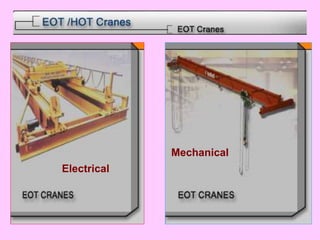
Electrical
Mechanical
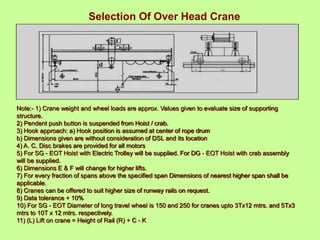
Note:- 1) Crane weight and wheel loads are approx. Values given to evaluate size of supporting
structure.
2) Pendent push button is suspended from Hoist / crab.
3) Hook approach: a) Hook position is assumed at center of rope drum
b) Dimensions given are without consideration of DSL and its location
4) A. C. Disc brakes are provided for all motors
5) For SG - EOT Hoist with Electric Trolley will be supplied. For DG - EOT Hoist with crab assembly
will be supplied.
6) Dimensions E & F will change for higher lifts.
7) For every fraction of spans above the specified span Dimensions of nearest higher span shall be
applicable.
8) Cranes can be offered to suit higher size of runway rails on request.
9) Data tolerance + 10%
10) For SG - EOT Diameter of long travel wheel is 150 and 250 for cranes upto 3Tx12 mtrs. and 5Tx3
mtrs to 10T x 12 mtrs. respectively.
11) (L) Lift on crane = Height of Rail (R) + C - K
Selection Of Over Head Crane
@ An overhead crane
operator’s job is very
important
@ Employers and employees need to be
aware that all cranes are different and may
have specific operating, safety, inspection and
maintenance requirements.
@ It is essential that you have the
manufacturers operating manuals
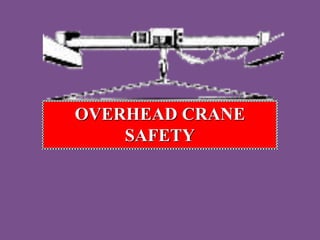
OVERHEAD CRANE
SAFETY
OVERHEAD AND GANTRY CRANE
OPERATION
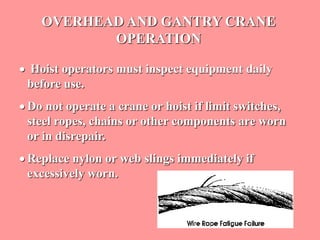
 Hoist operators must inspect equipment daily
before use.
 Do not operate a crane or hoist if limit switches,
steel ropes, chains or other components are worn
or in disrepair.
 Replace nylon or web slings immediately if
excessively worn.
OVERHEAD AND GANTRY CRANE
OPERATION
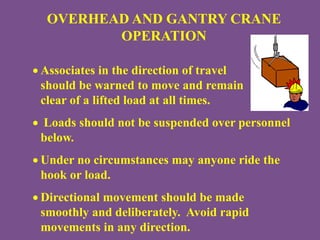
 Associates in the direction of travel
should be warned to move and remain
clear of a lifted load at all times.
 Loads should not be suspended over personnel
below.
 Under no circumstances may anyone ride the
hook or load.
 Directional movement should be made
smoothly and deliberately. Avoid rapid
movements in any direction.
OVERHEAD AND GANTRY CRANE
OPERATION
 Do not exceed the rated load
capacity of the crane, hoist,
chain, cable, slings, or other
component.
 Slings, load chains and other lifting devices must
be fully and securely seated in the hook before
moving a load. Remove slack from the sling,
chain, or cable before lifting a load.
OVERHEAD AND GANTRY CRANE
OPERATION
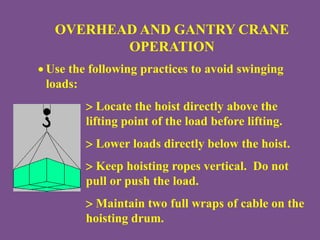
 Use the following practices to avoid swinging
loads:
 Locate the hoist directly above the
lifting point of the load before lifting.
 Lower loads directly below the hoist.
 Keep hoisting ropes vertical. Do not
pull or push the load.
 Maintain two full wraps of cable on the
hoisting drum.
OVERHEAD AND GANTRY CRANE
OPERATION
 When lifting loads at or near capacity, test the
hoist brakes by returning the master switch or
push button to the “OFF” position after raising
the load a few inches off the floor. If the brakes
do not hold, lower the load to the floor slowly and
do not operate the crane. Report the situation
immediately and DO NOT USE until repaired.
OVERHEAD AND GANTRY CRANE
OPERATION
 Ensure that all loads are lifted high enough to
clear obstructions before moving the bridge or
trolley. Whenever possible, maintain a minimum
clearance of one foot above loads and to the sides.
Raise the load only to the height necessary to
clear lower objects.
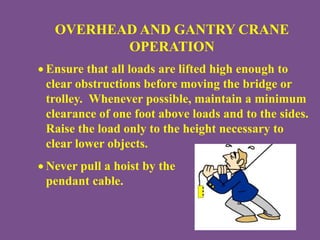
 Never pull a hoist by the
pendant cable.
OVERHEAD AND GANTRY CRANE
OPERATION
 Never leave the controls unattended while a load
is suspended. If it becomes necessary to leave the
controls, lower the load to the floor.
 Familiarize yourself with the location of the
disconnect switch.
 If loss of electrical power occurs, place controls
in the “OFF” position to prevent unexpected
startup upon restoration of power.
OVERHEAD AND GANTRY CRANE
OPERATION
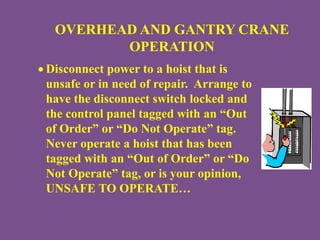
 Disconnect power to a hoist that is
unsafe or in need of repair. Arrange to
have the disconnect switch locked and
the control panel tagged with an “Out
of Order” or “Do Not Operate” tag.
Never operate a hoist that has been
tagged with an “Out of Order” or “Do
Not Operate” tag, or is your opinion,
UNSAFE TO OPERATE…
HOISTS / CRANES
Daily Inspection Checklist
 Check for any loose or missing parts.
 Check end stops. End stops prevent the
trolley from running off the beam.
 Know the location of disconnect
switch that will cut the power off
only to the hoist or crane. Be sure
it is readily accessible and not blocked.
HOISTS / CRANES
Daily Inspection Checklist
 Make sure all control buttons are
labeled to indicate their function.
Operate each button to make sure
it functions properly, releases
immediately, and does not stick.
N
W
S
E
 Check upper hoist limit switch by slowly raising
the block to trip the switch.
 Lower the hoist block to activate the lower limit
switch if the hoist is so equipped, leaving at least
one turn of rope on the take-up drum.
HOISTS / CRANES
Daily Inspection Checklist
 Make sure wire rope is properly seated in its
drum and sheave grooves without any slack or
overlapping.
 Operate the crane or hoist several feet in each
direction that it travels. Listen for any unusual
noises. Look for any jerky movements.
 When moving an A frame hoist, take care to
ensure that the wheels on each side stay on the
track.
HOISTS / CRANES
Daily Inspection Checklist
 Check all hooks. Hooks should not be cracked,
stretched, bent, or twisted. Each hook must have
a safety latch that automatically closes the
throat of the hook. If the latch is bent, spring is
broken, or is otherwise damaged the latch must
be repaired before use. Hooks should rotate
freely in block assembly without any “grinding”
felt or heard.
HOISTS / CRANES
Daily Inspection Checklist
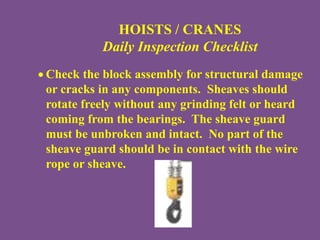
 Check the block assembly for structural damage
or cracks in any components. Sheaves should
rotate freely without any grinding felt or heard
coming from the bearings. The sheave guard
must be unbroken and intact. No part of the
sheave guard should be in contact with the wire
rope or sheave.
HOISTS / CRANES
Daily Inspection Checklist
 Check the wire rope by lowering the block to the
lowest level and looking for the following conditions.
If any of these conditions are observed, they should be
reported immediately.
 Reduced diameter of the rope. This may indicate
the rope has been stretched, has lost its inner core
support, or has worn outside wires.
 Any number of broken strands of wires.
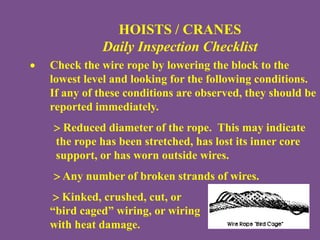
 Kinked, crushed, cut, or
“bird caged” wiring, or wiring
with heat damage.
HOISTS / CRANES
Daily Inspection Checklist
 Check load chain for damage, wear at contact
points, cracks, or distorted (bent, twisted, or
stretched) links. Inspect all mechanical coupling
links to insure linking pins are secure and in good
condition. Report unsafe conditions immediately.
HOISTS / CRANES
Daily Inspection Checklist
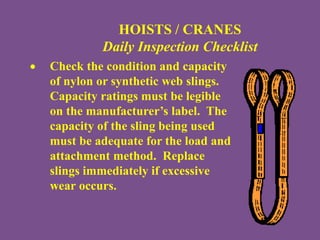
 Check the condition and capacity
of nylon or synthetic web slings.
Capacity ratings must be legible
on the manufacturer’s label. The
capacity of the sling being used
must be adequate for the load and
attachment method. Replace
slings immediately if excessive
wear occurs.
@ The minimum qualifications for an
employee selected to operate a crane are as
follows:
* Corrected vision
* Effective use of all 4 limbs
* Sufficient height to operate the controls & in
to the working area.
* coordination between eyes, hands, and feet.
* Be free of known convulsive disorders and
episodes of unconsciousness.
* Every 3 Year medical Fitness Check up is
necessary
Sample Permit
CRANE OPERATOR PERMIT
(Firm Name)
Operator’s Name:
Operator’s Number:
Is Authorized To Operate: (Insert Type of crane/Crane(s) Authorized)
Restrictions: (Explanation of Restrictions)
Date Issued: (Month-Day-Year
Date Expiring (Month-Day-Year)
By Issuing Authority: _______________________________________________
Title
Personal Protective Equipment
Head Protection
PROPER
CLOTHING &
DRESS
Safety Foot
Wear
Hearing Protection
Face Protection
Hand Protection
Respirators
Fall Protection
Special Clothing
Shift/Operator Inspection Checks
Inspection Item Description of Inspection Check Points
Tagged Crane or Hoist Check that crane or hoist is not tagged with an out-of-order sign.
Control Devices Test run that all motions agree with control device markings.
Brakes Check that all motions do not have excessive drift and that stopping distances are
normal
Hook Check for damage, cracks, nicks, gouges, deformations of the throat opening, wear
on saddle or load bearing point, and twist. Refer to the manual furnished by the
original manufacturer of the crane.
Hook Latch If a hook latch is required, check for proper operation.
Wire Rope Check for broken wires, broken strands, kinks, and any deformation or damage to the
rope structure.
Revving Check that the wire rope is properly revved and that rope parts are not twisted about
each other.
Limit Switches Check that the upper limit device stops lifting motion of the hoist load block before
striking any part of the hoist or crane.
Oil Leakage Check for any sign of oil leakage on the crane and on the floor area beneath the
crane.
Unusual Sounds Check for any unusual sounds from the crane or hoist mechanism while operating the
crane or hoist
Warning and Safety Labels Check that warning and other safety labels are not missing and that they are legible.
Housekeeping and Lighting Check area for accumulation of material, trip or slip hazards, and poor lighting
@ A hoisting limit switch on a crane or hoisting device
must not be used as an operating control unless the
crane is also equipped with a backup limit switch.
Operating Points
@ A load must not be lowered below a point where less
than 2 full wraps of wire rope remain on the hoisting
drum.
@ If there is doubt, safety of a crane or hoisting, the
operator must immediately stop the crane and report the
condition creating the doubt to the supervisor.
@ An operator must only respond to signals from the
employee directing the lift
@ Compressed gases can only be lifted by a cradle or
enclosed platform.
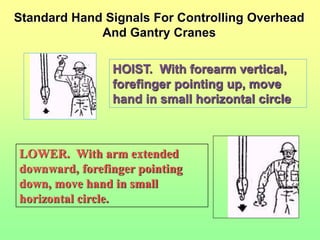
Standard Hand Signals For Controlling Overhead
And Gantry Cranes
HOIST. With forearm vertical,
forefinger pointing up, move
hand in small horizontal circle
LOWER. With arm extended
downward, forefinger pointing
down, move hand in small
horizontal circle.
Standard Hand Signals For Controlling Overhead
And Gantry Cranes
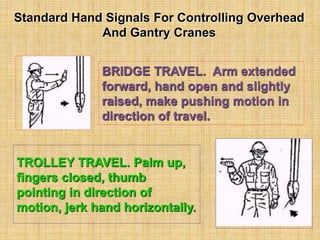
BRIDGE TRAVEL. Arm extended
forward, hand open and slightly
raised, make pushing motion in
direction of travel.
TROLLEY TRAVEL. Palm up,
fingers closed, thumb
pointing in direction of
motion, jerk hand horizontally.
Standard Hand Signals For Controlling Overhead
And Gantry Cranes
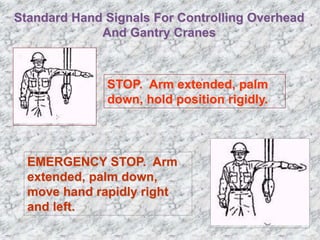
STOP. Arm extended, palm
down, hold position rigidly.
EMERGENCY STOP. Arm
extended, palm down,
move hand rapidly right
and left.
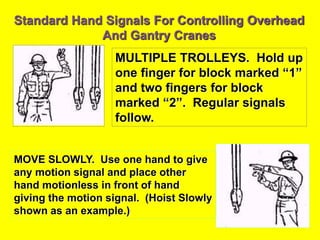
Standard Hand Signals For Controlling Overhead
And Gantry Cranes
MULTIPLE TROLLEYS. Hold up
one finger for block marked “1”
and two fingers for block
marked “2”. Regular signals
follow.
MOVE SLOWLY. Use one hand to give
any motion signal and place other
hand motionless in front of hand
giving the motion signal. (Hoist Slowly
shown as an example.)
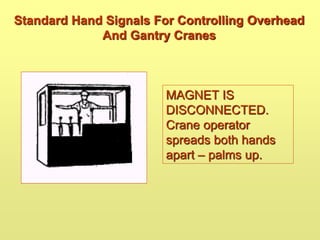
Standard Hand Signals For Controlling Overhead
And Gantry Cranes
MAGNET IS
DISCONNECTED.
Crane operator
spreads both hands
apart – palms up.
Inspection
The inspection procedure for cranes in regular
service is divided into 2 general classifications:
@ Monthly to quarterly or at intervals of 100
hours of use, whichever comes first.
@ Annually or at intervals of 500 hours of use,
whichever comes first.
The inspections cover topics outlined in
the standard or manufacturers guidelines.
Maintenance
# A preventative maintenance program will be
established and the program will be based on the
manufacturer’s recommendations
# Application is reviewed by a qualified person.
Before adjustments or repairs are made on a
crane, all of the following precautions must be
taken:
1. The crane will be moved to a location where
it will cause the least interference with other
moving equipment on the track or rails and
operations in the area.
2. Controllers will be placed in the “off” position.
3. The main switch will be placed in the “off”
position or “open” position and LOCKED OUT,
except where power is necessary to adjust or
service the crane
4. A warning sign or “out of order” sign will be
placed at the operator control station.
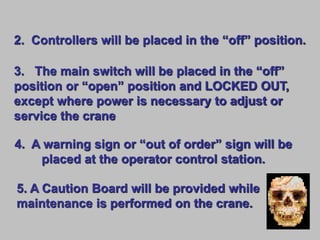
5. A Caution Board will be provided while
maintenance is performed on the crane.
In the event of power failure
@ The operator must place all controllers in the “off”
position.
@ When an operator leaves a crane unattended he
must land any attached load.
@ Place the controllers in the “off” position, and open
the main switch.
@ Before closing a main switch the operator must
make sure all controllers are in the “off” position.
@ The main switch does not need to be opened on a
pendant-controlled crane if the crane is left unattended
for short periods.
VIJAY VYAS

overhead_crane_operator_safety_manual.ppt

  • 1.
  • 2.
  • 3.
    Note:- 1) Craneweight and wheel loads are approx. Values given to evaluate size of supporting structure. 2) Pendent push button is suspended from Hoist / crab. 3) Hook approach: a) Hook position is assumed at center of rope drum b) Dimensions given are without consideration of DSL and its location 4) A. C. Disc brakes are provided for all motors 5) For SG - EOT Hoist with Electric Trolley will be supplied. For DG - EOT Hoist with crab assembly will be supplied. 6) Dimensions E & F will change for higher lifts. 7) For every fraction of spans above the specified span Dimensions of nearest higher span shall be applicable. 8) Cranes can be offered to suit higher size of runway rails on request. 9) Data tolerance + 10% 10) For SG - EOT Diameter of long travel wheel is 150 and 250 for cranes upto 3Tx12 mtrs. and 5Tx3 mtrs to 10T x 12 mtrs. respectively. 11) (L) Lift on crane = Height of Rail (R) + C - K Selection Of Over Head Crane
  • 4.
    @ An overheadcrane operator’s job is very important @ Employers and employees need to be aware that all cranes are different and may have specific operating, safety, inspection and maintenance requirements. @ It is essential that you have the manufacturers operating manuals
  • 5.
  • 6.
    OVERHEAD AND GANTRYCRANE OPERATION  Hoist operators must inspect equipment daily before use.  Do not operate a crane or hoist if limit switches, steel ropes, chains or other components are worn or in disrepair.  Replace nylon or web slings immediately if excessively worn.
  • 7.
    OVERHEAD AND GANTRYCRANE OPERATION  Associates in the direction of travel should be warned to move and remain clear of a lifted load at all times.  Loads should not be suspended over personnel below.  Under no circumstances may anyone ride the hook or load.  Directional movement should be made smoothly and deliberately. Avoid rapid movements in any direction.
  • 8.
    OVERHEAD AND GANTRYCRANE OPERATION  Do not exceed the rated load capacity of the crane, hoist, chain, cable, slings, or other component.  Slings, load chains and other lifting devices must be fully and securely seated in the hook before moving a load. Remove slack from the sling, chain, or cable before lifting a load.
  • 9.
    OVERHEAD AND GANTRYCRANE OPERATION  Use the following practices to avoid swinging loads:  Locate the hoist directly above the lifting point of the load before lifting.  Lower loads directly below the hoist.  Keep hoisting ropes vertical. Do not pull or push the load.  Maintain two full wraps of cable on the hoisting drum.
  • 10.
    OVERHEAD AND GANTRYCRANE OPERATION  When lifting loads at or near capacity, test the hoist brakes by returning the master switch or push button to the “OFF” position after raising the load a few inches off the floor. If the brakes do not hold, lower the load to the floor slowly and do not operate the crane. Report the situation immediately and DO NOT USE until repaired.
  • 11.
    OVERHEAD AND GANTRYCRANE OPERATION  Ensure that all loads are lifted high enough to clear obstructions before moving the bridge or trolley. Whenever possible, maintain a minimum clearance of one foot above loads and to the sides. Raise the load only to the height necessary to clear lower objects.  Never pull a hoist by the pendant cable.
  • 12.
    OVERHEAD AND GANTRYCRANE OPERATION  Never leave the controls unattended while a load is suspended. If it becomes necessary to leave the controls, lower the load to the floor.  Familiarize yourself with the location of the disconnect switch.  If loss of electrical power occurs, place controls in the “OFF” position to prevent unexpected startup upon restoration of power.
  • 13.
    OVERHEAD AND GANTRYCRANE OPERATION  Disconnect power to a hoist that is unsafe or in need of repair. Arrange to have the disconnect switch locked and the control panel tagged with an “Out of Order” or “Do Not Operate” tag. Never operate a hoist that has been tagged with an “Out of Order” or “Do Not Operate” tag, or is your opinion, UNSAFE TO OPERATE…
  • 14.
    HOISTS / CRANES DailyInspection Checklist  Check for any loose or missing parts.  Check end stops. End stops prevent the trolley from running off the beam.  Know the location of disconnect switch that will cut the power off only to the hoist or crane. Be sure it is readily accessible and not blocked.
  • 15.
    HOISTS / CRANES DailyInspection Checklist  Make sure all control buttons are labeled to indicate their function. Operate each button to make sure it functions properly, releases immediately, and does not stick. N W S E  Check upper hoist limit switch by slowly raising the block to trip the switch.  Lower the hoist block to activate the lower limit switch if the hoist is so equipped, leaving at least one turn of rope on the take-up drum.
  • 16.
    HOISTS / CRANES DailyInspection Checklist  Make sure wire rope is properly seated in its drum and sheave grooves without any slack or overlapping.  Operate the crane or hoist several feet in each direction that it travels. Listen for any unusual noises. Look for any jerky movements.  When moving an A frame hoist, take care to ensure that the wheels on each side stay on the track.
  • 17.
    HOISTS / CRANES DailyInspection Checklist  Check all hooks. Hooks should not be cracked, stretched, bent, or twisted. Each hook must have a safety latch that automatically closes the throat of the hook. If the latch is bent, spring is broken, or is otherwise damaged the latch must be repaired before use. Hooks should rotate freely in block assembly without any “grinding” felt or heard.
  • 18.
    HOISTS / CRANES DailyInspection Checklist  Check the block assembly for structural damage or cracks in any components. Sheaves should rotate freely without any grinding felt or heard coming from the bearings. The sheave guard must be unbroken and intact. No part of the sheave guard should be in contact with the wire rope or sheave.
  • 19.
    HOISTS / CRANES DailyInspection Checklist  Check the wire rope by lowering the block to the lowest level and looking for the following conditions. If any of these conditions are observed, they should be reported immediately.  Reduced diameter of the rope. This may indicate the rope has been stretched, has lost its inner core support, or has worn outside wires.  Any number of broken strands of wires.  Kinked, crushed, cut, or “bird caged” wiring, or wiring with heat damage.
  • 20.
    HOISTS / CRANES DailyInspection Checklist  Check load chain for damage, wear at contact points, cracks, or distorted (bent, twisted, or stretched) links. Inspect all mechanical coupling links to insure linking pins are secure and in good condition. Report unsafe conditions immediately.
  • 21.
    HOISTS / CRANES DailyInspection Checklist  Check the condition and capacity of nylon or synthetic web slings. Capacity ratings must be legible on the manufacturer’s label. The capacity of the sling being used must be adequate for the load and attachment method. Replace slings immediately if excessive wear occurs.
  • 22.
    @ The minimumqualifications for an employee selected to operate a crane are as follows: * Corrected vision * Effective use of all 4 limbs * Sufficient height to operate the controls & in to the working area. * coordination between eyes, hands, and feet. * Be free of known convulsive disorders and episodes of unconsciousness. * Every 3 Year medical Fitness Check up is necessary
  • 23.
    Sample Permit CRANE OPERATORPERMIT (Firm Name) Operator’s Name: Operator’s Number: Is Authorized To Operate: (Insert Type of crane/Crane(s) Authorized) Restrictions: (Explanation of Restrictions) Date Issued: (Month-Day-Year Date Expiring (Month-Day-Year) By Issuing Authority: _______________________________________________ Title
  • 24.
    Personal Protective Equipment HeadProtection PROPER CLOTHING & DRESS Safety Foot Wear Hearing Protection Face Protection Hand Protection Respirators Fall Protection Special Clothing
  • 25.
    Shift/Operator Inspection Checks InspectionItem Description of Inspection Check Points Tagged Crane or Hoist Check that crane or hoist is not tagged with an out-of-order sign. Control Devices Test run that all motions agree with control device markings. Brakes Check that all motions do not have excessive drift and that stopping distances are normal Hook Check for damage, cracks, nicks, gouges, deformations of the throat opening, wear on saddle or load bearing point, and twist. Refer to the manual furnished by the original manufacturer of the crane. Hook Latch If a hook latch is required, check for proper operation. Wire Rope Check for broken wires, broken strands, kinks, and any deformation or damage to the rope structure. Revving Check that the wire rope is properly revved and that rope parts are not twisted about each other. Limit Switches Check that the upper limit device stops lifting motion of the hoist load block before striking any part of the hoist or crane. Oil Leakage Check for any sign of oil leakage on the crane and on the floor area beneath the crane. Unusual Sounds Check for any unusual sounds from the crane or hoist mechanism while operating the crane or hoist Warning and Safety Labels Check that warning and other safety labels are not missing and that they are legible. Housekeeping and Lighting Check area for accumulation of material, trip or slip hazards, and poor lighting
  • 26.
    @ A hoistinglimit switch on a crane or hoisting device must not be used as an operating control unless the crane is also equipped with a backup limit switch. Operating Points @ A load must not be lowered below a point where less than 2 full wraps of wire rope remain on the hoisting drum. @ If there is doubt, safety of a crane or hoisting, the operator must immediately stop the crane and report the condition creating the doubt to the supervisor. @ An operator must only respond to signals from the employee directing the lift @ Compressed gases can only be lifted by a cradle or enclosed platform.
  • 27.
    Standard Hand SignalsFor Controlling Overhead And Gantry Cranes HOIST. With forearm vertical, forefinger pointing up, move hand in small horizontal circle LOWER. With arm extended downward, forefinger pointing down, move hand in small horizontal circle.
  • 28.
    Standard Hand SignalsFor Controlling Overhead And Gantry Cranes BRIDGE TRAVEL. Arm extended forward, hand open and slightly raised, make pushing motion in direction of travel. TROLLEY TRAVEL. Palm up, fingers closed, thumb pointing in direction of motion, jerk hand horizontally.
  • 29.
    Standard Hand SignalsFor Controlling Overhead And Gantry Cranes STOP. Arm extended, palm down, hold position rigidly. EMERGENCY STOP. Arm extended, palm down, move hand rapidly right and left.
  • 30.
    Standard Hand SignalsFor Controlling Overhead And Gantry Cranes MULTIPLE TROLLEYS. Hold up one finger for block marked “1” and two fingers for block marked “2”. Regular signals follow. MOVE SLOWLY. Use one hand to give any motion signal and place other hand motionless in front of hand giving the motion signal. (Hoist Slowly shown as an example.)
  • 31.
    Standard Hand SignalsFor Controlling Overhead And Gantry Cranes MAGNET IS DISCONNECTED. Crane operator spreads both hands apart – palms up.
  • 32.
    Inspection The inspection procedurefor cranes in regular service is divided into 2 general classifications: @ Monthly to quarterly or at intervals of 100 hours of use, whichever comes first. @ Annually or at intervals of 500 hours of use, whichever comes first. The inspections cover topics outlined in the standard or manufacturers guidelines.
  • 33.
    Maintenance # A preventativemaintenance program will be established and the program will be based on the manufacturer’s recommendations # Application is reviewed by a qualified person. Before adjustments or repairs are made on a crane, all of the following precautions must be taken: 1. The crane will be moved to a location where it will cause the least interference with other moving equipment on the track or rails and operations in the area.
  • 34.
    2. Controllers willbe placed in the “off” position. 3. The main switch will be placed in the “off” position or “open” position and LOCKED OUT, except where power is necessary to adjust or service the crane 4. A warning sign or “out of order” sign will be placed at the operator control station. 5. A Caution Board will be provided while maintenance is performed on the crane.
  • 35.
    In the eventof power failure @ The operator must place all controllers in the “off” position. @ When an operator leaves a crane unattended he must land any attached load. @ Place the controllers in the “off” position, and open the main switch. @ Before closing a main switch the operator must make sure all controllers are in the “off” position. @ The main switch does not need to be opened on a pendant-controlled crane if the crane is left unattended for short periods.
  • 36.