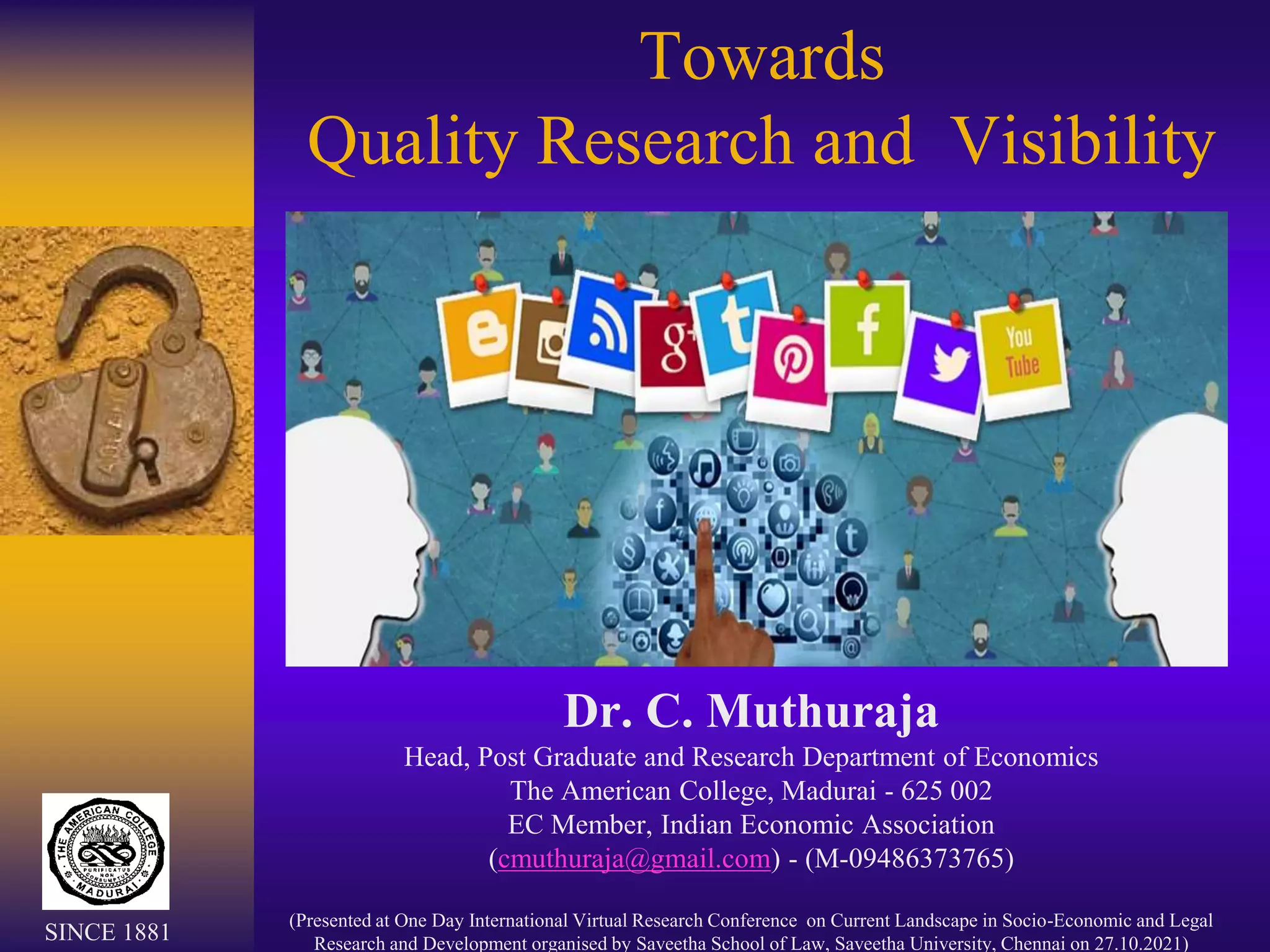
Towards
Quality Research and Visibility
Dr. C. Muthuraja
Head, Post Graduate and Research Department of Economics
The American College, Madurai - 625 002
EC Member, Indian Economic Association
(cmuthuraja@gmail.com) - (M-09486373765)
(Presented at One Day International Virtual Research Conference on Current Landscape in Socio-Economic and Legal
Research and Development organised by Saveetha School of Law, Saveetha University, Chennai on 27.10.2021)
SINCE 1881
Quality Research
 Scientific process including all aspects of study
design.
 Relates to the judgment regarding the match between
the methods and questions, selection of subjects,
measurement of outcomes, and protection against
systematic and nonsystematic bias
 Enlightens crucial decisions on the funding of
projects, teams and whole institutions, on how
research is conducted, on recruitment and promotion,
on what is published or disseminated, and on what
researchers and others choose to read.
 Makes trust in the work of the research community.
 Research investigates ideas and uncovers useful
knowledge.
SINCE 1881
Uniqueness of Quality Research
 Based on some logical rationale and tied to theory.
 Generates new questions or is cyclical in nature.
 Based on the work of others.
 Provides evidence that is robust, ethical, stands up to
scrutiny
 Can be replicated and achievable.
 Generalisable to other settings.
 Incremental.
 Can be used to inform policy making
 Contributes to that strand/topic of research and follows on
from what the current literature has developed
 Clarity in presentation, data use, data handling, data
sources
 Peer review is incredibly important
SINCE 1881
Research and Researcher…
Workload & Freedom-Teaching +++
Academic Curriculum
Co / Extra Curriculum
Research Resources / Facilities
Research Promotions
Research & T L E
Research Publications
Voluntary vs Compulsion
 Recognitions ? + + + + +
SINCE 1881
Research Can Help Teachers…
 To understand what works and why,
 What the short and long-term implications
are,
 Provide a justification and rationale for
decisions and actions,
 Help to build a repertoire to help deal with
the unexpected,
 Identify problems,
 Inform improvement and
 + + +
SINCE 1881
Research & Teacher
 Teaching does involve creative thinking and
experimentation
 Individuals and professional groups need to know
what works and why
 Teacher’s actions lead to improved students
performance, increased motivation, commitment,
better behavior
 The profession as a whole needs access to a range
of data/evidence types
 These all need to be connected, and too often
research is conducted in isolation of others
 Teachers can adapt it to fit the individual needs of
their own students
SINCE 1881
Research & Teacher
 Teachers are accountable - The public must have
faith in the profession – performance can be
demonstrated through the publication of research
findings
 Teachers project their own personality upon
learning experiences
 Research give teachers the tools to analyze and
make informed decisions about their practice
 Research helps teachers to share with colleagues
 Research - future oriented and designed to benefit
learners rather than the researchers themselves
 Research is the duty of academic professionals
everywhere
SINCE 1881
Research Visibility
Research(er) must linked with
 Teaching
 Learning / Unlearning
 Evaluation
 Publications
 Presentations @ Conference/Seminar/Workshop
 Network
 Consultancy
 Documentation
 Media Sharing : Mass/Social Media + + + &
 Research (Further)
SINCE 1881
Resources for Research
 Fellowships
 Scholarships
 Institutional Support
 Government Initiatives
 UGC / ICSSR / DST / CSIR / + + +
 International Institutions: World Bank / OECD /
WTO / WHO /+ + +
 Research Associations: IEA / NSC / ISSC/+ + +
 Foreign Governments
 Collaborative / Contributory
 Own Effort
 Other Sources
SINCE 1881
PINK TO THINK
 Research Projects
 Research Publications
 Books : In-house / Commercial
 Articles/ Research Notes: Printed / e-way
 ISSN (International Standard Serial Number), ISBN (International Standard Book
Number), Citation Index, Impact Factor ….
 Reports and Projects
 Conferences/Workshops/Seminar: Organized / Participated /
Presented
 Professional Membership
 Editorship / Member in Editorial Board / Consultancy
 Social / Environmental Activism
 Research Collaboration
 Media Sharing
 Others
SINCE 1881
IMPROVING
RESEARCH VISIBILITY
 Expand your co-authorship base
 Select your title and keywords wisely
 Make your articles open access
 Effective use of online Social Media
 Create and share podcasts (an audio or video file in
digital format for automatic download over the Internet)
 Sharing research outputs other than the manuscript
 Create a personal blog
 Get a unique author identifier ORCID to distinguish
yourself and your work from other researchers
 Other tools for dissemination - Kudos (Oxford, UK)
(https://www.growkudos.com/) and Impact Story
(https://impactstory.org/)
SINCE 1881
Steps for Increasing Visibility
 Get a Researcher ID – connect your publications
 Share your publications with different audiences
– Check copyright of publications
– Post online using appropriate tools
 Engage with others (academic, public, media)
 Establish a researcher ID-persistent digital identifier for
you links all your publications
– ORCID http://orcid.org/
– Researcher ID http://www.researcherid.com
Build Online Profiles
 Google Scholar profile
 Author profiles - publisher sites
 Faculty website - link publications
SINCE 1881
Share and Engage
with Scholarly Communities
Connect - Collaborate - Share
 Reference managers - Persona based on scholarly reading,
share bibliographies
 Social media - Connects you - your research to different
communities within & beyond academia
Some online communities
 Academia – multi-disciplinary community, track usage and
discover
 ResearchGate – heavily science based –collaboration ask
questions, follow others
 Labroots - scientific -producer of educational virtual
community conversations
 Reference managers and more…
Mendeley, Zotero …Tools for researchers blog
SINCE 1881
Why Use Social Media
YOUR RESEARCH
 Connects you - your research to different communities within &
beyond academia
 Facilitating knowledge translation post-publication
 Invites varying perspectives and uses
 Broader uses and access increases impact of research
YOU AS A RESEARCHER
 Meet people whom probably wouldn't have met
 Keep up to date on what’s happening in field
 Gives a voice to traditionally underrepresented groups
 Build network of colleagues for collaboration and support
Social Media Strategy
 Determine Goals – what are you looking to get out of activity
 Align goals with proper tool
 Be deliberate in the creation of your digital identity
 Separate professional and private accounts
 To measure impact , need to first clearly articulate aims and means
SINCE 1881
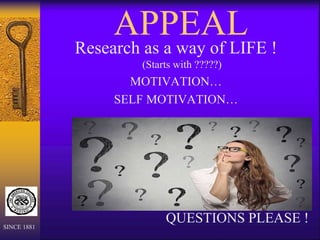
APPEAL
SINCE 1881
Research as a way of LIFE !
(Starts with ?????)
MOTIVATION…
SELF MOTIVATION…
QUESTIONS PLEASE !

Towards Quality Research and Visibility

  • 1.
    Towards Quality Research andVisibility Dr. C. Muthuraja Head, Post Graduate and Research Department of Economics The American College, Madurai - 625 002 EC Member, Indian Economic Association (cmuthuraja@gmail.com) - (M-09486373765) (Presented at One Day International Virtual Research Conference on Current Landscape in Socio-Economic and Legal Research and Development organised by Saveetha School of Law, Saveetha University, Chennai on 27.10.2021) SINCE 1881
  • 2.
    Quality Research  Scientificprocess including all aspects of study design.  Relates to the judgment regarding the match between the methods and questions, selection of subjects, measurement of outcomes, and protection against systematic and nonsystematic bias  Enlightens crucial decisions on the funding of projects, teams and whole institutions, on how research is conducted, on recruitment and promotion, on what is published or disseminated, and on what researchers and others choose to read.  Makes trust in the work of the research community.  Research investigates ideas and uncovers useful knowledge. SINCE 1881
  • 3.
    Uniqueness of QualityResearch  Based on some logical rationale and tied to theory.  Generates new questions or is cyclical in nature.  Based on the work of others.  Provides evidence that is robust, ethical, stands up to scrutiny  Can be replicated and achievable.  Generalisable to other settings.  Incremental.  Can be used to inform policy making  Contributes to that strand/topic of research and follows on from what the current literature has developed  Clarity in presentation, data use, data handling, data sources  Peer review is incredibly important SINCE 1881
  • 4.
    Research and Researcher… Workload& Freedom-Teaching +++ Academic Curriculum Co / Extra Curriculum Research Resources / Facilities Research Promotions Research & T L E Research Publications Voluntary vs Compulsion  Recognitions ? + + + + + SINCE 1881
  • 5.
    Research Can HelpTeachers…  To understand what works and why,  What the short and long-term implications are,  Provide a justification and rationale for decisions and actions,  Help to build a repertoire to help deal with the unexpected,  Identify problems,  Inform improvement and  + + + SINCE 1881
  • 6.
    Research & Teacher Teaching does involve creative thinking and experimentation  Individuals and professional groups need to know what works and why  Teacher’s actions lead to improved students performance, increased motivation, commitment, better behavior  The profession as a whole needs access to a range of data/evidence types  These all need to be connected, and too often research is conducted in isolation of others  Teachers can adapt it to fit the individual needs of their own students SINCE 1881
  • 7.
    Research & Teacher Teachers are accountable - The public must have faith in the profession – performance can be demonstrated through the publication of research findings  Teachers project their own personality upon learning experiences  Research give teachers the tools to analyze and make informed decisions about their practice  Research helps teachers to share with colleagues  Research - future oriented and designed to benefit learners rather than the researchers themselves  Research is the duty of academic professionals everywhere SINCE 1881
  • 8.
    Research Visibility Research(er) mustlinked with  Teaching  Learning / Unlearning  Evaluation  Publications  Presentations @ Conference/Seminar/Workshop  Network  Consultancy  Documentation  Media Sharing : Mass/Social Media + + + &  Research (Further) SINCE 1881
  • 9.
    Resources for Research Fellowships  Scholarships  Institutional Support  Government Initiatives  UGC / ICSSR / DST / CSIR / + + +  International Institutions: World Bank / OECD / WTO / WHO /+ + +  Research Associations: IEA / NSC / ISSC/+ + +  Foreign Governments  Collaborative / Contributory  Own Effort  Other Sources SINCE 1881
  • 10.
    PINK TO THINK Research Projects  Research Publications  Books : In-house / Commercial  Articles/ Research Notes: Printed / e-way  ISSN (International Standard Serial Number), ISBN (International Standard Book Number), Citation Index, Impact Factor ….  Reports and Projects  Conferences/Workshops/Seminar: Organized / Participated / Presented  Professional Membership  Editorship / Member in Editorial Board / Consultancy  Social / Environmental Activism  Research Collaboration  Media Sharing  Others SINCE 1881
  • 11.
    IMPROVING RESEARCH VISIBILITY  Expandyour co-authorship base  Select your title and keywords wisely  Make your articles open access  Effective use of online Social Media  Create and share podcasts (an audio or video file in digital format for automatic download over the Internet)  Sharing research outputs other than the manuscript  Create a personal blog  Get a unique author identifier ORCID to distinguish yourself and your work from other researchers  Other tools for dissemination - Kudos (Oxford, UK) (https://www.growkudos.com/) and Impact Story (https://impactstory.org/) SINCE 1881
  • 12.
    Steps for IncreasingVisibility  Get a Researcher ID – connect your publications  Share your publications with different audiences – Check copyright of publications – Post online using appropriate tools  Engage with others (academic, public, media)  Establish a researcher ID-persistent digital identifier for you links all your publications – ORCID http://orcid.org/ – Researcher ID http://www.researcherid.com Build Online Profiles  Google Scholar profile  Author profiles - publisher sites  Faculty website - link publications SINCE 1881
  • 13.
    Share and Engage withScholarly Communities Connect - Collaborate - Share  Reference managers - Persona based on scholarly reading, share bibliographies  Social media - Connects you - your research to different communities within & beyond academia Some online communities  Academia – multi-disciplinary community, track usage and discover  ResearchGate – heavily science based –collaboration ask questions, follow others  Labroots - scientific -producer of educational virtual community conversations  Reference managers and more… Mendeley, Zotero …Tools for researchers blog SINCE 1881
  • 14.
    Why Use SocialMedia YOUR RESEARCH  Connects you - your research to different communities within & beyond academia  Facilitating knowledge translation post-publication  Invites varying perspectives and uses  Broader uses and access increases impact of research YOU AS A RESEARCHER  Meet people whom probably wouldn't have met  Keep up to date on what’s happening in field  Gives a voice to traditionally underrepresented groups  Build network of colleagues for collaboration and support Social Media Strategy  Determine Goals – what are you looking to get out of activity  Align goals with proper tool  Be deliberate in the creation of your digital identity  Separate professional and private accounts  To measure impact , need to first clearly articulate aims and means SINCE 1881
  • 15.
    APPEAL SINCE 1881 Research asa way of LIFE ! (Starts with ?????) MOTIVATION… SELF MOTIVATION… QUESTIONS PLEASE !