Comparing use of Technology
Enhanced Learning in an on-campus
class and a distance learning class
Pamela McKinney
Pamela McKinney &
Sheila Webber
Information School
University of Sheffield
TELfest, July 2017
University of Sheffield Information School
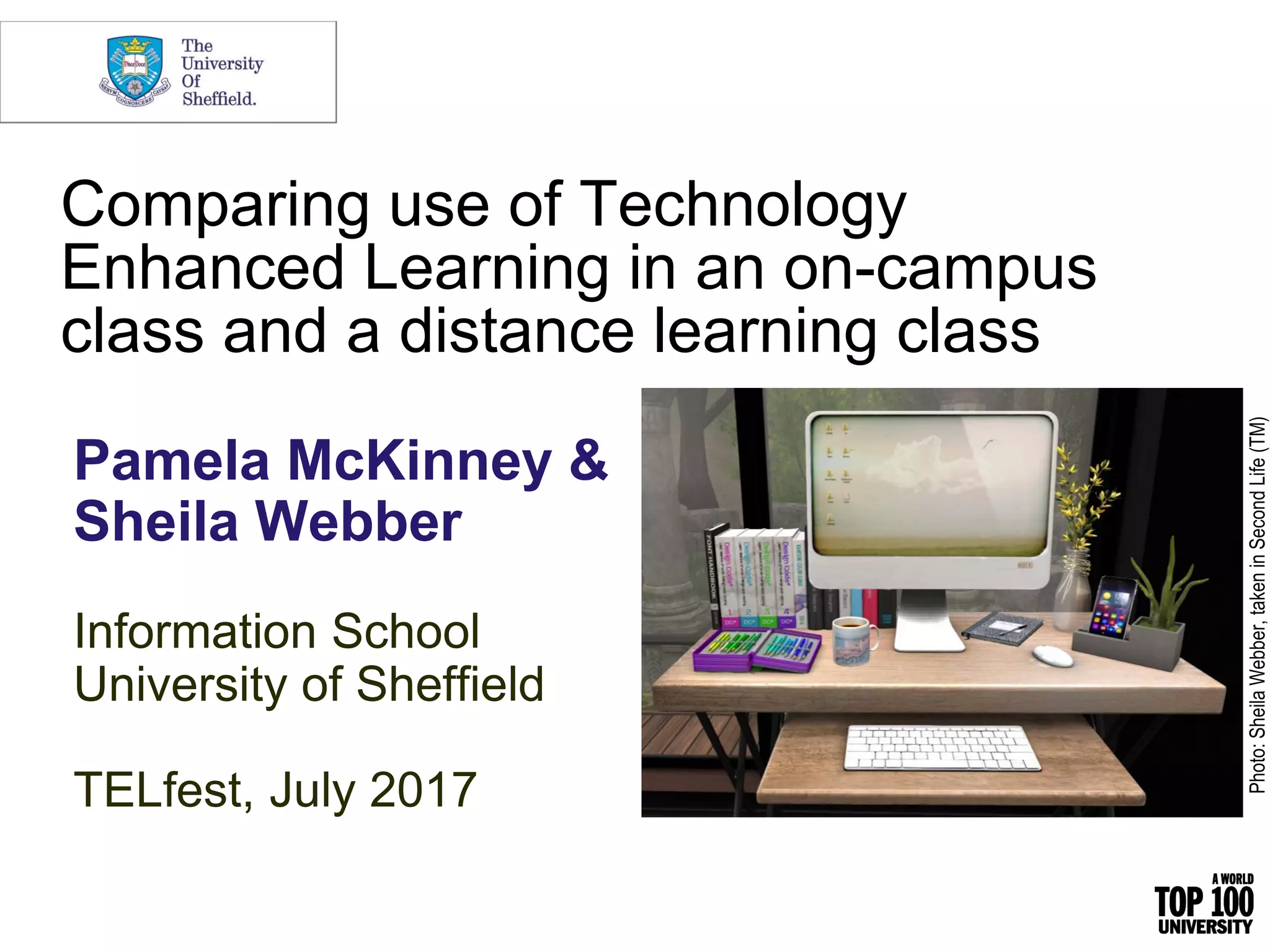
Photo:SheilaWebber,takeninSecondLife(TM)
Outline
• The module context
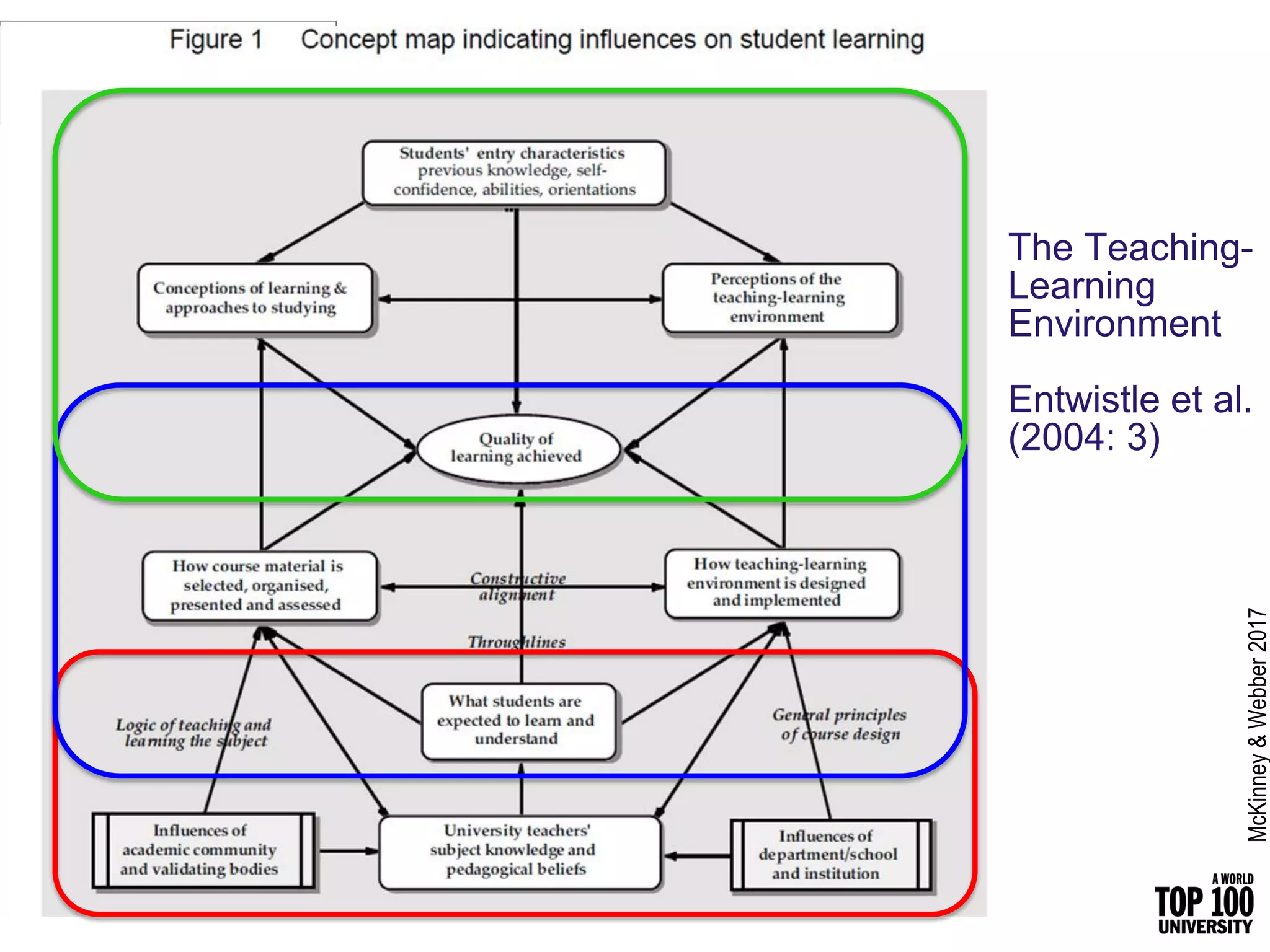
• Mapping the modules against Entwistle’s
et al. (2004) Teaching-learning
Environments model
• The principal TEL tools we use
• Example activity
• Student experience
• Conclusions
McKinney&Webber2017
The Information Literacy
modules
• Face-to-Face (F2F) and Distance Learning (DL course new in 2015)
running in tandem
• Learning aims:
• understand from both theoretical and practical perspectives the
concepts of information literacy and information behaviour;
• develop their own information literacy and understanding of its
application to their future lives;
• compare different approaches to teaching and demonstrate
awareness of implications for adopting different approaches to
teaching and learning;
• understand how the information environment is evolving,
including both traditional and new media, and the implications for
citizens’ information literacy; and
• develop practical skills in searching, evaluating and presenting
information.
McKinney&Webber2017
The development of the TLE
model
• ETL project Enhancing teaching-learning
environments in Undergraduate Courses
• 5 case studies in different disciplinary areas
• Gathered multi-institutional data and used
multiple data collection methods – from students
and from staff
McKinney&Webber2017
The Teaching-
Learning
Environment
Entwistle et al.
(2004: 3)
McKinney&Webber2017
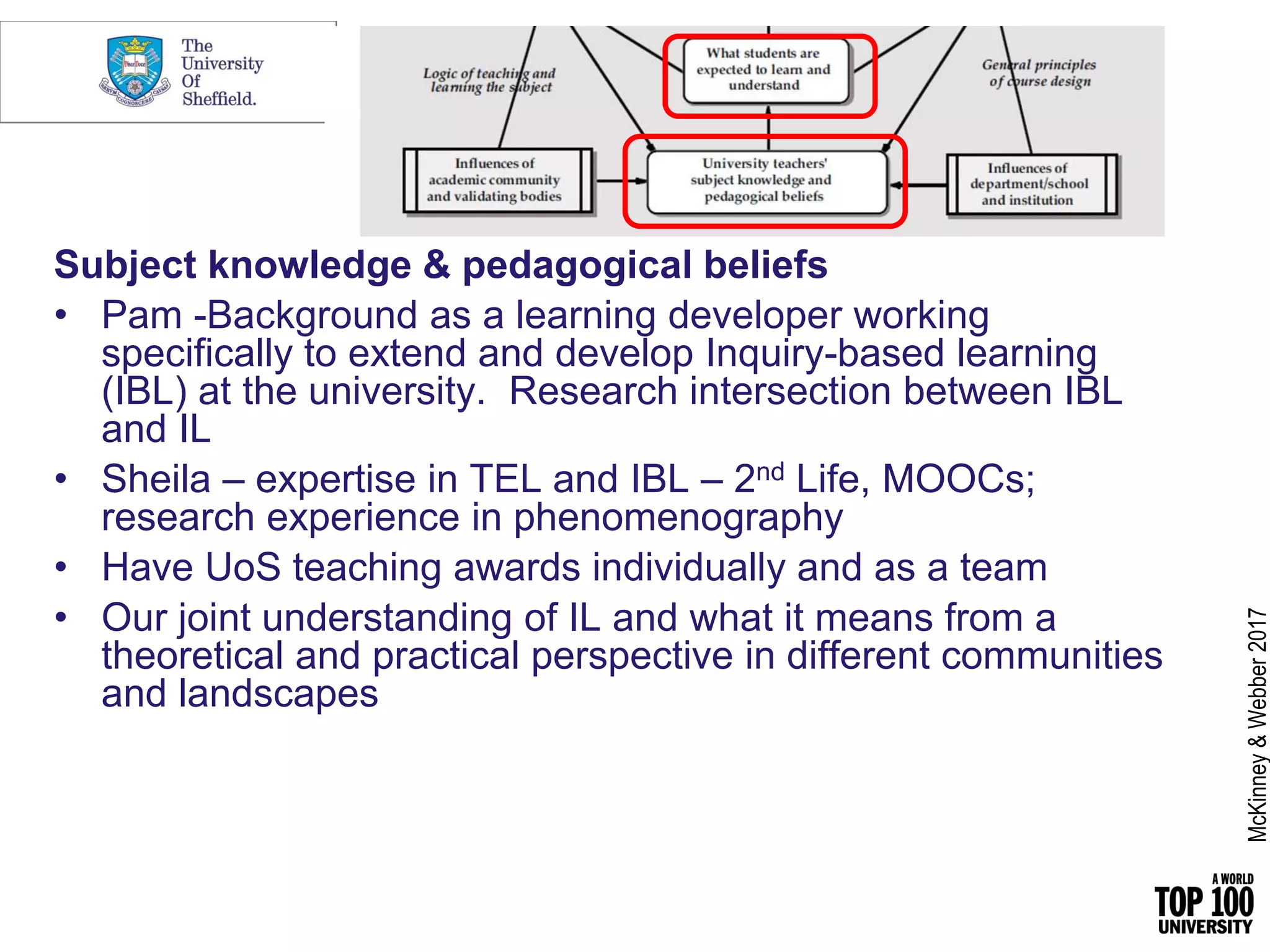
Subject knowledge & pedagogical beliefs
• Pam -Background as a learning developer working
specifically to extend and develop Inquiry-based learning
(IBL) at the university. Research intersection between IBL
and IL
• Sheila – expertise in TEL and IBL – 2nd Life, MOOCs;
research experience in phenomenography
• Have UoS teaching awards individually and as a team
• Our joint understanding of IL and what it means from a
theoretical and practical perspective in different communities
and landscapes
McKinney&Webber2017
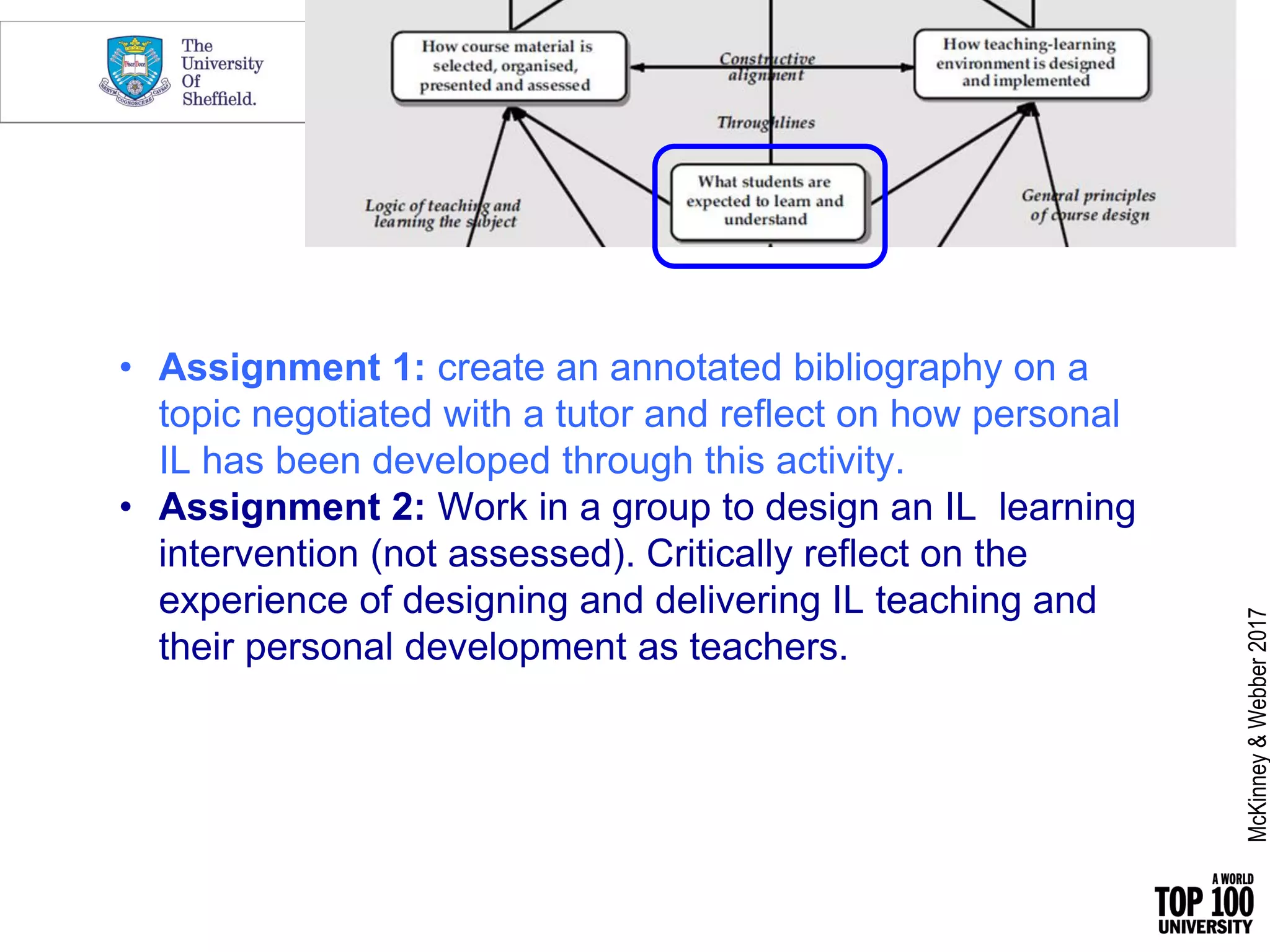
What students are expected to learn and understand
• Desire to bring about conceptual change in
students and not just “develop skills”.
• Develop a strong theoretical basis for their
teaching
McKinney&Webber2017
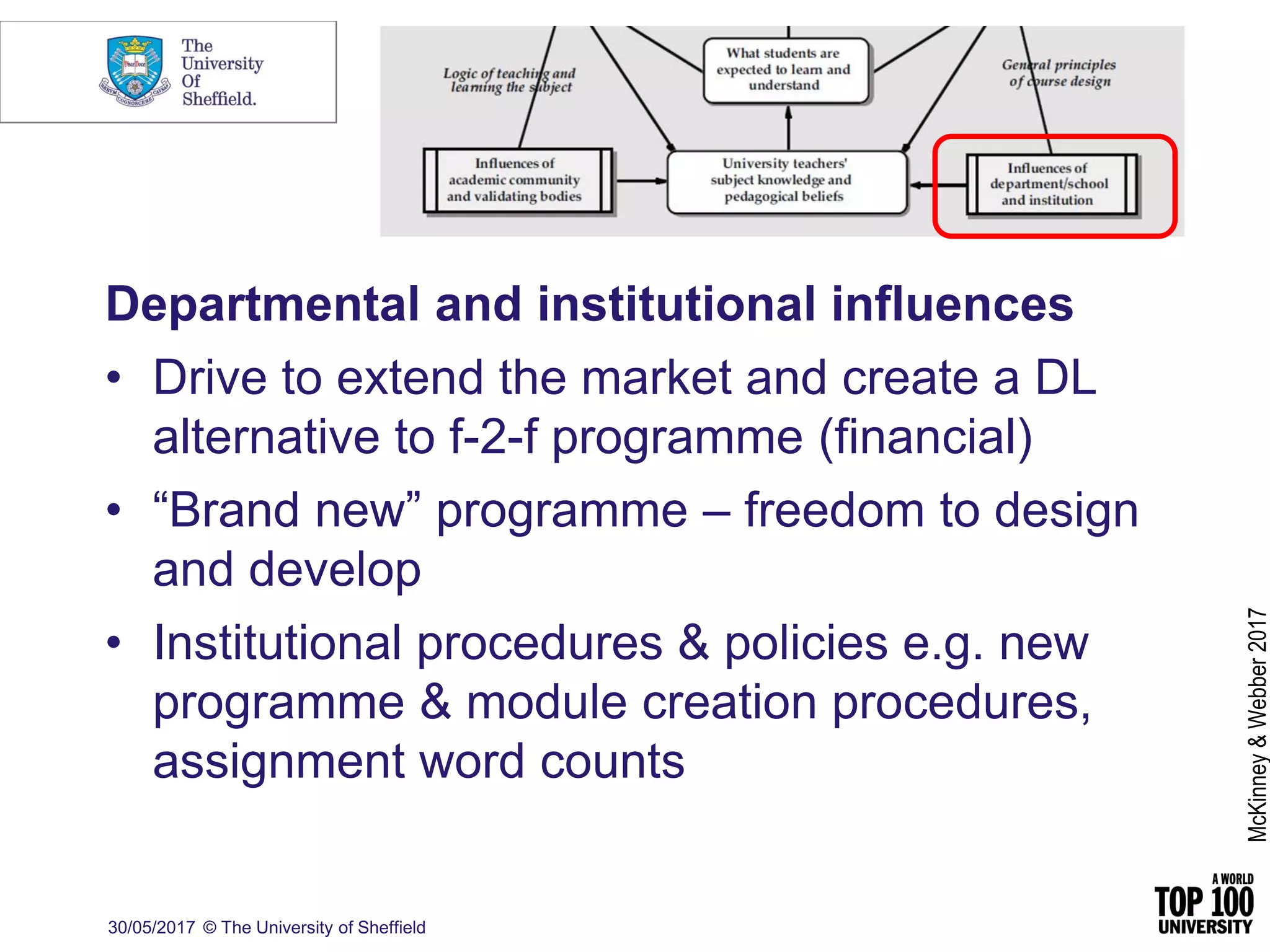
Departmental and institutional influences
• Drive to extend the market and create a DL
alternative to f-2-f programme (financial)
• “Brand new” programme – freedom to design
and develop
• Institutional procedures & policies e.g. new
programme & module creation procedures,
assignment word counts
30/05/2017 © The University of Sheffield
McKinney&Webber2017
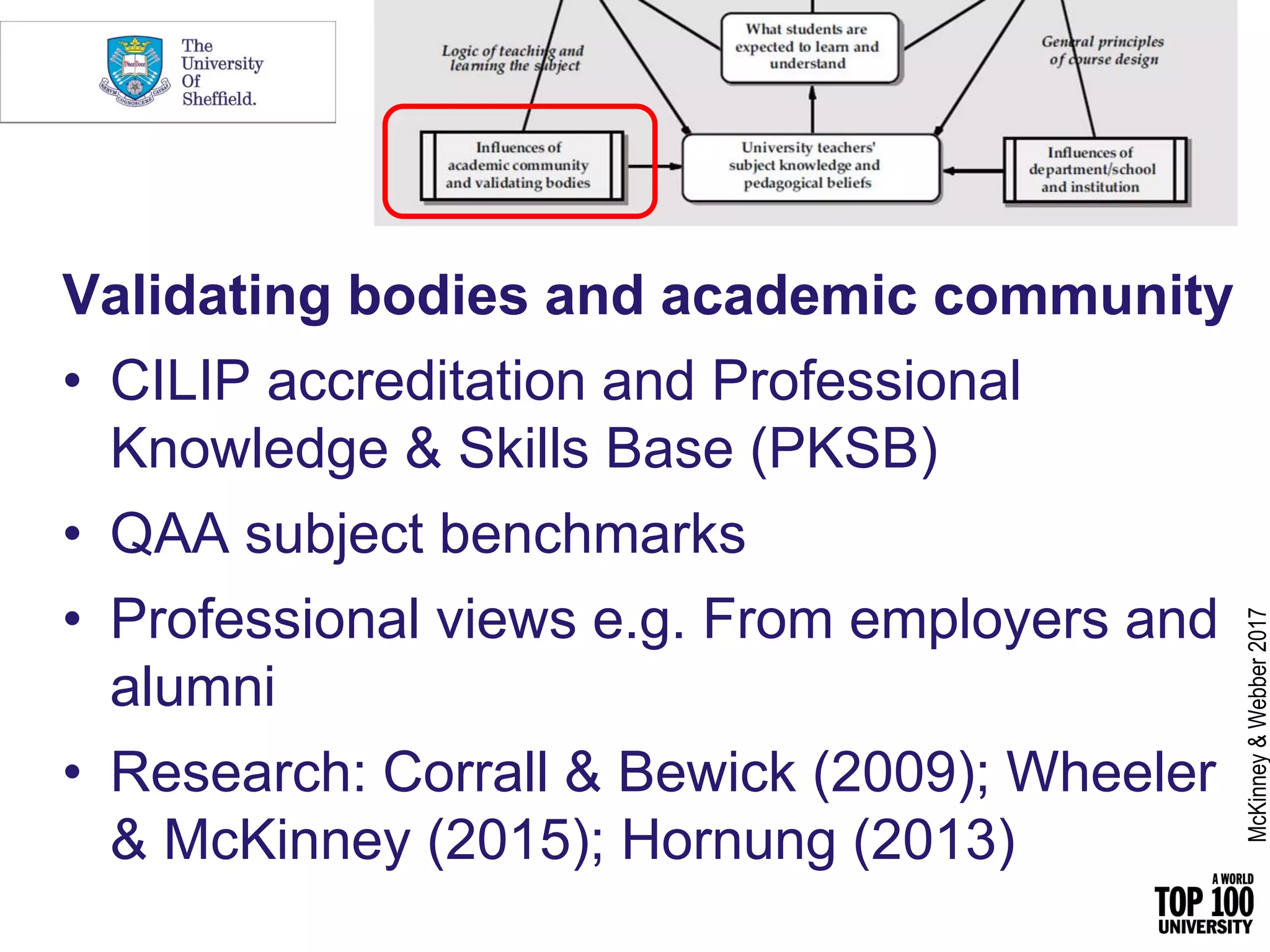
Validating bodies and academic community
• CILIP accreditation and Professional
Knowledge & Skills Base (PKSB)
• QAA subject benchmarks
• Professional views e.g. From employers and
alumni
• Research: Corrall & Bewick (2009); Wheeler
& McKinney (2015); Hornung (2013)
McKinney&Webber2017
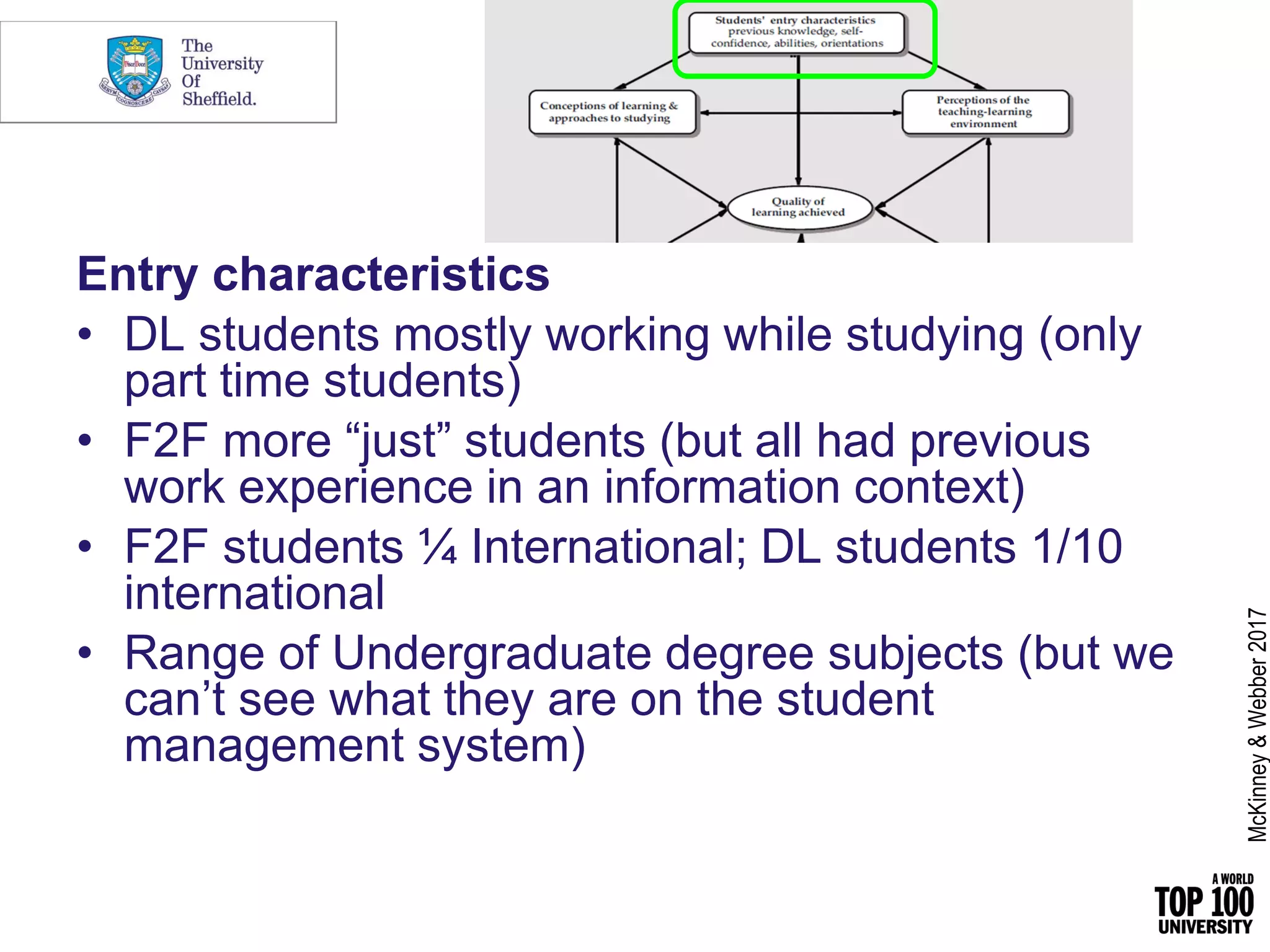
Entry characteristics
• DL students mostly working while studying (only
part time students)
• F2F more “just” students (but all had previous
work experience in an information context)
• F2F students ¼ International; DL students 1/10
international
• Range of Undergraduate degree subjects (but we
can’t see what they are on the student
management system)
McKinney&Webber2017
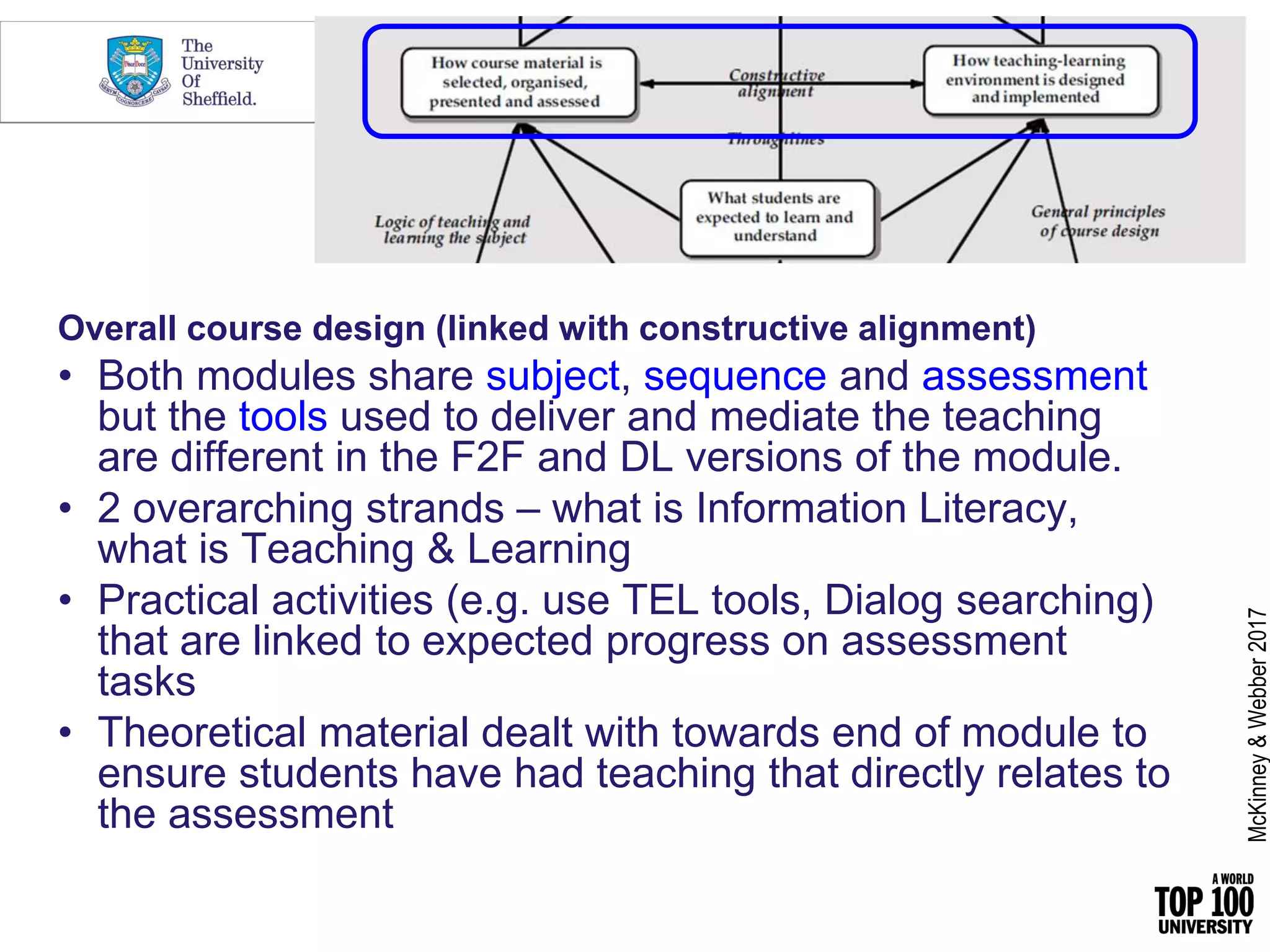
Overall course design (linked with constructive alignment)
• Both modules share subject, sequence and assessment
but the tools used to deliver and mediate the teaching
are different in the F2F and DL versions of the module.
• 2 overarching strands – what is Information Literacy,
what is Teaching & Learning
• Practical activities (e.g. use TEL tools, Dialog searching)
that are linked to expected progress on assessment
tasks
• Theoretical material dealt with towards end of module to
ensure students have had teaching that directly relates to
the assessment
McKinney&Webber2017
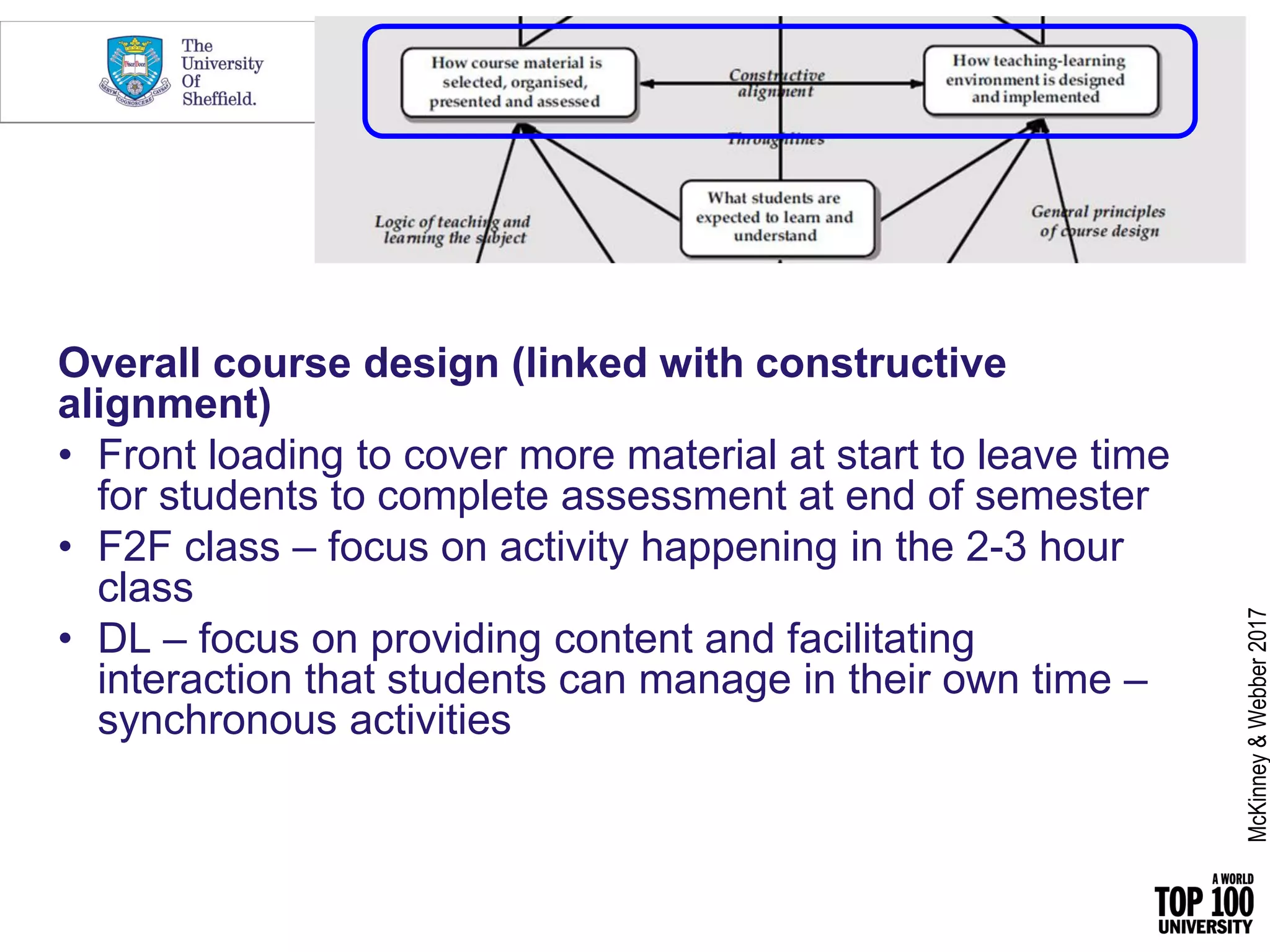
Overall course design (linked with constructive
alignment)
• Front loading to cover more material at start to leave time
for students to complete assessment at end of semester
• F2F class – focus on activity happening in the 2-3 hour
class
• DL – focus on providing content and facilitating
interaction that students can manage in their own time –
synchronous activities
McKinney&Webber2017
• Assignment 1: create an annotated bibliography on a
topic negotiated with a tutor and reflect on how personal
IL has been developed through this activity.
• Assignment 2: Work in a group to design an IL learning
intervention (not assessed). Critically reflect on the
experience of designing and delivering IL teaching and
their personal development as teachers.
McKinney&Webber2017
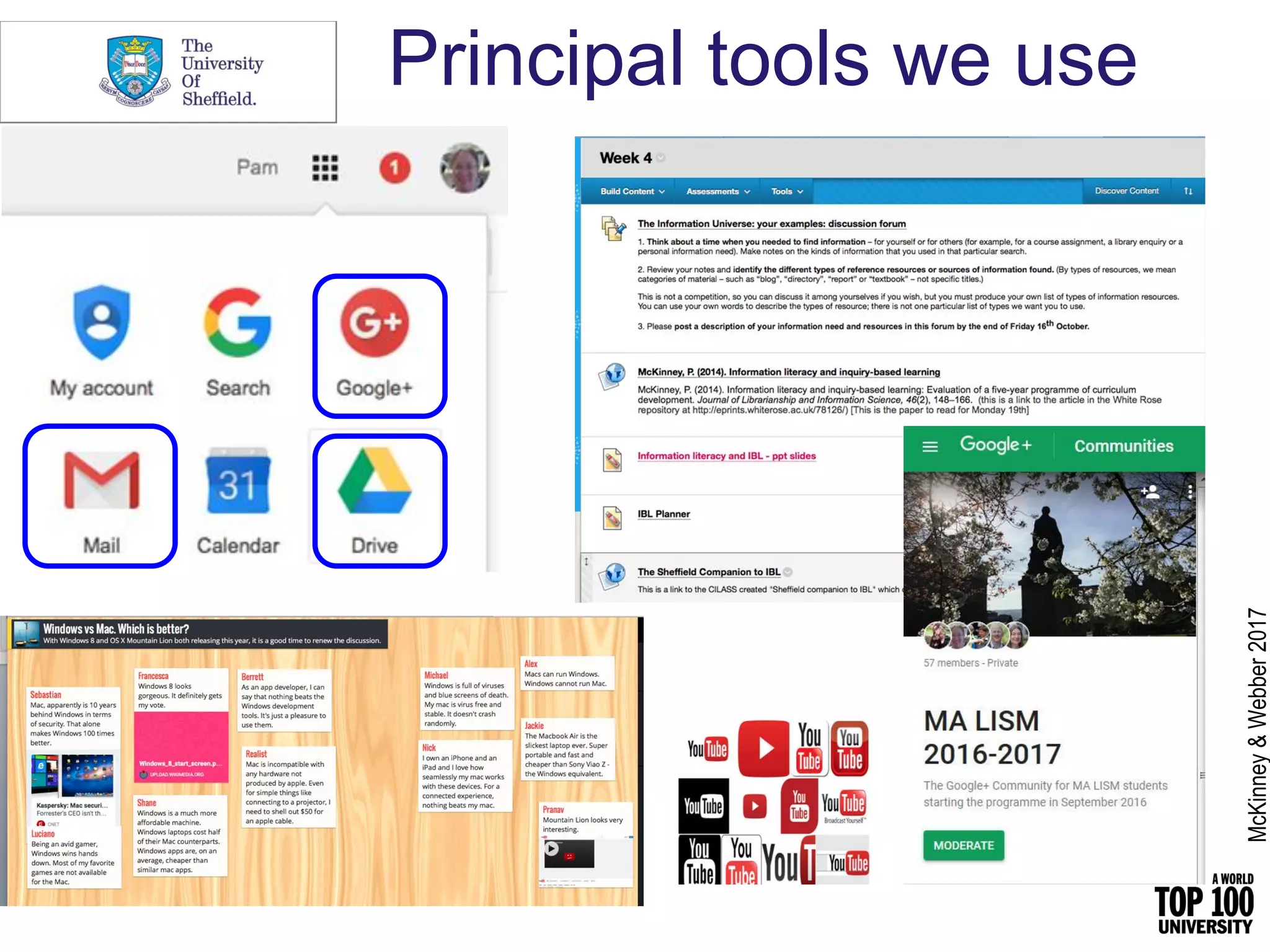
Principal tools we use
McKinney&Webber2017
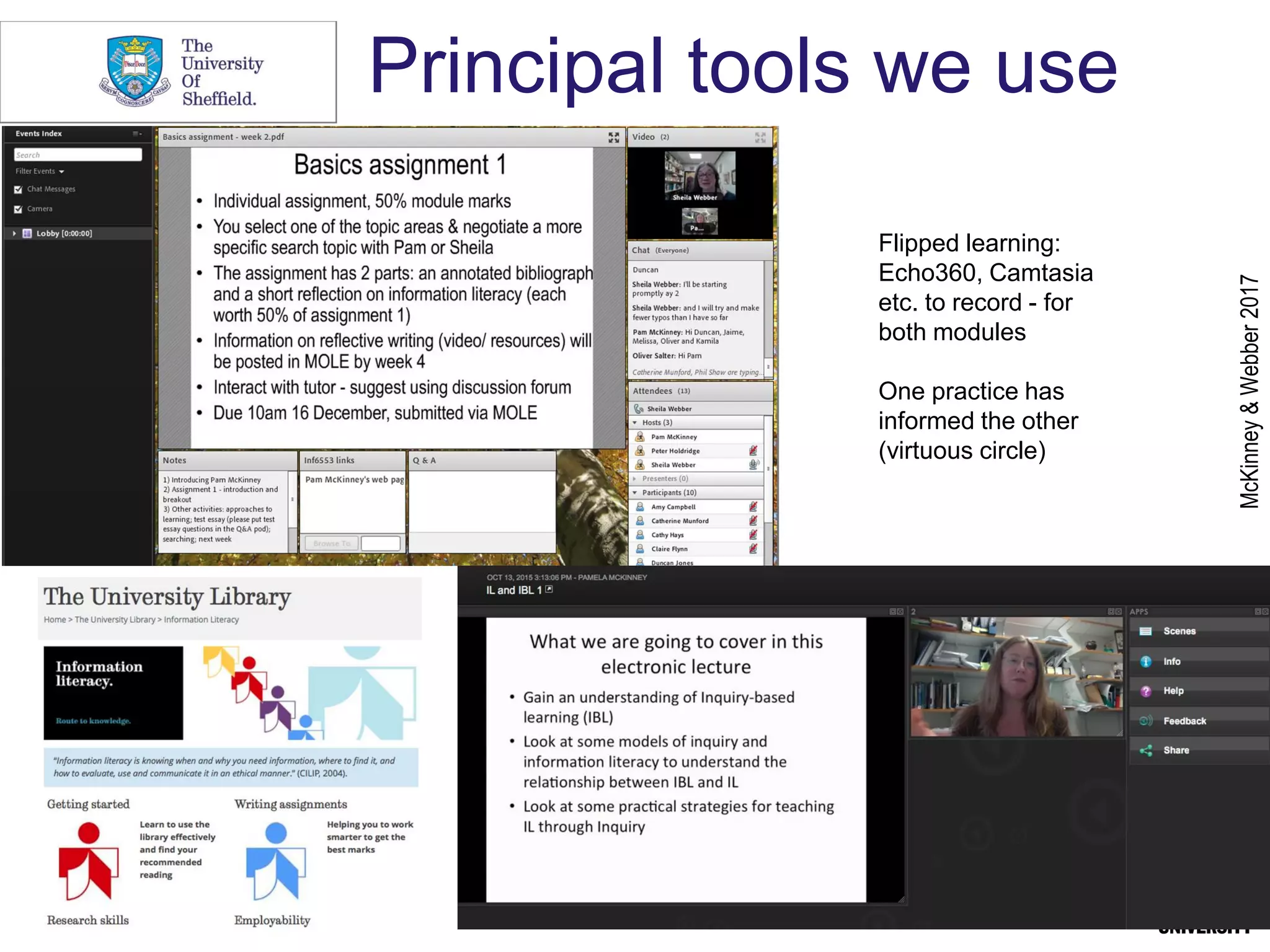
Principal tools we use
Flipped learning:
Echo360, Camtasia
etc. to record - for
both modules
One practice has
informed the other
(virtuous circle)
McKinney&Webber2017
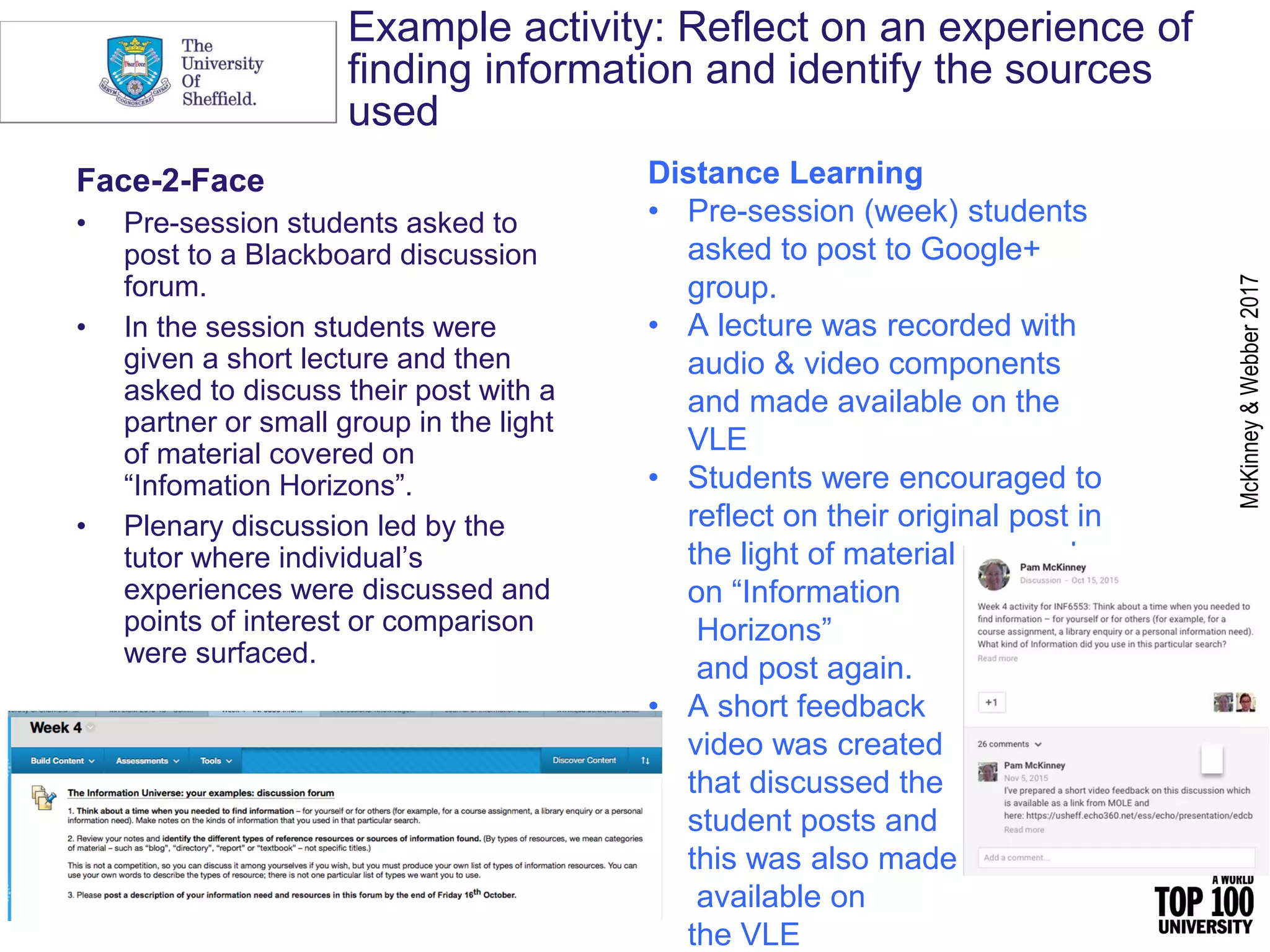
Example activity: Reflect on an experience of
finding information and identify the sources
used
Face-2-Face
• Pre-session students asked to
post to a Blackboard discussion
forum.
• In the session students were
given a short lecture and then
asked to discuss their post with a
partner or small group in the light
of material covered on
“Infomation Horizons”.
• Plenary discussion led by the
tutor where individual’s
experiences were discussed and
points of interest or comparison
were surfaced.
Distance Learning
• Pre-session (week) students
asked to post to Google+
group.
• A lecture was recorded with
audio & video components
and made available on the
VLE
• Students were encouraged to
reflect on their original post in
the light of material covered
on “Information
Horizons”
and post again.
• A short feedback
video was created
that discussed the
student posts and
this was also made
available on
the VLE
McKinney&Webber2017
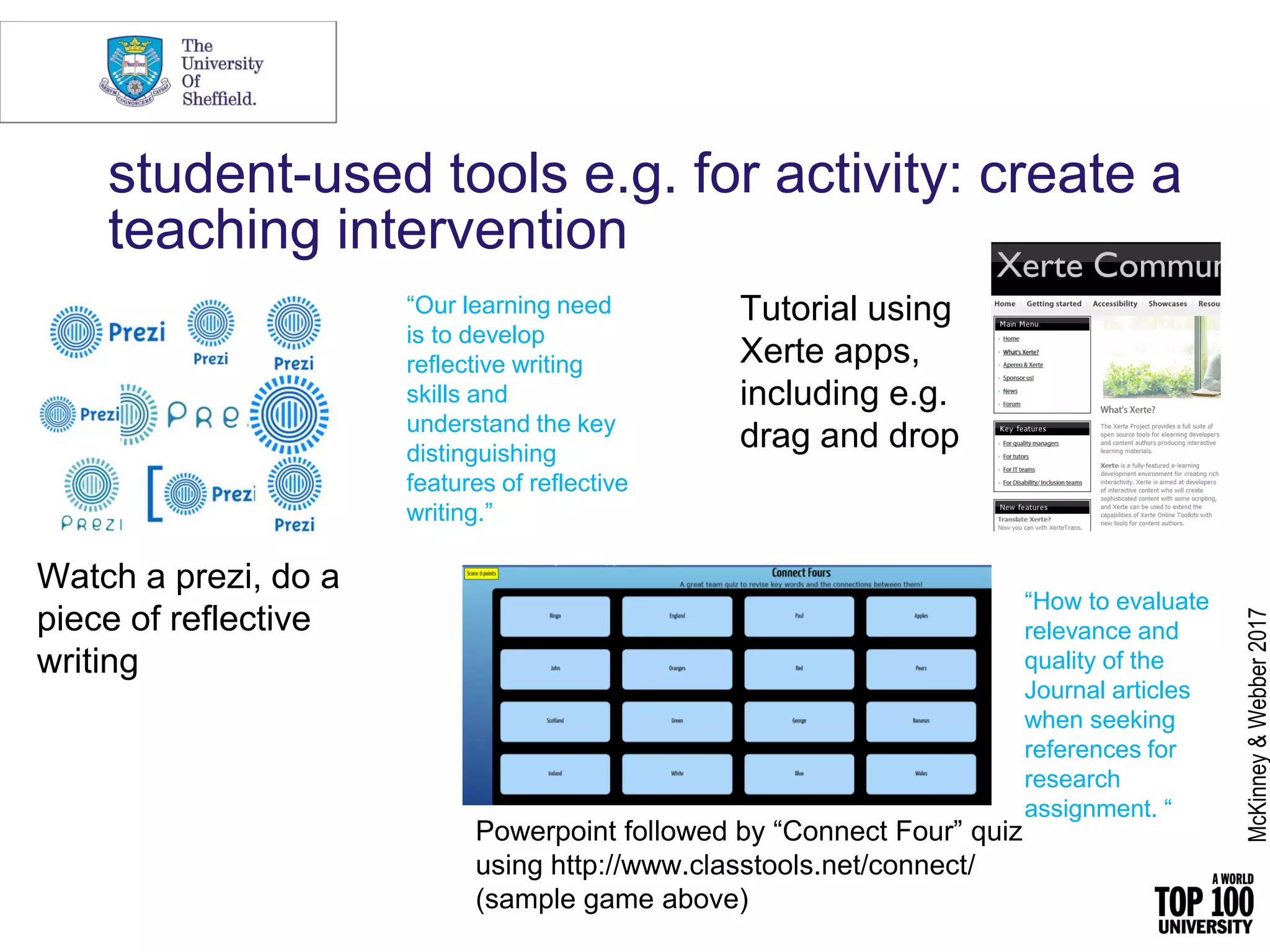
student-used tools e.g. for activity: create a
teaching intervention
Watch a prezi, do a
piece of reflective
writing
Powerpoint followed by “Connect Four” quiz
using http://www.classtools.net/connect/
(sample game above)
Tutorial using
Xerte apps,
including e.g.
drag and drop
“How to evaluate
relevance and
quality of the
Journal articles
when seeking
references for
research
assignment. “
“Our learning need
is to develop
reflective writing
skills and
understand the key
distinguishing
features of reflective
writing.”
McKinney&Webber2017
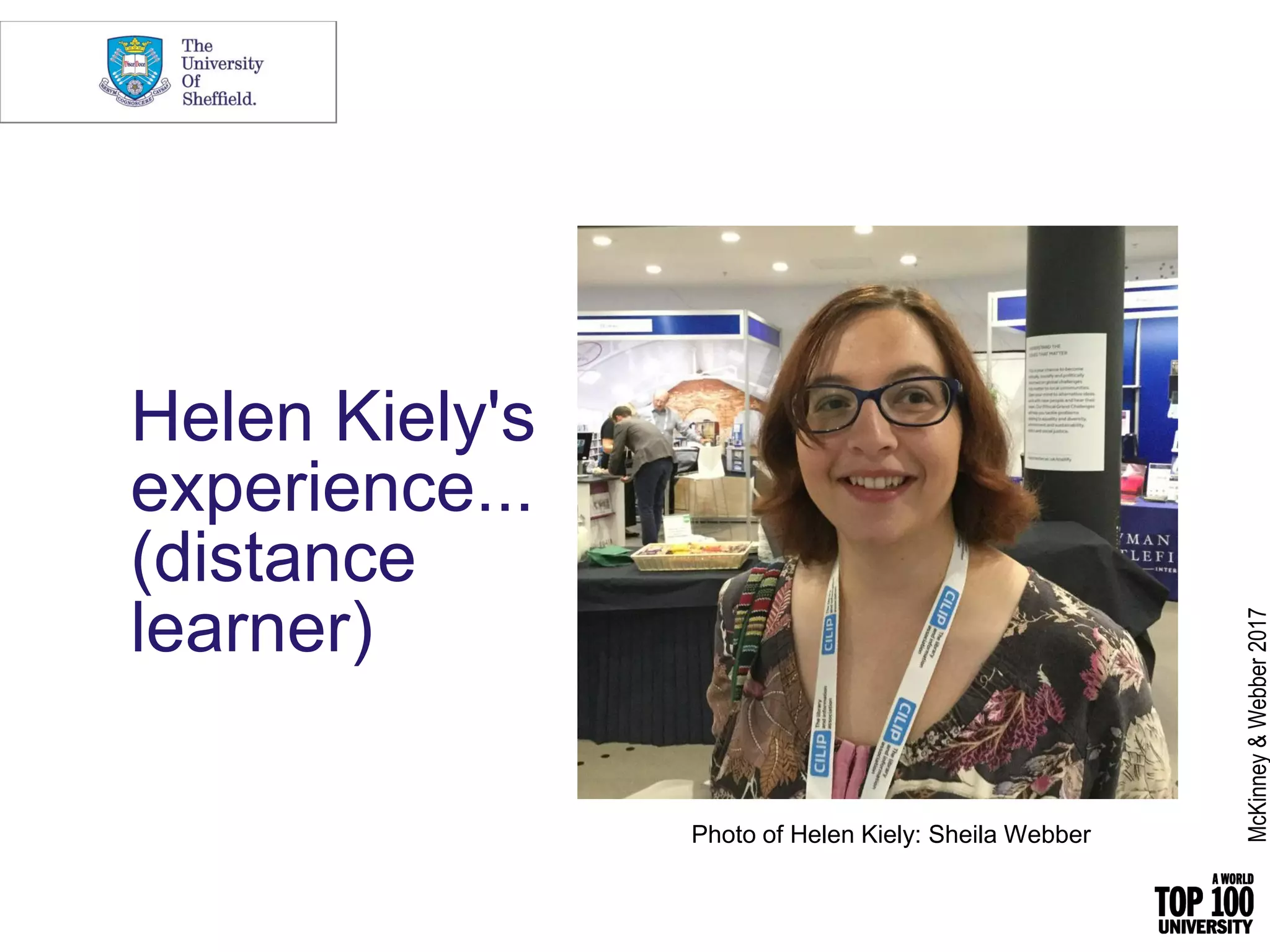
Helen Kiely's
experience...
(distance
learner)
Photo of Helen Kiely: Sheila Webber
McKinney&Webber2017
"It’s eleven o’clock at night and I am sitting in bed with my
laptop balanced precariously on my knees. On my screen, a
PowerPoint document is undergoing rapid changes. Slide 3’s
pictures are moving around, citations are being added to
Slide 7, typos are being removed on slide 12 all at the same
time. Through my headphones I can hear my fellow students
chatting away about the changes we still need to make and
at the bottom of the webpage a chat browser adds more
comments to the conversation. One person says she will
have to go soon, it is nearly teatime in Hong Kong, while the
rest of us will soon be heading to our beds before it is time to
get up for work the next morning.
I never expected distance-learning group work would look like
this!" (Kiely and Dawson, 2017)
McKinney&Webber2017
Action research project
P2: “And so I do, we do now use more electronic
resources, and so having come across some of the
frustrations with them and being aware of them does allow
me to support them better and say, “Yes I know this will be
difficult,” you know, “These things can be, and maybe you
need to think ahead about how that’s going to work for
you.”
P3: But the fact that I did this module definitely sort of
changed my way of thinking, that you know, the fact that
you have Adobe Connect and you can see the lecturer and
you can hear them, and that you have a variety of
resources that you can look at in your own time as opposed
to sort of face to face, having to do it there, and that was
also quite good.”
McKinney&Webber2017
Conclusions
• Creative use of different platforms for learning
worked well for both cohorts
• Being in-work allows students to more
immediately contextualise their learning through
discussion and observation
• "Virtuous circle" in terms of working with 2
cohorts - ideas from one feed into the other;
iterative and continuous
• TEL tools provided by university (e.g. Google
suite) very useful, but still need technical support
to use wide range of tools effectively
McKinney&Webber2017
Sheila Webber
Information School
University of Sheffield
s.webber@sheffield.ac.uk
Twitter: @SheilaYoshikawa
http://information-literacy.blogspot.com/
http://www.slideshare.net/sheilawebber/
Orcid ID 0000-0002-2280-9519
Pamela McKinney
Information School
University of Sheffield
p.mckinney@sheffield.ac.uk
Twitter: @ischoolpam
https://www.slideshare.net/PamelaMcKinney
Orcid ID 0000-0002-0227-3534
References
• Corrall, S. & Bewick, L (2009). Developing librarians as teachers:a study of their
pedagogical knowledge. Journal of Librarianship and Information Science, 42(2), 97-
110.
• Entwistle, N., Nisbet, J. & Bromage, A. (2004). Teaching-learning environments and
student learning in electronic engineering: paper presented at Third Workshop of the
European Network on Powerful Learning Environments, in Brugge, September 30 –
October 2, 2004. https://www.academia.edu/3426418/Teaching-
learning_environments_and_student_learning_in_electronic_engineering
• Hornung, E. (2013). On your own but not alone: One person librarians in Ireland and
their perceptions of continuing professional development. Library Trends, 61(3),
675-702.
• Kiely, H. & Dawson, L. (2017, February 27). Group work – experiences and advice
by Helen Kiely and Lorna Dawson. [blog post]
https://lihnnclinicallibs.wordpress.com/2017/02/27/group-work-experiences-and-
advice-by-helen-kiely-and-lorna-dawson/
• Wheeler, E. & McKinney, P. (2015). Are librarians teachers? Investigating academic
librarians’ perceptions of their own teaching roles. Journal of Information Literacy,
9(2), 111-128.
McKinney&Webber2017

Comparing use of Technology Enhanced Learning in an on-campus class and a distance learning class

  • 1.
    Comparing use ofTechnology Enhanced Learning in an on-campus class and a distance learning class Pamela McKinney Pamela McKinney & Sheila Webber Information School University of Sheffield TELfest, July 2017 University of Sheffield Information School Photo:SheilaWebber,takeninSecondLife(TM)
  • 2.
    Outline • The modulecontext • Mapping the modules against Entwistle’s et al. (2004) Teaching-learning Environments model • The principal TEL tools we use • Example activity • Student experience • Conclusions McKinney&Webber2017
  • 3.
    The Information Literacy modules •Face-to-Face (F2F) and Distance Learning (DL course new in 2015) running in tandem • Learning aims: • understand from both theoretical and practical perspectives the concepts of information literacy and information behaviour; • develop their own information literacy and understanding of its application to their future lives; • compare different approaches to teaching and demonstrate awareness of implications for adopting different approaches to teaching and learning; • understand how the information environment is evolving, including both traditional and new media, and the implications for citizens’ information literacy; and • develop practical skills in searching, evaluating and presenting information. McKinney&Webber2017
  • 4.
    The development ofthe TLE model • ETL project Enhancing teaching-learning environments in Undergraduate Courses • 5 case studies in different disciplinary areas • Gathered multi-institutional data and used multiple data collection methods – from students and from staff McKinney&Webber2017
  • 5.
    The Teaching- Learning Environment Entwistle etal. (2004: 3) McKinney&Webber2017
  • 6.
    Subject knowledge &pedagogical beliefs • Pam -Background as a learning developer working specifically to extend and develop Inquiry-based learning (IBL) at the university. Research intersection between IBL and IL • Sheila – expertise in TEL and IBL – 2nd Life, MOOCs; research experience in phenomenography • Have UoS teaching awards individually and as a team • Our joint understanding of IL and what it means from a theoretical and practical perspective in different communities and landscapes McKinney&Webber2017
  • 7.
    What students areexpected to learn and understand • Desire to bring about conceptual change in students and not just “develop skills”. • Develop a strong theoretical basis for their teaching McKinney&Webber2017
  • 8.
    Departmental and institutionalinfluences • Drive to extend the market and create a DL alternative to f-2-f programme (financial) • “Brand new” programme – freedom to design and develop • Institutional procedures & policies e.g. new programme & module creation procedures, assignment word counts 30/05/2017 © The University of Sheffield McKinney&Webber2017
  • 9.
    Validating bodies andacademic community • CILIP accreditation and Professional Knowledge & Skills Base (PKSB) • QAA subject benchmarks • Professional views e.g. From employers and alumni • Research: Corrall & Bewick (2009); Wheeler & McKinney (2015); Hornung (2013) McKinney&Webber2017
  • 10.
    Entry characteristics • DLstudents mostly working while studying (only part time students) • F2F more “just” students (but all had previous work experience in an information context) • F2F students ¼ International; DL students 1/10 international • Range of Undergraduate degree subjects (but we can’t see what they are on the student management system) McKinney&Webber2017
  • 11.
    Overall course design(linked with constructive alignment) • Both modules share subject, sequence and assessment but the tools used to deliver and mediate the teaching are different in the F2F and DL versions of the module. • 2 overarching strands – what is Information Literacy, what is Teaching & Learning • Practical activities (e.g. use TEL tools, Dialog searching) that are linked to expected progress on assessment tasks • Theoretical material dealt with towards end of module to ensure students have had teaching that directly relates to the assessment McKinney&Webber2017
  • 12.
    Overall course design(linked with constructive alignment) • Front loading to cover more material at start to leave time for students to complete assessment at end of semester • F2F class – focus on activity happening in the 2-3 hour class • DL – focus on providing content and facilitating interaction that students can manage in their own time – synchronous activities McKinney&Webber2017
  • 13.
    • Assignment 1:create an annotated bibliography on a topic negotiated with a tutor and reflect on how personal IL has been developed through this activity. • Assignment 2: Work in a group to design an IL learning intervention (not assessed). Critically reflect on the experience of designing and delivering IL teaching and their personal development as teachers. McKinney&Webber2017
  • 14.
    Principal tools weuse McKinney&Webber2017
  • 15.
    Principal tools weuse Flipped learning: Echo360, Camtasia etc. to record - for both modules One practice has informed the other (virtuous circle) McKinney&Webber2017
  • 16.
    Example activity: Reflecton an experience of finding information and identify the sources used Face-2-Face • Pre-session students asked to post to a Blackboard discussion forum. • In the session students were given a short lecture and then asked to discuss their post with a partner or small group in the light of material covered on “Infomation Horizons”. • Plenary discussion led by the tutor where individual’s experiences were discussed and points of interest or comparison were surfaced. Distance Learning • Pre-session (week) students asked to post to Google+ group. • A lecture was recorded with audio & video components and made available on the VLE • Students were encouraged to reflect on their original post in the light of material covered on “Information Horizons” and post again. • A short feedback video was created that discussed the student posts and this was also made available on the VLE McKinney&Webber2017
  • 17.
    student-used tools e.g.for activity: create a teaching intervention Watch a prezi, do a piece of reflective writing Powerpoint followed by “Connect Four” quiz using http://www.classtools.net/connect/ (sample game above) Tutorial using Xerte apps, including e.g. drag and drop “How to evaluate relevance and quality of the Journal articles when seeking references for research assignment. “ “Our learning need is to develop reflective writing skills and understand the key distinguishing features of reflective writing.” McKinney&Webber2017
  • 18.
    Helen Kiely's experience... (distance learner) Photo ofHelen Kiely: Sheila Webber McKinney&Webber2017
  • 19.
    "It’s eleven o’clockat night and I am sitting in bed with my laptop balanced precariously on my knees. On my screen, a PowerPoint document is undergoing rapid changes. Slide 3’s pictures are moving around, citations are being added to Slide 7, typos are being removed on slide 12 all at the same time. Through my headphones I can hear my fellow students chatting away about the changes we still need to make and at the bottom of the webpage a chat browser adds more comments to the conversation. One person says she will have to go soon, it is nearly teatime in Hong Kong, while the rest of us will soon be heading to our beds before it is time to get up for work the next morning. I never expected distance-learning group work would look like this!" (Kiely and Dawson, 2017) McKinney&Webber2017
  • 20.
    Action research project P2:“And so I do, we do now use more electronic resources, and so having come across some of the frustrations with them and being aware of them does allow me to support them better and say, “Yes I know this will be difficult,” you know, “These things can be, and maybe you need to think ahead about how that’s going to work for you.” P3: But the fact that I did this module definitely sort of changed my way of thinking, that you know, the fact that you have Adobe Connect and you can see the lecturer and you can hear them, and that you have a variety of resources that you can look at in your own time as opposed to sort of face to face, having to do it there, and that was also quite good.” McKinney&Webber2017
  • 21.
    Conclusions • Creative useof different platforms for learning worked well for both cohorts • Being in-work allows students to more immediately contextualise their learning through discussion and observation • "Virtuous circle" in terms of working with 2 cohorts - ideas from one feed into the other; iterative and continuous • TEL tools provided by university (e.g. Google suite) very useful, but still need technical support to use wide range of tools effectively McKinney&Webber2017
  • 22.
    Sheila Webber Information School Universityof Sheffield s.webber@sheffield.ac.uk Twitter: @SheilaYoshikawa http://information-literacy.blogspot.com/ http://www.slideshare.net/sheilawebber/ Orcid ID 0000-0002-2280-9519 Pamela McKinney Information School University of Sheffield p.mckinney@sheffield.ac.uk Twitter: @ischoolpam https://www.slideshare.net/PamelaMcKinney Orcid ID 0000-0002-0227-3534
  • 23.
    References • Corrall, S.& Bewick, L (2009). Developing librarians as teachers:a study of their pedagogical knowledge. Journal of Librarianship and Information Science, 42(2), 97- 110. • Entwistle, N., Nisbet, J. & Bromage, A. (2004). Teaching-learning environments and student learning in electronic engineering: paper presented at Third Workshop of the European Network on Powerful Learning Environments, in Brugge, September 30 – October 2, 2004. https://www.academia.edu/3426418/Teaching- learning_environments_and_student_learning_in_electronic_engineering • Hornung, E. (2013). On your own but not alone: One person librarians in Ireland and their perceptions of continuing professional development. Library Trends, 61(3), 675-702. • Kiely, H. & Dawson, L. (2017, February 27). Group work – experiences and advice by Helen Kiely and Lorna Dawson. [blog post] https://lihnnclinicallibs.wordpress.com/2017/02/27/group-work-experiences-and- advice-by-helen-kiely-and-lorna-dawson/ • Wheeler, E. & McKinney, P. (2015). Are librarians teachers? Investigating academic librarians’ perceptions of their own teaching roles. Journal of Information Literacy, 9(2), 111-128. McKinney&Webber2017