Pulsar Summit
San Francisco
Hotel Nikko
August 18 2022
Tech Deep Dive
Matteo Merli
CTO • StreamNative
Towards a
ZooKeeper-less Pulsar
Co-creator of Pulsar
PMC Chair for Apache Pulsar
Member of Apache BookKeeper PMC
Prev: Splunk, Streamlio, Yahoo
Matteo Merli
CTO
StreamNative
Pulsar and Metadata
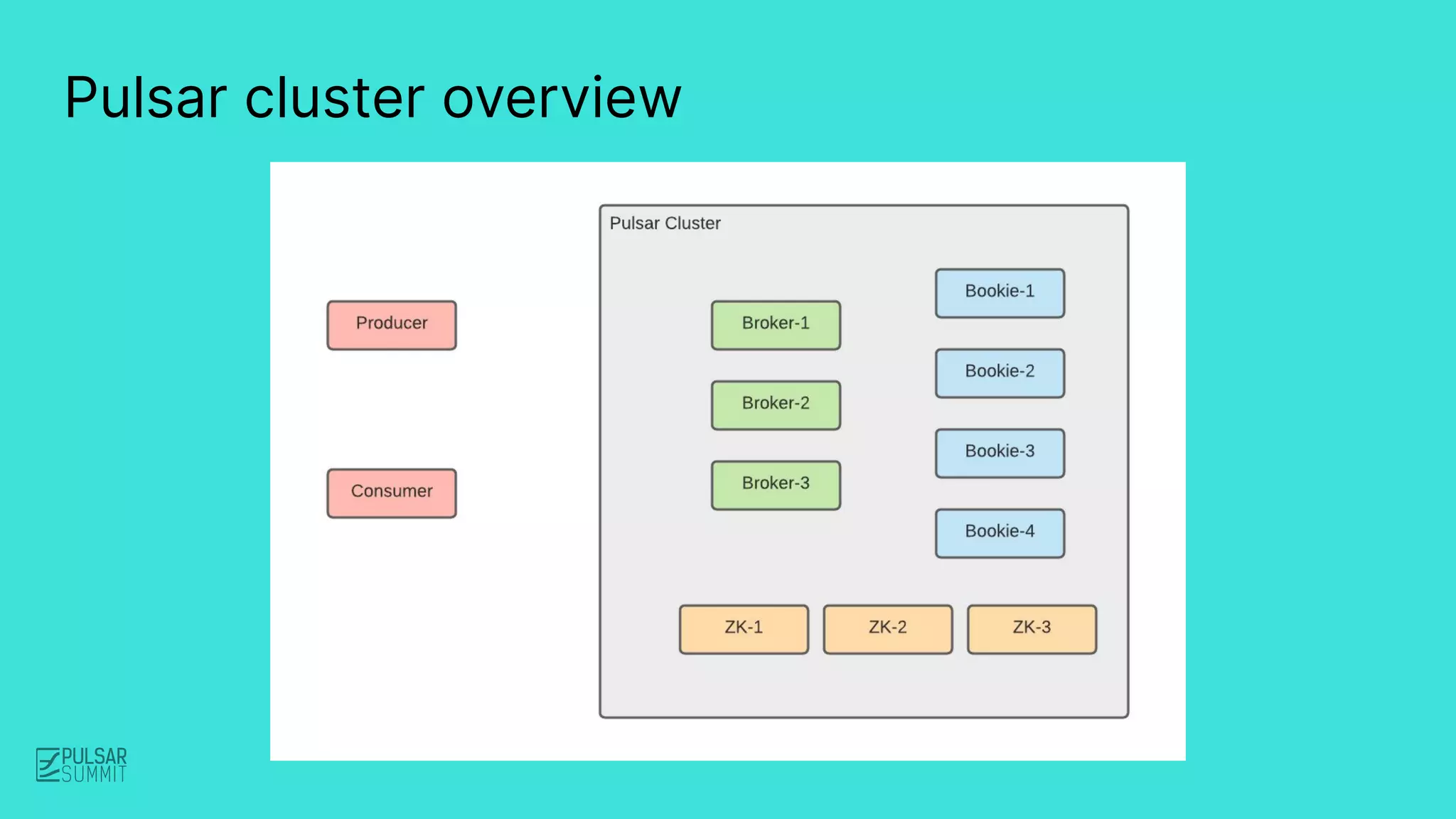
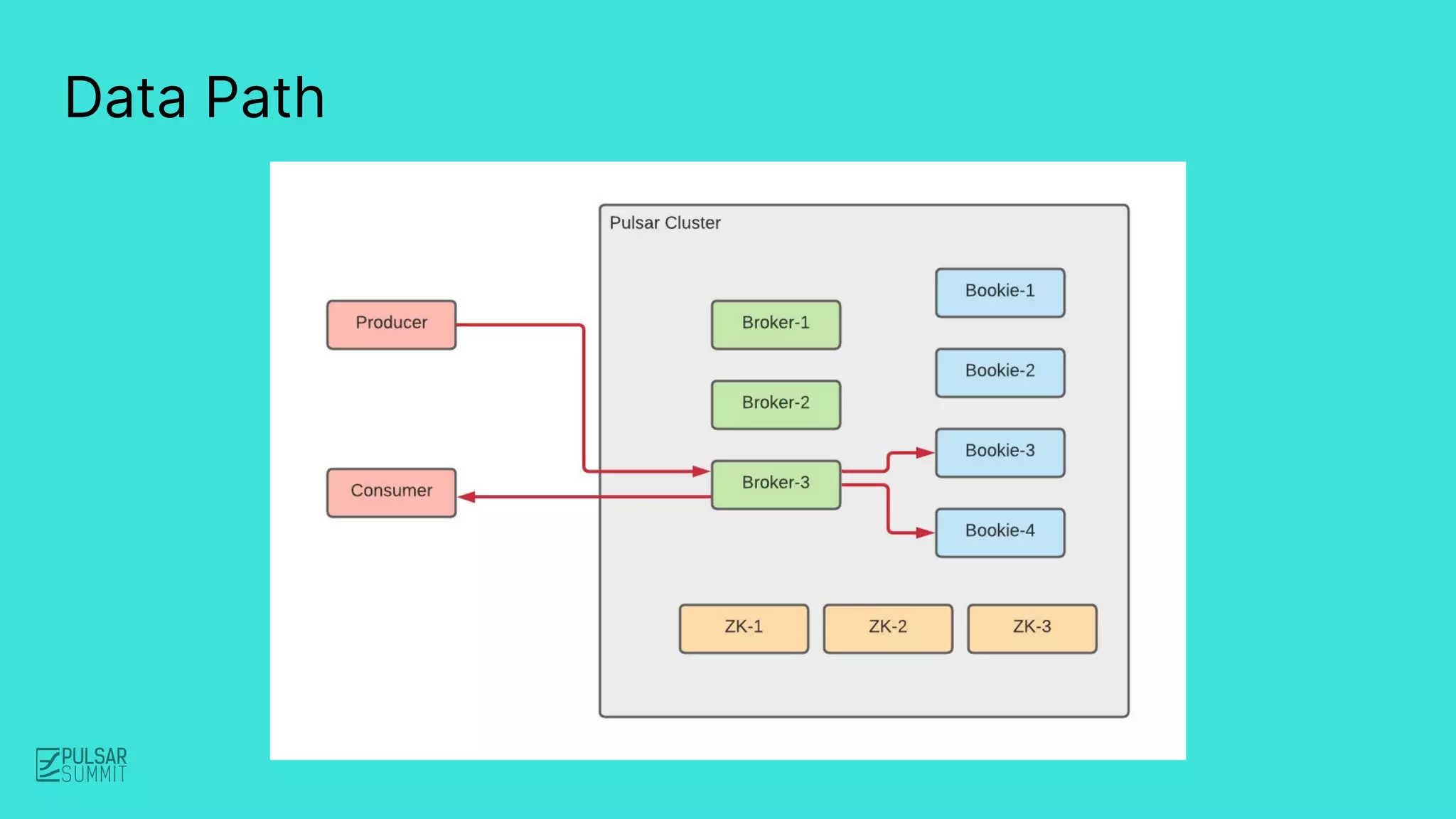
Pulsar cluster overview
Data Path
Metadata Path
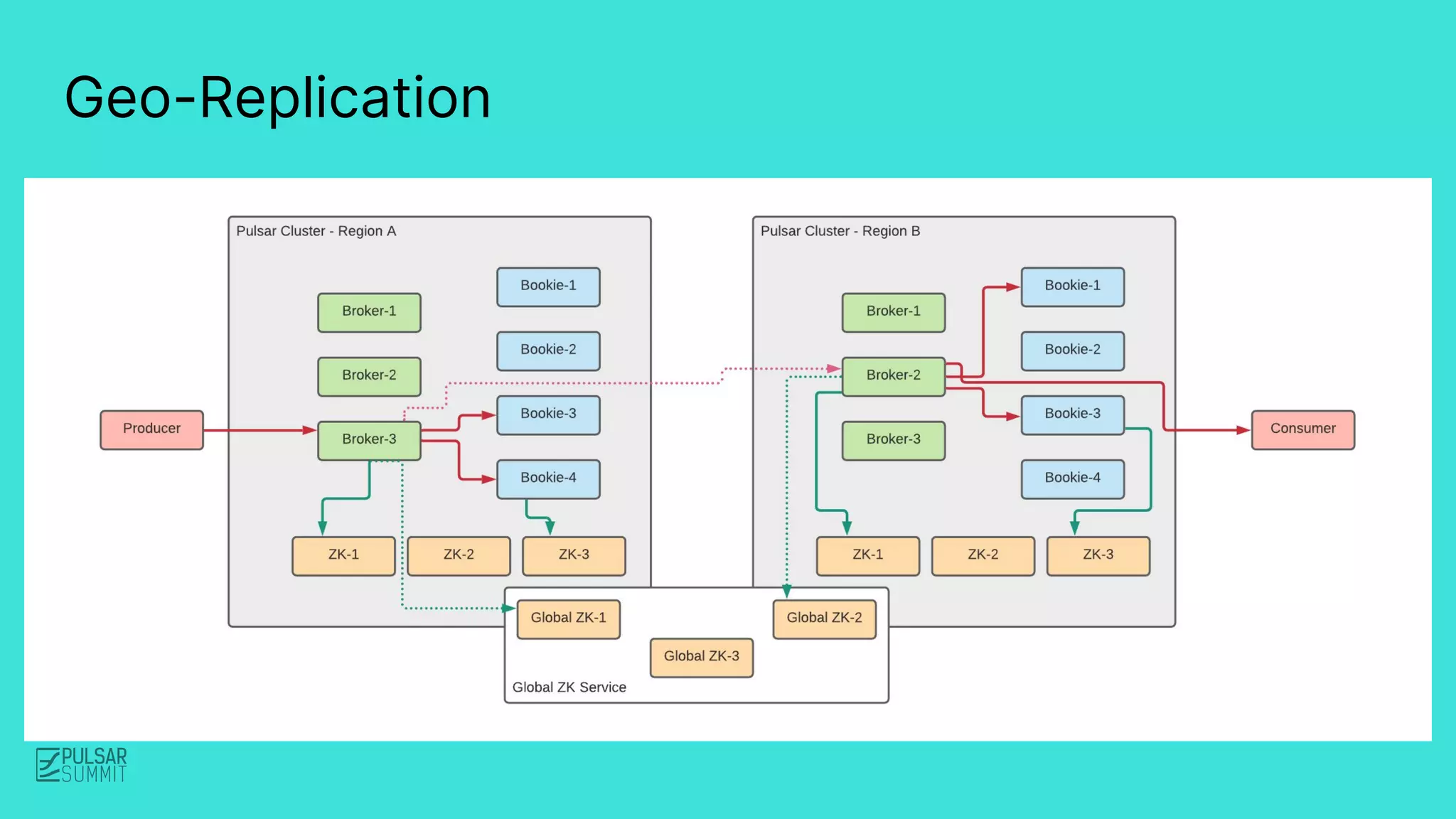
Geo-Replication
What is metadata?
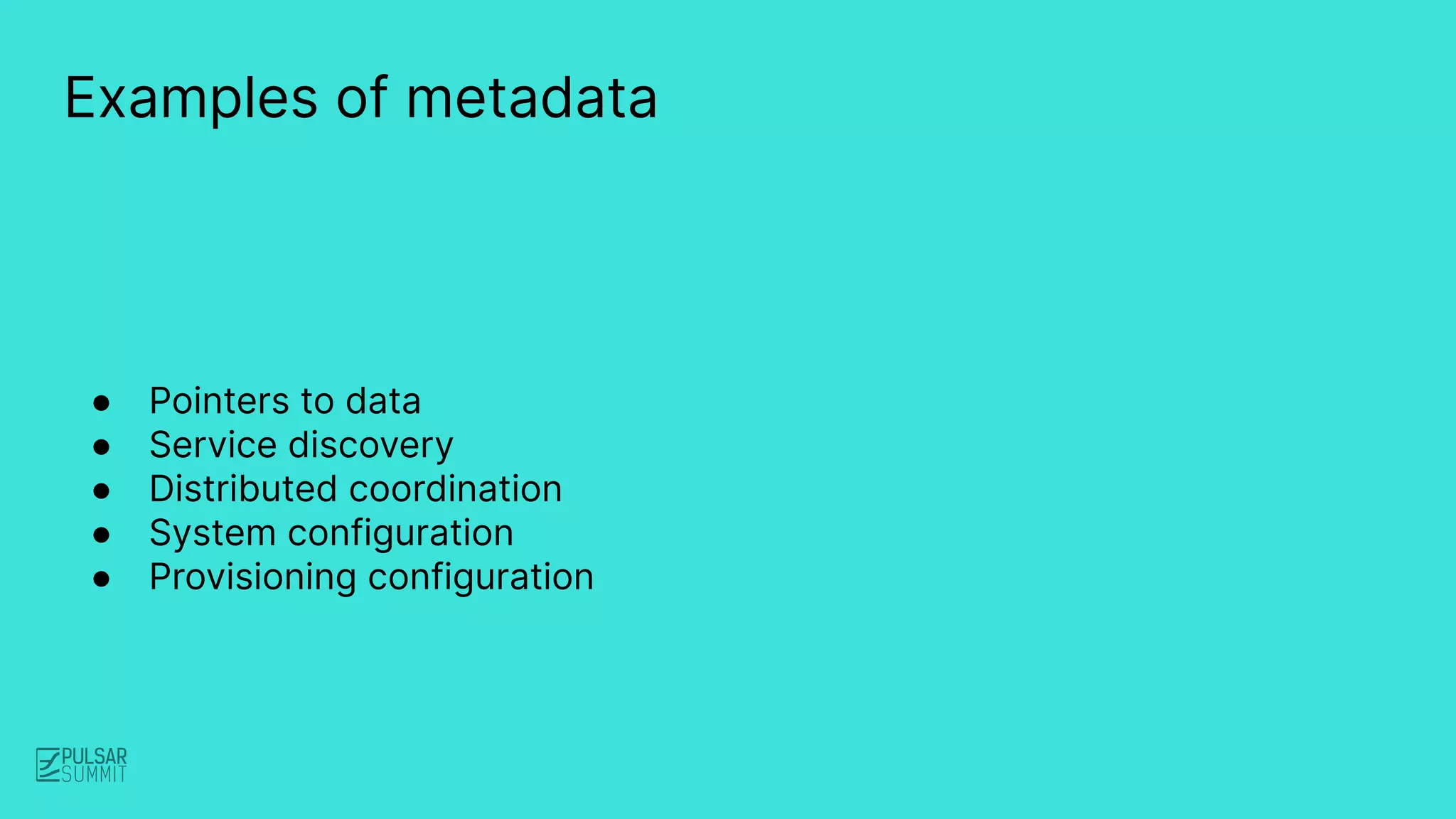
Examples of metadata
● Pointers to data
● Service discovery
● Distributed coordination
● System configuration
● Provisioning configuration
Topics metadata
Each persistent topic is
associated with a Managed
Ledger
Managed Ledger keeps a list of
ledgers for a topic
{
"ledgers" : [ {
"ledgerId" : 1234,
"entries" : 1000,
"size" : 433111,
"offloaded" : false
}, {
"ledgerId" : 5579,
"entries" : 50000,
"size" : 9433111,
"offloaded" : false
} ],
"schemaLedgers" : [ ],
"compactedLedger" : {
"ledgerId" : -1,
"entries" : -1,
"size" : -1,
"offloaded" : false
}
}
Ledger metadata
● Each BK ledger has an
associated metadata
● Contains
○ State of the ledger
○ Which bookies have the
data
LedgerMetadata{
formatVersion=3,
ensembleSize=2,
writeQuorumSize=2,
ackQuorumSize=2,
state=CLOSED,
length=1738964,
lastEntryId=1611
digestType=CRC32C,
password=base64:,
ensembles={
0=[bookie-1:3181, bookie-2:3181],
1000=[bookie-5:3181, bookie-2:3181]
},
customMetadata={
component=base64:bWFuYWdlZC1sZWRnZXI=,
pulsar/managed-ledger=base64:cHVibGlR=,
application=base64:cHVsc2Fy
}
}
Service discovery
● Find the list of available bookies
○ Which bookies are in read-only?
● Discover which broker owns a particular topic
● Find the list of available brokers
○ What is the current load on each broker?
Distributed coordination
● Acquire a lock over a particular resource
○ Ownership of group of topics
○ Signaling that some work on a particular resource is in
progress
■ BK autorecovery
● Leader election
○ Establish a single leader designed to perform some tasks
■ Load manager designates a leader that
○ Failover to other available nodes
System configuration
● Allow for dynamic settings
● Features can be activated/deactivated without restarting
brokers
● Keep isolation information
● Maintain tracking of (bookie → rack) mapping
Provisioning configuration
● Metadata for Tenants, Namespaces
● Policies to apply to namespaces
● Authorization definitions
● Highly-Cacheable metadata
What’s up with
ZooKeeper?
ZooKeeper
● Consensus based “database”
○ Data is replicated consistently to a quorum of nodes
● It is not horizontally scalable
○ Increasing the ZK cluster size does not increase the write
capacity
● All data is kept in memory in every node
○ Not very GC friendly
● It takes periodic snapshots of the entire dataset
ZooKeeper
● The amount of metadata that can be comfortably stored in ZK
is ~5GB
● Tuning and operating ZK to work with big datasets is not trivial
○ Requires deep knowledge of ZK internals
● In cloud and containerized environments, leader election can
sometime take few minutes:
○ Issues with DNS, software-defined-networking and sidecar
TCP proxies.
Why we would take ZK away?
● Big clusters → we don’t want to have a hard limit of the amount
of metadata
○ A horizontally scalable metadata store is more suited
● Small clusters → remove overhead of running ZK
○ Less components to deploy
○ Easier operations
PIP-45: A plan with
multiple steps
PIP-45: Pluggable metadata backend
● Instead of direct usage of ZooKeeper APIs, we have abstracted
all the accesses through a single generic API
● This API has multiple implementations:
○ ZooKeeper
○ Etcd
○ RocksDB (for standalone)
○ Memory (for unit tests)
Metadata semantics
We have identified 2 main patterns of access to the metadata
1. Simple key-value access + notifications
2. Complex coordination
Key-Value access
● MetadataStore → Key-value store access
○ put() – get() – delete()
○ Values are byte[]
○ Users can register for notifications
● MetadataCache → Object cache on top of MetadataStore
CoordinationService
● Contains primitives for “cluster coordination”
● High-level API that hides all the complexities
○ ResourceLock – Distributed lock over a shared resource
○ LeaderElection – Elect a leader among a set of peers
○ DistributedCounter – Generate unique IDs
Successes enabled
by MetadataStore
APIs in Pulsar 2.10
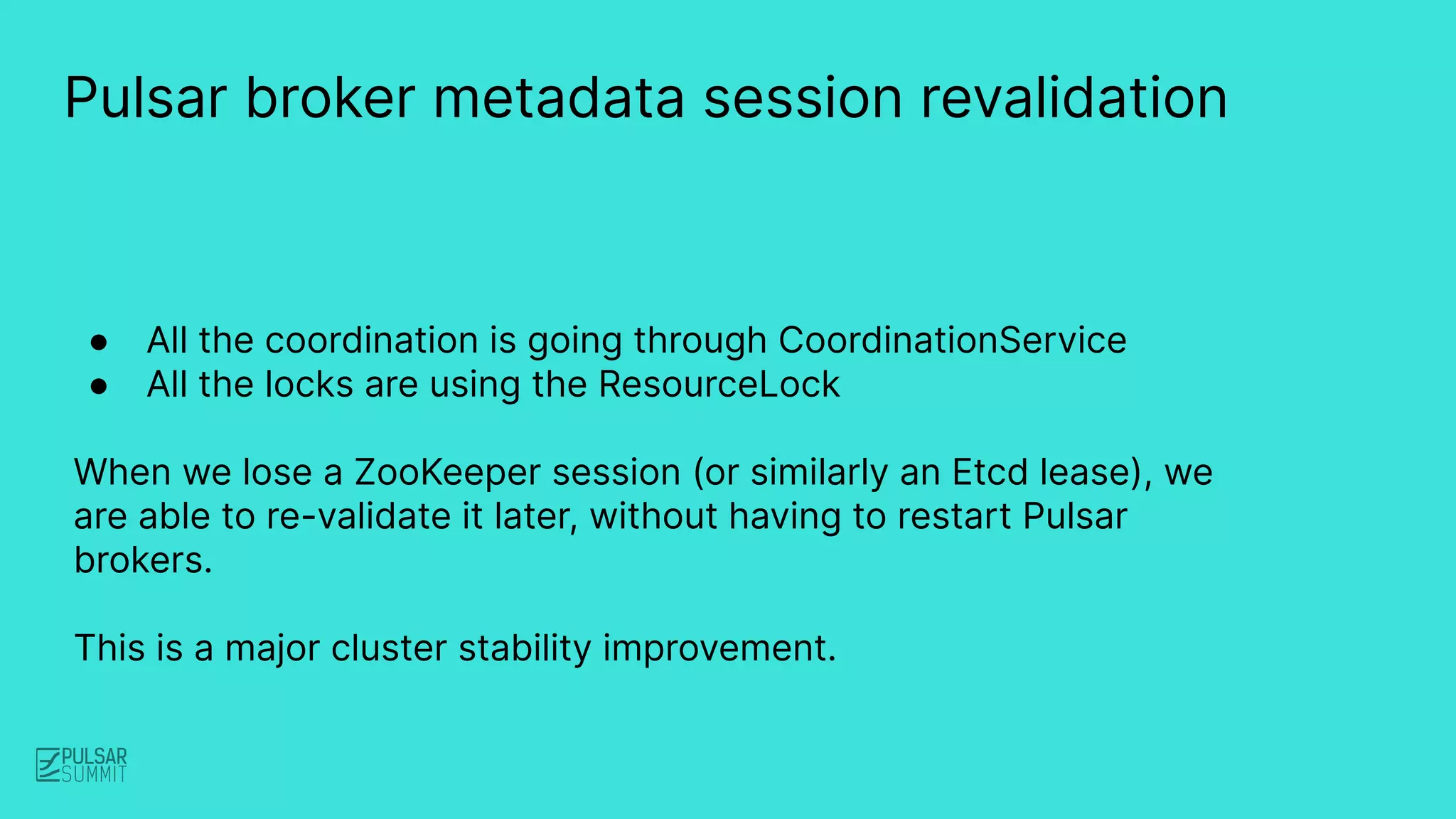
Pulsar broker metadata session revalidation
● All the coordination is going through CoordinationService
● All the locks are using the ResourceLock
When we lose a ZooKeeper session (or similarly an Etcd lease), we
are able to re-validate it later, without having to restart Pulsar
brokers.
This is a major cluster stability improvement.
Transparent batching of metadata operations
● All the metadata read and write operations are happening through a single
access point
● Accumulate operations into a queue and use underlying API for bulk access
(eg: ZK “multi” or Etcd transactions)
What’s next?
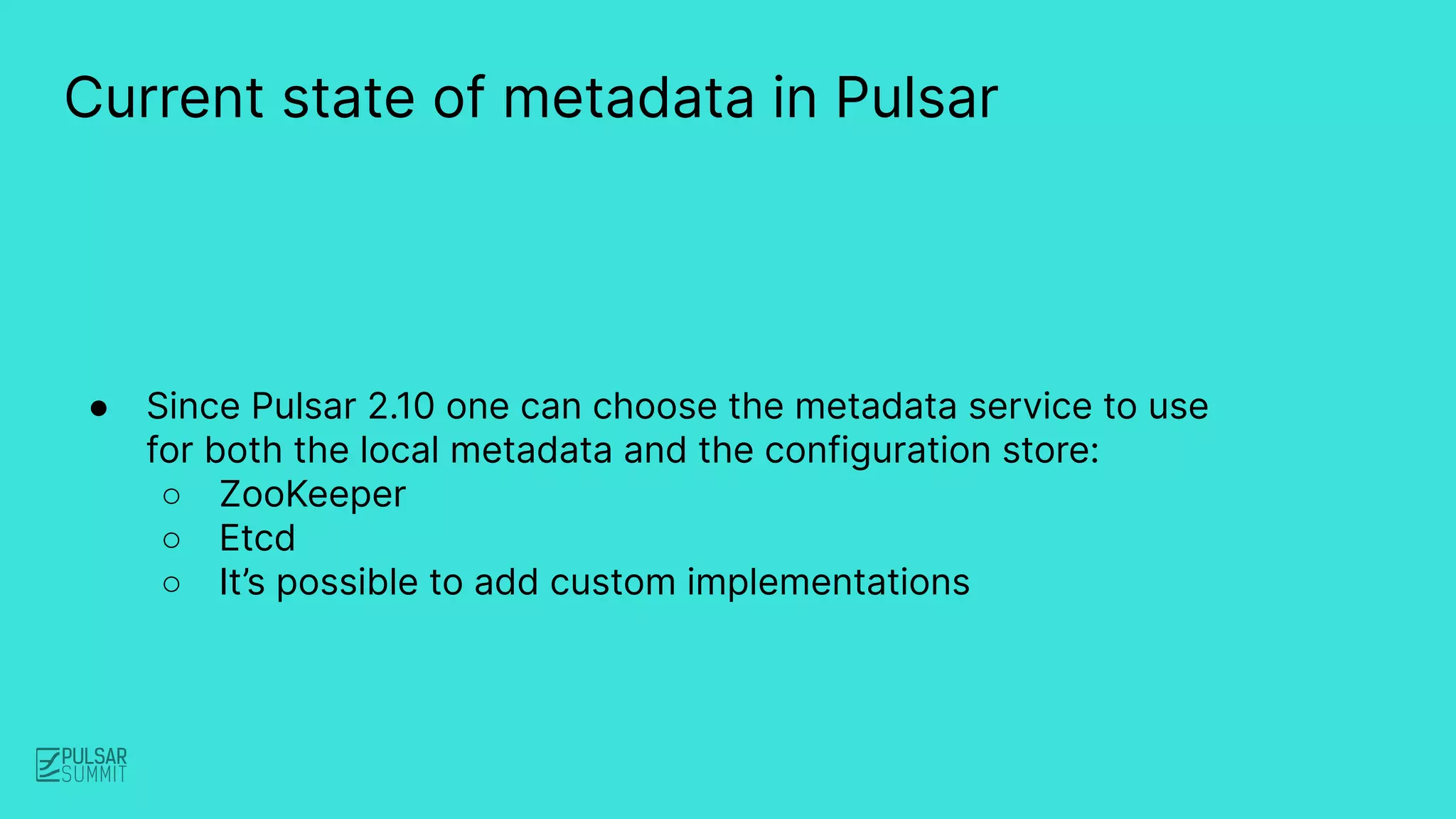
● Since Pulsar 2.10 one can choose the metadata service to use
for both the local metadata and the configuration store:
○ ZooKeeper
○ Etcd
○ It’s possible to add custom implementations
Current state of metadata in Pulsar
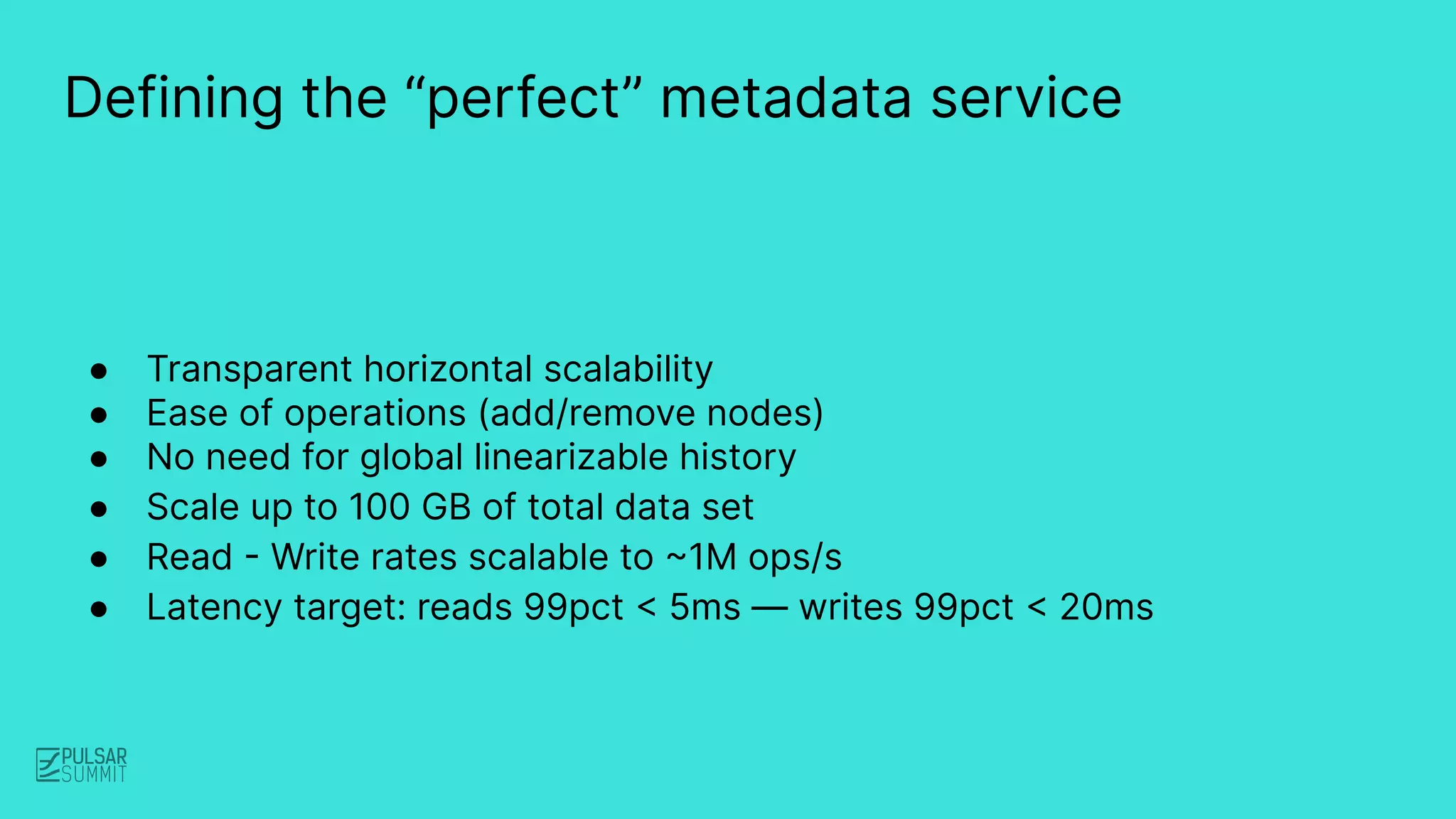
● Transparent horizontal scalability
● Ease of operations (add/remove nodes)
● No need for global linearizable history
● Scale up to 100 GB of total data set
● Read - Write rates scalable to ~1M ops/s
● Latency target: reads 99pct < 5ms — writes 99pct < 20ms
Defining the “perfect” metadata service
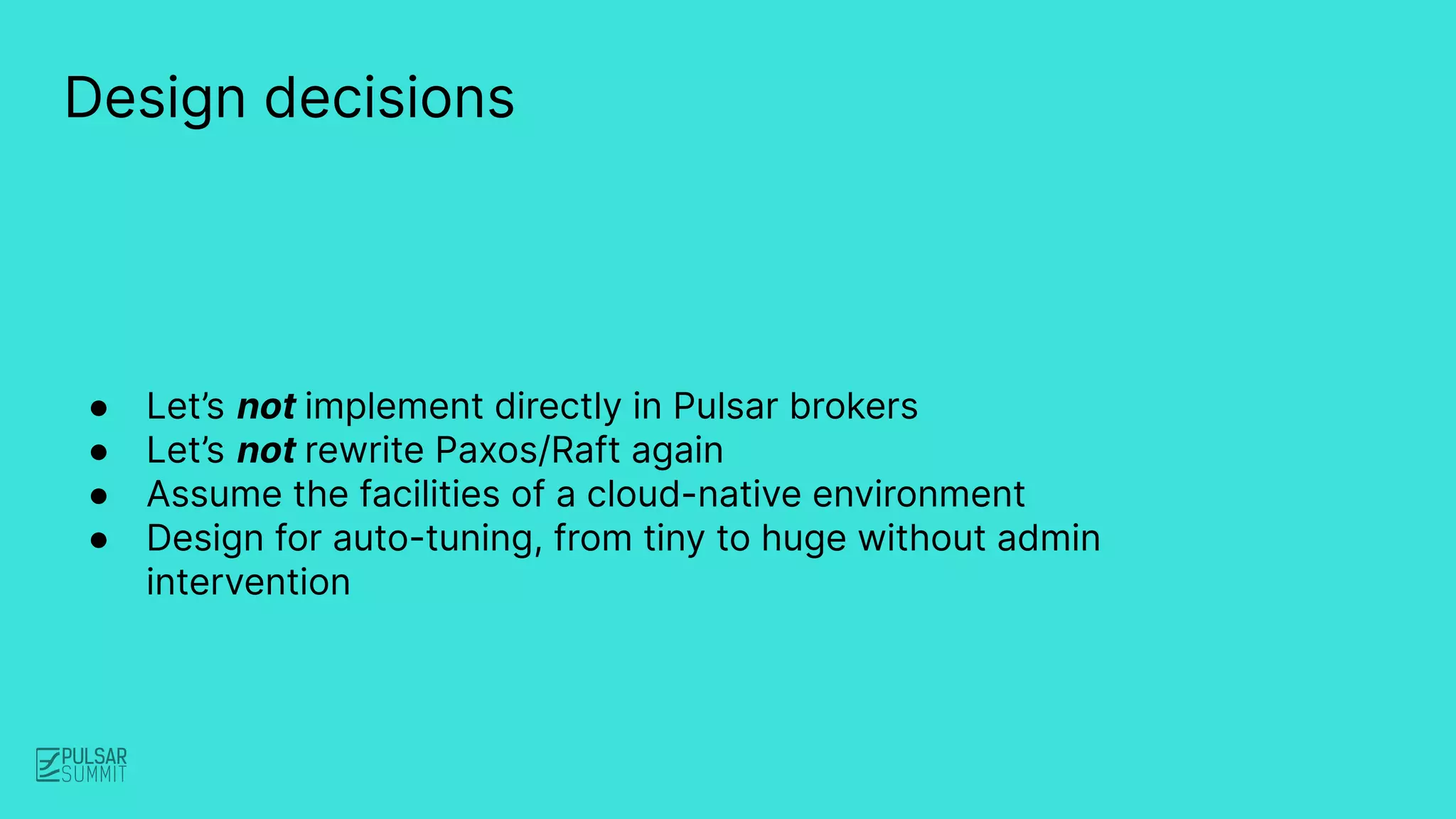
● Let’s not implement directly in Pulsar brokers
● Let’s not rewrite Paxos/Raft again
● Assume the facilities of a cloud-native environment
● Design for auto-tuning, from tiny to huge without admin
intervention
Design decisions
● Ultimate goal is to achieve a 10x increase in number of topics in
a cluster
● A small Pulsar cluster should be able to support millions of
topics
● Handling of metadata is the biggest obstacle
● It’s not the only factor though. We are also working on metrics,
lookups, overhead of single topic and global memory limits
What to expect
Matteo Merli
Thank you!
mmerli@streamnative.io
mmerli@apache.org
@merlimat
Pulsar Summit
San Francisco
Hotel Nikko
August 18 2022

Towards a ZooKeeper-less Pulsar, etcd, etcd, etcd. - Pulsar Summit SF 2022

  • 1.
    Pulsar Summit San Francisco HotelNikko August 18 2022 Tech Deep Dive Matteo Merli CTO • StreamNative Towards a ZooKeeper-less Pulsar
  • 2.
    Co-creator of Pulsar PMCChair for Apache Pulsar Member of Apache BookKeeper PMC Prev: Splunk, Streamlio, Yahoo Matteo Merli CTO StreamNative
  • 3.
  • 4.
  • 5.
  • 6.
  • 7.
  • 8.
  • 9.
    Examples of metadata ●Pointers to data ● Service discovery ● Distributed coordination ● System configuration ● Provisioning configuration
  • 10.
    Topics metadata Each persistenttopic is associated with a Managed Ledger Managed Ledger keeps a list of ledgers for a topic { "ledgers" : [ { "ledgerId" : 1234, "entries" : 1000, "size" : 433111, "offloaded" : false }, { "ledgerId" : 5579, "entries" : 50000, "size" : 9433111, "offloaded" : false } ], "schemaLedgers" : [ ], "compactedLedger" : { "ledgerId" : -1, "entries" : -1, "size" : -1, "offloaded" : false } }
  • 11.
    Ledger metadata ● EachBK ledger has an associated metadata ● Contains ○ State of the ledger ○ Which bookies have the data LedgerMetadata{ formatVersion=3, ensembleSize=2, writeQuorumSize=2, ackQuorumSize=2, state=CLOSED, length=1738964, lastEntryId=1611 digestType=CRC32C, password=base64:, ensembles={ 0=[bookie-1:3181, bookie-2:3181], 1000=[bookie-5:3181, bookie-2:3181] }, customMetadata={ component=base64:bWFuYWdlZC1sZWRnZXI=, pulsar/managed-ledger=base64:cHVibGlR=, application=base64:cHVsc2Fy } }
  • 12.
    Service discovery ● Findthe list of available bookies ○ Which bookies are in read-only? ● Discover which broker owns a particular topic ● Find the list of available brokers ○ What is the current load on each broker?
  • 13.
    Distributed coordination ● Acquirea lock over a particular resource ○ Ownership of group of topics ○ Signaling that some work on a particular resource is in progress ■ BK autorecovery ● Leader election ○ Establish a single leader designed to perform some tasks ■ Load manager designates a leader that ○ Failover to other available nodes
  • 14.
    System configuration ● Allowfor dynamic settings ● Features can be activated/deactivated without restarting brokers ● Keep isolation information ● Maintain tracking of (bookie → rack) mapping
  • 15.
    Provisioning configuration ● Metadatafor Tenants, Namespaces ● Policies to apply to namespaces ● Authorization definitions ● Highly-Cacheable metadata
  • 16.
  • 17.
    ZooKeeper ● Consensus based“database” ○ Data is replicated consistently to a quorum of nodes ● It is not horizontally scalable ○ Increasing the ZK cluster size does not increase the write capacity ● All data is kept in memory in every node ○ Not very GC friendly ● It takes periodic snapshots of the entire dataset
  • 18.
    ZooKeeper ● The amountof metadata that can be comfortably stored in ZK is ~5GB ● Tuning and operating ZK to work with big datasets is not trivial ○ Requires deep knowledge of ZK internals ● In cloud and containerized environments, leader election can sometime take few minutes: ○ Issues with DNS, software-defined-networking and sidecar TCP proxies.
  • 19.
    Why we wouldtake ZK away? ● Big clusters → we don’t want to have a hard limit of the amount of metadata ○ A horizontally scalable metadata store is more suited ● Small clusters → remove overhead of running ZK ○ Less components to deploy ○ Easier operations
  • 20.
    PIP-45: A planwith multiple steps
  • 21.
    PIP-45: Pluggable metadatabackend ● Instead of direct usage of ZooKeeper APIs, we have abstracted all the accesses through a single generic API ● This API has multiple implementations: ○ ZooKeeper ○ Etcd ○ RocksDB (for standalone) ○ Memory (for unit tests)
  • 22.
    Metadata semantics We haveidentified 2 main patterns of access to the metadata 1. Simple key-value access + notifications 2. Complex coordination
  • 23.
    Key-Value access ● MetadataStore→ Key-value store access ○ put() – get() – delete() ○ Values are byte[] ○ Users can register for notifications ● MetadataCache → Object cache on top of MetadataStore
  • 24.
    CoordinationService ● Contains primitivesfor “cluster coordination” ● High-level API that hides all the complexities ○ ResourceLock – Distributed lock over a shared resource ○ LeaderElection – Elect a leader among a set of peers ○ DistributedCounter – Generate unique IDs
  • 25.
  • 26.
    Pulsar broker metadatasession revalidation ● All the coordination is going through CoordinationService ● All the locks are using the ResourceLock When we lose a ZooKeeper session (or similarly an Etcd lease), we are able to re-validate it later, without having to restart Pulsar brokers. This is a major cluster stability improvement.
  • 27.
    Transparent batching ofmetadata operations ● All the metadata read and write operations are happening through a single access point ● Accumulate operations into a queue and use underlying API for bulk access (eg: ZK “multi” or Etcd transactions)
  • 28.
  • 29.
    ● Since Pulsar2.10 one can choose the metadata service to use for both the local metadata and the configuration store: ○ ZooKeeper ○ Etcd ○ It’s possible to add custom implementations Current state of metadata in Pulsar
  • 30.
    ● Transparent horizontalscalability ● Ease of operations (add/remove nodes) ● No need for global linearizable history ● Scale up to 100 GB of total data set ● Read - Write rates scalable to ~1M ops/s ● Latency target: reads 99pct < 5ms — writes 99pct < 20ms Defining the “perfect” metadata service
  • 31.
    ● Let’s notimplement directly in Pulsar brokers ● Let’s not rewrite Paxos/Raft again ● Assume the facilities of a cloud-native environment ● Design for auto-tuning, from tiny to huge without admin intervention Design decisions
  • 32.
    ● Ultimate goalis to achieve a 10x increase in number of topics in a cluster ● A small Pulsar cluster should be able to support millions of topics ● Handling of metadata is the biggest obstacle ● It’s not the only factor though. We are also working on metrics, lookups, overhead of single topic and global memory limits What to expect
  • 33.