TOURIST
TOURIST
• a person who travels and visits places for pleasure and interest:
Millions of tourists visit Rome every year.
• A tourist is a person who travels to a place for pleasure.
• Visitors who travel to and stay in places outside their usual
environment for more than twenty-four (24) hours and not more than
one consecutive year for leisure, business and other purposes not
related to the exercise of an activity remunerated from within the
place visited.
MOTIVATION FACTORS OF THE TOURISTS
Motivation of the tourists stems from the domain of human psychology. It is the
satisfaction-forming factor.
The factors of motivation can be categorized into two types −
• Internal Factors of Motivation
• External Factors of Motivation
Internal Factors of Motivation:
Internal factors arouse, direct, and integrate a person’s behavior and influence his
decisions for travelling.
• Intrinsic Motivation − For many people, tourism is a way of satisfying their
psychological needs such as travelling, performing leisure activities, exploring
novelty and capabilities, self-expression and self-assurance, creativity,
competition, need for relaxation, and belongingness. The intrinsic motivations
pertain to assuring one’s capabilities on different emotional fronts. Intrinsic
motivation drives the tourists to opt for tourism for intangible rewards such as
fun, assurance, and other emotional needs.
• The other intrinsic factors of motivation are
Attitudes of Tourist − Knowledge of a person, place, or object + Positive or
negative feelings about the same.
Tourist’s Perception − By observing, listening, or getting knowledge, a tourist
forms the perception about a place, person, or an object.
Values or Beliefs − A tourist believes or values a specific mode of conduct which
is acceptable personally or socially.
Personality of the Tourist − The nature and physique of a tourist plays an
important role towards motivation in tourism.
External Factors of Motivation:
There are external motives in tourism that can influence tourists and pull them
towards a certain motivation and subsequent decision.
• Extrinsic Motivation − Here, a tourist gets motivated by external factors such as
money and the need to feel competent on the scale of expenditure and
performance.
• The other Extrinsic factors of motivation are
Place of Origin − The grooming of the tourist depends upon the place of its origin. For
example, for the Indian married women, the tourism might come last in the list of
preferential things they wish to do whereas for American ladies, tourism would acquire
much higher rank.
Family and Age − The family matters when it comes to the structure and the income.
Today, the families with nuclear structure and double income tend to opt for long
distance, extravagant tourism more than joint families or families with single earning
member who are interested in visiting domestic places. The tourists also have different
preferences of places according to their age. For example, tourists in the age group of 5
to 45 years might enjoy visiting destination in the USA such as Disneyland more than
the senior citizens.
Culture or Social Class − Tourists of different cultures prefer different places, events,
and different types of tourism. In addition, if friends and families who have visited a
place earlier spread the first hand information that motivates the others to visit the
place too.
Market − Ever-changing market variables alter tourism. Changes in value of currency,
political situations, and economic well-being of the country influence the decisions of a
tourist.
TYPES OF TOURISTS
TYPES OF TOURISTS
• Intrinsic Tourists − They are into holidaying for the sake of enjoyment.
• Extrinsic Tourists − They have reward oriented motivation. These tourists are
susceptible to the activities where performance is evaluated.
• Adventurers tourists− They give very little importance to relaxation. They are always
up to exploring places and taking challenges. Mainly youths and singles from both
genders carrying zest of life largely contribute to this type of tourism.
• Budget tourists − They are economy-oriented tourists. Their touring decisions about
places, travelling mode, and other related factors are largely dependent on their
financial status.
• Homebodies tourists − They are mainly relaxed tourists. They do not get into
adventure. The tourists aged above 45 to 50 years belong to this type. The busy
professionals under 45 years also belong to this type.
• Moderates tourists− They plan their tour ahead, have a high inclination towards
tourism but they do not get into sports or adventure activities.
• Vacationers tourists− They plan touring during vacations such as summer break or
Christmas break. They are not always sure of where and why they wish to visit.
CLASSES OF TOURISTS
• Tourists Travelling with Families:The tourists who visit places with their first and
extended families, or families of relatives. One person, generally the head of the
tourist family is the decision maker. The families generally travel for holidays and
leisure and tend to expend sparingly. They generally are keen on receiving the
best services for what they have paid. They tend to carry more luggage.
• Single Tourists:They travel alone and are independent. They are alone but not
lonely; as tourism is what they pursue as a hobby. The gap year travelers,
unmarried persons, widows/widowers, backpackers, and solitary tourists travel
single. They decide for themselves and tend to expend more. They tend to carry
less stuff on the journey. They tend to behave balanced if any challenging
situation occurs and are rational towards tour schedules
• Groups of Tourists:Students from schools and universities as members of
educational tours, fellows of various fraternities with common interests, groups
of newly-weds, or senior citizens.
• Tourists Visiting Friends and Relatives:These tourists travel to meet friends or
relatives, or to attend a celebration or gathering. These tourists generally plan
their tours in the breaks such as Diwali holidays, Christmas holidays, or any kind
of long break when most of the people have break.
• Business Tourists:They are the professional tourists on the business trips. They
decide for themselves but do not spend much money. For example, a sales or a
marketing person travels to another city to attend a business fair, and business
manager travels to another country for business deals.
• Health Tourists:These tourists travels to places with the agenda of health on their
mind. They travel to avail some special medical treatment, operation, surgery,
medication, or inexpensive aesthetic surgeries available in different country.
Some tourists in this category also travel if they are receiving some illness from
the climate at their residence such as Asthma.
• Incentive Tourists:They tour for consuming the reward they received in the form
of a few days’ family holiday package at some hotel or resort. Such rewards are
generally distributed if an employee performs outstanding to achieve the goals.
FACTORS AFFECTING TOURIST
BEHAVIOR
factors affecting tourist behaviour helps to studies why a tourist chooses a
particular destination and what are the driving factors that influence his decision
for travelling.
The following factors immensely alter tourist behavior −
• Geographical Factors − Some physical factors like geographical and climatic
conditions, facilities and amenities available at the destination, advertising and
marketing conducted by tourism business alter the decision making of the
tourists.
• Social Factors − A few social factors such as a person’s social network, which
provide first had information that can alter a person’s decision of visiting or not
visiting a particular place.
• Place of Origin − There can be a broad spectrum of tourist behavior depending
upon the place they belong to. North Americans like to follow their own cultural
framework. Japanese and Korean tourists like to visit places in groups.
• Tourism Destination − It is a major contributing factor altering tourist behavior. If
a destination has all basic provisions such as electricity, water, clean
surroundings, proper accessibility, amenities, and has its own significance, it
largely attracts tourists.
• Education of Tourist − The more educated the tourist is, the wider range of
choices, curiosity, and the knowledge of places he would have. This drives the
decision making when it comes to choosing a destination.
PLOG’S MODEL OF TOURISTS
BEHAVIOR
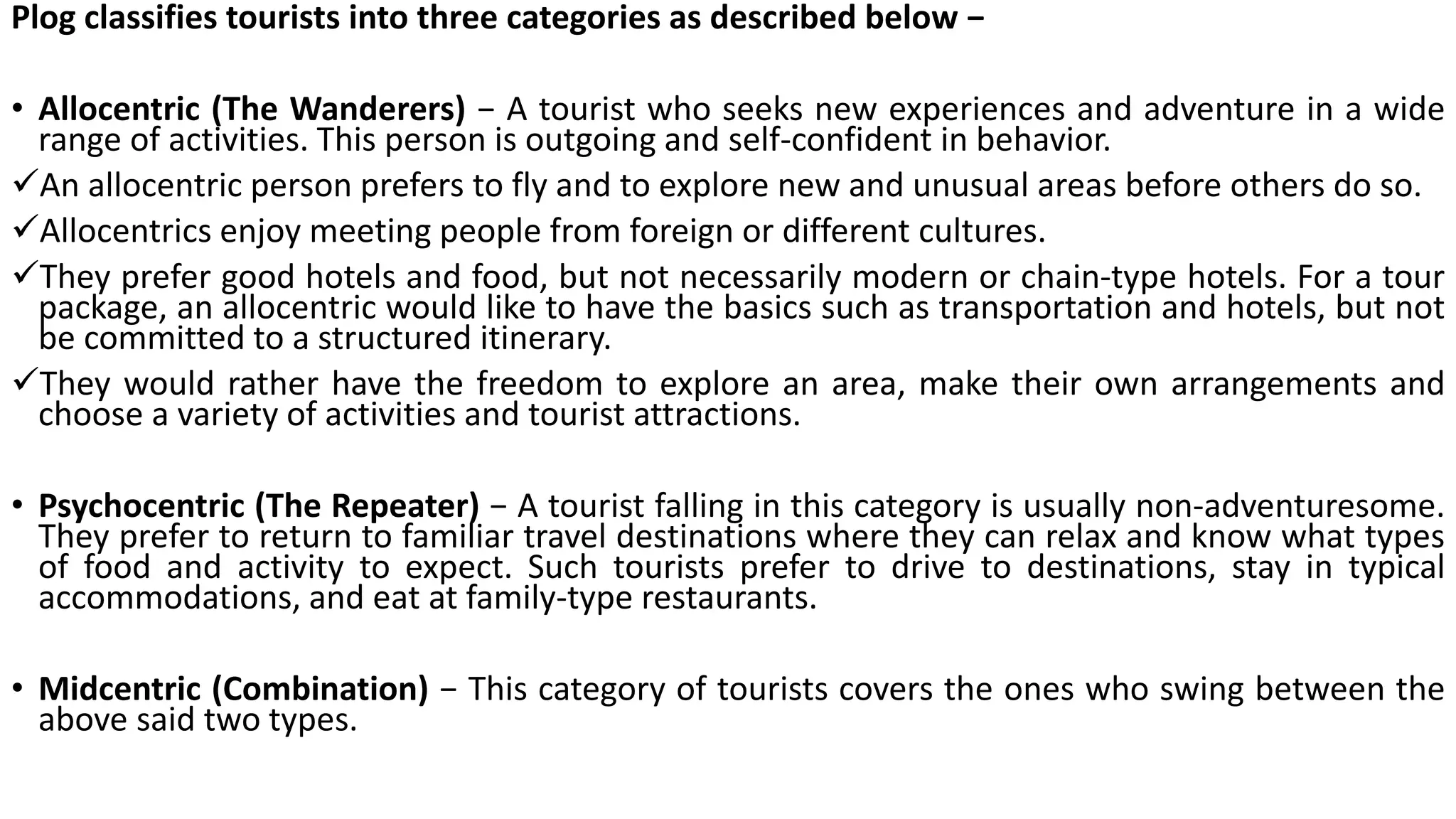
Plog classifies tourists into three categories as described below −
• Allocentric (The Wanderers) − A tourist who seeks new experiences and adventure in a wide
range of activities. This person is outgoing and self-confident in behavior.
An allocentric person prefers to fly and to explore new and unusual areas before others do so.
Allocentrics enjoy meeting people from foreign or different cultures.
They prefer good hotels and food, but not necessarily modern or chain-type hotels. For a tour
package, an allocentric would like to have the basics such as transportation and hotels, but not
be committed to a structured itinerary.
They would rather have the freedom to explore an area, make their own arrangements and
choose a variety of activities and tourist attractions.
• Psychocentric (The Repeater) − A tourist falling in this category is usually non-adventuresome.
They prefer to return to familiar travel destinations where they can relax and know what types
of food and activity to expect. Such tourists prefer to drive to destinations, stay in typical
accommodations, and eat at family-type restaurants.
• Midcentric (Combination) − This category of tourists covers the ones who swing between the
above said two types.

TOURIST & ITS TYPE &MOTIVETIONAL FACTORS & BEHAVIOR .pptx

  • 1.
  • 2.
    TOURIST • a personwho travels and visits places for pleasure and interest: Millions of tourists visit Rome every year. • A tourist is a person who travels to a place for pleasure. • Visitors who travel to and stay in places outside their usual environment for more than twenty-four (24) hours and not more than one consecutive year for leisure, business and other purposes not related to the exercise of an activity remunerated from within the place visited.
  • 3.
    MOTIVATION FACTORS OFTHE TOURISTS Motivation of the tourists stems from the domain of human psychology. It is the satisfaction-forming factor. The factors of motivation can be categorized into two types − • Internal Factors of Motivation • External Factors of Motivation
  • 4.
    Internal Factors ofMotivation: Internal factors arouse, direct, and integrate a person’s behavior and influence his decisions for travelling. • Intrinsic Motivation − For many people, tourism is a way of satisfying their psychological needs such as travelling, performing leisure activities, exploring novelty and capabilities, self-expression and self-assurance, creativity, competition, need for relaxation, and belongingness. The intrinsic motivations pertain to assuring one’s capabilities on different emotional fronts. Intrinsic motivation drives the tourists to opt for tourism for intangible rewards such as fun, assurance, and other emotional needs.
  • 5.
    • The otherintrinsic factors of motivation are Attitudes of Tourist − Knowledge of a person, place, or object + Positive or negative feelings about the same. Tourist’s Perception − By observing, listening, or getting knowledge, a tourist forms the perception about a place, person, or an object. Values or Beliefs − A tourist believes or values a specific mode of conduct which is acceptable personally or socially. Personality of the Tourist − The nature and physique of a tourist plays an important role towards motivation in tourism.
  • 6.
    External Factors ofMotivation: There are external motives in tourism that can influence tourists and pull them towards a certain motivation and subsequent decision. • Extrinsic Motivation − Here, a tourist gets motivated by external factors such as money and the need to feel competent on the scale of expenditure and performance.
  • 7.
    • The otherExtrinsic factors of motivation are Place of Origin − The grooming of the tourist depends upon the place of its origin. For example, for the Indian married women, the tourism might come last in the list of preferential things they wish to do whereas for American ladies, tourism would acquire much higher rank. Family and Age − The family matters when it comes to the structure and the income. Today, the families with nuclear structure and double income tend to opt for long distance, extravagant tourism more than joint families or families with single earning member who are interested in visiting domestic places. The tourists also have different preferences of places according to their age. For example, tourists in the age group of 5 to 45 years might enjoy visiting destination in the USA such as Disneyland more than the senior citizens. Culture or Social Class − Tourists of different cultures prefer different places, events, and different types of tourism. In addition, if friends and families who have visited a place earlier spread the first hand information that motivates the others to visit the place too. Market − Ever-changing market variables alter tourism. Changes in value of currency, political situations, and economic well-being of the country influence the decisions of a tourist.
  • 8.
  • 9.
    TYPES OF TOURISTS •Intrinsic Tourists − They are into holidaying for the sake of enjoyment. • Extrinsic Tourists − They have reward oriented motivation. These tourists are susceptible to the activities where performance is evaluated. • Adventurers tourists− They give very little importance to relaxation. They are always up to exploring places and taking challenges. Mainly youths and singles from both genders carrying zest of life largely contribute to this type of tourism. • Budget tourists − They are economy-oriented tourists. Their touring decisions about places, travelling mode, and other related factors are largely dependent on their financial status. • Homebodies tourists − They are mainly relaxed tourists. They do not get into adventure. The tourists aged above 45 to 50 years belong to this type. The busy professionals under 45 years also belong to this type. • Moderates tourists− They plan their tour ahead, have a high inclination towards tourism but they do not get into sports or adventure activities. • Vacationers tourists− They plan touring during vacations such as summer break or Christmas break. They are not always sure of where and why they wish to visit.
  • 10.
  • 11.
    • Tourists Travellingwith Families:The tourists who visit places with their first and extended families, or families of relatives. One person, generally the head of the tourist family is the decision maker. The families generally travel for holidays and leisure and tend to expend sparingly. They generally are keen on receiving the best services for what they have paid. They tend to carry more luggage. • Single Tourists:They travel alone and are independent. They are alone but not lonely; as tourism is what they pursue as a hobby. The gap year travelers, unmarried persons, widows/widowers, backpackers, and solitary tourists travel single. They decide for themselves and tend to expend more. They tend to carry less stuff on the journey. They tend to behave balanced if any challenging situation occurs and are rational towards tour schedules
  • 12.
    • Groups ofTourists:Students from schools and universities as members of educational tours, fellows of various fraternities with common interests, groups of newly-weds, or senior citizens. • Tourists Visiting Friends and Relatives:These tourists travel to meet friends or relatives, or to attend a celebration or gathering. These tourists generally plan their tours in the breaks such as Diwali holidays, Christmas holidays, or any kind of long break when most of the people have break. • Business Tourists:They are the professional tourists on the business trips. They decide for themselves but do not spend much money. For example, a sales or a marketing person travels to another city to attend a business fair, and business manager travels to another country for business deals.
  • 13.
    • Health Tourists:Thesetourists travels to places with the agenda of health on their mind. They travel to avail some special medical treatment, operation, surgery, medication, or inexpensive aesthetic surgeries available in different country. Some tourists in this category also travel if they are receiving some illness from the climate at their residence such as Asthma. • Incentive Tourists:They tour for consuming the reward they received in the form of a few days’ family holiday package at some hotel or resort. Such rewards are generally distributed if an employee performs outstanding to achieve the goals.
  • 14.
  • 15.
    factors affecting touristbehaviour helps to studies why a tourist chooses a particular destination and what are the driving factors that influence his decision for travelling.
  • 16.
    The following factorsimmensely alter tourist behavior − • Geographical Factors − Some physical factors like geographical and climatic conditions, facilities and amenities available at the destination, advertising and marketing conducted by tourism business alter the decision making of the tourists. • Social Factors − A few social factors such as a person’s social network, which provide first had information that can alter a person’s decision of visiting or not visiting a particular place. • Place of Origin − There can be a broad spectrum of tourist behavior depending upon the place they belong to. North Americans like to follow their own cultural framework. Japanese and Korean tourists like to visit places in groups.
  • 17.
    • Tourism Destination− It is a major contributing factor altering tourist behavior. If a destination has all basic provisions such as electricity, water, clean surroundings, proper accessibility, amenities, and has its own significance, it largely attracts tourists. • Education of Tourist − The more educated the tourist is, the wider range of choices, curiosity, and the knowledge of places he would have. This drives the decision making when it comes to choosing a destination.
  • 18.
    PLOG’S MODEL OFTOURISTS BEHAVIOR
  • 19.
    Plog classifies touristsinto three categories as described below − • Allocentric (The Wanderers) − A tourist who seeks new experiences and adventure in a wide range of activities. This person is outgoing and self-confident in behavior. An allocentric person prefers to fly and to explore new and unusual areas before others do so. Allocentrics enjoy meeting people from foreign or different cultures. They prefer good hotels and food, but not necessarily modern or chain-type hotels. For a tour package, an allocentric would like to have the basics such as transportation and hotels, but not be committed to a structured itinerary. They would rather have the freedom to explore an area, make their own arrangements and choose a variety of activities and tourist attractions. • Psychocentric (The Repeater) − A tourist falling in this category is usually non-adventuresome. They prefer to return to familiar travel destinations where they can relax and know what types of food and activity to expect. Such tourists prefer to drive to destinations, stay in typical accommodations, and eat at family-type restaurants. • Midcentric (Combination) − This category of tourists covers the ones who swing between the above said two types.