Tourism
Lo: To understand what tourism
is and why it has grown.
What is tourism?
• Tourism generally involves activities
that require away from home for at
least 1 night. This includes
holidays,buissness trips. Also some
scientists say that day trips are also
counted as tourism.
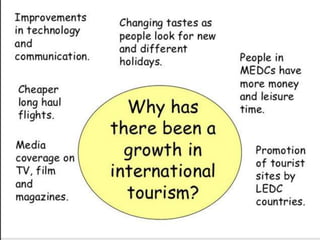
Why has tourism grown?
• People like to go on holiday because:
• The weather
• Leisure and recreation
• Advertising
• Cheaper and faster transport
• Landmarks
• Culture
• Food Extension task: explain these
points into more detail
Key terms:
• Tourist: going somewhere different to
do something for a day or overnight.
• Domestic tourist: someone that travels
in the same country.
• International: go to a different country
• Self catering: no food included
• Travel agent: person that books your
holiday for you.
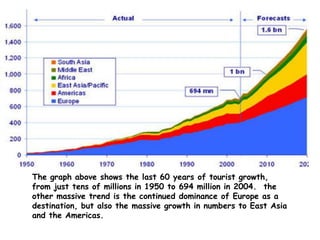
The graph above shows the last 60 years of tourist growth,
from just tens of millions in 1950 to 694 million in 2004. the
other massive trend is the continued dominance of Europe as a
destination, but also the massive growth in numbers to East Asia
and the Americas.
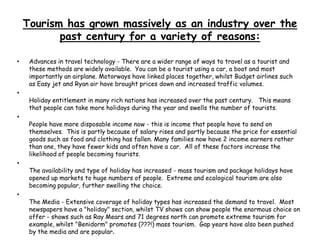
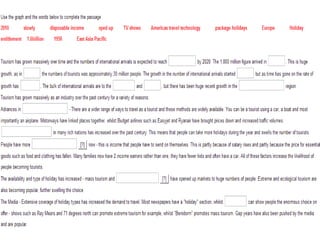
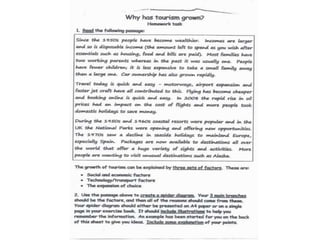
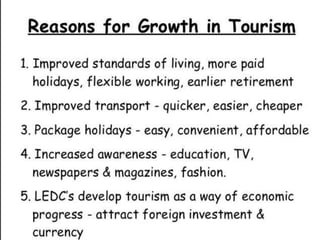
Tourism has grown massively as an industry over the
past century for a variety of reasons:
• Advances in travel technology - There are a wider range of ways to travel as a tourist and
these methods are widely available. You can be a tourist using a car, a boat and most
importantly an airplane. Motorways have linked places together, whilst Budget airlines such
as Easy jet and Ryan air have brought prices down and increased traffic volumes.
•
Holiday entitlement in many rich nations has increased over the past century. This means
that people can take more holidays during the year and swells the number of tourists.
•
People have more disposable income now - this is income that people have to send on
themselves. This is partly because of salary rises and partly because the price for essential
goods such as food and clothing has fallen. Many families now have 2 income earners rather
than one, they have fewer kids and often have a car. All of these factors increase the
likelihood of people becoming tourists.
•
The availability and type of holiday has increased - mass tourism and package holidays have
opened up markets to huge numbers of people. Extreme and ecological tourism are also
becoming popular, further swelling the choice.
•
The Media - Extensive coverage of holiday types has increased the demand to travel. Most
newspapers have a "holiday" section, whilst TV shows can show people the enormous choice on
offer - shows such as Ray Mears and 71 degrees north can promote extreme tourism for
example, whilst "Benidorm" promotes (???!) mass tourism. Gap years have also been pushed
by the media and are popular.
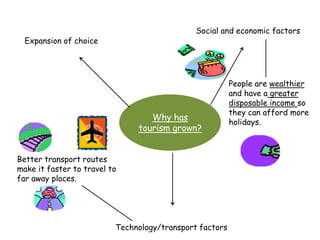
Why has
tourism grown?
Expansion of choice
Social and economic factors
Technology/transport factors
Better transport routes
make it faster to travel to
far away places.
People are wealthier
and have a greater
disposable income so
they can afford more
holidays.
Tourist
Environments
LO: To understand and explain in detail what
attracts tourists to some destinations.
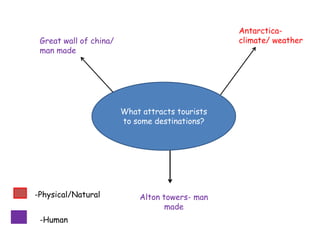
What attracts tourists
to some destinations?
-Physical/Natural
-Human
Great wall of china/
man made
Antarctica-
climate/ weather
Alton towers- man
made
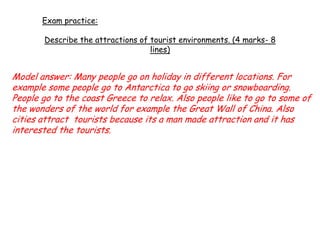
Exam practice:
Describe the attractions of tourist environments. (4 marks- 8
lines)
Model answer: Many people go on holiday in different locations. For
example some people go to Antarctica to go skiing or snowboarding.
People go to the coast Greece to relax. Also people like to go to some of
the wonders of the world for example the Great Wall of China. Also
cities attract tourists because its a man made attraction and it has
interested the tourists.
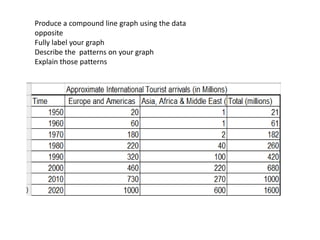
Produce a compound line graph using the data
opposite
Fully label your graph
Describe the patterns on your graph
Explain those patterns
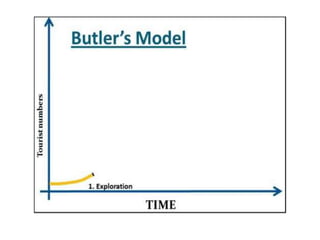
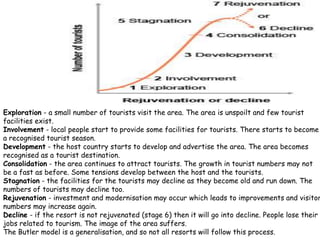
Exploration - a small number of tourists visit the area. The area is unspoilt and few tourist
facilities exist.
Involvement - local people start to provide some facilities for tourists. There starts to become
a recognised tourist season.
Development - the host country starts to develop and advertise the area. The area becomes
recognised as a tourist destination.
Consolidation - the area continues to attract tourists. The growth in tourist numbers may not
be a fast as before. Some tensions develop between the host and the tourists.
Stagnation - the facilities for the tourists may decline as they become old and run down. The
numbers of tourists may decline too.
Rejuvenation - investment and modernisation may occur which leads to improvements and visitor
numbers may increase again.
Decline - if the resort is not rejuvenated (stage 6) then it will go into decline. People lose their
jobs related to tourism. The image of the area suffers.
The Butler model is a generalisation, and so not all resorts will follow this process.
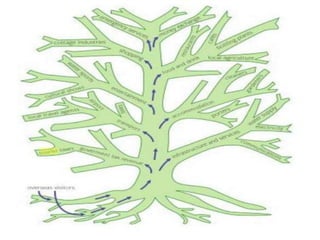
The economic importance of
tourism
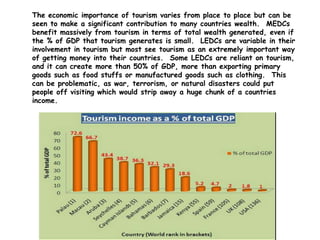
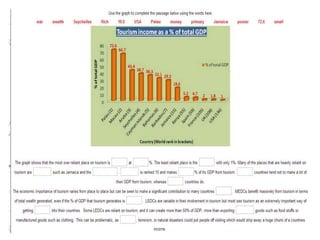
The economic importance of tourism varies from place to place but can be
seen to make a significant contribution to many countries wealth. MEDCs
benefit massively from tourism in terms of total wealth generated, even if
the % of GDP that tourism generates is small. LEDCs are variable in their
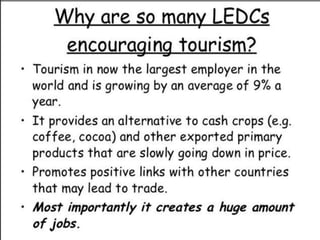
involvement in tourism but most see tourism as an extremely important way
of getting money into their countries. Some LEDCs are reliant on tourism,
and it can create more than 50% of GDP, more than exporting primary
goods such as food stuffs or manufactured goods such as clothing. This
can be problematic, as war, terrorism, or natural disasters could put
people off visiting which would strip away a huge chunk of a countries
income.
National parks in the UK
LO:
To understand what national parks are and
how important they are.
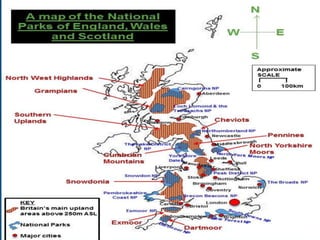
What is a national park?
• National parks have been created to protect Britain’s most
spectacular scenery by limiting the amount and type of
development that can take place. In addition, National Parks are
there to offer the British people access to the countryside for
recreational purposes.
• There are 15 National Parks in the British Isles and they came
into existence in 1951 following an act of Parliament (The 1949
National Parks and Access to the Countryside Act). The first
park created under this act was the Peak District National Park,
which is surrounded by large towns and cities such as Liverpool
and Manchester.
Why are national parks so
important?
• Primarily National Parks are created to conserve the biodiversity found in natural areas, and provide
habitats for permanent and migrating animals in the area. They are recognised nationally and internationally
as being the most effective method of improving the conservation and biodiversity values of reserves.
National Parks also protect cultural sites such as shell middens, scar trees and cave paintings from being
damaged by human activities, and involve indigenous peoples by including their lands in indigenous protected
areas (Figgis, Australia’s National Parks: Future Directions, 1999).
That is not to say that the general community cannot continue to use and enjoy National Parks in the same
way they enjoyed reserves. Many recreational activities are allowed in National Parks such as walking,
camping, boating and canoeing, fishing and swimming. It is this recreational aspect of National Parks that
make them particularly viable for tourism.
National Parks receive 'top billing' in many tourist guides as places to visit and as such boost the economy
of local areas. For example, the Grampians National Park contributed over $150 million to the regional
economy. The increased popularity of National Parks also allows for more employment opportunities.
It is not only the income generated by visitation that makes National Parks important to the economy but
also a variety of potential ecosystem services. Ecosystem services benefits include catchment protection,
water production, protection of soil stability, climatic controls, carbon sinks, genetic resources, pollination
of economic species, habitat for economically important species such as insectivorous birds and the
protection of hatcheries of commercial aquatic species (Beattie, Commercial Exploration of Biodiversity,
1995).
Overall, National Parks are an important and valuable resource for scientists, educators and the community
due to the variety of aesthetic, recreational and economic uses they offer.
What can you do in a national
park?
• Kayaking
• Jet skiing
• Boating
• Rock climbing
• horse riding
• Walks
• Cycling
• Rowing
• sailing
Your task:
• You need to create a leaflet to try and
attract more visitor to the lake district.
• Or
• You can create a news script on the new
national park that has just opened.
• (remember to add pictures, facts and websites)
Skills: proportional symbols
LO: During this lesson I will understand how to
calculate the radius of each of your
proportional symbols.
- I will be able to list the problems in the lake
district.
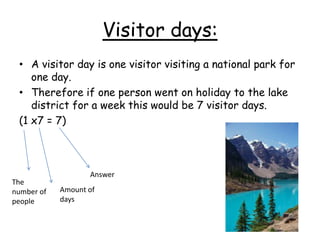
Visitor days:
• A visitor day is one visitor visiting a national park for
one day.
• Therefore if one person went on holiday to the lake
district for a week this would be 7 visitor days.
(1 x7 = 7)
Answer
Amount of
days
The
number of
people
Your task for today:
• During this lesson you will be creating a
map to display information using
different sized shapes. The area of
each shape will represent (be
proportional to) the number of visitor
days in each national park each year.
Alternative ways of presenting the same data:
Methods used to present
data.
Advantages Disadvantages
Proportional symbols map •The information is
presented on a base map
so you can see if there is a
special pattern.
•Some symbols can be very
large and cover parts of the
map making it more
difficult to understand.
Bar chart (graph)
Pie chart
Table
Ect ..
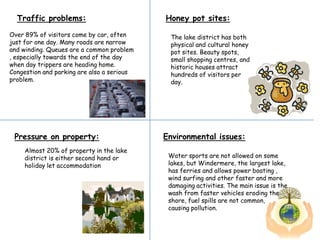
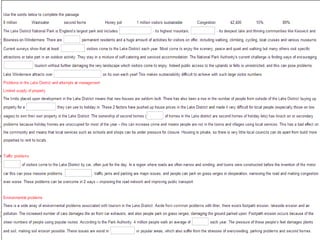
Traffic problems: Honey pot sites:
Pressure on property: Environmental issues:
Over 89% of visitors come by car, often
just for one day. Many roads are narrow
and winding. Queues are a common problem
, especially towards the end of the day
when day trippers are heading home.
Congestion and parking are also a serious
problem.
The lake district has both
physical and cultural honey
pot sites. Beauty spots,
small shopping centres, and
historic houses attract
hundreds of visitors per
day.
Almost 20% of property in the lake
district is either second hand or
holiday let accommodation
Water sports are not allowed on some
lakes, but Windermere, the largest lake,
has ferries and allows power boating ,
wind surfing and other faster and more
damaging activities. The main issue is the
wash from faster vehicles eroding the
shore, fuel spills are not common,
causing pollution.
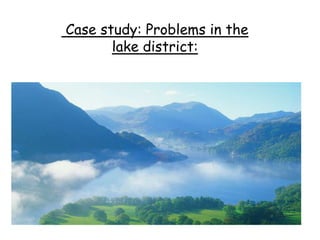
Case study: Problems in the
lake district:
Your task:
You will be given a role card about someone who is
experiencing problems in the lake district because
of the increasing amount of visitors or tourists.
You need to write a formal letter to the lake
district national park authority to explain the
problems they are experiencing (remember to
stay in character)
Hint: use the guidance on the back of the sheet.
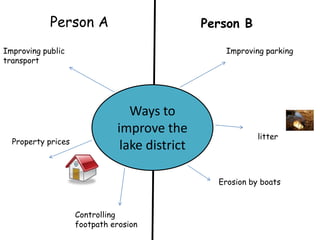
Ways to
improve the
lake district
Person A Person B
Improving parking
litter
Erosion by boats
Controlling
footpath erosion
Property prices
Improving public
transport
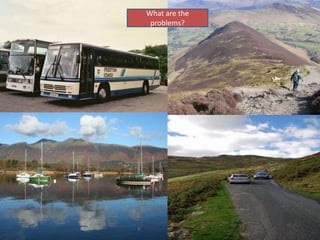
What are the
problems?
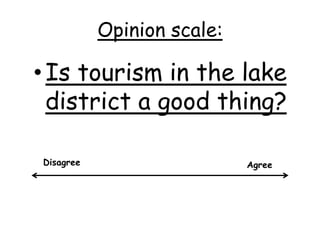
Opinion scale:
•Is tourism in the lake
district a good thing?
AgreeDisagree
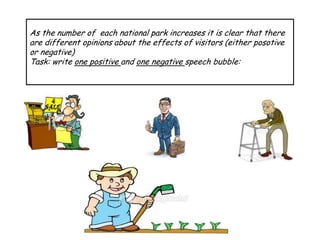
As the number of each national park increases it is clear that there
are different opinions about the effects of visitors (either posotive
or negative)
Task: write one positive and one negative speech bubble:
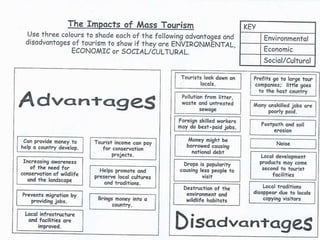
Mass tourism
is it good or bad?
Lo:To be able to evaluate the consequences
of mass tourism destinations
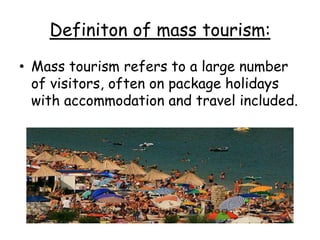
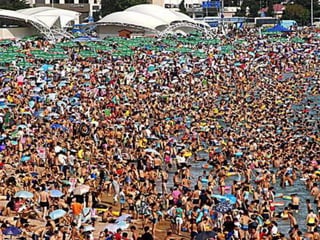
Definiton of mass tourism:
• Mass tourism refers to a large number
of visitors, often on package holidays
with accommodation and travel included.
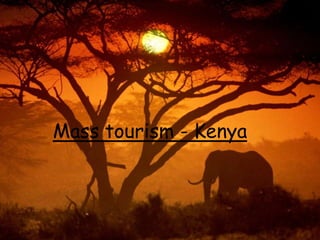
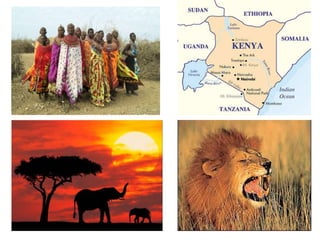
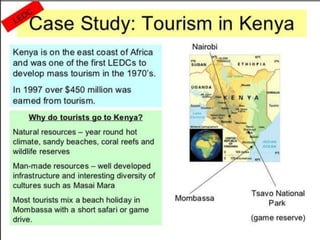
Mass tourism - Kenya
http://www.bbc.co.uk/learningzone/clips/tourism-in-kenya/4506.html
You need to watch these two videos and
complete the questions on your sheet.
http://www.bbc.co.uk/learningzone/clips/holidays-in-kenya/4507.html
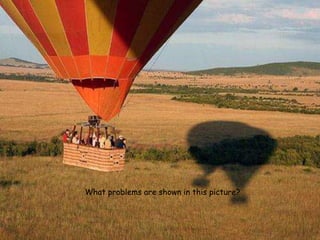
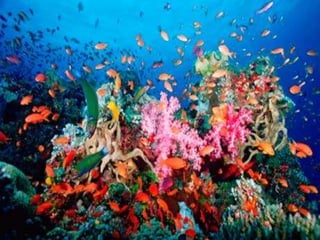
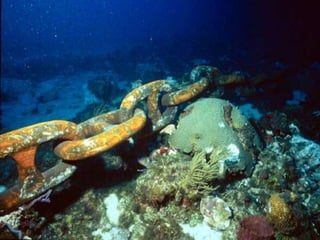
What problems are shown in this picture?
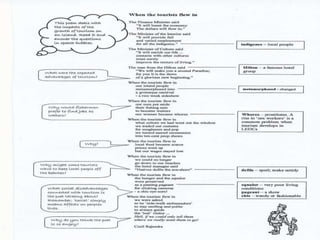
Task:
You need to read through this
diary entry and underline or
highlight the problems that Janis
is making.
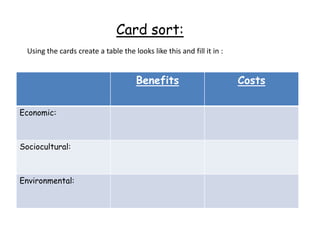
Card sort:
Using the cards create a table the looks like this and fill it in :
Benefits Costs
Economic:
Sociocultural:
Environmental:
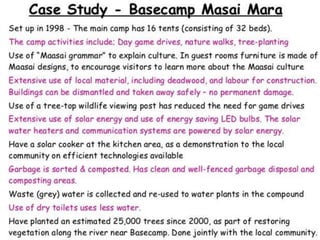
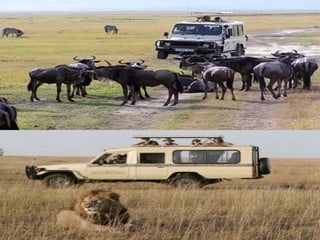
Problems with mass tourism in Kenya-
safaris
•Hot air balloons cast shadows over the land which
scare the animals and therefore they don't mate.
•Safari busses go off track to get closes to the
animals for the tourists which can scare the animals.
•The reef on the coast- people are touching the coral
and anchors break the coral and the petrol will create
a area were the coral cant survive.
23
24
22
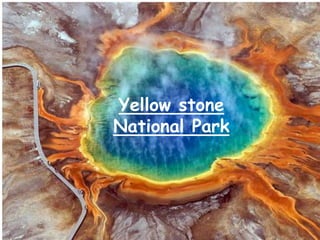
Yellow stone
National Park
Solutions:
•Safari busses are kept to well defined tracks and are not allowed
to go within 25 meters of animals. This is patrolled by wardens. The

drivers are fined if caught breaking these rules.
•The reef has now become a protection area. This has been put into
place to prevent over fishing and damage to the coral base
•There are a number of licensed operators that can enter the park
for the purpose of educating tourists.
•Three quarters of wildlife in Kenya can be found outside of
national parks. A large amount of land outside of Kenya's park is
owned by the masi tribe. They pay the masai tribe for the use of
their land.
•Tourists are asked to go on boats that have paddles and to not
touch the reef has become a rule.
What are the down sides to these rules?
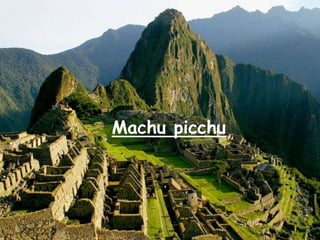
Machu picchu
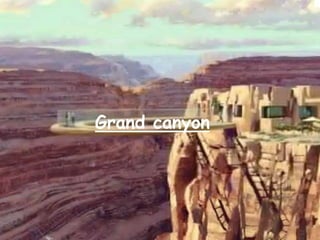
Grand canyon
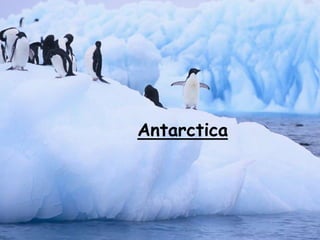
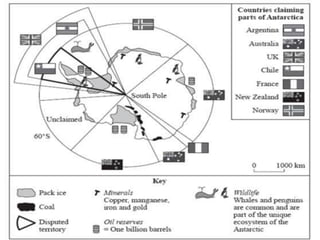
Antarctica
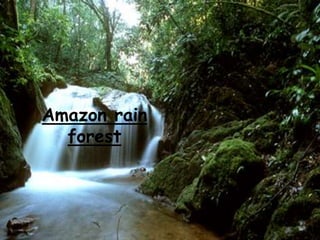
Amazon rain
forest
What do all of these pictures
have in common?
They are all extreme
environments
What are extreme environments?
Extreme environments are locations with particularly
difficult environments where the development of tourism
has only recently occurred due to the niche market
Create a facebook page for and animal in the Antartic,
think about:
What there doing?
Who their with?
Their friends?
Advertisment
Tourism in the Himalayas

Tourism unit

  • 1.
    Tourism Lo: To understandwhat tourism is and why it has grown.
  • 2.
    What is tourism? •Tourism generally involves activities that require away from home for at least 1 night. This includes holidays,buissness trips. Also some scientists say that day trips are also counted as tourism.
  • 3.
    Why has tourismgrown? • People like to go on holiday because: • The weather • Leisure and recreation • Advertising • Cheaper and faster transport • Landmarks • Culture • Food Extension task: explain these points into more detail
  • 4.
    Key terms: • Tourist:going somewhere different to do something for a day or overnight. • Domestic tourist: someone that travels in the same country. • International: go to a different country • Self catering: no food included • Travel agent: person that books your holiday for you.
  • 5.
    The graph aboveshows the last 60 years of tourist growth, from just tens of millions in 1950 to 694 million in 2004. the other massive trend is the continued dominance of Europe as a destination, but also the massive growth in numbers to East Asia and the Americas.
  • 8.
    Tourism has grownmassively as an industry over the past century for a variety of reasons: • Advances in travel technology - There are a wider range of ways to travel as a tourist and these methods are widely available. You can be a tourist using a car, a boat and most importantly an airplane. Motorways have linked places together, whilst Budget airlines such as Easy jet and Ryan air have brought prices down and increased traffic volumes. • Holiday entitlement in many rich nations has increased over the past century. This means that people can take more holidays during the year and swells the number of tourists. • People have more disposable income now - this is income that people have to send on themselves. This is partly because of salary rises and partly because the price for essential goods such as food and clothing has fallen. Many families now have 2 income earners rather than one, they have fewer kids and often have a car. All of these factors increase the likelihood of people becoming tourists. • The availability and type of holiday has increased - mass tourism and package holidays have opened up markets to huge numbers of people. Extreme and ecological tourism are also becoming popular, further swelling the choice. • The Media - Extensive coverage of holiday types has increased the demand to travel. Most newspapers have a "holiday" section, whilst TV shows can show people the enormous choice on offer - shows such as Ray Mears and 71 degrees north can promote extreme tourism for example, whilst "Benidorm" promotes (???!) mass tourism. Gap years have also been pushed by the media and are popular.
  • 11.
    Why has tourism grown? Expansionof choice Social and economic factors Technology/transport factors Better transport routes make it faster to travel to far away places. People are wealthier and have a greater disposable income so they can afford more holidays.
  • 12.
    Tourist Environments LO: To understandand explain in detail what attracts tourists to some destinations.
  • 13.
    What attracts tourists tosome destinations? -Physical/Natural -Human Great wall of china/ man made Antarctica- climate/ weather Alton towers- man made
  • 14.
    Exam practice: Describe theattractions of tourist environments. (4 marks- 8 lines) Model answer: Many people go on holiday in different locations. For example some people go to Antarctica to go skiing or snowboarding. People go to the coast Greece to relax. Also people like to go to some of the wonders of the world for example the Great Wall of China. Also cities attract tourists because its a man made attraction and it has interested the tourists.
  • 15.
    Produce a compoundline graph using the data opposite Fully label your graph Describe the patterns on your graph Explain those patterns
  • 17.
    Exploration - asmall number of tourists visit the area. The area is unspoilt and few tourist facilities exist. Involvement - local people start to provide some facilities for tourists. There starts to become a recognised tourist season. Development - the host country starts to develop and advertise the area. The area becomes recognised as a tourist destination. Consolidation - the area continues to attract tourists. The growth in tourist numbers may not be a fast as before. Some tensions develop between the host and the tourists. Stagnation - the facilities for the tourists may decline as they become old and run down. The numbers of tourists may decline too. Rejuvenation - investment and modernisation may occur which leads to improvements and visitor numbers may increase again. Decline - if the resort is not rejuvenated (stage 6) then it will go into decline. People lose their jobs related to tourism. The image of the area suffers. The Butler model is a generalisation, and so not all resorts will follow this process.
  • 18.
  • 19.
    The economic importanceof tourism varies from place to place but can be seen to make a significant contribution to many countries wealth. MEDCs benefit massively from tourism in terms of total wealth generated, even if the % of GDP that tourism generates is small. LEDCs are variable in their involvement in tourism but most see tourism as an extremely important way of getting money into their countries. Some LEDCs are reliant on tourism, and it can create more than 50% of GDP, more than exporting primary goods such as food stuffs or manufactured goods such as clothing. This can be problematic, as war, terrorism, or natural disasters could put people off visiting which would strip away a huge chunk of a countries income.
  • 22.
    National parks inthe UK LO: To understand what national parks are and how important they are.
  • 23.
    What is anational park? • National parks have been created to protect Britain’s most spectacular scenery by limiting the amount and type of development that can take place. In addition, National Parks are there to offer the British people access to the countryside for recreational purposes. • There are 15 National Parks in the British Isles and they came into existence in 1951 following an act of Parliament (The 1949 National Parks and Access to the Countryside Act). The first park created under this act was the Peak District National Park, which is surrounded by large towns and cities such as Liverpool and Manchester.
  • 25.
    Why are nationalparks so important? • Primarily National Parks are created to conserve the biodiversity found in natural areas, and provide habitats for permanent and migrating animals in the area. They are recognised nationally and internationally as being the most effective method of improving the conservation and biodiversity values of reserves. National Parks also protect cultural sites such as shell middens, scar trees and cave paintings from being damaged by human activities, and involve indigenous peoples by including their lands in indigenous protected areas (Figgis, Australia’s National Parks: Future Directions, 1999). That is not to say that the general community cannot continue to use and enjoy National Parks in the same way they enjoyed reserves. Many recreational activities are allowed in National Parks such as walking, camping, boating and canoeing, fishing and swimming. It is this recreational aspect of National Parks that make them particularly viable for tourism. National Parks receive 'top billing' in many tourist guides as places to visit and as such boost the economy of local areas. For example, the Grampians National Park contributed over $150 million to the regional economy. The increased popularity of National Parks also allows for more employment opportunities. It is not only the income generated by visitation that makes National Parks important to the economy but also a variety of potential ecosystem services. Ecosystem services benefits include catchment protection, water production, protection of soil stability, climatic controls, carbon sinks, genetic resources, pollination of economic species, habitat for economically important species such as insectivorous birds and the protection of hatcheries of commercial aquatic species (Beattie, Commercial Exploration of Biodiversity, 1995). Overall, National Parks are an important and valuable resource for scientists, educators and the community due to the variety of aesthetic, recreational and economic uses they offer.
  • 26.
    What can youdo in a national park? • Kayaking • Jet skiing • Boating • Rock climbing • horse riding • Walks • Cycling • Rowing • sailing
  • 27.
    Your task: • Youneed to create a leaflet to try and attract more visitor to the lake district. • Or • You can create a news script on the new national park that has just opened. • (remember to add pictures, facts and websites)
  • 28.
    Skills: proportional symbols LO:During this lesson I will understand how to calculate the radius of each of your proportional symbols. - I will be able to list the problems in the lake district.
  • 29.
    Visitor days: • Avisitor day is one visitor visiting a national park for one day. • Therefore if one person went on holiday to the lake district for a week this would be 7 visitor days. (1 x7 = 7) Answer Amount of days The number of people
  • 30.
    Your task fortoday: • During this lesson you will be creating a map to display information using different sized shapes. The area of each shape will represent (be proportional to) the number of visitor days in each national park each year.
  • 31.
    Alternative ways ofpresenting the same data: Methods used to present data. Advantages Disadvantages Proportional symbols map •The information is presented on a base map so you can see if there is a special pattern. •Some symbols can be very large and cover parts of the map making it more difficult to understand. Bar chart (graph) Pie chart Table Ect ..
  • 32.
    Traffic problems: Honeypot sites: Pressure on property: Environmental issues: Over 89% of visitors come by car, often just for one day. Many roads are narrow and winding. Queues are a common problem , especially towards the end of the day when day trippers are heading home. Congestion and parking are also a serious problem. The lake district has both physical and cultural honey pot sites. Beauty spots, small shopping centres, and historic houses attract hundreds of visitors per day. Almost 20% of property in the lake district is either second hand or holiday let accommodation Water sports are not allowed on some lakes, but Windermere, the largest lake, has ferries and allows power boating , wind surfing and other faster and more damaging activities. The main issue is the wash from faster vehicles eroding the shore, fuel spills are not common, causing pollution.
  • 33.
    Case study: Problemsin the lake district:
  • 34.
    Your task: You willbe given a role card about someone who is experiencing problems in the lake district because of the increasing amount of visitors or tourists. You need to write a formal letter to the lake district national park authority to explain the problems they are experiencing (remember to stay in character) Hint: use the guidance on the back of the sheet.
  • 35.
    Ways to improve the lakedistrict Person A Person B Improving parking litter Erosion by boats Controlling footpath erosion Property prices Improving public transport
  • 36.
  • 39.
    Opinion scale: •Is tourismin the lake district a good thing? AgreeDisagree
  • 40.
    As the numberof each national park increases it is clear that there are different opinions about the effects of visitors (either posotive or negative) Task: write one positive and one negative speech bubble:
  • 41.
    Mass tourism is itgood or bad? Lo:To be able to evaluate the consequences of mass tourism destinations
  • 42.
    Definiton of masstourism: • Mass tourism refers to a large number of visitors, often on package holidays with accommodation and travel included.
  • 47.
  • 58.
    http://www.bbc.co.uk/learningzone/clips/tourism-in-kenya/4506.html You need towatch these two videos and complete the questions on your sheet. http://www.bbc.co.uk/learningzone/clips/holidays-in-kenya/4507.html
  • 59.
    What problems areshown in this picture?
  • 60.
    Task: You need toread through this diary entry and underline or highlight the problems that Janis is making.
  • 64.
    Card sort: Using thecards create a table the looks like this and fill it in : Benefits Costs Economic: Sociocultural: Environmental:
  • 65.
    Problems with masstourism in Kenya- safaris •Hot air balloons cast shadows over the land which scare the animals and therefore they don't mate. •Safari busses go off track to get closes to the animals for the tourists which can scare the animals. •The reef on the coast- people are touching the coral and anchors break the coral and the petrol will create a area were the coral cant survive. 23 24 22
  • 66.
  • 67.
    Solutions: •Safari busses arekept to well defined tracks and are not allowed to go within 25 meters of animals. This is patrolled by wardens. The drivers are fined if caught breaking these rules. •The reef has now become a protection area. This has been put into place to prevent over fishing and damage to the coral base •There are a number of licensed operators that can enter the park for the purpose of educating tourists. •Three quarters of wildlife in Kenya can be found outside of national parks. A large amount of land outside of Kenya's park is owned by the masi tribe. They pay the masai tribe for the use of their land. •Tourists are asked to go on boats that have paddles and to not touch the reef has become a rule. What are the down sides to these rules?
  • 68.
  • 69.
  • 70.
  • 71.
  • 72.
    What do allof these pictures have in common? They are all extreme environments
  • 73.
    What are extremeenvironments? Extreme environments are locations with particularly difficult environments where the development of tourism has only recently occurred due to the niche market
  • 75.
    Create a facebookpage for and animal in the Antartic, think about: What there doing? Who their with? Their friends? Advertisment
  • 77.
    Tourism in theHimalayas

Editor's Notes

  • #2 http://blip.tv/scripts/flash/blipplayer.swf?autoStart=false&file=http://blip.tv/file/get/Gatm-SustainableTourism782.flv?source=3
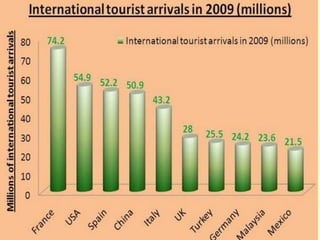
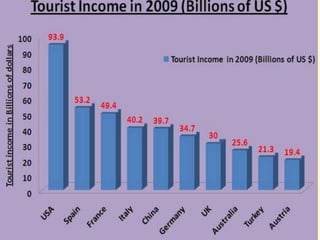
  • #7 It generates huge amounts of wealth for countries and generates jobs at countries of all stages of development.  The reliance on tourism as a source of income varies across the globe and can be measured as a percentage of a countries GDP.  Most Caribbean countries get at least half of their GDP from tourism and France, Spain, the USA, China, Italy and the UK are the most visited countries. This can be seen above
  • #23 http://blip.tv/scripts/flash/blipplayer.swf?autoStart=false&file=http://blip.tv/file/get/Gatm-NationalParks528.flv?source=3
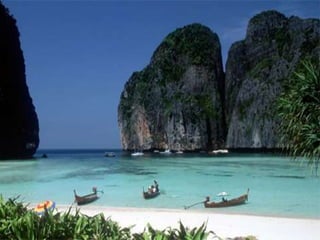
  • #44 Why would you want to visit this place?
  • #45 Why would you want to visit this place?
  • #73 http://www.youtube.com/watch?v=O0M9ACTlFaM
  • #75 http://www.youtube.com/watch?feature=player_embedded&v=7ih949hVs78#!