
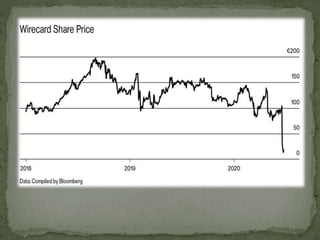

The downfall of
 By a not very famous entrepreneur Marcus Braun in
1999
 He faked an obscure Bavarian company called
WIRECARD into a German tech company
 The company focused on online payment services
 They started with Gambling Sites as clients
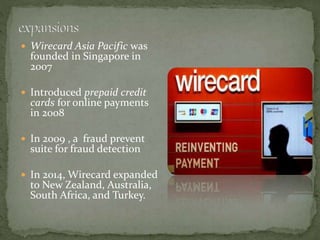
 Wirecard Asia Pacific was
founded in Singapore in
2007
 Introduced prepaid credit
cards for online payments
in 2008
 In 2009 , a fraud prevent
suite for fraud detection
 In 2014, Wirecard expanded
to New Zealand, Australia,
South Africa, and Turkey.
 With the purchase of
Prepaid Card Services from
Citibank , Wirecard was
represented in USA since
2016 .
 In 2019, Softbank invested
in Wirecard
 And with the acquisition of
AllScore Payment Services
from Beijing , represented
in China since Nov 2019
 Wirecard became a stock
corporation listed listed
in the Prime Standard
stock market segment
through a reverse IPO
 It was included in
tecDAX in 2006
 And in DAX sept 2018
ACCOUNTING IRREGULATIES
• It was harder to compare Wirecard’s financial results
from others because of its combined Banking and
Non-banking operations
• Thus, the Investors had to rely on the Altered version
of the Financial Statements of the company
FALSE INFLATION OF
PROFIT
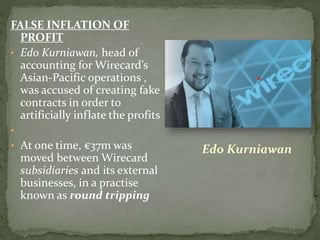
• Edo Kurniawan, head of
accounting for Wirecard’s
Asian-Pacific operations ,
was accused of creating fake
contracts in order to
artificially inflate the profits
•
• At one time, €37m was
moved between Wirecard
subsidiaries and its external
businesses, in a practise
known as round tripping
Edo Kurniawan
OPAQUE ACQUISITIONS
• Rumours were there of Wirecard’s purchase of smaller
businesses at price above market at notably above
market prices
 In 2015, Wirecard purchased an Indian payments
group at €340m, despite the founders of those
businesses failing to raise funding while valuing their
key asset at €46m.
OTHERS
• Wirecard used Third part acquirers in transactions for
which they did not hold any license for or the nature of
the transaction was unsuitable for direct processing
• Wirecard followed a pattern of being vaguely agressive
towards those who raise questions about the company's
business operations or accounting
• Red flags started to raise in 2008, when Wirecard's
balance sheet irregularities were brought into light
• In 2015, the Financial Times reported a significant gap
between the short-term assets and liabilities in
Wirecard's payment business.
• In 2018 , a seven-month investigation was conducted by
, Southern Investigative Reporting Foundation that
at least €175m from Wirecard’s €340m purchase of an
India-based payment processor in 2015 were not
transferred to the seller
 In 2019, Financial Times reported on irregularities
uncovered by Wirecard's Singapore investigation,
which had begun in late 2018
 Edo Kurniawan, was accused of creating unreal and
backdated contracts in order to show artificial
increase in profit
 In 2018, Wirecard’s poor positioning within the
German e-commerce payments market was
questioned
 In 2019, it was reported that half of Wirecard's
almost the entire profit were processed through
opaque third-party processors
 KPMG's special audit, Wirecard's long time
auditor EY failed to verify the existence of cash
reserves in their financial statements
 After initially defending BaFin's actions, its president
Felix Hufeld later admitted the Wirecard Scandal is a
“complete disaster.”
 On 1 September 2020, the German
parliament announced that an inquiry will be
organised to fully investigate the reasons why the
government failed to prevent corporate fraud.
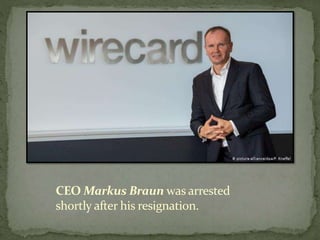
CEO Markus Braun was arrested
shortly after his resignation.
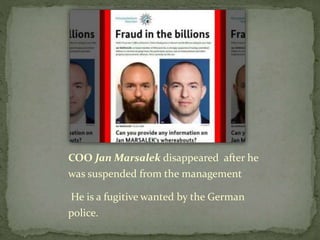
COO Jan Marsalek disappeared after he
was suspended from the management
He is a fugitive wanted by the German
police.
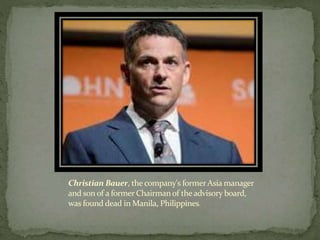
Christian Bauer, thecompany's formerAsia manager
and son of a former Chairmanof theadvisory board,
was found dead in Manila, Philippines.
In 2020, the FinCEN Files showed that Aktif
Bank helped launder money for Wirecard.
The agencies can still not figure
how the company went away with
such a fraud for so long .
Wirecard has been filed for
insolvency in Germany but is still
in business
THANK YOU

Wirecard scam

  • 1.
  • 2.
     By anot very famous entrepreneur Marcus Braun in 1999  He faked an obscure Bavarian company called WIRECARD into a German tech company  The company focused on online payment services  They started with Gambling Sites as clients
  • 3.
     Wirecard AsiaPacific was founded in Singapore in 2007  Introduced prepaid credit cards for online payments in 2008  In 2009 , a fraud prevent suite for fraud detection  In 2014, Wirecard expanded to New Zealand, Australia, South Africa, and Turkey.
  • 4.
     With thepurchase of Prepaid Card Services from Citibank , Wirecard was represented in USA since 2016 .  In 2019, Softbank invested in Wirecard  And with the acquisition of AllScore Payment Services from Beijing , represented in China since Nov 2019
  • 5.
     Wirecard becamea stock corporation listed listed in the Prime Standard stock market segment through a reverse IPO  It was included in tecDAX in 2006  And in DAX sept 2018
  • 6.
    ACCOUNTING IRREGULATIES • Itwas harder to compare Wirecard’s financial results from others because of its combined Banking and Non-banking operations • Thus, the Investors had to rely on the Altered version of the Financial Statements of the company
  • 7.
    FALSE INFLATION OF PROFIT •Edo Kurniawan, head of accounting for Wirecard’s Asian-Pacific operations , was accused of creating fake contracts in order to artificially inflate the profits • • At one time, €37m was moved between Wirecard subsidiaries and its external businesses, in a practise known as round tripping Edo Kurniawan
  • 8.
    OPAQUE ACQUISITIONS • Rumourswere there of Wirecard’s purchase of smaller businesses at price above market at notably above market prices  In 2015, Wirecard purchased an Indian payments group at €340m, despite the founders of those businesses failing to raise funding while valuing their key asset at €46m.
  • 9.
    OTHERS • Wirecard usedThird part acquirers in transactions for which they did not hold any license for or the nature of the transaction was unsuitable for direct processing • Wirecard followed a pattern of being vaguely agressive towards those who raise questions about the company's business operations or accounting
  • 10.
    • Red flagsstarted to raise in 2008, when Wirecard's balance sheet irregularities were brought into light • In 2015, the Financial Times reported a significant gap between the short-term assets and liabilities in Wirecard's payment business. • In 2018 , a seven-month investigation was conducted by , Southern Investigative Reporting Foundation that at least €175m from Wirecard’s €340m purchase of an India-based payment processor in 2015 were not transferred to the seller
  • 11.
     In 2019,Financial Times reported on irregularities uncovered by Wirecard's Singapore investigation, which had begun in late 2018  Edo Kurniawan, was accused of creating unreal and backdated contracts in order to show artificial increase in profit  In 2018, Wirecard’s poor positioning within the German e-commerce payments market was questioned
  • 12.
     In 2019,it was reported that half of Wirecard's almost the entire profit were processed through opaque third-party processors  KPMG's special audit, Wirecard's long time auditor EY failed to verify the existence of cash reserves in their financial statements
  • 14.
     After initiallydefending BaFin's actions, its president Felix Hufeld later admitted the Wirecard Scandal is a “complete disaster.”  On 1 September 2020, the German parliament announced that an inquiry will be organised to fully investigate the reasons why the government failed to prevent corporate fraud.
  • 15.
    CEO Markus Braunwas arrested shortly after his resignation.
  • 16.
    COO Jan Marsalekdisappeared after he was suspended from the management He is a fugitive wanted by the German police.
  • 17.
    Christian Bauer, thecompany'sformerAsia manager and son of a former Chairmanof theadvisory board, was found dead in Manila, Philippines.
  • 18.
    In 2020, theFinCEN Files showed that Aktif Bank helped launder money for Wirecard.
  • 19.
    The agencies canstill not figure how the company went away with such a fraud for so long . Wirecard has been filed for insolvency in Germany but is still in business THANK YOU