Chapter 10
Case Study
Russellville Middle School Principal Paige Littleton

was aware of the feud between Buffy McGuire and
Kathy Harris.
Buffy’s mom complained numerous times about the
mistreatment of Buffy and Kathy’s bullying.
One teacher said, “did their best to make life
miserable for Buffy.”
Paige spoke with both girls, referred them to
counseling, and made an effort to keep the peace.
However, Buffy and Kathy have a fight, Kathy uses a
5in pocketknife, and Buffy is seriously injured.
Case Study
Buffy is hospitalized for her injuries and “trauma.”
Principal Littleton learns later that day that Buffy’s

parents retained legal counsel.

Is it conceivable that Buffy and her parents could sue

Kathy and her parents?
Can Buffy sue the school district?
Do schools and districts have any liability for injuries
suffered by one student at the hands of another?
Leadership Perspectives
ISLLC Standard

Tort Liability

Standard 3C, calls for school

Tort liability is one way

leaders who promote and
protect the welfare and safety
of students and staff.
It is simply impossible to
protect students and
teachers from all potential
harm.

society ensures that local
schools boards affirmatively
meet their responsibility to
provide policy designed to
promote security within the
school community.
The Law Of Torts
A tort is a civil wrong that results in personal injury

or property damage, the compensation for which
serves around social policy.
As common law, tort law is generally court-made law,
rather than made (statutory) law. Schools, school
systems, individual teachers, and individual
administrators could all be either plaintiffs or
defendants in tort cases.
Negligence
Negligence is the most common of the tort.
Negligence-conduct that falls below the standards of

behavior established by law for the protection of
others against unreasonable risk of harm. A person
has acted negligently if he or she has departed from
the conduct expected of a reasonably prudent person
acting under similar circumstances.
There are five elements to the tort of negligence: 1.
existence of duty, 2. breach of duty, 3. cause-in-fact
causation, 4. proximate causation, and 5. damages.
Duty
The most common are the duties not to engage in

behaviors that would cause bodily harm to others or
damage to the economic interests (property) of
others.
Educators and educational systems stand in loco
parentis Latin for “in place of the parent” to the
unemancipated minors in their charge.
Educators have an affirmative duty to take reasonable
steps to protect children in their charge while at
school or at school-sponsored events regardless of
location.
Breach
When someone or some property is damaged, it is

not always someone else’s (or even anyone’s) fault.
A teacher/administrator very likely has a duty to
provide aid to a student who is in danger of being
injured.
A failure to exercise the affirmative duty of care that a
reasonably prudent teacher, counselor, or principal in
the same situation would exercise.
Cause-in-Fact Causation
Sometimes called the “but for” causation.
The injured person would not have suffered the

injury but for the breach. The breach must have been
in the chain of events that led directly to the injury.
A breach that occurs after the injury is complete can
never be a cause-in-fact of an injury.
Remember the logical fallacy post hoc, ergo propter
hoc. Simply because A precedes B, A is not necessarily
a cause of B.
Proximate Causation
Proximate causation has been reduced to a single

idea-foreseeability.
It asks whether a reasonable person, teacher, or
principal would have foreseen the injury.
One can argue that injuries are easily forseeable when
schools fail to fulfill their duty to maintain a safe
environment.
One can also argue that holding school districts
responsible for the malicious actions of students is
not sound social policy.
Damages
Damages are the physical or property damages

complained of.
The goal in calculating damages is to compensate
victims for their losses. Damages associated with
physical injuries tend to be things such as medical
bills, pain and suffering, and lost wages. When the
physical injuries are especially serious, damages can
increase very rapidly.
Defenses to Negligence
Contributory negligence

is an absolute defense.
If the defense is 99%
responsible for the
injury and the plaintiff is
only 1% responsible, the
plaintiff still takes
nothing.

Comparative negligence

seeks to proportion
financial responsibility
based on the percentage
of the damages
attributable to each
party’s negligence.
Assumption of Risk
Schools and educators frequently seek to obtain

express assumptions of risk from both parents prior to
potentially dangerous activities such as, athletic
competitions, travel by motor vehicle, activities off
the premises of the school, and other situations that
could potentially pose a risk beyond what would be
expected in an educational setting.
They seek the express assumption through liability
waivers, hold harmless, consent indemnity
Sovereign Immunity
We- “the people” are sovereign. The people of the

United States collectively are sovereign. Sovereigns
are immune to lawsuits in their own courts.
Sovereign immunity is a relevant defense for schools:
Most schools are in some way a part of state
government, and each state is sovereign.
It protects school systems (districts, boards of
education, county school boards, etc) and individual
schools from tort liability.
Sovereign Immunity
It does not protect individuals (teachers, principals,

and superintendents are not sovereigns).
Even if a school is negligent, it can generally be said
that the school is not responsible for compensating
the victims of its negligence.
Schools and school districts will be less likely
protected by the doctrine of sovereign immunity in
“premises liability.”
Land owners have a duty to property maintain their
premises, a duty to warn visitors of potentially
dangerous situations.
Statutory Immunity
A policy decision made by

the legislatures of many
states.
Educators are shielded
from liability when acting
within the scope of their
duties, exercising
judgment or discretion,
not using excessive force
to discipline a student, or
operating a motor vehicle.

The Paul D. Coverdell

Teacher Protection Act of
2001 (incl. NCLB ed. bill)
states that if teachers and
principals follow school
rules and act within the
scope of employment
responsibility, they will
not be subject to liability.
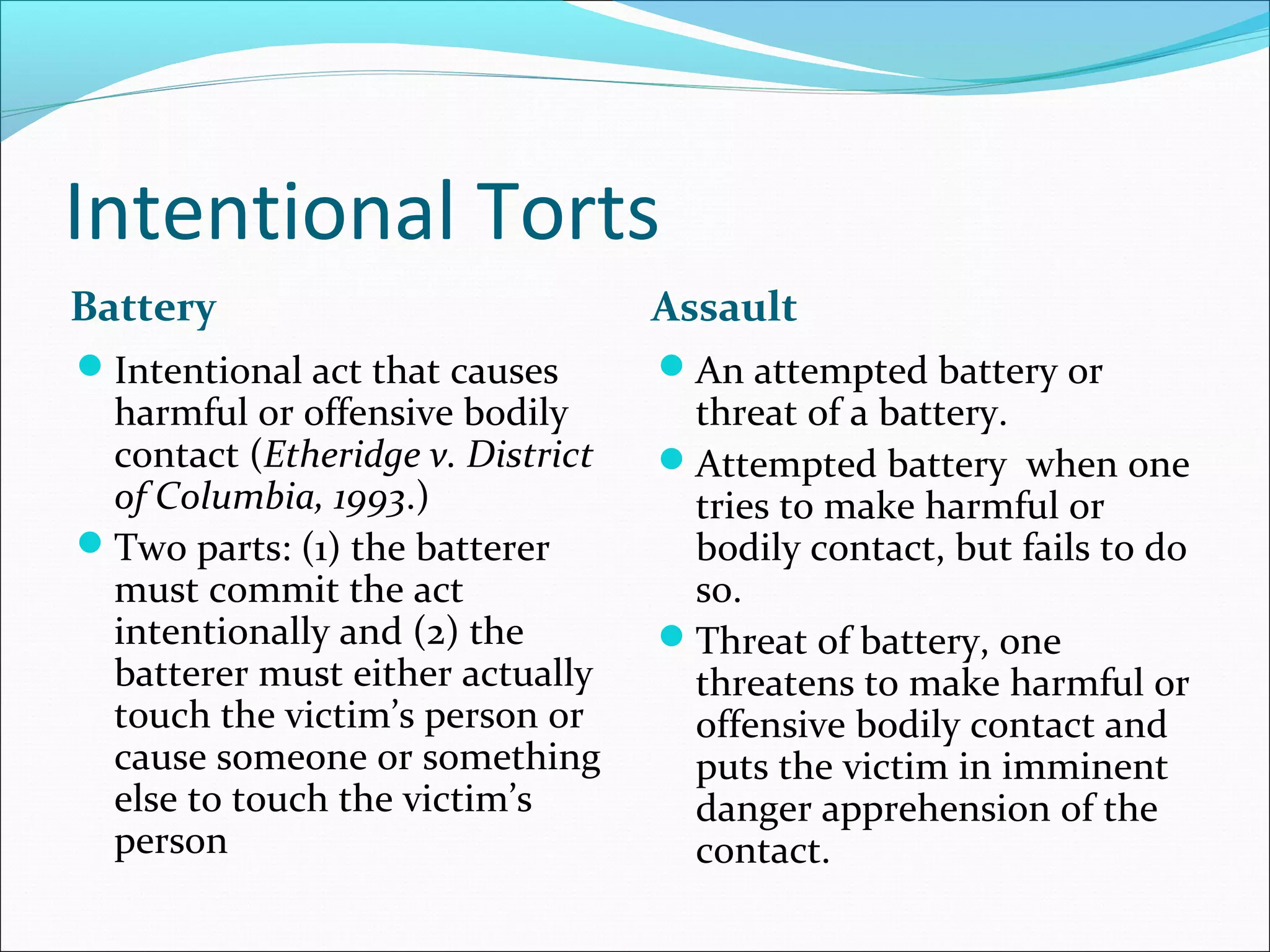
Intentional Torts
Battery

Assault

Intentional act that causes

An attempted battery or

harmful or offensive bodily
contact (Etheridge v. District
of Columbia, 1993.)
Two parts: (1) the batterer
must commit the act
intentionally and (2) the
batterer must either actually
touch the victim’s person or
cause someone or something
else to touch the victim’s
person

threat of a battery.
Attempted battery when one
tries to make harmful or
bodily contact, but fails to do
so.
Threat of battery, one
threatens to make harmful or
offensive bodily contact and
puts the victim in imminent
danger apprehension of the
contact.
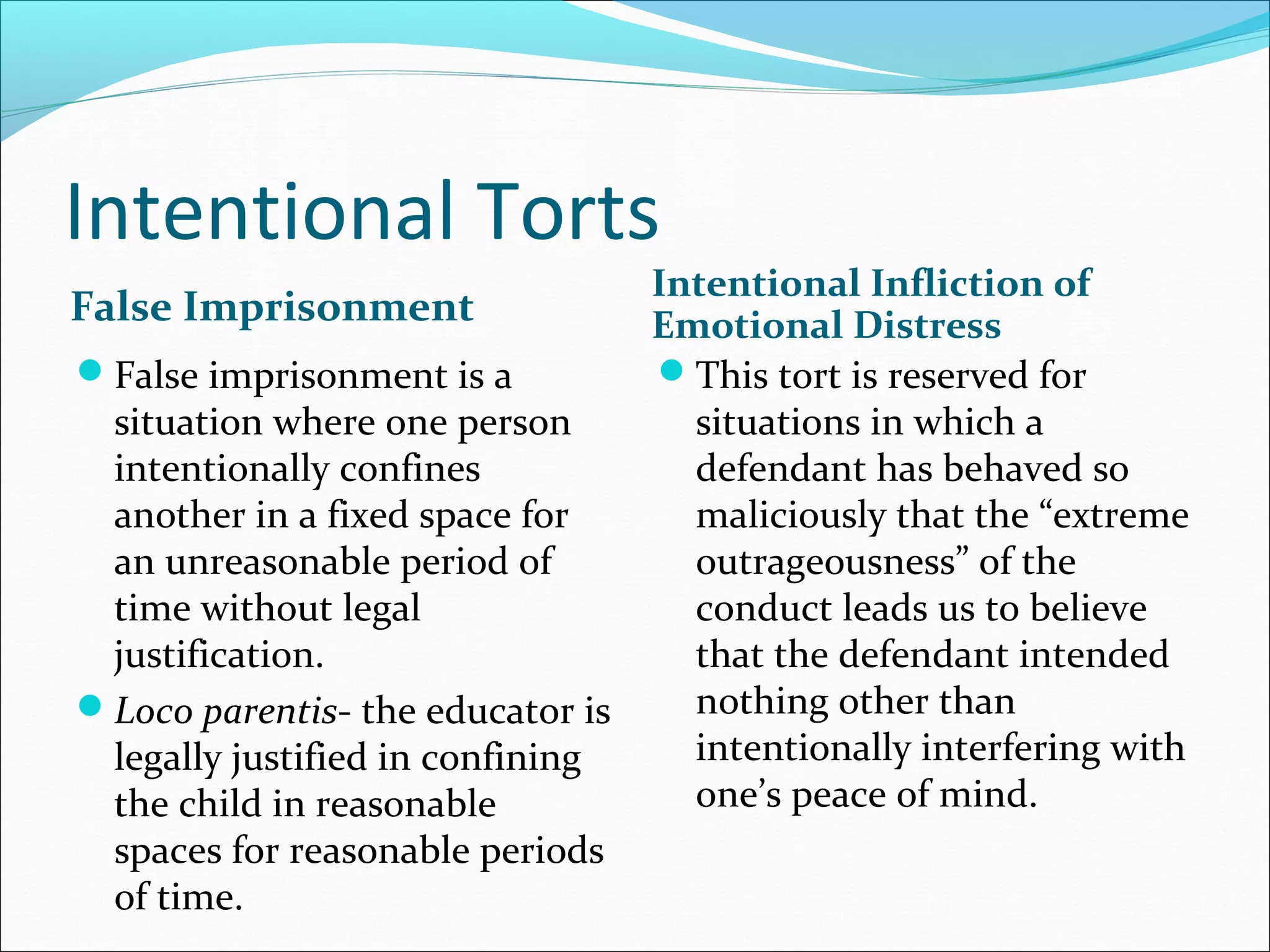
Intentional Torts
False Imprisonment
False imprisonment is a

situation where one person
intentionally confines
another in a fixed space for
an unreasonable period of
time without legal
justification.
Loco parentis- the educator is
legally justified in confining
the child in reasonable
spaces for reasonable periods
of time.

Intentional Infliction of
Emotional Distress
This tort is reserved for
situations in which a
defendant has behaved so
maliciously that the “extreme
outrageousness” of the
conduct leads us to believe
that the defendant intended
nothing other than
intentionally interfering with
one’s peace of mind.
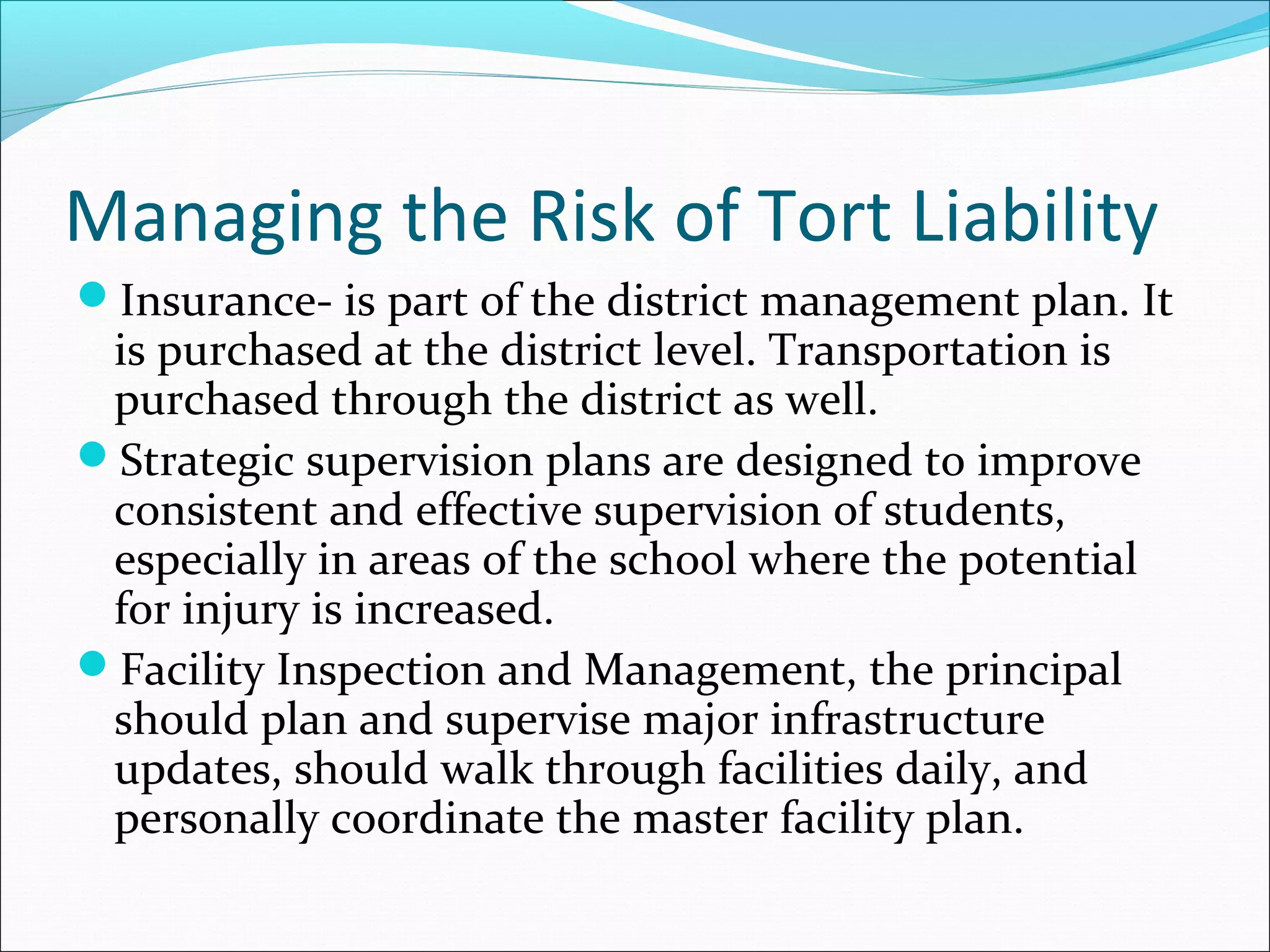
Managing the Risk of Tort Liability
Insurance- is part of the district management plan. It

is purchased at the district level. Transportation is
purchased through the district as well.
Strategic supervision plans are designed to improve
consistent and effective supervision of students,
especially in areas of the school where the potential
for injury is increased.
Facility Inspection and Management, the principal
should plan and supervise major infrastructure
updates, should walk through facilities daily, and
personally coordinate the master facility plan.
Court Cases
Gathwright v. Lincoln Insurance Co., 1985
Dadich v. Syosset High School, 2000
Kennedy v. Seaford, 1998
Summary
Tort law is not a fun topic, nobody likes talking about

getting sued.
A single serious avoidable injury on a campus has the
potential of ending a principal’s career.
Managing the risk of negligence is hard, intellectually
taxing work.
A principal can create a “culture of safety” on her
campus will go a long way toward becoming a
successful long-term principal.

Tort Liability and Risk Management

  • 1.
  • 2.
    Case Study Russellville MiddleSchool Principal Paige Littleton was aware of the feud between Buffy McGuire and Kathy Harris. Buffy’s mom complained numerous times about the mistreatment of Buffy and Kathy’s bullying. One teacher said, “did their best to make life miserable for Buffy.” Paige spoke with both girls, referred them to counseling, and made an effort to keep the peace. However, Buffy and Kathy have a fight, Kathy uses a 5in pocketknife, and Buffy is seriously injured.
  • 3.
    Case Study Buffy ishospitalized for her injuries and “trauma.” Principal Littleton learns later that day that Buffy’s parents retained legal counsel. Is it conceivable that Buffy and her parents could sue Kathy and her parents? Can Buffy sue the school district? Do schools and districts have any liability for injuries suffered by one student at the hands of another?
  • 4.
    Leadership Perspectives ISLLC Standard TortLiability Standard 3C, calls for school Tort liability is one way leaders who promote and protect the welfare and safety of students and staff. It is simply impossible to protect students and teachers from all potential harm. society ensures that local schools boards affirmatively meet their responsibility to provide policy designed to promote security within the school community.
  • 5.
    The Law OfTorts A tort is a civil wrong that results in personal injury or property damage, the compensation for which serves around social policy. As common law, tort law is generally court-made law, rather than made (statutory) law. Schools, school systems, individual teachers, and individual administrators could all be either plaintiffs or defendants in tort cases.
  • 6.
    Negligence Negligence is themost common of the tort. Negligence-conduct that falls below the standards of behavior established by law for the protection of others against unreasonable risk of harm. A person has acted negligently if he or she has departed from the conduct expected of a reasonably prudent person acting under similar circumstances. There are five elements to the tort of negligence: 1. existence of duty, 2. breach of duty, 3. cause-in-fact causation, 4. proximate causation, and 5. damages.
  • 7.
    Duty The most commonare the duties not to engage in behaviors that would cause bodily harm to others or damage to the economic interests (property) of others. Educators and educational systems stand in loco parentis Latin for “in place of the parent” to the unemancipated minors in their charge. Educators have an affirmative duty to take reasonable steps to protect children in their charge while at school or at school-sponsored events regardless of location.
  • 8.
    Breach When someone orsome property is damaged, it is not always someone else’s (or even anyone’s) fault. A teacher/administrator very likely has a duty to provide aid to a student who is in danger of being injured. A failure to exercise the affirmative duty of care that a reasonably prudent teacher, counselor, or principal in the same situation would exercise.
  • 9.
    Cause-in-Fact Causation Sometimes calledthe “but for” causation. The injured person would not have suffered the injury but for the breach. The breach must have been in the chain of events that led directly to the injury. A breach that occurs after the injury is complete can never be a cause-in-fact of an injury. Remember the logical fallacy post hoc, ergo propter hoc. Simply because A precedes B, A is not necessarily a cause of B.
  • 10.
    Proximate Causation Proximate causationhas been reduced to a single idea-foreseeability. It asks whether a reasonable person, teacher, or principal would have foreseen the injury. One can argue that injuries are easily forseeable when schools fail to fulfill their duty to maintain a safe environment. One can also argue that holding school districts responsible for the malicious actions of students is not sound social policy.
  • 11.
    Damages Damages are thephysical or property damages complained of. The goal in calculating damages is to compensate victims for their losses. Damages associated with physical injuries tend to be things such as medical bills, pain and suffering, and lost wages. When the physical injuries are especially serious, damages can increase very rapidly.
  • 12.
    Defenses to Negligence Contributorynegligence is an absolute defense. If the defense is 99% responsible for the injury and the plaintiff is only 1% responsible, the plaintiff still takes nothing. Comparative negligence seeks to proportion financial responsibility based on the percentage of the damages attributable to each party’s negligence.
  • 13.
    Assumption of Risk Schoolsand educators frequently seek to obtain express assumptions of risk from both parents prior to potentially dangerous activities such as, athletic competitions, travel by motor vehicle, activities off the premises of the school, and other situations that could potentially pose a risk beyond what would be expected in an educational setting. They seek the express assumption through liability waivers, hold harmless, consent indemnity
  • 14.
    Sovereign Immunity We- “thepeople” are sovereign. The people of the United States collectively are sovereign. Sovereigns are immune to lawsuits in their own courts. Sovereign immunity is a relevant defense for schools: Most schools are in some way a part of state government, and each state is sovereign. It protects school systems (districts, boards of education, county school boards, etc) and individual schools from tort liability.
  • 15.
    Sovereign Immunity It doesnot protect individuals (teachers, principals, and superintendents are not sovereigns). Even if a school is negligent, it can generally be said that the school is not responsible for compensating the victims of its negligence. Schools and school districts will be less likely protected by the doctrine of sovereign immunity in “premises liability.” Land owners have a duty to property maintain their premises, a duty to warn visitors of potentially dangerous situations.
  • 16.
    Statutory Immunity A policydecision made by the legislatures of many states. Educators are shielded from liability when acting within the scope of their duties, exercising judgment or discretion, not using excessive force to discipline a student, or operating a motor vehicle. The Paul D. Coverdell Teacher Protection Act of 2001 (incl. NCLB ed. bill) states that if teachers and principals follow school rules and act within the scope of employment responsibility, they will not be subject to liability.
  • 17.
    Intentional Torts Battery Assault Intentional actthat causes An attempted battery or harmful or offensive bodily contact (Etheridge v. District of Columbia, 1993.) Two parts: (1) the batterer must commit the act intentionally and (2) the batterer must either actually touch the victim’s person or cause someone or something else to touch the victim’s person threat of a battery. Attempted battery when one tries to make harmful or bodily contact, but fails to do so. Threat of battery, one threatens to make harmful or offensive bodily contact and puts the victim in imminent danger apprehension of the contact.
  • 18.
    Intentional Torts False Imprisonment Falseimprisonment is a situation where one person intentionally confines another in a fixed space for an unreasonable period of time without legal justification. Loco parentis- the educator is legally justified in confining the child in reasonable spaces for reasonable periods of time. Intentional Infliction of Emotional Distress This tort is reserved for situations in which a defendant has behaved so maliciously that the “extreme outrageousness” of the conduct leads us to believe that the defendant intended nothing other than intentionally interfering with one’s peace of mind.
  • 19.
    Managing the Riskof Tort Liability Insurance- is part of the district management plan. It is purchased at the district level. Transportation is purchased through the district as well. Strategic supervision plans are designed to improve consistent and effective supervision of students, especially in areas of the school where the potential for injury is increased. Facility Inspection and Management, the principal should plan and supervise major infrastructure updates, should walk through facilities daily, and personally coordinate the master facility plan.
  • 20.
    Court Cases Gathwright v.Lincoln Insurance Co., 1985 Dadich v. Syosset High School, 2000 Kennedy v. Seaford, 1998
  • 21.
    Summary Tort law isnot a fun topic, nobody likes talking about getting sued. A single serious avoidable injury on a campus has the potential of ending a principal’s career. Managing the risk of negligence is hard, intellectually taxing work. A principal can create a “culture of safety” on her campus will go a long way toward becoming a successful long-term principal.