CHAPTER THREE
3-1

TORT LAW
TORT LAW IS BASED ON THE
IDEA THAT EVERYONE IN OUR
SOCIETY HAS CERTAIN RIGHTS
• Along With Having Certain Rights,
Everyone Has The Duty to Respect the
Rights of Others.
• The Purpose of Tort Law is to Enforce
Those Rights and Duties
What Is A Tort???

A tort is a private wrong
committed by one
person against another.
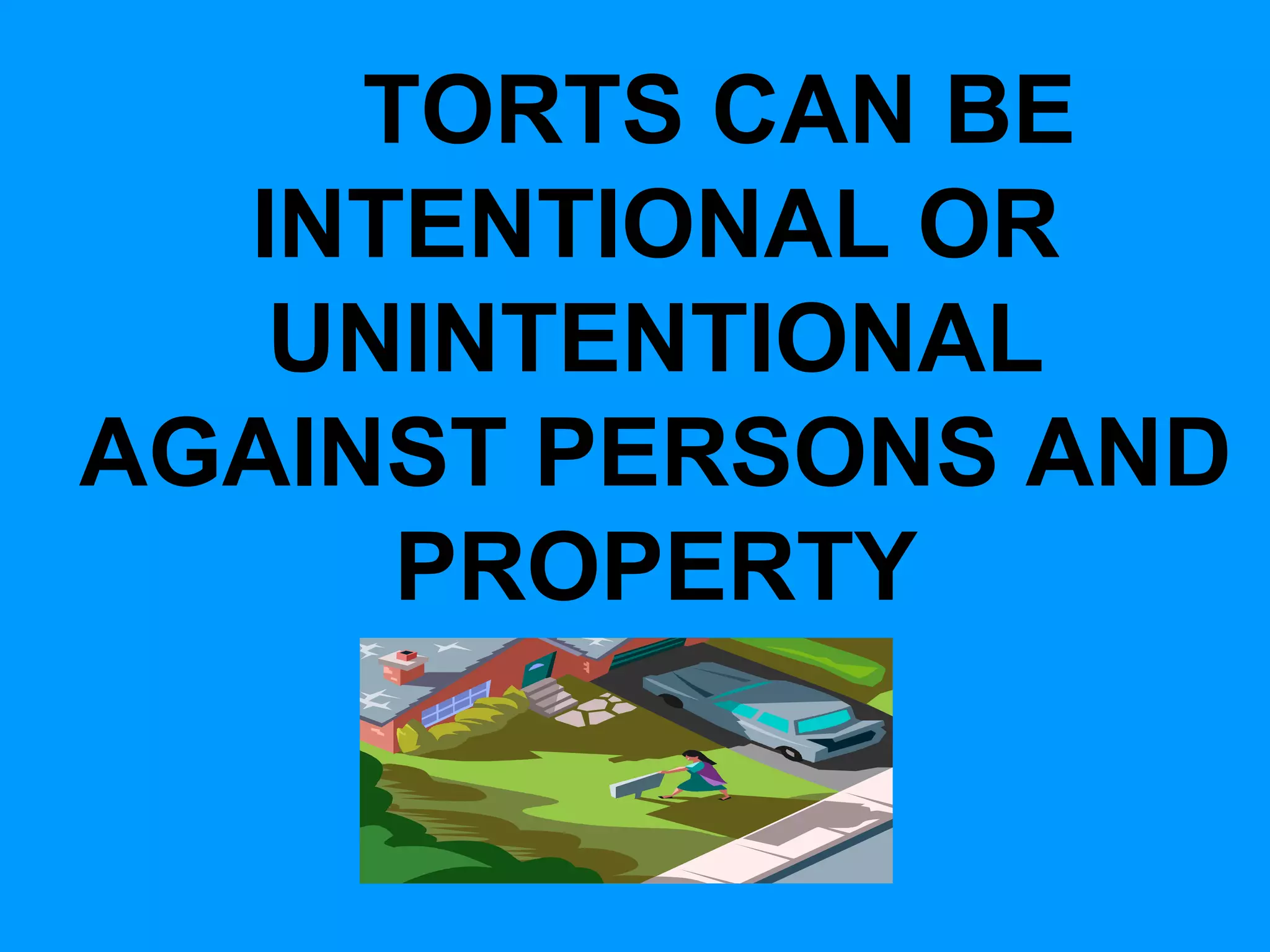
TORTS CAN BE
INTENTIONAL OR
UNINTENTIONAL
AGAINST PERSONS AND
PROPERTY
ANOTHER TERM FOR
AN UNINTENTIONAL
TORT IS

NEGLIGENCE
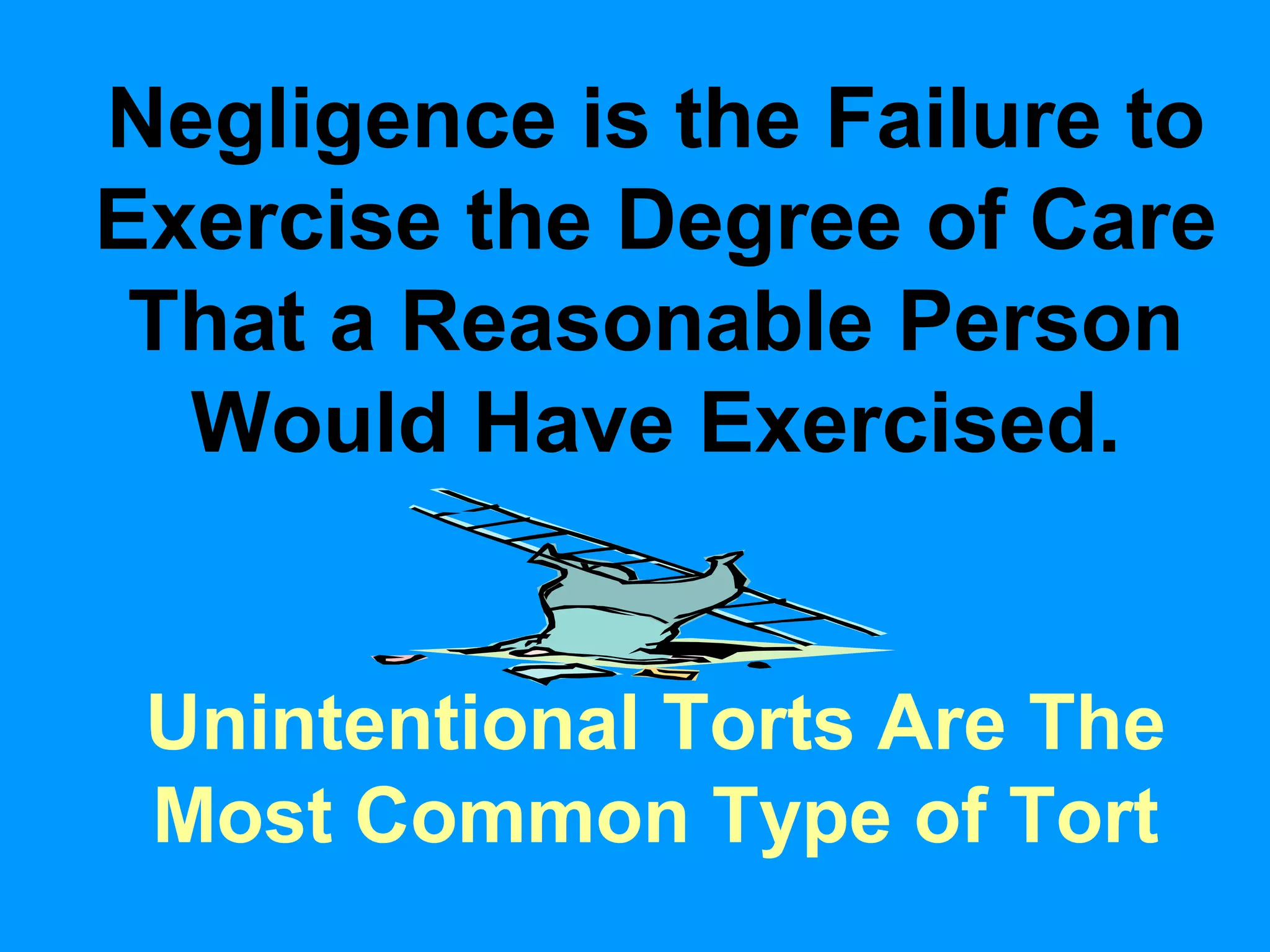
Negligence is the Failure to
Exercise the Degree of Care
That a Reasonable Person
Would Have Exercised.
Unintentional Torts Are The
Most Common Type of Tort
A
TORTFEASOR
is a person who
Commits A Tort—
A person who commits a
tort interferes with
another person’s rights.
THERE ARE THREE
ELEMENTS TO ANY
TORT—
1. The Possession
of Certain Rights by
an Innocent Party
2. A Violation of
Those Rights by
the Tortfeasor
3. A Resulting Injury
That Somehow Hurts
The Person Whose
Rights Were Violated
THE PERSON INJURED IS
USUALLY CALLED THE
Victim, the innocent party or
the plaintiff in a lawsuit.

THE TORTFEASOR IS THE
Defendant in a lawsuit.
Difference between
Criminal Law and Tort
Law…..
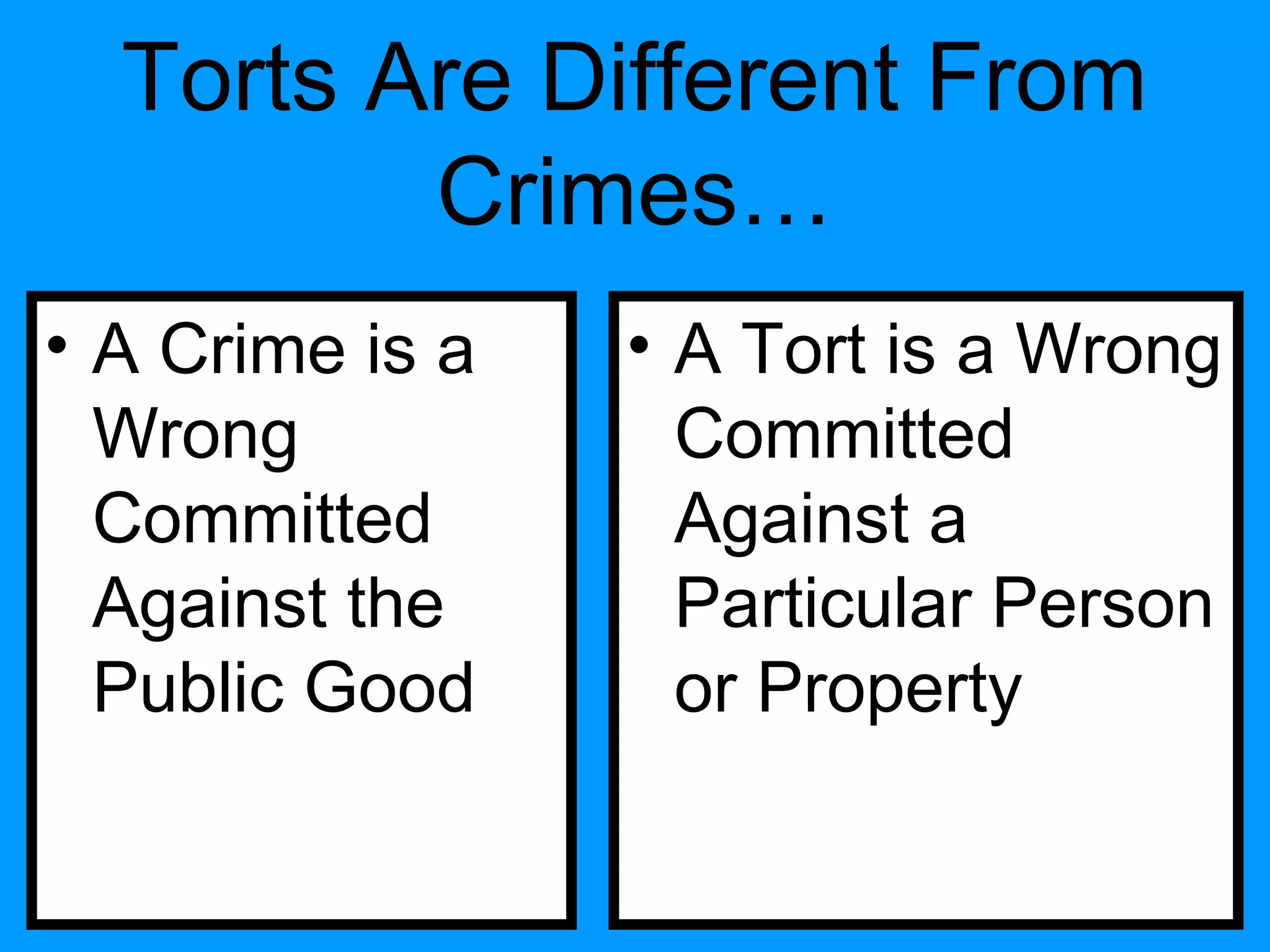
Torts Are Different From
Crimes…
• A Crime is a
Wrong
Committed
Against the
Public Good

• A Tort is a Wrong
Committed
Against a
Particular Person
or Property
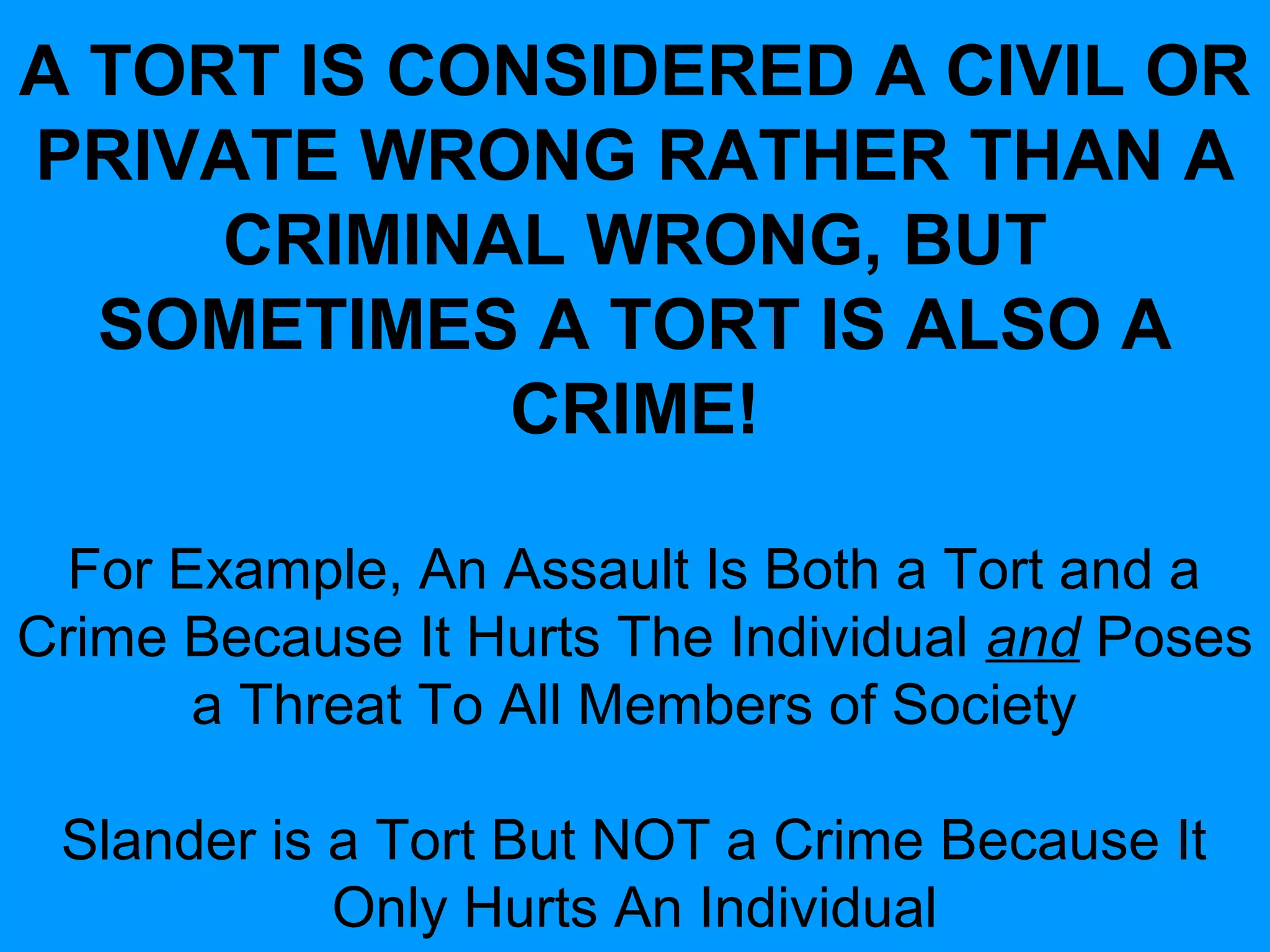
A TORT IS CONSIDERED A CIVIL OR
PRIVATE WRONG RATHER THAN A
CRIMINAL WRONG, BUT
SOMETIMES A TORT IS ALSO A
CRIME!
For Example, An Assault Is Both a Tort and a
Crime Because It Hurts The Individual and Poses
a Threat To All Members of Society
Slander is a Tort But NOT a Crime Because It
Only Hurts An Individual
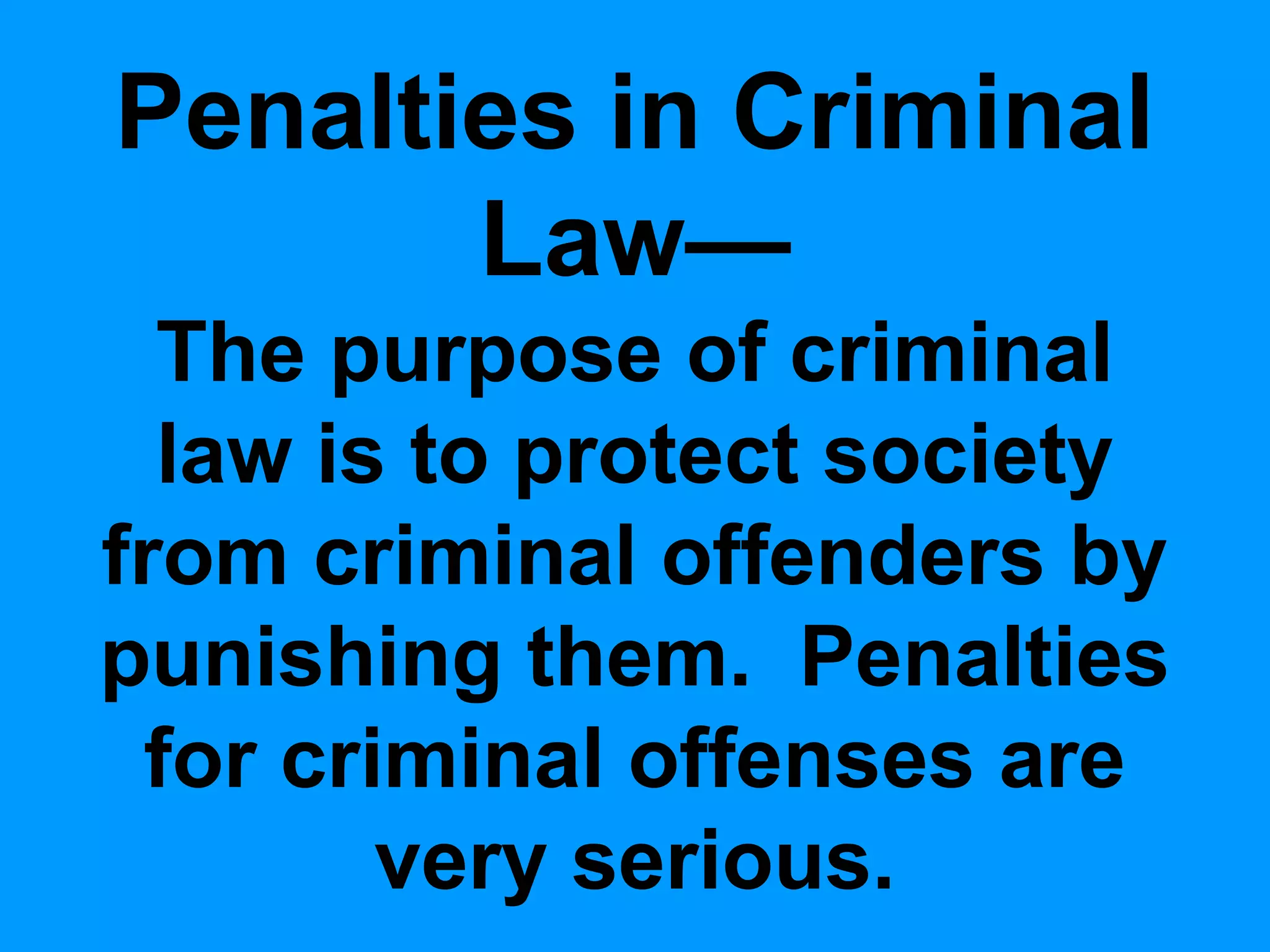
Penalties in Criminal
Law—
The purpose of criminal
law is to protect society
from criminal offenders by
punishing them. Penalties
for criminal offenses are
very serious.
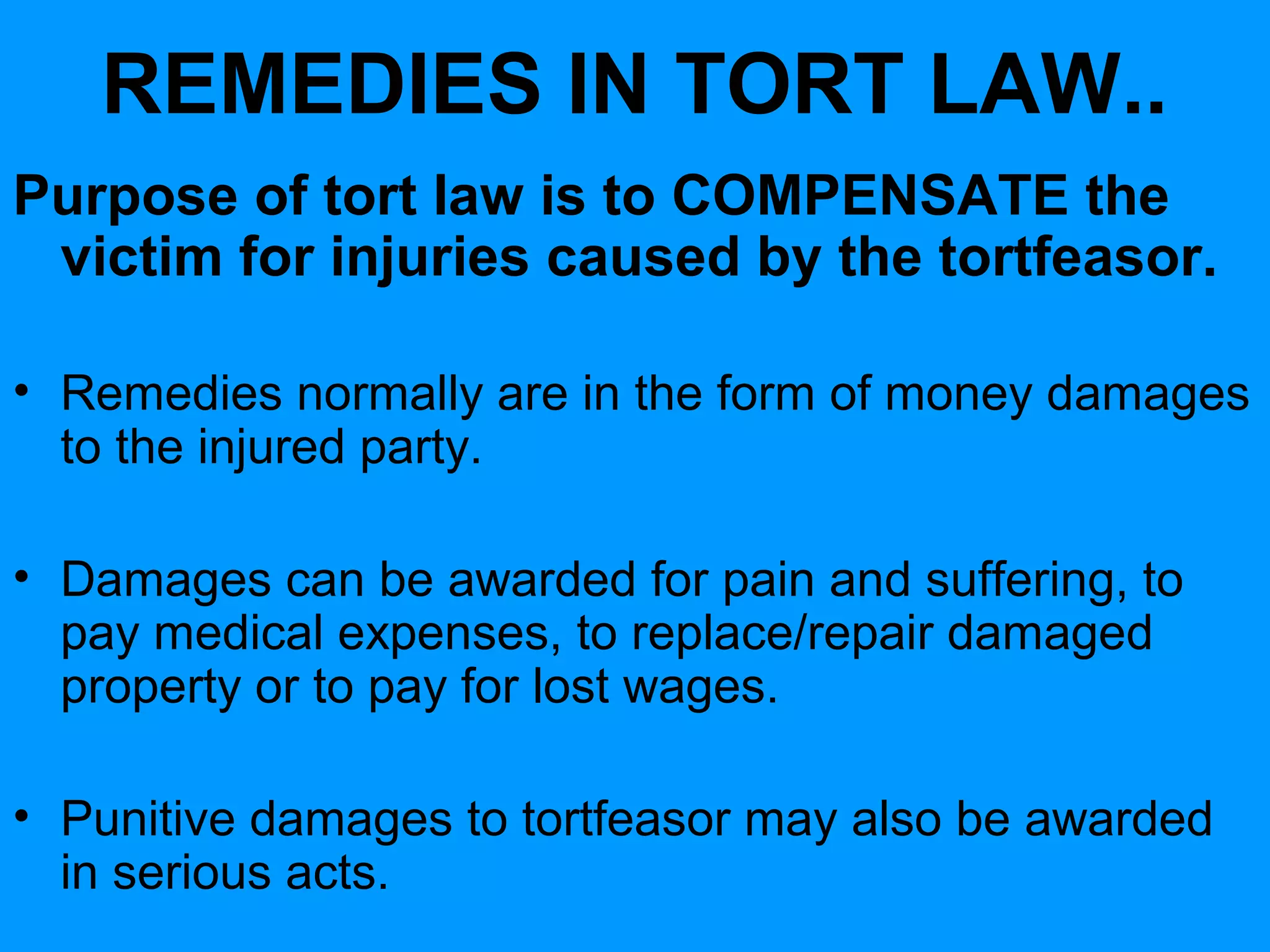
REMEDIES IN TORT LAW..
Purpose of tort law is to COMPENSATE the
victim for injuries caused by the tortfeasor.
• Remedies normally are in the form of money damages
to the injured party.
• Damages can be awarded for pain and suffering, to
pay medical expenses, to replace/repair damaged
property or to pay for lost wages.
• Punitive damages to tortfeasor may also be awarded
in serious acts.
INTENTIONAL
TORTS
Intentional Torts…….
are most often actions that
deliberately hurt, embarrass
or scare people
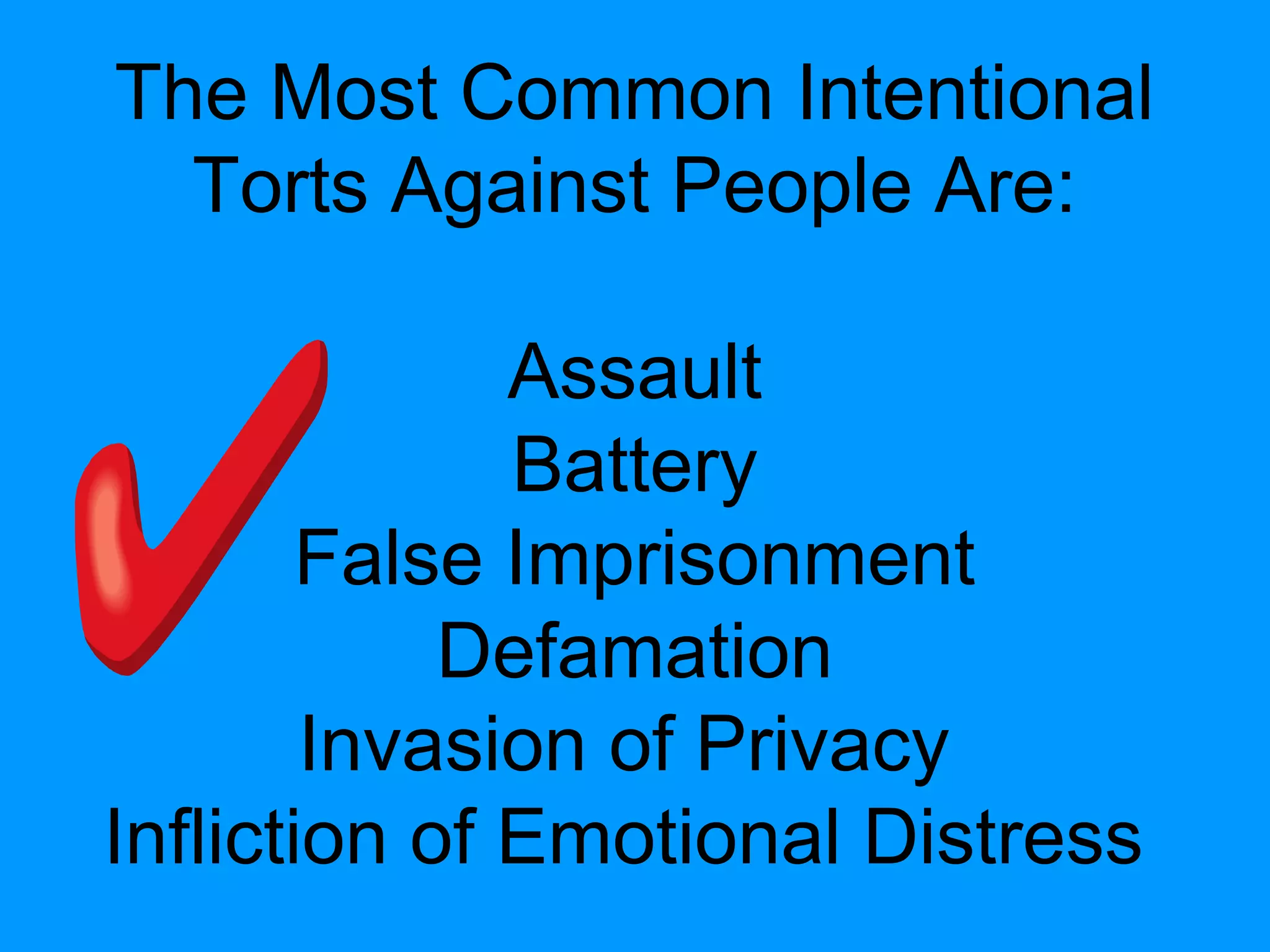
The Most Common Intentional
Torts Against People Are:
Assault
Battery
False Imprisonment
Defamation
Invasion of Privacy
Infliction of Emotional Distress
ASSAULT
AND
BATTERY
--Assault and Battery Are Two Different
Torts
--Can Be Committed Together Or By
Themselves
--A Person Commits An Assault by
Threatening to Harm An Innocent Person
--Battery Is the Unlawful, Unwanted
Touching of Another Person
An Assault Occurs As
Soon As You Are Afraid Of
Immediate Harm to Your
Body
----------An Assault has Occurred
Even If You Escape From
The Harm
A Battery Is Committed Even
If the Physical Contact Isn’t
Harmful
-------Battery Can Also Be Touching
Something Closely Associated With a
Person’s Body (Backpack, Cap) That
Causes Harm.
(Example, Pulling Chair Out As Someone Sits Down)
FALSE IMPRISONMENT
• If Someone Interferes With a Person’s Right to Move
About Freely, Then That Person Has Committed False
Imprisonment.
• Example, Security Guards in a Store Must Have
Reasonable Grounds Before They Stop Someone
Suspected Of Shoplifting.
• They Must Hold The Person in a Reasonable Way and
For A Reasonable Time.
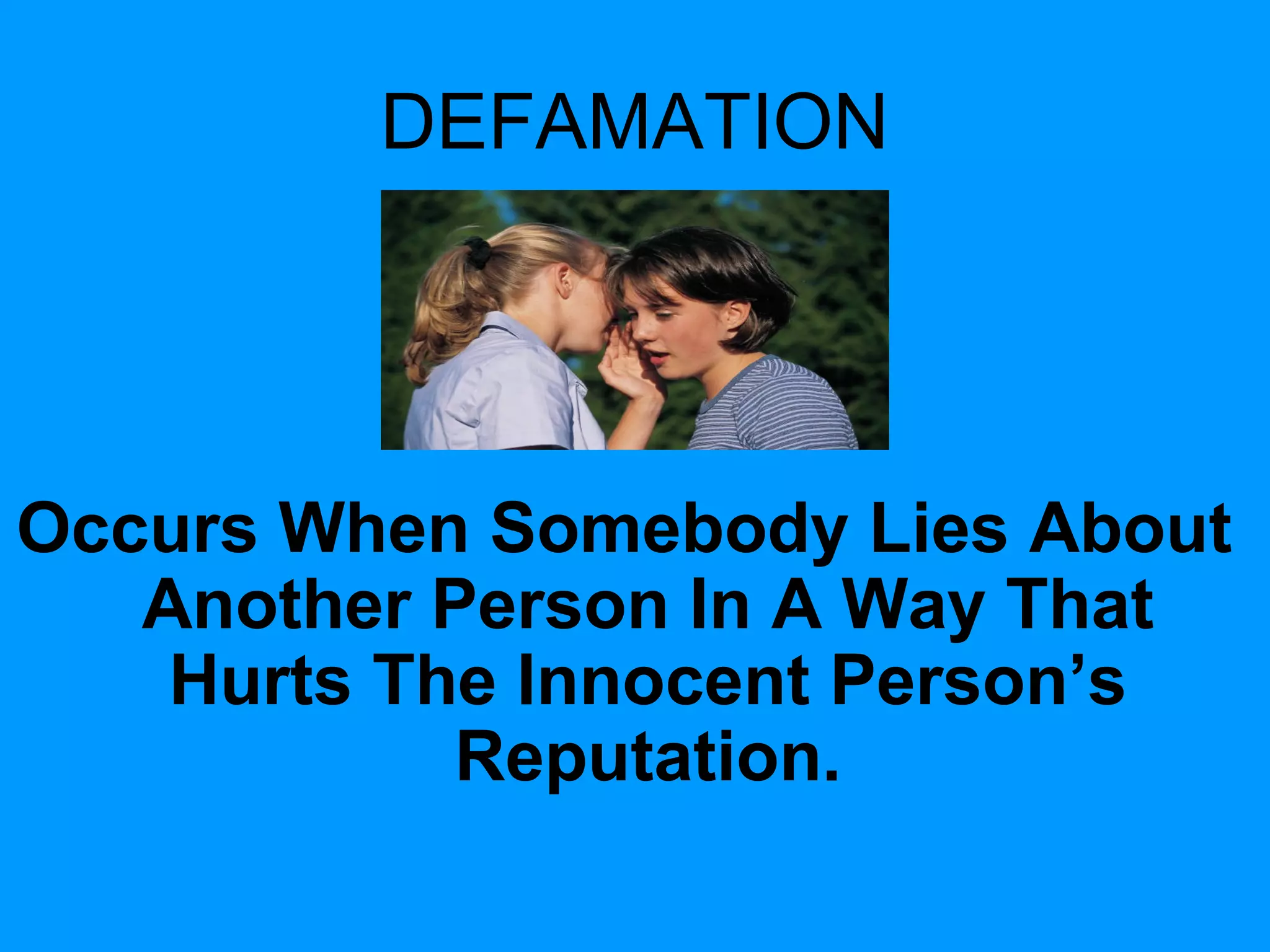
DEFAMATION

Occurs When Somebody Lies About
Another Person In A Way That
Hurts The Innocent Person’s
Reputation.
Two Types Of Defamation-—Libel
Consists of Lies About A Person in Written,
printed or recorded form, including
television shows, magazine stories, Web
sites and e-mails.

---Slander
Consists of Verbal or Spoken Lies that
Damage a Person’s Reputation.
Movie stars, famous athletes and
politicians have a hard time winning
libel suits because the Supreme Court
ruled that public figures must prove that
lies about them are told with actual
malice.
Actual Malice means that the person who published the
lie knew it was a lie and published it anyway. Actual
malice could also mean that the person who
published the lie thought it was true but did a poor job
checking out the facts.
INVASION OF PRIVACY
Interfering With A Person’s
Right to be Left Alone
--Includes the right to be free from
unwanted publicity
--People must stay out of your private
matters
People who use confidential records
in their jobs (doctors, nurses, lawyers,
teachers, counselors, etc) have to be
careful with these records.
A nurse can talk to another nurse about a patient if they
are both taking care of that patient. No one else can
see the patients records nor can they talk to others
about them.
It is also invasion of privacy to use your photograph,
likeness or name without your permission for
advertising, publicity or marketing purposes.
INTENTIONAL INFLICTION
OF EMOTIONAL DISTRESS
Causing Great Emotional or Mental Distress
to Another Person, Even If There Is No
Intent to Cause Physical Harm. The
Distress Must Be Caused By Extreme and
Outrageous Conduct.
(Example: Convincing another person that a
family member has died)
INTENTIONAL TORTS
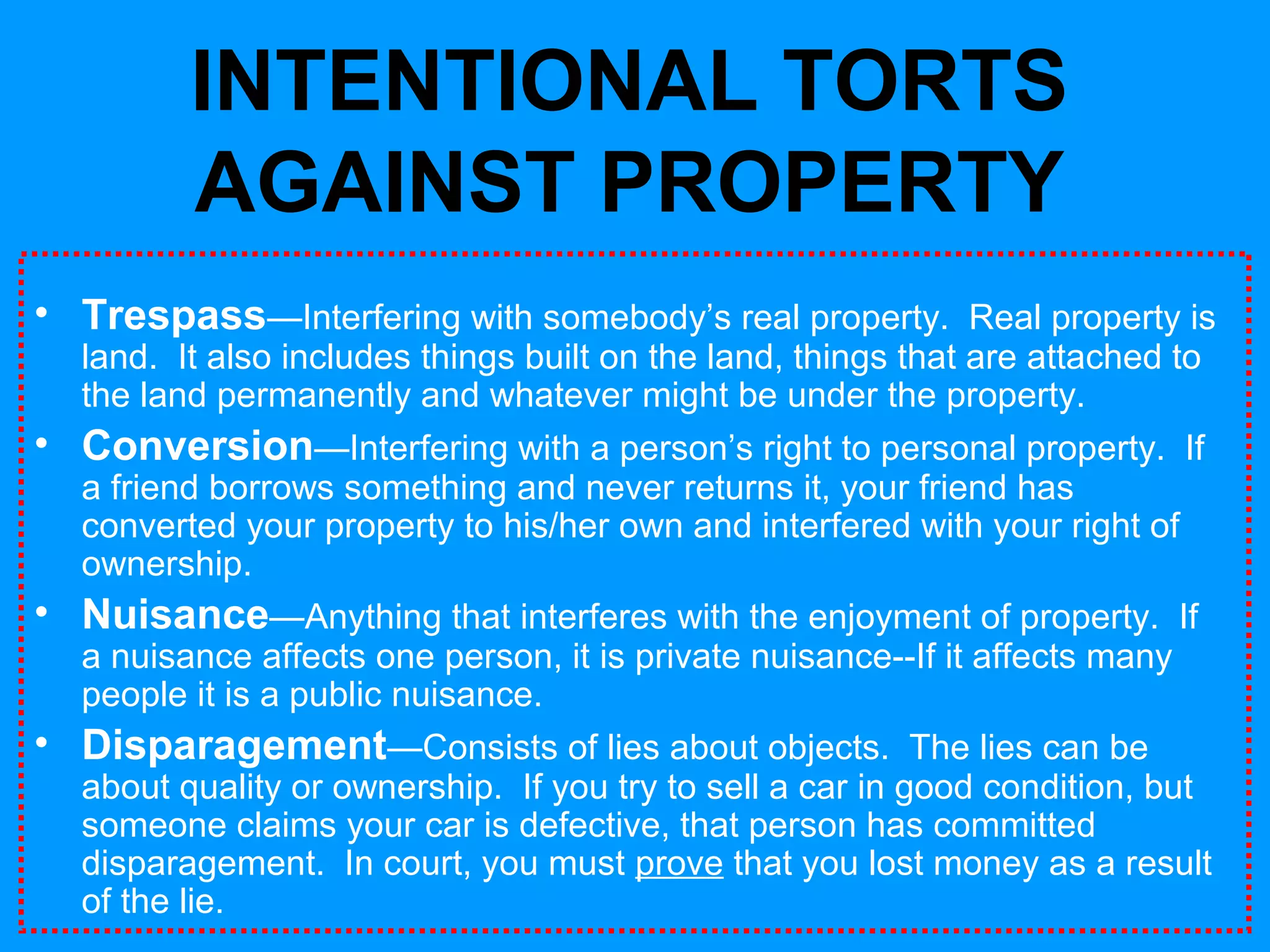
AGAINST PROPERTY
• Trespass—Interfering with somebody’s real property. Real property is
land. It also includes things built on the land, things that are attached to
the land permanently and whatever might be under the property.

• Conversion—Interfering with a person’s right to personal property. If
a friend borrows something and never returns it, your friend has
converted your property to his/her own and interfered with your right of
ownership.

• Nuisance—Anything that interferes with the enjoyment of property. If
a nuisance affects one person, it is private nuisance--If it affects many
people it is a public nuisance.

• Disparagement—Consists of lies about objects. The lies can be

about quality or ownership. If you try to sell a car in good condition, but
someone claims your car is defective, that person has committed
disparagement. In court, you must prove that you lost money as a result
of the lie.

Ch3 1 powerpoint Tort Law

  • 1.
  • 2.
    TORT LAW ISBASED ON THE IDEA THAT EVERYONE IN OUR SOCIETY HAS CERTAIN RIGHTS • Along With Having Certain Rights, Everyone Has The Duty to Respect the Rights of Others. • The Purpose of Tort Law is to Enforce Those Rights and Duties
  • 3.
    What Is ATort??? A tort is a private wrong committed by one person against another.
  • 4.
    TORTS CAN BE INTENTIONALOR UNINTENTIONAL AGAINST PERSONS AND PROPERTY
  • 5.
    ANOTHER TERM FOR ANUNINTENTIONAL TORT IS NEGLIGENCE
  • 6.
    Negligence is theFailure to Exercise the Degree of Care That a Reasonable Person Would Have Exercised. Unintentional Torts Are The Most Common Type of Tort
  • 7.
    A TORTFEASOR is a personwho Commits A Tort— A person who commits a tort interferes with another person’s rights.
  • 8.
  • 9.
    1. The Possession ofCertain Rights by an Innocent Party
  • 10.
    2. A Violationof Those Rights by the Tortfeasor
  • 11.
    3. A ResultingInjury That Somehow Hurts The Person Whose Rights Were Violated
  • 12.
    THE PERSON INJUREDIS USUALLY CALLED THE Victim, the innocent party or the plaintiff in a lawsuit. THE TORTFEASOR IS THE Defendant in a lawsuit.
  • 13.
  • 14.
    Torts Are DifferentFrom Crimes… • A Crime is a Wrong Committed Against the Public Good • A Tort is a Wrong Committed Against a Particular Person or Property
  • 15.
    A TORT ISCONSIDERED A CIVIL OR PRIVATE WRONG RATHER THAN A CRIMINAL WRONG, BUT SOMETIMES A TORT IS ALSO A CRIME! For Example, An Assault Is Both a Tort and a Crime Because It Hurts The Individual and Poses a Threat To All Members of Society Slander is a Tort But NOT a Crime Because It Only Hurts An Individual
  • 16.
    Penalties in Criminal Law— Thepurpose of criminal law is to protect society from criminal offenders by punishing them. Penalties for criminal offenses are very serious.
  • 17.
    REMEDIES IN TORTLAW.. Purpose of tort law is to COMPENSATE the victim for injuries caused by the tortfeasor. • Remedies normally are in the form of money damages to the injured party. • Damages can be awarded for pain and suffering, to pay medical expenses, to replace/repair damaged property or to pay for lost wages. • Punitive damages to tortfeasor may also be awarded in serious acts.
  • 18.
  • 19.
    Intentional Torts……. are mostoften actions that deliberately hurt, embarrass or scare people
  • 20.
    The Most CommonIntentional Torts Against People Are: Assault Battery False Imprisonment Defamation Invasion of Privacy Infliction of Emotional Distress
  • 21.
  • 22.
    --Assault and BatteryAre Two Different Torts --Can Be Committed Together Or By Themselves --A Person Commits An Assault by Threatening to Harm An Innocent Person --Battery Is the Unlawful, Unwanted Touching of Another Person
  • 23.
    An Assault OccursAs Soon As You Are Afraid Of Immediate Harm to Your Body ----------An Assault has Occurred Even If You Escape From The Harm
  • 24.
    A Battery IsCommitted Even If the Physical Contact Isn’t Harmful -------Battery Can Also Be Touching Something Closely Associated With a Person’s Body (Backpack, Cap) That Causes Harm. (Example, Pulling Chair Out As Someone Sits Down)
  • 25.
    FALSE IMPRISONMENT • IfSomeone Interferes With a Person’s Right to Move About Freely, Then That Person Has Committed False Imprisonment. • Example, Security Guards in a Store Must Have Reasonable Grounds Before They Stop Someone Suspected Of Shoplifting. • They Must Hold The Person in a Reasonable Way and For A Reasonable Time.
  • 26.
    DEFAMATION Occurs When SomebodyLies About Another Person In A Way That Hurts The Innocent Person’s Reputation.
  • 27.
    Two Types OfDefamation-—Libel Consists of Lies About A Person in Written, printed or recorded form, including television shows, magazine stories, Web sites and e-mails. ---Slander Consists of Verbal or Spoken Lies that Damage a Person’s Reputation.
  • 28.
    Movie stars, famousathletes and politicians have a hard time winning libel suits because the Supreme Court ruled that public figures must prove that lies about them are told with actual malice. Actual Malice means that the person who published the lie knew it was a lie and published it anyway. Actual malice could also mean that the person who published the lie thought it was true but did a poor job checking out the facts.
  • 29.
    INVASION OF PRIVACY InterferingWith A Person’s Right to be Left Alone --Includes the right to be free from unwanted publicity --People must stay out of your private matters
  • 30.
    People who useconfidential records in their jobs (doctors, nurses, lawyers, teachers, counselors, etc) have to be careful with these records. A nurse can talk to another nurse about a patient if they are both taking care of that patient. No one else can see the patients records nor can they talk to others about them. It is also invasion of privacy to use your photograph, likeness or name without your permission for advertising, publicity or marketing purposes.
  • 31.
    INTENTIONAL INFLICTION OF EMOTIONALDISTRESS Causing Great Emotional or Mental Distress to Another Person, Even If There Is No Intent to Cause Physical Harm. The Distress Must Be Caused By Extreme and Outrageous Conduct. (Example: Convincing another person that a family member has died)
  • 32.
    INTENTIONAL TORTS AGAINST PROPERTY •Trespass—Interfering with somebody’s real property. Real property is land. It also includes things built on the land, things that are attached to the land permanently and whatever might be under the property. • Conversion—Interfering with a person’s right to personal property. If a friend borrows something and never returns it, your friend has converted your property to his/her own and interfered with your right of ownership. • Nuisance—Anything that interferes with the enjoyment of property. If a nuisance affects one person, it is private nuisance--If it affects many people it is a public nuisance. • Disparagement—Consists of lies about objects. The lies can be about quality or ownership. If you try to sell a car in good condition, but someone claims your car is defective, that person has committed disparagement. In court, you must prove that you lost money as a result of the lie.