Elements of Torts
Chapter 6
Meiners, Ringleb & Edwards
The Legal Environment of Business, 13th Ed.
©2018 Cengage Learning®. May not be scanned, copied or
duplicated
or posted to a publicly accessible website, in whole or in part,
except
for use as permitted in a license distributed with a certain
product or
service or otherwise on a password-protected website or school-
approved learning management system for classroom use.
TORTS & THE LEGAL SYSTEM
The word tort derived from Latin tortus or “twisted.”
Means “wrong” in Old French.
A tort is a civil wrong, other than a breach of contract,
for which the law provides a remedy.
•Breach of a legal duty owed to another that causes
harm
•Torts arise from careless errors or intentional actions
•The law reflects social values and standards
•Lawsuits involving businesses can have large awards. In
Pennzoil-Texaco case jury awarded $10.5 billion.
•Has become a major issue for businesses
Business and Torts
ional
distributed by the
business
ons of another
business or person
The Role of Tort Law
• Tort law allows compensation for injuries wrongfully inflicted
by a
defendant on a plaintiff
• Civil not criminal law
• Law is determined in each state – rules vary.
• However, the basic principles are similar across states.
• Remedies should place an injured party in the position he/she
would have been in absent the tort.
• Fear of tort action deters injurious behavior by others.
• Punitive damages punish malicious or extremely reckless
behavior.
NEGLIGENCE-BASED
TORTS
• Unintentional careless conduct that creates an unreasonable
risk of harm
to others. No intent to harm needed.
• Elements
• 1. Breach of duty of care wrongdoer owed to injured party
• Owed to the plaintiff
• Breach through an act or omission
• 2. Causation (causal connection to the injury)
• 3. Injury/Damages
• Gross Negligence: Conscious & voluntary disregard for need
to use
reasonable care
• More likely to lead to punitive damages
Duty of Care and the Reasonable Person Standard
• The standard is how persons in the community ought to
behave.
• One must be reasonable at all times, under the circumstances.
• Not liable for everything – only for “unreasonable” acts
• Standard: “What a reasonable person would do in same or
similar circumstances?”
• Applies to professions – CPA, MD, attorney, etc.
• What a competent and experienced professional
would do
Squish La Fish v. Thomco Specialty Products
• Squish holds patent on “Tuna Squeeze;” ProPack hired to
assist with store
displays.
• ProPack got Thomco’s advice on adhesive for the displays.
• Thomco said the adhesive would wash off; Squish relied on
advice, but
adhesive would not wash off.
• A Squish distributor was not happy with adhesive; cancelled
the order.
• Squish sued Thomco for negligent misrepresentation.
• District Court granted judgment for Thomco; Squish appealed.
• Held: Reversed and remanded
• Disputed issues to go before the trial court
• There may have been reliance by Squish through ProPack on
Thomco’s
representations hence a tort of negligence.
• Causation between a party’s act & another’s injury.
• Cause in fact shows the person’s conduct is the actual cause of
the event that created
the injury (some courts call this the “but for” test [sine qua non
rule]).
• Proximate cause indicates that the liability bears a reasonable
relationship to the
negligent conduct.
• In some cases, case is so obvious, res ipsa loquitur (“the thing
speaks for itself”) applies.
• If consequences are too remote – no liability.
• If there is an intervening or superseding event/conduct – no
liability.
• Chain of events created by a party’s actions must be
foreseeable.
• Some states replace proximate cause with substantial factor
test in bringing about the
injury.
• Danger-Invites-Rescue Doctrine
• Negligent party is responsible for losses suffered by those who
attempt to save people who are
in danger as the result of torts of others.
CAUSATION
Causation
Causation between a party’s act and another’s injury.
Cause in fact: a person’s conduct is the actual cause of event
that
created the injury (some courts call this the “but for” test [sine
qua
non rule]).
In some instances, the case is obvious, so res ipsa loquitur (“the
thing
speaks for itself”) applies.
If consequences are too remote – no liability.
If there is an intervening or superseding event/conduct – no
liability.
Proximate cause indicates that the liability arises from a logical
relationship to negligent conduct.
Chain of events created by a party’s actions must be
foreseeable.
Some states replace proximate cause with substantial factor test
in
bringing about the injury.
Danger-Invites-Rescue Doctrine
Negligent party is responsible for injury suffered by those who
attempt to save people in danger as the result of torts of others.
PALSGRF V. LONG ISLAND RR CO.
• Palsgraf waited on a platform for a train; another train began
to leave
the station; man carrying a package ran to catch it; jumped on
the train;
might fall, so guard grabbed to help him.
• He dropped package which contains fireworks that exploded.
• Shock from the explosion caused scales on platform to fall,
injuring
Palsgraf who sued RR for negligence of its employees.
• Jury found for Palsgraf; appellate court affirmed; RR
appealed.
• Issue: Is it foreseeable that the assistance by the guards
would cause
Palsgraf’s injury through the falling scales?
• Held: No. Nothing in the situation would suggest such a
result. Strange
sequence of events involving no negligence by the railroad or
its
employees.
• Case reversed and dismissed.
Evolving Law of Negligence
• Thompson v. Kaczinski (Iowa Supreme Court)
• Adopted some portions of new Restatement (Third) of Torts
• Need not focus on ordinary duty of reasonable care – this duty
is presumed where
there is risk of physical harm.
• Instead, court should “proceed directly to the elements of
liability.”
• Less reliance on proximate case – “has been a source of
significant uncertainty and
confusion.”
• Move also away from “substantial factor.”
• Instead, Restatement Third refers to the “scope of liability”
related to risks present
in a specific situation.
• Court will use a “risk standard” to judge when liability is
imposed.
• Changes are subtle; could take many years—state by state—to
become
apparent in the working of tort law in the U.S.
DEFENSES TO A NEGLIGENCE ACTION
Assumption of Risk
• The injured party knew or
should have known of the
risk and voluntarily assumed
it.
• Complete bar to the
plaintiff’s case
• May be based on liability
waiver or exculpatory
clause in a contract
Comparative Negligence
• Damages are reduced by the %
of injuries caused by the
plaintiff’s own negligence
• Replaced old rule old rule of
contributory negligence
• Term contributory
negligence still used, but for
damages, the rule of
comparative negligence is
used.
• Pure Comparative
Negligence vs. 50% Rule
Geczi v. Lifetime Fitness
Ohio.
broken, but
no sign had been placed on it.
Geczi
agreed to an exculpatory clause
Lifetime from
using equipment. Clear in contract she signed.
behavior for
failure to warn of danger posed by the malfunctioning machine.
Geczi v. Lifetime Fitness continued
• Issue: Whether reasonable minds can only conclude that
documents Geczi signed
constituted valid release of claims against Lifetime.
• Previously courts recognize that law does not favor release
from liability for future tortious
conduct. Releases are narrowly construed.
• HOWEVER, clear & unambiguous contract clauses relieving a
party from liability for
negligence are generally upheld in Ohio.
• Provision in member Policy:
• “I accept full responsibility for my use, as well as the use by
any other person under my membership, of
any and all equipment . . . . I agree that I will hold the Club . . .
harmless from any and all loss, claim,
injury, damage, or liability incurred by me. . . . I fully
understand all of the Club’s policies and agree to
abide by them.”
• Release did not distinguish types of negligence. Any injury
could be relevant.
• Broad language in document extends to negligence in –
• Maintaining equipment, leaving defective equipment available
to users, and negligence in failing to warn
of defects.
• Jury looked at question if Lifetime’s failure to act or warn was
“willful or wanton conduct”
– found Lifetime was not.
• HELD: Judgment Affirmed.
INTENTIONAL TORTS AGAINST PERSONS
in harm to the plaintiff
consequences of an action
INTENTIONAL TORTS AGAINST PERSONS
• Placing plaintiff in fear of immediate bodily injury
• Intent to act to cause a harmful or offensive contact
• Plaintiff has imminent apprehension or fear
• Fear: if a reasonable person under the same or similar
circumstances would have
apprehension of bodily harm or offensive contact
• Examples:
• Pointing a gun? Yes
• Point a gun while other person sleeps? No assault
• Letter threats? Usually, no assault (“immediate” standard
usually not met)
• Phone threats? Maybe. How close is the caller? On a cell
phone outside the
window or in another town?
• Unlawful “touching”
• Intentional physical contact without
consent
• Even if no actual physical harm, offense to
a “reasonable person’s sense of dignity”
may constitute a battery.
• Use of fist, hand, or kicking
• Use of weapons, i.e. guns or stick
• Unwanted kiss? Has been held to
constitute battery
• Assault and Battery often linked together
• Defenses
• Consent
• Privilege
• Self defense
• Defense of others/Defense
of property
• Most states have “stand
your ground” doctrines
• No requirement to
retreat
• Allow force for force &
deadly force for deadly
force
Fuerschbach v. Southwest Airlines
• Fuerschbach worked as customer service representative for
Southwest
at Albuquerque airport.
• Airline prides itself on being “fun-loving, spirited company.”
• At end of probationary period, often a prank to celebrate the
event.
• Her supervisor thought would be fun to set up a mock arrest.
• Two Albuquerque police officers came to the counter, told her
of
outstanding warrants against her, handcuffed her and told her
she was
under arrest.
• She began to cry, so officers took her to the party in the back.
• All the employees yelled “Congratulations for being off
probation!”
• Handcuffs removed; party began. She kept crying and sent
home.
• Saw a psychologist who said she suffered post-traumatic stress
disorder.
Fuerschbach v. Southwest Airlines
• Fuerschbach sued everyone connected with the event on
numerous
grounds, including assault and battery.
• District court granted summary judgment for defendants and
did not
allow the matter to go to trial.
• HELD: Reversed. Summary judgment vacated re: assault and
battery
claim. She can go to trial.
• District court said officers “were courteous and professional.”
• Issue: Did the actions offend “a reasonable sense of personal
dignity?”
• HELD: Jury might be able to conclude that being handcuffed
and
leading the person to walk fifteen feet offends a “reasonable
sense
of personal dignity.”
• Police handcuffed her – could be offensive contact.
• Note: Some other claims allowed to go forward; others were
denied. The
only claim against Southwest Airlines was a Workers’
Compensation claim
because there was no intent by anyone to harm her at work.
FALSE IMPRISONMENT
(FALSE ARREST)
• Intentional holding, detaining or
confinement
• Freedom to come and go is
restrained
• Restraint or Confinement
• May be physical
• May be mental (i.e. through
verbal threats)
• Using position of authority
• Lawsuits often arise from detention
of suspected shoplifters
• Defense by businesses
regarding detention of
shoplifters
• Restraint was in a
reasonable manner
• Restraint was in a
reasonable time
• Basis for the detention
was valid
Harter v. Edwards
• Edwards purse stolen; thief tried to use credit cards.
• She contacted businesses about matter.
• Detective Harder of Fort Lauderdale PD had been working on
fraudulent
check ring.
• Edwards’ checking account was one thieves used for
fraudulent checks.
• Check from Edwards’ account written to T.J. Maxx – store
cooperated
with police.
• Officers arrested 23 people alleged in involvement in check
scam.
• Edwards arrested. Family bailed her out; charges dropped.
• She sued Detective Harder, Police Department, T.J Maxx &
store
employee Carlson who provided information to police about
bogus
checks.
• Trial Court: Found for Edwards. Defendants appealed.
Continued
Harter v. Edwards, cont.
• False imprisonment entails “imprisonment contrary to [the
plaintiff’s]
will and unlawfulness of detention.”
• Where criminal activity encountered, “public policy of Florida
is to
give wide latitude to an individual reported suspect crime.”
• This ensures “a free flow in information between the people
and the
police.”
• Carlson acted reasonable in pursuing his investigation.
Merely provided Detective Harder with fraudulent checks.
• Detective Harter exercised his discretion in pursing his
investigation.
• Evidence here is sufficient to establish probable cause for
Edwards’
arrest.
• HELD: Reversed; judgment for defendants.
Infliction of Emotional
Distress/Mental Distress
• Intentional conduct: So outrageous, it creates severe
mental or emotional distress
• Petty insults, annoying behavior, bad language? Usually
not actionable; we must have “tough skin.”
• Bill collectors or landlords who badger, are profane, or
threaten lay the background for a lawsuit.
• Ex: Louisiana court gave award to a woman who found her
comatose
husband being chewed by rats in a hospital
Lawler v. Montblanc
• Montblanc makes high-end writing implements and other
luxury products.
• Sells wholesale and at boutique retail stores.
• Cynthia Lawler was retail store manager in California for 8
years.
She was expected to work full time.
• In 8th year, Lawler developed medical conditions – doctor
said she could only
work 20 hours/week.
• She informed Montblanc.
• Was told as a manger she had to work at least 40 hours /week.
• President of company visited and was critical of way store was
run.
• Lawler testified he was “unpleasant.”
• Sshe told the company her doctor said she should not work
full time.
• Company said that was part of her position; offered her
severance pay.
• She refused; sued for intentional infliction of emotional
distress.
• District Court held for Montblanc.
Continued
Lawler v. Montblanc, cont.
• California’s cause of action for intentional infliction of
emotional distress:
• (1) extreme and outrageous conduct by defendant with
intention of causing or
probability of causing emotional distress
• (2) plaintiff suffered severe or extreme emotional distress
• (3) actual and proximate cause of emotional distress was by
defendant’s outrageous
conduct
• Outrageous: When so extreme it exceeds all bounds usually
tolerated in a civilized
community. Does not extend to mere insults, indignities,
threats, annoyances, petty
oppressions or other trivialities
• Schmitz’s “gruff,” “abrupt,” and “intimidating” conduct was
not “exceeding all bounds of
that tolerated civilized community.”
• Criticism he made related to store’s operations & Lawler’s
performance.
• He was inconsiderate and insensitive in communicating
dissatisfaction.
• However, the alleged emotional distress is not “severe.”
• Injuries manifested as “anxiety, sleeplessness, upset stomach
and muscle twitches –
do not rise to “severe” level.
• Affirmed District Court’s summary judgment for defendants.
INVASION OF PRIVACY
• Infringement of a person’s right of solitude and freedom from
unwarranted
public exposure
• Use of a person’s name or picture without permission
• Intrusion on solitude (i.e. wiretap; hacking into a computer)
• Placing a person in false light (publishing a false story)
• Public exposure of private facts (debts, drug use)
• Defenses
• Right of privacy waived by public figures, politicians,
entertainers, sports personalities, etc.
• Information about an individual taken from public files or
records
Seki v. Groupon
• Groupon did business with Sportations, a GA business.
• Sportations provided Groupon customers hot air balloon rides
for $139.00 per
person
• Groupon sold 25 vouchers.
• Ended it’s relationship with Sportations with 18 vouchers
unused.
• Seki’s business goes by name of Magical Adventures Balloon
Rides.
• Groupon asked him if he was interested in selling rides. He
was not.
• However, he agreed to give 18 rides to Sportations’ customers
and Groupon
would pay him for rides.
• That was extent of relationship between Magical and Groupon.
• Seki learned Groupon featured Magical on its website and was
selling
vouchers for rides.
• Seki demanded Groupon stop.
Continued
Seki v. Groupon continued
• Seki claimed to lose $140,000 in revenues when Groupon used
his company
name.
• Sued for invasion of privacy.
• Trial Court held for Groupon; Seki appealed.
• GA law: “the appropriation of another’s name and likeness …
without
consent and for … financial gain … is a tort.”
• It is invasion of privacy.
• Rational: Prevent unjust enrichment by theft of good will.
• Reversed: Seki is not precluded from pursing a claim for
invasion of privacy
through misappropriation.
Defamation
• Definition: An intentional false communication that
injures a person’s or company’s reputation or good
name
• Elements of the Tort:
• False or defamatory statement
• Published or communicated to a third person
• Causing harm or injury to the plaintiff
• If person who has false statement said directly to
them, then tells a 3rd party it is “self publication” and
no tort.
Defamation
Defamation per se: Presumption of harm
No proof of harm/injury is necessary.
Examples: person has committed a crime; has a
sexually communicable disease; or carries out
illegal business activities.
Workplace Defamation: Damaging information
given about job performance or negative
information spread about an employee
unnecessarily even within a business.
Defenses to Defamation
• Truth is a complete defense in some states.
• Absolute privilege is an immunity
• Legislators in committee sessions
• Participants in judicial proceedings
• Conditional privilege eliminates liability if the false statement
was
published in good faith.
• If there is no malice
• In order to protect a person’s legitimate interests
• Constitutional privilege
• Members of the press may publish “opinion” about public
officials, figures, or
those of public interest if there is no actual malice.
Chambers v. Travelers
• Chambers worked for Travelers from 1987-2008.
• Supervised employees (underwriters) who began to file
complaints about her.
• Human Resources Manager, Cady, investigated complaints as
did Chambers’
superior, Werner.
• Results were not good.
• Chambers was warned about her behavior.
• 2 months later, her superior asked her if it was true she took
her daughter with
her on a business trip. Said yes but did not admit took grandson
too.
• When facts came to light, she was fired.
• Chambers sued for defamation.
• District Court held for Travelers. She appealed..
Chambers v. Travelers cont.
• Defamation under Minnesota laws requires defamatory
statement
alse
the community
• Defendant may be entitled to “qualified privilege” that defeats
the claim
• If statement was “made upon proper occasion, for proper
motive and based upon
reasonable or probable cause”
• Complaints to Cady gave Travelers reasonable grounds to
investigate
Chambers’ performance to
supervisor Werner
--
sought her response
• Communications in a company during investigation or
punishing employee misconduct
are made upon a proper occasion and for proper purpose
• Employer has an interest in protecting itself and public against
dishonest or harmful
employees
• Qualified privilege is not abused if no malice; here, no actual
malice
• Affirmed: Travelers was entitled to the qualified privilege as a
matter of law.
• Statements made by Travelers agents were entitled to a
“qualified privilege.”
Elements of TortsTORTS & THE LEGAL SYSTEMBusiness and
TortsThe Role of Tort Law NEGLIGENCE-BASED
TORTSDuty of Care and the Reasonable Person Standard
Squish La Fish v. Thomco Specialty ProductsSlide Number
8CausationPALSGRF V. LONG ISLAND RR CO.Evolving Law
of NegligenceDEFENSES TO A NEGLIGENCE ACTIONGeczi
v. Lifetime Fitness Geczi v. Lifetime Fitness
continuedINTENTIONAL TORTS AGAINST
PERSONSINTENTIONAL TORTS AGAINST PERSONS
ASSAULTFuerschbach v. Southwest AirlinesFuerschbach v.
Southwest AirlinesFALSE IMPRISONMENT�(FALSE
ARREST)Harter v. EdwardsHarter v. Edwards, cont. Infliction
of Emotional �Distress/Mental DistressLawler v.
MontblancLawler v. Montblanc, cont.INVASION OF
PRIVACYSeki v. GrouponSeki v. Groupon
continuedDefamationDefamationDefenses to
DefamationChambers v. TravelersChambers v. Travelers cont.
Week 14 QSEN Competency Table Template
Student Name:
Problem:
QSEN Competency
Knowledge
Skill
Attitude
Patient Centered Care
Teamwork and Collaboration
Evidenced Based Practice
Quality Improvement
Safety
Informatics
Using the QSEN graduate competency document, review each of
the aspects under the Knowledge, Skill and Attitude columns
and identify how these competencies relate to your problem or
how you would use these competencies in potentially resolvi ng
the issue.
Problem: Polypharmacy in the older patient
QSEN Competency Knowledge Skill Attitude
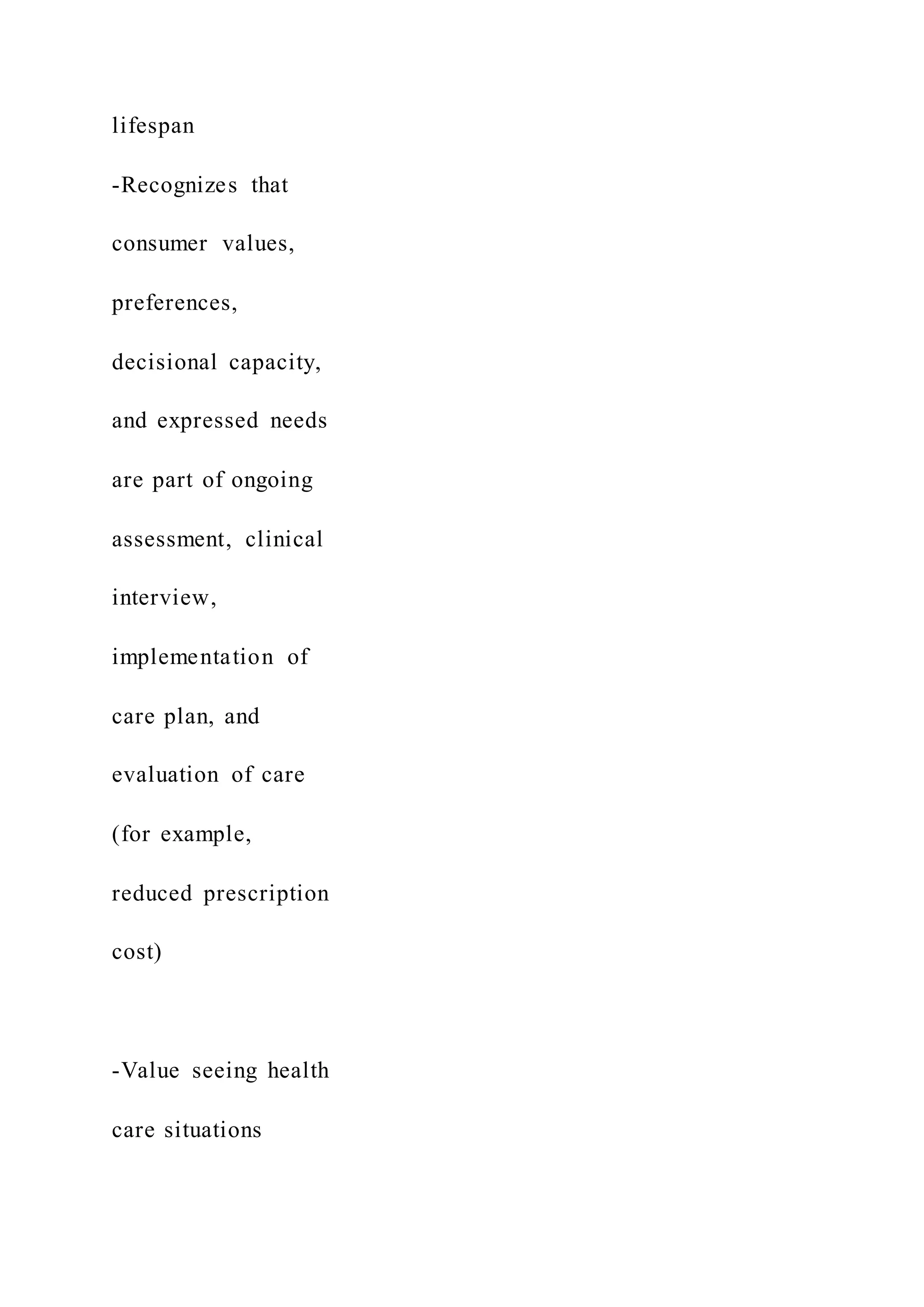
Patient Centered Care -Demonstrates service
delivery in a variety
of settings along a
continuum of care
that can be accessed
at any point -
Identifies components
of nursing process
appropriate to
individual, family,
group, community,
and population health
care needs across the
lifespan
-Recognizes that
consumer values,
preferences,
decisional capacity,
and expressed needs
are part of ongoing
assessment, clinical
interview,
implementation of
care plan, and
evaluation of care
(for example,
reduced prescription
cost)
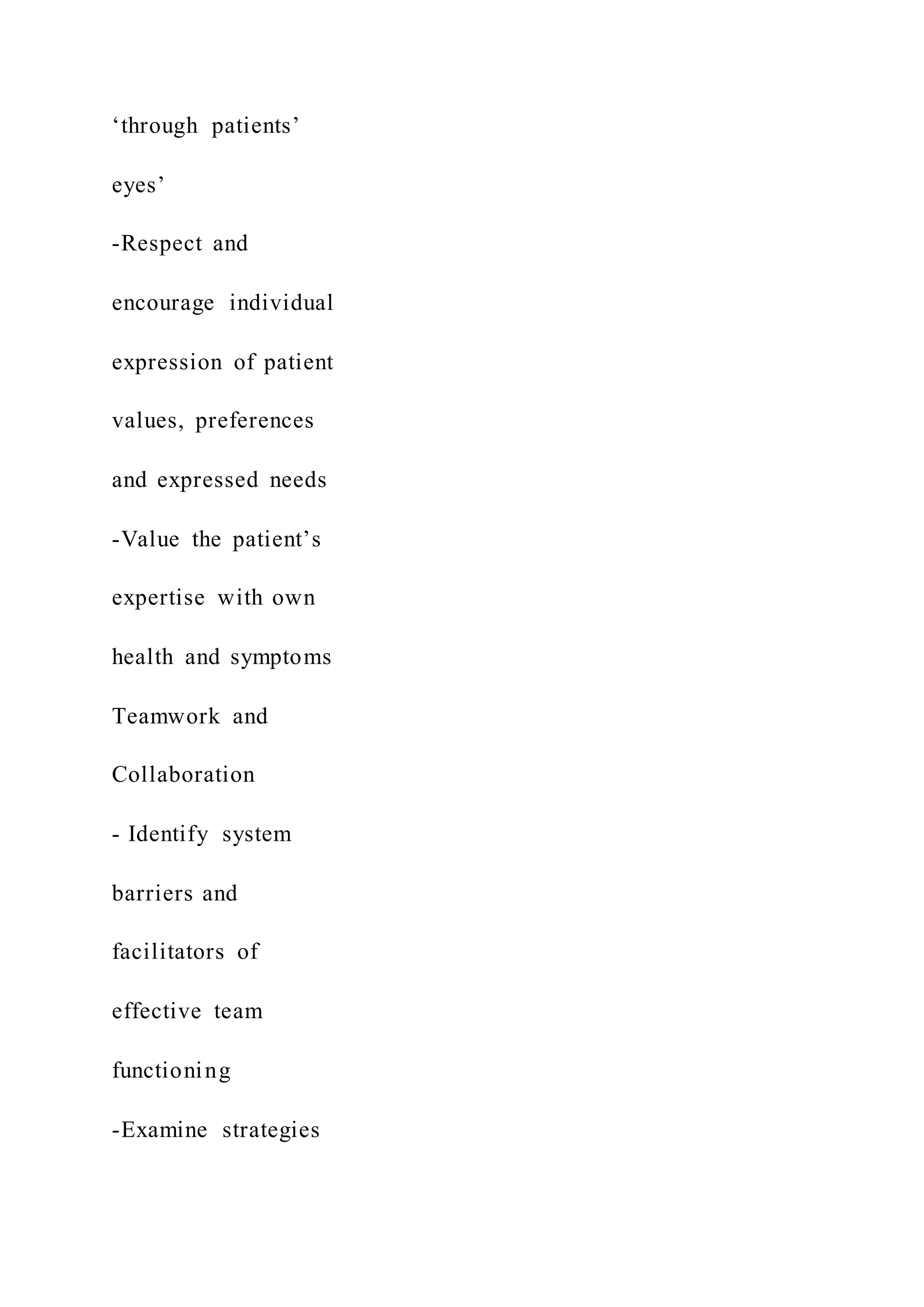
-Value seeing health
care situations
‘through patients’
eyes’
-Respect and
encourage individual
expression of patient
values, preferences
and expressed needs
-Value the patient’s
expertise with own
health and symptoms
Teamwork and
Collaboration
- Identify system
barriers and
facilitators of
effective team
functioning
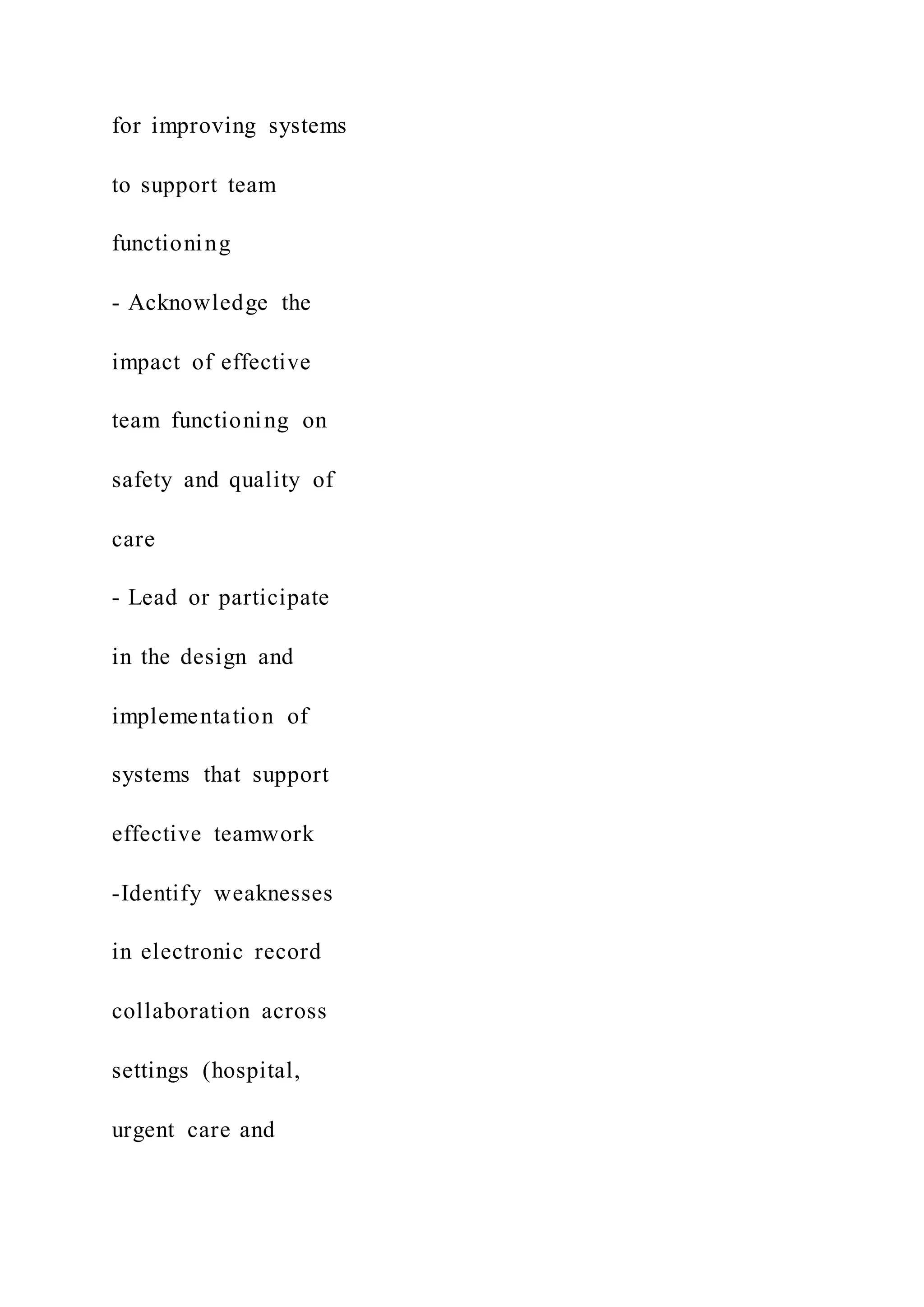
-Examine strategies
for improving systems
to support team
functioning
- Acknowledge the
impact of effective
team functioning on
safety and quality of
care
- Lead or participate
in the design and
implementation of
systems that support
effective teamwork
-Identify weaknesses
in electronic record
collaboration across
settings (hospital,
urgent care and
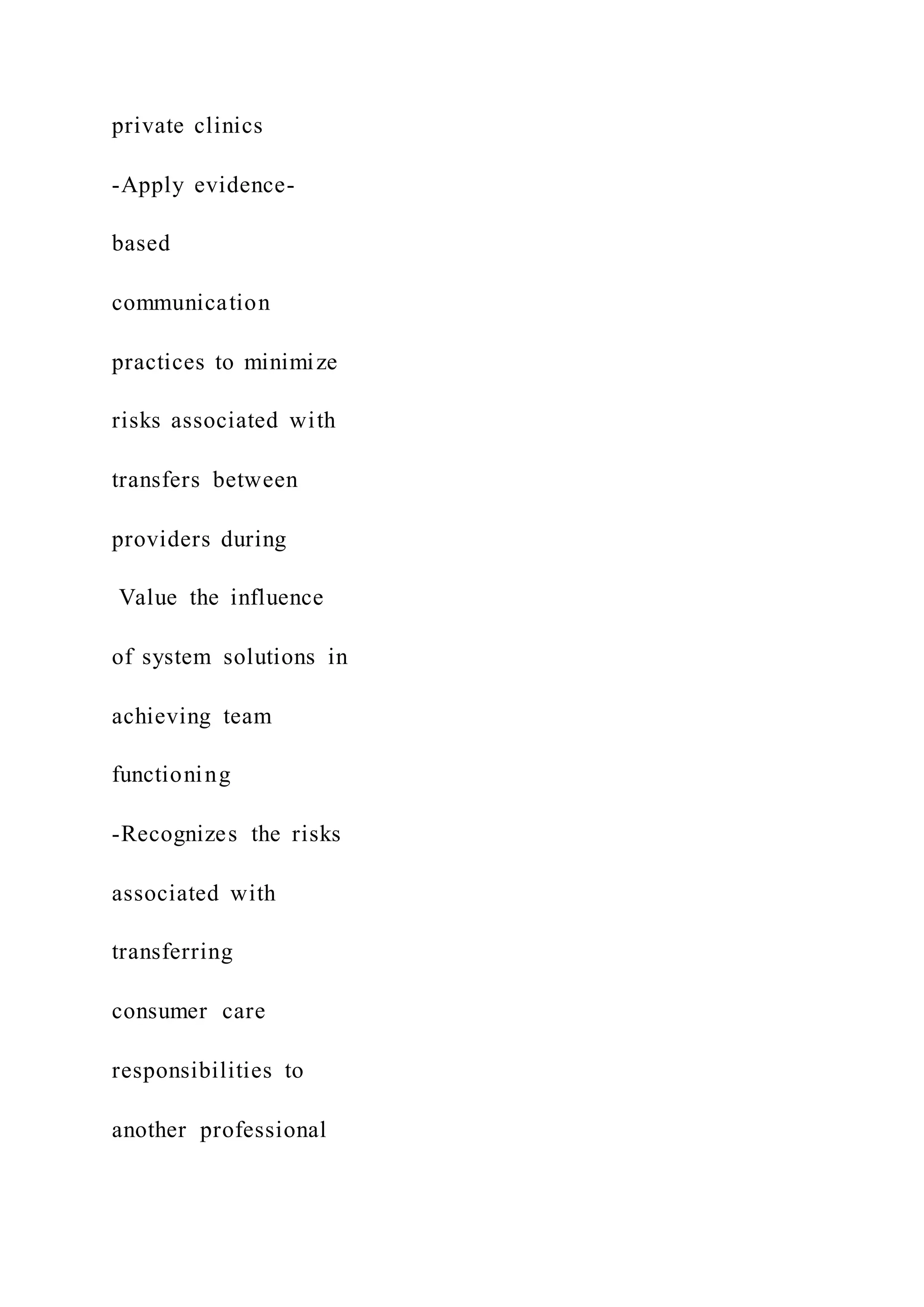
private clinics
-Apply evidence-
based
communication
practices to minimize
risks associated with
transfers between
providers during
Value the influence
of system solutions in
achieving team
functioning
-Recognizes the risks
associated with
transferring
consumer care
responsibilities to
another professional
(“hand-off”) during
transitions in care
transitions in care
delivery using
medication
reconciliation and
standardized EHR
systems.
Evidenced Based
Practice
-Describe reliable
sources for locating
evidence reports and
clinical practice
guidelines
- Accesses evidence-
based reports related
to clinical practice
topics and guidelines
-Informed by AGS of
BEERS Criteria for
potentially
inappropriate
medication in older
adults
-Acknowledge the
importance of
accessing relevant
clinical evidence
Quality Improvement -Describe approaches
for improving
processes and
outcomes of care
- Use a variety of
sources of
information to review
outcomes of care and
identify potential
areas for
improvement to
reduce drug-drug
interactions
-Propose appropriate
aims for quality
improvement efforts
to prevent adverse
drug events and
unnecessary
polypharmacy
-Participates in the
use of quality
indicators and
measures to evaluate
-Recognize the value
of what individuals
and teams can do to
improve care
processes and
outcomes of care
the effect of changes
in the delivery of
care to avoid
medications that may
contribute to
cognitive impairment
·
Safety -Describe how
consumers, families,
individual clinicians,
health care teams, and
systems can
contribute to
promoting safety and
reducing errors
-Describe the benefits
and limitations of
selected safety-
enhancing
technologies (such as
barcodes, Computer
Provider Order Entry,
and electronic
prescribing)
-Participate as a team
member to design,
promote and model
effective use of
strategies to reduce
risk of harm to self
and others by
reducing patient or
caregiver error when
self-administering
medications
-Prioritize predicting
and preventing
adverse drug
interactions
-Avoid prescription
cascading (treating
symptoms from
adverse effect of
another drug) by
using
STOPP/START
Criteria
- Integrated EMR
system development
and application to
reconcile previous
and current
medications lists
across all settings
-Recognize the value
of analyzing systems
and individual
accountability when
errors or near misses
occur
-Appreciate the
importance of being a
safety mentor and
role model
such as the hospital
urgent care and
primary care
- Utilize EMR
software that flags
drug allergies
Informatics -Evaluate benefits and
limitations of
different
communication
technologies and their
impact on safety and
quality
-Recognize lacking
integrated systems
between provider
settings and
pharmacists
-Champion
communication
technologies that
support clinical
decision-making,
error prevention, care
coordination, and
protection of patient
privacy
-Appreciate the need
for consensus and
collaboration in
developing systems
to manage
information for
patient care
-Value the
confidentiality and
security of all patient
records
References:
American Geriatrics Society 2015 Beers Criteria Update Expert
Panel
(2015) American Geriatrics Society 2015 Updated Beers
Criteria for Potentially Inappropriate
Medication Use in Older Adults. Journal of the American
Geriatrics Society (63) 2227–2246.
https://doi.org/10.1111/jgs.13702
Maine Partners in Nursing Education and Practice (2013, June).
Maine Nurse Core
Competencies [PDF]. Retrieved from:
https://www.omne.org/wp-content/uploads/2016/12/ME-
RN-Competencies.pdf
Rochon, P., A. (2018) Drug prescribing for older adults. In J.
Givens (Ed) UpToDate. Retrieved
from: https://www-uptodate-
com.regiscollege.idm.oclc.org/contents/drug-prescribing-for-
older-
adults?search=polypharmacy&sectionRank=1&usage_type=defa
ult&anchor=H18186995&sourc
e=machineLearning&selectedTitle=1~71&display_rank=1#H181
86995
Quality and Safety Education for Nurses (QSEN). (2019).
Graduate QSEN competencies.
Retrieved from http://qsen.org/competencies/graduate-ksas/
Week One Assignments.htmlObjectives
1.1 Identify and give examples of the two broad categories of
torts, Intentional Torts and Negligence torts.
1.2 Identify the elements of intentional torts and negligence
torts.
1.3 Identify and describe the particular torts that you will deal
with in business situations.
1.4 Apply the elements of business torts to case studies.
1.5 Identify and describe strict liability torts based on
warranties
1.6 Identify and describe liability based on defective products
including manufacturing defects and failure to warn and design
defects.Readings
Read Chapters Six - pay particular attention to the "test
yourself" segments.Assignments
Chapter 6 Assignment Part 1:
On page 141 of the text, write a brief paper on the following
discussion question. Must be at least 800 words on the topic of
"Are most accidents and injuries covered by tort law?" and
"Why or why not?" This assignment is directly related to the
objective regarding the category of negligence Torts and you
should discuss the elements of negligence torts. It would be a
good idea to discuss at least some defenses to negligence torts,
as well. Part 2:
Also on page 141, do question #2, the case of Newsom v.
Thalhimer Brothers, 901 S.Wd.2d 365, Ct. App., Tenn. (1994),
you need to read the case and answer the question below. Here
is a link to the Newsom v. Thalhimer Brothers case.
Answer the question thoroughly about whether or not the
Plaintiff had a case for false imprisonment and tell me why or
why not. Remember, these cases thoroughly discuss the subject
matter and there is a correct answer. You can certainly express
your opinion about whether or not the answer that the court
came up with was justified, but when you discuss what the court
held, then tell me that and tell me why they held as they did.
This case is a good discussion of intentional torts and their
impact on business.
Here is a good website with essay writing tips for college
students.
The most important cases to note in Chapter 6 are: Squish
LaFish, Palsgraf v. Long Island Railroad, and Fuerschbach
Be sure to review the grading rubric for this assignment.
Complete the introduction discussion. Make one original
statement and reply to two classmates for up to three (3) bonus
points. You have until July 11th to complete this extra credit
assignment)Submission InstructionsAll Week 1 Assignments
have a due date. The due date for all Chapter 6 Assignments is
July 11th, and and I will not accept them late. Be sure to upload
your files into the appropriate Dropbox. You can access the
dropboxes by going to Tasks in the top menu bar and selecting
Dropboxes from the dropdown menu.

Elements of TortsChapter 6Meiners, Ringleb & Edwards

  • 1.
    Elements of Torts Chapter6 Meiners, Ringleb & Edwards The Legal Environment of Business, 13th Ed. ©2018 Cengage Learning®. May not be scanned, copied or duplicated or posted to a publicly accessible website, in whole or in part, except for use as permitted in a license distributed with a certain product or service or otherwise on a password-protected website or school- approved learning management system for classroom use. TORTS & THE LEGAL SYSTEM The word tort derived from Latin tortus or “twisted.” Means “wrong” in Old French. A tort is a civil wrong, other than a breach of contract, for which the law provides a remedy. •Breach of a legal duty owed to another that causes harm •Torts arise from careless errors or intentional actions •The law reflects social values and standards •Lawsuits involving businesses can have large awards. In Pennzoil-Texaco case jury awarded $10.5 billion. •Has become a major issue for businesses
  • 2.
    Business and Torts ional distributedby the business ons of another business or person The Role of Tort Law • Tort law allows compensation for injuries wrongfully inflicted by a defendant on a plaintiff • Civil not criminal law • Law is determined in each state – rules vary. • However, the basic principles are similar across states. • Remedies should place an injured party in the position he/she
  • 3.
    would have beenin absent the tort. • Fear of tort action deters injurious behavior by others. • Punitive damages punish malicious or extremely reckless behavior. NEGLIGENCE-BASED TORTS • Unintentional careless conduct that creates an unreasonable risk of harm to others. No intent to harm needed. • Elements • 1. Breach of duty of care wrongdoer owed to injured party • Owed to the plaintiff • Breach through an act or omission • 2. Causation (causal connection to the injury) • 3. Injury/Damages • Gross Negligence: Conscious & voluntary disregard for need to use reasonable care • More likely to lead to punitive damages Duty of Care and the Reasonable Person Standard • The standard is how persons in the community ought to behave.
  • 4.
    • One mustbe reasonable at all times, under the circumstances. • Not liable for everything – only for “unreasonable” acts • Standard: “What a reasonable person would do in same or similar circumstances?” • Applies to professions – CPA, MD, attorney, etc. • What a competent and experienced professional would do Squish La Fish v. Thomco Specialty Products • Squish holds patent on “Tuna Squeeze;” ProPack hired to assist with store displays. • ProPack got Thomco’s advice on adhesive for the displays. • Thomco said the adhesive would wash off; Squish relied on advice, but adhesive would not wash off. • A Squish distributor was not happy with adhesive; cancelled the order. • Squish sued Thomco for negligent misrepresentation. • District Court granted judgment for Thomco; Squish appealed. • Held: Reversed and remanded • Disputed issues to go before the trial court • There may have been reliance by Squish through ProPack on Thomco’s representations hence a tort of negligence.
  • 5.
    • Causation betweena party’s act & another’s injury. • Cause in fact shows the person’s conduct is the actual cause of the event that created the injury (some courts call this the “but for” test [sine qua non rule]). • Proximate cause indicates that the liability bears a reasonable relationship to the negligent conduct. • In some cases, case is so obvious, res ipsa loquitur (“the thing speaks for itself”) applies. • If consequences are too remote – no liability. • If there is an intervening or superseding event/conduct – no liability. • Chain of events created by a party’s actions must be foreseeable. • Some states replace proximate cause with substantial factor test in bringing about the injury. • Danger-Invites-Rescue Doctrine • Negligent party is responsible for losses suffered by those who attempt to save people who are in danger as the result of torts of others. CAUSATION
  • 6.
    Causation Causation between aparty’s act and another’s injury. Cause in fact: a person’s conduct is the actual cause of event that created the injury (some courts call this the “but for” test [sine qua non rule]). In some instances, the case is obvious, so res ipsa loquitur (“the thing speaks for itself”) applies. If consequences are too remote – no liability. If there is an intervening or superseding event/conduct – no liability. Proximate cause indicates that the liability arises from a logical relationship to negligent conduct. Chain of events created by a party’s actions must be foreseeable. Some states replace proximate cause with substantial factor test in bringing about the injury. Danger-Invites-Rescue Doctrine Negligent party is responsible for injury suffered by those who attempt to save people in danger as the result of torts of others. PALSGRF V. LONG ISLAND RR CO. • Palsgraf waited on a platform for a train; another train began to leave the station; man carrying a package ran to catch it; jumped on the train; might fall, so guard grabbed to help him.
  • 7.
    • He droppedpackage which contains fireworks that exploded. • Shock from the explosion caused scales on platform to fall, injuring Palsgraf who sued RR for negligence of its employees. • Jury found for Palsgraf; appellate court affirmed; RR appealed. • Issue: Is it foreseeable that the assistance by the guards would cause Palsgraf’s injury through the falling scales? • Held: No. Nothing in the situation would suggest such a result. Strange sequence of events involving no negligence by the railroad or its employees. • Case reversed and dismissed. Evolving Law of Negligence • Thompson v. Kaczinski (Iowa Supreme Court) • Adopted some portions of new Restatement (Third) of Torts • Need not focus on ordinary duty of reasonable care – this duty is presumed where there is risk of physical harm. • Instead, court should “proceed directly to the elements of liability.” • Less reliance on proximate case – “has been a source of significant uncertainty and
  • 8.
    confusion.” • Move alsoaway from “substantial factor.” • Instead, Restatement Third refers to the “scope of liability” related to risks present in a specific situation. • Court will use a “risk standard” to judge when liability is imposed. • Changes are subtle; could take many years—state by state—to become apparent in the working of tort law in the U.S. DEFENSES TO A NEGLIGENCE ACTION Assumption of Risk • The injured party knew or should have known of the risk and voluntarily assumed it. • Complete bar to the plaintiff’s case • May be based on liability waiver or exculpatory clause in a contract Comparative Negligence • Damages are reduced by the % of injuries caused by the plaintiff’s own negligence
  • 9.
    • Replaced oldrule old rule of contributory negligence • Term contributory negligence still used, but for damages, the rule of comparative negligence is used. • Pure Comparative Negligence vs. 50% Rule Geczi v. Lifetime Fitness Ohio. broken, but no sign had been placed on it. Geczi agreed to an exculpatory clause Lifetime from
  • 10.
    using equipment. Clearin contract she signed. behavior for failure to warn of danger posed by the malfunctioning machine. Geczi v. Lifetime Fitness continued • Issue: Whether reasonable minds can only conclude that documents Geczi signed constituted valid release of claims against Lifetime. • Previously courts recognize that law does not favor release from liability for future tortious conduct. Releases are narrowly construed. • HOWEVER, clear & unambiguous contract clauses relieving a party from liability for negligence are generally upheld in Ohio. • Provision in member Policy: • “I accept full responsibility for my use, as well as the use by any other person under my membership, of any and all equipment . . . . I agree that I will hold the Club . . . harmless from any and all loss, claim, injury, damage, or liability incurred by me. . . . I fully understand all of the Club’s policies and agree to abide by them.” • Release did not distinguish types of negligence. Any injury could be relevant. • Broad language in document extends to negligence in –
  • 11.
    • Maintaining equipment,leaving defective equipment available to users, and negligence in failing to warn of defects. • Jury looked at question if Lifetime’s failure to act or warn was “willful or wanton conduct” – found Lifetime was not. • HELD: Judgment Affirmed. INTENTIONAL TORTS AGAINST PERSONS in harm to the plaintiff consequences of an action INTENTIONAL TORTS AGAINST PERSONS
  • 12.
    • Placing plaintiffin fear of immediate bodily injury • Intent to act to cause a harmful or offensive contact • Plaintiff has imminent apprehension or fear • Fear: if a reasonable person under the same or similar circumstances would have apprehension of bodily harm or offensive contact • Examples: • Pointing a gun? Yes • Point a gun while other person sleeps? No assault • Letter threats? Usually, no assault (“immediate” standard usually not met) • Phone threats? Maybe. How close is the caller? On a cell phone outside the window or in another town? • Unlawful “touching” • Intentional physical contact without consent • Even if no actual physical harm, offense to a “reasonable person’s sense of dignity” may constitute a battery. • Use of fist, hand, or kicking
  • 13.
    • Use ofweapons, i.e. guns or stick • Unwanted kiss? Has been held to constitute battery • Assault and Battery often linked together • Defenses • Consent • Privilege • Self defense • Defense of others/Defense of property • Most states have “stand your ground” doctrines • No requirement to retreat • Allow force for force & deadly force for deadly force Fuerschbach v. Southwest Airlines • Fuerschbach worked as customer service representative for Southwest at Albuquerque airport. • Airline prides itself on being “fun-loving, spirited company.” • At end of probationary period, often a prank to celebrate the event.
  • 14.
    • Her supervisorthought would be fun to set up a mock arrest. • Two Albuquerque police officers came to the counter, told her of outstanding warrants against her, handcuffed her and told her she was under arrest. • She began to cry, so officers took her to the party in the back. • All the employees yelled “Congratulations for being off probation!” • Handcuffs removed; party began. She kept crying and sent home. • Saw a psychologist who said she suffered post-traumatic stress disorder. Fuerschbach v. Southwest Airlines • Fuerschbach sued everyone connected with the event on numerous grounds, including assault and battery. • District court granted summary judgment for defendants and did not allow the matter to go to trial. • HELD: Reversed. Summary judgment vacated re: assault and battery claim. She can go to trial. • District court said officers “were courteous and professional.” • Issue: Did the actions offend “a reasonable sense of personal
  • 15.
    dignity?” • HELD: Jurymight be able to conclude that being handcuffed and leading the person to walk fifteen feet offends a “reasonable sense of personal dignity.” • Police handcuffed her – could be offensive contact. • Note: Some other claims allowed to go forward; others were denied. The only claim against Southwest Airlines was a Workers’ Compensation claim because there was no intent by anyone to harm her at work. FALSE IMPRISONMENT (FALSE ARREST) • Intentional holding, detaining or confinement • Freedom to come and go is restrained • Restraint or Confinement • May be physical • May be mental (i.e. through verbal threats) • Using position of authority • Lawsuits often arise from detention of suspected shoplifters
  • 16.
    • Defense bybusinesses regarding detention of shoplifters • Restraint was in a reasonable manner • Restraint was in a reasonable time • Basis for the detention was valid Harter v. Edwards • Edwards purse stolen; thief tried to use credit cards. • She contacted businesses about matter. • Detective Harder of Fort Lauderdale PD had been working on fraudulent check ring. • Edwards’ checking account was one thieves used for fraudulent checks. • Check from Edwards’ account written to T.J. Maxx – store cooperated with police. • Officers arrested 23 people alleged in involvement in check scam. • Edwards arrested. Family bailed her out; charges dropped. • She sued Detective Harder, Police Department, T.J Maxx & store
  • 17.
    employee Carlson whoprovided information to police about bogus checks. • Trial Court: Found for Edwards. Defendants appealed. Continued Harter v. Edwards, cont. • False imprisonment entails “imprisonment contrary to [the plaintiff’s] will and unlawfulness of detention.” • Where criminal activity encountered, “public policy of Florida is to give wide latitude to an individual reported suspect crime.” • This ensures “a free flow in information between the people and the police.” • Carlson acted reasonable in pursuing his investigation. Merely provided Detective Harder with fraudulent checks. • Detective Harter exercised his discretion in pursing his investigation. • Evidence here is sufficient to establish probable cause for Edwards’ arrest. • HELD: Reversed; judgment for defendants.
  • 18.
    Infliction of Emotional Distress/MentalDistress • Intentional conduct: So outrageous, it creates severe mental or emotional distress • Petty insults, annoying behavior, bad language? Usually not actionable; we must have “tough skin.” • Bill collectors or landlords who badger, are profane, or threaten lay the background for a lawsuit. • Ex: Louisiana court gave award to a woman who found her comatose husband being chewed by rats in a hospital Lawler v. Montblanc • Montblanc makes high-end writing implements and other luxury products. • Sells wholesale and at boutique retail stores. • Cynthia Lawler was retail store manager in California for 8 years. She was expected to work full time. • In 8th year, Lawler developed medical conditions – doctor said she could only work 20 hours/week. • She informed Montblanc. • Was told as a manger she had to work at least 40 hours /week. • President of company visited and was critical of way store was run. • Lawler testified he was “unpleasant.” • Sshe told the company her doctor said she should not work
  • 19.
    full time. • Companysaid that was part of her position; offered her severance pay. • She refused; sued for intentional infliction of emotional distress. • District Court held for Montblanc. Continued Lawler v. Montblanc, cont. • California’s cause of action for intentional infliction of emotional distress: • (1) extreme and outrageous conduct by defendant with intention of causing or probability of causing emotional distress • (2) plaintiff suffered severe or extreme emotional distress • (3) actual and proximate cause of emotional distress was by defendant’s outrageous conduct • Outrageous: When so extreme it exceeds all bounds usually tolerated in a civilized community. Does not extend to mere insults, indignities, threats, annoyances, petty oppressions or other trivialities • Schmitz’s “gruff,” “abrupt,” and “intimidating” conduct was not “exceeding all bounds of that tolerated civilized community.” • Criticism he made related to store’s operations & Lawler’s performance.
  • 20.
    • He wasinconsiderate and insensitive in communicating dissatisfaction. • However, the alleged emotional distress is not “severe.” • Injuries manifested as “anxiety, sleeplessness, upset stomach and muscle twitches – do not rise to “severe” level. • Affirmed District Court’s summary judgment for defendants. INVASION OF PRIVACY • Infringement of a person’s right of solitude and freedom from unwarranted public exposure • Use of a person’s name or picture without permission • Intrusion on solitude (i.e. wiretap; hacking into a computer) • Placing a person in false light (publishing a false story) • Public exposure of private facts (debts, drug use) • Defenses • Right of privacy waived by public figures, politicians, entertainers, sports personalities, etc. • Information about an individual taken from public files or records Seki v. Groupon • Groupon did business with Sportations, a GA business. • Sportations provided Groupon customers hot air balloon rides
  • 21.
    for $139.00 per person •Groupon sold 25 vouchers. • Ended it’s relationship with Sportations with 18 vouchers unused. • Seki’s business goes by name of Magical Adventures Balloon Rides. • Groupon asked him if he was interested in selling rides. He was not. • However, he agreed to give 18 rides to Sportations’ customers and Groupon would pay him for rides. • That was extent of relationship between Magical and Groupon. • Seki learned Groupon featured Magical on its website and was selling vouchers for rides. • Seki demanded Groupon stop. Continued Seki v. Groupon continued • Seki claimed to lose $140,000 in revenues when Groupon used his company name. • Sued for invasion of privacy. • Trial Court held for Groupon; Seki appealed. • GA law: “the appropriation of another’s name and likeness … without
  • 22.
    consent and for… financial gain … is a tort.” • It is invasion of privacy. • Rational: Prevent unjust enrichment by theft of good will. • Reversed: Seki is not precluded from pursing a claim for invasion of privacy through misappropriation. Defamation • Definition: An intentional false communication that injures a person’s or company’s reputation or good name • Elements of the Tort: • False or defamatory statement • Published or communicated to a third person • Causing harm or injury to the plaintiff • If person who has false statement said directly to them, then tells a 3rd party it is “self publication” and no tort. Defamation Defamation per se: Presumption of harm No proof of harm/injury is necessary. Examples: person has committed a crime; has a sexually communicable disease; or carries out illegal business activities.
  • 23.
    Workplace Defamation: Damaginginformation given about job performance or negative information spread about an employee unnecessarily even within a business. Defenses to Defamation • Truth is a complete defense in some states. • Absolute privilege is an immunity • Legislators in committee sessions • Participants in judicial proceedings • Conditional privilege eliminates liability if the false statement was published in good faith. • If there is no malice • In order to protect a person’s legitimate interests • Constitutional privilege • Members of the press may publish “opinion” about public officials, figures, or those of public interest if there is no actual malice. Chambers v. Travelers • Chambers worked for Travelers from 1987-2008. • Supervised employees (underwriters) who began to file complaints about her. • Human Resources Manager, Cady, investigated complaints as
  • 24.
    did Chambers’ superior, Werner. •Results were not good. • Chambers was warned about her behavior. • 2 months later, her superior asked her if it was true she took her daughter with her on a business trip. Said yes but did not admit took grandson too. • When facts came to light, she was fired. • Chambers sued for defamation. • District Court held for Travelers. She appealed.. Chambers v. Travelers cont. • Defamation under Minnesota laws requires defamatory statement alse the community • Defendant may be entitled to “qualified privilege” that defeats the claim • If statement was “made upon proper occasion, for proper motive and based upon reasonable or probable cause” • Complaints to Cady gave Travelers reasonable grounds to investigate
  • 25.
    Chambers’ performance to supervisorWerner -- sought her response • Communications in a company during investigation or punishing employee misconduct are made upon a proper occasion and for proper purpose • Employer has an interest in protecting itself and public against dishonest or harmful employees • Qualified privilege is not abused if no malice; here, no actual malice • Affirmed: Travelers was entitled to the qualified privilege as a matter of law. • Statements made by Travelers agents were entitled to a “qualified privilege.” Elements of TortsTORTS & THE LEGAL SYSTEMBusiness and TortsThe Role of Tort Law NEGLIGENCE-BASED TORTSDuty of Care and the Reasonable Person Standard Squish La Fish v. Thomco Specialty ProductsSlide Number 8CausationPALSGRF V. LONG ISLAND RR CO.Evolving Law of NegligenceDEFENSES TO A NEGLIGENCE ACTIONGeczi v. Lifetime Fitness Geczi v. Lifetime Fitness continuedINTENTIONAL TORTS AGAINST PERSONSINTENTIONAL TORTS AGAINST PERSONS ASSAULTFuerschbach v. Southwest AirlinesFuerschbach v. Southwest AirlinesFALSE IMPRISONMENT�(FALSE ARREST)Harter v. EdwardsHarter v. Edwards, cont. Infliction of Emotional �Distress/Mental DistressLawler v. MontblancLawler v. Montblanc, cont.INVASION OF PRIVACYSeki v. GrouponSeki v. Groupon
  • 26.
    continuedDefamationDefamationDefenses to DefamationChambers v.TravelersChambers v. Travelers cont. Week 14 QSEN Competency Table Template Student Name: Problem: QSEN Competency Knowledge Skill Attitude Patient Centered Care Teamwork and Collaboration Evidenced Based Practice Quality Improvement Safety Informatics Using the QSEN graduate competency document, review each of the aspects under the Knowledge, Skill and Attitude columns and identify how these competencies relate to your problem or
  • 27.
    how you woulduse these competencies in potentially resolvi ng the issue. Problem: Polypharmacy in the older patient QSEN Competency Knowledge Skill Attitude Patient Centered Care -Demonstrates service delivery in a variety of settings along a continuum of care that can be accessed at any point - Identifies components of nursing process appropriate to individual, family, group, community, and population health care needs across the
  • 28.
    lifespan -Recognizes that consumer values, preferences, decisionalcapacity, and expressed needs are part of ongoing assessment, clinical interview, implementation of care plan, and evaluation of care (for example, reduced prescription cost) -Value seeing health care situations
  • 29.
    ‘through patients’ eyes’ -Respect and encourageindividual expression of patient values, preferences and expressed needs -Value the patient’s expertise with own health and symptoms Teamwork and Collaboration - Identify system barriers and facilitators of effective team functioning -Examine strategies
  • 30.
    for improving systems tosupport team functioning - Acknowledge the impact of effective team functioning on safety and quality of care - Lead or participate in the design and implementation of systems that support effective teamwork -Identify weaknesses in electronic record collaboration across settings (hospital, urgent care and
  • 31.
    private clinics -Apply evidence- based communication practicesto minimize risks associated with transfers between providers during Value the influence of system solutions in achieving team functioning -Recognizes the risks associated with transferring consumer care responsibilities to another professional
  • 32.
    (“hand-off”) during transitions incare transitions in care delivery using medication reconciliation and standardized EHR systems. Evidenced Based Practice -Describe reliable sources for locating evidence reports and clinical practice guidelines - Accesses evidence- based reports related
  • 33.
    to clinical practice topicsand guidelines -Informed by AGS of BEERS Criteria for potentially inappropriate medication in older adults -Acknowledge the importance of accessing relevant clinical evidence Quality Improvement -Describe approaches for improving processes and outcomes of care - Use a variety of
  • 34.
    sources of information toreview outcomes of care and identify potential areas for improvement to reduce drug-drug interactions -Propose appropriate aims for quality improvement efforts to prevent adverse drug events and unnecessary polypharmacy -Participates in the use of quality indicators and
  • 35.
    measures to evaluate -Recognizethe value of what individuals and teams can do to improve care processes and outcomes of care the effect of changes in the delivery of care to avoid medications that may contribute to cognitive impairment · Safety -Describe how consumers, families,
  • 36.
    individual clinicians, health careteams, and systems can contribute to promoting safety and reducing errors -Describe the benefits and limitations of selected safety- enhancing technologies (such as barcodes, Computer Provider Order Entry, and electronic prescribing) -Participate as a team member to design, promote and model
  • 37.
    effective use of strategiesto reduce risk of harm to self and others by reducing patient or caregiver error when self-administering medications -Prioritize predicting and preventing adverse drug interactions -Avoid prescription cascading (treating symptoms from adverse effect of another drug) by using
  • 38.
    STOPP/START Criteria - Integrated EMR systemdevelopment and application to reconcile previous and current medications lists across all settings -Recognize the value of analyzing systems and individual accountability when errors or near misses occur -Appreciate the importance of being a safety mentor and
  • 39.
    role model such asthe hospital urgent care and primary care - Utilize EMR software that flags drug allergies Informatics -Evaluate benefits and limitations of different communication technologies and their impact on safety and quality -Recognize lacking integrated systems between provider
  • 40.
    settings and pharmacists -Champion communication technologies that supportclinical decision-making, error prevention, care coordination, and protection of patient privacy -Appreciate the need for consensus and collaboration in developing systems to manage information for patient care
  • 41.
    -Value the confidentiality and securityof all patient records References: American Geriatrics Society 2015 Beers Criteria Update Expert Panel (2015) American Geriatrics Society 2015 Updated Beers Criteria for Potentially Inappropriate Medication Use in Older Adults. Journal of the American Geriatrics Society (63) 2227–2246. https://doi.org/10.1111/jgs.13702 Maine Partners in Nursing Education and Practice (2013, June). Maine Nurse Core Competencies [PDF]. Retrieved from: https://www.omne.org/wp-content/uploads/2016/12/ME- RN-Competencies.pdf Rochon, P., A. (2018) Drug prescribing for older adults. In J. Givens (Ed) UpToDate. Retrieved
  • 42.
    from: https://www-uptodate- com.regiscollege.idm.oclc.org/contents/drug-prescribing-for- older- adults?search=polypharmacy&sectionRank=1&usage_type=defa ult&anchor=H18186995&sourc e=machineLearning&selectedTitle=1~71&display_rank=1#H181 86995 Quality andSafety Education for Nurses (QSEN). (2019). Graduate QSEN competencies. Retrieved from http://qsen.org/competencies/graduate-ksas/ Week One Assignments.htmlObjectives 1.1 Identify and give examples of the two broad categories of torts, Intentional Torts and Negligence torts. 1.2 Identify the elements of intentional torts and negligence torts. 1.3 Identify and describe the particular torts that you will deal with in business situations. 1.4 Apply the elements of business torts to case studies.
  • 43.
    1.5 Identify anddescribe strict liability torts based on warranties 1.6 Identify and describe liability based on defective products including manufacturing defects and failure to warn and design defects.Readings Read Chapters Six - pay particular attention to the "test yourself" segments.Assignments Chapter 6 Assignment Part 1: On page 141 of the text, write a brief paper on the following discussion question. Must be at least 800 words on the topic of "Are most accidents and injuries covered by tort law?" and "Why or why not?" This assignment is directly related to the objective regarding the category of negligence Torts and you should discuss the elements of negligence torts. It would be a good idea to discuss at least some defenses to negligence torts, as well. Part 2: Also on page 141, do question #2, the case of Newsom v. Thalhimer Brothers, 901 S.Wd.2d 365, Ct. App., Tenn. (1994), you need to read the case and answer the question below. Here is a link to the Newsom v. Thalhimer Brothers case. Answer the question thoroughly about whether or not the Plaintiff had a case for false imprisonment and tell me why or why not. Remember, these cases thoroughly discuss the subject matter and there is a correct answer. You can certainly express your opinion about whether or not the answer that the court came up with was justified, but when you discuss what the court held, then tell me that and tell me why they held as they did. This case is a good discussion of intentional torts and their impact on business. Here is a good website with essay writing tips for college students. The most important cases to note in Chapter 6 are: Squish LaFish, Palsgraf v. Long Island Railroad, and Fuerschbach
  • 44.
    Be sure toreview the grading rubric for this assignment. Complete the introduction discussion. Make one original statement and reply to two classmates for up to three (3) bonus points. You have until July 11th to complete this extra credit assignment)Submission InstructionsAll Week 1 Assignments have a due date. The due date for all Chapter 6 Assignments is July 11th, and and I will not accept them late. Be sure to upload your files into the appropriate Dropbox. You can access the dropboxes by going to Tasks in the top menu bar and selecting Dropboxes from the dropdown menu.