Housing Action Illinois  2009 Conference October 23, 2009 Marian Honel
A Closer Look  at equal housing opportunities F ai r Housing:
TOPICS About IDHR Perpetuation of Segregation Housing Discrimination Laws Examples of Housing Discrimination How to File a Charge Contact Information
The Illinois Department of Human Rights is the state agency charged with enforcing the Illinois Human Rights Act, enacted in 1979. Our mission is to secure for all individuals within the State of Illinois, freedom from unlawful discrimination and to establish and promote equal opportunity and affirmative action as the policy of this state for all its residents.
FIVE TYPES OF DISCRIMINATION Employment Housing/Real Estate Transactions Public Accommodations (public places) Financial Credit (loans) Sexual Harassment in Higher Education
IDHR Programs Affirmative action compliance program Public contractor program Institute for Training and Development Education and outreach Interagency Committee on Employees with Disabilities Charge investigation IDHR PROGRAMS
FAIR HOUSING DIVISION Intake and investigation of charges Education and Outreach –  •  Increase awareness about housing rights  •  H elp Illinois residents identify housing discrimination •  Empower more persons to recognize and report    incidents of unlawful housing discrimination Educational trainings in English and Spanish
Nationwide, over 10,000  housing discrimination complaints  are filed every year.  The most common allegation is discrimination in the  terms and conditions  of the sale or rental of housing.  Housing discrimination is still largely unreported – experts estimate 3.7 million incidents occur annually Housing discrimination has been perpetuated by other elements such as segregation, predatory lending, gentrification, etc.  FACTS
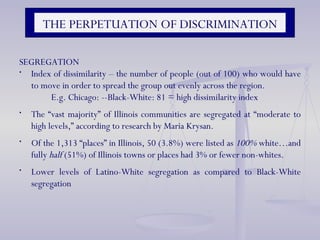
SEGREGATION Index of dissimilarity – the number of people (out of 100) who would have to move in order to spread the group out evenly across the region.  E.g. Chicago: --Black-White: 81 = high dissimilarity index The “vast majority” of Illinois communities are segregated at “moderate to high levels,” according to research by Maria Krysan.  Of the 1,313 “places” in Illinois, 50 (3.8%) were listed as  100%  white…and fully  half  (51%) of Illinois towns or places had 3% or fewer non-whites. Lower levels of Latino-White segregation as compared to Black-White segregation THE PERPETUATION OF DISCRIMINATION
HISTORY -- ANTI-MINORITY SENTIMENT AND ACTIONS Immigrants forced out of their homes, enclaves (1885 – 1920)  Factors in increased anti-minority sentiment (1890 – 1930’s)  - Government violations of treaties with  Native Americans - Immigrants became convinced to deny their culture and identify as whites  - Domination of persons of color Forced expulsions of African Americans and other persons of color (e.g. Springfield 1908) Sundown Towns (until the 1970’s) Public Policy Decisions  - Racially and economically divided landscape - Local zoning issues   -Government programs [FHA, interstate  highways, urban renewal] THE PERPETUATION OF DISCRIMINATION
Other Impediments to Fair Housing* Gaps in geographical coverage of private fair housing agencies Lack of fair housing knowledge Shortage of affordable, disability-accessible and suitable housing Unfair lending and real estate practices - blockbusting and panic-peddling create changing neighborhoods - restrictive  covenants - racial steering Lack of enforcement Lack of funding *as noted in the State of Illinois Analysis of Fair Housing Impediments 2009 THE PERPETUATION OF DISCRIMINATION
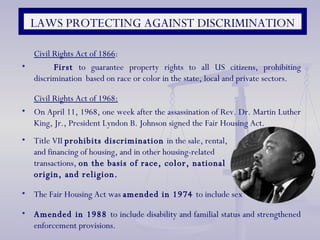
Civil Rights Act of 1866 : First  to guarantee property rights to all US citizens, prohibiting discrimination  based on race or color in the state, local and private sectors. Civil Rights Act of 1968: On April 11, 1968, one week after the assassination of Rev. Dr. Martin Luther King, Jr., President Lyndon B. Johnson signed the Fair Housing Act. Title VII  prohibits discrimination  in the sale, rental, and financing of housing, and in other housing-related  transactions,  on the basis of race, color, national  origin, and religion.  The Fair Housing Act was  amended in 1974  to include sex Amended in 1988  to include disability and familial status and strengthened enforcement provisions. LAWS PROTECTING AGAINST DISCRIMINATION
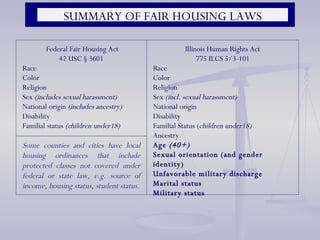
Some counties and cities have local housing ordinances that include protected classes not covered under federal or state law, e.g. source of income, housing status, student status.   Federal Fair Housing Act 42 USC § 3601 Race Color Religion Sex  (includes sexual harassment) National origin  (includes ancestry) Disability Familial status  (children under18)     Illinois Human Rights Act 775 ILCS 5/3-101 Race Color Religion Sex  (incl. sexual harassment) National origin Disability Familial Status ( children under18) Ancestry Age  (40+) Sexual orientation (and gender identity) Unfavorable military discharge Marital status Military status SUMMARY OF FAIR HOUSING LAWS
PROHIBITED ACTS Denial of Housing Misrepresenting  Housing Availability  Unequal Terms & Conditions Sexual Harassment Discriminatory Advertising Retaliation Segregation
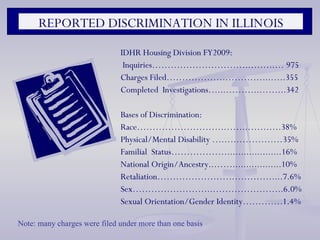
IDHR Housing Division FY2009: Inquiries…………………………..……..… 975 Charges Filed……………….…………...…..355  Completed  Investigations…...………..……...342 Bases of Discrimination: Race……………………….……..…….….38% Physical/Mental Disability ….….……………35% Familial  Status………………....................16% National Origin/Ancestry..……..................10% Retaliation…………………….…………....7.6% Sex……………………..…………………..6.0% Sexual Orientation/Gender Identity………….1.4% Note: many charges were filed under more than one basis REPORTED DISCRIMINATION IN ILLINOIS
RACE Discrimination & Foreclosure African American and Latino homeowners hold a disproportionate amount of high–cost loans, which represent the riskiest and most poorly underwritten home mortgages.* Foreclosure has been a result of defaulted loans (ARM), loss of equity (high payments to lenders) Metro areas with the most significant racial disparities are in the Midwest. * recent study by National Community Investment Network
RACE & NATIONAL ORIGIN Immigrant groups have been targets of discrimination through local ordinances and enforcement strategies: For example -- housing providers who  inquire about immigration status only of people who “look” or “sound” like immigrants,  require additional documentation or fees for immigrants all questions must be asked of all applicants and all applicants treated equally Advocates must be aware of: Inspections of school records Changes to occupancy codes to target immigrant groups, for example, changing the  definition of “family” Complaint-based, anonymous enforcement systems Zoning and other regulatory changes
DISABILITY Discrimination and People with Disabilities There has been an increase in disability complaints in recent years  The Urban Institute’s analysis* of 200 paired tests showed: Landlords refused to speak to deaf persons in 1 of 4 calls (with  relay-operator assistance), while non-disabled callers were  given  information about the units.  19 % of landlords refused a request for a reasonable  accommodation  16 % said they would not permit a reasonable modification The most common basis of complaints was disability *www.urban.org/CarlaHerbig  [Barriers at Every Step – HUD’s Study of Disability Discrimination in Housing]
1988 amendment to the Federal Fair Housing Act resulted from a 1980 HUD survey. IDHR charges based on familial status have increased from 5% of charges in FY2004 to 16% in FY2009 Familial status includes: Families with children under the age of 18 Women who are pregnant Persons in the process of adopting children or obtaining legal custody of minors. FAMILIAL STATUS
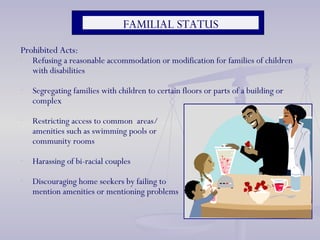
Prohibited Acts: Refusing a reasonable accommodation or modification for families of children with disabilities  Segregating families with children to certain floors or parts of a building or complex Restricting access to common  areas/ amenities such as swimming pools or  community rooms Harassing of bi-racial couples  Discouraging home seekers by failing to mention amenities or mentioning problems  FAMILIAL STATUS
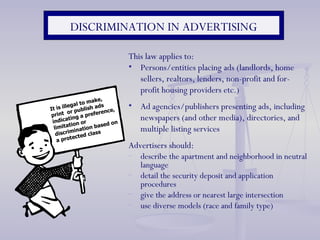
This law applies to: Persons/entities placing ads (landlords, home sellers, realtors, lenders, non-profit and for-profit housing providers etc.) Ad agencies/publishers presenting ads, including newspapers (and other media), directories, and multiple listing services Advertisers should:  describe the apartment and neighborhood in neutral language detail the security deposit and application procedures give the address or nearest large intersection use diverse models (race and family type) DISCRIMINATION IN ADVERTISING It is illegal to make, print  or publish ads indicating a preference, limitation or discrimination based on a protected class
HOW TO REPORT DISCRIMINATION Recommendations: Be aware of federal, state and local fair housing laws. Document conversations. Make notes of any phone calls or emails, including dates and times when they occurred. Report possible violations. Many agencies and organizations have free resources to help pursue fair housing complaints.  There is no fee to file with HUD or IDHR. Stick with the process.
FILING A CHARGE with IDHR 1- Contact IDHR as soon as possible (but no later than one year) 2- Fill out a complaint form (available on line) 3- For allegations covered under the Illinois Human Rights Act, a charge will be drafted and served on the Respondent(s) 4- IDHR will assign the case to an investigator who will interview parties relevant to the case, obtain necessary documents, and conduct an on-site investigation if needed 6- IDHR will attempt to resolve or complete the case within 100 days
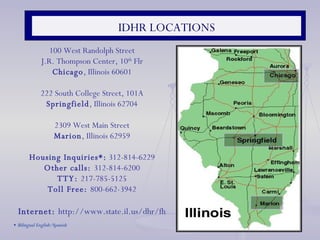
IDHR LOCATIONS 100 West Randolph Street J.R. Thompson Center, 10 th  Flr Chicago , Illinois 60601   222 South College Street, 101A Springfield , Illinois 62704   2309 West Main Street Marion , Illinois 62959 Housing Inquiries*:  312-814-6229 Other calls:  312-814-6200 TTY:  217-785-5125 Toll Free:  800-662-3942 Internet:  http://www.state.il.us/dhr/fh *  Bilingual English/Spanish
What’s  Next?

Fair Housing Basics - IDHR

  • 1.
    Housing Action Illinois 2009 Conference October 23, 2009 Marian Honel
  • 2.
    A Closer Look at equal housing opportunities F ai r Housing:
  • 3.
    TOPICS About IDHRPerpetuation of Segregation Housing Discrimination Laws Examples of Housing Discrimination How to File a Charge Contact Information
  • 4.
    The Illinois Departmentof Human Rights is the state agency charged with enforcing the Illinois Human Rights Act, enacted in 1979. Our mission is to secure for all individuals within the State of Illinois, freedom from unlawful discrimination and to establish and promote equal opportunity and affirmative action as the policy of this state for all its residents.
  • 5.
    FIVE TYPES OFDISCRIMINATION Employment Housing/Real Estate Transactions Public Accommodations (public places) Financial Credit (loans) Sexual Harassment in Higher Education
  • 6.
    IDHR Programs Affirmativeaction compliance program Public contractor program Institute for Training and Development Education and outreach Interagency Committee on Employees with Disabilities Charge investigation IDHR PROGRAMS
  • 7.
    FAIR HOUSING DIVISIONIntake and investigation of charges Education and Outreach – • Increase awareness about housing rights • H elp Illinois residents identify housing discrimination • Empower more persons to recognize and report incidents of unlawful housing discrimination Educational trainings in English and Spanish
  • 8.
    Nationwide, over 10,000 housing discrimination complaints are filed every year. The most common allegation is discrimination in the terms and conditions of the sale or rental of housing. Housing discrimination is still largely unreported – experts estimate 3.7 million incidents occur annually Housing discrimination has been perpetuated by other elements such as segregation, predatory lending, gentrification, etc. FACTS
  • 9.
    SEGREGATION Index ofdissimilarity – the number of people (out of 100) who would have to move in order to spread the group out evenly across the region. E.g. Chicago: --Black-White: 81 = high dissimilarity index The “vast majority” of Illinois communities are segregated at “moderate to high levels,” according to research by Maria Krysan. Of the 1,313 “places” in Illinois, 50 (3.8%) were listed as 100% white…and fully half (51%) of Illinois towns or places had 3% or fewer non-whites. Lower levels of Latino-White segregation as compared to Black-White segregation THE PERPETUATION OF DISCRIMINATION
  • 10.
    HISTORY -- ANTI-MINORITYSENTIMENT AND ACTIONS Immigrants forced out of their homes, enclaves (1885 – 1920) Factors in increased anti-minority sentiment (1890 – 1930’s) - Government violations of treaties with Native Americans - Immigrants became convinced to deny their culture and identify as whites - Domination of persons of color Forced expulsions of African Americans and other persons of color (e.g. Springfield 1908) Sundown Towns (until the 1970’s) Public Policy Decisions - Racially and economically divided landscape - Local zoning issues -Government programs [FHA, interstate highways, urban renewal] THE PERPETUATION OF DISCRIMINATION
  • 11.
    Other Impediments toFair Housing* Gaps in geographical coverage of private fair housing agencies Lack of fair housing knowledge Shortage of affordable, disability-accessible and suitable housing Unfair lending and real estate practices - blockbusting and panic-peddling create changing neighborhoods - restrictive covenants - racial steering Lack of enforcement Lack of funding *as noted in the State of Illinois Analysis of Fair Housing Impediments 2009 THE PERPETUATION OF DISCRIMINATION
  • 12.
    Civil Rights Actof 1866 : First to guarantee property rights to all US citizens, prohibiting discrimination based on race or color in the state, local and private sectors. Civil Rights Act of 1968: On April 11, 1968, one week after the assassination of Rev. Dr. Martin Luther King, Jr., President Lyndon B. Johnson signed the Fair Housing Act. Title VII prohibits discrimination in the sale, rental, and financing of housing, and in other housing-related transactions, on the basis of race, color, national origin, and religion. The Fair Housing Act was amended in 1974 to include sex Amended in 1988 to include disability and familial status and strengthened enforcement provisions. LAWS PROTECTING AGAINST DISCRIMINATION
  • 13.
    Some counties andcities have local housing ordinances that include protected classes not covered under federal or state law, e.g. source of income, housing status, student status.   Federal Fair Housing Act 42 USC § 3601 Race Color Religion Sex (includes sexual harassment) National origin (includes ancestry) Disability Familial status (children under18)     Illinois Human Rights Act 775 ILCS 5/3-101 Race Color Religion Sex (incl. sexual harassment) National origin Disability Familial Status ( children under18) Ancestry Age (40+) Sexual orientation (and gender identity) Unfavorable military discharge Marital status Military status SUMMARY OF FAIR HOUSING LAWS
  • 14.
    PROHIBITED ACTS Denialof Housing Misrepresenting Housing Availability Unequal Terms & Conditions Sexual Harassment Discriminatory Advertising Retaliation Segregation
  • 15.
    IDHR Housing DivisionFY2009: Inquiries…………………………..……..… 975 Charges Filed……………….…………...…..355 Completed Investigations…...………..……...342 Bases of Discrimination: Race……………………….……..…….….38% Physical/Mental Disability ….….……………35% Familial Status………………....................16% National Origin/Ancestry..……..................10% Retaliation…………………….…………....7.6% Sex……………………..…………………..6.0% Sexual Orientation/Gender Identity………….1.4% Note: many charges were filed under more than one basis REPORTED DISCRIMINATION IN ILLINOIS
  • 16.
    RACE Discrimination &Foreclosure African American and Latino homeowners hold a disproportionate amount of high–cost loans, which represent the riskiest and most poorly underwritten home mortgages.* Foreclosure has been a result of defaulted loans (ARM), loss of equity (high payments to lenders) Metro areas with the most significant racial disparities are in the Midwest. * recent study by National Community Investment Network
  • 17.
    RACE & NATIONALORIGIN Immigrant groups have been targets of discrimination through local ordinances and enforcement strategies: For example -- housing providers who inquire about immigration status only of people who “look” or “sound” like immigrants, require additional documentation or fees for immigrants all questions must be asked of all applicants and all applicants treated equally Advocates must be aware of: Inspections of school records Changes to occupancy codes to target immigrant groups, for example, changing the definition of “family” Complaint-based, anonymous enforcement systems Zoning and other regulatory changes
  • 18.
    DISABILITY Discrimination andPeople with Disabilities There has been an increase in disability complaints in recent years The Urban Institute’s analysis* of 200 paired tests showed: Landlords refused to speak to deaf persons in 1 of 4 calls (with relay-operator assistance), while non-disabled callers were given information about the units. 19 % of landlords refused a request for a reasonable accommodation 16 % said they would not permit a reasonable modification The most common basis of complaints was disability *www.urban.org/CarlaHerbig [Barriers at Every Step – HUD’s Study of Disability Discrimination in Housing]
  • 19.
    1988 amendment tothe Federal Fair Housing Act resulted from a 1980 HUD survey. IDHR charges based on familial status have increased from 5% of charges in FY2004 to 16% in FY2009 Familial status includes: Families with children under the age of 18 Women who are pregnant Persons in the process of adopting children or obtaining legal custody of minors. FAMILIAL STATUS
  • 20.
    Prohibited Acts: Refusinga reasonable accommodation or modification for families of children with disabilities Segregating families with children to certain floors or parts of a building or complex Restricting access to common areas/ amenities such as swimming pools or community rooms Harassing of bi-racial couples Discouraging home seekers by failing to mention amenities or mentioning problems FAMILIAL STATUS
  • 21.
    This law appliesto: Persons/entities placing ads (landlords, home sellers, realtors, lenders, non-profit and for-profit housing providers etc.) Ad agencies/publishers presenting ads, including newspapers (and other media), directories, and multiple listing services Advertisers should: describe the apartment and neighborhood in neutral language detail the security deposit and application procedures give the address or nearest large intersection use diverse models (race and family type) DISCRIMINATION IN ADVERTISING It is illegal to make, print or publish ads indicating a preference, limitation or discrimination based on a protected class
  • 22.
    HOW TO REPORTDISCRIMINATION Recommendations: Be aware of federal, state and local fair housing laws. Document conversations. Make notes of any phone calls or emails, including dates and times when they occurred. Report possible violations. Many agencies and organizations have free resources to help pursue fair housing complaints. There is no fee to file with HUD or IDHR. Stick with the process.
  • 23.
    FILING A CHARGEwith IDHR 1- Contact IDHR as soon as possible (but no later than one year) 2- Fill out a complaint form (available on line) 3- For allegations covered under the Illinois Human Rights Act, a charge will be drafted and served on the Respondent(s) 4- IDHR will assign the case to an investigator who will interview parties relevant to the case, obtain necessary documents, and conduct an on-site investigation if needed 6- IDHR will attempt to resolve or complete the case within 100 days
  • 24.
    IDHR LOCATIONS 100West Randolph Street J.R. Thompson Center, 10 th Flr Chicago , Illinois 60601   222 South College Street, 101A Springfield , Illinois 62704   2309 West Main Street Marion , Illinois 62959 Housing Inquiries*: 312-814-6229 Other calls: 312-814-6200 TTY: 217-785-5125 Toll Free: 800-662-3942 Internet: http://www.state.il.us/dhr/fh * Bilingual English/Spanish
  • 25.

Editor's Notes

  • #11 (1865 - 1890) slight increase in integration 1890-1930: ANTI MINORITY SENTIMENT Irish, Italian and Polish Americans – Forcing immigrants to identify with whites SUNDOWN TOWNS Towns where a person of color or a particular religious or ethnic group is not safe after sundown Enforced with violence, signs, ordinances, whistles, harassment by law enforcement, racial steering by realtors, etc. etc.
  • #12 (1865 - 1890) slight increase in integration 1890-1930: ANTI MINORITY SENTIMENT Irish, Italian and Polish Americans – Forcing immigrants to identify with whites SUNDOWN TOWNS Towns where a person of color or a particular religious or ethnic group is not safe after sundown Enforced with violence, signs, ordinances, whistles, harassment by law enforcement, racial steering by realtors, etc. etc. PUBLIC POLICY DECISION Contributing to “the racially and economically divided landscape” Local autonomy/zoning Federal Housing Administration (FHA) Interstate highway program “ Urban renewal” PRIVATE ACTIONS Private lenders encouraged to use same underwriting standards as FHA Racial steering Restrictive covenants Blockbusting and panic-peddling to create changing neighborhoods