Digital Bangladesh
Research Ideas
Dhaka
May 2015
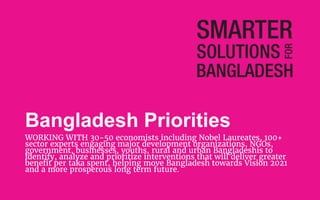
Bangladesh Priorities
WORKING WITH 30-50 economists including Nobel Laureates, 100+
sector experts engaging major development organizations, NGOs,
government, businesses, youths, rural and urban Bangladeshis to
identify, analyze and prioritize interventions that will deliver greater
benefit per taka spent, helping move Bangladesh towards Vision 2021
and a more prosperous long term future.
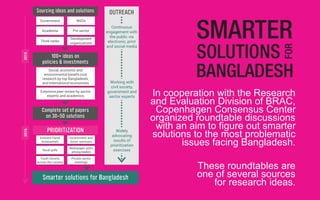
In cooperation with the Research
and Evaluation Division of BRAC,
Copenhagen Consensus Center
organized roundtable discussions
with an aim to figure out smarter
solutions to the most problematic
issues facing Bangladesh.
These roundtables are
one of several sources
for research ideas.
Sourcing ideas and solutions
Smarter solutions for Bangladesh
Complete set of papers
on 30-50 solutions
PRIORITIZATION
Government NGOs
Academia Pvt sector
Think tanks
Development
organizations
Eminent Panel
Assessment
Government and
donor seminars
Rural polls
Newspaper polls
among readers
Youth forums
across the country
Private sector
meetings
Social, economic and
environmental benefit-cost
research by top Bangladeshi,
and international economists
Extensive peer review by sector
experts and academics
100+ ideas on
policies & investments
20162015 Continuous
engagement with
the public via
electronic, print
and social media
Working with
civil society,
government and
sector experts
Widely
advocating
results of
prioritization
exercises
OUTREACH
Research Ideas
Digital Bangladesh;
(1 of 8)
• Provide tax incentives for expansion of IT/ITES
industry.
• Ease restrictions on payment for freelancer workers.
• Improve management of intellectual property rights
(IPR).
• Integrate IPR with Equity Entrepreneurship Fund (EEF)
for valuation of intangible assets.
• Increase consumers’ willingness to buy non-anti-virus
software.
• Emulate RMG experience to boost IT entrepreneurship.
Digital Bangladesh;
(2 of 8)
• Education quality improvement through IT-enabled
learning in all classrooms.
• Building ICT capacity of teachers in primary and
secondary education.
• Making appropriate use of ICTs in training programs.
• Expanding IT graduate pool.
• Capacity building of madrasa teachers in using ICT and
computer aided learning.
• Equip government approved Madrasas with multimedia
classrooms.
• Mandatory vocational ICT education for dropouts.
Digital Bangladesh;
(3 of 8)
• Support and scale TCV (time, cost and visit) innovation
process technique.
• Continue expanding public services through Union
Digital Centers (UDC).
• Activate urban service delivery access points following
the UDC model.
• Provide financial support to Chief Innovation Officers
(CIOs) and Innovation Teams.
• Creation of a civil registry to be used by all public and
NGO service delivery organizations.
• Set up electronic dashboards with administrative alerts
under a whole-of-government framework.
Digital Bangladesh;
(4 of 8)
• Expand e-Filing system to all offices of the
government.
• Integrate human resources, payroll, leave, study tour,
and training management with e-Filing.
• Provide free eHealth services by using the ‘Aponjon’
(the close/dear one in Bangla) database.
• Design and implement a digital rights policy.
• Use of mobile phones as a radio device for
disseminating public information, especially in times of
emergencies and natural disasters.
• Establishment of more community radio stations across
all divisions.
Digital Bangladesh;
(5 of 8)
• Adopt measures to exchange and share government
data both vertically and horizontally.
• Provide ICT training to constables and all ASI officers
who have direct interface with citizens.
• Design a uniform system for digital recording of
complaints.
• Improve crime data management system (CDMS) across
all district and divisional headquarters.
• Build capacity of law enforcement agencies in
prosecuting cybercrimes.
• Protect citizens from breach of privacy, security and
fraudulent activities.
Climate Change;
(6 of 8)
• Establish reliable and secure internet infrastructure
across Bangladesh.
• Increase financial support to Service Innovation Fund
(SIF).
• Reduce tax on broadband.
• Universalize mobile broadband access.
• Establish ICT infrastructure through an open market
approach.
• Create local digital contents to correspond to local
problems and demands.
Digital Bangladesh;
(7 of 8)
• Formalize use of UDC Blog as a grievance redressal
mechanism within the government structure.
• Digital processing of ongoing legal cases.
• Create home-grown mechanisms to increase youth’s
participation in Digital Bangladesh programs.
• Using BRAC’s Social Innovation Lab as a PPP platform.
• Conduct a cost-benefit analysis scrutiny, based on the
TCV parameters, for prioritizing implementation of
Digital Bangladesh projects.
• Adopt a localized cybersecurity model.
Digital Bangladesh;
(8 of 8)
• Monitor implementation of ICT Master Plan and ICT
Policy.
• Creation of local anti-virus software.
• Forecast Digital Bangladesh’s requirements of teachers,
doctors, economists, etc.
• Establish the Kaliakoir Hi-Tech Park.
• Rollout Controller of Certifying Authority (CCA) for e-
wallet and digital financial transactions.
• Use of social media to increase government-to-citizen
and vice versa interactions.
• Provide online information as well as forms,
applications, and other documentation for all public
services.
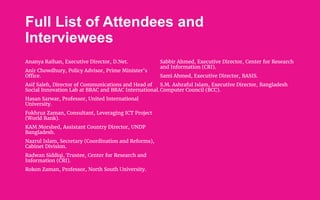
Full List of Attendees and
Interviewees
Ananya Raihan, Executive Director, D.Net.
Anir Chowdhury, Policy Advisor, Prime Minister’s
Office.
Asif Saleh, Director of Communications and Head of
Social Innovation Lab at BRAC and BRAC International.
Hasan Sarwar, Professor, United International
University.
Fokhruz Zaman, Consultant, Leveraging ICT Project
(World Bank).
KAM Morshed, Assistant Country Director, UNDP
Bangladesh.
Nazrul Islam, Secretary (Coordination and Reforms),
Cabinet Division.
Radwan Siddiqi, Trustee, Center for Research and
Information (CRI).
Rokon Zaman, Professor, North South University.
Sabbir Ahmed, Executive Director, Center for Research
and Information (CRI).
Sami Ahmed, Executive Director, BASIS.
S.M. Ashraful Islam, Executive Director, Bangladesh
Computer Council (BCC).

Top Ideas for Digital Bangladesh

  • 1.
  • 2.
    Bangladesh Priorities WORKING WITH30-50 economists including Nobel Laureates, 100+ sector experts engaging major development organizations, NGOs, government, businesses, youths, rural and urban Bangladeshis to identify, analyze and prioritize interventions that will deliver greater benefit per taka spent, helping move Bangladesh towards Vision 2021 and a more prosperous long term future.
  • 3.
    In cooperation withthe Research and Evaluation Division of BRAC, Copenhagen Consensus Center organized roundtable discussions with an aim to figure out smarter solutions to the most problematic issues facing Bangladesh. These roundtables are one of several sources for research ideas. Sourcing ideas and solutions Smarter solutions for Bangladesh Complete set of papers on 30-50 solutions PRIORITIZATION Government NGOs Academia Pvt sector Think tanks Development organizations Eminent Panel Assessment Government and donor seminars Rural polls Newspaper polls among readers Youth forums across the country Private sector meetings Social, economic and environmental benefit-cost research by top Bangladeshi, and international economists Extensive peer review by sector experts and academics 100+ ideas on policies & investments 20162015 Continuous engagement with the public via electronic, print and social media Working with civil society, government and sector experts Widely advocating results of prioritization exercises OUTREACH
  • 4.
  • 5.
    Digital Bangladesh; (1 of8) • Provide tax incentives for expansion of IT/ITES industry. • Ease restrictions on payment for freelancer workers. • Improve management of intellectual property rights (IPR). • Integrate IPR with Equity Entrepreneurship Fund (EEF) for valuation of intangible assets. • Increase consumers’ willingness to buy non-anti-virus software. • Emulate RMG experience to boost IT entrepreneurship.
  • 6.
    Digital Bangladesh; (2 of8) • Education quality improvement through IT-enabled learning in all classrooms. • Building ICT capacity of teachers in primary and secondary education. • Making appropriate use of ICTs in training programs. • Expanding IT graduate pool. • Capacity building of madrasa teachers in using ICT and computer aided learning. • Equip government approved Madrasas with multimedia classrooms. • Mandatory vocational ICT education for dropouts.
  • 7.
    Digital Bangladesh; (3 of8) • Support and scale TCV (time, cost and visit) innovation process technique. • Continue expanding public services through Union Digital Centers (UDC). • Activate urban service delivery access points following the UDC model. • Provide financial support to Chief Innovation Officers (CIOs) and Innovation Teams. • Creation of a civil registry to be used by all public and NGO service delivery organizations. • Set up electronic dashboards with administrative alerts under a whole-of-government framework.
  • 8.
    Digital Bangladesh; (4 of8) • Expand e-Filing system to all offices of the government. • Integrate human resources, payroll, leave, study tour, and training management with e-Filing. • Provide free eHealth services by using the ‘Aponjon’ (the close/dear one in Bangla) database. • Design and implement a digital rights policy. • Use of mobile phones as a radio device for disseminating public information, especially in times of emergencies and natural disasters. • Establishment of more community radio stations across all divisions.
  • 9.
    Digital Bangladesh; (5 of8) • Adopt measures to exchange and share government data both vertically and horizontally. • Provide ICT training to constables and all ASI officers who have direct interface with citizens. • Design a uniform system for digital recording of complaints. • Improve crime data management system (CDMS) across all district and divisional headquarters. • Build capacity of law enforcement agencies in prosecuting cybercrimes. • Protect citizens from breach of privacy, security and fraudulent activities.
  • 10.
    Climate Change; (6 of8) • Establish reliable and secure internet infrastructure across Bangladesh. • Increase financial support to Service Innovation Fund (SIF). • Reduce tax on broadband. • Universalize mobile broadband access. • Establish ICT infrastructure through an open market approach. • Create local digital contents to correspond to local problems and demands.
  • 11.
    Digital Bangladesh; (7 of8) • Formalize use of UDC Blog as a grievance redressal mechanism within the government structure. • Digital processing of ongoing legal cases. • Create home-grown mechanisms to increase youth’s participation in Digital Bangladesh programs. • Using BRAC’s Social Innovation Lab as a PPP platform. • Conduct a cost-benefit analysis scrutiny, based on the TCV parameters, for prioritizing implementation of Digital Bangladesh projects. • Adopt a localized cybersecurity model.
  • 12.
    Digital Bangladesh; (8 of8) • Monitor implementation of ICT Master Plan and ICT Policy. • Creation of local anti-virus software. • Forecast Digital Bangladesh’s requirements of teachers, doctors, economists, etc. • Establish the Kaliakoir Hi-Tech Park. • Rollout Controller of Certifying Authority (CCA) for e- wallet and digital financial transactions. • Use of social media to increase government-to-citizen and vice versa interactions. • Provide online information as well as forms, applications, and other documentation for all public services.
  • 13.
    Full List ofAttendees and Interviewees Ananya Raihan, Executive Director, D.Net. Anir Chowdhury, Policy Advisor, Prime Minister’s Office. Asif Saleh, Director of Communications and Head of Social Innovation Lab at BRAC and BRAC International. Hasan Sarwar, Professor, United International University. Fokhruz Zaman, Consultant, Leveraging ICT Project (World Bank). KAM Morshed, Assistant Country Director, UNDP Bangladesh. Nazrul Islam, Secretary (Coordination and Reforms), Cabinet Division. Radwan Siddiqi, Trustee, Center for Research and Information (CRI). Rokon Zaman, Professor, North South University. Sabbir Ahmed, Executive Director, Center for Research and Information (CRI). Sami Ahmed, Executive Director, BASIS. S.M. Ashraful Islam, Executive Director, Bangladesh Computer Council (BCC).