Top 10 Automotive
Industry Trends and
Technologies to Look
for in 2021
www.bacancytechnology.com
Quick Overview: Get an insight into the
automotive sector digital trends that are
hiking the markets. Give your customers a
luxurious yet utilitarian auto-experience
such that entering the vehicle no more
remains a purpose to get somewhere.
Rather, they should have a desire to
undergo a smart automobile driving
experience.
This blog contains the top 10 automotive
industry trends 2021. If you are an
entrepreneur in the vicinity of the
automobile industry, then invest your time
here and take away the futuristic approach
to boost your business.
Artificial Intelligence
Autonomous Vehicles
Big Data & Data Analytics
Blockchain
Internet of Things (IoT)
Cloud Computing Models/ Hybrid
Computing Models
AR/VR Solutions
Vehicle-to-Vehicle Communication
Smart Factory
Electrification
Table of Index
⭐ Introduction
⭐ 10 Automotive Industry Trends to Look
for in 2021
⭐ Conclusion
Introduction
Digital giants like Netflix, Amazon, and
Booking.com are setting exceptional
standards for customer experience.
Customers are used-to transparent prices,
one-click access, and fast delivery against
online & offline platforms. Customers are
expecting the same with automobiles. For
example, selling cars at transparent prices,
one-click access to in-car services, and
creating seamless online-offline journeys.
The new players in the market are thriving
because they are building extremely
customer-focused business and sales-
models. A study where such new market
players were questioned revealed that they
do not intend to sell cars, rather mobility.
The automotive industry and the sub-
branches of the domain that pertain under
the umbrella of the industry can leverage
the use of such fascinating and user-
friendly technologies.
Car-manufacturers, auto-parts
manufacturers, OEM original part
manufacturers, the ones in the transport
business, car-rentals, and shared mobility
have a tremendous amount of scope using
the digital technology trends in the
automotive industry for enhancing the
automobile utility and customer
satisfaction.
Top 10
Automotive
Industry
Trends and
Technologies
The automobile industry trends 2020n has
paved the way to keep the automotive
industry market trends top in the
competition.
1. Artificial Intelligence
AI technologies like deep learning, machine
learning, and computer vision discover
robotic automation applications inside the
future trends of the automotive industry. AI
guides the self-driving or Autonomous cars,
helps the drivers in terms of safety,
manages the fleet, and enhances services
like vehicle insurance and inspection.
Artificial intelligence further finds
applications in automotive manufacturing,
the rate of production, acceleration and
helps to bring down the costs. Another best
example of AI Development Solutions For
Businesses and Enterprises in the
automotive industry is chatbots. They can
help a bid hand in deducing the manpower
and efforts along with satisfying and
serving customer queries.
Connectivity aided by AI creates room for
tracking the vehicular data easily for
several use cases like driver safety, fleet
management, insurance, and predictive
maintenance. Sharing or Splitting the
vehicular data helps the customer and
repairs and builds the entire mobility
ecosystem.
We are aware that fantastic self-driving cars
and connected cars can transform the
automotive landscape. It is going to change
how the drivers interact and communicate
with the vehicles. Human-Machine
Interface(HMI) uses voice-based feedback
to manage and operate the vehicles. This
further widens the scope of user control of a
car. Consequently, interfaces like these
make the driving experience much more
safe and enjoyable.
RevitsOne: RevitsOne is an Indian
startup that provides AI-powered fleet
management software and is suitable
for managing fleets of different sizes.
The vehicle management system of the
startup offers insights into running
vitals, speed, and health information.
Drivers of this solution are significantly
benefited from the Voicera ID, a voice-
based virtual assistant. In addition to it,
the onboard speed recorder restricts the
speed, thereby discouraging rash or
dangerous driving.
Examples:
Apex AI: Apex AI is a US-based startup
that authorizes automotive companies
to incorporate complicated AI solutions.
The Apex OS runs on automotive
electronic control units(ECUs), and for
developing an Autonomous mobility
solution, it provides reliable, secure, and
robust APIs. Furthermore, Apex
autonomy provides modules for
building 3D localization and enabling
Autonomous Vehicles. To conclude,
MARV. Automotive is an expansive data
management platform that transmits
data accurately and safely from the
vehicle to the cloud.
These are self-driving vehicles. They focus
on a simple goal to decrease a human
driver’s requirements and look forward to
bringing an evolution in daily
transportation. Stocks of AVs widens the
scope of last-mile deliveries, reduces the
overall downtime, and aims to convert the
concept of transportation safe and secure
by minimizing the accidents caused by
human drivers due to negligence.
Equipped with advanced and latest
technologies, AVs hold AI-enhanced
computer vision for spotting the hurdles or
obstacles that come in the route.
2. Autonomous Vehicles
Intvo: Intvo is a US-based startup that
owns pedestrian behavior indicating
technology. Comparing the 2D and 3D
object observation technology that
examines restricted parameters, Intvo’s
solution checks for eye contact, head
position, proper leg movements of the
pedestrian, and accurate weather
conditions, thereby assigning a certain
risk level. This procedure reduces all the
risks of accidents and elevates the
safety levels in Autonomous vehicles.
Examples:
Udelv: Udelv is a US Based startup that
offers Autonomous vehicles and deals in
last-mile deliveries. It mixes the hyper-
speed teleoperations and the AI
algorithms for human-assisted guidance
in certain situations. These vans own a
payload capacity of around 360kgs, and
it reaches a speed of approx 100km per
hour. This Autonomous van delivers
groceries from the close by stores and
sends a notification to the customer
when the order arrives.
In the generation of big data, advanced data
analytics notifies several decisions of a
specific vehicle’s life cycle. Data collected
from the vehicles qualify predictive
maintenance, alert the authorities in cases
of emergencies or accidents and notify the
managers about the fleets. With the help of
predictive analysis, car manufacturers can
take decisions on their annual sale purchase
and target for production. Additionally,
customer automotive data find the app to
improve supply chains, driving more sales,
increasing the upcoming new vehicles’
product design.
3. Big Data & Data
Analytics
Procon Analytics: Procon Analytics is a US-
based startup that influences big data to
provide a solution for automotive finance.
The solution gets hold of millions of data
points in real-time and inspects them to
enable the lenders to access them
immediately and lower the risk. This
company permits Buy Here Pay
Here(BHPH) dealers to expand their
businesses and credit to high-risk
customers. Furthermore, it provides
software solutions for asset and fleet
tracking along with connected cars.
Examples:
Unit8: Unit8 is a Swiss startup using
analytics and big data to provide digital
solutions in several industries. For
automotive particularly, the startup
progresses a predictive model that
encourages the car companies to
enhance marketing or operations
thereby elevating their revenue. These
models offer insights into product price,
build, and after-sales service as well.
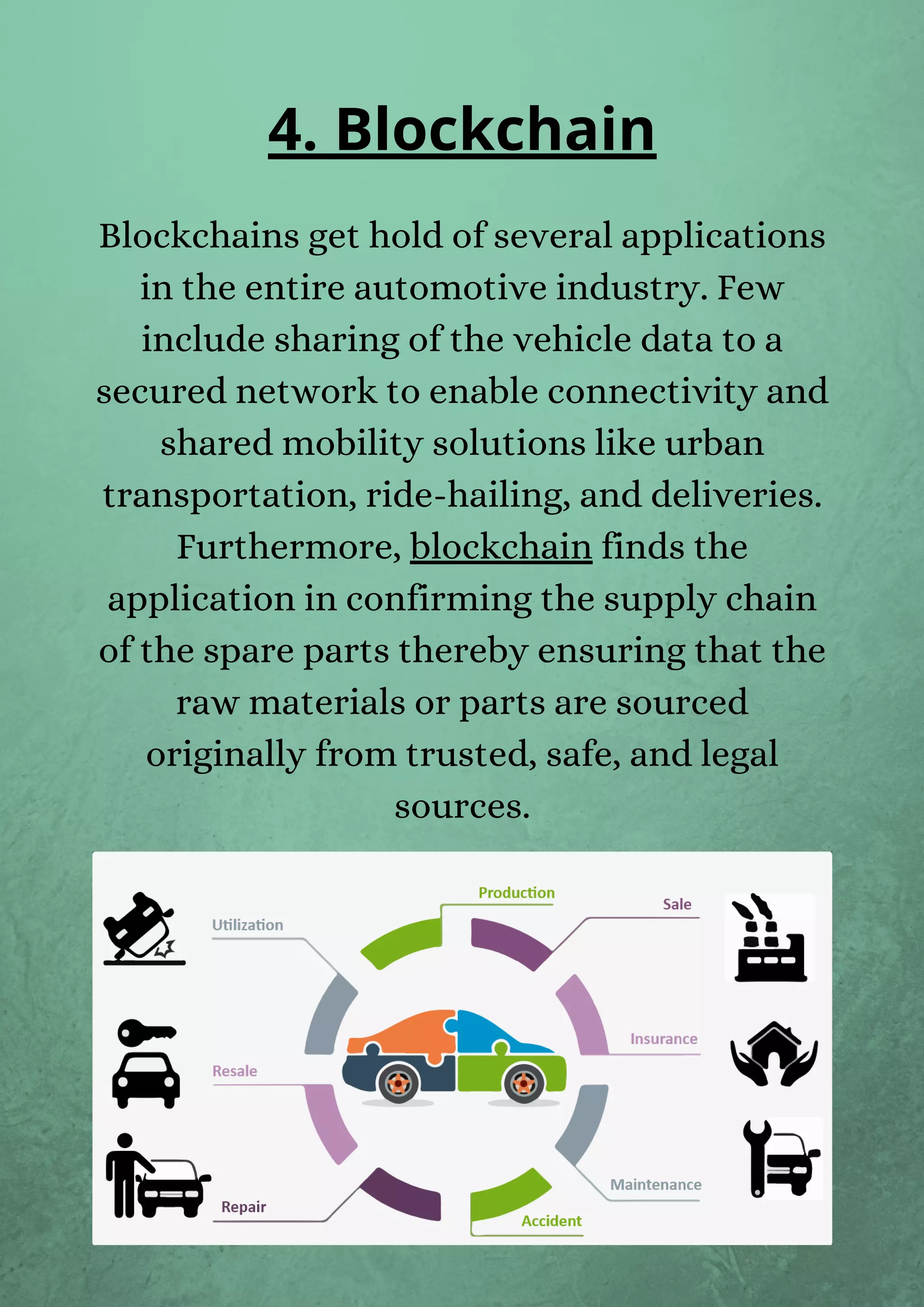
Blockchains get hold of several applications
in the entire automotive industry. Few
include sharing of the vehicle data to a
secured network to enable connectivity and
shared mobility solutions like urban
transportation, ride-hailing, and deliveries.
Furthermore, blockchain finds the
application in confirming the supply chain
of the spare parts thereby ensuring that the
raw materials or parts are sourced
originally from trusted, safe, and legal
sources.
4. Blockchain
Cube Intelligence: Cube intelligence is a
British startup that develops a security
platform based on the blockchain for
Autonomous Vehicles. The use of hash
codes for blocking malicious attacks or
any hacking attempts hacking any
autonomous car and connected cars.
The hardware that is used collects real-
time data on emissions and Mobility.
Furthermore, cube intelligence provides
valet parking and ride-hailing services
for AVs along with smart parking
management systems.
Examples:
DAV: DAV is an Israeli startup that
provides a decentralized autonomous
vehicle platform based on blockchain
technology. This platform permits
Autonomous Vehicles to locate the AVs,
clients, and service providers around
them. The vehicle to vehicle (V2V)
interaction occurs on the blockchain
with smart contracts or the off-block
gain with DAV protocols. This startup,
however, develops specific protocols for
drone flight planning, charging
networks, and open mobility.
IoT allows secure interactions between the
vehicle to vehicle and its infrastructure
components in the vast automotive
industry. This technology helps to a great
extent in improving the road’s safety,
reducing pollution, solving traffic
congestion, and spending energy with
better management of the fleet. The
emerging companies and the startups in
developed advanced sensing technologies to
tock of data about the vehicle. Furthermore,
it enables the car to understand and
comprehend its surroundings. The best part
of Enterprise Mobility App Development is
that the technology automates toll
payments and fuel payments.
5. Internet of Things (IoT)
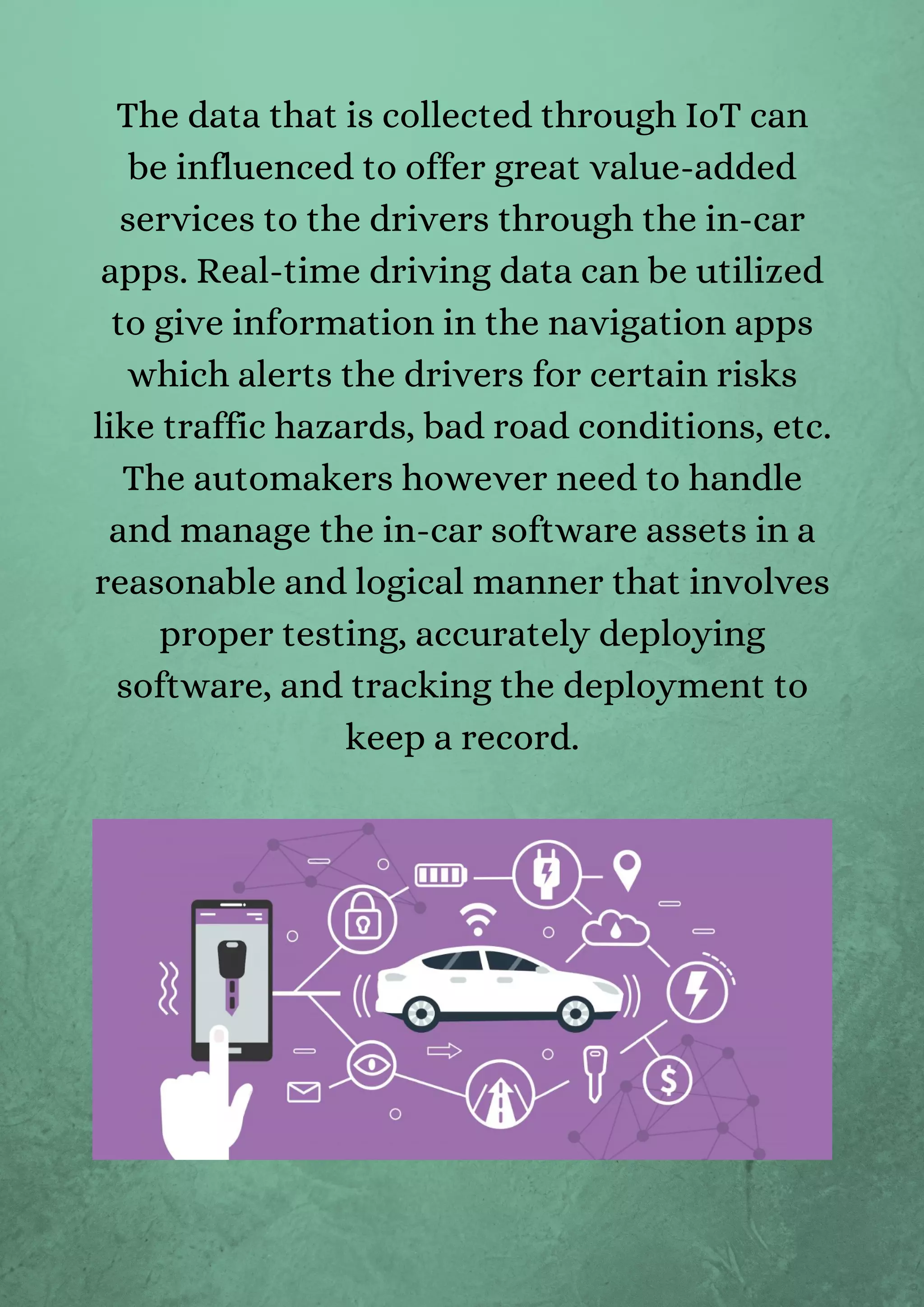
The data that is collected through IoT can
be influenced to offer great value-added
services to the drivers through the in-car
apps. Real-time driving data can be utilized
to give information in the navigation apps
which alerts the drivers for certain risks
like traffic hazards, bad road conditions, etc.
The automakers however need to handle
and manage the in-car software assets in a
reasonable and logical manner that involves
proper testing, accurately deploying
software, and tracking the deployment to
keep a record.
EcoG: EcoG operates from the US and
Germany. It is a startup that offers an
IoT-based operating platform and
system for enabling EV charging. The
startup offers the manufacturers
several tools that make the
maintenance and development of the
EV charging infrastructure fast, simple,
and scalable. It further permits the
operators to incorporate microservices
and services in the chargers to
transform the charging process more
profitable. Additionally, the solution
gets along well with any EV charger.
Examples:
KonnectShift: KonnectShift is a
Canadian startup that offers IoT
solutions to increase, and organize asset
and fleet management. The startup
supplements an automatic electronic
logging device (ELD), Konnect-GSO1, to
continually track the vehicle’s health.
The solution comprises route planning
and development for advanced and
latest analytics and real-time dispatch
to allow alerts regarding the vehicles,
fuel, driving, and maintenance thereby
deducting the downtime and developing
the driver management apps.
With the rise in demand for computing and
data in the automotive industry, an
enormous amount of collective innovating
is taking place in terms of data pipelines,
data capacity, computing capacity,
Analytics based algorithms, and AI. The
automotive companies own new computing
requirements that are only addressed by
cloud and hybrid computing models by
giving access to the enhanced capacity on
demand when they have storage-intensive
workloads and compute-intensive. Cloud
providers are funding significant R and D
resources in these areas specifically and the
car companies are partnering with these
providers to bring innovation in the correct
form.
6. Cloud Computing
Models/ Hybrid
Computing Models
Tesla: The Tesla model S is the superior
example of the modern-era car as it has
integration with the Tesla Cloud. The
cloud enables the driver to come over
any minor issue without involving the
driver’s physical effort.
BMW: The BMW automobile brand has
integrated with IBM cloud through their
BMW CarData network. The drivers
using these cloud services can tackle the
issue in a personalized manner.
Examples:
It is specifically made for the newly joined
employees in a company who can utilize the
AR/VR model for learning motive as well as
showcasing virtually to the customers. 3D
printing assists the automotive industry in
3 basic ways. First, it allows fast Prototyping
with the help of 3D printed models. This
accelerates the testing phases and design of
the production. Secondly, it enables the
manufacturers to print the spare parts to
match their needs and requirements. Lastly,
the additive generation of composite
materials guides to lighter, durable, and
robust automotive parts.
7. AR/VR Solutions
BMW: A real-time example of the mixed
reality trend in automotive is the BMW
company- which uses an augmented
dashboard for test-driving a specific car
model with the minutest customization
of the color and settings.
Examples:
Toyota: Toyota has developed a virtual
reality driving simulator known as the
TeenDrive365. To be more precise, this
stimulator helps the users to experience
the fun of driving in virtual reality
before they get themselves on the road.
Furthermore, it is enabled with 3D
graphics, realistic noises, full
simulations, and animations of the road
traffic. The TeenDrive365 teaches users
to be attentive on the road to avoid any
hurdles or distractions.
This brand innovation can decrease traffic,
sudden fatalities, severe vehicle accidents,
etc. With the introduction of V2V
innovation, a certain vehicle will receive a
signal straight away from the rest of the
vehicles in the entire car route.
8. Vehicle-to-Vehicle
Communication
Chorus Mobility: Chorus Mobility is a
USA-based startup that develops
applications based on blockchains for
enhanced V2V communication. The
applications allow Autonomous Vehicles
to communicate and share information
and data. Finally, the information that is
shared involves the factors like the
condition of traffic, roads, weather, etc.
Flexibility: Flexibility is a Russian-based
startup that develops and generates
close-range V2V solutions known as the
Flexroad. When this is installed in
certain vehicles, it allows the vehicle to
interact with other vehicles in a limited
or certain range. These vehicles warn
each other about potential collisions
and risks so that they can take
preventive measures.
Examples:
A smart factory stands as a vital part of
generating cars in a standardized, fast, and
free of error manner across diverse
locations around the globe. Robotic Process
Automation RPA uses technologies like
automation, modeling, and digitization to
offer a stabilized and flexible
manufacturing process in the foundation.
Apart from using automation and robotics
in the manufacturing industry, the adoption
of digital factories can generate great
business advantages.
9. Smart Factory
Mercedes-Benz: The company uses
virtual tools to aid their production and
thus develop self-learning and
optimizing production environments
using data analytics.
Audi: In Mexico, the automobile leader
Audi’s plant leverages 30% plus benefits
from its digital factory along with
strategy, talent robot, and integrated
system solution.
Examples:
Looking at the rate of depletion of the fossil
fuel reserves and the amount of harm
caused to the environment due to their use
introduces us to electric vehicles. (EVs). To
gain a more expanded adoption, EVs need to
evolve to spot issues like Fleet
electrification, low battery, insufficient
charging infrastructure, high price, and
fueling renewable energy-based charging
grids.
10. Electrification
Lordstown Motors: Lordstown Motors is
a US-based startup that makes an all-
electric pickup truck. The truck
Endurance TM is mapped to be a well-
built vehicle and comes along with
hardly any parts aa than traditional
commercial vehicles. This enables
extreme easy maintenance. This truck
features a 4hub electric motor to offer a
four-wheel drive and travel to distances
over 250 miles on one single charge.
Examples:
ChargeX: ChargeX is a German startup
that provides a modular EV charging
solution. It transforms parking spaces
into well-built charging stations.
Aqueduct, this startup platform is
uncomplicated to install, and it has four
charging modules using 22 kW energy.
Using a Type2 charging cable, this
solution offers accurate monthly
reports as well. It also indicates the
power requirements and automatically
handles the charging speed for each of
the vehicles.
I hope you are quenched by the futuristic
prospects of the marvelous automotive
industry trends 2021. Technology has the
power to transform any mere experience
into a utility-filled and profiting experience.
Who in the early agricultural era thought
that we today, shall be driving cars without
investing hand-energy or decisive skills into
the process? Be prepared for more such
eye-widening advances in the automotive
industry.
Do share your comments and feedback
here.
Conclusion
Thank you
www.bacancytechnology.com

Top 10 automotive industry trends and technologies to look for in 2021

  • 1.
    Top 10 Automotive IndustryTrends and Technologies to Look for in 2021 www.bacancytechnology.com
  • 2.
    Quick Overview: Getan insight into the automotive sector digital trends that are hiking the markets. Give your customers a luxurious yet utilitarian auto-experience such that entering the vehicle no more remains a purpose to get somewhere. Rather, they should have a desire to undergo a smart automobile driving experience. This blog contains the top 10 automotive industry trends 2021. If you are an entrepreneur in the vicinity of the automobile industry, then invest your time here and take away the futuristic approach to boost your business.
  • 3.
    Artificial Intelligence Autonomous Vehicles BigData & Data Analytics Blockchain Internet of Things (IoT) Cloud Computing Models/ Hybrid Computing Models AR/VR Solutions Vehicle-to-Vehicle Communication Smart Factory Electrification Table of Index ⭐ Introduction ⭐ 10 Automotive Industry Trends to Look for in 2021 ⭐ Conclusion
  • 4.
  • 5.
    Digital giants likeNetflix, Amazon, and Booking.com are setting exceptional standards for customer experience. Customers are used-to transparent prices, one-click access, and fast delivery against online & offline platforms. Customers are expecting the same with automobiles. For example, selling cars at transparent prices, one-click access to in-car services, and creating seamless online-offline journeys. The new players in the market are thriving because they are building extremely customer-focused business and sales- models. A study where such new market players were questioned revealed that they do not intend to sell cars, rather mobility. The automotive industry and the sub- branches of the domain that pertain under the umbrella of the industry can leverage the use of such fascinating and user- friendly technologies.
  • 6.
    Car-manufacturers, auto-parts manufacturers, OEMoriginal part manufacturers, the ones in the transport business, car-rentals, and shared mobility have a tremendous amount of scope using the digital technology trends in the automotive industry for enhancing the automobile utility and customer satisfaction.
  • 7.
  • 8.
    The automobile industrytrends 2020n has paved the way to keep the automotive industry market trends top in the competition.
  • 9.
    1. Artificial Intelligence AItechnologies like deep learning, machine learning, and computer vision discover robotic automation applications inside the future trends of the automotive industry. AI guides the self-driving or Autonomous cars, helps the drivers in terms of safety, manages the fleet, and enhances services like vehicle insurance and inspection. Artificial intelligence further finds applications in automotive manufacturing, the rate of production, acceleration and helps to bring down the costs. Another best example of AI Development Solutions For Businesses and Enterprises in the automotive industry is chatbots. They can help a bid hand in deducing the manpower and efforts along with satisfying and serving customer queries.
  • 10.
    Connectivity aided byAI creates room for tracking the vehicular data easily for several use cases like driver safety, fleet management, insurance, and predictive maintenance. Sharing or Splitting the vehicular data helps the customer and repairs and builds the entire mobility ecosystem. We are aware that fantastic self-driving cars and connected cars can transform the automotive landscape. It is going to change how the drivers interact and communicate with the vehicles. Human-Machine Interface(HMI) uses voice-based feedback to manage and operate the vehicles. This further widens the scope of user control of a car. Consequently, interfaces like these make the driving experience much more safe and enjoyable.
  • 11.
    RevitsOne: RevitsOne isan Indian startup that provides AI-powered fleet management software and is suitable for managing fleets of different sizes. The vehicle management system of the startup offers insights into running vitals, speed, and health information. Drivers of this solution are significantly benefited from the Voicera ID, a voice- based virtual assistant. In addition to it, the onboard speed recorder restricts the speed, thereby discouraging rash or dangerous driving. Examples:
  • 12.
    Apex AI: ApexAI is a US-based startup that authorizes automotive companies to incorporate complicated AI solutions. The Apex OS runs on automotive electronic control units(ECUs), and for developing an Autonomous mobility solution, it provides reliable, secure, and robust APIs. Furthermore, Apex autonomy provides modules for building 3D localization and enabling Autonomous Vehicles. To conclude, MARV. Automotive is an expansive data management platform that transmits data accurately and safely from the vehicle to the cloud.
  • 13.
    These are self-drivingvehicles. They focus on a simple goal to decrease a human driver’s requirements and look forward to bringing an evolution in daily transportation. Stocks of AVs widens the scope of last-mile deliveries, reduces the overall downtime, and aims to convert the concept of transportation safe and secure by minimizing the accidents caused by human drivers due to negligence. Equipped with advanced and latest technologies, AVs hold AI-enhanced computer vision for spotting the hurdles or obstacles that come in the route. 2. Autonomous Vehicles
  • 14.
    Intvo: Intvo isa US-based startup that owns pedestrian behavior indicating technology. Comparing the 2D and 3D object observation technology that examines restricted parameters, Intvo’s solution checks for eye contact, head position, proper leg movements of the pedestrian, and accurate weather conditions, thereby assigning a certain risk level. This procedure reduces all the risks of accidents and elevates the safety levels in Autonomous vehicles. Examples:
  • 15.
    Udelv: Udelv isa US Based startup that offers Autonomous vehicles and deals in last-mile deliveries. It mixes the hyper- speed teleoperations and the AI algorithms for human-assisted guidance in certain situations. These vans own a payload capacity of around 360kgs, and it reaches a speed of approx 100km per hour. This Autonomous van delivers groceries from the close by stores and sends a notification to the customer when the order arrives.
  • 16.
    In the generationof big data, advanced data analytics notifies several decisions of a specific vehicle’s life cycle. Data collected from the vehicles qualify predictive maintenance, alert the authorities in cases of emergencies or accidents and notify the managers about the fleets. With the help of predictive analysis, car manufacturers can take decisions on their annual sale purchase and target for production. Additionally, customer automotive data find the app to improve supply chains, driving more sales, increasing the upcoming new vehicles’ product design. 3. Big Data & Data Analytics
  • 17.
    Procon Analytics: ProconAnalytics is a US- based startup that influences big data to provide a solution for automotive finance. The solution gets hold of millions of data points in real-time and inspects them to enable the lenders to access them immediately and lower the risk. This company permits Buy Here Pay Here(BHPH) dealers to expand their businesses and credit to high-risk customers. Furthermore, it provides software solutions for asset and fleet tracking along with connected cars. Examples:
  • 18.
    Unit8: Unit8 isa Swiss startup using analytics and big data to provide digital solutions in several industries. For automotive particularly, the startup progresses a predictive model that encourages the car companies to enhance marketing or operations thereby elevating their revenue. These models offer insights into product price, build, and after-sales service as well.
  • 19.
    Blockchains get holdof several applications in the entire automotive industry. Few include sharing of the vehicle data to a secured network to enable connectivity and shared mobility solutions like urban transportation, ride-hailing, and deliveries. Furthermore, blockchain finds the application in confirming the supply chain of the spare parts thereby ensuring that the raw materials or parts are sourced originally from trusted, safe, and legal sources. 4. Blockchain
  • 20.
    Cube Intelligence: Cubeintelligence is a British startup that develops a security platform based on the blockchain for Autonomous Vehicles. The use of hash codes for blocking malicious attacks or any hacking attempts hacking any autonomous car and connected cars. The hardware that is used collects real- time data on emissions and Mobility. Furthermore, cube intelligence provides valet parking and ride-hailing services for AVs along with smart parking management systems. Examples:
  • 21.
    DAV: DAV isan Israeli startup that provides a decentralized autonomous vehicle platform based on blockchain technology. This platform permits Autonomous Vehicles to locate the AVs, clients, and service providers around them. The vehicle to vehicle (V2V) interaction occurs on the blockchain with smart contracts or the off-block gain with DAV protocols. This startup, however, develops specific protocols for drone flight planning, charging networks, and open mobility.
  • 22.
    IoT allows secureinteractions between the vehicle to vehicle and its infrastructure components in the vast automotive industry. This technology helps to a great extent in improving the road’s safety, reducing pollution, solving traffic congestion, and spending energy with better management of the fleet. The emerging companies and the startups in developed advanced sensing technologies to tock of data about the vehicle. Furthermore, it enables the car to understand and comprehend its surroundings. The best part of Enterprise Mobility App Development is that the technology automates toll payments and fuel payments. 5. Internet of Things (IoT)
  • 23.
    The data thatis collected through IoT can be influenced to offer great value-added services to the drivers through the in-car apps. Real-time driving data can be utilized to give information in the navigation apps which alerts the drivers for certain risks like traffic hazards, bad road conditions, etc. The automakers however need to handle and manage the in-car software assets in a reasonable and logical manner that involves proper testing, accurately deploying software, and tracking the deployment to keep a record.
  • 24.
    EcoG: EcoG operatesfrom the US and Germany. It is a startup that offers an IoT-based operating platform and system for enabling EV charging. The startup offers the manufacturers several tools that make the maintenance and development of the EV charging infrastructure fast, simple, and scalable. It further permits the operators to incorporate microservices and services in the chargers to transform the charging process more profitable. Additionally, the solution gets along well with any EV charger. Examples:
  • 25.
    KonnectShift: KonnectShift isa Canadian startup that offers IoT solutions to increase, and organize asset and fleet management. The startup supplements an automatic electronic logging device (ELD), Konnect-GSO1, to continually track the vehicle’s health. The solution comprises route planning and development for advanced and latest analytics and real-time dispatch to allow alerts regarding the vehicles, fuel, driving, and maintenance thereby deducting the downtime and developing the driver management apps.
  • 26.
    With the risein demand for computing and data in the automotive industry, an enormous amount of collective innovating is taking place in terms of data pipelines, data capacity, computing capacity, Analytics based algorithms, and AI. The automotive companies own new computing requirements that are only addressed by cloud and hybrid computing models by giving access to the enhanced capacity on demand when they have storage-intensive workloads and compute-intensive. Cloud providers are funding significant R and D resources in these areas specifically and the car companies are partnering with these providers to bring innovation in the correct form. 6. Cloud Computing Models/ Hybrid Computing Models
  • 27.
    Tesla: The Teslamodel S is the superior example of the modern-era car as it has integration with the Tesla Cloud. The cloud enables the driver to come over any minor issue without involving the driver’s physical effort. BMW: The BMW automobile brand has integrated with IBM cloud through their BMW CarData network. The drivers using these cloud services can tackle the issue in a personalized manner. Examples:
  • 28.
    It is specificallymade for the newly joined employees in a company who can utilize the AR/VR model for learning motive as well as showcasing virtually to the customers. 3D printing assists the automotive industry in 3 basic ways. First, it allows fast Prototyping with the help of 3D printed models. This accelerates the testing phases and design of the production. Secondly, it enables the manufacturers to print the spare parts to match their needs and requirements. Lastly, the additive generation of composite materials guides to lighter, durable, and robust automotive parts. 7. AR/VR Solutions
  • 29.
    BMW: A real-timeexample of the mixed reality trend in automotive is the BMW company- which uses an augmented dashboard for test-driving a specific car model with the minutest customization of the color and settings. Examples:
  • 30.
    Toyota: Toyota hasdeveloped a virtual reality driving simulator known as the TeenDrive365. To be more precise, this stimulator helps the users to experience the fun of driving in virtual reality before they get themselves on the road. Furthermore, it is enabled with 3D graphics, realistic noises, full simulations, and animations of the road traffic. The TeenDrive365 teaches users to be attentive on the road to avoid any hurdles or distractions.
  • 31.
    This brand innovationcan decrease traffic, sudden fatalities, severe vehicle accidents, etc. With the introduction of V2V innovation, a certain vehicle will receive a signal straight away from the rest of the vehicles in the entire car route. 8. Vehicle-to-Vehicle Communication
  • 32.
    Chorus Mobility: ChorusMobility is a USA-based startup that develops applications based on blockchains for enhanced V2V communication. The applications allow Autonomous Vehicles to communicate and share information and data. Finally, the information that is shared involves the factors like the condition of traffic, roads, weather, etc. Flexibility: Flexibility is a Russian-based startup that develops and generates close-range V2V solutions known as the Flexroad. When this is installed in certain vehicles, it allows the vehicle to interact with other vehicles in a limited or certain range. These vehicles warn each other about potential collisions and risks so that they can take preventive measures. Examples:
  • 33.
    A smart factorystands as a vital part of generating cars in a standardized, fast, and free of error manner across diverse locations around the globe. Robotic Process Automation RPA uses technologies like automation, modeling, and digitization to offer a stabilized and flexible manufacturing process in the foundation. Apart from using automation and robotics in the manufacturing industry, the adoption of digital factories can generate great business advantages. 9. Smart Factory
  • 34.
    Mercedes-Benz: The companyuses virtual tools to aid their production and thus develop self-learning and optimizing production environments using data analytics. Audi: In Mexico, the automobile leader Audi’s plant leverages 30% plus benefits from its digital factory along with strategy, talent robot, and integrated system solution. Examples:
  • 35.
    Looking at therate of depletion of the fossil fuel reserves and the amount of harm caused to the environment due to their use introduces us to electric vehicles. (EVs). To gain a more expanded adoption, EVs need to evolve to spot issues like Fleet electrification, low battery, insufficient charging infrastructure, high price, and fueling renewable energy-based charging grids. 10. Electrification
  • 36.
    Lordstown Motors: LordstownMotors is a US-based startup that makes an all- electric pickup truck. The truck Endurance TM is mapped to be a well- built vehicle and comes along with hardly any parts aa than traditional commercial vehicles. This enables extreme easy maintenance. This truck features a 4hub electric motor to offer a four-wheel drive and travel to distances over 250 miles on one single charge. Examples:
  • 37.
    ChargeX: ChargeX isa German startup that provides a modular EV charging solution. It transforms parking spaces into well-built charging stations. Aqueduct, this startup platform is uncomplicated to install, and it has four charging modules using 22 kW energy. Using a Type2 charging cable, this solution offers accurate monthly reports as well. It also indicates the power requirements and automatically handles the charging speed for each of the vehicles.
  • 38.
    I hope youare quenched by the futuristic prospects of the marvelous automotive industry trends 2021. Technology has the power to transform any mere experience into a utility-filled and profiting experience. Who in the early agricultural era thought that we today, shall be driving cars without investing hand-energy or decisive skills into the process? Be prepared for more such eye-widening advances in the automotive industry. Do share your comments and feedback here. Conclusion
  • 39.