1/6 http://autoassembly.mckinsey.com McKinsey & Company, Inc.
Highly Automated Driving: Trends,
Players, and Scenarios
In the future, the smartest thing in every car might no longer be the driver.
Autonomous driving could have a significant impact on the future of the
automotive industry.
by Johannes Deichmann, Kersten Heineke, Thomas Reinbacher, Dominik Wee,
Julian Woköck
As enabling technologies become more robust, the idea of a self-driving car is
beginning to emerge from the pages of science fiction books and become a
reality. This breakthrough, along with the trends toward electric vehicles and
connectivity in cars, has captured the imagination of a new, digitally focused
generation of consumers whose previous relationship with the automobile was
largely one of indifference. In other words, cars are “cool” again.
This article examines the trends shaping this newest automotive innovation in
terms of the technologies involved, consumer mind-sets, and market dynamics. It
also looks at the new industry players pursuing highly automated driving and
describes a number of possible end-game scenarios as this new market unfolds.
Exploring the trends driving autonomous cars
Three sets of trends will soon change the automotive world, likely making 2020
differ significantly from today.
Cars plug into the Internet of Things. Much of the excitement that surrounds
automated driving reflects advances in connected car capabilities, which
essentially link automobiles to the Internet of Things (IoT). Vehicle connectivity is
already a reality, and with it comes the ability to collect and transfer sensor data
in virtually real time. With 40 percent growth in the unit sales of cellular modules
in the automotive segment, analysts expect connected cars in North America and
Japan to exceed 90 percent penetration levels among new vehicles by 2020.
Thanks to connectivity and the IoT, cars will increasingly become part of the
environment in which they operate, sensing traffic lights, the availability of
parking spots, and a host of other signals invisible to humans. At the same time,
software is playing a major part in the connectivity revolution: in the past five
years, the amount of embedded software in premium cars has increased tenfold,
2/6 http://autoassembly.mckinsey.com McKinsey & Company, Inc.
from roughly 10 million to 100 million lines of code.
This confluence of connectivity and automated driving, which enables companies
to offer innovative, digitally enhanced vehicle services, coincides with the
ongoing race among premium OEMs to differentiate their products in new ways.
Consequently, automakers are introducing connectivity services that will
eventually give rise to highly automated features on premium cars and semi-
autonomous capabilities (e.g., self-parking or highway-only autonomy) on mass-
market vehicles.
What’s more, the heavy reliance on software is shifting control points within the
industry. Where many companies in digital industries develop most of their own
software in-house, recent estimates suggest that automakers provide only about
15 to 20 percent of the code in their cars and depend on suppliers for the rest.
Consumer mind-sets go digital. Research suggests that consumer attitudes
are changing regarding the automobile. Once viewed as a stand-alone personal
transportation purchase, connected cars increasingly represent yet another
mobile device to today’s car buyers, who seek in-vehicle digital services and
infotainment. From this perspective, the actual vehicle itself becomes one part of
the larger mobility ecosystem—but not the main part. In fact, McKinsey research
reveals that 20 percent of new car buyers would switch brands to achieve better
in-car connectivity. It appears likely that connectivity and highly automated driving
will become the largest future growth areas in the automotive industry, which will
necessitate access to high-resolution digital navigation maps.
From the makers of premium EVs to Silicon Valley tech giants that are
developing their own self-driving technologies, new automotive market entrants
are pushing this mobility ecosystem viewpoint the hardest. The tech giants in
particular are working aggressively to enter the automotive market, while
incumbent vehicle manufacturers are seeking opportunities to exploit digital
vehicle and driver data and benefit from the revenue streams they create. The
risks and challenges of these trends for vehicle manufacturers are enormous as
new competitors, networked business models, and connected customers drive
one of the biggest disruptions in automotive industry history. As they take on
more of a high technology aura, cars are once again becoming cultural icons, but
the entrance of new market participants from the computer and digital worlds are
blurring long-established industry boundaries, which can have a major impact on
the roles that traditional automotive companies play.
Market dynamics open the door to outside players. The growth of
connectivity and the introduction of highly automated driving systems will
3/6 http://autoassembly.mckinsey.com McKinsey & Company, Inc.
significantly change the automotive industry. It will open the door for new players,
which are entering via the highly fragmented infotainment and navigation value
chain. With the addition of a number of other digitally driven enhancements, such
as advanced driver assistance systems (ADAS), cloud-based automotive
services, and targeted smartphone apps and services, this portion of automotive
platform real estate provides a ready entry point for highly resourceful digital and
high-tech giants. In fact, if OEMs fail to control this ecosystem, they could lose a
major part of the automotive value chain. To defend their core market against
digital consumer-focused attackers, OEMs need to develop an integrated,
standardized, and independent platform for these systems.
And that’s not all—since many of these external companies routinely operate at
consumer market speeds and have mastered solid customer experience
performance. Their organizations have flat hierarchical structures and processes,
and they are comfortable using trial-and-error approaches when it comes to
products and budgeting. Automakers, on the other hand, often have rigid, highly
complicated decision processes that involve multitudes of stakeholders and
departments, making the ability to move quickly and agilely extremely difficult.
Explaining highly automated driving
An idea whose time is rapidly approaching, highly automated driving solves a
number of critical problems while relying on rapidly maturing technologies.
Why? The argument for autonomous driving typically has three parts: better road
safety, improved fuel efficiency, and the fact that less time spent driving means
more time to do other things, thus increasing a consumer’s productivity potential.
What? Exactly what is an autonomous vehicle? The US National Highway Traffic
Safety Administration (NHTSA) has developed a scale for determining this, which
starts at “level 0” (no automation) and goes to level 4 (full self-driving
automation). The four levels describe varying degrees of automation, from things
like electronic stability control at the low end (level 1) to limited self-driving
capabilities at level 3.
How? Achieving levels 3 and 4 of NHTSA’s vehicle autonomy scale will require
the automotive industry to solve three sets of challenges: customer acceptance
involves issues such as willingness to pay for the capability, sufficient confidence
in the technology, and assurance regarding privacy and security issues.
Regulatory approval concerns the establishment of laws and regulations that
cover autonomous vehicle operation, performance, and unique characteristics
(e.g., insurance liability). What follows examines some of the issues surrounding
4/6 http://autoassembly.mckinsey.com McKinsey & Company, Inc.
the third set of challenges, technology readiness, more closely.
An autonomous vehicle requires five specific technologies to operate effectively.
First, it needs high-definition maps of roads that are accurate down to 10
centimeters. Currently, only three companies are actively working on automotive-
grade HD maps, and a consortium of German automakers has purchased one of
them. Second, autonomous driving requires localization sensors and algorithms
that automatically position the vehicles within the HD map in real time. Third,
engineers have to integrate the highly automated driving features seamlessly into
the vehicle technology stack. The fourth component is a robust object recognition
system capable of identifying people and cars near the vehicle in real time.
Finally, autonomous driving requires cars to have stronger onboard capabilities in
the software stack in areas such as object recognition and decision algorithms.
Since OEMs can’t depend on the cloud all the time for these capabilities, in-car
computational power needs to increase to handle this critical new software. The
question is, who will develop and test this code and take responsibility for it?
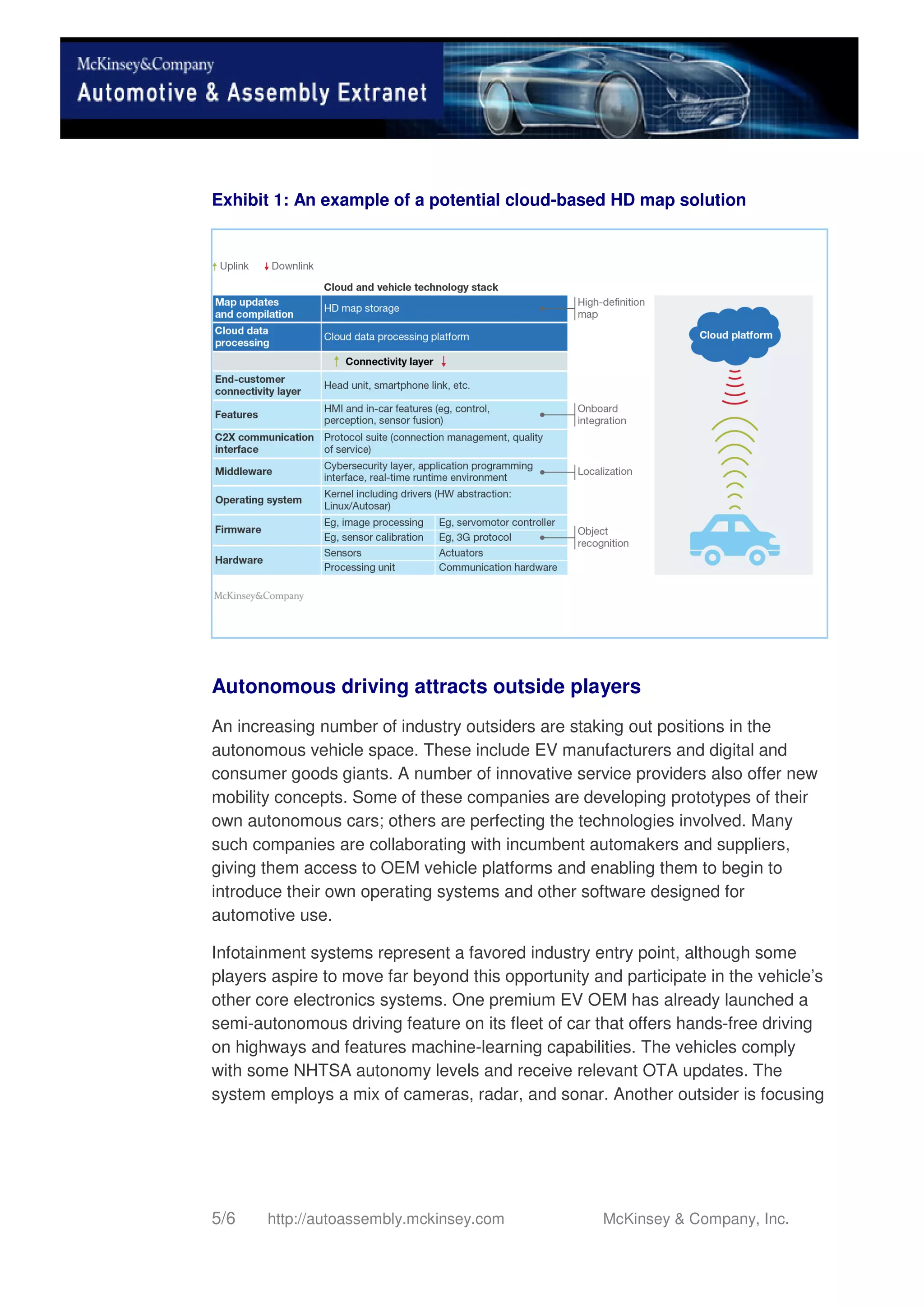
The typical configuration of these components could involve connected car
technologies such as over-the-air (OTA) links capable of transmitting HD map
updates from a centralized cloud platform (Exhibit 1). At the same time, the link
might also send vehicle-generated data concerning traffic and weather conditions
to central platforms for analysis and transmittal back to vehicles on the road.
5/6 http://autoassembly.mckinsey.com McKinsey & Company, Inc.
Exhibit 1: An example of a potential cloud-based HD map solution
Autonomous driving attracts outside players
An increasing number of industry outsiders are staking out positions in the
autonomous vehicle space. These include EV manufacturers and digital and
consumer goods giants. A number of innovative service providers also offer new
mobility concepts. Some of these companies are developing prototypes of their
own autonomous cars; others are perfecting the technologies involved. Many
such companies are collaborating with incumbent automakers and suppliers,
giving them access to OEM vehicle platforms and enabling them to begin to
introduce their own operating systems and other software designed for
automotive use.
Infotainment systems represent a favored industry entry point, although some
players aspire to move far beyond this opportunity and participate in the vehicle’s
other core electronics systems. One premium EV OEM has already launched a
semi-autonomous driving feature on its fleet of car that offers hands-free driving
on highways and features machine-learning capabilities. The vehicles comply
with some NHTSA autonomy levels and receive relevant OTA updates. The
system employs a mix of cameras, radar, and sonar. Another outsider is focusing
6/6 http://autoassembly.mckinsey.com McKinsey & Company, Inc.
on new mobility concepts and has reportedly decided to develop a line of self-
driving taxis.
Beyond the outsiders, several tier-1 automotive suppliers are also in the process
of extending their ADAS offerings to support highly automated driving. One is
creating a system that integrates map data and GPS positioning for use in
commercial trucking applications. It has also joined a technology company to
establish its own cloud solution to store and disseminate vehicle probe data and
future connected services in real time. Another tier-1 player is working with a
leading digital map company to develop maps for use in autonomous vehicles.
Given the enormous levels of interest in autonomous vehicles both within the
automotive industry and among outsiders, how should an automaker think about
participating in this dynamic part of the industry? The wide spectrum of
participation presents OEMs with a number of choices. For example, they can
collaborate with consumer industry and digital players and license their
autonomous driving offerings, or join already established consortia to develop
elements of the required solution such as HD maps and localization technologies.
They can also contract their own autonomous driving solutions either by
themselves or with their tier-1 suppliers, or join with other OEMs to co-develop
and share costs.
■ ■ ■
Autonomously driven cars could soon arrive in automotive markets worldwide,
but to make it happen, industry players still have their work cut out for them. They
need to solve myriad technological challenges while educating consumers and
engaging with regulators to ensure that everything is ready when these vehicles
hit the market. One major impediment to OEM ownership of this part of the
industry could result from the participation of resourceful players from the digital
and consumer goods worlds. To deal with these outsiders effectively, industry
incumbents will have to step out of their comfort zones and identify where and
how to participate in this newly forming mobility ecosystem.■
Copyright © 2016 McKinsey & Company, Inc.
All rights reserved.

Highly Automated Driving

  • 1.
    1/6 http://autoassembly.mckinsey.com McKinsey& Company, Inc. Highly Automated Driving: Trends, Players, and Scenarios In the future, the smartest thing in every car might no longer be the driver. Autonomous driving could have a significant impact on the future of the automotive industry. by Johannes Deichmann, Kersten Heineke, Thomas Reinbacher, Dominik Wee, Julian Woköck As enabling technologies become more robust, the idea of a self-driving car is beginning to emerge from the pages of science fiction books and become a reality. This breakthrough, along with the trends toward electric vehicles and connectivity in cars, has captured the imagination of a new, digitally focused generation of consumers whose previous relationship with the automobile was largely one of indifference. In other words, cars are “cool” again. This article examines the trends shaping this newest automotive innovation in terms of the technologies involved, consumer mind-sets, and market dynamics. It also looks at the new industry players pursuing highly automated driving and describes a number of possible end-game scenarios as this new market unfolds. Exploring the trends driving autonomous cars Three sets of trends will soon change the automotive world, likely making 2020 differ significantly from today. Cars plug into the Internet of Things. Much of the excitement that surrounds automated driving reflects advances in connected car capabilities, which essentially link automobiles to the Internet of Things (IoT). Vehicle connectivity is already a reality, and with it comes the ability to collect and transfer sensor data in virtually real time. With 40 percent growth in the unit sales of cellular modules in the automotive segment, analysts expect connected cars in North America and Japan to exceed 90 percent penetration levels among new vehicles by 2020. Thanks to connectivity and the IoT, cars will increasingly become part of the environment in which they operate, sensing traffic lights, the availability of parking spots, and a host of other signals invisible to humans. At the same time, software is playing a major part in the connectivity revolution: in the past five years, the amount of embedded software in premium cars has increased tenfold,
  • 2.
    2/6 http://autoassembly.mckinsey.com McKinsey& Company, Inc. from roughly 10 million to 100 million lines of code. This confluence of connectivity and automated driving, which enables companies to offer innovative, digitally enhanced vehicle services, coincides with the ongoing race among premium OEMs to differentiate their products in new ways. Consequently, automakers are introducing connectivity services that will eventually give rise to highly automated features on premium cars and semi- autonomous capabilities (e.g., self-parking or highway-only autonomy) on mass- market vehicles. What’s more, the heavy reliance on software is shifting control points within the industry. Where many companies in digital industries develop most of their own software in-house, recent estimates suggest that automakers provide only about 15 to 20 percent of the code in their cars and depend on suppliers for the rest. Consumer mind-sets go digital. Research suggests that consumer attitudes are changing regarding the automobile. Once viewed as a stand-alone personal transportation purchase, connected cars increasingly represent yet another mobile device to today’s car buyers, who seek in-vehicle digital services and infotainment. From this perspective, the actual vehicle itself becomes one part of the larger mobility ecosystem—but not the main part. In fact, McKinsey research reveals that 20 percent of new car buyers would switch brands to achieve better in-car connectivity. It appears likely that connectivity and highly automated driving will become the largest future growth areas in the automotive industry, which will necessitate access to high-resolution digital navigation maps. From the makers of premium EVs to Silicon Valley tech giants that are developing their own self-driving technologies, new automotive market entrants are pushing this mobility ecosystem viewpoint the hardest. The tech giants in particular are working aggressively to enter the automotive market, while incumbent vehicle manufacturers are seeking opportunities to exploit digital vehicle and driver data and benefit from the revenue streams they create. The risks and challenges of these trends for vehicle manufacturers are enormous as new competitors, networked business models, and connected customers drive one of the biggest disruptions in automotive industry history. As they take on more of a high technology aura, cars are once again becoming cultural icons, but the entrance of new market participants from the computer and digital worlds are blurring long-established industry boundaries, which can have a major impact on the roles that traditional automotive companies play. Market dynamics open the door to outside players. The growth of connectivity and the introduction of highly automated driving systems will
  • 3.
    3/6 http://autoassembly.mckinsey.com McKinsey& Company, Inc. significantly change the automotive industry. It will open the door for new players, which are entering via the highly fragmented infotainment and navigation value chain. With the addition of a number of other digitally driven enhancements, such as advanced driver assistance systems (ADAS), cloud-based automotive services, and targeted smartphone apps and services, this portion of automotive platform real estate provides a ready entry point for highly resourceful digital and high-tech giants. In fact, if OEMs fail to control this ecosystem, they could lose a major part of the automotive value chain. To defend their core market against digital consumer-focused attackers, OEMs need to develop an integrated, standardized, and independent platform for these systems. And that’s not all—since many of these external companies routinely operate at consumer market speeds and have mastered solid customer experience performance. Their organizations have flat hierarchical structures and processes, and they are comfortable using trial-and-error approaches when it comes to products and budgeting. Automakers, on the other hand, often have rigid, highly complicated decision processes that involve multitudes of stakeholders and departments, making the ability to move quickly and agilely extremely difficult. Explaining highly automated driving An idea whose time is rapidly approaching, highly automated driving solves a number of critical problems while relying on rapidly maturing technologies. Why? The argument for autonomous driving typically has three parts: better road safety, improved fuel efficiency, and the fact that less time spent driving means more time to do other things, thus increasing a consumer’s productivity potential. What? Exactly what is an autonomous vehicle? The US National Highway Traffic Safety Administration (NHTSA) has developed a scale for determining this, which starts at “level 0” (no automation) and goes to level 4 (full self-driving automation). The four levels describe varying degrees of automation, from things like electronic stability control at the low end (level 1) to limited self-driving capabilities at level 3. How? Achieving levels 3 and 4 of NHTSA’s vehicle autonomy scale will require the automotive industry to solve three sets of challenges: customer acceptance involves issues such as willingness to pay for the capability, sufficient confidence in the technology, and assurance regarding privacy and security issues. Regulatory approval concerns the establishment of laws and regulations that cover autonomous vehicle operation, performance, and unique characteristics (e.g., insurance liability). What follows examines some of the issues surrounding
  • 4.
    4/6 http://autoassembly.mckinsey.com McKinsey& Company, Inc. the third set of challenges, technology readiness, more closely. An autonomous vehicle requires five specific technologies to operate effectively. First, it needs high-definition maps of roads that are accurate down to 10 centimeters. Currently, only three companies are actively working on automotive- grade HD maps, and a consortium of German automakers has purchased one of them. Second, autonomous driving requires localization sensors and algorithms that automatically position the vehicles within the HD map in real time. Third, engineers have to integrate the highly automated driving features seamlessly into the vehicle technology stack. The fourth component is a robust object recognition system capable of identifying people and cars near the vehicle in real time. Finally, autonomous driving requires cars to have stronger onboard capabilities in the software stack in areas such as object recognition and decision algorithms. Since OEMs can’t depend on the cloud all the time for these capabilities, in-car computational power needs to increase to handle this critical new software. The question is, who will develop and test this code and take responsibility for it? The typical configuration of these components could involve connected car technologies such as over-the-air (OTA) links capable of transmitting HD map updates from a centralized cloud platform (Exhibit 1). At the same time, the link might also send vehicle-generated data concerning traffic and weather conditions to central platforms for analysis and transmittal back to vehicles on the road.
  • 5.
    5/6 http://autoassembly.mckinsey.com McKinsey& Company, Inc. Exhibit 1: An example of a potential cloud-based HD map solution Autonomous driving attracts outside players An increasing number of industry outsiders are staking out positions in the autonomous vehicle space. These include EV manufacturers and digital and consumer goods giants. A number of innovative service providers also offer new mobility concepts. Some of these companies are developing prototypes of their own autonomous cars; others are perfecting the technologies involved. Many such companies are collaborating with incumbent automakers and suppliers, giving them access to OEM vehicle platforms and enabling them to begin to introduce their own operating systems and other software designed for automotive use. Infotainment systems represent a favored industry entry point, although some players aspire to move far beyond this opportunity and participate in the vehicle’s other core electronics systems. One premium EV OEM has already launched a semi-autonomous driving feature on its fleet of car that offers hands-free driving on highways and features machine-learning capabilities. The vehicles comply with some NHTSA autonomy levels and receive relevant OTA updates. The system employs a mix of cameras, radar, and sonar. Another outsider is focusing
  • 6.
    6/6 http://autoassembly.mckinsey.com McKinsey& Company, Inc. on new mobility concepts and has reportedly decided to develop a line of self- driving taxis. Beyond the outsiders, several tier-1 automotive suppliers are also in the process of extending their ADAS offerings to support highly automated driving. One is creating a system that integrates map data and GPS positioning for use in commercial trucking applications. It has also joined a technology company to establish its own cloud solution to store and disseminate vehicle probe data and future connected services in real time. Another tier-1 player is working with a leading digital map company to develop maps for use in autonomous vehicles. Given the enormous levels of interest in autonomous vehicles both within the automotive industry and among outsiders, how should an automaker think about participating in this dynamic part of the industry? The wide spectrum of participation presents OEMs with a number of choices. For example, they can collaborate with consumer industry and digital players and license their autonomous driving offerings, or join already established consortia to develop elements of the required solution such as HD maps and localization technologies. They can also contract their own autonomous driving solutions either by themselves or with their tier-1 suppliers, or join with other OEMs to co-develop and share costs. ■ ■ ■ Autonomously driven cars could soon arrive in automotive markets worldwide, but to make it happen, industry players still have their work cut out for them. They need to solve myriad technological challenges while educating consumers and engaging with regulators to ensure that everything is ready when these vehicles hit the market. One major impediment to OEM ownership of this part of the industry could result from the participation of resourceful players from the digital and consumer goods worlds. To deal with these outsiders effectively, industry incumbents will have to step out of their comfort zones and identify where and how to participate in this newly forming mobility ecosystem.■ Copyright © 2016 McKinsey & Company, Inc. All rights reserved.