This presentation is intended
as a training tool for
Connection Circle Workshop
facilitators & moderators
Conducting the CircleConducting the Circle
What is the Connection Circle?
The Connection Circle is a method for discovering ourThe Connection Circle is a method for discovering our
connectedness and the great benefits that come withconnectedness and the great benefits that come with
this discovery.this discovery.
It helps us to work more as a group and less as
individuals, thereby creating unity.
ConnectionConnection is the purpose of the circle.is the purpose of the circle.
Connection Circle Workshops can be usedConnection Circle Workshops can be used
on 3 levels to achieve connection; fromon 3 levels to achieve connection; from
strangers getting accainted, converting tostrangers getting accainted, converting to
friendships, and conflict resolution.friendships, and conflict resolution.
Games
Connection Circles
Round Tables
Games are fun!Games are fun! When people hear (or read)When people hear (or read)
the word “game” they have an immediatethe word “game” they have an immediate
expectation to enjoy.expectation to enjoy.
You can use any game that promotes the spirit of
togetherness and collaboration, without invoking
competition.
We use games here primarily as an ice-breaker to
strengthen the bonds between us, creating unity.
Games
Connection Circles
The Connection Circle is a simple and effective tool to createThe Connection Circle is a simple and effective tool to create
warmth and a sense of harmony among us.warmth and a sense of harmony among us.
Circles are not group therapy.Circles are not group therapy.
They are a means to finding the commonality we all share asThey are a means to finding the commonality we all share as
human beingshuman beings, to discover the benefits of diversity, and in
general, to making people friends.
They are non-intrusive and do not require participants to open
up on topics they prefer to keep to themselves.
Round Tables
The Round Table format is a specialized form ofThe Round Table format is a specialized form of
Connection Circle intended primarily as a means forConnection Circle intended primarily as a means for
resolving conflicts.resolving conflicts.
The Round Table helps bring people closer togetherThe Round Table helps bring people closer together
and dissolve the animosity that people in conflicts oftenand dissolve the animosity that people in conflicts often
harbor toward one another.harbor toward one another.
Once this is achieved, the problem that caused the
dispute in the first place often vanishes.
Do's and Don’ts
of
Building Workshop Questions
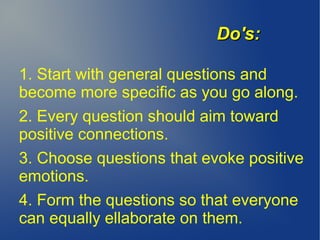
1. Start with general questions and
become more specific as you go along.
2. Every question should aim toward
positive connections.
3. Choose questions that evoke positive
emotions.
4. Form the questions so that everyone
can equally ellaborate on them.
Do's:Do's:
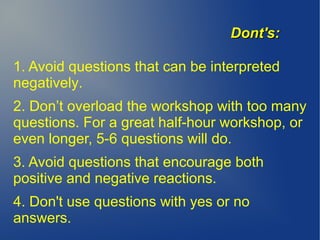
1. Avoid questions that can be interpreted
negatively.
2. Don’t overload the workshop with too many
questions. For a great half-hour workshop, or
even longer, 5-6 questions will do.
3. Avoid questions that encourage both
positive and negative reactions.
4. Don't use questions with yes or no
answers.
Dont's:Dont's:
The Rules of the GameThe Rules of the Game
The Connection Circle rules are few,The Connection Circle rules are few,
simple, reasonable, and intended tosimple, reasonable, and intended to
promote unity and warmth among thepromote unity and warmth among the
participants.participants.
The Rules of the GameThe Rules of the Game
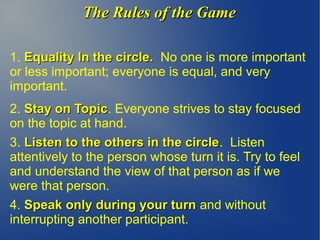
1. Equality In the circle.Equality In the circle. No one is more important
or less important; everyone is equal, and very
important.
2. Stay on TopicStay on Topic. Everyone strives to stay focused
on the topic at hand.
3. Listen to the others in the circleListen to the others in the circle. Listen
attentively to the person whose turn it is. Try to feel
and understand the view of that person as if we
were that person.
4. Speak only during your turnSpeak only during your turn and without
interrupting another participant.
The Rules of the GameThe Rules of the Game
5. At our turn, we will add our own view.At our turn, we will add our own view. Think
of the discussion as a warming fire on a cold night
in the woods. All the participants are working to
keep the flames burning, and each adds his or her
piece of wood to the fire. The pieces may be very
different, but they all add to the common purpose
of sustaining the warming flame. There shouldThere should
be no arguments, criticism, or judgmentalbe no arguments, criticism, or judgmental
statements, even if we disagreestatements, even if we disagree.
5. Set a time limitSet a time limit. Ideally, a speaker should
take no more than one minute before passing
on the “torch” to the next speaker.
Facilitator/Moderator Guidelines
Workshop rules are a general guideline, and not rules in the
strictest sense. Above everything else, the goal is to encourageAbove everything else, the goal is to encourage
connection, warmth, and a sense of unity.connection, warmth, and a sense of unity.
When you need to move on to the next person in the circle, if a
participant has spoken too long, do it gently. Give people time to
express themselves, but don’t let them make speeches that will give
them control over the discussion and prevent an even, smooth flow.
Establish a speaking order of participants.Establish a speaking order of participants.
Alphabetically, reverse alphabetical, or let
each friend call who will come after them and
then write the order in the chat so that the
group never has to stop a workshop answer to
call the next person.
Facilitator/Moderator Guidelines
In general, the best strategy when correctingIn general, the best strategy when correcting
someone who is not keeping the rules of discussionsomeone who is not keeping the rules of discussion
is to approach the issue indirectly.is to approach the issue indirectly.
Correct the flow in a way that does not point the finger
at any one in particular.
Remind participants of the workshop rules at some
point during the conversation.
When participants have completed a circle, ask them
to remind us of the rules of discussion. Say, “Let’s
each remind us of one rule.”
In short, the rule of thumb regardingIn short, the rule of thumb regarding
the rules of the workshop is “Be gentle,the rules of the workshop is “Be gentle,
sensitive, yet assertive.”sensitive, yet assertive.”
Facilitator/Moderator Guidelines
Facilitator & Moderator Guidelines
Flow of the CircleFlow of the Circle
1. Play a game (optional)
2. Conduct a workshop
3. Share impressions (optional but highly
recommended))
The goal of the game is to create warmthThe goal of the game is to create warmth
and break the ice.and break the ice. You are welcome to use
the games and topics suggested here, or any
other activities and games that bring people
closer without evoking competition.
Games
Warm-ups
Ice Breakers
Facilitator/Moderator GuidelinesFacilitator/Moderator Guidelines
Once you’ve played a game or two, and the people in the circle
are smiling and ready for more, it’s time to give them a real taste
of connection.
5-6 questions in the workshop is plenty. If you've reached a point
of profound closeness among the people in the circle after only
30 minutes and four questions, no problem, move on to the
sharing phase.
It’s best if people leave with a taste for more, than if they come
out with a sense that they have experienced everything the
Connection Circle has to offer..
Facilitator/Moderator Guidelines
Concluding the CircleConcluding the Circle
This is the part when people share their emotions.
If all flows naturally, simply let this sharing happen
as a natural extension of the final question.
You can also “play” this part by suggesting that we
play the wishing game, where you ask each
participant to answer a question, such as “What do I
wish for myself and for all of us” or “What do I take
with me from this circle today, what thoughts,
impressions, or emotions?”
Facilitator/Moderator Guidelines
Concluding the Circle
In the end, remember to thankIn the end, remember to thank
your friends for having this circleyour friends for having this circle
with youwith you, and refer them to other
Integral Education events where
they can find many more circles,
related materials, and live circles to
join.
Thank youThank you

Tools to conduct connection circles1 december16

  • 1.
    This presentation isintended as a training tool for Connection Circle Workshop facilitators & moderators Conducting the CircleConducting the Circle
  • 2.
    What is theConnection Circle? The Connection Circle is a method for discovering ourThe Connection Circle is a method for discovering our connectedness and the great benefits that come withconnectedness and the great benefits that come with this discovery.this discovery. It helps us to work more as a group and less as individuals, thereby creating unity. ConnectionConnection is the purpose of the circle.is the purpose of the circle.
  • 3.
    Connection Circle Workshopscan be usedConnection Circle Workshops can be used on 3 levels to achieve connection; fromon 3 levels to achieve connection; from strangers getting accainted, converting tostrangers getting accainted, converting to friendships, and conflict resolution.friendships, and conflict resolution. Games Connection Circles Round Tables
  • 4.
    Games are fun!Gamesare fun! When people hear (or read)When people hear (or read) the word “game” they have an immediatethe word “game” they have an immediate expectation to enjoy.expectation to enjoy. You can use any game that promotes the spirit of togetherness and collaboration, without invoking competition. We use games here primarily as an ice-breaker to strengthen the bonds between us, creating unity. Games
  • 5.
    Connection Circles The ConnectionCircle is a simple and effective tool to createThe Connection Circle is a simple and effective tool to create warmth and a sense of harmony among us.warmth and a sense of harmony among us. Circles are not group therapy.Circles are not group therapy. They are a means to finding the commonality we all share asThey are a means to finding the commonality we all share as human beingshuman beings, to discover the benefits of diversity, and in general, to making people friends. They are non-intrusive and do not require participants to open up on topics they prefer to keep to themselves.
  • 6.
    Round Tables The RoundTable format is a specialized form ofThe Round Table format is a specialized form of Connection Circle intended primarily as a means forConnection Circle intended primarily as a means for resolving conflicts.resolving conflicts. The Round Table helps bring people closer togetherThe Round Table helps bring people closer together and dissolve the animosity that people in conflicts oftenand dissolve the animosity that people in conflicts often harbor toward one another.harbor toward one another. Once this is achieved, the problem that caused the dispute in the first place often vanishes.
  • 7.
  • 8.
    1. Start withgeneral questions and become more specific as you go along. 2. Every question should aim toward positive connections. 3. Choose questions that evoke positive emotions. 4. Form the questions so that everyone can equally ellaborate on them. Do's:Do's:
  • 9.
    1. Avoid questionsthat can be interpreted negatively. 2. Don’t overload the workshop with too many questions. For a great half-hour workshop, or even longer, 5-6 questions will do. 3. Avoid questions that encourage both positive and negative reactions. 4. Don't use questions with yes or no answers. Dont's:Dont's:
  • 10.
    The Rules ofthe GameThe Rules of the Game The Connection Circle rules are few,The Connection Circle rules are few, simple, reasonable, and intended tosimple, reasonable, and intended to promote unity and warmth among thepromote unity and warmth among the participants.participants.
  • 11.
    The Rules ofthe GameThe Rules of the Game 1. Equality In the circle.Equality In the circle. No one is more important or less important; everyone is equal, and very important. 2. Stay on TopicStay on Topic. Everyone strives to stay focused on the topic at hand. 3. Listen to the others in the circleListen to the others in the circle. Listen attentively to the person whose turn it is. Try to feel and understand the view of that person as if we were that person. 4. Speak only during your turnSpeak only during your turn and without interrupting another participant.
  • 12.
    The Rules ofthe GameThe Rules of the Game 5. At our turn, we will add our own view.At our turn, we will add our own view. Think of the discussion as a warming fire on a cold night in the woods. All the participants are working to keep the flames burning, and each adds his or her piece of wood to the fire. The pieces may be very different, but they all add to the common purpose of sustaining the warming flame. There shouldThere should be no arguments, criticism, or judgmentalbe no arguments, criticism, or judgmental statements, even if we disagreestatements, even if we disagree. 5. Set a time limitSet a time limit. Ideally, a speaker should take no more than one minute before passing on the “torch” to the next speaker.
  • 13.
    Facilitator/Moderator Guidelines Workshop rulesare a general guideline, and not rules in the strictest sense. Above everything else, the goal is to encourageAbove everything else, the goal is to encourage connection, warmth, and a sense of unity.connection, warmth, and a sense of unity. When you need to move on to the next person in the circle, if a participant has spoken too long, do it gently. Give people time to express themselves, but don’t let them make speeches that will give them control over the discussion and prevent an even, smooth flow.
  • 14.
    Establish a speakingorder of participants.Establish a speaking order of participants. Alphabetically, reverse alphabetical, or let each friend call who will come after them and then write the order in the chat so that the group never has to stop a workshop answer to call the next person. Facilitator/Moderator Guidelines
  • 15.
    Facilitator/Moderator Guidelines In general,the best strategy when correctingIn general, the best strategy when correcting someone who is not keeping the rules of discussionsomeone who is not keeping the rules of discussion is to approach the issue indirectly.is to approach the issue indirectly. Correct the flow in a way that does not point the finger at any one in particular. Remind participants of the workshop rules at some point during the conversation. When participants have completed a circle, ask them to remind us of the rules of discussion. Say, “Let’s each remind us of one rule.”
  • 16.
    In short, therule of thumb regardingIn short, the rule of thumb regarding the rules of the workshop is “Be gentle,the rules of the workshop is “Be gentle, sensitive, yet assertive.”sensitive, yet assertive.” Facilitator/Moderator Guidelines
  • 17.
    Facilitator & ModeratorGuidelines Flow of the CircleFlow of the Circle 1. Play a game (optional) 2. Conduct a workshop 3. Share impressions (optional but highly recommended))
  • 18.
    The goal ofthe game is to create warmthThe goal of the game is to create warmth and break the ice.and break the ice. You are welcome to use the games and topics suggested here, or any other activities and games that bring people closer without evoking competition. Games Warm-ups Ice Breakers
  • 19.
    Facilitator/Moderator GuidelinesFacilitator/Moderator Guidelines Onceyou’ve played a game or two, and the people in the circle are smiling and ready for more, it’s time to give them a real taste of connection. 5-6 questions in the workshop is plenty. If you've reached a point of profound closeness among the people in the circle after only 30 minutes and four questions, no problem, move on to the sharing phase. It’s best if people leave with a taste for more, than if they come out with a sense that they have experienced everything the Connection Circle has to offer..
  • 20.
    Facilitator/Moderator Guidelines Concluding theCircleConcluding the Circle This is the part when people share their emotions. If all flows naturally, simply let this sharing happen as a natural extension of the final question. You can also “play” this part by suggesting that we play the wishing game, where you ask each participant to answer a question, such as “What do I wish for myself and for all of us” or “What do I take with me from this circle today, what thoughts, impressions, or emotions?”
  • 21.
    Facilitator/Moderator Guidelines Concluding theCircle In the end, remember to thankIn the end, remember to thank your friends for having this circleyour friends for having this circle with youwith you, and refer them to other Integral Education events where they can find many more circles, related materials, and live circles to join.
  • 22.