Together / Apart
3
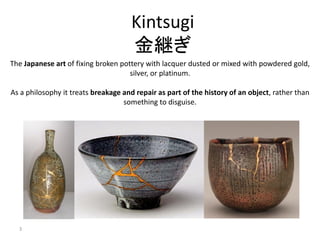
Kintsugi
金継ぎ
The Japanese art of fixing broken pottery with lacquer dusted or mixed with powdered gold,
silver, or platinum.
As a philosophy it treats breakage and repair as part of the history of an object, rather than
something to disguise.
4
Task 1
タスク
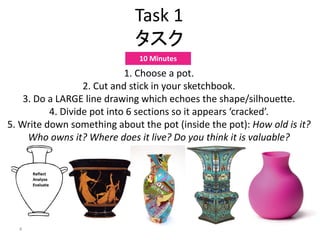
1. Choose a pot.
2. Cut and stick in your sketchbook.
3. Do a LARGE line drawing which echoes the shape/silhouette.
4. Divide pot into 6 sections so it appears ‘cracked’.
5. Write down something about the pot (inside the pot): How old is it?
Who owns it? Where does it live? Do you think it is valuable?
10 Minutes
Learning Outcomes
By the end of the lesson you will have…
Learnt how your theme ‘together and apart’ could be
explored through the deconstruction and
reconstruction of textiles and/or pottery and how
ancient traditions such as Kintsugi could be applied to
contemporary art; and how a composition can be
created using collagraph technique.
6
Artists who
explore the theme of
breaking / fixing / rearranging
in their work….
7
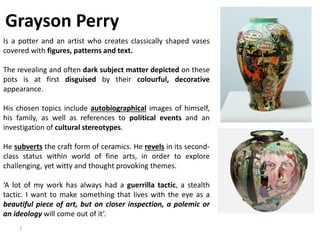
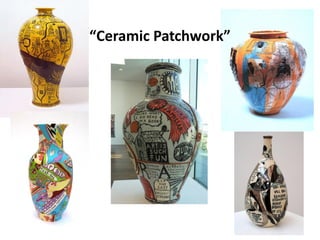
Grayson Perry
Is a potter and an artist who creates classically shaped vases
covered with figures, patterns and text.
The revealing and often dark subject matter depicted on these
pots is at first disguised by their colourful, decorative
appearance.
His chosen topics include autobiographical images of himself,
his family, as well as references to political events and an
investigation of cultural stereotypes.
He subverts the craft form of ceramics. He revels in its second-
class status within world of fine arts, in order to explore
challenging, yet witty and thought provoking themes.
‘A lot of my work has always had a guerrilla tactic, a stealth
tactic. I want to make something that lives with the eye as a
beautiful piece of art, but on closer inspection, a polemic or
an ideology will come out of it’.
8
“Ceramic Patchwork”
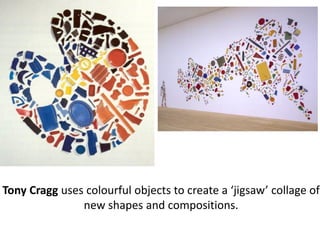
Tony Cragg uses colourful objects to create a ‘jigsaw’ collage of
new shapes and compositions.
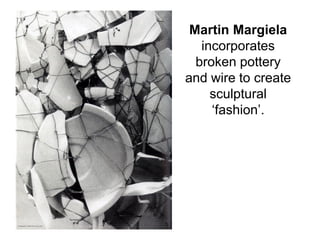
Martin Margiela
incorporates
broken pottery
and wire to create
sculptural
‘fashion’.
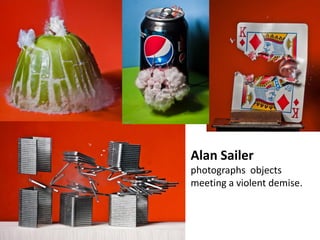
Alan Sailer
photographs objects
meeting a violent demise.
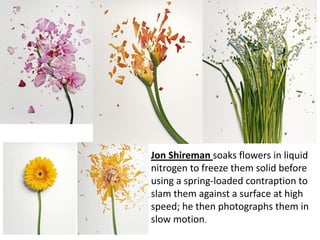
Jon Shireman soaks flowers in liquid
nitrogen to freeze them solid before
using a spring-loaded contraption to
slam them against a surface at high
speed; he then photographs them in
slow motion.
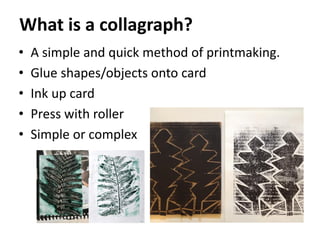
What is a collagraph?
• A simple and quick method of printmaking.
• Glue shapes/objects onto card
• Ink up card
• Press with roller
• Simple or complex
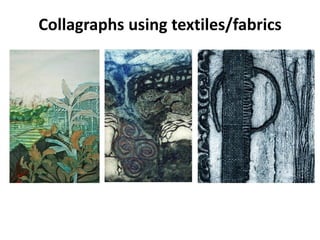
Collagraphs using textiles/fabrics
15
Task 2
タスク
1. Gather ripped, torn and cut clothes / textiles
2. Draw the outline of your vase onto the card
3. Cut or tear your fabric into smaller pieces if necessary
4. Arrange fabric pieces inside the lines of your vase
5. Glue down the fabric.
6. Create collagraph print.
30 - 40 Minutes
16
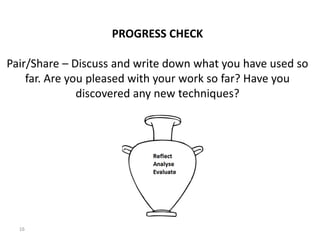
PROGRESS CHECK
Pair/Share – Discuss and write down what you have used so
far. Are you pleased with your work so far? Have you
discovered any new techniques?
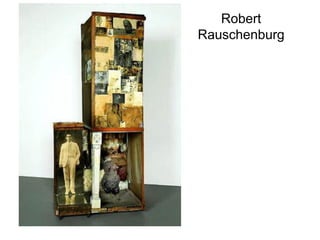
Robert
Rauschenburg
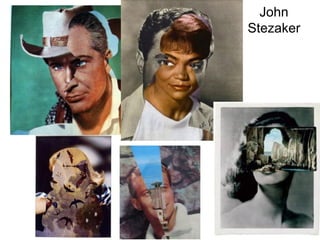
John
Stezaker
19
Task 3
タスク
1. Using a combination or magazines and biro /ink create a
response to the work of Grayson Perry, Robert
Rauschenburg or John Stezaker.
2. Create a collage within your vase shape which conveys a
message or a story.
3. Consider how you can show ‘cracks’ within the object
10 - 20 Minutes
Reflect & Evaluate
Briefly write how you think today’s activities
link to the exam theme, what have you
discovered, what have you found difficult?
Share outcomes and discuss findings and/or
challenges.
Task 4
タスク
10 Minutes
Homework
Create a double page spread in your
sketchbooks which focusses on an artist
reference inspired by today’s activities.
• Analyse the work of the artist
• Create your own response
• Explore how this could link to your theme
Kintsugi
金継ぎ

Together and Apart - KINTSUGI POTTERY

  • 1.
  • 3.
    3 Kintsugi 金継ぎ The Japanese artof fixing broken pottery with lacquer dusted or mixed with powdered gold, silver, or platinum. As a philosophy it treats breakage and repair as part of the history of an object, rather than something to disguise.
  • 4.
    4 Task 1 タスク 1. Choosea pot. 2. Cut and stick in your sketchbook. 3. Do a LARGE line drawing which echoes the shape/silhouette. 4. Divide pot into 6 sections so it appears ‘cracked’. 5. Write down something about the pot (inside the pot): How old is it? Who owns it? Where does it live? Do you think it is valuable? 10 Minutes
  • 5.
    Learning Outcomes By theend of the lesson you will have… Learnt how your theme ‘together and apart’ could be explored through the deconstruction and reconstruction of textiles and/or pottery and how ancient traditions such as Kintsugi could be applied to contemporary art; and how a composition can be created using collagraph technique.
  • 6.
    6 Artists who explore thetheme of breaking / fixing / rearranging in their work….
  • 7.
    7 Grayson Perry Is apotter and an artist who creates classically shaped vases covered with figures, patterns and text. The revealing and often dark subject matter depicted on these pots is at first disguised by their colourful, decorative appearance. His chosen topics include autobiographical images of himself, his family, as well as references to political events and an investigation of cultural stereotypes. He subverts the craft form of ceramics. He revels in its second- class status within world of fine arts, in order to explore challenging, yet witty and thought provoking themes. ‘A lot of my work has always had a guerrilla tactic, a stealth tactic. I want to make something that lives with the eye as a beautiful piece of art, but on closer inspection, a polemic or an ideology will come out of it’.
  • 8.
  • 9.
    Tony Cragg usescolourful objects to create a ‘jigsaw’ collage of new shapes and compositions.
  • 10.
    Martin Margiela incorporates broken pottery andwire to create sculptural ‘fashion’.
  • 11.
  • 12.
    Jon Shireman soaksflowers in liquid nitrogen to freeze them solid before using a spring-loaded contraption to slam them against a surface at high speed; he then photographs them in slow motion.
  • 13.
    What is acollagraph? • A simple and quick method of printmaking. • Glue shapes/objects onto card • Ink up card • Press with roller • Simple or complex
  • 14.
  • 15.
    15 Task 2 タスク 1. Gatherripped, torn and cut clothes / textiles 2. Draw the outline of your vase onto the card 3. Cut or tear your fabric into smaller pieces if necessary 4. Arrange fabric pieces inside the lines of your vase 5. Glue down the fabric. 6. Create collagraph print. 30 - 40 Minutes
  • 16.
    16 PROGRESS CHECK Pair/Share –Discuss and write down what you have used so far. Are you pleased with your work so far? Have you discovered any new techniques?
  • 17.
  • 18.
  • 19.
    19 Task 3 タスク 1. Usinga combination or magazines and biro /ink create a response to the work of Grayson Perry, Robert Rauschenburg or John Stezaker. 2. Create a collage within your vase shape which conveys a message or a story. 3. Consider how you can show ‘cracks’ within the object 10 - 20 Minutes
  • 20.
    Reflect & Evaluate Brieflywrite how you think today’s activities link to the exam theme, what have you discovered, what have you found difficult? Share outcomes and discuss findings and/or challenges. Task 4 タスク 10 Minutes
  • 21.
    Homework Create a doublepage spread in your sketchbooks which focusses on an artist reference inspired by today’s activities. • Analyse the work of the artist • Create your own response • Explore how this could link to your theme
  • 22.