TOEFL
1
What is TOEFL
 The TOEFL test is an internationally accepted
standard of English that measures the academic
English proficiency of a non-native speaker of
English.
 The TOEFL test is required by more than 7,000
colleges, universities and licensing agencies in 110
countries throughout the world.
2
TOFEL Origin
 The TOEFL test is a registered trademark of Educational
Testing Service (ETS) and is administered worldwide.
 The test was first administered in 1964 and has since been
taken by more than 23 million students.
 The test was originally developed at the Center for
Applied Linguistics led by the linguist, Dr. Charles A.
Ferguson.
3
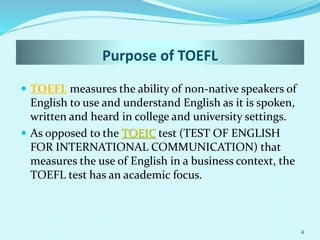
Purpose of TOEFL
 TOEFL measures the ability of non-native speakers of
English to use and understand English as it is spoken,
written and heard in college and university settings.
 As opposed to the TOEIC test (TEST OF ENGLISH
FOR INTERNATIONAL COMMUNICATION) that
measures the use of English in a business context, the
TOEFL test has an academic focus.
4
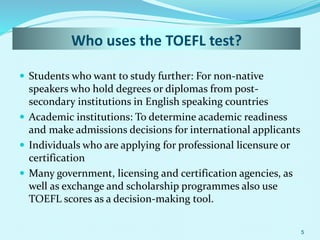
Who uses the TOEFL test?
 Students who want to study further: For non-native
speakers who hold degrees or diplomas from post-
secondary institutions in English speaking countries
 Academic institutions: To determine academic readiness
and make admissions decisions for international applicants
 Individuals who are applying for professional licensure or
certification
 Many government, licensing and certification agencies, as
well as exchange and scholarship programmes also use
TOEFL scores as a decision-making tool.
5
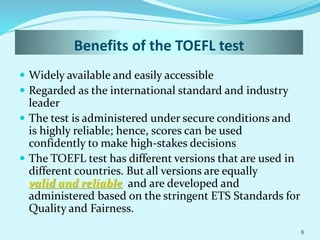
Benefits of the TOEFL test
 Widely available and easily accessible
 Regarded as the international standard and industry
leader
 The test is administered under secure conditions and
is highly reliable; hence, scores can be used
confidently to make high-stakes decisions
 The TOEFL test has different versions that are used in
different countries. But all versions are equally
valid and reliable and are developed and
administered based on the stringent ETS Standards for
Quality and Fairness.
6
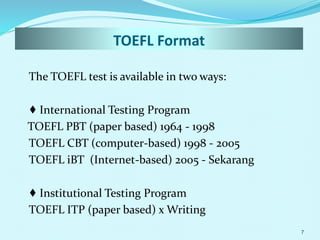
TOEFL Format
The TOEFL test is available in two ways:
♦ International Testing Program
TOEFL PBT (paper based) 1964 - 1998
TOEFL CBT (computer-based) 1998 - 2005
TOEFL iBT (Internet-based) 2005 - Sekarang
♦ Institutional Testing Program
TOEFL ITP (paper based) x Writing
7
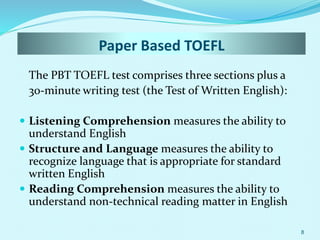
Paper Based TOEFL
The PBT TOEFL test comprises three sections plus a
30-minute writing test (the Test of Written English):
 Listening Comprehension measures the ability to
understand English
 Structure and Language measures the ability to
recognize language that is appropriate for standard
written English
 Reading Comprehension measures the ability to
understand non-technical reading matter in English
8
9
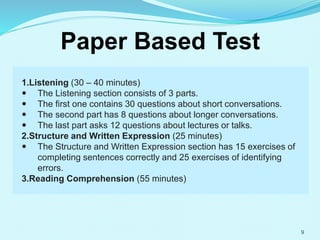
Paper Based Test
1.Listening (30 – 40 minutes)
 The Listening section consists of 3 parts.
 The first one contains 30 questions about short conversations.
 The second part has 8 questions about longer conversations.
 The last part asks 12 questions about lectures or talks.
2.Structure and Written Expression (25 minutes)
 The Structure and Written Expression section has 15 exercises of
completing sentences correctly and 25 exercises of identifying
errors.
3.Reading Comprehension (55 minutes)
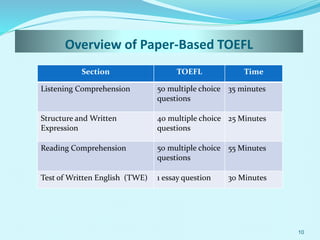
Overview of Paper-Based TOEFL
Time
TOEFL
Section
35 minutes
50 multiple choice
questions
Listening Comprehension
25 Minutes
40 multiple choice
questions
Structure and Written
Expression
55 Minutes
50 multiple choice
questions
Reading Comprehension
30 Minutes
1 essay question
Test of Written English (TWE)
10
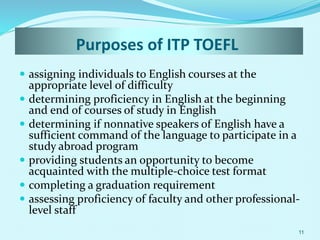
Purposes of ITP TOEFL
 assigning individuals to English courses at the
appropriate level of difficulty
 determining proficiency in English at the beginning
and end of courses of study in English
 determining if nonnative speakers of English have a
sufficient command of the language to participate in a
study abroad program
 providing students an opportunity to become
acquainted with the multiple-choice test format
 completing a graduation requirement
 assessing proficiency of faculty and other professional-
level staff
11
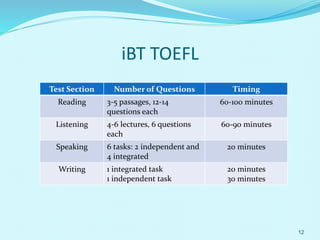
iBT TOEFL
Timing
Number of Questions
Test Section
60-100 minutes
3-5 passages, 12-14
questions each
Reading
60-90 minutes
4-6 lectures, 6 questions
each
Listening
20 minutes
6 tasks: 2 independent and
4 integrated
Speaking
20 minutes
30 minutes
1 integrated task
1 independent task
Writing
12
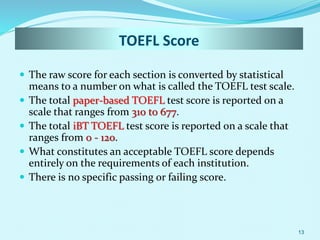
TOEFL Score
 The raw score for each section is converted by statistical
means to a number on what is called the TOEFL test scale.
 The total paper-based TOEFL test score is reported on a
scale that ranges from 310 to 677.
 The total iBT TOEFL test score is reported on a scale that
ranges from 0 - 120.
 What constitutes an acceptable TOEFL score depends
entirely on the requirements of each institution.
 There is no specific passing or failing score.
13
The score ranges
The paper based TOEFL score ranges are listed below:
Score Range
Test Section
31 - 68
Listening Comprehension
31 - 68
Structure/Written Expression
31 - 67
Reading Comprehension
310 - 677
Total Score
The iBT TOEFL score ranges are listed below:
Score Range
Test Section
0 - 30
Listening
0 - 30
Reading
0 - 30
Speaking
0 - 30
Writing
0 - 120
Total Score
14

TOEFL presentation for students pptx.pptx

  • 1.
  • 2.
    What is TOEFL The TOEFL test is an internationally accepted standard of English that measures the academic English proficiency of a non-native speaker of English.  The TOEFL test is required by more than 7,000 colleges, universities and licensing agencies in 110 countries throughout the world. 2
  • 3.
    TOFEL Origin  TheTOEFL test is a registered trademark of Educational Testing Service (ETS) and is administered worldwide.  The test was first administered in 1964 and has since been taken by more than 23 million students.  The test was originally developed at the Center for Applied Linguistics led by the linguist, Dr. Charles A. Ferguson. 3
  • 4.
    Purpose of TOEFL TOEFL measures the ability of non-native speakers of English to use and understand English as it is spoken, written and heard in college and university settings.  As opposed to the TOEIC test (TEST OF ENGLISH FOR INTERNATIONAL COMMUNICATION) that measures the use of English in a business context, the TOEFL test has an academic focus. 4
  • 5.
    Who uses theTOEFL test?  Students who want to study further: For non-native speakers who hold degrees or diplomas from post- secondary institutions in English speaking countries  Academic institutions: To determine academic readiness and make admissions decisions for international applicants  Individuals who are applying for professional licensure or certification  Many government, licensing and certification agencies, as well as exchange and scholarship programmes also use TOEFL scores as a decision-making tool. 5
  • 6.
    Benefits of theTOEFL test  Widely available and easily accessible  Regarded as the international standard and industry leader  The test is administered under secure conditions and is highly reliable; hence, scores can be used confidently to make high-stakes decisions  The TOEFL test has different versions that are used in different countries. But all versions are equally valid and reliable and are developed and administered based on the stringent ETS Standards for Quality and Fairness. 6
  • 7.
    TOEFL Format The TOEFLtest is available in two ways: ♦ International Testing Program TOEFL PBT (paper based) 1964 - 1998 TOEFL CBT (computer-based) 1998 - 2005 TOEFL iBT (Internet-based) 2005 - Sekarang ♦ Institutional Testing Program TOEFL ITP (paper based) x Writing 7
  • 8.
    Paper Based TOEFL ThePBT TOEFL test comprises three sections plus a 30-minute writing test (the Test of Written English):  Listening Comprehension measures the ability to understand English  Structure and Language measures the ability to recognize language that is appropriate for standard written English  Reading Comprehension measures the ability to understand non-technical reading matter in English 8
  • 9.
    9 Paper Based Test 1.Listening(30 – 40 minutes)  The Listening section consists of 3 parts.  The first one contains 30 questions about short conversations.  The second part has 8 questions about longer conversations.  The last part asks 12 questions about lectures or talks. 2.Structure and Written Expression (25 minutes)  The Structure and Written Expression section has 15 exercises of completing sentences correctly and 25 exercises of identifying errors. 3.Reading Comprehension (55 minutes)
  • 10.
    Overview of Paper-BasedTOEFL Time TOEFL Section 35 minutes 50 multiple choice questions Listening Comprehension 25 Minutes 40 multiple choice questions Structure and Written Expression 55 Minutes 50 multiple choice questions Reading Comprehension 30 Minutes 1 essay question Test of Written English (TWE) 10
  • 11.
    Purposes of ITPTOEFL  assigning individuals to English courses at the appropriate level of difficulty  determining proficiency in English at the beginning and end of courses of study in English  determining if nonnative speakers of English have a sufficient command of the language to participate in a study abroad program  providing students an opportunity to become acquainted with the multiple-choice test format  completing a graduation requirement  assessing proficiency of faculty and other professional- level staff 11
  • 12.
    iBT TOEFL Timing Number ofQuestions Test Section 60-100 minutes 3-5 passages, 12-14 questions each Reading 60-90 minutes 4-6 lectures, 6 questions each Listening 20 minutes 6 tasks: 2 independent and 4 integrated Speaking 20 minutes 30 minutes 1 integrated task 1 independent task Writing 12
  • 13.
    TOEFL Score  Theraw score for each section is converted by statistical means to a number on what is called the TOEFL test scale.  The total paper-based TOEFL test score is reported on a scale that ranges from 310 to 677.  The total iBT TOEFL test score is reported on a scale that ranges from 0 - 120.  What constitutes an acceptable TOEFL score depends entirely on the requirements of each institution.  There is no specific passing or failing score. 13
  • 14.
    The score ranges Thepaper based TOEFL score ranges are listed below: Score Range Test Section 31 - 68 Listening Comprehension 31 - 68 Structure/Written Expression 31 - 67 Reading Comprehension 310 - 677 Total Score The iBT TOEFL score ranges are listed below: Score Range Test Section 0 - 30 Listening 0 - 30 Reading 0 - 30 Speaking 0 - 30 Writing 0 - 120 Total Score 14