WEST BENGAL UNIVERSITY OF ANIMAL & FISHERY
SCIENCES
FACULTY OF FISHERY SCIENCES
Submitted to, Submitted By
Dr. S. Behera Soumya Sardar
Dept. of fisheries Resource Management B.F.Sc 2nd
Year
F/2015/37
A Seminer On,
Shrimp
Introduction
 India is major producer and one of the major
contributor of marine crustaceans to the world
production.
 Penaeid prawns is backbone of seafood export.
 Source of livelyhood for millions of fisherman.
 Frozen shrimp contributes 70% of total export.
 It is Include in class crustacean.
 Penaeid shrimps fetch good price in export market next
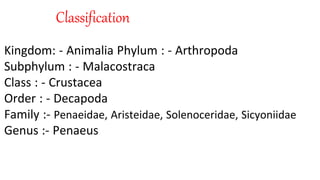
Kingdom: - Animalia Phylum : - Arthropoda
Subphylum : - Malacostraca
Class : - Crustacea
Order : - Decapoda
Family :- Penaeidae, Aristeidae, Solenoceridae, Sicyoniidae
Genus :- Penaeus
Classification
Characteristics :
 Plurae of the exoskeleton of the
2nd
abdominal
segment overlap only the 3rd segment.
The 1st three thoracic legs are chelate.
Male possesses petasma for transferring
sperms.
Female possesses thelycum for storing
sperms.
Female lay eggs individually in water.
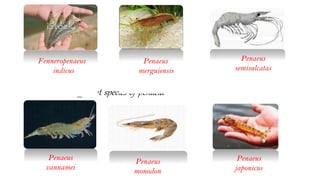
Different species of penaeid
shrimp
Fenneropenaeus
indicus
Penaeus
merguiensis
Penaeus
semisulcatas
Penaeus
japonicus
Penaeus
monodon
Penaeus
vannamei
Deep sea shrimp :
P. semisulcatus
P. indicus
P. maxillipedo (Torpedo Prawn)
Tranchypenaeus spp.
Solenocera spp.
Parapenaeopsis stylifera (kiddi prawn)
P. hardwickii (spear prawn)
P. jerryi
S. hextii
Marine & continuous estuarine
areas.
Habitat :
Distribution :
In Global : East coast of Africa, Pakistan, India,
Indonesia, Australia, Sri lanka, Malaysia.
In India : East and West Coast.
Fenneropenaeus
M.
Metapenaeus
P.
Food & feeding :
Omnivorous.
Food includes plant matter (diatoms, algae
seaweeds).
Animal matter (copepods, ostracods, amphipods,
small crustaceans, molluscan larcae, polychaetes,
foraminiforans etc.)
Age & growth :
 Young one of less than one year old- show faster
growth
 Older – growth decreases.
 Penaeus- grow large size .
 P. monodon (300mm).
 P. indicus, P. semisulcatus (290 & 250 mm)
Fecundity :
Fecundity is high.
Various between species & in
proportion
to size of female & wt. of ovary.
Penaeus breed – throughout the year.
Female shrimp spawn about- 4-5 times
in
year.
Spawning season :
Penaeus shrimp – 2 years.
Years group contributes more to the
prawn fishery.
Life span :
Mode of exploitation :
 Trawl net is principal gear used. (About 80% )
 Smaller varieties caught by Dol net. (North west
coast)
 Ring seines used in Kerala, Karnataka during
monsoon.
 Bottom set gill net & Disco net along east coast .
 Stake net is used for exploit juvenile shrimp along
both
MMT
Shrimp Aquaculture by Major Producing Regions:
2010 –2017
Conclusion :
 Production increases due to……….
 Intense trawling in inshore water.
 Increase in effort.
 Extension of trawling to deeper water.
 Night trawling.
 Introduction of multiday fishing operation.
 Introduction of innovative gears.
Shrimp

Shrimp

  • 1.
    WEST BENGAL UNIVERSITYOF ANIMAL & FISHERY SCIENCES FACULTY OF FISHERY SCIENCES Submitted to, Submitted By Dr. S. Behera Soumya Sardar Dept. of fisheries Resource Management B.F.Sc 2nd Year F/2015/37 A Seminer On, Shrimp
  • 2.
    Introduction  India ismajor producer and one of the major contributor of marine crustaceans to the world production.  Penaeid prawns is backbone of seafood export.  Source of livelyhood for millions of fisherman.  Frozen shrimp contributes 70% of total export.  It is Include in class crustacean.  Penaeid shrimps fetch good price in export market next
  • 3.
    Kingdom: - AnimaliaPhylum : - Arthropoda Subphylum : - Malacostraca Class : - Crustacea Order : - Decapoda Family :- Penaeidae, Aristeidae, Solenoceridae, Sicyoniidae Genus :- Penaeus Classification
  • 4.
    Characteristics :  Pluraeof the exoskeleton of the 2nd abdominal segment overlap only the 3rd segment. The 1st three thoracic legs are chelate. Male possesses petasma for transferring sperms. Female possesses thelycum for storing sperms. Female lay eggs individually in water.
  • 5.
    Different species ofpenaeid shrimp Fenneropenaeus indicus Penaeus merguiensis Penaeus semisulcatas Penaeus japonicus Penaeus monodon Penaeus vannamei
  • 6.
    Deep sea shrimp: P. semisulcatus P. indicus P. maxillipedo (Torpedo Prawn) Tranchypenaeus spp. Solenocera spp. Parapenaeopsis stylifera (kiddi prawn) P. hardwickii (spear prawn) P. jerryi S. hextii
  • 7.
    Marine & continuousestuarine areas. Habitat :
  • 8.
    Distribution : In Global: East coast of Africa, Pakistan, India, Indonesia, Australia, Sri lanka, Malaysia. In India : East and West Coast.
  • 10.
  • 11.
  • 12.
  • 13.
  • 14.
    Food & feeding: Omnivorous. Food includes plant matter (diatoms, algae seaweeds). Animal matter (copepods, ostracods, amphipods, small crustaceans, molluscan larcae, polychaetes, foraminiforans etc.)
  • 15.
    Age & growth:  Young one of less than one year old- show faster growth  Older – growth decreases.  Penaeus- grow large size .  P. monodon (300mm).  P. indicus, P. semisulcatus (290 & 250 mm)
  • 16.
    Fecundity : Fecundity ishigh. Various between species & in proportion to size of female & wt. of ovary.
  • 17.
    Penaeus breed –throughout the year. Female shrimp spawn about- 4-5 times in year. Spawning season :
  • 18.
    Penaeus shrimp –2 years. Years group contributes more to the prawn fishery. Life span :
  • 19.
    Mode of exploitation:  Trawl net is principal gear used. (About 80% )  Smaller varieties caught by Dol net. (North west coast)  Ring seines used in Kerala, Karnataka during monsoon.  Bottom set gill net & Disco net along east coast .  Stake net is used for exploit juvenile shrimp along both
  • 21.
    MMT Shrimp Aquaculture byMajor Producing Regions: 2010 –2017
  • 22.
    Conclusion :  Productionincreases due to……….  Intense trawling in inshore water.  Increase in effort.  Extension of trawling to deeper water.  Night trawling.  Introduction of multiday fishing operation.  Introduction of innovative gears.