Tocopherol (Vitamin E) Analysis in
Vaping E-Liquid by UHPLC-PDA
Shimadzu Scientific Instruments, Columbia, MD
Introduction
Vaping illnesses have been a growing concern for the CDC with over 2,000 known
cases and 39 confirmed deaths so far (CDC – November 2019). It is unclear what is
causing the illnesses, but vitamin E acetate has been identified as a possible
contributor. Vitamin E acetate has been found in the bronchoalveolar lavage (BAL) fluid
for all currently tested samples by the CDC (CDC – November 2019).
Two methods have been developed using photodiode array detection (PDA) to
separate three isomers of tocopherol (vitamin E): alpha-tocopherol acetate, alpha-
tocopherol, and gamma-tocopherol. First is a 10-minute method to separate e-liquid
matrix and nicotine from the cannabinoids and vitamin E isomers. Secondly, a quick 5-
minute method was also developed with full baseline resolution for identification and
quantitative analysis of the three Vitamin E isomers but without resolution between
matrix, nicotine and the cannabinoids.
The new Nexera XR UHPLC system with the photodiode array (PDA) was used for
method development. The Nexera XR allows for fast separation with low back pressure
when coupled with a superficially porous column resulting in high efficiency. The PDA
allows for simultaneous monitoring of three channels: 290 nm for vitamin E isomers,
260 nm for nicotine, and 228 nm for cannabinoids.
Analytical Conditions
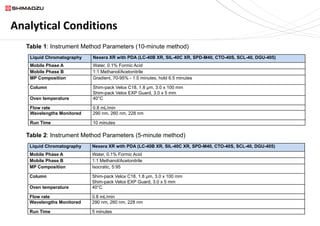
Table 1: Instrument Method Parameters (10-minute method)
Table 2: Instrument Method Parameters (5-minute method)
Liquid Chromatography Nexera XR with PDA (LC-40B XR, SIL-40C XR, SPD-M40, CTO-40S, SCL-40, DGU-405)
Mobile Phase A Water, 0.1% Formic Acid
Mobile Phase B 1:1 Methanol/Acetonitrile
MP Composition Gradient, 70-95% - 1.5 minutes, hold 6.5 minutes
Column Shim-pack Velox C18, 1.8 µm, 3.0 x 100 mm
Shim-pack Velox EXP Guard, 3.0 x 5 mm
Oven temperature 40°C
Flow rate 0.8 mL/min
Wavelengths Monitored 290 nm, 260 nm, 228 nm
Run Time 10 minutes
Liquid Chromatography Nexera XR with PDA (LC-40B XR, SIL-40C XR, SPD-M40, CTO-40S, SCL-40, DGU-405)
Mobile Phase A Water, 0.1% Formic Acid
Mobile Phase B 1:1 Methanol/Acetonitrile
MP Composition Isocratic, 5:95
Column Shim-pack Velox C18, 1.8 µm, 3.0 x 100 mm
Shim-pack Velox EXP Guard, 3.0 x 5 mm
Oven temperature 40°C
Flow rate 0.8 mL/min
Wavelengths Monitored 290 nm, 260 nm, 228 nm
Run Time 5 minutes
Standard Preparation
Three forms of tocopherol (vitamin E) were used for this application. A stock CRM
solution of Gamma-tocopherol (gamma vitamin E) at 1.0 mg/mL was purchased from
Sigma-Aldrich/Cerilliant. For alpha-tocopherol (alpha vitamin E) and alpha-tocopherol
acetate (alpha vitamin E acetate), each were purchased as neat (100 mg) standards
from Sigma-Aldrich. Vitamin E standards were prepared into 6 calibration levels 100,
50, 25, 10, 5, and 1 ppm in methanol.
The nicotine and cannabinoid mixture was prepared as a combined 50 ppm solution.
This mixture was used as a co-injection standard with the vitamin E standards to
demonstrate the separation of vitamin E analytes from the nicotine and cannabinoids.
Co-injection is a user-friendly pre-treatment program that allows for an injection of
different sample vials with a pre-selected standard concentration. The 3-component
cannabinoid mixture (CBD, d9-THC, and CBN) was purchased from Restek and the
nicotine 1.0 mg/mL standard was purchased from Sigma-Aldrich.
Sample Preparation
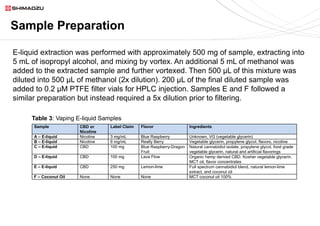
Table 3: Vaping E-liquid Samples
E-liquid extraction was performed with approximately 500 mg of sample, extracting into
5 mL of isopropyl alcohol, and mixing by vortex. An additional 5 mL of methanol was
added to the extracted sample and further vortexed. Then 500 µL of this mixture was
diluted into 500 µL of methanol (2x dilution). 200 µL of the final diluted sample was
added to 0.2 µM PTFE filter vials for HPLC injection. Samples E and F followed a
similar preparation but instead required a 5x dilution prior to filtering.
Sample CBD or
Nicotine
Label Claim Flavor Ingredients
A – E-liquid Nicotine 3 mg/mL Blue Raspberry Unknown, VG (vegetable glycerin)
B – E-liquid Nicotine 6 mg/mL Really Berry Vegetable glycerin, propylene glycol, flavors, nicotine
C – E-liquid CBD 100 mg Blue Raspberry-Dragon
Fruit
Natural cannabidiol isolate, propylene glycol, food grade
vegetable glycerin, natural and artificial flavorings
D – E-liquid CBD 100 mg Lava Flow Organic hemp derived CBD. Kosher vegetable glycerin,
MCT oil, flavor concentrates
E – E-liquid CBD 250 mg Lemon-lime Full spectrum cannabidiol blend, natural lemon-lime
extract, and coconut oil
F – Coconut Oil None None None MCT coconut oil 100%
Results and Discussion
Method Development
The 10-minute method uses gradient flow to allow for separation of e-liquid matrix,
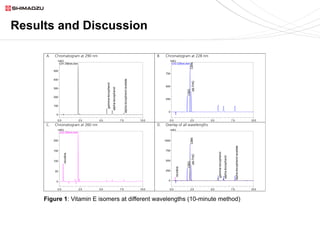
nicotine, cannabinoids, and the vitamin E isomers. Figure 1 shows chromatographic
separation of the vitamin E isomers starting near 5.5 minutes (black), the cannabinoids
near 2 minutes (blue), and nicotine near 0.5 minutes (pink). The e-liquid matrix also
elutes near nicotine (see Figure 4).
Three different wavelengths were determined for the different components of the e-
liquid based on the λ max from the respective absorbance spectra. Wavelength 290
nm is used for the vitamin E isomers, 228 nm for cannabinoids, and 260 nm for
nicotine (Figure 1).
Results and Discussion
A. Chromatogram at 290 nm B. Chromatogram at 228 nm
C. Chromatogram at 260 nm D. Overlay of all wavelengths
0.0 2.5 5.0 7.5 10.0
0
100
200
300
400
500
mAU
Ch1 290nm,4nm
gamma-tocopherol
alpha-tocopherol
alpha-tocopherolacetate
0.0 2.5 5.0 7.5 10.0
0
250
500
750
mAU
Ch3 228nm,4nm
CBD
CBNd9-THC
0.0 2.5 5.0 7.5 10.0
0
50
100
150
200
mAU
Ch2 260nm,4nm
nicotine
0.0 2.5 5.0 7.5 10.0
0
250
500
750
1000
mAU
CBD
CBNd9-THC
nicotine
gamma-tocopherol
alpha-tocopherol
alpha-tocopherolacetate
Figure 1: Vitamin E isomers at different wavelengths (10-minute method)
Results and Discussion
Figure 1 shows that the vitamin E isomers also absorb near 5.5 minutes in
chromatograms B and C at the lower wavelengths. It is not recommended to use
wavelengths 228 nm and 260 nm for vitamin E determination, because some of the
sample e-liquids have unknown analytes that have a similar retention time as alpha-
vitamin E and absorb at the lower wavelengths (Figure 4). These unknowns do not
absorb at the higher wavelengths. From this, 290 nm is used for vitamin E
determination to avoid false positive identification.
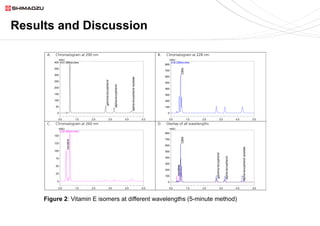
The 5-minute method was developed as an isocratic method that can be used for a
quick screening method to determine if vitamin E is present in vaping e-liquid. The
three vitamin E isomers are fully separated from the other sample components, but the
e-liquid matrix, cannabinoids and/or nicotine are not fully resolved (Figure 2).
Results and Discussion
A. Chromatogram at 290 nm B. Chromatogram at 228 nm
C. Chromatogram at 260 nm D. Overlay of all wavelengths
0.0 1.0 2.0 3.0 4.0 5.0
0
50
100
150
200
250
300
350
400
mAU
Ch1 290nm,4nm
gamma-tocopherol
alpha-tocopherol
alpha-tocopherolacetate
0.0 1.0 2.0 3.0 4.0 5.0
0
100
200
300
400
500
600
700
800
mAU
Ch3 228nm,4nm
CBN
0.0 1.0 2.0 3.0 4.0 5.0
0
25
50
75
100
125
150
mAU
Ch2 260nm,4nm
nicotine
0.0 1.0 2.0 3.0 4.0 5.0
0
100
200
300
400
500
600
700
800
mAU
CBN
nicotine
gamma-tocopherol
alpha-tocopherol
alpha-tocopherolacetate
Figure 2: Vitamin E isomers at different wavelengths (5-minute method)
Results and Discussion
Calibration
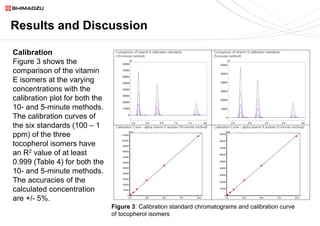
Figure 3 shows the
comparison of the vitamin
E isomers at the varying
concentrations with the
calibration plot for both the
10- and 5-minute methods.
The calibration curves of
the six standards (100 – 1
ppm) of the three
tocopherol isomers have
an R2 value of at least
0.999 (Table 4) for both the
10- and 5-minute methods.
The accuracies of the
calculated concentration
are +/- 5%.
Comparison of vitamin E calibration standards
(10-minute method)
Comparison of vitamin E calibration standards
(5-minute method)
Calibration Curve – alpha vitamin E acetate (10-minute method) Calibration Curve – alpha vitamin E acetate (5-minute method)
5.5 6.0 6.5 7.0 7.5 min
0
10000
20000
30000
40000
50000
60000
70000
80000
uV
2.5 3.0 3.5 4.0 min
0
10000
20000
30000
40000
50000
60000
uV
0.0 25.0 50.0 75.0 Conc.
0
10000
20000
30000
40000
50000
60000
70000
80000
90000
100000
110000
Area
0.0 25.0 50.0 75.0 Conc.
0
10000
20000
30000
40000
50000
60000
70000
80000
90000
Area
Figure 3: Calibration standard chromatograms and calibration curve
of tocopherol isomers
Results and Discussion
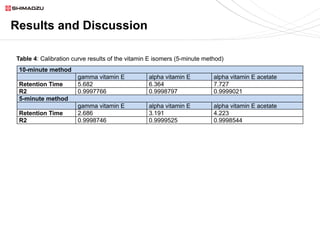
10-minute method
gamma vitamin E alpha vitamin E alpha vitamin E acetate
Retention Time 5.682 6.364 7.727
R2 0.9997766 0.9998797 0.9999021
5-minute method
gamma vitamin E alpha vitamin E alpha vitamin E acetate
Retention Time 2.686 3.191 4.223
R2 0.9998746 0.9999525 0.9998544
Table 4: Calibration curve results of the vitamin E isomers (5-minute method)
Results and Discussion
Sample Results
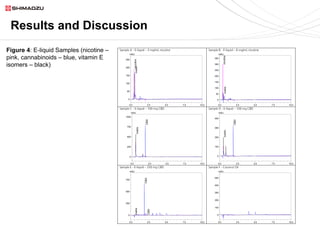
A sample set of six e-liquids were acquired for analysis of vitamin E. These results can
be seen in Figure 4. The three wavelength traces are overlaid (black – 290 nm, pink –
260 nm, and blue – 228 nm). Samples A and B show results of nicotine eluting near the
sample matrix. These peaks are also eluting very early in the chromatography,
indicating they are unretained on the column.
Samples C, D and E all result with a sample matrix peak and CBD cannabinoid
identification. CBD, d9-THC, and CBN show retention on the column, but should not be
used for quantitation as there could be other cannabinoids present not used in this
standard mixture. These methods were not developed for quantitation of nicotine and
cannabinoids but can be used qualitatively for product determination.
Sample A - E-liquid – 3 mg/mL nicotine Sample B - E-liquid – 6 mg/mL nicotine
Sample C - E-liquid – 100 mg CBD Sample D - E-liquid – 100 mg CBD
Sample E - E-liquid – 250 mg CBD Sample F - Coconut Oil
0.0 2.5 5.0 7.5 10.0
0
50
100
150
200
250
mAU
nicotinematrix
0.0 2.5 5.0 7.5 10.0
0
50
100
150
200
250
300
350
mAU
nicotinematrix
0.0 2.5 5.0 7.5 10.0
0
250
500
750
1000
mAU
CBD
matrix
0.0 2.5 5.0 7.5 10.0
0
100
200
300
400
mAU
CBD
matrix
0.0 2.5 5.0 7.5 10.0
0
250
500
750
mAU
CBD
CBN
matrix
0.0 2.5 5.0 7.5 10.0
0
100
200
300
400
500
mAU
Results and Discussion
Figure 4: E-liquid Samples (nicotine –
pink, cannabinoids – blue, vitamin E
isomers – black)
Results and Discussion
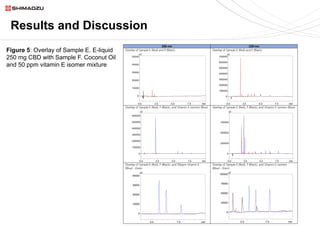
Vitamin E was not detected in any of the samples using the method from this
application. However, the e-liquid that used coconut oil (sample E) as a thickening
agent did show unknown components that absorb at low wavelengths (near 228 nm).
Coconut oil (sample F) was also analyzed under the same conditions, and the
chromatogram overlay with e-liquid (sample E) can be seen in Figure 5.
At 290 nm (Figure 5 – left), these unknown components are not seen, but at 228 nm
(Figure 5 – right) there are several compounds found in both sample E and coconut oil.
This demonstrates why it is not recommended to use 228 nm as the wavelength for
vitamin E quantitation as false positives could be possible.
Results and Discussion
290 nm 228 nm
Overlay of Sample E (Red) and F (Black) Overlay of Sample E (Red) and F (Black)
Overlay of Sample E (Red), F (Black), and Vitamin E isomers (Blue) Overlay of Sample E (Red), F (Black), and Vitamin E isomers (Blue)
Overlay of Sample E (Red), F (Black), and 50ppm Vitamin E
(Blue) - Zoom
Overlay of Sample E (Red), F (Black), and Vitamin E isomers
(Blue) - Zoom
0.0 2.5 5.0 7.5 min
0
10000
20000
30000
40000
50000
uV
0.0 2.5 5.0 7.5 min
0
100000
200000
300000
400000
500000
600000
700000
uV
0.0 2.5 5.0 7.5 min
0
100000
200000
300000
400000
500000
600000
uV
0.0 2.5 5.0 7.5 min
0
250000
500000
750000
uV
5.0 7.5 min
0
10000
20000
30000
40000
uV
5.0 7.5 min
0
25000
50000
75000
100000
uV
Figure 5: Overlay of Sample E. E-liquid
250 mg CBD with Sample F. Coconut Oil
and 50 ppm vitamin E isomer mixture
Conclusion
The methods described in this application can be used as a screening tool for
three vitamin E isomers in nicotine or cannabinoid e-liquid products. The quick 5-
minute method will allow for vitamin E identification and quantitation, while the 10-
minute method will also allow for determination between nicotine or cannabinoid-
based products.
Source
(2019) Outbreak of Lung Injury Associated with the Use of E-cigarette, or Vaping,
Products. https://www.cdc.gov
Need More Info?
Thank you for viewing this presentation. Should you have any
questions or require additional information about our research,
products, or services, please visit our Web site at:
www.ssi.shimadzu.com
Follow us on Twitter @shimadzussi

Tocopherol (Vitamin E) Analysis in Vaping E-Liquid by UHPLC-PDA

  • 1.
    Tocopherol (Vitamin E)Analysis in Vaping E-Liquid by UHPLC-PDA Shimadzu Scientific Instruments, Columbia, MD
  • 2.
    Introduction Vaping illnesses havebeen a growing concern for the CDC with over 2,000 known cases and 39 confirmed deaths so far (CDC – November 2019). It is unclear what is causing the illnesses, but vitamin E acetate has been identified as a possible contributor. Vitamin E acetate has been found in the bronchoalveolar lavage (BAL) fluid for all currently tested samples by the CDC (CDC – November 2019). Two methods have been developed using photodiode array detection (PDA) to separate three isomers of tocopherol (vitamin E): alpha-tocopherol acetate, alpha- tocopherol, and gamma-tocopherol. First is a 10-minute method to separate e-liquid matrix and nicotine from the cannabinoids and vitamin E isomers. Secondly, a quick 5- minute method was also developed with full baseline resolution for identification and quantitative analysis of the three Vitamin E isomers but without resolution between matrix, nicotine and the cannabinoids. The new Nexera XR UHPLC system with the photodiode array (PDA) was used for method development. The Nexera XR allows for fast separation with low back pressure when coupled with a superficially porous column resulting in high efficiency. The PDA allows for simultaneous monitoring of three channels: 290 nm for vitamin E isomers, 260 nm for nicotine, and 228 nm for cannabinoids.
  • 3.
    Analytical Conditions Table 1:Instrument Method Parameters (10-minute method) Table 2: Instrument Method Parameters (5-minute method) Liquid Chromatography Nexera XR with PDA (LC-40B XR, SIL-40C XR, SPD-M40, CTO-40S, SCL-40, DGU-405) Mobile Phase A Water, 0.1% Formic Acid Mobile Phase B 1:1 Methanol/Acetonitrile MP Composition Gradient, 70-95% - 1.5 minutes, hold 6.5 minutes Column Shim-pack Velox C18, 1.8 µm, 3.0 x 100 mm Shim-pack Velox EXP Guard, 3.0 x 5 mm Oven temperature 40°C Flow rate 0.8 mL/min Wavelengths Monitored 290 nm, 260 nm, 228 nm Run Time 10 minutes Liquid Chromatography Nexera XR with PDA (LC-40B XR, SIL-40C XR, SPD-M40, CTO-40S, SCL-40, DGU-405) Mobile Phase A Water, 0.1% Formic Acid Mobile Phase B 1:1 Methanol/Acetonitrile MP Composition Isocratic, 5:95 Column Shim-pack Velox C18, 1.8 µm, 3.0 x 100 mm Shim-pack Velox EXP Guard, 3.0 x 5 mm Oven temperature 40°C Flow rate 0.8 mL/min Wavelengths Monitored 290 nm, 260 nm, 228 nm Run Time 5 minutes
  • 4.
    Standard Preparation Three formsof tocopherol (vitamin E) were used for this application. A stock CRM solution of Gamma-tocopherol (gamma vitamin E) at 1.0 mg/mL was purchased from Sigma-Aldrich/Cerilliant. For alpha-tocopherol (alpha vitamin E) and alpha-tocopherol acetate (alpha vitamin E acetate), each were purchased as neat (100 mg) standards from Sigma-Aldrich. Vitamin E standards were prepared into 6 calibration levels 100, 50, 25, 10, 5, and 1 ppm in methanol. The nicotine and cannabinoid mixture was prepared as a combined 50 ppm solution. This mixture was used as a co-injection standard with the vitamin E standards to demonstrate the separation of vitamin E analytes from the nicotine and cannabinoids. Co-injection is a user-friendly pre-treatment program that allows for an injection of different sample vials with a pre-selected standard concentration. The 3-component cannabinoid mixture (CBD, d9-THC, and CBN) was purchased from Restek and the nicotine 1.0 mg/mL standard was purchased from Sigma-Aldrich.
  • 5.
    Sample Preparation Table 3:Vaping E-liquid Samples E-liquid extraction was performed with approximately 500 mg of sample, extracting into 5 mL of isopropyl alcohol, and mixing by vortex. An additional 5 mL of methanol was added to the extracted sample and further vortexed. Then 500 µL of this mixture was diluted into 500 µL of methanol (2x dilution). 200 µL of the final diluted sample was added to 0.2 µM PTFE filter vials for HPLC injection. Samples E and F followed a similar preparation but instead required a 5x dilution prior to filtering. Sample CBD or Nicotine Label Claim Flavor Ingredients A – E-liquid Nicotine 3 mg/mL Blue Raspberry Unknown, VG (vegetable glycerin) B – E-liquid Nicotine 6 mg/mL Really Berry Vegetable glycerin, propylene glycol, flavors, nicotine C – E-liquid CBD 100 mg Blue Raspberry-Dragon Fruit Natural cannabidiol isolate, propylene glycol, food grade vegetable glycerin, natural and artificial flavorings D – E-liquid CBD 100 mg Lava Flow Organic hemp derived CBD. Kosher vegetable glycerin, MCT oil, flavor concentrates E – E-liquid CBD 250 mg Lemon-lime Full spectrum cannabidiol blend, natural lemon-lime extract, and coconut oil F – Coconut Oil None None None MCT coconut oil 100%
  • 6.
    Results and Discussion MethodDevelopment The 10-minute method uses gradient flow to allow for separation of e-liquid matrix, nicotine, cannabinoids, and the vitamin E isomers. Figure 1 shows chromatographic separation of the vitamin E isomers starting near 5.5 minutes (black), the cannabinoids near 2 minutes (blue), and nicotine near 0.5 minutes (pink). The e-liquid matrix also elutes near nicotine (see Figure 4). Three different wavelengths were determined for the different components of the e- liquid based on the λ max from the respective absorbance spectra. Wavelength 290 nm is used for the vitamin E isomers, 228 nm for cannabinoids, and 260 nm for nicotine (Figure 1).
  • 7.
    Results and Discussion A.Chromatogram at 290 nm B. Chromatogram at 228 nm C. Chromatogram at 260 nm D. Overlay of all wavelengths 0.0 2.5 5.0 7.5 10.0 0 100 200 300 400 500 mAU Ch1 290nm,4nm gamma-tocopherol alpha-tocopherol alpha-tocopherolacetate 0.0 2.5 5.0 7.5 10.0 0 250 500 750 mAU Ch3 228nm,4nm CBD CBNd9-THC 0.0 2.5 5.0 7.5 10.0 0 50 100 150 200 mAU Ch2 260nm,4nm nicotine 0.0 2.5 5.0 7.5 10.0 0 250 500 750 1000 mAU CBD CBNd9-THC nicotine gamma-tocopherol alpha-tocopherol alpha-tocopherolacetate Figure 1: Vitamin E isomers at different wavelengths (10-minute method)
  • 8.
    Results and Discussion Figure1 shows that the vitamin E isomers also absorb near 5.5 minutes in chromatograms B and C at the lower wavelengths. It is not recommended to use wavelengths 228 nm and 260 nm for vitamin E determination, because some of the sample e-liquids have unknown analytes that have a similar retention time as alpha- vitamin E and absorb at the lower wavelengths (Figure 4). These unknowns do not absorb at the higher wavelengths. From this, 290 nm is used for vitamin E determination to avoid false positive identification. The 5-minute method was developed as an isocratic method that can be used for a quick screening method to determine if vitamin E is present in vaping e-liquid. The three vitamin E isomers are fully separated from the other sample components, but the e-liquid matrix, cannabinoids and/or nicotine are not fully resolved (Figure 2).
  • 9.
    Results and Discussion A.Chromatogram at 290 nm B. Chromatogram at 228 nm C. Chromatogram at 260 nm D. Overlay of all wavelengths 0.0 1.0 2.0 3.0 4.0 5.0 0 50 100 150 200 250 300 350 400 mAU Ch1 290nm,4nm gamma-tocopherol alpha-tocopherol alpha-tocopherolacetate 0.0 1.0 2.0 3.0 4.0 5.0 0 100 200 300 400 500 600 700 800 mAU Ch3 228nm,4nm CBN 0.0 1.0 2.0 3.0 4.0 5.0 0 25 50 75 100 125 150 mAU Ch2 260nm,4nm nicotine 0.0 1.0 2.0 3.0 4.0 5.0 0 100 200 300 400 500 600 700 800 mAU CBN nicotine gamma-tocopherol alpha-tocopherol alpha-tocopherolacetate Figure 2: Vitamin E isomers at different wavelengths (5-minute method)
  • 10.
    Results and Discussion Calibration Figure3 shows the comparison of the vitamin E isomers at the varying concentrations with the calibration plot for both the 10- and 5-minute methods. The calibration curves of the six standards (100 – 1 ppm) of the three tocopherol isomers have an R2 value of at least 0.999 (Table 4) for both the 10- and 5-minute methods. The accuracies of the calculated concentration are +/- 5%. Comparison of vitamin E calibration standards (10-minute method) Comparison of vitamin E calibration standards (5-minute method) Calibration Curve – alpha vitamin E acetate (10-minute method) Calibration Curve – alpha vitamin E acetate (5-minute method) 5.5 6.0 6.5 7.0 7.5 min 0 10000 20000 30000 40000 50000 60000 70000 80000 uV 2.5 3.0 3.5 4.0 min 0 10000 20000 30000 40000 50000 60000 uV 0.0 25.0 50.0 75.0 Conc. 0 10000 20000 30000 40000 50000 60000 70000 80000 90000 100000 110000 Area 0.0 25.0 50.0 75.0 Conc. 0 10000 20000 30000 40000 50000 60000 70000 80000 90000 Area Figure 3: Calibration standard chromatograms and calibration curve of tocopherol isomers
  • 11.
    Results and Discussion 10-minutemethod gamma vitamin E alpha vitamin E alpha vitamin E acetate Retention Time 5.682 6.364 7.727 R2 0.9997766 0.9998797 0.9999021 5-minute method gamma vitamin E alpha vitamin E alpha vitamin E acetate Retention Time 2.686 3.191 4.223 R2 0.9998746 0.9999525 0.9998544 Table 4: Calibration curve results of the vitamin E isomers (5-minute method)
  • 12.
    Results and Discussion SampleResults A sample set of six e-liquids were acquired for analysis of vitamin E. These results can be seen in Figure 4. The three wavelength traces are overlaid (black – 290 nm, pink – 260 nm, and blue – 228 nm). Samples A and B show results of nicotine eluting near the sample matrix. These peaks are also eluting very early in the chromatography, indicating they are unretained on the column. Samples C, D and E all result with a sample matrix peak and CBD cannabinoid identification. CBD, d9-THC, and CBN show retention on the column, but should not be used for quantitation as there could be other cannabinoids present not used in this standard mixture. These methods were not developed for quantitation of nicotine and cannabinoids but can be used qualitatively for product determination.
  • 13.
    Sample A -E-liquid – 3 mg/mL nicotine Sample B - E-liquid – 6 mg/mL nicotine Sample C - E-liquid – 100 mg CBD Sample D - E-liquid – 100 mg CBD Sample E - E-liquid – 250 mg CBD Sample F - Coconut Oil 0.0 2.5 5.0 7.5 10.0 0 50 100 150 200 250 mAU nicotinematrix 0.0 2.5 5.0 7.5 10.0 0 50 100 150 200 250 300 350 mAU nicotinematrix 0.0 2.5 5.0 7.5 10.0 0 250 500 750 1000 mAU CBD matrix 0.0 2.5 5.0 7.5 10.0 0 100 200 300 400 mAU CBD matrix 0.0 2.5 5.0 7.5 10.0 0 250 500 750 mAU CBD CBN matrix 0.0 2.5 5.0 7.5 10.0 0 100 200 300 400 500 mAU Results and Discussion Figure 4: E-liquid Samples (nicotine – pink, cannabinoids – blue, vitamin E isomers – black)
  • 14.
    Results and Discussion VitaminE was not detected in any of the samples using the method from this application. However, the e-liquid that used coconut oil (sample E) as a thickening agent did show unknown components that absorb at low wavelengths (near 228 nm). Coconut oil (sample F) was also analyzed under the same conditions, and the chromatogram overlay with e-liquid (sample E) can be seen in Figure 5. At 290 nm (Figure 5 – left), these unknown components are not seen, but at 228 nm (Figure 5 – right) there are several compounds found in both sample E and coconut oil. This demonstrates why it is not recommended to use 228 nm as the wavelength for vitamin E quantitation as false positives could be possible.
  • 15.
    Results and Discussion 290nm 228 nm Overlay of Sample E (Red) and F (Black) Overlay of Sample E (Red) and F (Black) Overlay of Sample E (Red), F (Black), and Vitamin E isomers (Blue) Overlay of Sample E (Red), F (Black), and Vitamin E isomers (Blue) Overlay of Sample E (Red), F (Black), and 50ppm Vitamin E (Blue) - Zoom Overlay of Sample E (Red), F (Black), and Vitamin E isomers (Blue) - Zoom 0.0 2.5 5.0 7.5 min 0 10000 20000 30000 40000 50000 uV 0.0 2.5 5.0 7.5 min 0 100000 200000 300000 400000 500000 600000 700000 uV 0.0 2.5 5.0 7.5 min 0 100000 200000 300000 400000 500000 600000 uV 0.0 2.5 5.0 7.5 min 0 250000 500000 750000 uV 5.0 7.5 min 0 10000 20000 30000 40000 uV 5.0 7.5 min 0 25000 50000 75000 100000 uV Figure 5: Overlay of Sample E. E-liquid 250 mg CBD with Sample F. Coconut Oil and 50 ppm vitamin E isomer mixture
  • 16.
    Conclusion The methods describedin this application can be used as a screening tool for three vitamin E isomers in nicotine or cannabinoid e-liquid products. The quick 5- minute method will allow for vitamin E identification and quantitation, while the 10- minute method will also allow for determination between nicotine or cannabinoid- based products. Source (2019) Outbreak of Lung Injury Associated with the Use of E-cigarette, or Vaping, Products. https://www.cdc.gov
  • 17.
    Need More Info? Thankyou for viewing this presentation. Should you have any questions or require additional information about our research, products, or services, please visit our Web site at: www.ssi.shimadzu.com Follow us on Twitter @shimadzussi