Tobacco
Botanical Name :- Nicotiana spp.
Family:- Solanaceae
Origin:- Central America.
Tobacco is use as narcotic crop– used for stimulation.
It is cultivated as cash commercial crop.
The genus Nicotiana has more than 60 species.
Economic importance:
-generating huge socio- economic benefits in terms of agricultural
employment, farm incomes, revenue generation and foreign
exchange earnings.
-Tobacco and tobacco products contributes total tax revenue more
than 43,000crores annually .
Botanical description:-
Tobacco belongs to family solanaceae.
It is herbaceous annual crop grown for its leaves.
Roots: It has central tap root.
Leaves:- Vary in number, shape and structure.
In general, the texture of the leaves of N. tabacum
is finer than that of N. rustica which more or less leathery and
tough.
Inflorescence:-raceme
Tobacco is normally a self-pollinated crop, but cross-fertilization
as much as 4 to 10% may occur from pollen carried by insects.
The seeds of tobacco are extremely small; a single fruit may
contain as many as 8000 seeds.
Soil and Climate:-
Soil requirement:-
-Quality of tobacco is influenced by the soil conditions.
- light to medium loams soil.
-Tobacco does not tolerate waterlogged soil.
-It requires well drained soil.
-cultivated in moderately acidic soil.
-pH ranging from 5.5 to 6.5.
Climatic requirement: -
-Tobacco is a tropical crop .
-it is grown in subtropical and temperate regions.
-Tobacco needs 500-1000mm rainfall.
-An optimum temperature for germination is 28°C .
-Temperature above 35°C and cold weather and low temperature
affects the quality of the tobacco.
Relative humidity of 85-95% .
Preparation of field:-
-A clean and well-pulverized seedbed of fine tilth is needed .
-Land should be well prepared by ploughing followed by 3 to 4
cross harrowing.
-Each harrowing should be followed by planking so that the soil
is well pulverized and leveled.
-Add 10 to 12 tonnes of F.Y.M. compost/ha in the soil at the time
of last harrowing.
Seed and sowing:-
Method of sowing: Transplanting:
Raising of seedlings (Nursery)
-Tobacco seeds are very small (0.08 to 0.09 mg per seed wt.) and
cannot be sown directly in the field.
-The soil selected for raising seedlings should be sandy loam to
clay loam.
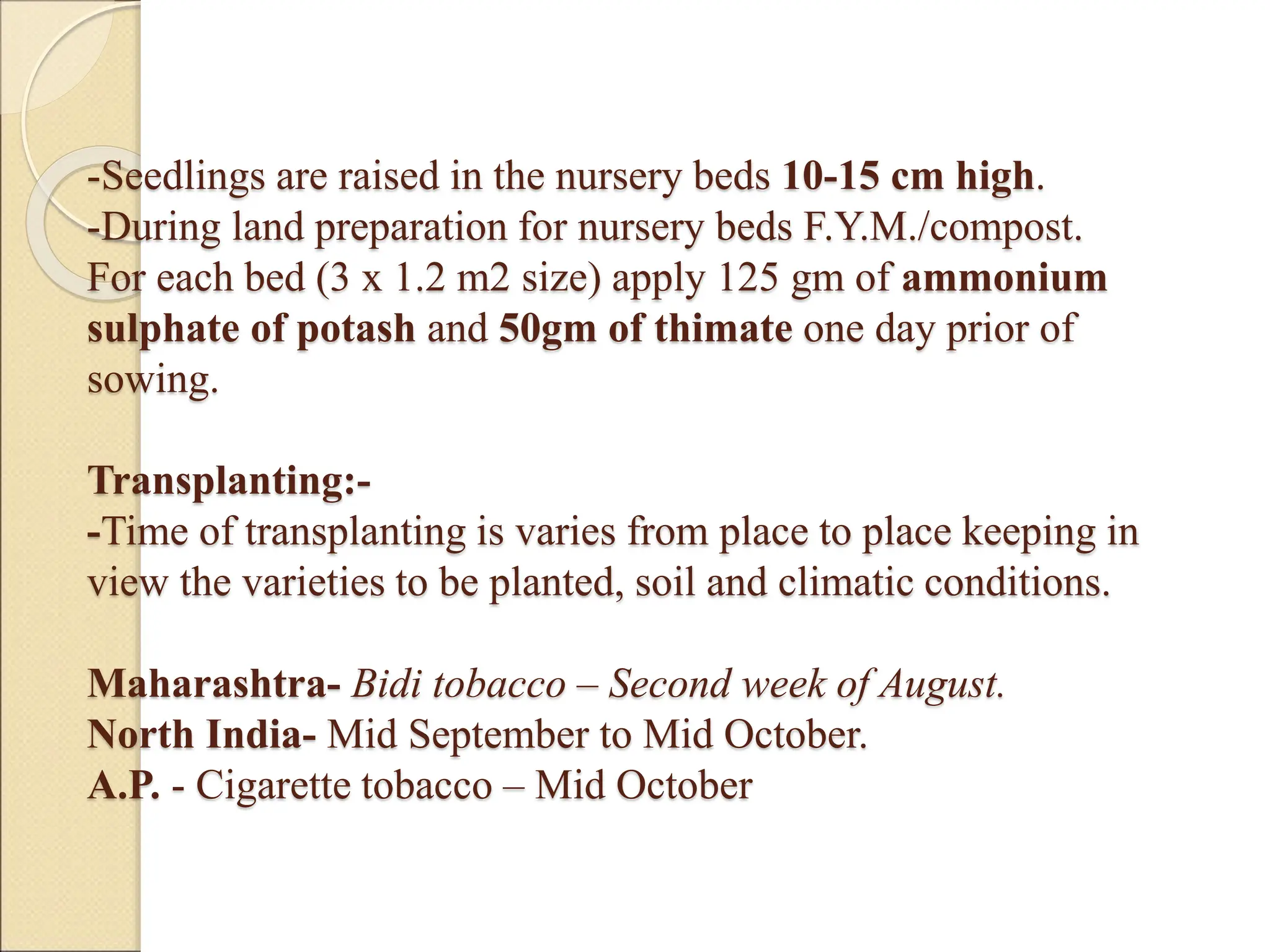
-Seedlings are raised in the nursery beds 10-15 cm high.
-During land preparation for nursery beds F.Y.M./compost.
For each bed (3 x 1.2 m2 size) apply 125 gm of ammonium
sulphate of potash and 50gm of thimate one day prior of
sowing.
Transplanting:-
-Time of transplanting is varies from place to place keeping in
view the varieties to be planted, soil and climatic conditions.
Maharashtra- Bidi tobacco – Second week of August.
North India- Mid September to Mid October.
A.P. - Cigarette tobacco – Mid October
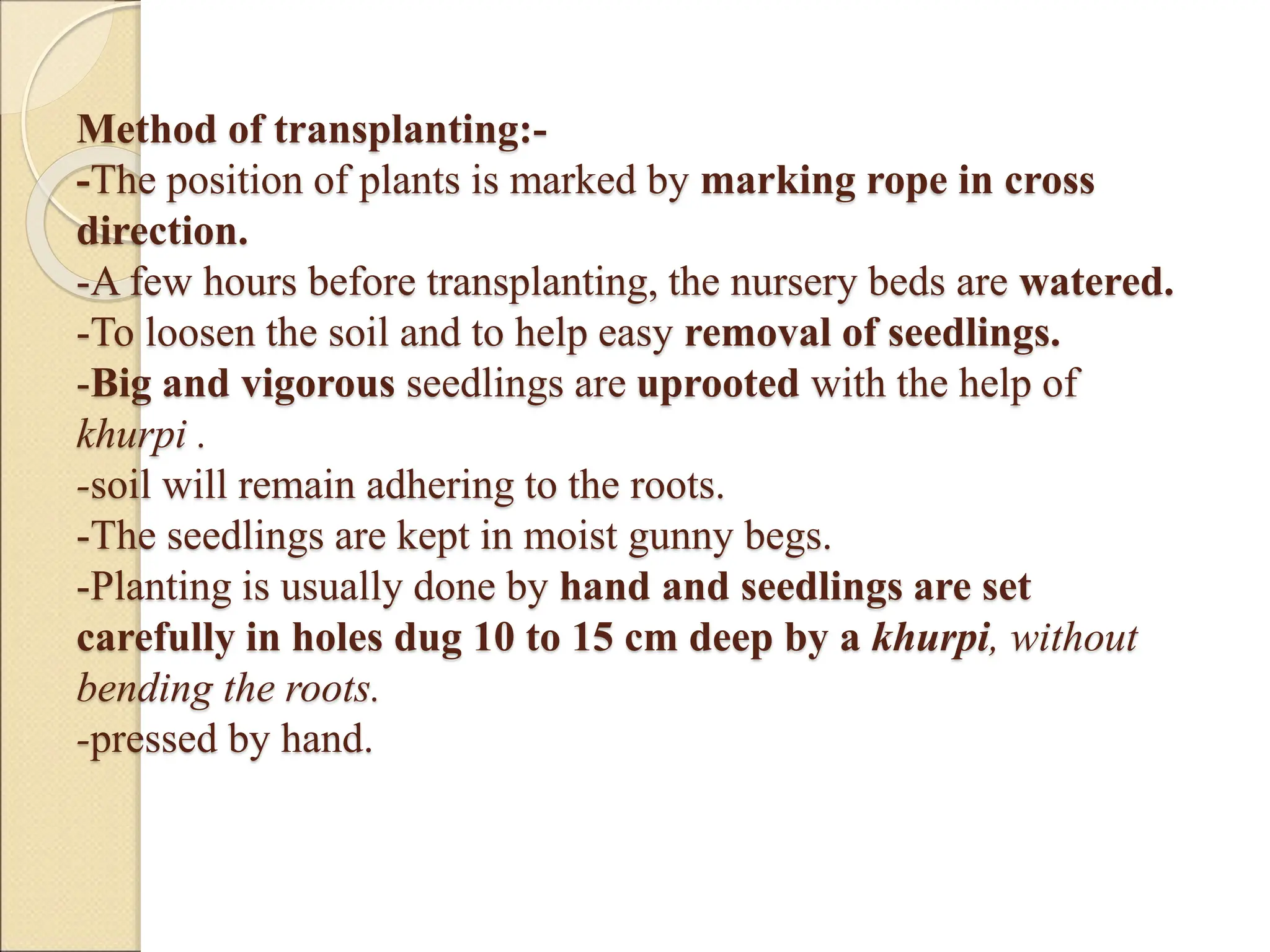
Method of transplanting:-
-The position of plants is marked by marking rope in cross
direction.
-A few hours before transplanting, the nursery beds are watered.
-To loosen the soil and to help easy removal of seedlings.
-Big and vigorous seedlings are uprooted with the help of
khurpi .
-soil will remain adhering to the roots.
-The seedlings are kept in moist gunny begs.
-Planting is usually done by hand and seedlings are set
carefully in holes dug 10 to 15 cm deep by a khurpi, without
bending the roots.
-pressed by hand.
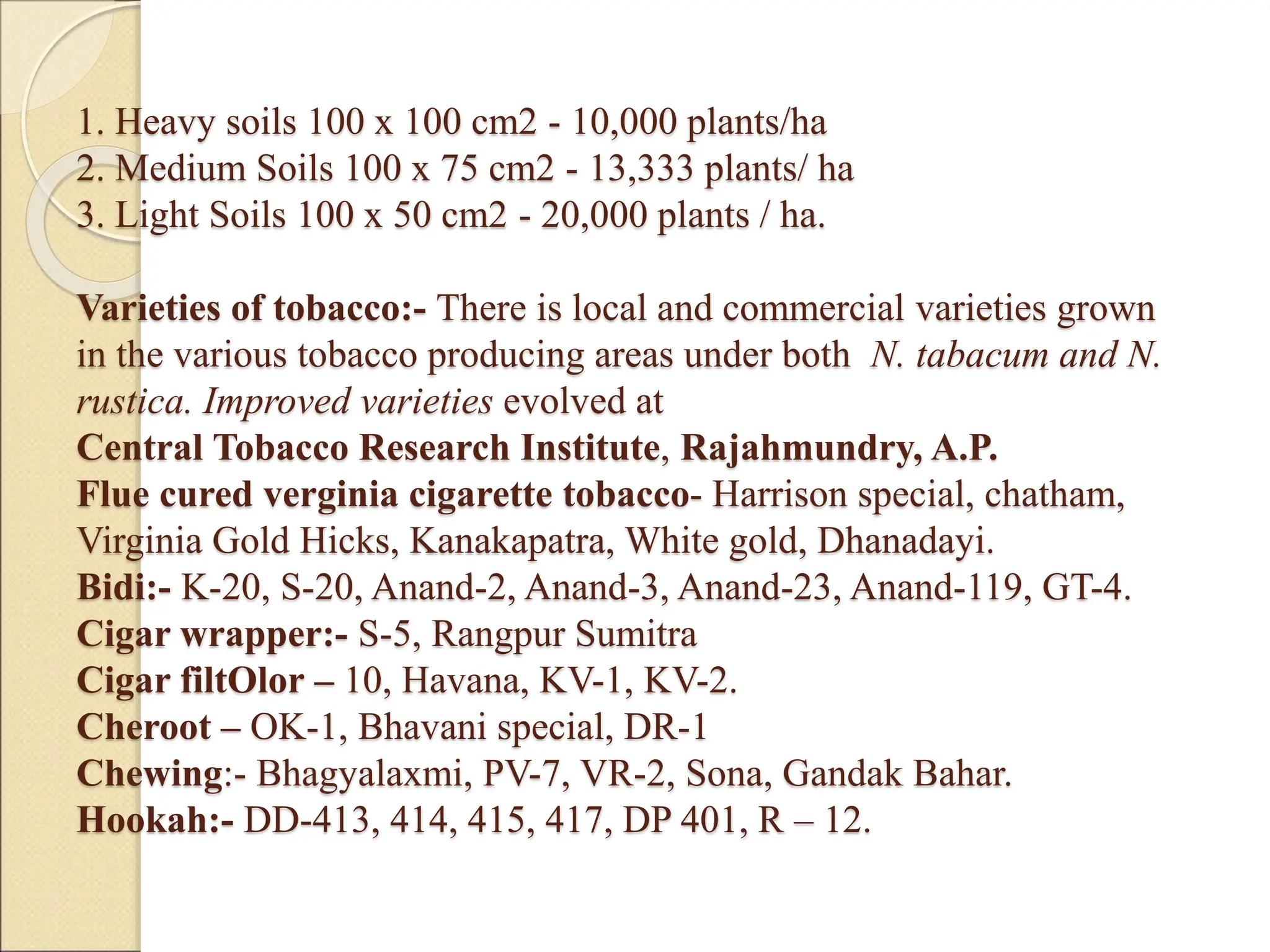
1. Heavy soils 100 x 100 cm2 - 10,000 plants/ha
2. Medium Soils 100 x 75 cm2 - 13,333 plants/ ha
3. Light Soils 100 x 50 cm2 - 20,000 plants / ha.
Varieties of tobacco:- There is local and commercial varieties grown
in the various tobacco producing areas under both N. tabacum and N.
rustica. Improved varieties evolved at
Central Tobacco Research Institute, Rajahmundry, A.P.
Flue cured verginia cigarette tobacco- Harrison special, chatham,
Virginia Gold Hicks, Kanakapatra, White gold, Dhanadayi.
Bidi:- K-20, S-20, Anand-2, Anand-3, Anand-23, Anand-119, GT-4.
Cigar wrapper:- S-5, Rangpur Sumitra
Cigar filtOlor – 10, Havana, KV-1, KV-2.
Cheroot – OK-1, Bhavani special, DR-1
Chewing:- Bhagyalaxmi, PV-7, VR-2, Sona, Gandak Bahar.
Hookah:- DD-413, 414, 415, 417, DP 401, R – 12.
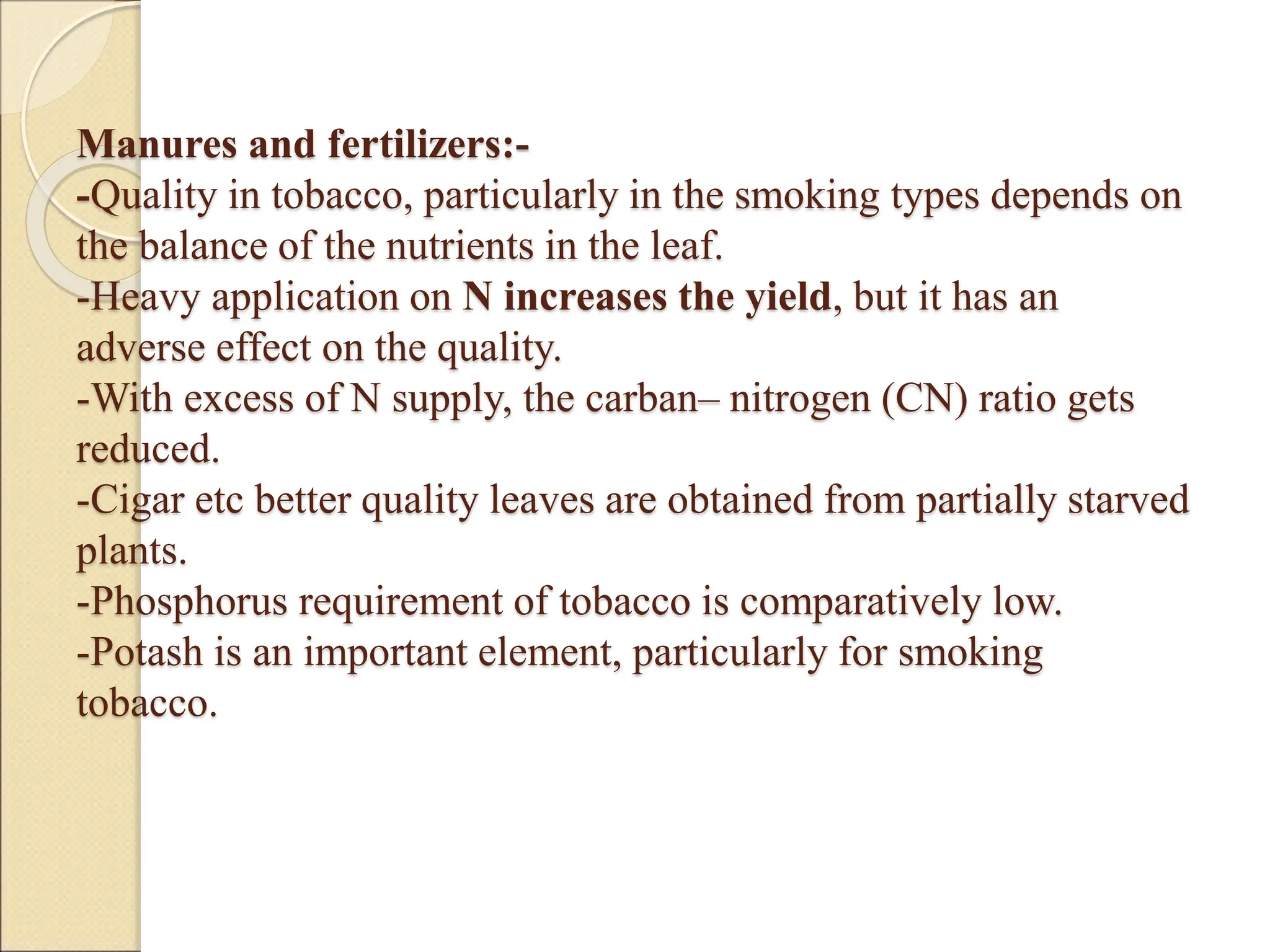
Manures and fertilizers:-
-Quality in tobacco, particularly in the smoking types depends on
the balance of the nutrients in the leaf.
-Heavy application on N increases the yield, but it has an
adverse effect on the quality.
-With excess of N supply, the carban– nitrogen (CN) ratio gets
reduced.
-Cigar etc better quality leaves are obtained from partially starved
plants.
-Phosphorus requirement of tobacco is comparatively low.
-Potash is an important element, particularly for smoking
tobacco.
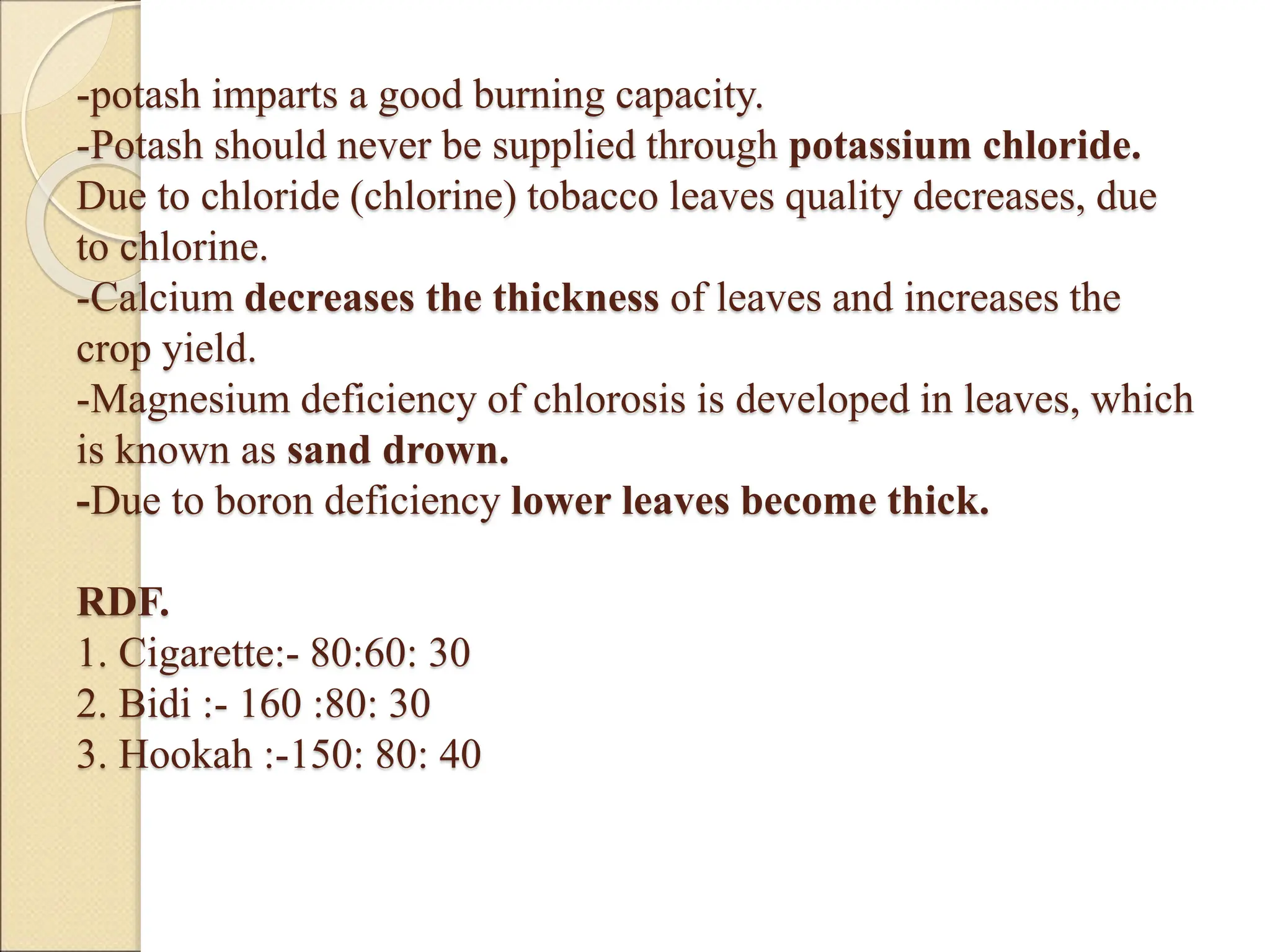
-potash imparts a good burning capacity.
-Potash should never be supplied through potassium chloride.
Due to chloride (chlorine) tobacco leaves quality decreases, due
to chlorine.
-Calcium decreases the thickness of leaves and increases the
crop yield.
-Magnesium deficiency of chlorosis is developed in leaves, which
is known as sand drown.
-Due to boron deficiency lower leaves become thick.
RDF.
1. Cigarette:- 80:60: 30
2. Bidi :- 160 :80: 30
3. Hookah :-150: 80: 40
Water management:-
-Tobacco crop does not tolerate water logging.
-It needs light and frequent irrigations.
-Too much irrigation produces slick leaf with dirty colour.
-6-7 irrigations are required.
-Irrigation water should be free from chlorides as it affects
burning quality of tobacco.
-More than 50 ppm chloride content in irrigation water inhibit
leaf burning, reduce leaf storage capacity.
Interculturing
Gap filling- The tobacco plants get established in about 10 days
after transplanting.
The gap filling operation should be completed as early as
possible to have uniform stand of crop.
Hoeing/Hand weeding:-Tobacco is very susceptible to water
logging.
-It requires good aeration.
-First intercultural operation should start 10 to 15 days DST
-usually 2 to 3 hoeing and 2 to 3 hand weedings are given.
Topping and de-suckering in tobacco:-
-Removal of terminal bud with or without some of the too
small leaves just before or after emergence of flower head is
called topping in tobacco.
-A week after topping dormancy buds in the leaf axils become
active and put forth branches technically known as suckers.
-These are also removed before they exceed 5 cm in length.
-This is known as desuckering.
Harvesting- and yield:
-The stage of maturity and the methods of harvesting differ with
the type of tobacco.
-Tobacco plants starts maturing 5 to 8 weeks after topping .
Signs of maturity:-
-When the normal green color changes to yellowish green or
slightly yellow.
-Leaves droop down and are brittle, thick spotted sticky or
gummy.
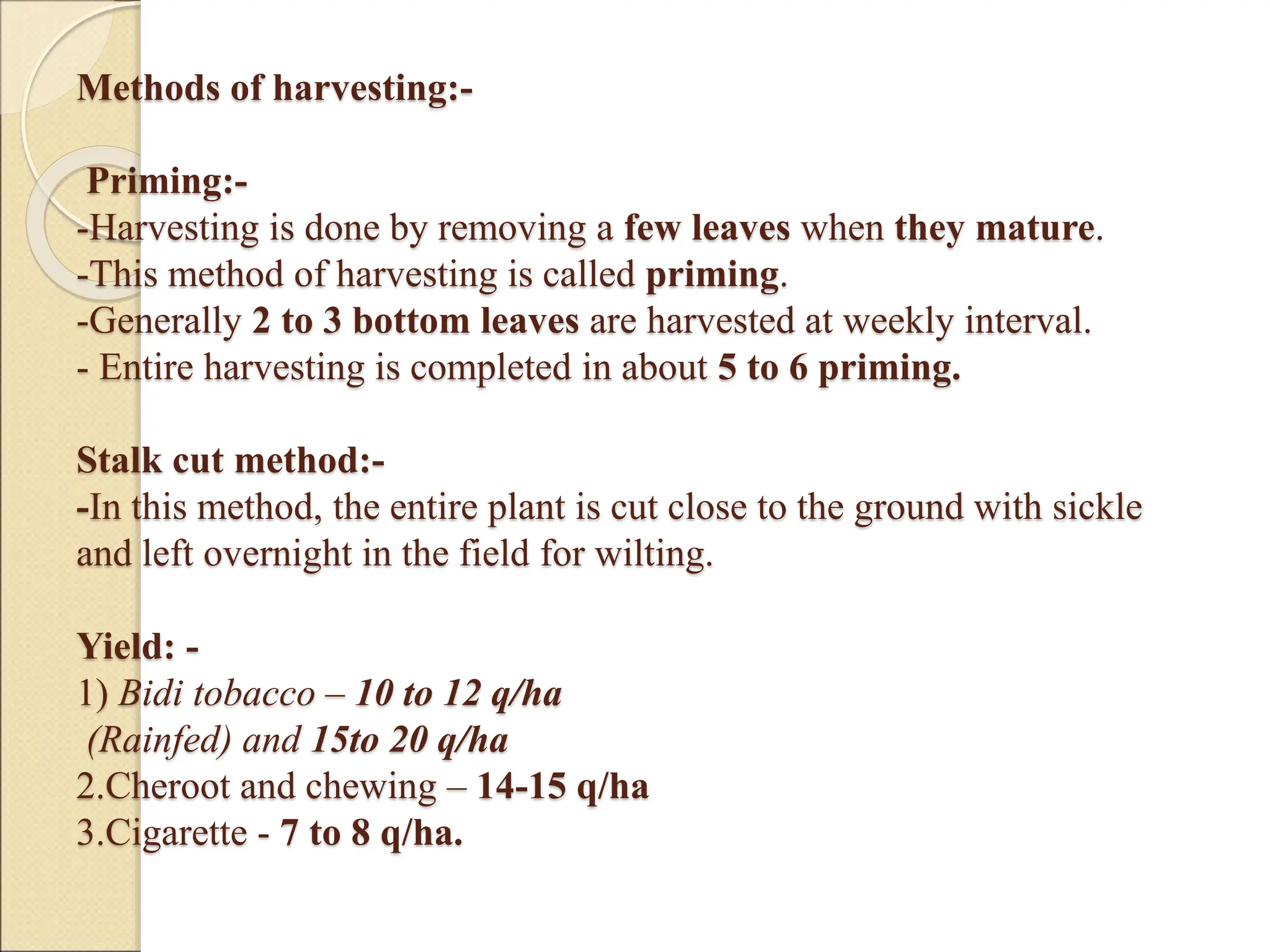
Methods of harvesting:-
Priming:-
-Harvesting is done by removing a few leaves when they mature.
-This method of harvesting is called priming.
-Generally 2 to 3 bottom leaves are harvested at weekly interval.
- Entire harvesting is completed in about 5 to 6 priming.
Stalk cut method:-
-In this method, the entire plant is cut close to the ground with sickle
and left overnight in the field for wilting.
Yield: -
1) Bidi tobacco – 10 to 12 q/ha
(Rainfed) and 15to 20 q/ha
2.Cheroot and chewing – 14-15 q/ha
3.Cigarette - 7 to 8 q/ha.

Tobacco.ppt Details cultivation practices of Tobacco

  • 1.
    Tobacco Botanical Name :-Nicotiana spp. Family:- Solanaceae Origin:- Central America. Tobacco is use as narcotic crop– used for stimulation. It is cultivated as cash commercial crop. The genus Nicotiana has more than 60 species. Economic importance: -generating huge socio- economic benefits in terms of agricultural employment, farm incomes, revenue generation and foreign exchange earnings. -Tobacco and tobacco products contributes total tax revenue more than 43,000crores annually .
  • 2.
    Botanical description:- Tobacco belongsto family solanaceae. It is herbaceous annual crop grown for its leaves. Roots: It has central tap root. Leaves:- Vary in number, shape and structure. In general, the texture of the leaves of N. tabacum is finer than that of N. rustica which more or less leathery and tough. Inflorescence:-raceme Tobacco is normally a self-pollinated crop, but cross-fertilization as much as 4 to 10% may occur from pollen carried by insects. The seeds of tobacco are extremely small; a single fruit may contain as many as 8000 seeds.
  • 3.
    Soil and Climate:- Soilrequirement:- -Quality of tobacco is influenced by the soil conditions. - light to medium loams soil. -Tobacco does not tolerate waterlogged soil. -It requires well drained soil. -cultivated in moderately acidic soil. -pH ranging from 5.5 to 6.5. Climatic requirement: - -Tobacco is a tropical crop . -it is grown in subtropical and temperate regions. -Tobacco needs 500-1000mm rainfall. -An optimum temperature for germination is 28°C . -Temperature above 35°C and cold weather and low temperature affects the quality of the tobacco. Relative humidity of 85-95% .
  • 4.
    Preparation of field:- -Aclean and well-pulverized seedbed of fine tilth is needed . -Land should be well prepared by ploughing followed by 3 to 4 cross harrowing. -Each harrowing should be followed by planking so that the soil is well pulverized and leveled. -Add 10 to 12 tonnes of F.Y.M. compost/ha in the soil at the time of last harrowing. Seed and sowing:- Method of sowing: Transplanting: Raising of seedlings (Nursery) -Tobacco seeds are very small (0.08 to 0.09 mg per seed wt.) and cannot be sown directly in the field. -The soil selected for raising seedlings should be sandy loam to clay loam.
  • 5.
    -Seedlings are raisedin the nursery beds 10-15 cm high. -During land preparation for nursery beds F.Y.M./compost. For each bed (3 x 1.2 m2 size) apply 125 gm of ammonium sulphate of potash and 50gm of thimate one day prior of sowing. Transplanting:- -Time of transplanting is varies from place to place keeping in view the varieties to be planted, soil and climatic conditions. Maharashtra- Bidi tobacco – Second week of August. North India- Mid September to Mid October. A.P. - Cigarette tobacco – Mid October
  • 6.
    Method of transplanting:- -Theposition of plants is marked by marking rope in cross direction. -A few hours before transplanting, the nursery beds are watered. -To loosen the soil and to help easy removal of seedlings. -Big and vigorous seedlings are uprooted with the help of khurpi . -soil will remain adhering to the roots. -The seedlings are kept in moist gunny begs. -Planting is usually done by hand and seedlings are set carefully in holes dug 10 to 15 cm deep by a khurpi, without bending the roots. -pressed by hand.
  • 7.
    1. Heavy soils100 x 100 cm2 - 10,000 plants/ha 2. Medium Soils 100 x 75 cm2 - 13,333 plants/ ha 3. Light Soils 100 x 50 cm2 - 20,000 plants / ha. Varieties of tobacco:- There is local and commercial varieties grown in the various tobacco producing areas under both N. tabacum and N. rustica. Improved varieties evolved at Central Tobacco Research Institute, Rajahmundry, A.P. Flue cured verginia cigarette tobacco- Harrison special, chatham, Virginia Gold Hicks, Kanakapatra, White gold, Dhanadayi. Bidi:- K-20, S-20, Anand-2, Anand-3, Anand-23, Anand-119, GT-4. Cigar wrapper:- S-5, Rangpur Sumitra Cigar filtOlor – 10, Havana, KV-1, KV-2. Cheroot – OK-1, Bhavani special, DR-1 Chewing:- Bhagyalaxmi, PV-7, VR-2, Sona, Gandak Bahar. Hookah:- DD-413, 414, 415, 417, DP 401, R – 12.
  • 8.
    Manures and fertilizers:- -Qualityin tobacco, particularly in the smoking types depends on the balance of the nutrients in the leaf. -Heavy application on N increases the yield, but it has an adverse effect on the quality. -With excess of N supply, the carban– nitrogen (CN) ratio gets reduced. -Cigar etc better quality leaves are obtained from partially starved plants. -Phosphorus requirement of tobacco is comparatively low. -Potash is an important element, particularly for smoking tobacco.
  • 9.
    -potash imparts agood burning capacity. -Potash should never be supplied through potassium chloride. Due to chloride (chlorine) tobacco leaves quality decreases, due to chlorine. -Calcium decreases the thickness of leaves and increases the crop yield. -Magnesium deficiency of chlorosis is developed in leaves, which is known as sand drown. -Due to boron deficiency lower leaves become thick. RDF. 1. Cigarette:- 80:60: 30 2. Bidi :- 160 :80: 30 3. Hookah :-150: 80: 40
  • 10.
    Water management:- -Tobacco cropdoes not tolerate water logging. -It needs light and frequent irrigations. -Too much irrigation produces slick leaf with dirty colour. -6-7 irrigations are required. -Irrigation water should be free from chlorides as it affects burning quality of tobacco. -More than 50 ppm chloride content in irrigation water inhibit leaf burning, reduce leaf storage capacity.
  • 11.
    Interculturing Gap filling- Thetobacco plants get established in about 10 days after transplanting. The gap filling operation should be completed as early as possible to have uniform stand of crop. Hoeing/Hand weeding:-Tobacco is very susceptible to water logging. -It requires good aeration. -First intercultural operation should start 10 to 15 days DST -usually 2 to 3 hoeing and 2 to 3 hand weedings are given.
  • 12.
    Topping and de-suckeringin tobacco:- -Removal of terminal bud with or without some of the too small leaves just before or after emergence of flower head is called topping in tobacco. -A week after topping dormancy buds in the leaf axils become active and put forth branches technically known as suckers. -These are also removed before they exceed 5 cm in length. -This is known as desuckering.
  • 13.
    Harvesting- and yield: -Thestage of maturity and the methods of harvesting differ with the type of tobacco. -Tobacco plants starts maturing 5 to 8 weeks after topping . Signs of maturity:- -When the normal green color changes to yellowish green or slightly yellow. -Leaves droop down and are brittle, thick spotted sticky or gummy.
  • 14.
    Methods of harvesting:- Priming:- -Harvestingis done by removing a few leaves when they mature. -This method of harvesting is called priming. -Generally 2 to 3 bottom leaves are harvested at weekly interval. - Entire harvesting is completed in about 5 to 6 priming. Stalk cut method:- -In this method, the entire plant is cut close to the ground with sickle and left overnight in the field for wilting. Yield: - 1) Bidi tobacco – 10 to 12 q/ha (Rainfed) and 15to 20 q/ha 2.Cheroot and chewing – 14-15 q/ha 3.Cigarette - 7 to 8 q/ha.