“ I have a dream that my four little
children will one day live in a nation
where they will not be judged by the
color of their skin, but by the content
of their character."
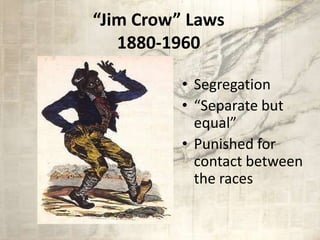
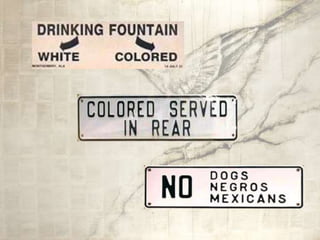
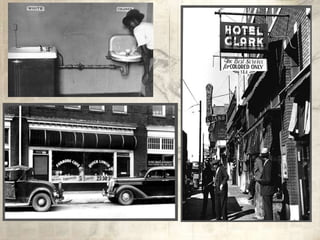
“Jim Crow” Laws
1880-1960
• Segregation
• “Separate but
equal”
• Punished for
contact between
the races
Jim Crow Guide
1. A Black male could not offer his hand (to shake hands) with a White male because it
implied being socially equal. Obviously, a Black male could not offer his hand or any other
part of his body to a White woman, because he risked being accused of rape.
· 2. Blacks and Whites were not supposed to eat together. If they did eat together, Whites
were to be served first, and some sort of partition was to be placed between them.
·
3. Under no circumstance was a Black male to offer to light the cigarette of a White
female -- that gesture implied intimacy.
· 4. Blacks were not allowed to show public affection toward one another in public,
especially kissing, because it offended Whites.
·
5. Blacks were introduced to Whites, never Whites to Blacks.
·
6. Whites did not use courtesy titles of respect when referring to Blacks, for example,
Mr., Mrs., Miss., Sir, or Ma'am. Instead, Blacks were called by their first names or by “boy”
or “girl” (regardless of age). Blacks had to use courtesy titles when referring to Whites,
and were not allowed to call them by their first names.
· 7. If a Black person rode in a car driven by a White person, the Black person sat in the
back seat, or the back of a truck.
·
8. White motorists had the right-of-way at all intersections.
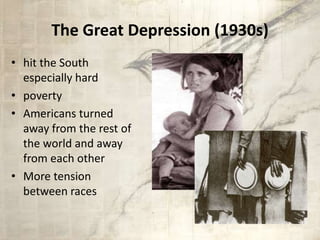
The Great Depression (1930s)
• hit the South
especially hard
• poverty
• Americans turned
away from the rest of
the world and away
from each other
• More tension
between races
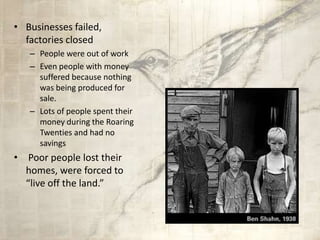
• Businesses failed,
factories closed
– People were out of work
– Even people with money
suffered because nothing
was being produced for
sale.
– Lots of people spent their
money during the Roaring
Twenties and had no
savings
• Poor people lost their
homes, were forced to
“live off the land.”
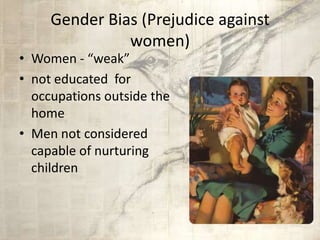
Gender Bias (Prejudice against
women)
• Women - “weak”
• not educated for
occupations outside the
home
• Men not considered
capable of nurturing
children
“White trash”
• Poor, uneducated white people who lived on
“relief “
– lowest social class, even below the poor blacks
– prejudiced against black people
– felt the need to “put down” blacks in order to
elevate themselves
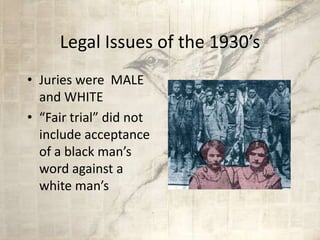
Legal Issues of the 1930’s
• Juries were MALE
and WHITE
• “Fair trial” did not
include acceptance
of a black man’s
word against a
white man’s
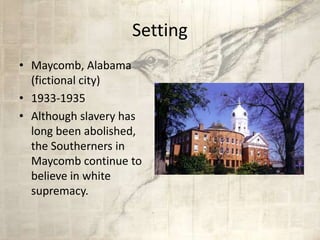
Setting
• Maycomb, Alabama
(fictional city)
• 1933-1935
• Although slavery has
long been abolished,
the Southerners in
Maycomb continue to
believe in white
supremacy.
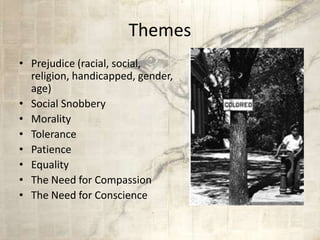
Themes
• Prejudice (racial, social,
religion, handicapped, gender,
age)
• Social Snobbery
• Morality
• Tolerance
• Patience
• Equality
• The Need for Compassion
• The Need for Conscience
Symbolism
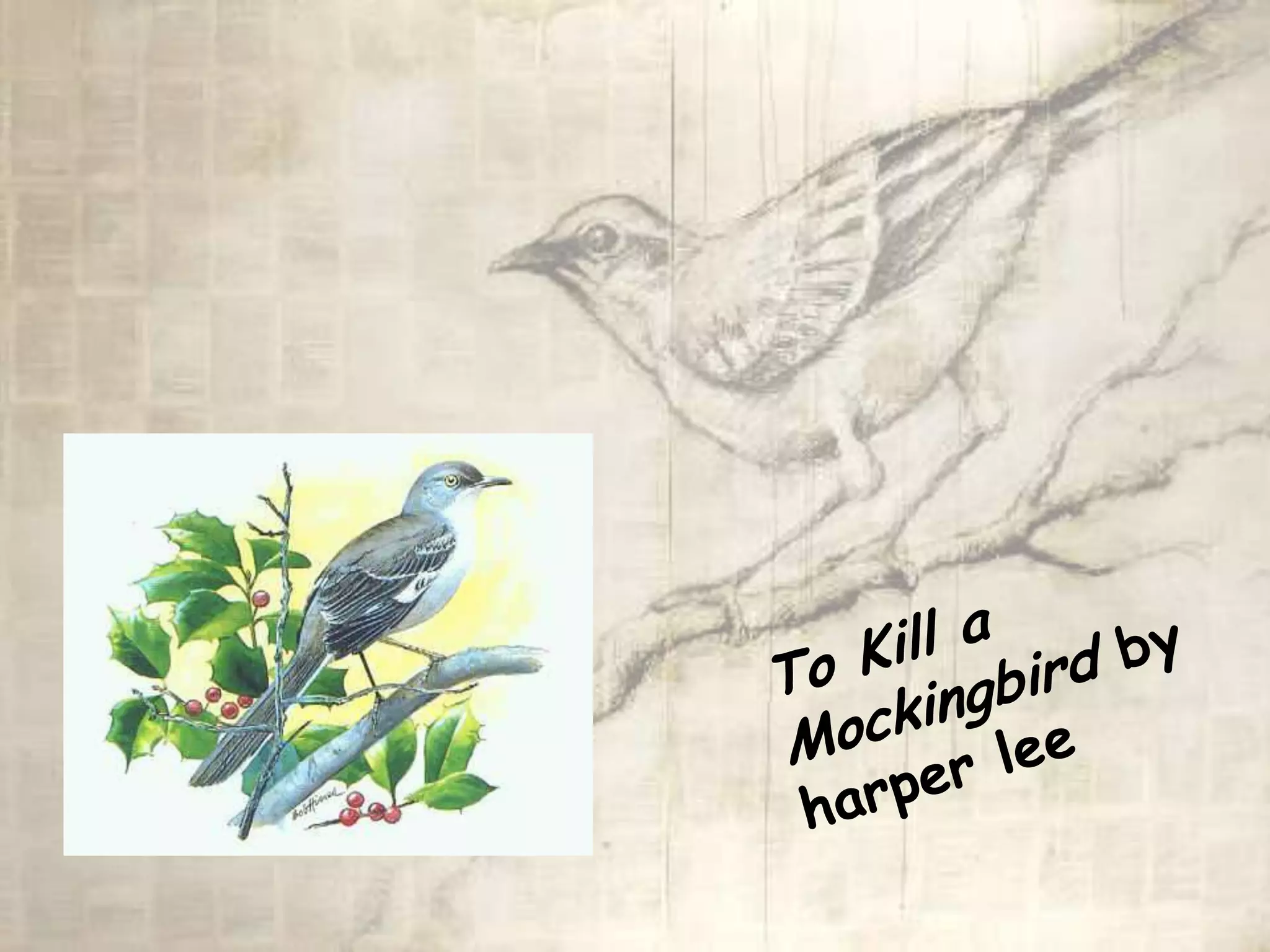
• The Mockingbird: Symbolizes Everything
That is Good and Harmless in This World
–The mockingbird only sings to please others
and therefore it is considered a sin to shoot
a mockingbird. They are considered
harmless creatures who give joy with their
song.
–Two characters in the novel symbolize the
mockingbird: Tom Robinson & Boo Radley.
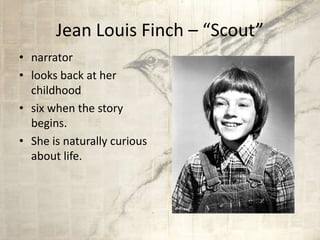
Jean Louis Finch – “Scout”
• narrator
• looks back at her
childhood
• six when the story
begins.
• She is naturally curious
about life.
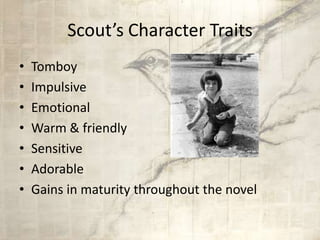
Scout’s Character Traits
• Tomboy
• Impulsive
• Emotional
• Warm & friendly
• Sensitive
• Adorable
• Gains in maturity throughout the novel
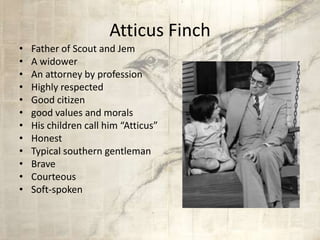
Atticus Finch
• Father of Scout and Jem
• A widower
• An attorney by profession
• Highly respected
• Good citizen
• good values and morals
• His children call him “Atticus”
• Honest
• Typical southern gentleman
• Brave
• Courteous
• Soft-spoken
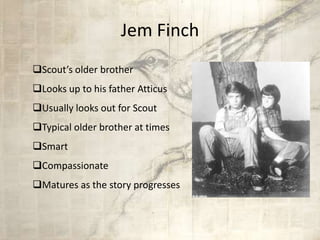
Jem Finch
Scout’s older brother
Looks up to his father Atticus
Usually looks out for Scout
Typical older brother at times
Smart
Compassionate
Matures as the story progresses
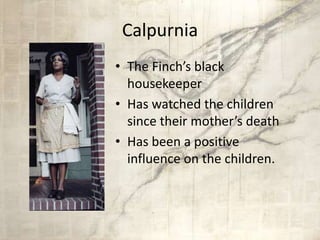
Calpurnia
• The Finch’s black
housekeeper
• Has watched the children
since their mother’s death
• Has been a positive
influence on the children.
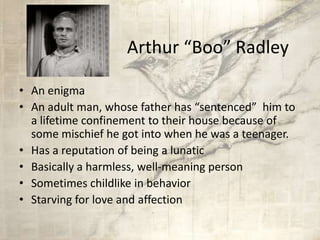
Arthur “Boo” Radley
• An enigma
• An adult man, whose father has “sentenced” him to
a lifetime confinement to their house because of
some mischief he got into when he was a teenager.
• Has a reputation of being a lunatic
• Basically a harmless, well-meaning person
• Sometimes childlike in behavior
• Starving for love and affection
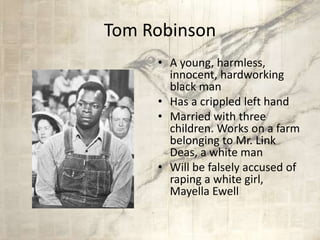
Tom Robinson
• A young, harmless,
innocent, hardworking
black man
• Has a crippled left hand
• Married with three
children. Works on a farm
belonging to Mr. Link
Deas, a white man
• Will be falsely accused of
raping a white girl,
Mayella Ewell
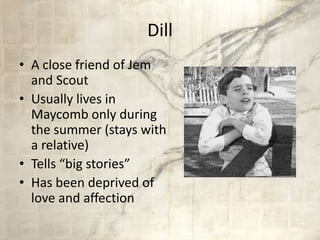
Dill
• A close friend of Jem
and Scout
• Usually lives in
Maycomb only during
the summer (stays with
a relative)
• Tells “big stories”
• Has been deprived of
love and affection
Two Poor White Families:
The Cunninghams The Ewells
• Poor white family
• Hard-working
• Honest
• Proud
• Survive on very little
• Always pay back their
debts – even if it is with
hickory nuts, turnips, or
holly.
• Poor white trash
• Dirty
• Lazy
• Good-for-nothing
• Never done a day’s
work
• Foul-mouthed
• Dishonest
• Immoral
The Black Community
• Simple
• Honest
• Clean
• Hard-working
• God fearing
• Proud
• Would never take anything
with paying it back
• Respectful
• Had stronger character than
most of the whites
• Oppressed
• Uneducated
• Discriminated against
• Talked about badly
• Deserve better than what is
dished out to them by
society
Language
• Various derogatory terms for
blacks will be used such as
“nigger,” “darky,” “Negroes,” and
“colored folk” – Lee uses such
language to keep her novel
naturally in sync with common
language of the times

"To Kill a Mockingbird" Intro

  • 2.
    “ I havea dream that my four little children will one day live in a nation where they will not be judged by the color of their skin, but by the content of their character."
  • 3.
    “Jim Crow” Laws 1880-1960 •Segregation • “Separate but equal” • Punished for contact between the races
  • 4.
    Jim Crow Guide 1.A Black male could not offer his hand (to shake hands) with a White male because it implied being socially equal. Obviously, a Black male could not offer his hand or any other part of his body to a White woman, because he risked being accused of rape. · 2. Blacks and Whites were not supposed to eat together. If they did eat together, Whites were to be served first, and some sort of partition was to be placed between them. · 3. Under no circumstance was a Black male to offer to light the cigarette of a White female -- that gesture implied intimacy. · 4. Blacks were not allowed to show public affection toward one another in public, especially kissing, because it offended Whites. · 5. Blacks were introduced to Whites, never Whites to Blacks. · 6. Whites did not use courtesy titles of respect when referring to Blacks, for example, Mr., Mrs., Miss., Sir, or Ma'am. Instead, Blacks were called by their first names or by “boy” or “girl” (regardless of age). Blacks had to use courtesy titles when referring to Whites, and were not allowed to call them by their first names. · 7. If a Black person rode in a car driven by a White person, the Black person sat in the back seat, or the back of a truck. · 8. White motorists had the right-of-way at all intersections.
  • 6.
    The Great Depression(1930s) • hit the South especially hard • poverty • Americans turned away from the rest of the world and away from each other • More tension between races
  • 7.
    • Businesses failed, factoriesclosed – People were out of work – Even people with money suffered because nothing was being produced for sale. – Lots of people spent their money during the Roaring Twenties and had no savings • Poor people lost their homes, were forced to “live off the land.”
  • 9.
    Gender Bias (Prejudiceagainst women) • Women - “weak” • not educated for occupations outside the home • Men not considered capable of nurturing children
  • 10.
    “White trash” • Poor,uneducated white people who lived on “relief “ – lowest social class, even below the poor blacks – prejudiced against black people – felt the need to “put down” blacks in order to elevate themselves
  • 11.
    Legal Issues ofthe 1930’s • Juries were MALE and WHITE • “Fair trial” did not include acceptance of a black man’s word against a white man’s
  • 12.
    Setting • Maycomb, Alabama (fictionalcity) • 1933-1935 • Although slavery has long been abolished, the Southerners in Maycomb continue to believe in white supremacy.
  • 13.
    Themes • Prejudice (racial,social, religion, handicapped, gender, age) • Social Snobbery • Morality • Tolerance • Patience • Equality • The Need for Compassion • The Need for Conscience
  • 14.
    Symbolism • The Mockingbird:Symbolizes Everything That is Good and Harmless in This World –The mockingbird only sings to please others and therefore it is considered a sin to shoot a mockingbird. They are considered harmless creatures who give joy with their song. –Two characters in the novel symbolize the mockingbird: Tom Robinson & Boo Radley.
  • 15.
    Jean Louis Finch– “Scout” • narrator • looks back at her childhood • six when the story begins. • She is naturally curious about life.
  • 16.
    Scout’s Character Traits •Tomboy • Impulsive • Emotional • Warm & friendly • Sensitive • Adorable • Gains in maturity throughout the novel
  • 17.
    Atticus Finch • Fatherof Scout and Jem • A widower • An attorney by profession • Highly respected • Good citizen • good values and morals • His children call him “Atticus” • Honest • Typical southern gentleman • Brave • Courteous • Soft-spoken
  • 18.
    Jem Finch Scout’s olderbrother Looks up to his father Atticus Usually looks out for Scout Typical older brother at times Smart Compassionate Matures as the story progresses
  • 19.
    Calpurnia • The Finch’sblack housekeeper • Has watched the children since their mother’s death • Has been a positive influence on the children.
  • 20.
    Arthur “Boo” Radley •An enigma • An adult man, whose father has “sentenced” him to a lifetime confinement to their house because of some mischief he got into when he was a teenager. • Has a reputation of being a lunatic • Basically a harmless, well-meaning person • Sometimes childlike in behavior • Starving for love and affection
  • 21.
    Tom Robinson • Ayoung, harmless, innocent, hardworking black man • Has a crippled left hand • Married with three children. Works on a farm belonging to Mr. Link Deas, a white man • Will be falsely accused of raping a white girl, Mayella Ewell
  • 22.
    Dill • A closefriend of Jem and Scout • Usually lives in Maycomb only during the summer (stays with a relative) • Tells “big stories” • Has been deprived of love and affection
  • 23.
    Two Poor WhiteFamilies: The Cunninghams The Ewells • Poor white family • Hard-working • Honest • Proud • Survive on very little • Always pay back their debts – even if it is with hickory nuts, turnips, or holly. • Poor white trash • Dirty • Lazy • Good-for-nothing • Never done a day’s work • Foul-mouthed • Dishonest • Immoral
  • 24.
    The Black Community •Simple • Honest • Clean • Hard-working • God fearing • Proud • Would never take anything with paying it back • Respectful • Had stronger character than most of the whites • Oppressed • Uneducated • Discriminated against • Talked about badly • Deserve better than what is dished out to them by society
  • 25.
    Language • Various derogatoryterms for blacks will be used such as “nigger,” “darky,” “Negroes,” and “colored folk” – Lee uses such language to keep her novel naturally in sync with common language of the times