Seminar on "Sharing Innovative
Ideas on STEM/Maker Activities
for Secondary School Students"
Dr. Clifford Choy
School of Design, PolyU
15 Jun 2018
mccliff@polyu.edu.hk
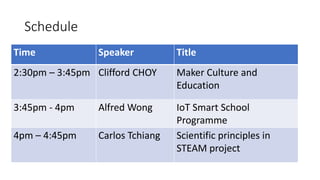
Schedule
Time Speaker Title
2:30pm – 3:45pm Clifford CHOY Maker Culture and
Education
3:45pm - 4pm Alfred Wong IoT Smart School
Programme
4pm – 4:45pm Carlos Tchiang Scientific principles in
STEAM project
Maker Culture and Education
Dr. Clifford CHOY
School of Design, PolyU
15 Jun 2018
mccliff@polyu.edu.hk
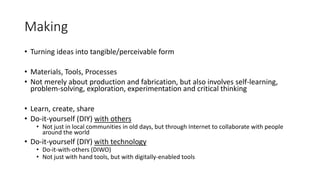
Making
• Turning ideas into tangible/perceivable form
• Materials, Tools, Processes
• Not merely about production and fabrication, but also involves self-learning,
problem-solving, exploration, experimentation and critical thinking
• Learn, create, share
• Do-it-yourself (DIY) with others
• Not just in local communities in old days, but through Internet to collaborate with people
around the world
• Do-it-yourself (DIY) with technology
• Do-it-with-others (DIWO)
• Not just with hand tools, but with digitally-enabled tools
Maker Movement
• Growing culture of hands-on making, creating, designing and
innovating
• Despite its diversity [in makers’ interests], the movement is unified by
a shared commitment to open exploration, intrinsic interests and
creative ideas
• When I talk about the maker movement, I make an effort to stay
away from the word “inventor” – most people just don’t identify
themselves that way. “Maker”, on the other hand, describes each
one of us no matter how we live our lives, or what our goals might
be.
Peppler, K., Bender, S. (2013) Maker movement spreads innovation one project at a time. Kappan, v95, N3,
pp22-27. Retrieved from http://www.kyliepeppler.com/Docs/2013_Peppler_Maker_Movement.pdf
Dougherty, D. (2012). The Maker Movement. Innovations, v7, n3, pp11-14
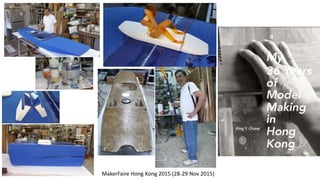
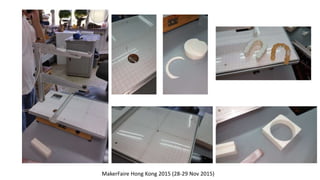
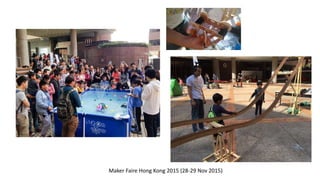
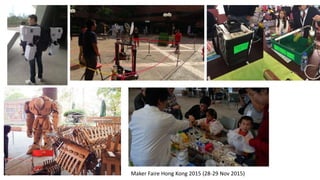
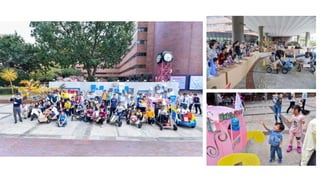
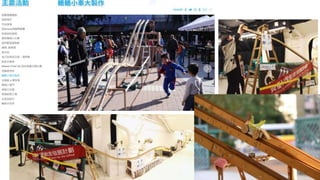
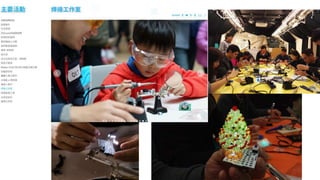
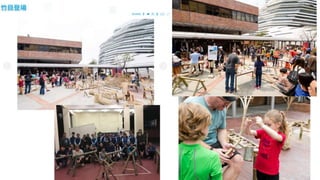
MakerFaire Hong Kong 2015 (28-29 Nov 2015)
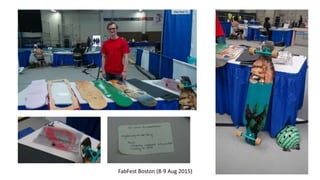
FabFest Boston (8-9 Aug 2015)
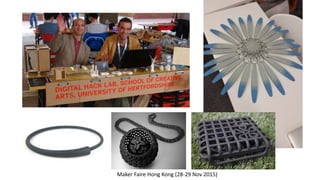
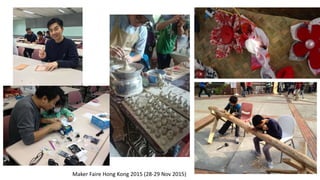
Maker Faire Hong Kong (28-29 Nov 2015)
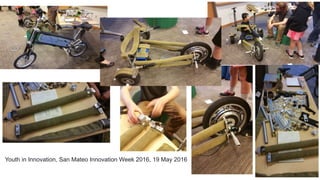
Youth in Innovation, San Mateo Innovation Week 2016, 19 May 2016
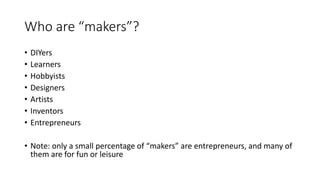
Who are “makers”?
• DIYers
• Learners
• Hobbyists
• Designers
• Artists
• Inventors
• Entrepreneurs
• Note: only a small percentage of “makers” are entrepreneurs, and many of
them are for fun or leisure
“making”
The Experiential Learning Cycle [Kolb and Kolb, 2005]
Kolb, A., Kolb, D. (2005, May 15) The Kolb Learning Style Inventory – Version 3.1 2005 Technical Specifications. Retrieved from
http://learningfromexperience.com/media/2010/08/tech_spec_lsi.pdf
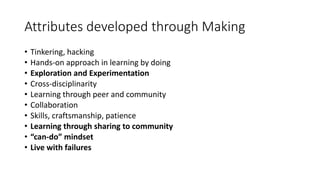
Attributes developed through Making
• Tinkering, hacking
• Hands-on approach in learning by doing
• Exploration and Experimentation
• Cross-disciplinarity
• Learning through peer and community
• Collaboration
• Skills, craftsmanship, patience
• Learning through sharing to community
• “can-do” mindset
• Live with failures
STEM, STEAM, Make, Design
STEM Education in Hong Kong
• According to EDB (2015, Dec):
• We aim to further develop among students a strong knowledge base in step
with the latest changes in these disciplines, and strengthen their ability to
integrate and apply knowledge and skills, so as to nurture their creativity and
innovation, collaboration and problem solving skills, which are essential
skills and qualities required in the 21st century. The learning activities of
STEM education also help students develop the essential qualities associated
with an entrepreneurial spirit.
• Should consider STEAM, Make and Design as well !!!!
Educational Development Bureau (2015, Dec) On-going Renewal of the School Curriculum – Focusing, Deepening and Sustaining: An
Overview. Retrieved from http://www.edb.gov.hk/attachment/en/curriculum-development/renewal/Overview_e_2015Dec.pdf
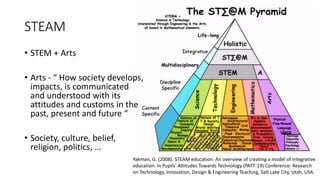
STEAM
Yakman, G. (2008). STEAM education: An overview of creating a model of integrative
education. In Pupils' Attitudes Towards Technology (PATT-19) Conference: Research
on Technology, Innovation, Design & Engineering Teaching, Salt Lake City, Utah, USA.
• STEM + Arts
• Arts - “ How society develops,
impacts, is communicated
and understood with its
attitudes and customs in the
past, present and future “
• Society, culture, belief,
religion, politics, …
Design
• Design is the competence to change existing situations into preferred ones.
Design then, is the human capacity to serve the needs of people and give
meaning to life through objects, communications, environments and systems
John Heskett
• Design is what links creativity and innovation. It shapes ideas to become practical
and attractive propositions for users or customers. Design may be described as
creativity deployed to a specific end.
Sir George Cox
• Design is about understanding users and finding elegant solutions to meet their
needs
Why Design?
• “Everyone designs who devises courses of action aimed at changing existing situations into
preferred ones.”
• “… design … makes ideas tangible, it [design] takes abstract thoughts and inspirations and makes
something concrete.”
• Designers think through making
(Herbert Simon, 1981, as cited by John Hesket, 2009)
(Mat Hunter, 2014)
Heskett, J. (2009). Creating Economic Value by Design. International Journal of Design, v3, n1. Retrieved from:
http://www.ijdesign.org/ojs/index.php/IJDesign/article/view/477/243
Hunter, M (2014) What is Design and Why it matters? Retrieved on 5 May 2015 from http://www.thecreativeindustries.co.uk/uk-creative-overview/news-and-
views/view-what-is-design-and-why-it-matters
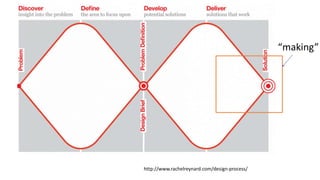
http://www.rachelreynard.com/design-process/
“making”
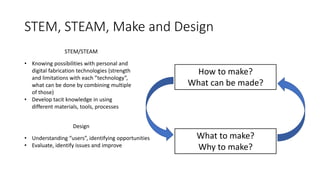
How to make?
What can be made?
What to make?
Why to make?
STEM, STEAM, Make and Design
• Knowing possibilities with personal and
digital fabrication technologies (strength
and limitations with each ”technology”,
what can be done by combining multiple
of those)
• Develop tacit knowledge in using
different materials, tools, processes
• Understanding “users”, identifying opportunities
• Evaluate, identify issues and improve
STEM/STEAM
Design
Maker Faire
What is Maker Faire?
• A family-friendly festival of invention, creativity and resourcefulness
• For makers to gather, show what they have made, and share what they have learned
• To demonstrate what is possible
• To exchange knowledge and ideas
• To inspire others
• Part of science fair, part of fun fair, part of country fair
• NOT “Book Fair”, “Computer Fair”, “Animation-Comic and Game Fair” in Hong Kong
• NOT a trade fair dominated by traditional sales and marketing
• NOT an invention show, NOT a technology expo
• NOT a competition
What is Maker Faire?
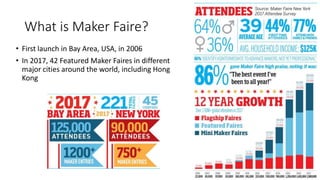
• First launch in Bay Area, USA, in 2006
• In 2017, 42 Featured Maker Faires in different
major cities around the world, including Hong
Kong
Why Maker Faire?
• Promote Maker Culture
• What is “Making”
• Turning ideas into tangible/perceivable form
• “Vision” to “execution”
• Driven by intrinsic interests, not extrinsic rewards
• Fun? Needs?
• Learn, create, share
• Ground up innovation, learn by doing, empowerment
• Sustainable human development
What do you expect in Maker Faire?
• Makers show-and-tell their works/projects
• Presentation
• Demonstration/Performance
• Hands-on activities
• Workshops
• Experiential Session
• Contests/Competitions
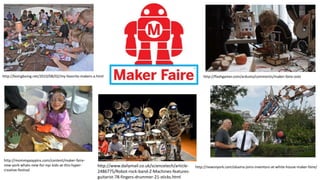
http://flashgamer.com/arduino/comments/maker-faire-oslo
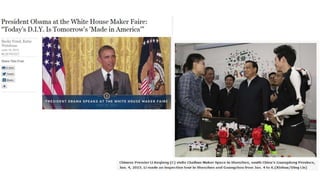
http://newsnyork.com/obama-joins-inventors-at-white-house-maker-faire/
http://mommypoppins.com/content/maker-faire-
new-york-whats-new-for-nyc-kids-at-this-hyper-
creative-festival
http://boingboing.net/2010/08/02/my-favorite-makers-a.html
http://www.dailymail.co.uk/sciencetech/article-
2486775/Robot-rock-band-Z-Machines-features-
guitarist-78-fingers-drummer-21-sticks.html
Supports Three Broad Stages of Makers
• Zero to Maker
• Arouse interest of those with no experience in making to become a maker
• In Maker Faire: Through hands-on activities, through workshops, through inspiring
talks, through inspiring works from other makers
• Maker to Maker
• Sharing of knowledge between makers
• Collaborate and access to others’ expertise
• Work together on shared platforms
• In Maker Faire: Through show-and-tell their projects, through offering hands-on
activities and organizing workshops, through interact with visitors and other makers
• Maker to Market
• Some creations of makers have commercial appeal and get into the market
• In Maker Faire: Through presenting their journey to other makers, through collecting
feedbacks from visitors on their creations
Hagel, J., Brown, J., Kulasooriya, D. (2014) A Movement in the Making. Retrieved
from http://dupress.com/articles/a-movement-in-the-making/
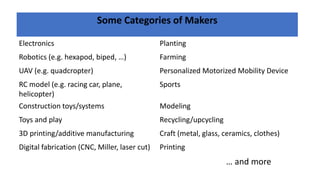
Some Categories of Makers
Electronics Planting
Robotics (e.g. hexapod, biped, …) Farming
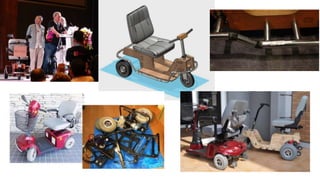
UAV (e.g. quadcropter) Personalized Motorized Mobility Device
RC model (e.g. racing car, plane,
helicopter)
Sports
Construction toys/systems Modeling
Toys and play Recycling/upcycling
3D printing/additive manufacturing Craft (metal, glass, ceramics, clothes)
Digital fabrication (CNC, Miller, laser cut) Printing
… and more
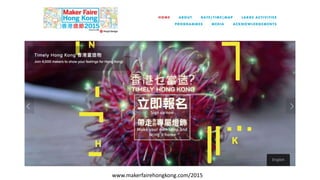
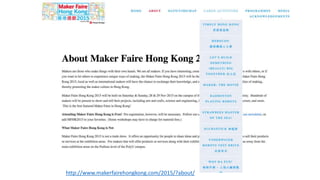
www.makerfairehongkong.com/2015
http://www.makerfairehongkong.com/2015/?about/
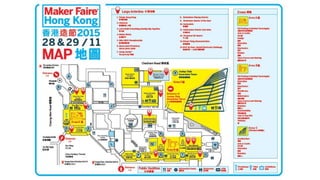
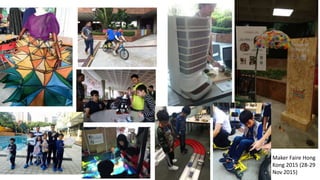
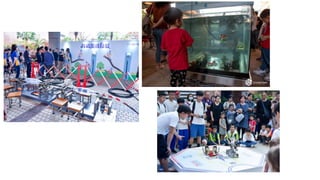
Maker Faire Hong Kong 2015 (28-29 Nov 2015)
Maker Faire Hong
Kong 2015 (28-29
Nov 2015)
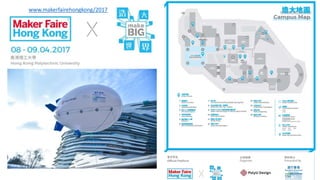
www.makerfairehongkong/2017
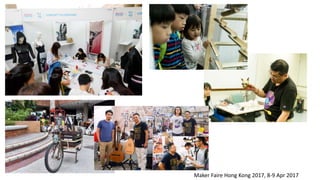
Maker Faire Hong Kong 2017, 8-9 Apr 2017
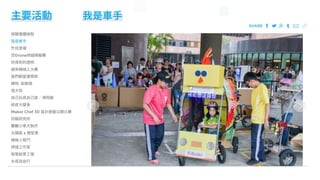
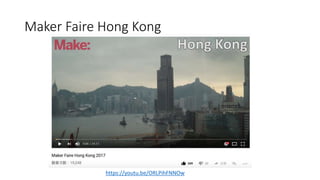
Maker Faire Hong Kong
https://youtu.be/ORLPihFNNOw
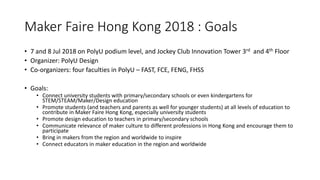
Maker Faire Hong Kong 2018 : Goals
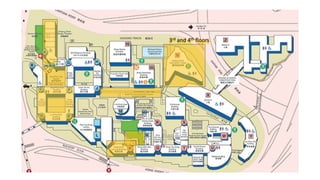
• 7 and 8 Jul 2018 on PolyU podium level, and Jockey Club Innovation Tower 3rd and 4th Floor
• Organizer: PolyU Design
• Co-organizers: four faculties in PolyU – FAST, FCE, FENG, FHSS
• Goals:
• Connect university students with primary/secondary schools or even kindergartens for
STEM/STEAM/Maker/Design education
• Promote students (and teachers and parents as well for younger students) at all levels of education to
contribute in Maker Faire Hong Kong, especially university students
• Promote design education to teachers in primary/secondary schools
• Communicate relevance of maker culture to different professions in Hong Kong and encourage them to
participate
• Bring in makers from the region and worldwide to inspire
• Connect educators in maker education in the region and worldwide
Themes
• Sound and Music
• Chinese character and printing
• Paper Casting
• Automata, Mechanical toys
• Geodesic dome
• LPWAN, IoT
• Goldberg Machine
• Electric vehicle
• Underwater robots
• Robot soccer
• Microbit
• FischerTechnik
• Makeblock
• ….
3rd and 4th floors
Maker Culture and Education
Questions
• How to introduce “Maker Projects” into existing curriculum
• Two Subjects
• Computer Game Development (Bachelor) (SD3985)
• Prototyping and Scripting + Tangible Interaction Workshop (Master) (SD5509
+ SD5524)
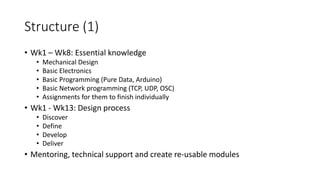
Structure (1)
• Wk1 – Wk8: Essential knowledge
• Mechanical Design
• Basic Electronics
• Basic Programming (Pure Data, Arduino)
• Basic Network programming (TCP, UDP, OSC)
• Assignments for them to finish individually
• Wk1 - Wk13: Design process
• Discover
• Define
• Develop
• Deliver
• Mentoring, technical support and create re-usable modules
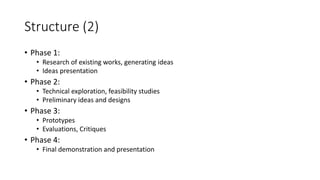
Structure (2)
• Phase 1:
• Research of existing works, generating ideas
• Ideas presentation
• Phase 2:
• Technical exploration, feasibility studies
• Preliminary ideas and designs
• Phase 3:
• Prototypes
• Evaluations, Critiques
• Phase 4:
• Final demonstration and presentation
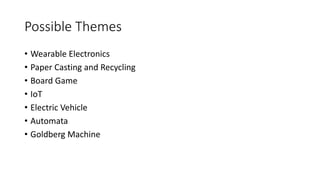
Possible Themes
• Wearable Electronics
• Paper Casting and Recycling
• Board Game
• IoT
• Electric Vehicle
• Automata
• Goldberg Machine
Looking forward to seeing you in
MFHK2018, to have fun and learn
Thanks
Questions?

Maker culture and education

  • 1.
    Seminar on "SharingInnovative Ideas on STEM/Maker Activities for Secondary School Students" Dr. Clifford Choy School of Design, PolyU 15 Jun 2018 mccliff@polyu.edu.hk
  • 2.
    Schedule Time Speaker Title 2:30pm– 3:45pm Clifford CHOY Maker Culture and Education 3:45pm - 4pm Alfred Wong IoT Smart School Programme 4pm – 4:45pm Carlos Tchiang Scientific principles in STEAM project
  • 3.
    Maker Culture andEducation Dr. Clifford CHOY School of Design, PolyU 15 Jun 2018 mccliff@polyu.edu.hk
  • 4.
    Making • Turning ideasinto tangible/perceivable form • Materials, Tools, Processes • Not merely about production and fabrication, but also involves self-learning, problem-solving, exploration, experimentation and critical thinking • Learn, create, share • Do-it-yourself (DIY) with others • Not just in local communities in old days, but through Internet to collaborate with people around the world • Do-it-yourself (DIY) with technology • Do-it-with-others (DIWO) • Not just with hand tools, but with digitally-enabled tools
  • 5.
    Maker Movement • Growingculture of hands-on making, creating, designing and innovating • Despite its diversity [in makers’ interests], the movement is unified by a shared commitment to open exploration, intrinsic interests and creative ideas • When I talk about the maker movement, I make an effort to stay away from the word “inventor” – most people just don’t identify themselves that way. “Maker”, on the other hand, describes each one of us no matter how we live our lives, or what our goals might be. Peppler, K., Bender, S. (2013) Maker movement spreads innovation one project at a time. Kappan, v95, N3, pp22-27. Retrieved from http://www.kyliepeppler.com/Docs/2013_Peppler_Maker_Movement.pdf Dougherty, D. (2012). The Maker Movement. Innovations, v7, n3, pp11-14
  • 6.
    MakerFaire Hong Kong2015 (28-29 Nov 2015)
  • 10.
    MakerFaire Hong Kong2015 (28-29 Nov 2015)
  • 11.
  • 12.
    Maker Faire HongKong (28-29 Nov 2015)
  • 13.
    Youth in Innovation,San Mateo Innovation Week 2016, 19 May 2016
  • 16.
    Who are “makers”? •DIYers • Learners • Hobbyists • Designers • Artists • Inventors • Entrepreneurs • Note: only a small percentage of “makers” are entrepreneurs, and many of them are for fun or leisure
  • 17.
    “making” The Experiential LearningCycle [Kolb and Kolb, 2005] Kolb, A., Kolb, D. (2005, May 15) The Kolb Learning Style Inventory – Version 3.1 2005 Technical Specifications. Retrieved from http://learningfromexperience.com/media/2010/08/tech_spec_lsi.pdf
  • 18.
    Attributes developed throughMaking • Tinkering, hacking • Hands-on approach in learning by doing • Exploration and Experimentation • Cross-disciplinarity • Learning through peer and community • Collaboration • Skills, craftsmanship, patience • Learning through sharing to community • “can-do” mindset • Live with failures
  • 19.
  • 20.
    STEM Education inHong Kong • According to EDB (2015, Dec): • We aim to further develop among students a strong knowledge base in step with the latest changes in these disciplines, and strengthen their ability to integrate and apply knowledge and skills, so as to nurture their creativity and innovation, collaboration and problem solving skills, which are essential skills and qualities required in the 21st century. The learning activities of STEM education also help students develop the essential qualities associated with an entrepreneurial spirit. • Should consider STEAM, Make and Design as well !!!! Educational Development Bureau (2015, Dec) On-going Renewal of the School Curriculum – Focusing, Deepening and Sustaining: An Overview. Retrieved from http://www.edb.gov.hk/attachment/en/curriculum-development/renewal/Overview_e_2015Dec.pdf
  • 21.
    STEAM Yakman, G. (2008).STEAM education: An overview of creating a model of integrative education. In Pupils' Attitudes Towards Technology (PATT-19) Conference: Research on Technology, Innovation, Design & Engineering Teaching, Salt Lake City, Utah, USA. • STEM + Arts • Arts - “ How society develops, impacts, is communicated and understood with its attitudes and customs in the past, present and future “ • Society, culture, belief, religion, politics, …
  • 22.
    Design • Design isthe competence to change existing situations into preferred ones. Design then, is the human capacity to serve the needs of people and give meaning to life through objects, communications, environments and systems John Heskett • Design is what links creativity and innovation. It shapes ideas to become practical and attractive propositions for users or customers. Design may be described as creativity deployed to a specific end. Sir George Cox • Design is about understanding users and finding elegant solutions to meet their needs
  • 23.
    Why Design? • “Everyonedesigns who devises courses of action aimed at changing existing situations into preferred ones.” • “… design … makes ideas tangible, it [design] takes abstract thoughts and inspirations and makes something concrete.” • Designers think through making (Herbert Simon, 1981, as cited by John Hesket, 2009) (Mat Hunter, 2014) Heskett, J. (2009). Creating Economic Value by Design. International Journal of Design, v3, n1. Retrieved from: http://www.ijdesign.org/ojs/index.php/IJDesign/article/view/477/243 Hunter, M (2014) What is Design and Why it matters? Retrieved on 5 May 2015 from http://www.thecreativeindustries.co.uk/uk-creative-overview/news-and- views/view-what-is-design-and-why-it-matters
  • 24.
  • 25.
    How to make? Whatcan be made? What to make? Why to make? STEM, STEAM, Make and Design • Knowing possibilities with personal and digital fabrication technologies (strength and limitations with each ”technology”, what can be done by combining multiple of those) • Develop tacit knowledge in using different materials, tools, processes • Understanding “users”, identifying opportunities • Evaluate, identify issues and improve STEM/STEAM Design
  • 26.
  • 27.
    What is MakerFaire? • A family-friendly festival of invention, creativity and resourcefulness • For makers to gather, show what they have made, and share what they have learned • To demonstrate what is possible • To exchange knowledge and ideas • To inspire others • Part of science fair, part of fun fair, part of country fair • NOT “Book Fair”, “Computer Fair”, “Animation-Comic and Game Fair” in Hong Kong • NOT a trade fair dominated by traditional sales and marketing • NOT an invention show, NOT a technology expo • NOT a competition
  • 28.
    What is MakerFaire? • First launch in Bay Area, USA, in 2006 • In 2017, 42 Featured Maker Faires in different major cities around the world, including Hong Kong
  • 29.
    Why Maker Faire? •Promote Maker Culture • What is “Making” • Turning ideas into tangible/perceivable form • “Vision” to “execution” • Driven by intrinsic interests, not extrinsic rewards • Fun? Needs? • Learn, create, share • Ground up innovation, learn by doing, empowerment • Sustainable human development
  • 30.
    What do youexpect in Maker Faire? • Makers show-and-tell their works/projects • Presentation • Demonstration/Performance • Hands-on activities • Workshops • Experiential Session • Contests/Competitions
  • 31.
  • 32.
    Supports Three BroadStages of Makers • Zero to Maker • Arouse interest of those with no experience in making to become a maker • In Maker Faire: Through hands-on activities, through workshops, through inspiring talks, through inspiring works from other makers • Maker to Maker • Sharing of knowledge between makers • Collaborate and access to others’ expertise • Work together on shared platforms • In Maker Faire: Through show-and-tell their projects, through offering hands-on activities and organizing workshops, through interact with visitors and other makers • Maker to Market • Some creations of makers have commercial appeal and get into the market • In Maker Faire: Through presenting their journey to other makers, through collecting feedbacks from visitors on their creations Hagel, J., Brown, J., Kulasooriya, D. (2014) A Movement in the Making. Retrieved from http://dupress.com/articles/a-movement-in-the-making/
  • 33.
    Some Categories ofMakers Electronics Planting Robotics (e.g. hexapod, biped, …) Farming UAV (e.g. quadcropter) Personalized Motorized Mobility Device RC model (e.g. racing car, plane, helicopter) Sports Construction toys/systems Modeling Toys and play Recycling/upcycling 3D printing/additive manufacturing Craft (metal, glass, ceramics, clothes) Digital fabrication (CNC, Miller, laser cut) Printing … and more
  • 35.
  • 36.
  • 38.
    Maker Faire HongKong 2015 (28-29 Nov 2015)
  • 39.
    Maker Faire HongKong 2015 (28-29 Nov 2015)
  • 40.
    Maker Faire HongKong 2015 (28-29 Nov 2015)
  • 41.
    Maker Faire Hong Kong2015 (28-29 Nov 2015)
  • 42.
  • 49.
    Maker Faire HongKong 2017, 8-9 Apr 2017
  • 50.
    Maker Faire HongKong https://youtu.be/ORLPihFNNOw
  • 51.
    Maker Faire HongKong 2018 : Goals • 7 and 8 Jul 2018 on PolyU podium level, and Jockey Club Innovation Tower 3rd and 4th Floor • Organizer: PolyU Design • Co-organizers: four faculties in PolyU – FAST, FCE, FENG, FHSS • Goals: • Connect university students with primary/secondary schools or even kindergartens for STEM/STEAM/Maker/Design education • Promote students (and teachers and parents as well for younger students) at all levels of education to contribute in Maker Faire Hong Kong, especially university students • Promote design education to teachers in primary/secondary schools • Communicate relevance of maker culture to different professions in Hong Kong and encourage them to participate • Bring in makers from the region and worldwide to inspire • Connect educators in maker education in the region and worldwide
  • 52.
    Themes • Sound andMusic • Chinese character and printing • Paper Casting • Automata, Mechanical toys • Geodesic dome • LPWAN, IoT • Goldberg Machine • Electric vehicle • Underwater robots • Robot soccer • Microbit • FischerTechnik • Makeblock • ….
  • 53.
  • 54.
  • 55.
    Questions • How tointroduce “Maker Projects” into existing curriculum • Two Subjects • Computer Game Development (Bachelor) (SD3985) • Prototyping and Scripting + Tangible Interaction Workshop (Master) (SD5509 + SD5524)
  • 56.
    Structure (1) • Wk1– Wk8: Essential knowledge • Mechanical Design • Basic Electronics • Basic Programming (Pure Data, Arduino) • Basic Network programming (TCP, UDP, OSC) • Assignments for them to finish individually • Wk1 - Wk13: Design process • Discover • Define • Develop • Deliver • Mentoring, technical support and create re-usable modules
  • 57.
    Structure (2) • Phase1: • Research of existing works, generating ideas • Ideas presentation • Phase 2: • Technical exploration, feasibility studies • Preliminary ideas and designs • Phase 3: • Prototypes • Evaluations, Critiques • Phase 4: • Final demonstration and presentation
  • 58.
    Possible Themes • WearableElectronics • Paper Casting and Recycling • Board Game • IoT • Electric Vehicle • Automata • Goldberg Machine
  • 59.
    Looking forward toseeing you in MFHK2018, to have fun and learn Thanks Questions?

Editor's Notes

  • #13 3d printed hat
  • #18 Kolb, A., Kolb, D. (2005, May 15) The Kolb Learning Style Inventory – Version 3.1 2005 Technical Specifications. Retrieved from http://learningfromexperience.com/media/2010/08/tech_spec_lsi.pdf
  • #23 What is design? what is innovation? What is creativity? Add examples of design as a product – object (product), communications (typography), environments (building, interior), systems (interaction design)