S.t6l
·aJ.1:IJ.VAHidSsnlda-niOA:IHJ.
v.u.n~:nv~
'
l.N3V13AOIIIvava
3H.t
@ COPYIUGB'4 ·Ai CHAKRABARTI
Atulananda Chakrabarti, 1899-
First Published : April 1975
t
Published by S. Bhattacharjee for the World Press
Private __pq., 37A College Street, Calcutta-700012
and Printed by ·P.C. Roy at Sonnet Ptinting Works,
19 Goabagan Stte~ Calcutta-700006.
· Sing on dearest brother, warble your reedy song,
Loud human song, with voice of uttermost woe,
0 liquid and free and tender !
0 wild and loose to my soul-0 wondrous singer I
You only I hear-yet the star holds me,
(but will soon depart,)
Yet the lilac with mastering odor holds me.
-When Lilacs Last in the Dooryard Bloom'd.
WALT WHITMAN
'
v
c
Very m my thanks for your India will somehow master
comments enclosed on the the overwhelming problems
DADA movement. Wish- and emerge as the greatest
ing all success to your spiritual leader in the world
book.. which is crying for leadership.
-C. N. PARKINSON -CHESTER BOWLES
.,
'
VII
I'
lll.,
..• 1,.·
A God-man.issoillusiveandimpalpable. This
is about aH that can be said :. something is
known, and something remains· unknowable.
Any attempt as such is likely to leave much
that is elusive and inexplicable. Many love
him, a good few adore him, and no fewer
abjure him. A veil of mist keeps on. In Dadaji
we have such a God·man, around whom
delightful sunbeams glow and delusive
bubbles play. So, his great goodness happens
to be as well greatly doubted. All that
makes him at once a tower of light and a
target of controversy. All the while, his love
and compassion for man continues to be in
action. However, a saint in service of
modern man has to meet all the needs of his
complex times. Man today lives in a one
e world while inheriting his local tradition.
This book, therefore, has to take a world
view of religious quests, in which ancient
religions and modern philosophies compare
notes and exchange inquiries.
IX:
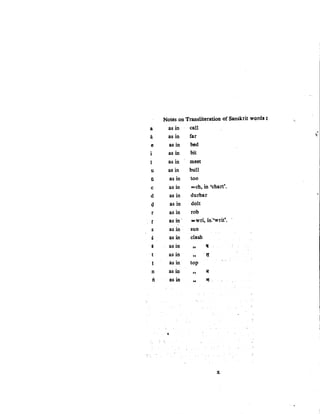
Notes on Transliteration of Sanskrit words :
"
a as in call
l
a as in far
,.
e as in bed
i as in bit
i as in meet
u as in bull
u as in too
c as in ==ch, in 'chart'.
d as in durbar
4 as in dolt
r as in rob
as in·
• .._ ., .. 9
r =wn, m. wnt.
s as in sun
s as in clash
s as in , Ill
t as in
" a
t as in top
n as in
" "'ti as in
"
VI
•
X
Preface
Life is movement. The world strides forward and bends
backward. Thus man goes on building and breaking. His
civilization is every now and then on the swing. All the time
hu.man values undergo renewaL
Diverse is the motion and varied is its behaviour. When,.
however, the move is inward, when life looks at itself and
turns its insight on the indwelling spirit, then religion is on
way. The quest, then, is of the finite for the Infinite.
And why is this quest 1 1he finite finds its own power
little .and limited ; its own conquests short-lived and insecure.
All that it ~s is fleeting, nothing is final. Comparably, man
finds that th~ Power that runs the universe is solemn and
sublime. To be secure and fortified, then, man yearns after
an understandable relation with the Infinite. Impelled by
doubt and discontent about his own limitations, man throws
himself prostrate before the Supreme power. Submission
from fear and friction is gloomy ; there is a glow of joy only
when the heart puts in faith and pours out love. This is just
how religion of love is grown andgoes to work on sweetening
life.
Indeed, knowledge of God is no more than a means ; the
end is love, while the beginning is awe. When forms multiply
and hypocrisy manipulates, religion gives way ; when grace
and goodness prevails religion comes into vigour.
The great religion of Christianity as well as Islam arose
at a definite period of history. Likewise, each had its Divine
Founder : the Son of God and the Messenger of God. And
fixed at this foundation; each has remained the sole and
invariable inspiration all along for millions of its followers.
Of cours~. complexities arose in the course of time. School-
men appeared to answer doubts and resolve disputes.
Nevertheless, each has remained the one unfailing light for
the faithful, linking the whole past and the future of the
given values.
XI
Not quite sp with the Chinese and the Indian religions.
In both countries religion appeared at no known point of
time. And no single human authority promulgated a parti-
cular faith that held sway over the whole country' rior haq '
ans human-divine arisen right at the very beginning: In that
shadowy era; various priests and literati, sages and wise men
laid the foun~ation of the varied and variegated beliefs in
Ittdia, as·in China. The earliest seers of the Veda sang hymns
as it were in a chorus, Thus Hindu religion came into
existence at a dim indefinite past and happened to·grow up as
a big banyan tree, with ever-renewing roots and over-
spreading branches.
No divine definer of faith had sprung up here before
Krsna of the Gita. And it was He who introduced Himself as
the incarnation of God, even as God Himself. Incarnations
have followed since.
Visions alter at varying angles, as age after age religious
outlook changes scales to find new view-points, new
objectives. So, now comes Dada. He comes in response to ·
the unspoken wishes of an otherwise noisy time. ·
There has been no thinker nor any thought that has no
challenge to face. Having had this in view, each of our ~ix
Schools of Philosophy, with its ancient tools of reasoning,
laid down : what it was for and what it stood against.
Impelled by a fine sense of intellectual trial, each framed its
point of vie.w: "Now the critique on Yoga", "Now the
enquiry into righteousness", "Now, then, there is the enquiry
into Brahma", With this traditio!lal guide-board, I may have
leave to begin : Now an enquiry about Dada. ¥ere is,
accordingly, an attempt to analyse : how the stage has been
set for Dadaji, how he means to lead men out of the jungle of
dogmas aad how does he lay out the way to happiness that
does not wane.
An ardent enquiry has been at the back of each School in
its own way. Indeed,. passion for proof that may take one
beyond doubt has ever been the very soul of mental activity.
XII
As Whitehead in his profound way affirms: uAll earnest
inquiry is a movement of thought."
Men feel ·uneasy when taken along an altogether un-
acquainted path. They like to get on from the partlyknown to
the partly unknown. That is why Lord Krsna chose to take
up some familiar old foundations: Sarilkhya, Yoga and
Vedanta and moved out to the new goal of the Gita, that has
nevertheless been hailed as a charmingly original lead by men
of all ages, In much the same manner, Dadaji talks of the
old Indian disciplines as of well as of fairly familiar western
philosophies and recent sciences. Thus he sguarely meets
the modern man's queries, and all the same he strikes as
distinctly .original.
Dadaji comes right along the line of Krsna, and like Him
he radically remoulds the old into new values. And, a god-
mao that he is, the light that . he holds naturally turns
Godward.
When he first met Dadaji, Radhakrishnan exclaimed in 
delight: ~'My ~yes are a';akene~." There can possibly be no
more telhng tnbute, commg as 1t does from none less than
Radhakrishnan himself. Indeed, Dadaji is,:to borrow a reveal-
ing word from John Dewey, a "Director of soul-life." Verily
he is a supreme master who setsthe mind and the soul of man
in meaningful movement: The chariot of the Sungod is nowise
at rest and always in motion. Its wheels are ever on the
move, all the while throwing out energy, light and vision,
laying out for man his approach toa radiant end.
A movement of the kind made by Dadaji .is one of
rem•king the mind, of moulding the inner man. As such, any
account of it can hardly be exact and accurate. An enlight-
enment made ofmingled shadow and sunshine is bound to be
imprecise and pretty impalpable. The worst of it : no such
narrative' can cater to sensation. Yet, search for sensation
has been a modern craze: Therefore, men nowadays are so
much attracted by miracles. Dadaji has quite a lot of that
too, and .of unusually astonishing quality. But he caUs these
just casual.
Xlll
A miracle is a play of power and as such a big value.
However, it is really good in so far as it is benign and
benevolent, above any showmanship or seliism. An estimable
miracle may well be comparable to gold. Even then, sunnier
.and sweeter than mere power is love and bliss, compassion
.and succour. Howevermuch precious, gold is after all a
metal imbedded in the womb of the earth, while, with all
1heir homely quality, water and crop, flower and fruit make
the honey and beauty of life, as they sprout with an innate
force from the heart of the mother .earth for her dear
.children. Power is of great consequence but love wields a
holier glory and a greater majesty.
The unbodied God is the same as a bodied god. But it is
only in the matter of redeeming man that the one acts
1hrough the Qther. In so acting, however, the deputed god-
man, identical with God, dives into the mystic retreat of
man's indwelling spirit and gently awakens it. Here, then, is
.a movement to bring life into bloom, to open the petals of
man's lotus•heart at the dewy touch of the dawning twilight,
to unfurl the flag of love and belief on,man's long march to
perpetual bliss. The creative urge does not end here and
now. It moves on from age to age in ever new manifestations
to meet the varying faiths of the altering times.
And in this performance it is better not to seek sensation.
'This is a work that calls for an environment of serenity and
stillness. This is a work that goes on only deep at the root.
Unseen in its underground workshop, the root runs the
machinery to produce life. force. Only in our outer region
1he result is visible. There we see the splendour of sprouting,
1he glory of foliage, the marvel of the flower and the whole-
someness of the fruit. Just so, in the tranquility of the sol!l
the music of the union of God and man keeps delicately
ringing. 'Our ear of the inner mind has to be tuned to this
inarticulate melody, audible .at rare moments of inward
.communion.
March 27, 1975. Atulananda Chakrabarti
XIV
t..
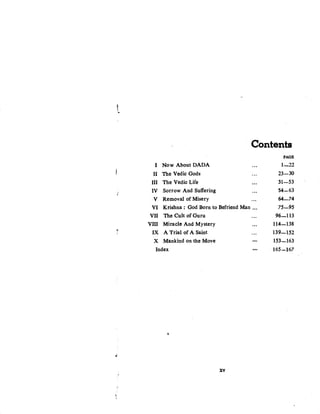
Contents
PAGE
I Now About DADA ... 1-22
II The Vedic Gods ... 23-30
III The Vedic Life ... 31-53
IV Sorrow And Suffering ... 54-63
v Removal of Misery ... 64-74
VI Krishna : God Born to Befriend Man ... 75-95
VII The Cult of Guru ... 96-113
VIII Miracle And Mystery ... 114-138
T·
IX A Trial of A Saint ... 139-152
X Mankind on the Move ... 153-163
Index ... 165-167
~
ti
XV
'!
I
I
J
t
'tli
J-
~
~
!
I Now About Dada
TIMES are crammed with tumult and terror. All the while
men now live in misery or in fear of it. Our days quiver with
nervous hopes and nights lour with bad dreams.
We are too often at cross with our fellowmen. We com-
plain of our neighbour's heartlessness. We are alarmed at
the intelligence of our colleagues. Often we are agreeable to
go wrong ; at the same time, we feel annoyed that others are
not good. Yet we are all, more or less equally, too impatient
to wait for reward in heaven.
We are fright~ned by galloping markets as much as by
multiple corruption. State-craft is daily becoming more
malign and menacing. We swear against atomic war and pre-
pare for it nervously, while the worst fear is : who may be
the first to begin and befool the rest.
Our modern world is war-conditioned. Class war, racial
war, national war, diplomatic war-all varieties of it are
rumbling around. Even while little is seen on the surface,.
cold war is creeping all along. Peace appears to be uneasily
seated on a smoky pike of multiplying arms. ·
Religion may halt the growth of evil and the race for kill.:..
ing. But it does not. For, we are either shy or cynic.
Religion is a matter of the spirit. It is a relation between
man and his Maker, through whom all men have a common
origin. Cordiality should spring from the sense of this
oneness. But we are too quick to discover manyness. We raise
walls and partition soul. The correct outlook should be :
when all are one, who hates whom ? But we love to hate. We
forget the love of God. If we can gain the vision of God as
the source of abiding good, all would come out well. It is a
big 'if'. Even so, religion remains the one power that can
resolve·confiicts.
2 THE DADA MOVEMENT
And strangest of all, there are conflicts over religion itself.
And these have been often mortal. This is the greatest irony :
religion which unveils the meaning of man has made mortal
fun of life. This has been a most cruel calamity, a most ill-
fated failure, a most fatal fall from grace.
But how and why ? A plain answer has been plainly put :
It is. sometimes urged that while psychol()gical
experiences rationaliseq by scien.ce are q10re. or
less uniform for alt observers, the data for
philosophy of religion are diverse and discordant.
~~~a~o h~r4 a.n4 t'Jol~ ~Y i$ bl~ for all But
G.od, i~ :Qu.<tdha tO- some and Christ to some others•
..-JMdh3ktishnan,./TJdi.tm PhilasopbJ'.
~o. religion has largely failed to deliver peace all.d union. If:
has. rotifed., Ieavins. the arena to politica.. But with politics,
peace has been. only an inted~Jde between wars. For., as it
~orks.·th.el;e. ia mote rhet.oti<;S.~ •~ieg.ce in politic"l deals...
Politics•. hawe.u:r,._ made. a. a,ood beginning. It appear•
with a programme of givins. iru;lividuals, in a tribal cemmu~·
city.. a sen~ of unity. In the beginning, people lived together
without a sense of togetherness. They battled among them..
aelve&. As desire. for peace gre.w, they. fOfmed society, wha$4
.conduct. was. g,uide.d by an unwritten contmct. Then, as the
State grew up, it formed $Ollle:tnment, framedlaws,. and raise.d
army to coerce people to behave.
Politics applies force to secur& order. But when force can-
not.control itself, it breeds chaos. Vast dissolutions of ancient
beliefs matked :the rise of power politics. Religion was Ji'C--r
jected with a cynic admiration that it was a golden legend.
SoOI. war became the character, even virtue, of the State.
A king, (ox government) would ggo to war with another. break·
~ at wi:ll the bond of man as easily as we break eggs on OW'
breagfast table. Then States forged alliances, witb a view to
waje colle.ctive wars.
, , Sehf.om we..uuite fDI' a harmless orharmonious actio~. More
readily we unite against others, for the sake ef on1atgill& ·
NOW ABOUT DADA ~
pow~t. A political unity is only a facade, b~hind which i~
massed the army. Politics .draws up diplomatic alliances-,
often as a threat w the non-allied. Power engineering has its
fatal fascination.
Collective selfishness ci"oe.s not serve the society any mo~
· than intiivid11al selfishness. It takes pretty short time oo
vitiate a good motive. Take, for example, man's love of fr~
dom. One view of it is freedom from want. Sense of want is
ebl&tic. Quite SOQU it outsteps its normal or moral bounds.
.An irony trails 9ehind the sensation of amassing more money
than others have. That way, wealth is embroidered with
blood.
At last came in science, with its wonder and radiance, to
:reeover the ma.j~y of truth. It set out to find facts about·. th.e
·nauual and. physical construction of the world. Anyway, it
~·made the modern world that captivates us and :fills us
with reasonable pride. It is concerned with mysteries orthe
~reated u.nive:&se, not of the Creator.
Matter and ~idn have reen studied al{>ng a wide ran&e
-helm Newtot.U.an. physics.to the theories ef Relativity and
.of Quanttt&t Mecllanics.. Yet the high one& among sQien~s
nave tefnsed tt>-be· Mind materialists. They recognise fhe ele-
ment of the unknown behind matter. Commenting on the
mystery of the electron, Sir Arthur Eddington has the awau-
ness ; "Something unknown is doing what we don't know
-what."
Generally spealcing, sCience leaves God alone. It is we
-ordinary folk who, in the name of science, take pleasure to
dethrone God. Also, the master minds in theology, of :East
.and West, Q.o not quarrel. Eckhart and Aquinas largely agree
witft Aruoi and Yajnavalkya. Only we vain moderns look at
faith with a wide smile,. while Buddhism and Taoism were
friendly.
Seieace has been the symbol of free thinking. It has. n.o
r«pet who• a new theory replaees an,ol4 o~ for it does not
.:JIIPIQ any ~ aa iafallible.. A scientist. ps ahead;. he
4 THB DADA MOVEMENT
looks forward. The Veda and the UpaniSad long maintained
this love for new ideas and ideals.
When brahminic priesthood was consolidated, it came to
be considered profane to doubt or discount an old text, which
was held asinvariable (sanatana). Firm belief is good; not so,
when it has become invalid. This was also the case with the
Bible.
In science, right from the start till today, the search for
truth goes on freely. And science has no sect. lt is accepted
by and acceptable to all who care to enquire. Comparably,
religion guards its frontiers.
In spite of all that sweet liberality and freedom of thought,
scientists do sell themselves to politicians or to the State.
Openheimer might have burst into a spiritual ecstasy over
the first test of his atom bomb, but it is the Pentagon that
controls nuclear experiments and issues directives. Obviously,
scientific experiments are not self-supporting. So~ when
science has to sell itself, it loses character. The pathos isthat
science makes itself available for releasing horror and
hysteria of destruction. Politics and science work upon man's
mind with the fear of their power. The fear of God may be
the only antidote ; but their glamour makes religion no more
respectable. Yogic rites have recently gained prestige. That
is only because pleasure-hunters and drug-addicts, weary
without sleep, have found relief.
On the whole, science is honoured as the source and sym-
bol of power. Industry and technology have opened out vast
opportunities for material comfort and delight. Even that is a
minor issue. The initial attraction is that science creates the
imprdsion of omnipotence. This command makes science
adorable. It rules the earth and the sky, it moulds man's life
and leisure. Man, tempted by its omnipotence, takes it to be
an attribute of God. Temptation is punishable. It has been
at the root of man's first fall. So, progress through science
has been perverted. What, however, is indeed progressive is
grief and greed, malice and mischief, hatred and hypocrisy.
NOW ABOUT DADA 5
All promises are drowned in the torrents of bitter tears.
Clouds of chaos have overcast the whole horizon.
The stifled cry of the misled humanity is becoming louder
and more audible. The main, major and masterly lead should
be the lead back to faith and reverence for the divine. A calm,
clean and kindly view of man and his inner life will show
man's truth about his "coming from God who is our home",
and that in turn will unfold human oneness. The law of union
is the call of the spirit. This sense of union is the only force
that can halt men from going to war with one another, partly
by the logic of this relation and largely by the perception
that God is. Mere inference gives no assurance. The vision of
God is obscure when forms spread wide. And then, evil
overtakes society.
Whenever evil mounts up too high, God has no other way
~an to come among men for their rescue. Even His creation,
it seems, has to be repaired from time to time. He then
;revives the force of life, the value of virtue and the vision of
bliss. This is the Hindu belief, set forth by Lord Kr~tia :
I come to birth by my own power (maya). Whenever
the law fails and lawlessness uprises, then do I bring
myself, 0 Bharata, to bodied birth. For the protection
ofthe pious, for the destruction of the impious, and
for the establishment of righteousness, I come into
being from age to age.
-Gitii, IV, 6-8.
The doctrine of Incarnation is also there in the New Testa•
ment (St. Paul and St. John). Ancient Hebrew beliefhas no
trace of it." Jesus was full of compassion. "The Lord God
of Israel," on the other hand, was "a jealous God." God of
' .
the New Testament was moved by love to become a man in
the person of Nazareth. His incarnation, however, was "the
only one". Christ was the "only begotten son of God".
Jesus's declaration is the foundation of the Christian faith :
''As he came up out of the river he saweth heavens·
parted above him and the spirit descending like .a
6 THE DADA MOVEMENT
·dove towards him ; and 1te beard • ·vQi§e •Yin&--
Thou art wy beloved Son, I have chosen thee."
11~-and that is noteworthy-Jesus is a bistori<: person.
Th' J:ljndu belief makes room for numerous incarnations.
(Stima4bha~at). Periodieal incar.natio~ however, ad1nits of
{t ~lause that every incarnation (Avatara) is "the only one" of
llw age (Yuga). But even this is ~t :Strictly obs.erved. Rarna
~nil Parasur.ama appeared in a same cycle. And wb.at is even
more confounding is that the two divine beings held a duel.
Jn Honleric poems, it is amusing to aote~ Apollo nearly came
to blows with Athena. and they were first class Greek
dt'ities 1
Be that as it may, evil survives well enough. Jesus could
no~ bring the kingdom of heaven on earth. Buddha did not
succeed in; annihilating sorrows. Rama courted a dismal end.
And Kpifui, the ;main Avatara and the author of the incar·
Ration .thesis, in a way failed to "establish righteousness".
After _the Kuruksbetra war, no kingdom of any substance
was set up. A blank darkness followed for a few centuries.
In ~pite of all that, descent of god..man .on earthhas a good
logic, and a gn~at moral. It has been a moving idea and a
rousing ideal. In nne, the belief that grows behind this is :
Divine love all the time flows for man.
In any case, the thought is heartening that Man and God
get together. It gives an ever new tone to our life and an
ever new life to our faith.
There is little sense in saying that God is not real because
our eyes do not see Him. Who among men of sciencehas seen
the ele.Ptr.on and ·who will not admit that it does its wOTk
really?" As Radhakrishnan observes: "The God of our
imagination may be as real a11 the electron but it is not
neces.sarily the reality which we immediat~ly apprehend."
God. does not live in a mythical heaven. Into His Kingdom
man can enter, and in His presence he can stand. By
·~int~rior illumination'' He is seen : that happens, when He
glvts us the eye.
'""'"
NOW ADOOT 1>A:DA 1 ~
B~y and mind mate -One whole. Eye and mind see to-
gether..But mind is largely based on the activity of the brain;
if and when mind tranScends body it is distilled into spirit,.
which sees what mind does not or cannot see. Something
psychological and something metaphysical combine to make
a larger visron. When mind is refined and empowered t0
roftect on the object to be seen or known, the vision is am-
plified and clarified. Even then a large tract of consciousness
lies along the vague borderland of perception.
An embodied God is rare, not unreal. God becomes one·
of His creatures, for love ef His creation compels Him to be
with us and for us. For what else did He create ?
"My child, the King loves you, be is coming himself."
- Tagore, Post Offi~.
An embodied God is here and now again among us, to
meet us and our need. Our cause bas moved Him to come to·
us. It is He who wants us. The relation is one of love and
affection, with noformal obligation on our part. And he can
tender service who only loves to serve, knows what is to be
done and how it can be done. The call is to affection from
above and faith from below.
The one who has now come names himself: DADA-a1
elder brother, fatherly a'S an elder, friendly as a brother, in
all, closely communicable. All that makes us more fellow-
men than followers. That makes him aa eager companion o
his fellow-travellers.
The relatioa between God and man, in the Vedic belief, is.
that of father and sons : you are our father-pita nohsi; give
u-s the sense that you are our father-pita no l:odhi. Krsna in:
the Gita reduces this relation from love and awe to love and
liberty, as when he holds Arjuna as his dear friend ! sakha, as
sharing a common mind. To this cordiality another fine twist,.
a: feeling of family tie, is added, as when the relation is:
between a Dada and his younger brethren-verily, a snare4-
8 mE DADA MOVEMENT
family fraternity .that prethren do have with the brother and
among themselves.t -. '
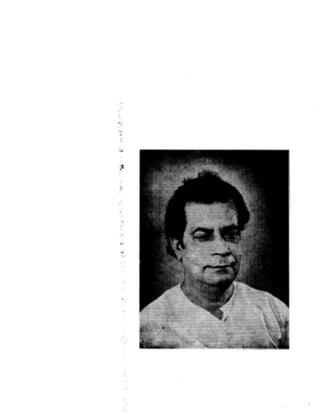
His name is Sri Amiya Roy Chowdhury. He lives a
homely life, in a rather modest house in Calcutta. He asks
nothing, takes nothing, even so, he gives nothing-no promise
to anyone for prosperity, far less, salvatiqn ; he runs no
_business of saving soul, which is no medium of merchandise.
You do not need, Dada says, a middle-man to take you to
God. In His own way, God is waiting for you, eager to bide
His tryst with you. You have only to have a yearning after
Him, to feel a nearness to Him. All that is by no means that
easy. Yet, an elaborate worship is impossible in these
times of stress and strain. Cut down forms. Simply take
God's name, as often as you may and listen to the rhythm of
tJ:te name in your heart. Only do not deceive yourself: that
js easier than deceiving others. And in good faith carry on
your worldly work. As Carlyle puts it: ..The universe is an
infinite conjugation of the verb to do." ·
I Dada warns not to go in for Guru. To warn an orthodox
·to do without a Guru and a Guru to wind up his trade is as
offensive as it is explosive. · He has thrown a stone at the
bee-hive. And thus he has raised bouts of unclean cliques
against himself. However, he leaves detractors to God's
mercy while iti tranquility he prays. Prayer, he says, should
be without noise.
. Dada asks his brethren to keep away from Guru, the
minister who appoints himself to conduct· services ofworship
on behalf of devotees. As such, a devotee ought to feel free
I to per.sonllllY worship his deity. Accordingly, an initial work
for him has been to release the great god Narayana from the
_grip of the high priest and instal him as the divinity with
·whom direct communion of heart must be made. The god
·of the people must come out for the people and be with the
j)Cople, in order that the priestly intermediary may be dispen-
$ed with.
s
NOW ABOUT DADA 9
Men interested in religious commerce have been up and
d~ing to misinterpret this message of freedom. The manu-
facturers of_ fetters go about accusing Dada of his free per•
formance of Satya-Narayana pi'ijii. No wonder. No one can
;get away who tells a challenging truth. Be he Krsna or
Christ, Socrates or Galileo. Truth is exacting and expensive.
Its price has to be paid in full. No great one can escape
false accusation. A saintly person is rather known by the
infamy hurled against him. Detractors, in a way, reveal the
<livine man. History's high souls have ever been slandered.
As Emerson has noted :
Pythagoras was misunderstood, Socrates was mis-
understood, Jesus was misunderstood. To be mis-
understood is to be great.
So, conspiracy· against goodness is common. In our
·country, this ungracious art has been unfailingly at work,
particularly inspired by priest craft that has cast a wide
-enough net over the simple folk. That is easy, for the un·
knowing men are apt to take bondage for bliss. The irony is
that it chokes the very springs of true faith. Thus life goes
out of religion. And dead forms with their deadly stink keep
the social air foul Prom time to time reformers arise :
Raja Rammohun Roy, Pandit Vidyasagar, Swami Dayanand,
Swami Vivekananda-in recent times, and there have been
te~ring priestly campaigns against tlrem. The guardians of
the misguided are ever in form.
Nor'are detractors of virtue inactive today. They are up 1.against Dadaji. He has app_eared at the call of divine life to
blow fresh air into faith. They are too eager to distort the
mystic method of his. novel worship of the Supreme Spirit-
.Sri Sri SatyaNarayaiia. While they slander there are others
who cannot resist his call; for, the good men and true, the
intelligent and· the inspired find their heart's delight in the new
free worship. The Hon; Mr. R. M; Kantawalaj Chief Justice of
the Bombay High Court, is onJy one among the good. ma~y·
t() THB l>ADA MOVI!MBNT
who have received refreshing enlightenment fi"om Dadaj:i. I
may here recount thereport of Shrimati Sumati Morarji, of
the Scindia Steam Navigation, in her own words that have a.
rblg of rare perception :
Oadaji was gracious efiough. to oblige me by his
sacred visit to my residence at Juhu on 11th Dec. '72.
He was to perform Sri Sri Satyanarayana on this
occasion, a phenomenon that is commonly termed ag:
puja, though in reality, it is something above and be-
yond the realm of the rationalist world.
Dadaji on the very introduction asserted that 1}0- .
mortal can be a Guru. The Guru isthe Supreme Lotd ,
or Sri Sri Satyanarayana Himself-Omnipotent,.
Omniscient, All-pervading and Eternal. Every human
being is potently divine.
Only wearing a saree of mine round his waist, Dadaji
went inside the next room and confined himself there
for half an hour. There was just a photograph of
Sri Sri Satyanarayana and a vessel filled with cocoanut ·
water in that room. When Dadaji came out, the room
became choked with the fumes of strong divine pet-
fume ; fragrant .water was sprinkled all over the dry
:floor from nowhere ; thick drops of honey covered
the glass of the photograph ; and, last of all, the
cocoanut water had been transformed into condensed
ksheer Charanamrita ...•
Ever since he graced me, I have been seeing him itt
person, blessing me at dead of night at my residence~
while from our so-called realistic point ofview, he is
in deep slumber at Mr. Abhi Bhattacharya's residence.
Is it an illusion, or a magic or miracle ? Is it also
extraneous ?
Dadaji has no math or asrama; for, he scoffs at it.
To him the human body is the asrama and Nature is
iti mohant. Countless offers of money in lakhs for
erecting asramas have been spurned by him with
genial grace and equanimity --POSsibly the greatest
miracle in the modern corruption-ridden world.
l- The Call Divine, 1.12.73..
Shrimati Morarjfhere points.to the finestfact about Dada:
his perfect datachment Again, miracles or revelations of
NOW ABOUT DADA 11
superutural ph.enomena, as quoted above, are but ••extra·
neous.., as Dada 'himself gives them no seriousness. Her
stat4ment k borne out by philosophy, 11ncient and modern.
That every being is divine is comparable to the saying of
Jlamanuja that man is a part of God : .tadaritsa jfvesamjnaka.
Particllady, her observation about miracle has a formida-
ble philosophical background ; science as well lends support
to it. The Up~nisad and Satilkara (Commentator) are not
(!.lone in saying that an illusion is behind reality. lhe Giti
(VII, 14) also says : "It is by My power of divine illusion".
that I bring forth the creation. Sir James Jeans affirms ; "The
stuff of the world is mind stuff." In trying ''to reach a bough
in the forest," Edding~on says, "one's hand closed on nothing·
ness." Philosopher F. H Bradley, who goes a long way
with Samkara, says : "There is no reality at all anywhere
except in appearance, and in our appearance we can discover
tbe main nature of reality". (ApJearance And Reality, p. 487).
By .itself, a miracle is neither fun nor fancy, if it springs
from a ·pure motive. The great schoolman, St. Thomas
Aquinas is of opinion that a miracle does not violate nature.
It is a eause of nature in supernatural way through a special
act of creative power. If the fate of the finite being is to be
dependent on God's will, miraculous' act~ he argues, are no
less natural than non-miraculous ones.
Can fact displace or replace faith ? And is reason the last
word ? Have not the learned, by the weapon of reason, cl,lt
through one another's conclusions? Anyway, is reason
everything all the time ? All questions considered, we may for
a while ijsten to Pascal : "Youlose nothing by belief in God."
(Thoughts) As spiritual science cannot be mathematically
exact it is bound to be a string of ambiguous yes and no.
there always and everywhere are critics who refuse to be
chastened. Dada ha& to have his share of injustice at their
hands. They complain that his motive is to colleGt followers.
Grant it. But he employs no spiritual stunts ; on the contrary.
12 THE DADA ~OVEMENT
4e is opposed to these. Anyway, to gain followers for a good
cause in a clean way has the sanction of the Gitii ; Carry 011
your work of service to the people-lokasarilgraham. (III,20)
this service is an act of friendliness for all-sarvabhiita
suhrdanam (Vt 29). Cleverer critics pose as wishing Dada
well and pretend to l~ment that he has been wasting his
power of the spirit--bibhuti-by attracting people with show. I
of miracles. They may well do without this anxiety, for he
runs no such risk, for Krsnsa says to .Arjuna : a doer of real
good to t>thers has no reason to undergo ruin of any kind :
na hi kalyanalqt kascid durgatim tata gacchet. (VI, 40)
Ruin cannot touch a God-man until and unless he himself
chooses to bring it about as a plot of mystery closing his own
drama. We have no eyes to see that far. As far as the view is
open, his path is strewn with goodness to his brethren.
Directly along the lineage of Kf8na, the descent of Dada
comes about. It is the pressure of the human need of today
that has thrown him up here. That is Krsna's scheme of
appearing at certain eras of impending human urgency.
In his boyhood, Dada used to beKrsna-intoxicated. A song
or even a strain of it on Kr~na (Hari) would enrapture him,
keeping him forgetful of everything at the time. He was a
mystic from the beginning, in the sense Dr. W. R. Inge held
that "Mysticism is pure religion." It is pure inasmuch as it is
free from forms, obey:s no sacrament and is absorbed in
direct communion with the Spirit or God.
A God-man is born' with his full gifts. He has not to
prepare lessons. At an age of about ten, Dada went out
roaming in the Himalaya that abounds in ascetics of great
inetit. They dwell in its far away recesses. There, among
others, he•met Santdas, the renowned 'pupil of the famed yogi,
Ramdas Kathia Baba. Dada himself has never been a furious
practitioner of austerities.
'To propitiate deity by self-torture makes no sense. By
total unconcern about creature comforts the grace of deity
mly be earned for fuljilment only of material ambitions.
But illumination ·of self can come only through absorbed
..
'
NOW ABOUT DADA 13
meditation. Unearthly bliss results from spiritual contempla-
tion. The Chandogya Upanisad says : tapasa brahma
vijijnasasvii, enquire after Self by taJqsytH(concentration). It. .
is a process of getting an answer to an intellectual question,
a spiritual problem. Tala is intense contemplation, which,
when highly strung, generates a certa~ heat in the temple of
the head. Not by self-torture, but by self-culture an an$wer
for a baffiing question is found.
Nor is Dada at any time pouring over the sastras -day and
night. But he has a strange access to them. At any time of
disputation with the mighties, he picks up these from no-
where, it seems; Torrents of scriptural texts flow from him
while disputants gladly submit in profound reverence. The
other day, in Madras, the citadel of Sanskrit learning, he
.confronted that mon:u~ent of ancient erudition, the venerable
Mahamahopadhyaya ·Srinivasan. It was then reported in
the press: Srinivasan saw in the person of Dada the image of
Vistiu, and in rhapsody he recited hymns presently made,
by way of offering his submission. As Swami Vivekananda
has said, 'We can see God only as we see His special
incarnations- avatars-who bear human appearance, who
are human divines.'
Srinivasan's mind at the moment and in that high-strung
perception resembled that of Arjuna who, troubled by the
Lord's world-image-visvariiiam (inJeanPaul Richter'sphrase,
"persecution of the infinite")-appealed that Krstia might now
graciously appear in his original form of Vistiu :
I wish to see Thee even as before with thy crown, and
mace and disc in Thy hand, Assume Thy four armed
9hape, 0 Thou of a thousand arms and of universal
form.
-Gita, XI, 4(i.
A particular individual, screened for a special view, may
pin the sight of Dadaji in his divine form. Even a vast crowd,
as it h~ppened at a rally in Bombay where saints like Sa~cha·
:14 THE DADA MOVEMENT
-baba and his colleagues paid homage to Dadaji, visioned him
in his divinely . hightened stature, bathed in a refulgent
splendour of holiness.
Usually Dadaji does not sit high in glory. He is a man of
plain maauer with a noble bearing. .Indeed, his amiable
oniuariness makes him so extraordinary.
No- wonder that Dada wins. The real wo11der is that
he leaves the conquered great ones ·fuliy free~ claiming no
l9yahy. Tlle dividends of his triumphs he Javes wholly to
his. comlllllnity of btethrcm:. His sole interest is : May the
aisery (){the mine Ieason and the good of men augment.
l might have leave to recount my own experience. 'l'tte
fru-fllme( scientist, Prof. S.N. Bose one day asked me: "There
~ a: Tathagata: somewhere in your locality. Oo you know
him or have you seen him 1" I said : "I had heard of him ;
S()Ille' time ago ,f had been to him." I looked up to the
pl'f)fess&t, but spoke no mare, finding· him in a ·meditative
spell, brier though. Religion has' probtem:s ; science too has
not a few. The desire to know, however nruch difterent may
be the process~ is shared between science and religion, and at
certain stftl heurs they exchange questions and compare
answers.
When Diekens wrote : "It was the best of times, it was the
worst of times.'' he had little fear that the neat end ·of the
20th centu-ry weuld be packed with far worse paradoxes.
· Now we have Whitmans, Sartres and Rutherfords. Innumer-
able masters have illumined our world with sublime lights.
Yet forces of evil furiously prevail. All glory is nearly
eclipsed, all moral magnificence has been overshadowed.
Dark afld desolate power-politics grip mankind today.
Human refinement had never before been so lamentably cast
.into the shade. Now is the time for god-men to appear and
radiate.
Whoever: l:lqs attended Dada's tlurbar at his Olkutta resi-
ftnoe. in recent months have often heard his propheti<: wa;t-
aiap .af. 6e ..--. catastropke. His WQJrdl bum with-bate
~!·.·e;.'·
NOW ABOUT DADA 1S
truth, his eyes glisten with tearful compassioa for humanity,
and while his voice quavers with loving kiadnes~ he entreats : )
~•oo not act as your own enemy."
NOted scientists at home and from abroad visit Dada..'f.hoy
come for enqUiry as well as from curiosity. He has tfmller
interest in science and men of science whom he holds as 'VI)lla.
ries· of tnlth ; also, he believes, science has its full sllate in
mysteries, much as religion has.
Science seeks to "explain"" the laws of Nature. It penna-
des the world of matter to giVe out its secrets. Often the reve-
lation is tftat matter is but finely spun tn)'sterie& : the mys-
teries ofthe electron, for example; or that, this space is not
rear but imaginary. What seems to be physical realities are
found to have no such material content ; and under the im-
pact of such sufl'l'ises, man Jlu new radically reviled his
sense of "the world of factM. Solid matter has in a way ...
shed, inasmuch as it is less directly tangible. What exists is
only energy. Electron Field quanta have energy and also
other attributes including mass. Mathematical physics has no
haines with cOQ.cretc thinv ;. it deals with iGeas.
The; concept of matter is aeneralized ; it is no longer
limited in useto deSCfibe lumps one can see and touch, though
such lumps still remain one aspect of matter. 101 this context,
materialism would mean the possibility (or hope) of const·
ructins more and more fat-reaching models to describe all
the observed phenomena without invoking divine interven-
tion to supplement, from time to time, a system of well-
established laws. That such laws oc concepts may appear to
be highly complex and abstract is not an obstacle. The mathe-
matical formulation of the models is not in conflict with a
"materhifis.tic." point of view. From such a point of view the
postulate of an all~powerful creator, which "explains..
abioluiely everything at onee is nat false but simply devoid
of content, just beallijiO it is not falsifiable. The strictlx
' ma~iitic paint of view is, of course. not imposed by
science and is not QQliptoiy foi a .sc.i=ti.st. Indeed. many o{
~~-- --~~-----~---~----. --
16 THE DADA MOVEMENT
the most eminent scientists feel the· necessity of one type or
:another of fundamental faith.
Atom, originally in Greek, meant an "indivisible" thing;
Now, it is known to bedivisible into particles of electricity.
·Electrons and protons, for example, of course, have electro-
lllagnetic interactions, as also other interactions. Electro-
magnetic properties are only one of their properties. To·
bombard an atom is only to destroy its electrical balance.
The process shows : a fair number of electrons (negative
electricity) whirls around a few protons (positive electricity)
which supply nuclear focus. "The real atom", says Edding-
ton, "contains something which has not entered into the mind
of man to conceive". It is, in terms of the UpaniSad, ultra-
minute, finer than the fi.nest atom : aftoraftiyan.
Vedanta and nuclear physics talk much alike. Take, for
example, Heisenberg's observation :
Light and matter are both single entities, and the
apparent dualitl arises in the limitations of our lan-
guage .... Furthermore, it is very difficult to modify
our language so that it will be able to describe these
atomic processes, for words can only describe things
of which 'we can form mental pictures, and this abi:..
lity, too, is a result of daily experience. Fortunately,
mathematics is not subject to this limitation.
Ages ago, the Upanisad was aware of the incompetence
of word : "Whence words return along with the mind, not
attaining It ; he who knows that bliss of Brahman fears not - !
from anything at all." (Tait. Up., II, iv, 1)- Here, however,
the point ·clearly is that-as Dada often emphasises- words
do not :fintl God ; nevertheless, God's bliss is gained ; that is·
the significance of the text of the UpaniSad just quoted.
The advantage of mathematics is that it talks in symbols,
not in words. However, that science· cannot still definitely
answer all its questions is not its limitation ; that only proves
that science does not deal in :finality but all the while is ready
for a 11ew vision; an ever new vision, of truth.
I
j
NOt/. ABotlT DADA 1?
Modern seie!lc~ has taken fhe teed to- *jO'tltttey WJdmfl
an end. When Newton's Law of Grnvibttion was baakdaledc
by Einstein'sliaw of Relativity., no one felt that one defeated
another ; the feeling that prevailed was that all were glad
that here was a new conquest of ttUth. The new law is built
on tht startling foundation that time and space are Ielative,.
mat matter, time and space make a unified factor. And ether·
lias been demateriali:zed.
the latest so far is Max Planck"s Quantum Theory. The:
older notion that ele::tron in motion starts in an tm.broken
wave is rejected ott the evidence that the behaviour of motion
is "determined by no Taws'". Nature acts naturally, so to say,
inasmuch a-9' it iS- not obliged to obey any "causal ctrtainty"t
sinee atoms of energy are released in a 'quant.u-111' le. ma
tiny •pa~· of,tadiatiou or •jerk' of energy.
S::ience cannot say what is tlie nature of mattet. w:b:i.dll itt
yet unknowable. All that it studies is the structure of nature.
Newton's apple still falls to the ground. while Einstein's
f<>ur-dimensional universe runs its course. However,
it is physics, concerned with physical universe, that has
undertaken to teach us that our dear world is not a solid.
sombr~ subst&otial physical fact, such ~s hac;i been hitherto
taken for granted. But then, the great beauty is that science
takes nothin_g for granted.
Engaged in religious search for truth, science has nothing:
to do with the religion of faith. But, now understandably,.
th.• old non..alignment between materialism and spiritualism,
between physics and metaphysics, has given· way t& an-
amiable toterance. As Sartre observeg : "The philosophe~ iD
quest of thought must question the established scieneell ill
~.rder to cfer.We it-from them as the condition of their pouibi..
lity". (Being And Nothingness, p. xxxiii) '
God-seekers and atom-breakets-,~ goa parallel. way, it
appears. No t.e.than reli&ion, scienc. is fuU ot :tnymai~
though the coneeptofaereatot is,not the o1&ial coneem Of
scieru:ot which rast~: on pwof~ 'Jim substance, of oun WU~Id is
DW--2
18, THE DADA MOVEMENT
unseeable, but we cannot say that time-space continuum~ an
illusion. Heisenberg again :
To mold our thoughts and language to agree with the
observed facts of atomic physics is a very difficult
task, as it was in the case of the relativity theory. In
the case of the latter, it proved advantageousto return
to the older philosophical discussions of the problems
of space and time. In the same way it is now profi-
table to review the fundamental discussions, so im-
portant for epistemology, of the difficulty of separa-
ting the subjective and objective aspects of the world.
Many of the abstractions that are characteristic of
modern theoretical physics are to be found discussed
in the philosophy of past centuries.
Thinking activity rests on or springs from freedom. No
wonder that men of science are free to be drawn by the
beauty of the impalpable. Answers to questions about Nature. I
-open up w!ngs to suggestions about Spirit :
The cosmic religious experience is the strongest and
noblest mainspring of scientific research. My ·religion
consists of a humble admiration of the illimitable
superior spirit, who reveals Himself in the slight
details we are able to perceive with our frail and fee-
ble minds. That deeply emotional conviction of the
presence of a superior reasoning power, which is
revealed in the incomprehensible universe, forms my
idea of God.
-The Universe:and:Dr. Einstein,
by Lincoln Barnett, p. 95.
The superior spirit is revealed to seekers of truth. It may
be interesting to compare here that Kant rejected all proofs
provided by "speculative reason", while·he:firmly believed
and asse,ted that "practical reason" should compel us to
postulate the existence of God. Indeed, the natural and the
supernatural have a way of getting blended.
There should be no reason to mix up the Dada movement
of India with "Dadaism" or "Dadaist movement". of the
West. Beyond just having a one name or word 'Dada', there
is little in common between the two ; for the meaning is al-
NOW ABOUT DADA 19
together different. Here •bada' means 'elder brother' ;. there
it is a Pren~h word for •a wooden horse'. In despair over
World War I, a group of intellectuals planned anti-aesthetic
activities against all existing ethical and artistic standards.
They seized upon a "nonsense-sounding" French word for
'hobby-horse' to symbolize a nihilistic variety of revolt
against the established order.
Their protest derived inspiration in artistic novelties from
Tristan Tzaara and in poetics from Rimbauld, while taking
its slogan "destruction is also construction" from Baqunin.
Their influence-very short-lived: 1915-'22..:..swept across
the world from Harvard to Bonn.
Dadaji's message has been gaining sway over all India and
a good many centres of the world. In one aspect only-his
protest against priestly religion-his doctrine may be consi·
dered to have a kind of faint likeness with the Zurich· thesis.
But what is decidedly an antithesis of the frothy impiety of
the Zurich movement is Dadaji's solemn lead to creating a
sober, sensitive will to a spiritual reconstruction of our times.
He is wholly against any unbelief in the glory of the Spirit.
In this regard his true likeness is with Emerson who holds :
~•Essence, or God, is not a relation or a part, but the whole."
{Essays, I, 116) God not only exists, He is all that exists.' For·
getful of this, a devastating shallowness has been gaining a
renewed lease of life. It is a menace from which only god-
men can deliverhumanity.
Prom Plato onward, all philosophers with a religious
inclination, have accepted the knowledge of the ultimate
Reality or divine presence. Schiler has put it very finely :
..Religious agnosticism is not a psychological fact, but a self-
deception~' He affirms that belief in God is natural, and
t)lat what, however, needs to be questioned is unbelief. In a
different style, the same conviction has ·been unfalteringly
expressed in the Katha Upanisad (VI, 12): The Superior Spirit
or Pltimate Reality is well beyond "the· reach of words,
mind and eyes," but the.n~ It is expressly felt and clearly
- to THIJ DADA MOVl!MI!Nf
fo4.soo -'t.the imler 1:nind, uaoloudtd •Y 4evbt.,.. "J1ie. etft&tieaal
cou:victien,. as admifted b.y Einstein, is ebviousPy oommo& tG
sailuls.aa wdl ascscientists.
- T)le e1iste&O$ or noR-existemce of a& all powerful cJ'e1t"'
tor, producing ~e univ.ePSe by mere wisk or resolve, can nei--
ther be proved aor disproved. Dada says : why not accept
the saying of the Sruti: samkalpena asrijat 1ok:iB-OodinHi&
SU}'Jt'eme playfulness, by mete .resolve, has been mdined
to create the worlds, a.nd thoy wero createdfo:t1lrw•ith. Seience
seeks: laws; its search goes on ; it may well be an ~ess
search, byt it is a search with an open mind. Religion takesup
from where reason stops. And man is at peace within himself
when he grows "conscious of his oneness with God's Being."
That consciousness, Dada says, is to be cultivated, but it is.
ruso. in~et in man so that the cultivation, if earnest, is a sileJilt
success. Intense. and austere cultiva~ion of pur~ thought is th.e
genuilte ·~apasya', which is not a phys~l severity or tN..
tun~ of the body. God is bliss.. Be sure of Ulis, Dad@ asid;
everyone of his numerou-s visito.r&,
.¢tnicted by the thought that "atheism has. made grea~J"
prot;res.s than before", Berkeley was eager to convey "un-
answ~rable proof of the existence and immediate eperatioe of
QO.q," (PhiloEo.~-bical Cotnntentaries, Vol. I, p. 2jl}
Th~ are not any better today. In reply to a questiOB
from the press (15.1().74) at a Calcutta reception, the Lord of
Kamakotipitha, Jagatguru Samkaracharya Jayendra Sara-
swati ob$erved that to the. lack of self-knowledge is to be
traced tb..e reason for &o: much. suJfe:ring of men of this eta.
Another question : 'There is a lot too. much. of religiou.
instt:uction nowadays and. too many guru& h$.ve got bJJSY :is
that t!le' r.oason of rising mjseri~& of .mQJl f The Jagatgutu
teplied; Most gurus are nogutus inthe striet spiritual cootext.
Only s~ gurus a,s inherit ~hoary trad:itimts have got holy
metit. .The ~ight gurus VI{Ve Sam.kata, IUmanuja, Bablabba
~ Cha,~Qya. Po,rf~tly trV¢• Bat one may: hav.e leave to
~ : t~ fq11n._r of a ~"aiUtge was. new at lis time. Possibly
'MOW :ABOUT DADA 21
anticipatin& stWh a query• h.e added : Qf coorse, new gurns ·tto
come forth, such as Ramakrishna and Vivekananda. Th.en
.agai11; it may ·ae further pointed out that traditions lose their
original qaality in the course of time. Indeed, Kalidiisa him-
self has put it in his inimitable way -purinamityeva,., sildllu
_,am-all is not good for the mere reason that it is old.
So th~ it may be appropriate to dive at the bottom of
the fact. It is that gurus, hereditary or self-made, neither hel})
Abr an they wanted, if the task is to cnmmunicate know-
ledge of the self. If we may follow the first Sarilkara's v~w:
jiWJ bralmuliWJ flijpDr4, that man is no other than God~ -we
may well accept that the self by its own divinity is goutl
011.ough ; it flas 110 valid necessity to beguided byany outsider,
in the garb Of a guru. Self;;lmowledge is to be had by one~s
own power of self-recognitibb. 'fJW proper valuation N ~
self has been most forcefully stated by Samkara himself in
a commentary on a text of the Isa Upanisad, which delivers
the message : "That Purusa and I are one." Samkara
comments : "I do not beg favour like a servant ; for, I am that
Purusa, encircled in Aum in the orl}it of the Sun."
That proud demand must have to be made articulate now
again with a full vigour of conviction. It is to do just this
that Dada has appeared at this age in our country, bristling
with gurus, and to urge us on to a rediscovery of the Self.
Ours is a country where many good old strains of mystery
and metaphysics are mingled:
He has come into this land of an hundred cross-roads.
- Tagore, Crescent Moon.
And to tnese cross-roads have been added, during the last
two centuries of contact with the West, its numerous sensitive
insights and lively thrills of thought.
A human-divine is never partitioned. So his background in
its proper relationship with the environments has to be
mapped out to harmonize ancient Indianspiritualwithmodern
Western philosophical values, connecting all that, again, with
22 THE DADA MOVEMENT
brief references to scien-ce as a study of the drama of life
through the veil of matter.
To understand and be understood, in such a complex cor-
relation, is by no means too easy. Therefore, any account
of Dada has to have a background, however sketchy, ofthe
broad meeting points of the classical thoughts of religions and
philosophies of the East and West, and their impact on our
science-illumined modern world.
I have an, uneasy consciousness of my incompetence to
jnterpret such a complex message. Yet I have undertaken to
do it, simply because I feel like doing it ; also because I hope
that a religious belief is, after all, received by a kind of trans-
mission rather than of information. This book is submitted
~Jth no doubt .that better minds will make out the meanings
where I have failed to express them.
'
~ £
2 The Ved,ic Gods
ALL religions in India are rooted in the Vedic lores. They
am either allied or opposed to tke Vedicheritage. For instance,
in evaluating any religious tenet, the Brahqtasiitra (Ill, 2,
38)gives the directive that its authority lies in the Sruti ; on
the other hand, this authority ,·is a bit belittled by the Gitii
(II, 53) as w:hen it refers to such believers as are confounded
by the Sruti (Srutibipratipanna).
Generally speaking, all Indian religions, one way or an-
other, have a Vedic reference, often origin. It is peculiar that
. Buddha, who in many ways felt· akin to the Upanisad;, was
.averse to the. Veda. Medieval· and modern masters-Kabir, ·
Nanak, Raja Rammohan, Swami Vivekanand~ Swami Daya-
nanda,-all have their' new faiths either founded on or
estranged from the Sruti. Even Saiva and Sakta ways of wor..
ship are remotely related to the Veda, though they strike.·
out strange patps, more or less.
So then, a proper study of the Dada movement has to
have some link; however remote, with the Vedic structure. It
is with this recognition of heritage that we begin here with
.an outline of the Vedic scripture-the origin as a rule of all
religious prescriptions and speculations in India.
'fhe first troop of Aryan exodus* (in,; 2000 B. C. or there~ :
:about) was captai.Q~d by, Manu. He was the grand patriarch
ofVedic·p~lity.,. It was from his· name- that the word m.Orulva .
Waf dfciv~;; !h~n.meaning children of Man~ ..not mapJP.nd.;
•
* All previous' estimates of the antiquity of the Vedic period have
been outdone by the present theory of prof. Jacobi of Bonn, who sup-
pO'aes that period goos.back to at feast 4900 B. C....The Vedic· literature in
an.y case is of con~idmbly higher antiquity than that of Greec~.
-M~pnell
23
24 THE DADA MOVEMENT
Faithful to the founding father, his retinue resolved tore-
main ever true to his principle :
Ye Gods, may we not go astray from the path laid'
out by father Manu. -RV. VIII, 30, 3~
This path corr prised of the twin rule of life : sam (santi)
and yo (yoga)~peace and union. The new-comers not only
found a neV homeland in a kindly climate : they as well
founded a sound law of life.
Be it noted here that the law-giver Manu was quite another
person who belonged to the late epic age, around 600 B.C~
He compiled what is known as the Code of Manu, which held
authority in the upper India of his time, which he had named
Aryavarta.
In contrast to miinava, another category was named deva·.
Both belonged to the human species. Atthat remoteage a deva
was no unbodied being. He was as good a flesh and blood
being as was manava. The only difference was that manava re...
presented a division of man who left West Asian home and
became domiciled in India, while deva was one who retained
that trans-Indian home and-only paid flying visits to India
to look after the adventurous colonisets out of fatherly or
friendly feeling. The native or original homeland west of
India was called div, the dweller of which was called deva.
In the course of centuries the primitive home and the old
connexions were not exactly remembered by the migrators.
As the tradition grew dim and recollections faded away, and
as physical contact was long lost and the remote genera-
tions remembered relationships only very vaguely, deva was
supposed to be an airy being. But as always, for fatherland
an attachment, however vague,:remains. So, it continued to be
remembered with poetic fancy. Thus the transmontane
fatherland was fondly fancied to be transmundane ; and, in-
vested with mystery, it was called heaven, located above the
skies. To put it in the poet's words: "The sky remains infinite-
ly vacant for earth there to build its heaven with dreams.·~
(Tagore, Fireflies).
THE VEDIC GODS 25-
In the early Vedic literature, c!evas were no figures of
; fiction, no figments of imagination. They were the leaders and-
patrons of the immigrants. who held sacrificial festiv~ties in
honpur of the benevolent guardians, much as nowadays huge·
parties are thrown to welcome eminent guests and superiors·
and regents. The l_{gveda (1,22, 13) speaks of mahi dyauh,earth·
and heaven, as spacious tracts. The Atharvaveda recalls the-
birthplace of our fathers : dyau is the birthplace .where 'our
fathers' were born-dyaur~ah pita janita niibhiratra. The ~g­
veda (III, 54, 9),pointedly informs: sarvam ekasmat jatam'-all
(manava and deva) were born of one and the same stock. Vis-·
wiimitra (RV. III, 39, 2) refers to the heritage of thought:-
'This in us is tl)e ancient thought of the fathers'- sayam sanaja
pitrya dhih. The l_{gveda states : 'They established friendship·
with the gods.-tatpratnam sakhyam (VI, 18, 5) And, it is·
clearly stated: our fathers were humans: pitaro manusyah.
(RV. IV, 1, 13; VIII, 38,. 3 ; VIII, 72, 8 & II ; VIII, 10, 27;.
VIII, 7, 72.)
·,
It may be relevant to note that the Chinese had similar
beliefs in regard to their religious life.
Yet in spite of this wealth of material the exact form
of their religious rites is not known, nor can the
Shang pantheon be enumerated. However, the deities
seem to have been somewhat intimate ones, chiefly
ancestors who lived in "heaven" but who would par-
ticipate in human actions, helping orhindering accord-
ing to whether they received the proper sacrifices. A
god who is familiarly termed "Emperor" and seems-
to be a sort of First Ancestor of the race is frequently
mentioned on the shell and bone inscriptions : every
kind of trouble, great or small, private disasters and
fortunes of war, are all broughtbeforehim. In addition
thete are gods of agriculture, mountains, and rivers
and natural elements, though it is likely that these
too were identified with ancestors, for we read one·
interesting record which says, "Pray for rain from
Grandmother Yi." .
- Tsui Chi, A Short History ofthe Chinese-
Civilization, p. 29.
2V THE DADA MOVEMENT
Vedic man and god were near, relati9ns; fathers-. sons,
,ancestors,issues. The ~gveda (1; 2, ll) alludes to a goddess
wife of a nora (man) devantpatni. It come"s out even clearer
when asage says: we know the ~ge of our gods- deviiniim nu
vayam jmta (RV.; 1, 72). One who has a certain ~e must
have been bom, .and he who is born as well dies. The idea of.
immortal gods came aoong the trend of theological tenets of
later times, when fathers, having been forgotten~ w~re deified.
A brahman and a deva were relations. The p~almists of
the :Veda generally addressed a god as father. The YajJir~
veda. (XXXII., 14) puts gods and fathers together : devagqi!Q!I.
JJ!tarsca. They are recognised as kith and kin: svajiiti (RV,
VII, 8-10; X, 27, 8); as well-willers (RV. I, 11, 2), as bro-
thers (RV. VIII, 72, 8) ; as friends, sakhii (RV. VIII, 100 ; X,
31, 1). In a hyDUl to Visim, the rsi (seer and singer) enquires:
What hath become of those our ancient friendships,
when without enmity we walked together ?:_RV.
VII, 88, 5.
A prayer to Vistiu remembers the old attachment : "Such
is our kinship." (RV. 1, 154, 5)
The language of the deva and miinava was the same deva
bhiiSii : devim viicam ajanaynta deviih (RV ; VIII, 89, II) -the
devas brought with them the divine language, their language
in the home before migration. It was called, later, Sanskrit
i.e. reformed and refined, as the language ~ for the matter of
that, any language -...underwent continual revision, recon-
struction, refinement, all throughout the Vedic and the
classical period from:the Veda to ·the Gita. The first script
was BrahmT, derived from Brahma, which at the time meant
the Veda.
'Brahmans (~rahmins) were the bards of the Vedic psalms.
A great deal .of scholarship has been spent on the word
Brahman (Brahmin):
The word brahmin which is considered by Scrader to
·~ have originally meant a magician in the Rigveda, de-
notes ·at first "poet" "sage"and then "officiating priest"
THE VEDIC GODS 27
or still later "a special class of priests" and this is not
questioned by Sanskrit scholars. The authors of the
Vedic Index think that the word does not mean merely
"poet" or "sage" but can in the Rigveda almdst al-
ways be translated by the word "priest", "since the
priest was of course the singer" : but they do not say
that the original meaning wasapriest, andthat it came
to mean a "poet" or "sage" later on.
-Max Weber, The Religion ofIndia, p. 58.
The core of the .Veda is neither magic nor ritualism. It has
many surprising flights of high philosophy' underneath and
over above the liturgical exercises. Nor even is it a string of
pastoral lyrics, as these have many subtle turns that soar into
the sublime.
The Aryan migrators came in successive batches to meet
their increasing need of'new abode': nutanena. •• sarmaila (RV.
VII, 51, 1). While on the move, immigrants possibly carried
with them some bits of rudimentary songs. Immense impetus
to their talent and taste was given by the encouragingenviron-
ment of their splendid settlements in India. For quite long a
live as well as imaginative contact with their former habitat
and habit seems to have been maintained. "A longing linger-
ing look behind" must have been going on for, a good while.
Memory of the older home used to emit sparks of thought, as
when a sage called out :
Harken ye. sons of the immortals who in the earlier
times used to stay in divine dwellings.
-Svetasvatara Up.
Thus the S8,ges in India reminded their folk of their forsaken
residence, which by that time was shrouded in mystery and
conceived in a mythical glare, in the metaphor of the heaven.
And the early sages from India undertook physical jour·
ney to heaven. So then, heaven had a geographical locatiM;
The young sage Naciketas travelled on foot to the land rule
by ,Yama, the King of Death, and he returned home:having
• THE DADA MQVJlMBNT
RQ~Uired instructions regarding death. and the hereafter. Yama
awtauds Naciketas: "May we have always an inquirer like
thee~. And then he informs him :
Th~-knowing {self) is not born, it dies not ; it sprang
from nothing, nothing sprang from it. The Ancient is
unborn, eternal, everlasting ; he is not killed, though
the·body is killed.
If the killer thinks that he kills, if the killed thinks
that he is killed, they do not understand ; for this one
does not kill, nor is that one killed.
The self, smaller than small, greater than great, is
hidden in the heart of that creature. A man whois free
from desires and free from grief, sees the majesty of
the &elf by the grace of the Creator.
Though sitting still he walks far ; though lying down,
he goes everywhere. Who, save myself, is able to
know that God who rejoices and rejoices not.
The Mahabliarata narrates that king Yudhisthira, with 1lis
wife and brothers, started for heaven on foo4 not b,y any
medium ofyoga ; and he at iast reached heaven in his physi·
cal form. At least till that ·time heaven was not an airy or
fairy land. Arjuna went to Indra's capital in heaven as well a:s
to Siv.a's heavenly seat at Kailas for winning and learniq
divine weapons.
The guardian gods of the Vedic Aryan; lndra, Agn4 Soma,
Vistiu and Varutia from time to time loved to come to Jndia
to attend sacrificial ceremonies or parties, performed by
their Indian protege. Goddess Saraswati was requested, in a
hymn, to hasten to the sacrificial altar on horse-back.
These personal contacts gradually lessened and were finally
lost, as centuries rolled away, though meanwhile new Indras
and o~r gods for some time appeared. Meanwhile suece"'
&tdve otfsprings and offshoots of clans entered the changing
scene. 'thus, with the passage of time, the father fugures grew
lUlfatniliat and faded away front memory. More than a thou-
!lalld hymns bad been composed and the compositioD went
tlt.rov.gh a thousand years. Meanwhile, chatacteristies of an.,.
Qient pat,ron deities- aetogs the aontur:ies, Obaqed ; eqlially
I
THB VEDIC GOD$
•changed the devotees thtouth num~rous generations.; fbi'M
of worship too responded to shifting scenes and altering
tra(ij:tions. tn he oonfounding envirQnment, a sa~e of a later
~~atiwl simply wonde.red:
What God with our oblatioDS slan we worship t
-RV.: X, 121.
Such confusion is in g1'eat contrast to the previous genera-
t~~~-w~se relation was fresh and familiar. These eadier hy•
mns to Agni and lndra rang with fresh vision and vigour. The
ideal god was lndra :
The strong who listens, who gives aid in battles~ wllo
slays the Vritra, wins and gathers riches.
!:-RV.i02 X, 89, 18.
~Ys prowess is immeasurable :
Vaster than days and nights, giver of increase, va3ter
than firmament and flood of ocean; Vaster than
bounds of earth and wind's extension, vaster than ri-
v~rs and our lands is lndra.
-RV. : x-, 89) 1:1.
Quite as great and gracious is Agpi :
His flames are fierce, never ageing are the flames of
him who is beautiful' to behold, Whose face is beauti-
fu-l, whose splendour is beautiful.
-RV. : I, 143, 3.
But to newer generations of sages the gods of old were not
as much manifest and familiar. A new worshipper, striclen
with doubt, fashioned his hymn in uncertain s.ubmission:
Striving for strength bring forth a laud to Indra, a
truthful hymn if he in truth existeth. One and another
say, There is no lndra. Who hath beheld him?
Whom then shall we honour?
..:....RV.: VIII, 89 (Griffith)
3P THB DADA MOVBMENT
Another, failing to identify Indra, prays :
Ye who desire for war,ifit be true, Indra exists there,
in his name offer hymn. The sage Nema says that
there is no one named ·Indra. Who has seen him ?-
Whom shall we worship ?
-RV. : VIII, 100, 3.
Doubts had been growing about the power of gods :
Where, Indra-Varuna, is now that glory wherewith;ye
brought us support to those who loved you ? ....
-RV. Ul, 62, 1'"'
Meanwhile many generations of sages had come and gone :
Rishis of old,
in numerous troops, as singers,
Who in the distant, near, and lower region...
-RV. X, 82, 4.
In the fle~ting current of times, very long indeed, the
gods of the early Vedic era lost ground, as they became
unremembered. Peelings for the past were roused and attempts
were mad~ to keep tradition going, so that good old faith ·
might revive and remain fresh.
Let us with tuneful skill proclaim, these generations
of the gods, That one mjly see them when these hymns
are chanted in a future age.
-RV. X, 72.
As the father figures grew shadowy, myths were spun to
cover the vacuum with fineries of fancy. Thus came in heaven
and heavenly beings, when live ones had long taken leave.
This is dqne now as well : We send the dear dead to heaven
and foul ones to hell.
3 The Vedic Life
IN his hall of audience, where Dada meets his brethren,
they are all pleasantly surprised :at his genial versatility. He
keeps an open mind on all subjects of human interest. He
listens to all topics and responds to all queries with the same
sweet eagerness.
His own teachings, however, are not elaborate. He choo-
ses to concentrate on a few cardinal values. They are : God
, is one ; religion is one ; mankind is one ; language is one.
He says : God, in philosophical term, is all-inclusiveness or
fullness (piirila); in mathematical symbol, He is zero (sfinnya).
Both are mystic readings. But issues that emerge from this
simple premise are manifold and have profound implications.
If God is everything and nothing at the same time, .the
~orship of Him must be. such .as may have appeal to everyone
and hurt no one. As such, remembrance (jap) and penance
. (tap) are not likely to help one reach His ,Presence. The right
road to meet Him is to know individual self,as:manifestation
ofthe universal Self. To run away from the world is not the
way to win union with God. To ~et unmindful of the work
that has fallen to one's lot is false indifference. To do one's
allotted work with unconcern about lgain is the art of gaining
God's grace. To work without attachment is the true kind
of detachment. With such a turn of mind, to work is to pray,
as duty theb becomes devotion, work becomes worship.. . ·
1 The injunction of the Gita rings. clear : nityam kuru karma.
tvam-daily do your, work. Non-attachment, Dada w~rns;
must- not be any encouragement. to escapism. Accept f~te,.
w.ithout-the.fear,of it. ~ave tolerance.for.the trials. of life.and:
carry..,on with. cheerful patience. His idea is that. destiny·~ ) . ' ..
31
32 THE DADA MOVEMENT
(prarabdha) is just what cannot be resisted ; but you can lessen
a little or somewhat shorten its duration, if you bear it with
cool judgment and quiet resignation. There is no dribbling to
av,QMl what bas.been o~ained. What is providence is yous
own making, the result of your deed. It is a cycle of action
and reaction.
Te, abide: by fate" OIW- may a.rg.-.&e, i&. to. acce.pt the position
tJilat :man is, unfree. To say so is: to admit that human being is
su!Jje4::t ro the effects o£ deeds in their last life (Nyayas.iltra,
lV, i.,.l9}. If sc, it readus hollow the high sermon of the
Vedanta (IV, i, 3) that one's soul is no other than God.
:Uadaji's simple auswer is that if you heartily believe in the
tri.mnphant na.ture. of the soul as indivisible from God
(Vedanta IV,. iv, 2), you may, then, v.e.ry well believe that
the effect-be it pain or pleasure-cannot touch and tarnish
you ; and with that belief in the supremacy of the over-soul,
y.ou. should be able to treat fate with sublime serenity.
The g~:and doctrine of Ekamevadvitiyam-God as one
without a second-has now been, Dadaji fears, a mere phrase,
a- comfortable theory. In practice, sectarian worship prevails,
'and wrangling in the name of God has been a show of piety.
Onseemly conflicts on the ·plea of faith has been in vogue all
ov~ tlie world. Though religious wars of old have been re-
placed by political wars, smaller but mottat feuds over faith
go on everywhere.
Cleavage over religion isa great woe. Wrangling takesaway
peace of mind· which, in D1tda's opinion, is' the initial value
af religion. The- test of a. true religious life- is, in Gita's word~~or
cheerfu-lness·of spirit (11, 65) and glow of inner light (V',24}.
Ant:f wh~ sheuld' yeu quarrel when God: is as much yollA a&
mine, when he is-flawlessly' eqool (V. 19)-and •absol.utel~ho­
ntf181meo.us' in relation to aH ? God is_ equally present ia all
beinas. (IX,. 2~. Tureshould.then, bttlJC) bad blood for., -..
o£g»:>ofl Go4. OM IDJJ· worshtp thc-.GciMl of one'~o own ideal
adfoliJ:ow. its.preeaiptiDJrs wiW.ont aa-, f.tictiau. witbl anmhu~
Lett CJd8 go;by one?aown meutat CIIIJStiiutioaana i11bitus} 6-
I
~
f(
~
j
'~
I~
'
I'I
f
i
~
•
?.
)!;
f&
THE VEDIC LIFE 3<?
liation, which will decide one's choice and course of worship.
When 11ll religions flow from God (Vedanta II, i, 37) one is
sure to earn God's blessing and gain blissful life, only if one
has real faith in his chosen symbol of God (VedantaIV, i, 4-5).
9ne can appreciate intellectual dispute, but acrimony over
religion is unwholesome and unworthy.
With the change of times, along with other things, logic of
religion also changes. The Gita tVII, 10) has a beautiful si-
mile : God is the seed of all religions. It means : seeds grow
into trees and trees in turn offer seeds which again are born
into ever new trees. But then, the changing religions should
not be viewed as alien to one another. Unity in diversity,
Dada often emphasises, is the law of creation. For, religion is
not an outer form, even while every faith finds a form of its
own. The underlying unity is derived from the fact that re..
ligion originates from-as Svetasvatara Up. says,-"the inner
soul of every being."
Inasmuch as a religion has its source in the inner being, it
is bound to be indefinable. True religion or spiritual experi-
ence is too fine for analysis. As Katha Up. (VI, 12) says : 'The
inner being is not expressible by words, nor visible by eyes,
nor conceivable by mind.' Even then, a vision of the holy life
is quite possible when we have acquired the knowledge of the
fundamentals. As the Sruti informs : Eka jnanena sarvam vi,.
jniitam bhavati-by the knowledge of the One all else becomes
·known. This is the gist of Dada's message.
In so far as God is one, mankind is one. God is the source
of birth-janmadytisya yatah-and this is the conclusion of the
Vedanta that has been stated right at its beginning (1, i, 2).
Differences are only matters of appellations and appearances.
(see, Cowell, Sarvadarsaiz Samgraha) The whole thesis is ob-
vious, not at -all far-fetched. As Max Muller observes,:. "'I:he
true Self, according to the Vedanta, is all the time free from
'all conditions, free from names and forms". 1(lndian·PfJloSoJhJ',
]!· ~07) Behind the veil of names and forms shines. tb,e s,Qul:---
:callit over-soul o~ super-soul: "When a man feels ,the ~hy- ·
DM-3
34 THE DADA~
thmie throb Of the souHife of the whele wedd in his own
lbul; then he is free!'-Tag-ore, Siidhanii.
As men ha:ve gtown in numbers and spread out ()tl many
ia'nds of different climate and habits of living, languages hai8
grown many as they have been usedby menofvarious regions.
It is said : "Bible is the word of God." As God is one and
the common source, l~nguage used by all is likely tobe alike.
And, without any such inference, when word was not yet vo-
tal and men used to give out their mind by a sign of hands or
eyes or of the head all would mean or underStand in the same
way. When words replaced signs, these universal mute notes
have not altogether come into disuse. Prof. Northcote Parkin-
son (The Fur-lined Mousetrap) in a most brilliant thesis, trans;.
formed the familiar phrase "from band to mouth" to indicate
the transit of utterance from signals to words, from gesture
to language.
When expressions ceased to be inarticulate, spoken words
took on different turns and moulds according to forms of lan-
~tiages. It inay be interesting to note that Yaska, the oldest
ituthor of Vedic philology (Nighantuand Nirukta) says: "Words
are used to designate objects with regard to everyday affairs
itt the world, on account of their comprehensiveness and mi-
nuteness." Yaska's commentator, Durgii. observes: "The mo"-
-vetnents of hands and the winking of eyes, etc., are also com!"
ptehensive ; they will express the meaning and in this manner
we will be saved the trouble of studying grammar and the
bUlky vedic literature." Yaska's preference for word to ges-
ture, "on account of the economy of effort," approaches a
Parkinsonian twist.
IIow~et, language as an art of expressing thought had its
cdurse ofevolution. Muit (~anskrit Text BoOk, vol. II, p. 215)
gays :·..It is true that more may be said in favour of the hy~
tbesis that Zend is derived from Sanskrit." Max Muller ob-
lerles :; ''I shallbe able to prove that the Greek is derivte
ftom tlfe Sanskrit." (SCience "'lAnguage, p; 185); Earl~r, ih
the same book (p. 3 &p. 29) hC" expre8ses : "VI~ ellrinot rett as
THE 'VEDIC tiPB 35
yet what langt~ag~ is." He traces its evolution: "Not as a pro--
duction of nature, but simply as a wotk of hutnan art.•• The
point here is not which language is the oldest. Our concern
.here lS tllat human onene5s is reflected in the growth of hti""
.man bihgua~. And what little has been noted herein very
well c;ndorses Dadji's creed that ~language is one' by Yirtue
d the common human art.
Anyway, Dada's fundamental tenet is human harmony.
Here he takes up from where Sri Chaitanya left, who had dis•
covered Brindaban, the !eat of Krsiiallla. Itwas not a mere to-
pographical discovery. It was a sPiritual recovery. Brindiii.
ban is a composition of two words : Brinda (chorus) & Ban
{prayer). Sri Chaitanya initiated communal worship of Lord
Ktina in company with cowherd boys and girls. Dada now
Iesets the old human harmony to the ~ew tunes. Brindaban:.
lila, in its idyllic temper, is in a way a distant echo of tlKt so-
lemn Vedic congregational worship (~g. X, 191): May wl go
together, speak together, and all be of one mind.
Religion today has lost its ancient direction and the ideal
:Ofhuman union has been wiped away. Religion that sprang
from elevated emotion has been continually contaminated by
crude customs, pa.Vmg the path to ruin . Yet, today, religic.us
bigotry and bilio~sness is not the only menace, the only
curse. Whatever rejects fellowship, glorifies conflicts, throws
.away the union of man, puts out the holy light and darkens
the soul, is a griftl threat to mankind. lt spreads out a horrid
.shadow across the splendour of love, brings about a painful
perversion of the divinity of the inner being. What followS,
then, is pernicious distortion of the image of God that is man.
Thus,our precious modern times are under woeful stress
:and storm. All our philosophy and science are ofno avail. So,
i-eligion is not the·only villain of the. piece ; science k in its
company. lfideed,all thatis high.ftas been laid low. Ptllitins that
initiated the 'pursuit of happiness', economics that evolved the
law of,equality' industry that shaped the production of goods
fot gOOd life, in short, all the instruments for the joy of living,
:36 THE DADA MOVEMENT
all that ennoble: the animal life_,.has·been damaged, deranged
and defiled, A progressive decay and devastation of. aU
cherished values goes onirresistibly. An endless engineering is.
at ·work on polluting the roots of humanity.- This maddening
melody · of destruction is due to directing progress.
towards merely physical prosperity at the cost of spiritual
poverty. And the mingled cries of all the tragic developments:
have called for a timely reincarnation of the redeemer.
I feel he is Dada ; and you as well may feel so, I hope..
These brief notes only reveal the broad agreement of the
Dada movement with. the ancient foundations. A better under-
standing of what.these were may here require a general re-
view of the Vedic life. An attempt at this is a delicate job for
~~ .one of my little ability, and may as such be looked upon with
.a kindly indulgence.
Round about two thousand years before Christ, a people-
were out in:quest of a new homeland, large and liberal. They
came across the Hindu Kush hills and halted, first~ on the
bank of Kubha (Kabul). By and by, in succeeding waves of
.migration, they entered India and built their habitations.
:on the banks of the five streams of the Indus. Maybe..
Vedic hymns were beginning to be done at home already on
the eve of the first exodus. Maybe the earliest colonisers came-
:singing a few home~made strains on their march route. That
.was likely to inject enthusiasm on the move.
, The immigrants were grateful that Nature was gracious,.
that hardship of livelihood was. over. In profound faith they
asked:
Grant us great riches, fair in form, of all good things,.
wealth which light labou_r may attain. . ,
• -RV. 1,48, 13~
Gratifie<J wit!l earthly prosperity, the Aryan settlers ear-
ned leisure to yearn after the higheT valu~ of the mind.
·~ .
Gods, may we. with our ears listen to what is go<?d,
and with our eyes see what is good, ye Holy Ones.-'-
. . . --.RV. :1,89, 8.
mE VEDIC LIFE 3-7:
Fortune smiled on these ancient colonisers. A .land of
beauty and bounty lay before them. Plenty, power, pteasure:
:all was at hand. Their thankful hearts streamed out in rosy
;ecstasy, as they put forth prayer to Usas (Dawn). :
So grant thou us a dwelling wide and free
from foes, 0 Goddess, give us food with kine.
- -RV. I, 48, 15.
To Soma (celestial nectar) votaries asked for the boon so'
that they might be presently placed :
Wherein the light of heaven is set, and ever-lasting·
lustre shines Where lucid worlds are full of light ..
Where food and full delight are found Where happi-
ness and transports ··Joys and felicities combine, and.
longing wishes are fulfilled.
-RV. IX, 113, 7-11.
The colonization spread over pretty long time. It seems(
preceding batches used to welcome following ones. An en-
i}uiry after the well-being of new arrivals is indicated :
Ye most high leaders, who you are and how have
you reached here, group after group···Where you had
your horses from ; how is their strength, marks of
severe whipping are seen, ..You appear to be good-
fellows. - RV. V, 61-1-4.
The first settlement in the interior tracts across the Indus
was around the holy land named Brahmavarta, bounded by
·Saraswati and Drsadvati, whose musical streams mingled
.with Vedic hymns. In that remote age Saraswati was a broad
,and copiously flowing river. It was from its mellifluous notes
that Goddess of Speech was named Saraswati.
As the population increased there was periodical move
farther e11.st. And now arose problems of conquest which led
:to development of kingship and the crafts of war. Also the
-.art of hymn-making took finer turns and firmer roots. The
pentre of the advanced learning was now Brahmadidesa-the
.land between the Ganga and Yamuna. It was here that the
three principal Vedas-Trayi: ~g. Sam and Yaju-were com-
pleted.
38 THfl lMDA MOVEMENT
The At'y~n polity, in ~is ~Pat• of expansion, grew m,ore
C:QJU'IUHt·miadtxl. A wadike ring forJII.ed around K.us;IJ~
Pan~la, $6Dlewherewith.inth.e modern Delhi-Lucknowzone ~
was here th~~ wa:& waa!!!d the first all-Aryan war. King Sudasa.
led the conquering army. He and his opponents had secured
allies from the natives, ca.lled Diisas or /)asyus. This first big
~attle amon_g the Aryans themselves was fought probably
because all Aryan emigrants did not belong to the same clan
or stock. It was, howev~r. the one languag.e, Sanskrit, that
gave them all a common name or bond.
Enmity was for a while with dasyu ordosa, originally mean-
ing 'a native' inasmuch as they were opposed to their expul-
Sion and subjugation. The new arrivals started rivalry. The
fair-skinned, Sanskrit-speaking conquerors with prominent
nose complained that the natives were black-skinned, their
:ftat noses were odd-looking while their language to them was.
an unintelligible jargon. But time came when intermarria.ge .as
well as interchange of gods became a practice. An agr~ble,­
move of reconciliation steadily began. Feuds were tiring and
sex-need~ were tempting.
·So the new-comers looked out f.or understanding with the
natives. The term dasa or dasyu was derived from desa i. e. the·
country of their origin. There were systematic attempts at
converting durhids (foes} into surhids (friends). Yearning for
peace prevailed on the whole. Visnu, in leading the Aryan
migrators on the line of march, came singing a song, the bur-
den of which was : "Who shall fight against us, them only we
shall slay... (Yajurveda, I, 25) 'Not very long afterwards.
peace became a felt necessity. In sonorous music the song of
universal peace was chanted :..
Aum, peace be in the heavenly regions, peace in ~
middle spaces, peace on earth, peace in the waters,
peace in the plants, peace in the woods ; the. gods:
all have peace, God of gods have peace, all creatures.
have peace ; peace, living peace, reign all around.
This all-embracing peaqe come within me.
. -Yajurveda, XXXVI, 17
-]
THE VBDIC LIFE 39
This superb c~ence cal~ to mind the Prophet's message :
''Let tker.e Qe no violence in ·religion." (~ale, .AJ Qur'an.
p. SO~). .
Our modern world with its pride in adv11ncement h~ been
t{)ftl with f~r devastating wars and atrocities. Its horror an<!
hideousne's is incomparable. ·The poet in great pain appea-
led:
In this galloping competition of hurtfulness, on the
slope of a bottomless pit, no nation dares to stop or
sJow down Today, more than ever before in history,
the aid of spiritual power is needed The God of ll.u;,.
manity has arrived at the gates of the ruined temples
of the tribe. Though he has not yet found his altar, I
ask the men of simple faith, wherever ~v may be,
to believe that it is far better to be wise and worship-
ful than to be clever and supercilious.
-Tagore, Religion ofMan.
However, good sense dawned on .the scene of strife in anci-
ent India, and people chose to be "wise and worshipful". The
,tnessage of the Veda went ringing to all without distinction of
caste and creed and com.munities :
Yathem,am vaca kalyanim avadani j_anebhyoh brahma
rajanyabhyam surdraya ca aryaya ca svayacarnaya
- Yajurveda, XXVI, 2.
The vedic message of goodwill I proclaim to all me~
and you also proclaim it to Brahmana and Kshatriya,
gudta and Vaisya, relations and non-relations.
Bq.t who can hold the reins of war ? However, one political
improvement was at work. Both Aryans and non-Arya~
froiU now, took sides, and as such Aryan camps on bothsides,
s~ld cottnt on non-Aryan allies. (RV. X, 154, 3 ; cf.
Medhatithi's Commentary on Manu : VII, 59.)
The two main settlements together had been natnW
~aptasindhu,, wa~red by seven rivers : Kubha .on the west
tfnd Saraswati in the ea$t, with. the five Indus rivers in
}letween.
Expansion continued. The next sweep .of settlemept
40 THE DADA MOV~T
extended to what was then called Madhyadesa, in between
Drsadvati and Yamuna, and it lay on the north ofthe Vindhya
hills. A farther spread out covered the area between Saraju
and Gandak rivers, and this division was named Kosala and
Videha. It was in the reign of king Janaka that the great
sage Yajnavalkya held conversations that are· reported ·iti
the Brhadaraliyaka Upanisad.
The whole area was now renamed Bharata. This name
still holds good (in a way, for it is only spoken aside), while
mainly and for all practical purposes the name that is current
is 'India'. It seems that we do not have a national name for
our country. Hindustan has been cancelled and Bharata is
old fashioned.
As the gospel of the Veda gained influence, professional
expertise gi:ew up. To teach the Veda was looked upon
as a need for the maintenance of society and continuance of
culture. Textbooks on Vedic rites, appended to the Vedas,
called Briihmailas, were designed to give directives of sacri-
fices, by which believers were assured life in heaven after
death, in addition to ·felicities desired in this mortal life.
In addition to rules and procedures, stories were got up to
illustrate the lesso-ns and the value of performances as well as
to moralise on the services of the priests. These stories in
the Brahmatias were used as models for the later popular
Puralias, eighteen in number, following the two great epics :
the Mahiibhiirata and the Riimiiyana. The latter epic was
begun later but completed earlier, while the Mahiibhiirata-
regarded as the fifth Veda-continued to be written OVer a
much l-onger period. This is the view held by Winternitz.
. 'In between the Vedic Brahmanas and the Epics, the meta-
physical musings of the Upanisad kept humming in ample
rhythm and sonorous vibrations. A most noticeable social
feature of the age of the Upanisad is that both Brahmins and
Kshatriya s figured as seers of the Supreme. Castes were
yet nebulous. A Kshatriya, as king, as also the martial
tepresentative of the community; was the patron of the
·•


THE VEDIC LIFE 41
~society. As such, he held a position not at all inferior to
Brahmins.
In the course of time, Brahmins claimed superiority
·,Qver Kshatriyas and built up a vast legend to prove .theit
~upremacy. 'the central story was the one that related how
IB~ahmin sage Vasistha overpowered the Kshatriya ·sag~
:v'iswamitra. But in the Veda, the Brahmin hero VasiStha had
:a comparatively minor role, while Viswamitra ranked as the
·maker of the most celebrated hymn, the one that was
-regarded as the core and kernel of brahminic worship-the
.Siivitri mantra sung in Giiyatri metre. More. Viswamitra's
·son, Madhuchhanda was the maker of the hymn to god Agili,
-with which the ~gveda opens. Indeed, he founded the school
.of"new" hymn-makers.
The Ramayaila mentions both Viswamitra and Vasistha,
-but does not spin any legend of rivalry between the two.
·viSwamitra had the honour of preparing the "charu"
·{celestial paste) to be eaten by the queens of Dasaratha, ~ho
-had arranged sacrificial ceremony for the birth of son. And
-ib.en, it was Viswamitra who led Rama to the task of bendip.g
· the big bow of Siva as the credential to marry Siti'i. It was in
·the Mahiibharata that the legend of dispute between VasiStha
:and Viswamitra was mentioned. Obviously this part of the
Mahabharata was an interpolation of the later times when
=Brahminic authority was in full swing. The same legend was
.·also related in a Brahmaila-which is a later annotation of
-the Veda ; this too belonged to a later period. In the
·Upanisad there is no quarrel between Brahmin and Kshatriya.
A new vision of spiritual life was opened as the Veda was
··compleft, and the sages swung over to a more finely sensitive
:'and indefinable idealism. Epochal change in values had set in.
Handsome gifts from gods were no more satisfying.· The old
live·gods retired, more or less, in favour of the one abstract
--God-variously named: Ultimate Reality, Infinite Self, Super
_!tman, and generally mentioned as Brahman.
It was here in the Upanisad that the term Brahma began
42 THE DADA. MOVEMENT
to bousod,f~ G~..In the Veda, as far as llearly the;en,d 9f!t,
Brahma meant Veda. Brahma meaning God is foun4 Qn,y ~~
the. very extrewe. ~nd of the Veda, which meaning w~s adop-
.t~ in the. UpaniSasf. Brahma in the sense of the Veda has been·
JX1~ntioned 0cc;:as~onally in later literature, for example, in the·
Qita. T.b.e or~ginal meaning has been distinctly noted by Sa-
yana in a commentary on Atharvaveda (XI, iii, 26) .: brahma ·
vedah tadvaditum #lam e~am iti brahmavadinah : they are brah-
mins who!ie profession is to give instruction on Brahma i.e.
.Veda.
The seers of the. UpaniS.ad do not hold uniform, or similar·
.id~s in all respects, and they revel in amazing freedom of-
thought, having rig.b.t to hold independent inquiries. Whatever ·
that may be, the Upanisad remains the most glorious heri-
t~,.ge of Hindu spiritual thought. There are many volumes,
while only thirteen <;~f them are ,considered classical, as these
QJ1ly have been particularly commented upon by Samkar~, .
.who appeared in the 9th century A. D. ··
The Upanisad did not commend neglect of the materiaL
world but it resolutely denied the value of attachment to it.
This life and the other life were to be in perfect accord, and
nt it warned a.gainst relying on earthly opulence and felicity
,as any aim of happiness. The abiding truth is straightaway ·
told in profoun4 simplicity ;
."1;4aitreyi": said Yajnavalls:ya, "lo, verily, I am about to
$0 forth from this state. Behold ; let me make a final settle--
~ent for you and th<:~.t Katyayani."
Then said Maitreyi : ('If now, sir, the whole earth fillc4'
.with wealth were mine, would. I be immortal thereby ?"
"No,"'said Yijnav.alkya. "As the life of the rich, even so·
.would your lifo be, Of im1;11ortality, however, there is no·
hope through wealth."
Then said Maitreyi: "What would I do with that through~
-which I may not be immortal'! What you know, sir-tha~
indeed, tell me."
Then said Yajnavalkya: "Ah, lo. dear as Y01 are to us,..
111E Wl>IC LifE 'J
dear is what you say: Come, sit down, I shall explain to you.
But while I am expounding, do you seek to ponder thereQn."
The sage gave a long lesson, and ~oncluded :
"This great Being, infinite, limitless, is just &mass of )Q)ow-
1c4ge. After dissolution into the elements i.e. death, ta•r•
is no consciousness."
Then spake Maitreyi : "Herein, indeed, you have hewil·
4ered me, sir."
Then spake Yajnavalkya: "lo, verily, I speak not bewij....
derment (moha). Sufficient, lo, verily is this for underst~~
ing."
Then he explained the inherent contradiction in the tasf.c of
understanding :
, "Then whereby and whom would one understand? Where-
py one would understand him by whom one understands this
all? lo, whereby would one understand the understander ?''
Brhadaratiyaka Up., II, iv, 1-14. .
Is the quest to be given up ? Despair is not the ring of the
Upanisad. The sage only said that the vision of the One can-
not be gained by intellect ; it is obtainable by perception. It
is knowable, after all :
By knowing Him as Lord (lsa) men become immortal.
I know this mighty Person of the colour of th~ sun,
beyond darkness. Only. by knowing Him does one
pass over death. There is no other path for going there.
God who is without beginning and without end, in
the mid10t of confusion, The Creator of all, of manifo41
form, Tbe One embr~cer of the universe,-By knowing
Him one is released from all fetters. ·
-Svetaswatara Up., III, 8 & V, 13.
The "edic vision of one GQd for the whole universe is ~
pit different fr<lm th~t of the ,Old Testarpent: "The God of
the ancient Israel is the God of the Jand of Israel."
When man tQQk up tbinking, at the earliest dawn of his
(llental awakening, his first tllought turned on himself. Wlt~t
jB this life that ~ats in him ? How has it come aboqt ? H~s it
just happeued ? Or, has ~tome power-to him 1,1nkqow~-
44 THE DADA MOVEMENT
take.n a fancy to bring forth life ? But th~n, why the drama of
life is to have a tragic end in death? Or, is death only a:
change, no end? Is soul as unreal all. body or is it linked with
the reality of God ? And, if there be a God, has He created
simply out offun? Or. has He a plan aboutit 1 Finally, what:
that creator is to me ? Amused by life while afraid of death,.
man has be~n moving in a twilight between doubt and beyond
doubt. A sense of assurance about the cosmic power and his
relation to it he so much wants and does not have enough of
it. As John Dewy writes : "insecurity generates the quest for
certainty." (The Quest for Certainty).
It is this primary question that the Upanisad offers to
answer. This is what the sage .Aruni tells his son, Svetaketu:
As the bees, my dear, prepare honey by collecting the
essences of different flowers and reducing the essence
to a unity, as they are not able to discriminate 'I am
the essence of this tree', 'I am the essence of that tree'
-even so, indeed, my dear, all creatures here, though
they reach Being, know not "We have reached Being.'
· That which is the finest essence -this whole world has
that as its self. That is the· Reality. That is Atman.
That art thou (tat tvam asi), Svetaketu. .
-Chiindogya Up., VI, ix, 1-4.
The view that man and God are one, that self and the
!!Uper-self are indivisible, is held by the Upanisad, which is
supported in Slitilkara commentary of the Vedanta. But
Ramanuja, the other commentator, opposes the Sarhkara
point. Max Muller (Indian Philosophy) also supports division:
~·The human spirit is distinct from the Divine spirit."
However, philosopher P. H. Bradley holds : ''There is
a notion. that sameness implies the denial of difference,
while difference is, of course, a palpable fact. But really,
sameness, while in one respect is exclusive of difference,
in another respect most essentially implies it. And these two
'respects' are indivisible, even in idea. There would be no
meaning in sameness, unless it were the identity of differences.
the unity of elements which. it holds together but must not
:.
r
...
THE VEDIC LIFE 45
(:onfound. And, in the same way, difference, while it denies,
presupposes identity."-Ap1earance and Reality, p, 308.
Our ancient fiigqts. of abstract thinking were a ·matter
not of a decade, nor even a century. These heights were
-pursued, s~aled and maintained at various noble levels for
more than ten centuries till the notes were taken up in the
Vedanta, which partly synthesised the confusing and
·- confounding messages ~f the inspired seers who took qp the:
challenge to define the undefinable. And the beauty is that
their communion with the divine has touched the mind of
the most modern enquirers and drawn their admiration and
regard. The musings of the Upanisad as also a good many
hymns ·Of the Veda· are a bold attempt to say, in Max
Muller's phrase, "the first word spoken by the Aryan man.'"
There is wonder; there is meditation, there is mystery,
.there is the majestic faith in man as the fact behind God's
·creation.
At frequent intervals the seers of the Veda and the
_Upani8ad rose. to great altitudes. Visions of the Spirit,
mystic in its quality,: cannot be clear-cut. It cannot be as
·exact as logic and science. This is agreed in Western meta-
physics.. As John Wilde says: "There exists an infinite~
perfect, first·cause of all being-God."
These· soaring hymns to the Spirit, however inexact, touch
-the:area· of the unknowable.. As such they are marvels of
~speculation, .especially when it is remembered that they ,
were e:omposed round about four thoqsand years b~ore O'Ql"
modern experiments·: .
.These Brahmanaspati (Lord of prayer) . produced
~ .. with :llast and smelting, like a smith,
Existence in an earlier age of gods, from
non~existence sprang.
Existence in the earliest age of gods,
from non•existence sprapg.
.Thereafter w·ere the regions born. This sprang
from.tbe__prQducttve_power•
. - .·.-RV. '){, 72 (Griffith)
46 THE DADA MOVEMENT
Mec.tetn ideas· do not altogithl!t reject these dMp
speculations. It is agreed : "Enry existence is llti etlMit."
TDe'YJey, &J;i!rienee And Natwe, p. 71. ) A nntty similar
View is held by Bergson : "The essence of reality is
·becomin'A, that is, a continual and active process, a creative
.,YolutiO'D-.,.
The V~da muses on Creation, with no final belief tb
teach. It is only a profound inquiry :
Nonbeing then existed not nor being : There was n0
11ir, nor sky that is beyond it. What was concealed ?
Wherein ? In whose protection ? And was there deep
unfathomable water ?
Death then existed not nor life immortal ; of
neither night nor day w:as any token. By its inherettt
force the one breathed windless : No other thing
than that beyond existed.
Who knows for certain ? Who shall here declare it ?
Whence was it born, and whence came this creation ?
The gods were born after this world's creation : Then
who can know from whence it has ariSen ? None
knoweth whence c-nmtion has arisen : And wheth'r
he.has or has liot preduced it: He wh.o surveys it
in the highest heaven, He only knows or haply he
may know not.
-RV. X. 129. (Macdonell)
Dofini~ kn(JW~ge is not the sensible demand. The- p&wer
or knowing is hi the seatch. -:r%t is a pMCeful belief a
supremt want. Oft-t'n beiief may b'e a fait dst. On meagte
evidence one may believe only to oome to grief. But thltt
is a matter of worldly wisdom. A higher wisdom is. that
you have a freedom to believe, and then you do not abuse
tire freedom. Reason is a high quality, but hot the ·highest.
Intellect'is boUnd to break dbWb at some point of exertion :
A really naked. spiti! cahnot .. assume that the
world is thoroughly intelligible. Th~re may be surds
there may be hard f'acts. there may be dar~ abysses
befete which ill'telliaence th~st be sit¢ttt. for fear
of going mad. And it th~~ steond place, even if
. t& the ib:tellect all things should prove perspicuous,
•
htE VEDIC l.IFE
..,
the intellect is not the whole bUI!lan ftllture, not
even the whole of pure spirit in man.
-Santayana, Ultimate Reason
Maybe belief in God is not scientific, but if your heart
·tings true you do not lo8e a value of life. Anyway, there
is no proof that ·ood does not exist. On the other hand,
3 visible or verifiable fact does not take us very far :
Whether a God exists, or whether JiQ 'God exists, in
yon blue heaven above us bent, we fonn at any rate
an ethical republic here lietow.. And the first
refiection which this leads to is that etliics have as
genuine and real a foothold iii a univerSe where the
nighest consciousness is human, as in a universe
the-re is a God as well.
-Willam James,
The Moral Philosopher
And The Moral life
So,. speculations of poetic and philosophical frenzy are
good for all times. The Upanisad moved farther up and
held firmly that God is to be seen, and communion with
Him is permissible. Our early seers did not toy with the
'idea of God. They were terribly earnest. And in
-passionate earnestness a sage prays:
With a golden vessel The Reat•t f'QC!e IS cavered
over. That do thou, 0 Pusan, uncover for one 1Vbose
law is the Real to see.
-lsa Up:, xv.
Western thought does not at all cancel -all that cass~t
be known or told. Philosophers there get tired of doubt;
Disbelief may be honest; it may as well be· a pose,
IA.kewise, belief may be hones4 twen ·if it w -incredible.
Anyway. exaggerated faith in fact$ to be JK"vW ha& been a
48 mE DADA MOVEMENT
moder-a misfortune. A sensible view ·of faith is not ruled. ' '
out:
Ifnow I turn my face in the other direction and consider
the prospect open to animal faith, I see that all this.
·insecurity and inadequacy of alleged knowledge are,
.almost'irrelevant to the natural effort of the mind to
·.describe natural things. The discouragement we may
feel in sciente does not come from failure ; it comes-
from a fa:lseJ conception of what would be success.
Our worst difficulties arise from the assumption that
. knowledge of existences ought to be_ ~iteral, whereas
knowledge of existences has no need, no propensity,
and no fitness to be literal. It is symbolic initially,
when a s-ound, a smell, an indescribable feeling areo
signals to the animal of his dangers or chances ; and
it fulfils its function perfectly- I mean its moral
function of enlightening us about our natural good-if
it remains symbolic to the end. Can anything be
more evident than that religion, language, patriotism,
love, scienc.e. itself speak in symbols ?
-Santayana, Scepticism And Animal Faith.
The meaning and manner of creation troubled the first
thinkers right from the day they learnt the art of using their
brain. Put in between world and God, man wanted to learri
th:e meaning of life and solve the riddle of creation. In search
Of the answers to the. temporal pleasures of the world th~
early man was lecl'to religion. That way came the Vedic sacri-
fices to gods to ensure a: passage to the heavens and escape
the agonies, afflictions and ambiguities of earthly life.
. The Christian i~a of salvation underwent cert~in varia-
tions from Catholic to Protestant-outlooks. 'These varied from
performance of the sacraments, the mediation of the clergy,
austeritX and finally to grace of God.' Max Weber (The Protes-
tant Ethic and the Spirit of Capitalism, p. 154.) .notes the changes
ftom the ast:eiieisrri '"of :fteeing from the world 'int<1 :solitude'"
to belief,in '-'iimer worldly asceticism,'! h~wi.Dg ''slammed th~
door ofthe monutery behind it."; ..
. . Then iheie was a:,•highel" revelation that warned inan ·or
the short;.:lived:jol(s 'df heaven and the COtiS'eqUettt return to.
I
'
'1
'
l1
1
I
I'H
~
"c·
-~~
fJ
THS VEDIC 'LIFE 49
earth. The yearning grew for a joy that. knows no end. The
Upanisad brought the message of union of man and God, of
realising the finite self in the infinite Self. Buddha taught the
negative way to obtaining release from the wheel of rebirth.
With the Upanisad, gods take leave in favour o( God,
Composed some three thousand years from now, its message
of bliss that is serene and unruffied c;:ontinues to e<;ho in the
mind of modern man. It is the finale of the Veda. The distinc·
tion between the two is clear :
There are two knowledges to be known-as indeed the
knowers of Brahman are wont to say : a higher (para)
and also a lower (apara).
Of these, the lower is the ~gveda, Yajurveda, Sam·
veda and Atharvaveda.
Now, the higher is that whereby that Imperishable
is apprehended. -Mun4aka Up.
But ·a harmony of view was ·aimed at : All ·gods are
manifestations of the One :
He is Brahman; he is Indra ; he is Prajiipati; he is all
these gods. -Aitareya Up., III. 46.
This echoes the Veda :
Ekam sat (The One is true). -RV., I, 164.
The vision of the One has been the main theme, which the
sages do not demur to repeat :
That which is invisible,.ungraspable, without family,
without caste.....
without sight or hearing is It, without hand or foot,
Eternal, all-pervading, omnipresent, exceedingly
subtile; ·
That is the Imperishable, which the wise ·perceive as
the source of beings.
Heavenly, formless is the Person.
He is without and within, unborn,
Breathless, mindless, pure, ··
Higher than the high : lm~rishable.
DM-4
/
-Manfi{uka, Up~
t. ·'
• THB DADA WJVEM!ENT
The re.elaUoa is by nq mens ~· 0.. can perMft
tb.e iMisiblc. fiye is not 1he only instrument of seciJlt,.< ~
eides, ont~nity by me&Di of reason is at times short..._'lt. A
fact may be .meh, even wilcn tae power of reai!On faijs ~
~e. Theduel between science :and I$'ligion.111Ulst llomewtlere
aa4 somctim.B haiti truce ;
We shout<! wait; but we should not waitpassive1y, or
in despair. The cla1lh is a sign that there are wider
truths and finer perspectives within which .a ~noi­
liation of a deeper religion and a more subtle science
<wiUbe found...On the one side there is thelaw of grav-
itation, a~ on the other the contemplation of the
beauty of holiness. <
-A. N. Whi.tehe~d, Religion.
'fhe UUimate can only be seen with the mystic mind and
communicated in indefinite terms. Yet it may be by no means
UDCleS)r. In&ed, :it iJ; clear just as much as 4efilli~ of
doubts can be. The thoughts of the Upami.Sad arefall' f'f-.
gyst~matic products. But they possess an enchantment forthe
soul Modern ,philosophies, even sciences attheir .supreme
heights, leave quite a lot that is undefined or undefinable.
He by whom It is conceived of, knows It not
lt ·is not understood by those who,
~ay they, understo,ad It.
it is 'Otlitetostood by those who,
say they, understand It not.
Indeed, understanding has its limits :
W})at .that;.,, know as
Being and Non-Being,
.~Uibo ·object of 1teli.l!e..
htgher than understanding.
-Kena Up., II, 3.
-Mun<;laka Up., I, ii, 1.
Negative characteJ:istics nm&t not misl~d us iPlo thinking
that Brahman is a none*'. .Wtiomea e~~ ¥fith clear
conception fail to tfuay. fiptteSs, lor nch is tao inature of
.QillitU81U"Uth-:
null YEJ)lC :LID
<>At ma' tlliH:11£itas 'tlte IDOtQor
ofJJ.ll U,ioga updct hl;awn.
Its trpe name w~ do. not Jcnow ;
Tao ts the "Y:-name we give it.
•
-Tao Te Ching, 'XXV.
ldQd.un philQSQ~, ~a llU)$t.•cif.Me~:at ~- ~upreme
.hfli.ah1s,.bl:avo JCPlim a lot undefined :-
The fact is, any branch of knowledge, whether it be
study of rocks and minerals, or tb,e study of cosmic
rays, ttdkes mysticism as soeri asit f'eacbes any depth.
Witness Dr. Alex Carrel and A. S. Eddington. The
ninettenth oratury Shallow rationlism naively
btlieved that1he question ''What is a blade .ofgrass ?"
could be answeredadequately by .considering dle blade
of grass as a purely mechanical phenomenon. The
contemporary lcientiic &UjtJJde is that itcmtncN:."ince
Walt Whitman asked.that que:stion with his pr.o~4
mysticism no one l;tas been a,ble to answer it and.rio
scientist will presume to -answer it today...It is my
conviction tbm the progress .<If contemporary scienceJ;
is forcing modern thought to develop it in the direc-
tion ofdepth, and ef a new synthesis af the mechani·
ul ,and the spirit181, of mattc.fi' and ·spirit.
. --Lin Yut~~ 'Phe W1$dtJP'IJ of China
That will bs: so~aething of newer application and finer
pl}ase of ~o-existenco. Ami 4cts are fast revealing that co-
existence is not just a poetical fiction.
By.'lae lay~ ~..sg.rass teminds <>fTagare'sc0uplet:
I l,l.Mre ~ ·t.b.e .t~es taat Aa¥• •• ll)f lift
fruitfvl,
but have fatled to f¢mem"bet the gra~s that has ever
lJpt it green. ·
" -lfrt~~Pt;J
In furnishing the eatth, in providing for its evolution·; in
3ivms a pc;rvmve co.upedl»ss • 4Jlst, in $tMs out the
~d wo,k ~r ~·g~of~e life, gt~has done
the hearty job .of laying eet the wrdll'rM ·'dvet'tO rectfve
theC,..4»1r4n fllae...-~ courtyard.
52 THE DADA MOVEMENT
The Upanisad represented a period when Aryan life irr
India was redolent with youthfulness and fulfilment of life.
The entire environm6nt was drizzled by ceaseless spray of
happiness..The Vedic hymn put the feeling to a lovely tune :
May the wind blow for sweetness of existence, may
rivers ft.ow with honey-wine, may plants yield delight
of being, may om:: nights and dawns, our ,colonies and
colonnaded forests glow with ample liveliness.
-RV., I~ 90, 6-8~
It was the life !that wholly agreed with Browning's faith :
Oh, how happy is man's life, the mere living itself;
How fit to employ all the heart and the soul and the
senses for ever in joy.
And the Upanisad lifted joy to a level of inward life. It
transcended material joys of physical living. It raised the
mind and the heart and the soul .to the realm of supreme;
goodness: The springs of lifeJie in bliss : . -
Verily what that well-made is-that verily, is the ess-
ence of existence. (raso vai sah) For, truly, on getting
the essence, one becomes blissful. For who, indeed,.
could live, who breathe, if there were not this bliss in~
space?
-Taittiriya Up., II, 7, I~
(Translation by Radhakrishnan}
. Our material world blends with the heavenly order. That
·is how duality i~ resolved. The self of man and the suprema-
cy. of God move in one and the same direction, the direction
of the divine in man. As Sri Aurobindo says : "Life exists in
Brahtria in order to discover Brahma in itself". (The Life
Djvine) ~e discovery is signalled inwardly by the fett power-
of joy in God, for God is joy-bliss :
The Brahman is bliss. Por truly, beings 'here are borrr
from bliss. when born, they live . by bliss, when
depart~•. ~ey enter. bliss, . .
~Taittiri)'a Up.,.IIl, 6, 1~
THE VEDIC LIFE 53
This agrees with Bishop Berkeley's thesis :
"In Him we live, and have our being."
-The Works ofGeorge Berkeley, Vol. I, p. 248.
From "earth-life" the transit to divine life lies through the
1he sense of gaining bliss. Life ceases to frown with any look
.of fear when bliss ofthe Spirit is ~ensed in the mind ·and the
soul, though man in the act of enjoying the bliss has no
power of words to express it.
The same note of peaceful courage rings in a saying of
Tao:
We have fears because we have a self.
When we do not regard that self as self,
What have we to fear ?
-Tao Te Ching, XIII.
.The fear .of the world is severe. Men take flight from itand
~ounter it by practice of austerities to get qualified for a.
life in heaven. The paradise that is lost is thus followed by
~ndeavour to regain it. The Upanisad follows a mystic route
of awareness of the bliss of God : vijnanam anandam brahma
{Brhadaratiyaka Up., III, 9, 28.).
Attainment of knowledge comes of the Supreme Spirit.
When bliss is attained, the vision grows : neha nanii.sti
kincana-there is no manyness, no diversity here. A sense of
-finding the One in all beings, of universal love, then becomes
4 perceptible fact
One is free to doubt it That freedom is a part of know-
ledge. "Scepticism is the chastity of intellect". So says Santa-
yana. Also Bradley leaves "due space for exercise of. doubt
.and wonder..•.We justify the natural wonder which delights
to stay beyond our daylight world, and, to follow paths that
lead to half-known half-knowable regions....And to suit the
divergent aspects of our inconsistet1t finite lives, a variety of
-error in the shap& of diverse partial truths is required";.
4 Sorrow and Suffering- '
lllll world iS a OIJUrt ottri&t Frot~:~ bitth to dwatll an a~
dlert jj maacrr, of one kjMl o:r «nGtl!M:t. li jg $(J for M09t met!
for most of the time. Meanwhile,. all stmtggl:e, m«e Ot: ~~~
to lessen or shonoa so~row. None succeed ; few otUY hOtpe to.
The ancient remedy was religion and prayer. Modem reaa~
edy is science and technolo&y,. which are to an ex,tont allied
with politics ~nd eeonomics and ~ host of other ~rim and
grand mechanisms. Yet our modem wodd has been' swinging
tb tJlo~ atld tlJC>ftt. misadventure and misfortune.
Ancient India readily set out on a bold adventure of the:
spirit; 11re Veda attd the· tJpaniSad ted 1ft~ way. R:osy belief
:Pf~'tai:led. Wilen life is in bloom it is naturally gay arrd gra•
ciaut. Springs of jay, then, keep playing. Sdrrow is simp'ly
l'augiied at. Indian soul at the time was i:n a flowering festiv-·
lty. 1'he Upanrtad pulsated with jOy of life.
Bright new idea is a gift of youth. Bold belief belongs to'
d1rting y'O'tttfl. The UpanHad was the musing of a spring time
6f-buddi.Itg yoUth. As the first thtmes af frem life wete about-
to- fade a'<lfay, ~e vi8rott of joy grew pale. Dim shadows or
sonow eclip$ed life. "F&.e mdv~~ of higher miftd began t<"·
go under and fall off. In fact, man cannot remain too long ott:
too·hith a plttne. A coming down is-only a matter of time~
A1 st.reb: a time of tarpot~ plil0$0pb.ie!f wearily wheel armtttcli
tll-cf-~tte'fg ofi'&Ubt~ deeay ~b:td dis~. By l'lOW, the era 6f
the tlt'St"t-.re'hre jteaf UpanMads was ol'Ck. Tken a d~W«""
ifg of quality set in. Original tb.Wtiftg · was ttplaced by
d!Gttl~ commoMadtes.
· Ag life fot'ce< wa; enf.ebl.t., mea feU intt> mOOd-y mecUt.-.
tion. FrcMW now·•atklto¥ to11gf " Malt Mull«.-,.,,!J~ '"111.,
principal systems of philosophy in India ...start from the
54
SOMICJW AND IUFFHIUNG ss
conviction that the world is full of sufitiag: ~that this
suffering should be accounted for and temoved'."'
T.IM eretiit was that U. pD.ilosoplleu had the iirmuess- to
k•p 1M ic14. Before. tbem the Buddl:8; had led the 'way te-
attuk the probiem of pain and pe.til of lite. And thou.IJJ. he
adopted a little of tb4, Upanisat4 be gav-e an entirely,lJ.eW
orientation of the p:roblom anci lifted thought to anGc;er
level, high enough. ..
Buddha llad. litUe interest itt OOd and in speculation about
t1're wodd and tht setf. His one absorbing tfrought was given
to conquest of sonow and account for the misery of man.
Nlither a life of physical pleasure and wMWiy possessions
ceufd &'IMite happintss nor self-torture wolJkt ltad to any
pO«;it,ive va1ue. In his vioW, the riaht way is to behave with the
k.aowieci&e that self is tho sour~:e o£ sufteria3- That way is to
p1il0tisct ttegacion of self, tv discipline it by the pt'OCCss of
nirvana, to annut self altogether. Buddha's main point of
difference with the Upanisad was his doctrine of 'no self' :
nairatmavada.
The road to it was laborious : to pursue Pour Noble .
Truths:
Th'M t&ere is· sutYerilf#,
that it has a cause,
that it can be abolished,
tmd that it is practicable.
the cause of suf:teriog is ignorance (avidyaJ and desire
(tqrma). The accomplishment is nirvana, as ·a result of
wisdom (prajna} and grace {karuritiJ.
The fout Truths are supplemented by Ei&I:J.tfold Path;..
Wh~ 0 monks. is the Middle Way, which gives s1P,t?. It,
i& the noble Bijhtfold Path, namely :
riabt faith.,
t;igb.t inte11tion,
right speech,
tight actiott,
~~~~ metibood,
right effort,
56 THE DADA MOVEMENT
right mindfulness,
right concentration.
This, 0 monks, is the Middle Way. -The First Sermon.
'l'he Buddha's prescription of the measures for the cessation of
sorrow was given without doubt. For, he had Enlightenment,
and he had come (Tathagata) to unclouded enlightenment.
· · His next sermon rang with confidence :
Thus have I heard..Once when the Lord was staying
at Benares in the Isipatana deerpark, he addressed
the almsmen as follows :
It is here in this very deerpark at Benares that the ·
Truth-finder, Arhat, all-enlightened, set a-rolling the
supreme Wheel of the Doctrine -which shall not be
turned back from its onward course by recluse or
Brahmin, god or Mara or Brahma or by any one in
the universe, -the announcement of the Four Noble
Truths, the teaching, the declaration, and establish-
ment of those Four Truths, with their unfolding
exposition and manifestation.
The logic of the Buddha's message is thorough attack on
sorrow as the only path to salvation :
Birth is sorrow, age is sorrow, sickness is sorrow,
clingmg to earthly things is sorrow.
Birth and rebirth, the chain of reincarnations, result
from the thirst for life together with passion and
desire.
The only escape from this thirst is the annihilation of
desire.
-E.W.Hopkins, The Religion ofIndia.
Like Jainism, Buddhism was a faith propounded by a Ksha-
tdya princ!. In thisconnexion,itmaybenoted that Kapila was
a Kshatriya (Bhagvat Purana, III, xxi, 26). Brhadaranyaka
Upanisad (II, 1, 1) and Kausitaki Brahmana Upanisad (IV,
1) refer to the infiuence of the Kshatriya. Gargya, a brahman
sage was taught by king Ajatasatru of Kashi. Brhadaranyaka
Upanisad (II, I). Regard for the Kshatriya is given at length
in the Brhadaranyaka Upanisad (I, 4):
_i
•~-
/'
SORROW AND SUFFilR.ING- ~-
Verily in the beginning this was Brihman, OR-e only.
That being one, was not strong enough. It -created
still further the most excellent Kshatt:a (power), viz.
those kshatras (powers) q.mong the Devas -Indra,
Varutia~ Soma, Rudra, Parjatiya,Yarna, Mrityu, Iiana.
Therefore there is nothing beyond the Kshatra, and
therefore at the Rajasiiya sacrifice the Brahman sit
down below the Kshatrya. He confers that glory on
K.hstra alone•
...Law is the. Kshatra {power) of the Kshatra,
therefore there is nothing higher than the Law.
In the Chandogya Upanisad (1, 8, 1 & V, 3) it is reported
that· Kshatriya king .Javali taught Brahman Gautama. The
-same Upanisad (V, II) Kshatriya king Asvapati is giving
lessons. Satapatha Brahmatia {VIII, 1, 4, 10), on the contrary,
.contemptuously says : ~"the words of a Kshatriya t•
No wonder that the Buddha welcomed aristocrats inhis Ot'der:
The Buddhist theory acknowledged the equal right of
all persons without distinction to be received into the
order...Buddha speaks of the highest consummation of
religious aspirations, for the sake of which "the sons
of noble familes {kulaputta) leave their homes and go
into homelessness~" ···We find young Brahmans
like Sariputta, Moggalana, Kaccana, nobles like
Ananda, Ruhula, Anuruddha, sons· -of the great
merchants···.invariably men and youths of the most
respectable classes of society···
-H. Oldenberg, .Buddha, His life, His Doctrine,
His Order, translated by William Hoey.
Particularly, in the eras when civilization was in the
making, the task of construction was naturally left to the
higher classes. In ancient Palestine, at the time of the early
prophets·lijce Isaiah and Jeremiah something likethiS obtained.
The plight of the poor and the oppressed moved:the heart of
.Jeremiah. But not knowing enough of the society and 11ociat
problem~. Jeremiah preferred ito leave it to the judgment of
&he upper class.;
"But these ar~ poor," I said, Mere~
ignorant folk, . .
- ·ftl.l!' :DA:J!t. MO'v~·
· Wh•HM"-ftflt'fed t6e tales.ef the.l!terna4
orm.....,..~tlit!itOod.
Jitill tlliM•fh- ...,perOlMew,
I wwrtaafo thet11 :. fen me:y h~ learned tile: rules
of ~131nrUt,. and! tht retljptll 0{ their Gild....
· -hretniidr, V. ~. ~ ft~m Dotr
~le.~ S'dtiallJfo &·Culturill Cftatfte. p. 276~
The Buddha was a master of logic, an& he ~ed what is·-
now well-Itt~ at~· Socratic meth&tt, or ratiet ' sort of
dialectical thiniing He was- leatned too, th<1ug!r he- did not
Vie'' hi&. JearnincfOW' ttisplay. Ho was. earnest, as was Soctates.
Ml h4- wa& o:ppoee4 to--.e Vetiic rites and rituals, In faot. he:
slulltl4 the o.aJ.Mk of his age that was iacliu:edto rebel against
respect fe' abatraQt knowled~ orthodQll regud for rituaJ.s.
and a genuilte.GOm)Bssion for man in misery. A d.iatogue or:·
1M. hdeha. ~iU illustrate his. kees logical bont of miad. 'This;
refers to his discussion with two sages :
W'eil thn~- Vasettka, thOse ancient R:ishis of the·
Bsabmaas, -wetsed ia the tboe Vedas~ the authors of
ftre 'ltC!IfSe, to Wit, Vamadeva,.Vnsamittha, Ja:madaggi,.
.Amginlsa, lhaTadaja, Vasettha; Kassapa and Bhagu-
did cwen they srpeak thus,. saying, "We kno·w it, we·
haft seen ~ wher~ Brahma is, when.ee Btahma is,.
whither Brahma is ?
·· ..Not lilt, Gtwtama."
......Tevijjll. Sr#t11:,.1Jig/ta Nikaym
And thus itt a s&att time lte nOnplussed the two Brahmans.
who submitted to the Buddha.
Thct master's; ~uo WitS natly followed- by hi~ abl~
difcipks. A bot* of :S.Odbist tales, named Milillda~.
~ a diak>p b••CCN~ t~ Gtcek King Mennde.r (Mi.~·
ab.4 ;tbe!.OIIQIIlk JN..-n••. ~he Gfoek ~ina wasdelfe&Wilt.y.
Pus~IIDit.~a_._lQO eebwry a. C.-wao was a €anatic fell&wer·
oUkabmaniMI'h) ~
Mtgasetl*: Y011t' l'I'Utjesty, y&U< at& a: cklioa~,
prince, an exceedingly delicate prince;..Pray,. cllici yoe
come on foot, or riding ? ·
Milinda : BhMe fte1-tted iire,. f 410- JfOt go •n foot.
I come in a chariot.
..
SORllOW AND stJfRRfNG
.,N: YMIII majesty, if y••eame in a. dharioti14eclare te
mo yGVr ohari~. PrttY• you majesty, is the cJOle t~
cltariot 1
:M: Nay, verity,Bhante.
N :· Is tb~ axle the ehatiot ?
M: Nay, -tel'ity, Bhante.
N :. Are tb• wheels the chariot 'l
M : Nay, verily, Bhante.
N : Is the banner sraft the chariot ?
M: Nay, verily, Bhante.
T.his way all the parts of the chariot are mentioned,
··~
N : Is it, therr, your majesty, something else besides
p4>le; axle, wheels, c:hatiot-body, banaer~staff, yoke~
~ins-, and ao~d w&ich is the chariot ?.
M: Nay~ verily, Bhante..
N: Your majesty, althotigh I questiort yon very
closely, J ran fel discover any chariot. Verily n~w,
your majesty, 1he w<>rd ehariot is a mere emptyiO!U'Ild:.
What !i:hatiot is there here ? your majesty, you. apeak
a falsehood, a lie : there is 110 chariot....
NO~ your majesty answer, if you can.
M : Bhante Nagasena, I spoke no lie. The word
chariot is but a way of counting, term, appellation,
~onve11ient desiJnation, and name•••.
'N: 'thotoushty well~ your majesty, do you under-
stand.. a chariot. In exactly the ,same way, your
majesty, in res~t of me, Naaasena is but a way of
counting. term,. appellation, convenient designation,
mere name for the :hair ofmy head..·brain ofthe head,
form,. sensation. perception, the predispositions and
consciousness. But in the absolute sense there is no
ego here to be found.
The king profusely admired the monk. The monk had paid
the king in the same coin. Por, the king, at the beginning :
orthe con-versation, had charged th~ monk itt nearly the satrte
strain. Tltoughall this dialogue tnay not have been at all held, ·
the sugge'Stion of this rep-ort is eloquent. At least', it shows
tlie high:ly ntetaphysieal style of teligieus disputation;, to
prove that neither 80ul n:or mat~t has any real exiStenee, but .
it it only a name by which it is comprehendee.
A"''a tule, BuciAa did liit take intetest in ~gma. At suelt,
he ttsM to hep silent evtt d•ate~t en the existence or God tt1'.
o60 THE DADA MOVEMENT
Soul. He· liked the Upanisad, and under.~ts induence; he loved
to remain :mystic, and only say: "The 'eye goes not thither
nor speech nor mind" (Brhadar~Iiyaka Up., Ill, 8, 8). Or, as the
Kena Upanisad says: ~'It is other than the known and above
the unknown." (1, 3) As Lao Tze expresses it, at the beginning
of his Lao Teh King : "The Tao which can be expressed is not
the unchanging Tao.; the Name which can be naQted is not
the unchanging Name." ·
In the sphere of culture the Brahmans and Buddhists had
close rivalry. Competition in cultural activities and educa-
tional pursuits gave. impetus to building Hindu temples
and Buddhist monast~ries. The monastery of Nalanda is an
inspiring instance. The site was purchased by a number of
merchapts at a co~t of ten crores of gold coin~, and then kings
in succession constructed the massive educational institution
that accommodated 10,000 students and more than a thousand
teachers, in addition to guest houses for visiting scholars.
The construction of the Jetavana Patk in Sravasti reads like a
myth of mighty attraction:
'
When the Buddha accepted Anathpindaka's invitation
to visit Sravasti, the latter,· seeking a suitable
place for the Buddha's residence, discovered this park
belonging to Jetakumara. When he asked to be
allowed to buy it, Jeta's reply was : 'Not even if you
could cover the whole place with money. Anathpinda
had gold brought down in carts and covered Jetavana
with pieces laid side by side.
· Emperor Asoka .Proclaimed Buddhism as State religion,
and· 'gifts continued to be poured into monasteries. King·
Kanishka appeared. as the last great patron. Likewise, huge
~indu terrples were built by devout donations ofKings.
, However, both the Vedic and the Buddhistreligions were
1h:e·o11tcomes of the great visions of sages. Naturally two sys-
tem.s will differ, yet great minds work at many times on simi-
lar lines. The main contlict was that Buddha ··was disinclined
- t() bo~h,er, ~uch about Self. Yet there were important meeting
J)9ints. for instance, the.Pali scriptu!e teaches: "Be such 's
..~
J
SORROW AND SUFFERING 61
-have the self as your· lamp, self as only refuge."-:(Atta-deeFa
viharatha atta-sarana. -Digha Nikaya, ii, 101) Buddhistdoctrine:
of no-self-QIJaltti-is in fact the denial that the Self is indivi-
dual, belonging to a particular.individual.*
The essential point of difference did not lie so much in the:
general doctrine of no-self, but in Buddha's refusal to "make
this the pivot of religious faith. In his view the vital matt'k of
religion was that man was a prey to misery and the tears ~f
man mainly worried him. In his view, religion's primary ta~
was to wipe out man's tears. Buddha as Lord of compa'ssion-
(karuiiti) reminds one of Jesus Christ. The one difference was
that Buddha was not condemned by any court to be killed,..
and he escaped anything like crucifixion, because India had
tolerance as a hat;>itof religion. What was odd about religion
in India was the conduct of disputation. A supporter of a
view at the very start imagines the presence of an opposer
(pijrvapaksha). He begins with positing the opposition points
and then he proceeds to smash the objections and establishes.
his thesis (siddhanta). This process hardens rivalry.
Human sorrow and suffering took the Christ on the Cross.
With the Buddha, this human tragedy weighed most, though
he was spared from solving it in his own person. Soul urttou-
ched by sorrow seemed to him to be a fine-spun mysticism.
The ·situation may be clarified by an extract from Radha.:.
krishnim who thinks that salvation is not to be limited to a
few. The ordeal of redeeming is endless, as every individual
is to be redeemed:
The Hindus assert different degrees of liberation, but
the complete and fi-nal release of all is the ultimate
one. Mahayana Buddhism declares that the Buddha
bcending on the threshold of nirvana took the vow
never to make the. irrevocable crossing so long ·as,
there was a single- undelivered being on eat;th. The
·Bhagvata Puraila records the following pr~~:yer: "l
* This base of agreement is finely discussed by Ananda Coomarsawmi
(BiraduNm at'J4 Bvddht.m) as well as by Rbys-Davids (Otitlinu of
BuddAt.m). ,
.....
>62
..! ·'
~Jl D.ID4 ~OV~'l'
JlesiTt not tb~ -mpr~M ~ wjt}t all .it$ Aigjlt ~­
tiol)s nos th~ release f.rom r.ebirtb; may l ass.ume tile
sorrow of all creatures who s.uffcr and enter intothem
so that they may be made free from grief." The self-
fulfilment whicb.1hey aspire .to • ineonsistent with dle
failure to ij.cbieve similaJ: results in Qth@fS,
-Itadhakrishnan, Indian Philosophy.
.BId.<lha was ~mod~st about W8 u.o:beli,t' in G9d,, b)J.t quj~
·10uflpaken in his disr~ard fort~ Vedaand the Vetlic r~tu4'J~.
A furious .aud forthright denunciation :of God as well .as.~
Veda came from carvaka. He was spiteful against rol~ f)f
..any kind. In ancittnt usage, the word nastika meant •n
unbeliever in the Veda; only later, it meant defamati~..citf
God. Carv:aka was a total nastika. His doctrine is calle4
J.pkayata. It meant belief in tS.e materi3l world, that this worW
is all and thi.t th.ere is nothing !beyond this. God, soul and alii
,abstract things like that he frankly rejected. Wbat lle
v.ehemently re~ended was; enjoy bu.rtlly ami u~~ta..
tingly .all that this world offers. UJka)llllll, may also m.a~
what the people prefer, when tb.ey are free from the ptios1Jy
·controL His doctrine may have been originally formulated
by Brhaspat4 who has been mentioned by Bl.lddha.
Carvaka is a very popular name in our philQSQ.phy. Iija
oe~treUU' godles.s.ness and absoU,.te aban®.nmen-t to ~.of
!ife m.J.lst have bem1.$0JUe hGnest ~·s holy anlJer _.u h.ygo-
~ri$y pr~~ in the :name of tel~. A f•w oi])is ¢raiN
.-re we:JJ. wortb. knowinJ. Th.ey are si¥1m below ;
While life is yours, live joyously ; ·
None can escape Deatb's searching eye;
Y.hea once thiB flame of.our~ tlley burn,
How shalt it ever again return '?
Hom A • pl!Oeept qu.atea ftom the first teacher ofthis
:adbool.ofehivalre~ materialism :
TM AlJ.l)iP.~a, U:te .111:tarJ Yedu, the aaceti::'s three
staves,
And Jmc&rin..J oaesclf with ashes,-
.Brh~~i ~y.s these are lJut meaDS of livetihood for
those who have no manliness or sense.
~
'j
~
~(
r
,,,,
"
SORROW AND SUFFERING ... 6J
Sarvasiddhiinta Samgraha carries this instruction :
There is no world other than this ; there is no -aven
and no hell. The realm of Siva and like regiOils are
in;v~ed by stupid .impQ.ftws of other school$ of
thought. ·
To denounce the Veda as humbug, the priest as a profe·
s~l :mountebank, god. as a ~~r ~ -~ prababltJa
demand of the time. Certainly, CatvlilafMM have possesdi
-..rp int~ect and. .a J<ighteous passio•iw ~lJ.iog the trutb.· ,
:against a Wh<>ie existina f.:)Jeder that ~~ ~-.in. its indisput..
11:ble po.wer,
One iss3e ~mer,ges cleuly. It Js that{;acv¥a a.s .a phllo·
:~oplwr h~ ereaJ#d ~n orbit ~f his inlhteaoe..At ~~. he had
madQ an impress~ on some reformers •o ~1"'- ,against
.Br~hmflnic formulas. for instance, the J<&in <iChooJ did not
subscribe to the belief in God and Vedic tlflcriices. Of cou.u~
the bin creed is sober and sweeter. a.M ·M.JI!ike • Lokayata,
it hohis that .fihe essence of soul cis ~8)90tiskable and tbat
spirit has its reality.
·~~'
......... ·•
w-
5 Removal of Misery
ThE revolt ofBuddhism se·rved Hinduism as a sort of shock
therapy. An immediate need was felt to answer the challenge·
mthe current m:odes of thought. The logic of Buddha was
met by the logic of the Six Sy$tems of Hindu Philosophy.
The earlier Hindu way was largely mystic. Now it must
forge the s<>rt of·weapons with which it had been attacked.
Hindu sages now. prepared what Buddha had developed and
used with great effect. Thus Hinduism. hammered out the
analytical implements to meet the ·masterful attacks of
Buddhism and Sainism.
It was this pressure that produced the six schools of
philosophy -an opus magnum of Hindu metaphysics. Among
these, Nyaya and Vaisesika turned their theses in severe
scholastic style. The same critical approach largely charac-
terised the four other schools. They all accepted the Veda as
their foundation. But they differed in their ingenuity in draw-
ing conclusions for their respective standpoints. That did not
impair the argumentative cJ:taracter of their work. Also,
they were not always exact in their rendering of the Vedas,
for these were by now too remote and some conceptions too
hazy and unfamiliar. The last of the six schools, the Vedanta
was closer to the Upanisads; in fact, it systematized them.
A philosophy, as Russell defines, is criticism. But the
critic does not go very far. At least, it cannot reach the
extrem~ ends. So, a stage is reached when truth awaits intui-
tion. Natural methods should surely prevail ; yet superna-
tural revelation remains a need in the last resort. A full view
of life and reality, in their complex and subtle aspects, cannot
possibly be gained except by a final submission to mystic
meanings. There are many things that well transcend the limit
64
~..-..,
l
-J
I
REMOVAL OF MISERY 65
·of logical reason. Reason cannot penettate into the uitimate
truths. It becomes really wise of reason to withdraw from
.where its jurisdiction ends. An abstract fact cannot be fath-
omed without enlightened faith. The real danger is where
faith is blind. Even then, at some heights, enquiry has to rely
on God-vision. Indeed, reason has to take leave when encoun-
tering things beyond reasoning. Reason, then, is coupled
with inward consciousness, a mystic conversion of mind. As a
great American philosopher says:
The overcoming of all the usual barriers between the
individual and the Absolute is the greatmystic achieve-
ment. In mystic states we become one with the
Absolute and we become aware of our oneness...In
Hinduism, in Neoplatonism, in Sufism, in Christian
mysticism, in Whitmanist'n, we have the same recurr-
ing note, so that there is about mystical utterance
an eternal unanimity which ought to make a critic
stop and think, and which brings it about, that
the mystic classics have, as has been said, neither
birthday nor native land. Perpetually feeling of the
unity of man and God, their speech antidates language,
nor do they grow old.
-William James, Varieties ofReligious Experience.
Philosophy, of course, is a search for knowledge by reason.
The Sanskrit word for it is darsaria, vision. But truth is
obtained not so much by .physical eye as by mind's eye. So
·then, the sight at a certain extremity is a matter of insight. It
is reached by logic that is only refined by contemplation.
Intellect does most of the task ; yet quite a little is left over
to intuition. ·There are points where science halts. The truth
of spiritual quest is then seen by an eye that is in touch with
the spirit. ~
By the way, each of the six systems was expounded by
means of sutra, that is concise in expression. In those ancient
days there was no printed book. To help memory, then, it
was necessary to express ideas with mostcareful economy of
words, so'that it would be easier to commit to meD10ry.
Discussion -of the nature of the world and creation is, of
DM-5
o6 THE DADA MOVBMINT
course, the central subject of each system. But what is
common to all and inherent in every inquiry 1is the essential
need to attack the problem of man's misery'--ofbody and mind.
Nyaya philosophy, for example, right a:t its beginning, lays
down the rule that by "true knowledge" is to be overcome
"wrong notions" so that the "highest good" may be reached ;
ilnd this follows the proposition :
When there is birth, there is pain. To remove pain is the
· primary concern.
The idea is developed :
Every action leads to pleasure and pain. Pain has the
characteristic of causing uneasiness. Everything (i.e.
body etc., and also pleasure and pain), being inter-
mingled with i.e., invariably accompanied by, never
existing apart from, pain, is inseparable from pain ;
and as such is regarded as pain itself. Finding every-
thing to be intermingled with pain, when one wishes to
get rid of pain, he finds that birth (or life) is nothing
but pain·; and thus he becomes disgusted (with life);
and being disgusted. he loses all attachment ; andbeing
free from attachment, he becomes released.
The above comment leads to the next Sutra :.
Release is the absolute deliverance from pain.
'This ''final release''-so the comment mlikes out,
"is the condition of immortality, free from feat,
imperishable (unchanging), consisting in the attain-
ment of bliss, is called "Brahman".
All this brooding on the problem of pain is not mere indul·
gence in melancholy. It is everyman's lot, and out of the ide·
sire to relieve man of his burden that the philosophies tHie
ifroubled interest in his elemental misfortune. The introductory
note o~ Padiirthadharma Sarhgraha in the Vaisesika phi1ost>phy
'dwells on this vital topic :
liaving bowed to lswara, the Cause, and then: to tl1e
.sage ·K:&niida, I am going to describe the nature ~f
things leading to the .best of results.
, ..Question: Well, wha~ is this highest ~eslJ.lt? . ,
Reply : ....the bJ.ghest result .1s the absolute
·· · · · · eeisation: ofpain.
~
IU!MOVAL OF MISERY (y7
VaiSesika Siitra, older than Nyiiya, is silent .and uncon-
-cerned about God. It is mainly a system of physies (much akin
to the laws of motion) and explains the composition of the
objects of experience { padiirtha) as built in by atoms. But, in
view of the difficulty of explaining the behaviour of the world
only by the movements of atoms, the later interpreters of the
school introduced the idea of God, which was available from
the Nyiiya school.
The Yoga philosophy accepts God not as an absolute
necessity for salvation ot release from the bondage of body or
life. According to this school, the principal means of release
is control of mind : cittavritti nirodhah ; only an alternative
may be: contemplation on God-!Swara- pranidhlinfidvii. Yoga
is a practice of expulsion and retention of breath, whereby
concentration is attained. It is also constitutional exercise for
maintaining energy, but its main job is to secure mental seren-
ity. That is all right. But the need of relief from human pain
is certainly not omitted: Or, the state of painless lucidity
-Sutra 36
The commentary on this crucial siitra runs concisely but
.convincingly :
"Or, the state of painless lucidity" appearing as a
higher activity, causes the steadiness of the mind.
This two-fold higher activity, the painless sensuous
and the purely egoistic, is called lucidity. By this the
yogi's mind reaches the state of steadiness.•
The Sarilkhya philosophy is most thoughtful about the
need of mastering misery; This school is not in any search of
<Jod. In fact, it asserts that God is not proved. He may exist,
but for y.-ant of logical proof of it, He is outside the focus of
·discussion.
Samkhya is perhaps the oldest of the six school&; It has its
own theory ofevolution. The title i$ derived from samkhya or
· number (of categories). It ,recognises only tw.o fundamental
. ..Maha!shi~lie~ Yogi~ ;·b'wlt up '"his jargon t,(,~ c,onscious~
ness" on h'is dWrt eonstriiction f.lr r.ecOIUtruetion ofPiitan)ati~oga SUtrjl.
68 THE DADA MOVEMENT
-categories: Puruta ·and Prakrti. Kapila, the founder of the
school, is not worried at all about salvation. In his view,
purusa-the true self-is always free. It feels fettered only as
long as it is under the illusion or the shadow of prakrti. Come:
out of shadow and you are free in fact, not merely in theory.
The very first siitra is eloquent of Kapila's compassion for
the suffering humanity :
From torment by three-fold misery arises the enquiry
into the means of terminating it ; if it be said that it is
fruitless, the means being obvious, no (we reply), since:
in them there is no certainty or finality.
He argues at length on the remedies of bodily and mental
pain. Physicians are there of excellent skill. Their diagnosis
· and prescription of medicines help in many cases. Mental
diseases are also treated by experts. For other pains, thereare:
politicians and economists trying their remedies. Yet with all
that available aid, advice and wisdom the "absolute and final
removal of pain" has not been effected. Then he frankly
notices that "The scriptural means of terminating misery" is
equally futile. The host of Vedic sacrifices have been "equally
inefficient in the absolute and final removal of the three kinds
of pain".
Kapila disapproves Vedic rituals e.g. Jyotistoma and Viija-
peya, as these are calculated to raise the performerstoheavenly
sovereignty, but this, according to him, "constitutes inequa-
lity. The greatness or the magnificence of one man is a source
of pain to another of lesser magnificence". This view is taken
up by SU.mkhyakiirikii which comments :
'The means of removing pain, consisting in the direct
discriminative knowledge of the spirit ( puruta) as apart
from matter, is contrary to Vedic means, and hence is
. better. The Vedic remedy· is good inasmuch as it is
authorised by the Veda and 'as such capable of remov-
ing pain to a certain extent ; the discriminative know-
ledge of the spirit as distinct from matter is also good;
and, ofthese two, the· latter is better, superior.
REMOVAL OF MISERY 69
Simkhya has candidly criticised God's motive of creation :
Further, God, being the Lord of the Universe~ has all
that He requires and, as such,· in the creating of the
world He can have no selfis1. motive. ; nor can, His
action be said to be due solely to benevolence or pity;
for pity consists in a desire for the removal of others'
pains ; but before creation, the spirits would be with-
out bodies, organs, and objects as such, without pain ;
for the removal of what then would God's compassion
be roused: And if the pain subsequentto the creationbe
held to be the cause of creation, then we should be in
the .inextricable noose of "interdependence" : creation
due to pity, and pity due to creation : and, again, if
God were moved to creation by pity, then H" would
create only happy mortals, not mortals with variega-
ted experiences. And if the diversity ofmen's experien-
ces be attributed to their past deeds, then what is the
necessity of postulating an intelligent controller of
such deeds ? ·
This objection has been met by Badarayatia in Vedanta:
(II, i, 32.) On account of having a motive (necessity).
On this Samkara comments :
Another objection is raised against the doctrine of an
intelligent cause of the world. The intelligent highest
Self cannot be the creator of the sphere of this world,
"on account of actions having a purpose". We know
from ordinary experience that man, who is an intelli-
gent being, begins to act after due consideration only,
·and does not engage even in an unimportant under-
taking unless it serves some purpose of hisown; much
less so in important business. There is also a scriptur-
al passage confirming this result of common exp~ri­
ence: "Verily everything is not dear that you may
lov~ everything ; but that you may love the .Self there-
fore everything is dear!' Now the undertaking of
creating the sphere of this world,. with all its various
contents, is certainly a weighty one. If, then, on the
other hand, you assume it to serve some purpose of
the intelligent highest Self, you thereby sublimate its
self-sufficiency vouched for. by scripture ; if, on the
other hand, you affirm absence of motive on its part,
you must affirm activity. also. ·
1(), TBJl DADA MOVEMENT
: The. answer is followed up in tbe. next Veqij.nta&Q.tra
~~~: .
But,in mere sport, such as we see in ordinary life~
Samkara c'>mments :
The word "blt" discards the objection raised-We see
in everyday life that ~rtain doings of princes or other
men of ~gh position who have no unfulfilled desires.
left have no reference to any extraneous. purpose, but
pz:oceed from mere sportfulness, a.s. for instance, their
recrt)ations in places of amusement.. We further see
th~t the process of inhalation and exhalation is going
on wit~out referenc~ to any purpose, merely follow-
iJ!g the law of. its owa nature. Analo~ously, the acti-
vity ~the Lord also may be supposed to be mere·
sport,. proceedingfrom His own nature, without refer-
ence to any purpose. For on· the ground neither of
reason nor of scripture can we construe any other
purpose of the Lord. Nor can His nature be
questioned.
The Vedanta, founded on and inspired by the UpaniSad,.
has been the only one of the six schools that has bright belief
in God. Though it has been named after the Veda, the virtues
of Vedic sacrifices and the material values derived thereof are
n,ot its subJect of enquiry. Its other name, Brahmasiitra, indica-
t~ .the scope and character of its spiritual musings.
The {!panisads were inspired, and their sages revelled in
the truths that were revealed to them. The Vedanta was not a-. . .
revelation. It was a hard argument, It was. out to prove a. .
tllesis, which it proved: by force of logic, a long and arduous
logic that was built bit by bit, raised section by section, allthe
wbile fi,rmly trnqountering ~versaries and fully ans:wering
thtir objection~ It was ~·mighty ·brain work. In a way, it
made.t.e Gltii's work easy.
·The eva,JufJ,tion ~f. the Vedic rites in hooour oftheir presid-
i~ deities, is treated, in p,uJ:V.a ¥,imaJiisa, in contra..distinction
to whidrVcdinta is called Uttara (i.e. laterorfinal)Mimamsa.
~tsimply ¥imal'bsa means PurvaMimamsa, which explains:
the,purpos~ a~ benefits of sacri~pes, a.nd the. par..ti<;ular fruit
i~ life in heaven, not reloase from life and retur.n to the
RJNOVAL OF MISEI.lY 71
~pr~ God or to non-existence (abhtiva). The author of the,
1t4imaJ.1l$3, is not much mindful of God. He is f.rank abo~
ft"uit ~
IV, iii, 15-That one result would be heaven, as that
is equally desirable for aU. But why so ? Because
heaven is happiness and everyone seeks for happiness.
This is about all that he says of dharma. Onlyonecommen-
tator, Kumarila Bhatta understands dharma as attaining the
"state of the self free from pain". Mimarilsakas do not have
much interest in God.
In the very remote age, in between 2500 and 600 B.C., a
heroic vis.ion of man and· his Maker enlightened the land
watered by the Indus. The light flickered haltingly at times,
and gradually flames shot up. high and white. Not that all was
good, but quite much was indeed majestic.
Massive power of ideas and words grew andgainedground.
The production as a whole is still regarded as a wonder of the
human mind. As musings on God, man and the world, the
~a and the Upanisad marked the dawn, while its meridian
glory circled around the Six Schools of philosophy, with the
Vedanta as its finale. These philosophies, with their noble
00mmentaries are still regarded as marvels of mental
oxercises. To man's treasure of truth they are aU precious
gems. Thinkers of the modem world look back at them with
joyous admiration and genuine thankfulness.
·, The commentators of the Vedanta or BrahmasQtra are
highly original thinkers. In fact, each of them carries a light
of his own. Of them, Samkara is revered as a great lu~ary.
He maintains : God is one, man is one with, God-. Who
expresses H~mself through the world. Theworld: is real in so.
far as m4n perceives it ; but it is in a way unreal, in the sense
that it is not an ultimate reality. The Ultimate ReaUty, is
Qrabma. the world is its form and factor.
Rimlinuja holds that man (self) has a separate existem:e,
bM is made of the same divine substance. Man worshi~. ae.d
God.ill.w..orshipped. Self gains.reltase from it$ in~ividu.U. ~nd
72 THE DADA MovBMENT
by its act of devotion to God. A third great commentator,
Miidhava goes farther 'in his view of duality of God and man.
Man is different from and dependent on God, and this depen-
dence he uses for enjoying int~nse love of God ; for, love
requires two; one is the lover and .the other is the beloved.
Ramanuja and Miidhava are· exponents of love and devotion
(bhakti) cult, while Samkara is the great prophet of pure
knowledge: 'Self (God) is to be known by the self (man).'
Samkara is hail~d in some, ways as an equal and an
opponent of Buddha.
By none of these means or by any other means man has
been enabled to gain abiding happiness. As Sri Aurobindo
observes : "Altruism, philanthropy and service, Christian love
or Buddhism has not made the world a whit happier."
There is a bit of a wrong view going that Sarilkara holds
that the world is unreal, an illusion, a maya. He says so in a
qualified way. But the popular version of his view is :
Brahma satya Jaganmithya (God is true, world is false,)
That this view is not correct is evident from Samkara's
own commentary on Vedanta (Il, i, 5 & III, ii, 3). Radha-
krishnan has set the Samkara view in its proper perspective.
He interprets : maya does not mean that the world is an illu-
sion or unreal ; only this much, it is not ultimate reality. So,
it is neither real nor unreal, In Sri Aurobindo's words, it is
"real-unreal universe" or in Herbert Spencer's words ;
"Transfigured Realism." Samkara's tenet is: God is real;·
then, anything made of or by God cannot be unreal.
It is only man's failure-in spite of all efforts-that seems
to have been at the root of the rejection of the world as
meaningless : miiya.
The UJ>anisad is clear on this issue : "The world is His :
indeed, He is the world itself." (Brhad. Up, XIII) The world is
made of the substance of God-as Mun4aka Upanisad says
-"much as a spider emits and draws in its thread." When the
).tgveda has, much earlier, assured : "The world which thou
hast made is real indeed, for it is not empty." (RV. X, 55, 6),1
j
/
,l
REMOVAL OF MISERY 73
So, maya is power of God ~o form myriads of finite things
.Out of His infinite being. God who has nolimitationplayswith
1he finite, and this ~lay is maya. The Infinite, for His love
·of the finite, fills the finite with His own splendour. The world
is real to the extent the finite appearances are related tO; the
ln:f,i,nite Re~lity. By themselves the :f,inite forms are not real ;
they are changing, while the Infinite is unchanging. From the
outward appearances when man is able to turn the eye inward
he sees the Spirit within. This ability to turn inward is the
iirst requisite "for transformation of nature and for the divine
life." (Sri Aurobindo, The Life Divine, pp. 910-11).
"God is the conviction fundamental to all spiritual wisdom.
It is not a matter of inference only." This belief of Radha-
krishnan has been inspired by the Upanisad, which assures
that God can be directly seen. The great text (mahavakya) : Tat
.tvam asi (That art thou), told by Aru:ili to his son Svetaketu, is
no anumana (inference) but pratyaksa (perception, a matter
·Of direct vision). Likewise, the saying of Jesus: "I and my
:Father are one." is a seen fact reported in faith.
Even then, cognition of God is not any of the common
method of knowledge. Aru:ili asks his son Svetaketu : "Have
you ever asked for that instruction by which that which is not
:heard becomes heard ; that which is not perceived, perceived,
that which is not known, known?" (Chiindogya Upanisad,
VI, i, 3). So then, it became an ancient style of thinking:
"This Self is to be described by no, no." (Br. Up. III, ix, 26).
tiut to the inward knower He becomes known as a positive
truth. Yama (Death) instructs Nachiketas:
Not by speech, not by mind,
Net by sight can He be apprehended.
How can He be comprehended
Otherwise than by one's saying "He is" ?
He can indeed be comprehended by the thought
"'He is"
And by (admitting) the real nature of both
(his comprehensibility and his
incomprehensibility).
74 THE. DADA MOVEMBNT
Whe.n He ha$ been comprehended by the thought
"-~}$'..
His real nature manifests itself. .
-Katha Up., VI, i, 12-13~
And when He is thus known, the knower becomes fearless.
The sage Yajnavalkya instructs King Janaka: 4
'0 Janaka,.yoUl
have indeed reached fearlessness" (Br. Up., IV, ii, 4)..
e
d;,:
i
"'
I
/
6'{ Krma : God born.
to befriend Man
'fHE second great war of the ancient Aryans was waged
between Kuru and Panc;lava Brothers. Non-Aryan allies wer&
on both sides. ThePuralia places the war aboutthe period when
Brohmanas (rules of Vedic rituals andlegends) were beingwrit-
ten. That was around, say, 1000 B. C. Radhakrishnan (l.ndian
Philosophy) thinks, it was an event of the 12th century B.C.
Anyway, by this time was over the royal regime of Bharata ;
but the same lineal course continues, for the heroes of Kuru-
kshetra are often addressed as "0 Bharata." Even then, Kuru
was a rather new dynasty, though the Kurukshetra war was
an echo of the Vedic Kuru-Pancala war.
The Mahabharata war was a lineal feud among the rivals
to the throne of Hastinapur. Its leadership was taken by
K:rS'fia. A minor king though, he was the domineering ·dip-
lomat. Above aU, he was the founder of the most populu
Hindu philosophy, a fine synthesis of older views, while all
that was impregnated with a new and original vision ofthe
divine.
And it was a strange compound of incitementto fightingand
as insight into the soU;l that is untouched by desire. The in-
tr.iguina call of the Gita is to go in for a double-edged ide~l·:
fu.lfilment of desire a.cCQQlpanied with a resolute.refusal to be.
~orted by desire :·
Either slain shalt thou go to heaven ; or victorious,
thou s.halt enjoy the earth ; .
"(herefore arise, 0 son of Kunti, resolve on battle..
' -11, 37.
To action alone thou hast a right and never· atall to its.
fruit:
Let not the ftuits of action be thy motive ; neither let
there be in thee anyattachment to inaction. · ·
' . . ......11, 47.
75
r
r
r
r
r
r
r
r
r
r
r
r
r
r
r
r
r
r
r
r
r
r
:76 THE DADA MOVEMENT
•
It turned.out to be a grim battle that ended in a horrid de-
·vastation. For some six centuries the kingly order(Kshatriya)
remained quelled and crippled. When the curtain rises. the
·centre of political gravity had shifted from north (Hastinapur-
Delhi) to east (Magadha-Pataliputra) under a non-Kshatriya
.adventurer, Chandragupta {321 B. C.) who had a wonderful
genius of carving an empire, after the retreat of the Greek
:invader, Alexander the Great.
Even in the Vedic age, mixture of races and mingling of
cultures took its natural course. New castes and clans arose,
-who would say : "We know not whether we are brahmins or
non-brahmins". (Gopatha Briihmana, V., 21), This was not bad.
.But what followed the Kurukshetra war was a terrible socio-
political turmoil. Religious guardians attempted to prevent
social dismemberment. They appealed: "Strengthen the priest,
:strengthen the Kshatriya". (Viijaseniya Sarhhitii, V., 27; also
-cf. Manu).
Kings and priests failed to strengthen one another. The
highest class was the Kshatriya, as the Aitareya Briihmana indi-
cates. (A. B. Keith, Vedic Index, vol. II). This class supported
the priestly class and granted them gifts to pursue the social
-ends.. But good relations began to be dissipated. The rise of
kingdoms in a way helped intellectual flowerage. But the rise
was not steady nor organized with any large vision. The
political breakdown could not be resisted.
The big puzzle is the one question : was the Kurukshetra
war wholly a political operation or did religious motif play
.any vital part in it ? And, if it did. how much and in what
way ? The epic war admitted a countless interludes of religi:., ·
ous topics and tenets. All that sets the modern student grop-
ing for the initial objective and the real outcome.
Evidently, Krsna ~as at once the teacher of religion and
the charioteer of a war, of which he was the primemover, but
which he argued in religious dialectics, And he argued on his
own authority' and into its peculiar treatment he hadsoadroit-
ly woven the UpanUad, The Vedanta, the Samkhya and the
K~S!':ilA ; GOD BORN TO BEFRIEND MAN 7T
Yoga. And the whole complex was charged with his graphic:
vision, moving logic and magnificent poetry.
The central doctrine of his Bhagvadgitii was his bold and
brilliant novelty: the theme of personal God. The Veda was
peopled with personal gods; but they were many. The Upa-
nisad had one God, but there He is impersonal. Herein lay
Kr£tia's art and originality. He brought about a lovely new;
. combination: One God, and that a personal God.
I am the origin of All ; from Me all proceeds.
~G., X, 8'.
For I am the foundation of Brahma, of changeless im-
mortality, of the ever lasting law, and of absolute joy..
-G., XIV, 27._
And the meaning and method of taking a personal form.
was too fine for ordinary comprehension.
Verily by My creative power I am not revealed to alL
This bewildered world knows Me not, the unborn, the
unchanging. -G., VII, 25.
1he trial to overcome evil is certainly a central theme of
the Gitii. To this end many mental tools have been forged and
many moral outlooks have been clarified. To chastise the·
evildoer and to found the virtuous order is the aim of the new
teaching. ·The victory of the war will go to the righteous,.
and it is forcefully added : "righteousness is where Krstia is".
Evidently, the struggle for the empire and the struggle for
illumination were about equally involved in the .war.
Not only the Gitii but also the innumerable religious allusions.
in the Mahabhiirata obviously suggest the religious motif.
To establish Piindava princes appears to be the means or·
promul~ating the cult of the Gitii.
Political solidarity was no matter of thought in the era of
the Mahiibhiirata. In fact, it was no concern as well of the:
founders of the Christian faith, which struggled at least for
tb.iee centuries till Constantine (311 A.D.) made it a State
religion. When the Christian faith had dawned the political
sky.ofthe West was dark with all kinds of clouds.•· Gone was.
:78 THE DADA MOVEMENT
the radiance of the Greek culture and the giory of the
Roman peace. And the priest-rule had crushed the Hebraic
belief, which persecuted Christian preachers. What finally
·stimulated the reception of the words of Jesus Christ, the
·carpenter of Nazareth? The one hope. The hope forthehop~
1ess of Redemption, the promise of the Kingdom of Heaven-
,no other kingdom. St. Paul might have borrowed much from
Greek philosophy, but his clarion call was the Master's word:
"By faith ye are saved " Political safety at that age had not
anywhere triggered thought or action. Krstia's one and only
··concern was to stimulate "human goodness". So it was in the
age of Confucian China. To restore righteousness was the
paramount value throughout the world before the indsutrial
revolution that underlined the supremancy of the matter-of-
fact world.
But what was the political outcome of it all ? What the
men of the time gained and what they lost ? Whatever might
have been the other benefits, the Aryan population fell to
pieces as a consequence of the Kurukshetra war. The ancient
prayer of peace and union, sung in the Veda, was eitherneatly
silenced or absent-mindedly uttered. A grim legacy of dis-
memberment was left. Kingdoms were as quickly formed
but little endeavour was made to consolidate them. Perhaps,
they split much sooner then they should.
The Mahabharata rec6unts a significant tale. After the
great victory, when king Yudhisthira appeared in state, the
gathering included Carvaka, the leading atheist. He addressed
the victor in caustic words : "This assembly of the brahmins
are cursing you, for you have. killed your kins. What have
you gained by destroying your own people and murdering
your eld~rs". (Santiparva) Yudhisthira was nonplussed and,
in remorse, he thought of giving up his life. The orthodox
brahmins assembled dissuaded the king. And then they killed
·carvalca with. the.ure of their eyes, having -accused hlm as a
demoll,!.
· The emergence of Krsna t0 the fore is a .most signifi.-
K~§NA : GOD BORN TO BEFRIEND MAN 79
unt social feature. Here arises a kshatriya king as a religious
leader. It is right in the tradition of the Upani§ad, which
1lccords ·a great eminence to the kshatriya class. ·The Gita
chose to be mildly critical about the Veda (Gitii : 11-42, 45 &
53) : but there was no intention to denounce the traditionAl
'SCripture. Likewise, the supremacy of brahmins was slightly
disputed. But these little flings at the Veda, that was the
,badge of the brahmins, had a large import
An event connected with the prelude to the Rajasiiya cere-
mony, performed by Yudhisthira, may clear up that import.
The customary rule was that on the eve of the ceremony
payment of homage was to be made to the best of brahmins
assembled on invitation. An unusual departure from the
precedent occurred. Grandfather Bhisma proposed that the
ceremony should open with paying obeisance to K{"Sila. It
may be noted in this connexion that Bhisma was not an ortho-
dox believer in the Veda. Once he had frankly observed:
Some say, the Veda represents religion, some say, no.
We do not decry the Veda; at the same time, we hold
the view that whatever is enjoined in the Veda may
· not be altogether valid.
-Mahiibharata, Siintiparva, 109, 14.
Here was the first religio-social move to introduce Krtfla
.at the supreme spiritual leader. Besides, the religion he pro-
mulgated was equally accessible to all. Non-brahmins, in his
view:, had all the rights of doing religious services directly,
without the medilltion of the priests. Priestly order was not
denounced outright, while vot-aries of any caste had leave to
seek direct comDlllnion with God.
It i~ an irony that Krsna, having quite a large following
-among notable brahmins, was in a later ·age entrapped in a
brahminic finesse. It was simply an act of revivalism, in the
first instance, to submerge Kfiila in the Vedic deity, Visnu.
.SO far, it was imagiD'ative. Genetally speaking, the ancieDt
·icklities, including Indta, had taded away. Their place was
.filted up by paurinic divinities. As the CamiJridge HimJry •J
80 ·THE DADA MOVEMENT '
India points out, the .Mahabhiirata mentions Siva as jeltkya
(eldest)·and Krsna as srestha ·(best).
· The .Yedic god .Yisnu was revived with a tour de force. Out
of 1·,017 hymns of the .B,gveda only 5 or 6 were offered to
·Visnu, and that too not independently, but in company with
other gods. Only about 100 times in all Visnu's name was
mentioned in the vast body Vedic texts. He was repo.rted to be
living in the company of Indra (Upendra: upa means near);.
.mainly he was regarded as an aspect of Aditya (Sungod).
Nontheless, Visnu was an especial celebrity by virtue of one.
little bit of a great hymn that was of vast significance. This.
hymn used to be daily rehearsed by all brahmins in profound
solemnity.
Tad Vistioh paramarh padam
sada pasyanti siirayah,
diviva cakshuratatam. (RV :/I, 22, 20)
That most high position ofVistiu
the learned always see,
verily -as they see the sun with their eyes.
This universally popular refrain might well have very
much to do with reviving Vistiu as the supreme post-vedic
divinity, at a time when Indra, Agni, Varutia had become
backdated or could not be recalled to mind. By force of this.
-potent little couplet, Visnu not only maintained his currency
but acquired exceptional supremacy. Natul'ally it was he who-
_was thought most agreeable to undergo birth for the Iibera-
.tion of man.
There are three religious modes : jnana (knowledge),karma:
(action) and bhakti (devotion). This bhakti mode wM.
developed.,in a large way in the interest of the majority
of common dev.otees who felt that knowledge was ·a
·bit too trying course of religious discipline, .Commentators
of the Vedanta were divided. Sarilka~ stood wholly for
the path of know~ge..R~man~ja and Midhava advocated
devotion or love..; and as. l9ve goes on between the lover
-an~ the belov~ they :~jtE>Qd. outfor·quality of god- and matt..
'
'
!
1
~
t
·~
"
K~SNA : GOD BORN TO. BEFRIEND MAN 81
while Samkara remained firm on his principle of non-duality
i.e. god and man are one without difference in essence. Wor-
ship by way of love was facilitated by Sanc;lilya and Narada-
the earlier sages who had already propounded the bhakti cult.
Krsna in the Gita promoted a synthesis of the three paths,
with special emphasis on knowledge, while "loving faith" was
crystalised in the course of transition from Bhagvadgta to
Srimadbhagvat.
Now came the play of brahmanic finesse mentioned before.
Priestly talent made an influential innovation in managing to
submerge Krsna, even Visnu, in Narayana, a good new god ;
but the motive was to retain. priestly hold on worship.
The Gita takes up the theory of Incarnation. Krma says,
he is V~nu's avatara, embodiment, for the mission of relieving
men from the sway of evil. Narayana is not at all mentioned
in the Gita.
A story of Narayana is put in somewhere in the twelfth
canto of the Mahabharata, not earlier. Even then, Narayana
has no image :of his own. When his appearance is to be concei-
ved, he appears in the form of Visiiu.
Narayana has been used as the epithet of Visnu in Maitra-
yiini Samhita of the Black Yaju, and of Purusa in Satapatha
Brahmaila. Both are works of the 'post-vedic period. In a
commentary on Ved.anta (IV, iv, 17), Ramanuja referstoNiira-
yaila who, at the time he began creation, was "all alone ; nei-
ther there was Brahma nor Isana, nor th~ universe nor stars
nor water nor fire nor the sun". The allusion to Brahma and
Siva shows that this Nariiyaila.has no Vedic origin,. Creation,
in the Vedic version was taken up by Hirailyagarbha (X, 121).
Such-~rence is understandable. What,. however, is utterly
confusing! is : how he could· be given the appelation, Nara-
yana, when there was no water, while the word Narayana
literally meant: 'one afloat on water', derived from 'nara'
(water) and 'ayana' (dwelling).. This derivation is mentioned
.in KwQla Purailao~. :In the Canqi, which is a Pfl't pf Mii,rka:Q.Qe"'
ya Pwana, is ,given_a-full descr,iptipn of'-~a,rayafta lying on .a
~d, pf: w~t~r, as_·at -that time o[starting creation, th~ ~~ci~~
DM-6
82 'THE DADA M<M!MENT
world was subtn«led:under water~ and this picture of •water,.
Water, everywhete' was particularly pertinent. Anyway• .so;
overwhelming was the supremacy of Narayana that even the·
mighty power-goodess-Can4i or Kiili-was conceived ·as
having been brought into being as a concentratedform ofNara-
yana's energy. The salutation hymn to Goddess Kill or Durga
States: 'Narayani namastute'. So very pervasive had been the
Narayana cult. Satyanarayana is mentioned in.Markan4eya.
In the ~gveda (X, 90), we are informed of a certain Niira-
yana sage as the maker ofthe famous hymn dedicatedtoPuru-
sa. This hymn, admittedly, belongs to a later era ofthe Vedic
composition. The name of this sage seems to have been ex-
ploited by the revivalist move of brahmanic priesthood at a
time when subsidiary groups of the Upanisads were promul-
gated, which included Mahiinarayana Upanisad. This Upani·
sad has been only passingly mentioned by Samkara, who was
riot inclined to give any account of it, far less writeacommen-
tary. But Madhavacarya, where he refers to Lord Visnu, right
at the beginning, quotes Mahiiruirtiyafl4 UpaniSad:
He is the embodiment of pure wisdom; He is con-
sciously active, and is, according to the wise, the one
lord of the world.
. Also Ramanuja, in his commentary, refers to "the soul
within all beings, untouched by sin and only divinity (without
a·second) Narayana'', Ainarkos (lexicon) gives Narayai:laand
Krsna as synonyms of Visnu.
Anyway, priestly craft is perfect. Narayana has been
thoroughly superimposed on Krsna, the popular god for wor-
shippers of all castes. In any Krsna worship Narayana has to
be brou~ht in, and the brahmin purohita does the worship 01t
behalf on the house-holder. Again Krsna worship of the spe-
~ial occasions-apart from ·daily prayer-for example, Holli
(sprinkling of red powder), Jhulan (swinging in union witlt
Itadha). Rasa (danc.efestival with cowherd damsels.all appear-
ihg as lladha), ·J'anmiiStami (birth-day festival-of KrsD.a) ·are to
be done in accompaniment with the worship ~f Nitiiyana, foe
,..-
'1
1
1
.J
K~SNA : GOO BOllN TO .EfRIEND MAN 8$
which the priest is to be there. Arid, Krsn.a or no Krsna, for
.an major daily or routine ceremonies from birth to death
such as marriage, funeral, entry into new house, wearing the
'sacred thread i.e. initiation into Vedic brahminism, and so on,
Narayana is a indispensable priestly paraphernalia.
It is not clear why the religious engineering of grafting
Narayana on Visnu and Krsna was considered so very nece·
ssary. There may be a reasonable guess. At .a time when
Brahmins were busy trying to overthrow Buddhism, they made
.a sort of all·Hindu call; a strategic need was to bring in a
new supreme God, in order to rope in all leading sects or
creeds, and all worshippers of personal gods, prominent
.among them: Visri.u, Krsna, SivaandSakti. They might be only
.remotely related to Vedic gods, but stillaVedicgeneral frame-
work was given a nodding acceptance. The organising brah-
min priests offered every sect the prestige of inclusion in the
Vedic family and in return these diverse creeds bowed down
to the senior Vedic system, thoughinfactthere was little Vedic
.anywhere and all were products of the Puranas. The netstrate·
gic gain was that the hegemony of the priests ruled all the
sectors of neo-Hinduism.
The call to unite against Buddhism was a misguided zeal.
Butit was a historic event. Its logic was not good enough, even
th<;mgh it suited well at the time. It may be recollected that
Yaska, in his Vedic lexicon alluded to the Buddhist as aniirya.
'This allusion is endorsed by Max Weber (lndifche Studies, vol.
I, p. 186). But Yaska and his colleagues were unfair, and a
little imprecise. Buddha himself called his doctrine firya-saty_a
the true faith of the Aryan. Buddha did no harm, and it was
farthest ,.rrom his mind to blackmail brahmins. Anyway,
Buddha's Middle Way was in no manner inimical to brahminic
highway:
The founder of Buddhism did not strike out a new
system of morals ; he was not a democrat ; he did not
originate a plot to overthrow the Brahmanic priest-
hood , he did not invent the order of monks. There. is
84 THB DADA. MOVEMENT •
perhaps noperson in. history in regard to whom have
arisen so many opinions that are either wholly fals~
or half.false.
-Edward Hopkins, The Religions ofIndia.
Kr~tia is half legend and half history. All the same, he had
many detractors and not a few enemies, as the Mahabharata
shows. Brahmins were divided on allegiance to him. The
orthodox section, as the Mahabharata informs, disagreed with
him. A large number were unable to grapple with first prin-
ciples and to unravel his transcendental laws ; and unable to
understand, they misunderstood him :
The deluded despise Me clad in human body,
not knowing My higher nature
as Lord of all existence.
-G. IX, II.
Narayana, as conceived, is a god for awe and reverence.
Krstia remains the god of love. And those who· yearn after
divine love they fill their mind with belief in Krstia. They
reach nearness by the sheer force of belief that He is near. A
lover of the divine and a knower vary in their approach :
But the Upanisad, though they measured the highest
reaches of the philosophical imagination of our
people, were yet incomplete in their answer to· the
complex longing of the human soul. Their emphasis
was too intellectual, and did not sufficiently explore
the approach to reality through love and devotion ...
This lesson was duly emphasised by the Bhagvadgita,
which fully expounded the harmony between diverse
approaches to the reality that is one through know-
ledge, through love, through righteousnessand helped
the individual to rise above the demands of the ego...
- Rabindranath
For a short century or so the Gita lost its full sway while
the society was unsure of its destiny and the country was
plunged in the turmoil of uncertainties, as the old order was
breaking and the new was yet to be born. With the. coming
in of the modern times, this ancient light returned to full
blaze. The'GiHi's message of deliverance from spiritual sloth
was taken up as the guidebook .for the. delivery of liberty.
K~SNA : GOD BORN TO 'BEFRIEND MAN 85
Scholars, politicians and reformers started publishing
.editions,.as Samkara had donein order to make the Gita good
for his own time. Some now turned to it as an education
in the art Qf meditation while others received the Gita~s a
,gospel of action. Ramakrishna Bhandarkar, Bal Gangadhar
Tilak, Lajpat Rai, Annie Besant, K. T. Telang, Sri Aurobindo,
Mahatma Gandhi, Dwijendranath Tagore, Sarvapalli
Radhaktishnan- and many others-had joined in a chorus to
sing praise on the sonorous 'Song Divine'. Yetit is not quite
known who really first composed the song. But who bothers?
If compared to the Upanisad, the Gitii. comes nearer to
-the commoner ; Srimadbhiigvat moves them even more.
Brighter may be Visim, more priestly backing may be for
Narayana, but Krsria is dearer to those who fail to revel in
.abstract thinking. In the same way, Krsria of the Srimadbhiig-
.vat has a still sweeter ring and more intimate appeal for the
simple folk. Nevertheless, the mystic order was laid by the
Upanisad. Contemplative worship prescribed by the Upanisad
was replaced by the ecs~atic devotion of the Narada
Bhaktisiitra.
Miidhava in his commentary on the Vedanta (ll, 2, 8, 45)
states that the four Vedas are not good enough to grant
·salvation, and in view of this the sage Siindilya promoted
the bhakti siistra. Vi~riu in the person of Vasudeva was the
god to whom devbtion was offered. In the grammar of Pariini
(IV, iii, 75) is found a word : Viisudevaka, meaning devotee
or bhakta of Vasudeva. Bhakti cult was a Kshatriya cult ;
Brahmins revelled in rituals.
Madhava, in his commentary, laid great stress on bhakti
and identified Br:ahman with Visriu, who in turn was wor-
'shipped as Kr8ria. It is by the grace of the highest god. Visriu
that t~e devotee gains liberation from bondage of life and
death: The idea of grace is as old as· the Upanisad. Yama
instructs Mlciketas :. .
That Self cannot be gained by the Veda, nor by
unpetstanding, nor by much learning..
86 'IHE D).DA MOVEMINJ:
He whom the Self chooses, by him the Self
can be gained.
-Katha Up. II.
Loving faith was woven in abundant colour and rhythm
round the human-god Krsna. Both Vistiu and Krstiahad heroic:
feats to their credit. The there boy Krstia killed demons, held
up a hill on his hand and pressed under his foot the huge ser-
pent in the depth of the black waters of Kalindi Such
mighty exploits still left him ample leisure to keep company
with his cowherd chum Subal and make endless amours with
the shepherd girl Radha. The common devotee pours out his
·heart to this captivating cowboy god, who opened a new
world of self-abandoning devotion.
The ~gveda identifies Vistiu with sun (Aditya). As a mani-
Testation of Vistiu, KrStia is director of rays. The bright cow-
boy, busy grazing the cattle in high heavens, has been beauti-
fully portrayed by Rabindranath:
Lo, here are your cows of rays,
suns and stars in herds ;
Where do you sit and play your lute
And tend the cattle on the lawns along the great
skies.
-Geetaviton, Puja.
It needs to be noted that symbols change from age to age.
In the Vedic age the word go. meant ray; so gopiila in that
context was one who directed the rays. In the Pauraftic age~
.'go~ meant simply cow, and the tender word 'gopala' now
meant cowherd boy, as the scene changed from the higlt
firmament to the green meadow along the Yamuna, shaded
with countless clusters of prolific trees.
The ~ractice of tending cow was to take it out in the cool
morning and returning in the mild evening. In such hours,
the sun's ray is soft. Chandogya Upanisad observes : "The
eastern rays of that sun are its ·eastern honey cells."
Exalted and charming at the same, Krstia inspires awe as
well kindles romance. And he belongs most intimately to
simple folk and hoidl them in holy human kinship. And there
K~SNA : GOD BORN TO BEFRIEND MAN 37
he tends his cows on the verdant lawns on the bank of Ya-
muna, flowing musically and blowing breeze moist with the
honey-wine of the black cool waters. The firmament lit up
with Visriu's glory and the banks of Yamuna ringing with the
strains of Krstia's flute and strewn with the pollens of wild
llowers : all merge in a wave of romance and weave silky
symbols. The Vedic symbol of cow as ray in the heaven and
the Bhagvata symbol ofherds ofcow tended on the meadows
ofBrindavan dancing to the tune ofKrstia's lute and Yamua's
cadence are equally true to changing ages of faith. The de-
votee whose whole heart is nioved and lost in the joy of
visioning the pastoral deity in his idyllic setting, where the
boy-god romps was big girls of the milkmaid clan, holding
trysts with bevies of bonny damsels, sparkling with the
loveliness of full body, in numerous bowers frilled with
,!0-0lourful flowers and gay with green creepers.
The poets have sung of the union of the gopi girls and boy
Kf5ria in utter self-abandon, in complete surrender to love.
This love has a meaning beyond the behaviour of mind and
body. In the words of Sri Aurobindo:
...the Vaisnava poetry of Bengal makes to the devout
mind a physical and emotional image or suggestion
of the love of the human soul for God. but to the pro-
fane it is nothing but a sen.suous and passionate love
poetry hung conventionally round the traditional
human-divine personalities of Krishna and Radha,
whose home is above in the infinite but which can be
built up here in man's soul and life.
-Vedic Glossary, Introduction.
The G4>d-idea that the Vedanta restated in pure logic was
exquisitely translated by the Gitii into God in supreme person ;
Purutottama. From the Gitii to Srimadbhagvat there is. but
Qae small step, but a meaningful step forward. In the Gmi,
:the relation is between Kf5tia and his friend Arjuna ; Sri~
madbhagvat makes. a romantic stride. Here the game is
between Kr$na and his beloved RlWha, and the $ensual: ~
88 THE DADA ~OVEMENT ;
-transformed into the spiritual, the gay is transformed into
the good, :pleasure is transformed into purity.
We must take universal good, not universal power,
for the object of our religion. This religion would not
need to be more imaginative, more poetical, than that
of Spinoza, and the word of God, if we still used it,
would have to mean for us not the universe, but the
good of the universe. There would not be a universe
worshipped, but a universe praying; and the flame of
the whole fire, the whole seminal and germinative
movement of nature, 'would be the love of God. This
love would be erotic ; it would be really love and not
something wingless called by that name. It would
bring celestial glimpses not to be retained, but
culminating in moments of unspeakable rapture,
in a union with all good, in which the soul would
vanish as an object because, as an organ, it had found
its perfect employment.
-Santayana, Ultimate Reason.
The notion that divine power is on a holy quest for human
love is more than a poetic frenzy. It is a truth on trial.
The human and the divine look out for each other.
We must conceive the Divine Eros as the active enter-
tainment of all ideals, with the urge to their finite
realization, .each in its due season. Thus a process
must be inherent in God's nature, whereby his infinity
is acquiring realization.
-Whitehead, Civilization. .
Krsna-liHi gave a new dimension to reverence for woman.
Homage to woman has varied from age to age. In the Vedic
age it was high. Georges Clemenceatu (In' the Evening ofMy
Thought) takes this as a testimony of remarkable culture pre-
vailing in that society. He admired the Vedic pantheon for its
inclusion of a good many women gods. The most significant
note is struck in the ~gveda (X, 123, 3). where the woman
goddess-Biik or Bagambhrni-asserts "I am the state" aham
rastri. This grand note of world-queen or world-mother was
mildly echoed in the Atharvaveda. Sayana, the great
,
..,.
K~SNA : GOD BORN TO BEFRIEND MAN .,89
.;,eomnientator, in paying homage to ·womatr, reverenced her
.as the leader: n!rirnetrya (RV. I, 92, 3).
Umii (or Durga-wife of Siva or Isana) was possibly fl.rst
:mentioned in Kenii Upanisad. In the Mahi.i.bharata, the world-
,.queen is not Durga but the one born of Yasoda, the foster-
·mother of Krsria, as told in the Bhagvat.
The Mahabharata and the Ramayatia have a good many
~glorious women characters: Kunti, Giindhari, Draupadi,
: Subhadrii are treasured names. And the noble Sita, with her
highly selfless love combined gracious self-assertion. When
Rama asked her to go through the fire-ordeal, on her return
.from captivity in Lanka, she stood with a dignified poise and
. charged R.iima of 'talking in a language unbecomingof an
_Aryan'.
The Vedic status of woman was considerably lowered in
· the Smrti period, even though Manu had for her a place of
. honour.
Tantras revived the Vedic role of woman and admitted her
. into the rights of. performing religious rites and pronouncing
mantras. But the cult of Bhairava-Bhairavi (Siva-Kali) was
· :carried to an odious excess, even if the basic idea was
·-elevating. The Buddhist priests from Nepal took up the
world-mother cult and developed it to a rather distasteful
horror. This.was largely copied by the Bengal Tiin~ric school.
· The post-vedic notion of regarding woman (niiri) as a symbol
· of loose moral (nirti) was now in full force.
_/ England of the glorious: 16th century was not gallant
· enough toward woman, whom a poet interpreted as •woe to
man'. A witty story relates : a friend complimented ~ilton
· ihat his third wife Rosalind was indeed a perfectrose : the
blind pqet retorted : "She must be so, for I feel hC?r thorns
·· ~aily". Our fine Bengali poet, Bh~ratchandra coined a witty
1 ·couplet:
.'
'
.niirir noi kona bhar•
·bharer mtldhye vadan bhiir.
A woman has no burden save that .she bears
a long face.
90 THE DADA MOVEMENT:
This digression to woman may be pardoned; for, it iS;
intended to convey honour to. her, and honour is due..
Krsna, it may be recalled, was hailed as more than an-
incarnation of God, he was acclaimed as God Himself~­
Krsnastu bhagaviin swayam.
This has been a controversial problem of theology.
Christianity identifies the Absolute God with a personal God,
as father, king and friend. Western philosophies of recent
times go a long way with Christian belief in laying emphasis.
on the personal nature of faith. Karl Barth, Martin Bubar, as.
also existentialists led by Kierkegaard have variou$ly
explained distinctions between personal and impersonal god•.
The same problem has been debated by the Bhagvadgita
inasmuch as it holds that God is a personal being, while he is.
the Lord of the universe and worshipped with devotional love:
(bhakti) that is rewarded with grace (prasiida). In revealing.
his universal image (viswariipa), Krslia informs that he. is 'god
incarnate' and 'friend' of Arjuna and that, all the same, he is.
in a way higher than Brahma. (Ch. XI). At this point,
Samkara, however, demurs, and even disagrees. An un--
compromisingly non-dualistic, he holds that Brahma is..
Impersonal and Absolute, a view that he has hadfrom the
Upanisad, his personal image is only a work of maya-power-
of illusion.
Here it is interesting to compare the idealist view of P. H.
Bradley, who partly agrees with Hegel and partly with
Samkara. As Bradley argues: "Absolute God cannot rest,..
and having reached that goal, he is lost and religion with
him•. We mav say that God is not God, till he has become·
all in all, and that a God which is all in all is not the god ol
religion. tGod is but an aspect, and that .must mean .but
an appearance, of the Absolute." (Appearance And RetiliJy,...
pp. 396-7).
Devotional religion and impersonal God do not go well
together. The whole argument is based on his logiC: "If you
iderttify the Absolute with God, that is not the God of
religion. If, again, you separate them, God becomes a finite:
,·
KtSNA : GOD BORN TO BEFRIEND MAN 91
factor in the Whole." (p. 395) Bradley's idealist concept of
R.eaJity spins round this argument :
Reality is spiritual . . . Outside the spirit there is not~
and there -cannot be, any reality, and the more that
any~hing is spiritual, so much more is it veritably
real. (p. 487)
However, notwithstanding his full divinity, Krstia was
not spared opposition and c!enunciation. In fact, the war at
Kurukshetra was a confrontation between Krsna's devotees
and his detractors. It was a war to settle the question of over-
lordship in faith. The Gitii is Krsna's thesis ; the Mahabharata
the history of his epic performance. The Gita (XI, 37) gains
the acknowledgement :
Tvamak~aram sadasat tatparam yat.
Thou art that which does not lessen, both existent and
non-existent, and if there be anything beyond this,
that too art thou.
The whole creation is an emanation of God. lndeed, "only
the God wpo reveals Himself is God." (Ecclesiastes, p. 202).
Has anyone seen God ?- The question has never been
categorically answered. As in the Upanisad so in the early
Christianity, the answer has been given by saying that He can
be known by knowing what He is not : neti, neti-not that,
not that. As W. B. Yeats asks:
Who can distinguish darkness from the soul ?
Nevertheless, revelation is gained, and gained by rare
spirits~of the East as well as of the West. The sage of Katha
Upanisad (III, 12; VI, p) assures: 'By sight cleaned of doubt
God is seen'. Likewise,Mun<;lakaUpanisad(III,i, 9) maintains:
'God is seen by inner awareness'. Objectors there have been.
Bacaspati Misra, in his commentary of Patanjali (1, 29)
frankly doubts if God can be seen. Max Muller (Indian
Philosophy, pp. 42~5) confirms this interpretation of Patanjali.
But believers cannot admit such clear negation. St. Thomas
Aquinas (Summ~~ Theologica, Ia, 8, 1) 'has a moving belief !
"God is in all things and imniediately." On the other hand~
92 THE DADA MOVEMENt ·
many treat such assertion as attempt io explain the inexplic-
able. A safe midway is taken by Plato (Republic, p. 597):·••He
put intelligence in soul, and soul in body, that he might be
'the creator of a work which was by nature best." A larger
assurance comes from Spinoza (Ethics, Prop. 33) : "All things
must have followed of necessity from a given nature of God."
Learned men have a way of reading mysteries; but simple
men too have the same report, (though given in a different
way) from signs of God through Nature. Prince Andrew,
wounded at Austerlitz
opened his eyes, hoping to see how the struggle of
the Frenchmen with the gunners ended. But he saw
nothing. Above him there was now nothing but the
sky-the lofty sky, not clear yet still immeasurably
lofty, with grey clouds gliding slowly across it.
"How quiet, peaceful and solemn, not at all as I ran",
thought Prince Andrew - "not as we ran shouting and
fighting.... How was it I did not see that lofty sky
before ? And how lofty I am to have found it at last.
Yes ; all is vanity, all falsehood except that infinite
sky. There is nothing, nothing but that. But even if it
does not exist, there is.nothing but quiet and peace.
Thank God."
-Tolstoy, War And Peace.
So, there are ways to feel the presence of the sublime, the
existence of the Supreme.
Anyway, a new idea has to be paid for. Christ paid it on
the Cross. Krsna paid it in his own way. He threw up a
number of radical ideas that challenged old beliefs : beliefs
in elaborate rituals, in priestly crafts, in reduction of God to
formulas. He raised an alarm and shook religion at its root.
the , mission was resumed long afterwards by Sri
Chaitanya of Bengal, though it was on a lesser scale. The
esSGnce of his teaching was : 'surrender, no spiritual
gymnastic, takes one to God. take His name, say it in
~ilence and .remember it as often as you can.' this wa' a
J:tomely move from· lifeless forms to lively union, to ·mystic
~ommunion through self..effacing love. But, as it happens
K~~NA: GOD BORN TO BEFRIEND MAN 93"
everywhere, the holy light, after a long lapse of time, fades
away and shadowed by its own decadence. And again, the
call is to afresh reformer, a timely messenger.
Strange enough, not India alone but the whole world at
this time is overcast by lowering clouds. With all the big
modern strides of philosophy and science, the proud West
wades through a wreckage of the good and the great. An Irish
poet recounts the picture of agony of our advanced world :
Things fall apart ; the centre cannot hold
Mere anarchy is loosed upon the world,
The blood-tide is loosed, and everywhere
The ceremony of innocence is drowned ;
The best lack all conviction, while the worst
Are full of passionate intensity.
-W. B. Yeats
And what has a German philosopher to say? He has a
worse tale to tell. And he tells with such a high poetic
frenzy as comes only at rare hours of inspiration. The mad
modern world, bedimmed by materialistic intellect, speaks
through The Mac.man whom Neitzsche introduces with the
pangs of false progress :
Have you ever heard of the madman who on a bright
morning lighted a lantern and ran to the marketplace
calling unceasingly : "I seekGod ! I seek God !" As
there were many people standing about who did not
believe in God, he caused a great deal of amusement.
"Why ! Is he lost?" said one. "Has he strayed away
like a child ?" said. another. "Or does he keep himself
·hidden? Is he afraid of us ?"-the people cried out
laughingly, all in a hubbub. The insane man jumped
into their midst and transfixed them with his glances.
"Where is God gone?'' he called out, "I mean to tell
· y~u ! We have killed him, you and I !...What did we do
when we loosened this earth from its sun ?...Does
not night come on continually, darker and darker?
Shall we not have to light -lanterns in the morning '?
Do we not hear the noise of the grave-diggers who
are burying God ? Do we not smell the divine
putrefaction ?-for even gods putrefy I God is
dead! God remains dead ! And we,hav:e killed hif!l. t;'
94 THE DADA MOVEMENT:
The political horizon today is no clearer. An eclipseof
~ivilization is all the time apprehended. Appeal for restraint
alternates with temptations for trials of strength. Locked in
envy, we talk of love! Nation is a term of rivalry; their
union is no more than a talk of strategy. Nations do not
unite ; men may, if we mean so. Correlation of national and
international interests is only a play on words.
The weakness in this (UNCTAD) and the weakness of
evet y United Nations activity centres upon that fatal
letter N. The League of Nations died because it was
a league of nations not of peoples. Least of all was it
a league of people who had anything in common. The
United Nations will die of the same disease -national-
ism.
-C. N. Parkinson, The Fur-lined Mousetrap, p. 24.
A leading ambassador of cooperative peace, Mr.Henry A.
Kissinger speaks with a blend of hope and hesitation : "The
frozen international landscape of the past quarter century has
begun to thaw._ but we have yet to put a duraQle structure of
cooperation in its place." (Address to the Indian Council of
World Affairs, Oct. 28, 1974)
The fact is : our natural resistance to ills has become far
too weak. We grow warmer about mutual malice, colder
when we try goodwill. A fatal fascination for friction seems
to be a normal behaviour. We have gone too far. An endeav-
our must be made, now at least, to halt the course of world
peril, to grow human brotherhood. Th~ consequences of fai-
lure are too clear to be seen or sensed. Yet almost everyone
is preoccupied with making an end of another.
Radhakrishnan pleads : "Life becomes meaningful only
when wCJ grasp the character of the age we live in." Our
tragedy is that we continue to be studiously absent-minded
about the imports of our times and the shadows of the coming
events. To make life positively meaningful we have to feel
the ·pulse of our time and grow mindful of the call ofthe
~ommon human cause. It should be obvious : to be happy is
to abjure hostility.
,
KJ.~SNA : GOD BORN TO BEFRIEND MAN 95
The art of good living is the craftsmanship of human
•oneness. It is to set to tune the human harmony and pave a
~broad enough path of fellowship for all to get together, go
-together, grow together, gain productive relationship that
Dada appears as a divine messenger of union. The new age
must have to be brought about. It does not merely happen.
'The spark to action is given by a masterly maker of mind.
:Such a maker is a God-man who is thrown up by the
-compulsion of the time, is appointed by the genius of the age,
much as Kpiria once was. And the art of his mind-making is
:artless. A lovely light plays on his face as he talks, and
whoever is around to hear gets the feeling of listening to a
voice within him.
And his message has a broad sweep, combining the modeas
of adoration and knowledge. The sport of Braja and theattain-
ment of Buddha mingle in one stream. Braja-'to go'-meansthe
:move to meet lord Krsna: 'ca/a sakhi kunjam'-as the Vaisnava
poet urges. Now, when you have come where you want
to go, literally, you are at the Buddhist stage of Tathagata or,
in the words of the Vedanta (III, i, 28) : you have arrived at
your goal : oneness with God (gantavyamca paramari:t
samyam). Here is the meeting point of movement and fulfil-
ment. The Bhagvata (VII, i, 29) says : Gopis gained Krsna by
love (gopyah kamad); on the other hand, Lord Krsna says in
the Gita (VII, 15): knowledge is the best of all the modes of
.attainment. Dadaji brings about a blend of the Bhagvata and
·the Gita, of Bud~ism and the Vedanta, as when he speaks of
'Braja' and 'Tathagata' in the same strain. All modes are dear
to him, if only any is not tainted with trade in religion, if
-only any has the soul of faith and unites art of understanding
with hon.!yed earnestness.

',
·7 The Cult of Guru ·
( "IF he thinks That is one and I another, he does not know.,,.
This text of Brhadaratiyaka {I, iv, 1) happened to be the key~
note of Dadaji's talk one day.
He says :All division is sorrow. When you like one and
dislike another, you sow the seed of friction. Here lies the-
root of sorrow. If you wall up your happiness, youonly have·
another's unhappiness assailing your wall. The same wrong
occurs when you love your God and get annoyed with
another's God. While thus you think and act, you bring about
conflict with him over an imaginary issue that your God and
his are opponents. Such partisanship amounts to negation of·
God. You are in for a fatal melancholy when you have a war-
over God, for such a war takes away the sense of God in you~
One God may well be conceived of having many forms, and
you may hold on to your chosen form. But then, you should
;,. bear no disregard nor hatred for other forms. The ideal is.
'--n-nely putforth in Srimadbhiigvat as when the devoutHanuman ..
' says : 'I know well enough that Hari and Rama are one and
the same, different only in name ; yet I wholly belong to"
Rama, the lotus-eyed- tathiipi mama sarvasva Rama rajiba
locanah.
The way to division is the way to death. As the Brhadaraii.--
yaka Up. (IV, iv, 19) says : "From death to death he goes .who·
sees here any diversity." Do not then break your being into·
fractions, Keep it whole. And that will help you make your-
relation with other individuals neatly human and wholesome:
Split neither your individuality nor the society's solidarity.
Live in the proper human context, and that is the one requisite:
for profound joy of life. Any sense of void in or around yoa
will render your life void of God.
96
~
'
i
"?
~
1I
l
~
i
}
1
THE CULT OF GURU 97
Do your own thinking on Goo, and lose no respect for
your own thought. Follow not another without giving your
thought to what you are told. Do not part with the thinking
power that God has planted in you. All that you want is in
you ; nothing lies oulside. This sense is the sense of living in
God, who is at once inside and outside. This is the secret of
religion. But you must find out the secret yourself. Isa Upa-
nisad says : "That on~ is all this." Test this truth by your own
awakened illumination, Sorrow and fear overcome you when
you live in division and darkness.
You may say: You qo not havetheknowledgeofthat One.
You need an expert's nelp. That expert, you blindly believe
is your Guru. Not trusting to your own judgment, will you
want to put all your trmt in another? You hope and believe
that he has the. power to deliver you the goods or that he
himself assurea that he alone can help you gain the grace of
God ; through his mediation, you hope to know God. He
may help himself. But he cannot help you or any other
person. The utterly simple thing is that you are to know that
you are that One. There is no trick nor trade in imparting this
knowledge. You are to see that One in you. No outside"! can
train you to see your -inner being. A doctor can see your
brain and yournetve system in your body. That's true. But
to see your self you are yourself to exercise that insight ; fot,
you are that One. And as the Upanisad (Br. III, vii, 23) says :
"There is no otP.et seer but H~." That clearly means, you are
to se~ that One by yourself. Your own impassioned'anxiety
or devou.t will to see God is all that can help you. There is,no
division pe~ween you and God , as such the job of seeing God
cannot be divided betw~en ·you and your Cutu, whoever he
may be.. ~ ·
This division looks pious. But at its..cqre it is impious. If
you really have 'belief-in God, you must..believe that He is in
you and for yott. So, tu(Jl y~;>1.p; ~yes inward. Only "interior-
" ise" your ·sear~h•.You have-•to j!_3ten to your own words.
You are to make:..your own discovery. Tolstoy held the view
DM-7
'"'"•'
"
~~ ~J,W>A.r~~
J~attbe EJ.ain ~Pfpos~ ~f t>¥lo!!OJ?hr_:itt? ~~~~ ~~jl)di,xi4ual
fo~ ~e .may .bl!!t~uc~ himself~ tlHs~ ~ -~~- -pqsi~ve· .~a1: )ty
:nununation,the, d~~~~t ~way_to_hap~<?~~· !his. Ul~ ~~.1. .if
;~mpared to OadaJl s dir~ctlye t? do ~ftlc;>1Jt· a Gu.ru.rA~
js all right as .an. intellectual train~r~ but.he ba4ly overaq~. . . .. ,· . . . l .
;his.role when he ~~ out to .trade in reli;i£ln ~ndj~n~ an.a~eney
_of taki,ng a man a.lon~ 19,l!leet God ~pd ga,in. ~s grp.~. ·
, This. Oadaji ~s· never tired of~l~in&-h~ ~reichr~n. Almost
every day· he ~ays ~ha.t atone 1~r another time,; to o11e ~
another person, to everyone belop,ging to the Dad~ ~r'?*''­
l;lood. At Benares, when Mahamahopaghyaya Gopipath
.!<aviraj met Dad.aji, h~ .said :: "A mortal bei~g c~n never'~.,J
Guru. Guru never dtes: The Supreme Bemg t.e. the sett
pwelling ·in every he,f,tft, is o,ut para"!a ·Guril--:Immort3;f?
Eternal. He has no birth nor death, no ·bondage· eren,· the
.question of bondage is our ego only~· iiinite(i kno~ited~~ ~kh­
notlead. to perfection arrd our sri-c;ll~d 'woddi~ o{iru:; mi:s:-
$uides us. It is m~ch a~ one'bfi~d rna~ l~adfug·~~'cithJr:...: fu
~.thewords ~fMun4aka Upanis~d (i) ii;s); 'The m~n -~lio. _li,as
,the knowledge. of Brahma 'become~ ,Brahm,a.• Tfi~ ~P.apisad
~says_; Brahmavefla brahmaiva bhavati: 'it ~s'well~says·t1frahmq
' . i . - ". ). . ..,-. ""'
§an brahma avait!-by b~coming br:hma o'!e kn~ows br~mar'r~~
as t~e Brhadaran_yaka .say~: :"Be~g ~r~am~ he. 9-Pe~:c-~o
:praqma". (fV, iv,. 6) Dadaj1's t~achin,g :W!:lS ent!re!y acCJ'PtC?d
:by Gopinathji,' thatt, whom there)s :p.~:) more, S,istr~-~noY1ng
;person among us;:Anotheri ma~ter 9f~~n
1
ski}t le~·rni~g 'fS 'r~J;)
Gouri.Q.ath Sastri. He interprets Oad,a in thes~ words .f1 ,
"
j.
r ~
' •,.
~' '• •.1, '
-- ~. ,..
·· T~e curr~t,In;a,ctice_genentlly :foliowed b¥ reftgio~s
·leaders to' tnittate fa 'J)Orson t6 ihe;woild efTMth~iK
to v.~;hispel'"Ja: fey.r..;words _in the eats. :lihis euroise. d
tmantra diksba' is casually performed by the,Q~
With all the rituals and attendant paraphernana li"is
e~szc®.beti:QJJ)~ m.oaningl~s~. ~liM iit. d~·l ~ot
fQ~lO"} ~e :t~~ . -_atra. Jnd ~~.u~can ~V. .r kf}2>Y. ffi~
by .a stu~ o Sastras; To wttllte a pZsoti~We"b:as
·to 'i&ntifly' ·himSelf·. with 1tHe. ·Abfliltl~ .JQ8w,. if
.tkat is:so. wbduilantra;?.Maaw-. ~biua wlriM
.•~ _{~ ·l~e.·: ~pr~qte .~iP..Jb _~o::~Uiq'Ul ~~IJL
THE CULl' og QUIW t9t
follows this esa,ep~l pr~f.OSI~isite :ill· a '-1~Qtr•-dikSha,
just. beCa,u$e~n9 in~¥! ~an :Jiv~ ~o: ff.Ui.sba' to
anbther .· iqd~y~4.uaJ.· The .inpividuf}., ~ .AnJB to be
ba~ed by tlle·~~$8-rays ,of Tru• w4~ dawns
thrQU,Sb the J;Depium of M4h~ama ~at na~ of the
.SilptePJ.e)_ wit;h whicb-~t. is.j~pt~d:. ;i Jhe Suprem.e
. Be•ng resides .~y. everylody. 1'he space 1n between 1s
·also covered tzy the Supreme, ...And whom will you
·pray to? He'is within us. ·... . ~
In fact,. Dada says, even warship is a fine division: one
worships and 'the One is worshipped. leis only love, he says,
that does not divid,e kut unifles or rather reveals the union. ,/.:.:
God is essence of consciO'usness, joy and love. He is real
inasmuch as He is behind all llleing and yet He is W'lreal 'iO so
far as He is not a~ objdctive fact. Here is ag-reement ·witit
Hesel who sayst'''Thillpure:Being'' is '$pure abstraction and
.consequently absolute negation, which taken in its i~diate
moment is·;also :not1-'being." (U>gic~Encyclopaedia). ·LikewiSe,
Sartre pushes the logic to an ann -of-the UpaniSad, .hen he
.argues : "Pure being and pure nothingness are then the same
thing." Brhadaraliyaka Upanisad (III. viii. 8) observes : "It is
not thick nor fine,. not short nor long." Commell.ting on this
<COntradictory "Ciuality,. S;un~utra also c_itQS MlnQ.ukya (VII} :
"'Not knowledge nor negation of knowledge.'' The same idea
is noted in Vcdiintasarai: Me is exi&tent as weliasnon-existent,
.and indefinable : sada9adbhyam anirvacaruyaril: Max Muller ·
(Indian Philosophy, p. 223) holds : f'Having no qualitieS, the
higher Brahman cannot be known by predicates. It 'is sub-
jective and not liable to any objective ,attribute." Here we
may· roturn to 8artre's coiiclusion,: ,"But non-being is· not the
opposite-or being.;: it is contradiction:!' (Being and Not~Jtttgne3s,
p. 14) In othet words, as: he says: "Being is equaR,- WyOild
negation~ as beyond affirmation. '• , .Being is What if ·iS."
{p. xii)
Q:etuxning to~Guru cult, as expounded by Dadaji, we 1nay
·note- the ·observation of a well"known mystic, Kriihaaanu.tti.
.& Ja;y.Sl! . '
''You need: a•:mind that .isl nle to .stand completely
al.one,..--not; ~u.Nf~ biY ~e PJQiNICt~; p~ ~-
'
100 THE DADA MOVEMENT
experiences_of othets. Enlightenment does not come-
through a leader ot through a teacher ~ it comes.
through the understanding of what is in yourself-not
going away from yourself. The mind has to under-
stand actually whatis going on in its own psychological
field; it must be aware of what is going on without
any distortion, without any choice, withoutany resent-
ment, bitterness, explanation ot justification- it must
be just aware....The highest, the immeasurable, is in
you, if you know how to look···but you must begin
with yourself, where you can discover for yourself
how to look."
-Beyond Violence, pp. 89 & 107..
To keep off Guru is a major message that Dada has to give
to our convention-ridden religion. But then a historical study
of the convention may be relevant. When millions follow a
practice it must have been a product of tradition, of history,.
so to say. Where lies the root of this pernicious tradition, this
unwholesome history ? The finding of an eminent scholar is.
this:
"Theory of efficacy of mantras led to importance of
guru about whom extravagant claims were made.,,.
-P. V. Kane, History ofDharmasastra, Vol. V, p. 1454.
Mantra begins with the ~gveda. But in the ~gveda the:
• word 'guru' in the sense of instructor of mantra is not found.
Yaska in his vedic lexicon, Nirukta and Nighantu, does not cite
any .such context or meaning. In the ~gveda, he says, the
word 'guru' simply means 'heavy weight' ~RV. VII, 56, 17).
Guru in the sense of preceptor, teacher, is well used in
Upanisad. Samkara in a commentary notes that the custom
was to learn the Veda from the teacher. But here only
academi'-' teaching is indicated. There was then initiation in
scholastic education, no esoteric inculcation. Of this academic
instruction there is ample mention in Upanisads. Katha, for
example, informs that Yama advises Naciketas to get hold of
an informed instructor. In Patanjal Yoga and in Jaimini's.
Piirva Mimamsa mention is made of guru, as an ancient insti-
tution ; but he is not yet functioning as whispering mantra
,
THE CULT OF GURU lQl
in the eat of a disciple. EKtraordinary reverence to gu~ t~~
teacher is CO!Jlmended by Manu (XII; 83). Also Gobhila
Grhya Siitra and Yajnavalkya Smrti have respectful references
to 'guru'. But so far, as already stated, 'guru'as a professional
redeemer of souls and the only deliverer of his disciples had
not yet entered the stage.
Guru was till then a tribe of Socrates and Plato, looking
after the enlightenment of the raw young souls brought into
the society. His holy function was to build the society, keep
fiowing its cultural traditions and refining the intellectual
abilities of the children and youths of his country. As such it
was really and fundamentally a holy job, and one who did it
or was commissioned by the society to do it was entitled to
highest reverence and truest adoration. A guru of this type
is the moral and mental guardian of boys and girls, and he
earned the one reward-thankful reverence of his pupils for
having given them useful direction for moral, mental and
material advancement. It may be remembered 'that it was,
mainly, the school teachers and college professors who
modelled the mind of the young and sowed in them the desire
for knowledge and the virtue of patriotism in the India of the
nineteenth century.
In the dawn of Indian nationalism, at once misty and
radiant, schools were the nurseries and colleges the play~
grounds of patriotism, of lively instructions outside the text·
books. With the boycott of schools and colleges teachers
were thrown out and their patriotic mission was closed,
Professional politicians have since been running the
machineq of power-engineering. The leader ousted the
teacher arid evening followed the sunrise.
Tilak, Gokhale, Aurobindo, Surendranath, Aswini Datta
were among the noble old order. Even Rabindranath took to
teaching, founding a school in a mango-grove where pupils
would learn in tune with the festive flowers and would have
communion with the rising and setting sun and talk.·· with· the
twinkling stars. Tagore's Santiniketan took after Plato's
10i THE DADA "MI:WJ!MENT
tfafimy '·:m.··a: ·. ·p:ttien near AtlieltS: ·.Mibd-.~n&kiag iii a
~g t4sk/l.-inilt: was enamoured of it.:·-"Oiive us1tle
tMicflT&fititf1J years,:a.td it will be ·a Bolsheviflt fbi ever.~
Wth 1talhetaiffJ6litlcll.- He wanted· the youth-as Sublias
orBen~{ ~anted-to-Keep life ·and dream iC'riwly related.
Let us return to the noble vocation of teachers in the era
of Upani~ad. It was not yet probably the time for any
&riatlis~d schools of the sort found now. The teacher was:
the kb,oc)t, ·and be was a free man who rarely took any fees
hicept ptobably ~hat was voluntarily give~ as a mark of
~tttitude and.; reverence. Parents generally left it to tho
~aclier to'teach as much as he would :think fit and in the way
tit~t he would fu:td s-iiitable. In most cases the education:
tt~ived depended on the aptitude of the pupil. And, in order
fo: find this, the teacher was in no hurry ; he looked after the
fHipil (ofhls residential school) as his own children and gave
8ppd_ttt1nities to ·acquire the social acumen of serving the
lh~rtrrltage that'was acentre of education fofhim and for his:
fellow~ Ample time was· given to allow the teacher and the
taught to undei'stand each other, to love each other, to grow
eaJh other's welfare. When the understanding p#bved to be
oreatwe, the teaeher .gave all that the pupil could appro-
priately receive. Seldom the pupil or the teacher failed.
A.d. a,t; thee right.; time the pupil woul(l return home and d<>
ib~hpuaehold duties and also his bit of keeping the society
inf~
: -~ this system ~volved and how it was tuned to the
a~ll'leii: ofi the sOciety, It. is not possible to say. But,
sli.i'ely if wo:tked lobg and ·wen enough to devetop into tt
liftltby--aitd uiet'ul ticadition·. The syllabus was selectivi. Fer
a brahmin boy, belonging to the priestly class, his course wu
}1flilbted iwith'Vedicliterature., For kshattiya and vaiSya bOys
academic ay:tlablis was lijhter while professional training
w.U.attentive~ impaned. When the course of the guru's home
unidllsity was fi.msbed, inquisitive students were encouraged
to:seek speciBiist education under.:espeoially famed teachers,.
dOiq'IOJRthin&lite ow: pe$t·paduate aaCl' rese&t'Ch studieS.
~~ ·~1' :b1ftGUf(J 198
Mention inay hdre: be niade,by tbie way that bd'dre caste
division had tim~ to-grow tigiii and1
.ihelastic; there ;'*as for a
89~·"flhllr- :MJ... atte.lJ!J?-t: atfoster~ upian ~nd un,Cil~~ding
betw~een :Brahmans and Kshatriyas. To the Vedic deities
Varuila (representativt ·ofthe pdn~ely order) artd Mithra
(of the priestly) is ascribed ahymn quoted in the satapatha
Brahmaila; "Turri thou to me that we.may Wiite."
i In this-.realm of intellectual ques~ then~· Wll~ neithef e-lass
nor ca:ste ~estrict~ns,. ~~e brahm~ teacher coul~ lear~Jrom
a ksh!ltriya. The. sage Gargya went to king Ajatasatru for
~dsiruction. Tht k,ing.first asked the s.age to give. him some
new ide.a. When dte sage finished the king said, "Is that all ?"
The >sag~- replied, "Yes.~ that is all.'; To that the king
(eioined, ·~Qod ~s not. known:by tbat." Then the sage ~id:
~·t.~t ltle, then, be a pupil to you." Ajatasatru said ~ "Verily,
i.t is' contrary to the convention that a brahmin should come
to. a kshatriya for this knowledge. .How~ver, I shall enlighten
~~l.t.~" Take another example. Sveiaketu went to·· king
p~~~altana.Jaibali for the knowledge that even his fatller, the
f:elebr~ted .Aruni wo1.1l~ not impart to him. The· story of
~g .J:analca of Mithila is well known. Probably all this
refers to extra-curricular pursuits of the truth abOut Self an4
God. The last stage that rounded off the schooling pel'iOO of
a.brahmin .set .the serious student in search of 'para-vidya'.
(non-worldly knowle~ge) of the Suprem~ Reality. Very fe'Y,
~ght this.·· abstract knowledge well beyond W,e horizon ot:
~ula~,and systematic training. Regular studies were. base4
OQ the· Vedas aWl ·led to the Vedas.. Agt;eaueac.,.er'whos~
fa~e would go before him was invited.to _the royal'courts' to
take part~ the seminars held by assemblies ;Of leamed men
or something :like spocia~ endowment of modern, times. ,
Man<,Juka Upanisad prescribes that the teacher should
~}ave competence to teach and tranquility of thought and an:
atniable manner that is likely to win the hearts of PUP,ils :
Let this Indra save me with intelligence, 0 God,
l cottld become possessor of immortality !
',
104 THE DADA MOVEMENT
May my body be very vigorous!
May my tongue be exceeding sweet!
Such a teacher felt entitled to receive many eager pupils:
As water runs downwards, as months
Into the year, so 0 Establisher,
May students of sacred knowledge
Run.unto me from all sides! Hail!
The teacher in Taittiriya UpaniSad closed his convocation
address to successful students on their return to home :
One should not be negligent of truth ; nor of virtue ;
nor of welfare ; nor of prosperity ; nor of studying
and teaching: and one should regard his parents, his
teacher and his guest as god.
.
The teacher had a full claim on his pupil's affection and
regard. And that claim rested on the quality of teaching and
on the earnestness to impart that teaching. The Atharvaveda
says : "...the teacher ... bears him (pupil) in his belly three
nights ; the gods gather urtto him to see th¢ pupil born."
(XI, v, 3). These cryptic words mean that the teacher's main
work was to make his pupil pass into a new life of enlighten-
ment by virtue of the instruction given. And remember,
education, then, was free.
The lovable role of guru lingered on till our childhood.
We know of the far-famed Mahamahopadhaya Phani Bhusan
Tarkabagish. If at any time he lost temper while teaching,
he would at once do an 'acman', i.e. have a little water on the
palm and take the name of Visim and swallow it. Then he
resumed teaching with a fresh mind. Such was the teacher's
devotion to teaching.
The tiuddhist Mahavagga carried the same tradition. As
such it obeyed the wish of Bud<!ha : "I prescribe, 0 bhiksus,
that young bhiksus choose an Upajjhyaa (teacher). The
Upajjhyaa, 0 bhiksus, ought to regard the saddhiviharika
(pupil) as a son ; the saddhiviharika ought to regard the
Upajjhyaa as father. Thus these two, united by mutual
reverence, confidence and communion, will advance the
~
~
THE CULT OF GURU 105
qcnowledge an~ reach a high degree of attainment in doctrine
-and discipline." (1, 25)
Recalling this great tradition, Manu lays down the injunc-
tion ; "The teacher is under obligation to fulfil his duty
:towards his pupil. Not onl~ is he to love the pupil as his
own son, but he is also to give the full course of teaching and
·withhold no part of it from the pupil."
So much, in brief, about siksii-guru, the academic teacher,
·the intellectual guardian of the society, the maker of young
minds destined to take up the task of ~dvancing the social
cause. Another brand of guru, the dikSii-guru, probably a
1ate development of the Vedic purohita, gained celebrity as
ministers of religion in the post-Upanisadic period.
Academic teachers held their revered position, because
they undertook to promote the intellectual acumen of the
budding generation. This ancient tutorial task, in its advanced
<Or final stage, was to stimulate interrogation about the
Supreme Spirit-brahma jijniisii. Imagination as well as
intelligence grows in an environment of freedom. So, this
ancient education relied on aid to asking questions, not
providing ready-made answers. The method of the religious
:guru was to dictate wisdom that was meant to be swallowed.
The academic teacher stirred his pupil's originality, his
:adventure for thought, and softly led him to flights of abstract
truth. Aitareya Upanisad raises reason to a level of intuition :
..,All this is guided by intelligence. The basis is intelligence.
iBrahma is Intelligence." A modern scholarly mystic, J.
Krishnamurti speaks in the same strain : "Intelligence implies
:freedom ; freedom implies cessation of all conflict; intelli-
gence comes into being and conflicts come to an end when the
'observer' is the observed, for then there is no division. After
:all, when this exists there is love." (Beyond Violence, p. 146)
He does not follow up to the conclusion of Upanisad that the
born self and the Unborn Self are one; He whirls round to
;argue that it "is one of the stupid tricks we play..upon our,.
selves, that we are God, that we are the 'perfect' ami all the
.rest of that childish stuff." (/Jeyond Violence, p, 107) He seem~
·,~'
',
!66 m:rlAI>A··~
foiWibl~teim1enti?itth the1!!nti'stian't1ieology·~ ·e&t beeotiiel
man, while man cannot become God.·:Sri A~tobindo; 'h&w'_.
t¥t!t~· kjtlees"'*ith. tJp'amstd hi ;that the human self 1i!the
di.vltte ?.:Sek!:·r(nJ uje;f)f.;;,;e;; p. '596) ·;We may conipa:t~
C
~~nqa~~~ lU'Pan~d (iii;~ ii, ~ ~~~He w~ ·~nows .the higliesl
Brahman lfiecdmes ·even Brahman." Thts· 1s often heard id
Dada's talks. Man is 'o~d; as when hcl comes.to know this.
~lf b'e dotri'es: tb know this only when he has•happened to
~~lhbard ·JHs: ~go·; •his .finite .being only then realises _iti
ofietr~s!i with· the'Inftnite. The technique of this bombar<hnent
tk ld~ti. the furi&us ecstasy fot ·w~olesale union. Nei foreiin,
ald :j~ ·he're ' a~y tear ai~f: ·A•guru is an outside influence.. the.
one in1luence tb.at works aright is what has been released by·
onb•s bw'n pu~ifi~d passion for the joy of union.
' ! ~ ' ' ' '
T~e Vedic teache!.. left the ·final course of self-kaowledge-
t.o .··the PU;Pil himscrlf~ He was given this directive :. 14jl~q
br,ah,nq, vijijniisasva;,.exertfor the enquiry about God by meani) · • l > • , , , I
of:~~ster~ intellectual applica~i()n.. He must undertake to .'dq
it by himself. The process is one of being fired by a spirit of' j ' ' • • .) • • j
aqventut"e, in Sri Auropindo's phrase-"adventureofconsciou&r, l , ( I . ' • , , ~ J.
n~~ and joY:"~ (his poe~ on Savitri). · · ....
; . put 0.ttu ha$ appea'red .in ret>ponse, apparently,, to a
hwnan need. ln.fear of his littleness ·and limitedness, man is
griPped by a:desire to get rid of fear and ep.large his power;
As such he :is in s~a;rt:h of.·some one wlio oan magnify.b.iseffdrt
tt> .ttiumph ov.er 'his littleness,by.making God's power and
gt!aqe:&~lableto him. 'In response to liis il:eed·there appears;
the Gnt;u; Man tits his own weakness, and the Guru exploits.
IUs weakness, his fond;expectations. It is like that a consum~
er f~ls tbe: n~ed of: a :eommodity and the producertoo well
adVertises it<totcatch his mind.' He believes in advertisemetrt:
fot m, must be~ve. So, the seeker of salvation, of remedy of
his tN)liblU:atid trial& of life, is readily entrapped by Guru.
OR the 06nf~tl', Vivekacu4amaili (VI) is critical about the
~Of 'spr~ wide tie net of words in such a manner
aeaae tdses -path ift a lar&e forest : savdajllam maharanyam.
/
TB1! rott c:JF G'ullu · tor
We.vertheltss,:a Guru :on his>part may be horrest, i:e: he may
Jione11tly want to altiat his discil)to. But even iln hOnest Guru
~ay overestimate lis capacity while he may"as well~~ in-
c&1Ja.Ole ·otl'judging thadrte very principle of his profission is
togkaU:f wrong and mhrally· unsound. He appropriates fhe·
dcivofion of his· disciple, largely out of benefit to hi~self.
Tradition makes his diSciple devoted while the transaction ·
turns to his mat~rial benefit.
Even if it ·be said that the Vedic purohit was long after-
ward transformed into the mantra-dealer, it must have to be
admitted· that: the ptofessional Guru was the product of the'
Tantra cult that was woven into the desire to grow esoteric
powet. According tc) Tantrasara, a Guru is defined as a triple
cembination as 'giver of success' (siddhi), killer of sin and god
~ambhu (Siva). This definition is supporte~ by Yogini Tantra
and Rudrajiimiil. Eveb then, as Jnonornava laid down, a Guru
was required to be a knower ofall Sastr'as.  .
Buddha 'l'antra went to the extreme length of surrender to
Guru. Buddhist Jnonasid~hi (XIII, 9-12), however, prescribes
that a Guru has to have very high qualification as a religious
technician. Similat'ly, the Buddhist Prajnopoyasidtihi (lll, 9-16),
while ·showering ar grand eulogy on the Guru, insists on his
acquiring ma'stery of the religious codes and techniques. It
goes, on the· contrary, as far as identifying a Guru witK
Btaddha himself. ·It even calls him omniscient and omnipotent.
'IDe .Adyll8ltldhi of Laksminkara (who appeared in about 729
AJD.) &fated that in a Guru's body resided all the gods and as
such his body should 'be worshiped as wholly divine, 1hii
text, which declares that in all the three: worlds"'- th~ ~ tht~
middle spaceand tbeob.eavens_:no one is higher. than tWa.Jru.
Hindu!Tant'fas do not lag behind. Bhllkt41ndla enj-~
a Guru is God and must be worshippea·as such. S~;
h.qwever, (II, 142-144) puts forward a list of high attajn~i
of a Guru, and along with all ~ulogies enumerates thi': .~
conditions of learning and .wisdQm that .,_., must fulfil. He
tilust know "the essence of:aH Ag.amas ruuldJ.I pt~les and
mo&nings of Sastras ; he must be one Wllolt "Otdll must come
108 THE DAJ)A MOVI;!MENT
out true, who has a quiet mind, who has profoundly studied
the Veda and its meaning, who follows the path ofyoga and
whose bearing is as beneficient as that ofa deity", The disci-
ple is enjoined to place the Guru's fe~t on his head and
surrender his body, wealth and even life to the guru". Kuliir-
nava Tantra (XII, 49) enjoins, even if angry Siva may be
appeased, there is no remedy of guru's anger.
Jnanasiddhi and another notable text, Kuliirnava (XIII, 128)
(both quoted earlier) sound severe warning againstgurus who
have lofty pretensions and talk as if they know all the Iores
and have the habit of giving wrong instructions. This text
condemns in no uncertain terms guru's inordinate greed of
money. Siva-Sarhhitii (III, 10-19) enunciates the relation of
guru and disciple. The Linga Puraiia (1, 85, 164-65) says that
guru is identical with Siva himself and the disciple earns the
reward of reverencing Siva by his submissions to the guru. In
the same strain, Devi Bhiigvata (XI, i, 49) equalises guru with
the Hindu Trinity : Brahma, Visiiu and Maheswara, and the
disciple prostrates before the guru who is the Supreme
Brahma.
It became a general belief that the unfailing refuge is the
feet of the guru, GuruJadiisraya. (H. H. Wilson) And though
it may be said that guru was modelled after the Vedic teacher,
in later eras even ordinary practitioners of religion, who had
no literary qualifications, acted as gurus. Though some of
them were really pious the majority were mere practitioners
of crude mysticism and posed as soul-redeemers. Many of
them plied a good religious trade, having gained domination
over the mind of the masses.
In the course of time, the Vaisiiava religion also took up
the Guru's techique. It was Vallabhacarya of Northern India
who might be said to have been the fc.under of the guru cult
in Vaisilava worship. As observed by Kane (History of
DJuumasiistra, vol. V; p. 980) :
Among the followers of Vallabhiicarya the guru tells
the devotee to look upon him (the guru) as Krsna and
upon himselfor herself as Radhika. ·
TIIB CULT OF GURU 10.9
It has to be noted here that Sri Chaitanya did neither
organise the Vaisilava cult nor had he set himself up as a
guru or wanted his principal lieutenants (the six Gosains) to
run an organization. Here an extract from an address at
Bhuvanesswar by Dr. Gourinath Sastri, Ex-Vice-Chancellor,
Varanasi Sanskrit University may be relevant :
Fortunately, Dadaji is now revealing the truth about
Mahaprabhu. Dadaji says that * Mahaptabhun had
never clothed himself in saffron robe, had neverused
chandana or other paste on his body and forehead.
Mahaprabhu came to this earth with completeenlight-
enment, with Truth. How could he ever indulge in
the these external practices, these meaningless super-
stitions... He had no guru.
Dadaji also reminds us that Mahaprabhu did not re-
nounce his wife or home. He received obstacles in
Bengal, and his message of universal love unnerved
the tantric sadhus who carried a campaign and a1so :1
good deal of torture against Mahaprabhu. He was
advised by his mother and wife to proceed to Jagan-
nathdham and preach his gospel of love and the Nam.
...To him humanity was one, as Truth is one.
It has to be admitted that his touching manner of mass
preaching of devotion to Krsna, as he used to lead procession
of songs, sung in devotional ardour, along the open streets of
of Nadia had enthralled the common people. The memory .of
that magic spell was revived and roused, as the Gosains
preached in the name of Mahaprabhu. And their fine manage-
rial talent was most adroitly employed to swell the emotional
wave and keep the rising stream of popular worship flowing
in broad sweep all over the whole country.
But before very long, lqve of God sank into lust for sex.
The granq gospel was diverted to crude channels. Guruism
grew horrid :
By the act of dedication, a man submits tothe pleasure
of the Gosain, as God's representative ; not only the
• A painting by Gagan Tagore of Sri Chaitanya in white dress may
here be referred to.
tllO 'I$DAP}.·~
ftuits of his w•Ith but· al~o ih~· virginity ·qt his
. daU,ghter ot: ofhi~ newly ~J'ri~d wife~· ..
· ' -Growse, Mathurqy p•.;~
The Tantri~:-~both. BUddhist _and__Hindu-as w'bn as·~
·vmtnava Guru's preached theoid doctrin~,while what was ·ne.w
in them was tlieir·definitions of religious authority. The o'ew
authority:..appeared a~ the savioU~' of the devot~s,; .so having
·displaced ·and then impersonated God, ..he, in etfeet, became
.«ari object of worship_ iri the form ofa dignity-bearing guru or
·gosain-be it through the (jesigoation ·_of successors, be it
·hereditar~" {Max Weber, Th.e Religion of India, p. 319)
· ·The founders of new religions (round about the fifteenth
.century)'appoint¢ themselves the spiritual monitors of the
masses. They-especially, Kabit and Nanak-denounced the
Veda,, ~ui~~eJllpl,Iatlcally' .rejected co.rporeal gods. ,Curiously,
~K,ahir's followers soon formed more than ten divisions -that
·was ltow they obeyed their path.,.finder: The biggest joke was
·this~ kJt was not long before he who rejepted idolatry
became himself a deity. And, in fact, every Te~chei, 'Guru, of
tbe sect was an absolute :~naster ofthouglt, and WIU ·tevtred
as a god." (E~ W. Hopkins, Th8 Religions oflndi11, p. 511)
One of the stauqcheid: (tdvocate of Guruism- wasKaliri""tn
the midst oftlie hig4estrheaventhereis a shining ligti.t,:·he'who
has no':Guru oannotTeach the plaeeo;t he·only reacHes who is
under the guidance .of.a true·Guru.'' But .once accepted as a
Guru, he cannot be questioned at all. So, once-say after
some examination....;if you.declare one as your Guru, and if
· thereafter your px:actical deal with him or experience of him
informs tb.Rt you had made arw:rong seleetion, you cannot
reitace,~ you cannot even repent•t "The ieading gUru· 1n a
territory", Weber observes, "is similar to a: bishop ·or a
Western .church.'~ (cf r4/pQBopa/l po/Utilh)
A.J.l good institutions go wrong1n the course of titne. The
West is no .exception.~ ,Faith ~ost}ts ~SSf?nce ~nd excetlencc;. its
'{true spirit,' arid ·in its wake tlle' 'Church ·.tiu'~- ..o.Pt ~• ,, ·""' , ! -
TRR .cu:L,T QF ,GUJW.
• ~ ..:.·-.. ··, -·..i ••r.:~
ltlJ...
~tnupe~t1 .of :flPPre,saion.;~nq. ..crll.Shed'- th! :·~·~iJJ:~dfm,.,o_f
~u~an brot~~rhood:'t .· ., · ~· _ :· :; .. c.': ; ,_, .. J
·"The 'drii'fche~ (shake a scar~crbw at ~. 2tJot to
.change 'OUr Goo, mother: Gnt:to:.c1eainBintll'p~qa
T~y've dre,sed Him UR inJiesan@.~~n4~ttll!U~
the face oUijm to,kill.o~r .spuJ~ t:', , · , ~ , . .,
"The place God h()lds·~n:thebuilian hea~t is .tht! sb,r~st
spot'f·But if you cut ifout:,.:ifi'Fhb.veia'Otintl tliiJfJbig.
Have to think up~a new faith; Patti.- Ha-ve:Jo:cieata'a
God who is a friend,.to ml:n, that's wha~ f'· .• ! , • ., ,
"God is a flame.. .And he lives in the heart . .. ~~1
right.r:Then God iS' in ilie heart'and in·tlle Rieaso/i!..:.;_
but not:in the churchJfhe ehtuch is thegmwe-of:Gride"
. -Gorki,MotiJer,,pp.dl?-JA•
Sikh religi~ri·was pr~pounded by.Nanak. 'rh~ offi.ce :of'f!e
<;Juru "was ~ad~ here~litary by:Aiju~,~ till:d~vin~/. ttl~: t.eltb
,Pohtiff, who left' no successor,' declared that aiter his4eath
1
thebranth (bibfe)' should be '1:h.e sole ~uthorityof,the
1
ch'utcli~·
1{Hopkins). ~ · · ; ·. · ,. 1 ··• · : : '
• Critics of the Guru cult appeared ih time. In Bengal· sdtne
'!ndfcation may be had from the banteri~g rema:fks~ ~rl sfith
1
hrimorous books as Hutumpyonchar ·Nak~a ·(P: ·ss) ·ana 'Aiaier
-Ghiuer ·Duliil (p.,26)~ · . · 1
· · r ' ' · ~ ·.
' ' " . • ' • " I (' . J
· Guru Nanak used to think that he had sinned. 'In fact, 'that
'was'his feeling of compassion~for his disciph~~ :w~o'-sinr1liih
1itvas really on thei~ behalf that· he asked '6oo's ln'¢rcy'"t.1
r:• • ". • ~. ,. < ' ?"'! ' •.
• ' • •• ; ·• ~ ... c
The 'rttle, the Imperishable, the Infinite,
. Himself does all.
· lam :a sinner~ Thou art Pardoner.·
; . J sfn is a ~hristian doct~ine. N~uak al~~.felt~.Wf~n;s ,tsve
,for God, which is a main Indication ofVaiSnava ~~~~l .v ,.: 1. . ..
f have;fallen asleep,. my Beloved is;awake. 1 .
~ ~<tl>Y ~! tliU~:.Qqrq._is ¥n~ to tJle•J,.ord ·; ~
abides in d~~o.#C?n ,; : . , . . . . .
Love; 0 Nanb.k~'"l$ heJ.I companion: - · -• >'•,
' ....... - . ~- .... ~ ' . ~
Jl1iJ:leJVedic ."u.~bbaktj.,iist ~tweon ~~ st..,_ ~v~
SUI~ in:~~f91.';4:nQW~e_.·l'M,,~tlll.


 .
112 THE DADA MOVEMENT
bhakti, especially between the devotee and his or her guide:
to gaining God is of a different order. This latter bhakti is not
endorsed by San<.filya who was the innovator of the bhakti
approach to God He said, "we cannot know by bhakti, we·
can only ·recognize by it" for "bhakti is not knowledge,..
though it may be the result of knowledge."
Bhakti cult was later exploited by Tantric 'Bhairavas and
Vaisnava Gosains. 'Gosain', in chaste Sanskrit, is 'Goswami''_
'go' means 'word' (not cow, here) and 'swami' is lord, i.e.
master of spiritual words. In fact, it was more a command or
felicity over sweet words than any true piety that won the li
faith ofdevotees. A very few high class Saiva and Vaistiava.
Gosains excepted, the majority were profligate and they won
the foolish believers byfine psychopathic phrases,
The pace of demoralization was rapid. The philosophy
of Yoga was sublime and treated with rigorous mentaL
discipline. The severe process was to gain control. on the:
nervous system, using it as the spring~board of spiritual up-
lift. The spinal cord, from its terminal vertebra, through six_
stations of nervous energy, is gradually linked up with brain·.
centre with its countless cells. The whole system is imaginecl
as a serpent which, decoiled at its base, step by step ·uncoils.
itself till it shoots up to the seventh culminating point
(sahasrira) and liberates supreme creative power, establishing.
relation with the Creator. This machinery of creative energy
was turned to polluting a source of spiritual realization.
0
The abiding truth is that not man, but God alone, is Guru.
n the real and right sense, "1 want to tell you," Dada told
Mr. A. P· Ma.ni, .M:.P. (Hitavada,30.7:72),"do not acc~pt me as.
your guru. God 1s 1n you and you w1ll have tofin.d Htm yout-
'self. Do not seek ·instrument for it." The Gita (XV, 15) is very
clear on this question. Sridhara; in his commentary, notices.
the word 'vedii.ntakrt' and explains that Lord Krsria, Absolute
Brahma, here says that He is the author of theVedanta and by
giving him knowledge ·about it; He Himself is his guru-
jitiinadD gururaham.ityarllu:lh. Htte, not academic but spiritual
,
~
J/
j
THE CULT OF GURU 113
teaching is definitely meant. Krsna himself has said : "know
me as the acarya, guru. (Srimadbhiigvat, XI, 17, 26) The very
common need of academic teaching is emphasised in
Chiindogya Upanisad, XIV..
After having had his vision of Krsna's world.irnage,Arjuila
acknowledges him as the supreme guru-gururgariiin (XI, 43).
Here the Gita took up the law laid down in the Yogasutra
{ I, 25·26 ) : No man, no angel nor any god is guru. The guru
in truth is God, who is the seed of infinite knowledge, who is
without beginning, without end, who is verily well ·beyond
all barriers of time.
In olden times, guru was the interpreter and instructor
of religious concepts and values. It was the joy of teaching
that was his inspiration, no material interest of any kind
lurked· in his mind. As time went on that higher inspiration
evaporated when guru assumed the role of saving souls of
disciples and taking them on to God, Whom he represented in
person. This absurdity was welcome because disciples were
obliged for this short·cut to winning God's grace. The absurd-
ity speedily developed into horrid malignity, as degenerate
yogis and dissolute gurus diverted all their thought and
endeavour to freely enjoying lust for sex and for money,
Divinity was hurled down to dust. Religion was brought
to market. Holiness was put up to sale. Piety grew pale
and perverse, feeble and fantastic.
DM-8
8 Miracle and Mystery
CI.FA.TJON itself is a mighty miracle, a magnificent mystery.
Jl i$ a tale of miracle that tho myriads of starry worlds
~unicate. And our hqman world : what a sublime
}MUzle.! One weeps for another, dies for another; just so,
one robs another's joy, one kills another, often for small
....And you forget yourself as you gaze into the mysterious
iimlament. White clouds, clinging to the blue sky as children
emlin"acing the mother, beam in happiness. At another hour,
tile same sky roars and rattles with flaming lightnings, tearing
through dark clouds, out to deluge the creation in a havoc
:of.Qestruction.
()r, turn. to our mother earth. The lotus with her hope
belosed, wait4lg aU the night in soft suspense till the crimsoa
swt kisses and the delighted petals open. A poet will write
of t-he pent up hope of the lotus or a painter will splash
:eol:Gurs to portray her sweet and silent love. A scientist,will
not do anything of the kind. He will seek and find his joy itt
a law to say how and why. Yet no man of science has a final
word ; only the man of spirit, perhaps, has. The old, old,
old thing God only a mystic sees ; a scientist only explores
the treasures of Nature. Both are equally devoted to truth,
in their different ways.
A miracle, usually, is a performance of power over
another'i mind. When the power is moved by kindness, it is
holy and white ; otherwise, it is malevolent, black, and
awfully bad for him who performs and on whom it is
performed. Benevolent miracles work by the grace of God.
Spinoza and Hume are against any miracle. "Even by the
apostles miracles are seldom referred to as having any
114
'
MIRACLE AND MYSTERY 115
"~iden:tial character." (A. T. Lyttleton, The Place of lttlrac'"
h Religion)
But miracles are attributed to Christ, who ~ays that suc:fr
miraelea iH' but "signs" of his power for the good of trlan.
lake the saying of Christ: "I am the bread of life." And to -
partake of the Eucharist is a very mtaningful miracle : ''He
that eateth my flesh and drinketh tny blood, dwelleth in Me
.and I in him." It may be compared to the Vedic sacrifice at
the end of which the priest and the sactificer both eat the cake
of meat (purodOB) and drink Sf>mtl elixir while others too join
an a communal feast. Sufi saints-much like the Prophet-are
.credited with happy miracles. While a few miracles are
attributed to Buddha and Laotse, generally speaking, they
disapproved of such feats.
Buddha had no design to set up even monasteries and such
monkish organizations. All these were the doings of succeed•
ing Arhats, his big disciples. He himself had no thought of
:ruling the mind of the people. He simply felt that they
·should be able to get rid of sorrow. He disfavoured any
practice of miracles. He protested : "There is no path
through the air. A man is not a Sramana by outward acts."
When an Arhat flew through the air he is said to have
censured him : "This will not conduce either to the conversion
of the unconverted or to the increase of the converted, but
nther to those who have not been converted remaining
unconverted, and to the turning back of those who have been
converted." He categorically said: "I command my disciples
not to work miracles.1
' (Rhys Davis ; also see Dhamma}ada
and Chullvagga).
The Chinese saints held the same view : "To search for
'what is mysterious and practise marvello"Q,s acts in order to
be mentioned with honour in future age : this is what I do
not do." (G, G. Alexander, Confucius the Great Teacher) His
~onsidered view was simply this: "Absorption in the study
of the supernatural is most harmful." (The Sayings of
Confucius, p. 94) Equally, Laots.e was opposed to all magic:
1J6 THE DADA MOVEMENT
he was. a man. of .plain. belief and pithy saying : "He who
conquers the world often does so by doing nothing." (The
J!ook of Tao, XLVIII)
. Magic is a part of priestly craft. A belief in super-human
elements·. is common to all ancient religious practices. Not
only it was there in the Veda, even ancient Egyptians, Greeks.
and Romans indulged in magic rites. "The melodies of
Samaveda,'' writes Winternitz (A History of Indian literature,
I, p. 167), "were looked upon as possessing magic power even
as late as in brahminical times." Yajurveda, particularly the
Sukla (White).Yaju, is full of spells and formulas which seem
to have been used for coaxing, even coercing the deities to
produce magic effects to favour the sacrificers. Max Weber
(TI.e Religion of lna"ia) thinks that Brahmans cultivated a
"systematic rationalization of magic." They maintained "a
.compromise between their own elite interest in a dignified
way of life and their need to provide for the masses magical
release from the misfortunes that were their lot."
Tantriks and Vaisilava Gosains followed suit, and they
·quite easily descended into libertinism.
Any good thing may be carried to horrid excess. And this.
happened to the cultivation of miracles, torn away from its:
pure spiritual contexts. Extravagant crudities, indulged in
Tantric rites, provide a popular example of malevolent exer-
cises. It should, however, be noted that right at its beginning,.
Tantra was indeed high-pitched, when it was adopted as a
new way of Vedic teaching. In the Veda, the woman sage
Vak, representing herself as elemental power, says in her
supreme dignity : I am the Over-soul-aham bt-ahmasmi. In the
same spi,rit-but a little short of that sublimity-the Tantra
declares: 0 Sambhu (Siva), my soul is what you are-titma
tvam Sambho. Again, the Tantric hamsa mantra is about the
same as the Vedic hamsah. Further, the Gitii enjoins: 'What-
ever you do, whomsoever you worship, all that you dedi-
cate to me.' The Tantra almost echoes : 0 World-Mother,.
·all that I perform is your worship-yat karomi jaganmiita
'MIRACLE AND MYSTERY
117 '
:tatfeva tava pUjanam. But before very long there was a fall
from this height into depths of lusts under cover of esoteric
rituals. ·
To return to parallelisms of Vedic-Christian concepts. In
the turns of ideas and phrases they are in wonderful accord-:
The Holy Bible The :Sruti
'There is but one God ekamevadvitiyam
God the Father yo nah pita janitii
Living God sa u prailasya pratiah
Everlasting
Without passion
Without part
Without body
Maker and Preserver of
all things
Very good from very good
Life from life
Light from light
I and My Father are One
And the Word was God
Let there be light
and there was light
Saviour
ataeva prailah
aja
niranjana
akhan<;la
divyo amiirtah purusah soh
yato vii imani bhiitiini ja-
yante yena jatani jivanti
piinia madah piirilamidam
piiri:tiit purilamaducyate
tamiva bhiintam anubhiiti
sarvam
soham...tat tvam asi
sabda brahma
sohakiimayata...atho yad
atah paro divo jyotirdip-
yate
Tarak-brahma (saving by
faith, not saved from sin)
Man's sin was so great that tvam hi nah pita, yohs-·
God only could pay it. miikam avidyaiih param
' tarayati
Such Vedic-Biblical agreements may be multiplied. How-
ever, an important disagreement is that the Veda, unlike the
Bible, bothers little about sin ; the one big worry of the Veda
is avidyo-ignorance · or nescience. Another issue is that with
the Bible the centre of creation is the earth ; while having
ample tenderness for the earth, the Veda holds the sun as the
"'
/
tl8 THE DADA MOVEMENT
¥ital furce and as such it is daily worshipped as th., illumina-
tor of the world and mind, and giver of energy.
As regards miracle there is little difference. It is regarde4
B4>od as long as it lPlifts the mind to higher altitqdes.
When it is diverted to the trade of power-cult it spells ruin
for all concerned : who practises and for whom it is practis-
ed. In its higher flights, the performer is carried away by
divine power itself ; he has little personal choice and no
interest in its material effects. He does it without effort o:r
plan, often himself not conscious of the performance. He has
only the awareness that it is done, and done for the purpoae
of awakening faith and stimulating a trust in the unknown.
The godly beings on our earth directly share the Creator's
p9wer. They do not have to borrow or requisition it from
GQd from time to time nor do they have to exert for it.
Divine-human beings, by virtue of living in the Supreme·
Being, can get strange things done by mere wish and can.
remain at several places at one time ; time-space conditions
do not restrain them. Only they cannot (Vedanta IV) create
worlds, as there is no need of it, for God Himself has been
doing this all the time. But they can create events and trans-
form men's mind by communication of grace. All these hold
good of Dada, who does not indulge in power but works by
a delicate compulsion for kindness, for sweetness, for-
transmission of the voice of the super-soul into any ofhis
comrades or brethren who have a yearning for communion.
with the World-worker Who is set inside their own soul-eta
~Jvakarmii mahiitmti.sadiijantiniifl'l hrdaye ·sanniviStah.
The proof that Dada does not trade in power is that men
l of perception find him as an utterly ordinary being ; only
f there is a certain flash in his look that says that he lives in an
unknow~bl~ sphere, the light of which .beams through his
tender eyes. Here is an impression. of a notable visitor :
~ose who b.ave the i,ntujtive ey~. can easily ~ee tltat
. tl,o.u~h b,e seetns. ordinary, he is extraor9inary. Hi~
oidinarin~ may be called a mask which intrigues so
many .wl0 come to havt' his diJMm. Many who hav•
MIRACLE AND MYSTERY UP
beard of his power of performing miraclts come with
high hopes to see them performed, and when ahey
do not find anything happening they return dis-
appointed and even begin to scandalise him. Only a
handful come to receive peace and light and stret:tt}th
and the luminous nakedness of interior vision w~
such a being as Dada can bestow. But the trouble is
that we do not really wish to have ourselves stripped
of what we erroneously call our individuality. What
the peace does, what the light does, what the interior
vision does is to strip us of our individualism and not
our individuality. We are accustomed to the darkness,
we are afraid of the light which Dada wants to sp~d
in the heart of the seeker. ·
-Harin Chattopadhyaya.
There is a vision when an individual is emancipated from
his worldly narrowness, when he feels that he is an emana-
tion of the Supreme from Whom a man derives his form. At
such times we take courage to transport ourselves from our
accustomed world into an unaccustomed refinement of reality.
We see then a new light playing on our familiar triviality,
our coarse concept of individuality; and then our individual
self mingles in the universal. Then, an individual, not tied to
any bloc, bas no conflict with another ; he is cleansed with the
knowledge of Oneness. To quote Boris Pasternak :
In that new way of living, and new form of society~
which is born of the heart, and which is called the
Kingdom of Heaven, there are no nations, there arc
only ind.ividuals.
This is the freedom from the fetters of morbid egois~
Each individual is linked with the other by a comm.OA
awareness of belonging to the same spiritual source, by aa
innate sene that men are indivisible 'souls'. The founda.ti011
is human. the expre&l!ion is i"dividual. Spiritual self-fulil:"
·ment is based on this new definition of the individual, OR the ,
refinement of individual federation. This way lies the release :J
froll friction and tb.e fulfiLment of happiness that ~based not
so much on goods as on goodness ; that is how and why one
is inclined to lose his happiness for the happiness of others.
120 THE DADA MOVEMENT
.. !~e One God has chosen to split Himselfinto innume~able ~
Indtvtduals. But they, every one of them, must in that case 1
hold the image· of the Supreme One. When this is not felt,
when the individual lives loose, life loses grace, being for-
gets its foundation in divinity. The fundamental problem,
then, is to raise our little ego, to develop its spiritual out-
lines, and .transform it into I AM THAT I AM- as Moses
spoke to God, or as .Arutii spoke to his son, Svetaketu.
If he has any business, Dada is busy in reminding indivi-
duals to recover his or her higher self-awareness. The only
perceptible effe~t of seeing Dada is the radiation of his spirit
and its excellence and mental betterment transferred to the
visitor then and there, through some sense of nearness to the
.divine. This is the real miracle that Dada works : transforma-
tion of his brethren, at least for the time-being. Indeed, this is
the task of spiritual companion, the non-material guardian,
the man of God.
An eminent visitor, Jaiprakash Narayan asked Dada a
·"simple question". He said, "Intellectually we cannot accept
the fact that God is within us as well as outside us. Since He
is within us it is not necessary to seek Him outside. But how
can we have the actual experience." Dadaji assured him that
the Absolute is within, and He is there to clear your vision
from within. He will communicate to you and endow you
with the experience of the in-dwelling Spirit. When He· is not
within, who from where can keep you in existence ? If you ~
are earnest you can have a glimpse of Him Who is life, Who
is existence, Who is manifestation. Seek Him, and He will
ive you the mantra which will lend the visual impression.
The Veda says, rsis are seers of mantra; they do not compose·;·
they jusi see what is revealed before their clarified vision.
Jaiprakash asked : Who will give the mantra, and how ?
Then the great miracle took place. In Jaiprakash's words :
When my wife and myself bowed to Sri · Satya-
narayana both of us clearly heard the words which
came from nowhere and they appeared in red ink on
j
,.,
t
MIRACLE AND MYS'TERY 121
·a small piece of paper I had been holding, affirming
the words we had heard. The words, however, dis-
appeared after a few seconds, and the piece of paper
I had received again became blank.
R was an amazing experience. I did not know how
this 'Mahanam' came. It was a miracle. God can do
.anything. We were overwhelmed with our
experience. We were told by Dadaji that Pralhad had
similarly received the mantra when he went to Narad
to get it. I wish I could understand intellectually,
but that is not possible. We ·have to accept it with
.sraddha (respect with faith).
Dadaji then asked me if I would receive a present
from him. I replied, "I hope it is not a precious
thing. I would gladly receive a kind present from
you." Dadaji was all along sitting with his upper
body completely bare. He put his bare hand inside
my kurta just under my neck, and immediately
brought out a very good wrist watch with strap and
.all that, and gave it to me. He asked for it and with
the touch of his finger on the glass cover the name of
the watch appeared on the dial. I had never received
-such a gift in my life.
I did not know that some more experience was still
in store for me. My wife had carried a bottle of clean
water. Dadaji placed it before the symbol of Sree
'Satyanarayana for a few moments and then took it in
his hands. The plain clear water started changing its
1:ransparen!:e in Dadaji's hands till the change CQvered
the entire area. When I opened the bottle, a sweet
strong fragrance came out, and both my wife and
myself were overwhelmed. The sanctified water was a
pleasant surprise and we accepted it with gratitude.
ln conclusion I would humbly submit that Dadaji's
supreme message to mankind that Truth is one,
Humanity is one and Language is one has great
-significance to our country, or rather to the entire
humanity. All divisions which have been created by
t;onsiderations of religion, caste and creed are artifi-
cial, and should be harmonised and rather be
eliminated if the people want to show their regard
for Truth Eternal where no division and no dissen-
-sion can ever enter. I consider myselffortunate that
I had the privilege of having this noble and universal
message from Dadaji whose· sole concern is to
propagate this simple fact about Truth without taking
the position of a Guru.
122 THEDADAM~
What needs to be noticed is that Dada speaks what is.
meant for the heart. It is not loaded with learning but is clad
·in the light brought from heavens. With him a conversation·
is held between two like-minded beings, difference of opinion·
is then washed away and a serene trust reigns between the-
talker and the listener. The second very noticeable thing is.
that behind the miracles there is no long, even no preparation
at all, to influence and overawe the mind of one who receives
the message of the mircles. Indeed, these miracle!! do not
end in credit on one side and obligation on the other.
Dadaji's miracles are such as shed light, produce belief,
change the heart and envelope the whole environment with a
sensation of a new life, provide a near definition of a new
faith. Such miracles leave an impression of enduring reality,.
give a glimpse of a power that draws out our soul and
leaves it elevated, listening to "the music of the spheres".
A note on Dada's concept of miracle may here be given.
He has asked his 'brethren' not to take any noble miracle
either too literally or too materially. He has often given
bits of warnings against getting addicted to it. His view he:
has told briefly but firmly on many occasions and to many
persons. It is here summarised :
' A miracle is blissful when it is worked with a high·
purpose. It is to create a belief in the power beyond our
vision. It proves, in the first place, that supernatural power
is a physical fact-by no means an illusion; in the second
place, that it is a benevolent power, which we do not under-
stand by our common sense. It gives us a glimpse of the·
unknown and the unknowable. It is inadvisable to employ
this other-worldly power for the sake of idle curiosity,
·certainly' not for fulfilling an unkind intention : to bring:
suffering on anyone, to advance one's own selfi.sh ends, even
to establish one's own glory or supremacy. To indulge in
any such harmful activity ultimately reacts on the performer
himself or herself. Such perversity ensnares one in
d$astroos temptation of exploiting the virtue of occult
science with a mind sunk in neseienoe.
j
'
f
.•
I
"
MIRACLE ANI> MYSTERY 123
The exercis1 of super-power is justified only for
enlightening the mind of another persQtt and stimulating
$piritual per®ption in him or her. Even then, it 3hould bo
only sparingly used. For, to bring into play a movement of
,uper-power that defies the normal limitations of space and
time is to engineer some sort of disequilibrium, for the time-
aeing, in the usual cosmic order. So it is injudicious and
improper to bring about such disturbance just for fun or
· fancy. It is not to be undertaken ex®pt under a compelling
spiritual necessity. When a miracle releases some uplifting
force, only then it is a blessing, an inspiration for rising to
moral elevation or spiritual betterment ; otherwise, it is an
abuse of a virtue.
In the course of an article released to the press on Sept•.
22, 1972, the Hon. the Chief Justice of Calcutta Highcourt,
MJ, S. P. Mitter wrote:
Dadaji kindly visited my house and graced us all by
his divine company. While sitting in our midst, with
his upper body bare, he suddenly spread his right
bare palm before us. And on it appeared from
nowhere a bright silver locket embossed with the
image of Sri Sri Satyanarayana. Dadaji gave it to me
and we all examined it very thoroughly. Then some-·
body expressed the desire for a golden one. Dadaji
took it back, touched it with his finger and lo, it
became transformed into a golden one...lt was really
a breath-taking phenomenon to us...In my opinion,
it is never a miracle. For to transform the matter
from silver to gold at will, does not fall in the range
of acquired powers by siddhi or kriya-yoga. Even
then DadaJi says that this is also extraneous in the
way of attaining the Truth and it just happens at the
~ivine Will of Sri Sri Satyanarayana. . .
Jaiprakash speaks of the concern to propagate the Truth
hel~ by Dada)i. He is h.imself a m,an of conviction as well as
influence. Sincere service of men of faith is p.eeded to advance
a Truth. Jesus's Truth was taken up by twelve men of plain
belillf; Buddha's message was preached by his five followers.
124 THE DADA MOVEMENT
So on. No object that is great by itself can be attained by
casual mention of it. To propagate a Truth, such as Dadaji has
in view, requires dedicated striving for it by men who accept
it or, him; When a Truth is elemental, .essential, celestial,
in its nature and implication, the struggle to get it going must
have to be both intellectual and devout, for it is an abstract,
not a mere marketable truth, inasmuch as it concerns the
health of man's higher being. A truth. that centres round the
inner relation of God and man is undoubtedly a most subtle,
even elusive, one. Even the best and the ablest of men or
women are put to test in its performance. Certainly, only
paying homage or ·singing praise does very little. It is a
cause that Dadaji holds on behalf of all of us, of mankind.
And, as men have many minds, the task surely is manifold.
~ Truth, in Sanskrit, is Satya-that which exists. The Veda
alludes to two types of what exists : Satya (human law) and
~ta (cosmic law). By one is held the value of man as God's
creature ; the other refers to the conduct of nature and uni-
verse, their forces and formulations. The latter 1s unalter-
able ; the former is changing according to perspective :
moral, mental, material, etc.
Of particular significance is man's will to convert his 'ego'
into love and to cover humanity. A training of his thought in
the human direction is as much necessary as the physiologi-
cal task of strengthening his nerve and brain centres, for the
higher centres have to be activated in order to release energy
for the growth and strength of consciousness. Man has been
given all the implements for elevated thinking and all the
:fine emotion for moving God's good world with his love.
But he is, restrained by tension. Of course, tension is a part
of vital life. The creative art is to modulate the tension and
make it conducive to the awareness of the indwelling spirit.
Only then, there is end of tension and joy of creation. As St.
Paul says : "But if ye be led of the Spirit, ye are not under
the law (of the flesh)."
Here is a remarkable example of one led ·'by the Spirit. ,
MIRACLE ..a.ND MYSTERY 125.
He is Mr. G. T. Kamdar, a man in big business.and with a
noble mind. He writes :
I recall very vividly the first time I had the revela-
tion of Dadaji's divine glory. It happened this way.
Mrs. Kamdar and myself had the good fortune to
have been received into Dadaji's room tha.t was
lighted with his presence. It was 6th April, 1972. As
we sat at his feet, the Mahanam presently rang in our
heart, and a st.range sweetness filled the air.
At this point of Mr. Kamdar's account, it may be desir-
able to turn aside for a while. The reader may well ask
here : what is this Mahanama, this 'solemn Name' ? What is
its purport, its purpose, its power? Word for word, it means :
'the great name' ; the meaning behind it is that it is the name)
of the Supreme which :is the source of all that is and will be.
So then, it is the "ineffable Name" (in Browning's word),
that par excellence is good for all,
In.a way, 'mahanama' is parallel to the term: 'mahiivakya'
-i.e. 'the great word'-ofthe Upanisad about the oneness of
man and God, of soul and over-soul. This sublime- text has
found four alternate expressions to reveal the relation be-
tween the individual and the universal, the finite and the
Infinite. They are :
tat tvam asi
soham
aham brahmasmi
ayamatma brahma
R. W. Emerson has
and infinite Brahma :
(That thou art)
(I am He)
(I am Brahma)
(This soul is Brahma)
a lovely poem-on the indescribable
Tliey reckon ill who leave me out ;
When me they fly, I am the wings:
I am the doubter and the doubt,
And I the hymn the Brahmin sings.
Broadly speaking, deep in man's mind lies the eagerne~s
to.grow the joy of touch with .the Supreme. All through the
ages, man has been seeking this joy, but the trend of seeking
126 THil DADA MQVBMBNT
and the mood of finding ehltlnges frem tim~ to .time, from
country to country. In our country the tune of joy was nrst
set by the Upanisad. For instance, Maitreyi, the dear wife of
Yajnavalkya, in quest of the Supreme, tnade the grand
declaration : I must live in the joy that does not languish nor
is lost. I seek the jay of immortality.
A new style was evolved in the Gitii by Lord Krsna.
From the abstract Supreme he turned the thought on live,
personal God. He instructed Arjuna : Seek to be wholly
enveloped by Me ; lose your identity in Me ; with the in-
tellect given to you, remain attached to Me in thouglit an4
deed, live in the delight of oneness with Me. (X, 9-101.
Not long afterward, in the Srimadbhagvat, the Lord switch•
ed on froni Intellect to Love. Later, this art of oneness was
developed by Sri Chaitanya of Bengal ; in another form by
Nanak in Upper India. Thus was introduced the war on all
formal worship, cancelling all ritual and resorting only to
take the name of God and keep it vibrating in the heart.
Dadaji who inherits the role ;of Krsna, transformed Sri
Chaitanya's 'Harinama' into Mahiinama, which broadens out
the ideal for reception by all. And the beauty lies in the
replacetnent of the Narayana of the prie3tly tradition, whom
one can worship through a brahmin priest only. Released
from the priestly prison, Dadaji's Narayana is Satyanarii-
yana, who in truth belongs to all, and is directly approach-
able by all, irrespective of caste, creed or race. The
Mahanama is the one open to whole humanity.
To return to Mr. Kamdar, under the spiritual spell of the
Mahanama. He continues :
Dadaji wanted us to keep in mind that he w~s not
bur Guru. Indeed, no person can be a Guru of an-
other. The one Guru of all men is Sri Sri Satyanara-
yan, dwelling in every heart and making Himself felt
as the Mahanama becomes audible inwardly. The
name of the Absolute, the Ultimate, the Supreme
Truth-of Sri Sri Satyanarayan-is the one by the
the holiness of which we are to rise above our ego.
Some months passed by, when all of a sudden I deve-
I}
J
•l.
J
I
(
t
MIIUCLE AND MYITBR 1.27
loped a -sewer~ baekaehe; Doctors. called it Skipped
Disc. We were; at the time in our home at Bom~y.
and the illness kept me confined to bed. It was good
in a way. It gave me ample leisure to recite the holy
Mahanama all the time. This brought me an indes•
cribable peace. As my mind went weaving my gar·
land of the Mahanama, I sensed a faint fragrance
"Slowly enveloping me. The fragrance grew stronger
by the second, and before long I realised that this
was the fragrance which always pervaded the place
where Dadaji was present. To make sure that I was
not labouring under any illusion, I called out ·to my
wife and children, who came rushing in, no doubt
with a sense of fear that my pain had increased. I
asked them if they also smelt divine aroma, in my
room. 'That was just what they had felt,' they said.
The fragrance became stronger as each minute went
by. Presently, the whole room was overspread with
a fog of fragrance. Mrs. Kamdar shouted in joy :
"Here is Dadaji"! Enthralled by the mystery, I
asked : where? "Right here at the door", she re-
plied. I got up with a desperate jerk and looked at
the door. Dadaji had vanished. And, lo, my back-
ache, that a moment before would not allow me to
get up, also now disappeared. To this day that pain
has not recurred. ,
The beatitude that has pervaded my heart ever since,
shall be, I believe, a~long as I live. How did Pujya
(reverend) Dadaji in Calcutta know that I was ill in
Bombay, arid how could he be present in Calcutta
and Bombay at the same time, and how could he
instantly give me total relief? I do not know, how.
But I am altogether sure : Dadaji knows. He is all-
knowing. And by his grace, we get glimpses of
~~. '
Dadaji performs wonders, works miracles. But the larger
view is that he embodies Truth, reveals the divinity in man.
He lives behind a veil, though it be a veil of light. So, we
cannot '*ell make out what he is, while we feel assured of
his compassion. He has access to every form of power, but
.he is not enamoured of power. He is divinity in person. In
·fine, this is about all that Mr. Kamdar wants to say in con·
-elusion.
People come to Dada to have the benefit or just the enter-
128 THB DADA· MOVEMENT
tainment of miracles. One genuine enquirer once sought
clarification : "They are widely talked about and, if I may
say so, not a little misunderstood." The enquiry was made- .
to Mr. Abhi Bhattacharya, .the renowned film-actor. He-
answered in a characteristic dramatic manner, but full of
deep meaning :
I know, I know. Miracles are rather misunderstood not
because miracles themselves are wrong, but because·
the word has become much abused in recent times.
What after all is a miracle ? That the moon and the
earth move only in their appointed orbits is no less a
miracle than the immediate delivery from nowhere-
of a gold medallion or a shwal or a string of letters.
This human body itself is indeed a miracle. How do·
these things occur ? By His will, if you ask one.
Dadaji disclaims any knowledge of the why and
wherefor of the so-called miracles They just some-
how come to pass, at His will. We cannot predict or-
anticipate them. They don't occur at our insistence.
Why should people misunderstand these ? I am not
unaware that people visit holy men mostly for some-
or other miracle, and it is often these people who
talk slightingly of the phenomenon they have either-
not witnessed or understood. Dadaji has repeatedly
told us that the miracles are acts of His will. You
can neither wish nor stop them. They excell men's.
curiosity ~bout higher power.
Mr. Bhattacharya has put it well how a miracle is inex-
plicable. Reason goes a long way ; but up to a point. Beyond
yes the frontier of mysticism, of truth beyond reasoning.
Dadaji once told Harin Chattopadhyaya: "I warn you, do
not take miracles to be anything but external happenings. r
perform,them in order to impress upon you that there is a
power above and beyond the reach of mind. Once you have-
ith in Him, you must forget all about miracles". And Mr-.
Ch~ttopadhyaya records his own impression : "Several of us,.
I~
1i
who are not quite insane or undeveloped people, have been G
witness to miracles. I, for one, do not doubt that when a j
.miracle. is performed it is performed, not by him who per-
'
I
Mill~ .AND JIIEYSI'ER.Y 129
fMtns it, f>llt by some Power., whose ways are unpredict·
able".
Francis X. Sutton quotes the high authority of Max
Weber: "From the thinking laymen, however, emerged the
prophets who- were hO'Stile to priests; as- well as mystics,
who searched for salvation independently of priests arKt
sectarians." But prophets and mystics notwithstanding, the
priestly profession of overawing simple folks by magic and
miracle bas gained new currency. The developing worries of
modern times keep men, running to miracle-managers. Pro·
fessional saints and sadhus have now a big job. Superiot
saints take to miracles, not for any personal gain, but for
relief to suffering ·devotees. But saints of the highest otder
have occasional recourse to miracles only to create among
people a trust in action and appearance of God, to charge
man's mundane thoughts with heavenly vibrations and instil
spiritual insight. A god-man's only mission is to lead man
Godward : and this applies to Dadaji.
Indeed, Dadaji always remains indifferent to his power, to
his command over the elements. He is sublime in his simpli-
city. Power is a part. ofhis being. This is what is conveyed
in a message, dated October 9,1974, from Dr. Karlis Osis,
Director of the American Society for Psychical Research,
New York: "My heartfelt greetings and best wishes for the
~t wonderful celebration. Great things do happen in Da·
daji's presence." His closing sentence, short though, is big in
ita connotation. Such things just happen. They are not
brought aboll.t by any endeavout. They spring from his mere
presence. And a senBe of bli&s prevails.
An admirable critic, who loves to parade his lack of
faith, Mr. Xushwant Singh, Editor of The Illustrated Weekly
tlj' India, was glad to receive presents brought in by acts of
miracles and gladly allowed himself to receive the:
Mahanama from Sri Satyanarayana, while around Dadaji a
he'lvenly light was oo. The Editor felt, Dadaji's eyes had '•a
hypilotic spell-bindi.Rg power...
DM-9
I
130 THE DADA MOVEMENT
Anyway, how the power works? By radiation of the
waves of love, goodness and compassion in high frequencies :
that is the simple answer, if an answer at all there can be.
Radiation of waves of various length and frequency is the
vehicle of power. When frequencies of different waves
coincide they have mutual effect, and this effect confers
mutual strength. On such occasions, the radiation from the
superior one produces a kind of power. Miracles fail to
appear when frequencies are disagreeable. When the impact
is weak, a gap occurs ; and then the effect is nil.. A bene-
volent, beneficial, benign radiation serves to animate love.
belief and blessedness. Waves are shortest and frequencies
highest when and where love is at work. Frequencies help
penetrate minds and communicate energy. It may well be
imagined that as love is the essence of God, irresistible effect
is produced where love of God radiates. Men of true, not
formal, religion or love of God are most radiative.
It is common truth that leaders of politics radiate tremen-
dous waves of high frequencies, and they today have
command over millions, for today millions are involved
more in politics than in religion. A comparison may be
permitted to be made between Jesus Christ and Karl Marx..
Masses of the whole world had welcomed the Marxian
tnessage. But the wave frequencies of politicians are not
steady;- these are often subjected to "interference"-as the
scientific term is. Churchill performed adorable magic ; but
it was weakened or neutralized in his lifetime. So also was
the matter with Gandhiji. He lamented very feelingly that
he used to be given only "lip homage" lately ; his non·
partition plan was ignored, and his non-violence was politely
put away. What eventually brought India independence was
not non-co-operation but willing co-operation of the Working
Committee with Mountbatten,. neither of whom counted
Gandhiji's opinion. It sheds a .pathetic light when Gandhi's
self-pity is set against his surprise at Churchill's fall from
public grace. Gandhi told a press correspondent of New York. .
MIRACLB AND. MYSTEllY 131
Post: "To me it is a sufficient miracle that in spite of his
oratory and brilliance, Churchill should cease to be the idol
of the British people who till yesterday hung on his lips and
listened to him in awe."
Nor is Shrimati Gandhi's power over Indian mind the
same in 1973-74 as it was in 1971. Her love for the people is
undoubtedly great. Nonetheless, bet 'Garibi batao' has
remained a mere dramatization, whereas Roosevelt's 'New
Deal' was switched to movement by 'Heaven's creative hand'.
New Deal gave his men more than economic benefits ; it as
well stimulated a creative life. Here India, in spite ofMrs~
Gandhi's grand leadership, has been wading through grave
economic miseries while political and psychological bearings
have been progressively unpromising. Opposition parties
are good only at inflaming people, all the while failing to
inspire them.
People have learnt slogans. They have not been taught to
grow ideas. They have been only used for taking orders and
have shaped as tools of agitation. This has been going on
right from the great days of the Mahatma. Nehru himself
confesses, referring to the years since Chauri Chaura (Feb~
1921): "All organisation and discipline was disappearing...
and the masses had so far received little training to carry on
'?Y themsleves." (An Autobiography) No Congress leader, since
then, can say what Chairman Mao, in 1966, could have well
said : ·~I have spent much time .in the rural areas with the
peasants and was deeply moved by the many things they
knew. Their knowledge was rich. I was no match for them."
After independence, Congress leaders figured as "political
Mohants"-in Nehru's fine phrase.
Mrs. bandhi has a religious turn of mind. To arrest the
approach of apolitical deluge, she had gone (11.9. 74) to the
ancient temple at Kanchipuram in South India; there she
prayed to the deity for half an hour and begged of the
venerable priest, Shri Swamigal, to equip her with divine
~lessings to. be empowered to defeat. the conspiracy against
ttl THE DADA MOVEMENT
the good Of her people. Does She really believe that power-
for .good cotnei ftotn Ood, not ftom Party ? She knows what
ihe means. Also, in a way, the priest knows his tnind; or is
it likely that Whitman's gentle irony may apply to hint:
"Let the priest play at immortality." People's troubles,
however. worsen daily, while the one concern of political
parties is to be fuelled'by large funds.
Faith~ Dada says, proves itself, much as science proves.
physical facts. Physical and spiritual nature obey their own
laws; which meet at a point. For, the world-maker and thee
mind-niaketis the same Supreme Being: He has physical or
4Xlsmic laws and also moral and mental laws; these work in
different ways btit converge at a point, however distant it
may be. Apparent contradictions resolve at a far end.
When spiritual activities follow conventional ways and are
conducted by professional authorities, the process does not
t1ng true. A format experiment has a false note. Stephen, a
character drawn by James Joyce, says in a plaintive tone :.
••1 fear . . . the ohemioal action which would be set up in
:tny soul by a false homage to a symbol behind which are.
massed twenty centuries of authority and veneration."
But where 'faith is profound, symbol has the breath of
reality. For instance, many critical and competent recipients
Of Mahanama have testified to the mystic truth of the event..
they include Chief Justices attd High Court Judges, litterateur-s
and scientists, poets and publicists, men of all eminent ranks,
and of course, quite a good many common men. It is an
. exercise in silent self-expression.
No doubt, power impresses profoundly. That is1
behind ·
our idea~f an almighty God. But the secret of His might iS.
that it operates internally and normally. His creation follows.
love, and what is lively is lovely. K!lidasa opens lUI.
kaghuvamtam with a prayer to god Siva and PArvati and
they are conceived as parents full of love for man. Tulsidisa
be8itts his Ramayafifl Mth a hymn to Siva who wears fetten~
holds serpents round his neck and drinks poison"'- and all these.
MIMCLB AND MfBTBP.Y '1~,
~~~ symbols of his divine love, his chosen way to sy.Uer for
man, so that ~~n may be relieved from the evils of bondS~.~
of serpentine crookedness and of the miseries that poiso~
llis life. God sends his chosen mento raise them to higller lif~.
It is.this quality of the god~man-sweet holiness and gracious
nearness-that has been at work through the ages for tb4"-
good of man.
Rare, extravagant spirits come by us at intervals,
who disclose to us new facts in nature. I see that meA
of God have from time to time walked among mfll
and made their commission felt in the heart and sol#.
of the commonest hearer." ·
-Emerson, Essays: First Series, p. 31.
And it is this unearthly quality that is well noticed about
Dadaji by Dr. R. S· Dinkar, a national poet :
' ----------------------Except for the state of spiritual excitement in whick
he constantly dwells, and which gives to his beautifu~
face an awsome serenity and his smile a beatific
significance, he may well be mistaken for a charming
old man who has preserved in his make up youthfuJ
zeal and enchanting manliness of a blue-bloode(l
aristocrat....He holds his court in the tone and style
of a good-natured paterfamilia who derives his
authority from the unselfish love that he bears ~
children. -
Eminent scientists too have had the same feeling. For
-example, Or. H. C. Sethna and Dr. L. K. Pandit, of the Tata
Institute of Fundamental Research, Bombay, have notice~!~
Padaji'~ overflowing affection for all who come to him or
even may not come. For his love radiates beyond th~
..confines of the Dada Brotherhood.
An jnformed member of the Brotherhood, Mr. D. C.
Chakrava.rty wriq,s that elites and in~llectuals. as alsf,>
~otists froqt foreign countries, have srown ~ger to meot
Dadaji and felt the appeal of his attraction, while those whp
b.ave attempted to probe ip.to Dad3ji's xnystic proful,ll).d~~
have been pleasantly baffled and yet d.rawn nearer. ·
134 'i:HB :DADA. MOVEMENT
Indeed, the attachment grows. For instance, a man of deep
religious conviction_ Dr. R. L. Datta (Director : Central Salt
and Marine Chemicals Research Institute, Bhavnagar, India)
writes : "I have often written and tried to understand the
message and philosophy of Dadaji. It is very difficult for me
to record all the encounters of mine. Infinity cannot be bound
by thought process of the mind."
Dr. Datta brought in to Dadaji at Bombay his distinguish-
ed friend from Berkeley. He was Professor Marshal F. Mer-
riam of the Dept. of Materials Science College of Engineer·
ing, University of California. His experiences may be briefly
touched here. He was taken aback when Dadaji told
him something of what his house was like and advised him to
return home where his son was very unwell but would soon
come round to normal health. He took leave to make a move
but it was raining a lot. Dadaji waved his hand, and present-
ly the rain stopped. Similar was the experience of Dr. D.N.
Naik, who had his finishing education at the University of
California, Looking at the sky heavily overcast with dark
clouds, he requested Dadaji to light it up with some sunshine.
The sun appeared and shed its splendour over a certain area
for a short while. Dr. Naik was told : The law and order of
Nature need not be much disturbed.
Prof. Merriam's story stirred curiosity among his asso-
'dates at home. A good team, used to conduct astro-physical
researches, came over to Calcutta with a view to examine the
type of Dadaji's brain activity. A demonstration was held in
·calcutta at the residence of the hotel magnate Mr. Obetoi.
Dadaji kept sitting and smiling ·in his sleeves in one room
while .id. an adjacent one was laid out the ealborate parapher-
·nalia of'taped electrodes to record the waves of his brain, his
'blood pressure, his heart load and metabolic currents and
·resistances. But all that collection of intricate and powerful
'instruments failed to obtain. any impression. They simply did
not work though nothing was wrong with any. The notable
scientists felt confounded.
MIRACLE AND MYSTERY 135
Take another variety of miracle. There have been famed
Sadhus who on particular occasions had brought the dying
back to life and even revived the dead. In regard to such
miracle healing, Dada's power acted in a right benevolent
way. And top·ranking doctors have borne witness to his rat.e
gift. But Dadaji does not set store on his performances of
reclaiming the dying and the dead. Indeed, what is of espe-
cial value is his vital message, which we need to follow all
the time, like a column of cloud in the day and of fire at
night.
A day may come when Dadaji will choose to be off our
world's stage. By his own simple divine wish one day-
very far away yet-he may close his present chapter. Then
-he will not be here to work any more miracles. Even then
his holy teaching will go on resounding. His divine grace
will continue to act as a live force to raise and revive coming
generations. His living words will lead the men of that day,
wipe out their tears by his unseen hands and push away their
fears by his echoing voice of hope. His treasured message
will spark brightly and illumine our mind dipped in dark-
ness. Devotion to Dadaji need not be pinned to his power of
performing miracles. The lamp of devotion may burn bright
for ages, much as the Gitii of Lord Krsna and the strains of
Lord Gauranga sway the hearts of believers today.
This luminous lamp has been d1awing good many seekers.
A very notable one among them is Mr. Bruce Kell, an
able judge of values. He ·feels, he has had the happiness
of listening to the inarticulate resonance of the Mahiiniima.
The other day he had come all the way from Australia to
see Dadaji.
I should refer to an observation of Dr. L. K. Pandit, if I
am reporting him aright. We had a few whispering words
exchanged on Dadaji's comment on 'zero'-a wonder of
mathematical symbols, that in Indian metaphysics means
· 'avyaya' : ever the same in value, neither exhaustible nor
reducible. Dr. Pandit observed : "Dadaji · is absorbed- in Jiis
136 l1IE 'Jt.WA ~
work on 'supt"e~ ~ci~n9e'-~he science of the supreme ~tue.
And he has no e~periment to make. He has had the t~DJt
ready with him. I:Iis knowledge is inborn."
This, indeed, is a good analysis of supreme science that
~ God's truth. It comes along its own way of revelation.
Natural and Physical sciences pursue the method of experi-
mentation. The Supreme is attainable by the pure knowledge
of ever-living bliss. In the West, probably, Descartes was the
first to have opened this issue whenhe framed the syllogism:
God possesses all perfection ;
existence is a perfection ;
therefore God exists.
What throws a tender aura about Dadaji is his love of
man. It is this that fills us with faith in his role as the com·
rade in our spiritual trials and travails. While his ways are
inexplicable, the effects are felt realities. Reality keeps it·
self hidden but it animates us with his presence, sending his
rays into the dim area where-we may or may not know-
the indwelling spirit resides. To have a glimpse of it is to
witness the profoundest miracle.
Between the natural and the supernatural the border line
is rather thin. Any high and noble power at work takes a
mysterious turn. Indeed it is a miracle, for example, how a
Shakespeare, a Goethe, a Tagore wreathes his words and
ideas in uncommon cadence and unearthly excellence. Many
great discoveries in science likewise came about incalculably
and unexpectedly, and the result had' been a su.rprisin.g
revelation even to the discoverer.
Every age and every country abounds in anecdotes a.boJlt
miracles performed by redeemers and mediators; seers ~
saints. Since religi<,>n has universal appeal, compared to arts
M.d sciences, a large fuu,d offolklQre on reijgiousmirac:J4's
has ever been ia circulation in all countries, shared by a,ll
~. 14oarned and unlearned.
But ~ce does not stop short and compromise. To <a1·
•rttin doubt is its virtue, its badse of honour. SQ, it i4 O¥t to
MIRACU! AND l.IYSTERY 137
-enquire into the how and why of every event. What it mean$
and how it turM out is a question that compels a scientist to
·seek to uncover the reason behind an occurence. Even then
there may well be a limit to the exploration of the cause or
the causes. The Maker's mysteries are after all unfathomable.
As such, god-men's doings, in this context, defy analysi.s,
more or less. One may say, the supernatural is something
like Natu.re acting at times without causal coherence ; in ~
sense, the Quantum theory of Physics applied to the field of
metaphysical miracles.
A miracle as a rule laughs at logic. Anyway, the finer and
the more elevating mysteries keep us dumb and confounded.
A thrill overwhelms us, and in vain we grope our way to
causes of events. In fact, any unusual miracle-such as are
much more than magic-is inexplicable and undefinable.
Nevertheless, men of science, true to their high calling, are
not prepared to leave a subject before a definition can be
framed and an explanation formulated.
In that solemn scientific spirit, recently, at the end of the
2nd week <?.f January 1975, the eminent American psycho-
physicist, Dr. Karlis Osis, accompanied by his able young
.assistant, Dr. E. Heraldsson, visited Dadaji with a view to
collect first hand reports on the many miracles credited to
Dadaji. His interest, obviously, lay in finding facts, not
reviewing philosophies, of miracles. Surely, his collections of
various reports, from men who have directly witnessed or
have been connected with these marvels, are going to prove
.a very interesting document of a very attractive area of
human affairs. They will be more than captivating stories,
for the c;vents are profoundly puzzling and the recording is
.going to be strictly scientific.
Even then it should be noted that miracles have little
human worth if they do not go beyond providing mere
.amusement or amazement, beyond catering to the excitement
for novelty-seekers. And the central focus is lost if it be not
zealised that the performer of miracles is more important
138 THE DADA MOVEMENT
than his performances. I would submit : the super miracle is
the divine man who rather absent-mindedly does the miracles;
and does them for the good of man, not for his entertainment
or even wonderment. To me it has always been evident
that the essence of the miracle is this man, Dadaji himself;
while any miracle is to be judged by its power for moral
elevation or spiritual illumination. And, after all, its abiding
value lies in awakening in man .faith in God, aiding the vision
of God at work. As Emerson says : "A miracle is the only
means by which God can make a communication to man~
that shall be known to be from God". (Young Emerson Speaks~
1958)
~
,r
9 A Trial of A Saint
HE was found by the Bureau of Statistics to be
One against whom there was no official complaint,
And all the reports on his conduct agree
That, in the modern sense of an old-fashioned
word, he was a saint,
For in everything he did he served the Greater
Community. -W. H. Auden
The first philosopher of the West, Pythagoras (530 B. C.)
was expelled fot the offence of undertaking1he moral reforma-
tion of the society. His doctrine of purifying soul,with a view
to help it escape the cycle of birth, irritated the authorities.
They expelled him from place to place, they crushed
his school of ''Magna Graecia" and burnt the meeting
houses of his religious brotherhood. When he died of broken
heart, he has been enshrined in the memory of man !
Small men do not spare their great men. Whoever loves
mankind is bound to be man-handled. Great men have ever
been on the dock since about the dawn of civilization. Such
a great man is on trial today in a Calcutta Court.
Calcutta awoke on the 12th December, 1973, with a
strange news. The papers :flashed : Dadajl was under
arrest last night in the small hours befor.e daybreak. In that
dim quiet hour a :fleet of police vans enclosed a small house
on Anwar Shah Road (South Calcutta), with an army of
police guards hanging on the scence. No, not a leading burg-
lar, not a notorious kill-devil, but only a humble saint was '
taken to Calcutta's Police Headquarters at Lalbazar.
The ffig operation was rather much too big. The enormous
.display in wide columns and bold headlines made the news
.amusingly out of proportion. After all that drumming, the
police asked for long enough time for more investigation,
though, reportedly, the arrest was made after months of
diligen~ spying.
139
140 nm DADA MOVEMENT
Anyway, the waves of event in Calcutta splashed aganist
(ar away shores of Bombay and Madras. All over people
were amazed. But they were more tickled than worried.
One charge is forgery. The accused is alleged to have
forged a deed of gift of a modest house on Bepin Pal Road,
South Calcutta.
Dadaji declin~d to be any party to the transaction. Having
had nothing whatever to do with it, he returned the deed to a
friend and follower. The friend had a wave of afterthought
of moving'the Court against the disinterested person.
The charge now waits to be proved in the Court. Till the
judgment is not given, nothing is to be publicly said on it~
legal issue. Law is sacred. Lawyers will presently debat~
over the merit of the charge-sheet.
Meanwhile lay men may only talk about the tasty
rumour that has been afloat. And it is this : Dadaji is a show-
man, under the cloak of a god-man. His profession is to
delude simple folk by his power of magic, which is all fiim-
ilam in the ·guise of spiritual bluff. Before the court of
philosophy this accusation may now be briefly argued.
The good God's own creation is a massive magic, contriv·
ed by maya (power of illusion) that God employs in His
work of creation. Indeed, the Creator has been regarded as
the one who spreads the net of illusion : yo eko jalavan
(Svetaswatara Up. III, 1). When the world is a magic or
illusion, what's wrong with any one who in imitation of the
Lord practises magic, as long as it does not improve his own
, matter nor harm anyone, in so far as it is not black by any
effect. Maya, as Max Muller (Indian Philosophy, p. 243) com..
ments, "is the cause of a phenomenal, not a ficitious world.,,
•That is to say, creative maya has a base of truth.
About the kind of magic attributed to Dadaji, the Hoft,-
ble the Chief Justice of Calcutta High court, writing on Sept.
28, 1972, pays this tribute :
Dadaji is a personality, initiating a new chapter 9f
life in history, to whom eminent people from all
A TR.lAL OF A SAINT 141
walks of life convey their sincerest tribute as the
Supreme Wisdom in human form. He has come tQ
establish the truth that a human heart is the most
potential source of the Cosmic· Divine Conscious-
ness.
This is an estimate recorded a year or so before the polic~
taid and the sensational arrest.
Such reverence has not at all evaporated. Some seven
months after the arrest~ the case still pending; Dadaji visited
Bhavnagar and Bombay. His host, a high-souled millionaire,
Shri G. T. Kamdar, had built at his place.in Bhavnagar a
spacious temple dedicated to Sri Sri Satyanarayaila. His wife~
Shrimati Kamdar is a lady of advanced spiritual life, and is
justly addressed as Mataji. At Bhavnagar a.good number of
eminent journalists of Bombay attended the rally, out of
personal love and admiration for Dadaji. Naturally, the
press report was profuse and profound. Nobody was least
disturbed by any shadow of the pending case in Calcutta
Court.
In fact, it was at this time that His.:Holiness the Samkara-
charya of Dwarka Math had come to make submission to
Dadaji and receive his blessing. Those who witnessed the
marvellous scene were nearly choked with amazement and
mystification that the Holy Samkaracharya:was happy to be
overpowered by the refulgent aura that played around
Dadaji, whose right hand, as if it was made exclusively of
Ught, softly rested on the head of His Holiness. The team of
notable pressmen recorded their own exuberant impression
.of Dadaji as the loving redeemer.
The scene in Bombay was naturaly more full of enthu-
siasm, of~n environment mingled with elegance and sophis-
tication. The elites and intellectuals, the cine-stars and
industrial moguls were eager to have darsan Of Dadaji. A
itlost meaningful event was that the celebrated counsel, Mt.
N. A. Palkhivala paid Oadaji a solemn homage and in all
humility received the god.m.an's ble'8smg, as the saint's bli58-
fbl hand was laid oh the Jegallumit1ary's learned head. 8uch
142 THE DAPA MOVEMENT
was the reverential reception accorded to a man under
trial.
People of poor knowledge and impure heart do not have
mental equipment to size up a man of divine mystery. They
deserve pity, even compassion. They •are incapable of form-
ing even a most vague conception of the incomprehensible.
History has horrid charges against human-divines and
tragic punishments are usual, for these are pretty abstract.
In such cases, as Radhakrishnan says: "We kill one another
for doubtful definitions of the unknown."
Once Dadaji said that the police action, followed by law
suit, against him was preordained by destiny. This is an old
belief among all people. Pre-destination is the decree of
Kala (Time) in the view of the Hindu Purailas. A long
discourse on prarabdha (pre-ordained consquence) appears in
YogavasiStha Ramayaila. Not man alone, even gods are
subject to the inexorable ordeal of paying for the deeds of
·previous births, whiCh set the wheel of rebirth rolling along.
Chinese fatalism is not far different. The Islamic tenet is
·suggested by the term : 'kismet'. Plato was a believer in
in this ancient. dogma. The Roman concept was that destiny
·was a decree of God.
The dogma is undying. In modern times the morbid faith
in fate lingers on :
Those with a stake in the status quo often assert that
the good and bad in life are controlled by God or
fate, and are hence beyond the power of mortal man
to change.
-Chester Bowles, Ideas, People And Peace, p. 56.
This belief is a convenient course to peace of mind. An
•informed analysis of doctrine of predestination forms a part
.of Max Weber's general studies in religious systems. He
"deduced that an unfathomable divine decisionconcerning the
fate of men in the hereafter would produce great anxiety
among a people intensely concerned with the salvation of
tpeir souls, am~ he_ assumedthat this anxiety was at its height
A TRIAL OF A SAINT 143
in the sixteenth and seventeenth centuries." (The Protestant
Ethic and the-Spirit of Capitalism, 1904-oS.)
Dadaji's belief in predestination is not any attitude of
helplessness. It is a cheerful recognition of the inevitable.
Nothing is to be regarded as good or bad. but one has to rise
higher and feel beatified at whatever happens : na sat na
casat siva eva kevalah (Svetaswatara Up., IV, 18.) This sense
-of resignation, this power of rising above mere pleasantness
.and unpleasantness, is not any easy stoicism. but the soaring
.of a mighty spirit.
Man does not like to be alone. Unwell when he is lonely,
'he loves to live in community. Yet one feels sick when
he finds that ·another is finer. He is rarely just, and the
more unjust, he cries for justice against others ; in this regard
exceptions are few. Consequently, he who is notably kind to
to fellowman is repaid with gross unkindness.
Higher a man is the more he is exposed to uncharity.
The high-souled one_ is rewarded with accusation and viewed
with jealousy. A man is great by the quality of his heart
and head. It is common knowledge; but this does not
influence the behaviour against our great and good ones,
who look after the society in lieu of their own interests,
Small men have little comprehension of the great love, the
·sweet sacrificial service, of their great men.
A man in love with fellowman happens to be a suspect
and is a target of envy just for the fact that he is too great to
be sized up properly. So, a majority is indifferentwhile
only a small minority keeps on and pays .due homage.
A great man is thus beseiged by unfriendliness in a. variety
of ways. In every society, at all time~. there are restlessly
.at work II. number of men, gifted with malign power, who do
not tolerate one for the only reason that one is much higher
.and immeasurably greater ; and instead oflove and admira,.
,tion they are inspired by envy and malice.
. They are often very able managers of mischief and have
..a,notorious talent for organizing public resistance to the on,e
i44 THE DADA M<)Vi!MENT
guilty of g'teat goGdness. Wb6n knaves lead fools, one wh3-
should be adorable is inevitably made a victim of cool and
caleulated cruelty and thrown at the mercy of the tnisguifed.
This has been so even in the advanced West. Indeed, evety•
where and at all times, the man who is verily the glory of
blankind has been damaged by infamy and then persecuted
with banishment, disgrace, even death. When worldly
intrigues take such hortid turns, life on earth is in the grip-
Of utter discord. The realisation of the venomous perversity
comes long afterwards. Mankind is in mourning only when
it is too late.
In India of old there was no persecution over religiou.S.
E>pinions. Controversies were limited to academic criticismS.
and jeering cemments. The Veda was held inviolable. To-
go against it was branded as atheism. Even then when
Buddha deviated from the Vedic path and denied its value,.
~ven he was was not stopped from preaching, far less given
any mortal injury. It was only in medieval India that bigotry
grew intolerant. Sri Chaitanya was tortured and banished
by the lords of Tantric vocation. Ultimately Chaitanya's.
message of love and defiance of forms prevailed, but not in.
his lifetime. Generally speaking, whoever shines in the.
glory of God, whoever communicates the dream of a new
day, is crushed with opposition, smeared with poisonous.
gossip and finally thrown to the wolves. This is the tragedy
of human holiness.
Man's education in righteousness and human values is.
-Badly belated. ltshorriblyexp~nsive knowledge is gained only
after poisoning a Socrates, crucifying a Christ and burnin~
a Juan at the stake. A general picture of the price paid
for love' of man but shows : "The wickeli plotteth against
lhe just.'' Histery's undying heroes have risen after they
were put to death. Men lament over the injurie~ they
inflict only very leisurely. The inrtocence of the noble victims.
is seldom proved btfore it is too late: And 1hen, with belated
oonseien~ the once mortally J,erseetited are installed as
'I~
~
If
lt~
~
r;
,t
I
'
l,,
•cl
Ij
A TR.IAL OF A SAINT 145
immortals. Trials of the great are indeed the trials of
mankind in the court of history.
From this larger background it may not be irrelevant to
recount here, in very brief outline, the trials of Pythagoras,
Socrates, Jesus, Galileo and Joan of Arc. No thesi$ on a
spiritual topic can be understood in their true perspective
without the lessons of these trials.
Even if there had been no Socrates, even if he might have
been Plato's creation of a philosophical allegory, Socrates
is more real than many living beings. And the singularly
inspiring part of the great tale is that, offered an opportunity
to escape, Socrates refused and stayed on to "tell the truth in
his own words."
What most profoundly turned the trend of man's spiritual
remaking was the trial of Jesus. Jews, led by Judas, charged
Jesus of violating the Old Testament as also of blasphemy of
calling himself the Saviour. Punishment of blasphemy
(Lev. XXIV, 16) was death. The Jews transferred the case
to the Roman political authority, Pontius Pilate. Under
popular pressure, he pronounced the capital punishment.
The Crucifixion of Jesus is now a symbol of the guilt of
whole mankind.
This is how men mistreated the prophets who lived
before you.
-The Sermon on the Mount,
The indictment before the Athenian Court stated :
Socrates is guilty on the ground that he does not
recognize the gods recognized by the State, but
introduces .other new divinities ; he is further guilty
on the ground that he corrupts the youth. The
penalty is death.
Even as a young man, Socrates earned a name for wisdom•
He encountered even the leading sophist, Protagoras. The
Delphic oracle had pronounced that no man was wiser than
.Socrates. His guiltin regard to youths was that he influenced
them to argue with parents and the noted superiors of
DM-10
:Mli TlfB' J.V.DA MQ~
1ltheA.S. 'Ehis wa.s resonted by the chiQ-tS' at1d .imp0rtant
citizens.
Soomtcs. charged the main accuser: "But tell me. iruthe
uame o£ Zeus, do you really think that I bolieve there ia no
God ?" Meletvs cried out : '"By Zeus. I swear that you
believe there is ·no God at all." 'Phus by a logical twist,
Socrates disproved the allegation that he "introduced other
:eow divinities~" On the eontrary, Socrates m"de the accusers
small by making an impassioned declaration about himself :
Such a man, citizens, you will not find easily again,
ahd if you take my advice you will spare me. And
that I am such a gift of God to the State you can see
from this my conduct; for it is not in the ordinary
course of human nature that I should have been thus
neglectful of my own affairs, and have suffered my
household interests to be uncared for these many
years, while I was continually busying myself with
yours, going about to each one of you individually,
like a father or an elder brother, and trying to take
thought for virtue.
What enraged citizens and their chiefs was that Socrates
charged that leaders, incluc!ing Pericles himself, were un-
mindful of higher values and so they did not fulfil the first
condition of true leadership. and rulership. He advocated rule
by. intellectuals, and doubted the value of government by
votes. Democracy, it may be remembered, had been ridiculed
by many thinkers--from Aristophanes to Bernard Shaw.
Rousseau wittil} observed : "Only gods are fit to run a
democracy." However, not political jugglery but moral
debility was Socrates's point of attack. And it was also his
regard for the moral law-truth, satya-that he did not yield
to the entreaty to escape, and with his last prayer to the gods,
Socrates drank the hemlock.
When: Joan of Arc (1431) was captured, her one solace
that kept up her -spirit was that "voices" still rang in her
ears,· speaking to 'her heart to remain brave and faithful.
·Before a court consisting of 117 hard·headed persons, inclnd!-
A 'I&IAL Of A SAINT 147
ing priests, professors and counsels. and with no one to ajd,
()f advise her, there still burned in her "the fire of the spirft••.
-still sparkled. the sure sense of "having God within her".
Each day of the long internment, for long hour&, hammered
by hearties& questionings from aU sides, the simple peasant
girl b.y the power o.f her simple .honesty answered the judges )
:and lawyers : "May God retain. me in His grace. I would
rather die ~an know that I were without the pale of the
grace and love of God." ·
In this connexion, the Article 1 of the Aecusations may be
remembered : "A certain woman says and affirms, that beina
.Of the age of thirteen or thereabouts; she has beheld with hot
mortal eyes Saint Maichael, who came to offer her consola·
tion, and sometimes also Saint Gabriel, who appeared to her
under a corporeal form···that she even beholds them daily
and has heard their voices...th"at the two saints repeatedly
stated to her,· by the order of God, that it was necessary she
.should repair to a certain secular prince, and promise him,
1:hat by her assistance and labour he should recover, by force
of arms, a very large temporal domain and great worldly
honour. •.. The saints said and commanded her to execute
many other things, in consequence of which she styles herself
the messenger of the God of heaven and of the church
1riumphant."
When the final act was to be performed, Joan asked all
-the clerics and all her enemies to pray for her. All that she
..asked for was holy water. As the :flames shot up and the
smoke enveloped.her, she looked up and burst with the one
last word: Jesus !
The trial of Galileo (1633) was of a milder order,
·compared ~o what have been just narrated. At the beginning
-of the sixteenth century, Copernicus had proved ; the earth
·revolves round the sun. Galileo, a century later, developed
the theory, and also added his 'findings about other planets,
:Showing, especially, that Jupiter had. satellites. This was not
~an. He did · not stop with his scientific di8COveries. He
148 THE DADA MOVEMENT
suggested that the Church might revise the Holy Bible in
respect of these· revelations of science. He wrote :
It appears to me, therefore, that no effect of nature~
which experience places before our eyes, or is the
necessary conclusion derived from evidence, should
be rendered doubtful by passages of Scripture which
contain thousands of words admitting of various.
interpretations, for every sentence of Scriptureis not
bound by such rigid laws as is every effect of Nature.
Controversy heightened in the cou~se of two decades.
Galileo was summoned to Rome. The charges were.
introduced by Pope Urban Vlll: "May God forgive him, for
having involved himself in these questions....There is one
argument which nobody has been ever able to refute, which.
is that God is Almighty and may do as He sees fit. If He can
do all, why question His works ?"
Galileo was forced to abjure his faith, his pride, as be had
conceived it.
Having before my eyes the holy gospel, on which I
now lay niy hands, swear that I have always believed~
and now believe, and God helping, that I shall for the
future always believe whatever the holy catholic and
apostolic Roman church holds, preaches, and teaches
.. this holy office had enjoined me by precept,.
entirely to relinquish the false dogma which maintains
that the sun is the centre of the world, and immovable.
and that the earth is not the centre, and moves....
The notice of this abjuration was communicated to all
professors of philosophy and mathematics. That such a brave
mind could bend is not the point .here. His half-uttered
words, after the abjuration : "still the earth moves" is the
testimony that man cannot forget truth even at the hour of
his mottal defeat.
.Anyway, these tales, unconnected with our subject proper,.
are introduced in the hope that they chasten man's mind.
In our trials of worldly life at times we need to look up
to a moral dimension. In practic.al life, decision-making at
a higher. level often calls for impractical wisdom, but .the
A TR.I.U. OF A, SAINT J49
risks of expensive possibilities are taken. A plain speculation
of a spiritual turn may here be cited:
But in carrying out my resvonsibilities, it has been
necessary for me to say 'no one hundred times for
every occasion on which it was possible for me to say
•yes'.
-.Chester Bowles, The Conscience ofa [j!Jeral, p. 154.
Man is at his best when his mind is at its finest flight.
Yet mind is usually unruly. It muddles its own peace as
often as it poisons the peace of another. And it gets entangled
in the coils of wayward desires that promise happiness, but
the promise fails or it is founded on false premise.
The art of good life is to cultivate the mind and stir up its
latent excellence. To be able to rouse mind to its own
unearthly height is not that easy, of course. But when we
gain a measurable success in directing mind along its higher
course, it is easily able to quell the primary animal in man
1
which is too often on the alert to defeat his dignity, distort
his dreams, defile his divinity, The soul then loses its
strength to break open the prison gates of impious passions.
All that needs a tremendous discipline. Our education in
general provides some aid. Our habits are so to be framed as
we may make good thoughts come easy. Of course, a tug of
war is on all the time, and copy book morals about good and
bad fail most often. We have so to train our instinct that
good thought may not need to await conscious effort, that
we may shut out evil much as "our eyelids close before we
are aware that the fly is about to enter the eyes."·
Our animal heritage of million years weighs heavily on
our finer tesolve. Our pride that "Man ~hall be man" is often
laid low. Our double nature is too often in tension.· It is to
stimulate our nobler nature that we have to arrest our easy-
going mind. Nevertheless. men have had Buddha and Laotse,
Plato and Newton, Whitman and Tagore. And we take
inspiration from the great masters and remember that we
belong to a great order.
fS() 1Im DADA MOVEMENT
MGst direet a,id we· rea,ive from spiritual tachers. The
tales and trials of our god-men, our human-divines, fill our
mind and heart and soul with the belief that we are sons of
the lrtunortal • amrtasya putriih.
Today a god·man of the kind is at work for us. He is
Dadaji-an elder brother, an elder comrade. He says~
Knowledge of the higher taw of life is too trying for' common
men,. not within the range of an ordinary one's normal
ability. But man has his right to this life and the life divine.
So, even within one's normal resources of mental powers,.
man has to have the bliss of good life. Just as an economi-
cally poor man has right to a human living so also the
spiritually poor one cannot be left out. God is as much his
as of the saint's. But this simple course must be made
 workable for him. That, Dada says, is to take the Name of
I the Supreme One-Sri Satyanarayatia, as he puts it-in his
heart as often as he may, in sacred silence and without any
ib.ow.
'--j wt.n questions provoke Dadaji, he gives many sweet and
souml but all aimple talks-unloaded with scriptural phrases~
as a rnle. But simple talks on spiritual subjects are not so·
simple as they may sound. They are to be mastered by
meditatioD and felt in the depth of the heart. Often Dadaji
sits or remains reclined in a sweet, absent-minded silence~
hiS mind r.oaming far away. But even then his unspoken
~peech behind the wo.td5 that vibrate in the minds of the
audience do the work of itlumination.
Pray for the sunbeam f()r your interior illumination, he
81Jys. T()1told communion with your own mind, at :available, e
itrtetvals1 'W'ill live your mind a certain poise which is wanted
tbt n 'life of peaee. To allow yourself to be overpowered by
"SUggestions (){ another is a wrong that you do your own
-f)el'IJonaUty. Oo by your own suggestion; when you take
tn&tru~tion, tomtmre it with the 'ftlite ()f your own mind.
1 Rise by' yWr ()Wn power. You have·the· power ; find it and
' hoi~ on to it.
·,.
,.
·'A TltlAL Of A SAINT 1511
Have .tbe right 'regard for yout own self. To slig:b.t your-
'3elf il abo:at as bad as vanity. And to have balasce., h~ 
regard for others u well, with the faith that they and yau 
be1ong to 0ne another. That way you go up your highWay
to tb:e love ofGod. Anc:l love with the mother's love for bet 
only child; love as the lover who is wholly lost in his Ot' hen' '
beloved, where no two-ness retn.ains. A sense of the two is
valid in a nH>St fine way, but the two is to be inseparably
merged in one fullness, absorbed in one another. 
Dadaji says : love suffering-the crown of thorns, :as it.•iB .
-said. That is the one way to overcome sorrow. Say to yOll!n' !r
self that what is sublime is yours : sorrow that is petty is a
insult to your nobility. Remember : Krsna suffered for you;
Siva swallowed poison on your behalf; Jesus took your
suffering on himself. You belong to mankind inasmuch as
you offer to bear• the sorrows of others. Divine love is just
what does not divide man. The test of higher life is peace
within and love all around. A life of faith is really alive
when it is mingled with Jove. Dadaji says : knowledge is on
the right road when it begins with love and ends in love.
With hate and envy begins the fall.
Considering that, all hatred driven hence,
The soul recovers radical innocence
And learns at last that it is self-delighting,
Self-appeasing, self-affrighting,
And that its own sweet will is Heaven's will.
-William Butler Yeats.
Mind is a rebel. That is the allegory of the Paradise Lost.
The rebel is all the time being converted. All religion, all
poetry, ail science, in their mystic elevation are but ways of
wooing and winning the rebel. The real conqueror is love.
To return to the trial. Goodness is always on trial.
Huxley's solemn manifesto : "Truth's a menace" (Brave New
World) reveals how common is reaction to truth. Neverthe·
less, there may be occasions when truth also wins. Most
Drethren of Dadaji share the deep faith of John Wycliffe:
152 THE DADA MOVEMENT
"In the end the truth will conquer." (J. R. Green, Short
History ofthe English People). . Meanwhile he remains at once
a world celebrity and a controversial divinity. 1
What a furore was made at the time and in the manner of
the arrest, though a long enough time is being taken to
substantiate the charge-sheet, delaying the· date for
argument. Immediately after the arrest, the police at Bombay
interrogated Mr. Abhi Bhattacharya, the cinestar : what w~s
his reaction to the arrest of the saint he was so particularly
devoted to. His reply was simply a hearty, rhythmic J
laughter, in unshakable belief in the god-man. It is a belief
that has been largely shared and warmly held.
~
:;,
10 Mankind on the Move
THE stream of religious life in India has been on the ebb and
ilow alon.g immemorial ages. At times the stream shrinks,
at times the bed is all but dry or nearly muddy ; at other
times, copious waters rush on musically and majestically,
overflowing the banks, fertilizing the territories and em-
bellishing the human environment. But it is the same lively
river that goes on for ever,
Just so, in a sense, the Dada movement does not begin
only today nor will it come to an end with him. His words
will be echoing through the corridors of continuing time,
while generations will be heartened by his message and
inspired to refill their belief.
It was Lord Krsna who had led the way. It was he who
took up the task of tuning the life of faith, having declared
himself the incarnation of God. He appeared at an age of
crisis-the first noticeable in our history. Then the ancient
Vedic tradition had grown dim and doubtful. The so~l of
man was stifled under a heap of forms.
The crisis today in our society is even more complicated
and confounding : to our homely ailments have been added
-for good or for evil-the strange exports from the modern
West, and that is the trial of living in a one world. Eastern
religion, Western philosophy and modern science make the
complex fabric of life today. An answer has to be found. A
reincarnation of Krs:ila to answer our new times has come in.
He is Dadaji. His thoughts already largely sway people in
many parts of India and the world.
As the Vedic values had become old and invalid, while
codifying the Veda, Vyasa drew up the great epic: the Mahi·
bhirata. The hero of the whole piece was K{sna. And he had
1S3
154 THE DADA MOVEMENT
been noticeably backed by grandfather Bhisma, great as a_
warrior and no less great as a truth-teller.
The .caste system was not yethopelesely hardened. Tile·
highly authoritative Aitareya Brahmaila, appended to the-
E.gveda, was the work of a sage known to have been the son
of a maidservant, named Itara i.e. low-born. Vyasa himself
was born of a :fisher-maid, Matsyagandha by name. He was:
rather black in complexion. It is also doubtful if the five
Pandava brothers were traditiOJ;lally as noble by birth as.
were king Duryodhana and his brothers. At least, the propo--
sal of sharing a one wife between five brothers was regarded
by the bride's father, Drupada, King of Pancala, as a custom
not in accord with his land.
Of course, colour does not mean much. The non-Aryan
god, Siva was snow-white, his one consort Uma was bright
as gold, while the other, the Mother goddess Kali, was dark
black. Krsna's beloved, Radha was adorably exquisite. Much
as cloud and lightning ; Krsna and Radhii are all the time'
together and yet seeking one another. Krsna woos her, wins.
her, but lodged right· well in his heart, all the same she is.
stricken with the fear of losing him. An idyllic game goes.
on : an endless yearning for union even while remainib~
incorporated. And in their embrace, the earth and heaven
meet, making the earth more heavenly and bringing the !
heaven nearer to the earth. The holy urge of love throbS.
with ecstatic trance.
To return to more sombre doctrines. One that KfSlia
emphasises is: act well your part, andhonourthe~ssignt:pent..
But he ~njoins : perform your· duty much as you perfonn
yoga (Gita : II, 48), inclining the mind to non-attachment, tO.
idle away is to live in darkness: The Vedic hymll tc) the-
mobility of life is a stirring call to action :. .
Whoe-ver keeps going he attains, the good .thfugs of
life. Who mov~s ~onwttd, the god Imfta becomes his.
comrade.•.So, on you go; on you go.
~
/
MANKIND ON TBB MOVE as
Whoever loves to be on the move, his body gai.ttG
the beauty of a fi.ower and his soul is in e}[ceUcnt
b~oom. So, on you go, on you go.
Look up and see how the Sun god, the source ofall
light, has started on his non-stop journey since the
creation began, and never has he fallen into dozing
for a while on the roadside. So, on yoti go, on you
go..
- Aitareya Brahmaila.
The conventional law of karma has little room for relaxa-
tion. The goal of life runs through a chain of rebirths, in
terms of merit or demerit of actions of the previous birth. In
a way it points to fatalism but there is little indulgence to
discontent or resentment; rather, a reconciliation with trials
and tribulations is encouraged. For, it provides an incentive
to good action to undo any sad effects of the last birth. A
better life for the next birth is promised. Divisions into
castes have no heartless intentions. To every grade is
alloted its particular rights and obligations.
This plain doctrine ofkarma has been raised to a philo-
sophical height :
It does not expect that the world will be suddenly
and miraculously transformed by a war or revolu-
tion, or an act of God. It embraces vast stretches of
of time, cycles ofhuman ages, whose successive lives
gravitate in concentric circles, and travel ever slowly
towards the centre, the place of Deliverance-already
attained in certain of the souls ofthe ProPhets. Such
a philosophy.knows no discouragement : it is never
impat~ent. It knows that there is time. The fQll cycle
of "time must be accomplished. It watches the turn
of the wheel and it waits···F'or this proud philosophy
demands most of those who are capable of most.
~ -Ananda .K. Coomarswamy, The Dance !1/Siva.
The ring of action and reaction, the causal circle,. Ita~ ~
conceived of as Siva's rhythmic dance.
Prom this pacttia fiight we may· return to the prouic prO'>
Oldure ohpiritbal tenets. However~ one is bollnd to be ·dis-o
appoislted. if he lOoks for a clear•eul rule of prooeduN.
T~ a. &i.mple example : the 6iti's injunction on sin (papa).
156 THE DADA MOVEMENT
The Lord c;n:ce categorically declares (V, 15) that He is not
concerned with any one's vice or virtue. Nevertheless, He
warns (III, 33) : Arjuna will acquire sin if he fails to go to
war but will have freedom from sin (II,.38) if he goes in for
war. And finally, Arjuna is assured: he will be absolved
from all sin (XVIII, 66) if he seeks refuge in Him. Or, take
another example. At several instances the Lord mildly
deprecates the Veda, and yet He is the objective (XV, 15) of
all the knowledge of the Veda.
The higher one rises, it may be, the more blurred be·
comes the vision of the Reality. The Chinese ideal of Tao
(the Way) has been aptly called the Unseen Reality. Indeed,
all truths at their best are pretty inexact and indefinable. In
unison with the essence, they are likely to be not known nor
seen ; they are only felt and perceived. A religious emotion
or experience, by its very subtlity and sublimity, has a
quality that eludes observation or analysis. Nevertheless it
is real. And, on some rare occasions, seers of supreme holi·
ness are pleased to make it in a way visible even to ordinary
men like us.
Indeed, a layer of high and harmless magic lies beneath
every symbol of worship. Undoubtedly, a deity dwells in an
image, made of mud or metal or stone or dra:wn on a por·
trait. All that is no hallucination. It is a substantial magic.
Cosmic reality is ·communicable. The symbol conveys-does
not conceal.;....the reality, which is therein. It is only brought
out, not brought about by any trick of showmanship.
In fact, what is unmanifest is made manifest.
When or where a faith is shrouded by convention, the
"life in image remains unawakened: Por example, the priest
Raghupati, in Tagore's lyrical drama ... Viwjan-had but to
have recourse to a pure stunt that the deity had spoken out
her wishes. On the contrary, Sri Ramakrishna provoe that
his Mother goddess Kali was alive an:d could be talked· to.
And tllis he proved to none but the firm doubter, Narendra;.
nath (later known as Vivekanan:da) who was as full of qucs·
I
"
MANKIND ON 1BB MOVE 157
tions even in his student life as to have been on writing terms
with Herbert Spencer. It may be noted that Spencer in a
way agrees with the concept of Pcwer behind the universe :
"The power which manifests Itself in consciousness is but a
differently conditioned form of the power which manifests
itself beyond consciousness". (Ecclesiastical Institutions, p.
838).
However, mode of worship is never the same in every
country or in every age. And every holy man has his own
vision of Reality. The power of creativity under a veil of
illusion is no myth. The very concept of God is that He is
all-powerful. As such, an urge to cultivate power is human.
But it is productive of good when cultivated with a good
motive. It muSt not be allowed to be tainted with tempta.:.
tion, to be selfish and self-willed. Power is to be true to its
godly source : to be enlivened with sweetness, free from
sensation, informed with purity of purpose and conducive to
peace of mind. That is what Dadaji says to his brethren.
Earn power, he enjoins, but see to it that it hurts noone and,
above all, it confirms belief in the existence of God. )
It is the sensation of bliss that tells us that God exists.
D~aji says this so often. This view, I may here have leave
to recount, came up again in the course of a talk on February •<
23, 1975. Mr. Sen Gupta (of the Economic Times) said:
·sense of sorrow takes man away from the path that should ·
be his. Mr. Acharia added: Joy is so little while sorrow is)
so vast. Dadaji said : No. It is just the other way about.
The sweep ofJoy is much vaster; it is this that secures man
against all gusts of sorrow,
This spiritual tone went rather unheeded. A diversion was
then created. Dadaji waived his palm several times and Mr.
Acharia smelt each time a different scent. The talk was
farther diverted. One narrated at length how. Dadaji from
Calcutta released a wave of miracles that did him great good
in Madras. Another reported. how his neice in Manchester
was saved by a miracle that was understandably worked by
158 THE DADA MllVBMENT
Dadaji from Calcutta. Miracles are facts of life; but their
spiritual worth is often limited. This he always strestes.
So, it is wrong togo after miracle and mys~ry. Jt is pot w
be a hobby; it is to be a service. A mania for miracles leavos
the mind unwell and nnsure. In his view, power is what
cha~tens and strengthens the mind and holds a light in i~
inner region.
Priest became de.based by morbid love of low power.
Dadaji is sternly and systematically against it. I». good old
.days, however, priesthood was not polluted by cunningness
f!.)r power. The .Vedic purohita was dedicated to the well-
being (i.e..hita) of the family, ofthe king or the commonalty.
(A. B. Keith, Oxford History ofIndia, vol. I, p.95). A valuation
of this.ancient institution may be given below:
The State in India has not, till recently, claimed the
right to regulate private worship or to treat places of
worship as public places subject to State control.
Hinduismhas had no priesthood. The description of
the Brahman as a priest is incorrect, All persons who
are entitled to perfurm sacriti.ce can·. themseives
officiate as such, but with suitable guidance in .the
intricate technique of the sacrifice or Yajna. The
learned Brahman supplies this guidance and renders
the necessary help. But.hc is no priest. The Veda is
the common possession to which all the twice;.born
(dvija) has access.
- K. V. Rangaswami Aiyangar,
Some Aspects ofthe Hindu View oflife, p. 17.
The Aryan worship of the Vedic age was Homa or fire-
'l'itual while the non-Aryanpracticewas Piija.Animal sacrifice
was common, more or less. Homa is done with habl or
clarified butter into an altar lit with fire; Piija is performed
with flowers. The Gita (IX, 26-27) narrates different styles-
with flo~er, fruit and water, but all with reference to tb,e
.deity, ranging from various manifestations of the div.i,Ae
power to. the supreme reality of God. And these varying
forms have little conflict among them.
Hinduism has .been a concert of diverse religious melodies
whose basic harmony has .been appropriately and s,olemnly
fijl
l
!
It
I'
~I
I.
I
I',I
I'
I
r
'
l·
~
I,
,
j
!,
~
t.
it
u
~..
••
'I
ij
'if
~M) O:ti 'llUl ~E
·~~
J~~~oaou~d: by Swami Vivck3DalKta U.. 18.93 at the lntetna..
aional Congre•of Religions that was celebra.t~ in Ch~cago.
7he Swamijj. pouted. out his noble conviction in a serll,lon
.that kept spcril-tx>und the whole august gala~y of the wo.rl4
.men of fauh :
I am proud to belong to a nation which has taught
the world both toleration and universal acceptance.
We believe not only in universal toleration, but we
accept all religions as true.
Prom the high spiritual flights of the Vedanta
philosophy, of which the latest discoveries of science
seem like echoes, to the low ideas of idolatory with
its multifarious mythology, the agnosticism of the
Buddhists and the atheism of the Jains, each and all
have a place in the Hindu's religion.
Thisis the concord of religious notes implied in Hinduism.
And it is on this that Radhakrishnan founded his famous
·treatise : The Hindu View of[jfe, He did not feel shy of the
word 'Hindu'. And he has invested the Hindu ideal with a
profundity that has evoked admiration of the thoughtful
world.
By the way, the word 'Hindu' originally indicated a race:
not a religion. It may be noted that the word 'Aryan' was
related to 'Iran'. Indo-Iranian or the Indo-Aryan conquerors,
.as a mark of superiority over pre-Aryan occuJ,ants of India,
called them 'black-skinned'. And it was a piece of irony that
:these very conquering Indo-Arya,ns, in the course long
centuries, fell a prey ·to the tropical climate that darkened
;their own colour, artd W~tern Asians or Iranians now called
.them 'Hindu'..,:.. a Persian word for unfair. skin.
To return to the ideal of power. Every pursuit of values
leads to g~owth of power. Culture, politics, economics-all
_give power and increase it. Indeed, power is the piv0t on
·which all live actions turn. The Vedic devotee·begged of the
~Sun-god to enliven him with his celestial rays that both
purify and energise. The key-note of Tantra is the quest for
j')OWer over others. The Vaisnava view of power is what
160 THE DADA MOVEMENT
sweetens the soul. It is "Viewed as Hladini Sakti : the power
that is blende<i with bliss and illumined with. lon. Thi&
blissful lo"Ve is personified by Ridhi : while her own heart
is crushed by her impetuous will for union with K{iJia, :the
very vibrations of her abandonment crushes . the world's.
heart in its sacred fury and romantic symphony.
. The theme of Radllii-Krsna has an unfailing fascination for
(
.Dadaji. Energy is the essence of life. But then, he holds, it
is only a spiriWalised energy that. in"Vests life with ·a right
vigour. Undisciplined by lo"Ve, power only leads to dts-
harmony in human relations. For example, Tantra worship
is gripped by lust of such power as runs into wild eddies of
evil, when the gracious vision of the Mother goddess is lost.
Similarly, science, in its superb non-material dedication to
the quest for the laws of Nature and the energy of creativity
is the greatest boon and a revealing light. On the contrary,.
diverted to sordid contests for power, sc:ience loses its mean-
ing and directive; then it turns out to be a menace and a
mortification for mankind. The foundation of science is its
great dream of knowing what is in the heart of creation.. It is
for this inherent intellectual purity of science that not only
the great disco"Veries awaken the awe of the students of
Nature but also the very lives of the diScoverers have a
human thrill.
·· Likewise, the "lantern" of Jesus shed its serene light on
the Dark Age of Europe. The Christian fathers touched the
heart of the suffering folk, and in affectionate recognition of
their sympathy they were called 'papa', from which came
the word 'Pope'. And yet before very long the "lantern,.
grew dim, and Papacy was involved in gross .power. On
Christmas Day of 800 A. D., Charles I (Charlemagne) came
to Rome to receive the crown from the Pope. "Charles
Augustus, crowned by God": 1,Vas the Pope's blessing.
Power .of the sort rapidly rose. Prom the Church to the
State it extended. Pope Gregory VII su~moned king Henry
IV of Prance to be judged at Rome, not for his moral vices
J
~
'
,
.#
MANKIND ON 'fWi MOVE J61
oply but also. for misgovernment. And the whole Western
world saw the spectacle- of their migbty Emperor "standing
bare-foot and woolen-fr~ked" in the yard of the castle of
Canosa, awaiting leave to be adm*el;l into the hall where the
Pope would absolve him.
It took time. But the State retaliated. At the Jubilee of
1300 A.D.., Pope Boniface VIII was seated "on the throne of
Constanti,ne, arrayed with sword, and crown, and sceptre,
shouting aloud 'I am Ceasar-1 am Emperor". And it was
on his death that Philip, the Fair of France, in 1305, set up a
Pope of his own choice. Here began the rise of the secular
State.. Here began the decline of the Church of Rome. The
fall was complete when the Treaty of Westphalia, in 1648,
concluded the Thirty Years War of Religion.
The secular State went tq excess. It generated-though
that was not directly .intended- disregard for religion The
modern man.
has the feeling that our religious truths have some-
how or other grown empty. Either they cannot
reconcile the scientific and religious outlooks, or
Christian tenets have lost their authority and their
psychological justification. People no longer feel
t-hemselves to be redeemed by the death of Christ ;
they cannot believe-they cannot compel themselves
to believe, however happy they may deem the man
who has a belief.
-C. G Jung, Man in Search ofa Soul.
At the same time, s.piritual life began to weaken when
"science undermined belief in transcendental religion and so
prepared the way for positivistic superstisions." (Aldous
Huxley, quoted by Vaughan Jortes,Democtacy and Civiliszation)
But all our investments in modernism have not given us
the key to peace. Persecuted by disappointments, man, it is
obvious, has been led to a renewed search for old remedies.
At least, knowledge today has ceased to ridicule faith. How-
ever slow and whispering, there is a rising inquiry in tke
West-about -the old "lantem" for new light.
DM-11
162 Tml l>ADA MOVEMENT
The 'young rebels' pose another problem. At the same
time, they reveal another hope, which slowly but su.rely
may attain fulfilment, even though today they are frantically
worried and bewildered. At times they are tantalised by the
promises of elders to make the world better for them. It is
these half-hearted promises that shock the young. And thus,
annoyed with themselves for one reason and angry with us
for another, they grow wayward and desperate. Without
enough confidence in 'themselves they -cannot well convert
despairinto any positive activity yet. But before long they
will be on the right road to creative enterprise. If they still
go in for destruction that is because they are ailing·from
confusion about what construction is like. It is time that
elders realise the common loss and open a broad way to
understand and be understood. Indeed, nothing is built unless
the old and the young build together.
The world over the same distemper and tumult is raging.
Here.indeed is a one world : the angry and agonised world of
the young-India:, Jap~n. Rome, Germany, France, America,
Mexico, England are in the same high tide. Maybe their
ideas are immature, hands unskilled, eyes failing to see far.
:Yet they all have a compelling urge to mould a fair future,
to outgrow the horror of a dark void about to swallow all
their todays and tomorrows. · '
They have a will to see the light of a dawn and hear the
song of a radiant day-break. They have a resolution to see
through new dimensions, to keep the flame of intellect clear
and correct. They have to have a hope to live by, a zeal to
press forward.
Youth is likely not to remain unaware of its essence of
the mind; Natural sense of.values one day, sooner rather
than Ia.ter, is sure to help remove its shades of aberrations
and strike the inner light. I happened to have seen the
other day quite a little of this light, Mrs. Puravi Bharatiya,
M.D.. a· young Indian lady, ·who was here on a shoti leave
from the U.S.A., was talking· to Dadaji. ·Her turns ·of'
MANKIND ON THE MOVE 163
thought had caught a touch of the" spiritual undertone that
is Dadaji's. Maybe, Mrs. Bharatiya had as well a strain of
inheritance in this regard from her father Dr. N.L. Sen, a
thoughtful student of Dadaji's philosophy.
It is an assuring sight that many young men and women,
even boys and girls, come to see Dadaji. He enriches them
with his non-material gifts. They go back with a mind radiat-
ed with a strange resolve to fill thetr future with fresh frag-
rance of faith in themselves. And then a sweet sensation
.Keeps prompting in their heart that God is at work within.
Happy are those who work for the peace among
men:
God will call them his sons.
-The Sermon on the Mount.
The call of God is listened to in trustful reverence. As it
happens from time to time, mankind is again on the move in
quest of profound fulfilment. As yet to most minds the goal
may be unclear, undefined and unchartered. But masses of
men have been seized with a resentment against a blank
future and animated with a spirit of setting out for an attain-
ment, even if its outline be vague and objective rather half-
understood. The very emotional awareness of being out on
a great quest opens out the mind to receive the ray of Truth 
(Satya) and gain the grace of the Supreme (Narayana), afloat }
on the primal seas overlaying the creation about to be put
into shape. Heaven's holy hand is now extended to clasp the
struggling mankind, young and old, and charge them with
an inward urge for worthy performance. From time to time
the human world is thus notably rebuilt. And at any such
turn of events a new lovely vision of glory airily hovers no
the illumined horizon.
/
/
''-
Aditya 80, 86
Agni 7, 28, 29, 80
Aiyangar K. V. 158
Appolo 6
Aristopltanes 146
Aruni 3, 44, 73, 120
Asoka 60
Atomic 1, 16
Auden W. H. 139
Aurobindo Sri 52, 72, 73, 85, 87,
101, 106
Avatar 6, 13
Badarayna 69
Ballabha 20, 108
Banerji S. N. 101
Baqunin 19
Barth Karl 90
Bergson H. 64
Berkeley 20, 53
Bhagvat (Devi) 108
Bhagvat (srimad) 6, 56, 61, 81, 85,
87, 89, 95. 96, 113, 126
Bhattacharya Abhi 10, 128, 152
Bhatta Kumarila 71
Bible 4, 34, 117
Bose S. N. 14
Bowles Chester 142, 149
Bradley F. H. 11, 44, 53, 90, 91
:Brahma 4, 41, 42, 45, 50, 52, 53, 56,
58, 71, 77, 85, 90, 98, 99, 105, 106,
112, 117, 125
Brahman
{Brahmin) 26, 27, 39, 40, 41, 56, 57,
58, 60, 76, 79, 82, 83, 84, 85, 103,
116
Brahmana 40, 41, 57, 75, 76, 81, 103,
154, 155
Brahmarsidesa 37
Brahmavarta 37
:Braja 95
l;lrindaban 35, 87
Browning R~ 52, 125
Bubar Martin 90
.Buddha 3, 6, 23, 55, 56, 57, 58, 59,
60, 61, 62, 64, 72. 83, 95, 104, 107,
110. 115, 144, 149
<Candi 81, 82
Carlyle 8
Carvaka 62, 63, 78
Index
Chaitanya 20, 35, 92, 109, 126, 135,
144
Chakrabarty D. C. 133
Chattopadhyaya Harin 119, 128
Chinese x, 25, 78, 142, 156
Chi Tsui 25
Christ Jesus ix, 9, 61, 73, 78, 90, 92,
115, 130, 144, 145, 151, 161
Christian 5, 6, 36, 48, 65, 71, 91,
106, llO, 111
Churchill 130, 131
Clemenceau Georges 88
Confucius 78, 115
Coomarswami A. K. 61, 155
Dada x, xi, 7-15, 18-21, 31-33, 35, 36,
95, 96, 98-100, 106, 109, 112, 118,
120-29, 132-35, 137-141, 143, 150,
151, 153, 157, 158, 160, 162
Dadaism (ist) 18-19
Davis Rhys 161, 115
Dayananda 9, 23
Descartes 136
Dewey John xi, 44, 46
Dickens 14
Dinkar R. S. 133
Dutta R. L. 134
Eckhart 3
Eddington 3, 11, 16, 51
Einstein 17, 18, 20
Emerson R. W. 9, 19,125, 133, 138
Fatalism 142
Gallileo 9, 145, 147. 148
Gandhi Indira 131
Gandhi Mahatma 13Q-31
Gita x, xi, 5, 7, 11-13, 23, 26, 31-33,
42, 75, 77, 79, 81, 84. 85, 87, 90,
91, 112, 113, 116, 126, 135, 154,
155, 158
Goethe 136
Gorky 111
Greek 76, 78
Green J. R. 152
Griffith 29, 45
Growse 110
Guru 8, 10,97-101,105-113,121
165
166 THE DADA MOVEMENT
Hebrew 5, 78
Hegel 99
Heissenberg 16, 18
Heraldsson E. 137
Hindu x, 5, 6, 61, 64, 65, 83, 107,
110, 158, 159
Homeric 6
Hopkins E. W. 56, 84, 110, 111
Hume 114
Huxley A. 151, 161
Inge W. R. 12
Israel 43
lssiah. 57
Jacobi 23
Jainism 56, 63, 64
James William 47, 65
Jeans Sir James 11
Jeremiah 57, 58
Joan of Arc 144·147
John St. 5, 6, 9
Joyce James 132
Jung C. G. 161
Kabir 23, 110
Kabiraj Gopinath 98
Kali 82, 89, 154, 156
Kalidasa 21, 132
Kamdar G. T. 125-127, 141
Kane P. V. 100, 108
Kant 18
Kantawalla R. M. 9
Keith A. B. 76. 158
Kell Bruce 135
Kierkegaard 90
Kissinger H. A. 94
Krishna x, xi, 5-7, 9, 12, 35, 75-92,
95, 109, 112, 113, 116, 126, 135,
151, 153, 154,156, 160
Krishnamurti J. 99, 105
Kshatriya 40, 41, 56, 57, 76, 79, 85,
103
Language 26,34,35
Laotse 115, 149
Lenin 102
Macdonel~ 23, 46,
Madhava 72, 80, 82
Mahabharata 40, 41, 77-81, 84, 89,
91
Maitreyi 42, 43, 126
Mahanama 121, 125, 126, 129,132,
135
Mahava~ya 125
ManiA. D. 112
Manu 23, 24, 39, 89, 101, 105
Mao 131
Marx Karl130
Maya 72, 73, 90, 140
Merriam F. 134
Mimamsa 70, 71, 100
Miracle iii, 114, 115, 122, 123, 128'.
131,136
Moraj i Sumati 10
Moses 120
Mountbatten 130
Muir 34
Muller Max 33, 34, 44, 45, 91. 99.
140
Naik D. N. 134
Nanaka 23,110,111,126,
Narada 81, 85
Narayana 8, 9, 81-85, 126·
Narayan J.P. 120, 12l
Nehru J. 131
Neitzsche 93
Newton 117, 149
Nyaya 32, 64, 66, 67
Oberoi 134
Oldenberg H. 57
Osis Dr, Karlis 129, 137
Palkhiwala N. A. 141
Pandit L. K. 133, 135
Panini 85
Parkinson C. N. 34, 94-
Pascal 11
Pasternak Boris 119
Paul st. 5, 78, 124
Pentagon 4
Planck Max 17
Plato 19, 92, 101, 142, 14Y'
Pope 160, 161
Priest 4, 27, 63, 76, 81, 82, 89, 102,
,129, 132, 158
Prophet 39, 129
Purana 40, 81, 83, 86, 108
Pythagoras 9, 139, 145
Radha 82, 86, 87,154, 160
Radhakrishnan xi, 6, 52, 61, 62, 73.
75, 85, 94, 142, 159
Rama 6, 89 96
Ramakrishna 21, 156
Ramanuja 11, 20, 44, 71, 72, 80, 81
Ramayana 40, 41, 89, 132, 142
Rammohan 9, 23
Richter Jean Paul 13
Roosevelt 131
Rousseau 146
Russell B. 64
Rutherford 14
,,...,
"
4
j
~
'1.,..
"'
INDEX 167
Sakti 23, 83, 160
Samkbya xi, 68, 69, 76
Sandilya 81, 85, 112
Samkara 11, 20, 21, 42, 44, 7o-72, 8o-
82, 85, 90, 99, 100
Sankaracbarya Jayendra 20
Santayana 47, 48, 88
Sartre J. P. 14, 17, 99
Sastri Gourinath 98, 109
Satyanarayana 9, 10, 120, 121, 123.
126, 129, 141, 150, 163
Sayana 42, 88
Schiler 19
Sethna H. C. 133
Shakespeare 136
Shaw Bernard 146
Singh Kushwant 129
Siva 23, 63, 83, 89, 108, 132, 151, 155
Socrates 9, 58, 101, 144, 145, 146
Spencer Herbert 72, 157
Spinoza 92, 114
Sllpreme ix, 53, 92, 98, 99, 103, 105,
108, 113, 117-120, 125, 126, 132,
136, 141, 150, 163
Sridhar 112
Srinivasan Mm. 13
Subhas 102
Sufism 65, 115
Svetaketu 44, 73, 120
Tagore 7. 21, 24, 34, 49, 51, 84, 86
101, 136, 149. 156
Tantra 89, 107, 108, 110, 116
Tao 51, 53, 60, 116, 156
Tarak Brahma 117
Tilak 101
Tolstoy 92
Tulsidas 132
Upanisad 4, 11, 13, 16, 19, 21, 23, 27,
33, 40-45, 47, 49, 50, 52-57, 60, 64,
69-74, 76, 79, 82, 85, 86, 89-91, 96-
100, 102-106, 113, 125. 126, 140,
143
Vaisesika 64, 66, 67
Vaisnava 108, 109, 110-112, 116, 159
Vasistha 41
Veda x, 4, 7, 20, 23-27, 99, 30, 34-43,
45, 46, 49, 52, 54, 58, 62-64, 69, 71,
75, 76, 78-80, 82, 83. 85·89, 100,
102-108, 110, 111, 115-117, 120,
144, 153, 154, 156, 158, 159
Vedanta xi, 23, 32, 33, 44, 45, 64, 69,
72, 76, 80, 81, 85, 87, 95, 112, 118,
Vidyasagar 9
Visnu 13, 28, 38, 80, 83, 85·87, 104,
108
Viswamitra 25, 41
Vivekacudamani 106
Vivekananda 9, 21, 23, 156, 159
Vysa 153, 154
Waber Max 27, 48, 110. 116, 129, 142
Whitehead xi, 50, 51,88
Whitman 14, 65, 132, 149
Wilde John 45
Wilson H. H. 108
Winternitz 116
Wycbffe John 151
Yeats W. B. 91,93,151
Yaska 34, 83, 100
Yajnavalkya 3, 40, 42, 43, 74, 126
Yoga x, xi, 3, 4, 67, 77, 91, 100, 102,
113
Yogi Mahesh 67
Young rebels 102

Dada.movement

  • 1.
  • 2.
    @ COPYIUGB'4 ·AiCHAKRABARTI Atulananda Chakrabarti, 1899- First Published : April 1975 t Published by S. Bhattacharjee for the World Press Private __pq., 37A College Street, Calcutta-700012 and Printed by ·P.C. Roy at Sonnet Ptinting Works, 19 Goabagan Stte~ Calcutta-700006.
  • 3.
    · Sing ondearest brother, warble your reedy song, Loud human song, with voice of uttermost woe, 0 liquid and free and tender ! 0 wild and loose to my soul-0 wondrous singer I You only I hear-yet the star holds me, (but will soon depart,) Yet the lilac with mastering odor holds me. -When Lilacs Last in the Dooryard Bloom'd. WALT WHITMAN ' v
  • 4.
    c Very m mythanks for your India will somehow master comments enclosed on the the overwhelming problems DADA movement. Wish- and emerge as the greatest ing all success to your spiritual leader in the world book.. which is crying for leadership. -C. N. PARKINSON -CHESTER BOWLES ., ' VII
  • 5.
    I' lll., ..• 1,.· A God-man.issoillusiveandimpalpable.This is about aH that can be said :. something is known, and something remains· unknowable. Any attempt as such is likely to leave much that is elusive and inexplicable. Many love him, a good few adore him, and no fewer abjure him. A veil of mist keeps on. In Dadaji we have such a God·man, around whom delightful sunbeams glow and delusive bubbles play. So, his great goodness happens to be as well greatly doubted. All that makes him at once a tower of light and a target of controversy. All the while, his love and compassion for man continues to be in action. However, a saint in service of modern man has to meet all the needs of his complex times. Man today lives in a one e world while inheriting his local tradition. This book, therefore, has to take a world view of religious quests, in which ancient religions and modern philosophies compare notes and exchange inquiries. IX:
  • 6.
    Notes on Transliterationof Sanskrit words : " a as in call l a as in far ,. e as in bed i as in bit i as in meet u as in bull u as in too c as in ==ch, in 'chart'. d as in durbar 4 as in dolt r as in rob as in· • .._ ., .. 9 r =wn, m. wnt. s as in sun s as in clash s as in , Ill t as in " a t as in top n as in " "'ti as in " VI • X
  • 7.
    Preface Life is movement.The world strides forward and bends backward. Thus man goes on building and breaking. His civilization is every now and then on the swing. All the time hu.man values undergo renewaL Diverse is the motion and varied is its behaviour. When,. however, the move is inward, when life looks at itself and turns its insight on the indwelling spirit, then religion is on way. The quest, then, is of the finite for the Infinite. And why is this quest 1 1he finite finds its own power little .and limited ; its own conquests short-lived and insecure. All that it ~s is fleeting, nothing is final. Comparably, man finds that th~ Power that runs the universe is solemn and sublime. To be secure and fortified, then, man yearns after an understandable relation with the Infinite. Impelled by doubt and discontent about his own limitations, man throws himself prostrate before the Supreme power. Submission from fear and friction is gloomy ; there is a glow of joy only when the heart puts in faith and pours out love. This is just how religion of love is grown andgoes to work on sweetening life. Indeed, knowledge of God is no more than a means ; the end is love, while the beginning is awe. When forms multiply and hypocrisy manipulates, religion gives way ; when grace and goodness prevails religion comes into vigour. The great religion of Christianity as well as Islam arose at a definite period of history. Likewise, each had its Divine Founder : the Son of God and the Messenger of God. And fixed at this foundation; each has remained the sole and invariable inspiration all along for millions of its followers. Of cours~. complexities arose in the course of time. School- men appeared to answer doubts and resolve disputes. Nevertheless, each has remained the one unfailing light for the faithful, linking the whole past and the future of the given values. XI
  • 8.
    Not quite spwith the Chinese and the Indian religions. In both countries religion appeared at no known point of time. And no single human authority promulgated a parti- cular faith that held sway over the whole country' rior haq ' ans human-divine arisen right at the very beginning: In that shadowy era; various priests and literati, sages and wise men laid the foun~ation of the varied and variegated beliefs in Ittdia, as·in China. The earliest seers of the Veda sang hymns as it were in a chorus, Thus Hindu religion came into existence at a dim indefinite past and happened to·grow up as a big banyan tree, with ever-renewing roots and over- spreading branches. No divine definer of faith had sprung up here before Krsna of the Gita. And it was He who introduced Himself as the incarnation of God, even as God Himself. Incarnations have followed since. Visions alter at varying angles, as age after age religious outlook changes scales to find new view-points, new objectives. So, now comes Dada. He comes in response to · the unspoken wishes of an otherwise noisy time. · There has been no thinker nor any thought that has no challenge to face. Having had this in view, each of our ~ix Schools of Philosophy, with its ancient tools of reasoning, laid down : what it was for and what it stood against. Impelled by a fine sense of intellectual trial, each framed its point of vie.w: "Now the critique on Yoga", "Now the enquiry into righteousness", "Now, then, there is the enquiry into Brahma", With this traditio!lal guide-board, I may have leave to begin : Now an enquiry about Dada. ¥ere is, accordingly, an attempt to analyse : how the stage has been set for Dadaji, how he means to lead men out of the jungle of dogmas aad how does he lay out the way to happiness that does not wane. An ardent enquiry has been at the back of each School in its own way. Indeed,. passion for proof that may take one beyond doubt has ever been the very soul of mental activity. XII
  • 9.
    As Whitehead inhis profound way affirms: uAll earnest inquiry is a movement of thought." Men feel ·uneasy when taken along an altogether un- acquainted path. They like to get on from the partlyknown to the partly unknown. That is why Lord Krsna chose to take up some familiar old foundations: Sarilkhya, Yoga and Vedanta and moved out to the new goal of the Gita, that has nevertheless been hailed as a charmingly original lead by men of all ages, In much the same manner, Dadaji talks of the old Indian disciplines as of well as of fairly familiar western philosophies and recent sciences. Thus he sguarely meets the modern man's queries, and all the same he strikes as distinctly .original. Dadaji comes right along the line of Krsna, and like Him he radically remoulds the old into new values. And, a god- mao that he is, the light that . he holds naturally turns Godward. When he first met Dadaji, Radhakrishnan exclaimed in delight: ~'My ~yes are a';akene~." There can possibly be no more telhng tnbute, commg as 1t does from none less than Radhakrishnan himself. Indeed, Dadaji is,:to borrow a reveal- ing word from John Dewey, a "Director of soul-life." Verily he is a supreme master who setsthe mind and the soul of man in meaningful movement: The chariot of the Sungod is nowise at rest and always in motion. Its wheels are ever on the move, all the while throwing out energy, light and vision, laying out for man his approach toa radiant end. A movement of the kind made by Dadaji .is one of rem•king the mind, of moulding the inner man. As such, any account of it can hardly be exact and accurate. An enlight- enment made ofmingled shadow and sunshine is bound to be imprecise and pretty impalpable. The worst of it : no such narrative' can cater to sensation. Yet, search for sensation has been a modern craze: Therefore, men nowadays are so much attracted by miracles. Dadaji has quite a lot of that too, and .of unusually astonishing quality. But he caUs these just casual. Xlll
  • 10.
    A miracle isa play of power and as such a big value. However, it is really good in so far as it is benign and benevolent, above any showmanship or seliism. An estimable miracle may well be comparable to gold. Even then, sunnier .and sweeter than mere power is love and bliss, compassion .and succour. Howevermuch precious, gold is after all a metal imbedded in the womb of the earth, while, with all 1heir homely quality, water and crop, flower and fruit make the honey and beauty of life, as they sprout with an innate force from the heart of the mother .earth for her dear .children. Power is of great consequence but love wields a holier glory and a greater majesty. The unbodied God is the same as a bodied god. But it is only in the matter of redeeming man that the one acts 1hrough the Qther. In so acting, however, the deputed god- man, identical with God, dives into the mystic retreat of man's indwelling spirit and gently awakens it. Here, then, is .a movement to bring life into bloom, to open the petals of man's lotus•heart at the dewy touch of the dawning twilight, to unfurl the flag of love and belief on,man's long march to perpetual bliss. The creative urge does not end here and now. It moves on from age to age in ever new manifestations to meet the varying faiths of the altering times. And in this performance it is better not to seek sensation. 'This is a work that calls for an environment of serenity and stillness. This is a work that goes on only deep at the root. Unseen in its underground workshop, the root runs the machinery to produce life. force. Only in our outer region 1he result is visible. There we see the splendour of sprouting, 1he glory of foliage, the marvel of the flower and the whole- someness of the fruit. Just so, in the tranquility of the sol!l the music of the union of God and man keeps delicately ringing. 'Our ear of the inner mind has to be tuned to this inarticulate melody, audible .at rare moments of inward .communion. March 27, 1975. Atulananda Chakrabarti XIV
  • 11.
    t.. Contents PAGE I Now AboutDADA ... 1-22 II The Vedic Gods ... 23-30 III The Vedic Life ... 31-53 IV Sorrow And Suffering ... 54-63 v Removal of Misery ... 64-74 VI Krishna : God Born to Befriend Man ... 75-95 VII The Cult of Guru ... 96-113 VIII Miracle And Mystery ... 114-138 T· IX A Trial of A Saint ... 139-152 X Mankind on the Move ... 153-163 Index ... 165-167 ~ ti XV '!
  • 12.
    I I J t 'tli J- ~ ~ ! I Now AboutDada TIMES are crammed with tumult and terror. All the while men now live in misery or in fear of it. Our days quiver with nervous hopes and nights lour with bad dreams. We are too often at cross with our fellowmen. We com- plain of our neighbour's heartlessness. We are alarmed at the intelligence of our colleagues. Often we are agreeable to go wrong ; at the same time, we feel annoyed that others are not good. Yet we are all, more or less equally, too impatient to wait for reward in heaven. We are fright~ned by galloping markets as much as by multiple corruption. State-craft is daily becoming more malign and menacing. We swear against atomic war and pre- pare for it nervously, while the worst fear is : who may be the first to begin and befool the rest. Our modern world is war-conditioned. Class war, racial war, national war, diplomatic war-all varieties of it are rumbling around. Even while little is seen on the surface,. cold war is creeping all along. Peace appears to be uneasily seated on a smoky pike of multiplying arms. · Religion may halt the growth of evil and the race for kill.:.. ing. But it does not. For, we are either shy or cynic. Religion is a matter of the spirit. It is a relation between man and his Maker, through whom all men have a common origin. Cordiality should spring from the sense of this oneness. But we are too quick to discover manyness. We raise walls and partition soul. The correct outlook should be : when all are one, who hates whom ? But we love to hate. We forget the love of God. If we can gain the vision of God as the source of abiding good, all would come out well. It is a big 'if'. Even so, religion remains the one power that can resolve·confiicts.
  • 13.
    2 THE DADAMOVEMENT And strangest of all, there are conflicts over religion itself. And these have been often mortal. This is the greatest irony : religion which unveils the meaning of man has made mortal fun of life. This has been a most cruel calamity, a most ill- fated failure, a most fatal fall from grace. But how and why ? A plain answer has been plainly put : It is. sometimes urged that while psychol()gical experiences rationaliseq by scien.ce are q10re. or less uniform for alt observers, the data for philosophy of religion are diverse and discordant. ~~~a~o h~r4 a.n4 t'Jol~ ~Y i$ bl~ for all But G.od, i~ :Qu.<tdha tO- some and Christ to some others• ..-JMdh3ktishnan,./TJdi.tm PhilasopbJ'. ~o. religion has largely failed to deliver peace all.d union. If: has. rotifed., Ieavins. the arena to politica.. But with politics, peace has been. only an inted~Jde between wars. For., as it ~orks.·th.el;e. ia mote rhet.oti<;S.~ •~ieg.ce in politic"l deals... Politics•. hawe.u:r,._ made. a. a,ood beginning. It appear• with a programme of givins. iru;lividuals, in a tribal cemmu~· city.. a sen~ of unity. In the beginning, people lived together without a sense of togetherness. They battled among them.. aelve&. As desire. for peace gre.w, they. fOfmed society, wha$4 .conduct. was. g,uide.d by an unwritten contmct. Then, as the State grew up, it formed $Ollle:tnment, framedlaws,. and raise.d army to coerce people to behave. Politics applies force to secur& order. But when force can- not.control itself, it breeds chaos. Vast dissolutions of ancient beliefs matked :the rise of power politics. Religion was Ji'C--r jected with a cynic admiration that it was a golden legend. SoOI. war became the character, even virtue, of the State. A king, (ox government) would ggo to war with another. break· ~ at wi:ll the bond of man as easily as we break eggs on OW' breagfast table. Then States forged alliances, witb a view to waje colle.ctive wars. , , Sehf.om we..uuite fDI' a harmless orharmonious actio~. More readily we unite against others, for the sake ef on1atgill& ·
  • 14.
    NOW ABOUT DADA~ pow~t. A political unity is only a facade, b~hind which i~ massed the army. Politics .draws up diplomatic alliances-, often as a threat w the non-allied. Power engineering has its fatal fascination. Collective selfishness ci"oe.s not serve the society any mo~ · than intiivid11al selfishness. It takes pretty short time oo vitiate a good motive. Take, for example, man's love of fr~ dom. One view of it is freedom from want. Sense of want is ebl&tic. Quite SOQU it outsteps its normal or moral bounds. .An irony trails 9ehind the sensation of amassing more money than others have. That way, wealth is embroidered with blood. At last came in science, with its wonder and radiance, to :reeover the ma.j~y of truth. It set out to find facts about·. th.e ·nauual and. physical construction of the world. Anyway, it ~·made the modern world that captivates us and :fills us with reasonable pride. It is concerned with mysteries orthe ~reated u.nive:&se, not of the Creator. Matter and ~idn have reen studied al{>ng a wide ran&e -helm Newtot.U.an. physics.to the theories ef Relativity and .of Quanttt&t Mecllanics.. Yet the high one& among sQien~s nave tefnsed tt>-be· Mind materialists. They recognise fhe ele- ment of the unknown behind matter. Commenting on the mystery of the electron, Sir Arthur Eddington has the awau- ness ; "Something unknown is doing what we don't know -what." Generally spealcing, sCience leaves God alone. It is we -ordinary folk who, in the name of science, take pleasure to dethrone God. Also, the master minds in theology, of :East .and West, Q.o not quarrel. Eckhart and Aquinas largely agree witft Aruoi and Yajnavalkya. Only we vain moderns look at faith with a wide smile,. while Buddhism and Taoism were friendly. Seieace has been the symbol of free thinking. It has. n.o r«pet who• a new theory replaees an,ol4 o~ for it does not .:JIIPIQ any ~ aa iafallible.. A scientist. ps ahead;. he
  • 15.
    4 THB DADAMOVEMENT looks forward. The Veda and the UpaniSad long maintained this love for new ideas and ideals. When brahminic priesthood was consolidated, it came to be considered profane to doubt or discount an old text, which was held asinvariable (sanatana). Firm belief is good; not so, when it has become invalid. This was also the case with the Bible. In science, right from the start till today, the search for truth goes on freely. And science has no sect. lt is accepted by and acceptable to all who care to enquire. Comparably, religion guards its frontiers. In spite of all that sweet liberality and freedom of thought, scientists do sell themselves to politicians or to the State. Openheimer might have burst into a spiritual ecstasy over the first test of his atom bomb, but it is the Pentagon that controls nuclear experiments and issues directives. Obviously, scientific experiments are not self-supporting. So~ when science has to sell itself, it loses character. The pathos isthat science makes itself available for releasing horror and hysteria of destruction. Politics and science work upon man's mind with the fear of their power. The fear of God may be the only antidote ; but their glamour makes religion no more respectable. Yogic rites have recently gained prestige. That is only because pleasure-hunters and drug-addicts, weary without sleep, have found relief. On the whole, science is honoured as the source and sym- bol of power. Industry and technology have opened out vast opportunities for material comfort and delight. Even that is a minor issue. The initial attraction is that science creates the imprdsion of omnipotence. This command makes science adorable. It rules the earth and the sky, it moulds man's life and leisure. Man, tempted by its omnipotence, takes it to be an attribute of God. Temptation is punishable. It has been at the root of man's first fall. So, progress through science has been perverted. What, however, is indeed progressive is grief and greed, malice and mischief, hatred and hypocrisy.
  • 16.
    NOW ABOUT DADA5 All promises are drowned in the torrents of bitter tears. Clouds of chaos have overcast the whole horizon. The stifled cry of the misled humanity is becoming louder and more audible. The main, major and masterly lead should be the lead back to faith and reverence for the divine. A calm, clean and kindly view of man and his inner life will show man's truth about his "coming from God who is our home", and that in turn will unfold human oneness. The law of union is the call of the spirit. This sense of union is the only force that can halt men from going to war with one another, partly by the logic of this relation and largely by the perception that God is. Mere inference gives no assurance. The vision of God is obscure when forms spread wide. And then, evil overtakes society. Whenever evil mounts up too high, God has no other way ~an to come among men for their rescue. Even His creation, it seems, has to be repaired from time to time. He then ;revives the force of life, the value of virtue and the vision of bliss. This is the Hindu belief, set forth by Lord Kr~tia : I come to birth by my own power (maya). Whenever the law fails and lawlessness uprises, then do I bring myself, 0 Bharata, to bodied birth. For the protection ofthe pious, for the destruction of the impious, and for the establishment of righteousness, I come into being from age to age. -Gitii, IV, 6-8. The doctrine of Incarnation is also there in the New Testa• ment (St. Paul and St. John). Ancient Hebrew beliefhas no trace of it." Jesus was full of compassion. "The Lord God of Israel," on the other hand, was "a jealous God." God of ' . the New Testament was moved by love to become a man in the person of Nazareth. His incarnation, however, was "the only one". Christ was the "only begotten son of God". Jesus's declaration is the foundation of the Christian faith : ''As he came up out of the river he saweth heavens· parted above him and the spirit descending like .a
  • 17.
    6 THE DADAMOVEMENT ·dove towards him ; and 1te beard • ·vQi§e •Yin&-- Thou art wy beloved Son, I have chosen thee." 11~-and that is noteworthy-Jesus is a bistori<: person. Th' J:ljndu belief makes room for numerous incarnations. (Stima4bha~at). Periodieal incar.natio~ however, ad1nits of {t ~lause that every incarnation (Avatara) is "the only one" of llw age (Yuga). But even this is ~t :Strictly obs.erved. Rarna ~nil Parasur.ama appeared in a same cycle. And wb.at is even more confounding is that the two divine beings held a duel. Jn Honleric poems, it is amusing to aote~ Apollo nearly came to blows with Athena. and they were first class Greek dt'ities 1 Be that as it may, evil survives well enough. Jesus could no~ bring the kingdom of heaven on earth. Buddha did not succeed in; annihilating sorrows. Rama courted a dismal end. And Kpifui, the ;main Avatara and the author of the incar· Ration .thesis, in a way failed to "establish righteousness". After _the Kuruksbetra war, no kingdom of any substance was set up. A blank darkness followed for a few centuries. In ~pite of all that, descent of god..man .on earthhas a good logic, and a gn~at moral. It has been a moving idea and a rousing ideal. In nne, the belief that grows behind this is : Divine love all the time flows for man. In any case, the thought is heartening that Man and God get together. It gives an ever new tone to our life and an ever new life to our faith. There is little sense in saying that God is not real because our eyes do not see Him. Who among men of sciencehas seen the ele.Ptr.on and ·who will not admit that it does its wOTk really?" As Radhakrishnan observes: "The God of our imagination may be as real a11 the electron but it is not neces.sarily the reality which we immediat~ly apprehend." God. does not live in a mythical heaven. Into His Kingdom man can enter, and in His presence he can stand. By ·~int~rior illumination'' He is seen : that happens, when He glvts us the eye.
  • 18.
    '""'" NOW ADOOT 1>A:DA1 ~ B~y and mind mate -One whole. Eye and mind see to- gether..But mind is largely based on the activity of the brain; if and when mind tranScends body it is distilled into spirit,. which sees what mind does not or cannot see. Something psychological and something metaphysical combine to make a larger visron. When mind is refined and empowered t0 roftect on the object to be seen or known, the vision is am- plified and clarified. Even then a large tract of consciousness lies along the vague borderland of perception. An embodied God is rare, not unreal. God becomes one· of His creatures, for love ef His creation compels Him to be with us and for us. For what else did He create ? "My child, the King loves you, be is coming himself." - Tagore, Post Offi~. An embodied God is here and now again among us, to meet us and our need. Our cause bas moved Him to come to· us. It is He who wants us. The relation is one of love and affection, with noformal obligation on our part. And he can tender service who only loves to serve, knows what is to be done and how it can be done. The call is to affection from above and faith from below. The one who has now come names himself: DADA-a1 elder brother, fatherly a'S an elder, friendly as a brother, in all, closely communicable. All that makes us more fellow- men than followers. That makes him aa eager companion o his fellow-travellers. The relatioa between God and man, in the Vedic belief, is. that of father and sons : you are our father-pita nohsi; give u-s the sense that you are our father-pita no l:odhi. Krsna in: the Gita reduces this relation from love and awe to love and liberty, as when he holds Arjuna as his dear friend ! sakha, as sharing a common mind. To this cordiality another fine twist,. a: feeling of family tie, is added, as when the relation is: between a Dada and his younger brethren-verily, a snare4-
  • 19.
    8 mE DADAMOVEMENT family fraternity .that prethren do have with the brother and among themselves.t -. ' His name is Sri Amiya Roy Chowdhury. He lives a homely life, in a rather modest house in Calcutta. He asks nothing, takes nothing, even so, he gives nothing-no promise to anyone for prosperity, far less, salvatiqn ; he runs no _business of saving soul, which is no medium of merchandise. You do not need, Dada says, a middle-man to take you to God. In His own way, God is waiting for you, eager to bide His tryst with you. You have only to have a yearning after Him, to feel a nearness to Him. All that is by no means that easy. Yet, an elaborate worship is impossible in these times of stress and strain. Cut down forms. Simply take God's name, as often as you may and listen to the rhythm of tJ:te name in your heart. Only do not deceive yourself: that js easier than deceiving others. And in good faith carry on your worldly work. As Carlyle puts it: ..The universe is an infinite conjugation of the verb to do." · I Dada warns not to go in for Guru. To warn an orthodox ·to do without a Guru and a Guru to wind up his trade is as offensive as it is explosive. · He has thrown a stone at the bee-hive. And thus he has raised bouts of unclean cliques against himself. However, he leaves detractors to God's mercy while iti tranquility he prays. Prayer, he says, should be without noise. . Dada asks his brethren to keep away from Guru, the minister who appoints himself to conduct· services ofworship on behalf of devotees. As such, a devotee ought to feel free I to per.sonllllY worship his deity. Accordingly, an initial work for him has been to release the great god Narayana from the _grip of the high priest and instal him as the divinity with ·whom direct communion of heart must be made. The god ·of the people must come out for the people and be with the j)Cople, in order that the priestly intermediary may be dispen- $ed with.
  • 20.
    s NOW ABOUT DADA9 Men interested in religious commerce have been up and d~ing to misinterpret this message of freedom. The manu- facturers of_ fetters go about accusing Dada of his free per• formance of Satya-Narayana pi'ijii. No wonder. No one can ;get away who tells a challenging truth. Be he Krsna or Christ, Socrates or Galileo. Truth is exacting and expensive. Its price has to be paid in full. No great one can escape false accusation. A saintly person is rather known by the infamy hurled against him. Detractors, in a way, reveal the <livine man. History's high souls have ever been slandered. As Emerson has noted : Pythagoras was misunderstood, Socrates was mis- understood, Jesus was misunderstood. To be mis- understood is to be great. So, conspiracy· against goodness is common. In our ·country, this ungracious art has been unfailingly at work, particularly inspired by priest craft that has cast a wide -enough net over the simple folk. That is easy, for the un· knowing men are apt to take bondage for bliss. The irony is that it chokes the very springs of true faith. Thus life goes out of religion. And dead forms with their deadly stink keep the social air foul Prom time to time reformers arise : Raja Rammohun Roy, Pandit Vidyasagar, Swami Dayanand, Swami Vivekananda-in recent times, and there have been te~ring priestly campaigns against tlrem. The guardians of the misguided are ever in form. Nor'are detractors of virtue inactive today. They are up 1.against Dadaji. He has app_eared at the call of divine life to blow fresh air into faith. They are too eager to distort the mystic method of his. novel worship of the Supreme Spirit- .Sri Sri SatyaNarayaiia. While they slander there are others who cannot resist his call; for, the good men and true, the intelligent and· the inspired find their heart's delight in the new free worship. The Hon; Mr. R. M; Kantawalaj Chief Justice of the Bombay High Court, is onJy one among the good. ma~y·
  • 21.
    t() THB l>ADAMOVI!MBNT who have received refreshing enlightenment fi"om Dadaj:i. I may here recount thereport of Shrimati Sumati Morarji, of the Scindia Steam Navigation, in her own words that have a. rblg of rare perception : Oadaji was gracious efiough. to oblige me by his sacred visit to my residence at Juhu on 11th Dec. '72. He was to perform Sri Sri Satyanarayana on this occasion, a phenomenon that is commonly termed ag: puja, though in reality, it is something above and be- yond the realm of the rationalist world. Dadaji on the very introduction asserted that 1}0- . mortal can be a Guru. The Guru isthe Supreme Lotd , or Sri Sri Satyanarayana Himself-Omnipotent,. Omniscient, All-pervading and Eternal. Every human being is potently divine. Only wearing a saree of mine round his waist, Dadaji went inside the next room and confined himself there for half an hour. There was just a photograph of Sri Sri Satyanarayana and a vessel filled with cocoanut · water in that room. When Dadaji came out, the room became choked with the fumes of strong divine pet- fume ; fragrant .water was sprinkled all over the dry :floor from nowhere ; thick drops of honey covered the glass of the photograph ; and, last of all, the cocoanut water had been transformed into condensed ksheer Charanamrita ...• Ever since he graced me, I have been seeing him itt person, blessing me at dead of night at my residence~ while from our so-called realistic point ofview, he is in deep slumber at Mr. Abhi Bhattacharya's residence. Is it an illusion, or a magic or miracle ? Is it also extraneous ? Dadaji has no math or asrama; for, he scoffs at it. To him the human body is the asrama and Nature is iti mohant. Countless offers of money in lakhs for erecting asramas have been spurned by him with genial grace and equanimity --POSsibly the greatest miracle in the modern corruption-ridden world. l- The Call Divine, 1.12.73.. Shrimati Morarjfhere points.to the finestfact about Dada: his perfect datachment Again, miracles or revelations of
  • 22.
    NOW ABOUT DADA11 superutural ph.enomena, as quoted above, are but ••extra· neous.., as Dada 'himself gives them no seriousness. Her stat4ment k borne out by philosophy, 11ncient and modern. That every being is divine is comparable to the saying of Jlamanuja that man is a part of God : .tadaritsa jfvesamjnaka. Particllady, her observation about miracle has a formida- ble philosophical background ; science as well lends support to it. The Up~nisad and Satilkara (Commentator) are not (!.lone in saying that an illusion is behind reality. lhe Giti (VII, 14) also says : "It is by My power of divine illusion". that I bring forth the creation. Sir James Jeans affirms ; "The stuff of the world is mind stuff." In trying ''to reach a bough in the forest," Edding~on says, "one's hand closed on nothing· ness." Philosopher F. H Bradley, who goes a long way with Samkara, says : "There is no reality at all anywhere except in appearance, and in our appearance we can discover tbe main nature of reality". (ApJearance And Reality, p. 487). By .itself, a miracle is neither fun nor fancy, if it springs from a ·pure motive. The great schoolman, St. Thomas Aquinas is of opinion that a miracle does not violate nature. It is a eause of nature in supernatural way through a special act of creative power. If the fate of the finite being is to be dependent on God's will, miraculous' act~ he argues, are no less natural than non-miraculous ones. Can fact displace or replace faith ? And is reason the last word ? Have not the learned, by the weapon of reason, cl,lt through one another's conclusions? Anyway, is reason everything all the time ? All questions considered, we may for a while ijsten to Pascal : "Youlose nothing by belief in God." (Thoughts) As spiritual science cannot be mathematically exact it is bound to be a string of ambiguous yes and no. there always and everywhere are critics who refuse to be chastened. Dada ha& to have his share of injustice at their hands. They complain that his motive is to colleGt followers. Grant it. But he employs no spiritual stunts ; on the contrary.
  • 23.
    12 THE DADA~OVEMENT 4e is opposed to these. Anyway, to gain followers for a good cause in a clean way has the sanction of the Gitii ; Carry 011 your work of service to the people-lokasarilgraham. (III,20) this service is an act of friendliness for all-sarvabhiita suhrdanam (Vt 29). Cleverer critics pose as wishing Dada well and pretend to l~ment that he has been wasting his power of the spirit--bibhuti-by attracting people with show. I of miracles. They may well do without this anxiety, for he runs no such risk, for Krsnsa says to .Arjuna : a doer of real good to t>thers has no reason to undergo ruin of any kind : na hi kalyanalqt kascid durgatim tata gacchet. (VI, 40) Ruin cannot touch a God-man until and unless he himself chooses to bring it about as a plot of mystery closing his own drama. We have no eyes to see that far. As far as the view is open, his path is strewn with goodness to his brethren. Directly along the lineage of Kf8na, the descent of Dada comes about. It is the pressure of the human need of today that has thrown him up here. That is Krsna's scheme of appearing at certain eras of impending human urgency. In his boyhood, Dada used to beKrsna-intoxicated. A song or even a strain of it on Kr~na (Hari) would enrapture him, keeping him forgetful of everything at the time. He was a mystic from the beginning, in the sense Dr. W. R. Inge held that "Mysticism is pure religion." It is pure inasmuch as it is free from forms, obey:s no sacrament and is absorbed in direct communion with the Spirit or God. A God-man is born' with his full gifts. He has not to prepare lessons. At an age of about ten, Dada went out roaming in the Himalaya that abounds in ascetics of great inetit. They dwell in its far away recesses. There, among others, he•met Santdas, the renowned 'pupil of the famed yogi, Ramdas Kathia Baba. Dada himself has never been a furious practitioner of austerities. 'To propitiate deity by self-torture makes no sense. By total unconcern about creature comforts the grace of deity mly be earned for fuljilment only of material ambitions. But illumination ·of self can come only through absorbed
  • 24.
    .. ' NOW ABOUT DADA13 meditation. Unearthly bliss results from spiritual contempla- tion. The Chandogya Upanisad says : tapasa brahma vijijnasasvii, enquire after Self by taJqsytH(concentration). It. . is a process of getting an answer to an intellectual question, a spiritual problem. Tala is intense contemplation, which, when highly strung, generates a certa~ heat in the temple of the head. Not by self-torture, but by self-culture an an$wer for a baffiing question is found. Nor is Dada at any time pouring over the sastras -day and night. But he has a strange access to them. At any time of disputation with the mighties, he picks up these from no- where, it seems; Torrents of scriptural texts flow from him while disputants gladly submit in profound reverence. The other day, in Madras, the citadel of Sanskrit learning, he .confronted that mon:u~ent of ancient erudition, the venerable Mahamahopadhyaya ·Srinivasan. It was then reported in the press: Srinivasan saw in the person of Dada the image of Vistiu, and in rhapsody he recited hymns presently made, by way of offering his submission. As Swami Vivekananda has said, 'We can see God only as we see His special incarnations- avatars-who bear human appearance, who are human divines.' Srinivasan's mind at the moment and in that high-strung perception resembled that of Arjuna who, troubled by the Lord's world-image-visvariiiam (inJeanPaul Richter'sphrase, "persecution of the infinite")-appealed that Krstia might now graciously appear in his original form of Vistiu : I wish to see Thee even as before with thy crown, and mace and disc in Thy hand, Assume Thy four armed 9hape, 0 Thou of a thousand arms and of universal form. -Gita, XI, 4(i. A particular individual, screened for a special view, may pin the sight of Dadaji in his divine form. Even a vast crowd, as it h~ppened at a rally in Bombay where saints like Sa~cha·
  • 25.
    :14 THE DADAMOVEMENT -baba and his colleagues paid homage to Dadaji, visioned him in his divinely . hightened stature, bathed in a refulgent splendour of holiness. Usually Dadaji does not sit high in glory. He is a man of plain maauer with a noble bearing. .Indeed, his amiable oniuariness makes him so extraordinary. No- wonder that Dada wins. The real wo11der is that he leaves the conquered great ones ·fuliy free~ claiming no l9yahy. Tlle dividends of his triumphs he Javes wholly to his. comlllllnity of btethrcm:. His sole interest is : May the aisery (){the mine Ieason and the good of men augment. l might have leave to recount my own experience. 'l'tte fru-fllme( scientist, Prof. S.N. Bose one day asked me: "There ~ a: Tathagata: somewhere in your locality. Oo you know him or have you seen him 1" I said : "I had heard of him ; S()Ille' time ago ,f had been to him." I looked up to the pl'f)fess&t, but spoke no mare, finding· him in a ·meditative spell, brier though. Religion has' probtem:s ; science too has not a few. The desire to know, however nruch difterent may be the process~ is shared between science and religion, and at certain stftl heurs they exchange questions and compare answers. When Diekens wrote : "It was the best of times, it was the worst of times.'' he had little fear that the neat end ·of the 20th centu-ry weuld be packed with far worse paradoxes. · Now we have Whitmans, Sartres and Rutherfords. Innumer- able masters have illumined our world with sublime lights. Yet forces of evil furiously prevail. All glory is nearly eclipsed, all moral magnificence has been overshadowed. Dark afld desolate power-politics grip mankind today. Human refinement had never before been so lamentably cast .into the shade. Now is the time for god-men to appear and radiate. Whoever: l:lqs attended Dada's tlurbar at his Olkutta resi- ftnoe. in recent months have often heard his propheti<: wa;t- aiap .af. 6e ..--. catastropke. His WQJrdl bum with-bate
  • 26.
  • 27.
    NOW ABOUT DADA1S truth, his eyes glisten with tearful compassioa for humanity, and while his voice quavers with loving kiadnes~ he entreats : ) ~•oo not act as your own enemy." NOted scientists at home and from abroad visit Dada..'f.hoy come for enqUiry as well as from curiosity. He has tfmller interest in science and men of science whom he holds as 'VI)lla. ries· of tnlth ; also, he believes, science has its full sllate in mysteries, much as religion has. Science seeks to "explain"" the laws of Nature. It penna- des the world of matter to giVe out its secrets. Often the reve- lation is tftat matter is but finely spun tn)'sterie& : the mys- teries ofthe electron, for example; or that, this space is not rear but imaginary. What seems to be physical realities are found to have no such material content ; and under the im- pact of such sufl'l'ises, man Jlu new radically reviled his sense of "the world of factM. Solid matter has in a way ... shed, inasmuch as it is less directly tangible. What exists is only energy. Electron Field quanta have energy and also other attributes including mass. Mathematical physics has no haines with cOQ.cretc thinv ;. it deals with iGeas. The; concept of matter is aeneralized ; it is no longer limited in useto deSCfibe lumps one can see and touch, though such lumps still remain one aspect of matter. 101 this context, materialism would mean the possibility (or hope) of const· ructins more and more fat-reaching models to describe all the observed phenomena without invoking divine interven- tion to supplement, from time to time, a system of well- established laws. That such laws oc concepts may appear to be highly complex and abstract is not an obstacle. The mathe- matical formulation of the models is not in conflict with a "materhifis.tic." point of view. From such a point of view the postulate of an all~powerful creator, which "explains.. abioluiely everything at onee is nat false but simply devoid of content, just beallijiO it is not falsifiable. The strictlx ' ma~iitic paint of view is, of course. not imposed by science and is not QQliptoiy foi a .sc.i=ti.st. Indeed. many o{
  • 28.
    ~~-- --~~-----~---~----. -- 16THE DADA MOVEMENT the most eminent scientists feel the· necessity of one type or :another of fundamental faith. Atom, originally in Greek, meant an "indivisible" thing; Now, it is known to bedivisible into particles of electricity. ·Electrons and protons, for example, of course, have electro- lllagnetic interactions, as also other interactions. Electro- magnetic properties are only one of their properties. To· bombard an atom is only to destroy its electrical balance. The process shows : a fair number of electrons (negative electricity) whirls around a few protons (positive electricity) which supply nuclear focus. "The real atom", says Edding- ton, "contains something which has not entered into the mind of man to conceive". It is, in terms of the UpaniSad, ultra- minute, finer than the fi.nest atom : aftoraftiyan. Vedanta and nuclear physics talk much alike. Take, for example, Heisenberg's observation : Light and matter are both single entities, and the apparent dualitl arises in the limitations of our lan- guage .... Furthermore, it is very difficult to modify our language so that it will be able to describe these atomic processes, for words can only describe things of which 'we can form mental pictures, and this abi:.. lity, too, is a result of daily experience. Fortunately, mathematics is not subject to this limitation. Ages ago, the Upanisad was aware of the incompetence of word : "Whence words return along with the mind, not attaining It ; he who knows that bliss of Brahman fears not - ! from anything at all." (Tait. Up., II, iv, 1)- Here, however, the point ·clearly is that-as Dada often emphasises- words do not :fintl God ; nevertheless, God's bliss is gained ; that is· the significance of the text of the UpaniSad just quoted. The advantage of mathematics is that it talks in symbols, not in words. However, that science· cannot still definitely answer all its questions is not its limitation ; that only proves that science does not deal in :finality but all the while is ready for a 11ew vision; an ever new vision, of truth.
  • 29.
    I j NOt/. ABotlT DADA1? Modern seie!lc~ has taken fhe teed to- *jO'tltttey WJdmfl an end. When Newton's Law of Grnvibttion was baakdaledc by Einstein'sliaw of Relativity., no one felt that one defeated another ; the feeling that prevailed was that all were glad that here was a new conquest of ttUth. The new law is built on tht startling foundation that time and space are Ielative,. mat matter, time and space make a unified factor. And ether· lias been demateriali:zed. the latest so far is Max Planck"s Quantum Theory. The: older notion that ele::tron in motion starts in an tm.broken wave is rejected ott the evidence that the behaviour of motion is "determined by no Taws'". Nature acts naturally, so to say, inasmuch a-9' it iS- not obliged to obey any "causal ctrtainty"t sinee atoms of energy are released in a 'quant.u-111' le. ma tiny •pa~· of,tadiatiou or •jerk' of energy. S::ience cannot say what is tlie nature of mattet. w:b:i.dll itt yet unknowable. All that it studies is the structure of nature. Newton's apple still falls to the ground. while Einstein's f<>ur-dimensional universe runs its course. However, it is physics, concerned with physical universe, that has undertaken to teach us that our dear world is not a solid. sombr~ subst&otial physical fact, such ~s hac;i been hitherto taken for granted. But then, the great beauty is that science takes nothin_g for granted. Engaged in religious search for truth, science has nothing: to do with the religion of faith. But, now understandably,. th.• old non..alignment between materialism and spiritualism, between physics and metaphysics, has given· way t& an- amiable toterance. As Sartre observeg : "The philosophe~ iD quest of thought must question the established scieneell ill ~.rder to cfer.We it-from them as the condition of their pouibi.. lity". (Being And Nothingness, p. xxxiii) ' God-seekers and atom-breakets-,~ goa parallel. way, it appears. No t.e.than reli&ion, scienc. is fuU ot :tnymai~ though the coneeptofaereatot is,not the o1&ial coneem Of scieru:ot which rast~: on pwof~ 'Jim substance, of oun WU~Id is DW--2
  • 30.
    18, THE DADAMOVEMENT unseeable, but we cannot say that time-space continuum~ an illusion. Heisenberg again : To mold our thoughts and language to agree with the observed facts of atomic physics is a very difficult task, as it was in the case of the relativity theory. In the case of the latter, it proved advantageousto return to the older philosophical discussions of the problems of space and time. In the same way it is now profi- table to review the fundamental discussions, so im- portant for epistemology, of the difficulty of separa- ting the subjective and objective aspects of the world. Many of the abstractions that are characteristic of modern theoretical physics are to be found discussed in the philosophy of past centuries. Thinking activity rests on or springs from freedom. No wonder that men of science are free to be drawn by the beauty of the impalpable. Answers to questions about Nature. I -open up w!ngs to suggestions about Spirit : The cosmic religious experience is the strongest and noblest mainspring of scientific research. My ·religion consists of a humble admiration of the illimitable superior spirit, who reveals Himself in the slight details we are able to perceive with our frail and fee- ble minds. That deeply emotional conviction of the presence of a superior reasoning power, which is revealed in the incomprehensible universe, forms my idea of God. -The Universe:and:Dr. Einstein, by Lincoln Barnett, p. 95. The superior spirit is revealed to seekers of truth. It may be interesting to compare here that Kant rejected all proofs provided by "speculative reason", while·he:firmly believed and asse,ted that "practical reason" should compel us to postulate the existence of God. Indeed, the natural and the supernatural have a way of getting blended. There should be no reason to mix up the Dada movement of India with "Dadaism" or "Dadaist movement". of the West. Beyond just having a one name or word 'Dada', there is little in common between the two ; for the meaning is al-
  • 31.
    NOW ABOUT DADA19 together different. Here •bada' means 'elder brother' ;. there it is a Pren~h word for •a wooden horse'. In despair over World War I, a group of intellectuals planned anti-aesthetic activities against all existing ethical and artistic standards. They seized upon a "nonsense-sounding" French word for 'hobby-horse' to symbolize a nihilistic variety of revolt against the established order. Their protest derived inspiration in artistic novelties from Tristan Tzaara and in poetics from Rimbauld, while taking its slogan "destruction is also construction" from Baqunin. Their influence-very short-lived: 1915-'22..:..swept across the world from Harvard to Bonn. Dadaji's message has been gaining sway over all India and a good many centres of the world. In one aspect only-his protest against priestly religion-his doctrine may be consi· dered to have a kind of faint likeness with the Zurich· thesis. But what is decidedly an antithesis of the frothy impiety of the Zurich movement is Dadaji's solemn lead to creating a sober, sensitive will to a spiritual reconstruction of our times. He is wholly against any unbelief in the glory of the Spirit. In this regard his true likeness is with Emerson who holds : ~•Essence, or God, is not a relation or a part, but the whole." {Essays, I, 116) God not only exists, He is all that exists.' For· getful of this, a devastating shallowness has been gaining a renewed lease of life. It is a menace from which only god- men can deliverhumanity. Prom Plato onward, all philosophers with a religious inclination, have accepted the knowledge of the ultimate Reality or divine presence. Schiler has put it very finely : ..Religious agnosticism is not a psychological fact, but a self- deception~' He affirms that belief in God is natural, and t)lat what, however, needs to be questioned is unbelief. In a different style, the same conviction has ·been unfalteringly expressed in the Katha Upanisad (VI, 12): The Superior Spirit or Pltimate Reality is well beyond "the· reach of words, mind and eyes," but the.n~ It is expressly felt and clearly
  • 32.
    - to THIJDADA MOVl!MI!Nf fo4.soo -'t.the imler 1:nind, uaoloudtd •Y 4evbt.,.. "J1ie. etft&tieaal cou:victien,. as admifted b.y Einstein, is ebviousPy oommo& tG sailuls.aa wdl ascscientists. - T)le e1iste&O$ or noR-existemce of a& all powerful cJ'e1t"' tor, producing ~e univ.ePSe by mere wisk or resolve, can nei-- ther be proved aor disproved. Dada says : why not accept the saying of the Sruti: samkalpena asrijat 1ok:iB-OodinHi& SU}'Jt'eme playfulness, by mete .resolve, has been mdined to create the worlds, a.nd thoy wero createdfo:t1lrw•ith. Seience seeks: laws; its search goes on ; it may well be an ~ess search, byt it is a search with an open mind. Religion takesup from where reason stops. And man is at peace within himself when he grows "conscious of his oneness with God's Being." That consciousness, Dada says, is to be cultivated, but it is. ruso. in~et in man so that the cultivation, if earnest, is a sileJilt success. Intense. and austere cultiva~ion of pur~ thought is th.e genuilte ·~apasya', which is not a phys~l severity or tN.. tun~ of the body. God is bliss.. Be sure of Ulis, Dad@ asid; everyone of his numerou-s visito.r&, .¢tnicted by the thought that "atheism has. made grea~J" prot;res.s than before", Berkeley was eager to convey "un- answ~rable proof of the existence and immediate eperatioe of QO.q," (PhiloEo.~-bical Cotnntentaries, Vol. I, p. 2jl} Th~ are not any better today. In reply to a questiOB from the press (15.1().74) at a Calcutta reception, the Lord of Kamakotipitha, Jagatguru Samkaracharya Jayendra Sara- swati ob$erved that to the. lack of self-knowledge is to be traced tb..e reason for &o: much. suJfe:ring of men of this eta. Another question : 'There is a lot too. much. of religiou. instt:uction nowadays and. too many guru& h$.ve got bJJSY :is that t!le' r.oason of rising mjseri~& of .mQJl f The Jagatgutu teplied; Most gurus are nogutus inthe striet spiritual cootext. Only s~ gurus a,s inherit ~hoary trad:itimts have got holy metit. .The ~ight gurus VI{Ve Sam.kata, IUmanuja, Bablabba ~ Cha,~Qya. Po,rf~tly trV¢• Bat one may: hav.e leave to ~ : t~ fq11n._r of a ~"aiUtge was. new at lis time. Possibly
  • 33.
    'MOW :ABOUT DADA21 anticipatin& stWh a query• h.e added : Qf coorse, new gurns ·tto come forth, such as Ramakrishna and Vivekananda. Th.en .agai11; it may ·ae further pointed out that traditions lose their original qaality in the course of time. Indeed, Kalidiisa him- self has put it in his inimitable way -purinamityeva,., sildllu _,am-all is not good for the mere reason that it is old. So th~ it may be appropriate to dive at the bottom of the fact. It is that gurus, hereditary or self-made, neither hel}) Abr an they wanted, if the task is to cnmmunicate know- ledge of the self. If we may follow the first Sarilkara's v~w: jiWJ bralmuliWJ flijpDr4, that man is no other than God~ -we may well accept that the self by its own divinity is goutl 011.ough ; it flas 110 valid necessity to beguided byany outsider, in the garb Of a guru. Self;;lmowledge is to be had by one~s own power of self-recognitibb. 'fJW proper valuation N ~ self has been most forcefully stated by Samkara himself in a commentary on a text of the Isa Upanisad, which delivers the message : "That Purusa and I are one." Samkara comments : "I do not beg favour like a servant ; for, I am that Purusa, encircled in Aum in the orl}it of the Sun." That proud demand must have to be made articulate now again with a full vigour of conviction. It is to do just this that Dada has appeared at this age in our country, bristling with gurus, and to urge us on to a rediscovery of the Self. Ours is a country where many good old strains of mystery and metaphysics are mingled: He has come into this land of an hundred cross-roads. - Tagore, Crescent Moon. And to tnese cross-roads have been added, during the last two centuries of contact with the West, its numerous sensitive insights and lively thrills of thought. A human-divine is never partitioned. So his background in its proper relationship with the environments has to be mapped out to harmonize ancient Indianspiritualwithmodern Western philosophical values, connecting all that, again, with
  • 34.
    22 THE DADAMOVEMENT brief references to scien-ce as a study of the drama of life through the veil of matter. To understand and be understood, in such a complex cor- relation, is by no means too easy. Therefore, any account of Dada has to have a background, however sketchy, ofthe broad meeting points of the classical thoughts of religions and philosophies of the East and West, and their impact on our science-illumined modern world. I have an, uneasy consciousness of my incompetence to jnterpret such a complex message. Yet I have undertaken to do it, simply because I feel like doing it ; also because I hope that a religious belief is, after all, received by a kind of trans- mission rather than of information. This book is submitted ~Jth no doubt .that better minds will make out the meanings where I have failed to express them. '
  • 35.
    ~ £ 2 TheVed,ic Gods ALL religions in India are rooted in the Vedic lores. They am either allied or opposed to tke Vedicheritage. For instance, in evaluating any religious tenet, the Brahqtasiitra (Ill, 2, 38)gives the directive that its authority lies in the Sruti ; on the other hand, this authority ,·is a bit belittled by the Gitii (II, 53) as w:hen it refers to such believers as are confounded by the Sruti (Srutibipratipanna). Generally speaking, all Indian religions, one way or an- other, have a Vedic reference, often origin. It is peculiar that . Buddha, who in many ways felt· akin to the Upanisad;, was .averse to the. Veda. Medieval· and modern masters-Kabir, · Nanak, Raja Rammohan, Swami Vivekanand~ Swami Daya- nanda,-all have their' new faiths either founded on or estranged from the Sruti. Even Saiva and Sakta ways of wor.. ship are remotely related to the Veda, though they strike.· out strange patps, more or less. So then, a proper study of the Dada movement has to have some link; however remote, with the Vedic structure. It is with this recognition of heritage that we begin here with .an outline of the Vedic scripture-the origin as a rule of all religious prescriptions and speculations in India. 'fhe first troop of Aryan exodus* (in,; 2000 B. C. or there~ : :about) was captai.Q~d by, Manu. He was the grand patriarch ofVedic·p~lity.,. It was from his· name- that the word m.Orulva . Waf dfciv~;; !h~n.meaning children of Man~ ..not mapJP.nd.; • * All previous' estimates of the antiquity of the Vedic period have been outdone by the present theory of prof. Jacobi of Bonn, who sup- pO'aes that period goos.back to at feast 4900 B. C....The Vedic· literature in an.y case is of con~idmbly higher antiquity than that of Greec~. -M~pnell 23
  • 36.
    24 THE DADAMOVEMENT Faithful to the founding father, his retinue resolved tore- main ever true to his principle : Ye Gods, may we not go astray from the path laid' out by father Manu. -RV. VIII, 30, 3~ This path corr prised of the twin rule of life : sam (santi) and yo (yoga)~peace and union. The new-comers not only found a neV homeland in a kindly climate : they as well founded a sound law of life. Be it noted here that the law-giver Manu was quite another person who belonged to the late epic age, around 600 B.C~ He compiled what is known as the Code of Manu, which held authority in the upper India of his time, which he had named Aryavarta. In contrast to miinava, another category was named deva·. Both belonged to the human species. Atthat remoteage a deva was no unbodied being. He was as good a flesh and blood being as was manava. The only difference was that manava re... presented a division of man who left West Asian home and became domiciled in India, while deva was one who retained that trans-Indian home and-only paid flying visits to India to look after the adventurous colonisets out of fatherly or friendly feeling. The native or original homeland west of India was called div, the dweller of which was called deva. In the course of centuries the primitive home and the old connexions were not exactly remembered by the migrators. As the tradition grew dim and recollections faded away, and as physical contact was long lost and the remote genera- tions remembered relationships only very vaguely, deva was supposed to be an airy being. But as always, for fatherland an attachment, however vague,:remains. So, it continued to be remembered with poetic fancy. Thus the transmontane fatherland was fondly fancied to be transmundane ; and, in- vested with mystery, it was called heaven, located above the skies. To put it in the poet's words: "The sky remains infinite- ly vacant for earth there to build its heaven with dreams.·~ (Tagore, Fireflies).
  • 37.
    THE VEDIC GODS25- In the early Vedic literature, c!evas were no figures of ; fiction, no figments of imagination. They were the leaders and- patrons of the immigrants. who held sacrificial festiv~ties in honpur of the benevolent guardians, much as nowadays huge· parties are thrown to welcome eminent guests and superiors· and regents. The l_{gveda (1,22, 13) speaks of mahi dyauh,earth· and heaven, as spacious tracts. The Atharvaveda recalls the- birthplace of our fathers : dyau is the birthplace .where 'our fathers' were born-dyaur~ah pita janita niibhiratra. The ~g­ veda (III, 54, 9),pointedly informs: sarvam ekasmat jatam'-all (manava and deva) were born of one and the same stock. Vis-· wiimitra (RV. III, 39, 2) refers to the heritage of thought:- 'This in us is tl)e ancient thought of the fathers'- sayam sanaja pitrya dhih. The l_{gveda states : 'They established friendship· with the gods.-tatpratnam sakhyam (VI, 18, 5) And, it is· clearly stated: our fathers were humans: pitaro manusyah. (RV. IV, 1, 13; VIII, 38,. 3 ; VIII, 72, 8 & II ; VIII, 10, 27;. VIII, 7, 72.) ·, It may be relevant to note that the Chinese had similar beliefs in regard to their religious life. Yet in spite of this wealth of material the exact form of their religious rites is not known, nor can the Shang pantheon be enumerated. However, the deities seem to have been somewhat intimate ones, chiefly ancestors who lived in "heaven" but who would par- ticipate in human actions, helping orhindering accord- ing to whether they received the proper sacrifices. A god who is familiarly termed "Emperor" and seems- to be a sort of First Ancestor of the race is frequently mentioned on the shell and bone inscriptions : every kind of trouble, great or small, private disasters and fortunes of war, are all broughtbeforehim. In addition thete are gods of agriculture, mountains, and rivers and natural elements, though it is likely that these too were identified with ancestors, for we read one· interesting record which says, "Pray for rain from Grandmother Yi." . - Tsui Chi, A Short History ofthe Chinese- Civilization, p. 29.
  • 38.
    2V THE DADAMOVEMENT Vedic man and god were near, relati9ns; fathers-. sons, ,ancestors,issues. The ~gveda (1; 2, ll) alludes to a goddess wife of a nora (man) devantpatni. It come"s out even clearer when asage says: we know the ~ge of our gods- deviiniim nu vayam jmta (RV.; 1, 72). One who has a certain ~e must have been bom, .and he who is born as well dies. The idea of. immortal gods came aoong the trend of theological tenets of later times, when fathers, having been forgotten~ w~re deified. A brahman and a deva were relations. The p~almists of the :Veda generally addressed a god as father. The YajJir~ veda. (XXXII., 14) puts gods and fathers together : devagqi!Q!I. JJ!tarsca. They are recognised as kith and kin: svajiiti (RV, VII, 8-10; X, 27, 8); as well-willers (RV. I, 11, 2), as bro- thers (RV. VIII, 72, 8) ; as friends, sakhii (RV. VIII, 100 ; X, 31, 1). In a hyDUl to Visim, the rsi (seer and singer) enquires: What hath become of those our ancient friendships, when without enmity we walked together ?:_RV. VII, 88, 5. A prayer to Vistiu remembers the old attachment : "Such is our kinship." (RV. 1, 154, 5) The language of the deva and miinava was the same deva bhiiSii : devim viicam ajanaynta deviih (RV ; VIII, 89, II) -the devas brought with them the divine language, their language in the home before migration. It was called, later, Sanskrit i.e. reformed and refined, as the language ~ for the matter of that, any language -...underwent continual revision, recon- struction, refinement, all throughout the Vedic and the classical period from:the Veda to ·the Gita. The first script was BrahmT, derived from Brahma, which at the time meant the Veda. 'Brahmans (~rahmins) were the bards of the Vedic psalms. A great deal .of scholarship has been spent on the word Brahman (Brahmin): The word brahmin which is considered by Scrader to ·~ have originally meant a magician in the Rigveda, de- notes ·at first "poet" "sage"and then "officiating priest"
  • 39.
    THE VEDIC GODS27 or still later "a special class of priests" and this is not questioned by Sanskrit scholars. The authors of the Vedic Index think that the word does not mean merely "poet" or "sage" but can in the Rigveda almdst al- ways be translated by the word "priest", "since the priest was of course the singer" : but they do not say that the original meaning wasapriest, andthat it came to mean a "poet" or "sage" later on. -Max Weber, The Religion ofIndia, p. 58. The core of the .Veda is neither magic nor ritualism. It has many surprising flights of high philosophy' underneath and over above the liturgical exercises. Nor even is it a string of pastoral lyrics, as these have many subtle turns that soar into the sublime. The Aryan migrators came in successive batches to meet their increasing need of'new abode': nutanena. •• sarmaila (RV. VII, 51, 1). While on the move, immigrants possibly carried with them some bits of rudimentary songs. Immense impetus to their talent and taste was given by the encouragingenviron- ment of their splendid settlements in India. For quite long a live as well as imaginative contact with their former habitat and habit seems to have been maintained. "A longing linger- ing look behind" must have been going on for, a good while. Memory of the older home used to emit sparks of thought, as when a sage called out : Harken ye. sons of the immortals who in the earlier times used to stay in divine dwellings. -Svetasvatara Up. Thus the S8,ges in India reminded their folk of their forsaken residence, which by that time was shrouded in mystery and conceived in a mythical glare, in the metaphor of the heaven. And the early sages from India undertook physical jour· ney to heaven. So then, heaven had a geographical locatiM; The young sage Naciketas travelled on foot to the land rule by ,Yama, the King of Death, and he returned home:having
  • 40.
    • THE DADAMQVJlMBNT RQ~Uired instructions regarding death. and the hereafter. Yama awtauds Naciketas: "May we have always an inquirer like thee~. And then he informs him : Th~-knowing {self) is not born, it dies not ; it sprang from nothing, nothing sprang from it. The Ancient is unborn, eternal, everlasting ; he is not killed, though the·body is killed. If the killer thinks that he kills, if the killed thinks that he is killed, they do not understand ; for this one does not kill, nor is that one killed. The self, smaller than small, greater than great, is hidden in the heart of that creature. A man whois free from desires and free from grief, sees the majesty of the &elf by the grace of the Creator. Though sitting still he walks far ; though lying down, he goes everywhere. Who, save myself, is able to know that God who rejoices and rejoices not. The Mahabliarata narrates that king Yudhisthira, with 1lis wife and brothers, started for heaven on foo4 not b,y any medium ofyoga ; and he at iast reached heaven in his physi· cal form. At least till that ·time heaven was not an airy or fairy land. Arjuna went to Indra's capital in heaven as well a:s to Siv.a's heavenly seat at Kailas for winning and learniq divine weapons. The guardian gods of the Vedic Aryan; lndra, Agn4 Soma, Vistiu and Varutia from time to time loved to come to Jndia to attend sacrificial ceremonies or parties, performed by their Indian protege. Goddess Saraswati was requested, in a hymn, to hasten to the sacrificial altar on horse-back. These personal contacts gradually lessened and were finally lost, as centuries rolled away, though meanwhile new Indras and o~r gods for some time appeared. Meanwhile suece"' &tdve otfsprings and offshoots of clans entered the changing scene. 'thus, with the passage of time, the father fugures grew lUlfatniliat and faded away front memory. More than a thou- !lalld hymns bad been composed and the compositioD went tlt.rov.gh a thousand years. Meanwhile, chatacteristies of an.,. Qient pat,ron deities- aetogs the aontur:ies, Obaqed ; eqlially
  • 41.
    I THB VEDIC GOD$ •changedthe devotees thtouth num~rous generations.; fbi'M of worship too responded to shifting scenes and altering tra(ij:tions. tn he oonfounding envirQnment, a sa~e of a later ~~atiwl simply wonde.red: What God with our oblatioDS slan we worship t -RV.: X, 121. Such confusion is in g1'eat contrast to the previous genera- t~~~-w~se relation was fresh and familiar. These eadier hy• mns to Agni and lndra rang with fresh vision and vigour. The ideal god was lndra : The strong who listens, who gives aid in battles~ wllo slays the Vritra, wins and gathers riches. !:-RV.i02 X, 89, 18. ~Ys prowess is immeasurable : Vaster than days and nights, giver of increase, va3ter than firmament and flood of ocean; Vaster than bounds of earth and wind's extension, vaster than ri- v~rs and our lands is lndra. -RV. : x-, 89) 1:1. Quite as great and gracious is Agpi : His flames are fierce, never ageing are the flames of him who is beautiful' to behold, Whose face is beauti- fu-l, whose splendour is beautiful. -RV. : I, 143, 3. But to newer generations of sages the gods of old were not as much manifest and familiar. A new worshipper, striclen with doubt, fashioned his hymn in uncertain s.ubmission: Striving for strength bring forth a laud to Indra, a truthful hymn if he in truth existeth. One and another say, There is no lndra. Who hath beheld him? Whom then shall we honour? ..:....RV.: VIII, 89 (Griffith)
  • 42.
    3P THB DADAMOVBMENT Another, failing to identify Indra, prays : Ye who desire for war,ifit be true, Indra exists there, in his name offer hymn. The sage Nema says that there is no one named ·Indra. Who has seen him ?- Whom shall we worship ? -RV. : VIII, 100, 3. Doubts had been growing about the power of gods : Where, Indra-Varuna, is now that glory wherewith;ye brought us support to those who loved you ? .... -RV. Ul, 62, 1'"' Meanwhile many generations of sages had come and gone : Rishis of old, in numerous troops, as singers, Who in the distant, near, and lower region... -RV. X, 82, 4. In the fle~ting current of times, very long indeed, the gods of the early Vedic era lost ground, as they became unremembered. Peelings for the past were roused and attempts were mad~ to keep tradition going, so that good old faith · might revive and remain fresh. Let us with tuneful skill proclaim, these generations of the gods, That one mjly see them when these hymns are chanted in a future age. -RV. X, 72. As the father figures grew shadowy, myths were spun to cover the vacuum with fineries of fancy. Thus came in heaven and heavenly beings, when live ones had long taken leave. This is dqne now as well : We send the dear dead to heaven and foul ones to hell.
  • 43.
    3 The VedicLife IN his hall of audience, where Dada meets his brethren, they are all pleasantly surprised :at his genial versatility. He keeps an open mind on all subjects of human interest. He listens to all topics and responds to all queries with the same sweet eagerness. His own teachings, however, are not elaborate. He choo- ses to concentrate on a few cardinal values. They are : God , is one ; religion is one ; mankind is one ; language is one. He says : God, in philosophical term, is all-inclusiveness or fullness (piirila); in mathematical symbol, He is zero (sfinnya). Both are mystic readings. But issues that emerge from this simple premise are manifold and have profound implications. If God is everything and nothing at the same time, .the ~orship of Him must be. such .as may have appeal to everyone and hurt no one. As such, remembrance (jap) and penance . (tap) are not likely to help one reach His ,Presence. The right road to meet Him is to know individual self,as:manifestation ofthe universal Self. To run away from the world is not the way to win union with God. To ~et unmindful of the work that has fallen to one's lot is false indifference. To do one's allotted work with unconcern about lgain is the art of gaining God's grace. To work without attachment is the true kind of detachment. With such a turn of mind, to work is to pray, as duty theb becomes devotion, work becomes worship.. . · 1 The injunction of the Gita rings. clear : nityam kuru karma. tvam-daily do your, work. Non-attachment, Dada w~rns; must- not be any encouragement. to escapism. Accept f~te,. w.ithout-the.fear,of it. ~ave tolerance.for.the trials. of life.and: carry..,on with. cheerful patience. His idea is that. destiny·~ ) . ' .. 31
  • 44.
    32 THE DADAMOVEMENT (prarabdha) is just what cannot be resisted ; but you can lessen a little or somewhat shorten its duration, if you bear it with cool judgment and quiet resignation. There is no dribbling to av,QMl what bas.been o~ained. What is providence is yous own making, the result of your deed. It is a cycle of action and reaction. Te, abide: by fate" OIW- may a.rg.-.&e, i&. to. acce.pt the position tJilat :man is, unfree. To say so is: to admit that human being is su!Jje4::t ro the effects o£ deeds in their last life (Nyayas.iltra, lV, i.,.l9}. If sc, it readus hollow the high sermon of the Vedanta (IV, i, 3) that one's soul is no other than God. :Uadaji's simple auswer is that if you heartily believe in the tri.mnphant na.ture. of the soul as indivisible from God (Vedanta IV,. iv, 2), you may, then, v.e.ry well believe that the effect-be it pain or pleasure-cannot touch and tarnish you ; and with that belief in the supremacy of the over-soul, y.ou. should be able to treat fate with sublime serenity. The g~:and doctrine of Ekamevadvitiyam-God as one without a second-has now been, Dadaji fears, a mere phrase, a- comfortable theory. In practice, sectarian worship prevails, 'and wrangling in the name of God has been a show of piety. Onseemly conflicts on the ·plea of faith has been in vogue all ov~ tlie world. Though religious wars of old have been re- placed by political wars, smaller but mottat feuds over faith go on everywhere. Cleavage over religion isa great woe. Wrangling takesaway peace of mind· which, in D1tda's opinion, is' the initial value af religion. The- test of a. true religious life- is, in Gita's word~~or cheerfu-lness·of spirit (11, 65) and glow of inner light (V',24}. Ant:f wh~ sheuld' yeu quarrel when God: is as much yollA a& mine, when he is-flawlessly' eqool (V. 19)-and •absol.utel~ho­ ntf181meo.us' in relation to aH ? God is_ equally present ia all beinas. (IX,. 2~. Tureshould.then, bttlJC) bad blood for., -.. o£g»:>ofl Go4. OM IDJJ· worshtp thc-.GciMl of one'~o own ideal adfoliJ:ow. its.preeaiptiDJrs wiW.ont aa-, f.tictiau. witbl anmhu~ Lett CJd8 go;by one?aown meutat CIIIJStiiutioaana i11bitus} 6-
  • 45.
    I ~ f( ~ j '~ I~ ' I'I f i ~ • ?. )!; f& THE VEDIC LIFE3<? liation, which will decide one's choice and course of worship. When 11ll religions flow from God (Vedanta II, i, 37) one is sure to earn God's blessing and gain blissful life, only if one has real faith in his chosen symbol of God (VedantaIV, i, 4-5). 9ne can appreciate intellectual dispute, but acrimony over religion is unwholesome and unworthy. With the change of times, along with other things, logic of religion also changes. The Gita tVII, 10) has a beautiful si- mile : God is the seed of all religions. It means : seeds grow into trees and trees in turn offer seeds which again are born into ever new trees. But then, the changing religions should not be viewed as alien to one another. Unity in diversity, Dada often emphasises, is the law of creation. For, religion is not an outer form, even while every faith finds a form of its own. The underlying unity is derived from the fact that re.. ligion originates from-as Svetasvatara Up. says,-"the inner soul of every being." Inasmuch as a religion has its source in the inner being, it is bound to be indefinable. True religion or spiritual experi- ence is too fine for analysis. As Katha Up. (VI, 12) says : 'The inner being is not expressible by words, nor visible by eyes, nor conceivable by mind.' Even then, a vision of the holy life is quite possible when we have acquired the knowledge of the fundamentals. As the Sruti informs : Eka jnanena sarvam vi,. jniitam bhavati-by the knowledge of the One all else becomes ·known. This is the gist of Dada's message. In so far as God is one, mankind is one. God is the source of birth-janmadytisya yatah-and this is the conclusion of the Vedanta that has been stated right at its beginning (1, i, 2). Differences are only matters of appellations and appearances. (see, Cowell, Sarvadarsaiz Samgraha) The whole thesis is ob- vious, not at -all far-fetched. As Max Muller observes,:. "'I:he true Self, according to the Vedanta, is all the time free from 'all conditions, free from names and forms". 1(lndian·PfJloSoJhJ', ]!· ~07) Behind the veil of names and forms shines. tb,e s,Qul:--- :callit over-soul o~ super-soul: "When a man feels ,the ~hy- · DM-3
  • 46.
    34 THE DADA~ thmiethrob Of the souHife of the whele wedd in his own lbul; then he is free!'-Tag-ore, Siidhanii. As men ha:ve gtown in numbers and spread out ()tl many ia'nds of different climate and habits of living, languages hai8 grown many as they have been usedby menofvarious regions. It is said : "Bible is the word of God." As God is one and the common source, l~nguage used by all is likely tobe alike. And, without any such inference, when word was not yet vo- tal and men used to give out their mind by a sign of hands or eyes or of the head all would mean or underStand in the same way. When words replaced signs, these universal mute notes have not altogether come into disuse. Prof. Northcote Parkin- son (The Fur-lined Mousetrap) in a most brilliant thesis, trans;. formed the familiar phrase "from band to mouth" to indicate the transit of utterance from signals to words, from gesture to language. When expressions ceased to be inarticulate, spoken words took on different turns and moulds according to forms of lan- ~tiages. It inay be interesting to note that Yaska, the oldest ituthor of Vedic philology (Nighantuand Nirukta) says: "Words are used to designate objects with regard to everyday affairs itt the world, on account of their comprehensiveness and mi- nuteness." Yaska's commentator, Durgii. observes: "The mo"- -vetnents of hands and the winking of eyes, etc., are also com!" ptehensive ; they will express the meaning and in this manner we will be saved the trouble of studying grammar and the bUlky vedic literature." Yaska's preference for word to ges- ture, "on account of the economy of effort," approaches a Parkinsonian twist. IIow~et, language as an art of expressing thought had its cdurse ofevolution. Muit (~anskrit Text BoOk, vol. II, p. 215) gays :·..It is true that more may be said in favour of the hy~ tbesis that Zend is derived from Sanskrit." Max Muller ob- lerles :; ''I shallbe able to prove that the Greek is derivte ftom tlfe Sanskrit." (SCience "'lAnguage, p; 185); Earl~r, ih the same book (p. 3 &p. 29) hC" expre8ses : "VI~ ellrinot rett as
  • 47.
    THE 'VEDIC tiPB35 yet what langt~ag~ is." He traces its evolution: "Not as a pro-- duction of nature, but simply as a wotk of hutnan art.•• The point here is not which language is the oldest. Our concern .here lS tllat human onene5s is reflected in the growth of hti"" .man bihgua~. And what little has been noted herein very well c;ndorses Dadji's creed that ~language is one' by Yirtue d the common human art. Anyway, Dada's fundamental tenet is human harmony. Here he takes up from where Sri Chaitanya left, who had dis• covered Brindaban, the !eat of Krsiiallla. Itwas not a mere to- pographical discovery. It was a sPiritual recovery. Brindiii. ban is a composition of two words : Brinda (chorus) & Ban {prayer). Sri Chaitanya initiated communal worship of Lord Ktina in company with cowherd boys and girls. Dada now Iesets the old human harmony to the ~ew tunes. Brindaban:. lila, in its idyllic temper, is in a way a distant echo of tlKt so- lemn Vedic congregational worship (~g. X, 191): May wl go together, speak together, and all be of one mind. Religion today has lost its ancient direction and the ideal :Ofhuman union has been wiped away. Religion that sprang from elevated emotion has been continually contaminated by crude customs, pa.Vmg the path to ruin . Yet, today, religic.us bigotry and bilio~sness is not the only menace, the only curse. Whatever rejects fellowship, glorifies conflicts, throws .away the union of man, puts out the holy light and darkens the soul, is a griftl threat to mankind. lt spreads out a horrid .shadow across the splendour of love, brings about a painful perversion of the divinity of the inner being. What followS, then, is pernicious distortion of the image of God that is man. Thus,our precious modern times are under woeful stress :and storm. All our philosophy and science are ofno avail. So, i-eligion is not the·only villain of the. piece ; science k in its company. lfideed,all thatis high.ftas been laid low. Ptllitins that initiated the 'pursuit of happiness', economics that evolved the law of,equality' industry that shaped the production of goods fot gOOd life, in short, all the instruments for the joy of living,
  • 48.
    :36 THE DADAMOVEMENT all that ennoble: the animal life_,.has·been damaged, deranged and defiled, A progressive decay and devastation of. aU cherished values goes onirresistibly. An endless engineering is. at ·work on polluting the roots of humanity.- This maddening melody · of destruction is due to directing progress. towards merely physical prosperity at the cost of spiritual poverty. And the mingled cries of all the tragic developments: have called for a timely reincarnation of the redeemer. I feel he is Dada ; and you as well may feel so, I hope.. These brief notes only reveal the broad agreement of the Dada movement with. the ancient foundations. A better under- standing of what.these were may here require a general re- view of the Vedic life. An attempt at this is a delicate job for ~~ .one of my little ability, and may as such be looked upon with .a kindly indulgence. Round about two thousand years before Christ, a people- were out in:quest of a new homeland, large and liberal. They came across the Hindu Kush hills and halted, first~ on the bank of Kubha (Kabul). By and by, in succeeding waves of .migration, they entered India and built their habitations. :on the banks of the five streams of the Indus. Maybe.. Vedic hymns were beginning to be done at home already on the eve of the first exodus. Maybe the earliest colonisers came- :singing a few home~made strains on their march route. That .was likely to inject enthusiasm on the move. , The immigrants were grateful that Nature was gracious,. that hardship of livelihood was. over. In profound faith they asked: Grant us great riches, fair in form, of all good things,. wealth which light labou_r may attain. . , • -RV. 1,48, 13~ Gratifie<J wit!l earthly prosperity, the Aryan settlers ear- ned leisure to yearn after the higheT valu~ of the mind. ·~ . Gods, may we. with our ears listen to what is go<?d, and with our eyes see what is good, ye Holy Ones.-'- . . . --.RV. :1,89, 8.
  • 49.
    mE VEDIC LIFE3-7: Fortune smiled on these ancient colonisers. A .land of beauty and bounty lay before them. Plenty, power, pteasure: :all was at hand. Their thankful hearts streamed out in rosy ;ecstasy, as they put forth prayer to Usas (Dawn). : So grant thou us a dwelling wide and free from foes, 0 Goddess, give us food with kine. - -RV. I, 48, 15. To Soma (celestial nectar) votaries asked for the boon so' that they might be presently placed : Wherein the light of heaven is set, and ever-lasting· lustre shines Where lucid worlds are full of light .. Where food and full delight are found Where happi- ness and transports ··Joys and felicities combine, and. longing wishes are fulfilled. -RV. IX, 113, 7-11. The colonization spread over pretty long time. It seems( preceding batches used to welcome following ones. An en- i}uiry after the well-being of new arrivals is indicated : Ye most high leaders, who you are and how have you reached here, group after group···Where you had your horses from ; how is their strength, marks of severe whipping are seen, ..You appear to be good- fellows. - RV. V, 61-1-4. The first settlement in the interior tracts across the Indus was around the holy land named Brahmavarta, bounded by ·Saraswati and Drsadvati, whose musical streams mingled .with Vedic hymns. In that remote age Saraswati was a broad ,and copiously flowing river. It was from its mellifluous notes that Goddess of Speech was named Saraswati. As the population increased there was periodical move farther e11.st. And now arose problems of conquest which led :to development of kingship and the crafts of war. Also the -.art of hymn-making took finer turns and firmer roots. The pentre of the advanced learning was now Brahmadidesa-the .land between the Ganga and Yamuna. It was here that the three principal Vedas-Trayi: ~g. Sam and Yaju-were com- pleted.
  • 50.
    38 THfl lMDAMOVEMENT The At'y~n polity, in ~is ~Pat• of expansion, grew m,ore C:QJU'IUHt·miadtxl. A wadike ring forJII.ed around K.us;IJ~ Pan~la, $6Dlewherewith.inth.e modern Delhi-Lucknowzone ~ was here th~~ wa:& waa!!!d the first all-Aryan war. King Sudasa. led the conquering army. He and his opponents had secured allies from the natives, ca.lled Diisas or /)asyus. This first big ~attle amon_g the Aryans themselves was fought probably because all Aryan emigrants did not belong to the same clan or stock. It was, howev~r. the one languag.e, Sanskrit, that gave them all a common name or bond. Enmity was for a while with dasyu ordosa, originally mean- ing 'a native' inasmuch as they were opposed to their expul- Sion and subjugation. The new arrivals started rivalry. The fair-skinned, Sanskrit-speaking conquerors with prominent nose complained that the natives were black-skinned, their :ftat noses were odd-looking while their language to them was. an unintelligible jargon. But time came when intermarria.ge .as well as interchange of gods became a practice. An agr~ble,­ move of reconciliation steadily began. Feuds were tiring and sex-need~ were tempting. ·So the new-comers looked out f.or understanding with the natives. The term dasa or dasyu was derived from desa i. e. the· country of their origin. There were systematic attempts at converting durhids (foes} into surhids (friends). Yearning for peace prevailed on the whole. Visnu, in leading the Aryan migrators on the line of march, came singing a song, the bur- den of which was : "Who shall fight against us, them only we shall slay... (Yajurveda, I, 25) 'Not very long afterwards. peace became a felt necessity. In sonorous music the song of universal peace was chanted :.. Aum, peace be in the heavenly regions, peace in ~ middle spaces, peace on earth, peace in the waters, peace in the plants, peace in the woods ; the. gods: all have peace, God of gods have peace, all creatures. have peace ; peace, living peace, reign all around. This all-embracing peaqe come within me. . -Yajurveda, XXXVI, 17 -]
  • 51.
    THE VBDIC LIFE39 This superb c~ence cal~ to mind the Prophet's message : ''Let tker.e Qe no violence in ·religion." (~ale, .AJ Qur'an. p. SO~). . Our modern world with its pride in adv11ncement h~ been t{)ftl with f~r devastating wars and atrocities. Its horror an<! hideousne's is incomparable. ·The poet in great pain appea- led: In this galloping competition of hurtfulness, on the slope of a bottomless pit, no nation dares to stop or sJow down Today, more than ever before in history, the aid of spiritual power is needed The God of ll.u;,. manity has arrived at the gates of the ruined temples of the tribe. Though he has not yet found his altar, I ask the men of simple faith, wherever ~v may be, to believe that it is far better to be wise and worship- ful than to be clever and supercilious. -Tagore, Religion ofMan. However, good sense dawned on .the scene of strife in anci- ent India, and people chose to be "wise and worshipful". The ,tnessage of the Veda went ringing to all without distinction of caste and creed and com.munities : Yathem,am vaca kalyanim avadani j_anebhyoh brahma rajanyabhyam surdraya ca aryaya ca svayacarnaya - Yajurveda, XXVI, 2. The vedic message of goodwill I proclaim to all me~ and you also proclaim it to Brahmana and Kshatriya, gudta and Vaisya, relations and non-relations. Bq.t who can hold the reins of war ? However, one political improvement was at work. Both Aryans and non-Arya~ froiU now, took sides, and as such Aryan camps on bothsides, s~ld cottnt on non-Aryan allies. (RV. X, 154, 3 ; cf. Medhatithi's Commentary on Manu : VII, 59.) The two main settlements together had been natnW ~aptasindhu,, wa~red by seven rivers : Kubha .on the west tfnd Saraswati in the ea$t, with. the five Indus rivers in }letween. Expansion continued. The next sweep .of settlemept
  • 52.
    40 THE DADAMOV~T extended to what was then called Madhyadesa, in between Drsadvati and Yamuna, and it lay on the north ofthe Vindhya hills. A farther spread out covered the area between Saraju and Gandak rivers, and this division was named Kosala and Videha. It was in the reign of king Janaka that the great sage Yajnavalkya held conversations that are· reported ·iti the Brhadaraliyaka Upanisad. The whole area was now renamed Bharata. This name still holds good (in a way, for it is only spoken aside), while mainly and for all practical purposes the name that is current is 'India'. It seems that we do not have a national name for our country. Hindustan has been cancelled and Bharata is old fashioned. As the gospel of the Veda gained influence, professional expertise gi:ew up. To teach the Veda was looked upon as a need for the maintenance of society and continuance of culture. Textbooks on Vedic rites, appended to the Vedas, called Briihmailas, were designed to give directives of sacri- fices, by which believers were assured life in heaven after death, in addition to ·felicities desired in this mortal life. In addition to rules and procedures, stories were got up to illustrate the lesso-ns and the value of performances as well as to moralise on the services of the priests. These stories in the Brahmatias were used as models for the later popular Puralias, eighteen in number, following the two great epics : the Mahiibhiirata and the Riimiiyana. The latter epic was begun later but completed earlier, while the Mahiibhiirata- regarded as the fifth Veda-continued to be written OVer a much l-onger period. This is the view held by Winternitz. . 'In between the Vedic Brahmanas and the Epics, the meta- physical musings of the Upanisad kept humming in ample rhythm and sonorous vibrations. A most noticeable social feature of the age of the Upanisad is that both Brahmins and Kshatriya s figured as seers of the Supreme. Castes were yet nebulous. A Kshatriya, as king, as also the martial tepresentative of the community; was the patron of the
  • 53.
    ·• THE VEDIC LIFE41 ~society. As such, he held a position not at all inferior to Brahmins. In the course of time, Brahmins claimed superiority ·,Qver Kshatriyas and built up a vast legend to prove .theit ~upremacy. 'the central story was the one that related how IB~ahmin sage Vasistha overpowered the Kshatriya ·sag~ :v'iswamitra. But in the Veda, the Brahmin hero VasiStha had :a comparatively minor role, while Viswamitra ranked as the ·maker of the most celebrated hymn, the one that was -regarded as the core and kernel of brahminic worship-the .Siivitri mantra sung in Giiyatri metre. More. Viswamitra's ·son, Madhuchhanda was the maker of the hymn to god Agili, -with which the ~gveda opens. Indeed, he founded the school .of"new" hymn-makers. The Ramayaila mentions both Viswamitra and Vasistha, -but does not spin any legend of rivalry between the two. ·viSwamitra had the honour of preparing the "charu" ·{celestial paste) to be eaten by the queens of Dasaratha, ~ho -had arranged sacrificial ceremony for the birth of son. And -ib.en, it was Viswamitra who led Rama to the task of bendip.g · the big bow of Siva as the credential to marry Siti'i. It was in ·the Mahiibharata that the legend of dispute between VasiStha :and Viswamitra was mentioned. Obviously this part of the Mahabharata was an interpolation of the later times when =Brahminic authority was in full swing. The same legend was .·also related in a Brahmaila-which is a later annotation of -the Veda ; this too belonged to a later period. In the ·Upanisad there is no quarrel between Brahmin and Kshatriya. A new vision of spiritual life was opened as the Veda was ··compleft, and the sages swung over to a more finely sensitive :'and indefinable idealism. Epochal change in values had set in. Handsome gifts from gods were no more satisfying.· The old live·gods retired, more or less, in favour of the one abstract --God-variously named: Ultimate Reality, Infinite Self, Super _!tman, and generally mentioned as Brahman. It was here in the Upanisad that the term Brahma began
  • 54.
    42 THE DADA.MOVEMENT to bousod,f~ G~..In the Veda, as far as llearly the;en,d 9f!t, Brahma meant Veda. Brahma meaning God is foun4 Qn,y ~~ the. very extrewe. ~nd of the Veda, which meaning w~s adop- .t~ in the. UpaniSasf. Brahma in the sense of the Veda has been· JX1~ntioned 0cc;:as~onally in later literature, for example, in the· Qita. T.b.e or~ginal meaning has been distinctly noted by Sa- yana in a commentary on Atharvaveda (XI, iii, 26) .: brahma · vedah tadvaditum #lam e~am iti brahmavadinah : they are brah- mins who!ie profession is to give instruction on Brahma i.e. .Veda. The seers of the. UpaniS.ad do not hold uniform, or similar· .id~s in all respects, and they revel in amazing freedom of- thought, having rig.b.t to hold independent inquiries. Whatever · that may be, the Upanisad remains the most glorious heri- t~,.ge of Hindu spiritual thought. There are many volumes, while only thirteen <;~f them are ,considered classical, as these QJ1ly have been particularly commented upon by Samkar~, . .who appeared in the 9th century A. D. ·· The Upanisad did not commend neglect of the materiaL world but it resolutely denied the value of attachment to it. This life and the other life were to be in perfect accord, and nt it warned a.gainst relying on earthly opulence and felicity ,as any aim of happiness. The abiding truth is straightaway · told in profoun4 simplicity ; ."1;4aitreyi": said Yajnavalls:ya, "lo, verily, I am about to $0 forth from this state. Behold ; let me make a final settle-- ~ent for you and th<:~.t Katyayani." Then said Maitreyi : ('If now, sir, the whole earth fillc4' .with wealth were mine, would. I be immortal thereby ?" "No,"'said Yijnav.alkya. "As the life of the rich, even so· .would your lifo be, Of im1;11ortality, however, there is no· hope through wealth." Then said Maitreyi: "What would I do with that through~ -which I may not be immortal'! What you know, sir-tha~ indeed, tell me." Then said Yajnavalkya: "Ah, lo. dear as Y01 are to us,..
  • 55.
    111E Wl>IC LifE'J dear is what you say: Come, sit down, I shall explain to you. But while I am expounding, do you seek to ponder thereQn." The sage gave a long lesson, and ~oncluded : "This great Being, infinite, limitless, is just &mass of )Q)ow- 1c4ge. After dissolution into the elements i.e. death, ta•r• is no consciousness." Then spake Maitreyi : "Herein, indeed, you have hewil· 4ered me, sir." Then spake Yajnavalkya: "lo, verily, I speak not bewij.... derment (moha). Sufficient, lo, verily is this for underst~~ ing." Then he explained the inherent contradiction in the tasf.c of understanding : , "Then whereby and whom would one understand? Where- py one would understand him by whom one understands this all? lo, whereby would one understand the understander ?'' Brhadaratiyaka Up., II, iv, 1-14. . Is the quest to be given up ? Despair is not the ring of the Upanisad. The sage only said that the vision of the One can- not be gained by intellect ; it is obtainable by perception. It is knowable, after all : By knowing Him as Lord (lsa) men become immortal. I know this mighty Person of the colour of th~ sun, beyond darkness. Only. by knowing Him does one pass over death. There is no other path for going there. God who is without beginning and without end, in the mid10t of confusion, The Creator of all, of manifo41 form, Tbe One embr~cer of the universe,-By knowing Him one is released from all fetters. · -Svetaswatara Up., III, 8 & V, 13. The "edic vision of one GQd for the whole universe is ~ pit different fr<lm th~t of the ,Old Testarpent: "The God of the ancient Israel is the God of the Jand of Israel." When man tQQk up tbinking, at the earliest dawn of his (llental awakening, his first tllought turned on himself. Wlt~t jB this life that ~ats in him ? How has it come aboqt ? H~s it just happeued ? Or, has ~tome power-to him 1,1nkqow~-
  • 56.
    44 THE DADAMOVEMENT take.n a fancy to bring forth life ? But th~n, why the drama of life is to have a tragic end in death? Or, is death only a: change, no end? Is soul as unreal all. body or is it linked with the reality of God ? And, if there be a God, has He created simply out offun? Or. has He a plan aboutit 1 Finally, what: that creator is to me ? Amused by life while afraid of death,. man has be~n moving in a twilight between doubt and beyond doubt. A sense of assurance about the cosmic power and his relation to it he so much wants and does not have enough of it. As John Dewy writes : "insecurity generates the quest for certainty." (The Quest for Certainty). It is this primary question that the Upanisad offers to answer. This is what the sage .Aruni tells his son, Svetaketu: As the bees, my dear, prepare honey by collecting the essences of different flowers and reducing the essence to a unity, as they are not able to discriminate 'I am the essence of this tree', 'I am the essence of that tree' -even so, indeed, my dear, all creatures here, though they reach Being, know not "We have reached Being.' · That which is the finest essence -this whole world has that as its self. That is the· Reality. That is Atman. That art thou (tat tvam asi), Svetaketu. . -Chiindogya Up., VI, ix, 1-4. The view that man and God are one, that self and the !!Uper-self are indivisible, is held by the Upanisad, which is supported in Slitilkara commentary of the Vedanta. But Ramanuja, the other commentator, opposes the Sarhkara point. Max Muller (Indian Philosophy) also supports division: ~·The human spirit is distinct from the Divine spirit." However, philosopher P. H. Bradley holds : ''There is a notion. that sameness implies the denial of difference, while difference is, of course, a palpable fact. But really, sameness, while in one respect is exclusive of difference, in another respect most essentially implies it. And these two 'respects' are indivisible, even in idea. There would be no meaning in sameness, unless it were the identity of differences. the unity of elements which. it holds together but must not
  • 57.
    :. r ... THE VEDIC LIFE45 (:onfound. And, in the same way, difference, while it denies, presupposes identity."-Ap1earance and Reality, p, 308. Our ancient fiigqts. of abstract thinking were a ·matter not of a decade, nor even a century. These heights were -pursued, s~aled and maintained at various noble levels for more than ten centuries till the notes were taken up in the Vedanta, which partly synthesised the confusing and ·- confounding messages ~f the inspired seers who took qp the: challenge to define the undefinable. And the beauty is that their communion with the divine has touched the mind of the most modern enquirers and drawn their admiration and regard. The musings of the Upanisad as also a good many hymns ·Of the Veda· are a bold attempt to say, in Max Muller's phrase, "the first word spoken by the Aryan man.'" There is wonder; there is meditation, there is mystery, .there is the majestic faith in man as the fact behind God's ·creation. At frequent intervals the seers of the Veda and the _Upani8ad rose. to great altitudes. Visions of the Spirit, mystic in its quality,: cannot be clear-cut. It cannot be as ·exact as logic and science. This is agreed in Western meta- physics.. As John Wilde says: "There exists an infinite~ perfect, first·cause of all being-God." These· soaring hymns to the Spirit, however inexact, touch -the:area· of the unknowable.. As such they are marvels of ~speculation, .especially when it is remembered that they , were e:omposed round about four thoqsand years b~ore O'Ql" modern experiments·: . .These Brahmanaspati (Lord of prayer) . produced ~ .. with :llast and smelting, like a smith, Existence in an earlier age of gods, from non~existence sprang. Existence in the earliest age of gods, from non•existence sprapg. .Thereafter w·ere the regions born. This sprang from.tbe__prQducttve_power• . - .·.-RV. '){, 72 (Griffith)
  • 58.
    46 THE DADAMOVEMENT Mec.tetn ideas· do not altogithl!t reject these dMp speculations. It is agreed : "Enry existence is llti etlMit." TDe'YJey, &J;i!rienee And Natwe, p. 71. ) A nntty similar View is held by Bergson : "The essence of reality is ·becomin'A, that is, a continual and active process, a creative .,YolutiO'D-.,. The V~da muses on Creation, with no final belief tb teach. It is only a profound inquiry : Nonbeing then existed not nor being : There was n0 11ir, nor sky that is beyond it. What was concealed ? Wherein ? In whose protection ? And was there deep unfathomable water ? Death then existed not nor life immortal ; of neither night nor day w:as any token. By its inherettt force the one breathed windless : No other thing than that beyond existed. Who knows for certain ? Who shall here declare it ? Whence was it born, and whence came this creation ? The gods were born after this world's creation : Then who can know from whence it has ariSen ? None knoweth whence c-nmtion has arisen : And wheth'r he.has or has liot preduced it: He wh.o surveys it in the highest heaven, He only knows or haply he may know not. -RV. X. 129. (Macdonell) Dofini~ kn(JW~ge is not the sensible demand. The- p&wer or knowing is hi the seatch. -:r%t is a pMCeful belief a supremt want. Oft-t'n beiief may b'e a fait dst. On meagte evidence one may believe only to oome to grief. But thltt is a matter of worldly wisdom. A higher wisdom is. that you have a freedom to believe, and then you do not abuse tire freedom. Reason is a high quality, but hot the ·highest. Intellect'is boUnd to break dbWb at some point of exertion : A really naked. spiti! cahnot .. assume that the world is thoroughly intelligible. Th~re may be surds there may be hard f'acts. there may be dar~ abysses befete which ill'telliaence th~st be sit¢ttt. for fear of going mad. And it th~~ steond place, even if . t& the ib:tellect all things should prove perspicuous,
  • 59.
    • htE VEDIC l.IFE .., theintellect is not the whole bUI!lan ftllture, not even the whole of pure spirit in man. -Santayana, Ultimate Reason Maybe belief in God is not scientific, but if your heart ·tings true you do not lo8e a value of life. Anyway, there is no proof that ·ood does not exist. On the other hand, 3 visible or verifiable fact does not take us very far : Whether a God exists, or whether JiQ 'God exists, in yon blue heaven above us bent, we fonn at any rate an ethical republic here lietow.. And the first refiection which this leads to is that etliics have as genuine and real a foothold iii a univerSe where the nighest consciousness is human, as in a universe the-re is a God as well. -Willam James, The Moral Philosopher And The Moral life So,. speculations of poetic and philosophical frenzy are good for all times. The Upanisad moved farther up and held firmly that God is to be seen, and communion with Him is permissible. Our early seers did not toy with the 'idea of God. They were terribly earnest. And in -passionate earnestness a sage prays: With a golden vessel The Reat•t f'QC!e IS cavered over. That do thou, 0 Pusan, uncover for one 1Vbose law is the Real to see. -lsa Up:, xv. Western thought does not at all cancel -all that cass~t be known or told. Philosophers there get tired of doubt; Disbelief may be honest; it may as well be· a pose, IA.kewise, belief may be hones4 twen ·if it w -incredible. Anyway. exaggerated faith in fact$ to be JK"vW ha& been a
  • 60.
    48 mE DADAMOVEMENT moder-a misfortune. A sensible view ·of faith is not ruled. ' ' out: Ifnow I turn my face in the other direction and consider the prospect open to animal faith, I see that all this. ·insecurity and inadequacy of alleged knowledge are, .almost'irrelevant to the natural effort of the mind to ·.describe natural things. The discouragement we may feel in sciente does not come from failure ; it comes- from a fa:lseJ conception of what would be success. Our worst difficulties arise from the assumption that . knowledge of existences ought to be_ ~iteral, whereas knowledge of existences has no need, no propensity, and no fitness to be literal. It is symbolic initially, when a s-ound, a smell, an indescribable feeling areo signals to the animal of his dangers or chances ; and it fulfils its function perfectly- I mean its moral function of enlightening us about our natural good-if it remains symbolic to the end. Can anything be more evident than that religion, language, patriotism, love, scienc.e. itself speak in symbols ? -Santayana, Scepticism And Animal Faith. The meaning and manner of creation troubled the first thinkers right from the day they learnt the art of using their brain. Put in between world and God, man wanted to learri th:e meaning of life and solve the riddle of creation. In search Of the answers to the. temporal pleasures of the world th~ early man was lecl'to religion. That way came the Vedic sacri- fices to gods to ensure a: passage to the heavens and escape the agonies, afflictions and ambiguities of earthly life. . The Christian i~a of salvation underwent cert~in varia- tions from Catholic to Protestant-outlooks. 'These varied from performance of the sacraments, the mediation of the clergy, austeritX and finally to grace of God.' Max Weber (The Protes- tant Ethic and the Spirit of Capitalism, p. 154.) .notes the changes ftom the ast:eiieisrri '"of :fteeing from the world 'int<1 :solitude'" to belief,in '-'iimer worldly asceticism,'! h~wi.Dg ''slammed th~ door ofthe monutery behind it."; .. . . Then iheie was a:,•highel" revelation that warned inan ·or the short;.:lived:jol(s 'df heaven and the COtiS'eqUettt return to.
  • 61.
    I ' '1 ' l1 1 I I'H ~ "c· -~~ fJ THS VEDIC 'LIFE49 earth. The yearning grew for a joy that. knows no end. The Upanisad brought the message of union of man and God, of realising the finite self in the infinite Self. Buddha taught the negative way to obtaining release from the wheel of rebirth. With the Upanisad, gods take leave in favour o( God, Composed some three thousand years from now, its message of bliss that is serene and unruffied c;:ontinues to e<;ho in the mind of modern man. It is the finale of the Veda. The distinc· tion between the two is clear : There are two knowledges to be known-as indeed the knowers of Brahman are wont to say : a higher (para) and also a lower (apara). Of these, the lower is the ~gveda, Yajurveda, Sam· veda and Atharvaveda. Now, the higher is that whereby that Imperishable is apprehended. -Mun4aka Up. But ·a harmony of view was ·aimed at : All ·gods are manifestations of the One : He is Brahman; he is Indra ; he is Prajiipati; he is all these gods. -Aitareya Up., III. 46. This echoes the Veda : Ekam sat (The One is true). -RV., I, 164. The vision of the One has been the main theme, which the sages do not demur to repeat : That which is invisible,.ungraspable, without family, without caste..... without sight or hearing is It, without hand or foot, Eternal, all-pervading, omnipresent, exceedingly subtile; · That is the Imperishable, which the wise ·perceive as the source of beings. Heavenly, formless is the Person. He is without and within, unborn, Breathless, mindless, pure, ·· Higher than the high : lm~rishable. DM-4 / -Manfi{uka, Up~
  • 62.
    t. ·' • THBDADA WJVEM!ENT The re.elaUoa is by nq mens ~· 0.. can perMft tb.e iMisiblc. fiye is not 1he only instrument of seciJlt,.< ~ eides, ont~nity by me&Di of reason is at times short..._'lt. A fact may be .meh, even wilcn tae power of reai!On faijs ~ ~e. Theduel between science :and I$'ligion.111Ulst llomewtlere aa4 somctim.B haiti truce ; We shout<! wait; but we should not waitpassive1y, or in despair. The cla1lh is a sign that there are wider truths and finer perspectives within which .a ~noi­ liation of a deeper religion and a more subtle science <wiUbe found...On the one side there is thelaw of grav- itation, a~ on the other the contemplation of the beauty of holiness. < -A. N. Whi.tehe~d, Religion. 'fhe UUimate can only be seen with the mystic mind and communicated in indefinite terms. Yet it may be by no means UDCleS)r. In&ed, :it iJ; clear just as much as 4efilli~ of doubts can be. The thoughts of the Upami.Sad arefall' f'f-. gyst~matic products. But they possess an enchantment forthe soul Modern ,philosophies, even sciences attheir .supreme heights, leave quite a lot that is undefined or undefinable. He by whom It is conceived of, knows It not lt ·is not understood by those who, ~ay they, understo,ad It. it is 'Otlitetostood by those who, say they, understand It not. Indeed, understanding has its limits : W})at .that;.,, know as Being and Non-Being, .~Uibo ·object of 1teli.l!e.. htgher than understanding. -Kena Up., II, 3. -Mun<;laka Up., I, ii, 1. Negative characteJ:istics nm&t not misl~d us iPlo thinking that Brahman is a none*'. .Wtiomea e~~ ¥fith clear conception fail to tfuay. fiptteSs, lor nch is tao inature of .QillitU81U"Uth-:
  • 63.
    null YEJ)lC :LID <>Atma' tlliH:11£itas 'tlte IDOtQor ofJJ.ll U,ioga updct hl;awn. Its trpe name w~ do. not Jcnow ; Tao ts the "Y:-name we give it. • -Tao Te Ching, 'XXV. ldQd.un philQSQ~, ~a llU)$t.•cif.Me~:at ~- ~upreme .hfli.ah1s,.bl:avo JCPlim a lot undefined :- The fact is, any branch of knowledge, whether it be study of rocks and minerals, or tb,e study of cosmic rays, ttdkes mysticism as soeri asit f'eacbes any depth. Witness Dr. Alex Carrel and A. S. Eddington. The ninettenth oratury Shallow rationlism naively btlieved that1he question ''What is a blade .ofgrass ?" could be answeredadequately by .considering dle blade of grass as a purely mechanical phenomenon. The contemporary lcientiic &UjtJJde is that itcmtncN:."ince Walt Whitman asked.that que:stion with his pr.o~4 mysticism no one l;tas been a,ble to answer it and.rio scientist will presume to -answer it today...It is my conviction tbm the progress .<If contemporary scienceJ; is forcing modern thought to develop it in the direc- tion ofdepth, and ef a new synthesis af the mechani· ul ,and the spirit181, of mattc.fi' and ·spirit. . --Lin Yut~~ 'Phe W1$dtJP'IJ of China That will bs: so~aething of newer application and finer pl}ase of ~o-existenco. Ami 4cts are fast revealing that co- existence is not just a poetical fiction. By.'lae lay~ ~..sg.rass teminds <>fTagare'sc0uplet: I l,l.Mre ~ ·t.b.e .t~es taat Aa¥• •• ll)f lift fruitfvl, but have fatled to f¢mem"bet the gra~s that has ever lJpt it green. · " -lfrt~~Pt;J In furnishing the eatth, in providing for its evolution·; in 3ivms a pc;rvmve co.upedl»ss • 4Jlst, in $tMs out the ~d wo,k ~r ~·g~of~e life, gt~has done the hearty job .of laying eet the wrdll'rM ·'dvet'tO rectfve theC,..4»1r4n fllae...-~ courtyard.
  • 64.
    52 THE DADAMOVEMENT The Upanisad represented a period when Aryan life irr India was redolent with youthfulness and fulfilment of life. The entire environm6nt was drizzled by ceaseless spray of happiness..The Vedic hymn put the feeling to a lovely tune : May the wind blow for sweetness of existence, may rivers ft.ow with honey-wine, may plants yield delight of being, may om:: nights and dawns, our ,colonies and colonnaded forests glow with ample liveliness. -RV., I~ 90, 6-8~ It was the life !that wholly agreed with Browning's faith : Oh, how happy is man's life, the mere living itself; How fit to employ all the heart and the soul and the senses for ever in joy. And the Upanisad lifted joy to a level of inward life. It transcended material joys of physical living. It raised the mind and the heart and the soul .to the realm of supreme; goodness: The springs of lifeJie in bliss : . - Verily what that well-made is-that verily, is the ess- ence of existence. (raso vai sah) For, truly, on getting the essence, one becomes blissful. For who, indeed,. could live, who breathe, if there were not this bliss in~ space? -Taittiriya Up., II, 7, I~ (Translation by Radhakrishnan} . Our material world blends with the heavenly order. That ·is how duality i~ resolved. The self of man and the suprema- cy. of God move in one and the same direction, the direction of the divine in man. As Sri Aurobindo says : "Life exists in Brahtria in order to discover Brahma in itself". (The Life Djvine) ~e discovery is signalled inwardly by the fett power- of joy in God, for God is joy-bliss : The Brahman is bliss. Por truly, beings 'here are borrr from bliss. when born, they live . by bliss, when depart~•. ~ey enter. bliss, . . ~Taittiri)'a Up.,.IIl, 6, 1~
  • 65.
    THE VEDIC LIFE53 This agrees with Bishop Berkeley's thesis : "In Him we live, and have our being." -The Works ofGeorge Berkeley, Vol. I, p. 248. From "earth-life" the transit to divine life lies through the 1he sense of gaining bliss. Life ceases to frown with any look .of fear when bliss ofthe Spirit is ~ensed in the mind ·and the soul, though man in the act of enjoying the bliss has no power of words to express it. The same note of peaceful courage rings in a saying of Tao: We have fears because we have a self. When we do not regard that self as self, What have we to fear ? -Tao Te Ching, XIII. .The fear .of the world is severe. Men take flight from itand ~ounter it by practice of austerities to get qualified for a. life in heaven. The paradise that is lost is thus followed by ~ndeavour to regain it. The Upanisad follows a mystic route of awareness of the bliss of God : vijnanam anandam brahma {Brhadaratiyaka Up., III, 9, 28.). Attainment of knowledge comes of the Supreme Spirit. When bliss is attained, the vision grows : neha nanii.sti kincana-there is no manyness, no diversity here. A sense of -finding the One in all beings, of universal love, then becomes 4 perceptible fact One is free to doubt it That freedom is a part of know- ledge. "Scepticism is the chastity of intellect". So says Santa- yana. Also Bradley leaves "due space for exercise of. doubt .and wonder..•.We justify the natural wonder which delights to stay beyond our daylight world, and, to follow paths that lead to half-known half-knowable regions....And to suit the divergent aspects of our inconsistet1t finite lives, a variety of -error in the shap& of diverse partial truths is required";.
  • 66.
    4 Sorrow andSuffering- ' lllll world iS a OIJUrt ottri&t Frot~:~ bitth to dwatll an a~ dlert jj maacrr, of one kjMl o:r «nGtl!M:t. li jg $(J for M09t met! for most of the time. Meanwhile,. all stmtggl:e, m«e Ot: ~~~ to lessen or shonoa so~row. None succeed ; few otUY hOtpe to. The ancient remedy was religion and prayer. Modem reaa~ edy is science and technolo&y,. which are to an ex,tont allied with politics ~nd eeonomics and ~ host of other ~rim and grand mechanisms. Yet our modem wodd has been' swinging tb tJlo~ atld tlJC>ftt. misadventure and misfortune. Ancient India readily set out on a bold adventure of the: spirit; 11re Veda attd the· tJpaniSad ted 1ft~ way. R:osy belief :Pf~'tai:led. Wilen life is in bloom it is naturally gay arrd gra• ciaut. Springs of jay, then, keep playing. Sdrrow is simp'ly l'augiied at. Indian soul at the time was i:n a flowering festiv-· lty. 1'he Upanrtad pulsated with jOy of life. Bright new idea is a gift of youth. Bold belief belongs to' d1rting y'O'tttfl. The UpanHad was the musing of a spring time 6f-buddi.Itg yoUth. As the first thtmes af frem life wete about- to- fade a'<lfay, ~e vi8rott of joy grew pale. Dim shadows or sonow eclip$ed life. "F&.e mdv~~ of higher miftd began t<"· go under and fall off. In fact, man cannot remain too long ott: too·hith a plttne. A coming down is-only a matter of time~ A1 st.reb: a time of tarpot~ plil0$0pb.ie!f wearily wheel armtttcli tll-cf-~tte'fg ofi'&Ubt~ deeay ~b:td dis~. By l'lOW, the era 6f the tlt'St"t-.re'hre jteaf UpanMads was ol'Ck. Tken a d~W«"" ifg of quality set in. Original tb.Wtiftg · was ttplaced by d!Gttl~ commoMadtes. · Ag life fot'ce< wa; enf.ebl.t., mea feU intt> mOOd-y mecUt.-. tion. FrcMW now·•atklto¥ to11gf " Malt Mull«.-,.,,!J~ '"111., principal systems of philosophy in India ...start from the 54
  • 67.
    SOMICJW AND IUFFHIUNGss conviction that the world is full of sufitiag: ~that this suffering should be accounted for and temoved'."' T.IM eretiit was that U. pD.ilosoplleu had the iirmuess- to k•p 1M ic14. Before. tbem the Buddl:8; had led the 'way te- attuk the probiem of pain and pe.til of lite. And thou.IJJ. he adopted a little of tb4, Upanisat4 be gav-e an entirely,lJ.eW orientation of the p:roblom anci lifted thought to anGc;er level, high enough. .. Buddha llad. litUe interest itt OOd and in speculation about t1're wodd and tht setf. His one absorbing tfrought was given to conquest of sonow and account for the misery of man. Nlither a life of physical pleasure and wMWiy possessions ceufd &'IMite happintss nor self-torture wolJkt ltad to any pO«;it,ive va1ue. In his vioW, the riaht way is to behave with the k.aowieci&e that self is tho sour~:e o£ sufteria3- That way is to p1il0tisct ttegacion of self, tv discipline it by the pt'OCCss of nirvana, to annut self altogether. Buddha's main point of difference with the Upanisad was his doctrine of 'no self' : nairatmavada. The road to it was laborious : to pursue Pour Noble . Truths: Th'M t&ere is· sutYerilf#, that it has a cause, that it can be abolished, tmd that it is practicable. the cause of suf:teriog is ignorance (avidyaJ and desire (tqrma). The accomplishment is nirvana, as ·a result of wisdom (prajna} and grace {karuritiJ. The fout Truths are supplemented by Ei&I:J.tfold Path;.. Wh~ 0 monks. is the Middle Way, which gives s1P,t?. It, i& the noble Bijhtfold Path, namely : riabt faith., t;igb.t inte11tion, right speech, tight actiott, ~~~~ metibood, right effort,
  • 68.
    56 THE DADAMOVEMENT right mindfulness, right concentration. This, 0 monks, is the Middle Way. -The First Sermon. 'l'he Buddha's prescription of the measures for the cessation of sorrow was given without doubt. For, he had Enlightenment, and he had come (Tathagata) to unclouded enlightenment. · · His next sermon rang with confidence : Thus have I heard..Once when the Lord was staying at Benares in the Isipatana deerpark, he addressed the almsmen as follows : It is here in this very deerpark at Benares that the · Truth-finder, Arhat, all-enlightened, set a-rolling the supreme Wheel of the Doctrine -which shall not be turned back from its onward course by recluse or Brahmin, god or Mara or Brahma or by any one in the universe, -the announcement of the Four Noble Truths, the teaching, the declaration, and establish- ment of those Four Truths, with their unfolding exposition and manifestation. The logic of the Buddha's message is thorough attack on sorrow as the only path to salvation : Birth is sorrow, age is sorrow, sickness is sorrow, clingmg to earthly things is sorrow. Birth and rebirth, the chain of reincarnations, result from the thirst for life together with passion and desire. The only escape from this thirst is the annihilation of desire. -E.W.Hopkins, The Religion ofIndia. Like Jainism, Buddhism was a faith propounded by a Ksha- tdya princ!. In thisconnexion,itmaybenoted that Kapila was a Kshatriya (Bhagvat Purana, III, xxi, 26). Brhadaranyaka Upanisad (II, 1, 1) and Kausitaki Brahmana Upanisad (IV, 1) refer to the infiuence of the Kshatriya. Gargya, a brahman sage was taught by king Ajatasatru of Kashi. Brhadaranyaka Upanisad (II, I). Regard for the Kshatriya is given at length in the Brhadaranyaka Upanisad (I, 4): _i
  • 69.
    •~- /' SORROW AND SUFFilR.ING-~- Verily in the beginning this was Brihman, OR-e only. That being one, was not strong enough. It -created still further the most excellent Kshatt:a (power), viz. those kshatras (powers) q.mong the Devas -Indra, Varutia~ Soma, Rudra, Parjatiya,Yarna, Mrityu, Iiana. Therefore there is nothing beyond the Kshatra, and therefore at the Rajasiiya sacrifice the Brahman sit down below the Kshatrya. He confers that glory on K.hstra alone• ...Law is the. Kshatra {power) of the Kshatra, therefore there is nothing higher than the Law. In the Chandogya Upanisad (1, 8, 1 & V, 3) it is reported that· Kshatriya king .Javali taught Brahman Gautama. The -same Upanisad (V, II) Kshatriya king Asvapati is giving lessons. Satapatha Brahmatia {VIII, 1, 4, 10), on the contrary, .contemptuously says : ~"the words of a Kshatriya t• No wonder that the Buddha welcomed aristocrats inhis Ot'der: The Buddhist theory acknowledged the equal right of all persons without distinction to be received into the order...Buddha speaks of the highest consummation of religious aspirations, for the sake of which "the sons of noble familes {kulaputta) leave their homes and go into homelessness~" ···We find young Brahmans like Sariputta, Moggalana, Kaccana, nobles like Ananda, Ruhula, Anuruddha, sons· -of the great merchants···.invariably men and youths of the most respectable classes of society··· -H. Oldenberg, .Buddha, His life, His Doctrine, His Order, translated by William Hoey. Particularly, in the eras when civilization was in the making, the task of construction was naturally left to the higher classes. In ancient Palestine, at the time of the early prophets·lijce Isaiah and Jeremiah something likethiS obtained. The plight of the poor and the oppressed moved:the heart of .Jeremiah. But not knowing enough of the society and 11ociat problem~. Jeremiah preferred ito leave it to the judgment of &he upper class.; "But these ar~ poor," I said, Mere~ ignorant folk, . .
  • 70.
    - ·ftl.l!' :DA:J!t.MO'v~· · Wh•HM"-ftflt'fed t6e tales.ef the.l!terna4 orm.....,..~tlit!itOod. Jitill tlliM•fh- ...,perOlMew, I wwrtaafo thet11 :. fen me:y h~ learned tile: rules of ~131nrUt,. and! tht retljptll 0{ their Gild.... · -hretniidr, V. ~. ~ ft~m Dotr ~le.~ S'dtiallJfo &·Culturill Cftatfte. p. 276~ The Buddha was a master of logic, an& he ~ed what is·- now well-Itt~ at~· Socratic meth&tt, or ratiet ' sort of dialectical thiniing He was- leatned too, th<1ug!r he- did not Vie'' hi&. JearnincfOW' ttisplay. Ho was. earnest, as was Soctates. Ml h4- wa& o:ppoee4 to--.e Vetiic rites and rituals, In faot. he: slulltl4 the o.aJ.Mk of his age that was iacliu:edto rebel against respect fe' abatraQt knowled~ orthodQll regud for rituaJ.s. and a genuilte.GOm)Bssion for man in misery. A d.iatogue or:· 1M. hdeha. ~iU illustrate his. kees logical bont of miad. 'This; refers to his discussion with two sages : W'eil thn~- Vasettka, thOse ancient R:ishis of the· Bsabmaas, -wetsed ia the tboe Vedas~ the authors of ftre 'ltC!IfSe, to Wit, Vamadeva,.Vnsamittha, Ja:madaggi,. .Amginlsa, lhaTadaja, Vasettha; Kassapa and Bhagu- did cwen they srpeak thus,. saying, "We kno·w it, we· haft seen ~ wher~ Brahma is, when.ee Btahma is,. whither Brahma is ? ·· ..Not lilt, Gtwtama." ......Tevijjll. Sr#t11:,.1Jig/ta Nikaym And thus itt a s&att time lte nOnplussed the two Brahmans. who submitted to the Buddha. Thct master's; ~uo WitS natly followed- by hi~ abl~ difcipks. A bot* of :S.Odbist tales, named Milillda~. ~ a diak>p b••CCN~ t~ Gtcek King Mennde.r (Mi.~· ab.4 ;tbe!.OIIQIIlk JN..-n••. ~he Gfoek ~ina wasdelfe&Wilt.y. Pus~IIDit.~a_._lQO eebwry a. C.-wao was a €anatic fell&wer· oUkabmaniMI'h) ~ Mtgasetl*: Y011t' l'I'Utjesty, y&U< at& a: cklioa~, prince, an exceedingly delicate prince;..Pray,. cllici yoe come on foot, or riding ? · Milinda : BhMe fte1-tted iire,. f 410- JfOt go •n foot. I come in a chariot. ..
  • 71.
    SORllOW AND stJfRRfNG .,N:YMIII majesty, if y••eame in a. dharioti14eclare te mo yGVr ohari~. PrttY• you majesty, is the cJOle t~ cltariot 1 :M: Nay, verity,Bhante. N :· Is tb~ axle the ehatiot ? M: Nay, -tel'ity, Bhante. N :. Are tb• wheels the chariot 'l M : Nay, verily, Bhante. N : Is the banner sraft the chariot ? M: Nay, verily, Bhante. T.his way all the parts of the chariot are mentioned, ··~ N : Is it, therr, your majesty, something else besides p4>le; axle, wheels, c:hatiot-body, banaer~staff, yoke~ ~ins-, and ao~d w&ich is the chariot ?. M: Nay~ verily, Bhante.. N: Your majesty, althotigh I questiort yon very closely, J ran fel discover any chariot. Verily n~w, your majesty, 1he w<>rd ehariot is a mere emptyiO!U'Ild:. What !i:hatiot is there here ? your majesty, you. apeak a falsehood, a lie : there is 110 chariot.... NO~ your majesty answer, if you can. M : Bhante Nagasena, I spoke no lie. The word chariot is but a way of counting, term, appellation, ~onve11ient desiJnation, and name•••. 'N: 'thotoushty well~ your majesty, do you under- stand.. a chariot. In exactly the ,same way, your majesty, in res~t of me, Naaasena is but a way of counting. term,. appellation, convenient designation, mere name for the :hair ofmy head..·brain ofthe head, form,. sensation. perception, the predispositions and consciousness. But in the absolute sense there is no ego here to be found. The king profusely admired the monk. The monk had paid the king in the same coin. Por, the king, at the beginning : orthe con-versation, had charged th~ monk itt nearly the satrte strain. Tltoughall this dialogue tnay not have been at all held, · the sugge'Stion of this rep-ort is eloquent. At least', it shows tlie high:ly ntetaphysieal style of teligieus disputation;, to prove that neither 80ul n:or mat~t has any real exiStenee, but . it it only a name by which it is comprehendee. A"''a tule, BuciAa did liit take intetest in ~gma. At suelt, he ttsM to hep silent evtt d•ate~t en the existence or God tt1'.
  • 72.
    o60 THE DADAMOVEMENT Soul. He· liked the Upanisad, and under.~ts induence; he loved to remain :mystic, and only say: "The 'eye goes not thither nor speech nor mind" (Brhadar~Iiyaka Up., Ill, 8, 8). Or, as the Kena Upanisad says: ~'It is other than the known and above the unknown." (1, 3) As Lao Tze expresses it, at the beginning of his Lao Teh King : "The Tao which can be expressed is not the unchanging Tao.; the Name which can be naQted is not the unchanging Name." · In the sphere of culture the Brahmans and Buddhists had close rivalry. Competition in cultural activities and educa- tional pursuits gave. impetus to building Hindu temples and Buddhist monast~ries. The monastery of Nalanda is an inspiring instance. The site was purchased by a number of merchapts at a co~t of ten crores of gold coin~, and then kings in succession constructed the massive educational institution that accommodated 10,000 students and more than a thousand teachers, in addition to guest houses for visiting scholars. The construction of the Jetavana Patk in Sravasti reads like a myth of mighty attraction: ' When the Buddha accepted Anathpindaka's invitation to visit Sravasti, the latter,· seeking a suitable place for the Buddha's residence, discovered this park belonging to Jetakumara. When he asked to be allowed to buy it, Jeta's reply was : 'Not even if you could cover the whole place with money. Anathpinda had gold brought down in carts and covered Jetavana with pieces laid side by side. · Emperor Asoka .Proclaimed Buddhism as State religion, and· 'gifts continued to be poured into monasteries. King· Kanishka appeared. as the last great patron. Likewise, huge ~indu terrples were built by devout donations ofKings. , However, both the Vedic and the Buddhistreligions were 1h:e·o11tcomes of the great visions of sages. Naturally two sys- tem.s will differ, yet great minds work at many times on simi- lar lines. The main contlict was that Buddha ··was disinclined - t() bo~h,er, ~uch about Self. Yet there were important meeting J)9ints. for instance, the.Pali scriptu!e teaches: "Be such 's
  • 73.
    ..~ J SORROW AND SUFFERING61 -have the self as your· lamp, self as only refuge."-:(Atta-deeFa viharatha atta-sarana. -Digha Nikaya, ii, 101) Buddhistdoctrine: of no-self-QIJaltti-is in fact the denial that the Self is indivi- dual, belonging to a particular.individual.* The essential point of difference did not lie so much in the: general doctrine of no-self, but in Buddha's refusal to "make this the pivot of religious faith. In his view the vital matt'k of religion was that man was a prey to misery and the tears ~f man mainly worried him. In his view, religion's primary ta~ was to wipe out man's tears. Buddha as Lord of compa'ssion- (karuiiti) reminds one of Jesus Christ. The one difference was that Buddha was not condemned by any court to be killed,.. and he escaped anything like crucifixion, because India had tolerance as a hat;>itof religion. What was odd about religion in India was the conduct of disputation. A supporter of a view at the very start imagines the presence of an opposer (pijrvapaksha). He begins with positing the opposition points and then he proceeds to smash the objections and establishes. his thesis (siddhanta). This process hardens rivalry. Human sorrow and suffering took the Christ on the Cross. With the Buddha, this human tragedy weighed most, though he was spared from solving it in his own person. Soul urttou- ched by sorrow seemed to him to be a fine-spun mysticism. The ·situation may be clarified by an extract from Radha.:. krishnim who thinks that salvation is not to be limited to a few. The ordeal of redeeming is endless, as every individual is to be redeemed: The Hindus assert different degrees of liberation, but the complete and fi-nal release of all is the ultimate one. Mahayana Buddhism declares that the Buddha bcending on the threshold of nirvana took the vow never to make the. irrevocable crossing so long ·as, there was a single- undelivered being on eat;th. The ·Bhagvata Puraila records the following pr~~:yer: "l * This base of agreement is finely discussed by Ananda Coomarsawmi (BiraduNm at'J4 Bvddht.m) as well as by Rbys-Davids (Otitlinu of BuddAt.m). ,
  • 74.
    ..... >62 ..! ·' ~Jl D.ID4~OV~'l' JlesiTt not tb~ -mpr~M ~ wjt}t all .it$ Aigjlt ~­ tiol)s nos th~ release f.rom r.ebirtb; may l ass.ume tile sorrow of all creatures who s.uffcr and enter intothem so that they may be made free from grief." The self- fulfilment whicb.1hey aspire .to • ineonsistent with dle failure to ij.cbieve similaJ: results in Qth@fS, -Itadhakrishnan, Indian Philosophy. .BId.<lha was ~mod~st about W8 u.o:beli,t' in G9d,, b)J.t quj~ ·10uflpaken in his disr~ard fort~ Vedaand the Vetlic r~tu4'J~. A furious .aud forthright denunciation :of God as well .as.~ Veda came from carvaka. He was spiteful against rol~ f)f ..any kind. In ancittnt usage, the word nastika meant •n unbeliever in the Veda; only later, it meant defamati~..citf God. Carv:aka was a total nastika. His doctrine is calle4 J.pkayata. It meant belief in tS.e materi3l world, that this worW is all and thi.t th.ere is nothing !beyond this. God, soul and alii ,abstract things like that he frankly rejected. Wbat lle v.ehemently re~ended was; enjoy bu.rtlly ami u~~ta.. tingly .all that this world offers. UJka)llllll, may also m.a~ what the people prefer, when tb.ey are free from the ptios1Jy ·controL His doctrine may have been originally formulated by Brhaspat4 who has been mentioned by Bl.lddha. Carvaka is a very popular name in our philQSQ.phy. Iija oe~treUU' godles.s.ness and absoU,.te aban®.nmen-t to ~.of !ife m.J.lst have bem1.$0JUe hGnest ~·s holy anlJer _.u h.ygo- ~ri$y pr~~ in the :name of tel~. A f•w oi])is ¢raiN .-re we:JJ. wortb. knowinJ. Th.ey are si¥1m below ; While life is yours, live joyously ; · None can escape Deatb's searching eye; Y.hea once thiB flame of.our~ tlley burn, How shalt it ever again return '? Hom A • pl!Oeept qu.atea ftom the first teacher ofthis :adbool.ofehivalre~ materialism : TM AlJ.l)iP.~a, U:te .111:tarJ Yedu, the aaceti::'s three staves, And Jmc&rin..J oaesclf with ashes,- .Brh~~i ~y.s these are lJut meaDS of livetihood for those who have no manliness or sense.
  • 75.
    ~ 'j ~ ~( r ,,,, " SORROW AND SUFFERING... 6J Sarvasiddhiinta Samgraha carries this instruction : There is no world other than this ; there is no -aven and no hell. The realm of Siva and like regiOils are in;v~ed by stupid .impQ.ftws of other school$ of thought. · To denounce the Veda as humbug, the priest as a profe· s~l :mountebank, god. as a ~~r ~ -~ prababltJa demand of the time. Certainly, CatvlilafMM have possesdi -..rp int~ect and. .a J<ighteous passio•iw ~lJ.iog the trutb.· , :against a Wh<>ie existina f.:)Jeder that ~~ ~-.in. its indisput.. 11:ble po.wer, One iss3e ~mer,ges cleuly. It Js that{;acv¥a a.s .a phllo· :~oplwr h~ ereaJ#d ~n orbit ~f his inlhteaoe..At ~~. he had madQ an impress~ on some reformers •o ~1"'- ,against .Br~hmflnic formulas. for instance, the J<&in <iChooJ did not subscribe to the belief in God and Vedic tlflcriices. Of cou.u~ the bin creed is sober and sweeter. a.M ·M.JI!ike • Lokayata, it hohis that .fihe essence of soul cis ~8)90tiskable and tbat spirit has its reality. ·~~'
  • 76.
    ......... ·• w- 5 Removalof Misery ThE revolt ofBuddhism se·rved Hinduism as a sort of shock therapy. An immediate need was felt to answer the challenge· mthe current m:odes of thought. The logic of Buddha was met by the logic of the Six Sy$tems of Hindu Philosophy. The earlier Hindu way was largely mystic. Now it must forge the s<>rt of·weapons with which it had been attacked. Hindu sages now. prepared what Buddha had developed and used with great effect. Thus Hinduism. hammered out the analytical implements to meet the ·masterful attacks of Buddhism and Sainism. It was this pressure that produced the six schools of philosophy -an opus magnum of Hindu metaphysics. Among these, Nyaya and Vaisesika turned their theses in severe scholastic style. The same critical approach largely charac- terised the four other schools. They all accepted the Veda as their foundation. But they differed in their ingenuity in draw- ing conclusions for their respective standpoints. That did not impair the argumentative cJ:taracter of their work. Also, they were not always exact in their rendering of the Vedas, for these were by now too remote and some conceptions too hazy and unfamiliar. The last of the six schools, the Vedanta was closer to the Upanisads; in fact, it systematized them. A philosophy, as Russell defines, is criticism. But the critic does not go very far. At least, it cannot reach the extrem~ ends. So, a stage is reached when truth awaits intui- tion. Natural methods should surely prevail ; yet superna- tural revelation remains a need in the last resort. A full view of life and reality, in their complex and subtle aspects, cannot possibly be gained except by a final submission to mystic meanings. There are many things that well transcend the limit 64 ~..-..,
  • 77.
    l -J I REMOVAL OF MISERY65 ·of logical reason. Reason cannot penettate into the uitimate truths. It becomes really wise of reason to withdraw from .where its jurisdiction ends. An abstract fact cannot be fath- omed without enlightened faith. The real danger is where faith is blind. Even then, at some heights, enquiry has to rely on God-vision. Indeed, reason has to take leave when encoun- tering things beyond reasoning. Reason, then, is coupled with inward consciousness, a mystic conversion of mind. As a great American philosopher says: The overcoming of all the usual barriers between the individual and the Absolute is the greatmystic achieve- ment. In mystic states we become one with the Absolute and we become aware of our oneness...In Hinduism, in Neoplatonism, in Sufism, in Christian mysticism, in Whitmanist'n, we have the same recurr- ing note, so that there is about mystical utterance an eternal unanimity which ought to make a critic stop and think, and which brings it about, that the mystic classics have, as has been said, neither birthday nor native land. Perpetually feeling of the unity of man and God, their speech antidates language, nor do they grow old. -William James, Varieties ofReligious Experience. Philosophy, of course, is a search for knowledge by reason. The Sanskrit word for it is darsaria, vision. But truth is obtained not so much by .physical eye as by mind's eye. So ·then, the sight at a certain extremity is a matter of insight. It is reached by logic that is only refined by contemplation. Intellect does most of the task ; yet quite a little is left over to intuition. ·There are points where science halts. The truth of spiritual quest is then seen by an eye that is in touch with the spirit. ~ By the way, each of the six systems was expounded by means of sutra, that is concise in expression. In those ancient days there was no printed book. To help memory, then, it was necessary to express ideas with mostcareful economy of words, so'that it would be easier to commit to meD10ry. Discussion -of the nature of the world and creation is, of DM-5
  • 78.
    o6 THE DADAMOVBMINT course, the central subject of each system. But what is common to all and inherent in every inquiry 1is the essential need to attack the problem of man's misery'--ofbody and mind. Nyaya philosophy, for example, right a:t its beginning, lays down the rule that by "true knowledge" is to be overcome "wrong notions" so that the "highest good" may be reached ; ilnd this follows the proposition : When there is birth, there is pain. To remove pain is the · primary concern. The idea is developed : Every action leads to pleasure and pain. Pain has the characteristic of causing uneasiness. Everything (i.e. body etc., and also pleasure and pain), being inter- mingled with i.e., invariably accompanied by, never existing apart from, pain, is inseparable from pain ; and as such is regarded as pain itself. Finding every- thing to be intermingled with pain, when one wishes to get rid of pain, he finds that birth (or life) is nothing but pain·; and thus he becomes disgusted (with life); and being disgusted. he loses all attachment ; andbeing free from attachment, he becomes released. The above comment leads to the next Sutra :. Release is the absolute deliverance from pain. 'This ''final release''-so the comment mlikes out, "is the condition of immortality, free from feat, imperishable (unchanging), consisting in the attain- ment of bliss, is called "Brahman". All this brooding on the problem of pain is not mere indul· gence in melancholy. It is everyman's lot, and out of the ide· sire to relieve man of his burden that the philosophies tHie ifroubled interest in his elemental misfortune. The introductory note o~ Padiirthadharma Sarhgraha in the Vaisesika phi1ost>phy 'dwells on this vital topic : liaving bowed to lswara, the Cause, and then: to tl1e .sage ·K:&niida, I am going to describe the nature ~f things leading to the .best of results. , ..Question: Well, wha~ is this highest ~eslJ.lt? . , Reply : ....the bJ.ghest result .1s the absolute ·· · · · · eeisation: ofpain.
  • 79.
    ~ IU!MOVAL OF MISERY(y7 VaiSesika Siitra, older than Nyiiya, is silent .and uncon- -cerned about God. It is mainly a system of physies (much akin to the laws of motion) and explains the composition of the objects of experience { padiirtha) as built in by atoms. But, in view of the difficulty of explaining the behaviour of the world only by the movements of atoms, the later interpreters of the school introduced the idea of God, which was available from the Nyiiya school. The Yoga philosophy accepts God not as an absolute necessity for salvation ot release from the bondage of body or life. According to this school, the principal means of release is control of mind : cittavritti nirodhah ; only an alternative may be: contemplation on God-!Swara- pranidhlinfidvii. Yoga is a practice of expulsion and retention of breath, whereby concentration is attained. It is also constitutional exercise for maintaining energy, but its main job is to secure mental seren- ity. That is all right. But the need of relief from human pain is certainly not omitted: Or, the state of painless lucidity -Sutra 36 The commentary on this crucial siitra runs concisely but .convincingly : "Or, the state of painless lucidity" appearing as a higher activity, causes the steadiness of the mind. This two-fold higher activity, the painless sensuous and the purely egoistic, is called lucidity. By this the yogi's mind reaches the state of steadiness.• The Sarilkhya philosophy is most thoughtful about the need of mastering misery; This school is not in any search of <Jod. In fact, it asserts that God is not proved. He may exist, but for y.-ant of logical proof of it, He is outside the focus of ·discussion. Samkhya is perhaps the oldest of the six school&; It has its own theory ofevolution. The title i$ derived from samkhya or · number (of categories). It ,recognises only tw.o fundamental . ..Maha!shi~lie~ Yogi~ ;·b'wlt up '"his jargon t,(,~ c,onscious~ ness" on h'is dWrt eonstriiction f.lr r.ecOIUtruetion ofPiitan)ati~oga SUtrjl.
  • 80.
    68 THE DADAMOVEMENT -categories: Puruta ·and Prakrti. Kapila, the founder of the school, is not worried at all about salvation. In his view, purusa-the true self-is always free. It feels fettered only as long as it is under the illusion or the shadow of prakrti. Come: out of shadow and you are free in fact, not merely in theory. The very first siitra is eloquent of Kapila's compassion for the suffering humanity : From torment by three-fold misery arises the enquiry into the means of terminating it ; if it be said that it is fruitless, the means being obvious, no (we reply), since: in them there is no certainty or finality. He argues at length on the remedies of bodily and mental pain. Physicians are there of excellent skill. Their diagnosis · and prescription of medicines help in many cases. Mental diseases are also treated by experts. For other pains, thereare: politicians and economists trying their remedies. Yet with all that available aid, advice and wisdom the "absolute and final removal of pain" has not been effected. Then he frankly notices that "The scriptural means of terminating misery" is equally futile. The host of Vedic sacrifices have been "equally inefficient in the absolute and final removal of the three kinds of pain". Kapila disapproves Vedic rituals e.g. Jyotistoma and Viija- peya, as these are calculated to raise the performerstoheavenly sovereignty, but this, according to him, "constitutes inequa- lity. The greatness or the magnificence of one man is a source of pain to another of lesser magnificence". This view is taken up by SU.mkhyakiirikii which comments : 'The means of removing pain, consisting in the direct discriminative knowledge of the spirit ( puruta) as apart from matter, is contrary to Vedic means, and hence is . better. The Vedic remedy· is good inasmuch as it is authorised by the Veda and 'as such capable of remov- ing pain to a certain extent ; the discriminative know- ledge of the spirit as distinct from matter is also good; and, ofthese two, the· latter is better, superior.
  • 81.
    REMOVAL OF MISERY69 Simkhya has candidly criticised God's motive of creation : Further, God, being the Lord of the Universe~ has all that He requires and, as such,· in the creating of the world He can have no selfis1. motive. ; nor can, His action be said to be due solely to benevolence or pity; for pity consists in a desire for the removal of others' pains ; but before creation, the spirits would be with- out bodies, organs, and objects as such, without pain ; for the removal of what then would God's compassion be roused: And if the pain subsequentto the creationbe held to be the cause of creation, then we should be in the .inextricable noose of "interdependence" : creation due to pity, and pity due to creation : and, again, if God were moved to creation by pity, then H" would create only happy mortals, not mortals with variega- ted experiences. And if the diversity ofmen's experien- ces be attributed to their past deeds, then what is the necessity of postulating an intelligent controller of such deeds ? · This objection has been met by Badarayatia in Vedanta: (II, i, 32.) On account of having a motive (necessity). On this Samkara comments : Another objection is raised against the doctrine of an intelligent cause of the world. The intelligent highest Self cannot be the creator of the sphere of this world, "on account of actions having a purpose". We know from ordinary experience that man, who is an intelli- gent being, begins to act after due consideration only, ·and does not engage even in an unimportant under- taking unless it serves some purpose of hisown; much less so in important business. There is also a scriptur- al passage confirming this result of common exp~ri­ ence: "Verily everything is not dear that you may lov~ everything ; but that you may love the .Self there- fore everything is dear!' Now the undertaking of creating the sphere of this world,. with all its various contents, is certainly a weighty one. If, then, on the other hand, you assume it to serve some purpose of the intelligent highest Self, you thereby sublimate its self-sufficiency vouched for. by scripture ; if, on the other hand, you affirm absence of motive on its part, you must affirm activity. also. ·
  • 82.
    1(), TBJl DADAMOVEMENT : The. answer is followed up in tbe. next Veqij.nta&Q.tra ~~~: . But,in mere sport, such as we see in ordinary life~ Samkara c'>mments : The word "blt" discards the objection raised-We see in everyday life that ~rtain doings of princes or other men of ~gh position who have no unfulfilled desires. left have no reference to any extraneous. purpose, but pz:oceed from mere sportfulness, a.s. for instance, their recrt)ations in places of amusement.. We further see th~t the process of inhalation and exhalation is going on wit~out referenc~ to any purpose, merely follow- iJ!g the law of. its owa nature. Analo~ously, the acti- vity ~the Lord also may be supposed to be mere· sport,. proceedingfrom His own nature, without refer- ence to any purpose. For on· the ground neither of reason nor of scripture can we construe any other purpose of the Lord. Nor can His nature be questioned. The Vedanta, founded on and inspired by the UpaniSad,. has been the only one of the six schools that has bright belief in God. Though it has been named after the Veda, the virtues of Vedic sacrifices and the material values derived thereof are n,ot its subJect of enquiry. Its other name, Brahmasiitra, indica- t~ .the scope and character of its spiritual musings. The {!panisads were inspired, and their sages revelled in the truths that were revealed to them. The Vedanta was not a-. . . revelation. It was a hard argument, It was. out to prove a. . tllesis, which it proved: by force of logic, a long and arduous logic that was built bit by bit, raised section by section, allthe wbile fi,rmly trnqountering ~versaries and fully ans:wering thtir objection~ It was ~·mighty ·brain work. In a way, it made.t.e Gltii's work easy. ·The eva,JufJ,tion ~f. the Vedic rites in hooour oftheir presid- i~ deities, is treated, in p,uJ:V.a ¥,imaJiisa, in contra..distinction to whidrVcdinta is called Uttara (i.e. laterorfinal)Mimamsa. ~tsimply ¥imal'bsa means PurvaMimamsa, which explains: the,purpos~ a~ benefits of sacri~pes, a.nd the. par..ti<;ular fruit i~ life in heaven, not reloase from life and retur.n to the
  • 83.
    RJNOVAL OF MISEI.lY71 ~pr~ God or to non-existence (abhtiva). The author of the, 1t4imaJ.1l$3, is not much mindful of God. He is f.rank abo~ ft"uit ~ IV, iii, 15-That one result would be heaven, as that is equally desirable for aU. But why so ? Because heaven is happiness and everyone seeks for happiness. This is about all that he says of dharma. Onlyonecommen- tator, Kumarila Bhatta understands dharma as attaining the "state of the self free from pain". Mimarilsakas do not have much interest in God. In the very remote age, in between 2500 and 600 B.C., a heroic vis.ion of man and· his Maker enlightened the land watered by the Indus. The light flickered haltingly at times, and gradually flames shot up. high and white. Not that all was good, but quite much was indeed majestic. Massive power of ideas and words grew andgainedground. The production as a whole is still regarded as a wonder of the human mind. As musings on God, man and the world, the ~a and the Upanisad marked the dawn, while its meridian glory circled around the Six Schools of philosophy, with the Vedanta as its finale. These philosophies, with their noble 00mmentaries are still regarded as marvels of mental oxercises. To man's treasure of truth they are aU precious gems. Thinkers of the modem world look back at them with joyous admiration and genuine thankfulness. ·, The commentators of the Vedanta or BrahmasQtra are highly original thinkers. In fact, each of them carries a light of his own. Of them, Samkara is revered as a great lu~ary. He maintains : God is one, man is one with, God-. Who expresses H~mself through the world. Theworld: is real in so. far as m4n perceives it ; but it is in a way unreal, in the sense that it is not an ultimate reality. The Ultimate ReaUty, is Qrabma. the world is its form and factor. Rimlinuja holds that man (self) has a separate existem:e, bM is made of the same divine substance. Man worshi~. ae.d God.ill.w..orshipped. Self gains.reltase from it$ in~ividu.U. ~nd
  • 84.
    72 THE DADAMovBMENT by its act of devotion to God. A third great commentator, Miidhava goes farther 'in his view of duality of God and man. Man is different from and dependent on God, and this depen- dence he uses for enjoying int~nse love of God ; for, love requires two; one is the lover and .the other is the beloved. Ramanuja and Miidhava are· exponents of love and devotion (bhakti) cult, while Samkara is the great prophet of pure knowledge: 'Self (God) is to be known by the self (man).' Samkara is hail~d in some, ways as an equal and an opponent of Buddha. By none of these means or by any other means man has been enabled to gain abiding happiness. As Sri Aurobindo observes : "Altruism, philanthropy and service, Christian love or Buddhism has not made the world a whit happier." There is a bit of a wrong view going that Sarilkara holds that the world is unreal, an illusion, a maya. He says so in a qualified way. But the popular version of his view is : Brahma satya Jaganmithya (God is true, world is false,) That this view is not correct is evident from Samkara's own commentary on Vedanta (Il, i, 5 & III, ii, 3). Radha- krishnan has set the Samkara view in its proper perspective. He interprets : maya does not mean that the world is an illu- sion or unreal ; only this much, it is not ultimate reality. So, it is neither real nor unreal, In Sri Aurobindo's words, it is "real-unreal universe" or in Herbert Spencer's words ; "Transfigured Realism." Samkara's tenet is: God is real;· then, anything made of or by God cannot be unreal. It is only man's failure-in spite of all efforts-that seems to have been at the root of the rejection of the world as meaningless : miiya. The UJ>anisad is clear on this issue : "The world is His : indeed, He is the world itself." (Brhad. Up, XIII) The world is made of the substance of God-as Mun4aka Upanisad says -"much as a spider emits and draws in its thread." When the ).tgveda has, much earlier, assured : "The world which thou hast made is real indeed, for it is not empty." (RV. X, 55, 6),1
  • 85.
    j / ,l REMOVAL OF MISERY73 So, maya is power of God ~o form myriads of finite things .Out of His infinite being. God who has nolimitationplayswith 1he finite, and this ~lay is maya. The Infinite, for His love ·of the finite, fills the finite with His own splendour. The world is real to the extent the finite appearances are related tO; the ln:f,i,nite Re~lity. By themselves the :f,inite forms are not real ; they are changing, while the Infinite is unchanging. From the outward appearances when man is able to turn the eye inward he sees the Spirit within. This ability to turn inward is the iirst requisite "for transformation of nature and for the divine life." (Sri Aurobindo, The Life Divine, pp. 910-11). "God is the conviction fundamental to all spiritual wisdom. It is not a matter of inference only." This belief of Radha- krishnan has been inspired by the Upanisad, which assures that God can be directly seen. The great text (mahavakya) : Tat .tvam asi (That art thou), told by Aru:ili to his son Svetaketu, is no anumana (inference) but pratyaksa (perception, a matter ·Of direct vision). Likewise, the saying of Jesus: "I and my :Father are one." is a seen fact reported in faith. Even then, cognition of God is not any of the common method of knowledge. Aru:ili asks his son Svetaketu : "Have you ever asked for that instruction by which that which is not :heard becomes heard ; that which is not perceived, perceived, that which is not known, known?" (Chiindogya Upanisad, VI, i, 3). So then, it became an ancient style of thinking: "This Self is to be described by no, no." (Br. Up. III, ix, 26). tiut to the inward knower He becomes known as a positive truth. Yama (Death) instructs Nachiketas: Not by speech, not by mind, Net by sight can He be apprehended. How can He be comprehended Otherwise than by one's saying "He is" ? He can indeed be comprehended by the thought "'He is" And by (admitting) the real nature of both (his comprehensibility and his incomprehensibility).
  • 86.
    74 THE. DADAMOVEMBNT Whe.n He ha$ been comprehended by the thought "-~}$'.. His real nature manifests itself. . -Katha Up., VI, i, 12-13~ And when He is thus known, the knower becomes fearless. The sage Yajnavalkya instructs King Janaka: 4 '0 Janaka,.yoUl have indeed reached fearlessness" (Br. Up., IV, ii, 4).. e d;,:
  • 87.
    i "' I / 6'{ Krma :God born. to befriend Man 'fHE second great war of the ancient Aryans was waged between Kuru and Panc;lava Brothers. Non-Aryan allies wer& on both sides. ThePuralia places the war aboutthe period when Brohmanas (rules of Vedic rituals andlegends) were beingwrit- ten. That was around, say, 1000 B. C. Radhakrishnan (l.ndian Philosophy) thinks, it was an event of the 12th century B.C. Anyway, by this time was over the royal regime of Bharata ; but the same lineal course continues, for the heroes of Kuru- kshetra are often addressed as "0 Bharata." Even then, Kuru was a rather new dynasty, though the Kurukshetra war was an echo of the Vedic Kuru-Pancala war. The Mahabharata war was a lineal feud among the rivals to the throne of Hastinapur. Its leadership was taken by K:rS'fia. A minor king though, he was the domineering ·dip- lomat. Above aU, he was the founder of the most populu Hindu philosophy, a fine synthesis of older views, while all that was impregnated with a new and original vision ofthe divine. And it was a strange compound of incitementto fightingand as insight into the soU;l that is untouched by desire. The in- tr.iguina call of the Gita is to go in for a double-edged ide~l·: fu.lfilment of desire a.cCQQlpanied with a resolute.refusal to be. ~orted by desire :· Either slain shalt thou go to heaven ; or victorious, thou s.halt enjoy the earth ; . "(herefore arise, 0 son of Kunti, resolve on battle.. ' -11, 37. To action alone thou hast a right and never· atall to its. fruit: Let not the ftuits of action be thy motive ; neither let there be in thee anyattachment to inaction. · · ' . . ......11, 47. 75
  • 88.
    r r r r r r r r r r r r r r r r r r r r r r :76 THE DADAMOVEMENT • It turned.out to be a grim battle that ended in a horrid de- ·vastation. For some six centuries the kingly order(Kshatriya) remained quelled and crippled. When the curtain rises. the ·centre of political gravity had shifted from north (Hastinapur- Delhi) to east (Magadha-Pataliputra) under a non-Kshatriya .adventurer, Chandragupta {321 B. C.) who had a wonderful genius of carving an empire, after the retreat of the Greek :invader, Alexander the Great. Even in the Vedic age, mixture of races and mingling of cultures took its natural course. New castes and clans arose, -who would say : "We know not whether we are brahmins or non-brahmins". (Gopatha Briihmana, V., 21), This was not bad. .But what followed the Kurukshetra war was a terrible socio- political turmoil. Religious guardians attempted to prevent social dismemberment. They appealed: "Strengthen the priest, :strengthen the Kshatriya". (Viijaseniya Sarhhitii, V., 27; also -cf. Manu). Kings and priests failed to strengthen one another. The highest class was the Kshatriya, as the Aitareya Briihmana indi- cates. (A. B. Keith, Vedic Index, vol. II). This class supported the priestly class and granted them gifts to pursue the social -ends.. But good relations began to be dissipated. The rise of kingdoms in a way helped intellectual flowerage. But the rise was not steady nor organized with any large vision. The political breakdown could not be resisted. The big puzzle is the one question : was the Kurukshetra war wholly a political operation or did religious motif play .any vital part in it ? And, if it did. how much and in what way ? The epic war admitted a countless interludes of religi:., · ous topics and tenets. All that sets the modern student grop- ing for the initial objective and the real outcome. Evidently, Krsna ~as at once the teacher of religion and the charioteer of a war, of which he was the primemover, but which he argued in religious dialectics, And he argued on his own authority' and into its peculiar treatment he hadsoadroit- ly woven the UpanUad, The Vedanta, the Samkhya and the
  • 89.
    K~S!':ilA ; GODBORN TO BEFRIEND MAN 7T Yoga. And the whole complex was charged with his graphic: vision, moving logic and magnificent poetry. The central doctrine of his Bhagvadgitii was his bold and brilliant novelty: the theme of personal God. The Veda was peopled with personal gods; but they were many. The Upa- nisad had one God, but there He is impersonal. Herein lay Kr£tia's art and originality. He brought about a lovely new; . combination: One God, and that a personal God. I am the origin of All ; from Me all proceeds. ~G., X, 8'. For I am the foundation of Brahma, of changeless im- mortality, of the ever lasting law, and of absolute joy.. -G., XIV, 27._ And the meaning and method of taking a personal form. was too fine for ordinary comprehension. Verily by My creative power I am not revealed to alL This bewildered world knows Me not, the unborn, the unchanging. -G., VII, 25. 1he trial to overcome evil is certainly a central theme of the Gitii. To this end many mental tools have been forged and many moral outlooks have been clarified. To chastise the· evildoer and to found the virtuous order is the aim of the new teaching. ·The victory of the war will go to the righteous,. and it is forcefully added : "righteousness is where Krstia is". Evidently, the struggle for the empire and the struggle for illumination were about equally involved in the .war. Not only the Gitii but also the innumerable religious allusions. in the Mahabhiirata obviously suggest the religious motif. To establish Piindava princes appears to be the means or· promul~ating the cult of the Gitii. Political solidarity was no matter of thought in the era of the Mahiibhiirata. In fact, it was no concern as well of the: founders of the Christian faith, which struggled at least for tb.iee centuries till Constantine (311 A.D.) made it a State religion. When the Christian faith had dawned the political sky.ofthe West was dark with all kinds of clouds.•· Gone was.
  • 90.
    :78 THE DADAMOVEMENT the radiance of the Greek culture and the giory of the Roman peace. And the priest-rule had crushed the Hebraic belief, which persecuted Christian preachers. What finally ·stimulated the reception of the words of Jesus Christ, the ·carpenter of Nazareth? The one hope. The hope forthehop~ 1ess of Redemption, the promise of the Kingdom of Heaven- ,no other kingdom. St. Paul might have borrowed much from Greek philosophy, but his clarion call was the Master's word: "By faith ye are saved " Political safety at that age had not anywhere triggered thought or action. Krstia's one and only ··concern was to stimulate "human goodness". So it was in the age of Confucian China. To restore righteousness was the paramount value throughout the world before the indsutrial revolution that underlined the supremancy of the matter-of- fact world. But what was the political outcome of it all ? What the men of the time gained and what they lost ? Whatever might have been the other benefits, the Aryan population fell to pieces as a consequence of the Kurukshetra war. The ancient prayer of peace and union, sung in the Veda, was eitherneatly silenced or absent-mindedly uttered. A grim legacy of dis- memberment was left. Kingdoms were as quickly formed but little endeavour was made to consolidate them. Perhaps, they split much sooner then they should. The Mahabharata rec6unts a significant tale. After the great victory, when king Yudhisthira appeared in state, the gathering included Carvaka, the leading atheist. He addressed the victor in caustic words : "This assembly of the brahmins are cursing you, for you have. killed your kins. What have you gained by destroying your own people and murdering your eld~rs". (Santiparva) Yudhisthira was nonplussed and, in remorse, he thought of giving up his life. The orthodox brahmins assembled dissuaded the king. And then they killed ·carvalca with. the.ure of their eyes, having -accused hlm as a demoll,!. · The emergence of Krsna t0 the fore is a .most signifi.-
  • 91.
    K~§NA : GODBORN TO BEFRIEND MAN 79 unt social feature. Here arises a kshatriya king as a religious leader. It is right in the tradition of the Upani§ad, which 1lccords ·a great eminence to the kshatriya class. ·The Gita chose to be mildly critical about the Veda (Gitii : 11-42, 45 & 53) : but there was no intention to denounce the traditionAl 'SCripture. Likewise, the supremacy of brahmins was slightly disputed. But these little flings at the Veda, that was the ,badge of the brahmins, had a large import An event connected with the prelude to the Rajasiiya cere- mony, performed by Yudhisthira, may clear up that import. The customary rule was that on the eve of the ceremony payment of homage was to be made to the best of brahmins assembled on invitation. An unusual departure from the precedent occurred. Grandfather Bhisma proposed that the ceremony should open with paying obeisance to K{"Sila. It may be noted in this connexion that Bhisma was not an ortho- dox believer in the Veda. Once he had frankly observed: Some say, the Veda represents religion, some say, no. We do not decry the Veda; at the same time, we hold the view that whatever is enjoined in the Veda may · not be altogether valid. -Mahiibharata, Siintiparva, 109, 14. Here was the first religio-social move to introduce Krtfla .at the supreme spiritual leader. Besides, the religion he pro- mulgated was equally accessible to all. Non-brahmins, in his view:, had all the rights of doing religious services directly, without the medilltion of the priests. Priestly order was not denounced outright, while vot-aries of any caste had leave to seek direct comDlllnion with God. It i~ an irony that Krsna, having quite a large following -among notable brahmins, was in a later ·age entrapped in a brahminic finesse. It was simply an act of revivalism, in the first instance, to submerge Kfiila in the Vedic deity, Visnu. .SO far, it was imagiD'ative. Genetally speaking, the ancieDt ·icklities, including Indta, had taded away. Their place was .filted up by paurinic divinities. As the CamiJridge HimJry •J
  • 92.
    80 ·THE DADAMOVEMENT ' India points out, the .Mahabhiirata mentions Siva as jeltkya (eldest)·and Krsna as srestha ·(best). · The .Yedic god .Yisnu was revived with a tour de force. Out of 1·,017 hymns of the .B,gveda only 5 or 6 were offered to ·Visnu, and that too not independently, but in company with other gods. Only about 100 times in all Visnu's name was mentioned in the vast body Vedic texts. He was repo.rted to be living in the company of Indra (Upendra: upa means near);. .mainly he was regarded as an aspect of Aditya (Sungod). Nontheless, Visnu was an especial celebrity by virtue of one. little bit of a great hymn that was of vast significance. This. hymn used to be daily rehearsed by all brahmins in profound solemnity. Tad Vistioh paramarh padam sada pasyanti siirayah, diviva cakshuratatam. (RV :/I, 22, 20) That most high position ofVistiu the learned always see, verily -as they see the sun with their eyes. This universally popular refrain might well have very much to do with reviving Vistiu as the supreme post-vedic divinity, at a time when Indra, Agni, Varutia had become backdated or could not be recalled to mind. By force of this. -potent little couplet, Visnu not only maintained his currency but acquired exceptional supremacy. Natul'ally it was he who- _was thought most agreeable to undergo birth for the Iibera- .tion of man. There are three religious modes : jnana (knowledge),karma: (action) and bhakti (devotion). This bhakti mode wM. developed.,in a large way in the interest of the majority of common dev.otees who felt that knowledge was ·a ·bit too trying course of religious discipline, .Commentators of the Vedanta were divided. Sarilka~ stood wholly for the path of know~ge..R~man~ja and Midhava advocated devotion or love..; and as. l9ve goes on between the lover -an~ the belov~ they :~jtE>Qd. outfor·quality of god- and matt..
  • 93.
    ' ' ! 1 ~ t ·~ " K~SNA : GODBORN TO. BEFRIEND MAN 81 while Samkara remained firm on his principle of non-duality i.e. god and man are one without difference in essence. Wor- ship by way of love was facilitated by Sanc;lilya and Narada- the earlier sages who had already propounded the bhakti cult. Krsna in the Gita promoted a synthesis of the three paths, with special emphasis on knowledge, while "loving faith" was crystalised in the course of transition from Bhagvadgta to Srimadbhagvat. Now came the play of brahmanic finesse mentioned before. Priestly talent made an influential innovation in managing to submerge Krsna, even Visnu, in Narayana, a good new god ; but the motive was to retain. priestly hold on worship. The Gita takes up the theory of Incarnation. Krma says, he is V~nu's avatara, embodiment, for the mission of relieving men from the sway of evil. Narayana is not at all mentioned in the Gita. A story of Narayana is put in somewhere in the twelfth canto of the Mahabharata, not earlier. Even then, Narayana has no image :of his own. When his appearance is to be concei- ved, he appears in the form of Visiiu. Narayana has been used as the epithet of Visnu in Maitra- yiini Samhita of the Black Yaju, and of Purusa in Satapatha Brahmaila. Both are works of the 'post-vedic period. In a commentary on Ved.anta (IV, iv, 17), Ramanuja referstoNiira- yaila who, at the time he began creation, was "all alone ; nei- ther there was Brahma nor Isana, nor th~ universe nor stars nor water nor fire nor the sun". The allusion to Brahma and Siva shows that this Nariiyaila.has no Vedic origin,. Creation, in the Vedic version was taken up by Hirailyagarbha (X, 121). Such-~rence is understandable. What,. however, is utterly confusing! is : how he could· be given the appelation, Nara- yana, when there was no water, while the word Narayana literally meant: 'one afloat on water', derived from 'nara' (water) and 'ayana' (dwelling).. This derivation is mentioned .in KwQla Purailao~. :In the Canqi, which is a Pfl't pf Mii,rka:Q.Qe"' ya Pwana, is ,given_a-full descr,iptipn of'-~a,rayafta lying on .a ~d, pf: w~t~r, as_·at -that time o[starting creation, th~ ~~ci~~ DM-6
  • 94.
    82 'THE DADAM<M!MENT world was subtn«led:under water~ and this picture of •water,. Water, everywhete' was particularly pertinent. Anyway• .so; overwhelming was the supremacy of Narayana that even the· mighty power-goodess-Can4i or Kiili-was conceived ·as having been brought into being as a concentratedform ofNara- yana's energy. The salutation hymn to Goddess Kill or Durga States: 'Narayani namastute'. So very pervasive had been the Narayana cult. Satyanarayana is mentioned in.Markan4eya. In the ~gveda (X, 90), we are informed of a certain Niira- yana sage as the maker ofthe famous hymn dedicatedtoPuru- sa. This hymn, admittedly, belongs to a later era ofthe Vedic composition. The name of this sage seems to have been ex- ploited by the revivalist move of brahmanic priesthood at a time when subsidiary groups of the Upanisads were promul- gated, which included Mahiinarayana Upanisad. This Upani· sad has been only passingly mentioned by Samkara, who was riot inclined to give any account of it, far less writeacommen- tary. But Madhavacarya, where he refers to Lord Visnu, right at the beginning, quotes Mahiiruirtiyafl4 UpaniSad: He is the embodiment of pure wisdom; He is con- sciously active, and is, according to the wise, the one lord of the world. . Also Ramanuja, in his commentary, refers to "the soul within all beings, untouched by sin and only divinity (without a·second) Narayana'', Ainarkos (lexicon) gives Narayai:laand Krsna as synonyms of Visnu. Anyway, priestly craft is perfect. Narayana has been thoroughly superimposed on Krsna, the popular god for wor- shippers of all castes. In any Krsna worship Narayana has to be brou~ht in, and the brahmin purohita does the worship 01t behalf on the house-holder. Again Krsna worship of the spe- ~ial occasions-apart from ·daily prayer-for example, Holli (sprinkling of red powder), Jhulan (swinging in union witlt Itadha). Rasa (danc.efestival with cowherd damsels.all appear- ihg as lladha), ·J'anmiiStami (birth-day festival-of KrsD.a) ·are to be done in accompaniment with the worship ~f Nitiiyana, foe ,..- '1 1 1 .J
  • 95.
    K~SNA : GOOBOllN TO .EfRIEND MAN 8$ which the priest is to be there. Arid, Krsn.a or no Krsna, for .an major daily or routine ceremonies from birth to death such as marriage, funeral, entry into new house, wearing the 'sacred thread i.e. initiation into Vedic brahminism, and so on, Narayana is a indispensable priestly paraphernalia. It is not clear why the religious engineering of grafting Narayana on Visnu and Krsna was considered so very nece· ssary. There may be a reasonable guess. At .a time when Brahmins were busy trying to overthrow Buddhism, they made .a sort of all·Hindu call; a strategic need was to bring in a new supreme God, in order to rope in all leading sects or creeds, and all worshippers of personal gods, prominent .among them: Visri.u, Krsna, SivaandSakti. They might be only .remotely related to Vedic gods, but stillaVedicgeneral frame- work was given a nodding acceptance. The organising brah- min priests offered every sect the prestige of inclusion in the Vedic family and in return these diverse creeds bowed down to the senior Vedic system, thoughinfactthere was little Vedic .anywhere and all were products of the Puranas. The netstrate· gic gain was that the hegemony of the priests ruled all the sectors of neo-Hinduism. The call to unite against Buddhism was a misguided zeal. Butit was a historic event. Its logic was not good enough, even th<;mgh it suited well at the time. It may be recollected that Yaska, in his Vedic lexicon alluded to the Buddhist as aniirya. 'This allusion is endorsed by Max Weber (lndifche Studies, vol. I, p. 186). But Yaska and his colleagues were unfair, and a little imprecise. Buddha himself called his doctrine firya-saty_a the true faith of the Aryan. Buddha did no harm, and it was farthest ,.rrom his mind to blackmail brahmins. Anyway, Buddha's Middle Way was in no manner inimical to brahminic highway: The founder of Buddhism did not strike out a new system of morals ; he was not a democrat ; he did not originate a plot to overthrow the Brahmanic priest- hood , he did not invent the order of monks. There. is
  • 96.
    84 THB DADA.MOVEMENT • perhaps noperson in. history in regard to whom have arisen so many opinions that are either wholly fals~ or half.false. -Edward Hopkins, The Religions ofIndia. Kr~tia is half legend and half history. All the same, he had many detractors and not a few enemies, as the Mahabharata shows. Brahmins were divided on allegiance to him. The orthodox section, as the Mahabharata informs, disagreed with him. A large number were unable to grapple with first prin- ciples and to unravel his transcendental laws ; and unable to understand, they misunderstood him : The deluded despise Me clad in human body, not knowing My higher nature as Lord of all existence. -G. IX, II. Narayana, as conceived, is a god for awe and reverence. Krstia remains the god of love. And those who· yearn after divine love they fill their mind with belief in Krstia. They reach nearness by the sheer force of belief that He is near. A lover of the divine and a knower vary in their approach : But the Upanisad, though they measured the highest reaches of the philosophical imagination of our people, were yet incomplete in their answer to· the complex longing of the human soul. Their emphasis was too intellectual, and did not sufficiently explore the approach to reality through love and devotion ... This lesson was duly emphasised by the Bhagvadgita, which fully expounded the harmony between diverse approaches to the reality that is one through know- ledge, through love, through righteousnessand helped the individual to rise above the demands of the ego... - Rabindranath For a short century or so the Gita lost its full sway while the society was unsure of its destiny and the country was plunged in the turmoil of uncertainties, as the old order was breaking and the new was yet to be born. With the. coming in of the modern times, this ancient light returned to full blaze. The'GiHi's message of deliverance from spiritual sloth was taken up as the guidebook .for the. delivery of liberty.
  • 97.
    K~SNA : GODBORN TO 'BEFRIEND MAN 85 Scholars, politicians and reformers started publishing .editions,.as Samkara had donein order to make the Gita good for his own time. Some now turned to it as an education in the art Qf meditation while others received the Gita~s a ,gospel of action. Ramakrishna Bhandarkar, Bal Gangadhar Tilak, Lajpat Rai, Annie Besant, K. T. Telang, Sri Aurobindo, Mahatma Gandhi, Dwijendranath Tagore, Sarvapalli Radhaktishnan- and many others-had joined in a chorus to sing praise on the sonorous 'Song Divine'. Yetit is not quite known who really first composed the song. But who bothers? If compared to the Upanisad, the Gitii. comes nearer to -the commoner ; Srimadbhiigvat moves them even more. Brighter may be Visim, more priestly backing may be for Narayana, but Krsria is dearer to those who fail to revel in .abstract thinking. In the same way, Krsria of the Srimadbhiig- .vat has a still sweeter ring and more intimate appeal for the simple folk. Nevertheless, the mystic order was laid by the Upanisad. Contemplative worship prescribed by the Upanisad was replaced by the ecs~atic devotion of the Narada Bhaktisiitra. Miidhava in his commentary on the Vedanta (ll, 2, 8, 45) states that the four Vedas are not good enough to grant ·salvation, and in view of this the sage Siindilya promoted the bhakti siistra. Vi~riu in the person of Vasudeva was the god to whom devbtion was offered. In the grammar of Pariini (IV, iii, 75) is found a word : Viisudevaka, meaning devotee or bhakta of Vasudeva. Bhakti cult was a Kshatriya cult ; Brahmins revelled in rituals. Madhava, in his commentary, laid great stress on bhakti and identified Br:ahman with Visriu, who in turn was wor- 'shipped as Kr8ria. It is by the grace of the highest god. Visriu that t~e devotee gains liberation from bondage of life and death: The idea of grace is as old as· the Upanisad. Yama instructs Mlciketas :. . That Self cannot be gained by the Veda, nor by unpetstanding, nor by much learning..
  • 98.
    86 'IHE D).DAMOVEMINJ: He whom the Self chooses, by him the Self can be gained. -Katha Up. II. Loving faith was woven in abundant colour and rhythm round the human-god Krsna. Both Vistiu and Krstiahad heroic: feats to their credit. The there boy Krstia killed demons, held up a hill on his hand and pressed under his foot the huge ser- pent in the depth of the black waters of Kalindi Such mighty exploits still left him ample leisure to keep company with his cowherd chum Subal and make endless amours with the shepherd girl Radha. The common devotee pours out his ·heart to this captivating cowboy god, who opened a new world of self-abandoning devotion. The ~gveda identifies Vistiu with sun (Aditya). As a mani- Testation of Vistiu, KrStia is director of rays. The bright cow- boy, busy grazing the cattle in high heavens, has been beauti- fully portrayed by Rabindranath: Lo, here are your cows of rays, suns and stars in herds ; Where do you sit and play your lute And tend the cattle on the lawns along the great skies. -Geetaviton, Puja. It needs to be noted that symbols change from age to age. In the Vedic age the word go. meant ray; so gopiila in that context was one who directed the rays. In the Pauraftic age~ .'go~ meant simply cow, and the tender word 'gopala' now meant cowherd boy, as the scene changed from the higlt firmament to the green meadow along the Yamuna, shaded with countless clusters of prolific trees. The ~ractice of tending cow was to take it out in the cool morning and returning in the mild evening. In such hours, the sun's ray is soft. Chandogya Upanisad observes : "The eastern rays of that sun are its ·eastern honey cells." Exalted and charming at the same, Krstia inspires awe as well kindles romance. And he belongs most intimately to simple folk and hoidl them in holy human kinship. And there
  • 99.
    K~SNA : GODBORN TO BEFRIEND MAN 37 he tends his cows on the verdant lawns on the bank of Ya- muna, flowing musically and blowing breeze moist with the honey-wine of the black cool waters. The firmament lit up with Visriu's glory and the banks of Yamuna ringing with the strains of Krstia's flute and strewn with the pollens of wild llowers : all merge in a wave of romance and weave silky symbols. The Vedic symbol of cow as ray in the heaven and the Bhagvata symbol ofherds ofcow tended on the meadows ofBrindavan dancing to the tune ofKrstia's lute and Yamua's cadence are equally true to changing ages of faith. The de- votee whose whole heart is nioved and lost in the joy of visioning the pastoral deity in his idyllic setting, where the boy-god romps was big girls of the milkmaid clan, holding trysts with bevies of bonny damsels, sparkling with the loveliness of full body, in numerous bowers frilled with ,!0-0lourful flowers and gay with green creepers. The poets have sung of the union of the gopi girls and boy Kf5ria in utter self-abandon, in complete surrender to love. This love has a meaning beyond the behaviour of mind and body. In the words of Sri Aurobindo: ...the Vaisnava poetry of Bengal makes to the devout mind a physical and emotional image or suggestion of the love of the human soul for God. but to the pro- fane it is nothing but a sen.suous and passionate love poetry hung conventionally round the traditional human-divine personalities of Krishna and Radha, whose home is above in the infinite but which can be built up here in man's soul and life. -Vedic Glossary, Introduction. The G4>d-idea that the Vedanta restated in pure logic was exquisitely translated by the Gitii into God in supreme person ; Purutottama. From the Gitii to Srimadbhagvat there is. but Qae small step, but a meaningful step forward. In the Gmi, :the relation is between Kf5tia and his friend Arjuna ; Sri~ madbhagvat makes. a romantic stride. Here the game is between Kr$na and his beloved RlWha, and the $ensual: ~
  • 100.
    88 THE DADA~OVEMENT ; -transformed into the spiritual, the gay is transformed into the good, :pleasure is transformed into purity. We must take universal good, not universal power, for the object of our religion. This religion would not need to be more imaginative, more poetical, than that of Spinoza, and the word of God, if we still used it, would have to mean for us not the universe, but the good of the universe. There would not be a universe worshipped, but a universe praying; and the flame of the whole fire, the whole seminal and germinative movement of nature, 'would be the love of God. This love would be erotic ; it would be really love and not something wingless called by that name. It would bring celestial glimpses not to be retained, but culminating in moments of unspeakable rapture, in a union with all good, in which the soul would vanish as an object because, as an organ, it had found its perfect employment. -Santayana, Ultimate Reason. The notion that divine power is on a holy quest for human love is more than a poetic frenzy. It is a truth on trial. The human and the divine look out for each other. We must conceive the Divine Eros as the active enter- tainment of all ideals, with the urge to their finite realization, .each in its due season. Thus a process must be inherent in God's nature, whereby his infinity is acquiring realization. -Whitehead, Civilization. . Krsna-liHi gave a new dimension to reverence for woman. Homage to woman has varied from age to age. In the Vedic age it was high. Georges Clemenceatu (In' the Evening ofMy Thought) takes this as a testimony of remarkable culture pre- vailing in that society. He admired the Vedic pantheon for its inclusion of a good many women gods. The most significant note is struck in the ~gveda (X, 123, 3). where the woman goddess-Biik or Bagambhrni-asserts "I am the state" aham rastri. This grand note of world-queen or world-mother was mildly echoed in the Atharvaveda. Sayana, the great
  • 101.
    , ..,. K~SNA : GODBORN TO BEFRIEND MAN .,89 .;,eomnientator, in paying homage to ·womatr, reverenced her .as the leader: n!rirnetrya (RV. I, 92, 3). Umii (or Durga-wife of Siva or Isana) was possibly fl.rst :mentioned in Kenii Upanisad. In the Mahi.i.bharata, the world- ,.queen is not Durga but the one born of Yasoda, the foster- ·mother of Krsria, as told in the Bhagvat. The Mahabharata and the Ramayatia have a good many ~glorious women characters: Kunti, Giindhari, Draupadi, : Subhadrii are treasured names. And the noble Sita, with her highly selfless love combined gracious self-assertion. When Rama asked her to go through the fire-ordeal, on her return .from captivity in Lanka, she stood with a dignified poise and . charged R.iima of 'talking in a language unbecomingof an _Aryan'. The Vedic status of woman was considerably lowered in · the Smrti period, even though Manu had for her a place of . honour. Tantras revived the Vedic role of woman and admitted her . into the rights of. performing religious rites and pronouncing mantras. But the cult of Bhairava-Bhairavi (Siva-Kali) was · :carried to an odious excess, even if the basic idea was ·-elevating. The Buddhist priests from Nepal took up the world-mother cult and developed it to a rather distasteful horror. This.was largely copied by the Bengal Tiin~ric school. · The post-vedic notion of regarding woman (niiri) as a symbol · of loose moral (nirti) was now in full force. _/ England of the glorious: 16th century was not gallant · enough toward woman, whom a poet interpreted as •woe to man'. A witty story relates : a friend complimented ~ilton · ihat his third wife Rosalind was indeed a perfectrose : the blind pqet retorted : "She must be so, for I feel hC?r thorns ·· ~aily". Our fine Bengali poet, Bh~ratchandra coined a witty 1 ·couplet: .' ' .niirir noi kona bhar• ·bharer mtldhye vadan bhiir. A woman has no burden save that .she bears a long face.
  • 102.
    90 THE DADAMOVEMENT: This digression to woman may be pardoned; for, it iS; intended to convey honour to. her, and honour is due.. Krsna, it may be recalled, was hailed as more than an- incarnation of God, he was acclaimed as God Himself~­ Krsnastu bhagaviin swayam. This has been a controversial problem of theology. Christianity identifies the Absolute God with a personal God, as father, king and friend. Western philosophies of recent times go a long way with Christian belief in laying emphasis. on the personal nature of faith. Karl Barth, Martin Bubar, as. also existentialists led by Kierkegaard have variou$ly explained distinctions between personal and impersonal god•. The same problem has been debated by the Bhagvadgita inasmuch as it holds that God is a personal being, while he is. the Lord of the universe and worshipped with devotional love: (bhakti) that is rewarded with grace (prasiida). In revealing. his universal image (viswariipa), Krslia informs that he. is 'god incarnate' and 'friend' of Arjuna and that, all the same, he is. in a way higher than Brahma. (Ch. XI). At this point, Samkara, however, demurs, and even disagrees. An un-- compromisingly non-dualistic, he holds that Brahma is.. Impersonal and Absolute, a view that he has hadfrom the Upanisad, his personal image is only a work of maya-power- of illusion. Here it is interesting to compare the idealist view of P. H. Bradley, who partly agrees with Hegel and partly with Samkara. As Bradley argues: "Absolute God cannot rest,.. and having reached that goal, he is lost and religion with him•. We mav say that God is not God, till he has become· all in all, and that a God which is all in all is not the god ol religion. tGod is but an aspect, and that .must mean .but an appearance, of the Absolute." (Appearance And RetiliJy,... pp. 396-7). Devotional religion and impersonal God do not go well together. The whole argument is based on his logiC: "If you iderttify the Absolute with God, that is not the God of religion. If, again, you separate them, God becomes a finite:
  • 103.
    ,· KtSNA : GODBORN TO BEFRIEND MAN 91 factor in the Whole." (p. 395) Bradley's idealist concept of R.eaJity spins round this argument : Reality is spiritual . . . Outside the spirit there is not~ and there -cannot be, any reality, and the more that any~hing is spiritual, so much more is it veritably real. (p. 487) However, notwithstanding his full divinity, Krstia was not spared opposition and c!enunciation. In fact, the war at Kurukshetra was a confrontation between Krsna's devotees and his detractors. It was a war to settle the question of over- lordship in faith. The Gitii is Krsna's thesis ; the Mahabharata the history of his epic performance. The Gita (XI, 37) gains the acknowledgement : Tvamak~aram sadasat tatparam yat. Thou art that which does not lessen, both existent and non-existent, and if there be anything beyond this, that too art thou. The whole creation is an emanation of God. lndeed, "only the God wpo reveals Himself is God." (Ecclesiastes, p. 202). Has anyone seen God ?- The question has never been categorically answered. As in the Upanisad so in the early Christianity, the answer has been given by saying that He can be known by knowing what He is not : neti, neti-not that, not that. As W. B. Yeats asks: Who can distinguish darkness from the soul ? Nevertheless, revelation is gained, and gained by rare spirits~of the East as well as of the West. The sage of Katha Upanisad (III, 12; VI, p) assures: 'By sight cleaned of doubt God is seen'. Likewise,Mun<;lakaUpanisad(III,i, 9) maintains: 'God is seen by inner awareness'. Objectors there have been. Bacaspati Misra, in his commentary of Patanjali (1, 29) frankly doubts if God can be seen. Max Muller (Indian Philosophy, pp. 42~5) confirms this interpretation of Patanjali. But believers cannot admit such clear negation. St. Thomas Aquinas (Summ~~ Theologica, Ia, 8, 1) 'has a moving belief ! "God is in all things and imniediately." On the other hand~
  • 104.
    92 THE DADAMOVEMENt · many treat such assertion as attempt io explain the inexplic- able. A safe midway is taken by Plato (Republic, p. 597):·••He put intelligence in soul, and soul in body, that he might be 'the creator of a work which was by nature best." A larger assurance comes from Spinoza (Ethics, Prop. 33) : "All things must have followed of necessity from a given nature of God." Learned men have a way of reading mysteries; but simple men too have the same report, (though given in a different way) from signs of God through Nature. Prince Andrew, wounded at Austerlitz opened his eyes, hoping to see how the struggle of the Frenchmen with the gunners ended. But he saw nothing. Above him there was now nothing but the sky-the lofty sky, not clear yet still immeasurably lofty, with grey clouds gliding slowly across it. "How quiet, peaceful and solemn, not at all as I ran", thought Prince Andrew - "not as we ran shouting and fighting.... How was it I did not see that lofty sky before ? And how lofty I am to have found it at last. Yes ; all is vanity, all falsehood except that infinite sky. There is nothing, nothing but that. But even if it does not exist, there is.nothing but quiet and peace. Thank God." -Tolstoy, War And Peace. So, there are ways to feel the presence of the sublime, the existence of the Supreme. Anyway, a new idea has to be paid for. Christ paid it on the Cross. Krsna paid it in his own way. He threw up a number of radical ideas that challenged old beliefs : beliefs in elaborate rituals, in priestly crafts, in reduction of God to formulas. He raised an alarm and shook religion at its root. the , mission was resumed long afterwards by Sri Chaitanya of Bengal, though it was on a lesser scale. The esSGnce of his teaching was : 'surrender, no spiritual gymnastic, takes one to God. take His name, say it in ~ilence and .remember it as often as you can.' this wa' a J:tomely move from· lifeless forms to lively union, to ·mystic ~ommunion through self..effacing love. But, as it happens
  • 105.
    K~~NA: GOD BORNTO BEFRIEND MAN 93" everywhere, the holy light, after a long lapse of time, fades away and shadowed by its own decadence. And again, the call is to afresh reformer, a timely messenger. Strange enough, not India alone but the whole world at this time is overcast by lowering clouds. With all the big modern strides of philosophy and science, the proud West wades through a wreckage of the good and the great. An Irish poet recounts the picture of agony of our advanced world : Things fall apart ; the centre cannot hold Mere anarchy is loosed upon the world, The blood-tide is loosed, and everywhere The ceremony of innocence is drowned ; The best lack all conviction, while the worst Are full of passionate intensity. -W. B. Yeats And what has a German philosopher to say? He has a worse tale to tell. And he tells with such a high poetic frenzy as comes only at rare hours of inspiration. The mad modern world, bedimmed by materialistic intellect, speaks through The Mac.man whom Neitzsche introduces with the pangs of false progress : Have you ever heard of the madman who on a bright morning lighted a lantern and ran to the marketplace calling unceasingly : "I seekGod ! I seek God !" As there were many people standing about who did not believe in God, he caused a great deal of amusement. "Why ! Is he lost?" said one. "Has he strayed away like a child ?" said. another. "Or does he keep himself ·hidden? Is he afraid of us ?"-the people cried out laughingly, all in a hubbub. The insane man jumped into their midst and transfixed them with his glances. "Where is God gone?'' he called out, "I mean to tell · y~u ! We have killed him, you and I !...What did we do when we loosened this earth from its sun ?...Does not night come on continually, darker and darker? Shall we not have to light -lanterns in the morning '? Do we not hear the noise of the grave-diggers who are burying God ? Do we not smell the divine putrefaction ?-for even gods putrefy I God is dead! God remains dead ! And we,hav:e killed hif!l. t;'
  • 106.
    94 THE DADAMOVEMENT: The political horizon today is no clearer. An eclipseof ~ivilization is all the time apprehended. Appeal for restraint alternates with temptations for trials of strength. Locked in envy, we talk of love! Nation is a term of rivalry; their union is no more than a talk of strategy. Nations do not unite ; men may, if we mean so. Correlation of national and international interests is only a play on words. The weakness in this (UNCTAD) and the weakness of evet y United Nations activity centres upon that fatal letter N. The League of Nations died because it was a league of nations not of peoples. Least of all was it a league of people who had anything in common. The United Nations will die of the same disease -national- ism. -C. N. Parkinson, The Fur-lined Mousetrap, p. 24. A leading ambassador of cooperative peace, Mr.Henry A. Kissinger speaks with a blend of hope and hesitation : "The frozen international landscape of the past quarter century has begun to thaw._ but we have yet to put a duraQle structure of cooperation in its place." (Address to the Indian Council of World Affairs, Oct. 28, 1974) The fact is : our natural resistance to ills has become far too weak. We grow warmer about mutual malice, colder when we try goodwill. A fatal fascination for friction seems to be a normal behaviour. We have gone too far. An endeav- our must be made, now at least, to halt the course of world peril, to grow human brotherhood. Th~ consequences of fai- lure are too clear to be seen or sensed. Yet almost everyone is preoccupied with making an end of another. Radhakrishnan pleads : "Life becomes meaningful only when wCJ grasp the character of the age we live in." Our tragedy is that we continue to be studiously absent-minded about the imports of our times and the shadows of the coming events. To make life positively meaningful we have to feel the ·pulse of our time and grow mindful of the call ofthe ~ommon human cause. It should be obvious : to be happy is to abjure hostility.
  • 107.
    , KJ.~SNA : GODBORN TO BEFRIEND MAN 95 The art of good living is the craftsmanship of human •oneness. It is to set to tune the human harmony and pave a ~broad enough path of fellowship for all to get together, go -together, grow together, gain productive relationship that Dada appears as a divine messenger of union. The new age must have to be brought about. It does not merely happen. 'The spark to action is given by a masterly maker of mind. :Such a maker is a God-man who is thrown up by the -compulsion of the time, is appointed by the genius of the age, much as Kpiria once was. And the art of his mind-making is :artless. A lovely light plays on his face as he talks, and whoever is around to hear gets the feeling of listening to a voice within him. And his message has a broad sweep, combining the modeas of adoration and knowledge. The sport of Braja and theattain- ment of Buddha mingle in one stream. Braja-'to go'-meansthe :move to meet lord Krsna: 'ca/a sakhi kunjam'-as the Vaisnava poet urges. Now, when you have come where you want to go, literally, you are at the Buddhist stage of Tathagata or, in the words of the Vedanta (III, i, 28) : you have arrived at your goal : oneness with God (gantavyamca paramari:t samyam). Here is the meeting point of movement and fulfil- ment. The Bhagvata (VII, i, 29) says : Gopis gained Krsna by love (gopyah kamad); on the other hand, Lord Krsna says in the Gita (VII, 15): knowledge is the best of all the modes of .attainment. Dadaji brings about a blend of the Bhagvata and ·the Gita, of Bud~ism and the Vedanta, as when he speaks of 'Braja' and 'Tathagata' in the same strain. All modes are dear to him, if only any is not tainted with trade in religion, if -only any has the soul of faith and unites art of understanding with hon.!yed earnestness. ',
  • 108.
    ·7 The Cultof Guru · ( "IF he thinks That is one and I another, he does not know.,,. This text of Brhadaratiyaka {I, iv, 1) happened to be the key~ note of Dadaji's talk one day. He says :All division is sorrow. When you like one and dislike another, you sow the seed of friction. Here lies the- root of sorrow. If you wall up your happiness, youonly have· another's unhappiness assailing your wall. The same wrong occurs when you love your God and get annoyed with another's God. While thus you think and act, you bring about conflict with him over an imaginary issue that your God and his are opponents. Such partisanship amounts to negation of· God. You are in for a fatal melancholy when you have a war- over God, for such a war takes away the sense of God in you~ One God may well be conceived of having many forms, and you may hold on to your chosen form. But then, you should ;,. bear no disregard nor hatred for other forms. The ideal is. '--n-nely putforth in Srimadbhiigvat as when the devoutHanuman .. ' says : 'I know well enough that Hari and Rama are one and the same, different only in name ; yet I wholly belong to" Rama, the lotus-eyed- tathiipi mama sarvasva Rama rajiba locanah. The way to division is the way to death. As the Brhadaraii.-- yaka Up. (IV, iv, 19) says : "From death to death he goes .who· sees here any diversity." Do not then break your being into· fractions, Keep it whole. And that will help you make your- relation with other individuals neatly human and wholesome: Split neither your individuality nor the society's solidarity. Live in the proper human context, and that is the one requisite: for profound joy of life. Any sense of void in or around yoa will render your life void of God. 96 ~ '
  • 109.
    i "? ~ 1I l ~ i } 1 THE CULT OFGURU 97 Do your own thinking on Goo, and lose no respect for your own thought. Follow not another without giving your thought to what you are told. Do not part with the thinking power that God has planted in you. All that you want is in you ; nothing lies oulside. This sense is the sense of living in God, who is at once inside and outside. This is the secret of religion. But you must find out the secret yourself. Isa Upa- nisad says : "That on~ is all this." Test this truth by your own awakened illumination, Sorrow and fear overcome you when you live in division and darkness. You may say: You qo not havetheknowledgeofthat One. You need an expert's nelp. That expert, you blindly believe is your Guru. Not trusting to your own judgment, will you want to put all your trmt in another? You hope and believe that he has the. power to deliver you the goods or that he himself assurea that he alone can help you gain the grace of God ; through his mediation, you hope to know God. He may help himself. But he cannot help you or any other person. The utterly simple thing is that you are to know that you are that One. There is no trick nor trade in imparting this knowledge. You are to see that One in you. No outside"! can train you to see your -inner being. A doctor can see your brain and yournetve system in your body. That's true. But to see your self you are yourself to exercise that insight ; fot, you are that One. And as the Upanisad (Br. III, vii, 23) says : "There is no otP.et seer but H~." That clearly means, you are to se~ that One by yourself. Your own impassioned'anxiety or devou.t will to see God is all that can help you. There is,no division pe~ween you and God , as such the job of seeing God cannot be divided betw~en ·you and your Cutu, whoever he may be.. ~ · This division looks pious. But at its..cqre it is impious. If you really have 'belief-in God, you must..believe that He is in you and for yott. So, tu(Jl y~;>1.p; ~yes inward. Only "interior- " ise" your ·sear~h•.You have-•to j!_3ten to your own words. You are to make:..your own discovery. Tolstoy held the view DM-7 '"'"•' "
  • 110.
    ~~ ~J,W>A.r~~ J~attbe EJ.ain~Pfpos~ ~f t>¥lo!!OJ?hr_:itt? ~~~~ ~~jl)di,xi4ual fo~ ~e .may .bl!!t~uc~ himself~ tlHs~ ~ -~~- -pqsi~ve· .~a1: )ty :nununation,the, d~~~~t ~way_to_hap~<?~~· !his. Ul~ ~~.1. .if ;~mpared to OadaJl s dir~ctlye t? do ~ftlc;>1Jt· a Gu.ru.rA~ js all right as .an. intellectual train~r~ but.he ba4ly overaq~. . . .. ,· . . . l . ;his.role when he ~~ out to .trade in reli;i£ln ~ndj~n~ an.a~eney _of taki,ng a man a.lon~ 19,l!leet God ~pd ga,in. ~s grp.~. · , This. Oadaji ~s· never tired of~l~in&-h~ ~reichr~n. Almost every day· he ~ays ~ha.t atone 1~r another time,; to o11e ~ another person, to everyone belop,ging to the Dad~ ~r'?*''­ l;lood. At Benares, when Mahamahopaghyaya Gopipath .!<aviraj met Dad.aji, h~ .said :: "A mortal bei~g c~n never'~.,J Guru. Guru never dtes: The Supreme Bemg t.e. the sett pwelling ·in every he,f,tft, is o,ut para"!a ·Guril--:Immort3;f? Eternal. He has no birth nor death, no ·bondage· eren,· the .question of bondage is our ego only~· iiinite(i kno~ited~~ ~kh­ notlead. to perfection arrd our sri-c;ll~d 'woddi~ o{iru:; mi:s:- $uides us. It is m~ch a~ one'bfi~d rna~ l~adfug·~~'cithJr:...: fu ~.thewords ~fMun4aka Upanis~d (i) ii;s); 'The m~n -~lio. _li,as ,the knowledge. of Brahma 'become~ ,Brahm,a.• Tfi~ ~P.apisad ~says_; Brahmavefla brahmaiva bhavati: 'it ~s'well~says·t1frahmq ' . i . - ". ). . ..,-. ""' §an brahma avait!-by b~coming br:hma o'!e kn~ows br~mar'r~~ as t~e Brhadaran_yaka .say~: :"Be~g ~r~am~ he. 9-Pe~:c-~o :praqma". (fV, iv,. 6) Dadaj1's t~achin,g :W!:lS ent!re!y acCJ'PtC?d :by Gopinathji,' thatt, whom there)s :p.~:) more, S,istr~-~noY1ng ;person among us;:Anotheri ma~ter 9f~~n 1 ski}t le~·rni~g 'fS 'r~J;) Gouri.Q.ath Sastri. He interprets Oad,a in thes~ words .f1 , " j. r ~ ' •,. ~' '• •.1, ' -- ~. ,.. ·· T~e curr~t,In;a,ctice_genentlly :foliowed b¥ reftgio~s ·leaders to' tnittate fa 'J)Orson t6 ihe;woild efTMth~iK to v.~;hispel'"Ja: fey.r..;words _in the eats. :lihis euroise. d tmantra diksba' is casually performed by the,Q~ With all the rituals and attendant paraphernana li"is e~szc®.beti:QJJ)~ m.oaningl~s~. ~liM iit. d~·l ~ot fQ~lO"} ~e :t~~ . -_atra. Jnd ~~.u~can ~V. .r kf}2>Y. ffi~ by .a stu~ o Sastras; To wttllte a pZsoti~We"b:as ·to 'i&ntifly' ·himSelf·. with 1tHe. ·Abfliltl~ .JQ8w,. if .tkat is:so. wbduilantra;?.Maaw-. ~biua wlriM .•~ _{~ ·l~e.·: ~pr~qte .~iP..Jb _~o::~Uiq'Ul ~~IJL
  • 111.
    THE CULl' ogQUIW t9t follows this esa,ep~l pr~f.OSI~isite :ill· a '-1~Qtr•-dikSha, just. beCa,u$e~n9 in~¥! ~an :Jiv~ ~o: ff.Ui.sba' to anbther .· iqd~y~4.uaJ.· The .inpividuf}., ~ .AnJB to be ba~ed by tlle·~~$8-rays ,of Tru• w4~ dawns thrQU,Sb the J;Depium of M4h~ama ~at na~ of the .SilptePJ.e)_ wit;h whicb-~t. is.j~pt~d:. ;i Jhe Suprem.e . Be•ng resides .~y. everylody. 1'he space 1n between 1s ·also covered tzy the Supreme, ...And whom will you ·pray to? He'is within us. ·... . ~ In fact,. Dada says, even warship is a fine division: one worships and 'the One is worshipped. leis only love, he says, that does not divid,e kut unifles or rather reveals the union. ,/.:.: God is essence of consciO'usness, joy and love. He is real inasmuch as He is behind all llleing and yet He is W'lreal 'iO so far as He is not a~ objdctive fact. Here is ag-reement ·witit Hesel who sayst'''Thillpure:Being'' is '$pure abstraction and .consequently absolute negation, which taken in its i~diate moment is·;also :not1-'being." (U>gic~Encyclopaedia). ·LikewiSe, Sartre pushes the logic to an ann -of-the UpaniSad, .hen he .argues : "Pure being and pure nothingness are then the same thing." Brhadaraliyaka Upanisad (III. viii. 8) observes : "It is not thick nor fine,. not short nor long." Commell.ting on this <COntradictory "Ciuality,. S;un~utra also c_itQS MlnQ.ukya (VII} : "'Not knowledge nor negation of knowledge.'' The same idea is noted in Vcdiintasarai: Me is exi&tent as weliasnon-existent, .and indefinable : sada9adbhyam anirvacaruyaril: Max Muller · (Indian Philosophy, p. 223) holds : f'Having no qualitieS, the higher Brahman cannot be known by predicates. It 'is sub- jective and not liable to any objective ,attribute." Here we may· roturn to 8artre's coiiclusion,: ,"But non-being is· not the opposite-or being.;: it is contradiction:!' (Being and Not~Jtttgne3s, p. 14) In othet words, as: he says: "Being is equaR,- WyOild negation~ as beyond affirmation. '• , .Being is What if ·iS." {p. xii) Q:etuxning to~Guru cult, as expounded by Dadaji, we 1nay ·note- the ·observation of a well"known mystic, Kriihaaanu.tti. .& Ja;y.Sl! . ' ''You need: a•:mind that .isl nle to .stand completely al.one,..--not; ~u.Nf~ biY ~e PJQiNICt~; p~ ~- '
  • 112.
    100 THE DADAMOVEMENT experiences_of othets. Enlightenment does not come- through a leader ot through a teacher ~ it comes. through the understanding of what is in yourself-not going away from yourself. The mind has to under- stand actually whatis going on in its own psychological field; it must be aware of what is going on without any distortion, without any choice, withoutany resent- ment, bitterness, explanation ot justification- it must be just aware....The highest, the immeasurable, is in you, if you know how to look···but you must begin with yourself, where you can discover for yourself how to look." -Beyond Violence, pp. 89 & 107.. To keep off Guru is a major message that Dada has to give to our convention-ridden religion. But then a historical study of the convention may be relevant. When millions follow a practice it must have been a product of tradition, of history,. so to say. Where lies the root of this pernicious tradition, this unwholesome history ? The finding of an eminent scholar is. this: "Theory of efficacy of mantras led to importance of guru about whom extravagant claims were made.,,. -P. V. Kane, History ofDharmasastra, Vol. V, p. 1454. Mantra begins with the ~gveda. But in the ~gveda the: • word 'guru' in the sense of instructor of mantra is not found. Yaska in his vedic lexicon, Nirukta and Nighantu, does not cite any .such context or meaning. In the ~gveda, he says, the word 'guru' simply means 'heavy weight' ~RV. VII, 56, 17). Guru in the sense of preceptor, teacher, is well used in Upanisad. Samkara in a commentary notes that the custom was to learn the Veda from the teacher. But here only academi'-' teaching is indicated. There was then initiation in scholastic education, no esoteric inculcation. Of this academic instruction there is ample mention in Upanisads. Katha, for example, informs that Yama advises Naciketas to get hold of an informed instructor. In Patanjal Yoga and in Jaimini's. Piirva Mimamsa mention is made of guru, as an ancient insti- tution ; but he is not yet functioning as whispering mantra ,
  • 113.
    THE CULT OFGURU lQl in the eat of a disciple. EKtraordinary reverence to gu~ t~~ teacher is CO!Jlmended by Manu (XII; 83). Also Gobhila Grhya Siitra and Yajnavalkya Smrti have respectful references to 'guru'. But so far, as already stated, 'guru'as a professional redeemer of souls and the only deliverer of his disciples had not yet entered the stage. Guru was till then a tribe of Socrates and Plato, looking after the enlightenment of the raw young souls brought into the society. His holy function was to build the society, keep fiowing its cultural traditions and refining the intellectual abilities of the children and youths of his country. As such it was really and fundamentally a holy job, and one who did it or was commissioned by the society to do it was entitled to highest reverence and truest adoration. A guru of this type is the moral and mental guardian of boys and girls, and he earned the one reward-thankful reverence of his pupils for having given them useful direction for moral, mental and material advancement. It may be remembered 'that it was, mainly, the school teachers and college professors who modelled the mind of the young and sowed in them the desire for knowledge and the virtue of patriotism in the India of the nineteenth century. In the dawn of Indian nationalism, at once misty and radiant, schools were the nurseries and colleges the play~ grounds of patriotism, of lively instructions outside the text· books. With the boycott of schools and colleges teachers were thrown out and their patriotic mission was closed, Professional politicians have since been running the machineq of power-engineering. The leader ousted the teacher arid evening followed the sunrise. Tilak, Gokhale, Aurobindo, Surendranath, Aswini Datta were among the noble old order. Even Rabindranath took to teaching, founding a school in a mango-grove where pupils would learn in tune with the festive flowers and would have communion with the rising and setting sun and talk.·· with· the twinkling stars. Tagore's Santiniketan took after Plato's
  • 114.
    10i THE DADA"MI:WJ!MENT tfafimy '·:m.··a: ·. ·p:ttien near AtlieltS: ·.Mibd-.~n&kiag iii a ~g t4sk/l.-inilt: was enamoured of it.:·-"Oiive us1tle tMicflT&fititf1J years,:a.td it will be ·a Bolsheviflt fbi ever.~ Wth 1talhetaiffJ6litlcll.- He wanted· the youth-as Sublias orBen~{ ~anted-to-Keep life ·and dream iC'riwly related. Let us return to the noble vocation of teachers in the era of Upani~ad. It was not yet probably the time for any &riatlis~d schools of the sort found now. The teacher was: the kb,oc)t, ·and be was a free man who rarely took any fees hicept ptobably ~hat was voluntarily give~ as a mark of ~tttitude and.; reverence. Parents generally left it to tho ~aclier to'teach as much as he would :think fit and in the way tit~t he would fu:td s-iiitable. In most cases the education: tt~ived depended on the aptitude of the pupil. And, in order fo: find this, the teacher was in no hurry ; he looked after the fHipil (ofhls residential school) as his own children and gave 8ppd_ttt1nities to ·acquire the social acumen of serving the lh~rtrrltage that'was acentre of education fofhim and for his: fellow~ Ample time was· given to allow the teacher and the taught to undei'stand each other, to love each other, to grow eaJh other's welfare. When the understanding p#bved to be oreatwe, the teaeher .gave all that the pupil could appro- priately receive. Seldom the pupil or the teacher failed. A.d. a,t; thee right.; time the pupil woul(l return home and d<> ib~hpuaehold duties and also his bit of keeping the society inf~ : -~ this system ~volved and how it was tuned to the a~ll'leii: ofi the sOciety, It. is not possible to say. But, sli.i'ely if wo:tked lobg and ·wen enough to devetop into tt liftltby--aitd uiet'ul ticadition·. The syllabus was selectivi. Fer a brahmin boy, belonging to the priestly class, his course wu }1flilbted iwith'Vedicliterature., For kshattiya and vaiSya bOys academic ay:tlablis was lijhter while professional training w.U.attentive~ impaned. When the course of the guru's home unidllsity was fi.msbed, inquisitive students were encouraged to:seek speciBiist education under.:espeoially famed teachers,. dOiq'IOJRthin&lite ow: pe$t·paduate aaCl' rese&t'Ch studieS.
  • 115.
    ~~ ·~1' :b1ftGUf(J198 Mention inay hdre: be niade,by tbie way that bd'dre caste division had tim~ to-grow tigiii and1 .ihelastic; there ;'*as for a 89~·"flhllr- :MJ... atte.lJ!J?-t: atfoster~ upian ~nd un,Cil~~ding betw~een :Brahmans and Kshatriyas. To the Vedic deities Varuila (representativt ·ofthe pdn~ely order) artd Mithra (of the priestly) is ascribed ahymn quoted in the satapatha Brahmaila; "Turri thou to me that we.may Wiite." i In this-.realm of intellectual ques~ then~· Wll~ neithef e-lass nor ca:ste ~estrict~ns,. ~~e brahm~ teacher coul~ lear~Jrom a ksh!ltriya. The. sage Gargya went to king Ajatasatru for ~dsiruction. Tht k,ing.first asked the s.age to give. him some new ide.a. When dte sage finished the king said, "Is that all ?" The >sag~- replied, "Yes.~ that is all.'; To that the king (eioined, ·~Qod ~s not. known:by tbat." Then the sage ~id: ~·t.~t ltle, then, be a pupil to you." Ajatasatru said ~ "Verily, i.t is' contrary to the convention that a brahmin should come to. a kshatriya for this knowledge. .How~ver, I shall enlighten ~~l.t.~" Take another example. Sveiaketu went to·· king p~~~altana.Jaibali for the knowledge that even his fatller, the f:elebr~ted .Aruni wo1.1l~ not impart to him. The· story of ~g .J:analca of Mithila is well known. Probably all this refers to extra-curricular pursuits of the truth abOut Self an4 God. The last stage that rounded off the schooling pel'iOO of a.brahmin .set .the serious student in search of 'para-vidya'. (non-worldly knowle~ge) of the Suprem~ Reality. Very fe'Y, ~ght this.·· abstract knowledge well beyond W,e horizon ot: ~ula~,and systematic training. Regular studies were. base4 OQ the· Vedas aWl ·led to the Vedas.. Agt;eaueac.,.er'whos~ fa~e would go before him was invited.to _the royal'courts' to take part~ the seminars held by assemblies ;Of leamed men or something :like spocia~ endowment of modern, times. , Man<,Juka Upanisad prescribes that the teacher should ~}ave competence to teach and tranquility of thought and an: atniable manner that is likely to win the hearts of PUP,ils : Let this Indra save me with intelligence, 0 God, l cottld become possessor of immortality ! ',
  • 116.
    104 THE DADAMOVEMENT May my body be very vigorous! May my tongue be exceeding sweet! Such a teacher felt entitled to receive many eager pupils: As water runs downwards, as months Into the year, so 0 Establisher, May students of sacred knowledge Run.unto me from all sides! Hail! The teacher in Taittiriya UpaniSad closed his convocation address to successful students on their return to home : One should not be negligent of truth ; nor of virtue ; nor of welfare ; nor of prosperity ; nor of studying and teaching: and one should regard his parents, his teacher and his guest as god. . The teacher had a full claim on his pupil's affection and regard. And that claim rested on the quality of teaching and on the earnestness to impart that teaching. The Atharvaveda says : "...the teacher ... bears him (pupil) in his belly three nights ; the gods gather urtto him to see th¢ pupil born." (XI, v, 3). These cryptic words mean that the teacher's main work was to make his pupil pass into a new life of enlighten- ment by virtue of the instruction given. And remember, education, then, was free. The lovable role of guru lingered on till our childhood. We know of the far-famed Mahamahopadhaya Phani Bhusan Tarkabagish. If at any time he lost temper while teaching, he would at once do an 'acman', i.e. have a little water on the palm and take the name of Visim and swallow it. Then he resumed teaching with a fresh mind. Such was the teacher's devotion to teaching. The tiuddhist Mahavagga carried the same tradition. As such it obeyed the wish of Bud<!ha : "I prescribe, 0 bhiksus, that young bhiksus choose an Upajjhyaa (teacher). The Upajjhyaa, 0 bhiksus, ought to regard the saddhiviharika (pupil) as a son ; the saddhiviharika ought to regard the Upajjhyaa as father. Thus these two, united by mutual reverence, confidence and communion, will advance the ~
  • 117.
    ~ THE CULT OFGURU 105 qcnowledge an~ reach a high degree of attainment in doctrine -and discipline." (1, 25) Recalling this great tradition, Manu lays down the injunc- tion ; "The teacher is under obligation to fulfil his duty :towards his pupil. Not onl~ is he to love the pupil as his own son, but he is also to give the full course of teaching and ·withhold no part of it from the pupil." So much, in brief, about siksii-guru, the academic teacher, ·the intellectual guardian of the society, the maker of young minds destined to take up the task of ~dvancing the social cause. Another brand of guru, the dikSii-guru, probably a 1ate development of the Vedic purohita, gained celebrity as ministers of religion in the post-Upanisadic period. Academic teachers held their revered position, because they undertook to promote the intellectual acumen of the budding generation. This ancient tutorial task, in its advanced <Or final stage, was to stimulate interrogation about the Supreme Spirit-brahma jijniisii. Imagination as well as intelligence grows in an environment of freedom. So, this ancient education relied on aid to asking questions, not providing ready-made answers. The method of the religious :guru was to dictate wisdom that was meant to be swallowed. The academic teacher stirred his pupil's originality, his :adventure for thought, and softly led him to flights of abstract truth. Aitareya Upanisad raises reason to a level of intuition : ..,All this is guided by intelligence. The basis is intelligence. iBrahma is Intelligence." A modern scholarly mystic, J. Krishnamurti speaks in the same strain : "Intelligence implies :freedom ; freedom implies cessation of all conflict; intelli- gence comes into being and conflicts come to an end when the 'observer' is the observed, for then there is no division. After :all, when this exists there is love." (Beyond Violence, p. 146) He does not follow up to the conclusion of Upanisad that the born self and the Unborn Self are one; He whirls round to ;argue that it "is one of the stupid tricks we play..upon our,. selves, that we are God, that we are the 'perfect' ami all the .rest of that childish stuff." (/Jeyond Violence, p, 107) He seem~ ·,~' ',
  • 118.
    !66 m:rlAI>A··~ foiWibl~teim1enti?itth the1!!nti'stian't1ieology·~·e&t beeotiiel man, while man cannot become God.·:Sri A~tobindo; 'h&w'_. t¥t!t~· kjtlees"'*ith. tJp'amstd hi ;that the human self 1i!the di.vltte ?.:Sek!:·r(nJ uje;f)f.;;,;e;; p. '596) ·;We may conipa:t~ C ~~nqa~~~ lU'Pan~d (iii;~ ii, ~ ~~~He w~ ·~nows .the higliesl Brahman lfiecdmes ·even Brahman." Thts· 1s often heard id Dada's talks. Man is 'o~d; as when hcl comes.to know this. ~lf b'e dotri'es: tb know this only when he has•happened to ~~lhbard ·JHs: ~go·; •his .finite .being only then realises _iti ofietr~s!i with· the'Inftnite. The technique of this bombar<hnent tk ld~ti. the furi&us ecstasy fot ·w~olesale union. Nei foreiin, ald :j~ ·he're ' a~y tear ai~f: ·A•guru is an outside influence.. the. one in1luence tb.at works aright is what has been released by· onb•s bw'n pu~ifi~d passion for the joy of union. ' ! ~ ' ' ' ' T~e Vedic teache!.. left the ·final course of self-kaowledge- t.o .··the PU;Pil himscrlf~ He was given this directive :. 14jl~q br,ah,nq, vijijniisasva;,.exertfor the enquiry about God by meani) · • l > • , , , I of:~~ster~ intellectual applica~i()n.. He must undertake to .'dq it by himself. The process is one of being fired by a spirit of' j ' ' • • .) • • j aqventut"e, in Sri Auropindo's phrase-"adventureofconsciou&r, l , ( I . ' • , , ~ J. n~~ and joY:"~ (his poe~ on Savitri). · · .... ; . put 0.ttu ha$ appea'red .in ret>ponse, apparently,, to a hwnan need. ln.fear of his littleness ·and limitedness, man is griPped by a:desire to get rid of fear and ep.large his power; As such he :is in s~a;rt:h of.·some one wlio oan magnify.b.iseffdrt tt> .ttiumph ov.er 'his littleness,by.making God's power and gt!aqe:&~lableto him. 'In response to liis il:eed·there appears; the Gnt;u; Man tits his own weakness, and the Guru exploits. IUs weakness, his fond;expectations. It is like that a consum~ er f~ls tbe: n~ed of: a :eommodity and the producertoo well adVertises it<totcatch his mind.' He believes in advertisemetrt: fot m, must be~ve. So, the seeker of salvation, of remedy of his tN)liblU:atid trial& of life, is readily entrapped by Guru. OR the 06nf~tl', Vivekacu4amaili (VI) is critical about the ~Of 'spr~ wide tie net of words in such a manner aeaae tdses -path ift a lar&e forest : savdajllam maharanyam.
  • 119.
    / TB1! rott c:JFG'ullu · tor We.vertheltss,:a Guru :on his>part may be horrest, i:e: he may Jione11tly want to altiat his discil)to. But even iln hOnest Guru ~ay overestimate lis capacity while he may"as well~~ in- c&1Ja.Ole ·otl'judging thadrte very principle of his profission is togkaU:f wrong and mhrally· unsound. He appropriates fhe· dcivofion of his· disciple, largely out of benefit to hi~self. Tradition makes his diSciple devoted while the transaction · turns to his mat~rial benefit. Even if it ·be said that the Vedic purohit was long after- ward transformed into the mantra-dealer, it must have to be admitted· that: the ptofessional Guru was the product of the' Tantra cult that was woven into the desire to grow esoteric powet. According tc) Tantrasara, a Guru is defined as a triple cembination as 'giver of success' (siddhi), killer of sin and god ~ambhu (Siva). This definition is supporte~ by Yogini Tantra and Rudrajiimiil. Eveb then, as Jnonornava laid down, a Guru was required to be a knower ofall Sastr'as. . Buddha 'l'antra went to the extreme length of surrender to Guru. Buddhist Jnonasid~hi (XIII, 9-12), however, prescribes that a Guru has to have very high qualification as a religious technician. Similat'ly, the Buddhist Prajnopoyasidtihi (lll, 9-16), while ·showering ar grand eulogy on the Guru, insists on his acquiring ma'stery of the religious codes and techniques. It goes, on the· contrary, as far as identifying a Guru witK Btaddha himself. ·It even calls him omniscient and omnipotent. 'IDe .Adyll8ltldhi of Laksminkara (who appeared in about 729 AJD.) &fated that in a Guru's body resided all the gods and as such his body should 'be worshiped as wholly divine, 1hii text, which declares that in all the three: worlds"'- th~ ~ tht~ middle spaceand tbeob.eavens_:no one is higher. than tWa.Jru. Hindu!Tant'fas do not lag behind. Bhllkt41ndla enj-~ a Guru is God and must be worshippea·as such. S~; h.qwever, (II, 142-144) puts forward a list of high attajn~i of a Guru, and along with all ~ulogies enumerates thi': .~ conditions of learning and .wisdQm that .,_., must fulfil. He tilust know "the essence of:aH Ag.amas ruuldJ.I pt~les and mo&nings of Sastras ; he must be one Wllolt "Otdll must come
  • 120.
    108 THE DAJ)AMOVI;!MENT out true, who has a quiet mind, who has profoundly studied the Veda and its meaning, who follows the path ofyoga and whose bearing is as beneficient as that ofa deity", The disci- ple is enjoined to place the Guru's fe~t on his head and surrender his body, wealth and even life to the guru". Kuliir- nava Tantra (XII, 49) enjoins, even if angry Siva may be appeased, there is no remedy of guru's anger. Jnanasiddhi and another notable text, Kuliirnava (XIII, 128) (both quoted earlier) sound severe warning againstgurus who have lofty pretensions and talk as if they know all the Iores and have the habit of giving wrong instructions. This text condemns in no uncertain terms guru's inordinate greed of money. Siva-Sarhhitii (III, 10-19) enunciates the relation of guru and disciple. The Linga Puraiia (1, 85, 164-65) says that guru is identical with Siva himself and the disciple earns the reward of reverencing Siva by his submissions to the guru. In the same strain, Devi Bhiigvata (XI, i, 49) equalises guru with the Hindu Trinity : Brahma, Visiiu and Maheswara, and the disciple prostrates before the guru who is the Supreme Brahma. It became a general belief that the unfailing refuge is the feet of the guru, GuruJadiisraya. (H. H. Wilson) And though it may be said that guru was modelled after the Vedic teacher, in later eras even ordinary practitioners of religion, who had no literary qualifications, acted as gurus. Though some of them were really pious the majority were mere practitioners of crude mysticism and posed as soul-redeemers. Many of them plied a good religious trade, having gained domination over the mind of the masses. In the course of time, the Vaisiiava religion also took up the Guru's techique. It was Vallabhacarya of Northern India who might be said to have been the fc.under of the guru cult in Vaisilava worship. As observed by Kane (History of DJuumasiistra, vol. V; p. 980) : Among the followers of Vallabhiicarya the guru tells the devotee to look upon him (the guru) as Krsna and upon himselfor herself as Radhika. ·
  • 121.
    TIIB CULT OFGURU 10.9 It has to be noted here that Sri Chaitanya did neither organise the Vaisilava cult nor had he set himself up as a guru or wanted his principal lieutenants (the six Gosains) to run an organization. Here an extract from an address at Bhuvanesswar by Dr. Gourinath Sastri, Ex-Vice-Chancellor, Varanasi Sanskrit University may be relevant : Fortunately, Dadaji is now revealing the truth about Mahaprabhu. Dadaji says that * Mahaptabhun had never clothed himself in saffron robe, had neverused chandana or other paste on his body and forehead. Mahaprabhu came to this earth with completeenlight- enment, with Truth. How could he ever indulge in the these external practices, these meaningless super- stitions... He had no guru. Dadaji also reminds us that Mahaprabhu did not re- nounce his wife or home. He received obstacles in Bengal, and his message of universal love unnerved the tantric sadhus who carried a campaign and a1so :1 good deal of torture against Mahaprabhu. He was advised by his mother and wife to proceed to Jagan- nathdham and preach his gospel of love and the Nam. ...To him humanity was one, as Truth is one. It has to be admitted that his touching manner of mass preaching of devotion to Krsna, as he used to lead procession of songs, sung in devotional ardour, along the open streets of of Nadia had enthralled the common people. The memory .of that magic spell was revived and roused, as the Gosains preached in the name of Mahaprabhu. And their fine manage- rial talent was most adroitly employed to swell the emotional wave and keep the rising stream of popular worship flowing in broad sweep all over the whole country. But before very long, lqve of God sank into lust for sex. The granq gospel was diverted to crude channels. Guruism grew horrid : By the act of dedication, a man submits tothe pleasure of the Gosain, as God's representative ; not only the • A painting by Gagan Tagore of Sri Chaitanya in white dress may here be referred to.
  • 122.
    tllO 'I$DAP}.·~ ftuits ofhis w•Ith but· al~o ih~· virginity ·qt his . daU,ghter ot: ofhi~ newly ~J'ri~d wife~· .. · ' -Growse, Mathurqy p•.;~ The Tantri~:-~both. BUddhist _and__Hindu-as w'bn as·~ ·vmtnava Guru's preached theoid doctrin~,while what was ·ne.w in them was tlieir·definitions of religious authority. The o'ew authority:..appeared a~ the savioU~' of the devot~s,; .so having ·displaced ·and then impersonated God, ..he, in etfeet, became .«ari object of worship_ iri the form ofa dignity-bearing guru or ·gosain-be it through the (jesigoation ·_of successors, be it ·hereditar~" {Max Weber, Th.e Religion of India, p. 319) · ·The founders of new religions (round about the fifteenth .century)'appoint¢ themselves the spiritual monitors of the masses. They-especially, Kabit and Nanak-denounced the Veda,, ~ui~~eJllpl,Iatlcally' .rejected co.rporeal gods. ,Curiously, ~K,ahir's followers soon formed more than ten divisions -that ·was ltow they obeyed their path.,.finder: The biggest joke was ·this~ kJt was not long before he who rejepted idolatry became himself a deity. And, in fact, every Te~chei, 'Guru, of tbe sect was an absolute :~naster ofthouglt, and WIU ·tevtred as a god." (E~ W. Hopkins, Th8 Religions oflndi11, p. 511) One of the stauqcheid: (tdvocate of Guruism- wasKaliri""tn the midst oftlie hig4estrheaventhereis a shining ligti.t,:·he'who has no':Guru oannotTeach the plaeeo;t he·only reacHes who is under the guidance .of.a true·Guru.'' But .once accepted as a Guru, he cannot be questioned at all. So, once-say after some examination....;if you.declare one as your Guru, and if · thereafter your px:actical deal with him or experience of him informs tb.Rt you had made arw:rong seleetion, you cannot reitace,~ you cannot even repent•t "The ieading gUru· 1n a territory", Weber observes, "is similar to a: bishop ·or a Western .church.'~ (cf r4/pQBopa/l po/Utilh) A.J.l good institutions go wrong1n the course of titne. The West is no .exception.~ ,Faith ~ost}ts ~SSf?nce ~nd excetlencc;. its '{true spirit,' arid ·in its wake tlle' 'Church ·.tiu'~- ..o.Pt ~• ,, ·""' , ! -
  • 123.
    TRR .cu:L,T QF,GUJW. • ~ ..:.·-.. ··, -·..i ••r.:~ ltlJ... ~tnupe~t1 .of :flPPre,saion.;~nq. ..crll.Shed'- th! :·~·~iJJ:~dfm,.,o_f ~u~an brot~~rhood:'t .· ., · ~· _ :· :; .. c.': ; ,_, .. J ·"The 'drii'fche~ (shake a scar~crbw at ~. 2tJot to .change 'OUr Goo, mother: Gnt:to:.c1eainBintll'p~qa T~y've dre,sed Him UR inJiesan@.~~n4~ttll!U~ the face oUijm to,kill.o~r .spuJ~ t:', , · , ~ , . ., "The place God h()lds·~n:thebuilian hea~t is .tht! sb,r~st spot'f·But if you cut ifout:,.:ifi'Fhb.veia'Otintl tliiJfJbig. Have to think up~a new faith; Patti.- Ha-ve:Jo:cieata'a God who is a friend,.to ml:n, that's wha~ f'· .• ! , • ., , "God is a flame.. .And he lives in the heart . .. ~~1 right.r:Then God iS' in ilie heart'and in·tlle Rieaso/i!..:.;_ but not:in the churchJfhe ehtuch is thegmwe-of:Gride" . -Gorki,MotiJer,,pp.dl?-JA• Sikh religi~ri·was pr~pounded by.Nanak. 'rh~ offi.ce :of'f!e <;Juru "was ~ad~ here~litary by:Aiju~,~ till:d~vin~/. ttl~: t.eltb ,Pohtiff, who left' no successor,' declared that aiter his4eath 1 thebranth (bibfe)' should be '1:h.e sole ~uthorityof,the 1 ch'utcli~· 1{Hopkins). ~ · · ; ·. · ,. 1 ··• · : : ' • Critics of the Guru cult appeared ih time. In Bengal· sdtne '!ndfcation may be had from the banteri~g rema:fks~ ~rl sfith 1 hrimorous books as Hutumpyonchar ·Nak~a ·(P: ·ss) ·ana 'Aiaier -Ghiuer ·Duliil (p.,26)~ · . · 1 · · r ' ' · ~ ·. ' ' " . • ' • " I (' . J · Guru Nanak used to think that he had sinned. 'In fact, 'that 'was'his feeling of compassion~for his disciph~~ :w~o'-sinr1liih 1itvas really on thei~ behalf that· he asked '6oo's ln'¢rcy'"t.1 r:• • ". • ~. ,. < ' ?"'! ' •. • ' • •• ; ·• ~ ... c The 'rttle, the Imperishable, the Infinite, . Himself does all. · lam :a sinner~ Thou art Pardoner.· ; . J sfn is a ~hristian doct~ine. N~uak al~~.felt~.Wf~n;s ,tsve ,for God, which is a main Indication ofVaiSnava ~~~~l .v ,.: 1. . .. f have;fallen asleep,. my Beloved is;awake. 1 . ~ ~<tl>Y ~! tliU~:.Qqrq._is ¥n~ to tJle•J,.ord ·; ~ abides in d~~o.#C?n ,; : . , . . . . . Love; 0 Nanb.k~'"l$ heJ.I companion: - · -• >'•, ' ....... - . ~- .... ~ ' . ~ Jl1iJ:leJVedic ."u.~bbaktj.,iist ~tweon ~~ st..,_ ~v~ SUI~ in:~~f91.';4:nQW~e_.·l'M,,~tlll. .
  • 124.
    112 THE DADAMOVEMENT bhakti, especially between the devotee and his or her guide: to gaining God is of a different order. This latter bhakti is not endorsed by San<.filya who was the innovator of the bhakti approach to God He said, "we cannot know by bhakti, we· can only ·recognize by it" for "bhakti is not knowledge,.. though it may be the result of knowledge." Bhakti cult was later exploited by Tantric 'Bhairavas and Vaisnava Gosains. 'Gosain', in chaste Sanskrit, is 'Goswami''_ 'go' means 'word' (not cow, here) and 'swami' is lord, i.e. master of spiritual words. In fact, it was more a command or felicity over sweet words than any true piety that won the li faith ofdevotees. A very few high class Saiva and Vaistiava. Gosains excepted, the majority were profligate and they won the foolish believers byfine psychopathic phrases, The pace of demoralization was rapid. The philosophy of Yoga was sublime and treated with rigorous mentaL discipline. The severe process was to gain control. on the: nervous system, using it as the spring~board of spiritual up- lift. The spinal cord, from its terminal vertebra, through six_ stations of nervous energy, is gradually linked up with brain·. centre with its countless cells. The whole system is imaginecl as a serpent which, decoiled at its base, step by step ·uncoils. itself till it shoots up to the seventh culminating point (sahasrira) and liberates supreme creative power, establishing. relation with the Creator. This machinery of creative energy was turned to polluting a source of spiritual realization. 0 The abiding truth is that not man, but God alone, is Guru. n the real and right sense, "1 want to tell you," Dada told Mr. A. P· Ma.ni, .M:.P. (Hitavada,30.7:72),"do not acc~pt me as. your guru. God 1s 1n you and you w1ll have tofin.d Htm yout- 'self. Do not seek ·instrument for it." The Gita (XV, 15) is very clear on this question. Sridhara; in his commentary, notices. the word 'vedii.ntakrt' and explains that Lord Krsria, Absolute Brahma, here says that He is the author of theVedanta and by giving him knowledge ·about it; He Himself is his guru- jitiinadD gururaham.ityarllu:lh. Htte, not academic but spiritual
  • 125.
    , ~ J/ j THE CULT OFGURU 113 teaching is definitely meant. Krsna himself has said : "know me as the acarya, guru. (Srimadbhiigvat, XI, 17, 26) The very common need of academic teaching is emphasised in Chiindogya Upanisad, XIV.. After having had his vision of Krsna's world.irnage,Arjuila acknowledges him as the supreme guru-gururgariiin (XI, 43). Here the Gita took up the law laid down in the Yogasutra { I, 25·26 ) : No man, no angel nor any god is guru. The guru in truth is God, who is the seed of infinite knowledge, who is without beginning, without end, who is verily well ·beyond all barriers of time. In olden times, guru was the interpreter and instructor of religious concepts and values. It was the joy of teaching that was his inspiration, no material interest of any kind lurked· in his mind. As time went on that higher inspiration evaporated when guru assumed the role of saving souls of disciples and taking them on to God, Whom he represented in person. This absurdity was welcome because disciples were obliged for this short·cut to winning God's grace. The absurd- ity speedily developed into horrid malignity, as degenerate yogis and dissolute gurus diverted all their thought and endeavour to freely enjoying lust for sex and for money, Divinity was hurled down to dust. Religion was brought to market. Holiness was put up to sale. Piety grew pale and perverse, feeble and fantastic. DM-8
  • 126.
    8 Miracle andMystery CI.FA.TJON itself is a mighty miracle, a magnificent mystery. Jl i$ a tale of miracle that tho myriads of starry worlds ~unicate. And our hqman world : what a sublime }MUzle.! One weeps for another, dies for another; just so, one robs another's joy, one kills another, often for small ....And you forget yourself as you gaze into the mysterious iimlament. White clouds, clinging to the blue sky as children emlin"acing the mother, beam in happiness. At another hour, tile same sky roars and rattles with flaming lightnings, tearing through dark clouds, out to deluge the creation in a havoc :of.Qestruction. ()r, turn. to our mother earth. The lotus with her hope belosed, wait4lg aU the night in soft suspense till the crimsoa swt kisses and the delighted petals open. A poet will write of t-he pent up hope of the lotus or a painter will splash :eol:Gurs to portray her sweet and silent love. A scientist,will not do anything of the kind. He will seek and find his joy itt a law to say how and why. Yet no man of science has a final word ; only the man of spirit, perhaps, has. The old, old, old thing God only a mystic sees ; a scientist only explores the treasures of Nature. Both are equally devoted to truth, in their different ways. A miracle, usually, is a performance of power over another'i mind. When the power is moved by kindness, it is holy and white ; otherwise, it is malevolent, black, and awfully bad for him who performs and on whom it is performed. Benevolent miracles work by the grace of God. Spinoza and Hume are against any miracle. "Even by the apostles miracles are seldom referred to as having any 114 '
  • 127.
    MIRACLE AND MYSTERY115 "~iden:tial character." (A. T. Lyttleton, The Place of lttlrac'" h Religion) But miracles are attributed to Christ, who ~ays that suc:fr miraelea iH' but "signs" of his power for the good of trlan. lake the saying of Christ: "I am the bread of life." And to - partake of the Eucharist is a very mtaningful miracle : ''He that eateth my flesh and drinketh tny blood, dwelleth in Me .and I in him." It may be compared to the Vedic sacrifice at the end of which the priest and the sactificer both eat the cake of meat (purodOB) and drink Sf>mtl elixir while others too join an a communal feast. Sufi saints-much like the Prophet-are .credited with happy miracles. While a few miracles are attributed to Buddha and Laotse, generally speaking, they disapproved of such feats. Buddha had no design to set up even monasteries and such monkish organizations. All these were the doings of succeed• ing Arhats, his big disciples. He himself had no thought of :ruling the mind of the people. He simply felt that they ·should be able to get rid of sorrow. He disfavoured any practice of miracles. He protested : "There is no path through the air. A man is not a Sramana by outward acts." When an Arhat flew through the air he is said to have censured him : "This will not conduce either to the conversion of the unconverted or to the increase of the converted, but nther to those who have not been converted remaining unconverted, and to the turning back of those who have been converted." He categorically said: "I command my disciples not to work miracles.1 ' (Rhys Davis ; also see Dhamma}ada and Chullvagga). The Chinese saints held the same view : "To search for 'what is mysterious and practise marvello"Q,s acts in order to be mentioned with honour in future age : this is what I do not do." (G, G. Alexander, Confucius the Great Teacher) His ~onsidered view was simply this: "Absorption in the study of the supernatural is most harmful." (The Sayings of Confucius, p. 94) Equally, Laots.e was opposed to all magic:
  • 128.
    1J6 THE DADAMOVEMENT he was. a man. of .plain. belief and pithy saying : "He who conquers the world often does so by doing nothing." (The J!ook of Tao, XLVIII) . Magic is a part of priestly craft. A belief in super-human elements·. is common to all ancient religious practices. Not only it was there in the Veda, even ancient Egyptians, Greeks. and Romans indulged in magic rites. "The melodies of Samaveda,'' writes Winternitz (A History of Indian literature, I, p. 167), "were looked upon as possessing magic power even as late as in brahminical times." Yajurveda, particularly the Sukla (White).Yaju, is full of spells and formulas which seem to have been used for coaxing, even coercing the deities to produce magic effects to favour the sacrificers. Max Weber (TI.e Religion of lna"ia) thinks that Brahmans cultivated a "systematic rationalization of magic." They maintained "a .compromise between their own elite interest in a dignified way of life and their need to provide for the masses magical release from the misfortunes that were their lot." Tantriks and Vaisilava Gosains followed suit, and they ·quite easily descended into libertinism. Any good thing may be carried to horrid excess. And this. happened to the cultivation of miracles, torn away from its: pure spiritual contexts. Extravagant crudities, indulged in Tantric rites, provide a popular example of malevolent exer- cises. It should, however, be noted that right at its beginning,. Tantra was indeed high-pitched, when it was adopted as a new way of Vedic teaching. In the Veda, the woman sage Vak, representing herself as elemental power, says in her supreme dignity : I am the Over-soul-aham bt-ahmasmi. In the same spi,rit-but a little short of that sublimity-the Tantra declares: 0 Sambhu (Siva), my soul is what you are-titma tvam Sambho. Again, the Tantric hamsa mantra is about the same as the Vedic hamsah. Further, the Gitii enjoins: 'What- ever you do, whomsoever you worship, all that you dedi- cate to me.' The Tantra almost echoes : 0 World-Mother,. ·all that I perform is your worship-yat karomi jaganmiita
  • 129.
    'MIRACLE AND MYSTERY 117' :tatfeva tava pUjanam. But before very long there was a fall from this height into depths of lusts under cover of esoteric rituals. · To return to parallelisms of Vedic-Christian concepts. In the turns of ideas and phrases they are in wonderful accord-: The Holy Bible The :Sruti 'There is but one God ekamevadvitiyam God the Father yo nah pita janitii Living God sa u prailasya pratiah Everlasting Without passion Without part Without body Maker and Preserver of all things Very good from very good Life from life Light from light I and My Father are One And the Word was God Let there be light and there was light Saviour ataeva prailah aja niranjana akhan<;la divyo amiirtah purusah soh yato vii imani bhiitiini ja- yante yena jatani jivanti piinia madah piirilamidam piiri:tiit purilamaducyate tamiva bhiintam anubhiiti sarvam soham...tat tvam asi sabda brahma sohakiimayata...atho yad atah paro divo jyotirdip- yate Tarak-brahma (saving by faith, not saved from sin) Man's sin was so great that tvam hi nah pita, yohs-· God only could pay it. miikam avidyaiih param ' tarayati Such Vedic-Biblical agreements may be multiplied. How- ever, an important disagreement is that the Veda, unlike the Bible, bothers little about sin ; the one big worry of the Veda is avidyo-ignorance · or nescience. Another issue is that with the Bible the centre of creation is the earth ; while having ample tenderness for the earth, the Veda holds the sun as the "'
  • 130.
    / tl8 THE DADAMOVEMENT ¥ital furce and as such it is daily worshipped as th., illumina- tor of the world and mind, and giver of energy. As regards miracle there is little difference. It is regarde4 B4>od as long as it lPlifts the mind to higher altitqdes. When it is diverted to the trade of power-cult it spells ruin for all concerned : who practises and for whom it is practis- ed. In its higher flights, the performer is carried away by divine power itself ; he has little personal choice and no interest in its material effects. He does it without effort o:r plan, often himself not conscious of the performance. He has only the awareness that it is done, and done for the purpoae of awakening faith and stimulating a trust in the unknown. The godly beings on our earth directly share the Creator's p9wer. They do not have to borrow or requisition it from GQd from time to time nor do they have to exert for it. Divine-human beings, by virtue of living in the Supreme· Being, can get strange things done by mere wish and can. remain at several places at one time ; time-space conditions do not restrain them. Only they cannot (Vedanta IV) create worlds, as there is no need of it, for God Himself has been doing this all the time. But they can create events and trans- form men's mind by communication of grace. All these hold good of Dada, who does not indulge in power but works by a delicate compulsion for kindness, for sweetness, for- transmission of the voice of the super-soul into any ofhis comrades or brethren who have a yearning for communion. with the World-worker Who is set inside their own soul-eta ~Jvakarmii mahiitmti.sadiijantiniifl'l hrdaye ·sanniviStah. The proof that Dada does not trade in power is that men l of perception find him as an utterly ordinary being ; only f there is a certain flash in his look that says that he lives in an unknow~bl~ sphere, the light of which .beams through his tender eyes. Here is an impression. of a notable visitor : ~ose who b.ave the i,ntujtive ey~. can easily ~ee tltat . tl,o.u~h b,e seetns. ordinary, he is extraor9inary. Hi~ oidinarin~ may be called a mask which intrigues so many .wl0 come to havt' his diJMm. Many who hav•
  • 131.
    MIRACLE AND MYSTERYUP beard of his power of performing miraclts come with high hopes to see them performed, and when ahey do not find anything happening they return dis- appointed and even begin to scandalise him. Only a handful come to receive peace and light and stret:tt}th and the luminous nakedness of interior vision w~ such a being as Dada can bestow. But the trouble is that we do not really wish to have ourselves stripped of what we erroneously call our individuality. What the peace does, what the light does, what the interior vision does is to strip us of our individualism and not our individuality. We are accustomed to the darkness, we are afraid of the light which Dada wants to sp~d in the heart of the seeker. · -Harin Chattopadhyaya. There is a vision when an individual is emancipated from his worldly narrowness, when he feels that he is an emana- tion of the Supreme from Whom a man derives his form. At such times we take courage to transport ourselves from our accustomed world into an unaccustomed refinement of reality. We see then a new light playing on our familiar triviality, our coarse concept of individuality; and then our individual self mingles in the universal. Then, an individual, not tied to any bloc, bas no conflict with another ; he is cleansed with the knowledge of Oneness. To quote Boris Pasternak : In that new way of living, and new form of society~ which is born of the heart, and which is called the Kingdom of Heaven, there are no nations, there arc only ind.ividuals. This is the freedom from the fetters of morbid egois~ Each individual is linked with the other by a comm.OA awareness of belonging to the same spiritual source, by aa innate sene that men are indivisible 'souls'. The founda.ti011 is human. the expre&l!ion is i"dividual. Spiritual self-fulil:" ·ment is based on this new definition of the individual, OR the , refinement of individual federation. This way lies the release :J froll friction and tb.e fulfiLment of happiness that ~based not so much on goods as on goodness ; that is how and why one is inclined to lose his happiness for the happiness of others.
  • 132.
    120 THE DADAMOVEMENT .. !~e One God has chosen to split Himselfinto innume~able ~ Indtvtduals. But they, every one of them, must in that case 1 hold the image· of the Supreme One. When this is not felt, when the individual lives loose, life loses grace, being for- gets its foundation in divinity. The fundamental problem, then, is to raise our little ego, to develop its spiritual out- lines, and .transform it into I AM THAT I AM- as Moses spoke to God, or as .Arutii spoke to his son, Svetaketu. If he has any business, Dada is busy in reminding indivi- duals to recover his or her higher self-awareness. The only perceptible effe~t of seeing Dada is the radiation of his spirit and its excellence and mental betterment transferred to the visitor then and there, through some sense of nearness to the .divine. This is the real miracle that Dada works : transforma- tion of his brethren, at least for the time-being. Indeed, this is the task of spiritual companion, the non-material guardian, the man of God. An eminent visitor, Jaiprakash Narayan asked Dada a ·"simple question". He said, "Intellectually we cannot accept the fact that God is within us as well as outside us. Since He is within us it is not necessary to seek Him outside. But how can we have the actual experience." Dadaji assured him that the Absolute is within, and He is there to clear your vision from within. He will communicate to you and endow you with the experience of the in-dwelling Spirit. When He· is not within, who from where can keep you in existence ? If you ~ are earnest you can have a glimpse of Him Who is life, Who is existence, Who is manifestation. Seek Him, and He will ive you the mantra which will lend the visual impression. The Veda says, rsis are seers of mantra; they do not compose·;· they jusi see what is revealed before their clarified vision. Jaiprakash asked : Who will give the mantra, and how ? Then the great miracle took place. In Jaiprakash's words : When my wife and myself bowed to Sri · Satya- narayana both of us clearly heard the words which came from nowhere and they appeared in red ink on
  • 133.
    j ,., t MIRACLE AND MYS'TERY121 ·a small piece of paper I had been holding, affirming the words we had heard. The words, however, dis- appeared after a few seconds, and the piece of paper I had received again became blank. R was an amazing experience. I did not know how this 'Mahanam' came. It was a miracle. God can do .anything. We were overwhelmed with our experience. We were told by Dadaji that Pralhad had similarly received the mantra when he went to Narad to get it. I wish I could understand intellectually, but that is not possible. We ·have to accept it with .sraddha (respect with faith). Dadaji then asked me if I would receive a present from him. I replied, "I hope it is not a precious thing. I would gladly receive a kind present from you." Dadaji was all along sitting with his upper body completely bare. He put his bare hand inside my kurta just under my neck, and immediately brought out a very good wrist watch with strap and .all that, and gave it to me. He asked for it and with the touch of his finger on the glass cover the name of the watch appeared on the dial. I had never received -such a gift in my life. I did not know that some more experience was still in store for me. My wife had carried a bottle of clean water. Dadaji placed it before the symbol of Sree 'Satyanarayana for a few moments and then took it in his hands. The plain clear water started changing its 1:ransparen!:e in Dadaji's hands till the change CQvered the entire area. When I opened the bottle, a sweet strong fragrance came out, and both my wife and myself were overwhelmed. The sanctified water was a pleasant surprise and we accepted it with gratitude. ln conclusion I would humbly submit that Dadaji's supreme message to mankind that Truth is one, Humanity is one and Language is one has great -significance to our country, or rather to the entire humanity. All divisions which have been created by t;onsiderations of religion, caste and creed are artifi- cial, and should be harmonised and rather be eliminated if the people want to show their regard for Truth Eternal where no division and no dissen- -sion can ever enter. I consider myselffortunate that I had the privilege of having this noble and universal message from Dadaji whose· sole concern is to propagate this simple fact about Truth without taking the position of a Guru.
  • 134.
    122 THEDADAM~ What needsto be noticed is that Dada speaks what is. meant for the heart. It is not loaded with learning but is clad ·in the light brought from heavens. With him a conversation· is held between two like-minded beings, difference of opinion· is then washed away and a serene trust reigns between the- talker and the listener. The second very noticeable thing is. that behind the miracles there is no long, even no preparation at all, to influence and overawe the mind of one who receives the message of the mircles. Indeed, these miracle!! do not end in credit on one side and obligation on the other. Dadaji's miracles are such as shed light, produce belief, change the heart and envelope the whole environment with a sensation of a new life, provide a near definition of a new faith. Such miracles leave an impression of enduring reality,. give a glimpse of a power that draws out our soul and leaves it elevated, listening to "the music of the spheres". A note on Dada's concept of miracle may here be given. He has asked his 'brethren' not to take any noble miracle either too literally or too materially. He has often given bits of warnings against getting addicted to it. His view he: has told briefly but firmly on many occasions and to many persons. It is here summarised : ' A miracle is blissful when it is worked with a high· purpose. It is to create a belief in the power beyond our vision. It proves, in the first place, that supernatural power is a physical fact-by no means an illusion; in the second place, that it is a benevolent power, which we do not under- stand by our common sense. It gives us a glimpse of the· unknown and the unknowable. It is inadvisable to employ this other-worldly power for the sake of idle curiosity, ·certainly' not for fulfilling an unkind intention : to bring: suffering on anyone, to advance one's own selfi.sh ends, even to establish one's own glory or supremacy. To indulge in any such harmful activity ultimately reacts on the performer himself or herself. Such perversity ensnares one in d$astroos temptation of exploiting the virtue of occult science with a mind sunk in neseienoe.
  • 135.
    j ' f .• I " MIRACLE ANI> MYSTERY123 The exercis1 of super-power is justified only for enlightening the mind of another persQtt and stimulating $piritual per®ption in him or her. Even then, it 3hould bo only sparingly used. For, to bring into play a movement of ,uper-power that defies the normal limitations of space and time is to engineer some sort of disequilibrium, for the time- aeing, in the usual cosmic order. So it is injudicious and improper to bring about such disturbance just for fun or · fancy. It is not to be undertaken ex®pt under a compelling spiritual necessity. When a miracle releases some uplifting force, only then it is a blessing, an inspiration for rising to moral elevation or spiritual betterment ; otherwise, it is an abuse of a virtue. In the course of an article released to the press on Sept•. 22, 1972, the Hon. the Chief Justice of Calcutta Highcourt, MJ, S. P. Mitter wrote: Dadaji kindly visited my house and graced us all by his divine company. While sitting in our midst, with his upper body bare, he suddenly spread his right bare palm before us. And on it appeared from nowhere a bright silver locket embossed with the image of Sri Sri Satyanarayana. Dadaji gave it to me and we all examined it very thoroughly. Then some-· body expressed the desire for a golden one. Dadaji took it back, touched it with his finger and lo, it became transformed into a golden one...lt was really a breath-taking phenomenon to us...In my opinion, it is never a miracle. For to transform the matter from silver to gold at will, does not fall in the range of acquired powers by siddhi or kriya-yoga. Even then DadaJi says that this is also extraneous in the way of attaining the Truth and it just happens at the ~ivine Will of Sri Sri Satyanarayana. . . Jaiprakash speaks of the concern to propagate the Truth hel~ by Dada)i. He is h.imself a m,an of conviction as well as influence. Sincere service of men of faith is p.eeded to advance a Truth. Jesus's Truth was taken up by twelve men of plain belillf; Buddha's message was preached by his five followers.
  • 136.
    124 THE DADAMOVEMENT So on. No object that is great by itself can be attained by casual mention of it. To propagate a Truth, such as Dadaji has in view, requires dedicated striving for it by men who accept it or, him; When a Truth is elemental, .essential, celestial, in its nature and implication, the struggle to get it going must have to be both intellectual and devout, for it is an abstract, not a mere marketable truth, inasmuch as it concerns the health of man's higher being. A truth. that centres round the inner relation of God and man is undoubtedly a most subtle, even elusive, one. Even the best and the ablest of men or women are put to test in its performance. Certainly, only paying homage or ·singing praise does very little. It is a cause that Dadaji holds on behalf of all of us, of mankind. And, as men have many minds, the task surely is manifold. ~ Truth, in Sanskrit, is Satya-that which exists. The Veda alludes to two types of what exists : Satya (human law) and ~ta (cosmic law). By one is held the value of man as God's creature ; the other refers to the conduct of nature and uni- verse, their forces and formulations. The latter 1s unalter- able ; the former is changing according to perspective : moral, mental, material, etc. Of particular significance is man's will to convert his 'ego' into love and to cover humanity. A training of his thought in the human direction is as much necessary as the physiologi- cal task of strengthening his nerve and brain centres, for the higher centres have to be activated in order to release energy for the growth and strength of consciousness. Man has been given all the implements for elevated thinking and all the :fine emotion for moving God's good world with his love. But he is, restrained by tension. Of course, tension is a part of vital life. The creative art is to modulate the tension and make it conducive to the awareness of the indwelling spirit. Only then, there is end of tension and joy of creation. As St. Paul says : "But if ye be led of the Spirit, ye are not under the law (of the flesh)." Here is a remarkable example of one led ·'by the Spirit. ,
  • 137.
    MIRACLE ..a.ND MYSTERY125. He is Mr. G. T. Kamdar, a man in big business.and with a noble mind. He writes : I recall very vividly the first time I had the revela- tion of Dadaji's divine glory. It happened this way. Mrs. Kamdar and myself had the good fortune to have been received into Dadaji's room tha.t was lighted with his presence. It was 6th April, 1972. As we sat at his feet, the Mahanam presently rang in our heart, and a st.range sweetness filled the air. At this point of Mr. Kamdar's account, it may be desir- able to turn aside for a while. The reader may well ask here : what is this Mahanama, this 'solemn Name' ? What is its purport, its purpose, its power? Word for word, it means : 'the great name' ; the meaning behind it is that it is the name) of the Supreme which :is the source of all that is and will be. So then, it is the "ineffable Name" (in Browning's word), that par excellence is good for all, In.a way, 'mahanama' is parallel to the term: 'mahiivakya' -i.e. 'the great word'-ofthe Upanisad about the oneness of man and God, of soul and over-soul. This sublime- text has found four alternate expressions to reveal the relation be- tween the individual and the universal, the finite and the Infinite. They are : tat tvam asi soham aham brahmasmi ayamatma brahma R. W. Emerson has and infinite Brahma : (That thou art) (I am He) (I am Brahma) (This soul is Brahma) a lovely poem-on the indescribable Tliey reckon ill who leave me out ; When me they fly, I am the wings: I am the doubter and the doubt, And I the hymn the Brahmin sings. Broadly speaking, deep in man's mind lies the eagerne~s to.grow the joy of touch with .the Supreme. All through the ages, man has been seeking this joy, but the trend of seeking
  • 138.
    126 THil DADAMQVBMBNT and the mood of finding ehltlnges frem tim~ to .time, from country to country. In our country the tune of joy was nrst set by the Upanisad. For instance, Maitreyi, the dear wife of Yajnavalkya, in quest of the Supreme, tnade the grand declaration : I must live in the joy that does not languish nor is lost. I seek the jay of immortality. A new style was evolved in the Gitii by Lord Krsna. From the abstract Supreme he turned the thought on live, personal God. He instructed Arjuna : Seek to be wholly enveloped by Me ; lose your identity in Me ; with the in- tellect given to you, remain attached to Me in thouglit an4 deed, live in the delight of oneness with Me. (X, 9-101. Not long afterward, in the Srimadbhagvat, the Lord switch• ed on froni Intellect to Love. Later, this art of oneness was developed by Sri Chaitanya of Bengal ; in another form by Nanak in Upper India. Thus was introduced the war on all formal worship, cancelling all ritual and resorting only to take the name of God and keep it vibrating in the heart. Dadaji who inherits the role ;of Krsna, transformed Sri Chaitanya's 'Harinama' into Mahiinama, which broadens out the ideal for reception by all. And the beauty lies in the replacetnent of the Narayana of the prie3tly tradition, whom one can worship through a brahmin priest only. Released from the priestly prison, Dadaji's Narayana is Satyanarii- yana, who in truth belongs to all, and is directly approach- able by all, irrespective of caste, creed or race. The Mahanama is the one open to whole humanity. To return to Mr. Kamdar, under the spiritual spell of the Mahanama. He continues : Dadaji wanted us to keep in mind that he w~s not bur Guru. Indeed, no person can be a Guru of an- other. The one Guru of all men is Sri Sri Satyanara- yan, dwelling in every heart and making Himself felt as the Mahanama becomes audible inwardly. The name of the Absolute, the Ultimate, the Supreme Truth-of Sri Sri Satyanarayan-is the one by the the holiness of which we are to rise above our ego. Some months passed by, when all of a sudden I deve-
  • 139.
    I} J •l. J I ( t MIIUCLE AND MYITBR1.27 loped a -sewer~ baekaehe; Doctors. called it Skipped Disc. We were; at the time in our home at Bom~y. and the illness kept me confined to bed. It was good in a way. It gave me ample leisure to recite the holy Mahanama all the time. This brought me an indes• cribable peace. As my mind went weaving my gar· land of the Mahanama, I sensed a faint fragrance "Slowly enveloping me. The fragrance grew stronger by the second, and before long I realised that this was the fragrance which always pervaded the place where Dadaji was present. To make sure that I was not labouring under any illusion, I called out ·to my wife and children, who came rushing in, no doubt with a sense of fear that my pain had increased. I asked them if they also smelt divine aroma, in my room. 'That was just what they had felt,' they said. The fragrance became stronger as each minute went by. Presently, the whole room was overspread with a fog of fragrance. Mrs. Kamdar shouted in joy : "Here is Dadaji"! Enthralled by the mystery, I asked : where? "Right here at the door", she re- plied. I got up with a desperate jerk and looked at the door. Dadaji had vanished. And, lo, my back- ache, that a moment before would not allow me to get up, also now disappeared. To this day that pain has not recurred. , The beatitude that has pervaded my heart ever since, shall be, I believe, a~long as I live. How did Pujya (reverend) Dadaji in Calcutta know that I was ill in Bombay, arid how could he be present in Calcutta and Bombay at the same time, and how could he instantly give me total relief? I do not know, how. But I am altogether sure : Dadaji knows. He is all- knowing. And by his grace, we get glimpses of ~~. ' Dadaji performs wonders, works miracles. But the larger view is that he embodies Truth, reveals the divinity in man. He lives behind a veil, though it be a veil of light. So, we cannot '*ell make out what he is, while we feel assured of his compassion. He has access to every form of power, but .he is not enamoured of power. He is divinity in person. In ·fine, this is about all that Mr. Kamdar wants to say in con· -elusion. People come to Dada to have the benefit or just the enter-
  • 140.
    128 THB DADA·MOVEMENT tainment of miracles. One genuine enquirer once sought clarification : "They are widely talked about and, if I may say so, not a little misunderstood." The enquiry was made- . to Mr. Abhi Bhattacharya, .the renowned film-actor. He- answered in a characteristic dramatic manner, but full of deep meaning : I know, I know. Miracles are rather misunderstood not because miracles themselves are wrong, but because· the word has become much abused in recent times. What after all is a miracle ? That the moon and the earth move only in their appointed orbits is no less a miracle than the immediate delivery from nowhere- of a gold medallion or a shwal or a string of letters. This human body itself is indeed a miracle. How do· these things occur ? By His will, if you ask one. Dadaji disclaims any knowledge of the why and wherefor of the so-called miracles They just some- how come to pass, at His will. We cannot predict or- anticipate them. They don't occur at our insistence. Why should people misunderstand these ? I am not unaware that people visit holy men mostly for some- or other miracle, and it is often these people who talk slightingly of the phenomenon they have either- not witnessed or understood. Dadaji has repeatedly told us that the miracles are acts of His will. You can neither wish nor stop them. They excell men's. curiosity ~bout higher power. Mr. Bhattacharya has put it well how a miracle is inex- plicable. Reason goes a long way ; but up to a point. Beyond yes the frontier of mysticism, of truth beyond reasoning. Dadaji once told Harin Chattopadhyaya: "I warn you, do not take miracles to be anything but external happenings. r perform,them in order to impress upon you that there is a power above and beyond the reach of mind. Once you have- ith in Him, you must forget all about miracles". And Mr-. Ch~ttopadhyaya records his own impression : "Several of us,. I~ 1i who are not quite insane or undeveloped people, have been G witness to miracles. I, for one, do not doubt that when a j .miracle. is performed it is performed, not by him who per-
  • 141.
    ' I Mill~ .AND JIIEYSI'ER.Y129 fMtns it, f>llt by some Power., whose ways are unpredict· able". Francis X. Sutton quotes the high authority of Max Weber: "From the thinking laymen, however, emerged the prophets who- were hO'Stile to priests; as- well as mystics, who searched for salvation independently of priests arKt sectarians." But prophets and mystics notwithstanding, the priestly profession of overawing simple folks by magic and miracle bas gained new currency. The developing worries of modern times keep men, running to miracle-managers. Pro· fessional saints and sadhus have now a big job. Superiot saints take to miracles, not for any personal gain, but for relief to suffering ·devotees. But saints of the highest otder have occasional recourse to miracles only to create among people a trust in action and appearance of God, to charge man's mundane thoughts with heavenly vibrations and instil spiritual insight. A god-man's only mission is to lead man Godward : and this applies to Dadaji. Indeed, Dadaji always remains indifferent to his power, to his command over the elements. He is sublime in his simpli- city. Power is a part. ofhis being. This is what is conveyed in a message, dated October 9,1974, from Dr. Karlis Osis, Director of the American Society for Psychical Research, New York: "My heartfelt greetings and best wishes for the ~t wonderful celebration. Great things do happen in Da· daji's presence." His closing sentence, short though, is big in ita connotation. Such things just happen. They are not brought aboll.t by any endeavout. They spring from his mere presence. And a senBe of bli&s prevails. An admirable critic, who loves to parade his lack of faith, Mr. Xushwant Singh, Editor of The Illustrated Weekly tlj' India, was glad to receive presents brought in by acts of miracles and gladly allowed himself to receive the: Mahanama from Sri Satyanarayana, while around Dadaji a he'lvenly light was oo. The Editor felt, Dadaji's eyes had '•a hypilotic spell-bindi.Rg power... DM-9
  • 142.
    I 130 THE DADAMOVEMENT Anyway, how the power works? By radiation of the waves of love, goodness and compassion in high frequencies : that is the simple answer, if an answer at all there can be. Radiation of waves of various length and frequency is the vehicle of power. When frequencies of different waves coincide they have mutual effect, and this effect confers mutual strength. On such occasions, the radiation from the superior one produces a kind of power. Miracles fail to appear when frequencies are disagreeable. When the impact is weak, a gap occurs ; and then the effect is nil.. A bene- volent, beneficial, benign radiation serves to animate love. belief and blessedness. Waves are shortest and frequencies highest when and where love is at work. Frequencies help penetrate minds and communicate energy. It may well be imagined that as love is the essence of God, irresistible effect is produced where love of God radiates. Men of true, not formal, religion or love of God are most radiative. It is common truth that leaders of politics radiate tremen- dous waves of high frequencies, and they today have command over millions, for today millions are involved more in politics than in religion. A comparison may be permitted to be made between Jesus Christ and Karl Marx.. Masses of the whole world had welcomed the Marxian tnessage. But the wave frequencies of politicians are not steady;- these are often subjected to "interference"-as the scientific term is. Churchill performed adorable magic ; but it was weakened or neutralized in his lifetime. So also was the matter with Gandhiji. He lamented very feelingly that he used to be given only "lip homage" lately ; his non· partition plan was ignored, and his non-violence was politely put away. What eventually brought India independence was not non-co-operation but willing co-operation of the Working Committee with Mountbatten,. neither of whom counted Gandhiji's opinion. It sheds a .pathetic light when Gandhi's self-pity is set against his surprise at Churchill's fall from public grace. Gandhi told a press correspondent of New York. .
  • 143.
    MIRACLB AND. MYSTEllY131 Post: "To me it is a sufficient miracle that in spite of his oratory and brilliance, Churchill should cease to be the idol of the British people who till yesterday hung on his lips and listened to him in awe." Nor is Shrimati Gandhi's power over Indian mind the same in 1973-74 as it was in 1971. Her love for the people is undoubtedly great. Nonetheless, bet 'Garibi batao' has remained a mere dramatization, whereas Roosevelt's 'New Deal' was switched to movement by 'Heaven's creative hand'. New Deal gave his men more than economic benefits ; it as well stimulated a creative life. Here India, in spite ofMrs~ Gandhi's grand leadership, has been wading through grave economic miseries while political and psychological bearings have been progressively unpromising. Opposition parties are good only at inflaming people, all the while failing to inspire them. People have learnt slogans. They have not been taught to grow ideas. They have been only used for taking orders and have shaped as tools of agitation. This has been going on right from the great days of the Mahatma. Nehru himself confesses, referring to the years since Chauri Chaura (Feb~ 1921): "All organisation and discipline was disappearing... and the masses had so far received little training to carry on '?Y themsleves." (An Autobiography) No Congress leader, since then, can say what Chairman Mao, in 1966, could have well said : ·~I have spent much time .in the rural areas with the peasants and was deeply moved by the many things they knew. Their knowledge was rich. I was no match for them." After independence, Congress leaders figured as "political Mohants"-in Nehru's fine phrase. Mrs. bandhi has a religious turn of mind. To arrest the approach of apolitical deluge, she had gone (11.9. 74) to the ancient temple at Kanchipuram in South India; there she prayed to the deity for half an hour and begged of the venerable priest, Shri Swamigal, to equip her with divine ~lessings to. be empowered to defeat. the conspiracy against
  • 144.
    ttl THE DADAMOVEMENT the good Of her people. Does She really believe that power- for .good cotnei ftotn Ood, not ftom Party ? She knows what ihe means. Also, in a way, the priest knows his tnind; or is it likely that Whitman's gentle irony may apply to hint: "Let the priest play at immortality." People's troubles, however. worsen daily, while the one concern of political parties is to be fuelled'by large funds. Faith~ Dada says, proves itself, much as science proves. physical facts. Physical and spiritual nature obey their own laws; which meet at a point. For, the world-maker and thee mind-niaketis the same Supreme Being: He has physical or 4Xlsmic laws and also moral and mental laws; these work in different ways btit converge at a point, however distant it may be. Apparent contradictions resolve at a far end. When spiritual activities follow conventional ways and are conducted by professional authorities, the process does not t1ng true. A format experiment has a false note. Stephen, a character drawn by James Joyce, says in a plaintive tone :. ••1 fear . . . the ohemioal action which would be set up in :tny soul by a false homage to a symbol behind which are. massed twenty centuries of authority and veneration." But where 'faith is profound, symbol has the breath of reality. For instance, many critical and competent recipients Of Mahanama have testified to the mystic truth of the event.. they include Chief Justices attd High Court Judges, litterateur-s and scientists, poets and publicists, men of all eminent ranks, and of course, quite a good many common men. It is an . exercise in silent self-expression. No doubt, power impresses profoundly. That is1 behind · our idea~f an almighty God. But the secret of His might iS. that it operates internally and normally. His creation follows. love, and what is lively is lovely. K!lidasa opens lUI. kaghuvamtam with a prayer to god Siva and PArvati and they are conceived as parents full of love for man. Tulsidisa be8itts his Ramayafifl Mth a hymn to Siva who wears fetten~ holds serpents round his neck and drinks poison"'- and all these.
  • 145.
    MIMCLB AND MfBTBP.Y'1~, ~~~ symbols of his divine love, his chosen way to sy.Uer for man, so that ~~n may be relieved from the evils of bondS~.~ of serpentine crookedness and of the miseries that poiso~ llis life. God sends his chosen mento raise them to higller lif~. It is.this quality of the god~man-sweet holiness and gracious nearness-that has been at work through the ages for tb4"- good of man. Rare, extravagant spirits come by us at intervals, who disclose to us new facts in nature. I see that meA of God have from time to time walked among mfll and made their commission felt in the heart and sol#. of the commonest hearer." · -Emerson, Essays: First Series, p. 31. And it is this unearthly quality that is well noticed about Dadaji by Dr. R. S· Dinkar, a national poet : ' ----------------------Except for the state of spiritual excitement in whick he constantly dwells, and which gives to his beautifu~ face an awsome serenity and his smile a beatific significance, he may well be mistaken for a charming old man who has preserved in his make up youthfuJ zeal and enchanting manliness of a blue-bloode(l aristocrat....He holds his court in the tone and style of a good-natured paterfamilia who derives his authority from the unselfish love that he bears ~ children. - Eminent scientists too have had the same feeling. For -example, Or. H. C. Sethna and Dr. L. K. Pandit, of the Tata Institute of Fundamental Research, Bombay, have notice~!~ Padaji'~ overflowing affection for all who come to him or even may not come. For his love radiates beyond th~ ..confines of the Dada Brotherhood. An jnformed member of the Brotherhood, Mr. D. C. Chakrava.rty wriq,s that elites and in~llectuals. as alsf,> ~otists froqt foreign countries, have srown ~ger to meot Dadaji and felt the appeal of his attraction, while those whp b.ave attempted to probe ip.to Dad3ji's xnystic proful,ll).d~~ have been pleasantly baffled and yet d.rawn nearer. ·
  • 146.
    134 'i:HB :DADA.MOVEMENT Indeed, the attachment grows. For instance, a man of deep religious conviction_ Dr. R. L. Datta (Director : Central Salt and Marine Chemicals Research Institute, Bhavnagar, India) writes : "I have often written and tried to understand the message and philosophy of Dadaji. It is very difficult for me to record all the encounters of mine. Infinity cannot be bound by thought process of the mind." Dr. Datta brought in to Dadaji at Bombay his distinguish- ed friend from Berkeley. He was Professor Marshal F. Mer- riam of the Dept. of Materials Science College of Engineer· ing, University of California. His experiences may be briefly touched here. He was taken aback when Dadaji told him something of what his house was like and advised him to return home where his son was very unwell but would soon come round to normal health. He took leave to make a move but it was raining a lot. Dadaji waved his hand, and present- ly the rain stopped. Similar was the experience of Dr. D.N. Naik, who had his finishing education at the University of California, Looking at the sky heavily overcast with dark clouds, he requested Dadaji to light it up with some sunshine. The sun appeared and shed its splendour over a certain area for a short while. Dr. Naik was told : The law and order of Nature need not be much disturbed. Prof. Merriam's story stirred curiosity among his asso- 'dates at home. A good team, used to conduct astro-physical researches, came over to Calcutta with a view to examine the type of Dadaji's brain activity. A demonstration was held in ·calcutta at the residence of the hotel magnate Mr. Obetoi. Dadaji kept sitting and smiling ·in his sleeves in one room while .id. an adjacent one was laid out the ealborate parapher- ·nalia of'taped electrodes to record the waves of his brain, his 'blood pressure, his heart load and metabolic currents and ·resistances. But all that collection of intricate and powerful 'instruments failed to obtain. any impression. They simply did not work though nothing was wrong with any. The notable scientists felt confounded.
  • 147.
    MIRACLE AND MYSTERY135 Take another variety of miracle. There have been famed Sadhus who on particular occasions had brought the dying back to life and even revived the dead. In regard to such miracle healing, Dada's power acted in a right benevolent way. And top·ranking doctors have borne witness to his rat.e gift. But Dadaji does not set store on his performances of reclaiming the dying and the dead. Indeed, what is of espe- cial value is his vital message, which we need to follow all the time, like a column of cloud in the day and of fire at night. A day may come when Dadaji will choose to be off our world's stage. By his own simple divine wish one day- very far away yet-he may close his present chapter. Then -he will not be here to work any more miracles. Even then his holy teaching will go on resounding. His divine grace will continue to act as a live force to raise and revive coming generations. His living words will lead the men of that day, wipe out their tears by his unseen hands and push away their fears by his echoing voice of hope. His treasured message will spark brightly and illumine our mind dipped in dark- ness. Devotion to Dadaji need not be pinned to his power of performing miracles. The lamp of devotion may burn bright for ages, much as the Gitii of Lord Krsna and the strains of Lord Gauranga sway the hearts of believers today. This luminous lamp has been d1awing good many seekers. A very notable one among them is Mr. Bruce Kell, an able judge of values. He ·feels, he has had the happiness of listening to the inarticulate resonance of the Mahiiniima. The other day he had come all the way from Australia to see Dadaji. I should refer to an observation of Dr. L. K. Pandit, if I am reporting him aright. We had a few whispering words exchanged on Dadaji's comment on 'zero'-a wonder of mathematical symbols, that in Indian metaphysics means · 'avyaya' : ever the same in value, neither exhaustible nor reducible. Dr. Pandit observed : "Dadaji · is absorbed- in Jiis
  • 148.
    136 l1IE 'Jt.WA~ work on 'supt"e~ ~ci~n9e'-~he science of the supreme ~tue. And he has no e~periment to make. He has had the t~DJt ready with him. I:Iis knowledge is inborn." This, indeed, is a good analysis of supreme science that ~ God's truth. It comes along its own way of revelation. Natural and Physical sciences pursue the method of experi- mentation. The Supreme is attainable by the pure knowledge of ever-living bliss. In the West, probably, Descartes was the first to have opened this issue whenhe framed the syllogism: God possesses all perfection ; existence is a perfection ; therefore God exists. What throws a tender aura about Dadaji is his love of man. It is this that fills us with faith in his role as the com· rade in our spiritual trials and travails. While his ways are inexplicable, the effects are felt realities. Reality keeps it· self hidden but it animates us with his presence, sending his rays into the dim area where-we may or may not know- the indwelling spirit resides. To have a glimpse of it is to witness the profoundest miracle. Between the natural and the supernatural the border line is rather thin. Any high and noble power at work takes a mysterious turn. Indeed it is a miracle, for example, how a Shakespeare, a Goethe, a Tagore wreathes his words and ideas in uncommon cadence and unearthly excellence. Many great discoveries in science likewise came about incalculably and unexpectedly, and the result had' been a su.rprisin.g revelation even to the discoverer. Every age and every country abounds in anecdotes a.boJlt miracles performed by redeemers and mediators; seers ~ saints. Since religi<,>n has universal appeal, compared to arts M.d sciences, a large fuu,d offolklQre on reijgiousmirac:J4's has ever been ia circulation in all countries, shared by a,ll ~. 14oarned and unlearned. But ~ce does not stop short and compromise. To <a1· •rttin doubt is its virtue, its badse of honour. SQ, it i4 O¥t to
  • 149.
    MIRACU! AND l.IYSTERY137 -enquire into the how and why of every event. What it mean$ and how it turM out is a question that compels a scientist to ·seek to uncover the reason behind an occurence. Even then there may well be a limit to the exploration of the cause or the causes. The Maker's mysteries are after all unfathomable. As such, god-men's doings, in this context, defy analysi.s, more or less. One may say, the supernatural is something like Natu.re acting at times without causal coherence ; in ~ sense, the Quantum theory of Physics applied to the field of metaphysical miracles. A miracle as a rule laughs at logic. Anyway, the finer and the more elevating mysteries keep us dumb and confounded. A thrill overwhelms us, and in vain we grope our way to causes of events. In fact, any unusual miracle-such as are much more than magic-is inexplicable and undefinable. Nevertheless, men of science, true to their high calling, are not prepared to leave a subject before a definition can be framed and an explanation formulated. In that solemn scientific spirit, recently, at the end of the 2nd week <?.f January 1975, the eminent American psycho- physicist, Dr. Karlis Osis, accompanied by his able young .assistant, Dr. E. Heraldsson, visited Dadaji with a view to collect first hand reports on the many miracles credited to Dadaji. His interest, obviously, lay in finding facts, not reviewing philosophies, of miracles. Surely, his collections of various reports, from men who have directly witnessed or have been connected with these marvels, are going to prove .a very interesting document of a very attractive area of human affairs. They will be more than captivating stories, for the c;vents are profoundly puzzling and the recording is .going to be strictly scientific. Even then it should be noted that miracles have little human worth if they do not go beyond providing mere .amusement or amazement, beyond catering to the excitement for novelty-seekers. And the central focus is lost if it be not zealised that the performer of miracles is more important
  • 150.
    138 THE DADAMOVEMENT than his performances. I would submit : the super miracle is the divine man who rather absent-mindedly does the miracles; and does them for the good of man, not for his entertainment or even wonderment. To me it has always been evident that the essence of the miracle is this man, Dadaji himself; while any miracle is to be judged by its power for moral elevation or spiritual illumination. And, after all, its abiding value lies in awakening in man .faith in God, aiding the vision of God at work. As Emerson says : "A miracle is the only means by which God can make a communication to man~ that shall be known to be from God". (Young Emerson Speaks~ 1958) ~
  • 151.
    ,r 9 A Trialof A Saint HE was found by the Bureau of Statistics to be One against whom there was no official complaint, And all the reports on his conduct agree That, in the modern sense of an old-fashioned word, he was a saint, For in everything he did he served the Greater Community. -W. H. Auden The first philosopher of the West, Pythagoras (530 B. C.) was expelled fot the offence of undertaking1he moral reforma- tion of the society. His doctrine of purifying soul,with a view to help it escape the cycle of birth, irritated the authorities. They expelled him from place to place, they crushed his school of ''Magna Graecia" and burnt the meeting houses of his religious brotherhood. When he died of broken heart, he has been enshrined in the memory of man ! Small men do not spare their great men. Whoever loves mankind is bound to be man-handled. Great men have ever been on the dock since about the dawn of civilization. Such a great man is on trial today in a Calcutta Court. Calcutta awoke on the 12th December, 1973, with a strange news. The papers :flashed : Dadajl was under arrest last night in the small hours befor.e daybreak. In that dim quiet hour a :fleet of police vans enclosed a small house on Anwar Shah Road (South Calcutta), with an army of police guards hanging on the scence. No, not a leading burg- lar, not a notorious kill-devil, but only a humble saint was ' taken to Calcutta's Police Headquarters at Lalbazar. The ffig operation was rather much too big. The enormous .display in wide columns and bold headlines made the news .amusingly out of proportion. After all that drumming, the police asked for long enough time for more investigation, though, reportedly, the arrest was made after months of diligen~ spying. 139
  • 152.
    140 nm DADAMOVEMENT Anyway, the waves of event in Calcutta splashed aganist (ar away shores of Bombay and Madras. All over people were amazed. But they were more tickled than worried. One charge is forgery. The accused is alleged to have forged a deed of gift of a modest house on Bepin Pal Road, South Calcutta. Dadaji declin~d to be any party to the transaction. Having had nothing whatever to do with it, he returned the deed to a friend and follower. The friend had a wave of afterthought of moving'the Court against the disinterested person. The charge now waits to be proved in the Court. Till the judgment is not given, nothing is to be publicly said on it~ legal issue. Law is sacred. Lawyers will presently debat~ over the merit of the charge-sheet. Meanwhile lay men may only talk about the tasty rumour that has been afloat. And it is this : Dadaji is a show- man, under the cloak of a god-man. His profession is to delude simple folk by his power of magic, which is all fiim- ilam in the ·guise of spiritual bluff. Before the court of philosophy this accusation may now be briefly argued. The good God's own creation is a massive magic, contriv· ed by maya (power of illusion) that God employs in His work of creation. Indeed, the Creator has been regarded as the one who spreads the net of illusion : yo eko jalavan (Svetaswatara Up. III, 1). When the world is a magic or illusion, what's wrong with any one who in imitation of the Lord practises magic, as long as it does not improve his own , matter nor harm anyone, in so far as it is not black by any effect. Maya, as Max Muller (Indian Philosophy, p. 243) com.. ments, "is the cause of a phenomenal, not a ficitious world.,, •That is to say, creative maya has a base of truth. About the kind of magic attributed to Dadaji, the Hoft,- ble the Chief Justice of Calcutta High court, writing on Sept. 28, 1972, pays this tribute : Dadaji is a personality, initiating a new chapter 9f life in history, to whom eminent people from all
  • 153.
    A TR.lAL OFA SAINT 141 walks of life convey their sincerest tribute as the Supreme Wisdom in human form. He has come tQ establish the truth that a human heart is the most potential source of the Cosmic· Divine Conscious- ness. This is an estimate recorded a year or so before the polic~ taid and the sensational arrest. Such reverence has not at all evaporated. Some seven months after the arrest~ the case still pending; Dadaji visited Bhavnagar and Bombay. His host, a high-souled millionaire, Shri G. T. Kamdar, had built at his place.in Bhavnagar a spacious temple dedicated to Sri Sri Satyanarayaila. His wife~ Shrimati Kamdar is a lady of advanced spiritual life, and is justly addressed as Mataji. At Bhavnagar a.good number of eminent journalists of Bombay attended the rally, out of personal love and admiration for Dadaji. Naturally, the press report was profuse and profound. Nobody was least disturbed by any shadow of the pending case in Calcutta Court. In fact, it was at this time that His.:Holiness the Samkara- charya of Dwarka Math had come to make submission to Dadaji and receive his blessing. Those who witnessed the marvellous scene were nearly choked with amazement and mystification that the Holy Samkaracharya:was happy to be overpowered by the refulgent aura that played around Dadaji, whose right hand, as if it was made exclusively of Ught, softly rested on the head of His Holiness. The team of notable pressmen recorded their own exuberant impression .of Dadaji as the loving redeemer. The scene in Bombay was naturaly more full of enthu- siasm, of~n environment mingled with elegance and sophis- tication. The elites and intellectuals, the cine-stars and industrial moguls were eager to have darsan Of Dadaji. A itlost meaningful event was that the celebrated counsel, Mt. N. A. Palkhivala paid Oadaji a solemn homage and in all humility received the god.m.an's ble'8smg, as the saint's bli58- fbl hand was laid oh the Jegallumit1ary's learned head. 8uch
  • 154.
    142 THE DAPAMOVEMENT was the reverential reception accorded to a man under trial. People of poor knowledge and impure heart do not have mental equipment to size up a man of divine mystery. They deserve pity, even compassion. They •are incapable of form- ing even a most vague conception of the incomprehensible. History has horrid charges against human-divines and tragic punishments are usual, for these are pretty abstract. In such cases, as Radhakrishnan says: "We kill one another for doubtful definitions of the unknown." Once Dadaji said that the police action, followed by law suit, against him was preordained by destiny. This is an old belief among all people. Pre-destination is the decree of Kala (Time) in the view of the Hindu Purailas. A long discourse on prarabdha (pre-ordained consquence) appears in YogavasiStha Ramayaila. Not man alone, even gods are subject to the inexorable ordeal of paying for the deeds of ·previous births, whiCh set the wheel of rebirth rolling along. Chinese fatalism is not far different. The Islamic tenet is ·suggested by the term : 'kismet'. Plato was a believer in in this ancient. dogma. The Roman concept was that destiny ·was a decree of God. The dogma is undying. In modern times the morbid faith in fate lingers on : Those with a stake in the status quo often assert that the good and bad in life are controlled by God or fate, and are hence beyond the power of mortal man to change. -Chester Bowles, Ideas, People And Peace, p. 56. This belief is a convenient course to peace of mind. An •informed analysis of doctrine of predestination forms a part .of Max Weber's general studies in religious systems. He "deduced that an unfathomable divine decisionconcerning the fate of men in the hereafter would produce great anxiety among a people intensely concerned with the salvation of tpeir souls, am~ he_ assumedthat this anxiety was at its height
  • 155.
    A TRIAL OFA SAINT 143 in the sixteenth and seventeenth centuries." (The Protestant Ethic and the-Spirit of Capitalism, 1904-oS.) Dadaji's belief in predestination is not any attitude of helplessness. It is a cheerful recognition of the inevitable. Nothing is to be regarded as good or bad. but one has to rise higher and feel beatified at whatever happens : na sat na casat siva eva kevalah (Svetaswatara Up., IV, 18.) This sense -of resignation, this power of rising above mere pleasantness .and unpleasantness, is not any easy stoicism. but the soaring .of a mighty spirit. Man does not like to be alone. Unwell when he is lonely, 'he loves to live in community. Yet one feels sick when he finds that ·another is finer. He is rarely just, and the more unjust, he cries for justice against others ; in this regard exceptions are few. Consequently, he who is notably kind to to fellowman is repaid with gross unkindness. Higher a man is the more he is exposed to uncharity. The high-souled one_ is rewarded with accusation and viewed with jealousy. A man is great by the quality of his heart and head. It is common knowledge; but this does not influence the behaviour against our great and good ones, who look after the society in lieu of their own interests, Small men have little comprehension of the great love, the ·sweet sacrificial service, of their great men. A man in love with fellowman happens to be a suspect and is a target of envy just for the fact that he is too great to be sized up properly. So, a majority is indifferentwhile only a small minority keeps on and pays .due homage. A great man is thus beseiged by unfriendliness in a. variety of ways. In every society, at all time~. there are restlessly .at work II. number of men, gifted with malign power, who do not tolerate one for the only reason that one is much higher .and immeasurably greater ; and instead oflove and admira,. ,tion they are inspired by envy and malice. . They are often very able managers of mischief and have ..a,notorious talent for organizing public resistance to the on,e
  • 156.
    i44 THE DADAM<)Vi!MENT guilty of g'teat goGdness. Wb6n knaves lead fools, one wh3- should be adorable is inevitably made a victim of cool and caleulated cruelty and thrown at the mercy of the tnisguifed. This has been so even in the advanced West. Indeed, evety• where and at all times, the man who is verily the glory of blankind has been damaged by infamy and then persecuted with banishment, disgrace, even death. When worldly intrigues take such hortid turns, life on earth is in the grip- Of utter discord. The realisation of the venomous perversity comes long afterwards. Mankind is in mourning only when it is too late. In India of old there was no persecution over religiou.S. E>pinions. Controversies were limited to academic criticismS. and jeering cemments. The Veda was held inviolable. To- go against it was branded as atheism. Even then when Buddha deviated from the Vedic path and denied its value,. ~ven he was was not stopped from preaching, far less given any mortal injury. It was only in medieval India that bigotry grew intolerant. Sri Chaitanya was tortured and banished by the lords of Tantric vocation. Ultimately Chaitanya's. message of love and defiance of forms prevailed, but not in. his lifetime. Generally speaking, whoever shines in the. glory of God, whoever communicates the dream of a new day, is crushed with opposition, smeared with poisonous. gossip and finally thrown to the wolves. This is the tragedy of human holiness. Man's education in righteousness and human values is. -Badly belated. ltshorriblyexp~nsive knowledge is gained only after poisoning a Socrates, crucifying a Christ and burnin~ a Juan at the stake. A general picture of the price paid for love' of man but shows : "The wickeli plotteth against lhe just.'' Histery's undying heroes have risen after they were put to death. Men lament over the injurie~ they inflict only very leisurely. The inrtocence of the noble victims. is seldom proved btfore it is too late: And 1hen, with belated oonseien~ the once mortally J,erseetited are installed as
  • 157.
    'I~ ~ If lt~ ~ r; ,t I ' l,, •cl Ij A TR.IAL OFA SAINT 145 immortals. Trials of the great are indeed the trials of mankind in the court of history. From this larger background it may not be irrelevant to recount here, in very brief outline, the trials of Pythagoras, Socrates, Jesus, Galileo and Joan of Arc. No thesi$ on a spiritual topic can be understood in their true perspective without the lessons of these trials. Even if there had been no Socrates, even if he might have been Plato's creation of a philosophical allegory, Socrates is more real than many living beings. And the singularly inspiring part of the great tale is that, offered an opportunity to escape, Socrates refused and stayed on to "tell the truth in his own words." What most profoundly turned the trend of man's spiritual remaking was the trial of Jesus. Jews, led by Judas, charged Jesus of violating the Old Testament as also of blasphemy of calling himself the Saviour. Punishment of blasphemy (Lev. XXIV, 16) was death. The Jews transferred the case to the Roman political authority, Pontius Pilate. Under popular pressure, he pronounced the capital punishment. The Crucifixion of Jesus is now a symbol of the guilt of whole mankind. This is how men mistreated the prophets who lived before you. -The Sermon on the Mount, The indictment before the Athenian Court stated : Socrates is guilty on the ground that he does not recognize the gods recognized by the State, but introduces .other new divinities ; he is further guilty on the ground that he corrupts the youth. The penalty is death. Even as a young man, Socrates earned a name for wisdom• He encountered even the leading sophist, Protagoras. The Delphic oracle had pronounced that no man was wiser than .Socrates. His guiltin regard to youths was that he influenced them to argue with parents and the noted superiors of DM-10
  • 158.
    :Mli TlfB' J.V.DAMQ~ 1ltheA.S. 'Ehis wa.s resonted by the chiQ-tS' at1d .imp0rtant citizens. Soomtcs. charged the main accuser: "But tell me. iruthe uame o£ Zeus, do you really think that I bolieve there ia no God ?" Meletvs cried out : '"By Zeus. I swear that you believe there is ·no God at all." 'Phus by a logical twist, Socrates disproved the allegation that he "introduced other :eow divinities~" On the eontrary, Socrates m"de the accusers small by making an impassioned declaration about himself : Such a man, citizens, you will not find easily again, ahd if you take my advice you will spare me. And that I am such a gift of God to the State you can see from this my conduct; for it is not in the ordinary course of human nature that I should have been thus neglectful of my own affairs, and have suffered my household interests to be uncared for these many years, while I was continually busying myself with yours, going about to each one of you individually, like a father or an elder brother, and trying to take thought for virtue. What enraged citizens and their chiefs was that Socrates charged that leaders, incluc!ing Pericles himself, were un- mindful of higher values and so they did not fulfil the first condition of true leadership. and rulership. He advocated rule by. intellectuals, and doubted the value of government by votes. Democracy, it may be remembered, had been ridiculed by many thinkers--from Aristophanes to Bernard Shaw. Rousseau wittil} observed : "Only gods are fit to run a democracy." However, not political jugglery but moral debility was Socrates's point of attack. And it was also his regard for the moral law-truth, satya-that he did not yield to the entreaty to escape, and with his last prayer to the gods, Socrates drank the hemlock. When: Joan of Arc (1431) was captured, her one solace that kept up her -spirit was that "voices" still rang in her ears,· speaking to 'her heart to remain brave and faithful. ·Before a court consisting of 117 hard·headed persons, inclnd!-
  • 159.
    A 'I&IAL OfA SAINT 147 ing priests, professors and counsels. and with no one to ajd, ()f advise her, there still burned in her "the fire of the spirft••. -still sparkled. the sure sense of "having God within her". Each day of the long internment, for long hour&, hammered by hearties& questionings from aU sides, the simple peasant girl b.y the power o.f her simple .honesty answered the judges ) :and lawyers : "May God retain. me in His grace. I would rather die ~an know that I were without the pale of the grace and love of God." · In this connexion, the Article 1 of the Aecusations may be remembered : "A certain woman says and affirms, that beina .Of the age of thirteen or thereabouts; she has beheld with hot mortal eyes Saint Maichael, who came to offer her consola· tion, and sometimes also Saint Gabriel, who appeared to her under a corporeal form···that she even beholds them daily and has heard their voices...th"at the two saints repeatedly stated to her,· by the order of God, that it was necessary she .should repair to a certain secular prince, and promise him, 1:hat by her assistance and labour he should recover, by force of arms, a very large temporal domain and great worldly honour. •.. The saints said and commanded her to execute many other things, in consequence of which she styles herself the messenger of the God of heaven and of the church 1riumphant." When the final act was to be performed, Joan asked all -the clerics and all her enemies to pray for her. All that she ..asked for was holy water. As the :flames shot up and the smoke enveloped.her, she looked up and burst with the one last word: Jesus ! The trial of Galileo (1633) was of a milder order, ·compared ~o what have been just narrated. At the beginning -of the sixteenth century, Copernicus had proved ; the earth ·revolves round the sun. Galileo, a century later, developed the theory, and also added his 'findings about other planets, :Showing, especially, that Jupiter had. satellites. This was not ~an. He did · not stop with his scientific di8COveries. He
  • 160.
    148 THE DADAMOVEMENT suggested that the Church might revise the Holy Bible in respect of these· revelations of science. He wrote : It appears to me, therefore, that no effect of nature~ which experience places before our eyes, or is the necessary conclusion derived from evidence, should be rendered doubtful by passages of Scripture which contain thousands of words admitting of various. interpretations, for every sentence of Scriptureis not bound by such rigid laws as is every effect of Nature. Controversy heightened in the cou~se of two decades. Galileo was summoned to Rome. The charges were. introduced by Pope Urban Vlll: "May God forgive him, for having involved himself in these questions....There is one argument which nobody has been ever able to refute, which. is that God is Almighty and may do as He sees fit. If He can do all, why question His works ?" Galileo was forced to abjure his faith, his pride, as be had conceived it. Having before my eyes the holy gospel, on which I now lay niy hands, swear that I have always believed~ and now believe, and God helping, that I shall for the future always believe whatever the holy catholic and apostolic Roman church holds, preaches, and teaches .. this holy office had enjoined me by precept,. entirely to relinquish the false dogma which maintains that the sun is the centre of the world, and immovable. and that the earth is not the centre, and moves.... The notice of this abjuration was communicated to all professors of philosophy and mathematics. That such a brave mind could bend is not the point .here. His half-uttered words, after the abjuration : "still the earth moves" is the testimony that man cannot forget truth even at the hour of his mottal defeat. .Anyway, these tales, unconnected with our subject proper,. are introduced in the hope that they chasten man's mind. In our trials of worldly life at times we need to look up to a moral dimension. In practic.al life, decision-making at a higher. level often calls for impractical wisdom, but .the
  • 161.
    A TR.I.U. OFA, SAINT J49 risks of expensive possibilities are taken. A plain speculation of a spiritual turn may here be cited: But in carrying out my resvonsibilities, it has been necessary for me to say 'no one hundred times for every occasion on which it was possible for me to say •yes'. -.Chester Bowles, The Conscience ofa [j!Jeral, p. 154. Man is at his best when his mind is at its finest flight. Yet mind is usually unruly. It muddles its own peace as often as it poisons the peace of another. And it gets entangled in the coils of wayward desires that promise happiness, but the promise fails or it is founded on false premise. The art of good life is to cultivate the mind and stir up its latent excellence. To be able to rouse mind to its own unearthly height is not that easy, of course. But when we gain a measurable success in directing mind along its higher course, it is easily able to quell the primary animal in man 1 which is too often on the alert to defeat his dignity, distort his dreams, defile his divinity, The soul then loses its strength to break open the prison gates of impious passions. All that needs a tremendous discipline. Our education in general provides some aid. Our habits are so to be framed as we may make good thoughts come easy. Of course, a tug of war is on all the time, and copy book morals about good and bad fail most often. We have so to train our instinct that good thought may not need to await conscious effort, that we may shut out evil much as "our eyelids close before we are aware that the fly is about to enter the eyes."· Our animal heritage of million years weighs heavily on our finer tesolve. Our pride that "Man ~hall be man" is often laid low. Our double nature is too often in tension.· It is to stimulate our nobler nature that we have to arrest our easy- going mind. Nevertheless. men have had Buddha and Laotse, Plato and Newton, Whitman and Tagore. And we take inspiration from the great masters and remember that we belong to a great order.
  • 162.
    fS() 1Im DADAMOVEMENT MGst direet a,id we· rea,ive from spiritual tachers. The tales and trials of our god-men, our human-divines, fill our mind and heart and soul with the belief that we are sons of the lrtunortal • amrtasya putriih. Today a god·man of the kind is at work for us. He is Dadaji-an elder brother, an elder comrade. He says~ Knowledge of the higher taw of life is too trying for' common men,. not within the range of an ordinary one's normal ability. But man has his right to this life and the life divine. So, even within one's normal resources of mental powers,. man has to have the bliss of good life. Just as an economi- cally poor man has right to a human living so also the spiritually poor one cannot be left out. God is as much his as of the saint's. But this simple course must be made workable for him. That, Dada says, is to take the Name of I the Supreme One-Sri Satyanarayatia, as he puts it-in his heart as often as he may, in sacred silence and without any ib.ow. '--j wt.n questions provoke Dadaji, he gives many sweet and souml but all aimple talks-unloaded with scriptural phrases~ as a rnle. But simple talks on spiritual subjects are not so· simple as they may sound. They are to be mastered by meditatioD and felt in the depth of the heart. Often Dadaji sits or remains reclined in a sweet, absent-minded silence~ hiS mind r.oaming far away. But even then his unspoken ~peech behind the wo.td5 that vibrate in the minds of the audience do the work of itlumination. Pray for the sunbeam f()r your interior illumination, he 81Jys. T()1told communion with your own mind, at :available, e itrtetvals1 'W'ill live your mind a certain poise which is wanted tbt n 'life of peaee. To allow yourself to be overpowered by "SUggestions (){ another is a wrong that you do your own -f)el'IJonaUty. Oo by your own suggestion; when you take tn&tru~tion, tomtmre it with the 'ftlite ()f your own mind. 1 Rise by' yWr ()Wn power. You have·the· power ; find it and ' hoi~ on to it. ·,.
  • 163.
    ,. ·'A TltlAL OfA SAINT 1511 Have .tbe right 'regard for yout own self. To slig:b.t your- '3elf il abo:at as bad as vanity. And to have balasce., h~ regard for others u well, with the faith that they and yau be1ong to 0ne another. That way you go up your highWay to tb:e love ofGod. Anc:l love with the mother's love for bet only child; love as the lover who is wholly lost in his Ot' hen' ' beloved, where no two-ness retn.ains. A sense of the two is valid in a nH>St fine way, but the two is to be inseparably merged in one fullness, absorbed in one another. Dadaji says : love suffering-the crown of thorns, :as it.•iB . -said. That is the one way to overcome sorrow. Say to yOll!n' !r self that what is sublime is yours : sorrow that is petty is a insult to your nobility. Remember : Krsna suffered for you; Siva swallowed poison on your behalf; Jesus took your suffering on himself. You belong to mankind inasmuch as you offer to bear• the sorrows of others. Divine love is just what does not divide man. The test of higher life is peace within and love all around. A life of faith is really alive when it is mingled with Jove. Dadaji says : knowledge is on the right road when it begins with love and ends in love. With hate and envy begins the fall. Considering that, all hatred driven hence, The soul recovers radical innocence And learns at last that it is self-delighting, Self-appeasing, self-affrighting, And that its own sweet will is Heaven's will. -William Butler Yeats. Mind is a rebel. That is the allegory of the Paradise Lost. The rebel is all the time being converted. All religion, all poetry, ail science, in their mystic elevation are but ways of wooing and winning the rebel. The real conqueror is love. To return to the trial. Goodness is always on trial. Huxley's solemn manifesto : "Truth's a menace" (Brave New World) reveals how common is reaction to truth. Neverthe· less, there may be occasions when truth also wins. Most Drethren of Dadaji share the deep faith of John Wycliffe:
  • 164.
    152 THE DADAMOVEMENT "In the end the truth will conquer." (J. R. Green, Short History ofthe English People). . Meanwhile he remains at once a world celebrity and a controversial divinity. 1 What a furore was made at the time and in the manner of the arrest, though a long enough time is being taken to substantiate the charge-sheet, delaying the· date for argument. Immediately after the arrest, the police at Bombay interrogated Mr. Abhi Bhattacharya, the cinestar : what w~s his reaction to the arrest of the saint he was so particularly devoted to. His reply was simply a hearty, rhythmic J laughter, in unshakable belief in the god-man. It is a belief that has been largely shared and warmly held. ~
  • 165.
    :;, 10 Mankind onthe Move THE stream of religious life in India has been on the ebb and ilow alon.g immemorial ages. At times the stream shrinks, at times the bed is all but dry or nearly muddy ; at other times, copious waters rush on musically and majestically, overflowing the banks, fertilizing the territories and em- bellishing the human environment. But it is the same lively river that goes on for ever, Just so, in a sense, the Dada movement does not begin only today nor will it come to an end with him. His words will be echoing through the corridors of continuing time, while generations will be heartened by his message and inspired to refill their belief. It was Lord Krsna who had led the way. It was he who took up the task of tuning the life of faith, having declared himself the incarnation of God. He appeared at an age of crisis-the first noticeable in our history. Then the ancient Vedic tradition had grown dim and doubtful. The so~l of man was stifled under a heap of forms. The crisis today in our society is even more complicated and confounding : to our homely ailments have been added -for good or for evil-the strange exports from the modern West, and that is the trial of living in a one world. Eastern religion, Western philosophy and modern science make the complex fabric of life today. An answer has to be found. A reincarnation of Krs:ila to answer our new times has come in. He is Dadaji. His thoughts already largely sway people in many parts of India and the world. As the Vedic values had become old and invalid, while codifying the Veda, Vyasa drew up the great epic: the Mahi· bhirata. The hero of the whole piece was K{sna. And he had 1S3
  • 166.
    154 THE DADAMOVEMENT been noticeably backed by grandfather Bhisma, great as a_ warrior and no less great as a truth-teller. The .caste system was not yethopelesely hardened. Tile· highly authoritative Aitareya Brahmaila, appended to the- E.gveda, was the work of a sage known to have been the son of a maidservant, named Itara i.e. low-born. Vyasa himself was born of a :fisher-maid, Matsyagandha by name. He was: rather black in complexion. It is also doubtful if the five Pandava brothers were traditiOJ;lally as noble by birth as. were king Duryodhana and his brothers. At least, the propo-- sal of sharing a one wife between five brothers was regarded by the bride's father, Drupada, King of Pancala, as a custom not in accord with his land. Of course, colour does not mean much. The non-Aryan god, Siva was snow-white, his one consort Uma was bright as gold, while the other, the Mother goddess Kali, was dark black. Krsna's beloved, Radha was adorably exquisite. Much as cloud and lightning ; Krsna and Radhii are all the time' together and yet seeking one another. Krsna woos her, wins. her, but lodged right· well in his heart, all the same she is. stricken with the fear of losing him. An idyllic game goes. on : an endless yearning for union even while remainib~ incorporated. And in their embrace, the earth and heaven meet, making the earth more heavenly and bringing the ! heaven nearer to the earth. The holy urge of love throbS. with ecstatic trance. To return to more sombre doctrines. One that KfSlia emphasises is: act well your part, andhonourthe~ssignt:pent.. But he ~njoins : perform your· duty much as you perfonn yoga (Gita : II, 48), inclining the mind to non-attachment, tO. idle away is to live in darkness: The Vedic hymll tc) the- mobility of life is a stirring call to action :. . Whoe-ver keeps going he attains, the good .thfugs of life. Who mov~s ~onwttd, the god Imfta becomes his. comrade.•.So, on you go; on you go.
  • 167.
    ~ / MANKIND ON TBBMOVE as Whoever loves to be on the move, his body gai.ttG the beauty of a fi.ower and his soul is in e}[ceUcnt b~oom. So, on you go, on you go. Look up and see how the Sun god, the source ofall light, has started on his non-stop journey since the creation began, and never has he fallen into dozing for a while on the roadside. So, on yoti go, on you go.. - Aitareya Brahmaila. The conventional law of karma has little room for relaxa- tion. The goal of life runs through a chain of rebirths, in terms of merit or demerit of actions of the previous birth. In a way it points to fatalism but there is little indulgence to discontent or resentment; rather, a reconciliation with trials and tribulations is encouraged. For, it provides an incentive to good action to undo any sad effects of the last birth. A better life for the next birth is promised. Divisions into castes have no heartless intentions. To every grade is alloted its particular rights and obligations. This plain doctrine ofkarma has been raised to a philo- sophical height : It does not expect that the world will be suddenly and miraculously transformed by a war or revolu- tion, or an act of God. It embraces vast stretches of of time, cycles ofhuman ages, whose successive lives gravitate in concentric circles, and travel ever slowly towards the centre, the place of Deliverance-already attained in certain of the souls ofthe ProPhets. Such a philosophy.knows no discouragement : it is never impat~ent. It knows that there is time. The fQll cycle of "time must be accomplished. It watches the turn of the wheel and it waits···F'or this proud philosophy demands most of those who are capable of most. ~ -Ananda .K. Coomarswamy, The Dance !1/Siva. The ring of action and reaction, the causal circle,. Ita~ ~ conceived of as Siva's rhythmic dance. Prom this pacttia fiight we may· return to the prouic prO'> Oldure ohpiritbal tenets. However~ one is bollnd to be ·dis-o appoislted. if he lOoks for a clear•eul rule of prooeduN. T~ a. &i.mple example : the 6iti's injunction on sin (papa).
  • 168.
    156 THE DADAMOVEMENT The Lord c;n:ce categorically declares (V, 15) that He is not concerned with any one's vice or virtue. Nevertheless, He warns (III, 33) : Arjuna will acquire sin if he fails to go to war but will have freedom from sin (II,.38) if he goes in for war. And finally, Arjuna is assured: he will be absolved from all sin (XVIII, 66) if he seeks refuge in Him. Or, take another example. At several instances the Lord mildly deprecates the Veda, and yet He is the objective (XV, 15) of all the knowledge of the Veda. The higher one rises, it may be, the more blurred be· comes the vision of the Reality. The Chinese ideal of Tao (the Way) has been aptly called the Unseen Reality. Indeed, all truths at their best are pretty inexact and indefinable. In unison with the essence, they are likely to be not known nor seen ; they are only felt and perceived. A religious emotion or experience, by its very subtlity and sublimity, has a quality that eludes observation or analysis. Nevertheless it is real. And, on some rare occasions, seers of supreme holi· ness are pleased to make it in a way visible even to ordinary men like us. Indeed, a layer of high and harmless magic lies beneath every symbol of worship. Undoubtedly, a deity dwells in an image, made of mud or metal or stone or dra:wn on a por· trait. All that is no hallucination. It is a substantial magic. Cosmic reality is ·communicable. The symbol conveys-does not conceal.;....the reality, which is therein. It is only brought out, not brought about by any trick of showmanship. In fact, what is unmanifest is made manifest. When or where a faith is shrouded by convention, the "life in image remains unawakened: Por example, the priest Raghupati, in Tagore's lyrical drama ... Viwjan-had but to have recourse to a pure stunt that the deity had spoken out her wishes. On the contrary, Sri Ramakrishna provoe that his Mother goddess Kali was alive an:d could be talked· to. And tllis he proved to none but the firm doubter, Narendra;. nath (later known as Vivekanan:da) who was as full of qucs· I
  • 169.
    " MANKIND ON 1BBMOVE 157 tions even in his student life as to have been on writing terms with Herbert Spencer. It may be noted that Spencer in a way agrees with the concept of Pcwer behind the universe : "The power which manifests Itself in consciousness is but a differently conditioned form of the power which manifests itself beyond consciousness". (Ecclesiastical Institutions, p. 838). However, mode of worship is never the same in every country or in every age. And every holy man has his own vision of Reality. The power of creativity under a veil of illusion is no myth. The very concept of God is that He is all-powerful. As such, an urge to cultivate power is human. But it is productive of good when cultivated with a good motive. It muSt not be allowed to be tainted with tempta.:. tion, to be selfish and self-willed. Power is to be true to its godly source : to be enlivened with sweetness, free from sensation, informed with purity of purpose and conducive to peace of mind. That is what Dadaji says to his brethren. Earn power, he enjoins, but see to it that it hurts noone and, above all, it confirms belief in the existence of God. ) It is the sensation of bliss that tells us that God exists. D~aji says this so often. This view, I may here have leave to recount, came up again in the course of a talk on February •< 23, 1975. Mr. Sen Gupta (of the Economic Times) said: ·sense of sorrow takes man away from the path that should · be his. Mr. Acharia added: Joy is so little while sorrow is) so vast. Dadaji said : No. It is just the other way about. The sweep ofJoy is much vaster; it is this that secures man against all gusts of sorrow, This spiritual tone went rather unheeded. A diversion was then created. Dadaji waived his palm several times and Mr. Acharia smelt each time a different scent. The talk was farther diverted. One narrated at length how. Dadaji from Calcutta released a wave of miracles that did him great good in Madras. Another reported. how his neice in Manchester was saved by a miracle that was understandably worked by
  • 170.
    158 THE DADAMllVBMENT Dadaji from Calcutta. Miracles are facts of life; but their spiritual worth is often limited. This he always strestes. So, it is wrong togo after miracle and mys~ry. Jt is pot w be a hobby; it is to be a service. A mania for miracles leavos the mind unwell and nnsure. In his view, power is what cha~tens and strengthens the mind and holds a light in i~ inner region. Priest became de.based by morbid love of low power. Dadaji is sternly and systematically against it. I». good old .days, however, priesthood was not polluted by cunningness f!.)r power. The .Vedic purohita was dedicated to the well- being (i.e..hita) of the family, ofthe king or the commonalty. (A. B. Keith, Oxford History ofIndia, vol. I, p.95). A valuation of this.ancient institution may be given below: The State in India has not, till recently, claimed the right to regulate private worship or to treat places of worship as public places subject to State control. Hinduismhas had no priesthood. The description of the Brahman as a priest is incorrect, All persons who are entitled to perfurm sacriti.ce can·. themseives officiate as such, but with suitable guidance in .the intricate technique of the sacrifice or Yajna. The learned Brahman supplies this guidance and renders the necessary help. But.hc is no priest. The Veda is the common possession to which all the twice;.born (dvija) has access. - K. V. Rangaswami Aiyangar, Some Aspects ofthe Hindu View oflife, p. 17. The Aryan worship of the Vedic age was Homa or fire- 'l'itual while the non-Aryanpracticewas Piija.Animal sacrifice was common, more or less. Homa is done with habl or clarified butter into an altar lit with fire; Piija is performed with flowers. The Gita (IX, 26-27) narrates different styles- with flo~er, fruit and water, but all with reference to tb,e .deity, ranging from various manifestations of the div.i,Ae power to. the supreme reality of God. And these varying forms have little conflict among them. Hinduism has .been a concert of diverse religious melodies whose basic harmony has .been appropriately and s,olemnly
  • 171.
    fijl l ! It I' ~I I. I I',I I' I r ' l· ~ I, , j !, ~ t. it u ~.. •• 'I ij 'if ~M) O:ti 'llUl~E ·~~ J~~~oaou~d: by Swami Vivck3DalKta U.. 18.93 at the lntetna.. aional Congre•of Religions that was celebra.t~ in Ch~cago. 7he Swamijj. pouted. out his noble conviction in a serll,lon .that kept spcril-tx>und the whole august gala~y of the wo.rl4 .men of fauh : I am proud to belong to a nation which has taught the world both toleration and universal acceptance. We believe not only in universal toleration, but we accept all religions as true. Prom the high spiritual flights of the Vedanta philosophy, of which the latest discoveries of science seem like echoes, to the low ideas of idolatory with its multifarious mythology, the agnosticism of the Buddhists and the atheism of the Jains, each and all have a place in the Hindu's religion. Thisis the concord of religious notes implied in Hinduism. And it is on this that Radhakrishnan founded his famous ·treatise : The Hindu View of[jfe, He did not feel shy of the word 'Hindu'. And he has invested the Hindu ideal with a profundity that has evoked admiration of the thoughtful world. By the way, the word 'Hindu' originally indicated a race: not a religion. It may be noted that the word 'Aryan' was related to 'Iran'. Indo-Iranian or the Indo-Aryan conquerors, .as a mark of superiority over pre-Aryan occuJ,ants of India, called them 'black-skinned'. And it was a piece of irony that :these very conquering Indo-Arya,ns, in the course long centuries, fell a prey ·to the tropical climate that darkened ;their own colour, artd W~tern Asians or Iranians now called .them 'Hindu'..,:.. a Persian word for unfair. skin. To return to the ideal of power. Every pursuit of values leads to g~owth of power. Culture, politics, economics-all _give power and increase it. Indeed, power is the piv0t on ·which all live actions turn. The Vedic devotee·begged of the ~Sun-god to enliven him with his celestial rays that both purify and energise. The key-note of Tantra is the quest for j')OWer over others. The Vaisnava view of power is what
  • 172.
    160 THE DADAMOVEMENT sweetens the soul. It is "Viewed as Hladini Sakti : the power that is blende<i with bliss and illumined with. lon. Thi& blissful lo"Ve is personified by Ridhi : while her own heart is crushed by her impetuous will for union with K{iJia, :the very vibrations of her abandonment crushes . the world's. heart in its sacred fury and romantic symphony. . The theme of Radllii-Krsna has an unfailing fascination for ( .Dadaji. Energy is the essence of life. But then, he holds, it is only a spiriWalised energy that. in"Vests life with ·a right vigour. Undisciplined by lo"Ve, power only leads to dts- harmony in human relations. For example, Tantra worship is gripped by lust of such power as runs into wild eddies of evil, when the gracious vision of the Mother goddess is lost. Similarly, science, in its superb non-material dedication to the quest for the laws of Nature and the energy of creativity is the greatest boon and a revealing light. On the contrary,. diverted to sordid contests for power, sc:ience loses its mean- ing and directive; then it turns out to be a menace and a mortification for mankind. The foundation of science is its great dream of knowing what is in the heart of creation.. It is for this inherent intellectual purity of science that not only the great disco"Veries awaken the awe of the students of Nature but also the very lives of the diScoverers have a human thrill. ·· Likewise, the "lantern" of Jesus shed its serene light on the Dark Age of Europe. The Christian fathers touched the heart of the suffering folk, and in affectionate recognition of their sympathy they were called 'papa', from which came the word 'Pope'. And yet before very long the "lantern,. grew dim, and Papacy was involved in gross .power. On Christmas Day of 800 A. D., Charles I (Charlemagne) came to Rome to receive the crown from the Pope. "Charles Augustus, crowned by God": 1,Vas the Pope's blessing. Power .of the sort rapidly rose. Prom the Church to the State it extended. Pope Gregory VII su~moned king Henry IV of Prance to be judged at Rome, not for his moral vices J ~ ' , .#
  • 173.
    MANKIND ON 'fWiMOVE J61 oply but also. for misgovernment. And the whole Western world saw the spectacle- of their migbty Emperor "standing bare-foot and woolen-fr~ked" in the yard of the castle of Canosa, awaiting leave to be adm*el;l into the hall where the Pope would absolve him. It took time. But the State retaliated. At the Jubilee of 1300 A.D.., Pope Boniface VIII was seated "on the throne of Constanti,ne, arrayed with sword, and crown, and sceptre, shouting aloud 'I am Ceasar-1 am Emperor". And it was on his death that Philip, the Fair of France, in 1305, set up a Pope of his own choice. Here began the rise of the secular State.. Here began the decline of the Church of Rome. The fall was complete when the Treaty of Westphalia, in 1648, concluded the Thirty Years War of Religion. The secular State went tq excess. It generated-though that was not directly .intended- disregard for religion The modern man. has the feeling that our religious truths have some- how or other grown empty. Either they cannot reconcile the scientific and religious outlooks, or Christian tenets have lost their authority and their psychological justification. People no longer feel t-hemselves to be redeemed by the death of Christ ; they cannot believe-they cannot compel themselves to believe, however happy they may deem the man who has a belief. -C. G Jung, Man in Search ofa Soul. At the same time, s.piritual life began to weaken when "science undermined belief in transcendental religion and so prepared the way for positivistic superstisions." (Aldous Huxley, quoted by Vaughan Jortes,Democtacy and Civiliszation) But all our investments in modernism have not given us the key to peace. Persecuted by disappointments, man, it is obvious, has been led to a renewed search for old remedies. At least, knowledge today has ceased to ridicule faith. How- ever slow and whispering, there is a rising inquiry in tke West-about -the old "lantem" for new light. DM-11
  • 174.
    162 Tml l>ADAMOVEMENT The 'young rebels' pose another problem. At the same time, they reveal another hope, which slowly but su.rely may attain fulfilment, even though today they are frantically worried and bewildered. At times they are tantalised by the promises of elders to make the world better for them. It is these half-hearted promises that shock the young. And thus, annoyed with themselves for one reason and angry with us for another, they grow wayward and desperate. Without enough confidence in 'themselves they -cannot well convert despairinto any positive activity yet. But before long they will be on the right road to creative enterprise. If they still go in for destruction that is because they are ailing·from confusion about what construction is like. It is time that elders realise the common loss and open a broad way to understand and be understood. Indeed, nothing is built unless the old and the young build together. The world over the same distemper and tumult is raging. Here.indeed is a one world : the angry and agonised world of the young-India:, Jap~n. Rome, Germany, France, America, Mexico, England are in the same high tide. Maybe their ideas are immature, hands unskilled, eyes failing to see far. :Yet they all have a compelling urge to mould a fair future, to outgrow the horror of a dark void about to swallow all their todays and tomorrows. · ' They have a will to see the light of a dawn and hear the song of a radiant day-break. They have a resolution to see through new dimensions, to keep the flame of intellect clear and correct. They have to have a hope to live by, a zeal to press forward. Youth is likely not to remain unaware of its essence of the mind; Natural sense of.values one day, sooner rather than Ia.ter, is sure to help remove its shades of aberrations and strike the inner light. I happened to have seen the other day quite a little of this light, Mrs. Puravi Bharatiya, M.D.. a· young Indian lady, ·who was here on a shoti leave from the U.S.A., was talking· to Dadaji. ·Her turns ·of'
  • 175.
    MANKIND ON THEMOVE 163 thought had caught a touch of the" spiritual undertone that is Dadaji's. Maybe, Mrs. Bharatiya had as well a strain of inheritance in this regard from her father Dr. N.L. Sen, a thoughtful student of Dadaji's philosophy. It is an assuring sight that many young men and women, even boys and girls, come to see Dadaji. He enriches them with his non-material gifts. They go back with a mind radiat- ed with a strange resolve to fill thetr future with fresh frag- rance of faith in themselves. And then a sweet sensation .Keeps prompting in their heart that God is at work within. Happy are those who work for the peace among men: God will call them his sons. -The Sermon on the Mount. The call of God is listened to in trustful reverence. As it happens from time to time, mankind is again on the move in quest of profound fulfilment. As yet to most minds the goal may be unclear, undefined and unchartered. But masses of men have been seized with a resentment against a blank future and animated with a spirit of setting out for an attain- ment, even if its outline be vague and objective rather half- understood. The very emotional awareness of being out on a great quest opens out the mind to receive the ray of Truth (Satya) and gain the grace of the Supreme (Narayana), afloat } on the primal seas overlaying the creation about to be put into shape. Heaven's holy hand is now extended to clasp the struggling mankind, young and old, and charge them with an inward urge for worthy performance. From time to time the human world is thus notably rebuilt. And at any such turn of events a new lovely vision of glory airily hovers no the illumined horizon.
  • 176.
    / / ''- Aditya 80, 86 Agni7, 28, 29, 80 Aiyangar K. V. 158 Appolo 6 Aristopltanes 146 Aruni 3, 44, 73, 120 Asoka 60 Atomic 1, 16 Auden W. H. 139 Aurobindo Sri 52, 72, 73, 85, 87, 101, 106 Avatar 6, 13 Badarayna 69 Ballabha 20, 108 Banerji S. N. 101 Baqunin 19 Barth Karl 90 Bergson H. 64 Berkeley 20, 53 Bhagvat (Devi) 108 Bhagvat (srimad) 6, 56, 61, 81, 85, 87, 89, 95. 96, 113, 126 Bhattacharya Abhi 10, 128, 152 Bhatta Kumarila 71 Bible 4, 34, 117 Bose S. N. 14 Bowles Chester 142, 149 Bradley F. H. 11, 44, 53, 90, 91 :Brahma 4, 41, 42, 45, 50, 52, 53, 56, 58, 71, 77, 85, 90, 98, 99, 105, 106, 112, 117, 125 Brahman {Brahmin) 26, 27, 39, 40, 41, 56, 57, 58, 60, 76, 79, 82, 83, 84, 85, 103, 116 Brahmana 40, 41, 57, 75, 76, 81, 103, 154, 155 Brahmarsidesa 37 Brahmavarta 37 :Braja 95 l;lrindaban 35, 87 Browning R~ 52, 125 Bubar Martin 90 .Buddha 3, 6, 23, 55, 56, 57, 58, 59, 60, 61, 62, 64, 72. 83, 95, 104, 107, 110. 115, 144, 149 <Candi 81, 82 Carlyle 8 Carvaka 62, 63, 78 Index Chaitanya 20, 35, 92, 109, 126, 135, 144 Chakrabarty D. C. 133 Chattopadhyaya Harin 119, 128 Chinese x, 25, 78, 142, 156 Chi Tsui 25 Christ Jesus ix, 9, 61, 73, 78, 90, 92, 115, 130, 144, 145, 151, 161 Christian 5, 6, 36, 48, 65, 71, 91, 106, llO, 111 Churchill 130, 131 Clemenceau Georges 88 Confucius 78, 115 Coomarswami A. K. 61, 155 Dada x, xi, 7-15, 18-21, 31-33, 35, 36, 95, 96, 98-100, 106, 109, 112, 118, 120-29, 132-35, 137-141, 143, 150, 151, 153, 157, 158, 160, 162 Dadaism (ist) 18-19 Davis Rhys 161, 115 Dayananda 9, 23 Descartes 136 Dewey John xi, 44, 46 Dickens 14 Dinkar R. S. 133 Dutta R. L. 134 Eckhart 3 Eddington 3, 11, 16, 51 Einstein 17, 18, 20 Emerson R. W. 9, 19,125, 133, 138 Fatalism 142 Gallileo 9, 145, 147. 148 Gandhi Indira 131 Gandhi Mahatma 13Q-31 Gita x, xi, 5, 7, 11-13, 23, 26, 31-33, 42, 75, 77, 79, 81, 84. 85, 87, 90, 91, 112, 113, 116, 126, 135, 154, 155, 158 Goethe 136 Gorky 111 Greek 76, 78 Green J. R. 152 Griffith 29, 45 Growse 110 Guru 8, 10,97-101,105-113,121 165
  • 177.
    166 THE DADAMOVEMENT Hebrew 5, 78 Hegel 99 Heissenberg 16, 18 Heraldsson E. 137 Hindu x, 5, 6, 61, 64, 65, 83, 107, 110, 158, 159 Homeric 6 Hopkins E. W. 56, 84, 110, 111 Hume 114 Huxley A. 151, 161 Inge W. R. 12 Israel 43 lssiah. 57 Jacobi 23 Jainism 56, 63, 64 James William 47, 65 Jeans Sir James 11 Jeremiah 57, 58 Joan of Arc 144·147 John St. 5, 6, 9 Joyce James 132 Jung C. G. 161 Kabir 23, 110 Kabiraj Gopinath 98 Kali 82, 89, 154, 156 Kalidasa 21, 132 Kamdar G. T. 125-127, 141 Kane P. V. 100, 108 Kant 18 Kantawalla R. M. 9 Keith A. B. 76. 158 Kell Bruce 135 Kierkegaard 90 Kissinger H. A. 94 Krishna x, xi, 5-7, 9, 12, 35, 75-92, 95, 109, 112, 113, 116, 126, 135, 151, 153, 154,156, 160 Krishnamurti J. 99, 105 Kshatriya 40, 41, 56, 57, 76, 79, 85, 103 Language 26,34,35 Laotse 115, 149 Lenin 102 Macdonel~ 23, 46, Madhava 72, 80, 82 Mahabharata 40, 41, 77-81, 84, 89, 91 Maitreyi 42, 43, 126 Mahanama 121, 125, 126, 129,132, 135 Mahava~ya 125 ManiA. D. 112 Manu 23, 24, 39, 89, 101, 105 Mao 131 Marx Karl130 Maya 72, 73, 90, 140 Merriam F. 134 Mimamsa 70, 71, 100 Miracle iii, 114, 115, 122, 123, 128'. 131,136 Moraj i Sumati 10 Moses 120 Mountbatten 130 Muir 34 Muller Max 33, 34, 44, 45, 91. 99. 140 Naik D. N. 134 Nanaka 23,110,111,126, Narada 81, 85 Narayana 8, 9, 81-85, 126· Narayan J.P. 120, 12l Nehru J. 131 Neitzsche 93 Newton 117, 149 Nyaya 32, 64, 66, 67 Oberoi 134 Oldenberg H. 57 Osis Dr, Karlis 129, 137 Palkhiwala N. A. 141 Pandit L. K. 133, 135 Panini 85 Parkinson C. N. 34, 94- Pascal 11 Pasternak Boris 119 Paul st. 5, 78, 124 Pentagon 4 Planck Max 17 Plato 19, 92, 101, 142, 14Y' Pope 160, 161 Priest 4, 27, 63, 76, 81, 82, 89, 102, ,129, 132, 158 Prophet 39, 129 Purana 40, 81, 83, 86, 108 Pythagoras 9, 139, 145 Radha 82, 86, 87,154, 160 Radhakrishnan xi, 6, 52, 61, 62, 73. 75, 85, 94, 142, 159 Rama 6, 89 96 Ramakrishna 21, 156 Ramanuja 11, 20, 44, 71, 72, 80, 81 Ramayana 40, 41, 89, 132, 142 Rammohan 9, 23 Richter Jean Paul 13 Roosevelt 131 Rousseau 146 Russell B. 64 Rutherford 14 ,,..., "
  • 178.
    4 j ~ '1.,.. "' INDEX 167 Sakti 23,83, 160 Samkbya xi, 68, 69, 76 Sandilya 81, 85, 112 Samkara 11, 20, 21, 42, 44, 7o-72, 8o- 82, 85, 90, 99, 100 Sankaracbarya Jayendra 20 Santayana 47, 48, 88 Sartre J. P. 14, 17, 99 Sastri Gourinath 98, 109 Satyanarayana 9, 10, 120, 121, 123. 126, 129, 141, 150, 163 Sayana 42, 88 Schiler 19 Sethna H. C. 133 Shakespeare 136 Shaw Bernard 146 Singh Kushwant 129 Siva 23, 63, 83, 89, 108, 132, 151, 155 Socrates 9, 58, 101, 144, 145, 146 Spencer Herbert 72, 157 Spinoza 92, 114 Sllpreme ix, 53, 92, 98, 99, 103, 105, 108, 113, 117-120, 125, 126, 132, 136, 141, 150, 163 Sridhar 112 Srinivasan Mm. 13 Subhas 102 Sufism 65, 115 Svetaketu 44, 73, 120 Tagore 7. 21, 24, 34, 49, 51, 84, 86 101, 136, 149. 156 Tantra 89, 107, 108, 110, 116 Tao 51, 53, 60, 116, 156 Tarak Brahma 117 Tilak 101 Tolstoy 92 Tulsidas 132 Upanisad 4, 11, 13, 16, 19, 21, 23, 27, 33, 40-45, 47, 49, 50, 52-57, 60, 64, 69-74, 76, 79, 82, 85, 86, 89-91, 96- 100, 102-106, 113, 125. 126, 140, 143 Vaisesika 64, 66, 67 Vaisnava 108, 109, 110-112, 116, 159 Vasistha 41 Veda x, 4, 7, 20, 23-27, 99, 30, 34-43, 45, 46, 49, 52, 54, 58, 62-64, 69, 71, 75, 76, 78-80, 82, 83. 85·89, 100, 102-108, 110, 111, 115-117, 120, 144, 153, 154, 156, 158, 159 Vedanta xi, 23, 32, 33, 44, 45, 64, 69, 72, 76, 80, 81, 85, 87, 95, 112, 118, Vidyasagar 9 Visnu 13, 28, 38, 80, 83, 85·87, 104, 108 Viswamitra 25, 41 Vivekacudamani 106 Vivekananda 9, 21, 23, 156, 159 Vysa 153, 154 Waber Max 27, 48, 110. 116, 129, 142 Whitehead xi, 50, 51,88 Whitman 14, 65, 132, 149 Wilde John 45 Wilson H. H. 108 Winternitz 116 Wycbffe John 151 Yeats W. B. 91,93,151 Yaska 34, 83, 100 Yajnavalkya 3, 40, 42, 43, 74, 126 Yoga x, xi, 3, 4, 67, 77, 91, 100, 102, 113 Yogi Mahesh 67 Young rebels 102