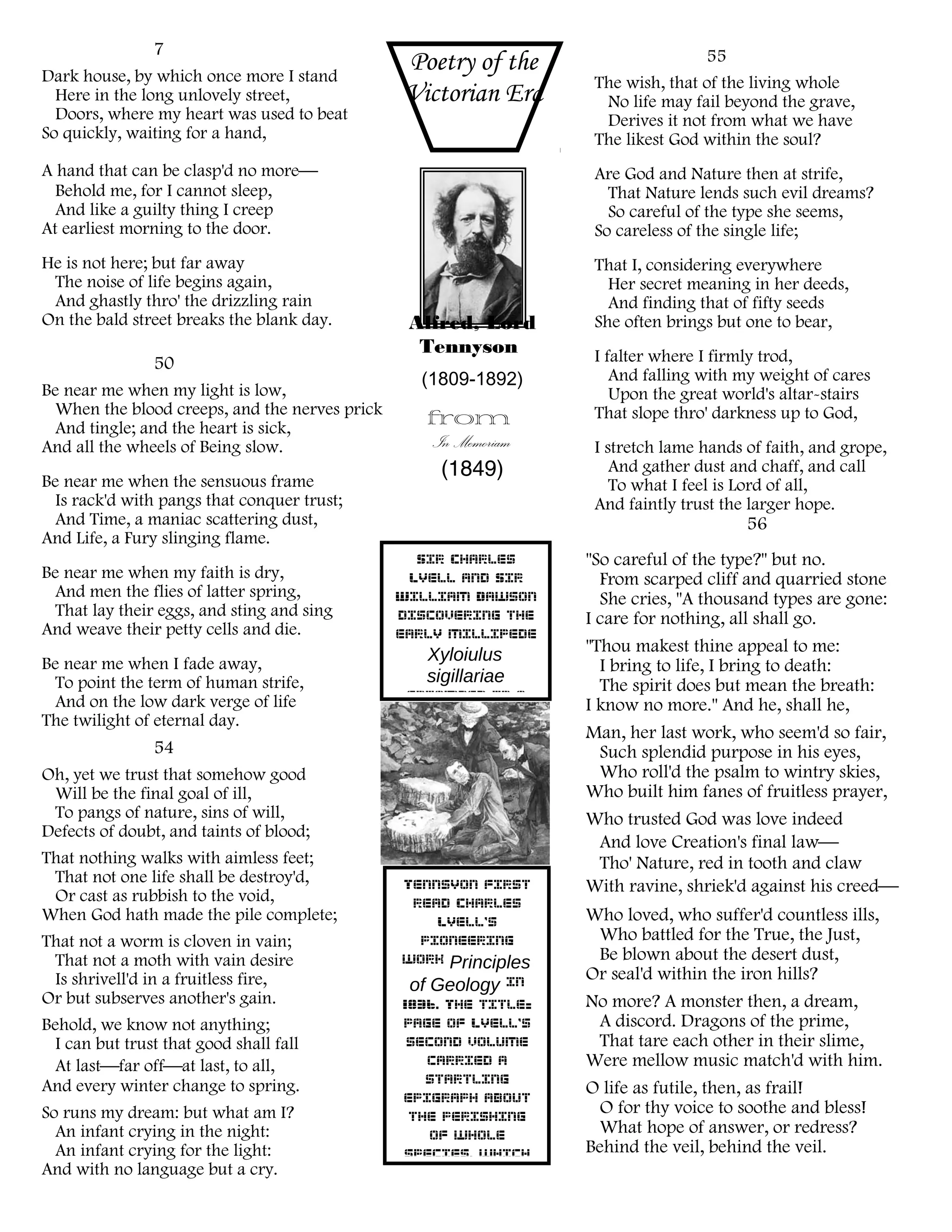
Tennsyon first
read Charles
Lyell's
pioneering
work Principles
of Geology in
1836. The title-
page of Lyell's
second volume
carried a
startling
epigraph about
the perishing
of whole
species, which
7
Dark house, by which once more I stand
Here in the long unlovely street,
Doors, where my heart was used to beat
So quickly, waiting for a hand,
A hand that can be clasp'd no more
Behold me, for I cannot sleep,
And like a guilty thing I creep
At earliest morning to the door.
He is not here; but far away
The noise of life begins again,
And ghastly thro' the drizzling rain
On the bald street breaks the blank day.
50
Be near me when my light is low,
When the blood creeps, and the nerves prick
And tingle; and the heart is sick,
And all the wheels of Being slow.
Be near me when the sensuous frame
Is rack'd with pangs that conquer trust;
And Time, a maniac scattering dust,
And Life, a Fury slinging flame.
Be near me when my faith is dry,
And men the flies of latter spring,
That lay their eggs, and sting and sing
And weave their petty cells and die.
Be near me when I fade away,
To point the term of human strife,
And on the low dark verge of life
The twilight of eternal day.
54
Oh, yet we trust that somehow good
Will be the final goal of ill,
To pangs of nature, sins of will,
Defects of doubt, and taints of blood;
That nothing walks with aimless feet;
That not one life shall be destroy'd,
Or cast as rubbish to the void,
When God hath made the pile complete;
That not a worm is cloven in vain;
That not a moth with vain desire
Is shrivell'd in a fruitless fire,
Or but subserves another's gain.
Behold, we know not anything;
I can but trust that good shall fall
At lastfar offat last, to all,
And every winter change to spring.
So runs my dream: but what am I?
An infant crying in the night:
An infant crying for the light:
And with no language but a cry.
55
The wish, that of the living whole
No life may fail beyond the grave,
Derives it not from what we have
The likest God within the soul?
Are God and Nature then at strife,
That Nature lends such evil dreams?
So careful of the type she seems,
So careless of the single life;
That I, considering everywhere
Her secret meaning in her deeds,
And finding that of fifty seeds
She often brings but one to bear,
I falter where I firmly trod,
And falling with my weight of cares
Upon the great world's altar-stairs
That slope thro' darkness up to God,
I stretch lame hands of faith, and grope,
And gather dust and chaff, and call
To what I feel is Lord of all,
And faintly trust the larger hope.
Alfred, Lord
Tennyson
(1809-1892)
from
In Memoriam
(1849)
56
"So careful of the type?" but no.
From scarped cliff and quarried stone
She cries, "A thousand types are gone:
I care for nothing, all shall go.
"Thou makest thine appeal to me:
I bring to life, I bring to death:
The spirit does but mean the breath:
I know no more." And he, shall he,
Man, her last work, who seem'd so fair,
Such splendid purpose in his eyes,
Who roll'd the psalm to wintry skies,
Who built him fanes of fruitless prayer,
Who trusted God was love indeed
And love Creation's final law
Tho' Nature, red in tooth and claw
With ravine, shriek'd against his creed
Who loved, who suffer'd countless ills,
Who battled for the True, the Just,
Be blown about the desert dust,
Or seal'd within the iron hills?
No more? A monster then, a dream,
A discord. Dragons of the prime,
That tare each other in their slime,
Were mellow music match'd with him.
O life as futile, then, as frail!
O for thy voice to soothe and bless!
What hope of answer, or redress?
Behind the veil, behind the veil.
Sir Charles
Lyell and Sir
William Dawson
discovering the
early millipede
Xyloiulus
sigillariae
entombed in a
Poetry of the
Victorian Era
DE PROFUNDIS
Oh why is heaven built so far,
Oh why is earth set so remote?
I cannot reach the nearest star
That hangs afloat.
I would not care to reach the moon,
One round monotonous of change;
Yet even she repeats her tune
Beyond my range.
I never watch the scatter'd fire
Of stars, or sun's far-trailing train,
But all my heart is one desire,
And all in vain:
For I am bound with fleshly bands,
Joy, beauty, lie beyond my scope;
I strain my heart, I stretch my hands,
And catch at hope.
ALOOF
THE irresponsive silence of the land,
The irresponsive sounding of the sea,
Speak both one message of one sense to me:—
Aloof, aloof, we stand aloof, so stand
Thou too aloof, bound with the flawless band
Of inner solitude; we bind not thee;
But who from thy self-chain shall set thee free?
What heart shall touch thy heart? What hand thy hand?
And I am sometimes proud and sometimes meek,
And sometimes I remember days of old
When fellowship seem'd not so far to seek,
And all the world and I seem'd much less cold,
And at the rainbow's foot lay surely gold,
And hope felt strong, and life itself not weak.
(1881)
Gerard Manley Hopkins
(1844–1889)
GOD’S GRANDEUR
THE WORLD is charged with the grandeur of God.
It will flame out, like shining from shook foil;
It gathers to a greatness, like the ooze of oil
Crushed. Why do men then now not reck his rod?
Generations have trod, have trod, have trod;
And all is seared with trade; bleared, smeared with toil;
And wears man’s smudge and shares man’s smell: the soil
Is bare now, nor can foot feel, being shod.
And for all this, nature is never spent;
There lives the dearest freshness deep down things;
And though the last lights off the black West went
Oh, morning, at the brown brink eastward, springs—
Because the Holy Ghost over the bent
World broods with warm breast and with ah! bright wings.
PIED BEAUTY
GLORY be to God for dappled things—
For skies of couple-colour as a brinded cow;
For rose-moles all in stipple upon trout that swim;
Fresh-firecoal chestnut-falls; finches’ wings;
Landscape plotted and pieced—fold, fallow, and plough;
And áll trádes, their gear and tackle and trim.
All things counter, original, spare, strange;
Whatever is fickle, freckled (who knows how?)
With swift, slow; sweet, sour; adazzle, dim;
He fathers-forth whose beauty is past change:
Praise him.
I WAKE AND FEEL THE FELL OF DARK, NOT DAY
I WAKE and feel the fell of dark, not day.
What hours, O what black hoürs we have spent
This night! what sights you, heart, saw; ways you went!
And more must, in yet longer light’s delay.
With witness I speak this. But where I say
Hours I mean years, mean life. And my lament
Is cries countless, cries like dead letters sent
To dearest him that lives alas! away.
I am gall, I am heartburn. God’s most deep decree
Bitter would have me taste: my taste was me;
Bones built in me, flesh filled, blood brimmed the curse.
Selfyeast of spirit a dull dough sours. I see
The lost are like this, and their scourge to be
As I am mine, their sweating selves; but worse.
Christina Rossetti
(1830–1894)

Victorian Era Poetry handout

  • 1.
    Tennsyon first read Charles Lyell's pioneering workPrinciples of Geology in 1836. The title- page of Lyell's second volume carried a startling epigraph about the perishing of whole species, which 7 Dark house, by which once more I stand Here in the long unlovely street, Doors, where my heart was used to beat So quickly, waiting for a hand, A hand that can be clasp'd no more Behold me, for I cannot sleep, And like a guilty thing I creep At earliest morning to the door. He is not here; but far away The noise of life begins again, And ghastly thro' the drizzling rain On the bald street breaks the blank day. 50 Be near me when my light is low, When the blood creeps, and the nerves prick And tingle; and the heart is sick, And all the wheels of Being slow. Be near me when the sensuous frame Is rack'd with pangs that conquer trust; And Time, a maniac scattering dust, And Life, a Fury slinging flame. Be near me when my faith is dry, And men the flies of latter spring, That lay their eggs, and sting and sing And weave their petty cells and die. Be near me when I fade away, To point the term of human strife, And on the low dark verge of life The twilight of eternal day. 54 Oh, yet we trust that somehow good Will be the final goal of ill, To pangs of nature, sins of will, Defects of doubt, and taints of blood; That nothing walks with aimless feet; That not one life shall be destroy'd, Or cast as rubbish to the void, When God hath made the pile complete; That not a worm is cloven in vain; That not a moth with vain desire Is shrivell'd in a fruitless fire, Or but subserves another's gain. Behold, we know not anything; I can but trust that good shall fall At lastfar offat last, to all, And every winter change to spring. So runs my dream: but what am I? An infant crying in the night: An infant crying for the light: And with no language but a cry. 55 The wish, that of the living whole No life may fail beyond the grave, Derives it not from what we have The likest God within the soul? Are God and Nature then at strife, That Nature lends such evil dreams? So careful of the type she seems, So careless of the single life; That I, considering everywhere Her secret meaning in her deeds, And finding that of fifty seeds She often brings but one to bear, I falter where I firmly trod, And falling with my weight of cares Upon the great world's altar-stairs That slope thro' darkness up to God, I stretch lame hands of faith, and grope, And gather dust and chaff, and call To what I feel is Lord of all, And faintly trust the larger hope. Alfred, Lord Tennyson (1809-1892) from In Memoriam (1849) 56 "So careful of the type?" but no. From scarped cliff and quarried stone She cries, "A thousand types are gone: I care for nothing, all shall go. "Thou makest thine appeal to me: I bring to life, I bring to death: The spirit does but mean the breath: I know no more." And he, shall he, Man, her last work, who seem'd so fair, Such splendid purpose in his eyes, Who roll'd the psalm to wintry skies, Who built him fanes of fruitless prayer, Who trusted God was love indeed And love Creation's final law Tho' Nature, red in tooth and claw With ravine, shriek'd against his creed Who loved, who suffer'd countless ills, Who battled for the True, the Just, Be blown about the desert dust, Or seal'd within the iron hills? No more? A monster then, a dream, A discord. Dragons of the prime, That tare each other in their slime, Were mellow music match'd with him. O life as futile, then, as frail! O for thy voice to soothe and bless! What hope of answer, or redress? Behind the veil, behind the veil. Sir Charles Lyell and Sir William Dawson discovering the early millipede Xyloiulus sigillariae entombed in a Poetry of the Victorian Era
  • 2.
    DE PROFUNDIS Oh whyis heaven built so far, Oh why is earth set so remote? I cannot reach the nearest star That hangs afloat. I would not care to reach the moon, One round monotonous of change; Yet even she repeats her tune Beyond my range. I never watch the scatter'd fire Of stars, or sun's far-trailing train, But all my heart is one desire, And all in vain: For I am bound with fleshly bands, Joy, beauty, lie beyond my scope; I strain my heart, I stretch my hands, And catch at hope. ALOOF THE irresponsive silence of the land, The irresponsive sounding of the sea, Speak both one message of one sense to me:— Aloof, aloof, we stand aloof, so stand Thou too aloof, bound with the flawless band Of inner solitude; we bind not thee; But who from thy self-chain shall set thee free? What heart shall touch thy heart? What hand thy hand? And I am sometimes proud and sometimes meek, And sometimes I remember days of old When fellowship seem'd not so far to seek, And all the world and I seem'd much less cold, And at the rainbow's foot lay surely gold, And hope felt strong, and life itself not weak. (1881) Gerard Manley Hopkins (1844–1889) GOD’S GRANDEUR THE WORLD is charged with the grandeur of God. It will flame out, like shining from shook foil; It gathers to a greatness, like the ooze of oil Crushed. Why do men then now not reck his rod? Generations have trod, have trod, have trod; And all is seared with trade; bleared, smeared with toil; And wears man’s smudge and shares man’s smell: the soil Is bare now, nor can foot feel, being shod. And for all this, nature is never spent; There lives the dearest freshness deep down things; And though the last lights off the black West went Oh, morning, at the brown brink eastward, springs— Because the Holy Ghost over the bent World broods with warm breast and with ah! bright wings. PIED BEAUTY GLORY be to God for dappled things— For skies of couple-colour as a brinded cow; For rose-moles all in stipple upon trout that swim; Fresh-firecoal chestnut-falls; finches’ wings; Landscape plotted and pieced—fold, fallow, and plough; And áll trádes, their gear and tackle and trim. All things counter, original, spare, strange; Whatever is fickle, freckled (who knows how?) With swift, slow; sweet, sour; adazzle, dim; He fathers-forth whose beauty is past change: Praise him. I WAKE AND FEEL THE FELL OF DARK, NOT DAY I WAKE and feel the fell of dark, not day. What hours, O what black hoürs we have spent This night! what sights you, heart, saw; ways you went! And more must, in yet longer light’s delay. With witness I speak this. But where I say Hours I mean years, mean life. And my lament Is cries countless, cries like dead letters sent To dearest him that lives alas! away. I am gall, I am heartburn. God’s most deep decree Bitter would have me taste: my taste was me; Bones built in me, flesh filled, blood brimmed the curse. Selfyeast of spirit a dull dough sours. I see The lost are like this, and their scourge to be As I am mine, their sweating selves; but worse. Christina Rossetti (1830–1894)