


N
O T
Technology and
Livelihood Education
Quarter 1,Wk.6-10 - Module 1
(Draft Floor Plan)
Department of Education ● Republic of the Philippines
9
Technology and Livelihood Education- Grade 9
Alternative Delivery Mode
Quarter 1, Wk.6 - Module 1: (Drafting Architectural Layout and Details)
First Edition, 2020
Republic Act 8293, section 176 states that: No copyright shall subsist in any
work of the Government of the Philippines. However, prior approval of the
government agency or office wherein the work is created shall be necessary for
exploitation of such work for profit. Such agency or office may, among other things,
impose as a condition the payment of royalty.
Borrowed materials (i.e., songs, stories, poems, pictures, photos, brand
names, trademarks, etc.) included in this book are owned by their respective
copyright holders. Every effort has been exerted to locate and seek permission to
use these materials from their respective copyright owners. The publisher and
authors do not represent nor claim ownership over them.
Published by the Department of Education – Division of Cagayan de Oro
Schools Division Superintendent: Roy Angelo L. Gazo, PhD.,CESO V
Development Team of the Module
Author/s: (______Maria Cristina Mina)
Reviewers: (_______________________)
Illustrator and Layout Artist: (________________________)
Management Team
Chairperson: Dr. Arturo B. Bayocot, CESO III
Regional Director
Co-Chairpersons: Dr. Victor G. De Gracia Jr. CESO V
Asst. Regional Director
Roy Angelo E. Gazo, PhD, CESO V
Schools Division Superintendent
Nimfa R. Lago,PhD, CESE
Assistant Schools Division Superintendent
Mala Epra B. Magnaong, Chief ES, CLMD
Members Neil A. Improgo, EPS-LRMS
Bienvenido U. Tagolimot, Jr., EPS-ADM
Henry B. Abueva OIC-CID Chief
Blair D. Castillon, EPS-EPP/TLE
Sherlita L. Daguisonan, LRMS Manager
Meriam S. Otarra, PDO II
Charlotte D. Quidlat, Librarian II
Printed in the Philippines by
Department of Education – Division of Iligan City
Office Address: General Aguinaldo, St., Iligan City
Telefax: (063)221-6069
E-mail Address: iligan.city@deped.gov.ph
Technology and
Livelihood
Education
Quarter 1,Wk.6 - Module 1
(Draft Floor Plan)
This instructional material was collaboratively developed and reviewed
by educators from public and private schools, colleges, and or/universities.
We encourage teachers and other education stakeholders to email their
feedback, comments, and recommendations to the Department of Education
– Iligan City at iligancity@deped.gov.ph or Trlrfax (063) 221-6069.
We value your feedback and recommendations.
Department of Education ● Republic of the Philippines
9
This page is intentionally blank
Table of Contents
What This Module is About......................................................................................................................................i
What I Need to Know .................................................................................................................................................ii
How to Learn from this Module.............................................................................................................................ii
Icons of this Module....................................................................................................................................................iii
What I Know.................................................................................................................................................................iii
Lesson 1:
(Draw Walls, Windows, Doors, Fixtures and Fittings)
Pre-Test
Lesson Objectives
Information Sheet 1.1
( Draft Walls, Windows, Doors, Fixtures and Fittings)
Self Check 1.1
Activity Sheet 1.1
Operation Sheet 1.1
Performance Criterion Checklist 1.1
Lesson 2:
(Draw Grid and Dimension Lines According to Architectural Design
Standard )
Pre-Test
Lesson Objectives
Information Sheet 2.1
( Draw Grid and Dimension Lines According to Architectural Design Standard
)
Self Check 2.1
Activity Sheet 2.1
Operation Sheet 2.1
Performance Criterion Checklist 2.1
Lesson 3:
(Use of Metric Scale System According to Magnitude of Plan )
Pre-Test
Lesson Objectives
Information Sheet 3.1
( Use of Metric Scale System According to Magnitude of Plan)
Self Check 3.1
Lesson 4:
(Identify Sizes of Doors, Walls and Rooms Following the Schedule.
Indicate Letterings and Labels according to Drafting Standard )
Pre-Test
Lesson Objectives
Information Sheet 4.1
( Identify Sizes of Doors, Walls and Rooms Following the Schedule
Indicate Letterings and Labels According to Drafting Standards.)
Self Check 4.1
Activity Sheet 4.1
Operation Sheet 4.1
Performance Criterion Checklist 4.1
Summary
Assessment: (Post-Test)
Key to Answers.......................................................................................................................................................
References................................................................................................................................................................
This page is intentionally blank
What This Module is About
Introduction
A floor plan is used in construction to build the structures. This drawing provides
visual guidelines, showing technical details such as dimension etc. The floor plan is also an
avenue for a proposed home of the future homeowner a chance to assess the design in
terms of aptness for the requirements of the family. Designing a floor plan is a meticulous
process that involves many factors and standards to be considered. Symbols are used on
floor plans to label the items with living in the home and other factors more strictly
associated to the construction of the home. One of the most vital concern of the drafter is to
cautiously associate all the symbols, notes and dimensions on the plan to make it
uncluttered and easy to read. Floor plans that are organized are easy to build because there
is a fewer possibility of construction errors than with unorganized plans.
This module is specifically created to introduced and focus on the different hands-on
learning activities that will prepare you to be skilled and poised on your knowledge and skills
and be a step closer to be a draftsman.
In this module, you are required to go through a series of learning activities in order
to complete each learning outcome. In each learning outcome are Information Sheets, Slef
Checks, Operation Sheets and Activity Sheets. Follow and perform the activities on your
own. If you have questions do not hesitate to ask for assistance from your facilitator.
Remember to:
 Work through all the information and complete the activities in each section.
 Read Information Sheets and complete the self- check. Suggested references
are included to supplements the materials provided in this module.
 You will be given an opportunity to ask questions and practice on the job.
Make sure you practice your new skills, this will help you improve your speed,
memory and confidence.
 Use the Self- Checks, Operation Sheets, Activity Sheets at the end of each
lesson to check your own progress. Use the performance criteria checklist
located after the Sheet to check your own performance.
You need to complete this module before you can perform the next module.
What I Need to Know About This Module
This contains information and learning activities on Draw walls, windows, doors and
fittings. It includes instruction and procedure on how to Draft Floor Plans.
Completion of this module will help you better understand the succeeding module on
Draft Roof Framing Plan.
This module hs four learning outcome that contains learning activities supported by
instructional sheets. Before you perform the instruction, read the information sheets and
answer the self-check activities provided. To ascertain your competence, your teacher will
assess on what you have acquired when the knowledge necessary to perform the skill
portion of the particular learning outcome.
Upon the completion of this module, ask your teacher for assessment to check your
achievement of knowledge and skills requirements of this module. If you pass the
assessment, you will be given a certificate of completion.
Upon completion of the module the learner should be able to:
LO1 : Draw walls, windows, door, fixtures and fittings TLE_IAAW9-12RW-Iva-1
How to Learn from this Module
To achieve the objectives cited above, you are to do the following:
• Take your time reading the lessons carefully.
• Follow the directions and/or instructions in the activities and exercises diligently.
• Answer all the given tests and exercises.
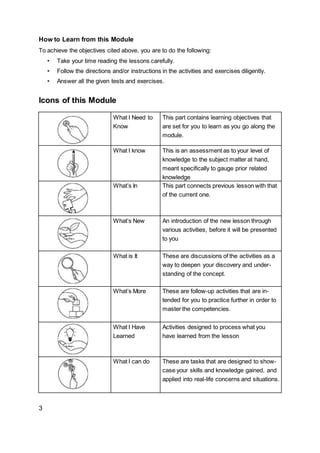
Icons of this Module
What I Need to This part contains learning objectives that
Know are set for you to learn as you go along the
module.
What I know This is an assessment as to your level of
knowledge to the subject matter at hand,
meant specifically to gauge prior related
knowledge
What’s In This part connects previous lesson with that
of the current one.
What’s New An introduction of the new lesson through
various activities, before it will be presented
to you
What is It These are discussions of the activities as a
way to deepen your discovery and under-
standing of the concept.
What’s More These are follow-up activities that are in-
tended for you to practice further in order to
master the competencies.
What I Have Activities designed to process what you
Learned have learned from the lesson
What I can do These are tasks that are designed to show-
case your skills and knowledge gained, and
applied into real-life concerns and situations.
3
What I Know
Lesson 4. Draw Walls, Windows, Doors, Fixtures and Fittings
This lesson is designed to help you draft sample floor plans that
follow a given architectural design standards and requirements.
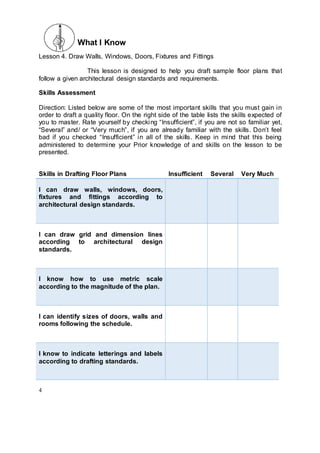
Skills Assessment
Direction: Listed below are some of the most important skills that you must gain in
order to draft a quality floor. On the right side of the table lists the skills expected of
you to master. Rate yourself by checking “Insufficient”, if you are not so familiar yet,
“Several” and/ or “Very much”, if you are already familiar with the skills. Don’t feel
bad if you checked “Insufficient” in all of the skills. Keep in mind that this being
administered to determine your Prior knowledge of and skills on the lesson to be
presented.
Skills in Drafting Floor Plans Insufficient Several Very Much
I can draw walls, windows, doors,
fixtures and fittings according to
architectural design standards.
I can draw grid and dimension lines
according to architectural design
standards.
I know how to use metric scale
according to the magnitude of the plan.
I can identify sizes of doors, walls and
rooms following the schedule.
I know to indicate letterings and labels
according to drafting standards.
4
What I Know
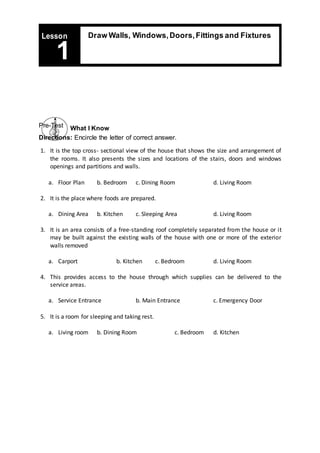
Pre-Test
Directions: Encircle the letter of correct answer.
1. It is the top cross- sectional view of the house that shows the size and arrangement of
the rooms. It also presents the sizes and locations of the stairs, doors and windows
openings and partitions and walls.
a. Floor Plan b. Bedroom c. Dining Room d. Living Room
2. It is the place where foods are prepared.
a. Dining Area b. Kitchen c. Sleeping Area d. Living Room
3. It is an area consists of a free-standing roof completely separated from the house or it
may be built against the existing walls of the house with one or more of the exterior
walls removed
a. Carport b. Kitchen c. Bedroom d. Living Room
4. This provides access to the house through which supplies can be delivered to the
service areas.
a. Service Entrance b. Main Entrance c. Emergency Door
5. It is a room for sleeping and taking rest.
a. Living room b. Dining Room c. Bedroom d. Kitchen
Lesson Draw Walls, Windows,Doors,Fittings and Fixtures
1
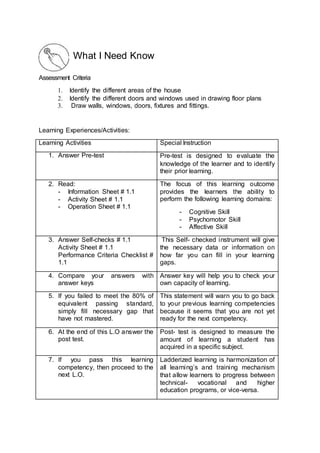
Assessment Criteria
1. Identify the different areas of the house
2. Identify the different doors and windows used in drawing floor plans
3. Draw walls, windows, doors, fixtures and fittings.
Learning Experiences/Activities:
Learning Activities Special Instruction
1. Answer Pre-test Pre-test is designed to evaluate the
knowledge of the learner and to identify
their prior learning.
2. Read:
- Information Sheet # 1.1
- Activity Sheet # 1.1
- Operation Sheet # 1.1
The focus of this learning outcome
provides the learners the ability to
perform the following learning domains:
- Cognitive Skill
- Psychomotor Skill
- Affective Skill
3. Answer Self-checks # 1.1
Activity Sheet # 1.1
Performance Criteria Checklist #
1.1
This Self- checked instrument will give
the necessary data or information on
how far you can fill in your learning
gaps.
4. Compare your answers with
answer keys
Answer key will help you to check your
own capacity of learning.
5. If you failed to meet the 80% of
equivalent passing standard,
simply fill necessary gap that
have not mastered.
This statement will warn you to go back
to your previous learning competencies
because it seems that you are not yet
ready for the next competency.
6. At the end of this L.O answer the
post test.
Post- test is designed to measure the
amount of learning a student has
acquired in a specific subject.
7. If you pass this learning
competency, then proceed to the
next L.O.
Ladderized learning is harmonization of
all learning’s and training mechanism
that allow learners to progress between
technical- vocational and higher
education programs, or vice-versa.
What I Need Know
What’s New
Technical Terms Encountered in Drawing Walls, Windows, Doors, Fittings and
Fixtures.
Bathroom- Where the toilet and tub or shower are separated for east installation of
pipes.
Bedroom- is a room for sleeping and taking rest.
Carport- is a garage consists of a free-standing roof completely separated from the
house or it may be built against the existing walls of the house with one or more of
the exterior walls removed.
Floor Plan- is the top cross- sectional view of the house that shows the size and
arrangement of the rooms. It also presents the sizes and locations of the stairs,
doors and windows openings and partitions and walls.
Kitchen- is the place where foods are prepared.
Livingroom- is the center of the living area in most homes.
Main Entrance- provides access to the house. It is the one through which guest are
welcomed. It Provides shelter to anyone awaiting entrance.
Service Entrance- provides access to the house through which supplies can be
delivered to the service areas.
What Is It
AREA PLANNING
In creating any architectural design, the designer should progress logically
follow the step by step design process. One of the vital step is to divide the functions
of the building into specific areas.
Three Major Functional Areas of the House
1. Living Area- the space in the house where the family spends their free time.
a. Living Room d. Terrace
b. Balcony e. Family Room
c. Porch f. Recreational or Game Room
2. Sleeping Area- the area where the family rests.
Information Sheet 1.1
a. Bedrooms
b. Guest Room
c. Maids Room
3. Mechanical Chore Areas- the place where the family works.
a. Kitchen d. Service Room
b. Dining Room e. Library
c. Bath and Toilet
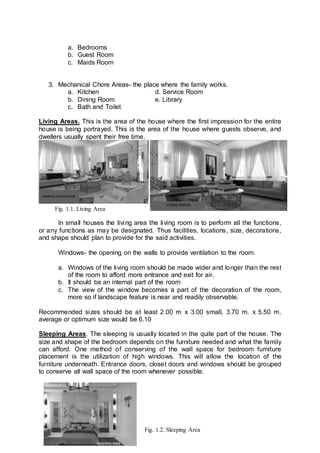
Living Areas. This is the area of the house where the first impression for the entire
house is being portrayed. This is the area of the house where guests observe, and
dwellers usually spent their free time.
In small houses the living area the living room is to perform all the functions,
or any functions as may be designated. Thus facilities, locations, size, decorations,
and shape should plan to provide for the said activities.
Windows- the opening on the walls to provide ventilation to the room.
a. Windows of the living room should be made wider and longer than the rest
of the room to afford more entrance and exit for air.
b. It should be an internal part of the room
c. The view of the window becomes a part of the decoration of the room,
more so if landscape feature is near and readily observable.
Recommended sizes should be at least 2.00 m x 3.00 small, 3.70 m. x 5.50 m.
average or optimum size would be 6.10
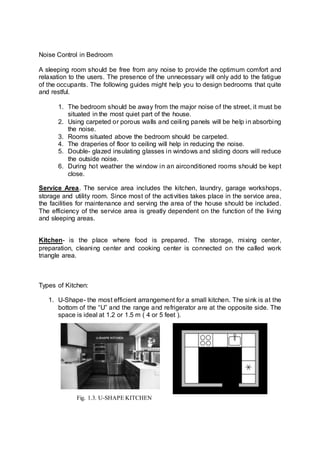
Sleeping Areas. The sleeping is usually located in the quite part of the house. The
size and shape of the bedroom depends on the furniture needed and what the family
can afford. One method of conserving of the wall space for bedroom furniture
placement is the utilization of high windows. This will allow the location of the
furniture underneath. Entrance doors, closet doors and windows should be grouped
to conserve all wall space of the room whenever possible.
Fig. 1.1. Living Area
Fig. 1.2. Sleeping Area
Noise Control in Bedroom
A sleeping room should be free from any noise to provide the optimum comfort and
relaxation to the users. The presence of the unnecessary will only add to the fatigue
of the occupants. The following guides might help you to design bedrooms that quite
and restful.
1. The bedroom should be away from the major noise of the street, it must be
situated in the most quiet part of the house.
2. Using carpeted or porous walls and ceiling panels will be help in absorbing
the noise.
3. Rooms situated above the bedroom should be carpeted.
4. The draperies of floor to ceiling will help in reducing the noise.
5. Double- glazed insulating glasses in windows and sliding doors will reduce
the outside noise.
6. During hot weather the window in an airconditioned rooms should be kept
close.
Service Area. The service area includes the kitchen, laundry, garage workshops,
storage and utility room. Since most of the activities takes place in the service area,
the facilities for maintenance and serving the area of the house should be included.
The efficiency of the service area is greatly dependent on the function of the living
and sleeping areas.
Kitchen- is the place where food is prepared. The storage, mixing center,
preparation, cleaning center and cooking center is connected on the called work
triangle area.
Types of Kitchen:
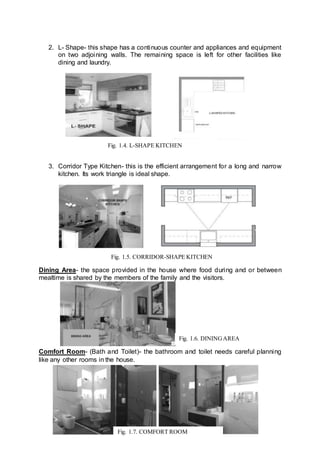
1. U-Shape- the most efficient arrangement for a small kitchen. The sink is at the
bottom of the “U” and the range and refrigerator are at the opposite side. The
space is ideal at 1.2 or 1.5 m ( 4 or 5 feet ).
Fig. 1.3. U-SHAPE KITCHEN
2. L- Shape- this shape has a continuous counter and appliances and equipment
on two adjoining walls. The remaining space is left for other facilities like
dining and laundry.
3. Corridor Type Kitchen- this is the efficient arrangement for a long and narrow
kitchen. Its work triangle is ideal shape.
Dining Area- the space provided in the house where food during and or between
mealtime is shared by the members of the family and the visitors.
Comfort Room- (Bath and Toilet)- the bathroom and toilet needs careful planning
like any other rooms in the house.
Fig. 1.4. L-SHAPE KITCHEN
Fig. 1.5. CORRIDOR-SHAPE KITCHEN
Fig. 1.6. DININGAREA
Fig. 1.7. COMFORT ROOM
Basic Fixtures of a Comfort Room
1. Lavatory
2. Water Closet
3. Mirror
4. Sink
5. Shower
6. Floor Drain
7. Tub
Garage and Carport
Garage- it is a structure or a part of the house for the automobile. It could be
connected to the main structure or as an integral part of it or a separate building. It is
more secure for the car if attached to the main building.
Types of Garage Doors:
1. Two-leaf wing door 4. Sectional Roll-up
2. Overhead 5. Electronic Controlled
3. Four-leaf wing door
Carport- A style of garage with one or more exterior walls removed. It is less
expensive than a real garage.
ROOM SIZES
Entrance- the main opening in the house that provides access to both owners and
visitors into the structure. It should be strategically located where it could serve the
most, usually in front of the building.
The entrance is classified into three kinds, namely:
1. Main Entrance- this should be made visible to the stranger and should
appear, if possible, at the lower portion of the floor.
2. Service Entrance- This opening provides access for the entrance of
supplies into the house and an access to the other service areas, like
garage, laundry and workshop.
3. Special Purpose Entrance- an opening in the house that does not provide
traffic into the house but outward like that of the living room to the terrace.
Wall Opening
Windows- the kind of wall opening that provides natural daytime lighting and
ventilation to the house to the house or room. It is provided with a shutter to
control the light and air needed and to provide safety for the users at night
time.
Doors and Windows in Plan
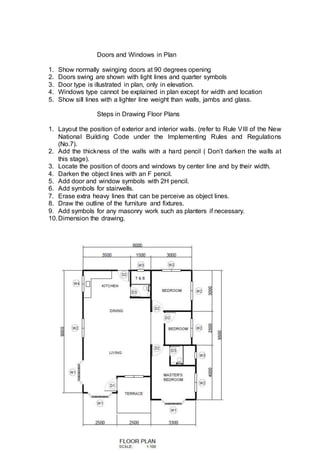
1. Show normally swinging doors at 90 degrees opening
2. Doors swing are shown with light lines and quarter symbols
3. Door type is illustrated in plan, only in elevation.
4. Windows type cannot be explained in plan except for width and location
5. Show sill lines with a lighter line weight than walls, jambs and glass.
Steps in Drawing Floor Plans
1. Layout the position of exterior and interior walls. (refer to Rule VIII of the New
National Building Code under the Implementing Rules and Regulations
(No.7).
2. Add the thickness of the walls with a hard pencil ( Don’t darken the walls at
this stage).
3. Locate the position of doors and windows by center line and by their width.
4. Darken the object lines with an F pencil.
5. Add door and window symbols with 2H pencil.
6. Add symbols for stairwells.
7. Erase extra heavy lines that can be perceive as object lines.
8. Draw the outline of the furniture and fixtures.
9. Add symbols for any masonry work such as planters if necessary.
10.Dimension the drawing.
What I Have Learned
Self -Check 1.1
A. Directions: Read each item carefully. Choose the letter of the correct answer and
write your answer on a separate sheet of paper.
1. This is the kind of wall opening that provides natural daytime lighting and
ventilation to the house to the house or room. It is provided with a shutter to
control the light and air needed and to provide safety for the users at
nighttime.
a. Window b. Doors c. Wall d. Crack
2. This the type of kitchen on which the shape has a continuous counter and
appliances and equipment on two adjoining walls. The remaining space is left
for other facilities like dining and laundry.
a. L- Shaped b. U-Shaped c. Mediterranean d. Family
3. A room that should be free from any noise to provide the optimum comfort
and relaxation to the users.
a. Sleeping b. Living c. Service d. French
4. The space provided in the house where food during and or between mealtime
is shared by the members of the family and the visitors.
a. Kitchen b. Dining c. Bedroom d. Project
5. This opening provides access for the entrance of supplies into the house and
an access to the other service areas, like garage, laundry and workshop.
a. Service Entrance b. Main Entrance c. Special Purpose Entrance.
Fig. Sample Floor Plan
What’s More
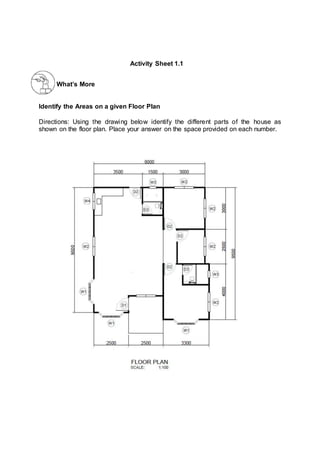
Identify the Areas on a given Floor Plan
Directions: Using the drawing below identify the different parts of the house as
shown on the floor plan. Place your answer on the space provided on each number.
Activity Sheet 1.1
What I Can Do
Operation Sheet 1.1
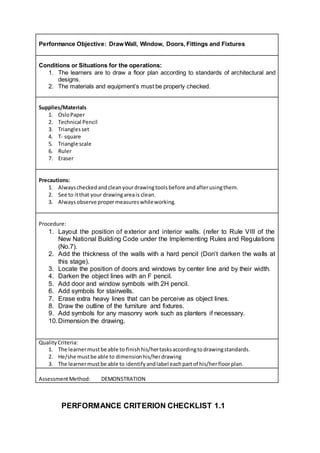
Performance Objective: Draw Wall, Window, Doors, Fittings and Fixtures
Conditions or Situations for the operations:
1. The learners are to draw a floor plan according to standards of architectural and
designs.
2. The materials and equipment’s must be properly checked.
Supplies/Materials
1. OsloPaper
2. Technical Pencil
3. Trianglesset
4. T- square
5. Triangle scale
6. Ruler
7. Eraser
Precautions:
1. Alwayscheckedandcleanyourdrawingtoolsbefore andafterusingthem.
2. See to itthat your drawingareais clean.
3. Always observe propermeasureswhileworking.
Procedure:
1. Layout the position of exterior and interior walls. (refer to Rule VIII of the
New National Building Code under the Implementing Rules and Regulations
(No.7).
2. Add the thickness of the walls with a hard pencil (Don’t darken the walls at
this stage).
3. Locate the position of doors and windows by center line and by their width.
4. Darken the object lines with an F pencil.
5. Add door and window symbols with 2H pencil.
6. Add symbols for stairwells.
7. Erase extra heavy lines that can be perceive as object lines.
8. Draw the outline of the furniture and fixtures.
9. Add symbols for any masonry work such as planters if necessary.
10.Dimension the drawing.
QualityCriteria:
1. The learnermustbe able to finishhis/hertasksaccordingtodrawingstandards.
2. He/she mustbe able to dimensionhis/herdrawing
3. The learnermustbe able to identifyandlabel eachpartof his/herfloorplan.
AssessmentMethod: DEMONSTRATION
PERFORMANCE CRITERION CHECKLIST 1.1
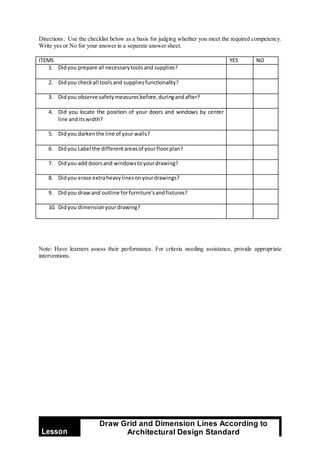
Directions: Use the checklist below as a basis for judging whether you meet the required competency.
Write yes or No for your answer in a separate answer sheet.
ITEMS YES NO
1. Didyou prepare all necessarytoolsand supplies?
2. Didyou checkall toolsand suppliesfunctionality?
3. Didyou observe safetymeasuresbefore,duringandafter?
4. Did you locate the position of your doors and windows by center
line anditswidth?
5. Didyou darkenthe line of your walls?
6. Didyou Label the differentareasof yourfloorplan?
7. Didyou add doorsand windowstoyourdrawing?
8. Didyou erase extraheavylinesonyourdrawings?
9. Didyou drawand outline forfurniture’sandfixtures?
10. Didyou dimensionyourdrawing?
Note: Have learners assess their performance. For criteria needing assistance, provide appropriate
interventions.
Lesson
Draw Grid and Dimension Lines According to
Architectural Design Standard
2
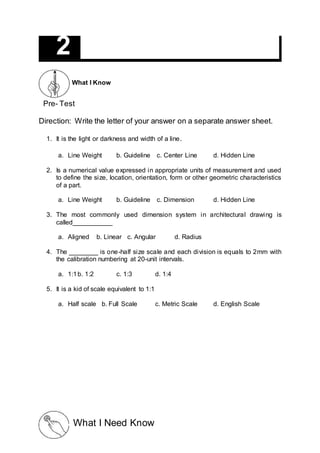
Pre- Test
Direction: Write the letter of your answer on a separate answer sheet.
1. It is the light or darkness and width of a line.
a. Line Weight b. Guideline c. Center Line d. Hidden Line
2. Is a numerical value expressed in appropriate units of measurement and used
to define the size, location, orientation, form or other geometric characteristics
of a part.
a. Line Weight b. Guideline c. Dimension d. Hidden Line
3. The most commonly used dimension system in architectural drawing is
called___________
a. Aligned b. Linear c. Angular d. Radius
4. The ________ is one-half size scale and each division is equals to 2mm with
the calibration numbering at 20-unit intervals.
a. 1:1b. 1:2 c. 1:3 d. 1:4
5. It is a kid of scale equivalent to 1:1
a. Half scale b. Full Scale c. Metric Scale d. English Scale
What I Know
What I Need Know
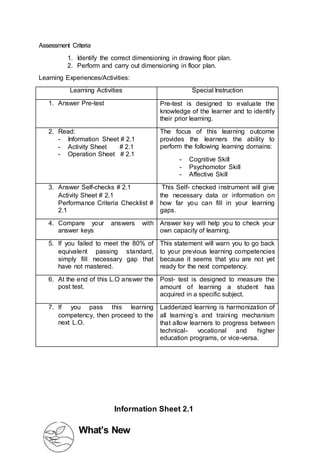
Assessment Criteria
1. Identify the correct dimensioning in drawing floor plan.
2. Perform and carry out dimensioning in floor plan.
Learning Experiences/Activities:
Learning Activities Special Instruction
1. Answer Pre-test Pre-test is designed to evaluate the
knowledge of the learner and to identify
their prior learning.
2. Read:
- Information Sheet # 2.1
- Activity Sheet # 2.1
- Operation Sheet # 2.1
The focus of this learning outcome
provides the learners the ability to
perform the following learning domains:
- Cognitive Skill
- Psychomotor Skill
- Affective Skill
3. Answer Self-checks # 2.1
Activity Sheet # 2.1
Performance Criteria Checklist #
2.1
This Self- checked instrument will give
the necessary data or information on
how far you can fill in your learning
gaps.
4. Compare your answers with
answer keys
Answer key will help you to check your
own capacity of learning.
5. If you failed to meet the 80% of
equivalent passing standard,
simply fill necessary gap that
have not mastered.
This statement will warn you to go back
to your previous learning competencies
because it seems that you are not yet
ready for the next competency.
6. At the end of this L.O answer the
post test.
Post- test is designed to measure the
amount of learning a student has
acquired in a specific subject.
7. If you pass this learning
competency, then proceed to the
next L.O.
Ladderized learning is harmonization of
all learning’s and training mechanism
that allow learners to progress between
technical- vocational and higher
education programs, or vice-versa.
What’s New
Information Sheet 2.1
Technical Terms Encountered in Draw Grid and Dimension Lines According to
Architectural Design Standard
Line Weights – is the light or darkness and width of a line.
Guidelines or Construction Lines- are setting-out or guidelines, and they should be
drawn as light as possible. They are generally covered over by stronger final lines.
Hidden Lines- are broken lines and can be either thick or thin depending on their
important. They show work which is not visible.
Centre Lines- are thin chain dotted lines and are used as the name implies, to show
the center of things.
Leader Line- lines are used to connect notes or references to objects or lines in a
drawing
Dimension- is a numerical value expressed in appropriate units of measurement and
used to define the size, location, orientation, form or other geometric characteristics
of a part.
What Is It
Grids
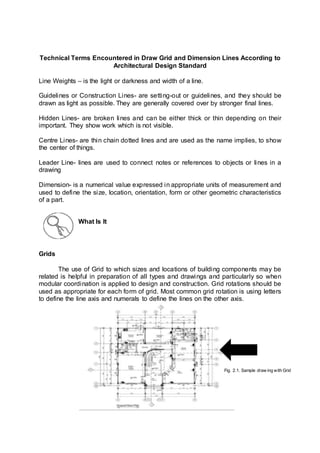
The use of Grid to which sizes and locations of building components may be
related is helpful in preparation of all types and drawings and particularly so when
modular coordination is applied to design and construction. Grid rotations should be
used as appropriate for each form of grid. Most common grid rotation is using letters
to define the line axis and numerals to define the lines on the other axis.
Fig. 2.1. Sample draw ing with Grid
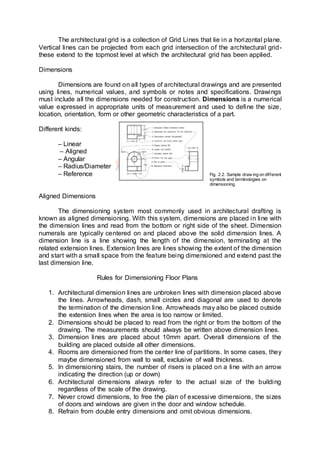
The architectural grid is a collection of Grid Lines that lie in a horizontal plane.
Vertical lines can be projected from each grid intersection of the architectural grid-
these extend to the topmost level at which the architectural grid has been applied.
Dimensions
Dimensions are found on all types of architectural drawings and are presented
using lines, numerical values, and symbols or notes and specifications. Drawings
must include all the dimensions needed for construction. Dimensions is a numerical
value expressed in appropriate units of measurement and used to define the size,
location, orientation, form or other geometric characteristics of a part.
Different kinds:
– Linear
– Aligned
– Angular
– Radius/Diameter
– Reference
Aligned Dimensions
The dimensioning system most commonly used in architectural drafting is
known as aligned dimensioning. With this system, dimensions are placed in line with
the dimension lines and read from the bottom or right side of the sheet. Dimension
numerals are typically centered on and placed above the solid dimension lines. A
dimension line is a line showing the length of the dimension, terminating at the
related extension lines. Extension lines are lines showing the extent of the dimension
and start with a small space from the feature being dimensioned and extend past the
last dimension line.
Rules for Dimensioning Floor Plans
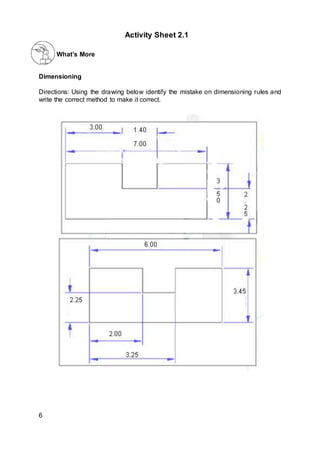
1. Architectural dimension lines are unbroken lines with dimension placed above
the lines. Arrowheads, dash, small circles and diagonal are used to denote
the termination of the dimension line. Arrowheads may also be placed outside
the extension lines when the area is too narrow or limited.
2. Dimensions should be placed to read from the right or from the bottom of the
drawing. The measurements should always be written above dimension lines.
3. Dimension lines are placed about 10mm apart. Overall dimensions of the
building are placed outside all other dimensions.
4. Rooms are dimensioned from the center line of partitions. In some cases, they
maybe dimensioned from wall to wall, exclusive of wall thickness.
5. In dimensioning stairs, the number of risers is placed on a line with an arrow
indicating the direction (up or down)
6. Architectural dimensions always refer to the actual size of the building
regardless of the scale of the drawing.
7. Never crowd dimensions, to free the plan of excessive dimensions, the sizes
of doors and windows are given in the door and window schedule.
8. Refrain from double entry dimensions and omit obvious dimensions.
Fig. 2.2. Sample draw ing on different
symbols and terminologies on
dimensioning.
What I Have Learned
Self -Check 2.1
B. Directions: Read each item carefully. Choose the letter of the correct answer and
write your answer on a separate sheet of paper.
1. This is the type of line that are unbroken lines with dimension placed above
the lines.
b. Dimension Line b. Center Line c. Hidden Line d. Guidelines
2. This always refer to the actual size of the building.
a. Architectural Dimension b. Linear c. Radius d. Diameter
3. Dimensions are to be placed ________ apart.
a. 10 mm b. 12 mm c. 15 mm d. 20 mm
4. This is commonly used grid rotation to define the line axis and numerals to
define the lines on the other axis.
a. Numbers b. Letters c. Symbols d. None of the Above
5. ____________ must include all the dimensions needed for construction.
a. Letter b. Drawings c. Books d. Bill of Materials
What’s More
Dimensioning
Directions: Using the drawing below identify the mistake on dimensioning rules and
write the correct method to make it correct.
6
Activity Sheet 2.1
What I Can Do
Performance Objective: Carryout Dimensioning on Floor Plan Drawing
Conditions or Situations for the operations:
1. The learners are to dimension a floor plan according to standards of architectural
and designs.
2. The materials and equipment’s must be properly checked.
Supplies/Materials
1. OsloPaper
2. Technical Pencil
3. Trianglesset
4. T- square
5. Triangle scale
6. Ruler
7. Eraser
Precautions:
1. Always checkedandcleanyourdrawingtoolsbefore andafterusingthem.
2. See to itthat your drawingareais clean.
3. Alwaysobserve propermeasureswhileworking.
Procedure:
1. Measure the overall dimensions
2. Measure the outside wall length
3. Dimensionwindowsanddoorstotheircenter
4. Dimensioninteriorwall locationnotroomsizes
QualityCriteria:
1. The learnermustbe able to finishhis/hertasksaccordingtodrawingstandards.
2. He/she mustbe able to dimensionhis/herdrawing
3. The learnermustbe able to place the properway on dimensioningafloorplan.
AssessmentMethod: DEMONSTRATION
Operation Sheet 1.1
Directions: Use the checklist below as a basis for judging whether you meet the required competency.
Write yes or No for your answer in a separate answer sheet.
ITEMS YES NO
1. Didyou prepare all necessarytoolsandsupplies?
2. Didyou checkall toolsand suppliesfunctionality?
3. Didyou observe safetymeasuresbefore,duringandafter?
4. Didyou showthe overall dimension?
5. Didyou showthe outside wall lengths?
6. Didyou dimensionthe windowsanddoorstotheircenter?
7. Didyou dimensioninteriorwall locations?
Note: Have learners assess their performance. For criteria needing assistance, provide appropriate
interventions.
Lesson
Use of Metric Scale System According to Magnitude of
Plan
PERFORMANCE CRITERION CHECKLIST 2.1
Pre- Test
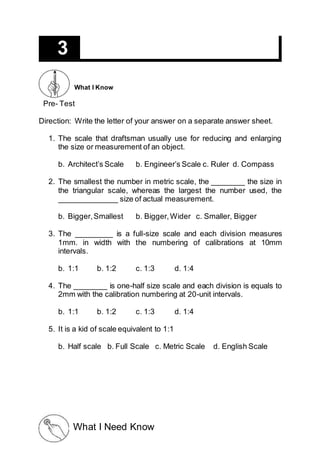
Direction: Write the letter of your answer on a separate answer sheet.
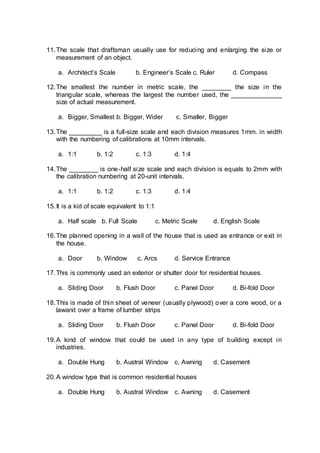
1. The scale that draftsman usually use for reducing and enlarging
the size or measurement of an object.
b. Architect’s Scale b. Engineer’s Scale c. Ruler d. Compass
2. The smallest the number in metric scale, the ________ the size in
the triangular scale, whereas the largest the number used, the
______________ size of actual measurement.
b. Bigger,Smallest b. Bigger,Wider c. Smaller, Bigger
3. The _________ is a full-size scale and each division measures
1mm. in width with the numbering of calibrations at 10mm
intervals.
b. 1:1 b. 1:2 c. 1:3 d. 1:4
4. The ________ is one-half size scale and each division is equals to
2mm with the calibration numbering at 20-unit intervals.
b. 1:1 b. 1:2 c. 1:3 d. 1:4
5. It is a kid of scale equivalent to 1:1
b. Half scale b. Full Scale c. Metric Scale d. English Scale
3
What I Know
What I Need Know
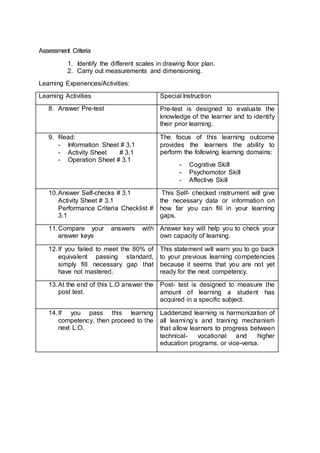
Assessment Criteria
1. Identify the different scales in drawing floor plan.
2. Carry out measurements and dimensioning.
Learning Experiences/Activities:
Learning Activities Special Instruction
8. Answer Pre-test Pre-test is designed to evaluate the
knowledge of the learner and to identify
their prior learning.
9. Read:
- Information Sheet # 3.1
- Activity Sheet # 3.1
- Operation Sheet # 3.1
The focus of this learning outcome
provides the learners the ability to
perform the following learning domains:
- Cognitive Skill
- Psychomotor Skill
- Affective Skill
10.Answer Self-checks # 3.1
Activity Sheet # 3.1
Performance Criteria Checklist #
3.1
This Self- checked instrument will give
the necessary data or information on
how far you can fill in your learning
gaps.
11.Compare your answers with
answer keys
Answer key will help you to check your
own capacity of learning.
12.If you failed to meet the 80% of
equivalent passing standard,
simply fill necessary gap that
have not mastered.
This statement will warn you to go back
to your previous learning competencies
because it seems that you are not yet
ready for the next competency.
13.At the end of this L.O answer the
post test.
Post- test is designed to measure the
amount of learning a student has
acquired in a specific subject.
14.If you pass this learning
competency, then proceed to the
next L.O.
Ladderized learning is harmonization of
all learning’s and training mechanism
that allow learners to progress between
technical- vocational and higher
education programs, or vice-versa.
What’s New
Technical Terms Encountered in Use of Appropriate Scale in Drawing a Floor
Plan
Count or/sets – no measurements are taken. The number of items required is
considered. This is the case for items like basins, toilets, appliances etc. The number
recorded.
Length- only one dimension is required. Length is used to calculate the quantities for
items such as skirting, pipes, gutters etc. Lineal measurement. L/M.
Area- Two dimensions are required to calculated the area in square metres (m2).
Items measured in area include such things as carpets, tiles, glass, painting, brick
walls, roof tiles etc.
Volume- Three dimensions need to be taken to calculate volume. The unit for
volume is cubic meters ( m3) the tops of material measured by volume include
concrete, topsoil and excavations.
Weight- steel work in a building is often measured in weight. They can be measured
in number, m3 or m2 and then multiplied by a weight factor to give quantity in tonnes
(t). some examples of materials measured by weight are; steel reinforcement, steel
beams and columns etc.
What Is It
Designing Floor Plans Using Standard Construction Modules
Material conservation and construction labor is important to consider when
designing floor plans.
Using Metric Dimensions
The unit of metric measure commonly used is the millimeter (mm). Meters (m)
are used for large site plans and civil engineering drawings. Metric Dimensioning is
based on the International System of Units (SI).
Expressing Metrics Units on a Drawing
- When placing metric dimensions on a drawing all dimensions, all
dimensions specified with dimension lines are in millimeters and the
millimeter symbol is omitted.
- When more than one dimension is quoted, the millimeter symbol is placed
only after the last dimension. The millimeter symbol is omitted in the notes
Information Sheet 3.1
associated in the drawing , except when referring to a single dimension,
such as thickness of materials or the spacing of the members.
Rules for Writing Metric Symbols and Names
- Unit names are lowercase, even those derived from proper names, for
example, millimeter, meter, kilogram, Kelvin, Newton and Pascal.
- Use vertical text for unit symbols. Use lowercase text, such as mm
(millimeter), m (meter), and kg (kilogram), unless the unit name is derived
from a proper name as in K (Kelvin), N (Newton), or Pa (Pascal).
- Leave a space between numerical and symbol, such as 55 kg, 24 m. Do
not close the space like this: 55kg, 24m.
- Do not leave a space between a unit symbol and its prefix- example, use
kg, not k g.
- Do not use the plural of unit symbols- for example, use 55 kg, not 55 kgs.
- Use the plural of spelled-out metric measurements, such as 125 meters.
- Do not mix unit names and symbols; use one or other. Symbols are
preferred on drawings where necessary.
- Millimeters (mm) are assumed on architectural drawings unless otherwise
specified.
Drafting Scales
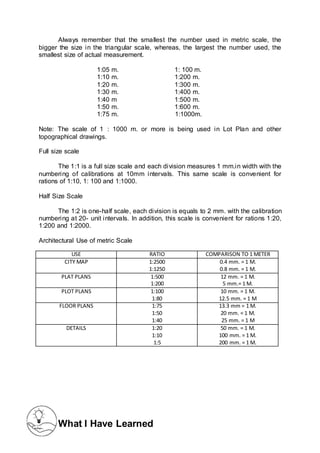
The architectural draftsman normally uses an architect scale for reducing and
enlarging the size or measurement of an object. There are two system of
measurement, namely Metric system and English system.
Architectural Use of Metric System
Always remember that the smallest the number used in metric scale, the
bigger the size in the triangular scale, whereas, the largest the number used, the
smallest size of actual measurement.
1:05 m. 1: 100 m.
1:10 m. 1:200 m.
1:20 m. 1:300 m.
1:30 m. 1:400 m.
1:40 m 1:500 m.
1:50 m. 1:600 m.
1:75 m. 1:1000m.
Note: The scale of 1 : 1000 m. or more is being used in Lot Plan and other
topographical drawings.
Full size scale
The 1:1 is a full size scale and each division measures 1 mm.in width with the
numbering of calibrations at 10mm intervals. This same scale is convenient for
rations of 1:10, 1: 100 and 1:1000.
Half Size Scale
The 1:2 is one-half scale, each division is equals to 2 mm. with the calibration
numbering at 20- unit intervals. In addition, this scale is convenient for rations 1:20,
1:200 and 1:2000.
Architectural Use of metric Scale
What I Have Learned
USE RATIO COMPARISON TO 1 METER
CITY MAP 1:2500
1:1250
0.4 mm. = 1 M.
0.8 mm. = 1 M.
PLAT PLANS 1:500
1:200
12 mm. = 1 M.
5 mm.= 1 M.
PLOT PLANS 1:100
1:80
10 mm. = 1 M.
12.5 mm. = 1 M
FLOOR PLANS 1:75
1:50
1:40
13.3 mm = 1 M.
20 mm. = 1 M.
25 mm. = 1 M
DETAILS 1:20
1:10
1:5
50 mm. = 1 M.
100 mm. = 1 M.
200 mm. = 1 M.
Self -Check 3.1
C. Directions: Read each item carefully. Choose the letter of the correct answer and
write your answer on a separate sheet of paper.
1. It is the appropriate scale for plat plan.
a. 1:500, 1:200 b. 1:100, 1:80 c. 1:75, 1:50 d. 1:20,1:10,1:5
2. It is the scale that is equivalent to 1:20’
a. Full Scale b. Half Scale c. Metric Scale d. None of the above
3. It is equivalent to Full Scale.
a. 1:50 b. 1:20 c. 1:1 d. 1:200
4. It is also equivalent to one kilometer.
a. 1000 meters b. 500 meters c. 100 centimeters d. 100 millimeters
5. It is equivalent to Half size scale
a. 1:20 b. 1:1 c. 1:500 d. None of the above
Lesson
Identify Sizes of Doors, Walls and Rooms Following the
Schedule
Pre- Test
Direction: Write the letter of your answer on a separate answer sheet.
1. The planned opening in a wall of the house that is used as entrance or exit in
the house.
a. Door b. Window c. Arcs d. Service Entrance
2. This is commonly used an exterior or shutter door for residential houses.
a. Sliding Door b. Flush Door c. Panel Door d. Bi-fold Door
3. This is made of thin sheet of veneer (usually plywood) over a core wood, or a
lawanit over a frame of lumber strips
a. Sliding Door b. Flush Door c. Panel Door d. Bi-fold Door
4. A kind of window that could be used in any type of building except in
industries.
a. Double Hung b. Austrial Window c. Awning d. Casement
5. A window type that is common residential houses
a. Double Hung b. Austral Window c. Awning d. Casement
4What I Know
Assessment Criteria
1. Identify the different doors, windows and fixtures in drawing floor plan.
2. Draw a floor plan following the steps and given requirements.
Learning Experiences/Activities:
Learning Activities Special Instruction
1. Answer Pre-test Pre-test is designed to evaluate the
knowledge of the learner and to identify
their prior learning.
2. Read:
- Information Sheet # 4.1
- Activity Sheet # 4.1
- Operation Sheet # 4.1
The focus of this learning outcome
provides the learners the ability to
perform the following learning domains:
- Cognitive Skill
- Psychomotor Skill
- Affective Skill
3. Answer Self-checks # 4.1
Activity Sheet # 4.1
Performance Criteria Checklist #
4.1
This Self- checked instrument will give
the necessary data or information on
how far you can fill in your learning
gaps.
4. Compare your answers with
answer keys
Answer key will help you to check your
own capacity of learning.
5. If you failed to meet the 80% of
equivalent passing standard,
simply fill necessary gap that
have not mastered.
This statement will warn you to go back
to your previous learning competencies
because it seems that you are not yet
ready for the next competency.
6. At the end of this L.O answer the
post test.
Post- test is designed to measure the
amount of learning a student has
acquired in a specific subject.
7. If you pass this learning
competency, then proceed to the
next L.O.
Ladderized learning is harmonization of
all learning’s and training mechanism
that allow learners to progress between
technical- vocational and higher
education programs, or vice-versa.
What I Need Know
What Is It
Doors- the planned opening in a wall of the house that is used as entrance or exit in
the house. Its width vary as to its purpose, like exterior or interior openings with a
standard height of 2.10 meter for residentials.
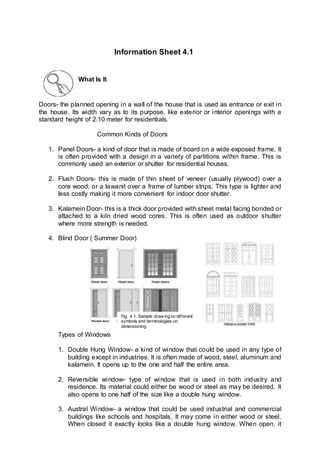
Common Kinds of Doors
1. Panel Doors- a kind of door that is made of board on a wide exposed frame. It
is often provided with a design in a variety of partitions within frame. This is
commonly used an exterior or shutter for residential houses.
2. Flush Doors- this is made of thin sheet of veneer (usually plywood) over a
core wood, or a lawanit over a frame of lumber strips. This type is lighter and
less costly making it more convenient for indoor door shutter.
3. Kalamein Door- this is a thick door provided with sheet metal facing bonded or
attached to a kiln dried wood cores. This is often used as outdoor shutter
where more strength is needed.
4. Blind Door ( Summer Door)
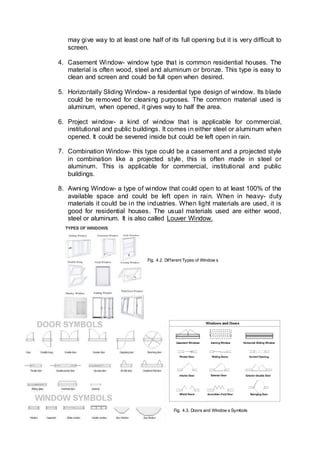
Types of Windows
1. Double Hung Window- a kind of window that could be used in any type of
building except in industries. It is often made of wood, steel, aluminum and
kalamein. It opens up to the one and half the entire area.
2. Reversible window- type of window that is used in both industry and
residence. Its material could either be wood or steel as may be desired. It
also opens to one half of the size like a double hung window.
3. Austral Window- a window that could be used industrial and commercial
buildings like schools and hospitals. It may come in either wood or steel.
When closed it exactly looks like a double hung window. When open, it
Information Sheet 4.1
Fig. 4.1. Sample draw ing on different
symbols and terminologies on
dimensioning.
may give way to at least one half of its full opening but it is very difficult to
screen.
4. Casement Window- window type that is common residential houses. The
material is often wood, steel and aluminum or bronze. This type is easy to
clean and screen and could be full open when desired.
5. Horizontally Sliding Window- a residential type design of window. Its blade
could be removed for cleaning purposes. The common material used is
aluminum, when opened, it gives way to half the area.
6. Project window- a kind of window that is applicable for commercial,
institutional and public buildings. It comes in either steel or aluminum when
opened. It could be severed inside but could be left open in rain.
7. Combination Window- this type could be a casement and a projected style
in combination like a projected style, this is often made in steel or
aluminum. This is applicable for commercial, institutional and public
buildings.
8. Awning Window- a type of window that could open to at least 100% of the
available space and could be left open in rain. When in heavy- duty
materials it could be in the industries. When light materials are used, it is
good for residential houses. The usual materials used are either wood,
steel or aluminum. It is also called Louver Window.
Fig. 4.2. Different Types of Window s
Fig. 4.3. Doors and Window s Symbols
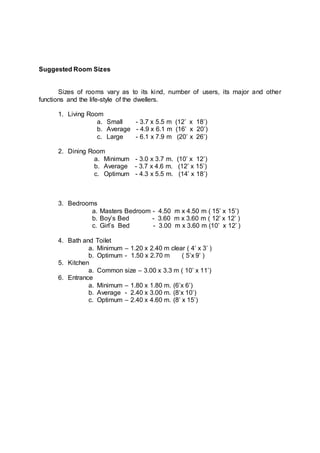
Suggested Room Sizes
Sizes of rooms vary as to its kind, number of users, its major and other
functions and the life-style of the dwellers.
1. Living Room
a. Small - 3.7 x 5.5 m (12’ x 18’)
b. Average - 4.9 x 6.1 m (16’ x 20’)
c. Large - 6.1 x 7.9 m (20’ x 26’)
2. Dining Room
a. Minimum - 3.0 x 3.7 m. (10’ x 12’)
b. Average - 3.7 x 4.6 m. (12’ x 15’)
c. Optimum - 4.3 x 5.5 m. (14’ x 18’)
3. Bedrooms
a. Masters Bedroom - 4.50 m x 4.50 m ( 15’ x 15’)
b. Boy’s Bed - 3.60 m x 3.60 m ( 12’ x 12’ )
c. Girl’s Bed - 3.00 m x 3.60 m (10’ x 12’ )
4. Bath and Toilet
a. Minimum – 1.20 x 2.40 m clear ( 4’ x 3’ )
b. Optimum - 1.50 x 2.70 m ( 5’x 9’ )
5. Kitchen
a. Common size – 3.00 x 3.3 m ( 10’ x 11’)
6. Entrance
a. Minimum – 1.80 x 1.80 m. (6’x 6’)
b. Average - 2.40 x 3.00 m. (8’x 10’)
c. Optimum – 2.40 x 4.60 m. (8’ x 15’)
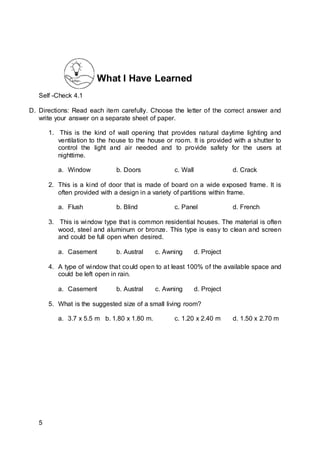
What I Have Learned
Self -Check 4.1
D. Directions: Read each item carefully. Choose the letter of the correct answer and
write your answer on a separate sheet of paper.
1. This is the kind of wall opening that provides natural daytime lighting and
ventilation to the house to the house or room. It is provided with a shutter to
control the light and air needed and to provide safety for the users at
nighttime.
a. Window b. Doors c. Wall d. Crack
2. This is a kind of door that is made of board on a wide exposed frame. It is
often provided with a design in a variety of partitions within frame.
a. Flush b. Blind c. Panel d. French
3. This is window type that is common residential houses. The material is often
wood, steel and aluminum or bronze. This type is easy to clean and screen
and could be full open when desired.
a. Casement b. Austral c. Awning d. Project
4. A type of window that could open to at least 100% of the available space and
could be left open in rain.
a. Casement b. Austral c. Awning d. Project
5. What is the suggested size of a small living room?
a. 3.7 x 5.5 m b. 1.80 x 1.80 m. c. 1.20 x 2.40 m d. 1.50 x 2.70 m
5
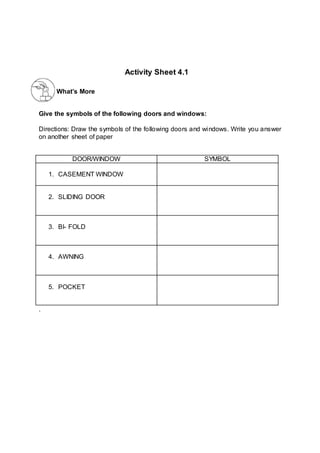
What’s More
Give the symbols of the following doors and windows:
Directions: Draw the symbols of the following doors and windows. Write you answer
on another sheet of paper
DOOR/WINDOW SYMBOL
1. CASEMENT WINDOW
2. SLIDING DOOR
3. BI- FOLD
4. AWNING
5. POCKET
.
Activity Sheet 4.1
What I Can Do
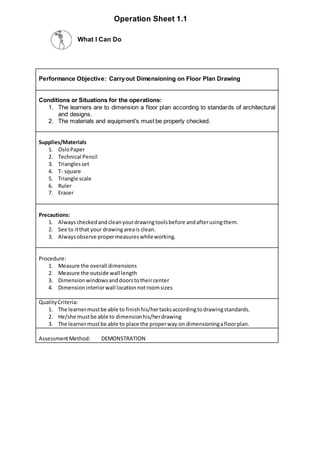
Operation Sheet 4.1
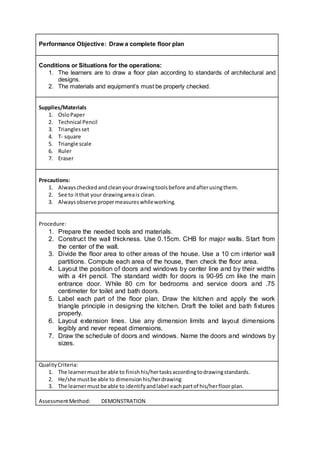
Performance Objective: Draw a complete floor plan
Conditions or Situations for the operations:
1. The learners are to draw a floor plan according to standards of architectural and
designs.
2. The materials and equipment’s must be properly checked.
Supplies/Materials
1. OsloPaper
2. Technical Pencil
3. Trianglesset
4. T- square
5. Triangle scale
6. Ruler
7. Eraser
Precautions:
1. Alwayscheckedandcleanyourdrawingtoolsbefore andafterusingthem.
2. See to itthat your drawingareais clean.
3. Alwaysobserve propermeasureswhileworking.
Procedure:
1. Prepare the needed tools and materials.
2. Construct the wall thickness. Use 0.15cm. CHB for major walls. Start from
the center of the wall.
3. Divide the floor area to other areas of the house. Use a 10 cm interior wall
partitions. Compute each area of the house, then check the floor area.
4. Layout the position of doors and windows by center line and by their widths
with a 4H pencil. The standard width for doors is 90-95 cm like the main
entrance door. While 80 cm for bedrooms and service doors and .75
centimeter for toilet and bath doors.
5. Label each part of the floor plan. Draw the kitchen and apply the work
triangle principle in designing the kitchen. Draft the toilet and bath fixtures
properly.
6. Layout extension lines. Use any dimension limits and layout dimensions
legibly and never repeat dimensions.
7. Draw the schedule of doors and windows. Name the doors and windows by
sizes.
QualityCriteria:
1. The learnermustbe able to finishhis/hertasksaccordingtodrawingstandards.
2. He/she mustbe able to dimensionhis/herdrawing
3. The learnermustbe able to identifyandlabel eachpartof his/herfloorplan.
AssessmentMethod: DEMONSTRATION
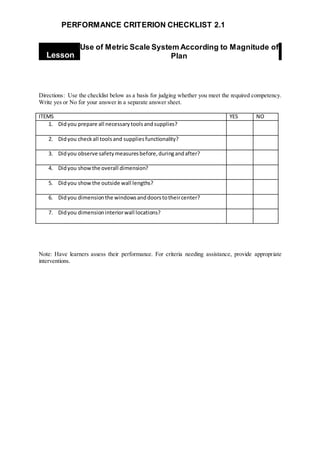
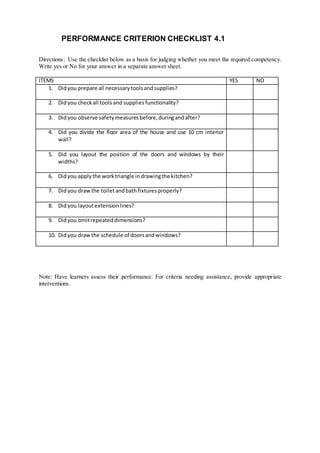
Directions: Use the checklist below as a basis for judging whether you meet the required competency.
Write yes or No for your answer in a separate answer sheet.
ITEMS YES NO
1. Didyou prepare all necessarytoolsandsupplies?
2. Didyou checkall toolsand suppliesfunctionality?
3. Didyou observe safetymeasuresbefore,duringandafter?
4. Did you divide the floor area of the house and use 10 cm interior
wall?
5. Did you layout the position of the doors and windows by their
widths?
6. Didyou applythe worktriangle indrawingthe kitchen?
7. Didyou drawthe toiletandbathfixturesproperly?
8. Didyou layoutextensionlines?
9. Didyou omitrepeateddimensions?
10. Didyou drawthe schedule of doorsandwindows?
Note: Have learners assess their performance. For criteria needing assistance, provide appropriate
interventions.
PERFORMANCE CRITERION CHECKLIST 4.1
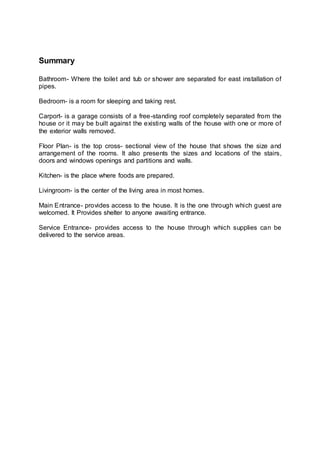
Summary
Bathroom- Where the toilet and tub or shower are separated for east installation of
pipes.
Bedroom- is a room for sleeping and taking rest.
Carport- is a garage consists of a free-standing roof completely separated from the
house or it may be built against the existing walls of the house with one or more of
the exterior walls removed.
Floor Plan- is the top cross- sectional view of the house that shows the size and
arrangement of the rooms. It also presents the sizes and locations of the stairs,
doors and windows openings and partitions and walls.
Kitchen- is the place where foods are prepared.
Livingroom- is the center of the living area in most homes.
Main Entrance- provides access to the house. It is the one through which guest are
welcomed. It Provides shelter to anyone awaiting entrance.
Service Entrance- provides access to the house through which supplies can be
delivered to the service areas.
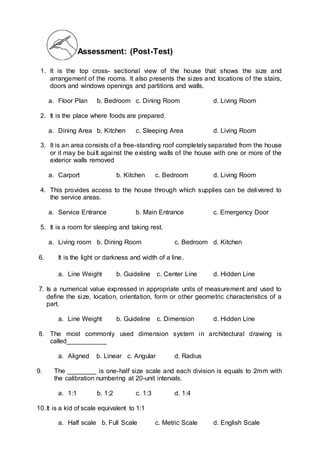
Assessment: (Post-Test)
1. It is the top cross- sectional view of the house that shows the size and
arrangement of the rooms. It also presents the sizes and locations of the stairs,
doors and windows openings and partitions and walls.
a. Floor Plan b. Bedroom c. Dining Room d. Living Room
2. It is the place where foods are prepared.
a. Dining Area b. Kitchen c. Sleeping Area d. Living Room
3. It is an area consists of a free-standing roof completely separated from the house
or it may be built against the existing walls of the house with one or more of the
exterior walls removed
a. Carport b. Kitchen c. Bedroom d. Living Room
4. This provides access to the house through which supplies can be delivered to
the service areas.
a. Service Entrance b. Main Entrance c. Emergency Door
5. It is a room for sleeping and taking rest.
a. Living room b. Dining Room c. Bedroom d. Kitchen
6. It is the light or darkness and width of a line.
a. Line Weight b. Guideline c. Center Line d. Hidden Line
7. Is a numerical value expressed in appropriate units of measurement and used to
define the size, location, orientation, form or other geometric characteristics of a
part.
a. Line Weight b. Guideline c. Dimension d. Hidden Line
8. The most commonly used dimension system in architectural drawing is
called___________
a. Aligned b. Linear c. Angular d. Radius
9. The ________ is one-half size scale and each division is equals to 2mm with
the calibration numbering at 20-unit intervals.
a. 1:1 b. 1:2 c. 1:3 d. 1:4
10.It is a kid of scale equivalent to 1:1
a. Half scale b. Full Scale c. Metric Scale d. English Scale
11.The scale that draftsman usually use for reducing and enlarging the size or
measurement of an object.
a. Architect’s Scale b. Engineer’s Scale c. Ruler d. Compass
12.The smallest the number in metric scale, the ________ the size in the
triangular scale, whereas the largest the number used, the ______________
size of actual measurement.
a. Bigger, Smallest b. Bigger, Wider c. Smaller, Bigger
13.The _________ is a full-size scale and each division measures 1mm. in width
with the numbering of calibrations at 10mm intervals.
a. 1:1 b. 1:2 c. 1:3 d. 1:4
14.The ________ is one-half size scale and each division is equals to 2mm with
the calibration numbering at 20-unit intervals.
a. 1:1 b. 1:2 c. 1:3 d. 1:4
15.It is a kid of scale equivalent to 1:1
a. Half scale b. Full Scale c. Metric Scale d. English Scale
16.The planned opening in a wall of the house that is used as entrance or exit in
the house.
a. Door b. Window c. Arcs d. Service Entrance
17.This is commonly used an exterior or shutter door for residential houses.
a. Sliding Door b. Flush Door c. Panel Door d. Bi-fold Door
18.This is made of thin sheet of veneer (usually plywood) over a core wood, or a
lawanit over a frame of lumber strips
a. Sliding Door b. Flush Door c. Panel Door d. Bi-fold Door
19.A kind of window that could be used in any type of building except in
industries.
a. Double Hung b. Austral Window c. Awning d. Casement
20.A window type that is common residential houses
a. Double Hung b. Austral Window c. Awning d. Casement
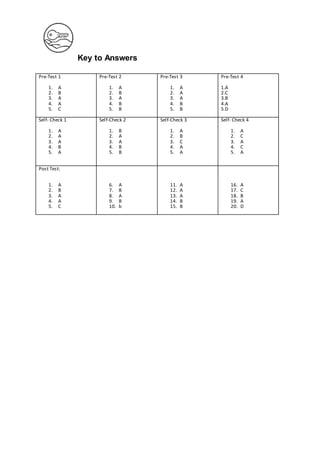
Key to Answers
Pre-Test 1
1. A
2. B
3. A
4. A
5. C
Pre-Test 2
1. A
2. B
3. A
4. B
5. B
Pre-Test 3
1. A
2. A
3. A
4. B
5. B
Pre-Test 4
1.A
2.C
3.B
4.A
5.D
Self- Check 1
1. A
2. A
3. A
4. B
5. A
Self-Check 2
1. B
2. A
3. A
4. B
5. B
Self-Check 3
1. A
2. B
3. C
4. A
5. A
Self- Check 4
1. A
2. C
3. A
4. C
5. A
Post Test:
1. A
2. B
3. A
4. A
5. C
6. A
7. B
8. A
9. B
10. b
11. A
12. A
13. A
14. B
15. B
16. A
17. C
18. B
19. A
20. D
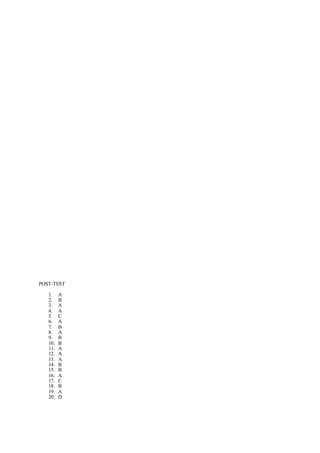
POST-TEST
1. A
2. B
3. A
4. A
5. C
6. A
7. B
8. A
9. B
10. B
11. A
12. A
13. A
14. B
15. B
16. A
17. C
18. B
19. A
20. D
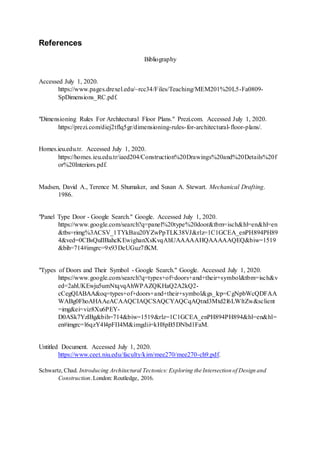
References
Bibliography
Accessed July 1, 2020.
https://www.pages.drexel.edu/~rcc34/Files/Teaching/MEM201%20L5-Fa0809-
SpDimensions_RC.pdf.
"Dimensioning Rules For Architectural Floor Plans." Prezi.com. Accessed July 1, 2020.
https://prezi.com/diej2tflq5gr/dimensioning-rules-for-architectural-floor-plans/.
Homes.ieu.edu.tr. Accessed July 1, 2020.
https://homes.ieu.edu.tr/iaed204/Construction%20Drawings%20and%20Details%20f
or%20Interiors.pdf.
Madsen, David A., Terence M. Shumaker, and Susan A. Stewart. Mechanical Drafting.
1986.
"Panel Type Door - Google Search." Google. Accessed July 1, 2020.
https://www.google.com/search?q=panel%20type%20door&tbm=isch&hl=en&hl=en
&tbs=rimg%3ACSV_1TYkBau20YZwPpTLK38VJ&rlz=1C1GCEA_enPH894PH89
4&ved=0CBsQuIIBahcKEwighanXsKvqAhUAAAAAHQAAAAAQEQ&biw=1519
&bih=714#imgrc=9x93DeUGuz7fKM.
"Types of Doors and Their Symbol - Google Search." Google. Accessed July 1, 2020.
https://www.google.com/search?q=types+of+doors+and+their+symbol&tbm=isch&v
ed=2ahUKEwju5umNtqvqAhWPAZQKHaQ2A2kQ2-
cCegQIABAA&oq=types+of+doors+and+their+symbol&gs_lcp=CgNpbWcQDFAA
WABg0FhoAHAAeACAAQCIAQCSAQCYAQCqAQtnd3Mtd2l6LWltZw&sclient
=img&ei=viz8Xu6PEY-
D0ASk7YzIBg&bih=714&biw=1519&rlz=1C1GCEA_enPH894PH894&hl=en&hl=
en#imgrc=l6qzY4l4pFII4M&imgdii=kH8pB5DNbd1FaM.
Untitled Document. Accessed July 1, 2020.
https://www.ceet.niu.edu/faculty/kim/mee270/mee270-ch9.pdf.
Schwartz, Chad. Introducing Architectural Tectonics: Exploring the Intersection of Design and
Construction.London: Routledge, 2016.
For inquiries and feedback, please write or call:
Department of Education – Bureau of Learning Resources (DepEd-BLR)
DepEd Division of Cagayan de Oro City
Fr. William F. Masterson Ave Upper Balulang Cagayan de Oro
Telefax: ((08822)855-0048
E-mail Address: cagayandeoro.city@deped.gov.ph

Tle9 q1 w6-10_mod1_draft-floor-plan-v3

  • 1.
    N O T Technology and LivelihoodEducation Quarter 1,Wk.6-10 - Module 1 (Draft Floor Plan) Department of Education ● Republic of the Philippines 9
  • 2.
    Technology and LivelihoodEducation- Grade 9 Alternative Delivery Mode Quarter 1, Wk.6 - Module 1: (Drafting Architectural Layout and Details) First Edition, 2020 Republic Act 8293, section 176 states that: No copyright shall subsist in any work of the Government of the Philippines. However, prior approval of the government agency or office wherein the work is created shall be necessary for exploitation of such work for profit. Such agency or office may, among other things, impose as a condition the payment of royalty. Borrowed materials (i.e., songs, stories, poems, pictures, photos, brand names, trademarks, etc.) included in this book are owned by their respective copyright holders. Every effort has been exerted to locate and seek permission to use these materials from their respective copyright owners. The publisher and authors do not represent nor claim ownership over them. Published by the Department of Education – Division of Cagayan de Oro Schools Division Superintendent: Roy Angelo L. Gazo, PhD.,CESO V Development Team of the Module Author/s: (______Maria Cristina Mina) Reviewers: (_______________________) Illustrator and Layout Artist: (________________________) Management Team Chairperson: Dr. Arturo B. Bayocot, CESO III Regional Director Co-Chairpersons: Dr. Victor G. De Gracia Jr. CESO V Asst. Regional Director Roy Angelo E. Gazo, PhD, CESO V Schools Division Superintendent Nimfa R. Lago,PhD, CESE Assistant Schools Division Superintendent Mala Epra B. Magnaong, Chief ES, CLMD Members Neil A. Improgo, EPS-LRMS Bienvenido U. Tagolimot, Jr., EPS-ADM Henry B. Abueva OIC-CID Chief Blair D. Castillon, EPS-EPP/TLE Sherlita L. Daguisonan, LRMS Manager Meriam S. Otarra, PDO II Charlotte D. Quidlat, Librarian II Printed in the Philippines by Department of Education – Division of Iligan City Office Address: General Aguinaldo, St., Iligan City Telefax: (063)221-6069 E-mail Address: iligan.city@deped.gov.ph
  • 3.
    Technology and Livelihood Education Quarter 1,Wk.6- Module 1 (Draft Floor Plan) This instructional material was collaboratively developed and reviewed by educators from public and private schools, colleges, and or/universities. We encourage teachers and other education stakeholders to email their feedback, comments, and recommendations to the Department of Education – Iligan City at iligancity@deped.gov.ph or Trlrfax (063) 221-6069. We value your feedback and recommendations. Department of Education ● Republic of the Philippines 9
  • 4.
    This page isintentionally blank
  • 5.
    Table of Contents WhatThis Module is About......................................................................................................................................i What I Need to Know .................................................................................................................................................ii How to Learn from this Module.............................................................................................................................ii Icons of this Module....................................................................................................................................................iii What I Know.................................................................................................................................................................iii Lesson 1: (Draw Walls, Windows, Doors, Fixtures and Fittings) Pre-Test Lesson Objectives Information Sheet 1.1 ( Draft Walls, Windows, Doors, Fixtures and Fittings) Self Check 1.1 Activity Sheet 1.1 Operation Sheet 1.1 Performance Criterion Checklist 1.1 Lesson 2: (Draw Grid and Dimension Lines According to Architectural Design Standard ) Pre-Test Lesson Objectives Information Sheet 2.1 ( Draw Grid and Dimension Lines According to Architectural Design Standard ) Self Check 2.1 Activity Sheet 2.1 Operation Sheet 2.1 Performance Criterion Checklist 2.1
  • 6.
    Lesson 3: (Use ofMetric Scale System According to Magnitude of Plan ) Pre-Test Lesson Objectives Information Sheet 3.1 ( Use of Metric Scale System According to Magnitude of Plan) Self Check 3.1 Lesson 4: (Identify Sizes of Doors, Walls and Rooms Following the Schedule. Indicate Letterings and Labels according to Drafting Standard ) Pre-Test Lesson Objectives Information Sheet 4.1 ( Identify Sizes of Doors, Walls and Rooms Following the Schedule Indicate Letterings and Labels According to Drafting Standards.) Self Check 4.1 Activity Sheet 4.1 Operation Sheet 4.1 Performance Criterion Checklist 4.1 Summary Assessment: (Post-Test) Key to Answers....................................................................................................................................................... References................................................................................................................................................................
  • 7.
    This page isintentionally blank
  • 8.
    What This Moduleis About Introduction A floor plan is used in construction to build the structures. This drawing provides visual guidelines, showing technical details such as dimension etc. The floor plan is also an avenue for a proposed home of the future homeowner a chance to assess the design in terms of aptness for the requirements of the family. Designing a floor plan is a meticulous process that involves many factors and standards to be considered. Symbols are used on floor plans to label the items with living in the home and other factors more strictly associated to the construction of the home. One of the most vital concern of the drafter is to cautiously associate all the symbols, notes and dimensions on the plan to make it uncluttered and easy to read. Floor plans that are organized are easy to build because there is a fewer possibility of construction errors than with unorganized plans. This module is specifically created to introduced and focus on the different hands-on learning activities that will prepare you to be skilled and poised on your knowledge and skills and be a step closer to be a draftsman. In this module, you are required to go through a series of learning activities in order to complete each learning outcome. In each learning outcome are Information Sheets, Slef Checks, Operation Sheets and Activity Sheets. Follow and perform the activities on your own. If you have questions do not hesitate to ask for assistance from your facilitator. Remember to:  Work through all the information and complete the activities in each section.  Read Information Sheets and complete the self- check. Suggested references are included to supplements the materials provided in this module.  You will be given an opportunity to ask questions and practice on the job. Make sure you practice your new skills, this will help you improve your speed, memory and confidence.  Use the Self- Checks, Operation Sheets, Activity Sheets at the end of each lesson to check your own progress. Use the performance criteria checklist located after the Sheet to check your own performance. You need to complete this module before you can perform the next module.
  • 9.
    What I Needto Know About This Module This contains information and learning activities on Draw walls, windows, doors and fittings. It includes instruction and procedure on how to Draft Floor Plans. Completion of this module will help you better understand the succeeding module on Draft Roof Framing Plan. This module hs four learning outcome that contains learning activities supported by instructional sheets. Before you perform the instruction, read the information sheets and answer the self-check activities provided. To ascertain your competence, your teacher will assess on what you have acquired when the knowledge necessary to perform the skill portion of the particular learning outcome. Upon the completion of this module, ask your teacher for assessment to check your achievement of knowledge and skills requirements of this module. If you pass the assessment, you will be given a certificate of completion. Upon completion of the module the learner should be able to: LO1 : Draw walls, windows, door, fixtures and fittings TLE_IAAW9-12RW-Iva-1
  • 10.
    How to Learnfrom this Module To achieve the objectives cited above, you are to do the following: • Take your time reading the lessons carefully. • Follow the directions and/or instructions in the activities and exercises diligently. • Answer all the given tests and exercises. Icons of this Module What I Need to This part contains learning objectives that Know are set for you to learn as you go along the module. What I know This is an assessment as to your level of knowledge to the subject matter at hand, meant specifically to gauge prior related knowledge What’s In This part connects previous lesson with that of the current one. What’s New An introduction of the new lesson through various activities, before it will be presented to you What is It These are discussions of the activities as a way to deepen your discovery and under- standing of the concept. What’s More These are follow-up activities that are in- tended for you to practice further in order to master the competencies. What I Have Activities designed to process what you Learned have learned from the lesson What I can do These are tasks that are designed to show- case your skills and knowledge gained, and applied into real-life concerns and situations. 3
  • 11.
    What I Know Lesson4. Draw Walls, Windows, Doors, Fixtures and Fittings This lesson is designed to help you draft sample floor plans that follow a given architectural design standards and requirements. Skills Assessment Direction: Listed below are some of the most important skills that you must gain in order to draft a quality floor. On the right side of the table lists the skills expected of you to master. Rate yourself by checking “Insufficient”, if you are not so familiar yet, “Several” and/ or “Very much”, if you are already familiar with the skills. Don’t feel bad if you checked “Insufficient” in all of the skills. Keep in mind that this being administered to determine your Prior knowledge of and skills on the lesson to be presented. Skills in Drafting Floor Plans Insufficient Several Very Much I can draw walls, windows, doors, fixtures and fittings according to architectural design standards. I can draw grid and dimension lines according to architectural design standards. I know how to use metric scale according to the magnitude of the plan. I can identify sizes of doors, walls and rooms following the schedule. I know to indicate letterings and labels according to drafting standards. 4
  • 12.
    What I Know Pre-Test Directions:Encircle the letter of correct answer. 1. It is the top cross- sectional view of the house that shows the size and arrangement of the rooms. It also presents the sizes and locations of the stairs, doors and windows openings and partitions and walls. a. Floor Plan b. Bedroom c. Dining Room d. Living Room 2. It is the place where foods are prepared. a. Dining Area b. Kitchen c. Sleeping Area d. Living Room 3. It is an area consists of a free-standing roof completely separated from the house or it may be built against the existing walls of the house with one or more of the exterior walls removed a. Carport b. Kitchen c. Bedroom d. Living Room 4. This provides access to the house through which supplies can be delivered to the service areas. a. Service Entrance b. Main Entrance c. Emergency Door 5. It is a room for sleeping and taking rest. a. Living room b. Dining Room c. Bedroom d. Kitchen Lesson Draw Walls, Windows,Doors,Fittings and Fixtures 1
  • 13.
    Assessment Criteria 1. Identifythe different areas of the house 2. Identify the different doors and windows used in drawing floor plans 3. Draw walls, windows, doors, fixtures and fittings. Learning Experiences/Activities: Learning Activities Special Instruction 1. Answer Pre-test Pre-test is designed to evaluate the knowledge of the learner and to identify their prior learning. 2. Read: - Information Sheet # 1.1 - Activity Sheet # 1.1 - Operation Sheet # 1.1 The focus of this learning outcome provides the learners the ability to perform the following learning domains: - Cognitive Skill - Psychomotor Skill - Affective Skill 3. Answer Self-checks # 1.1 Activity Sheet # 1.1 Performance Criteria Checklist # 1.1 This Self- checked instrument will give the necessary data or information on how far you can fill in your learning gaps. 4. Compare your answers with answer keys Answer key will help you to check your own capacity of learning. 5. If you failed to meet the 80% of equivalent passing standard, simply fill necessary gap that have not mastered. This statement will warn you to go back to your previous learning competencies because it seems that you are not yet ready for the next competency. 6. At the end of this L.O answer the post test. Post- test is designed to measure the amount of learning a student has acquired in a specific subject. 7. If you pass this learning competency, then proceed to the next L.O. Ladderized learning is harmonization of all learning’s and training mechanism that allow learners to progress between technical- vocational and higher education programs, or vice-versa. What I Need Know
  • 14.
    What’s New Technical TermsEncountered in Drawing Walls, Windows, Doors, Fittings and Fixtures. Bathroom- Where the toilet and tub or shower are separated for east installation of pipes. Bedroom- is a room for sleeping and taking rest. Carport- is a garage consists of a free-standing roof completely separated from the house or it may be built against the existing walls of the house with one or more of the exterior walls removed. Floor Plan- is the top cross- sectional view of the house that shows the size and arrangement of the rooms. It also presents the sizes and locations of the stairs, doors and windows openings and partitions and walls. Kitchen- is the place where foods are prepared. Livingroom- is the center of the living area in most homes. Main Entrance- provides access to the house. It is the one through which guest are welcomed. It Provides shelter to anyone awaiting entrance. Service Entrance- provides access to the house through which supplies can be delivered to the service areas. What Is It AREA PLANNING In creating any architectural design, the designer should progress logically follow the step by step design process. One of the vital step is to divide the functions of the building into specific areas. Three Major Functional Areas of the House 1. Living Area- the space in the house where the family spends their free time. a. Living Room d. Terrace b. Balcony e. Family Room c. Porch f. Recreational or Game Room 2. Sleeping Area- the area where the family rests. Information Sheet 1.1
  • 15.
    a. Bedrooms b. GuestRoom c. Maids Room 3. Mechanical Chore Areas- the place where the family works. a. Kitchen d. Service Room b. Dining Room e. Library c. Bath and Toilet Living Areas. This is the area of the house where the first impression for the entire house is being portrayed. This is the area of the house where guests observe, and dwellers usually spent their free time. In small houses the living area the living room is to perform all the functions, or any functions as may be designated. Thus facilities, locations, size, decorations, and shape should plan to provide for the said activities. Windows- the opening on the walls to provide ventilation to the room. a. Windows of the living room should be made wider and longer than the rest of the room to afford more entrance and exit for air. b. It should be an internal part of the room c. The view of the window becomes a part of the decoration of the room, more so if landscape feature is near and readily observable. Recommended sizes should be at least 2.00 m x 3.00 small, 3.70 m. x 5.50 m. average or optimum size would be 6.10 Sleeping Areas. The sleeping is usually located in the quite part of the house. The size and shape of the bedroom depends on the furniture needed and what the family can afford. One method of conserving of the wall space for bedroom furniture placement is the utilization of high windows. This will allow the location of the furniture underneath. Entrance doors, closet doors and windows should be grouped to conserve all wall space of the room whenever possible. Fig. 1.1. Living Area Fig. 1.2. Sleeping Area
  • 16.
    Noise Control inBedroom A sleeping room should be free from any noise to provide the optimum comfort and relaxation to the users. The presence of the unnecessary will only add to the fatigue of the occupants. The following guides might help you to design bedrooms that quite and restful. 1. The bedroom should be away from the major noise of the street, it must be situated in the most quiet part of the house. 2. Using carpeted or porous walls and ceiling panels will be help in absorbing the noise. 3. Rooms situated above the bedroom should be carpeted. 4. The draperies of floor to ceiling will help in reducing the noise. 5. Double- glazed insulating glasses in windows and sliding doors will reduce the outside noise. 6. During hot weather the window in an airconditioned rooms should be kept close. Service Area. The service area includes the kitchen, laundry, garage workshops, storage and utility room. Since most of the activities takes place in the service area, the facilities for maintenance and serving the area of the house should be included. The efficiency of the service area is greatly dependent on the function of the living and sleeping areas. Kitchen- is the place where food is prepared. The storage, mixing center, preparation, cleaning center and cooking center is connected on the called work triangle area. Types of Kitchen: 1. U-Shape- the most efficient arrangement for a small kitchen. The sink is at the bottom of the “U” and the range and refrigerator are at the opposite side. The space is ideal at 1.2 or 1.5 m ( 4 or 5 feet ). Fig. 1.3. U-SHAPE KITCHEN
  • 17.
    2. L- Shape-this shape has a continuous counter and appliances and equipment on two adjoining walls. The remaining space is left for other facilities like dining and laundry. 3. Corridor Type Kitchen- this is the efficient arrangement for a long and narrow kitchen. Its work triangle is ideal shape. Dining Area- the space provided in the house where food during and or between mealtime is shared by the members of the family and the visitors. Comfort Room- (Bath and Toilet)- the bathroom and toilet needs careful planning like any other rooms in the house. Fig. 1.4. L-SHAPE KITCHEN Fig. 1.5. CORRIDOR-SHAPE KITCHEN Fig. 1.6. DININGAREA Fig. 1.7. COMFORT ROOM
  • 18.
    Basic Fixtures ofa Comfort Room 1. Lavatory 2. Water Closet 3. Mirror 4. Sink 5. Shower 6. Floor Drain 7. Tub Garage and Carport Garage- it is a structure or a part of the house for the automobile. It could be connected to the main structure or as an integral part of it or a separate building. It is more secure for the car if attached to the main building. Types of Garage Doors: 1. Two-leaf wing door 4. Sectional Roll-up 2. Overhead 5. Electronic Controlled 3. Four-leaf wing door Carport- A style of garage with one or more exterior walls removed. It is less expensive than a real garage. ROOM SIZES Entrance- the main opening in the house that provides access to both owners and visitors into the structure. It should be strategically located where it could serve the most, usually in front of the building. The entrance is classified into three kinds, namely: 1. Main Entrance- this should be made visible to the stranger and should appear, if possible, at the lower portion of the floor. 2. Service Entrance- This opening provides access for the entrance of supplies into the house and an access to the other service areas, like garage, laundry and workshop. 3. Special Purpose Entrance- an opening in the house that does not provide traffic into the house but outward like that of the living room to the terrace. Wall Opening Windows- the kind of wall opening that provides natural daytime lighting and ventilation to the house to the house or room. It is provided with a shutter to control the light and air needed and to provide safety for the users at night time.
  • 19.
    Doors and Windowsin Plan 1. Show normally swinging doors at 90 degrees opening 2. Doors swing are shown with light lines and quarter symbols 3. Door type is illustrated in plan, only in elevation. 4. Windows type cannot be explained in plan except for width and location 5. Show sill lines with a lighter line weight than walls, jambs and glass. Steps in Drawing Floor Plans 1. Layout the position of exterior and interior walls. (refer to Rule VIII of the New National Building Code under the Implementing Rules and Regulations (No.7). 2. Add the thickness of the walls with a hard pencil ( Don’t darken the walls at this stage). 3. Locate the position of doors and windows by center line and by their width. 4. Darken the object lines with an F pencil. 5. Add door and window symbols with 2H pencil. 6. Add symbols for stairwells. 7. Erase extra heavy lines that can be perceive as object lines. 8. Draw the outline of the furniture and fixtures. 9. Add symbols for any masonry work such as planters if necessary. 10.Dimension the drawing.
  • 20.
    What I HaveLearned Self -Check 1.1 A. Directions: Read each item carefully. Choose the letter of the correct answer and write your answer on a separate sheet of paper. 1. This is the kind of wall opening that provides natural daytime lighting and ventilation to the house to the house or room. It is provided with a shutter to control the light and air needed and to provide safety for the users at nighttime. a. Window b. Doors c. Wall d. Crack 2. This the type of kitchen on which the shape has a continuous counter and appliances and equipment on two adjoining walls. The remaining space is left for other facilities like dining and laundry. a. L- Shaped b. U-Shaped c. Mediterranean d. Family 3. A room that should be free from any noise to provide the optimum comfort and relaxation to the users. a. Sleeping b. Living c. Service d. French 4. The space provided in the house where food during and or between mealtime is shared by the members of the family and the visitors. a. Kitchen b. Dining c. Bedroom d. Project 5. This opening provides access for the entrance of supplies into the house and an access to the other service areas, like garage, laundry and workshop. a. Service Entrance b. Main Entrance c. Special Purpose Entrance. Fig. Sample Floor Plan
  • 21.
    What’s More Identify theAreas on a given Floor Plan Directions: Using the drawing below identify the different parts of the house as shown on the floor plan. Place your answer on the space provided on each number. Activity Sheet 1.1
  • 22.
    What I CanDo Operation Sheet 1.1
  • 23.
    Performance Objective: DrawWall, Window, Doors, Fittings and Fixtures Conditions or Situations for the operations: 1. The learners are to draw a floor plan according to standards of architectural and designs. 2. The materials and equipment’s must be properly checked. Supplies/Materials 1. OsloPaper 2. Technical Pencil 3. Trianglesset 4. T- square 5. Triangle scale 6. Ruler 7. Eraser Precautions: 1. Alwayscheckedandcleanyourdrawingtoolsbefore andafterusingthem. 2. See to itthat your drawingareais clean. 3. Always observe propermeasureswhileworking. Procedure: 1. Layout the position of exterior and interior walls. (refer to Rule VIII of the New National Building Code under the Implementing Rules and Regulations (No.7). 2. Add the thickness of the walls with a hard pencil (Don’t darken the walls at this stage). 3. Locate the position of doors and windows by center line and by their width. 4. Darken the object lines with an F pencil. 5. Add door and window symbols with 2H pencil. 6. Add symbols for stairwells. 7. Erase extra heavy lines that can be perceive as object lines. 8. Draw the outline of the furniture and fixtures. 9. Add symbols for any masonry work such as planters if necessary. 10.Dimension the drawing. QualityCriteria: 1. The learnermustbe able to finishhis/hertasksaccordingtodrawingstandards. 2. He/she mustbe able to dimensionhis/herdrawing 3. The learnermustbe able to identifyandlabel eachpartof his/herfloorplan. AssessmentMethod: DEMONSTRATION PERFORMANCE CRITERION CHECKLIST 1.1
  • 24.
    Directions: Use thechecklist below as a basis for judging whether you meet the required competency. Write yes or No for your answer in a separate answer sheet. ITEMS YES NO 1. Didyou prepare all necessarytoolsand supplies? 2. Didyou checkall toolsand suppliesfunctionality? 3. Didyou observe safetymeasuresbefore,duringandafter? 4. Did you locate the position of your doors and windows by center line anditswidth? 5. Didyou darkenthe line of your walls? 6. Didyou Label the differentareasof yourfloorplan? 7. Didyou add doorsand windowstoyourdrawing? 8. Didyou erase extraheavylinesonyourdrawings? 9. Didyou drawand outline forfurniture’sandfixtures? 10. Didyou dimensionyourdrawing? Note: Have learners assess their performance. For criteria needing assistance, provide appropriate interventions. Lesson Draw Grid and Dimension Lines According to Architectural Design Standard
  • 25.
    2 Pre- Test Direction: Writethe letter of your answer on a separate answer sheet. 1. It is the light or darkness and width of a line. a. Line Weight b. Guideline c. Center Line d. Hidden Line 2. Is a numerical value expressed in appropriate units of measurement and used to define the size, location, orientation, form or other geometric characteristics of a part. a. Line Weight b. Guideline c. Dimension d. Hidden Line 3. The most commonly used dimension system in architectural drawing is called___________ a. Aligned b. Linear c. Angular d. Radius 4. The ________ is one-half size scale and each division is equals to 2mm with the calibration numbering at 20-unit intervals. a. 1:1b. 1:2 c. 1:3 d. 1:4 5. It is a kid of scale equivalent to 1:1 a. Half scale b. Full Scale c. Metric Scale d. English Scale What I Know What I Need Know
  • 26.
    Assessment Criteria 1. Identifythe correct dimensioning in drawing floor plan. 2. Perform and carry out dimensioning in floor plan. Learning Experiences/Activities: Learning Activities Special Instruction 1. Answer Pre-test Pre-test is designed to evaluate the knowledge of the learner and to identify their prior learning. 2. Read: - Information Sheet # 2.1 - Activity Sheet # 2.1 - Operation Sheet # 2.1 The focus of this learning outcome provides the learners the ability to perform the following learning domains: - Cognitive Skill - Psychomotor Skill - Affective Skill 3. Answer Self-checks # 2.1 Activity Sheet # 2.1 Performance Criteria Checklist # 2.1 This Self- checked instrument will give the necessary data or information on how far you can fill in your learning gaps. 4. Compare your answers with answer keys Answer key will help you to check your own capacity of learning. 5. If you failed to meet the 80% of equivalent passing standard, simply fill necessary gap that have not mastered. This statement will warn you to go back to your previous learning competencies because it seems that you are not yet ready for the next competency. 6. At the end of this L.O answer the post test. Post- test is designed to measure the amount of learning a student has acquired in a specific subject. 7. If you pass this learning competency, then proceed to the next L.O. Ladderized learning is harmonization of all learning’s and training mechanism that allow learners to progress between technical- vocational and higher education programs, or vice-versa. What’s New Information Sheet 2.1
  • 27.
    Technical Terms Encounteredin Draw Grid and Dimension Lines According to Architectural Design Standard Line Weights – is the light or darkness and width of a line. Guidelines or Construction Lines- are setting-out or guidelines, and they should be drawn as light as possible. They are generally covered over by stronger final lines. Hidden Lines- are broken lines and can be either thick or thin depending on their important. They show work which is not visible. Centre Lines- are thin chain dotted lines and are used as the name implies, to show the center of things. Leader Line- lines are used to connect notes or references to objects or lines in a drawing Dimension- is a numerical value expressed in appropriate units of measurement and used to define the size, location, orientation, form or other geometric characteristics of a part. What Is It Grids The use of Grid to which sizes and locations of building components may be related is helpful in preparation of all types and drawings and particularly so when modular coordination is applied to design and construction. Grid rotations should be used as appropriate for each form of grid. Most common grid rotation is using letters to define the line axis and numerals to define the lines on the other axis. Fig. 2.1. Sample draw ing with Grid
  • 28.
    The architectural gridis a collection of Grid Lines that lie in a horizontal plane. Vertical lines can be projected from each grid intersection of the architectural grid- these extend to the topmost level at which the architectural grid has been applied. Dimensions Dimensions are found on all types of architectural drawings and are presented using lines, numerical values, and symbols or notes and specifications. Drawings must include all the dimensions needed for construction. Dimensions is a numerical value expressed in appropriate units of measurement and used to define the size, location, orientation, form or other geometric characteristics of a part. Different kinds: – Linear – Aligned – Angular – Radius/Diameter – Reference Aligned Dimensions The dimensioning system most commonly used in architectural drafting is known as aligned dimensioning. With this system, dimensions are placed in line with the dimension lines and read from the bottom or right side of the sheet. Dimension numerals are typically centered on and placed above the solid dimension lines. A dimension line is a line showing the length of the dimension, terminating at the related extension lines. Extension lines are lines showing the extent of the dimension and start with a small space from the feature being dimensioned and extend past the last dimension line. Rules for Dimensioning Floor Plans 1. Architectural dimension lines are unbroken lines with dimension placed above the lines. Arrowheads, dash, small circles and diagonal are used to denote the termination of the dimension line. Arrowheads may also be placed outside the extension lines when the area is too narrow or limited. 2. Dimensions should be placed to read from the right or from the bottom of the drawing. The measurements should always be written above dimension lines. 3. Dimension lines are placed about 10mm apart. Overall dimensions of the building are placed outside all other dimensions. 4. Rooms are dimensioned from the center line of partitions. In some cases, they maybe dimensioned from wall to wall, exclusive of wall thickness. 5. In dimensioning stairs, the number of risers is placed on a line with an arrow indicating the direction (up or down) 6. Architectural dimensions always refer to the actual size of the building regardless of the scale of the drawing. 7. Never crowd dimensions, to free the plan of excessive dimensions, the sizes of doors and windows are given in the door and window schedule. 8. Refrain from double entry dimensions and omit obvious dimensions. Fig. 2.2. Sample draw ing on different symbols and terminologies on dimensioning.
  • 29.
    What I HaveLearned Self -Check 2.1 B. Directions: Read each item carefully. Choose the letter of the correct answer and write your answer on a separate sheet of paper. 1. This is the type of line that are unbroken lines with dimension placed above the lines. b. Dimension Line b. Center Line c. Hidden Line d. Guidelines 2. This always refer to the actual size of the building. a. Architectural Dimension b. Linear c. Radius d. Diameter 3. Dimensions are to be placed ________ apart. a. 10 mm b. 12 mm c. 15 mm d. 20 mm 4. This is commonly used grid rotation to define the line axis and numerals to define the lines on the other axis. a. Numbers b. Letters c. Symbols d. None of the Above 5. ____________ must include all the dimensions needed for construction. a. Letter b. Drawings c. Books d. Bill of Materials
  • 30.
    What’s More Dimensioning Directions: Usingthe drawing below identify the mistake on dimensioning rules and write the correct method to make it correct. 6 Activity Sheet 2.1
  • 31.
    What I CanDo Performance Objective: Carryout Dimensioning on Floor Plan Drawing Conditions or Situations for the operations: 1. The learners are to dimension a floor plan according to standards of architectural and designs. 2. The materials and equipment’s must be properly checked. Supplies/Materials 1. OsloPaper 2. Technical Pencil 3. Trianglesset 4. T- square 5. Triangle scale 6. Ruler 7. Eraser Precautions: 1. Always checkedandcleanyourdrawingtoolsbefore andafterusingthem. 2. See to itthat your drawingareais clean. 3. Alwaysobserve propermeasureswhileworking. Procedure: 1. Measure the overall dimensions 2. Measure the outside wall length 3. Dimensionwindowsanddoorstotheircenter 4. Dimensioninteriorwall locationnotroomsizes QualityCriteria: 1. The learnermustbe able to finishhis/hertasksaccordingtodrawingstandards. 2. He/she mustbe able to dimensionhis/herdrawing 3. The learnermustbe able to place the properway on dimensioningafloorplan. AssessmentMethod: DEMONSTRATION Operation Sheet 1.1
  • 32.
    Directions: Use thechecklist below as a basis for judging whether you meet the required competency. Write yes or No for your answer in a separate answer sheet. ITEMS YES NO 1. Didyou prepare all necessarytoolsandsupplies? 2. Didyou checkall toolsand suppliesfunctionality? 3. Didyou observe safetymeasuresbefore,duringandafter? 4. Didyou showthe overall dimension? 5. Didyou showthe outside wall lengths? 6. Didyou dimensionthe windowsanddoorstotheircenter? 7. Didyou dimensioninteriorwall locations? Note: Have learners assess their performance. For criteria needing assistance, provide appropriate interventions. Lesson Use of Metric Scale System According to Magnitude of Plan PERFORMANCE CRITERION CHECKLIST 2.1
  • 33.
    Pre- Test Direction: Writethe letter of your answer on a separate answer sheet. 1. The scale that draftsman usually use for reducing and enlarging the size or measurement of an object. b. Architect’s Scale b. Engineer’s Scale c. Ruler d. Compass 2. The smallest the number in metric scale, the ________ the size in the triangular scale, whereas the largest the number used, the ______________ size of actual measurement. b. Bigger,Smallest b. Bigger,Wider c. Smaller, Bigger 3. The _________ is a full-size scale and each division measures 1mm. in width with the numbering of calibrations at 10mm intervals. b. 1:1 b. 1:2 c. 1:3 d. 1:4 4. The ________ is one-half size scale and each division is equals to 2mm with the calibration numbering at 20-unit intervals. b. 1:1 b. 1:2 c. 1:3 d. 1:4 5. It is a kid of scale equivalent to 1:1 b. Half scale b. Full Scale c. Metric Scale d. English Scale 3 What I Know What I Need Know
  • 34.
    Assessment Criteria 1. Identifythe different scales in drawing floor plan. 2. Carry out measurements and dimensioning. Learning Experiences/Activities: Learning Activities Special Instruction 8. Answer Pre-test Pre-test is designed to evaluate the knowledge of the learner and to identify their prior learning. 9. Read: - Information Sheet # 3.1 - Activity Sheet # 3.1 - Operation Sheet # 3.1 The focus of this learning outcome provides the learners the ability to perform the following learning domains: - Cognitive Skill - Psychomotor Skill - Affective Skill 10.Answer Self-checks # 3.1 Activity Sheet # 3.1 Performance Criteria Checklist # 3.1 This Self- checked instrument will give the necessary data or information on how far you can fill in your learning gaps. 11.Compare your answers with answer keys Answer key will help you to check your own capacity of learning. 12.If you failed to meet the 80% of equivalent passing standard, simply fill necessary gap that have not mastered. This statement will warn you to go back to your previous learning competencies because it seems that you are not yet ready for the next competency. 13.At the end of this L.O answer the post test. Post- test is designed to measure the amount of learning a student has acquired in a specific subject. 14.If you pass this learning competency, then proceed to the next L.O. Ladderized learning is harmonization of all learning’s and training mechanism that allow learners to progress between technical- vocational and higher education programs, or vice-versa.
  • 35.
    What’s New Technical TermsEncountered in Use of Appropriate Scale in Drawing a Floor Plan Count or/sets – no measurements are taken. The number of items required is considered. This is the case for items like basins, toilets, appliances etc. The number recorded. Length- only one dimension is required. Length is used to calculate the quantities for items such as skirting, pipes, gutters etc. Lineal measurement. L/M. Area- Two dimensions are required to calculated the area in square metres (m2). Items measured in area include such things as carpets, tiles, glass, painting, brick walls, roof tiles etc. Volume- Three dimensions need to be taken to calculate volume. The unit for volume is cubic meters ( m3) the tops of material measured by volume include concrete, topsoil and excavations. Weight- steel work in a building is often measured in weight. They can be measured in number, m3 or m2 and then multiplied by a weight factor to give quantity in tonnes (t). some examples of materials measured by weight are; steel reinforcement, steel beams and columns etc. What Is It Designing Floor Plans Using Standard Construction Modules Material conservation and construction labor is important to consider when designing floor plans. Using Metric Dimensions The unit of metric measure commonly used is the millimeter (mm). Meters (m) are used for large site plans and civil engineering drawings. Metric Dimensioning is based on the International System of Units (SI). Expressing Metrics Units on a Drawing - When placing metric dimensions on a drawing all dimensions, all dimensions specified with dimension lines are in millimeters and the millimeter symbol is omitted. - When more than one dimension is quoted, the millimeter symbol is placed only after the last dimension. The millimeter symbol is omitted in the notes Information Sheet 3.1
  • 36.
    associated in thedrawing , except when referring to a single dimension, such as thickness of materials or the spacing of the members. Rules for Writing Metric Symbols and Names - Unit names are lowercase, even those derived from proper names, for example, millimeter, meter, kilogram, Kelvin, Newton and Pascal. - Use vertical text for unit symbols. Use lowercase text, such as mm (millimeter), m (meter), and kg (kilogram), unless the unit name is derived from a proper name as in K (Kelvin), N (Newton), or Pa (Pascal). - Leave a space between numerical and symbol, such as 55 kg, 24 m. Do not close the space like this: 55kg, 24m. - Do not leave a space between a unit symbol and its prefix- example, use kg, not k g. - Do not use the plural of unit symbols- for example, use 55 kg, not 55 kgs. - Use the plural of spelled-out metric measurements, such as 125 meters. - Do not mix unit names and symbols; use one or other. Symbols are preferred on drawings where necessary. - Millimeters (mm) are assumed on architectural drawings unless otherwise specified. Drafting Scales The architectural draftsman normally uses an architect scale for reducing and enlarging the size or measurement of an object. There are two system of measurement, namely Metric system and English system. Architectural Use of Metric System
  • 37.
    Always remember thatthe smallest the number used in metric scale, the bigger the size in the triangular scale, whereas, the largest the number used, the smallest size of actual measurement. 1:05 m. 1: 100 m. 1:10 m. 1:200 m. 1:20 m. 1:300 m. 1:30 m. 1:400 m. 1:40 m 1:500 m. 1:50 m. 1:600 m. 1:75 m. 1:1000m. Note: The scale of 1 : 1000 m. or more is being used in Lot Plan and other topographical drawings. Full size scale The 1:1 is a full size scale and each division measures 1 mm.in width with the numbering of calibrations at 10mm intervals. This same scale is convenient for rations of 1:10, 1: 100 and 1:1000. Half Size Scale The 1:2 is one-half scale, each division is equals to 2 mm. with the calibration numbering at 20- unit intervals. In addition, this scale is convenient for rations 1:20, 1:200 and 1:2000. Architectural Use of metric Scale What I Have Learned USE RATIO COMPARISON TO 1 METER CITY MAP 1:2500 1:1250 0.4 mm. = 1 M. 0.8 mm. = 1 M. PLAT PLANS 1:500 1:200 12 mm. = 1 M. 5 mm.= 1 M. PLOT PLANS 1:100 1:80 10 mm. = 1 M. 12.5 mm. = 1 M FLOOR PLANS 1:75 1:50 1:40 13.3 mm = 1 M. 20 mm. = 1 M. 25 mm. = 1 M DETAILS 1:20 1:10 1:5 50 mm. = 1 M. 100 mm. = 1 M. 200 mm. = 1 M.
  • 38.
    Self -Check 3.1 C.Directions: Read each item carefully. Choose the letter of the correct answer and write your answer on a separate sheet of paper. 1. It is the appropriate scale for plat plan. a. 1:500, 1:200 b. 1:100, 1:80 c. 1:75, 1:50 d. 1:20,1:10,1:5 2. It is the scale that is equivalent to 1:20’ a. Full Scale b. Half Scale c. Metric Scale d. None of the above 3. It is equivalent to Full Scale. a. 1:50 b. 1:20 c. 1:1 d. 1:200 4. It is also equivalent to one kilometer. a. 1000 meters b. 500 meters c. 100 centimeters d. 100 millimeters 5. It is equivalent to Half size scale a. 1:20 b. 1:1 c. 1:500 d. None of the above Lesson Identify Sizes of Doors, Walls and Rooms Following the Schedule
  • 39.
    Pre- Test Direction: Writethe letter of your answer on a separate answer sheet. 1. The planned opening in a wall of the house that is used as entrance or exit in the house. a. Door b. Window c. Arcs d. Service Entrance 2. This is commonly used an exterior or shutter door for residential houses. a. Sliding Door b. Flush Door c. Panel Door d. Bi-fold Door 3. This is made of thin sheet of veneer (usually plywood) over a core wood, or a lawanit over a frame of lumber strips a. Sliding Door b. Flush Door c. Panel Door d. Bi-fold Door 4. A kind of window that could be used in any type of building except in industries. a. Double Hung b. Austrial Window c. Awning d. Casement 5. A window type that is common residential houses a. Double Hung b. Austral Window c. Awning d. Casement 4What I Know
  • 40.
    Assessment Criteria 1. Identifythe different doors, windows and fixtures in drawing floor plan. 2. Draw a floor plan following the steps and given requirements. Learning Experiences/Activities: Learning Activities Special Instruction 1. Answer Pre-test Pre-test is designed to evaluate the knowledge of the learner and to identify their prior learning. 2. Read: - Information Sheet # 4.1 - Activity Sheet # 4.1 - Operation Sheet # 4.1 The focus of this learning outcome provides the learners the ability to perform the following learning domains: - Cognitive Skill - Psychomotor Skill - Affective Skill 3. Answer Self-checks # 4.1 Activity Sheet # 4.1 Performance Criteria Checklist # 4.1 This Self- checked instrument will give the necessary data or information on how far you can fill in your learning gaps. 4. Compare your answers with answer keys Answer key will help you to check your own capacity of learning. 5. If you failed to meet the 80% of equivalent passing standard, simply fill necessary gap that have not mastered. This statement will warn you to go back to your previous learning competencies because it seems that you are not yet ready for the next competency. 6. At the end of this L.O answer the post test. Post- test is designed to measure the amount of learning a student has acquired in a specific subject. 7. If you pass this learning competency, then proceed to the next L.O. Ladderized learning is harmonization of all learning’s and training mechanism that allow learners to progress between technical- vocational and higher education programs, or vice-versa. What I Need Know
  • 41.
    What Is It Doors-the planned opening in a wall of the house that is used as entrance or exit in the house. Its width vary as to its purpose, like exterior or interior openings with a standard height of 2.10 meter for residentials. Common Kinds of Doors 1. Panel Doors- a kind of door that is made of board on a wide exposed frame. It is often provided with a design in a variety of partitions within frame. This is commonly used an exterior or shutter for residential houses. 2. Flush Doors- this is made of thin sheet of veneer (usually plywood) over a core wood, or a lawanit over a frame of lumber strips. This type is lighter and less costly making it more convenient for indoor door shutter. 3. Kalamein Door- this is a thick door provided with sheet metal facing bonded or attached to a kiln dried wood cores. This is often used as outdoor shutter where more strength is needed. 4. Blind Door ( Summer Door) Types of Windows 1. Double Hung Window- a kind of window that could be used in any type of building except in industries. It is often made of wood, steel, aluminum and kalamein. It opens up to the one and half the entire area. 2. Reversible window- type of window that is used in both industry and residence. Its material could either be wood or steel as may be desired. It also opens to one half of the size like a double hung window. 3. Austral Window- a window that could be used industrial and commercial buildings like schools and hospitals. It may come in either wood or steel. When closed it exactly looks like a double hung window. When open, it Information Sheet 4.1 Fig. 4.1. Sample draw ing on different symbols and terminologies on dimensioning.
  • 42.
    may give wayto at least one half of its full opening but it is very difficult to screen. 4. Casement Window- window type that is common residential houses. The material is often wood, steel and aluminum or bronze. This type is easy to clean and screen and could be full open when desired. 5. Horizontally Sliding Window- a residential type design of window. Its blade could be removed for cleaning purposes. The common material used is aluminum, when opened, it gives way to half the area. 6. Project window- a kind of window that is applicable for commercial, institutional and public buildings. It comes in either steel or aluminum when opened. It could be severed inside but could be left open in rain. 7. Combination Window- this type could be a casement and a projected style in combination like a projected style, this is often made in steel or aluminum. This is applicable for commercial, institutional and public buildings. 8. Awning Window- a type of window that could open to at least 100% of the available space and could be left open in rain. When in heavy- duty materials it could be in the industries. When light materials are used, it is good for residential houses. The usual materials used are either wood, steel or aluminum. It is also called Louver Window. Fig. 4.2. Different Types of Window s Fig. 4.3. Doors and Window s Symbols
  • 43.
    Suggested Room Sizes Sizesof rooms vary as to its kind, number of users, its major and other functions and the life-style of the dwellers. 1. Living Room a. Small - 3.7 x 5.5 m (12’ x 18’) b. Average - 4.9 x 6.1 m (16’ x 20’) c. Large - 6.1 x 7.9 m (20’ x 26’) 2. Dining Room a. Minimum - 3.0 x 3.7 m. (10’ x 12’) b. Average - 3.7 x 4.6 m. (12’ x 15’) c. Optimum - 4.3 x 5.5 m. (14’ x 18’) 3. Bedrooms a. Masters Bedroom - 4.50 m x 4.50 m ( 15’ x 15’) b. Boy’s Bed - 3.60 m x 3.60 m ( 12’ x 12’ ) c. Girl’s Bed - 3.00 m x 3.60 m (10’ x 12’ ) 4. Bath and Toilet a. Minimum – 1.20 x 2.40 m clear ( 4’ x 3’ ) b. Optimum - 1.50 x 2.70 m ( 5’x 9’ ) 5. Kitchen a. Common size – 3.00 x 3.3 m ( 10’ x 11’) 6. Entrance a. Minimum – 1.80 x 1.80 m. (6’x 6’) b. Average - 2.40 x 3.00 m. (8’x 10’) c. Optimum – 2.40 x 4.60 m. (8’ x 15’)
  • 44.
    What I HaveLearned Self -Check 4.1 D. Directions: Read each item carefully. Choose the letter of the correct answer and write your answer on a separate sheet of paper. 1. This is the kind of wall opening that provides natural daytime lighting and ventilation to the house to the house or room. It is provided with a shutter to control the light and air needed and to provide safety for the users at nighttime. a. Window b. Doors c. Wall d. Crack 2. This is a kind of door that is made of board on a wide exposed frame. It is often provided with a design in a variety of partitions within frame. a. Flush b. Blind c. Panel d. French 3. This is window type that is common residential houses. The material is often wood, steel and aluminum or bronze. This type is easy to clean and screen and could be full open when desired. a. Casement b. Austral c. Awning d. Project 4. A type of window that could open to at least 100% of the available space and could be left open in rain. a. Casement b. Austral c. Awning d. Project 5. What is the suggested size of a small living room? a. 3.7 x 5.5 m b. 1.80 x 1.80 m. c. 1.20 x 2.40 m d. 1.50 x 2.70 m 5
  • 45.
    What’s More Give thesymbols of the following doors and windows: Directions: Draw the symbols of the following doors and windows. Write you answer on another sheet of paper DOOR/WINDOW SYMBOL 1. CASEMENT WINDOW 2. SLIDING DOOR 3. BI- FOLD 4. AWNING 5. POCKET . Activity Sheet 4.1
  • 46.
    What I CanDo Operation Sheet 4.1
  • 47.
    Performance Objective: Drawa complete floor plan Conditions or Situations for the operations: 1. The learners are to draw a floor plan according to standards of architectural and designs. 2. The materials and equipment’s must be properly checked. Supplies/Materials 1. OsloPaper 2. Technical Pencil 3. Trianglesset 4. T- square 5. Triangle scale 6. Ruler 7. Eraser Precautions: 1. Alwayscheckedandcleanyourdrawingtoolsbefore andafterusingthem. 2. See to itthat your drawingareais clean. 3. Alwaysobserve propermeasureswhileworking. Procedure: 1. Prepare the needed tools and materials. 2. Construct the wall thickness. Use 0.15cm. CHB for major walls. Start from the center of the wall. 3. Divide the floor area to other areas of the house. Use a 10 cm interior wall partitions. Compute each area of the house, then check the floor area. 4. Layout the position of doors and windows by center line and by their widths with a 4H pencil. The standard width for doors is 90-95 cm like the main entrance door. While 80 cm for bedrooms and service doors and .75 centimeter for toilet and bath doors. 5. Label each part of the floor plan. Draw the kitchen and apply the work triangle principle in designing the kitchen. Draft the toilet and bath fixtures properly. 6. Layout extension lines. Use any dimension limits and layout dimensions legibly and never repeat dimensions. 7. Draw the schedule of doors and windows. Name the doors and windows by sizes. QualityCriteria: 1. The learnermustbe able to finishhis/hertasksaccordingtodrawingstandards. 2. He/she mustbe able to dimensionhis/herdrawing 3. The learnermustbe able to identifyandlabel eachpartof his/herfloorplan. AssessmentMethod: DEMONSTRATION
  • 48.
    Directions: Use thechecklist below as a basis for judging whether you meet the required competency. Write yes or No for your answer in a separate answer sheet. ITEMS YES NO 1. Didyou prepare all necessarytoolsandsupplies? 2. Didyou checkall toolsand suppliesfunctionality? 3. Didyou observe safetymeasuresbefore,duringandafter? 4. Did you divide the floor area of the house and use 10 cm interior wall? 5. Did you layout the position of the doors and windows by their widths? 6. Didyou applythe worktriangle indrawingthe kitchen? 7. Didyou drawthe toiletandbathfixturesproperly? 8. Didyou layoutextensionlines? 9. Didyou omitrepeateddimensions? 10. Didyou drawthe schedule of doorsandwindows? Note: Have learners assess their performance. For criteria needing assistance, provide appropriate interventions. PERFORMANCE CRITERION CHECKLIST 4.1
  • 49.
    Summary Bathroom- Where thetoilet and tub or shower are separated for east installation of pipes. Bedroom- is a room for sleeping and taking rest. Carport- is a garage consists of a free-standing roof completely separated from the house or it may be built against the existing walls of the house with one or more of the exterior walls removed. Floor Plan- is the top cross- sectional view of the house that shows the size and arrangement of the rooms. It also presents the sizes and locations of the stairs, doors and windows openings and partitions and walls. Kitchen- is the place where foods are prepared. Livingroom- is the center of the living area in most homes. Main Entrance- provides access to the house. It is the one through which guest are welcomed. It Provides shelter to anyone awaiting entrance. Service Entrance- provides access to the house through which supplies can be delivered to the service areas.
  • 50.
    Assessment: (Post-Test) 1. Itis the top cross- sectional view of the house that shows the size and arrangement of the rooms. It also presents the sizes and locations of the stairs, doors and windows openings and partitions and walls. a. Floor Plan b. Bedroom c. Dining Room d. Living Room 2. It is the place where foods are prepared. a. Dining Area b. Kitchen c. Sleeping Area d. Living Room 3. It is an area consists of a free-standing roof completely separated from the house or it may be built against the existing walls of the house with one or more of the exterior walls removed a. Carport b. Kitchen c. Bedroom d. Living Room 4. This provides access to the house through which supplies can be delivered to the service areas. a. Service Entrance b. Main Entrance c. Emergency Door 5. It is a room for sleeping and taking rest. a. Living room b. Dining Room c. Bedroom d. Kitchen 6. It is the light or darkness and width of a line. a. Line Weight b. Guideline c. Center Line d. Hidden Line 7. Is a numerical value expressed in appropriate units of measurement and used to define the size, location, orientation, form or other geometric characteristics of a part. a. Line Weight b. Guideline c. Dimension d. Hidden Line 8. The most commonly used dimension system in architectural drawing is called___________ a. Aligned b. Linear c. Angular d. Radius 9. The ________ is one-half size scale and each division is equals to 2mm with the calibration numbering at 20-unit intervals. a. 1:1 b. 1:2 c. 1:3 d. 1:4 10.It is a kid of scale equivalent to 1:1 a. Half scale b. Full Scale c. Metric Scale d. English Scale
  • 51.
    11.The scale thatdraftsman usually use for reducing and enlarging the size or measurement of an object. a. Architect’s Scale b. Engineer’s Scale c. Ruler d. Compass 12.The smallest the number in metric scale, the ________ the size in the triangular scale, whereas the largest the number used, the ______________ size of actual measurement. a. Bigger, Smallest b. Bigger, Wider c. Smaller, Bigger 13.The _________ is a full-size scale and each division measures 1mm. in width with the numbering of calibrations at 10mm intervals. a. 1:1 b. 1:2 c. 1:3 d. 1:4 14.The ________ is one-half size scale and each division is equals to 2mm with the calibration numbering at 20-unit intervals. a. 1:1 b. 1:2 c. 1:3 d. 1:4 15.It is a kid of scale equivalent to 1:1 a. Half scale b. Full Scale c. Metric Scale d. English Scale 16.The planned opening in a wall of the house that is used as entrance or exit in the house. a. Door b. Window c. Arcs d. Service Entrance 17.This is commonly used an exterior or shutter door for residential houses. a. Sliding Door b. Flush Door c. Panel Door d. Bi-fold Door 18.This is made of thin sheet of veneer (usually plywood) over a core wood, or a lawanit over a frame of lumber strips a. Sliding Door b. Flush Door c. Panel Door d. Bi-fold Door 19.A kind of window that could be used in any type of building except in industries. a. Double Hung b. Austral Window c. Awning d. Casement 20.A window type that is common residential houses a. Double Hung b. Austral Window c. Awning d. Casement
  • 52.
    Key to Answers Pre-Test1 1. A 2. B 3. A 4. A 5. C Pre-Test 2 1. A 2. B 3. A 4. B 5. B Pre-Test 3 1. A 2. A 3. A 4. B 5. B Pre-Test 4 1.A 2.C 3.B 4.A 5.D Self- Check 1 1. A 2. A 3. A 4. B 5. A Self-Check 2 1. B 2. A 3. A 4. B 5. B Self-Check 3 1. A 2. B 3. C 4. A 5. A Self- Check 4 1. A 2. C 3. A 4. C 5. A Post Test: 1. A 2. B 3. A 4. A 5. C 6. A 7. B 8. A 9. B 10. b 11. A 12. A 13. A 14. B 15. B 16. A 17. C 18. B 19. A 20. D
  • 53.
    POST-TEST 1. A 2. B 3.A 4. A 5. C 6. A 7. B 8. A 9. B 10. B 11. A 12. A 13. A 14. B 15. B 16. A 17. C 18. B 19. A 20. D
  • 54.
    References Bibliography Accessed July 1,2020. https://www.pages.drexel.edu/~rcc34/Files/Teaching/MEM201%20L5-Fa0809- SpDimensions_RC.pdf. "Dimensioning Rules For Architectural Floor Plans." Prezi.com. Accessed July 1, 2020. https://prezi.com/diej2tflq5gr/dimensioning-rules-for-architectural-floor-plans/. Homes.ieu.edu.tr. Accessed July 1, 2020. https://homes.ieu.edu.tr/iaed204/Construction%20Drawings%20and%20Details%20f or%20Interiors.pdf. Madsen, David A., Terence M. Shumaker, and Susan A. Stewart. Mechanical Drafting. 1986. "Panel Type Door - Google Search." Google. Accessed July 1, 2020. https://www.google.com/search?q=panel%20type%20door&tbm=isch&hl=en&hl=en &tbs=rimg%3ACSV_1TYkBau20YZwPpTLK38VJ&rlz=1C1GCEA_enPH894PH89 4&ved=0CBsQuIIBahcKEwighanXsKvqAhUAAAAAHQAAAAAQEQ&biw=1519 &bih=714#imgrc=9x93DeUGuz7fKM. "Types of Doors and Their Symbol - Google Search." Google. Accessed July 1, 2020. https://www.google.com/search?q=types+of+doors+and+their+symbol&tbm=isch&v ed=2ahUKEwju5umNtqvqAhWPAZQKHaQ2A2kQ2- cCegQIABAA&oq=types+of+doors+and+their+symbol&gs_lcp=CgNpbWcQDFAA WABg0FhoAHAAeACAAQCIAQCSAQCYAQCqAQtnd3Mtd2l6LWltZw&sclient =img&ei=viz8Xu6PEY- D0ASk7YzIBg&bih=714&biw=1519&rlz=1C1GCEA_enPH894PH894&hl=en&hl= en#imgrc=l6qzY4l4pFII4M&imgdii=kH8pB5DNbd1FaM. Untitled Document. Accessed July 1, 2020. https://www.ceet.niu.edu/faculty/kim/mee270/mee270-ch9.pdf. Schwartz, Chad. Introducing Architectural Tectonics: Exploring the Intersection of Design and Construction.London: Routledge, 2016.
  • 55.
    For inquiries andfeedback, please write or call: Department of Education – Bureau of Learning Resources (DepEd-BLR) DepEd Division of Cagayan de Oro City Fr. William F. Masterson Ave Upper Balulang Cagayan de Oro Telefax: ((08822)855-0048 E-mail Address: cagayandeoro.city@deped.gov.ph