Effective PowerPoint
            14 Top
             Tips
         for designing and

          presenting great
            slide shows
   by Paul Hinckley
Oh no!!
   Not another boring
PowerPoint presentation….
1. Keep the points simple
•   Introduce yourself
•   Title page
•   Aims and objectives
•   Structure
•   Subheadings
•   Bullet points
•   Summary / conclusion
•   Questions
2. Make your title concise and
   relevant

• Show where
  you are going!
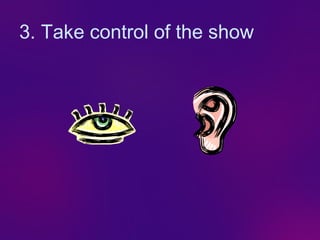
3. Take control of the show
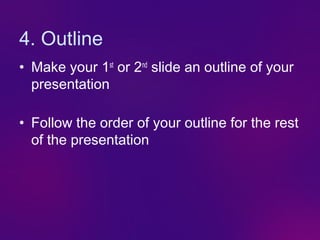
4. Outline
• Make your 1st or 2nd slide an outline of your
  presentation

• Follow the order of your outline for the rest
  of the presentation
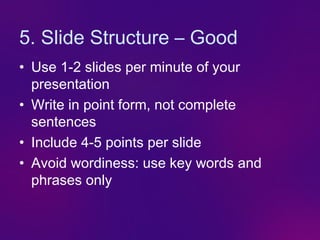
5. Slide Structure – Good
• Use 1-2 slides per minute of your
  presentation
• Write in point form, not complete
  sentences
• Include 4-5 points per slide
• Avoid wordiness: use key words and
  phrases only
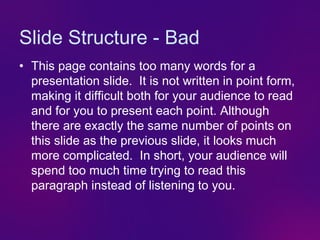
Slide Structure - Bad
• This page contains too many words for a
  presentation slide. It is not written in point form,
  making it difficult both for your audience to read
  and for you to present each point. Although
  there are exactly the same number of points on
  this slide as the previous slide, it looks much
  more complicated. In short, your audience will
  spend too much time trying to read this
  paragraph instead of listening to you.
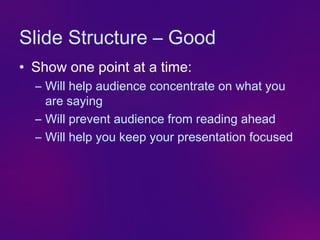
Slide Structure – Good
• Show one point at a time:
  – Will help audience concentrate on what you
    are saying
  – Will prevent audience from reading ahead
  – Will help you keep your presentation focused
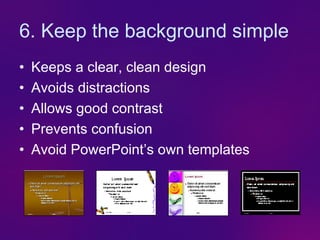
6. Keep the background simple
• Keeps a clear, clean design
6. Keep the background simple
 Keeps a clear, clean design
 Avoids distractions
6. Keep the background simple
• Keeps a clear, clean design
• Avoids distractions
• Allows good contrast
6. Keep the background simple
•   Keeps a clear, clean design
•   Avoids distractions
•   Allows good contrast
•   Prevents confusion
6. Keep the background simple
•   Keeps a clear, clean design
•   Avoids distractions
•   Allows good contrast
•   Prevents confusion
•   Avoid PowerPoint’s own templates
Background – Bad
• Avoid backgrounds that are distracting or
  difficult to read from
• Always be consistent with the background
  that you use
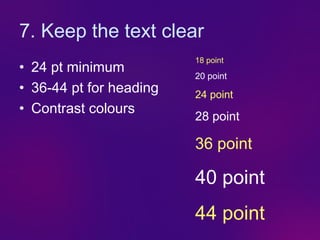
7. Keep the text clear
                         18 point
• 24 pt minimum
                         20 point
• 36-44 pt for heading   24 point
• Contrast colours
                         28 point

                         36 point

                         40 point
                         44 point
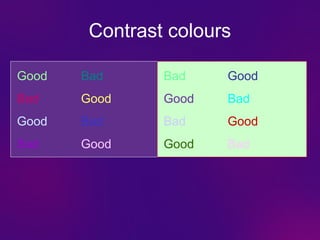
Contrast colours

Good   Bad      Bad    Good
Bad    Good     Good   Bad
Good   Bad      Bad    Good
Bad    Good     Good   Bad
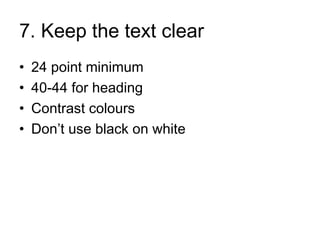
7. Keep the text clear
•   24 point minimum
•   40-44 for heading
•   Contrast colours
•   Don’t use black on white
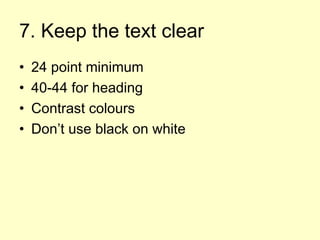
7. Keep the text clear
•   24 point minimum
•   40-44 for heading
•   Contrast colours
•   Don’t use black on white
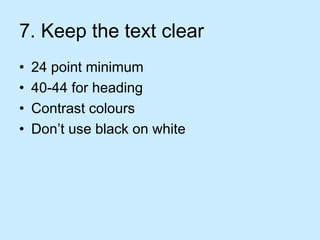
7. Keep the text clear
•   24 point minimum
•   40-44 for heading
•   Contrast colours
•   Don’t use black on white
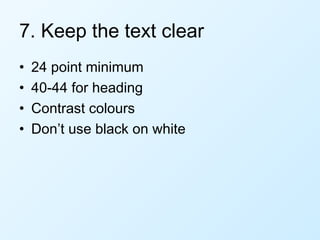
7. Keep the text clear
•   24 point minimum
•   40-44 for heading
•   Contrast colours
•   Don’t use black on white
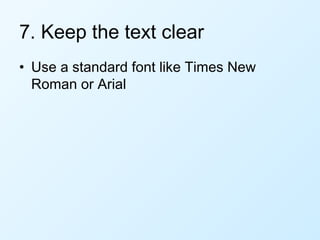
7. Keep the text clear
• Use a standard font like Times New
  Roman or Arial
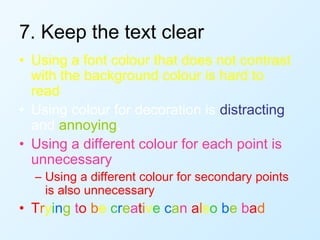
7. Keep the text clear
• Using a font colour that does not contrast
  with the background colour is hard to
  read
• Using colour for decoration is distracting
  and annoying.
• Using a different colour for each point is
  unnecessary
  – Using a different colour for secondary points
    is also unnecessary
• Trying to be creative can also be bad
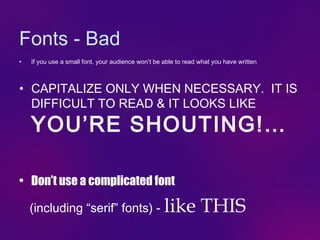
Fonts - Bad
•   If you use a small font, your audience won’t be able to read what you have written


• CAPITALIZE ONLY WHEN NECESSARY. IT IS
  DIFFICULT TO READ & IT LOOKS LIKE
    YOU’RE SHOUTING!…

• Don’t use a complicated font

    (including “serif” fonts) - like                             THIS
8. Always have a good picture
• Photographs are fantastic
• Cartoons are fun (… sometimes!)
• Diagrams are
  useful
• No picture? Then why have a slide?
9. Animate quickly and simply
• Avoid transitions
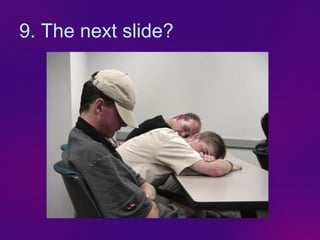
9. The next slide?
9. Animate quickly and simply
• Avoid transitions
• For text use:
  – Appear
  – Fly, from left/right/bottom (very fast)
  – Fade (very fast)
9. Animate quickly and simply
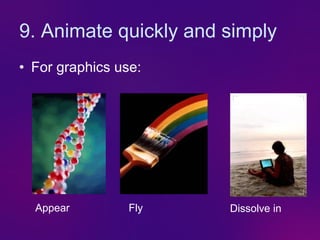
• For graphics use:


  Appear         Fly   Dissolve in
9. Animate quickly and simply
• Nothing fancy
  It will only end up
  REALLY ANNOYING
  your poor audience.
• Keep it quick
  Or you try to read or recognise it before it has
   fully developed!
10. Spelling and grammar
• Spellcheck!
• Proof your slides for:
  – speling mistakes
  – The the use of of repeated words
  – grammatical errors you might have make


• If English is not your first language,
  please get someone else to check your
  presentation!
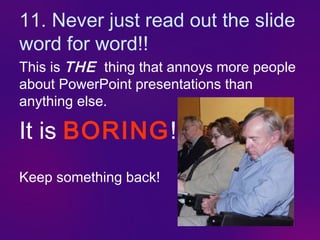
11. Never just read out the slide
word for word!!
This is THE thing that annoys more people
about PowerPoint presentations than
anything else.

It is BORING!
Keep something back!
12. Be very careful with sound
•   No whooshes
•   No chimes
•   No lasers
•   No typewriters
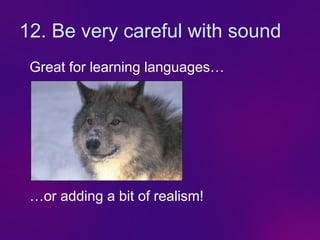
12. Be very careful with sound
 Great for learning languages…
  French        Français
   Hello       Bonjour
   Goodbye     Au revoir
   Thank you Merci

 …or adding a bit of realism!
13. (Don’t) give out great
handouts

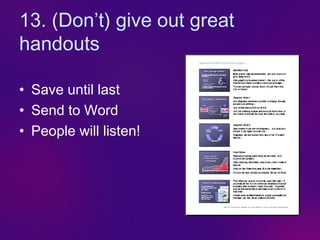
• Save until last
• Send to Word
• People will listen!
                        
                        
14. Enjoy it!
 Teaching and imparting knowledge and
 experience is one of the fundamental
 expectations of us as nurses within our
 profession. (NMC, 2010)

 Embrace it….


 It’s fun!….
Conclusion
• Use an effective and strong closing
  – Your audience is likely to remember your last
    words


• Use a conclusion slide to:
  – Summarize the main points of your
    presentation
  – Suggest future avenues of research
Questions??
• End your presentation with a simple
  question slide to:
  – Invite your audience to ask questions
  – Provide a visual aid during question period
  – Avoid ending a presentation abruptly
Thank you for your attention


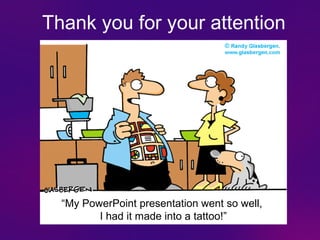
  “My PowerPoint presentation went so well,
         I had it made into a tattoo!”

Tipsfor effectivepowerpoint

  • 1.
    Effective PowerPoint 14 Top Tips for designing and presenting great slide shows by Paul Hinckley
  • 2.
    Oh no!! Not another boring PowerPoint presentation….
  • 3.
    1. Keep thepoints simple • Introduce yourself • Title page • Aims and objectives • Structure • Subheadings • Bullet points • Summary / conclusion • Questions
  • 4.
    2. Make yourtitle concise and relevant • Show where you are going!
  • 5.
    3. Take controlof the show
  • 6.
    4. Outline • Makeyour 1st or 2nd slide an outline of your presentation • Follow the order of your outline for the rest of the presentation
  • 7.
    5. Slide Structure– Good • Use 1-2 slides per minute of your presentation • Write in point form, not complete sentences • Include 4-5 points per slide • Avoid wordiness: use key words and phrases only
  • 8.
    Slide Structure -Bad • This page contains too many words for a presentation slide. It is not written in point form, making it difficult both for your audience to read and for you to present each point. Although there are exactly the same number of points on this slide as the previous slide, it looks much more complicated. In short, your audience will spend too much time trying to read this paragraph instead of listening to you.
  • 9.
    Slide Structure –Good • Show one point at a time: – Will help audience concentrate on what you are saying – Will prevent audience from reading ahead – Will help you keep your presentation focused
  • 10.
    6. Keep thebackground simple • Keeps a clear, clean design
  • 11.
    6. Keep thebackground simple Keeps a clear, clean design Avoids distractions
  • 12.
    6. Keep thebackground simple • Keeps a clear, clean design • Avoids distractions • Allows good contrast
  • 13.
    6. Keep thebackground simple • Keeps a clear, clean design • Avoids distractions • Allows good contrast • Prevents confusion
  • 14.
    6. Keep thebackground simple • Keeps a clear, clean design • Avoids distractions • Allows good contrast • Prevents confusion • Avoid PowerPoint’s own templates
  • 15.
    Background – Bad •Avoid backgrounds that are distracting or difficult to read from • Always be consistent with the background that you use
  • 16.
    7. Keep thetext clear 18 point • 24 pt minimum 20 point • 36-44 pt for heading 24 point • Contrast colours 28 point 36 point 40 point 44 point
  • 17.
    Contrast colours Good Bad Bad Good Bad Good Good Bad Good Bad Bad Good Bad Good Good Bad
  • 18.
    7. Keep thetext clear • 24 point minimum • 40-44 for heading • Contrast colours • Don’t use black on white
  • 19.
    7. Keep thetext clear • 24 point minimum • 40-44 for heading • Contrast colours • Don’t use black on white
  • 20.
    7. Keep thetext clear • 24 point minimum • 40-44 for heading • Contrast colours • Don’t use black on white
  • 21.
    7. Keep thetext clear • 24 point minimum • 40-44 for heading • Contrast colours • Don’t use black on white
  • 22.
    7. Keep thetext clear • Use a standard font like Times New Roman or Arial
  • 23.
    7. Keep thetext clear • Using a font colour that does not contrast with the background colour is hard to read • Using colour for decoration is distracting and annoying. • Using a different colour for each point is unnecessary – Using a different colour for secondary points is also unnecessary • Trying to be creative can also be bad
  • 24.
    Fonts - Bad • If you use a small font, your audience won’t be able to read what you have written • CAPITALIZE ONLY WHEN NECESSARY. IT IS DIFFICULT TO READ & IT LOOKS LIKE YOU’RE SHOUTING!… • Don’t use a complicated font (including “serif” fonts) - like THIS
  • 25.
    8. Always havea good picture • Photographs are fantastic • Cartoons are fun (… sometimes!) • Diagrams are useful • No picture? Then why have a slide?
  • 26.
    9. Animate quicklyand simply • Avoid transitions
  • 27.
  • 28.
    9. Animate quicklyand simply • Avoid transitions • For text use: – Appear – Fly, from left/right/bottom (very fast) – Fade (very fast)
  • 29.
    9. Animate quicklyand simply • For graphics use: Appear Fly Dissolve in
  • 30.
    9. Animate quicklyand simply • Nothing fancy It will only end up REALLY ANNOYING your poor audience. • Keep it quick Or you try to read or recognise it before it has fully developed!
  • 31.
    10. Spelling andgrammar • Spellcheck! • Proof your slides for: – speling mistakes – The the use of of repeated words – grammatical errors you might have make • If English is not your first language, please get someone else to check your presentation!
  • 32.
    11. Never justread out the slide word for word!! This is THE thing that annoys more people about PowerPoint presentations than anything else. It is BORING! Keep something back!
  • 33.
    12. Be verycareful with sound • No whooshes • No chimes • No lasers • No typewriters
  • 34.
    12. Be verycareful with sound Great for learning languages… French Français Hello Bonjour Goodbye Au revoir Thank you Merci …or adding a bit of realism!
  • 35.
    13. (Don’t) giveout great handouts • Save until last • Send to Word • People will listen!  
  • 36.
    14. Enjoy it! Teaching and imparting knowledge and experience is one of the fundamental expectations of us as nurses within our profession. (NMC, 2010) Embrace it…. It’s fun!….
  • 37.
    Conclusion • Use aneffective and strong closing – Your audience is likely to remember your last words • Use a conclusion slide to: – Summarize the main points of your presentation – Suggest future avenues of research
  • 38.
    Questions?? • End yourpresentation with a simple question slide to: – Invite your audience to ask questions – Provide a visual aid during question period – Avoid ending a presentation abruptly
  • 39.
    Thank you foryour attention “My PowerPoint presentation went so well, I had it made into a tattoo!”

Editor's Notes

  • #4 Explain that bottom three points say the same thing as the top point. Only quotes should be typed out in full (although a sound file would be better).
  • #5 This is called the signalling principle – the title should explain the IDEA of the slide NOT just something like “Marketing Principles” or “Second Quarter Projections”.
  • #6 Use B and W keys after first point to show how it works. Change to pen after graphics have come in. Ask the audience (as an example) whether they think what you see or what you hear is the most important in a PowerPoint presentation. Use line and gate numbers by each graphic to show how you could use a pen. Use slide number and enter to move to specific slides (remember to come back to this one – slide 20)
  • #19 Explain that B&W is worst colour combination for people with Dyslexia. Pale colours can still be used effectively as next few slides show (slide 12 has a simple gradient if you want to make it a bit more interesting)
  • #26 Remember not to click after cartoon – it comes in automatically Explain that you blank out the slideshow (see slide 20) to get attention back to you and just say stuff that was just going to be words anyway. Remember that words themselves can be a graphic (in boxes or explaining a particular point like in slides 9-10).
  • #32 Read the first paragraph slowly and deliberately with your back to the audience – to make the point!
  • #33 Read the first paragraph slowly and deliberately with your back to the audience – to make the point!
  • #34 Just click to start French bit – the rest of the language bit comes in automatically.
  • #35 Just click to start French bit – the rest of the language bit comes in automatically.