TIPS FOR
IMPROVING
YOUR SPEAKING
INTRODUCTION
Speaking is one of the most clearly recognised language skills.It is unique
among Writing, Reading and Listening because, unlike them, it cannot be done
silently.Speaking means actively producing meaningful sounds with your body:
mouth, tongue, teeth and so on, using breath from your lungs.
There are also appropriate facial expressions and hand gestures that
accompany speaking.For all these reasons, Speaking is your most physical
language skill.So, as with other physical skills, such as playing tennis, you have
to practise speaking.
MICRO-SKILLS
The skill of speaking includes a range
of micro-skills, including pronunciation of over
40 phonemes, active recall of vocabulary,
production of suitable grammatical structures,
and social /cultural behaviour such as turn
taking.
PRONOUNCIATION
Let’s look at Pronunciation. Some of the challenges of
English pronunciation relate to differences between the
sounds of English and the sounds of your first language.I
suggest finding out what these are, being aware of them,
and working on what are called ‘minimal pairs’
You might have difficulty with ‘L’ and ‘R’ for example, which
can also affect your listening and spelling, such as ‘collect’
or ‘correct’.The solution here is the position of your tongue.
Listen carefully to yourself and to other speakers of English.
FLUENCY
Your practice should also include working on
Fluency.That is, when you speak at a normal
pace and do not worry about small mistakes
but keep the conversation going with lots of
vocabulary, questions and exclamations, using
intonation (the musical rise and fall of your
voice) like native speakers.Fluency practice is
like a tennis player actually playing a game,
different to working on improving backhand or
serving during training.
MISTAKES
Mistakes are an opportunity for learning.This brings me to a
final point: how do you respond to error correction, that is,
when people ( a teacher or classmate or others) point out an
error in your speaking?Sometimes you might feel
discouraged that you have made another mistake ( maybe a
persistant one) but try to welcome the correction as an
opportunity to learn and improve.Also, look deeper into this
mistake and try to really understand why it happened, or
keeps happening.
Then work on a plan for changing it.You can also correct
yourself by actively, critically, listening to your own speaking
and reflecting on your conversations later.I hope you find
these tips helpful. Enjoy your speaking!
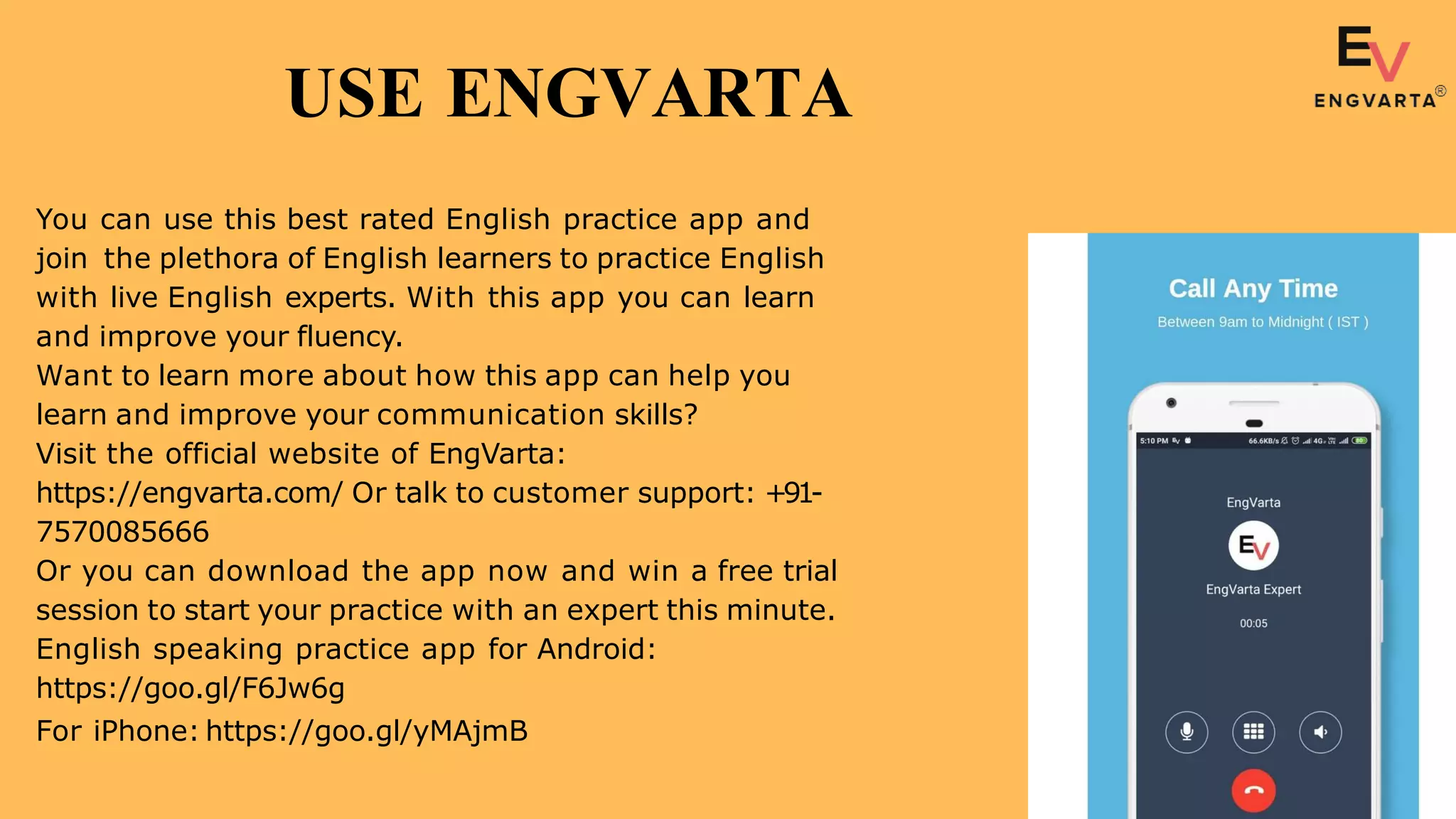
You can use this best rated English practice app and
join the plethora of English learners to practice English
with live English experts. With this app you can learn
and improve your fluency.
Want to learn more about how this app can help you
learn and improve your communication skills?
Visit the official website of EngVarta:
https://engvarta.com/ Or talk to customer support: +91-
7570085666
Or you can download the app now and win a free trial
session to start your practice with an expert this minute.
English speaking practice app for Android:
https://goo.gl/F6Jw6g
For iPhone: https://goo.gl/yMAjmB
USE ENGVARTA

Tips for improving your speaking

  • 1.
  • 2.
    INTRODUCTION Speaking is oneof the most clearly recognised language skills.It is unique among Writing, Reading and Listening because, unlike them, it cannot be done silently.Speaking means actively producing meaningful sounds with your body: mouth, tongue, teeth and so on, using breath from your lungs. There are also appropriate facial expressions and hand gestures that accompany speaking.For all these reasons, Speaking is your most physical language skill.So, as with other physical skills, such as playing tennis, you have to practise speaking.
  • 3.
    MICRO-SKILLS The skill ofspeaking includes a range of micro-skills, including pronunciation of over 40 phonemes, active recall of vocabulary, production of suitable grammatical structures, and social /cultural behaviour such as turn taking.
  • 4.
    PRONOUNCIATION Let’s look atPronunciation. Some of the challenges of English pronunciation relate to differences between the sounds of English and the sounds of your first language.I suggest finding out what these are, being aware of them, and working on what are called ‘minimal pairs’ You might have difficulty with ‘L’ and ‘R’ for example, which can also affect your listening and spelling, such as ‘collect’ or ‘correct’.The solution here is the position of your tongue. Listen carefully to yourself and to other speakers of English.
  • 5.
    FLUENCY Your practice shouldalso include working on Fluency.That is, when you speak at a normal pace and do not worry about small mistakes but keep the conversation going with lots of vocabulary, questions and exclamations, using intonation (the musical rise and fall of your voice) like native speakers.Fluency practice is like a tennis player actually playing a game, different to working on improving backhand or serving during training.
  • 6.
    MISTAKES Mistakes are anopportunity for learning.This brings me to a final point: how do you respond to error correction, that is, when people ( a teacher or classmate or others) point out an error in your speaking?Sometimes you might feel discouraged that you have made another mistake ( maybe a persistant one) but try to welcome the correction as an opportunity to learn and improve.Also, look deeper into this mistake and try to really understand why it happened, or keeps happening. Then work on a plan for changing it.You can also correct yourself by actively, critically, listening to your own speaking and reflecting on your conversations later.I hope you find these tips helpful. Enjoy your speaking!
  • 7.
    You can usethis best rated English practice app and join the plethora of English learners to practice English with live English experts. With this app you can learn and improve your fluency. Want to learn more about how this app can help you learn and improve your communication skills? Visit the official website of EngVarta: https://engvarta.com/ Or talk to customer support: +91- 7570085666 Or you can download the app now and win a free trial session to start your practice with an expert this minute. English speaking practice app for Android: https://goo.gl/F6Jw6g For iPhone: https://goo.gl/yMAjmB USE ENGVARTA