CALL
ZAKIAH
11.10.010.745.074
HOW TO LEARN
SPEAKING
Speaking is one of
important skill that
have to be have by
someone to say
something.
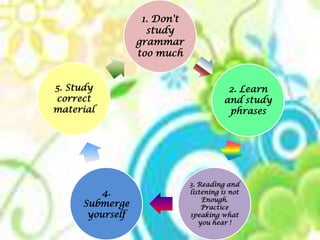
5 Speaking Rules you
need to know
1. Don't
study
grammar
too much
2. Learn
and study
phrases
3. Reading and
listening is not
Enough.
Practice
speaking what
you hear !
4.
Submerge
yourself
5. Study
correct
material
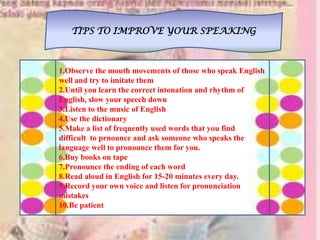
TIPS TO IMPROVE YOUR SPEAKING
1.Observe the mouth movements of those who speak English
well and try to imitate them
2.Until you learn the correct intonation and rhythm of
English, slow your speech down
3.Listen to the music of English
4.Use the dictionary
5.Make a list of frequently used words that you find
difficult to prnounce and ask someone who speaks the
language well to pronounce them for you.
6.Buy books on tape
7.Pronounce the ending of each word
8.Read aloud in English for 15-20 minutes every day.
9.Record your own voice and listen for pronunciation
mistakes
10.Be patient
Pronunciation
Pronunciation means:
 The ways to learn how to world
is spelled
 Saying a word the way it should
be said
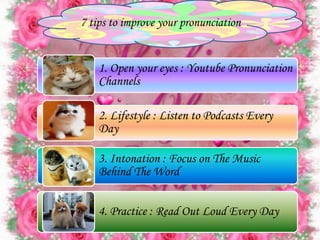
7 tips to improve your pronunciation
1. Open your eyes : Youtube Pronunciation
Channels
2. Lifestyle : Listen to Podcasts Every
Day
3. Intonation : Focus on The Music
Behind The Word
4. Practice : Read Out Loud Every Day
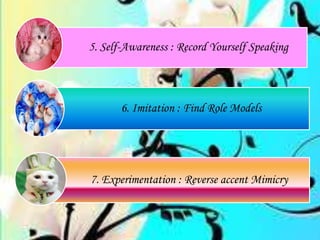
5. Self-Awareness : Record Yourself Speaking
6. Imitation : Find Role Models
7. Experimentation : Reverse accent Mimicry
HOW TO LEARN VOCABULARY
VOCABULARY
Vocabulary is commonly defined as "all the words known and
used by a particular person".
Knowing a word, however, is not as simple as simply being
able to recognize or use it. There are several aspects of word
knowledge which are used to measure word knowledge
Vocabulary Learning Tip One: Read, Read, Read
Vocabulary Learning Tip Two: Improve your context skills
Vocabulary Learning Tip Three: Practice, practice, practice
Vocabulary Learning Tip Four: Make up as many associations and connections
as possible
Vocabulary Learning Tip Five: Use mnemonics ( memory tricks)
Vocabulary Learning Tip Six: Get in the habit of looking up words you don't
know
Vocabulary Learning Tip Seven: Play with words
Vocabulary Learning Tip Eight: Use vocabulary lists
Vocabulary Learning Tip Nine: Take vocabulary tests
Vocabulary Learning Tip Ten: Get excited about words!
The Ten Best Vocabulary Learning Tips
HOW TO LEARN GRAMMAR
USING MEDIA
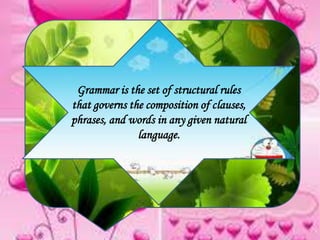
Grammar is the set of structural rules
that governs the composition of clauses,
phrases, and words in any given natural
language.
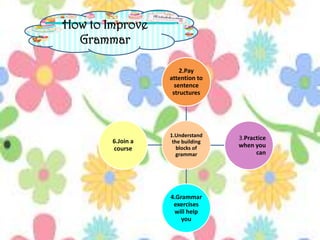
How to Improve
Grammar
1.Understand
the building
blocks of
grammar
2.Pay
attention to
sentence
structures
3.Practice
when you
can
4.Grammar
exercises
will help
you
6.Join a
course
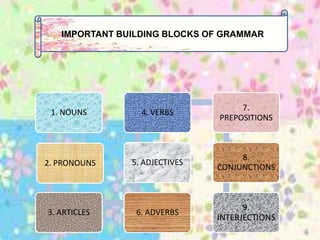
1. NOUNS
2. PRONOUNS
3. ARTICLES 6. ADVERBS
5. ADJECTIVES
4. VERBS
7.
PREPOSITIONS
8.
CONJUNCTIONS
9.
INTERJECTIONS
IMPORTANT BUILDING BLOCKS OF GRAMMAR
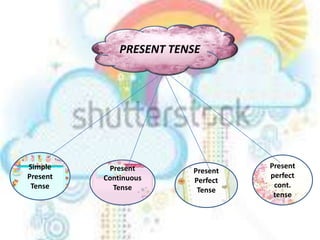
Simple
Present
Tense
Present
perfect
cont.
tense
Present
Perfect
Tense
Present
Continuous
Tense
PRESENT TENSE
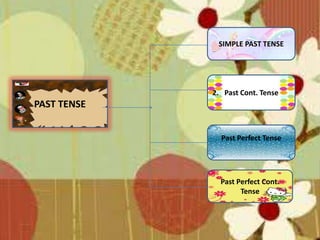
PAST TENSE
SIMPLE PAST TENSE
2. Past Cont. Tense
Past Perfect Tense
Past Perfect Cont.
Tense
Simple Future Tense
Future Cont. Tense
Future Perfect Tense
Future Perfect Cont.
Tense
FUTURE TENSE
Past Future Tense
Past Future Cont. Tense
Past Future Perfect Tense
Past Future Perfect Cont. Tense
PAST FUTURE TENSE
LISTENING
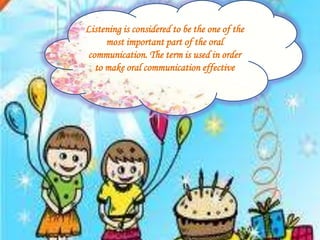
Listening is considered to be the one of the
most important part of the oral
communication. The term is used in order
to make oral communication effective
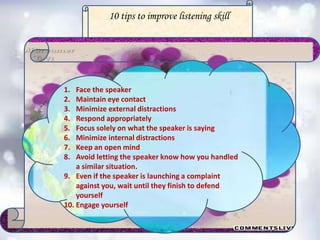
10 tips to improve listening skill
1. Face the speaker
2. Maintain eye contact
3. Minimize external distractions
4. Respond appropriately
5. Focus solely on what the speaker is saying
6. Minimize internal distractions
7. Keep an open mind
8. Avoid letting the speaker know how you handled
a similar situation.
9. Even if the speaker is launching a complaint
against you, wait until they finish to defend
yourself
10. Engage yourself
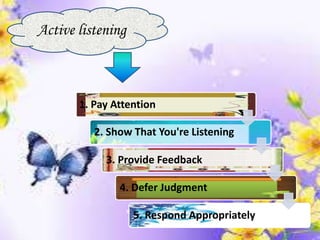
1. Pay Attention
2. Show That You're Listening
3. Provide Feedback
4. Defer Judgment
5. Respond Appropriately
Active listening
Reading
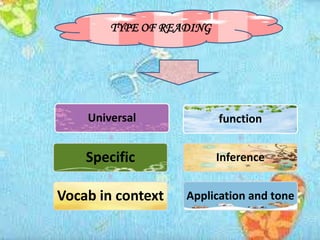
TYPE OF READING
Universal
Specific
Vocab in context
function
Inference
Application and tone
WRITING
Writing is language in a textual medium
through the use of a set of signs or symbols
(known as a writing system.It is
distinguished from illustration, such as cave
drawing and painting, and non-symbolic
preservation of language via non-textual
media, such as magnetic tape audio.
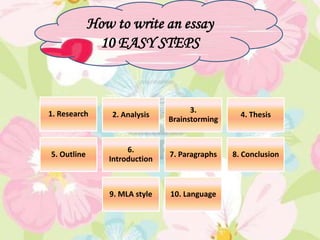
1. Research 2. Analysis
3.
Brainstorming
4. Thesis
5. Outline
6.
Introduction
7. Paragraphs 8. Conclusion
9. MLA style 10. Language
How to write an essay
10 EASY STEPS
Presentation1 kiah call

Presentation1 kiah call

  • 1.
  • 2.
  • 3.
    Speaking is oneof important skill that have to be have by someone to say something.
  • 4.
    5 Speaking Rulesyou need to know
  • 5.
    1. Don't study grammar too much 2.Learn and study phrases 3. Reading and listening is not Enough. Practice speaking what you hear ! 4. Submerge yourself 5. Study correct material
  • 6.
    TIPS TO IMPROVEYOUR SPEAKING 1.Observe the mouth movements of those who speak English well and try to imitate them 2.Until you learn the correct intonation and rhythm of English, slow your speech down 3.Listen to the music of English 4.Use the dictionary 5.Make a list of frequently used words that you find difficult to prnounce and ask someone who speaks the language well to pronounce them for you. 6.Buy books on tape 7.Pronounce the ending of each word 8.Read aloud in English for 15-20 minutes every day. 9.Record your own voice and listen for pronunciation mistakes 10.Be patient
  • 7.
  • 8.
    Pronunciation means:  Theways to learn how to world is spelled  Saying a word the way it should be said
  • 9.
    7 tips toimprove your pronunciation 1. Open your eyes : Youtube Pronunciation Channels 2. Lifestyle : Listen to Podcasts Every Day 3. Intonation : Focus on The Music Behind The Word 4. Practice : Read Out Loud Every Day
  • 10.
    5. Self-Awareness :Record Yourself Speaking 6. Imitation : Find Role Models 7. Experimentation : Reverse accent Mimicry
  • 11.
    HOW TO LEARNVOCABULARY
  • 12.
    VOCABULARY Vocabulary is commonlydefined as "all the words known and used by a particular person". Knowing a word, however, is not as simple as simply being able to recognize or use it. There are several aspects of word knowledge which are used to measure word knowledge
  • 13.
    Vocabulary Learning TipOne: Read, Read, Read Vocabulary Learning Tip Two: Improve your context skills Vocabulary Learning Tip Three: Practice, practice, practice Vocabulary Learning Tip Four: Make up as many associations and connections as possible Vocabulary Learning Tip Five: Use mnemonics ( memory tricks) Vocabulary Learning Tip Six: Get in the habit of looking up words you don't know Vocabulary Learning Tip Seven: Play with words Vocabulary Learning Tip Eight: Use vocabulary lists Vocabulary Learning Tip Nine: Take vocabulary tests Vocabulary Learning Tip Ten: Get excited about words! The Ten Best Vocabulary Learning Tips
  • 14.
    HOW TO LEARNGRAMMAR USING MEDIA
  • 15.
    Grammar is theset of structural rules that governs the composition of clauses, phrases, and words in any given natural language.
  • 16.
    How to Improve Grammar 1.Understand thebuilding blocks of grammar 2.Pay attention to sentence structures 3.Practice when you can 4.Grammar exercises will help you 6.Join a course
  • 17.
    1. NOUNS 2. PRONOUNS 3.ARTICLES 6. ADVERBS 5. ADJECTIVES 4. VERBS 7. PREPOSITIONS 8. CONJUNCTIONS 9. INTERJECTIONS IMPORTANT BUILDING BLOCKS OF GRAMMAR
  • 18.
  • 19.
    PAST TENSE SIMPLE PASTTENSE 2. Past Cont. Tense Past Perfect Tense Past Perfect Cont. Tense
  • 20.
    Simple Future Tense FutureCont. Tense Future Perfect Tense Future Perfect Cont. Tense FUTURE TENSE
  • 21.
    Past Future Tense PastFuture Cont. Tense Past Future Perfect Tense Past Future Perfect Cont. Tense PAST FUTURE TENSE
  • 22.
  • 23.
    Listening is consideredto be the one of the most important part of the oral communication. The term is used in order to make oral communication effective
  • 24.
    10 tips toimprove listening skill 1. Face the speaker 2. Maintain eye contact 3. Minimize external distractions 4. Respond appropriately 5. Focus solely on what the speaker is saying 6. Minimize internal distractions 7. Keep an open mind 8. Avoid letting the speaker know how you handled a similar situation. 9. Even if the speaker is launching a complaint against you, wait until they finish to defend yourself 10. Engage yourself
  • 25.
    1. Pay Attention 2.Show That You're Listening 3. Provide Feedback 4. Defer Judgment 5. Respond Appropriately Active listening
  • 26.
  • 27.
    TYPE OF READING Universal Specific Vocabin context function Inference Application and tone
  • 28.
  • 29.
    Writing is languagein a textual medium through the use of a set of signs or symbols (known as a writing system.It is distinguished from illustration, such as cave drawing and painting, and non-symbolic preservation of language via non-textual media, such as magnetic tape audio.
  • 30.
    1. Research 2.Analysis 3. Brainstorming 4. Thesis 5. Outline 6. Introduction 7. Paragraphs 8. Conclusion 9. MLA style 10. Language How to write an essay 10 EASY STEPS