



Conducting Longitudinal
    Diary Studies


      Amanda Nance
           Sage
       June 10, 2009
Early diary study
Goal of this presentation
• How to run a better diary study
  – Create effective template
  – Understand the data
  – Keep users engaged

• See benefits of the method
Topics for this presentation
• Reason for the project

• About the diary study

• Diary study tips

• Unique contributions of the diary method
Reasons for the project
•   Assess “getting started” experience of our
    desktop accounting software

•   Focus on tasks after initial set up

•   Create requirements for next release
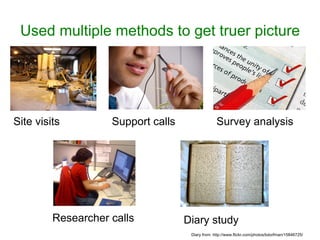
Used multiple methods to get truer picture


Site visits         Support calls                 Survey analysis


         Researcher calls           Diary study
                                     Diary from: http://www.flickr.com/photos/bdorfman/15846725/
About the diary study
• 5 participants: small business owners,
  bookkeepers
• Diaries kept for up to 8 weeks beginning at
  install
• Diaries submitted weekly by email
• Compensation – at least $40/week
About the diary study
• Provided template in Word to record
  – Daily Work: tools they used, other tasks
  – Issues and Comments: problems with our
    product
Tips
Recruit extra participants
• Recruited 12
• 5 completed


• Reasons for drop outs were interesting
  findings, too
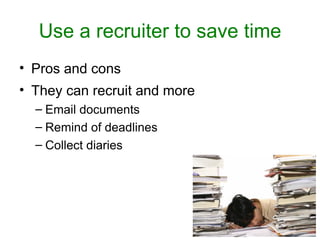
Use a recruiter to save time
• Pros and cons
• They can recruit and more
  – Email documents
  – Remind of deadlines
  – Collect diaries
Communicate deadlines
• Communicate due date for first submission
• Disqualify participants who don’t respond
• Close the loop
Template tips
Make it easy for participants
• Keep it short
  – This study: 3 questions daily, 6-7 per incident

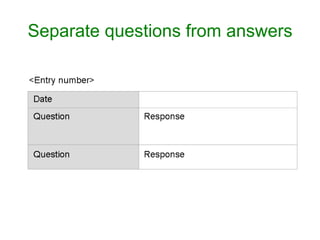
• Separate questions from answers
Separate questions from answers
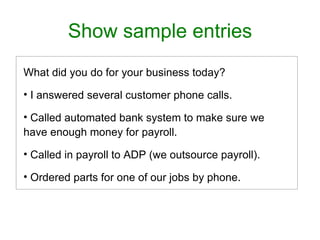
Show sample entries
What did you do for your business today?

• I answered several customer phone calls.

• Called automated bank system to make sure we
have enough money for payroll.

• Called in payroll to ADP (we outsource payroll).

• Ordered parts for one of our jobs by phone.
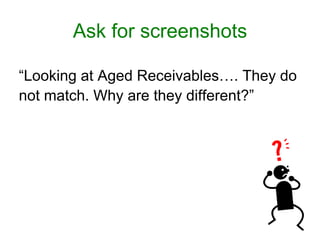
Ask for screenshots

“Looking at Aged Receivables…. They do
not match. Why are they different?”
Tips for screenshots
• If they are important, require them

• Include instructions
Structure template for easy analysis

• Separate daily entries from critical
  incidents

• Include participant name and week number
  in footer and file name
Iterate on the template
• Prior to launching

• As you receive user feedback
Process tips
Require daily entries
• Keeps participants engaged

• Gives you a reason to pay them

• Opportunity to learn about the broader
  work context
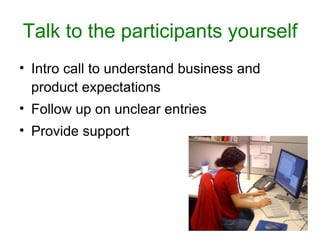
Talk to the participants yourself
• Intro call to understand business and
  product expectations
• Follow up on unclear entries
• Provide support
Research tips
• Read entries as soon as possible
• Leave time to research
Data analysis
• No different from other methods
• Evaluate data
  – Excel to categorize theme, second theme, week #
• Share and act on data
  – Summarize key findings, provide recommendation
    for each
  – Use customer quotes
  – Share complete diaries
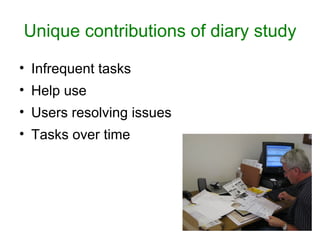
Unique contributions of diary study

• Infrequent tasks
• Help use
• Users resolving issues
• Tasks over time
Reasons to run a diary study
• No travel required
• Non-intrusive, in context
• Cheaper than site visits
Engagement and meaningful data

• Pay for more complete responses

• Encourage useful responses through
  feedback on recent entries

• Continue participants who are useful
Key Points
• Daily entries
• Explain what you expect
• Sample entries
• Reasonable number of questions
• Personal contact with researcher


• Questions?
Contact
More tips in conference proceedings


anance@gmail.com
Twitter: @amandaux

Tips for conducting long-term diary studies - UPA 2009

  • 1.
    Conducting Longitudinal Diary Studies Amanda Nance Sage June 10, 2009
  • 2.
  • 3.
    Goal of thispresentation • How to run a better diary study – Create effective template – Understand the data – Keep users engaged • See benefits of the method
  • 4.
    Topics for thispresentation • Reason for the project • About the diary study • Diary study tips • Unique contributions of the diary method
  • 5.
    Reasons for theproject • Assess “getting started” experience of our desktop accounting software • Focus on tasks after initial set up • Create requirements for next release
  • 6.
    Used multiple methodsto get truer picture Site visits Support calls Survey analysis Researcher calls Diary study Diary from: http://www.flickr.com/photos/bdorfman/15846725/
  • 7.
    About the diarystudy • 5 participants: small business owners, bookkeepers • Diaries kept for up to 8 weeks beginning at install • Diaries submitted weekly by email • Compensation – at least $40/week
  • 8.
    About the diarystudy • Provided template in Word to record – Daily Work: tools they used, other tasks – Issues and Comments: problems with our product
  • 9.
  • 10.
    Recruit extra participants •Recruited 12 • 5 completed • Reasons for drop outs were interesting findings, too
  • 11.
    Use a recruiterto save time • Pros and cons • They can recruit and more – Email documents – Remind of deadlines – Collect diaries
  • 12.
    Communicate deadlines • Communicatedue date for first submission • Disqualify participants who don’t respond • Close the loop
  • 13.
  • 15.
    Make it easyfor participants • Keep it short – This study: 3 questions daily, 6-7 per incident • Separate questions from answers
  • 16.
  • 17.
    Show sample entries Whatdid you do for your business today? • I answered several customer phone calls. • Called automated bank system to make sure we have enough money for payroll. • Called in payroll to ADP (we outsource payroll). • Ordered parts for one of our jobs by phone.
  • 18.
    Ask for screenshots “Lookingat Aged Receivables…. They do not match. Why are they different?”
  • 19.
    Tips for screenshots •If they are important, require them • Include instructions
  • 20.
    Structure template foreasy analysis • Separate daily entries from critical incidents • Include participant name and week number in footer and file name
  • 21.
    Iterate on thetemplate • Prior to launching • As you receive user feedback
  • 22.
  • 23.
    Require daily entries •Keeps participants engaged • Gives you a reason to pay them • Opportunity to learn about the broader work context
  • 24.
    Talk to theparticipants yourself • Intro call to understand business and product expectations • Follow up on unclear entries • Provide support
  • 25.
    Research tips • Readentries as soon as possible • Leave time to research
  • 26.
    Data analysis • Nodifferent from other methods • Evaluate data – Excel to categorize theme, second theme, week # • Share and act on data – Summarize key findings, provide recommendation for each – Use customer quotes – Share complete diaries
  • 27.
    Unique contributions ofdiary study • Infrequent tasks • Help use • Users resolving issues • Tasks over time
  • 28.
    Reasons to runa diary study • No travel required • Non-intrusive, in context • Cheaper than site visits
  • 29.
    Engagement and meaningfuldata • Pay for more complete responses • Encourage useful responses through feedback on recent entries • Continue participants who are useful
  • 30.
    Key Points • Dailyentries • Explain what you expect • Sample entries • Reasonable number of questions • Personal contact with researcher • Questions?
  • 31.
    Contact More tips inconference proceedings anance@gmail.com Twitter: @amandaux

Editor's Notes

  • #12 Pros/cons. I started by recruiting myself: I thought I could identify appropriate customers more accurately than a screener. Also thought customers more likely to participate if contacted directly by Sage. Recruitment continued... Was taking time away from analyzing the data, so I hired a recruiter. Recruiters can also handle some of the admin work. (give examples from bullets) All of this frees up your time for analysis.
  • #13 When deadline passes, let potential participants know they cannot complete the study.
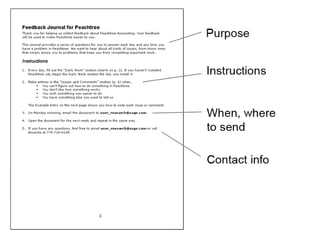
  • #15 Full template is in proceedings. Tell participants how to use the document. This includes: 1. Explain what the diary is 2. How to complete it – Be clear about what you expect. Story here: participant who didn’t use product one week so didn’t fill in diary 3. Remind when and where to send it 4. Contact info – in case they have questions.
  • #17 Makes it easier for participant to fill out Easier to analyze later Can paste it into Excel and rotate it to look across participants
  • #18 With appropriate level of detail Full example in the proceedings
  • #19 This is a quote from one of the diaries. I had no idea what it meant, but she included screenshots. She felt there was a discrepancy between 2 screens showing the same information, but looking at the screenshots, I realized the label on one of them was very confusing.
  • #20 This study: only 1 person included screenshots, probably because template said, “include if it helps you explain the problem”
  • #25 Engages users Their expectations about the product – found out that people wanted a certain feature through these Follow up: by email or phone depending on type of issue Provide support after you understand problem.
  • #26 Because you’re following up w/ participants, it’s important to read entries quickly. It allows you to get clarification while incidents are fresh on their minds. Our product is complex. I didn’t always understand how the system works. Had to understand that to interpret some of the entries.
  • #28 Captured infrequent tasks Use of Help documented, reasons people call support Saw how users resolve issues on their own and how long it takes Gave a sense for overall getting started process
  • #30 “Participants who provide especially helpful information (determined at our discretion) will be given a bonus of $140 for a total of $300.” But didn’t want to affect how often people used the software. I continued 2 participants for 8 weeks