Difficult memories
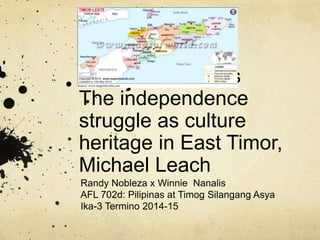
The independence
struggle as culture
heritage in East Timor,
Michael Leach
Randy Nobleza x Winnie Nanalis
AFL 702d: Pilipinas at Timog Silangang Asya
Ika-3 Termino 2014-15
imprisonment, trauma and resistance
massacre sites, place of political imprisonment,
torture, x human rights abuses
post conflict societies, Timor Leste
contexts
nationalist sense of East Timorese identity and
community arose from the collective experiences
of suffering under the Indonesian occupation,
which had a unifying effect across various ethnic
and language groups under the ‘colonial gaze.
(Anderson, 1999)
Funu
a 450 year national resistance struggle against
consecutive foreign occupiers.
However, this broadly unifying historical narrative
is complicated by the more divisive cultural
legacies of successive colonial eras.
Beneath it, a complex and ongoing struggle over
post-colonial cultural affiliations and national
identity is evident.
Tetum – indigenous lingua franca accorded a
high degree of cross-generational endorsement
Portuguese – less popular with younger
generation educated in Indonesian was important
as a unifying language across the elite of local
language groups and as language of the armed
resistance
Bahasa – with little knowledge of the old colonial
language for the younger generation
Fault line
Intergenerational debate over nationalist
historiography and the nature of an authentic
postcolonial identity
Older generation – emphasizing the long history
of funu. The Portuguese preserve is critical to
East Timorese nationalism
Younger generation – look for what they see as a
more authentic postcolonial identity, looking
primarily to its Melanesian or indigenous roots
Layers of cultural heritage
East Timor became the newest member of the
UN upon independence in 2002, following 450
years of Portuguese colonial rule ending in 1975
and a 24-year struggle against Indonesia
occupation between 1975and 1999.
East Timor is at the crossroads of three major
cultures: Melanasian which binds us to our
brothers and sisters of the South Pacific region.
Malay-Polynesian, binding us to the South East
Asia, and the Latin Catholic influence, a legacy of
almost 500 years of Portuguese colonization.
Jose Ramos-Horta, President and Nobel Peace
Prize recipient
During the twenty-four year Indonesia
occupation, these tensions became aside of
Symbolic struggle with Indonesia neo-colonial
historiography emphasizing historical Malay
connections and East Timorese nationalists
highlighting Melanasian affinities and the 450-
year impact of Portuguese colonialism by which
East Timor could be identified as a nation distinct
from Dutch-colonized West Timor.
Timorese nationalist
cultural heritage
The final layer of East Timorese memorials
reflecting on the Indonesia era and the pain and
trauma of the liberation struggle. Prominently
among these post-independence sites are the
Comarca Balide (Balide Jail) a former jail and
interrogation centre; the heroes monument to
Falintil resistance fighters at Metinaro and
memorials remembering the victims of
massacres in the lead up and aftermath of the
1999 referendum of independence such as those
in the Suai and Liquica churches.
The Comarca as a
memorial
The Comarca house both standing memorials to
victims of human rights abuses and other less
conventional memorials, literally embedded in
the architecture of the site.
Santa Cruz room
Suai circle
Prisoner graffiti
Cultural heritage x human
rights
The primary role of the archive is to provide
evidence of the violations… on which the victims
can base their request for reparations and on
which the authors can be pursued. – Jose
Caetano Guterre, CAVR coordinator archives
team
CAVR records
interviews
victims testimonies
community profiles
CAVR principles
prevention through preservation
public accountability
rights to information
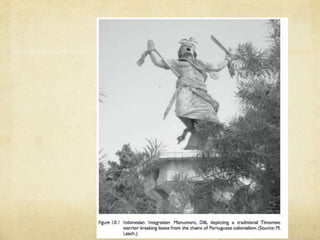
the heroes monument
Metinaro
designed as a sacralised national site to be
under permanent honor guard. Built close to the
main East Timor Defence Force (ETDF)
barracks, the center piece of the site is a open
platform monument, designed to accommodate
official ceremonies with 3 flagpoles facing the
open sea.
National museum of the
resistance
In a country in which 54% of the inhabitants are
under 15 years of age, the collective history of
the resistance in Timor-Leste “will remain a fact
expressed by a fragile memory’ unless preserved
at recorded quickly for future generations. – Jose
Mattoso, curator
Massacre sites:
Suai and Liquica
Some 2,600 East Timorese are estimated to
have been killed by the TNI or their proxy militias
in the violence leading up to and following the
independence referendum in September 1999.
Eg. The monument to the 200 victims of the Suai
massacre, small but moving monument to the 60
victims of the Liquica church massacre.
Other memorials and
‘immanent’ cultural
heritage
These more informal memorials include locally
made monuments in hiding places for Falintil
resistance fighters. Built by the proud community
members who assisted them. Other more difficult
sites are partly remembered, recalled by one
side of the brief but bloody civil war in 1975
between Freitilin and UDT (Timorese Democratic
Union).
Cultural heritage as
recognition
Memorials and repositories of difficult national
memories, like the Comarca, seek to make
sense of the collective experience of a people in
ways that foster a sense of national unity and
valorize the pain and trauma of all those who
suffered in the struggle for liberation.
As an essential element of ‘nation-building’ more
broadly, is the cultural production of unifying
narratives of collective identity and history.
East Timor’s independence
struggle
armed resistance Falintil
underground civilian resistance
diplomatic front x international solidarity
conclusion
a patchwork of cultural heritage sites, authored
by several generations of colonial and nationalist
elites, serves as a reminder of Timor-Leste’s long
and difficult history of occupation resistance and
intimately, of national liberation.
Historical layers
funu, the struggle of a united people against
colonial occupation
Indonesia era (precolonial unities) reunification
Asian resistance
Portuguese colonial era (portugulization, mission
civilitrice
Cultural heritage management mirror the larger
challenges of nation-building in Timor-Leste of
recognizing different generations’ experiences in
the liberation struggle and accommodating the
on-going power of local and regional identities in
presenting a unified national story.

Timor leste

  • 1.
    Difficult memories The independence struggleas culture heritage in East Timor, Michael Leach Randy Nobleza x Winnie Nanalis AFL 702d: Pilipinas at Timog Silangang Asya Ika-3 Termino 2014-15
  • 2.
    imprisonment, trauma andresistance massacre sites, place of political imprisonment, torture, x human rights abuses post conflict societies, Timor Leste
  • 3.
    contexts nationalist sense ofEast Timorese identity and community arose from the collective experiences of suffering under the Indonesian occupation, which had a unifying effect across various ethnic and language groups under the ‘colonial gaze. (Anderson, 1999)
  • 4.
    Funu a 450 yearnational resistance struggle against consecutive foreign occupiers. However, this broadly unifying historical narrative is complicated by the more divisive cultural legacies of successive colonial eras. Beneath it, a complex and ongoing struggle over post-colonial cultural affiliations and national identity is evident.
  • 5.
    Tetum – indigenouslingua franca accorded a high degree of cross-generational endorsement Portuguese – less popular with younger generation educated in Indonesian was important as a unifying language across the elite of local language groups and as language of the armed resistance Bahasa – with little knowledge of the old colonial language for the younger generation
  • 6.
    Fault line Intergenerational debateover nationalist historiography and the nature of an authentic postcolonial identity Older generation – emphasizing the long history of funu. The Portuguese preserve is critical to East Timorese nationalism Younger generation – look for what they see as a more authentic postcolonial identity, looking primarily to its Melanesian or indigenous roots
  • 7.
    Layers of culturalheritage East Timor became the newest member of the UN upon independence in 2002, following 450 years of Portuguese colonial rule ending in 1975 and a 24-year struggle against Indonesia occupation between 1975and 1999.
  • 8.
    East Timor isat the crossroads of three major cultures: Melanasian which binds us to our brothers and sisters of the South Pacific region. Malay-Polynesian, binding us to the South East Asia, and the Latin Catholic influence, a legacy of almost 500 years of Portuguese colonization. Jose Ramos-Horta, President and Nobel Peace Prize recipient
  • 9.
    During the twenty-fouryear Indonesia occupation, these tensions became aside of Symbolic struggle with Indonesia neo-colonial historiography emphasizing historical Malay connections and East Timorese nationalists highlighting Melanasian affinities and the 450- year impact of Portuguese colonialism by which East Timor could be identified as a nation distinct from Dutch-colonized West Timor.
  • 10.
    Timorese nationalist cultural heritage Thefinal layer of East Timorese memorials reflecting on the Indonesia era and the pain and trauma of the liberation struggle. Prominently among these post-independence sites are the Comarca Balide (Balide Jail) a former jail and interrogation centre; the heroes monument to Falintil resistance fighters at Metinaro and memorials remembering the victims of massacres in the lead up and aftermath of the 1999 referendum of independence such as those in the Suai and Liquica churches.
  • 12.
    The Comarca asa memorial The Comarca house both standing memorials to victims of human rights abuses and other less conventional memorials, literally embedded in the architecture of the site. Santa Cruz room Suai circle Prisoner graffiti
  • 14.
    Cultural heritage xhuman rights The primary role of the archive is to provide evidence of the violations… on which the victims can base their request for reparations and on which the authors can be pursued. – Jose Caetano Guterre, CAVR coordinator archives team
  • 15.
  • 16.
    CAVR principles prevention throughpreservation public accountability rights to information
  • 17.
    the heroes monument Metinaro designedas a sacralised national site to be under permanent honor guard. Built close to the main East Timor Defence Force (ETDF) barracks, the center piece of the site is a open platform monument, designed to accommodate official ceremonies with 3 flagpoles facing the open sea.
  • 18.
    National museum ofthe resistance In a country in which 54% of the inhabitants are under 15 years of age, the collective history of the resistance in Timor-Leste “will remain a fact expressed by a fragile memory’ unless preserved at recorded quickly for future generations. – Jose Mattoso, curator
  • 19.
    Massacre sites: Suai andLiquica Some 2,600 East Timorese are estimated to have been killed by the TNI or their proxy militias in the violence leading up to and following the independence referendum in September 1999. Eg. The monument to the 200 victims of the Suai massacre, small but moving monument to the 60 victims of the Liquica church massacre.
  • 21.
    Other memorials and ‘immanent’cultural heritage These more informal memorials include locally made monuments in hiding places for Falintil resistance fighters. Built by the proud community members who assisted them. Other more difficult sites are partly remembered, recalled by one side of the brief but bloody civil war in 1975 between Freitilin and UDT (Timorese Democratic Union).
  • 22.
    Cultural heritage as recognition Memorialsand repositories of difficult national memories, like the Comarca, seek to make sense of the collective experience of a people in ways that foster a sense of national unity and valorize the pain and trauma of all those who suffered in the struggle for liberation. As an essential element of ‘nation-building’ more broadly, is the cultural production of unifying narratives of collective identity and history.
  • 23.
    East Timor’s independence struggle armedresistance Falintil underground civilian resistance diplomatic front x international solidarity
  • 25.
    conclusion a patchwork ofcultural heritage sites, authored by several generations of colonial and nationalist elites, serves as a reminder of Timor-Leste’s long and difficult history of occupation resistance and intimately, of national liberation.
  • 26.
    Historical layers funu, thestruggle of a united people against colonial occupation Indonesia era (precolonial unities) reunification Asian resistance Portuguese colonial era (portugulization, mission civilitrice
  • 27.
    Cultural heritage managementmirror the larger challenges of nation-building in Timor-Leste of recognizing different generations’ experiences in the liberation struggle and accommodating the on-going power of local and regional identities in presenting a unified national story.