Another year has come and gone, and to imagine that up
until last month (and the most unexpected Presidential election
results of my lifetime) I was concerned I would have nothing to write about. While
2016 was a snoozer in the world of estate planning, 2017 may well bring the most
consequential alterations in estate planning law in our lifetimes. Like it or not, 2017
will be a year of changes which we still cannot predict that will likely shape our
financial lives forever.
2017 Tax Law Changes (?)
The Trump Administration and
Republican Legislature
Yes, you are (still) reading that correctly:
Barring the unpredicted imminent heat
death of our universe, Donald Trump
shall be sworn into the office of
President next month, and he will be
accompanied by a Republican
legislature. While it is difficult to get a
bead on what President Trump’s policy
goals are, from a Congressional
perspective it appears that imminent
policy changes will be definitely
happening:
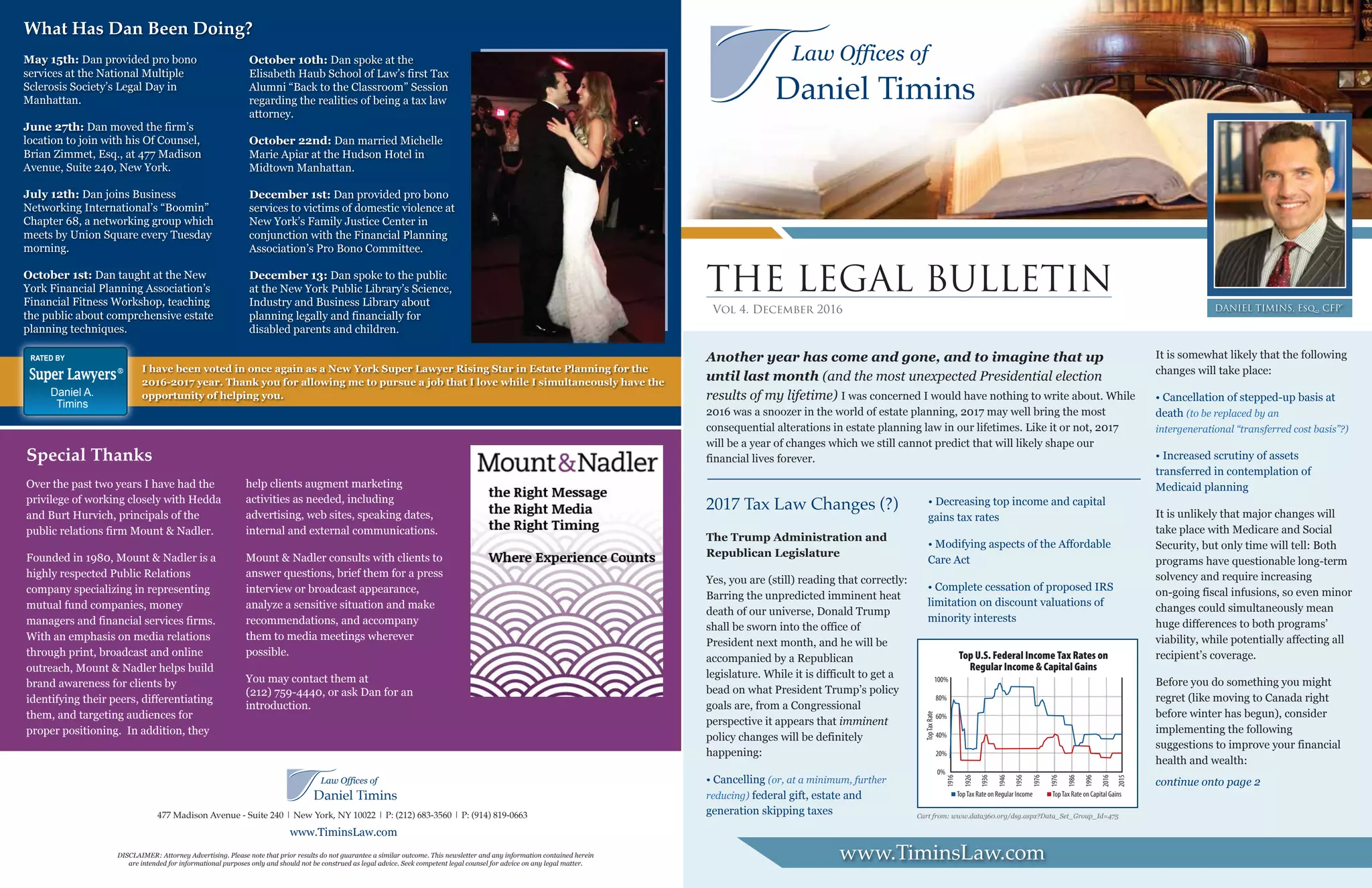
• Cancelling (or, at a minimum, further
reducing) federal gift, estate and
generation skipping taxes
THE LEGAL BULLETIN
• Decreasing top income and capital
gains tax rates
• Modifying aspects of the Affordable
Care Act
• Complete cessation of proposed IRS
limitation on discount valuations of
minority interests
www.TiminsLaw.com
477 Madison Avenue - Suite 240 | New York, NY 10022 | P: (212) 683-3560 | P: (914) 819-0663
www.TiminsLaw.com
DANIEL TIMINS, Esq., CFP®Vol 4. December 2016
Daniel Timins
Law Offices of
What Has Dan Been Doing?
May 15th: Dan provided pro bono
services at the National Multiple
Sclerosis Society’s Legal Day in
Manhattan.
June 27th: Dan moved the firm’s
location to join with his Of Counsel,
Brian Zimmet, Esq., at 477 Madison
Avenue, Suite 240, New York.
July 12th: Dan joins Business
Networking International’s “Boomin”
Chapter 68, a networking group which
meets by Union Square every Tuesday
morning.
October 1st: Dan taught at the New
York Financial Planning Association’s
Financial Fitness Workshop, teaching
the public about comprehensive estate
planning techniques.
October 10th: Dan spoke at the
Elisabeth Haub School of Law’s first Tax
Alumni “Back to the Classroom” Session
regarding the realities of being a tax law
attorney.
October 22nd: Dan married Michelle
Marie Apiar at the Hudson Hotel in
Midtown Manhattan.
December 1st: Dan provided pro bono
services to victims of domestic violence at
New York’s Family Justice Center in
conjunction with the Financial Planning
Association’s Pro Bono Committee.
December 13: Dan spoke to the public
at the New York Public Library’s Science,
Industry and Business Library about
planning legally and financially for
disabled parents and children.
I have been voted in once again as a New York Super Lawyer Rising Star in Estate Planning for the
2016-2017 year. Thank you for allowing me to pursue a job that I love while I simultaneously have the
opportunity of helping you.
RATED BY
Daniel A.
Timins
Super Lawyers®
It is somewhat likely that the following
changes will take place:
• Cancellation of stepped-up basis at
death (to be replaced by an
intergenerational “transferred cost basis”?)
• Increased scrutiny of assets
transferred in contemplation of
Medicaid planning
It is unlikely that major changes will
take place with Medicare and Social
Security, but only time will tell: Both
programs have questionable long-term
solvency and require increasing
on-going fiscal infusions, so even minor
changes could simultaneously mean
huge differences to both programs’
viability, while potentially affecting all
recipient’s coverage.
Before you do something you might
regret (like moving to Canada right
before winter has begun), consider
implementing the following
suggestions to improve your financial
health and wealth:
continue onto page 2
Special Thanks
Over the past two years I have had the
privilege of working closely with Hedda
and Burt Hurvich, principals of the
public relations firm Mount & Nadler.
Founded in 1980, Mount & Nadler is a
highly respected Public Relations
company specializing in representing
mutual fund companies, money
managers and financial services firms.
With an emphasis on media relations
through print, broadcast and online
outreach, Mount & Nadler helps build
brand awareness for clients by
identifying their peers, differentiating
them, and targeting audiences for
proper positioning. In addition, they
Top U.S. Federal Income Tax Rates on
Regular Income & Capital Gains
100%
80%
60%
40%
20%
0%
TopTax Rate on Regular Income TopTax Rate on Capital Gains
TopTaxRate
1916
1926
1936
1946
1956
1976
1976
1986
1996
2016
2015
Cart from: www.data360.org/dsg.aspx?Data_Set_Group_Id=475
help clients augment marketing
activities as needed, including
advertising, web sites, speaking dates,
internal and external communications.
Mount & Nadler consults with clients to
answer questions, brief them for a press
interview or broadcast appearance,
analyze a sensitive situation and make
recommendations, and accompany
them to media meetings wherever
possible.
You may contact them at
(212) 759-4440, or ask Dan for an
introduction.
DISCLAIMER: Attorney Advertising. Please note that prior results do not guarantee a similar outcome. This newsletter and any information contained herein
are intended for informational purposes only and should not be construed as legal advice. Seek competent legal counsel for advice on any legal matter.
Money Will Continue to Be the Great Equalizer,
so Build & Protect Your Assets
No matter your politics, sexual orientation, gender, culture, religion or ethnicity,
money has been, is, and will continue to be the greatest source of protection for you
and your family. Money still buys access to the best health care, legal representation
and education. Specifically, assets (as opposed to an income stream) allow you
investment flexibility, ease of transfer, and accessibility. Focusing your efforts on
building and maintaining family wealth is the best way for you to protect your
interests in both good and uncertain times.
due to modest wealth, they now would
face a capital gains tax.
Be mindful that in 2010 there was also
no federal estate tax. In its stead, there
was no step-up in basis and instead a
capital gains tax on estates, meaning
your beneficiary would have to prove the
value you purchased the stock / real
estate / business for, or else the IRS
assumed the asset had a ZERO basis,
meaning they owed capital gains taxes on
every penny of the stock. It is typically
very difficult for you to track your own
cost basis on property; you can only
imagine how much harder it is for a child
who has no idea when you purchased the
property.
Track your cost basis. Give proof to your
attorney, your accountant, your financial
advisor and keep it in your records,
clearly labeled for your beneficiaries.
(Some) State Estate Taxes No
Longer Matter
After some sneaky bureaucrat in Albany
slipped in the devious, infamous,
nefarious, precarious, and buzz-killing
“cliff tax”, which retroactively imposed a
tax on an entire estate if it was even one
dollar over the exempted amount, the
New York Middle Class (albeit, Upper
Class in most other parts of the country)
finally got their revenge. New York’s
estate tax exemption is due to be pegged
to the federal exemption in 2019. Of
course, this law was passed when it was
assumed there would actually be a
federal estate tax, meaning the state
would collect some tax revenue when an
ultra-wealthy New Yorker died. But if
there is NO federal estate tax in 2019,
there will be NO New York State estate
tax either. Stay tuned for further updates
on bureaucrat bunglings and
slight-of-hand in Albany…
New Jersey FINALLY took action on its
estate tax, which shall be repealed in
2018 (and the exemption raises to
$2,000,000 in 2017). However, the state
kept its inheritance tax, meaning
beneficiaries who are not immediate
family members will still owe a death tax
to the state.
And so, New York and New Jersey both
pass the award for “Worst State to Die
In” to Connecticut, which still imposes
an estate tax on estates over
$2,000,000. However, look for
Connecticut to rescind its own estate tax
in the coming years to remain a
competitive place to maintain domicile
(plus Trenton really want’s that award back).
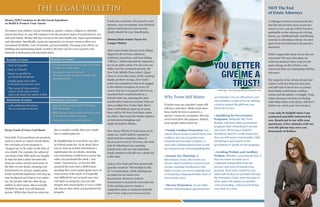
Why Trusts Still Matter
If estate taxes are repealed, trusts will
still have relevance: While trusts have
been useful devices to preserve a
spouse’s estate tax exemption, this has
never been their sole purpose. Indeed,
most people utilize trusts for:
• Family Creditor Protection: You
cannot always protect yourself from your
creditors, but you can protect your
beneficiaries from their creditors. A
trust with a disinterested trustee is still
the preferred way of accomplishing this.
• Income Tax Planning: In
discretionary trusts, the trustee can
choose which beneficiary receives trust
income, meaning beneficiaries with
higher income can receive principle and
avoid paying a disproportionate share of
trust income taxes.
• Divorce Protection: If your child
believes that prenuptial agreements are
not romantic, you can still protect your
asset transfers to him or her by utilizing
a trust to protect the gift from your
future Ex-In-Law.
• Qualifying for Government
Programs: Medicaid, SSI, Food
Stamps, and many other government
programs limit a beneficiary’s income
and assets. By leaving a disabled
beneficiary fund in a conforming trust
they can still receive trust benefits while
not having to give money to the
government to qualify for the programs.
• Avoiding Probate and Ancillary
Probate: Whether a government may or
may not assess an estate tax is
completely independent from the
process (and costs) of transferring
property. Real estate owned by your
estate still needs to be probated through
the Surrogate’s Court, and real estate in
other states will require an ancillary
court proceeding…unless you hold that
real estate in a trust.
THE LEGAL BULLETIN
Keep Track of Your Cost Basis
Currently, if you purchase any property,
such as a stock or a piece of real estate,
the cost basis of your property is
“stepped up” to its value on the date of
your death. For example, the adjusted
cost basis of the IBM stock you bought
in 1997 for $20 a share becomes the
$200 per share current stock price at
the date of your death, meaning your
beneficiaries do not pay capital gains.
Under potential legislation, this step up
may be phased out if there is no estate
tax. For people with less than $5.45
million to their name, this is actually
WORSE for their over-all financial
picture: While they faced no estate tax
NOT The End
of Estate Attorneys
A colleague of mine bemoaned the fact
that the end of estate taxes means her
career is over, and she will be forced to
panhandle on the subways for a living.
Surely, my childhood bully and lifelong
nemesis is scheming to harass me once
again from his bedroom in his parent’s
basement.
While I appreciate those of you who are
concerned. We may soon share an
awkward moment when I ask you for
spare change on the 6 Train, I can
assure you that our relationship still has
relevance.
The majority of my clients already had
estates worth less than $11,000,000,
and still want to know how to protect
their family wealth from creditors,
courts, and the public’s oversight. Truly,
estate attorneys are better at dealing
with dollars than cents (if you still don’t
believe me, check your next invoice).
I can only be helpful when I am
contacted and fully informed by
you. Reach out to me with your
questions: A few minutes with me
over the phone may save you
thousands of dollars.
Benefits of Assets
• Ease of Liquidity
• Easy to Transfer
• Easier to qualify for
government programs
• Capital gains rates often
lower than income tax rates
• The extent of your assets is
private at life and at death
unless an estate tax return is filed
Detriments of Assets
• 3.8% additional Medicare
tax on investment income
Benefits of Income
• Lower top tax rates on income taxes than
on gift and estate taxes
• Guaranteed income stream
(Social Security, Pensions) makes life
planning easier
Detriments of Income
• High Income causes higher Medicare
Part B expense
• High income means more Social Security
is included as taxable income
• Income must be reported annualy
YOU BETTER
GIVE ME A
TRUST!
*Internet image... This is a image went viral and is very popular for memes.
YOU BETTER
GIVE ME A
TRUST!

Timins Law ewsletter-December 2016

  • 1.
    Another year hascome and gone, and to imagine that up until last month (and the most unexpected Presidential election results of my lifetime) I was concerned I would have nothing to write about. While 2016 was a snoozer in the world of estate planning, 2017 may well bring the most consequential alterations in estate planning law in our lifetimes. Like it or not, 2017 will be a year of changes which we still cannot predict that will likely shape our financial lives forever. 2017 Tax Law Changes (?) The Trump Administration and Republican Legislature Yes, you are (still) reading that correctly: Barring the unpredicted imminent heat death of our universe, Donald Trump shall be sworn into the office of President next month, and he will be accompanied by a Republican legislature. While it is difficult to get a bead on what President Trump’s policy goals are, from a Congressional perspective it appears that imminent policy changes will be definitely happening: • Cancelling (or, at a minimum, further reducing) federal gift, estate and generation skipping taxes THE LEGAL BULLETIN • Decreasing top income and capital gains tax rates • Modifying aspects of the Affordable Care Act • Complete cessation of proposed IRS limitation on discount valuations of minority interests www.TiminsLaw.com 477 Madison Avenue - Suite 240 | New York, NY 10022 | P: (212) 683-3560 | P: (914) 819-0663 www.TiminsLaw.com DANIEL TIMINS, Esq., CFP®Vol 4. December 2016 Daniel Timins Law Offices of What Has Dan Been Doing? May 15th: Dan provided pro bono services at the National Multiple Sclerosis Society’s Legal Day in Manhattan. June 27th: Dan moved the firm’s location to join with his Of Counsel, Brian Zimmet, Esq., at 477 Madison Avenue, Suite 240, New York. July 12th: Dan joins Business Networking International’s “Boomin” Chapter 68, a networking group which meets by Union Square every Tuesday morning. October 1st: Dan taught at the New York Financial Planning Association’s Financial Fitness Workshop, teaching the public about comprehensive estate planning techniques. October 10th: Dan spoke at the Elisabeth Haub School of Law’s first Tax Alumni “Back to the Classroom” Session regarding the realities of being a tax law attorney. October 22nd: Dan married Michelle Marie Apiar at the Hudson Hotel in Midtown Manhattan. December 1st: Dan provided pro bono services to victims of domestic violence at New York’s Family Justice Center in conjunction with the Financial Planning Association’s Pro Bono Committee. December 13: Dan spoke to the public at the New York Public Library’s Science, Industry and Business Library about planning legally and financially for disabled parents and children. I have been voted in once again as a New York Super Lawyer Rising Star in Estate Planning for the 2016-2017 year. Thank you for allowing me to pursue a job that I love while I simultaneously have the opportunity of helping you. RATED BY Daniel A. Timins Super Lawyers® It is somewhat likely that the following changes will take place: • Cancellation of stepped-up basis at death (to be replaced by an intergenerational “transferred cost basis”?) • Increased scrutiny of assets transferred in contemplation of Medicaid planning It is unlikely that major changes will take place with Medicare and Social Security, but only time will tell: Both programs have questionable long-term solvency and require increasing on-going fiscal infusions, so even minor changes could simultaneously mean huge differences to both programs’ viability, while potentially affecting all recipient’s coverage. Before you do something you might regret (like moving to Canada right before winter has begun), consider implementing the following suggestions to improve your financial health and wealth: continue onto page 2 Special Thanks Over the past two years I have had the privilege of working closely with Hedda and Burt Hurvich, principals of the public relations firm Mount & Nadler. Founded in 1980, Mount & Nadler is a highly respected Public Relations company specializing in representing mutual fund companies, money managers and financial services firms. With an emphasis on media relations through print, broadcast and online outreach, Mount & Nadler helps build brand awareness for clients by identifying their peers, differentiating them, and targeting audiences for proper positioning. In addition, they Top U.S. Federal Income Tax Rates on Regular Income & Capital Gains 100% 80% 60% 40% 20% 0% TopTax Rate on Regular Income TopTax Rate on Capital Gains TopTaxRate 1916 1926 1936 1946 1956 1976 1976 1986 1996 2016 2015 Cart from: www.data360.org/dsg.aspx?Data_Set_Group_Id=475 help clients augment marketing activities as needed, including advertising, web sites, speaking dates, internal and external communications. Mount & Nadler consults with clients to answer questions, brief them for a press interview or broadcast appearance, analyze a sensitive situation and make recommendations, and accompany them to media meetings wherever possible. You may contact them at (212) 759-4440, or ask Dan for an introduction. DISCLAIMER: Attorney Advertising. Please note that prior results do not guarantee a similar outcome. This newsletter and any information contained herein are intended for informational purposes only and should not be construed as legal advice. Seek competent legal counsel for advice on any legal matter.
  • 2.
    Money Will Continueto Be the Great Equalizer, so Build & Protect Your Assets No matter your politics, sexual orientation, gender, culture, religion or ethnicity, money has been, is, and will continue to be the greatest source of protection for you and your family. Money still buys access to the best health care, legal representation and education. Specifically, assets (as opposed to an income stream) allow you investment flexibility, ease of transfer, and accessibility. Focusing your efforts on building and maintaining family wealth is the best way for you to protect your interests in both good and uncertain times. due to modest wealth, they now would face a capital gains tax. Be mindful that in 2010 there was also no federal estate tax. In its stead, there was no step-up in basis and instead a capital gains tax on estates, meaning your beneficiary would have to prove the value you purchased the stock / real estate / business for, or else the IRS assumed the asset had a ZERO basis, meaning they owed capital gains taxes on every penny of the stock. It is typically very difficult for you to track your own cost basis on property; you can only imagine how much harder it is for a child who has no idea when you purchased the property. Track your cost basis. Give proof to your attorney, your accountant, your financial advisor and keep it in your records, clearly labeled for your beneficiaries. (Some) State Estate Taxes No Longer Matter After some sneaky bureaucrat in Albany slipped in the devious, infamous, nefarious, precarious, and buzz-killing “cliff tax”, which retroactively imposed a tax on an entire estate if it was even one dollar over the exempted amount, the New York Middle Class (albeit, Upper Class in most other parts of the country) finally got their revenge. New York’s estate tax exemption is due to be pegged to the federal exemption in 2019. Of course, this law was passed when it was assumed there would actually be a federal estate tax, meaning the state would collect some tax revenue when an ultra-wealthy New Yorker died. But if there is NO federal estate tax in 2019, there will be NO New York State estate tax either. Stay tuned for further updates on bureaucrat bunglings and slight-of-hand in Albany… New Jersey FINALLY took action on its estate tax, which shall be repealed in 2018 (and the exemption raises to $2,000,000 in 2017). However, the state kept its inheritance tax, meaning beneficiaries who are not immediate family members will still owe a death tax to the state. And so, New York and New Jersey both pass the award for “Worst State to Die In” to Connecticut, which still imposes an estate tax on estates over $2,000,000. However, look for Connecticut to rescind its own estate tax in the coming years to remain a competitive place to maintain domicile (plus Trenton really want’s that award back). Why Trusts Still Matter If estate taxes are repealed, trusts will still have relevance: While trusts have been useful devices to preserve a spouse’s estate tax exemption, this has never been their sole purpose. Indeed, most people utilize trusts for: • Family Creditor Protection: You cannot always protect yourself from your creditors, but you can protect your beneficiaries from their creditors. A trust with a disinterested trustee is still the preferred way of accomplishing this. • Income Tax Planning: In discretionary trusts, the trustee can choose which beneficiary receives trust income, meaning beneficiaries with higher income can receive principle and avoid paying a disproportionate share of trust income taxes. • Divorce Protection: If your child believes that prenuptial agreements are not romantic, you can still protect your asset transfers to him or her by utilizing a trust to protect the gift from your future Ex-In-Law. • Qualifying for Government Programs: Medicaid, SSI, Food Stamps, and many other government programs limit a beneficiary’s income and assets. By leaving a disabled beneficiary fund in a conforming trust they can still receive trust benefits while not having to give money to the government to qualify for the programs. • Avoiding Probate and Ancillary Probate: Whether a government may or may not assess an estate tax is completely independent from the process (and costs) of transferring property. Real estate owned by your estate still needs to be probated through the Surrogate’s Court, and real estate in other states will require an ancillary court proceeding…unless you hold that real estate in a trust. THE LEGAL BULLETIN Keep Track of Your Cost Basis Currently, if you purchase any property, such as a stock or a piece of real estate, the cost basis of your property is “stepped up” to its value on the date of your death. For example, the adjusted cost basis of the IBM stock you bought in 1997 for $20 a share becomes the $200 per share current stock price at the date of your death, meaning your beneficiaries do not pay capital gains. Under potential legislation, this step up may be phased out if there is no estate tax. For people with less than $5.45 million to their name, this is actually WORSE for their over-all financial picture: While they faced no estate tax NOT The End of Estate Attorneys A colleague of mine bemoaned the fact that the end of estate taxes means her career is over, and she will be forced to panhandle on the subways for a living. Surely, my childhood bully and lifelong nemesis is scheming to harass me once again from his bedroom in his parent’s basement. While I appreciate those of you who are concerned. We may soon share an awkward moment when I ask you for spare change on the 6 Train, I can assure you that our relationship still has relevance. The majority of my clients already had estates worth less than $11,000,000, and still want to know how to protect their family wealth from creditors, courts, and the public’s oversight. Truly, estate attorneys are better at dealing with dollars than cents (if you still don’t believe me, check your next invoice). I can only be helpful when I am contacted and fully informed by you. Reach out to me with your questions: A few minutes with me over the phone may save you thousands of dollars. Benefits of Assets • Ease of Liquidity • Easy to Transfer • Easier to qualify for government programs • Capital gains rates often lower than income tax rates • The extent of your assets is private at life and at death unless an estate tax return is filed Detriments of Assets • 3.8% additional Medicare tax on investment income Benefits of Income • Lower top tax rates on income taxes than on gift and estate taxes • Guaranteed income stream (Social Security, Pensions) makes life planning easier Detriments of Income • High Income causes higher Medicare Part B expense • High income means more Social Security is included as taxable income • Income must be reported annualy YOU BETTER GIVE ME A TRUST! *Internet image... This is a image went viral and is very popular for memes. YOU BETTER GIVE ME A TRUST!