FINANCIAL PLANNING FOR
DISABLED PARENTS AND SPECIAL
NEEDS BENEFICIARIES
DECEMBER 12, 2016
FPANY’s Public Awareness Committee in
Partnership with NYU School of Professional Studies
Ne w Yo rk Public Library
Scie nce , Industry and Busine ss Library
2
 All information contained in these pages is for informational purposes
only. It should not be considered legal advise. Please consult an attorney
before taking any steps based on this information.
 All information contained in this presentation is for informational
purposes. The presenting attorney does not represent the information
contained herein is accurate or appropriate for your personal situation.
 All financial advisors are committed to fiduciary standard. Professionals
are bound to adhere to the Certified Financial Planner Board of
Standards and Ethics and/or the Financial Planning Association
Standards depending upon their designation.
 The information contained in this document was provided on a pro bono
basis. No compensation was obtained in exchange for services provided
either directly or via a third party.
Disclaimer
Why Are We Here Today?
1. Discuss differences of NEEDS-BASED
versus ENTITLEMENT programs
2. Understand gov’t. programs regarding
HEALTH and MONEY
3. Determine how to optimize family assets
while using these programs
3
 SSDI and MEDICARE:
 “Entitlement Programs” – you paid for it, you get it
 Separately withdrawn from your paycheck: 15.3%
 You pay half, your employer pays half
 SSI and MEDICAID:
 “Needs Based Programs”
 (1) Must have the physical / mental need
 (2) “Means Tested”: must meet asset & income limits
 Comes out of your general tax dollars
Entitlement v. Needs Based
Government Programs
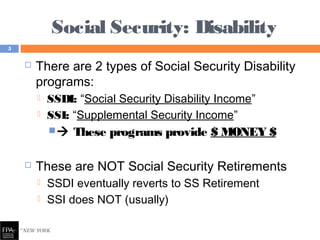
Social Security: Disability
 There are 2 types of Social Security Disability
programs:
 SSDI: “Social Security Disability Income”
 SSI: “Supplemental Security Income”
 These programs provide $ MONEY $
 These are NOT Social Security Retirements
 SSDI eventually reverts to SS Retirement
 SSI does NOT (usually)
5
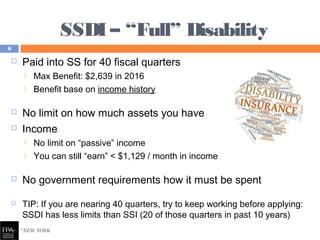
SSDI – “Full” Disability
 Paid into SS for 40 fiscal quarters
 Max Benefit: $2,639 in 2016
 Benefit base on income history
 No limit on how much assets you have
 Income
 No limit on “passive” income
 You can still “earn” < $1,129 / month in income
 No government requirements how it must be spent
 TIP: If you are nearing 40 quarters, try to keep working before applying:
SSDI has less limits than SSI (20 of those quarters in past 10 years)
6
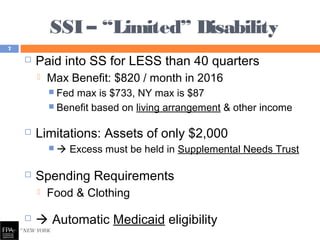
SSI – “Limited” Disability
 Paid into SS for LESS than 40 quarters
 Max Benefit: $820 / month in 2016
 Fed max is $733, NY max is $87
 Benefit based on living arrangement & other income
 Limitations: Assets of only $2,000
  Excess must be held in Supplemental Needs Trust
 Spending Requirements
 Food & Clothing
  Automatic Medicaid eligibility
7
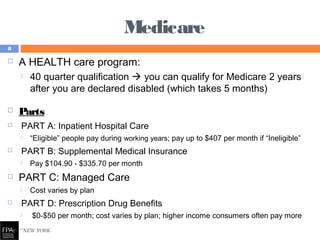
Medicare
 A HEALTH care program:
 40 quarter qualification  you can qualify for Medicare 2 years
after you are declared disabled (which takes 5 months)
 Parts
 PART A: Inpatient Hospital Care
 “Eligible” people pay during working years; pay up to $407 per month if “Ineligible”
 PART B: Supplemental Medical Insurance
 Pay $104.90 - $335.70 per month
 PART C: Managed Care
 Cost varies by plan
 PART D: Prescription Drug Benefits
 $0-$50 per month; cost varies by plan; higher income consumers often pay more
8
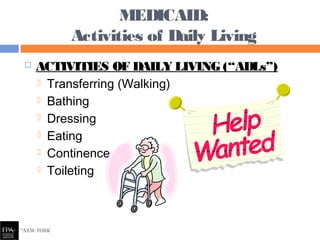
 ACTIVITIES OF DAILY LIVING (“ADLs”)
 Transferring (Walking)
 Bathing
 Dressing
 Eating
 Continence
 Toileting
MEDICAID:
Activities of Daily Living
The type of Medicaid benefit you receive determines “lookback” periods (I.e.
the penalty fortransferring assets)
Home /Community Care
Personal care, physical therapy, home
health care and home health aid
services; clinical orout-patient basis;
includes physicians, dentists,
pharmaceutical, nursery
Institutional Care
Hospitals, medical facilities, nursing
homes
Does NOT usually pay for“Assisted
Living facilities”
Types of Medicaid
You have to give away Money (gifting)
AND/OR
You have to give up control of spending
REMEMBER:
This is a “Needs Based” program, NOT an “Entitlement” program;
if you have no financial need you do not qualify
Why Do People Hesitate?
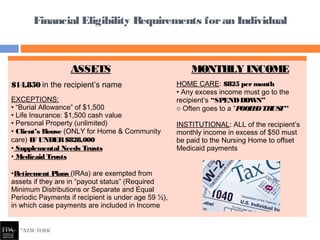
ASSETS
$14,850 in the recipient’s name
EXCEPTIONS:
• “Burial Allowance” of $1,500
• Life Insurance: $1,500 cash value
• Personal Property (unlimited)
• Client’s House (ONLY for Home & Community
care) IF UNDER$828,000
• Supplemental Needs Trusts
• Medicaid Trusts
•Retirement Plans (IRAs) are exempted from
assets if they are in “payout status” (Required
Minimum Distributions or Separate and Equal
Periodic Payments if recipient is under age 59 ½),
in which case payments are included in Income
MONTHLY INCOME
HOME CARE: $825 permonth
• Any excess income must go to the
recipient’s “SPENDDOWN”
o Often goes to a “POOLEDTRUST”
INSTITUTIONAL: ALL of the recipient’s
monthly income in excess of $50 must
be paid to the Nursing Home to offset
Medicaid payments
Financial Eligibility Requirements foran Individual
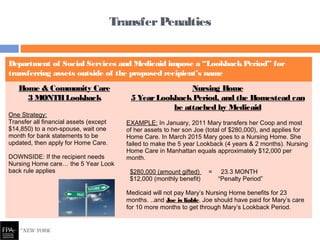
Department of Social Services and Medicaid impose a “LookbackPeriod” for
transferring assets outside of the proposed recipient’s name
Home & Community Care
3 MONTHLookback
One Strategy:
Transfer all financial assets (except
$14,850) to a non-spouse, wait one
month for bank statements to be
updated, then apply for Home Care.
DOWNSIDE: If the recipient needs
Nursing Home care… the 5 Year Look
back rule applies
Nursing Home
5 YearLookbackPeriod, and the Homestead can
be attached by Medicaid
EXAMPLE: In January, 2011 Mary transfers her Coop and most
of her assets to her son Joe (total of $280,000), and applies for
Home Care. In March 2015 Mary goes to a Nursing Home. She
failed to make the 5 year Lookback (4 years & 2 months). Nursing
Home Care in Manhattan equals approximately $12,000 per
month.
$280,000 (amount gifted) = 23.3 MONTH
$12,000 (monthly benefit) “Penalty Period”
Medicaid will not pay Mary’s Nursing Home benefits for 23
months. ..and Joe is liable. Joe should have paid for Mary’s care
for 10 more months to get through Mary’s Lookback Period.
TransferPenalties
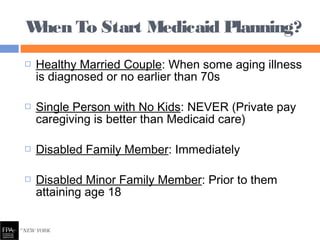
 Healthy Married Couple: When some aging illness
is diagnosed or no earlier than 70s
 Single Person with No Kids: NEVER (Private pay
caregiving is better than Medicaid care)
 Disabled Family Member: Immediately
 Disabled Minor Family Member: Prior to them
attaining age 18
When To Start Medicaid Planning?
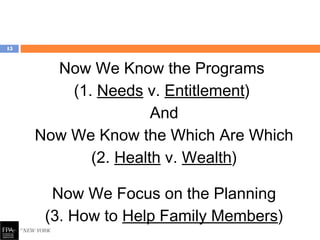
Now We Know the Programs
(1. Needs v. Entitlement)
And
Now We Know the Which Are Which
(2. Health v. Wealth)
Now We Focus on the Planning
(3. How to Help Family Members)
15
Probate v. Non-Probate
“Operation of Law” Transfers Probate /Administration
Anything with a “Beneficiary Designation”
Because we kno w who it g o e s to at de ath
•Jointly Owned Property
•Some Business Agreements
•Retirement Plans
•Life Insurance
•Transfer on Death [“TOD”] accounts
•Trusts
All you need is a Death Certificate to
collect these (if you are the beneficiary)
 This is what transfers through your
WILL or Intestacy
Because we do n’t auto m atically
kno w who it g o e s to at de ath
This includes all property not listed
under “Operation of Law”
(I.e. everything else)
2 Legal Procedures:
• If there is a valid Will = “Probate”
• If NO Will = “Administration”
16
YOU HAVE A WILL
WHETHERYOU HAVE
WRITTEN ONE ORNOT
17
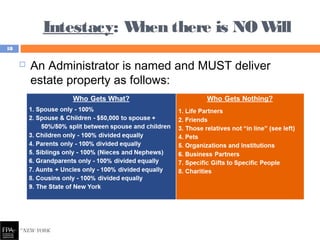
Intestacy: When there is NOWill
 An Administrator is named and MUST deliver
estate property as follows:
18
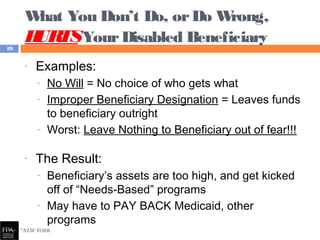
What You Don’t Do, orDo Wrong,
HURTSYourDisabled Beneficiary
19
- Examples:
- No Will = No choice of who gets what
- Improper Beneficiary Designation = Leaves funds
to beneficiary outright
- Worst: Leave Nothing to Beneficiary out of fear!!!
- The Result:
- Beneficiary’s assets are too high, and get kicked
off of “Needs-Based” programs
- May have to PAY BACK Medicaid, other
programs
The GOOD News…
There are solutions for
you and your family!
To save money AND receive benefits
20
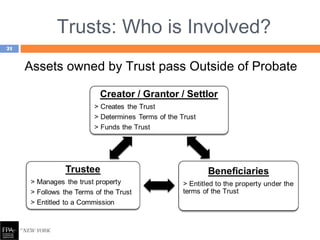
Trusts: Who is Involved?
Assets owned by Trust pass Outside of Probate
21
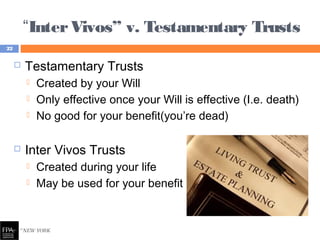
“InterVivos” v. Testamentary Trusts
 Testamentary Trusts
 Created by your Will
 Only effective once your Will is effective (I.e. death)
 No good for your benefit(you’re dead)
 Inter Vivos Trusts
 Created during your life
 May be used for your benefit
22
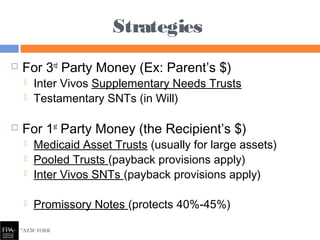
 For 3rd
Party Money (Ex: Parent’s $)
 Inter Vivos Supplementary Needs Trusts
 Testamentary SNTs (in Will)
 For 1st
Party Money (the Recipient’s $)
 Medicaid Asset Trusts (usually for large assets)
 Pooled Trusts (payback provisions apply)
 Inter Vivos SNTs (payback provisions apply)
 Promissory Notes (protects 40%-45%)
Strategies
Supplemental Needs Trusts
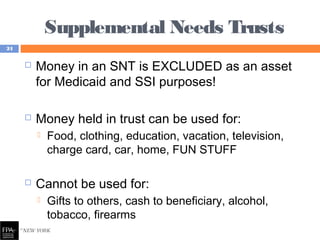
 Money in an SNT is EXCLUDED as an asset
for Medicaid and SSI purposes!
 Money held in trust can be used for:
 Food, clothing, education, vacation, television,
charge card, car, home, FUN STUFF
 Cannot be used for:
 Gifts to others, cash to beneficiary, alcohol,
tobacco, firearms
24
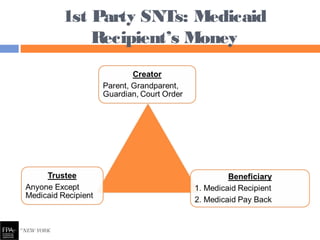
1st Party SNTs: Medicaid
Recipient’s Money
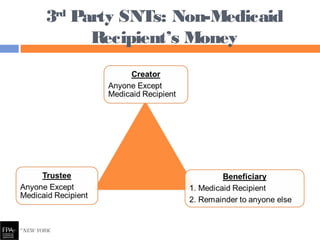
3rd
Party SNTs: Non-Medicaid
Recipient’s Money
SNTs: 1st
Party v. 3rd
Party
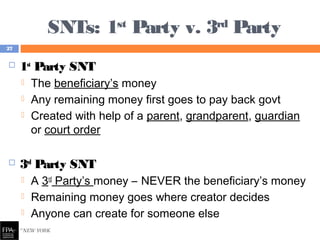
 1st
Party SNT
 The beneficiary’s money
 Any remaining money first goes to pay back govt
 Created with help of a parent, grandparent, guardian
or court order
 3rd
Party SNT
 A 3rd
Party’s money – NEVER the beneficiary’s money
 Remaining money goes where creator decides
 Anyone can create for someone else
27
Medicaid Homestead Exemptions
– ForSiblings and Children
The following family arrangements avoid a
Medicaid Lien on the primary residence:
Sibling Caretakers – 1 year exemption
 MUST live in same house
Children Caretakers – 2 year exemption
 MUST live in same house
Disabled Parent & Child both on Medicaid
 MUST live in same house
28
 Created by Medicaid recipient and/or spouse
  Meant to protect ASSETS, NOT INCOME
 Illiquid, non income-generating assets placed in the Trust,
such as real estate, or…
 …Income generating assets can be placed in Trust and
income withdrawn
 Income could disqualify recipient for Medicaid due to income limits
 5 Year Look Back applies for Institutional Care
 Child cannot evict parents from house, and cannot take assets
from Trust while parent(s) are alive
Medicaid Asset Protection Trusts
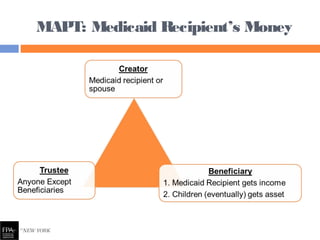
MAPT: Medicaid Recipient’s Money
 The “Community Spouse” is entitled to some assets and income, but they are
limited
 If spouse is in a Nursing Home:
 $3,022.50 of income per month
 $74,180 - $120,900 of resources
 If s spouses have Home Care:
 Combined income of $1,192 per month
 During the Medicaid Application process the well spouse may exercise a
“Spousal Refusal” to avoid inclusion of his/her assets and income
 Medicaid may accept this (varies county to county), but will have a claim against the
well spouse when he/she dies
 New “Spousal Impoverishment” rules avoid liens
What About the “Well” Spouse?
Putting It All Together
32
 A Certified Financial PlannerTM
is a
trained financial professional
required to meet certain
Experience, Examination,
Education and Ethical standards.
 They are trained in the financial
planning process and bring
together multiple components of
your financial lives (Ex: estate
planning, retirement planning, risk
management, investment
management, etc.)
Daniel Timins, Esq.
dan@timinslaw.com
477 Madison Avenue, Suite 240
New York, NY 10022
(212) 683-3560
Questions & Answers33
Formoreinformationabout theFinancial PlanningAssociationof New Yorkvisit
www.fpany.org.

SIBL Presentation Planning for the Disabled

  • 1.
    FINANCIAL PLANNING FOR DISABLEDPARENTS AND SPECIAL NEEDS BENEFICIARIES DECEMBER 12, 2016 FPANY’s Public Awareness Committee in Partnership with NYU School of Professional Studies Ne w Yo rk Public Library Scie nce , Industry and Busine ss Library
  • 2.
    2  All informationcontained in these pages is for informational purposes only. It should not be considered legal advise. Please consult an attorney before taking any steps based on this information.  All information contained in this presentation is for informational purposes. The presenting attorney does not represent the information contained herein is accurate or appropriate for your personal situation.  All financial advisors are committed to fiduciary standard. Professionals are bound to adhere to the Certified Financial Planner Board of Standards and Ethics and/or the Financial Planning Association Standards depending upon their designation.  The information contained in this document was provided on a pro bono basis. No compensation was obtained in exchange for services provided either directly or via a third party. Disclaimer
  • 3.
    Why Are WeHere Today? 1. Discuss differences of NEEDS-BASED versus ENTITLEMENT programs 2. Understand gov’t. programs regarding HEALTH and MONEY 3. Determine how to optimize family assets while using these programs 3
  • 4.
     SSDI andMEDICARE:  “Entitlement Programs” – you paid for it, you get it  Separately withdrawn from your paycheck: 15.3%  You pay half, your employer pays half  SSI and MEDICAID:  “Needs Based Programs”  (1) Must have the physical / mental need  (2) “Means Tested”: must meet asset & income limits  Comes out of your general tax dollars Entitlement v. Needs Based Government Programs
  • 5.
    Social Security: Disability There are 2 types of Social Security Disability programs:  SSDI: “Social Security Disability Income”  SSI: “Supplemental Security Income”  These programs provide $ MONEY $  These are NOT Social Security Retirements  SSDI eventually reverts to SS Retirement  SSI does NOT (usually) 5
  • 6.
    SSDI – “Full”Disability  Paid into SS for 40 fiscal quarters  Max Benefit: $2,639 in 2016  Benefit base on income history  No limit on how much assets you have  Income  No limit on “passive” income  You can still “earn” < $1,129 / month in income  No government requirements how it must be spent  TIP: If you are nearing 40 quarters, try to keep working before applying: SSDI has less limits than SSI (20 of those quarters in past 10 years) 6
  • 7.
    SSI – “Limited”Disability  Paid into SS for LESS than 40 quarters  Max Benefit: $820 / month in 2016  Fed max is $733, NY max is $87  Benefit based on living arrangement & other income  Limitations: Assets of only $2,000   Excess must be held in Supplemental Needs Trust  Spending Requirements  Food & Clothing   Automatic Medicaid eligibility 7
  • 8.
    Medicare  A HEALTHcare program:  40 quarter qualification  you can qualify for Medicare 2 years after you are declared disabled (which takes 5 months)  Parts  PART A: Inpatient Hospital Care  “Eligible” people pay during working years; pay up to $407 per month if “Ineligible”  PART B: Supplemental Medical Insurance  Pay $104.90 - $335.70 per month  PART C: Managed Care  Cost varies by plan  PART D: Prescription Drug Benefits  $0-$50 per month; cost varies by plan; higher income consumers often pay more 8
  • 9.
     ACTIVITIES OFDAILY LIVING (“ADLs”)  Transferring (Walking)  Bathing  Dressing  Eating  Continence  Toileting MEDICAID: Activities of Daily Living
  • 10.
    The type ofMedicaid benefit you receive determines “lookback” periods (I.e. the penalty fortransferring assets) Home /Community Care Personal care, physical therapy, home health care and home health aid services; clinical orout-patient basis; includes physicians, dentists, pharmaceutical, nursery Institutional Care Hospitals, medical facilities, nursing homes Does NOT usually pay for“Assisted Living facilities” Types of Medicaid
  • 11.
    You have togive away Money (gifting) AND/OR You have to give up control of spending REMEMBER: This is a “Needs Based” program, NOT an “Entitlement” program; if you have no financial need you do not qualify Why Do People Hesitate?
  • 12.
    ASSETS $14,850 in therecipient’s name EXCEPTIONS: • “Burial Allowance” of $1,500 • Life Insurance: $1,500 cash value • Personal Property (unlimited) • Client’s House (ONLY for Home & Community care) IF UNDER$828,000 • Supplemental Needs Trusts • Medicaid Trusts •Retirement Plans (IRAs) are exempted from assets if they are in “payout status” (Required Minimum Distributions or Separate and Equal Periodic Payments if recipient is under age 59 ½), in which case payments are included in Income MONTHLY INCOME HOME CARE: $825 permonth • Any excess income must go to the recipient’s “SPENDDOWN” o Often goes to a “POOLEDTRUST” INSTITUTIONAL: ALL of the recipient’s monthly income in excess of $50 must be paid to the Nursing Home to offset Medicaid payments Financial Eligibility Requirements foran Individual
  • 13.
    Department of SocialServices and Medicaid impose a “LookbackPeriod” for transferring assets outside of the proposed recipient’s name Home & Community Care 3 MONTHLookback One Strategy: Transfer all financial assets (except $14,850) to a non-spouse, wait one month for bank statements to be updated, then apply for Home Care. DOWNSIDE: If the recipient needs Nursing Home care… the 5 Year Look back rule applies Nursing Home 5 YearLookbackPeriod, and the Homestead can be attached by Medicaid EXAMPLE: In January, 2011 Mary transfers her Coop and most of her assets to her son Joe (total of $280,000), and applies for Home Care. In March 2015 Mary goes to a Nursing Home. She failed to make the 5 year Lookback (4 years & 2 months). Nursing Home Care in Manhattan equals approximately $12,000 per month. $280,000 (amount gifted) = 23.3 MONTH $12,000 (monthly benefit) “Penalty Period” Medicaid will not pay Mary’s Nursing Home benefits for 23 months. ..and Joe is liable. Joe should have paid for Mary’s care for 10 more months to get through Mary’s Lookback Period. TransferPenalties
  • 14.
     Healthy MarriedCouple: When some aging illness is diagnosed or no earlier than 70s  Single Person with No Kids: NEVER (Private pay caregiving is better than Medicaid care)  Disabled Family Member: Immediately  Disabled Minor Family Member: Prior to them attaining age 18 When To Start Medicaid Planning?
  • 15.
    Now We Knowthe Programs (1. Needs v. Entitlement) And Now We Know the Which Are Which (2. Health v. Wealth) Now We Focus on the Planning (3. How to Help Family Members) 15
  • 16.
    Probate v. Non-Probate “Operationof Law” Transfers Probate /Administration Anything with a “Beneficiary Designation” Because we kno w who it g o e s to at de ath •Jointly Owned Property •Some Business Agreements •Retirement Plans •Life Insurance •Transfer on Death [“TOD”] accounts •Trusts All you need is a Death Certificate to collect these (if you are the beneficiary)  This is what transfers through your WILL or Intestacy Because we do n’t auto m atically kno w who it g o e s to at de ath This includes all property not listed under “Operation of Law” (I.e. everything else) 2 Legal Procedures: • If there is a valid Will = “Probate” • If NO Will = “Administration” 16
  • 17.
    YOU HAVE AWILL WHETHERYOU HAVE WRITTEN ONE ORNOT 17
  • 18.
    Intestacy: When thereis NOWill  An Administrator is named and MUST deliver estate property as follows: 18
  • 19.
    What You Don’tDo, orDo Wrong, HURTSYourDisabled Beneficiary 19 - Examples: - No Will = No choice of who gets what - Improper Beneficiary Designation = Leaves funds to beneficiary outright - Worst: Leave Nothing to Beneficiary out of fear!!! - The Result: - Beneficiary’s assets are too high, and get kicked off of “Needs-Based” programs - May have to PAY BACK Medicaid, other programs
  • 20.
    The GOOD News… Thereare solutions for you and your family! To save money AND receive benefits 20
  • 21.
    Trusts: Who isInvolved? Assets owned by Trust pass Outside of Probate 21
  • 22.
    “InterVivos” v. TestamentaryTrusts  Testamentary Trusts  Created by your Will  Only effective once your Will is effective (I.e. death)  No good for your benefit(you’re dead)  Inter Vivos Trusts  Created during your life  May be used for your benefit 22
  • 23.
     For 3rd PartyMoney (Ex: Parent’s $)  Inter Vivos Supplementary Needs Trusts  Testamentary SNTs (in Will)  For 1st Party Money (the Recipient’s $)  Medicaid Asset Trusts (usually for large assets)  Pooled Trusts (payback provisions apply)  Inter Vivos SNTs (payback provisions apply)  Promissory Notes (protects 40%-45%) Strategies
  • 24.
    Supplemental Needs Trusts Money in an SNT is EXCLUDED as an asset for Medicaid and SSI purposes!  Money held in trust can be used for:  Food, clothing, education, vacation, television, charge card, car, home, FUN STUFF  Cannot be used for:  Gifts to others, cash to beneficiary, alcohol, tobacco, firearms 24
  • 25.
    1st Party SNTs:Medicaid Recipient’s Money
  • 26.
  • 27.
    SNTs: 1st Party v.3rd Party  1st Party SNT  The beneficiary’s money  Any remaining money first goes to pay back govt  Created with help of a parent, grandparent, guardian or court order  3rd Party SNT  A 3rd Party’s money – NEVER the beneficiary’s money  Remaining money goes where creator decides  Anyone can create for someone else 27
  • 28.
    Medicaid Homestead Exemptions –ForSiblings and Children The following family arrangements avoid a Medicaid Lien on the primary residence: Sibling Caretakers – 1 year exemption  MUST live in same house Children Caretakers – 2 year exemption  MUST live in same house Disabled Parent & Child both on Medicaid  MUST live in same house 28
  • 29.
     Created byMedicaid recipient and/or spouse   Meant to protect ASSETS, NOT INCOME  Illiquid, non income-generating assets placed in the Trust, such as real estate, or…  …Income generating assets can be placed in Trust and income withdrawn  Income could disqualify recipient for Medicaid due to income limits  5 Year Look Back applies for Institutional Care  Child cannot evict parents from house, and cannot take assets from Trust while parent(s) are alive Medicaid Asset Protection Trusts
  • 30.
  • 31.
     The “CommunitySpouse” is entitled to some assets and income, but they are limited  If spouse is in a Nursing Home:  $3,022.50 of income per month  $74,180 - $120,900 of resources  If s spouses have Home Care:  Combined income of $1,192 per month  During the Medicaid Application process the well spouse may exercise a “Spousal Refusal” to avoid inclusion of his/her assets and income  Medicaid may accept this (varies county to county), but will have a claim against the well spouse when he/she dies  New “Spousal Impoverishment” rules avoid liens What About the “Well” Spouse?
  • 32.
    Putting It AllTogether 32  A Certified Financial PlannerTM is a trained financial professional required to meet certain Experience, Examination, Education and Ethical standards.  They are trained in the financial planning process and bring together multiple components of your financial lives (Ex: estate planning, retirement planning, risk management, investment management, etc.)
  • 33.
    Daniel Timins, Esq. dan@timinslaw.com 477Madison Avenue, Suite 240 New York, NY 10022 (212) 683-3560 Questions & Answers33 Formoreinformationabout theFinancial PlanningAssociationof New Yorkvisit www.fpany.org.