Cedar Point Financial
Services LLC®
Todd N. Robison, CLU
President
10 Wright Street
2nd Floor
Westport, CT 06880
203-222-4951
todd.robison@cedarpointfinancial.com
www.cedarpointfinancial.com
January 2019
Key Retirement and Tax Numbers for 2019
Four Tips for Planning a Career Change
Women: Are you planning for retirement
with one hand tied behind your back?
Can a flexible work schedule help you stay
in the workforce after having children?
Cedar Point Monthly Newsletter
Elegant solutions to complex financial issues
Famous People Who Failed to Plan Properly
See disclaimer on final page
Have questions? I can help.
Email Me:
todd.robison@cedarpointfinancial.com
Visit My Website:
www.cedarpointfinancial.com
linkedin.com/in/toddrobison
Services:
Estate Planning
Retirement Strategies
Executive Benefits
Group Benefits
CA License #0B77420
It's almost impossible to
overstate the importance of
taking the time to plan your
estate. Nevertheless, it's
surprising how many American
adults haven't done so. You
might think that those who are rich and famous
would be way ahead of the curve when it
comes to planning their estates properly,
considering the resources and lawyers
presumably available to them. Yet there are
plenty of celebrities and people of note who
died with inadequate (or nonexistent) estate
plans.
Most recently
The Queen of Soul, Aretha Franklin, died in
2018, leaving behind a score of wonderful
music and countless memories. But it appears
Ms. Franklin died without a will or estate plan in
place. Her four sons filed documents in the
Oakland County (Michigan) Probate Court
listing themselves as interested parties, while
Ms. Franklin's niece asked the court to appoint
her as personal representative of the estate.
All of this information is available to the public.
Her estate will be distributed according to the
laws of her state of residence (Michigan). In
addition, creditors will have a chance to make
claims against her estate and may get paid
before any of her heirs. And if she owned
property in more than one state (according to
public records, she did), then probate will likely
have to be opened in each state where she
owned property (called ancillary probate). The
settling of her estate could drag on for years at
a potentially high financial cost.
A few years ago
Prince Rogers Nelson, who was better known
as Prince, died in 2016. He was 57 years old
and still making incredible music and
entertaining millions of fans throughout the
world. The first filing in the Probate Court for
Carver County, Minnesota, was by a woman
claiming to be the sister of Prince, asking the
court to appoint a special administrator
because there was no will or other
testamentary documents. As of November
2018, there have been hundreds of court filings
from prospective heirs, creditors, and other
"interested parties." There will be no private
administration of Prince's estate, as the entire
ongoing proceeding is open and available to
anyone for scrutiny.
A long time ago
Here are some other notable personalities who
died many years ago without planning their
estates.
Pablo Picasso died in 1973 at the ripe old age
of 91, apparently leaving no will or other
testamentary instructions. He left behind nearly
45,000 works of art, rights and licensing deals,
real estate, and other assets. The division of his
estate assets took six years and included seven
heirs. The settlement among his nearest
relatives cost an estimated $30 million in legal
fees and other related costs.
The administration of the estate of Howard
Hughes made headlines for several years
following his death in 1976. Along the way,
bogus wills were offered; people claiming to be
his wives came forward, as did countless
alleged relatives. Three states — Nevada,
California, and Texas — claimed to be
responsible for the distribution of his estate.
Ultimately, by 1983, his estimated $2.5 billion
estate was split among some 22 "relatives" and
the Howard Hughes Medical Institute.
Abraham Lincoln, one of America's greatest
presidents, was also a lawyer. Yet when he met
his untimely and tragic death at the hands of
John Wilkes Booth in 1865, he died intestate —
without a will or other testamentary documents.
On the day of his death, Lincoln's son, Robert,
asked Supreme Court Justice David Davis to
assist in handling his father's financial affairs.
Davis ultimately was appointed as the
administrator of Lincoln's estate. It took more
than two years to settle his estate, which was
divided between his surviving widow and two
sons.
Page 1 of 4
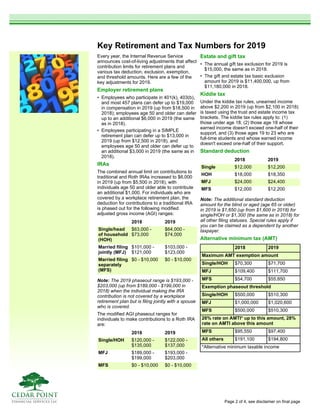
Key Retirement and Tax Numbers for 2019
Every year, the Internal Revenue Service
announces cost-of-living adjustments that affect
contribution limits for retirement plans and
various tax deduction, exclusion, exemption,
and threshold amounts. Here are a few of the
key adjustments for 2019.
Employer retirement plans
• Employees who participate in 401(k), 403(b),
and most 457 plans can defer up to $19,000
in compensation in 2019 (up from $18,500 in
2018); employees age 50 and older can defer
up to an additional $6,000 in 2019 (the same
as in 2018).
• Employees participating in a SIMPLE
retirement plan can defer up to $13,000 in
2019 (up from $12,500 in 2018), and
employees age 50 and older can defer up to
an additional $3,000 in 2019 (the same as in
2018).
IRAs
The combined annual limit on contributions to
traditional and Roth IRAs increased to $6,000
in 2019 (up from $5,500 in 2018), with
individuals age 50 and older able to contribute
an additional $1,000. For individuals who are
covered by a workplace retirement plan, the
deduction for contributions to a traditional IRA
is phased out for the following modified
adjusted gross income (AGI) ranges:
2018 2019
Single/head
of household
(HOH)
$63,000 -
$73,000
$64,000 -
$74,000
Married filing
jointly (MFJ)
$101,000 -
$121,000
$103,000 -
$123,000
Married filing
separately
(MFS)
$0 - $10,000 $0 - $10,000
Note: The 2019 phaseout range is $193,000 -
$203,000 (up from $189,000 - $199,000 in
2018) when the individual making the IRA
contribution is not covered by a workplace
retirement plan but is filing jointly with a spouse
who is covered.
The modified AGI phaseout ranges for
individuals to make contributions to a Roth IRA
are:
2018 2019
Single/HOH $120,000 -
$135,000
$122,000 -
$137,000
MFJ $189,000 -
$199,000
$193,000 -
$203,000
MFS $0 - $10,000 $0 - $10,000
Estate and gift tax
• The annual gift tax exclusion for 2019 is
$15,000, the same as in 2018.
• The gift and estate tax basic exclusion
amount for 2019 is $11,400,000, up from
$11,180,000 in 2018.
Kiddie tax
Under the kiddie tax rules, unearned income
above $2,200 in 2019 (up from $2,100 in 2018)
is taxed using the trust and estate income tax
brackets. The kiddie tax rules apply to: (1)
those under age 18, (2) those age 18 whose
earned income doesn't exceed one-half of their
support, and (3) those ages 19 to 23 who are
full-time students and whose earned income
doesn't exceed one-half of their support.
Standard deduction
2018 2019
Single $12,000 $12,200
HOH $18,000 $18,350
MFJ $24,000 $24,400
MFS $12,000 $12,200
Note: The additional standard deduction
amount for the blind or aged (age 65 or older)
in 2019 is $1,650 (up from $1,600 in 2018) for
single/HOH or $1,300 (the same as in 2018) for
all other filing statuses. Special rules apply if
you can be claimed as a dependent by another
taxpayer.
Alternative minimum tax (AMT)
2018 2019
Maximum AMT exemption amount
Single/HOH $70,300 $71,700
MFJ $109,400 $111,700
MFS $54,700 $55,850
Exemption phaseout threshold
Single/HOH $500,000 $510,300
MFJ $1,000,000 $1,020,600
MFS $500,000 $510,300
26% rate on AMTI* up to this amount, 28%
rate on AMTI above this amount
MFS $95,550 $97,400
All others $191,100 $194,800
*Alternative minimum taxable income
Page 2 of 4, see disclaimer on final page
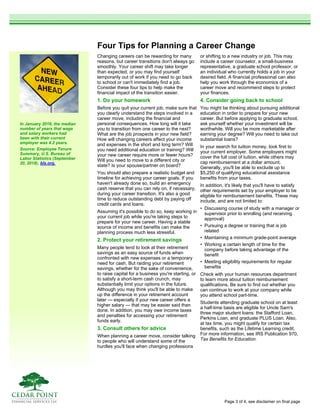
Four Tips for Planning a Career Change
Changing careers can be rewarding for many
reasons, but career transitions don't always go
smoothly. Your career shift may take longer
than expected, or you may find yourself
temporarily out of work if you need to go back
to school or can't immediately find a job.
Consider these four tips to help make the
financial impact of the transition easier.
1. Do your homework
Before you quit your current job, make sure that
you clearly understand the steps involved in a
career move, including the financial and
personal consequences. How long will it take
you to transition from one career to the next?
What are the job prospects in your new field?
How will changing careers affect your income
and expenses in the short and long term? Will
you need additional education or training? Will
your new career require more or fewer hours?
Will you need to move to a different city or
state? Is your spouse/partner on board?
You should also prepare a realistic budget and
timeline for achieving your career goals. If you
haven't already done so, build an emergency
cash reserve that you can rely on, if necessary,
during your career transition. It's also a good
time to reduce outstanding debt by paying off
credit cards and loans.
Assuming it's possible to do so, keep working in
your current job while you're taking steps to
prepare for your new career. Having a stable
source of income and benefits can make the
planning process much less stressful.
2. Protect your retirement savings
Many people tend to look at their retirement
savings as an easy source of funds when
confronted with new expenses or a temporary
need for cash. But raiding your retirement
savings, whether for the sake of convenience,
to raise capital for a business you're starting, or
to satisfy a short-term cash crunch, may
substantially limit your options in the future.
Although you may think you'll be able to make
up the difference in your retirement account
later — especially if your new career offers a
higher salary — that may be easier said than
done. In addition, you may owe income taxes
and penalties for accessing your retirement
funds early.
3. Consult others for advice
When planning a career move, consider talking
to people who will understand some of the
hurdles you'll face when changing professions
or shifting to a new industry or job. This may
include a career counselor, a small-business
representative, a graduate school professor, or
an individual who currently holds a job in your
desired field. A financial professional can also
help you work through the economics of a
career move and recommend steps to protect
your finances.
4. Consider going back to school
You might be thinking about pursuing additional
education in order to prepare for your new
career. But before applying to graduate school,
ask yourself whether your investment will be
worthwhile. Will you be more marketable after
earning your degree? Will you need to take out
substantial loans?
In your search for tuition money, look first to
your current employer. Some employers might
cover the full cost of tuition, while others may
cap reimbursement at a dollar amount.
Generally, you'll be able to exclude up to
$5,250 of qualifying educational assistance
benefits from your taxes.
In addition, it's likely that you'll have to satisfy
other requirements set by your employer to be
eligible for reimbursement benefits. These may
include, and are not limited to:
• Discussing course of study with a manager or
supervisor prior to enrolling (and receiving
approval)
• Pursuing a degree or training that is job
related
• Maintaining a minimum grade-point average
• Working a certain length of time for the
company before taking advantage of the
benefit
• Meeting eligibility requirements for regular
benefits
Check with your human resources department
to learn more about tuition reimbursement
qualifications. Be sure to find out whether you
can continue to work at your company while
you attend school part-time.
Students attending graduate school on at least
a half-time basis are eligible for Uncle Sam's
three major student loans: the Stafford Loan,
Perkins Loan, and graduate PLUS Loan. Also,
at tax time, you might qualify for certain tax
benefits, such as the Lifetime Learning credit.
For more information, see IRS Publication 970,
Tax Benefits for Education.
In January 2018, the median
number of years that wage
and salary workers had
been with their current
employer was 4.2 years.
Source: Employee Tenure
Summary, U.S. Bureau of
Labor Statistics (September
20, 2018), bls.org.
Page 3 of 4, see disclaimer on final page
Cedar Point Financial
Services LLC®
Todd N. Robison, CLU
President
10 Wright Street
2nd Floor
Westport, CT 06880
203-222-4951
todd.robison@cedarpointfinancial.com
www.cedarpointfinancial.com
Prepared by Broadridge Investor Communication Solutions, Inc. Copyright 2019
Securities offered through Kestra
Investment Services, LLC (Kestra
IS), member FINRA/SIPC. Cedar
Point Financial Services LLC is a
member firm of PartnersFinancial.
Kestra IS is not affiliated with
Cedar Point Financial Services or
PartnersFinancial.
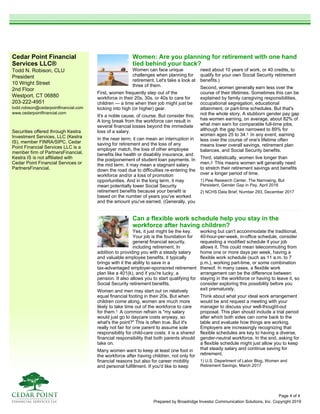
Can a flexible work schedule help you stay in the
workforce after having children?
Yes, it just might be the key.
Your job is the foundation for
general financial security,
including retirement. In
addition to providing you with a steady salary
and valuable employee benefits, it typically
brings with it the ability to save in a
tax-advantaged employer-sponsored retirement
plan like a 401(k), and if you're lucky, a
pension. It also allows you to start qualifying for
Social Security retirement benefits.
Women and men may start out on relatively
equal financial footing in their 20s. But when
children come along, women are much more
likely to take time out of the workforce to care
for them.1 A common refrain is "my salary
would just go to daycare costs anyway, so
what's the point?" This is often true. But it's
really not fair for one parent to assume sole
responsibility for child-care costs; it is a shared
financial responsibility that both parents should
take on.
Many women want to keep at least one foot in
the workforce after having children, not only for
financial reasons but also for career mobility
and personal fulfillment. If you'd like to keep
working but can't accommodate the traditional,
40-hour-per-week, in-office schedule, consider
requesting a modified schedule if your job
allows it. This could mean telecommuting from
home one or more days per week, having a
flexible work schedule (such as 11 a.m. to 7
p.m.), working part-time, or some combination
thereof. In many cases, a flexible work
arrangement can be the difference between
staying in the workforce or having to leave it, so
consider exploring this possibility before you
exit prematurely.
Think about what your ideal work arrangement
would be and request a meeting with your
manager to discuss your well-thought-out
proposal. This plan should include a trial period
after which both sides can come back to the
table and evaluate how things are working.
Employers are increasingly recognizing that
flexible schedules are key to having a diverse,
gender-neutral workforce. In the end, asking for
a flexible schedule might just allow you to keep
that steady salary and continue saving for
retirement.
1) U.S. Department of Labor Blog, Women and
Retirement Savings, March 2017
Women: Are you planning for retirement with one hand
tied behind your back?
Women can face unique
challenges when planning for
retirement. Let's take a look at
three of them.
First, women frequently step out of the
workforce in their 20s, 30s, or 40s to care for
children — a time when their job might just be
kicking into high (or higher) gear.
It's a noble cause, of course. But consider this:
A long break from the workforce can result in
several financial losses beyond the immediate
loss of a salary.
In the near term, it can mean an interruption in
saving for retirement and the loss of any
employer match, the loss of other employee
benefits like health or disability insurance, and
the postponement of student loan payments. In
the mid term, it may mean a stagnant salary
down the road due to difficulties re-entering the
workforce and/or a loss of promotion
opportunities. And in the long term, it may
mean potentially lower Social Security
retirement benefits because your benefit is
based on the number of years you've worked
and the amount you've earned. (Generally, you
need about 10 years of work, or 40 credits, to
qualify for your own Social Security retirement
benefits.)
Second, women generally earn less over the
course of their lifetimes. Sometimes this can be
explained by family caregiving responsibilities,
occupational segregation, educational
attainment, or part-time schedules. But that's
not the whole story. A stubborn gender pay gap
has women earning, on average, about 82% of
what men earn for comparable full-time jobs,
although the gap has narrowed to 89% for
women ages 25 to 34.1 In any event, earning
less over the course of one's lifetime often
means lower overall savings, retirement plan
balances, and Social Security benefits.
Third, statistically, women live longer than
men.2 This means women will generally need
to stretch their retirement savings and benefits
over a longer period of time.
1) Pew Research Center, The Narrowing, But
Persistent, Gender Gap in Pay, April 2018
2) NCHS Data Brief, Number 293, December 2017
Page 4 of 4

January 2019 Newsletter

  • 1.
    Cedar Point Financial ServicesLLC® Todd N. Robison, CLU President 10 Wright Street 2nd Floor Westport, CT 06880 203-222-4951 todd.robison@cedarpointfinancial.com www.cedarpointfinancial.com January 2019 Key Retirement and Tax Numbers for 2019 Four Tips for Planning a Career Change Women: Are you planning for retirement with one hand tied behind your back? Can a flexible work schedule help you stay in the workforce after having children? Cedar Point Monthly Newsletter Elegant solutions to complex financial issues Famous People Who Failed to Plan Properly See disclaimer on final page Have questions? I can help. Email Me: todd.robison@cedarpointfinancial.com Visit My Website: www.cedarpointfinancial.com linkedin.com/in/toddrobison Services: Estate Planning Retirement Strategies Executive Benefits Group Benefits CA License #0B77420 It's almost impossible to overstate the importance of taking the time to plan your estate. Nevertheless, it's surprising how many American adults haven't done so. You might think that those who are rich and famous would be way ahead of the curve when it comes to planning their estates properly, considering the resources and lawyers presumably available to them. Yet there are plenty of celebrities and people of note who died with inadequate (or nonexistent) estate plans. Most recently The Queen of Soul, Aretha Franklin, died in 2018, leaving behind a score of wonderful music and countless memories. But it appears Ms. Franklin died without a will or estate plan in place. Her four sons filed documents in the Oakland County (Michigan) Probate Court listing themselves as interested parties, while Ms. Franklin's niece asked the court to appoint her as personal representative of the estate. All of this information is available to the public. Her estate will be distributed according to the laws of her state of residence (Michigan). In addition, creditors will have a chance to make claims against her estate and may get paid before any of her heirs. And if she owned property in more than one state (according to public records, she did), then probate will likely have to be opened in each state where she owned property (called ancillary probate). The settling of her estate could drag on for years at a potentially high financial cost. A few years ago Prince Rogers Nelson, who was better known as Prince, died in 2016. He was 57 years old and still making incredible music and entertaining millions of fans throughout the world. The first filing in the Probate Court for Carver County, Minnesota, was by a woman claiming to be the sister of Prince, asking the court to appoint a special administrator because there was no will or other testamentary documents. As of November 2018, there have been hundreds of court filings from prospective heirs, creditors, and other "interested parties." There will be no private administration of Prince's estate, as the entire ongoing proceeding is open and available to anyone for scrutiny. A long time ago Here are some other notable personalities who died many years ago without planning their estates. Pablo Picasso died in 1973 at the ripe old age of 91, apparently leaving no will or other testamentary instructions. He left behind nearly 45,000 works of art, rights and licensing deals, real estate, and other assets. The division of his estate assets took six years and included seven heirs. The settlement among his nearest relatives cost an estimated $30 million in legal fees and other related costs. The administration of the estate of Howard Hughes made headlines for several years following his death in 1976. Along the way, bogus wills were offered; people claiming to be his wives came forward, as did countless alleged relatives. Three states — Nevada, California, and Texas — claimed to be responsible for the distribution of his estate. Ultimately, by 1983, his estimated $2.5 billion estate was split among some 22 "relatives" and the Howard Hughes Medical Institute. Abraham Lincoln, one of America's greatest presidents, was also a lawyer. Yet when he met his untimely and tragic death at the hands of John Wilkes Booth in 1865, he died intestate — without a will or other testamentary documents. On the day of his death, Lincoln's son, Robert, asked Supreme Court Justice David Davis to assist in handling his father's financial affairs. Davis ultimately was appointed as the administrator of Lincoln's estate. It took more than two years to settle his estate, which was divided between his surviving widow and two sons. Page 1 of 4
  • 2.
    Key Retirement andTax Numbers for 2019 Every year, the Internal Revenue Service announces cost-of-living adjustments that affect contribution limits for retirement plans and various tax deduction, exclusion, exemption, and threshold amounts. Here are a few of the key adjustments for 2019. Employer retirement plans • Employees who participate in 401(k), 403(b), and most 457 plans can defer up to $19,000 in compensation in 2019 (up from $18,500 in 2018); employees age 50 and older can defer up to an additional $6,000 in 2019 (the same as in 2018). • Employees participating in a SIMPLE retirement plan can defer up to $13,000 in 2019 (up from $12,500 in 2018), and employees age 50 and older can defer up to an additional $3,000 in 2019 (the same as in 2018). IRAs The combined annual limit on contributions to traditional and Roth IRAs increased to $6,000 in 2019 (up from $5,500 in 2018), with individuals age 50 and older able to contribute an additional $1,000. For individuals who are covered by a workplace retirement plan, the deduction for contributions to a traditional IRA is phased out for the following modified adjusted gross income (AGI) ranges: 2018 2019 Single/head of household (HOH) $63,000 - $73,000 $64,000 - $74,000 Married filing jointly (MFJ) $101,000 - $121,000 $103,000 - $123,000 Married filing separately (MFS) $0 - $10,000 $0 - $10,000 Note: The 2019 phaseout range is $193,000 - $203,000 (up from $189,000 - $199,000 in 2018) when the individual making the IRA contribution is not covered by a workplace retirement plan but is filing jointly with a spouse who is covered. The modified AGI phaseout ranges for individuals to make contributions to a Roth IRA are: 2018 2019 Single/HOH $120,000 - $135,000 $122,000 - $137,000 MFJ $189,000 - $199,000 $193,000 - $203,000 MFS $0 - $10,000 $0 - $10,000 Estate and gift tax • The annual gift tax exclusion for 2019 is $15,000, the same as in 2018. • The gift and estate tax basic exclusion amount for 2019 is $11,400,000, up from $11,180,000 in 2018. Kiddie tax Under the kiddie tax rules, unearned income above $2,200 in 2019 (up from $2,100 in 2018) is taxed using the trust and estate income tax brackets. The kiddie tax rules apply to: (1) those under age 18, (2) those age 18 whose earned income doesn't exceed one-half of their support, and (3) those ages 19 to 23 who are full-time students and whose earned income doesn't exceed one-half of their support. Standard deduction 2018 2019 Single $12,000 $12,200 HOH $18,000 $18,350 MFJ $24,000 $24,400 MFS $12,000 $12,200 Note: The additional standard deduction amount for the blind or aged (age 65 or older) in 2019 is $1,650 (up from $1,600 in 2018) for single/HOH or $1,300 (the same as in 2018) for all other filing statuses. Special rules apply if you can be claimed as a dependent by another taxpayer. Alternative minimum tax (AMT) 2018 2019 Maximum AMT exemption amount Single/HOH $70,300 $71,700 MFJ $109,400 $111,700 MFS $54,700 $55,850 Exemption phaseout threshold Single/HOH $500,000 $510,300 MFJ $1,000,000 $1,020,600 MFS $500,000 $510,300 26% rate on AMTI* up to this amount, 28% rate on AMTI above this amount MFS $95,550 $97,400 All others $191,100 $194,800 *Alternative minimum taxable income Page 2 of 4, see disclaimer on final page
  • 3.
    Four Tips forPlanning a Career Change Changing careers can be rewarding for many reasons, but career transitions don't always go smoothly. Your career shift may take longer than expected, or you may find yourself temporarily out of work if you need to go back to school or can't immediately find a job. Consider these four tips to help make the financial impact of the transition easier. 1. Do your homework Before you quit your current job, make sure that you clearly understand the steps involved in a career move, including the financial and personal consequences. How long will it take you to transition from one career to the next? What are the job prospects in your new field? How will changing careers affect your income and expenses in the short and long term? Will you need additional education or training? Will your new career require more or fewer hours? Will you need to move to a different city or state? Is your spouse/partner on board? You should also prepare a realistic budget and timeline for achieving your career goals. If you haven't already done so, build an emergency cash reserve that you can rely on, if necessary, during your career transition. It's also a good time to reduce outstanding debt by paying off credit cards and loans. Assuming it's possible to do so, keep working in your current job while you're taking steps to prepare for your new career. Having a stable source of income and benefits can make the planning process much less stressful. 2. Protect your retirement savings Many people tend to look at their retirement savings as an easy source of funds when confronted with new expenses or a temporary need for cash. But raiding your retirement savings, whether for the sake of convenience, to raise capital for a business you're starting, or to satisfy a short-term cash crunch, may substantially limit your options in the future. Although you may think you'll be able to make up the difference in your retirement account later — especially if your new career offers a higher salary — that may be easier said than done. In addition, you may owe income taxes and penalties for accessing your retirement funds early. 3. Consult others for advice When planning a career move, consider talking to people who will understand some of the hurdles you'll face when changing professions or shifting to a new industry or job. This may include a career counselor, a small-business representative, a graduate school professor, or an individual who currently holds a job in your desired field. A financial professional can also help you work through the economics of a career move and recommend steps to protect your finances. 4. Consider going back to school You might be thinking about pursuing additional education in order to prepare for your new career. But before applying to graduate school, ask yourself whether your investment will be worthwhile. Will you be more marketable after earning your degree? Will you need to take out substantial loans? In your search for tuition money, look first to your current employer. Some employers might cover the full cost of tuition, while others may cap reimbursement at a dollar amount. Generally, you'll be able to exclude up to $5,250 of qualifying educational assistance benefits from your taxes. In addition, it's likely that you'll have to satisfy other requirements set by your employer to be eligible for reimbursement benefits. These may include, and are not limited to: • Discussing course of study with a manager or supervisor prior to enrolling (and receiving approval) • Pursuing a degree or training that is job related • Maintaining a minimum grade-point average • Working a certain length of time for the company before taking advantage of the benefit • Meeting eligibility requirements for regular benefits Check with your human resources department to learn more about tuition reimbursement qualifications. Be sure to find out whether you can continue to work at your company while you attend school part-time. Students attending graduate school on at least a half-time basis are eligible for Uncle Sam's three major student loans: the Stafford Loan, Perkins Loan, and graduate PLUS Loan. Also, at tax time, you might qualify for certain tax benefits, such as the Lifetime Learning credit. For more information, see IRS Publication 970, Tax Benefits for Education. In January 2018, the median number of years that wage and salary workers had been with their current employer was 4.2 years. Source: Employee Tenure Summary, U.S. Bureau of Labor Statistics (September 20, 2018), bls.org. Page 3 of 4, see disclaimer on final page
  • 4.
    Cedar Point Financial ServicesLLC® Todd N. Robison, CLU President 10 Wright Street 2nd Floor Westport, CT 06880 203-222-4951 todd.robison@cedarpointfinancial.com www.cedarpointfinancial.com Prepared by Broadridge Investor Communication Solutions, Inc. Copyright 2019 Securities offered through Kestra Investment Services, LLC (Kestra IS), member FINRA/SIPC. Cedar Point Financial Services LLC is a member firm of PartnersFinancial. Kestra IS is not affiliated with Cedar Point Financial Services or PartnersFinancial. Can a flexible work schedule help you stay in the workforce after having children? Yes, it just might be the key. Your job is the foundation for general financial security, including retirement. In addition to providing you with a steady salary and valuable employee benefits, it typically brings with it the ability to save in a tax-advantaged employer-sponsored retirement plan like a 401(k), and if you're lucky, a pension. It also allows you to start qualifying for Social Security retirement benefits. Women and men may start out on relatively equal financial footing in their 20s. But when children come along, women are much more likely to take time out of the workforce to care for them.1 A common refrain is "my salary would just go to daycare costs anyway, so what's the point?" This is often true. But it's really not fair for one parent to assume sole responsibility for child-care costs; it is a shared financial responsibility that both parents should take on. Many women want to keep at least one foot in the workforce after having children, not only for financial reasons but also for career mobility and personal fulfillment. If you'd like to keep working but can't accommodate the traditional, 40-hour-per-week, in-office schedule, consider requesting a modified schedule if your job allows it. This could mean telecommuting from home one or more days per week, having a flexible work schedule (such as 11 a.m. to 7 p.m.), working part-time, or some combination thereof. In many cases, a flexible work arrangement can be the difference between staying in the workforce or having to leave it, so consider exploring this possibility before you exit prematurely. Think about what your ideal work arrangement would be and request a meeting with your manager to discuss your well-thought-out proposal. This plan should include a trial period after which both sides can come back to the table and evaluate how things are working. Employers are increasingly recognizing that flexible schedules are key to having a diverse, gender-neutral workforce. In the end, asking for a flexible schedule might just allow you to keep that steady salary and continue saving for retirement. 1) U.S. Department of Labor Blog, Women and Retirement Savings, March 2017 Women: Are you planning for retirement with one hand tied behind your back? Women can face unique challenges when planning for retirement. Let's take a look at three of them. First, women frequently step out of the workforce in their 20s, 30s, or 40s to care for children — a time when their job might just be kicking into high (or higher) gear. It's a noble cause, of course. But consider this: A long break from the workforce can result in several financial losses beyond the immediate loss of a salary. In the near term, it can mean an interruption in saving for retirement and the loss of any employer match, the loss of other employee benefits like health or disability insurance, and the postponement of student loan payments. In the mid term, it may mean a stagnant salary down the road due to difficulties re-entering the workforce and/or a loss of promotion opportunities. And in the long term, it may mean potentially lower Social Security retirement benefits because your benefit is based on the number of years you've worked and the amount you've earned. (Generally, you need about 10 years of work, or 40 credits, to qualify for your own Social Security retirement benefits.) Second, women generally earn less over the course of their lifetimes. Sometimes this can be explained by family caregiving responsibilities, occupational segregation, educational attainment, or part-time schedules. But that's not the whole story. A stubborn gender pay gap has women earning, on average, about 82% of what men earn for comparable full-time jobs, although the gap has narrowed to 89% for women ages 25 to 34.1 In any event, earning less over the course of one's lifetime often means lower overall savings, retirement plan balances, and Social Security benefits. Third, statistically, women live longer than men.2 This means women will generally need to stretch their retirement savings and benefits over a longer period of time. 1) Pew Research Center, The Narrowing, But Persistent, Gender Gap in Pay, April 2018 2) NCHS Data Brief, Number 293, December 2017 Page 4 of 4