Please provide
    us your
   questions,
   concerns,
  comments.
 We need the
good as well as
 the concerns.

 (Online Survey
   Available)
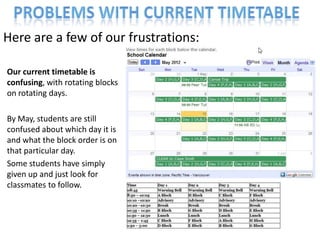
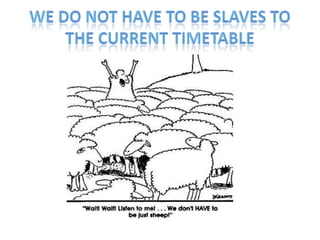
Here are a few of our frustrations:

Our current timetable is
confusing, with rotating blocks
on rotating days.

By May, students are still
confused about which day it is
and what the block order is on
that particular day.
Some students have simply
given up and just look for
classmates to follow.
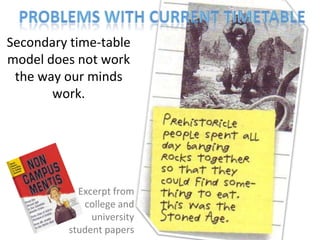
Secondary time-table
model does not work
 the way our minds
       work.


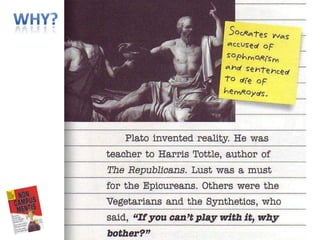
            Excerpt from
             college and
               university
          student papers
• Our current timetable does not work for
  middle school minds: Secondary timetable model
  does not really work for Middle School. Subjects are
  separate and provide no context. With no reason to
  remember content, other than for a test or specific
  assignment, content is easily forgotten and becomes of
  no use to students.
• Another example of what happens when information has no
  context or importance to a student:
  http://www.youtube.com/watch?v=p0wk4qG2mIg
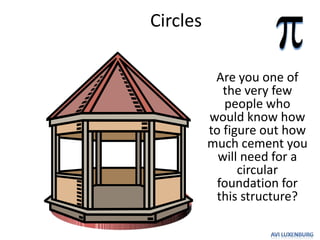
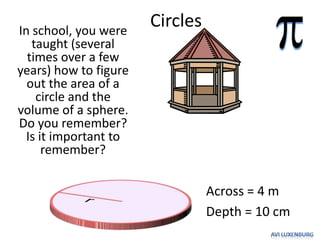
Circles

           Are you one of
             the very few
             people who
          would know how
          to figure out how
          much cement you
            will need for a
                circular
            foundation for
           this structure?
In school, you were
                       Circles
   taught (several
  times over a few
years) how to figure
  out the area of a
    circle and the
volume of a sphere.
Do you remember?
  Is it important to
      remember?


                                 Across = 4 m
                                 Depth = 10 cm
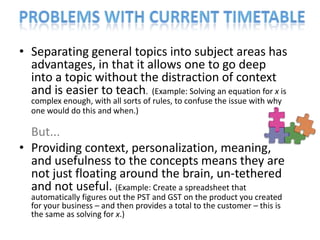
• Separating general topics into subject areas has
  advantages, in that it allows one to go deep
  into a topic without the distraction of context
  and is easier to teach. (Example: Solving an equation for x is
  complex enough, with all sorts of rules, to confuse the issue with why
  one would do this and when.)

  But...
• Providing context, personalization, meaning,
  and usefulness to the concepts means they are
  not just floating around the brain, un-tethered
  and not useful. (Example: Create a spreadsheet that
  automatically figures out the PST and GST on the product you created
  for your business – and then provides a total to the customer – this is
  the same as solving for x.)
• Students had too many teachers for the
  teachers to effectively monitor them and to
  develop deeper relationships with them. This
  was affecting student success, as students in
  middle school need to have stronger adult
  connections and more continuous
  accountability.
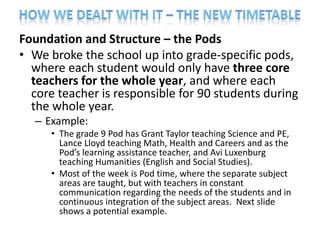
Foundation and Structure – the Pods
• We broke the school up into grade-specific pods,
  where each student would only have three core
  teachers for the whole year, and where each
  core teacher is responsible for 90 students during
  the whole year.
  – Example:
     • The grade 9 Pod has Grant Taylor teaching Science and PE,
       Lance Lloyd teaching Math, Health and Careers and as the
       Pod’s learning assistance teacher, and Avi Luxenburg
       teaching Humanities (English and Social Studies).
     • Most of the week is Pod time, where the separate subject
       areas are taught, but with teachers in constant
       communication regarding the needs of the students and in
       continuous integration of the subject areas. Next slide
       shows a potential example.
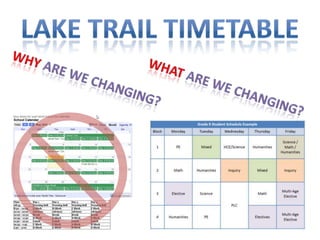
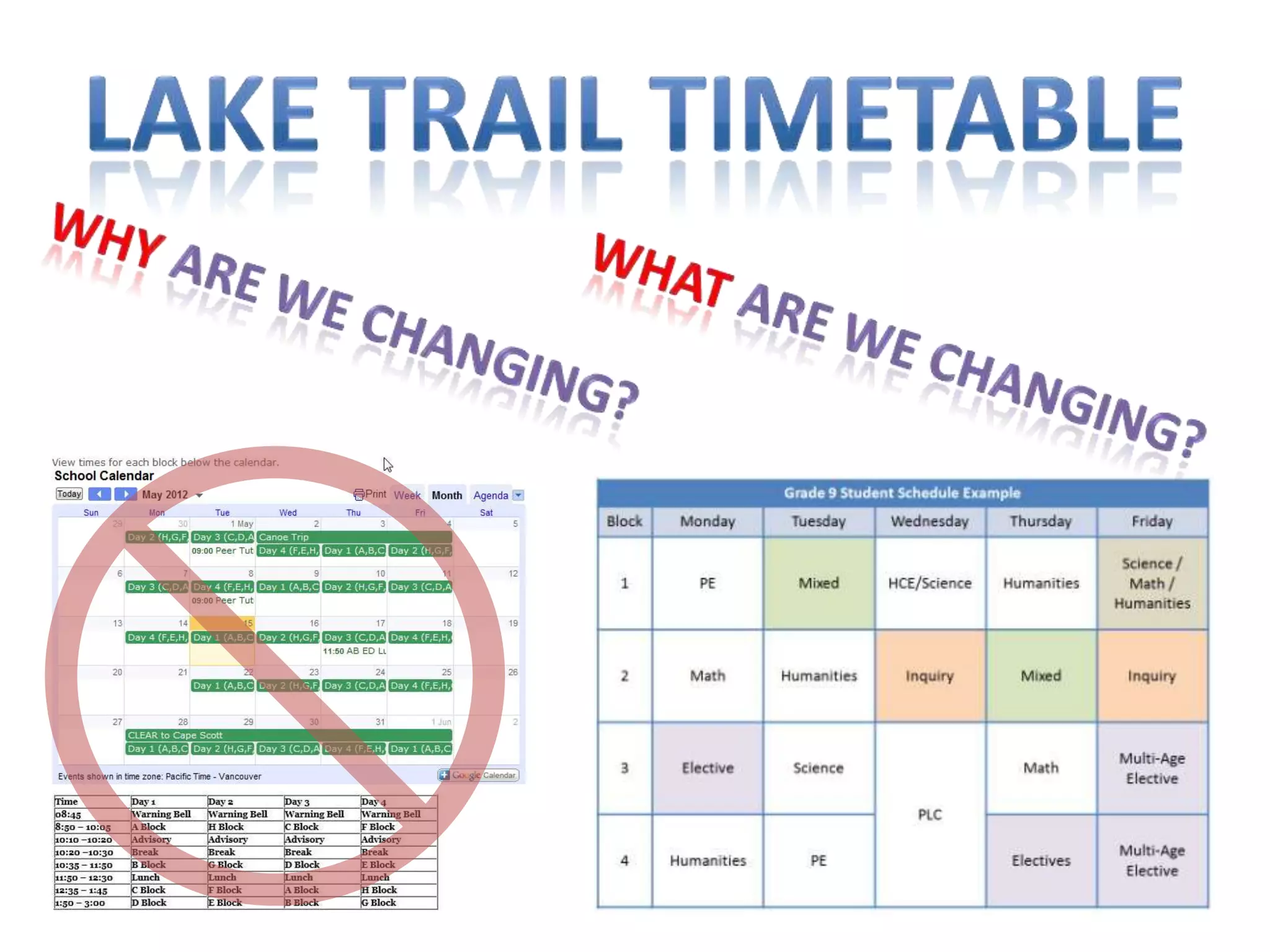
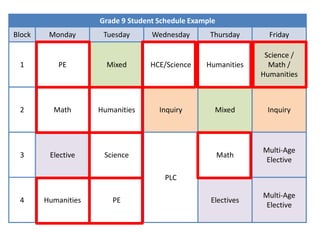
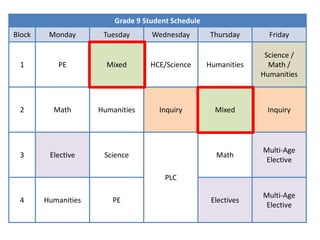
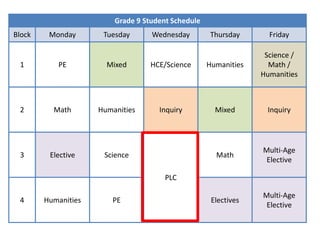
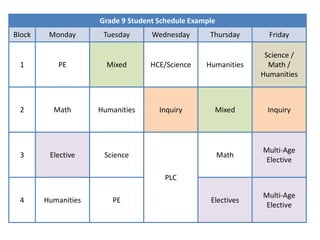
Grade 9 Student Schedule Example
Block    Monday       Tuesday      Wednesday       Thursday      Friday

                                                                Science /
 1         PE          Mixed       HCE/Science    Humanities     Math /
                                                               Humanities


 2        Math       Humanities      Inquiry        Mixed       Inquiry


                                                               Multi-Age
 3       Elective     Science                           Math
                                                                Elective

                                       PLC

                                                               Multi-Age
 4      Humanities      PE                         Electives
                                                                Elective
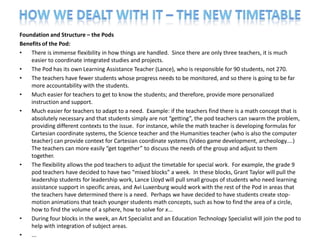
Foundation and Structure – the Pods
Benefits of the Pod:
•   There is immense flexibility in how things are handled. Since there are only three teachers, it is much
    easier to coordinate integrated studies and projects.
•   The Pod has its own Learning Assistance Teacher (Lance), who is responsible for 90 students, not 270.
•   The teachers have fewer students whose progress needs to be monitored, and so there is going to be far
    more accountability with the students.
•   Much easier for teachers to get to know the students; and therefore, provide more personalized
    instruction and support.
•   Much easier for teachers to adapt to a need. Example: if the teachers find there is a math concept that is
    absolutely necessary and that students simply are not “getting”, the pod teachers can swarm the problem,
    providing different contexts to the issue. For instance, while the math teacher is developing formulas for
    Cartesian coordinate systems, the Science teacher and the Humanities teacher (who is also the computer
    teacher) can provide context for Cartesian coordinate systems (Video game development, archeology....)
    The teachers can more easily “get together” to discuss the needs of the group and adjust to them
    together.
•   The flexibility allows the pod teachers to adjust the timetable for special work. For example, the grade 9
    pod teachers have decided to have two “mixed blocks” a week. In these blocks, Grant Taylor will pull the
    leadership students for leadership work, Lance Lloyd will pull small groups of students who need learning
    assistance support in specific areas, and Avi Luxenburg would work with the rest of the Pod in areas that
    the teachers have determined there is a need. Perhaps we have decided to have students create stop-
    motion animations that teach younger students math concepts, such as how to find the area of a circle,
    how to find the volume of a sphere, how to solve for x...
•   During four blocks in the week, an Art Specialist and an Education Technology Specialist will join the pod to
    help with integration of subject areas.
•   ...
Grade 9 Student Schedule
Block    Monday       Tuesday      Wednesday         Thursday      Friday

                                                                  Science /
 1         PE          Mixed       HCE/Science      Humanities     Math /
                                                                 Humanities


 2        Math       Humanities      Inquiry          Mixed       Inquiry


                                                                 Multi-Age
 3       Elective     Science                         Math
                                                                  Elective

                                       PLC

                                                                 Multi-Age
 4      Humanities      PE                           Electives
                                                                  Elective
Inflexibility of timetable made working together very
   difficult:

• When teachers wanted to work together to integrate
  topics, which research shows helps teachers develop
  more engaging learning environments, it was almost
  impossible to coordinate due to the inflexibility of the
  timetable.


• Students were limited to the cohort with which they
  travelled. Although this could help build deeper
  relationships, it was also limiting in that it was more
  difficult to find others with similar interests and goals
  with which to work. In the new model we wanted both
  deeper relationships and flexibility.
Teacher collaborative planning was near impossible to
  coordinate:
• When teachers wanted to plan together and provide
  integrated projects for the students, it became more
  and more difficult to plan and coordinate. Teachers
  were not able to schedule times to coordinate
  everything that needed to be coordinated
  (Example: teams of teachers meeting with the Learning
  Assistance teachers to discuss modifications and
  adaptations required for special projects.)
   – Coordinating team-teaching was near impossible (like
     herding cats – watch this video to see what it is like).
Teacher collaborative planning was near impossible to
  coordinate:

• Coordinating team-teaching was extremely difficult.

• As we attempted to create more integrated (and
  therefore more meaningful) projects, we found a
  greater need for coordination between educators.
  Sometimes it became too much and we had to give up.
  Example: We could not complete the ICAN project with
  more a couple of classes.
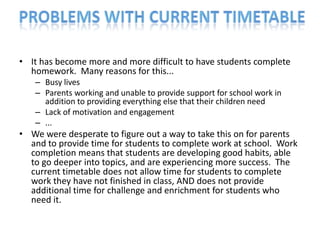
• It has become more and more difficult to have students complete
  homework. Many reasons for this...
   – Busy lives
   – Parents working and unable to provide support for school work in
     addition to providing everything else that their children need
   – Lack of motivation and engagement
   – ...
• We were desperate to figure out a way to take this on for parents
  and to provide time for students to complete work at school. Work
  completion means that students are developing good habits, able
  to go deeper into topics, and are experiencing more success. The
  current timetable does not allow time for students to complete
  work they have not finished in class, AND does not provide
  additional time for challenge and enrichment for students who
  need it.
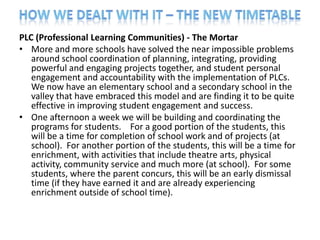
PLC (Professional Learning Communities) - The Mortar
• More and more schools have solved the near impossible problems
   around school coordination of planning, integrating, providing
   powerful and engaging projects together, and student personal
   engagement and accountability with the implementation of PLCs.
   We now have an elementary school and a secondary school in the
   valley that have embraced this model and are finding it to be quite
   effective in improving student engagement and success.
• One afternoon a week we will be building and coordinating the
   programs for students. For a good portion of the students, this
   will be a time for completion of school work and of projects (at
   school). For another portion of the students, this will be a time for
   enrichment, with activities that include theatre arts, physical
   activity, community service and much more (at school). For some
   students, where the parent concurs, this will be an early dismissal
   time (if they have earned it and are already experiencing
   enrichment outside of school time).
Grade 9 Student Schedule
Block    Monday       Tuesday      Wednesday         Thursday      Friday

                                                                  Science /
 1         PE          Mixed       HCE/Science      Humanities     Math /
                                                                 Humanities


 2        Math       Humanities      Inquiry          Mixed       Inquiry


                                                                 Multi-Age
 3       Elective     Science                         Math
                                                                  Elective

                                       PLC

                                                                 Multi-Age
 4      Humanities      PE                           Electives
                                                                  Elective
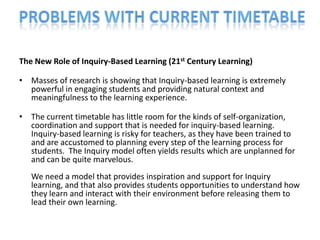
The New Role of Inquiry-Based Learning (21st Century Learning)

• Masses of research is showing that Inquiry-based learning is extremely
  powerful in engaging students and providing natural context and
  meaningfulness to the learning experience.

• The current timetable has little room for the kinds of self-organization,
  coordination and support that is needed for inquiry-based learning.
  Inquiry-based learning is risky for teachers, as they have been trained to
  and are accustomed to planning every step of the learning process for
  students. The Inquiry model often yields results which are unplanned for
  and can be quite marvelous.
   We need a model that provides inspiration and support for Inquiry
   learning, and that also provides students opportunities to understand how
   they learn and interact with their environment before releasing them to
   lead their own learning.
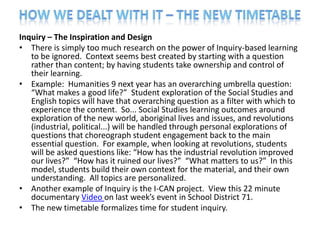
Inquiry – The Inspiration and Design
• There is simply too much research on the power of Inquiry-based learning
   to be ignored. Context seems best created by starting with a question
   rather than content; by having students take ownership and control of
   their learning.
• Example: Humanities 9 next year has an overarching umbrella question:
   “What makes a good life?” Student exploration of the Social Studies and
   English topics will have that overarching question as a filter with which to
   experience the content. So... Social Studies learning outcomes around
   exploration of the new world, aboriginal lives and issues, and revolutions
   (industrial, political...) will be handled through personal explorations of
   questions that choreograph student engagement back to the main
   essential question. For example, when looking at revolutions, students
   will be asked questions like: “How has the industrial revolution improved
   our lives?” “How has it ruined our lives?” “What matters to us?” In this
   model, students build their own context for the material, and their own
   understanding. All topics are personalized.
• Another example of Inquiry is the I-CAN project. View this 22 minute
   documentary Video on last week’s event in School District 71.
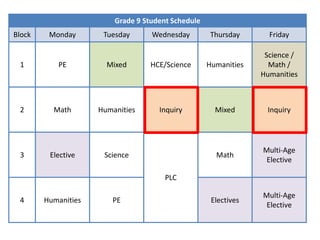
• The new timetable formalizes time for student inquiry.
Grade 9 Student Schedule
Block    Monday       Tuesday      Wednesday         Thursday      Friday

                                                                  Science /
 1         PE          Mixed       HCE/Science      Humanities     Math /
                                                                 Humanities


 2        Math       Humanities      Inquiry          Mixed       Inquiry


                                                                 Multi-Age
 3       Elective     Science                         Math
                                                                  Elective

                                       PLC

                                                                 Multi-Age
 4      Humanities      PE                           Electives
                                                                  Elective
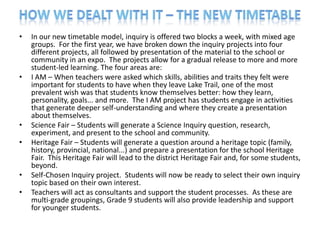
•   In our new timetable model, inquiry is offered two blocks a week, with mixed age
    groups. For the first year, we have broken down the inquiry projects into four
    different projects, all followed by presentation of the material to the school or
    community in an expo. The projects allow for a gradual release to more and more
    student-led learning. The four areas are:
•   I AM – When teachers were asked which skills, abilities and traits they felt were
    important for students to have when they leave Lake Trail, one of the most
    prevalent wish was that students know themselves better: how they learn,
    personality, goals... and more. The I AM project has students engage in activities
    that generate deeper self-understanding and where they create a presentation
    about themselves.
•   Science Fair – Students will generate a Science Inquiry question, research,
    experiment, and present to the school and community.
•   Heritage Fair – Students will generate a question around a heritage topic (family,
    history, provincial, national...) and prepare a presentation for the school Heritage
    Fair. This Heritage Fair will lead to the district Heritage Fair and, for some students,
    beyond.
•   Self-Chosen Inquiry project. Students will now be ready to select their own inquiry
    topic based on their own interest.
•   Teachers will act as consultants and support the student processes. As these are
    multi-grade groupings, Grade 9 students will also provide leadership and support
    for younger students.
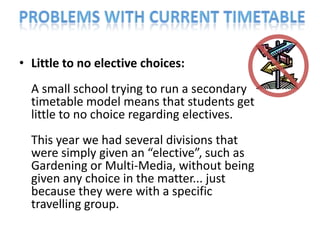
• Little to no elective choices:
  A small school trying to run a secondary
  timetable model means that students get
  little to no choice regarding electives.
  This year we had several divisions that
  were simply given an “elective”, such as
  Gardening or Multi-Media, without being
  given any choice in the matter... just
  because they were with a specific
  travelling group.
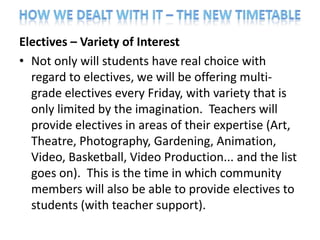
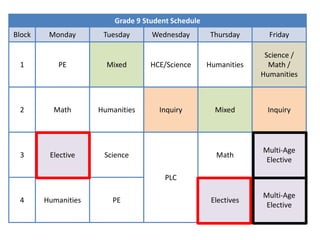
Electives – Variety of Interest
• Not only will students have real choice with
  regard to electives, we will be offering multi-
  grade electives every Friday, with variety that is
  only limited by the imagination. Teachers will
  provide electives in areas of their expertise (Art,
  Theatre, Photography, Gardening, Animation,
  Video, Basketball, Video Production... and the list
  goes on). This is the time in which community
  members will also be able to provide electives to
  students (with teacher support).
Grade 9 Student Schedule
Block    Monday       Tuesday      Wednesday         Thursday      Friday

                                                                  Science /
 1         PE          Mixed       HCE/Science      Humanities     Math /
                                                                 Humanities


 2        Math       Humanities      Inquiry          Mixed       Inquiry


                                                                 Multi-Age
 3       Elective     Science                         Math
                                                                  Elective

                                       PLC

                                                                 Multi-Age
 4      Humanities      PE                           Electives
                                                                  Elective
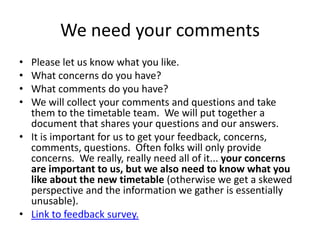
We need your comments
• Please let us know what you like.
• What concerns do you have?
• What comments do you have?
• We will collect your comments and questions and take
  them to the timetable team. We will put together a
  document that shares your questions and our answers.
• It is important for us to get your feedback, concerns,
  comments, questions. Often folks will only provide
  concerns. We really, really need all of it... your concerns
  are important to us, but we also need to know what you
  like about the new timetable (otherwise we get a skewed
  perspective and the information we gather is essentially
  unusable).
• Link to feedback survey.
Grade 9 Student Schedule Example
Block    Monday       Tuesday      Wednesday       Thursday      Friday

                                                                Science /
 1         PE          Mixed       HCE/Science    Humanities     Math /
                                                               Humanities


 2        Math       Humanities      Inquiry        Mixed       Inquiry


                                                               Multi-Age
 3       Elective     Science                           Math
                                                                Elective

                                       PLC

                                                               Multi-Age
 4      Humanities      PE                         Electives
                                                                Elective

Timetable

  • 2.
    Please provide us your questions, concerns, comments. We need the good as well as the concerns. (Online Survey Available)
  • 3.
    Here are afew of our frustrations: Our current timetable is confusing, with rotating blocks on rotating days. By May, students are still confused about which day it is and what the block order is on that particular day. Some students have simply given up and just look for classmates to follow.
  • 4.
    Secondary time-table model doesnot work the way our minds work. Excerpt from college and university student papers
  • 6.
    • Our currenttimetable does not work for middle school minds: Secondary timetable model does not really work for Middle School. Subjects are separate and provide no context. With no reason to remember content, other than for a test or specific assignment, content is easily forgotten and becomes of no use to students. • Another example of what happens when information has no context or importance to a student: http://www.youtube.com/watch?v=p0wk4qG2mIg
  • 7.
    Circles Are you one of the very few people who would know how to figure out how much cement you will need for a circular foundation for this structure?
  • 8.
    In school, youwere Circles taught (several times over a few years) how to figure out the area of a circle and the volume of a sphere. Do you remember? Is it important to remember? Across = 4 m Depth = 10 cm
  • 10.
    • Separating generaltopics into subject areas has advantages, in that it allows one to go deep into a topic without the distraction of context and is easier to teach. (Example: Solving an equation for x is complex enough, with all sorts of rules, to confuse the issue with why one would do this and when.) But... • Providing context, personalization, meaning, and usefulness to the concepts means they are not just floating around the brain, un-tethered and not useful. (Example: Create a spreadsheet that automatically figures out the PST and GST on the product you created for your business – and then provides a total to the customer – this is the same as solving for x.)
  • 11.
    • Students hadtoo many teachers for the teachers to effectively monitor them and to develop deeper relationships with them. This was affecting student success, as students in middle school need to have stronger adult connections and more continuous accountability.
  • 13.
    Foundation and Structure– the Pods • We broke the school up into grade-specific pods, where each student would only have three core teachers for the whole year, and where each core teacher is responsible for 90 students during the whole year. – Example: • The grade 9 Pod has Grant Taylor teaching Science and PE, Lance Lloyd teaching Math, Health and Careers and as the Pod’s learning assistance teacher, and Avi Luxenburg teaching Humanities (English and Social Studies). • Most of the week is Pod time, where the separate subject areas are taught, but with teachers in constant communication regarding the needs of the students and in continuous integration of the subject areas. Next slide shows a potential example.
  • 14.
    Grade 9 StudentSchedule Example Block Monday Tuesday Wednesday Thursday Friday Science / 1 PE Mixed HCE/Science Humanities Math / Humanities 2 Math Humanities Inquiry Mixed Inquiry Multi-Age 3 Elective Science Math Elective PLC Multi-Age 4 Humanities PE Electives Elective
  • 15.
    Foundation and Structure– the Pods Benefits of the Pod: • There is immense flexibility in how things are handled. Since there are only three teachers, it is much easier to coordinate integrated studies and projects. • The Pod has its own Learning Assistance Teacher (Lance), who is responsible for 90 students, not 270. • The teachers have fewer students whose progress needs to be monitored, and so there is going to be far more accountability with the students. • Much easier for teachers to get to know the students; and therefore, provide more personalized instruction and support. • Much easier for teachers to adapt to a need. Example: if the teachers find there is a math concept that is absolutely necessary and that students simply are not “getting”, the pod teachers can swarm the problem, providing different contexts to the issue. For instance, while the math teacher is developing formulas for Cartesian coordinate systems, the Science teacher and the Humanities teacher (who is also the computer teacher) can provide context for Cartesian coordinate systems (Video game development, archeology....) The teachers can more easily “get together” to discuss the needs of the group and adjust to them together. • The flexibility allows the pod teachers to adjust the timetable for special work. For example, the grade 9 pod teachers have decided to have two “mixed blocks” a week. In these blocks, Grant Taylor will pull the leadership students for leadership work, Lance Lloyd will pull small groups of students who need learning assistance support in specific areas, and Avi Luxenburg would work with the rest of the Pod in areas that the teachers have determined there is a need. Perhaps we have decided to have students create stop- motion animations that teach younger students math concepts, such as how to find the area of a circle, how to find the volume of a sphere, how to solve for x... • During four blocks in the week, an Art Specialist and an Education Technology Specialist will join the pod to help with integration of subject areas. • ...
  • 16.
    Grade 9 StudentSchedule Block Monday Tuesday Wednesday Thursday Friday Science / 1 PE Mixed HCE/Science Humanities Math / Humanities 2 Math Humanities Inquiry Mixed Inquiry Multi-Age 3 Elective Science Math Elective PLC Multi-Age 4 Humanities PE Electives Elective
  • 17.
    Inflexibility of timetablemade working together very difficult: • When teachers wanted to work together to integrate topics, which research shows helps teachers develop more engaging learning environments, it was almost impossible to coordinate due to the inflexibility of the timetable. • Students were limited to the cohort with which they travelled. Although this could help build deeper relationships, it was also limiting in that it was more difficult to find others with similar interests and goals with which to work. In the new model we wanted both deeper relationships and flexibility.
  • 18.
    Teacher collaborative planningwas near impossible to coordinate: • When teachers wanted to plan together and provide integrated projects for the students, it became more and more difficult to plan and coordinate. Teachers were not able to schedule times to coordinate everything that needed to be coordinated (Example: teams of teachers meeting with the Learning Assistance teachers to discuss modifications and adaptations required for special projects.) – Coordinating team-teaching was near impossible (like herding cats – watch this video to see what it is like).
  • 19.
    Teacher collaborative planningwas near impossible to coordinate: • Coordinating team-teaching was extremely difficult. • As we attempted to create more integrated (and therefore more meaningful) projects, we found a greater need for coordination between educators. Sometimes it became too much and we had to give up. Example: We could not complete the ICAN project with more a couple of classes.
  • 20.
    • It hasbecome more and more difficult to have students complete homework. Many reasons for this... – Busy lives – Parents working and unable to provide support for school work in addition to providing everything else that their children need – Lack of motivation and engagement – ... • We were desperate to figure out a way to take this on for parents and to provide time for students to complete work at school. Work completion means that students are developing good habits, able to go deeper into topics, and are experiencing more success. The current timetable does not allow time for students to complete work they have not finished in class, AND does not provide additional time for challenge and enrichment for students who need it.
  • 21.
    PLC (Professional LearningCommunities) - The Mortar • More and more schools have solved the near impossible problems around school coordination of planning, integrating, providing powerful and engaging projects together, and student personal engagement and accountability with the implementation of PLCs. We now have an elementary school and a secondary school in the valley that have embraced this model and are finding it to be quite effective in improving student engagement and success. • One afternoon a week we will be building and coordinating the programs for students. For a good portion of the students, this will be a time for completion of school work and of projects (at school). For another portion of the students, this will be a time for enrichment, with activities that include theatre arts, physical activity, community service and much more (at school). For some students, where the parent concurs, this will be an early dismissal time (if they have earned it and are already experiencing enrichment outside of school time).
  • 22.
    Grade 9 StudentSchedule Block Monday Tuesday Wednesday Thursday Friday Science / 1 PE Mixed HCE/Science Humanities Math / Humanities 2 Math Humanities Inquiry Mixed Inquiry Multi-Age 3 Elective Science Math Elective PLC Multi-Age 4 Humanities PE Electives Elective
  • 23.
    The New Roleof Inquiry-Based Learning (21st Century Learning) • Masses of research is showing that Inquiry-based learning is extremely powerful in engaging students and providing natural context and meaningfulness to the learning experience. • The current timetable has little room for the kinds of self-organization, coordination and support that is needed for inquiry-based learning. Inquiry-based learning is risky for teachers, as they have been trained to and are accustomed to planning every step of the learning process for students. The Inquiry model often yields results which are unplanned for and can be quite marvelous. We need a model that provides inspiration and support for Inquiry learning, and that also provides students opportunities to understand how they learn and interact with their environment before releasing them to lead their own learning.
  • 24.
    Inquiry – TheInspiration and Design • There is simply too much research on the power of Inquiry-based learning to be ignored. Context seems best created by starting with a question rather than content; by having students take ownership and control of their learning. • Example: Humanities 9 next year has an overarching umbrella question: “What makes a good life?” Student exploration of the Social Studies and English topics will have that overarching question as a filter with which to experience the content. So... Social Studies learning outcomes around exploration of the new world, aboriginal lives and issues, and revolutions (industrial, political...) will be handled through personal explorations of questions that choreograph student engagement back to the main essential question. For example, when looking at revolutions, students will be asked questions like: “How has the industrial revolution improved our lives?” “How has it ruined our lives?” “What matters to us?” In this model, students build their own context for the material, and their own understanding. All topics are personalized. • Another example of Inquiry is the I-CAN project. View this 22 minute documentary Video on last week’s event in School District 71. • The new timetable formalizes time for student inquiry.
  • 25.
    Grade 9 StudentSchedule Block Monday Tuesday Wednesday Thursday Friday Science / 1 PE Mixed HCE/Science Humanities Math / Humanities 2 Math Humanities Inquiry Mixed Inquiry Multi-Age 3 Elective Science Math Elective PLC Multi-Age 4 Humanities PE Electives Elective
  • 26.
    In our new timetable model, inquiry is offered two blocks a week, with mixed age groups. For the first year, we have broken down the inquiry projects into four different projects, all followed by presentation of the material to the school or community in an expo. The projects allow for a gradual release to more and more student-led learning. The four areas are: • I AM – When teachers were asked which skills, abilities and traits they felt were important for students to have when they leave Lake Trail, one of the most prevalent wish was that students know themselves better: how they learn, personality, goals... and more. The I AM project has students engage in activities that generate deeper self-understanding and where they create a presentation about themselves. • Science Fair – Students will generate a Science Inquiry question, research, experiment, and present to the school and community. • Heritage Fair – Students will generate a question around a heritage topic (family, history, provincial, national...) and prepare a presentation for the school Heritage Fair. This Heritage Fair will lead to the district Heritage Fair and, for some students, beyond. • Self-Chosen Inquiry project. Students will now be ready to select their own inquiry topic based on their own interest. • Teachers will act as consultants and support the student processes. As these are multi-grade groupings, Grade 9 students will also provide leadership and support for younger students.
  • 27.
    • Little tono elective choices: A small school trying to run a secondary timetable model means that students get little to no choice regarding electives. This year we had several divisions that were simply given an “elective”, such as Gardening or Multi-Media, without being given any choice in the matter... just because they were with a specific travelling group.
  • 28.
    Electives – Varietyof Interest • Not only will students have real choice with regard to electives, we will be offering multi- grade electives every Friday, with variety that is only limited by the imagination. Teachers will provide electives in areas of their expertise (Art, Theatre, Photography, Gardening, Animation, Video, Basketball, Video Production... and the list goes on). This is the time in which community members will also be able to provide electives to students (with teacher support).
  • 29.
    Grade 9 StudentSchedule Block Monday Tuesday Wednesday Thursday Friday Science / 1 PE Mixed HCE/Science Humanities Math / Humanities 2 Math Humanities Inquiry Mixed Inquiry Multi-Age 3 Elective Science Math Elective PLC Multi-Age 4 Humanities PE Electives Elective
  • 30.
    We need yourcomments • Please let us know what you like. • What concerns do you have? • What comments do you have? • We will collect your comments and questions and take them to the timetable team. We will put together a document that shares your questions and our answers. • It is important for us to get your feedback, concerns, comments, questions. Often folks will only provide concerns. We really, really need all of it... your concerns are important to us, but we also need to know what you like about the new timetable (otherwise we get a skewed perspective and the information we gather is essentially unusable). • Link to feedback survey.
  • 31.
    Grade 9 StudentSchedule Example Block Monday Tuesday Wednesday Thursday Friday Science / 1 PE Mixed HCE/Science Humanities Math / Humanities 2 Math Humanities Inquiry Mixed Inquiry Multi-Age 3 Elective Science Math Elective PLC Multi-Age 4 Humanities PE Electives Elective

Editor's Notes

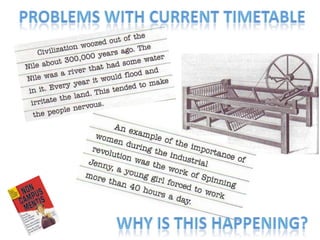
  • #6 Is this happening because we are not providing the content the student’s need, or is it because the information is simply floating around in their brains... Untethered to any form of context?
  • #7 Does not work for middle school minds: Secondary timetable model does not really work for Middle School. Subjects are separate and provide no context. With no reason to remember content, other than for a test or specific assignment, content is easily forgotten and becomes of no use to students.
  • #10 These examples demonstrate what happens when content is taught for the sake of the content, and without the natural context within which we naturally learn.