Time-Saver
Standards
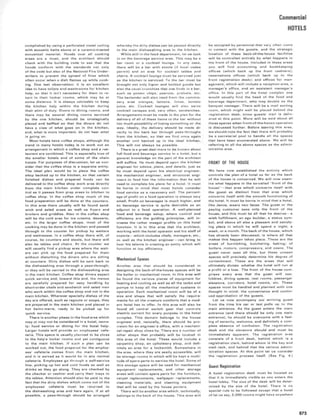
for
Building Types
Other McGraw-Hill Handbooks of Interest
Baumeisterand Marks Standard I Handbook for Mechanical Engineers
Bradv Materials Handbook
Callender Time-Saver Standards for Architectural Design Data
Conover Grounds Maintenance Handbook
Considine Energy Technology handbook
Crocker and King Piping Handbook
Croft, Carr, and Watt American Electricians' H Handbook
Foster Handbook of Municipal Administration and Engineering
Gavlordand Gaylord Structural Engineering Handbook
Marris Dictionary of Architecture and Construction
Hams I Handbook of Noise Control
Harris Historic Architecure Source book
Hicks - Standard Handbook of Engineering Calculations
Karassik Krutzsch Fraser and Messins Pump Handbook
LaLonde nad Janes - Concrete Engineering Hat Handbook
MH'artland McGraw-Hill's fill's National Electrical Code I Handbook
Merritt Building Construction f Handbook
Merritt Standard H Handbook for Civil Engineers
Morrow Maintenance Engineering Handbook
O'Brien Scheduling handbook
Perrv Engineering Manual
Rau and Wooten Environmental Impact Analysis I Handbook
Stubbs H Handbook of heavy Construction
Tuma - Engineering Mathematics Handbook
Urquhart Civil Engineering I Handbook
Woods Highway Engineering I Handbook
Time-Saver
Standards
for
Building Types
Second Edition
Edited by
JOSEPH De CHIARA
and
JOHN HANCOCK CALLENDER
TIME-SAVER STANDARDS FOR BUILDING TYPES second edition
INTERNATIONAL EDITION
Copyright © 1983 by McGraw-Hill Book Co-Singapore for manufacture and
export. This book cannot be re-exported from the country to which it is consigned
by McGraw-Hill .
2nd printing 1987
Copyright © 1980, 1973 by McGraw-Hill Inc. All rights reserved. No part of this
publication may be reproduced or distributed in any form or by any means, or
stored in a data base or retrieval system, without the prior written permission of the
publisher .
When ordering this title use ISBN 0-07-099076-X
Printed and bound in Singapore by Singapore National Printers Ltd
Contents
Contributors
Organizations
Preface to the Second Edition
Preface to the First Edition
1 . RESIDENTIAL . .
xi
xili
xv
xvii
Dimensions of the Human Figure 3
Living Areas 5
Living Rooms 6
Furniture 6
Furniture Sizes 7
Furniture Arrangements 8
Furniture Sizes and Clearances 14
Dining Areas 15
Combined Living-Dining Spaces 20
Combined Dining Area-Kitchen 21
Bedrooms 22
Combined Living-Sleeping Areas 27
Kitchens 29
Laundry Rooms 41
Bathrooms 48
Closets 58
Apartments 70
Housing Densities 82
Housing for the Elderly 87
Housing for the Handicapped 102
Parking for the Handicapped 117
Group Homes 119
Senior Citizens' Center 122
Mobile Homes and Parks 129
Youth Hostels 140
Site Planning 146
2 . EDUCATIONAL
Nursery Schools 163
Children's Center 167
Child Care Centers 168
Elementary and Secondary Schools 169
General 169
Site Selection 173
Basing, Parking 174
Recreation Facilities 175
Contents
Safety 176
Kinds of Schools 178
Administration Suites 185
Learning Resource Centers 188
Classrooms 190
Multipurpose Rooms 195
Student Lockers 197
Language Laboratory 200
Science Facilities 200
Arts 205
Music 206
Industrial and Vocational Facilities 210
Home Arts 211
Food Service 212
Physical Education 218
Auditoriums 229
Guidance Services 231
College and University Facilities 233
Classrooms 233
Lecture Rooms 234
Gymnasiums 236
Physical Education and Sports Facilities 240
Field House 241
Dormitories 242
Handicapped Students 255
Libraries, Academic and Research 257
Individual Study Carrels 274
Student Unions 285
Computation Centers 293
Communications Centers 296
Regional Education Center (Supplementary) 298
Resource Facilities (Library) 300
Large-Group Facilities 303
Audiovisual 314
Theater-Arts-Laboratory Teaching Station 320
Programs and Programming 323
3. CULTURAL. . . . . . . . . . . . . . . . 327
Museums 329
Small Museums 336
Gallery Design 339
Libraries 341
Branch Libraries 343
Space Requirements 344
Service and Space Relationships 347
Library location 348
Branch Buildings 350
Bookmobiles 350
Bookstack Data 351
Theaters 352
Sight Lines 362
Stage Space 365
Community Theaters 371
Amphitheaters 377
Music Facilities 380
4. HEALTH . . . . . . . . . . . . . . . . 393
Hospitals 395
Surgical Suite 403
Nursery 405
Pediatric Nursing Units 409
Diagnostic X-Ray Suite 412
Pharmacy 418
Teletherapy Units 420
Electroencephalographic Suite 424
Physical Therapy Department 425
Occupational Therapy Department 428
Laboratory 431
Labor-Delivery Suite 437
Radioisotope Facility 439
Outpatient Activity 441
Emergency Activity 456
EDP Unit 458
Rehabilitation Centers 461
Mental Health Centers 476
Nursing Homes 482
Child Health Station 489
Medical Schools 490
Dental Schools 511
Nursing Schools 528
Youth Treatment Centers 544
Multiphasic Health-Screening Centers 550
5. RELIGIOUS . . . . . . . . . . . . . . . 557
Churches, General 559
Churches, Lutheran 564
Churches, United Methodist 570
Temples and Synagogues 582
Chapels 589
Church Schools 592
6 . GOVERNMENTAL AND PUBLIC . . . . . . . . . . 601
City end Town Halls 603
Courthouses 608
Fire Stations 628
Firehouses 631
Police Stations 636
Police Facility 646
Jails and Prisons 653
Incinerator Plants 669
YMCA Buildings 676
YWCA Buildings 677
Boy's Clubs 690
Recreation Centers 696
Neighborhood Service Centers 702
Embassies 704
Post Offices 708
Access Ramps for the Handicapped _ 709
Public Toilet Rooms for the Handicapped 710
7 . COMMERCIAL . . . . . . . . . . . . . . . 711
Regional Shopping Centers 713
Retail Shops 730
Show Windows 735
Women's Weer 736
Contents
Contents
Men's Wear 739
Bookshops 740
Gift Shops 740
Jewelry Shops 741
Barber Shop 743
Tailor and Cleaner 743
Beauty Shop 744
Shoe-Repair Shop 744
Florist Shops 744
Drugstores 745
Liquor Stores 746
Shoe Stores 748
Supermarkets 751
Banks 753
Bank Vaults 754
Restaurants and Eating Places 755
Restaurant Seating 759
Food Bars 763
Serving Units 764
Liquor Bars 765
Nondining Spaces 766
Kitchens 768
Offices, General 780
Work Stations 782
Private and Semiprivate 788
Conference Rooms 790
Layout 791
Space 792
Planning 793
Clearances for Private Offices 798
Clearances for General Offices 798
Insurance Companies 800
Medical Offices 801
Radiological Offices 806
Dental Offices 807
Law Offices 810
Ophthalmological Offices 814
Parking 817
Automobile Dimensions 817
Car Classification 822
Parking Garages 824
Parking Lots 835
Automobile Service Stations 839
Automotive Shop 843
Gas Filling and Service Stations 844
Automobile Dealer Centers 845
Truck Dealer and Service Facilities 854
Radio Stations 858
TV Stations 865
Hotels 870
Motels 899
Computer (EDP) Facilities 912
Photographic Laboratories 915
Funeral Homes 916
8. TRANSPORTATION . . . . . . . . . . . . . 919
Airports and Terminals 921
Airport Cargo Facilities 953
Air Cargo Terminals 957
Airport Service Equipment Buildings 959
Aircraft Fire and Rescue Station 962
Heliports 963
STOL Ports 972
Seaplane Terminals 976
Bus Terminals 984
Truck Terminals 990
9. INDUSTRIAL .
Industrial Parks 1001
Industrial Buildings, General 1007
Industrial Plants 1020
Research Laboratories 1026
Warehouses 1038
Warehouses, Waterfront 1041
Airport Industrial Park 1045
Industrial Plants-Parking 1049
10. RECREATION AND ENTERTAINMENT
Playlots and Playgrounds 1055
Badminton 1064
Basketball (AAU) 1065
Basketball (NCAA) 1066
Biddy Basketball 1067
Goal-Hi Basketball 1068
Boccie Ball 1069
Croquet 1070
One-Wall Handball 1071
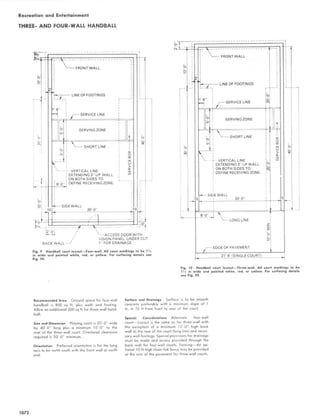
Three- and Four-Wall Handball 1072
Hopscotch 1073
Horseshoes 1074
Ice Hockey 1075
Lawn Bowling 1076
Roque 1077
Shuffleboard 1078
Deck Tennis 1079
Platform Tennis 1080
Paddle Tennis 1081
Tennis 1082
Tetherball 1083
Volleyball 1084
Official Baseball 1085
Baseball 1086
Bronco League (9-12 yr) 1086
Pony League (13-14 yr) 1087
Colt League (15-16 yr) 1088
Little league (9-12 yr) 1089
Field Hockey 1090
Flickerball 1091
Football (NCAA) 1092
Touch and Flog Football 1093
Golf Driving Range 1094
Lacrosse 1095
Men's 1095
Women's 1096
Soccer 1097
Men's and Boys' 1097
Women's and Girls' 1098
Softball 1099
12-Inch 1099
16-Inch 1100
Speedball 1101
Team Handball 1102
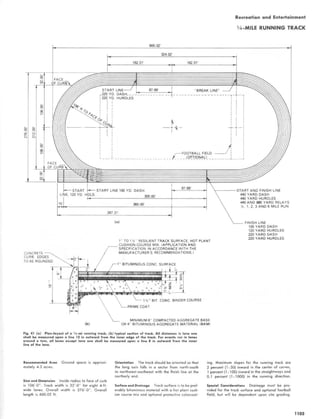
%.-Mile Running Track 1103
Shot Put 1104
Hammer Throw 1105
Discus Throw 1106
Javelin Throw 1107
Long Jump and Triple Jump 1108
Pole Vauk 1109
High Jump 1110
Archery 1111
International Shooting Union Automatic Trap 1112
Fixed Nets and Posts 1113
Fence Enclosures 1114
Typical Grading and Drainage Details 1115
Typical Playing Surfaces 1116
Baseball and Softball Backstops 1117
Movie Theaters 1118
Handicapped Seating 1123
500-Seat Movie Theater 1125
Drive-In Theaters 1127
Bowling Alleys 1129
Bowling Alleys with Billiard Rooms 1133
Swimming Pools 1138
Diving Pools 1144
Residential Swimming Pools 1146
50-Meter Recreational Swimming Pool 1149
25-Meter Recreational Swimming Pool 1150
25- and 50-Meter Indoor Pools 1151
Locker Rooms 1153
Bathhouses 1155
Gymnasium 1157
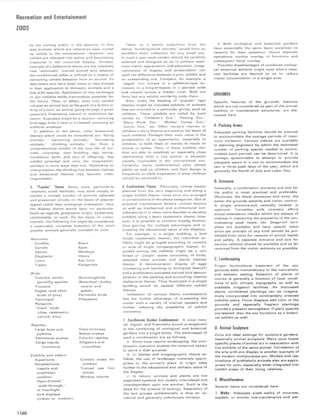
Zoos 1158
Aquariums 1168
Indoor Tennis Building 1175
Sports Arenas 1176
Golf Courses and Clubhouses 1185
Rifle and Pistol Ranges 1193
Rifle and Carbine Ranges, Outdoor 1200
Shooting Ranges, Outdoor 1204
Trap Field 1205
Skeet Field 1206
Combination Skeet and Trop Field 1207
Marinas 1208
Swimming Docks 1218
Camps and Comp Facilities 1219
11 . MISCELLANEOUS . . . . . . . . . . . . . . 1239
Farmstands Farmstands 1241
Farms and Farm Buildings 1243
Animal Facility. Laboratary 1247
Greenhouses 1251
Horse Borns 1252
Horse Stables 1255
Riding Schools 1261
Kennels 1263
Nature Center 1265
Richard M . Adler, AIA John J. Fruin, Ph .D.
Iris Alex, AIA Building Consultant YWCA Bruno FunarO Architect
Egmont Arens IndustrialDesigner Richard U . Gambrill
James W. AtZ Associate Curator, theAmerican Francis W. Gencorelli, AIA
Museum of Natural History
Noyce L. Griffin, E.E.
Geoffrey Baker Architect
John J. Grosfeld, AIA
Herbert Behrend, P.E.
Victor Gruen, AIA
Richard M. Bennett, AIA
Frederick Bentel, AIA
Don Halamka
Maria Banta[, AIA
Morton Hartman, AIA The Perkins &Will Corporation
Chester Arthur Berry, Ed.D.
Ernest J. Hasch
Glenn H . Bayer Housing Research Center,
Keith 1. Hibner AIA
Cornell University
Charles M. Bolden Conrad Associates August Hoenack U.S. Public Health Service
William N. Breger, AIA
Gladys L. Brown Health, Physical Education, and
Recreation Consultant
C . William Brubaker, AIA The Perkins & will
Corporation
Harold Burris-Mayor
Charles A. Chaney
Contributors
J . L. Gruzen, AIA Gruzen and Partners
Joseph Horowitz, P.E. Manager, Facilities Engineering
Dept., Columbia Broadcasting System, Inc.
George A. Hutchinson, AIA The Perkins &will
Corporation
Emmet Ingram, AIA The Perkins & WiliCorporation
David Jones
Aaron N. Kiff Architect
Alonso W. Clark, AIA Alexander Kira Housing Research Center,
Cornell University
Harold Cliffer, AIA
Joseph Kleinman Architect
F. G. Cole
Robert L. Knapp, AIA Charles Luckmen Associates
Walter L. Cook
A. Frederick Kolflat, AIA The Perkins & Will
William J. Cronin, Jr. Corporation
Laurence Curtis J. J . Koster Architect, Gruzen andPartners
Marvin Cutler, AID Lendal H . Kotschevar
T. P.Deis Architect Alan Lapidus, AIA
Clyde H. Dorsett, AIA Morris Lapidus, AIA
Lathrop Douglass, FAIA Betsy Laslett
Max Fengler Architect Fred Lawson
W. R. Ferguson Stanton Leggett EducationelConsultant
A. Peter Florio Designer-Consultant Ronald Mace, AIA
Contributors
James Mackenzie Richard F. Roti
Francis Joseph McCarthy, FAIA Christine F. Salmon, AIA
William McCoy, AIA The Perkins & WillCorporation F. Cuthbert Salmon, AIA
Gordon P. McMaster Architect
Frank Memoli Architect
Emmanuel Mesagna Architect
Keyes D. Metcalf
Jo Mielziner Stage Designer
William A. Mllls Architectural Consultant
Maurice Mogulescu
Bruno Molajoli
George Muramoto Architect
Richard Muther
Clifford E. Nelson, M.D.
Oscar Newman Architect
Raymond C . Ovresat, AIA The Perkins & Will
Corporation
James A. Paddock Dober Paddock, Upton and
Associates, Inc.
Julius Penero Architectand Urban Planning Consultant
W. Russel Parker Architect
Robert Perlman
Frank Harrison Randolph, P.E. Professor ofHotel
Engineering, Cornell University
Richard M. Williams Director, NationalBuilding
Consultation and Supply Services, Boys"Clubs of
Scott Turner Ritenour America
Herbert ROSS IndustrialDesigner Mary Worthen Architect
Kenneth Ricci Architect
Maurice R. Sala, AIA Consulting Architect to the
Lutheran Church in America
Ben Schlanger Architect and Theater Consultant
Myron E . Schoen, F .T.A . Director, Commission on
Synagogue Administration
Max B. Schreiber Architect
Walter E. Schultz Architectural Consultant
Samuel Selden
Peter C . Smith Associate of the RoyalInstitute of
British Architects
R. Jackson Smith, AIA
Bernard Spero
William Staniar, M.E.
Wilbur R. Taylor Architect
Margaret E. Terrell
James G . Terrill, Jr.
George H. Tryon
Howard P. Vermilya, AIA
Joshua H. Vogel, AIA
Mildred C. Widber
Philip Will, Jr., AIA The Perkins &Will Corporation
American Association for Health, Physical Education, and Recreation
American Association of Port Authorities
American Association for State and Local History
American Association of Zoological Parks and Aquariums
American Bar Association
American Library Association
American Medical Association
American Psychiatric Association
American Trucking Associations, Inc.
American Youth Hostels, Inc.
Association of College Unions-International
The Athletic Institute
Boy Scouts of America
Boys' Clubs of America
Brunswick Corp.
Canadian Museum Association
Center for Architectural Research, Rensselaer Polytechnic Institute
Conference Board of Mathematical Sciences
Civil Aeronautics Administration
Educational Facilities Laboratories
Eno Foundation
Federal Aviation Administration
Federal Housing Administration
General Motors Corporation
General Services Administration
Housing and Home Finance Agency
Housing Research Center, Cornell University
Humble Oil & Refining Co.
Institute of Outdoor Drama, University of North Carolina
Institute of Traffic Engineers
International Association of Chiefs of Police
International City Managers Association
International Youth Hostel Federation
Michigan State Housing Development Authority
Organizations
Mobile Homes Manufacturers Association
Mosler Safe Co.
Motor Vehicle Manufacturers Association of the U .S., Inc.
Music Educators National Conference
National Association of Engine and Boat Manufacturers, Inc.
National Association of Home Builders
National Council of the Young Men's Christian Association of U .S.A.
National Council on the Aging
National Crushed Stone Association
National Education Association
National Fire Protection-International
National Fisheries Center and Aquariums
National Institute of Mental Health
National Golf Association
National Office Products Association
National Recreation and Park Association
National Rifle Association
National Swimming Pool Institute
New York City Housing Authority
New York State University Construction Fund
Philadelphia Housing Association
Texas A & M University, School of Architecture
United Methodist Church, Board of Global Ministries
U .S. Department of Health, Education, and Welfare (now called U.S . Department
of Health and Human Services)
U .S. Department of Housing and Urban Development
U .S. Department of the Navy
U .S. Public Health Service
University of California
University of Oregon
University of Washington, Bureau of Government Research and Services
Urban Land Institute
Preface
to the Second Edition
The first edition of TIME-SAVER STANDARDS FOR BUILDING TYPES was
a unique and significant publication . It established for the first time a com-
prehensive source of reference material dealing with the functional analysis
and standards of all major types of buildings . It contained in a single source
an extensive amount of essential planning data for the architectural designer
and related professionals. This was accomplished by contributions from
many individuals and by researching and consolidating a wide range of
literature. As much as possible, the criteria were presented in graphic form
for easier reference and use. In a span of a few short years, the first edition
has established itself as a useful and popular reference source to both pro-
fessionals and students. In order to maintain its effectiveness and meet
this need, the book requires periodic review and revision to incorporate new
developments and thinking. As a result, the second edition has been pub-
lished. The new edition has been expanded by over two hundred pages and
approximately twenty-five percent of the original book has been revised.
Obsolete pages have been eliminated and more current materials have been
added. Also, several new building types have been included .
The authors wish to emphasize to the user of this handbook that the
material presented is primarily offered to give basic or general data for a
particular building type. This material is not intended to give definitive
schematics, rigid formulas, or final design solutions that will automatically
provide the solution to the particular design problem at hand. Rather, these
standards and criteria should be the starting point for further analysis, study,
and review of the functional relationships of each building type. Primarily,
the material in this handbook is intended to be used by the architect, designer,
student, or related design professionals in the following manner:
1 . to assist in developing building programs and establishing preliminary
space allocations.
2 . to analyze specific client needs and to quantify them
3. to study general and specific functional relationships
4. to assist in the preparations of preliminary architectural designs
The authors strongly believe in the principle that "form follows function"
and that before a building can succeed aesthetically it must perform its
function efficiently. All the material presented in this handbook deals with
the function of a building rather than its form. There is absolutely no attempt
to dictate or even suggest aesthetic or definitive design solutions to any
building type. The architectural designer must have complete freedom to
exercise his or her creative abilities. With the handbook's solid functional
basis, this goal can be achieved more successfully.
JOSEPH De CHIARA
Preface
to the first Edition
TIME-SAVER STANDARDS FOR BUILDING TYPES is a natural outgrowth
of the present fourth edition of Time-Saver Standards, A Handbook of
Architectural Design Data. Over the years, as Time-Saver Standards became
more popular and comprehensive, it also became larger in size and more
cumbersome to use. In addition to containing architectural design data, the
fourth edition also had some design material dealing with specific types of
buildings. When the book was ready for a fifth revision, it became apparent
that changes had to be made in the content and format of the book. In order
to be able to include new design data in a comprehensive manner, it was
decided to remove the material dealing with building types from the fifth
edition and use this material as a core for the new book : Time-Saver
Standards for Building Types. The original material has been revised,
greatly expanded, and reorganized to cover all of the major building types.
The result has been a completely new handbook for the architectural
profession . It evolved from and follows the tradition of the first four
editions of Time-Saver Standards . Time-Saver Standards for Building Types
and Time-Saver Standards for Architectural Design Data, 5th edition, are
closely related but, in fact, are separate and independent books.
Time-Saver Standards for Building Types is intended primarily to meet the
needs of those who are involved in the conceiving, planning, programming, or
design of buildings . It is intended to give basic design criteria for each major
type of building . It will give those unfamiliar with a specific type of building a
talking or working knowledge of its functions, organization, and major com-
ponents .
This material is intended to act as a guide or reference point from which the
specific design solutions can be established. Absolutely no attempt is made in
this book to present the final design solution for any building type, nor does it
try to establish or influence the final aesthetic expression of the building. It is
hoped that the designer or architect, by having at his disposal the widest
range of information concerning a building type, will be able to design more
functional, more meaningful, and more exciting buildings .
Theeditors wish to takethis opportunity toexpress their gratitude and sincere
thankstothemany individuals, architects, libraries, and many varied organiza-
tions who have generously contributed their expertise to this new creation,
Time-Saver Standards for Building Types.
JOSEPH De CHIARA
JOHN HANCOCK CALLENDER
Residential
DIMENSIONS OF THE HUMAN FIGURE 3
LIVING AREAS 5
LIVING ROOMS 6
Furniture 6
Furniture Sizes 7
Furniture Arrangements 8
Furniture Sizes and Clearances 14
DINING AREAS 15
COMBINED LIVING-DINING SPACES 20
COMBINED DINING AREA-KITCHEN 21
BEDROOMS 22
COMBINED LIVING-SLEEPING AREAS 27
KITCHENS 29
LAUNDRY ROOMS 41
BATHROOMS 48
CLOSETS 58
APARTMENTS 70
HOUSING DENSITIES 82
HOUSING FOR THE ELDERLY 87
HOUSING FOR THE HANDICAPPED 102
PARKING FOR THE HANDICAPPED 117
GROUP HOMES 119
SENIOR CITIZENS' CENTER 122
MOBILE HOMES AND PARKS 129
YOUTH HOSTELS 140
SITE PLANNING 146
DIMENSIONS OF ADULTS
The dimensions and clearances shown for the
average adult (Fig . 2) represent minimum require-
ments for use in planning building layouts and
furnishings. If possible, clearances should be in-
creased to allow comfortable accommodations for
persons larger than average. The height of table-
tops shown on the next page is 2 ft 5 in; some
authorities prefer 2 ft 6 in, or sometimes 2 ft
61/2 in.
Since doorways and passageways must nor-
mally be dimensioned to permit the movement
of furniture, they should seldom be designed
merely on the needs of the average adult. (See
section of this book relating to furniture sizes.)
DIMENSIONS OF CHILDREN
Children do not have the same physical propor-
tions as adults, especially during their early years,
and their heights vary greatly, but their space
requirements can be approximated from the fol-
lowing table and from Fig. 1 . (For heights of chil-
dren's furniture and equipment, see section on
"Schools .")
.-.IDi6-
O
,H I I
till 1111
,I _~ ~I
Fig. 1 Dimensions and clearances for children . Source: "Time-Saver Standards," 1st ed., F. W. Dodge Corp .,
Qli
1/4 H
New York, 1946 .
Fig. 2 Dimensions and clearances for adults . Source: "Time-Saver Standards," 1st ed., F. W. Dodge Corp ., New York, 1946.
DIMENSIONS OF THE HUMAN FIGURE
Average Height of Children
Residential
Age Height, in Age Height, in
5 44 11 56
6 46 12 58
7 48 13 60
8 50 14 62
9 52 15 64
10 54 16 66
Residential
DIMENSIONS OF THE HUMAN FIGURE
4
LIVING AREAS
Planning Considerations
" Through traffic should be separated from
activity centers.
" Openings should be located so as to give
enough wall space for various furniture
arrangements.
" Convenient access should be provided to doors,
windows, electric outlets, thermostats, and
supply grills .
Furniture Clearances
To assure adequate space for convenient use of
furniture in the living area, not less than the fol-
lowing clearances should be observed.
60 in between facing seating
24 in where circulation occurs between furni-
ture
30 in for use of desk
36 in for main traffic
60 in between television set and seating
Seating arranged around a 10-ft diameter circle
(Fig . 1) makes a comfortable grouping for conver-
sation . Figure 2 indicates clearances, circulation,
and conversation areas.
Fig. 2 Minimum clearances, circulation and con-
versation areas for living rooms.
r
3
â
Nu1pI11111RINfl1111~N11111/IWII
30'' to
use desk
`vtnmutnr~
s~É
10' diam .
conversation
area
To sleeping area
and main entrance
Fig. 1 Plan. Source: "Manual of Acceptable Practices," Vol . 4,
U.S. Dept . of Housing and Urban Development, 1973 .
To dining and
kitchen area
Residential
LIVING AREAS
FURNITURE
GENERAL
Typical furniture-group units
While the typical furniture arrangements
presented in the following pages by no
means cover the entire range of possibili-
ties, they do cover the fundamental uses to
which living, dining, and sleeping spaces
are put. From the suggested schemes furni-
ture arrangements can be developed to suit
any particular problem or set of problems
with which a designer may be confronted .
Furniture sizes may vary slightly ; those
indicated are the averages commonly met
with in upper middle-class homes, and are
little affected by changes in style or similar
matters of individual preference .
Specific space allowances
In studying furniture groupings, it be-
comes obvious that certain clearances are
required . Spaces, lanes, or paths of dif-
ferent types develop naturally between
furniture-group units . Minimum distances
for comfort have been established by
numerous planners . These, and in some
cases, maximum distances based upon re-
quirements for human intercourse, have
been incorporated in the diagrams . A list-
ing of those generally applicable to all
rooms follows:
1 . Single passage (not a traffic lane)
between low objects, such as a sofa and
coffee table: 18 in. is the minimum.
2. Single passage (not a traffic lane)
between tall objects, hip height or over :
2 ft to 2 ft 6 in. is the minimum.
3. General traffic lane : 3 ft 4 in. is the
practical minimum. As rooms increase in size,
this minimum increases, in order to pre-
serve the space scale of the room. The
traffic lane between an entrance door and
a major group unit is preferably generous
in width. It is desirable to place doors so
that the central portions of rooms do not
become major traffic ways between differ-
ent parts of the house.
4. Seating areas, confined (for instance,
between a desk and a wall): 3 ft is a
minimum tolerance, which permits one per-
son to pass back of an occupied chair. This
minimum does not constitute a major traffic
lane .
LIVING ROOM
Typical furniture groups in the living
room are as follows:
1 . Primary conversation group: chairs
and sofa normally grouped around the
fireplace
2. Secondary conversation group: chairs
and love seat at end of room or in corner
3. Reading group or groups: chair, otto-
man, lamp, table
4. Writing or study group: desk, lamp,
one or two chairs, bookcases
5. Music group: piano, bench, storage
space
6. Game group: game table and four
chairs
7. Television group: television set and
seating for several people
According to the price of a house and
the cubage allotted to the living room, two
or three or all of the furniture-group units
may be included . The fireplace is so closely
associated with living room furniture that it
has been included in all schemes.
Clearances
Traffic tolerances in living rooms are im-
portant, since numbers of people use the
room, and narrow lanes between furniture-
group units are uncomfortable. An ade-
quate traffic lane between the main en-
trance and the major seating group is 3 ft
4 in. wide; 4 ft 6 in. is preferred . The
minimum clearance between facing pieces
of furniture in a fireplace group is 4 ft 8
in. for a fireplace 3 ft wide. For every inch
added to the size of the fireplace, 1 in. is
added to the minimum clearance space.
If a wide sofa is placed directly oppo-
site the fireplace, this group is often
spread. A 6-ft tolerance is usually consid-
ered the maximum because it is difficult to
carry on a conversation over a greater dis-
tance.
A considerable flexibility in location of
doors and windows is possible, and all wall
pieces can be shifted. Doors flanking a fire-
place are to be avoided in order that the
furniture group may be concentrated
around the fireplace opening.
SOFAS LOVE SEATS
"SHERATON" TYPE
LENGTH 6'-0"
DEPTH 2.-6"
HEIGHT 3'-0"
CHAIRS
DESKS
FLAT TOP... SMALL
LENGTH 4'-0"
DEPTH 2' -0"
HEIGHT 2'-6"
BREAKFRONT BOOK CASES
SMALL
LENGTH 4' - 0"
DEPTH 1'-6"
HEIGHT 6' -6"
S
AVERAGE
LENGTH 2'-6"
DEPTH 1' - 6"
HEIGHT 2'-6" H N- 2"
PIANOS
LARGE
L 5'-0"
D l'-6"
H 7'-0"
"CHIPPENDALE" TYPE
L . 6=6"
D' 2'-6"
H 3'-0"
FLAT TOP I AkGE
L 5'-0"
D 2'-6"
H 2' - 6"
20
LOWBOYS HIGHBOYS
SWAN TOP
L 3'-0"
D l' - 6"
H 7'-0"
TABLES
37. CONCERT GRAND 40. BABY GRAND
L 9'-0 ,. L 5 ,_ 6 
D 5'-0 D 5'-O
H 3'-4 H 3'-4
FLAT TOP
L 3'-0'D
l'-6
H 5-0
38 . MUSIC ROOM GRAND 41 . CONSOLE
L
7 '_ 0  L
5'-0

D 5'-0 D
2'-0
.
H 3'-4  H
4'-3

SIDE OR
DESK
L l'-6
OCCASIONAL WING D I'-6
CLUB L 2'- 3 L 2'-6
H 2-6
LENGTH 2'-6 D 2-6 D 2'- 6
DEPTH 3'-0 H 3'- 0 H 3'-0
HEIGHT 3'-O D 3'-0
FLAT TOP....VERY LARGE
L 6'-0
D 3'-0
H 2'-6
UPHOLSTERED
ARMLESS
L 2
,
-0
D 2'-6
H 2- -6
END
L 2'-0 END
0 l'- 3 L I '-8
H 2'
-0,.
D 1 , -8 
H 2'-0
BRIDGE
ARM
L 2'-0
UPHOLSTERED D 2' -0
CORNER CHAIR H 2-6
L 3'-0
CIRCULAR PIECES
LOW COFFEE TABLE DRUM TABLE PIECRUST TABLE
DIAM 3' -0 DIAM 3'-0 DIAM. 3'-0
HEIGHT 1'6 H 2'-6 H 2 -6
DUMBWAITER
LARGEST DIAM . 2' - 0
H 2'-6
STAND,
DIAM . I' - 0
H 2-6
Residential
FURNITURE SIZES
LARGE
L 4'-6
D 2'-6
H 3'-d
,
GOVERNOR SECRETARY
WINTHROP L 3'-0
L 3'-0 D 2'-0
D 2'-0 H 7'- O
H 5-6
CONSOLE
L 3'- 0
D 1'-6
H 2'-6
BRIDGE
ARM LESS
L l'-6
D l'-6
H 2'-6
39.PARLOR GRAND 42 .MINATURE
L
6 ' -0
L 4 ,_ 8 
D 5'-0 O l'-7
DIAMP
TABLE
H
V _4 H
3'-0 2O DEPTH 0F
ROUNDABOUT SEAT

H . 2 - 6 DIAM . 4'-0
Residential
FURNITURE ARRANGEMENTS
1 . In all living rooms shown, main conversation group
centered about fireplace is dark gray. Bay or picture
windows may be used as focal points, instead of fireplaces.
3 . For larger families, or for those who entertain often,
seating for 7 to S persons in the primary group is a reason-
able design limitation. Off-center location of game group
provides for a corner entrance door.
5. If sofa opposite fireplace is omitted, primary group can
be brought closer together. In schemes I to 4, note that
wide groups permit conversation without twisting to see
speakers seated on sofa ; here this restriction is removed .
2. Clearance between low coffee table (23) and easy chairs
(6) ought to be maintained at 3'-4 even though table is low,
because the aisle here constitutes a major traffic way.
4. Minimum length for a room which must contain a baby
grand piano is approximately 20'. If minimum clearances of
l' between piano and wall, and 3' between desk (15) and
wall, are to be maintained, room length must be increased .
6. Here, presumably, doors at ends of room indicate use of
one side of room as a traffic route. Primary furniture is
grouped closely about fireplace ; wall pieces are all that can
be used on opposite side.
7. Grouping for door locations at both ends of room;
ideally, 1-ft clearance is desirable between piano and wall.
Chairs (6) are smaller than those previously listed, 2`-6 x 3'-0.
9. Primary group shown is one of most popular arrange-
ments. Unit placing suggests entrance at left end. Sec-
ondary conversation unit often becomes music or game group.
11 . Ten persons can be comfortably seated in this type of
arrangement, in which primary and secondary conversation
groupings almost merge into one.
Residential
FURNITURE ARRANGEMENTS
8 . If living room has a dead end (no doors), primary unit
may be spread to include entire end of room. Inclusion of
music or game group would demand more area.
10. Writing or study group at left, music or game group
at right, and center primary group, need minimum passages
only when room is narrow.
12. Arrangement designed to permit door locations on side
walls rather than ends. Angled chairs (6) are small size
noted in Fig. 7, and often used in other arrangements .
Residential
FURNITURE ARRANGEMENTS
z
13. Previous diagrams have shown schemes arranged sym-
metrically about centered fireplaces; on this and the fol-
lowing page are schemes for cases when foci cannot be
centered .
15 . If primary, music, and game groups are all to be con-
tained in a small area, one must be curtailed. Here game
group consists of table and only two chairs.
17. Two smaller upholstered chairs (6), each 2'-6 x 3'-0
might be accommodated at the right of the fireplace in
this room with only a slight increase in room width.
14 . Off-center rooms often divide naturally into two parts:
primary group, and other groups combined. Clearance no
greater than 2' will not accommodate a major traffic lane.
16. In this case the primary conversation group is curtailed
to permit inclusion of a grand piano; use of corner bench
for game group may result in some loss of comfort.
18. In a room with only one door the minimum traffic lane
of 3'-4 needs to be increased to at least 4'-10, which will
accommodate two persons side by side, without crowding.
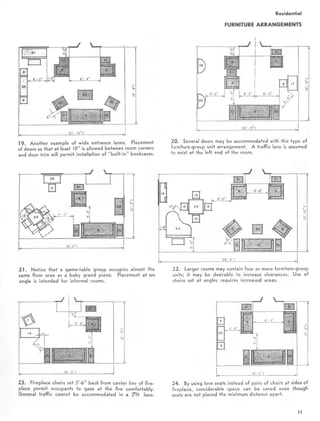
19. Another example of wide entrance lanes. Placement
of doors so that at least 10 is allowed between room corners
and door trim will permit installation of built-in bookcases.
21 . Notice that a game-table group occupies almost the
same floor area as a baby grand piano. Placement at an
angle is intended for informal rooms.
23. Fireplace chairs set 3'-6 back from center line of fire-
place permit occupants to gaze at the fire comfortably.
General traffic cannot be accommodated in a 2°
-ft lane.
Residential
FURNITURE ARRANGEMENTS
20. Several doors may be accommodated with this type of
furniture-group unit arrangement. A traffic lane is assumed
to exist at the left end of the room .
22. Larger rooms may contain four or more furniture-group
units; it may be desirable to increase clearances. Use of
chairs set at angles requires increased areas.
24. By using love seats instead of pairs of chairs at sides of
fireplace, considerable space can be saved even though
seats are not placed the minimum distance apart.
Residential
FURNITURE ARRANGEMENTS
r;
12
25. In rooms with fire-
places in end walls, as
in the schemes immedi-
ately preceding, furni-
ture arrangements
often fall naturally into
two distinct groups.
27. In this scheme, by
placing the sofa on the
long axis opposite the
fireplace, furniture is
held together as a
single unit. There are
two obvious positions
for an entrance door.
If is possible to back
the sofa against a
group of windows.
29. Here the
left side and end
opposite the fire-
place are avail-
able for doors.
Piano should, if
possible, be
placed against an
inside wall.
26. One of the two
groups may be adapted
for dining, eliminating
need for a separate
dining room. Minimum
clearance around din-
ing table should be
3'-0.
28 . Backing the pri-
mary-group furniture
against walls eliminates
passage behind them
and reduces room
width to a minimum.
30. Placing the
sofa against one
side of the room
tends to open up
the primary group-
in effect, to merge
with it the secon -
dary conversation -
group furniture.
31 . The entire area
may be treated as a
single unit, all furniture
being brought into the
principal group.
33 . By inter-
changing the
positions of
the fireplace
furniture in
Fig . 32, a
grand piano
can be accom-
i modated.
35. Type of sofa
shown is becoming in-
creasingly popular.
Chairs (6) may be units
which can be added to
sofa, if desired. is'- 5t
Residential
FURNITURE ARRANGEMENTS
32 . Here the plac-
ing of the desk
group (14) allies it
closely with the fire-
place unit. Four
units are included .
34. Completely
symmetrical ar-
rangement in com-
paratively small
space; music group
might replace items
14 and 25.
36. Unit types of
sofas are particular-
ly suited to corner
groupings. Scheme
shown contains three
group units.
13
Residential
LIVING ROOM-FURNITURE SIZES AND CLEARANCES
SPACE w the small house for general living activities
must often serve a wide variety of functions. Thus,
furniture can add greatly to the usefulness of living
area if it is adaptable in type and size to a number
of different purposes.
Accompanying data give a working basis for
providing sufficient space for general living activi-
ties. Dimensional information includes only a few
of many available sizes and types of furniture. Di-
mensions of groups refer to clearances necessary
for comfortable and convenient use.
Necessary planning considerations include: pro-
vision of adequate floor and wall space for furniture
groupings; segregation of trafficways from centers
of activities; ease of access ; and a maximum of
flexibility.
Doors in constant use should be placed so that
traffic between them will not interfere with furniture
groups.
Flexibility implies the varying uses to which space
may be put. The lounging group of the right, for
instance, requires approximately the same floor
space as the card-playing group; the sofa, below,
may be a convertible bed. Thus, functions of other
areas-such as recreation, sleeping, dining and
even storage-may be applicable equally to living
rooms.
s. .- -..-- ..
-,
Double Bed StudioCouch
Convertible Sofa-Beds (G) : 2'-9 to 3'-3 deep, 6'-2 to 6'-8 long
Living Room Tables (F) : l'-8 to 3'-0 wide, 3'-6 to 10'-0 long
Easy Chairs: Wing, 2'-4 to 2'-10 square ; Club, 2'-4 to 3'-3, 3'-9 square
Book Cases (D) : 2'-6 to 3'-0 wide, 10 to 12 deep
Sofa Sizes (B) :
2'-8 to 3'-6 deep
6'-0 to 7'-2 long
Love Seats:
2'-0 to 2'-10 deep
3'-6 to 4'- 6 long
End Tables (A) :
10 to l'-2 wide
l'-6 to 3'-0 long
Occasional
Tables (C) :
2'-0 to 2'-4 square,
round, oval, draw-
top, etc .
Card Tables:
2'-6 to 3'-0 square ;
folding type 1i/2
thick folded )aver-
age)
Side Chairs :
1'-6 to 2'-0 wide
l'-6 to l'-10 deep
Desks, Sloping Top:
3'-0 to 3'-B wide
l'-6 to 2'-0 deep
Writing Desks:
2'-8 to 3'-6 wide
l'-6 to 2'-6 deep
Secretaries:
3'-0 to 5'-0 wide
l'-6 to 2'-8 deep
By GLENN H . BEYER AND ALEXANDER KIRA, Housing Research Center, Cornell University
DINING ROOM
The principal factors to be considered
in planning the dining area are as follows :
(1) Number of persons to be seated ;
(2) Space used at the table ; (3) Space
for chairs and for passage behind them ;
(4) Seating arrangement; (5) Size and
type of furniture ; and (6) Storage space
for china, glassware, silver, and linen .
Recommended space dimensions, based
on recent research, are provided below .
SIZE OF PLACE SETTING
The minimum width needed for each
place setting is 21 in . ; however, a width
of up to 29 in . i s desirable for greater
freedom of movement . A 25-in . width is
usually adequate ; this permits chairs 19
in . wide to be placed 6 in . apart . The
minimum depth for a place setting is 14 1 (,
in . These dimensions allow space for
china, glassware, silver, and elbow ex-
tension (See Fig . 1) .
PASSAGE BEHIND CHAIRS
The minimum space recommended for
passage behind chairs is 22 in . ; a satis-
factory range is 22 to 25 in . If passage
behind the chairs is not required, a mini-
mum of 5 in . plus the depth of the chair
must be provided for pushing back the
chair when leaving the table (See Fig . 3) .
Size of table
The minimum width recommended is 36
in .; a satisfactory width is 36 to 44 in .
If 25-in .-wide place settings are pro-
vided and if one person is seated at each
end of the table, then minimum and rec-
ommended table lengths are as follows :
Persons Minimum, in . Recommended, in .
4 54 60
6 79 84
8 104 108
10 129 132
12 154 156
Table 1 . Inside dimensions of drawers for storage of silverware
Adapted front Indoor Dining Areas for Rural Homes in the Western Region,
Report 118, 1'ainersity of Arizona Agricidfural E.rprroneof Staboir, Trcr.soa
(June 19551 .
Item Width, in . Depth, in . Height, in .
8 each forks, knives, soupspoons ; 12 teaspoons, 11 181/.-, 2 :
6 tablespoons, 4 serving pieces
12 each forks, knives, salad forks or others, butter 14 1 . ,
20 3
spreaders, soupspoons; 18 teaspoons, 6 table-
spoons, 3-piece carving set, 3 serving pieces
12 each forks, knives, soupspoons, salad forks or 17 19/' 2V4
butter spreaders ; 24 teaspoons, 6 tablespoons,
6 serving pieces
Table 2. Dimensions of stacks of folded table linens
Adapted from Storage Space Requirements for Household Textiles, A . -
Woolriclr, :11. :11 . While, aid .11. A. Richards, Agricultural Rescarrh Rullefin
62--:;, U.S . L)eparfnzent of Agriculhzre, WaNhirrglon, D.C. 119551 . Dinlen-
.~ions gives are frond-la-back, ., ide-to-side, acrd heigld.
Space 16 in . deep Space 20 in . deep
Item Minimum, in . Maximum, in . Minimum, in . Maximum, in .
2 large tablecloths, 14xl9x3 14x36x2 19x14x3 19x28x2
guest use
2 medium tablecloths, 15xl9xl 13x28xl 19x10xl 18x28x1
everyday use
4 small tablecloths, 14100 14x2Bxl 10x14x3 15xl4x2
everyday use
3 small tablecloths, 14x10x2 14x28xl 10xl4x2 15xl4x2
guest use
12 small napkins 7x10x3 7x10x3 10x 5x3 10x 9x2
(2 stacks of 6)
12 large napkins 8x10x2 8x10x2 10x 6x2 10x10x1
(2 stacks of 6)
6 place mats, everyday 13xl9xl 13xl9xl 19xl3xl 19xl3xl
use
1 table pad 13x21 x3 13x21x3 13x21x3 13x21x3
If no one is seated at either end of the
table, the length may be reduced by ap-
proximately 4 in .
Space for total dining area
With the same conditions noted above
and with on ample 42-in . space for pas-
sage on all sides of a 42-in .-wide table,
required sizes are as follows :
Persons W X L = Area
ft sq ft
4 101=2x12 126
6 101  x14 = 147
8 101=,x16 168
10 10 1 =x18 = 189
12 10 1 :x20 = 210
If no one is to be seated at either end of
the table, the length may be reduced by
2 ft (21 sq ft) .
Storage space
Linear feet of shelf space required for
medium-income families, for both moderate
and liberal supplies of dishes and glass-
ware, for everyday and guest use, is as
follows :
12-in . shelves, 20-in . shelves,
ft--in . ft
Moderate 21-0 2
Liberal 36-9 2
Drawer space for storage of silver is shown
in Table 1 . Space for storage of table
linens is shown in Table 2 .
Residential
DINING AREAS
DINING AREAS must accommodate furniture-either
portable or built-in-for eating, sitting, serving and
possible storage. Equipment for these dining func-
tions may also be adapted to meet other possible
requirements for this space-as studying, game-
playing, etc.
Table space requirements per person are as fol-
lows: for crowded seating, l'-10 on the table's
perimeter; for comfort, 2'-0 . Adequate clearances
for use are indicated on diagrams.
Furniture Sizes :
Portable Tables, round (A)-
2'-7 to 5'-10 diam.
Portable Tables, rectangular (C) :
2'-6 to 4'-0 by 3'-6 to 8'-0 ;
or 2',-0 to 4'-0 square
Dining Chairs, portable:
l'-6 to 2'-0 by l'-6 to l'-10
Serving Table (B) :
2'-6 to 3'-6 by 1'-2 to l'-q
Sideboard or Buffet (B) :
4'-0 to 6'-6 by l'-5 to 2'-I
China Cabinet (B) :
2'-8 to 3'-8 by l'-2 to l'-9
1 6
Furniture Clearances
To assure adequate space for convenient use of
the dining area, not less than the following clear-
ances from the edge of the dining table should
be observed .
32 in for chairs plus access thereto
38 in for chairs plus access and passage
42 in for serving from behind chair
24 in for passage only
48 in from table to base cabinet (in dining-
kitchen)
Figures 4, 5, and b illustrate proper clearances .
Various arrangements appear on the next page .
Residential
DINING AREAS
Fig . 6 Minimum clearances for dining areas . (a) one end of table
against wall; (b) serving from one end and

one side of table . Source :
Housing for the Elderly Development Process, Michigan State Housing De-
velopment Authority, 1974 .
* From Manual of Acceptable Practices, Vol . 4, U .S . De-
partment of Housing and Urban Development, 1973 .
1 7
Residential
DINING AREAS
1 . Minimum requires 2-ft buffe+
space on one side only ; 3' more
length is needed for extension table.
2. Typical dining-room suite, as used
in East and on West Coast, requires
furniture space on two sides of room.
3 . Long narrow area with some waste
space results when wall pieces are at
ends, and end entrance is needed.
4. Solid lines indicate minimum room
with corner cupboards, no wall furni-
ture. Dotted lines indicate added
space for 3' breakfast table.
5. Table-and-passage unit in one cor-
ner permits use of minimum space for
multiple activities; piano may be re-
placed by desk, love seat, etc.
6. Spaces smaller than the usual min-
imum can be utilized if built-in seats
are included; seating and table-
service comfort are sacrificed .
1 8
7 . The same set of clearances ap-
plies to the seldom used round table
as to the more popular oblong table.
8. Arrangement of typical suite in
larger-than-minimum space, when a
screen is used at serving door.
9. Dining rooms with fireplaces have
to be larger than minimum for the
comfort of those seated a+ table.
Fig. 7 Dining room furniture. Source: Manual of Acceptable Practices, Vol . 4, U .S. Dept . of Housing
and Urban Development, 1973 .
Residential
DINING AREAS
19
Residential
COMBINED LIVING-DINING SPACES
COMBINED SPACES
Often several compatible living functions can be
combined advantageously in a single room . Some
of the benefits of such arrangements are that
less space is used but it is used more intensively,
its functions can be changed making it more flexi-
ble and serviceable space, it is adaptable to var-
ied furniture arrangements, while visually it can
be made more interesting and seem more gener-
ous than if the same functions were dispersed
into separate rooms .
For adjacent spaces to be considered a com-
bined room, the clear opening between them
should permit common use of the spaces . This
usually necessitates an opening of at least 8 ft .
Figures S and 9 show combined living-dining
rooms .
Fig . 8 Combined living-dining room .'
2 0
A combination dining area-kitchen is preferred chores and provides space which can be used
by some occupants of small houses and apart- as the family's day-to-day meeting place .
ments . This arrangement minimizes housekeeping
21 sink counter combined
with 21 range counter
Residential
COMBINED DINING AREA-KITCHEN
Fig . 10 Combined dining area-kitchen, 2-bedroom living unit . Source: Manual of Acceptable
Practices, Vol . 4, U .S . Dept. of Housing and Urban Development, 1973 .
One of the primary functions of the kitchen
has been to provide a place for informal or family
eating . This is different than guest or formal din-
ing in a separate dining room or area . The infor-
mal dining generally consists of breakfast, lunch,
snacks, or just serving coffee to a neighbor . This
eating area should be clearly defined as a sepa-
rate functional area .
A frequent and desirable arrangement is the
combined kitchen-dining area . The following
sketches (Fig . 11) show the various possible ar-
rangements . Another arrangement is the kitchen-
family room .
Fig. 11 Minimum clearances for dining area in kitchen . Source : Housing
for the Elderly Development Process, Michigan State Housing Development
Authority, 1974 .
2 1
Residential
BEDROOMS
CHESTS
Fig. 1 Typical average furniture sizes .
22
BEDROOM
DIAGRAMS indicate minimum clearances that
should be provided for use of the bedroom furni-
ture shown, dimensions for which are listed below.
Many types and sizes of furniture are available;
but those listed are most common and can serve
as a basis for bedroom design . At least 2 in should
be allowed as clearance between walls and furni-
ture ; 3 in between furniture units.
Beds:
Single (C), 3'-0 to 3'-3 wide; 6'-10 long .
Twin (F), 3'-3 wide; 6'-10 long .
Three-quarter (E), 4'-0 wide; 6'-10 long
Three-quarter (B), large, 4'-2 to 4'-6 wide;
6'-10 long
Double, 4'-6 wide, 6'-10 long .
Roll-away beds, (A): 2'-0 by 5'-0 on edge, 3
clearance on all sides
Bed Tables (G):
1'-2 to 2'-0 by l'-0 to 2'-0
Bedroom Chairs (H):
Small, l'-8 by l'-8; larger, 2'-6 to 2'-10
by 2'-8 to 3'-2
Dressers (3-drawer) (D):
3'-0 to 4'-0 by l'-6 to l'-10
Chest of Drawers (4-drawer) (D):
2'-8 to 3'-4 by l'-6 to l'-10
Chaise Longue:
2'-0 to 2'-4 by 4'-0 to 5'-6
Day Bed:
2'-9 to 3'-3 by 6'-2 to 6'-8
Dressing Table:
l'-3 to l'-10 by 3'-0 to 4'-2
Residential
BEDROOMS
23
Residential
BEDROOMS
24
Fig . 2 (a), (b) Primary bedroom, (c) primary bedroom without crib.*
FURNITURE CLEARANCES
To assure adequate space for convenient use of
furniture in the bedroom, not less than the follow-
ing clearances should be observed (Figs . 2 and
3) .
42 in at one side or foot of bed for dressing
6 in between side of bed and side of dresser
or chest
36 in in front of dresser, closet, and chest of
drawers
24 in for major circulation path (door to closet,
etc .)
22 in on one side of bed for circulation
12 in on least used side of double bed . The
least-used side of a single or twin bed can
be placed against the wall except in bedrooms
for the elderly (Fig . 4) .
* From Manual of Acceptable Practices, Vol . 4, U .S .
Department of Housing and Urban Development, 1973 .
FURNITURE ARRANGEMENTS
The location of doors and windows should permit
alternate furniture arrangements.
Fig . 3 (a) Single-occupancy bedroom ; (b) double-occupancy bedroom .*
Residential
BEDROOMS
25
Where at least two other sleeping spaces are
provided, a dormitory is sometimes preferred by
larger families (Fig . S) .*
* From Manual of Acceptable Practices, Vol . 4, U .S .
Department of Housing and Urban Development, 1973 .
Fig . 4 Single-occupancy bedroom for elderly ;
there is a 12-in allowance to make the bed .*
Fig. 5 Dormitory bedroom .
Residential
BEDROOMS
TYPICAL UNIT ARRANGEMENTS
1 . For comfort, 2 night tables are
desirable with a double bed. A
minimum double-bed unit arrange-
ment may be achieved by omitting
arm chair and one side chair, and
reducing to 3'-6 the traffic lane
at foot of bed.
2. Use of small chairs and chest
makes possible the addition of
conversation or lounging furniture
(2 chairs and table) to a typical
suite, without increasing square
footage. Use of 3-ft passages
eliminates crowding.
3 . Other types of arrangements
beyond the minimum include ad-
dition of a chaise longue (shown
dotted above), which is usually
placed at an angle to walls, re-
quires a table, and necessitates
ample passages.
4. Minimum twin-bed group (2 5. Increased requirements for addition of 6. Twin beds with single night table require
night tables) needs 9'-6 wall. dressing table and boudoir chair. 8' of wall space.
26
7. Variations on this plan
may be developed by re-
placing the chair between
the beds with a dressing
table which serves also as
a night table . This would
free other walls for twin
ches+s. shown doffed .
8. Twin beds head-
ing toward a com-
mon corner may re-
quire less space than
is indicated if dress-
ing table and bou-
doir chair are
omitted.
COMBINED SPACES
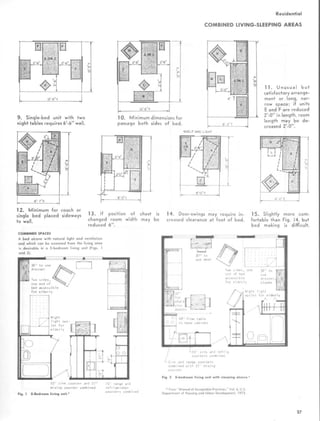
A bed alcove with natural light and ventilation
and which can be screened from the living area
is desirable in a 0-bedroom living unit (Figs . 1
and 2) .
15'' sink counter and 21'' 15'' range and
mixing counter combined refrigerator
Fig . 1 0-Bedroom living unit.'
counters combined
Residential
COMBINED LIVING-SLEEPING AREAS
12. Minimum for couch or
single bed placed sideways
to wall.
13. If position of chest is
changed room width may be
reduced b.
14. Door-swings may require in-
creased clearance at foot of bed.
15. Slightly more com-
fortable than Fig. 14, but
bed making is difficult.
Fig . 2 0-bedroom living unit with sleeping alcove.`
From Manual of Acceptable Practices, Vol . 4, U .S .
Department of Housing and Urban Development, 1973 .
11 . Unusual but
satisfactory arrange-
ment or long, nar-
row space; if units
E and F are reduced
2'-0 in length, room
length may be de-
creased 2'-0.
27
Residential
COMBINED LIVING-SLEEPING AREAS
In housing for the elderly and handicapped,
the units suitable for wheelchair users often can
be placed advantageously on the ground floor
(Fig . 3) .
Night light
outlet
Omission of an easy chair is acceptable to
give more space for occupant's wheelchair (Fig .
4) .
* From Manual of Acceptable Practices, Vol . 4, U .S .
Department of Housing and Urban Development, 1973 .
2 8
Fig . 4 0-Bedroom living unit for wheelchair user .*
Fig . 3 0-Bedroom living unit for wheelchair user.*
By GLENN H . BEYER AND ALEXANDER KIRA,
KITCHENS
The kitchen is not a specialized work-
room, for it has many uses . It is used for
preparation of meals, food preservation,
storage of food and utensils, and also, in
many cases, for eating, laundering, enter-
taining, and child care . In it a woman
uses her own labor and also makes full
use of electric power, tap water, and man-
ufactured or bottled gas ; she uses re-
frigerators, stoves, dishwashers, mixers,
toasters, and garbage-disposal units, as
well as various kinds of storage compart-
ments and work surfaces .
Since more time and effort are fre-
quently spent in the kitchen than in any
other area of the house, careful planning
is especially important . This requires care-
ful selection of appliances and storage
units and convenient arrangement of the
area . Some general planning guides are
as follows :
FOOD PREPARATION
Arrangement
It is important to keep the basic work
area compact, even if the kitchen is of
the large living type . Consideration
should be given, however, to the possi-
bility of more than one person working
there . The arrangement will vary accord-
ing to the size and shape of space avail-
able, but we should always keep in mind
relationships among functions in different
areas of the kitchen .
Traffic lanes
Traffic lanes through work areas should
be avoided . Arrange the service entrance
and access to the basement so that traffic
not essential to food preparation, service,
or storage can by-pass the area .
Housing Research Center, Cornell University
Storage
Kitchen design should be functional in
the sense of minimizing reaching and
stooping . Storage facilities should be no
higher than a woman can reach with both
feet flat on the floor . There should be
sufficient space to store items so that they
may be easily seen, reached, grasped,
and taken down and put back without
excessive strain . With proper planning,
stored items can be located close to where
they are first used, and unattractive items
can be kept out of sight . Storage space
should be sufficiently flexible to permit its
adjustment to varying amounts, sizes, and
kinds of food, supplies, and utensils .
Shelving should be adjustable .
Counters and working surfaces
The height of counters and working sur-
faces should permit a comfortable working
posture . The worker should be able to sit,
if she wishes, while doing certain kitchen
tasks, such as working at the sink . Con-
tinuous lines and surfaces permit ease of
movement, and are easier to keep clean .
Servicing and replacement of appliances
Consideration should be given to ease
of servicing and replacement of major
appliances, especially built-in units .
Materials
Materials and finishes that minimize
maintenance and cleaning should be used,
and they should be sufficiently light in color
to create a pleasant work atmosphere .
Lighting
Good lighting helps to prevent fatigue,
as well as promoting safety and a pleasant
atmosphere . Comfortable levels of light,
Fig. I Vertical and horizontal limits of reach .
Residential
KITCHENS
with a minimum of shadows, should be
planned throughout the kitchen . Adequate
daylight or artificial lighting makes the
room more agreeable and attractive than
a dark or poorly lighted room .
Ventilation
The kitchen should be well ventilated,
with an exhaust fan to remove objection-
able kitchen odors .
Safety
Burns, scalds, falls, and explosions should
be designed out of the kitchen . Sharp
corners, exposed handles, and control
knobs on kitchen equipment should be
avoided, and there should be safety
catches on doors and drawers to limit the
exploratory activities of young children .
Accessibility
There should be easy access to front
and back doors, laundry area, telephone,
and bathroom .
Decoration
Color, texture, and decoration should
be used to create an atmosphere that is
attractive, cheerful, and restful .
OTHER KITCHEN ACTIVITIES
Nonworking areas
Nonworking areas should be segregated
from working areas . Avoid interruption of
work areas by breakfast nooks, general
storage closets, rest areas, and other areas
not essential to normal food preparation
activities .
Eating facilities
Most families want to eat some meals
in the kitchen . Provision should be made
for this, if possible, even if a separate
dining room is also provided .
Child's play
In younger families, especially, there
is likely to be one or more children who
want to be near their mother . Provision
should be made for a play area out from
underfoot, but where adequate supervision
is possible . Storage space should be pro-
vided for toys and games .
Infant care
It is a well-known fact that many
kitchens are used for care of infants . If
provision is not made in the bathroom for
infant care and related supplies, then it
should be made in the kitchen .
Grooming
Washing hands and some personal
grooming frequently take place in the
29
Residential
KITCHENS
kitchen, especially if there is not ready
access to the bathroom . A mirror is de-
sirable.
CRITICAL DIMENSIONS
The critical dimensions for working
space are illustrated in Figs . 1-4. These
dimensions are recommended on the basis
of research and do not necessarily coincide
with either current practice or currently
available cabinets and equipment. Width
requirements for counter space, in particu-
lot, are based on research covering opera-
tions at individual work centers. Over-
lapping is permissible if work at adjacent
centers is not being carried on simul-
taneously.
Fig. 2 Minimum counter-width dimensions.
30
Fig. 3 Comfortable working heights.
Residential
KITCHENS
BASIC WORK AREAS
The work center concept, favorably sup-
ported by a great deal of research data
from many sources, emphasizes the planning
of the kitchen in terms of its major cen-
ters of activity . These work centers, in
turn, are planned in terms of their constit-
uent parts, their proper functions, and
their ideal relationships, one to another .
The actual design of the work centers
will vary with the size and shape of space
available in each project . Four work centers
must be considered : sink, range, mix, and
serve. In addition, there is the refrigerator
(which functions as a closely related
storage center) and the oven, if it is not
an integral part of the range .
Each work center should have three
components : (1) Adequate storage space
for the various items used there ; (2) Ade-
quate counter space for the work to be
accomplished ; and (3) Necessary utilities
and facilities, such as water at the sink,
heat at the range, outlet and space for
the mixer at the mix center, and adequate
lighting at each center .
Equip each work center for the storage
of utensils, supplies, and dishes according
to their frequency and order of use .
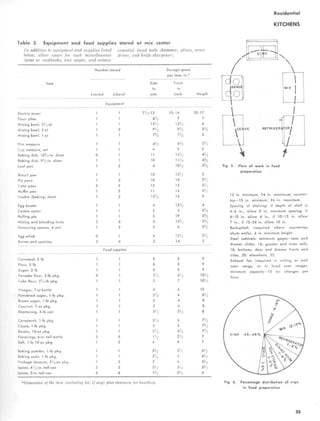
Tables 1-4 list the number of items and
the space dimensions required for equip-
ment and food supplies commonly stored
Fig . 4 Minimum clearances-horizontal and vertical .
Table 1 . Equipment and food supplies stored at range center
Number stored Storage space
per item, in .*
Item Side Front
to to
Limited Liberal side back Height
Equipment
Potato masher_ 1 1 _- 31!~ 13 4! _~
Knives, forks, spoons 3 3 3~'z 13 3
Frying pan, 10!y-in . 1 1 11 171j 5!
Frying pan, 9-in . 1 2 9!= 16 5
Frying pan, 6-in . 0 1 6 12 5
Pot lids 2 4 10;_' 101-'~ 1
Potholders 4 8 7 7 2f
Food supplies
Rice, 1-lb pkg ._
-
2
4
6 1,
Spaghetti, 1-Ib pkg . 1 1 21!, 11 ?': 6
Coffee, 1-Ib can 1 1 511
5L_, 4
Oatmeal, 3-Ib box 1 1 6 6 11
Macaroni, 1-Ib pkg . 1 1 2 5
Tea, 8-oz pkg . 1 1 21,(, 41,2 7
*l)itnensiun of Iltc item (iitrludiog lid, if aoy) plus rlcaranre for handling .
1Prorirh ,; fur -stack of 6 potholders .
Residential
KITCHENS
at each of the four centers. These lists
represent the storage space requirements
for the average family, but they may be
adapted to the needs of particular families .
The storage space dimensions are based
on the most recent information available.
KITCHEN ARRANGEMENT
The relative location of work centers
should permit a continuity of kitchen ac-
tivities as follows: (1) Storage (gathering
materials needed for the performance of
the task); (2) Cleaning and mixing (or
initial preparation) ; (3) Cooking; (4)
Serving, or storing for future use; and
(5) Cleaning up. (See Fig. 5.)
In principle, any plan that interrupts
this continuity with doors, or with non-
working areas or facilities, is faulty be-
cause extra steps are required every time
the gap is crossed, and, consequently,
convenience and working efficiency are re-
duced.
The actual plan may be U-shaped or
L-shaped, or it may be of the corridor
type .
The U arrangement affords the most
compact work area . Frequently, however,
this arrangement is impossible to achieve
because of the necessity of having a door
on one of the three walls. The resulting
Broken U arrangement still permits com-
pactness, but traffic is allowed through the
area. Therefore, special consideration
should be given to the arrangement of
the work centers in order to minimize the
effect of through traffic.
The L arrangement is ideally suited
where space along two walls is sufficient to
accommodate all of the necessary work
areas. This arrangement has the advan-
tage of concentrating the work area in
one corner, thus minimizing travel, but it
has the disadvantage of necessitating longer
trips to the extremities of the L.
The Corridor arrangement is satis-
factory where doors are necessary at each
end of the space. This arrangement fre-
quently has the advantage of the parallel
walls being closer together than in the
typical U, but the disadvantage of a
greater distance along the corridor .
An important factor in determining the
location of specific work areas within any
of these over-all arrangements is frequency
of use, which in Fig. 6 is expressed as the
percentage of trips to and from each area.
Figures 7-9 provide floor plans illus-
trating some possible arrangements of the
basic work centers within each of the plan
types. If the space for the kitchen is al-
ready established, the number of possible
satisfactory arrangements obviously will be
limited. If the space is being planned,
however, greater choice of arrangements less than 20 sq ft in either wall or base
is possible . In either event, the advantage cabinets .
of a shorter distance between some re- Total countertop area: 11 sq ft minimum.
lated areas must be balanced against the Total drawer area: 11 sq ft minimum. (If
resulting increase in distance between other a 39-in . range is provided, it may be
related areas. An end-to-end alignment or counted as 4 sq ft of base cabinet shelf
a right-angle arrangement between areas area and 2 sq ft of countertop area.)
of close relationship can eliminate trips Wall shelving : 74 in. maximum height .
and reduce the over-all travel distances. Countertop: 38 in. maximum height, 30 in.
Functional relationships between key work minimum height .
centers are, of course, accommodated more Height between wall cabinets and counter-
ideally in some of the plans than others . top: 24 in. minimum over range and sink,
15 in. minimum elsewhere. (Shelving may
FHA REQUIREMENTS FOR KITCHEN
be closer if it does not project beyond
STORAGE t
a line drawn from the front edge of the
Total shelf area: 50 sq ft minimum; not wall cabinet at an angle of 60 deg to
the bottom of the cabinet.)
IFroin11inimum'PropertyStandards for Depth of shelving : wall shelving-4 in.
One and Two Living Units, Federal Hous- minimum, 18 in. maximum; base shelving-
ing Administration, Washington, D.C. (Re-
vised, July 1959) .
Residential
KITCHENS
Fig. 5. Flow of work in food
preparation
12 in. minimum, 24 in. maximum; counter-
top-15 in. minimum, 24 in. maximum.
Spacing of shelving : if depth of shelf is
4-6 in., allow 5 in. minimum spacing, if
6-10 in. allow 6 in., if 10-15 in. allow
7 in., if 15-24 in . allow 10 in .
Backsplash (required where countertop
abuts walls) : 4 in. minimum height .
Steel cabinets : minimum gages-case and
drawer slides, 16; gussets and cross rails,
18; bottoms, door and drawer fronts and
sides, 20; elsewhere, 22.
Exhaust fan (required in ceiling or wall
near range, or in hood over range):
minimum capacity-15 air changes per
hour.
Fig. 6. Percentage distribution of trips
in food preparation
33
Residential
KITCHENS
BIBLIOGRAPHY
Bayer, Glenn H. The Cornell Kitchen!
Product Design Through Research . Cor-
nell University Agricultural Experiment
Station, Ithaca (1952).
Handbook of Kitchen Design. Small Homes
Council, University of Illinois, Urbana
(1950).
Heiner, Mary Koll, and McCullough, Helen
E. Functional Kitchen Storage. Bulletin
846, Cornell University Agricultural Ex-
periment Station, Ithaca (June 1948) .
Heiner, Mary Koll, and Steidl, Rose E.
Guides for Arrangement of Urban Fam-
ily Kitchens . Bulletin 878, Cornell Uni-
versity Agricultural Experiment Station,
Ithaca (1951) .
Minimum Property Standards for One and
Two Living Units. Federal Housing Ad-
ministration, Washington, D. C. (Re-
vised, July 1959).
Planning Guides for Southern Rural Homes.
Prepared by Southern Regional Housing
Research Technical Committee. Southern
Cooperative Series Bulletin 58, Georgia
Agricultural Experiment Station, Athens
(June 1958).
Roberts, Evelyn H., Wilson, Maud, and
Thayer, Ruth . Standards for Working-Sur-
face Heights and Other Space Units of
the Dwelling. State Bulletin 348, Oregon
Agricultural Experiment Station, Corvallis
(June 1937). Published also as Washing-
ton Agricultural Experiment Station Bul-
letin 345, Pullman.
Space Standards for Home Planners . West-
ern Cooperative Series Research Report
2, Western Region Agricultural Experi-
ment Stations (n.d.) . (Publication may be
obtained from Institute of Home Eco-
nomics, Agricultural Research Service,
U.S. Dept. of Agriculture, Washington,
D.C.)
Wilson, Maud . Considerations in Planning
Kitchen Cabinets . State Bulletin 445,
Oregon Agricultural Experiment Statioh,
Corvallis (November 1947).
---. A Guide for the Kitchen Planner.
State Bulletin 482, Oregon Agricultural
Experiment Station, Corvallis (September
1950).
Wood, Anna L., Ribelin, Shirley, and
Lange, Fay. Location and Counter Area
Requirements of a Mechanical Dish-
washer. Bulletin 526, Washington State
College, Pullman (1951).
34
Residential
KITCHENS
Fig . B Corridor plans. If a dishwasher is desired, it should be located
at the sink center .
35
Residential
KITCHENS
Fig . 9 Broken-U plans. If a dishwasher is desired, if should be Fig . 10 L-shaped plans. If a dishwasher is desired, if should
located of the sink center . be located of the sink confer .
36
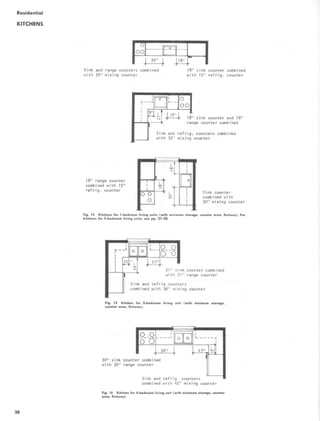
A work triangle is an efficient kitchen arrange-
ment (Fig . 11) . Figures 11-16 are from Manual
of Acceptable Practices, Vol . 4, U .S . Department
of Housing and Urban Development, 1973 .
Residential
KITCHENS
Fig . 11 Minimum distances from appliances to inside
corners of base cabinets.
Fig. 12 Typical cabinet dimen-
sions .
21 sink counter combined
with 36 mixing counter
Sink and range counters combined
with 36 mixing counter
21 range counter combined 21 sink counter combined
with 15 refrig counter with 15 refrig counter
Fig . 13 Kitchens for 2-bedroom living unit (with minimum storage, counter area,
fixtures) .
37
Residential
KITCHENS
38
Fig . 16 Kitchen for 4-bedroom living unit (with minimum storage, counter
area, fixtures) .
Sink and range counters combined
with 30 mixing counter
18 sink counter combined
with 15 refrig . counter
Sink counter
combined with
30 mixing counter
18 range counter
combined with 15
refrig . counter
Fig. 14 Kitchens for 1-bedroom living units (with minimum storage, counter area, fixtures). For
kitchens for 0-bedroom living units, see pp . 27-28 .
Fig . 15 Kitchen for 3-bedroom living unit (with minimum storage,
counter area, fixtures).
Residential
KITCHENS
39
Residential
KITCHENS
40
By GLENN H . BEYER AND ALEXANDER KIRA, Housing Research Center, Cornell University
(including material adapted from previously published article by Larch C . Renshaw in 3rd ed . of Time-Saver Standards)
Residential
LAUNDRY ROOMS
LAUNDRIES
Laundering includes a host of tasks-
collecting and sorting dirty clothes, pre-
treating, washing, drying, sprinkling and
ironing-all of which are tiring, for they
require a great deal of stooping, lifting,
and carrying . To reduce the amount of
effort required, a laundry center (either
separate or combined with another area)
should be carefully planned . Some basic
planning considerations are as follows :
Arrangement
The sequence of laundering operations
should determine the planning of space and
facilities and the placing of equipment .
Traffic lanes
With automatic equipment, many fam-
ilies now wash clothes three or four days
a week . Therefore, laundering should not
be done in any of the congested areas of
the house . Passageways should be at least
4 ft wide . If the laundry area adjoins the
kitchen, there should be a barrier of some
type, at least a counter, between the two
areas .
Equipment and facilities
To reduce the amount of effort required,
a laundry center should have a sorting
table, a heating surface (such as a hot
plate), and storage facilities for soiled
clothes, washing supplies, and baskets, as
well as a washing machine, dryer, and
ironing board ; some may also have ironers .
A laundry tray (usually a 14-in .-deep por-
celain enamel sink) is desirable for pre-
washing, soaking, or starching some items .
Space
The space should be dry, heated, and
well lighted, with sufficient electrical out-
lets, properly located . The space should be
ventilated to remove moisture and odors .
Accessibility
Laundry centers today con be more con-
veniently located because of the compact-
ness of automatic washers and dryers and
the elimination of much of the dampness
and disorder formerly associated with
household washing . Although many loca-
tions are possible (such as the kitchen,
bath, separate laundry room, or utility
room), the laundry center should be acces-
sible both to the work areas of the house
(since frequent trips to and from them may
be required during any of the laundering
processes) and to outdoor summer drying
areas.
FLOW OF WORK
Convenience and efficiency are achieved
by placing the equipment in their natural
order of use : (1) Clothes chute (with or
without bins or hampers), (2) Sorting and
pretreating table or counter, (3) Washing
machine, (4) Laundry tray (if available),
(5) Dryer, (6) Ironing board (and ironer, if
available), and (7) Standing or hanging
bar and counter for ironed items . In addi-
tion, a storage closet or cabinet is neces-
sary for cleaning supplies . In some in-
stances, a hot plate is also needed . Some
of these facilities and equipment are de-
scribed in more detail below .
Clothes chute : In two-story houses, the
chute is a handy device for delivering
clothes from upstairs . It should empty on
or near the sorting table so that the clothes
will not have to be carried or handled
more than necessary . It should be vertical,
because curved sections are likely to cause
clothes to clog the chute .
Sorting and prefreating table : Ample
space should be allowed on a table or
counter for sorting and dampening the
clothes, and for a clothes basket, as well
as space for the worker using the table .
The table size required will depend upon
the size of the average wash load . Research
at Pennsylvania State University indicates
that a table 6x2 1/2 ft is required for a
32-Ib, 4-load laundry . For pretreating, an
area 20x36 in . i s adequate for work and
equipment (pan, brush, soap, and kettle) .
Washing machine : Automatic washers
and dryers permit much more convenient
and compact arrangements than were pos-
sible with nonautomatic equipment . The
total floor area needed is determined by
the type of washer, the other equipment
needed, and the space for the worker . The
old-fashioned, galvanized tubs are not re-
quired with automatic equipment, but, as
indicated earlier, a laundry tray is desir-
able . To ensure that a laundry area is both
economical in use of space and convenient
to work in, the dimensions shown in Fig . 4
should be followed .
Drying : The research at Pennsylvania
State University revealed that 124 lin ft of
line is required to hang a 4-load laundry
of 32 lb .
The space requirements for different
styles of dryers, and for operating them,
are shown in Fig . 5 . The combination
washer-dryer or the stacked arrangement
of washer and dryer requires less floor
area than other arrangements . These di-
mensions are shown in Fig . 6 .
Since some garments must be hung to
drip-dry, a pull-out drying rod or- similar
arrangement should be provided, prefer-
ably above a laundry tray (or a floor
drain, if the laundry is in the basement) .
Ironing : An ironing board adjustable
from a height of 23 to 37 in . accommodates
most women when sitting or standing to
iron . The choice of either a built-in or a
freestanding board depends upon personal
preference . Freestanding boards should be
stored where they are readily accessible .
The space needed to use a hand iron at a
board is shown in Fig . 2 . The space needed
to use an ironer, with auxiliary equipment,
is shown in Fig . 3 .
The storage closet should be large
enough to accommodate soaps, spoons,
sieves, bleaches, bluing, stain remover,
starch, clothespins, and the like . If a
storage cupboard 9 in . i n depth is placed
over an automatic washer, it should be at
least 20 in . above the washer; and if 12
in . i n depth, it should be 24 in . above the
washer . This clearance allows for head
room when using the water faucets .
SPACE ARRANGEMENTS
Laundering may be done in a room de-
signed especially for this purpose, or in a
multiuse room, designed also for food
preparation, sewing, child play, and the
like .
The best location, of course, is convenient
to other work centers, such as the kitchen,
and to the drying yard so that there will
be a minimum of carrying necessary . Gen-
erally, basements are not considered de-
sirable locations because of their incon-
venience, dampness, and lack of adequate
light .
Figures 7-13 provide floor plans illus-
trating various arrangements of basic
work areas needed for the laundering
process . In some of the plans shown, the
space needed for laundering is treated as
a separate area ; in others, possible com-
binations with other areas are indicated .
EQUIPMENT
Figure 1 and Tables 1 and 2 provide
basic dimensions of a typical automatic
washer, dryer, combination washer-dryer,
and ironer . These dimensions may be
used for preliminary planning purposes,
but final selection of equipment and de-
tailing of working drawings should always
be based on specific manufacturer's data .
Dimensions have been drawn from the
current catalogs of leading manufacturers
of each type of equipment . Special and
nonresidential equipment are not included .
Dimensions are generally given only to the
nearest half inch since dimensions of new
models vary slightly from year to year .
Door swings, location of vents, and the
specific requirements for power, waste, and
water supply should be checked against
the manufacturer's data after units have
been tentatively selected .
41
Residential
LAUNDRY ROOMS
42
Source (riy. 2 and J): CCile P. Sinden mid Kathleen
A . Johu4oi, Space for Home Laundering, B«lletin
65b', Peo,isylvania Stale l'txiversily Agricullnral
E'xpcriwnt Stalimz, University Park (July 1,95 .9) .
Fig. 2 . Space requirements for ironing board
Fig . l . Dimensions of household laundry equipment
Fig. 3. Space requirements for ironer
Residential
LAUNDRY ROOMS
Fig . 6 . Space requirements for combination washer-dryer
Worker's clearance (Fig. ,t, 5, anal 6) can overlap to either left or right of
machinea. Source (Fig. y, 5, and 6) : Cecile P. Sinden and Kathleen. A.
Johnstoo, Space for Home Laundering, Bulletin 658, Pennsylvania State
University Agricultural Experiment Station, University Park (July 1959) .
43
Fig . 5 . Space requirements for two types of automatic dryers
Fig . 4 . Space requirements for two types of automatic washers
Residential
LAUNDRY ROOMS
Key
1 . Storage closet
2. Laundry chute (ventilated)
3. Sorting shelf (ventilated bins below)
4. Laundry tray with mixing faucet and
cover
5. Washer
6. Dryer (should be ventilated)
7. Ironer
8. Ironing board
Fig . 7 . Kitchen-laundry plans
44
Residential
LAUNDRY ROOMS
45
Fig. 8. Separate laundry rooms
Residential
LAUNDRY ROOMS
46
Key
1 . Storage closet
2. Laundry chute
3. Sorting shelf
4. Laundry tray
5. Washer
6. Dryer
7. Ironer
8. Ironing board
9. Electric plate
10. Home freezer
Fig. 9. Separate laundry rooms
Residential
LAUNDRY ROOMS
Key
1 . Storage closet
2. Laundry chute
3. Sorting shelf
4. Laundry troy
5. Washer
b. Dryer
7. Ironer
B. Ironing board
9. Electric plate
Note: Home freezer
may be substituted for
ironer
47
Fig. 10. Combination laundry-sewing room with storage area
Fig. 11 . Combination laundry-sewing room
Fig, 12. Combination laundry-breakfast room Fig. 13. Combination laundry-playroom
Residential
BATHROOMS
48
By GLENN H . BEYER AND ALEXANDER KIRA, Housing Research Center, Cornell University
BATHROOMS
Activities commonly performed in the
bathroom include washing of hands, face,
and hair, bathing, elimination, and groom-
ing, and also such activities as hand laun-
dering and infant care . Often it is also
used as a dressing room . Major problems
in bathroom design include planning for
optimum convenience and privacy of all
bathroom functions for all members of the
household, adequate provision for storage
of supplies and equipment, and ease of
cleaning .
Some general planning guides are as
follows ,
Arrangement
Facilities should be conveniently ar-
ranged, with special attention given to
clearances . The room arrangement should
1 1lanp a( these snggestiuns are by rottr-
te.slt of the Atneriran Radiator and Standard
Sanitary Corporation .
permit more than one family member to use
its facilities at the same time (Fig . 8) .
Illumination
Lighting should be adequate for all of
the activities performed . For grooming,
direct sources of light are essential in or-
der to illuminate the face from all angles .
High strip windows, clerestory windows, and
skylights provide excellent over-all illumi-
nation in the daytime, while still affording
privacy . Luminous ceilings are also effec-
tive, particularly in interior bathrooms .
Ventilation
Good ventilation is essential in bath-
rooms, both to reduce humidity and to
dispel odors . If a window is relied upon
as the sole means of ventilation, care
should be taken in its selection and place-
ment to minimize drafts and to permit
easy access . Exhaust fans in the wall or
ceiling are often used to supplement nat-
ural ventilation . In interior bathroom
spaces, a mechanical exhaust is, of course,
essential .
Sound control
Lack of acoustical privacy is one of the
most common complaints with regard to
bathrooms . Noise can be reduced by
proper placement of the bathroom in re-
lation to other spaces, by the use of
closets and storage walls as sound barriers
between it and adjacent spaces, as well as
by the use of soundproof partitions and
tightly fitted doors . Acoustical treatment
of the ceiling makes the room more com-
fortable to use and reduces somewhat the
amount of sound transmitted through the
walls. Acoustical tiles for use in the bath-
room should be moisture resistant and
easily cleaned .
Auxiliary heat
A heat lamp or a radiant wall panel
can be used to provide quick warmth in
the bathroom .
Materials
It is essential that all surface materials
used in the bathroom have moisture-re-
sistant finishes .
Storage
Adequate storage should be provided for
current and reserve supplies . Articles in
current use should be located near their
place of first use . A closet opening from
the bathroom and hallway or laundry is
convenient for such items as bathroom linen
and cleaning supplies . Medicine cabinets
should be as large as possible since in-
creasing numbers of toiletries and medi-
cines are being used by American families .
Hamper space is desirable for soiled linen
and clothes . Install a cabinet with a self-
contained hamper, or, in two-story houses,
install a chute from the second floor to the
laundry . The minimum requirements for
storage of bathroom linens, based on re-
cent research, are shown in Table 3 .
Increased countertop space
Larger lavatories and increased counter-
top surfaces provide excellent facilities for
light laundry, hair washing, and bathing
and dressing the baby .
Children's convenience
Children's height should be considered
in the placement of accessory equipment .
A dental lavatory can double as a child's
lavatory . If a combination lavatory-dressing
table is installed, a step-up retractable
stool should be provided for children's use .
Mirrors
An atmosphere of luxury and spacious-
ness is created by mirrors . A full-length
mirror is always desirable . Also recom-
mended is a medicine cabinet with a
three-way combination of mirrored doors
on either side and a mirror in the center .
Safety features
Grab bars should be used vertically fc
bathtub and shower and should be located
for convenient use . They should be of ade-
quate size and securely fastened to sturdy
backing or studs. Use nonskid finishes for
flooring . Install a door lock that opens
automatically from the inside, and from the
outside in case of emergency . Locate light
switches out of reach of the bathtub or
shower-preferably just outside the bath-
room . Electric or radiant heaters should be
recessed or protected . Provide a lock for
medicine compartments .
Drying facilities and accessories
Add extra racks for drying women's
hose and other light laundry . Racks may
be concealed in well-ventilated cabinets,
which, if desired, may include a receptacle
for a low-wattage light bulb to facilitate
drying . Sufficient robe hooks, bag hooks,
Residential
BATHROOMS
49
Residential
BATHROOMS
50
Recent research has provided some rec-
ommendations for the space required
around the three basic fixtures : lavatory,
toilet, and bathtub and shower . The basic
clearances are given in Tables 1 and 2 and
Figs . 1-3 .
Miscellaneous activities
In planning the bathroom, the designer
should remember that families with infants
usually prefer to bathe them in the bath-
room . The lack of adequate space has, in
the past, caused many families to use the
kitchen, which obviously is less appropriate
for this activity than the bath . The mini-
mum space needed to bathe and dress an
infant is 1 ft b?._, in . deep by 4 ft 11 in .
wide by 3 ft high .
In addition, other important activities are
often performed in the bathroom . Most
women, at least occasionally, launder small
items in the bathroom, and provision for
this should be made . Many adults, and
children, like to use the bathroom for
dressing . Since this requires a considerable
amount of space, it should be provided
only when requested .
ARRANGEMENT
Bathrooms can be classified into four
categories : (1) The conventional three-
fixture bath ; (2) The larger, compartmented
bath; (3) The lavatory or guest bath ;
and (4) The utility both .
Three-fixture both : The conventional
three-fixture bath without separate com-
partments has traditionally been designed
for the occupancy and use of one indi-
vidual at a time. This type of bath, with
combination tub-shower, averages about
40 sq ft of floor space (Fig. 5).
Compartmented both : To avoid the ex .
cessive humidity common in the usual three-
fixture bath, tub and shower may be
located in a separate compartment, with
or without on additional lavatory . This
plan also affords greater privacy for use
of the toilet. Separate doors, possibly with
a small entry, are desirable . Connecting
doors between compartments are also pos-
sible but are not recommended as the
only means of access (Figs . b and 7) .
Another variation is to make the toilet a
separate compartment, affording complete
privacy . In even the minimum-sized both of
this type there is generally room for an
additional lavatory, and the bath proper
is often enlarged into a combination both-
dressing room . Dressing tables may be a
combination of lavatory and table or in-
dividual fixtures . In the latter case, tables
should be sufficiently far from lavatories to
prevent damage from splashing water .
A still greater expansion of this plan
provides a separate dressing room and
connecting bath, with a compartment for
the toilet . The required floor space ranges
from 110 to 140 sq ft .
In all plans for baths, showers should
be included, either as stalls or over tubs .
Guest both : The lavatory, or two-fixture
guest bath, for living portions of resi-
dences may vary in size and appointments
from a minimum area of about 14 sq ft to
rooms of 22 to 25 sq ft or larger when a
dressing table is included (Fig . 4) .
Utility bath : The utility bath provides
an area larger than the minimum size
required for the three basic fixtures, for
other functions, such as laundering .
DOORS AND WINDOWS
Bathroom doors can be as small as 2 ft
wide, except for utility bathrooms, for
which doors should be not less than 2 ft
4 in . wide to permit passage of equipment
as required . In general, bathrooms should
contain only one door .
Door swings should be arranged so that :
(1) The door cannot strike any person
using any fixture ; (2) The door will shield
or conceal the toilet; and (3) The door may
be left fully open for ventilation in warm
weather .
Customarily, doors swing into the bath-
room . If hall areas are sufficiently large,
doors to small bathrooms can sometimes
be designed to swing out . In-swinging doors
should be set to clear towel-bars or radi-
ators . Sliding doors are frequently desir.
able, as space savers, between various
compartments within the bathroom .
The shape and position of bathroom
windows is important from the standpoint
of light, ventilation, and privacy . Gen-
erally, the higher the window, the better .
Preferred locations include : clear wall space
reserved for portable equipment, space
At lavatory
A . Mirror and medicine cabinet . Size is
governed by use of shelf or shelf-topped
lavatory ; mirror should swing 7 in . over
any shelf . (A .1) Fixed mirror is desirable
immediately above lavatory for children
7 to 14 years .
B . Shelf . Preferably recessed flush with
wall. May be part of medicine cabinet
or part of lavatory .
C, D, and E . Soap, toothbrush, and tum-
bler holders . May be separate units or
combined ; flush or projecting type .
F . Receptacle for electric razor and hair
dryer . Should be above and to right of
lavatory; dead front type .
G . Razor blade disposal slot .
H . Towel bars . May be at level of shelf or
lavatory top . In congested space pro-
vide upper bar for face cloths, lower
bar for towels.
Residential
BATHROOMS
5 1
Fia. 7 Dimensions at lavatory, bathtub, and shower .
Fig . 3 Bathroom accessories . The accessories shown are typical .
Many other types and styles are available.
Residential
BATHROOMS
52
At shower
A . Shower head . Height is governed by
client's preferences ; may be overhead
for men only .
B . Shower valves or mixing valves . Always
place near entrance to shower .
C . Shower curtain rod . (C .1) Optional ;
glass shower enclosure door ; place
hinges on edge opposite shower control
valves.
D . Combination soap and sponge holder
and grab bar . Use draining-lip type .
May be on rear wall or on side wall
opposite shower head .
E . Shower ventilator . Desirable to remove
steam ; may function as vent for bath-
room .
F . Shower stall light . Optional ; must be
vapor-proof fixture .
At bathtub
A, B, and C . Shower head, shower controls,
bath valves and spout . Location is op-
tional with client but must be accessible
from outside of tub . See shower stall for
recommended heights .
D . Combination soap and sponge holder
and grab bar . Draining-lip type pre-
ferred .
E . Vertical grab bars . Optional but rec-
ommended .
F . Towel bar . Do not use over tub
equipped with shower .
G . Curtain rod . Keep within inside face of
tub . (G.l) Alternate ; glass shower en-
closure in place of curtain . Various
types, with and without doors, are avail .
able .
Fig . 3 (cont.) .
Not illustrated
Full-length mirror . Usually on
door .
Bathroom scale . May be built-in
or portable .
Linen hamper . Optional ; may be
part of cabinet-type lavatory,
built-in or portable .
Auxiliary heater . Built-in radi-
ant type desirable ; should
radiate toward open floor
space .
Residential
BATHROOMS
53
Fig. 4. Two-fixture plans
Residential
BATHROOMS
54
Fig . 5 . Three-fixture plans
Residential
BATHROOMS
55
Fig. 6. Compartmented plans
Residential
BATHROOMS
over a dressing table, and space above or
on either side of the lavatory . Windows
should not be placed over the bathtub
unless they are of the casement or awning
type opened by a crank . A window behind
the toilet is seldom desirable . Skylights
may be used to serve top-floor bathrooms
if they are large enough to provide ade-
quate light and ventilation . Inside bath-
rooms without exterior windows are some-
times used but require a dependable sys-
tem of exhaust ventilation by natural or
mechanical means, and greater artificial
lighting in lieu of natural light .
ACCESSORIES
The medicine cabinet should be related
in size to the type of bathroom or toilet .
For guest baths or toilets, space is needed
only for dentifrices, shaving accessories,
toilet preparations, and a few simple rem-
edies . A bath serving several bedrooms
may require a complete supply of medicines
in addition to the items mentioned above .
Every bathroom should have a storage
closet for cleaning utensils and supplies
and for reserve stocks of toilet paper,
towels, and sundries .
Floor space should be left in every bath-
room for portable accessories desired by
the owner or needed on occasion for the
care of infants or invalids . Also consider
allowing space for such items as scales,
stool or seat, infant's bath and dressing
table (portable type requires about 3 by
4 ft of floor space in use), soiled-linen
hamper, exercise devices, dressing table
or vanity with bench, and ultra-violet
radiation equipment .
Towel bars should be ample in number
and length to serve the need : of ea_h quote wall space for essential accessories
member of the family regularly using the (Table 4) .
bathroom, or of guests likely to use its
facilities, before supplies can be replen-
ished . For each person regularly using the
bathroom, thera should be separate bar
space for bath towel, face towel, and face
cloth, as well as an additional rack for
guest towels .
Linen storage may consist of towel cabi-
nets recessed in the thickness of plumbing
walls (either over fixtures or as full height
cabinets) or may be expanded into com-
plete linen closets. Dressing-rcom baths may
include completely fitted wardrobes . (See
Table 3 .)
Minimum-sized bathrooms and toilets
require special planning to ensure ade-
5 6
Residential
BATHROOMS
Fig . 8 Bathroom arrangements . Source: Planning Bathrooms for Today's Homes, Home and Garden
Bulletin No . 99, U .S. Department of Agriculture, Washington, D .C ., 1967 . S%
Residential
CLOSETS
By GLENN H. BEYER, and ALEXANDER KIRA, Housing Research Center, Cornell University
Drawings by LARCH RENSHAW, AIA
STORAGE
A place for everything and everything
in its place is the slogan for closet de-
signers as well as housewives. Modern
closets should be planned for the storage
of the particular clothing or objects of the
individual or the group using the space.
An accurate list of the objects to be stored
is necessary for the scientific allotment and
arrangement of space and facilities. A
margin of safety of some 25 per cent
increased capacity should be allowed for
the usual accumulation of additional be-
longings . It is better to have too much
space than not enough . Much can be stored
in little space if sufficient thought is given
to the arrangement of the space and the
equipment. Too many closets have unused
and unusable space due to poor planning.
Good closet design requires planning, ar-
rangement, and fixtures contributing to:
1. Convenience
a. Ease of access
b. Maximum visibility
c. Orderliness
d. Maximum accessibility
e. Maximum of used space
2. Preservation
a. Of pressed condition
b. Of freshness (ventilation)
c. From moths
d. From dust
e. From pilfering
The above are not all simultaneously ob-
tainable, and some are mutually exclusive;
for instance, eliminating doors gives maxi-
mum availability but minimum security from
dust, moths, and pilfering; adhering to
the principle of maximum accessibility
would result in unused space at top and
bottom of closet .
Modern closets, by the efficient arrange-
ment of space and fixtures, accommodate
much more clothing and material than the
inconvenient, space-wasting closets of a
few decades ago. The modern closet often
replaces pieces of furniture and thus pro-
vides a greater amount of free, uncluttered
space in the room.
Doors should open the full width of the
closet whenever possible . In most cases the
most efficient and economical doors are the
usual hinged type . Two doors for a 5-ft
closet will eliminate dark, inaccessible,
hard-to-clean corners. Hooks, racks, and ac-
cessories on the backs of swinging doors
increase efficiency by using otherwise un-
occupied space in the closet .
Alternate closet closing methods may in-
volve more complicated or more expensive
construction, though they may obviate the
objection that swinging doors form an ob-
struction in the room. Sliding doors can
expose the entire interior of the closet to
view and make it immediately accessible .
Such doors do not block traffic. Sliding
doors, however, do not permit the use of
special door fixtures such as tie racks, shoe
racks or bags, hat hangers, or mirrors,
which are handy and easily reached when
attached to a hinged closet door. Banks of
wardrobe-type closets with sliding doors
are becoming more and more popular.
Fitted with drawers or trays, they take the
place of bureaus, chests, and chiffoniers
and make far more spacious, uncluttered
rooms.
Doors which expose the full width of the
closet are preferable for both visibility and
accessibility. Walk-in or walk-through
closets naturally use more area than others
with no circulation . In some rooms, how-
ever, a single door to a large walk-in
closet may be justified by the need for
maximum wall space for furniture.
Some of the various closing methods are
shown in Fig. 1 .
Lighting is considered essential and
standard in the modern closet unless room
lights are located to illuminate fully all
portions of the closet. A single tubular or
bulb light with a diffusing reflector placed
just above the door inside the front of the
closet is usually sufficient. Automatic door
switches are convenient .
Ventilation is often desirable, particu-
larly in hall closets where damp outer gar-
ments or work clothes might be stored . It
can be accomplished readily by providing
louvers in the closet door or by using
louver doors.
Types of closets
Closets are required for various pur-
poses, in different parts of the house. Some
have already been mentioned in other sec-
tions of this volume : kitchen supplies ; din-
nerware, glassware, and table linens (dis-
cussed under Kitchens); and bathroom
supplies (discussed under Bathrooms) .
Closets must also be provided for the stor-
age of clothing, bedding, cleaning equip-
ment, books, magazines, and phonograph
records, toys and other children's and adults'
recreation equipment, and certain items such
as luggage that are used only seasonally or
infrequently. The discussion here relates only
to active storage space.
Clothes closet. For clothes closets in bed-
rooms or dressing rooms, 2 ft is standard
depth (2 ft 6 in. if a hook strip is to be
used). (See Fig. 2.) This permits clothing to
be on hangers on poles, with sufficient clear-
ance. Clothing lengths are shown in Fig. 3.
Clothes closet width, parallel to the doors,
should be from 3 to 6 ft per person, de-
pending on amounts of clothing and
58
Fig. 2. Closet depth and hanger sixes
Fig. 1. Closet closing methods
Residential
CLOSETS
whether drawers or trays are to be pro-
vided in the closet or wardrobe for such
items as have in the past been kept in
bureaus or other pieces of furniture . Some
typical closet plans are illustrated in Fig .
4; suggested layouts for bedroom closets
for men, women, and children are shown
in Figs . 5-9.
Coat closets, located near the entrance
doors, are sometimes made 2 or 3 in .
deeper than bedroom closets, to allow for
the bulkiness of some overcoats, and to
permit better air circulation around the
garments which are often damp when hung
in the closet . Several designs for coat
closets are shown in Figs . 10 and 14 .
Closet for cleaning equipment : The di-
mensions of the storage space needed for
cleaning equipment will depend in large
part upon the type of vacuum cleaner
used ; horizontal, upright, or canister ; rec-
ommended dimensions for each type are
shown in Fig . 11 . Since families may
change from one type of vacuum cleaner
to another, the cleaning closet should be
made large enough for any type . The
closet should be located as near the center
of the house as possible, and should be
provided with a convenience receptacle so
that the vacuum cleaner can be left con-
nected and can reach most areas of the
house . A suggested design for a cleaning
equipment closet is shown in Fig . 12 .
Storage for bedroom linens and bedding :
Limited and liberal lists of articles of bed-
ding that require storage, and the mini-
mum dimensions of the space required, are
shown in Table 1 .
FHAI requirements for linen closets are the floor ; minimum total shelf area for one-
as follows : minimum interior dimensions, 18 and two-bedroom house, 9 sq ft, for three-
in . wide by 14 in . deep (24 in . maximum) ; and four-bedroom house, 12 sq ft; drawers
shelves spaced approximately 12 in . on may replace 50 per cent of the shelves .
center vertically ; highest shelf, 74 in . above These are minimum dimensions, and about
twice this amount is recommended, espe
Minimum P
cially if both bedroom and bathroom linen
Property Standards for
One and Two Living Units, Federal
are to be stored . A suggested layout for
Housing Administration, Washington, such a combined linen closet is shown in
D .C., revised July, 1959. Fig . 12 .
59
Fig . 4 . Typical closet plans
Residential
CLOSETS
60
A minimum size closet of a usual type.
Shoes can be stored on the raised shelf-
rack and three additional pair on the floor
in front of the rack. Door could be ar-
ranged for hats as shown below, Heaving
shelf for other storage.
Minimal closet arranged to make shoes
more visible and reachable. There is space
for hats without crushing or for night
clothes hooks if hats are normally stored
in a hall closet. Neckties might be in two
tiers.
An alternate to the scheme above giving A four-foot closet with seven drawers for
maximum view of shoes and an additional shirts, socks, underwear, etc., and a verti-
shelf. Trousers would have to be folded cal tier of shoe racks (as above) . Night
over the crossbar of the suit hanger rather clothes and bathrobe hooks are best on the
than being hung separately from the pole right band door, necktie racks flat against
with trouser-hangers. the Heft hand door.
Fig . 5 . Bedroom closets for men
Residential
CLOSETS
61
Another four-foot closet with ten standard A solution to the shallow closet problem.
drawers conveniently arranged. Shoes are A pull-out rod takes care of the suit, coat
placed tandem above the drawers for visi- and trouser hanging. Five drawers take
bility and reachability. Poles are one above the place of a small bureau or chest. Shoes
the other, requiring reaching. are at no stoop, no squat, no squint levels.
Wide wardrobe closets of more luxurious A deep walk-in closet. High tiers of shoe
size planned as part of walls separating racks flank the door jambs. Shelves for
two rooms. Four doors, sliding or swing- Hive and dead storage on three sides, upper
ing, can be used. Lower portion of shoe- levels. Suit poles range the back wall. Ties
tiers could be replaced with mothproof are on the left wall, night clothes hooks on
dead-storage drawers. right wall.
Fig . 6 . Bedroom closets for men
Residential
CLOSETS
62
A small closet with shoe racks at the side
under short hanging garments. Additional
shoe pockets might be placed on the door
under the hanging shelves. These handy
shelves fold into the space in front of the
hat and storage shelves.
An alternate minimum closet arrangment
with a high pole for Hong dresses. Two
drawers below the shorter hanging gar-
ments. Depth of closet permits a door type
shoe rack and a hat rack. Wide bats can
go on upper shelf.
Alternate to closet above. It provides a
high pole for banging evening dresses and
a lower pole for other dresses and suits. A
large hat shelf is provided above the low
pole as well as a hat rack and shoe pockets
on the door.
Fig . 7 . Bedroom closets for women
A four-foot closet combining hanging and
shelf space with drawers for stockings, un-
derthings, and what-not. Shoes are easily
seen and chosen from the almost eye-level
cleat rack above the drawers. Hat storage
on the shelves.
Another four-foot closet with a short canti-
lever pole at the left allowing two-decker
hanging. Closet drawer space would natur-
ally be supplemented by a bureau or other
furniture. A shoe rack on the door would
increase capacity.
The shallow closet problem solved by the
use of a pull-out rod firmly anchored to the
back wall . Drawers again at lower right
with cleated shoe shelves above, and hat
shelves above them. Drawers may have to
be shorter than standard.
Large double wardrobe type closet, almost A walk-in closet, shoe racks and shallow
half devoted to hanging space. Left half shelves at one side drawers and hanging
fitted with large and small drawers and pole at the other. Drawers next to door
wide shelf-counter with mirror above. Slid- are convenient but hazardous if Heft open.
ing doors may be preferred and center par- They could be placed at the back with
tition minimized. hanging space near door.
Fig . 8 . Bedroom closets for women
Residential
CLOSETS
63
Residential
CLOSETS
Closet for infants up to about 5 years old,
LOW hanging pole shelves and drawers per-
mit habits of care and orderliness to be de-
veloped at an early age. tipper part would
be used by adults. Note two sets of doors,
Small closet designed for a child of from 6
to 10 years. Pole at higher but easily
reached level. Drawers and shoe racks at
convenient heights. Ample shelf room pro-
vided above for the storage of possessions.
Alternate, and larger, closet for an infant
up to 5 years of age. Trays or drawers for
folded garments at an upper level for adult
use. Hanging space, drawers and shelt
available to child using the lower doors.
Fig . 9 . Bedroom closets for children
Closet for youngster up to 10 years old,
providing greater length of hanging pole
and different shoe arrangement, trays in-
stead of cleat racks. A large shelf for hats,
toys . or collections available to child .
64
Residential
CLOSETS
65
THREE-COMPARTMENT HALL CLOSET FOR
HALL CLOSET SMALL CHILDREN
Fig. 10 . Coat clossfs
Residential
CLOSETS
66
Miscellaneous storage
A large variety of other articles that are
in regular use must be stored somewhere.
Included in this category are books, maga-
zines, phonograph records, card tables and
chairs, games, movie and slide projectors,
screens and film, toys, sports equipment,
and tools. If adequate and conveniently
located built-in storage is not provided,
then portable units (furniture) will have to
be used for this purpose.
Book storage is usually required in the
living room, study, and each bedroom. Most
books (85 per cent) can fit comfortably on
shelves 8 in. deep (front to back); some
books (10 per cent) need 10-in. shelves,
and a few (5 per cent) require 12-in .
shelves. Vertical spacing between shelves
varies from 8 to 16 in., with the greatest
use in the 10 to 12-in. range. Horizontally,
books average 7 to 8 volumes per linear
foot of shelf.
Phonograph records (12 in.) in albums
require shelves with a clear height of 14
in. and a depth of 15 in. (14 in. for long-
playing records in cardboard folders) .
Card tables are usually 30 in. square
but may be as large as 36 in., and are
2 to 3 in. thick when folded . Folded chairs
vary widely in dimension, but a fair
average is 30 by 16 by 3 in. Space should
also be provided for cards, score cards,
rule books, poker chips, chess, etc. (see
Fig . 13).
Toy and game storage should be pro-
vided in children's bedrooms and wherever
the toys are regularly used. Toy storage
should be designed for future conversion
to other use.
Sports equipment, especially golf bags,
skis, and camping equipment, may present
a serious storage problem. For some fami-
lies, a separate closet for this purpose may
be justified; a suggested design is shown
in Fig. 13. Such a closet should be located
near the outside entrance which is most
used by the family .
Tools and associated items should, of
course, be stored in the workshop, which
every house must have. Paints, because of
odor and fire hazard, are best stored out-
side the house.
General storage is required for bulky,
seldom-used items, such as trunks, boxes,
and extra furniture.
Outdoor storage (i .e., directly accessible
from outdoors) is required for lawnmowers,
wheelbarrows, sprays, rakes, and other
garden tools and equipment; for snow
shovels and sleds, ladders, screens, and
storm windows; for outdoor furniture, bar-
becues, hammocks, croquet sets ; for bi-
cycles, tricycles, scooters, and perambula-
tors (see Fig. 14).
These last two types of storage (general
and outdoor) were provided in the tradi-
tional house by the basement, attic, and
garage . Modern houses may have none of
these spaces, and, in such cases, the archi-
tect should take particular care to provide
adequate general and outdoor storage
space. FHA minimum requirements are 200
cu ft plus 75 cu ft per bedroom, of which
at least 25 per cent and not more than 50
per cent should be indoors. Again, it
should be emphasized that this is a mini-
mum requirement; more is recommended.
Basic elements
The standard elements of closet storage
are shelves, drawers, poles, hooks, and
special fixtures . Practically any object can
be stored efficiently by one or another of
these means. The choice and arrangement
of the fixtures depend on the amount and
nature of the materials to be stored .
Shelves: Shelves are simple and inex-
pensive to install, require a minimum of
effort to use, and are adaptable to the
storage of many types of things, espe-
cially those of odd or bulky shape, folded
articles, and, of course, books, magazines,
etc. However, if open, they are exposed to
dust . Also small objects become hidden be-
hind one another if the shelves are deep.
A 12-in. shelf is usually adequate for most
things . Articles of larger dimensions or
greater depth should have their special
places ; linens, for instance, are frequently
folded for a 16-in. shelf.
Drawers! Drawers are growing in popular-
ity in closet design because they accommo-
date numerous articles with a minimum of
space and a maximum of convenience. They
provide practically dust-free storage and
present a neat appearance even when
carelessly used . Drawers of different widths
and depths make possible classified filing
of different items, thus providing a great
saving in time and an incentive to orderli-
ness . A cabinet made up of a battery of
standard drawers, selected for the storage
of the known possessions of the user, can
easily be made from a comprehensive list,
with allowance made for the accumulation
of additional items.
Drawer construction is cabinetwork re-
quiring both skillful craftsmanship and the
best materials. They must operate freely
under all seasonal and climatic conditions .
A recent logical outcome of this situation
has been the development of molded plas-
tic drawers in a variety of stock sizes.
Fronts of various materials can be at-
tached . All that is required of the builder
is the construction of the supporting en-
closure.
Poles. Hanging pole length can be esti-
mated roughly at 3 in. per hanger for men's
suits (4 in . for heavy coats) and 2 in. per
hanger for women's clothing . Height of
pole above floor should average 64 in.,
but should be adjusted to the individual .
Clearance between pole and shelf above
should be 3 in. Hardwood poles 1 in. in
diameter should have intermediate sup-
ports if over 4 ft in length . Consult manu-
facturers for special-purpose hanging rods,
extension poles, brackets, etc.
Hooks : A variety of hooks is available.
Special features ; Such special features as
shoe and hat racks and miscellaneous racks
are on the market and greatly increase
convenience in storage.
=,g 12. Miscellaneous Storage
67
Residential
CLOSETS
68
Fig . 13 . Miscellaneous closets
Residential
CLOSETS
69
Fig. 14. Miscellaneous closets
Residential
APARTMENTS
By J . L . GRUZEN and J . J . KOSTER, Gruzen and Partners
INTRODUCTION
At the time of this writing, It is anticipated that
within the next 1 5 years in the United States it
will be necessary to construct as many new
housing units as have been constructed to date .
This need for new housing, considered
against a background of continuing urbaniza-
tion, clearly indicates that an increasing pro-
portion of an expanding housing market will
be devoted to multifamily types of housing or
apartments . The inevitability of this trend
contains a challenge to the architect to do
more then merely meet a statistical demand . He
must rather address, identify, and solve the
problems of multifamily building types as an
attractive alternative to freestanding single-
family buildings .
This article will deal with multifamily living
in general, with some additional attention to
the problems of the medium- and high-rise
building type (i .e . building types which require
a degree of vertical servicing) .
GENERAL
The process of designing an apartment building
may be graphically depicted in a general way
as in Table 1 . This article will be developed
in the same sequence as Table 1 . It must be
borne in mind that, as with any design develop-
ment, the evolution of an apartment building
design is not a sequential process but a pro-
cess of continuing interaction, feedback, and
reevaluation, and that the number and com-
plexity of events will vary according to the
program, scope, and funding sources involved .
The sequences shown are labeled as program
development, site analysis, building planning,
and building design .
Program development is for the most pert
evaluation of information over which the archi-
tect has relatively little control but which shapes
the project in a basic way .
Site analysis involves evaluation of physical
data which must be recognized, identified, and
weighed by the architect in making basic de-
sign decisions dealing with site use, allocation,
and development .
PROGRAM
Market Analysis
A market analysis and program formulation
may precede the retention of an architect ;
however, to an increasing degree clients solicit
the aid of an architect in these areas . An inves-
tigation of the potential market should consider
existing market conditions and trends with
regard to
1 . Type of occupancy
a . Rental
b . Cooperative
c. Condominium
2 . Price (rent, maintenance, etc .)
3 . Amenities
4 . Apartment size (area and number of
rooms)
70
Residential
APARTMENTS
5 . Building types
6 . Vacancy rates
7 . Public facilities (transportation, schools,
shopping, recreation)
Program items to be resolved include
Price range . What segment of the market
is the project to be aimed at?
Amenities . Identified in Table 2 as support
facilities and closely interrelated with price
range .
Scope . How many units?
Distribution . Percentage of each type of unit .
Building type or types .
1 AND 2 STORY ROW OR
10-20 DU/ACRE
CLUSTER HOUSING
4 AND 5 STORY WALK-UP GARDEN
30-40 DU/ACRE
Fig. 1 Comparative densities.
%SSK:ii%
APARTMENT DEVELOPMENT
7p-110 DU/ACRE
COMBINED HI- AND LOW-RISE ESTATE
HOUSING WITH ISOLATED MED-RISE 150-175 DU/ACRE
TYPICAL URBAN DENSITY FOR COM-
BINED HI- AND LOW-RISE DEVELOPMENT 200 DU/ACRE
TYPICAL HIGH URBAN DENSITY
HI-RISE DEVELOPMENT 425 DU/ACRE
NEW YORK CITY THEORETICAL MAX .
Funding
in many cases a market analysis will conclude
that conventional private financing is not
economically feasible and that some type of
public or semipublic assistance is required
if a project is to proceed .
There are a number of sources of such assis-
tance at both federal and state levels . The FHA
(Federal Housing Administration) and PHA
(Public Housing Administration) are well-
known examples of such agencies . As a rule,
an agency which provides assistance also
requires conformance to agency standards,
and frequently such an agency will require
approval of or participation in program devel-
opment .
While the client, local authorities, and
funding sources will usually institute basic
program direction, it nevertheless remains the
responsibility of the architect to catalyze these
decisions and formulate the finished program .
Density
Figure t compares relative densities of various
urban and suburban situations . It is helpful
to have a feel for the physical reality of den-
sity figures as an aid in visualizing possible
solutions and to anticipate implications of
decisions which are made during program
formulation .
ZONING AND CODES
General
Zoning and building codes are of basic im-
portance to any project ; and of all types of
projects, those which involve housing tend
to be regulated to a greater degree by zoning
ordinances and codes .
Appropriate local and regional authorities
should be contacted in order to determine the
type and extent of limitations or controls which
may be imposed on a project and, further, to
gauge the discretionary powers and flexibility
of the governing authorities. To an increasing
degree, the philosophy of zoning is changing
from one of restrictive limits and controls to
an approach which attempts to lead and in-
fluence community growth . Many communities
and regional authorities have guiding master
plans which deal with long-range development
and evaluation . The conceptual and planning
freedom of the architect is linked with these
considerations .
Failure to pursue a thorough investigation
of these controls can result in serious prob-
lems later on in project development .
Controls
Zoning is concerned principally with questions
of use, bulk, density, and location .
Use, bulk, and density are usually controlled
Fig. 2 Zoning map example.
Fig. 3 Setback diagrams.
71
Residential
APARTMENTS
Bulk is frequently controlled by floor-area
ratio, which limits total buildable floor area
as a multiple of the site area . In contemporary
zoning regulations, floor-area ratio for apart-
ment buildings will range from a low of 1 or
less to a high in the range of 14 to 16 in dense
metropolitan areas .
Building codes are less regional and vary
less than zoning regulations . Many localities
adopt national or state building codes as their
standard . Such codes are concerned with
health and safety requirements such as light
and air, access, egress, construction stan-
dards, minimum dimensional standards, fire
detection and protection, and fire equipment
access .'
Standards
Similar to zoning and codes and equally im-
portant in many cases are governmental agency
standards, which apply when public or semi-
public funding sources are involved or mort-
gage standards if private funding is involved .
The need for a thorough initial investigation
and continuing review for conformance with
controls imposed by zoning, codes and agen-
cies cannot be overemphasized .
' Note : Local fire departments and fire in-
surance groups may exert more restrictive
controls than the above-mentioned codes .
72
on the basis of districts which are generally
shown on maps and explained in an accom-
panying text (Fig . 2) .
Uses may be designated as, for example,
residential, commercial, manufacturing, and,
in some cases, park or recreational . Mixed
uses are frequently allowed, end for large
housing projects it is considered advantageous
to incorporate retail shopping, entertainment,
and dining facilities into a program .
Location of buildings is controlled in order
to prevent oppressive proximity of building
masses . Formulas or diagrams which relate to
variables such as building height and density
are applied to locate buildings with respect to
property lines and/or one another . (See Figs . 3
and 4 .)
Density regulations limit the number of
people per site-area unit. The basis for density
determination will vary from regulation to
regulation . Density may range from a low of
ten or fewer people per acre in low-density
districts to a high of up to 1,500 or more per
acre in the highest-density districts .
Fig . 4 Building spacing and location diagram .
SITE CONSIDERATIONS
Site Characteristics
Physical characteristics of a site may impose
limitations on a building program ; therefore
an early analysis of site data and conditions
should be undertaken by the architect in order
to ascertain and evaluate such limitations .
Borings and samples taken at the site will
provide information regarding location and
extent of rock, bearing capacity of the sub-
surface strata at various levels, and the level
of a water table .
A survey indicating boundaries, contours,
or spot elevations is necessary and, in the
case of difficult sites, such a survey may indi-
cate terrain and other conditions which will
strongly influence design decisions . Limita-
tions imposed by difficult terrain-in addition
to those imposed by local laws or ordinances-
may limit such items as location of driveways
and parking entrances .
Utilities
Availability, adequacy, and location of site
utilities enter into basic decision making . A
Site Elements
Figure 5 diagrams possible relationships
among site layout elements which normally
occur in apartment development . As suggested
by the diagram, it is desirable to limit cross
traffic among circulation elements such as
vehicular access and pedestrian access and to
maintain proximity or easy access among
activity elements such as the dwelling unit,
recreation, and parking .
The relationships may be horizontally or
vertically arranged, depending on density or
tightness of a site . Emphasis on the impor-
tance of certain relationships may vary with
the program ; however, the basic elements and
relationships remain . Figure 6 shows examples
of different arrangements of the site ele-
ments-arrangements which reflect program
density relative to site area .
Building Access
Figure 7 diagrams various means of building
access and internal circulation, each with
different advantages and degrees of suitabili-
ty to specific design solutions .
Fig. 5 Site element diagram.
building or buildings may be located so as to
minimize expensive service runs . Inadequacy
or unavailability of certain services may require
on-site generation or disposal facilities .
Large Scale
Large-scale residential developments involve
special problems and opportunities . Closing
or rerouting of streets wholly within a project
is frequently undertaken and can free up area,
eliminate restrictions of a street grid pattern,
and generally change the scale and feeling of a
project . When through streets within a project
are closed or otherwise restricted, compensa-
tory widening and improvement of peripheral
roads is usually in order not only to offset the
effect of the closings but also to accommodate
the increased traffic flow generated by the proj-
ect itself. Similarly, shutting down a utility
line and adding to demand generally requires
compensatory improvement .
Building Orientation
Building orientation may be influenced by a
number of factors such as site, view (desir-
able or undesirable), sun, and prevailing winds .
Closely interrelated to building orientation
is the question of internal circulation and floor
layout of the building . Figure 8 indicates how
different layouts lend themselves to solutions
of site problems .
BUILDING CONFIGURATION
Floor Shape and Size
The shape and size of an apartment building
can have significant influence on the cost and
consequently the feasibility of a project .
The shape of the repetitive typical floors
influences the cost of constructing and en-
closing the floors . For purposes of economy
and efficiency, building shape should be such
that expensive exterior walls are minie,ired in
Residential
APARTMENTS
73
Fig. 8 Orientation influences.
Fig. 7 Building types.
Fig. 6 Site element relationships.
Residential
APARTMENTS
74
Frawley Plaza, New York State Urban Development Corporation 11972)
Fig. 9 Examples of housing plans. (Gruzen  Partners .)
Residential
APARTMENTS
ratio to area enclosed and that breaks and
direction changes in the perimeter are mini-
mized . (See Fig . 9 .)
Area of a typical floor may affect costs .
For example, pouring of a typical tier in a cast-
in-place concrete building is a continuous
process and requires a full concrete crew
throughout . The area of a typical floor or part
thereof should be such as to efficiently utilize
the day's productivity of a concrete crew. Simi-
lar analysis and considerations should be ap-
plied to other building techniques or systems .
Building Height
The cost of a building may be affected by
building height . A building may be of such
height that it exceeds prevailing capacities
in terms of available construction equipment
and contractor experience . In addition to con-
siderations of what is possible, there are con-
siderations of what is practical and efficient
from a cost standpoint . Of the various mechan-
ical systems which serve an apartment build-
ing, each has various increments and step-
up points . For example, there is a situation
such that the addition of a single extra floor
could require a substantial increase in elevator
service either through an additional elevator
or an expensive increase in elevator speed.
Similar situations exist for heating, cooling,
plumbing, and ventilating systems, and opin-
ions of the various consultants in these areas
should be solicited .
Length and Width
Additional costs resulting from an increase of
building length or width are generally pro-
portionate to increase in area, However, as
with other such items, there are step-up points
at which there are disproportionately large
increases in cost for slight dimensional in-
creases .
Wind Bracing
Wind bracing becomes a structural design
consideration in buildings beyond the 10-to 12-
story range, and one must then consider
measures which may be introduced to resist
the overturning tendency due to wind loads .
Wind bracing may be achieved by introduction
of various structural measures . The extent
and, therefore, the expense of these measures
may be reduced if the building shape itself
contributes to wind bracing . As the diagrams
(Fig . 10) indicate, certain building shapes
obviously have a greater inherent resistance
to overturning .
STRUCTURAL SYSTEMS
Concrete
The most common structural system presently
employed for medium- to high-rise apartment
construction is flat-plate cast-in-place rein-
forced concrete with randomly placed columns .
This structural approach has certain advan-
tages which make it particularly adaptable to
apartment construction . (See Fig . 11 .)
1 . The horizontal services normally required
in apartment construction may be imbedded
Steel
Although much less common than cast-in-
place concrete, steel frame structures are
also employed in the construction of apart-
ment buildings .
The advantages of strength and relative
simplicity of erection may recommend steel
for use in extremely tall structures or for use
in locales where there is limited experience
in the use of concrete .
Steel structural frames tend to be laid out in
a regular grid pattern, and this in turn regu-
within the concrete slab, thereby eliminating
the need for a hung ceiling and allowing the
flat underside of the slab to serve as the fin-
ished ceiling of the space below . This reduces
floor-to-floor and overall building height and
eliminates the separate construction of a hung
ceiling .
2 . The possibility of placing columns ran-
domly adapts well to the inherently irregular
module generated by a typical apartment floor
layout . Columns may thus be buried in con-
venient locations within an efficient layout .
3 . As a rule, openings for vertical services
may be located at will in this type of structure ;
however, large openings near columns should
be handled with care so as to assure continuity
of vertical and horizontal reinforcing .
larizes the apartment layout . One should bear in
mind that in this type of structure mechanical
and structural lines may not coincide .
Limitations
As a rule of thumb, spacing between concrete
columns may economically be in the range of
12- to 18-ft centers and spacing for steel
columns may range from 16 to 24 ft .
Figure 12 may serve as a guide for sizing of
concrete columns in preliminary layouts . Three
common bay sizes or center-to-center distances
have been shown for various building heights .
Sizes are for internal columns, expressed in
square inches . Peripheral and corner columns
will be smaller .
The smallest dimension per side considered
acceptable for concrete columns is 10 in ., and
4 ft is the limit which normal concrete frame-
work can easily accommodate . Columns with
larger dimensions become, in effect, walls
and are formed differently .
It is significant to note from the chart that an
internal column in a tall building may be on the
order of 2 by 3 ft . Such a planning element
cannot be overlooked even for preliminary
sketching .
Systems Approach
Any discussion of structural considerations
in conjunction with housing must recognize
that the housing industry appears to be at the
beginning of an era of greatly increased pre-
fabrication, which is leading towards full
systems building and industrialization of the
building process .
7 5
Fig . 10 Building shapes.
Fig . 11 Steel end concrete structurel systems .
Residential
APARTMENTS
There are four variables involved in elevator
selection :
1 . Travel distance
2 . Elevator speed
3 . Elevator capacity
4 . Building population
Travel distance is represented on the graph
as Number of stories based on the assump-
tion of normal floor-to-floor heights .
Possible speeds for buildings of different
heights are shown .
Building population is represented on the
graph as population per floor, with curves
shown for typical floor populations . In deter-
mining population, two persons per bedroom
are assumed .
Egress and Safety
Except in rare circumstances, relatively little in
the realm of egress and safety is left to the dis-
cretion of the architect . In general, the architect
may choose only among accepted and approved
procedures as set down in codes .
In most codes, two means of egress must be
provided within specified distances from each
dwelling unit (Fig. 159-c) except in the case of
duplexes, which frequently require an addi-
tional means of egress off the corridors, usu-
ally by means of an escape balcony (Fig . 15e) .
Figure 1 5d diagrams a scissor stair which, as
shown, is an arrangement which allows for
construction of two stairs in one fire enclosure .
This is an efficient and cost-saving solution to
the two egress requirements . Most codes, how-
ever, effectively preclude the use of scissor
stairs, in many cases by limiting the allowable
length of dead-end corridors . Fire escapes are
usually required for construction that is not
fireproof ; and sprinklers, smoke doors, fire de-
tectors, and alarms are additionally required
for various classifications of construction in
some codes .
Plumbing
Vertical plumbing risers and waste lines (or
plumbing stacks) are expensive due to both
material and labor costs . Reduction in the
number of stacks saves money and is, there-
fore, to a greater or lesser extent advantageous
and advisable .
bility, union acceptability, adaptability to minor
variations, and guarantees regarding erected
costs .
VERTICAL SERVICES
Elevators
Figure 14 may serve as a preliminary guide in
determining number and type of elevators
necessary for an efficient solution .
Prefabrication and systems building has
been applied widely in European countries for
a number of years, and there have been many
prototypical developments and limited ap-
plications of techniques in this field in the
United States .
It is anticipated that, within the foresee-
able future, virtually all European housing
will be the product of some type of system .
It would appear inevitable that progress toward
industrialized construction will likewise con-
tinue in the United States .
At what precise point the utilization of
systems building will become a major con-
sideration in apartment design and what
system or systems will survive to become
a standard of the future is uncertain ; however,
it is a significantly growing field which will
be watched closely by practitioners in the
housing field .
Of the number of systems which are pres-
ently available, the following categories may
be drawn :
1 . Steel or concrete frame with precast
planks, self-formed concrete deck or metal
deck
2 . Poured-in-place concrete tiers utilizing
special reusable forms for transverse walls or
columns
3 . Long-span or short-span precast panel/
plank and bearing wall
4 . Prefabricated floor-size truss or beam
systems with clear span capabilities .
5 . Preassembled modules, prepared off
site or on site, for stacking or insertion in a
structural frame
Figure 13 shows a composite structure
including the categories described .
Any proposal to use a building system
should be preceded by a thorough investigation
as to availability, code and market accepts-
7
6
Fig . 13 Systems composite.
Fig. 12 Concrete-column sizing guide. (Data supplied by Farkas Baron and Partners .)
Reduction in the number of plumbing stacks finish around the area of exhaust . The ratio of water pipes or electric conduit . Pipe risers as
is accomplished by doubling or even tripling dimensions should be as close to square as shown in Fig . 19 occupy a space of approxi-
up on each stack at each floor . Figure 16 shows possible and should not exceed a ratio of 3 :1 . mately 3 to 4 sq ft, are located at an outside
common bathroom and/or kitchen layouts with A mechanical engineer should be consulted wall, and generally, if possible, run out in two
order-of-magnitude dimensions shown . to determine final data regarding size and Iota- directions to serve two units at each floor . It is
These dimensions, it should be remembered, tion of ducts . desirable to avoid having a common riser be-
are for rough layout purposes only and should tween separate apartments .
be verified by consultants .
Heating and Cooling
Ventilation
In most cases, plannin g and spatial la y out are
DETERMINATION OF A TYPICAL FLOOR
not significantly influenced by heating and/or
Interior spaces such as bathrooms, interior cooling units and their lines of supply . The
General
kitchens, and public halls require mechanical most common exception is the case in which
exhausting . Figures 17 and 18 may be used as ducts deliver conditioned air from either a ten- In discussing determination of a typical floor
guides, in making preliminary layouts, to de- tral source or a unit in the apartment . In such a and specific apartment layouts, the most com-
termine the floor area to be allocated to exhaust case, ducts may be of such size as to become a mon structural type-poured-in-place flat-plate
ducts . Figure 18 indicates the area of exhaust planning factor. Otherwise, heating or cooling concrete construction with repetitive typical
and Fig . 17 shows buildup of fireproofing and units are served either by hot and/or chilled floors-is assumed . The principles of the pro-
Residential
APARTMENTS
7 7
Fig. 15 Types of stairs .
Fig . 14 Elevator guide.
Residential
APARTMENTS
78
Fig. 17 Exhaust duct .
Fig. 16 Plumbing chases .
Fig. 18 Exhaust-duct sizing guide.
Fig. 19 Heating-cooling composite.
Residential
APARTMENTS
5 . The typical floor distribution must now be
accommodated within the tentatively accepted
area and within reasonable dimensions . The
elevator core and stairs should be located and
apartments laid out around them .
Figure 22 diagrams interrelationships among
component elements of a typical living unit .
Although many apartments tend to have
much the same layout as the diagram, there are
many alternative arrangements which retain the
essential component relationships . Apartments
may be arranged as corner or floor-through
units and-in addition to flats, or apartments
on one level-layouts may be on two or three
floors or on split levels (see Fig . 23) .
As the diagram indicates, it is considered
desirable to have ready circulation from the
entrance foyer to the activity elements of the
kitchen, living room, and sleeping areas and at
the same time to maintain degrees of separa-
tion among these three elements .
Ideally, each space in an apartment should
have access or exposure to the outdoors . How-
ever, application of this principle could result
in an excessively expensive building type .
Therefore baths, foyers, and frequently kitch-
ens and dining areas are usually developed as
interior spaces (see Fig . 24) .
FIRST-FLOOR ORGANIZATION
General
The first floor of an apartment building fulfills
a number of different program requirements .
It serves as a connection between the dwelling
portion of a building and the outdoors ; it re-
lates and interacts with both the outdoor func-
tions and the dwelling units ; and, further, it
accommodates the physical transition between
the dwelling units and the first floor .
Figure 25 illustrates possible interrelation-
ships of first-floor functions with both the
outdoors and the dwelling units .
Program requirements for typical first-floor
spaces frequently call for larger unobstructed
areas than occur at dwelling floors above .
Common methods employed to achieve the un-
obstructed space at the first floor are (1) to
''push out the walls at the ground floor and
enclose a larger space with an appropriate
structure or, (2) to hang a ceiling in the first
floor and collect and redirect various vertical
services which would otherwise break up
space at the ground floor . This is a common
method used in the case of plumbing, heating,
cedure which will be outlined may, however, be
applied to any construction technique or sys-
tem, bearing in mind the unique characteristics
of that technique or system . (See Fig . 20 .)
Procedure
Sequentially, the steps in the determination of
a typical floor (in an ideal case) could proceed
as follows : (See also Fig . 21 .)
1 . Investigate program with regard to the to-
tal number and types of apartments .
2 . Identify repetitive groups with each group
possibly representing a typical floor .
3 . Assign area figures to apartments as de-
termined in program analysis or as required by
governmental agency standards . Total up the
area of the apartments in a repetitive group
and to this total add 10 to 15 percent for cor-
ridors and cores . This figure then may repre-
sent the area of a typical floor . If the area figure
is reasonable and economical, if the size of the
building thus generated conforms with various
limits of the site, and if the typical floor area is
otherwise acceptable, the investigation may
proceed .
4 . Tentative acceptance of a typical floor
fixes a total number of floors . The implications
of this number with regard to the potential for
efficient utilization of the various mechanical
systems, soil-bearing characteristics, zoning
limits, etc ., should be investigated . If the oum-
ber of floors checks out acceptably, actual plan-
ning and layout may proceed .
Fig . 21 Typical floor .
(1) It is generally desirable to group vertical services such
as the elevator, incinerator or refuse chute, flue, stand-
pipe, and, if possible, stairs so as to minimize above-roof
construction . (2) Stairs may be spaced to avoid corridors
with lengthy dead ends . (3) Efficiency apartments, probably
with higher-than-average late-night traffic, may be best
located near the elevator . (4) Multibedroom apartments
are best located at corners . Larger multibedroom units lay
out more compactly with two exposures . Larger apartments
at corners also can cut down on required public corridor.
(5) An attempt should be made to back up similar units,
such as bedrooms, as well as similar mechanical services.
(8) It may be necessary to allow space for electric closets
(i .e ., electric distribution panels) at every sixth or eighth
floor . It electric heat is used, closets may occur more
frequently . (7) Community balcony, laundry, vending ma-
chines, pram storage, or tenant storage may be provided
at each floor or only on certain floors . (8) A janitor's closet
is usually located on each floor at the refuse room . (9)
If the corridor has no window, mechanical ventilation is in-
dicated . Delivery and exhaust ducts should he planned to be
(emote from one another . 79
Fig. 20 Plan of 44-story apartment building with hatched areas indicating space devoted to vertical service elements .
Fig . 22 Apartment element diagram .
Residential
APARTMENTS
Fig . 23 Typical apartment types .
Fig . 24 Typical apartment layout .
(1) It is advisable to back up similar (kitchen and kitchen,
bath and bathl ducts where possible . This allows one fan
and fireproof enclosure to serve two ducts but requires mea-
sures to avoid excessive sound transmission between backed
up spaces . Ducts may be buried in closets, kitchen, etc .
Kitchen exhausts are best located near the range and close
to the ceiling . Bathroom exhausts should, if possible, be
placed away from the door in order to pull as much bathroom
air as possible . Ducts are not necessary in kitchens or baths
with windows (however, baths with windows, like top-
floor baths, should be heated). (2) The structure should be
spaced as regularly as practicable and within economical
center-to-center distances . Columns built into closets or
kitchens should assume the dimensions of the closet or
cabinet . Column size should be reduced at upper stories of
tall buildings . Slab openings along an entire column face
should be avoided . (3) Plumbing backup is recommended .
Dissimilar uses may be backed up, and it is possible to back
up plumbing for more than two spaces . 14) Depth of rooms
is sometimes limited by building codes . In any event, room
depth relative to window size and location and natural light
should be considered,
and electrical lines and not unusual for venti-
lating ducts . If there is substantial advantage
to be gained, structural columns may be picked
up and carried on girders concealed by the
hung ceiling .
Vertical Circulation Core
For purposes of security and convenience,
elevators should be well illuminated and visi-
ble from the lobby area . At least one exit stair
should empty directly to the outside (but not
necessarily at the lobby level).
It should be borne in mind that the stair
layout in the lobby will frequently differ from
a typical floor due to a greater first-floor ceiling
height .
Mail Room
Mailboxes as well should be highly visible .
If boxes are rear-loading, a locked room behind
the boxes should be provided for the mailman's
8 0
Fig . 25 First-11100F diagram .
use . Front-loading boxes require no such room .
However, in either case, an additional secure
area for packages and deliveries may be ad-
vised . Current federal requirements which
govern matters such as maximum and mini-
mum height of boxes and size of mail rooms
should be consulted .
Wheeled Storage and/or Pram Room
Paths of travel from the main entrance to these
areas should be short, direct, and without
steps . Layout of the rooms for purposes of
security should be such that all parts of the
room are visible from the entrance . Lock rails,
to which equipment may be secured, should be
supplied .
Commercial
Shops and service facilities at the ground floor
provide many advantages in terms of activity
and convenience . However, much of the ad-
vantage to the building may be diminished if
the shops face away from the lobby and pro-
vide either no access or poor back-door access
from the apartment building itself . On the other
hand, easy circulation between a commercial
establishment and the lobby may cause se-
curity problems which must be considered .
Laundry and Community Room
Laundries and community rooms are fre-
quently found at the first floor for convenient
servicing and public access and in order to uti-
lize the additional story height . These facilities
should be on a short, direct path from eleva-
tors, with as little cross circulation with other
activities as possible . (See Figs . 26 to 30 .)
Laundries may be located either on typical
floors or in a penthouse in conjunction with
the community room .
Location of laundry rooms on typical floors
has the advantage of convenience which, how-
ever, is offset by difficulties of multiple
maintenance and problems of odor and noise .
Residential
APARTMENTS
A rooftop location for either of these facili-
ties provides an additional level of amenity ;
however, it also involves additional expense .
Refuse disposal may be handled in a number
of ways . The most widely used methods are
by incineration or preferably, by compaction,
with the processed refuse hauled away by
truck . Both the incinerator and compactor re-
quire a storage area for waste containers,
which should be nearby and should have easy
access to the outdoors . The size of the con-
tainer storage area will depend upon the type
of container employed, frequency of collec-
tion, and, in some cases, agency standards .
The area required for the refuse chute at typical
floors is relatively small, ranging from 4 by 4 ft
up to any size desired . The area of the com-
pactor room or incinerator room at a lower
level is quite large, and the refuse chute at
the typical floor should be located so as to
avoid interference problems at the lower levels .
8 1
Fig . 28 Compactor room layout .
Fig . 27 Community room layout .
Fig . 26 Laundry room diagram .
INDOOR
ACCESS
Fig . 30 Boiler room layout .
Residential
HOUSING DENSITIES
82
Fig. 1 Typical city block, 200' x 600', showing a one-acre (218' x 200') vacant site in the center.
Fig . 2 Detached houses, one story, density six units per acre .
. Detached houses on 1-acre site
. Site dimensions : 218' x 200'- 43,600 sq ft
 3 units per side = 6 units per acre
. Typical interior unit dimension 30' x 40' - 1,200 sq ft
. 1,200 sq k - 3-bedroom unit
 Parking : 6 on-site spaces
Fig. 3 Two-story semidetached houses, density 16 units per acre .
. Semidetached an 1-acre site
. Site dimensions: 218'x 200' - 43,600 sq ft
 8 units per side -- 16 units per acre
. Typical interior unit dimension: 17' x 37 .6' x 2 stories = 1280 sq ft
 1200 sq . N . - 3-bedroom unit, + 40 sq k of stairs per floor
. Parking: 16 on-site spaces
Figures 1 to 13 from Community of Interest by Oscar
Newman . Copyright (S) 1975, 1978, 1979 by Oscar
Newman . Reproduced by permission of Doubleday 
Company, Inc .
Residential
HOUSING DENSITIES
83
Fig . 4 Two-story row houses, density 18 units per acre .
. Row houses on 1-acre site
. Site dimensions: 217'x 200' - 43,400 sq ft
 9 units per side - 18 units per acre
 Typical interior unit dimension : 23' x 28'x 2 stories - 1288 sq ft
. 1,200 sq ft - 3-bedroom unit, + 40 sq ft
. Parking : 22 on street parking spaces
Fig . 5 Two-story row houses, density 24 units per acre.
. Row houses on 1-acre site
 Site dimensions: 217'x 200' = 43,400 sq ft
. 12 units per side = 24 units per acre
. Typical interior unit dimensions: 17'x 37 .6' x 2 stories - 1280 sq ft
. 1200 sq k - 3-bedroom unit, 1 40 sq ft of stairs per floor
 Parking : 22 on-street parking spaces
Fig. 6 Three-story row houses on modified city block, density 38 units per acre .
 Row houses on 1-acre site
. Site dimensions: 267' x 163' - 43,321 sq ft
. 19 units per side - 38 units per acre
. Typical interior unit dimensions : 13'x 34'x 3 stories - 1326 sq ft
 1200 sq ft - 3-bedroom unit, -F 40 sq ft of stairs per floor
. Parking: 13 spaces per side (on street), total - 26 spaces
Residential
HOUSING DENSITIES
84
Fig . 7 Garden apartments, density 36 units per acre .
. Garden apartments on 1-acre site, 6 units per entry
. Site dimensions : 218' x 200' = 43,600 sq k
. 18 units per side = 36 units per acre
. Typical interior unit dimensions ; 29' x 41 .4 - 1,202 sq ft
. Parking : 10 spaces each side street = 20 spaces, + 16 spaces on interior of site, total - 36 spaces
Fig. 8 Medium high-rise apartments, density 35 units per acre.
. Apartments on 1-acre site
. Site dimensions : 218'x 200' = 43,600 sq ft
 Six stories, six apartments per floor = 35-36 units per acre
. Typical interior unit areas (per floor) : 2 apartments @ 1,200 sq ft ; 4
apartments @ 1,280 sq k
. 1,200 sq H = 3-bedroom unit
. Parking: 44 on-site spaces
Fig . 9 Medium high-rise apartments, density 55 units per acre .
. Apartments on 1-acre site
. Site dimensions: 218'x 200' = 43,600 sq ft
 Seven stories, eight apartments per floor = 55-56 units per acre
 Typical interior unit areas (per floor) : 4 apartments @ 1,202 sq h ; 4
apartments @ 1,227 sq ft
. 1,200 sq ft = 3-bedroom unit
. Parking : 44 on-site spaces
Residential
HOUSING DENSITIES
85
Fig . I1 High-density walk-up, density 72 units per acre .
. Walk-up apartments on 1-acre site
. Site dimensions: 218'x 200' = 43,600 sq h
. 36 units per side = 72 units per acre
. Typical interior unit dimensions; 29' x 41 .4' - 1,201 sq It
. Typical interior unit dimensions, duplex : 29' x 22 .2' x 2 stories = 1,288 sq ft
. 1,200 - 3-bedroom unit, + 40 sq k stairs per floor
. Parking : 30 spaces on site + 20 spaces on street, total = 50 spaces
Fig . 10 European walk-up, density 56 units per acre .
. Walk-up apartments on 1-acre site
. Site dimensions : 218' x 200' = 43,600 sq ft
. 28 units per side - 56 units per acre
. Typical interior unit dimensions : 27 .7' x 43.4' = 1,202 sq ft
. Typical interior unit dimensions, duplex: 13 .35' x 48.0' x 2 stories = 1,282 sq ft
. 1,200 sq H - 3-bedroom unit, 4- 40 sq ft stairs per floor for duplex
. Parking : 22 spaces per side (on street), total - 44 spaces
Residential
HOUSING DENSITIES
86
Fig . 13 High-rise apartments, density 103 units per acre .
. Apartments on 1-acre site
. Site dimensions 218'x 200' = 43,600 sq ft
. 13 stories, 8 apartments per floor = 103 units per acre
. Typical interior unit dimensions : 4 apartments @ 33' x 36' = 1,188 sq
ft ; 2 apartments @ 25 .5' x 47 .3' - 1,211 sq k ; 2 apartments @
31 .5' x 38' = 1,197 sq ft
. 1,200 sq H = 3-bedroom unit
. Parking: 42 on-site spaces
Residential
HOUSING FOR THE ELDERLY
By W. RUSSEL PARKER, Architect
BACKGROUND
In the coming years, a greater proportion of
houses, apartments, and institutional accom-
modations will be built for elderly persons than
at any previous time in our history. There are
several reasons for this . First is the well-
known fact that the life-span of mankind has
increased through advances in medical sci-
ence ; thus the proportion of older people in the
population has increased. Second, with the
passing of the three-generation household,
more elderly persons are living by themselves
and therefore require separate housing accom-
modations. Third, increased social security
benefits and private pension payments have en-
abled more aged people to pay for suitable
accommodations . Finally, many nonprofit
groups such as church, labor, and fraternal or-
ganizations, charitably supported groups, and
tax-supported bodies are, and will continue to
be, engaged in the provision of housing specifi-
cally for the elderly .
Ordinary design criteria do not always apply
to housing for the aged. One of the most strik-
ing differences is the high concentration of
one- and two-person families as a result of
children leaving home or the death of one
spouse . Also important are the needs caused
by physical deterioration in old age, which re-
quires special design treatments and facilities.
In addition, certain basic psychological and
sociological principles should be observed in
planning for the elderly. People in this age
group usually do not want to break their ties
with family and neighborhood and be placed in
a new and foreign environment. They need ac-
tivities, not merely hobbies, and they want to
participate in community functions. The objec-
tives, programs, and physical facilities for the
housing of the aged should encourage and sup-
port the continuance of earlier patterns of
living, daily routines, personal care habits,
social contacts, and recreational activities . An
important objective is to maintain independent
living as long as possible .
NEIGHBORHOOD AND SITE
A desirable neighborhood for the elderly
should have many of the characteristics of any
good neighborhood . It should be basically resi-
dential, possess the normal range of com-
munity facilities, have convenient public
transportation, and be removed from particu-
larly objectionable land uses. In terms of the
individual aged person, the ideal neighborhood
is often the one in which he has lived most of
his life . The development of a broad program
and the selection of a particular site should
give consideration to old established neighbor-
hoods where many of the aged are likely to be
living and to have their roots.
From the point of view of the community
Multi-Unit Retirement Housing for Rural
Areas-A Guide to Design Considerations for
Architects, Engineers, and Builders, Agricul-
tural Engineering Research Division, Agricul-
ture! Research Service, U.S . Department of
Agriculture, Washington, D.C., 1965.
itself, there are also many advantages in hous- these areas would be in addition to, and out of
ing the aged in well-established neighbor- the way of, those areas used by other residents,
hoods, where there are more existing facilities particularly children .
and generally better public transportation . 8 . Consideration should also be given to
Another advantage, which is frequently over- possible changes in the over-all land use pat-
looked, is the sympathy and help that are ex- tern, in terms of probable trends and projected
tended to the aged by friends and neighbors, plans.
young and old alike. These considerations must be taken into ac-
The selection of an actual site involves the count whether the site is to accommodate
following considerations : solely aged persons or whether the aged repre-
1 . The topography should be as level as pos- sent only a portion of a larger project popula-
sible to minimize the need for steep walks, lion .
ramps, or stairs . Relatively level sites encour-
age walking-a highly desirable exercise .
2. The site should not be bounded on all DESIGN AND PLANNING PRINCIPLES
sides by major traffic arteries . It should be pos-
sible to go shopping or to the park without In very general terms the criteria for planning
having to cross a major street . housing accommodations for the aged are:
3 . Essential commercial facilities should be 1 . Smell size and compactness for con-
close at hand and easily accessible -supermar- venience and economy
kets, cleaners, teundries, shoe repair shops, 2. Fireproof construction planned for maxi-
drug stores, end the like . mum safety
4. Basic community facilities such as 3. Minimizing of the problems and effort
churches, libraries, health services, end repre- of housekeeping and daily activities
ation facilities should also be close at hand. In 4. Livability, pleasantness, and the ef-
this connection it should be noted that a half- fact of spaciousness
mile is the maximum walking radius of many 5. A high degree of privacy
aged persons.' . 6. Careful avoidance of an institutional look.
5. Public transportation should be immedi- Other criteria affecting the different func-
ately available at the site, since many of the tional areas of the dwelling are discussed
services that the aged require, such as special- briefly in the following paragraphs . Many
ized medical attention, will in all likelihood be states have established official standards
located elsewhere. Transportation is also im- dealing with minimum areas, design features,
portant for obtaining part-time work, for vis- etc., for housing for the aged (see Table t ).
iting distant relatives or friends, and generally Before proceeding with specific designs, such
for maintaining a spirit of self-sufficiency . local standards, if any, should be consulted.
6. The site should not be immediately adja-
cent to a school building or a children's play-
Leisure Areas
ground, or an active recreation area used by
teenagers or adults . Because the aged are generally retired, a com-
7 . The site should be large enough to permit fortable and pleasant living area is highly
the development of adequate outdoor areas for important . Particular pains should be taken in
both active and passive recreation . Ideally, the design of these spaces because they are
not only intensively used but also tend to be
ost aged persons place grest emphasis
quite small . Some suggested state standards,
on the proximity of essential services and for example, cal! for living areas of 80 to 90
facilities such as shops. In one study (Scot- sq ft for single-person occupancy. Interesting
tish Housing Advisory Committee, Housing of views and southern exposure should be pro-
Special Groups, Edinburgh : H .M.S.O. 1952), vided if possible . Extra-wide window stools for
approximately 90 percent of the aged persons
surveyed considered proximity to shops essen- plants and built-in shelves and storage spaces
tial . The other facilities desired were, in order: are desirable. Privacy from the front door
churches, 65 percent; parks, 50 percent ; social should be provided. If a dining area is included
centers, 37 percent; movies, 30 percent ; and
active recreation areas, 25 percent . as a part of the living area, it should permit lo-
87
Residential
HOUSING FOR THE ELDERLY
cation of the table by a window. A light and/or
a convenience outlet should be easily acces-
sible to the table .
Sleeping Areas
A separate bedroom is necessary for two-per-
son occupancy, but a sleeping alcove or a com-
bined living-sleeping arrangement is often
satisfactory for single persons. The separate
bedroom should always be large enough to
accommodate twin beds, and it is often desir-
able to be able to divide the room in two with a
screen. (See Figs . 1 to 4.)
A combined living-sleeping arrangement is
the most economical in terms of space but has
the disadvantages of lack of privacy and a ten-
dency to be untidy. The sleeping alcove is a
generally satisfactory compromise, since it
offers almost the same economy as the com-
bined arrangement but without its drawbacks .
The alcove should be large enough to accommo-
date all the essential items of any sleeping area
-bed, night table, storage chest, closet, and
chair-and it should be possible to close off
this area from the living area if desired. There
should always be an operable window in the
alcove for light and ventilation.
Regardless of which arrangement is used,
certain details should receive attention :
Adequate space should be provided in bed
rooms for getting into bed from either side,
making the bed, using the dresser or chest of
drawers, cleaning the room, using the closet,
and dressing. In the sketches (Figs. 1-5i . the
recommended amount ofspace for these activi-
ties is given .
To provide for this degree of comfort and
convenience, the bedroom must be about 11 ft
2 in. wide and 9 ft 10 in . or 10 ft 4 in . long, de-
pending on whether space is provided at the
foot of the bed for dressing or just for opening
the closet door. If twin beds are to be used, the
width of the room (with the furniture arranged
as shown) would need to be increased to 15 ft.
This would give space for two twin beds, each
39 in. wide, with 22 in. between them. (See
Fig. 5.)
with a switch at the door or the entrance to the
space. Thus a bed lamp could serve as the es-
sential nightlight . Because of the two-way
switching possible, this arrangement is pref-
erable to the use of a single-switch ceiling or
wall fixture.
- There must be a short and direct access
from the bed to the bathroom .
BATHROOMS
Bathrooms for older people should be ample
in size and planned for safety . Many of the el-
derly need assistance in the bathroom, so the
room should be large enough to permit one
person to help another. For a person in a wheel-
chair, the bathroom should be large enough
that he can maneuver the chair, and the door-
way must be 3 ft wide.
The location of the bathroom in relation to
the bedroom, as well as other rooms of the
house, must be given special consideration. If
possible, one should be able to get into the
bathroom without having to go around furni-
ture or through other rooms.
A minimum area of 35 to 40 sq ft is ac-
ceptable but, because of the possibility that
crutches or wheelchairs may need to be accom-
modated, 50 to 60 sq ft is often recommended.
Bathrooms without windows are acceptable
and have some advantages for the older person .
Ventilation is easily controlled by a switch . In
a bathroom with an outside wall and window,
avoid-if possible-placing the bathtub under
the window, because it is difficult to open the
window and to clean and curtain it. But if that
is the only possible location, then select a
crank-type window.
A lavatory installed at a height of 33 in . is
more comfortable to use than one installed at
the customary 31-in. height . For a person in a
wheelchair, however, the 31-in. height is better.
Lavatories should be well-supported, to hold a
person's weight .
The shower and tub faucets should be placed
so that a person can reach them easily both
before and after stepping into the tub. Showers
should have mixing controls, preferably ther-
mostatic, and it would be well to have a testing
spout where the mixture of hot and cold water
could be tested for showers and tub baths. De-
sign shower stalls without curbs, using a
sliding door or other firmly installed and safe
closure, and a seat, either built-in or removable,
is desirable for both tub and shower . The tub
should have a low side and flat, non-slip bot-
tom.
The toilet should be placed next to the tub (if
a tub is used) so it can be used as a seat when
filling the tub or simply for resting, and grab
bars should be provided at the toilet and tub or
shower .
All grab bars and hand holds should be of
noncorrosive material, '/, to 1 in . in diameter,
and mounted to withstand a pull of at least 500
lb.
Towel racks and rods should also be strong
and securely mounted because older people
sometimes use them as grab bars to steady
themselves . Glass towel rods should not be
used.
Medicine cabinets should be extra large and
preferably recessed . Projecting accessories
should be avoided whenever possible . It should
be possible to unlock the door from the out-
side in an emergency.
Bathroom Arrangements
Figures 6 and 7 are suggested arrangements
for bathrooms with tubs and shower stalls .The
In the case of two-person occupancy, when-
ever more space is available, 3 ft is often rec-
ommended as the clear distance between beds,
and some agencies recommend an allowance of
at least 5 ft at one side of the bed for a wheel-
chair.
- Whenever possible, there should also
be space for an oversize bedside table to hold
medicines, water, tissues, and the like in large
quantities .
- The plan should permit placement of the
bed so that a bedridden person can see out the
window .
- It is often desirable to provide a bell or
buzzer near the bed so that a person can sum-
mon assistance.
- In close proximity to the bed there should
be a convenience outlet which is hooked up
88
Fig. 5
Fig. 1
Fig. 4
Fig . 3
Residential
HOUSING FOR THE ELDERLY
Fig. 6 Bathrooms with tubs .
star indicates where space has been provided the floor, and no lower than 12 in. Too little ventional type of refrigerator, consider the
for a helper. counter space leads to crowded work surfaces, amount of stooping and reaching that will be
which in turn can create hazardous working necessary.
KITCHEN conditions . Double sinks or sink-and-tray combinations
Clearance between facing equipment and should be provided to facilitate hand laun-
Because kitchens are potentially as dangerous counters should be a minimum of 3 ft for one dering . Consideration should be given to the
as bathrooms, equal care should be given to person . To permit two people to work and pass provision of complete laundry facilities, partic-
their layout and design . In locating the kitchen each other, the between-counter clearance ularly in projects . If full laundry facilities are
in the plan, provide easy access to the outside should be 4t, ft . not possible, at least drying racks should be
and direct access to the dining space, which Equipment should be electric for greatest provided .
could be a portion of the living room . In some safety and should be arranged for maximum Storage spaces should be arranged as nearly
plans, space can be provided in the kitchens efficiency . Ranges should be provided with as possible so that the bulk of the regular-use
for dining. In these cases, however, an addi- front rather than back controls . Heating ale- items can be stored between 27 and 63 in. from
tional 20 to 40 sq ft are necessary. Interior loca- ments should visibly glow when hot. In placing the floor. Ideally, stored items should be visi-
tions are acceptable if mechanical ventilation is the range, consider allowing extra space for ble as well as physically accessible . Storage
provided. ease in making minor repairs and cleaning . A spaces over ranges and refrigerators should
Do not plan extremely compact kitchens for wall oven set at waist height is desirable. AI- be avoided. Sliding cabinet doors are preferable
older people; they desire and need ample work though refrigerators need not be larger than a to swinging doors.
space. If the kitchen is too compact, storage 6 or 7 cu ft capacity, they should have a large Provide adequate lighting over all work sur-
space is limited and much of it is either too freezing compartment and should be self-de- faces; provide an exhaust fan to assure ade-
high or too low to be reached comfortably. frosting . Do not place the refrigerator too quate ventilation and to carry out cooking
Shelves should be no higher than 68 in. from low-as under a counter. In choosing the con- odors; select floors or floor coverings that will
89
Fig. 7 Bathrooms with showers.
Residential
HOUSING FOR THE ELDERLY
General Storage
Ample, lighted closets should be provided for
clothes, linens, and miscellaneous household
items. Closets should either have sliding doors
or be arranged for the use of curtains or
screens. Provision must also be made for gen-
eral storage of bulky items, such as trunks
and furniture.
CONSTRUCTION, EQUIPMENT, AND
FURNISHINGS
In designing housing for the aged, special
consideration must also be given to the selec-
tion of materials, hardware, and equipment.
not absorb grease and become slippery ; and
provide a fire extinguisher for grease and elec-
tric fires. (See Figs . 8 to 11.)
DINING AREAS
The size of the dining space needed is deter-
mined by the number of people to be served ;
furniture including table, chairs, buffet, cab-
inet, and serving table; and the amount of
clearance required for passage and serving.
Allow 21 to 24 in . of table space for each
person . The minimum-size table at which eight
adults can sit comfortably, three on each side
and one at each end, is 40 in. by 72 in. The
minimum size for six adults with two on each
side and one at each end is 36 in. by 60 in. A
round table 42 in. in diameter is minimum for
four people, and 48 in. for six people.
Regardless of the size or shape of the dining
table, certain minimum clearances around it
should be provided. Allow 36 in. between the
wall or a piece of furniture and the table in
order to edge past a seated person . Serving
requires 44 in. from table to wall ; 32 in . is
needed for rising from a chair at the table. (See
Fig. 12.)
Some criteria that should govern the selection
of these items are presented below.
Floors
All floor surfaces should be nonslip, outside
as well as inside the basic dwelling unit . In
this connection, apparent slipperiness is as
important, because of the psychological dan-
ger, as actual slipperiness . This is particularly
pertinent to the design of lobbies and other
public spaces which often have large expanses
of glossy, although perhaps nonslip, surface.
Suitable flooring materials include unglazed
tile, cork, vinyl or vinyl-asbestos tile, on-
waxed wood, and wall-to-wall carpeting. Throw
rugs or deep-pile rugs are generally unsatis-
factory because of the danger of tripping . Un-
waxed wood floors are particularly satisfactory
for the wheelchair user. Floors should be
smooth and level, and particular care should
be taken with highly jointed materials such
as ceramic tile or brick or stone. Door thresh-
olds and minor changes in floor level should
be avoided whenever possible .
Doors and Hardware
Door openings should be 3 ft wide to permit
easy passage of wheelchairs, stretchers, and
persons using crutches. Precautions should
be taken to see that doors fit properly and do
not stick, and thresholds should be eliminated .
Bathroom doors should not have locks ; provide
easy latches instead. Large, easy-to-grasp
doorknobs or lever-type handles should be
used. Revolving and double-acting doors and
automatic door closets are particularly danger-
ous and should be avoided . In projects, outside
doors should be master-keyed and all devices
which cannot be operated from the outside
should be prohibited . It is also desirable to
provide peepholes or vision panels . Sliding
doors conserve valuable space in small units
and eliminate the danger of walking into half-
open doors.
Windows
Whenever possible, windows should look out
on an interesting view. In housing for older
people, the height of the windows is important,
particularly in the living room, dining area, and
bedroom. Sitting and looking out of the win-
dow is a daily activity for many of the elderly.
The living room windows should be low so
that a person sitting in a lounge chair can see
out. The bottom of the window should be no
higher than 3 ft 2 in. from the floor and can
be as low as 1 ft. For window walls, it is desir-
able to include a guard rail at a height that will
not interfere with viewing but that will give a
feeling of security. To permit viewing from a
standing position, the window should extend to
a height of 6 ft. 8 in. (See Fig . 13.)
For dining areas, the eye-level zone is deter-
mined by the sitting height . The sill of the
window can be 2 ft 6 in. from the floor. For
the bathroom and kitchen, the eye-level zone is
set by the standing height . The opening of the
window should be between 3 ft 6 in. and 6 ft
8 in . from the floor. (See Figs . 14 and 15 .)
For bedrooms, one window should be low
enough to permit a person in bed to look out.
In addition to making the room more pleas-
ant, a low window provides an emergency exit .
The eye-level zone suggested for the dining
area could also apply to bedrooms . Window
arrangements that produce a uniform distri-
bution of light are preferable to a spotty place-
ment of openings.
Choose windows that are easily operated.
Except for over the bathtub and similar loca-
tions, double-hung windows are satisfactory .
But in hard-to-reach places, windows that are
opened and closed by turning a crank are easier
to operate. Many windows have been designed
to reverse so that the exterior side of the glass
can be turned to be washed from the inside .
This is an important safety factor for those
who find it difficult to reach or climb. Insect
screens, weather stripping, and storm sash
should be provided for all windows depending
upon the location and climate.
A southerly orientation is most desirable,
but provision should be made for shading
devices. Roller shades should be avoided
because of the danger involved in retrieving a
released shade. Venetian blinds or draw-type
draperies are preferable .
Lighting
Illumination levels should be approximately
double those generally used in residential
9 0
Fig. 8 U-shaped kitchen cabinets.
Fig. 11 Cabinet heights.
Fig. 10 L-shaped, showing recommended widths
and clearances .
Fig. 9 Parallel wall with wall oven.
Fig. 12
practice . Light sources should always be
shielded . Ceiling-mounted fixtures are not
recommended because of the dangers inherent
in cleaning the fixtures and changing bulbs.
As indicated earlier, it is highly desirable to
plan lighting layouts so that lights can always
be switched on from a doorway. Wall switches
should control all light fixtures. Switched
outlets are particularly important in bedrooms
or sleeping alcoves so that the elderly person
need not stumble around in the dark when
looking for the switch or after turning off the
light.
Place a convenience outlet for use of a night-
light between bed and-bath . A night-light in a
central location is often useful, as are luminous
switch plates . Convenience outlets should
never be located less than 18 in. above the floor
(30 to 40 in. above the floor is preferable).
Have the entrance well lighted so that steps
(if any) can be clearly seen and keyholes can
be located.
Heating
The aged generally require a higher tempera-
ture level than the standard : approximately
80°F. The heating system should be quick-
acting and arranged to provide a uniform distri-
bution of heat. If the aged are to be housed in
structureswith younger occupants, considera-
tion should be given to the provision of sepa-
rate temperature controls or supplementary
heat sources. If steam or hot water systems are
used, exposed radiators and risers should be
avoided. Exposed radiators under operable win-
dows are particularly hazardous . Although
cold floors are to be avoided, radiant panel
floors seem to be undesirable because they ag-
gravate conditions of impaired blood circula-
tion in the legs .
Sound Control
While a certain degree of acoustical privacy is
necessary in any building, it is perhaps more
important in housing for the aged than in other
residential work . There is a strong desire on
the part of the aged to protect their privacy
and to be assured of quiet during their rest
periods and in the event of illness. Elderly oc-
cupants tend to be especially sensitive to the
noise of children .
Communications and Alarm Systems
In any building devoted exclusively to housing
the aged, an automatic fire alarm system
should be provided. Because of the difficulties
many elderly persons experience in bedrooms
and bathrooms, particularly at night, it is desir-
able to provide some form of signaling device
whereby they can summon help . Usually the
device sounds in a neighboring apartment or
in a resident manager's or superintendent's
Residential
HOUSING FOR THE ELDERLY
suite. In buildings or projects devoted exclu-
sively to the aged, it may also be desirable to
provide a conveniently located public telephone
booth, since many aged cannot afford a private
telephone. When installed in the dwelling,
however, locate a telephone conveniently near
the bed. Several outlets would be most helpful.
Vertical Circulation
Whenever possible, accommodations for the
aged should be on one level and, unless ele-
vators are used, located on the ground floor .
In the case of low buildings where elevators are
uneconomical, the aged should not be expected
to climb more than one flight . For small un-
avoidable changes in level, ramps with flat
slope not over 5 percent are preferable to
stairs . Where stairs must be used, the fol-
lowing precautions should be observed :
1 . Risers should not be more than 7 in .
high .
2. The proper proportion of run to rise
should be scrupulously observed .
3 . Fewerthantwo risers should be avoided .
4. Winders or curved treads should never
be used.
5. Nonslip nosings should be used and
should be of a contrasting color.
6 . Continuous handrails should be pro-
vided on both sides of the stairs .
7 . Handrails should be of the proper
height, of a cross section which is easily
grasped, and sturdy in appearance as well
as in fact .
8 . Stairs should not be less than 3 ft 3 in .
in clear width.
9. No doors should open directly onto the
stairs.
10. Traffic should not cross the top or
bottom of the stairs .
11 . The stairs should be well lighted with
shielded sources .
Some special considerations should also be
observed with respect to elevators :
1 . Self-operated elevators should be
equipped with automatic doors.
2. A signaling device should be provided to
summon assistance.
3. Continuous handrails should be provided,
and if the car is sufficiently large, a small
bench should be considered.
4. An automatic leveling device is neces-
sary and should be inspected frequently .
5. If there is a possibility of use by a dis-
abled person in a wheelchair, the control panel
should be mounted low enough enough to be
reached from a sitting position .
Fig. 15 Eye-level for kitchens and bathrooms.
9 1
Residential
HOUSING FOR THE ELDERLY
ENTRY/EXIT`
The entry/exit (or front door) is the critical transfer
point from the least public area of the develop-
ment to the least private area of the dwelling
unit . If properly designed, it will insure the privacy
of unit activities and contribute strongly to the
sense of home. It must be a place, not just a
door in a wall which opens directly into the living
area or other such space. (See Figs . 1 and 2.)
Accessibility The entry/exit area should be di-
rectly accessible to the following less private
areas of the unit :
. Food preparation
. Living area, with spatial differentiation be-
tween the two functions
 Storage/utility
The entry/exit area should be indirectly accessible
(minor intermediate activity or a circulation path)
to more private areas of the unit :
 Dining
 Private outdoor (optional)
. Personal hygiene
. Sleeping/dressing
The entry/exit area should have both visual
and audio contact with visitors outside of the
entry door; but visitors should not have visual
contact and only controlled audio contact into
the entry area of the dwelling unit . This maximizes
the ability of the resident to keep out unwanted
visitors and allows the resident to control the
space just outside the unit.
All of the previously mentioned spaces with
direct physical access to the entry/exit area
should have visual/audio contact with this area
for control and security within the unit . Other
areas should have audio but not visual contact
to minimize disruption of privacy.
Orientation The orientation of this activity to-
ward view and sunlight is governed by more es-
sential concerns related to building type and the
functional organization of other activities .
Furnishability The furnishings and equipment
necessary for this area are:
Storage for outer wear, that is, coats, galoshes,
umbrellas, etc.; a closet at least 3'-0 by 2'-2
should be provided
A place to sit while putting on outer wear
Spatial Characteristics The space should have
sufficient wall area to accommodate a mirror ;
there should also be a clear dimension area of
at least 3'-6 to 4'-0 square for putting on coats
as well as greeting guests .
FOOD PREPARATION
The physical characteristics of the aged hamper
the normal functions of food preparation, cook-
ing, food and utensil storage, trash disposal, dish
washing and drying, and eating . If appropriate
physical design adaptation is not made to the
food preparation space and facilities, cooking
and related activities will become unpleasant, te-
dious, and possibly dangerous. The net effect will
be the creation of a psychological barrier which
deters the user from cooking and eating . This
situation is particularly unacceptable because di-
etary problems can become acute for the aged.
Accessibility The food preparation area should
be directly accessible to the main entry/exit of
the dwelling unit to facilitate carrying of bundles.
It should also be directly accessible to the dining
area. If the dining area is outside of the kitchen,
a small eating surface in the kitchen for breakfast
or light meals should be provided . This can be
a small table, counter, or pull-out shelf about
24 by 24 inches, set at table height and usable
from a wheelchair. The food preparation area
should be indirectly accessible to, but visually
screened from the living, sleeping, personal hy-
giene, and private outdoor areas of the dwelling
unit . Of these, access should be most direct to
the private outdoor space. In all cases, indirect
access should be through easily traversed interme-
diate spaces or corridors.
Visual and audio contact to the entry/exit area
should be maintained, while audio contact to the
living, sleeping, and personal hygiene areas
should be minimized. (See Fig. 3.)
Orientation Often food preparation areas are
located at the rear of dwelling units, but, where
possible, this should be avoided. The kitchen
should be located on an outside wall with an
interesting view from a window and it should
have morning sunlight if possible .
Furnishability and Equipment The necessary
equipment for food preparation and related activ-
ities is:
Ventilation, both mechanical and natural, to
eliminate heat and odors
Sinks and associated work space
Cooking unit and oven with associated work
space
Refrigerator and freezer with associated
loading and unloading counter space
Storage consisting of wall and base cabinets
and pantry
Dishwasher, optional but should be included
where possible
Dining counter (where formal dining space
is outside of the kitchen)
Clothes washer and dryer; location in the
unit is optional, but the kitchen is a good
location when this option is exercised
Fig. 2 The foyer.
* Pages 92 to 101 from Housing for the Elderly Devel-
opment Process, Michigan State Housing Development
Authority, Lansing, Michigan, 1974 .
92 Fig. 3 Kitchen area .
An example of a desirable organization of
kitchen activities is shown in Fig. 4.
An L- or U-shaped kitchen is preferable to the
Pullman or corridor type kitchen. The corridor type
is inconvenient for the elderly who, with advanc-
ing age and motor/sensory losses, find it difficult
to repeatedly turn from one counter to another
as they work. The table and Figs. 5-7 give neces-
sary clearances and dimensions .
Equipment should be placed so that there is
sufficient operating room between it and any ad-
jacent corner cabinet. At least 12 inches from
the edge of the sink and range and 15 inches
at the side of the refrigerator are recommended.
A minimum of 42 inches should be provided
between base cabinets or appliances opposite
each other. This same minimum clearance applies
when a wall, storage wall, or work table is oppo-
site a base cabinet.
Desirable kitchen layouts and work area front-
ages are illustrated in Figs . 5-7. There should
be no through circulation in the kitchen work area.
Spatial Characteristics To insure that this space
is enjoyable to work in, it is necessary to provide
adequate artificial light at all work areas and
to create a spatial volume of appropriate scale.
These criteria can be translated to mean that
the ceiling height should be no lower than 7'-
6 . Color should be used carefully and be tied
to visual identification . It should not create the
impression of a closed-in, constricting place.
Where ductless range hoods are used, another
means of ventilation should be used to carry away
cooking heat. Where main dining is combined
with food preparation, there should be clear spa-
tial distinction between them, perhaps even a
difference in ceiling height.
DINING
There must be a permanent dining place within
each dwelling unit for the independent elderly.
Depending on the program, the space may be
Fig. 4 Kitchen activity pattern-meal preparation and cleanup.
Residential
HOUSING FOR THE ELDERLY
eliminated from units which are part of formal
congregate care programs . This place may be
within or outside of the food preparation area .
Secondary activities will naturally occur within
this area such as table games, letter writing and
paper work, and hobbies. (See Figs . 8 and 9.)
Accessibility Because of the array of activities
that will be carried out, the dining area should
have direct accessibility to:
. Food preparation, to facilitate serving of
food and cleaning of dishes
. Living area
The dining area may have only indirect (minor
intervening activity or circulation path) accessibil-
ity to:
. Entry/exit
. Private outdoor
These relationships should be subordinated to the
requirements of relationship to the food prepara-
tion and living areas. There should be no direct
accessibility between the dining activity and:
. Sleeping/dressing
. Personal hygiene
There should be direct visual/audio accessibility
between the dining and the food preparation
areas. Dependent upon unit organization, there
may be direct visual/audio relationship between
the dining and living areas; however, in such a
case there should be no visual connection between
the food preparation and living areas through
the dining area. Visual/audio contact between
the dining area and the very private areas such
as sleeping/dressing and personal hygiene should
be minimal or entirely eliminated.
Orientation Wherever possible, the dining area
should have views out of the dwelling unit and
should also have morning sunlight . Where the
orientation is western, it is important to control
the harsh effects of the setting sun. Because other
Fig. 5 Minimum corner distances.
Fig. 6 Minimum frontages and edge distances-
one bedroom.
Fig. 7 Minimum frontages and edge distances-
two bedrooms .
93
Residential
HOUSING FOR THE ELDERLY
functional relationships must be achieved (such
as entry/exit to the living and food preparation
areas, and the food preparation area to the din-
ing area) these orientation criteria must be subor-
dinate and may not be achievable . At the very
Fig. 8 Minimum clearances fer dining areas in
kitchens .
least, views out should be possible through other
activity areas.
Furnishability Each dining space must contain
sufficient space to accommodate four people. It
is desirable if sufficient space is available to ex-
pand this accommodation to six persons for spe-
cial circumstances. Appropriate space should be
provided for the storage of china and large dining
articles . There should be space to accommodate
the following items of furniture:
. Dining table with a minimum width of 3'-
0, and 2'-0 of edge length for each diner
(tables should be no less than 3'-0 by 3'-
0 square, or 3'-6 in diameter)
 Dining chairs of l'-6 by 1'-6 sufficient for
the number of diners that can be accommo-
dated
 Buffet or storage unit of l'-6 by 3'-6
Size of the individual eating space on the table
should be based on a frontage of 24 inches and
an area of approximately 2 square feet . In addi-
tion, table space should be large enough to ac-
commodate serving dishes .
The following minimum clearances from the
edge of the table should be provided :
36 for chairs plus access thereto
42 for chairs plus access and passage
42 for serving from behind chair
30 for passage only
48 from table to base cabinet (in kitchen)
In sizing a separate dining room, provision should
be mode for circulation through the room in addi-
tion to space for dining .
Spatial Characteristics As noted above, the din-
ing activity space may be located separately or
combined with living or food preparation spaces .
Because of economic considerations, a separate
dining space seems unlikely but, nevertheless, it
is desirable that developments offer both arrange-
ments to provide a variety and choice in respond-
ing to the differences between formal or informal
lifestyles of various tenants.
The ceiling height of the dining space in a
dwelling unit may be raised or lowered for spa-
tial effect; it should, however, be no lower than
The dining table location should be permanent,
requiring no rearrangement of furniture at meal-
times, and use of this space should not infringe
upon other activities. Wall area should be avail-
able for hanging pictures and the like . It should
be possible to see the outdoors from the dining
table.
Where cabinets are used to separate the food
preparation area from the dining area, some of
the cabinets should open from both sides to facili-
tate table setting.
GENERAL LIVING
Each dwelling unit shall have an area or areas
which are organized and furnishable for a wide
range of activities such as:
 Conversation
. Entertaining
. Reading
. Television viewing
. Radio/record listening
 Contemplation
. Lounging
In most units, more than one of these activities
will be provided for in a single space. In larger
than standard units or in two-bedroom units, how-
ever, it may be desirable to provide more special-
ized spaces .
Accessibility Direct physical accessibility (no in-
tervening spaces) should be provided to:
 Entry/exit (planning can be too open; there-
fore, there should be a definite spatial dis-
tinction between living area and entry/exit)
 Private outdoor, for the extension of general
living activities
 Dining, where these spaces are combined,
accessibility should not impair either activity
Indirect physical accessibility (minor intervening
activity or circulation path) should exist between:
. Food preparation
. Personal hygiene, for visitor use (this accessi-
bility should not impair the privacy of the
sleeping/dressing areas)
 Storage/utility
. Sleeping/dressing
Fig. 9 Minimum clearances for dining areas: (a) one end of table against wall; (b) serving from one end and one side of table
94
Residential
HOUSING FOR THE ELDERLY
Visual and audio contact with equally active
areas (entry/exit and private outdoor) should be
encouraged . Visual and audio contact to the food
preparation area should be either minimized or
controllable so that it can be minimized or maxi-
mized as desired bythe resident . The visual/audio
relationship between the dining and living areas
will vary with the location of the dining area .
Visual/audio contact to sleeping/dressing and
personal hygiene spaces should be minimized.
Orientation Living spaces will be occupied many
hours of the day and should, therefore, be pro-
vided with interesting views out of the unit . Win-
dows should be located so that a seated person
can see out. In first and second floor units, win-
dows should also be carefully located to avoid
loss of internal privacy from outside of the unit .
On upper floors, close views from one unit to
another should be avoided.
. 30 minimum clearance is required for use People gather during social activities in rather
of a desk. small groups and a desirable conversation dis-
 60 minimum distance is necessary between tance is rather short; an area approximately 10
the television set and seating. The designer feet in diameter is workable.
should make sure that it is possible to locate Figures 11-13 illustrate the desired circulation
the set opposite the main seating area. and furnishability requirements .
Sunlight is important to both physical and men-
tal conditions and, therefore, planning should in-
sure that living spaces will receive some sunlight
during each sunny day (probably no less than
30 percent of the day). Northern orientations
should be avoided. Reference should be made
to Fig. 10 for acceptable sun orientations.
Furnishobility Furniture that should be accom-
modated in the living area should include the
following items (sizes are minimums) for one-bed-
room units:
One couch, 3'-0 x 6'-10
Two easy chairs, 2'-6 x 3'-0
One television set, l'-4 x 2'-8
One table, l'-6 x 2'-6
For two-bedroom units one easy chair should be
added as well as:
One desk, l'-8 x 3'-6
One desk chair, l'-6 x l'-6
Because of the diversity of activities which may
occur in this space or spaces, and because provi-
sion must be made for a wide variety of lifestyles,
special provision should be made in the design
process to allow for many alternate furniture
types and arrangements. The location of doors,
windows, and other openings should be carefully
considered so as not to unnecessarily limit furni-
ture arrangement. A substantial amount of unin-
terrupted wall length is required . It should be
remembered that many elderly residents will come
from single-family or larger rental housing and
many of them can be expected to have much
more furniture than described above.
The following specific design criteria shall be
used:
 60 minimum clearance should be provided
between facing seating.
95
Fig. 11 Minimum clearances, circulation, and conversation areas for living rooms.
Fig. 10 Sun orientation.
Fig. 12 living room circulation approaches.
Fig. 13 Living room circulation approaches.
ity (only minor intervening space) should only exist
between the sleeping/dressing area and:
. Personal hygiene
. Personal clothing storage
The bathroom may also be accessible through
a hall .
In some cases provision for personal living ac-
tivities may be located within the bedroom. Direct
accessibility to private outdoor space may also
be acceptable under some circumstances.
Indirect accessibility (through intervening circu-
lation) should exist to:
. Food preparation
. Storage/utility
No direct accessibility should exist between
the sleeping/dressing area and:
. Entry/exit, for protection of privacy
. Living
. Dining
Because of the privacy factor and the desire
to be able to entertain guests without having
to make the whole dwelling unit tidy, the sleep-
ing/dressing area should be isolated from most
visual and audio contact with other areas in the
dwelling unit. The level of visual/audio contact
between the bathroom and the sleeping/dressing
area should be controllable to insure bedroom
privacy when a guest uses the bathroom . It is
desirable that a circulation space serve as a buffer
between the sleeping/dressing area and the rest
of the dwelling unit .
Like the living area, this area should have excel-
lent views from its windows. Windows should be
placed so that a person can easily see out while
lying in bed. This space requires direct exposure
to the sun for at least 30 percent of the day.
Reference should be made to Figs . 14 and 15
for desired sun orientation.
Furnishobility In addition to the sleeping and
dressing functions, the bedroom should have pro-
visions for such passive living activities as:
Television viewing
Reading
Sewing
The minimum furniture to be provided for is as
follows:
Two twin beds (3'-3 x 6'-6) or one double
bed (4'-9 x 6'6)
One dresser (l'-6 x 4'-4)
One chair (l'-6 x l'-6)
cient and commodious bedroom is important for
any household but for older people it is absolutely
necessary. This is partly because of the need for
rest periods but also, as people grow older, many
become more susceptible to illness and are bed-
ridden more frequently than younger people.
Accessibility This activity is one of the most pri-
vate in the dwelling unit . In dwelling units contain-
ing two residents it is essential that one resident
be able to carry on normal living activities (includ-
ing entertaining visitors) without serious loss of
privacy to the other person in the bedroom. Be-
cause of this basic need, direct physical accessibil-
The living area or areas will most probably
have to sustain both infra- and interspace circula-
tion . Adequate circulation space which is direct
and nondisruptive is important because of the
tendency toward infirmity of movement and loss
of visual acuity in the elderly. The following crite-
ria pertain:
. 36 minimum clearance should be possible for
main traffic paths. This dimension will also ac-
commodate a wheelchair.
. 30 minimum clearance should be allowed
where secondary circulation occurs between fur-
niture .
Spatial Characteristics The living area is likely
to become the focus of the dwelling unit for many
residents. The size of the space, however, is often
not as important as good planning which effec-
tively accommodates the living activity while also
accounting for circulation, doors, windows, and
furniture. This does not mean, however, that a
small space is desirable; in fact the living area
should be of sufficient size as to allow some excess
in floor area for such temporary activities as exer-
cises, ironing in front of the television set, etc.
Provision of floor area beyond the minimum space
required by the furnishability test will also insure
the accommodation of a wider range of lifestyles
and activity patterns .
The living activities area may be greatly en-
hanced in spatial character by a higher than nor-
mal ceiling if the building type permits.
As a general rule, it has been found that a
width of less than 12 feet is difficult to utilize
effectively. It has also been found that rectangu-
lar rather than square space is easier to furnish
and to zone for different activities .
Consideration should be given in dwelling units
of larger than standard size to subdividing the
living activities area into two separate areas such
as a living room and den/sewing room combina-
tion. This can also be accommodated by room
configurations (such as L-shape) which are easily
subdivided by furniture arrangement. This ap-
proach is particularly effective where there are
two residents in a unit who wish to carry on differ-
ent activities simultaneously .
SLEEPING/DRESSING
The elderly make greater use of the bedroom
than any other age group except babies . An effi- Fig. 15 Space orientation.
96
Fig. 14 Sun orientation.
Residential
HOUSING FOR THE ELDERLY
ideal but rather an attempt to synthesize the most
current thinking on the subject as it relates to
the elderly user . In addition, requirements for
adoption of bathroom facilities for use by perma-
nently disabled persons are included. These re-
quirements shall apply to at least 10 percent of
the units in developments of 100 units or more.
Application to smaller projects will be determined
individually for each case .
large and so designed as to permit alternate ar-
rangements of furniture if at all possible. There
should also be space provided for working pri-
vately or resting. (See Figs . 17-19.)
PERSONAL HYGIENE
The bathroom is the subject of much public and
private research . What is set forth here is not
One table (l'-6 x 2'-6) for sewing or other
work (optional)
Two night stands (l'-6 x l'-6)
One portable television set
Where both bedrooms of a dwelling unit are pri-
mary (as in unrelated occupancy), the above re-
quirements apply to both .
Twin beds should be possible even in the bed-
room of a unit programmed for single-person oc-
cupancy.
A secondary bedroom for single occupancy
should have circulation space and accommodate
furniture of the following sizes:
One twin bed (3'-3 x 6'-6)
One dresser (l'-6 x 3'-6)
One chair (1'-6 x l'-6)
One night stand (l'-6 x l'-6)
The location of doors, windows, and closets
should be planned to allow for the best placement
of the bed and other furniture.
The closet should be placed next to the door
into the bedroom because the use of available
wall space is minimized in this way (Fig. 16).
For reasonable access to and use of bedroom
furniture and equipment, the following minimum
clearances should be observed:
42 at one side or foot of bed, for dressing
24 clearance for least used side of double
bed
6 clearance from side of bed to side of dresser
or chest of drawers
36 clearance in front of dresser, closet, or
chest of drawers
30 clearance for major circulation path (door
to closet, etc.)
24 clearance between twin beds
18 clearance between twin bed and wall for
ease of bed making
it should not be necessary to move beds in order
to make them up. Bedrooms should be sufficiently
97
Fig. 16 Closet depths.
Fig. 19 Larger-than-standard bedroom-may be applicable in larger-than-standard
unit or in two-bedroom unrelated occupancy.
Fig. 17 Typical standard bedroom-with twin beds.
ResLanticll
HOL SING FOR THE ELDERLY
In general, bathrooms in developments for the
elderly should be given great care in design as
this space can, if poorly conceived, cause both
serious health hazards and, through its inconve-
nience, greatfrustration. The general lack of mobil-
ity and slow reaction time of the elderly make
it mandatory that hygiene spaces be inherently
safe from sharp edges and slippery floor surfaces
and that they do not require excessive bending,
leaning, or twisting to carry out necessary activi-
ties .
Accessibility In addition to more frequent than
normal use during the day, frequent use of the
bathroom at night is common. Therefore, consid-
eration should be given to direct accessibility be-
tween the bedroom and the bathroom. Hopefully,
this accessibility would not require passage
through an intervening circulation space. If it
does, the route shall be direct, unobstructed, and
of sufficient width for a wheelchair to pass easily .
Indirect accessibility should also exist between
the bathroom and the more general living areas
of the unit for use of the bathroom by guests .
Visual/audio contact between the bathroom
and other areas should be minimized. It should
not be possible to see into the bathroom from
the living, dining, or food preparation areas. (See
Fig. 20.)
Orientation Views to the outside and natural
light are not necessary to bathroom functions.
Where windows are used, the following criteria
pertain:
The designer should make sure that no loss
of privacy occurs .
Windows should not be located over bathtubs .
Furnishability and Equipment All personal hy-
giene spaces shall have the following equipment;
Lavatory basin (preferred in a vanity counter
top)
Water closet
Bath or shower
Appropriate grab bars
Storage space and mirror
Toilet-paper holder
Towel bars
It is essential for the successful functioning of
the bathroom or lavatory that certain minimum
clear working areas be provided around fixtures .
(See Fig. 21 .) These requirements are:
Fig. 21 Minimum clearances-personal hygiene.
 Lavatory Basins. 3'-6 x 3'-6; the sink shall
be centered on one dimension and at the extreme
of the other.
. Water Closet: 2'-6 x 4'-4 ; the water closet
shall be centered on the 2'-6 dimension and
located at the extreme of the 4'-4 dimension.
. Tub and/or Shower: 2'-4 clear dimension
extending out from access point of fixture and
at least 2'-B along its length ; the length dimen-
sion shall begin from the central end of the fixture.
An emergency call system shall be included
in all developments. An alarm button should be
placed in the bathroom in a convenient place,
but not where it can be set off accidentally .
All bathrooms and lavatories, whether naturally
ventilated or not, shall have air exhaust fans vent-
ing to the outside and sized according to the
code for an interior bathroom .
Spatial Characteristics All personal hygiene
spaces, both bathrooms and lavatories, shall have
privacy locks which can be easily unlocked from
the outside in case of emergency. The key type
of emergency release is not desirable because
there may not be sufficient time to locate the
key in an emergency. Outward opening doors
should be used so that people can get in easily
to help someone who is lying on the bathroom
floor, perhaps unconscious or helpless.
Non-slip, easily maintained floor surfaces
which are free from changes in level shall be
provided .
The vertical surfaces of bathrooms should be
free from sharp corners and edges, unnecessary
projections, and breakable materials. This require-
ment has particular bearing on room layout and
the location of bathroom accessories, such as
towel bars, paper holders, etc.
Many bathroom layouts are possible but two
are the most common, offering solutions to a wide
range of concerns . Each has its own advantages .
These layouts (Fig . 22) are described for illustra-
tive purposes below.
Layout 7: In the first layout, the toilet is placed
by the wall with the lavatory next to the bath-
tub. This arrangement allows easy placement
of the toilet-paper holder and grab bar on the
wall while, at the same time, the edge of the
lavatory can be used as a support for getting
into and out from the bathtub.
A vertical grab bar mounted on the wall near
the bathtub in addition to grab bars on the
bathtub wall is recommended. An angled grab
bar should also be provided on the wall by
the toilet.
Layout ?: In the second layout the bathtub is
placed against the wall opposite the lavatory
and toilet. As in layout 1, separate grab bars
should be provided for the toilet and tub. In
this layout the lavatory can be installed in a
vanity counter top with sides. The vanity ar-
rangement can support a toilet-paper holder
next to the toilet, a towel rack, and perhaps
a small grab bar.
Fig. 22 Illustrative hygiene space layouts-all
doors 2'-8.
PRIVATE OUTDOOR
Many older people, either by choice or by limita-
tions of their physical conditions, are largely con-
fined to their dwelling units, and access to a pri-
vate outdoor space over which they have control
is very desirable. It offers a welcome change of
atmosphere, a chance to grow flowers, cook out,
and enjoy the sun. In the event of fire, a balcony
can provide refuge and access to fresh air. Provi-
sion for private outdoor activities may take the
form of balconies or patios. Requirements for pa-
tios are discussed in the Townhouse Development
Process.*
Accessibility The private outdoor space should
be directly accessible to the main general living
area of the dwelling unit. If possible this area
should also be directly accessible to the food
preparation area; however, if this is not possible,
the indirect accessibility between the outdoor
space and the food preparation area should be
via a non-circuitous circulation path . Accessibility
to all other areas should be indirect and placed
as dictated by the functional organization of the
dwelling unit, except that there may also be direct
accessibility to the sleeping /dressing area.
To protect the privacy of each private outdoor
area on the ground floor, direct access from it
to the public outdoor area should be avoided
by creating an identity for the outdoor private
areas. There should be no direct accessibility be-
tween the private outdoor areas of separate
dwelling units. (See Fig. 23.)
* Michigan State Housing Development Authority,
Townhouse Development Process, 1970 .
98
Fig. 20 Accessibility of bathroom.
ResidEntial
HOUSING FOR THE ELDERLY
Visual accessibility between the private out-
door area and interesting views on and off the
site should be maximized, while at the same time
loss of privacy from views outside the outdoor
area should be minimized. The visual accessibility
between the general living area of the unit and
the general outdoor area should not be impaired
by the design of the private outdoor area.
Orientation The configuration and orientation of
the outdoor space should be such that sun falls
on the space for at least 30 percent of each
day during the prime spring, summer, and fall
months .
Furnishability and Spatial Characteristics On-
grade patios and/or private areas shall be well
defined. Location and design shall provide spatial
privacy from other living units and from adjacent
walks or drives in public space.
Overhead protection of balconies is very desir-
able but not required . A shelf for plant pots should
be included for all balconies at a height of 24
to 30 inches above the floor.
Access doors to balconies should be fully draft-
proof and should not be the only source of natural
ventilation to the room. The door sill should be
kept as low as possible . Passage doors of the
swing type are preferable to sliding glass doors
and shall be required when economically feasible
to eliminate large sills.
Balconies or terraces above the twelfth floor
are generally undesirable and should not be pro-
vided except in special or unique circumstances.
Where private balconies are not provided for
all the dwelling units on a floor, a common bal-
cony shall be provided at a central location .
All balconies, terraces, and patios shall be pro-
vided with artificial lighting which is switched on
within the dwelling unit . At least one duplex elec-
tric receptacle which is weatherproof shall be pro-
vided in each private outdoor space.
The criteria for minimum privacy require that
screening walls at the sides of outdoor spaces
be provided to protect the space from being over-
looked by adjoining dwelling units and their pri-
vate outdoor spaces. The side of the space oppo-
site the building wall may be partially closed and/
or defined by planting.
On-grade private space shall have a least di-
mension of 12 feet and include a paved patio
of of least 100 square feet. The remaining area
shall be lawn or planting beds.
Private on-grade outdoor spaces may become
a security problem if their design provides the
potential intruder with a space completely free
from observance and control. Therefore, com-
pletely enclosed patios shall themselves be secure .
Partially enclosed patios shall be designed so that
they can be controlled visually from public areas.
The paved surface in outdoor spaces shall be
smooth and free from unexpected changes in
level. All steps required to provide a transition
from unit floor level to ground level shall have
handrails.
Private outdoor spaces above grade (raised
terraces and balconies) should be included in the
integral design at the beginning of the design
process and not added later as an afterthought.
Only in this way can the problems traditionally
associated with balconies be overcome. Balconies
shall have a least clear dimension of no less than
5 feet and a total clear area of no less than
50 square feet for one-bedroom units and 60
square feet for two-bedroom units. Because the
elderly are particularly concerned about security
and heights, balconies must not only be safe,
but they must also feel safe . The use of solid
balustrades is desirable. Where this is not possi-
ble, a sturdy railing with a large solid top rail
should be used. In either case care should be
taken to avoid obscuring views out from the inte-
rior of the dwelling unit . For this purpose a solid
balustrade to a height of 24 inches with an open
handrail above is a good solution . Railings or
balustrades shall have a minimum height above
the balcony surface of 36 inches and shall extend
completely along all open sides of the balcony.
(See Fig. 24.)
Whenever possible balconies should be re-
cessed behind the main face of the building be-
cause this technique provides a strong sense of
enclosure, privacy, and security. Where this is
not possible, and where there are adjoining balco-
nies or the balcony is exposed to broad public
view, balconies should be provided with screening
walls or devices at their sides which achieve pri-
vacy and security.
FOOD PREPARATION EQUIPMENT
This section deals with equipment and facilities
in the food preparation area of the dwelling unit
in terms of quantities, sizes, and detailed location .
The question of the functional organization of
the food preparation area and its relationship
to other areas of the dwelling unit is discussed
earlier. The discussion here is divided into two
parts. The first deals directly with the minimum
standards against which all proposed develop-
ments will be measured and to which all must
comply . The second begins with the minimum
standards as a base and develops optimum stan-
dards for the various components of the food prep-
aration area where appropriate. These optimum
standards are not mandatory, and the achieve-
ment of some may not be economically feasible
within the context of low- and moderate-income
housing programs; however, developments which
approach or meet some or all of these standards
may be given financing priority over those which
only satisfy the minimum standards.
Minimum Standards
Refrigerator The refrigerator shall be an upright
freestanding model with integral freezing com-
partment. The minimum acceptable sizes are 10
cubic feet for a one-bedroom unit and 12 cubic
feet for a two-bedroom unit . The freezer compart-
ment shall be located at the top or the side of
the refrigerator . Refrigerators of the undercounter
type are unacceptable because of the excessive
stooping required in their use.
The refrigerator shall be of the self-defrosting
type . (This is a designated amenity.)
The general storage shelves of the refrigerator
should pull out on roller guides and should be
removable for ease in cleaning .
Cooking Unit and Oven The cooking unit and
oven should be electric; they should be both ap-
proved and listed by the Underwriter Laboratories
(UL) in their publication, Electric Appliance and
Utilization Equipment List. Gas cooking devices
are not recommended because the elderly often
have a poor sense of smell and are forgetful,
thus becoming vulnerable to the hazards of fire
and explosion.
Cooking devices shall have pilot lights to visu-
ally indicate when they are on. A master cutoff
switch should be provided if possible . The controls
on cooking devices shall be easily read by sight;
touch controls should be located at the front of
the device to eliminate the necessity of reaching
over hot cooking surfaces .
Where an integral cook top and oven unit
(stove) are used, the oven should be located below
the cook top. Stoves with ovens that are overhead
or at eye level are not acceptable because of
the reaching required . (See Fig. 25.) The door on
Fig. 25 Oven over stove not desirable.
99
Fig. 23 Privacy at ground level.
Fig. 24 Example of balcony.
Residential
HOUSING FOR THE ELDERLY
the oven should be hung on the side and swing
out if such units are available. This type of oven
door is safer and also allows the oven to be
used by someone sitting in a wheelchair .
All cook tops must have a hood and exhaust
fan mounted directly above the cooking surface.
Ceiling-mounted exhaust fans are unacceptable.
The cook top shall have four burners and have
a minimum width of 24 inches .
Sink The kitchen sink shall be of stainless steel
and mounted on the counter top. The minimum
overall dimensions are 24 inches by 21 inches.
Where counter top area permits, a sink with a
double compartment equal to the capacity of a
sink with a single compartment is preferred (Fig .
26).
No less than 10 square feet of counter top
work surface shall be provided in kitchens . Coun-
ter tops should be approximately 24 inches deep
and no higher than 36 inches above the floor.
In calculating the length of the counter top, the
length occupied by sinks and cook tops may not
be counted. Counter tops should have rounded
leading edges. Where possible, supplementary
counter top space shall be provided at tabletop
height so that a resident can use this space for
food preparation and for eating light meals. In
apartments designed for the handicapped, half
of the required counter space shall be at work-
table height.
Storage of household equipment shall be pro-
vided by a broom closet at least 3 square feet
in floor area. These closets shall have shelves
for the storage of cleaning materials and they
shall have a clear area of sufficient height to
accommodate an upright vacuum cleaner and
brooms.
A separate compartment with a door shall be
provided in each kitchen for a garbage and trash
container.
Garbage Disposal All kitchen sinks shall be
equipped with garbage disposals that are fully
insulated for sound.
Optimum Standards
The following modifications can be made to op-
timize kitchen facilities .
Refrigerator A horizontally shaped refrigerator
that is hung on the wall and mounted in the range
of 34 to 72 inches greatly improves usability by
eliminating stooping (Fig . 29).
Cooking Unit and Oven A separate cook top
mounted on the counter and an oven mounted
on the wall greatly increase flexibility of place-
ment and enhance functional organization and
usability. The cook top should be mounted no
higher than 34 inches above the floor, while the
oven should be mounted at waist level (that is,
the bottom of the oven should be 27 inches above
the floor).
Sinks Sinks should be mounted 34 inches above
the floor.
Cabinets, Shelves, Counters, and Closets Many
elderly people tend to develop a stoop and are,
consequently, shorter than the average adult. As
noted earlier, they also have trouble bending and
reaching . Therefore, while maintaining the stor-
age requirement of the minimum standards and
increasing the work surface area to 12 square
feet, the following changes in location and con-
figuration should be made to optimize storage
and work surface facilities .
1. Counter tops should be located 34 inches
above the floor. This counter area should
be supplemented by some counter area at
table height to accommodate light dining
and food preparation from a sitting position
(4 to 6 square feet). Pull-out counters could
provide for this need.
2. Shelves 12 inches or deeper should not be
mounted higher than 55 inches above the
floor when the shelf is above a counter,
or 63 inches above the floor when no
counter interferes. Shelves of this depth
should not be located lower than 27 inches
above the floor.
3. Approximately 50 percent of the kitchen
storage space should be provided by pantry
cupboards or a closet. Shallow pantry
shelves (less than 12 inches) may be
mounted as low as 21 inches above the
floor (Fig . 28).
4. Storage space under counters should be in
the form of deep drawers on roller guides
rather than cabinets with shelves.
5. Sliding cabinet doors will be substituted for
doors of the swing type in the optimally
designed kitchen. Where cabinet doors can-
not be avoided on cabinets that are 34
inches or higher above the floor, they should
be limited to no more than 15 inches in
width.
6. All sharp corners and edges will be rounded
off cabinet doors.
Cabinets, Shelves, Counters, and Closets Each
kitchen or kitchenette shall have:
l. Accessible storage space for food and cook-
ing and eating utensils
2. Sufficient space for average kitchen acces-
sories
3. Sufficient storage space for those items of
household equipment normally used and for
which storage is not provided elsewhere
such as brooms, mops, soap, etc.
4. Sufficient work surface area for the prepa-
ration and serving of food and the cleanup
of cooking and eating utensils
Kitchen storage should be provided in the form
of wall and base cabinets as follows:
Shelving : 40 sq ft
Drawers: 7 sq ft
Kitchen storage should be designed to satisfy the
following requirements (Fig . 27):
1 . Usable storage space in or under stoves,
or under wall ovens, when provided in the
form of shelves or drawers that roll out,
may be included in the minimum shelf area.
2. Conventional base cabinets over counter
tops shall not be deeper than 12 inches
and the highest shelf shall be no more than
66 inches from the floor.
3. No cabinet or shelf space should be located
above refrigerators.
4. The minimum clearance between counter
tops and wall shelves shall be 24 inches
at the sink and 15 inches in other locations.
5. At least 80 percent of all shelving shall be
enclosed by cabinetry or a pantry . Cabinet
doors shall have rounded edges.
100
Fig. 29 Wall-hung refrigerator .
Fig. 28 Kitchen arrangement.
Fig. 26 Desirable knee space at kitchen sink.
Fig. 27 Kitchen storage and counter space.
Residential
HOUSING FOR THE ELDERLY
7. Wall-mounted hanging devices for cooking
utensils such as pots, pans, large spoons,
etc., should be provided at convenient loca-
tions.
PERSONAL HYGIENE EQUIPMENT
The following requirements are the minimum
equipment specifications for elderly develop-
ments; they are also applicable for adoption for
use by the handicapped. Each requirement is ac-
companied by locational and size parameters.
The Lavatory Basin Each bathroom or lavatory
shall have a lavatory basin firmly supported to
withstand pulling or leaning loads of up to 300
pounds. Vanity cabinets are not recommended
as they require excessive stooping and leaning
to be used . Vanity counter tops are desirable.
Provision for storage should be made in wall-hung
cabinetry where necessary.
Basins should be of the cantilever type, either
wall-mounted on chair hangers or mounted in a
vanity top. An installation of this kind is more
easily used by someone in a wheelchair. The most
desirable mounting height for basins will provide
a minimum clear dimension below the basin and/
or vanity top of 2 feet and 2 inches and place
the top of the basin and/or counter 2 feet and
9 inches above the floor. Water taps on basins
should be low profile with cross shaped or lever
handles. Round knobs should not be used. (See
Fig. 30a.)
The Water Closet Each bathroom or lavatory
shall have a water closet with a seat height of
17 inches (the elderly have difficulty with seating
and standing motions) . If users in wheelchairs are
anticipated, the seat height should be 20 inches .
Where economically feasible, the water closet
should be of the wall-hung type for convenience
in floor cleaning . (See Fig. 30b.) The toilet-paper
holder should be located in front of or directly
at the side of the water closet, in a position where
leaning or twisting is not required to use it.
Bath and Shower The question of whether a
bathtub or shower is more desirable has been
debated at length. It has been fairly well estab-
lished that showers are both cleaner and safer
than bathtubs, and showers seem to better meet
the goal of extending the span of independent
living for the elderly. Many elderly persons, how-
ever, enjoy and need the therapeutic benefits of
a sitz bath. The situation could easily be resolved
by providing both a shower and a bathtub in
separate installations; however, this is not eco-
nomically feasible . It seems, therefore, that a com-
promise is required, that is, a specially manufac-
tured tub/shower combination. This compromise
is the recommended solution, although showers
will be considered where central bathtubs are
provided on each occupied floor (one tub for
twenty dwelling units).
Bathtubs should have controls that are easily
operated from outside of the tub without exces-
sive leaning or stretching and should include an
automatic mixing valve with an upper tempera-
ture limit of 120 degrees F. Tubs shall have a
flat bottom with a non-slip surface. Abrasive
tapes and heavy, sharp textures should be
avoided. The sides of the bathtub should not be
higher than 15 inches and the lengthwise dimen-
sion should not be less than 60 inches .
Where showers are provided instead of bath-
tubs (that is, where centralized bathtubs are avail-
able), they shall be of sufficient size to allow
the bather to stand or sit outside of the area
of the spray while soaping his (her] body. The
shower enclosure should be equipped with a fold-
ing seat as sitting showers prolong independence
for those who either require assistance in standing
or who are completely infirm . As mentioned
above, the shower head should be variable in
height and preferably of the detachable type with
a flexible head. The highest shower head position
should not exceed 60 inches .
Shower controls should be easily reachable
from outside the shower stall and should include
both an automatic mixing valve limiting the maxi-
mum water temperature at the head to 120 de-
grees F., and a water temperature testing spout
to be used by the bather before entering the
shower. The soap dish and grab bar should be
conveniently located 51 inches above the floor
of the shower. Where technically feasible, the
raised entrance curb should be eliminated . If glass
is used in the shower enclosure, it shall be tem-
pered for safety .
Soap dishes and similar attachments should
be recessed . Water controls should be placed so
that they are not a hazard either in normal usage
or when the bather slips.
Bathtubs shall be equipped with shower heads.
The shower head should be adjustable in height
and, preferably, detachable with a flexible head.
There should be several wall positions for the
head to fix it at various heights. Bathtubs shall
be equipped with a detachable seat which allows
the bather to shower sitting down. A grab bar
and soap dish, placed at a high level about 51
inches from the bottom of the tub will avoid the
necessity to bend down for soap or to use the
shower curtain for support when taking a shower.
Glass enclosures instead of shower curtains are
not advisable as they further restrict getting in
and out of the tub.
Grab Bars Grab bars are generally overused
and sometimes bear little relationship to the anat-
omy of the human body. If improperly located,
they not only fail to serve the user but they can
also become a hazard if someone should slip.
Grab bars should be used judiciously and wher-
ever possible located to serve more than one bath-
room position . Bars should be approximately 1
inch in diameter, be capable of withstanding a
pulling or hanging load of 300 pounds, and be
fixed to structure members rather than to wall
finishes or materials. There should be at least
one grab bar at the water closet and another
in the bathtub or shower, located and in the con-
figuration shown in Fig. 31 .
Storage and Mirror The preferred provision for
storage needs is a large mirror behind the lavatory
(not a medicine cabinet/mirror combination) and
a separate storage unit, built into a wall, large
enough to hold both medicine/toiletries and tow-
els. The storage unit should be located so that
reaching across counter tops is not required . If
towel storage is located externally in a linen
closet, the bathroom shall have a mirror behind
the lavatory and a separate medicine cabinet
which is convenient to the lavatory but placed
so that excessive reaching is not required .
Electric Outlets A convenient duplex outlet shall
be located adjacent to the mirror and lavatory
approximately 6 inches above the height of the
lavatory and positioned so that reaching across
the lavatory or counter top is not required.
101
Fig. 30 Fig. 31 Bath and shower.
Residential
HOUSING FOR THE HANDICAPPED
THE NEIGHBORHOOD
Accessibility to community services and
facilities is the first factor to consider in site
selection.
Primary services and facilities are: employ-
ment opportunities; clinics; vocational reha-
bilitation programs ; inexpensive private and
public recreation (such as movies, parks
lively with activities for participation and
view, libraries, etc.); churches ; stores includ-
ing drug, grocery and variety; barber and
beauty shops; inexpensive restaurants;
schools.
Another important factor is accessibility to
public transportation . To the employed im-
paired citizen, as well as to staff and visitors,
good public transportation may be a necessity.
To the unemployed, good transportation may
keep him in touch with the world, participating
in meaningful and dignified activities . Eco-
nomical public transportation with a nearby
stop, without intervening hazards, is highly
desirable. Such transportation may be either
existing or assured by the time the develop-
ment is first occupied .
A convenient location is so essential for
impaired persons that it may outweigh the
other standards and criteria for evaluating resi-
dential neighborhoods. Neighborhoods close to
specialized services, such as sheltered work-
shops, should be considered if the neighbor-
hood also possesses the other more generally
used services and facilities . It is easier and
less expensive to arrange transportation for a
particular group of tenants using a single
facility than to bring the multiple, less spe-
cialized, but equally essential public and private
facilities and services within reach of all
tenants.
Urban renewal areas, which contemplate
commercial shopping centers and other ad-
juncts to housing needs, may furnish desirable
sites.
THE SITE
The criteria for selecting residential sites in
general should apply. [These criteria cover
economy, topography, subsoil conditions, and
existing utility services . Sites subject to in-
dustrial smoke, traffic hazards, excessive
noise, or polluted air should be avoided .]
The site should allow for development so
that structures can be oriented to give resi-
dents the advantages of local climate.
Odd or irregularly shaped sites should be
carefully evaluated based on amount of usable
land and cost of its maintenance.
If the community has restrictive ordinances,
zoning, or other local controls which would
adversely affect the proposed development in
a particularly good location and site, waivers
should be investigated . In applying for such
waivers, it is important to remember that the
housing is to be residential, designed for in-
Housing for the Physically Impaired, Depart-
ment of Housing and Urban Development,
Washington, D .C ., 1968 .
dependent living . It is neither an institution
nor a nursing home .
An important special consideration is slope
of the site . For the physically impaired, a
comparatively flat site is needed . Steeper and
more rugged sites may be used but with doubt-
ful success. Such sites should be evaluated in
terms of the costs of any special improvements
required to serve the limitations and needs
of the tenants. Examples of such extra costs
would be those for constructing retaining
walls to create useful flat outdoor sitting and
resting areas or constructing gently sloping
pedestrian ramps throughout the site . Extra
maintenance costs (upkeep of banks, lawn
areas, and in some climates snow removal,
etc.) may result in increased rents.
It is important to have outlooks, both natural
and created, that provide interest or beauty
and contribute to pleasant living . Many ten-
ants will undoubtedly spend more time at home
than would a comparable group of nonimpaired
individuals. Views of such things as wooded
areas, hills, night-lights, and distant traffic ;
of planes, boats, trains and automobiles are
desirable, and count as positive factors in
site selection .
Consideration should be given to the exist-
ing and proposed approaches to the site (street
improvement, widening ; surface; sidewalks)
and public utilities .
ACCESS, RAMPS, PEDESTRIAN WALKS
Access All building entrances to be used by
the tenants should be approached by paved
walks, with nonskid surface, sloped for drain-
age, but not over 1 in 20 (or 5 percent) . Steps
should not be used.
Landing platforms at all building entrance
doors should be level, sloped only as required
for drainage. The platform width should be at
least 1 ft beyond the door jambs. Platforms
should be at least 3 ft deep if doors swing in,
and 5 ft deep if doors swing out, but never less
than 3 ft beyond the edge of the fully open door.
(See Fig. 1 .)
Ramps Most wheelchair users can negotiate
a ramp sloped 5 percent or less without assis-
tance. Steeper ramps limit independent chair
use and should never be used. They are hazard-
ous not only to wheelchair users but also to
persons with artificial limbs and to the elderly.
Ramp surfaces should be fireproof and non-
slip . (See Fig. 2.)
If the vertical height requires two ramps to
achieve the properly graded slope, the ramps
should be no longer than 20 ft, separated by a
level platform at least 5 ft-6 in. long, to pro-
vide ample rest space. Such two-run ramps may
be in a straight line ; however, a more desirable
and safer arrangement would be a 90 or 180 °
turn at the platform.
When more than two ramp lengths are re-
quired, the descent should be broken by turns
to be negotiated on level platforms.
The recommended width for a one-way ramp
is 3 ft between handrails. At least 6 ft should
be provided for two-way circulation.
Handrails and anchors should support 250
Ib for 5 min; they should extend at least 12 in.
(24 in. is preferable) beyond the beginning and
end of the ramp to assist persons with poor
vision, and they should be returned to a wall
or an upright post for safety .
Handrails installed specifically for children
should be at a height of 24 in. Local codes
or special safety objectives might necessitate
the installation of additional, higher rails.
Pedestrian Walks Pedestrian walks at street
curbs should be ramped . The ramp should
not protrude onto the street but be indented
into the curb ; it should have a nonslip surface
colored orange, or curb jambs should be col-
ored to assist those with poor vision . Greater
slopes than 2 in 12 could hinder wheelchair
use.
PARKING
The parking areas should be moderate sized
and conveniently located to provide easy and
safe access to entrances. (See Fig . 3.)
There should be no steps or curbs from the
parking area to the dwelling buildings or to
community space. Space should be planned to
eliminate pedestrian circulation behind parked
vehicles-a particularly hazardous area for the
individual with limited mobility .
A desirable plan for multiple parking space
would extend the parking surface into the
sidewalk, eliminating the need for curbs.
Surface drainage would place the sidewalk
at the high point and the center of the parking
driveway at the low point.
A pipe rail is necessary between the side-
102
Fig. 1 Single-run entrance ramp .
Fig. 2 Street-curb ramp for wheelchair .
Residential
HOUSING FOR THE HANDICAPPED
of the automatic door opener can usually be
reduced by flanking the automatic doors with
hinged doors for use of the physically unim-
paired . Safety glass vision panels are recom-
mended for solid panel building entrance
doors. (See Fig. 4 .)
For those who have poor vision or are blind,
the floor directly inside or outside the entrance
doors to multifamily buildings should either
be slightly romped or have a finish of a dif-
ferent color, distinguishable from the sur-
rounding floor and of a different texture that
will provide more grip for shoe soles, thus
suggesting caution. Recessed floor mats meet
these requirements .
Exterior doors should be covered by a can-
opy or hood of ample width. A porte-cochere
may be feasible . A canopy or roofed-over ser-
vice entrance also should be provided for am-
bulances if the development is for elderly and
impaired persons . Other entrances may be
made from parking areas and grounds. If a
clinic is included, a separate entrance should
be provided so that persons outside the project
who come to the clinic will not use the main
entrance lobby-
The operating hardware of entrance doors
should be 2 ft-10 in. to 3 ft above the floor. Door
checks or closers should be the adjustable ten-
sion type, set for minimum pull to assist per-
sons using wheelchairs and other orthopedic
devices. Pull handles, push bars, and panic
hardware bars with curved ends are best be-
cause they contain no hooks or sharp angles to
catch clothing . A lever handle which curves
close to the door surface is a most suitable
operator for latch or lock . Kickplates 12 in.
high help to reduce door maintenance by pre-
venting abrasions caused by footrests and
axle hubs on wheelchairs, etc. In multifamily
buildings, entrance doors normally used by
tenants should be provided with key locks
which could be set to operate as latches (no
keys needed) for daytime use and as key locks
at night. A tenant's key would operate these
locks and his apartment door lock . Master
keys should be provided for management use.
Public Corridors, Galleries
In mild climates, galleries might be appropri-
ate and desirable for cross ventilation, tenant
circulation, relaxation, visiting, etc. Galleries
should be at least 7 ft wide to allow enough
room both for tenant sitting space and two-way
traffic of persons using crutches or wheel-
chairs . Handrails of a bright color or material in
bold contrast to the walls should be provided
on corridor walls. Such handrails are especially
helpful to people with poor vision end to blind
persons.
To avoid hazards, doors should not swing
into public corridors. Doors to public corridors
walk and parked cars to protect people, par-
ticularly those with poor eyesight, from ac-
cidents caused by colliding with car bumpers.
For wheelchair users, the minimum width of
parking bays is 11 ft (12 ft is desirable) . Other
orthopedic equipment users will require at
least a 9 ft width. The wider bays should be
nearest the building entrances. For these ten-
ants, covered parking is desirable.
Parking bays for the nonimpaired may have
a minimum width of 8 ft-6 in. under unusual,
restricted circumstances. However, the general
rule should be 9 ft. Parking areas should not
be permitted to obstruct or dominate views
from indoor recreation areas or dwellings.
DUTDODR AREAS, LIGHTING, AND PLANTING
Outdoor facilities and areas (walks, ramps,
drives, parking and recreational areas, etc.)
should be sloped for drainage and be properly
illuminated for safe circulation. Lights should
be placed and angled to permit good percep-
tion from inside the building .
Existing trees, streams, or rock outcropping
of the site should be retained where possible
in order to preserve natural beauty. Planting
(a few large specimens skillfully located), with
emphasis on recreational and sitting areas,
contributes to enjoyment and creates a more
pleasant environment. Planting around parking
area will enhance the site .
The surfaces of concentrated use areas
should be paved for maximum safety, use, and
interest . For large paved areas, several mate-
rials of varied color, design, and texture are
recommended to provide a pleasant visual di-
versity. Nonslip surfaces are desirable-rough
surfaces generally present in fieldstone are
not recommended.
Rest or sitting areas should be protected
from winter winds and excessive summer sun.
Some of them should provide a view of the
street or of other places where there is ani-
mated activity . The best way to provide shade
is to use large trees or small, attractive shel-
ters, or both.
Flowering trees and shrubbery can enhance
pleasantness and potential enjoyment of the
setting.
One-story dwelling buildings and other
structures, where appropriate, should have
outdoor flower planting areas for the tenants,
preferably at or near entrance door.
Every effort should be made to have a shel-
tered bus stop located al the development. A
mail depository box at the same location would
be desirable.
Amenities such as a water fountain or a
reflecting pool can be included if funds are
available. Also, it may be possible to encourage
donations of sculpture and other works of art
from civic-minded local groups interested in
making this housing a visual asset to the resi-
dents and the entire community.
Future ease of grounds' maintenance should
be kept in mind during the planning and design
stage. However, achieving the best possible
living environment is the primary objective.
DWELLING STRUCTURES
Entrances
Entrance doors to multifamily structures, com-
munity centers, and other public-use space
should provide a clear minimum width passage
of 3 ft. Entrance doors to individual dwellings
should provide a clear minimum width passage
of 2 ft-10 in . Thresholds that project above the
floor should be avoided when possible . If a pro-
jection is unavoidable, it should be no higher
than Y, in., feetheredged to the floor, and 5 to
6 in. wide .
Hinged entrance doors to dwellings are the
most economical and safest . Revolving doors
should never be installed; they must be col-
lapsed for wheelchair users and are particularly
hazardous for users of other orthopedic equip-
ment. For entrance doors to a multifamily
building, it is beat to have automatic door
openers, with floor mat activation, flush with
floor. Such mechanisms should fully open the
door without restricting the clear 3-ft minimum
passage- If the opening mechanism fails to
function, the door operation should automati-
cally revert to manual operation . Maintenance
103
Fig. 4 Building entrance doors and doors to public space should have vision panels .
Fig. 3 Parking. Wheel bumper not recommended as car overhangs very .
Residential
HOUSING FOR THE HANDICAPPED
should be located on the basis of walking dis-
tance, climate, and convenience.
Laundry rooms must accommodate the nec-
essary equipment: work table, ironing board
which is adjustable for standing or sitting,
hanging rack, table and chairs for rest and
sociability.
Tenant General Storage
Central storage is not recommended for dwell-
ings with one- and two-person occupancy-
the general storage provided within the dwell-
ings will suffice.
Mailboxes
In cottage-type developments, where mail is
delivered to the individual dwelling unit, a
mail receptacle must be provided. The best
type is the mail slot with a receiving box inside,
the top of which is 2 ft-10 in. to 3 ft above the
floor. Impaired persons should not be expected
to pick up mail from the floor. A mailbox
mounted outside is not desirable. Mail slots
should not be located in entrance doors where
locked screen doors may make them inacces-
sible to the mailman or the inside box would
interfere with door opening at least 90 ° .
Mailboxes in a multistory structure are usu-
ally installed in rows stacked above each other.
Sometimes, because of limited wall space, the
top rows are beyond the reach of wheelchair
users; for them the locks to their boxes should
not exceed 4 ft-3 in. above the floor. The local
post office should be consulted when planning
this feature.
Separate mailboxes for community space
staff workers are desirable, especially when
the management office, where they would
otherwise receive their business mail, is lo-
cated at some distance from the community
space.
DWELLING UNITS
General
The major problems in designing most rental
housing for the physically impaired are how to
provide maximum livability and safety for per-
sons with impairments that vary in nature and
degree . These problems are somewhat miti-
gated when the housing is to be designed to
aid a specific type of impaired individual, such
as the blind or the cardiac. The recommenda-
tions that follow, however, are based on the
fact that the units will be occupied by people
who have varying types of impairment, such
as those with little or no vision who may or may
not use a guide dog ; those using wheelchairs
or crutches ; and those whose physical con-
dition requires the conservation of energy
though they use no orthopedic devices.
For room divisions of the dwelling plan,
either fixed or movable partitions are suitable .
Divisions may be achieved by movable wood
closets that do not reach the ceiling or by fixed
or movable baffle walls, which are particularly
suitable in warm climates . A desirable feeling
of larger space is created when the ceilings of
adjoining rooms visibly flow from one to an-
other.
All bathrooms should be enclosed by floor-
to-ceiling partitions .
Kitchens may be baffled or shielded . When
the open plan is used, the kitchen should be
fan-ventilated . View of kitchen equipment from
the living room and entrance to the dwelling
through the kitchen should be avoided.
Each unit should have sufficient space to
should be identified by raised, brightly colored
letters to aid the blind and those with poor
vision . An important safety precaution is iden-
tification of doors not intended for normal use
which would expose blind persons to danger if
used. Such doors, when key locked, may pro-
vide sufficient protection .
No columns, radiators, drinking fountains,
telephone booths, pipes, or other projections
should protrude into public corridors.
Public Stairs or Fire Towers
There should be no stairs or steps in the
structure except those contained within fire
towers for emergency use . Even such stairs
should be especially planned. Single-run
stairs between floors are not desirable; at
least one landing should be used, two in floor-
to-floor height over 9 ft. Straight runs between
floors are not advisable; runs with 90 or 160°
turns at landings are recommended. The most
desirable stair would have a 6- to 6y~-in. riser
and an 11-in. minimum tread. The 11-in. tread
places the ball of the descender's foot inside
the stair nosing . A safety nosing should be
used which does not project beyond the riser
and which is distinct in color from the rest of
the tread, preferably lighter. Risers should
slope forward between 1 and 1 Y2 in. to permit
the ascender's heel to rest safely on the tread.
(See Fig. 5.)
Stair wall handrails should continue around
the platform to help anyone using the stair who
is blind or has poor vision . The rails should
carry a 6-tin-in . marking for hand feel 2 ft before
the first down riser at both floor and landing
levels . Steel pipes can be marked by deforming,
or by a continuous raised welding, ground
smooth, or by a smooth welded strip. Wooden
rails can be shaved, notched, or marked with
domed-end wood dowels .
Open or grating-type fire escapes are not
recommended.
Elevators
It should not be necessary to go through the
lobby to reach an ambulance. If there is no
lower-level entrance, the approach should be
through a rear or side door in the elevator,
thence to the seryice entrance to the ambu-
lance.
Self-service elevators should level automati-
cally at landings and have automatic sliding
cab and hoistway doors with delayed closing,
plus two push buttons both overriding the de-
lay timing, one holding doors open, the other
to close the doors. An emergency sound alarm
system and a cab telephone for emergency use
should be installed in each elevator . Cab hand-
rails are required . Cab control panel should be
set at a height convenient to persons in wheel-
chairs, the lowest buttons 3 ft above the floor.
The panel location should be on the side cab
wall 1 ft back from the front, otherwise a wheel-
chair will block most of the cab entry.
Back-lighted buttons with raised figures
should be used to assist those with poor vision
and the blind . These people will need some
sounding device which would identify the next
floor stop .
Since stairways are of no use to some, con-
sideration should be given to emergency power
to operate at least one elevator .
Incinerator Chutes
Incinerator chute hopper doors should be
lower than normal . A 2-ft maximum height from
floor to hinge is recommended.
Large hopper doors are desirable for con-
venience and maintenance. For the convenience
of persons in wheelchairs, hopper doors should
be installed in open corridor or alcove, a loca-
tion found satisfactory for the elderly. Where
codes prohibit this, a waiver should be re-
quested. Anterooms are most inconvenient for
many impaired persons-self-closing doors
add complications for users of orthopedic
equipment and wheelchairs. (See Fig. 6.)
Laundry Facilities
Laundry facilities should be either in one cen-
tral area or grouped in several areas. Conces-
sionaires who furnish and maintain coin-
operated washing and drying machines
generally favor, for their convenience, central
laundry facilities . Conveniently located group
laundries are usually preferred by the impaired
and elderly tenants and are recommended.
One automatic washing machine and batch
dryer should be installed for each 20 one- and
two-person families (one for 17 other families)
or fraction thereof. In large central laundries,
it is possible to use cabinet-type dryers which
can handle more than one batch-useful in proj-
ects which include large families . In multifam-
ily buildings, group laundries may be located
on each floor or on some floors and not others,
whichever is required to meet the demand. In
cottage-type developments, laundry facilities
Fig. 5 Interior stair.
Fig. 6 Incinerator chute hopper doors.
Residential
HOUSING FOR THE HANDICAPPED
105
* Handbook for Design: Specially Adopted Hous-
ing, VA Pamphlet 26-13, Veterans Administration,
Washington, D.C., 1978 .
Fig. 7 Average clearances . Source : An Illustrated Handbook of the Handicapped Section of the North Carolina
State Building Code, Raleigh, 1977.
Fig . 8 Typical dimensions.* Fig . 9 Wheelchair dimensions .*
Fig. 10 Typical dimensions.*
Residential
HOUSING FOR THE HANDICAPPED
assure suitable living, sleeping, cooking, and
dining accommodations plus adequate storage
and sanitary facilities. The space should be
planned to permit placement of furniture and
essential equipment for circulation by wheel-
chair users and those on crutches. (See Figs .
7-10.)
Living Room
In general, dwelling entrance should be by
way of the living room . Entrance through the
kitchen is not desirable. For families without
children, a combined living-dining room ar-
rangement is preferable to a kitchen-dining
room combination. A wheelchair requires at
least 2 ft-6 in . seating space at the dining table.
Dining by a window, the stool of which is
no higher than the dining table, is pleasant,
and particularly desirable for the elderly or
impaired persons.
Food service from the kitchen to the living-
dining area should be direct, without turning
corners, and the distance should be as short as
possible . A partition between the living room
and kitchen should be provided. A baffle wall,
with posts attached to floor and ceiling, the
material between the posts not reaching either
the floor or ceiling, makes a quite suitable
partition and creates a sense of space. Pre-
fabricated wood closets resting on the floor
and not quite reaching the ceiling also make
suitable living room-bedroom partitions in
dwellings for one and perhaps two persons.
In these small dwellings, the resulting open
plan makes the space look larger than it is.
Kitchen
The kitchen for the physically impaired
requires more considered attention than any
other room . Unlike the living room, such a
kitchen may require more space than one for
the nonimpaired .
A 5-ft minimum width should be provided
for wheelchair turns between counters on op-
posite walls or between counter and opposite
wall .
Counter tops should be set 2 ft-10 in . above
the floor, a workable height from both wheel-
chair and standing positions.
Base cabinets should have a recessed toe
space 6 in . deep and 8Y
. in. high to allow the
wheelchair homemaker to get close to the
counter and to permit maneuverability. A
minimum open space 2 ft-4 in. wide should be
provided under the sink . Base cabinet storage
space involving hinged doors and fixed or
adjustable shelves should not be used, because
many impaired persons cannot band down
enough to use them. Base cabinet storage is
most usable when drawers of various depth are
provided and revolving units are installed at
the reentrant corners. Pull-out vertical units
at one or both sides of the work center also
are desirable. (See Fig. 11 .)
The kitchen sink should be 4 in. deep, single
compartment for one- or two-person dwelling
and single or double compartment for larger
dwellings. The drain should be at the rear of
the sink to provide maximum clearance for
knees and clearance under the sink for stand-
ard wheelchair arms, 29 in . above floor. At
this height, the wheelchair homemaker can
reach the inside bottom of the sink without
undue stress. This height is also suitable for
the stand-up user without unnecessary bend-
ing. (See Fig. 12.)
When a stainless steel sink is used, under-
coating should be applied to prevent conden-
sation, which also acts as insulation . A single-
lever-handle water-control mixing faucet
should be provided. This type is the easiest to
Sustained contact with the underside of a
sink or trap filled with hot water could burn
persons in a sitting position who lack leg or
knee sensation. An insulating board under the
sink is not a solution, because the hot water at
the faucet and in the sink may be between 130
to 140F, which is a hazard to a person lack-
ing hand sensation. A much safer way is to
control all delivered hot water at a maximum
of 120° F. Recent tests showed that with 120F
water at the faucet, the water in the under-
coated stainless steel sink was 112F and a
safe 95 to 100 ° F on the sink's undercoating .
The maximum hot-water temperature control
should be under management supervision only,
which may be the control recommended in the
bathroom .
One arrangement for the work center would
have a kneehole opening, 2 ft wide minimum
(2 ft-4 in. is desirable), flanked with vertical
pull-out units about 12 in. wide. The vertical
units should extent from under the counter to
operate for those with hand infirmities . The
swing spout should have a built-in aerator to
prevent splash, especially in a shallow sink .
The sink waste line should have a close-fitting
elbow leading to the trap installed near, and
parallel to, the back wall .
toe space, with content accessible from the
kneehole side when the units are pulled out .
One flanker unit could be used for hanging
utensils from a peg board. (See Figs . 13-21 .)
The other, if installed, could be used for
supplies and should have adjustable shelves.
Space for the storage of additional supplies
should be provided on the counter or in wall
cabinets directly in front of the work center.
Another work center arrangement would be
the right-hand pedestal 16 to 18 in. wide
with drawers, no left pedestal ; it is desirable
to increase the open space to 28 or 30 in. The
storage cabinet above the counter may consist
of open adjustable shelves.
A lapboard pull-out shelf beneath the
counter at the work center should be installed
to provide a working surface for mixing and
cutting operations. This shelf should be adjust-
able in height at 2-in . intervals from about 2 it-
2 in. above the floor to the under-counter posi-
10 6
Fig. 13 Work center elevation.
Fig. I1 Kitchen sink and base cabinet elevation and section.
Residential
HOUSING FOR THE HANDICAPPED
107
Fig. 15 Counter-mounted cook top . Fig . 17 Sink.
Fig . 19 Knee-space clearance .
Fig . 40 Armrest clearance.
Fig . 18 Disposal sink .
Fig . 16 Knee-recess work area .
Fig . 14 Kitchen arrangements .'
Residential
HOUSING FOR THE HANDICAPPED
A 5y,-in .-wide open shelf placed 7 in . below arate oven, with a left or right side-hinged
the wall cabinets may be desirable at some door depending on counter-top space and front
location . controls, should be installed so that the height
Cabinets should never be installed above of the pull-out oven shelf at the lowest position
counter-top burners or ovens . Such placement is at counter-top level . This permits transfer
creates a fire hazard to the person reaching for of hot pans from oven to counter conveniently
stored articles because his clothing might ig- and safely . Ovens with glide-up doors are also
nite or he might accidentally drop the articles satisfactory .
into boiling water or hot grease . Electrical top burners are considered by
A 14-in .-deep, 18- to 24-in .-wide cabinet, some as safer than gas burners because the gas
resting on the floor and extending to the same flame can more easily ignite loose, flimsy gar-
height as the top wall cabinets is also very ments . Electrical top burners and ovens are
useful as storage space for the wheelchair user generally recommended . '
and others . A standard 14-in .-deep cabinet with The recommended type of refrigerator-
adjustable gy-in . shelves and shallow inside- freezer is the standard two-compartment, two-
of-door adjustable shelves places within reach door model with freezer compartment on top
from a standing or sitting position many and self-defrosting for the food compartment
cooking utensils, dishes, and packaged food only . Pull-out shelves in the food compartment
supplies . The door hinges for such a cabinet are desirable . Frequent defrosting of the food
should be the continuous piano type . The cab- compartment is a difficult operation for many
inet bottom can be used for storing serving impaired persons .
trays, cookie sheets, muffin pans, etc ., when The refrigerator location in the kitchen
the usual dividers are installed slanting either should never be adjacent to heat-producing
horizontally or vertically, thus increasing the equipment such as the oven, top burner, or
cabinet's depth and usefulness . water healer .
The standard range, with oven below and As to garbage grinders, the continuous-feed
bottom-hinged door, is unsatisfactory and haz- type of grinder is more convenient to use and
ardous for the physically impaired person . costs less to maintain than the batch type and
Counter-top burners should be provided, pref- is recommended .
erably with front-of-counter controls . Con- Dishwashers are admittedly desirable, espe-
trols mounted back of the burners are not cially those with an electric heat booster .
recommended because of the hazardous reach Whenever possible, natural light and ventila-
involved, and controls mounted on the counter tion in kitchens should be provided through
to the side of the burners may interfere with windows . Artificial light should be distributed
the transfer of pots from burners to counter . to illuminate all dining and cooking areas
Easy-to-read large control dials, with safety effectively . Any required mechanical ventila-
feature to prevent accidental turn-on of tion should be adequate for removing cooking
burners, should be provided . To assist the fumes and odors as well as for summer com-
blind and those with poor vision, the control fort .
dials, in addition to visual markings, should
be marked, shaped, or provided with click
Bedroom
stops so that the fingers can feel such marks,
shapes, or clicks representing the various heat All bedrooms should be partition-enclosed .
intensities at the burner . Pushbutton control In one- and perhaps two-person dwellings,
with indicator light for electrical burners is one wall may be movable wood closets, a
satisfactory . Burners should not be located baffle wall, or a sliding or folding partition .
below or near a window or near a door . A sap- Sleeping-living room combinations are not
tion . The hardwood shelf should be cored to
brace firmly an8-in .diameter mixing bowl . (See
Fig . 22 .
Under-counter or wall-storage space should
be provided, if possible, for a small (perhaps
18- by 24-in .) tenant-owned wheel table . Such
tables are useful for moving several items at
one time from the refrigerator to the work
center, to the dining table, etc .
Fig. 22 Pull-out shelf lopboard. A plastic lami-
nated work surface is recommended . The hole is
for an 8-in .-diameter stainless steel mixing bowl
which should fit snugly when the fop rim is about
1 in. above the shelf.
Wall storage cabinets when mounted 12 in .
above the counter provide the maximum con-
venient storage, accessible from a sitting posi-
tion . The average height (5 ft-4y, in .) female's
reach from floor to wrist is 6 ft standing ;
4 ft-1o in . sitting in wheelchair, side reach ;
4 ft-7 in . sitting in wheelchair under kitchen
counter to front of wall cabinet . Standard wall
cabinets, 14 in . deep and 30 to 34 in . high with
three adjustable shelves, are recommended .
The upper shelf of such cabinets is reachable
by taller, nonimpaired family members . Cabinet
doors should be equipped with 3- to 4-in .
drawer-type pulls of simple design and mag-
netic or nylon roller latches, which are the
easiest type to operate . At the work counter,
3-in . adjustable shelves should be installed
inside of the cabinet doors to provide con-
venient storage for numerous small items .
10 8
Fig. 23 Bathroom floor plan.
Fig . 21 Work center section . Rear track set 1/4 in .
lower will cause shelf to slope. Recommended .
recommended, nor are room layouts which
require the bed to be in a corner or the side
of the bed to be against a wall .
For two or more persons, at least one bed-
room should be planned for twin beds . Bed-
rooms intended for the impaired will require
more floor area than other bedrooms in order
to provide for wheelchair circulation . At least
3 ft (preferably 3 ft-4 in .) must be provided for
a wheelchair along one side of one bed and in
front of clothes closets and furniture .
Bathroom
The bathroom presents more hazards than
any other room ; therefore, planning for safety
is of utmost importance . A bathroom must
be larger than standard to permit wheelchair
use . The minimal floor area of a carefully
planned bathroom is 40 to 45 sq ft . A bath-
room that permits a wheelchair to enter but
not to turn around is not desirable . For maneu-
verability, an area 45 to 55 sq ft . i s recom-
mended ; however, careful planning is more
important than increased floor area . (See Fig .
23 .)
Grab bars capable of supporting 250 Ib
should be provided at the water closet, shower,
and elsewhere in the bathroom . Grab bars
should be devoid of sharp corners, with ends
returning to the walls . Towel bars should be of
grab bar quality and strength for safety because
they may accidentally be used as grab bars .
Bathtub or shower? We are not considering
a hospital, or a nursing home, but a dwelling
for independent living and self care . The oc-
cupants may be physically impaired, single or
married, young or elderly . The question there-
fore is : what will provide a bathing facility
which can be used by the most people, over
the longest period of time, with the least
hazard? The answer is a specially designed
shower with these features :
 No curb or step, for ease of access,
including wheelchair .
 Internal dimensions of at least 3 ft-4 in .
by 4 ft-6 in .
 Unglazed tile floor-the same for the bath-
room floor-which drains into shower .
 4-ft-6-in .-wide opening with sliding non-
breakable doors (not hazardous curtains) .
 120 ° F maximum temperature delivered
hot water under management control ; this
control would also supply the lavatory and
kitchen sink-tenant control for lower tem-
peratures .
 Single lever mixing handle set 3 ft-6 in .
above floor, located inside shower compart-
ment, but reachable from outside shower .
 Possibly a flexible metal-covered extension
spray head with or without holders at different
levels, recommended to be detached for use as
hand spray .
 A recessed soap dish-convenient from
sitting or standing position .
 Grab bars .
The lavatory should be set 2 ft-10 in . above
the floor :
 The maximum depth, 4 in .
 Single-lever water control-aerator spout .
 120F maximum-temperature hot water
under management control-see shower con-
trol .
 Drain opening at the rear of the bowl .
 A close elbow drain, run to the trap, set
near and parallel to the wall-so as not to
interfere with knee room .
A square lavatory can be installed in a
counter top with the faucet at the rear (normal
position) or the lavatory can be turned so that
the faucet is either to the right or left side . A
side arrangement facilitates use by a tenant
Residential
HOUSING FOR THE HANDICAPPED
10 9
Residential
HOUSING FOR THE HANDICAPPED
11 0
Fig. 31 Combination bathtub/shower .
Fig . 32 Shower.
Fig . 33 Shower seat.
Fig. 27 Floor-mounted water closet. Fig . 29 Typical bathroom arrangement.
Fig. 34 Roll-in shower.
Fig . 28 Lavatory . Fig . 30 Bathtub .
 Figures 26-34 from Handbook for Design : Specially Adapted Housing, VA Pamphlet 26-13, Veterans Adminis-
tration, Washington, D .C ., 1978.
Residential
HOUSING FOR THE HANDICAPPED
with limited reach and can easily be converted
for convenience of future tenants when it is
initially provided with flexible-tube water sup-
plies and ample length slip-joint tailpiece waste
line . (See Fig. 24.)
The mirror over the lavatory should be us-
able from both standing and sitting positions.
If fixed to the wall, the mirror should be
tilted forward at the top. Bottom-hinged mirror
provided with a friction stay arm is available.
This mirror permits the top to tilt forward to
any distance up to 6 in. and can be installed on
the medicine cabinet door.
The medicine cabinet should be mounted so
as to be accessible from standing or sitting po-
sition, and its location in the bathroom should
be carefully considered . (See Fig. 25.)
The water closet seat of standard height,
15 to 16 in., can be used by ambulant impaired
persons. Forthe semiambulant and others who
find this height difficult, a standard manu-
factured sanitary chair with arm rests and
seat 18 in. high is recommended. The advan-
tage of the chair is twofold; it can also be used
in the shower, and would not be present when
not needed by the occupant . Some wheelchairs
are equipped to be used as toilet chairs . Grab
rails should be provided at the closet . One
manufacturer can supply an integral seat,
cover, and grab bars . (Note: Detachable ring
seats that clip on the china bowl or seat are
unstable and should be avoided .)
Other recommendations are shown in Figs .
26-34.
Storage
Adequate storage space should be provided
within the dwelling . Separate units are desir-
able for hanging coats and for bedroom, linen,
and general storage. The storage units may be
closets enclosed by partitions or wood cabi-
nets, fixed or movable, to serve as room di-
viders . Kitchen cabinets are discussed else-
where.
The cost closet should permit the hanging
of clothing from both standing and sitting
positions. For the standing position, the fixed
shelf height at 5 ft-6 in. with the clothes-hang-
ing pole below is standard . For the wheelchair
position, 4 ft to 4 ft-6 in. is most convenient .
The lower shelf and pole unit should be adjust-
able from 4 ft to 5 ft-6 in . (See Fig. 35.)
For one-person dwellings, the coat closet
shelves and pole should be made adjustable.
For larger dwellings, both the standing posi-
tion height and the adjustable wheelchair
height should be provided by dividing the
closet with a wood partition. (See Figs . 36
and 37.)
The bedroom clothes closet should be di-
vided by wood partitions into two sections, one
with shelves and pole for the standing position
height and the other adjustable for the wheel-
chair user.
The linen closet shelves should be adjustable
in height, from the baseboard up. Persons in a
sitting position can easily reach low shelves,
but low shelves are difficult for those on
crutches. The linen closet often stores items
other than linen, such as clothes hamper, bath-
room supplies, etc. Adjustable shelves provide
the needed flexibility.
A storage unit should be provided for storing
supplies and cleaning equipment, ironing
board, canned goods, etc . The unit need not be
in the kitchen, but it should be easily acces-
sible from the kitchen . It may be a standard
prefabricated cabinet resting on the floor or a
built-in closet .
A general storage area and kitchen storage
space may be combined if located conveniently
to the kitchen .
Although the general storage area is not
primarily designed for the storage of excess
furniture, it should be large enough to store
foot lockers, suitcases, vacuum cleaner, large
and seldom-used cooking utensils, work
clothes and work shoes, and-in large family
units, folded baby furniture and unused toys .
Increasing the amount of storage space does
not always economically resolve the storage
problem . The best use of available space can be
made by careful arrangement of varying shelf
widths adjustable for height and use of hook
strips for hanging such items as brooms, mops,
vacuum cleaner hose, etc.
Windows
The following hazards should be avoided when
selecting and installing windows: windows that
project, outside or inside, beyond the wall line
and protrude in the path of persons walking ;
windows that require climbing or leaning out to
clean; windowsills too low to provide adequate
safety from falling or high sills which block the
view from a sitting or bed position . The recom-
mended windowsill height is 28 to 32 in . ; [it
can be at floor level if the window opens on a
terrace or balcony] .
Windows should be easy to operate, lock,
and clean. Operating and locking hardware
should be located for convenient reach from
a sitting or a standing position and be of the
type easily grasped by arthritic or otherwise
impaired hands.
Window types deserving consideration are :
- The modified double-hung window which,
in addition to sliding up and down, permits
each sash to pivot and swing inward for clean-
ing with no interference by insect screens or
storm panels when used, or curtains, shades,
and venetian blinds .
 The awning type with push bar or rotary
gear operator set below the screen (some of
these windows require the screen unit to be
removed to clean the window, others permit
the swing panels to reverse when fully opened
for cleaning the outside glass surface) . Clean-
ing of upper glass may be difficult for some .
 The hopper type, somewhat similar to the
awning type except that window units open in-
ward and screen is on the outside. This type
window may interfere with draperies and
shades and may project inward to the point of
being a hazard .
 Horizontal sliding windows. Cleaning of
upper glass may be difficult for some .
Aluminum windows coated by the manu-
facturer for protection during shipping and
installation have some advantage over win
dows requiring maintenance painting .
Window items which increase maintenance
costs should be avoided. Dissimilar metals
that cause galvanic corrosive action in the
presence of moisture should not be used. The
best rust prevention for steel is hot-dip gal-
vanizing. To prevent condensation and early
ill
Fig. 35 Two-person bedroom closet . Coat closet
same but smaller.
Fig. 37 Closets. Source: Handbook for Design : Spe-
cially Adapted Housing, VA Pamphlet 26-13, Veterans
Administration, Washington, D.C., 1978 .
Residential
HOUSING FOR THE HANDICAPPED
11 2
the rubber ferrules become wet or the floor is
wet .
Bare concrete floors are not recommended .
Carpeted floors, for low-rent housing, cost
more initially and in the long run than other
suitable floor materials . Carpets need under-
pads to extend their life and, due to the effort
needed to propel a wheelchair, are not desir-
able for wheelchair users who have arm or
hand impediments . Floor materials which re-
quire special maintenance equipment or treat-
ment should not be installed inside the dwell-
ing . Floor materials of intermediate colors
with a patterned surface should be selected .
Very dark or light surfaces, especially solid-
colored, show dirt more readily.
For the bathroom and shower, unglazed ce-
ramic floors are recommended . The smaller-
sized tiles (2 in . or less) provide some friction
at the joints and therefore greater safety . For
similar reason, square-edge tiles are more suit-
able than those with a cushion edge . Caved
base makes for easier floor cleaning .
Kitchen floor materials should be grease-
resistant . The best materials are those which
can be kept clean with warm water and deter-
gent, such as vinyl asbestos .
Floor materials for other dwelling space may
be asphalt tile (in the midrange colors), vinyl
asbestos, or hardwood . There are numerous
wood floor finishes that require little mainte-
nance, such as those formulated with polyure-
thane (an excellent finish) or epoxy .
Lighting, Telephone, Television,
Emergency Signal System
Lighting All light fixtures should be controlled
by wall switches . The switches should be uni-
formly located 2 ft-10 in . t o 3 ft above the
floor and not over 8 in . from door jamb et latch
side of door . A receptacle (not switch con-
trolled) should be combined at some locations
with switches, for convenient use of a vacuum
cleaner . Tap-type or rocker switches are best
for persona with hand impairment . Light fix-
tures located at a height permitting the tenants
to replace light bulbs without using a steplad-
der are desirable . One way to eliminate this
hazard is by the use of a floor or table lamp
for room lighting . For this purpose, one recep-
tacle of a wall duplex outlet, conveniently
located, should be switch controlled at the
room entrance . (See Figs . 40 and 41 .)
Adequate light should be provided outside
entrance doors so that residents can easily
locate their door locks at night . Higher than
normal lighting intensity is needed by most
elderly and some impaired persons, especially
in the kitchen and bathroom .
Wall receptacles should be uniformly placed
1 8 to 24 in . above the floor to reduce the physi-
cal effort of bending . Only those wall recep-
tacles placed above kitchen counters and in
dining areas should be mounted higher . Twin
wall receptacles are inexpensive and are less
hazardous than the cheap substitutes often
purchased by tenants .
For safety, the switch(es) controlling elec-
trical outlets in the bathroom should be located
outside the bathroom door unless the return
wire and the outlet box are grounded .
In low-rent housing, electrical outlets for
tenant-owned wall or window air-cooling equip-
ment are permitted subject to approval by
H LI D-H AA .
The dwelling circuit panel should be located
at a height convenient for the wheelchair users .
The circuit panel must be of the dead front
type . Circuit breakers are preferred to plug
fuses .
deterioration, a thermal break is advisable be-
tween metal windows (steel or aluminum) and
butting interior materials, such as plaster or
metal jamb liners . Windowsills are subject to
hard usage from flower pots and other heavy
objects . Glass glazing compounds which
harden make glass replacement expensive ;
vinyl or snap-in beads are recommended .
Two curtain rods or tracks, as well as vene-
tian blinds or shades, should be provided for
windows . Ring pull trim on pull-down blinds
or shades is convenient for many impaired per-
sons who use a device with a hooked end for
many things . Venetian blinds are practical,
though difficult to clean . The general tendency
toward excessive glass areas makes the cost to
the tenant of providing suitable glare-control-
ling and cold-retarding draperies unreasonably
high .
Doors and Hallways
The entrance door to the dwelling should be at
least 2 ft-10 in . wide if door opens 180`,
otherwise 3 ft . There should be no entrance
step or riser . Any threshold should be at least
5 in . wide, featheredged to floor and projecting
no more than' in . above the floor .
Letters or numbers identifying the dwelling
should be visible day and night . Raised num-
bers are more easily seen by those with poor
vision and can be felt by the blind . It is also
helpful to have color variation on doors or else-
where near the entrance . Entrance doors lead-
ing directly from the outside should have a
protective hood or canopy .
The proper width of pass-through doors
within the dwelling depends upon wheelchair
dimensions and the ability of the individual to
operate the chair . Overall dimensions for the
standard wheelchair are 24 to 26 in . wide,
42 in . long and 36 in . high . Special-purpose
wheelchairs are larger and require more ma-
neuvering space . The pass-through dimensions
that follow, which are identified as minimal,
represent what the standard American wheel-
chair is capable of negotiating ; the recom-
mended dimensions represent what most
wheelchair users can negotiate :
- Hallways in the dwelling : To permit 180`
turn, 4-ft minimum width, 4 ft-6 in . recom-
mended.
- Pass-through door-straight-line travel :
2-ft-8-in . minimum if door opens 180 ; other-
wise, 2 ft-10 in . recommended.
- Pass-through door-90 wheelchair turn
from hallway : 2-ft-10-in . door and 3-ft-4-in .
hallway recommended ; or 3-ft door and 3-ft
hallway recommended. (See Fig . 38 .)
Closet doors and other non-pass-through
doors, 2-ft-6-in . minimum width-horizontal
sliding or folding doors are easiest to operate
from a sitting position, and they eliminate the
danger, especially to the blind, of walking into
the edge of a partially open door .
Hinged bathroom doors should swing out-
ward, to remove collapsed person . If the latch
includes a lock feature, it should be the type
that can be released from the outside . Sliding
or folding doors are satisfactory . Two-way
swinging doors are hazardous and should not
be used .
Operating hardware on doors should be
2 ft-10 in . t o 3 ft above floor for all doors in
the dwelling, including entrance door . Round
or oval doorknobs are the most difficult for
impaired hands to operate . Lever handles with
ends looped back to the door surface to pre-
vent catching of clothing, etc ., are best for
operating a latch or lock . Pull handles should
be of simple design with no hooks to catch
clothing and with both ends returned to the
Fig . 38 (a) Side view of standard adult wheel-
chair. (b) Plan view of standard adult wheelchair .
Source : An Illustrated Handbook of the Handicapped
Section of the North Carolina Building Code, Raleigh,
1977 .
door . A 5-in . or more door pull handle, mounted
on the hinge side, is convenient for pulling the
door shut from a wheelchair .
Kickplates on the entrance door are desir-
able to reduce damage and door maintenance
caused by wheelchair foot rests and wheel
hubs . (See Fig . 39 .)
Thresholds should not be installed at inte-
rior doors or openings .
Floors
For the physically impaired, floor surface mate-
rials should have nonslip properties . Some
materials are satisfactory when dry but danger-
ous when wet and therefore should not be used
in the bathroom, kitchen, or near the entrance
doors when these doors are in the exterior
walls . Slippery floor surfaces are particularly
dangerous to users of canes or crutches when
Fig . 39 Dwelling entrance opening out . Door pull
assists a wheelchair user to pull door shut on enter-
ing. The door pull should be on the outside for
an inward opening door.
Residential
HOUSING FOR THE HANDICAPPED
trally located and have at least two bedrooms,
to suit the housing needs of a couple with
children . In a multistory structure, the custo-
dial dwelling should be on the ground floor .
To have the custodian living within the de-
velopment is desirable and necessary for the
physically impaired and the elderly . Therefore,
justification for including a custodial dwelling
should show the number of tenants who are im-
paired or elderly .
Although the custodian is an employee with
specific work assignments, he should be avail-
able for emergencies when off duty . The cus-
todian's wife might be available during the day ;
however, in most developments there is a man-
agement office open during working hours .
COMMUNITY SPACE
General
The following recommendations apply par-
ticularly to multiuse community space and to
those less specialized community facilities
most frequently developed in conjunction with
residential housing developments . Local con-
siderations will govern the number and nature
of specialized community facilities developed
in combination with a residential facility for
the physically impaired . Because the range of
possibilities in such specialized facilities is so
vast-from health clinics to sheltered work-
shops offering specific types of employment
opportunities-anyone undertaking to design
them should consult with program directors .
Before the architectural plan and functional
layout of the community space can proceed, the
local need and available services should be
explored in cooperation with local agencies
which will finance the staffing and operate
the space after it is constructed.
Since the maximum space permitted is deter-
mined by the number of families in each de-
velopment, it is not possible to provide in all
developments, especially the smaller ones,
space for all activities . The space planning for
some areas should provide for functional use of
the maximum number of activities . Areas or
spaces generally considered desirable are a
lounge combined with the entrance lobby ;
group recreational space with kitchen ; craft
area ; library ; clinic ; facilities such as toilets,
public telephones, drinking fountains, and
vending machines especially designed or ar-
ranged for orthopedic equipment users ; and a
separate space for the resident children's
activities .
Space to be allotted as a health clinic should
be planned as a separate functional unit . Health
clinic space rarely can be combined with
recreational or other space .
Indoor community space should be closely
related to outdoor recreational areas with easy
access and no intervening stairs or steps . In-
door space should have natural light and
ventilation with pleasant outward views . It is
not desirable to locate community space in
basements or on rooftops detached from out-
door recreational areas .
In general, floor surfacing suitable for the
dwelling area is suitable for indoor community
space . It may be advisable, however, to install
nonstaining flooring in certain special use
areas, and more durable flooring-such as
nonslip terrazzo, unglazed tile, or quarry tile-
in corridors, entrance lobbies, and other con-
centrated use areas .
General illumination should be of multiple
control to allow for varying degrees of in-
tensity . The maximum should be at about 30
11 3
central telephone switchboard is not recom-
mended because of the manpower operating
cost and its resultant effect on rents .
A house emergency telephone and/or other
signal device should be installed in each ele-
vator cab . The answering service should be in
the management office and the custodial apart-
ment, or other 24-hr service if found to be eco-
nomical .
Television A television antenna system should
be provided when needed for good reception .
Emergency Signal System The system would in-
clude one large-diameter pushbutton in the
bathroom, another near the head of the bed in a
one-person dwelling, and one between the beds
of the first bedroom in all other dwellings .
Both pushbuttons activate an audio and visual
unit located outside the dwelling . A third unit,
which can be activated simultaneously, should
change the dwelling entrance door from locked
to unlocked. The activated unit should be on
continuous duty, allowing it to remain in opera-
tion until reset . The audio unit tone should be
distinct and should differ from the fire alarm .
A secondary power supply should be con-
sidered for the emergency signal system and
the fire alarm .
The audio and visual units may be located
outside the entrance door, inside an adjacent
dwelling, or in a central location .
Heating
The heating system should be designed to
maintain room temperature of 75 F for the
physically impaired or elderly .
Exposed vertical heating risers and exposed
radiators are dangerous . Such equipment can
cause severe burns to persons who, in portions
of their bodies, have little sensation to heat .
All vertical heating pipes should be concealed
and radiators covered with cabinets .
In bathrooms, the use of a ceiling-type heat
lamp, thermostatically controlled and operated
by a manual wall switch, is recommended as
safe and economical, providing instant heat
day or night . Exposed heaters, radiators, or
heat riser pipes are not safe and should not be
used .
In multistory structures, a central heating
plant is generally most economical . For one-
story structures, a central heating plant is
costly due to the installation of distribution
mains . Either forced warm air or forced hot
water as individual units or group plants could
be used for one-story structures . The final de-
termination should be based on a detailed util-
ity analysis .
Excessive window glass areas increase heat
loss and therefore fuel cost . In summer, rooms
with a south or west exposure receive the rays
of the hot afternoon sun, which raises the tem-
perature in the unit . Large glass areas exposed
to summer sun or winter cold require curtains
or draperies, an expensive tenant item .
Whatever form of heat is provided, tenant
control is recommended, preferably by thermo-
stat or, in the case of radiators, by shut-off
valves .
Domestic Hot Water
in warm climates, individual water heaters in-
stalled in a closet with outside entrance makes
for ease of maintenance and facilitates manage-
ment control of water temperature setting .
Custodial Dwelling
The need for a custodial dwelling unit should
be considered . Such dwelling should be can-
Telephone In a one-person dwelling, provision
should be made for a telephone outlet near the
head of the bed ; and in all other dwellings, be-
tween the beds of the first bedroom . A second
telephone outlet could be placed in the living
room of dwellings with one or more bedrooms .
Some telephone companies will install one
plug-in instrument in a dwelling with more
than one plug-in outlet . Most low-income ten-
ants cannot afford the monthly expense of two
instruments . ISee Fig . 42 .)
In developments assisted by HUD-HAA, a
Fig . 42 Telephone .
Figures 40-42 from Handbook for Design : Specially
Adopted Housing, VA Pamphlet 26-13, Veterans Ad-
ministration, Washington, D .C ., 1978.
Residential
HOUSING FOR THE HANDICAPPED
foot-candles attable height. Supplemental mov-
able lights (floor and table lamps in the
lounge and library) should be provided at
required utilitarian locations for decorative
and functional use. Avoid creating hazards
by exposed extension cords to floor and table
lamps.
There should be no hazards within the com-
munity space, such as thresholds, freestanding
columns, pilasters, projecting radiators, or
drinking fountains.
Air conditioning of all community space
used by physically impaired or elderly should
be considered .
Lounge
When combined with the entrance lobby of
a community building or the elevator lobby
of a multistory structure, a lounge provides
increased activity and interest . The elderly and
the impaired enjoy watching the going and
coming tenants and visitors . In cold climates
a vestibule entrance is necessary.
Locating the mail delivery room in the ele-
vator lobby near the lounge is recommended.
The décor of the lounge should be coordi-
nated-wall colors, white ceiling, accent colors
-in draperies, furniture, lamps, and plastic or
cloth upholstery materials. Woven cloth up-
holstery material used in the lounge must be
stainproof.
Selection of chairs and sofas for the physi-
cally impaired, especially the semiambulant,
deserves special consideration. Seat height 18
in. above floor is best. Sturdy arm rests help
the impaired to rise . Chairs should not over-
balance when weight is applied on the arm
rest . Deep seats (over 20 in .) are undesirable.
Semistiff, upholstered furniture is recom-
mended.
matic defrosting food compartment is recom. and shelves that can be adjusted. Some drawer-
mended. In large kitchens, consider how best type storage space may be desirable. Apronless
to provide cold drinking water. tables are recommended.
A kitchen service entrance should be planned Special consideration should be given to
to accommodate delivery of supplies, catering providing outlets for both 110 and 220 volts
service, and garbage and trash removal. A in craft activity area-consult with operating
garbage grinder may be installed in this kitchen staff.
-the continuous-feed type is recommended.
Floor and wall surfaces should be of easily Library
cleaned materials and finishes . Well cabinets
should have adjustable shelves . At least one The larger community spaces may provide,
closet, with lock, for storage of staple supplies if need is established, an area for a branch of
should be provided, as well as a cabinet for the city library, which will furnish book stacks.
mops, brooms, and cleaning materials . When the book stacks can be locked or other-
wise segregated from the rest of the library,
Craft Activity Area then the area generally used for reading could
on occasion be used for small gatherings or
The space for craft activities should have other uses-again, flexibility. If possible, this
maximum flexibility for varied arrangement. space should be large enough for apronless
Fixed partitioning of cubicles is not desirable- tables and for chairs . Since smaller projects
no flexibility. It is best to concentrate the craft seldom can afford a separate library, the lounge
space in one room, dividing the space with may be provided with adjustable shelves
movable (on casters with step-on brakes) for books and periodicals . This same idea,
wood storage cabinets for materials and sup- while less desirable than a separate library,
plies. This provides for multiple use of space may be considered for large projects,
and permits adapting space size to tenant in-
terest and various activities .
Health Clinic
The movable divider cabinets should not
extend to the ceiling. A height of about 4 ft A clinic can contribute substantially to the
provides views Ito the person who is] standing welfare end continued independence of the
and improves ventilation and distribution of elderly and physically impaired. Clinic space
light ; further, no change in the prearranged may be provided when such facilities are not
distribution of air conditioning is required . available near the site .
The cabinet units should be of sizes easy to In small developments, the permissible clinic
move . Standardized units are advisable, but space may consist of an office and examination
they should be selected or designed for the room for use of doctors and nurses who visit
materials and supplies to be stored. It is also during scheduled periods.
advisable to have cabinets that can be locked In larger developments, space for a variety
Recreation or Multipurpose Room
This space may be subdivided by sliding or
folding soundproof dividers or doors-the
ceiling should be acoustically treated. The
space should be suited for meetings, movies,
concerts, plays, lunches, etc. Because of the
nature of such activities, convenient storage
space for tables and other items should be
provided. An inventory of the items is needed
to adequately plan an orderly and functional
storage-flexibility of use with adjustable
shelves is desirable.
Building codes may require emergency exits,
but at least one exit door may be desirable for
departing guests after evening affairs.
Structural columns or other obstructions
within this space should be avoided or elimi-
nated if possible in order that the space may
function as one room for certain occasions.
Tables without aprons, which will permit
wheelchair arms to fit underneath, are recom-
mended-they also take less space to store.
Kitchen
A kitchen should be provided adjacent to the
recreation room . Equipment and arrangement
should facilitate efficient and functional food
preparation and clean-up . The kitchen may be
used by the tenants.
The kitchen should be planned and designed
to be useful in demonstrating and instructing
on food preparation, in planning balanced
diets, and in conducting various consumer
education activities . For this purpose, the divi-
sion between the recreation room and kitchen
should be a sliding or folding divider or doors
which can be locked or secured.
A two-door refrigerator freezer with auto-
11 4
Fig. 43 Toilet stall. (a) Plan . (b) Elevation. (c) Isometric. Source: An Illustrated Handbook of the Handicapped
Section of the North Carolina State Building Code, Raleigh, 1977.
Residential
HOUSING FOR THE HANDICAPPED
of health services may be provided, including
physical therapy and hydrotherapy, a special
need of the physically impaired . Occupational
therapy may be conducted in the craft activity
area . This type of clinic would generally be
active each work day and should have a wait-
ing room with a separate outside entrance per-
mitting nontenant patients to come and go
without traversing the lobby or lounge .
Washrooms
Separate washrooms for each sex should be
provided in community space . At least one
water closet compartment for the semiambu-
lant and wheelchair user should be provided in
each washroom in addition to other plumbing
fixtures .
Urinals in the men's room should be of the
wall-mounted type, also for sanitary reasons .
The front lip of the urinal should be 18 to 19 in .
above the floor, which is convenient for per-
sons in wheelchairs as well as others . (See
Fig . 45 .)
The installation of lavatory and wall mirrors
is discussed in the section on Dwelling Units,
under Bathroom .
A separate staff washroom which can be
used by both sexes should be provided in the
clinic-two washrooms in the large clinic .
Public Telephones, Drinking Fountains,
Vending Machines
Public Telephones The standard public tele-
phone booth is not usable for most physically
impaired people .
To assist persons with hearing disabilities,
telephone receivers should have adjustable
amplifiers .
on the standard fixture . Persons in wheelchairs
can use a children's drinking fountain 31 in .
high . Pushbutton control is best for persons
with impaired hands . Some drinking fountains
are available with both hand and foot control .
(See Figs . 46 and 47.)
Drinking fountains with paper cup dis-
pensers should have the dispensing mech-
anism 30 to 34 in . above the floor . Drinking
fountains resting on the floor and projecting
into the corridor are a hazard ; recessing into
wall pockets makes floor cleaning difficult .
The washrooms should be located to permit
convenient use by outside visitors to the clinic
and tenants using the various activity areas .
The toilet stall illustrated in Fig . 43 is a pos-
sible solution for persons using wheelchairs .
Maximum maneuverability for persons using
crutches or wheelchairs is provided in toilet
stalls, with the toilet fixture set toward either
side wall .
Horizontal grab bars should be installed on
the side and rear wall of the water closet com-
partment . Such bars (1 'h-in . outside diameter)
should beat least 4 in . from the wall to prevent
pinioning the wrist, hand, or arm in case of
a fall . Grab bars should support 250 lb .
The water closet seat should be 18 in . above
the floor. A wall-hung closet is most suitable
forthe semiambulant person-it also makes for
ease of floor cleaning and sanitation . (See
Fig . 44 .)
S
Fig . 46 Semirecessed model with projecting basin
is recommended because the wheelchair approach
is parallel to the wall . A frontal approach is difficult .
Two units may be connected to one water chiller .
The second unit should be set 40 to 42 in . above
the floor and S to 6 ft from the other. The water
stream rises about 4 in . above the bubbler orifice .
The pushbutton-dial receiver is more desir-
able for the impaired than the rotating dial .
The standard coin-box receiver mounted
above the table or shelf elevates the coin slot
4 ft above the floor, which is not convenient
for some with physical impairments . A desk-
type telephone, resting on a table or shelf
about 31 in . above the floor, is the most con-
venient (bottom of shelf must clear wheelchair
arm rests) . For wheelchair users, the desirable
height for coin slots is about 3 ft above the
floor or 6 in . above the counter top . The local
telephone company should be consulted for
advice regarding available special and standard
equipment which is especially desirable for the
physically unpaired .
Drinking Fountains The standard adult drinking
fountain is satisfactory to all except wheel-
chair users . For wheelchair users, the fountain
bubbler should be 31 to 33 in . above the floor .
Two-level drinking fountains that satisfy both
standard and wheelchair height requirements
are available, or a low-level unit can be added
Fig. 47 The floor cabinet model is available with
an additive basin ; while this two-level unit would
serve the dual use, it is not recommended because
of the hazard created to persons with poor vision
and to blind persons who will be using the wall
handrail.
Vending Machines The need for and location
(not in prominent view) of vending machines
which dispense soft drinks, etc . should be con-
sidered .
Other Areas
The minimum corridor width should be 6 ft .
Grab rails should be provided on each side
wall . (See chapter on dwelling structures for
special assistance to those with poor vision .)
The minimum door width should be 3 ft . Doors
from the corridor to the various rooms, when
fully open, should not extend into the corri-
dor . They are a hazard, especially to persons
with poor vision .
Consideration should be given to the need
for a staff management office . In multistory
buildings, such an office should be located to
provide an unobtrusive view of the lobby
entrance and elevators .
Office space in which tenants may, in pri-
vacy, discuss problems with counselors and
[which may also serve] for other uses should
be considered .
Consideration also should be given to tem-
porary coat and umbrella storage facilities
for tenants and visitors using the recreation or
multipurpose rooms . This facility is best lo-
cated where it can be visually supervised .
Closed cloakrooms should be avoided .
Certain rooms and storage areas will require
locked doors .
11 5
Fig . 45 Wall-hung urinal.
Fig . 44 Wall-hung toilet-desirable .
Residential
HOUSING FOR THE HANDICAPPED
CENTRAL DINING
Seating for wheelchair users should be on at least
2'6 centers. Tables should be 3'-6 wide if chair
users are to face each other . Wider tables are
not recommended because of chair users' re-
stricted reaching ability . (See Fig . 48 .)*
Parking Space Requirements
Parking spaces specifically designed for restricted spaces are not used indiscriminately by people attached to vehicles must be provided to facilitate
individuals should be set aside and properly iden- not needing them . (Fig . 50) . boarding and disembarkment by wheelchair
tified through the use of signage so that the Special elevated platforms, or mechanical lifts bound people from mass transit vehicles.
PARKING J
Fig. 49 Clearance for handicapped parking space.
Text and Figs . 49-50 from An Illustrated Handbook
of the Handicapped Section of the North Carolina State
Building Code, Raleigh, 1977 .
t This text and Figs . 51-53 from Barrier-Free Site
Design, The American Society of Landscape Architects
Foundation, HUD-PDR-84, Washington, D .C ., 1975 .
116
Fig . 48 Clearance for central dining-wheelchair users.
Fig . 50 Suggested signs displaying the interna-
tional symbol for accessibility .
Residential
PARKING FOR THE HANDICAPPED
1 . Parking spaces of greater width than normal
are necessary for people who are disabled
and use mechanical aids such as wheelchairs,
crutches, and walkers. For example, persons
who are chairbound must have wider aisles
in which to set up their wheelchairs.
2. A minimum of two spaces per parking lot
should be designed for use by physically re-
stricted people, or at least one space per 20
cars, whichever is greater.
3. These spaces should - be placed as close as
possible to a major entrance of a building
or function, preferably no more than 100'-0
away.
4. Parking patterns are described in 5 and 6 be-
low (Fig . 51).
5. Parallel Parking:
Parallel parking spaces should be placed adja-
cent to a walk system so that access from
the car to the destination is over a hard sur-
face . Such spaces should be made 12'-0
wide, 24'-0 long and should either have a
1 :6 ramp up to the walk, or should be sepa-
rated from it by bollards or some other device
if the road level is at the same elevation as
the walk. These areas should be designated
as special parking since they may otherwise
appear to be a drop-off zone.
6. 90 Degree and Angled Parking:
a. Spaces designed for use by disabled peo-
ple functioning with large mechanical aids
as described above, should be 9'-0 wide
as a minimum. In addition to the 9'-0, a
3'-6 to 4'-0 wide aisle between cars
should be provided for access alongside
the vehicle (Figs. 49 and 54). It is important
that there be plenty of room to open the
car door entirely, and in the case of a de-
pendent chairbound person, that there be
room for friends or attendants to assist him
[or her] out of the car, into his [or her]
chair, and away from the car.
b. The 9'-0 wide standard space width for
a parking stall, with no aisle between
spaces, does not drastically hinder semiam-
bulant people with minor impairments, but
an 8'-0 width, unless used exclusively for
attendant parking, is too narrow and
should be avoided.
c. A 4'-0 minimum clear aisle width should
be provided between rows of cars parked
end to end. The overhang of the automo-
bile should be taken into account so that
the island strip is wide enough to leave
a 4'-0 clear aisle when the stalls are filled.
A strip 8'-0 wide is a recommended mini-
mum for an on-grade aisle, and 10'-0 is
a recommended minimum where the aisle
is raised 6 above the parking level.
d. If the aisle between rows of cars is not
at the same grade level as the cars, then
ramps must be provided to mount the curbs.
A 1 :6 (17%) ramp is suitable for such a
short distance .
e. Economically, the installation of an on-
grade 4'-0 wide pathway is less expensive
than a raised walk. Precast car stops to
delineate the passage can be used provid-
ing that a 4'-0 wide space between the
ends of stops is maintained to allow access
to the main passageway .
11 7
Fig. 51 Parking patterns .
Residential
PARKING FOR THE HANDICAPPED
lÎ8
Fig. 54 Garage or carport. Source: Handbook for
Design : Specially Adapted Housing, Veterans Adminis-
tration, Washington, D .C ., 1978.
Fig. 53 Cross-slope in parking areas .
Residential
GROUP HOMES
SPATIAL REQUIREMENTS
Building : Approximately 6,650 square feet for
a 12-person home and 7,400 square feet for a
16-person home are allotted . This area includes
space for the garage and basements. The building
can be arranged on one level or on two full or
partial levels .
Entry
Major This spatial requirement varies according
to the inclusion or exclusion of the vertical
circulation element within the space. Normally,
an area of approximately 90 square feet should
be sufficient. A closet with a minimum of 6 linear
feet of hanging space should be adequate .
Minor The size of this space varies; however,
it should be adequately sized for ease of
circulation through it.
Living Space
This space varies in size . In a typical 16-resident
group home it is approximately 400 to 500 square
feet .
Recreation Room
This space varies in size . In a typical 16-resident
group home it is approximately 400 to 500 square
feet and as previously indicated should be sized
to seat all residents. It is required that direct
access suitable for use by the physically handi-
capped be provided from the main living area
and to the common outdoor activity area .
Kitchen
The area designated for food preparation shall
meet all of the requirements of the Michigan
Department of Public Health, Michigan Depart-
ment of Social Services, and the applicable por-
tion of the F.H .A. Minimum Property Standards
for Multifamily Housing. The typical kitchen is
equipped with the following appliances :
refrigerator
freezer
commercial dishwasher
cooktop range with exhaust hood
double oven
disposal
Dining
The dining space shall have a glazed area of
at least 10 percent of the floor area. The following
clearances and sizes will be assumed for design
purposes :
2'0 for table edge for each diner
3'0 minimum table width for tables seating
four to six persons
3'3 for larger tables
4'0 minimum clearance between the table
edge and obstruction where seating and cir-
culation occurs
3'0 for circulation clearance
2'6 for seating clearance table to obstruction
Clearances are shown in Fig. 1
Powder Room
This space should be sized to accommodate physi-
cally handicapped residents. A water closet and
Special Group Housing for Adults Development Pro-
cess, Michigan State Housing Development Authority,
Lansing, Michigan, 1978 .
a lavatory without vanity base should be pro-  Specially designed desks/storage units may
vided. be used.
Minimum clearance shall be maintained as fol-
Bedroom lows :
No resident room shall accommodate more than
1'6 between wall and the side of bed that
three persons. Each occupant of a room shall be is least used
provided with a separate storage closet of at
3'0 in front of dresser
least the following:
3'6 diameter area for dressing
. 4'0 x 2'2 clear and an opening width of 2'6 for access to and use of table as a desk
at least 3' clear. 3'0 door opening
. The closet shall be equipped with a shelf 2'6 general circulation
and hanging rod.
Th
. The bedroom shall be equipped with windows
e bedroom shall be designed to provide a
hose glazed area is at least 15 percent
clearly defined area within the room for each
w
f the floor area of the room.
occupant. It is preferable if one occupant does
o
. Windows shall be operable and have a free
not have to violate the area of another in order
air ventilation area equal to half the glazed to get to or from the room entrance or [sic] the
bedroom.
area.
If possible, the room should be designed so
. Resident bedrooms shall accommodate at
that there is a visual separation between the
least the following:
sleeping areas. Generally, resident rooms should
2 beds: 3'3 x 6'6 min . be grouped together and served from common
2 dressers : 3'0 x l'6 min. halls or foyers . These halls shall provide direct
1 lounge chair: 1'10 x 1'10 min. access to shared facilities for the residents without
2 bedside tables : l'0 x l'0 the necessity of going out of doors. The room
119
Fig. 1 Clearances for central dining.
Residential
GROUP HOMES
specially adapted for the handicapped shall have room shall contain a water closet and a vanity slip materials and will include a storage space
such access only via level floors or elevators. The base with a pair of lavatories with cabinets for each individual's personal toiletries.
acoustic separation of party walls and floors of mounted on it . The homes specially adapted for
a given resident room shall have STC rating of the physically handicapped shall have a stall
OFFICE
45 and INR rating of +5 . The ceiling height shall shower of sufficient dimensions to allow soaping
be at least 7'6 (B'0 preferred) . out of the spray instead of a tub. Lavatories shall The office shall contain no less than 100 square
be located in vanity tops without a base. Tubs feet in area. It shall have walls, floors, and ceilings
BATHROOM may be allowed if equipped with appropriate with a rating of 45 STC and +5 INR to insure
grab bars. privacy during counseling .
One bathroom shall serve every two resident bed- Bathroom shall open directly off the resident's
rooms, that is, a total of four residents. The bath- room. All bathrooms will be finished with non-
120
Residential
GROUP HOMES
12 1
Residential
SENIOR CITIZENS' CENTER
122
Residential
SENIOR CITIZENS' CENTER
123
Residential
SENIOR CITIZENS' CENTER
124
Residential
SENIOR CITIZENS' CENTER
Meetings of groups and classes are a major part
of any Center program. These groups may range
from classes in creative writing to group discus-
sions on current affairs. They may include a dra-
matics group or a Great Books course, or any
of a wide range of interests. An adequate number
of rooms should be provided for these groups,
for as the program develops, requirements will
increase .
The number of meeting rooms will depend on
the size of the Center and the number of individ-
ual groups and classes.
Additional meeting space can be provided by
using lounge and auditorium space for larger
groups.
125
Residential
SENIOR CITIZENS' CENTER
126
Residential
SENIOR CITIZENS' CENTER
127
Residential
SENIOR CITIZENS' CENTER
128
Residential
MOBILE HOMES AND PARKS
LOCATION
The location of mobile homes and mobile home
developments is usually controlled by zoning .
Generally, zoning is based upon a land-use plan
for the community, backed up by sound planning
principles . However, the basis for mobile home
zoning is frequently underlain by emotional con-
siderations, rather than land-use planning .
Mobile homes, and mobile home developments
in particular, have the reputation of being visually
unattractive and of attracting lower-income hous-
ing and people. Communities tend to look at mo-
bile homes as affecting property values and as
tax liabilities. For these major reasons, mobile
homes ore often relegated to parts of the commu-
nity which are undesirable for other uses or rural
This section is from Guidelines for Improving the Mo-
bile Home Living Environment, Office of Policy Develop-
ment and Research, HUD, Washington, D.C., 1978 .
out-of-the-way and out-of-sight places . Most of
these areas have neither utilities nor community
facilities but are selected to be developed as
high-density living environments .
Mobile home developments are rarely allowed
or encouraged in areas well suited for residential
development. The normally accepted planning
principles for residential land-use planning are
to locate residential uses :
. in areas of compatible land use and surround-
ing environments ;
. in areas with adequate utility and road sup-
port systems;
. in areas with reasonable convenience to com-
munity facilities;
. in areas of similar density such as a mobile
home density of 4 to 7 dwelling units per
acre, much like townhouses and low density
apartments; and
. in areas of logical extension or infilling of
the existing urban growth pattern.
These principles are often ignored with regard
to mobile home zoning .
LAYOUT
The layout of a mobile home subdivision is nor-
mally a gridlike arrangement of parallel roads
about 200 feet apart linked together by other
local or collector roads. This arrangement is used
because most development costs are determined
by the amount of rood frontage required for each
lot. Lining the mobile homes up perpendicular to
the road requires the least road frontage and
is the most economical arrangement of lots .
Common facilities like swimming pools and
community buildings, when provided, are usually
centrally located within the development and are
often located as a focal point along the entrance
drive. Facilities are maintained by the developer
or homeowners' association and each resident
is charged a monthly rate for use and mainte-
nance.
129
The typical subdivision lot consists of about
4,000-4,500 square feet of land with overall di-
mensions of 40 by 100 feet or 45 by 90 feet
for single and 50 by 85 feet or 55 by 75 feet
for double-wide homes. The lot fronts on a road
built to local specifications for dedicated roads,
but may not actually be dedicated to the munici-
pality . The road right-of-way is usually a minimum
of 50 feet wide and contains a 24- to 30-foot
paved cartway. (See Fig. 1 .)
INDIVIDUAL MOBILE HOME LOT
The mobile home lot is the land area, large or
small, upon which the home is placed and which
provides space for all of the belongings and activ-
ities of its occupant.
Required Functional Areas
The individual mobile home lot consists of six
component areas which reflect the basic functions
of the mobile home site-pad, parking, entrance,
outdoor living, utility corridor and storage. The
arrangement of these six functional components
of the lot is somewhat variable, but typically looks
like Fig. 2.
the lot arrangement. The occupant arrives at
home in a car, makes his way from the car to
the door and goes in. He lives in his house and
occasionally moves outside of his home into the
yard area as an extension of his living space.
Logically, the parking area should be between
the park entrance and door. The outdoor living
area should be adjacent to the home and near
one of the two entrances. (See Fig. 3.)
be a dead-end, culs-de-sac street or court with
no through traffic and with limited on-street park-
ing. Local streets are generally short and may
have culs-de-sac, courts, or occasionally two or
three branching places . Usually, no through traffic
should exist between two streets of a higher clas-
sification. The purpose of a local street is to con-
nect traffic to and from dwelling units to subcollec-
tors.
Subcollectors provide access to local streets and
courts, places, or culs-de-sac and conduct this
traffic to an activity center or to a collector street .
A subcollector may be a loop street connecting
one collector or outside arterial street at two
points, or conducting traffic between collector
streets or arterial streets.
Collectors are the principal traffic arteries within
residential areas and carry fairly high traffic vol-
umes. They function to conduct traffic to or be-
tween major arterial streets outside the residential
areas. A well-planned neighborhood maximizes
the number of mobile homes located on either
local streets or courts, places, and culs-de-sac
where there is no through traffic between streets
of higher classification . Homes having direct ac-
cess to subcollectors and collectors are allowable,
but should be minimized. Local streets and courts
are safe and desirable places to live ; living areas
are dominant and traffic movement is subordi-
nate .
Only a single moving traffic lane is necessary
on local streets or courts, while subcollectors and
collectors should have two moving lanes. Frontage
of living areas on entrance roads and collector
streets should be minimized.
Street alignments should be based upon sight dis-
tance and probable roadway speeds using com-
putation methods endorsed by the institute of
Traffic Engineers. Generally, a minimum practical
curve radius in residential areas is 100 feet, with
30 feet acceptable on minor streets. Street align-
ment at intersections is especially critical . The
preferred angle of street intersections is 90 de-
grees; for safety purposes, streets should never
intersect at angles less than 80 degrees. When
two streets intersect the same street, they should
either form a through intersection or be offset
by at least 100 feet .
Street gradients affect the visual character, safety
and accessibility of the mobile home develop-
ment. Generally speaking, grades between 2 and
7 percent are the most desirable; and a minimum
of 0.5 percent is necessary on all curbed streets
to prevent pooling of water. If gradients must
be less than the minimum in very flat areas, spe-
cial subgrade compaction and street construction
controls are necessary. Streets of less than 2 per-
cent grade are visually perceived as flat. Moder-
ate slopes of 2 to 7 percent usually result in a
more interesting street-scope and encourage more
imagination in the siting of homes.
Streets should generally not exceed 12 percent
grade, but on minor streets grades of up to 15
percent are acceptable . Where steep road gra-
dienis are unavoidable, care must still be taken
to flatten grades at intersection areas; gradients
within 100 feet of intersections should not exceed
10 percent, with 4 to 6 percent preferable in
snow or ice areas for a distance of 50 feet .
Circulation layout determines the accessibility of
the mobile home site within each development.
In properly designed residential neighborhoods
The only component of this arrangement that
is fixed is the utility side of the home which is
always on the right side when facing the mobile
home hitch. The other areas are variable, depend-
ing primarily upon the lot size and unit orientation
on the lot.
Each mobile home lot is usually required, by
ordinance, to provide the pod, parking area, out-
door living and storage areas. Existing standards
vary, but typically define a minimum lot size and
minimum yard areas, which does not give the
flexibility of lot size required because of the
highly variable size of homes. A minimum distance
between homes and setbacks allows this lot size
flexibility.
Convenience in Relationship of Use
Areas
The arrangement of the six functional component
areas of the lot should be determined by the
floor plan of the home, the characteristics of each
site, and the logical and convenient relationship
of on-lot space. The sequence in which residents
use the component areas should be reflected in
130
Courts, places or culs-de-sac are very minor resi-
dential streets, the primary purpose of which is
to serve individual lots and provide access to
local or higher forms of streets. A place may
Circulation-Hierarchy of Streets
Streets within mobile home developments should
be grouped into four functional categories : (See
Fig. 4).
1 . courts, places, culs-de-sac,
2. local streets,
3. subcollectors, and
4. collectors
Residential
MOBILE HOMES AND PARKS
Residential
MOBILE HOMES AND PARKS
without through traffic, travel distances from resi-
dences to collector streets are short, actual traffic
speeds are low, lane capacity is not a controlling
design factor, and inconvenience or short delay
is a minor consideration.
In conventional single-family residential neigh-
borhoods, traffic speed should be slow : approxi-
mately 25 miles per hour. In mobile home areas
where density is higher, speed should not exceed
15 miles per hour. Momentary delays to allow
other traffic to pass around parked cars is accept-
able and it is customary to drive slowly to avoid
children and pets .
Pavement widths should be determined by consid-
ering probable peak-traffic volume, parking
needs, and limitations imposed by sight distance,
climate, terrain and maintenance requirements .
It is senseless for streets to be wider than abso-
lutely necessary; excessive widths only increase
development costs which are passed on to the
lot renter or owner. Also, from an ecological point
of view, avoiding excessively wide streets means
less impervious surface which results in less storm
water runoff . The special problem of delivering
mobile homes to lots is not a major consideration
in determining street widths. Spacing between
the mobile homes and the grades from street to
lot are of much greater concern. Movement of
mobile homes from their original placement on
a lot is uncommon, When homes are to be moved
through narrow streets, notice may be given to
remove parked cars from the street .
Where streets also serve as pedestrian walks,
they should be built with a cortway 2 feet wider
than otherwise required . All entrance streets and
other collector streets with guest parking should
be 28 to 30 feet wide; this provides for two
moving lanes and a parking lane on one side .
Collector streets without parking should be 24
to 26 feet wide. Minor streets with parking on
one side should be 26 feet wide; and local streets,
courts, plazas and culs-de-sac with no parking
should be 20 feet wide. A 20-foot wide pavement
is the minimum width which generally offers year-
round utility and convenience where snow and
ice control is necessary.
One-way streets may be allowed at 11-foot
widths in the following situations : (1) adequate
off-street parking is assured; (2) the climate is
mild, and snow and ice control problems cannot
be foreseen; (3) total loop length will not exceed
about 500 feet; (4) no more than about 25 dwell-
ing units are served ; (5) adequate longitudinal
sight distances can be provided; and (6) vehicle
speeds may be reasonably expected in the 10-
to 15-mile-per-hour range. A 16-foot-wide pave-
ment may be a practical loop street alternative
in difficult terrain where cross-pavement ground
slopes are severe, where vehicle speeds will not
exceed 10 miles per hour, and where other above-
outlined considerations can be met. Under the
various conditions outlined, the 16-foot-wide
pavement can be functionally effective, but will
result in a higher level of resident inconvenience
than a wider pavement. Sixteen feet cannot be
considered a desirable pavement width but must
be conceded to be acceptable under certain con-
ditions, where necessary to avoid destruction of
natural features .
Street rights-of-way ore a consideration unique
to the mobile home subdivision development.
Streets within rental parks simply aren't dedicated
to the municipality since the entire park properly
is owned by the park developer-operator. In order
to achieve maximum density, a park developer
will usually retain ownership of roads and there-
fore does not have to meet local standards for
roads or reserve a wide right-of-way .
Within the mobile home subdivision, the streets
and street rights-of-way are dedicated or retained
in the ownership of the homeowners' association.
When roads are to be dedicated, they have
to meet the same standards applied to all roads
within residential areas. This generally means that
a 50-foot right-of-way is required . The resulting
arrangement of space, small lots and wide rights-
of-way, is comparatively wasteful of space.
Space is still lacking where it is most needed
(in the outdoor living area of individual homes)
because lot sizes are still usually small. On the
other hand, on excess of space is provided where
it is needed least. The distance between homes
on opposite sides of streets is sometimes 70 to
80 feet, a more generous spacing than is needed
in a small lot development.
Street rights-of-way must be adequate to provide
required street pavements, sidewalks, drainage
facilities, and utilities as needed, when they are
placed in the rights-of-way. Right-of-way widths
are too frequently fixed uniformly by local ordi-
nances, regardless of the actual space required
to accommodate necessary improvements . Exces-
sively wide rights-of-way waste land and result
in avoidable maintenance costs to the municipal-
ity; a community realizes no tax revenue from
street rights-of-way. This land would be better
devoted to individual building sites rather than
public right-of-way.
Sidewalks along the road edge in suburban resi-
dential areas are being provided less frequently
than in the past, and the amount of pedestrian
use varies . Placement of sidewalks immediately
adjacent to the road isn't really a safe location
unless curbs are provided . More elaborate devel-
opments have interior pedestrian paths linking
logical origins and destinations such as clusters
of individual homes to community facilities or to
convenience commercial areas. Paths or sidewalks
other than these are not necessary in low-traffic-
movement areas.
Drainage faellilles may include either grassed
swales or curb gutters and subsurface storm drain-
age structures. Where roadside drainage swales
are used, they normally require a right-of-way
at least 10 feet wider than the pavement width.
Thus if a 28-Foot pavement is used and swales
are located on both sides, a total right-of-way
of 48 feet would be required . If streets are curbed,
there may be no justifiable reason for right-of-
way widths to be much wider than roadway pave-
ments.
Dead-end streets must be provided with turn-
around areas. Turn-grounds in most conventional
single family subdivisions are cul-de-sac streets
with a 75- to 80-foot-diameter paved area. It
is fairly common in mobile home parks to eliminate
the turning circle for streets with fewer than
twenty-five homes, substituting a T or Y turn-
around incorporated into a parking lot cluster.
T and Y turn-grounds should utilize an 18-
foot minimum radius on all turns. The residential
dead-end turn-around is basically for automobile
use, but larger vehicles must sometimes be accom-
modated. Residential streets will also be used,
in decreasing order of frequency, by refuse collec-
tors, delivery trucks, snowplows, moving vans and
fire trucks . Experience has shown that circular
paved turning areas 75 to 80 feet in diameter
function very well .
Curbs along residential streets are usually justified
for three reasons; (1) preventing the roadway
pavement from breaking down, (2) controlling
traffic from encroaching beyond paved surfaces,
and (3) concentrating and channelizing storm-
water runoff . Valid arguments have also been
made against the use of curbs, making a clearcut
answer difficult. Proponents of curbless streets
regard curbs as both a needless expense and
an ecologically unsound practice which disrupts
natural surface drainage and requires expensive
storm drainage facilities . Such facilities frequently
concentrate storm water and produce water ve-
locities which necessitate the collection of water
in pipes and storm water systems. These condi-
tions tend to minimize the amount of water infil-
trating the ground and can cause a considerable
amount of fast-moving water to leave the site
and cause off-site flooding and erosion. Swales,
an alternative to curbs, can collect water where
velocity is slowed and allow it to be absorbed
into the ground . Proponents of curbless streets
also question the reliability of curbs as a safety
measure, citing how easy it is for a vehicle to
strike or go over a curb and out of control.
The decision to use curbs should largely be
based on how effectively storm water con be
removed from the site without causing harmful
on- or off-site impacts. The feasibility of using
swales should be explored as a preferred alterna-
tive over the use of curbsduring the early planning
phase. If curbs are used, the rolled curb may
be more desirable due to the numerous crossovers
required for frequent on-lot parking areas, yet
its effectiveness in controlling traffic may be less .
Ifcurbs are not used, pavements can be prevented
from unraveling by using a thickened-edge pave-
ment, extending the base course beyond the pav-
ing surface by 6 to 8 inches, or using anchored
steel edging flush with the pavement surface.
COMMUNITY FACILITIES`
The need for community facilities is related to
the density of the development. Community facili-
ties are especially important in small lot develop-
ments where private outdoor space is limited; they
are somewhat less critical where lots are large
enough to allow many activities in individual
yards. At higher densities, community open space
can compensate for small private exterior living
space.
Regulations for community facilities and open
space systems typically require that at least 8
percent of the gross site area be devoted to recre-
ational facilities and that a community building,
storm shelter, laundry and drying facilities, toilets,
and a management office be provided. Depend-
ing on the size of the development, however,
all of these facilities may not be desirable or
necessary.
Tot lots and areas for children to play away
from the mobile homes are especially necessary
to minimize disturbance of the individual resi-
dents outdoor living areas. In developments
where lots are greater than 10,000 square feet,
there is less dependence upon community space;
but playground and park areas for large-scale
activities are desirable as in any residential area.
Community areas should have a parklike at-
mosphere compatible with residential living envi-
ronments. Community buildings and structures
should also be designed in a manner compatible
' SOURCE : Guidelines for Improving the Mobile
Home Living Environment, Office of Policy Development
and Research, HUD, Washington, D.C., 1978.
131
Residential
MOBILE HOMES AND PARKS
with a residential living environment rather than
a commercial development .
Public outdoor open space commonly consists
of two types: structured and unstructured
facilities. Structured facilities include formal play-
grounds, golf courses, shuffleboard courts, tennis
courts, swimming pools, and related facilities .
Structured facilities are normally developed in a
complex with a community building. Equally im-
portant are the unstructured public open spaces
which can be as simple as open grass areas for
spontaneous team games and other activities. The
type of community facilities necessary for any
mobile home development is determined by the
occupants to be served. A family-oriented devel-
opment may require more extensive outdoor open
space for active recreation, whereas a retirement
community may require less space but a greater
variation of activity areas. Community facilities
commonly include such things as swimming pools,
community buildings, vehicle storage areas, pe-
destrian paths, tot lots, and court games.
Community Building
A community facility which is common to most
new mobile home parks is the community building.
Fig. 5 Mobile home park sketch plans.
132
Residential
MOBILE HOMES AND PARKS
It contains more than one activity and serves more
than one function . Uses commonly built into a
community building include: laundry facilities,
meeting rooms, recreation rooms and, in the case
of family-oriented parks, day-care centers. The
building is normally constructed as part of a com-
plex including structured outdoor recreation facili-
ties, such as swimming pools and limited off-street
parking. Community buildings should be designed
with a residential character harmonious with the
mobile home development. When constructed and
managed properly, the community building can
be a major asset to the mobile home environment.
The key word becomes management, for after
the mobile home development is established and
the community building is constructed, it is the
responsibility of the homeowners' association in
subdivisions, and the operator in parks, to main-
tain the structure and operate the activity pro-
grams.
A secondary, but very important, function of
the community building is that of storm shelter
for mobile home residents. In areas of the country
where dangerous storms might occur, a structur-
ally adequate community building of ample ca-
pacity must be provided for the residents' safety.
The Mobile Home Manufacturers Association
recommends that approximately 10 to 15 square
feet of floor area per mobile home unit should
be provided .
Common Vehicular Storage Area
Much of the clutter and disarray in mobile home
parks is due to the lack of a defined storage
area for seldom-used vehicles or recreational vehi-
cles . Provisions for storage of these vehicles
should be included in the mobile home develop-
ment, especially where lots are small. In many
mobile home parks, residents have more leisure
time than their conventional housing counterparts ;
recreational equipment, snowmobiles, boats, and
travel trailers are sometimes abundant. Recrea-
tional vehicles generally take up too much space
to be stored on each individual home site . Com-
mon areas accessible to all residents of the devel-
opment are necessary to store such vehicles or
equipment. The storage area should be separated
from the living areas of the site and should be
a gravel or hard surface area enclosed by a secu-
rity fence and adequately screened from sight.
At least one storage space should be provided
for every 19 mobile homes.
Swimming Pools
Swimming pools do much to enhance the image
of a mobile home community. In fact, most high-
quality mobile home parks include a swimming
pool or some equivalent structured recreational
facility. The generally isolated location of mobile
home developments suggests that such a facility
is desirable, especially under certain climatic con-
ditions and for specific segments of the mobile
home market. Swimming pools are usually located
near a community building and other structured
facilities, and should be designed to accommo-
date the anticipated usership without undue
crowding. An estimate of participation rate during
typical summer weekends provides the basis for
determining an appropriate pool size . This rate
of participation varies with the expected popula-
tion characteristics of the development. Approxi-
mately one-quarter of the persons at the pool
will be in the water at any one time, and the
pool should be designed to provide 10 to 15
square feet of water surface for each wader and
30 square feet for each swimmer. Deck area equal
to or larger than the pool surface area should
be provided . Most participants also desire a
large, fenced-in turf area of equal size for sun-
bathing.
A general rule of thumb for estimating required
pool area is to provide 3 square feet of pool
surface for each mobile home lot. (This standard
assumes 2 potential participants per home, 20
percent participation rate, 25 percent of actual
participants in pool at any one time, and 30
square feet of surface per swimmer.)
Tot Lots and Playgrounds
Tot lots are small playgrounds consisting of sev-
eral pieces of play apparatus, swings, or climbing
equipment provided especially for use by young
children . They should be located close to the
homes which they serve or within the community
recreation area where they can be easily observed
and supervised . Ideally, a small tot lot could be
established for each grouping of homesites so
that children could use them without crossing col-
lector streets in the development. Tot lots also
work well when located adjacent to adult recrea-
tion areas so that children may be observed by
adults using other facilities .
Playgrounds are somewhat larger in scale than
tot lots and are normally oriented to elementary-
school-age children . They should have safe appa-
ratus which provide opportunities for children to
use a variety of motor skills . Such equipment can
include: tire or other flexible-seat swings ; seesaws
with tire safety stops; climbing arches or other
apparatus on soft surface; and splinter-free
climbing blocks .
Court Games
Basketball and tennis courts are popular facilities
for adult recreation . They can often be incorpo-
rated into a centralized recreation clubhouse com-
plex where they are easily accessible via streets
and pedestrian paths. Both facilities require much
space, serve a limited number of people at any
one time, and can benefit from night lighting
which increases the number of people who can
be served .
General Court Games
Provide a variety of facilities to serve various
age groups including:
basketball courts (hard surface)-50 users per
half court, daily capacity
Volleyball (in lawn areas-72 users per court,
daily capacity
shuffleboard (hard surface)-20 users per court,
daily capacity
Lighting for night use of court areas is desirable
and will increase daily capacity by 20 to 30
percent.
Tennis Courts
. Provide a fenced, low-maintenance, all-weather
(hard-surface) court.
. General capacity is 20 participants per day
per court.
. Lighting for night use is desirable and will
increase capacity by 40 percent.
133
Residential
MOBILE HOMES AND PARKS
STANDARD DETAILS-SEWER AND WATER
CONNECTIONS FOR MOBILE HOMES
A NON-FREEZING WALL HYDRANT
B MAIN SHUT-OFF VALVE
C WATER CONNECTION (3/4' COPPER TUBING)
0 WATER RISER PIPE (SEE DETAILS)
E MOBILE HOME DRAIN OUTLET
F SEWER CONNECTIONS (SEE DETAIL)
a SEWER RISER PIPE (SEE DETALSI
134
Fig . b (a) Typical pipe connections to mobile homes. (b) Location of water and sewer riser pipes.
SOURCE : Mobile Homes Manufacturers Association.
Residential
MOBILE HOMES AND PARKS
NOTE SIZE AND FACILITIES SHOWN FOR THIS OFFICE BUILDING IS BASED ON
HYPOTHETICAL CONDITIONS AND IS NOT MEANT TO BE AN ILLUS-
TRATION OF A MODEL OFFICE FOR ANY PARK .
ANY GIVEN PARK HAS CONDITIONS WHICH DICTATE WHAT AN OFFICE
BUILDING SHOULD HAVE TO FUNCTION PROPERLY, THE FOLLOWING
CONDITIONS SHOULD BE CONSIDERED---
I PARK ADMINISTRATION AREA
2 WAITING AREA
3 PUBLIC AREA
4 PARK INFORMATION CENTER
5 PUBLIC PHONES
6 PARTS B SALES SERVICE
7 STORAGE
B ELECTRICAL B MECHANICAL RC
OTHER THAN SIZE OF BUILDING, TYPE OF CONSTRUCTION AND AREA LOCATION,
SOME OF THE FACTORS WHICH DICTATE SIZE OF AREA REQUIRED ARE: REQUIREMENTS OF
ELECTRIC, PHONE, GAS B WATER COMPANIES B LOCAL CODES FOR INCOMING SERVICES,
METERING, PROTECTION B SUPERVISION FOR THE PARK UTILITIES AS WELL AS VENTI-
LATION, SPACE 8 WATER HEATING, ELECTRIC PANELS, ETC, FOR T ' HE BUILDING ITSELF.
ADDITIONAL AREA REQUIREMENTS MAY BE : CENTRAL LIGHTING CONTROL STATION AND
CENTRAL TV. ANTENNA RELAY STATION,
NOTE : ALL ABOVE INFORMATION MUST BE DETERMINED LOCALLY BY THE
PROSPECTIVE PARK OWNER . THERE ARE NO NATIONAL AVERAGES OR A
TYPICAL' OFFICE BUILDING TO FIT ALL CONDITIONS .
Fig. 7 Park office building . (George Muramoto, Architect)
135
Fig . 8 Park office mobile units. (George Murorroto, Architect)
Residential
MOBILE HOMES AND PARKS
LAUNDRY, MOBILE HOME PARK
CHECK UWIT PARK DEMANDS BY LOCAL INVESTIGATIONS OF!
I. AVAILABLE COMMUNITY FACILITIES NEARBY.
2 . NUMBER OF COACHES WITH OWN LAUNDRY FACILITIES .
(THE NUMBER OF UNITS MANUFACTURED WITH LAUNDRY
FACILITIES IS GROWING EACH YEAR .)
3 SEASONAL AND WEATHER CONDITIONS TO ESTABLISH RATIO
OF WASHERS T) DRYERS-AND TENANT PREFERENCES FOR ErTHER
OR BOTH TYPES OF DRYING .
. DEMAND FOR ADDITIONAL LAUNDRY SERVICES OR SPACE SUCH AS
IRONING, HANDLING, PACKAGING ETC .
S. COMPARE COSTS AND/OR NEED FOR COMMERCIAL-TYPE EXTRACTORS
 DRYEAA.
INTERIOR ROOM FINISHES
MINIMUM GOOD
FLOOR CONCRETE* CERAMIC TILE OR TERRAZZO
BASE COVED CONC.* COVED CERAMIC TLE,FACING TILE OR TERRAZZO
WALLS CEMENT ENAMEL CERAMIC TILE OR FACING TILE
OR EPOXY
PRAYED ON
ONC . BLOCK .
CEILING CEM.PLASTER MINERAL ACOUSTICAL TLI:
* WITH HARDENER ADDITIVE
SYMBOLS
W - WASHER
LT-LAUNDRY TRAY,DOUBLE
0 - DRYER
EXL-COMMERCIAL EXTRACTOR
SS-SERVICE SINK
8 WALL OUTLETS
DISPENSEPOETERGENT SOAP
STARCH, BWING, BLEACH, ET~
DIISPEONDISPENSER, CANDY, DRINKS, ETC
.©
TELEPHONE
ABBREVIATIONS
WC. WATER CLOSET
UR. URINAL
LAY LAVATORY
FD FLOOR DRAIN
136
Fig . 9 Typical minimum laundry building facilities for a mobile home park of about 100 spaces. (George
Muramoto, Architect(
Fig . 10 Typical mobile laundry units . (George Muramoto, Architect(
Residential
MOBILE HOMES AND PARKS
MOBILE HOME PARK
13 7
Fig. 11 Typical plot plans for individual lofs. (H . Behrend and D . Ghorbani)
Residential
MOBILE HOMES AND PARKS
138
Fia. 12 Mobile home park modules.
Residential
MOBILE HOMES AND PARKS
ALL MODULES SHOWN ON THESE SHEETS
HAVE BEEN EXTRACTED FROM WORKING DRAWINGS AND SITE
PLANS PROVIDED BY THE FOLLOWING ARCHITECTS AND LANDSCAPE
ARCHITECTS, CONSULTANTS TO THE LAND DEVELOPMENT
DIVISION OF M .H .M .A . : DAN ABERNATHY, CLAY ADAMSON,
TONY BARNES, JOHN COOPER, ROBERT EBL.JOE GERACI,
EDWARD GEUBTNER, MARTY GILCHRIST.STEVE LUND,TOM MIERZWA,
DONALD MOLNAR, TED POTZNER, ROBERT PHILLIPS, PHILLIPS RUSH,
DOUGLAS RUTH, DONALD WESTPHAL .LARRY WHITLOCK .
THE STAFF OF LAND DEVELOPMENT DIVISION REFINED THESE
MODULES AND COORDINATED THE PROGRAM .
Fig. 12 (cont.) Mobile home park modules.
139
Residential
YOUTH HOSTELS
1. INTRODUCTION
A Youth Hostel Described
A youth hostel provides for young people on their
travels what a hotel provides for adults : a place
to sleep, wash, and eat. But whereas a hotel
segregates people-in private rooms and at pri-
vate tables-a youth hostel brings them together;
it is a meeting place at which young people of
different nationalities, social backgrounds and
opinions can meet and come to know each other.
The simplest youth hostel, in a country district
frequented by walkers or climbers, will provide
only the basic requirements of dormitories, wash-
rooms, sanitary installation, and a kitchen in
which travellers can prepare their own meals. On
the other hand, a large modern youth hostel, in
a city or main tourist center, will offer comfortable
bedrooms with four to eight beds, hot shower
baths, recreation rooms, a restaurant or cafeteria,
and other facilities . (See Fig. 1 .)
Each youth hostel is in the charge of adult
houseparents or 'wardens' (generally a married
couple) who have an educational as well as an
administrative function ; their task is to weld the
group of young strangers under their roof into
a friendly and happy community for the brief
period of two or three days. The charge for ac-
commodation is kept to the minimum consistent
SOURCE : The Design, Construction and Equipment
of Youth Hostels, International Youth Hostel Federation,
Welwyn Garden City, England, 1975 .
with adequate standards. For this reason simplic-
ity is the rule-there are no servants, and visitors
normally take a share of the domestic duties in
the hostel ; beds are equipped only with mattress
and blankets, each visitor bringing his own sheet
sleeping bag in place of sheets; furnishing is sim-
ple though it may be in good taste.
'Youth' is a word which cannot be rigidly de-
fined, and there are few countries in which a
strict age limit is applied. Preference is generally
given, however, to visitors aged under 25, while
10 years is considered the minimum age for inter-
national usage of hostels.
In order to exercise some control over the use
of hostels, admission is restricted to holders of
a membership card, but a card can be obtained
for a very modest charge (graded according to
age) and no discrimination is shown against any
applicant on grounds of religion, politics, race,
colour, etc. Membership cards issued in any coun-
try within the International Youth Hostel Federa-
tion are accepted at youth hostels in every other
country.
Consequently, hostels should have a certain uni-
formity, so that, in whatever part of the world
it may be, the youth hostel will provide accommo-
dation acceptable to all visitors. Thus for instance,
in Japan, western style beds and chairs are to
be found alongside the traditional pillows, cush-
ions, and beds placed directly on the floor. At
the same time, it is important that each country
preserve its individual customs and national char-
140
Fig. 1 Diagram showing the relationship between the elements of a modern youth hostel .
acteristics, as these are often the very things
which attract visitors. The youth hostel must never
be a form of standardized barracks which could
be produced in any country and be repeated
throughout the world. The converse in fact should
be the criteria : no two hostels even in the same
country should be identical, in order that each
hostel visited will be a new experience. Within
this principle, the practical arrangements of
spaces and hygiene facilities can, and should,
conform to a common minimum standard :
MINIMUM AND NORMAL STANDARDS
FOR YOUTH HOSTELS
(adopted at the 28th Conference of the
International Youth Hostel Federation, 1970)
Minimum Standards (Obligatory)
Every Youth Hostel must provide:
 Supervision by a warden or other suitable adult
person who shall be responsible for the well-
being of the person using the hostel .
. Separate dormitories for men and women, with
separate entrances (but family rooms may be
offered for parents with young children). Dormi-
tories must be equipped with beds, each with
a mattress, a pillow, and a sufficient number
of blankets according to the climate.
. Separate sanitary installations (toilets and
washing facilities) in adequate numbers for men
and women, kept in clean and hygienic condi-
tion .
. A members' kitchen, equipped with cooking
stoves, pots, pans, etc., or some simple facilities
for cooking meals. Facilities enabling the hostel
staff to provide meals at reasonable prices may
also be provided .
. A common room, terrace, or other place (de-
pending on the climate) in which guests can
meet and get to know each other.
Additional Facilities (Optional)
Dependent upon the size and function of a youth
hostel, other accommodation will be required
which may include the following:
(a) A baggage room
(b) Living accommodation for staff
(c) A lockable cycle store
(d) A heated and ventilated drying room for
the drying of wet clothing
(e) A kitchen in which the warden and/or staff
can prepare meals for supply to the hostel-
lers ; also food stores, and facilities for ca-
tering staff
(f) A separate small room (or rooms) for lead-
ers or instructors
(g) A sick room (alternatively the leader's room
can be used in the case of sickness)
(h) A room in which hostellers can wash, dry,
and iron clothes
(i) A room in which the warden (or hostel staff)
can launder hostel linen
(j) Additional common rooms which can also
be used as dining rooms and as classrooms
for school parties
(k) A reception office and stare where the
warden can receive and book in hostellers
(I) Accommodation for specialist equipment as
required depending on the location: ski
store, boat sheds, stables, etc.
In the early days of the youth hostel movement
many very simple hostels were set up in whatever
property was available, such as old cottages,
huts, old schools, and farm buildings. This type
of simple accommodation is still employed in
many parts of the world, especially in those areas
where the population is thin and there is a degree
of isolation.
Residential
YOUTH HOSTELS
INTRODUCTION
This section has been prepared to assist in the
designing of a new hostel or in the conversion
of an existing building into a hostel .
Each type of room necessary in a hostel is
described and all the various features relative
to each room are indicated.
The information in this section is based on
the physical standards for hostels adopted
by the American Youth Hostels in 1962 and on
the national building code of National Board
of Fire Underwriters .
All the computations are approximate and
they must be modified to suit actual conditions.
All local or state building codes which are
more stringent than the information in this
section will take precedence .
Figure 2 illustrates the relationship that
should exist among rooms. Entrance through
the foyer into the common room ; then, access
to the boys' and girls' bunk rooms, preferably
through a hall . The toilets should be located
directly off the bunk rooms, but it is also
desirable to have access to them from the hall,
so that the bunk room does not become a pas-
sageway.
The common room and dining room may be
combined in small hostels and provides a big,
flexible space for recreation . The kitchen,
located off the dining room, should be large
enough to handle group cooking activities . If
possible, the kitchen should have direct out-
side access for ease of food and garbage trans-
port .
A Trail Hostel Design Manual, American
Youth Hostels, Inc , New York, N.Y.
14 1
Fig. 4 Typical dining area for 16 people .
KITCHEN
 Add units together to form larger kitchens
 Should have door to outside handy for
garbage or food deliveries
 Should try to line up sinks for economical
plumbing
 Should have window or electrical fan for
range ventilation
Fig. 3 Dining-common room. Typical layout for 30
people.
DINING ROOM
Roam Area
A minimum of 12 sq ft per person for dining
room is required . For a combination dining
and recreation room, minimum of 20 sq ft per
person should be allowed . (See Table 2.)
COMMON ROOM
Room Area
A minimum of 15 sq ft per person is required .
For combination dining and common room,
22 sq ft per person should be allowed. (See
Table 1 and Fig. 3.)
Residential
YOUTH HOSTELS
142
Fig. 9 A typical bunk room is a combination of many units.
Residential
YOUTH HOSTELS
HOUSEPARENTS' APARTMENT
 Houseparents' apartment should be lo-
cated next to and connected with the hostel
common room for control .
 A small office is a good connection to
the hostel from the apartment . It should over-
look the hostel entrance, if possible .
 A separate outside entrance should be
provided .
143
Fig . 12 Trail hostel design 1 .
144
Residential
YOUTH HOSTELS
Fig . 13 Trail hostel design 2.
Residential
YOUTH HOSTELS
145
Fig. 14 Trail hostel design 3, two-story.
Residential
SITE PLANNING
By HOWARD P . VERMILYA, AIA
SITE PLANNING AND SUBDIVISION
LAYOUT
Site planning in its narrow sense involves
the disposition of space for appropriate
uses; the positioning of structures to pro-
vide effective relationships (well-propor-
tioned masses with attractive outlooks and
good orientation) ; the provision of access to
structures in an expeditious, attractive, and
safe manner; the design of the services,
walks, streets, parking facilities, drainage,
and utilities; the preservation of the natural
advantage of the site, and its enhancement
by landscaping .
In its larger sense, site planning involves
consideration of the site in relation to the
physical pattern and economic growth
trends of the larger area of which it is a
part. An analysis of the area should be
made based on population growth, family
formations, family size, housing inventory,
income levels, schools, taxes and assess-
ments, transportation and traffic patterns,
and directions of growth . An analysis of
site development costs should be made in
terms of densities, housing types, construc-
tion types, topography and grading, and
local requirements with regard to zoning,
subdivision regulations, and utility services .
This analysis may be made as a basis for
site selection or as a basis for determining
the most appropriate use of a particular
site. For large sites involving several types
of housing, commercial or industrial uses,
schools, and churches, more extensive anal-
yses may be necessary . For small sites
forming parts of neighborhoods already
established, the analysis need not be as
comprehensive .
A subdivision site plan can be made for
a complete community, involving all types
of land use found in a typical town or vil-
lage, or for a neighborhood, usually con-
sidered to be a homogeneous area large
enough to support an elementary school, or
for a segment of a neighborhood . The
1. Size. A residential unit development should provide housing for
that population for which one elementary school is ordinarily required,
its actual area depending upon its population density .
2. Boundaries. The unit should be bounded by arterial streets
sufficiently wide to facilitate traffic by-passing the neighborhood instead
of passing through it
3. Open Spaces. Small park and recreation space, planned to meet
the needs of the particular neighborhood should be provided.
4. Institution Sites. Sites for the school and other institutions having
service spheres coinciding with the limits of the unit should be suitably
grouped about a central point or common, and combined with the
neighborhood recreation area, usually .
5. Local Shopping Center. If warranted by the population to be
served the local convenience shopping facility should be located at the
edge preferably at an arterial traffic junction and adjacent to similar
commercial districts, if any, of adjoining neighborhoods.
6 . Internal Street System . The unit should be provided with a
special street system, each highway being proportioned to its probable
traffHanc load, and the street net as a whole being designed to facilitate
circulation within the unit with good access to main arteries, and to
discourage its use by through traffic.
146
Fig. 1 . Principles of neighborhood planning
Courtesy Urban Land Institute
Sites are provided for parks,
playing fields and recreational
areas.
Church sites are provided in con-
venient locations.
There is a central shopping area,
with off-street parking.
Two school sites are provided,
reasonably accessible from all
parts of the neighborhood . The
Catholic school is off-centre be-
cause it also serves adjacent
neighborhoods.
Through arterial highways, of
adequate width, are separated
from local service roads by lim-
ited access planted strips. Thus
both local and through traf-
fic are safeguarded . There are
feeder roads for bus routes. Lo-
cal residential streets are de-
signed in such a way as to dis-
courage through driving, yet
remain adequate for local pur-
poses.
At the corners of the area, there
are intersections designed to
keep through traffic moving.
One-family housing is created in
an aesthetic as well as a func-
tional setting. Set-backs are ar-
ranged to allow for a rhythmic
variation . A buffer strip sepa-
rates housing from an adjacent
industrial zone.
There are also apartments and
row housing in a variety of types .
A neighborhood focus of larger
buildings and open space is in-
cluded as an essential ingredient
of a well-designed residential
area.
Residential
SITE PLANNING
Fig . 2 . Example of well-planned neighborhood
Courtesy Urban Land Institute
principles of neighborhood planning are
illustrated in Fig . 1 ; an example of a well-
planned neighborhood is shown in Fig . 2 .
Housing types
It is no longer considered good practice
to limit housing within a subdivision to one
type and price range . For sites of fewer
than 100 houses the range of types should
be restricted but the range in price should
permit some variation, the degree of dif-
ference being reduced as the size of the
site diminishes. For larger sites not only
may the types of single-family houses be
varied, but rental housing of either high-
rise or garden types may be included
where zoning permits. Apartments and
town houses (row houses in small groups)
often provide a very satisfactory transition
between the commercial (shopping) areas
and the less dense residential areas .
Single-family housing : Lot sizes for the
single-family detached house are wider now
than they were 30 years ago ; 60 ft is con-
sidered the minimum width and 70 to 80 ft
is more usual . This has come about because
of the popularity of the one-story house
with large glass areas and provisions for
outdoor living with a reasonable degree of
privacy . Devices such as patios and courts
and fenced-in areas are used to provide
privacy when lot sizes are small . An ex-
ample of a typical one-story subdivision
house of better than average design is
shown in Fig . 3 . The split-level house is also
popular in subdivision work because it pro-
vides the economy of the two-story house
but requires less stair climbing .
Row houses or, as they are now called,
town houses are finding many advocates
because of their economical use of land
and low site-development costs . When de-
veloped with not more than 8 or 10 units
(preferably fewer) in one group and lo-
cated around a court, cul-de-sac, or loop
street, the monotonous appearance usually
associated with such housing disappears.
Lots should be 20 to 25 ft wide; wider lots
with side yards should be provided at the
ends of the groups. Garages should be pro-
vided either within the house structure itself
or as a one-story attached structure, often
a carport, at the front of the house . An
example of the variety possible within this
housing type is shown in Fig. 4; see also
Fig . 16 .
Rental housing, for more attractive ap-
pearance, is now built at lower densities
and with more emphasis on open space; it
often includes such club-like features as
swimming pools and tennis courts. Densities
of 15 to 25 families per acre and cover-
ages of 15 to 25 per cent are standard in
well-designed garden apartment develop-
ments . Garden apartments are usually two
stories high and should not be higher than
three stories (Fig . 5) . High-rise elevator
apartments should restrict land coverage
to 10 to 15 per cent . The trend in apart-
ment design is toward larger rooms, more
storage, and other facilities in keeping
with those of single-family housing .
Lot sizes and development costs
The cost of raw land and the cost of
installing streets and utilities has greatly
increased in recent years . At the same time,
as previously noted, lot widths have mark-
edly increased . In order to keep the cost of
the developed lot from rising to prohibi-
147
Residential
SITE PLANNING
live levels, site planners have resorted to
the superblock. This is typically a long,
shallow block (600-800 ft by 200-250 ft)
which reduces the number of cross streets
and eliminates the need for utilities in
them. Typical lot depths are thus likely to
be 1 1/2 to 2 times their width. Deep super-
blocks, penetrated by culs-de-sac or loop
streets, are also used. Further economies in
development costs result from the use of a
functional street system, as described later
on, which permits most of the streets to be
built to the most economical specifications
(see also Fig. 15 and the discussion of the
cluster plan).
Basic data for estimating lot costs are
given in Tables 1 and 2.
Streets
Conformance with the master street plan
for the city is usually a requisite for any
subdivision plan. As a rule, however, this
requirement applies only to major streets.
It is a factor which should be given con-
sideration in the initial analysis of the site
since it is undesirable to have major streets
traverse a residential area. At the bound.
aries, however, major streets may be an
asset if they provide good access to other
areas in the community.
Fire protection should be considered in
determining the street pattern. Some of
the problems to consider are hydrant loca-
tion, culs-de-sac turn-grounds, access to
buildings in multifamily projects and com-
mercial areas, radius of curvature of curbs
at intersections, and similar problems .
Streets are necessary evils in a neighbor-
hood or smaller subdivision; they are in-
tended primarily to provide access to and
circulation within the area. Streets serving
other purposes (arterial streets) should
148
Fig. 4. Row house scheme for irregular site
Yost and Taylor, Architects
George E . Treichel, Landscape Architect
Fig. 5. Two-story garden apartment plan
Courtesy Federal Housing Administration
Fig. 3. One-story house plan
Courtesy National Association of Home Builders
Residential
SITE PLANNING
from such streets. Instead, the lots should
be backed up to the highway and heavy
planting should be provided along the
rear-lot lines. Or a local access road should
be provided parallel to the highway and
screened from i1 by planting (Fig. 10).
Either method serves to reduce the number
of street intersections with main traffic ways
to a minimum and to keep driveways off
the main highway.
Sidewalks
The design of sidewalks is often gov-
erned by local regulations . Sometimes they
may be omitted in low-density areas of
single-family detached homes. Some juris-
dictions permit installation on one side of
the street only, others require sidewalks
within certain distances of schools, usually
inside the zones beyond which school
busses operate. Higher-density areas (more
than 5 families per acre) and streets car-
rying other than local traffic usually require
sidewalks on both sides of the street.
Four feet is the customary design width
for sidewalks. When combined with the
curb they may sometimes be as narrow as
3 ft 6 in.; in commercial areas they should
be much wider. When sidewalks are sep-
arated from the curb by a planting strip,
the strip should be at least 3 ft wide to
provide for snow removal ; if trees are in-
cluded it should be at least 7 ft wide (see
Fig. 8 and Table 3).
Curbs
The rolled curb is more economical than
the straight curb and does not require cut-
ting at driveways. It is not recommended
however on steep grades or in hillside de-
velopments. When used, rolled curbs should
be molded into straight curbs at intersec-
tions to discourage corner cutting. The sug-
gested radius of 15 ft for curbs al right-
angle intersections discourages speeding
and is intended for intersections of minor
streets. Cuts in straight curbs for driveways
should provide for 3 to 5 ft radiuses and
a 9 or 10-ft wide driveway.
Lot layout
The layout of the lots in a subdivision
can make the difference between an attrac-
tive and an unattractive development, also
the difference between an economical and
an uneconomical project. Good and poor
lotting practices are illustrated in Fig. 11
and methods of lotting around cull-de-sac
are shown In Fig. 12.
Topography
Topography can influence the character
of a subdivision . Hilly land, with grades
steeper than 10 per cent, may be devel-
oped for low-density, higher-priced homes,
149
bound rather than penetrate the area . The mum paved widths of 20 ft. Cuts-de-sac
street pattern within the area should be should terminate in a turning circle not
designed to discourage through traffic. The less than 80 ft in diameter between curbs.
widths of the interior streets should be Rights-of-way should be 60 ft wide for
consistent with their function and the den- collector streets, 50 ft for minor streets, and
sity of housing they serve and should be no 40 ft for cuts-de-sac and minor access
greater than necessary, in the interest of streets. A cut-de-sac should not be in excess
safety and economy of installation and of 500 ft in length (see Fig. 8 and Table
maintenance . Subdivision street types are 3).
Illustrated in Fig. 7. Collector streets, those The use of the T intersection of minor
carrying traffic from minor streets to arte. streets and of minor with collector streets,
rial streets should have a paved width of with at least a 125-ft separation between
36 ft, consisting of two moving lanes and opposing intersections, offers a device to
two parking lanes. Minor streets, depending reduce through traffic within a subdivision
on the off-street parking provisions and the area and improve the safety conditions
density of the area they serve, should be (Fig. 9). Slight jogs in the alignment of
26 ft wide for single-family detached streets are not desirable .
houses and 32 ft wide for row houses and Where the subdivision borders on arte.
apartments. Short access streets, such as rial highways or streets bearing heavy traf.
cuts-de-sac or loop streets, may have mini- fic, houses should not be entered directly
The more intensive the use of land, the greater need there is for
recreation space, wider streets and sidewalks, shorter blocks and off-
street parking. In multi-family development careful consideration must be
given to land coverage and open space needs. High density, multi-family
intrusions into single family residential development must be avoided .
Apartment buildings must be spaced and located within the project so
as to provide transition between residential land uses. The developer
of multi-family areas has a responsibility in making such sections of his
city fitting, appropriate and serviceable to his community .
Residential
SITE PLANNING
ISO
or for multifamily projects of relatively low
density, but it is rarely adaptable to small
lots and lower-cost homes. Flat land, be-
cause of the difficulty of obtaining good
drainage for sewers and storm drains, may
also not be suitable for low-priced homes.
Gently sloping land without drainage pock-
ets or swampy areas or underlying rock is
best for low-cost development. Where pub-
lic sewerage is not available the character
of the soil is an important factor and may
even determine the lot sizes. Soil seepage
tests are usually required by health de-
partments where septic tanks and disposal
fields are installed. If public water service
is not available and individual wells must
be used, this too may affect lot sizes. Com-
munity water and sewerage systems should
be provided wherever possible in these
cases; wells and septic tanks should be used
only as a last resort .
The nature of the topography will affect
the street pattern. Streets should be laid
out so as to avoid steep grades, excessive
cut and fill, and to provide buildable sites
with good surface drainage. In general,
streets should follow natural drainage lines
or ridge locations. On side hill locations,
they should cut across the contour lines, In
order to avoid cut and fill operations .
Steep grades can be reduced oo hilly land
by running streets diagonally across the
contours .
Surface drainage : Not only must the
entire site be graded for proper drainage,
but each Individual lot and block must be
separately and carefully considered . Ex-
amples of proper grading for surface drain-
age of lots and blocks are shown In Figs .
13 and 14.
Off-street parking: For single-family de-
tached houses parking is usually provided
in an attached garage or carport. The set-
back from the street is normally sufficient
to permit overflow parking in the driveway .
Apartments are usually provided with park-
ing bays or courts located reasonably near
the building entrances. Suggested designs
for such parking areas are shown In Fig .
15 (see also sections on Apartments and
Automobiles : Parking).
For parking areas at neighborhood shop.
ping centers see sections on Shopping
Centers and Automobiles : Parking.
Recreation areas are essential and
should represent at least 5 per cent of the
residential area and more where the lots
are small (see sections on Apartments
and Recreation.) Playgrounds for small
children (tot lots') may be quite small but
they must be widely dispersed throughout
the site . Playgrounds for older children are
best provided by enlarging the school site
and its playground . This provides an ade-
quate recreation area in one place and
simplifies supervision and maintenance.
Wherever possible, recreation areas should
be maintained by the local government.
When recreation areas provided by the
developer are not taken over by the local
government, they must be maintained co-
operatively by the residents through a
neighborhood association, as discussed
farther on.
SUBDIVISION REGULATIONS
Subdivision of the land Is a permanent
change which determines the use of the
land for at least a generation and pro-
foundly affects the surrounding area. The
public interest is thus directly concerned
and local governments now generally exer.
cize strict controls over this important func-
tion . Most municipalities, many counties,
and some states now have subdivision regu-
lations. These generally require conform-
ance with established standards of design
and construction such as:
Streets: location, types, rights-of-way
widths, pavement widths and specifica.
tions, grades, intersections, curvatures,
alignments, curbs, gutters, sidewalks
Blocks: length, width, crosswalks, utility
easements
Lots: size, shape, minimum dimensions
Open spaces: size, type
Utilities: storm and sanitary sewers, cul-
verts, bridges, water service; monuments
Names: of area and streets; street num-
bers
PROTECTIVE COVENANTS
Covenants, sometimes called deed restric-
tions and sometimes protective covenants,
are usually drafted by the subdivider
of an area to provide land use regula-
tions for the entire area, either supple-
menting those of the zoning ordinance or
in lieu of it. They are, or should be, re-
corded and made superior to the lien of
any mortgage and are intended to preserve
the physical, economic, and esthetic quali-
ties of the subdivision in the interests of the
subdivider in aiding his development pro-
gram and of the purchasers in protecting
their investment . Enforcement should be
delegated to a home owners or neighbor-
hood association.
Protective covenants, being a contract or
agreement between private parties, may
include provisions which go well beyond
the public health, safety and welfare pro-
visions to which zoning regulations are
limited. These may include any or all of
the following:
Architectural control-Usually provides
procedure for the review of designs for
new construction and alterations for ap-
proval by a designated individual archi-
tect, or committee of the neighborhood
Cross-!Section A. Provides two-way traffic
with parallel parking on both sides. For
collector streets In developments of one-
famlly detached houses and for minor streets
In apartment developments.
Cross-section B. Provides two-way traffic
.
and one continuous lane of parallel parking
on one side or parallel parking alternated
on either side of the street . For minor
streets In developments of one-family de-
tached houses .
Cross-Section C. Provides two-way traffic
and drainage with all parking on Individual
driveways. For streets In country home de-
velopments .
Cross-section D. Marginal access street
paralleling an arterial highway . Provides
two-way traffic, one lane of parallel park-
Ing, safe access to properties and protec-
tion from through traffic.
Cross-section E. Provides
separated two-way traffic
with parallel parking on
both sides . For use as
collector streets of the
boulevard and development
entranceway types .
Fig. 8. Typical street cross sections
Courtesy Federal Ho-using Adwiuistration
Residential
SITE PLANNING
Fig. 7. Subdivision street types
Courtesy Housing and Honie Finance Agency
15 1
Residential
SITE PLANNING
association, as to conformity with the of stories, area, volume, or cost ; the lat-
esthetic character of the area. ter is not an effective device because of
Use and size of the structure may be fluctuation of building costs.
limited more severely than required by Lot sizes and setbacks greater than re-
the zoning ordinance. In particular, min- quired by the zoning ordinance may be
imum sizes may be established . Size called for.
limitations may refer to height, number Landscaping and fences may be con-
trolled as to placement and height. This
may be desirable for various reasons: to
ensure visibility at street intersections, to
prevent interference with surface drain-
age, or to preserve a desired esthetic
character for the subdivision as a whole.
Nuisances: Various undesirable usages
may be prohibited such as business,
farming, mining, signs, outdoor garbage
or refuse incineration, tents, trailers, etc.
Covenants usually run with the land for
a definite term of years, with provision for
renewal unless terminated or modified by
agreement of the property owners affected .
Restrictive covenants based on race or reli-
gion have been declared unconstitutional
by the Supreme Court of the United States.
HOME OWNERS ASSOCIATIONS
Home owners associations or neighbor-
hood associations, as they are sometimes
called, are usually established by the sub-
divider to provide a means for carrying
out certain community functions, such as the
maintenance of recreation areas and the
enforcement of protective covenants. The
management of the association is usually
turned over to the owners of the sub-
divided land when sales progress to a pre-
determined ratio. The association is usually
established as a corporation with a charter
from the state and reference to it is made
in the protective covenants or deed restric-
tions. To be effective it should have the
power to assess the property owners to
obtain the funds necessary to carry out its
functions. It should provide for representa-
tion of the owners in the selection of the
management in an orderly manner through
well-drafted bylaws. The functions of the
Association can be any of the following:
Action to enforce the protective cove-
nants in case of violation by any prop-
erty owner, or where continuing action
152
Fig. 9. Street intersection types and resulting traffic patterns
Coarrtesy Housing and Home F'inanre Agency
Fig. 10 . Methods of subdividing along heavy traffic ways
Courtesy Urban La?zd Institute
is required as in the operation of an
architectural control of design .
Operation of community facilities, such as
club house or community center and rec-
reational facilities such as playgrounds,
swimming pools, tennis courts, or golf
courses.
Maintenance of common land such as cul-
de-sac turn-arounds and planting strips
and unimproved property in absentee
ownership (see cluster plans) .
Maintenance and operation of community
sewerage and water systems .
Performance of services such as street
repair, snow removal, and garbage col-
lection until taken over by the munici-
pality .
Representation of the owners' needs or
opinions to the public authorities .
Development of community programs-
social, cultural, or recreational .
NEW APPROACHES
Although the standard subdivision tech-
nique of today is a vast improvement over
the monotonous grid-iron plots of the past,
many planners feel that it still leaves much
to be desired . They believe that it is pos-
sible to preserve the beauty of the natural
land, to relate the houses better to each
other and to the site and provide more
open space, all at less cost than in today's
practice.
An early example of this type of thinking
is the Rodburn plan (1929) in which the
houses are grouped on small lots around
culs-de-sac which penetrate the periphery
EXPLANATION
1 . Excess underground utilities at end of block required.
2. No underground utilities at end of block.
3. Rear overhead utility easement .
4 . Street overhead utilities.
5. Increased corner lot width.
6. Corner lots too narrow.
7. Good use of butt lot.
8 . Butt lots require extra utilities with bad vie~x do%vn rear lot line
9 . Good lotting at street intersection .
10. Required underground utilities.
153
Residential
SITE PLANNING
Fig . 11 . Good and poor lotting practices
Courtesy Urban Land Institute
Residential
SITE PLANNING
154
Fig . 12 . Lotting around culs-de-sac
Courtesy Urban Land lustitute
Residential
SITE PLANNING
of huge superblocks. The center of each
superblock is a park on which all houses
face . Pedestrian walks lead through the
parks to schools, shopping, and transporta-
tion .
A more recent example of the same gen-
eral approach is the cluster scheme shown
in comparison with more conventional plans
in Fig. 16. This plan reduces the cost of
streets and utilities by half and leaves ap-
proximately half the total site for recrea-
tion . Every house abuts on a park or open
land . Although normal suburban densities
are maintained, the rural character of
the land is preserved, there is less monot-
ony in the appearance of the development,
and better living qualities are provided,
all at less cost than in conventional sub-
divisions. The common land must be main-
tained by a neighborhood association; it
could be treated as a park or playground
or it could be left in its natural state, es-
pecially if wooded, rocky, or otherwise at-
tractive in appearance .
Unfortunately, neither the Rodburn plan
nor the cluster plan are permitted under
most existing zoning ordinances and sub-
division regulations. The rigidity of these
regulations has been a serious handicap to
any significant improvement in subdivision
site planning. Further examples of this are
illustrated in fig. 17.
REFERENCES
(all Washington, D.C.)
Home Builders Manual for Land Develop-
ment, National Association of Home
Builders, 1958.
Community Builders Handbook, Urban
Land Institute, 1956.
New Approaches to Land Development,
Technical Bulletin No. 40, Urban Land
Institute, 1960.
Neighborhood Standards, Land Planning
Bulletin No. 3, Federal Housing Admini-
stration, 1956.
Suggested Land Subdivision Regulations,
Housing and Home Finance Agency,
1962.
155
Fig. 14. Types of block grading
Courtesy Federal Housing Administration
Residential
SITE PLANNING
156
Fig. 15. Parking areas for rental housing
Courtesy National Association of Home Bttilder:s
Residential
SITE PLANNING
Fig. 16. Cluster scheme compared with conventional subdivision plans for the same site
All schemes have 94 lots. Lot size in cluster scheute is ? ; smaller thun in conventional planes. Linear feet of
streets and utilities in cluster plan is half that of the other plans. C(nster plan leaves approcimotely half of to-
tal site as open space . All houses abut on open space. (Stephen Sussna Associates, Designer. Courtesy Ur-
ban Land Institute.)
157
Residential
SITE PLANNING
The approved subdivision represents current development prat- Scheme A houses the some 280 families . The new street pattern
tice fully conforming to most zoning and subdivision ordinances . excludes through traffic. The twin house is replaced by groups of
The subdivision plan (1) provides for 280 families (9.3 families houses of varying lengths and varying setbacks . No houses face
per acre) in twin houses with basement garages. Curving streets on the busy boundary highways . With garages out of the base-
are an improvement over the traditional gridiron pattern, but their ments, the houses need be only two stories above street level,
repetition in numerous subdivisions has created a new monotony. thus eliminating artificial terraces and giving direct access to
The curving streets only partially obscure another monotony: the private gardens which are supplemented by tot lots, sitting areas,
uniformly spaced houses . Access from both boundary highways a small common, and parklike walks.
invites through traffic. The similarity of lots, and lack of inte-
grated communal areas, is only too apparent in detail (2) . Plan
of the typical house, three stories above street level, basement
garage, is shown in (3).
Fig. 17. Existing regulations may block improvements in subdivision design
Fi-ow a study by the Philadelphia Ho-using Association, 1961 .
158
Residential
SITE PLANNING
Scheme 8 also provides for 280 families . Groups of houses face
on courts instead of streets. Parking compounds in each court
justify elimination of individual garages. As in Scheme A, tot lots,
sitting areas, common areas and interior walks are provided in
addition to private yards and gardens.
Scheme C shows the number of families reduced from 280 to
165 (5.7 per acre). Groups of twelve houses front on pedestrian
courts. Access for cars and service vehicles is by looping drive-
ways behind the houses . Visitors park in the compounds at the
entrances to the courts . The low density results in even more
generous open space than in Schemes A and B. Through traffic is
excluded from the subdivision and, again, the boundary streets
are not used for lot frontages.
Schemes A, B, and C fulfill the basic objectives of zoning: pro-
motion of health and general welfare, provision of adequate
light and air, and prevention of overcrowding of the land, of
undue congestion . Yet, under most existing zoning ordinances
Schemes A, 8, and C cannot be built.
159
Educational
NURSERY SCHOOLS 163 Physical Education 218
CHILDREN'S CENTER 167 AudItorIums 2'19
CHILD CARE CENTERS 168 GUIDANCE SERVICES 291
ELEMENTARY AND SECONDARY SCHOOLS 169 COLLEGE AND UNIVERSITY FACILITIES 233
General 169 Classrooms 233
Site Selection 173 Lecture Reams 234
Busing, Parking 174 Gymnasiums 236
Recreation FacIlities 175 Physical Education and Sports Facilities 240
Safety 176 Field House 241
Kinds of Schools 178 Dormitories 242
Administration Suites 185 Handicapped Students 255
Looming Resource Centers 188 libraries, Academic and Research 257
Classrooms 190 Individual Study Carrels 274
Multipurpose Rooms 195 Student Unions 285
Student Lockers 197 Computation Centers 293
Language Laboratory 200 Communications Centers 2%
Science Facilities 200 Regional Education Center (Supplementary) 298
Arts 205 Resource Facilities (Library) 300
Music 206 Large-Group Facilities 303
Industrial and Vocational Facilities 210 Audiovisual 314
Home Arts 211 Theater-Arts-laboratory Teaching Station 320
Food Service 212 Programs and Programming 323
GENERAL REQUIREMENTS
Typically, the nursery class consists of 15 to 20
children, 1 teacher, and 1 assistant teacher. For
this we recommend a minimum of 700 sq ft of
instructional space excluding observation and
office area. The optimal area would be 1,00(, sq
ft . This discussion focuses on a classroom for
a single group, but, through creative planning,
a nursery classroom of unconventional shape
could be designed to accommodate two or
three nursery class groups (30 to 60 children).
The classroom environment should foster a
climate conducive to the educational objec-
tives of the program. For example, children may
have difficulty learning to be relatively quiet
and attentive in a noisy environment or sitting
in uncomfortable positions. Children may be
inhibited in the development of self-reliance if
the environment forces the teacher to supervise
their every move .
The classroom's arrangement should contrib-
ute to the child's concepts of order and space .
A perceptually clear and distinct room environ-
ment, achieved through uncluttered equipment
and furniture arranged in an orderly fashion,
helps the child focus his attention on the cur-
riculum instead of distracting him with irrele-
vant stimuli . Daily contact with an uncluttered,
structurally simple environment helps to teach
time and space organization . Tidiness is a
secondary benefit.
The nursery classroom should consist of a
series of well-defined, interrelated areas, in-
cluding a general area for group activities, a
reading corner, a doll corner and housekeeping
area, an area for blocks and another for manip-
ulative toys, an art corner, and storage cubicles
where the children hang their hats and coals
and keep their possessions. Rest rooms and
storage areas are also essential. A separate
tutoring booth is desirable because it provides
a special environment for individualization of
instruction and for teacher-child interaction.
(See Fig. 1 .)
The smaller the total space available, the
more careful must be the selection of what to
include. Regardless of the room's size, it is
imperative to maintain neatness, orderliness,
and general attractiveness, with adequate
space around objects and areas in the room .
Empty space around objects is necessary :
when a child's attention is directed to a group
of rubber animals, for example, he must be able
to see them unobscured by adjacent objects.
Teachers who have taught only in square or
rectangular rooms seem to prefer large, open
spaces which make visual supervision of an
entire room possible from any vantage point. If
more than one adult is in the room at all times,
there is less need for such supervision. Further-
more, a rectangle of 1,000 sq ft has some disad-
vantages . Such a room appears extremely large
to small children . It makes it difficult to create
corners for reading and other quiet activities .
Facilities for Early Childhood Education,
Educational Facilities Laboratories, New York,
N Y
Educational
NURSERY SCHOOLS
And it almost eliminates the possibility for a
child to be alone with an adult.
A rectangular room is by no means ideal,
and, if it is necessary to use one, it should be
broken down into specific areas with freestand-
ing dividers and cabinets .
Acoustical control is a fundamental concern
in designing nursery schoolrooms. Children's
voices are high-pitched, and many activities,
both noisy and quiet, take place at the same
time. Because disadvantaged children need
special help in discriminating sounds, the
classroom itself should be as free as possible
of acoustical distractions .
A carpeted floor is recommended for acous-
tic purposes and for its other advantages . It
is attractive, is easy to maintain, and provides a
warm, comfortable surface on which the chil-
dren work and play . Using carpets of different
colors and textures helps to define different
areas of the school. Only the art corner, be-
cause it is cleaned with water, requires a hard
surface.
The size of the children must be kept in mind
in planning display areas. Any display higher
than 4 ft-6 in. is beyond the small child's usual
range of awareness. Most children can select
their own books or puzzles if the top shelves
are not higher than 3 ft-6 in.
In planning the number and placement of
windows, consideration ought to be given to
the view outside the window . Where the school
setting affords a pleasant, changing view, win-
dows might be included as integral parts of the
classroom. Windows should be low enough for
the children to see through. When windows
would expose only the monotony of a brick
wall, the space traditionally given them might
better be used as space for classroom displays .
In the second case, skylights and translucent
wall materials are effective ways of providing
natural light in the classroom without losing
valuable wall space.
THE GENERAL AREA FOR GROUP ACTIVITIES
As already mentioned, a nursery schoolroom
comprises a general area and several specific
corners or alcoves for special activities . The
general area should be an open space of at
least 150 sq ft for group activities like singing,
dancing, and listening to a story.
It is frequently advisable to seat all the chil-
dren and adults around tables . The same tables
can be used in the art area, the reading area, or
the manipulative toy area as long as they can be
pulled together easily in the larger area for
group activities .
Music activities can take place in the general
area . Carts are needed here for a record player
and a tape recorder, and closed shelving for
items such as rhythm instruments, autoharp,
guitar, and drums.
The general area should have a central place
containing shelves for displays that change
every few days. The display shelf should be
about 4 ft long, with a bulletin board above it
and one shelf below. The shelf should be 15 to
20 in. high to accommodate small animal
cages, canned vegetables, and the like . A slid-
ing bulletin board over a fixed one would allow
various displays to be exposed or covered at
the teacher's will .
Where there is no opportunity to grow things
out of doors, a planter for raising flowers,
plants, or vegetables is essential. Other useful
Fig. 1
163
Educational
NURSERY SCHOOLS
equipment in the general area would include a
hot plate and a refrigerator.
THE BLOCK AREA
Blocks provide a wide variety of learning
opportunities. These opportunities include de-
velopment of self-expression, muscular coor-
dination, and cognitive skills . Building struc-
tures that are shared with and admired by
peers and teachers help the child view himself
positively .
The block area could be a little alcove (24 to
30 sq ft) outside of the major traffic area but
opening onto the general area. This arrange-
ment creates a protected space where children
can build something that won't be inadvertent-
ly knocked down by children engaged in other
activities, and it also provides the necessary
space for several children to play with the
blocks simultaneously.
Unpainted, rectangular unit blocks, uniform
in height and width but varying in length, are
used, along with blocks of various shapes-
triangular, curved, and so on. Blocks of the
same shape and length are stored in separate
stacks with enough space between the stacks
to make them easy to arrange . The lengths of
the blocks, which vary, are exposed rather than
the ends, which do not vary. Silhouettes paint-
ed on the shelves help the children to find and
replace the blocks by themselves . (See Fig. 2.)
At the beginning of the year, 16 lin ft of shelv-
ing, at least 11 in. deep and having at least 10
in. between shelves, is adequate . As the school
year progresses, more blocks are added. These
may be shelved in movable cabinets that can be
rolled into the classroom when needed, and
then left in the room . If the storage shelves for
the blocks are no higher than 2 ft, small items,
such as toy trains, cars, planes, boats, animals,
and figures of people, can be displayed on cab-
inet tops, their places marked by painted sil-
houettes .
MANIPULATIVE TOY AREA
Play with manipulative toys complements and
enhances some of what children learn when
playing with the blocks. By playing with
colored pegs and pegboards, lockboards, small
unit blocks, Cuisenaire rods, puzzles, felt
boards and geometric forms, nuts and bolts,
nesting cups, and similar toys, children can
learn colors and develop perceptions of size
and form as well as of mathematical concepts .
The manipulative toy area is basically a
quiet area where children work individually. It
can be by itself or part of the area for reading
and listening. Two or three two-shelf, open
cabinets are sufficient to display the manipula-
tive toys . Puzzles are best displayed on sloping
shelves so the children can see them all as they
select the ones they want to use . A cabinet
above the manipulative toy area is a good place
to Store toys and puzzles not currently in use ;
the number and complexity of toys and puzzles
are increased as the year progresses . A table
that can accommodate at least four or five chil-
dren should be located near the display cabi-
nets . (See Fig. 3.)
READING AND LISTENING AREA
Children will come, individually or together,
to the reading and listening area to look at
books, to be read to by the assistant or the
teacher, or to listen to a story on a tape re-
corder. These activities are probably more im-
portant for disadvantaged children than for
children from more advantaged homes. The
typical home of the disadvantaged child might
not have available sufficient kinds and quanti-
ties of children's reading material, and there
will probably not be a quiet, uncrowded place
for the child to learn to listen .
The reading and listening area should be a
quiet place well away from the block area, art
area, and housekeeping corner. The space
should be well defined either by walls and
dividers, by cabinets, or by a difference in
ceiling height, floor elevation, lighting, or
color and texture of floor or walls- This area
could be elevated two or three steps above
the general area, an arrangement that would
convey a feeling of its being special, separate,
and cozy. If elevated, it can also serve as a
platform for dramatic activity, and the children
can sit on the steps when they are being read
to.
The reading corner requires sufficient dis-
play-shelf space for showing the front cover
of each of 20 to 25 books. The highest shelf
should be no more than 3 ft-6 in. from the
floor-preferably 3 ft only . If the shelving
Fig. 2 Block carts. Colored silhouettes indicate storage locations.
164
Fig. 3 Sloping shelves for display of books and puzzles.
cannot be adjusted, there should be at least
14 in. between the two shelves . Thirty-two
lin ft of shelving provides enough space for
books.
There should be a place to display one book
and related small objects and pictures . An
adjacent bulletin board adds to the display.
In addition to the bookshelves and display
area, it is highly desirable to have a low
shelf or table, available to as many as six
children at a time, on which to place special-
ized learning equipment such as a cartridge
tape recorder.
DOLL AND HOUSEKEEPING AREA
The doll and housekeeping area requires a
dress-up area, dolls and necessary accessories,
cooking and eating utensils, and general
housekeeping equipment. Some authorities
feel that as the year progresses, the house-
keeping area should be increased, while other
authorities would gradually eliminate the area
completely.
The doll and housekeeping area is the area
most children will first turn to when they come
to nursery school. It is a link to the home, and
at the same time it provides the opportunity
for expanding the child's concept of what a
home can be. Some disadvantaged children
are unfamiliar with many things that teachers
assume are standard equipment or practices in
any home . Some families, for instance, may
not have organized meals when everyone sits
down together to eat . Instead, family members
eat at different times, and not necessarily at
a table.
The housekeeping area might present a
major problem-it can be so attractive to
children that some of them will want to spend
most of their time there. It is for this reason
that some authorities would begin the year
with a complete housekeeping corner and
gradually eliminate it. Presumably, as the area
is decreased, children will either move into
other areas of the room, or, if they remain in
the housekeeping area, become more creative
in their play.
The dress-up area is usually of great interest
to the children . It should include a child-size
chest of drawers and either hatboxes or open
shelves for dress-up clothing (shoes, hats,
jewelry, material suitable for belts, trains,
capes, veils), a full-length mirror, and a tele-
phone connected to another telephone else-
wlrare in the room. One telephone should be
pieced so that the child can look into the mirror
while talking. The second telephone need not
be fully enclosed, but neither should the child
fee able to see or hear (except through the
receiver) the one to whom he is talking.
Dolls and the necessary accessories also
provide important opportunities for learning .
Though their own explorations and through
mrsaractions with the teacher, children learn
saaures, the names and functions of objects,
tenors, manipulative skills, and the routines
of their own daily living-dressing, eating,
going to bed, and the like .
The cooking area requires a child's stove and
refrigerator, cooking utensils, other equipment
such as plastic fruits and vegetables, and a
container for juice or milk. There could also be
a sink, open shelves, and a pegboard . The
shelves would hold table flatware as well as
many of the other utensils found in the aver-
age kitchen. There should be enough space
between objects to present an orderly ap-
pearance, and the pegboard should have sil-
houettes of each object to encourage the
children to return each item to its place. A
child-size table and chairs complete the
cooking area .
Finally, the housekeeping area should in-
clude places for a child-size ironing board, iron,
clotheslines, mop, dustpan, and broom.
ART AREA
In the art area, a few children at a time paint
pictures ; make finger paintings, collages,
and mobiles ; or play with clay, modeling com-
pound, paste, crayons, marking pens, and an
assortment of other material such as soda
straws and pipe cleaners.
The art area should be away from heavy
room traffic and should have limited access.
It requires a sink for washing hands and
cleaning paintbrushes and sponges. Ideally,
there would be two sinks -one at the appro-
priate height for the teacher and a lower one
for the children . If only one can be provided,
it should be at the appropriate height for the
children's use.
Two kinds of storage space in the art area
are desirable.
In the first, sheets of newsprint (usually 18
by 24 in.) and of colored construction paper
should be stored within easy reach of the
children . Construction paper should be ar-
ranged so that a child can take one color with-
out disturbing the other stacks . The teacher
might also store crayons, marking pens, and
paintbrushes here.
The second storage space, for such things
as scissors and paints, should be closed and
out of the reach of the children . The storage
cabinets can also serve as room dividers .
The art area should have space enough for
two or more children to paint at one time. A
regular easel with room for painting on either
side is satisfactory ; or three or four easels side
by side could be provided by sloping a long
piece of plywood or masonite out from a wall
or room divider. The latter arrangement has the
virtue of providing more work area in less
space, and it allows the young painters to ad-
mire each other's work . Easels should be easy
to clean, and the tray that holds the paints and
brushes should be removable for cleaning .
A table is important in this area . It should
be large enough to accommodate four children
playing with clay, using finger paints, or
pasting collages . The table should be about
18 in. high and have a work area of 15 sq ft or
more .
Art activities provide a feeling of accomplish-
ment and recognition that helps a child feel
positive about himself. One of the ways to
reinforce this is to display the child's paintings,
but to display all the children's paintings
simultaneously destroys the clarity and at-
tractiveness of the room . If, somewhere in the
room, at child's eye level, a display space is
provided for five or six 18- by 24-in. pictures,
Educational
NURSERY SCHOOLS
and if the pictures are frequently changed,
each child can see his work exhibited many
times during a year . It is not necessary to dis-
play all the children's art work at once.
Provisions should be made for hanging
paintings to dry . There should be enough space
for at least 12 paintings to dry at one time.
TUTORING BOOTH
It is essential that an enclosed space be pro-
vided for teaching one child at a time. The
enclosed space, or tutoring booth, enables
a child to be free of distractions while working
with a teacher or with specialized teaching
Fig. 4. Individual cubicles.
Fig. 5 Proposed nursery.
165
Educational
NURSERY SCHOOLS
equipment . This space might also serve as a
testing area or simply as a place where a child
can be alone with an adult . These activities
are important and such a space should be pro-
vided even if, as a consequence, the size of the
main room is reduced .
In some instances, it might be feasible to
create a room within a room by enclosing an
area large enough to accommodate a smell
group of five or six who could work away from
the distractions of the rest of the class . If only
one teacher is to be present in the class, the
walls should be transparent to allow the
teacher visual control.
166
INDIVIDUAL CUBICLES FOR STORAGE
Each child should have a place of his own in
which to hang his hat and coat, set his rubbers
or overshoes, and store things that belong to
him . These cubicles, or cubbies, should be
about t ft deep, t ft wide, and 4 ft-6 in . high .
The child should be able to sit down in or near
his cubicle to put on his shoes . (See Fig . 4 .)
TOILETS
Where rest rooms for the children are not
adjacent to the classroom, inordinate time is
wasted in moving children to and from the rest
room . If rest rooms are integral parts of the
classroom, children can use them indepen-
dently and develop self-reliance .
The theory that the fixtures should resemble
those in the children's homes has merit, but
the overriding considerations are convenience
and utility . The wash basin and toilets should
be appropriately sized for children .
STORAGE SPACE
To ensure an orderly end neat room and reduce
the number of stimuli present et any one time,
storage space outside the classroom is im-
portant . It can also serve as a utility area for
the teacher and should contain a large sink for
preparation of paints and for cleaning up .
If a sink is provided here for the teacher,
only one sink, placed between the art and
housekeeping areas, is necessary in the class-
room . The hot plate used in the classroom and
a refrigerator for keeping milk and juice belong
in the outside storage room if possible .
OUTDOOR PLAY AREA
The outdoor play area could include a planting
area, a sandbox, an open area for play with
balls, hoops, inner tubes, boxes, and boards .
Ideally, some part of this area would be shel-
tered to allow the children to spend some time
outdoors during inclement weather .
A storage space is needed for the outdoor
equipment .
OBSERVATION SPACE
An observation area is desirable for programs
that encourage parents to observe classes and
to become more involved with the school end
the education of the child . A combination of
one-way glass, microphones, and earphones
will ensure separation of pupils and observers ;
one-way glass with a louvered panel would suf-
fice . (See Fig . 5 .)
Ideally, the observation area should be t
or 2 ft higher than the regular classroom . That
would give the observer a good view over the
low room dividers and would leave the wall
space below the observation windows free
for cabinet and display space .
An alternative to an observation room is e
closed-circuit television setup that provides
viewing at a location removed from the class-
room .
Acoustical control in the classroom is essen-
tial . Without this control it is virtually impos-
sible to hear or to transmit the speech of the
children . Sound-absorbing ceiling and wall
tile, draperies, and carpet all merit considera-
tion for inclusion in the classroom .
The observation area should open directly
on the corridor or outside, allowing observers
to come and go without interfering with the
children and the teachers .
Educational
CHILDREN'S CENTER
Fig. 1 Children's center space organisation . Source : Memo to Architects, New York City Housing Authority,
New York .
MAIN FU NOTIONS
I A D M I S S I O N
0 F F I C E
EXAM I NATION
ISOLATION
2 CHILDREN'S ROOMS
PLAYING
E A T I N G
SLEEPING
3 . PLAY AREAS
OUTDOOR PLAY
4 . SERVICES
167
Educational
CHILD CARE CENTERS
EQUIPMENT SCHEDULE
FOR FIGS. (2) AND (3)
1 Sink
2 Refrigerator
3 Range w/oven
4 Cabinets/worktop
5 Cabinets wall type
6 Clinical sink
7 High chair
8 Crib
9 Play pen
Fig. 2 Care center for 25 children: (a) playtime
arrangement; (b) cot arrangement for naptime .
Fig. 3 Care center for a 50-child population. (From Department of Defense Definitive Designs, Department of the Navy, Washington, 1968 .(
168
By PHILIP WILL, JR., and RAYMOND C. OVRESAT
with the assistance of C . WILLIAM BRUBAKER, MORTON HARTMAN,
GEORGE A . HUTCHINSON, EMMET INGRAM, A . FREDERICK KOLFLAT,
and WILLIAM McCOY,Perkins  Will, Architects
Educational
ELEMENTARY AND SECONDARY SCHOOLS
General
INTRODUCTION
School building has passed through the years
and styles of building to finally free itself of the
constraints of building in some certain way.
The response now is to the real needs and
reasons for education, to change and flexibility
and an awareness that the buildings are simply
and primarily for children to learn in, teachers
to teach and learn in, and staff and parents to
land a hand in .
The log cabin and the one-room little red
schoolhouse are a far cry from the prideful
community institutions of the early 1900s . But
are they indeed so far from ungraded schools,
modular scheduling, turf space, magnet
schools, and a host of self-initiative plans?
The technological and communication races
pace and outpace people's performance and
their acquaintance and acceptance of ever-new
ideas and increasing information . Learning
must be accelerated, horizons broadened, and
differences narrowed between urban and rural
communities . Still, some communities are
doing better and have more innovative pro-
grams, more responsive staffs, and more total
determination . The facilities alone can only
do part of the job .
Education is life and people doing things.
The school is both a kind of shelter and a kind
of stage . It brings together children and adults
on the cloy-to-day business of contending,
learning, working hard, having fun, and grow-
ing up . It focuses attention and is a focus of
attention . It is its own community and a critical
part of the total community .
The process of planning a school which will
respond to the real needs of learning, teaching
philosophies and community objectives and
which will really meet the basic uncommon
denominator, its children, is complex and
challenging . It demands a nice balance of
experience, wisdom, professional skills, and
uncommon sense on the pert of all involved .
Only part of the objective should be a well-
conceived, efficient, practical, soundly con-
structed, quality building . It must, too, be
changeable and compatible with its children
and its own community of users . Buildings do
not die of old age, but of design obsolescence
or overindulgence . The architect is and should
be regularly challenged to conceive ways in
which school facilities may be designed not
only to be a practical, efficient response to the
needs of today's teaching technologies, but
also to anticipate the inevitable changes by
which learning will become an entirely different
experience.
Environment
The architect's efforts must be put into the
creation of a school which actively and attrac-
tively suits the functions of the education it
serves and which not only accommodates but
also contributes a very special environment
for learning . Environment for learning con-
notes a broad range of special qualities,
evidenced by many characteristics of a build-
ing's design . The physical aspects of environ-
ment-those relating to the bodily senses of
temperature, vision, and hearing-may be
relatively well controlled by known engineering
methods . Those environmental qualities which
affect emotions and behavior are far more
difficult to accomplish through building design
since they are not subject to established
formulas or systems . Human scale, hominess,
warmth, excitement, and repose are recogniz-
able attributes of a building which engenders
real responses from its occupants . The environ-
ment of a school should be one which actively
stimulates the development of human beings-
socially, intellectually, physically, and emo-
tionally . Creating an environment, and not
just a space, should not be a bonus, but rather
is a minimum essential .
Program Involvement
The architect properly seeks to provide ser-
vices early in the planning stages prior to the
actual design and construction of school
facilities . This is so that he can contribute
with the best of his experience and technical
knowledge in the processes of site selection,
preparation for bond issue referenda, time
scheduling, programming, and budgeting .
During the early planning stages the architect
may gain insight into the philosophical atti-
tudes of the school board and administrators
end the nature of the community or neighbor-
hood for which new or added school facilities
are needed. It is during this time that ideas
can be exchanged .
The architect should know the community
he serves by considering as parts of his total
responsibility the following :
1 . The nature of the total community setting
and its people
2 . The character of the neighborhood sur-
rounding the site, e .g ., high-density multi-
family, single family, mixed uses, obsolete,
declining, stable, or growing, and the presence
of significant environmental influences such
an air or noise pollution
3 . The projected rate of growth, if the com-
munity is developing, as an indicator of phased
construction of the school
Teaching and learning programs must be
formulated and facilities must be planned in
response to the anticipated educational, cul-
tural, and social needs not only of the school-
age members of the community but of the adult
group as well . A predominantly vocational-
technical orientation is generally indicated for
a school in a largely industrial community .
In an area where a high percentage of students
go on to college, the school's curriculum must
include preparatory liberal arts subjects . The
intensified academic programs necessary today
are tempting communities to extend the typical
nine-month school year end to lengthen the
school day . Summer sessions are becoming
conventional both for makeup work and for
programs of acceleration and enrichment .
Some communities have implemented full
twelve-month use of their facilities, some an
a basis of 45 days of school, 15 days of vaca-
tion . Extracurricular activities, most of which
are offshoots of formal scholastic work, such
as foreign language and science clubs, school
publications, special music groups and dramat-
ic organizations, are carried over into after-
school hours and evenings .
In addition to housing the regular school
programs, the building will probably also
accommodate adult evening classes, PTA
meetings, public lectures, concerts, and similar
educational-cultural events . Add to these a
variety of civic functions, such as town meet-
ings and park recreation projects, and we have
the town hall school busily serving as its
community's educational and cultural center
practically around the clock and all year long .
All these considerations influence the broad
strokes of decision making for the form of the
school . Beyond these are the educational
specifications, which spell out the details of
the school program in terms of optimum size
of enrollment ; teaching loads ; scheduling
(modular or conventional) ; organization of the
instructional program (school within a school,
house plan) ; learning methods (team teach-
ing, individualized instruction, independent
study) ; and all the mechanical, electronic, and
audio-visual aids to the learning process, in
addition to the library as instructional mate-
rials center . Additionally, physical education,
competitive athletics, recreation, cultural, and
social needs must be accounted for .
Space, Quality, Cost
These functions together make up the plan-
dictating, form-generating influences that the
school board, administration, citizens com-
mittees, and architect must consider in estab-
lishing the priorities of space, quality, and cost
which will govern the design and construction
of the new facilities . It is axiomatic that these
factors shall be placed in balance, if the results
are not somehow to be frustrated . In applying
the space X quality = cost formula, only two
factors can be fixed by the client . The architect
must be allowed to vary the third ; i .e ., if space
end cost are rigid requirements, the only vari-
able then is quality of materials and construc-
tion . Obviously, inefficient planning can rob the
administration of space urgently needed to
carry out the desired programs . Unless appro-
priate materials, equipment, and finishes are
used, the board of education will be forever
burdened by excessive maintenance and opera-
tion costs ; and if, through lack of discipline
over these factors of space and quality, the
project cost exceeds the funds that have been
voted, the community will, assuredly, be most
169
Educational
ELEMENTARY AND SECONDARY SCHOOLS
General
170
articulate in voicing its displeasure . In school
design the architect must reject wishful think-
ing, whether it be his own or that of his client .
It is rarely understood by voters that the
overwhelming cost of the school system is
for teachers' salaries and related educational
expense . Even if schools cost nothing to build,
the effect on a citizen's tax bill for education
would be relatively trivial . Depending on
whether a school district is well established
with existing buildings, or newly created with
buildings yet to be built, the budget for the
building and financing of the physical plant
over its lifetime varies from 5 to t S percent of
the cost of educating a child . Of this cost ap-
proximately half is chargeable to financing-
the interest paid on bonds . Cheap and inade-
quate educational facilities save little initially
and, for the long run, are indeed poor invest-
ments and are permanent handicaps to the
learning/teething process . Therefore, those
who defend high quality do so on sound eco-
nomic ground . The benefits of education
require no defense.
All of what goes into a school, what must be
considered is outlined in the following pages.
The task is complex, the options are many,
involving the input of people, money, effort,
patience, and finally providing a gratifying
reward when the job's been done well . Schools
can be and should be fun to be in, for everyone.
By STANTON LEGGETT, Educational
Consultant
EDUCATIONAL CONSULTING
Purpose
In order to state the needs of an educational
institution and to relate a facility more closely
to the educational program, communities,
schools, and colleges increasingly use an edu-
cational consultant as a primary member of the
planning team . A school planning project,
whether for a new building or for a master plan
for an institution, should be used not only to
construct a good facility but to provide a set-
ting for effective restudy of educational pro-
grams and to allow a time for examining new
perspectives of learning . With close personal
contact between a consultant with wide experi-
ence and a faculty that must search its collec-
tive soul before the concrete is poured, a prime
time is created for real in-service education .
The operative word is real.
rrocedure
As in education, the name of the game is pro-
cess. While the assessable outcomes of a facili-
ty planning procedure are most important, dol-
lars for consulting services can be used twice :
once for the building product end once for the
process of involving many people in planning
and decision making .
Greatest advantage con come by designating
a planning cadre who will ultimately take over
operation of the new institution . Alternatively,
a group of potential operators of the education-
al system could be involved . Further options in-
clude general participation by parallel staff
members from other schools or colleges .
When groups to participate and to be in .
volved are Identified, one useful device is to
select a steering committee . Hopefully, a steer-
ing committee will include a cross section of
the people who will be involved, people with
optimistic but not necessarily similar views .
Also it should be composed so that it will give
credibility to the work of the committee . The
steering committee should steer . The consul-
tant should become working staff for the
committee .
The planning process should involve as many
people as possible, and the consultant must be
responsive to the direction of the educational
institution . The consultant is a temporary em-
ployee of the school system . The school system
should induct the consultant Into the problem,
providing wide opportunities for him to get to
know where the institution is going, what the
educational aspirations of the community are,
and how the new facility should help the sys-
tem achieve its goals .
While the process of induction is going on,
where many people tell the consultant about
the problem or the purpose, the consultant is
making his contribution . This is, essentially, to
widen the spectrum of choices or options that
are considered by those involved in the plan-
ning process . Viewing and discussing ways to
meet objectives should go on for some time-
long enough so that all the participants feel that
they have really explored and participated, but
not so long that frustration sets in .
The consultant somewhere along in the pro-
cess takes on another role-organizer of chaos .
It is his task, as temporary staff to a decision-
making organization, to develop a first docu-
ment which states the problems and offers a
set of alternatives to consider in decision mak-
ing about general directions . Such a report
should be made widely available to the staff or
the involved group for review, critique, revi-
sion, deletion, and addition . A program of
needs for a building or the base for a master
plan evolves from the basic study and evalua-
tion of options, leading through successive re-
visions to descriptions of spaces in terms of
numbers, sizes, and characteristics .
EDUCATIONAL SPECIFICATIONS
The development of a formal document of edu-
cational specifications for new educational fa-
cilities is now accepted practice in approaching
the construction of educational projects of any
consequence . The document is designed to for-
malize and organize the needs of the users of
the school so that the design can be developed
to house these needs .
Outline of Educational Program Document
t . Educational concept of the facility . A brief
statement should be made of the educa-
tional goals and purposes to be accommo-
dated by the facility. Discussion of the ed-
ucational philosophy to be followed is
necessary. Make a general description of
the facility and its basic elements . Drew
up a statement of design objectives .
2 . Activity program and space requirements .
Make a general description of the as-
sumed academic curriculum and other ac-
tivities at the facility. Make a general de-
scription of types of space required and
teaching methods to be used . Data are to
be summarized in four charts :
a . Activity program chart
b . Space requirements and utilization
chart
c . Area summary chart
d. Environmental conditions chart
3 . Detailed area and equipment require-
ments . For each activity area, write a nar-
rative outline of how the various spaces in
it will be used, their relationship to each
other, and their relationship to other parts
of the facility. For each activity area, pro-
vide a detailed list of all spaces, giving
areas and equipment for each . Data are to
be summarized on two standard forms :
a . Space list
b . Equipment list
Flexibility and Change
All schools must be as flexible as possible in
terms of space . The spaces in them must be
easily adaptable to new uses and arrangements
in the future. The types end division of spaces
given in the program should not imply struc-
tures that cannot be easily modified for chang-
ing needs in the future .
The operative idea in the traditional view of
educational specifications is specific . The ap-
proach assumes that a school or college can be
frozen et a point and fixed there with all the
elements held constant while the architect de-
signs an environment . Change an element and
the design process must start over again, for
the program has changed .
It is not easy to describe a viable alternative
to this process, because the human mind can-
not deal realistically with an infinite number of
variables at the same time and come up with a
definite and specific answer, be it a building or
educational program . When we have fully
learned to supplement the mind of man with the
memory of a computer, we will have better suc-
cess in dealing with the dynamics of a school or
college and the creative environment .
The school is a planning process, an enve-
lope for change . The objective is to develop a
building that provides the environment for
growth and change, not to pin education down .
Process
The educational specifications for a school that
emphasizes process are as general a set of
specifications as it is possible to agree upon
while, at the same time, securing an appropri-
ate building . To as large a degree as possible,
the arrangement of the apace, the staffing of
the school, and the deployment of the re-
sources should be left up to the people who will
use the school . The educational specifications
will be the beginning of the planning process
which will continue through the life of the
school . The specifications may describe the
first of any environmental settings for learning
experience .
Part of the design process should be to cre-
ate models of teaching spaces so that the plan-
ning group for the school (teachers, students,
and parents) could make value judgments
about the use of space end try them out. These
models serve as bases for simulations . People
learn a great deal from simulations, for in this
manner the consequences of actions or deci-
eions are seen graphically and realistically .
The educational specifications can help by
being constructed on a modular basis and by
including examples of the options that exist
within the more generalized requirements . The
architects con contribute much by graphically
representing the wide variety of ways people
con organize themselves within the pliable, yet
not anonymous, environment the architects
have created for them .
The educational consultant is not an archi-
tect, nor vice verse . As the planning process
moves from words toward lines, the consul-
tant's role changes . The planning organization,
of which he is a part, responds to the designs of
the architect . For this is a team process . A good
team uses all the qualities of the participants
as fully as possible and shifts roles unobtru-
sively, but responsibly .
ARCHITECTURAL PROGRAMMING
Architectural programming is the specific
defining and analysis of physical needs . It is
Educational
ELEMENTARY AND SECONDARY SCHOOLS
General
also the defining and analysis of constraints,
like budget, code, site, and time schedules
imposed upon those needs. Architectural pro-
gramming is not educational programming, but
follows end evolves from it.
Objectives
The prime objective is to define the problem :
to clearly state the physical spaces required,
the uses of these spaces, the functional rela-
tionship between them, end the occupancy end
equipment needs of each space, all in a format
understood and approved by the client .
Procedure
The first step is to determine who will partici-
pate in the planning process to follow. In-
cluded should be the owner, the educational
consultants if involved, the architect, and any
others who will have a direct bearing on the
end result . These representatives should have
the authority to make the day-to-day decisions
on the formation of the program. In the case of
a larger project, such as an urban high school,
additional consultants may be required . They
should be brought into the programming pro-
cess as soon as possible so that the end result
benefits best from their expertise when their
recommendations of basic philosophy and
policy are incorporated .
Secondly, a time schedule should be set
with a final target date . It is essential. It should
go beyond the programming phase and relate
to an overall schedule including completion of
construction and occupancy. Adherence to a
schedule from the very outset imposes a con-
structive discipline and a healthy sense of
urgency encouraging interaction among the
participants . Modification or change of a
schedule can then be appraised in light of the
overall effect on time of occupancy. The time
schedule clearly defines those points in time
when approvals and reviews are required or
desirable.
Thirdly, there should be a sequence and
methodology: establishing the aims, organizing
and collecting the facts, seeking out meaning-
ful inherent concepts, and determining the
needs (not wants) consistent with realistic
constraint . The needs should then be stated in
terms of interior and exterior spaces, site,
budget, and time schedule.
Fourth, there should be a format and tech-
nique that graphically portray the parts. A
picture is worth a pile of words. The technique
should be consistently followed so that the
continuing experiences can be added and their
implications made clearly visible.
Finally, meetings should be scheduled in a
neutral location . Meetings do not have to
take place in the school building . In fact, there
may be fewer interruptions elsewhere, and new
ideas might be generated best in new surround-
ings where inhibitions are left behind .
Content
A complete architectural program should con-
tain the following information:
1 . Statement of use by owner. Adult educa-
tion, community concerts, and other similar
activities have a direct bearing on the planning
of schools. In some urban schools, for ex-
ample, specialized instruction in one school
serving students throughout the city might
require much more ample access into the site,
as well as extraordinary circulations and toilet
requirements . The complete, intended use of
the facility should be made clear, as well as its
place in a total educational system since that
too may affect its future use.
2. Basic concepts of teaching/administre-
tion . What the approach to teaching and admin-
!staring will be has critical influence on space
needs, size, and building type. Team teaching
and differentiated staffing would call for large
open space and a variety of space sizes. Modu-
lar scheduling in a variety of class time periods
dramatically affects space utilization . Will it be
an open campus with students free to leave the
building during free periods, or must the
entire student body be housed in the building's
spaces during all periods? Will there be study
halls or free library or lounge access? Will the
school be divided into subschools? Particularly
in larger schools and school systems the
matter of food service can influence decisions
on plan organization and program organization .
Counseling arrangements can be related to the
administration offices or faculty-department
grouping . The whole concern of administrative
centralization versus decentralization can pull
a plan one way or another.
3. Spaces to be provided . All details of the
space requirements should be recorded, their
size, how many of each size, the number of
occupants in each space, the number of teach-
ing stations, the equipment demands, their
relationship and functions, and other special
comments should be noted. With even a mini-
mal experience in school design, a format can
be developed to cover all basic types of school
facilities as a checklist in developing a par-
ticular program. Through experience, certain
guidelines and rules of thumb have been
developed for school planning. Unit areas have
gradually increased over the years, with the
trend toward more individualized instruction,
more specialized and diverse course offerings,
and greater reliance on special equipment.
Typical basis for calculation includes number
of students per teaching station, area per
student by types of space, gross square feet per
student, and cost per student.
4. Graphic representation . It is most useful
and makes clear to everyone relative sizes and
priorities for consideration if the individual
program parts and their numbers are graphical-
ly illustrated. All interior spaces and exterior
spaces like playfields and parking lots should
be shown to give a good overall picture of what
the total space needs are in relation to land
available and what various parts of the program
physically represent in area relation to others.
Some initial bulk areas may be additionally
included to represent circulation, storage,
and service requirements, and to indicate the
relationship between net and gross areas.
5. Limits/constraints . It is also a prudent
reminder to carefully note the various con-
straints on the programming process, like
budget, time schedule, codes, insurance provi-
sions and ratings, zoning and special use
requirements, net to gross area limits or projec-
tions, and any special considerations (e.g.,
required review processes by government or
other review agencies). Soil borings, site sur-
veys, end information about utility services
should be a part of the program data as well .
6. Architectural statement. Just as the
owner's intended use and teaching-adminis-
trative philosophy will significantly guide the
formation of the program, so the architect's
basic planning approach to the particular
problem should be written end recorded as part
of the programming process . While this could
not or should not be developed until the archi-
tect has learned enough about the problem,
its incorporation into the programming docu-
ment can thereafter serve as an important
guide for the others who will be involved in
making decisions that should relate more
clearly to a common philosophy and assure a
more consistent and better end result . Also,
for reviews by various approval groups, wheth-
er they be the school owner or a code official,
having all the whys stated clarifies under-
standing and minimizes misinterpretation .
Summary
The architectural program then is the basis for
beginning the building, and the more informa-
tion collected at the outset, and properly
evaluated, the more successful the planning
process and end result will be. Time and
thought carefully spent in programming will
bring everyone's ideas together at the outset,
give everyone a chance to make his contribu-
tion, and advance the project in an orderly
manner .
FINANCING
Programming procedures and determinations
quickly come to a collision course with finan-
cial limitations, and almost invariably the
building program has to be adjusted to conform
to the hard reality of financial possibilities.
The nature of financing school buildings hinges
on the type of school and its sponsorship. The
job of getting the money is becoming increas-
ingly harder as more complex government
funding procedures come into effect, tax al-
locations are spread across consolidated
districts, and the trend to more centralized
control and management increases. Campaigns
for bond issues and tax increases must become
more effective, newspaper publicity, coffee
klatches, and public to-dos must be more ob-
jectively organized to convince an increasingly
well-informed, interested, but demanding
public.
Both new communities and old residential-
based communities have problems in funding
new schools end programs because of the
limits of assessed valuation of their total
properties . This prompts a search for state and
federal support and a concern about the pos-
sible loss of local prerogatives . New tax
revenues are being sought within the com-
munities by charging for more services and
pursuing zoning changes toward a wider mix
of community to accomplish a broader tax
base.
Types of Financing
A given project will normally be in one of the
following categories, requiring a related type
of financing:
1 . School districts with taxing power.
Major building projects are financed by a bond
issue referendum within the limits established
by the differential between existing indebted-
ness end an allowed percentage of current
assessed valuation of taxable property in the
district.
2. School systems under local government.
Project funds are received as appropriations
which may or may not represent proceeds from
sales of bonds by the governmental taxing
authority.
3. Private schools. Funding is primarily
dependent on bequests, contributions, end
mortgage loans. Under special circumstances
some facilities may be funded by federal
agencies.
These categories, and the traditional meth-
ods of financing characteristic of each, general-
ly apply to institutions of higher learning, as
well as to secondary and elementary schools.
Near exhaustion of traditional financing
sources has led in recent years to the develop-
ment of methods of supplemental aid or pro-
cedures for lifting the entire burden of capital
investment from the school or institution.
Federal legislation provides grants-in-aid and
self-liquidating loans to qualifying institutions
through agencies of the Department of Health,
Education, and Welfare and to a limited degree
through agencies of the Department of Housing
and Urban Renewal . State and local govern-
171
Educational
PRIMARY AND SECONDARY SCHOOLS
General
merits have assistance programs of their own.
A growing trend is toward the establishment
of school building authorities or commissions,
which will finance and construct buildings for
occupancy by a school on a rentlike basis,
with costs paid out of operating income .
It has become a routine obligation of school
administrators to keep themselves informed
about all agencies and assistance programs
which may be available to help in financing a
project or, in some cases, to make traditional
funding unnecessary.
Programming and Budgeting
Financing patterns have critical effects on the
design and planning of school facilities. If the
amount of a bond issue or an appropriation
has been established prior to programming or
detail planning, the scope of the project will
be rigidly limited by that amount . The only
flexibility then lies in a supplemental bond
issue or appropriation, which is usually not
feasible . If planning funds are available, pro-
gramming and preparation of preliminary plans
and estimates should be carried out prior to
the establishment of a fixed amount of funds
available for the project.
If assistance in financing is obtained from
outside agencies, these agencies will become
reviewing authorities with their own require-
ments and standards which will directly affect
the implementation of the program. Such
requirements may include any or all of the
following:
1 . A maximum allowable cost per square
foot
2 . A minimum required ratio of net instruc-
tional area to gross building area
3 . Use of governmental specification
standards
4 . Specified bidding procedures
5. Designation of construction labor pay
scale
In contemplating allowable costs for a pro-
posed project, there must first exist a clear
idea of all the costs involved . If there is a mil-
lion dollars to spend, a million-dollar building
cannot be built. The project budget must cover
all costs related to the project which are
chargeable to the capital funds available. A
typical project budget would contain allow-
ances for the following items:
1 . Construction cost of building facilities
2. Site development and utility connections
3. Fixed equipment
4. Architectural and engineering fees
5. Contingency allowance
Additional budget items might include land
acquisition, demolition of existing buildings,
landscaping, movable equipment and furnish-
ings, legal fees, special consultant fees, and
miscellaneous special expenses . As a rule of
thumb, in the average building project, con-
struction cost cannot exceed three-quarters
of the allowable project cost amount. If the
project requires an unusual amount of furnish-
ings and equipment, or if unusual site condi-
tions add heavily to site-related costs, the
allowable ratio for building construction cost
will be correspondingly reduced.
THE LEARNING ENVIRONMENT
Economics of Comfort Conditioning
Business and industry have amply proved that
people perform more efficiently in ideally con-
trolled surroundings, and equally well support-
ed is the fact that financial savings have been
made . Translating these arguments to the
school situation, it can be said that if students
learn and teachers instruct more efficiently in
a controlled learning environment, more stu-
dents can be educated in less time, hence at
a lower cost per student. If the building is
conditioned for effective 12-month operation
and is made attractive for intensive community
use, it can certainly be said to be more efficient-
ly and economically used.
Certain characteristics of building designs
appropriate to total environment conditioning
may, if the educational program permits, facili-
tate more economical construction, particu-
larlyif imagination is used in planning. The com-
pact plan, for example, produces minimum ex-
terior wall area, reduces piping runs, uses cor-
ridors and service areas most efficiently, and
can be substantially more economical to build,
operate, and maintain than other plan
arrangements .
More and better use of the school build-
ings is, in itself, an economy to the community.
Add to this the broadened educational and cul-
tural advantages to the community at large, and
it becomes apparent that the totally comfort-
conditioned school is both practical and neces-
sary.
Architectural Functions
The mechanical elements are the basic, but not
the only, considerations for the entire job of
climate control. The orientation, the plan ar-
rangement, the design of the building, and the
materials used can contribute to the quality of
comfort achieved and to the economy (see Fig.
1) . Consider the following :
1 . Plait. Less room and exterior wall expo-
sure in a compact, multistory building will cost
less to heat and cool than a sprawling, one-
story arrangement of equal area and cubage . A
plan consisting of predominantly interior class-
room spaces and peripheral corridors provides
flexibility of space and economies in heating
and cooling.
2. Orientation. Classroom windows facing
east or west receive excessive heat from the
sun. Although this fact assists heating in cold
weather, the cooling problem is generally
greater. As a general rule, it is preferable to
face the majority of rooms north or south.
3. Fenestration. Windowless buildings
are entirely practical : they save on initial cost,
maintenance, and heat loss and are free of out-
side dust, smoke, odors, and noise. Some
windows should be introduced, however, to
avoid that closed-in feeling. On the other
hand, equally strong arguments can and have
been made for the other environmental advan-
tages of large window areas, the benefits of
close relationship to the out-of-doors, and the
welcome of light and sunshine to one's physi-
cal being.
4 . Solar controls . Wide roof overhangs,
solar screens, glass block, and similar devices
to control sunlight are no longer as essential.
The use of heat-absorbing glass reduces glare
and light transmission and produces econo-
mies in the HVAC system design. Cleaner, sim-
pler, far less expensive designs are now possi-
ble with uniform, high-level electrical illumina-
tion .
5. Insulation . Adequate insulation of roofs
and exterior walls reduces both heat loss and
heat gain far more than is generally supposed .
Even double glazing adds measurably to more
economical climate control.
6. Space conditioning . Skillful use of light-
ing, acoustic materials, and color and form in
school design are essential ingredients of con-
ditioning space in the learning environment
and, properly applied, act upon our senses of
sight and hearing to cause reactions conducive
to better learning and teaching.
7. Lighting . Good lighting design involves
locating illumination sources so that work
areas receive adequate light free of glare and
excessive contrast or shadow. Both natural and
artificial light must be controllable to eliminate
glaring shafts of sunlight or to darken the room
for projecting pictures . It is desirable to use
some incandescent lighting, strategically
placed, to create points of variety and accent
in the more conventional all-fluorescent sys-
tems.
a. Acoustics. Acoustical control involves
containment, absorption, and reflection or rein-
forcement of sound . According to the circum-
stances of the listener, sound should be pre-
vented from leaving a space when it will
disturb people in adjacent rooms. Certain
amounts of acoustically absorbent material
must be used to soak up noise in such areas
as corridors, toilets, and cafeterias . Accurate
and comfortable hearing of music in an audi-
torium depends on projecting sound from re-
flection from some surfaces, but absorption in
others to prevent distracting ethos ; a speaker's
voice may have to be reinforced by an amplifier
in large rooms.
9. Colors. Color is a psychological aid to
learning . Tastefully used, it can enhance envi-
ronment, engendering a cheerful, receptive
mood . Bright, warm colors stimulate excite-
ment and action in the gymnasium; soft, cool
colors create a quiet atmosphere in places of
study.
10. Form. The physical shapes of our sur-
roundings also have psychological effects
which can favorably influence learning . Large
rooms, such as the library, cafeteria, or audi-
torium require higher ceilings, for a sense
of airy freedom, than do small offices and
conference rooms; corridors should be offset,
widened occasionally, and given a view in
order to avoid the feeling of interminable con-
stricting length ; an atmosphere of spacious-
ness, or lack of confinement, can be created by
making some interior partitions of glass. This
is particularly important when the plan design
involves large areas of interior spaces, made
possible by a climate-conditioned system .
172
Fig. 1
By DON HALAMKA
SITE SELECTION
The farsighted school board will project its
needs well into the future and select and
acquire sites while land is still available and
cheap . Such prudent long-range planning is
facilitated by consultation with local county
or regional planning agencies that possess
knowledge and appreciation of the long-term
system needs and growth patterns on com-
munity development . Frequently, large-scale
development builders can be persuaded to
dedicate land to community purposes well in
advance of need with consequent savings to
taxpayers . The following is a list of basic items
for use in the selection of a school site .
I . Present and future environment . Eco-
nomic, social, and housing makeup of
community
II . Integration with community planning .
Potential housing expansion relative to
size, need, and location
Zoning requirements, limitations or
restrictions
Ill . Role in comprehensive school building
plan . Relationship to high schools and
other elementary schools in same dis-
trict (township, county, or community)
IV . Site characteristics . Site location-
urban, suburban, or rural (determines
demand for minimum and maximum
space required) ; percent of usability of
site for building, recreation and play-
fields, parking, roads, and services ;
soil conditions-water table, flood plan,
adjacent watersheds, and suitable mate-
rials for structural applications
V . Utility services . Utilities-availability
and cost of electrical service, sanitary
service (if none, feasibility of sewage
treatment plant or septic tank) ; initial
cost of land versus cost of land versus
cost of improvements
SITE PLANNING
Analysis of Site and Surrounding Area
Site analysis, synthesis, and design are best
developed by a team including the architect,
landscape architect, and engineer working
closely with the client . Using the checklist
outline below, this analysis should be based
on the specifics of the site and surrounding
Fig. 1 Site analysis .
Educational
ELEMENTARY AND SECONDARY SCHOOLS
Site Selection
area, the educational program, and community
relationships.
I . Site analysis and evaluation
A . Location
1 . Regional
2 . Vicinity
B . Description
1 . Size and survey locations
2 . Existing conditions
a . Soils-classification and uses
b. Topography-contours and
grade elevations
c. Hydrography-flood plain, wa-
tershed, streams, lakes and
swamps
d. Structures-existing types,
historic value or landmarks
e . Easements-widths and de-
scriptions
f. Vegetation-type and size of
materials
g. Utilities- sanitary, storm, water,
gas, and electric
h. Wind and Sun-precipitation
and humidity
i. Natural features and present
land use
C . Zoning
1 . Type and restrictions
D. Environmental conditions
1 . Noise, vibration, and interference
a . Aircraft
b . Railroad
c . Auto
d. Commercial
a . Electrical
f. Radar
g . Industrial
2 . Smoke and smog
E . Access road characteristics
1 . Type-paved, unpaved, etc .
2 . Width-paving and right-of-way
3 . Volume-daily average and peaks
4 . Planned improvements-widening,
extensions, expressways
5 . Traffic patterns-regional, city and
local
n . Site requirements
A . Vehicular
1 . Parking requirements
a . Executive
b . Employee
c . Visitor
2 . Service
3 . Maintenance equipment
4 . Public transportation
B . Pedestrian
1 . Circulation
2 . Recreation
173
Educational
ELEMENTARY AND SECONDARY SCHOOLS
Site Planning ; Busing; Parking
C. Utilities
1 . Normal requirement
2. Special requirement
D. Miscellaneous
1 . Police and fire protection-dis-
tance, location, municipality,
jurisdiction.
2. Exhibit areas
3. Community use
Land Use
Space Allocation Studies should incorporate all
the elements and spaces required by the total
developed program . In addition, any limitations
which may be caused by specific site condi-
tions should be noted .
Relationships The relationships of these pro-
posed site elements and spaces to each other
and to the site are best developed visually as
diagrammatic studies such as those shown in
Figs . 1 to 3.
Circulation
Circulation patterns are continuous from the
points of access at property lines to and
through the buildings and must be designed as
integrated systems. Safety is important,
particularly for lower age groups. For safe and
efficient movement, separate each different
type of circulation. Eliminate or minimize cross
traffic between pedestrians and vehicles .
Separate drop-off facilities for buses and auto-
mobiles. Service vehicles should be excluded
from these drop-off areas ; if this is not pos-
sible, use of service areas should be permitted
only at times when pedestrians are not present.
Vehicular/Automobile Differentiate and provide
for the three types of automobile traffic normal-
ly found on a school site : faculty, student, and
visitor or parent.
Vehicular/Bus Give careful consideration to
number, loading and unloading areas, site
access, and storage of vehicles. Plan so that
the backing up of buses is never necessary.
Vehicular/Service Service-vehicle access and
loading and unloading areas should permit
as short and direct an approach as possible
with adequate maneuvering space. Service
areas and access should be separate from
other circulation systems.
BUSING
Magnet School Busing Study Figures 4 to 7
represent four (4) approaches to developing
a system of bus parking and circulation . Pres-
ently, 36 buses will be required to provide
transportation for 1,800 students to and from
the school site (site area required for this
service is significant-see land use studies) .
Dimensions of buses to be considered are
bus length - 36 ft 0 in . ; bus width= 8 ft 0 in. ;
inside turning radius - 45 ft 0 in. ; outside
turning radius = 60 ft 0 in.; typical stall size
- 12 ft 0 in. X 14 ft 0 in. Buses should not
be required to back up. (Tables 1 and 2.)
174
People
Safety is most important. Walkways of all-
weather, nonskid materials, well delineated
and arranged to eliminate or minimize conflict
with vehicle circulation can be both safe and
pleasant . Where changes in grade are neces-
sary, a ramp is generally preferred to steps
and the incline should not exceed 5 percent
especially where snow and ice are expected .
PARKING
There is usually merit in separation of the
three types of automobile parking, with the
daytime visitor taking precedence over faculty
and student. Parking facilities should be
located to consider all their uses, including
daytime uses for visitor, parent, faculty, or
student, uses for school-related or community
events within the school building, and uses
Educational
ELEMENTARY AND SECONDARY SCHOOLS
Busing; Parking; Recreation Facilities
Fig. 5 30° bus parking system.
relating to various outdoor athletic events.
Overflow parking areas may double as paved
play areas when properly designed and located.
Access to parking facilities and arrangement
of parking lanes should minimize conflict
between automobile and pedestrian. Collector
walks should be provided and arranged to
permit pedestrians to exit vehicle areas as
directly as possible (see Fig. 8).
RECREATION FACILITIES
Site Location Considerations
These criteria for recreation areas, such as
relation to adjacent property, soil stability and
percolation, existing vegetation, existing
topography, etc., are important ; however,
special attention should be given to the need
for large open spaces for field games with
adjacent existing vegetation to provide shade,
oxygen, and windbreak . In dense urban areas,
where ordinary open spaces are scarce, such
field facilities can be created on air rights,
rooftops, and terraced slopes. Informal play
areas, especially for the lower grades, can be
created in multilevel arrangements conforming
to a steep site; this is not possible with field
175
1 . Optimum orientation for sun and wind
control
2. Circulation for players and spectators
3. Buffer zones between action spaces
4. Access from showers, classrooms,
student and spectator perking, and buses
5. Access from community where multiuse
is possible
6. Flexibility of layout and accommodation
of staging or building expansion
7. Programming of play and learning
experiences for younger children
Recreational Facility Layout
One of the best approaches is to construct
scale templates (1 in. = 50 ft for most site
planning purposes) of all facilities considered
in the school program. These can be drawn on
tracing vellum, using official court and field
dimension layouts as a guide. Cutouts can be
used for shifting locations on site plan to de-
termine optimum layout. Construction and
funding phasing and types of multiuse can also
be developed using these templates .
In creating a unique layout for a site, con-
sider these factors:
(b) FREE-ACCESS SYSTEM
Fig. 7 60° bus parking system.
recreation facilities for the contact sports
enjoyed by upper grades. Superimposition of
layouts and multiuse helps conserve space
when land is al a premium .
(b) FREE-ACCESS SYSTEM
Fig. 6 45° bus parking system.
Educational
ELEMENTARY AND SECONDARY SCHOOLS
Recreation Facilities; Safety
8. Supervision and safety
9. Compatibility of age groups, sexes, and
type of activity in contiguous play areas
10. Grading and slope for drainage (or
underdrainage)
11 . Existing relationship to nearby com-
munity facilities
12. Need for balance of action spaces with
provision of quiet open spaces
Suggested Facilities According to Age Groups and
Grade
- Kindergarten to third grade: Sandboxes,
sand trays/cans, slides and tunnels, swings,
tree houses, climbers and steppers, trike and
bike riding, water features .
- Fourth to seventh grades: Climbers and
jungle gyms, shuffleboard, hopscotch, informal
group games, little league ball, softball, spider
webs and trampolines, adventure playgrounds
with junk building materials.
- Eighth to twelfth grades: Softball, base-
ball, football, touch football, soccer, volleyball,
tennis, archery, track and field events, rifle
range, physical fitness workout course .
Materials for Recreational Surfaces and Structures
Effect of low-maintenance synthetic surfacing
and structural materials is significant. Their
increased durability under intensive use makes
multiuse and community use feasible . All-
weather surfaces maximize use; cleaning by
hosing, vacuum, and snow blower minimize
maintenance. Durable yet flexible play sur-
faces allow use in cold or wet weather without
injury to surface or players. Regrading,reseed-
ing, fertilizing, aerating, spraying, mowing,
and weeding are eliminated.
DRAINAGE
Proper storm drainage is essential to success-
ful school-site facilities in most areas of the
country. Not only do the function and longev-
ity of many facilities and materials depend on
good drainage, but in some cases permanent
damage may result from water. Surface and
subsurface systems or combinations should be
designed to adequately handle the needs of
buildings and site facilities . Where possible, an
overland emergency system should be incorpo-
rated, using the relative grade elevations of the
site . When circumstances do not permit this, a
standby system of pumps or power generators
is recommended.
PLANTING
Select materials indigenous to the area where
possible, and supplement with ornamental ma-
terials that possess characteristics not obtain-
176
Fig. 8 Parking area circulation.
able with local materials. Plant materials thetic contribution plant material on the school
should also have low maintenance require- site can be used to solve many problems such
ments and be compatible with existing growing as windbreaks, screens and buffers, sound
conditions. Plant material for school sites gen- dampers, sun and light controls, erosion con-
erally consists of shade trees, ornamental trot, and air purification.
trees, evergreen trees and shrubs, deciduous
shrubs, vines, and ground covers (see Fig. 9).
Though some of the ground-covering material SAFETY
on most school sites functionally is mowed
grass, this material remains one of the highest Schools, by the nature of their occupancy and
maintenance types. It is recommended that its use, require higher standards of safety than
use be kept to the necessary minimum and the other types of buildings. Provisions for life
use of meadow and prairie grasses and other safety have the highest priority and affect the
types of ground-covering materials be consid- entire design in plan, construction, and choice
ered. This is particularly important on sites of materials. All phases of health and safety be-
where appropriate ground cover material exists come pervasive program elements that un-
and should be carefully preserved . Select plant avoidably add to the complexity and cost of
material on the basis of its mature size and schools and greatly determine their form and
character to minimize excessive shearing and plan organization and appearance .
early replacement. Initial sizes should not be Building codes generally have separate and
less than a reasonable minimum to ensure sur- specific requirements for school construction .
vival from injury or damage by students and Many states and counties have school safety
other causes . In addition to providing an aes- codes established by departments of education,
177
Educational
ELEMENTARY AND SECONDARY SCHOOLS
Safety
5 ft between handrails is recommended. Stair-
ways should be of fireproof construction, lead-
ing directly to the outdoors . They should be
provided with smoke-control facilities, separat-
ing the stairwells from the corridors which they
serve.
Corridors
A well-designed school has corridors that
accommodate the free and informal movement
of students . The narrow corridor usually re-
quires formal, regimented, and supervised
traffic flow.
The walls of corridors should be free of all
projections . Heat units, drinking fountains,
fire extinguishers, lockers, doors, and display
cases should be recessed in the interest of
student safety (Fig . 10).
Acoustical properties are desirable to reduce
hall noise. Corridors should be well lighted,
with emergency provision in the event of main
power failure. Floor covering should be dur-
able, nonskid, and easy to maintain.
The maximum length of unbroken corridors
should not exceed 150 to 200 ft. Longer sec-
tions give an undesirable perspective.
Stair Treads
Standard dimensions of stair treads and risers
should be used in schools. Odd dimensions
increase the stair hazards for children as well
as adults . Wax used on classroom and corridor
floors may be deposited on stair treads by
students' shoes. One way to reduce this hazard
is to design a tread that will give traction re-
gardless of wax application. Inserted carborun-
dum treads have proved adequate (Fig . 1 1).
Surface-mounted strips are unsatisfactory .
Handrails
Handrails are necessary on both sides of stair-
ways in accordance with the National Building
Code. They should be installed with attachment
brackets permanently anchored in the masonry
wall (Fig . 12). Brackets anchored with lead,
wood, or leather expansion bolts often result in
unsafe support and considerable maintenance.
Doors
Boys and girls are not expected to use caution
in opening and closing doors. The hazard of
striking students with doors can be reduced by
including a vision panel in the door (Fig . 13)
and by recessing the door. The location of this
panel should be in proportion to the varying
heights of children . Use of tempered or wire
glass will provide safety .
Vision panels placed next to doors allow
students to see someone approaching the door
from the opposite direction. These panels
should be designed with opaque sections near
the floor and mullions at suitable intervals to
clearly identify them as windows, not passage-
ways.
Covered walkways to accommodate inter-
building traffic should be designed to protect
students and not for appearance alone. The roof
deck should be wide and low. Provision should
be made to carry off roof water. Proper outside
lighting will be necessary under the roof deck.
Some current trends in school planning such
as the open-plan concept depart from tradition-
al room and corridor arrangements and raise
new problems in preserving a protected route
of exit from all parts of a school building . At-
tempts to make use of corridor areas for in-
struction, study, or special purposes must be
carefully planned to maintain a clear traffic lane
free from obstacles or disruption by movable
equipment and furnishings.
Fig . 10
Stairways
One of the most critical parts of school traffic
design is the stairway, which should be located
in relation to the overall traffic pattern, keep-
ing in mind load distribution, safety, destina-
tion of students between periods, and elimina-
tion of cross traffic. The stairways should be
designed for easy, fast, and safe movement of
boys and girls.
Stairways not only provide egress to and
from various floor levels, but they are used
every period for the vertical circulation of
students changing classes . It is important that
stairways be designed so that boys and girls
with books under their arms may walk side by
side to avoid congestion ; a width of 4 ft 8 in. to
health, and public safety . Architects and engi-
neers are obligated to inform themselves of all
reviewing authorities and applicable codes in a
given locality. In the absence of adequate local
codes, standards of the National Building Code,
the National Board of Fire Underwriters, and/or
the BOCA (Building Officials Conference of
America) Code are good guides. The following
are some of the safety considerations of
concern:
' Structural safety
Material strengths and factors of safety
Fireproof and fire resistive structures
Windstorm resistance
Earthquake resistance
 Fire safety
Provision and protection of exits, corri-
dors, and stairs
Fire detector and alarm systems
Sprinkler systems
Materials and finishes with low flame-
spread rating and Nontoxic combustion
characteristics
 Health safety
Ventilation systems and standards
Lighting standards and electrical code
Plumbing fixture requirements and plumb-
ing code
Swimming pool and locker room require-
ments
 Special emergencies
Emergency lighting systems
Air raid shelter and radiation protection
Tornado protection and shelter
 Accident protection
Nonslip surfaces (especially stairs, ramps,
locker rooms, pool decks)
Vision panels, door swings and hardware,
Hand rails
Safety glass in doors, sidelights
 Handicapped provisions
Required accommodations at entrances in
circulation provisions, toilets, and other
public accommodations for use by handi-
capped persons.
Sensible corridor planning and location of
stairs and exits to handle traffic flow without
congestion will usually provide appropriate fire
exit facilities. However, codes must be checked
to ensure proper corridor widths, corridor
lengths, and smoke barriers at suitable inter-
vals . Stair enclosures are required for all stairs
connecting more than two levels and are rec-
ommended for stairs generally. Most stairs are
used for exit purposes and have detailed code
requirements which must be met such as width
and ratio of tread-to-risers .
School Exits
Exits and emergency exits should be clearly
marked so that at no time is there any doubt or
Fig . 11
hesitation as to their purpose. A sign indicating
the nearest exit should be visible from every
point in the corridor . Two or more exits should
be provided from any area within the school .
Some states require two exits from each class-
room .
It should be possible to open every door
from the inside at all times, even after school
is closed for the day.
A well-defined exit will include a lighted red
exit sign and a white security light connected
to an emergency power supply in the event of
main oower failure.
Fig . 12
Educational
ELEMENTARY AND SECONDARY SCHOOLS
Safety ; Kinds of Schools
However, more frequently in recent years it
covers only K-6 with junior high or middle
schools experience for the last two years.
Primary: The earlier years of elementary
education, usually K-3, sometimes K-4.
Middle schools : Usually grades 5-8, some-
times grades 4-8, combining both secondary
and elementary pupils . Program is frequently
structured as a secondary school.
Secondary schools: This category includes
middle schools, junior high schools, and senior
high schools, grades 5-12 .
Junior high schools: The earlier years of
secondary education usually grades 7-9, some-
times grades 7 and 8.
Senior high schools: The latter years of
secondary education usually grades 9-12,
sometimes grades 10-12.
Special schools for secondary education :
These schools are usually found in large urban
areas or in more rural areas as special regional
schools. They provide a special curriculum for
such studies as vocational training, business,
art, drama, science, marine, and fashion and
design.
- Special schools: Schools for children who
do not fit traditionally into the normal school
programs . These schools are for emotionally
and physically handicapped, the mentally
retarded, or the exceptionally bright .
 Community schools: Community use of
the facilities for programs other than the
normal school program. This can range from
the limited use of a gymnasium for basketball
at night to a building that could house social
agencies; health agencies; extensive youth
programs ; and programs for the elderly, social
guidance, public assistance, legal aid, etc.
- Neighborhood : Generally means smaller
schools identified with a specific neighbor-
hood, where busing is neither necessary nor
desirable.
- Central schools and/or regional : Generally
found in rural areas where population density
does not support adequate school facilities .
Children are bused for great distances to allow
them to attend facilities that offer them
broader program and opportunity.
Urban: Urban schools can be any of the
above, but some new innovations are such
things as storefront academies.
Storefront schools: These schools identify
with the people of the street in heavily con-
gested urban areas. Such schools do away with
the traditional atmosphere . They relate to the
dropout and other youth who are alienated from
the traditional institution.
- Schools without walls : In downtown urban
areas, schools use the facilities of community
space, office space of business organizations,
public libraries, etc.
Organization of Spaces
There are many ways to organize the spaces
for a school into a plan, and many determinants
to consider, beginning with the basic purpose
of the specific teaching program and the
children to be served . But even this basic
premise may have to be considered in the
context of how flexible the plan may be made
to anticipate the possibility, or rather the
probability, that the school could convert to
some other organizational structure.
Pupil Capacity
Elementary Schools Before any calculation of
school capacity can be made, the school system
must have an educational policy establishing
the optimum capacity of classrooms . In many
schools this figure is set at 27 pupils, which,
when used as an average class size, may mean
that some rooms will exceed this number .
Fig . 13
Efforts to minimize barriers between instruc-
tional areas and corridors by glazing with ordi-
nary glass or by eliminating portions of corri-
dor walls run counter to traditional safety
requirements, but have been accomplished
through special provisions of sprinkler sys-
tems, plan organization, and building material
use. Open planning for large instructional areas
accommodating several groups with no desig-
nated corridor areas and with flexible divisions
provided by movable partitions and divider
units also presents special problems of safety .
Since many codes were written before this edu-
cational concept became popular, planning of
this type will require conferences and coopera-
tion with public safety officials to obtain agree-
ment on acceptable provisions for safety .
Some safety considerations, such as avoid-
ance of risers at entrances, also relate to the
needs of the handicapped and the temporarily
disabled . Low-pitch ramps instead of stairs at
changes in level can be a safety feature as well
as a service to the physically handicapped and
an aid to the movement of maintenance equip-
ment and supplies . Special additional provi.
sions for the handicapped should be made in
toilets and other areas.
Secondary to life-safety considerations, but
still a major factor in school design, is the pres-
ervation of building integrity and security . Fire
insurance bureaus establish requirements of
building design and construction which must
also be checked for the safety of the occupants
and for qualification for reasonable rates of in-
surance. External security should be provided
by night illumination of the area around the
building and by other electronic systems. Prob-
lems of vandalism are increasing with exterior
glass a particular target . Currently, glass areas
are being reduced along with the trend to air
conditioning, and new types of plastic glazing
are being used.
While most responses to the various safety-
factor requirements are quite obvious, com-
monsense planning and aesthetic consideration
can make schools more safe in other ways. The
particular use of colors and materials can pro-
duce an aura of serenity and order in them-
selves. A plan of sure clarity can minimize con-
fusion and make circulation patterns clearer.
Carpeting and other acoustic provisions can
reduce noise and distraction. Materials that are
attractive but easily maintained will allow a
cleaner and safer school. And, lastly, the atti-
tude of those learning and teaching in the
school can make it safer. A clean, well-done,
well-run, and happy ship school is a safe
school.
KINDS OF SCHOOLS
There are different kinds of schools, function .
ing as organizations of students and faculties,
that serve various age groups and certain pur-
poses. There are also different kinds of school
plans, or ways of organizing the needed space
to better respond to the ways of teaching cer-
tain age groups and to other requirements such
- Day care : Serves the dual function of pro-
viding a custodial or care center where working
parents can leave their preschool child and pro-
viding group learning experience for the child.
Nursery: May serve the same function as
day care, but frequently provides only the
group learning experience.
- Head Start: The same function as day care
and nursery for socially deprived children, with
emphasis on program and experience to reme-
dy or prevent the problems of such deprivation.
- Kindergarten: Usual type of introduction to
group learning experience in elementary
schools.
Elementary : Traditionally covers K-8.
17 8
as site and climate conditions, construction
and funding phasing, and code restraints .
Organization of Students and Faculties
Time, location, organization, method, and se-
mantics all have had their influence on schools.
Sometimes a school's name has little to do with
what the school is . There are still grammar
schools, but most of this category are now
called elementary schools . Secondary schools
usually denote grades 9 to 12, but this category
now encompasses junior high and middle
schools, depending on program and organiza-
tion . Kindergarten at one time was preschool
education. Now almost universally, it has be-
come a part of the elementary school's pro-
gram. Preschool education can be divided into
a number of types : day care, nursery, and
Head Start.
There are community, central, neighborhood,
regional, vocational, technical, academies, aca-
demic, and special schools. All these schools
include education before higher education .
Even the definition between lower and higher
education is now being reconsidered, with the
first two years of college and junior college be-
ing thought of as the thirteenth and fourteenth
years of public education.
Because of the overlapping names, grades,
levels, and age groups, the following list of de-
scriptions and Fig. 14 might make this maze
somewhat clearer.
Educational
ELEMENTARY AND SECONDARY SCHOOLS
Kinds of Schools
Kindergartens may be set at 20 pupils in each
of the morning and afternoon sessions.
Some schools do not like to exceed 25 pupils
per class . It is frequently recommended that
when a class goes to 32 pupils it be divided into
two sections with two teachers . It is also ad-
visable in determining the capacity of an ele-
mentary school to consider each grade sepa-
rately so that there will be no single classroom
housing more than one grade.
High Schools Determining capacity on the
secondary school level is considerably more
complex than on the elementary school level.
Capacity in a good secondary school reflects
the kind of educational program and the educa-
tional goals of the community. (See Fig. 15.)
The character of the classroom and the sub-
ject are determinants of the classroom size .
Physical education classes may run to 35 or 40
students ; shop classes should not exceed 20
students . Many other areas should not exceed
25 students and might, more likely, hold 20
pupils, including science rooms, homemaking,
and fine arts . These class sizes may be adjusted
from community to community, but for compar-
ative purposes it would be helpful to maintain
a standard formula for determining capacity
(Table 4).
Flexibility and the Open Plan
Indeed, flexibility has become a most critical
consideration, reflecting the continuing
changes in educational thinking and building
techniques. The open-plan concept derives
from a dramatic change from the self-contained
classroom to various size spaces to accom-
modate groups working together and separate-
ly, and also from the development of dramatic
improvements in lighting and ventilation
techniques, acoustic and long-span structural
economies, and the total economy of better
utilized space.
What is required by users and authorities is
a real breakthrough in attitudes toward the
sharing of a total space by a large group of
different ages so that the space can be con-
structed with few or no ceiling-high partitions,
without any special concern for being near
windows, and with no especially designated
bands of space for circulation.
In fact, the open-plan concept responds to
a looser, more relaxed society with more con-
fidence in the group, and to the totality of the
school's objective of enabling people to get
along with each other, and to the step-by-step
progress of democracy: an individual into a
group, a group into another, into the whole.
As with many ideas in education, the open-
plan concept has begun at the elementary
school level and has yet to extend appreciably
beyond to where concepts of specialization
begin, spaces are more especially planned,
and innovations are more slowly realized . Such
areas of specialization, like science, bring
together people of specialized interest and
require the use of specialized equipment or
teaching techniques that make more difficult
the realization of new, combined approaches .
Working Space Relationships Variety in Plan Concept
Successful planning puts together the parts The plans shown have been chosen for the
in such a way that they work well together . differences they illustrate, simply because
As the open-plan concept responds to a way of many factors other than purpose and function
teaching and a way of efficiently using space, affect and determine the concept of a plan .
any good plan stems from and assures efficient Some are compact and chunky, containing
function by responding carefully to the educa- large amounts of interior, mechanically ven-
tional program and matching it with a logically tilated spaces for reasons of internal relation-
engineered building expression. Circulation ships or ultimate use of restricted site . Some
should be as direct and minimal as possible, are cluster plans using units connected by
directed to an efficiency of the total plan to circulation links to resolve a plan into a series
allow for the incorporation of amenities to give of smaller pieces to give the school better
the school some special qualities. scale, to allow small children to respond better,
The sections following on special areas to relate better to a neighborhood of homes,
define their own requirements as part of the and to fit better to changing terrain.
total program and further illustrate relation- Other plans group their parts to resolve a
ships within their specialties. Circulation to large school into component communities of
Fig. 16
the school and within the school along with
the physical needs of the spaces establishes
the plan concept. The plan examples shown
vary in total concept yet work as entities in the
relationship of their parts.
students. Others especially relate to unusual
site conditions, place emphasis on unique cir-
culation requirements, and respond to the need
of incremental expansion of classrooms or core
elements . Chosen to represent such differ-
ences, the examples shown collectively reflect
a major trend in school buildings, as in all
buildings: a trend away from finger plans or
narrow building units dependent on windows
toward large plan areas divisible into many
combinations, more efficient in usable area,
developing less perimeter wall, and generally
representing more value for the cost to build,
to utilize, and to operate.
Elementary Figure 16 shows a city school of
three units, four stories high, dependent on
simple stair circulation. Most classrooms get
179
Fig . 15
Educational
ELEMENTARY AND SECONDARY SCHOOLS
Kinds of Schools
to supplement the site's minimal play area.
Figures 21b and c show the communicative
arts unit, a centered experimental theater sur-
rounded by art studios of adaptable, divisible
space with service utilities on the inner perim-
eter .
Junior High-Middle Sch00111 The plan shown in
Fig. 22 was developed for a narrow city lot,
and compactly radiates its parts out from a
central activities court. The specialized and
public-oriented facilities are all on the ground
floor, while stairways at the four corners serve
the upper floors of typical classrooms that
ring the courtyard.
Figure 23 is a two-story middle school with
classroom/laboratory blocks related to a cen-
tral resource area . All the major units are well
articulated, with stair units on the edge of or
between flexible units of space. The pool is a
later added unit and illustrates the ability to
successfully expand such a concept. Figure 23b
is the upper floor academic unit, illustrating
a classic and basic grouping of classrooms
around a large, shared lecture room.
High Sch0el$ Figure 24 shows a campus-type
plan resolving a relatively large school into
smaller elements . Classrooms are grouped
around interior laboratory and lecture facili-
ties, and the library is the academic focus;
gyms and auditorium are in separate buildings
of structures appropriate to their function, as
are the academic elements .
Figure 25 demonstrates a basic disposition
of functional elements in simple, economic
blocks of spaces organizing its public and
major entrances to the left, and focusing its em-
phasis on a pleasant circulation-flanked court
to which the learning resource opens.
Again, simple large blocks of space, in Fig.
Fig. 17
corner orientation, minimum corridors, simple requiring special services . The upper floor
convertibility to open-plan clusters, efficient accommodates the more typical, simpler
site utilization, and repetitive construction . spaces like classrooms and library and has the
Figure 17 shows an open-plan concept of potential for complete flexibility around the
spaces for small groups arranged around large stair and toilet cores.
group instructional areas for three age groups In Fig. 20, there is an efficient, one-story
in turn related to a central study-resource plan of alternating classroom clusters opening
center. Administration and other shared spaces to private courtyards and connected by a main
wrap around school court entrance area. circulation aisle. Shared facilities are centered
Figure 18 illustrates a cluster plan of divisible in the plan for easy public access through the
classrooms arranged by age groups sharing large entry court.
central entrance areas, relating to shared Figure 21 a shows another special city school
spaces, and resulting in a plan of residential for ages 3 to 14 on a limited site, three floors,
scale and noninstitutional interiors. with large corner open-plan spaces for group
A two-story school, a near square in plan, is instruction related to a core space for faculty
shown in Fig. 19. Its lower level accommodates and seminar use. Rooftops of a related parking
the more fixed elements of special function area and a communicative arts center are used
Fig. 19
Fig. 19
Educational
ELEMENTARY AND SECONDARY SCHOOLS
Kinds of Schools
Fig . 21
Fig . 22
18 1
Educational
ELEMENTARY AND SECONDARY SCHOOLS
Kinds of Schools
182
Educational
ELEMENTARY AND SECONDARY SCHOOLS
Kinds of Schools
26, in a compact plan on a restricted city site,
connected by a see-through, central, two-story
unit of cafeteria, study and lobby and balcony
circulation (toned area) and library at the second
level. Terrain and grading of site allow academic
units to exit without stair units. Form articulation
develops a scale compatible to the neighbor-
hood's apartments .
Figure 27 is a school that has been added
to many times; its most recent and substantial
addition enlarges it from a school for 2,400 stu-
dents to 6,000 students . The plan expansion de-
velops around courtyards and resolves itself into
four subschools, or houses, of 1,500 similar aca-
demic facilities, with shared facilities expanded
to serve the total. Each house of 1,500 has
its own resource center, study, and dining facili-
ties, as well as core classrooms giving the students
a better sense of identity and scale for learning .
Vocational High Schools A typical floor plan of
a high school for business instruction (Fig. 28) is
located approximately in a ten-story building in
a downtown location . Designed as an office build-
ing to expand vertically, it has flexible space
around the core of circulation and mechanical
requirements . Additional elevators can be accom-
modated in spaces next to the existing elevators.
Figure 29 proves that vocational schools can
indeed be exciting in concept. This plan groups
its major shops efficiently in two wings and slashes
through a ramping diagonal connecting the
changing levels of the site .
The portable or prefabricated classroom (Fig .
30) is a good and useful idea that has developed
a somewhat bad reputation . Designed to be tem-
porary, it too seldom has been removed or re-
placed or refurbished. It remains, however, a
good idea to serve temporary peak enrollment
loads. Many such facilities are available, and their
quality is improving.
183
Fig. 25
Fig . 2fi
Educational
ELEMENTARY AND SECONDARY SCHOOLS
Kinds of Schools
Fig. 27
Fig. 29
Fig. 28
184
185
Educational
ELEMENTARY AND SECONDARY SCHOOLS
Administration Suites
ADMINISTRATION SUITES
The administrative spaces for a school, wheth-
er it's a single office for a teaching principal
and a part-time secretary or a battery of offices
for a huge high school, are the control center
for the school and contact point for parents,
students, and faculty alike. Here the school
records are kept or reviewed, the ubiquitous
public address system originates, budgets
are developed, books and records are kept,
and counseling and discipline are meted out. It
is a first contact point and a crossroads check-
point and is most always placed near the main
entrance, and belongs there.
Essentially it is an office, or a group of of-
fices, conference rooms, work storage rooms,
record storage, and money vault. Opening to
the entrance lobby, Fig. 31 shows a well-devel-
oped suite for an elementary school, containing
the basic administrative offices and areas for
typical related activities . Figure 32 shows a
more extensive development for a junior high
school, with added typically related space for
counseling offices. Figure 33 shows a high
school suite, where counseling occurs else-
where, but with other facilities and a close rela-
tionship to the resource center. Figures 34a
and b are details for faculty mail boxes, allow-
ing service from one side and access from the
other.
Figure 34c shows another high school of-
fice suite including counseling and space for
Fig. 31
Fig. 30
Fig. 32
Fig. 33
Fig. 34
186
Educational
ELEMENTARY AND SECONDARY SCHOOLS
Administration Suites
Educational
ELEMENTARY AND PUBLIC SCHOOLS
Administration Suites
faculty carrel units. Figure 35 develops in a
linear plan . Figures 36 and 37 show the basics
needed in a faculty office, and Fig. 38 is a
unique variation that groups four faculty offices
as an island space, with non-ceiling-high
partitions, set in groups in a large resource
center space for closer contact with the stu-
dents.
In school planning particularly, the area
for office use is carefully dispensed in relation
to all the other space needs and since the pub-
lic is sometimes suspicious, careful planning
187
Educational
ELEMENTARY AND SECONDARY SCHOOLS
Learning Resource Centers
and choice of efficient equipment are especially
important; minimums are almost invariably
exercised, but common sense should be too.
A few suggestions: fireproof files for records
are less expensive than a fireproof vault; dis-
ciplinary offices and waiting rooms should
be kept separate from the administrative wait-
ing room for psychological (student) reasons;
and teachers' mail should be private but easily
accessible.
LEARNING RESOURCE CENTERS
Library may be yesterday's term for yesterday's
services, for the school library has become the
information and resource center for the school,
and is more appropriately and now commonly
called learning resource center (LRC), instruc-
tional materials center (IMC), or information
resource center (IRC). In addition to books
and periodicals there are now records, tapes
and casettes, closed-circuit TV programming
and production, film, cameras, and projection
equipment. Alongside the book stacks, chairs,
and tables are sight-and-sound-equipped study
carrels, listening rooms, earphones and pro-
gram selectors, film splicers and slide-making
equipment, preview rooms, even television
studios. It is a supermart of media and a place
for its active use, but its ultimate use could be
anywhere and everywhere (Fig . 39).
The resource center is now indeed where
the action is and should be physically and edu-
cationally at the heart-center of the school,
as equally accessible as possible to the class-
rooms, the laboratories, the administrative
offices, and the community. It may well be open
after school hours and should be located to
allow direct access to it.
While the resource center is now a conglorn-
erate of materials and services and successful
planning seeks the mixture of these for the con-
venience of the users, control of the materials
becomes a greater concern and problem, along
with well-related backup preparation and work
space. The circulation of the users, the admin-
istration of the materials, and the functional
accommodation of the materials are the basic
planning determinants .
The examples illustrated show various
combinations of elements, the constant of the
control desk and its more usual relationship
to workrooms, reference-periodical areas,
and offices. Added required exits are treated as
emergency exits with alarm provisions. Areas
allocated for books and seating are usually
prescribed by state agencies or follow rec-
ommendations of the American Library As-
sociation. The total program may best be de-
veloped with a consultant in the field who is
fully aware of equipment needs, current devel-
opments, and the proper relation of a program
for the resource center to the entire school
curriculum.
Though the idea of a quiet reading atmo-
sphere has not been forgotten, the resource
center has become a pleasant, busy goldfish-
bowl kind of place: glassy, on display itself,
extending its welcome to students as a com-
fortable place they like to learn in . Whether
it may be considered a resource center or still
a library, whether it is an alcove off the lobby,
a room, or a maze of parts, the real goal is to
get the students to use the materials and to
learn. Carpeting has become very common,
and other surfaces are being upgraded, result-
ing in good looking functional finishes to which
everyone responds well .
A resource center for a 1,000- to 2,000-stu-
dent high school, Fig. 40 well illustrates the
many kinds of facilities that can be included,
188
Fig. 41 (a) Study carrel cluster. (b) Section through study carrel cluster.
Educational
ELEMENTARY AND SECONDARY SCHOOLS
Learning Resource Centers
APPROXIMATE BOOK CAPACITY PER 3' SINGLE-FACE SECTION :
HIGH SHELF UNIT : 150 ; MEDIUM SHELF UNIT : 105 ; LOW SHELF UNIT : 65
Fig. 43
189
Educational
ELEMENTARY AND SECONDARY SCHOOLS
Learning Resource Centers; Classrooms
the mixing of stacks with group study tables
and study carrels, a teacher material prepara-
tion area, and a central nerve-control center.
Figure 41 shows a typical carrel unit and de-
tail equipped for audio-visual use. Grouping
four together in this manner saves space and is
a useful alternative to wall perimeter units.
Responding to the scarcity and high cost of
land in certain communities, Fig. 42 shows a
center that connects to an existing building,
but is air conditioned and all below grade, with
its roof developed as landscaped or play space.
It also responds 100 percent to the concern
by some about windows in the resources cen-
ter which reduce the wall perimeter for book
shelving and other uses.
Accommodating books remains a basic prob-
lem in the desire to visually open up a re-
source center; capacities can be gaged from
the illustrations in Fig. 43 and Table 5 .
A two-level high school resource center is
shown in Fig. 49 with entrance land control)
at both levels bringing the center's services
closer to more of the school. An opening in the
second level and generous stairs between
levels unite the spaces that open to an enclosed
court.
Figure 45showsone offou rlearning resource
centers for a high school of 6,000 students that
has been organized into four subschools of
1,500 and related groupings of core class-
rooms. Unique is the accommodating of faculty
offices within the study-resource area in group
units of non-ceiling-high glass partitions and
book shelving units . This develops a close
teacher-student relationship and a counseling
tothe typicalresource center by personsexpert
in specific subject areas.
CLASSROOMS
The classroom layout in Fig . 46 represents a
standard size room with a recessed corridor
door and a standard seating arrangement.
Figure 47 shows a room designed for ten to
fifteen pupils . Rooms of this size can be used
for a variety of purposes, such as conference
room, student council room, or for small class
groups .
The development of the teaching process,
extension of classroom activities, and use of
group techniques within the classroom have
led to new classroom design in recent years.
Square classrooms have been proving more
satisfactory than rectangular ones. The area of
the classroom is increasing with the realization
that small classrooms of the past have been the
greatest handicap to the improvement of the
educational program.
The large group lecture and demonstration
room in Fig. 46 is provided with 64 tablet-
armed chairs . Proximity to the demonstration
table is important for all students . Seats should
be tiered for better visibility. In the case of
science demonstration, the demonstrationtable
should be immediately adjacent to the prepara-
tion room. Natural lighting is generally unde-
sirable but, if required, provision should be
made for automatic operation of blinds. The
light switch should be near the demonstration
table.
Recommended classroom sizes for elemen-
tary schools range from 850 to 1,150 sq ft. High
school classrooms may range from 750 to 900
sq ft. In some instances where large group
teaching or team teaching is taking place,
double classrooms may be desirable. In other
instances, regular classrooms may be divided
by the use of a folding partition which has a
satisfactory acoustical separation .
190
Educational
ELEMENTARY AND SECONDARY SCHOOLS
Classrooms
General Requirements for All Classrooms
Design
1 . Sufficient space is needed near the front
of the room for setting up audiovisual equip-
ment, such as projection screens and charts .
2. Ceilings should be a maximum of 9',¢ ft
high .
3. Light from windows should, if possible,
come over a pupil's left shoulder. No teacher
should be required to face the windows when
addressing the class from the normal teaching
position.
4. Ceilings and/or walls should be acous-
tically treated.
5. Floors should have a cushioning material .
Location The classroom should have as quiet
a location as possible, away from noisy outdoor
areas. Ease of access to specialized facilities
outside the academic unit should be ensured.
Light Control Color films, television, and slides
are becoming more and more widely used.
Darkening curtains or light-tight blinds should
be provided for light control in all teaching
areas. The architect should give careful con-
sideration to the problem of darkening cle-
restories, skylights, and other sources of light .
Consideration might be given to the type of
venetian blinds that ride in side channels and
are easier to operate and to clean than other
blinds.
Electrical Services
1 . A double electric outlet should be located
on each of the three interior walls, and above
all counters for use with equipment such as
projectors and phonographs. Locations near
sinks should be avoided.
2. Eight-inch clocks should be placed in all
educational rooms.
3. A fire-alarm system is required .
4. Light switches should be located at the
door. It is suggested that switches for corri-
dor lighting be located so that pupils do not
have access to them.
5. In planning the building, consideration
should be given to ease of wiring a coaxial
cable for television, if it will be needed later.
Conduit is not recommended, but access to
furred ceilings above corridors for this purpose
would be desirable. Television reception from
broadcast stations may be desirable in large
group classrooms . Antennas might be provided
here and at other selected points in the build-
ing.
6. Telephone service will be required to ad-
ministrative offices and to other critical points
in the school.
Dears
1 . Doors should be placed at the front of the
classroom and should be recessed so that they
do not protrude into the corridor.
2. Thresholds should be avoided so that
equipment on wheeled tables, such as mounted
movie projectors, can be rolled in and out
easily .
3. All doors should have a vision panel of
tempered or wire glass.
4. Door hardware should be such that doors
cannot be locked from inside the classroom.
Two large classrooms separated by a mov-
able partition are shown in Fig. 49. When the
folding door is open these rooms become an
assembly room or an area for large group in-
struction. Caution should be exercised when
selecting a folding door. It should be easy to
operate and it should provide suitable acousti-
cal properties . Rooms of this type should have
two exits, one for each area .
191
Educational
ELEMENTARY AND SECONDARY SCHOOLS
Classrooms
Fig . 46
Fig . 47
Fig. 46
The split-level plan of the Dundee Elementary
School in Greenwich, Conn . (Fig . 50), shows
classroom space needed for a team-teaching
program . Team teaching, a relatively new tech-
nique, is being used in both the elementary
and the high school level . The principal require-
ment for building facilities in team-teaching
programs is flexibility-the ability to have
space for small, average, and large-size classes,
and to be able to shift these spaces from hour
to hour. In this type of school the rooms may be
constant or variable in size, and in both cate-
gories there are small, average, and large-size
groups . The illustration indicates how this has
been done by the installation of electrically
operated folding partitions in many of the
rooms . Under this program the movement of
pupils is generally much greater than under the
homeroom type of elementary program . Ample
corridors and stairs are essential . This pro-
gram also indicates the need for compact
design to avoid excessive travel time between
rooms . The lower portion of the plan is at
ground level ; the upper portion is one half
story higher . Below the upper level are addi-
tional classrooms and the administrative
offices.
This plan of the Concord-Carlisle Regional
High School, Concord, Mass . (Fig . 51), gives an
indication of the variation in sizes of rooms
needed to support a modern comprehensive
program . Adaptation of room sizes to the needs
of the class ensures maximum use of space .
Grouping of students within classes is quite
common and calls for the availability of small
spaces where small groups from classes may
meet informally . Likewise, there are many oc-
casions when it is desirable to join two or more
classes for a large group experience .
A small platform unit (Fig . 52) is recommend-
ed for elementary classrooms. It is portable
and designed in four sections . The sections
may be used together or separately for a variety
of educational activities . This portable unit
keeps the floor area flexible, whereas a per-
manent built-in platform limits the use of a sec-
tion of the classroom .
Classroom Facilities
Modern teaching procedures require more com-
plex classroom facilities than were considered
necessary in the past . Provision should be
19 2
Fig . 50 Perkins and Will, Archifecfs
CONSTANT SIZE ROOMS
VARIABLE SIZE ROOMS
TEACHING CENTER
Fig . 49
Educational
ELEMENTARY AND SECONDARY SCHOOLS
Classrooms
made for books, audio-visual equipment, re- vided for the intermediate grades and above.
corders, television, tack space, and writing Drinking fountains in or adjacent to classrooms
surfaces. are desirable .
Many communities are building a self-con- Several educational activities require such
tained classroom in elementary schools . This facilities as sink, counter work area, portable
room requires facilities for teaching various stage, hot and cold water, earth bed, and spe-
subjects, such as English, mathematics, read- cial furniture . provision should be made for
ing, arts and crafts, music, social studies, and such items in accordance with the educational
science. This area is used exclusively by one program when the building is planned .
group of pupils. Other schools provide certain
facilities in special areas for use by numerous Storage Needs in High School
classroom groups. This design, however, may 1 . Storage space for each group using the
limit the program because it becomes noces- classroom should be provided with locks.
sary for groups to conform to a time schedule. 2. Storage is needed for the following items :
The elementary classroom will require stor- supplies, such as paper and pencils; books and
age for such items as science projects and magazines; special equipment for the subject
equipment, reference books, paints, paper, taught in the room (such as blueprints for
posters, maps, globes, coats, boots, audio- mechanical drawing, globes and paperback
visual equipment, records, lunches, and small reprints for social studies, and compasses and
playground equipment. For kindergarten and protractors for mathematics) ; and the teacher's
primary grades, toilets and coat storage areas coat and personal belongings, if not provided
located in or adjacent to the classroom are for elsewhere .
convenient for the teacher to assist the smaller 3. A standard storage closet, either of metal
children . Central toilet facilities should be pro- or wood, is recommended for all classrooms .
Fig. 51 Warren H. Ashley, Architect
rypie' ac ASS0N8L y:
¢ -PIECE PLArFORA'
Fig. 53
Fig. 52
193
Educational
ELEMENTARY AND SECONDARY SCHOOLS
Clneernnme
19 4
Fig . 56
Chalkboard and Tackboard
1 . The demands for chalkboard and tack-
board will vary from subject to subject in the
high school . Generally, English and mathema-
tics require more chalkboard than do the social
studies, which in turn require more tackboard.
The minimum amount of chalkboard in any
classroom should be 16 lin ft, and up to 48 lin
ft could be used to advantage in many mathe-
matics rooms . Approximately 16 to 32 lin ft of
tackboard should be provided.
2. A display rail extending the entire length
of the chalkboard is an essential teaching aid.
Such a display rail should have hooks with clip
fasteners. Provision might also be made for
hanging pictures, maps, and charts on other
walls of the room . Embedded picture molding
should be installed on three walls at a suitable
height.
3 . Consider installing display cabinets to
serve as classroom showcases.
Chalkboard installation is of great impor-
tance. For each room, consideration should be
given to the type, amount, height, and neces-
sary attachments. The recommended mounting
heights can be determined by reviewing the
working heights chart (Table 6).
Chalkboard may be purchased in several dif-
ferent materials. Glass, slate, and porcelain-
enameled steel have proved satisfactory ; how-
ever, asbestos-cement may be more economi-
cal. Avoid hardboard types . If the steel type is
used, a three-coat finish will give more lasting
results. The chalk tray should be designed for
easy cleaning . A map rail is needed, complete
with hooks and cork strip (Figs. 53 and 54).
Corkboard should be distributed throughout
the school . Display of educational materials
will support the educational program. Sixteen-
foot sections are recommended for most class-
rooms and placed for easy viewing by students .
The cork should be at least 'A in. thick if staples
or thumbtacks are used for mounting displays
(Fig . 54) .
A pegboard may be used to display three-
dimensional objects on brackets, hooks, or
shelves. The thickness of the board should be
no less than ''A in.; the tempered grade will give
better service.
A high degree of flexibility in the use of wall
area can be obtained by building in adjustable
hanging strips (Fig . 54).
Steel cabinet (Fig . 55) is a combination of
teacher's wardrobe, file drawers, and a small
cabinet for personal belongings . This unit
should be equipped with a locking device. It
can be built into a wall, set in a recess or corner
of the classroom. A coat hanger rod and mirror
should be included on the wardrobe side .
The unit in Fig . 56 may be used for storing
large charts (24 by 48 in .), maps, graphs, large
paper, paintings, projects, and audio-visual
equipment. The lower half includes long, deep
drawers and the top section provides a very
flexible space with adjustable shelving . This
unit will have its greatest use in elementary
schools.
The storage unit in Fig. 57 serves also as a
work counter and sink . The height is de-
termined by the size of students. The sliding
doors are safer and need less maintenance than
swinging doors. The top and splashboard
should be a durable plastic .
Figure 58 shows shelving or base cabinets
along a window wall . The storage unit makes
Educational
ELEMENTARY AND SECONDARY SCHOOLS
Classrooms; Multipurpose Rooms
good use of this area and provides counter
space for plants and displays . The units may be
prefabricated or custom built.
Working Heights for Students
Table 6 can be used as a general guide to accep-
table working heights for elementary and junior
and senior high school children . There is a
large variation in the size of children within a
particular classroom group and in various geo-
graphical sections of the country. The architect
should obtain the median child height in the
particular community and select minimum, op-
timum, or maximum heights as indicated.
MULTIPURPOSE ROOMS
The layout in Fig. 59 was designed for a small
high school. As the student enrollments in-
crease and additional classrooms are built, the
stage will be removed and this area converted
to dining . The room is located at the main en-
trance to the building, with a combined
corridor and lounge. The chair and table stor-
age is well placed with direct access to the
195
Fig. 57
Educational
ELEMENTARY AND SECONDARY SCHOOLS
Multipurpose Rooms
service entrance. The room is opened up to the
two wide corridors-an arrangement that per-
mits overflow seating during special assem-
blies or public performances . The openings can
be closed with drapes when desired. The open-
ness reduces traffic congestion and discipline
problems .
This cafeteria-assembly room (Fig. 60) is
opened up on two sides, with the kitchen at one
end. Overflow seating is available on the corri-
dor side. The plan provides space for an
adequate program within a limited budget.
The following information and drawings are
primarily concerned with large areas in school
buildings which are designed and equipped for
two or more group activities . The most fre-
quently used room combinations include
assembly-cafeteria, assembly-cafeteria-gym .
nasium, assembly-gymnasium, and a student
activity area where many small learning centers
may operate at one time.
Assembly-Cafeteria
The assembly-cafeteria combination is popular
because the room can be designed with a pleas-
ing environment for both eating and assembly .
This type of room is also more adaptable to
scheduling without limiting other phases of the
educational program.
The room should be furnished with tables
that can be quickly moved into a nearby storage
area . A large portable folding unit containing
table and benches has proved satisfactory for
elementary schools. Tables that fold into the
wall are also available . Many high schools pre-
fer the smaller folding table and stacking
chairs, which permit a more informal and
flexible arrangement.
This type of room should have a stage, stage
curtain, backdrops, and adequate lighting for
dramatic presentations .
Student traffic flow in this area should be
planned. Minimum cross traffic is essential
during the lunch period when children are
carrying food . During student assembly periods
good circulation may reduce discipline prob-
lems .
Assembly-Cafeteria-Gymnasium
The assembly-cafeteria-gymnasium combina-
tion can be found in schools where limited
funds are available . This arrangement may
seriously curtail the educational program. The
time necessary to set up the cafeteria furniture,
feed the children, clean the room, and remove
the cafeteria furniture will consume a large por-
tion of the school day. The remaining time
available for physical and assembly activities
may be insufficient for a good program. It is
also difficult for the architect to design a room
in which the atmosphere is conducive to dining,
physical education, and assembly productions .
Assembly-Gymnasium
The assembly-gymnasium combination is a
possible solution to seating the total student
enrollment when a small or no auditorium is
available . This area should be designed with a
stage that can also be used for physical activity.
Storage space will be needed for chairs, gym-
nasium equipment, and stage equipment.
Acoustics, lighting, ventilation, and traffic flow
should be adequate for assembly and physical
education. This arrangement is not considered
as satisfactory as the assembly-cafeteria com-
bination .
Adequate chair storage is provided in this
cafeteria-assembly combination (Fig. 61) for an
196
Fig. 60 Chapman and Leffier, Architects
Fig. 58
Fig. 59 Chapman and Leffler, Architects
Educational
ELEMENTARY AND SECONDARY SCHOOLS
Multipurpose Rooms; Student Lockers
elementary school. The low display can be
moved and overflow seating is available in the
lobby corridor. Public toilets are well placed .
The stage has outside and inside access inde-
pendent of the main room . The music room and
the stagecraft area provide adequate space
for school or public performance preparation .
The gymnasium-assembly combination
shown in Fig. 62 provides chair storage. gym-
nasium storage, stage, and exercise rooms.
The large gymnasium has a large folding door
which provides two teacher stations . The stage
can be divided with a folding door to provide
two more stations . Access to shower rooms is
on either side of the stage, and the stage can be
entered from the corridor on either side. Fold-
ing bleachers close the proscenium opening
when the stage is used as exercise rooms.
STUDENT LOCKERS
Many different solutions have been developed
to solve the problem of storing coats and per-
sonal belongings of students . In the elementary
school, proximity to the homeroom for ease Fig. 63 C O R R I D 0 R
of teacher supervision is important. Lockers
in the high school should be located for easy
access between periods. Circulation in the lock-
er areas should be sufficiently adequate to pre-
vent congestion . It is generally necessary to
provide arrangements whereby students may
lock up personal belongings and books. Most
high schools also provide lockers with locks
for coats. However, others have been success-
ful in providing small security lockers and open
coat racks.
Figure 63 shows one way of storing coats,
boots, and small personal articles in a four-
classroom unit of an elementary school. Ven-
tilation can be provided economically. This type
of open cubicle should have permanently
attached coat hangers. The boot rack should be
constructed of materials resistant to water and
dirt .
Another way of storing coats is within a
classroom (Fig . 64), where the storage area
serves also for passage of pupils . The area is
convenient for teacher supervision. The coat
and toilet areas for all four classrooms are
located together, permitting economical
utilities.
Fig. 62 Fig. 64
197
Fig. 61 Chapman and Leffler, Architects
Educational
ELEMENTARY AND SECONDARY SCHOOLS
Student Lockers
A. G . Odell, Jr. and Associates, Architects
Fig . 65
and circulation. Mechanical ventilation is need-
ed to dry wet clothing and avoid odors. How-
ever, this plan uses up wall space that might
better be used for educational purposes .
The type of storage shown in Fig. 68 is usu-
ally found in elementary schools where open
cubicles are desirable. These units are located
on the classroom side of a single-loaded cor-
ridor for convenient supervision. The walls
have been splayed to relieve corridor conges-
tion during the arrival and dismissal of chil-
dren. The splayed wall also provides a recess
for the classroom door.
In Fig. 69, panels fold to provide the doors
on the wardrobe . Mechanical ventilation is
essential. The large amount of wall area used
by this system may introduce serious handi-
Lockers may be concentrated in several con-
veniently located areas (Fig . 65). These areas
are completely open and the wide spaces be-
tween rows provide comfortable circulation.
This type of locker arrangement eliminates
congestion in corridors and frees corridor
walls for display and vision panels . As locker
alcoves are difficult to supervise, it is essential
to provide complete circulation around the
entire space.
Another way of treating locker installation in
a high school is shown in Fig. 66. The lockers
have been concentrated in two areas near the
entrance and student center . The areas have
been left open with ample space for com-
fortable circulation. Restrooms are adjacent to
the locker area, which may reduce corridor
traffic and save student time. Each student
is assigned a security locker for books and
personal items. Coats and boots are stared in
open coat racks.
Coat storage (Fig . 67) in a classroom can be
closed off by means of a folding partition. This
arrangement gives students easy access to
wraps. The area is convenient to supervise and
the classroom area provides space for dressing
Fig . 66 Chapman and Leffler, Architects Fig . 67
Educational
ELEMENTARY AND SECONDARY SCHOOLS
Student Lockers
caps in the use of the room for teaching
purposes .
The locker unit (Fig . 70) is used as a space
saver . These units give an economical ap-
proach to coat storage . Each student may be
assigned a personal locker for books and small
personal belongings . The coats are hung on
permanently attached hangers . This unit per-
mits natural air circulation for drying coats
and is convenient to supervise .
The detail in Fig . 71 shows the recessed cor-
ridor lockers . which are seen below in ele-
vation (Fig .72). The ceramic tile base is used
to simplify floor maintenance . The ceiling is
Fig . 69
Fig. 72
199
Fig . 70
Fig . 71
Educational
ELEMENTARY AND SECONDARY SCHOOLS
Student Lockers; Language Laboratory; Science Facilities
furred down to eliminate the accumulation of
dust and trash on top of the lockers. These
units can be ventilated by pulling air through
lower front vents and into the plenum above.
LANGUAGE LABORATORY
The language laboratory provides a place
where pupils can listen to recordings in a for-
eign language, make their own recordings,
practice speaking a foreign language in private,
and carry out drill exercises.
It should have students' booths constructed
of sound-absorbent material, approximately 30
or 36 in . wide, 36 in. deep, 54 in. high. These
should face the teacher. The top front half
should have a see-through glass panel so that
the student can see the teacher, and so that
the laboratory can easily be adapted for audio-
visual aids. The back wall and ceiling should
be treated with acoustical or sound-absorbent
materials (see Fig. 73).
SCIENCE FACILITIES
General Science Rooms and Biology
Laboratories
General science rooms and biology labora-
tories should be located on the first floor, with
windows facing south or southwest, a door
opening into the preparation room, and a door
opening onto the campus so that classes may
study outdoors without passing through the
building (see Fig. 74).
Activities include lectures, demonstrations,
viewing projected materials, individual and
group study, writing, and experimentation with
animals and plants .
The front wall should be equipped along
its entire length with chalkboard, the center
section of which should be raisable. There
should be a display rail over everything except
the raisable section of board. Provision should
be made for a projection screen at the front
shelves are desirable . Instructor's demonstra-
tion desk should be equipped with hot and
cold water, duplex ac receptacle, soapstone
sink, upright rods with clamps and wood cross-
bar, and double gas cock. Also needed are two-
student biology desks with one cupboard and
two book compartments ; chairs, mock-up ta-
ble; herbarium, aquariums; projection screen ;
microscopes; models, charts; dissecting trays ;
specimens ; portable germinating bed; terrar-
ium; microprojectors ; three sinks with towels
and soap dispensers; experiment sheet filing
cabinet near tackboard ; first-aid cabinet ; fire
extinguisher.
Electric outlets should be located on each
of the walls. If the entire class uses electrically
Fig. 73
Fig. 74
lighted microscopes, tables will need electric
outlets . Sinks and outlets for gas and elec-
tricity are needed in counters.
Booths should be equipped with headphones,
microphones attached to a flexible gooseneck
stand, magnetic disc or tape recorder, and
a control panel with switches for selecting
balance and volume. There should be a monitor
jack on the same panel.
At the front of the room, the teacher's area
should have a platform at least 6 in. high in
order to raise the level of vision into the stu-
dent booths. The master unit should accom-
modate three channels for simultaneous pro-
grams and should also contain two dual-track
tape recorders and two phonographs, four-
speed . A small soundproof booth will be nec-
essary to enable the teacher to make master
tape recordings. A typewriter with international
keyboard is needed .
Storage and small recording rooms should
be separate.
of the room. Corkboard 4-ft wide should cover
the entire width of the beck wall above the
wainscoting . It is suggested that counters be
installed along two sides of the room, one
being the window side. Such counters should
include several sinks and outlets for gas and
electricity.
All laboratory furniture should be acid-resis-
tant and easy to wash and clean. Equipment
includes a display case for biological speci-
mens that opens to the corridor from within
the room; teacher's combination wardrobe and
closet ; legal-size file with lock ; storage areas
for notebooks, aprons, microscopes, instru-
ments, specimens, biologicals, pupil projects,
microprojector, and books. A storage cabinet
at counter height might be installed along win-
dow wall. Locked sliding door extending the
entire length of the storage cabinet and metal
Storage and Preparation Rooms
Storage and preparation rooms should be ad-
jacent to general science and biology. These
rooms are used for teacher preparation, stor-
age of bulk supplies, conferences and offices.
This area should be lined with storage spaces
for materials and equipment of various sizes.
There should be provision for teachers' records
and professional books. Room should be out-
fitted with a sink and gas and electric out-
lets . Access windows should open into the
laboratories.
Storage provision should be made for equip-
ment used in general science and biology . A
storage bin, made up of many small draw-
ers, each measuring approximately 4 by 4 in .,
should be included for efficient storage of
small items of equipment. Also needed are
desks and chairs; preparation table on wheels ;
preparation table with drawers ; standing stor-
age cabinet for charts; cabinet with slides;
bookcase ; shelving to ceiling ; sink with hot
and cold water; gas and electric outlets .
200
Educational
ELEMENTARY AND SECONDARY SCHOOLS
Science Facilities
Fig. 75
Plant and Animal Room
The plant and animal room should be located
adjacent to the biology laboratory, possibly
adjacent to a biology storeroom . Easy access
to the outdoors is desirable.
Southern exposure is desirable . This area
should be arranged like a greenhouse, with
sanitary finishes and a concrete floor with
drain so that the room can be hosed down.
In addition to sunlight, the plant room will
require special ventilation and heating so that
it does not get cold overnight. Special heating,
thermostatically controlled and separate from
other parts of the building, should ensure even
heating during weekends and holiday periods.
Equipment includes table and racks for
plants; growing beds on wheeled tables ; ani-
mal cages ; feeding trays; storage for food,
tools, equipment; sink with hot and cold water;
hose; pails; hand garden tools; bins for loam,
sand, and peat moss.
Chemistry Laboratories
Chemistry laboratories should be readily ac-
cessible from individual research and prepare-
tion rooms (see Fig. 75). Laboratory activities
include demonstrations, individual and group
study and experimentation, writing, viewing
projected materials, and lectures.
At a comfortable height there should be stu-
dent stations for 24 students, consisting of
tables with large free working area and all
services available : ac and do variable voltage
should be provided . The front wall should be
equipped for its entire length with a chalk-
board, the center section of which should be
raisable. There should be a display rail over
all but the raisable section of board. On the
back wall above the wainscoting level, there
should be some corkboard and pegboard with
hardware. A fume hood, accessible from three
sides, should be provided.
One end of the room should contain the
teacher's desk and a demonstration area with
a 5-in.-high dais for demonstration. Demonstra-
tion table should have a stone top, spotlight
lighting, and a roll-away extension . All services
should be provided for the demonstration, in-
cluding variable ac and do voltage. Sound cable
should be installed in the floor for projection
purposes . Provision should be made for dark-
ening the room.
Special attention should be given to the
furniture for this space. As a minimum, it
should be acid- and base-resistant and easy
to wash and clean. It should include tablet
armchairs ; teacher's combination wardrobe
and closet ; acid-proof sinks with dilution tank;
storage for chemical supplies; storage space in
laboratory tables; normal chemistry laboratory
equipment for semi-micro techniques ; salt and
solution cabinets ; three rolling tables to ser-
vice tables ; standard reagent storage area;
locked cupboards for delicate instruments and
dangerous chemicals ; fire extinguishers and
first-aid kits; storage for notebooks and
aprons; experiment-sheet filing cabinet; charts
and models; projection screen.
Physics Laboratories
Physics laboratories are used for lectures, dem-
onstrations, viewing projected material, indi-
vidual and group study, writing, individual and
group experimentation (see Fig. 76).
Around the room on three sides at a com-
fortable height (higher than the ordinary table)
should be a work station for each student,
Fig. 76
20 1
Educational
ELEMENTARY AND SECONDARY SCHOOLS
Science Facilities
consisting of a table with a large free working
area and all services available; ac and do vari-
able voltage should be provided to all stations ;
voltage should be supplied by several portable
voltage-regulating units. Sinks should be avail-
able. Some attention should be given to per-
manent or semipermanent laboratory stands
for rigging equipment.
One end of the room should contain the
teacher's desk and a demonstration area with
a 5-in .-high dais for the demonstration table.
The demonstration table should have a stone
top, spotlight lighting, and a roll-away exten-
sion . All services should be available. Down-
draft ventilator is suggested, but it should be
positioned so as to give as much unobstructed
broad area on table surface as possible . It
should not be centrally placed. Tablet arm-
chairs should be placed in front of the demon-
stration desk.
The room should have as much chalkboard
space as possible, since chalkboard work with
problems constitutes a considerable part of
class time . Ample corkboard space and some
pegboard with hardware are needed .
Attention should be given to darkening the
room properly . This is important for the pro-
jection of movies and slides, as well as for
demonstrations that require a darkened room,
and for some laboratory work such as photom-
etry. Sound cable should be installed for pro-
jection purposes and antenna facilities for tele-
vision and radio reception. There should be
central control of lighting .
Doors should open into the front of the lab-
oratory. An open-joist ceiling has the advantage
of permitting hanging of apparatus. A ceiling
hook capable of holding a '/,-ton load should
be provided.
One of the main problems for the physics
area will be provision of adequate storage
space for a vast amount of demonstration
equipment and specialized scientific apparatus.
Storage space with glass doors for visibility,
bookshelves for a reference library, and a cab-
inet for notebooks should be provided.
Preparation and Storage Rooms far Chemistry
and Physics Laboratories
Preparation and storage rooms should be ad-
jacent to laboratories, with a door leading to
corridor and laboratory . They are used for
teacher preparation, storage of bulk supplies,
and conferences .
The area should be lined with storage spaces
for materials and equipment of various sizes
(in chemistry, glass tubing, long items, tall
items). All shelves should have lips to prevent
slippage, and should be built so that the floor
supports the weight, unless the storage area
is small and specifically designated for light
items.
Chemistry Open shelving of cabinets is fa-
vored for storage of bulk chemicals. Special
transite-lined volatile closets vented to the out-
side for volatile reagents, acids, and alkalies
should be provided, along with provisions for
the teacher's records and professional books.
The room should be outfitted with sink and
gas and electric outlets. It should also have
storage provision for all equipment, a prepara-
tion table large enough for six analytical bal-
ances, adequate work space for preparation,
special storage for charts so that they are
kept flat, not rolled, desks and chairs, prepara-
tion table on wheels, ladders with rail, and a
bookcase .
Physics A storage bin made up of many
small drawers measuring approximately 4 by
4 in. for efficient storage of small items of
equipment is suggested . Electric outlets sim-
ilar to those provided in demonstration table,
as well as plentiful 110-V ac outlets, and ade-
quate lighting should be provided, as well as
ladders with rail to reach stored items, and
a workbench and sink with drainboard along
one side, to repair and set up equipment. The
bench should be rugged enough to take con-
siderable hammering .
Individual Research and Project Rooms for
Chemistry and Physics
Research and project rooms should be adja-
cent to chemistry and physics laboratories and
separated from them by half-glass partitions .
They are used for individual and small group
study and experimentation, instruction, and
research. (See Fig. 89)
Science Shop
The science shop and the darkroom may be
built as a unit and placed back to back between
the corridor and the window side. The project
room should be located on the window side
and have a door opening into a laboratory .
A glass wall will enable the teacher to keep
the area under observation.
The science shop is used for individual
work in making and repairing instruments
and equipment.
It should have a workbench and sink along
one side of the room. The bench, for repair and
setting up of equipment, should be rugged
enough for metalworking .
The furniture and equipment should in-
clude equipment drawers, work counter, drill
press, small metalworking lathe, some stor-
age shelves for reference books, tool storage,
sink, and ample space for electrical equipment.
Electric outlets similar to those provided in
the demonstration desk should be available,
as well as 110-V ac outlets.
Darkroom
The darkroom could be placed back to back
with the science shop and located on the cor-
ridor side with the door opening into the
corridor.
It is used for developing film and the storage
of darkroom materials and reagents, mounting
equipment, and the like .
A vestibule and two-door entrance will pre-
vent light from entering . The area could be
divided into a small room near the entrance
for weighing and mixing chemicals and a larger
room toward the rear for developing and
printing .
A counter should be constructed along three
sides of the room, 34 to 36 in. high and 24
in. wide. There should be a large chemical-
resistant open sink, 24 by 30 in. and 18 in.
deep; and a wet bench, attached at either end,
draining into the sink . The sink must have
both hot and cold water. Stainless-steel sur-
faces are recommended ; finishes must be eas-
ily cleaned and stain-resistant.
Shelves 12 in. apart and 10 in. deep should
be constructed above the counter. Storage in
standard darkroom style should provide tray
and chemical storage as well as shelves for
dry stock. Since the room will be used for
dry work, such as spectroscopy, provision
202
Fig. 78
Fig. 77
should be made for sit-down as well as stand-
up dry work . Wells should be finished a flat
green for eye ease. Serious attention must
be given to ensure adequate ventilation of this
room.
Furniture and equipment will include re-
touching table; developing ; enlarging, and
printing equipment; dryer; print washer ; trays;
paper cutter ; hot plate; safe lights ; timer; fire
extinguisher ; clock.
At least four double electric outlets are
needed at the counter. There must be sufficient
plugs for all appliances, conveniently placed
near all work positions.
AUXILIARY SCIENCE FACILITIES
Special science facilities like animal rooms,
greenhouses, vivariums, and planetariums
are not exclusively part of large science com-
plexes . Sometimes a given instructor will have
Educational
ELEMENTARY AND SECONDARY SCHOOLS
Science Facilities
Fig. 85
Fig. 84
Fig. 79
Fig. 80
Fig. 86
Fig. 81
Fig. 82
Fig. 83
Fig. 87 Combined laboratory and lecture hall.
Fig. 88
203
Educational
ELEMENTARY AND SECONDARY SCHOOLS
Science Facilities
Fig. 89
Fig. 92
Fig . 90
Fig. 93
Fig. 91
204
Fig. 94
Educational
ELEMENTARY AND SECONDARY SCHOOLS
Science Facilities ; Arts
a special interest, or a local business group or
community effort will focus on funding such
added programs . As a result, such spaces often
get extra special attention in their development
Planetariums, as very special spaces, can be
accommodated within a building or developed
as a satellite facility, as the one example indi-
cates, being built from prefabricated manu-
factured parts. Many specially motivated
students, particular parent and community
pride, and unique accomplishment have de-
rived from having such bonus facilities.
ARTS
Working surface, and lots of it, by way of
counters and tables is a basic requirement,
as is wall space for display and storage cabi-
netry. Figure 99 shows a well-equipped, typical
general art room with sinks (X squares) in the
perimeter counterwork, allowing flexibility
for various table and desk combinations .
Figure 100 shows a larger art suite, with no
windows and all kinds of wall space, artificially
well lit, with a storage core and peninsula
sinks, but otherwise open, flexible space
utilizing 7-ft-high storage units as dividers of
functions .
Corridors flank the art suite shown in Figure
101 that develops as an interior core unit relat-
ed to typical classrooms along the corridors.
Glass over the work counters allows the cre-
ative activities to be seen from the corridors,
showcasing an attractive interest center.
Where storage requirements are so unique
and stringent, and working techniques so
important in the work done, certain special
details and ideas develop as useful and practi-
cal. Some of these are noted here. Figure 102
shows a room well equipped with all kinds of
cabinets and counters, plus one bonus extra,
that of wires stretched across to hang prints on
to dry. Figure 103 shows a clay wedging board,
useful for working in clay. Figure 104 is a com-
mon available light track, allowing feature
lighting fixtures anywhere. Figure 105 shows a
way of storing fabric for use in silk-screen
work. A spare roll is kept forward, and the
working roll is looped around and then fed un-
der a cutting gate board. Figure 106 shows
movable platforms set on lockable casters
to serve as a model stand .
Fig. 95
Fig. 97
Fig. 96 Fig. 98
from everyone, demand research, turn out to
be topnotch, and really excite the students.
Figures 95-98 exemplify a vivarium
and a planetarium, neither of which requires
much area, but both entail special equipment,
special care and know-how to construct and
operate . The vivarium shown is located in a
high school suite between two biology labora-
tories, backs up to a preparation room, and
fronts, through a glass wall, to a main circula-
tion corridor. Skylit, its setting of sun, animals,
plants, and water brings nature right into the
everyday action of the school .
Educational
ELEMENTARY AND SECONDARY SCHOOLS
Arts; Music Facilities
Displaying art work itself becomes a creative
and practical challenge. Ample tack surface
should be available on the wall. Display devices
can be hung from the ceiling, developed as
free-standing kiosks, or used in other con-
structions, even in front of windows to set
ceramic pieces on. The art room should be an
exciting place to be and to work, amid work
that has been done to encourage comparison
and increasing quality. Finishes should be
practical and spartan, for it is a laboratory to
work in with freedom to explore and, if neces-
sary, to be messy.
Arts and Crafts Rooms
Arts and crafts rooms should be located near
auditorium stage, stagecraft area, homemak-
ing, industrial arts, dramatic, and music rooms.
Location should facilitate delivery of supplies.
They should have an outside door, for use
when holding classes outdoors, and good nat-
ural lighting.
The space should be arranged with sufficient
imagination so that it is flexible and allows
the teacher to vary the curriculum from year
to year. The program involves the use of a
number of media. Rooms, therefore, should
be conceived of as a series of work centers
in which activities with different kinds of ma-
terials can be carried forward. There is much
need for display space for finished work. Walls
should be of material that will receive thumb-
tacks, to eliminate the need for broken-up
wall panels and bulletin board. Avoid breaking
up wall spaces uneconomically; keep display
areas large and simple. Phones, light switches,
thermostats, and other necessary electric out-
lets should be placed where they are accessible
but do not interfere with otherwise usable dis-
play spaces . Windows should provide adequate
light and be high enough for storage and coun-
ter space underneath.
Ceilings and/or walls should be acoustically
treated. It is preferable to have a vinyl asbestos
floor in the general art area; in the ceramics
area terrazzo or hardened concrete floor is sug-
gested . Finishes should be easily washed and
maintained, and resistant to oils and heat. A
chalkboard should be placed where it can be
seen easily but where it will not produce re-
flections or shine. It could be incorporated in
a cabinet of vertical sliding balanced sections
to include two chalkboards, one corkboard,
and one projection screen. A bulletin board
and opaque drapes or light-tight venetian blinds
for darkening the room are also necessary .
Suitable lighting is needed to ensure effec-
tive color rendering on dark days and in the
evening. Semi-indirect lighting with daylight
bulbs is recommended . If the room is located
on the ground floor, it will need protection
against ground glare in lower sash of windows.
Double sinks with hot and cold water; drinking
fountain outlet ; gas outlets; enough electric
outlets around room for projectors and spot-
lights; and heating by ceiling or floor radiation
to save floor and wall space, or at least a min-
imum allocation of space to this utility, are
also recommended .
Room for bulk storage and storage of papers,
illustrative materials, models, cardboard, fin-
ished and unfinished projects will have to
be supplied. The area will require much pro-
tection against fire. Shelving, suspension fa-
cilities, and bins should be arranged for great
flexibility.
MUSIC FACILITIES
The music program is usually divided into
four parts : instrumental activities; choral ac-
tivities ; classes in music theory, music appre-
ciation, and voice ; and correlated activities,
such as drama and opera projects. Good traf-
fic circulation is essential . Instrument storage
area should be planned so that students can
circulate easily to collect their instruments,
attend class, and return instruments for stor-
age. It should be convenient to move large
instruments to buses, stage, and playing field.
The size, shape, and construction material
are important factors to consider in planning
and designing music facilities for the best
sound control possible. The architect should
aim for rooms that have optimum reverberation
time, even distribution of sound, and freedom
from undesirable absorption at certain pitches.
Nevertheless, the reverberation period must
not be reduced below the point mandatory for
correct brilliance of tone. Nonparallel walls
or splayed walls and ceilings should be con-
sidered ; soundproof walls and doors are de-
sirable. Acoustic ceilings and walls should
be carefully designed to ensure satisfactory
conditions within each room. Storage areas
should serve as sound-transmission buffer
areas to keep interference between music
rooms at a minimum. It is recommended that
a competent sound engineer be consulted in
preliminary planning stages.
Music Classroom
The music classroom should be part of the
music suite and readily accessible to corridor
and office (see Fig. 107).
It is used for class instruction, choral work,
and as a dressing room for large groups .
It should have sound-tight doors, natural
lighting, lavatory, and a dressing table. A chalk-
board ruled for music, bulletin board, piano,
and tablet armchairs will be needed.
Provision should be made for projection,
television, and a high-fidelity sound system .
Choral Room
The choral room should be near the rear of
the auditorium stage so that choral groups
can move easily onto stage for performances .
CORRIDOR
Fig. 101
Fig. 100
CORRIDOR
Fig. 99
206
207
Fig. 105
Educational
ELEMENTARY AND SECONDARY SCHOOLS
Music Facilities
It is used for boys' and girls' glee clubs and
mixed chorus .
The room should have a flat floor and 6-ft-
wide doors so that a piano can be moved in
and out. It may be rounded at rear . A chalk-
board with music ruling on part of it, a pull-
type screen over the chalkboard, and a bulletin
board are recommended.
Furniture and equipment include movable
seats of the drop-arm type, conductor's plat-
form, record player, tape recorder, storage for
records and sheet music, piano, television set,
portable risers, and clock.
Room should have natural lighting, ventila-
tion, soundproofing, provisions for music re-
cording and reproduction, two built-in 12-in.
speakers with proper connection for either
record player or microphone plug-in to serve
for broadcasting over school public-address
system .
Instrumental Music Room
The instrumental music room should be near
the rear of the auditorium so that the band
can move instruments easily onto the stage,
near an outdoor entrance so that the band can
have access to the field without going through
the building, and near practice rooms.
It is used for band, orchestra, brass and
woodwind ensemble, chamber music groups,
and sectional rehearsals .
The space should have a flat floor and doors
6 ft wide to move piano in and out. Doors
should be soundproofed . Storage space in back
and sides of room, chalkboard with music rul-
ing on part of it, pull-type screen over chalk-
board, and bulletin board are suggested.
Furniture and equipment include movable
seats, conductor's platform, record player, tape
recorder, piano, television set, music stands,
small sink, counters for books with music
slots below counters, storage for records and
musical scores of various size, portable risers,
and clock.
The room should have special soundproof-
ing; natural lighting and ventilation, if possible ;
provision for music recording and reproduc-
tion ; two built-in 12-in. speakers with proper
connection for either record player or mi-
crophone plug-in to serve for broadcasting
over school public-address system ; outlets for
16-mm sound motion picture projector. Re-
production in music rooms requires high-fidel-
ity equipment.
Practice Rooms
Practice rooms should be near band and or-
chestra room. They are used for practicing
and individual instruction.
They may serve as music listening rooms.
Soundproof doors, and soundproof windows
into corridor, are necessary for supervision.
Equipment includes music rack, small table,
music lamp, chairs, clock, and counter for
instruments and books. It may have a piano
and phonograph .
Electric outlets and artificial lighting are
needed . Special acoustical treatment is nec-
essary to prevent interference between rooms
and with other areas and to deaden reverbera-
tion . Special attention should be paid to me-
chanical ventilation
Fig. 104
Fig. 103
Fig . 102
Educational
ELEMENTARY AND SECONDARY SCHOOLS
Music Facilities
Fig.106
Music Office and Library
The music office and library should be between
the choral and instrumental rooms . It should
provide good supervision of spaces in music
area .
It is used as an office-for teacher confer-
ence, teacher preparation, and keeping records
-and a library-for research, reading, study-
ing, and storage of music .
Furniture and equipment include teachers'
desks and chairs ; wardrobe space ; conference
table ; work counter ; adjustable shelves on
walls ; bookcase ; cabinet for records ; type-
writer and stand ; phonograph ; radio ; and play-
back machines .
Music Storage Room
The music storage room should provide safe,
sanitary protection against robe and uniform
destruction . Cabinets, 3 ft deep, 30 ft long,
equipped with racks and hangers and space
above for hats and lockers, for special band
equipment such as flags and batons, and with
lockable sliding doors are desirable .
Instruments need maximum care and pres-
ervation from damage . Adjustable shelving
must vary according to instrument sizes . Roll-
away racks for bulky instruments are needed .
Smaller instruments are best cared for in cab-
inets. Other provisions include lockers with
master-keyed padlocks, student benches, rec-
ord cabinet, music filing cabinet, piano dolly,
and music stands . If possible, a small area
for instrument maintenance should be pro-
vided : sink with hot and cold water, floor drain,
shelves, workbench, gas outlet for Bunsen
burner, and counter for instrument repair .
A complete music suite is shown in Fig .
108 accommodating all the functions with re-
lated storage . Tiers in the choral and instru-
mental rooms are often built-up from the flat,
main-level structural floor . Figures 109 to 111
show a practice room noted for proper sound
isolation and equipped for double duty as a
theater dressing room since music facilities
are commonly related to the auditorium facili-
ties for instrument storage .
Figure 112 shows in more detail an instru-
ment rehearsal room, with student stations
shown as dots, and practice rooms across a
typical circulation corridor ; a very typical, basic
situation allowing free use of the practice
rooms and easy access to the small instrument
Fig. 107
Fig. 108
Fig. 109
Fig. 110
208
Educational
ELEMENTARY AND SECONDARY SCHOOLS
Music Facilities
storage lockers along the corridor (see Fig.
113). Large instruments are stored in the re-
hearsal room in rolling racks (Fig. 114) to allow
for their easy moving for away-from-home per-
formances. In this scheme, the room steps
down from the corridor, allowing the genera-
tion of adequate volume in the room without
stepping the roof up. The front wall is made
heavily absorbent to sound-simulate playing to
an audience: the ceiling is 50 percent reflective
and 50 percent absorbent so that one section of
the room can hear the other.
Figure 115 shows a related reflected ceiling
pattern, and Fig. 116 shows some details for
soft and hard surfaces. Figure 117 is an-
other convenient space saver.
Fig. 112
Fig. 113 Fia. 114
Fig. 115
Fig. 111
209
Educational
ELEMENTARY AND SECONDARY SCHOOLS
Industrial and Vocational Facilities
Fig. 116
INDUSTRIAL AND VOCATIONAL FACILITIES
Industrial and vocational education are one and
the same, vocational being the more current
term and implying a more specialized education
program designed to train a person for a voca-
tion rather than simply acquainting him with a
working knowledge of tools and their uses.
Many schools extend their in-school education
to cooperative programs with local industries,
providing the student with actual on-the-job
experience. Additionally, industry representa-
tives counsel and work with the students in the
school .
The industrial arts department should be
isolated from quieter areas of building, with
a service road provided nearby. There should
be an outdoor shop area, if possible . Ac-
cess to shower and locker facilities will be
needed . All machines and equipment should
be arranged so that a sequence of operations
can be carried out with the greatest possible
efficiency .
Special servicing requirements of materials,
relationship to drives for automotive shops,
noise levels, and kinds of functions performed
very realistically determine the relationship
of the vocational education area to the total
plan . Also, because the school's functions are
essentially industrial in nature, related struc-
tural and enclosure systems are appropriately
different from the more finished elements
in the remainder of the school . One-story struc-
tures on grade are most common, though mez-
zanine space is often developed for storage or
seminar use.
However, this does not mean that the spaces
cannot be attractive in their own way. For it
is most important to the student, and the rela-
tionship among all students, that no one is
being discriminated against. All are being treat-
ed equally. And so in relating the vocational
education units to the rest of the school, rather
than being a separate or tail-end unit as it was
so often in the past, it should be made as inte-
gral a part of the total school as possible, phys-
ically and philosophically.
Basically, the major elements of vocational
education are speciality shops like woodwork-
ing, electrical, metals, auto, or combined gen-
eral shops. Additionally, drafting rooms are
common as well as supporting classrooms,
offices, and sometimes locker rooms. The lay-
out of any shop should follow the logic of its
equipment use and its relationship to electrical
and mechanical services . Several things must
be considered such as special code and safety
concerns, good lighting, sawdust collecting
systems, overhead hoist systems, exhaust
ducts, and the ability to get large supplies in,
out, and stored . It should also be realized that
students are learning on the machines, and
extra clearances should be allowed for joint
teacher-learner use.
Figure 118 shows a layout of typical shop
types with related spaces . Typically the class
meets first in the classrooms to learn prin-
ciples, take certain tests, and put these into
practice in the shop laboratories . In the dia-
gram the dots represent students, the semi-
circles group sink-wash units. Figure 119
shows a more comprehensive shop suite.
Figure 120 is a section through a not unusual
higher-ceiling shop area showing open-struc-
ture treatment, rooftop mechanical units, and
the development of some double-deck space.
The specific equipment provided in any shop
is determined by the client and by the various
Fig. 116
21 0
Fig. 117
Educational
ELEMENTARY AND SECONDARY SCHOOLS
Industrial and Vocational Facilities ; Home Arts
Fig. 119
Fig . 120
Fig. 121
requirements most states have . Sometimes the
equipment itself is leased, another reason for
the increasing preference for electrical service
being fed down from the ceiling rather than up
from the floor, allowing more flexibility . While
most surfaces must be hard for maintenance
reasons, some acoustic relief can be introduced
by acoustic-absorbent mounted blocks in
ceiling materials, roof decking, and high wall
surfaces .
A sense of order should prevail in consider-
ing the equipment needs and the disposition
of services to them, for a well-organized shop
is itself a deterrent to accidents .
HOME ARTS
Home arts might be better called family-life ed-
ucation, for its purpose is to teach students
about everyday living, home life, cooking, sew-
ing, personal care, and caring for a home and
family . It would be well if boys could partici-
pate more in the curriculum, and this might
well be encouraged by a more central location
of the facilities in the total plan and merchan-
dising and furbishing it in a less exclusively
feminine way . For it should represent the feel-
ing and purpose of the total home in the
school ; even outdoor patios might be included .
Facilities comprising a home arts program
can range from a single laboratory space serv-
ing cooking and sewing classes to a full suite of
spaces embracing these, and child develop-
ment, cosmetology, living-dining, and support-
ive classroom areas . The various examples
shown here illustrate program emphasis, and
the many combinations possible, the relation-
ships of one space to another, and the apparent
flow of activity functions . Obviously, the larger
the facility, the more difficult to avoid an insti-
tutionalized character . But it should be realized
that certain of these programs are directed to-
ward institutional vocational education, others
toward homemakers .
Food Laboratories
The food laboratories may be divided into cook-
ing area, freezing area, laundry, wall storage
(for tote drawers, staples, cleaning supplies,
and books), and classroom area large enough
to accommodate movable desk chairs for stu-
dents . Grease-resistant asphalt tile or linoleum
flooring is necessary . Folding doors or screens
could be used to separate areas .
Unit kitchens should contain equipment for
about four students and include stoves, double
sinks, counter space, and storage cupboards
above and below the counters . Enameled-steel
upper and lower cabinets with back splashes
which are molded into a curved surface rather
than joined together with stainless-steel strips
are suggested . Movable supply wagons made
of materials similar to those of other kitchen
equipment can be built to fit into recessed
space under the counter surface . Allowance
must be made on the window wall for access
to windows . Counters should be made of a
durable material with two areas large enough
21 1
Educational
ELEMENTARY AND SECONDARY SCHOOLS
Home Arts; Food Service
to place two boards 16 by 20 in. next to each
other so that two students can work side by
side at each area . These should not be located
at a corner since this does not allow space
for two pupils to stand and work together,
Minimum desirable length of counter per pupil
is 30 in. If counter width is 24 in., minimum
desirable size of one unit kitchen should be
11 by 9 ft, or 99 sq ft. Counter heights should
be about 33 to 34 in. To accommodate four
students at work, space between counters
should be 6 to 8 ft. Just outside each kitchen
should be space for a kitchen table end four
chairs for serving and eating.
Allowance should be made for adequate ven-
tilation to carry away food odors . Exhaust fan
for entire room is suggested . Two duplex elec-
tric outlets should be provided in each cooking
area. In laundry area, provision should be made
for 110/220-V outlet for clothes dryer.
Clothing Laboratory
The clothing laboratory should be equivalent
in size to a large classroom. It should include a
sewing area (preferably along window wall) ;
grooming area ; dressing room area (about
8 feet square), walled off by cabinets on
at least one side ; storage areas (preferably
along walls) ; and fitting area. Folding doors
or screens could be used to separate areas .
Storage should be provided for portable ma-
chines, notions, tote boxes (5 in. deep by 14 in.
wide by 19 in. long), roll of 36-in. wrapping
paper, small articles, textbooks, large fashion
magazines, patterns, and teacher's wardrobe,
four-drawer, legal-size file with lock. Space
is needed for hanging student projects.
Provide adequately keyed electric outlets for
machines-suggest one double outlet for each
machine- electric outlets for irons and visu-
al-aid machines, one fluorescent light over
grooming unit, and adequate light at working
surfaces.
Family Living Laboratory
The family living laboratory is used for ad-
vanced courses in homemaking: table service,
housekeeping, home decoration, selection and
arrangement of furniture, entertainment, bed
making, home care of sick, leisure time ac-
tivities, family living, money management, child
care, and consumer education .
This is the central core of homemaking fa-
cilities . Furniture and equipment should rep-
resent advanced solutions of home problems .
Space should provide for dining room, living
room, and flexible area for home nursing, child
care, home furnishing, family living, group
discussion, and film viewing. There should
be at least one plastered wall for experimen-
tation with wallpapers . Hardwood floors are
preferred. Folding doors or screens could be
used to separate areas.
Furniture and equipment include upholstered
sofa and chairs; side tables and coffee table ;
lamps and vases; sideboard or hutch; drapes
(to be made by class); dining room table and
chairs to seat eight; card table and chairs;
framed pictures (art project); roll-away bed;
built-in storage cabinets for magazines and
linens; cleaning supplies; vacuum cleaner; elec-
tric drill and attachments for waxing and buff-
ing; samples of home furnishing materials ;
dishes ; silver; table linen; curtain and drap-
ery fixtures; full-length mirrors ; home nurs-
ing equipment; child-care supplies. Supplies
should be stored near area where they will
be used.
There should be artificial lighting and
switches adapted to house situations; com-
bination outlet for electric iron, pilot light,
switch and outlet; electric clock; special light-
ing on machines ; electric duplex outlet spaced
at least every 12 ft of available wall space;
sink with hot and cold water.
In laying out the prototype kitchen units it
should be remembered that there are both in-
structors and students using them ; hence di-
mensions between counters should be more
ample. Figure 121 indicates some minimum di-
mensions, while Fig. 122 shows a grouping of
U kitchens. Fig. 123 shows perimeter kitchens,
allowing for a sit-down class grouping at the
tables in the center in a rather typical combined
food-and-clothing arrangement.
Typically, various kitchen-plan types as well
as various appliance types are incorporated in-
to a layout to allow the student to experience
their differences . Counter and cabinet types
and finishes, even flooring, might likewise be
varied while realizing some discretion toward
enough common denominators to give order to
the total space.
Like planning any laboratory, equipment
functions, clearances, and their electrical and
mechanical service requirements should be
carefully understood, and most of the needs are
larger extensions of home situations, such as
extra lengths of counter and space between ap-
pliances. Unit kitchen plans should also be de-
signed to allow for periodic appliance replace-
ment with new models, sometimes provided for
specific consignment by local utility compa-
nies, such as accommodating ranges at counter
ends to allow for size changes.
A few miscellaneous planning aids should be
provided :
 A minimum of 2 linear feet of counter
space per student (wall cabinet storage is un-
derutilized in the prototype kitchen and can be
more minimal)
 Tackboard or wall behind sink
 A well-located teacher demonstration
kitchen counter (an overhead mirror helps too)
 Pull-out bread boards (they save on coun-
ter top wear)
Spread-out storage for student projects,
like sewing
 Portable ironing boards (these are better
than built-ins)
 Sewing table unit (for use by four works
well)
Fig . 123
 Corridor exhibit area for display
Summing up, the home arts area is a place
for learning about living; make it as easy and
pleasant as life can be for the students starting
out.
F000 SERVICE
Lunchtime can and should be break-time, a
change of pace in a place different in feeling
and fact from the rest of the day. In reality, it is
hard to be efficient in the use of space in
schools. Most often lunchrooms must serve
other purposes . Time for eating is cut too finely
between academic periods . Great numbers
must be served in a hurry.
All the more reason and need then to try
harder while planning to carefully consider the
processes of food preparation and serving, to-
gether with seating areas and traffic flow, to
give the best chance for table manners to sur-
vive and a happy shipshape atmosphere to exist
amid the hubbub.
There are enough ordinary problems to be
solved in planning a dining and kitchen area to
allow consideration of a unique design ap-
proach. Like anything that is architecture, it
grows from those human needs it is serving,
asking : Whom are we going to serve? What are
we going to serve them? How will we go about
it?
21 2
Fig . 122
Educational
ELEMENTARY AND SECONDARY SCHOOLS
Home Arts; Food Service
The program is made up of three factors: pa-
trons, menus, and operation . Particularly in this
part of the school, the allocation and arrange-
ment of spaces and the choice of fixtures must
develop for specific reasons in order that the
total design be functional .
Systems for a School Lunch Program
Each system is a kitchen and an arrangement
for the distribution of food.
1 . Conventional kitchen and adjacent
cafeteria.
2 . Kitchen, central to site, with adjacent and
remote serving stations .
3 . Kitchen, central to community, with all
serving stations remote . Satellite is another
term for remote .
The Conventional Kitchen A conventional kitchen
and adjacent cafeteria are illustrated in Fig. 129.
This particular kitchen produces an a la carte
Fig. 126 Home arts, Linton High School, Schenectady, N.Y.
Fig. 125
Fig. 127
CORRIDOR
Fig. 124
21 3
Educational
ELEMENTARY AND SECONDARY SCHOOLS
Food Service
Fig. 128
Fig. 129 Kitchen and serving
21 4
Educational
ELEMENTARY AND SECONDARY SCHOOLS
Food Service
luncheon for approximately 1,100 patrons. Raw
foods enter the building at the rear, diagonally
opposite the dining room . Food processing fol-
lows a straight flow line from receiving to stor-
age to preparation to the counters.
The serving counter adjacent to a conven-
tional kitchen requires little or no cartage of
bulk food. In Fig. 130 the distance between pre-
pared food and pickup of trays is but the thick-
ness of a wall . Kitchen personnel assemble
trays at both sides of this assembly line . There
are no conveyor belts. Trays are set up in ad-
vance with napkin-wrapped silver . Output of
the line is two trays at a time. Snack bars when
they do exist in schools, usually augment cafe-
teria counter service of a full, hot lunch. Most
snack bars serve milk, prepackaged ice cream,
apples, and cookies, as does the small unit in
Fig. 131 . Some serve soft drinks. The second or
third counter in some high schools is an a la
carte service of prepared sandwiches, pack-
aged snacks, and bakery and soda fountain
items (see Fig. 132) .
Clean dishes are needed at the serving sta-
tion ; the serving station is adjacent to the cafe-
teria. Soiled trays and dishes from the cafeteria
are usually deposited by student customers at
the dishroom . This cycle establishes the loca-
tion of dishwashing as adjacent to cafeteria
and adjacent to serving, as shown in Figs . 118
and 119 .
Large cafeterias utilize conveyor belts be-
cause these permit multiple and simultaneous
deposit of trays. Figure 133 shows a belt bring-
ing soiled trays from the student and faculty
dining rooms to join trays from a third dining
room for scraping near the feed end of the
dishwasher. The baffle wall between the con-
veyor and dishroom in Fig. 134 screens that
room's activities and sounds from the dining
area. Ample dish- and tray-scraping table, dis-
poser, and shelf space can be provided whether
or not a conveyor is used.
Flight-type dishwashing machines are com-
monly employed for patronage numbers as
small as 1,000, although conveyor models func-
tidn efficiently for programs of more than 1,000
people. This choice depends upon many fac-
tors, such as the amount of were to be stored
Fig. 130 Kitchen, serving, and dishwashing.
Fig. 131 Snack bar, serving, and dishwashing.
Fig. 132 Cold food kitchen and a la carte counter. Fig. 134 Serving and seating arrangements .
Fig. 135 Remote serving station.
215
Fig. 133 Kitchen between two cafeterias .
Educational
ELEMENTARY AND SECONDARY SCHOOLS
Food Service
and handled in racks, the shape of the room
available, and the ratio of trays to dishes, etc .
The dishroom is difficult to ventilate effec-
tively . Provide a steam removal exhaust for
dishwasher, ample fresh air supply and ex-
haust, and keep ceiling high for maximum cubic
feet of air in circulation .
Kitchen Central to Site Small bulk-food carts can
traverse the corridors or elevators from the
kitchen to the remote serving station within a
building . The hot food, cold food, and pastry
carts shown at the serving station in Fig . 134
have been fitted with tongues and hitches .
They are pulled by electric tractor from the ex-
isting kitchen in the old school building
through the new corridors to this location .
Some remote serving stations have dish-
washing facilities . The source of clean dishes
must be close to the serving station in any plan .
Figure 135 shows a small serving station which
includes a counter garaging bulk foods under
its top, a back bar with refrigerator and small
electric appliances, plus a complete assembly
of soiled and clean dish tables with smallest
floor-supported dishwasher, a window sill for
soiled tray deposit, a disposer, and a silver-
soak sink .
Any remote station also requires some dish-
scraping facility ; it is not practical to trans-
port garbage . Note the location of soiled tray
deposit in the remote serving station of Fig .
136 . The plan permits the flow of high school
student patrons to circulate around this serving
station segment of the building without any
turning back or crossing of traffic . Pick-up food
and entrance to the dining area are at the left of
the plan ; exit and tray deposit are at the right .
Within the segment, dishes are processed in a
direction toward the serving station .
Kitchens Central to Community The conventional
kitchen differs from the central kitchen in that
it does not have to accommodate, wash, ga-
rage, and load bulk-food carts . Kitchens central
to the community differ from the kitchen cen-
tral to a building because community bulk-food
carts and kitchen cart spaces are large, and
these carts are invariably transported by motor
vehicle . Each of those shown in Fig . 137 is
strapped into place along with a cart of trays in-
side a truck . The truck is fitted with a hydraulic
tailgate to adjust to the various unloading con-
ditions at community schools . Thus, an adja-
cent, well-appointed loading-dock facility is im-
perative . If located in a cold climate, the loading
dock can be enclosed .
Compartmented trays used in lieu of dishes
travel in carts to the remote serving station in
the community and are returned to the central
kitchen for dishwashing, as shown in Fig . 137 .
This largest of carts keeping bulk, hot, and cold
food has a serving top . It therefore has many
applications as a portable counter, for example
for service in the classroom to kindergarten
tots and first graders . Figure 136 shows it sub-
stituting for a section of built-in counter .
Anatomy of a Kitchen
An efficient kitchen has a straight-through flow
of foods being processed from the raw state to
finished and ready to serve .
Its Departments Their relationship
Receiving and . . . . Near dock
trash rooms
Dry storage . . . . . . Near the receiving and
adjacent to the kitchen
Refrigerated Near the receiving area
storage and adjacent to the
kitchen
Pre-preparation Between refrigerated
sinks, tables storage and vegetable
prep
Vegetable Adjacent to the cooking
preparation battery
Cooking . . . . . . . . . Adjacent to the cooking
battery
Baking . . . . . . . . . . Can be remote, adjacent
to the kitchen
Pot washing . . . . . . Must be near the
cooking area, the baking
area or both
Salad making . . . . . Near refrigerated
storage, can be remote,
adjacent to the kitchen
Fig. 136 Remote serving station .
Fig . 138 Serving.
21 6
Fig . 137 Community central kitchen.
Educational
ELEMENTARY AND SECONDARY SCHOOLS
Food Service
Serving Counters
When the menu is simple and everyone re-
ceives the same lunch, tray assembly can
be employed for fast service . When food
choices are offered, the serving counter is
needed to stock and display items. The number
of seats in the cafeteria determines the total
length of serving counter required (refer to
the Food Service Space Requirement Chart) .
Bottlenecks in student traffic can occur if
counters are not of sufficient size, if there
are too few cashiers, or if there are not simple
seats . As Table 8 illustrates, a counter (35 ft)
is required for every 150 to 200 seats . One to
two cashiers per counter is recommended .
The quantity of seats required is halfway
between one-third and one-half of total patrons
daily . This formula provides for the peak load
in the cafeteria, which will occur during three
seating periods .
It is increasingly necessary, with the advent
of modular scheduling of classes, to provide
for fast pickup of food . For this reason, scram-
ble and other configurations should be con-
templated as soon as more than one counter
is required . This need not increase the quantity
of counters . Sections of counters for categories
of foods, such as beverages or cold foods
are arranged separately for direct and quick
access .
If the scramble system incorporates parallel
units, minimum distance between tray slides
is 12 to 13 ft . Duplication of counter sections
keeps traffic crisscross at a minimum . The
scramble system is most successful in schools
or any situations where people eat regularly .
The patron who enters the serving area knows
where he is going . The scramble layout in
Fig . 138 incorporates a beverage island at the
center . Two sides of the island are identical .
The marketplace unconnected sawtooth
arrangement of the counters in Fig . 139 allows
the patron to skip certain sections . This layout
lends itself to a serving area which is long and
narrow . A wide aisle suffices ; patron traffic
moves quickly .
Fig. 139 Serving and seating arrangement.
Dining Rooms, Seating and Plan Arrangements
School dining rooms most often double as
study halls and lecture rooms ; they are multi-
purpose and must include functional aspects
which are incompatible with a dining atmo-
sphere (see Fig . 140) .
While bywords like washable, easily main-
tained, movable, durable, and economical do
and must prevail in selecting furnishings and
finishes, the call for character and creativity
must then come on stronger . Color, plan
arrangement, and the whole feel of the room
must have a sense of order and sureness, some
predominant theme .
Commonsense planning can eliminate a lot
of irritations . A partition between the dining
and serving area can screen off the clutter,
noise, and distractions of the serving lines .
The utility aspects of cashier stands, silver
and condiment stands, and water stations can
be less obstrusively located and camouflaged
in the room decor . Look at the more attractive
commercial cafeterias, their subduing of the
working parts, and the pleasant, sometimes
striking, overall look designed with similar
criteria . They avoid namby pamby colors,
too many materials, and disorder ; instead,
they have an organized theme of color, form,
and materials, and acoustical materials too,
for noise is a prime chaos contributor .
Mess-hall-size spaces, undivided, are
unnecessary, as a screen or partition can cut
down simply on the vastness end accumulation
of noise and visual business . Carpeting with
color, texture, and : whole environmental con-
trol and order of its own and which is virtually
stainproof can be used now to further minimize
noise. Or, if the room has to serve for gym or
coke dances, all kinds and colors of resilient
flooring materials are available .
While air conditioning and new efficient
lighting have made windows functionally
unnecessary, still a room with a view is
worth looking into, or out of, and an outward
visual release can generate calm with the
apparent increase of sensed space. An outlook-
ing view would be all the more appropriate if
the school's instructional areas are primarily
windowless . Good ventilation is another criti-
TABLE 8 Food Service Space Requirement Chart for School, College,
and Commercial Lunch Programs
* Kitchen space :
150-650 students = 3 and 4 sq ft per student
650-2,000 students = 2 and 2'G sq ft per student
2,000-6,000 students = 1 1/2 and 1 34 sq ft per student
t Counter = 35 to 40 linear feet of serving equipment .
21 7
Planned
enrollment Seats Area designation, sq ft
Number of
or patrons required Kitchen* Serving counterst
400 170 1,500 700 1
500 210 1,650 800
600 250 1,800 1,540 2
700 290 1,950 1,540
800 335 2,100 1,920
900 375 2,250 1,920
1,000 420 2,400 2,310 3
1,100 460 2,550 2,310
1,200 500 2,700 2,690
1,300 540 2,850 2,690
1,400 585 3,000 2,690
1,500 625 3,150 3,080 4
1,600 670 3,300 3,080
1,700 710 3,450 3,460
1,800 750 3,600 3,460
1,900 790 3,750 3,460
2,000 835 3,900 3,850 5
2,100 875 4,050 3,850
2,200 920 4,200 4,230
2,300 960 4,350 4,230
2,400 1,000 4,500 4,620 6
2,500 1,040 4,650 4,620
2,600 1,085 4,800 5,000
2,700 1,125 4,950 5,000
2,800 1,170 5,100 5,000
2,900 1,210 5,250 5,390 7
3,000 1,250 5,400 5,390
3,100 1,290 5,550 5,770
3,200 1,335 5,700 5,770
3,300 1,375 5,850 5,770
3,400 1,420 6,000 6,160 8
3,500 1,460 6,150 6,160
3,600 1,500 6,300 6,540
Educational
ELEMENTARY AND SECONDARY SCHOOLS
Food Service; Physical Education : Gymnasiums
Fig. 140 Seating arrangement.
cal item. Food odors are best controlled by
bringing air into the dining room and exhaust-
ing it through the kitchen at 30 air changes
per hour minimum. In the kitchen itself, 30 to
60 air changes are desirable.
Space and how it's used, though, is the key.
A good guide is to allow 12 to 15 sq ft per
seat in planning the dining space. Smaller
tables will use more space, but will encourage
more quiet conversation . The small table for
four persons, which makes most of floor space
and yields the most elbow space when standard
trays are placed on its top is 30 X 48 in.
Four standard 14 X 18 in. trays will not fit
on a 36 in. sq table. Mixing round tables with
rectangular ones relieves the monotony of the
repetitious, institutional look. Manufacturers
provide tables which are 29 in. and 24 in. high
for the younger children. All kinds of table and
seating types-folding, jackknifing, folding
into walls, stacking-allow for countless
arrangements and flexibility.
To review briefly, in planning for food ser-
vice, the simple objectives are getting the food
to the student, getting the students to the food,
and providing an enjoyable dining atmosphere.
PHYSICAL EDUCATION
Gymnasiums
In this keep-fit, diet-craze, body-bent, sports-
minded age, physical education programs
have gained a new focus, and top-notch facili-
ties are getting built, from multipurpose 40 X
60 ft rooms in the elementary grades to multi-
gyms and specialty spaces in the large high
schools. The basketball court is the common
denominator of the gymnasium plan, over-
lapped by other court layouts and enlarged
for other uses including spectator seating.
Making up the right kind of environment are
the factors diagrammed below. Places to play
well in should be well designed in all ways,
more than super-space boxes. The gymnasium,
the whole physical education unit, is most
always a place for other performance use, and
so its internal planning relationships must
serve its everyday use, but its public use sets
other demands for its relation in the total plan .
Its great volume begs other considerations
for separate, special ventilating systems,
structural systems, and related massing con-
cerns of its exterior (see Fig. 141).
opening to allow the total space for exhibition
game use, with bleachers folding out and down
from the balcony gyms, and the whole volume
given better scale and character inside and out
with beams and undulating angular roof/ceiling
treatment.
Table 9 gives recommended dimensions for
various gymnasium sizes.
The basic relationship of elements and plan-
ning fundamentals for a gymnasium are shown
in Figs. 143 to 147. In the typical school the
staff for boys and girls have a working relation-
ship to each other and a responsibility for
instructional supervision to both the gymnasi-
um and locker spaces, as well as a preferred,
as-direct-as-possible relationship to the total
school, or corridor entry. The staff offices are,
in effect, control centers. The locker rooms
should be so located and planned to allow
direct access to the outdoor playfields as well
as to the gym.
Expansion potential should always be con-
sidered, and the physical education parts
should not be locked into other plan ele-
ments. As enrollment increases, oft-times
added practice gyms or auxiliary spaces like
wrestling rooms, a pool, or more locker space
may be needed.
The gymnasium itself develops from many
functional and prescribed requirements as are
noted on Fig. 143.
Figure 148 illustrates a field house complex,
with large balcony gyms (above the locker
areas) flanking the main exhibition gym. Spec-
tator seating is accommodated by folding/roll-
ing bleachers at both levels. Those at the main
floor level can be folded back against the locker
room wall to allow more usable space in the
main gym and those on the balcony can be
rolled and folded back, or could be detailed to
fold up to form a wall between the balcony and
main gym spaces.
Fig. 141
The gymnasium complex in Fig. 142 shows
several relative points: direct relation to
parking and playfields, public lobby space
and rest rooms, double-decking of locker
facilities and auxiliary, or balcony, gym space
equating to the height of the main gym, boys
and girls gyms divided by a folding partition
TABLE 9 Recommended Dimensions in feet for Gymnasiums
* W, and L, are dimensions of basketball court.
t Use folding partition.
21 8
School W L WI* L I * Seats
Small elementary 36 52
Large elementary 52 72
Junior high school* 65 86 42 74 400
Small senior high schoolt 79 96 50 84 700
Large senior high schoolt 100 104 50 84 1,500
Educational
ELEMENTARY AND SECONDARY SCHOOLS
Physical Education : Gymnasiums
Fig. 142 Physical education unit, Newark High School, Newark, Ohio.
A. ACCESS FROM LOCKER ROOMS
B. 5' MIN . DIMENSIONS RECOMMENDED-FACE OF BLEACHER
OR WALL FROM END OR SIDE LINE OF COURT .
C. FOLDING BLEACHERS EXTENDED . VARIES DEPENDING ON
REQUIREMENTS . FOR BEST SPECTATOR VIEW, RESTRICT
BLEACHER LENGTH TO FACE-TO-FACE DIMENSION OF
BACKBOARDS .
D. 6' MIN . -10' RECOMMENDED.
E. SCORE RS' TABLE-MAY BE LOCATED IN BLEACHERS.
PROVIDE ELECTRICAL OUTLETS, MICROPHONE JACK, AND
SCOREBOARD CONTROLS .
F. COURT SIZE : JR . HIGH-42' X 74', HIGH SCHOOL-50' X 84'.
SOME HIGH SCHOOLS USE COLLEGE SIZE COURT, 50'X 94',
FOR VARSITY TOURNAMENT COURT.
G. HIGH SCHOOL BACKBOARD, GLASS OR METAL, 54 FAN-
SHAPED (PER 1969-1970 N.F .S .H.S.A.A. RULES) KEEP WALLS
BEHIND BACKBOARDS FREE OF DOORS AND OBSTRUCTIONS .
H. EGRESS TO PLAYING FIELDS.
I . 10'-RECOMMENDED CLEARANCE FOR TOURNAMENT
COURT .
J. ACCESS FOR SPECTATORS. LOCATE TO MIN. TRAFFIC ON GYM
FLOOR. (POSSIBLE USE OF CARPET RUNNERS.)
K. PRACTICE COURTS. MAY BE SHORTER AND MORE NARROW
THAN STANDARD COURT.
L . STRUCTURE HUNG WD. FOLD . PART. HORIZONTAL PULL OR
VERTICAL ROLL NET CURTAIN WITH CANVAS BOTTOM
VISUAL BARRIER MAYBE USED.
M. SPAN-ACROSS SEATS (UP TO 6'I TO ACCOMMODATE FOLD.
PART. OPENING.
Fig. 143 Divided gym, seating one side. (Two teaching stations .)
219
Educational
ELEMENTARY AND SECONDARY SCHOOLS
Physical Education: Gymnasiums
TOURNAMENT COURT. 50' X94'
TWO CROSS PRACTICE COURTS: 50' X 84'
FOLDING BLEACHERS. GYM FLOOR-RECESSED : 4-14', 2-16' SEC.,
14 ROWS - 846 SEATS. BALCONY REVERSE FOLD : 4-14', 2-16' SEC .
15 ROWS = 960 SEATS.
CAPACITY . 1,846 SEATS AT 16.
GYM FLOOR: 94' X 120' .
(a)
PLASTIC SKY DOMES PROVIDE EXCELLENT NONGLARE GYM LIGHTING. AREA OF
THE SKY DOMES SHOULD EQUAL 4-6% OF THE GYM FLOOR . POWER GROOVE
FLUORESCENT LAMPED LIGHT FIXTURES, GROUPED ADJUSTABLE TO OR AROUND
THE SKY DOMES PROVIDES A GOOD CLEAN LOOKING ELECTRICAL ILLUMINATION
INSTALLATION .
DELAYED ACTION REVERSE FOLD. BLEACHERS USED ON A BALCONY TEACHING
STATION, PROVIDES NO7 ONLY INCREASED SEATING CAPACITY, BUT IN THE
RETRACTED POSITION, CREATES A PHYSICAL AND VISUAL BARRIER BETWEEN
THE BALCONY AND THE MAIN GYM FLOOR. WHEN PLANNING THE USE OF FOLDING
BLEACHERS AS SHOWN ABOVE, CONSULT WITH THE BLEACHER MANUFACTURERS
FOR CORRECT DIMENSIONS, CLEARANCES, MAXIMUM RECOMMENDED ROWS,
OPERATION AND SEAT RISE, FOR OPTIMUM SIGHT LINES.
(b)
Fig. 146 (a) Divided gym with (b) balcony auxiliary gym, seating one side .
(Four teaching stations.)
TOURNAMENT COURT: 50' X84' WITH MINIMUM END AND SIDE
CLEARANCE
TWO CROSS PRACTICE COURTS: 50' X 84' WITH MINIMUM END
CLEARANCE
FOLDING BLEACHERS: FOLD . PART. SIDE : 2-16', 2-20' SEC.
WITH 6' SPAN ACROSS-11 ROWS - 616 SEATS. OPPOSITE SIDE :
4 16', 2-8' SEC., 11 ROWS - 660 SEATS. ENDS: 3-16' SEC.
EACH, 9 ROWS = 648 SEATS. CAPACITY: 1,924 SEATS AT 16 .
Fig . 145 Divided gym, seating four sides. (Two teaching stations.)
TOURNAMENT COURT: 50' X 84' (50' X 94' POSSIBLEI
TWO CROSS PRACTICE COURTS : 50'X 84' WITH MINIMUM
END COURT CLEARANCE.
FOLDING BLEACHERS. FOLD . PART. SIDE: 2-16', 2-20',
SEC. WITH 6' SPAN ACROSS SEATS AT PART . PACKET.
11 ROWS - 616 SEATS. OPPOSITE SIDE : 2-8', 4-16' SEC .
11 ROWS-660 SEATS.
CAPACITY : 1,276 SEATS AT 16.
Fig. 144 Divided gym, seating two sides. (Two teaching stations.)
220
Educational
ELEMENTARY AND SECONDARY SCHOOLS
Physical Education: Gymnasiums, Locker Rooms
TOURNAMENT COURT : 50'X 84' .
TWO PARALLEL PRACTICE COURTS : 50' X 84' .
FOLDING BLEACHERS: GYM FLOOR-RECESSED : 1--14', 4-- 16' SEC . -14 ROWS = 812 SEATS ~EACH SIDE
BALCONY-REVERSE FOLD : 5-16' SEC .-15 ROWS - 900 SEATS
CAPACITY : 3,424 SEATS AT 16 .
GYM FLOOR : 104' X 120' .
Fig . 147 Divided gym with balcony auxiliary gyms, seating two sides. (Four teaching stations .)
Figure 149 illustrates a 2,400-student high
school physical education complex where the
main activity areas develop above a base floor
of lockers and auxiliary space. The result is
architecturally well articulated, saves on
ground coverage for more playfield space on a
restricted site, allows for separate student
and public access to the pool, provides on-
grade access to the playfields, and clearly
divides the gyms into usable components
(see Fig. 150) .
Locker Rooms
Locker rooms need not be the noisy, steamy,
smelly, dimly lit spaces too many have been.
Because they are very concentrated areas of
complex plumbing and ventilation and hard
wear requirements, they can be expensive to
build and are too often made too minimal to
properly function and be maintained .
Locker rooms are busy places for students
in a hurry, dressing in never-enough room,
with showering humidity, outdoor muck, and
emotional pitch and pique as added realities.
A very functional plan is a must, one that
thoroughly considers traffic flow, the realities
of body dressing clearances, locker door
swings, clothing storage, systems for towel
distribution, uniform drying, and supervision
and discipline . Equal concern must be given
to good and durable lighting, plumbing, ventila-
tion, and finishes (see Fig. 151).
22 1
Fig. 148 Field house de-allopment, senior high school Englewood, Colo . (Perkins  Will-Wheeler  Lewis,
April 15, 1957 .)
Educational
ELEMENTARY AND SECONDARY SCHOOLS
Physical Education: Gymnasiums, Locker Rooms
Fig . 149 (a) First level . (b) Second level. (c) Second floor of physical education area, west division of
New Trier High School. (Used with permission from The Perkins  Will Partnership, Architects, and The Architects
Collaborative, Cambridge, Massachusetts, Associated Architects .)
Fig. 150
Educational
ELEMENTARY AND SECONDARY SCHOOLS
Physical Education: Gymnasiums, Locker Rooms
Wire baskets may be used in place of the
small lockers for the storage of gym clothes .
Although in some cases the baskets have been
mounted in a fixed position, it is more desirable
to place them on trucks which can be locked
in a well-ventilated storage space. The basket
system is generally more difficult to manage
than the locker system.
A common arrangement is to provide one
large dressing locker, together with six stor-
age lockers . This permits the student to have
a large locker in which to hang his street
clothes and also provides him with a small
locker for the storage of gym clothes.
Figures 153 through 157 show various
shower arrangements and dimensions for
group showering. Additionally, it is still com-
mon practice to provide some private showers
for special demand usage. As the illustrations
indicate, there is a trend to prefabricated
plumbing arrangements wherein the plumbing
is not built into the walls, reducing its installa-
tion and repair costs. It is also quite common
to equip the facility with preset temperature
valves or graduated settings in walk-through
showers. Figure 158 shows the height range
for shower heads.
The arrangements shown here are for a 500-
student junior high school boys' locker room
(Fig. 159) with center benches, a 1,500-student
high school girls' locker room (Fig. 160), and
the boys' and team locker room (Fig. 161) with
benches integral with the locker bases. Note
the inclusion of two private showers in the
girls' locker room, the supervisory location
(and windows) of the office in both areas, the
walk-through showers in the one, and showers
and drying areas in the other.
Figure 162 shows a very compact, well-
organized complex of team locker bays, per-
mitting unused bays to be locked with sliding
gates while providing good access from the
opened bays to the shower facilities. Figures
163 and 164 show various details and arrange-
ments providing for uniform drying and storage .
S =number of street clothes (dressing)
lockers required
T also then represents the gymsuit lockers
needed, and T/S = R, or the ratio of gymsuit
versus street clothes lockers, varying as shown
in Figs. 151 and 152 and determining the total
space required for lockers.
The standard type of full-length locker should
be set on a masonry base to facilitate cleaning.
The unit should be complete with two top
shelves, ventilating grilles, and four hooks
for hanging clothes . Some type of locking de-
vice should be furnished.
Unless the increasingly seldom used system
of central basket storage is utilized for clothing
storage, the number and ratio of gymsuit to
street clothes lockers are determined by the
formula
TXN/P=S
where T=number of students to be enrolled
N =number of times/week student in
course
P =number of periods/week that
physical education is given (hours/
day X days/week)
 CENTER TRAFFIC AISLE
NO CONFLICT WITH
DRESSING AREA
 BENCH FOR EACH LOCKER
BANK
 LOCKER DOORS LESS
HAZARDOUS THAN (b)
 BOTTOM GYM SUIT
LOCKER INCONVENIENT
-MAXIMUM FLOOR AREA
REQUIRED
 COMBINED AISLE AND
DRESSING AREA-
CONGESTED
 SINGLE SEAT FOR TWO
BANKS OF LOCKERS
-UNPROTECTED LOCKER
DOORS IN AISLE PRESENT
HAZARD
 BOTTOM GYM SUIT
LOCKER INCONVENIENT
-ECONOMICAL USE OF
FLOOR AREA
(a)
 COMBINED WIDER AISLE AND
DRESSING AREA
*SEAT FOR EACH LOCKER BANK
LESS CONGESTION
-SEAT PROVIDES AISLE PROTECTION
FROM DOOR SWING
-POSITIVE THROUGH-LOCKER
VENTILATION (SEE DETAIL SKETCH)
-ECONOMICAL USE OF FLOOR AREA
Fig. 151
Educational
ELEMENTARY AND SECONDARY SCHOOLS
Physical Education: Locker Rooms
REQUIRES MOST FLOOR AREA
PER RATIO UNIT
 HIGHEST INITIAL COST
. AFFORDS GREATEST HANGING
DIMENSION IN GYM SUIT
LOCKER FOR GOOD VENTILATION
AND DRYING OF GYM SUITS.
SEE SKETCH DETAIL OF
POSITIVE VENTILATION
THROUGH LOCKERS
 ECONOMICAL USE OF
FLOOR AREA BETWEEN
(a) AND (c)
 GOOD VENTILATION-
SINCE HANGING OF
GYM SUITS POSSIBLE
 REQUIRES LEAST
FLOOR SPACE PER
RATIO UNIT
 POOR VENTILATION
AND DRYING OF GYM
SUITS-NO HANGING
POSSIBLE
 LEAST INITIAL COST
OPEN BASKET PROVIDES
BETTER VENTILATION
THAN (c), NOT AS GOOD
AS (a) AND (b)
REMOVABLE BASKETS
MORE SUBJECT TO
DAMAGE-MAINTENANCE
PROBLEM
NOTE : OTHER WIDTHS, DEPTHS AND COMBINATIONS ARE AVAILABLE : THESE SHOWN ARE REPRESENTATIVE .
Fig. 152
Fig. 153 Conventional shower (in-wall piping); 14 sq ft per head . Fig. 155 Prepiped package showers (span-across); 12.2 sq ft par head .
Fig. 156 Column showers. (Available in 4, 5, or 6 heads per column ; 12.8 sq ft
per head at 5.)
1
Fig . 154 Prepiped package showers (wall-mounted) ; 14.6 sq ft per head .
Fig . 157 Walk-through shower .
Fig. 159 Junior high locker room (500).
Educational
ELEMENTARY AND SECONDARY SCHOOLS
Physical Education: Locker Rooms
Fig. 158 Recommended shower head heights.
(From Basic Body Measurement of School Age Chil-
dren, U.S. Department of Health, Education, and Wel-
fare .)
Fig. 160 High school girls' locker room (1500) .
Fig. 161 Boys' physical education and team locker rooms with dual use showers and toilets between.
Educational
ELEMENTARY AND SECONDARY SCHOOLS
Physical Education: Locker Rooms
Fig . 163 (a) Hooks. (h) Uniform drying rack . (c) Uniform drying and storage room .
Fig. 162 Team locker rooms with joint showers.
Swimming Pools
Swimming pools are a very desirable, but rela-
tively expensive, part of a physical education
program . However, with the increasing public
interest in participating, more recreational ac-
tivities are being built as parts of schools or as
community facilities .
New finishes like epoxy coatings and prefab-
ricated pool liners of plastic and aluminum are
being used more often . Swimming programs
divide their activities into diving, swimming in-
struction, and competitive swimming . The
more extensive facilities accommodate these
three activities into separate, appropriately de-
signed pools or develop diving alcove areas
in T- or L-shaped pools .
The basics of pool design are covered in Fig .
165, the various dimensions relating to the age
group using the pool . Important also is the
amount and location of the surrounding deck
area for instructional use, a related advantage
of the T- and L-shaped pools (see Fig . 166) .
Giving spectators a good and comfortable
view involves proper sight lines, plus a care-
ful consideration of acoustic and lighting that
takes into account the reflectance of the water .
Figure 167 shows one solution where the
light,
source has been screened and the ceiling made
nonparallel to the floor to minimize reverbera-
tion . Figure 168 illustrates other ideas for user
comfort and convenience . A way to accom-
modate supervision and privacy both is shown
in Fig . 169 .
Figure 170 illustrates a complete pool and
SIZE RECOMMENDATIONS :
ELEMENTARY SCHOOL
WATER DEPTH : 2' TO 4', 4 .5'
MIN . WIDTH : 16'
DESIRABLE WIDTH : 20', 25', 30'
MIN . LENGTH : 36'
DESIRABLE LENGTH : 50', 60', 75'
JR .HIGH SCHOOL
WATER DEPTH : 3'-5'
MIN . WIDTH : 25'
DESIRABLE WIDTH : 30', 36', 42'
MIN . LENGTH : 60'
DESIRABLE LENGTH : 75'
SENIOR HIGH SCHOOL
WATER DEPTH : 3'-6 TO 9' (1 M .
BD)*
MIN . WIDTH : 36' 12' (2M . BD)
DESIRABLE WIDTH : 45'-46'
MIN . LENGTH
DESIRABLE : 75'-1
4' SHALLOW DEPTH PERMITS FASTER TURNS .
FASTER SPEEDS ARE POSSIBLE IN 5' OR
DEEPER WATER .
Educational
ELEMENTARY AND SECONDARY SCHOOLS
Physical Education : Locker Rooms, Swimming Pools
Fig . 164 (a) Uniform drying truck . (h) Truck hanger. (c) Uniform drying and storage room .
Fig . 165 Recommended minimum pool design dimensions . (*NCAA, 1970 ; FINA, 1968 .)
Fig. 168 Comfort control. Fig. 169 Visual control for supervision.
Fig. 167 Light source not visible from spectator area .
Fig. 166 Additional pool shapes incorporating separated diving pool .
Educational
ELEMENTARY AND SECONDARY SCHOOLS
Physical Education: Swimming Pools
Educational
ELEMENTARY AND SECONDARY SCHOOLS
Physical Education : Swimming Pools; Auditoriums
supporting locker facility. In many states sep-
arate locker facilities are required for pool use.
Note in the locker room layout, the entry into
the pool via the shower room, a basic require-
ment.
AUDITORIUMS
The school auditorium is frequently used as
a center for community affairs. It should be
so designed and equipped that it may be used
effectively by all groups-amateurs, profes-
sionals, youth and adult alike. The use of this
facility will extend over a wide range, including
concerts, plays, motion pictures, forums, and
other forms of presentation.
The stage is the essential educational facil-
ity, for it is on the stage that young people
have the opportunity to learn to present them-
selves before large groups . It should be de-
signed for ease of movement of performers
and stage sets. Areas that support produc-
tion, such as stagecraft, band room, choral
room, storage, dressing rooms, and restrooms,
should be located to give rapid and convenient
access to the stage.
Many school officials have expressed a pref-
erence for auditoriums without any natural
lighting. Absolute light control is essential for
a good performance. In some schools,
win-dowscanbedarkenedbyautomaticcontrols
operated from a central point. Stage lighting
should be flexible and simple enough to permit
amateurs to operate the equipment effectively.
The seating of the auditorium is not as im-
portant from an educational point of view as
it may be from the community use standpoint.
There is no need for the school auditorium to
seat the entire student body. It is best designed
when the audience is small enough to make
participation possible in group discussions
and to ensure a reasonably full assembly area
under most types of usage. A capacity of 300
to 800 would normally meet all school require-
ments. Additional capacity would be dictated
largely by community use.
The school auditorium in Figs. 171 and 172
will comfortably seat about 850 students. A
ticket booth is located in the foyer of the audi-
torium lobby. This lobby provides ample circu-
lation space immediately outside the seating
area. The placement of seats and aisles gives
good traffic circulation. The entire seating area
has adequate sight lines giving good view of
Fig. 170 (a) Balcony seating level. (b) Pool deck level.
Fig. 172
Fig. 171
Educational
ELEMENTARY AND SECONDARY SCHOOLS
Auditoriums
the stage from all seats. The front of the stage
platform extends beyond the main curtain,
providing area for a speaker or discussion
panel while the main stage is being set up
for a following performance. The stage cur-
tains, teasers, borders, and cyclorama shown
on the drawing are adequate to support the
various stage activities . The ample corridor
space and doors back stage provide rapid cir-
culation of performers, stage crews, and prop-
erties . The band and choral rooms are con-
veniently located with direct access to the
stage. Music practice rooms are also used as
dressing rooms for performers . This audito-
rium has direct access to a delivery area, which
is convenient when delivering or removing
stage properties .
This auditorium unit (Fig . 173) is a com-
munity art center . Integration of all the arts
with the auditorium is highly desirable.
The educational program of the school and
the needs of the community resulted in this
extensive auditorium center (Fig . 174) . Over
1,400 seats are provided on the main floor
and balcony area . Adjacent to the stage is a
workshop room where scenery and properties
may be designed, built, and moved directly
to the stage. This room also provides storage
for flats and props. The area in front of the
stage is large enough to seat a band or orches-
tra with adjacent storage for music chairs and
stands. Student and adult performers are pro-
vided with dressing rooms, make-up room,
and toilets.
Figures 175 and 176 illustrate an auditorium
unit where considerable emphasis is placed
on teaching and preparation for theater, tele-
vision, and radio productions. This design may
be considered more advantageous for student
use than for use by community groups . Note
the relation in area of the stage and seating
space.
Fig. 173 W. B. Itiner, Architect
Fig. 175
Fig. 176 M. McDowell Brackett, Architect
Fig. 174 LaPierre, Litchfield and Partners, Architects
Educational
GUIDANCE SERVICES
SCHEME 2
DIAGRAMMATIC
SCHEME I
DIAGRAMMATIC
Fig. 1
Waiting Area
The waiting area is provided as a reception area,
as an informational resource area, and as a place
for students and others to wait for their appoint-
ment with the counselors . This room should be
sufficiently large to provide space for a secretary-
receptionist and for one student for each coun-
selor available. In addition, there should be space
available for three or four additional persons,
such as parents or teachers who might be accom-
panying the student. Thus, for a school which
has three counselors, waiting space should be
provided for about seven or eight persons.
In order to provide a smoother flow of traffic,
and also to minimize possible embarrassment to
those students who appear to have experienced
an emotional disturbance during the counseling
interview, it is desirable that exits other than
through the waiting area be provided for students
leaving counseling offices. (See Fig. 1 .)
Counselors' Offices
The counselors office is the setting for the inter-
view. There should be an office for each counselor.
The interview usually involves only the counselor
and the student. However, at times other persons
such as a teacher, the child's parents, or another
professional worker, such as the visiting teacher,
are called into conference . Since the interview
Physical Facilities for School Guidance Services, Office
of Education, Dept. of Health, Education, and Welfare,
Washington .
is regarded as confidential, the room should offer
privacy, and should be reasonably soundproof.
The use of partial partitions is not satisfactory.
Small Conference Room
The small conference room will be used for case
conferences where as many as 10 persons may
be present. It also may be used by such profes-
sional persons as the visiting teacher, school psy-
chologist, health and medical services personnel,
attendance officer, college admissions personnel,
and the school psychometrist or diagnostician for
individual testing or for small group (less than
10) testing.
Multipurpose Guidance Room
This room will have many uses . These uses will
vary from school to school depending upon the
guidance services offered and upon the concept
of group procedures in guidance which prevails.
The room should be about the same size as a
regular classroom. When a multipurpose room as
a part of the guidance area is not feasible, some
schools make use of a conveniently located class-
room. Uses may include group procedures, group
testing, and inservice training sessions in guid-
ance. Some schools may use it as a center for
information services . (See Fig. 2.)
Storage Room
Storage space is desirable in several of the areas.
This could be one area or several smaller areas,
depending on the size of the guidance area and
the ingenuity of the architect.
SUMMARY OF LOCATION AND SPACE
GUIDELINES
Location
The guidance unit should be:
1 . Separate from but near the administrative
offices for convenient access to personnel records
and certain clerical services . (See Fig. 2.)
2. Accessible by a direct entrance from corri-
dor.
3. Located to provide exits from counseling
area separate from entrances, if possible .
4. Readily accessible to students and near the
main flow of student traffic to facilitate contact,
scheduling, and communication.
5. Readily accessible from a main entrance for
the benefit of parents and representatives of com-
munity agencies .
6. Reasonably near to related personnel ser-
vices, such as pupil accounting, health, and psy-
chological services.
7. Reasonably near to the library for conve-
nience in use of display and reference materials.
Space
The guidance unit should provide:
1 . Attractive and comfortable reception area
with appropriate materials to encourage profit-
able use of waiting time.
2. Private counseling rooms or offices.
3 . Conference room for such uses as case con-
ferences ; individual testing ; special staff person-
nel such as the school nurse, visiting teacher,
speech correctionist ; interviewing by prospective
employers and representatives of institutions of
higher learning .
4 . Multipurpose room adjacent to counseling
offices for group testing, group procedures, and
inservice training activities .
Fig . 2 Location of guidance unit . (Reproduced from Administrative Facilities in School Buildings, Special
Publication No. 6, U .S . Department of Health, Education and Welfare, Office of Education, Washington,
1957 .)
Educational
GUIDANCE SERVICES
Educational
COLLEGE AND UNIVERSITY FACILITIES
Classrooms
CLASSROOMS
Major factors to be considered in designing a
classroom are the following:
l . Seating and writing surfaces
2. Space and furnishings for the lecturer
3. The use of wall space, including chalkboards,
screens, size and location of windows, etc.
4. Facilities for projection and television
5. Coat racks, storage, and other conveniences
6. Acoustics and lighting
7. Heating and air conditioning
8. Aesthetic considerations
Classroom Seating The seating arrangement is
the most important feature in determining the
size and shape of a classroom. Seating arrange-
ments in a mathematics classroom should provide
all students with a good view of the front chalk-
board, ready access both to the seats and to
chalkboards on other walls, an adequate, well-
illuminated writing surface at each seat, a place
to set books and papers, reasonable comfort, and
privacy in taking examinations. In a class of 50
or fewer students, where a long front chalkboard
is desirable, it seems better to have the front
wall longer than the side walls. This presupposes
that there are more students in a row of seats
than there are rows ; for example, visibility is bet-
ter in a classroom having five rows of seven seats
than in one having seven rows of five seats. In
a room measuring 26' X 30' (Fig . 1), with separate
tablet armchairs for 35 students, the seven seats
in a row might have a spacing of 3'6 between
seat centers laterally and 4'6 between the end
seat centers and side walls (6 X 3'6 -f- 9' _
30') . Spacing from front to back in a column
might be 3 feet between seat centers with 4 feet
behind the back-seat center and 10 feet between
the front-seat center and the front chalkboard
(4 X 3' + 14' = 26') . This pattern allows for
aisles of about 20 inches between columns, a
width just under the 22-inch unit width used
as a standard in estimating the number of persons
who can walk abreast in a corridor or stairhall.
This arrangement requires about 22 square feet
of space per student. Lecture halls whose seats
have folding tablet arms may allow 15 square
feet or less per student.
Close-packed seating arrangements are not the
most desirable, but sometimes are necessary be-
cause larger rooms are not available. Laws in
some states provide that no person shall have
to pass more than six others to reach an aisle;
hence 14 persons in a row between aisles is an
absolute maximum. If 10 to 14 students sit next
to each other in a row behind a long strip table
or writing ledge, the ledge should be at least
12 inches wide and should provide at least 2
feet of length per person. An arrangement
whereby the nearer half of the writing surface
in front of each person can fold up and away
from the writer gives more room for students to
pass . A spacing between rows of 42 inches be-
J. Sutherland and John W . McLeod, Buildings and
Facilities for the Mathematical Sciences, Conference
Board of the Mathematical Sciences, Washington, 1963 .
tween seat centers is adequate for most seating
arrangements that use strip tables for writing.
Tablet armchairs are commonly used for seat-
ing in college classrooms in the United States
and permit rows to be spaced every 3 feet. They
are satisfactory for most classes that do not make
use of special equipment (such as desk calculators
or slide rules), provided they have a large writing
surface and a shelf underneath for books and
papers. Tablet armchairs may be found either
fixed to the floor, fastened together in sets of
two to six that can be moved as a group, or
individually movable. When chairs are fixed to
the floor the arrangement should be one that
permits good visibility and ready access . Good
visibility may be achieved in three ways: by slop-
ing the floor, by staggering seats in consecutive
rows, or by wide spacing.
An arrangement permitting a class of 30 to
spread out for examination purposes in a 26' X
26' classroom seating 40 students would be the
following (Fig . 2): in each of five rows, spaced
3 feet apart from front to back between seat
centers, let two triples of seats be placed with
seat centers 2 feet apart laterally and with a
4-foot central aisle from front to back between
triples. In 5-foot aisles at the sides, let movable
tablet armchairs be placed next to the fixed seats
for lectures and recitations (keeping the 3-foot
aisle by the walls), but let these chairs be moved
over next to the walls during examinations . If
the center chair in each fixed triple were left
vacant, there would still be 30 widely spaced
chairs available for an examination. Another pat-
tern involves joint activity by two instructors
whose adjoining classrooms are separated by a
folding partition, and can be combined into a
larger room for 60 for appropriate portions of
the instruction (Fig . 3).
A Front Platform In front of the students' seating
area, there should be enough space for the lec-
turer to walk back and forth before a long chalk-
board . In rooms with more than five rows of seats
there is an advantage in having a platform, possi-
bly 8 inches above the floor and extending the
Fig. 1 Seating arrangement in a classroom for 35 students.
Fig. 2 Classroom for 40, with 10 side seats movable.
Educational
COLLEGE AND UNIVERSITY FACILITIES
Lecture Rooms
full width of the room, on which the teacher may
walk the length of the board without danger of
falling off the end. The chalkboard should then
be raised correspondingly higher above the class-
room floor for better visibility . The mathematics
teacher needs a table on which he [she] can place
his [her] lecture notes and papers, but it is better
to have this table either movable on casters or
fixed at the side of the platform where it does
not block the view of the chalkboard from the
first two rows of students . If an overhead projector
is to be used, there must either be a place where
it can be mounted permanently at the front of
the room, or there must be provision for rolling
it in on a cart and connecting it electrically. In
the latter case, the front platform might be slightly
lower and be accessible by a ramp. The mathe-
matics teacher seldom sits during a lecture but
may wish to sit down during an examination.
There should be a chair by his [her] table or desk .
A lecture room should be so placed in a building
that it is accessible to students without overcrowd-
ing of corridors or stairways. Coat racks, ade-
quate bulletin boards lining the corridors, and
ample toilet facilities should be provided nearby.
The room itself should be arranged so that the
audience can see well, hear well, and be comfort-
able . In part this depends on temperature, humid-
ity, background of light and sound, and seating
space.
Projection Systems The large lecture room should
be built to accommodate a variety of projection
systems that may be used immediately or in the
more distant future . An overhead projector re-
quires an electrical outlet near the lecturer's table,
placed so that the lecturer will not trip over the
cord, and also a screen properly mounted to as-
sure that the entire class has good visibility with
minimum distortion . More screens or a wide screen
may be needed to enable the lecturer to use two
or more overhead projectors at once. If movies,
films, or slides are projected from the rear of
the room and reflected from a front screen, the
room should have a projection booth, or at least
a suitable stand and electrical outlet for the pro-
jector . Remote controls for operating the projector
are desirable. Shades may be required for dark-
ening a room with windows. If the rear screen
method of projection is to be used, in which the
image is thrown onto a translucent screen
mounted in the front wall from a projector in
an adjacent room beyond the front wall, the build-
ing plans must include adequate provision for
this projection room.
A room or space for the preparation of tran-
sparencies or other visuals is a corollary of their
use. Material can be prepared on ordinary paper
and copied quickly onto a transparency by a ther-
mal duplicator or similar equipment. Such copies
can be posted after the lecture for inspection
by students . Storage for such materials must also
be provided, as well as for any materials distrib-
uted to students to supplement their lecture notes.
Provision for receiving and transmitting televi-
sion is also an important consideration in planning
a lecture room for large group instruction.
Seating and Visibility Good visibility depends
not only on the arrangement of chalkboards and
of projection screens and equipment, but also
to a large degree upon seating arrangements.
Factors to be considered are avoidance of ob-
J. Sutherland and John W. McLeod, Buildings and
Facilities for the Mathematical Sciences, Conference
Board of Mathematical Sciences, Washington, 1963 . Fig. 4 Optimum viewing angles.
Fig. 3 A classroom divisible into two seminar rooms.
Educational
COLLEGE AND UNIVERSITY FACILITIES
Lecture Rooms
more than six times the width of the screen image
to be viewed and that the distance from a person
to the chalkboard should not exceed 400 times
the size of the smallest letter or digit being writ-
ten. Thus, if the back row of students is 64 feet
away, the lecturer should make his letters and
digits at least two inches high . Similar studies
indicate that the angle of elevation from the eye
to the upper part of an object on the screen or
chalkboard should not exceed 30 degrees (see
Fig. 4). If lecture rooms are built in a fan shape
instead of a rectangular shape, the minimum an-
gle between line of sight and the blackboard
should be at least 30 degrees and preferably
more than 45 degrees. These limitations of view-
ing distance and angle impose restrictions on the
placement of seats for adequate viewing.
to see over or around the heads of those in front
of him and to give the impression of a smaller
room. If the seats in successive rows are staggered
so that the line of sight from one seat to the
lecturer goes directly between the centers of two
seats in the next row, the rise required per row
may be reduced by half. Closely interdependent
are the slope of the floor and the height of the
speaker's platform . The use of a raised platform
for the teacher has advantages in increased visi-
bility in any room seating more than about 40
persons, provided that the table or other furniture
on the platform does not block the chalkboard
for those in the front rows. [A possible plan is
shown in Fig. 5.1
Studies of distances and angles for satisfactory
viewing indicate that seats should be placed at
a distance from a screen not less than twice nor
structions, slope of the floor and height of the
speaker's platform, viewing distance, and the ex-
treme vertical and horizontal viewing angles . It
is clear that a good lecture room will not have
columns or supports so placed as to block the
front screen and chalkboard from any seat in
the room. However, when a large demonstration
table stands on a platform between the chalk-
board and the audience, the lower 12 to 18 inches
of the board often cannot be seen by people
in the first few rows. In this case, vertically sliding
chalkboards are needed so that the writing may
be raised to a level where it can be seen by
all. A sloping floor in a lecture room will generally
add somewhat to the cost of construction, but
in many instances it will be worth the extra cost
in providing good visibility for all. The object of
a sloping floor is to make it easier for a person
Fig. 5 Three auditoriums with common preparation room.
GYMNASIUMS
Basic Considerations
The type and size of gymnasium facilities
needed for a given college or university will de-
pend upon many factors, one of the most im-
portant of which is the anticipated enrollment
of the institution. A gymnasium planned to
serve 2,000 students will, obviously, be con-
siderably smaller than, and different in design
and construction from, a facility planned for a
university of 10,000 or more students. In other
words, planning must be done with future en-
rollment in mind, and as part of the master plan
for the college or university . If a college or
university has a definite enrollment ceiling, the
building may be planned for this enrollment. If
the enrollment ceiling is indefinite, however,
the structure should be planned so that addi-
tions to the building are feasible . Most univer-
sities or colleges should plan for and build for
expansion. Gymnasium space is usually
planned to take care of enrollments for at least
ten years in advance. Universities of 15,000 or
more students may find it desirable to build
more than one gymnasium structure, each ser-
vicing an area of the campus.
Another factor that will affect the type of
building constructed is the philosophy of the
administration concerning athletics and phys-
ical education. Many questions need to be
answered before planning begins. Some of
these questions are:
- Will all students be required to take phys-
ical education for one, two, three, or four
years?
Is the required program in physical educa-
tion to be broad in scope; i.e., will a greet many
opportunities to develop sports skills be ex-
tended to students?
 Is teacher education in physical educa-
tion to be part of the program?
 What responsibility does the college or
university take for the physical education, rec-
reation, and fitness of its faculty?
 Is it anticipated that research in physical
education, health, and recreation may become
an important aspect of the program?
 What is the scope of the varsity athletic
program? (The facility requirements are con-
siderably different if varsity teams are to be
fielded only in the major sports .)
 What will be done to provide facilities for
an expanded program of intramurals and extra-
murals?
Principles of Gymnasium and Construction
Indoor facilities for sports end athletics should
be planned so that all activity areas will be
available to both men and women. It is unwise
to identify facilities as men's or women's
athletic areas. Good planning will permit easy
Planning Areas and Facilities for Health,
Physical Education, and Recreation, rev. 1966,
The Athletic Institute, Merchandise Mart, Chi-
cago, III., American Association for Health,
Physical Education, and Recreation, Washing-
ton, D.C .
access to all areas from both the men's and
women's locker rooms. This type of planning
permits the flexibility necessary for efficient
utilization and control .
The space used for permanent seating of
spectators at athletic events should be kept
to a minimum unless space and funds present
no problem to be considered . Roll-away or
folding bleachers should be used in order to
utilize efficiently the space available. Most col-
leges and universities cannot afford to invest
large sums of money nor give large areas of
space to permanent seating which is used only
a few times each year.
The health and safety of those using the
building should be a prime consideration in
planning of all activity areas. The disabled and
the aging should also be considered.
The construction of the types of facilities
and the allocation of adequate square footage
to handle a broad athletic and intramural pro-
gram will provide more than enough gross
space for a two-year physical education re-
quirement for all students.
The traffic patterns for a building should be
carefully studied. Lockers, showers, and
toweling rooms should be centrally located in
the building so that they may serve all activity
areas. Easy access should be provided from the
locker rooms to the playing fields adjacent to
the building .
Storage rooms for equipment and supplies
should be carefully planned and functionally
located. These rooms should be of three types :
- Central receiving storage room, to which
all equipment and supplies are delivered. The
warehouse storage room should be accessible
by truck.
 Utility storage rooms located adjacent to
gymnasiums so that bulky equipment may be
moved to the floor and back to storage with
limited difficulty . Overhead doors or double
doors should be large enough to permit free
movement of heavy equipment.
 Supply rooms with an attendant's window
opening to the locker rooms .
Off-season storage rooms are critically
needed . The type of equipment to be moved and
stored will define the dimensions of the room
and size of the doors needed . Reserve storage
should also be provided.
Location of the Gymnasium
If physical education and athletic facilities are
used by all of the students at a college or
university, the gymnasium facility should be
centrally located in order to be easily reached
from both the academic buildings and student
housing. Physical education facilities, to serve
as teaching stations, must be close enough to
academic buildings to make it possible for
students to move from the classroom into the
gymnasium and back within the time provided
between classes.
Buildings used only for intramural and inter-
collegiate activities may be located farther
from classrooms and housing than a general-
use gymnasium would be. This is especially
true if the activities promoted in these build-
ings are scheduled. If the building is to be used
for unscheduled participation of students, how-
ever, the amount of use will vary inversely
with the distance from housing and other cam-
pus buildings.
The Main Gymnasium
The criteria for determining the size of the gym-
nasium are : (1) the nature of the total physical
education program; (2) student load as deter-
mined by enrollment and attendance require-
ments per week; (3) spectator interest ; and (4)
anticipated enrollment growth .
The physical education building should in-
clude one main gymnasium to be used for
general physical education classwork,
intra-murals, andintercollegiate athleticactivities in
basketball and wrestling. Ideally, the size of
the main-gymnasium floor for an enrollment of
4,000 students would be approximately 140 by
140 it. (Use a rectangular dimension if the
facility will be heavily used for spectator
sports .) This size would provide for one official
and three junior-size (35 by 84 ft) basketball
courts, with adequate space between the courts
and between the courts and walls. If desirable,
folding partitions can be used to provide three
practice gymnasiums, each 48 by 140 ft . For
the basketball courts, backboards that swing
up to the ceiling are needed, since nonfolding
backboards would interfere with the court us-
age for volleyball and badminton. In order to
increase the number of other instructional
units, electrically controlled wooden partitions
or nets (nylon or Fiberglas) should be installed.
If the gymnasium is to be used for intercol-
legiate athletics, seating must be provided for
spectators (3 sq ft per person). Portable folding
bleachers which can be easily moved are rec-
ommended for seating . Portable knock-down
bleachers are not recommended because they
interfere with classwork while they are being
erected, used, and removed. Cost is also an
important factor .
The number of seats to be provided will be
determined by the size of the student body, the
college community, and the degree to which
there is public demand for admittance . The
seating capacity should be set at a minimum of
one-half to two-thirds of the student-faculty
population . In larger institutions, it may be
necessary to install roll-away bleacher seats in
the balcony, which, when combined with the
bleachers on the main floor, will provide the re-
quired number of seats.
The varsity basketball court should be laid
out lengthwise in the center of the gymnasium.
If the dimensions of 114 by 145 ft are provided,
25 ft is left on either side for bleachers. A mini-
mum of 5 ft should be left between the first ro-
of seats and the outside boundary line of the
court.
Where a permanent balcony is required, it is
necessary to plan the line of vision so that the
sidelines of the varsity basketball court are
plainly visible to the spectators . In this case,
the folding bleachers on the floor should be
planned to conform to the same line of vision.
With the use of roll-away bleachers, added
Educational
COLLEGE AND UNIVERSITY FACILITIES
Gymnasiums
Educational
COLLEGE AND UNIVERSITY FACILITIES
Gymnasiums
sponsibilities should be provided a private of-
fice. Ideally, each of these offices should oc-
cupy a minimum of 120 sq ft and be equipped
with necessary office furniture. A workroom
with space for a secretarial pool should receive
serious consideration.
Classrooms The physical education complex
should include sufficient classroom space de-
signed primarily for lectures, discussion, and
demonstrations. The number, size, and types of
rooms will depend upon the anticipated enroll-
ment and curricular offerings. Institutions of-
fering teacher-training programs in health,
physical education, recreation, and safety will
have need for more specialized rooms than will
those concerned primarily with service and
basic instruction courses and varsity athletics.
The sizes of classrooms may well vary to ac-
commodate from 10 to 150 persons. The space
per student may vary from approximately 20 sq
ft per student in smaller rooms to 12 aq ft per
student in rooms for 100 or more persons.
Standard classrooms normally sent an average
of 40 students. The smaller rooms lend them-
selves more readily to seminars, conferences
and informal discussions, while an assembly
room big enough to combine large groups for
professional lectures, clinics, and demonstra-
tions is essential.
Where class size warrants, a wall clock visi-
ble from all seats should be installed. Acous-
tical treatment, adequate lighting, and thermo-
statically controlled mechanical ventilation
should be considered for all classrooms. Each
classroom should be provided with chalk-
boards, tackboards, and hook strips . Electri-
cal outlets for audiovisual equipment should be
strategically located with due regard for the
convenient placement of controls.
Windows should be equipped with effective
room-darkening devices which are easily oper-
ated. A speakers' platform or podium is fre-
quently desirable in rooms designed for larger
groups . Large assembly rooms might well be
equipped with a projection booth. A rectangu-
lar room is more satisfactory for film projec-
tion . Transmission and reception of television,
including closed-circuit programs, should be
considered when planning modern physical
education facilities .
In locating room entrances, due regard
should be given to traffic control. The rooms
themselves should be placed where they are
conveniently accessible yet removed from dis-
turbing noise and distraction.
In smaller classrooms, movable tablet or
desk armchairs may tie used, or conference ta-
bles and straight chairs may be preferred.
Large lecture hells and assemblies should be
equipped with numbered tablet or desk chairs
secured to the floor and so arranged as to pro-
vide visual efficiency. It is highly desirable that
convenient recessed cabinets and closets be
provided for storing instructional materials
and personal effects .
Auxiliary Gymnasiums
In addition to the large general gymnasium, or
gymnasiums, several other gymnasiums may
be required for
 Exercise therapy
 Gymnastics
 Weight exercise
 Wrestling and personal defense
 Street-shoe usage
 Dance studio
 General games
locked display cabinets, bulletin boards, and
directories. These units should be recessed and
flush-mounted. Public telephones should be
located in or adjacent to the lobby. Other ser-
vice facilities needed, as defined by the pro-
gram, should be provided . Examples of these
needs are ticket booths, planters, and special
decorations. The lobby should be attractive and
of sufficient size to accommodate traffic needs.
Vestibules should be included for climate con-
trol .
The general administrative offices of the
building should be located near the lobby. Cor-
ridors should lead from the lobby to locker
rooms and spectator areas. Probably the most
serviceable and attractive floor for the lobby
is terrazzo or a material of similar quality. The
walls should be constructed of durable mate-
rial .
A large checkroom for outer wraps should be
placed adjacent to the direct line of traffic, but
in an alcove or a side room in order to prevent
congestion . The location and arrangement of
the checkroom should serve the daily needs of
the building as well as the needs of special oc-
casions. The room should have a long, low
counter covered with brass or stainless steel,
end it should be possible to lock both the room
and counter opening when the facility is not in
use. Racks permanently numbered for checking
coats and hats should be installed. Shelves
should also be provided for storing packages
and bags.
Toilet and washroom facilities for men and
women should be located near the checkroom .
Adequate stairways or ramps should lead from
the main lobby to balconies or other spectator
areas above the first floor.
Offices The central administrative offices serve
as the nerve center of the entire physical educa-
tion plant. They should be located near the en-
trance of the building, since all who have
business with the department will first come
to these offices. The office of the director and
those of the various faculty members should be
adjacent to a large central office which will
serve as the workroom for the secretarial and
clerical staff, as a repository for all depart-
mental records, and as a reception center and
waiting room for persons who have business
with the department .
The work area of this central office should be
separated from the reception-waiting room
area by a counter. The reception-waiting room
should open into the main corridor of the build-
ing. A large closet should be provided adjacent
to the work. area for the storage of office sup-
plies and records. The administrative head
should have his office in or near the central
administrative suite. His office should be of
sufficient size to accommodate such things as
an executive desk, a number of chairs, a file
cabinet, and a small work table. This will re-
quire approximately 200 sq ft. The central ad-
ministrative office unit should include a con-
ference .room. This room should be near the
office of the administrative head of the depart-
ment. It should be furnished with a truncated
conference table large enough to seat the entire
physical education faculty, if possible, or the
administrative staff in a larger university .
A small cloakroom and rest rooms should be
located near the conference room . The chairs
for the conference room should be upholstered
in attractive colors of vinyl materials so they
can be kept clean. The conference room should
be finished in light, attractive colors . It is de-
sirable to have a small, murphy-type kitchen
for refreshments .
Each member of the faculty with major re-
teaching stations can be provided in the bal-
cony area.
If the gymnasium is to be used for intercol-
legiate sports, the number of entrances and
exits equipped with panic hardware should
meet fire regulations and be ample in number
to control spectator traffic. Spectators should
be routed in such a manner that they do not
cross the playing courts or other activity areas
in the gymnasium.
The height from the floor to the beams in the
main gymnasium should be such that in normal
use of any of the courts, the balls or badminton
birds will not strike the lowest ceiling beam .
This height should be a minimum of 22 ft to ac-
commodate the rope climb, basketball, volley-
ball, and badminton.
Where intercollegiate basketball is played,
there should be adequate provision for sports-
writers. A press box is recommended if condi-
tions permit. The placing of tables adjacent to
playing courts is not a good practice . Provision
should be made for telephone and telegraph
connections, for reception and transmission
lines for television, for timing and scoring de-
vices, and for the operation of a public-address
system, including stereophonic music.
When an area is designed for an activity
which will require the use of a piano, phono-
graph, or tape recorder, a space should be pro-
vided for storing this equipment. It is prefer-
able to have a space recessed in the side-wall
near the place where the instructor will stand to
lead the class. Electrical outlets which will pro-
vide current at all times will be needed for such
equipment as amplifiers . A locking, sliding
door should be installed for the protection of
the instruments as well as the students. All
instructional equipment should be on movable
carts.
In addition to the niche described above for
the storage of the piano and phonograph, there
should be a storage room adjacent to the main
gymnasium of sufficient size to accommodate
the storage of all types of equipment, such as
roll-sway standards, mots and gymnastics ap-
paratus, and chairs.
Other audiovisual aids can include still and
movie projectors, daylight-projection screens,
television sets, a scoreboard, a clock, chalk-
boards, and an intercommunication system .
Concrete is commonly used as a base in con-
structing the floor of the main gymnasium.
Sleepers of 2 by 2 in . up to 2 by 10 in. are laid
on edge. Maple tongue-end-groove is the most
popular type of wood finish .
It is suggested that a glazed-tile wainscot be
carried up to a height of 7 or 8 ft. From that
point to the ceiling, the concrete or cinder
block should be painted with a light-colored
point.
Experience has shown that, in general, natu-
ral lighting methods have not proved satisfac-
tory . Mercury-vapor or fluorescent lights with
diffusion panels have provided satisfactory il-
lumination.
There is some evidence that suspended
tracks are no longer favored by physical educa-
tion directors. However, if there is no balcony
in the main gymnasium, a track serves as space
for spectator seats and also for additional
teaching stations .
If a track is constructed, it should be at least
8 ft wide and 10 ft above the gymnasium floor.
The surface should provide good traction, and
the curves should be banked .
The Lobby The purpose of the lobby is to fur-
nish an area for the control of admission and
distribution of traffic and the provision of in-
formation. It should contain well-lighted and
Educational
COLLEGE AND UNIVERSITY FACILITIES
Gymnasiums
Exercise-Therapy Facilities Two separate areas
should be planned for this specialized program :
(1) an exercise-therapy room, which can be
used as a clinic, designed for individual ame-
liorative exercises, is the basic requirement ;
and (2) a gymnasium for adapted activity is nec-
essary for students assigned to this program .
The exercise-therapy room should be on the
ground floor if possible, or accessible to an
elevator . It should be well lighted, and the
walls end floor attractively finished to lend a
cheerful atmosphere . The size of the room is
determined by the number of students needing
this special attention . Approximately 70 sq ft of
floor space is required per student . To accom-
modate equipment, the minimum size of the
room should be 1,600 sq ft . Office space should
be located within this area, and the office
should be equipped with large glass windows
for adequate supervision of the room . The room
should be well ventilated, with air conditioning
provided where necessary . The dressing and
toilet facilities should be close to the exercise .
therapy roam and should be adjusted to the
needs of the handicapped . A sink or washbasin
should be provided in this facility . Doors and
windows to the room should be designed for
privacy . A curtained area should be provided
for changes of equipment or appliances when
privacy in desired .
Permanent equipment installed in the exer-
cise-therapy room should include stall bars,
wall weights (pulley), press bar, weight racks,
shoulder wheel, finger ladder, hanging bars,
overhead ladder, push-up bars, wall charts and
anatomical drawings, mirrors (single), mirrors
(triple), and walking rails .
Removable equipment should include :
plinths (treatment tables) 26 by 72 by 30 1/2 in . ;
stall-bar benches ; incline boards 7 ft by 30 in .
b y 3 in . ; ankle exercisers ; a bicycle (station-
ery) ; weights (dumbbells) ; weights (barbells) ;
exercise mate ; iron boots (single) ; iron boots
(double) ; parallel bars (low) ; orthopedic stairs ;
rowing-machine stools ; scales ; an Elgin table
(or improvisation of quadriceps exercise ta-
ble) ; wrist rollers ; neck-traction halters ; cush-
ions or pillows ; crutches ; a wheelchair ; dyna-
mometers (hand, spring cable) ; goniometers ; a
chalkboard ; end a skeleton .
The equipment in an adapted-activities gym-
nasium should be the same as in a regular gym-
nasium, with necessary adaptations . This
gymnasium should be in close proximity to the
exercise-therapy room so that a student can
utilize both facilities .
Gymnastic Facilities With the recent nationwide
surge of interest in physical fitness, there has
been a renewed support of instruction in gym-
nastics . Gymnastics make a unique contribu-
tion toward overcoming a lack of development
of the upper body, which is often neglected in
other sports . Gymnastics contribute to building
strength, agility, flexibility, coordination, bal-
ance, and posture . They also contribute to the
mental qualities of alertness, daring, and pre-
cision ; the character trait of self-discipline ; and
fun and enjoyment. These values, together with
those of preventative and corrective action,
place gymnastics in a position of major impor-
tance in physical education .
In addition to the main gymnasium where
gymnastic meets, exhibitions, and other com-
petitions are held before a viewing public, a
separate gymnasium should be provided for
the permanent installation and storage of ap-
paratus and equipment and for instruction in
gymnastics . The dimensions of this gymnasium
should be determined by space requirements
needed to accommodate the apparatus and
equipment to be installed, by space needs for
performance in gymnastics, and by total school
enrollment and interest in gymnastics . Ideally,
the size of this gymnasium should be 120 by 90
ft, with a minimum ceiling height of 23 ft . This
height permits a clearance of 22 ft for the rope
climb and is ideal for hanging the various me-
chanical systems used in gymnastics . Some
have found it desirable to install tracks on the
ceiling supports to make it possible to use trol-
leys for moving equipment and for attaching
safety belts used in the instruction of trampo-
lining and tumbling .
The safety of performers and instructors
should receive major consideration in planning
the location and installation of apparatus,
equipment, and wall fixtures . Apparatus used
in performance should be located so that per-
formers do not interfere with each other when
going through their routines . Flying rings
should be located so that there is at least 1 5 ft
of free space allowed at each end of the swing-
ing arc . All equipment should be installed ac-
cording to a plan that will permit, without inter-
ference, a full range of movement, including the
approach. Mats should be laid completely
around the area of performance on horizontal
and parallel bare.
Floor plates for attaching equipment should
be recessed and flush with the floor . It may be
necessary to reinforce the floor to install floor
plates adequately where tension is unusually
severe . Wall boards should be securely in-
stalled to the wall when equipment is attached
to it. Apparatus suspended from the ceiling
should be securely attached to metal supports .
The ceiling should be acoustically treated .
Lights should be shielded and adequate for the
program . Doors should be constructed wide
enough and without a threshold so as to accom-
modate the movement of equipment to other
areas . Maple has many advantages over other
types of flooring . The facility should be air-
conditioned in accordance with standard spec-
ifications . Wall construction should be of the
same materials as recommended for other gym-
nasiums .
A common failure in planning is to overlook
the need for adequate and conveniently placed
storage space for gymnastic equipment . If mul-
tiple use of this equipment is expected, trans-
portation carts and dollies should be provided .
Specifications on size and installation of the
various pieces of apparatus and equipment may
be obtained from the manufacturers . Ideally,
the gymnasium for gymnastics should be
equipped with the following types of items :
side horses, horizontal bars, long horses, par-
allel bars, bucks, trampolines, mats, rings, and
other special apparatus .
A gymnastic landing pit, 10 ft wide, 20 ft
long, and 30 in . deep, filled with sponge rub-
ber-for use with parallel bars, horizontal bars,
still rings, and tumbling-is anew development
in construction for gymnastics .
Weight-Exercise Room This room should contain
a minimum of 2,500 sq ft of floor space . Such
space will provide a weight-training area and
space for the practice of official events in com-
petitive weight lifting . It is recommended that
the floor of this room be covered with a dura-
ble, resilient material . A flooring of this type
makes it unnecessary to use weight platforms,
which are essential to protect a maple or other
wood flooring .
The weight-lifting area should be roped off
and should be approximately 15 by 15 ft for the
practice of official lifts . The rest of the room
may be used for exercise with barbells, dumb-
bells, isometric cables, etc . Several full-length
mirrors should be installed on the walls . Bar-
bell and weight racks should be attached to the
walls so that the room may be kept tidy .
Wrestling and Personal-Defense ROOM This room is
designed for wrestling, judo, and personal de-
fense activities . The ceiling should be of
acoustical material and should be a minimum
height of 12 ft . It should be rectangular in
shape and should contain two square 40- by 40.
ft mats . The floor area not covered by the regu-
lation mats should be covered wall to wall with
the same type of mat material . The room should
be at least 40 by 80 ft . A satisfactory standard
is 40 sq ft per student during peak usage .
The floor of the wrestling room should be
constructed of, or covered with, resilient mate-
rials to prolong the life of the mats . These mate-
rials may be rubberlock products, other newly
developed resilient materials, or wood . Con-
crete is not recommended . The mats should be
of plastic-type materials and the walls should
be covered with resilient materials up to 5 ft
above the floor on all aides . Adequate lighting
which is properly screened and forced ventila-
tion are essential in this room .
Street-Shoe Usage ROOM This room should be of
sufficient size-70 by 90 ft-to care for the
groups for which it is needed . A floor for street-
shoe usage may be needed in any size college
or university, or in a program with a variety of
offerings . The floor most commonly used for
this purpose is hard maple, tongue-end-groove,
conventional gymnasium flooring . Square
dance, folk dance, social dance, physical educa-
tion for elementary teachers, marching and
band practice, and similar activities can be con-
ducted on such a floor . The demand of special
college and community events which need to be
served, such as musical and drama production,
fairs, and carnivals, may be met . The make-up
room or warming room for department and
college outdoor programs can be housed in this
area and can be served through a door leading
to a corridor and immediately to the out-of-
doors .
This street-shoe room, when not scheduled
in some manner as indicated above, can serve
the purposes of any regular gymnasium if so
planned in its equipment and floor markings .
The floor will need some extra maintenance for
the hard use it will receive, but the desirabil-
ity of the activities which may be scheduled on
it will justify the usage and resultant wear .
Dance StudiOS Dance areas should be provided
to serve the departmental and student needs
and to afford opportunity for individual and de-
partmental development . Some of these areas
are specific and may be limited to forms of
dance activity . Other dance areas are versatile
and may serve several purposes. Large colleges
and universities with a variety of courses may
need to plan for one or more of each of several
dance-activity rooms . Classes should be advan-
tageously scheduled for the purposes of floor
maintenance or equipment moving. The types
of dance areas suggested are discussed in the
material which follows .
Main Dance Studio This studio, which
should measure no less than 56 by 56 ft, will
provide for a class of up to 36 students in mod-
ern dance, ballet, or some other dance form
performed in bare feet or with soft-sole dance
shoes . The floor, which should be of conven-
tional gymnasium construction-tongue-and-
groove, select maple-should be free of floor
plates, plugs, and other installations . The
ceiling height should be 22 ft to be proportional
Educational
COLLEGE AND UNIVERSITY FACILITIES
Gymnasiums
The back wall of s single court need not be
higher than 12 ft. Shatterproof glass may be
used to enclose the remainder of the back well .
The use of wire mesh for this purpose is of
questionable value. Many courts are satis-
factorily used with an open upper rear wall .
Handball courts may be constructed of hard
plaster, concrete, shatterproof glass, or a non-
splintering, durable wood . While plaster is
sometimes recommended, it would be wise to
consider courts constructed of other materials
because of maintenance costs. Glass courts
provide maximum spectator participation, but
the initial cost may be prohibitive. Hardwood
construction is most satisfactory. Courts con-
structed with a high proportion of glass walls
obviously allow for a large number of ob-
servers . Open-balcony construction interferes
with individual-court air conditioning .
Front walls may be constructed of hard
maple laid on diagonal wood sheathing. Stud-
ding should be placed close enough to prevent
dead spots. A maximum of 16-in. centered
studs is recommended. A costly but desirable
front-wall construction is to lay maple on edge
grain.
Side and back walls may be of nonsplin-
tering, durable wood such as yellow pine or
hard maple. Some side end back walls con-
structed with 1-in . tongue-and-groove marine
plywood have been satisfactory and economi-
cal . Hardwood floors of standard gymnasium
construction are recommended. Plaster
ceilings have proved satisfactory. All in-
terior surfaces should be painted with eggshell-
white enamel .
Entrance doors should open toward the
corridor and be provided with flush-type pulls
and hinges. A small shatterproof window
installed flush with the interior surface of the
door should be located at approximately ever-
age-adult-male eye level.
No fixtures, such as heat pipes, ventilating
ducts, lights, or any other mechanical equip-
ment, should project into the playing area .
Ventilating ducts and lighting fixtures are best
located flush with the ceiling surface. Lighting
specifications are available for handball courts.
Provision for replacement of burnt-out light
bulbs from above is a desirable feature.
A single light switch to control all lights in
each court should be placed on the corridor
side and near the entrance door. Warning
lights, located outside each court, should
indicate when a court is being used. By use of a
sturdy push button, lights can be turned on
when an entrance door is closed.
Refrigerated air conditioning, or at least
forced ventilation, is essential for individual
courts . The ventilation switch can operate in
conjunction with the light switch. Climatic
conditions may dictate separate switches.
Squash Courts Squash is very popular in some
localities and should be provided for in the
physical education program. It is recom-
mended that at least one single and one double
squash court be included in a physical educa-
tion complex . A singles court in 18 ft-6 in.
wide by 32 ft long by 16 ft high. A doubles
court is 25 ft wide by 45 ft long by 20 ft high.
The number of courts should be determined
by the interest in this activity in a given com-
munity .
It is possible to install movable metal tell-
tales across the front of handball courts so
they can be used for squash . Construction
features of squash courts are similar to those
of four-wall handball courts relative to floors,
walls, ceilings, lighting, heating, end ventila-
tion .
housed in a recessed, lockable cabinet. Other
lockable cabinets will provide needed storage
space for dance practice materials. Ballet bars
and mirrors will add to the usefulness of such
a room.
Dance Property Construction and Storage
Room Flats, levels, and other properties can
be made and stored in a room of approximately
25 by 30 ft. This room should be located adja-
cent to the main dance studio and should have
wide double doors with a removable mullion so
sets and properties can be moved in and out.
The room should have a high ceiling to allow
sets to be constructed and moved to a vertical
position or to the finished position for painting .
Drawers and cabinets, some lockable, a sink
with hot and cold water, lumber racks, work
counters and tables, and electrical outlets are
essential in the planned structure of the room .
Tackboards, bulletin boards, and lockable,
glass-front display bulletin boards are desir-
able .
Dance Costume Construction and Storage
Room The size of this room will vary ac-
cording to the program needs for costume
construction and the storage needs for cos-
tumes made and retained in the department .
The room will probably be best used by having
cabinets in close-order banks, somewhat as
bookcases are placed in the stacks in a library.
This will free one and of the room for clothing
construction . Costume-storage cabinets should
have racks for hanging and bins and drawers
for storage . Units can be planned so as to be
comprised of several components, which may
be used as desired for separate assignment to
clubs, groups, or projects .
Cabinets for material and equipment storage,
wall-attached ironing boards, an automatic
washer-drier, a three-way mirror unit, a
washroom basin, a large cutting table of 4
by 8 ft, and a counter sink are additional
necessities.
Game Room This is a multiple-purpose room,
and its use will determine its dimensions . It
should be large enough to accommodate at
least six table-tennis tables . A ceiling height
of 12 ft is adequate . The room should be
equipped with a public-address system and
record player for instructional and recreational
activities, including social and square dancing .
This room should be accessible from the lobby
or from a building corridor . It should have
some kitchen facilities and a herd-usage type
floor. The disabled should be considered in
the planning .
Special Instructional end Activity Areas
Handball Courts Handball is a vigorous com-
petitive sport long recognized as an essential
activity for a college physical education pro-
gram. Depending on the size of the institution
and the expressed interest in handball, one
or more batteries of four-wall handball courts
should be provided. The official size of a hand-
ball court is 20 ft wide by 40 ft long by 20 ft
high. Specifications for handball courts can be
found in the official handball rule book.
When more than a single battery of courts
is to be constructed, the batteries should be
arranged so the back walls of each battery are
separated by a corridor approximately 10 ft
wide and 8 ft high . A corridor located im-
mediately above, and at least 12 ft high, may
serve an instructor or be used as a spectator
gallery. Corridors and galleries should be
illuminated with indirect light.
with the room and to give the feeling of height
in leaps.
The room should have wall mirrors along one
well-24 ft in length, 6 ft high, and with the
bottom being 2 ft from the floor. The mirrors
should have a draw drapery controlled by cord
pulls. Ballet bars (hand rails) should be in-
stalled on two opposite sides of the room at
ascending heights of 3, 3'/2, and 4 ft above the
floor.
Audiovisual equipment should include a
tackboard, a chalkboard, a hook rail, and a
lockable glass-front bulletin board. An amplifi-
cation system-for a record player and tape re-
corder-on a roll-away table should be re-
cessed into a lockable cabinet with a sliding
door. Other cabinets should provide space for
musical instruments, records, music, cos-
tumes, and other properties . Some dance
studios may have a grand piano in the room . It
may be desirable to have an area where a grand
piano or an upright piano can be stored when
removed from the floor. Storage cabinets for
stage equipment, levels, and other items should
be provided since floor storage of materials
not actively used markedly diminishes the floor
space usable for dance activities .
Main-Dance-Studio Balcony Current plans
of some major institutions may be considered
desirable in the provision for a hanging balcony
or a balcony over other class or service areas.
This balcony can provide 100 or more seats for
viewing activity on the floor of the main dance
studio or in the auxiliary dance studio, which
can be used as a stage area for the main dance
studio. Access to the balcony may be gained
from the dance-studio floor through a lockable
control door or from the second-floor service
hallway. The balcony will provide opportunity
for practice-performance viewing from the
balcony level by the members of a dance group
or will make it possible to seat visitors for an
invitation performance.
Auxiliary Dance Studio An auxiliary dance
studio of 56 by 40 ft with a ceiling of 22 ft can
be located adjacent to the main dance studio on
the side opposite from the balcony and can be
separated by appropriate folding doors and
draperies. This studio can serve as a stage for
small concert productions or class projects .
Several institutions have successfully con-
structed such a facility . Traveling draperies
suspended from the ceiling can be run on
tracks and can be controlled electrically to
serve as the traditional flats used in staging
and in making up a backdrop behind which
dancers can cross over. When not used, the
draperies can be withdrawn from the staging
area and can be stacked along one wall . Stage
lighting can be developed to give illumination
from the ceiling, from the stage side of the di-
vider, from projecting semi-cones in the ceil-
ing of the main dance studio, and from spots
in the balcony.
This dance studio will need to include those
features desirable for the program needs as are
included in the main dance studio : ballet bars,
mirror, cabinets for classroom materials, and
e roll-away table with record player and tape
recorder . In addition, there may be a need for
piano and equipment storage rooms.
Dance Rehearsal Room One or more dance
rehearsal rooms of a minimum of 400 sq ft each
will contribute to the development of students
in dance who need small-group practices and
extra rehearsals . A chalkboard, tackboard, and
rolling table for tape recorder player should be
provided in such rooms. The table should be
Educational
COLLEGE AND UNIVERSITY FACILITIES
Gymnasiums; Physical Education and Sports Facilities
The official rules of the United States Squash
Racquets Association and the National Squash
Tennis Association should be consulted in
planning and constructing squash courts.
Rowing-Practice Facilities In certain colleges and
universities, it may be desirable to construct
facilities for indoor crew practice. Colleges
engaging in competitive rowing will require
either fixed rowing machines with accompa-
nying mirrors to reflect the action of the
rowers, or a rowing-practice tank. The rowing
machines may be installed in a special activity
room. If there is space. underneath the spec-
tator area in the main gymnasium, they may be
installed there. In every case, the area should
be well lighted and ventilated.
The rowing tank, when used, should simu-
late the conditions to be found in open-water
rowing. The water should be mechanically
circulated in such a manner as to make pos-
sible the actual introduction of the oar into
the water end the completion of the stroke.
The crew should be seated on a rigid platform
which spans the pool et actual shell height.
All the specifications for indoor rowing
equipment may be obtained from the manu-
facturers, and the details of the construction of
a rowing tank are available through the office
of the Intercollegiate Rowing Association.
Indoor Archery Range An indoor archery range
is much needed in modern college gymna-
siums. The popularity of the Chicago Round
has made indoor ranges feasible because of the
decreased shooting distances, requiring lose
space than formerly required for the American
and York Rounds. A satisfactory indoor range
should be 45 ft in width and 78 ft in length .
This will provide space for 15 shooters on the
line at the same time, each facing a separate
target. The length suggested will provide a
distance of 60 ft for the Chicago Round, two
feet for backstop material, and 16 ft behind
the shooting line for instructors, observers,
and those preparing to shoot.
Backstops may be constructed of baled
straw treated with fire-resistant materials,
or may be purchased from archery equipment
manufacturers . The targets may be fastened
to the backstop or placed on easels in front
of it. The floor in the archery room should
be constructed of hard-usage materials to
permit street shoes to be worn. The room
should be well lighted. The target line should
be illuminated by floodlights which shine only
on the target area.
Research Laboratory College and university
health, physical education, and recreation
programs are becoming increasingly involved
in research. Graduate studies and faculty re-
search cannot thrive unless apace is allocated
for this work in the gymnasium building where
exercise and sports areas are convenient.
Research in physical education may be of
many different types. Some colleges and
universities emphasize one or more areas.
The research taking place in physical education
programs is in the following categories : kine-
siologic, tests and measurements, organic
(metabolic, cardiovascular, and chemical
analysis), and statistical .
A laboratory providing opportunities in the
kinds of research mentioned requires a mini-
mum of 2,800 sq ft of space for the basic
equipment needed . The maximum space needs
will depend upon the number of faculty and
students involved and the complexity of the
research program. Research laboratory space
may be provided in one large room or in several
smaller rooms. It is suggested that a separate
room of 300 sq ft be used for a statistical
laboratory.
Steam Room Some college gymnasium facili-
ties include: steam-bath installation . This may
be desirable if supervision is present when
the steam room is in use. Unsupervised steam
baths or sweat boxes are not recommended.
If a steam room is constructed, a satisfactory
size is 8 it square, with a ceiling 10 ft high.
A lockable door containing a window should
open outward. The room should be equipped
with two or three movable benches of sturdy
wood construction . The steam valve used
should be a type that can be set to prevent
the temperature in the room from exceeding
130 ° .
Group Study Rooms If the gymnasium is to serve
the needs of students enrolled in a major pro-
fessional program, the inclusion of small-group
study rooms is recommended . Study rooms
should occupy approximately 150 sq ft end
should be equipped with a large table and
sufficient chairs to accommodate a maximum
of eight students. These rooms may serve a
variety of educational needs in addition to
small-group on-campus study.
In-Uniform Study-Hour Rooms In gymnasium
buildings, there is a need for rooms where
men end women students who have one free
hour between two activity classes may go in
uniform to read or study.
The use of this room will conserve student
time, encourage their reading or studying
habits, and will clear the dressing rooms.
Rooms for in-uniform study should be separate
for man and women and should be located near
the appropriate dressing rooms.
Workroom Each physical education department
may wish to concentrate several work or repair
functions in one or more areas according to
the program and equipment and dependent
upon the secretarial and office needs. Two
types of areas are described below. In some
colleges, it may be considered practical to
combine most of the functions of these two
workrooms into one plan.
Secretarial Workroom Secretaries, ma-
chines, and typewriters are assigned to some
individual offices or to a group of offices, but
it may not be practical to have all individual
offices so staffed and equipped. Office sup-
plies, typewriters, duplicating machines, end
some other needed and desirable office ma-
chines can be concentrated in one or more
department or college workrooms where
services can be performed for faculty members
who have limited or irregular need of secre-
tarial help. In such a room, a workroom
manager can receive assignments, distribute
and allocate this work, receive it from the
workers, and return it to the appropriate
faculty members.
The room should have area enough to ac-
commodate desks, tables, and cabinets, which
must be planned according to the anticipated
demands. Acoustical treatment and a generous
supply of electrical outlets are essential to
the orderly functioning of such a service area.
A wall-installed washbasin and a hand-towel
cabinet are important to the economy of time
in the work area.
Repair and Service Workroom The need
for repair and service of equipment will dictate
the size of the repair end service workroom.
Some departments will perform only minor
repairs which can be accomplished in a small,
modestly equipped workroom or in a part of
some other area already provided. Other
faculties will wish to plan to repair archery-
target stands, covers, field carts, and other
larger pieces which require the use of tools
and space. This plan to service and repair
large pieces, then, will require space for the
equipment to be repaired end tools with which
to perform the needed repairs.
A well-equipped workroom will contain such
constructional and built-in features as cabinets,
a sink, wood and lumber storage racks,
shelves, a blower discharge fen, a work shelf,
and drawers. Many, or most, of the storage
areas should be locked individually or as a
group with a master key system.
PHYSICAL EDUCATION AND
SPORTS FACILITIES
The following standards are recommended for
consideration by those involved in planning
college and university facilities for physical
education, intramural sports, intercollegiate
athletics, and recreation.
Type A- Indoor Teaching Stations
 Space requirements : 8.5 to 9 .5 sq ft per
student (total undergraduate enrollment)
 Including : Gym floors, mat areas, swim-
ming pools, courts, etc . (adjacent to lockers
and showers and within 10-min walking dis-
tance of academic classrooms)
- Uses: Physical education class instruction,
varsity sports, intramural sports, unorganized
informal sports participation, student and
faculty recreation, etc.
Breakdown of Type A Space
Al -Large gymnasium areas with rela-
tively high ceilings (22-ft minimum) for
basketball, badminton, gymnastics, apparatus,
volleyball, etc. (approximately 55 percent of
type A space)
A2-Activity areas with relatively low
ceilings (12-ft minimum) for combatives, thera-
peutic exercises, dancing, weight lifting, etc .
(approximately 30 percent of type A space)
- A3-Swimming and diving pools (ap-
proximately 15 percent of type A space)
Type B-Outdoor Teaching Stations
Space requirements : 70 to 90 sq ft per
student (total undergraduate enrollment)
- Including : Sports fields of all types (adja-
cent to lockers and showers end within 10-min
walking distance of academic classrooms)
- Uses: Physical education class instruction,
varsity sports, intramural sports participation,
student and faculty recreation, etc.
Breakdown of Type B Space
. B1 -Sodded areas for soccer, touch foot-
ball, softball, etc. (approximately 60 percent
of Type B space)
. B2-Court-type areas for tennis, volley-
ball, flicker ball, etc. (approximately 15 percent
of Type B space)
-B3-Specialized athletic areas for track
and field, baseball, archery, varsity football,
golf, camping demonstrations, etc. (approx-
imately 25 percent of Type B space)
- B4-Swimming pools (included in B3 ap-
proximation)
Educational
COLLEGE AND UNIVERSITY FACILITIES
Field House
Type C -Sports Fields and Buildings ;
Intramural and General Outdoor Recreation Areas
 Space requirements : 120 to 140 sq ft per
student (total undergraduate enrollment)
 Including: Playing fields and athletic
buildings of all types; softball diamonds, tennis
courts, arenas, field houses, etc. (too far re-
moved from general student lockers, showers,
living quarters, and academic buildings for
use as teaching stations) (maximum distance
from major residence areas-1 mi)
 Uses: Intramural sports, varsity sports,
unorganized informal sports
Breakdown of Type C Space
 C1 -Sodded areas for soccer, touch foot-
ball, softball, etc. (approximately 40 percent of
type C space)
 C2-Court-type areas for tennis, volleyball,
flicker bell, etc. (approximately 10 percent of
type C space)
 C3-Specialized athletic areas for track
end field, baseball, archery, varsity football,
golf, camping demonstrations, etc. (approx-
imately 45 percent of type C space)
 C4-Swimming pools (included in C3
approximation)
 C5-Sports and intramural buildings pro-
viding lockers, showers, play space, office
space, lounge rooms, etc. (approximately 5
percent of type C space)
Type O-Informal Recreation Areas
 Space requirements : included in C3
 Including : On-campus picnic areas (maxi-
mum distance from residence areas-1 1/2 miles)
(approximately 15 percent of total type C
space)
 Uses: Picnics, outing activities (including
outdoor cookery, evening songfests, story-
telling, etc.)
Type E-Off-Campus Outdoor Education,
Camping, and Recreation Areas
 Including : Outdoor camping and outdoor
education center, off-campus golf course,
university country club, etc. (maximum dis-
tance from heart of the campus-25 mi).
 Uses: Overnight camping, picnics, outing
activities, camping demonstrations, golf,
archery, boating, canoeing, outdoor swimming,
formal classes taught outdoors .
 Estimate of space needs of this type area:
It is difficult to state these needs on a square-
feet-per-student basis . Such areas contribute
materially to the outdoor education and out-
door recreation of both men and women stu-
dents, but the many variables in climate, in
topography, in distance from the heart of the
campus, and in emphasis on outdoor education
make a aquare-feet-per-student standard dif-
ficult to establish.
 It has been estimated by intramural leaders
that graduate students participate in physical
recreation 25 percent as extensively as under-
graduates. Consequently, it is suggested that
planners add 25 percent of the graduate enroll-
ment in using the standard .
Ancillary Areas
Investigation indicates that a reasonable stan-
dard for determining the space needed for
lockers, showers, toweling rooms, equipment
storage, supply rooms, and offices associated
with type A space is a square footage equaling
approximately 40 percent of the play or activity
area in a gymnasium facility . As an example of
how this figure may be used, assume that a
gymnasium is being planned which will provide
100,000 sq ft of activity space. In other words,
the square footage in the swimming-pool sur-
face and deck, and all gymnasium floors, in-
cluding high and low ceiling areas, equals
100,000 sq ft. This would mean that the square
footage needed for ancillary areas would be in
the neighborhood of 40,000 sq ft. Architects
generally speak of the combination of play
space and ancillary areas in a gymnasium as
net usable area . Consequently, the net
area in the building would be approximately
140,000 sq ft.
All other space in a building, including hall-
ways, stairways, wall thicknesses, lobbies,
public toilets, bleachers for public use, cus-
todial . space, and space needed for service
conduits of all types, is spoken of by many
architects as tare. The space needed for
tare varies greatly from building to building,
depending upon the function and architectural
design. A rough estimate of the area needed
for this item is a figure equal to 80 percent
of the activity or play area in a gymnasium.
By adding tare, ancillary, and play space, a
rough estimate of the gross square footage of
a gymnasium plan can be computed . This
figure is helpful in preliminary discussions of
costs involved .
Enrollment Relationships
When standards in terms of square feet per
student are used as guides in college or uni-
versity planning, it is natural to ask where
the cut-off begins . At what point, from 10
students up, do the standards become mean-
ingful? Obviously, for a college of 200 students,
9 sq ft per student of indoor area for sports
and athletics would be woefully inadequate.
It would not even provide one basketball court.
A university or college meeting the space
standards for 1,500 students represents the
minimum physical-recreation space needs of
any collegiate institution. As a college or
university increases in size, these standards
are applicable regardless of enrollment.
Peak Load After School Hours
Through study of utilization problems at the
various universities, it was found that the
greatest load on facilities each day occurred
between 4 P.M. and 10 P.M. In all the univer-
sities studied, either one or two years of
physical education was required of all students .
As long as the requirement in basic physical
education is not greater than 2 years, it seems
that the greatest demand for space comes after
the usual school hours. This may not be true
in universities which require all students to
register for physical education each year they
are in residence.
A few universities have dropped required
physical education in the belief that this will
reduce the pressures on facilities for sports
and athletics. The futility of this move is ob-
vious. In fact, the elimination of a physical
education requirement may increase the de-
mands for this type of space, since all students
will then tend to use after-school hours to
meet their physical-activity needs. This concen-
tration of student activity will likely make it
necessary to provide greater play end exercise
space than needed for a balanced program of
basic instruction, free-play opportunities, and
intramural sports competition.
Application of Standards
Standards are guides for the use of planning
committees and administrators . They are not
substitutes for creative planning. They help
a great deal in early computations of cost
estimates end are also helpful in checking
preliminary drawings to determine whether or
not enough space has been provided in dif-
ferent categories to meet the program needs
of the student enrollment for which the facili-
ties are planned .
FIELD HOUSE
Function
The field house provides enclosed end un-
obstructed space adaptable to indoor and
outdoor sports activities . It is not intended
as a substitute for the gymnasium; it is com-
plementary and supplementary to other facili-
ties for indoor end outdoor physical education
and recreation activities . The enclosure may
also serve purposes other than physical educa-
tion and recreation .
Typical functions of the field house for a
college are as follows: instruction in the
service program in physical education; practice
for intercollegiate athletics (football, track
and field, baseball, basketball, tennis, soccer,
lacrosse, and other sports); intramural and
intercollegiate competition ; informal play ;
horseback riding ; demonstrations and exhi-
bitions which attract large crowds of spec-
tators ; commencement exercises; registration ;
and final examinations . In addition, community
uses may include interscholastic games,
matches, meets and tournaments; bend con-
certs; school commencement exercises; ex-
hibits ; and mass meetings .
The total physical education program, in-
cluding co-physical education and co-recrea-
tion, should be considered when plans are
developed, so that facilities for activities such
as tennis, volleyball, badminton, and golf
practice may be provided. Unless provided in
the gymnasium, handball and squash courts
should be constructed in the field house. A
survey of available facilities for activities com-
mon to modern physical education programs
will serve to determine the number and kind
of activity units to include in the field house.
Location
If needed for class instruction, the preferable
location for the field house is adjacent to the
main gymnasium building and the natatorium .
If space is not available in proximity to the
gymnasium, the field house will serve well for
intramural activities and intercollegiate sports,
even though it is constructed in a peripheral
area of the campus. It should, however, be
placed in an area contiguous to athletic fields
and where parking problems are not critical .
SIZE
The size of the field house should be deter-
mined by careful study of its functions; con-
sideration should be given to the size and num-
ber of groups (classes, squads, teams) likely
to participate simultaneously in the program.
There should be a minimum of interference of
groups with each other. The area surrounded
by a %
r-mi track can include the following
facilities : a regulation basketball court; a ten-
nis court on each side of the basketball court;
broad-jump, high-jump, and pole-vault runways
and pits ; and a shot-put area.
The minimum length of the field house
Educational
COLLEGE AND UNIVERSITY FACILITIES
Field House ; Dormitories
should accommodate a 60-yd straightaway for
men's track plus sufficient distance for
starting and stopping. A wide door at the end
of the straightaway to permit competitors to
run outside the field house would prevent
injuries and eliminate a mental hazard where
space is limited. Six regulation lanes are
desirable. The track around the portable or
permanent basketball floor should be of such
size as to be a convenient fraction of a longer
standard distance .
Balconies and Bleachers
When permanent balconies are planned, they
should be constructed without supporting
pillars which would interfere in any way with
the playing or visual area . Balconies should be
served by ramps which connect directly, or by
means of wide corridors, with convenient
entrances and exits. Temporary bleachers,
when placed in front of and below the per-
manent balconies, should continue the sight
lines of the balconies. Bleachers can be placed
inside a 1/H-mi track on both sides and ends of
a basketball court to accommodate approx-
imately 5,000 spectators. Such bleachers
should be inspected thoroughly before they are
used; their capacity should never be taxed.
The field house should be so designed that
normal flow of traffic will not encroach upon
the activity areas. It is essential that this be
done in order to avoid interference with in-
struction and participation and to decrease
maintenance costs.
Press, Radio, and Scout Accommodations
Accommodations for reporters, sports broad-
casters, and scouts should be planned in the
original design. Soundproof broadcasting
and television booths should be provided for
these services when the field house will be
used for attractions of considerable public
interest.
Entrances
Entrances to the field house should be located
with reference to parking facilities and traffic
approaches . The main lobby should be large
enough to accommodate anticipated crowds
seeking tickets and admission . This is partic-
ularly important in northern climates . The
lobby should be so designed for ticket selling
and collecting that the traffic will flow in a
straight line, or nearly so, from the entrances
to the box offices to the ticket collectors . To
avoid congestion, approximately two-thirds
of the lobby should be planned for accom-
modating box offices and ticket purchasers ;
the remainder should be reserved for ticket
holders, who should have direct access to
admission gates.
Drinking Fountains
Drinking fountains should be sufficient in num-
ber and so located that they do not interfere
with the circulation of the crowd.
Service Units
If the field house is adjacent to the main gym-
nasium building and the natatorium, the re-
quirements for lockers, showers, and toilets
can, in some instances, be reduced. An under-
pass from the gymnasium to the field house
may be desirable in order to make the gym-
nasium service units available to some partici-
pants in the field house. If the field house is
not adjacent to the gymnasium, consideration
should be given to the erection of a small
building or a basement, simple in design, with
dressing, shower, and toilet facilities, rather
than using space for such purposes which
might be utilized more advantageously for
activity units.
Convenient and accessible dressing units
equipped with chalk and tack boards for the
home and visiting teams should be provided .
When the field house is to be used for inter-
scholastic basketball tournaments and indoor
track meets, consideration should be given to
providing separate locker rooms with ad-
joining shower and toilet facilities. These units
could be used regularly throughout the year
by intramural participants and intercollegiate
squads .
It is desirable to provide passageways from
dressing rooms directly to the basketball floor
to avoid crowd interference .
A dressing room with adjoining shower and
toilet facilities should be provided for staff
members. These accommodations can also be
used by game officials.
Separate toilet facilities in sufficient num-
ber for men and for women spectators should
be provided in close proximity to the seating
areas. Toilets should be provided near traffic
lanes . Where large crowds attend games, it is
advisable to place supplementary toilet facili-
ties off the main lobby.
First-Aid and Training Rooms
A room for first-aid treatment should be pro-
vided if the field-house program is planned
to attract spectators . This room may also serve
the purpose of a training room for emergency
treatment of participants, and the prevention of
injuries .
Lounge and Trophy Room
Provision for a lounge room may be advisable
after consideration of such factors as available
space and funds, and the functions of such a
room for clubs, members of athletic squads,
letter men, officials and coaches, and visitors .
An adjoining kitchenette is desirable.
Storage Space
Sufficient storage space should be provided
to accommodate physical education and main-
tenance supplies and equipment . Supply
rooms, built so that supplies and equipment
may be cared for within them and issued from
them, should be provided where they are
needed .
Concession Booths
When the field house is planned to accom-
modate large crowds, concession booths
should be constructed. They should be equipped
with electric or gas stoves, sinks, running
water, and sewer connections and should be
located where they do not interfere with the
normal flow of traffic.
Scoreboards and Timing Devices
Scoreboards and timing devices should be of
sufficient number and be so placed that they
can be seen readily by players and all spec-
tators . They should be easy to operate and
readily accessible for maintenance purposes.
Public-Address System
Provision should be made for the installation
of a public-address system . Acoustical treat-
ment of the building is desirable.
Lighting, Heating, and Ventilation
Windows should be equipped with means to
prevent the interference of sunlight with player
performance at any time during the day. Walls
and ceilings should be light in color. Catwalks
are necessary for servicing the ceiling lights,
spotlights, and net.
Condensation problems should be given ma-
jor consideration, particularly where there are
extremes of temperature, where sprinkling of
surface or dirt areas is required, and where
large crowds witness events in the field house.
As a means whereby some of the excess con-
densation may be reabsorbed, the building
should be heated by the circulation of warm
air in addition to fixed radiation. Adequate
means should be provided to supply fresh air
and to exhaust foul air. The walls inside and
outside should be impervious to vapor pres-
sure. Technical heating, ventilating, and
lighting problems should be referred to a
specialist .
Floors
The floor of the field house should be of an
all-weather-resistant construction . Rubber
asphalt and several patented rubberlike syn-
thetics should be considered . A portable wood
floor for basketball may be used. Dirt floors
are not recommended.
DORMITORIES
Area Requirements for Student Room Furniture
1 . Furniture sizes and use spaces are the
average for existing furnishings.
2 . Each furniture layout assumes the item(s)
placed along a wall .
Use Space The use space of one item may over-
lap the use space of another, but no use space
should overlap an adjacent item of furniture.
designations An item of furniture automatically
requires additional space around it to make its
use possible . This space should be allowed for
in the planning of the room.
User Requirements, URBS Publication 5,
University Residential Building System, Univer-
sity of California, Berkeley, Calif ., 1969.
Fig . 1
Educational
COLLEGE AND UNIVERSITY FACILITIES
Dormitories
the room . If it is desirable to move
the bed from one section to the other,
the two sections will be approximately
equal in size . If it is not desirable, the
interchangeability of other pieces of
furniture will control the dimensions
and size of each section of the room .
d. An offset room will increase the pos-
sibility of space divisibility . In a rectan-
gular room, the items must create the
space; in an offset room the walls di-
vide the space .
Student Rooms The student room is the smallest
element and the basic space in the housing fa-
cility . It is the core environment of the student
who spends many of his waking hours here
(undergraduate girls, 8 hr ; boys, 6 hr) . In this
space the student studies, sleeps, dresses, and
socializes . He stores all of his clothes, books,
and personal possessions here except for non-
seasonal clothing and larger-size sports equip-
ment . In a very real sense, it is here that his
identity within the university is established,
since it is the only space on campus which he
himself can control in any way .
1 . Study. Individual study is accomplished
within an amazing spectrum of activities . It
takes place while standing, walking, sitting,
lying, singing, whistling, eating, drinking -
alone or with another person . Few participate
in group studying .
People study at different rates . Some subject
themselves to long periods of monklike con-
centration ; others apply themselves for rela-
tively short periods interspersed with intervals
of social or recreational activity . The individual
prefers to study in his own room and, for in-
tense study, by himself . For this type of study,
the roommate must be elsewhere .
The desk apparently is used for reading only
in cases requiring extensive note-taking or use
of several reference sources . Otherwise, it is a
repository for study and personal equipment
including typewriters, calculators, drafting
equipment, radios, and phonographs . Yet it
does not have the height accommodations or
acoustical padding needed to use these mate-
rials quietly and effectively . Its length is inade-
quate for any use-the 42 in . standard desk is
overtaxed with books and writing material [as
well as personal paraphernalia . The space re-
quirements for multiple references, collation of
materials, or large belongings create overflow
onto the bed or floor . Consequently, work is
often done on the floor of the room, particu-
larly if it is carpeted, and on the bed .
Sometimes an apparent student idiosyncrasy
has a real functional basis . Many students were
observed typing on the floor when an adequate
table was available . The students then dernon-
strated the drumlike sound of the unmuffled
typewriter which conflicted with their room-
mate's sleeping . Students often used the cor-
ridors and bathrooms as study spaces when
typing and study rooms were missing or occu-
pied and roommates were sleeping .
Bookshelves are generally inadequate in size
and length . Moreover, the shelves are usually
in places of difficult access and are poorly il-
luminated . There is a need for more shelves,
preferably adjustable and flexible as to place-
ment .
Built-in furnishings are resented because
their rigidity impedes both individual living and
study habits . Students are forced to supple-
ment the university furnishings with such
things as orange crates to create an individual
study environment . The results may appear
cluttered to some, but they accommodate the
occupant . Clearly then, a book, pen, reading
light, straight back chair, and a 42-in .-long desk
Fig. 2
Planning Studies-Single and Double Rooms
General
1 . Room dimensions must accommodate :
a . Furniture sizes and design (wall
mounted, freestanding)
b . Furniture use spaces
c . Combination of furniture items
2 . Room size (and shape) will affect two lev-
els of possible room change :
a . Adaptability of furniture arrangements
b. Divisibility of spaces-physical or vi-
sual separation of activities
Room Areas
1 . Definition of terms used :
a . Minimum-access to furniture items ;
overlap of items and use space ; some
restriction in the use of furniture .
b . Optimum-no overlap of items and use
space
c. Generous-beginning of space divisi-
bility
2 . Single Rooms
a . Minimum recommended area-90 sq ft
b . Optimum recommended area-110 sq
ft
c . Generous recommended area-120 sq
ft
3 . Double rooms with bunked beds
a . Minimum recommended area-140 sq
ft
b . Optimum recommended area-160 sq
ft
c . Generous recommended area-180 sq
ft
4 . Double rooms without bunked beds
a . Minimum recommended area-180 sq
ft
b . Optimum recommended area-220 sq
ft
c . Generous recommended area-240 sq
ft
Offset Single Rooms
1 . Conclusions
a . The area of the room with an offset
may be comparable to a rectangular
room with little or no loss in the adapt-
ability of furniture .
b . If dimensions of the room and furniture
sizes share a common module, an off-
set room may have a slightly greater
amount of furniture adaptability than a
rectangular room of equal area .
c . In an offset room, the controlling ob-
ject is the bed in determining the pro-
portional areas of the two sections of
Educational
COLLEGE AND UNIVERSITY FACILITIES
Dormitories
B Bed
D Desk
D2 Desk 2'6 X 5'6
W Wardrobe
SC Soft chair
BC Bookcase
Fig. 3 Examples of furniture layouts depicting some possible arrangements involved in the planning of the student
room .
Educational
COLLEGE AND UNIVERSITY FACILITIES
Dormitories
Fig. 3 (cont.) Examples of furniture layouts depicting some possible arrangements involved in the planning of the
student room .
Educational
COLLEGE AND UNIVERSITY FACILITIES
Dormitories
vide the slight slope for proper sitting ; some
adjustment therefore is necessary . Beds could
be made to resemble couches and have a mech-
anism allowing a shift from sloping for sitting
to level for sleeping position .
3 . Socializing . The student's room has al-
ways attracted social discourse . With more lib-
eral rules, the student's room becomes more of
a social center for both sexes . The student
room, however, with its split emphasis of
study-sleep, presents difficulties as a social
environment . The bed is the chief offender. The
bed as a bed conjures all sorts of social prob-
lems in intervisitation . A bed with cushions or
pillows tossed about is not acceptable because
of the difficulty of sitting upright comfortably .
Its conversion to a sofa, with its contributions
as a living room furnishing, is most desirable
not to mention its more comfortable use for
multiple seating .
Clothes and storage of personal posses-
sions are also a bedroom symbol . Closets look
like closets ; dressers look like dressers . Con-
temporary furniture designers, however, have
provided storage units for studio-apartment
(which arel quite acceptable as living room
pieces . Such pieces have yet to make their ap-
pearance in student rooms . It should be pos-
sible to have either intimate conversations or
sessions with a number of additional individ-
uals within one's own private room . The bed,
hard and soft chairs, and even a desk top may
be brought into use as sitting surfaces to ac-
commodate a congenial group . The space
should be such that furniture can be quickly ar-
ranged to make group conversation easy .
4 . Dressing . The concentration of clothes
storage in the student room not only precludes
its use as a social environment but also re-
stricts its use for dressing . One study discloses
that the normal 4-ft closet and five-drawer
dresser just satisfies the male student, and it
provides only half the female student's storage
requirements . Both sexes require differing vol-
umes and types of storage . Smaller combine-
tion-storage units might well accommodate
student preference and allow flexibility of room
arrangement .
Types of Spaces
1 . Single rooms . The single room provides
controlled privacy for its occupant with respect
to all other students . It may open directly to a
corridor and thus provide complete privacy
coming and going, or it may be part of a suite or
apartment . Privacy for sleeping can be con-
trolled if adequate acoustic separation between
adjacent spaces is provided .
The single room should be arranged suitably
so that it is possible to study effectively with
an invited second person . In addition, the stu-
dent should be able to play the radio, phono-
graph, tape recorder, or quiet instruments and
to indulge in reasonable recreational activity
without creating an acoustical problem for his
neighbors .
One authority believes the single room is
unlikely to be really humanely satisfactory if
it is less than 120 square feet . The furniture
should be movable, not fixed, to allow the stu-
dent to organize his own environment .
2 . Split double rooms . The split double
room provides the social contact obtained by
two students sharing a common space but, at
the same time, recognizes and solves the prob-
lem of conflict of interest in the student's social
and study activities . The split double room con-
sists of two spaces with a connecting opening .
When connected with a door, there is a degree
of acoustic privacy . Without a door, the ar-
Fig. 4 Diagrammatic arrangements rectangular rooms,
single rooms.
constitute less than the optimum answer to the
study problem .
The telephone is a most important tool to the
student . Its use is restricted only by the univer-
sity's ability to provide an individual instrument
and the student's ability to pay thetoll . The tele-
phone is finding increased use-both as a
study and a social aid .
The tremendous and continuing advances of
the electronics industry are only beginning to
be noted in the educational sector . Although
the student of today is required to attend uni-
lateral communication lectures in large halls,
the student of tomorrow may view the lecture
on TV in his room, coming out for seminars or
laboratory sessions . Future student housing
must accommodate this .
The students of all campuses could simul-
taneously be able to receive the lecture of one
outstanding professor or professional team .
Much of this communication will be at the dis-
cretion of the student . It is but one indication
of the growing importance of the student room
as a study aid . Only the provision of conduit
access is needed to expand the horizons of the
student room beyond imagination .
2 . Sleep . The student's pattern of activity is
rarely consistent ; he may sleep at any time of
the day or night . Two occupants of a roorn very
rarely follow the same schedule . Exams and
social activities modify their patterns even
more extensively . It is the varying patterns that
present conflicts in multiple-occupancy rooms .
Interesting improvisations-hanging blankets,
relocated wardrobes and beds, and stacked
dressers--were observed in situations where
one student wished to study while the other
slept . Perhaps beds with suitable acoustical
light-separation screens could be one answer ;
single-occupancy rooms would be better .
Present provisions for sleeping range from
the studio bed in single rooms to bunkable
beds in multi-occupancy rooms . Beds acquired
a decade ago are increasingly limiting to the
succeeding generations of taller students .
Reading is more often done in the compara-
tively relaxed attitude of the bed or easy chair .
However, the bed is seldom designed to pro-
At present, the area of a double room varies
between 145 and 250 sq ft. Within these areas,
possibilities for alternative furniture layouts
and room shapes are particularly important.
Some room configurations make possible the
separation of the two students in their study
activities ; others situate the desks in parallel
arrangements for study. The use of movable
wardrobes to shield the beds from desks pro-
vides the degree of separation between activi-
ties within a room but reduces the apparent
size of the room . Wardrobes which are grouped
to provide dressing alcoves or to line corridors
remove valuable space from the room itself. If
double rooms are to be provided, there should
be sufficient area to convert them into split-
double, single, or other types of rooms in the
future . More than enough conventional double
facilities already exist on most campuses .
4. Triple room . This form has been popu-
lar with some students on a small number of
campuses . Where this arrangement has been
used with movable furniture, the extra area
provided in the single space has made possible
a large number of different space arrange-
ments. The resulting individuality of the layout
of the room would appear to be a major reason
for the popularity of such spaces, since some
students do seem to prefer a three-student to a
two-student room . The triple room, however,
tends to breed more serious interpersonal
problems.
5 . Four-student room . Four students
sharing one room have the same problems as
the students sharing double- or triple-occu-
pancy rooms. There is a slight advantage in that
the space is usually large enough to be subdi-
room with direct communication between
them. Then the spaces may be separated on an
activity basis, with the desks, study, and living
facilities in one space and sleeping and dress-
ing facilities in the other. When one of the two
spaces is large and the other small in size, the
students live together much as they would with-
Fig. 5 Diagrammatic arrangements rectangular rooms,
double rooms.
rangement provides only visual privacy and
shielding from illumination sources. The pro-
vision of two spaces makes it possible for one
student to sleep while the other studies or talks
with friends .
The best arrangement would permit the stu-
dents to treat each of the two spaces as a single
in a traditional double room . Where the habits
of two students come into conflict, the second
smaller space can relieve the situation. For ex-
ample, the second room can provide for a late-
hour study station. This type of arrangement
will not necessarily suffice to provide the ap-
propriate separation between social and sleep-
ing habits, but it may do so if the smaller space
has sufficient room for an extra chair.
If two students must share space, the split
double represents an optimum arrangement,
because easy choice exists for privacy or socia-
bility.
Here again, the space with the two beds
should have the atmosphere of a sitting room
so that one is not consciously in a bedroom.
3. Double rooms. The double room is the
present standard in student housing, largely be-
cause of the tradition and economies it presum-
ably brings to initial construction costs. This
economy is deceptive, however. Since these
rooms irritate their inhabitants because of lack
of privacy and quiet and because of insufficient
study and storage space, it becomes necessary
to provide typing rooms, individual study car-
rels, and large public lounges (furniture show-
rooms) . These factors should be considered
when citing the economies of the standard
double-room residence hall .
Educational
COLLEGE AND UNIVERSITY FACILITIES
Dormitories
Fig. 6
common area when going between one's room
and bathroom .
With eight or more students in double rooms,
more than one common space in a suite is re-
quired . At least one separate study as well as a
social room should be provided to accom-
modate privacy for study and typing late at
night and the noisy social sessions that inevi-
tably occur within a suite . Obviously, single
rooms designed so that privacy may be main-
tained represent the most ideal solution .
If the suite is entered through a common
space, this space is useful only for purposes
where quiet and privacy are not essential . At-
tempts to provide a combined living-study
room in the suite are not successful because
students soon revert to using their bedrooms
for study . The suite telephone must not inter-
fere with study activities .
7 . Apartments . An apartment differs from
the suite in providing a kitchen . It may consist
of single or double rooms built around common
spaces as in a suite, or it may have a number of
students in a sleeping room with the other
spaces in common for social, dining, and study
purposes .
A consensus of opinion among students indi-
cates that three to five single students form an
optimum group for apartment living . This num-
ber tends to work well in arranging cooking
chores for the week, with weekends left on an
individual basis . With more than five students,
assignment of cooking chores becomes diffi-
cult . Indiana University and Michigan State
University have extremely popular facilities ac-
commodating four students .
Some students believe they get better food al
less cost if they do their own cooking and
shopping . Therefore, the apartment requires
adequate food supply capacity to handle a
posed for this reason, especially in regard to
freshman students who desire maximum op-
portunities to meet fellow students .
Another problem in suites composed of four
to seven students is the possibility that strong
friendship patterns may have a detrimental in-
fluence on a student's academic life . The peer
group pressure to go out for coffee or a ham-
burger is quite strong on one out of six . Ries-
man notes this encapsulation . One size of an
encapsulated group has been equated with the
six occupants of an automobile . Therefore, the
organization of space into suites must be such
that the students in different suites may interre.
late . If, for example, three suites of six students
share a larger living room so that a group of
eighteen have something in common, it is quite
unlikely that a small group desiring a coffee
break could interrupt the study pattern of the
other eleven . More likely, they will find only
one or two others willing to go along .
The shared living room also provides a larger
base for friends and tends to reduce stress . The
value of grouping students into a suite where
an ordered pattern of relationships may devel-
op (first with a roommate or perhaps with two
or four additional students and then with a
larger number) provides some balance in the
way outside attachments are formed . Such rela-
tionships are not well studied at this time and
the patterns of change in the future may be very
considerable . Therefore an approach to the use
of suites should leave open the maximum num-
ber of options for future living patterns .
Within the suite it is important to organize
the common spaces so that privacy is main-
tained between the sleeping rooms and the
bathroom . Problems occur where the common
room(s) in a suite may be open for coed activ-
ities and it is necessary to pass through the
Fig . 7
vided by wardrobes, lightweight partitions, and
other elements .
Although few students would choose to live
in a single space with three other strangers,
four friends might choose to be together and
succeed at it if provided sufficient options for
the disposition of the space and for the appro-
priate screening of different activities .
Large numbers of students may share a
space, but more than four require that separate
adjacent spaces be provided for conflicting
activities . At this point, one must consider the
suite plan .
6 . Suites . A suite is an arrangement in
which four or more students share the total
space in single and double rooms, with or with-
out a bathroom, and at least one extra common
space . In this way, the group of students
working and living together have at least one
space under their own control which may be
used for any of the three major facets of room
life : sleep, study, or social activities . The ma-
jor value of the suite plan is the opportunity it
affords for closer student association and the
freedom it gives students using the various
spaces as they wish . The common space
within a suite (1) reduces some of the pres-
sures felt by two students trying to share a sin-
gle room ; (2) provides for social activities as
does a residential living room, and (3) includes
in social activities those students who might
not have direct or easy association with other
students .
The sharing of a fair amount of space by a
group of students makes possible a variety of
usage patterns and provides considerable flexi-
bility in room rearrangement so the space may
be organized in the best possible way .
Typical patterns are a common room also
used as a study room ; one room used only for
sleeping, with separate rooms for study and
social purposes ; and four single rooms or two
double rooms with a common living room .
Suites composed of single rooms rather than
double rooms increase the potential for pri-
vacy . However, if one desires a separate room
for each student, additional square footage
above that normally required for four students
will be necessary . This space can be regained
through a reduction in the large lounge spaces
on the ground floor .
Another way to obtain sufficient area for a
suite is to incorporate some corridor space in
the common room . Corridors may not be neces-
sary for a four-student suite ; therefore, this ap-
proach works best when perhaps eight or ten
students share a suite . A major problem in op-
timum use of the common room of a suite con-
cerns doors that do not provide sufficient
acoustical separation between the common
room and the individual's room . In such a case,
spaces for study outside the suite become nec-
essary .
Bathroom facilities pose one of the major
questions in the design of suites : should these
facilities be available just for the suite or for a
larger group of students? Although initially it is
less expensive to build gang facilities for larger
groups, long-term economy can be obtained by
providing residential-scale bathrooms for
suites wherein students, instead of maids,
clean the facility . The reduction in maintenance
requirements will more than amortize the in-
creased first cost of smaller bath facilities,
while also considerably improving the human
quality of the housing environment for the stu-
dent .
Suites must also be considered for the social
impact resulting from them . Students devel-
oping a strong social life around the activities
of their suite may have less incentive to make
friends outside their circle . Objections might be
COLLEGE AND UNIVERSITY FACILITIES
Dormitories
Educational
Educational
COLLEGE AND UNIVERSITY FACILITIES
Dormitories
week's supply of groceries . The apartment's
dining area must be of a size to permit the oc-
cupants to have dinner guests .
Experience indicates that most students
living in apartments tire of the responsibility of
cooking and cleaning . It would seem appropri-
ate to develop central food service to relieve
apartment groups of the cooking chores while
still retaining the benefits of apartment-type
living .
For example, Indiana University has two
living groups of 60 students having common
kitchen facilities with another residence hall
which provides the food service of the small
living unit . Trolleys containing food for 60 stu-
dents are wheeled from the central kitchen to
the serving kitchen within the living units . All
services and cleanup are then handled by the
living units at a very considerable savings in
cost . These two facilities are the most popular
ones on the entire campus .
Much of the attraction of the apartment is its
comparative freedom from behavioral control,
particularly in regard to coeducational activ-
ities . This does not mean complete relinquish-
ment of responsibility on the part of the univer-
sity but rather the more positive recognition of
the student's adult qualities .
Students living in apartments tend to develop
a very close relationship with those sharing the
space . It is a pattern perhaps more appropriate
for upper division and graduate students than
it is for lower division students . These students
have developed a range of acquaintances on a
campus and now are interested in cultivating
specific friendships . Apartments, like suites,
can be grouped to provide activities through
combined use of spaces for recreation, study,
and social affairs so that a wide range of friend-
ship is possible .
Since the key difference between the suite
and the apartment is the kitchen, provision
should be included in suites for a plug-in kitch-
enette so that conversion from suite to apart-
ment may be accomplished quickly . This will
enhance flexibility of use during the summer
sessions for conferences involving families or
for foreign students .
Space Allocation
1 . Dimensions of student rooms . Rooms of
minimum size cause many complaints from stu-
dents ; this was reflected in both the URBS
and another recent study . The situation has
changed a great deal in the past 25 years . Stern
Hall at Berkeley was built in 1940 and allowed
480 gross sq ft per student with 250 sq ft in the
student room . Present rooms of 85-95 sq ft per
student create serious problems of constric-
tion .
Built-in furnishings compound this problem
by preventing an expressive control by stu-
dents of the layout of their rooms . Movable
furniture, in most instances, would not alleviate
the problem because the small room size dic-
tates only one possible arrangement . The need
for expression is so important to the student
that he sometimes resorts to an irrational lay-
out, such as placing the bed across the door
opening, in an effort to control his environ-
ment.
The allocation of space will be the decision of
the campus . Adequate space allocation within
the student room must have first priority so
that enough space is provided to allow both im-
mediate individual expression by the student
and future arrangement by the university .
Several studies have recommended that a
single student room of rectangular shape con-
tain 100 to 115 act ft . The rationale for this rec-
ommendation is that a room must contain
enough space to provide the student with (1)
Fig . 8 Suite organization 1 .
the furniture he needs, (2) space for the use and
service of this furniture (make beds or open
drawers), and (3) possibility of a variety of fur-
niture layouts .
Environment
1 . Thermal . Student rooms require an ap-
propriate thermal environment for the func-
tions carried on within them . The environment
is affected by temperature, ventilation, humid-
ity. radiation, and the quality of air produced by
filtration .
The thermal system in student housing al-
lows for individual requirements and the wide
range of conditions which personal preference
may demand. In a mixed community of smokers
and nonsmokers, it is important that the air be
kept moving and clean, particularly in student
rooms, interior spaces, lounges, and study ar-
eas . Because of variations in student hygiene,
TABLE 1 Recommended Space Standards per Student from a Group of Recent Studies
Assignable square feet per student .
1, Outside gross square feet per student .
I University of California . UC Standing Committee on Residence Halls, Meeting of August 29 and 30, 1966, Hilton Inn,
San Francisco International Airport .
d Development Guide for Campus Housing, California State Colleges, July 1968, Table 1, Summary of Project Norms, o . 13 .
University of Guelph Student Housing Study, Evan H . Walker, Student Housing Consultant, November 1965, pp 56-66 .
t University of Pennsylvania . Study of Undergraduate Men's Housing System, Geddes, Bracher, Dualls and Cunningham,
Architectural Consultants .
KMassachusetts Institute of Technology . A Program for Undergraduate Men's Housing, MIT Planning Office, August
1965 .
h Eugene E . Higgins, M . Louise Steward, and Linda Wright, Residence Hall Planning Aids, Report OE-51004-9A, College
and University Physical Facility Series, Department of Health, Education and Welfare, U .S . Office of Education, Washington,
D . C .
University
ASP
Single Double No dining
OGSF b
With dining
University of California'' . . . . . . . . . . . . . . 100 100 239 265
California State Colleg8S d . . . . . . . . . . . . 94-110 .5 84-91 215 .5 230 .5
University of Guelph'. . . . . . . . . . . 115 NR 230
University of Pennsylvania I . . . . . . . . . . . . 108 NR 271 .5 290
M .I .T .9 . . . . . . . . . . . . . . . . . . 140 470 486
Aggregate United States h
Men . . . . .
. . . . . . . . . . . . . . . . . . . 96 .7 211 .1 234 .7
Wo men . . . . . . . . . . . . . . . . . . . . . . . . . . . 103 .5 237 .4 261 .4
Educational
COLLEGE AND UNIVERSITY FACILITIES
Dormitories
university's need for ease of maintenance need
not conflict . Walls can be covered with safe,
removable wall-covering panels that provide
the student with unrestricted freedom of color
and decoration . At the same time, these wall
coverings can still protect the underlying mate-
rials to the university's satisfaction. It should
be possible for the student to roll up his wall
coverings at the conclusion of use and use
them again elsewhere if desired.
Such panels would allow women students to
compensate for the universal institutional as-
pect of student housing by softening the en-
vironment through the use of feminine colors,
textures, and materials.
It was observed that in rooms with hard
walls, pinup materials are often fastened to the
softer acoustical tile ceilings . Resawn wood
wall panels, however, would permit unre-
stricted tacking up of decorations.
It was noted that carpeted residence halls are
far more quiet and that the behavior of the stu-
dent was more adult. Since many study and
social activities are performed on the floor, the
comfort and quiet provided by carpeting are
quite desirable.
5. Appliances . A revolution in the design,
production, and marketing of economical per-
sonal appliances has been occurring in recent
years. As a result, the number of electrical ap-
pliances brought by the student to college in-
variably exceeds the number anticipated by the
designers of present-day residence halls. Con-
sequently, this has precipitated problems of
general safety, fire hazards, intolerable odor,
noise levels, and frequent interruption of elec-
trical services .
Another significant new trend is in the per-
sonalization of entertainment and cultural me-
dia; tape recorders, radios, phonographs, and
miniature TV sets are within the economic
reach of most students . The transistor radio
permits the student to listen to the world be-
yond the campus even as he walks from one
class to another. Similarly, the personal, tran-
sistorized TV is making the TV room out of
date, just when most residence halls are specif-
ically providing such space.
Hot plates, coffee pots, and popcorn poppers
are sources of potential fire hazards and odors.
At the minimal level of food service, there is
need for facilities enabling students to make
their own coffee . This requires but an appro-
priate surface and an outlet, with the student
providing the appliance. At the next level is a
desire for cold drink storage facilities . Students
will sometimes buy old refrigerators-often
hazardous and awkward in size and arrange-
ment. The idea of partitioned refrigerators, as
in English residence halls where students may
keep track of their own belongings, would
seem to be a good solution . The minimal
cooking done on a hot plate introduces the
need for clean-up facilities. The sink becomes
necessary ; the problem becomes one of the
minimal kitchen facility-a project expensive
enough to require careful consideration of how
many students it is going to serve. Where such
kitchens are provided in addition to full food
service facilities, they must inevitably be few
and far between . Women are far more inter-
ested than men in such a facility .
Television, radios, tape recorders, stereos,
movie projectors, and phonographs create dis-
turbing noises for others . These require, in
most buildings, extensive and expensive noise
abatement policing . The better solution to the
problem of appliance noise, previously men-
tioned, is good planning for adequate isolation
between rooms.
Most of all, new buildings must recognize
the evolution of electrical use by providing ini-
cluding a reading light for a bunk bed, is nec-
essary. Because of the highly individualized
nature of activities performed in student
rooms, light from a number of well-placed but
relocatable point sources is far more useful
than light from one central source .
3 . Acoustics. Quiet is the most desired
characteristic of any living arrangement in the
opinion of students, so acoustical considera-
tions are of great importance . Fundamental to
providing quiet environments are walls, floors,
windows, and doors providing adequate reduc-
tion of sound from adjacent activities . Doors do
not facilitate noise reduction. Since standard
doors are poor in acoustic performance and
high-performance doors are too expensive for
student housing use, a solution isolating noise
at low cost will have to be developed. The best
inhibitor of noise is good planning of the rela-
tionships between rooms. Wherever possible,
social areas should be isolated from student
rooms by at least two doors.
4. Color, texture, materials. Materials pres-
ently used are hard, unyielding, and chosen for
their durability and ease of maintenance. How-
ever, those used invariably lead to a depress-
ing, sterile, institutional appearance .
The student's need for expression and the
separate ventilation of individual spaces is re-
quired, especially in the more athletic men's
halls. The odors in many residence halls were
found by visitors to be overpowering.
Although conventional air conditioning is
more economical within a sealed space, it is
important that students be able to open their
windows to enjoy the soft, fresh morning and
evening air, and in the lower-height buildings to
enjoy communication (but not access) through
an open window.
2 . Lighting . The quality of lighting in stu-
dent rooms is determined by the quantity and
brightness of both the light sources and their
general surroundings . High illumination levels
are appropriate to study; lower levels to social
functions. In the daytime, natural daylight may
provide much of the necessary illumination if
windows are well placed and the glare elimi-
nated. However, high illumination levels are
necessary in areas where concentrated study is
to be done, but the brightness contrast between
the work and its surroundings must be at a
minimum.
Lighting sources in student rooms should be
integrated with the movable furnishings. This
tends to minimize maintenance and fix the
light's proper level. Light for reading in bed, in-
Fig. 9 Suite organization 2.
Fig. 1 0
spaces and facilities are important in providing
environmental support to the personal interac-
tion of students, both new and old, since aca-
demic assimilation and involvement are not re-
stricted to the classroom or student room.
However, care must be taken in the areas pro-
grammed for recreation so that they truly ac-
commodate the intended activities . Otherwise,
the spaces will fail to accomplish the intended
purposes. Evaluation of the success of social
spaces in meeting their intended needs indi-
cates that a variety of smaller spaces are likely
to be the most popular and useful .
Student complaints are universal concerning
the typical residence hall's main lounge. It has
been relatively unpopular with students be-
cause of its large size and lack of individualized
space. The tendency is for this space to become
monopolized by one small group, or even one
couple, making other individuals or groups
hesitant to intrude. A recent study shows that
32 percent of student residents use the lounges
less than once a week and that 36 percent of
them use the lounge only one to three times a
week. The lounge fails because it cannot simul-
taneously accommodate incompatible activi-
ties . The piano, TV set, and sofa are not appro-
priate companions . The main lounge, furnished
with expensive, hotel-like furnishings, is usu-
ally designed, and is mainly suited, for large,
quiet groups . It is seldom used by the students
for entertaining friends.
The suite living room can accommodate both
quiet and active uses, although conflict occurs
when the space attempts to serve socializing
and study.
Small date rooms, as observed on some
campuses, are popular when not overly super-
vised. However, date rooms seem to be an arti-
ficial solution to a problem better solved by a
wider range of social rooms .
Television rooms are losing their effective-
ness as social centers because the diminishing
cost of television sets makes it possible for
students to have individual sets in floor
lounges or in their rooms .
Spaces allowing vigorous activity are impor-
tant to all students, especially men . At present,
such activities (if provided for) are usually lo-
cated in drab, ill-equipped basements. In those
residence halls where suitable spaces are ac-
cessible to food sources and open occasionally
to both sexes, they are very popular and used
continuously .
The comparison of expenses for furnishings
between main lounges and recreation spaces
shows the letter to be less expensive. Since
main lounges are infrequently used, money
spent on them is largely wasted . To provide
more useful variety than is now available, the
question of area allocation to main lounge-
recreational spaces should be carefully con-
sidered .
One way to provide close at hand recrea-
tional space is to equip the rooftops of resi-
dence halls for recreational activities . Problems
arise in regard to construction, cost, control-
ling vents, and flues ; nevertheless, rooftops are
a desirable location for many activities .
Another important form of recreation, but
seldom provided for, is student hobbies. The
mess and equipment involved in many hobbies
suggest that perhaps older utility buildings on
campus could provide spaces for these activi-
ties . It is more difficult to foresee the needs of
hobbyists and expensive to introduce into resi-
dence halls the sufficient acoustically isolated
spaces for them .
4. Cultural. Residence halls can participate
in the overall academic environment of the uni-
versity with the inclusion of facilities for li-
brary, music, and discussion . It is part of the
Educational
COLLEGE AND UNIVERSITY FACILITIES
Dormitories
tial high capacity with provision for easily
adding to that capacity with minimum disrup-
tion .
Facilities
1 . Bathing. The gang bath is one of the
most persistent features of residence halls. It
has been defended on the basis of economy and
its contribution to socialization.
Certainly, the initial construction cost of one
central gang bath is less than that of smaller
installations in several locations. It is also evi-
dent that when a bathroom serves more than a
few students, maintenance becomes nobody's
business but the university's ; the student does
not realize that he is paying extra for the uni-
versity's maintenance of the gang bathroom.
The initial extra expense for smaller baths will
actually result in long-term cost savings if the
students themselves maintain the smaller bath-
room, because it eliminates the need for maid
service throughout the life of the building .
Another economic factor against the gang
bath is its inflexibility. Residence halls with
gang baths are far less appropriate for partici-
pants in conventions, reunions, and institutes
where families or both sexes are involved than
are areas with smaller baths serving a few per-
sons.
2. Dining. There is universal agreement
that the single, large rooms for hundreds of
students is not the satisfactory solution to the
problem of student dining facilities. Although
the large kitchen with its extensive equipment,
service line arrangements, and building area is
the most economical and efficient method of
food preparation, the one large dining room for
all students negates a congenial atmosphere
for social interaction during mealtime .
Dining facilities that combine the best ad-
vantage of the large kitchen-efficiency, econo-
my, and flexibility-while at the same time pro-
viding a pleasant and social dining environment
can be built . Proper planning permits large cen-
tral areas to be divided by movable walls into
smaller or intimate dining rooms . The walls can
be moved when a large scale is needed for
social events such as dances, etc.
Food preparation in student rooms presents
a safety and sanitary problem, but the need for
between-meal snacks can be solved indepen-
dently of the central dining room. Students can
be accommodated by automatic vending ma-
chines located at strategic points in the resi-
dence hall or by provision of facilities in which
they can prepare snacks themselves . Student
food preparation problems cannot be solved by
unenforceable prohibitions but only by con-
struction of appropriate areas with automatic
cooking devices and controlled food storage
facilities.
3. Recreation and social activity. Assimila-
tion into the student society is the foremost
concern of most new students. Recreational
Economy is the obvious feature of double-
loaded corridors because core plans require
more circulation area. When each student has
a single room, economy of circulation space is
difficult since each room must have a window
on the periphery of the building . This arrange-
ment, in its simplest configuration, requires ex-
tremely long frontages. Irregular building con-
figurations to reduce corridor space must be
considered in a cost context also .
Elevators for freight and disabled students
are useful in all buildings. In high-rise build-
ings, passenger elevators are essential, al-
though they tend to make insular entities of
each floor. This problem can be reduced by
skip-stop elevators stopping at unit lounges
linking two floors . The initial expense of good
elevators is not offset by cheap ones requiring
much ,maintenance . Competent servicing can
be provided by including maintenance con-
tracts in purchase agreements . The better ser-
vice an elevator gives, the less likely it is to be
lish a unit . All the rooms on one floor having
common access and services may also be con-
sidered as a unit .
The predominant traditional pattern is the
familiar double-loaded corridor arrangement
wherein the unit is one floor of a residence hall .
This plan offers easy control opportunities.
With a group of 48 to 72 students, it facilitates
the organization of intramural and academic
activities . Another source of group size deriva-
tion is the optimum number sharing bathroom
facilities .
Efficient space utilization requires that the
circulation area comprise the smallest possi-
ble percentage of the total area . Studies of ex-
isting student housing show the efficiency per-
centage varying from 7 percent to 25 percent.
Although it is advantageous to reduce circula-
tion areas, building safety codes prescribe min-
imum areas and arrangements . Corridors
which are mean, cramped, and possibly dan-
gerous in an emergency are not acceptable.
Educational
COLLEGE AND UNIVERSITY FACILITIES
Dormitories
job of housing to smooth the transition from
green freshmen to sophisticated seniors. At
Harvard University, house libraries relieve
some pressure on central facilities, creating a
sense of academic community as well as
making books more readily available. Inexpen-
sive paperback libraries are quite adequate for
providing both stimulating and enjoyable
reading materials within a residential atmos-
phere. Eventually these libraries will include
random-access listening stations ; it is there-
fore advisable to initially provide adequate dis-
tribution access into the structure.
Music rooms can also serve as tape and rec-
ord libraries, although the centrally located
equipment will be used less frequently as more
students can afford their own equipment. All
music involves a noise factor which must be
considered.
Formal academic classes in residence halls
present difficulties in mechanical services and
density beyond the capability of most residence
hall structures, but informal classes and semi-
nars can be successfully held in the social
spaces in the hall .
5. Service and storage. The university
must provide facilities for (1) maintenance of
buildings, (2) the mechanical and electrical
equipment, and (3) overflow storage from stu-
dent rooms.
Increasing affluence of students and the
growth of disposable articles have increased
space requirements for efficient trash collec-
tion and removal. Trash chutes, central collec-
tion facilities, and dumping trucks are required
to handle present volumes of trash. Too often
this involves the ugly exposure of the trash
while awaiting collection, as well as the con-
siderable fire hazard.
Efficient maintenance of electrical and
mechanical systems requires easy access with-
out the invasion of student privacy. Equip-
ment should be so located.
Out-of-season and seldom-used student
property is usually stored in inexpensive areas
of a building, but these are often the least ac-
cessible . This situation could be relieved by
more adequate storage provisions in the stu-
dent room . Student and service storage should
be in separate areas and away from heavy traf-
fic areas such as laundry and recreation rooms.
Bike shelters, surfboards, skis, and scuba gear
present spatial storage problems that require
careful consideration. All student storage areas
must be lockable .
6. Circulation and interrelation of spaces .
The residence hall is a social organist . The re-
lationship of student rooms one to another and
to the public and service rooms make up a total
environment most conveniently studied as a
hierarchy of spaces. The hierarchy is deter-
mined by the student activities and the physical
characteristics of the building . Following is a
hierarchy of typical unit sizes in university
housing :
Unit size is defined by building spaces, activ-
ities related to space, and by agents of regu-
lation and control . For example, a number of
rooms served by a bathroom constitutes a
suite, group, or floor. A number of rooms under
the direction of a resident assistant will estab- Fig. 1 1
HIERARCHY DIAGRAM.
DOUBLE LOADED CORRIDOR, HIGH RISE BUILDING.
DINING
RECREATION
MUSIC PRACTICE
MAIL
SEMINAR
RECORD ROOMS
LIBRARY
VENDING
LOUNGE
LIBRARY
LAUNDRY
HEAD RESIDENT
3 KITCHENETTES
DATE ROOMS
2 RESIDENT ADVISORS
LOUNGE
STUDY BEDROOM
N0. OF
571-)06N75
BATHROOM
Student unit Students
Room . . . . . . . . . . . 1-2
Suite . . . . . . . . . . . . 4-12
Group . . . . . . . . . . . 16-24
House or floor . . . . . 48-72
Hall, building or
college . . . . . . . . . 120-800
Complex of hells . . . 1,200-4,800
Campus . . . . . . . . . . 12,000-27,500
Fig. 12 Basic room-hall plan types.
Educational
COLLEGE AND UNIVERSITY FACILITIES
Dormitories
Educational
COLLEGE AND UNIVERSITY FACILITIES
Dormitories
abused . Elevator switches, as common targets
of student pranks, must be tamper-proof. Esca-
lators are too expensive and have far too great
a passenger capacity to be viable alternatives
in residence halls.
The location and intensity of such fixed facil-
ities as baths, stairs, and elevators are the main
inhibitors of future rearrangement. The URBS
approach permits choice based on require-
ments rather than custom and makes possible
alteration to new unit sizes to satisfy rapid so-
cial change . Hence the initial placement of the
fixed facilities is a critical decision .
A major determinant of environment is the
access to movement from space to space.
Those spaces grouped about a room or wide
corridor make up a more residential environ-
ment through the use of attractive carpets, col-
ors, and materials . Corridors can be more fully
utilized ; for example, conversation spaces that
do not impede circulation can be provided by
window seats and railed landings . Although
stairs must conform to fire regulations, their
configurations can be a pleasant contribution
to the environment.
Structural Spans
The 40-ft span with a 20-ft bay length derived
from study of many existing dormitory plans as
well as proposed ideal environment spaces . On
the national scale, older dormitory types were
studied along with the newer ones being built.
Whereas 10 years ago most structures were
a simple, rectangular shell, a present-day trend
seems to involve more complex configurations
relating to more complex hierarchies in the
social structure.
As a frame of reference, residence halls were
classified in five basic plan types:
1 . The Double-loaded Corridor-a series of
perimeter rooms on both sides of a five-foot
1 corridor, usually with gang baths and
stairs at either end
2. The Gallery Plan-a variation of the Dou-
ble-loaded Corridor with rooms on one side
only of an open or closed corridor
3. The Extended Core Plan-a series of
perimeter rooms around four sides of a struc-
ture . In the center is a core of service rooms in-
cluding gang toilets, janitor's closets, eleva-
tors, etc. A corridor usually surrounds the core
on four sides
4. Vertical House -a series of 4, 6, 8 rooms,
suites, etc. A stair serving one or two such con-
figurations of rooms or suites is provided, cre-
ating the feeling of an individual house
5. Point Tower Plan-usually but not always
high-rise with vertical circulation such as
stairs and elevators in a center core along with
gang baths and service rooms. The rooms,
suites, and arrangements are on the perimeter.
Shared baths are often used with suites of 4, 6,
8 persons
Once these five types were defined, all plans
were classified accordingly, and a study of
their structural requirements was begun. These
plans were studied not as actually constructed
but rather as they would need to be framed to
permit maximum adaptability .
Based on these studies, frequency of occur-
rence charts showed that very few long spans
over 35 ft were used and that a corresponding
maximum short span of 20 ft was adequate .
Coupling this study with spatial needs and as-
suming a fixed toilet space, it was concluded
that a maximum 35- by 20-ft bay would be re-
quired . Provision by a given system of bays
larger than 35 by 20 ft will, of course, be accep-
table provided the required spans are taken
care of.
A variety of bay sizes will be needed in addi-
tion to accommodate balconies, overhangs,
stairways, and elevators. The precise condi-
tions for these accommodations will be defined
in the performance specifications for structure.
Fig. 13
I¢%
RATIOS OF CIRCULATION TO GROSS AREA
Fig. 2 Fig. 4
RESIDENCE HALLS
Sleeping and Study Quarters (Fig. 1)
Space There must be a minimum clear floor
space in such areas of 6' [183 cm] by 6' [183
cm] enabling a 360° turn by a wheelchair.
Working Area Space clearance under counter,
table, and desk tops to be used by a wheelchair
student shall be a minimum of 271/2  [69.8 cm]
in height and 32 [81 .3 cm] in width.
Beds Beds shall have minimum dimensions of
3' [92 cm] by 6' [183 cm] and between 19 [48.3
cm] and 22 [55.9 cm] in mattress height from
floor level.
Mirrors Mirrors should be adjustably hung (a
minimum of 2'-0 [61 .0 cm] in length) so that
the bottom is 30 [76.2 cm] above floor level.
Where this lower height is not feasible, mirrors
of greater height shall be tilted from the top to
a degree to sufficiently accommodate individuals
described in rational.
Electrical Outlets Electrical outlets shall be
mounted no lower than 20 [50.8 cm] above floor
level.
Handles and Switches Protruding desk and
dresser drawer handles shall be installed.
Switches for electrical fixtures and equipment
shall be of a toggle or push-button type or
equipped with pull-chains of a minimum length
of 15 [38 cm].
Closets Where one closet is provided for each
occupant, the clothes bar should provide two
different heights. Three-quarters of the total
length should be at 52 [132 cm] and the
remaining quarter at 62 [157.5 cm]. To achieve
this, the lower bar, three-quarters of the total
length, can be suspended from the higher bar.
Wall hooks shall be installed within a height range
of 40 [101 .6 cm] to 56 [142.2 cm]. Shelves
of various height intervals shall be installed on
the side-closed wall . The top shelf shall not exceed
45 [114.3 cm] in height . Shelves above the
clothes bars shall be provided for long-term
storage. (See Fig. 2.)
Windows, Heating, and Air Conditioning
Windows shall close and open easily, using hard-
ware latches, cranks, or slides which are within
the accessibility range limits of 20 [50.8 cm]
to 48 [121 .9 cm] above floor level. Heating and
air-conditioning controls and thermostats shall be
mounted within the same height range.
Power Curtain Traverse Rods Power traverse
rods should be installed in rooms occupied by
the physically handicapped. All controls should
be placed within an accessibility height range
of 20 [50.8 cm] to 48 [121 .9 cm].
PERFORMING ARTS
Aisles Where possible all new theater
construction shall have ramped aisles (no greater
Architectural Accessibility for the Disabled of College
Compuses, Stephen R . Cotler and Alfred H . Degraff,
State University Construction Fund, Albany, N.Y., 1976 .
than 1 in 12) with no steps (sight lines should
be considered). If this is not possible, accessible
and level cross aisles between seating sections
shall be provided with minimum width of 7'-6
[228 .6 cm]. (See Fig. 3.)
The placement of seating areas for the
physically handicapped should not block egress
routes used in the case of emergency.
Seating Seating space shall be set aside for
those in wheelchairs who must remain in their
wheelchairs and cannot transfer to the regular
seating. The number of level floor spaces of at
least 36 [92 cm] in width and 4'-4 [132 cm]
in length to be provided shall be as follows:
LECTURE HALLS
Lecture Seating Lecture halls providing fixed
seating and desk facilities shall provide spaces
of level floor area of at least 36 [92 cm] in
Fig. 3
Fig. 1
Educational
COLLEGE AND UNIVERSITY FACILITIES
Handicapped Students
Capacity of Minimum number of
assembly space seating spaces
0-75 2
75-300 3
over 300 3 + 1 for each
add'tl. 100
Educational
COLLEGE AND UNIVERSITY FACILITIES
Handicapped Students
width and 4'-4 [132 cm] in length . Desk space
provided in this area shall have a knee clearance
of at least 32 [81 .3 cm] in width and a height
of 27/2 [69.8 cm]. (See Fig. 4.) The number
of desk spaces and accompanying level floor
areas shall be provided as follows:
[92 cm] in width for passage as measured from
the outer edge of the tray slide. (See Fig. 5.)
Self-Service Areas Salad bars, condiment areas,
beverage dispensers, utensil racks, and other
areas where self-service is required shall provide
access within the unilateral vertical reach range
of 20 [50.8 cm] to 48 [121 .9 cm].
Dining Area Tables shall be provided within the
dining area which provide a knee clearance of
at least 271/2  [69.8 cm] in height and 32 [81.3
cm] in width.
Pedestal tables are not recommended because
the center post hinders wheelchair footrests.
Aisle widths shall be at least 6'-0 [183 cm]
as measured from table edge to table edge (Fig .
6, plan A), or 3'-0 [92 cm] from table corner
to table corner (Fig . 6, plan B), in those areas
used by persons in wheelchairs.
The width of main aisles, in areas of normal
traffic pedestrian flow, shall be at least 6'-0
[183 cm] to allow two wheelchairs to pass each
other (Figs. 7 and 8).
CAFETERIAS
Food Lines Food lines of cafeterias shall employ
tray slides no higher than 34 [86.4 cm] in height
and, where a security wall or railing runs the
length of the line, the area shall be at least 36
STANDARD WHEELCHAIR
ELECTRIC WHEELCHAIR
MANUAL WHEELCHAIR
WITH RIM PROJECTIONS
Fig. 7 Fig. E
MIN. SPACE NEEDED UNDER COUNTER OR DESK
Fig. 5
Fig. 6
Lecture hall capacity
Minimum number of
spaces provided
0-50 2
50-100 3
101-200 4
over 200 4 + 1 for each
add'tl 100
By KEYES D. METCALF
LIBRARIES, ACADEMIC AND RESEARCH
Formulas and Tables
The figures given here are at best only approxi-
mations and may be altered by local conditions;
they are not arrived at by exact scientific calcu-
lation .
Six groups are dealt with; those relating to:
I. Column spacing
11. Ceiling heights and floor size areas
III . Reader accommodations
IV. Book storage (excluding problems that
are affected by column spacing)
V. Card catalogs
VI. Government standards
Planning Academic and Research Library
Buildings, McGraw-Hill Book Company, New
York . 1965.
'Columns should not be wider than the depth of range. 14 by 14 in. up to 14 by 18 in. is suggested.
TABLE 2 Square Modules with Column Spacing Multiple of 3 ft'
 Columns should not be wider than the depth of the range. 18 by 32 in. is suggested.
Frg. 9
Educational
COLLEGE AND UNIVERSITY FACILITIES
Libraries
aisles at right angles to the ranges is also of
importance . (See Fig. 10.)
If practicable, columns should be no greater
than 14 in. in the direction of a range, and the
dimension in the other direction should be kept
down to 18 in. If over 14 in . in the direction of
the range is necessary, the column might al-
most as well be 32 in. in that direction. It could
then occupy the space of a full stack section
and perhaps enclose a heating duct. If a column
is wider than the range, it will jut into the stack
aisle. Irregular length stack sections are incon-
venient, and can often be replaced to advantage
by a lectern or consultation table.
Tables 1 and 2 deal with standard layouts in
commonly used module sizes .
The following comments may be useful in
connection with Tables 1 and 2.
1 . Spacing 3 ft 9 in. or less should be used
for closed-access storage only, with ranges not
more than 30 ft long and not more than 16 in.
deep.
2 . Spacing 3 ft 9 in . to 4 ft 1 in. can be used
to advantage for large, little used, limited-ac-
I . Column Spacing
A. Stack Areas No one size is perfect for column
sizes or column spacing.
Other things being equal, the larger the bay
size, the better .
Column spacing-that is, the distance be-
tween column centers-is generally more im-
portant in concentrated stack areas than in
combined stack and reading areas because in
the latter suitable adjustments are easier to
make .
Clear space between columns-this is not
the space between column centers-in a col-
umn range should preferably be a multiple of
3 ft (plus an additional 4 in. to provide for ir-
regularities in the column sizes and for the end
uprights in the range) .
Range spacing and range lengths have a
greater effect on book capacity than the dis-
tance between columns in a column range. The
reduction of space between range centers by 1
in. increases book capacity by approximately 2
percent. The reduction of space used for cross
!AMPS
graft A ramp shall be at least 4' [122 cm] in
+,dxh-
LesyflU The inclined section of a ramp shall not
eueed 30' [9 .14 m] in length . At both ends of
each 30' [9.14 m] (or smaller) section and at each
srrrrirg point shall be a level area of at least
6' [183 cm) in length and the width of the ramp.
adewM In modifying existing spaces: If an
area to be romped has a vertical drop of 3
7.6 cm) or less and is situated either in an open
^rea or at a door with no closing-device pressure,
-- _- gradient of not greater than 1 :4 (25%)
ee used .
An Modifying Existing Spaces If an area to
be romped has a vertical drop of 2 [5.1 cm]
or less and is situated at a door with a closing-
device pressure, then a gradient of not greater
*bon 1 :6 (16.66%) shall be used.
In New Construction Any vertical drop over
'-j' [1 .27 cm] shall be ramped using a gradient
not greater than 1 : 12 (8.33%) and preferably
1 : 16 (6.25I) where feasible . (See Fig. 9.) TABLE 1 Square Modules with the Column Spacing a Multiple of 3 ft
(Plus 1'/~ ft for the Column itself)'
Sections
between
columns, Ranges to Range spacing
Bay size standard 3 ft a bay on centers
19 ft 6 in . by 19 ft 6 in. 6 5 3 ft 10% in.
6 4 4 ft 10y in.
6 3 6ft6in .
22 ft 6 in. by 22 ft 6 in . 7 6 3 ft 9 in.
7 5 4 ft 6 in.
7 4 5 ft 7y in.
25 ft 6 in. by 25 ft 6 in . 8 7 3 ft 7/, in .
8 6 4 ft 3 in.
8 5 5 ft 1 y, in.
B 4 6 ft 4y, in.
28 ft 6 in. by 28 ft 6 in. 9 8 3 ft 6/, in.
9 7 4 ft Oy, in.
9 6 4h9in.
9 5 5 ft 8% in.
Bay size
Sections
between
columns
standard 3 ft
Ranges to
a bay
Range spacing
on centers
18 it by18ft 5 5 3ft7y,in.
5 4 4ft6in .
5 3 6 ft
21 ft by 21 ft 6 6 3 ft 6 in.
6 5 4 ft 2/s in .
6 4 5 ft 3 in .
24 ft by 24 ft 7 7 3 ft 5y, in .
7 B 4 ft
7 5 4 ft 9'/ in .
7 4 6 ft
27 ft by 27 ft 8 8 3 ft 4y2 in .
8 7 3 ft 10% in.
8 6 4ft6in .
8 5 5 ft 4/., in .
8 4 6 ft 9 in .
Educational
COLLEGE AND UNIVERSITY FACILITIES
Libraries
TABLE 3 Long Rectangular Modules, 22 ff
6 In. In One Direction'
case stacks with ranges up to 30 ft long .
Closed-access ranges up to 60 ft long have
been used successfully with ranges 18 in . or
less deep, 4 ft or 4 ft 1 in . on centers .
3 . Spacing 4 ft 2 in . to 4 ft 6 in . can be used
for open-access stack, preferably held to 18 in .
i n depth with the range length based on the
amount of use .
4 . Spacing 4 ft 6 in . to 5 ft is generous even
for heavily used open-access undergraduate
stack if ranges are 15 ft long and 4 ft 6 in . on
centers, and in some circumstances up to 30
ft if 5 ft on centers .
5 . Spacing 5 ft to 5 ft 10 in . i s unnecessarily
generous for any regular stack -shelving and is
often adequate for periodical display cases and
for heavily used reference collections .
6 . Spacing 6 It or greater is adequate for
newspaper shelving and generous for periodi-
cal display cases .
Square bays are more flexible then those that
form a long rectangle and are generally some-
what cheaper if the ceiling height is limited . But
if the letter are used, the number of suitable
sizes can be greatly increased . Table 3 shows
possibilities with 22 ft 6 in . i n one direction and
different spacing in the other one .
Similar tables can be prepared for long rec-
tangular bays 18 ft, 19%, ft, 21 ft, 24 ft, 25% ft,
27 ft, and 28ji ft in one direction .
If section lengths are changed from 3 ft to
some other size, such as 3 ft 1 in ., 3 ft 2 in ., 3 ft
3 in ., 3 ft 4 in ., 3 ft 5 in ., or 3 ft 6 in ., or in coun-
tries using the metric system to 90, 95, 100, or
105 cm . tables comparable to Tables 1, 2 and
3 above should be prepared with those lengths
as a base .
B . Seating Accommodations
Column spacing is of less importance in con.
nection with seating accommodations than
with shelving . Tables 4 and 5 show the maxi-
mum number of carrels available on one side of
standard-size bays and the number of studies
available in such bays .
II. Ceiling Heights and Floor Areas
Minimum and maximum ceiling heights and
floor areas involve basic functional and aes-
thetic problems . Suggestions from the func-
tional point of view are proposed as an aid in
reaching decisions .
A . Ceiling Heights
Table 6 suggests functional minimums and maxi-
mums .
B. Floor Areas Both the number of floors in a
library and the area of each floor may be im-
portant functionally and aesthetically . Deci-
sions in regard to them may properly be in-
fluenced by the site surroundings, the slope of
the ground, and the value of the property .
Table 7 makes suggestions, which at beat
are only approximations, as to the percentage
of the gross square footage of a library build-
ing which functionally should be on the en-
trance or central-services level in a typical aca-
demic library .
III. Accommodations for Readers
Seating accommodations for readers and the
service to readers are the largest space con-
sumers in most libraries . The required areas
depend on :
A . The number of accommodations provided
B . The types of accommodations and the
percentage of each
A bay of this size will give seven sections 3 ft long
between 14-in . columns in the direction of the column
range . The column sizes suggested in Table 2 are suitable
here .
TABLE 4 Carrels'
A carrel, as used here, is an area in which a reader is cut off from any neighbor who is closer than 3 ft on either side or
front and back and one side . The minimum desirable width of an adequate carrel working surface is 2 ft 9 in ., which is as use-
ful as 3 ft for each person at a table with two or more persons sitting side by side . Minimum depth suggested is 20 in .
t Distance apart on centers should be not less than 4 ft 3 in ., unless the front table leg is set back 4 to 6 in . and armless
chairs are used, in which case the distance on centers can be reduced to 4 ft . Any distance over 4 ft 6 in . i s unnecessarily
generous . A clear space of 27 in. or more between working surface and partition at the rear is recommended A shelf above the
table interferes with overhead lighting and makes a deeper table desirable .
t Distance between centers should seldom be less than 4 ft 6 in . ; 5 ft is preferred, anything greater is unnecessarily gen-
erous . With triple-staggered carrels, the back of the center one should be held down to no more than 10 in . above the tabletop.
The distance between centers should be not less than 4
it
6 in . ; and 5 ft is preferred . Watch out for ventilation . A window
is psychologically desirable . Closed carrels are not recommended for undergraduates or any student not actually engaged in
writing e dissertation . Glass in the door or grills should be provided for supervision .
T A room less than 6 ft long at right angles to the desk will permit shelves above the desk or a bookcase behind the occupant
but preferably not both . One less than 6 ft parallel to the desk will not permit a 4-ft long desk, and a second chair, and may
make it necessary to open the door outward .
TABLE S Faculty Studies and Small
Multipurpose Roams
'A room of this size can house a large desk, shelving,
a filing case, and permit a door to open in .
t This will provide for conference rooms for four, an ade-
quate small staff office, or a generous faculty study . It
should be at least 8 ft in the clear in one direction and have
e total area of over 70 sq ft .
Any small room will seem less confining it it has a window,
and since window wall space is generally at a premium, a
room can well have one of its short sides on the window
wall .
C . Dimensions of the working surfaces for
each type of accommodation
D . Average square footage required for each
type of accommodation
E . Additional space required for service to
readers
A . Formulas for Percentage of Students for Whom
Seating Accommodations Are Required The formula
used should depend on :
1 . The quality of the student body and fac-
ulty . The higher the quality, the greater the li-
brary use .
2 . The library facilities provided . The more
satisfactory the seating accommodations and
the services provided, the greater the use .
3 . The quality of the collections . Superior
collections increase use.
4 . The curriculum . In general, students in
the humanities and social sciences use the li-
brary more then do those in the pure and ap-
plied sciences .
5 . The emphasis placed on textbook in-
struction, which tends to reduce library use .
6 . Whether the student body is resident or
commuting and, if the former, whether the
dormitories provide suitable study facilities .
Heaviest library use in most residential institu-
tions is in the evening ; in commuting ones,
during the daytime hours .
7 . Whether the location is rural, suburban,
or urban . Large population centers tend to de-
crease evening use because of other available
activities and attractions .
8 . Whether the institution is coeducational
or for one sex only . Coeducation tends to in-
crease library use, particularly in the evening .
9 . The emphasis placed by the faculty on
the library and on nontextbook reading .
10 . The percentage of graduate students and
the fields in which they work .
11 . The institution's policy in regard to use
by persons other than those connected with it .
12 . The departmental library arrangements
which may make available other reading facili-
ties and reduce the use of the central library .
Table 8 suggests formulas for percentage of
students for whom seating is suggested .
B. Suggestions for Types of Seating Accommodations
and the Percentage of Each Type
1 . For Undergraduates
a . Tables for four or more . Not more then
20 percent . Should be largely restricted
Double- or
triple- Small Large
Bay size Opent staggered$ closed§ closedq
18 ft 4 4 4 3
19h ft 4 4 4 3
21 1t 5 4 4 4
22 ,h it 5 5 5 4
24 ft 6 5 5 4
25y, ft 6 5 5 5
27 ft 6 6 6 5
Bay size
Ranges to
a bay
Range spacing
on centers
22 ft 6 in . by 18 ft 4 4 ft 6 in .
22 ft 6 in . by 20 ft 5 4 ft
22 ft 6 in . by 20 ft 10 in . 5 4 ft 2 in .
22 ft 6 in . by 21 ft 8 in . 5 4 ft 4 in .
22 ft 6 in . by 24 ft 6 4 it
22 it 6 in . by 25 ft 6 4 ft 2 in .
22 it 6 in . by 26 it 6 4 it 4 in .
22 it 6 in . by 27 ft 6 4 it 6 in .
Bay size
Small
faculty
study'
Small conference
room or generous
faculty studyt
18 ft 3 2
19 ;1, ft 3 2
21 ft 3 2
22 h ft 3 2
24 ft 4 3
25% ft 4 3
27 ft 4 3
Educational
COLLEGE AND UNIVERSITY FACILITIES
Lihrnriws
TABLE 8 Formulas for Percentage of Students
for Whom Seating Accommodations Are
suggested
titions in both directions . See Fig .
3 . A great improvement over a table
for four without partitions .
(4) Pinwheel arrangement for four. See
Fig . Bc. Satisfactory, but requires
more space than (3) above .
(5) Double carrels with readers facing
in different directions . See Fig . 56.
Not as satisfactory as (6) be-
low.
(6) Double-staggered carrels . See Fig .
7a .
(7) Pairs of double-staggered carrels on
both sides of a screen . See Fig . 76.
(8) Triple-staggered carrels in place of
three stack ranges or in a large read-
ing area .
(9) Rows of single carrels at right angles
to a wall in book-stack or reading
area . See Fig. I a.
(10) Single carrels in place of last stack
section of the end of a blind stack
aisle . See Fig . I b .
(11) Typing carrels similar to (10) above,
but with special acoustic protec-
tion .
(12) Rows of double carrels in a reading
area or in place of two stack ranges .
See Fig . 6 .
Closed carrels are rarely recommended for
undergraduates . Shelves in carrels tend to en-
by aisles or partitions on one, two, or
three sides . The partitions should be
high enough-52 in . for men-so that
heads do not bob up or down above
them and cause visual distraction .
These accommodations may include :
(1) Tables for one . These can be
quite satisfactory along a wall or
screen if the readers all face in
the same direction .
(2) Tables for two with partitions
down the center . Sae Fig . Bb . For
limited use only.
(3) Tables for four or more with par-
to those in reserve-book and reference
rooms .
b . Lounge chairs . Not more than 15 per-
cent . Should in general be restricted
to lounge areas, smoking rooms, cur-
rent-periodical rooms, or used to break
up unpleasantly long rows of other
types of accommodations . In many li-
braries 8 to 10 percent of seating of
this kind is adequate .
c . Individual accommodations . Up to 85
percent . These should provide in most
cases for working surfaces cut off
from immediately adjacent neighbors,
TABLE 7 Suggested Formulas for Percentage of
Gross Square Footage Functionally Desirable on the
Central-Services Level'
TABLE 9 Suggested Working Surface Area for Each Person
Recommended only for reserve-book use or for a college for women .
t A space of 33 by 20 in . goes farther in an individual accommodation than at a large table because others do not intrude
on the space .
t Shelves are not recommended over open carrels because they make it easier for an unauthorized student to monopolize
one .
§ A shelf over a carrel table requires additional depth because it interferes with lighting . A closed carrel should preferably
have a window, glass in the door, and more space around the table than an open one, or claustrophobia may result.
Central services as used here include the main control
point, circulation end reference services, reference and
bibliographical collections, the public catalog, and acquisi-
tion and catalog departments .
These computations are approximations only, but smaller
figures than those in the lest column will often necessitate
shifting part of the central services to other levels and
incidentally may add considerably to staff payrolls .
TABLF 6 Clear Coiling Heights
Heights lower than specified have been used successfully on occasion, but ceiling lights should be recessed and good
ventilation assured . Financial savings will be comparativelY small .
t Greater heights may be useful aesthetically and provide added flexibility by making areas available for a wider range of
purposes .
t 7 ft 8 in . is the lowest height which permits an adequate protective base and seven shelves 12 in . on centers (standard
for academic libraries) with suitable clearance at the top. The top shelf will be 8 tt 4 in . above the floor, the greatest height
that can be reached without difficulty by a person 6 ft tell . Space above 7 ft 6 in . i s not useful for storage of open-access coi-
lections and will be confusing it used for other shelving.
§ This height used with fluorescent tubes, at right angles to the ranges, permits stack ranges to be shifted closer together
or farther apart without rewiring, and is high enough so that heal from the tubes will not damage the books on the top shelf .
It the fixtures are flush or nearly flush with the ceiling, the clear height can be reduced a few inches .
1( Mezzanines provide inexpensive square footage if they occupy at least 80 percent of the floor area (building codes may
prohibit them unless mezzanine is partitioned off and made a separate unit), and if the overall height of the two resulting
levels is not much more then 611 greater then would be provided if there were no mezzanine .
Type of institution Percentage
Superior residential coeducational
liberal arts college in rural area or
small town . . . . . . . . . . . . . . . . . 50-60
Superior residential liberal arts college
for men or women in rural area or
small town . . . . . . . . . . . . . . . . 45-50
Superior residential liberal arts college
in a small city . . . . . . . . . . . . . . 40-45
Superior residential university . . . . . . 35-40
Typical residential university . . . . . . 25-30
Typical commuting university . . . . . . 20-25
Area
Suggested
minimum'
Suggested
functional
maximumt
Book stacks* . . . . . . . . . . . . . . . . . . . . . 7 ft 8 in . 8 ft 6 in .
Stacks with lights at right angle
to ranges§ . . . . . . . . . . . . . . . . . . . . . . 8 ft 4 in . 8 ft 9 in .
Stacks with lights on range tops
functioning by ceiling
reflection . . . . . . . . . . . . . . . . . . . . . . . 9 ft 0 in . 9 ft 6 in.
Reading areas under 100 sq ft . . . . . . . . . . 7 ft 6 in . 8 ft 6 in .
Individual seating in large
areas . . . . . . . . . . . . . . . . . . . . . . . . . 8 ft 4 in . 9 ft 6 in.
Large reading rooms over 100
ft lone broken by screens or
bookcases . . . . . . . . . . . . . . . . . . . . . . 9 ft 6 in . 10 ft 6 in .
Auditoriums up to 1,500 sq ft . . . . . . . . . . . 9 ft 6 in . 10 ft 6 in .
Entrance or main level with
over 20,000 sq ft . . . . . . . . . . . . . . . . . 9 ft 6 in . 10 ft 6 in .
Floor with mezzanineg . . . . . . . . . . . . . . 15 ft 6 in . 18 ft 6 in .
Type of accommodation
Minimum
size Adequate size
Table for multiple seating . . . . . . . . . 33 in . by 21 in .' 36 in . by 24 in .
Individual table or open
carrel for undergraduate . . . . . . . 33 in . by 20 in . t 36 in . by 22 in .
Open carrel for graduate
student without book shelf
over it . . . . . . . . . . . . . . . . . . . . . 36 in. b y 24 in . t
Carrel, open or closed, for
graduate student writing
dissertation, with a book
shelf . . . . . . . . . . . . . . . . . . . . . . 36 in . by 27 in . § 48 in . by 30 in .
Faculty study . . . . . . . . . . . . . . . . . . 48 in . b y 30 in . 60 in . by 30 in . if
there is shelving
over it
Minimum
percentages
of gross
area on
central-
Gross building Size of collections services
area in sq ft in volumes level
Under 20,000 Under 100,000 40-50
20,000-45,000 100,000-250,000 33S-40
40,000-80,000 250,000-500,000 25-33h
75,000-150,000 500,000-1,000,000 20-30
135,000 + 1,000,000 + 18%-25
Fig. 2 Carrels with shelves . (a) Shelf in front of reader. The table should be S in . deeper than one
without a shelf, and adequate spacing between carrels may be difficult to arrange . (b) Shelf at one
side instead of in front. (It can be of either side .) This requires more width but less depth . (c) Shelf at
one side facing the aisle . This can provide more shelf capacity and greater privacy ; it also demands
greater total width .
Fig. 1 Carrels at right angles to a wall . (a) Suggests sizes and spacing and shows elevations. (b)
Carrel in place of last stack section next to a wall. The working surface of the carrel should be in line
with the stack range instead of the aisle in order to make if easier to get into the chair .
courage undesirable monopolization . A shelf
outside the carrel with an open or locked cup-
board provides for books and papers to be re-
served and makes possible longer hours of car-
rel use .
2. Graduate Student Accommodations
a . At tables for multiple seating . Not rec-
ommended .
b . Open carrels of any of the types pro-
posed in t above . Graduate carrels may
have shelves over the working surface,
but this will require deeper table tops
because of lighting problems, unless
the shelves are installed at one side .
See Figs . 2a, b, and c .
c . Closed carrels . See C and D below for
working surface dimensions and
square-footage requirements . Closed
carrels require special care for satis-
factory lighting and ventilation . Unless
larger than necessary to provide ade-
quate working surfaces, claustropho-
bia tends to result . A window for each
carrel or an attractive grill on at least
one side will help .
3 . Faculty Accommodations . If possible,
closed studies should be provided for faculty
Members engaged in research projects which
require the use of library materials . Limited as-
signment periods are suggested . They should
not be used as offices . See C and D below for
working surface dimensions and square-foot-
age requirements .
C. Dimensions of Working Surface for Each Type of
Seating Accommodation Table 9 gives suggested
minimum and adequate dimensions .
Educational
COLLEGE AND UNIVERSITY FACILITIES
Libraries
Educational
COLLEGE AND UNIVERSITY FACILITIES
Libraries
0 . Average Square Footage Required for Different
Types of Accommodation The square-footage re-
quirements suggested in Table 10 are at best
approximations, but may be helpful in pre-
liminary stages of planning .
E . Additional Space Required for Service to Readers
Space for direct access to seating accommo-
dations is dealt with in Table 10 and else-
where . Additional space required includes :
Assignable Areas
The public catalog .
Space around the bibliographical and refer-
ence and current-periodical collections which
is required because of heavy use .
Public areas outside service desks .
Special accommodations for microfilm repro-
ductions, maps, manuscripts, archives, and
other collections not shelved in the main stack
area . These may include audiovisual areas of
various types .
Staff working quarters .
Nonassignable Areas
Entrances, vestibules, and lobbies
Corridors
Areas used primarily as traffic arteries
Stairwells and elevator shafts
Toilets
Walls and columns
It is suggested that not less than 25 sq ft
per reader in assignable or nonassignable areas
will be required for the services in these
groups, and that unless the special accommo-
dations mentioned above are held to a reason-
able minimum and careful planning is provided
throughout, the 25 may have to be increased to
35 sq ft .
Seating Accommodations As an aid in planning
layouts, suggestions are presented for arrange-
ments for seating accommodations in reading
areas and book stacks . Remember that aca-
demic and research (not public) libraries are
under consideration, and the sizes and arrange-
ments suggested are for academic and re-
search use .
1 . Single open carrels with the long axis of
the tabletops at right angles to a wall . These
may be in reading areas, or in book stacks with
walls on one side, a subsidiary cross aisle on
the other, with the end of stack ranges beyond
the aisle, or they may take the place of the last
stack section in a range . Single carrels should
preferably be fastened to the wall or floor in
some way so as not to get out of position . (See
Fig . 1a and b .)
2 . Single closed carrels along a book-stack
wall and opening into a subsidiary stack aisle .
These are quite similar to the open carrels
described above, but have partitions and a door
and, unless considerably larger, they may be
difficult to ventilate and to light and tend to
cause claustrophobia . Partitions to the ceiling
are not recommended for undergraduates, but
if the area, including the adjacent aisle, is
at least as much as 5 ft by 6 ft 8 in ., it can be
used for graduate students if there is glass in
the door . Light from an outside window will
Fig . 3 Reading-room table with dividing parti-
tions. Not very satisfactory if fable seats more than
four and reader is hemmed in on both sides . If
he leans bock, he is too close to his neighbor . If
light is hung from the partition, it fends to cause
an unpleasant glare. If partitions between readers
sitting side by side are extended on both sides
to provide more privacy, they become too confin-
ing.
TABLE 10 Approximate Square-footage Requirements for Different
Types of Seating Accommodations
The figures used here include : (11 area of working surface if any;121 area occupied by chair; (3) area used for direct access
to the accommodations; and (41 reasonable share of all the assignable space used for main aisles in the room under consider-
ation .
b These chairs if in pairs should be separated by a small table to prevent congestion and to hold books not in use .
r'Large lounge chairs are expensive, space-consuming, and an aid to slumber . Rarely recommended .
dlndividual tables are space-consuming, are generally disorderly in appearance because they are easily moved, and result
in a restless atmosphere from traffic on all sides . Not recommended except along a wall or screen .
Tables for four are the largest ones recommended, unless pressure for additional capacity is great .
(Tables for more than tour are space savers, but few readers like to sit with someone on each side . They will avoid using
them as far as possible .
KIndividual carrels are economical in use of space it placed at right angles to a wall, adjacent to an aisle that must be pro-
vided under any circumstances . They reduce visual distraction if partitions 52 in . or more in height are provided on at least two
of the four sides . See Fig . 5a and d.
4 Double carrels are useful, but the staggered ones described below are preferred .
' Double-staggered carrels are as economical of space as tables for four and reduce visual distractions . See
Fig . 7a.
JTriple-staggered carrels are as economical of space as tables for six or more and reduce visual distraction .
kDouble rows of carrels ore economical in space use and reduce visual distraction . See Fig . 6.
Fig . 2 (cont .) Carrels with shelves .
Type of accommodations Minimum
Require ments, sq ft
Adequate Generous
Small lounge chair b . . . . . . . . . 20 25 30
Large lounge chair . . . . . . . . . . . 25 30 35
Individual tablert. . . . . . . . . . . .
25 30 35
Tables for tour . . . . . . . . . . . . . 22y, 25 27,/,
Tables for more than
fourf . . . . . . . . . . . . . . . . . . 20 22,4 25
Individual carrelsg . . . . . . . . . . . 20 22~/, 25
Double carrels h . . . . . . . . . . . 22', 25 27',A
Doubled-staggered
carrels' . . . . . . . . . . . . . . . . . 22'/, 25 27h
Triple-staggered carrels r . . . . . . . 22,/~ 25 27 ;,
Double row of carrels
with partitions
between, placed in a
reading room or in
place of two stack
ranges k . . . . . . . . . . . . . . . 22y 25 27f
Educational
COLLEGE AND UNIVERSITY FACILITIES
Libraries
help . Fig . 46 shows a closed carrel with a
door .
3 . Single carrels in place of a stack section
of the end of a book range . (See Fig . 16.) As
far as space use is concerned, this is the most
economical way to provide a seating accommoda-
tion, and it gives a great deal of seclusion, which
many readers want . It presents four problems,
however, as follows:
a . The space from front to back is limited to
the distance between range centers, which in
some cases is minimal.
b. Unless the table top is specially designed
to occupy the full depth of the double-faced
range, as shown in Fig . 3, it may be difficult
to get into the chair because the table top will
jut out into the ais)e .
c. Some readers, particularly if there is no
adjacent outside window, will feel too shut in
for comfort .
d . Since the seat is at the end of a blind aisle,
the length of the range should not be more than
half that of a range with cross aisles at both
ends.
4 . Single seats facing a reading room or
stack wall or a high partition down the center
of a regular reading room table, sometimes
with a high partition at the sides projecting 6
in . beyond the table top into the aisle, to cut
one off from his neighbors . There is no place to
look out, except directly at the neighbor to the
right or left when leaning back in the chair .
They are not recommended, except in an open
area in groups of four where the reader can
look out in at least one direction, because
few students enjoy facing a blank wall, unless
they can look out at least a few feet on one side
without seeing a neighbor close at hand . (See
Fig . 3 .) Single carrels in a sawtooth . or what is
known as a dog-leg arrangement, shown in
Fig . 4c, are preferable to those directly facing
a wall, as the reader can look out on one side
and still is protected from his neighbors . They
require no additional space .
5 . Double carrels in rows in a reading room
Fig . 4 Other types of single carrels. (a) Partly open typing carrel in place of last stack section with
acoustically protected walls and ceiling aided by adjacent books. Absence of other seating close at
hand makes doors unnecessary . (b) Closed carrel with door and shelf. If there is no window, wider
spacing is desirable to prevent claustrophobia . Ventilation and lighting will present problems . (c) A
dog-leg carrel is a compromise for one facing a wall, which is disliked by many, if partitions are extended
enough to provide seclusion . The carrel is open on one side.
Fig. 5 Open carrels along a wall or a partition at least 52 in . high. (a) Carrels along a wall all facing the same way . (Recommended .) (b) Carrels along a
wall in pairs . (Possible, but they back up to each other unpleasantly .) (c) Carrels facing a wall. (Not recommended . If there are side partitions, reader has
blinders. If he leans back, his neighbor is close at hand .) (d) Carrel elevation to show desirable height of partitions to prevent visual distraction . The left-
hand carrel shows a rounded type of construction and the right-hand one a square type .
separated by partitions which are at least 52
in . i n height in the front and on one side of the
working area . Partitions in front can be held
down to no more than 3 to 10 in . above the
table top because a full view of one's neighbor
all the time is less distracting than a head
bobbing up and down occasionally ; but 52 in .
above the floor is preferable . (Fig. 5d .(
6 . Double carrels in rows in place of two
stack ranges . A size of 33 by 22 in . can be used
in place of two stack ranges when ranges are
4 ft 3 in . on centers . A size of 36 by 22 in . can
be used comfortably with ranges 4 ft 6 in . on
centers . By placing one or both end pairs at
right angles to the others, the carrel range
and the stack range length can be made to
match with table tops and distances between
centers of standard size . (See Fig . 6 .)
7 . Double-staggered carrels with the adja-
cent table tops overlapping by one-half their
depth, placed along walls, with 4' ft minimum
on centers and 5 ft preferred .
8 . Pinwheel groups of four carrels, pref-
erably in a reading alcove . If the alcove is 12
by 12 ft in the clear, table tops 22 by 36 in .
are recommended, with partitions at least 52
in . i n height, which extend 6 in . beyond the end
of each table . Shelves are ordinarily not rec-
ommended for these cases, particularly if the
table top is less than 27 in . deep .
This arrangement fits perfectly in a 27-ft
column spacing with two alcoves to a bay . If
the module size is 25 ft 6 in ., the space in each
alcove will be reduced a total of 9 in ., and one
of the shelf sections will be only 27 in . It can be
used for shorter shelves or set up as wall space
for a bulletin board or for a picture or other
decoration.
If ventilation is adequate, alcoves can be
partially closed in on the fourth side by a single
or double-faced book section, which may help
to use space to advantage and make possible
the best utilization of the available bay size .
The main aisle between double rows of alcoves
can be as narrow as 4',h ft . (See Fig . 86 and c .)
Pinwheel groups have been successful in large
reading areas, but they tend to give an impres-
sion of disorderliness when not in an alcove .
9 . Carrels in alcoves with tables for four
installed with 52-in .-high partitions in each
direction . These alcoves may be as little as 9
ft deep and 11 ft 3 in . t o 12 ft wide in the clear .
With a 25 ft 6 in . bay and 4 ft 6 in . main aisle,
an unusually large capacity is possible . (See
Fig . 8b and c .) With a 27-ft bay, the space
utilization is still good, and the main aisle
can be widened to 6 ft .
Educational
COLLEGE AND UNIVERSITY FACILITIES
Libraries
Fig. 6 Double rows of carrels in booksfack or reading area in place of two stack ranges.
IV . Book-Stack Capacity
Book-stack capacity is based on :
A . The number of volumes shelved in a
standard stack section
B . The square-footage requirements for a
standard stack section .
A. The Number of Volumes Shelved in a Standard
Stack Section The number of volumes that can
be shelved in a standard stack section depends
on : (1) Book heights and the number of shelves
per section ; (2) book thickness ; (3) the deci-
sion in regard to what is considered a full
section .
1 . Book Heights and Shelves per Section .
Stack sections in academic libraries are con-
sidered standard if they are 7 ft 6 in . high and
3 ft wide . Sections of this height make possible
seven shelves 12 in . on centers over a 4-in .
base. This spacing is adequate for books which
are 11 in . tall or less, which, as shown in Table
11, include 90 percent of the books in a typical
collection .
It is suggested that most of the remaining
10 percent will be concentrated in a compare-
lively few subjects, that 70 percent of this 10
percent will be between 11 and 13 in . tall, and
that six shelves 14 in . on centers will provide
for them .
2 . Book Thickness and the Number of Vol-
umes That Can Be Shelved Satisfactorily on
Each Linear Foot of Shelving. No two libraries
Educational
COLLEGE AND UNIVERSITY FACILITIES
Libraries
Fig . 7 Double-staggered carrels. (a) Double-staggered cartel adjacent to a wall. The carrel by the
wall will be helped by a window . Partitions should be S2 in . high or higher. Recommended . (b) Double-
staggered carrels on each side of a screen or partition. A space saver, but recommended only when
necessary to provide required seating capacity. The backs of the inside carrels should be no more than
40 in. high .
3. The Decision on When a Section Is Full.
In Table 10 a suggested number of volumes
per single-faced section is proposed . h is evi-
dent that if books are shelved by subject, it is
unwise to fill the shelves completely, and any
estimate must be an approximation . For many
libraries 125 volumes per stack section is con-
sidered safe .
B . Squera-footage Requirements for a Standard Stack
Section . The square-footage requirements
for a standard stack section depend primarily
on : (1) range spacing ; (2) range lengths ; (3)
the number of cross aisles and their widths ;
(4) cross aisle area charged against adjacent
reader accommodations ; (5) nonassignable
space .
1 . Range Spacing . Range spacing should
be based on column spacing, on shelf depths,
which are discussed in a below ; and on stack-
aisle widths, dealt with in 2 below.
a . Shelf depths . Depths as used here are
based on double-faced bracket shelving with
2 in . between the back of the shelf on one side
of the range and the back of the shelf on the
other side . Shelf depths specified by stack
manufacturers are 1 in . greater than the actual
depth, that is, a 7-in . actual shelf is called
an 8-in . nominal shelf, because 8 in . i s avail-
able if half the 2 in . noted above is assigned
'This table is in common use by stack manufacturers .
Adapted from Riders Compact Storage, p 45, which
was based to a considerable extent on research done by
Van Hoesen and Kilpatrick on the height of books in aca-
demic libraries .
volume ; (b) binding policy, particularly for
pamphlets and serials and periodicals ; (c) the
collection under consideration .
A commonly used formula for thickness of
books is shown in Table 12 .
TABLE 12 Volumes per linear Foot of Shelf
for Books in Different Subjects
Educational
COLLEGE AND UNIVERSITY FACILITIES
Libraries
are alike in this connection . The average thick-
ness will depend on (a) The definition of a
TABLE 11 Book Heights`
Volumes per Volumes per
foot of single-faced
Subject shelf section
8 in . or less . . . . . . . . . . . 25°10
. . . . . . . . . .
9 in . or less . . . . . . . . . . . 54
. . . . . . . . . .
10 in . or less . . . . . . . . . . . . . . . . . . . . . 79
11 in . or less . . . . . . . . . . . . . . . . . . . . . 90
12 in . or less . . . . . . . . . . . . . . . . . . . . . 94
13 in . or less . . . . . . . . . . . . . . . . . . . . . 97
Over 13 in . . . . . . . . . . . . . . . . . . . . . . . . 3
Circulating (nonfiction) . . . 8 168
Fiction . . . . . . . . . . . . . 8 168
Economics . . . . . . . . . . . 8 168
General literature . . . . . . 7 147
History . . . . . . . . . . . . . 7 147
Art (not including
large folios) . . . . . . . . . 7 147
Technical and scientific . . 6 126
Medical . . . . . . . . . . . . 5 105
Public documents . . . . . . 5 105
Bound periodicals . . . . . . 5 105
Law . . . . . . . . . . . . . . 4 84
Fig . 8 Tables in book alcove . (a) Standard fable with no partitions. (b) Tables for two to four persons,
with partitions fitted in different column spacing and with exhibit space replacing a short section. (c)
Nest of tables in pinwheel form to give additional privacy .
Educational
COLLEGE AND UNIVERSITY FACILITIES
Libraries
Educational
COLLEGE AND UNIVERSITY FACILITIES
Libraries
TABLE 14 Suggested Stack-Alslo Widths and Stack-Range Lengths'
to the shelves on each side of a double-faced
shelf section .
Table 13 shows depths of books . If these
figures are correct (the author believes they
TABLE 13 Percentage of Books In an
Academic Collection Below Different Depths
Measured from the Back of the Spine to the
Fore Edge of the Coven*
These are suggestions only and not to be considered definite recommendations . Circumstances alter cases .
tStack-aisle widths of 24 in . should be considered an absolute minimum and are rarely justifiable . Anything under 28 in .
is difficult with a book truck, even when the use is light . The minimum range lengths suggested .
$ Stack-range lengths are often determined by available space, rather then by their suitability . The maximum lengths shown
in the table should generally be used only with the maximum aisle widths suggested .
*Adapted from Rider's Compact Book Storage, p. 45 .
tAn 8-in . actual, i .e ., a 9-in . nominal depth shelf, will
house a 10-in .-deep book without difficulty, unless there is
another deep book immediately behind it . Most books over
10 in, deep will be more than 11 in . tall and should be
segregated on special shelving which is more then 9 in . in
nominal depth .
represent the average in research and aca-
demic libraries), a shelf with 8 in . actual depth,
together with the space available between
shelves on the two sides of a double-faced sec-
tion, will provide for practically any book that
does not have to be segregated because of its
height, and 8-in . actual depth shelves (they
are designated by the manufacturers as 9-in .
shelves) are recommended in place of the T-
or 9-in . actual-depth shelves which are com-
monly used . In many libraries a 7-in . actual-
depth shelf is suitable for a large part of the
collections .
2 . Stack-aisle Widths and Stack-range
Lengths. Stack-aisle widths should be based
on the amount of use by individuals and by
trucks and the length of the ranges before a
cross aisle is reached . Other things being
equal, the longer the range, the wider the aisle
should be . Table 14 suggests desirable stack-
aisle widths in conjunction with stock-range
lengths under different types and amounts of
use .
Do not forget that stack-aisle widths must
be based, indirectly at least, on the column
spacing, and are affected as well by the shelf
depths discussed in 1 s above, if columns are
not to obstruct the aisles . The distance be-
tween column centers should be an exact mul-
tiple of the distance between the center of
parallel stack ranges within the stack bay,
which in turn is determined by the sum of the
depth of a double-faced range and the width
of a stack aisle .
3 . Widths for Main and Subsidiary Cross-
stack Aisles. Cross-aisle widths should be
based on amount of use and are inevitably af-
fected by the column spacing . Column spacing
often makes it difficult to provide any cross-
aisle widths except 3 ft or a multiple of 3 ft .
Table 15 suggests desirable cross-aisle
widths under different types and amounts of
use .
4 . Cross-aisle Area Charged against Adja-
cent Reader Accommodations . The effect on
square-footage requirements per stack section
and volume capacity per net square foot of
stack area, resulting from the provision of
reader accommodations in the form of stack
carrels, is shown in Figs .10 and 11 These
indicate that the assignment of one-half of the
adjacent cross-aisle areas to reader space
when carrels are on one side of the cross aisles
* Based on Fig. 10, with a 15-ft blind-aisle range on each side of a 3-ft center aisle .
t Based on two 3-ft side aisles and a 6-ft center aisle separated by 30-h stack ranges .
t Based on 3-ft side aisles between carrels and 30-ft stack ranges, the latter separated by a 4 ft 6 in . center aisle .
One-half of the side aisles are charged against the carrels, but even on 5-ft centers the carrels occupy only 221 so ft, and
square footage for a section is low .
TABLE 16 Square Footage Required for One Single-faced Standard Section
*These are suggestions only and not to be considered definite recommendations . Circumstances aher cases.
t In determining minimum or maximum widths, keep in mind the length and width of the book trucks used, as well as the
amount of use . Minimum width stack aisles should not be accompanied by minimum cross aisles . From the widths shown in
the table, up to 4 in . may have to be subtracted to provide for adjacent stack uprights and irregularities in column sizes .
t If open carrels adjoin a subsidiary aisle, they will make it seem wider, but traffic will tend to be disturbing to the carrel
occupants .
If closed carrels open from a subsidiary aisle, they will make d seem narrower .
TABLE 15 Suggested Cross-Aisle Widths*t
Typical use of stack
Aisle
width, in .t
Min . Max .
Range
lengths$
Min . Max .
Closed-access storage
stack . . . . . . . . . . . . . . 24 30 30 60
Limited-access, little-used
stack for over 1,000,000
volumes . . . . . . . . . . . . 26 31 30 42
Heavily used open-access
stack for over 1,000,000
volumes . . . . . . . . . . . . 31 36 24 38
Very heavily used open-
access stack with less than
1,000,000 volumes . . . . . 33 40 15 30
Newspaper stack with 18 in .
deep shelves . . . . . . . . . 36 45 15 30
Reference and current-
periodical room stacks . . . 36 60 12 21
Current-periodical display
stacks . . . . . . . . . . . . . 42 60 12 21
5 in . or less . . . . . . . . . . . . . . . . . . . . . 25%
6 in . or less . . . . . . . . . . . . . . . . . . . . . 54
7 in . or less . . . . . . . . . . . . . . . . . . . . . 79
8 in . or less . . . . . . . . . . . . . . . . . . . . . 90
9 in . or less . . . . . . . . . . . . . . . . . . . . . 94
10 in . or less . . . . . . . . . . . . . . . . . . . . . 97t
Over 10 in . . . . . . . . . . . . . . . . . . . . . . . . 3
Typical use of stack Min .
Main aisle
Max . Min .
Subsidiary
cross aisle*
Max .
Closed-access storage . . . 3 it 4 ft 6 in . 2 ft 6 in . 3 ft 6 in .
Limited-access stack . . . . 3 ft 4 ft 6 in . 3 ft 3 ft 6 in .
Heavily used open-access
stack . . . . . . . . . . . . . 4 ft 5 ft 3 ft 4 ft
Heavily used open-access
stack far large collection
and ranges 30 ft or more
long . . . . . . . . . . 4 ft 6 in . 6 ft 3 ft 3 in . 4 ft 6 in .
Square feet with
Square feet Square feet adequate cross
Range with minimum with generous aisles combined
spacing cross aisles* cross aislest with carrels$
5 ft 0 in . 8 .25 9 .00 8 .4375
4 ft 6 in . 7 425 8.10 7 .60
4 ft 3 in . 7 .0125 7 .65 7 .225
4 1t 0 in . 6 60 7 .20 6 .75
Educational
COLLEGE AND UNIVERSITY FACILITIES
Libraries
TABLE 17 Volume Capacity per 1,000 sq ft of Stack Area with Different Number of Square Feet and
Different Number of Volumes per Section
and book-stack ranges are on the other, may
increase rather than decrease book capacity
per square foot of net stack area, and in addi-
tion provide desirable and economical seating
accommodations adjacent to the books . See
Table 16 .
It is evident that a large number of variables
are involved in book-stack capacity. Table 16
is based on the square footage required for a
single-faced standard section in stack layouts,
with different range spacing, range lengths,
and cross-aisle widths, as well as stack carrels .
Table 17 shows stack capacity per square
foot of area if 100, 125, 150, or 160 volumes
per standard stack section is used in connec-
tion with 7, 8'/ 9, or 10 sq ft occupied by each
section .
5 . Nonassignable Space . Nonassignable
space includes, as far as its effect on book
capacity is concerned, the floor space occupied
by columns, mechanical services, and vertical
transportation of all kinds. We mention it here
simply to call attention to it . In a carefully de-
signed stack for 25,000 volumes or more on
one level, nonassignable space should not
amount to more than 10 percent of the gross
stack area, and with a larger installation
considerably less than that .
V . Card Catalog Capacity
In planning a card-catalog room, estimates
quite similar to those used for book-stack
capacity must be made . They should include :
A . The capacity for each card catalog unit
used
B . The square footage of floor space re-
quired to file 1,000 cards comfortably
A . The Capacity of Each Card Catalog Unit The
capacity of each card catalog unit depends
on :
1 . The number of trays it contains
2 . The depth of each tray and the number of
inches of cards that can be filed in it without
undesirable and uneconomical congestion
3 . The thickness of the card stock, that is,
the number of cards that will occupy 1 in . of
filing space
1 . The Number of Trays in a Card Cabinet.
This depends on the number of trays in each
direction, that is, vertically and horizontally .
Cabinets are made in a great many different
sizes, but for large installations 6 trays wide
and 10 to 12 high are considered standard,
giving 60 or 72 to a unit .
A cabinet with trays 14 or even 16 high is
possible, with fairly low bases so that the top
one will be within reach . This will give 84 or
96 trays to a unit .
Cabinets 5 trays wide of different heights
are also available, but may be more expensive
per tray unless purchased in large quantities .
They have the advantage of fitting into stan-
dard 3-ft-wide stack units .
2 . The Depth of the Trays . Trays can be
purchased in almost any depth, but just over
15, 17, and 19 in . might be considered stan-
dard . A tray under 15 in . i s uneconomical in
floor space used if the catalog is large . Those
over 19 in . are so heavy when full as to make
their use a doubtful blessing .
3 . The Thickness of Cards and the Number
That Will Occupy 1 in . of Filing Space . Ex-
perience indicates that 100 average cards to
1 in . of filing space is a safe figure to use today .
Cards tend to thicken somewhat as they get
older .
Table 18 shows the capacity for cabinets 6
trays wide with different heights and different
tray depths, based on 100 cards to 1 in ., with
the net available filing space filled to a com-
fortable working capacity . The term tray
Cabinets six trays wide occupy approximately 40 in .
i n width . Five-tray-wide cabinets occupy approximately
33y, in . i n width and can be placed in a standard 3-ft-wide
stack section . They will probably cost more per tray, but
they may fit into the available space to advantage, some-
times combined with the wider units .
to 15-in . tray is estimated to provide 12 in . of net filing
space, which, it filled to 7 .1 percent capacity, will house
comfortably approximately 850 cards which average 11100
in . i n thickness,
to 17-in . tray is estimated to provide 14 in . of net tiling
space, which, if filled to 72 percent of capacity, will house
comfortably approximately 1,000 cards which average
1 /100 in . i n thickness .
§ A 19-in . tray is estimated to provide 16 in . of net filing
space, which, if filled to 73 percent of capacity, will house
comfortably approximately 1,150 cards which average
1/100 in . i n thickness . These trays may be uncomfort-
ably heavy when tilled to capacity.
Fig . 9 Stack capacity with different range spacing.
No allowance is included here for cross aisles. See
Figs. 10 and 11 for their effect. Stack capacities
used here are on the basis of 125 volumes to each
single-faced section .
TABLE 18 Card Capacity for Standard Card
Cabinets Six Trays Wide*
depth refers to the overall depth of the cabinet
in which the trays are housed . From it 3 in .
should be subtracted to obtain the gross
filing space available, and comfortable working
capacity can be estimated at between 70 and
75 percent of the gross filing space, with a
somewhat larger percentage usable with the
longer trays .
The capacities noted above can be increased
by at least 10 percent before they become
completely unmanageable, but it is strongly
recommended that the lower figure be used in
estimating comfortable working capacity .
B . Square Footage of Floor Space Required to File
1,000 Cards Comfortably The space requirements
depend on :
1 . The depth of the trays is a somewhat
variable factor, as already noted .
2 . The height of the cabinets .
 Examination of Table 16 and Figs . 9 to 11 should help in determining area to allow for a single-faced section .
This matter has been covered in IV9 .
° Volumes per section has been covered in detail in IVA .
rlf a period is used instead of a comma in the volume count in the last four columns shown above, it will give
the number of volumes per square foot available under different conditions .
u 10 sq ft per section is the cubook formula proposed by R . W. Henderson .
See Table 16 for an example .
J The author suggests that this is a satisfactory and safe figure to use for a large collection accessible to
graduate students and a limited number of undergraduates .
KAdequate for a very large collection with limited access .
.100 volumes per section is the cubook formula .
.The author suggests that this is a sate figure for comfortable working capacity in an average library . See IVA .
IThe number of 150 volumes per section is too often proposed by architects and librarians . While it is a possible figure,
it should be realized that it approaches full capacity and should be used only in cases where additional space is immediately
available when capacity is reached . The time to consider what comes next will have passed .
~ The number of 160 volumes per section should not be considered for most academic libraries, unless the collection has
an unusually high percentage of abnormally thin volumes and individually bound pamphlets .
3 . The space between cabinets set aside for
consultation tables and for those who use the
catalog . This should depend on the intensity
of use at the time of peak loads . A small cata-
log with heavy use requires much more square
footage for 1,000 cards than does a large one
with light use .
4 . The space assigned to main and second-
ary aisles used to approach the cards .
Tray l eng th
Trays high 15 in . t 17 in . $ 19 in .§
10 51,000 60,000 69,000
12 61,200 72,000 82,800
14 71,400 84,000 96,600
16 81,600 96,000 110,400
Volumes per 1,000 sq ft with
different no, of vols .
per section f . `
Sq ft per
section
No . of sections
in 1,000 ft 100 h 125' 150 1 160
sq
10`f 100 10,000 12,500 15,000 16,000
9 111 11,100 13,875 16,650 17,780
By, i 120 12,000 15,000 18,000 19,200
7
9
143 14,300 17,875 21,450 22,880
Fig . 10 Stack capacity with different range spacing and minimum cross aisle . Cross aisle = ' ; , area .
Educational
COLLEGE AND UNIVERSITY FACILITIES
Libraries
Fig. 11 Stack combined with stack alcoves. Nonstandard bay sizes can sometimes be used to advantage
without seriously affecting capacity per square foot.
Fig . 12 Width of catalog cases. (a) Cases which are five trays wide can be fitted into a standard 3-ft
wide book section, an arrangement which is sometimes useful . (b) The right-hand case is a standard
six-fray width; both cases are in two parts, each seven frays high for additional capacity . Additional
horizontal support provided by thicker cross pieces (not shown) will be required in each part.
Figs . 17 and 18 show different arrangements
based primarily on the intensity of use and
secondarily on the size of the catalog which
result in all the way from 1,000 to 4,000 cards
per sq ft of floor space for the whole area .
Every library building program should indi-
cate the number of cards that should be housed
and any available information about the amount
of use at the time of peak loads .
Card catalogs are generally placed in double-
faced rows parallel to each other, at suitable
distances apart, so spaced that it is possible to
go around either end of each row to reach the
next one . As catalogs become larger, it may be
desirable and perhaps necessary to fill in one
of the ends, making an alcove closed on three
sides . This may add to the capacity of the area
by as much as 50 percent, but it must be re-
membered that, if corners are flight together,
there is danger of bruised knuckles when a
tray from the row next to the corner is pulled
out . A 4- to 6-in . break, preferably covered with
a filler, is desirable on each side of the corner .
A double row of alcoves with a corridor in be-
tween, perhaps 6 ft wide, may give the largest
possible capacity in a given area .
Suggested layouts for three libraries, each
representing a different situation as far as
size and use are concerned, are shown in Figs .
16, 17, and 18 .
YI. Government Standards
it is possible and in some cases necessary to
base space-assignment figures on standards
promulgated by governmental authorities
supervising the institutions concerned . These
standards can be helpful but, like all formulas
and tables, they should be used with caution
because, as has been emphasized throughout
this section, situations differ and circum-
stances alter cases . With this word of warning,
standards for three different groups are noted :
A. California State Colleges Library Standards Based
upon library volumes to be housed, the fol-
Educational
COLLEGE AND UNIVERSITY FACILITIES
Libraries
Educational
COLLEGE AND UNIVERSITY FACILITIES
Libraries
Fig . 13 Consultation table adjacent to catalog cases . (a) If the table is placed between parallel rows
of cases with aisles of suitable width, it will prevent obstruction and not require the trays to be carried
uncomfortably long distances . (b) This shows an end and front elevation of a consultation table indicating
possible widths, heights, and accessories .
Educational
COLLEGE AND UNIVERSITY FACILITIES
Libraries
Fig . 14 Consultation table along a wall at right angles to catalog cases. With this arrangement, cases
can be placed closer together but trays must be carried considerably farther, and there will be a tendency
to try to consult cards without removing trays. Congestion and damage to cards may result.
Fig . 15 Consultation tables in line with and between catalog cases . Consultation tables arranged in
this way save steps but partially obstruct use of adjacent trays.
Fig. 16 Catalog for a small library . With 3-ft-wide aisles at end of each row of standard cases six
frays wide and ten high, 720,000 cards can be housed in 480 sq ft, giving 1,500 to a square foot. This
is adequate spacing for a library with 300 seats.
Educational
COLLEGE AND UNIVERSITY FACILITIES
Libraries
Fig . 17 Catalog room for a small university library with 1,000 seats . A larger proportion of the area
is required for consultation tables and only 1,000 cards per square foot of floor space is provided .
Fig. 18 Catalog room for typical large university library . Provision is made for 1,500 cards per square
foot of area with adequate space at tables for readers consulting them .
Educational
COLLEGE AND UNIVERSITY FACILITIES
Libraries ; Individual Study Carrels
lowing space standards are to serve as guide-
lines for the design of new buildings or addi-
tions to existing buildings :
1 . Book-stack areas at the rate of 0 .10 act ft
per volume .
2 . Readers' stations at the rate of 25 sq ft
per station, with stations to be provided for 25
percent of predicted FTE (full-time equivalent
students) .
3 . Special materials . An additional area
equal to 25 percent of the bound-volume area
should be the budget standard for special mate-
rials : unbound periodicals, maps, courses of
study, and sample textbooks .
4 . Special functions :
(These data relate to each person employed
in any of these categories)
Square feet
INDIVIDUAL STUDY CARRELS
From an Educational Facilities
Laboratories Report*
Square feet
I Note : The total floor area allowed by 1 and 2 above will,
it is estimated, provide for the necessary carrels, microfilm
and audio-visual facilities, etc .)
3 . Size of collection :
State college : 30 volumes per full-time stu-
dent for the first 5,000 students, plus 20 vol-
umes per full-time student beyond 5,000
students .
University : 100 volumes per full-time stu-
dent for the first 10,000 students, plus 75
volumes per student for the second 10,000
students, plus 50 volumes per student beyond
20,000 students .
C . The United States Veterans Administra-
tion has prepared tables to indicate library
space assignments which are based on the
number of beds in different types of hospitals .
They are hoping by the use of these tables to
determine through a computer the square foot-
age to be assigned in a library for each group
of space users, library staff, hospital staff,
patients, shelving equipment, and so forth .
B . The California State Department of Edu-
cation in 1955 included this statement in A
Restudy of the Needs of California in Higher
Education .
Libraries .-Total library space requirements,
including study halls and all library-staff
work areas, were computed on the basis of the
following estimates :
1 . Reading rooms and study halls, including
circulation desks and staff offices : 30 net
square feet per station and one station for
every four full-time students, or 7 .5 net square
feet per full-time student .
2 . Collections housing the volumes listed
below, including work areas, assuming pro-
gressively greater use of closed stacks as
collections increase in size, and the use of
central storage facilities for the larger col-
lections :
* The School Library, Facilities for Independent Study
in the Secondary School, by Ralph E . Ellsworth, Ph.D .,
and Hobart D . Wagerer, A .I .A ., edited by Ruth Wein-
stock, Educational Facilities Laboratories, New York,
1963 .
Fig . 1 A variety of possible shapes and arrangements for small-group rooms.
First 150,000 volumes . . . . . . 0 .10 net act ft
per volume
Second 150,000 volumes . . . . 0 .09
Next 300,000 volumes . . . . . . 0 .08
Next 400,000 volumes . . . . . . 0 .07
Second 1,000,000 volumes . . 0.05
Public services
Division head . . . . . . . . . . . . . . . . 150
Department head . . . . . . . . . . . . . . 150
Reference librarian . . . . . . . . . . . . . 110
Special services . . . . . . . . . . . . . . . 110
Circulation librarian . . . . . . . . . . . . 110
Clerical-per position . . . . . . . . . . 80
Public services points
Per librarian's station . . . . . . . . . . . 125
Per clerical station . . . . . . . . . . . . . 80
Administration . . . . . . . . . . . . . . . . 150
Administrative conference
room . . . . . . . . . . . . . . . . . . . . . . 150
Secretary-receptio . . . . . . . . . . . . . . 160
Technical services
Division head . . . . . . . . . . . . . . . . 150
Department head . . . . . . . . . . . . . . 110
Asst . catalog librarian . . . . . . . . . . 110
Asst . order librarian . . . . . . . . . . . . 110
Serials librarian . . . . . . . . . . . . . . . 110
Documents librarian . . . . . . . . . . . . 110
Clerical-per position . . . . . . . . . . 80
Educational
COLLEGE AND UNIVERSITY FACILITIES
Individual Study Carrels
Fig. 2 A variety of possible carrel arrangements .
Fig . 4 Conventional library table subdivided by panels.
Fig . 3 Carrels with panel dividers .
Educational
COLLEGE AND UNIVERSITY FACILITIES
Individual Study Carrels
Educational
COLLEGE AND UNIVERSITY FACILITIES
Individual Sfudy Carrels
Fig . S Carrels with storage dividers.
Fig . 6 Library table with storage units as dividers.
Fig . 7 Arrangement of carrels for three-student places. Base is a hexagonal table.
Educational
COLLEGE AND UNIVERSITY FACILITIES
Individual Study Carrels
Educational
COLLEGE AND UNIVERSITY FACILITIES
Individual Study Carrels
Fig . 8 Carrels for four student places using octagonal table .
Fig . 10 Carrels with typing unit .
Fig . 9 Hexagon-based carrel with mechanical core .
Educational
COLLEGE AND UNIVERSITY FACILITIES
Individual Study Carrels
Educational
COLLEGE AND UNIVERSITY FACILITIES
Individual Study Carrels
Fig. 11 Closed carrels for sound and visual equipment.
Fig . 12 Carrels with mechanical equipment built in, based on a steel or aluminum
X frame. Frame folds up like a card table, can be used for other purposes as well .
Educational
COLLEGE AND UNIVERSITY FACILITIES
Individual Study Carrels
Fig. 13 Carrel arrangements using standard bookcases and tables .
Educational
COLLEGE AND UNIVERSITY FACILITIES
Individual Study Carrels
Fig . 14 Carrels with storage lockers for books.
Fig . 16 (a) Various panel divider materials : (1) perforated metal or pegboard with acoustical line, (2)
cork with hardwood or metal frame, (3) translucent plastic set in wood or metal frame, and (4) fabric
covered fiberboard set in metal frame . (b) Divider panel and center divider: side panels or storage
units can be slid along tracks of center divider to change carrel size .
Fig . 15 Various storage units: (1) plan, (2) elevation, (3) tambour door, and (4) sliding doors opening to opposite sides .
Educational
COLLEGE AND UNIVERSITY FACILITIES
Individual Study Carrels
Educational
COLLEGE AND UNIVERSITY FACILITIES
Student Unions
By CHESTER ARTHUR BERRY, Ed.D.
STUDENT UNIONS
Organization
Since by definition the term college union has
two meanings-organization and building-it
is necessary to investigate the nature of each.
The organization of students, faculty, and
alumni which composes the union usually oper-
ates with a governing board at its head . This
board, which may or may not include repre-
sentatives of the three groups, is responsible
for the operation of the union, although much
of the detail is handled by trained staff mem-
bers and much of the guiding philosophy is
originally that of the professional staff. The
board itself is concerned largely with questions
of policy and implements its policies through
the work of various volunteer committees and
the paid staff of the union.
The committees consist almost entirely of
students and may or may not include members
of the governing board . At Michigan State Uni-
versity the following standing committees
operate: education, library, merit, outings,
publications, publicity, social, and tournament.
At the University of Nebraska standing commit-
tees for 1950-51 included: general entertain-
ment ; special activities ; convocations and hos-
pitality ; music activities; house and office;
public relations; recreation ; dance ; and bud-
gets, orientation, end evaluation . Regardless
of the titles and varying functions, most of the
committees serve as the links which connect
the boards with the general campus population .
The committees plan and execute programs,
attending to such details as scheduling, pub-
licizing, decorating, and budgeting . They may
choose records for the music library, prints for
the art collection . They may help in the orienta-
tion of freshmen or study a proposed change in
furniture arrangement . They may run the bil-
liards tournament or a book review hour. The
committees, sensitive to campus needs and
interests, keep the union dynamic, flexible, and
busy.
Building
The nature of a college union building varies
with each structure, whether approached from
either the functional or the physical stand-
point. Functionally it is a community center of
the first order. It may be a library, art gallery,
art workshop, theater, billiard and bowling
room, dance center, scene of concerts and fo-
rums, informal outing and sports headquarters,
office building, hotel, public relations agency,
ticket bureau, general campus information bu-
reau, convention headquarters, and post office.
The uniqueness of college unions demands
custom planning, with the result that, physi-
cally, union buildings differ as local situations
differ. While the overall purposes of unions re-
main relatively alike, their functional and
structural natures very.
The functions housed by the union building
ideally are those needed to make it the focus
Planning a College Union Building, Teachers College
Press, New York, 1960.
of the recreational, cultural, social, and civic
life on the campus. Needless to say, many ex-
isting campus facilities such as the library,
art museum, gymnasium, or theater cannot and
should not be duplicated in a new union
building, but the inclusion of as many such
facilities as are feasible is desirable to assure
that the widest possible range of educational
experiences are made available by the union.
Structurally, of course, the union building
must house efficiently the facilities required by
the union functions while suggesting its pur-
poses by its appearance and design. Its atmo-
sphere should meet the local requirements . If
the union is considered the living room of the
campus, it is logical that it reflect the friendli-
ness and warmth of a living room . If it exists
largely to serve as a convention center and ho-
tel, it might well offer a more formal environ .
ment but, it should be pointed out, such an
approach may result in a building and an opera-
tion which do not meet the terms of definition
of a college union. Whatever the local require-
ments may be, it seems well to remember that
much of the activity of a union is informal in
nature end that most of the participation in its
activities is carried on by informal college stu-
dents. The nature of a college union building,
then, might well be largely informal to reflect
the character of the activities which it houses.
The well-planned union building separates its
areas by functions to permit efficient communi-
cation, supervision, and operation. It does not
place bowling areas next to conference rooms
or information desks on upper levels. By sepa-
rating yet coordinating its components, it con-
tinually offers the opportunity for new experi-
ences, so that the walk from the coffee shop to
the games area, for example, may lead students
past a music room or by an art exhibit. It liter-
ally surrounds those who use it with opportu-
nities, and this pervasiveness is a part of the
nature of a union .
Facilities and Activities
The diversity of facilities and activities of a
union building makes their classification into a
few major categories difficult. Nevertheless,
there are some aspects of similarity of use,
such as noise, service, or supervision, which
appear to recommend it. The eight classifica-
tions include:
1 . Administrative, service, and maintenance
2. Food
3. Quiet
4. Theater
5. Hobby
6. Games
7. Outdoor
8. Miscellaneous
Insistence on rigid separation of activities
into areas is, of course, fruitless. Thus, lis-
tening to records or working on the college
newspaper are hobbies which might well take
place in the quiet area, and a bridge tournament
held in the main lounge would defy cataloging,
involving as it does a quiet hobby which is a
game.
Far from definitive, the table merely indi-
cates the type of program which can fit into
each area . Much of the duplication of function
which occurs among areas is caused because
all facilities are not likely to be found in any
union building, with the result, for exempla,
that the ballroom or meeting rooms of a the-
starless building may assume many of the
functions which are best performed in the the-
ater. Conflicting events also demand alternate
expedients, such as showing motion pictures
in a large meeting room on dress-rehearsal
night or holding a club meeting in a rehearsal
room on an evening when meeting rooms are at
a premium. The table does not exhaust the flexi-
bility of use by any means. Obviously the small
building without cardroom, chess room and
ballroom can use its lounges for many of the
events listed for those areas. The success and
attendance (not necessarily synonymous) of
various programs also determine their loca-
tions, so that an exceptional music recital
might well be held in the theater while a bridge
tournament might never require the use of the
ballroom.
Not all of the facilities mentioned are dis-
cussed here. Some, such an cooperative gro-
ceries or ice skating rinks, occur so seldom in
connection with unions that they can scarcely
be considered as union facilities. Others-
bookstore, faculty space, hotel unit, swimming
pool, university administrative offices, beauty
end barber shops, or chapel-are facilities
about which there is widely varying opinion and
are usually justified only by local circum-
stances .
Administrative, Service and Maintenance Areas
A glance at the Classified Facilities Table re-
veals that union program activities as such are
infrequently held in most of these facilities. The
program potential of the barber shop and check
rooms, for example, is not very high. Closer
examination of the table shows that nearly all
of the activities are in the nature of services and
most of them, in all probability, are performed
by paid staff members. If the union board has
its offices located away from the administra-
tive offices, the function of staff members is
even more pronounced, since many of the ser-
vices rendered, such as interviewing and
training union committee applicants or oper-
ating a talent agency or a date bureau, are car-
ried on in the student offices.
Food Areas
Examination of the Classified Facilities Table
shows that the variety of food services offered
by union buildings equals that of large, modern
hotels. They include soda fountains and grill,
cafeterias, private dining rooms, service dining
rooms, coffee shops, faculty dining rooms,
commuters' lunchrooms, women's dining
rooms, and banquet rooms .
Sincethe dining service is the main source of
union revenue and caters regularly to a large
segment of the campus, it is extremely impor-
tant that it be planned, constructed, and oper-
ated properly.
Functionality As in other union building facili-
ties, the functions of the food service areas
vary with the institutions. The existence of
Educational
COLLEGE AND UNIVERSITY FACILITIES
Student Unions
other eating facilities on and off the campus,
the policies of such facilities (a la carte, five-
or seven-day board bills, semester contracts),
the location of existing places as well as that of
the union building, the prevalence and size of
conferences and conventions, and the institu-
tion's future plans are some of the items
which should be considered .
Feed Area Components An all-inclusive union
food operation, embracing soda fountain and
grills ; cafeteria ; private, women's, faculty,
banquet, and service dining rooms ; coffee
shops ; and commuters' lunchroom includes
many components in common with other food
operations elsewhere, since the flow process is
basically the same . Such components include
receiving, storage, meat cutting, vegetable
preparation, cooking, bakery, ice cream, salad,
service (cafeteria counter or waitress pantry),
dining, pot-washing, dishwashing, garbage and
trash storage, maintenance, employees' facili-
ties, rest rooms, coat rooms, and offices . All
unions neither need nor are able to afford such
a comprehensive plant, and only the largest can
use all components . Certainly few small unions
can afford to hire a butcher for a meat-cutting
room, and many provide only refreshment ser-
vices through a soda fountain or grillroom .
Receiving The receiving facilities of the food
area need not be separate from those for the
rest of the union building . If combined to serve
all the other arses, they may permit the employ-
ment of a receiving clerk . A central storeroom
for nonperishable items is quite feasible as
well, and such arrangement may make it pos-
sible for even the smaller unions to use a re-
ceiving clerk-storekeeper . Obviously, both
vertical and horizontal transportation is needed
in such an operation and, since the frequency
and perishability of food deliveries are high,
the receiving room should be near the food
service department .
Storage Storage in the food area includes dry
stores or nonperishablea, day stores, re-
frigerated stores, frozen stores, garbage and
trash storage . Some may include several sub-
divisions such as freezers for meat, fruit, vege-
tables, and ice cream or dairy and meat, fruit,
and vegetable refrigerators .
Service Areas The service areas are directly
between the various preparation areas and the
dining areas in the flow chart . They are usually
the places where the food is placed on the indi-
vidual plates and distributed and may take the
form of a cafeteria counter, a serving kitchen or
pantry, a waitress station, a serving counter in
the kitchen, or a station in a short-order kitch-
en . In this area food must be kept hot or cold
and dishes stored. Dispensing of food occurs
here for consumption in the dining area . Re-
finements and variations of this basic operation
differ according to the type of food service
being offered .
The prepared food in larger union buildings
may go in several directions from the central
kitchen. Cafeterias, counters, banquet service
kitchens, soda fountains, coffee shops, employ-
ees' cafeteria counters, private and public
dining room kitchens, and commuter lunch-
rooms may all be served from this single area,
with auxiliary food preparation completed at
the serving scene .
Supplying food to these service areas calls
for various kinds of transportation . Cafeterias
demand a rather steady stream of food for two
or more hours at a time, while banquets and
private dinners demand that all persons be
Classified Facilities Table
Administrative, Service, and Maintenance :
Offices Duplicating area
Check and coat rooms Rest rooms
Information center Janitorial spaces
Bookstore Bulletin boards
Non-union offices Bank
Ticket office Delivery area
Barber shop Trash rooms
Beauty shop Elevator
Post office Mechanical rooms
Maintenance shop Storage
Lobby Employees' lockers and rest rooms
Western Union office Pay telephones
Shops Corridors
Lost and found P-A system
Food :
Soda fountain and grill Banquet room
Cafeteria Offices
Private dining rooms Kitchen
Service dining rooms Dishwashing room
Coffee shop Garbage room
Faculty dining room Refrigeration room
Commuters' lunchroom Trash room
Women's dining room
Quiet:
Meeting rooms Commuters' lockers
Lounges Box lunch lockers
Music listening room Commuters' sleeping rooms
Library International center
Guest rooms Student activities area
Dormitory Student organization offices
Chapel Art room
Other faculty space
Games :
Table tennis room Bowling alleys
Cardroom Chess room
Billiard room
Hobby :
Photographic studio Outing club headquarters
Art shop Amateur radio transmitter
Craft shop Lending art library
Theater :
Auditorium Stage house
Stage Costume shop
Dressing rooms Costume storage
Shops Rehearsal room
Lobbies Ticket office
Projection booth Offices
Outdoor :
Cement slab Games
Sun decks Parking
Picnic areas
Miscellaneous :
Ballroom Swimming pool
Music recital room Ice skating rink
Music practice room Cooperative grocery
Television room Ski slide
Convention hall
Non-Union :
Campus newspaper Student amateur radio club
College yearbook Religious advising
Student government Outing club
Student radio station Others
Educational
COLLEGE AND UNIVERSITY FACILITIES
Student Unions
lounge ; a women's college probably finds a
men's lounge superfluous, although it may
wish to have a room available which can be
converted to serve such a purpose on special
occasions. The existence and location of a fac-
ulty club may determine the desirability of a
faculty lounge, end the facilities and enter-
taining regulations in living units bear on the
size and number of mixed lounges. The pres-
ence and availability of other lounges on cam-
pus should be considered in planning the union
building lounges .
Reading Rooms while all colleges have li-
braries, they seem to be considered primarily
places for work, so that much can be done by a
union browsing or reading room to stimulate
good recreational reading habits on the cam-
pus. Avoidance of the library stigma may be
achieved by using comfortable surroundings
with air conditioning, fireplaces, decorative
plants, proper lighting, by not numbering the
binding of books and by meeting the reading
needs through a selection committee. Certainly
atmosphere is important if the browsing room
is to be the sort of place where students and
others go for intellectual stimulation or satis-
faction, or to while away some time .
The normal functions most likely to be car-
ried out in the browsing room are book, period-
ical and newspaper storage, reading and book
selection. Books are usually shelved around
the periphery of the room, end this area should
be separated from furnishings and equipment
by an aisle wide enough to permit persons to
select their books easily . Periodicals and news-
papers require less browsing room and may be
incorporated in a lounge arrangement of furni-
ture by use of standard racks, or by storage on
coffee or other tables .
Wilk ROOMS Marked changes have occurred in
the field of music listening . Record changers,
the long playing record, tape recorders, and
high fidelity have increased tremendously the
interest in reproduced music and have offered
unions, among others, a real opportunity for
improving the level of musical understanding
and interest of their students . At the same time,
problems of control and usage have been
raised since record and tape playing equipment
is costly and complex, records easily damaged
and the noise potential great enough to trans-
form the so-called quiet areas of the union
building into pandemonium. The whole music
listening program must be thought out well in
advance because this aspect of the union
building is dependent to a very great extent
upon the manner in which the program func-
tions. Individuals listening to music may do so
in booths, small rooms or lounges of varying
sizes. They may be using earphones which can
disturb no one, commercial combination pho-
nograph-radios, or custom-built high fidelity
sets. They may be playing the records them-
selves or may have requested selections which
an attendant is playing from the control point.
Records and tapes may be kept with the player
and used by anyone, they may be issued by an
attendant or they may be private property . Per-
sons using record players may be required to
pass a test in the operation of the equipment.
Planned group listening such as record coffee
hours may be held in a multipurpose lounge
equipped with a player or a speaker from a
master system, or they may take place in e
music lounge specifically designed for music
listening, recorded and live . Economy may de-
mand that listening booths be connected with
the reading room where group concerts are
held . Obviously, many of these items must be
used by all students, should adjoin each other,
including their lunchroom and lounge. The loca-
tion of meeting rooms near each other permits
flexibility of use, easy transfer of furniture and
equipment, proper supervision and mainte-
nance resulting from concentration of people,
and economy of time between meetings.
Lounges may be spread throughout the
building to serve various sections and may vary
in kind with the sections they serve.
Some of the quiet areas may well be served
by separate entrances, included among which
could be the chapel, guest quarters, faculty
lounge, international center, and student activ-
ities and office spaces . Problems of control
arise when this situation occurs and it may
have some divisive effect on the union, but late
operating hours in the newspaper office or
guest wing may dictate separation of such ar-
eas from the whole building, as may the partial
operation of the building during vacation peri-
ods .
Music listening (properly soundproofed),
library or browsing, and art display rooms can
be located together in a sort of cultural center .
If this is done, the issuing of records, books,
and periodicals and prints from a central loca-
tion and supervision of that area proves eco-
nomical . These areas are likely to offer less
attraction than the game areas, for example,
while supplying experiences of value in broad-
ening the horizons of undergraduates. Their lo-
cation, however, in a fairly prominent spot may
encourage more patronage, but since heavy
traffic and accompanying noisiness may result,
a choice may be necessary between promi-
nence and peacefulness of position .
Meeting Rooms Expansibility. A glance et the
Classified Facilities Table shows e wide variety
of uses to which meeting rooms and lounges
may be put and the degree of interchangeability
which exists between the functions of the two
areas. If lounges are not to be used for formal
programs but solely for spontaneous, informal
use, the number of meeting rooms required is
larger than that demanded when the use of
lounges permits more flexibility. It seems quite
certain, at any rate, that the meeting room facil-
ity will require expansion early.
The need for many small meeting rooms does
not eliminate the demand for larger ones .
Enough of each is expensive and the compro-
mise of dividing large rooms into smaller ones
by means of folding or sliding walls is a widely
accepted one, even though it is a compromise
with faults centering largely around the acous-
tic problem .
Some small meeting rooms, equipped with
tables and seating, may double as conference
rooms, and the tables themselves may serve as
rostrums for meetings as well as conference
tables .
The addition of a small 16 mm projection
booth at the end of a meeting room simplifies
the showing of motion pictures to small groups
and eliminates much of the need for trans-
porting and setting up equipment in a room
where its noise, light and extension cords de-
tract from the film showing . Such a booth,
separated from the meeting room by a wall and
glass port, can serve many groups and relieve
much of the load normally placed on a theatre,
particularly if this booth looks into a larger
room which may be subdivided .
LOllages A variety of lounges-men's, wom-
en's, faculty, commuters', mixed--may be in-
cluded in a union building . To a certain extent,
the kind of institution involved determines the
kinds of lounges which are desirable. A resi-
dential college does not need a commuters'
served nearly simultaneously. Public dining
rooms, coffee shops, and soda fountains re-
quire more individual service.
Many unions do a brisk take-out business
with coffee, sandwiches, and similar refresh-
ment being purchased for consumption outside
the building . Much of this business occurs late
in the evening when food is taken back to living
units for consumption during study hours. The
soda-fountain-short-order facilities with their
long operating hours end particular menu are
best equipped to handle this operation.
Dining Rooms Basically, the function of the
dining room is the housing of eaters . If this
were its only function, the most economical
and efficient way to fulfill it would be achieved
by using long tables with stools stored under
them and with one large room used for all
eating . Since some of the union's education and
service programs are carried out in the dining
areas, they must do much more than just house
eaters . In addition to eating, such activities as
card and chess playing, dances, carnivals, en-
tertainment, concerts or recitals, radio forums,
or speeches may occur in them. They may
house displays or serve as polling places .
Meetings and private parties may take place in
some of them, classes in etiquette or home-
making in others . In some, conferences or con-
ventions for hundreds may be occurring simul-
taneously with intimate tote-a-totes in others.
Therefore, more than more feeding stations,
the dining rooms are really gathering places for
people. They are important in bringing stu-
dents, faculty, alumni, staff, and the public to-
gether, and they further the unifying concepts
of the term union.
The variety of dining facilities found in the
larger union buildings attests to the variety of
dining functions demanding service. There are
the soda fountains or snack bare where a quick
bite or cup of coffee may be obtained or where
acquaintanceships are made and friendships
cemented . This, more than any other single
spot on campus, is apt to be the gathering
place. Smoke, juke box music, laughter, con-
versation and crowds typify it, and informality
is its keynote. The coffee shops offer informal
dining, with or without table service, for a re-
laxed meal or casual entertaining ; the cafeteria
provides the low-priced three meals a day; and
the dining room, with its linen, service, crystal,
and other fine appointments, is the place for a
full-course meal, special date, or folks from
home . The banquet hall provides for the nu-
merous student, faculty, and other organiza-
tional dinners that occur throughout the year
but which abound each spring, and the private
dining rooms cater to luncheon or dinner
meetings for groups, classes, guests, or others.
Quiet Areas
All the quiet areas of the union building need
not be connected, but they should be isolated
from the noisier sections such as kitchens,
workshops, or game areas. Actually, quiet
areas subdivide quite easily by function to per-
mit separation. Thus, the living quarters such
as guest rooms, guest dormitories, or com-
muters' sleeping rooms should be separated
from the busier lounges and meeting rooms,
and their combination permits more efficient
operation, supervision, and housekeeping . Stu-
dent activity areas (rooms with desks and
files not permanently assigned) and student
offices (permanently assigned spaces) should
be together for ease of communication and
supervision. The facilities for day students, if
they are distinguished from those normally
considered before the building is planned,
because such items as conduits, storage racks,
acoustics, equipment, furniture, electrical out-
lets, glazed doors for supervision, and cata-
loging methods determine much of the utility
of the music room.
Commuters' Areas Nonresident students at col-
leges near or in metropolitan centers afford
many problems to unions, a number of which
center around their nonparticipation in most
of the union's programs . Their demands on the
college naturally differ from those of the resi-
dents. They need parking space on the campus,
a place to eat a bag or light lunch, storage place
for books, lunches, and similar equipment, e
spot for resting or, perhaps, an occasional
overnight stay . While the union is not neces-
sarily the only location on the campus where
such services may be rendered, it seems to be
the logical place for many of them . Further-
more, many of the day students are quite
likely to eat in the union and to use it as their
headquarters, and so it seems logical to plan
to meet as many of their demands As possible
in advance. If the union building is to be a uni-
fying factor on the campus, it must be prepared
to serve the offtimes large[nonresident]seg-
ment of the student body.
Guest Rooms Many union buildings contain
overnight guest facilities, the extent of which
ranges from a single room or suite through
large, barracks-like halls to elaborate hotels
with full commercial service. The facilities may
be intended primarily for university guests,
such as convocation speakers, for visiting
groups such as athletic teems, for parents or
returning alumni, for the guests of students or
for conventions. They add to the service as-
pects of the union building and offer little to its
educational program aside from the training
the larger units afford to student employees
and to students who are majoring in hotel
administration . The inclusion of guest rooms
in the union building depends upon many di-
verse elements, such as present and future
needs, facilities existing elsewhere, nearby
hotels, curricular development, operating
hours, operating costs and other union facili-
ties, and careful study is indicated. The fact
that the Association of College Unions lists
hotel units among the doubtful facilities to be
included in union buildings should serve to re-
inforce the need for careful study.
Student Activities Area A student activities area
is a space housing a number of desks and filing
cabinets which can be used by varying student
organizations for a portion of the academic
year. Thus groups which do not need an office
or room of their own can be accommodated
with a minimum of space allocation . The num-
ber of groups end activities on each campus
that might use such an area determine its size,
and it appears wise to consider that the exis-
tence of such an area might well increase re-
quests for its use, thus making a somewhat
oversized original plan advisable.
Theater
Need Like so many other parts of the union
building, the theater must be custom-built to
suit its campus . It is quite likely that a union
building located near a modern, well-equipped
theater can utilize these facilities for its pro-
gram and not need a theater of its own. On the
other hand, the demands on such a theater by
dramatic and other groups may render the the-
ater unavailable for the variety of activities
Educational
COLLEGE AND UNIVERSITY FACILITIES
Student Unions
which the Classified Facilities Table indicates
may be held therein, thus making desirable the
inclusion of a theater in the union building .
With a well-housed drama program already in
operation, the theater requirements may be
pared down so that nothing more than an audi-
torium and platform suits the union's needs.
Such a solution appears most questionable,
however, since it provides little more than a
forum for speakers, a location for motion pic-
tures and stage for formal music concerts.
Such activities as variety or vaudeville shows,
fashion shows, orchestral and choral concerts,
sing contests and dance recitals become diffi-
cult to present without proper stage, scenery,
dressing, shops, wing and lighting facilities .
The use of road shows-ballet, drama, opera,
and the like-by the union is obviated . It may
be that such activities can be housed else-
where, but the demands on theaters of dramatic
groups for practice and for rehearsal and
staging time, of music groups for practice and
concert time, of assemblies, meetings and con-
ferences for auditorium time, of departments
and organizations for space for motion pic-
tures, lectures and demonstrations, indicate
that a close study of all present demands upon
theater facilities be studied and that future pos-
sibilities, particularly as suggested by other
campuses with adequate union theaters, be
considered before plans are drawn up. The
place of other existing theaters and assembly
halls in the campus scheme of things, including
policies governing their use, should be given
grave consideration.
A union theater would seem to suit most of
its purposes if it houses the requirements of a
fairly orthodox collegiate drama program and
adds such items as an elevating forestage-
orchestra pit; audience access to stage for
variety shows, sing contests end the like ;
fluctuating seating capacity by means of sliding
panels or draperies; reception or lobby lounge ;
broadcasting facilities; possible combination
craft-scenery shops, and still and motion-
picture equipment to achieve the flexibility
which is an earmark of the union building .
To function completely, the union theater
would be composed of:
Auditorium Projection booth
Stage Sound system
Forestage Screen
Orchestra pit Stage house
Proscenium arch Lobby
Dressing rooms Ticket office
Scene shop Scenery storeroom
Costume shop Control board
Light booth Rest rooms
Makeup room Coat room
Rehearsal room Lounge or green room
Some of these facilities, such as lounge,
coat room, rest room or rehearsal room, may
be a part of the union building and serve a
double purpose, so that a nearby lounge may be
used for receptions or a properly shaped
meeting room double for use during live re-
hearsals .
Arts and Crafts Shops
The variety of offerings which the union's
shops can provide is large. Some of these
offerings, such as photography, demand spe-
cialized facilities and equipment; others, such
an leatherwork or jewelry making, require little
and can be accommodated in a general shop
area. The tools of some crafts may be used in
common by participants in other union activi-
ties, so that the scene, maintenance, and wood-
working shops may use the same power tools
and central materials sources and the camera
club and campus publications the same stu-
dios. The size of the union and the university,
the organizational scheme and expected use of
the various shops would determine the pos-
sibility of such a combination. Among the arts
and crafts activities which a union might
embrace are :
Painting General woodworking
Sketching Picture framing
Block printing Cabinet making
Poster making Metal and jewelry work
Silk screening Ceramics
Clay modeling Drafting
Weaving Photography
Rug making Leatherwork
Drawing Graphic arts
Fly tying Sewing
Plastic work Knitting
While adherents of nearly each art or craft
could develop a list of reasons why their favor.
its activity should be allocated separate space
and equipment, much of it with special require-
ments such as north light for sketching or hu-
midity control for clay modeling, enough com-
promises and combinations can be effected to
provide a variety of activities within a reason-
able area.
Outdoor Games
The extent to which the games area should be
developed is dependent in large degree on what
is available elsewhere on the campus. The num-
ber of games within the union's province which
can be played outside might include badminton,
bowling on the green, boccie, croquet, curling,
clock golf, horseshoes, shuffleboard, table
tennis, giant checkers, deck tennis, roque,
quoits, and a variety of table games such as
chess, checkers . or cards.
Integration of Areas
Some union facilities must be located on the
street level; others operate most efficiently on
other levels . There are strong reasons for
placing food services, information center,
bookstore, ticket offices, ballroom, and admin-
istrative offices on the ground floor, while
other areas such as publication offices or stu-
dent activity offices may be in less accessible
locations. Guest rooms, which receive rela-
tively little traffic and function better in qui-
et, fit nicely into higher floors and more remote
wings. The task of putting the various elements
of a union building together so that each fulfills
its own function while complementing that of
the others is nearly certain to demand com-
promises. Realism may dictate that such reve-
nue-producing facilities as a bookstore or soda
fountain take precedence in location over a
music room or browsing library, even though
it may be educationally desirable to expose, at
least by propinquity, those entering the
building to the latter rather than the former.
Traffic to the most popular areas of the union
building should not be so directed that it
causes great crowds of people to throng its
passages and stairways to the disturbance of
other sections and to the detriment of building
maintenance. Some seldom-used facilities,
such as a ballroom or hobby shop, may finally
be placed on the top floor because there is no
room elsewhere for them.
Segregation by Function Whenever practical, ar-
eas should be separated by function, as previ-
ously described in the section on game rooms,
where supervision, instruction, and equipment
control for all were made possible . Such areas
Educational
COLLEGE AND UNIVERSITY FACILITIES
Student Unions
join the foot-meeting-room section . A review
of this portion of the building so far reveals it
to be a busy place with many persons using it
for eating, meeting, and theater work . Service
facilities such as coat rooms, toilets, and public
telephones are needed, and multipurpose
lounges prove valuable . If the costume and
stage shops are to have any connections with
the hobby shops, the latter must be included in
this section of the building . By the same token,
if the darkroom facilities are to be used by the
campus publications, these offices might well
be located here .
Reception Center The main entrance, lobby, and
information desk go together . In some union
buildings the information center includes tick-
et, cigarette, and other sales, a lost and found
service, and, possibly, some office functions .
Figures 1-21 are reprinted from Planning College
Union Facilities for Multiple-use, Association of College
Unions-International, Madison, Wisconsin, 1966 .
rooms can be worked into a unit which is ser-
viced and supervised by one central control or
which, at least during rest periods or emer-
gencies, can be satisfactorily administered by
one person .
The kitchen should connect with the ball-
room and with certain of the lounges and
meeting rooms, even if only by conveyors or
elevators, to provide adequate service for re-
ceptions, coffee hours, intermission refresh-
ments, and, possibly, banquets . Thus, those
areas served by the kitchen but not on the same
level must be vertically aligned with it if they
are to be serviced by a dumbwaiter .
Public Spaces So far, then, the food areas are
best located largely on the ground level with
the games rooms not too remote from the re-
freshment area and with some meeting rooms
and lounges directly above the kitchen . The
theater crowds at intermission may use the re-
freshment service if it is not too far distant,
hence this wing, which offers some meeting
space while sometimes needing additional
reception and rehearsal room, might well ad-
may assist others in their functions when
properly located and so, while complete in
themselves, they can nevertheless help and be
helped by others. Thus, a self-contained game
area receives players from a nearby coffee
shop, and the presence of such a shop induces
gamesters to stop for refreshments when
leaving . It is to be hoped that persons walking
by a corridor case containing a craft display
might be interested in utilizing the out-of-the-
way hobby shop .
Some principles in combining the elements
of the union building into an entity are elemen-
tary . The games area is noisy and should not be
next to sleeping rooms or private dining or
meeting rooms . Kitchens demand considerable
delivery, removal, and storage, hence they
should be near driveways, storerooms, and
receiving spaces . The information center
should be near the main entrance . The theater
should have its own exits and entrance and is
probably best situated in its own wing . Similar
or related activities may suggest combinations
such as the ballroom-banquet room or theatre-
radio station . The browsing, music, and art
Fig. 1 The core of union facilities at the University of Delaware-solid lines. And the planned future extensions, showing circulation and integration of all
units (including how food would be delivered to the future ballroom and private dining rooms)-dashed lines .
Fig. 4 Separate TV lounge-At minimum size
needed for special event broadcasts. Fig . 8 Combined facilities .
Fig . 6 Information desk-Requires full-time at- Fig . 7 Private dining or meeting rooms.
tendant.
Fig. 3 Union auditorium-Needed for union cul-
tural program, movies, conferences .
Fig. 2 A union embracing typical facilities usually
required at a university for about 6,000 students :
 Food Service
 Social Facilities
. Recreation Rooms
 Small Auditorium
 Meeting  Conference Rooms
. Offices
 Service Auxiliaries
Fig. S Main lounge-Used to expand TV viewing area during special
event broadcasts, with folding partition open .
Educational
COLLEGE AND UNIVERSITY FACILITIES
Student Unions
Smaller unions combine this center with an
administrative office and even make it the is-
suing and supervising center for the music and
browsing rooms . Many unions may wish to
place a large lounge for receptions next to the
main entrance . Coat rooms should adjoin this
area, and toilets should be near by.
Administrative Spaces If the advantages of ad-
joining offices outweigh those of decentralized
offices, an administrative suite can be planned
wherein equipment and personnel can be used
with flexibility. Some office space is needed in
the various departments but can be reduced if
centralization is adopted . Should decentralized
offices be used, the social director might well
be housed in the student activities section
where the various student government organi-
zations, union committees, and publications
hold forth . In this way communication among
the various groups and with the social director
is improved and a relatively quiet group of
activities kept together. If decentralization of
offices is adopted, other offices besides the
social director's can serve double duty . The
business office near the food or bookstore area
can offer closer supervision and emergency as-
sistance . A maintenance superintendent's of-
fice near the maintenance shop or a reservation
office near the information center can provide
bonuses in the form of added service .
Quiet Areas The quiet areas, logically enough,
occur away from the noisier, highly trafficked
ones . Offices ; conference and meeting rooms ;
art, music, and browsing rooms ; and lounges
go well together, but they cannot entirely be
separated from the noisier sections . Meeting
rooms with their periodic traffic introduce
some noise to an otherwise quiet facility, par-
ticularly when larger rooms are in use, and it
may be that larger meeting rooms and lounges
fit into the noisier section, which includes the
food services, while smaller meeting rooms
and lounges and conference rooms are com-
bined in a quiet section which embraces of-
fices and other less noisy facilities . While
outside noise can interfere with the music
room, the considerable amount of sound which
originates therein makes the music room a
most unlikely component of a quiet area unless
it is well soundproofed .
By and large, the quiet areas of the building
present most of the demands for late or vaca-
tion-time operation . Guest rooms and adminis-
trative and publications offices are quite likely
to function late at night or during the Christmas
or summer vacations, and locating these to-
gether with separate access permits their use
after the union's normal operating hours . With
this in mind it may seem advisable to place the
campus radio station alongside the various stu-
dent offices . Separate use of other areas of the
building should also be considered in laying out
the floor plans .
Educational
COLLEGE AND UNIVERSITY FACILITIES
Student Unions
Fig . 9 Normal main-floor facilities: (a) conference room ; (b) coat checkroom .
Fig. 10 Union food services.
Fig . 11 Space for various functions.
Fig . 12 Facilities for social functions.
Educational
COLLEGE AND UNIVERSITY FACILITIES
Student Unions
Fig. 17
Fig. 18
Fig . 16 Game facilities.
Fig . 15 Separate bridge-chess room
(game-playing only) .
Fig . 14 Meeting room (plus storage) .
Fig . 13 Multi-use spectator area.
Educational
COLLEGE AND UNIVERSITY FACILITIES
Student Unions; Computation Centers
Fig. 19 Special dining facilities.
Fig. 20 Gymnasium. Fig. 21 Union ballroom.
COMPUTATION CENTERS
Most experts in the field agree that a computa-
tion center for a college or university should be
an all-campus facility, administratively under
the control either of the Graduate School or of
an all-campus committee, rather than an ad-
junct of an academic department such as math-
ematics, statistics, or electrical engineering. A
currently emerging pattern is the formation of a
separate department of computer science with
some teaching duties; it usually has some af-
filiation with the department of mathematics
and is possibly not fully responsible for the
service activities of the computation center.
Location of a Computation Center,
Public Access, and Parking
In choosing a central or peripheral location for
a computer, the rapid development of computer
use by medical schools, business schools, and
behaviorial science groups, as well as by physi-
cal scientists and engineers, should be con-
sidered. Proximity to users must be weighed
against the almost certain needs for expansion
in the near future. New means are being de-
veloped whereby a fast central computer can
service simultaneously a number of different
input-output stations that may be placed strate-
gically at several points on a campus.
A computation center is visited daily by
large numbers of people who come either as
clients to have problems done on the com-
Buildings and Facilities for the Mathematical
Sciences, Conference Board of the Mathe-
matical Sciences, Washington, D.C., 1963.
puter or as visitors to see the facilities . Hence
it is important that adequate parking be pro-
vided near the computation center to accommo-
date both its own staff and these visitors.
Access to the computer facilities must also
be provided for the computing machinery and
for the supplies that will be needed in its opera-
tion .
The functions of a computation center may
be different at different institutions, and must
be considered in planning its location and
space requirements .
A small center with more limited objectives
may require a relatively small amount of space
at first. However, experience has often indi-
cated that after a small computer has intro-
duced research workers in many areas on the
campus to the potentialities of computer use,
a larger center is not only desired but justified.
Wise planning must take this into account .
Furthermore, experience both on university
campuses and in industrial organizations sug-
gests that a single computer of great capability
is preferable to a collection of several much
slower machines, since both the machine cost
and programing cost per unit of computing
are cheaper on the single large machine than
on several minor machines . It is assumed that
the large machine is satisfactory to all parties
concerned, is capable of handling the com-
bined workload, and is not idle much of the
time. The tenfold increase in cost required for
a fast machine may possibly provide a hundred-
fold increase in capability, thereby reducing
the cost per unit of computing by a factor of
ten. This is a real saving if the fast machine
is used to capacity, but not if it is used only
10 percent of the time.
Perhaps even more serious than the direct
dollar cost is the fragmentation of knowledge
that takes place when each small computer
has its own staff, communicating poorly, if
at all, with similar groups on the same campus.
Despite this, groups frustrated by inconvenient
or inadequate access press strongly and some-
times successfully for their own installation .
A separate problem here is the need for ana-
logue or digital equipment tied directly (i .e.
on line) to a real time experiment, such as
a reactor, jet engine test stand, or a human
being under some form of medical obser-
vation or treatment. Techniques for inter-
rupting large-scale problems for brief uses of
the computer are under very active develop-
ment, but it is difficult at this time to predict
whether additional machines of about the
present size will be installed or whether even
larger machines will be shared by many users,
perhaps with the aid of off-site input and out-
put devices .
Public Viewing and Briefing
The main computer room itself is an important
showplace. Good public relations require that
it be located where visitors can easily see it
from a corridor or viewing room through a
glass wall. Otherwise, there will be crowding
that interferes with the work. A classroom,
briefing room, or auditorium, equipped with
adequate chalkboard in front, should be placed
near the viewing area. This room can be used
both for briefing groups who may come to see
the computer and for regular instruction in
computer science, either in short courses,
institutes, or regular university courses.
Fig. 1 Plan of computation center, University of Texas.
Educational
COLLEGE AND UNIVERSITY FACILITIES
Computation Centers
Computer Space
The main computer room is the heart of a com-
puting center. It must be accessible to the com-
puter staff who operate the machines and to
the maintenance engineers who repair the
machines and keep them in running order, as
well as being strategically located for public
viewing (Figs. 1 and 2) . It must also be ac-
cessible to appropriate storage spaces and to
the power supply. Efficient operation requires
that the individual machine units in the main
computing room be so placed that they are
easily accessible for quick repair in emergency,
as well as being conveniently located for the
operators and the public . If the distance from
the back of the computer units to the walls
were made 18 in. greater than the distance
needed to open the cabinet doors and carry
out repairs, this wall space could be used for
storage that would be accessible except during
maintenance. (However, fire regulations de-
mand that only the absolute minimum of rec-
ords required for efficient operation shall be
kept in the computer room itself.) An upper
limit to the distances between computer units
may be set in some installations by the avail-
able lengths of information cable.
The machines in the main computer room
need proper support, cable connections, and
air conditioning . In the main machine rooms
for most of the larger computers, the under-
lying fixed floor is built about 18 in. lower
than the floors in adjacent preparation rooms
or corridors, and it is covered by a strong
elevated floor beneath which cable connections
can be installed without obstructing the pas-
sageways (Fig . 3) . The panels may be covered
with carpeting or other types of flooring
materials, but it is important that the floor be
kept free from dust, lint, and static electricity .
In buildings without a recessed subfloor,
such as those remodeled for computer use,
ramps should be used to connect the elevated
floor with floor areas at a different level in
order to permit carts with tape or punch cards,
or other equipment, to be rolled in.
Auxiliary card-punch machines, tape prepara-
tion units, and printers may be included within
the vapor seal enclosing the main computer
units, but they should probably be separated
from the main room by glass panels to reduce
the noise level and dirt . Acoustic treatment
of the ceilings is important for noise reduction.
Adequate and well-diffused lighting should
also be installed in the ceilings of the com-
puter areas.
Some information storage media, such as
punched Hollerith cards, punched tape, or
magnetic tape, are needed for current use and
should be readily accessible ; a fireproof stor-
age closet for such items should be adjacent
to the computer room . Magnetic tapes are com-
monly stored in flat, cylindrical cans, placed
on racks so that their circular bases are in a
vertical plane . Metal file cabinets with drawers
designed for standard punched cards are also
commercially available.
Maintenance and Mechanical Areas,
Power, and Air Conditioning
Adequate space should be provided near the
main equipment room for the use of mainte-
nance engineers, whether they be local person-
nel or representatives of the equipment manu-
facturer on contract to repair the machines.
Undue economy in the space available to main-
tenance engineers may be no economy at all in
the long run, since time wasted in repairing a
fast computer may be worth several dollars a
minute .
Spaces for auxiliary mechanical equipment
for the computer, including the power supply
and air conditioning, must be provided close
to the main computer room. There are some ad-
vantages in having this area adjacent to the
working areas for maintenance personnel.
Preparation Areas
For programming there should be a preparation
room, or ready room, near the auxiliary ma-
chine room, where programmers may put their
programs on tape or cards that the computer
can read, and where they may check their pro-
grams for errors . A ready root should be
equipped with work tables and desk calculators
in addition to the auxiliary punch units that
may be needed for preparing programs to be
read by the computer .
For efficient operation, many people who do
not have permanent offices in the computer
area need temporary work space there.
A reception desk or counter may be provided
in or near the ready room to accept and check
in programs to be run on the machine, record
completed work, and return it to an appro-
priate cubbyhole in a large rack, where it may
be picked up by the person who submitted it.
Offices, Conference Rooms, Library,
and Lounge
Spaces required by the computer personnel,
in addition to the preparation areas just
described, include offices, conference rooms,
library, and lounge or refreshment corner.
Conference rooms are needed in which several
persons, including the proposer of the prob-
lem, may get together to discuss possible
methods of attack for its solution . Private
offices are needed where people working on
problems can concentrate without interrup-
tion on the complicated series of steps neces-
sary to program a problem.
A reference library should be readily avail-
able to computer personnel. This library should
include not only a collection or library of sub-
routines and other programs that may be stored
on tape or punched cards but also at least a
minimal collection of technical books and
journals relating to computing and numerical
Fig . 2 Plan of computation center, Stanford University.
analysis . A larger departmental collection in
a separate room, including duplicates of some
pertinent mathematics books, may be justified
if the computing center cannot share a library
with mathematics or statistics and is not near
the main library .
Offices for computer personnel should in-
clude the same essentials as for mathematics
professors, namely, a desk, chairs, book-
shelving, telephone, and adequate chalkboard
on at least one wall . However, the computer
specialist may have more need than the pure
mathematician for electrical equipment such
as desk calculator or a tape punch . These re-
quire electrical outlets and either a table or
writing shelf on which to work .
Regular staff members of a computer center
should not only have individual offices where
they can work without distraction but also a
staff lounge where they can get together to
exchange ideas and charge their mental bat-
teries . At the University of Texas Computation
Center (Fig . 1), ten offices of 180 square
ft each and six cubicles of 100 sq ft each are
provided for the use of staff and graduate
students, and there is a small lounge in which
coffee can be served . Since a computer may be
in operation 24 hours a day and programming
activities require long periods of meticulous
work, a kitchenette or at least a hot plate may
be needed to restore the energy and efficiency
of the staff .
Reception, Administration,
Duplicating, and Storage
The administrative space for the computing
center may closely resemble the administrative
space for a mathematics department . Not to be
forgotten are offices for the director and his
assistant, office space for reception and for
secretaries and typists, and a workroom
equipped with duplicating machines and plenty
of shelving space for all the reports and notes
that must be reproduced. Of course, adequate
space with controlled temperature and humid-
ity must be provided for the storage of punched
cards . Clearly, such general facilities as toilets
must not be overlooked .
A computer installation uses large quantities
of materials, such as punch cards, paper tapes,
ditto paper, and paper for a high-speed printer .
Suitable provision must be made for receiving
and storing these supplies . Printing by machine
at slower speeds directly on multilith masters
permits the reproduction of computer-pro-
duced information without the errors arising
from human intervention . Supplies for such
work will require storage.
Fire Protection and Emergencies
To prevent damage to the computer by fire or
water hazards arising outside the computer
room itself, the equipment should be housed
in a fire-resistive building and should be pro-
tected by fire doors from the rest of the
building ; the flooring should be of noncom-
bustible construction, and the roof or floor
above the computer room should be a water-
tight slab to which the walls are sealed .
Waterproofed walls and proper drainage may
be needed to prevent water damage in a base-
ment installation . Local fire protection for cer-
tain key computer units may be provided by
approved automatic carbon dioxide fire
extinguishers rather than by water sprinklers .
Educational
COLLEGE AND UNIVERSITY FACILITIES
Computation Centers
Educational
COLLEGE AND UNIVERSITY FACILITIES
Computation Centers; Communications Centers
Fig. 3 Elevated floor for a computation center.
Cards, disks, and drums should be kept in
waterproof, noncombustible metal cabinets
with controlled temperature and humidity if
required . Those not in current use should be
stored in a separate room close to the com-
puter room . Magnetic tape itself is highly flam-
mable. Duplicate copies of programs and rec-
ords might be stored in a remote place as
insurance against their total loss by a fire in
the computer center. Adequate controls should
prevent the ducts of the computer air-condi-
tioning system from circulating smoke and fire
in case of emergency; it is best to have the
computer air ducts independent of the other air
ducts in the building . All office furniture in the
computer room should be metal.
Hazards other than fire and water that may
need to be considered in planning and main-
taining a computer installation are those from
radiation, magnetic fields, static electricity,
dust, insects, or rodents. To protect stored
rolls of magnetic tape from loss of information
due to local magnetic disturbances, it is best
to place their containers on edge in a mag-
netically protected storage place. To minimize
the effects of dust and static electricity, car-
pets and drapes should be made of materials
free from lint and static ; the use of dustcloths
or dry mops for cleaning should be avoided.
If the incoming power supply for the com-
puter is subject to occasional interruptions,
a secondary source of power may be needed
to provide continuity of operations. Failure
of the air-conditioning system may, also cause
the computer to shut down within a short time,
so there should be a warning alarm that will
immediately call attention to such a failure.
COMMUNICATIONS CENTERS
A new building type resulting from new
thinking and practice is the communications
center . The emphasis of this type of facility is
on large-group instruction and on the media to
support it . For this reason, it is becoming a
college building, centrally located on the
campus to accommodate many hundreds of
students in large groups throughout the day.
It may also be part of an educational park with
its facilities available to all school groups in
the area. (See Fig. 1 .)
The philosophy behind the communications
center is a simple one. If the institution feels
that large-group instruction fits its needs for
economical but effective instruction (as many
colleges do believe), it makes sense to put
these expensive supporting functions to-
gether . The communications center can
economically provide :
 Shared projection areas, allowing expen-
sive equipment to be kept together in one room.
This not only ensures better care of the equip-
ment, but through consolidation, utilization
rates can go up .
 Special and expensive lighting and me-
chanical systems. It is cheaper and less cum-
bersome, for instance, to air-condition one
whole building rather then little pieces of many
buildings .
Educational Facilities with New Media, De-
partment of Audiovisual Instruction. National
Education Association in collaboration with
the Center for Architectural Research, Rens-
selaer Polytechnic Institute.
 Special and expensive electrical installa-
tions.
 Accommodation for weird room shapes ;
placing one pie-shaped lecture room in many
separate buildings creates waste space and
odd configurations . Putting many such rooms
together in one building allows the good de-
signer to cut down if not eliminate these
wasted spaces . (See Fig. 2.)
 Centralization of production facilities.
Since many of the items produced will be used
in the large-group lectures, it makes sense to
consolidate all production and support
activities in the building (Fig . 2) .
 A central focal point for faculty training
in effectively using presentation and other
instructional media.
The communications center does not be-
come the property of any one discipline or
department on campus ; its use will be en-
couraged for all departments needing it. It will
occupy a focal point on the campus, probably
at the crossroads of major circulation paths.
The types of facilities the communications
center may include cover those in many areas.
(See Fig. 3.)
 Lobby and Circulation
Include display, exhibition, reception,
kitchen areas
Generous to accommodate many large
groups in the building
 Instructional Spaces
Lecture halls (capacity determined by
local programming)
Storage and preparation areas
Seminar and small-group rooms
Fig . 2 Communications lecture hall center, State University of New York, Oswego, N .Y. Skidmore Owings
8 Merrill, Architects .
 Film and TV Production
TV and film studios
Central engineering and control
Dressing and ante areas
Equipment storage and work rooms
Prop storage and work rooms
Staff and faculty offices
Film processing and editing
Preview end conference rooms
 Graphics and Aids Production
Art and finishing studios
Photo and finishing studios
Staff and preview areas
 Instructional Materials Distribution
Storage of materials and equipment
Check-out area
Office, records, and work area
 Administration and Research
Office and conference
Library
Records storage
 General Services
Workshop areas
Shipping and receiving
Building maintenance
Educational
COLLEGE AND UNIVERSITY FACILITIES
Communications Centers
Fig . 1
Educational
COLLEGE AND UNIVERSITY FACILITIES
Communications Centers; Regional Education Center
Necessary work areas
Shipping and receiving
 Production Services
Regional office and conference
Research, testing, and evaluation
Equipment mock-up and repair
Radio origination studios and support
TV origination and support
Film origination and support
Photographic and film processing
Graphics center
Writing and editing publications areas
Publications mock-up areas
Central reproduction facility
Shipping and receiving
 Curriculum Services
Regional office and conference
Curriculum development and project
center
Resource rooms for the various disciplines
Spaces for adjunct and consulting staffs
Student testing area
Pupil personnel services staff area
In-service training areas
Demonstration classrooms
Exhibit areas
 Administrative Services
Legal advisory office
Financial planning, audit, and control
office
Transportation, maintenance, etc . offices
Central personnel interviewing and records
center
 Supporting Services
Lobby and central exhibition spaces
Large-group area
Conference and assembly areas
Cafeteria and kitchen
Central receiving and storage
Central workshop
Maintenance, toilet, services, etc.
Many of these facility types have already
been discussed elsewhere . The design of the
regional center will necessarily become a pro-
cess of putting them together with the neces-
sary offices, conference areas, circulation, and
other support areas.
Figures 1 and 2 show the kinds of space
relationships that might exist in a regional
center undertaking a broad range of programs
and services.
Regional Education Laboratories
While the regional supplementary center can
perform services and conduct localized re-
search for its members, there is still a need for
educational research on the larger scale. This
larger-scale research has been growing steadily
in this post-Sputnik era, but much remains to
be done. Moreover, overall coordination of
projects and widespread reporting of findings
are needed if the research is to become an ef-
fective part of contemporary education .
These concerns stand behind the creation of
the regional education laboratory . The labora-
tory steps in to undertake the research and
fill the gaps always present between projects
and dissemination of results.
So far, attempts at these regional research
and development centers have been sporadic;
some highly successful ones have been set up
in large universities to attack specific educa-
tional problems, but the educational laboratory
concept has yet to be adopted on any scale.
Title IV of the Elementary and Secondary Edu-
cation Act of 1965 calls for aid to support and
maintain these kinds of centers, though, and
growth in this direction is bound to result.
While these laboratories will take on differ-
ent tasks, they will have some similar goals in
mind, such as the following :
Fig. 3 Communications lecture hall center, State University of Now York, Oneonta, N.Y. Toole 
Angerame, Architects.
REGIONAL EDUCATION CENTER (SUPPLEMEN-
TARY)
This concept is not new. There are already
many attempts to provide regional programs,
resources, and services; some are little more
than country film libraries while others (like
Toronto's Education Centre) provide a whole
variety of services, classes, materials, and
publications. Title III money will begin to fill in
the gaps in our fragmented efforts so far, and
the future points toward more comprehen-
sive supplementary centers.
Despite the constant use of the term center,
these regional activities may not be accom-
plished in a central facility at all . The best pos-
sibilities for coordination and cross-fertiliza-
tion exist in the central facility, but economics
may preclude this. Many of the programs and
Educational Facilities with New Media,
Department of Audiovisual Instruction, Na-
tional Education Association m collaboration
with the Center for Architectural Research,
Rensselaer Polytechnic Institute.
services can be accomplished in outlying or
adjacent buildings; most centers will proba-
bly be a combination of a central building with
many of these scattered adjunct buildings
housing various parts of the effort.
The types of spaces that might be included in
the supplementary center are many, in-
cluding
 Regional Administration
Administrative office and conference areas
Clerical staff areas
Regional research and conference areas
Central records and storage areas
Data processing center
 Program Coordination
Administrative and staff areas
Facilities for the programs themselves
 Resource Services
Regional office and conference
Professional resource library
Search and bibliographic work area
Central examination area for books, re-
sources, and equipment
Central ordering and processing
Central collection of materials for area
borrowing
Fig. 2
 To carry on a concentrated and coordinat-
ed program of educational research activities .
These activities will most likely be accom-
plished by eminently qualified persons and
will have widespread rather than limited appli-
cation and use.
 To develop new curriculum units, with
special attention to ways of supporting them.
This will make media research, testing, and
evaluation an important part of the laboratory's
program.
 To test, evaluate, and disseminate innova-
tions on a broad scale.
 To provide direction and to encourage in-
novation in other quarters .
 To supplement and coordinate research
throughout the region.
 To provide a training ground for-educa-
tional research personnel .
In order to achieve these goals, the various
regional education laboratories will have a
number of common characteristics,
 Projects may be undertaken in-house or
in collaboration with other educational and
community groups .
 Staffing will include at least a corps of
administrators to coordinate activities, a pro-
fessional evaluation staff, and a professional
dissemination unit . Actual project research
may be carried on by other staff members, in-
terim staff, consultants, or a combination of
these.
 The laboratory will remain flexible. It will
adapt to the situation as necessary, changing
its own character as it undertakes different
kinds of projects in different fields .
The regions covered by these laboratories
will be necessarily large; some now envision
perhaps a dozen large centers around the coun-
try. Smaller, more specialized units in colleges
and universities may supplement the labora-
tories or extend their work into specific areas.
Implications for facilities, then, are not con-
crete. Most laboratories will require a variety
of spaces, some of which may be eked out of
local college buildings or those of other co-
operating groups . While many of the labora-
tory's activities may be scattered around the
region it serves, it is reasonable to believe that
there will be at least a central administrative
facility and staff. Kinds of facilities may in-
clude
 Administrative and Project
Central administrative offices
Conference areas
Fig. 1
Educational
COLLEGE AND UNIVERSITY FACILITIES
Regional Education Center
Small project offices closely tied to cen-
tral media and information complexes
 Central Information Complex
Warehouse of resources, reports, data
files, etc.
May include information retrieval and
storage
Entire complex readily accessible to all
in the center and wired to adjunct units
of the laboratory
 Central Media Complex
Production and origination facilities as
required
Work areas for testing and mocking-up
media units
Accessible to all functions in the labora-
tory
Can be used for media research and sup-
port for other research
 Evaluation and Processing
Office and conference area for the evalua-
tion team
Educational
COLLEGE AND UNIVERSITY FACILITIES
Regional Education Center; Resource Facilities
Data processing center serving all units
of the laboratory
 Demonstration and Mock-up
Area for mocking-up different facility
types
Large open space that can be arranged in
many ways
Central location for access by staff, stu-
dents, visitors
Provision for visitors and viewing
 Dissemination Area
Office area for professional dissemination
staff
Publications editing and mock-up areas
Printing and finishing areas
Shipping and receiving
 Service and Workshop
Large workshop to serve for all carpen-
try activities in the laboratory
Conventional building service spaces
RESOURCE FACILITIES (LIBRARY)
No other educational facility is receiving more
attention today than the library and its des-
cendant, the resources center . There are many
concepts and philosophies for the new form of
the library, and as is appropriate in a time of
change and innovation, the form of the library
is certainly not set. One fact is certain ; the li-
brary (it will be called the resources center
from here on) is more than a repository for
books and printed materials available for
checkout or for use by students at long, drab
tables with stiff chairs. The functional charac-
teristics of the library are still present-the
acquiring, cataloging, indexing, storing, re-
trieving, use, and restoring of information, but
the information has taken on many new forms.
It is in the form of books, periodicals, and
standard references, but also films and slides,
audio tapes and programs, videotapes and kin-
escopes, film strips and miniaturized equip-
ment. The problem is how to handle these
various types of resources logistically and still
have them readily available for student use as
required by the educational philosophy of the
institution. (See Figs . 1 and 2.)
It is certainly the educational philosophy and
the way it is translated by faculty and staff
that dictate how a resources center is used . It
may be simply a more complex library -a place
where students come and check out materials
as required to complete assignments. It may
also be the whole focus of the educational pro-
gram for the institution-a place where a stu-
dent comes and learns independently, and a
place from which information is delivered to
students throughout the entire school plant
working in a number of different learning situa-
tions. More and more, the resources center is
becoming the focal point, philosophically and
physically, for many new school plants . What-
ever the philosophy, it must be spelled out in
termsof educational objectives before any archi-
tectural planning can begin.
A resources center may function as part of
the system of education within a school plant in
a number of different ways. Figure 3 indicates
a little school or school-within-a-school
concept in which each subdivision contains a
Educational Facilities with New Media, De-
partment of Audiovisual Instruction, National
Education Association in collaboration with the
Center for Architectural Research, Rensselaer
Polytechnic Institute .
Fig. 2
resources center, either discipline-oriented or
general in content. In such an institution, the
resources center will contain independent
study facilities and seminar and project rooms,
as well as the resources themselves . These
resources centers may be interconnected for
call-up of material from any one of them, and in
turn, all the resources centers may be con-
nected with a large, regional electronic storage
and retrieval facility .
Figure 4a indicates a single resources cen-
ter as the focus of the school and serving the
entire school . Not only would students come to Fig. 3
Fig . 5 Resources center.
Fig . 4
the resources center to use the resources, but
audio and video materials would be distributed
from the center to carrels and independent
study facilities, classrooms, seminar rooms,
and other kinds of spaces throughout the
school plant. In this case, a student does not
have to come physically to the resources center
to partake of its resources .
Figure 4b might illustrate a large educa-
tional complex-a college or university, an edu-
cational park, or a large, centralized school
plant . A large central resources center serves
the entire complex and, in turn, a number of
subcenters located within specialized academic
units . Here resources will be distributed in a
number of ways and the student will have the
choice of either using his local subcenter or
going to the larger centralized facility . In turn,
the central unit could draw from large regional
or national information centers .
In Fig . 4c a central, electronically based
storage and retrieval facility serves a number
of schools within a district, and each school
contains a small resource subcenter . It should
be noted that in this type of system all materials
must be distributed electronically or physically
from the central facility to the schools for stu-
dent use .
In programming and planning resource facili-
ties, the following points may prove of assis-
tance :
1 . The resources center in school buildings
should be considered as a learning facility as
well as a place to store and use materials . This
means that the spaces must be readily acces-
sible, inviting in character and environment,
well equipped, humanely administered, and an
integral part of the school plant .
2 . Independent study and learning facilities
within or associated with resources centers are
more than electronic carrels . A comfortable
lounge chair, some carpeted flooring, a seat at
a table, tables with low dividers, small separate
rooms, and writing cubicles are all independent
study facilities and should be represented
along with the electronic carrel . There should
not be a choice of only wet or dry carrels,
but a mixture of these and other accommoda-
tions for individual students learning with re-
sources .
3 . A concern with space utilization has led to
some solutions for independent study facilities
in resources centers that consist of monoto-
nous row upon monotonous row of carrels .
Such planning seems to completely deny a ba-
sic philosophy of the resources center-indi-
vidualization .
4 . In bringing a resources center to physical
reality, it may follow a variety of solutions-
centralized in a single large space, decentral-
ized in small units which are dispersed about,
or a combination of both . Whatever the plan-
ning scheme, the resources center will include
a number of common components . These
would include administrative and work areas,
media storage, book and periodical storage,
soft reading area, independent study area,
simple production and reproduction facilities,
and conference, project, and seminar facilities .
5 . In planning a resources center, considers-
tion should be given to the rapid advances that
have been made in computer-based library op-
erations-processing acquisitions, printing out
bibliographies and special lists, handling
checkouts and due and reserve notices, and
requisitioning materials . Certainly this type of
system should be studied with the idea of ini-
tially incorporating compatible components
allowing expansion of the basic system serving
several centers and subcenters .
6 . Electronically based information storage
and retrieval systems will certainly be a
Educational
COLLEGE AND UNIVERSITY FACILITIES
Resource Facilities
Fig. 6
Educational
COLLEGE AND UNIVERSITY FACILITIES
Resource Facilities
planning factor in designing resources centers.
Some carrels will be wired into such systems
for instant access to information, and in some
cases, the resources centers may be part of the
input into a retrieval system . The hardware
and economies of such systems have not been
clearly defined, and they are not universally
available. However, planning must anticipate
their eventual role .
Resource Facility Study-1
This resources center combines many different
types of facilities into a single center . As such,
it would form the resources focus for a high
school, middle school, and, with modifications,
an elementary school . In addition, it has many
of the characteristics appropriate for a re-
source subcenter found at many points in a
large educational complex.
The central area consists of storage facilities
for books, media, independent audiovisual
equipment, and a variety of facilities for inde-
pendent study and learning-soft reading ar-
eas, electronic carrels, reading and writing
carrels, reading tables and chairs, etc. Sur-
rounding this center are a number of significant
supplementary facilities . Small viewing rooms
provide for independent and team work using
projected media. Typing or audio rooms pro-
vide soundproof cubicles for individual use.
Seminar rooms, project areas, and conference
facilities all provide for the use of various kinds
of resources by small groups working together .
Naturally, storage, workrooms, and office
facilities must be provided, as well as reference
files, indexes and a control center. Finally, the
teachers' planning, preview, and simple pro-
duction facility is provided as part of this par-
ticular resources center. (See Fig. 5.)
This center would be located at the heart of a
school plant with other educational facilities
surrounding it, all easily accessible.
Resource Facility Study-2
This resources center would be appropriate
as a subcenter in schools-within-schools .
It can be either a general resources subcenter
or discipline-oriented, and provides for long-
term, independent student utilization. Carrels
for audio and video use, and reading and
writing, are provided, as are a soft reading
area, tables and chairs, and enclosed and semi-
enclosed rooms used for typing and recording.
The adjunct facilities include small group
viewing rooms, project rooms, conference
rooms, a small teacher production facility,
and office work and storage space for the
administrators of the center. (See Fig. 6 .)
As a resources subcenter, this facility would
be surrounded by other types of learning
spaces, and the line of demarcation between
the resources and other educational facilities
would be indistinguishable. In fact, if properly
deigned, students would move between these
spaces freely without feeling that they were
moving from one educational world to another.
Resource Facility Study-3
This resources center introduces the basic
philosophic concept that teachers themselves
are significant resources and coordinators in
the use of resources. Therefore, they should
be part of the resources center, and this study
includes a teacher planning and conference
suite composed of teachers' work cubicles Fig. 7
surrounding a common conference and work area .
Mere students may come on appointment, or on
a drop-in basis, and consult with their instruc-
tors as readily as they could consult with the
other resources contained in the center. This type
of facility would be most appropriate for a non-
graded or continuous-progress type of educa-
tional philosophy . It might serve either as a re-
source subcenter in a school-within-a-school
concept or as the basic resources center in a
school which is moving toward continuous prog-
ress, but which is initially designed for a signifi-
cant program in team planning and teaching . (See
Fig . 7 .)
The remainder of the resources center in-
cludes accessibility to a variety of resources
which may be used individually and in small
groups .
LARGE-GROUP FACILITIES
It seems that the effectiveness of media in
education has been tested most extensively
in large-group learning situations . Certainly
in the last ten years many public schools and a
large number of colleges and universities have
adopted large-group instruction using media
for an increasingly large proportion of the
instructional load . In fact, it is through the
utilization of learning media that large-group
instruction may become truly effective-by
bringing to this type of learning system means
for magnifying and displaying information,
presenting information from a remote location,
introducing information that otherwise would
be impossible to present, and introducing
information in a more demonstratively effec-
tive way .
There is a current reexamination of large-
group instruction following on the heels of a
general concern for more independent and
individualized learning experiences . Even
though there are proponents of each to the
exclusion of the other, the logical solution
for most institutions will be the incorporation
of both types of learning experience-and
indeed a variety of learning experiences in
between-and in turn the necessary facilities
for their effective use . This mix of learning
experiences is the basis for many organiza-
tional patterns, and is at the heart of the sys-
tems approach to designing learning .
For these reasons an examination of the plan-
ning of large-group facilities with media is
essential, particularly because the design
criteria and planning considerations in large-
group facilities with media are probably the
most critical of any type of space that might
be provided . The following points summarize
these design and planning criteria :
1 . An optimum viewing area, as defined by
the various display surfaces which are con-
sidered critical for student viewing, will deter-
New Spaces for Learning : Designing college
facilities to utilize instructional aids and media .
Report of Research Project DASFEE : (Design
of Auditorium-Studio Facilities for Engineering
Education) supported by grant from Educa-
tional Facilities Laboratories, Inc ., revised ad .,
June 1966 .
Educational
COLLEGE AND UNIVERSITY FACILITIES
Resource Facilities ; Large-Group Facilities
mine the most effective room shape . This
optimum area is not a fixed function of the
combination of screens and/or monitors but
will vary with the type of material presented,
the duration of the presentation, the quality
of the equipment, the type of screen, and other
factors of environment . (See details of projec-
tion systems and viewing areas .)
2 . Stepped or sloped floors will always be
required in order to provide optimum viewing
conditions . Both horizontal end vertical sight
lines in these rooms are major design factors .
Also, raised seating introduces more intimacy
in these rooms and may allow the interaction
desired for case presentations and discussions .
3 . Once the viewing area has been estab-
lished, the actual capacity of the large-group
space becomes a function of the seating type
and arrangement . Seating types run the gamut
from loose seats to fixed seats and built-in
counters . Whenever possible, aisles and circu-
lation spaces should be kept out of the viewing
area to assure the maximum number of seats
located within optimum viewing conditions.
4 . As long as the display of information
and the use of media are a significant function
in the large-group room, windows and natural
light are a liability rather than an asset. Al-
though means may be found for controlling
natural light, the size of required images in the
room mitigates against natural light with its
inherent problems of control and washed out
images caused by ambient light .
5 . Complete climatic conditioning is neces-
sary for this type of space by virtue of the
number of students involved, the lack of natural
windows and ventilation, and the concentration
required by this type of learning experience .
Such conditioning will include cooling, air
change, filtration, and humidity control .
6 . Proper acoustical design, from the out-
set, in necessary for the successful functioning
of this type of room . Not only should sound
originating within the room be easily heard
by all students but the space should be thor-
oughly acoustically isolated from interfering
sounds from the outside .
7 . Likewise, the planning of lighting is an
important consideration . Generally, three levels
of illumination will be necessary for the display
methods used in these spaces ; control of
ambient light on projection screens is likewise
essential .
8 . Because lighting, acoustics, and climatic
conditioning are such critical design features
in the large-group room, their integration and
design must be considered from the outset .
Too often this kind of space suffers badly
because these design features are neglected
until too late in the planning process .
9 . Educationally, the key to the proper
functioning of this type of space is the integra-
tion of the systems for displaying information
end other media uses . The studies which fol-
low illustrate the fact that the display surfaces
are an integral part of the room, and that equip-
ment should be located for proper functioning
and not to interfere in any way with the process
of learning . This consideration includes the
location and planning of the teacher's lectern
or control center and suggests that lighting
and equipment be tied in and controlled from
this lectern .
10 . Finally, the success of these rooms will
depend on the inclusion and relationship of
adjunct storage, projection, and preparation
areas . This is particularly true when rooms
are to be used for science courses requiring
equipment and demonstrations . In addition,
these adjunct spaces may include project
areas, conference rooms, end other smaller-
group activities used to complement large ,
group presentation .
Large-group instruction can include learning
functions other than the simple presentation of
information . Manipulative and laboratory types
of experiences have been employed for many
years, and this study suggests a combination of
laboratory and lecture-demonstration functions
within the same facility . The resulting lecture
laboratory permits the experimental and infor-
mation presentation functions to be carried on
simultaneously and without changing rooms .
The advantages of being able to demonstrate
and present information to a group of students
seated at laboratory stations is one that may
help overcome the problems of amalgamating
media and instruction in science areas .
The lecture laboratory is a suite of facilities
including a large area containing over a hun-
dred student laboratory-desk stations, two
smaller demonstration and special equipment
areas, a rear projection area, a special projects
room, and storage and preparation space
serving all parts of the facility. The student
area is arranged on three platforms with a ramp
at one side for wheeling in special equipment,
reagents, and other materials for student use .
Each laboratory station consists of a stand-up,
sit-down work area with complete utilities
serving every two students . The smaller
demonstration areas in the front of the room
permit small groups of students to work more
intimately as a team or with an instructor,
and also provides space for special equipment
used by students during the laboratory exer-
cises ; these can be shielded from the larger
area by movable partitions. (See Fig . 1 .)
The projection area allows two 10-ft images
to be projected simultaneously, and further in-
formation display can be provided through two
overhead projectors . The front of the room also
provides area for demonstrations which are
prepared and supplied from the adjacent work
and storage room . These types of demonstra-
tions will probably be magnified by closed-
circuit TV and projected on the rear projection
screen .
Production-Support Facilities
To reiterate a basic point, the effective and
efficient utilization of learning media in educa-
tion requires three broad types of space-
learning spaces, resource facilities, and pro-
duction-instructional support facilities . In
addition to classrooms, lecture rooms, labora-
tories, and seminar rooms designed and
equipped with appropriate media, it ie necessary
that film, slide, and tape materials and other
media resources be made accessible to stu-
dents end staff for individual use. Also, facili-
ties must be provided in which learning media
may be produced and which house the staff
and functions that support the teaching faculty
in their work .
The following points are offered as guidance
in the design and planning of productional-
instructional support facilities :
1 . Production and support functions and in
turn their facilities vary in complexity and size
with their location and level within the educa-
tional system . Within an academic department
or little school, simple facilities should be
available for teachers and students to produce
transparencies, photocopies, slides, multiple
copies, graphs, and charts . Usually, this local,
simple production area will be located within
Educational
COLLEGE AND UNIVERSITY FACILITIES
Large-Group Facilities
the complexity and needs of the particular
learning situation .
2 . Production support centers may be com-
posed of a variety of components, each of
which is related according to the echelon of
production and the types of services to be
offered . Some of these components are :
Graphic arts production
Photographic production
Motion picture production
Audio recording
Animation
Television origination
Television control, distribution, and re-
cording
Film editing and processing
Graphic materials production and assembly
Scene, set, and model production
Equipment storage and repair
General storage
Administration and offices for production
staff and visiting faculty and teachers
Conference and preview facilities
Film and tape materials and equipment stor-
age and distribution .
In programming an instructional support
center, it is the manner in which these com-
ponents are arranged and placed together that
creates the appropriate center for a particular
institution .
3 . The instructional support center can per-
form several major services in addition to
producing films, slides, tapes, and other
instructional materials :
 It can design and produce materials that
are not commercially available but which are
needed for specific instructional purposes .
- It can provide technical assistance to
teachers and professors in using instructional
technology effectively. It is this type of assis-
tance which helps teachers overcome a fear of
mechanical devices about which they have
little knowledge and great anxiety .
 It can be the catalyst which causes
teachers to begin planning instruction and
learning together. Producing televised instruc-
tion may bring cooperation among teachers
who otherwise would always function as
independent entities .
 An instructional support center can pro-
vide pedagogical assistance to teachers in
designing learning . The learning systems
designers-the pedagogical consultants-
would logically be housed within this center .
These facilities can provide the profes-
sional focus for teachers and faculty members
by making available professional references,
material, journals, and consultants.
4. Instructional support facilities may be an
integral part of an educational plant or a
separate, free-standing building or unit . In
either case, consideration should be given to
designing the area to permit changes in areas
and relocation of walls, services, and cables .
Flexibility of this type is very important, as the
functions, staff, and faculty develop . A loft
space, free of interior partitions and permitting
economical changes, may be the best type of
space .
5 . One of the changes anticipated above
involves the planning of TV studios . Often
when studios are initially planned, the faculty
will wish to provide for a class of students to
be present in the studio during production .
However, as the faculty becomes more com-
fortable with television, the need for students
in the studio is less significant . The building
should be designed to permit this evolutionary
change .
6 . Obviously there is not single instructional
all the institutions located in an educational
park .
The important objective is to provide several
echelons of production and support ranging
from the very large and complex covering a
region to the very simple and local serving a
few teachers . Also, to adequately support the
uses of media, all of these echelons of pro-
duction and support should eventually be
represented so that the instructional staff
has many levels to draw upon, depending on
the resources center or instructional materials
center .
At the other end of the spectrum may be a
very large and complex production facility as
part of a large regional service and production
center . Such facilities may form a part of the
regional service center or educational labora-
tory . In between these two extremes are pro-
duction centers which will serve a university,
a college, a large high school, several schools
within a district, an entire school district, or
Fig . 1
Fig. 3
support facility which solves all needs at all levels.
There are many, many different systems of pro-
duction and support which can be diagrammed .
Figure 2a indicates a regional center which sup-
ports a number of subcenters within schools
throughout the system. From the subcenter, further
production and support activities are provided
to individual classrooms, resources center, inde-
pendent study facilities, and special rooms. It
should be noted that within the resources center
there is the small, simplified production area for
teacher use. The same diagram might illustrate
the activities within a college or university campus
where, from a central location, major production
and support feeds out into schools and depart-
ments and then into individual facilities and areas.
Figure 2b illustrates a center within a large
central school which not only supports that school
but feeds into other, smaller schools throughout
a school district. This might be the appropriate
diagram to illustrate production-support facilities
within an educational park.
Production-Support-1 This production-support
center might serve a high school, a couple of
middle schools, several elementary schoosr or a
combination of all. Figure 3 shows the basic
facilities to support uses of television, graphic
arts, and projected media while providing the
administrative and instructional support activities
necessary for such a situation. The multi-use studio
can be used for live and recorded television pro-
duction, film production, still photography, and,
possibly, audio recording. Control of all of these
production activities would come from the central
control and distribution room.
The graphics room includes drafting space,
copying machines, film editing and copying
equipment, assembly and work tables, and other
equipment associated with these types of pro-
duction. The preparation and storage area adja-
cent to the studio is used for building and storing
sets and models; next to it is maintenance and
repair area for AV equipment used both within
this production facility and throughout the schools
it serves . The administrative facilities include wait-
ing and exhibit areas, preview and conference
rooms, and offices.
Production-Support-2 Figure 4 illustrates a
center producing basic institutional aids and me-
dia, with an emphasis on film production . The
production process is initiated by a conference
between faculty and production staff, at which
time the nature and instructional requirements of
the materials are defined and a production sched-
ule is set up. After production, the finished materi-
als are distributed to the faculty concerned. Even-
tually the material may be deposited in the library
of resources center where it is available to the
student for review ; it may also be distributed
to cooperating institutions .
Production-Supporter Figure 5 illustrates a
center designed for originating televised in-
struction for distribution to a number of re-
ceiving points on the campus or to cooperat-
ing institutions. This center may fulfill a number
of related functions such as reception and dis-
tribution of off the air programs, recording
of televised instruction (videotape or kinescope),
distribution of film materials, and coordinating
of remote origination from labs, research cen-
ters, and other potential studios . These re-
lated functions affect space considerations
only as far as requirements of engineering
Fig. 2
Educational
COLLEGE AND UNIVERSITY FACILITIES
Large-Group Facilities
Educational
COLLEGE AND UNIVERSITY FACILITIES
Large-Group Facilities
and control, and storage of materials and
equipment . Distribution of the television image
may be by open or closed circuit or both; the
method of transmission does not basically af-
fect the design of the facility .
Such a unit would probably serve an entire
campus, or, possibly, in the case of the large
university, one or more colleges on the cam-
pus.
Production-Support-4 An institution venturing
into a broad program utilizing the aids and
media may well consider providing a single
facility that combines all the production func-
tions. In the long run such an approach can
probably be justified from the standpoint of
economy of space, equipment, and personnel,
as often a single activity will support several
production processes . A graphic arts studio,
for example, can produce not only visuals and
graphic materials for direct classroom use but
also the materials used in film production and
television production . This total, more complex
center is represented in Fig. 6.
Projection Systems
Too frequently the hardware used in audiovisu-
al presentations is regarded as a collection of
individual items-a projector, a screen, and a
speaker-each performing its function more or
less independently . A much broader concept is
essential if media are to be used with maximum
effectiveness . Not only these hardware items
but also the seating area and the environment
itself must be considered as integrated com-
ponents of a system, each influenced by and
depending on all of the others in producing the
total effect. None of these components, even
the hardware, can be selected on its merits
alone.
Regardless of the projected material or meth-
od, the effectiveness of the presentation de-
pends upon the ease with which the viewers
receive the message. With any normal audi-
ence, the quality of viewing conditions is
chiefly determined by four factors:
1 . The appropriateness and efficiency of the
projection equipment and screens
2. The quality of the projected material
3. The location of the viewer in relation to
the screen
4. The visual and auditory environment
Front and fl88r Projection Before considering any
of the above matters, it is important to recog-
nize that two different methods may be used
Fig. 4
particularly in larger rooms . In rooms where
small image sizes are appropriate, ambient
light effects may not be critical providing
proper equipment is used. Current develop-
ments in the improvement of equipment indi-
cate that the size of acceptable images possible
with front projection under useful levels of
ambient light will be increased .
An undeniable disadvantage of rear projec-
tion is that additional space behind the screen
must be provided to accommodate the pro-
jectors and their throw distances . To conserve
space, projectors with short focal length
lenses are desirable and mirrors may be
used to bend the projection rays . Also self-
Both front and rear projection have their
inherent advantages and disadvantages, which
become clear by comparing them in respect to
the most important areas of difference . These
are :
 The effect of ambient light
 Space requirements, and
 Interference with the projected image
The ambient light level in the room is much
more critical with front projection than with
rear projection . This means that with present
equipment a much higher level of room lighting
can be tolerated in the viewing area when rear
projection is employed . This is considered to
be the chief advantage of rear projection,
for projecting images onto a screen, and that
the choice of method will influence the design
of a projection system . These two methods
are :
 Front projection, in which both the pro-
jector and the viewers are on the same side of
an opaque screen which reflects the image,
and,
 Rear projection, in which the projector and
the viewers are on opposite sides of a translu-
cent screen upon which the image is displayed .
Either one may be used for any type of pro-
jector, including the TV projector, but cus-
tomarily the overhead and opaque projectors
are used in front projection . (See Fig . 7.)
Fig . 5
Educational
COLLEGE AND UNIVERSITY FACILITIES
Large-Group Facilities
Educational
COLLEGE AND UNIVERSITY FACILITIES
Large-Group Facilities
Fig. 6
contained screen-projector units or media
modules may be used . It must be recognized,
however, that shortening the focal length of
the projector decreases the width of optimum
viewing areas, and the use of mirrors generally
diminishes the effective brightness of the pro-
jected image .
One of the important advantages of rear pro-
jection is that the projection rays are protected
from interference by either the instructor or
the viewers . The instructor can stand in front
of the image to point out details without casting
shadows . With front projection this is impos-
sible ; distracting shadows are cast by any
object or person in the path of the projection
beam, and the freedom of the instructor is
limited accordingly .
It has been assumed that in both methods the
projectors are located in reasonably sound-
proof enclosures and that remote control is
provided for the instructor who remains at the
front of the class . Such assumptions are fre-
quently not valid for front projection, however .
With relatively small groups of viewers, porta-
ble front projection equipment is often used,
and the instructor himself may operate the
projector . Used in this way, front projection
has several additional disadvantages which
should be recognized . Unless precautions are
taken to minimize it, the noise of the projector
is distractine to viewers, and if the instructor
must double as an operator, his effectiveness
as a teacher is necessarily diminished .
Screens The design of any projection system
must necessarily recognize the human factor
-the needs and limitations of the observer .
The impact and effectiveness of the image
displayed largely depend on such matters as
its brightness, its legibility and its contrast
values .
The human eye can tolerate and adjust to a
remarkably wide range of conditions, but if
eyestrain is to be avoided, these critical vari-
ables must be controlled within established
Fig . 7 (a) Front projection; (b) rear projection.
limits of acceptability . The projection screen is
a major component in determining visual com-
fort .
A variety of screen types are available for
both front and rear projection . They differ
significantly in their characteristics, affecting
both the appropriate size of viewing area and
the tolerable level of ambient lighting .
Projectors The reader is cautioned that any dis-
cussion of projection devices can only report
on the existing ranges and characteristics of
commercially available equipment . Technolog-
ical developments can render much of today's
equipment obsolete ; at the time equipment is
selected, the newest models should be inves-
tigated for improvements in optical systems,
lumen output, remote capability, ease of opera-
tion, and cost .
Overhead Projector. The overhead pro-
jector currently is one of the most popular pro-
jection devices in classrooms . Ease and speed
of transparency-making, high lumen output,
elimination of the need for room darkening, and
ease of operation are among its good character-
istics . The only special requirement for this
projector is a tilted screen in order to prevent
keystoning of the image . Projectors range from
fanless desktop models to those which include
the projection of slides and filmstrip through
the projector's optical system .
35 mm Slide Projector. The classroom use
of 35 mm color slides has substantially in-
creased with the production of inexpensive,
foolproof 35 mm cameras and remotely con-
trolled projectors . With the low cost of slide pro-
duction and the space savings in storage, the
35mm slide is being used more and more exten-
sively than the 3y- by 4-in . slide . For efficient
use in classrooms, the projectors should be
capable of remote on-off, forward-reverse, and
focus . Ideally, the fan should have a thermal
device to allow cooling of the projector after
the lamp is turned off . Highly desirable charac-
teristics for a projector will be ease of loading,
low cost of slide trays that accept all sorts of
mountings, and freedom from jamming . Lenses
are available that will allow projection from as
short a distance as 1 W (1 width of the screen)
for rear projection to 6 W for front projection in
larger auditoriums . With improvements in
lumen output, mirrors can be used to reduce
the space required for rear screen projection .
Projectors are available with xenon light
sources, random access, digital readout, and
audio projector programming .
3 Y,- by 4-in . Slide Projector. Most 3y,-by
4-in . slide projectors manufactured today are of
the manually operated type . For the purpose of
this report and where remote control of the
projection device is necessary, the few re-
motely operated projectors currently available
are discussed . Some of the most desirable
characteristics of these projectors are high
lumen output, the capability with an adapter of
projecting 35 mm slides, the ability to handle
Polaroid slides, and short-throw lenses for
rear screen projection .
Motion Picture Projectors . Currently the
16 mm projector has a monopoly on motion
picture projection in the classroom . However,
with the introduction of the new, large-frame
8 mm film and sound cameras, there may be a
marked changeover to 8 mm for small-group
use, and it will be introduced for independent
study . Film projection using 35 mm film has
never found extensive educational application .
Film Strip Projectors and Previewers . The
low cost and availability of film strips on al-
most every subject make this form of visual
aid attractive to many teachers . Projectors with
remote control are required for rear-screen
projection . Simple film strip previewers may
adequately serve the student studying inde-
pendently . In between are projectors appro-
priate for front projection with small groups .
Television Projectors . Television projec-
tion has its greatest implications for large-
group instruction . Its use as a method of dis-
playing and magnifying gross images is
excellent . Its promise as a first-rate teaching
tool is dependent not only on its ability to have
good contrast, brightness, and definition but
also simple maintenance . Projectors are avail-
able for closed circuit or broadcast in either
black and white or color and black and white .
In general, the more expensive the projector,
the more acceptable the image and the higher
the lumen output . Projected television requires
slightly more than a 2 W throw distance . Prices
vary tremendously from $2,800 to $50,000 or
so .
More Information . For more comprehen-
sive information on projection equipment the
reader is directed to the Audio-visual Equip-
ment Directory, National Audio-Visual Associa-
tion, Inc ., 1201 Spring Street, Fairfax, Virginia .
Space for Rear Projection . In designing for
rear projection, one of the problems the archi-
tect faces is the allowance of the correct
amount of space for the location of the projec-
tion equipment . Figure Sa shows a projector
located at a 1 W throw distance and indicates
the maximum bend angle for seat A as over
75 . This is unsatisfactory for this seat ; the
allowable bend angle is established by the
screen characteristics, and at present, the
maximum bend angle is 60 . Figure 8b shows
a 2 W throw distance and a maximum bend
angle at seat A of about 60, which is satis-
factory. Figure 8c shows a total depth of
rear projection area as 1 W, but by using a
mirror, it still permits a 2 W throw distance
and a 60° bend angle .
Mirrors Reduce Light. The use of mirrors,
however, has its drawback in that about a
10 percent loss of image brightness occurs .
One must also be careful of reflections of ambi-
ent light of other projectors or classroom light
passing through other screens and affecting
either the mirror or the screen . This can be
combatted by locating black drapes to mask
the projectors from this stray light .
Some General Rules. A few general rules
are helpful in locating projectors and establish-
ing space for rear projection equipment :
- The larger the screen, the longer the throw
distance .
 Conversely, the smaller the screen, the
shorter the throw distance.
 Mirrors may be used to fold the projection
beam for space saving with smaller screens or
with projectors with high lumen output on
larger screens .
 For initial schematic design a 2 W depth
behind all the screens should be allocated for
the rear projection area .
- The use of extra closeup lenses decreases
the viewing area, and may result in some dis-
tortion around the edge of projected images .
Educational
COLLEGE AND UNIVERSITY FACILITIES
Large-Group Facilities
Educational
COLLEGE AND UNIVERSITY FACILITIES
Large-Group Facilities
screen size for any given space will be deter-
mined by the number of viewers intended.
Conversely, a given type and size of screen
automatically establishes the size of the
viewing area, and consequently the size of
audience that can be properly accommodated .
The viewing area is the pattern which deter-
mines the seating arrangement in any learning
space where projected images are to be used,
and in the larger spaces, at least, it also in-
fluencesthe shape of the room . (Fig . 11 .)
Planning the Projection System Steps in Design .
Whether front or rear projection is to be used,
the design of the projection system itself in-
volves determining:
1 . The size of viewing area required
2. The appropriate screen size
3. The proper type of screen
4. The appropriate projector(s)-the re-
quired lumen output, focal length and location
5. The maximum permissible level of ambi-
ent lighting on the screen .
Trial and Error at First. The desired audi-
ence size is usually predetermined. In some
cases, the size of the viewing area, too, may
be established by existing conditions . Other-
wise, its size and shape should be tentatively
distancefromthe furthermost part ofthe image
tothe most distant viewer
. The maximum viewing angle (3), which is
the angle between the projection axis and the
line of sight of a person located as far from
this axis as he can be and still see all image
detail in proper brilliance
Two Ways of Establishing the Viewing
Angle. Whether the apex of the maximum
viewing angle should be located at the screen
or at some other point on the projection axis
is a moot point. There is some disagreement
among authorities, too, as to how it should
govern the side limits of the viewing area .
Some prefer the use of the edge angle, while
others use the angle at the center of the screen.
By either approach, the limits defined are es-
sentially similar. In this study, an edge angle
of 40 has been used in laying out viewing
areas for rear projection, since it is felt this
best represents average screen character-
istics . With front projection, the use of the
center angle is probably more common
practice, and its values range from 20 to
possibly as high as 50. The maximum value
of the angle used in determining the viewing
area for receiver TV is 45 .
Minimum and Maximum TV Viewing Distances
Fig. 8
The Viewing Area Viewing Area Not Critical
in Most Classrooms. Before projected ma-
terials were introduced, the objects to be
viewed in the usual schoolroom were the in-
structor . the chalkboards, and sometimes
maps and charts . The instructor was free to
move about the room, and the other objects
of visual attention were usually distributed
over several wall areas. All of them received
their illumination by the general lighting of
the room itself. With no fixed area of attention,
sightlines and viewing were not critical as long
as the general lighting was adequate .
Projected Images Restrict Viewing Area.
For the effective use of visual aids, however,
the requirements for good viewing are much
more demanding. The projected image neces-
sarily occupies a fixed position, and, except
on the TV receiver, is in a flat plane. Whereas
a three-dimensional object may well be viewed
from the side, a flat picture can be seen intel-
ligibly only within the limits of a cone of
view. To see the image properly, the viewer
must be within the limits of this cone, and
neither too near the image nor too far from it .
The area defined by these limits is referred to
as the viewing area. Its importance in the plan-
ning of spaces for image viewing is funda-
mental, whether the space be a small informal
conference area or a large formal lecture hall .
Shape of the Viewing Area. The shape of
the viewing area, then, is approximately as
shown. Its size is always based on the size of
the image to be viewed . The human eye com-
prehends detail only within a limited cone
angle (about 2'/ min of arc), and the length of
chord subtending this arc, e.g. the image width,
varies with its distance from the observer. Thus
an object 20 ft away and 6 ft long appears the
same as a similar object 10 ft away and 3 ft
long. The size of the viewing area is determined
by three dimensions, as shown in Fig. 9.
- The minimum distance (1), which is the
distance from the nearest part of the image
to the eye of the closest viewer
- The maximum distance (2), which is the
Defining Minimum and Maximum Viewing
Distances. Practical minimum and maximum
distances are both expressed as multiples
of the image width (W). They vary both with
the medium being used and with the type and
quality of material being projected, and may
be affected also, in some degree, by personal
preferences. They have not yet been precisely
determined by scientific methods, and it is
doubtful that such data would have much
practical value anyway . The generally accepted
values, resulting from numerous studies, are
these : (See Fig . 10 .)
Relation of Screen Size and Viewing Area.
Since the size of the viewing area is a function
of the image width, it follows that the proper
Fig. 10
approximated in accord with the principles
already discussed. Because of the relationship
between its dimensions and the width of screen
to be used, the inexperienced designer neces-
sarily proceeds by trial and error until he
arrives at a satisfactory arrangement accom-
modating the specified audience in proper
relationship with the screen. Sometimes, the
problem may be reversed, requiring a deter-
mination of the optimum audience and seating
arrangement for projection equipment already
at hand.
Standards Professional standards accepted by
the Society of Motion Picture and Television
Engineers have been developed for viewing
front and rear projected images . These stan-
dards provide excellent images . However,
for the purpose of economy in classroom use
of projected media, it is felt that some stan-
dards based on the poorest seat in the room
can be lowered, particularly for gross images .
The following resume of standards indicates
by asterisk (`) those that are less than the
professional standards.
Screen Brightness
Motion pictures :
5 ft L-Minimum' (gross images)
10 It L- Satisfactory
15 ft L-Excellent
20 ft L -Maximum (flicker threshold for some
observers)
Slides :
2.5 ft L-Minimum* (gross images)
5 ft L-Minimum for slides with detail
10 ft L-Satisfactory
20 ft L-Excellent
Fig. 9
Size of Min viewing Max viewing
TV tube distance, 4 W distance, 12 W
17 in -4 ft-11 in. - 14 ft-9 in
19 in 5 ft-1 in. 15 ft-2 in.
21 in 6 tt-4 in. 19 ft-0 in .
23 in, 6 ft-6 in. 19 ft-4 in .
24 in. 7 ft-5 in . 21 ft-5 in.
27 in 9 ft-8 in . 24 ft-5 in.
Film, slides and TV
projected TV receivers
Minimum distance 2 W 4 W
Maximum distance . . 6 to 10 W 12 W
Projected TV :
2 ft L-Minimum* (gross images)
20 ft L-Maximum (flicker threshold for some
observers)
TV monitors :
100 lumens per square foot
Brightness Ratio
2:1 -Excellent
3:1-Very good
10:1 -Acceptable* under some conditions
Contrast Ratio
100:1-Pictorial scenes
25:1 -Good legibility of printed characters
5:1-White letters on black background
30 :1 -Minimum* contrast ratio for poorest
seat dictated by higher levels of class-
room light and many types of pro-
jected materials
Contrast ratio is determined in part by non-
image brightness which, in turn, is related to
screen reflectance and room ambient light.
Therefore, controlling the amount of ambient
light reaching the screen is important. For large
screen installations, if the amount of ambient
light occurring at the screen is held to 1-2 ft
C, the contrast ratio will normally be adequate .
Writing Surface Lighting Levels Ideally, an
average ratio of 1 :1 between writing surface
brightness and screen brightness should be
maintained, while not spilling excessive
ambient light on the screens. Since screen
brightness varies for each seat in the viewing
area, the average condition of brightness for
each broad class of projected material should
be approximately satisfied . For a medium to
large size room, three lighting levels would be
in the range of :
5-10 ft C-Projected TV and films
10-20 ft C-Slides
30 + ft C-Other class activities
Media Module This study led to the design and
development of a self-contained media cabinet
which might be used in many types of small Fig. 12
and medium group situations . These media
modules can be of several types:
- A fixed cabinet with self-contained equip-
ment, rear projection screen, and several addi-
tional swing-out display surfaces .
 Same as above, only the entire media
module would be mobile.
 A basic fixed cabinet with rear projection
screen and swing-out display surfaces. Pro-
jection equipment would be mounted on mobile
carts which would roll into the cabinet and
which would permit the interchanging of pro-
jectors .
- Same as above with both the basic cabi-
net and the equipment carts mobile .
- Any of the above, but with a cabinet and
rear projection screen sized to accommodate
two rear projected images side-by-side .
Media modules have several attractive
features . They can be fabricated in a shop and
installed in existing classrooms with little
disruption of normal class meetings; in this
way, media modules can quickly and inexpen-
sively convert existing facilities for uses of
media. Both in building new facilities and
remodelling old, the media module is a rela-
Fig. 11 Viewing areas for two- and three-screen projection .
tively inexpensive answer initially, which also
readily adapts to new and improved equipment.
Mobile units can be designed for flexible
spaces where the regrouping of students fre-
quently is an important functional require-
ment; fixed installations of media might not
be feasible in such circumstances. As illus-
trated in this study, media modules can be used
to increase the utilization of facilities such
as dining rooms and gymnasiums by also al-
lowing them to be used for instruction .
The accompanying figure (Fig . 12) shows one
type of media module which was designed
and built. The basic cabinet with screen and
display surfaces could be either fixed or
mobile . Various types of projectors can be
mounted in the cart, which is rolled into
position for projection on the rear projection
screen. Remote controls operate the equipment
and the rear screen is of the flexible type .
This media module has a screen surface 32
in. square and the entire unit stands 6 ft-8 in .
high. Naturally, these dimensions will vary
from module to module .
Furnitufe Planning Furniture an Integral Part
of the Design Process. For effective uses of
media in education, the manner in which class-
rooms, seminar rooms, independent study
facilities, and other learning spaces are
furnished is an important design decision .
Unfortunately, too often the selection and
purchase of furniture are left until too late in
the planning process when energies, funds,
and professional services have been expended .
Furniture, as part of the learning environment,
should be considered an integral part of any
space in which media are to be employed ;
its selection should be based on careful study
and professional advice early in planning . Most
importantly, functional, aesthetic, and eco-
nomic criteria should be established during
the programming stages when the functional
requirements of the spaces are spelled out.
Fixed Seating-Continuous Counters with
Fixed Seats. Many types of seating for
learning spaces are available, but their indi-
vidual appropriateness varies from space to
space . Of the three basic types of seating
(fixed, movable, and combined) fixed has had
the advantage of guaranteeing that, once
properly positioned, every student will always
be in the proper relationship to screens and
other display surfaces . Of the various types
of fixed seating, the continuous counter with
individual fixed chairs provides a desirable
surface for writing and for holding references .
This is particularly important in secondary and
higher education where the learning process
may require extensive use of various types of
materials and resources during a class. Also,
Educational
COLLEGE AND UNIVERSITY FACILITIES
Large-Group Facilities
Educational
COLLEGE AND UNIVERSITY FACILITIES
Large-Group Facilities
a continuous counter works well when port-
able, audiovisual equipment, small demonstra-
tions, or various forms of teaching machines
are to be used by students at their seats, or
when student response systems, requiring the
use of a response panel at each station, are to
be installed initially or planned for later instal-
lation . This type of seating does require more
floor area per unit then most other types of
fixed seating, but this may be compensated for
by the provision of cross aisles between each
row of seating, allowing students to move
freely to and from their seats.
Fixed Seating-Theater Types. There are
many so-called theater-type of fixed seating
employing a seat with a folding or lifting
individual writing surface. Unfortunately, many
of the tablet arms provided with this type of
seating have the disadvantage of being too
small to accommodate writing and reference
materials. Lately, some improvements in
seating have resulted in folding tablet arms that
are adequate in size . Generally, fixed seating of
this kind requires less floor area than the con-
tinuous counters, but student access to his
individual seat is more limited. Also, the neces-
sary moving parts to raise and lower the tablet
arms can create maintenance and upkeep prob-
lems. Installation of response devices and out-
lets for equipment can be handled in seating
with movable tablet arms, but this again intro-
duces maintenance problems.
Movable Seating. Movable seating also
introduces a variety of alternatives, and again
the provision of an adequate writing surface
is extremely important. In rooms where re-
grouping of students is important, separate
table units or seat-table units that are modular
to allow conference and discussion groupings
are desirable. Movable seating mitigates
against the use of any individual student in-
structional device requiring wiring, such as
response systems, portable recorders or pro-
jectors, and power-operated teaching ma-
chines. Particularly with movable seating,
seating should be scaled and designed with
the age and character of the students in mind.
Combined Seating. Combined seating is
basically of one type-continuous counter
with loose seats. This type has the advantages
of flexibility, accommodation to many body
postures, and reduced cost over the continuous
counter with fixed seats. However, the inter-
pretation of building codes may prohibit
continental seating in large rooms. The ac-
companying diagram (Fig . 13) shows several of
the fixed and combined types of seating that
are available, together with the average size of
writing surfaces andthe floor area required.
A Mix of Seating Is Often the Answer. In
many instances, several types of seating in
one space may best meet functional needs.
For instance, loose tooles and chairs on a flat
floor area at the front of a large teaching room
can be used for case studies, moot courts, and
other instructional methods, while the re-
mainder of the seating is fixed on a sloped or
stepped floor. Also, in rooms requiring raised
seating, rows of seating may alternate between
riser-mounted and floor-mounted types. Partic .
ularly in medium group spaces, various types
of loose seating may meet the varying require-
ments dictated by multi-age, multi-class, and
nongroded approaches to learning .
Importance of Good Sight Lines from All
Seats. Certainly in rooms where projected
media are to be used extensively, good sight
lines from all seats to all screens are important.
Where 40 or more students are Involved, this
will generally require stepped or sloped floors .
However, steep slopes such as seen for years
In college lecture halls or amphitheaters are
not always necessary. These slopes have
usually been dictated by a functional require-
ment that every student be able to see the top
of a demonstration teole at the front of the
room . Rather than thus increasing the volume
of the room, and the cost of the room, elec-
tronic means of magnification should be em-
ployed which shifts the functional requirement
from viewing a demonstration table to the more
easily accommodated viewing of screens. 8y
offsetting the rows of seating, and by using
platforms containing two rows of seating each,
the volume of the room can be reduced without
Impairing the viewing of screens and informs-
tion display surfaces .
Investigate the Advantages of Continental
Seating. In laying out seating in the larger
rooms, continental seating, which allows cross
aisles between the rows of seats, should be
explored. This arrangement can move aisles
outside the viewing area, can allow longer
rows of seats, and can permit students to move
to and from their seats without disturbing
other students. The square footage per seating
unit based on the total room area may not be
mush greater than that for more conven-
tional arrangements . Each such solution must
be judged in accordance with the applicable
building code.
Educational
COLLEGE AND UNIVERSITY FACILITIES
Large-Group Facilities
Fig. 13 Seating types.
Educational
COLLEGE AND UNIVERSITY FACILITIES
Audiovisual
Fig. 1 Rear-screon projection area .
Figures 1-17 reprinted from New Spaces for Learn-
ing: Designing college facilities to utilize instructional
aids and media. Report of Research Project DASFEE :
(Design of Auditorium-Studio Facilities for Engineering
Education) supported by grant from Educational Facilities
Laboratories, Inc ., revised ed ., June 1966.
Fig. 3 Tape recorders .
Fig. 2 Phonographs.
Fig . 6 Front projection screens.
Fig . 5 Rear-screen projection cabinet.
Fig . 4 Classroom monitors .
Educational
COLLEGE AND UNIVERSITY FACILITIES
Audiovisual
Educational
COLLEGE AND UNIVERSITY FACILITIES
Audiovisual
Fig. 7 Slides and filmstrips; projectors .
Fig . 8 Repetitive film projectors.
Fig . 9 Multiprojector console .
Educational
COLLEGE AND UNIVERSITY FACILITIES
Audiovisual
Fig . 10 Microprojectors.
Fig . 11 Opaque projector .
Fig. 12 Overhead projector .
Fig. 15 Film workshop.
Fig . 14 Multiprojector module.
Fig. 13 8-mm and 16-mm motion-picture projectors .
Educational
COLLEGE AND UNIVERSITY FACILITIES
Audiovisual
Educational
COLLEGE AND UNIVERSITY FACILITIES
Audiovisual ; Language Laboratory
Fig. 16
Fig . 17 Language laboratory
Educational
COLLEGE AND UNIVERSITY FACILITIES
Theater-Arts-Laboratory Teaching Station
occupy space equivalent in size and shape to
two standard classrooms. The recommended plan
includes space for normal classroom function,
space for arena-type presentation, space for pro-
scenium and thrust stage presentations, and al-
lows all of this space to be converted to other
multiple-theater purposes .
The area designated as the teaching station
divides roughly into three parts (see Fig. 2). Part
one: some fixed seating on an inclined floor ac-
commodating about 30 students, with chairs
equipped with movable tablet arms. Within some
individual teaching practices the area might be
preferred with a flat floor with movable chairs .
Part two: an elevated stage, presumably at the
opposite end from the fixed seating just de-
scribed, and with the usual physical and electrical
same dressing rooms, the same lobby space, the
same ticket offices, the same rest rooms, the same
shop area, and some of the same storage area
(see Fig. 1). Although it is true that on occasion
both of these producing units might be in perfor-
mance simultaneously, it is not probable that this
would occur frequently enough to warrant com-
plete duplication of all these service areas. How-
ever, such support space is absolutely essential,
and, if it is not provided in connection with some
other function of the building, it will be necessary
to plan it in connection with the teaching station.
In the description which follows, it will be appar-
ent that there are a number of advantages to
having the teaching station accessible from four
sides. The dimensional data suggest the possibil-
ity, but do not demand that the teaching station
THEATER-ARTS-LABORATORY
TEACHING STATION
There are many types of space facility which may
be employed in the Theater-Arts program. The
Theater-Arts-Laboratory Teaching Station is pri-
marily a classroom which is designed for, and
specifically allocated to, the teaching of theater-
arts subjects . It is presumed that this room will
probably be assigned to a single teacher, or to
a small group of teachers, employed in a team-
teaching concept. With only slight expansion,
however, it might serve in some instances as a
very comfortable and pleasant place for public
performances. It is not designed primarily as a
replacement for a conventional school auditorium .
Its existence, however, will emphasize the fact
that the well-appointed auditorium is not essential
for the successful pursuance of a theater-arts pro-
gram. Under ideal circumstances, such a facility
is employed on a day-to-day basis by the teacher
in the normal progress of instruction, and there-
fore may be considered a supplement to the audi-
torium employed for the larger public perfor-
mances . In addition to the normal daily class
functions, it is entirely appropriate to employ the
teaching station, on occasion, for public presenta-
tion of material adapted to this space, if the
seating will accommodate a small invited, or even
paying audience.
Although some dimensional data are provided,
it should be remembered that they represent only
a suggested treatment and that, in specific in-
stances, a room might change its shape percepti-
bly and be increased or decreased in size . The
basic concept of this room implies that its primary
function is that of a classroom, and a continual
enlargement of this facility approaching a small
auditorium would be undesirable. The term
teaching station is employed rather than lit-
tle or studio theater in an attempt to empha-
size its classroom function .
Separate Service Facilities
If the school has separate auditorium facilities,
it is recommended that the teaching station be
nearby in order that some of the service areas
might be employed by both of these theater units.
As an example-it would be possible for the
teaching station and the auditorium to use the
Architecture for the Educational Theatre, H . W . Robin-
son, 1970. Reprinted by permission. Copyright © 1970
by University of Oregon.
Fig. 1 Functional and space relationships of audi-
torturrr to teaching station. It is highly desirable,
as the text indicates, to have both a stage-audito-
rium and a teaching station in an efficient academic
theater plant. If both are provided, it is not neces-
sary to duplicate all of the support functions; avoid-
ing unnecessary duplication will save space and
construction costs. This diagram illustrates the de-
sirable functional and positional relationships be-
tween the two complementary theater forms.
Educational
COLLEGE AND UNIVERSITY FACILITIES
Theater-Arts-Laboratory Teaching Station
larged, the space beneath these walkways may
be employed for storage for seating or other the-
atrical equipment.
No attempt will be made here to specify a
minimum of equipment for this teaching station,
but it is obvious that it must have the usual com-
plement of front traveler, cyclorama, switchboard,
and lighting equipment.
Although it is not planned that all three of
these areas will be used simultaneously in a class-
room teaching station, it is possible to have on
stage the fixed stage scenic, lighting, and prop-
erty elements to be used for a public presentation
or for the use of another class while the teacher
lectures or conducts a demonstration in the central
area without having to clear this material . In the
same way a set-up can remain in the arena section
and the teacher will still have a lecture area and
a drill or rehearsal area unencumbered .
The essential features of this classroom teach-
ing station are designed specifically to serve the
purposes of theater instruction, but if, in schedul-
ing, it appears that the room will not be in contin-
to serve as a sound room and a listening room,
as well as to accommodate projection equipment.
The ceiling of this room should be approxi-
mately 14 ft above the stage level, and should
provide, in addition to standard room lighting,
other arrangements for the hanging of special
stage lighting instruments and other hanging
units. These supporting members can be exposed
or concealed above a false ceiling. Lighting con-
trol may be located either in the offstage area
on the fixed stage floor or in the projection room
described above.
A walkway at least 42 in wide should be pro-
vided on the two long sides of the room which
connect the stage level at one end with the en-
trance level at the opposite end. For classroom
use, these levels will be employed as display and
work areas at low table height . When the room
is employed for arena staging, they serve as ele-
vated rows of seating on the two sides. For end
staging, they serve as additional side stages or
for walkways approaching the stage for entrance,
tableau, or processional purposes. If slightly en-
equipment. When employed as a proscenium
stage, there would be space for seating approxi-
motely 80 in the fixed seating described com-
bined with the temporary seating in the space
next described. Part three: a flat floor area be-
tween part one and part two for rehearsal, dem-
onstration and arena staging, a playing area of
at least 14 by 18 ft, and with the usual lighting
and mechanical equipment. When this area is
employed for arena staging, and all other areas
adapted to seating, it can accommodate approxi-
mately 140. The minimum width of this room is
24 ft; widths up to 36 ft would prove additionally
desirable. The total length of the room, if the
areas described are laid end-to-end, is about 70
ft.
If the fixed seating plan is employed for some
30 to 50 seats, and if they are on a raked (in-
clined( or terraced floor, it is recommended that
there be at least a 5-in differential in the height
of the rows. Back-to-back spacing of 36 in is
recommended for rows, and 20-22 in for individ-
ual seat widths. Other seating to be provided
should be of padded metal folding chairs with
arm rests. Linkable chairs have some advantages
in terms of ease of movement, for regrouping,
and for cleaning .
The center area of the room is recommended
for general demonstration, classroom space, and
as an arena playing area for productions to be
viewed from four sides. It is suggested that the
recessed space might be twenty-one to twenty-
four inches below that of the surrounding areas,
including the service halls. This provides a de-
pressed area for the arena stage with some seat-
ing at that level, with other raised seating on
all sides, and it also allows for the elevated pro-
scenium and thrust stage to be above the central
floor area. Although the raised stage at the end
of the room may be employed as a proscenium
stage, it should not be thought of as that exclu-
sively. Its design lends itself to other, flexible
treatment. There is no fixed proscenium-the
bounding edges of the opening are established
by movable sections of wall or by a simple curtain
framing. This stage space should be the full width
of the room at that end, and should be at least
14 ft deep. Although more-than-usual classroom
height is desirable over the stage area, it is not
necessary to provide the usual stage house or
fly space. It is suggested that two levels (each
3 ft deep( running the full width of the stage
be provided in front of the fixed platform area
with one-third stage height differential for each,
namely 7 or 8 in. These levels can be created
by separate, collapsible, or nesting boxes and
reemployed as terraced seating spaces for the
arena concept, or as variable forestage space
as suggested by the accompanying diagrams (see
Fig. 4).
A projection room may be provided at the end
of the room opposite that of the fixed stage,
Fig. 2 The teaching station. The teaching station
provides space for all theater functions such as
work areas, rehearsal areas, classroom, and public
seating for all three basic theater forms: thrust,
arena, and proscenium . It is multifunctional in terms
of space, but can seldom accommodate more than
one function of one time . The basic concept calls
for three major tandem spaces, A, 6, C, and two
flanking spaces, D; all are multifunctional. The di-
mensions of these spaces are optional (see text).
This diagram shows the interrelationship of the
spaces and their function, and introduces the plan
presented in Fig. 3.
Fig . 4 Teaching station : platform and seating alternatives. The standard teaching station is readily
convertible to many staging forms . A few of the alternates are suggested in this diagram . Portable
platforms of standard modular dimension such as 3 by 6 ft may be used as a base for audience seating
on varying levels, or stacked to change the height of playing levels. These units are stored, when not
in use, under the forestage and under the elevated walkways at each side of the room. Stair units of
compatible height increase the flexibility of the system. Infinite variety is available with the exercise
of imagination (note that the fixed seating remains the same for each alternate) .
Fig . 3 Teaching station: section and plan. A . Fixed
seating ; B. potential arena staging ; C. elevated
stags, no fixed proscenium ; D. elevated walkways
on each side of the room serve as work tables
and arena seating and provide chair and platform
storage underneath ; E . projection room.
Educational
COLLEGE AND UNIVERSITY FACILITIES
Theater-Arts-Laboratory Teaching Station
ual use, it may be employed quite effectively in
the true multiple-function sense . Although specifi-
cally designed for theater purposes, it has not
lost its usefulness as a general classroom regard-
less of subject matter. It has a raised stage for
any type of classroom performance, a large flat
floor space for activities such as dance, and may
even be used as a small lecture hall .
PROGRAMS AND PROGRAMMING
Until recent years large building projects were
launched by nothing more then a conversation
between an individual client and the architect
of his personal choice with, perhaps, some
reference to a historical precedent with which
both were familiar. The resulting inconvenient
planning and lack of facilities and equipment
in buildings of all types appeared to be of little
consequence . Labor was cheap and plentiful;
space was at a discount ; client and architect
could afford to waste space.
Recently several changes in society have
affected the way in which new building is
brought into being : the autocratic statesman,
industrialist, and educator has been supplanted
by the building committee; the personal fortune
has been replaced by the finance committee
and program budgeting ; and building require-
ments have become vastly more exacting in
response to the technological revolution in
government, industry, and education. Al the
same time, the private conversation and occa-
sional letter between client and architect has
given way to a wordy document by which a
many-heeded client instructs an architectural
organization and many specialists In building
design and construction. This document is
sometimes called user requirements or
building specifications; more frequently it
Is known as the program . Generally, pro-
grams are of two types, serving different pur-
poses.
Master Plan Program
The program for the master plan is concerned
with large-scale development to be accom-
plished in several phases over many years. It
deals in building space to the nearest thousand
square foot and required site area in sores. The
master plan program may be used to determine
the area of land to be acquired for the new
development, to assess the adequacy of an
existing site and utilities to accommodate
future requirements, to estimate development
costs, and to raise funds.
Building Program
The building program is concerned with de-
tailed space descriptions for immediate new
construction and deals in building space to the
nearest hundred square foot. The detailed
building program may be used so the basis for
the architect's design. It also may be used to
conduct an architectural competition for the
selection of an architect, to estimate conntruc-
tlon costs, to estimate furniture and equipment
requirements, and to raise funds.
A program may be concerned with the expan-
sion of existing physical facilities to accommo-
date a growing organization, or with the de-
velopment of new facilities on a site not yet
selected for an organization in process of
formation. In either case, the program is a net
of instructions and criteria derived from con
aideration of many factors, including at least
the following:
1 . Policy. The organization's goals and ob-
jectives for future growth and change. In an
educational institution this would be known as
the academic plan.
By JAMES A. PADDOCK, Dobor, Paddock,
Upton and Associates, Inc.
Educational
COLLEGE AND UNIVERSITY FACILITIES
Programs and Programming
2. Projection . Anticipation of numbers and
characteristics of people to be accommodated
at some point in the future or at some selected
level of activity, population, or enrollment.
a. Criteria. Space plannIng standards for
people and equipment andother factual require-
ments which must be met.
4. Spatial relationship. The desired relation-
ship among individuals, groups, and the equip-
ment they use; their relationship to visitors,
TABLE 1 Sample of Typical Program Sheet
TABLE 2 Space Program
Number of
existing
Stations
projected
Net sq ft
per station
Total net
sq ft
Audio visual center:
Coordinator . . . . . . . . . .
. . . . . . . . . . . . . . . . . . . 1 1 140 140
Faculty office . . . . .
. . . . . . . . . . . . . . . . . . . . . . . 1 1 100 100
Supervisor, .
. . . . . . . . . . . . . . . . . . . . . . . . . . . . 1 1 100 100
Secretary . . . . . . . . .
. . . . . . . . . . . . . . . . . . . . . 3 3 80 180
Projectionist's study room . . . . . . . . . . . . . . . . . . . . . . . . . . . . . 100
Reception . . . . . . . . . . . . . . . . . . . . . . . . . . . . . . . . . . . . . . . 80
Student viewing cubicles . . . . . . . . . . . . . . . . . . . . . - - - 15 30 450
Studentlfeculty laboratory . . . . . . . . . . . . . . . . . . . . . . . 8 40 240
Previewing studios:
Group 1151 . . . . . . . . . . .
. . . . . . . . . . . . . . . . . . . 1 225 225
Individual. . . . . . . . . . . . . . . . . . . . . . . . . . . . . . . . 4 40 180
Audio visual class/laboratory . . . . . . . . . . . . . . . . . . . . 20 80 1200
Repair shop. . . . . .
. . . . . . . . . . . . . . . . . . . . . . . . . . 1 400 400
Subtotal . . . . . . . . . . . . . . . . . . . . . . . . . . . . . . . . . . . . . . . . . . . . . . . . . . . . . . . . 3,375
Television:
Coordinator of educational activities of TV . . . . . . . . . . 1 1 140 140
Faculty office . . . . . . . . . . . . . . . . . . . . . . . . . . . . 1 1 100 100
Technical coordinator . . . . . . . . . . . . . . . . . . . . . . . 1 1 100 100
Higher education officers . . . . . . . . . . . . . . . . . . . . . 2 2 80 180
Secretary . . . . . . . . . . . . . . . . . . . . . . . . . . . . . . 1 1 50 00
Student work stations. . . . . . . . . . . . . . . . . . . . . . . . . . 3 80 180
Control room . . . . . . . . . . . . . . . . . . . . . . . . . . . . . . . 1 400 400
Shop . . . . . . . . . . . . . . . . . . . . . . . . . . . . . . . . . . . 1 400 _400
Subtotal . . . . . . . . . . . . . . . . . . . . . . . . . . . . . . . . . . . . . . . . . . . . . . . . . . . . . . . 1,540
Audio visual and TV
Existing operations. . . . . . . . . Function:
The Audio Visual end Television Centers, although headquartered together, are
independent operations . The Audio Visual Center is financed by the College;
the Television Center is financed by the Education Department.
The Audio Visual Center conducts courses required of all Education majors and
prepares and thstfbutes all films and other audio visual aids, distributes all
television tapes prepared by the Television Center, and provides projection end
other technical personnel to all departments.
The Television Center prepares television tapes for teaching purposes .
Facilities:
Existing space is cramped and inappropriate to the function housed. IThe tele-
vision repair center is in a mechanical equipment room containing steam-operated
hot-water boiler and reaches 100° during the summer.)
Anticipated changes . . . . . . . . Function:
The trend toward interdisciplinary operations will bring the two centers closer
together.
Facilities:
Although the Audio Visual and Television Centers will each require their own office
and studio facilities, technical and support spaces may be shared.
Location criteria . . . . . . . . . . Located adjacent to a space easily vacated to accommodate unforeseen future
expansion.
Planning assumptions . . . . . . . Separate graphic arts and photography facilities will be provided for the Audio
Visual Center and College Relations and Publications .
the public, and others outside the immediate
organization ; and the flow of information,
supplies, and material.
5. Constraints. Limitations of budget, time,
area of site, zoning restrictions and availability
of special equipment.
Programming
The process by which the program is produced
is called programming. This may be done by
Fig. t Program process outline.
the client (the people who are going to use the
building), the architect, or a consultant. In any
case, the process is essentially the same and
consists of the following steps.
1 . Existing data. Assembly and review of all
existing documents concerning policy deci-
sions, enrollment projections, corporate plans,
and other papers that describe the present and
future structure of the organization .
2. Planning committee. Appointment of a
planning committee to review the programming
work as it proceeds, to resolve possible con-
flicts over such matters as the allocation of
space or other resources among competing
divisions, and to approve the completed pro-
gram document. The committee should include
a representative of each functional area within
the organization . Most of these functional
areas can be identified prior to the beginning
of the programming process by reference to
organization charts and telephone directories
and through consultation with administrators .
The size and, consequently, the number of
functional areas specified depend largely on
the level of detail to which the programming
is expected to go. For example, all administra-
tive functions might be subsumed under an Of-
fice of the Vice President for Administration .
If more detail is required, subdivisions might
be made to establish separate offices for fiscal
planning, personnel, buildings and grounds,
etc.
3. Interviews. Interviewing individuals and
groups representing each functional area with-
in the organization. The purpose of these inter-
views is to ask the individual, Who are you,
what do you do, how do you do it, with whom,
and in what kind of space? Ideally, these dis-
cussions should almost never touch on the
question of how much space is needed . The
programmer should know from the space in-
ventory how much space exists, if any; and he
will be able to observe overcrowding or gross
under-utilization. The person using the space
is the expert regarding how it is used. The
programmer is an expert in translating need
into square feet. The success of the discus-
sions depends upon each party's ability to stay
within his own area of expertise .
4. Draft program. Following the interviews,
the programmer writes a detailed sheet for
each functional area (see Tables 1 to 3). The
draft program sheet will include the program-
mer's analysis of the spaces required and their
sizes. The sheet is then sent to the person
interviewed. Review and further discussion
take place as required until he is satisfied that
the program sheet represents his explicit un-
derstanding of need.
Educational
COLLEGE AND UNIVERSITY FACILITIES
Programs and Programming
TABLE 3 Sample of Detailed Building Program Space Description
Area Number: MM-11
Name of Space: Biology/chemistry preparation room
Number: One
Floor Area: 180 sq ft
User: Faculty, lab technician
Purpose : Preparation and setting up of movable demonstration bench, storage of
chemicals and apparatus, storage of bench
Ceiling Height: No special requirements
Lighting Requirements: No special requirements
Heating, Ventilating, Air
Conditioning, Exhaust: Fume hood
Suggested Materials
for Floors Walls: Acid resistant floor and base
Ceiling:
Doors: It direct access is provided to hall, then door to hall to be solid core or
equivalent, gasketted; window with sliding panel, door width to allow
passage of movable bench
Equipment and Furniture: 1 . Chemical bench 12 ft long with sink, hot and cold water, gas, vacuum,
and air, chemical resistant stop, cupboards and drawer under; reagent
shelf, acid drain
2. Storage cabinets and shelving
3. Fume hood
4. Electric wall clock
5. Steel chalkboard, 4 X 3 ft
6. Pegboard, 4 X 3 ft for drying glassware
7. Stool
Special Utility Requirements : Plugmold on wall above bench
Spatial Relationships: Adjacent to hall at stage level and to service access
Educational
COLLEGE AND UNIVERSITY FACILITIES
Programs and Programming
resolve the conflict, or the president of the
organization and some representative group of
advisers may make the final decisions con-
cerning allocations of space or development
funds .
The process outlined above reduce* a vast
amount of data to a reasonable set of state-
ments concerning any one of which there
should be little or no argument, and so the
decision-making process should be compara-
tively easy . When the decisions have been
made, the organization will have clarified its
goals and established a reasonably firm basis
for physical planning and architectural design .
Figure 1 illustrates the programming process
as it might apply to an educational institution .
5 . Committee review . The planning commit-
tee meets to review the draft program sheets .
The committee must judge individual space
requests in the context of the whole organiza-
tion . It must ensure that requests are not re-
dundant but complementary and that no inter-
ests have been ignored .
6 . Estimate of building size and cost. The
program consultant totals the net square foot
space, requests, and estimates the building
area needed in gross square feet . This is done
by applying a not-to-gross multiplier to allow
for circulation space, washrooms, mechanical
equipment areas, and wall thicknesses. Typical
multipliers are 1 .66 for offices, 1 .35 for under-
graduate libraries, and 1 .25 for suditoria . The
total gross square footage is now used to make
an approximate estimate of construction cost .
Other costs such as furniture, equipment, site
works and professional fees may be estimated
in order to arrive at a total development cost .
7 . Final decision and review. The committee
now has a list of carefully considered state-
ments concerning the amount and type of space
required by each functional area based on
specified assumptions concerning its responsi-
bilities, and an approximate estimate of the
cost of developing a building or buildings to
accommodate the programmed spaces . It is
highly likely that the total demands exceed the
organization's resources . The task now is to
decide how much space should be allotted for
each purpose . The planning committee may
Cultural
329
336
339
341
343
344
347
348
350
350
351
352
362
365
371
377
380
MUSEUMS
SMALL MUSEUMS
Gallery Design
LIBRARIES
Branch Libraries
Space Requirements
Service and Space Relationships
library location
Branch Buildings
Bookmobiles
Bookstack Data
THEATERS
Sight Lines
Stage Space
COMMUNITY THEATERS
AMPHITHEATERS
MUSIC FACILITIES
Cultural
MUSEUMS
By BRUNO MOLAJOLI
GENERAL OBSERVATIONS
Whenever it is proposed to build a museum-
whether large or small-there is usually one
preliminary matter to be settled : the choice of a
site . Where several possibilities are available,
thedrawbacks and advantages of each must be
carefully weighed.
Should the site be central, or on the out-
skirts of the town? This appears to be the most
usual dilemma. Until 20 or 30 years ago there
was a preference for the center of a town, with
its better transport facilities. But as the use and
speed of public and private transport have grad-
ually increased and it has become easier to get
from one point to another, it has been realized
that the convenience of a central situation for a
museum is outweighed by the many and sub-
stantial advantages of a less central position.
These include a greater choice and easier ac-
quisition of land (at lower cost), less fatigue
from the noise of traffic-a growing and al-
ready very real problem-and an atmosphere
less laden with dust and with gases which
when not poisonous are, to say the least, un-
pleasant .
A museum should always be readily acces-
sible from all parts of the town by public trans-
port and, if possible, be within walking dis-
tance as well, and must be within easy reach of
schools, colleges, university, and libraries. As
a matter of fact, all these institutions have simi-
lar problems and stand equally in need of topo-
graphical coordination ; it would be advisable to
take this into account at the town-planning
stage, rather than deal with each case sepa-
rately, as it arises, a method which may involve
the sacrifice or neglect of many desiderata .
Museums tend nowadays to be regarded
more and more as cultural centers. It must
therefore be remembered that as such they are
visited not only by students but by people with
different backgrounds who, ifa museum is near
enough and easy to reach, may come to it, even
with little time to spare, in search of instructive
recreation .
Though there is still a prejudice against the
building of museums in parks or gardens-on
the plea that this makes them more difficult to
reach and disturbs the tranquillity of such
places-these are becoming very popular as
the sites of new museums. They offer consider-
able advantages-a wider choice of detached
positions, thus reducing the risk of fire ; a rela-
tive degree of protection from dust, noise, vi-
brations, exhaust gases from motor engines or
factories, smoke from the chimneys of
houses and from municipal heating plants, the
sulphur content of which is always harmful to
works of art.
A belt of trees surrounding the museum
building serves as an effective natural filter for
dust and for the chemical discharges that pol-
lute the air of a modern industrial town; it also
helps to stabilize the humidity of the atmo-
sphere, to which paintings and period furniture
are often sensitive. It is said that large trees, if
unduly close to the building, cut off or deflect
the light and thus diminish or alter its effect
Museums, The Organization of Museums, UNESCO,
Place de Fontenoy, Paris, 1967,
on color; but this disadvantage would appear to
be unimportant, or in any case easy to over-
come .
The surrounding land may offer space for an
annex, built at a suitable distance from the
museum itself, to house various types of equip-
ment and services (heating and electricity,
repair shop, garage, etc.), or the stores re-
quired for them (wood, textile materials, fuel
oils, etc .), which it would be unsafe or, for
some reason, inconvenient to stock in the main
building .
Moreover, space will always be available
-at least in theory-for future expansion,
either by enlargement of the original building
or by the construction of connected annexes ;
this is particularly important if the first project
has to be restricted in scale for reasons which,
though unavoidable, are likely to be transitory .
The beauty of a museum is considerably en-
hanced if it is surrounded by a garden which, if
the local climate is propitious, can be used to
advantage for the display of certain types of
exhibit, such as ancient or modern sculpture,
archaeological or architectural fragments, etc.
Part of the surrounding grounds may also
provide space for a car park.
The planning of a museum is an outstanding
example of the need not only for preliminary
and specific agreements but for close and un-
interrupted collaboration between the architect
and his employer.
There is no such thing as a museum planned
in the abstract, suitable for all cases and cir-
cumstances . On the contrary, every case has
its own conditions, requirements, characteris-
tics, purposes, and problems, the assessment
of which is primarily the task of the museum
director . It is for him to provide the architect
with an exact description of the result to be
aimed at and of the preliminary steps to be
taken, and he must be prepared to share in
every successive phase of the work-failing
which the finished building may fall short in
some respects of the many and complex techni-
cal and functional demands which e modern
museum must satisfy.
Another point to be considered is whether
the new building is to house an entirely new
museum (whose contents have yet to be as-
sembled) or to afford a permanent home for an
existing collection . In the first case we have the
advantage of a free approach to the problem
and can decide on an ideal form for the muse-
um ; but with the attendant drawback of be-
ginning our work in the abstract, on the basis
of entirely vague and theoretical assumptions
which future developments will probably not
confirm . In the second case we must take care
not to go to the opposite extreme by designing
a building too precisely adapted to the quality
and quantity of the works or collections which
form the nucleus of the museum ; future needs
and possibilities of development should always
be foreseen and provision made for them.
All this is part of the director's responsi-
bility.
Due regard should also be given to the spe-
cial character of the new museum-the quality
it already possesses and by which it is in future
to be distinguished-in relation to its collec-
tions. This may, of course, be of several kinds
(artistic, archaeological, technical, scientific,
etc.) and respond to various needs (cultural,
general or local permanence or interchange-
ability, uniformity of the exhibits or group
display, etc.).
Naturally, every type of collection, every
kind of material, every situation has its own
general and individual requirements which
will considerably influence the structure of the
building and the form and size of the exhibi-
tion rooms and related services . It is no use
attempting to present a series of archaeological
or ethnographical exhibits, whose interest is
chiefly documentary, in the space and sur-
roundings that would be appropriate to a col-
lection of works of art, paintings, or sculpture
of great aesthetic importance, or to apply the
same standards to a museum arranged chrono-
logically and one whose exhibits are classified
in artistic or scientific categories ; nor in it pos-
sible to display a collection of small works of
art, such as jewelry, small bronzes, medallions,
miniatures, etc., in rooms of the size needed for
large objects of less meticulous workmanship,
which require to be seen as a whole and from a
certain distance .
Even a picture gallery cannot be designed in
such a way as to serve equally well for the exhi-
bition of old pictures and modern ones: for,
apart from the fact that aesthetic considera-
tions recommend different settings for the two
groups, it is obvious that a gallery of old
paintings is comparatively stabilized, where-
as the appearance of a modern gallery is to
some extent transitory, owing to the greater
ease and frequency with which additions,
changes, and rearrangements can be mode, In
the letter case, therefore, not only the architec-
tural features of the building but also its actual
construction must be planned with a view to
facilitating the rapid displacement and change-
over of exhibits . The transport of heavy statues,
the adaptation of space and the use of the
sources of light in the way and on the scale
most appropriate for particular works of art,
should be taken into account as well as the pos-
sibility either of grouping or of displaying them
singly, according to the importance and empha-
sis to be attributed to them.
A museum must be planned not only in rela-
tion to its purpose end to the quality and type
of its exhibits, but also with regard to certain
economic and social considerations . For in-
stance, if it is to be the only institution in the
town which is suitable for a number of cultural
purposes (theatrical performances, lectures,
concerts, exhibitions, meetings, courses of
instruction, etc.) it may be desirable to take ac-
count in the initial calculations of the financial
resources on which it will be able to rely, the
nature of the local population, the trend of de-
velopment of that population as revealed by
statistics, and the proportion of the population
which is interested in each of the museum's ac-
tivities .
In fact, the word museum covers a wide
range of possibilities, and the architect com-
missioned to design one must make clear-to
himself first of all-not only the specific char-
acter of the museum he is to build but the po-
tential subsidiary developments and related
purposes which can be sensed and foreseen in
addition to the dominant theme.
The future may see substantial changes in
Cultural
MUSEUMS
our present conception of museums. If the
architect who designs one allows in his plan
for easy adaptation to now fashions, new de-
velopments, new practical and aesthetic possi.
bilities, his work will be all the sounder and
more enduring . A museum is not like an exhibi-
tion, to be broken up after a short time and
brought together later in an entirely different
form . There should be nothing ephemeral in
its character or appearance, even where the
possibility of changes or temporary arrange-
ments is to be contemplated .
These considerations should be borne in
mind when the architectural plans for the
building are drawn up.
According to a prejudice which, though
gradually dying, is still fairly common, a muse-
um building should be imposing in appearance,
solemn, and monumental . The worst of it is
that this effect is often sought through the
adoption of an archaic style of architecture . We
are all acquainted with deplorable instances of
new buildings constructed in imitation of the
antique; they produce a markedly antihistoricsl
impression, just because they were inspired by
a false view of history. Another outmoded prej-
udice is that which demands s classical
setting for ancient works of art, as though their
venerable dignity would suffer and their aes-
thetic value be diminished if they were placed
in modern surroundings.
But though the style of the building should
be frankly contemporary and governed by the
creative imagination of its designer, architec-
tural interest must not be an and in itself but
should be subordinated to the purpose in view.
In other words we must not devote our entire
effort to designing rooms which will be archi-
tecturally pleasing ; it is at least equally impor-
tant that attention be concentrated on the
works exhibited, that their miss an valour be
ensured and their predominance established. A
museum in which the works of art were rele-
gated to the background and used to com-
plete a pretentious architectural scheme,
could not be regarded as successful ; but
neither could a museum which went to the
other extreme, where the construction was
subordinated to cold, mechanically functional
considerations so that no spatial relationship
could be created between the works of art and
other exhibits-a museum with a completely
impersonal atmosphere .
The ideal would seem to lie somewhere
between these two extremes-the aim being to
allow for that sense of proportion which should
always be in evidence when a museum is
planned, to ensure that the visitor will find
there the friendly, welcoming atmosphere, the
attractive and convenient features that ha en-
joys in his own house.
It is the difficult but essential task of the
architect, no less then of the director of a muse-
um, to bring the place into conformity with the
mentality and customs of every citizen of what-
ever rank and standard of education. Much
will depend on the level of taste of both men, on
their human qualities of sympathy and sensibil-
ity, which must go hand in hand with their
professional abilities and which cannot be
prompted or taught.
PLANS FOR SMALL MUSEUMS
The foregoing remarks apply to every new mu-
seum, whatever its size . We shall now consider
more particularly the principles and character-
istics on which the planning and construction
of small museums should be based.
By smell museum we understand any in-
stitution whose program and finances are re-
stricted so that, at least at its inception, the
premises built for it will be of limited size, in
most cases only one story high .
It is not so easy to determine precisely within
what limits the idea of the little museum'' is
to be confined; for while it may, at its smallest,
consist of one room, it may on the other hand
be of an appreciable extent, though still too
small to be properly described as a medium-
sized or large museum .
For the present purpose it may be assumed
that the small museum will not consist of
more than 10 to 12 medium-sized exhibition
rooms (16 X 24 sq ft) in addition to its other
services .
A new museum, even an this small stale,
cannot function efficiently unless it respects
the general principles of museogrephy and the
special possibilities for applying them which
are provided by the particular circumstances
governing its construction.
There are certain mussographical considera-
tions which must have a decisive influence on
the structure of the building, for instance, on
the arrangement of the rooms or the type of
roof chosen, and which are therefore of techni-
cal importance in the construction .
Consequently, the successful planning of a
museum entails the well-considered choice
and unerring application of these deciding
principles, whose chief theoretical and piacti-calaspectsIshallnowbrieflydescribe.
Natural Lighting This is one of the subjects most
keenly discussed by museum authorities, and
is, indeed, of outstanding Importance . It was
believed at one time that electric light, being
easy to switch on, adaptable and unvarying in
its effects and able to give full value to architec-
tural features, might provide not merely an
alternative to the use of daylight in museums,
but a substitute for It . But experience has
forced us to recognize that-especially where
running expenses have to be
considered-day-lightisstillthebast meansoflighting amuse-
um, despite the variations and difficulties
which characterize it at different seasons and
in different places. The building should there-
fore be so planned as to make the best use of
this source of light, even if certain other struc-
tural features have to be sacrificed as a result .
Daylight may coma from above or from the
side . In the former case suitable skylights will
be provided in the ceilings of the exhibition
rooms. In the letter case, one or more walls
will be pierced by windows, the height and
width of which must be decided according to
individual requirements (see Fig. 1a-j.).
Lighting from Above This type of lighting, some-
times called overhead lighting (I dislike this
term, which seems too restrictive, ignoring the
possibility of directing the light from above at
any desirable angle), has long been favored by
the designers of museums, for it presents cer-
tain obvious advantages .
1 . A freer and steadier supply of light, less
liable to be affected by the different aspects of
the various rooms in the building and by any
lateral obstacles (other buildings, trees, etc.)
which might tend, by causing refraction or by
casting shadows, to alter the quantity or quality
of the light itself.
2. The possibility of regulating the amount
of light cast on the pictures or other exhibits
and of securing full and uniform lighting, giving
good visibility with a minimum of reflection or
distortion .
3. The saving of wallspace, which thus re-
mains available for exhibits .
4. The maximum latitude in planning space
inside the building, which can be divided with-
out requiring courtyards or light shafts .
5. The facilitation of security measures,
owing to fewer openings in the outside walls.
Compared with these advantages, the draw-
backs seem trifling and can in any case be re-
duced or overcome by suitable technical and
structural measures. They are:
1 . The excess of radiating light, or of dif-
fused light interspersed with irregular rays .
2. The disadvantages inseparable from any
system of skylights (increased weight of the
roof or coiling supports; liability to become
coated with dirt ; risk of panes being broken ;
danger of rainwater infiltration ; condensation
of moisture ; admission of sun rays ; irradia-
tion and dispersion of heat, etc.).
3. The monotony of the lighting, and oppres-
sive claustrophobic effect produced on visitors
called upon to walk through a long succession
of rooms lit from above.
4. The greater complexity of the architec-
tural and technical problems to be solved in
providing a roof which, while adopted to this
form of lighting, will effectively serve its vari-
ous purposes (problems relating to weather-
proof qualities, heating, maintenance, cleaning,
security, etc.) .
Lateral Lighting This is provided either by ordi-
nary windows of various shapes and sizes,
placed at suitable intervals in the walls, or by
continuous openings; both windows and
openings may be placed either at a level at
which people can see out of them or in the
upper part of the wall .
The solution adopted will be determined by
the type of museum and the nature of its exhib-
its, an the advantages end disadvantages vary
from one to another.
Windows at the usual level, whether separate
or continuous, have one serious drawback, in
that the wall in which they are placed is ren-
dered useless and the opposite wall practically
useless, because showcases, paintings, and
any other object with a smooth reflecting sur-
face, if placed against the wall facing the
source of light, will inevitably cause an inter-
play of reflections which impedes visibility.
These windows will, however, shed full and
agreeable light an exhibits placed against the
other walls and in the center of the room at a
correct angle to the source of light.
Advocates of lateral lighting point out that
this is particularly successful in bringing out
the plastic and luminous qualities of paintings
and sculpture created in past centuries, when
artists usually worked by such light.
All this must be considered in conjunction
with the proper use of the floor space, the
shape, arrangement, and sequence of the dif-
ferent rooms, their size and depth in relation to
the outer walls-the aim being to make the
most of the sources of light and to obtain the
greatest possible uniformity of lighting
throughout each room .
A definite practical advantage is, however,
that of rendering possible the utmost simplicity
and economy in the style of building, permitting
the adoption of the ordinary, nontransparent
roofing (flat or sloped) customary in the dis-
trict, and providing, thanks to the side win-
dows, a convenient end simple method of regu-
lating ventilation and temperature in museums
which cannot afford expensive air-condi-
tioning apparatus.
Another advantage of windows placed at the
ordinary level is that some of them can be
fitted with transparent glass, allowing pleasant
views of the countryside, gardens, or architec-
turally interesting courtyards. This provides a
Fig . 1 Different methods of admitting natural light from above. (a) Cross section. (b) to (h) Cross section and view
from above. (i) and (i) Cross section.
diversion, resting the visitor's eyes and re-
freshing his mind .
For this purpose it may be wise, even where
overhead lighting is adopted, to arrange a few
lateral openings for the passing visitor.
High-placed windows, especially if they oc-
cupy more than one wall, provide more light,
more closely resembling that supplied by sky-
lights, and leave all four walls free for exhibits :
but as they must be placed at a considerable
height, if visitors are not to be dazzled, the
rooms must be comparatively large and the
ceilings lofty. This means that considerable
stretches of wall will be left blank, and building
expenses will increase owing to the larger size
of the rooms.
The tendency nowadays is to abandon uni-
form lighting in favor of light concentrated on
the walls and on individual exhibits or groups
of exhibits, which are thus rendered more con-
spicuous and more likely to attract the visitor's
attention . Consequently, instead of lighting the
whole room, it is found preferable to light the
showcases from within, either by artificial
lighting or by backing them with frosted glass
which admits daylight from outside .
This is a possibility which the architect of a
small museum can bear in mind, making use of
it in special cases and for objects (glass, ce-
ramics, enamels, etc.) whose effect can be
heightened by such lighting. But it entails
special structural features which may compli-
cate the general budget.
Moreover, if the lighting system is too rigid,
too definitely planned to suit a particular
setting and to establish certain relationships
between that setting and the exhibits, it will
form an impediment by imposing a certain sta-
bility, tending to reduce the museum to the
static condition from which modern institu-
tions are striving to emerge-the present-day
being that a museum should make a lively, dy-
namic impression.
It therefore seems preferable, especially in
small museums, to choose an intermediate sys-
tem which can be adapted to varying needs and
necessary changes, even if it thus becomes
more difficult to achieve ideal results.
Utilization and Division of Space In designing a mu-
seum the architect will also be decisively in-
Cultural
MUSEUMS
Cultural
MUSEUMS
Fig. 2 (a) to (d) Floor plans for the location of doors in relation to the use of space. (e) 1 -Traditional location
of doors. 2 to 8 - Secondary doors. 9 to 15- Polygonal enclosures .
fluenced by the way in which it is intended to
utilize and divide the space to be devoted to the
displays. This, too, is of course closely con-
nected with the question of lighting, which we
have already discussed .
The modern tendency is to create large un-
broken spaces, which can then be divided up by
movable partitions or lightweight structures, to
be grouped or displaced as required.
The traditional system is the contrary one of
dividing the space, by means of permanent
walls, into rooms of various sizes, which may
be either communicating or independent (con-
nected, in the letter case, by passages or side
galleries) (see Fig . 2a-e).
A small museum may do well to adopt an
intermediate system with a succession of av-
erage-sized rooms (for the display of perma-
nent collections whose contents will not
change, such as those received through be-
quests, donations, etc.) and one or more large
rooms which can be variously divided up when
required by movable partitions or light struc-
tures.
The structure of the building and, with it,
the interior and exterior technical features,
will vary according to the purpose for which it
is intended. Requirements and costs will be
different in each separate case, for it is evident
that the larger the surface to be roofed in one
span without intermediate supports, the
greater the technical problem and the cost of
the roof. Furthermore, the architect's calcula-
tions for the various features of a coordinated
project (plan, circulation, lighting, etc.) will
not be the same if the project relates to rigid
construction subdivided by permanent wells,
or to flexible construction, adjusted to the
changes periodically effected in the museum.
Museum Services Before considering the plan-
ning of the museum it is essential to determine
the size and location of the various services.
In other words, we must decide how much
space can end should be allocated for sub-
sidiary activities, or for those necessary to the
functioning of the museum in its relationship
with the public (offices, rooms for meetings
and lectures, library, documentation service)
on the same floor as the exhibition rooms,
end which services and technical plant (heating
and electrical apparatus, storerooms, work-
shops, garage, etc.) can be housed in the base-
ment or, if possible, in special outlying build-
ings to be built as annexes, at a convenient
distance from the main building.
It should be remembered that the usual
custom is to set aside for these purposes en
area which may be as much as 50 percent of
the total space available. In small museums
this proportion may be reduced. But the fact
remains that two conflicting needs have to be
reconciled : on the one hand there must be
easy communication between the public rooms
and the museum services, since this makes
for smooth relations between visitors and
staff; on the other hand it must be possible to
separate these two sections, so that they can
function independently at any time. This is
necessary chiefly to safeguard the collections
et times when the building is closed to the
public while the curators or office staff are
still at work end the library and lecture hall
in use.
Planning
It is hardly necessary to explain, before em-
Cultural
MUSEUMS
barking upon a discussion of the different
questions that may arise when a small mu-
seum is being planned and built, that my aim
is merely to put forward certain suggestions
to serve an practical pointers, based on experi-
ence of the subject, with no intention of tres-
passing upon the domains of the various
technical authorities who must inevitably be
consulted .
The Exterior A museum which is to be built
in an isolated spot or reserved space (park,
garden, etc .) needs to be surrounded by an
enclosure, especially if the site forms part
of an extensive area . For the visitor, this
enclosure will provide a foretaste of the
museum's architecture, and thus must not
constitute a psychological barrier, though
the fundamental aim of security, which it
has to serve, must not be sacrificed .
If, on the contrary, the museum is to over-
look a public street, it will always be advisable :
(a) to separate it from the stream of traffic
by a belt of trees or even by flowerbeds ; (b)
to set back the entrance in a quiet corner :
(c) to allow space for a public car park .
The architect should think of the building
he has been asked to design as an organism
capable of growing, and therefore provide
from the outset for suitable possibilities of
expansion, so that when the time comes for
this it will not require far-reaching and costly
alterations . He should regard the portion to be
built as the nucleus of a cell, capable of
multiplying itself or at least of joining up,
according to plan, with future enlargements .
Where space permits, it is beat to allow for
horizontal expansion, as this, though more
expensive, has the twofold advantage of
enabling all the display rooms to be kept
on one level and of leaving the roof free for
overhead lighting .
Renouncing all pretensions to a monumental
style, the outward appearance of the building-
especially if overhead lighting is adopted, so
that there are no windows to break the sur-
face-should be distinguished by a simple
balance of line and proportion and by its
functional character .
Arrangement Any general plan of construction
which entails an apportionment of premises
is closely bound up with the purpose of the
museum and the nature, quality, and principal
components of its collections . Each type of
museum has different requirements, which
may be met by various architectural methods .
It is difficult to give any exact classifica-
tion of the different types of collections, but
we can offer a very brief one, if only to indi-
cate the wide range of demands the designer of
a museum may be called upon to meet :
1 . Museums of art and archaeology . The
size of the rooms and height of the ceilings
will be determined by the nature and dimen-
sions of the works to be exhibited . It is not
difficult to calculate a practical minimum cap-
able either of accommodating old paintings,
which are usually large, or medium-sized
modern canvases ; a suitable room might
measure about 16 by 23 ft, with wall accom-
modation to a height of about 14 ft . In the case
of furniture, or of examples of decorative art
(metal, glass, ceramics, textiles, etc .) to be
displayed in showcases, the ceiling need not be
as high . If pictures and sculpture are to be
shown separately, their settings must be dif-
ferent from the point of view of space and
lighting . For silver, jewelry, or precious
objects, it may be better to use showcases set
in the wells-which can thus be equipped with
locking devices and antiburglar safeguards-
lit from within, the rooms being left in semi-
darkness . Rooms lit by artificial means rather
then by sunlight are best for drawings, en-
gravings, watercolors, and textiles . Such
rooms may be long and narrow rather then
square-rather like corridors or galleries-as
the visitor has no need to stand back in order
to look at the exhibits, which will be arranged
in showcases against the longest walls .
2 . Historical or archival museums . These
need less space for the showcases in which
their exhibits are placed, and comparatively
large and numerous storerooms for the docu-
ments kept in reserve . Relics and papers are
best shown in rooms equipped with suitable
protective devices and artificially lighted,
though some use may also be made of indirect
natural light .
3 . Ethnographic and folk museums . The
exhibits are usually displayed in showcases .
They are often large and cumbersome, re-
quiring a good deal of space . Considerable
space is also needed for reproducing typical
surroundings, if this is done with genuine
pieces and properties or full-sized replicas .
Strong artificial lighting is generally used as
being more effective than daylight .
4 . Museums of physical and natural sci-
ences, technological or educational museums .
Owing to the great variety of collections in-
volved, their division into sections and the
necessary scientific cataloging, these mu-
seums differ in size end in architectural and
functional characteristics . Where the exhibits
are arranged in series (minerals, insects, fos-
sils, dried plants, etc .), medium-sized rooms
may suffice, whereas reconstructions and
built-up displays of animals or plants demand
considerable space and special technical fea-
tures (for instance, means of keeping the
special materials and preparations in good
condition, unaffected by the atmosphere, or
equipment for maintaining aquaria, permanent
film displays, etc .) . This type of museum
needs laboratories for the preparation and
upkeep of certain exhibits (stuffing, drying,
disinfecting, etc .) .
It thus rests with the architect to decide,
for each of these types of museum, what ar-
rangement will beat satisfy the particular
conditions, purposes, and requirements in-
volved .
There can never be any objection to adopting
the modern principle of a building so con-
structed that its interior can be adapted,
divided, and altered to meet the varying de-
mands of successive exhibitions . If this is
done, the most important thing is that the con-
struction shall be flexible, that is, capable
of adaptation to the different features it must
simultaneously or successively contain, while
preserving unchanged its general framework-
entrances and exits, lighting system, general
services and technical installation . This princi-
ple is particularly valuable in smell museums
end in any others which must allow for en-
largements not always foreseeable at the
outset .
The internal arrangement of the available
space, the distribution and style of the gal-
leries can then be either temporary or compara-
tively permanent . In the former case, use will
be made of movable partitions, panels of
lightweight materiel (plywood or thin metal
frames covered with cloth, etc .) fitted into
special supports or into holes or grooves
suitably placed in the floor ; these can either
be separate or arranged in groups held together
by bolts or hinges .
This system is very practical for small
museums which intend to follow a definite
cultural program including successive loan
exhibitions of works of art, and are therefore
obliged to make frequent changes, dictated
by circumstances, in the size and appearance
of their galleries . It has, however, the draw-
backs that all the interior structure is inde-
pendent of the outer walls of the building and
made of comparatively fragile materials which
are expensive to keep in repair ; moreover
the place never looks settled, but rather
mechanical and disjointed-en effect which
is displeasing to the eye unless the architect
designs the component parts with great taste .
Other objections to this method include the
difficulty of preparing new catalogs and guides
to keep pace with the changes, and of over-
coming the conservatism of a great proportion
of the public ; and, above all, the consequent
impossibility of arranging circulation within
the building, and other matters affecting the
division of space on a permanent basis . These
things have to be left to the organizers of each
successive exhibition, and therefore cannot be
included in the architect's original plan .
If, on the other hand, the interior apace is to
be divided up in a more or less permanent man-
ner, the question of flexibility being set aside
until the comparatively distant time when
the original plan of the museum comes to be
radically altered, than the dividing walls can
be really built to lest, even if lightweight
materials are employed . For their role will be
reduced to providing a background for works
of art, for showcases, or for any exhibits hung
on them, and to supporting their share of
whatever type of roof or ceiling is chosen .
fn this case the interior arrangement will
be very similar to, if not identical with, that
of a museum of the traditional type, planned
as a complete building with all its sections
permanently fixed and the size and shape of
its rooms settled once and for all .
In this kind of structure it is more then
ever necessary to plan with a view to enabling
the public to circulate and to arranging the col-
lections and services in the most rational and
functional manner possible .
The question of circulation must be studied
attentively, so that the arrangement and the
itinerary will be clear not only to anyone
looking at the ground plan of the museum
but also to anyone walking through the rooms .
It should be planned to fit the logical order
of the exhibition, whether that order is gov-
erned by chronology, by the nature of the
material displayed, or as in a scientific mu-
seum, aims at providing a connected sequence
of practical information .
Though a compulsory, one-way route may
not be entirely desirable in a large museum,
it is satisfactory and one might say logical
in a smell one, as it saves space and facilitates
supervision . Visitors should not have to turn
back and return through rooms they have al-
ready seen, in order to reach the exit . They
should, however, be able to turn off on their
way round if they wish to cut short their visit
or confine it to certain things that particularly
interest them .
So, even if a museum is to show a series
of selected works of the first quality, we should
consider the possibility of arranging them in
proximity to one another in such a way that
they can be seen without the necessity of
traversing the entire building . For example,
in a succession of rooms surrounding an inner
courtyard (see Fig . 3) .
Care should always be taken, however, to
avoid the confusion of too many adjacent
doors, or of rooms running parallel to one
another ; visitors must not be made to feel
that they are in a maze where they can easily
lose their way .
If the designer's preference or the demands
of space result in a series of rooms ell set
along the same axis, it may be desirable to
connect them by a corridor . But this should
not be the only means of access to the rooms,
for if the visitor is forced to return to it each
Cultural
MUSEUMS
Fig . 3 Suggested floor plan for e small museum .
time, fatigue and bewilderment will be much
increased .
Entrance However many outside doors may
be found necessary for the various museum
services (but these should be as few as pos-
sible, to facilitate supervision and security
measures), there must be only one public en-
trance, placed quite separately from the others.
This should lead into a vestibule where certain
essential services will be located-sale of
tickets, information service, and sale of
catalogs and postcards . In a small museum
one person will of course be responsible for
all this, and the necessary installation must
be carefully planned to ensure the most
practical form and arrangement . The official
in charge should not be confined to a booth be-
hind a window, but should be able to move
about freely and leave his [her) position when
circumstances require .
In a little museum it would be particularly
unsuitable to design the entrance hall on a
massive or pompous scale, as was customary
in the past, making it unnecessarily lofty, and
to decorate it in would-be monumental style,
like the atrium of a classical temple, with
arches and pillars . Modern architects tend
increasingly to reduce overhead space and give
the greatest possible width and depth, pro-
ducing a balanced effect of greater intimacy
and attraction . It is important for the entrance
hall to seem attractive even to the casual pas-
serby-who is always a potential visitor to the
museum . It should provide an easy introduction
to the building, a point from which the indi-
vidual visitor can find his way without dif-
ficulty and where large parties can be greeted
and assembled . It must therefore be fairly
spacious, and provided with the strict mini-
mum of sturdily built furniture (one or two
tables for the sale of tickets, catalogs, etc .,
a cloakroom, a few benches or chairs, a notice
board, a general plan of the museum to guide
visitors, a clock, and perhaps a public tele-
phone booth and a letterbox) . It is not advis-
able to have only one door from here into the
exhibition rooms ; there should be two, an
entrance and an exit, far enough apart to
prevent delay should there be a crowd but
placed in such a way that both can be easily
watched at the same time .
In museums where arriving and departing
visitors are to be mechanically counted, an
automatic turnstile should be installed, serving
both doors but placed at a sufficient distance
from the main entrance and the ticket office .
Another possible method is that of the photo-
electric cell, but the objection to this is that
when visitors are crowding through the turn-
stile the record may not be accurate . In mu-
seums where admission is free, attendance
can be computed for statistical purposes more
simply by the custodian with a manual coun-
ter-which will avoid adding an unnecessary
complication to the fittings of the entrance
hall .
Exhibition Rooms-Shape and Requirements A mu-
seum in which all the rooms are the same size
becomes very monotonous . By varying their di-
mensions and the relation between height and
width-and also by using different colors for
the walls and different kinds of flooring-we
provide a spontaneous and unconscious stim-
ulus to attention (see Fig . 4a-f) .
Fig . 4 Different ways of dividing up exhibition space .
Cultural
MUSEUMS
Fig . 5 In 1942, Mies van der Robe devoted a great deal of attention to the theoretical design of a museum for a
small city to provide a setting for Picasso's painting Guernica . The building is designed to be as flexible as possible,
consisting simply of a floor slab, columns, roof plate, free-standing partitions and exterior walls of glass .
The relative absence of architecture intensifies the individuality of each work of art and at the same time incor-
porates it into the entire design .
One of the museum's original features is the auditorium which consists of free-standing partitions and an acoustical
dropped ceiling .
Two openings in the roof plate (3 and 7) admit light into an inner court (7) and into an open passage 13). Outer
walls (4) and those of the inner court ere of glass . On the exterior, free-standing walls of stone would define outer
courts 11) and terraces (10). Offices (2) and wardrobes would be free-standing . A shallow recessed area 15) is pro-
vided, around the edge of which small groups could sit for informal discussions . The auditorium (8) is defined by
free-standing walls providing facilities for lectures, concerts and intimate formal discussions . The form of these
walls and the shell hung above the stage would be dictated by the acoustics. The floor of the auditorium is recessed
in steps of seat height, using each step as a continuous bench . Number (6) is the print department and a space for
special exhibits . Number (9) is a pool . (From P. C. Johnson, Mies van der Rohe, Museum of Modern Art, New
Yolk, 1947 .1
to the windows, because otherwise the two
walls meet in a dark corner where nothing
can be exhibited . But if the daylight is admitted
not through a vertical or comparatively narrow
window, but through a ribbon of glass run-
ning the whole length of the wall, the problem
is not the same . In this case the two end walls,
meeting the outside wall from the normal
direction, or at a slight angle, will be well
lit throughout their length ; the doorways can
therefore be placed at the furthest extremities,
thus adding to the effective depth of the room .
One important fact should be remembered
when the shape of the rooms is being decided .
A square room, when it exceeds a certain size
(about 23 sq ft), has no advantage over an
oblong one, either from the point of view of
cost (roof span) or from that of the use of space
in the satisfactory display of the exhibits,
expecially if they are paintings .
It is sometimes found advisable to place
a work of art of outstanding interest and
exceptional value in a room by itself, to attract
and concentrate the greatest possible attention .
Such a room need be only large enough to
accommodate a single work ; but there must
always be enough space for the public to
circulate freely. Galleries intended for perma-
nent exhibitions may, on the contrary, be of
considerable size, though it is never advisable
for them to be more than about 22 ft wide, 12
to 18 ft high, and 65 to 80 ft long .
Monotony also results when a number of
rooms follow one another in a straight line .
Even where this cannot be entirely avoided,
the rooms should be so constructed that the
doors are not opposite one another, providing
a telescopic view through the building .
An uninterrupted prospect of the long route
ahead is usually found to have a depressing
effect on visitors .
There are, however, undoubted advantages
in being able to see into several rooms at the
same time ; it is a help, for instance, in directing
visitors, and for security purposes .
On the other hand, by varying the positions of
the doors we are also able to place the visitor,
from the moment of his entrance, at the point
chosen by the organizer of the display as the
best for conveying an immediate and striking
impression of its general contents, or for giving
a view of the most important piece in that
particular room . In principle, the door should
be placed in such a way that a visitor coming
through it will see the full length of the op-
posite wall . It is therefore not advisable for it
to face a window, since the visitor will then
be dazzled just as he comes in .
With regard to the shape and size of the
rooms, I have already pointed out that dimen-
sions should be varied so as to stimulate the
attention of the public and should also be
adapted to the size of the exhibits .
1 ought perhaps to repeat here, for the sake
of clarity, that the form and size of the rooms
will also depend to some extent on the lighting
system chosen . Overhead lighting allows
greater diversity of shape (rectangular, polyg-
onal, circular, etc .) because the lighting can
always be arranged on a scale to suit the room.
Oblong rooms, divided by partitions to a certain
height, but with one ceiling and skylight,
should however be avoided ; this system has
proved unsatisfactory both from the aesthetic
and from the functional points of view .
The practice of rounding off the corners
of rectangular rooms is also going out of
fashion, as it has been found that the advan-
tage of unbroken walls and the impression of
better use of light in a more compact space
are offset by the resultant monotony, and that
the general effect is not pleasing to the eye .
Lateral lighting requires shallow rooms,
their walls set at an oblique angle to the source
of light . But the larger the windows, the more
difficult it becomes to prevent light from
being reflected in the works placed against
the opposite wall . It is undeniably difficult
to give a pleasing appearance to these asym-
metrical rooms ; the taste of a fine architect
is needed to give them character and harmony,
either by careful attention to spatial propor-
tion or by the use of different colors for the
walls end ceiling .
Theoretically, the door between two laterally
lit rooms should be placed near the wall next
Cultural
SMALL MUSEUMS
PLANNING THE SMALL MUSEUM
The objective of the proposed museum should
be clearly defined, as well as the geographic re-
gion, the subject (history, natural history, or art)
and extent of display and other services .
The following is an example of a suitable basic
statement for a small museum :
The basic objective of the Museum is to collect, pre-
serve, study and exhibit significant objects of the com-
munity, and provide related educational services in
order to increase public knowledge and stimulate cre-
ative activity.
This statement should have further definition
by incorporating a reference to the type of collec-
tions, whether human history, natural history or
art.
A good museum includes these basic functions :
(1) curatorial, (2) display, (3) display preparation,
(4) education . In order to realize both objectives
and functions, certain facilities and spaces are
essential .
There must be sufficient diversification of
spaces to allow each function to be undertaken
separately while at the same time combining cer-
tain activities in a single area as required for
economy in a small museum . Because of the many
and varied kinds of tasks which a museum has
to perform, it is absolutely impossible to maintain
good housekeeping and curatorial procedures
without separation of functions into separate
rooms . This relation between functions and physi-
cal facilities is summarized in the following .
The Technical Requirements of Small Museums,
Raymond O . Harrison, M.R .A] .C . Technical Paper No .
1, Canadian Museums Association, Ottawa, Ontario,
1966 .
Fig. 1 Space organization diagram .
Functions Space required
l . Curatorial Functions
a. Collection, preservation, identification, documentation, study, restora- a . Office-workroom, Workshop
tion .
b. Storage of collections. b . Reserve Collection Room
2 . Display Function
Thematic and changing displays of selected objects and . documents from Display Gallery
the collections arranged to tell a story .
3 . Display Preparation Function
The preparation of exhibits. Workshop,
Office-workroom
4 . Educational and Public Functions
This term has been expanded to include all public functions . .
a . Lectures, school tours, society meetings, films, and social functions . a . Lecture room,
Chair storage closet,
Kitchenette
b . Reception, information, sales, supervision of display gallery . b. Lobby
Sales and Information Counter
c . Public requirements . c. Cloak room,
Washrooms
S . Other Services
a . Mechanical . a . Heating-ventilation plant
b . Janitorial . b . Janitor's closet
Cultural
SMALL MUSEUMS
Fig. 2 Basic plan 1 .
Fig . 3 Basic plan 2.
Cultural
SMALL MUSEUMS
Cultural
SMALL MUSEUMS
Gallery Design
ORGANIZATION OF SPACE
The next step in the planning of a museum is
the working relationship between these various
functions . The planning of a good museum must
reflect the most efficient manner in which the vari-
ous tasks are carried out individually and in rela-
tionship to each other, without one adversely af-
fecting the other. A major consideration in this
planning is the matter of future expansion and
construction in several stages.
The diagram (Fig. 1) illustrates the most effi-
cient working arrangement,
To illustrate the manner in which a good small
museum may be planned on the basis of the or-
ganizational diagram, three basic plans are pre-
sented as examples, ranging from the smallest
possible at 1960 sq ft, up to 3823 sq ft, and
therefore representing three different capital ex-
penditures and operating costs. All plans incorpo-
rate provisions for future expansion and construc-
tion in several stages as a basic principle.
It should be further noted that the museum
plans shown are based upon collections compris-
ing smaller types of specimens and artifacts.
Large equipment, vehicles, and farm machinery
would require considerably more space although
the basic functions outlined earlier would still ap-
ply. The following is a summary of some main
features.
Basic Plan 1
This plan (Fig. 2) shows the absolutely minimum
sizes of spaces required for an effective minimum
museum. It will be noted that the display area
is only about 40 percent of the area of the build-
ing.
Future expansion of the existing collection stor-
age room can take place as the collections grow,
while the existing display room also can be in-
creased in size as required. Future addition of
a lecture room off the lobby can also be achieved
so that the educational functions of the museum
can be expanded . Note that these additions can
be made without complication to the roof struc-
ture of the original plan. The number of perimeter
display cases shown would be ample to maintain
and ensure changing displays.
Basic Plan 2
This (Fig. 3) is an expansion of Plan 1, with allow-
ance for further expansion of the display, collec-
tion, and educational functions in the future. The
number of perimeter cases shown would be ample
for the story theme and changing exhibits while
the center of the room may have larger items,
photographic panels or special feature displays.
The display room is 33 percent of gross.
GALLERY DESIGN*
The average American museum visitor (Fig. 4),
if a man, is about 5 ft 91/4 in tall, and his eye
level is 5 ft 43/4 in; the average woman is about
5 ft 31/4 in tall, and her eye level is 4 ft 11 3/4
in . Thus, the mean adult eye-level height is about
5 ft 21/4 in. With little eye movement, people
usually see and recognize with ease things that
are within an approximately elliptical cone of vi-
sion, with the apex of the cone at the eye-level
height. Studies have shown that, in general, the
* Reprinted with permission from Technical Leaflet
#52, Galleryand Case fxhi6il Design, by Arminto Neal,
Copyright 1969 by the American Association for State
and Local History, 1400 8th Avenue South, Nashville,
TN 37203.
Fig. S Difficulties encountered in viewing details
more than 3 ft below or 1 ft above one's eye level.
adult museum visitor observes an area only a
little over 1 ft above his own eye level to 3 ft
below it at an average viewing distance of 24-
48 in (Fig. 5). Arranging objects and labels
above and below these limits places a strain on
seldom-used muscles and produces aching backs,
tired feet, burning eyes, and stiff necks. Some
quite large objects, such as totem poles or dino-
saurs, will inevitably soar above these viewing
limits, and, in this event, the visitor must be per-
mitted space to back far enough away from the
object to comprehend it without becoming a case
for an orthopedic specialist (Fig. 6).
The flow of visitors is like the flow of water
in a stream. If the cases are arranged with gently
curving lines to take advantage of this pattern
of movement (Fig. 76), visitors will find the room
more attractive and can progress easily with the
line of the case. Often the arrangements can be
staggered (Fig. 7c) which produces a certain
mystery and a desire on the part of the visitor
to peek around corners to see what is next. It
is not always necessary to have a wide opening
into a hall. Cases that are arranged to narrow
the entrance a bit (Fig. 7d), so that the hall
inside then opens out, provide a certain amount
of interest .
Fig. 4 Measurements of adult and six-year-old visitors in relation to cases.
Fig. 6 Viewing distance should increase with greater size of object.
Cultural
SMALL MUSEUMS
Gallery Design
Fig . 7 Possible gallery arrangements .
Cultural
LIBRARIES
DIAGRAMS OF ESSENTIAL LIBRARY
ELEMENTS
Three diagrams have been prepared as an aid
to visualizing the functional relationships of the
principal areas in typical small libraries . These
diagrams are for libraries for towns of 5,000,
10,000 and 25,000 persons respectively.
They are meant to clarify relationships and cir-
culation patterns. They definitely are not building
plans, nor do they constitute the only possible
relationships between the program elements. It
is intended that they assist in understanding the
interrelationships between the major program ele-
ments.
They are intended to suggest a starting point
for the planning of the library and represent
minimum standards . They are derived from In-
terim Standards for Small Public Libraries: Guide-
lines Toward Achieving the Goals of Public Library
Service. ALA-Public Library Association, Chi-
cago, 1962. (See Table 2 on p. 345.)
1. The Library for the Town of 5,000
Population
The basic principles when planning for the library
(Fig. 1) are:
1 . Location to insure maximum accessibility
2. Simplicity of design concept
3. Ease of supervision by library staff
4. Provision for future expansion
The basic statistics of the library are:
Staff: One and one-half persons, including a professional
librarian and a part-time assistant.
These are approximates only and will, of course,
vary with each community.
II. The Library for the Town of 10,000
Population
This library (Fig. 2) in many respects is an ex-
panded version of the first one. The basic princi-
ples and relationships are the same. The staff
and space requirements are approximately twice
those of the first.
The larger size permits the development of spe-
cial areas that add to the usefulness of the library
and enable it to provide better services . Some
of these may be: a special area in the children's
section for storytelling and related activities, ex-
panded reference, and separate periodical areas.
A small meeting room may be a useful addition
to the program .
The basic requirements for this library are:
Staff: Three persons: a professional librarian, an assis-
tant, and part-time clerical and page help equivalent
to one full-time person.
III. The Library for the Town of 25,000
Population
This library (Fig. 3) in function is more complex
than the previous libraries . To the three basic
functional areas of the library, which are ex-
panded and elaborated on, there usually is added
a fourth, a community function, often in the form
of a meeting room or small auditorium. There
may also be (Fig. 4):
Special exhibition space
Special exhibition rooms
Study area with carrels near the stacks
Small meeting rooms
Audiovisual rooms or booths
The circulation pattern is more complex. A sep-
arate entrance for children is highly desirable .
Access to the community facility by the public
after normal library hours is required. A library
of this size may be a two-level structure. On the
diagram (Fig. 3) we have indicated these circula-
tion requirements. Note the separate staff and
public circulation between levels. The basic re-
quirements for the library for the town of 25,000
persons are:
Staff: Ten-this might be broken down to include two
professional librarians, a college graduate, three as-
sistants, and four other persons, divided between cleri-
cal and pages.
A. Anthony Tappc, ALA., Guide to Planning a Library
Building, Huggens and Tappe, Inc., Boston, 1968.
Fig. 1
Book Collection: 15,000 volumes
Space for book collection: 1,000 sq ft
Space for readers: 700 sq ft
Staff work space: 500 sq ft
Estimated additional span for utilities,
circulation, and miscellaneous: 800 sq ft
Total estimated floor space: 3,500 sq ft
Size of book collection: 20,000 volumes
Space for the book collection: 2,000 sq ft
Space for readers (40 seats min.): 1,200 sq ft
Staff work space: 1,000 sq ft
Estimated additional space for utili-
ties, circulation, and miscellaneous: 2,800 sq ft
Total estimated floor space 7,000 sq ft
Space for book collection: 5,000 sq ft
Reader space (minimum of 75 seatsl: 2,250 sq ft
Staff work space: 1,500 sq ft
Estimated additional space required
for special uses, utilities, and
miscellaneous: 6,250 sq ft
Total estimated floor space: 15,000 sq ft
LIBRARIES
Cultural
Fig . 2
Fig . 3
Fig. t Fig. 2
readily available elsewhere in the community.
They should be located for easy supervision so
that they may be used for quiet reading and
study when not needed by groups.
No single type of building is satisfactory for
all public libraries. Each building is likely to be
different, and its differences should be directly
related to its service program.
The library building should be located in or
near the community shopping center and at street
level if possible . Adequate parking should be
available nearby.
Fig. 4 Floor plan of a library. Source : U.S. Naval Facilities Engineering Command, Department of the Navy,
Washington, D.C.
BRANCH LIBRARIES
A branch library can play an important role as
a cultural center . In addition to providing books,
it can provide record and tape lending, music-
listening facilities, visual-aid facilities, and lecture
series as well as act as a general information
center. With such an expanded role, the library
or cultural center will be an important element
in the neighborhood. Figs . 1 and 2 are possible
floor plans.
Regardless of the size of the community, its
library should provide access to enough books
to cover the interests of the whole population .
Manual of Housing/Planning and Design Criteria, De
Chiaro and Koppelmon, Prentice-Hall, Inc., Englewood
Cliffs, N.J., 1975 .
1. Libraries serving populations from 5,000 to
50,000 require a minimum of 2 books per capita .
2. Communities up to 5,000 persons need ac-
cess to a minimum of 10,000 volumes, or 3 books
per capita, whichever is greater.
The library building should provide space for
the full range of library services . All libraries
should have designated areas for children's,
young adult, and adult materials.
Multipurpose rooms should be provided for
meeting, viewing, and listening by cultural, educa-
tional, and civic groups unless such facilities are
Cultural
LIBRARIES
Branch Libraries
SPACE REQUIREMENTS
The program statement, which includes objec-
tives, activities, and requirements, will spell
out total needs in terms of square feet of floor
space. Generally speaking, the total need may
be divided into five categories: space for (1)
books, (2) readers, (3) staff, (4) group meet-
ings, and (5) mechanical operations and all
other (stairways, elevators, tbilets, etc.).
Actual space allocations will tend to vary in
accordance with the library service program
in relationship to community needs.' Table
1 provides general guidelines for programming
the total building, end Table 2 provides guide-
lines for interior space in relation to popula-
tion and size of the book collection.
Space for Books
To a large extent the amount of book shelving
required will depend on the size of the library
service area and whether the library is a mem-
ber of a library system . Most library planners,
when estimating the size of the book collection,
apply a standard which ranges from three
books per capita (smallest communities) to one
and one-half books per capita (largest cities) .
In any event enough book shelving should
be provided to plan for 20 years' anticipated
growth.
The program statement should also include
a detailed analysis of the amount of shelving
needed. It should be presented in terms of
category, location, and linear feet. Categories
found in nearly all public libraries include
adult fiction and nonfiction ; children's books ;
books _for young adults; reference books;
bound, unbound, and microfilmed newspapers ;
bound, unbound, and microfilmed periodicals ;
local history books ; less used books for the
bookstacks; and special subject collections .
Allowances should be made also for nonbook
materials (i.e., phonograph records) which are
often accommodated on library shelving.
Despite the fact that there is considerable
variation in the size of books, there are several
reliable formulas which may be used to esti-
mate the amount of space required for books.
These are: open reading rooms, 7 volumes
per lineal foot, or 50 books per foot of standard
height wall shelving, or 100 books per foot
of double-faced shelving ; bookstack areas, 15
books per square foot (includes aisles), or 2
Local Public Library Administration, Interna-
tional City Managers Association, Chicago,
III., 1964. With illustrations from Harold L .
Roth, Ed., Planning Library Buildings far Ser-
vice, American Library Association, Chicago,
1964.
' Much of the discussion on space standards
is based on Joseph L. Wheeler, The Effective
Location of Public Library Buildings (Urbane :
University of Illinois Library School, Occasion-
al Papers, No. 52, 1958), 50pp. ; Joseph L.
Wheeler and Herbert Goldhor, Practical Admin-
istration of Public Libraries (New York:
Harper and Row, 1962), pp. 553-60; American
Library Association, Subcommittee on Stan-
dards In Small Libraries, Public Library Associ-
ation ; Interim Standards for Small Public Li-
braries: Guidelines Toward Achieving the
Goals of Public Library Service (Chicago : The
Association, 1962), 16pp. ; and Russell J.
Schunk, Pointers for Public Library Building
Planners (Chicago : American Library Associa-
tion, 1945), 67pp.
Figures 1 to 9 by Francis Joseph McCarthy,
FAIA.
Cultural
LIBRARIES
Space Requirements
books per cubic foot. Approximately 50 long-
play phonograph records may be shelved in
one lineal foot of wall shelving . It is important
to note that these formulas are given for full
capacity. Under normal conditions, one-third
of each shelf should be left for future expan-
sion. (See Figs. 1 to 3.)
Space for Readers
Reader seating requirements should be deter-
mined for at least 20 years ahead. Two princi-
pal sources of information which library
building planners will find equally useful for
this purpose are first, a careful analysis of
Fig. 1 Optimum shelving conditions for adults.
Fig. 2 Optimum shelving conditions for teen-agars.
Fig. 3 Optimum shelving conditions tui children.
Cultural
LIBRARIES
Space Requirements
TABLE 1 Experience Formulas for Library Size and Costs
purely local needs, and second, existing, time-
proven formulas applied as a basic guide.
The most important factor In determining
reader space needs is of course the reading
potential of the people who will use the library.
A conveniently located, attractive library will
stimulate dramatically increased library use.
Serious errors can result when estimates are
based on use of the old, existing library.
As noted earlier an additional problem that
must be carefully evaluated is providing an
adequate number of seats for use by readers
during peak periods. This problem has been in-
tensified in recant years due to the increase in
school attendance and the newer methods of
instruction which involve extensive use of
reference and supplementary materials by stu-
dents of all ages. Since these periods of peak
use occur irregularly, it is not economical to
provide reading rooms which will be large
enough to accommodate abnormally large
crowds . Therefore, some libraries have at-
tempted to solve this problem by locating
multipurpose rooms adjacent to adult reference
SOURCE: Joseph L. Wheeler and Herbert Goldhor, Practical Administration of Public Libraries INew York : Harper and Row,
19621 p. 554.
TABLE 2 Guidelines for Determining Minimum Space Requirements
SOURCE: American Library Association, Subcommittee on Standards tot Small Libraries, Public Library Association, Interim Standards for Small Public Libraries: Guidelines Toward Achieving
the Goals of Public Library Service (Chicago : The Association, 1962), p 15. This brief 16-page report is based on standards set forth in ALA's, Public Library Service; A Guide to Evaluation with
Minimum Standards. It is intended to provide interim standards for libraries serving populations of less than 50,000 until these libraries can meet the standards of ALA's Public Library Service.
'Libraries in systems need only to provide shelving for basic collection plus number of books on loan from resource center at any one time .
to standard library shelf equals 3 lin ft.
*Space for circulation desk, heating and cooling equipment, multipurpose room, stairways, supplies, toilets, etc., as required by community needs and the program of library services .
Population
size
Book
stock-
volumes
per capita
No. of
seats
per 1,000
population
Circulation-
volumes
per capita
Total
sq ft
per capita
Desirable,
first
floor,
sq ft
per capita
Under 10,000 3h-5 10 10 0.7-0.8 0.5-0 .7
10,000-35,000 2rti-3 5 9.5 0.6-0.65 0.4-0 .45
35,000-100,000 2,A-2,1 3 9 0.5-0 .6 0.25-0.3
100,000-200,000 1 ,A-2 2 8 0.4-0 .5 0.15-0.2
200,000-500,000 1Y4-lh lti 7 0.35-0.4 0.1-0 .125
500,000 and up 1-iA 1 6.5 0.3 0.06-0.08
Population
served
Size of
book
collection,
volumes
Shelving Space'
Linear
feet of
shelvingt
Amount of
floor
space,
sq ft
Reader space,
sq it
Staff work
space,
sq ft
Estimated
additional
space
needed,
sq ft$
Total
floor
space,
sq ft
Under 2,499 10,000 1,300 1,000 Min. 400 300 300 2,000
for 13 seats, at
30 sq ft per
reader space
2,500-4,999 10.000, 1,300. 1,000. Min. 500 300 700 2,500,
plus 3 Add 1 ft Add 1 for 16 seats. or 0.7
per capita of shelving sq ft Add 5 seats per sq ft per
for pop for every 8 for every 1,000 over 3,500 capita, which-
over vols . over 10 vols . over pop. served, at ever is
3,500 10,000 10,000 30 sq ft per greater
reader space
5,000-9,999 15,000, 1,875. 1,500. Min. 700 500. 1,000 3,500,
plus 2 Add 1 ft Add 1 for 23 seats. Add 150 or 0.7
per capita of shelving so ft Add 4 seats per sq ft for each sq ft per
for pop for every 8 for every 1,000 over 5,000 full-time capita, which.
over vols . over 10 vole, over pop. served, at staff mem- ever is
5,000 15,000 15,000 30 sq ft per bar over 3 greater
reader space
10,000-24,999 20,000, 2,500. 2,000. Min. 1,200 1,000. 1,800 7,000,
plus 2 Add 1 ft Add 1 for 40 seats. Add 150 or 0 .7
per capita of shelving sq ft Add 4 seats per so it for each sq it per
for pop. for every 8 for every 1,000 over 10,000 full-time capita, which-
over vols . over 10 vols. over pop. served, at staff mem- ever is
10,000 20,000 20,000 30 so ft per bar over 7 greater
reader space
25,000-49,999 50,000 6,300 5,000 Min. 2,250 1,500. 5,250 15,000,
plus 2. Add 1 ft Add 1 for 75 seats. Add 150 or 0.6
per capita of shelving sq ft Add 3 seats per sq ft for each sq ft per
for pop. for every 8 for every 1,000 over 25,000 full-time capita, which-
over vole, over 10 vols . over pop, served, at staff mem- ever is
25,000 50,000 50,000 30 sq ft per bar over 13 greater
reader space
Cultural
LIBRARIES
Space Requirements
and study areas . Arrangements of this type
have proved to be most effective in smaller li-
braries and in branch library buildings .
The following formulas, developed by
Joseph L . Wheeler, are based on building
analyses made over a period of more than 30
years . If the estimated future population is less
than 10,000, allow 10 seats per thousand ; if
more than 10,000 but less than 35,000, allow
5 seats per thousand ; between 35,000 and
100,000, 3 seats per thousand ; between
100,000 and 200,000, 2 seats per thousand ;
between 200,000 and 500,000, allow 1'/
seats per thousand ; and 500,000 and up, 1 seat
per thousand .'
As an established rule of thumb, minimum
allowances are made of 30 sq ft per adult
reader and 20 sq ft per child . These allocations
for reader seating are in terms of net space
for readers, chairs, tables, aisles, and service
desk . Seating requirements should be listed
according to the several areas of the building .
In addition, the program statement should esti-
mate the proportion of table seating to informal
seating (See Figs . 4 to 6.)
Space for Staff
Space requirements for the staff must also be
stated in the program . These estimates will be
conditioned by (1) anticipated growth for a
20-year period and (2) the nature and extent of
the library's service program . The American
Library Association recommends that space
for staff be calculated on the basis of one staff
member (full-time or equivalent) . . . for each
2,500 people in the service area .' It is a mini-
mum standard that includes pages but not
maintenance personnel . Although suitable for
application to most situations, it must not be
regarded as inflexible . As an example, a library
that is not affiliated with a system will probably
require a somewhat larger staff than libraries
that have joined together in cooperative ar-
rangements, such as centralized technical
processing centers . Moreover, something as
fundamental as the number of hours per week
the library is open will affect the size of the
staff and, consequently, space requirements .
There are striking differences in staff require-
ments between libraries open 20, 38, or 72
hours per week .
Staff space requirements should be calcu-
lated on the basis of 100 sq ft per staff member .
It is important that this standard be met for
there is ample evidence that space for staff
has been outgrown more rapidly than any
other type of space in most library buildings .
Only too often is it easy to forget that an ex-
panding service program will require the sup-
port of an enlarged staff . The unit of measure-
ment of 100 sq ft per staff member includes
space for desk, chair, books, and equipment .
A checklist of staff work areas should in-
clude (1) administrative offices, (2) work
rooms, and (3) staff lunch and lounge rooms .
Administrative offices should include a com-
bination librarian's office-trustee room ; spaces
for the assistant librarian and a secretary-re-
ceptionist ; business office ; and other related
offices . Work room areas should be provided
for technical processing ; reference, circula-
tion, extension, and other departments ; subject
specialists ; and supply storage. Comfort facili-
ties for the staff should include cooking and
lunchroom areas as well as appropriate locker,
lounge, and toilet facilities for both men and
women . Comfortable working conditions con-
tribute to effective personnel administration
as well as to efficient library service .
Wheeler, op- cit.,p . 18, Wheeler and Gold-
her, op . cit .
'Public Library Service, op . cit., p. 43 . Fig. 4 Minimum clearances for various body positions in library stack areas.
provisions should be made for staff kitchen and
lounge facilities .
Small auditoriums may feature sloping floors
along with elaborate lighting, stage, and pro-
jection equipment, or they may be austere with
major emphasis placed on flexibility . It is
recommended that no auditorium ever be in-
cluded in a library building program statement
without first consulting community leaders .
Such facilities are expensive to maintain and,
as a result, can place an invisible but dangerous
strain on the library's budget unless fully
justified. Whenever group meeting spaces are
provided, it is important that they be located
where there can be access for community use
without opening the rest of the building . It is
customary to allow from 7 to 10 sq ft per seat
for meeting room and auditorium seating.
Space for Mechanical Operations
Included within this category are halls, stair-
ways, toilets, elevators and lifts, air ducts,
heating and air conditioning equipment, clos-
ets, and shops .
Because it is exceedingly easy to underesti-
mate the amount of space required for me-
chanical operations, it is recommended that the
best available technical advice be secured to
assure inclusion of an accurate estimate within
the program statement . Fortunately, with the
development of new construction materials and
techniques combined with new concepts in
planning, much less space is needed for these
Meeting Rooms
With the exception of the very smallest li-
braries, most public libraries should provide
some group meeting space, at least one multi-
purpose meeting room . At the other extreme, a
small auditorium and a series of conference
rooms may be required . The services proposed
by the library together with community needs
for facilities of this type will be the final de-
terminants .
Multipurpose rooms meet two general
classes of need . First, they can be utilized for
children's story hours, discussion groups, staff
meetings, and other library-sponsored activi-
ties . Second, various community, educational,
cultural, and local government groups will
make frequent and varied use of a multipurpose
room . To be of maximum value, however, the
room should be arranged for easy and effective
use of audiovisual equipment . In addition, there
should be adjacent closet space for storage of
blackboards, folding tables, chairs, and related
equipment .
Many libraries provide a small pullman
type kitchen in an area adjoining group meet-
ing rooms . Serious consideration should be
given to including this facility since there are
many occasions when it is highly appropriate
to serve simple refreshments . A kitchen
featuring a compact combination stove-sink-re-
frigerator unit will not cause administrative or
maintenance problems provided regulations
governing its use are stated clearly . Separate
Fig. 4 (cone) Minimum clearances for various body positions in library stack areas.
purposes than was formerly the case. It is sug-
gested that an allowance of 20 percent be made
for mechanical operations. In comparison,
some planners allowed twice as much space
not too many years ago. It is of utmost impor-
tance that this space requirement not be over-
looked. After the amount of space needed has
been estimated, it should be added to the total
required for the other activities to be provided
in the building.
SERVICE AND SPACE RELATIONSHIPS
As a logical extension of the program state-
ment, it is important that the members of the
planning team, especially the architect, acquire
an understanding of the interrelationships be-
tween areas within the library. It is not enough
to simply know how much space is needed ; it
is equally important to determine which ele-
ment is to be placed where-and why. Toward
this end, service and space relationships can be
most readily clarified by analyzing all of the
activities that take place in the library. This
analysis of both public and staff use can be
facilitated through preparation of work flow
studies.
The central objective for the library planner
is to arrange the several elements in a manner
which will assure maximum flexibility . Reduced
expenses for supervision, personnel, and
construction are among the benefits derived
from an open, flexible building.
More specifically, flexibility implies success-
ful, long-time use of the building. The same
area may be used for one or more purposes at
different times. The amount of space allocated
for a certain use may be shrunk or expanded
without structural changes. Furniture and
equipment are not fixed and may be relocated .
Ideally, all public services should be located
on the main floor of a library in the interests of
user convenience, economy, and simplification
of operation. Where this is impossible, as in the
case of libraries in large cities, every effort
should be made to visualize the vertical move-
ment of persons and materials . Under any cir-
cumstances, a careful study of the flow of traf-
fic and material is basic to the development of
successful service and space relationships .
Members of the planning team will find it use-
ful to visualize the traffic flow of library users
according to age and purpose of their visit to
the library from the point of entrance into the
building to the time of departure. Another test
that will help to clarify space relationships is to
trace a book from the placement of its order to
the time it is placed on the public shelves and
the cards arefiled in the card catalog. (See Figs.
7 to 9.)
In addition to locating a maximum number of
public services on the main floor, the fol-
lowing points should be kept in mind:
1 . Only one complete card catalog should be
maintained. It should be located conveniently
as near as possible to the reading and reference
areas, circulation desk, and the processing
department. Department catalogs, a children's
catalog, and shelflist and other processing
records should be placed in their respective
areas as needed.
2. Except for large libraries, there should
not be more than one circulation desk. It should
be near the main entrance where there will be
direct visual control of the movement of both
children and adults .
3. There should be a single public entrance
within short distance of the circulation desk.
Auditoriums and meeting rooms need not be
directly accessible from the main entrance.
4. Public toilets, telephones, and display
cases should be located where they can be
supervised by circulation desk personnel .
Cultural
LIBRARIES
Service and Space Relationships
Cultural
LIBRARIES
Library Location
5. Every public service area should be sup-
ported by book storage, office, and work areas.
Reading rooms should be grouped so that they
may be served by common book storage, office,
and work area .
6. A librarian or attendant should not be
responsible for areas more than 55 ft beyond
his desk .
7 . Load bearing walls should be kept to a
minimum and maximum use of shelving and
furniture made to separate different service
areas .
Other factors, such as exterior light and
noise, also may influence the location of vari-
ous areas within the building .
Finally it may be said that the success or
failure of a building is measured by the degree
to which planners succeed in applying the fore-
going principles of desirable interrelation-
ships . Whether it is a simple village library or a
complex large-city library, every effort should
be made to facilitate supervisory control, flexi-
bility, and convenience of readers . Careful at-
tention to supervisory control together with a
flexible layout of public services will pay off in
savings in staff time and ability to handle peak
loads with a minimum staff . By the same token,
failure to achieve effective service and space
relationships can be a financial burden for
many years and the source of continuing incon-
venience for countless readers .
LIBRARY LOCATION
Central Location
A library is a service organization intended to
serve people . Therefore, it should be centrally
located where it will be accessible to the
largest number of potential readers and infor-
mation seekers .
This principle is neither new nor revolution-
ary . It has been advocated by a vast majority of
experienced public library administrators for
well over a half century . The concept of a cen-
trally located library is just as valid now when
there are more than 70 million registered motor
vehicles as it was when the first successful
American automobile was introduced in 1892 .
A central location is usually associated with
a heavy concentration of retail stores, office
buildings, banks, public transportation points,
and parking facilities . This means that it Ithe
public library] should be near the center of
general community activity, i .e ., the shopping
and business district . Just as dime store opera-
tors study the flow of pedestrian traffic before
locating one of their units, so should library
planners consider carefully the best location to
reach John O . Public. A building located just
around the corner from the most advantageous
spot can lose a great deal of its potential pa-
tronage
.-The
importance of a central location was re-
affirmed in this statement : A prominent,
easily accessible location is required to attract
a large number of persons . Therefore the li-
brary should be placed where people naturally
converge-in the heart of the shopping and
business district, rather than in a remote loca-
tion such as a park, civic center or quiet side
street .' The American Library Association's
standards for public library service also empha-
size the need of maximum accessibility.
Unquestionably, a location which affords
maximum accessibility to the greatest number
of people is fundamental to the success of
° Russell J . Schunk, Pointers for Public Li-
brary Building Planners (Chicago : American
Library Association, 1945), p . 6 .
sCharles M . Mohrhardt and Ralph A . UI-
veling, Public Libraries, Architectural Rec-
ord, December, 1952, p . 152 .
Fig. 6 Table space requirements for readers.
Fig. 5 Minimum clearances for people and equipment in reading rooms.
Cultural
LIBRARIES
Library Location
every new public library, be it the central li-
brary or a branch. It is equally true that a site
which is located in the heart of a shopping and
business district will usually cost far more than
a site which is located in a remote or secondary
area. Once confronted with the reality of the
high cost usually associated with the acquisi-
tion of a prime location, there is a tendency
toward instant compromise. Fortunately,
ever increasing numbers of municipal officials,
architects, and citizens recognize that the pub-
lic library cannot fulfill its functions in a sec-
ond-rate location and that operating costs are
proportionately higher for an off-center library
than for one which is centrally located. Maxi-
mum use is synonymous with lower service-
unit costs, and strategically located sites are
synonymous with maximum use.
The Site
In addition to central location, several other
important criteria should be considered in li-
brary site selection:
1 . The site should be prominent . A corner
site at a busy intersection where the library can
easily be seen is preferred. Maximum use
should be made of display windows and views
of the interior .
2. The site should permit street level en-
trance. Although a site that slopes to the rear
has certain advantages, a level site should be
acquired if possible.
3. The site should be large enough for ex-
pansion, accessibility for service vehicles and
bookmobiles, and a modest amount of land-
scaping.
4. The site should permit orientation of the
front of the building to the north in order to
minimize glare from the sun. When this is not
possible, orientation to the east is the second
choice. However, an otherwise excellent, cen-
trally located site should not be eliminated for
lack of appropriate orientation . Modern year
around temperature control devices and artifi-
cial light can be used effectively to minimize
sun exposure problems .
5. Rectangular service areas within a
building lend themselves to easy supervision.
As a result, a site which is rectangular in shape
and permits construction of a rectangular
building should be obtained if possible .
6. Ideally, a site should have uniform founda-
tion conditions, either rock or soil . Test
borings should be made, preferably before a
site is purchased.
Certain other conditions should be met if the
community is to be adequately served. First,
the library should be located reasonably near
adequate automobile parking. Second, parking
provisions should be made for bookmobiles,
other official library vehicles, and library staff
members. Third, automobile access to drive-in
service windows should be provided where this
feature has been incorporated into the library
building design.
Although emphasis has been placed on ac-
quiring a site which would be large enough to
permit easy horizontal expansion, it is impor-
tant to note that under certain conditions pur-
chase of a strategically located smaller site can
be justified provided there is enough space to
locate primary adult public service areas at
street level. Both Norfolk and Dallas acted ac-
cordingly when they acquired their choice
downtown sites. In both instances, multistory
buildings were erected with provision made for
vertical expansion .
Where Not to Locate a Library
Despite the overwhelming evidence that can be
offered in support of central locations for can- Fig . 9 Study for charge desk-maximum usable space from one position or station.
Fig . 8 Study for feasibility of scanning the 48-in. shelf.
Fig. 7 Desirable heights for catalog tray consultation.
Cultural
LIBRARIES
Branch Buildings; Bookmobiles
wherever public transportation is available .
4 . A branch library should be either within
or on the fringe of a major neighborhood or
regional shopping center .
5 . A branch library should be located where
it can be clearly seen .
6 . A branch library should provide parking
space equal to its interior area if general
parking facilities are not available .
Other factors to be considered by the
planning team are parking space for bicycles
end space for delivery trucks . In certain com-
munities where bicycles are used heavily, it
will be necessary to make appropriate provi-
sions . Where the terrain is rugged, the use of
bicycles may be limited . Planners must also
make allowances for library system delivery
and repair vehicles . The latter may be station-
wagon types, full-size trucks, or both .
In addition to a highly accessible location, a
branch library building should incorporate the
some basic building details found in a head-
quarters or central library building .
1 . A branch library should be at street level
entrance with as little setback as possible .
2 . When space permits, it should be a one-
floor plan with all public service at ground
level .
3 . It should have a minimum number of fixed
partitions .
4 . A branch library should be planned to
permit easy expansion .
5 . It should have enough windows on its
street frontage so that the books and people
within can serve as a living advertisement and
constant invitation to use the library .
6 . It should not have more than one single
control desk, thereby reducing operating costs .
7 . It should be air conditioned and ade-
quately illuminated .
8 . It should have one multipurpose meeting
room available for both library and community
purposes if such use is anticipated .
Branch library buildings, as well as central
libraries, should be located in the heart of re-
tail shopping districts in order to serve the
greatest numbers at the lowest cost, for the
more who are served the less each service per-
formed will cost . In other words, there are cer-
tain fixed operating costs which pertain wher-
ever the library may be located . With the
maximum exposure gained from a good loca-
tion, unit costs are reduced accordingly .
It can be safely assumed that the most suc-
cessful branch library will be the one that is
based on a carefully stated written program and
is located in the thick of things . It is of great
importance that the accepted principles of
planning and site selection not be overlooked
merely because a small branch is being
planned . To bypass any of these steps in
planning is to invite mistakes which might
prove to be costly . This holds true for new
branches, rented storerooms, leased branch
buildings built according to library specifica-
tions, and branch facilities incorporated into
other public service buildings .
BOOKMOBILES
Because of obvious space restrictions, a book-
mobile is a book distribution service which
cannot serve as a substitute for a branch li-
brary, since there are neither reference nor
study facilities . Known to many as one-room
libraries on wheels, bookmobiles have be-
come a widely and enthusiastically accepted
form of library service.
Although they are used principally to serve
sparsely populated fringe and pocket areas
where a full-scale library cannot be justified,
they are used often to serve densely populated
areas until branch libraries can be planned,
financed, and built . As a natural by-product and
The centrally located Knoxville Branch, of
course, lends more books for considerably less
money than does the West End Branch .
As another comparison, a well-stocked book-
mobile will lend many more books at a busy
suburban shopping center than will secluded
nearby community libraries that offer the very
same books plus parking, peacefulness, and
higher service unit costal
The parking problem cannot be overlooked .
On the other hand, it is a communitywide prob-
lem that must be solved by the community
rather than by the library alone . In fact, choked
highways and overtaxed parking facilities are
matters of increasing concern to all govern-
ments . Perhaps new concepts in mass transit
will help to alleviate parking problems through-
out the notion . In the meantime, many libraries
have attempted to ease the parking problem
through provision of curbside book return
boxes . Others are experimenting with drive-in
return and will call windows, similar to those
used by banks for drive-in service .
BRANCH BUILDINGS
Branch libraries usually are established as a
result of population growth and community ex-
pansion . Generally, it is their purpose to pro-
vide books and services which will meet the
everyday reading needs of children and adult
general readers who live within the local
neighborhood . The person who requires more
advanced information and special materials will
use the collection at the headquarters library .
Although there is a definite trend toward the
establishment of larger and fewer branch li-
braries, there are hundreds of branch libraries
which vary widely in both size and responsibil-
ity . They range from the small subbranch, open
but a few hours each week, to large regional
centers which provide a full range of library
service .
Branch libraries may be found in busy ur-
ban shopping centers and quiet rural communi-
ties . Many are housed in their own buildings
while others occupy rented quarters . In smaller
communities, branch libraries sometimes share
space in public buildings planned for joint
municipal use .
Whether small or large, rural or urban,
owned or rented, branch library buildings
should be planned with great care. The object
of this planning is a building strategically lo-
cated for the area which it is to serve . It should
be attractive, functional, flexible, and economi-
cal to operate. Toward this end, it is essential
that a written program statement be prepared
for the guidance of the architect . This state-
ment should include objectives, services and
their interrelationships, physical requirements,
and operational procedures . Physical require-
ments specify the spaces which will be needed
for books, readers, staff, meeting and com-
munity service rooms, and other auxiliary
spaces .
Of equal or even greater importance is the
need for adhering to accepted location and site
selection standards . The most functional at-
tractive building can never realize its full poten-
tial unless it is located where it will be easily
accessible to the largest number of people . The
following criteria are suggested as a basis
for evaluating sites for a new branch building :
1 . A branch library usually should serve a
minimum of 25,000 to 30,000 people within a
1- to 1 Y-mi radius of the branch, subject to
topographic conditions .
2 . A branch library should be located within
reasonable proximity of a residential area so
that a sizable number of children and adults will
be within walking distance .
3 . A branch library should be near an impor-
tant street or highway intersection, especially
tral libraries and branches in cities both large
and small, library planners continue to en-
counter seemingly plausible arguments from
those who believe that libraries should be lo-
cated in civic or cultural centers, parks, or on
sites where avoidance of noise or provision for
parking is the major consideration . Usually
these misconceptions are held by those who
are not qualified to choose a library site. They
do not understand the significance of the li-
brary in the daily life of its constituents . Quite
to the contrary, they associate the library with a
setting of monumental buildings, large land-
scaped grounds, and quiet, aloof surroundings .
Libraries are not mausoleums, they are dynam-
ic educational centers whose services and re-
sources must be easily accessible to the great-
est number of potential readers .
Specifically, then, remote locations should
be avoided . By definition, remote means
(either literally or psychologically) to be situ-
ated at a distance, out of the way, secluded,
separate, not primary . Hence the aloof and inac-
cessible civic and cultural center file this defi-
nition because it is separated from the daily
life of the community and is used principally for
attendance at special events . How much more
satisfactory it is to be where there are bright
lights at night rather than in a civic center
where governmental offices close at 5 P .M . and
there is little activity at night or on weekends .
The San Francisco Public Library is in a civic
center and is a classic example of a poorly lo-
cated library . Removed from the mainstream of
community life, it is flanked by municipal
buildings, the civic auditorium, and large land-
scaped areas . The Carnegie Library of Pitts-
burgh, which is located in a cultural and educa-
tional center, has attempted to overcome its
problem of remoteness by establishing lending
and business reference branches in the down-
town area . Such operations are expensive, un-
satisfactory, and would not be necessary if the
central library were located downtown .
By the same token, it is almost always a seri-
ous mistake to place a library in the geographic
or population center of a community . Except in
those rare instances where there is coincidence
between trade center and geographic or popu-
lation center, such centers are remote and un-
related to the everyday activities within the
life of the community .
Another argument that may be encountered
is that the library should be located away from
noise . Again, if this point is headed, it will
mean placing the building in a remote location .
Fortunately, modern technology has provided
acoustical materials, air conditioning, and
lighting methods which have completely in-
validated this argument .
The argument encountered most often, how-
ever, is the one that the library should be placed
where there is ample parking space for the li-
brary's public . Again, the implication is clear,
for if the library is to assume full responsibil-
ity for providing enough parking, it will be
necessary to locate the building in a secondary
location where land is cheap .
Although there are some individuals for
whom parking is the main consideration in
using the library, numerous surveys have reaf-
firmed the point of view that a downtown, pe-
destrian-oriented location in the thick of things
is the most important consideration affecting
use of the public library. To illustrate, the Knox-
ville Branch, Carnegie Library of Pittsburgh, is
located on the main street of a busy commer-
cial district near banks, post office, liquor and
variety stores, and public transportation . Its
sister West End Branch, two blocks removed
from the neighborhood shopping center, enjoys
ample parking facilities in a parklike setting .
'Wheeler, op . ca ., pp . 3--5 .
Cultural
LIBRARIES
Bookmobiles; Bookstack Data
added benefit deriving from their mobility,
bookmobiles pretest the validity of potential
branch library locations .
Wherever the bookmobile goes, it is met and
used by crowds of book-hungry men, women,
and children, who are entitled to the use of a
facility which provides maximum safety and
comfort . As a result, it is important that book-
mobiles be chosen with great care . Following
a thorough study of local service requirements,
the bookmobile planner should visit and in-
spect bookmobiles being used by other li-
braries which have comparable requirements .
Major attention should be given to equipment .
Shelving, desks, electric power, heat, light,
ventilation, air conditioning, chassis, and con-
venience accessories are items which relate
directly to function as well as reader and staff
comfort .
Bookmobile size will be determined in part
by population to be served, terrain, roads, cli-
mate, number of books to be carried, and the
amount of work space required by the staff . To
illustrate, while a tractor-trailer rig may be
most appropriate to serve the densely popu-
lated Youngstown area, it would not be feasible
for use on the mountain roads of sparsely
populated rural New Hampshire .
Another item to be explored is bookmobile
storage and service facilities at the headquar-
ters library . When a new library is being
planned, adequate provisions should be made
for the support of bookmobile service .
Library and other officials responsible for the
selection of a bookmobile should be guided by
the standards for structural design and equip-
ment as established by the American Library
Association .
BOOKSTACK DATA
Unit Stack Weights
Books
25 to 30 Ib per cu ft of ranges .
Stack Construction
Quoted as 5, 8, and 8 to 10 Ib per cu ft, de-
pending upon the manufacturer .
Deck Framing
2 to 4 Ib per sq ft of gross deck area .
Deck Flooring
3-in . reinforced concrete slab, 38 Ib per sq ft ;
3'/-in . reinforced concrete slab, 38 Ib per sq ft ;
gross area, with 'A-in . tile or linoleum cover-
ing, 45 lb ; flanged steel plate floor, 12 Ib per sq
ft of gross area ; 1 '-in . marble or slate, 18 Ib
per act ft, aisle area .
Live Loads
Building codes vary, but in general, for column
loads, assume 40 Ib per sq ft of aisle area for
live load and reduce this figure 5 percent for
each deck below the top deck .
Bookstack Capacities
Among formulas suggested for use in com-
puting the size of stacks necessary to house a
given number of books is the cubook method,
devised by R . W . Henderson of the New York
Public Library .' The cubook is a measurement
of stack capacity, defined as the volume of
space required to shelve the average book in
the typical library . According to this formula,
a single-faced section of stack 3 ft long and 7 ft
6 in . high has the following capacities :
100 cubooks (85 percent octavos, 13 percent
quartos, and 2 percent folios)'
' Library Journal, Nov . 15, 1934, and Jan . 15,
1936
8 According to American Library Association,
an octavo is about 8 to 10 in . high ; a quarto, 10
to 12 in . ; and a folio, over 12 in .
Including stacks, books, live load, and 3'/-in . concrete deck floor . (A= typical aisle and support; B = typical intermediate
support; C = typical wall end support) .
Shelving Data for Special Collections*
* To be consistent with cubook method, figures shown should be reduced by 10 percent to avoid overcrowding
shelves .
117 volumes (87 percent octavos and 13 per-
cent quartos)
132 volumes (octavos only)
67 volumes (quartos only)
12 volumes (folios only)
The cubook method makes provision for 10
percent of each shelf to remain unoccupied,
since it often is impractical to load shelves to
their full visible capacity .
To determine the number of sections re-
quired when the number of volumes to be
shelved is known, the following formulas are
used :
Let N - number of single-faced sections re-
quired (1 section = 100 cubooks)
1 . For a typical library, when the cubook is
considered directly applicable : N = Vols .
100
2 . For a library made up of octavos and
quartos only : N = Vets. - 117
3 . For a library made up of octavos only :
N = Vols. - 132 .3
4 . For a library made up of quartos only :
N = Vols. - 67 .5
5 . For a library made up of folios only : N -
Vols . - 11 .7
6 . For a library made up of various size
groups when the ratios are known :
N =10ctavos 1 (quartos X 1 .96) i (folios X
11 .3)1 -- 132 .3
Shelf Size The foregoing formulas indicate
the number of sections required but do not
cover the number of shelves or the proportion
of shelves of each width (8 in ., 10 in ., or 12 in .) .
In general, the following shelf data applies :
For folios-thirteen 12-in . shelves per sec-
tion
For octavos and quartos-usually 7 shelves
per section, divided as follows :
85 percent 8-in . shelves
10 percent 10-in . shelves
5 percent 12-in . shelves
Area and Volume Requirements The cubook can be
reduced to approximate terms of area and vol-
ume requirements for bookstacks, as follows :
11 .08 cubooks require 1 sq ft of stack floor
area
1 .48 cubooks require 1 cu ft of space in a
stack
These values can be used as follows :
Required stack floor area = No . cubooks X
0.090
Required space (cu ft) = No . cubooks X
0.676
Stack Loads : General Variation of Stack Loads for from One to Twelve Tiers
Ty p e of book
Vols . per
foot of
shelf
VOIS . per
foot of
single-
faced
range
Vols . per
shelf
Maximum
vols . per
single-
faced
section
Shelf
depth,
in .
Shelves
per
section
Circulating (nonfiction) . . . . B 56 24 168 8 7
Fiction . . . . . . . . . . . . . . B 56 24 168 8 7
Economics . . . . . . . . . . . . 8 56 24 168 8 7
General literature 7 49 21 147 8 7
Reference . . . . . . . . . . . . 7 49 21 147 8  10 6-7
History . . . . . . . . . . . . . . 7 49 21 147 B 7
Technical and scientific . . . . 6 42 18 126 10  12 7
Medical . . . . . . . . . . . . . 5 35 15 105 8  10 6-7
Law . . . . . . . . . . . . . . . . 4 28 12 B4 8 7
Public documents . . . . . . . . 5 35 15 105 8 7
Bound periodicals . . . . . . . 5 35 15 105 10  12 5-7
U.S. patent specifications . . 2 14 6 42 8 7
Art . . . . . . . . . . . . . . . . 7 42 21 126 10  12 5-6
Braille . . . . . . . . . . . . 4 24 12 72 15 5-6
8-in . shelving
Tiers 1 2 3 4 5 6 7 8 9 10 11 12
A . . . . . 495 2,320 4,120 5,890 7,630 9,340 11,029 12,670 14,290 15,880 17,440 18,970
B . . . . . . 990 3,000 4,990 6,960 8,910 10,840 12,750 14,640 16,510 18,360 20,190 22,000
C . . . . . . 495 1,500 2,600 3,590 4, 570 5,540 6 ,500 7,450 8,390 9,320 10,240 11,150
10-in . shelving
A . . . . . . 620 2,570 4,490 6,380 8,240 10,070 11,870 13,640 15,380 17,090 18,770 20,420
8 . . . . . .1,240 4,000 6,240 8,460 10,660 12,849 15,000 17,140 19,260 21,360 23,440 25,500
C . . . . . . 620 1 .750 2 .870 3,980 5,080 6,170 7,250 8,320 9,480 10,530 11,570 12,600
Cultural
THEATERS
By JO MIELZINER
The twentieth century brought an entirely new
attitude toward shaping our theaters . Whereas
in the past, a consistent, developing produc-
tion technique gave rise to a single, if gradually
developing theater shape for each period, in the
last 60 years several theater shapes have been
available for our use . Due partly, no doubt, to
nineteenth-century historicism and scholar-
ship, a revival of earlier stage forms sprang up
to accompany the mainstream tradition of the
proscenium stage . There began to be a multiple
choice of theater shapes for plays in the twen-
tieth century-a situation that was unknown in
previous times . This movement clearly under-
scored the tremendous activity in theater arts
-the thinking and lack of it-being done by
all people involved .
Proscenium Theaters
From the turn of the twentieth century to the
present day, the proscenium theater-a direct-
line survival of the horseshoe opera house that
originated in the Renaissance-has continued
as the most generally accepted and widely
built theater shape in this country . By defini-
tion, a proscenium theater is a shape in which
the audience faces the performing area on one
side only and sees the performing area through
an architectural opening that often has an
elaborated architectural frame-although that
is not an essential element. The performing
area is not always limited by that opening ; it
can project out a nominal distance into the
auditorium in the form of what is called a fore-
stage or apron . In essence, this is not an inti-
mate theater shape, since the audience and the
actors are each in separate, but connected, in-
terior rooms (see Fig . 1) .
At the turn of the century, many American
proscenium theaters were outmoded and run
down, despite the fact that the theater itself
was prosperous . Unlike European theaters of
the time, in the United States experiments were
hampered by the lack of space, prohibitive
The Shape of Our Theatre, Clarkson N . Pot-
ter, Publisher, New York .
Fig . 1 The proscenium shape .
Fig . 2 The typical early-twentieth-century American theater had meager and often inadequate stage and supporting
facilities .
labor costs, and the overriding profit motive of
the commerical American theater . Very few of
these theaters were built with adequate me-
chinery-stage elevators or turntables . Tenants
were expected to bring everything with them,
including turntables and all lighting equipment .
Consequently, early-twentieth-century produc-
ing groups dedicated to the new stagecraft
and contemporary American playwrights found
their theaters woefully inadequate in shape and
meager in equipment .
The absentee landlord's profits were not put
back into the buildings or into new equipment,
particularly stage lighting equipment . Actually,
landlords were not absent physically . What was
missing was any real love of the arts of the
theater ; instead they substituted a love of prof-
its . If they were away from their theaters for
any length of time, their general managers were
on hand to keep a watchful eye on financial op-
erations .
One New York City landlord-builder ordered
a theater constructed with as little space as
possible for the stage, the lobby, and between-
legroom rows . In one instance the box office
was omitted entirely . In spite of the owner's
concern over his new theater's capacity to oper-
ate on a profitable level, the absence of any
professional theater people on the owner's or
the architect's staff was responsible for the
amazing omission . Only in a last-minute inspec-
tion by the owner did this situation reveal itself,
and a hastily designed and very cramped box
office was quickly put in .
One theater builder in Philadelphia forgot to
include dressing rooms and later had them
constructed in a separate building across an
alley, back of the theater . This little conve-
nience meant that the artist, to get from his
dressing room to the stage, had to go down to
the basement, literally duck under sewage and
steam pipes, and then go up into the other
building . All this showed little understanding
for the art of the theater-and no respect for its
artists (see Fig . 2) .
Because of this general situation, it was the
Cultural
THEATERS
Reinhardt and Leopold Jessner in Germany-
our best young playwrights, Eugene O'Neill,
Elmer Rice, and John Howard Lawson, helped
launch and stimulate a new attitude toward
stagecraft in the United States.
Expressionistic scene development in Ger-
many and Russia was also reflected in America .
Lee Simonson, Norman Bel Geddes, and Robert
Edmond Jones produced designs of dramatic
imagination for scenery and stage . However,
since they were not in the mainstream of com-
mercial thinking, few of these new stages
were actually built.
Conventional Broadway was not the only
vital place ; community and college playhouses
sprang up all over the country . But the time and
cost of producing scenery led directors to by-
pass that traditional problem and to investigate
other techniques of stagecraft .
Early in this century, the ancient open-thrust
stage, which had been used before the develop-
ment of the proscenium theatre, was revived
by several directors and producers . High costs
of proscenium productions, which required
elaborate and sometimes complicated scenery
as well as high operating costs, led to this re-
vival . Coupled with this was a desire to bring
greater intimacy to the theater again. (See Fig .
4 .)
The open-thrust stage had experienced an
earlier revival in Europe . Davioud and Bourdais'
unexecuted 1875 opera house design proposed
a stage of extreme thrust, extending 50 ft into
the auditorium with seating on three sides . And
in the twenties, the Parisian actor-director
Jacques Copeau conceived a truly open theater
chamber of intimate proportions in his Theatre
Vieux Colombier . His open stage had multiple
to this cost-saving stage form which automati-
cally minimizes the expensive, elaborate sce-
nery usually associated with the proscenium
tradition . (See Fig . 3 .)
The period following World War I was ex-
citing both in Europe and America . Inspired by
a fresh approach to writing and the new Euro-
pean expressionistic stage designers and pro-
ducers-Adolphe Appia in Switzerland, Max
Fig . 4 The open-thrust shape .
producer, not the theater owner, who was
forced to keep up with the times and pay for
proper facilities and equipment to install porta-
ble dressing rooms backstage. I note these
almost unbelievable instances not in the spirit
of gossip, but to stress the need for the con-
stant presence of a professional theater expert
-not on the outskirts of a projected theater
design, but in a position of responsibility.
However, some producer-managers who
were clients for their own theater buildings had
a real love of theater itself, and an under-
standing of the latest European stagecraft de-
velopments . Among them were the Frohmans,
David Belasco, and Florenz Ziegfeld ; the latter
retained architect-scene designer Joseph Ur-
ban to design his own theater . Winthrop Ames,
a wealthy amateur of the arts, and a thoroughly
professional producer, put up the Century
Theater on New York's Central Park West . This
2,000-seat theater was notably ahead of its
time, but was soon demolished because no
contemporary repertory company could fill it .
If the absentee theater owners had been
more knowing, if they had even more material-
istic imagination, they would have made the
kind of improvement that Billy Rose later made
to his Ziegfeld Theatre (since demolished) .
There he equipped the backstage as well as the
auditorium with the latest, most efficient
lighting equipment and lighting control sys-
tems . Even if motivated solely by financial
self-interest, this produced lucrative rentals
from his tenants, and also provided presenta-
tional potential for the users .
Because the picture frame theaters were
badly designed and therefore nearly unusable,
they have recently been much downgraded .
They were not bad simply because they were
old or because they had proscenium forms,
but because of their initial poor design . What
most of us have forgotten is that the prosceni-
um stage has been for centuries and will remain
one of our most useful theater shapes .
A Revival of Ancient Shapes
As early as 1914, a group at Teachers Col-
lege in New York used the simplest bleachers
and seats on four sides of a medium-sized room
to create an arena stage . An ancient theater
shape, the arena stage was used in the great
coliseums and arenas of Greece and Rome-
but never specifically for drama . This new
usage was the beginning of a revival .
The arena is a theater-in-the-round . The
stage is surrounded on all sides by the audi-
ence . This arrangement puts the greatest num-
ber of the audience in intimate proximity with
the performer. Both the audience and actor are
in the same room . Others were gradually won
Fig . 5 The open stage of Jacques Copeeu's Vieux Colombier, Paris, had multiple levels and a flexible but permanent
architectural set .
Fig . 3 The alone shape .
Cultural
THEATERS
levels, a number of entrances and exits, and a
flexible architectural set, which was perma-
nent and therefore cost-cutting . Neither of
these European theater designs directly in-
fluenced American stage designs, however,
until the educational theater did so much to
spur the revival of the open-thrust stage . (See
Fig . 5 .)
American educators felt that the proper
method of teaching Shakespeare was to permit
students to act and to
Time_Saver_building_types_new-.pdf

Time_Saver_building_types_new-.pdf

  • 2.
  • 3.
    Other McGraw-Hill Handbooksof Interest Baumeisterand Marks Standard I Handbook for Mechanical Engineers Bradv Materials Handbook Callender Time-Saver Standards for Architectural Design Data Conover Grounds Maintenance Handbook Considine Energy Technology handbook Crocker and King Piping Handbook Croft, Carr, and Watt American Electricians' H Handbook Foster Handbook of Municipal Administration and Engineering Gavlordand Gaylord Structural Engineering Handbook Marris Dictionary of Architecture and Construction Hams I Handbook of Noise Control Harris Historic Architecure Source book Hicks - Standard Handbook of Engineering Calculations Karassik Krutzsch Fraser and Messins Pump Handbook LaLonde nad Janes - Concrete Engineering Hat Handbook MH'artland McGraw-Hill's fill's National Electrical Code I Handbook Merritt Building Construction f Handbook Merritt Standard H Handbook for Civil Engineers Morrow Maintenance Engineering Handbook O'Brien Scheduling handbook Perrv Engineering Manual Rau and Wooten Environmental Impact Analysis I Handbook Stubbs H Handbook of heavy Construction Tuma - Engineering Mathematics Handbook Urquhart Civil Engineering I Handbook Woods Highway Engineering I Handbook
  • 4.
    Time-Saver Standards for Building Types Second Edition Editedby JOSEPH De CHIARA and JOHN HANCOCK CALLENDER
  • 5.
    TIME-SAVER STANDARDS FORBUILDING TYPES second edition INTERNATIONAL EDITION Copyright © 1983 by McGraw-Hill Book Co-Singapore for manufacture and export. This book cannot be re-exported from the country to which it is consigned by McGraw-Hill . 2nd printing 1987 Copyright © 1980, 1973 by McGraw-Hill Inc. All rights reserved. No part of this publication may be reproduced or distributed in any form or by any means, or stored in a data base or retrieval system, without the prior written permission of the publisher . When ordering this title use ISBN 0-07-099076-X Printed and bound in Singapore by Singapore National Printers Ltd
  • 6.
    Contents Contributors Organizations Preface to theSecond Edition Preface to the First Edition 1 . RESIDENTIAL . . xi xili xv xvii Dimensions of the Human Figure 3 Living Areas 5 Living Rooms 6 Furniture 6 Furniture Sizes 7 Furniture Arrangements 8 Furniture Sizes and Clearances 14 Dining Areas 15 Combined Living-Dining Spaces 20 Combined Dining Area-Kitchen 21 Bedrooms 22 Combined Living-Sleeping Areas 27 Kitchens 29 Laundry Rooms 41 Bathrooms 48 Closets 58 Apartments 70 Housing Densities 82 Housing for the Elderly 87 Housing for the Handicapped 102 Parking for the Handicapped 117 Group Homes 119 Senior Citizens' Center 122 Mobile Homes and Parks 129 Youth Hostels 140 Site Planning 146 2 . EDUCATIONAL Nursery Schools 163 Children's Center 167 Child Care Centers 168 Elementary and Secondary Schools 169 General 169 Site Selection 173 Basing, Parking 174 Recreation Facilities 175
  • 7.
    Contents Safety 176 Kinds ofSchools 178 Administration Suites 185 Learning Resource Centers 188 Classrooms 190 Multipurpose Rooms 195 Student Lockers 197 Language Laboratory 200 Science Facilities 200 Arts 205 Music 206 Industrial and Vocational Facilities 210 Home Arts 211 Food Service 212 Physical Education 218 Auditoriums 229 Guidance Services 231 College and University Facilities 233 Classrooms 233 Lecture Rooms 234 Gymnasiums 236 Physical Education and Sports Facilities 240 Field House 241 Dormitories 242 Handicapped Students 255 Libraries, Academic and Research 257 Individual Study Carrels 274 Student Unions 285 Computation Centers 293 Communications Centers 296 Regional Education Center (Supplementary) 298 Resource Facilities (Library) 300 Large-Group Facilities 303 Audiovisual 314 Theater-Arts-Laboratory Teaching Station 320 Programs and Programming 323 3. CULTURAL. . . . . . . . . . . . . . . . 327 Museums 329 Small Museums 336 Gallery Design 339 Libraries 341 Branch Libraries 343 Space Requirements 344 Service and Space Relationships 347 Library location 348 Branch Buildings 350 Bookmobiles 350 Bookstack Data 351 Theaters 352 Sight Lines 362 Stage Space 365 Community Theaters 371 Amphitheaters 377 Music Facilities 380 4. HEALTH . . . . . . . . . . . . . . . . 393 Hospitals 395 Surgical Suite 403
  • 8.
    Nursery 405 Pediatric NursingUnits 409 Diagnostic X-Ray Suite 412 Pharmacy 418 Teletherapy Units 420 Electroencephalographic Suite 424 Physical Therapy Department 425 Occupational Therapy Department 428 Laboratory 431 Labor-Delivery Suite 437 Radioisotope Facility 439 Outpatient Activity 441 Emergency Activity 456 EDP Unit 458 Rehabilitation Centers 461 Mental Health Centers 476 Nursing Homes 482 Child Health Station 489 Medical Schools 490 Dental Schools 511 Nursing Schools 528 Youth Treatment Centers 544 Multiphasic Health-Screening Centers 550 5. RELIGIOUS . . . . . . . . . . . . . . . 557 Churches, General 559 Churches, Lutheran 564 Churches, United Methodist 570 Temples and Synagogues 582 Chapels 589 Church Schools 592 6 . GOVERNMENTAL AND PUBLIC . . . . . . . . . . 601 City end Town Halls 603 Courthouses 608 Fire Stations 628 Firehouses 631 Police Stations 636 Police Facility 646 Jails and Prisons 653 Incinerator Plants 669 YMCA Buildings 676 YWCA Buildings 677 Boy's Clubs 690 Recreation Centers 696 Neighborhood Service Centers 702 Embassies 704 Post Offices 708 Access Ramps for the Handicapped _ 709 Public Toilet Rooms for the Handicapped 710 7 . COMMERCIAL . . . . . . . . . . . . . . . 711 Regional Shopping Centers 713 Retail Shops 730 Show Windows 735 Women's Weer 736 Contents
  • 9.
    Contents Men's Wear 739 Bookshops740 Gift Shops 740 Jewelry Shops 741 Barber Shop 743 Tailor and Cleaner 743 Beauty Shop 744 Shoe-Repair Shop 744 Florist Shops 744 Drugstores 745 Liquor Stores 746 Shoe Stores 748 Supermarkets 751 Banks 753 Bank Vaults 754 Restaurants and Eating Places 755 Restaurant Seating 759 Food Bars 763 Serving Units 764 Liquor Bars 765 Nondining Spaces 766 Kitchens 768 Offices, General 780 Work Stations 782 Private and Semiprivate 788 Conference Rooms 790 Layout 791 Space 792 Planning 793 Clearances for Private Offices 798 Clearances for General Offices 798 Insurance Companies 800 Medical Offices 801 Radiological Offices 806 Dental Offices 807 Law Offices 810 Ophthalmological Offices 814 Parking 817 Automobile Dimensions 817 Car Classification 822 Parking Garages 824 Parking Lots 835 Automobile Service Stations 839 Automotive Shop 843 Gas Filling and Service Stations 844 Automobile Dealer Centers 845 Truck Dealer and Service Facilities 854 Radio Stations 858 TV Stations 865 Hotels 870 Motels 899 Computer (EDP) Facilities 912 Photographic Laboratories 915 Funeral Homes 916 8. TRANSPORTATION . . . . . . . . . . . . . 919 Airports and Terminals 921 Airport Cargo Facilities 953 Air Cargo Terminals 957
  • 10.
    Airport Service EquipmentBuildings 959 Aircraft Fire and Rescue Station 962 Heliports 963 STOL Ports 972 Seaplane Terminals 976 Bus Terminals 984 Truck Terminals 990 9. INDUSTRIAL . Industrial Parks 1001 Industrial Buildings, General 1007 Industrial Plants 1020 Research Laboratories 1026 Warehouses 1038 Warehouses, Waterfront 1041 Airport Industrial Park 1045 Industrial Plants-Parking 1049 10. RECREATION AND ENTERTAINMENT Playlots and Playgrounds 1055 Badminton 1064 Basketball (AAU) 1065 Basketball (NCAA) 1066 Biddy Basketball 1067 Goal-Hi Basketball 1068 Boccie Ball 1069 Croquet 1070 One-Wall Handball 1071 Three- and Four-Wall Handball 1072 Hopscotch 1073 Horseshoes 1074 Ice Hockey 1075 Lawn Bowling 1076 Roque 1077 Shuffleboard 1078 Deck Tennis 1079 Platform Tennis 1080 Paddle Tennis 1081 Tennis 1082 Tetherball 1083 Volleyball 1084 Official Baseball 1085 Baseball 1086 Bronco League (9-12 yr) 1086 Pony League (13-14 yr) 1087 Colt League (15-16 yr) 1088 Little league (9-12 yr) 1089 Field Hockey 1090 Flickerball 1091 Football (NCAA) 1092 Touch and Flog Football 1093 Golf Driving Range 1094 Lacrosse 1095 Men's 1095 Women's 1096 Soccer 1097 Men's and Boys' 1097 Women's and Girls' 1098
  • 11.
    Softball 1099 12-Inch 1099 16-Inch1100 Speedball 1101 Team Handball 1102 %.-Mile Running Track 1103 Shot Put 1104 Hammer Throw 1105 Discus Throw 1106 Javelin Throw 1107 Long Jump and Triple Jump 1108 Pole Vauk 1109 High Jump 1110 Archery 1111 International Shooting Union Automatic Trap 1112 Fixed Nets and Posts 1113 Fence Enclosures 1114 Typical Grading and Drainage Details 1115 Typical Playing Surfaces 1116 Baseball and Softball Backstops 1117 Movie Theaters 1118 Handicapped Seating 1123 500-Seat Movie Theater 1125 Drive-In Theaters 1127 Bowling Alleys 1129 Bowling Alleys with Billiard Rooms 1133 Swimming Pools 1138 Diving Pools 1144 Residential Swimming Pools 1146 50-Meter Recreational Swimming Pool 1149 25-Meter Recreational Swimming Pool 1150 25- and 50-Meter Indoor Pools 1151 Locker Rooms 1153 Bathhouses 1155 Gymnasium 1157 Zoos 1158 Aquariums 1168 Indoor Tennis Building 1175 Sports Arenas 1176 Golf Courses and Clubhouses 1185 Rifle and Pistol Ranges 1193 Rifle and Carbine Ranges, Outdoor 1200 Shooting Ranges, Outdoor 1204 Trap Field 1205 Skeet Field 1206 Combination Skeet and Trop Field 1207 Marinas 1208 Swimming Docks 1218 Camps and Comp Facilities 1219 11 . MISCELLANEOUS . . . . . . . . . . . . . . 1239 Farmstands Farmstands 1241 Farms and Farm Buildings 1243 Animal Facility. Laboratary 1247 Greenhouses 1251 Horse Borns 1252 Horse Stables 1255 Riding Schools 1261 Kennels 1263 Nature Center 1265
  • 12.
    Richard M .Adler, AIA John J. Fruin, Ph .D. Iris Alex, AIA Building Consultant YWCA Bruno FunarO Architect Egmont Arens IndustrialDesigner Richard U . Gambrill James W. AtZ Associate Curator, theAmerican Francis W. Gencorelli, AIA Museum of Natural History Noyce L. Griffin, E.E. Geoffrey Baker Architect John J. Grosfeld, AIA Herbert Behrend, P.E. Victor Gruen, AIA Richard M. Bennett, AIA Frederick Bentel, AIA Don Halamka Maria Banta[, AIA Morton Hartman, AIA The Perkins &Will Corporation Chester Arthur Berry, Ed.D. Ernest J. Hasch Glenn H . Bayer Housing Research Center, Keith 1. Hibner AIA Cornell University Charles M. Bolden Conrad Associates August Hoenack U.S. Public Health Service William N. Breger, AIA Gladys L. Brown Health, Physical Education, and Recreation Consultant C . William Brubaker, AIA The Perkins & will Corporation Harold Burris-Mayor Charles A. Chaney Contributors J . L. Gruzen, AIA Gruzen and Partners Joseph Horowitz, P.E. Manager, Facilities Engineering Dept., Columbia Broadcasting System, Inc. George A. Hutchinson, AIA The Perkins &will Corporation Emmet Ingram, AIA The Perkins & WiliCorporation David Jones Aaron N. Kiff Architect Alonso W. Clark, AIA Alexander Kira Housing Research Center, Cornell University Harold Cliffer, AIA Joseph Kleinman Architect F. G. Cole Robert L. Knapp, AIA Charles Luckmen Associates Walter L. Cook A. Frederick Kolflat, AIA The Perkins & Will William J. Cronin, Jr. Corporation Laurence Curtis J. J . Koster Architect, Gruzen andPartners Marvin Cutler, AID Lendal H . Kotschevar T. P.Deis Architect Alan Lapidus, AIA Clyde H. Dorsett, AIA Morris Lapidus, AIA Lathrop Douglass, FAIA Betsy Laslett Max Fengler Architect Fred Lawson W. R. Ferguson Stanton Leggett EducationelConsultant A. Peter Florio Designer-Consultant Ronald Mace, AIA
  • 13.
    Contributors James Mackenzie RichardF. Roti Francis Joseph McCarthy, FAIA Christine F. Salmon, AIA William McCoy, AIA The Perkins & WillCorporation F. Cuthbert Salmon, AIA Gordon P. McMaster Architect Frank Memoli Architect Emmanuel Mesagna Architect Keyes D. Metcalf Jo Mielziner Stage Designer William A. Mllls Architectural Consultant Maurice Mogulescu Bruno Molajoli George Muramoto Architect Richard Muther Clifford E. Nelson, M.D. Oscar Newman Architect Raymond C . Ovresat, AIA The Perkins & Will Corporation James A. Paddock Dober Paddock, Upton and Associates, Inc. Julius Penero Architectand Urban Planning Consultant W. Russel Parker Architect Robert Perlman Frank Harrison Randolph, P.E. Professor ofHotel Engineering, Cornell University Richard M. Williams Director, NationalBuilding Consultation and Supply Services, Boys"Clubs of Scott Turner Ritenour America Herbert ROSS IndustrialDesigner Mary Worthen Architect Kenneth Ricci Architect Maurice R. Sala, AIA Consulting Architect to the Lutheran Church in America Ben Schlanger Architect and Theater Consultant Myron E . Schoen, F .T.A . Director, Commission on Synagogue Administration Max B. Schreiber Architect Walter E. Schultz Architectural Consultant Samuel Selden Peter C . Smith Associate of the RoyalInstitute of British Architects R. Jackson Smith, AIA Bernard Spero William Staniar, M.E. Wilbur R. Taylor Architect Margaret E. Terrell James G . Terrill, Jr. George H. Tryon Howard P. Vermilya, AIA Joshua H. Vogel, AIA Mildred C. Widber Philip Will, Jr., AIA The Perkins &Will Corporation
  • 14.
    American Association forHealth, Physical Education, and Recreation American Association of Port Authorities American Association for State and Local History American Association of Zoological Parks and Aquariums American Bar Association American Library Association American Medical Association American Psychiatric Association American Trucking Associations, Inc. American Youth Hostels, Inc. Association of College Unions-International The Athletic Institute Boy Scouts of America Boys' Clubs of America Brunswick Corp. Canadian Museum Association Center for Architectural Research, Rensselaer Polytechnic Institute Conference Board of Mathematical Sciences Civil Aeronautics Administration Educational Facilities Laboratories Eno Foundation Federal Aviation Administration Federal Housing Administration General Motors Corporation General Services Administration Housing and Home Finance Agency Housing Research Center, Cornell University Humble Oil & Refining Co. Institute of Outdoor Drama, University of North Carolina Institute of Traffic Engineers International Association of Chiefs of Police International City Managers Association International Youth Hostel Federation Michigan State Housing Development Authority Organizations
  • 15.
    Mobile Homes ManufacturersAssociation Mosler Safe Co. Motor Vehicle Manufacturers Association of the U .S., Inc. Music Educators National Conference National Association of Engine and Boat Manufacturers, Inc. National Association of Home Builders National Council of the Young Men's Christian Association of U .S.A. National Council on the Aging National Crushed Stone Association National Education Association National Fire Protection-International National Fisheries Center and Aquariums National Institute of Mental Health National Golf Association National Office Products Association National Recreation and Park Association National Rifle Association National Swimming Pool Institute New York City Housing Authority New York State University Construction Fund Philadelphia Housing Association Texas A & M University, School of Architecture United Methodist Church, Board of Global Ministries U .S. Department of Health, Education, and Welfare (now called U.S . Department of Health and Human Services) U .S. Department of Housing and Urban Development U .S. Department of the Navy U .S. Public Health Service University of California University of Oregon University of Washington, Bureau of Government Research and Services Urban Land Institute
  • 16.
    Preface to the SecondEdition The first edition of TIME-SAVER STANDARDS FOR BUILDING TYPES was a unique and significant publication . It established for the first time a com- prehensive source of reference material dealing with the functional analysis and standards of all major types of buildings . It contained in a single source an extensive amount of essential planning data for the architectural designer and related professionals. This was accomplished by contributions from many individuals and by researching and consolidating a wide range of literature. As much as possible, the criteria were presented in graphic form for easier reference and use. In a span of a few short years, the first edition has established itself as a useful and popular reference source to both pro- fessionals and students. In order to maintain its effectiveness and meet this need, the book requires periodic review and revision to incorporate new developments and thinking. As a result, the second edition has been pub- lished. The new edition has been expanded by over two hundred pages and approximately twenty-five percent of the original book has been revised. Obsolete pages have been eliminated and more current materials have been added. Also, several new building types have been included . The authors wish to emphasize to the user of this handbook that the material presented is primarily offered to give basic or general data for a particular building type. This material is not intended to give definitive schematics, rigid formulas, or final design solutions that will automatically provide the solution to the particular design problem at hand. Rather, these standards and criteria should be the starting point for further analysis, study, and review of the functional relationships of each building type. Primarily, the material in this handbook is intended to be used by the architect, designer, student, or related design professionals in the following manner: 1 . to assist in developing building programs and establishing preliminary space allocations. 2 . to analyze specific client needs and to quantify them 3. to study general and specific functional relationships 4. to assist in the preparations of preliminary architectural designs The authors strongly believe in the principle that "form follows function" and that before a building can succeed aesthetically it must perform its function efficiently. All the material presented in this handbook deals with the function of a building rather than its form. There is absolutely no attempt to dictate or even suggest aesthetic or definitive design solutions to any
  • 17.
    building type. Thearchitectural designer must have complete freedom to exercise his or her creative abilities. With the handbook's solid functional basis, this goal can be achieved more successfully. JOSEPH De CHIARA
  • 18.
    Preface to the firstEdition TIME-SAVER STANDARDS FOR BUILDING TYPES is a natural outgrowth of the present fourth edition of Time-Saver Standards, A Handbook of Architectural Design Data. Over the years, as Time-Saver Standards became more popular and comprehensive, it also became larger in size and more cumbersome to use. In addition to containing architectural design data, the fourth edition also had some design material dealing with specific types of buildings. When the book was ready for a fifth revision, it became apparent that changes had to be made in the content and format of the book. In order to be able to include new design data in a comprehensive manner, it was decided to remove the material dealing with building types from the fifth edition and use this material as a core for the new book : Time-Saver Standards for Building Types. The original material has been revised, greatly expanded, and reorganized to cover all of the major building types. The result has been a completely new handbook for the architectural profession . It evolved from and follows the tradition of the first four editions of Time-Saver Standards . Time-Saver Standards for Building Types and Time-Saver Standards for Architectural Design Data, 5th edition, are closely related but, in fact, are separate and independent books. Time-Saver Standards for Building Types is intended primarily to meet the needs of those who are involved in the conceiving, planning, programming, or design of buildings . It is intended to give basic design criteria for each major type of building . It will give those unfamiliar with a specific type of building a talking or working knowledge of its functions, organization, and major com- ponents . This material is intended to act as a guide or reference point from which the specific design solutions can be established. Absolutely no attempt is made in this book to present the final design solution for any building type, nor does it try to establish or influence the final aesthetic expression of the building. It is hoped that the designer or architect, by having at his disposal the widest range of information concerning a building type, will be able to design more functional, more meaningful, and more exciting buildings . Theeditors wish to takethis opportunity toexpress their gratitude and sincere thankstothemany individuals, architects, libraries, and many varied organiza- tions who have generously contributed their expertise to this new creation, Time-Saver Standards for Building Types. JOSEPH De CHIARA JOHN HANCOCK CALLENDER
  • 20.
    Residential DIMENSIONS OF THEHUMAN FIGURE 3 LIVING AREAS 5 LIVING ROOMS 6 Furniture 6 Furniture Sizes 7 Furniture Arrangements 8 Furniture Sizes and Clearances 14 DINING AREAS 15 COMBINED LIVING-DINING SPACES 20 COMBINED DINING AREA-KITCHEN 21 BEDROOMS 22 COMBINED LIVING-SLEEPING AREAS 27 KITCHENS 29 LAUNDRY ROOMS 41 BATHROOMS 48 CLOSETS 58 APARTMENTS 70 HOUSING DENSITIES 82 HOUSING FOR THE ELDERLY 87 HOUSING FOR THE HANDICAPPED 102 PARKING FOR THE HANDICAPPED 117 GROUP HOMES 119 SENIOR CITIZENS' CENTER 122 MOBILE HOMES AND PARKS 129 YOUTH HOSTELS 140 SITE PLANNING 146
  • 22.
    DIMENSIONS OF ADULTS Thedimensions and clearances shown for the average adult (Fig . 2) represent minimum require- ments for use in planning building layouts and furnishings. If possible, clearances should be in- creased to allow comfortable accommodations for persons larger than average. The height of table- tops shown on the next page is 2 ft 5 in; some authorities prefer 2 ft 6 in, or sometimes 2 ft 61/2 in. Since doorways and passageways must nor- mally be dimensioned to permit the movement of furniture, they should seldom be designed merely on the needs of the average adult. (See section of this book relating to furniture sizes.) DIMENSIONS OF CHILDREN Children do not have the same physical propor- tions as adults, especially during their early years, and their heights vary greatly, but their space requirements can be approximated from the fol- lowing table and from Fig. 1 . (For heights of chil- dren's furniture and equipment, see section on "Schools .") .-.IDi6- O ,H I I till 1111 ,I _~ ~I Fig. 1 Dimensions and clearances for children . Source: "Time-Saver Standards," 1st ed., F. W. Dodge Corp ., Qli 1/4 H New York, 1946 . Fig. 2 Dimensions and clearances for adults . Source: "Time-Saver Standards," 1st ed., F. W. Dodge Corp ., New York, 1946. DIMENSIONS OF THE HUMAN FIGURE Average Height of Children Residential Age Height, in Age Height, in 5 44 11 56 6 46 12 58 7 48 13 60 8 50 14 62 9 52 15 64 10 54 16 66
  • 23.
  • 24.
    LIVING AREAS Planning Considerations "Through traffic should be separated from activity centers. " Openings should be located so as to give enough wall space for various furniture arrangements. " Convenient access should be provided to doors, windows, electric outlets, thermostats, and supply grills . Furniture Clearances To assure adequate space for convenient use of furniture in the living area, not less than the fol- lowing clearances should be observed. 60 in between facing seating 24 in where circulation occurs between furni- ture 30 in for use of desk 36 in for main traffic 60 in between television set and seating Seating arranged around a 10-ft diameter circle (Fig . 1) makes a comfortable grouping for conver- sation . Figure 2 indicates clearances, circulation, and conversation areas. Fig. 2 Minimum clearances, circulation and con- versation areas for living rooms. r 3 â Nu1pI11111RINfl1111~N11111/IWII 30'' to use desk `vtnmutnr~ s~É 10' diam . conversation area To sleeping area and main entrance Fig. 1 Plan. Source: "Manual of Acceptable Practices," Vol . 4, U.S. Dept . of Housing and Urban Development, 1973 . To dining and kitchen area Residential LIVING AREAS
  • 25.
    FURNITURE GENERAL Typical furniture-group units Whilethe typical furniture arrangements presented in the following pages by no means cover the entire range of possibili- ties, they do cover the fundamental uses to which living, dining, and sleeping spaces are put. From the suggested schemes furni- ture arrangements can be developed to suit any particular problem or set of problems with which a designer may be confronted . Furniture sizes may vary slightly ; those indicated are the averages commonly met with in upper middle-class homes, and are little affected by changes in style or similar matters of individual preference . Specific space allowances In studying furniture groupings, it be- comes obvious that certain clearances are required . Spaces, lanes, or paths of dif- ferent types develop naturally between furniture-group units . Minimum distances for comfort have been established by numerous planners . These, and in some cases, maximum distances based upon re- quirements for human intercourse, have been incorporated in the diagrams . A list- ing of those generally applicable to all rooms follows: 1 . Single passage (not a traffic lane) between low objects, such as a sofa and coffee table: 18 in. is the minimum. 2. Single passage (not a traffic lane) between tall objects, hip height or over : 2 ft to 2 ft 6 in. is the minimum. 3. General traffic lane : 3 ft 4 in. is the practical minimum. As rooms increase in size, this minimum increases, in order to pre- serve the space scale of the room. The traffic lane between an entrance door and a major group unit is preferably generous in width. It is desirable to place doors so that the central portions of rooms do not become major traffic ways between differ- ent parts of the house. 4. Seating areas, confined (for instance, between a desk and a wall): 3 ft is a minimum tolerance, which permits one per- son to pass back of an occupied chair. This minimum does not constitute a major traffic lane . LIVING ROOM Typical furniture groups in the living room are as follows: 1 . Primary conversation group: chairs and sofa normally grouped around the fireplace 2. Secondary conversation group: chairs and love seat at end of room or in corner 3. Reading group or groups: chair, otto- man, lamp, table 4. Writing or study group: desk, lamp, one or two chairs, bookcases 5. Music group: piano, bench, storage space 6. Game group: game table and four chairs 7. Television group: television set and seating for several people According to the price of a house and the cubage allotted to the living room, two or three or all of the furniture-group units may be included . The fireplace is so closely associated with living room furniture that it has been included in all schemes. Clearances Traffic tolerances in living rooms are im- portant, since numbers of people use the room, and narrow lanes between furniture- group units are uncomfortable. An ade- quate traffic lane between the main en- trance and the major seating group is 3 ft 4 in. wide; 4 ft 6 in. is preferred . The minimum clearance between facing pieces of furniture in a fireplace group is 4 ft 8 in. for a fireplace 3 ft wide. For every inch added to the size of the fireplace, 1 in. is added to the minimum clearance space. If a wide sofa is placed directly oppo- site the fireplace, this group is often spread. A 6-ft tolerance is usually consid- ered the maximum because it is difficult to carry on a conversation over a greater dis- tance. A considerable flexibility in location of doors and windows is possible, and all wall pieces can be shifted. Doors flanking a fire- place are to be avoided in order that the furniture group may be concentrated around the fireplace opening.
  • 26.
    SOFAS LOVE SEATS "SHERATON"TYPE LENGTH 6'-0" DEPTH 2.-6" HEIGHT 3'-0" CHAIRS DESKS FLAT TOP... SMALL LENGTH 4'-0" DEPTH 2' -0" HEIGHT 2'-6" BREAKFRONT BOOK CASES SMALL LENGTH 4' - 0" DEPTH 1'-6" HEIGHT 6' -6" S AVERAGE LENGTH 2'-6" DEPTH 1' - 6" HEIGHT 2'-6" H N- 2" PIANOS LARGE L 5'-0" D l'-6" H 7'-0" "CHIPPENDALE" TYPE L . 6=6" D' 2'-6" H 3'-0" FLAT TOP I AkGE L 5'-0" D 2'-6" H 2' - 6" 20 LOWBOYS HIGHBOYS SWAN TOP L 3'-0" D l' - 6" H 7'-0" TABLES 37. CONCERT GRAND 40. BABY GRAND L 9'-0 ,. L 5 ,_ 6 D 5'-0 D 5'-O H 3'-4 H 3'-4 FLAT TOP L 3'-0'D l'-6 H 5-0 38 . MUSIC ROOM GRAND 41 . CONSOLE L 7 '_ 0 L 5'-0 D 5'-0 D 2'-0 . H 3'-4 H 4'-3 SIDE OR DESK L l'-6 OCCASIONAL WING D I'-6 CLUB L 2'- 3 L 2'-6 H 2-6 LENGTH 2'-6 D 2-6 D 2'- 6 DEPTH 3'-0 H 3'- 0 H 3'-0 HEIGHT 3'-O D 3'-0 FLAT TOP....VERY LARGE L 6'-0 D 3'-0 H 2'-6 UPHOLSTERED ARMLESS L 2 , -0 D 2'-6 H 2- -6 END L 2'-0 END 0 l'- 3 L I '-8 H 2' -0,. D 1 , -8 H 2'-0 BRIDGE ARM L 2'-0 UPHOLSTERED D 2' -0 CORNER CHAIR H 2-6 L 3'-0 CIRCULAR PIECES LOW COFFEE TABLE DRUM TABLE PIECRUST TABLE DIAM 3' -0 DIAM 3'-0 DIAM. 3'-0 HEIGHT 1'6 H 2'-6 H 2 -6 DUMBWAITER LARGEST DIAM . 2' - 0 H 2'-6 STAND, DIAM . I' - 0 H 2-6 Residential FURNITURE SIZES LARGE L 4'-6 D 2'-6 H 3'-d , GOVERNOR SECRETARY WINTHROP L 3'-0 L 3'-0 D 2'-0 D 2'-0 H 7'- O H 5-6 CONSOLE L 3'- 0 D 1'-6 H 2'-6 BRIDGE ARM LESS L l'-6 D l'-6 H 2'-6 39.PARLOR GRAND 42 .MINATURE L 6 ' -0 L 4 ,_ 8 D 5'-0 O l'-7 DIAMP TABLE H V _4 H 3'-0 2O DEPTH 0F ROUNDABOUT SEAT H . 2 - 6 DIAM . 4'-0
  • 27.
    Residential FURNITURE ARRANGEMENTS 1 .In all living rooms shown, main conversation group centered about fireplace is dark gray. Bay or picture windows may be used as focal points, instead of fireplaces. 3 . For larger families, or for those who entertain often, seating for 7 to S persons in the primary group is a reason- able design limitation. Off-center location of game group provides for a corner entrance door. 5. If sofa opposite fireplace is omitted, primary group can be brought closer together. In schemes I to 4, note that wide groups permit conversation without twisting to see speakers seated on sofa ; here this restriction is removed . 2. Clearance between low coffee table (23) and easy chairs (6) ought to be maintained at 3'-4 even though table is low, because the aisle here constitutes a major traffic way. 4. Minimum length for a room which must contain a baby grand piano is approximately 20'. If minimum clearances of l' between piano and wall, and 3' between desk (15) and wall, are to be maintained, room length must be increased . 6. Here, presumably, doors at ends of room indicate use of one side of room as a traffic route. Primary furniture is grouped closely about fireplace ; wall pieces are all that can be used on opposite side.
  • 28.
    7. Grouping fordoor locations at both ends of room; ideally, 1-ft clearance is desirable between piano and wall. Chairs (6) are smaller than those previously listed, 2`-6 x 3'-0. 9. Primary group shown is one of most popular arrange- ments. Unit placing suggests entrance at left end. Sec- ondary conversation unit often becomes music or game group. 11 . Ten persons can be comfortably seated in this type of arrangement, in which primary and secondary conversation groupings almost merge into one. Residential FURNITURE ARRANGEMENTS 8 . If living room has a dead end (no doors), primary unit may be spread to include entire end of room. Inclusion of music or game group would demand more area. 10. Writing or study group at left, music or game group at right, and center primary group, need minimum passages only when room is narrow. 12. Arrangement designed to permit door locations on side walls rather than ends. Angled chairs (6) are small size noted in Fig. 7, and often used in other arrangements .
  • 29.
    Residential FURNITURE ARRANGEMENTS z 13. Previousdiagrams have shown schemes arranged sym- metrically about centered fireplaces; on this and the fol- lowing page are schemes for cases when foci cannot be centered . 15 . If primary, music, and game groups are all to be con- tained in a small area, one must be curtailed. Here game group consists of table and only two chairs. 17. Two smaller upholstered chairs (6), each 2'-6 x 3'-0 might be accommodated at the right of the fireplace in this room with only a slight increase in room width. 14 . Off-center rooms often divide naturally into two parts: primary group, and other groups combined. Clearance no greater than 2' will not accommodate a major traffic lane. 16. In this case the primary conversation group is curtailed to permit inclusion of a grand piano; use of corner bench for game group may result in some loss of comfort. 18. In a room with only one door the minimum traffic lane of 3'-4 needs to be increased to at least 4'-10, which will accommodate two persons side by side, without crowding.
  • 30.
    19. Another exampleof wide entrance lanes. Placement of doors so that at least 10 is allowed between room corners and door trim will permit installation of built-in bookcases. 21 . Notice that a game-table group occupies almost the same floor area as a baby grand piano. Placement at an angle is intended for informal rooms. 23. Fireplace chairs set 3'-6 back from center line of fire- place permit occupants to gaze at the fire comfortably. General traffic cannot be accommodated in a 2° -ft lane. Residential FURNITURE ARRANGEMENTS 20. Several doors may be accommodated with this type of furniture-group unit arrangement. A traffic lane is assumed to exist at the left end of the room . 22. Larger rooms may contain four or more furniture-group units; it may be desirable to increase clearances. Use of chairs set at angles requires increased areas. 24. By using love seats instead of pairs of chairs at sides of fireplace, considerable space can be saved even though seats are not placed the minimum distance apart.
  • 31.
    Residential FURNITURE ARRANGEMENTS r; 12 25. Inrooms with fire- places in end walls, as in the schemes immedi- ately preceding, furni- ture arrangements often fall naturally into two distinct groups. 27. In this scheme, by placing the sofa on the long axis opposite the fireplace, furniture is held together as a single unit. There are two obvious positions for an entrance door. If is possible to back the sofa against a group of windows. 29. Here the left side and end opposite the fire- place are avail- able for doors. Piano should, if possible, be placed against an inside wall. 26. One of the two groups may be adapted for dining, eliminating need for a separate dining room. Minimum clearance around din- ing table should be 3'-0. 28 . Backing the pri- mary-group furniture against walls eliminates passage behind them and reduces room width to a minimum. 30. Placing the sofa against one side of the room tends to open up the primary group- in effect, to merge with it the secon - dary conversation - group furniture.
  • 32.
    31 . Theentire area may be treated as a single unit, all furniture being brought into the principal group. 33 . By inter- changing the positions of the fireplace furniture in Fig . 32, a grand piano can be accom- i modated. 35. Type of sofa shown is becoming in- creasingly popular. Chairs (6) may be units which can be added to sofa, if desired. is'- 5t Residential FURNITURE ARRANGEMENTS 32 . Here the plac- ing of the desk group (14) allies it closely with the fire- place unit. Four units are included . 34. Completely symmetrical ar- rangement in com- paratively small space; music group might replace items 14 and 25. 36. Unit types of sofas are particular- ly suited to corner groupings. Scheme shown contains three group units. 13
  • 33.
    Residential LIVING ROOM-FURNITURE SIZESAND CLEARANCES SPACE w the small house for general living activities must often serve a wide variety of functions. Thus, furniture can add greatly to the usefulness of living area if it is adaptable in type and size to a number of different purposes. Accompanying data give a working basis for providing sufficient space for general living activi- ties. Dimensional information includes only a few of many available sizes and types of furniture. Di- mensions of groups refer to clearances necessary for comfortable and convenient use. Necessary planning considerations include: pro- vision of adequate floor and wall space for furniture groupings; segregation of trafficways from centers of activities; ease of access ; and a maximum of flexibility. Doors in constant use should be placed so that traffic between them will not interfere with furniture groups. Flexibility implies the varying uses to which space may be put. The lounging group of the right, for instance, requires approximately the same floor space as the card-playing group; the sofa, below, may be a convertible bed. Thus, functions of other areas-such as recreation, sleeping, dining and even storage-may be applicable equally to living rooms. s. .- -..-- .. -, Double Bed StudioCouch Convertible Sofa-Beds (G) : 2'-9 to 3'-3 deep, 6'-2 to 6'-8 long Living Room Tables (F) : l'-8 to 3'-0 wide, 3'-6 to 10'-0 long Easy Chairs: Wing, 2'-4 to 2'-10 square ; Club, 2'-4 to 3'-3, 3'-9 square Book Cases (D) : 2'-6 to 3'-0 wide, 10 to 12 deep Sofa Sizes (B) : 2'-8 to 3'-6 deep 6'-0 to 7'-2 long Love Seats: 2'-0 to 2'-10 deep 3'-6 to 4'- 6 long End Tables (A) : 10 to l'-2 wide l'-6 to 3'-0 long Occasional Tables (C) : 2'-0 to 2'-4 square, round, oval, draw- top, etc . Card Tables: 2'-6 to 3'-0 square ; folding type 1i/2 thick folded )aver- age) Side Chairs : 1'-6 to 2'-0 wide l'-6 to l'-10 deep Desks, Sloping Top: 3'-0 to 3'-B wide l'-6 to 2'-0 deep Writing Desks: 2'-8 to 3'-6 wide l'-6 to 2'-6 deep Secretaries: 3'-0 to 5'-0 wide l'-6 to 2'-8 deep
  • 34.
    By GLENN H. BEYER AND ALEXANDER KIRA, Housing Research Center, Cornell University DINING ROOM The principal factors to be considered in planning the dining area are as follows : (1) Number of persons to be seated ; (2) Space used at the table ; (3) Space for chairs and for passage behind them ; (4) Seating arrangement; (5) Size and type of furniture ; and (6) Storage space for china, glassware, silver, and linen . Recommended space dimensions, based on recent research, are provided below . SIZE OF PLACE SETTING The minimum width needed for each place setting is 21 in . ; however, a width of up to 29 in . i s desirable for greater freedom of movement . A 25-in . width is usually adequate ; this permits chairs 19 in . wide to be placed 6 in . apart . The minimum depth for a place setting is 14 1 (, in . These dimensions allow space for china, glassware, silver, and elbow ex- tension (See Fig . 1) . PASSAGE BEHIND CHAIRS The minimum space recommended for passage behind chairs is 22 in . ; a satis- factory range is 22 to 25 in . If passage behind the chairs is not required, a mini- mum of 5 in . plus the depth of the chair must be provided for pushing back the chair when leaving the table (See Fig . 3) . Size of table The minimum width recommended is 36 in .; a satisfactory width is 36 to 44 in . If 25-in .-wide place settings are pro- vided and if one person is seated at each end of the table, then minimum and rec- ommended table lengths are as follows : Persons Minimum, in . Recommended, in . 4 54 60 6 79 84 8 104 108 10 129 132 12 154 156 Table 1 . Inside dimensions of drawers for storage of silverware Adapted front Indoor Dining Areas for Rural Homes in the Western Region, Report 118, 1'ainersity of Arizona Agricidfural E.rprroneof Staboir, Trcr.soa (June 19551 . Item Width, in . Depth, in . Height, in . 8 each forks, knives, soupspoons ; 12 teaspoons, 11 181/.-, 2 : 6 tablespoons, 4 serving pieces 12 each forks, knives, salad forks or others, butter 14 1 . , 20 3 spreaders, soupspoons; 18 teaspoons, 6 table- spoons, 3-piece carving set, 3 serving pieces 12 each forks, knives, soupspoons, salad forks or 17 19/' 2V4 butter spreaders ; 24 teaspoons, 6 tablespoons, 6 serving pieces Table 2. Dimensions of stacks of folded table linens Adapted from Storage Space Requirements for Household Textiles, A . - Woolriclr, :11. :11 . While, aid .11. A. Richards, Agricultural Rescarrh Rullefin 62--:;, U.S . L)eparfnzent of Agriculhzre, WaNhirrglon, D.C. 119551 . Dinlen- .~ions gives are frond-la-back, ., ide-to-side, acrd heigld. Space 16 in . deep Space 20 in . deep Item Minimum, in . Maximum, in . Minimum, in . Maximum, in . 2 large tablecloths, 14xl9x3 14x36x2 19x14x3 19x28x2 guest use 2 medium tablecloths, 15xl9xl 13x28xl 19x10xl 18x28x1 everyday use 4 small tablecloths, 14100 14x2Bxl 10x14x3 15xl4x2 everyday use 3 small tablecloths, 14x10x2 14x28xl 10xl4x2 15xl4x2 guest use 12 small napkins 7x10x3 7x10x3 10x 5x3 10x 9x2 (2 stacks of 6) 12 large napkins 8x10x2 8x10x2 10x 6x2 10x10x1 (2 stacks of 6) 6 place mats, everyday 13xl9xl 13xl9xl 19xl3xl 19xl3xl use 1 table pad 13x21 x3 13x21x3 13x21x3 13x21x3 If no one is seated at either end of the table, the length may be reduced by ap- proximately 4 in . Space for total dining area With the same conditions noted above and with on ample 42-in . space for pas- sage on all sides of a 42-in .-wide table, required sizes are as follows : Persons W X L = Area ft sq ft 4 101=2x12 126 6 101 x14 = 147 8 101=,x16 168 10 10 1 =x18 = 189 12 10 1 :x20 = 210 If no one is to be seated at either end of the table, the length may be reduced by 2 ft (21 sq ft) . Storage space Linear feet of shelf space required for medium-income families, for both moderate and liberal supplies of dishes and glass- ware, for everyday and guest use, is as follows : 12-in . shelves, 20-in . shelves, ft--in . ft Moderate 21-0 2 Liberal 36-9 2 Drawer space for storage of silver is shown in Table 1 . Space for storage of table linens is shown in Table 2 .
  • 35.
    Residential DINING AREAS DINING AREASmust accommodate furniture-either portable or built-in-for eating, sitting, serving and possible storage. Equipment for these dining func- tions may also be adapted to meet other possible requirements for this space-as studying, game- playing, etc. Table space requirements per person are as fol- lows: for crowded seating, l'-10 on the table's perimeter; for comfort, 2'-0 . Adequate clearances for use are indicated on diagrams. Furniture Sizes : Portable Tables, round (A)- 2'-7 to 5'-10 diam. Portable Tables, rectangular (C) : 2'-6 to 4'-0 by 3'-6 to 8'-0 ; or 2',-0 to 4'-0 square Dining Chairs, portable: l'-6 to 2'-0 by l'-6 to l'-10 Serving Table (B) : 2'-6 to 3'-6 by 1'-2 to l'-q Sideboard or Buffet (B) : 4'-0 to 6'-6 by l'-5 to 2'-I China Cabinet (B) : 2'-8 to 3'-8 by l'-2 to l'-9 1 6
  • 36.
    Furniture Clearances To assureadequate space for convenient use of the dining area, not less than the following clear- ances from the edge of the dining table should be observed . 32 in for chairs plus access thereto 38 in for chairs plus access and passage 42 in for serving from behind chair 24 in for passage only 48 in from table to base cabinet (in dining- kitchen) Figures 4, 5, and b illustrate proper clearances . Various arrangements appear on the next page . Residential DINING AREAS Fig . 6 Minimum clearances for dining areas . (a) one end of table against wall; (b) serving from one end and one side of table . Source : Housing for the Elderly Development Process, Michigan State Housing De- velopment Authority, 1974 . * From Manual of Acceptable Practices, Vol . 4, U .S . De- partment of Housing and Urban Development, 1973 . 1 7
  • 37.
    Residential DINING AREAS 1 .Minimum requires 2-ft buffe+ space on one side only ; 3' more length is needed for extension table. 2. Typical dining-room suite, as used in East and on West Coast, requires furniture space on two sides of room. 3 . Long narrow area with some waste space results when wall pieces are at ends, and end entrance is needed. 4. Solid lines indicate minimum room with corner cupboards, no wall furni- ture. Dotted lines indicate added space for 3' breakfast table. 5. Table-and-passage unit in one cor- ner permits use of minimum space for multiple activities; piano may be re- placed by desk, love seat, etc. 6. Spaces smaller than the usual min- imum can be utilized if built-in seats are included; seating and table- service comfort are sacrificed . 1 8 7 . The same set of clearances ap- plies to the seldom used round table as to the more popular oblong table. 8. Arrangement of typical suite in larger-than-minimum space, when a screen is used at serving door. 9. Dining rooms with fireplaces have to be larger than minimum for the comfort of those seated a+ table.
  • 38.
    Fig. 7 Diningroom furniture. Source: Manual of Acceptable Practices, Vol . 4, U .S. Dept . of Housing and Urban Development, 1973 . Residential DINING AREAS 19
  • 39.
    Residential COMBINED LIVING-DINING SPACES COMBINEDSPACES Often several compatible living functions can be combined advantageously in a single room . Some of the benefits of such arrangements are that less space is used but it is used more intensively, its functions can be changed making it more flexi- ble and serviceable space, it is adaptable to var- ied furniture arrangements, while visually it can be made more interesting and seem more gener- ous than if the same functions were dispersed into separate rooms . For adjacent spaces to be considered a com- bined room, the clear opening between them should permit common use of the spaces . This usually necessitates an opening of at least 8 ft . Figures S and 9 show combined living-dining rooms . Fig . 8 Combined living-dining room .' 2 0
  • 40.
    A combination diningarea-kitchen is preferred chores and provides space which can be used by some occupants of small houses and apart- as the family's day-to-day meeting place . ments . This arrangement minimizes housekeeping 21 sink counter combined with 21 range counter Residential COMBINED DINING AREA-KITCHEN Fig . 10 Combined dining area-kitchen, 2-bedroom living unit . Source: Manual of Acceptable Practices, Vol . 4, U .S . Dept. of Housing and Urban Development, 1973 . One of the primary functions of the kitchen has been to provide a place for informal or family eating . This is different than guest or formal din- ing in a separate dining room or area . The infor- mal dining generally consists of breakfast, lunch, snacks, or just serving coffee to a neighbor . This eating area should be clearly defined as a sepa- rate functional area . A frequent and desirable arrangement is the combined kitchen-dining area . The following sketches (Fig . 11) show the various possible ar- rangements . Another arrangement is the kitchen- family room . Fig. 11 Minimum clearances for dining area in kitchen . Source : Housing for the Elderly Development Process, Michigan State Housing Development Authority, 1974 . 2 1
  • 41.
    Residential BEDROOMS CHESTS Fig. 1 Typicalaverage furniture sizes . 22
  • 42.
    BEDROOM DIAGRAMS indicate minimumclearances that should be provided for use of the bedroom furni- ture shown, dimensions for which are listed below. Many types and sizes of furniture are available; but those listed are most common and can serve as a basis for bedroom design . At least 2 in should be allowed as clearance between walls and furni- ture ; 3 in between furniture units. Beds: Single (C), 3'-0 to 3'-3 wide; 6'-10 long . Twin (F), 3'-3 wide; 6'-10 long . Three-quarter (E), 4'-0 wide; 6'-10 long Three-quarter (B), large, 4'-2 to 4'-6 wide; 6'-10 long Double, 4'-6 wide, 6'-10 long . Roll-away beds, (A): 2'-0 by 5'-0 on edge, 3 clearance on all sides Bed Tables (G): 1'-2 to 2'-0 by l'-0 to 2'-0 Bedroom Chairs (H): Small, l'-8 by l'-8; larger, 2'-6 to 2'-10 by 2'-8 to 3'-2 Dressers (3-drawer) (D): 3'-0 to 4'-0 by l'-6 to l'-10 Chest of Drawers (4-drawer) (D): 2'-8 to 3'-4 by l'-6 to l'-10 Chaise Longue: 2'-0 to 2'-4 by 4'-0 to 5'-6 Day Bed: 2'-9 to 3'-3 by 6'-2 to 6'-8 Dressing Table: l'-3 to l'-10 by 3'-0 to 4'-2 Residential BEDROOMS 23
  • 43.
    Residential BEDROOMS 24 Fig . 2(a), (b) Primary bedroom, (c) primary bedroom without crib.* FURNITURE CLEARANCES To assure adequate space for convenient use of furniture in the bedroom, not less than the follow- ing clearances should be observed (Figs . 2 and 3) . 42 in at one side or foot of bed for dressing 6 in between side of bed and side of dresser or chest 36 in in front of dresser, closet, and chest of drawers 24 in for major circulation path (door to closet, etc .) 22 in on one side of bed for circulation 12 in on least used side of double bed . The least-used side of a single or twin bed can be placed against the wall except in bedrooms for the elderly (Fig . 4) . * From Manual of Acceptable Practices, Vol . 4, U .S . Department of Housing and Urban Development, 1973 . FURNITURE ARRANGEMENTS The location of doors and windows should permit alternate furniture arrangements. Fig . 3 (a) Single-occupancy bedroom ; (b) double-occupancy bedroom .*
  • 44.
    Residential BEDROOMS 25 Where at leasttwo other sleeping spaces are provided, a dormitory is sometimes preferred by larger families (Fig . S) .* * From Manual of Acceptable Practices, Vol . 4, U .S . Department of Housing and Urban Development, 1973 . Fig . 4 Single-occupancy bedroom for elderly ; there is a 12-in allowance to make the bed .* Fig. 5 Dormitory bedroom .
  • 45.
    Residential BEDROOMS TYPICAL UNIT ARRANGEMENTS 1. For comfort, 2 night tables are desirable with a double bed. A minimum double-bed unit arrange- ment may be achieved by omitting arm chair and one side chair, and reducing to 3'-6 the traffic lane at foot of bed. 2. Use of small chairs and chest makes possible the addition of conversation or lounging furniture (2 chairs and table) to a typical suite, without increasing square footage. Use of 3-ft passages eliminates crowding. 3 . Other types of arrangements beyond the minimum include ad- dition of a chaise longue (shown dotted above), which is usually placed at an angle to walls, re- quires a table, and necessitates ample passages. 4. Minimum twin-bed group (2 5. Increased requirements for addition of 6. Twin beds with single night table require night tables) needs 9'-6 wall. dressing table and boudoir chair. 8' of wall space. 26 7. Variations on this plan may be developed by re- placing the chair between the beds with a dressing table which serves also as a night table . This would free other walls for twin ches+s. shown doffed . 8. Twin beds head- ing toward a com- mon corner may re- quire less space than is indicated if dress- ing table and bou- doir chair are omitted.
  • 46.
    COMBINED SPACES A bedalcove with natural light and ventilation and which can be screened from the living area is desirable in a 0-bedroom living unit (Figs . 1 and 2) . 15'' sink counter and 21'' 15'' range and mixing counter combined refrigerator Fig . 1 0-Bedroom living unit.' counters combined Residential COMBINED LIVING-SLEEPING AREAS 12. Minimum for couch or single bed placed sideways to wall. 13. If position of chest is changed room width may be reduced b. 14. Door-swings may require in- creased clearance at foot of bed. 15. Slightly more com- fortable than Fig. 14, but bed making is difficult. Fig . 2 0-bedroom living unit with sleeping alcove.` From Manual of Acceptable Practices, Vol . 4, U .S . Department of Housing and Urban Development, 1973 . 11 . Unusual but satisfactory arrange- ment or long, nar- row space; if units E and F are reduced 2'-0 in length, room length may be de- creased 2'-0. 27
  • 47.
    Residential COMBINED LIVING-SLEEPING AREAS Inhousing for the elderly and handicapped, the units suitable for wheelchair users often can be placed advantageously on the ground floor (Fig . 3) . Night light outlet Omission of an easy chair is acceptable to give more space for occupant's wheelchair (Fig . 4) . * From Manual of Acceptable Practices, Vol . 4, U .S . Department of Housing and Urban Development, 1973 . 2 8 Fig . 4 0-Bedroom living unit for wheelchair user .* Fig . 3 0-Bedroom living unit for wheelchair user.*
  • 48.
    By GLENN H. BEYER AND ALEXANDER KIRA, KITCHENS The kitchen is not a specialized work- room, for it has many uses . It is used for preparation of meals, food preservation, storage of food and utensils, and also, in many cases, for eating, laundering, enter- taining, and child care . In it a woman uses her own labor and also makes full use of electric power, tap water, and man- ufactured or bottled gas ; she uses re- frigerators, stoves, dishwashers, mixers, toasters, and garbage-disposal units, as well as various kinds of storage compart- ments and work surfaces . Since more time and effort are fre- quently spent in the kitchen than in any other area of the house, careful planning is especially important . This requires care- ful selection of appliances and storage units and convenient arrangement of the area . Some general planning guides are as follows : FOOD PREPARATION Arrangement It is important to keep the basic work area compact, even if the kitchen is of the large living type . Consideration should be given, however, to the possi- bility of more than one person working there . The arrangement will vary accord- ing to the size and shape of space avail- able, but we should always keep in mind relationships among functions in different areas of the kitchen . Traffic lanes Traffic lanes through work areas should be avoided . Arrange the service entrance and access to the basement so that traffic not essential to food preparation, service, or storage can by-pass the area . Housing Research Center, Cornell University Storage Kitchen design should be functional in the sense of minimizing reaching and stooping . Storage facilities should be no higher than a woman can reach with both feet flat on the floor . There should be sufficient space to store items so that they may be easily seen, reached, grasped, and taken down and put back without excessive strain . With proper planning, stored items can be located close to where they are first used, and unattractive items can be kept out of sight . Storage space should be sufficiently flexible to permit its adjustment to varying amounts, sizes, and kinds of food, supplies, and utensils . Shelving should be adjustable . Counters and working surfaces The height of counters and working sur- faces should permit a comfortable working posture . The worker should be able to sit, if she wishes, while doing certain kitchen tasks, such as working at the sink . Con- tinuous lines and surfaces permit ease of movement, and are easier to keep clean . Servicing and replacement of appliances Consideration should be given to ease of servicing and replacement of major appliances, especially built-in units . Materials Materials and finishes that minimize maintenance and cleaning should be used, and they should be sufficiently light in color to create a pleasant work atmosphere . Lighting Good lighting helps to prevent fatigue, as well as promoting safety and a pleasant atmosphere . Comfortable levels of light, Fig. I Vertical and horizontal limits of reach . Residential KITCHENS with a minimum of shadows, should be planned throughout the kitchen . Adequate daylight or artificial lighting makes the room more agreeable and attractive than a dark or poorly lighted room . Ventilation The kitchen should be well ventilated, with an exhaust fan to remove objection- able kitchen odors . Safety Burns, scalds, falls, and explosions should be designed out of the kitchen . Sharp corners, exposed handles, and control knobs on kitchen equipment should be avoided, and there should be safety catches on doors and drawers to limit the exploratory activities of young children . Accessibility There should be easy access to front and back doors, laundry area, telephone, and bathroom . Decoration Color, texture, and decoration should be used to create an atmosphere that is attractive, cheerful, and restful . OTHER KITCHEN ACTIVITIES Nonworking areas Nonworking areas should be segregated from working areas . Avoid interruption of work areas by breakfast nooks, general storage closets, rest areas, and other areas not essential to normal food preparation activities . Eating facilities Most families want to eat some meals in the kitchen . Provision should be made for this, if possible, even if a separate dining room is also provided . Child's play In younger families, especially, there is likely to be one or more children who want to be near their mother . Provision should be made for a play area out from underfoot, but where adequate supervision is possible . Storage space should be pro- vided for toys and games . Infant care It is a well-known fact that many kitchens are used for care of infants . If provision is not made in the bathroom for infant care and related supplies, then it should be made in the kitchen . Grooming Washing hands and some personal grooming frequently take place in the 29
  • 49.
    Residential KITCHENS kitchen, especially ifthere is not ready access to the bathroom . A mirror is de- sirable. CRITICAL DIMENSIONS The critical dimensions for working space are illustrated in Figs . 1-4. These dimensions are recommended on the basis of research and do not necessarily coincide with either current practice or currently available cabinets and equipment. Width requirements for counter space, in particu- lot, are based on research covering opera- tions at individual work centers. Over- lapping is permissible if work at adjacent centers is not being carried on simul- taneously. Fig. 2 Minimum counter-width dimensions. 30 Fig. 3 Comfortable working heights.
  • 50.
    Residential KITCHENS BASIC WORK AREAS Thework center concept, favorably sup- ported by a great deal of research data from many sources, emphasizes the planning of the kitchen in terms of its major cen- ters of activity . These work centers, in turn, are planned in terms of their constit- uent parts, their proper functions, and their ideal relationships, one to another . The actual design of the work centers will vary with the size and shape of space available in each project . Four work centers must be considered : sink, range, mix, and serve. In addition, there is the refrigerator (which functions as a closely related storage center) and the oven, if it is not an integral part of the range . Each work center should have three components : (1) Adequate storage space for the various items used there ; (2) Ade- quate counter space for the work to be accomplished ; and (3) Necessary utilities and facilities, such as water at the sink, heat at the range, outlet and space for the mixer at the mix center, and adequate lighting at each center . Equip each work center for the storage of utensils, supplies, and dishes according to their frequency and order of use . Tables 1-4 list the number of items and the space dimensions required for equip- ment and food supplies commonly stored Fig . 4 Minimum clearances-horizontal and vertical . Table 1 . Equipment and food supplies stored at range center Number stored Storage space per item, in .* Item Side Front to to Limited Liberal side back Height Equipment Potato masher_ 1 1 _- 31!~ 13 4! _~ Knives, forks, spoons 3 3 3~'z 13 3 Frying pan, 10!y-in . 1 1 11 171j 5! Frying pan, 9-in . 1 2 9!= 16 5 Frying pan, 6-in . 0 1 6 12 5 Pot lids 2 4 10;_' 101-'~ 1 Potholders 4 8 7 7 2f Food supplies Rice, 1-lb pkg ._ - 2 4 6 1, Spaghetti, 1-Ib pkg . 1 1 21!, 11 ?': 6 Coffee, 1-Ib can 1 1 511 5L_, 4 Oatmeal, 3-Ib box 1 1 6 6 11 Macaroni, 1-Ib pkg . 1 1 2 5 Tea, 8-oz pkg . 1 1 21,(, 41,2 7 *l)itnensiun of Iltc item (iitrludiog lid, if aoy) plus rlcaranre for handling . 1Prorirh ,; fur -stack of 6 potholders .
  • 51.
    Residential KITCHENS at each ofthe four centers. These lists represent the storage space requirements for the average family, but they may be adapted to the needs of particular families . The storage space dimensions are based on the most recent information available. KITCHEN ARRANGEMENT The relative location of work centers should permit a continuity of kitchen ac- tivities as follows: (1) Storage (gathering materials needed for the performance of the task); (2) Cleaning and mixing (or initial preparation) ; (3) Cooking; (4) Serving, or storing for future use; and (5) Cleaning up. (See Fig. 5.) In principle, any plan that interrupts this continuity with doors, or with non- working areas or facilities, is faulty be- cause extra steps are required every time the gap is crossed, and, consequently, convenience and working efficiency are re- duced. The actual plan may be U-shaped or L-shaped, or it may be of the corridor type . The U arrangement affords the most compact work area . Frequently, however, this arrangement is impossible to achieve because of the necessity of having a door on one of the three walls. The resulting Broken U arrangement still permits com- pactness, but traffic is allowed through the area. Therefore, special consideration should be given to the arrangement of the work centers in order to minimize the effect of through traffic. The L arrangement is ideally suited where space along two walls is sufficient to accommodate all of the necessary work areas. This arrangement has the advan- tage of concentrating the work area in one corner, thus minimizing travel, but it has the disadvantage of necessitating longer trips to the extremities of the L. The Corridor arrangement is satis- factory where doors are necessary at each end of the space. This arrangement fre- quently has the advantage of the parallel walls being closer together than in the typical U, but the disadvantage of a greater distance along the corridor . An important factor in determining the location of specific work areas within any of these over-all arrangements is frequency of use, which in Fig. 6 is expressed as the percentage of trips to and from each area. Figures 7-9 provide floor plans illus- trating some possible arrangements of the basic work centers within each of the plan types. If the space for the kitchen is al- ready established, the number of possible satisfactory arrangements obviously will be limited. If the space is being planned, however, greater choice of arrangements less than 20 sq ft in either wall or base is possible . In either event, the advantage cabinets . of a shorter distance between some re- Total countertop area: 11 sq ft minimum. lated areas must be balanced against the Total drawer area: 11 sq ft minimum. (If resulting increase in distance between other a 39-in . range is provided, it may be related areas. An end-to-end alignment or counted as 4 sq ft of base cabinet shelf a right-angle arrangement between areas area and 2 sq ft of countertop area.) of close relationship can eliminate trips Wall shelving : 74 in. maximum height . and reduce the over-all travel distances. Countertop: 38 in. maximum height, 30 in. Functional relationships between key work minimum height . centers are, of course, accommodated more Height between wall cabinets and counter- ideally in some of the plans than others . top: 24 in. minimum over range and sink, 15 in. minimum elsewhere. (Shelving may FHA REQUIREMENTS FOR KITCHEN be closer if it does not project beyond STORAGE t a line drawn from the front edge of the Total shelf area: 50 sq ft minimum; not wall cabinet at an angle of 60 deg to the bottom of the cabinet.) IFroin11inimum'PropertyStandards for Depth of shelving : wall shelving-4 in. One and Two Living Units, Federal Hous- minimum, 18 in. maximum; base shelving- ing Administration, Washington, D.C. (Re- vised, July 1959) .
  • 52.
    Residential KITCHENS Fig. 5. Flowof work in food preparation 12 in. minimum, 24 in. maximum; counter- top-15 in. minimum, 24 in. maximum. Spacing of shelving : if depth of shelf is 4-6 in., allow 5 in. minimum spacing, if 6-10 in. allow 6 in., if 10-15 in. allow 7 in., if 15-24 in . allow 10 in . Backsplash (required where countertop abuts walls) : 4 in. minimum height . Steel cabinets : minimum gages-case and drawer slides, 16; gussets and cross rails, 18; bottoms, door and drawer fronts and sides, 20; elsewhere, 22. Exhaust fan (required in ceiling or wall near range, or in hood over range): minimum capacity-15 air changes per hour. Fig. 6. Percentage distribution of trips in food preparation 33
  • 53.
    Residential KITCHENS BIBLIOGRAPHY Bayer, Glenn H.The Cornell Kitchen! Product Design Through Research . Cor- nell University Agricultural Experiment Station, Ithaca (1952). Handbook of Kitchen Design. Small Homes Council, University of Illinois, Urbana (1950). Heiner, Mary Koll, and McCullough, Helen E. Functional Kitchen Storage. Bulletin 846, Cornell University Agricultural Ex- periment Station, Ithaca (June 1948) . Heiner, Mary Koll, and Steidl, Rose E. Guides for Arrangement of Urban Fam- ily Kitchens . Bulletin 878, Cornell Uni- versity Agricultural Experiment Station, Ithaca (1951) . Minimum Property Standards for One and Two Living Units. Federal Housing Ad- ministration, Washington, D. C. (Re- vised, July 1959). Planning Guides for Southern Rural Homes. Prepared by Southern Regional Housing Research Technical Committee. Southern Cooperative Series Bulletin 58, Georgia Agricultural Experiment Station, Athens (June 1958). Roberts, Evelyn H., Wilson, Maud, and Thayer, Ruth . Standards for Working-Sur- face Heights and Other Space Units of the Dwelling. State Bulletin 348, Oregon Agricultural Experiment Station, Corvallis (June 1937). Published also as Washing- ton Agricultural Experiment Station Bul- letin 345, Pullman. Space Standards for Home Planners . West- ern Cooperative Series Research Report 2, Western Region Agricultural Experi- ment Stations (n.d.) . (Publication may be obtained from Institute of Home Eco- nomics, Agricultural Research Service, U.S. Dept. of Agriculture, Washington, D.C.) Wilson, Maud . Considerations in Planning Kitchen Cabinets . State Bulletin 445, Oregon Agricultural Experiment Statioh, Corvallis (November 1947). ---. A Guide for the Kitchen Planner. State Bulletin 482, Oregon Agricultural Experiment Station, Corvallis (September 1950). Wood, Anna L., Ribelin, Shirley, and Lange, Fay. Location and Counter Area Requirements of a Mechanical Dish- washer. Bulletin 526, Washington State College, Pullman (1951). 34
  • 54.
    Residential KITCHENS Fig . BCorridor plans. If a dishwasher is desired, it should be located at the sink center . 35
  • 55.
    Residential KITCHENS Fig . 9Broken-U plans. If a dishwasher is desired, if should be Fig . 10 L-shaped plans. If a dishwasher is desired, if should located of the sink center . be located of the sink confer . 36
  • 56.
    A work triangleis an efficient kitchen arrange- ment (Fig . 11) . Figures 11-16 are from Manual of Acceptable Practices, Vol . 4, U .S . Department of Housing and Urban Development, 1973 . Residential KITCHENS Fig . 11 Minimum distances from appliances to inside corners of base cabinets. Fig. 12 Typical cabinet dimen- sions . 21 sink counter combined with 36 mixing counter Sink and range counters combined with 36 mixing counter 21 range counter combined 21 sink counter combined with 15 refrig counter with 15 refrig counter Fig . 13 Kitchens for 2-bedroom living unit (with minimum storage, counter area, fixtures) . 37
  • 57.
    Residential KITCHENS 38 Fig . 16Kitchen for 4-bedroom living unit (with minimum storage, counter area, fixtures) . Sink and range counters combined with 30 mixing counter 18 sink counter combined with 15 refrig . counter Sink counter combined with 30 mixing counter 18 range counter combined with 15 refrig . counter Fig. 14 Kitchens for 1-bedroom living units (with minimum storage, counter area, fixtures). For kitchens for 0-bedroom living units, see pp . 27-28 . Fig . 15 Kitchen for 3-bedroom living unit (with minimum storage, counter area, fixtures).
  • 58.
  • 59.
  • 60.
    By GLENN H. BEYER AND ALEXANDER KIRA, Housing Research Center, Cornell University (including material adapted from previously published article by Larch C . Renshaw in 3rd ed . of Time-Saver Standards) Residential LAUNDRY ROOMS LAUNDRIES Laundering includes a host of tasks- collecting and sorting dirty clothes, pre- treating, washing, drying, sprinkling and ironing-all of which are tiring, for they require a great deal of stooping, lifting, and carrying . To reduce the amount of effort required, a laundry center (either separate or combined with another area) should be carefully planned . Some basic planning considerations are as follows : Arrangement The sequence of laundering operations should determine the planning of space and facilities and the placing of equipment . Traffic lanes With automatic equipment, many fam- ilies now wash clothes three or four days a week . Therefore, laundering should not be done in any of the congested areas of the house . Passageways should be at least 4 ft wide . If the laundry area adjoins the kitchen, there should be a barrier of some type, at least a counter, between the two areas . Equipment and facilities To reduce the amount of effort required, a laundry center should have a sorting table, a heating surface (such as a hot plate), and storage facilities for soiled clothes, washing supplies, and baskets, as well as a washing machine, dryer, and ironing board ; some may also have ironers . A laundry tray (usually a 14-in .-deep por- celain enamel sink) is desirable for pre- washing, soaking, or starching some items . Space The space should be dry, heated, and well lighted, with sufficient electrical out- lets, properly located . The space should be ventilated to remove moisture and odors . Accessibility Laundry centers today con be more con- veniently located because of the compact- ness of automatic washers and dryers and the elimination of much of the dampness and disorder formerly associated with household washing . Although many loca- tions are possible (such as the kitchen, bath, separate laundry room, or utility room), the laundry center should be acces- sible both to the work areas of the house (since frequent trips to and from them may be required during any of the laundering processes) and to outdoor summer drying areas. FLOW OF WORK Convenience and efficiency are achieved by placing the equipment in their natural order of use : (1) Clothes chute (with or without bins or hampers), (2) Sorting and pretreating table or counter, (3) Washing machine, (4) Laundry tray (if available), (5) Dryer, (6) Ironing board (and ironer, if available), and (7) Standing or hanging bar and counter for ironed items . In addi- tion, a storage closet or cabinet is neces- sary for cleaning supplies . In some in- stances, a hot plate is also needed . Some of these facilities and equipment are de- scribed in more detail below . Clothes chute : In two-story houses, the chute is a handy device for delivering clothes from upstairs . It should empty on or near the sorting table so that the clothes will not have to be carried or handled more than necessary . It should be vertical, because curved sections are likely to cause clothes to clog the chute . Sorting and prefreating table : Ample space should be allowed on a table or counter for sorting and dampening the clothes, and for a clothes basket, as well as space for the worker using the table . The table size required will depend upon the size of the average wash load . Research at Pennsylvania State University indicates that a table 6x2 1/2 ft is required for a 32-Ib, 4-load laundry . For pretreating, an area 20x36 in . i s adequate for work and equipment (pan, brush, soap, and kettle) . Washing machine : Automatic washers and dryers permit much more convenient and compact arrangements than were pos- sible with nonautomatic equipment . The total floor area needed is determined by the type of washer, the other equipment needed, and the space for the worker . The old-fashioned, galvanized tubs are not re- quired with automatic equipment, but, as indicated earlier, a laundry tray is desir- able . To ensure that a laundry area is both economical in use of space and convenient to work in, the dimensions shown in Fig . 4 should be followed . Drying : The research at Pennsylvania State University revealed that 124 lin ft of line is required to hang a 4-load laundry of 32 lb . The space requirements for different styles of dryers, and for operating them, are shown in Fig . 5 . The combination washer-dryer or the stacked arrangement of washer and dryer requires less floor area than other arrangements . These di- mensions are shown in Fig . 6 . Since some garments must be hung to drip-dry, a pull-out drying rod or- similar arrangement should be provided, prefer- ably above a laundry tray (or a floor drain, if the laundry is in the basement) . Ironing : An ironing board adjustable from a height of 23 to 37 in . accommodates most women when sitting or standing to iron . The choice of either a built-in or a freestanding board depends upon personal preference . Freestanding boards should be stored where they are readily accessible . The space needed to use a hand iron at a board is shown in Fig . 2 . The space needed to use an ironer, with auxiliary equipment, is shown in Fig . 3 . The storage closet should be large enough to accommodate soaps, spoons, sieves, bleaches, bluing, stain remover, starch, clothespins, and the like . If a storage cupboard 9 in . i n depth is placed over an automatic washer, it should be at least 20 in . above the washer; and if 12 in . i n depth, it should be 24 in . above the washer . This clearance allows for head room when using the water faucets . SPACE ARRANGEMENTS Laundering may be done in a room de- signed especially for this purpose, or in a multiuse room, designed also for food preparation, sewing, child play, and the like . The best location, of course, is convenient to other work centers, such as the kitchen, and to the drying yard so that there will be a minimum of carrying necessary . Gen- erally, basements are not considered de- sirable locations because of their incon- venience, dampness, and lack of adequate light . Figures 7-13 provide floor plans illus- trating various arrangements of basic work areas needed for the laundering process . In some of the plans shown, the space needed for laundering is treated as a separate area ; in others, possible com- binations with other areas are indicated . EQUIPMENT Figure 1 and Tables 1 and 2 provide basic dimensions of a typical automatic washer, dryer, combination washer-dryer, and ironer . These dimensions may be used for preliminary planning purposes, but final selection of equipment and de- tailing of working drawings should always be based on specific manufacturer's data . Dimensions have been drawn from the current catalogs of leading manufacturers of each type of equipment . Special and nonresidential equipment are not included . Dimensions are generally given only to the nearest half inch since dimensions of new models vary slightly from year to year . Door swings, location of vents, and the specific requirements for power, waste, and water supply should be checked against the manufacturer's data after units have been tentatively selected . 41
  • 61.
    Residential LAUNDRY ROOMS 42 Source (riy.2 and J): CCile P. Sinden mid Kathleen A . Johu4oi, Space for Home Laundering, B«lletin 65b', Peo,isylvania Stale l'txiversily Agricullnral E'xpcriwnt Stalimz, University Park (July 1,95 .9) . Fig. 2 . Space requirements for ironing board Fig . l . Dimensions of household laundry equipment Fig. 3. Space requirements for ironer
  • 62.
    Residential LAUNDRY ROOMS Fig .6 . Space requirements for combination washer-dryer Worker's clearance (Fig. ,t, 5, anal 6) can overlap to either left or right of machinea. Source (Fig. y, 5, and 6) : Cecile P. Sinden and Kathleen. A. Johnstoo, Space for Home Laundering, Bulletin 658, Pennsylvania State University Agricultural Experiment Station, University Park (July 1959) . 43 Fig . 5 . Space requirements for two types of automatic dryers Fig . 4 . Space requirements for two types of automatic washers
  • 63.
    Residential LAUNDRY ROOMS Key 1 .Storage closet 2. Laundry chute (ventilated) 3. Sorting shelf (ventilated bins below) 4. Laundry tray with mixing faucet and cover 5. Washer 6. Dryer (should be ventilated) 7. Ironer 8. Ironing board Fig . 7 . Kitchen-laundry plans 44
  • 64.
  • 65.
    Residential LAUNDRY ROOMS 46 Key 1 .Storage closet 2. Laundry chute 3. Sorting shelf 4. Laundry tray 5. Washer 6. Dryer 7. Ironer 8. Ironing board 9. Electric plate 10. Home freezer Fig. 9. Separate laundry rooms
  • 66.
    Residential LAUNDRY ROOMS Key 1 .Storage closet 2. Laundry chute 3. Sorting shelf 4. Laundry troy 5. Washer b. Dryer 7. Ironer B. Ironing board 9. Electric plate Note: Home freezer may be substituted for ironer 47 Fig. 10. Combination laundry-sewing room with storage area Fig. 11 . Combination laundry-sewing room Fig, 12. Combination laundry-breakfast room Fig. 13. Combination laundry-playroom
  • 67.
    Residential BATHROOMS 48 By GLENN H. BEYER AND ALEXANDER KIRA, Housing Research Center, Cornell University BATHROOMS Activities commonly performed in the bathroom include washing of hands, face, and hair, bathing, elimination, and groom- ing, and also such activities as hand laun- dering and infant care . Often it is also used as a dressing room . Major problems in bathroom design include planning for optimum convenience and privacy of all bathroom functions for all members of the household, adequate provision for storage of supplies and equipment, and ease of cleaning . Some general planning guides are as follows , Arrangement Facilities should be conveniently ar- ranged, with special attention given to clearances . The room arrangement should 1 1lanp a( these snggestiuns are by rottr- te.slt of the Atneriran Radiator and Standard Sanitary Corporation . permit more than one family member to use its facilities at the same time (Fig . 8) . Illumination Lighting should be adequate for all of the activities performed . For grooming, direct sources of light are essential in or- der to illuminate the face from all angles . High strip windows, clerestory windows, and skylights provide excellent over-all illumi- nation in the daytime, while still affording privacy . Luminous ceilings are also effec- tive, particularly in interior bathrooms . Ventilation Good ventilation is essential in bath- rooms, both to reduce humidity and to dispel odors . If a window is relied upon as the sole means of ventilation, care should be taken in its selection and place- ment to minimize drafts and to permit easy access . Exhaust fans in the wall or ceiling are often used to supplement nat- ural ventilation . In interior bathroom spaces, a mechanical exhaust is, of course, essential . Sound control Lack of acoustical privacy is one of the most common complaints with regard to bathrooms . Noise can be reduced by proper placement of the bathroom in re- lation to other spaces, by the use of closets and storage walls as sound barriers between it and adjacent spaces, as well as by the use of soundproof partitions and tightly fitted doors . Acoustical treatment of the ceiling makes the room more com- fortable to use and reduces somewhat the amount of sound transmitted through the walls. Acoustical tiles for use in the bath- room should be moisture resistant and easily cleaned . Auxiliary heat A heat lamp or a radiant wall panel can be used to provide quick warmth in the bathroom . Materials It is essential that all surface materials used in the bathroom have moisture-re- sistant finishes .
  • 68.
    Storage Adequate storage shouldbe provided for current and reserve supplies . Articles in current use should be located near their place of first use . A closet opening from the bathroom and hallway or laundry is convenient for such items as bathroom linen and cleaning supplies . Medicine cabinets should be as large as possible since in- creasing numbers of toiletries and medi- cines are being used by American families . Hamper space is desirable for soiled linen and clothes . Install a cabinet with a self- contained hamper, or, in two-story houses, install a chute from the second floor to the laundry . The minimum requirements for storage of bathroom linens, based on re- cent research, are shown in Table 3 . Increased countertop space Larger lavatories and increased counter- top surfaces provide excellent facilities for light laundry, hair washing, and bathing and dressing the baby . Children's convenience Children's height should be considered in the placement of accessory equipment . A dental lavatory can double as a child's lavatory . If a combination lavatory-dressing table is installed, a step-up retractable stool should be provided for children's use . Mirrors An atmosphere of luxury and spacious- ness is created by mirrors . A full-length mirror is always desirable . Also recom- mended is a medicine cabinet with a three-way combination of mirrored doors on either side and a mirror in the center . Safety features Grab bars should be used vertically fc bathtub and shower and should be located for convenient use . They should be of ade- quate size and securely fastened to sturdy backing or studs. Use nonskid finishes for flooring . Install a door lock that opens automatically from the inside, and from the outside in case of emergency . Locate light switches out of reach of the bathtub or shower-preferably just outside the bath- room . Electric or radiant heaters should be recessed or protected . Provide a lock for medicine compartments . Drying facilities and accessories Add extra racks for drying women's hose and other light laundry . Racks may be concealed in well-ventilated cabinets, which, if desired, may include a receptacle for a low-wattage light bulb to facilitate drying . Sufficient robe hooks, bag hooks, Residential BATHROOMS 49
  • 69.
    Residential BATHROOMS 50 Recent research hasprovided some rec- ommendations for the space required around the three basic fixtures : lavatory, toilet, and bathtub and shower . The basic clearances are given in Tables 1 and 2 and Figs . 1-3 . Miscellaneous activities In planning the bathroom, the designer should remember that families with infants usually prefer to bathe them in the bath- room . The lack of adequate space has, in the past, caused many families to use the kitchen, which obviously is less appropriate for this activity than the bath . The mini- mum space needed to bathe and dress an infant is 1 ft b?._, in . deep by 4 ft 11 in . wide by 3 ft high . In addition, other important activities are often performed in the bathroom . Most women, at least occasionally, launder small items in the bathroom, and provision for this should be made . Many adults, and children, like to use the bathroom for dressing . Since this requires a considerable amount of space, it should be provided only when requested . ARRANGEMENT Bathrooms can be classified into four categories : (1) The conventional three- fixture bath ; (2) The larger, compartmented bath; (3) The lavatory or guest bath ; and (4) The utility both . Three-fixture both : The conventional three-fixture bath without separate com- partments has traditionally been designed for the occupancy and use of one indi- vidual at a time. This type of bath, with combination tub-shower, averages about 40 sq ft of floor space (Fig. 5). Compartmented both : To avoid the ex . cessive humidity common in the usual three- fixture bath, tub and shower may be located in a separate compartment, with or without on additional lavatory . This plan also affords greater privacy for use of the toilet. Separate doors, possibly with a small entry, are desirable . Connecting doors between compartments are also pos- sible but are not recommended as the only means of access (Figs . b and 7) . Another variation is to make the toilet a separate compartment, affording complete privacy . In even the minimum-sized both of this type there is generally room for an additional lavatory, and the bath proper is often enlarged into a combination both- dressing room . Dressing tables may be a combination of lavatory and table or in- dividual fixtures . In the latter case, tables should be sufficiently far from lavatories to prevent damage from splashing water . A still greater expansion of this plan provides a separate dressing room and connecting bath, with a compartment for the toilet . The required floor space ranges from 110 to 140 sq ft . In all plans for baths, showers should be included, either as stalls or over tubs . Guest both : The lavatory, or two-fixture guest bath, for living portions of resi- dences may vary in size and appointments from a minimum area of about 14 sq ft to rooms of 22 to 25 sq ft or larger when a dressing table is included (Fig . 4) . Utility bath : The utility bath provides an area larger than the minimum size required for the three basic fixtures, for other functions, such as laundering . DOORS AND WINDOWS Bathroom doors can be as small as 2 ft wide, except for utility bathrooms, for which doors should be not less than 2 ft 4 in . wide to permit passage of equipment as required . In general, bathrooms should contain only one door . Door swings should be arranged so that : (1) The door cannot strike any person using any fixture ; (2) The door will shield or conceal the toilet; and (3) The door may be left fully open for ventilation in warm weather . Customarily, doors swing into the bath- room . If hall areas are sufficiently large, doors to small bathrooms can sometimes be designed to swing out . In-swinging doors should be set to clear towel-bars or radi- ators . Sliding doors are frequently desir. able, as space savers, between various compartments within the bathroom . The shape and position of bathroom windows is important from the standpoint of light, ventilation, and privacy . Gen- erally, the higher the window, the better . Preferred locations include : clear wall space reserved for portable equipment, space
  • 70.
    At lavatory A .Mirror and medicine cabinet . Size is governed by use of shelf or shelf-topped lavatory ; mirror should swing 7 in . over any shelf . (A .1) Fixed mirror is desirable immediately above lavatory for children 7 to 14 years . B . Shelf . Preferably recessed flush with wall. May be part of medicine cabinet or part of lavatory . C, D, and E . Soap, toothbrush, and tum- bler holders . May be separate units or combined ; flush or projecting type . F . Receptacle for electric razor and hair dryer . Should be above and to right of lavatory; dead front type . G . Razor blade disposal slot . H . Towel bars . May be at level of shelf or lavatory top . In congested space pro- vide upper bar for face cloths, lower bar for towels. Residential BATHROOMS 5 1 Fia. 7 Dimensions at lavatory, bathtub, and shower . Fig . 3 Bathroom accessories . The accessories shown are typical . Many other types and styles are available.
  • 71.
    Residential BATHROOMS 52 At shower A .Shower head . Height is governed by client's preferences ; may be overhead for men only . B . Shower valves or mixing valves . Always place near entrance to shower . C . Shower curtain rod . (C .1) Optional ; glass shower enclosure door ; place hinges on edge opposite shower control valves. D . Combination soap and sponge holder and grab bar . Use draining-lip type . May be on rear wall or on side wall opposite shower head . E . Shower ventilator . Desirable to remove steam ; may function as vent for bath- room . F . Shower stall light . Optional ; must be vapor-proof fixture . At bathtub A, B, and C . Shower head, shower controls, bath valves and spout . Location is op- tional with client but must be accessible from outside of tub . See shower stall for recommended heights . D . Combination soap and sponge holder and grab bar . Draining-lip type pre- ferred . E . Vertical grab bars . Optional but rec- ommended . F . Towel bar . Do not use over tub equipped with shower . G . Curtain rod . Keep within inside face of tub . (G.l) Alternate ; glass shower en- closure in place of curtain . Various types, with and without doors, are avail . able . Fig . 3 (cont.) . Not illustrated Full-length mirror . Usually on door . Bathroom scale . May be built-in or portable . Linen hamper . Optional ; may be part of cabinet-type lavatory, built-in or portable . Auxiliary heater . Built-in radi- ant type desirable ; should radiate toward open floor space .
  • 72.
  • 73.
    Residential BATHROOMS 54 Fig . 5. Three-fixture plans
  • 74.
  • 75.
    Residential BATHROOMS over a dressingtable, and space above or on either side of the lavatory . Windows should not be placed over the bathtub unless they are of the casement or awning type opened by a crank . A window behind the toilet is seldom desirable . Skylights may be used to serve top-floor bathrooms if they are large enough to provide ade- quate light and ventilation . Inside bath- rooms without exterior windows are some- times used but require a dependable sys- tem of exhaust ventilation by natural or mechanical means, and greater artificial lighting in lieu of natural light . ACCESSORIES The medicine cabinet should be related in size to the type of bathroom or toilet . For guest baths or toilets, space is needed only for dentifrices, shaving accessories, toilet preparations, and a few simple rem- edies . A bath serving several bedrooms may require a complete supply of medicines in addition to the items mentioned above . Every bathroom should have a storage closet for cleaning utensils and supplies and for reserve stocks of toilet paper, towels, and sundries . Floor space should be left in every bath- room for portable accessories desired by the owner or needed on occasion for the care of infants or invalids . Also consider allowing space for such items as scales, stool or seat, infant's bath and dressing table (portable type requires about 3 by 4 ft of floor space in use), soiled-linen hamper, exercise devices, dressing table or vanity with bench, and ultra-violet radiation equipment . Towel bars should be ample in number and length to serve the need : of ea_h quote wall space for essential accessories member of the family regularly using the (Table 4) . bathroom, or of guests likely to use its facilities, before supplies can be replen- ished . For each person regularly using the bathroom, thera should be separate bar space for bath towel, face towel, and face cloth, as well as an additional rack for guest towels . Linen storage may consist of towel cabi- nets recessed in the thickness of plumbing walls (either over fixtures or as full height cabinets) or may be expanded into com- plete linen closets. Dressing-rcom baths may include completely fitted wardrobes . (See Table 3 .) Minimum-sized bathrooms and toilets require special planning to ensure ade- 5 6
  • 76.
    Residential BATHROOMS Fig . 8Bathroom arrangements . Source: Planning Bathrooms for Today's Homes, Home and Garden Bulletin No . 99, U .S. Department of Agriculture, Washington, D .C ., 1967 . S%
  • 77.
    Residential CLOSETS By GLENN H.BEYER, and ALEXANDER KIRA, Housing Research Center, Cornell University Drawings by LARCH RENSHAW, AIA STORAGE A place for everything and everything in its place is the slogan for closet de- signers as well as housewives. Modern closets should be planned for the storage of the particular clothing or objects of the individual or the group using the space. An accurate list of the objects to be stored is necessary for the scientific allotment and arrangement of space and facilities. A margin of safety of some 25 per cent increased capacity should be allowed for the usual accumulation of additional be- longings . It is better to have too much space than not enough . Much can be stored in little space if sufficient thought is given to the arrangement of the space and the equipment. Too many closets have unused and unusable space due to poor planning. Good closet design requires planning, ar- rangement, and fixtures contributing to: 1. Convenience a. Ease of access b. Maximum visibility c. Orderliness d. Maximum accessibility e. Maximum of used space 2. Preservation a. Of pressed condition b. Of freshness (ventilation) c. From moths d. From dust e. From pilfering The above are not all simultaneously ob- tainable, and some are mutually exclusive; for instance, eliminating doors gives maxi- mum availability but minimum security from dust, moths, and pilfering; adhering to the principle of maximum accessibility would result in unused space at top and bottom of closet . Modern closets, by the efficient arrange- ment of space and fixtures, accommodate much more clothing and material than the inconvenient, space-wasting closets of a few decades ago. The modern closet often replaces pieces of furniture and thus pro- vides a greater amount of free, uncluttered space in the room. Doors should open the full width of the closet whenever possible . In most cases the most efficient and economical doors are the usual hinged type . Two doors for a 5-ft closet will eliminate dark, inaccessible, hard-to-clean corners. Hooks, racks, and ac- cessories on the backs of swinging doors increase efficiency by using otherwise un- occupied space in the closet . Alternate closet closing methods may in- volve more complicated or more expensive construction, though they may obviate the objection that swinging doors form an ob- struction in the room. Sliding doors can expose the entire interior of the closet to view and make it immediately accessible . Such doors do not block traffic. Sliding doors, however, do not permit the use of special door fixtures such as tie racks, shoe racks or bags, hat hangers, or mirrors, which are handy and easily reached when attached to a hinged closet door. Banks of wardrobe-type closets with sliding doors are becoming more and more popular. Fitted with drawers or trays, they take the place of bureaus, chests, and chiffoniers and make far more spacious, uncluttered rooms. Doors which expose the full width of the closet are preferable for both visibility and accessibility. Walk-in or walk-through closets naturally use more area than others with no circulation . In some rooms, how- ever, a single door to a large walk-in closet may be justified by the need for maximum wall space for furniture. Some of the various closing methods are shown in Fig. 1 . Lighting is considered essential and standard in the modern closet unless room lights are located to illuminate fully all portions of the closet. A single tubular or bulb light with a diffusing reflector placed just above the door inside the front of the closet is usually sufficient. Automatic door switches are convenient . Ventilation is often desirable, particu- larly in hall closets where damp outer gar- ments or work clothes might be stored . It can be accomplished readily by providing louvers in the closet door or by using louver doors. Types of closets Closets are required for various pur- poses, in different parts of the house. Some have already been mentioned in other sec- tions of this volume : kitchen supplies ; din- nerware, glassware, and table linens (dis- cussed under Kitchens); and bathroom supplies (discussed under Bathrooms) . Closets must also be provided for the stor- age of clothing, bedding, cleaning equip- ment, books, magazines, and phonograph records, toys and other children's and adults' recreation equipment, and certain items such as luggage that are used only seasonally or infrequently. The discussion here relates only to active storage space. Clothes closet. For clothes closets in bed- rooms or dressing rooms, 2 ft is standard depth (2 ft 6 in. if a hook strip is to be used). (See Fig. 2.) This permits clothing to be on hangers on poles, with sufficient clear- ance. Clothing lengths are shown in Fig. 3. Clothes closet width, parallel to the doors, should be from 3 to 6 ft per person, de- pending on amounts of clothing and 58 Fig. 2. Closet depth and hanger sixes Fig. 1. Closet closing methods
  • 78.
    Residential CLOSETS whether drawers ortrays are to be pro- vided in the closet or wardrobe for such items as have in the past been kept in bureaus or other pieces of furniture . Some typical closet plans are illustrated in Fig . 4; suggested layouts for bedroom closets for men, women, and children are shown in Figs . 5-9. Coat closets, located near the entrance doors, are sometimes made 2 or 3 in . deeper than bedroom closets, to allow for the bulkiness of some overcoats, and to permit better air circulation around the garments which are often damp when hung in the closet . Several designs for coat closets are shown in Figs . 10 and 14 . Closet for cleaning equipment : The di- mensions of the storage space needed for cleaning equipment will depend in large part upon the type of vacuum cleaner used ; horizontal, upright, or canister ; rec- ommended dimensions for each type are shown in Fig . 11 . Since families may change from one type of vacuum cleaner to another, the cleaning closet should be made large enough for any type . The closet should be located as near the center of the house as possible, and should be provided with a convenience receptacle so that the vacuum cleaner can be left con- nected and can reach most areas of the house . A suggested design for a cleaning equipment closet is shown in Fig . 12 . Storage for bedroom linens and bedding : Limited and liberal lists of articles of bed- ding that require storage, and the mini- mum dimensions of the space required, are shown in Table 1 . FHAI requirements for linen closets are the floor ; minimum total shelf area for one- as follows : minimum interior dimensions, 18 and two-bedroom house, 9 sq ft, for three- in . wide by 14 in . deep (24 in . maximum) ; and four-bedroom house, 12 sq ft; drawers shelves spaced approximately 12 in . on may replace 50 per cent of the shelves . center vertically ; highest shelf, 74 in . above These are minimum dimensions, and about twice this amount is recommended, espe Minimum P cially if both bedroom and bathroom linen Property Standards for One and Two Living Units, Federal are to be stored . A suggested layout for Housing Administration, Washington, such a combined linen closet is shown in D .C., revised July, 1959. Fig . 12 . 59 Fig . 4 . Typical closet plans
  • 79.
    Residential CLOSETS 60 A minimum sizecloset of a usual type. Shoes can be stored on the raised shelf- rack and three additional pair on the floor in front of the rack. Door could be ar- ranged for hats as shown below, Heaving shelf for other storage. Minimal closet arranged to make shoes more visible and reachable. There is space for hats without crushing or for night clothes hooks if hats are normally stored in a hall closet. Neckties might be in two tiers. An alternate to the scheme above giving A four-foot closet with seven drawers for maximum view of shoes and an additional shirts, socks, underwear, etc., and a verti- shelf. Trousers would have to be folded cal tier of shoe racks (as above) . Night over the crossbar of the suit hanger rather clothes and bathrobe hooks are best on the than being hung separately from the pole right band door, necktie racks flat against with trouser-hangers. the Heft hand door. Fig . 5 . Bedroom closets for men
  • 80.
    Residential CLOSETS 61 Another four-foot closetwith ten standard A solution to the shallow closet problem. drawers conveniently arranged. Shoes are A pull-out rod takes care of the suit, coat placed tandem above the drawers for visi- and trouser hanging. Five drawers take bility and reachability. Poles are one above the place of a small bureau or chest. Shoes the other, requiring reaching. are at no stoop, no squat, no squint levels. Wide wardrobe closets of more luxurious A deep walk-in closet. High tiers of shoe size planned as part of walls separating racks flank the door jambs. Shelves for two rooms. Four doors, sliding or swing- Hive and dead storage on three sides, upper ing, can be used. Lower portion of shoe- levels. Suit poles range the back wall. Ties tiers could be replaced with mothproof are on the left wall, night clothes hooks on dead-storage drawers. right wall. Fig . 6 . Bedroom closets for men
  • 81.
    Residential CLOSETS 62 A small closetwith shoe racks at the side under short hanging garments. Additional shoe pockets might be placed on the door under the hanging shelves. These handy shelves fold into the space in front of the hat and storage shelves. An alternate minimum closet arrangment with a high pole for Hong dresses. Two drawers below the shorter hanging gar- ments. Depth of closet permits a door type shoe rack and a hat rack. Wide bats can go on upper shelf. Alternate to closet above. It provides a high pole for banging evening dresses and a lower pole for other dresses and suits. A large hat shelf is provided above the low pole as well as a hat rack and shoe pockets on the door. Fig . 7 . Bedroom closets for women A four-foot closet combining hanging and shelf space with drawers for stockings, un- derthings, and what-not. Shoes are easily seen and chosen from the almost eye-level cleat rack above the drawers. Hat storage on the shelves.
  • 82.
    Another four-foot closetwith a short canti- lever pole at the left allowing two-decker hanging. Closet drawer space would natur- ally be supplemented by a bureau or other furniture. A shoe rack on the door would increase capacity. The shallow closet problem solved by the use of a pull-out rod firmly anchored to the back wall . Drawers again at lower right with cleated shoe shelves above, and hat shelves above them. Drawers may have to be shorter than standard. Large double wardrobe type closet, almost A walk-in closet, shoe racks and shallow half devoted to hanging space. Left half shelves at one side drawers and hanging fitted with large and small drawers and pole at the other. Drawers next to door wide shelf-counter with mirror above. Slid- are convenient but hazardous if Heft open. ing doors may be preferred and center par- They could be placed at the back with tition minimized. hanging space near door. Fig . 8 . Bedroom closets for women Residential CLOSETS 63
  • 83.
    Residential CLOSETS Closet for infantsup to about 5 years old, LOW hanging pole shelves and drawers per- mit habits of care and orderliness to be de- veloped at an early age. tipper part would be used by adults. Note two sets of doors, Small closet designed for a child of from 6 to 10 years. Pole at higher but easily reached level. Drawers and shoe racks at convenient heights. Ample shelf room pro- vided above for the storage of possessions. Alternate, and larger, closet for an infant up to 5 years of age. Trays or drawers for folded garments at an upper level for adult use. Hanging space, drawers and shelt available to child using the lower doors. Fig . 9 . Bedroom closets for children Closet for youngster up to 10 years old, providing greater length of hanging pole and different shoe arrangement, trays in- stead of cleat racks. A large shelf for hats, toys . or collections available to child . 64
  • 84.
    Residential CLOSETS 65 THREE-COMPARTMENT HALL CLOSETFOR HALL CLOSET SMALL CHILDREN Fig. 10 . Coat clossfs
  • 85.
    Residential CLOSETS 66 Miscellaneous storage A largevariety of other articles that are in regular use must be stored somewhere. Included in this category are books, maga- zines, phonograph records, card tables and chairs, games, movie and slide projectors, screens and film, toys, sports equipment, and tools. If adequate and conveniently located built-in storage is not provided, then portable units (furniture) will have to be used for this purpose. Book storage is usually required in the living room, study, and each bedroom. Most books (85 per cent) can fit comfortably on shelves 8 in. deep (front to back); some books (10 per cent) need 10-in. shelves, and a few (5 per cent) require 12-in . shelves. Vertical spacing between shelves varies from 8 to 16 in., with the greatest use in the 10 to 12-in. range. Horizontally, books average 7 to 8 volumes per linear foot of shelf. Phonograph records (12 in.) in albums require shelves with a clear height of 14 in. and a depth of 15 in. (14 in. for long- playing records in cardboard folders) . Card tables are usually 30 in. square but may be as large as 36 in., and are 2 to 3 in. thick when folded . Folded chairs vary widely in dimension, but a fair average is 30 by 16 by 3 in. Space should also be provided for cards, score cards, rule books, poker chips, chess, etc. (see Fig . 13). Toy and game storage should be pro- vided in children's bedrooms and wherever the toys are regularly used. Toy storage should be designed for future conversion to other use. Sports equipment, especially golf bags, skis, and camping equipment, may present a serious storage problem. For some fami- lies, a separate closet for this purpose may be justified; a suggested design is shown in Fig. 13. Such a closet should be located near the outside entrance which is most used by the family . Tools and associated items should, of course, be stored in the workshop, which every house must have. Paints, because of odor and fire hazard, are best stored out- side the house. General storage is required for bulky, seldom-used items, such as trunks, boxes, and extra furniture. Outdoor storage (i .e., directly accessible from outdoors) is required for lawnmowers, wheelbarrows, sprays, rakes, and other garden tools and equipment; for snow shovels and sleds, ladders, screens, and storm windows; for outdoor furniture, bar- becues, hammocks, croquet sets ; for bi- cycles, tricycles, scooters, and perambula- tors (see Fig. 14). These last two types of storage (general and outdoor) were provided in the tradi- tional house by the basement, attic, and garage . Modern houses may have none of these spaces, and, in such cases, the archi- tect should take particular care to provide adequate general and outdoor storage space. FHA minimum requirements are 200 cu ft plus 75 cu ft per bedroom, of which at least 25 per cent and not more than 50 per cent should be indoors. Again, it should be emphasized that this is a mini- mum requirement; more is recommended. Basic elements The standard elements of closet storage are shelves, drawers, poles, hooks, and special fixtures . Practically any object can be stored efficiently by one or another of these means. The choice and arrangement of the fixtures depend on the amount and nature of the materials to be stored . Shelves: Shelves are simple and inex- pensive to install, require a minimum of effort to use, and are adaptable to the storage of many types of things, espe- cially those of odd or bulky shape, folded articles, and, of course, books, magazines, etc. However, if open, they are exposed to dust . Also small objects become hidden be- hind one another if the shelves are deep. A 12-in. shelf is usually adequate for most
  • 86.
    things . Articlesof larger dimensions or greater depth should have their special places ; linens, for instance, are frequently folded for a 16-in. shelf. Drawers! Drawers are growing in popular- ity in closet design because they accommo- date numerous articles with a minimum of space and a maximum of convenience. They provide practically dust-free storage and present a neat appearance even when carelessly used . Drawers of different widths and depths make possible classified filing of different items, thus providing a great saving in time and an incentive to orderli- ness . A cabinet made up of a battery of standard drawers, selected for the storage of the known possessions of the user, can easily be made from a comprehensive list, with allowance made for the accumulation of additional items. Drawer construction is cabinetwork re- quiring both skillful craftsmanship and the best materials. They must operate freely under all seasonal and climatic conditions . A recent logical outcome of this situation has been the development of molded plas- tic drawers in a variety of stock sizes. Fronts of various materials can be at- tached . All that is required of the builder is the construction of the supporting en- closure. Poles. Hanging pole length can be esti- mated roughly at 3 in. per hanger for men's suits (4 in . for heavy coats) and 2 in. per hanger for women's clothing . Height of pole above floor should average 64 in., but should be adjusted to the individual . Clearance between pole and shelf above should be 3 in. Hardwood poles 1 in. in diameter should have intermediate sup- ports if over 4 ft in length . Consult manu- facturers for special-purpose hanging rods, extension poles, brackets, etc. Hooks : A variety of hooks is available. Special features ; Such special features as shoe and hat racks and miscellaneous racks are on the market and greatly increase convenience in storage. =,g 12. Miscellaneous Storage 67
  • 87.
    Residential CLOSETS 68 Fig . 13. Miscellaneous closets
  • 88.
  • 89.
    Residential APARTMENTS By J .L . GRUZEN and J . J . KOSTER, Gruzen and Partners INTRODUCTION At the time of this writing, It is anticipated that within the next 1 5 years in the United States it will be necessary to construct as many new housing units as have been constructed to date . This need for new housing, considered against a background of continuing urbaniza- tion, clearly indicates that an increasing pro- portion of an expanding housing market will be devoted to multifamily types of housing or apartments . The inevitability of this trend contains a challenge to the architect to do more then merely meet a statistical demand . He must rather address, identify, and solve the problems of multifamily building types as an attractive alternative to freestanding single- family buildings . This article will deal with multifamily living in general, with some additional attention to the problems of the medium- and high-rise building type (i .e . building types which require a degree of vertical servicing) . GENERAL The process of designing an apartment building may be graphically depicted in a general way as in Table 1 . This article will be developed in the same sequence as Table 1 . It must be borne in mind that, as with any design develop- ment, the evolution of an apartment building design is not a sequential process but a pro- cess of continuing interaction, feedback, and reevaluation, and that the number and com- plexity of events will vary according to the program, scope, and funding sources involved . The sequences shown are labeled as program development, site analysis, building planning, and building design . Program development is for the most pert evaluation of information over which the archi- tect has relatively little control but which shapes the project in a basic way . Site analysis involves evaluation of physical data which must be recognized, identified, and weighed by the architect in making basic de- sign decisions dealing with site use, allocation, and development . PROGRAM Market Analysis A market analysis and program formulation may precede the retention of an architect ; however, to an increasing degree clients solicit the aid of an architect in these areas . An inves- tigation of the potential market should consider existing market conditions and trends with regard to 1 . Type of occupancy a . Rental b . Cooperative c. Condominium 2 . Price (rent, maintenance, etc .) 3 . Amenities 4 . Apartment size (area and number of rooms) 70
  • 90.
    Residential APARTMENTS 5 . Buildingtypes 6 . Vacancy rates 7 . Public facilities (transportation, schools, shopping, recreation) Program items to be resolved include Price range . What segment of the market is the project to be aimed at? Amenities . Identified in Table 2 as support facilities and closely interrelated with price range . Scope . How many units? Distribution . Percentage of each type of unit . Building type or types . 1 AND 2 STORY ROW OR 10-20 DU/ACRE CLUSTER HOUSING 4 AND 5 STORY WALK-UP GARDEN 30-40 DU/ACRE Fig. 1 Comparative densities. %SSK:ii% APARTMENT DEVELOPMENT 7p-110 DU/ACRE COMBINED HI- AND LOW-RISE ESTATE HOUSING WITH ISOLATED MED-RISE 150-175 DU/ACRE TYPICAL URBAN DENSITY FOR COM- BINED HI- AND LOW-RISE DEVELOPMENT 200 DU/ACRE TYPICAL HIGH URBAN DENSITY HI-RISE DEVELOPMENT 425 DU/ACRE NEW YORK CITY THEORETICAL MAX . Funding in many cases a market analysis will conclude that conventional private financing is not economically feasible and that some type of public or semipublic assistance is required if a project is to proceed . There are a number of sources of such assis- tance at both federal and state levels . The FHA (Federal Housing Administration) and PHA (Public Housing Administration) are well- known examples of such agencies . As a rule, an agency which provides assistance also requires conformance to agency standards, and frequently such an agency will require approval of or participation in program devel- opment . While the client, local authorities, and funding sources will usually institute basic program direction, it nevertheless remains the responsibility of the architect to catalyze these decisions and formulate the finished program . Density Figure t compares relative densities of various urban and suburban situations . It is helpful to have a feel for the physical reality of den- sity figures as an aid in visualizing possible solutions and to anticipate implications of decisions which are made during program formulation . ZONING AND CODES General Zoning and building codes are of basic im- portance to any project ; and of all types of projects, those which involve housing tend to be regulated to a greater degree by zoning ordinances and codes . Appropriate local and regional authorities should be contacted in order to determine the type and extent of limitations or controls which may be imposed on a project and, further, to gauge the discretionary powers and flexibility of the governing authorities. To an increasing degree, the philosophy of zoning is changing from one of restrictive limits and controls to an approach which attempts to lead and in- fluence community growth . Many communities and regional authorities have guiding master plans which deal with long-range development and evaluation . The conceptual and planning freedom of the architect is linked with these considerations . Failure to pursue a thorough investigation of these controls can result in serious prob- lems later on in project development . Controls Zoning is concerned principally with questions of use, bulk, density, and location . Use, bulk, and density are usually controlled Fig. 2 Zoning map example. Fig. 3 Setback diagrams. 71
  • 91.
    Residential APARTMENTS Bulk is frequentlycontrolled by floor-area ratio, which limits total buildable floor area as a multiple of the site area . In contemporary zoning regulations, floor-area ratio for apart- ment buildings will range from a low of 1 or less to a high in the range of 14 to 16 in dense metropolitan areas . Building codes are less regional and vary less than zoning regulations . Many localities adopt national or state building codes as their standard . Such codes are concerned with health and safety requirements such as light and air, access, egress, construction stan- dards, minimum dimensional standards, fire detection and protection, and fire equipment access .' Standards Similar to zoning and codes and equally im- portant in many cases are governmental agency standards, which apply when public or semi- public funding sources are involved or mort- gage standards if private funding is involved . The need for a thorough initial investigation and continuing review for conformance with controls imposed by zoning, codes and agen- cies cannot be overemphasized . ' Note : Local fire departments and fire in- surance groups may exert more restrictive controls than the above-mentioned codes . 72 on the basis of districts which are generally shown on maps and explained in an accom- panying text (Fig . 2) . Uses may be designated as, for example, residential, commercial, manufacturing, and, in some cases, park or recreational . Mixed uses are frequently allowed, end for large housing projects it is considered advantageous to incorporate retail shopping, entertainment, and dining facilities into a program . Location of buildings is controlled in order to prevent oppressive proximity of building masses . Formulas or diagrams which relate to variables such as building height and density are applied to locate buildings with respect to property lines and/or one another . (See Figs . 3 and 4 .) Density regulations limit the number of people per site-area unit. The basis for density determination will vary from regulation to regulation . Density may range from a low of ten or fewer people per acre in low-density districts to a high of up to 1,500 or more per acre in the highest-density districts . Fig . 4 Building spacing and location diagram . SITE CONSIDERATIONS Site Characteristics Physical characteristics of a site may impose limitations on a building program ; therefore an early analysis of site data and conditions should be undertaken by the architect in order to ascertain and evaluate such limitations . Borings and samples taken at the site will provide information regarding location and extent of rock, bearing capacity of the sub- surface strata at various levels, and the level of a water table . A survey indicating boundaries, contours, or spot elevations is necessary and, in the case of difficult sites, such a survey may indi- cate terrain and other conditions which will strongly influence design decisions . Limita- tions imposed by difficult terrain-in addition to those imposed by local laws or ordinances- may limit such items as location of driveways and parking entrances . Utilities Availability, adequacy, and location of site utilities enter into basic decision making . A Site Elements Figure 5 diagrams possible relationships among site layout elements which normally occur in apartment development . As suggested by the diagram, it is desirable to limit cross traffic among circulation elements such as vehicular access and pedestrian access and to maintain proximity or easy access among activity elements such as the dwelling unit, recreation, and parking . The relationships may be horizontally or vertically arranged, depending on density or tightness of a site . Emphasis on the impor- tance of certain relationships may vary with the program ; however, the basic elements and relationships remain . Figure 6 shows examples of different arrangements of the site ele- ments-arrangements which reflect program density relative to site area . Building Access Figure 7 diagrams various means of building access and internal circulation, each with different advantages and degrees of suitabili- ty to specific design solutions . Fig. 5 Site element diagram. building or buildings may be located so as to minimize expensive service runs . Inadequacy or unavailability of certain services may require on-site generation or disposal facilities . Large Scale Large-scale residential developments involve special problems and opportunities . Closing or rerouting of streets wholly within a project is frequently undertaken and can free up area, eliminate restrictions of a street grid pattern, and generally change the scale and feeling of a project . When through streets within a project are closed or otherwise restricted, compensa- tory widening and improvement of peripheral roads is usually in order not only to offset the effect of the closings but also to accommodate the increased traffic flow generated by the proj- ect itself. Similarly, shutting down a utility line and adding to demand generally requires compensatory improvement . Building Orientation Building orientation may be influenced by a number of factors such as site, view (desir- able or undesirable), sun, and prevailing winds . Closely interrelated to building orientation is the question of internal circulation and floor layout of the building . Figure 8 indicates how different layouts lend themselves to solutions of site problems . BUILDING CONFIGURATION Floor Shape and Size The shape and size of an apartment building can have significant influence on the cost and consequently the feasibility of a project . The shape of the repetitive typical floors influences the cost of constructing and en- closing the floors . For purposes of economy and efficiency, building shape should be such that expensive exterior walls are minie,ired in
  • 92.
    Residential APARTMENTS 73 Fig. 8 Orientationinfluences. Fig. 7 Building types. Fig. 6 Site element relationships.
  • 93.
    Residential APARTMENTS 74 Frawley Plaza, NewYork State Urban Development Corporation 11972) Fig. 9 Examples of housing plans. (Gruzen Partners .)
  • 94.
    Residential APARTMENTS ratio to areaenclosed and that breaks and direction changes in the perimeter are mini- mized . (See Fig . 9 .) Area of a typical floor may affect costs . For example, pouring of a typical tier in a cast- in-place concrete building is a continuous process and requires a full concrete crew throughout . The area of a typical floor or part thereof should be such as to efficiently utilize the day's productivity of a concrete crew. Simi- lar analysis and considerations should be ap- plied to other building techniques or systems . Building Height The cost of a building may be affected by building height . A building may be of such height that it exceeds prevailing capacities in terms of available construction equipment and contractor experience . In addition to con- siderations of what is possible, there are con- siderations of what is practical and efficient from a cost standpoint . Of the various mechan- ical systems which serve an apartment build- ing, each has various increments and step- up points . For example, there is a situation such that the addition of a single extra floor could require a substantial increase in elevator service either through an additional elevator or an expensive increase in elevator speed. Similar situations exist for heating, cooling, plumbing, and ventilating systems, and opin- ions of the various consultants in these areas should be solicited . Length and Width Additional costs resulting from an increase of building length or width are generally pro- portionate to increase in area, However, as with other such items, there are step-up points at which there are disproportionately large increases in cost for slight dimensional in- creases . Wind Bracing Wind bracing becomes a structural design consideration in buildings beyond the 10-to 12- story range, and one must then consider measures which may be introduced to resist the overturning tendency due to wind loads . Wind bracing may be achieved by introduction of various structural measures . The extent and, therefore, the expense of these measures may be reduced if the building shape itself contributes to wind bracing . As the diagrams (Fig . 10) indicate, certain building shapes obviously have a greater inherent resistance to overturning . STRUCTURAL SYSTEMS Concrete The most common structural system presently employed for medium- to high-rise apartment construction is flat-plate cast-in-place rein- forced concrete with randomly placed columns . This structural approach has certain advan- tages which make it particularly adaptable to apartment construction . (See Fig . 11 .) 1 . The horizontal services normally required in apartment construction may be imbedded Steel Although much less common than cast-in- place concrete, steel frame structures are also employed in the construction of apart- ment buildings . The advantages of strength and relative simplicity of erection may recommend steel for use in extremely tall structures or for use in locales where there is limited experience in the use of concrete . Steel structural frames tend to be laid out in a regular grid pattern, and this in turn regu- within the concrete slab, thereby eliminating the need for a hung ceiling and allowing the flat underside of the slab to serve as the fin- ished ceiling of the space below . This reduces floor-to-floor and overall building height and eliminates the separate construction of a hung ceiling . 2 . The possibility of placing columns ran- domly adapts well to the inherently irregular module generated by a typical apartment floor layout . Columns may thus be buried in con- venient locations within an efficient layout . 3 . As a rule, openings for vertical services may be located at will in this type of structure ; however, large openings near columns should be handled with care so as to assure continuity of vertical and horizontal reinforcing . larizes the apartment layout . One should bear in mind that in this type of structure mechanical and structural lines may not coincide . Limitations As a rule of thumb, spacing between concrete columns may economically be in the range of 12- to 18-ft centers and spacing for steel columns may range from 16 to 24 ft . Figure 12 may serve as a guide for sizing of concrete columns in preliminary layouts . Three common bay sizes or center-to-center distances have been shown for various building heights . Sizes are for internal columns, expressed in square inches . Peripheral and corner columns will be smaller . The smallest dimension per side considered acceptable for concrete columns is 10 in ., and 4 ft is the limit which normal concrete frame- work can easily accommodate . Columns with larger dimensions become, in effect, walls and are formed differently . It is significant to note from the chart that an internal column in a tall building may be on the order of 2 by 3 ft . Such a planning element cannot be overlooked even for preliminary sketching . Systems Approach Any discussion of structural considerations in conjunction with housing must recognize that the housing industry appears to be at the beginning of an era of greatly increased pre- fabrication, which is leading towards full systems building and industrialization of the building process . 7 5 Fig . 10 Building shapes. Fig . 11 Steel end concrete structurel systems .
  • 95.
    Residential APARTMENTS There are fourvariables involved in elevator selection : 1 . Travel distance 2 . Elevator speed 3 . Elevator capacity 4 . Building population Travel distance is represented on the graph as Number of stories based on the assump- tion of normal floor-to-floor heights . Possible speeds for buildings of different heights are shown . Building population is represented on the graph as population per floor, with curves shown for typical floor populations . In deter- mining population, two persons per bedroom are assumed . Egress and Safety Except in rare circumstances, relatively little in the realm of egress and safety is left to the dis- cretion of the architect . In general, the architect may choose only among accepted and approved procedures as set down in codes . In most codes, two means of egress must be provided within specified distances from each dwelling unit (Fig. 159-c) except in the case of duplexes, which frequently require an addi- tional means of egress off the corridors, usu- ally by means of an escape balcony (Fig . 15e) . Figure 1 5d diagrams a scissor stair which, as shown, is an arrangement which allows for construction of two stairs in one fire enclosure . This is an efficient and cost-saving solution to the two egress requirements . Most codes, how- ever, effectively preclude the use of scissor stairs, in many cases by limiting the allowable length of dead-end corridors . Fire escapes are usually required for construction that is not fireproof ; and sprinklers, smoke doors, fire de- tectors, and alarms are additionally required for various classifications of construction in some codes . Plumbing Vertical plumbing risers and waste lines (or plumbing stacks) are expensive due to both material and labor costs . Reduction in the number of stacks saves money and is, there- fore, to a greater or lesser extent advantageous and advisable . bility, union acceptability, adaptability to minor variations, and guarantees regarding erected costs . VERTICAL SERVICES Elevators Figure 14 may serve as a preliminary guide in determining number and type of elevators necessary for an efficient solution . Prefabrication and systems building has been applied widely in European countries for a number of years, and there have been many prototypical developments and limited ap- plications of techniques in this field in the United States . It is anticipated that, within the foresee- able future, virtually all European housing will be the product of some type of system . It would appear inevitable that progress toward industrialized construction will likewise con- tinue in the United States . At what precise point the utilization of systems building will become a major con- sideration in apartment design and what system or systems will survive to become a standard of the future is uncertain ; however, it is a significantly growing field which will be watched closely by practitioners in the housing field . Of the number of systems which are pres- ently available, the following categories may be drawn : 1 . Steel or concrete frame with precast planks, self-formed concrete deck or metal deck 2 . Poured-in-place concrete tiers utilizing special reusable forms for transverse walls or columns 3 . Long-span or short-span precast panel/ plank and bearing wall 4 . Prefabricated floor-size truss or beam systems with clear span capabilities . 5 . Preassembled modules, prepared off site or on site, for stacking or insertion in a structural frame Figure 13 shows a composite structure including the categories described . Any proposal to use a building system should be preceded by a thorough investigation as to availability, code and market accepts- 7 6 Fig . 13 Systems composite. Fig. 12 Concrete-column sizing guide. (Data supplied by Farkas Baron and Partners .)
  • 96.
    Reduction in thenumber of plumbing stacks finish around the area of exhaust . The ratio of water pipes or electric conduit . Pipe risers as is accomplished by doubling or even tripling dimensions should be as close to square as shown in Fig . 19 occupy a space of approxi- up on each stack at each floor . Figure 16 shows possible and should not exceed a ratio of 3 :1 . mately 3 to 4 sq ft, are located at an outside common bathroom and/or kitchen layouts with A mechanical engineer should be consulted wall, and generally, if possible, run out in two order-of-magnitude dimensions shown . to determine final data regarding size and Iota- directions to serve two units at each floor . It is These dimensions, it should be remembered, tion of ducts . desirable to avoid having a common riser be- are for rough layout purposes only and should tween separate apartments . be verified by consultants . Heating and Cooling Ventilation In most cases, plannin g and spatial la y out are DETERMINATION OF A TYPICAL FLOOR not significantly influenced by heating and/or Interior spaces such as bathrooms, interior cooling units and their lines of supply . The General kitchens, and public halls require mechanical most common exception is the case in which exhausting . Figures 17 and 18 may be used as ducts deliver conditioned air from either a ten- In discussing determination of a typical floor guides, in making preliminary layouts, to de- tral source or a unit in the apartment . In such a and specific apartment layouts, the most com- termine the floor area to be allocated to exhaust case, ducts may be of such size as to become a mon structural type-poured-in-place flat-plate ducts . Figure 18 indicates the area of exhaust planning factor. Otherwise, heating or cooling concrete construction with repetitive typical and Fig . 17 shows buildup of fireproofing and units are served either by hot and/or chilled floors-is assumed . The principles of the pro- Residential APARTMENTS 7 7 Fig. 15 Types of stairs . Fig . 14 Elevator guide.
  • 97.
    Residential APARTMENTS 78 Fig. 17 Exhaustduct . Fig. 16 Plumbing chases . Fig. 18 Exhaust-duct sizing guide. Fig. 19 Heating-cooling composite.
  • 98.
    Residential APARTMENTS 5 . Thetypical floor distribution must now be accommodated within the tentatively accepted area and within reasonable dimensions . The elevator core and stairs should be located and apartments laid out around them . Figure 22 diagrams interrelationships among component elements of a typical living unit . Although many apartments tend to have much the same layout as the diagram, there are many alternative arrangements which retain the essential component relationships . Apartments may be arranged as corner or floor-through units and-in addition to flats, or apartments on one level-layouts may be on two or three floors or on split levels (see Fig . 23) . As the diagram indicates, it is considered desirable to have ready circulation from the entrance foyer to the activity elements of the kitchen, living room, and sleeping areas and at the same time to maintain degrees of separa- tion among these three elements . Ideally, each space in an apartment should have access or exposure to the outdoors . How- ever, application of this principle could result in an excessively expensive building type . Therefore baths, foyers, and frequently kitch- ens and dining areas are usually developed as interior spaces (see Fig . 24) . FIRST-FLOOR ORGANIZATION General The first floor of an apartment building fulfills a number of different program requirements . It serves as a connection between the dwelling portion of a building and the outdoors ; it re- lates and interacts with both the outdoor func- tions and the dwelling units ; and, further, it accommodates the physical transition between the dwelling units and the first floor . Figure 25 illustrates possible interrelation- ships of first-floor functions with both the outdoors and the dwelling units . Program requirements for typical first-floor spaces frequently call for larger unobstructed areas than occur at dwelling floors above . Common methods employed to achieve the un- obstructed space at the first floor are (1) to ''push out the walls at the ground floor and enclose a larger space with an appropriate structure or, (2) to hang a ceiling in the first floor and collect and redirect various vertical services which would otherwise break up space at the ground floor . This is a common method used in the case of plumbing, heating, cedure which will be outlined may, however, be applied to any construction technique or sys- tem, bearing in mind the unique characteristics of that technique or system . (See Fig . 20 .) Procedure Sequentially, the steps in the determination of a typical floor (in an ideal case) could proceed as follows : (See also Fig . 21 .) 1 . Investigate program with regard to the to- tal number and types of apartments . 2 . Identify repetitive groups with each group possibly representing a typical floor . 3 . Assign area figures to apartments as de- termined in program analysis or as required by governmental agency standards . Total up the area of the apartments in a repetitive group and to this total add 10 to 15 percent for cor- ridors and cores . This figure then may repre- sent the area of a typical floor . If the area figure is reasonable and economical, if the size of the building thus generated conforms with various limits of the site, and if the typical floor area is otherwise acceptable, the investigation may proceed . 4 . Tentative acceptance of a typical floor fixes a total number of floors . The implications of this number with regard to the potential for efficient utilization of the various mechanical systems, soil-bearing characteristics, zoning limits, etc ., should be investigated . If the oum- ber of floors checks out acceptably, actual plan- ning and layout may proceed . Fig . 21 Typical floor . (1) It is generally desirable to group vertical services such as the elevator, incinerator or refuse chute, flue, stand- pipe, and, if possible, stairs so as to minimize above-roof construction . (2) Stairs may be spaced to avoid corridors with lengthy dead ends . (3) Efficiency apartments, probably with higher-than-average late-night traffic, may be best located near the elevator . (4) Multibedroom apartments are best located at corners . Larger multibedroom units lay out more compactly with two exposures . Larger apartments at corners also can cut down on required public corridor. (5) An attempt should be made to back up similar units, such as bedrooms, as well as similar mechanical services. (8) It may be necessary to allow space for electric closets (i .e ., electric distribution panels) at every sixth or eighth floor . It electric heat is used, closets may occur more frequently . (7) Community balcony, laundry, vending ma- chines, pram storage, or tenant storage may be provided at each floor or only on certain floors . (8) A janitor's closet is usually located on each floor at the refuse room . (9) If the corridor has no window, mechanical ventilation is in- dicated . Delivery and exhaust ducts should he planned to be (emote from one another . 79 Fig. 20 Plan of 44-story apartment building with hatched areas indicating space devoted to vertical service elements . Fig . 22 Apartment element diagram .
  • 99.
    Residential APARTMENTS Fig . 23Typical apartment types . Fig . 24 Typical apartment layout . (1) It is advisable to back up similar (kitchen and kitchen, bath and bathl ducts where possible . This allows one fan and fireproof enclosure to serve two ducts but requires mea- sures to avoid excessive sound transmission between backed up spaces . Ducts may be buried in closets, kitchen, etc . Kitchen exhausts are best located near the range and close to the ceiling . Bathroom exhausts should, if possible, be placed away from the door in order to pull as much bathroom air as possible . Ducts are not necessary in kitchens or baths with windows (however, baths with windows, like top- floor baths, should be heated). (2) The structure should be spaced as regularly as practicable and within economical center-to-center distances . Columns built into closets or kitchens should assume the dimensions of the closet or cabinet . Column size should be reduced at upper stories of tall buildings . Slab openings along an entire column face should be avoided . (3) Plumbing backup is recommended . Dissimilar uses may be backed up, and it is possible to back up plumbing for more than two spaces . 14) Depth of rooms is sometimes limited by building codes . In any event, room depth relative to window size and location and natural light should be considered, and electrical lines and not unusual for venti- lating ducts . If there is substantial advantage to be gained, structural columns may be picked up and carried on girders concealed by the hung ceiling . Vertical Circulation Core For purposes of security and convenience, elevators should be well illuminated and visi- ble from the lobby area . At least one exit stair should empty directly to the outside (but not necessarily at the lobby level). It should be borne in mind that the stair layout in the lobby will frequently differ from a typical floor due to a greater first-floor ceiling height . Mail Room Mailboxes as well should be highly visible . If boxes are rear-loading, a locked room behind the boxes should be provided for the mailman's 8 0 Fig . 25 First-11100F diagram . use . Front-loading boxes require no such room . However, in either case, an additional secure area for packages and deliveries may be ad- vised . Current federal requirements which govern matters such as maximum and mini- mum height of boxes and size of mail rooms should be consulted . Wheeled Storage and/or Pram Room Paths of travel from the main entrance to these areas should be short, direct, and without steps . Layout of the rooms for purposes of security should be such that all parts of the room are visible from the entrance . Lock rails, to which equipment may be secured, should be supplied . Commercial Shops and service facilities at the ground floor provide many advantages in terms of activity and convenience . However, much of the ad- vantage to the building may be diminished if the shops face away from the lobby and pro- vide either no access or poor back-door access from the apartment building itself . On the other hand, easy circulation between a commercial establishment and the lobby may cause se- curity problems which must be considered . Laundry and Community Room Laundries and community rooms are fre- quently found at the first floor for convenient servicing and public access and in order to uti- lize the additional story height . These facilities should be on a short, direct path from eleva- tors, with as little cross circulation with other activities as possible . (See Figs . 26 to 30 .) Laundries may be located either on typical floors or in a penthouse in conjunction with the community room . Location of laundry rooms on typical floors has the advantage of convenience which, how- ever, is offset by difficulties of multiple maintenance and problems of odor and noise .
  • 100.
    Residential APARTMENTS A rooftop locationfor either of these facili- ties provides an additional level of amenity ; however, it also involves additional expense . Refuse disposal may be handled in a number of ways . The most widely used methods are by incineration or preferably, by compaction, with the processed refuse hauled away by truck . Both the incinerator and compactor re- quire a storage area for waste containers, which should be nearby and should have easy access to the outdoors . The size of the con- tainer storage area will depend upon the type of container employed, frequency of collec- tion, and, in some cases, agency standards . The area required for the refuse chute at typical floors is relatively small, ranging from 4 by 4 ft up to any size desired . The area of the com- pactor room or incinerator room at a lower level is quite large, and the refuse chute at the typical floor should be located so as to avoid interference problems at the lower levels . 8 1 Fig . 28 Compactor room layout . Fig . 27 Community room layout . Fig . 26 Laundry room diagram . INDOOR ACCESS Fig . 30 Boiler room layout .
  • 101.
    Residential HOUSING DENSITIES 82 Fig. 1Typical city block, 200' x 600', showing a one-acre (218' x 200') vacant site in the center. Fig . 2 Detached houses, one story, density six units per acre . . Detached houses on 1-acre site . Site dimensions : 218' x 200'- 43,600 sq ft 3 units per side = 6 units per acre . Typical interior unit dimension 30' x 40' - 1,200 sq ft . 1,200 sq k - 3-bedroom unit Parking : 6 on-site spaces Fig. 3 Two-story semidetached houses, density 16 units per acre . . Semidetached an 1-acre site . Site dimensions: 218'x 200' - 43,600 sq ft 8 units per side -- 16 units per acre . Typical interior unit dimension: 17' x 37 .6' x 2 stories = 1280 sq ft 1200 sq . N . - 3-bedroom unit, + 40 sq k of stairs per floor . Parking: 16 on-site spaces Figures 1 to 13 from Community of Interest by Oscar Newman . Copyright (S) 1975, 1978, 1979 by Oscar Newman . Reproduced by permission of Doubleday Company, Inc .
  • 102.
    Residential HOUSING DENSITIES 83 Fig .4 Two-story row houses, density 18 units per acre . . Row houses on 1-acre site . Site dimensions: 217'x 200' - 43,400 sq ft 9 units per side - 18 units per acre Typical interior unit dimension : 23' x 28'x 2 stories - 1288 sq ft . 1,200 sq ft - 3-bedroom unit, + 40 sq ft . Parking : 22 on street parking spaces Fig . 5 Two-story row houses, density 24 units per acre. . Row houses on 1-acre site Site dimensions: 217'x 200' = 43,400 sq ft . 12 units per side = 24 units per acre . Typical interior unit dimensions: 17'x 37 .6' x 2 stories - 1280 sq ft . 1200 sq k - 3-bedroom unit, 1 40 sq ft of stairs per floor Parking : 22 on-street parking spaces Fig. 6 Three-story row houses on modified city block, density 38 units per acre . Row houses on 1-acre site . Site dimensions: 267' x 163' - 43,321 sq ft . 19 units per side - 38 units per acre . Typical interior unit dimensions : 13'x 34'x 3 stories - 1326 sq ft 1200 sq ft - 3-bedroom unit, -F 40 sq ft of stairs per floor . Parking: 13 spaces per side (on street), total - 26 spaces
  • 103.
    Residential HOUSING DENSITIES 84 Fig .7 Garden apartments, density 36 units per acre . . Garden apartments on 1-acre site, 6 units per entry . Site dimensions : 218' x 200' = 43,600 sq k . 18 units per side = 36 units per acre . Typical interior unit dimensions ; 29' x 41 .4 - 1,202 sq ft . Parking : 10 spaces each side street = 20 spaces, + 16 spaces on interior of site, total - 36 spaces Fig. 8 Medium high-rise apartments, density 35 units per acre. . Apartments on 1-acre site . Site dimensions : 218'x 200' = 43,600 sq ft Six stories, six apartments per floor = 35-36 units per acre . Typical interior unit areas (per floor) : 2 apartments @ 1,200 sq ft ; 4 apartments @ 1,280 sq k . 1,200 sq H = 3-bedroom unit . Parking: 44 on-site spaces Fig . 9 Medium high-rise apartments, density 55 units per acre . . Apartments on 1-acre site . Site dimensions: 218'x 200' = 43,600 sq ft Seven stories, eight apartments per floor = 55-56 units per acre Typical interior unit areas (per floor) : 4 apartments @ 1,202 sq h ; 4 apartments @ 1,227 sq ft . 1,200 sq ft = 3-bedroom unit . Parking : 44 on-site spaces
  • 104.
    Residential HOUSING DENSITIES 85 Fig .I1 High-density walk-up, density 72 units per acre . . Walk-up apartments on 1-acre site . Site dimensions: 218'x 200' = 43,600 sq h . 36 units per side = 72 units per acre . Typical interior unit dimensions; 29' x 41 .4' - 1,201 sq It . Typical interior unit dimensions, duplex : 29' x 22 .2' x 2 stories = 1,288 sq ft . 1,200 - 3-bedroom unit, + 40 sq k stairs per floor . Parking : 30 spaces on site + 20 spaces on street, total = 50 spaces Fig . 10 European walk-up, density 56 units per acre . . Walk-up apartments on 1-acre site . Site dimensions : 218' x 200' = 43,600 sq ft . 28 units per side - 56 units per acre . Typical interior unit dimensions : 27 .7' x 43.4' = 1,202 sq ft . Typical interior unit dimensions, duplex: 13 .35' x 48.0' x 2 stories = 1,282 sq ft . 1,200 sq H - 3-bedroom unit, 4- 40 sq ft stairs per floor for duplex . Parking : 22 spaces per side (on street), total - 44 spaces
  • 105.
    Residential HOUSING DENSITIES 86 Fig .13 High-rise apartments, density 103 units per acre . . Apartments on 1-acre site . Site dimensions 218'x 200' = 43,600 sq ft . 13 stories, 8 apartments per floor = 103 units per acre . Typical interior unit dimensions : 4 apartments @ 33' x 36' = 1,188 sq ft ; 2 apartments @ 25 .5' x 47 .3' - 1,211 sq k ; 2 apartments @ 31 .5' x 38' = 1,197 sq ft . 1,200 sq H = 3-bedroom unit . Parking: 42 on-site spaces
  • 106.
    Residential HOUSING FOR THEELDERLY By W. RUSSEL PARKER, Architect BACKGROUND In the coming years, a greater proportion of houses, apartments, and institutional accom- modations will be built for elderly persons than at any previous time in our history. There are several reasons for this . First is the well- known fact that the life-span of mankind has increased through advances in medical sci- ence ; thus the proportion of older people in the population has increased. Second, with the passing of the three-generation household, more elderly persons are living by themselves and therefore require separate housing accom- modations. Third, increased social security benefits and private pension payments have en- abled more aged people to pay for suitable accommodations . Finally, many nonprofit groups such as church, labor, and fraternal or- ganizations, charitably supported groups, and tax-supported bodies are, and will continue to be, engaged in the provision of housing specifi- cally for the elderly . Ordinary design criteria do not always apply to housing for the aged. One of the most strik- ing differences is the high concentration of one- and two-person families as a result of children leaving home or the death of one spouse . Also important are the needs caused by physical deterioration in old age, which re- quires special design treatments and facilities. In addition, certain basic psychological and sociological principles should be observed in planning for the elderly. People in this age group usually do not want to break their ties with family and neighborhood and be placed in a new and foreign environment. They need ac- tivities, not merely hobbies, and they want to participate in community functions. The objec- tives, programs, and physical facilities for the housing of the aged should encourage and sup- port the continuance of earlier patterns of living, daily routines, personal care habits, social contacts, and recreational activities . An important objective is to maintain independent living as long as possible . NEIGHBORHOOD AND SITE A desirable neighborhood for the elderly should have many of the characteristics of any good neighborhood . It should be basically resi- dential, possess the normal range of com- munity facilities, have convenient public transportation, and be removed from particu- larly objectionable land uses. In terms of the individual aged person, the ideal neighborhood is often the one in which he has lived most of his life . The development of a broad program and the selection of a particular site should give consideration to old established neighbor- hoods where many of the aged are likely to be living and to have their roots. From the point of view of the community Multi-Unit Retirement Housing for Rural Areas-A Guide to Design Considerations for Architects, Engineers, and Builders, Agricul- tural Engineering Research Division, Agricul- ture! Research Service, U.S . Department of Agriculture, Washington, D.C., 1965. itself, there are also many advantages in hous- these areas would be in addition to, and out of ing the aged in well-established neighbor- the way of, those areas used by other residents, hoods, where there are more existing facilities particularly children . and generally better public transportation . 8 . Consideration should also be given to Another advantage, which is frequently over- possible changes in the over-all land use pat- looked, is the sympathy and help that are ex- tern, in terms of probable trends and projected tended to the aged by friends and neighbors, plans. young and old alike. These considerations must be taken into ac- The selection of an actual site involves the count whether the site is to accommodate following considerations : solely aged persons or whether the aged repre- 1 . The topography should be as level as pos- sent only a portion of a larger project popula- sible to minimize the need for steep walks, lion . ramps, or stairs . Relatively level sites encour- age walking-a highly desirable exercise . 2. The site should not be bounded on all DESIGN AND PLANNING PRINCIPLES sides by major traffic arteries . It should be pos- sible to go shopping or to the park without In very general terms the criteria for planning having to cross a major street . housing accommodations for the aged are: 3 . Essential commercial facilities should be 1 . Smell size and compactness for con- close at hand and easily accessible -supermar- venience and economy kets, cleaners, teundries, shoe repair shops, 2. Fireproof construction planned for maxi- drug stores, end the like . mum safety 4. Basic community facilities such as 3. Minimizing of the problems and effort churches, libraries, health services, end repre- of housekeeping and daily activities ation facilities should also be close at hand. In 4. Livability, pleasantness, and the ef- this connection it should be noted that a half- fact of spaciousness mile is the maximum walking radius of many 5. A high degree of privacy aged persons.' . 6. Careful avoidance of an institutional look. 5. Public transportation should be immedi- Other criteria affecting the different func- ately available at the site, since many of the tional areas of the dwelling are discussed services that the aged require, such as special- briefly in the following paragraphs . Many ized medical attention, will in all likelihood be states have established official standards located elsewhere. Transportation is also im- dealing with minimum areas, design features, portant for obtaining part-time work, for vis- etc., for housing for the aged (see Table t ). iting distant relatives or friends, and generally Before proceeding with specific designs, such for maintaining a spirit of self-sufficiency . local standards, if any, should be consulted. 6. The site should not be immediately adja- cent to a school building or a children's play- Leisure Areas ground, or an active recreation area used by teenagers or adults . Because the aged are generally retired, a com- 7 . The site should be large enough to permit fortable and pleasant living area is highly the development of adequate outdoor areas for important . Particular pains should be taken in both active and passive recreation . Ideally, the design of these spaces because they are not only intensively used but also tend to be ost aged persons place grest emphasis quite small . Some suggested state standards, on the proximity of essential services and for example, cal! for living areas of 80 to 90 facilities such as shops. In one study (Scot- sq ft for single-person occupancy. Interesting tish Housing Advisory Committee, Housing of views and southern exposure should be pro- Special Groups, Edinburgh : H .M.S.O. 1952), vided if possible . Extra-wide window stools for approximately 90 percent of the aged persons surveyed considered proximity to shops essen- plants and built-in shelves and storage spaces tial . The other facilities desired were, in order: are desirable. Privacy from the front door churches, 65 percent; parks, 50 percent ; social should be provided. If a dining area is included centers, 37 percent; movies, 30 percent ; and active recreation areas, 25 percent . as a part of the living area, it should permit lo- 87
  • 107.
    Residential HOUSING FOR THEELDERLY cation of the table by a window. A light and/or a convenience outlet should be easily acces- sible to the table . Sleeping Areas A separate bedroom is necessary for two-per- son occupancy, but a sleeping alcove or a com- bined living-sleeping arrangement is often satisfactory for single persons. The separate bedroom should always be large enough to accommodate twin beds, and it is often desir- able to be able to divide the room in two with a screen. (See Figs . 1 to 4.) A combined living-sleeping arrangement is the most economical in terms of space but has the disadvantages of lack of privacy and a ten- dency to be untidy. The sleeping alcove is a generally satisfactory compromise, since it offers almost the same economy as the com- bined arrangement but without its drawbacks . The alcove should be large enough to accommo- date all the essential items of any sleeping area -bed, night table, storage chest, closet, and chair-and it should be possible to close off this area from the living area if desired. There should always be an operable window in the alcove for light and ventilation. Regardless of which arrangement is used, certain details should receive attention : Adequate space should be provided in bed rooms for getting into bed from either side, making the bed, using the dresser or chest of drawers, cleaning the room, using the closet, and dressing. In the sketches (Figs. 1-5i . the recommended amount ofspace for these activi- ties is given . To provide for this degree of comfort and convenience, the bedroom must be about 11 ft 2 in. wide and 9 ft 10 in . or 10 ft 4 in . long, de- pending on whether space is provided at the foot of the bed for dressing or just for opening the closet door. If twin beds are to be used, the width of the room (with the furniture arranged as shown) would need to be increased to 15 ft. This would give space for two twin beds, each 39 in. wide, with 22 in. between them. (See Fig. 5.) with a switch at the door or the entrance to the space. Thus a bed lamp could serve as the es- sential nightlight . Because of the two-way switching possible, this arrangement is pref- erable to the use of a single-switch ceiling or wall fixture. - There must be a short and direct access from the bed to the bathroom . BATHROOMS Bathrooms for older people should be ample in size and planned for safety . Many of the el- derly need assistance in the bathroom, so the room should be large enough to permit one person to help another. For a person in a wheel- chair, the bathroom should be large enough that he can maneuver the chair, and the door- way must be 3 ft wide. The location of the bathroom in relation to the bedroom, as well as other rooms of the house, must be given special consideration. If possible, one should be able to get into the bathroom without having to go around furni- ture or through other rooms. A minimum area of 35 to 40 sq ft is ac- ceptable but, because of the possibility that crutches or wheelchairs may need to be accom- modated, 50 to 60 sq ft is often recommended. Bathrooms without windows are acceptable and have some advantages for the older person . Ventilation is easily controlled by a switch . In a bathroom with an outside wall and window, avoid-if possible-placing the bathtub under the window, because it is difficult to open the window and to clean and curtain it. But if that is the only possible location, then select a crank-type window. A lavatory installed at a height of 33 in . is more comfortable to use than one installed at the customary 31-in. height . For a person in a wheelchair, however, the 31-in. height is better. Lavatories should be well-supported, to hold a person's weight . The shower and tub faucets should be placed so that a person can reach them easily both before and after stepping into the tub. Showers should have mixing controls, preferably ther- mostatic, and it would be well to have a testing spout where the mixture of hot and cold water could be tested for showers and tub baths. De- sign shower stalls without curbs, using a sliding door or other firmly installed and safe closure, and a seat, either built-in or removable, is desirable for both tub and shower . The tub should have a low side and flat, non-slip bot- tom. The toilet should be placed next to the tub (if a tub is used) so it can be used as a seat when filling the tub or simply for resting, and grab bars should be provided at the toilet and tub or shower . All grab bars and hand holds should be of noncorrosive material, '/, to 1 in . in diameter, and mounted to withstand a pull of at least 500 lb. Towel racks and rods should also be strong and securely mounted because older people sometimes use them as grab bars to steady themselves . Glass towel rods should not be used. Medicine cabinets should be extra large and preferably recessed . Projecting accessories should be avoided whenever possible . It should be possible to unlock the door from the out- side in an emergency. Bathroom Arrangements Figures 6 and 7 are suggested arrangements for bathrooms with tubs and shower stalls .The In the case of two-person occupancy, when- ever more space is available, 3 ft is often rec- ommended as the clear distance between beds, and some agencies recommend an allowance of at least 5 ft at one side of the bed for a wheel- chair. - Whenever possible, there should also be space for an oversize bedside table to hold medicines, water, tissues, and the like in large quantities . - The plan should permit placement of the bed so that a bedridden person can see out the window . - It is often desirable to provide a bell or buzzer near the bed so that a person can sum- mon assistance. - In close proximity to the bed there should be a convenience outlet which is hooked up 88 Fig. 5 Fig. 1 Fig. 4 Fig . 3
  • 108.
    Residential HOUSING FOR THEELDERLY Fig. 6 Bathrooms with tubs . star indicates where space has been provided the floor, and no lower than 12 in. Too little ventional type of refrigerator, consider the for a helper. counter space leads to crowded work surfaces, amount of stooping and reaching that will be which in turn can create hazardous working necessary. KITCHEN conditions . Double sinks or sink-and-tray combinations Clearance between facing equipment and should be provided to facilitate hand laun- Because kitchens are potentially as dangerous counters should be a minimum of 3 ft for one dering . Consideration should be given to the as bathrooms, equal care should be given to person . To permit two people to work and pass provision of complete laundry facilities, partic- their layout and design . In locating the kitchen each other, the between-counter clearance ularly in projects . If full laundry facilities are in the plan, provide easy access to the outside should be 4t, ft . not possible, at least drying racks should be and direct access to the dining space, which Equipment should be electric for greatest provided . could be a portion of the living room . In some safety and should be arranged for maximum Storage spaces should be arranged as nearly plans, space can be provided in the kitchens efficiency . Ranges should be provided with as possible so that the bulk of the regular-use for dining. In these cases, however, an addi- front rather than back controls . Heating ale- items can be stored between 27 and 63 in. from tional 20 to 40 sq ft are necessary. Interior loca- ments should visibly glow when hot. In placing the floor. Ideally, stored items should be visi- tions are acceptable if mechanical ventilation is the range, consider allowing extra space for ble as well as physically accessible . Storage provided. ease in making minor repairs and cleaning . A spaces over ranges and refrigerators should Do not plan extremely compact kitchens for wall oven set at waist height is desirable. AI- be avoided. Sliding cabinet doors are preferable older people; they desire and need ample work though refrigerators need not be larger than a to swinging doors. space. If the kitchen is too compact, storage 6 or 7 cu ft capacity, they should have a large Provide adequate lighting over all work sur- space is limited and much of it is either too freezing compartment and should be self-de- faces; provide an exhaust fan to assure ade- high or too low to be reached comfortably. frosting . Do not place the refrigerator too quate ventilation and to carry out cooking Shelves should be no higher than 68 in. from low-as under a counter. In choosing the con- odors; select floors or floor coverings that will 89 Fig. 7 Bathrooms with showers.
  • 109.
    Residential HOUSING FOR THEELDERLY General Storage Ample, lighted closets should be provided for clothes, linens, and miscellaneous household items. Closets should either have sliding doors or be arranged for the use of curtains or screens. Provision must also be made for gen- eral storage of bulky items, such as trunks and furniture. CONSTRUCTION, EQUIPMENT, AND FURNISHINGS In designing housing for the aged, special consideration must also be given to the selec- tion of materials, hardware, and equipment. not absorb grease and become slippery ; and provide a fire extinguisher for grease and elec- tric fires. (See Figs . 8 to 11.) DINING AREAS The size of the dining space needed is deter- mined by the number of people to be served ; furniture including table, chairs, buffet, cab- inet, and serving table; and the amount of clearance required for passage and serving. Allow 21 to 24 in . of table space for each person . The minimum-size table at which eight adults can sit comfortably, three on each side and one at each end, is 40 in. by 72 in. The minimum size for six adults with two on each side and one at each end is 36 in. by 60 in. A round table 42 in. in diameter is minimum for four people, and 48 in. for six people. Regardless of the size or shape of the dining table, certain minimum clearances around it should be provided. Allow 36 in. between the wall or a piece of furniture and the table in order to edge past a seated person . Serving requires 44 in. from table to wall ; 32 in . is needed for rising from a chair at the table. (See Fig. 12.) Some criteria that should govern the selection of these items are presented below. Floors All floor surfaces should be nonslip, outside as well as inside the basic dwelling unit . In this connection, apparent slipperiness is as important, because of the psychological dan- ger, as actual slipperiness . This is particularly pertinent to the design of lobbies and other public spaces which often have large expanses of glossy, although perhaps nonslip, surface. Suitable flooring materials include unglazed tile, cork, vinyl or vinyl-asbestos tile, on- waxed wood, and wall-to-wall carpeting. Throw rugs or deep-pile rugs are generally unsatis- factory because of the danger of tripping . Un- waxed wood floors are particularly satisfactory for the wheelchair user. Floors should be smooth and level, and particular care should be taken with highly jointed materials such as ceramic tile or brick or stone. Door thresh- olds and minor changes in floor level should be avoided whenever possible . Doors and Hardware Door openings should be 3 ft wide to permit easy passage of wheelchairs, stretchers, and persons using crutches. Precautions should be taken to see that doors fit properly and do not stick, and thresholds should be eliminated . Bathroom doors should not have locks ; provide easy latches instead. Large, easy-to-grasp doorknobs or lever-type handles should be used. Revolving and double-acting doors and automatic door closets are particularly danger- ous and should be avoided . In projects, outside doors should be master-keyed and all devices which cannot be operated from the outside should be prohibited . It is also desirable to provide peepholes or vision panels . Sliding doors conserve valuable space in small units and eliminate the danger of walking into half- open doors. Windows Whenever possible, windows should look out on an interesting view. In housing for older people, the height of the windows is important, particularly in the living room, dining area, and bedroom. Sitting and looking out of the win- dow is a daily activity for many of the elderly. The living room windows should be low so that a person sitting in a lounge chair can see out. The bottom of the window should be no higher than 3 ft 2 in. from the floor and can be as low as 1 ft. For window walls, it is desir- able to include a guard rail at a height that will not interfere with viewing but that will give a feeling of security. To permit viewing from a standing position, the window should extend to a height of 6 ft. 8 in. (See Fig . 13.) For dining areas, the eye-level zone is deter- mined by the sitting height . The sill of the window can be 2 ft 6 in. from the floor. For the bathroom and kitchen, the eye-level zone is set by the standing height . The opening of the window should be between 3 ft 6 in. and 6 ft 8 in . from the floor. (See Figs . 14 and 15 .) For bedrooms, one window should be low enough to permit a person in bed to look out. In addition to making the room more pleas- ant, a low window provides an emergency exit . The eye-level zone suggested for the dining area could also apply to bedrooms . Window arrangements that produce a uniform distri- bution of light are preferable to a spotty place- ment of openings. Choose windows that are easily operated. Except for over the bathtub and similar loca- tions, double-hung windows are satisfactory . But in hard-to-reach places, windows that are opened and closed by turning a crank are easier to operate. Many windows have been designed to reverse so that the exterior side of the glass can be turned to be washed from the inside . This is an important safety factor for those who find it difficult to reach or climb. Insect screens, weather stripping, and storm sash should be provided for all windows depending upon the location and climate. A southerly orientation is most desirable, but provision should be made for shading devices. Roller shades should be avoided because of the danger involved in retrieving a released shade. Venetian blinds or draw-type draperies are preferable . Lighting Illumination levels should be approximately double those generally used in residential 9 0 Fig. 8 U-shaped kitchen cabinets. Fig. 11 Cabinet heights. Fig. 10 L-shaped, showing recommended widths and clearances . Fig. 9 Parallel wall with wall oven.
  • 110.
    Fig. 12 practice .Light sources should always be shielded . Ceiling-mounted fixtures are not recommended because of the dangers inherent in cleaning the fixtures and changing bulbs. As indicated earlier, it is highly desirable to plan lighting layouts so that lights can always be switched on from a doorway. Wall switches should control all light fixtures. Switched outlets are particularly important in bedrooms or sleeping alcoves so that the elderly person need not stumble around in the dark when looking for the switch or after turning off the light. Place a convenience outlet for use of a night- light between bed and-bath . A night-light in a central location is often useful, as are luminous switch plates . Convenience outlets should never be located less than 18 in. above the floor (30 to 40 in. above the floor is preferable). Have the entrance well lighted so that steps (if any) can be clearly seen and keyholes can be located. Heating The aged generally require a higher tempera- ture level than the standard : approximately 80°F. The heating system should be quick- acting and arranged to provide a uniform distri- bution of heat. If the aged are to be housed in structureswith younger occupants, considera- tion should be given to the provision of sepa- rate temperature controls or supplementary heat sources. If steam or hot water systems are used, exposed radiators and risers should be avoided. Exposed radiators under operable win- dows are particularly hazardous . Although cold floors are to be avoided, radiant panel floors seem to be undesirable because they ag- gravate conditions of impaired blood circula- tion in the legs . Sound Control While a certain degree of acoustical privacy is necessary in any building, it is perhaps more important in housing for the aged than in other residential work . There is a strong desire on the part of the aged to protect their privacy and to be assured of quiet during their rest periods and in the event of illness. Elderly oc- cupants tend to be especially sensitive to the noise of children . Communications and Alarm Systems In any building devoted exclusively to housing the aged, an automatic fire alarm system should be provided. Because of the difficulties many elderly persons experience in bedrooms and bathrooms, particularly at night, it is desir- able to provide some form of signaling device whereby they can summon help . Usually the device sounds in a neighboring apartment or in a resident manager's or superintendent's Residential HOUSING FOR THE ELDERLY suite. In buildings or projects devoted exclu- sively to the aged, it may also be desirable to provide a conveniently located public telephone booth, since many aged cannot afford a private telephone. When installed in the dwelling, however, locate a telephone conveniently near the bed. Several outlets would be most helpful. Vertical Circulation Whenever possible, accommodations for the aged should be on one level and, unless ele- vators are used, located on the ground floor . In the case of low buildings where elevators are uneconomical, the aged should not be expected to climb more than one flight . For small un- avoidable changes in level, ramps with flat slope not over 5 percent are preferable to stairs . Where stairs must be used, the fol- lowing precautions should be observed : 1 . Risers should not be more than 7 in . high . 2. The proper proportion of run to rise should be scrupulously observed . 3 . Fewerthantwo risers should be avoided . 4. Winders or curved treads should never be used. 5. Nonslip nosings should be used and should be of a contrasting color. 6 . Continuous handrails should be pro- vided on both sides of the stairs . 7 . Handrails should be of the proper height, of a cross section which is easily grasped, and sturdy in appearance as well as in fact . 8 . Stairs should not be less than 3 ft 3 in . in clear width. 9. No doors should open directly onto the stairs. 10. Traffic should not cross the top or bottom of the stairs . 11 . The stairs should be well lighted with shielded sources . Some special considerations should also be observed with respect to elevators : 1 . Self-operated elevators should be equipped with automatic doors. 2. A signaling device should be provided to summon assistance. 3. Continuous handrails should be provided, and if the car is sufficiently large, a small bench should be considered. 4. An automatic leveling device is neces- sary and should be inspected frequently . 5. If there is a possibility of use by a dis- abled person in a wheelchair, the control panel should be mounted low enough enough to be reached from a sitting position . Fig. 15 Eye-level for kitchens and bathrooms. 9 1
  • 111.
    Residential HOUSING FOR THEELDERLY ENTRY/EXIT` The entry/exit (or front door) is the critical transfer point from the least public area of the develop- ment to the least private area of the dwelling unit . If properly designed, it will insure the privacy of unit activities and contribute strongly to the sense of home. It must be a place, not just a door in a wall which opens directly into the living area or other such space. (See Figs . 1 and 2.) Accessibility The entry/exit area should be di- rectly accessible to the following less private areas of the unit : . Food preparation . Living area, with spatial differentiation be- tween the two functions Storage/utility The entry/exit area should be indirectly accessible (minor intermediate activity or a circulation path) to more private areas of the unit : Dining Private outdoor (optional) . Personal hygiene . Sleeping/dressing The entry/exit area should have both visual and audio contact with visitors outside of the entry door; but visitors should not have visual contact and only controlled audio contact into the entry area of the dwelling unit . This maximizes the ability of the resident to keep out unwanted visitors and allows the resident to control the space just outside the unit. All of the previously mentioned spaces with direct physical access to the entry/exit area should have visual/audio contact with this area for control and security within the unit . Other areas should have audio but not visual contact to minimize disruption of privacy. Orientation The orientation of this activity to- ward view and sunlight is governed by more es- sential concerns related to building type and the functional organization of other activities . Furnishability The furnishings and equipment necessary for this area are: Storage for outer wear, that is, coats, galoshes, umbrellas, etc.; a closet at least 3'-0 by 2'-2 should be provided A place to sit while putting on outer wear Spatial Characteristics The space should have sufficient wall area to accommodate a mirror ; there should also be a clear dimension area of at least 3'-6 to 4'-0 square for putting on coats as well as greeting guests . FOOD PREPARATION The physical characteristics of the aged hamper the normal functions of food preparation, cook- ing, food and utensil storage, trash disposal, dish washing and drying, and eating . If appropriate physical design adaptation is not made to the food preparation space and facilities, cooking and related activities will become unpleasant, te- dious, and possibly dangerous. The net effect will be the creation of a psychological barrier which deters the user from cooking and eating . This situation is particularly unacceptable because di- etary problems can become acute for the aged. Accessibility The food preparation area should be directly accessible to the main entry/exit of the dwelling unit to facilitate carrying of bundles. It should also be directly accessible to the dining area. If the dining area is outside of the kitchen, a small eating surface in the kitchen for breakfast or light meals should be provided . This can be a small table, counter, or pull-out shelf about 24 by 24 inches, set at table height and usable from a wheelchair. The food preparation area should be indirectly accessible to, but visually screened from the living, sleeping, personal hy- giene, and private outdoor areas of the dwelling unit . Of these, access should be most direct to the private outdoor space. In all cases, indirect access should be through easily traversed interme- diate spaces or corridors. Visual and audio contact to the entry/exit area should be maintained, while audio contact to the living, sleeping, and personal hygiene areas should be minimized. (See Fig. 3.) Orientation Often food preparation areas are located at the rear of dwelling units, but, where possible, this should be avoided. The kitchen should be located on an outside wall with an interesting view from a window and it should have morning sunlight if possible . Furnishability and Equipment The necessary equipment for food preparation and related activ- ities is: Ventilation, both mechanical and natural, to eliminate heat and odors Sinks and associated work space Cooking unit and oven with associated work space Refrigerator and freezer with associated loading and unloading counter space Storage consisting of wall and base cabinets and pantry Dishwasher, optional but should be included where possible Dining counter (where formal dining space is outside of the kitchen) Clothes washer and dryer; location in the unit is optional, but the kitchen is a good location when this option is exercised Fig. 2 The foyer. * Pages 92 to 101 from Housing for the Elderly Devel- opment Process, Michigan State Housing Development Authority, Lansing, Michigan, 1974 . 92 Fig. 3 Kitchen area .
  • 112.
    An example ofa desirable organization of kitchen activities is shown in Fig. 4. An L- or U-shaped kitchen is preferable to the Pullman or corridor type kitchen. The corridor type is inconvenient for the elderly who, with advanc- ing age and motor/sensory losses, find it difficult to repeatedly turn from one counter to another as they work. The table and Figs. 5-7 give neces- sary clearances and dimensions . Equipment should be placed so that there is sufficient operating room between it and any ad- jacent corner cabinet. At least 12 inches from the edge of the sink and range and 15 inches at the side of the refrigerator are recommended. A minimum of 42 inches should be provided between base cabinets or appliances opposite each other. This same minimum clearance applies when a wall, storage wall, or work table is oppo- site a base cabinet. Desirable kitchen layouts and work area front- ages are illustrated in Figs . 5-7. There should be no through circulation in the kitchen work area. Spatial Characteristics To insure that this space is enjoyable to work in, it is necessary to provide adequate artificial light at all work areas and to create a spatial volume of appropriate scale. These criteria can be translated to mean that the ceiling height should be no lower than 7'- 6 . Color should be used carefully and be tied to visual identification . It should not create the impression of a closed-in, constricting place. Where ductless range hoods are used, another means of ventilation should be used to carry away cooking heat. Where main dining is combined with food preparation, there should be clear spa- tial distinction between them, perhaps even a difference in ceiling height. DINING There must be a permanent dining place within each dwelling unit for the independent elderly. Depending on the program, the space may be Fig. 4 Kitchen activity pattern-meal preparation and cleanup. Residential HOUSING FOR THE ELDERLY eliminated from units which are part of formal congregate care programs . This place may be within or outside of the food preparation area . Secondary activities will naturally occur within this area such as table games, letter writing and paper work, and hobbies. (See Figs . 8 and 9.) Accessibility Because of the array of activities that will be carried out, the dining area should have direct accessibility to: . Food preparation, to facilitate serving of food and cleaning of dishes . Living area The dining area may have only indirect (minor intervening activity or circulation path) accessibil- ity to: . Entry/exit . Private outdoor These relationships should be subordinated to the requirements of relationship to the food prepara- tion and living areas. There should be no direct accessibility between the dining activity and: . Sleeping/dressing . Personal hygiene There should be direct visual/audio accessibility between the dining and the food preparation areas. Dependent upon unit organization, there may be direct visual/audio relationship between the dining and living areas; however, in such a case there should be no visual connection between the food preparation and living areas through the dining area. Visual/audio contact between the dining area and the very private areas such as sleeping/dressing and personal hygiene should be minimal or entirely eliminated. Orientation Wherever possible, the dining area should have views out of the dwelling unit and should also have morning sunlight . Where the orientation is western, it is important to control the harsh effects of the setting sun. Because other Fig. 5 Minimum corner distances. Fig. 6 Minimum frontages and edge distances- one bedroom. Fig. 7 Minimum frontages and edge distances- two bedrooms . 93
  • 113.
    Residential HOUSING FOR THEELDERLY functional relationships must be achieved (such as entry/exit to the living and food preparation areas, and the food preparation area to the din- ing area) these orientation criteria must be subor- dinate and may not be achievable . At the very Fig. 8 Minimum clearances fer dining areas in kitchens . least, views out should be possible through other activity areas. Furnishability Each dining space must contain sufficient space to accommodate four people. It is desirable if sufficient space is available to ex- pand this accommodation to six persons for spe- cial circumstances. Appropriate space should be provided for the storage of china and large dining articles . There should be space to accommodate the following items of furniture: . Dining table with a minimum width of 3'- 0, and 2'-0 of edge length for each diner (tables should be no less than 3'-0 by 3'- 0 square, or 3'-6 in diameter) Dining chairs of l'-6 by 1'-6 sufficient for the number of diners that can be accommo- dated Buffet or storage unit of l'-6 by 3'-6 Size of the individual eating space on the table should be based on a frontage of 24 inches and an area of approximately 2 square feet . In addi- tion, table space should be large enough to ac- commodate serving dishes . The following minimum clearances from the edge of the table should be provided : 36 for chairs plus access thereto 42 for chairs plus access and passage 42 for serving from behind chair 30 for passage only 48 from table to base cabinet (in kitchen) In sizing a separate dining room, provision should be mode for circulation through the room in addi- tion to space for dining . Spatial Characteristics As noted above, the din- ing activity space may be located separately or combined with living or food preparation spaces . Because of economic considerations, a separate dining space seems unlikely but, nevertheless, it is desirable that developments offer both arrange- ments to provide a variety and choice in respond- ing to the differences between formal or informal lifestyles of various tenants. The ceiling height of the dining space in a dwelling unit may be raised or lowered for spa- tial effect; it should, however, be no lower than The dining table location should be permanent, requiring no rearrangement of furniture at meal- times, and use of this space should not infringe upon other activities. Wall area should be avail- able for hanging pictures and the like . It should be possible to see the outdoors from the dining table. Where cabinets are used to separate the food preparation area from the dining area, some of the cabinets should open from both sides to facili- tate table setting. GENERAL LIVING Each dwelling unit shall have an area or areas which are organized and furnishable for a wide range of activities such as: Conversation . Entertaining . Reading . Television viewing . Radio/record listening Contemplation . Lounging In most units, more than one of these activities will be provided for in a single space. In larger than standard units or in two-bedroom units, how- ever, it may be desirable to provide more special- ized spaces . Accessibility Direct physical accessibility (no in- tervening spaces) should be provided to: Entry/exit (planning can be too open; there- fore, there should be a definite spatial dis- tinction between living area and entry/exit) Private outdoor, for the extension of general living activities Dining, where these spaces are combined, accessibility should not impair either activity Indirect physical accessibility (minor intervening activity or circulation path) should exist between: . Food preparation . Personal hygiene, for visitor use (this accessi- bility should not impair the privacy of the sleeping/dressing areas) Storage/utility . Sleeping/dressing Fig. 9 Minimum clearances for dining areas: (a) one end of table against wall; (b) serving from one end and one side of table 94
  • 114.
    Residential HOUSING FOR THEELDERLY Visual and audio contact with equally active areas (entry/exit and private outdoor) should be encouraged . Visual and audio contact to the food preparation area should be either minimized or controllable so that it can be minimized or maxi- mized as desired bythe resident . The visual/audio relationship between the dining and living areas will vary with the location of the dining area . Visual/audio contact to sleeping/dressing and personal hygiene spaces should be minimized. Orientation Living spaces will be occupied many hours of the day and should, therefore, be pro- vided with interesting views out of the unit . Win- dows should be located so that a seated person can see out. In first and second floor units, win- dows should also be carefully located to avoid loss of internal privacy from outside of the unit . On upper floors, close views from one unit to another should be avoided. . 30 minimum clearance is required for use People gather during social activities in rather of a desk. small groups and a desirable conversation dis- 60 minimum distance is necessary between tance is rather short; an area approximately 10 the television set and seating. The designer feet in diameter is workable. should make sure that it is possible to locate Figures 11-13 illustrate the desired circulation the set opposite the main seating area. and furnishability requirements . Sunlight is important to both physical and men- tal conditions and, therefore, planning should in- sure that living spaces will receive some sunlight during each sunny day (probably no less than 30 percent of the day). Northern orientations should be avoided. Reference should be made to Fig. 10 for acceptable sun orientations. Furnishobility Furniture that should be accom- modated in the living area should include the following items (sizes are minimums) for one-bed- room units: One couch, 3'-0 x 6'-10 Two easy chairs, 2'-6 x 3'-0 One television set, l'-4 x 2'-8 One table, l'-6 x 2'-6 For two-bedroom units one easy chair should be added as well as: One desk, l'-8 x 3'-6 One desk chair, l'-6 x l'-6 Because of the diversity of activities which may occur in this space or spaces, and because provi- sion must be made for a wide variety of lifestyles, special provision should be made in the design process to allow for many alternate furniture types and arrangements. The location of doors, windows, and other openings should be carefully considered so as not to unnecessarily limit furni- ture arrangement. A substantial amount of unin- terrupted wall length is required . It should be remembered that many elderly residents will come from single-family or larger rental housing and many of them can be expected to have much more furniture than described above. The following specific design criteria shall be used: 60 minimum clearance should be provided between facing seating. 95 Fig. 11 Minimum clearances, circulation, and conversation areas for living rooms. Fig. 10 Sun orientation. Fig. 12 living room circulation approaches.
  • 115.
    Fig. 13 Livingroom circulation approaches. ity (only minor intervening space) should only exist between the sleeping/dressing area and: . Personal hygiene . Personal clothing storage The bathroom may also be accessible through a hall . In some cases provision for personal living ac- tivities may be located within the bedroom. Direct accessibility to private outdoor space may also be acceptable under some circumstances. Indirect accessibility (through intervening circu- lation) should exist to: . Food preparation . Storage/utility No direct accessibility should exist between the sleeping/dressing area and: . Entry/exit, for protection of privacy . Living . Dining Because of the privacy factor and the desire to be able to entertain guests without having to make the whole dwelling unit tidy, the sleep- ing/dressing area should be isolated from most visual and audio contact with other areas in the dwelling unit. The level of visual/audio contact between the bathroom and the sleeping/dressing area should be controllable to insure bedroom privacy when a guest uses the bathroom . It is desirable that a circulation space serve as a buffer between the sleeping/dressing area and the rest of the dwelling unit . Like the living area, this area should have excel- lent views from its windows. Windows should be placed so that a person can easily see out while lying in bed. This space requires direct exposure to the sun for at least 30 percent of the day. Reference should be made to Figs . 14 and 15 for desired sun orientation. Furnishobility In addition to the sleeping and dressing functions, the bedroom should have pro- visions for such passive living activities as: Television viewing Reading Sewing The minimum furniture to be provided for is as follows: Two twin beds (3'-3 x 6'-6) or one double bed (4'-9 x 6'6) One dresser (l'-6 x 4'-4) One chair (l'-6 x l'-6) cient and commodious bedroom is important for any household but for older people it is absolutely necessary. This is partly because of the need for rest periods but also, as people grow older, many become more susceptible to illness and are bed- ridden more frequently than younger people. Accessibility This activity is one of the most pri- vate in the dwelling unit . In dwelling units contain- ing two residents it is essential that one resident be able to carry on normal living activities (includ- ing entertaining visitors) without serious loss of privacy to the other person in the bedroom. Be- cause of this basic need, direct physical accessibil- The living area or areas will most probably have to sustain both infra- and interspace circula- tion . Adequate circulation space which is direct and nondisruptive is important because of the tendency toward infirmity of movement and loss of visual acuity in the elderly. The following crite- ria pertain: . 36 minimum clearance should be possible for main traffic paths. This dimension will also ac- commodate a wheelchair. . 30 minimum clearance should be allowed where secondary circulation occurs between fur- niture . Spatial Characteristics The living area is likely to become the focus of the dwelling unit for many residents. The size of the space, however, is often not as important as good planning which effec- tively accommodates the living activity while also accounting for circulation, doors, windows, and furniture. This does not mean, however, that a small space is desirable; in fact the living area should be of sufficient size as to allow some excess in floor area for such temporary activities as exer- cises, ironing in front of the television set, etc. Provision of floor area beyond the minimum space required by the furnishability test will also insure the accommodation of a wider range of lifestyles and activity patterns . The living activities area may be greatly en- hanced in spatial character by a higher than nor- mal ceiling if the building type permits. As a general rule, it has been found that a width of less than 12 feet is difficult to utilize effectively. It has also been found that rectangu- lar rather than square space is easier to furnish and to zone for different activities . Consideration should be given in dwelling units of larger than standard size to subdividing the living activities area into two separate areas such as a living room and den/sewing room combina- tion. This can also be accommodated by room configurations (such as L-shape) which are easily subdivided by furniture arrangement. This ap- proach is particularly effective where there are two residents in a unit who wish to carry on differ- ent activities simultaneously . SLEEPING/DRESSING The elderly make greater use of the bedroom than any other age group except babies . An effi- Fig. 15 Space orientation. 96 Fig. 14 Sun orientation.
  • 116.
    Residential HOUSING FOR THEELDERLY ideal but rather an attempt to synthesize the most current thinking on the subject as it relates to the elderly user . In addition, requirements for adoption of bathroom facilities for use by perma- nently disabled persons are included. These re- quirements shall apply to at least 10 percent of the units in developments of 100 units or more. Application to smaller projects will be determined individually for each case . large and so designed as to permit alternate ar- rangements of furniture if at all possible. There should also be space provided for working pri- vately or resting. (See Figs . 17-19.) PERSONAL HYGIENE The bathroom is the subject of much public and private research . What is set forth here is not One table (l'-6 x 2'-6) for sewing or other work (optional) Two night stands (l'-6 x l'-6) One portable television set Where both bedrooms of a dwelling unit are pri- mary (as in unrelated occupancy), the above re- quirements apply to both . Twin beds should be possible even in the bed- room of a unit programmed for single-person oc- cupancy. A secondary bedroom for single occupancy should have circulation space and accommodate furniture of the following sizes: One twin bed (3'-3 x 6'-6) One dresser (l'-6 x 3'-6) One chair (1'-6 x l'-6) One night stand (l'-6 x l'-6) The location of doors, windows, and closets should be planned to allow for the best placement of the bed and other furniture. The closet should be placed next to the door into the bedroom because the use of available wall space is minimized in this way (Fig. 16). For reasonable access to and use of bedroom furniture and equipment, the following minimum clearances should be observed: 42 at one side or foot of bed, for dressing 24 clearance for least used side of double bed 6 clearance from side of bed to side of dresser or chest of drawers 36 clearance in front of dresser, closet, or chest of drawers 30 clearance for major circulation path (door to closet, etc.) 24 clearance between twin beds 18 clearance between twin bed and wall for ease of bed making it should not be necessary to move beds in order to make them up. Bedrooms should be sufficiently 97 Fig. 16 Closet depths. Fig. 19 Larger-than-standard bedroom-may be applicable in larger-than-standard unit or in two-bedroom unrelated occupancy. Fig. 17 Typical standard bedroom-with twin beds.
  • 117.
    ResLanticll HOL SING FORTHE ELDERLY In general, bathrooms in developments for the elderly should be given great care in design as this space can, if poorly conceived, cause both serious health hazards and, through its inconve- nience, greatfrustration. The general lack of mobil- ity and slow reaction time of the elderly make it mandatory that hygiene spaces be inherently safe from sharp edges and slippery floor surfaces and that they do not require excessive bending, leaning, or twisting to carry out necessary activi- ties . Accessibility In addition to more frequent than normal use during the day, frequent use of the bathroom at night is common. Therefore, consid- eration should be given to direct accessibility be- tween the bedroom and the bathroom. Hopefully, this accessibility would not require passage through an intervening circulation space. If it does, the route shall be direct, unobstructed, and of sufficient width for a wheelchair to pass easily . Indirect accessibility should also exist between the bathroom and the more general living areas of the unit for use of the bathroom by guests . Visual/audio contact between the bathroom and other areas should be minimized. It should not be possible to see into the bathroom from the living, dining, or food preparation areas. (See Fig. 20.) Orientation Views to the outside and natural light are not necessary to bathroom functions. Where windows are used, the following criteria pertain: The designer should make sure that no loss of privacy occurs . Windows should not be located over bathtubs . Furnishability and Equipment All personal hy- giene spaces shall have the following equipment; Lavatory basin (preferred in a vanity counter top) Water closet Bath or shower Appropriate grab bars Storage space and mirror Toilet-paper holder Towel bars It is essential for the successful functioning of the bathroom or lavatory that certain minimum clear working areas be provided around fixtures . (See Fig. 21 .) These requirements are: Fig. 21 Minimum clearances-personal hygiene. Lavatory Basins. 3'-6 x 3'-6; the sink shall be centered on one dimension and at the extreme of the other. . Water Closet: 2'-6 x 4'-4 ; the water closet shall be centered on the 2'-6 dimension and located at the extreme of the 4'-4 dimension. . Tub and/or Shower: 2'-4 clear dimension extending out from access point of fixture and at least 2'-B along its length ; the length dimen- sion shall begin from the central end of the fixture. An emergency call system shall be included in all developments. An alarm button should be placed in the bathroom in a convenient place, but not where it can be set off accidentally . All bathrooms and lavatories, whether naturally ventilated or not, shall have air exhaust fans vent- ing to the outside and sized according to the code for an interior bathroom . Spatial Characteristics All personal hygiene spaces, both bathrooms and lavatories, shall have privacy locks which can be easily unlocked from the outside in case of emergency. The key type of emergency release is not desirable because there may not be sufficient time to locate the key in an emergency. Outward opening doors should be used so that people can get in easily to help someone who is lying on the bathroom floor, perhaps unconscious or helpless. Non-slip, easily maintained floor surfaces which are free from changes in level shall be provided . The vertical surfaces of bathrooms should be free from sharp corners and edges, unnecessary projections, and breakable materials. This require- ment has particular bearing on room layout and the location of bathroom accessories, such as towel bars, paper holders, etc. Many bathroom layouts are possible but two are the most common, offering solutions to a wide range of concerns . Each has its own advantages . These layouts (Fig . 22) are described for illustra- tive purposes below. Layout 7: In the first layout, the toilet is placed by the wall with the lavatory next to the bath- tub. This arrangement allows easy placement of the toilet-paper holder and grab bar on the wall while, at the same time, the edge of the lavatory can be used as a support for getting into and out from the bathtub. A vertical grab bar mounted on the wall near the bathtub in addition to grab bars on the bathtub wall is recommended. An angled grab bar should also be provided on the wall by the toilet. Layout ?: In the second layout the bathtub is placed against the wall opposite the lavatory and toilet. As in layout 1, separate grab bars should be provided for the toilet and tub. In this layout the lavatory can be installed in a vanity counter top with sides. The vanity ar- rangement can support a toilet-paper holder next to the toilet, a towel rack, and perhaps a small grab bar. Fig. 22 Illustrative hygiene space layouts-all doors 2'-8. PRIVATE OUTDOOR Many older people, either by choice or by limita- tions of their physical conditions, are largely con- fined to their dwelling units, and access to a pri- vate outdoor space over which they have control is very desirable. It offers a welcome change of atmosphere, a chance to grow flowers, cook out, and enjoy the sun. In the event of fire, a balcony can provide refuge and access to fresh air. Provi- sion for private outdoor activities may take the form of balconies or patios. Requirements for pa- tios are discussed in the Townhouse Development Process.* Accessibility The private outdoor space should be directly accessible to the main general living area of the dwelling unit. If possible this area should also be directly accessible to the food preparation area; however, if this is not possible, the indirect accessibility between the outdoor space and the food preparation area should be via a non-circuitous circulation path . Accessibility to all other areas should be indirect and placed as dictated by the functional organization of the dwelling unit, except that there may also be direct accessibility to the sleeping /dressing area. To protect the privacy of each private outdoor area on the ground floor, direct access from it to the public outdoor area should be avoided by creating an identity for the outdoor private areas. There should be no direct accessibility be- tween the private outdoor areas of separate dwelling units. (See Fig. 23.) * Michigan State Housing Development Authority, Townhouse Development Process, 1970 . 98 Fig. 20 Accessibility of bathroom.
  • 118.
    ResidEntial HOUSING FOR THEELDERLY Visual accessibility between the private out- door area and interesting views on and off the site should be maximized, while at the same time loss of privacy from views outside the outdoor area should be minimized. The visual accessibility between the general living area of the unit and the general outdoor area should not be impaired by the design of the private outdoor area. Orientation The configuration and orientation of the outdoor space should be such that sun falls on the space for at least 30 percent of each day during the prime spring, summer, and fall months . Furnishability and Spatial Characteristics On- grade patios and/or private areas shall be well defined. Location and design shall provide spatial privacy from other living units and from adjacent walks or drives in public space. Overhead protection of balconies is very desir- able but not required . A shelf for plant pots should be included for all balconies at a height of 24 to 30 inches above the floor. Access doors to balconies should be fully draft- proof and should not be the only source of natural ventilation to the room. The door sill should be kept as low as possible . Passage doors of the swing type are preferable to sliding glass doors and shall be required when economically feasible to eliminate large sills. Balconies or terraces above the twelfth floor are generally undesirable and should not be pro- vided except in special or unique circumstances. Where private balconies are not provided for all the dwelling units on a floor, a common bal- cony shall be provided at a central location . All balconies, terraces, and patios shall be pro- vided with artificial lighting which is switched on within the dwelling unit . At least one duplex elec- tric receptacle which is weatherproof shall be pro- vided in each private outdoor space. The criteria for minimum privacy require that screening walls at the sides of outdoor spaces be provided to protect the space from being over- looked by adjoining dwelling units and their pri- vate outdoor spaces. The side of the space oppo- site the building wall may be partially closed and/ or defined by planting. On-grade private space shall have a least di- mension of 12 feet and include a paved patio of of least 100 square feet. The remaining area shall be lawn or planting beds. Private on-grade outdoor spaces may become a security problem if their design provides the potential intruder with a space completely free from observance and control. Therefore, com- pletely enclosed patios shall themselves be secure . Partially enclosed patios shall be designed so that they can be controlled visually from public areas. The paved surface in outdoor spaces shall be smooth and free from unexpected changes in level. All steps required to provide a transition from unit floor level to ground level shall have handrails. Private outdoor spaces above grade (raised terraces and balconies) should be included in the integral design at the beginning of the design process and not added later as an afterthought. Only in this way can the problems traditionally associated with balconies be overcome. Balconies shall have a least clear dimension of no less than 5 feet and a total clear area of no less than 50 square feet for one-bedroom units and 60 square feet for two-bedroom units. Because the elderly are particularly concerned about security and heights, balconies must not only be safe, but they must also feel safe . The use of solid balustrades is desirable. Where this is not possi- ble, a sturdy railing with a large solid top rail should be used. In either case care should be taken to avoid obscuring views out from the inte- rior of the dwelling unit . For this purpose a solid balustrade to a height of 24 inches with an open handrail above is a good solution . Railings or balustrades shall have a minimum height above the balcony surface of 36 inches and shall extend completely along all open sides of the balcony. (See Fig. 24.) Whenever possible balconies should be re- cessed behind the main face of the building be- cause this technique provides a strong sense of enclosure, privacy, and security. Where this is not possible, and where there are adjoining balco- nies or the balcony is exposed to broad public view, balconies should be provided with screening walls or devices at their sides which achieve pri- vacy and security. FOOD PREPARATION EQUIPMENT This section deals with equipment and facilities in the food preparation area of the dwelling unit in terms of quantities, sizes, and detailed location . The question of the functional organization of the food preparation area and its relationship to other areas of the dwelling unit is discussed earlier. The discussion here is divided into two parts. The first deals directly with the minimum standards against which all proposed develop- ments will be measured and to which all must comply . The second begins with the minimum standards as a base and develops optimum stan- dards for the various components of the food prep- aration area where appropriate. These optimum standards are not mandatory, and the achieve- ment of some may not be economically feasible within the context of low- and moderate-income housing programs; however, developments which approach or meet some or all of these standards may be given financing priority over those which only satisfy the minimum standards. Minimum Standards Refrigerator The refrigerator shall be an upright freestanding model with integral freezing com- partment. The minimum acceptable sizes are 10 cubic feet for a one-bedroom unit and 12 cubic feet for a two-bedroom unit . The freezer compart- ment shall be located at the top or the side of the refrigerator . Refrigerators of the undercounter type are unacceptable because of the excessive stooping required in their use. The refrigerator shall be of the self-defrosting type . (This is a designated amenity.) The general storage shelves of the refrigerator should pull out on roller guides and should be removable for ease in cleaning . Cooking Unit and Oven The cooking unit and oven should be electric; they should be both ap- proved and listed by the Underwriter Laboratories (UL) in their publication, Electric Appliance and Utilization Equipment List. Gas cooking devices are not recommended because the elderly often have a poor sense of smell and are forgetful, thus becoming vulnerable to the hazards of fire and explosion. Cooking devices shall have pilot lights to visu- ally indicate when they are on. A master cutoff switch should be provided if possible . The controls on cooking devices shall be easily read by sight; touch controls should be located at the front of the device to eliminate the necessity of reaching over hot cooking surfaces . Where an integral cook top and oven unit (stove) are used, the oven should be located below the cook top. Stoves with ovens that are overhead or at eye level are not acceptable because of the reaching required . (See Fig. 25.) The door on Fig. 25 Oven over stove not desirable. 99 Fig. 23 Privacy at ground level. Fig. 24 Example of balcony.
  • 119.
    Residential HOUSING FOR THEELDERLY the oven should be hung on the side and swing out if such units are available. This type of oven door is safer and also allows the oven to be used by someone sitting in a wheelchair . All cook tops must have a hood and exhaust fan mounted directly above the cooking surface. Ceiling-mounted exhaust fans are unacceptable. The cook top shall have four burners and have a minimum width of 24 inches . Sink The kitchen sink shall be of stainless steel and mounted on the counter top. The minimum overall dimensions are 24 inches by 21 inches. Where counter top area permits, a sink with a double compartment equal to the capacity of a sink with a single compartment is preferred (Fig . 26). No less than 10 square feet of counter top work surface shall be provided in kitchens . Coun- ter tops should be approximately 24 inches deep and no higher than 36 inches above the floor. In calculating the length of the counter top, the length occupied by sinks and cook tops may not be counted. Counter tops should have rounded leading edges. Where possible, supplementary counter top space shall be provided at tabletop height so that a resident can use this space for food preparation and for eating light meals. In apartments designed for the handicapped, half of the required counter space shall be at work- table height. Storage of household equipment shall be pro- vided by a broom closet at least 3 square feet in floor area. These closets shall have shelves for the storage of cleaning materials and they shall have a clear area of sufficient height to accommodate an upright vacuum cleaner and brooms. A separate compartment with a door shall be provided in each kitchen for a garbage and trash container. Garbage Disposal All kitchen sinks shall be equipped with garbage disposals that are fully insulated for sound. Optimum Standards The following modifications can be made to op- timize kitchen facilities . Refrigerator A horizontally shaped refrigerator that is hung on the wall and mounted in the range of 34 to 72 inches greatly improves usability by eliminating stooping (Fig . 29). Cooking Unit and Oven A separate cook top mounted on the counter and an oven mounted on the wall greatly increase flexibility of place- ment and enhance functional organization and usability. The cook top should be mounted no higher than 34 inches above the floor, while the oven should be mounted at waist level (that is, the bottom of the oven should be 27 inches above the floor). Sinks Sinks should be mounted 34 inches above the floor. Cabinets, Shelves, Counters, and Closets Many elderly people tend to develop a stoop and are, consequently, shorter than the average adult. As noted earlier, they also have trouble bending and reaching . Therefore, while maintaining the stor- age requirement of the minimum standards and increasing the work surface area to 12 square feet, the following changes in location and con- figuration should be made to optimize storage and work surface facilities . 1. Counter tops should be located 34 inches above the floor. This counter area should be supplemented by some counter area at table height to accommodate light dining and food preparation from a sitting position (4 to 6 square feet). Pull-out counters could provide for this need. 2. Shelves 12 inches or deeper should not be mounted higher than 55 inches above the floor when the shelf is above a counter, or 63 inches above the floor when no counter interferes. Shelves of this depth should not be located lower than 27 inches above the floor. 3. Approximately 50 percent of the kitchen storage space should be provided by pantry cupboards or a closet. Shallow pantry shelves (less than 12 inches) may be mounted as low as 21 inches above the floor (Fig . 28). 4. Storage space under counters should be in the form of deep drawers on roller guides rather than cabinets with shelves. 5. Sliding cabinet doors will be substituted for doors of the swing type in the optimally designed kitchen. Where cabinet doors can- not be avoided on cabinets that are 34 inches or higher above the floor, they should be limited to no more than 15 inches in width. 6. All sharp corners and edges will be rounded off cabinet doors. Cabinets, Shelves, Counters, and Closets Each kitchen or kitchenette shall have: l. Accessible storage space for food and cook- ing and eating utensils 2. Sufficient space for average kitchen acces- sories 3. Sufficient storage space for those items of household equipment normally used and for which storage is not provided elsewhere such as brooms, mops, soap, etc. 4. Sufficient work surface area for the prepa- ration and serving of food and the cleanup of cooking and eating utensils Kitchen storage should be provided in the form of wall and base cabinets as follows: Shelving : 40 sq ft Drawers: 7 sq ft Kitchen storage should be designed to satisfy the following requirements (Fig . 27): 1 . Usable storage space in or under stoves, or under wall ovens, when provided in the form of shelves or drawers that roll out, may be included in the minimum shelf area. 2. Conventional base cabinets over counter tops shall not be deeper than 12 inches and the highest shelf shall be no more than 66 inches from the floor. 3. No cabinet or shelf space should be located above refrigerators. 4. The minimum clearance between counter tops and wall shelves shall be 24 inches at the sink and 15 inches in other locations. 5. At least 80 percent of all shelving shall be enclosed by cabinetry or a pantry . Cabinet doors shall have rounded edges. 100 Fig. 29 Wall-hung refrigerator . Fig. 28 Kitchen arrangement. Fig. 26 Desirable knee space at kitchen sink. Fig. 27 Kitchen storage and counter space.
  • 120.
    Residential HOUSING FOR THEELDERLY 7. Wall-mounted hanging devices for cooking utensils such as pots, pans, large spoons, etc., should be provided at convenient loca- tions. PERSONAL HYGIENE EQUIPMENT The following requirements are the minimum equipment specifications for elderly develop- ments; they are also applicable for adoption for use by the handicapped. Each requirement is ac- companied by locational and size parameters. The Lavatory Basin Each bathroom or lavatory shall have a lavatory basin firmly supported to withstand pulling or leaning loads of up to 300 pounds. Vanity cabinets are not recommended as they require excessive stooping and leaning to be used . Vanity counter tops are desirable. Provision for storage should be made in wall-hung cabinetry where necessary. Basins should be of the cantilever type, either wall-mounted on chair hangers or mounted in a vanity top. An installation of this kind is more easily used by someone in a wheelchair. The most desirable mounting height for basins will provide a minimum clear dimension below the basin and/ or vanity top of 2 feet and 2 inches and place the top of the basin and/or counter 2 feet and 9 inches above the floor. Water taps on basins should be low profile with cross shaped or lever handles. Round knobs should not be used. (See Fig. 30a.) The Water Closet Each bathroom or lavatory shall have a water closet with a seat height of 17 inches (the elderly have difficulty with seating and standing motions) . If users in wheelchairs are anticipated, the seat height should be 20 inches . Where economically feasible, the water closet should be of the wall-hung type for convenience in floor cleaning . (See Fig. 30b.) The toilet-paper holder should be located in front of or directly at the side of the water closet, in a position where leaning or twisting is not required to use it. Bath and Shower The question of whether a bathtub or shower is more desirable has been debated at length. It has been fairly well estab- lished that showers are both cleaner and safer than bathtubs, and showers seem to better meet the goal of extending the span of independent living for the elderly. Many elderly persons, how- ever, enjoy and need the therapeutic benefits of a sitz bath. The situation could easily be resolved by providing both a shower and a bathtub in separate installations; however, this is not eco- nomically feasible . It seems, therefore, that a com- promise is required, that is, a specially manufac- tured tub/shower combination. This compromise is the recommended solution, although showers will be considered where central bathtubs are provided on each occupied floor (one tub for twenty dwelling units). Bathtubs should have controls that are easily operated from outside of the tub without exces- sive leaning or stretching and should include an automatic mixing valve with an upper tempera- ture limit of 120 degrees F. Tubs shall have a flat bottom with a non-slip surface. Abrasive tapes and heavy, sharp textures should be avoided. The sides of the bathtub should not be higher than 15 inches and the lengthwise dimen- sion should not be less than 60 inches . Where showers are provided instead of bath- tubs (that is, where centralized bathtubs are avail- able), they shall be of sufficient size to allow the bather to stand or sit outside of the area of the spray while soaping his (her] body. The shower enclosure should be equipped with a fold- ing seat as sitting showers prolong independence for those who either require assistance in standing or who are completely infirm . As mentioned above, the shower head should be variable in height and preferably of the detachable type with a flexible head. The highest shower head position should not exceed 60 inches . Shower controls should be easily reachable from outside the shower stall and should include both an automatic mixing valve limiting the maxi- mum water temperature at the head to 120 de- grees F., and a water temperature testing spout to be used by the bather before entering the shower. The soap dish and grab bar should be conveniently located 51 inches above the floor of the shower. Where technically feasible, the raised entrance curb should be eliminated . If glass is used in the shower enclosure, it shall be tem- pered for safety . Soap dishes and similar attachments should be recessed . Water controls should be placed so that they are not a hazard either in normal usage or when the bather slips. Bathtubs shall be equipped with shower heads. The shower head should be adjustable in height and, preferably, detachable with a flexible head. There should be several wall positions for the head to fix it at various heights. Bathtubs shall be equipped with a detachable seat which allows the bather to shower sitting down. A grab bar and soap dish, placed at a high level about 51 inches from the bottom of the tub will avoid the necessity to bend down for soap or to use the shower curtain for support when taking a shower. Glass enclosures instead of shower curtains are not advisable as they further restrict getting in and out of the tub. Grab Bars Grab bars are generally overused and sometimes bear little relationship to the anat- omy of the human body. If improperly located, they not only fail to serve the user but they can also become a hazard if someone should slip. Grab bars should be used judiciously and wher- ever possible located to serve more than one bath- room position . Bars should be approximately 1 inch in diameter, be capable of withstanding a pulling or hanging load of 300 pounds, and be fixed to structure members rather than to wall finishes or materials. There should be at least one grab bar at the water closet and another in the bathtub or shower, located and in the con- figuration shown in Fig. 31 . Storage and Mirror The preferred provision for storage needs is a large mirror behind the lavatory (not a medicine cabinet/mirror combination) and a separate storage unit, built into a wall, large enough to hold both medicine/toiletries and tow- els. The storage unit should be located so that reaching across counter tops is not required . If towel storage is located externally in a linen closet, the bathroom shall have a mirror behind the lavatory and a separate medicine cabinet which is convenient to the lavatory but placed so that excessive reaching is not required . Electric Outlets A convenient duplex outlet shall be located adjacent to the mirror and lavatory approximately 6 inches above the height of the lavatory and positioned so that reaching across the lavatory or counter top is not required. 101 Fig. 30 Fig. 31 Bath and shower.
  • 121.
    Residential HOUSING FOR THEHANDICAPPED THE NEIGHBORHOOD Accessibility to community services and facilities is the first factor to consider in site selection. Primary services and facilities are: employ- ment opportunities; clinics; vocational reha- bilitation programs ; inexpensive private and public recreation (such as movies, parks lively with activities for participation and view, libraries, etc.); churches ; stores includ- ing drug, grocery and variety; barber and beauty shops; inexpensive restaurants; schools. Another important factor is accessibility to public transportation . To the employed im- paired citizen, as well as to staff and visitors, good public transportation may be a necessity. To the unemployed, good transportation may keep him in touch with the world, participating in meaningful and dignified activities . Eco- nomical public transportation with a nearby stop, without intervening hazards, is highly desirable. Such transportation may be either existing or assured by the time the develop- ment is first occupied . A convenient location is so essential for impaired persons that it may outweigh the other standards and criteria for evaluating resi- dential neighborhoods. Neighborhoods close to specialized services, such as sheltered work- shops, should be considered if the neighbor- hood also possesses the other more generally used services and facilities . It is easier and less expensive to arrange transportation for a particular group of tenants using a single facility than to bring the multiple, less spe- cialized, but equally essential public and private facilities and services within reach of all tenants. Urban renewal areas, which contemplate commercial shopping centers and other ad- juncts to housing needs, may furnish desirable sites. THE SITE The criteria for selecting residential sites in general should apply. [These criteria cover economy, topography, subsoil conditions, and existing utility services . Sites subject to in- dustrial smoke, traffic hazards, excessive noise, or polluted air should be avoided .] The site should allow for development so that structures can be oriented to give resi- dents the advantages of local climate. Odd or irregularly shaped sites should be carefully evaluated based on amount of usable land and cost of its maintenance. If the community has restrictive ordinances, zoning, or other local controls which would adversely affect the proposed development in a particularly good location and site, waivers should be investigated . In applying for such waivers, it is important to remember that the housing is to be residential, designed for in- Housing for the Physically Impaired, Depart- ment of Housing and Urban Development, Washington, D .C ., 1968 . dependent living . It is neither an institution nor a nursing home . An important special consideration is slope of the site . For the physically impaired, a comparatively flat site is needed . Steeper and more rugged sites may be used but with doubt- ful success. Such sites should be evaluated in terms of the costs of any special improvements required to serve the limitations and needs of the tenants. Examples of such extra costs would be those for constructing retaining walls to create useful flat outdoor sitting and resting areas or constructing gently sloping pedestrian ramps throughout the site . Extra maintenance costs (upkeep of banks, lawn areas, and in some climates snow removal, etc.) may result in increased rents. It is important to have outlooks, both natural and created, that provide interest or beauty and contribute to pleasant living . Many ten- ants will undoubtedly spend more time at home than would a comparable group of nonimpaired individuals. Views of such things as wooded areas, hills, night-lights, and distant traffic ; of planes, boats, trains and automobiles are desirable, and count as positive factors in site selection . Consideration should be given to the exist- ing and proposed approaches to the site (street improvement, widening ; surface; sidewalks) and public utilities . ACCESS, RAMPS, PEDESTRIAN WALKS Access All building entrances to be used by the tenants should be approached by paved walks, with nonskid surface, sloped for drain- age, but not over 1 in 20 (or 5 percent) . Steps should not be used. Landing platforms at all building entrance doors should be level, sloped only as required for drainage. The platform width should be at least 1 ft beyond the door jambs. Platforms should be at least 3 ft deep if doors swing in, and 5 ft deep if doors swing out, but never less than 3 ft beyond the edge of the fully open door. (See Fig. 1 .) Ramps Most wheelchair users can negotiate a ramp sloped 5 percent or less without assis- tance. Steeper ramps limit independent chair use and should never be used. They are hazard- ous not only to wheelchair users but also to persons with artificial limbs and to the elderly. Ramp surfaces should be fireproof and non- slip . (See Fig. 2.) If the vertical height requires two ramps to achieve the properly graded slope, the ramps should be no longer than 20 ft, separated by a level platform at least 5 ft-6 in. long, to pro- vide ample rest space. Such two-run ramps may be in a straight line ; however, a more desirable and safer arrangement would be a 90 or 180 ° turn at the platform. When more than two ramp lengths are re- quired, the descent should be broken by turns to be negotiated on level platforms. The recommended width for a one-way ramp is 3 ft between handrails. At least 6 ft should be provided for two-way circulation. Handrails and anchors should support 250 Ib for 5 min; they should extend at least 12 in. (24 in. is preferable) beyond the beginning and end of the ramp to assist persons with poor vision, and they should be returned to a wall or an upright post for safety . Handrails installed specifically for children should be at a height of 24 in. Local codes or special safety objectives might necessitate the installation of additional, higher rails. Pedestrian Walks Pedestrian walks at street curbs should be ramped . The ramp should not protrude onto the street but be indented into the curb ; it should have a nonslip surface colored orange, or curb jambs should be col- ored to assist those with poor vision . Greater slopes than 2 in 12 could hinder wheelchair use. PARKING The parking areas should be moderate sized and conveniently located to provide easy and safe access to entrances. (See Fig . 3.) There should be no steps or curbs from the parking area to the dwelling buildings or to community space. Space should be planned to eliminate pedestrian circulation behind parked vehicles-a particularly hazardous area for the individual with limited mobility . A desirable plan for multiple parking space would extend the parking surface into the sidewalk, eliminating the need for curbs. Surface drainage would place the sidewalk at the high point and the center of the parking driveway at the low point. A pipe rail is necessary between the side- 102 Fig. 1 Single-run entrance ramp . Fig. 2 Street-curb ramp for wheelchair .
  • 122.
    Residential HOUSING FOR THEHANDICAPPED of the automatic door opener can usually be reduced by flanking the automatic doors with hinged doors for use of the physically unim- paired . Safety glass vision panels are recom- mended for solid panel building entrance doors. (See Fig. 4 .) For those who have poor vision or are blind, the floor directly inside or outside the entrance doors to multifamily buildings should either be slightly romped or have a finish of a dif- ferent color, distinguishable from the sur- rounding floor and of a different texture that will provide more grip for shoe soles, thus suggesting caution. Recessed floor mats meet these requirements . Exterior doors should be covered by a can- opy or hood of ample width. A porte-cochere may be feasible . A canopy or roofed-over ser- vice entrance also should be provided for am- bulances if the development is for elderly and impaired persons . Other entrances may be made from parking areas and grounds. If a clinic is included, a separate entrance should be provided so that persons outside the project who come to the clinic will not use the main entrance lobby- The operating hardware of entrance doors should be 2 ft-10 in. to 3 ft above the floor. Door checks or closers should be the adjustable ten- sion type, set for minimum pull to assist per- sons using wheelchairs and other orthopedic devices. Pull handles, push bars, and panic hardware bars with curved ends are best be- cause they contain no hooks or sharp angles to catch clothing . A lever handle which curves close to the door surface is a most suitable operator for latch or lock . Kickplates 12 in. high help to reduce door maintenance by pre- venting abrasions caused by footrests and axle hubs on wheelchairs, etc. In multifamily buildings, entrance doors normally used by tenants should be provided with key locks which could be set to operate as latches (no keys needed) for daytime use and as key locks at night. A tenant's key would operate these locks and his apartment door lock . Master keys should be provided for management use. Public Corridors, Galleries In mild climates, galleries might be appropri- ate and desirable for cross ventilation, tenant circulation, relaxation, visiting, etc. Galleries should be at least 7 ft wide to allow enough room both for tenant sitting space and two-way traffic of persons using crutches or wheel- chairs . Handrails of a bright color or material in bold contrast to the walls should be provided on corridor walls. Such handrails are especially helpful to people with poor vision end to blind persons. To avoid hazards, doors should not swing into public corridors. Doors to public corridors walk and parked cars to protect people, par- ticularly those with poor eyesight, from ac- cidents caused by colliding with car bumpers. For wheelchair users, the minimum width of parking bays is 11 ft (12 ft is desirable) . Other orthopedic equipment users will require at least a 9 ft width. The wider bays should be nearest the building entrances. For these ten- ants, covered parking is desirable. Parking bays for the nonimpaired may have a minimum width of 8 ft-6 in. under unusual, restricted circumstances. However, the general rule should be 9 ft. Parking areas should not be permitted to obstruct or dominate views from indoor recreation areas or dwellings. DUTDODR AREAS, LIGHTING, AND PLANTING Outdoor facilities and areas (walks, ramps, drives, parking and recreational areas, etc.) should be sloped for drainage and be properly illuminated for safe circulation. Lights should be placed and angled to permit good percep- tion from inside the building . Existing trees, streams, or rock outcropping of the site should be retained where possible in order to preserve natural beauty. Planting (a few large specimens skillfully located), with emphasis on recreational and sitting areas, contributes to enjoyment and creates a more pleasant environment. Planting around parking area will enhance the site . The surfaces of concentrated use areas should be paved for maximum safety, use, and interest . For large paved areas, several mate- rials of varied color, design, and texture are recommended to provide a pleasant visual di- versity. Nonslip surfaces are desirable-rough surfaces generally present in fieldstone are not recommended. Rest or sitting areas should be protected from winter winds and excessive summer sun. Some of them should provide a view of the street or of other places where there is ani- mated activity . The best way to provide shade is to use large trees or small, attractive shel- ters, or both. Flowering trees and shrubbery can enhance pleasantness and potential enjoyment of the setting. One-story dwelling buildings and other structures, where appropriate, should have outdoor flower planting areas for the tenants, preferably at or near entrance door. Every effort should be made to have a shel- tered bus stop located al the development. A mail depository box at the same location would be desirable. Amenities such as a water fountain or a reflecting pool can be included if funds are available. Also, it may be possible to encourage donations of sculpture and other works of art from civic-minded local groups interested in making this housing a visual asset to the resi- dents and the entire community. Future ease of grounds' maintenance should be kept in mind during the planning and design stage. However, achieving the best possible living environment is the primary objective. DWELLING STRUCTURES Entrances Entrance doors to multifamily structures, com- munity centers, and other public-use space should provide a clear minimum width passage of 3 ft. Entrance doors to individual dwellings should provide a clear minimum width passage of 2 ft-10 in . Thresholds that project above the floor should be avoided when possible . If a pro- jection is unavoidable, it should be no higher than Y, in., feetheredged to the floor, and 5 to 6 in. wide . Hinged entrance doors to dwellings are the most economical and safest . Revolving doors should never be installed; they must be col- lapsed for wheelchair users and are particularly hazardous for users of other orthopedic equip- ment. For entrance doors to a multifamily building, it is beat to have automatic door openers, with floor mat activation, flush with floor. Such mechanisms should fully open the door without restricting the clear 3-ft minimum passage- If the opening mechanism fails to function, the door operation should automati- cally revert to manual operation . Maintenance 103 Fig. 4 Building entrance doors and doors to public space should have vision panels . Fig. 3 Parking. Wheel bumper not recommended as car overhangs very .
  • 123.
    Residential HOUSING FOR THEHANDICAPPED should be located on the basis of walking dis- tance, climate, and convenience. Laundry rooms must accommodate the nec- essary equipment: work table, ironing board which is adjustable for standing or sitting, hanging rack, table and chairs for rest and sociability. Tenant General Storage Central storage is not recommended for dwell- ings with one- and two-person occupancy- the general storage provided within the dwell- ings will suffice. Mailboxes In cottage-type developments, where mail is delivered to the individual dwelling unit, a mail receptacle must be provided. The best type is the mail slot with a receiving box inside, the top of which is 2 ft-10 in. to 3 ft above the floor. Impaired persons should not be expected to pick up mail from the floor. A mailbox mounted outside is not desirable. Mail slots should not be located in entrance doors where locked screen doors may make them inacces- sible to the mailman or the inside box would interfere with door opening at least 90 ° . Mailboxes in a multistory structure are usu- ally installed in rows stacked above each other. Sometimes, because of limited wall space, the top rows are beyond the reach of wheelchair users; for them the locks to their boxes should not exceed 4 ft-3 in. above the floor. The local post office should be consulted when planning this feature. Separate mailboxes for community space staff workers are desirable, especially when the management office, where they would otherwise receive their business mail, is lo- cated at some distance from the community space. DWELLING UNITS General The major problems in designing most rental housing for the physically impaired are how to provide maximum livability and safety for per- sons with impairments that vary in nature and degree . These problems are somewhat miti- gated when the housing is to be designed to aid a specific type of impaired individual, such as the blind or the cardiac. The recommenda- tions that follow, however, are based on the fact that the units will be occupied by people who have varying types of impairment, such as those with little or no vision who may or may not use a guide dog ; those using wheelchairs or crutches ; and those whose physical con- dition requires the conservation of energy though they use no orthopedic devices. For room divisions of the dwelling plan, either fixed or movable partitions are suitable . Divisions may be achieved by movable wood closets that do not reach the ceiling or by fixed or movable baffle walls, which are particularly suitable in warm climates . A desirable feeling of larger space is created when the ceilings of adjoining rooms visibly flow from one to an- other. All bathrooms should be enclosed by floor- to-ceiling partitions . Kitchens may be baffled or shielded . When the open plan is used, the kitchen should be fan-ventilated . View of kitchen equipment from the living room and entrance to the dwelling through the kitchen should be avoided. Each unit should have sufficient space to should be identified by raised, brightly colored letters to aid the blind and those with poor vision . An important safety precaution is iden- tification of doors not intended for normal use which would expose blind persons to danger if used. Such doors, when key locked, may pro- vide sufficient protection . No columns, radiators, drinking fountains, telephone booths, pipes, or other projections should protrude into public corridors. Public Stairs or Fire Towers There should be no stairs or steps in the structure except those contained within fire towers for emergency use . Even such stairs should be especially planned. Single-run stairs between floors are not desirable; at least one landing should be used, two in floor- to-floor height over 9 ft. Straight runs between floors are not advisable; runs with 90 or 160° turns at landings are recommended. The most desirable stair would have a 6- to 6y~-in. riser and an 11-in. minimum tread. The 11-in. tread places the ball of the descender's foot inside the stair nosing . A safety nosing should be used which does not project beyond the riser and which is distinct in color from the rest of the tread, preferably lighter. Risers should slope forward between 1 and 1 Y2 in. to permit the ascender's heel to rest safely on the tread. (See Fig. 5.) Stair wall handrails should continue around the platform to help anyone using the stair who is blind or has poor vision . The rails should carry a 6-tin-in . marking for hand feel 2 ft before the first down riser at both floor and landing levels . Steel pipes can be marked by deforming, or by a continuous raised welding, ground smooth, or by a smooth welded strip. Wooden rails can be shaved, notched, or marked with domed-end wood dowels . Open or grating-type fire escapes are not recommended. Elevators It should not be necessary to go through the lobby to reach an ambulance. If there is no lower-level entrance, the approach should be through a rear or side door in the elevator, thence to the seryice entrance to the ambu- lance. Self-service elevators should level automati- cally at landings and have automatic sliding cab and hoistway doors with delayed closing, plus two push buttons both overriding the de- lay timing, one holding doors open, the other to close the doors. An emergency sound alarm system and a cab telephone for emergency use should be installed in each elevator . Cab hand- rails are required . Cab control panel should be set at a height convenient to persons in wheel- chairs, the lowest buttons 3 ft above the floor. The panel location should be on the side cab wall 1 ft back from the front, otherwise a wheel- chair will block most of the cab entry. Back-lighted buttons with raised figures should be used to assist those with poor vision and the blind . These people will need some sounding device which would identify the next floor stop . Since stairways are of no use to some, con- sideration should be given to emergency power to operate at least one elevator . Incinerator Chutes Incinerator chute hopper doors should be lower than normal . A 2-ft maximum height from floor to hinge is recommended. Large hopper doors are desirable for con- venience and maintenance. For the convenience of persons in wheelchairs, hopper doors should be installed in open corridor or alcove, a loca- tion found satisfactory for the elderly. Where codes prohibit this, a waiver should be re- quested. Anterooms are most inconvenient for many impaired persons-self-closing doors add complications for users of orthopedic equipment and wheelchairs. (See Fig. 6.) Laundry Facilities Laundry facilities should be either in one cen- tral area or grouped in several areas. Conces- sionaires who furnish and maintain coin- operated washing and drying machines generally favor, for their convenience, central laundry facilities . Conveniently located group laundries are usually preferred by the impaired and elderly tenants and are recommended. One automatic washing machine and batch dryer should be installed for each 20 one- and two-person families (one for 17 other families) or fraction thereof. In large central laundries, it is possible to use cabinet-type dryers which can handle more than one batch-useful in proj- ects which include large families . In multifam- ily buildings, group laundries may be located on each floor or on some floors and not others, whichever is required to meet the demand. In cottage-type developments, laundry facilities Fig. 5 Interior stair. Fig. 6 Incinerator chute hopper doors.
  • 124.
    Residential HOUSING FOR THEHANDICAPPED 105 * Handbook for Design: Specially Adopted Hous- ing, VA Pamphlet 26-13, Veterans Administration, Washington, D.C., 1978 . Fig. 7 Average clearances . Source : An Illustrated Handbook of the Handicapped Section of the North Carolina State Building Code, Raleigh, 1977. Fig . 8 Typical dimensions.* Fig . 9 Wheelchair dimensions .* Fig. 10 Typical dimensions.*
  • 125.
    Residential HOUSING FOR THEHANDICAPPED assure suitable living, sleeping, cooking, and dining accommodations plus adequate storage and sanitary facilities. The space should be planned to permit placement of furniture and essential equipment for circulation by wheel- chair users and those on crutches. (See Figs . 7-10.) Living Room In general, dwelling entrance should be by way of the living room . Entrance through the kitchen is not desirable. For families without children, a combined living-dining room ar- rangement is preferable to a kitchen-dining room combination. A wheelchair requires at least 2 ft-6 in . seating space at the dining table. Dining by a window, the stool of which is no higher than the dining table, is pleasant, and particularly desirable for the elderly or impaired persons. Food service from the kitchen to the living- dining area should be direct, without turning corners, and the distance should be as short as possible . A partition between the living room and kitchen should be provided. A baffle wall, with posts attached to floor and ceiling, the material between the posts not reaching either the floor or ceiling, makes a quite suitable partition and creates a sense of space. Pre- fabricated wood closets resting on the floor and not quite reaching the ceiling also make suitable living room-bedroom partitions in dwellings for one and perhaps two persons. In these small dwellings, the resulting open plan makes the space look larger than it is. Kitchen The kitchen for the physically impaired requires more considered attention than any other room . Unlike the living room, such a kitchen may require more space than one for the nonimpaired . A 5-ft minimum width should be provided for wheelchair turns between counters on op- posite walls or between counter and opposite wall . Counter tops should be set 2 ft-10 in . above the floor, a workable height from both wheel- chair and standing positions. Base cabinets should have a recessed toe space 6 in . deep and 8Y . in. high to allow the wheelchair homemaker to get close to the counter and to permit maneuverability. A minimum open space 2 ft-4 in. wide should be provided under the sink . Base cabinet storage space involving hinged doors and fixed or adjustable shelves should not be used, because many impaired persons cannot band down enough to use them. Base cabinet storage is most usable when drawers of various depth are provided and revolving units are installed at the reentrant corners. Pull-out vertical units at one or both sides of the work center also are desirable. (See Fig. 11 .) The kitchen sink should be 4 in. deep, single compartment for one- or two-person dwelling and single or double compartment for larger dwellings. The drain should be at the rear of the sink to provide maximum clearance for knees and clearance under the sink for stand- ard wheelchair arms, 29 in . above floor. At this height, the wheelchair homemaker can reach the inside bottom of the sink without undue stress. This height is also suitable for the stand-up user without unnecessary bend- ing. (See Fig. 12.) When a stainless steel sink is used, under- coating should be applied to prevent conden- sation, which also acts as insulation . A single- lever-handle water-control mixing faucet should be provided. This type is the easiest to Sustained contact with the underside of a sink or trap filled with hot water could burn persons in a sitting position who lack leg or knee sensation. An insulating board under the sink is not a solution, because the hot water at the faucet and in the sink may be between 130 to 140F, which is a hazard to a person lack- ing hand sensation. A much safer way is to control all delivered hot water at a maximum of 120° F. Recent tests showed that with 120F water at the faucet, the water in the under- coated stainless steel sink was 112F and a safe 95 to 100 ° F on the sink's undercoating . The maximum hot-water temperature control should be under management supervision only, which may be the control recommended in the bathroom . One arrangement for the work center would have a kneehole opening, 2 ft wide minimum (2 ft-4 in. is desirable), flanked with vertical pull-out units about 12 in. wide. The vertical units should extent from under the counter to operate for those with hand infirmities . The swing spout should have a built-in aerator to prevent splash, especially in a shallow sink . The sink waste line should have a close-fitting elbow leading to the trap installed near, and parallel to, the back wall . toe space, with content accessible from the kneehole side when the units are pulled out . One flanker unit could be used for hanging utensils from a peg board. (See Figs . 13-21 .) The other, if installed, could be used for supplies and should have adjustable shelves. Space for the storage of additional supplies should be provided on the counter or in wall cabinets directly in front of the work center. Another work center arrangement would be the right-hand pedestal 16 to 18 in. wide with drawers, no left pedestal ; it is desirable to increase the open space to 28 or 30 in. The storage cabinet above the counter may consist of open adjustable shelves. A lapboard pull-out shelf beneath the counter at the work center should be installed to provide a working surface for mixing and cutting operations. This shelf should be adjust- able in height at 2-in . intervals from about 2 it- 2 in. above the floor to the under-counter posi- 10 6 Fig. 13 Work center elevation. Fig. I1 Kitchen sink and base cabinet elevation and section.
  • 126.
    Residential HOUSING FOR THEHANDICAPPED 107 Fig. 15 Counter-mounted cook top . Fig . 17 Sink. Fig . 19 Knee-space clearance . Fig . 40 Armrest clearance. Fig . 18 Disposal sink . Fig . 16 Knee-recess work area . Fig . 14 Kitchen arrangements .'
  • 127.
    Residential HOUSING FOR THEHANDICAPPED A 5y,-in .-wide open shelf placed 7 in . below arate oven, with a left or right side-hinged the wall cabinets may be desirable at some door depending on counter-top space and front location . controls, should be installed so that the height Cabinets should never be installed above of the pull-out oven shelf at the lowest position counter-top burners or ovens . Such placement is at counter-top level . This permits transfer creates a fire hazard to the person reaching for of hot pans from oven to counter conveniently stored articles because his clothing might ig- and safely . Ovens with glide-up doors are also nite or he might accidentally drop the articles satisfactory . into boiling water or hot grease . Electrical top burners are considered by A 14-in .-deep, 18- to 24-in .-wide cabinet, some as safer than gas burners because the gas resting on the floor and extending to the same flame can more easily ignite loose, flimsy gar- height as the top wall cabinets is also very ments . Electrical top burners and ovens are useful as storage space for the wheelchair user generally recommended . ' and others . A standard 14-in .-deep cabinet with The recommended type of refrigerator- adjustable gy-in . shelves and shallow inside- freezer is the standard two-compartment, two- of-door adjustable shelves places within reach door model with freezer compartment on top from a standing or sitting position many and self-defrosting for the food compartment cooking utensils, dishes, and packaged food only . Pull-out shelves in the food compartment supplies . The door hinges for such a cabinet are desirable . Frequent defrosting of the food should be the continuous piano type . The cab- compartment is a difficult operation for many inet bottom can be used for storing serving impaired persons . trays, cookie sheets, muffin pans, etc ., when The refrigerator location in the kitchen the usual dividers are installed slanting either should never be adjacent to heat-producing horizontally or vertically, thus increasing the equipment such as the oven, top burner, or cabinet's depth and usefulness . water healer . The standard range, with oven below and As to garbage grinders, the continuous-feed bottom-hinged door, is unsatisfactory and haz- type of grinder is more convenient to use and ardous for the physically impaired person . costs less to maintain than the batch type and Counter-top burners should be provided, pref- is recommended . erably with front-of-counter controls . Con- Dishwashers are admittedly desirable, espe- trols mounted back of the burners are not cially those with an electric heat booster . recommended because of the hazardous reach Whenever possible, natural light and ventila- involved, and controls mounted on the counter tion in kitchens should be provided through to the side of the burners may interfere with windows . Artificial light should be distributed the transfer of pots from burners to counter . to illuminate all dining and cooking areas Easy-to-read large control dials, with safety effectively . Any required mechanical ventila- feature to prevent accidental turn-on of tion should be adequate for removing cooking burners, should be provided . To assist the fumes and odors as well as for summer com- blind and those with poor vision, the control fort . dials, in addition to visual markings, should be marked, shaped, or provided with click Bedroom stops so that the fingers can feel such marks, shapes, or clicks representing the various heat All bedrooms should be partition-enclosed . intensities at the burner . Pushbutton control In one- and perhaps two-person dwellings, with indicator light for electrical burners is one wall may be movable wood closets, a satisfactory . Burners should not be located baffle wall, or a sliding or folding partition . below or near a window or near a door . A sap- Sleeping-living room combinations are not tion . The hardwood shelf should be cored to brace firmly an8-in .diameter mixing bowl . (See Fig . 22 . Under-counter or wall-storage space should be provided, if possible, for a small (perhaps 18- by 24-in .) tenant-owned wheel table . Such tables are useful for moving several items at one time from the refrigerator to the work center, to the dining table, etc . Fig. 22 Pull-out shelf lopboard. A plastic lami- nated work surface is recommended . The hole is for an 8-in .-diameter stainless steel mixing bowl which should fit snugly when the fop rim is about 1 in. above the shelf. Wall storage cabinets when mounted 12 in . above the counter provide the maximum con- venient storage, accessible from a sitting posi- tion . The average height (5 ft-4y, in .) female's reach from floor to wrist is 6 ft standing ; 4 ft-1o in . sitting in wheelchair, side reach ; 4 ft-7 in . sitting in wheelchair under kitchen counter to front of wall cabinet . Standard wall cabinets, 14 in . deep and 30 to 34 in . high with three adjustable shelves, are recommended . The upper shelf of such cabinets is reachable by taller, nonimpaired family members . Cabinet doors should be equipped with 3- to 4-in . drawer-type pulls of simple design and mag- netic or nylon roller latches, which are the easiest type to operate . At the work counter, 3-in . adjustable shelves should be installed inside of the cabinet doors to provide con- venient storage for numerous small items . 10 8 Fig. 23 Bathroom floor plan. Fig . 21 Work center section . Rear track set 1/4 in . lower will cause shelf to slope. Recommended .
  • 128.
    recommended, nor areroom layouts which require the bed to be in a corner or the side of the bed to be against a wall . For two or more persons, at least one bed- room should be planned for twin beds . Bed- rooms intended for the impaired will require more floor area than other bedrooms in order to provide for wheelchair circulation . At least 3 ft (preferably 3 ft-4 in .) must be provided for a wheelchair along one side of one bed and in front of clothes closets and furniture . Bathroom The bathroom presents more hazards than any other room ; therefore, planning for safety is of utmost importance . A bathroom must be larger than standard to permit wheelchair use . The minimal floor area of a carefully planned bathroom is 40 to 45 sq ft . A bath- room that permits a wheelchair to enter but not to turn around is not desirable . For maneu- verability, an area 45 to 55 sq ft . i s recom- mended ; however, careful planning is more important than increased floor area . (See Fig . 23 .) Grab bars capable of supporting 250 Ib should be provided at the water closet, shower, and elsewhere in the bathroom . Grab bars should be devoid of sharp corners, with ends returning to the walls . Towel bars should be of grab bar quality and strength for safety because they may accidentally be used as grab bars . Bathtub or shower? We are not considering a hospital, or a nursing home, but a dwelling for independent living and self care . The oc- cupants may be physically impaired, single or married, young or elderly . The question there- fore is : what will provide a bathing facility which can be used by the most people, over the longest period of time, with the least hazard? The answer is a specially designed shower with these features : No curb or step, for ease of access, including wheelchair . Internal dimensions of at least 3 ft-4 in . by 4 ft-6 in . Unglazed tile floor-the same for the bath- room floor-which drains into shower . 4-ft-6-in .-wide opening with sliding non- breakable doors (not hazardous curtains) . 120 ° F maximum temperature delivered hot water under management control ; this control would also supply the lavatory and kitchen sink-tenant control for lower tem- peratures . Single lever mixing handle set 3 ft-6 in . above floor, located inside shower compart- ment, but reachable from outside shower . Possibly a flexible metal-covered extension spray head with or without holders at different levels, recommended to be detached for use as hand spray . A recessed soap dish-convenient from sitting or standing position . Grab bars . The lavatory should be set 2 ft-10 in . above the floor : The maximum depth, 4 in . Single-lever water control-aerator spout . 120F maximum-temperature hot water under management control-see shower con- trol . Drain opening at the rear of the bowl . A close elbow drain, run to the trap, set near and parallel to the wall-so as not to interfere with knee room . A square lavatory can be installed in a counter top with the faucet at the rear (normal position) or the lavatory can be turned so that the faucet is either to the right or left side . A side arrangement facilitates use by a tenant Residential HOUSING FOR THE HANDICAPPED 10 9
  • 129.
    Residential HOUSING FOR THEHANDICAPPED 11 0 Fig. 31 Combination bathtub/shower . Fig . 32 Shower. Fig . 33 Shower seat. Fig. 27 Floor-mounted water closet. Fig . 29 Typical bathroom arrangement. Fig. 34 Roll-in shower. Fig . 28 Lavatory . Fig . 30 Bathtub . Figures 26-34 from Handbook for Design : Specially Adapted Housing, VA Pamphlet 26-13, Veterans Adminis- tration, Washington, D .C ., 1978.
  • 130.
    Residential HOUSING FOR THEHANDICAPPED with limited reach and can easily be converted for convenience of future tenants when it is initially provided with flexible-tube water sup- plies and ample length slip-joint tailpiece waste line . (See Fig. 24.) The mirror over the lavatory should be us- able from both standing and sitting positions. If fixed to the wall, the mirror should be tilted forward at the top. Bottom-hinged mirror provided with a friction stay arm is available. This mirror permits the top to tilt forward to any distance up to 6 in. and can be installed on the medicine cabinet door. The medicine cabinet should be mounted so as to be accessible from standing or sitting po- sition, and its location in the bathroom should be carefully considered . (See Fig. 25.) The water closet seat of standard height, 15 to 16 in., can be used by ambulant impaired persons. Forthe semiambulant and others who find this height difficult, a standard manu- factured sanitary chair with arm rests and seat 18 in. high is recommended. The advan- tage of the chair is twofold; it can also be used in the shower, and would not be present when not needed by the occupant . Some wheelchairs are equipped to be used as toilet chairs . Grab rails should be provided at the closet . One manufacturer can supply an integral seat, cover, and grab bars . (Note: Detachable ring seats that clip on the china bowl or seat are unstable and should be avoided .) Other recommendations are shown in Figs . 26-34. Storage Adequate storage space should be provided within the dwelling . Separate units are desir- able for hanging coats and for bedroom, linen, and general storage. The storage units may be closets enclosed by partitions or wood cabi- nets, fixed or movable, to serve as room di- viders . Kitchen cabinets are discussed else- where. The cost closet should permit the hanging of clothing from both standing and sitting positions. For the standing position, the fixed shelf height at 5 ft-6 in. with the clothes-hang- ing pole below is standard . For the wheelchair position, 4 ft to 4 ft-6 in. is most convenient . The lower shelf and pole unit should be adjust- able from 4 ft to 5 ft-6 in . (See Fig. 35.) For one-person dwellings, the coat closet shelves and pole should be made adjustable. For larger dwellings, both the standing posi- tion height and the adjustable wheelchair height should be provided by dividing the closet with a wood partition. (See Figs . 36 and 37.) The bedroom clothes closet should be di- vided by wood partitions into two sections, one with shelves and pole for the standing position height and the other adjustable for the wheel- chair user. The linen closet shelves should be adjustable in height, from the baseboard up. Persons in a sitting position can easily reach low shelves, but low shelves are difficult for those on crutches. The linen closet often stores items other than linen, such as clothes hamper, bath- room supplies, etc. Adjustable shelves provide the needed flexibility. A storage unit should be provided for storing supplies and cleaning equipment, ironing board, canned goods, etc . The unit need not be in the kitchen, but it should be easily acces- sible from the kitchen . It may be a standard prefabricated cabinet resting on the floor or a built-in closet . A general storage area and kitchen storage space may be combined if located conveniently to the kitchen . Although the general storage area is not primarily designed for the storage of excess furniture, it should be large enough to store foot lockers, suitcases, vacuum cleaner, large and seldom-used cooking utensils, work clothes and work shoes, and-in large family units, folded baby furniture and unused toys . Increasing the amount of storage space does not always economically resolve the storage problem . The best use of available space can be made by careful arrangement of varying shelf widths adjustable for height and use of hook strips for hanging such items as brooms, mops, vacuum cleaner hose, etc. Windows The following hazards should be avoided when selecting and installing windows: windows that project, outside or inside, beyond the wall line and protrude in the path of persons walking ; windows that require climbing or leaning out to clean; windowsills too low to provide adequate safety from falling or high sills which block the view from a sitting or bed position . The recom- mended windowsill height is 28 to 32 in . ; [it can be at floor level if the window opens on a terrace or balcony] . Windows should be easy to operate, lock, and clean. Operating and locking hardware should be located for convenient reach from a sitting or a standing position and be of the type easily grasped by arthritic or otherwise impaired hands. Window types deserving consideration are : - The modified double-hung window which, in addition to sliding up and down, permits each sash to pivot and swing inward for clean- ing with no interference by insect screens or storm panels when used, or curtains, shades, and venetian blinds . The awning type with push bar or rotary gear operator set below the screen (some of these windows require the screen unit to be removed to clean the window, others permit the swing panels to reverse when fully opened for cleaning the outside glass surface) . Clean- ing of upper glass may be difficult for some . The hopper type, somewhat similar to the awning type except that window units open in- ward and screen is on the outside. This type window may interfere with draperies and shades and may project inward to the point of being a hazard . Horizontal sliding windows. Cleaning of upper glass may be difficult for some . Aluminum windows coated by the manu- facturer for protection during shipping and installation have some advantage over win dows requiring maintenance painting . Window items which increase maintenance costs should be avoided. Dissimilar metals that cause galvanic corrosive action in the presence of moisture should not be used. The best rust prevention for steel is hot-dip gal- vanizing. To prevent condensation and early ill Fig. 35 Two-person bedroom closet . Coat closet same but smaller. Fig. 37 Closets. Source: Handbook for Design : Spe- cially Adapted Housing, VA Pamphlet 26-13, Veterans Administration, Washington, D.C., 1978 .
  • 131.
    Residential HOUSING FOR THEHANDICAPPED 11 2 the rubber ferrules become wet or the floor is wet . Bare concrete floors are not recommended . Carpeted floors, for low-rent housing, cost more initially and in the long run than other suitable floor materials . Carpets need under- pads to extend their life and, due to the effort needed to propel a wheelchair, are not desir- able for wheelchair users who have arm or hand impediments . Floor materials which re- quire special maintenance equipment or treat- ment should not be installed inside the dwell- ing . Floor materials of intermediate colors with a patterned surface should be selected . Very dark or light surfaces, especially solid- colored, show dirt more readily. For the bathroom and shower, unglazed ce- ramic floors are recommended . The smaller- sized tiles (2 in . or less) provide some friction at the joints and therefore greater safety . For similar reason, square-edge tiles are more suit- able than those with a cushion edge . Caved base makes for easier floor cleaning . Kitchen floor materials should be grease- resistant . The best materials are those which can be kept clean with warm water and deter- gent, such as vinyl asbestos . Floor materials for other dwelling space may be asphalt tile (in the midrange colors), vinyl asbestos, or hardwood . There are numerous wood floor finishes that require little mainte- nance, such as those formulated with polyure- thane (an excellent finish) or epoxy . Lighting, Telephone, Television, Emergency Signal System Lighting All light fixtures should be controlled by wall switches . The switches should be uni- formly located 2 ft-10 in . t o 3 ft above the floor and not over 8 in . from door jamb et latch side of door . A receptacle (not switch con- trolled) should be combined at some locations with switches, for convenient use of a vacuum cleaner . Tap-type or rocker switches are best for persona with hand impairment . Light fix- tures located at a height permitting the tenants to replace light bulbs without using a steplad- der are desirable . One way to eliminate this hazard is by the use of a floor or table lamp for room lighting . For this purpose, one recep- tacle of a wall duplex outlet, conveniently located, should be switch controlled at the room entrance . (See Figs . 40 and 41 .) Adequate light should be provided outside entrance doors so that residents can easily locate their door locks at night . Higher than normal lighting intensity is needed by most elderly and some impaired persons, especially in the kitchen and bathroom . Wall receptacles should be uniformly placed 1 8 to 24 in . above the floor to reduce the physi- cal effort of bending . Only those wall recep- tacles placed above kitchen counters and in dining areas should be mounted higher . Twin wall receptacles are inexpensive and are less hazardous than the cheap substitutes often purchased by tenants . For safety, the switch(es) controlling elec- trical outlets in the bathroom should be located outside the bathroom door unless the return wire and the outlet box are grounded . In low-rent housing, electrical outlets for tenant-owned wall or window air-cooling equip- ment are permitted subject to approval by H LI D-H AA . The dwelling circuit panel should be located at a height convenient for the wheelchair users . The circuit panel must be of the dead front type . Circuit breakers are preferred to plug fuses . deterioration, a thermal break is advisable be- tween metal windows (steel or aluminum) and butting interior materials, such as plaster or metal jamb liners . Windowsills are subject to hard usage from flower pots and other heavy objects . Glass glazing compounds which harden make glass replacement expensive ; vinyl or snap-in beads are recommended . Two curtain rods or tracks, as well as vene- tian blinds or shades, should be provided for windows . Ring pull trim on pull-down blinds or shades is convenient for many impaired per- sons who use a device with a hooked end for many things . Venetian blinds are practical, though difficult to clean . The general tendency toward excessive glass areas makes the cost to the tenant of providing suitable glare-control- ling and cold-retarding draperies unreasonably high . Doors and Hallways The entrance door to the dwelling should be at least 2 ft-10 in . wide if door opens 180`, otherwise 3 ft . There should be no entrance step or riser . Any threshold should be at least 5 in . wide, featheredged to floor and projecting no more than' in . above the floor . Letters or numbers identifying the dwelling should be visible day and night . Raised num- bers are more easily seen by those with poor vision and can be felt by the blind . It is also helpful to have color variation on doors or else- where near the entrance . Entrance doors lead- ing directly from the outside should have a protective hood or canopy . The proper width of pass-through doors within the dwelling depends upon wheelchair dimensions and the ability of the individual to operate the chair . Overall dimensions for the standard wheelchair are 24 to 26 in . wide, 42 in . long and 36 in . high . Special-purpose wheelchairs are larger and require more ma- neuvering space . The pass-through dimensions that follow, which are identified as minimal, represent what the standard American wheel- chair is capable of negotiating ; the recom- mended dimensions represent what most wheelchair users can negotiate : - Hallways in the dwelling : To permit 180` turn, 4-ft minimum width, 4 ft-6 in . recom- mended. - Pass-through door-straight-line travel : 2-ft-8-in . minimum if door opens 180 ; other- wise, 2 ft-10 in . recommended. - Pass-through door-90 wheelchair turn from hallway : 2-ft-10-in . door and 3-ft-4-in . hallway recommended ; or 3-ft door and 3-ft hallway recommended. (See Fig . 38 .) Closet doors and other non-pass-through doors, 2-ft-6-in . minimum width-horizontal sliding or folding doors are easiest to operate from a sitting position, and they eliminate the danger, especially to the blind, of walking into the edge of a partially open door . Hinged bathroom doors should swing out- ward, to remove collapsed person . If the latch includes a lock feature, it should be the type that can be released from the outside . Sliding or folding doors are satisfactory . Two-way swinging doors are hazardous and should not be used . Operating hardware on doors should be 2 ft-10 in . t o 3 ft above floor for all doors in the dwelling, including entrance door . Round or oval doorknobs are the most difficult for impaired hands to operate . Lever handles with ends looped back to the door surface to pre- vent catching of clothing, etc ., are best for operating a latch or lock . Pull handles should be of simple design with no hooks to catch clothing and with both ends returned to the Fig . 38 (a) Side view of standard adult wheel- chair. (b) Plan view of standard adult wheelchair . Source : An Illustrated Handbook of the Handicapped Section of the North Carolina Building Code, Raleigh, 1977 . door . A 5-in . or more door pull handle, mounted on the hinge side, is convenient for pulling the door shut from a wheelchair . Kickplates on the entrance door are desir- able to reduce damage and door maintenance caused by wheelchair foot rests and wheel hubs . (See Fig . 39 .) Thresholds should not be installed at inte- rior doors or openings . Floors For the physically impaired, floor surface mate- rials should have nonslip properties . Some materials are satisfactory when dry but danger- ous when wet and therefore should not be used in the bathroom, kitchen, or near the entrance doors when these doors are in the exterior walls . Slippery floor surfaces are particularly dangerous to users of canes or crutches when Fig . 39 Dwelling entrance opening out . Door pull assists a wheelchair user to pull door shut on enter- ing. The door pull should be on the outside for an inward opening door.
  • 132.
    Residential HOUSING FOR THEHANDICAPPED trally located and have at least two bedrooms, to suit the housing needs of a couple with children . In a multistory structure, the custo- dial dwelling should be on the ground floor . To have the custodian living within the de- velopment is desirable and necessary for the physically impaired and the elderly . Therefore, justification for including a custodial dwelling should show the number of tenants who are im- paired or elderly . Although the custodian is an employee with specific work assignments, he should be avail- able for emergencies when off duty . The cus- todian's wife might be available during the day ; however, in most developments there is a man- agement office open during working hours . COMMUNITY SPACE General The following recommendations apply par- ticularly to multiuse community space and to those less specialized community facilities most frequently developed in conjunction with residential housing developments . Local con- siderations will govern the number and nature of specialized community facilities developed in combination with a residential facility for the physically impaired . Because the range of possibilities in such specialized facilities is so vast-from health clinics to sheltered work- shops offering specific types of employment opportunities-anyone undertaking to design them should consult with program directors . Before the architectural plan and functional layout of the community space can proceed, the local need and available services should be explored in cooperation with local agencies which will finance the staffing and operate the space after it is constructed. Since the maximum space permitted is deter- mined by the number of families in each de- velopment, it is not possible to provide in all developments, especially the smaller ones, space for all activities . The space planning for some areas should provide for functional use of the maximum number of activities . Areas or spaces generally considered desirable are a lounge combined with the entrance lobby ; group recreational space with kitchen ; craft area ; library ; clinic ; facilities such as toilets, public telephones, drinking fountains, and vending machines especially designed or ar- ranged for orthopedic equipment users ; and a separate space for the resident children's activities . Space to be allotted as a health clinic should be planned as a separate functional unit . Health clinic space rarely can be combined with recreational or other space . Indoor community space should be closely related to outdoor recreational areas with easy access and no intervening stairs or steps . In- door space should have natural light and ventilation with pleasant outward views . It is not desirable to locate community space in basements or on rooftops detached from out- door recreational areas . In general, floor surfacing suitable for the dwelling area is suitable for indoor community space . It may be advisable, however, to install nonstaining flooring in certain special use areas, and more durable flooring-such as nonslip terrazzo, unglazed tile, or quarry tile- in corridors, entrance lobbies, and other con- centrated use areas . General illumination should be of multiple control to allow for varying degrees of in- tensity . The maximum should be at about 30 11 3 central telephone switchboard is not recom- mended because of the manpower operating cost and its resultant effect on rents . A house emergency telephone and/or other signal device should be installed in each ele- vator cab . The answering service should be in the management office and the custodial apart- ment, or other 24-hr service if found to be eco- nomical . Television A television antenna system should be provided when needed for good reception . Emergency Signal System The system would in- clude one large-diameter pushbutton in the bathroom, another near the head of the bed in a one-person dwelling, and one between the beds of the first bedroom in all other dwellings . Both pushbuttons activate an audio and visual unit located outside the dwelling . A third unit, which can be activated simultaneously, should change the dwelling entrance door from locked to unlocked. The activated unit should be on continuous duty, allowing it to remain in opera- tion until reset . The audio unit tone should be distinct and should differ from the fire alarm . A secondary power supply should be con- sidered for the emergency signal system and the fire alarm . The audio and visual units may be located outside the entrance door, inside an adjacent dwelling, or in a central location . Heating The heating system should be designed to maintain room temperature of 75 F for the physically impaired or elderly . Exposed vertical heating risers and exposed radiators are dangerous . Such equipment can cause severe burns to persons who, in portions of their bodies, have little sensation to heat . All vertical heating pipes should be concealed and radiators covered with cabinets . In bathrooms, the use of a ceiling-type heat lamp, thermostatically controlled and operated by a manual wall switch, is recommended as safe and economical, providing instant heat day or night . Exposed heaters, radiators, or heat riser pipes are not safe and should not be used . In multistory structures, a central heating plant is generally most economical . For one- story structures, a central heating plant is costly due to the installation of distribution mains . Either forced warm air or forced hot water as individual units or group plants could be used for one-story structures . The final de- termination should be based on a detailed util- ity analysis . Excessive window glass areas increase heat loss and therefore fuel cost . In summer, rooms with a south or west exposure receive the rays of the hot afternoon sun, which raises the tem- perature in the unit . Large glass areas exposed to summer sun or winter cold require curtains or draperies, an expensive tenant item . Whatever form of heat is provided, tenant control is recommended, preferably by thermo- stat or, in the case of radiators, by shut-off valves . Domestic Hot Water in warm climates, individual water heaters in- stalled in a closet with outside entrance makes for ease of maintenance and facilitates manage- ment control of water temperature setting . Custodial Dwelling The need for a custodial dwelling unit should be considered . Such dwelling should be can- Telephone In a one-person dwelling, provision should be made for a telephone outlet near the head of the bed ; and in all other dwellings, be- tween the beds of the first bedroom . A second telephone outlet could be placed in the living room of dwellings with one or more bedrooms . Some telephone companies will install one plug-in instrument in a dwelling with more than one plug-in outlet . Most low-income ten- ants cannot afford the monthly expense of two instruments . ISee Fig . 42 .) In developments assisted by HUD-HAA, a Fig . 42 Telephone . Figures 40-42 from Handbook for Design : Specially Adopted Housing, VA Pamphlet 26-13, Veterans Ad- ministration, Washington, D .C ., 1978.
  • 133.
    Residential HOUSING FOR THEHANDICAPPED foot-candles attable height. Supplemental mov- able lights (floor and table lamps in the lounge and library) should be provided at required utilitarian locations for decorative and functional use. Avoid creating hazards by exposed extension cords to floor and table lamps. There should be no hazards within the com- munity space, such as thresholds, freestanding columns, pilasters, projecting radiators, or drinking fountains. Air conditioning of all community space used by physically impaired or elderly should be considered . Lounge When combined with the entrance lobby of a community building or the elevator lobby of a multistory structure, a lounge provides increased activity and interest . The elderly and the impaired enjoy watching the going and coming tenants and visitors . In cold climates a vestibule entrance is necessary. Locating the mail delivery room in the ele- vator lobby near the lounge is recommended. The décor of the lounge should be coordi- nated-wall colors, white ceiling, accent colors -in draperies, furniture, lamps, and plastic or cloth upholstery materials. Woven cloth up- holstery material used in the lounge must be stainproof. Selection of chairs and sofas for the physi- cally impaired, especially the semiambulant, deserves special consideration. Seat height 18 in. above floor is best. Sturdy arm rests help the impaired to rise . Chairs should not over- balance when weight is applied on the arm rest . Deep seats (over 20 in .) are undesirable. Semistiff, upholstered furniture is recom- mended. matic defrosting food compartment is recom. and shelves that can be adjusted. Some drawer- mended. In large kitchens, consider how best type storage space may be desirable. Apronless to provide cold drinking water. tables are recommended. A kitchen service entrance should be planned Special consideration should be given to to accommodate delivery of supplies, catering providing outlets for both 110 and 220 volts service, and garbage and trash removal. A in craft activity area-consult with operating garbage grinder may be installed in this kitchen staff. -the continuous-feed type is recommended. Floor and wall surfaces should be of easily Library cleaned materials and finishes . Well cabinets should have adjustable shelves . At least one The larger community spaces may provide, closet, with lock, for storage of staple supplies if need is established, an area for a branch of should be provided, as well as a cabinet for the city library, which will furnish book stacks. mops, brooms, and cleaning materials . When the book stacks can be locked or other- wise segregated from the rest of the library, Craft Activity Area then the area generally used for reading could on occasion be used for small gatherings or The space for craft activities should have other uses-again, flexibility. If possible, this maximum flexibility for varied arrangement. space should be large enough for apronless Fixed partitioning of cubicles is not desirable- tables and for chairs . Since smaller projects no flexibility. It is best to concentrate the craft seldom can afford a separate library, the lounge space in one room, dividing the space with may be provided with adjustable shelves movable (on casters with step-on brakes) for books and periodicals . This same idea, wood storage cabinets for materials and sup- while less desirable than a separate library, plies. This provides for multiple use of space may be considered for large projects, and permits adapting space size to tenant in- terest and various activities . Health Clinic The movable divider cabinets should not extend to the ceiling. A height of about 4 ft A clinic can contribute substantially to the provides views Ito the person who is] standing welfare end continued independence of the and improves ventilation and distribution of elderly and physically impaired. Clinic space light ; further, no change in the prearranged may be provided when such facilities are not distribution of air conditioning is required . available near the site . The cabinet units should be of sizes easy to In small developments, the permissible clinic move . Standardized units are advisable, but space may consist of an office and examination they should be selected or designed for the room for use of doctors and nurses who visit materials and supplies to be stored. It is also during scheduled periods. advisable to have cabinets that can be locked In larger developments, space for a variety Recreation or Multipurpose Room This space may be subdivided by sliding or folding soundproof dividers or doors-the ceiling should be acoustically treated. The space should be suited for meetings, movies, concerts, plays, lunches, etc. Because of the nature of such activities, convenient storage space for tables and other items should be provided. An inventory of the items is needed to adequately plan an orderly and functional storage-flexibility of use with adjustable shelves is desirable. Building codes may require emergency exits, but at least one exit door may be desirable for departing guests after evening affairs. Structural columns or other obstructions within this space should be avoided or elimi- nated if possible in order that the space may function as one room for certain occasions. Tables without aprons, which will permit wheelchair arms to fit underneath, are recom- mended-they also take less space to store. Kitchen A kitchen should be provided adjacent to the recreation room . Equipment and arrangement should facilitate efficient and functional food preparation and clean-up . The kitchen may be used by the tenants. The kitchen should be planned and designed to be useful in demonstrating and instructing on food preparation, in planning balanced diets, and in conducting various consumer education activities . For this purpose, the divi- sion between the recreation room and kitchen should be a sliding or folding divider or doors which can be locked or secured. A two-door refrigerator freezer with auto- 11 4 Fig. 43 Toilet stall. (a) Plan . (b) Elevation. (c) Isometric. Source: An Illustrated Handbook of the Handicapped Section of the North Carolina State Building Code, Raleigh, 1977.
  • 134.
    Residential HOUSING FOR THEHANDICAPPED of health services may be provided, including physical therapy and hydrotherapy, a special need of the physically impaired . Occupational therapy may be conducted in the craft activity area . This type of clinic would generally be active each work day and should have a wait- ing room with a separate outside entrance per- mitting nontenant patients to come and go without traversing the lobby or lounge . Washrooms Separate washrooms for each sex should be provided in community space . At least one water closet compartment for the semiambu- lant and wheelchair user should be provided in each washroom in addition to other plumbing fixtures . Urinals in the men's room should be of the wall-mounted type, also for sanitary reasons . The front lip of the urinal should be 18 to 19 in . above the floor, which is convenient for per- sons in wheelchairs as well as others . (See Fig . 45 .) The installation of lavatory and wall mirrors is discussed in the section on Dwelling Units, under Bathroom . A separate staff washroom which can be used by both sexes should be provided in the clinic-two washrooms in the large clinic . Public Telephones, Drinking Fountains, Vending Machines Public Telephones The standard public tele- phone booth is not usable for most physically impaired people . To assist persons with hearing disabilities, telephone receivers should have adjustable amplifiers . on the standard fixture . Persons in wheelchairs can use a children's drinking fountain 31 in . high . Pushbutton control is best for persons with impaired hands . Some drinking fountains are available with both hand and foot control . (See Figs . 46 and 47.) Drinking fountains with paper cup dis- pensers should have the dispensing mech- anism 30 to 34 in . above the floor . Drinking fountains resting on the floor and projecting into the corridor are a hazard ; recessing into wall pockets makes floor cleaning difficult . The washrooms should be located to permit convenient use by outside visitors to the clinic and tenants using the various activity areas . The toilet stall illustrated in Fig . 43 is a pos- sible solution for persons using wheelchairs . Maximum maneuverability for persons using crutches or wheelchairs is provided in toilet stalls, with the toilet fixture set toward either side wall . Horizontal grab bars should be installed on the side and rear wall of the water closet com- partment . Such bars (1 'h-in . outside diameter) should beat least 4 in . from the wall to prevent pinioning the wrist, hand, or arm in case of a fall . Grab bars should support 250 lb . The water closet seat should be 18 in . above the floor. A wall-hung closet is most suitable forthe semiambulant person-it also makes for ease of floor cleaning and sanitation . (See Fig . 44 .) S Fig . 46 Semirecessed model with projecting basin is recommended because the wheelchair approach is parallel to the wall . A frontal approach is difficult . Two units may be connected to one water chiller . The second unit should be set 40 to 42 in . above the floor and S to 6 ft from the other. The water stream rises about 4 in . above the bubbler orifice . The pushbutton-dial receiver is more desir- able for the impaired than the rotating dial . The standard coin-box receiver mounted above the table or shelf elevates the coin slot 4 ft above the floor, which is not convenient for some with physical impairments . A desk- type telephone, resting on a table or shelf about 31 in . above the floor, is the most con- venient (bottom of shelf must clear wheelchair arm rests) . For wheelchair users, the desirable height for coin slots is about 3 ft above the floor or 6 in . above the counter top . The local telephone company should be consulted for advice regarding available special and standard equipment which is especially desirable for the physically unpaired . Drinking Fountains The standard adult drinking fountain is satisfactory to all except wheel- chair users . For wheelchair users, the fountain bubbler should be 31 to 33 in . above the floor . Two-level drinking fountains that satisfy both standard and wheelchair height requirements are available, or a low-level unit can be added Fig. 47 The floor cabinet model is available with an additive basin ; while this two-level unit would serve the dual use, it is not recommended because of the hazard created to persons with poor vision and to blind persons who will be using the wall handrail. Vending Machines The need for and location (not in prominent view) of vending machines which dispense soft drinks, etc . should be con- sidered . Other Areas The minimum corridor width should be 6 ft . Grab rails should be provided on each side wall . (See chapter on dwelling structures for special assistance to those with poor vision .) The minimum door width should be 3 ft . Doors from the corridor to the various rooms, when fully open, should not extend into the corri- dor . They are a hazard, especially to persons with poor vision . Consideration should be given to the need for a staff management office . In multistory buildings, such an office should be located to provide an unobtrusive view of the lobby entrance and elevators . Office space in which tenants may, in pri- vacy, discuss problems with counselors and [which may also serve] for other uses should be considered . Consideration also should be given to tem- porary coat and umbrella storage facilities for tenants and visitors using the recreation or multipurpose rooms . This facility is best lo- cated where it can be visually supervised . Closed cloakrooms should be avoided . Certain rooms and storage areas will require locked doors . 11 5 Fig . 45 Wall-hung urinal. Fig . 44 Wall-hung toilet-desirable .
  • 135.
    Residential HOUSING FOR THEHANDICAPPED CENTRAL DINING Seating for wheelchair users should be on at least 2'6 centers. Tables should be 3'-6 wide if chair users are to face each other . Wider tables are not recommended because of chair users' re- stricted reaching ability . (See Fig . 48 .)* Parking Space Requirements Parking spaces specifically designed for restricted spaces are not used indiscriminately by people attached to vehicles must be provided to facilitate individuals should be set aside and properly iden- not needing them . (Fig . 50) . boarding and disembarkment by wheelchair tified through the use of signage so that the Special elevated platforms, or mechanical lifts bound people from mass transit vehicles. PARKING J Fig. 49 Clearance for handicapped parking space. Text and Figs . 49-50 from An Illustrated Handbook of the Handicapped Section of the North Carolina State Building Code, Raleigh, 1977 . t This text and Figs . 51-53 from Barrier-Free Site Design, The American Society of Landscape Architects Foundation, HUD-PDR-84, Washington, D .C ., 1975 . 116 Fig . 48 Clearance for central dining-wheelchair users. Fig . 50 Suggested signs displaying the interna- tional symbol for accessibility .
  • 136.
    Residential PARKING FOR THEHANDICAPPED 1 . Parking spaces of greater width than normal are necessary for people who are disabled and use mechanical aids such as wheelchairs, crutches, and walkers. For example, persons who are chairbound must have wider aisles in which to set up their wheelchairs. 2. A minimum of two spaces per parking lot should be designed for use by physically re- stricted people, or at least one space per 20 cars, whichever is greater. 3. These spaces should - be placed as close as possible to a major entrance of a building or function, preferably no more than 100'-0 away. 4. Parking patterns are described in 5 and 6 be- low (Fig . 51). 5. Parallel Parking: Parallel parking spaces should be placed adja- cent to a walk system so that access from the car to the destination is over a hard sur- face . Such spaces should be made 12'-0 wide, 24'-0 long and should either have a 1 :6 ramp up to the walk, or should be sepa- rated from it by bollards or some other device if the road level is at the same elevation as the walk. These areas should be designated as special parking since they may otherwise appear to be a drop-off zone. 6. 90 Degree and Angled Parking: a. Spaces designed for use by disabled peo- ple functioning with large mechanical aids as described above, should be 9'-0 wide as a minimum. In addition to the 9'-0, a 3'-6 to 4'-0 wide aisle between cars should be provided for access alongside the vehicle (Figs. 49 and 54). It is important that there be plenty of room to open the car door entirely, and in the case of a de- pendent chairbound person, that there be room for friends or attendants to assist him [or her] out of the car, into his [or her] chair, and away from the car. b. The 9'-0 wide standard space width for a parking stall, with no aisle between spaces, does not drastically hinder semiam- bulant people with minor impairments, but an 8'-0 width, unless used exclusively for attendant parking, is too narrow and should be avoided. c. A 4'-0 minimum clear aisle width should be provided between rows of cars parked end to end. The overhang of the automo- bile should be taken into account so that the island strip is wide enough to leave a 4'-0 clear aisle when the stalls are filled. A strip 8'-0 wide is a recommended mini- mum for an on-grade aisle, and 10'-0 is a recommended minimum where the aisle is raised 6 above the parking level. d. If the aisle between rows of cars is not at the same grade level as the cars, then ramps must be provided to mount the curbs. A 1 :6 (17%) ramp is suitable for such a short distance . e. Economically, the installation of an on- grade 4'-0 wide pathway is less expensive than a raised walk. Precast car stops to delineate the passage can be used provid- ing that a 4'-0 wide space between the ends of stops is maintained to allow access to the main passageway . 11 7 Fig. 51 Parking patterns .
  • 137.
    Residential PARKING FOR THEHANDICAPPED lÎ8 Fig. 54 Garage or carport. Source: Handbook for Design : Specially Adapted Housing, Veterans Adminis- tration, Washington, D .C ., 1978. Fig. 53 Cross-slope in parking areas .
  • 138.
    Residential GROUP HOMES SPATIAL REQUIREMENTS Building: Approximately 6,650 square feet for a 12-person home and 7,400 square feet for a 16-person home are allotted . This area includes space for the garage and basements. The building can be arranged on one level or on two full or partial levels . Entry Major This spatial requirement varies according to the inclusion or exclusion of the vertical circulation element within the space. Normally, an area of approximately 90 square feet should be sufficient. A closet with a minimum of 6 linear feet of hanging space should be adequate . Minor The size of this space varies; however, it should be adequately sized for ease of circulation through it. Living Space This space varies in size . In a typical 16-resident group home it is approximately 400 to 500 square feet . Recreation Room This space varies in size . In a typical 16-resident group home it is approximately 400 to 500 square feet and as previously indicated should be sized to seat all residents. It is required that direct access suitable for use by the physically handi- capped be provided from the main living area and to the common outdoor activity area . Kitchen The area designated for food preparation shall meet all of the requirements of the Michigan Department of Public Health, Michigan Depart- ment of Social Services, and the applicable por- tion of the F.H .A. Minimum Property Standards for Multifamily Housing. The typical kitchen is equipped with the following appliances : refrigerator freezer commercial dishwasher cooktop range with exhaust hood double oven disposal Dining The dining space shall have a glazed area of at least 10 percent of the floor area. The following clearances and sizes will be assumed for design purposes : 2'0 for table edge for each diner 3'0 minimum table width for tables seating four to six persons 3'3 for larger tables 4'0 minimum clearance between the table edge and obstruction where seating and cir- culation occurs 3'0 for circulation clearance 2'6 for seating clearance table to obstruction Clearances are shown in Fig. 1 Powder Room This space should be sized to accommodate physi- cally handicapped residents. A water closet and Special Group Housing for Adults Development Pro- cess, Michigan State Housing Development Authority, Lansing, Michigan, 1978 . a lavatory without vanity base should be pro- Specially designed desks/storage units may vided. be used. Minimum clearance shall be maintained as fol- Bedroom lows : No resident room shall accommodate more than 1'6 between wall and the side of bed that three persons. Each occupant of a room shall be is least used provided with a separate storage closet of at 3'0 in front of dresser least the following: 3'6 diameter area for dressing . 4'0 x 2'2 clear and an opening width of 2'6 for access to and use of table as a desk at least 3' clear. 3'0 door opening . The closet shall be equipped with a shelf 2'6 general circulation and hanging rod. Th . The bedroom shall be equipped with windows e bedroom shall be designed to provide a hose glazed area is at least 15 percent clearly defined area within the room for each w f the floor area of the room. occupant. It is preferable if one occupant does o . Windows shall be operable and have a free not have to violate the area of another in order air ventilation area equal to half the glazed to get to or from the room entrance or [sic] the bedroom. area. If possible, the room should be designed so . Resident bedrooms shall accommodate at that there is a visual separation between the least the following: sleeping areas. Generally, resident rooms should 2 beds: 3'3 x 6'6 min . be grouped together and served from common 2 dressers : 3'0 x l'6 min. halls or foyers . These halls shall provide direct 1 lounge chair: 1'10 x 1'10 min. access to shared facilities for the residents without 2 bedside tables : l'0 x l'0 the necessity of going out of doors. The room 119 Fig. 1 Clearances for central dining.
  • 139.
    Residential GROUP HOMES specially adaptedfor the handicapped shall have room shall contain a water closet and a vanity slip materials and will include a storage space such access only via level floors or elevators. The base with a pair of lavatories with cabinets for each individual's personal toiletries. acoustic separation of party walls and floors of mounted on it . The homes specially adapted for a given resident room shall have STC rating of the physically handicapped shall have a stall OFFICE 45 and INR rating of +5 . The ceiling height shall shower of sufficient dimensions to allow soaping be at least 7'6 (B'0 preferred) . out of the spray instead of a tub. Lavatories shall The office shall contain no less than 100 square be located in vanity tops without a base. Tubs feet in area. It shall have walls, floors, and ceilings BATHROOM may be allowed if equipped with appropriate with a rating of 45 STC and +5 INR to insure grab bars. privacy during counseling . One bathroom shall serve every two resident bed- Bathroom shall open directly off the resident's rooms, that is, a total of four residents. The bath- room. All bathrooms will be finished with non- 120
  • 140.
  • 141.
  • 142.
  • 143.
  • 144.
    Residential SENIOR CITIZENS' CENTER Meetingsof groups and classes are a major part of any Center program. These groups may range from classes in creative writing to group discus- sions on current affairs. They may include a dra- matics group or a Great Books course, or any of a wide range of interests. An adequate number of rooms should be provided for these groups, for as the program develops, requirements will increase . The number of meeting rooms will depend on the size of the Center and the number of individ- ual groups and classes. Additional meeting space can be provided by using lounge and auditorium space for larger groups. 125
  • 145.
  • 146.
  • 147.
  • 148.
    Residential MOBILE HOMES ANDPARKS LOCATION The location of mobile homes and mobile home developments is usually controlled by zoning . Generally, zoning is based upon a land-use plan for the community, backed up by sound planning principles . However, the basis for mobile home zoning is frequently underlain by emotional con- siderations, rather than land-use planning . Mobile homes, and mobile home developments in particular, have the reputation of being visually unattractive and of attracting lower-income hous- ing and people. Communities tend to look at mo- bile homes as affecting property values and as tax liabilities. For these major reasons, mobile homes ore often relegated to parts of the commu- nity which are undesirable for other uses or rural This section is from Guidelines for Improving the Mo- bile Home Living Environment, Office of Policy Develop- ment and Research, HUD, Washington, D.C., 1978 . out-of-the-way and out-of-sight places . Most of these areas have neither utilities nor community facilities but are selected to be developed as high-density living environments . Mobile home developments are rarely allowed or encouraged in areas well suited for residential development. The normally accepted planning principles for residential land-use planning are to locate residential uses : . in areas of compatible land use and surround- ing environments ; . in areas with adequate utility and road sup- port systems; . in areas with reasonable convenience to com- munity facilities; . in areas of similar density such as a mobile home density of 4 to 7 dwelling units per acre, much like townhouses and low density apartments; and . in areas of logical extension or infilling of the existing urban growth pattern. These principles are often ignored with regard to mobile home zoning . LAYOUT The layout of a mobile home subdivision is nor- mally a gridlike arrangement of parallel roads about 200 feet apart linked together by other local or collector roads. This arrangement is used because most development costs are determined by the amount of rood frontage required for each lot. Lining the mobile homes up perpendicular to the road requires the least road frontage and is the most economical arrangement of lots . Common facilities like swimming pools and community buildings, when provided, are usually centrally located within the development and are often located as a focal point along the entrance drive. Facilities are maintained by the developer or homeowners' association and each resident is charged a monthly rate for use and mainte- nance. 129
  • 149.
    The typical subdivisionlot consists of about 4,000-4,500 square feet of land with overall di- mensions of 40 by 100 feet or 45 by 90 feet for single and 50 by 85 feet or 55 by 75 feet for double-wide homes. The lot fronts on a road built to local specifications for dedicated roads, but may not actually be dedicated to the munici- pality . The road right-of-way is usually a minimum of 50 feet wide and contains a 24- to 30-foot paved cartway. (See Fig. 1 .) INDIVIDUAL MOBILE HOME LOT The mobile home lot is the land area, large or small, upon which the home is placed and which provides space for all of the belongings and activ- ities of its occupant. Required Functional Areas The individual mobile home lot consists of six component areas which reflect the basic functions of the mobile home site-pad, parking, entrance, outdoor living, utility corridor and storage. The arrangement of these six functional components of the lot is somewhat variable, but typically looks like Fig. 2. the lot arrangement. The occupant arrives at home in a car, makes his way from the car to the door and goes in. He lives in his house and occasionally moves outside of his home into the yard area as an extension of his living space. Logically, the parking area should be between the park entrance and door. The outdoor living area should be adjacent to the home and near one of the two entrances. (See Fig. 3.) be a dead-end, culs-de-sac street or court with no through traffic and with limited on-street park- ing. Local streets are generally short and may have culs-de-sac, courts, or occasionally two or three branching places . Usually, no through traffic should exist between two streets of a higher clas- sification. The purpose of a local street is to con- nect traffic to and from dwelling units to subcollec- tors. Subcollectors provide access to local streets and courts, places, or culs-de-sac and conduct this traffic to an activity center or to a collector street . A subcollector may be a loop street connecting one collector or outside arterial street at two points, or conducting traffic between collector streets or arterial streets. Collectors are the principal traffic arteries within residential areas and carry fairly high traffic vol- umes. They function to conduct traffic to or be- tween major arterial streets outside the residential areas. A well-planned neighborhood maximizes the number of mobile homes located on either local streets or courts, places, and culs-de-sac where there is no through traffic between streets of higher classification . Homes having direct ac- cess to subcollectors and collectors are allowable, but should be minimized. Local streets and courts are safe and desirable places to live ; living areas are dominant and traffic movement is subordi- nate . Only a single moving traffic lane is necessary on local streets or courts, while subcollectors and collectors should have two moving lanes. Frontage of living areas on entrance roads and collector streets should be minimized. Street alignments should be based upon sight dis- tance and probable roadway speeds using com- putation methods endorsed by the institute of Traffic Engineers. Generally, a minimum practical curve radius in residential areas is 100 feet, with 30 feet acceptable on minor streets. Street align- ment at intersections is especially critical . The preferred angle of street intersections is 90 de- grees; for safety purposes, streets should never intersect at angles less than 80 degrees. When two streets intersect the same street, they should either form a through intersection or be offset by at least 100 feet . Street gradients affect the visual character, safety and accessibility of the mobile home develop- ment. Generally speaking, grades between 2 and 7 percent are the most desirable; and a minimum of 0.5 percent is necessary on all curbed streets to prevent pooling of water. If gradients must be less than the minimum in very flat areas, spe- cial subgrade compaction and street construction controls are necessary. Streets of less than 2 per- cent grade are visually perceived as flat. Moder- ate slopes of 2 to 7 percent usually result in a more interesting street-scope and encourage more imagination in the siting of homes. Streets should generally not exceed 12 percent grade, but on minor streets grades of up to 15 percent are acceptable . Where steep road gra- dienis are unavoidable, care must still be taken to flatten grades at intersection areas; gradients within 100 feet of intersections should not exceed 10 percent, with 4 to 6 percent preferable in snow or ice areas for a distance of 50 feet . Circulation layout determines the accessibility of the mobile home site within each development. In properly designed residential neighborhoods The only component of this arrangement that is fixed is the utility side of the home which is always on the right side when facing the mobile home hitch. The other areas are variable, depend- ing primarily upon the lot size and unit orientation on the lot. Each mobile home lot is usually required, by ordinance, to provide the pod, parking area, out- door living and storage areas. Existing standards vary, but typically define a minimum lot size and minimum yard areas, which does not give the flexibility of lot size required because of the highly variable size of homes. A minimum distance between homes and setbacks allows this lot size flexibility. Convenience in Relationship of Use Areas The arrangement of the six functional component areas of the lot should be determined by the floor plan of the home, the characteristics of each site, and the logical and convenient relationship of on-lot space. The sequence in which residents use the component areas should be reflected in 130 Courts, places or culs-de-sac are very minor resi- dential streets, the primary purpose of which is to serve individual lots and provide access to local or higher forms of streets. A place may Circulation-Hierarchy of Streets Streets within mobile home developments should be grouped into four functional categories : (See Fig. 4). 1 . courts, places, culs-de-sac, 2. local streets, 3. subcollectors, and 4. collectors Residential MOBILE HOMES AND PARKS
  • 150.
    Residential MOBILE HOMES ANDPARKS without through traffic, travel distances from resi- dences to collector streets are short, actual traffic speeds are low, lane capacity is not a controlling design factor, and inconvenience or short delay is a minor consideration. In conventional single-family residential neigh- borhoods, traffic speed should be slow : approxi- mately 25 miles per hour. In mobile home areas where density is higher, speed should not exceed 15 miles per hour. Momentary delays to allow other traffic to pass around parked cars is accept- able and it is customary to drive slowly to avoid children and pets . Pavement widths should be determined by consid- ering probable peak-traffic volume, parking needs, and limitations imposed by sight distance, climate, terrain and maintenance requirements . It is senseless for streets to be wider than abso- lutely necessary; excessive widths only increase development costs which are passed on to the lot renter or owner. Also, from an ecological point of view, avoiding excessively wide streets means less impervious surface which results in less storm water runoff . The special problem of delivering mobile homes to lots is not a major consideration in determining street widths. Spacing between the mobile homes and the grades from street to lot are of much greater concern. Movement of mobile homes from their original placement on a lot is uncommon, When homes are to be moved through narrow streets, notice may be given to remove parked cars from the street . Where streets also serve as pedestrian walks, they should be built with a cortway 2 feet wider than otherwise required . All entrance streets and other collector streets with guest parking should be 28 to 30 feet wide; this provides for two moving lanes and a parking lane on one side . Collector streets without parking should be 24 to 26 feet wide. Minor streets with parking on one side should be 26 feet wide; and local streets, courts, plazas and culs-de-sac with no parking should be 20 feet wide. A 20-foot wide pavement is the minimum width which generally offers year- round utility and convenience where snow and ice control is necessary. One-way streets may be allowed at 11-foot widths in the following situations : (1) adequate off-street parking is assured; (2) the climate is mild, and snow and ice control problems cannot be foreseen; (3) total loop length will not exceed about 500 feet; (4) no more than about 25 dwell- ing units are served ; (5) adequate longitudinal sight distances can be provided; and (6) vehicle speeds may be reasonably expected in the 10- to 15-mile-per-hour range. A 16-foot-wide pave- ment may be a practical loop street alternative in difficult terrain where cross-pavement ground slopes are severe, where vehicle speeds will not exceed 10 miles per hour, and where other above- outlined considerations can be met. Under the various conditions outlined, the 16-foot-wide pavement can be functionally effective, but will result in a higher level of resident inconvenience than a wider pavement. Sixteen feet cannot be considered a desirable pavement width but must be conceded to be acceptable under certain con- ditions, where necessary to avoid destruction of natural features . Street rights-of-way ore a consideration unique to the mobile home subdivision development. Streets within rental parks simply aren't dedicated to the municipality since the entire park properly is owned by the park developer-operator. In order to achieve maximum density, a park developer will usually retain ownership of roads and there- fore does not have to meet local standards for roads or reserve a wide right-of-way . Within the mobile home subdivision, the streets and street rights-of-way are dedicated or retained in the ownership of the homeowners' association. When roads are to be dedicated, they have to meet the same standards applied to all roads within residential areas. This generally means that a 50-foot right-of-way is required . The resulting arrangement of space, small lots and wide rights- of-way, is comparatively wasteful of space. Space is still lacking where it is most needed (in the outdoor living area of individual homes) because lot sizes are still usually small. On the other hand, on excess of space is provided where it is needed least. The distance between homes on opposite sides of streets is sometimes 70 to 80 feet, a more generous spacing than is needed in a small lot development. Street rights-of-way must be adequate to provide required street pavements, sidewalks, drainage facilities, and utilities as needed, when they are placed in the rights-of-way. Right-of-way widths are too frequently fixed uniformly by local ordi- nances, regardless of the actual space required to accommodate necessary improvements . Exces- sively wide rights-of-way waste land and result in avoidable maintenance costs to the municipal- ity; a community realizes no tax revenue from street rights-of-way. This land would be better devoted to individual building sites rather than public right-of-way. Sidewalks along the road edge in suburban resi- dential areas are being provided less frequently than in the past, and the amount of pedestrian use varies . Placement of sidewalks immediately adjacent to the road isn't really a safe location unless curbs are provided . More elaborate devel- opments have interior pedestrian paths linking logical origins and destinations such as clusters of individual homes to community facilities or to convenience commercial areas. Paths or sidewalks other than these are not necessary in low-traffic- movement areas. Drainage faellilles may include either grassed swales or curb gutters and subsurface storm drain- age structures. Where roadside drainage swales are used, they normally require a right-of-way at least 10 feet wider than the pavement width. Thus if a 28-Foot pavement is used and swales are located on both sides, a total right-of-way of 48 feet would be required . If streets are curbed, there may be no justifiable reason for right-of- way widths to be much wider than roadway pave- ments. Dead-end streets must be provided with turn- around areas. Turn-grounds in most conventional single family subdivisions are cul-de-sac streets with a 75- to 80-foot-diameter paved area. It is fairly common in mobile home parks to eliminate the turning circle for streets with fewer than twenty-five homes, substituting a T or Y turn- around incorporated into a parking lot cluster. T and Y turn-grounds should utilize an 18- foot minimum radius on all turns. The residential dead-end turn-around is basically for automobile use, but larger vehicles must sometimes be accom- modated. Residential streets will also be used, in decreasing order of frequency, by refuse collec- tors, delivery trucks, snowplows, moving vans and fire trucks . Experience has shown that circular paved turning areas 75 to 80 feet in diameter function very well . Curbs along residential streets are usually justified for three reasons; (1) preventing the roadway pavement from breaking down, (2) controlling traffic from encroaching beyond paved surfaces, and (3) concentrating and channelizing storm- water runoff . Valid arguments have also been made against the use of curbs, making a clearcut answer difficult. Proponents of curbless streets regard curbs as both a needless expense and an ecologically unsound practice which disrupts natural surface drainage and requires expensive storm drainage facilities . Such facilities frequently concentrate storm water and produce water ve- locities which necessitate the collection of water in pipes and storm water systems. These condi- tions tend to minimize the amount of water infil- trating the ground and can cause a considerable amount of fast-moving water to leave the site and cause off-site flooding and erosion. Swales, an alternative to curbs, can collect water where velocity is slowed and allow it to be absorbed into the ground . Proponents of curbless streets also question the reliability of curbs as a safety measure, citing how easy it is for a vehicle to strike or go over a curb and out of control. The decision to use curbs should largely be based on how effectively storm water con be removed from the site without causing harmful on- or off-site impacts. The feasibility of using swales should be explored as a preferred alterna- tive over the use of curbsduring the early planning phase. If curbs are used, the rolled curb may be more desirable due to the numerous crossovers required for frequent on-lot parking areas, yet its effectiveness in controlling traffic may be less . Ifcurbs are not used, pavements can be prevented from unraveling by using a thickened-edge pave- ment, extending the base course beyond the pav- ing surface by 6 to 8 inches, or using anchored steel edging flush with the pavement surface. COMMUNITY FACILITIES` The need for community facilities is related to the density of the development. Community facili- ties are especially important in small lot develop- ments where private outdoor space is limited; they are somewhat less critical where lots are large enough to allow many activities in individual yards. At higher densities, community open space can compensate for small private exterior living space. Regulations for community facilities and open space systems typically require that at least 8 percent of the gross site area be devoted to recre- ational facilities and that a community building, storm shelter, laundry and drying facilities, toilets, and a management office be provided. Depend- ing on the size of the development, however, all of these facilities may not be desirable or necessary. Tot lots and areas for children to play away from the mobile homes are especially necessary to minimize disturbance of the individual resi- dents outdoor living areas. In developments where lots are greater than 10,000 square feet, there is less dependence upon community space; but playground and park areas for large-scale activities are desirable as in any residential area. Community areas should have a parklike at- mosphere compatible with residential living envi- ronments. Community buildings and structures should also be designed in a manner compatible ' SOURCE : Guidelines for Improving the Mobile Home Living Environment, Office of Policy Development and Research, HUD, Washington, D.C., 1978. 131
  • 151.
    Residential MOBILE HOMES ANDPARKS with a residential living environment rather than a commercial development . Public outdoor open space commonly consists of two types: structured and unstructured facilities. Structured facilities include formal play- grounds, golf courses, shuffleboard courts, tennis courts, swimming pools, and related facilities . Structured facilities are normally developed in a complex with a community building. Equally im- portant are the unstructured public open spaces which can be as simple as open grass areas for spontaneous team games and other activities. The type of community facilities necessary for any mobile home development is determined by the occupants to be served. A family-oriented devel- opment may require more extensive outdoor open space for active recreation, whereas a retirement community may require less space but a greater variation of activity areas. Community facilities commonly include such things as swimming pools, community buildings, vehicle storage areas, pe- destrian paths, tot lots, and court games. Community Building A community facility which is common to most new mobile home parks is the community building. Fig. 5 Mobile home park sketch plans. 132
  • 152.
    Residential MOBILE HOMES ANDPARKS It contains more than one activity and serves more than one function . Uses commonly built into a community building include: laundry facilities, meeting rooms, recreation rooms and, in the case of family-oriented parks, day-care centers. The building is normally constructed as part of a com- plex including structured outdoor recreation facili- ties, such as swimming pools and limited off-street parking. Community buildings should be designed with a residential character harmonious with the mobile home development. When constructed and managed properly, the community building can be a major asset to the mobile home environment. The key word becomes management, for after the mobile home development is established and the community building is constructed, it is the responsibility of the homeowners' association in subdivisions, and the operator in parks, to main- tain the structure and operate the activity pro- grams. A secondary, but very important, function of the community building is that of storm shelter for mobile home residents. In areas of the country where dangerous storms might occur, a structur- ally adequate community building of ample ca- pacity must be provided for the residents' safety. The Mobile Home Manufacturers Association recommends that approximately 10 to 15 square feet of floor area per mobile home unit should be provided . Common Vehicular Storage Area Much of the clutter and disarray in mobile home parks is due to the lack of a defined storage area for seldom-used vehicles or recreational vehi- cles . Provisions for storage of these vehicles should be included in the mobile home develop- ment, especially where lots are small. In many mobile home parks, residents have more leisure time than their conventional housing counterparts ; recreational equipment, snowmobiles, boats, and travel trailers are sometimes abundant. Recrea- tional vehicles generally take up too much space to be stored on each individual home site . Com- mon areas accessible to all residents of the devel- opment are necessary to store such vehicles or equipment. The storage area should be separated from the living areas of the site and should be a gravel or hard surface area enclosed by a secu- rity fence and adequately screened from sight. At least one storage space should be provided for every 19 mobile homes. Swimming Pools Swimming pools do much to enhance the image of a mobile home community. In fact, most high- quality mobile home parks include a swimming pool or some equivalent structured recreational facility. The generally isolated location of mobile home developments suggests that such a facility is desirable, especially under certain climatic con- ditions and for specific segments of the mobile home market. Swimming pools are usually located near a community building and other structured facilities, and should be designed to accommo- date the anticipated usership without undue crowding. An estimate of participation rate during typical summer weekends provides the basis for determining an appropriate pool size . This rate of participation varies with the expected popula- tion characteristics of the development. Approxi- mately one-quarter of the persons at the pool will be in the water at any one time, and the pool should be designed to provide 10 to 15 square feet of water surface for each wader and 30 square feet for each swimmer. Deck area equal to or larger than the pool surface area should be provided . Most participants also desire a large, fenced-in turf area of equal size for sun- bathing. A general rule of thumb for estimating required pool area is to provide 3 square feet of pool surface for each mobile home lot. (This standard assumes 2 potential participants per home, 20 percent participation rate, 25 percent of actual participants in pool at any one time, and 30 square feet of surface per swimmer.) Tot Lots and Playgrounds Tot lots are small playgrounds consisting of sev- eral pieces of play apparatus, swings, or climbing equipment provided especially for use by young children . They should be located close to the homes which they serve or within the community recreation area where they can be easily observed and supervised . Ideally, a small tot lot could be established for each grouping of homesites so that children could use them without crossing col- lector streets in the development. Tot lots also work well when located adjacent to adult recrea- tion areas so that children may be observed by adults using other facilities . Playgrounds are somewhat larger in scale than tot lots and are normally oriented to elementary- school-age children . They should have safe appa- ratus which provide opportunities for children to use a variety of motor skills . Such equipment can include: tire or other flexible-seat swings ; seesaws with tire safety stops; climbing arches or other apparatus on soft surface; and splinter-free climbing blocks . Court Games Basketball and tennis courts are popular facilities for adult recreation . They can often be incorpo- rated into a centralized recreation clubhouse com- plex where they are easily accessible via streets and pedestrian paths. Both facilities require much space, serve a limited number of people at any one time, and can benefit from night lighting which increases the number of people who can be served . General Court Games Provide a variety of facilities to serve various age groups including: basketball courts (hard surface)-50 users per half court, daily capacity Volleyball (in lawn areas-72 users per court, daily capacity shuffleboard (hard surface)-20 users per court, daily capacity Lighting for night use of court areas is desirable and will increase daily capacity by 20 to 30 percent. Tennis Courts . Provide a fenced, low-maintenance, all-weather (hard-surface) court. . General capacity is 20 participants per day per court. . Lighting for night use is desirable and will increase capacity by 40 percent. 133
  • 153.
    Residential MOBILE HOMES ANDPARKS STANDARD DETAILS-SEWER AND WATER CONNECTIONS FOR MOBILE HOMES A NON-FREEZING WALL HYDRANT B MAIN SHUT-OFF VALVE C WATER CONNECTION (3/4' COPPER TUBING) 0 WATER RISER PIPE (SEE DETAILS) E MOBILE HOME DRAIN OUTLET F SEWER CONNECTIONS (SEE DETAIL) a SEWER RISER PIPE (SEE DETALSI 134 Fig . b (a) Typical pipe connections to mobile homes. (b) Location of water and sewer riser pipes. SOURCE : Mobile Homes Manufacturers Association.
  • 154.
    Residential MOBILE HOMES ANDPARKS NOTE SIZE AND FACILITIES SHOWN FOR THIS OFFICE BUILDING IS BASED ON HYPOTHETICAL CONDITIONS AND IS NOT MEANT TO BE AN ILLUS- TRATION OF A MODEL OFFICE FOR ANY PARK . ANY GIVEN PARK HAS CONDITIONS WHICH DICTATE WHAT AN OFFICE BUILDING SHOULD HAVE TO FUNCTION PROPERLY, THE FOLLOWING CONDITIONS SHOULD BE CONSIDERED--- I PARK ADMINISTRATION AREA 2 WAITING AREA 3 PUBLIC AREA 4 PARK INFORMATION CENTER 5 PUBLIC PHONES 6 PARTS B SALES SERVICE 7 STORAGE B ELECTRICAL B MECHANICAL RC OTHER THAN SIZE OF BUILDING, TYPE OF CONSTRUCTION AND AREA LOCATION, SOME OF THE FACTORS WHICH DICTATE SIZE OF AREA REQUIRED ARE: REQUIREMENTS OF ELECTRIC, PHONE, GAS B WATER COMPANIES B LOCAL CODES FOR INCOMING SERVICES, METERING, PROTECTION B SUPERVISION FOR THE PARK UTILITIES AS WELL AS VENTI- LATION, SPACE 8 WATER HEATING, ELECTRIC PANELS, ETC, FOR T ' HE BUILDING ITSELF. ADDITIONAL AREA REQUIREMENTS MAY BE : CENTRAL LIGHTING CONTROL STATION AND CENTRAL TV. ANTENNA RELAY STATION, NOTE : ALL ABOVE INFORMATION MUST BE DETERMINED LOCALLY BY THE PROSPECTIVE PARK OWNER . THERE ARE NO NATIONAL AVERAGES OR A TYPICAL' OFFICE BUILDING TO FIT ALL CONDITIONS . Fig. 7 Park office building . (George Muramoto, Architect) 135 Fig . 8 Park office mobile units. (George Murorroto, Architect)
  • 155.
    Residential MOBILE HOMES ANDPARKS LAUNDRY, MOBILE HOME PARK CHECK UWIT PARK DEMANDS BY LOCAL INVESTIGATIONS OF! I. AVAILABLE COMMUNITY FACILITIES NEARBY. 2 . NUMBER OF COACHES WITH OWN LAUNDRY FACILITIES . (THE NUMBER OF UNITS MANUFACTURED WITH LAUNDRY FACILITIES IS GROWING EACH YEAR .) 3 SEASONAL AND WEATHER CONDITIONS TO ESTABLISH RATIO OF WASHERS T) DRYERS-AND TENANT PREFERENCES FOR ErTHER OR BOTH TYPES OF DRYING . . DEMAND FOR ADDITIONAL LAUNDRY SERVICES OR SPACE SUCH AS IRONING, HANDLING, PACKAGING ETC . S. COMPARE COSTS AND/OR NEED FOR COMMERCIAL-TYPE EXTRACTORS DRYEAA. INTERIOR ROOM FINISHES MINIMUM GOOD FLOOR CONCRETE* CERAMIC TILE OR TERRAZZO BASE COVED CONC.* COVED CERAMIC TLE,FACING TILE OR TERRAZZO WALLS CEMENT ENAMEL CERAMIC TILE OR FACING TILE OR EPOXY PRAYED ON ONC . BLOCK . CEILING CEM.PLASTER MINERAL ACOUSTICAL TLI: * WITH HARDENER ADDITIVE SYMBOLS W - WASHER LT-LAUNDRY TRAY,DOUBLE 0 - DRYER EXL-COMMERCIAL EXTRACTOR SS-SERVICE SINK 8 WALL OUTLETS DISPENSEPOETERGENT SOAP STARCH, BWING, BLEACH, ET~ DIISPEONDISPENSER, CANDY, DRINKS, ETC .© TELEPHONE ABBREVIATIONS WC. WATER CLOSET UR. URINAL LAY LAVATORY FD FLOOR DRAIN 136 Fig . 9 Typical minimum laundry building facilities for a mobile home park of about 100 spaces. (George Muramoto, Architect( Fig . 10 Typical mobile laundry units . (George Muramoto, Architect(
  • 156.
    Residential MOBILE HOMES ANDPARKS MOBILE HOME PARK 13 7 Fig. 11 Typical plot plans for individual lofs. (H . Behrend and D . Ghorbani)
  • 157.
    Residential MOBILE HOMES ANDPARKS 138 Fia. 12 Mobile home park modules.
  • 158.
    Residential MOBILE HOMES ANDPARKS ALL MODULES SHOWN ON THESE SHEETS HAVE BEEN EXTRACTED FROM WORKING DRAWINGS AND SITE PLANS PROVIDED BY THE FOLLOWING ARCHITECTS AND LANDSCAPE ARCHITECTS, CONSULTANTS TO THE LAND DEVELOPMENT DIVISION OF M .H .M .A . : DAN ABERNATHY, CLAY ADAMSON, TONY BARNES, JOHN COOPER, ROBERT EBL.JOE GERACI, EDWARD GEUBTNER, MARTY GILCHRIST.STEVE LUND,TOM MIERZWA, DONALD MOLNAR, TED POTZNER, ROBERT PHILLIPS, PHILLIPS RUSH, DOUGLAS RUTH, DONALD WESTPHAL .LARRY WHITLOCK . THE STAFF OF LAND DEVELOPMENT DIVISION REFINED THESE MODULES AND COORDINATED THE PROGRAM . Fig. 12 (cont.) Mobile home park modules. 139
  • 159.
    Residential YOUTH HOSTELS 1. INTRODUCTION AYouth Hostel Described A youth hostel provides for young people on their travels what a hotel provides for adults : a place to sleep, wash, and eat. But whereas a hotel segregates people-in private rooms and at pri- vate tables-a youth hostel brings them together; it is a meeting place at which young people of different nationalities, social backgrounds and opinions can meet and come to know each other. The simplest youth hostel, in a country district frequented by walkers or climbers, will provide only the basic requirements of dormitories, wash- rooms, sanitary installation, and a kitchen in which travellers can prepare their own meals. On the other hand, a large modern youth hostel, in a city or main tourist center, will offer comfortable bedrooms with four to eight beds, hot shower baths, recreation rooms, a restaurant or cafeteria, and other facilities . (See Fig. 1 .) Each youth hostel is in the charge of adult houseparents or 'wardens' (generally a married couple) who have an educational as well as an administrative function ; their task is to weld the group of young strangers under their roof into a friendly and happy community for the brief period of two or three days. The charge for ac- commodation is kept to the minimum consistent SOURCE : The Design, Construction and Equipment of Youth Hostels, International Youth Hostel Federation, Welwyn Garden City, England, 1975 . with adequate standards. For this reason simplic- ity is the rule-there are no servants, and visitors normally take a share of the domestic duties in the hostel ; beds are equipped only with mattress and blankets, each visitor bringing his own sheet sleeping bag in place of sheets; furnishing is sim- ple though it may be in good taste. 'Youth' is a word which cannot be rigidly de- fined, and there are few countries in which a strict age limit is applied. Preference is generally given, however, to visitors aged under 25, while 10 years is considered the minimum age for inter- national usage of hostels. In order to exercise some control over the use of hostels, admission is restricted to holders of a membership card, but a card can be obtained for a very modest charge (graded according to age) and no discrimination is shown against any applicant on grounds of religion, politics, race, colour, etc. Membership cards issued in any coun- try within the International Youth Hostel Federa- tion are accepted at youth hostels in every other country. Consequently, hostels should have a certain uni- formity, so that, in whatever part of the world it may be, the youth hostel will provide accommo- dation acceptable to all visitors. Thus for instance, in Japan, western style beds and chairs are to be found alongside the traditional pillows, cush- ions, and beds placed directly on the floor. At the same time, it is important that each country preserve its individual customs and national char- 140 Fig. 1 Diagram showing the relationship between the elements of a modern youth hostel . acteristics, as these are often the very things which attract visitors. The youth hostel must never be a form of standardized barracks which could be produced in any country and be repeated throughout the world. The converse in fact should be the criteria : no two hostels even in the same country should be identical, in order that each hostel visited will be a new experience. Within this principle, the practical arrangements of spaces and hygiene facilities can, and should, conform to a common minimum standard : MINIMUM AND NORMAL STANDARDS FOR YOUTH HOSTELS (adopted at the 28th Conference of the International Youth Hostel Federation, 1970) Minimum Standards (Obligatory) Every Youth Hostel must provide: Supervision by a warden or other suitable adult person who shall be responsible for the well- being of the person using the hostel . . Separate dormitories for men and women, with separate entrances (but family rooms may be offered for parents with young children). Dormi- tories must be equipped with beds, each with a mattress, a pillow, and a sufficient number of blankets according to the climate. . Separate sanitary installations (toilets and washing facilities) in adequate numbers for men and women, kept in clean and hygienic condi- tion . . A members' kitchen, equipped with cooking stoves, pots, pans, etc., or some simple facilities for cooking meals. Facilities enabling the hostel staff to provide meals at reasonable prices may also be provided . . A common room, terrace, or other place (de- pending on the climate) in which guests can meet and get to know each other. Additional Facilities (Optional) Dependent upon the size and function of a youth hostel, other accommodation will be required which may include the following: (a) A baggage room (b) Living accommodation for staff (c) A lockable cycle store (d) A heated and ventilated drying room for the drying of wet clothing (e) A kitchen in which the warden and/or staff can prepare meals for supply to the hostel- lers ; also food stores, and facilities for ca- tering staff (f) A separate small room (or rooms) for lead- ers or instructors (g) A sick room (alternatively the leader's room can be used in the case of sickness) (h) A room in which hostellers can wash, dry, and iron clothes (i) A room in which the warden (or hostel staff) can launder hostel linen (j) Additional common rooms which can also be used as dining rooms and as classrooms for school parties (k) A reception office and stare where the warden can receive and book in hostellers (I) Accommodation for specialist equipment as required depending on the location: ski store, boat sheds, stables, etc. In the early days of the youth hostel movement many very simple hostels were set up in whatever property was available, such as old cottages, huts, old schools, and farm buildings. This type of simple accommodation is still employed in many parts of the world, especially in those areas where the population is thin and there is a degree of isolation.
  • 160.
    Residential YOUTH HOSTELS INTRODUCTION This sectionhas been prepared to assist in the designing of a new hostel or in the conversion of an existing building into a hostel . Each type of room necessary in a hostel is described and all the various features relative to each room are indicated. The information in this section is based on the physical standards for hostels adopted by the American Youth Hostels in 1962 and on the national building code of National Board of Fire Underwriters . All the computations are approximate and they must be modified to suit actual conditions. All local or state building codes which are more stringent than the information in this section will take precedence . Figure 2 illustrates the relationship that should exist among rooms. Entrance through the foyer into the common room ; then, access to the boys' and girls' bunk rooms, preferably through a hall . The toilets should be located directly off the bunk rooms, but it is also desirable to have access to them from the hall, so that the bunk room does not become a pas- sageway. The common room and dining room may be combined in small hostels and provides a big, flexible space for recreation . The kitchen, located off the dining room, should be large enough to handle group cooking activities . If possible, the kitchen should have direct out- side access for ease of food and garbage trans- port . A Trail Hostel Design Manual, American Youth Hostels, Inc , New York, N.Y. 14 1 Fig. 4 Typical dining area for 16 people . KITCHEN Add units together to form larger kitchens Should have door to outside handy for garbage or food deliveries Should try to line up sinks for economical plumbing Should have window or electrical fan for range ventilation Fig. 3 Dining-common room. Typical layout for 30 people. DINING ROOM Roam Area A minimum of 12 sq ft per person for dining room is required . For a combination dining and recreation room, minimum of 20 sq ft per person should be allowed . (See Table 2.) COMMON ROOM Room Area A minimum of 15 sq ft per person is required . For combination dining and common room, 22 sq ft per person should be allowed. (See Table 1 and Fig. 3.)
  • 161.
    Residential YOUTH HOSTELS 142 Fig. 9A typical bunk room is a combination of many units.
  • 162.
    Residential YOUTH HOSTELS HOUSEPARENTS' APARTMENT Houseparents' apartment should be lo- cated next to and connected with the hostel common room for control . A small office is a good connection to the hostel from the apartment . It should over- look the hostel entrance, if possible . A separate outside entrance should be provided . 143 Fig . 12 Trail hostel design 1 .
  • 163.
    144 Residential YOUTH HOSTELS Fig .13 Trail hostel design 2.
  • 164.
    Residential YOUTH HOSTELS 145 Fig. 14Trail hostel design 3, two-story.
  • 165.
    Residential SITE PLANNING By HOWARDP . VERMILYA, AIA SITE PLANNING AND SUBDIVISION LAYOUT Site planning in its narrow sense involves the disposition of space for appropriate uses; the positioning of structures to pro- vide effective relationships (well-propor- tioned masses with attractive outlooks and good orientation) ; the provision of access to structures in an expeditious, attractive, and safe manner; the design of the services, walks, streets, parking facilities, drainage, and utilities; the preservation of the natural advantage of the site, and its enhancement by landscaping . In its larger sense, site planning involves consideration of the site in relation to the physical pattern and economic growth trends of the larger area of which it is a part. An analysis of the area should be made based on population growth, family formations, family size, housing inventory, income levels, schools, taxes and assess- ments, transportation and traffic patterns, and directions of growth . An analysis of site development costs should be made in terms of densities, housing types, construc- tion types, topography and grading, and local requirements with regard to zoning, subdivision regulations, and utility services . This analysis may be made as a basis for site selection or as a basis for determining the most appropriate use of a particular site. For large sites involving several types of housing, commercial or industrial uses, schools, and churches, more extensive anal- yses may be necessary . For small sites forming parts of neighborhoods already established, the analysis need not be as comprehensive . A subdivision site plan can be made for a complete community, involving all types of land use found in a typical town or vil- lage, or for a neighborhood, usually con- sidered to be a homogeneous area large enough to support an elementary school, or for a segment of a neighborhood . The 1. Size. A residential unit development should provide housing for that population for which one elementary school is ordinarily required, its actual area depending upon its population density . 2. Boundaries. The unit should be bounded by arterial streets sufficiently wide to facilitate traffic by-passing the neighborhood instead of passing through it 3. Open Spaces. Small park and recreation space, planned to meet the needs of the particular neighborhood should be provided. 4. Institution Sites. Sites for the school and other institutions having service spheres coinciding with the limits of the unit should be suitably grouped about a central point or common, and combined with the neighborhood recreation area, usually . 5. Local Shopping Center. If warranted by the population to be served the local convenience shopping facility should be located at the edge preferably at an arterial traffic junction and adjacent to similar commercial districts, if any, of adjoining neighborhoods. 6 . Internal Street System . The unit should be provided with a special street system, each highway being proportioned to its probable traffHanc load, and the street net as a whole being designed to facilitate circulation within the unit with good access to main arteries, and to discourage its use by through traffic. 146 Fig. 1 . Principles of neighborhood planning Courtesy Urban Land Institute
  • 166.
    Sites are providedfor parks, playing fields and recreational areas. Church sites are provided in con- venient locations. There is a central shopping area, with off-street parking. Two school sites are provided, reasonably accessible from all parts of the neighborhood . The Catholic school is off-centre be- cause it also serves adjacent neighborhoods. Through arterial highways, of adequate width, are separated from local service roads by lim- ited access planted strips. Thus both local and through traf- fic are safeguarded . There are feeder roads for bus routes. Lo- cal residential streets are de- signed in such a way as to dis- courage through driving, yet remain adequate for local pur- poses. At the corners of the area, there are intersections designed to keep through traffic moving. One-family housing is created in an aesthetic as well as a func- tional setting. Set-backs are ar- ranged to allow for a rhythmic variation . A buffer strip sepa- rates housing from an adjacent industrial zone. There are also apartments and row housing in a variety of types . A neighborhood focus of larger buildings and open space is in- cluded as an essential ingredient of a well-designed residential area. Residential SITE PLANNING Fig . 2 . Example of well-planned neighborhood Courtesy Urban Land Institute principles of neighborhood planning are illustrated in Fig . 1 ; an example of a well- planned neighborhood is shown in Fig . 2 . Housing types It is no longer considered good practice to limit housing within a subdivision to one type and price range . For sites of fewer than 100 houses the range of types should be restricted but the range in price should permit some variation, the degree of dif- ference being reduced as the size of the site diminishes. For larger sites not only may the types of single-family houses be varied, but rental housing of either high- rise or garden types may be included where zoning permits. Apartments and town houses (row houses in small groups) often provide a very satisfactory transition between the commercial (shopping) areas and the less dense residential areas . Single-family housing : Lot sizes for the single-family detached house are wider now than they were 30 years ago ; 60 ft is con- sidered the minimum width and 70 to 80 ft is more usual . This has come about because of the popularity of the one-story house with large glass areas and provisions for outdoor living with a reasonable degree of privacy . Devices such as patios and courts and fenced-in areas are used to provide privacy when lot sizes are small . An ex- ample of a typical one-story subdivision house of better than average design is shown in Fig . 3 . The split-level house is also popular in subdivision work because it pro- vides the economy of the two-story house but requires less stair climbing . Row houses or, as they are now called, town houses are finding many advocates because of their economical use of land and low site-development costs . When de- veloped with not more than 8 or 10 units (preferably fewer) in one group and lo- cated around a court, cul-de-sac, or loop street, the monotonous appearance usually associated with such housing disappears. Lots should be 20 to 25 ft wide; wider lots with side yards should be provided at the ends of the groups. Garages should be pro- vided either within the house structure itself or as a one-story attached structure, often a carport, at the front of the house . An example of the variety possible within this housing type is shown in Fig. 4; see also Fig . 16 . Rental housing, for more attractive ap- pearance, is now built at lower densities and with more emphasis on open space; it often includes such club-like features as swimming pools and tennis courts. Densities of 15 to 25 families per acre and cover- ages of 15 to 25 per cent are standard in well-designed garden apartment develop- ments . Garden apartments are usually two stories high and should not be higher than three stories (Fig . 5) . High-rise elevator apartments should restrict land coverage to 10 to 15 per cent . The trend in apart- ment design is toward larger rooms, more storage, and other facilities in keeping with those of single-family housing . Lot sizes and development costs The cost of raw land and the cost of installing streets and utilities has greatly increased in recent years . At the same time, as previously noted, lot widths have mark- edly increased . In order to keep the cost of the developed lot from rising to prohibi- 147
  • 167.
    Residential SITE PLANNING live levels,site planners have resorted to the superblock. This is typically a long, shallow block (600-800 ft by 200-250 ft) which reduces the number of cross streets and eliminates the need for utilities in them. Typical lot depths are thus likely to be 1 1/2 to 2 times their width. Deep super- blocks, penetrated by culs-de-sac or loop streets, are also used. Further economies in development costs result from the use of a functional street system, as described later on, which permits most of the streets to be built to the most economical specifications (see also Fig. 15 and the discussion of the cluster plan). Basic data for estimating lot costs are given in Tables 1 and 2. Streets Conformance with the master street plan for the city is usually a requisite for any subdivision plan. As a rule, however, this requirement applies only to major streets. It is a factor which should be given con- sideration in the initial analysis of the site since it is undesirable to have major streets traverse a residential area. At the bound. aries, however, major streets may be an asset if they provide good access to other areas in the community. Fire protection should be considered in determining the street pattern. Some of the problems to consider are hydrant loca- tion, culs-de-sac turn-grounds, access to buildings in multifamily projects and com- mercial areas, radius of curvature of curbs at intersections, and similar problems . Streets are necessary evils in a neighbor- hood or smaller subdivision; they are in- tended primarily to provide access to and circulation within the area. Streets serving other purposes (arterial streets) should 148 Fig. 4. Row house scheme for irregular site Yost and Taylor, Architects George E . Treichel, Landscape Architect Fig. 5. Two-story garden apartment plan Courtesy Federal Housing Administration Fig. 3. One-story house plan Courtesy National Association of Home Builders
  • 168.
    Residential SITE PLANNING from suchstreets. Instead, the lots should be backed up to the highway and heavy planting should be provided along the rear-lot lines. Or a local access road should be provided parallel to the highway and screened from i1 by planting (Fig. 10). Either method serves to reduce the number of street intersections with main traffic ways to a minimum and to keep driveways off the main highway. Sidewalks The design of sidewalks is often gov- erned by local regulations . Sometimes they may be omitted in low-density areas of single-family detached homes. Some juris- dictions permit installation on one side of the street only, others require sidewalks within certain distances of schools, usually inside the zones beyond which school busses operate. Higher-density areas (more than 5 families per acre) and streets car- rying other than local traffic usually require sidewalks on both sides of the street. Four feet is the customary design width for sidewalks. When combined with the curb they may sometimes be as narrow as 3 ft 6 in.; in commercial areas they should be much wider. When sidewalks are sep- arated from the curb by a planting strip, the strip should be at least 3 ft wide to provide for snow removal ; if trees are in- cluded it should be at least 7 ft wide (see Fig. 8 and Table 3). Curbs The rolled curb is more economical than the straight curb and does not require cut- ting at driveways. It is not recommended however on steep grades or in hillside de- velopments. When used, rolled curbs should be molded into straight curbs at intersec- tions to discourage corner cutting. The sug- gested radius of 15 ft for curbs al right- angle intersections discourages speeding and is intended for intersections of minor streets. Cuts in straight curbs for driveways should provide for 3 to 5 ft radiuses and a 9 or 10-ft wide driveway. Lot layout The layout of the lots in a subdivision can make the difference between an attrac- tive and an unattractive development, also the difference between an economical and an uneconomical project. Good and poor lotting practices are illustrated in Fig. 11 and methods of lotting around cull-de-sac are shown In Fig. 12. Topography Topography can influence the character of a subdivision . Hilly land, with grades steeper than 10 per cent, may be devel- oped for low-density, higher-priced homes, 149 bound rather than penetrate the area . The mum paved widths of 20 ft. Cuts-de-sac street pattern within the area should be should terminate in a turning circle not designed to discourage through traffic. The less than 80 ft in diameter between curbs. widths of the interior streets should be Rights-of-way should be 60 ft wide for consistent with their function and the den- collector streets, 50 ft for minor streets, and sity of housing they serve and should be no 40 ft for cuts-de-sac and minor access greater than necessary, in the interest of streets. A cut-de-sac should not be in excess safety and economy of installation and of 500 ft in length (see Fig. 8 and Table maintenance . Subdivision street types are 3). Illustrated in Fig. 7. Collector streets, those The use of the T intersection of minor carrying traffic from minor streets to arte. streets and of minor with collector streets, rial streets should have a paved width of with at least a 125-ft separation between 36 ft, consisting of two moving lanes and opposing intersections, offers a device to two parking lanes. Minor streets, depending reduce through traffic within a subdivision on the off-street parking provisions and the area and improve the safety conditions density of the area they serve, should be (Fig. 9). Slight jogs in the alignment of 26 ft wide for single-family detached streets are not desirable . houses and 32 ft wide for row houses and Where the subdivision borders on arte. apartments. Short access streets, such as rial highways or streets bearing heavy traf. cuts-de-sac or loop streets, may have mini- fic, houses should not be entered directly The more intensive the use of land, the greater need there is for recreation space, wider streets and sidewalks, shorter blocks and off- street parking. In multi-family development careful consideration must be given to land coverage and open space needs. High density, multi-family intrusions into single family residential development must be avoided . Apartment buildings must be spaced and located within the project so as to provide transition between residential land uses. The developer of multi-family areas has a responsibility in making such sections of his city fitting, appropriate and serviceable to his community .
  • 169.
    Residential SITE PLANNING ISO or formultifamily projects of relatively low density, but it is rarely adaptable to small lots and lower-cost homes. Flat land, be- cause of the difficulty of obtaining good drainage for sewers and storm drains, may also not be suitable for low-priced homes. Gently sloping land without drainage pock- ets or swampy areas or underlying rock is best for low-cost development. Where pub- lic sewerage is not available the character of the soil is an important factor and may even determine the lot sizes. Soil seepage tests are usually required by health de- partments where septic tanks and disposal fields are installed. If public water service is not available and individual wells must be used, this too may affect lot sizes. Com- munity water and sewerage systems should be provided wherever possible in these cases; wells and septic tanks should be used only as a last resort . The nature of the topography will affect the street pattern. Streets should be laid out so as to avoid steep grades, excessive cut and fill, and to provide buildable sites with good surface drainage. In general, streets should follow natural drainage lines or ridge locations. On side hill locations, they should cut across the contour lines, In order to avoid cut and fill operations . Steep grades can be reduced oo hilly land by running streets diagonally across the contours . Surface drainage : Not only must the entire site be graded for proper drainage, but each Individual lot and block must be separately and carefully considered . Ex- amples of proper grading for surface drain- age of lots and blocks are shown In Figs . 13 and 14. Off-street parking: For single-family de- tached houses parking is usually provided in an attached garage or carport. The set- back from the street is normally sufficient to permit overflow parking in the driveway . Apartments are usually provided with park- ing bays or courts located reasonably near the building entrances. Suggested designs for such parking areas are shown In Fig . 15 (see also sections on Apartments and Automobiles : Parking). For parking areas at neighborhood shop. ping centers see sections on Shopping Centers and Automobiles : Parking. Recreation areas are essential and should represent at least 5 per cent of the residential area and more where the lots are small (see sections on Apartments and Recreation.) Playgrounds for small children (tot lots') may be quite small but they must be widely dispersed throughout the site . Playgrounds for older children are best provided by enlarging the school site and its playground . This provides an ade- quate recreation area in one place and simplifies supervision and maintenance. Wherever possible, recreation areas should be maintained by the local government. When recreation areas provided by the developer are not taken over by the local government, they must be maintained co- operatively by the residents through a neighborhood association, as discussed farther on. SUBDIVISION REGULATIONS Subdivision of the land Is a permanent change which determines the use of the land for at least a generation and pro- foundly affects the surrounding area. The public interest is thus directly concerned and local governments now generally exer. cize strict controls over this important func- tion . Most municipalities, many counties, and some states now have subdivision regu- lations. These generally require conform- ance with established standards of design and construction such as: Streets: location, types, rights-of-way widths, pavement widths and specifica. tions, grades, intersections, curvatures, alignments, curbs, gutters, sidewalks
  • 170.
    Blocks: length, width,crosswalks, utility easements Lots: size, shape, minimum dimensions Open spaces: size, type Utilities: storm and sanitary sewers, cul- verts, bridges, water service; monuments Names: of area and streets; street num- bers PROTECTIVE COVENANTS Covenants, sometimes called deed restric- tions and sometimes protective covenants, are usually drafted by the subdivider of an area to provide land use regula- tions for the entire area, either supple- menting those of the zoning ordinance or in lieu of it. They are, or should be, re- corded and made superior to the lien of any mortgage and are intended to preserve the physical, economic, and esthetic quali- ties of the subdivision in the interests of the subdivider in aiding his development pro- gram and of the purchasers in protecting their investment . Enforcement should be delegated to a home owners or neighbor- hood association. Protective covenants, being a contract or agreement between private parties, may include provisions which go well beyond the public health, safety and welfare pro- visions to which zoning regulations are limited. These may include any or all of the following: Architectural control-Usually provides procedure for the review of designs for new construction and alterations for ap- proval by a designated individual archi- tect, or committee of the neighborhood Cross-!Section A. Provides two-way traffic with parallel parking on both sides. For collector streets In developments of one- famlly detached houses and for minor streets In apartment developments. Cross-section B. Provides two-way traffic . and one continuous lane of parallel parking on one side or parallel parking alternated on either side of the street . For minor streets In developments of one-family de- tached houses . Cross-Section C. Provides two-way traffic and drainage with all parking on Individual driveways. For streets In country home de- velopments . Cross-section D. Marginal access street paralleling an arterial highway . Provides two-way traffic, one lane of parallel park- Ing, safe access to properties and protec- tion from through traffic. Cross-section E. Provides separated two-way traffic with parallel parking on both sides . For use as collector streets of the boulevard and development entranceway types . Fig. 8. Typical street cross sections Courtesy Federal Ho-using Adwiuistration Residential SITE PLANNING Fig. 7. Subdivision street types Courtesy Housing and Honie Finance Agency 15 1
  • 171.
    Residential SITE PLANNING association, asto conformity with the of stories, area, volume, or cost ; the lat- esthetic character of the area. ter is not an effective device because of Use and size of the structure may be fluctuation of building costs. limited more severely than required by Lot sizes and setbacks greater than re- the zoning ordinance. In particular, min- quired by the zoning ordinance may be imum sizes may be established . Size called for. limitations may refer to height, number Landscaping and fences may be con- trolled as to placement and height. This may be desirable for various reasons: to ensure visibility at street intersections, to prevent interference with surface drain- age, or to preserve a desired esthetic character for the subdivision as a whole. Nuisances: Various undesirable usages may be prohibited such as business, farming, mining, signs, outdoor garbage or refuse incineration, tents, trailers, etc. Covenants usually run with the land for a definite term of years, with provision for renewal unless terminated or modified by agreement of the property owners affected . Restrictive covenants based on race or reli- gion have been declared unconstitutional by the Supreme Court of the United States. HOME OWNERS ASSOCIATIONS Home owners associations or neighbor- hood associations, as they are sometimes called, are usually established by the sub- divider to provide a means for carrying out certain community functions, such as the maintenance of recreation areas and the enforcement of protective covenants. The management of the association is usually turned over to the owners of the sub- divided land when sales progress to a pre- determined ratio. The association is usually established as a corporation with a charter from the state and reference to it is made in the protective covenants or deed restric- tions. To be effective it should have the power to assess the property owners to obtain the funds necessary to carry out its functions. It should provide for representa- tion of the owners in the selection of the management in an orderly manner through well-drafted bylaws. The functions of the Association can be any of the following: Action to enforce the protective cove- nants in case of violation by any prop- erty owner, or where continuing action 152 Fig. 9. Street intersection types and resulting traffic patterns Coarrtesy Housing and Home F'inanre Agency Fig. 10 . Methods of subdividing along heavy traffic ways Courtesy Urban La?zd Institute
  • 172.
    is required asin the operation of an architectural control of design . Operation of community facilities, such as club house or community center and rec- reational facilities such as playgrounds, swimming pools, tennis courts, or golf courses. Maintenance of common land such as cul- de-sac turn-arounds and planting strips and unimproved property in absentee ownership (see cluster plans) . Maintenance and operation of community sewerage and water systems . Performance of services such as street repair, snow removal, and garbage col- lection until taken over by the munici- pality . Representation of the owners' needs or opinions to the public authorities . Development of community programs- social, cultural, or recreational . NEW APPROACHES Although the standard subdivision tech- nique of today is a vast improvement over the monotonous grid-iron plots of the past, many planners feel that it still leaves much to be desired . They believe that it is pos- sible to preserve the beauty of the natural land, to relate the houses better to each other and to the site and provide more open space, all at less cost than in today's practice. An early example of this type of thinking is the Rodburn plan (1929) in which the houses are grouped on small lots around culs-de-sac which penetrate the periphery EXPLANATION 1 . Excess underground utilities at end of block required. 2. No underground utilities at end of block. 3. Rear overhead utility easement . 4 . Street overhead utilities. 5. Increased corner lot width. 6. Corner lots too narrow. 7. Good use of butt lot. 8 . Butt lots require extra utilities with bad vie~x do%vn rear lot line 9 . Good lotting at street intersection . 10. Required underground utilities. 153 Residential SITE PLANNING Fig . 11 . Good and poor lotting practices Courtesy Urban Land Institute
  • 173.
    Residential SITE PLANNING 154 Fig .12 . Lotting around culs-de-sac Courtesy Urban Land lustitute
  • 174.
    Residential SITE PLANNING of hugesuperblocks. The center of each superblock is a park on which all houses face . Pedestrian walks lead through the parks to schools, shopping, and transporta- tion . A more recent example of the same gen- eral approach is the cluster scheme shown in comparison with more conventional plans in Fig. 16. This plan reduces the cost of streets and utilities by half and leaves ap- proximately half the total site for recrea- tion . Every house abuts on a park or open land . Although normal suburban densities are maintained, the rural character of the land is preserved, there is less monot- ony in the appearance of the development, and better living qualities are provided, all at less cost than in conventional sub- divisions. The common land must be main- tained by a neighborhood association; it could be treated as a park or playground or it could be left in its natural state, es- pecially if wooded, rocky, or otherwise at- tractive in appearance . Unfortunately, neither the Rodburn plan nor the cluster plan are permitted under most existing zoning ordinances and sub- division regulations. The rigidity of these regulations has been a serious handicap to any significant improvement in subdivision site planning. Further examples of this are illustrated in fig. 17. REFERENCES (all Washington, D.C.) Home Builders Manual for Land Develop- ment, National Association of Home Builders, 1958. Community Builders Handbook, Urban Land Institute, 1956. New Approaches to Land Development, Technical Bulletin No. 40, Urban Land Institute, 1960. Neighborhood Standards, Land Planning Bulletin No. 3, Federal Housing Admini- stration, 1956. Suggested Land Subdivision Regulations, Housing and Home Finance Agency, 1962. 155 Fig. 14. Types of block grading Courtesy Federal Housing Administration
  • 175.
    Residential SITE PLANNING 156 Fig. 15.Parking areas for rental housing Courtesy National Association of Home Bttilder:s
  • 176.
    Residential SITE PLANNING Fig. 16.Cluster scheme compared with conventional subdivision plans for the same site All schemes have 94 lots. Lot size in cluster scheute is ? ; smaller thun in conventional planes. Linear feet of streets and utilities in cluster plan is half that of the other plans. C(nster plan leaves approcimotely half of to- tal site as open space . All houses abut on open space. (Stephen Sussna Associates, Designer. Courtesy Ur- ban Land Institute.) 157
  • 177.
    Residential SITE PLANNING The approvedsubdivision represents current development prat- Scheme A houses the some 280 families . The new street pattern tice fully conforming to most zoning and subdivision ordinances . excludes through traffic. The twin house is replaced by groups of The subdivision plan (1) provides for 280 families (9.3 families houses of varying lengths and varying setbacks . No houses face per acre) in twin houses with basement garages. Curving streets on the busy boundary highways . With garages out of the base- are an improvement over the traditional gridiron pattern, but their ments, the houses need be only two stories above street level, repetition in numerous subdivisions has created a new monotony. thus eliminating artificial terraces and giving direct access to The curving streets only partially obscure another monotony: the private gardens which are supplemented by tot lots, sitting areas, uniformly spaced houses . Access from both boundary highways a small common, and parklike walks. invites through traffic. The similarity of lots, and lack of inte- grated communal areas, is only too apparent in detail (2) . Plan of the typical house, three stories above street level, basement garage, is shown in (3). Fig. 17. Existing regulations may block improvements in subdivision design Fi-ow a study by the Philadelphia Ho-using Association, 1961 . 158
  • 178.
    Residential SITE PLANNING Scheme 8also provides for 280 families . Groups of houses face on courts instead of streets. Parking compounds in each court justify elimination of individual garages. As in Scheme A, tot lots, sitting areas, common areas and interior walks are provided in addition to private yards and gardens. Scheme C shows the number of families reduced from 280 to 165 (5.7 per acre). Groups of twelve houses front on pedestrian courts. Access for cars and service vehicles is by looping drive- ways behind the houses . Visitors park in the compounds at the entrances to the courts . The low density results in even more generous open space than in Schemes A and B. Through traffic is excluded from the subdivision and, again, the boundary streets are not used for lot frontages. Schemes A, B, and C fulfill the basic objectives of zoning: pro- motion of health and general welfare, provision of adequate light and air, and prevention of overcrowding of the land, of undue congestion . Yet, under most existing zoning ordinances Schemes A, 8, and C cannot be built. 159
  • 180.
    Educational NURSERY SCHOOLS 163Physical Education 218 CHILDREN'S CENTER 167 AudItorIums 2'19 CHILD CARE CENTERS 168 GUIDANCE SERVICES 291 ELEMENTARY AND SECONDARY SCHOOLS 169 COLLEGE AND UNIVERSITY FACILITIES 233 General 169 Classrooms 233 Site Selection 173 Lecture Reams 234 Busing, Parking 174 Gymnasiums 236 Recreation FacIlities 175 Physical Education and Sports Facilities 240 Safety 176 Field House 241 Kinds of Schools 178 Dormitories 242 Administration Suites 185 Handicapped Students 255 Looming Resource Centers 188 libraries, Academic and Research 257 Classrooms 190 Individual Study Carrels 274 Multipurpose Rooms 195 Student Unions 285 Student Lockers 197 Computation Centers 293 Language Laboratory 200 Communications Centers 2% Science Facilities 200 Regional Education Center (Supplementary) 298 Arts 205 Resource Facilities (Library) 300 Music 206 Large-Group Facilities 303 Industrial and Vocational Facilities 210 Audiovisual 314 Home Arts 211 Theater-Arts-laboratory Teaching Station 320 Food Service 212 Programs and Programming 323
  • 182.
    GENERAL REQUIREMENTS Typically, thenursery class consists of 15 to 20 children, 1 teacher, and 1 assistant teacher. For this we recommend a minimum of 700 sq ft of instructional space excluding observation and office area. The optimal area would be 1,00(, sq ft . This discussion focuses on a classroom for a single group, but, through creative planning, a nursery classroom of unconventional shape could be designed to accommodate two or three nursery class groups (30 to 60 children). The classroom environment should foster a climate conducive to the educational objec- tives of the program. For example, children may have difficulty learning to be relatively quiet and attentive in a noisy environment or sitting in uncomfortable positions. Children may be inhibited in the development of self-reliance if the environment forces the teacher to supervise their every move . The classroom's arrangement should contrib- ute to the child's concepts of order and space . A perceptually clear and distinct room environ- ment, achieved through uncluttered equipment and furniture arranged in an orderly fashion, helps the child focus his attention on the cur- riculum instead of distracting him with irrele- vant stimuli . Daily contact with an uncluttered, structurally simple environment helps to teach time and space organization . Tidiness is a secondary benefit. The nursery classroom should consist of a series of well-defined, interrelated areas, in- cluding a general area for group activities, a reading corner, a doll corner and housekeeping area, an area for blocks and another for manip- ulative toys, an art corner, and storage cubicles where the children hang their hats and coals and keep their possessions. Rest rooms and storage areas are also essential. A separate tutoring booth is desirable because it provides a special environment for individualization of instruction and for teacher-child interaction. (See Fig. 1 .) The smaller the total space available, the more careful must be the selection of what to include. Regardless of the room's size, it is imperative to maintain neatness, orderliness, and general attractiveness, with adequate space around objects and areas in the room . Empty space around objects is necessary : when a child's attention is directed to a group of rubber animals, for example, he must be able to see them unobscured by adjacent objects. Teachers who have taught only in square or rectangular rooms seem to prefer large, open spaces which make visual supervision of an entire room possible from any vantage point. If more than one adult is in the room at all times, there is less need for such supervision. Further- more, a rectangle of 1,000 sq ft has some disad- vantages . Such a room appears extremely large to small children . It makes it difficult to create corners for reading and other quiet activities . Facilities for Early Childhood Education, Educational Facilities Laboratories, New York, N Y Educational NURSERY SCHOOLS And it almost eliminates the possibility for a child to be alone with an adult. A rectangular room is by no means ideal, and, if it is necessary to use one, it should be broken down into specific areas with freestand- ing dividers and cabinets . Acoustical control is a fundamental concern in designing nursery schoolrooms. Children's voices are high-pitched, and many activities, both noisy and quiet, take place at the same time. Because disadvantaged children need special help in discriminating sounds, the classroom itself should be as free as possible of acoustical distractions . A carpeted floor is recommended for acous- tic purposes and for its other advantages . It is attractive, is easy to maintain, and provides a warm, comfortable surface on which the chil- dren work and play . Using carpets of different colors and textures helps to define different areas of the school. Only the art corner, be- cause it is cleaned with water, requires a hard surface. The size of the children must be kept in mind in planning display areas. Any display higher than 4 ft-6 in. is beyond the small child's usual range of awareness. Most children can select their own books or puzzles if the top shelves are not higher than 3 ft-6 in. In planning the number and placement of windows, consideration ought to be given to the view outside the window . Where the school setting affords a pleasant, changing view, win- dows might be included as integral parts of the classroom. Windows should be low enough for the children to see through. When windows would expose only the monotony of a brick wall, the space traditionally given them might better be used as space for classroom displays . In the second case, skylights and translucent wall materials are effective ways of providing natural light in the classroom without losing valuable wall space. THE GENERAL AREA FOR GROUP ACTIVITIES As already mentioned, a nursery schoolroom comprises a general area and several specific corners or alcoves for special activities . The general area should be an open space of at least 150 sq ft for group activities like singing, dancing, and listening to a story. It is frequently advisable to seat all the chil- dren and adults around tables . The same tables can be used in the art area, the reading area, or the manipulative toy area as long as they can be pulled together easily in the larger area for group activities . Music activities can take place in the general area . Carts are needed here for a record player and a tape recorder, and closed shelving for items such as rhythm instruments, autoharp, guitar, and drums. The general area should have a central place containing shelves for displays that change every few days. The display shelf should be about 4 ft long, with a bulletin board above it and one shelf below. The shelf should be 15 to 20 in. high to accommodate small animal cages, canned vegetables, and the like . A slid- ing bulletin board over a fixed one would allow various displays to be exposed or covered at the teacher's will . Where there is no opportunity to grow things out of doors, a planter for raising flowers, plants, or vegetables is essential. Other useful Fig. 1 163
  • 183.
    Educational NURSERY SCHOOLS equipment inthe general area would include a hot plate and a refrigerator. THE BLOCK AREA Blocks provide a wide variety of learning opportunities. These opportunities include de- velopment of self-expression, muscular coor- dination, and cognitive skills . Building struc- tures that are shared with and admired by peers and teachers help the child view himself positively . The block area could be a little alcove (24 to 30 sq ft) outside of the major traffic area but opening onto the general area. This arrange- ment creates a protected space where children can build something that won't be inadvertent- ly knocked down by children engaged in other activities, and it also provides the necessary space for several children to play with the blocks simultaneously. Unpainted, rectangular unit blocks, uniform in height and width but varying in length, are used, along with blocks of various shapes- triangular, curved, and so on. Blocks of the same shape and length are stored in separate stacks with enough space between the stacks to make them easy to arrange . The lengths of the blocks, which vary, are exposed rather than the ends, which do not vary. Silhouettes paint- ed on the shelves help the children to find and replace the blocks by themselves . (See Fig. 2.) At the beginning of the year, 16 lin ft of shelv- ing, at least 11 in. deep and having at least 10 in. between shelves, is adequate . As the school year progresses, more blocks are added. These may be shelved in movable cabinets that can be rolled into the classroom when needed, and then left in the room . If the storage shelves for the blocks are no higher than 2 ft, small items, such as toy trains, cars, planes, boats, animals, and figures of people, can be displayed on cab- inet tops, their places marked by painted sil- houettes . MANIPULATIVE TOY AREA Play with manipulative toys complements and enhances some of what children learn when playing with the blocks. By playing with colored pegs and pegboards, lockboards, small unit blocks, Cuisenaire rods, puzzles, felt boards and geometric forms, nuts and bolts, nesting cups, and similar toys, children can learn colors and develop perceptions of size and form as well as of mathematical concepts . The manipulative toy area is basically a quiet area where children work individually. It can be by itself or part of the area for reading and listening. Two or three two-shelf, open cabinets are sufficient to display the manipula- tive toys . Puzzles are best displayed on sloping shelves so the children can see them all as they select the ones they want to use . A cabinet above the manipulative toy area is a good place to Store toys and puzzles not currently in use ; the number and complexity of toys and puzzles are increased as the year progresses . A table that can accommodate at least four or five chil- dren should be located near the display cabi- nets . (See Fig. 3.) READING AND LISTENING AREA Children will come, individually or together, to the reading and listening area to look at books, to be read to by the assistant or the teacher, or to listen to a story on a tape re- corder. These activities are probably more im- portant for disadvantaged children than for children from more advantaged homes. The typical home of the disadvantaged child might not have available sufficient kinds and quanti- ties of children's reading material, and there will probably not be a quiet, uncrowded place for the child to learn to listen . The reading and listening area should be a quiet place well away from the block area, art area, and housekeeping corner. The space should be well defined either by walls and dividers, by cabinets, or by a difference in ceiling height, floor elevation, lighting, or color and texture of floor or walls- This area could be elevated two or three steps above the general area, an arrangement that would convey a feeling of its being special, separate, and cozy. If elevated, it can also serve as a platform for dramatic activity, and the children can sit on the steps when they are being read to. The reading corner requires sufficient dis- play-shelf space for showing the front cover of each of 20 to 25 books. The highest shelf should be no more than 3 ft-6 in. from the floor-preferably 3 ft only . If the shelving Fig. 2 Block carts. Colored silhouettes indicate storage locations. 164 Fig. 3 Sloping shelves for display of books and puzzles. cannot be adjusted, there should be at least 14 in. between the two shelves . Thirty-two lin ft of shelving provides enough space for books. There should be a place to display one book and related small objects and pictures . An adjacent bulletin board adds to the display. In addition to the bookshelves and display area, it is highly desirable to have a low shelf or table, available to as many as six children at a time, on which to place special- ized learning equipment such as a cartridge tape recorder. DOLL AND HOUSEKEEPING AREA The doll and housekeeping area requires a dress-up area, dolls and necessary accessories, cooking and eating utensils, and general housekeeping equipment. Some authorities feel that as the year progresses, the house- keeping area should be increased, while other authorities would gradually eliminate the area completely. The doll and housekeeping area is the area most children will first turn to when they come to nursery school. It is a link to the home, and at the same time it provides the opportunity for expanding the child's concept of what a home can be. Some disadvantaged children are unfamiliar with many things that teachers assume are standard equipment or practices in any home . Some families, for instance, may not have organized meals when everyone sits down together to eat . Instead, family members eat at different times, and not necessarily at a table. The housekeeping area might present a major problem-it can be so attractive to children that some of them will want to spend most of their time there. It is for this reason that some authorities would begin the year with a complete housekeeping corner and gradually eliminate it. Presumably, as the area is decreased, children will either move into other areas of the room, or, if they remain in the housekeeping area, become more creative in their play. The dress-up area is usually of great interest to the children . It should include a child-size chest of drawers and either hatboxes or open shelves for dress-up clothing (shoes, hats, jewelry, material suitable for belts, trains, capes, veils), a full-length mirror, and a tele-
  • 184.
    phone connected toanother telephone else- wlrare in the room. One telephone should be pieced so that the child can look into the mirror while talking. The second telephone need not be fully enclosed, but neither should the child fee able to see or hear (except through the receiver) the one to whom he is talking. Dolls and the necessary accessories also provide important opportunities for learning . Though their own explorations and through mrsaractions with the teacher, children learn saaures, the names and functions of objects, tenors, manipulative skills, and the routines of their own daily living-dressing, eating, going to bed, and the like . The cooking area requires a child's stove and refrigerator, cooking utensils, other equipment such as plastic fruits and vegetables, and a container for juice or milk. There could also be a sink, open shelves, and a pegboard . The shelves would hold table flatware as well as many of the other utensils found in the aver- age kitchen. There should be enough space between objects to present an orderly ap- pearance, and the pegboard should have sil- houettes of each object to encourage the children to return each item to its place. A child-size table and chairs complete the cooking area . Finally, the housekeeping area should in- clude places for a child-size ironing board, iron, clotheslines, mop, dustpan, and broom. ART AREA In the art area, a few children at a time paint pictures ; make finger paintings, collages, and mobiles ; or play with clay, modeling com- pound, paste, crayons, marking pens, and an assortment of other material such as soda straws and pipe cleaners. The art area should be away from heavy room traffic and should have limited access. It requires a sink for washing hands and cleaning paintbrushes and sponges. Ideally, there would be two sinks -one at the appro- priate height for the teacher and a lower one for the children . If only one can be provided, it should be at the appropriate height for the children's use. Two kinds of storage space in the art area are desirable. In the first, sheets of newsprint (usually 18 by 24 in.) and of colored construction paper should be stored within easy reach of the children . Construction paper should be ar- ranged so that a child can take one color with- out disturbing the other stacks . The teacher might also store crayons, marking pens, and paintbrushes here. The second storage space, for such things as scissors and paints, should be closed and out of the reach of the children . The storage cabinets can also serve as room dividers . The art area should have space enough for two or more children to paint at one time. A regular easel with room for painting on either side is satisfactory ; or three or four easels side by side could be provided by sloping a long piece of plywood or masonite out from a wall or room divider. The latter arrangement has the virtue of providing more work area in less space, and it allows the young painters to ad- mire each other's work . Easels should be easy to clean, and the tray that holds the paints and brushes should be removable for cleaning . A table is important in this area . It should be large enough to accommodate four children playing with clay, using finger paints, or pasting collages . The table should be about 18 in. high and have a work area of 15 sq ft or more . Art activities provide a feeling of accomplish- ment and recognition that helps a child feel positive about himself. One of the ways to reinforce this is to display the child's paintings, but to display all the children's paintings simultaneously destroys the clarity and at- tractiveness of the room . If, somewhere in the room, at child's eye level, a display space is provided for five or six 18- by 24-in. pictures, Educational NURSERY SCHOOLS and if the pictures are frequently changed, each child can see his work exhibited many times during a year . It is not necessary to dis- play all the children's art work at once. Provisions should be made for hanging paintings to dry . There should be enough space for at least 12 paintings to dry at one time. TUTORING BOOTH It is essential that an enclosed space be pro- vided for teaching one child at a time. The enclosed space, or tutoring booth, enables a child to be free of distractions while working with a teacher or with specialized teaching Fig. 4. Individual cubicles. Fig. 5 Proposed nursery. 165
  • 185.
    Educational NURSERY SCHOOLS equipment .This space might also serve as a testing area or simply as a place where a child can be alone with an adult . These activities are important and such a space should be pro- vided even if, as a consequence, the size of the main room is reduced . In some instances, it might be feasible to create a room within a room by enclosing an area large enough to accommodate a smell group of five or six who could work away from the distractions of the rest of the class . If only one teacher is to be present in the class, the walls should be transparent to allow the teacher visual control. 166 INDIVIDUAL CUBICLES FOR STORAGE Each child should have a place of his own in which to hang his hat and coat, set his rubbers or overshoes, and store things that belong to him . These cubicles, or cubbies, should be about t ft deep, t ft wide, and 4 ft-6 in . high . The child should be able to sit down in or near his cubicle to put on his shoes . (See Fig . 4 .) TOILETS Where rest rooms for the children are not adjacent to the classroom, inordinate time is wasted in moving children to and from the rest room . If rest rooms are integral parts of the classroom, children can use them indepen- dently and develop self-reliance . The theory that the fixtures should resemble those in the children's homes has merit, but the overriding considerations are convenience and utility . The wash basin and toilets should be appropriately sized for children . STORAGE SPACE To ensure an orderly end neat room and reduce the number of stimuli present et any one time, storage space outside the classroom is im- portant . It can also serve as a utility area for the teacher and should contain a large sink for preparation of paints and for cleaning up . If a sink is provided here for the teacher, only one sink, placed between the art and housekeeping areas, is necessary in the class- room . The hot plate used in the classroom and a refrigerator for keeping milk and juice belong in the outside storage room if possible . OUTDOOR PLAY AREA The outdoor play area could include a planting area, a sandbox, an open area for play with balls, hoops, inner tubes, boxes, and boards . Ideally, some part of this area would be shel- tered to allow the children to spend some time outdoors during inclement weather . A storage space is needed for the outdoor equipment . OBSERVATION SPACE An observation area is desirable for programs that encourage parents to observe classes and to become more involved with the school end the education of the child . A combination of one-way glass, microphones, and earphones will ensure separation of pupils and observers ; one-way glass with a louvered panel would suf- fice . (See Fig . 5 .) Ideally, the observation area should be t or 2 ft higher than the regular classroom . That would give the observer a good view over the low room dividers and would leave the wall space below the observation windows free for cabinet and display space . An alternative to an observation room is e closed-circuit television setup that provides viewing at a location removed from the class- room . Acoustical control in the classroom is essen- tial . Without this control it is virtually impos- sible to hear or to transmit the speech of the children . Sound-absorbing ceiling and wall tile, draperies, and carpet all merit considera- tion for inclusion in the classroom . The observation area should open directly on the corridor or outside, allowing observers to come and go without interfering with the children and the teachers .
  • 186.
    Educational CHILDREN'S CENTER Fig. 1Children's center space organisation . Source : Memo to Architects, New York City Housing Authority, New York . MAIN FU NOTIONS I A D M I S S I O N 0 F F I C E EXAM I NATION ISOLATION 2 CHILDREN'S ROOMS PLAYING E A T I N G SLEEPING 3 . PLAY AREAS OUTDOOR PLAY 4 . SERVICES 167
  • 187.
    Educational CHILD CARE CENTERS EQUIPMENTSCHEDULE FOR FIGS. (2) AND (3) 1 Sink 2 Refrigerator 3 Range w/oven 4 Cabinets/worktop 5 Cabinets wall type 6 Clinical sink 7 High chair 8 Crib 9 Play pen Fig. 2 Care center for 25 children: (a) playtime arrangement; (b) cot arrangement for naptime . Fig. 3 Care center for a 50-child population. (From Department of Defense Definitive Designs, Department of the Navy, Washington, 1968 .( 168
  • 188.
    By PHILIP WILL,JR., and RAYMOND C. OVRESAT with the assistance of C . WILLIAM BRUBAKER, MORTON HARTMAN, GEORGE A . HUTCHINSON, EMMET INGRAM, A . FREDERICK KOLFLAT, and WILLIAM McCOY,Perkins Will, Architects Educational ELEMENTARY AND SECONDARY SCHOOLS General INTRODUCTION School building has passed through the years and styles of building to finally free itself of the constraints of building in some certain way. The response now is to the real needs and reasons for education, to change and flexibility and an awareness that the buildings are simply and primarily for children to learn in, teachers to teach and learn in, and staff and parents to land a hand in . The log cabin and the one-room little red schoolhouse are a far cry from the prideful community institutions of the early 1900s . But are they indeed so far from ungraded schools, modular scheduling, turf space, magnet schools, and a host of self-initiative plans? The technological and communication races pace and outpace people's performance and their acquaintance and acceptance of ever-new ideas and increasing information . Learning must be accelerated, horizons broadened, and differences narrowed between urban and rural communities . Still, some communities are doing better and have more innovative pro- grams, more responsive staffs, and more total determination . The facilities alone can only do part of the job . Education is life and people doing things. The school is both a kind of shelter and a kind of stage . It brings together children and adults on the cloy-to-day business of contending, learning, working hard, having fun, and grow- ing up . It focuses attention and is a focus of attention . It is its own community and a critical part of the total community . The process of planning a school which will respond to the real needs of learning, teaching philosophies and community objectives and which will really meet the basic uncommon denominator, its children, is complex and challenging . It demands a nice balance of experience, wisdom, professional skills, and uncommon sense on the pert of all involved . Only part of the objective should be a well- conceived, efficient, practical, soundly con- structed, quality building . It must, too, be changeable and compatible with its children and its own community of users . Buildings do not die of old age, but of design obsolescence or overindulgence . The architect is and should be regularly challenged to conceive ways in which school facilities may be designed not only to be a practical, efficient response to the needs of today's teaching technologies, but also to anticipate the inevitable changes by which learning will become an entirely different experience. Environment The architect's efforts must be put into the creation of a school which actively and attrac- tively suits the functions of the education it serves and which not only accommodates but also contributes a very special environment for learning . Environment for learning con- notes a broad range of special qualities, evidenced by many characteristics of a build- ing's design . The physical aspects of environ- ment-those relating to the bodily senses of temperature, vision, and hearing-may be relatively well controlled by known engineering methods . Those environmental qualities which affect emotions and behavior are far more difficult to accomplish through building design since they are not subject to established formulas or systems . Human scale, hominess, warmth, excitement, and repose are recogniz- able attributes of a building which engenders real responses from its occupants . The environ- ment of a school should be one which actively stimulates the development of human beings- socially, intellectually, physically, and emo- tionally . Creating an environment, and not just a space, should not be a bonus, but rather is a minimum essential . Program Involvement The architect properly seeks to provide ser- vices early in the planning stages prior to the actual design and construction of school facilities . This is so that he can contribute with the best of his experience and technical knowledge in the processes of site selection, preparation for bond issue referenda, time scheduling, programming, and budgeting . During the early planning stages the architect may gain insight into the philosophical atti- tudes of the school board and administrators end the nature of the community or neighbor- hood for which new or added school facilities are needed. It is during this time that ideas can be exchanged . The architect should know the community he serves by considering as parts of his total responsibility the following : 1 . The nature of the total community setting and its people 2 . The character of the neighborhood sur- rounding the site, e .g ., high-density multi- family, single family, mixed uses, obsolete, declining, stable, or growing, and the presence of significant environmental influences such an air or noise pollution 3 . The projected rate of growth, if the com- munity is developing, as an indicator of phased construction of the school Teaching and learning programs must be formulated and facilities must be planned in response to the anticipated educational, cul- tural, and social needs not only of the school- age members of the community but of the adult group as well . A predominantly vocational- technical orientation is generally indicated for a school in a largely industrial community . In an area where a high percentage of students go on to college, the school's curriculum must include preparatory liberal arts subjects . The intensified academic programs necessary today are tempting communities to extend the typical nine-month school year end to lengthen the school day . Summer sessions are becoming conventional both for makeup work and for programs of acceleration and enrichment . Some communities have implemented full twelve-month use of their facilities, some an a basis of 45 days of school, 15 days of vaca- tion . Extracurricular activities, most of which are offshoots of formal scholastic work, such as foreign language and science clubs, school publications, special music groups and dramat- ic organizations, are carried over into after- school hours and evenings . In addition to housing the regular school programs, the building will probably also accommodate adult evening classes, PTA meetings, public lectures, concerts, and similar educational-cultural events . Add to these a variety of civic functions, such as town meet- ings and park recreation projects, and we have the town hall school busily serving as its community's educational and cultural center practically around the clock and all year long . All these considerations influence the broad strokes of decision making for the form of the school . Beyond these are the educational specifications, which spell out the details of the school program in terms of optimum size of enrollment ; teaching loads ; scheduling (modular or conventional) ; organization of the instructional program (school within a school, house plan) ; learning methods (team teach- ing, individualized instruction, independent study) ; and all the mechanical, electronic, and audio-visual aids to the learning process, in addition to the library as instructional mate- rials center . Additionally, physical education, competitive athletics, recreation, cultural, and social needs must be accounted for . Space, Quality, Cost These functions together make up the plan- dictating, form-generating influences that the school board, administration, citizens com- mittees, and architect must consider in estab- lishing the priorities of space, quality, and cost which will govern the design and construction of the new facilities . It is axiomatic that these factors shall be placed in balance, if the results are not somehow to be frustrated . In applying the space X quality = cost formula, only two factors can be fixed by the client . The architect must be allowed to vary the third ; i .e ., if space end cost are rigid requirements, the only vari- able then is quality of materials and construc- tion . Obviously, inefficient planning can rob the administration of space urgently needed to carry out the desired programs . Unless appro- priate materials, equipment, and finishes are used, the board of education will be forever burdened by excessive maintenance and opera- tion costs ; and if, through lack of discipline over these factors of space and quality, the project cost exceeds the funds that have been voted, the community will, assuredly, be most 169
  • 189.
    Educational ELEMENTARY AND SECONDARYSCHOOLS General 170 articulate in voicing its displeasure . In school design the architect must reject wishful think- ing, whether it be his own or that of his client . It is rarely understood by voters that the overwhelming cost of the school system is for teachers' salaries and related educational expense . Even if schools cost nothing to build, the effect on a citizen's tax bill for education would be relatively trivial . Depending on whether a school district is well established with existing buildings, or newly created with buildings yet to be built, the budget for the building and financing of the physical plant over its lifetime varies from 5 to t S percent of the cost of educating a child . Of this cost ap- proximately half is chargeable to financing- the interest paid on bonds . Cheap and inade- quate educational facilities save little initially and, for the long run, are indeed poor invest- ments and are permanent handicaps to the learning/teething process . Therefore, those who defend high quality do so on sound eco- nomic ground . The benefits of education require no defense. All of what goes into a school, what must be considered is outlined in the following pages. The task is complex, the options are many, involving the input of people, money, effort, patience, and finally providing a gratifying reward when the job's been done well . Schools can be and should be fun to be in, for everyone. By STANTON LEGGETT, Educational Consultant EDUCATIONAL CONSULTING Purpose In order to state the needs of an educational institution and to relate a facility more closely to the educational program, communities, schools, and colleges increasingly use an edu- cational consultant as a primary member of the planning team . A school planning project, whether for a new building or for a master plan for an institution, should be used not only to construct a good facility but to provide a set- ting for effective restudy of educational pro- grams and to allow a time for examining new perspectives of learning . With close personal contact between a consultant with wide experi- ence and a faculty that must search its collec- tive soul before the concrete is poured, a prime time is created for real in-service education . The operative word is real. rrocedure As in education, the name of the game is pro- cess. While the assessable outcomes of a facili- ty planning procedure are most important, dol- lars for consulting services can be used twice : once for the building product end once for the process of involving many people in planning and decision making . Greatest advantage con come by designating a planning cadre who will ultimately take over operation of the new institution . Alternatively, a group of potential operators of the education- al system could be involved . Further options in- clude general participation by parallel staff members from other schools or colleges . When groups to participate and to be in . volved are Identified, one useful device is to select a steering committee . Hopefully, a steer- ing committee will include a cross section of the people who will be involved, people with optimistic but not necessarily similar views . Also it should be composed so that it will give credibility to the work of the committee . The steering committee should steer . The consul- tant should become working staff for the committee . The planning process should involve as many people as possible, and the consultant must be responsive to the direction of the educational institution . The consultant is a temporary em- ployee of the school system . The school system should induct the consultant Into the problem, providing wide opportunities for him to get to know where the institution is going, what the educational aspirations of the community are, and how the new facility should help the sys- tem achieve its goals . While the process of induction is going on, where many people tell the consultant about the problem or the purpose, the consultant is making his contribution . This is, essentially, to widen the spectrum of choices or options that are considered by those involved in the plan- ning process . Viewing and discussing ways to meet objectives should go on for some time- long enough so that all the participants feel that they have really explored and participated, but not so long that frustration sets in . The consultant somewhere along in the pro- cess takes on another role-organizer of chaos . It is his task, as temporary staff to a decision- making organization, to develop a first docu- ment which states the problems and offers a set of alternatives to consider in decision mak- ing about general directions . Such a report should be made widely available to the staff or the involved group for review, critique, revi- sion, deletion, and addition . A program of needs for a building or the base for a master plan evolves from the basic study and evalua- tion of options, leading through successive re- visions to descriptions of spaces in terms of numbers, sizes, and characteristics . EDUCATIONAL SPECIFICATIONS The development of a formal document of edu- cational specifications for new educational fa- cilities is now accepted practice in approaching the construction of educational projects of any consequence . The document is designed to for- malize and organize the needs of the users of the school so that the design can be developed to house these needs . Outline of Educational Program Document t . Educational concept of the facility . A brief statement should be made of the educa- tional goals and purposes to be accommo- dated by the facility. Discussion of the ed- ucational philosophy to be followed is necessary. Make a general description of the facility and its basic elements . Drew up a statement of design objectives . 2 . Activity program and space requirements . Make a general description of the as- sumed academic curriculum and other ac- tivities at the facility. Make a general de- scription of types of space required and teaching methods to be used . Data are to be summarized in four charts : a . Activity program chart b . Space requirements and utilization chart c . Area summary chart d. Environmental conditions chart 3 . Detailed area and equipment require- ments . For each activity area, write a nar- rative outline of how the various spaces in it will be used, their relationship to each other, and their relationship to other parts of the facility. For each activity area, pro- vide a detailed list of all spaces, giving areas and equipment for each . Data are to be summarized on two standard forms : a . Space list b . Equipment list Flexibility and Change All schools must be as flexible as possible in terms of space . The spaces in them must be easily adaptable to new uses and arrangements in the future. The types end division of spaces given in the program should not imply struc- tures that cannot be easily modified for chang- ing needs in the future . The operative idea in the traditional view of educational specifications is specific . The ap- proach assumes that a school or college can be frozen et a point and fixed there with all the elements held constant while the architect de- signs an environment . Change an element and the design process must start over again, for the program has changed . It is not easy to describe a viable alternative to this process, because the human mind can- not deal realistically with an infinite number of variables at the same time and come up with a definite and specific answer, be it a building or educational program . When we have fully learned to supplement the mind of man with the memory of a computer, we will have better suc- cess in dealing with the dynamics of a school or college and the creative environment . The school is a planning process, an enve- lope for change . The objective is to develop a building that provides the environment for growth and change, not to pin education down . Process The educational specifications for a school that emphasizes process are as general a set of specifications as it is possible to agree upon while, at the same time, securing an appropri- ate building . To as large a degree as possible, the arrangement of the apace, the staffing of the school, and the deployment of the re- sources should be left up to the people who will use the school . The educational specifications will be the beginning of the planning process which will continue through the life of the school . The specifications may describe the first of any environmental settings for learning experience . Part of the design process should be to cre- ate models of teaching spaces so that the plan- ning group for the school (teachers, students, and parents) could make value judgments about the use of space end try them out. These models serve as bases for simulations . People learn a great deal from simulations, for in this manner the consequences of actions or deci- eions are seen graphically and realistically . The educational specifications can help by being constructed on a modular basis and by including examples of the options that exist within the more generalized requirements . The architects con contribute much by graphically representing the wide variety of ways people con organize themselves within the pliable, yet not anonymous, environment the architects have created for them . The educational consultant is not an archi- tect, nor vice verse . As the planning process moves from words toward lines, the consul- tant's role changes . The planning organization, of which he is a part, responds to the designs of the architect . For this is a team process . A good team uses all the qualities of the participants as fully as possible and shifts roles unobtru- sively, but responsibly . ARCHITECTURAL PROGRAMMING Architectural programming is the specific defining and analysis of physical needs . It is
  • 190.
    Educational ELEMENTARY AND SECONDARYSCHOOLS General also the defining and analysis of constraints, like budget, code, site, and time schedules imposed upon those needs. Architectural pro- gramming is not educational programming, but follows end evolves from it. Objectives The prime objective is to define the problem : to clearly state the physical spaces required, the uses of these spaces, the functional rela- tionship between them, end the occupancy end equipment needs of each space, all in a format understood and approved by the client . Procedure The first step is to determine who will partici- pate in the planning process to follow. In- cluded should be the owner, the educational consultants if involved, the architect, and any others who will have a direct bearing on the end result . These representatives should have the authority to make the day-to-day decisions on the formation of the program. In the case of a larger project, such as an urban high school, additional consultants may be required . They should be brought into the programming pro- cess as soon as possible so that the end result benefits best from their expertise when their recommendations of basic philosophy and policy are incorporated . Secondly, a time schedule should be set with a final target date . It is essential. It should go beyond the programming phase and relate to an overall schedule including completion of construction and occupancy. Adherence to a schedule from the very outset imposes a con- structive discipline and a healthy sense of urgency encouraging interaction among the participants . Modification or change of a schedule can then be appraised in light of the overall effect on time of occupancy. The time schedule clearly defines those points in time when approvals and reviews are required or desirable. Thirdly, there should be a sequence and methodology: establishing the aims, organizing and collecting the facts, seeking out meaning- ful inherent concepts, and determining the needs (not wants) consistent with realistic constraint . The needs should then be stated in terms of interior and exterior spaces, site, budget, and time schedule. Fourth, there should be a format and tech- nique that graphically portray the parts. A picture is worth a pile of words. The technique should be consistently followed so that the continuing experiences can be added and their implications made clearly visible. Finally, meetings should be scheduled in a neutral location . Meetings do not have to take place in the school building . In fact, there may be fewer interruptions elsewhere, and new ideas might be generated best in new surround- ings where inhibitions are left behind . Content A complete architectural program should con- tain the following information: 1 . Statement of use by owner. Adult educa- tion, community concerts, and other similar activities have a direct bearing on the planning of schools. In some urban schools, for ex- ample, specialized instruction in one school serving students throughout the city might require much more ample access into the site, as well as extraordinary circulations and toilet requirements . The complete, intended use of the facility should be made clear, as well as its place in a total educational system since that too may affect its future use. 2. Basic concepts of teaching/administre- tion . What the approach to teaching and admin- !staring will be has critical influence on space needs, size, and building type. Team teaching and differentiated staffing would call for large open space and a variety of space sizes. Modu- lar scheduling in a variety of class time periods dramatically affects space utilization . Will it be an open campus with students free to leave the building during free periods, or must the entire student body be housed in the building's spaces during all periods? Will there be study halls or free library or lounge access? Will the school be divided into subschools? Particularly in larger schools and school systems the matter of food service can influence decisions on plan organization and program organization . Counseling arrangements can be related to the administration offices or faculty-department grouping . The whole concern of administrative centralization versus decentralization can pull a plan one way or another. 3. Spaces to be provided . All details of the space requirements should be recorded, their size, how many of each size, the number of occupants in each space, the number of teach- ing stations, the equipment demands, their relationship and functions, and other special comments should be noted. With even a mini- mal experience in school design, a format can be developed to cover all basic types of school facilities as a checklist in developing a par- ticular program. Through experience, certain guidelines and rules of thumb have been developed for school planning. Unit areas have gradually increased over the years, with the trend toward more individualized instruction, more specialized and diverse course offerings, and greater reliance on special equipment. Typical basis for calculation includes number of students per teaching station, area per student by types of space, gross square feet per student, and cost per student. 4. Graphic representation . It is most useful and makes clear to everyone relative sizes and priorities for consideration if the individual program parts and their numbers are graphical- ly illustrated. All interior spaces and exterior spaces like playfields and parking lots should be shown to give a good overall picture of what the total space needs are in relation to land available and what various parts of the program physically represent in area relation to others. Some initial bulk areas may be additionally included to represent circulation, storage, and service requirements, and to indicate the relationship between net and gross areas. 5. Limits/constraints . It is also a prudent reminder to carefully note the various con- straints on the programming process, like budget, time schedule, codes, insurance provi- sions and ratings, zoning and special use requirements, net to gross area limits or projec- tions, and any special considerations (e.g., required review processes by government or other review agencies). Soil borings, site sur- veys, end information about utility services should be a part of the program data as well . 6. Architectural statement. Just as the owner's intended use and teaching-adminis- trative philosophy will significantly guide the formation of the program, so the architect's basic planning approach to the particular problem should be written end recorded as part of the programming process . While this could not or should not be developed until the archi- tect has learned enough about the problem, its incorporation into the programming docu- ment can thereafter serve as an important guide for the others who will be involved in making decisions that should relate more clearly to a common philosophy and assure a more consistent and better end result . Also, for reviews by various approval groups, wheth- er they be the school owner or a code official, having all the whys stated clarifies under- standing and minimizes misinterpretation . Summary The architectural program then is the basis for beginning the building, and the more informa- tion collected at the outset, and properly evaluated, the more successful the planning process and end result will be. Time and thought carefully spent in programming will bring everyone's ideas together at the outset, give everyone a chance to make his contribu- tion, and advance the project in an orderly manner . FINANCING Programming procedures and determinations quickly come to a collision course with finan- cial limitations, and almost invariably the building program has to be adjusted to conform to the hard reality of financial possibilities. The nature of financing school buildings hinges on the type of school and its sponsorship. The job of getting the money is becoming increas- ingly harder as more complex government funding procedures come into effect, tax al- locations are spread across consolidated districts, and the trend to more centralized control and management increases. Campaigns for bond issues and tax increases must become more effective, newspaper publicity, coffee klatches, and public to-dos must be more ob- jectively organized to convince an increasingly well-informed, interested, but demanding public. Both new communities and old residential- based communities have problems in funding new schools end programs because of the limits of assessed valuation of their total properties . This prompts a search for state and federal support and a concern about the pos- sible loss of local prerogatives . New tax revenues are being sought within the com- munities by charging for more services and pursuing zoning changes toward a wider mix of community to accomplish a broader tax base. Types of Financing A given project will normally be in one of the following categories, requiring a related type of financing: 1 . School districts with taxing power. Major building projects are financed by a bond issue referendum within the limits established by the differential between existing indebted- ness end an allowed percentage of current assessed valuation of taxable property in the district. 2. School systems under local government. Project funds are received as appropriations which may or may not represent proceeds from sales of bonds by the governmental taxing authority. 3. Private schools. Funding is primarily dependent on bequests, contributions, end mortgage loans. Under special circumstances some facilities may be funded by federal agencies. These categories, and the traditional meth- ods of financing characteristic of each, general- ly apply to institutions of higher learning, as well as to secondary and elementary schools. Near exhaustion of traditional financing sources has led in recent years to the develop- ment of methods of supplemental aid or pro- cedures for lifting the entire burden of capital investment from the school or institution. Federal legislation provides grants-in-aid and self-liquidating loans to qualifying institutions through agencies of the Department of Health, Education, and Welfare and to a limited degree through agencies of the Department of Housing and Urban Renewal . State and local govern- 171
  • 191.
    Educational PRIMARY AND SECONDARYSCHOOLS General merits have assistance programs of their own. A growing trend is toward the establishment of school building authorities or commissions, which will finance and construct buildings for occupancy by a school on a rentlike basis, with costs paid out of operating income . It has become a routine obligation of school administrators to keep themselves informed about all agencies and assistance programs which may be available to help in financing a project or, in some cases, to make traditional funding unnecessary. Programming and Budgeting Financing patterns have critical effects on the design and planning of school facilities. If the amount of a bond issue or an appropriation has been established prior to programming or detail planning, the scope of the project will be rigidly limited by that amount . The only flexibility then lies in a supplemental bond issue or appropriation, which is usually not feasible . If planning funds are available, pro- gramming and preparation of preliminary plans and estimates should be carried out prior to the establishment of a fixed amount of funds available for the project. If assistance in financing is obtained from outside agencies, these agencies will become reviewing authorities with their own require- ments and standards which will directly affect the implementation of the program. Such requirements may include any or all of the following: 1 . A maximum allowable cost per square foot 2 . A minimum required ratio of net instruc- tional area to gross building area 3 . Use of governmental specification standards 4 . Specified bidding procedures 5. Designation of construction labor pay scale In contemplating allowable costs for a pro- posed project, there must first exist a clear idea of all the costs involved . If there is a mil- lion dollars to spend, a million-dollar building cannot be built. The project budget must cover all costs related to the project which are chargeable to the capital funds available. A typical project budget would contain allow- ances for the following items: 1 . Construction cost of building facilities 2. Site development and utility connections 3. Fixed equipment 4. Architectural and engineering fees 5. Contingency allowance Additional budget items might include land acquisition, demolition of existing buildings, landscaping, movable equipment and furnish- ings, legal fees, special consultant fees, and miscellaneous special expenses . As a rule of thumb, in the average building project, con- struction cost cannot exceed three-quarters of the allowable project cost amount. If the project requires an unusual amount of furnish- ings and equipment, or if unusual site condi- tions add heavily to site-related costs, the allowable ratio for building construction cost will be correspondingly reduced. THE LEARNING ENVIRONMENT Economics of Comfort Conditioning Business and industry have amply proved that people perform more efficiently in ideally con- trolled surroundings, and equally well support- ed is the fact that financial savings have been made . Translating these arguments to the school situation, it can be said that if students learn and teachers instruct more efficiently in a controlled learning environment, more stu- dents can be educated in less time, hence at a lower cost per student. If the building is conditioned for effective 12-month operation and is made attractive for intensive community use, it can certainly be said to be more efficient- ly and economically used. Certain characteristics of building designs appropriate to total environment conditioning may, if the educational program permits, facili- tate more economical construction, particu- larlyif imagination is used in planning. The com- pact plan, for example, produces minimum ex- terior wall area, reduces piping runs, uses cor- ridors and service areas most efficiently, and can be substantially more economical to build, operate, and maintain than other plan arrangements . More and better use of the school build- ings is, in itself, an economy to the community. Add to this the broadened educational and cul- tural advantages to the community at large, and it becomes apparent that the totally comfort- conditioned school is both practical and neces- sary. Architectural Functions The mechanical elements are the basic, but not the only, considerations for the entire job of climate control. The orientation, the plan ar- rangement, the design of the building, and the materials used can contribute to the quality of comfort achieved and to the economy (see Fig. 1) . Consider the following : 1 . Plait. Less room and exterior wall expo- sure in a compact, multistory building will cost less to heat and cool than a sprawling, one- story arrangement of equal area and cubage . A plan consisting of predominantly interior class- room spaces and peripheral corridors provides flexibility of space and economies in heating and cooling. 2. Orientation. Classroom windows facing east or west receive excessive heat from the sun. Although this fact assists heating in cold weather, the cooling problem is generally greater. As a general rule, it is preferable to face the majority of rooms north or south. 3. Fenestration. Windowless buildings are entirely practical : they save on initial cost, maintenance, and heat loss and are free of out- side dust, smoke, odors, and noise. Some windows should be introduced, however, to avoid that closed-in feeling. On the other hand, equally strong arguments can and have been made for the other environmental advan- tages of large window areas, the benefits of close relationship to the out-of-doors, and the welcome of light and sunshine to one's physi- cal being. 4 . Solar controls . Wide roof overhangs, solar screens, glass block, and similar devices to control sunlight are no longer as essential. The use of heat-absorbing glass reduces glare and light transmission and produces econo- mies in the HVAC system design. Cleaner, sim- pler, far less expensive designs are now possi- ble with uniform, high-level electrical illumina- tion . 5. Insulation . Adequate insulation of roofs and exterior walls reduces both heat loss and heat gain far more than is generally supposed . Even double glazing adds measurably to more economical climate control. 6. Space conditioning . Skillful use of light- ing, acoustic materials, and color and form in school design are essential ingredients of con- ditioning space in the learning environment and, properly applied, act upon our senses of sight and hearing to cause reactions conducive to better learning and teaching. 7. Lighting . Good lighting design involves locating illumination sources so that work areas receive adequate light free of glare and excessive contrast or shadow. Both natural and artificial light must be controllable to eliminate glaring shafts of sunlight or to darken the room for projecting pictures . It is desirable to use some incandescent lighting, strategically placed, to create points of variety and accent in the more conventional all-fluorescent sys- tems. a. Acoustics. Acoustical control involves containment, absorption, and reflection or rein- forcement of sound . According to the circum- stances of the listener, sound should be pre- vented from leaving a space when it will disturb people in adjacent rooms. Certain amounts of acoustically absorbent material must be used to soak up noise in such areas as corridors, toilets, and cafeterias . Accurate and comfortable hearing of music in an audi- torium depends on projecting sound from re- flection from some surfaces, but absorption in others to prevent distracting ethos ; a speaker's voice may have to be reinforced by an amplifier in large rooms. 9. Colors. Color is a psychological aid to learning . Tastefully used, it can enhance envi- ronment, engendering a cheerful, receptive mood . Bright, warm colors stimulate excite- ment and action in the gymnasium; soft, cool colors create a quiet atmosphere in places of study. 10. Form. The physical shapes of our sur- roundings also have psychological effects which can favorably influence learning . Large rooms, such as the library, cafeteria, or audi- torium require higher ceilings, for a sense of airy freedom, than do small offices and conference rooms; corridors should be offset, widened occasionally, and given a view in order to avoid the feeling of interminable con- stricting length ; an atmosphere of spacious- ness, or lack of confinement, can be created by making some interior partitions of glass. This is particularly important when the plan design involves large areas of interior spaces, made possible by a climate-conditioned system . 172 Fig. 1
  • 192.
    By DON HALAMKA SITESELECTION The farsighted school board will project its needs well into the future and select and acquire sites while land is still available and cheap . Such prudent long-range planning is facilitated by consultation with local county or regional planning agencies that possess knowledge and appreciation of the long-term system needs and growth patterns on com- munity development . Frequently, large-scale development builders can be persuaded to dedicate land to community purposes well in advance of need with consequent savings to taxpayers . The following is a list of basic items for use in the selection of a school site . I . Present and future environment . Eco- nomic, social, and housing makeup of community II . Integration with community planning . Potential housing expansion relative to size, need, and location Zoning requirements, limitations or restrictions Ill . Role in comprehensive school building plan . Relationship to high schools and other elementary schools in same dis- trict (township, county, or community) IV . Site characteristics . Site location- urban, suburban, or rural (determines demand for minimum and maximum space required) ; percent of usability of site for building, recreation and play- fields, parking, roads, and services ; soil conditions-water table, flood plan, adjacent watersheds, and suitable mate- rials for structural applications V . Utility services . Utilities-availability and cost of electrical service, sanitary service (if none, feasibility of sewage treatment plant or septic tank) ; initial cost of land versus cost of land versus cost of improvements SITE PLANNING Analysis of Site and Surrounding Area Site analysis, synthesis, and design are best developed by a team including the architect, landscape architect, and engineer working closely with the client . Using the checklist outline below, this analysis should be based on the specifics of the site and surrounding Fig. 1 Site analysis . Educational ELEMENTARY AND SECONDARY SCHOOLS Site Selection area, the educational program, and community relationships. I . Site analysis and evaluation A . Location 1 . Regional 2 . Vicinity B . Description 1 . Size and survey locations 2 . Existing conditions a . Soils-classification and uses b. Topography-contours and grade elevations c. Hydrography-flood plain, wa- tershed, streams, lakes and swamps d. Structures-existing types, historic value or landmarks e . Easements-widths and de- scriptions f. Vegetation-type and size of materials g. Utilities- sanitary, storm, water, gas, and electric h. Wind and Sun-precipitation and humidity i. Natural features and present land use C . Zoning 1 . Type and restrictions D. Environmental conditions 1 . Noise, vibration, and interference a . Aircraft b . Railroad c . Auto d. Commercial a . Electrical f. Radar g . Industrial 2 . Smoke and smog E . Access road characteristics 1 . Type-paved, unpaved, etc . 2 . Width-paving and right-of-way 3 . Volume-daily average and peaks 4 . Planned improvements-widening, extensions, expressways 5 . Traffic patterns-regional, city and local n . Site requirements A . Vehicular 1 . Parking requirements a . Executive b . Employee c . Visitor 2 . Service 3 . Maintenance equipment 4 . Public transportation B . Pedestrian 1 . Circulation 2 . Recreation 173
  • 193.
    Educational ELEMENTARY AND SECONDARYSCHOOLS Site Planning ; Busing; Parking C. Utilities 1 . Normal requirement 2. Special requirement D. Miscellaneous 1 . Police and fire protection-dis- tance, location, municipality, jurisdiction. 2. Exhibit areas 3. Community use Land Use Space Allocation Studies should incorporate all the elements and spaces required by the total developed program . In addition, any limitations which may be caused by specific site condi- tions should be noted . Relationships The relationships of these pro- posed site elements and spaces to each other and to the site are best developed visually as diagrammatic studies such as those shown in Figs . 1 to 3. Circulation Circulation patterns are continuous from the points of access at property lines to and through the buildings and must be designed as integrated systems. Safety is important, particularly for lower age groups. For safe and efficient movement, separate each different type of circulation. Eliminate or minimize cross traffic between pedestrians and vehicles . Separate drop-off facilities for buses and auto- mobiles. Service vehicles should be excluded from these drop-off areas ; if this is not pos- sible, use of service areas should be permitted only at times when pedestrians are not present. Vehicular/Automobile Differentiate and provide for the three types of automobile traffic normal- ly found on a school site : faculty, student, and visitor or parent. Vehicular/Bus Give careful consideration to number, loading and unloading areas, site access, and storage of vehicles. Plan so that the backing up of buses is never necessary. Vehicular/Service Service-vehicle access and loading and unloading areas should permit as short and direct an approach as possible with adequate maneuvering space. Service areas and access should be separate from other circulation systems. BUSING Magnet School Busing Study Figures 4 to 7 represent four (4) approaches to developing a system of bus parking and circulation . Pres- ently, 36 buses will be required to provide transportation for 1,800 students to and from the school site (site area required for this service is significant-see land use studies) . Dimensions of buses to be considered are bus length - 36 ft 0 in . ; bus width= 8 ft 0 in. ; inside turning radius - 45 ft 0 in. ; outside turning radius = 60 ft 0 in.; typical stall size - 12 ft 0 in. X 14 ft 0 in. Buses should not be required to back up. (Tables 1 and 2.) 174 People Safety is most important. Walkways of all- weather, nonskid materials, well delineated and arranged to eliminate or minimize conflict with vehicle circulation can be both safe and pleasant . Where changes in grade are neces- sary, a ramp is generally preferred to steps and the incline should not exceed 5 percent especially where snow and ice are expected . PARKING There is usually merit in separation of the three types of automobile parking, with the daytime visitor taking precedence over faculty and student. Parking facilities should be located to consider all their uses, including daytime uses for visitor, parent, faculty, or student, uses for school-related or community events within the school building, and uses
  • 194.
    Educational ELEMENTARY AND SECONDARYSCHOOLS Busing; Parking; Recreation Facilities Fig. 5 30° bus parking system. relating to various outdoor athletic events. Overflow parking areas may double as paved play areas when properly designed and located. Access to parking facilities and arrangement of parking lanes should minimize conflict between automobile and pedestrian. Collector walks should be provided and arranged to permit pedestrians to exit vehicle areas as directly as possible (see Fig. 8). RECREATION FACILITIES Site Location Considerations These criteria for recreation areas, such as relation to adjacent property, soil stability and percolation, existing vegetation, existing topography, etc., are important ; however, special attention should be given to the need for large open spaces for field games with adjacent existing vegetation to provide shade, oxygen, and windbreak . In dense urban areas, where ordinary open spaces are scarce, such field facilities can be created on air rights, rooftops, and terraced slopes. Informal play areas, especially for the lower grades, can be created in multilevel arrangements conforming to a steep site; this is not possible with field 175 1 . Optimum orientation for sun and wind control 2. Circulation for players and spectators 3. Buffer zones between action spaces 4. Access from showers, classrooms, student and spectator perking, and buses 5. Access from community where multiuse is possible 6. Flexibility of layout and accommodation of staging or building expansion 7. Programming of play and learning experiences for younger children Recreational Facility Layout One of the best approaches is to construct scale templates (1 in. = 50 ft for most site planning purposes) of all facilities considered in the school program. These can be drawn on tracing vellum, using official court and field dimension layouts as a guide. Cutouts can be used for shifting locations on site plan to de- termine optimum layout. Construction and funding phasing and types of multiuse can also be developed using these templates . In creating a unique layout for a site, con- sider these factors: (b) FREE-ACCESS SYSTEM Fig. 7 60° bus parking system. recreation facilities for the contact sports enjoyed by upper grades. Superimposition of layouts and multiuse helps conserve space when land is al a premium . (b) FREE-ACCESS SYSTEM Fig. 6 45° bus parking system.
  • 195.
    Educational ELEMENTARY AND SECONDARYSCHOOLS Recreation Facilities; Safety 8. Supervision and safety 9. Compatibility of age groups, sexes, and type of activity in contiguous play areas 10. Grading and slope for drainage (or underdrainage) 11 . Existing relationship to nearby com- munity facilities 12. Need for balance of action spaces with provision of quiet open spaces Suggested Facilities According to Age Groups and Grade - Kindergarten to third grade: Sandboxes, sand trays/cans, slides and tunnels, swings, tree houses, climbers and steppers, trike and bike riding, water features . - Fourth to seventh grades: Climbers and jungle gyms, shuffleboard, hopscotch, informal group games, little league ball, softball, spider webs and trampolines, adventure playgrounds with junk building materials. - Eighth to twelfth grades: Softball, base- ball, football, touch football, soccer, volleyball, tennis, archery, track and field events, rifle range, physical fitness workout course . Materials for Recreational Surfaces and Structures Effect of low-maintenance synthetic surfacing and structural materials is significant. Their increased durability under intensive use makes multiuse and community use feasible . All- weather surfaces maximize use; cleaning by hosing, vacuum, and snow blower minimize maintenance. Durable yet flexible play sur- faces allow use in cold or wet weather without injury to surface or players. Regrading,reseed- ing, fertilizing, aerating, spraying, mowing, and weeding are eliminated. DRAINAGE Proper storm drainage is essential to success- ful school-site facilities in most areas of the country. Not only do the function and longev- ity of many facilities and materials depend on good drainage, but in some cases permanent damage may result from water. Surface and subsurface systems or combinations should be designed to adequately handle the needs of buildings and site facilities . Where possible, an overland emergency system should be incorpo- rated, using the relative grade elevations of the site . When circumstances do not permit this, a standby system of pumps or power generators is recommended. PLANTING Select materials indigenous to the area where possible, and supplement with ornamental ma- terials that possess characteristics not obtain- 176 Fig. 8 Parking area circulation. able with local materials. Plant materials thetic contribution plant material on the school should also have low maintenance require- site can be used to solve many problems such ments and be compatible with existing growing as windbreaks, screens and buffers, sound conditions. Plant material for school sites gen- dampers, sun and light controls, erosion con- erally consists of shade trees, ornamental trot, and air purification. trees, evergreen trees and shrubs, deciduous shrubs, vines, and ground covers (see Fig. 9). Though some of the ground-covering material SAFETY on most school sites functionally is mowed grass, this material remains one of the highest Schools, by the nature of their occupancy and maintenance types. It is recommended that its use, require higher standards of safety than use be kept to the necessary minimum and the other types of buildings. Provisions for life use of meadow and prairie grasses and other safety have the highest priority and affect the types of ground-covering materials be consid- entire design in plan, construction, and choice ered. This is particularly important on sites of materials. All phases of health and safety be- where appropriate ground cover material exists come pervasive program elements that un- and should be carefully preserved . Select plant avoidably add to the complexity and cost of material on the basis of its mature size and schools and greatly determine their form and character to minimize excessive shearing and plan organization and appearance . early replacement. Initial sizes should not be Building codes generally have separate and less than a reasonable minimum to ensure sur- specific requirements for school construction . vival from injury or damage by students and Many states and counties have school safety other causes . In addition to providing an aes- codes established by departments of education,
  • 196.
    177 Educational ELEMENTARY AND SECONDARYSCHOOLS Safety 5 ft between handrails is recommended. Stair- ways should be of fireproof construction, lead- ing directly to the outdoors . They should be provided with smoke-control facilities, separat- ing the stairwells from the corridors which they serve. Corridors A well-designed school has corridors that accommodate the free and informal movement of students . The narrow corridor usually re- quires formal, regimented, and supervised traffic flow. The walls of corridors should be free of all projections . Heat units, drinking fountains, fire extinguishers, lockers, doors, and display cases should be recessed in the interest of student safety (Fig . 10). Acoustical properties are desirable to reduce hall noise. Corridors should be well lighted, with emergency provision in the event of main power failure. Floor covering should be dur- able, nonskid, and easy to maintain. The maximum length of unbroken corridors should not exceed 150 to 200 ft. Longer sec- tions give an undesirable perspective. Stair Treads Standard dimensions of stair treads and risers should be used in schools. Odd dimensions increase the stair hazards for children as well as adults . Wax used on classroom and corridor floors may be deposited on stair treads by students' shoes. One way to reduce this hazard is to design a tread that will give traction re- gardless of wax application. Inserted carborun- dum treads have proved adequate (Fig . 1 1). Surface-mounted strips are unsatisfactory . Handrails Handrails are necessary on both sides of stair- ways in accordance with the National Building Code. They should be installed with attachment brackets permanently anchored in the masonry wall (Fig . 12). Brackets anchored with lead, wood, or leather expansion bolts often result in unsafe support and considerable maintenance. Doors Boys and girls are not expected to use caution in opening and closing doors. The hazard of striking students with doors can be reduced by including a vision panel in the door (Fig . 13) and by recessing the door. The location of this panel should be in proportion to the varying heights of children . Use of tempered or wire glass will provide safety . Vision panels placed next to doors allow students to see someone approaching the door from the opposite direction. These panels should be designed with opaque sections near the floor and mullions at suitable intervals to clearly identify them as windows, not passage- ways. Covered walkways to accommodate inter- building traffic should be designed to protect students and not for appearance alone. The roof deck should be wide and low. Provision should be made to carry off roof water. Proper outside lighting will be necessary under the roof deck. Some current trends in school planning such as the open-plan concept depart from tradition- al room and corridor arrangements and raise new problems in preserving a protected route of exit from all parts of a school building . At- tempts to make use of corridor areas for in- struction, study, or special purposes must be carefully planned to maintain a clear traffic lane free from obstacles or disruption by movable equipment and furnishings. Fig . 10 Stairways One of the most critical parts of school traffic design is the stairway, which should be located in relation to the overall traffic pattern, keep- ing in mind load distribution, safety, destina- tion of students between periods, and elimina- tion of cross traffic. The stairways should be designed for easy, fast, and safe movement of boys and girls. Stairways not only provide egress to and from various floor levels, but they are used every period for the vertical circulation of students changing classes . It is important that stairways be designed so that boys and girls with books under their arms may walk side by side to avoid congestion ; a width of 4 ft 8 in. to health, and public safety . Architects and engi- neers are obligated to inform themselves of all reviewing authorities and applicable codes in a given locality. In the absence of adequate local codes, standards of the National Building Code, the National Board of Fire Underwriters, and/or the BOCA (Building Officials Conference of America) Code are good guides. The following are some of the safety considerations of concern: ' Structural safety Material strengths and factors of safety Fireproof and fire resistive structures Windstorm resistance Earthquake resistance Fire safety Provision and protection of exits, corri- dors, and stairs Fire detector and alarm systems Sprinkler systems Materials and finishes with low flame- spread rating and Nontoxic combustion characteristics Health safety Ventilation systems and standards Lighting standards and electrical code Plumbing fixture requirements and plumb- ing code Swimming pool and locker room require- ments Special emergencies Emergency lighting systems Air raid shelter and radiation protection Tornado protection and shelter Accident protection Nonslip surfaces (especially stairs, ramps, locker rooms, pool decks) Vision panels, door swings and hardware, Hand rails Safety glass in doors, sidelights Handicapped provisions Required accommodations at entrances in circulation provisions, toilets, and other public accommodations for use by handi- capped persons. Sensible corridor planning and location of stairs and exits to handle traffic flow without congestion will usually provide appropriate fire exit facilities. However, codes must be checked to ensure proper corridor widths, corridor lengths, and smoke barriers at suitable inter- vals . Stair enclosures are required for all stairs connecting more than two levels and are rec- ommended for stairs generally. Most stairs are used for exit purposes and have detailed code requirements which must be met such as width and ratio of tread-to-risers . School Exits Exits and emergency exits should be clearly marked so that at no time is there any doubt or Fig . 11 hesitation as to their purpose. A sign indicating the nearest exit should be visible from every point in the corridor . Two or more exits should be provided from any area within the school . Some states require two exits from each class- room . It should be possible to open every door from the inside at all times, even after school is closed for the day. A well-defined exit will include a lighted red exit sign and a white security light connected to an emergency power supply in the event of main oower failure. Fig . 12
  • 197.
    Educational ELEMENTARY AND SECONDARYSCHOOLS Safety ; Kinds of Schools However, more frequently in recent years it covers only K-6 with junior high or middle schools experience for the last two years. Primary: The earlier years of elementary education, usually K-3, sometimes K-4. Middle schools : Usually grades 5-8, some- times grades 4-8, combining both secondary and elementary pupils . Program is frequently structured as a secondary school. Secondary schools: This category includes middle schools, junior high schools, and senior high schools, grades 5-12 . Junior high schools: The earlier years of secondary education usually grades 7-9, some- times grades 7 and 8. Senior high schools: The latter years of secondary education usually grades 9-12, sometimes grades 10-12. Special schools for secondary education : These schools are usually found in large urban areas or in more rural areas as special regional schools. They provide a special curriculum for such studies as vocational training, business, art, drama, science, marine, and fashion and design. - Special schools: Schools for children who do not fit traditionally into the normal school programs . These schools are for emotionally and physically handicapped, the mentally retarded, or the exceptionally bright . Community schools: Community use of the facilities for programs other than the normal school program. This can range from the limited use of a gymnasium for basketball at night to a building that could house social agencies; health agencies; extensive youth programs ; and programs for the elderly, social guidance, public assistance, legal aid, etc. - Neighborhood : Generally means smaller schools identified with a specific neighbor- hood, where busing is neither necessary nor desirable. - Central schools and/or regional : Generally found in rural areas where population density does not support adequate school facilities . Children are bused for great distances to allow them to attend facilities that offer them broader program and opportunity. Urban: Urban schools can be any of the above, but some new innovations are such things as storefront academies. Storefront schools: These schools identify with the people of the street in heavily con- gested urban areas. Such schools do away with the traditional atmosphere . They relate to the dropout and other youth who are alienated from the traditional institution. - Schools without walls : In downtown urban areas, schools use the facilities of community space, office space of business organizations, public libraries, etc. Organization of Spaces There are many ways to organize the spaces for a school into a plan, and many determinants to consider, beginning with the basic purpose of the specific teaching program and the children to be served . But even this basic premise may have to be considered in the context of how flexible the plan may be made to anticipate the possibility, or rather the probability, that the school could convert to some other organizational structure. Pupil Capacity Elementary Schools Before any calculation of school capacity can be made, the school system must have an educational policy establishing the optimum capacity of classrooms . In many schools this figure is set at 27 pupils, which, when used as an average class size, may mean that some rooms will exceed this number . Fig . 13 Efforts to minimize barriers between instruc- tional areas and corridors by glazing with ordi- nary glass or by eliminating portions of corri- dor walls run counter to traditional safety requirements, but have been accomplished through special provisions of sprinkler sys- tems, plan organization, and building material use. Open planning for large instructional areas accommodating several groups with no desig- nated corridor areas and with flexible divisions provided by movable partitions and divider units also presents special problems of safety . Since many codes were written before this edu- cational concept became popular, planning of this type will require conferences and coopera- tion with public safety officials to obtain agree- ment on acceptable provisions for safety . Some safety considerations, such as avoid- ance of risers at entrances, also relate to the needs of the handicapped and the temporarily disabled . Low-pitch ramps instead of stairs at changes in level can be a safety feature as well as a service to the physically handicapped and an aid to the movement of maintenance equip- ment and supplies . Special additional provi. sions for the handicapped should be made in toilets and other areas. Secondary to life-safety considerations, but still a major factor in school design, is the pres- ervation of building integrity and security . Fire insurance bureaus establish requirements of building design and construction which must also be checked for the safety of the occupants and for qualification for reasonable rates of in- surance. External security should be provided by night illumination of the area around the building and by other electronic systems. Prob- lems of vandalism are increasing with exterior glass a particular target . Currently, glass areas are being reduced along with the trend to air conditioning, and new types of plastic glazing are being used. While most responses to the various safety- factor requirements are quite obvious, com- monsense planning and aesthetic consideration can make schools more safe in other ways. The particular use of colors and materials can pro- duce an aura of serenity and order in them- selves. A plan of sure clarity can minimize con- fusion and make circulation patterns clearer. Carpeting and other acoustic provisions can reduce noise and distraction. Materials that are attractive but easily maintained will allow a cleaner and safer school. And, lastly, the atti- tude of those learning and teaching in the school can make it safer. A clean, well-done, well-run, and happy ship school is a safe school. KINDS OF SCHOOLS There are different kinds of schools, function . ing as organizations of students and faculties, that serve various age groups and certain pur- poses. There are also different kinds of school plans, or ways of organizing the needed space to better respond to the ways of teaching cer- tain age groups and to other requirements such - Day care : Serves the dual function of pro- viding a custodial or care center where working parents can leave their preschool child and pro- viding group learning experience for the child. Nursery: May serve the same function as day care, but frequently provides only the group learning experience. - Head Start: The same function as day care and nursery for socially deprived children, with emphasis on program and experience to reme- dy or prevent the problems of such deprivation. - Kindergarten: Usual type of introduction to group learning experience in elementary schools. Elementary : Traditionally covers K-8. 17 8 as site and climate conditions, construction and funding phasing, and code restraints . Organization of Students and Faculties Time, location, organization, method, and se- mantics all have had their influence on schools. Sometimes a school's name has little to do with what the school is . There are still grammar schools, but most of this category are now called elementary schools . Secondary schools usually denote grades 9 to 12, but this category now encompasses junior high and middle schools, depending on program and organiza- tion . Kindergarten at one time was preschool education. Now almost universally, it has be- come a part of the elementary school's pro- gram. Preschool education can be divided into a number of types : day care, nursery, and Head Start. There are community, central, neighborhood, regional, vocational, technical, academies, aca- demic, and special schools. All these schools include education before higher education . Even the definition between lower and higher education is now being reconsidered, with the first two years of college and junior college be- ing thought of as the thirteenth and fourteenth years of public education. Because of the overlapping names, grades, levels, and age groups, the following list of de- scriptions and Fig. 14 might make this maze somewhat clearer.
  • 198.
    Educational ELEMENTARY AND SECONDARYSCHOOLS Kinds of Schools Kindergartens may be set at 20 pupils in each of the morning and afternoon sessions. Some schools do not like to exceed 25 pupils per class . It is frequently recommended that when a class goes to 32 pupils it be divided into two sections with two teachers . It is also ad- visable in determining the capacity of an ele- mentary school to consider each grade sepa- rately so that there will be no single classroom housing more than one grade. High Schools Determining capacity on the secondary school level is considerably more complex than on the elementary school level. Capacity in a good secondary school reflects the kind of educational program and the educa- tional goals of the community. (See Fig. 15.) The character of the classroom and the sub- ject are determinants of the classroom size . Physical education classes may run to 35 or 40 students ; shop classes should not exceed 20 students . Many other areas should not exceed 25 students and might, more likely, hold 20 pupils, including science rooms, homemaking, and fine arts . These class sizes may be adjusted from community to community, but for compar- ative purposes it would be helpful to maintain a standard formula for determining capacity (Table 4). Flexibility and the Open Plan Indeed, flexibility has become a most critical consideration, reflecting the continuing changes in educational thinking and building techniques. The open-plan concept derives from a dramatic change from the self-contained classroom to various size spaces to accom- modate groups working together and separate- ly, and also from the development of dramatic improvements in lighting and ventilation techniques, acoustic and long-span structural economies, and the total economy of better utilized space. What is required by users and authorities is a real breakthrough in attitudes toward the sharing of a total space by a large group of different ages so that the space can be con- structed with few or no ceiling-high partitions, without any special concern for being near windows, and with no especially designated bands of space for circulation. In fact, the open-plan concept responds to a looser, more relaxed society with more con- fidence in the group, and to the totality of the school's objective of enabling people to get along with each other, and to the step-by-step progress of democracy: an individual into a group, a group into another, into the whole. As with many ideas in education, the open- plan concept has begun at the elementary school level and has yet to extend appreciably beyond to where concepts of specialization begin, spaces are more especially planned, and innovations are more slowly realized . Such areas of specialization, like science, bring together people of specialized interest and require the use of specialized equipment or teaching techniques that make more difficult the realization of new, combined approaches . Working Space Relationships Variety in Plan Concept Successful planning puts together the parts The plans shown have been chosen for the in such a way that they work well together . differences they illustrate, simply because As the open-plan concept responds to a way of many factors other than purpose and function teaching and a way of efficiently using space, affect and determine the concept of a plan . any good plan stems from and assures efficient Some are compact and chunky, containing function by responding carefully to the educa- large amounts of interior, mechanically ven- tional program and matching it with a logically tilated spaces for reasons of internal relation- engineered building expression. Circulation ships or ultimate use of restricted site . Some should be as direct and minimal as possible, are cluster plans using units connected by directed to an efficiency of the total plan to circulation links to resolve a plan into a series allow for the incorporation of amenities to give of smaller pieces to give the school better the school some special qualities. scale, to allow small children to respond better, The sections following on special areas to relate better to a neighborhood of homes, define their own requirements as part of the and to fit better to changing terrain. total program and further illustrate relation- Other plans group their parts to resolve a ships within their specialties. Circulation to large school into component communities of Fig. 16 the school and within the school along with the physical needs of the spaces establishes the plan concept. The plan examples shown vary in total concept yet work as entities in the relationship of their parts. students. Others especially relate to unusual site conditions, place emphasis on unique cir- culation requirements, and respond to the need of incremental expansion of classrooms or core elements . Chosen to represent such differ- ences, the examples shown collectively reflect a major trend in school buildings, as in all buildings: a trend away from finger plans or narrow building units dependent on windows toward large plan areas divisible into many combinations, more efficient in usable area, developing less perimeter wall, and generally representing more value for the cost to build, to utilize, and to operate. Elementary Figure 16 shows a city school of three units, four stories high, dependent on simple stair circulation. Most classrooms get 179 Fig . 15
  • 199.
    Educational ELEMENTARY AND SECONDARYSCHOOLS Kinds of Schools to supplement the site's minimal play area. Figures 21b and c show the communicative arts unit, a centered experimental theater sur- rounded by art studios of adaptable, divisible space with service utilities on the inner perim- eter . Junior High-Middle Sch00111 The plan shown in Fig. 22 was developed for a narrow city lot, and compactly radiates its parts out from a central activities court. The specialized and public-oriented facilities are all on the ground floor, while stairways at the four corners serve the upper floors of typical classrooms that ring the courtyard. Figure 23 is a two-story middle school with classroom/laboratory blocks related to a cen- tral resource area . All the major units are well articulated, with stair units on the edge of or between flexible units of space. The pool is a later added unit and illustrates the ability to successfully expand such a concept. Figure 23b is the upper floor academic unit, illustrating a classic and basic grouping of classrooms around a large, shared lecture room. High Sch0el$ Figure 24 shows a campus-type plan resolving a relatively large school into smaller elements . Classrooms are grouped around interior laboratory and lecture facili- ties, and the library is the academic focus; gyms and auditorium are in separate buildings of structures appropriate to their function, as are the academic elements . Figure 25 demonstrates a basic disposition of functional elements in simple, economic blocks of spaces organizing its public and major entrances to the left, and focusing its em- phasis on a pleasant circulation-flanked court to which the learning resource opens. Again, simple large blocks of space, in Fig. Fig. 17 corner orientation, minimum corridors, simple requiring special services . The upper floor convertibility to open-plan clusters, efficient accommodates the more typical, simpler site utilization, and repetitive construction . spaces like classrooms and library and has the Figure 17 shows an open-plan concept of potential for complete flexibility around the spaces for small groups arranged around large stair and toilet cores. group instructional areas for three age groups In Fig. 20, there is an efficient, one-story in turn related to a central study-resource plan of alternating classroom clusters opening center. Administration and other shared spaces to private courtyards and connected by a main wrap around school court entrance area. circulation aisle. Shared facilities are centered Figure 18 illustrates a cluster plan of divisible in the plan for easy public access through the classrooms arranged by age groups sharing large entry court. central entrance areas, relating to shared Figure 21 a shows another special city school spaces, and resulting in a plan of residential for ages 3 to 14 on a limited site, three floors, scale and noninstitutional interiors. with large corner open-plan spaces for group A two-story school, a near square in plan, is instruction related to a core space for faculty shown in Fig. 19. Its lower level accommodates and seminar use. Rooftops of a related parking the more fixed elements of special function area and a communicative arts center are used Fig. 19 Fig. 19
  • 200.
    Educational ELEMENTARY AND SECONDARYSCHOOLS Kinds of Schools Fig . 21 Fig . 22 18 1
  • 201.
    Educational ELEMENTARY AND SECONDARYSCHOOLS Kinds of Schools 182
  • 202.
    Educational ELEMENTARY AND SECONDARYSCHOOLS Kinds of Schools 26, in a compact plan on a restricted city site, connected by a see-through, central, two-story unit of cafeteria, study and lobby and balcony circulation (toned area) and library at the second level. Terrain and grading of site allow academic units to exit without stair units. Form articulation develops a scale compatible to the neighbor- hood's apartments . Figure 27 is a school that has been added to many times; its most recent and substantial addition enlarges it from a school for 2,400 stu- dents to 6,000 students . The plan expansion de- velops around courtyards and resolves itself into four subschools, or houses, of 1,500 similar aca- demic facilities, with shared facilities expanded to serve the total. Each house of 1,500 has its own resource center, study, and dining facili- ties, as well as core classrooms giving the students a better sense of identity and scale for learning . Vocational High Schools A typical floor plan of a high school for business instruction (Fig. 28) is located approximately in a ten-story building in a downtown location . Designed as an office build- ing to expand vertically, it has flexible space around the core of circulation and mechanical requirements . Additional elevators can be accom- modated in spaces next to the existing elevators. Figure 29 proves that vocational schools can indeed be exciting in concept. This plan groups its major shops efficiently in two wings and slashes through a ramping diagonal connecting the changing levels of the site . The portable or prefabricated classroom (Fig . 30) is a good and useful idea that has developed a somewhat bad reputation . Designed to be tem- porary, it too seldom has been removed or re- placed or refurbished. It remains, however, a good idea to serve temporary peak enrollment loads. Many such facilities are available, and their quality is improving. 183 Fig. 25 Fig . 2fi
  • 203.
    Educational ELEMENTARY AND SECONDARYSCHOOLS Kinds of Schools Fig. 27 Fig. 29 Fig. 28 184
  • 204.
    185 Educational ELEMENTARY AND SECONDARYSCHOOLS Administration Suites ADMINISTRATION SUITES The administrative spaces for a school, wheth- er it's a single office for a teaching principal and a part-time secretary or a battery of offices for a huge high school, are the control center for the school and contact point for parents, students, and faculty alike. Here the school records are kept or reviewed, the ubiquitous public address system originates, budgets are developed, books and records are kept, and counseling and discipline are meted out. It is a first contact point and a crossroads check- point and is most always placed near the main entrance, and belongs there. Essentially it is an office, or a group of of- fices, conference rooms, work storage rooms, record storage, and money vault. Opening to the entrance lobby, Fig. 31 shows a well-devel- oped suite for an elementary school, containing the basic administrative offices and areas for typical related activities . Figure 32 shows a more extensive development for a junior high school, with added typically related space for counseling offices. Figure 33 shows a high school suite, where counseling occurs else- where, but with other facilities and a close rela- tionship to the resource center. Figures 34a and b are details for faculty mail boxes, allow- ing service from one side and access from the other. Figure 34c shows another high school of- fice suite including counseling and space for Fig. 31 Fig. 30 Fig. 32 Fig. 33
  • 205.
    Fig. 34 186 Educational ELEMENTARY ANDSECONDARY SCHOOLS Administration Suites
  • 206.
    Educational ELEMENTARY AND PUBLICSCHOOLS Administration Suites faculty carrel units. Figure 35 develops in a linear plan . Figures 36 and 37 show the basics needed in a faculty office, and Fig. 38 is a unique variation that groups four faculty offices as an island space, with non-ceiling-high partitions, set in groups in a large resource center space for closer contact with the stu- dents. In school planning particularly, the area for office use is carefully dispensed in relation to all the other space needs and since the pub- lic is sometimes suspicious, careful planning 187
  • 207.
    Educational ELEMENTARY AND SECONDARYSCHOOLS Learning Resource Centers and choice of efficient equipment are especially important; minimums are almost invariably exercised, but common sense should be too. A few suggestions: fireproof files for records are less expensive than a fireproof vault; dis- ciplinary offices and waiting rooms should be kept separate from the administrative wait- ing room for psychological (student) reasons; and teachers' mail should be private but easily accessible. LEARNING RESOURCE CENTERS Library may be yesterday's term for yesterday's services, for the school library has become the information and resource center for the school, and is more appropriately and now commonly called learning resource center (LRC), instruc- tional materials center (IMC), or information resource center (IRC). In addition to books and periodicals there are now records, tapes and casettes, closed-circuit TV programming and production, film, cameras, and projection equipment. Alongside the book stacks, chairs, and tables are sight-and-sound-equipped study carrels, listening rooms, earphones and pro- gram selectors, film splicers and slide-making equipment, preview rooms, even television studios. It is a supermart of media and a place for its active use, but its ultimate use could be anywhere and everywhere (Fig . 39). The resource center is now indeed where the action is and should be physically and edu- cationally at the heart-center of the school, as equally accessible as possible to the class- rooms, the laboratories, the administrative offices, and the community. It may well be open after school hours and should be located to allow direct access to it. While the resource center is now a conglorn- erate of materials and services and successful planning seeks the mixture of these for the con- venience of the users, control of the materials becomes a greater concern and problem, along with well-related backup preparation and work space. The circulation of the users, the admin- istration of the materials, and the functional accommodation of the materials are the basic planning determinants . The examples illustrated show various combinations of elements, the constant of the control desk and its more usual relationship to workrooms, reference-periodical areas, and offices. Added required exits are treated as emergency exits with alarm provisions. Areas allocated for books and seating are usually prescribed by state agencies or follow rec- ommendations of the American Library As- sociation. The total program may best be de- veloped with a consultant in the field who is fully aware of equipment needs, current devel- opments, and the proper relation of a program for the resource center to the entire school curriculum. Though the idea of a quiet reading atmo- sphere has not been forgotten, the resource center has become a pleasant, busy goldfish- bowl kind of place: glassy, on display itself, extending its welcome to students as a com- fortable place they like to learn in . Whether it may be considered a resource center or still a library, whether it is an alcove off the lobby, a room, or a maze of parts, the real goal is to get the students to use the materials and to learn. Carpeting has become very common, and other surfaces are being upgraded, result- ing in good looking functional finishes to which everyone responds well . A resource center for a 1,000- to 2,000-stu- dent high school, Fig. 40 well illustrates the many kinds of facilities that can be included, 188 Fig. 41 (a) Study carrel cluster. (b) Section through study carrel cluster.
  • 208.
    Educational ELEMENTARY AND SECONDARYSCHOOLS Learning Resource Centers APPROXIMATE BOOK CAPACITY PER 3' SINGLE-FACE SECTION : HIGH SHELF UNIT : 150 ; MEDIUM SHELF UNIT : 105 ; LOW SHELF UNIT : 65 Fig. 43 189
  • 209.
    Educational ELEMENTARY AND SECONDARYSCHOOLS Learning Resource Centers; Classrooms the mixing of stacks with group study tables and study carrels, a teacher material prepara- tion area, and a central nerve-control center. Figure 41 shows a typical carrel unit and de- tail equipped for audio-visual use. Grouping four together in this manner saves space and is a useful alternative to wall perimeter units. Responding to the scarcity and high cost of land in certain communities, Fig. 42 shows a center that connects to an existing building, but is air conditioned and all below grade, with its roof developed as landscaped or play space. It also responds 100 percent to the concern by some about windows in the resources cen- ter which reduce the wall perimeter for book shelving and other uses. Accommodating books remains a basic prob- lem in the desire to visually open up a re- source center; capacities can be gaged from the illustrations in Fig. 43 and Table 5 . A two-level high school resource center is shown in Fig. 49 with entrance land control) at both levels bringing the center's services closer to more of the school. An opening in the second level and generous stairs between levels unite the spaces that open to an enclosed court. Figure 45showsone offou rlearning resource centers for a high school of 6,000 students that has been organized into four subschools of 1,500 and related groupings of core class- rooms. Unique is the accommodating of faculty offices within the study-resource area in group units of non-ceiling-high glass partitions and book shelving units . This develops a close teacher-student relationship and a counseling tothe typicalresource center by personsexpert in specific subject areas. CLASSROOMS The classroom layout in Fig . 46 represents a standard size room with a recessed corridor door and a standard seating arrangement. Figure 47 shows a room designed for ten to fifteen pupils . Rooms of this size can be used for a variety of purposes, such as conference room, student council room, or for small class groups . The development of the teaching process, extension of classroom activities, and use of group techniques within the classroom have led to new classroom design in recent years. Square classrooms have been proving more satisfactory than rectangular ones. The area of the classroom is increasing with the realization that small classrooms of the past have been the greatest handicap to the improvement of the educational program. The large group lecture and demonstration room in Fig. 46 is provided with 64 tablet- armed chairs . Proximity to the demonstration table is important for all students . Seats should be tiered for better visibility. In the case of science demonstration, the demonstrationtable should be immediately adjacent to the prepara- tion room. Natural lighting is generally unde- sirable but, if required, provision should be made for automatic operation of blinds. The light switch should be near the demonstration table. Recommended classroom sizes for elemen- tary schools range from 850 to 1,150 sq ft. High school classrooms may range from 750 to 900 sq ft. In some instances where large group teaching or team teaching is taking place, double classrooms may be desirable. In other instances, regular classrooms may be divided by the use of a folding partition which has a satisfactory acoustical separation . 190
  • 210.
    Educational ELEMENTARY AND SECONDARYSCHOOLS Classrooms General Requirements for All Classrooms Design 1 . Sufficient space is needed near the front of the room for setting up audiovisual equip- ment, such as projection screens and charts . 2. Ceilings should be a maximum of 9',¢ ft high . 3. Light from windows should, if possible, come over a pupil's left shoulder. No teacher should be required to face the windows when addressing the class from the normal teaching position. 4. Ceilings and/or walls should be acous- tically treated. 5. Floors should have a cushioning material . Location The classroom should have as quiet a location as possible, away from noisy outdoor areas. Ease of access to specialized facilities outside the academic unit should be ensured. Light Control Color films, television, and slides are becoming more and more widely used. Darkening curtains or light-tight blinds should be provided for light control in all teaching areas. The architect should give careful con- sideration to the problem of darkening cle- restories, skylights, and other sources of light . Consideration might be given to the type of venetian blinds that ride in side channels and are easier to operate and to clean than other blinds. Electrical Services 1 . A double electric outlet should be located on each of the three interior walls, and above all counters for use with equipment such as projectors and phonographs. Locations near sinks should be avoided. 2. Eight-inch clocks should be placed in all educational rooms. 3. A fire-alarm system is required . 4. Light switches should be located at the door. It is suggested that switches for corri- dor lighting be located so that pupils do not have access to them. 5. In planning the building, consideration should be given to ease of wiring a coaxial cable for television, if it will be needed later. Conduit is not recommended, but access to furred ceilings above corridors for this purpose would be desirable. Television reception from broadcast stations may be desirable in large group classrooms . Antennas might be provided here and at other selected points in the build- ing. 6. Telephone service will be required to ad- ministrative offices and to other critical points in the school. Dears 1 . Doors should be placed at the front of the classroom and should be recessed so that they do not protrude into the corridor. 2. Thresholds should be avoided so that equipment on wheeled tables, such as mounted movie projectors, can be rolled in and out easily . 3. All doors should have a vision panel of tempered or wire glass. 4. Door hardware should be such that doors cannot be locked from inside the classroom. Two large classrooms separated by a mov- able partition are shown in Fig. 49. When the folding door is open these rooms become an assembly room or an area for large group in- struction. Caution should be exercised when selecting a folding door. It should be easy to operate and it should provide suitable acousti- cal properties . Rooms of this type should have two exits, one for each area . 191
  • 211.
    Educational ELEMENTARY AND SECONDARYSCHOOLS Classrooms Fig . 46 Fig . 47 Fig. 46 The split-level plan of the Dundee Elementary School in Greenwich, Conn . (Fig . 50), shows classroom space needed for a team-teaching program . Team teaching, a relatively new tech- nique, is being used in both the elementary and the high school level . The principal require- ment for building facilities in team-teaching programs is flexibility-the ability to have space for small, average, and large-size classes, and to be able to shift these spaces from hour to hour. In this type of school the rooms may be constant or variable in size, and in both cate- gories there are small, average, and large-size groups . The illustration indicates how this has been done by the installation of electrically operated folding partitions in many of the rooms . Under this program the movement of pupils is generally much greater than under the homeroom type of elementary program . Ample corridors and stairs are essential . This pro- gram also indicates the need for compact design to avoid excessive travel time between rooms . The lower portion of the plan is at ground level ; the upper portion is one half story higher . Below the upper level are addi- tional classrooms and the administrative offices. This plan of the Concord-Carlisle Regional High School, Concord, Mass . (Fig . 51), gives an indication of the variation in sizes of rooms needed to support a modern comprehensive program . Adaptation of room sizes to the needs of the class ensures maximum use of space . Grouping of students within classes is quite common and calls for the availability of small spaces where small groups from classes may meet informally . Likewise, there are many oc- casions when it is desirable to join two or more classes for a large group experience . A small platform unit (Fig . 52) is recommend- ed for elementary classrooms. It is portable and designed in four sections . The sections may be used together or separately for a variety of educational activities . This portable unit keeps the floor area flexible, whereas a per- manent built-in platform limits the use of a sec- tion of the classroom . Classroom Facilities Modern teaching procedures require more com- plex classroom facilities than were considered necessary in the past . Provision should be 19 2 Fig . 50 Perkins and Will, Archifecfs CONSTANT SIZE ROOMS VARIABLE SIZE ROOMS TEACHING CENTER Fig . 49
  • 212.
    Educational ELEMENTARY AND SECONDARYSCHOOLS Classrooms made for books, audio-visual equipment, re- vided for the intermediate grades and above. corders, television, tack space, and writing Drinking fountains in or adjacent to classrooms surfaces. are desirable . Many communities are building a self-con- Several educational activities require such tained classroom in elementary schools . This facilities as sink, counter work area, portable room requires facilities for teaching various stage, hot and cold water, earth bed, and spe- subjects, such as English, mathematics, read- cial furniture . provision should be made for ing, arts and crafts, music, social studies, and such items in accordance with the educational science. This area is used exclusively by one program when the building is planned . group of pupils. Other schools provide certain facilities in special areas for use by numerous Storage Needs in High School classroom groups. This design, however, may 1 . Storage space for each group using the limit the program because it becomes noces- classroom should be provided with locks. sary for groups to conform to a time schedule. 2. Storage is needed for the following items : The elementary classroom will require stor- supplies, such as paper and pencils; books and age for such items as science projects and magazines; special equipment for the subject equipment, reference books, paints, paper, taught in the room (such as blueprints for posters, maps, globes, coats, boots, audio- mechanical drawing, globes and paperback visual equipment, records, lunches, and small reprints for social studies, and compasses and playground equipment. For kindergarten and protractors for mathematics) ; and the teacher's primary grades, toilets and coat storage areas coat and personal belongings, if not provided located in or adjacent to the classroom are for elsewhere . convenient for the teacher to assist the smaller 3. A standard storage closet, either of metal children . Central toilet facilities should be pro- or wood, is recommended for all classrooms . Fig. 51 Warren H. Ashley, Architect rypie' ac ASS0N8L y: ¢ -PIECE PLArFORA' Fig. 53 Fig. 52 193
  • 213.
    Educational ELEMENTARY AND SECONDARYSCHOOLS Clneernnme 19 4 Fig . 56 Chalkboard and Tackboard 1 . The demands for chalkboard and tack- board will vary from subject to subject in the high school . Generally, English and mathema- tics require more chalkboard than do the social studies, which in turn require more tackboard. The minimum amount of chalkboard in any classroom should be 16 lin ft, and up to 48 lin ft could be used to advantage in many mathe- matics rooms . Approximately 16 to 32 lin ft of tackboard should be provided. 2. A display rail extending the entire length of the chalkboard is an essential teaching aid. Such a display rail should have hooks with clip fasteners. Provision might also be made for hanging pictures, maps, and charts on other walls of the room . Embedded picture molding should be installed on three walls at a suitable height. 3 . Consider installing display cabinets to serve as classroom showcases. Chalkboard installation is of great impor- tance. For each room, consideration should be given to the type, amount, height, and neces- sary attachments. The recommended mounting heights can be determined by reviewing the working heights chart (Table 6). Chalkboard may be purchased in several dif- ferent materials. Glass, slate, and porcelain- enameled steel have proved satisfactory ; how- ever, asbestos-cement may be more economi- cal. Avoid hardboard types . If the steel type is used, a three-coat finish will give more lasting results. The chalk tray should be designed for easy cleaning . A map rail is needed, complete with hooks and cork strip (Figs. 53 and 54). Corkboard should be distributed throughout the school . Display of educational materials will support the educational program. Sixteen- foot sections are recommended for most class- rooms and placed for easy viewing by students . The cork should be at least 'A in. thick if staples or thumbtacks are used for mounting displays (Fig . 54) . A pegboard may be used to display three- dimensional objects on brackets, hooks, or shelves. The thickness of the board should be no less than ''A in.; the tempered grade will give better service. A high degree of flexibility in the use of wall area can be obtained by building in adjustable hanging strips (Fig . 54). Steel cabinet (Fig . 55) is a combination of teacher's wardrobe, file drawers, and a small cabinet for personal belongings . This unit should be equipped with a locking device. It can be built into a wall, set in a recess or corner of the classroom. A coat hanger rod and mirror should be included on the wardrobe side . The unit in Fig . 56 may be used for storing large charts (24 by 48 in .), maps, graphs, large paper, paintings, projects, and audio-visual equipment. The lower half includes long, deep drawers and the top section provides a very flexible space with adjustable shelving . This unit will have its greatest use in elementary schools. The storage unit in Fig. 57 serves also as a work counter and sink . The height is de- termined by the size of students. The sliding doors are safer and need less maintenance than swinging doors. The top and splashboard should be a durable plastic . Figure 58 shows shelving or base cabinets along a window wall . The storage unit makes
  • 214.
    Educational ELEMENTARY AND SECONDARYSCHOOLS Classrooms; Multipurpose Rooms good use of this area and provides counter space for plants and displays . The units may be prefabricated or custom built. Working Heights for Students Table 6 can be used as a general guide to accep- table working heights for elementary and junior and senior high school children . There is a large variation in the size of children within a particular classroom group and in various geo- graphical sections of the country. The architect should obtain the median child height in the particular community and select minimum, op- timum, or maximum heights as indicated. MULTIPURPOSE ROOMS The layout in Fig. 59 was designed for a small high school. As the student enrollments in- crease and additional classrooms are built, the stage will be removed and this area converted to dining . The room is located at the main en- trance to the building, with a combined corridor and lounge. The chair and table stor- age is well placed with direct access to the 195 Fig. 57
  • 215.
    Educational ELEMENTARY AND SECONDARYSCHOOLS Multipurpose Rooms service entrance. The room is opened up to the two wide corridors-an arrangement that per- mits overflow seating during special assem- blies or public performances . The openings can be closed with drapes when desired. The open- ness reduces traffic congestion and discipline problems . This cafeteria-assembly room (Fig. 60) is opened up on two sides, with the kitchen at one end. Overflow seating is available on the corri- dor side. The plan provides space for an adequate program within a limited budget. The following information and drawings are primarily concerned with large areas in school buildings which are designed and equipped for two or more group activities . The most fre- quently used room combinations include assembly-cafeteria, assembly-cafeteria-gym . nasium, assembly-gymnasium, and a student activity area where many small learning centers may operate at one time. Assembly-Cafeteria The assembly-cafeteria combination is popular because the room can be designed with a pleas- ing environment for both eating and assembly . This type of room is also more adaptable to scheduling without limiting other phases of the educational program. The room should be furnished with tables that can be quickly moved into a nearby storage area . A large portable folding unit containing table and benches has proved satisfactory for elementary schools. Tables that fold into the wall are also available . Many high schools pre- fer the smaller folding table and stacking chairs, which permit a more informal and flexible arrangement. This type of room should have a stage, stage curtain, backdrops, and adequate lighting for dramatic presentations . Student traffic flow in this area should be planned. Minimum cross traffic is essential during the lunch period when children are carrying food . During student assembly periods good circulation may reduce discipline prob- lems . Assembly-Cafeteria-Gymnasium The assembly-cafeteria-gymnasium combina- tion can be found in schools where limited funds are available . This arrangement may seriously curtail the educational program. The time necessary to set up the cafeteria furniture, feed the children, clean the room, and remove the cafeteria furniture will consume a large por- tion of the school day. The remaining time available for physical and assembly activities may be insufficient for a good program. It is also difficult for the architect to design a room in which the atmosphere is conducive to dining, physical education, and assembly productions . Assembly-Gymnasium The assembly-gymnasium combination is a possible solution to seating the total student enrollment when a small or no auditorium is available . This area should be designed with a stage that can also be used for physical activity. Storage space will be needed for chairs, gym- nasium equipment, and stage equipment. Acoustics, lighting, ventilation, and traffic flow should be adequate for assembly and physical education. This arrangement is not considered as satisfactory as the assembly-cafeteria com- bination . Adequate chair storage is provided in this cafeteria-assembly combination (Fig. 61) for an 196 Fig. 60 Chapman and Leffier, Architects Fig. 58 Fig. 59 Chapman and Leffler, Architects
  • 216.
    Educational ELEMENTARY AND SECONDARYSCHOOLS Multipurpose Rooms; Student Lockers elementary school. The low display can be moved and overflow seating is available in the lobby corridor. Public toilets are well placed . The stage has outside and inside access inde- pendent of the main room . The music room and the stagecraft area provide adequate space for school or public performance preparation . The gymnasium-assembly combination shown in Fig. 62 provides chair storage. gym- nasium storage, stage, and exercise rooms. The large gymnasium has a large folding door which provides two teacher stations . The stage can be divided with a folding door to provide two more stations . Access to shower rooms is on either side of the stage, and the stage can be entered from the corridor on either side. Fold- ing bleachers close the proscenium opening when the stage is used as exercise rooms. STUDENT LOCKERS Many different solutions have been developed to solve the problem of storing coats and per- sonal belongings of students . In the elementary school, proximity to the homeroom for ease Fig. 63 C O R R I D 0 R of teacher supervision is important. Lockers in the high school should be located for easy access between periods. Circulation in the lock- er areas should be sufficiently adequate to pre- vent congestion . It is generally necessary to provide arrangements whereby students may lock up personal belongings and books. Most high schools also provide lockers with locks for coats. However, others have been success- ful in providing small security lockers and open coat racks. Figure 63 shows one way of storing coats, boots, and small personal articles in a four- classroom unit of an elementary school. Ven- tilation can be provided economically. This type of open cubicle should have permanently attached coat hangers. The boot rack should be constructed of materials resistant to water and dirt . Another way of storing coats is within a classroom (Fig . 64), where the storage area serves also for passage of pupils . The area is convenient for teacher supervision. The coat and toilet areas for all four classrooms are located together, permitting economical utilities. Fig. 62 Fig. 64 197 Fig. 61 Chapman and Leffler, Architects
  • 217.
    Educational ELEMENTARY AND SECONDARYSCHOOLS Student Lockers A. G . Odell, Jr. and Associates, Architects Fig . 65 and circulation. Mechanical ventilation is need- ed to dry wet clothing and avoid odors. How- ever, this plan uses up wall space that might better be used for educational purposes . The type of storage shown in Fig. 68 is usu- ally found in elementary schools where open cubicles are desirable. These units are located on the classroom side of a single-loaded cor- ridor for convenient supervision. The walls have been splayed to relieve corridor conges- tion during the arrival and dismissal of chil- dren. The splayed wall also provides a recess for the classroom door. In Fig. 69, panels fold to provide the doors on the wardrobe . Mechanical ventilation is essential. The large amount of wall area used by this system may introduce serious handi- Lockers may be concentrated in several con- veniently located areas (Fig . 65). These areas are completely open and the wide spaces be- tween rows provide comfortable circulation. This type of locker arrangement eliminates congestion in corridors and frees corridor walls for display and vision panels . As locker alcoves are difficult to supervise, it is essential to provide complete circulation around the entire space. Another way of treating locker installation in a high school is shown in Fig. 66. The lockers have been concentrated in two areas near the entrance and student center . The areas have been left open with ample space for com- fortable circulation. Restrooms are adjacent to the locker area, which may reduce corridor traffic and save student time. Each student is assigned a security locker for books and personal items. Coats and boots are stared in open coat racks. Coat storage (Fig . 67) in a classroom can be closed off by means of a folding partition. This arrangement gives students easy access to wraps. The area is convenient to supervise and the classroom area provides space for dressing Fig . 66 Chapman and Leffler, Architects Fig . 67
  • 218.
    Educational ELEMENTARY AND SECONDARYSCHOOLS Student Lockers caps in the use of the room for teaching purposes . The locker unit (Fig . 70) is used as a space saver . These units give an economical ap- proach to coat storage . Each student may be assigned a personal locker for books and small personal belongings . The coats are hung on permanently attached hangers . This unit per- mits natural air circulation for drying coats and is convenient to supervise . The detail in Fig . 71 shows the recessed cor- ridor lockers . which are seen below in ele- vation (Fig .72). The ceramic tile base is used to simplify floor maintenance . The ceiling is Fig . 69 Fig. 72 199 Fig . 70 Fig . 71
  • 219.
    Educational ELEMENTARY AND SECONDARYSCHOOLS Student Lockers; Language Laboratory; Science Facilities furred down to eliminate the accumulation of dust and trash on top of the lockers. These units can be ventilated by pulling air through lower front vents and into the plenum above. LANGUAGE LABORATORY The language laboratory provides a place where pupils can listen to recordings in a for- eign language, make their own recordings, practice speaking a foreign language in private, and carry out drill exercises. It should have students' booths constructed of sound-absorbent material, approximately 30 or 36 in . wide, 36 in. deep, 54 in. high. These should face the teacher. The top front half should have a see-through glass panel so that the student can see the teacher, and so that the laboratory can easily be adapted for audio- visual aids. The back wall and ceiling should be treated with acoustical or sound-absorbent materials (see Fig. 73). SCIENCE FACILITIES General Science Rooms and Biology Laboratories General science rooms and biology labora- tories should be located on the first floor, with windows facing south or southwest, a door opening into the preparation room, and a door opening onto the campus so that classes may study outdoors without passing through the building (see Fig. 74). Activities include lectures, demonstrations, viewing projected materials, individual and group study, writing, and experimentation with animals and plants . The front wall should be equipped along its entire length with chalkboard, the center section of which should be raisable. There should be a display rail over everything except the raisable section of board. Provision should be made for a projection screen at the front shelves are desirable . Instructor's demonstra- tion desk should be equipped with hot and cold water, duplex ac receptacle, soapstone sink, upright rods with clamps and wood cross- bar, and double gas cock. Also needed are two- student biology desks with one cupboard and two book compartments ; chairs, mock-up ta- ble; herbarium, aquariums; projection screen ; microscopes; models, charts; dissecting trays ; specimens ; portable germinating bed; terrar- ium; microprojectors ; three sinks with towels and soap dispensers; experiment sheet filing cabinet near tackboard ; first-aid cabinet ; fire extinguisher. Electric outlets should be located on each of the walls. If the entire class uses electrically Fig. 73 Fig. 74 lighted microscopes, tables will need electric outlets . Sinks and outlets for gas and elec- tricity are needed in counters. Booths should be equipped with headphones, microphones attached to a flexible gooseneck stand, magnetic disc or tape recorder, and a control panel with switches for selecting balance and volume. There should be a monitor jack on the same panel. At the front of the room, the teacher's area should have a platform at least 6 in. high in order to raise the level of vision into the stu- dent booths. The master unit should accom- modate three channels for simultaneous pro- grams and should also contain two dual-track tape recorders and two phonographs, four- speed . A small soundproof booth will be nec- essary to enable the teacher to make master tape recordings. A typewriter with international keyboard is needed . Storage and small recording rooms should be separate. of the room. Corkboard 4-ft wide should cover the entire width of the beck wall above the wainscoting . It is suggested that counters be installed along two sides of the room, one being the window side. Such counters should include several sinks and outlets for gas and electricity. All laboratory furniture should be acid-resis- tant and easy to wash and clean. Equipment includes a display case for biological speci- mens that opens to the corridor from within the room; teacher's combination wardrobe and closet ; legal-size file with lock ; storage areas for notebooks, aprons, microscopes, instru- ments, specimens, biologicals, pupil projects, microprojector, and books. A storage cabinet at counter height might be installed along win- dow wall. Locked sliding door extending the entire length of the storage cabinet and metal Storage and Preparation Rooms Storage and preparation rooms should be ad- jacent to general science and biology. These rooms are used for teacher preparation, stor- age of bulk supplies, conferences and offices. This area should be lined with storage spaces for materials and equipment of various sizes. There should be provision for teachers' records and professional books. Room should be out- fitted with a sink and gas and electric out- lets . Access windows should open into the laboratories. Storage provision should be made for equip- ment used in general science and biology . A storage bin, made up of many small draw- ers, each measuring approximately 4 by 4 in ., should be included for efficient storage of small items of equipment. Also needed are desks and chairs; preparation table on wheels ; preparation table with drawers ; standing stor- age cabinet for charts; cabinet with slides; bookcase ; shelving to ceiling ; sink with hot and cold water; gas and electric outlets . 200
  • 220.
    Educational ELEMENTARY AND SECONDARYSCHOOLS Science Facilities Fig. 75 Plant and Animal Room The plant and animal room should be located adjacent to the biology laboratory, possibly adjacent to a biology storeroom . Easy access to the outdoors is desirable. Southern exposure is desirable . This area should be arranged like a greenhouse, with sanitary finishes and a concrete floor with drain so that the room can be hosed down. In addition to sunlight, the plant room will require special ventilation and heating so that it does not get cold overnight. Special heating, thermostatically controlled and separate from other parts of the building, should ensure even heating during weekends and holiday periods. Equipment includes table and racks for plants; growing beds on wheeled tables ; ani- mal cages ; feeding trays; storage for food, tools, equipment; sink with hot and cold water; hose; pails; hand garden tools; bins for loam, sand, and peat moss. Chemistry Laboratories Chemistry laboratories should be readily ac- cessible from individual research and prepare- tion rooms (see Fig. 75). Laboratory activities include demonstrations, individual and group study and experimentation, writing, viewing projected materials, and lectures. At a comfortable height there should be stu- dent stations for 24 students, consisting of tables with large free working area and all services available : ac and do variable voltage should be provided . The front wall should be equipped for its entire length with a chalk- board, the center section of which should be raisable. There should be a display rail over all but the raisable section of board. On the back wall above the wainscoting level, there should be some corkboard and pegboard with hardware. A fume hood, accessible from three sides, should be provided. One end of the room should contain the teacher's desk and a demonstration area with a 5-in.-high dais for demonstration. Demonstra- tion table should have a stone top, spotlight lighting, and a roll-away extension . All services should be provided for the demonstration, in- cluding variable ac and do voltage. Sound cable should be installed in the floor for projection purposes . Provision should be made for dark- ening the room. Special attention should be given to the furniture for this space. As a minimum, it should be acid- and base-resistant and easy to wash and clean. It should include tablet armchairs ; teacher's combination wardrobe and closet ; acid-proof sinks with dilution tank; storage for chemical supplies; storage space in laboratory tables; normal chemistry laboratory equipment for semi-micro techniques ; salt and solution cabinets ; three rolling tables to ser- vice tables ; standard reagent storage area; locked cupboards for delicate instruments and dangerous chemicals ; fire extinguishers and first-aid kits; storage for notebooks and aprons; experiment-sheet filing cabinet; charts and models; projection screen. Physics Laboratories Physics laboratories are used for lectures, dem- onstrations, viewing projected material, indi- vidual and group study, writing, individual and group experimentation (see Fig. 76). Around the room on three sides at a com- fortable height (higher than the ordinary table) should be a work station for each student, Fig. 76 20 1
  • 221.
    Educational ELEMENTARY AND SECONDARYSCHOOLS Science Facilities consisting of a table with a large free working area and all services available; ac and do vari- able voltage should be provided to all stations ; voltage should be supplied by several portable voltage-regulating units. Sinks should be avail- able. Some attention should be given to per- manent or semipermanent laboratory stands for rigging equipment. One end of the room should contain the teacher's desk and a demonstration area with a 5-in .-high dais for the demonstration table. The demonstration table should have a stone top, spotlight lighting, and a roll-away exten- sion . All services should be available. Down- draft ventilator is suggested, but it should be positioned so as to give as much unobstructed broad area on table surface as possible . It should not be centrally placed. Tablet arm- chairs should be placed in front of the demon- stration desk. The room should have as much chalkboard space as possible, since chalkboard work with problems constitutes a considerable part of class time . Ample corkboard space and some pegboard with hardware are needed . Attention should be given to darkening the room properly . This is important for the pro- jection of movies and slides, as well as for demonstrations that require a darkened room, and for some laboratory work such as photom- etry. Sound cable should be installed for pro- jection purposes and antenna facilities for tele- vision and radio reception. There should be central control of lighting . Doors should open into the front of the lab- oratory. An open-joist ceiling has the advantage of permitting hanging of apparatus. A ceiling hook capable of holding a '/,-ton load should be provided. One of the main problems for the physics area will be provision of adequate storage space for a vast amount of demonstration equipment and specialized scientific apparatus. Storage space with glass doors for visibility, bookshelves for a reference library, and a cab- inet for notebooks should be provided. Preparation and Storage Rooms far Chemistry and Physics Laboratories Preparation and storage rooms should be ad- jacent to laboratories, with a door leading to corridor and laboratory . They are used for teacher preparation, storage of bulk supplies, and conferences . The area should be lined with storage spaces for materials and equipment of various sizes (in chemistry, glass tubing, long items, tall items). All shelves should have lips to prevent slippage, and should be built so that the floor supports the weight, unless the storage area is small and specifically designated for light items. Chemistry Open shelving of cabinets is fa- vored for storage of bulk chemicals. Special transite-lined volatile closets vented to the out- side for volatile reagents, acids, and alkalies should be provided, along with provisions for the teacher's records and professional books. The room should be outfitted with sink and gas and electric outlets. It should also have storage provision for all equipment, a prepara- tion table large enough for six analytical bal- ances, adequate work space for preparation, special storage for charts so that they are kept flat, not rolled, desks and chairs, prepara- tion table on wheels, ladders with rail, and a bookcase . Physics A storage bin made up of many small drawers measuring approximately 4 by 4 in. for efficient storage of small items of equipment is suggested . Electric outlets sim- ilar to those provided in demonstration table, as well as plentiful 110-V ac outlets, and ade- quate lighting should be provided, as well as ladders with rail to reach stored items, and a workbench and sink with drainboard along one side, to repair and set up equipment. The bench should be rugged enough to take con- siderable hammering . Individual Research and Project Rooms for Chemistry and Physics Research and project rooms should be adja- cent to chemistry and physics laboratories and separated from them by half-glass partitions . They are used for individual and small group study and experimentation, instruction, and research. (See Fig. 89) Science Shop The science shop and the darkroom may be built as a unit and placed back to back between the corridor and the window side. The project room should be located on the window side and have a door opening into a laboratory . A glass wall will enable the teacher to keep the area under observation. The science shop is used for individual work in making and repairing instruments and equipment. It should have a workbench and sink along one side of the room. The bench, for repair and setting up of equipment, should be rugged enough for metalworking . The furniture and equipment should in- clude equipment drawers, work counter, drill press, small metalworking lathe, some stor- age shelves for reference books, tool storage, sink, and ample space for electrical equipment. Electric outlets similar to those provided in the demonstration desk should be available, as well as 110-V ac outlets. Darkroom The darkroom could be placed back to back with the science shop and located on the cor- ridor side with the door opening into the corridor. It is used for developing film and the storage of darkroom materials and reagents, mounting equipment, and the like . A vestibule and two-door entrance will pre- vent light from entering . The area could be divided into a small room near the entrance for weighing and mixing chemicals and a larger room toward the rear for developing and printing . A counter should be constructed along three sides of the room, 34 to 36 in. high and 24 in. wide. There should be a large chemical- resistant open sink, 24 by 30 in. and 18 in. deep; and a wet bench, attached at either end, draining into the sink . The sink must have both hot and cold water. Stainless-steel sur- faces are recommended ; finishes must be eas- ily cleaned and stain-resistant. Shelves 12 in. apart and 10 in. deep should be constructed above the counter. Storage in standard darkroom style should provide tray and chemical storage as well as shelves for dry stock. Since the room will be used for dry work, such as spectroscopy, provision 202 Fig. 78 Fig. 77 should be made for sit-down as well as stand- up dry work . Wells should be finished a flat green for eye ease. Serious attention must be given to ensure adequate ventilation of this room. Furniture and equipment will include re- touching table; developing ; enlarging, and printing equipment; dryer; print washer ; trays; paper cutter ; hot plate; safe lights ; timer; fire extinguisher ; clock. At least four double electric outlets are needed at the counter. There must be sufficient plugs for all appliances, conveniently placed near all work positions. AUXILIARY SCIENCE FACILITIES Special science facilities like animal rooms, greenhouses, vivariums, and planetariums are not exclusively part of large science com- plexes . Sometimes a given instructor will have
  • 222.
    Educational ELEMENTARY AND SECONDARYSCHOOLS Science Facilities Fig. 85 Fig. 84 Fig. 79 Fig. 80 Fig. 86 Fig. 81 Fig. 82 Fig. 83 Fig. 87 Combined laboratory and lecture hall. Fig. 88 203
  • 223.
    Educational ELEMENTARY AND SECONDARYSCHOOLS Science Facilities Fig. 89 Fig. 92 Fig . 90 Fig. 93 Fig. 91 204 Fig. 94
  • 224.
    Educational ELEMENTARY AND SECONDARYSCHOOLS Science Facilities ; Arts a special interest, or a local business group or community effort will focus on funding such added programs . As a result, such spaces often get extra special attention in their development Planetariums, as very special spaces, can be accommodated within a building or developed as a satellite facility, as the one example indi- cates, being built from prefabricated manu- factured parts. Many specially motivated students, particular parent and community pride, and unique accomplishment have de- rived from having such bonus facilities. ARTS Working surface, and lots of it, by way of counters and tables is a basic requirement, as is wall space for display and storage cabi- netry. Figure 99 shows a well-equipped, typical general art room with sinks (X squares) in the perimeter counterwork, allowing flexibility for various table and desk combinations . Figure 100 shows a larger art suite, with no windows and all kinds of wall space, artificially well lit, with a storage core and peninsula sinks, but otherwise open, flexible space utilizing 7-ft-high storage units as dividers of functions . Corridors flank the art suite shown in Figure 101 that develops as an interior core unit relat- ed to typical classrooms along the corridors. Glass over the work counters allows the cre- ative activities to be seen from the corridors, showcasing an attractive interest center. Where storage requirements are so unique and stringent, and working techniques so important in the work done, certain special details and ideas develop as useful and practi- cal. Some of these are noted here. Figure 102 shows a room well equipped with all kinds of cabinets and counters, plus one bonus extra, that of wires stretched across to hang prints on to dry. Figure 103 shows a clay wedging board, useful for working in clay. Figure 104 is a com- mon available light track, allowing feature lighting fixtures anywhere. Figure 105 shows a way of storing fabric for use in silk-screen work. A spare roll is kept forward, and the working roll is looped around and then fed un- der a cutting gate board. Figure 106 shows movable platforms set on lockable casters to serve as a model stand . Fig. 95 Fig. 97 Fig. 96 Fig. 98 from everyone, demand research, turn out to be topnotch, and really excite the students. Figures 95-98 exemplify a vivarium and a planetarium, neither of which requires much area, but both entail special equipment, special care and know-how to construct and operate . The vivarium shown is located in a high school suite between two biology labora- tories, backs up to a preparation room, and fronts, through a glass wall, to a main circula- tion corridor. Skylit, its setting of sun, animals, plants, and water brings nature right into the everyday action of the school .
  • 225.
    Educational ELEMENTARY AND SECONDARYSCHOOLS Arts; Music Facilities Displaying art work itself becomes a creative and practical challenge. Ample tack surface should be available on the wall. Display devices can be hung from the ceiling, developed as free-standing kiosks, or used in other con- structions, even in front of windows to set ceramic pieces on. The art room should be an exciting place to be and to work, amid work that has been done to encourage comparison and increasing quality. Finishes should be practical and spartan, for it is a laboratory to work in with freedom to explore and, if neces- sary, to be messy. Arts and Crafts Rooms Arts and crafts rooms should be located near auditorium stage, stagecraft area, homemak- ing, industrial arts, dramatic, and music rooms. Location should facilitate delivery of supplies. They should have an outside door, for use when holding classes outdoors, and good nat- ural lighting. The space should be arranged with sufficient imagination so that it is flexible and allows the teacher to vary the curriculum from year to year. The program involves the use of a number of media. Rooms, therefore, should be conceived of as a series of work centers in which activities with different kinds of ma- terials can be carried forward. There is much need for display space for finished work. Walls should be of material that will receive thumb- tacks, to eliminate the need for broken-up wall panels and bulletin board. Avoid breaking up wall spaces uneconomically; keep display areas large and simple. Phones, light switches, thermostats, and other necessary electric out- lets should be placed where they are accessible but do not interfere with otherwise usable dis- play spaces . Windows should provide adequate light and be high enough for storage and coun- ter space underneath. Ceilings and/or walls should be acoustically treated. It is preferable to have a vinyl asbestos floor in the general art area; in the ceramics area terrazzo or hardened concrete floor is sug- gested . Finishes should be easily washed and maintained, and resistant to oils and heat. A chalkboard should be placed where it can be seen easily but where it will not produce re- flections or shine. It could be incorporated in a cabinet of vertical sliding balanced sections to include two chalkboards, one corkboard, and one projection screen. A bulletin board and opaque drapes or light-tight venetian blinds for darkening the room are also necessary . Suitable lighting is needed to ensure effec- tive color rendering on dark days and in the evening. Semi-indirect lighting with daylight bulbs is recommended . If the room is located on the ground floor, it will need protection against ground glare in lower sash of windows. Double sinks with hot and cold water; drinking fountain outlet ; gas outlets; enough electric outlets around room for projectors and spot- lights; and heating by ceiling or floor radiation to save floor and wall space, or at least a min- imum allocation of space to this utility, are also recommended . Room for bulk storage and storage of papers, illustrative materials, models, cardboard, fin- ished and unfinished projects will have to be supplied. The area will require much pro- tection against fire. Shelving, suspension fa- cilities, and bins should be arranged for great flexibility. MUSIC FACILITIES The music program is usually divided into four parts : instrumental activities; choral ac- tivities ; classes in music theory, music appre- ciation, and voice ; and correlated activities, such as drama and opera projects. Good traf- fic circulation is essential . Instrument storage area should be planned so that students can circulate easily to collect their instruments, attend class, and return instruments for stor- age. It should be convenient to move large instruments to buses, stage, and playing field. The size, shape, and construction material are important factors to consider in planning and designing music facilities for the best sound control possible. The architect should aim for rooms that have optimum reverberation time, even distribution of sound, and freedom from undesirable absorption at certain pitches. Nevertheless, the reverberation period must not be reduced below the point mandatory for correct brilliance of tone. Nonparallel walls or splayed walls and ceilings should be con- sidered ; soundproof walls and doors are de- sirable. Acoustic ceilings and walls should be carefully designed to ensure satisfactory conditions within each room. Storage areas should serve as sound-transmission buffer areas to keep interference between music rooms at a minimum. It is recommended that a competent sound engineer be consulted in preliminary planning stages. Music Classroom The music classroom should be part of the music suite and readily accessible to corridor and office (see Fig. 107). It is used for class instruction, choral work, and as a dressing room for large groups . It should have sound-tight doors, natural lighting, lavatory, and a dressing table. A chalk- board ruled for music, bulletin board, piano, and tablet armchairs will be needed. Provision should be made for projection, television, and a high-fidelity sound system . Choral Room The choral room should be near the rear of the auditorium stage so that choral groups can move easily onto stage for performances . CORRIDOR Fig. 101 Fig. 100 CORRIDOR Fig. 99 206
  • 226.
    207 Fig. 105 Educational ELEMENTARY ANDSECONDARY SCHOOLS Music Facilities It is used for boys' and girls' glee clubs and mixed chorus . The room should have a flat floor and 6-ft- wide doors so that a piano can be moved in and out. It may be rounded at rear . A chalk- board with music ruling on part of it, a pull- type screen over the chalkboard, and a bulletin board are recommended. Furniture and equipment include movable seats of the drop-arm type, conductor's plat- form, record player, tape recorder, storage for records and sheet music, piano, television set, portable risers, and clock. Room should have natural lighting, ventila- tion, soundproofing, provisions for music re- cording and reproduction, two built-in 12-in. speakers with proper connection for either record player or microphone plug-in to serve for broadcasting over school public-address system . Instrumental Music Room The instrumental music room should be near the rear of the auditorium so that the band can move instruments easily onto the stage, near an outdoor entrance so that the band can have access to the field without going through the building, and near practice rooms. It is used for band, orchestra, brass and woodwind ensemble, chamber music groups, and sectional rehearsals . The space should have a flat floor and doors 6 ft wide to move piano in and out. Doors should be soundproofed . Storage space in back and sides of room, chalkboard with music rul- ing on part of it, pull-type screen over chalk- board, and bulletin board are suggested. Furniture and equipment include movable seats, conductor's platform, record player, tape recorder, piano, television set, music stands, small sink, counters for books with music slots below counters, storage for records and musical scores of various size, portable risers, and clock. The room should have special soundproof- ing; natural lighting and ventilation, if possible ; provision for music recording and reproduc- tion ; two built-in 12-in. speakers with proper connection for either record player or mi- crophone plug-in to serve for broadcasting over school public-address system ; outlets for 16-mm sound motion picture projector. Re- production in music rooms requires high-fidel- ity equipment. Practice Rooms Practice rooms should be near band and or- chestra room. They are used for practicing and individual instruction. They may serve as music listening rooms. Soundproof doors, and soundproof windows into corridor, are necessary for supervision. Equipment includes music rack, small table, music lamp, chairs, clock, and counter for instruments and books. It may have a piano and phonograph . Electric outlets and artificial lighting are needed . Special acoustical treatment is nec- essary to prevent interference between rooms and with other areas and to deaden reverbera- tion . Special attention should be paid to me- chanical ventilation Fig. 104 Fig. 103 Fig . 102
  • 227.
    Educational ELEMENTARY AND SECONDARYSCHOOLS Music Facilities Fig.106 Music Office and Library The music office and library should be between the choral and instrumental rooms . It should provide good supervision of spaces in music area . It is used as an office-for teacher confer- ence, teacher preparation, and keeping records -and a library-for research, reading, study- ing, and storage of music . Furniture and equipment include teachers' desks and chairs ; wardrobe space ; conference table ; work counter ; adjustable shelves on walls ; bookcase ; cabinet for records ; type- writer and stand ; phonograph ; radio ; and play- back machines . Music Storage Room The music storage room should provide safe, sanitary protection against robe and uniform destruction . Cabinets, 3 ft deep, 30 ft long, equipped with racks and hangers and space above for hats and lockers, for special band equipment such as flags and batons, and with lockable sliding doors are desirable . Instruments need maximum care and pres- ervation from damage . Adjustable shelving must vary according to instrument sizes . Roll- away racks for bulky instruments are needed . Smaller instruments are best cared for in cab- inets. Other provisions include lockers with master-keyed padlocks, student benches, rec- ord cabinet, music filing cabinet, piano dolly, and music stands . If possible, a small area for instrument maintenance should be pro- vided : sink with hot and cold water, floor drain, shelves, workbench, gas outlet for Bunsen burner, and counter for instrument repair . A complete music suite is shown in Fig . 108 accommodating all the functions with re- lated storage . Tiers in the choral and instru- mental rooms are often built-up from the flat, main-level structural floor . Figures 109 to 111 show a practice room noted for proper sound isolation and equipped for double duty as a theater dressing room since music facilities are commonly related to the auditorium facili- ties for instrument storage . Figure 112 shows in more detail an instru- ment rehearsal room, with student stations shown as dots, and practice rooms across a typical circulation corridor ; a very typical, basic situation allowing free use of the practice rooms and easy access to the small instrument Fig. 107 Fig. 108 Fig. 109 Fig. 110 208
  • 228.
    Educational ELEMENTARY AND SECONDARYSCHOOLS Music Facilities storage lockers along the corridor (see Fig. 113). Large instruments are stored in the re- hearsal room in rolling racks (Fig. 114) to allow for their easy moving for away-from-home per- formances. In this scheme, the room steps down from the corridor, allowing the genera- tion of adequate volume in the room without stepping the roof up. The front wall is made heavily absorbent to sound-simulate playing to an audience: the ceiling is 50 percent reflective and 50 percent absorbent so that one section of the room can hear the other. Figure 115 shows a related reflected ceiling pattern, and Fig. 116 shows some details for soft and hard surfaces. Figure 117 is an- other convenient space saver. Fig. 112 Fig. 113 Fia. 114 Fig. 115 Fig. 111 209
  • 229.
    Educational ELEMENTARY AND SECONDARYSCHOOLS Industrial and Vocational Facilities Fig. 116 INDUSTRIAL AND VOCATIONAL FACILITIES Industrial and vocational education are one and the same, vocational being the more current term and implying a more specialized education program designed to train a person for a voca- tion rather than simply acquainting him with a working knowledge of tools and their uses. Many schools extend their in-school education to cooperative programs with local industries, providing the student with actual on-the-job experience. Additionally, industry representa- tives counsel and work with the students in the school . The industrial arts department should be isolated from quieter areas of building, with a service road provided nearby. There should be an outdoor shop area, if possible . Ac- cess to shower and locker facilities will be needed . All machines and equipment should be arranged so that a sequence of operations can be carried out with the greatest possible efficiency . Special servicing requirements of materials, relationship to drives for automotive shops, noise levels, and kinds of functions performed very realistically determine the relationship of the vocational education area to the total plan . Also, because the school's functions are essentially industrial in nature, related struc- tural and enclosure systems are appropriately different from the more finished elements in the remainder of the school . One-story struc- tures on grade are most common, though mez- zanine space is often developed for storage or seminar use. However, this does not mean that the spaces cannot be attractive in their own way. For it is most important to the student, and the rela- tionship among all students, that no one is being discriminated against. All are being treat- ed equally. And so in relating the vocational education units to the rest of the school, rather than being a separate or tail-end unit as it was so often in the past, it should be made as inte- gral a part of the total school as possible, phys- ically and philosophically. Basically, the major elements of vocational education are speciality shops like woodwork- ing, electrical, metals, auto, or combined gen- eral shops. Additionally, drafting rooms are common as well as supporting classrooms, offices, and sometimes locker rooms. The lay- out of any shop should follow the logic of its equipment use and its relationship to electrical and mechanical services . Several things must be considered such as special code and safety concerns, good lighting, sawdust collecting systems, overhead hoist systems, exhaust ducts, and the ability to get large supplies in, out, and stored . It should also be realized that students are learning on the machines, and extra clearances should be allowed for joint teacher-learner use. Figure 118 shows a layout of typical shop types with related spaces . Typically the class meets first in the classrooms to learn prin- ciples, take certain tests, and put these into practice in the shop laboratories . In the dia- gram the dots represent students, the semi- circles group sink-wash units. Figure 119 shows a more comprehensive shop suite. Figure 120 is a section through a not unusual higher-ceiling shop area showing open-struc- ture treatment, rooftop mechanical units, and the development of some double-deck space. The specific equipment provided in any shop is determined by the client and by the various Fig. 116 21 0 Fig. 117
  • 230.
    Educational ELEMENTARY AND SECONDARYSCHOOLS Industrial and Vocational Facilities ; Home Arts Fig. 119 Fig . 120 Fig. 121 requirements most states have . Sometimes the equipment itself is leased, another reason for the increasing preference for electrical service being fed down from the ceiling rather than up from the floor, allowing more flexibility . While most surfaces must be hard for maintenance reasons, some acoustic relief can be introduced by acoustic-absorbent mounted blocks in ceiling materials, roof decking, and high wall surfaces . A sense of order should prevail in consider- ing the equipment needs and the disposition of services to them, for a well-organized shop is itself a deterrent to accidents . HOME ARTS Home arts might be better called family-life ed- ucation, for its purpose is to teach students about everyday living, home life, cooking, sew- ing, personal care, and caring for a home and family . It would be well if boys could partici- pate more in the curriculum, and this might well be encouraged by a more central location of the facilities in the total plan and merchan- dising and furbishing it in a less exclusively feminine way . For it should represent the feel- ing and purpose of the total home in the school ; even outdoor patios might be included . Facilities comprising a home arts program can range from a single laboratory space serv- ing cooking and sewing classes to a full suite of spaces embracing these, and child develop- ment, cosmetology, living-dining, and support- ive classroom areas . The various examples shown here illustrate program emphasis, and the many combinations possible, the relation- ships of one space to another, and the apparent flow of activity functions . Obviously, the larger the facility, the more difficult to avoid an insti- tutionalized character . But it should be realized that certain of these programs are directed to- ward institutional vocational education, others toward homemakers . Food Laboratories The food laboratories may be divided into cook- ing area, freezing area, laundry, wall storage (for tote drawers, staples, cleaning supplies, and books), and classroom area large enough to accommodate movable desk chairs for stu- dents . Grease-resistant asphalt tile or linoleum flooring is necessary . Folding doors or screens could be used to separate areas . Unit kitchens should contain equipment for about four students and include stoves, double sinks, counter space, and storage cupboards above and below the counters . Enameled-steel upper and lower cabinets with back splashes which are molded into a curved surface rather than joined together with stainless-steel strips are suggested . Movable supply wagons made of materials similar to those of other kitchen equipment can be built to fit into recessed space under the counter surface . Allowance must be made on the window wall for access to windows . Counters should be made of a durable material with two areas large enough 21 1
  • 231.
    Educational ELEMENTARY AND SECONDARYSCHOOLS Home Arts; Food Service to place two boards 16 by 20 in. next to each other so that two students can work side by side at each area . These should not be located at a corner since this does not allow space for two pupils to stand and work together, Minimum desirable length of counter per pupil is 30 in. If counter width is 24 in., minimum desirable size of one unit kitchen should be 11 by 9 ft, or 99 sq ft. Counter heights should be about 33 to 34 in. To accommodate four students at work, space between counters should be 6 to 8 ft. Just outside each kitchen should be space for a kitchen table end four chairs for serving and eating. Allowance should be made for adequate ven- tilation to carry away food odors . Exhaust fan for entire room is suggested . Two duplex elec- tric outlets should be provided in each cooking area. In laundry area, provision should be made for 110/220-V outlet for clothes dryer. Clothing Laboratory The clothing laboratory should be equivalent in size to a large classroom. It should include a sewing area (preferably along window wall) ; grooming area ; dressing room area (about 8 feet square), walled off by cabinets on at least one side ; storage areas (preferably along walls) ; and fitting area. Folding doors or screens could be used to separate areas . Storage should be provided for portable ma- chines, notions, tote boxes (5 in. deep by 14 in. wide by 19 in. long), roll of 36-in. wrapping paper, small articles, textbooks, large fashion magazines, patterns, and teacher's wardrobe, four-drawer, legal-size file with lock. Space is needed for hanging student projects. Provide adequately keyed electric outlets for machines-suggest one double outlet for each machine- electric outlets for irons and visu- al-aid machines, one fluorescent light over grooming unit, and adequate light at working surfaces. Family Living Laboratory The family living laboratory is used for ad- vanced courses in homemaking: table service, housekeeping, home decoration, selection and arrangement of furniture, entertainment, bed making, home care of sick, leisure time ac- tivities, family living, money management, child care, and consumer education . This is the central core of homemaking fa- cilities . Furniture and equipment should rep- resent advanced solutions of home problems . Space should provide for dining room, living room, and flexible area for home nursing, child care, home furnishing, family living, group discussion, and film viewing. There should be at least one plastered wall for experimen- tation with wallpapers . Hardwood floors are preferred. Folding doors or screens could be used to separate areas. Furniture and equipment include upholstered sofa and chairs; side tables and coffee table ; lamps and vases; sideboard or hutch; drapes (to be made by class); dining room table and chairs to seat eight; card table and chairs; framed pictures (art project); roll-away bed; built-in storage cabinets for magazines and linens; cleaning supplies; vacuum cleaner; elec- tric drill and attachments for waxing and buff- ing; samples of home furnishing materials ; dishes ; silver; table linen; curtain and drap- ery fixtures; full-length mirrors ; home nurs- ing equipment; child-care supplies. Supplies should be stored near area where they will be used. There should be artificial lighting and switches adapted to house situations; com- bination outlet for electric iron, pilot light, switch and outlet; electric clock; special light- ing on machines ; electric duplex outlet spaced at least every 12 ft of available wall space; sink with hot and cold water. In laying out the prototype kitchen units it should be remembered that there are both in- structors and students using them ; hence di- mensions between counters should be more ample. Figure 121 indicates some minimum di- mensions, while Fig. 122 shows a grouping of U kitchens. Fig. 123 shows perimeter kitchens, allowing for a sit-down class grouping at the tables in the center in a rather typical combined food-and-clothing arrangement. Typically, various kitchen-plan types as well as various appliance types are incorporated in- to a layout to allow the student to experience their differences . Counter and cabinet types and finishes, even flooring, might likewise be varied while realizing some discretion toward enough common denominators to give order to the total space. Like planning any laboratory, equipment functions, clearances, and their electrical and mechanical service requirements should be carefully understood, and most of the needs are larger extensions of home situations, such as extra lengths of counter and space between ap- pliances. Unit kitchen plans should also be de- signed to allow for periodic appliance replace- ment with new models, sometimes provided for specific consignment by local utility compa- nies, such as accommodating ranges at counter ends to allow for size changes. A few miscellaneous planning aids should be provided : A minimum of 2 linear feet of counter space per student (wall cabinet storage is un- derutilized in the prototype kitchen and can be more minimal) Tackboard or wall behind sink A well-located teacher demonstration kitchen counter (an overhead mirror helps too) Pull-out bread boards (they save on coun- ter top wear) Spread-out storage for student projects, like sewing Portable ironing boards (these are better than built-ins) Sewing table unit (for use by four works well) Fig . 123 Corridor exhibit area for display Summing up, the home arts area is a place for learning about living; make it as easy and pleasant as life can be for the students starting out. F000 SERVICE Lunchtime can and should be break-time, a change of pace in a place different in feeling and fact from the rest of the day. In reality, it is hard to be efficient in the use of space in schools. Most often lunchrooms must serve other purposes . Time for eating is cut too finely between academic periods . Great numbers must be served in a hurry. All the more reason and need then to try harder while planning to carefully consider the processes of food preparation and serving, to- gether with seating areas and traffic flow, to give the best chance for table manners to sur- vive and a happy shipshape atmosphere to exist amid the hubbub. There are enough ordinary problems to be solved in planning a dining and kitchen area to allow consideration of a unique design ap- proach. Like anything that is architecture, it grows from those human needs it is serving, asking : Whom are we going to serve? What are we going to serve them? How will we go about it? 21 2 Fig . 122
  • 232.
    Educational ELEMENTARY AND SECONDARYSCHOOLS Home Arts; Food Service The program is made up of three factors: pa- trons, menus, and operation . Particularly in this part of the school, the allocation and arrange- ment of spaces and the choice of fixtures must develop for specific reasons in order that the total design be functional . Systems for a School Lunch Program Each system is a kitchen and an arrangement for the distribution of food. 1 . Conventional kitchen and adjacent cafeteria. 2 . Kitchen, central to site, with adjacent and remote serving stations . 3 . Kitchen, central to community, with all serving stations remote . Satellite is another term for remote . The Conventional Kitchen A conventional kitchen and adjacent cafeteria are illustrated in Fig. 129. This particular kitchen produces an a la carte Fig. 126 Home arts, Linton High School, Schenectady, N.Y. Fig. 125 Fig. 127 CORRIDOR Fig. 124 21 3
  • 233.
    Educational ELEMENTARY AND SECONDARYSCHOOLS Food Service Fig. 128 Fig. 129 Kitchen and serving 21 4
  • 234.
    Educational ELEMENTARY AND SECONDARYSCHOOLS Food Service luncheon for approximately 1,100 patrons. Raw foods enter the building at the rear, diagonally opposite the dining room . Food processing fol- lows a straight flow line from receiving to stor- age to preparation to the counters. The serving counter adjacent to a conven- tional kitchen requires little or no cartage of bulk food. In Fig. 130 the distance between pre- pared food and pickup of trays is but the thick- ness of a wall . Kitchen personnel assemble trays at both sides of this assembly line . There are no conveyor belts. Trays are set up in ad- vance with napkin-wrapped silver . Output of the line is two trays at a time. Snack bars when they do exist in schools, usually augment cafe- teria counter service of a full, hot lunch. Most snack bars serve milk, prepackaged ice cream, apples, and cookies, as does the small unit in Fig. 131 . Some serve soft drinks. The second or third counter in some high schools is an a la carte service of prepared sandwiches, pack- aged snacks, and bakery and soda fountain items (see Fig. 132) . Clean dishes are needed at the serving sta- tion ; the serving station is adjacent to the cafe- teria. Soiled trays and dishes from the cafeteria are usually deposited by student customers at the dishroom . This cycle establishes the loca- tion of dishwashing as adjacent to cafeteria and adjacent to serving, as shown in Figs . 118 and 119 . Large cafeterias utilize conveyor belts be- cause these permit multiple and simultaneous deposit of trays. Figure 133 shows a belt bring- ing soiled trays from the student and faculty dining rooms to join trays from a third dining room for scraping near the feed end of the dishwasher. The baffle wall between the con- veyor and dishroom in Fig. 134 screens that room's activities and sounds from the dining area. Ample dish- and tray-scraping table, dis- poser, and shelf space can be provided whether or not a conveyor is used. Flight-type dishwashing machines are com- monly employed for patronage numbers as small as 1,000, although conveyor models func- tidn efficiently for programs of more than 1,000 people. This choice depends upon many fac- tors, such as the amount of were to be stored Fig. 130 Kitchen, serving, and dishwashing. Fig. 131 Snack bar, serving, and dishwashing. Fig. 132 Cold food kitchen and a la carte counter. Fig. 134 Serving and seating arrangements . Fig. 135 Remote serving station. 215 Fig. 133 Kitchen between two cafeterias .
  • 235.
    Educational ELEMENTARY AND SECONDARYSCHOOLS Food Service and handled in racks, the shape of the room available, and the ratio of trays to dishes, etc . The dishroom is difficult to ventilate effec- tively . Provide a steam removal exhaust for dishwasher, ample fresh air supply and ex- haust, and keep ceiling high for maximum cubic feet of air in circulation . Kitchen Central to Site Small bulk-food carts can traverse the corridors or elevators from the kitchen to the remote serving station within a building . The hot food, cold food, and pastry carts shown at the serving station in Fig . 134 have been fitted with tongues and hitches . They are pulled by electric tractor from the ex- isting kitchen in the old school building through the new corridors to this location . Some remote serving stations have dish- washing facilities . The source of clean dishes must be close to the serving station in any plan . Figure 135 shows a small serving station which includes a counter garaging bulk foods under its top, a back bar with refrigerator and small electric appliances, plus a complete assembly of soiled and clean dish tables with smallest floor-supported dishwasher, a window sill for soiled tray deposit, a disposer, and a silver- soak sink . Any remote station also requires some dish- scraping facility ; it is not practical to trans- port garbage . Note the location of soiled tray deposit in the remote serving station of Fig . 136 . The plan permits the flow of high school student patrons to circulate around this serving station segment of the building without any turning back or crossing of traffic . Pick-up food and entrance to the dining area are at the left of the plan ; exit and tray deposit are at the right . Within the segment, dishes are processed in a direction toward the serving station . Kitchens Central to Community The conventional kitchen differs from the central kitchen in that it does not have to accommodate, wash, ga- rage, and load bulk-food carts . Kitchens central to the community differ from the kitchen cen- tral to a building because community bulk-food carts and kitchen cart spaces are large, and these carts are invariably transported by motor vehicle . Each of those shown in Fig . 137 is strapped into place along with a cart of trays in- side a truck . The truck is fitted with a hydraulic tailgate to adjust to the various unloading con- ditions at community schools . Thus, an adja- cent, well-appointed loading-dock facility is im- perative . If located in a cold climate, the loading dock can be enclosed . Compartmented trays used in lieu of dishes travel in carts to the remote serving station in the community and are returned to the central kitchen for dishwashing, as shown in Fig . 137 . This largest of carts keeping bulk, hot, and cold food has a serving top . It therefore has many applications as a portable counter, for example for service in the classroom to kindergarten tots and first graders . Figure 136 shows it sub- stituting for a section of built-in counter . Anatomy of a Kitchen An efficient kitchen has a straight-through flow of foods being processed from the raw state to finished and ready to serve . Its Departments Their relationship Receiving and . . . . Near dock trash rooms Dry storage . . . . . . Near the receiving and adjacent to the kitchen Refrigerated Near the receiving area storage and adjacent to the kitchen Pre-preparation Between refrigerated sinks, tables storage and vegetable prep Vegetable Adjacent to the cooking preparation battery Cooking . . . . . . . . . Adjacent to the cooking battery Baking . . . . . . . . . . Can be remote, adjacent to the kitchen Pot washing . . . . . . Must be near the cooking area, the baking area or both Salad making . . . . . Near refrigerated storage, can be remote, adjacent to the kitchen Fig. 136 Remote serving station . Fig . 138 Serving. 21 6 Fig . 137 Community central kitchen.
  • 236.
    Educational ELEMENTARY AND SECONDARYSCHOOLS Food Service Serving Counters When the menu is simple and everyone re- ceives the same lunch, tray assembly can be employed for fast service . When food choices are offered, the serving counter is needed to stock and display items. The number of seats in the cafeteria determines the total length of serving counter required (refer to the Food Service Space Requirement Chart) . Bottlenecks in student traffic can occur if counters are not of sufficient size, if there are too few cashiers, or if there are not simple seats . As Table 8 illustrates, a counter (35 ft) is required for every 150 to 200 seats . One to two cashiers per counter is recommended . The quantity of seats required is halfway between one-third and one-half of total patrons daily . This formula provides for the peak load in the cafeteria, which will occur during three seating periods . It is increasingly necessary, with the advent of modular scheduling of classes, to provide for fast pickup of food . For this reason, scram- ble and other configurations should be con- templated as soon as more than one counter is required . This need not increase the quantity of counters . Sections of counters for categories of foods, such as beverages or cold foods are arranged separately for direct and quick access . If the scramble system incorporates parallel units, minimum distance between tray slides is 12 to 13 ft . Duplication of counter sections keeps traffic crisscross at a minimum . The scramble system is most successful in schools or any situations where people eat regularly . The patron who enters the serving area knows where he is going . The scramble layout in Fig . 138 incorporates a beverage island at the center . Two sides of the island are identical . The marketplace unconnected sawtooth arrangement of the counters in Fig . 139 allows the patron to skip certain sections . This layout lends itself to a serving area which is long and narrow . A wide aisle suffices ; patron traffic moves quickly . Fig. 139 Serving and seating arrangement. Dining Rooms, Seating and Plan Arrangements School dining rooms most often double as study halls and lecture rooms ; they are multi- purpose and must include functional aspects which are incompatible with a dining atmo- sphere (see Fig . 140) . While bywords like washable, easily main- tained, movable, durable, and economical do and must prevail in selecting furnishings and finishes, the call for character and creativity must then come on stronger . Color, plan arrangement, and the whole feel of the room must have a sense of order and sureness, some predominant theme . Commonsense planning can eliminate a lot of irritations . A partition between the dining and serving area can screen off the clutter, noise, and distractions of the serving lines . The utility aspects of cashier stands, silver and condiment stands, and water stations can be less obstrusively located and camouflaged in the room decor . Look at the more attractive commercial cafeterias, their subduing of the working parts, and the pleasant, sometimes striking, overall look designed with similar criteria . They avoid namby pamby colors, too many materials, and disorder ; instead, they have an organized theme of color, form, and materials, and acoustical materials too, for noise is a prime chaos contributor . Mess-hall-size spaces, undivided, are unnecessary, as a screen or partition can cut down simply on the vastness end accumulation of noise and visual business . Carpeting with color, texture, and : whole environmental con- trol and order of its own and which is virtually stainproof can be used now to further minimize noise. Or, if the room has to serve for gym or coke dances, all kinds and colors of resilient flooring materials are available . While air conditioning and new efficient lighting have made windows functionally unnecessary, still a room with a view is worth looking into, or out of, and an outward visual release can generate calm with the apparent increase of sensed space. An outlook- ing view would be all the more appropriate if the school's instructional areas are primarily windowless . Good ventilation is another criti- TABLE 8 Food Service Space Requirement Chart for School, College, and Commercial Lunch Programs * Kitchen space : 150-650 students = 3 and 4 sq ft per student 650-2,000 students = 2 and 2'G sq ft per student 2,000-6,000 students = 1 1/2 and 1 34 sq ft per student t Counter = 35 to 40 linear feet of serving equipment . 21 7 Planned enrollment Seats Area designation, sq ft Number of or patrons required Kitchen* Serving counterst 400 170 1,500 700 1 500 210 1,650 800 600 250 1,800 1,540 2 700 290 1,950 1,540 800 335 2,100 1,920 900 375 2,250 1,920 1,000 420 2,400 2,310 3 1,100 460 2,550 2,310 1,200 500 2,700 2,690 1,300 540 2,850 2,690 1,400 585 3,000 2,690 1,500 625 3,150 3,080 4 1,600 670 3,300 3,080 1,700 710 3,450 3,460 1,800 750 3,600 3,460 1,900 790 3,750 3,460 2,000 835 3,900 3,850 5 2,100 875 4,050 3,850 2,200 920 4,200 4,230 2,300 960 4,350 4,230 2,400 1,000 4,500 4,620 6 2,500 1,040 4,650 4,620 2,600 1,085 4,800 5,000 2,700 1,125 4,950 5,000 2,800 1,170 5,100 5,000 2,900 1,210 5,250 5,390 7 3,000 1,250 5,400 5,390 3,100 1,290 5,550 5,770 3,200 1,335 5,700 5,770 3,300 1,375 5,850 5,770 3,400 1,420 6,000 6,160 8 3,500 1,460 6,150 6,160 3,600 1,500 6,300 6,540
  • 237.
    Educational ELEMENTARY AND SECONDARYSCHOOLS Food Service; Physical Education : Gymnasiums Fig. 140 Seating arrangement. cal item. Food odors are best controlled by bringing air into the dining room and exhaust- ing it through the kitchen at 30 air changes per hour minimum. In the kitchen itself, 30 to 60 air changes are desirable. Space and how it's used, though, is the key. A good guide is to allow 12 to 15 sq ft per seat in planning the dining space. Smaller tables will use more space, but will encourage more quiet conversation . The small table for four persons, which makes most of floor space and yields the most elbow space when standard trays are placed on its top is 30 X 48 in. Four standard 14 X 18 in. trays will not fit on a 36 in. sq table. Mixing round tables with rectangular ones relieves the monotony of the repetitious, institutional look. Manufacturers provide tables which are 29 in. and 24 in. high for the younger children. All kinds of table and seating types-folding, jackknifing, folding into walls, stacking-allow for countless arrangements and flexibility. To review briefly, in planning for food ser- vice, the simple objectives are getting the food to the student, getting the students to the food, and providing an enjoyable dining atmosphere. PHYSICAL EDUCATION Gymnasiums In this keep-fit, diet-craze, body-bent, sports- minded age, physical education programs have gained a new focus, and top-notch facili- ties are getting built, from multipurpose 40 X 60 ft rooms in the elementary grades to multi- gyms and specialty spaces in the large high schools. The basketball court is the common denominator of the gymnasium plan, over- lapped by other court layouts and enlarged for other uses including spectator seating. Making up the right kind of environment are the factors diagrammed below. Places to play well in should be well designed in all ways, more than super-space boxes. The gymnasium, the whole physical education unit, is most always a place for other performance use, and so its internal planning relationships must serve its everyday use, but its public use sets other demands for its relation in the total plan . Its great volume begs other considerations for separate, special ventilating systems, structural systems, and related massing con- cerns of its exterior (see Fig. 141). opening to allow the total space for exhibition game use, with bleachers folding out and down from the balcony gyms, and the whole volume given better scale and character inside and out with beams and undulating angular roof/ceiling treatment. Table 9 gives recommended dimensions for various gymnasium sizes. The basic relationship of elements and plan- ning fundamentals for a gymnasium are shown in Figs. 143 to 147. In the typical school the staff for boys and girls have a working relation- ship to each other and a responsibility for instructional supervision to both the gymnasi- um and locker spaces, as well as a preferred, as-direct-as-possible relationship to the total school, or corridor entry. The staff offices are, in effect, control centers. The locker rooms should be so located and planned to allow direct access to the outdoor playfields as well as to the gym. Expansion potential should always be con- sidered, and the physical education parts should not be locked into other plan ele- ments. As enrollment increases, oft-times added practice gyms or auxiliary spaces like wrestling rooms, a pool, or more locker space may be needed. The gymnasium itself develops from many functional and prescribed requirements as are noted on Fig. 143. Figure 148 illustrates a field house complex, with large balcony gyms (above the locker areas) flanking the main exhibition gym. Spec- tator seating is accommodated by folding/roll- ing bleachers at both levels. Those at the main floor level can be folded back against the locker room wall to allow more usable space in the main gym and those on the balcony can be rolled and folded back, or could be detailed to fold up to form a wall between the balcony and main gym spaces. Fig. 141 The gymnasium complex in Fig. 142 shows several relative points: direct relation to parking and playfields, public lobby space and rest rooms, double-decking of locker facilities and auxiliary, or balcony, gym space equating to the height of the main gym, boys and girls gyms divided by a folding partition TABLE 9 Recommended Dimensions in feet for Gymnasiums * W, and L, are dimensions of basketball court. t Use folding partition. 21 8 School W L WI* L I * Seats Small elementary 36 52 Large elementary 52 72 Junior high school* 65 86 42 74 400 Small senior high schoolt 79 96 50 84 700 Large senior high schoolt 100 104 50 84 1,500
  • 238.
    Educational ELEMENTARY AND SECONDARYSCHOOLS Physical Education : Gymnasiums Fig. 142 Physical education unit, Newark High School, Newark, Ohio. A. ACCESS FROM LOCKER ROOMS B. 5' MIN . DIMENSIONS RECOMMENDED-FACE OF BLEACHER OR WALL FROM END OR SIDE LINE OF COURT . C. FOLDING BLEACHERS EXTENDED . VARIES DEPENDING ON REQUIREMENTS . FOR BEST SPECTATOR VIEW, RESTRICT BLEACHER LENGTH TO FACE-TO-FACE DIMENSION OF BACKBOARDS . D. 6' MIN . -10' RECOMMENDED. E. SCORE RS' TABLE-MAY BE LOCATED IN BLEACHERS. PROVIDE ELECTRICAL OUTLETS, MICROPHONE JACK, AND SCOREBOARD CONTROLS . F. COURT SIZE : JR . HIGH-42' X 74', HIGH SCHOOL-50' X 84'. SOME HIGH SCHOOLS USE COLLEGE SIZE COURT, 50'X 94', FOR VARSITY TOURNAMENT COURT. G. HIGH SCHOOL BACKBOARD, GLASS OR METAL, 54 FAN- SHAPED (PER 1969-1970 N.F .S .H.S.A.A. RULES) KEEP WALLS BEHIND BACKBOARDS FREE OF DOORS AND OBSTRUCTIONS . H. EGRESS TO PLAYING FIELDS. I . 10'-RECOMMENDED CLEARANCE FOR TOURNAMENT COURT . J. ACCESS FOR SPECTATORS. LOCATE TO MIN. TRAFFIC ON GYM FLOOR. (POSSIBLE USE OF CARPET RUNNERS.) K. PRACTICE COURTS. MAY BE SHORTER AND MORE NARROW THAN STANDARD COURT. L . STRUCTURE HUNG WD. FOLD . PART. HORIZONTAL PULL OR VERTICAL ROLL NET CURTAIN WITH CANVAS BOTTOM VISUAL BARRIER MAYBE USED. M. SPAN-ACROSS SEATS (UP TO 6'I TO ACCOMMODATE FOLD. PART. OPENING. Fig. 143 Divided gym, seating one side. (Two teaching stations .) 219
  • 239.
    Educational ELEMENTARY AND SECONDARYSCHOOLS Physical Education: Gymnasiums TOURNAMENT COURT. 50' X94' TWO CROSS PRACTICE COURTS: 50' X 84' FOLDING BLEACHERS. GYM FLOOR-RECESSED : 4-14', 2-16' SEC., 14 ROWS - 846 SEATS. BALCONY REVERSE FOLD : 4-14', 2-16' SEC . 15 ROWS = 960 SEATS. CAPACITY . 1,846 SEATS AT 16. GYM FLOOR: 94' X 120' . (a) PLASTIC SKY DOMES PROVIDE EXCELLENT NONGLARE GYM LIGHTING. AREA OF THE SKY DOMES SHOULD EQUAL 4-6% OF THE GYM FLOOR . POWER GROOVE FLUORESCENT LAMPED LIGHT FIXTURES, GROUPED ADJUSTABLE TO OR AROUND THE SKY DOMES PROVIDES A GOOD CLEAN LOOKING ELECTRICAL ILLUMINATION INSTALLATION . DELAYED ACTION REVERSE FOLD. BLEACHERS USED ON A BALCONY TEACHING STATION, PROVIDES NO7 ONLY INCREASED SEATING CAPACITY, BUT IN THE RETRACTED POSITION, CREATES A PHYSICAL AND VISUAL BARRIER BETWEEN THE BALCONY AND THE MAIN GYM FLOOR. WHEN PLANNING THE USE OF FOLDING BLEACHERS AS SHOWN ABOVE, CONSULT WITH THE BLEACHER MANUFACTURERS FOR CORRECT DIMENSIONS, CLEARANCES, MAXIMUM RECOMMENDED ROWS, OPERATION AND SEAT RISE, FOR OPTIMUM SIGHT LINES. (b) Fig. 146 (a) Divided gym with (b) balcony auxiliary gym, seating one side . (Four teaching stations.) TOURNAMENT COURT: 50' X84' WITH MINIMUM END AND SIDE CLEARANCE TWO CROSS PRACTICE COURTS: 50' X 84' WITH MINIMUM END CLEARANCE FOLDING BLEACHERS: FOLD . PART. SIDE : 2-16', 2-20' SEC. WITH 6' SPAN ACROSS-11 ROWS - 616 SEATS. OPPOSITE SIDE : 4 16', 2-8' SEC., 11 ROWS - 660 SEATS. ENDS: 3-16' SEC. EACH, 9 ROWS = 648 SEATS. CAPACITY: 1,924 SEATS AT 16 . Fig . 145 Divided gym, seating four sides. (Two teaching stations.) TOURNAMENT COURT: 50' X 84' (50' X 94' POSSIBLEI TWO CROSS PRACTICE COURTS : 50'X 84' WITH MINIMUM END COURT CLEARANCE. FOLDING BLEACHERS. FOLD . PART. SIDE: 2-16', 2-20', SEC. WITH 6' SPAN ACROSS SEATS AT PART . PACKET. 11 ROWS - 616 SEATS. OPPOSITE SIDE : 2-8', 4-16' SEC . 11 ROWS-660 SEATS. CAPACITY : 1,276 SEATS AT 16. Fig. 144 Divided gym, seating two sides. (Two teaching stations.) 220
  • 240.
    Educational ELEMENTARY AND SECONDARYSCHOOLS Physical Education: Gymnasiums, Locker Rooms TOURNAMENT COURT : 50'X 84' . TWO PARALLEL PRACTICE COURTS : 50' X 84' . FOLDING BLEACHERS: GYM FLOOR-RECESSED : 1--14', 4-- 16' SEC . -14 ROWS = 812 SEATS ~EACH SIDE BALCONY-REVERSE FOLD : 5-16' SEC .-15 ROWS - 900 SEATS CAPACITY : 3,424 SEATS AT 16 . GYM FLOOR : 104' X 120' . Fig . 147 Divided gym with balcony auxiliary gyms, seating two sides. (Four teaching stations .) Figure 149 illustrates a 2,400-student high school physical education complex where the main activity areas develop above a base floor of lockers and auxiliary space. The result is architecturally well articulated, saves on ground coverage for more playfield space on a restricted site, allows for separate student and public access to the pool, provides on- grade access to the playfields, and clearly divides the gyms into usable components (see Fig. 150) . Locker Rooms Locker rooms need not be the noisy, steamy, smelly, dimly lit spaces too many have been. Because they are very concentrated areas of complex plumbing and ventilation and hard wear requirements, they can be expensive to build and are too often made too minimal to properly function and be maintained . Locker rooms are busy places for students in a hurry, dressing in never-enough room, with showering humidity, outdoor muck, and emotional pitch and pique as added realities. A very functional plan is a must, one that thoroughly considers traffic flow, the realities of body dressing clearances, locker door swings, clothing storage, systems for towel distribution, uniform drying, and supervision and discipline . Equal concern must be given to good and durable lighting, plumbing, ventila- tion, and finishes (see Fig. 151). 22 1 Fig. 148 Field house de-allopment, senior high school Englewood, Colo . (Perkins Will-Wheeler Lewis, April 15, 1957 .)
  • 241.
    Educational ELEMENTARY AND SECONDARYSCHOOLS Physical Education: Gymnasiums, Locker Rooms Fig . 149 (a) First level . (b) Second level. (c) Second floor of physical education area, west division of New Trier High School. (Used with permission from The Perkins Will Partnership, Architects, and The Architects Collaborative, Cambridge, Massachusetts, Associated Architects .)
  • 242.
    Fig. 150 Educational ELEMENTARY ANDSECONDARY SCHOOLS Physical Education: Gymnasiums, Locker Rooms Wire baskets may be used in place of the small lockers for the storage of gym clothes . Although in some cases the baskets have been mounted in a fixed position, it is more desirable to place them on trucks which can be locked in a well-ventilated storage space. The basket system is generally more difficult to manage than the locker system. A common arrangement is to provide one large dressing locker, together with six stor- age lockers . This permits the student to have a large locker in which to hang his street clothes and also provides him with a small locker for the storage of gym clothes. Figures 153 through 157 show various shower arrangements and dimensions for group showering. Additionally, it is still com- mon practice to provide some private showers for special demand usage. As the illustrations indicate, there is a trend to prefabricated plumbing arrangements wherein the plumbing is not built into the walls, reducing its installa- tion and repair costs. It is also quite common to equip the facility with preset temperature valves or graduated settings in walk-through showers. Figure 158 shows the height range for shower heads. The arrangements shown here are for a 500- student junior high school boys' locker room (Fig. 159) with center benches, a 1,500-student high school girls' locker room (Fig. 160), and the boys' and team locker room (Fig. 161) with benches integral with the locker bases. Note the inclusion of two private showers in the girls' locker room, the supervisory location (and windows) of the office in both areas, the walk-through showers in the one, and showers and drying areas in the other. Figure 162 shows a very compact, well- organized complex of team locker bays, per- mitting unused bays to be locked with sliding gates while providing good access from the opened bays to the shower facilities. Figures 163 and 164 show various details and arrange- ments providing for uniform drying and storage . S =number of street clothes (dressing) lockers required T also then represents the gymsuit lockers needed, and T/S = R, or the ratio of gymsuit versus street clothes lockers, varying as shown in Figs. 151 and 152 and determining the total space required for lockers. The standard type of full-length locker should be set on a masonry base to facilitate cleaning. The unit should be complete with two top shelves, ventilating grilles, and four hooks for hanging clothes . Some type of locking de- vice should be furnished. Unless the increasingly seldom used system of central basket storage is utilized for clothing storage, the number and ratio of gymsuit to street clothes lockers are determined by the formula TXN/P=S where T=number of students to be enrolled N =number of times/week student in course P =number of periods/week that physical education is given (hours/ day X days/week) CENTER TRAFFIC AISLE NO CONFLICT WITH DRESSING AREA BENCH FOR EACH LOCKER BANK LOCKER DOORS LESS HAZARDOUS THAN (b) BOTTOM GYM SUIT LOCKER INCONVENIENT -MAXIMUM FLOOR AREA REQUIRED COMBINED AISLE AND DRESSING AREA- CONGESTED SINGLE SEAT FOR TWO BANKS OF LOCKERS -UNPROTECTED LOCKER DOORS IN AISLE PRESENT HAZARD BOTTOM GYM SUIT LOCKER INCONVENIENT -ECONOMICAL USE OF FLOOR AREA (a) COMBINED WIDER AISLE AND DRESSING AREA *SEAT FOR EACH LOCKER BANK LESS CONGESTION -SEAT PROVIDES AISLE PROTECTION FROM DOOR SWING -POSITIVE THROUGH-LOCKER VENTILATION (SEE DETAIL SKETCH) -ECONOMICAL USE OF FLOOR AREA Fig. 151
  • 243.
    Educational ELEMENTARY AND SECONDARYSCHOOLS Physical Education: Locker Rooms REQUIRES MOST FLOOR AREA PER RATIO UNIT HIGHEST INITIAL COST . AFFORDS GREATEST HANGING DIMENSION IN GYM SUIT LOCKER FOR GOOD VENTILATION AND DRYING OF GYM SUITS. SEE SKETCH DETAIL OF POSITIVE VENTILATION THROUGH LOCKERS ECONOMICAL USE OF FLOOR AREA BETWEEN (a) AND (c) GOOD VENTILATION- SINCE HANGING OF GYM SUITS POSSIBLE REQUIRES LEAST FLOOR SPACE PER RATIO UNIT POOR VENTILATION AND DRYING OF GYM SUITS-NO HANGING POSSIBLE LEAST INITIAL COST OPEN BASKET PROVIDES BETTER VENTILATION THAN (c), NOT AS GOOD AS (a) AND (b) REMOVABLE BASKETS MORE SUBJECT TO DAMAGE-MAINTENANCE PROBLEM NOTE : OTHER WIDTHS, DEPTHS AND COMBINATIONS ARE AVAILABLE : THESE SHOWN ARE REPRESENTATIVE . Fig. 152 Fig. 153 Conventional shower (in-wall piping); 14 sq ft per head . Fig. 155 Prepiped package showers (span-across); 12.2 sq ft par head . Fig. 156 Column showers. (Available in 4, 5, or 6 heads per column ; 12.8 sq ft per head at 5.) 1 Fig . 154 Prepiped package showers (wall-mounted) ; 14.6 sq ft per head .
  • 244.
    Fig . 157Walk-through shower . Fig. 159 Junior high locker room (500). Educational ELEMENTARY AND SECONDARY SCHOOLS Physical Education: Locker Rooms Fig. 158 Recommended shower head heights. (From Basic Body Measurement of School Age Chil- dren, U.S. Department of Health, Education, and Wel- fare .) Fig. 160 High school girls' locker room (1500) . Fig. 161 Boys' physical education and team locker rooms with dual use showers and toilets between.
  • 245.
    Educational ELEMENTARY AND SECONDARYSCHOOLS Physical Education: Locker Rooms Fig . 163 (a) Hooks. (h) Uniform drying rack . (c) Uniform drying and storage room . Fig. 162 Team locker rooms with joint showers.
  • 246.
    Swimming Pools Swimming poolsare a very desirable, but rela- tively expensive, part of a physical education program . However, with the increasing public interest in participating, more recreational ac- tivities are being built as parts of schools or as community facilities . New finishes like epoxy coatings and prefab- ricated pool liners of plastic and aluminum are being used more often . Swimming programs divide their activities into diving, swimming in- struction, and competitive swimming . The more extensive facilities accommodate these three activities into separate, appropriately de- signed pools or develop diving alcove areas in T- or L-shaped pools . The basics of pool design are covered in Fig . 165, the various dimensions relating to the age group using the pool . Important also is the amount and location of the surrounding deck area for instructional use, a related advantage of the T- and L-shaped pools (see Fig . 166) . Giving spectators a good and comfortable view involves proper sight lines, plus a care- ful consideration of acoustic and lighting that takes into account the reflectance of the water . Figure 167 shows one solution where the light, source has been screened and the ceiling made nonparallel to the floor to minimize reverbera- tion . Figure 168 illustrates other ideas for user comfort and convenience . A way to accom- modate supervision and privacy both is shown in Fig . 169 . Figure 170 illustrates a complete pool and SIZE RECOMMENDATIONS : ELEMENTARY SCHOOL WATER DEPTH : 2' TO 4', 4 .5' MIN . WIDTH : 16' DESIRABLE WIDTH : 20', 25', 30' MIN . LENGTH : 36' DESIRABLE LENGTH : 50', 60', 75' JR .HIGH SCHOOL WATER DEPTH : 3'-5' MIN . WIDTH : 25' DESIRABLE WIDTH : 30', 36', 42' MIN . LENGTH : 60' DESIRABLE LENGTH : 75' SENIOR HIGH SCHOOL WATER DEPTH : 3'-6 TO 9' (1 M . BD)* MIN . WIDTH : 36' 12' (2M . BD) DESIRABLE WIDTH : 45'-46' MIN . LENGTH DESIRABLE : 75'-1 4' SHALLOW DEPTH PERMITS FASTER TURNS . FASTER SPEEDS ARE POSSIBLE IN 5' OR DEEPER WATER . Educational ELEMENTARY AND SECONDARY SCHOOLS Physical Education : Locker Rooms, Swimming Pools Fig . 164 (a) Uniform drying truck . (h) Truck hanger. (c) Uniform drying and storage room . Fig . 165 Recommended minimum pool design dimensions . (*NCAA, 1970 ; FINA, 1968 .)
  • 247.
    Fig. 168 Comfortcontrol. Fig. 169 Visual control for supervision. Fig. 167 Light source not visible from spectator area . Fig. 166 Additional pool shapes incorporating separated diving pool . Educational ELEMENTARY AND SECONDARY SCHOOLS Physical Education: Swimming Pools
  • 248.
    Educational ELEMENTARY AND SECONDARYSCHOOLS Physical Education : Swimming Pools; Auditoriums supporting locker facility. In many states sep- arate locker facilities are required for pool use. Note in the locker room layout, the entry into the pool via the shower room, a basic require- ment. AUDITORIUMS The school auditorium is frequently used as a center for community affairs. It should be so designed and equipped that it may be used effectively by all groups-amateurs, profes- sionals, youth and adult alike. The use of this facility will extend over a wide range, including concerts, plays, motion pictures, forums, and other forms of presentation. The stage is the essential educational facil- ity, for it is on the stage that young people have the opportunity to learn to present them- selves before large groups . It should be de- signed for ease of movement of performers and stage sets. Areas that support produc- tion, such as stagecraft, band room, choral room, storage, dressing rooms, and restrooms, should be located to give rapid and convenient access to the stage. Many school officials have expressed a pref- erence for auditoriums without any natural lighting. Absolute light control is essential for a good performance. In some schools, win-dowscanbedarkenedbyautomaticcontrols operated from a central point. Stage lighting should be flexible and simple enough to permit amateurs to operate the equipment effectively. The seating of the auditorium is not as im- portant from an educational point of view as it may be from the community use standpoint. There is no need for the school auditorium to seat the entire student body. It is best designed when the audience is small enough to make participation possible in group discussions and to ensure a reasonably full assembly area under most types of usage. A capacity of 300 to 800 would normally meet all school require- ments. Additional capacity would be dictated largely by community use. The school auditorium in Figs. 171 and 172 will comfortably seat about 850 students. A ticket booth is located in the foyer of the audi- torium lobby. This lobby provides ample circu- lation space immediately outside the seating area. The placement of seats and aisles gives good traffic circulation. The entire seating area has adequate sight lines giving good view of Fig. 170 (a) Balcony seating level. (b) Pool deck level. Fig. 172 Fig. 171
  • 249.
    Educational ELEMENTARY AND SECONDARYSCHOOLS Auditoriums the stage from all seats. The front of the stage platform extends beyond the main curtain, providing area for a speaker or discussion panel while the main stage is being set up for a following performance. The stage cur- tains, teasers, borders, and cyclorama shown on the drawing are adequate to support the various stage activities . The ample corridor space and doors back stage provide rapid cir- culation of performers, stage crews, and prop- erties . The band and choral rooms are con- veniently located with direct access to the stage. Music practice rooms are also used as dressing rooms for performers . This audito- rium has direct access to a delivery area, which is convenient when delivering or removing stage properties . This auditorium unit (Fig . 173) is a com- munity art center . Integration of all the arts with the auditorium is highly desirable. The educational program of the school and the needs of the community resulted in this extensive auditorium center (Fig . 174) . Over 1,400 seats are provided on the main floor and balcony area . Adjacent to the stage is a workshop room where scenery and properties may be designed, built, and moved directly to the stage. This room also provides storage for flats and props. The area in front of the stage is large enough to seat a band or orches- tra with adjacent storage for music chairs and stands. Student and adult performers are pro- vided with dressing rooms, make-up room, and toilets. Figures 175 and 176 illustrate an auditorium unit where considerable emphasis is placed on teaching and preparation for theater, tele- vision, and radio productions. This design may be considered more advantageous for student use than for use by community groups . Note the relation in area of the stage and seating space. Fig. 173 W. B. Itiner, Architect Fig. 175 Fig. 176 M. McDowell Brackett, Architect Fig. 174 LaPierre, Litchfield and Partners, Architects
  • 250.
    Educational GUIDANCE SERVICES SCHEME 2 DIAGRAMMATIC SCHEMEI DIAGRAMMATIC Fig. 1 Waiting Area The waiting area is provided as a reception area, as an informational resource area, and as a place for students and others to wait for their appoint- ment with the counselors . This room should be sufficiently large to provide space for a secretary- receptionist and for one student for each coun- selor available. In addition, there should be space available for three or four additional persons, such as parents or teachers who might be accom- panying the student. Thus, for a school which has three counselors, waiting space should be provided for about seven or eight persons. In order to provide a smoother flow of traffic, and also to minimize possible embarrassment to those students who appear to have experienced an emotional disturbance during the counseling interview, it is desirable that exits other than through the waiting area be provided for students leaving counseling offices. (See Fig. 1 .) Counselors' Offices The counselors office is the setting for the inter- view. There should be an office for each counselor. The interview usually involves only the counselor and the student. However, at times other persons such as a teacher, the child's parents, or another professional worker, such as the visiting teacher, are called into conference . Since the interview Physical Facilities for School Guidance Services, Office of Education, Dept. of Health, Education, and Welfare, Washington . is regarded as confidential, the room should offer privacy, and should be reasonably soundproof. The use of partial partitions is not satisfactory. Small Conference Room The small conference room will be used for case conferences where as many as 10 persons may be present. It also may be used by such profes- sional persons as the visiting teacher, school psy- chologist, health and medical services personnel, attendance officer, college admissions personnel, and the school psychometrist or diagnostician for individual testing or for small group (less than 10) testing. Multipurpose Guidance Room This room will have many uses . These uses will vary from school to school depending upon the guidance services offered and upon the concept of group procedures in guidance which prevails. The room should be about the same size as a regular classroom. When a multipurpose room as a part of the guidance area is not feasible, some schools make use of a conveniently located class- room. Uses may include group procedures, group testing, and inservice training sessions in guid- ance. Some schools may use it as a center for information services . (See Fig. 2.) Storage Room Storage space is desirable in several of the areas. This could be one area or several smaller areas, depending on the size of the guidance area and the ingenuity of the architect. SUMMARY OF LOCATION AND SPACE GUIDELINES Location The guidance unit should be: 1 . Separate from but near the administrative offices for convenient access to personnel records and certain clerical services . (See Fig. 2.) 2. Accessible by a direct entrance from corri- dor. 3. Located to provide exits from counseling area separate from entrances, if possible . 4. Readily accessible to students and near the main flow of student traffic to facilitate contact, scheduling, and communication. 5. Readily accessible from a main entrance for the benefit of parents and representatives of com- munity agencies . 6. Reasonably near to related personnel ser- vices, such as pupil accounting, health, and psy- chological services. 7. Reasonably near to the library for conve- nience in use of display and reference materials. Space The guidance unit should provide: 1 . Attractive and comfortable reception area with appropriate materials to encourage profit- able use of waiting time. 2. Private counseling rooms or offices.
  • 251.
    3 . Conferenceroom for such uses as case con- ferences ; individual testing ; special staff person- nel such as the school nurse, visiting teacher, speech correctionist ; interviewing by prospective employers and representatives of institutions of higher learning . 4 . Multipurpose room adjacent to counseling offices for group testing, group procedures, and inservice training activities . Fig . 2 Location of guidance unit . (Reproduced from Administrative Facilities in School Buildings, Special Publication No. 6, U .S . Department of Health, Education and Welfare, Office of Education, Washington, 1957 .) Educational GUIDANCE SERVICES
  • 252.
    Educational COLLEGE AND UNIVERSITYFACILITIES Classrooms CLASSROOMS Major factors to be considered in designing a classroom are the following: l . Seating and writing surfaces 2. Space and furnishings for the lecturer 3. The use of wall space, including chalkboards, screens, size and location of windows, etc. 4. Facilities for projection and television 5. Coat racks, storage, and other conveniences 6. Acoustics and lighting 7. Heating and air conditioning 8. Aesthetic considerations Classroom Seating The seating arrangement is the most important feature in determining the size and shape of a classroom. Seating arrange- ments in a mathematics classroom should provide all students with a good view of the front chalk- board, ready access both to the seats and to chalkboards on other walls, an adequate, well- illuminated writing surface at each seat, a place to set books and papers, reasonable comfort, and privacy in taking examinations. In a class of 50 or fewer students, where a long front chalkboard is desirable, it seems better to have the front wall longer than the side walls. This presupposes that there are more students in a row of seats than there are rows ; for example, visibility is bet- ter in a classroom having five rows of seven seats than in one having seven rows of five seats. In a room measuring 26' X 30' (Fig . 1), with separate tablet armchairs for 35 students, the seven seats in a row might have a spacing of 3'6 between seat centers laterally and 4'6 between the end seat centers and side walls (6 X 3'6 -f- 9' _ 30') . Spacing from front to back in a column might be 3 feet between seat centers with 4 feet behind the back-seat center and 10 feet between the front-seat center and the front chalkboard (4 X 3' + 14' = 26') . This pattern allows for aisles of about 20 inches between columns, a width just under the 22-inch unit width used as a standard in estimating the number of persons who can walk abreast in a corridor or stairhall. This arrangement requires about 22 square feet of space per student. Lecture halls whose seats have folding tablet arms may allow 15 square feet or less per student. Close-packed seating arrangements are not the most desirable, but sometimes are necessary be- cause larger rooms are not available. Laws in some states provide that no person shall have to pass more than six others to reach an aisle; hence 14 persons in a row between aisles is an absolute maximum. If 10 to 14 students sit next to each other in a row behind a long strip table or writing ledge, the ledge should be at least 12 inches wide and should provide at least 2 feet of length per person. An arrangement whereby the nearer half of the writing surface in front of each person can fold up and away from the writer gives more room for students to pass . A spacing between rows of 42 inches be- J. Sutherland and John W . McLeod, Buildings and Facilities for the Mathematical Sciences, Conference Board of the Mathematical Sciences, Washington, 1963 . tween seat centers is adequate for most seating arrangements that use strip tables for writing. Tablet armchairs are commonly used for seat- ing in college classrooms in the United States and permit rows to be spaced every 3 feet. They are satisfactory for most classes that do not make use of special equipment (such as desk calculators or slide rules), provided they have a large writing surface and a shelf underneath for books and papers. Tablet armchairs may be found either fixed to the floor, fastened together in sets of two to six that can be moved as a group, or individually movable. When chairs are fixed to the floor the arrangement should be one that permits good visibility and ready access . Good visibility may be achieved in three ways: by slop- ing the floor, by staggering seats in consecutive rows, or by wide spacing. An arrangement permitting a class of 30 to spread out for examination purposes in a 26' X 26' classroom seating 40 students would be the following (Fig . 2): in each of five rows, spaced 3 feet apart from front to back between seat centers, let two triples of seats be placed with seat centers 2 feet apart laterally and with a 4-foot central aisle from front to back between triples. In 5-foot aisles at the sides, let movable tablet armchairs be placed next to the fixed seats for lectures and recitations (keeping the 3-foot aisle by the walls), but let these chairs be moved over next to the walls during examinations . If the center chair in each fixed triple were left vacant, there would still be 30 widely spaced chairs available for an examination. Another pat- tern involves joint activity by two instructors whose adjoining classrooms are separated by a folding partition, and can be combined into a larger room for 60 for appropriate portions of the instruction (Fig . 3). A Front Platform In front of the students' seating area, there should be enough space for the lec- turer to walk back and forth before a long chalk- board . In rooms with more than five rows of seats there is an advantage in having a platform, possi- bly 8 inches above the floor and extending the Fig. 1 Seating arrangement in a classroom for 35 students. Fig. 2 Classroom for 40, with 10 side seats movable.
  • 253.
    Educational COLLEGE AND UNIVERSITYFACILITIES Lecture Rooms full width of the room, on which the teacher may walk the length of the board without danger of falling off the end. The chalkboard should then be raised correspondingly higher above the class- room floor for better visibility . The mathematics teacher needs a table on which he [she] can place his [her] lecture notes and papers, but it is better to have this table either movable on casters or fixed at the side of the platform where it does not block the view of the chalkboard from the first two rows of students . If an overhead projector is to be used, there must either be a place where it can be mounted permanently at the front of the room, or there must be provision for rolling it in on a cart and connecting it electrically. In the latter case, the front platform might be slightly lower and be accessible by a ramp. The mathe- matics teacher seldom sits during a lecture but may wish to sit down during an examination. There should be a chair by his [her] table or desk . A lecture room should be so placed in a building that it is accessible to students without overcrowd- ing of corridors or stairways. Coat racks, ade- quate bulletin boards lining the corridors, and ample toilet facilities should be provided nearby. The room itself should be arranged so that the audience can see well, hear well, and be comfort- able . In part this depends on temperature, humid- ity, background of light and sound, and seating space. Projection Systems The large lecture room should be built to accommodate a variety of projection systems that may be used immediately or in the more distant future . An overhead projector re- quires an electrical outlet near the lecturer's table, placed so that the lecturer will not trip over the cord, and also a screen properly mounted to as- sure that the entire class has good visibility with minimum distortion . More screens or a wide screen may be needed to enable the lecturer to use two or more overhead projectors at once. If movies, films, or slides are projected from the rear of the room and reflected from a front screen, the room should have a projection booth, or at least a suitable stand and electrical outlet for the pro- jector . Remote controls for operating the projector are desirable. Shades may be required for dark- ening a room with windows. If the rear screen method of projection is to be used, in which the image is thrown onto a translucent screen mounted in the front wall from a projector in an adjacent room beyond the front wall, the build- ing plans must include adequate provision for this projection room. A room or space for the preparation of tran- sparencies or other visuals is a corollary of their use. Material can be prepared on ordinary paper and copied quickly onto a transparency by a ther- mal duplicator or similar equipment. Such copies can be posted after the lecture for inspection by students . Storage for such materials must also be provided, as well as for any materials distrib- uted to students to supplement their lecture notes. Provision for receiving and transmitting televi- sion is also an important consideration in planning a lecture room for large group instruction. Seating and Visibility Good visibility depends not only on the arrangement of chalkboards and of projection screens and equipment, but also to a large degree upon seating arrangements. Factors to be considered are avoidance of ob- J. Sutherland and John W. McLeod, Buildings and Facilities for the Mathematical Sciences, Conference Board of Mathematical Sciences, Washington, 1963 . Fig. 4 Optimum viewing angles. Fig. 3 A classroom divisible into two seminar rooms.
  • 254.
    Educational COLLEGE AND UNIVERSITYFACILITIES Lecture Rooms more than six times the width of the screen image to be viewed and that the distance from a person to the chalkboard should not exceed 400 times the size of the smallest letter or digit being writ- ten. Thus, if the back row of students is 64 feet away, the lecturer should make his letters and digits at least two inches high . Similar studies indicate that the angle of elevation from the eye to the upper part of an object on the screen or chalkboard should not exceed 30 degrees (see Fig. 4). If lecture rooms are built in a fan shape instead of a rectangular shape, the minimum an- gle between line of sight and the blackboard should be at least 30 degrees and preferably more than 45 degrees. These limitations of view- ing distance and angle impose restrictions on the placement of seats for adequate viewing. to see over or around the heads of those in front of him and to give the impression of a smaller room. If the seats in successive rows are staggered so that the line of sight from one seat to the lecturer goes directly between the centers of two seats in the next row, the rise required per row may be reduced by half. Closely interdependent are the slope of the floor and the height of the speaker's platform . The use of a raised platform for the teacher has advantages in increased visi- bility in any room seating more than about 40 persons, provided that the table or other furniture on the platform does not block the chalkboard for those in the front rows. [A possible plan is shown in Fig. 5.1 Studies of distances and angles for satisfactory viewing indicate that seats should be placed at a distance from a screen not less than twice nor structions, slope of the floor and height of the speaker's platform, viewing distance, and the ex- treme vertical and horizontal viewing angles . It is clear that a good lecture room will not have columns or supports so placed as to block the front screen and chalkboard from any seat in the room. However, when a large demonstration table stands on a platform between the chalk- board and the audience, the lower 12 to 18 inches of the board often cannot be seen by people in the first few rows. In this case, vertically sliding chalkboards are needed so that the writing may be raised to a level where it can be seen by all. A sloping floor in a lecture room will generally add somewhat to the cost of construction, but in many instances it will be worth the extra cost in providing good visibility for all. The object of a sloping floor is to make it easier for a person Fig. 5 Three auditoriums with common preparation room.
  • 255.
    GYMNASIUMS Basic Considerations The typeand size of gymnasium facilities needed for a given college or university will de- pend upon many factors, one of the most im- portant of which is the anticipated enrollment of the institution. A gymnasium planned to serve 2,000 students will, obviously, be con- siderably smaller than, and different in design and construction from, a facility planned for a university of 10,000 or more students. In other words, planning must be done with future en- rollment in mind, and as part of the master plan for the college or university . If a college or university has a definite enrollment ceiling, the building may be planned for this enrollment. If the enrollment ceiling is indefinite, however, the structure should be planned so that addi- tions to the building are feasible . Most univer- sities or colleges should plan for and build for expansion. Gymnasium space is usually planned to take care of enrollments for at least ten years in advance. Universities of 15,000 or more students may find it desirable to build more than one gymnasium structure, each ser- vicing an area of the campus. Another factor that will affect the type of building constructed is the philosophy of the administration concerning athletics and phys- ical education. Many questions need to be answered before planning begins. Some of these questions are: - Will all students be required to take phys- ical education for one, two, three, or four years? Is the required program in physical educa- tion to be broad in scope; i.e., will a greet many opportunities to develop sports skills be ex- tended to students? Is teacher education in physical educa- tion to be part of the program? What responsibility does the college or university take for the physical education, rec- reation, and fitness of its faculty? Is it anticipated that research in physical education, health, and recreation may become an important aspect of the program? What is the scope of the varsity athletic program? (The facility requirements are con- siderably different if varsity teams are to be fielded only in the major sports .) What will be done to provide facilities for an expanded program of intramurals and extra- murals? Principles of Gymnasium and Construction Indoor facilities for sports end athletics should be planned so that all activity areas will be available to both men and women. It is unwise to identify facilities as men's or women's athletic areas. Good planning will permit easy Planning Areas and Facilities for Health, Physical Education, and Recreation, rev. 1966, The Athletic Institute, Merchandise Mart, Chi- cago, III., American Association for Health, Physical Education, and Recreation, Washing- ton, D.C . access to all areas from both the men's and women's locker rooms. This type of planning permits the flexibility necessary for efficient utilization and control . The space used for permanent seating of spectators at athletic events should be kept to a minimum unless space and funds present no problem to be considered . Roll-away or folding bleachers should be used in order to utilize efficiently the space available. Most col- leges and universities cannot afford to invest large sums of money nor give large areas of space to permanent seating which is used only a few times each year. The health and safety of those using the building should be a prime consideration in planning of all activity areas. The disabled and the aging should also be considered. The construction of the types of facilities and the allocation of adequate square footage to handle a broad athletic and intramural pro- gram will provide more than enough gross space for a two-year physical education re- quirement for all students. The traffic patterns for a building should be carefully studied. Lockers, showers, and toweling rooms should be centrally located in the building so that they may serve all activity areas. Easy access should be provided from the locker rooms to the playing fields adjacent to the building . Storage rooms for equipment and supplies should be carefully planned and functionally located. These rooms should be of three types : - Central receiving storage room, to which all equipment and supplies are delivered. The warehouse storage room should be accessible by truck. Utility storage rooms located adjacent to gymnasiums so that bulky equipment may be moved to the floor and back to storage with limited difficulty . Overhead doors or double doors should be large enough to permit free movement of heavy equipment. Supply rooms with an attendant's window opening to the locker rooms . Off-season storage rooms are critically needed . The type of equipment to be moved and stored will define the dimensions of the room and size of the doors needed . Reserve storage should also be provided. Location of the Gymnasium If physical education and athletic facilities are used by all of the students at a college or university, the gymnasium facility should be centrally located in order to be easily reached from both the academic buildings and student housing. Physical education facilities, to serve as teaching stations, must be close enough to academic buildings to make it possible for students to move from the classroom into the gymnasium and back within the time provided between classes. Buildings used only for intramural and inter- collegiate activities may be located farther from classrooms and housing than a general- use gymnasium would be. This is especially true if the activities promoted in these build- ings are scheduled. If the building is to be used for unscheduled participation of students, how- ever, the amount of use will vary inversely with the distance from housing and other cam- pus buildings. The Main Gymnasium The criteria for determining the size of the gym- nasium are : (1) the nature of the total physical education program; (2) student load as deter- mined by enrollment and attendance require- ments per week; (3) spectator interest ; and (4) anticipated enrollment growth . The physical education building should in- clude one main gymnasium to be used for general physical education classwork, intra-murals, andintercollegiate athleticactivities in basketball and wrestling. Ideally, the size of the main-gymnasium floor for an enrollment of 4,000 students would be approximately 140 by 140 it. (Use a rectangular dimension if the facility will be heavily used for spectator sports .) This size would provide for one official and three junior-size (35 by 84 ft) basketball courts, with adequate space between the courts and between the courts and walls. If desirable, folding partitions can be used to provide three practice gymnasiums, each 48 by 140 ft . For the basketball courts, backboards that swing up to the ceiling are needed, since nonfolding backboards would interfere with the court us- age for volleyball and badminton. In order to increase the number of other instructional units, electrically controlled wooden partitions or nets (nylon or Fiberglas) should be installed. If the gymnasium is to be used for intercol- legiate athletics, seating must be provided for spectators (3 sq ft per person). Portable folding bleachers which can be easily moved are rec- ommended for seating . Portable knock-down bleachers are not recommended because they interfere with classwork while they are being erected, used, and removed. Cost is also an important factor . The number of seats to be provided will be determined by the size of the student body, the college community, and the degree to which there is public demand for admittance . The seating capacity should be set at a minimum of one-half to two-thirds of the student-faculty population . In larger institutions, it may be necessary to install roll-away bleacher seats in the balcony, which, when combined with the bleachers on the main floor, will provide the re- quired number of seats. The varsity basketball court should be laid out lengthwise in the center of the gymnasium. If the dimensions of 114 by 145 ft are provided, 25 ft is left on either side for bleachers. A mini- mum of 5 ft should be left between the first ro- of seats and the outside boundary line of the court. Where a permanent balcony is required, it is necessary to plan the line of vision so that the sidelines of the varsity basketball court are plainly visible to the spectators . In this case, the folding bleachers on the floor should be planned to conform to the same line of vision. With the use of roll-away bleachers, added Educational COLLEGE AND UNIVERSITY FACILITIES Gymnasiums
  • 256.
    Educational COLLEGE AND UNIVERSITYFACILITIES Gymnasiums sponsibilities should be provided a private of- fice. Ideally, each of these offices should oc- cupy a minimum of 120 sq ft and be equipped with necessary office furniture. A workroom with space for a secretarial pool should receive serious consideration. Classrooms The physical education complex should include sufficient classroom space de- signed primarily for lectures, discussion, and demonstrations. The number, size, and types of rooms will depend upon the anticipated enroll- ment and curricular offerings. Institutions of- fering teacher-training programs in health, physical education, recreation, and safety will have need for more specialized rooms than will those concerned primarily with service and basic instruction courses and varsity athletics. The sizes of classrooms may well vary to ac- commodate from 10 to 150 persons. The space per student may vary from approximately 20 sq ft per student in smaller rooms to 12 aq ft per student in rooms for 100 or more persons. Standard classrooms normally sent an average of 40 students. The smaller rooms lend them- selves more readily to seminars, conferences and informal discussions, while an assembly room big enough to combine large groups for professional lectures, clinics, and demonstra- tions is essential. Where class size warrants, a wall clock visi- ble from all seats should be installed. Acous- tical treatment, adequate lighting, and thermo- statically controlled mechanical ventilation should be considered for all classrooms. Each classroom should be provided with chalk- boards, tackboards, and hook strips . Electri- cal outlets for audiovisual equipment should be strategically located with due regard for the convenient placement of controls. Windows should be equipped with effective room-darkening devices which are easily oper- ated. A speakers' platform or podium is fre- quently desirable in rooms designed for larger groups . Large assembly rooms might well be equipped with a projection booth. A rectangu- lar room is more satisfactory for film projec- tion . Transmission and reception of television, including closed-circuit programs, should be considered when planning modern physical education facilities . In locating room entrances, due regard should be given to traffic control. The rooms themselves should be placed where they are conveniently accessible yet removed from dis- turbing noise and distraction. In smaller classrooms, movable tablet or desk armchairs may tie used, or conference ta- bles and straight chairs may be preferred. Large lecture hells and assemblies should be equipped with numbered tablet or desk chairs secured to the floor and so arranged as to pro- vide visual efficiency. It is highly desirable that convenient recessed cabinets and closets be provided for storing instructional materials and personal effects . Auxiliary Gymnasiums In addition to the large general gymnasium, or gymnasiums, several other gymnasiums may be required for Exercise therapy Gymnastics Weight exercise Wrestling and personal defense Street-shoe usage Dance studio General games locked display cabinets, bulletin boards, and directories. These units should be recessed and flush-mounted. Public telephones should be located in or adjacent to the lobby. Other ser- vice facilities needed, as defined by the pro- gram, should be provided . Examples of these needs are ticket booths, planters, and special decorations. The lobby should be attractive and of sufficient size to accommodate traffic needs. Vestibules should be included for climate con- trol . The general administrative offices of the building should be located near the lobby. Cor- ridors should lead from the lobby to locker rooms and spectator areas. Probably the most serviceable and attractive floor for the lobby is terrazzo or a material of similar quality. The walls should be constructed of durable mate- rial . A large checkroom for outer wraps should be placed adjacent to the direct line of traffic, but in an alcove or a side room in order to prevent congestion . The location and arrangement of the checkroom should serve the daily needs of the building as well as the needs of special oc- casions. The room should have a long, low counter covered with brass or stainless steel, end it should be possible to lock both the room and counter opening when the facility is not in use. Racks permanently numbered for checking coats and hats should be installed. Shelves should also be provided for storing packages and bags. Toilet and washroom facilities for men and women should be located near the checkroom . Adequate stairways or ramps should lead from the main lobby to balconies or other spectator areas above the first floor. Offices The central administrative offices serve as the nerve center of the entire physical educa- tion plant. They should be located near the en- trance of the building, since all who have business with the department will first come to these offices. The office of the director and those of the various faculty members should be adjacent to a large central office which will serve as the workroom for the secretarial and clerical staff, as a repository for all depart- mental records, and as a reception center and waiting room for persons who have business with the department . The work area of this central office should be separated from the reception-waiting room area by a counter. The reception-waiting room should open into the main corridor of the build- ing. A large closet should be provided adjacent to the work. area for the storage of office sup- plies and records. The administrative head should have his office in or near the central administrative suite. His office should be of sufficient size to accommodate such things as an executive desk, a number of chairs, a file cabinet, and a small work table. This will re- quire approximately 200 sq ft. The central ad- ministrative office unit should include a con- ference .room. This room should be near the office of the administrative head of the depart- ment. It should be furnished with a truncated conference table large enough to seat the entire physical education faculty, if possible, or the administrative staff in a larger university . A small cloakroom and rest rooms should be located near the conference room . The chairs for the conference room should be upholstered in attractive colors of vinyl materials so they can be kept clean. The conference room should be finished in light, attractive colors . It is de- sirable to have a small, murphy-type kitchen for refreshments . Each member of the faculty with major re- teaching stations can be provided in the bal- cony area. If the gymnasium is to be used for intercol- legiate sports, the number of entrances and exits equipped with panic hardware should meet fire regulations and be ample in number to control spectator traffic. Spectators should be routed in such a manner that they do not cross the playing courts or other activity areas in the gymnasium. The height from the floor to the beams in the main gymnasium should be such that in normal use of any of the courts, the balls or badminton birds will not strike the lowest ceiling beam . This height should be a minimum of 22 ft to ac- commodate the rope climb, basketball, volley- ball, and badminton. Where intercollegiate basketball is played, there should be adequate provision for sports- writers. A press box is recommended if condi- tions permit. The placing of tables adjacent to playing courts is not a good practice . Provision should be made for telephone and telegraph connections, for reception and transmission lines for television, for timing and scoring de- vices, and for the operation of a public-address system, including stereophonic music. When an area is designed for an activity which will require the use of a piano, phono- graph, or tape recorder, a space should be pro- vided for storing this equipment. It is prefer- able to have a space recessed in the side-wall near the place where the instructor will stand to lead the class. Electrical outlets which will pro- vide current at all times will be needed for such equipment as amplifiers . A locking, sliding door should be installed for the protection of the instruments as well as the students. All instructional equipment should be on movable carts. In addition to the niche described above for the storage of the piano and phonograph, there should be a storage room adjacent to the main gymnasium of sufficient size to accommodate the storage of all types of equipment, such as roll-sway standards, mots and gymnastics ap- paratus, and chairs. Other audiovisual aids can include still and movie projectors, daylight-projection screens, television sets, a scoreboard, a clock, chalk- boards, and an intercommunication system . Concrete is commonly used as a base in con- structing the floor of the main gymnasium. Sleepers of 2 by 2 in . up to 2 by 10 in. are laid on edge. Maple tongue-end-groove is the most popular type of wood finish . It is suggested that a glazed-tile wainscot be carried up to a height of 7 or 8 ft. From that point to the ceiling, the concrete or cinder block should be painted with a light-colored point. Experience has shown that, in general, natu- ral lighting methods have not proved satisfac- tory . Mercury-vapor or fluorescent lights with diffusion panels have provided satisfactory il- lumination. There is some evidence that suspended tracks are no longer favored by physical educa- tion directors. However, if there is no balcony in the main gymnasium, a track serves as space for spectator seats and also for additional teaching stations . If a track is constructed, it should be at least 8 ft wide and 10 ft above the gymnasium floor. The surface should provide good traction, and the curves should be banked . The Lobby The purpose of the lobby is to fur- nish an area for the control of admission and distribution of traffic and the provision of in- formation. It should contain well-lighted and
  • 257.
    Educational COLLEGE AND UNIVERSITYFACILITIES Gymnasiums Exercise-Therapy Facilities Two separate areas should be planned for this specialized program : (1) an exercise-therapy room, which can be used as a clinic, designed for individual ame- liorative exercises, is the basic requirement ; and (2) a gymnasium for adapted activity is nec- essary for students assigned to this program . The exercise-therapy room should be on the ground floor if possible, or accessible to an elevator . It should be well lighted, and the walls end floor attractively finished to lend a cheerful atmosphere . The size of the room is determined by the number of students needing this special attention . Approximately 70 sq ft of floor space is required per student . To accom- modate equipment, the minimum size of the room should be 1,600 sq ft . Office space should be located within this area, and the office should be equipped with large glass windows for adequate supervision of the room . The room should be well ventilated, with air conditioning provided where necessary . The dressing and toilet facilities should be close to the exercise . therapy roam and should be adjusted to the needs of the handicapped . A sink or washbasin should be provided in this facility . Doors and windows to the room should be designed for privacy . A curtained area should be provided for changes of equipment or appliances when privacy in desired . Permanent equipment installed in the exer- cise-therapy room should include stall bars, wall weights (pulley), press bar, weight racks, shoulder wheel, finger ladder, hanging bars, overhead ladder, push-up bars, wall charts and anatomical drawings, mirrors (single), mirrors (triple), and walking rails . Removable equipment should include : plinths (treatment tables) 26 by 72 by 30 1/2 in . ; stall-bar benches ; incline boards 7 ft by 30 in . b y 3 in . ; ankle exercisers ; a bicycle (station- ery) ; weights (dumbbells) ; weights (barbells) ; exercise mate ; iron boots (single) ; iron boots (double) ; parallel bars (low) ; orthopedic stairs ; rowing-machine stools ; scales ; an Elgin table (or improvisation of quadriceps exercise ta- ble) ; wrist rollers ; neck-traction halters ; cush- ions or pillows ; crutches ; a wheelchair ; dyna- mometers (hand, spring cable) ; goniometers ; a chalkboard ; end a skeleton . The equipment in an adapted-activities gym- nasium should be the same as in a regular gym- nasium, with necessary adaptations . This gymnasium should be in close proximity to the exercise-therapy room so that a student can utilize both facilities . Gymnastic Facilities With the recent nationwide surge of interest in physical fitness, there has been a renewed support of instruction in gym- nastics . Gymnastics make a unique contribu- tion toward overcoming a lack of development of the upper body, which is often neglected in other sports . Gymnastics contribute to building strength, agility, flexibility, coordination, bal- ance, and posture . They also contribute to the mental qualities of alertness, daring, and pre- cision ; the character trait of self-discipline ; and fun and enjoyment. These values, together with those of preventative and corrective action, place gymnastics in a position of major impor- tance in physical education . In addition to the main gymnasium where gymnastic meets, exhibitions, and other com- petitions are held before a viewing public, a separate gymnasium should be provided for the permanent installation and storage of ap- paratus and equipment and for instruction in gymnastics . The dimensions of this gymnasium should be determined by space requirements needed to accommodate the apparatus and equipment to be installed, by space needs for performance in gymnastics, and by total school enrollment and interest in gymnastics . Ideally, the size of this gymnasium should be 120 by 90 ft, with a minimum ceiling height of 23 ft . This height permits a clearance of 22 ft for the rope climb and is ideal for hanging the various me- chanical systems used in gymnastics . Some have found it desirable to install tracks on the ceiling supports to make it possible to use trol- leys for moving equipment and for attaching safety belts used in the instruction of trampo- lining and tumbling . The safety of performers and instructors should receive major consideration in planning the location and installation of apparatus, equipment, and wall fixtures . Apparatus used in performance should be located so that per- formers do not interfere with each other when going through their routines . Flying rings should be located so that there is at least 1 5 ft of free space allowed at each end of the swing- ing arc . All equipment should be installed ac- cording to a plan that will permit, without inter- ference, a full range of movement, including the approach. Mats should be laid completely around the area of performance on horizontal and parallel bare. Floor plates for attaching equipment should be recessed and flush with the floor . It may be necessary to reinforce the floor to install floor plates adequately where tension is unusually severe . Wall boards should be securely in- stalled to the wall when equipment is attached to it. Apparatus suspended from the ceiling should be securely attached to metal supports . The ceiling should be acoustically treated . Lights should be shielded and adequate for the program . Doors should be constructed wide enough and without a threshold so as to accom- modate the movement of equipment to other areas . Maple has many advantages over other types of flooring . The facility should be air- conditioned in accordance with standard spec- ifications . Wall construction should be of the same materials as recommended for other gym- nasiums . A common failure in planning is to overlook the need for adequate and conveniently placed storage space for gymnastic equipment . If mul- tiple use of this equipment is expected, trans- portation carts and dollies should be provided . Specifications on size and installation of the various pieces of apparatus and equipment may be obtained from the manufacturers . Ideally, the gymnasium for gymnastics should be equipped with the following types of items : side horses, horizontal bars, long horses, par- allel bars, bucks, trampolines, mats, rings, and other special apparatus . A gymnastic landing pit, 10 ft wide, 20 ft long, and 30 in . deep, filled with sponge rub- ber-for use with parallel bars, horizontal bars, still rings, and tumbling-is anew development in construction for gymnastics . Weight-Exercise Room This room should contain a minimum of 2,500 sq ft of floor space . Such space will provide a weight-training area and space for the practice of official events in com- petitive weight lifting . It is recommended that the floor of this room be covered with a dura- ble, resilient material . A flooring of this type makes it unnecessary to use weight platforms, which are essential to protect a maple or other wood flooring . The weight-lifting area should be roped off and should be approximately 15 by 15 ft for the practice of official lifts . The rest of the room may be used for exercise with barbells, dumb- bells, isometric cables, etc . Several full-length mirrors should be installed on the walls . Bar- bell and weight racks should be attached to the walls so that the room may be kept tidy . Wrestling and Personal-Defense ROOM This room is designed for wrestling, judo, and personal de- fense activities . The ceiling should be of acoustical material and should be a minimum height of 12 ft . It should be rectangular in shape and should contain two square 40- by 40. ft mats . The floor area not covered by the regu- lation mats should be covered wall to wall with the same type of mat material . The room should be at least 40 by 80 ft . A satisfactory standard is 40 sq ft per student during peak usage . The floor of the wrestling room should be constructed of, or covered with, resilient mate- rials to prolong the life of the mats . These mate- rials may be rubberlock products, other newly developed resilient materials, or wood . Con- crete is not recommended . The mats should be of plastic-type materials and the walls should be covered with resilient materials up to 5 ft above the floor on all aides . Adequate lighting which is properly screened and forced ventila- tion are essential in this room . Street-Shoe Usage ROOM This room should be of sufficient size-70 by 90 ft-to care for the groups for which it is needed . A floor for street- shoe usage may be needed in any size college or university, or in a program with a variety of offerings . The floor most commonly used for this purpose is hard maple, tongue-end-groove, conventional gymnasium flooring . Square dance, folk dance, social dance, physical educa- tion for elementary teachers, marching and band practice, and similar activities can be con- ducted on such a floor . The demand of special college and community events which need to be served, such as musical and drama production, fairs, and carnivals, may be met . The make-up room or warming room for department and college outdoor programs can be housed in this area and can be served through a door leading to a corridor and immediately to the out-of- doors . This street-shoe room, when not scheduled in some manner as indicated above, can serve the purposes of any regular gymnasium if so planned in its equipment and floor markings . The floor will need some extra maintenance for the hard use it will receive, but the desirabil- ity of the activities which may be scheduled on it will justify the usage and resultant wear . Dance StudiOS Dance areas should be provided to serve the departmental and student needs and to afford opportunity for individual and de- partmental development . Some of these areas are specific and may be limited to forms of dance activity . Other dance areas are versatile and may serve several purposes. Large colleges and universities with a variety of courses may need to plan for one or more of each of several dance-activity rooms . Classes should be advan- tageously scheduled for the purposes of floor maintenance or equipment moving. The types of dance areas suggested are discussed in the material which follows . Main Dance Studio This studio, which should measure no less than 56 by 56 ft, will provide for a class of up to 36 students in mod- ern dance, ballet, or some other dance form performed in bare feet or with soft-sole dance shoes . The floor, which should be of conven- tional gymnasium construction-tongue-and- groove, select maple-should be free of floor plates, plugs, and other installations . The ceiling height should be 22 ft to be proportional
  • 258.
    Educational COLLEGE AND UNIVERSITYFACILITIES Gymnasiums The back wall of s single court need not be higher than 12 ft. Shatterproof glass may be used to enclose the remainder of the back well . The use of wire mesh for this purpose is of questionable value. Many courts are satis- factorily used with an open upper rear wall . Handball courts may be constructed of hard plaster, concrete, shatterproof glass, or a non- splintering, durable wood . While plaster is sometimes recommended, it would be wise to consider courts constructed of other materials because of maintenance costs. Glass courts provide maximum spectator participation, but the initial cost may be prohibitive. Hardwood construction is most satisfactory. Courts con- structed with a high proportion of glass walls obviously allow for a large number of ob- servers . Open-balcony construction interferes with individual-court air conditioning . Front walls may be constructed of hard maple laid on diagonal wood sheathing. Stud- ding should be placed close enough to prevent dead spots. A maximum of 16-in. centered studs is recommended. A costly but desirable front-wall construction is to lay maple on edge grain. Side and back walls may be of nonsplin- tering, durable wood such as yellow pine or hard maple. Some side end back walls con- structed with 1-in . tongue-and-groove marine plywood have been satisfactory and economi- cal . Hardwood floors of standard gymnasium construction are recommended. Plaster ceilings have proved satisfactory. All in- terior surfaces should be painted with eggshell- white enamel . Entrance doors should open toward the corridor and be provided with flush-type pulls and hinges. A small shatterproof window installed flush with the interior surface of the door should be located at approximately ever- age-adult-male eye level. No fixtures, such as heat pipes, ventilating ducts, lights, or any other mechanical equip- ment, should project into the playing area . Ventilating ducts and lighting fixtures are best located flush with the ceiling surface. Lighting specifications are available for handball courts. Provision for replacement of burnt-out light bulbs from above is a desirable feature. A single light switch to control all lights in each court should be placed on the corridor side and near the entrance door. Warning lights, located outside each court, should indicate when a court is being used. By use of a sturdy push button, lights can be turned on when an entrance door is closed. Refrigerated air conditioning, or at least forced ventilation, is essential for individual courts . The ventilation switch can operate in conjunction with the light switch. Climatic conditions may dictate separate switches. Squash Courts Squash is very popular in some localities and should be provided for in the physical education program. It is recom- mended that at least one single and one double squash court be included in a physical educa- tion complex . A singles court in 18 ft-6 in. wide by 32 ft long by 16 ft high. A doubles court is 25 ft wide by 45 ft long by 20 ft high. The number of courts should be determined by the interest in this activity in a given com- munity . It is possible to install movable metal tell- tales across the front of handball courts so they can be used for squash . Construction features of squash courts are similar to those of four-wall handball courts relative to floors, walls, ceilings, lighting, heating, end ventila- tion . housed in a recessed, lockable cabinet. Other lockable cabinets will provide needed storage space for dance practice materials. Ballet bars and mirrors will add to the usefulness of such a room. Dance Property Construction and Storage Room Flats, levels, and other properties can be made and stored in a room of approximately 25 by 30 ft. This room should be located adja- cent to the main dance studio and should have wide double doors with a removable mullion so sets and properties can be moved in and out. The room should have a high ceiling to allow sets to be constructed and moved to a vertical position or to the finished position for painting . Drawers and cabinets, some lockable, a sink with hot and cold water, lumber racks, work counters and tables, and electrical outlets are essential in the planned structure of the room . Tackboards, bulletin boards, and lockable, glass-front display bulletin boards are desir- able . Dance Costume Construction and Storage Room The size of this room will vary ac- cording to the program needs for costume construction and the storage needs for cos- tumes made and retained in the department . The room will probably be best used by having cabinets in close-order banks, somewhat as bookcases are placed in the stacks in a library. This will free one and of the room for clothing construction . Costume-storage cabinets should have racks for hanging and bins and drawers for storage . Units can be planned so as to be comprised of several components, which may be used as desired for separate assignment to clubs, groups, or projects . Cabinets for material and equipment storage, wall-attached ironing boards, an automatic washer-drier, a three-way mirror unit, a washroom basin, a large cutting table of 4 by 8 ft, and a counter sink are additional necessities. Game Room This is a multiple-purpose room, and its use will determine its dimensions . It should be large enough to accommodate at least six table-tennis tables . A ceiling height of 12 ft is adequate . The room should be equipped with a public-address system and record player for instructional and recreational activities, including social and square dancing . This room should be accessible from the lobby or from a building corridor . It should have some kitchen facilities and a herd-usage type floor. The disabled should be considered in the planning . Special Instructional end Activity Areas Handball Courts Handball is a vigorous com- petitive sport long recognized as an essential activity for a college physical education pro- gram. Depending on the size of the institution and the expressed interest in handball, one or more batteries of four-wall handball courts should be provided. The official size of a hand- ball court is 20 ft wide by 40 ft long by 20 ft high. Specifications for handball courts can be found in the official handball rule book. When more than a single battery of courts is to be constructed, the batteries should be arranged so the back walls of each battery are separated by a corridor approximately 10 ft wide and 8 ft high . A corridor located im- mediately above, and at least 12 ft high, may serve an instructor or be used as a spectator gallery. Corridors and galleries should be illuminated with indirect light. with the room and to give the feeling of height in leaps. The room should have wall mirrors along one well-24 ft in length, 6 ft high, and with the bottom being 2 ft from the floor. The mirrors should have a draw drapery controlled by cord pulls. Ballet bars (hand rails) should be in- stalled on two opposite sides of the room at ascending heights of 3, 3'/2, and 4 ft above the floor. Audiovisual equipment should include a tackboard, a chalkboard, a hook rail, and a lockable glass-front bulletin board. An amplifi- cation system-for a record player and tape re- corder-on a roll-away table should be re- cessed into a lockable cabinet with a sliding door. Other cabinets should provide space for musical instruments, records, music, cos- tumes, and other properties . Some dance studios may have a grand piano in the room . It may be desirable to have an area where a grand piano or an upright piano can be stored when removed from the floor. Storage cabinets for stage equipment, levels, and other items should be provided since floor storage of materials not actively used markedly diminishes the floor space usable for dance activities . Main-Dance-Studio Balcony Current plans of some major institutions may be considered desirable in the provision for a hanging balcony or a balcony over other class or service areas. This balcony can provide 100 or more seats for viewing activity on the floor of the main dance studio or in the auxiliary dance studio, which can be used as a stage area for the main dance studio. Access to the balcony may be gained from the dance-studio floor through a lockable control door or from the second-floor service hallway. The balcony will provide opportunity for practice-performance viewing from the balcony level by the members of a dance group or will make it possible to seat visitors for an invitation performance. Auxiliary Dance Studio An auxiliary dance studio of 56 by 40 ft with a ceiling of 22 ft can be located adjacent to the main dance studio on the side opposite from the balcony and can be separated by appropriate folding doors and draperies. This studio can serve as a stage for small concert productions or class projects . Several institutions have successfully con- structed such a facility . Traveling draperies suspended from the ceiling can be run on tracks and can be controlled electrically to serve as the traditional flats used in staging and in making up a backdrop behind which dancers can cross over. When not used, the draperies can be withdrawn from the staging area and can be stacked along one wall . Stage lighting can be developed to give illumination from the ceiling, from the stage side of the di- vider, from projecting semi-cones in the ceil- ing of the main dance studio, and from spots in the balcony. This dance studio will need to include those features desirable for the program needs as are included in the main dance studio : ballet bars, mirror, cabinets for classroom materials, and e roll-away table with record player and tape recorder . In addition, there may be a need for piano and equipment storage rooms. Dance Rehearsal Room One or more dance rehearsal rooms of a minimum of 400 sq ft each will contribute to the development of students in dance who need small-group practices and extra rehearsals . A chalkboard, tackboard, and rolling table for tape recorder player should be provided in such rooms. The table should be
  • 259.
    Educational COLLEGE AND UNIVERSITYFACILITIES Gymnasiums; Physical Education and Sports Facilities The official rules of the United States Squash Racquets Association and the National Squash Tennis Association should be consulted in planning and constructing squash courts. Rowing-Practice Facilities In certain colleges and universities, it may be desirable to construct facilities for indoor crew practice. Colleges engaging in competitive rowing will require either fixed rowing machines with accompa- nying mirrors to reflect the action of the rowers, or a rowing-practice tank. The rowing machines may be installed in a special activity room. If there is space. underneath the spec- tator area in the main gymnasium, they may be installed there. In every case, the area should be well lighted and ventilated. The rowing tank, when used, should simu- late the conditions to be found in open-water rowing. The water should be mechanically circulated in such a manner as to make pos- sible the actual introduction of the oar into the water end the completion of the stroke. The crew should be seated on a rigid platform which spans the pool et actual shell height. All the specifications for indoor rowing equipment may be obtained from the manu- facturers, and the details of the construction of a rowing tank are available through the office of the Intercollegiate Rowing Association. Indoor Archery Range An indoor archery range is much needed in modern college gymna- siums. The popularity of the Chicago Round has made indoor ranges feasible because of the decreased shooting distances, requiring lose space than formerly required for the American and York Rounds. A satisfactory indoor range should be 45 ft in width and 78 ft in length . This will provide space for 15 shooters on the line at the same time, each facing a separate target. The length suggested will provide a distance of 60 ft for the Chicago Round, two feet for backstop material, and 16 ft behind the shooting line for instructors, observers, and those preparing to shoot. Backstops may be constructed of baled straw treated with fire-resistant materials, or may be purchased from archery equipment manufacturers . The targets may be fastened to the backstop or placed on easels in front of it. The floor in the archery room should be constructed of hard-usage materials to permit street shoes to be worn. The room should be well lighted. The target line should be illuminated by floodlights which shine only on the target area. Research Laboratory College and university health, physical education, and recreation programs are becoming increasingly involved in research. Graduate studies and faculty re- search cannot thrive unless apace is allocated for this work in the gymnasium building where exercise and sports areas are convenient. Research in physical education may be of many different types. Some colleges and universities emphasize one or more areas. The research taking place in physical education programs is in the following categories : kine- siologic, tests and measurements, organic (metabolic, cardiovascular, and chemical analysis), and statistical . A laboratory providing opportunities in the kinds of research mentioned requires a mini- mum of 2,800 sq ft of space for the basic equipment needed . The maximum space needs will depend upon the number of faculty and students involved and the complexity of the research program. Research laboratory space may be provided in one large room or in several smaller rooms. It is suggested that a separate room of 300 sq ft be used for a statistical laboratory. Steam Room Some college gymnasium facili- ties include: steam-bath installation . This may be desirable if supervision is present when the steam room is in use. Unsupervised steam baths or sweat boxes are not recommended. If a steam room is constructed, a satisfactory size is 8 it square, with a ceiling 10 ft high. A lockable door containing a window should open outward. The room should be equipped with two or three movable benches of sturdy wood construction . The steam valve used should be a type that can be set to prevent the temperature in the room from exceeding 130 ° . Group Study Rooms If the gymnasium is to serve the needs of students enrolled in a major pro- fessional program, the inclusion of small-group study rooms is recommended . Study rooms should occupy approximately 150 sq ft end should be equipped with a large table and sufficient chairs to accommodate a maximum of eight students. These rooms may serve a variety of educational needs in addition to small-group on-campus study. In-Uniform Study-Hour Rooms In gymnasium buildings, there is a need for rooms where men end women students who have one free hour between two activity classes may go in uniform to read or study. The use of this room will conserve student time, encourage their reading or studying habits, and will clear the dressing rooms. Rooms for in-uniform study should be separate for man and women and should be located near the appropriate dressing rooms. Workroom Each physical education department may wish to concentrate several work or repair functions in one or more areas according to the program and equipment and dependent upon the secretarial and office needs. Two types of areas are described below. In some colleges, it may be considered practical to combine most of the functions of these two workrooms into one plan. Secretarial Workroom Secretaries, ma- chines, and typewriters are assigned to some individual offices or to a group of offices, but it may not be practical to have all individual offices so staffed and equipped. Office sup- plies, typewriters, duplicating machines, end some other needed and desirable office ma- chines can be concentrated in one or more department or college workrooms where services can be performed for faculty members who have limited or irregular need of secre- tarial help. In such a room, a workroom manager can receive assignments, distribute and allocate this work, receive it from the workers, and return it to the appropriate faculty members. The room should have area enough to ac- commodate desks, tables, and cabinets, which must be planned according to the anticipated demands. Acoustical treatment and a generous supply of electrical outlets are essential to the orderly functioning of such a service area. A wall-installed washbasin and a hand-towel cabinet are important to the economy of time in the work area. Repair and Service Workroom The need for repair and service of equipment will dictate the size of the repair end service workroom. Some departments will perform only minor repairs which can be accomplished in a small, modestly equipped workroom or in a part of some other area already provided. Other faculties will wish to plan to repair archery- target stands, covers, field carts, and other larger pieces which require the use of tools and space. This plan to service and repair large pieces, then, will require space for the equipment to be repaired end tools with which to perform the needed repairs. A well-equipped workroom will contain such constructional and built-in features as cabinets, a sink, wood and lumber storage racks, shelves, a blower discharge fen, a work shelf, and drawers. Many, or most, of the storage areas should be locked individually or as a group with a master key system. PHYSICAL EDUCATION AND SPORTS FACILITIES The following standards are recommended for consideration by those involved in planning college and university facilities for physical education, intramural sports, intercollegiate athletics, and recreation. Type A- Indoor Teaching Stations Space requirements : 8.5 to 9 .5 sq ft per student (total undergraduate enrollment) Including : Gym floors, mat areas, swim- ming pools, courts, etc . (adjacent to lockers and showers and within 10-min walking dis- tance of academic classrooms) - Uses: Physical education class instruction, varsity sports, intramural sports, unorganized informal sports participation, student and faculty recreation, etc. Breakdown of Type A Space Al -Large gymnasium areas with rela- tively high ceilings (22-ft minimum) for basketball, badminton, gymnastics, apparatus, volleyball, etc. (approximately 55 percent of type A space) A2-Activity areas with relatively low ceilings (12-ft minimum) for combatives, thera- peutic exercises, dancing, weight lifting, etc . (approximately 30 percent of type A space) - A3-Swimming and diving pools (ap- proximately 15 percent of type A space) Type B-Outdoor Teaching Stations Space requirements : 70 to 90 sq ft per student (total undergraduate enrollment) - Including : Sports fields of all types (adja- cent to lockers and showers end within 10-min walking distance of academic classrooms) - Uses: Physical education class instruction, varsity sports, intramural sports participation, student and faculty recreation, etc. Breakdown of Type B Space . B1 -Sodded areas for soccer, touch foot- ball, softball, etc. (approximately 60 percent of Type B space) . B2-Court-type areas for tennis, volley- ball, flicker ball, etc. (approximately 15 percent of Type B space) -B3-Specialized athletic areas for track and field, baseball, archery, varsity football, golf, camping demonstrations, etc. (approx- imately 25 percent of Type B space) - B4-Swimming pools (included in B3 ap- proximation)
  • 260.
    Educational COLLEGE AND UNIVERSITYFACILITIES Field House Type C -Sports Fields and Buildings ; Intramural and General Outdoor Recreation Areas Space requirements : 120 to 140 sq ft per student (total undergraduate enrollment) Including: Playing fields and athletic buildings of all types; softball diamonds, tennis courts, arenas, field houses, etc. (too far re- moved from general student lockers, showers, living quarters, and academic buildings for use as teaching stations) (maximum distance from major residence areas-1 mi) Uses: Intramural sports, varsity sports, unorganized informal sports Breakdown of Type C Space C1 -Sodded areas for soccer, touch foot- ball, softball, etc. (approximately 40 percent of type C space) C2-Court-type areas for tennis, volleyball, flicker bell, etc. (approximately 10 percent of type C space) C3-Specialized athletic areas for track end field, baseball, archery, varsity football, golf, camping demonstrations, etc. (approx- imately 45 percent of type C space) C4-Swimming pools (included in C3 approximation) C5-Sports and intramural buildings pro- viding lockers, showers, play space, office space, lounge rooms, etc. (approximately 5 percent of type C space) Type O-Informal Recreation Areas Space requirements : included in C3 Including : On-campus picnic areas (maxi- mum distance from residence areas-1 1/2 miles) (approximately 15 percent of total type C space) Uses: Picnics, outing activities (including outdoor cookery, evening songfests, story- telling, etc.) Type E-Off-Campus Outdoor Education, Camping, and Recreation Areas Including : Outdoor camping and outdoor education center, off-campus golf course, university country club, etc. (maximum dis- tance from heart of the campus-25 mi). Uses: Overnight camping, picnics, outing activities, camping demonstrations, golf, archery, boating, canoeing, outdoor swimming, formal classes taught outdoors . Estimate of space needs of this type area: It is difficult to state these needs on a square- feet-per-student basis . Such areas contribute materially to the outdoor education and out- door recreation of both men and women stu- dents, but the many variables in climate, in topography, in distance from the heart of the campus, and in emphasis on outdoor education make a aquare-feet-per-student standard dif- ficult to establish. It has been estimated by intramural leaders that graduate students participate in physical recreation 25 percent as extensively as under- graduates. Consequently, it is suggested that planners add 25 percent of the graduate enroll- ment in using the standard . Ancillary Areas Investigation indicates that a reasonable stan- dard for determining the space needed for lockers, showers, toweling rooms, equipment storage, supply rooms, and offices associated with type A space is a square footage equaling approximately 40 percent of the play or activity area in a gymnasium facility . As an example of how this figure may be used, assume that a gymnasium is being planned which will provide 100,000 sq ft of activity space. In other words, the square footage in the swimming-pool sur- face and deck, and all gymnasium floors, in- cluding high and low ceiling areas, equals 100,000 sq ft. This would mean that the square footage needed for ancillary areas would be in the neighborhood of 40,000 sq ft. Architects generally speak of the combination of play space and ancillary areas in a gymnasium as net usable area . Consequently, the net area in the building would be approximately 140,000 sq ft. All other space in a building, including hall- ways, stairways, wall thicknesses, lobbies, public toilets, bleachers for public use, cus- todial . space, and space needed for service conduits of all types, is spoken of by many architects as tare. The space needed for tare varies greatly from building to building, depending upon the function and architectural design. A rough estimate of the area needed for this item is a figure equal to 80 percent of the activity or play area in a gymnasium. By adding tare, ancillary, and play space, a rough estimate of the gross square footage of a gymnasium plan can be computed . This figure is helpful in preliminary discussions of costs involved . Enrollment Relationships When standards in terms of square feet per student are used as guides in college or uni- versity planning, it is natural to ask where the cut-off begins . At what point, from 10 students up, do the standards become mean- ingful? Obviously, for a college of 200 students, 9 sq ft per student of indoor area for sports and athletics would be woefully inadequate. It would not even provide one basketball court. A university or college meeting the space standards for 1,500 students represents the minimum physical-recreation space needs of any collegiate institution. As a college or university increases in size, these standards are applicable regardless of enrollment. Peak Load After School Hours Through study of utilization problems at the various universities, it was found that the greatest load on facilities each day occurred between 4 P.M. and 10 P.M. In all the univer- sities studied, either one or two years of physical education was required of all students . As long as the requirement in basic physical education is not greater than 2 years, it seems that the greatest demand for space comes after the usual school hours. This may not be true in universities which require all students to register for physical education each year they are in residence. A few universities have dropped required physical education in the belief that this will reduce the pressures on facilities for sports and athletics. The futility of this move is ob- vious. In fact, the elimination of a physical education requirement may increase the de- mands for this type of space, since all students will then tend to use after-school hours to meet their physical-activity needs. This concen- tration of student activity will likely make it necessary to provide greater play end exercise space than needed for a balanced program of basic instruction, free-play opportunities, and intramural sports competition. Application of Standards Standards are guides for the use of planning committees and administrators . They are not substitutes for creative planning. They help a great deal in early computations of cost estimates end are also helpful in checking preliminary drawings to determine whether or not enough space has been provided in dif- ferent categories to meet the program needs of the student enrollment for which the facili- ties are planned . FIELD HOUSE Function The field house provides enclosed end un- obstructed space adaptable to indoor and outdoor sports activities . It is not intended as a substitute for the gymnasium; it is com- plementary and supplementary to other facili- ties for indoor end outdoor physical education and recreation activities . The enclosure may also serve purposes other than physical educa- tion and recreation . Typical functions of the field house for a college are as follows: instruction in the service program in physical education; practice for intercollegiate athletics (football, track and field, baseball, basketball, tennis, soccer, lacrosse, and other sports); intramural and intercollegiate competition ; informal play ; horseback riding ; demonstrations and exhi- bitions which attract large crowds of spec- tators ; commencement exercises; registration ; and final examinations . In addition, community uses may include interscholastic games, matches, meets and tournaments; bend con- certs; school commencement exercises; ex- hibits ; and mass meetings . The total physical education program, in- cluding co-physical education and co-recrea- tion, should be considered when plans are developed, so that facilities for activities such as tennis, volleyball, badminton, and golf practice may be provided. Unless provided in the gymnasium, handball and squash courts should be constructed in the field house. A survey of available facilities for activities com- mon to modern physical education programs will serve to determine the number and kind of activity units to include in the field house. Location If needed for class instruction, the preferable location for the field house is adjacent to the main gymnasium building and the natatorium . If space is not available in proximity to the gymnasium, the field house will serve well for intramural activities and intercollegiate sports, even though it is constructed in a peripheral area of the campus. It should, however, be placed in an area contiguous to athletic fields and where parking problems are not critical . SIZE The size of the field house should be deter- mined by careful study of its functions; con- sideration should be given to the size and num- ber of groups (classes, squads, teams) likely to participate simultaneously in the program. There should be a minimum of interference of groups with each other. The area surrounded by a % r-mi track can include the following facilities : a regulation basketball court; a ten- nis court on each side of the basketball court; broad-jump, high-jump, and pole-vault runways and pits ; and a shot-put area. The minimum length of the field house
  • 261.
    Educational COLLEGE AND UNIVERSITYFACILITIES Field House ; Dormitories should accommodate a 60-yd straightaway for men's track plus sufficient distance for starting and stopping. A wide door at the end of the straightaway to permit competitors to run outside the field house would prevent injuries and eliminate a mental hazard where space is limited. Six regulation lanes are desirable. The track around the portable or permanent basketball floor should be of such size as to be a convenient fraction of a longer standard distance . Balconies and Bleachers When permanent balconies are planned, they should be constructed without supporting pillars which would interfere in any way with the playing or visual area . Balconies should be served by ramps which connect directly, or by means of wide corridors, with convenient entrances and exits. Temporary bleachers, when placed in front of and below the per- manent balconies, should continue the sight lines of the balconies. Bleachers can be placed inside a 1/H-mi track on both sides and ends of a basketball court to accommodate approx- imately 5,000 spectators. Such bleachers should be inspected thoroughly before they are used; their capacity should never be taxed. The field house should be so designed that normal flow of traffic will not encroach upon the activity areas. It is essential that this be done in order to avoid interference with in- struction and participation and to decrease maintenance costs. Press, Radio, and Scout Accommodations Accommodations for reporters, sports broad- casters, and scouts should be planned in the original design. Soundproof broadcasting and television booths should be provided for these services when the field house will be used for attractions of considerable public interest. Entrances Entrances to the field house should be located with reference to parking facilities and traffic approaches . The main lobby should be large enough to accommodate anticipated crowds seeking tickets and admission . This is partic- ularly important in northern climates . The lobby should be so designed for ticket selling and collecting that the traffic will flow in a straight line, or nearly so, from the entrances to the box offices to the ticket collectors . To avoid congestion, approximately two-thirds of the lobby should be planned for accom- modating box offices and ticket purchasers ; the remainder should be reserved for ticket holders, who should have direct access to admission gates. Drinking Fountains Drinking fountains should be sufficient in num- ber and so located that they do not interfere with the circulation of the crowd. Service Units If the field house is adjacent to the main gym- nasium building and the natatorium, the re- quirements for lockers, showers, and toilets can, in some instances, be reduced. An under- pass from the gymnasium to the field house may be desirable in order to make the gym- nasium service units available to some partici- pants in the field house. If the field house is not adjacent to the gymnasium, consideration should be given to the erection of a small building or a basement, simple in design, with dressing, shower, and toilet facilities, rather than using space for such purposes which might be utilized more advantageously for activity units. Convenient and accessible dressing units equipped with chalk and tack boards for the home and visiting teams should be provided . When the field house is to be used for inter- scholastic basketball tournaments and indoor track meets, consideration should be given to providing separate locker rooms with ad- joining shower and toilet facilities. These units could be used regularly throughout the year by intramural participants and intercollegiate squads . It is desirable to provide passageways from dressing rooms directly to the basketball floor to avoid crowd interference . A dressing room with adjoining shower and toilet facilities should be provided for staff members. These accommodations can also be used by game officials. Separate toilet facilities in sufficient num- ber for men and for women spectators should be provided in close proximity to the seating areas. Toilets should be provided near traffic lanes . Where large crowds attend games, it is advisable to place supplementary toilet facili- ties off the main lobby. First-Aid and Training Rooms A room for first-aid treatment should be pro- vided if the field-house program is planned to attract spectators . This room may also serve the purpose of a training room for emergency treatment of participants, and the prevention of injuries . Lounge and Trophy Room Provision for a lounge room may be advisable after consideration of such factors as available space and funds, and the functions of such a room for clubs, members of athletic squads, letter men, officials and coaches, and visitors . An adjoining kitchenette is desirable. Storage Space Sufficient storage space should be provided to accommodate physical education and main- tenance supplies and equipment . Supply rooms, built so that supplies and equipment may be cared for within them and issued from them, should be provided where they are needed . Concession Booths When the field house is planned to accom- modate large crowds, concession booths should be constructed. They should be equipped with electric or gas stoves, sinks, running water, and sewer connections and should be located where they do not interfere with the normal flow of traffic. Scoreboards and Timing Devices Scoreboards and timing devices should be of sufficient number and be so placed that they can be seen readily by players and all spec- tators . They should be easy to operate and readily accessible for maintenance purposes. Public-Address System Provision should be made for the installation of a public-address system . Acoustical treat- ment of the building is desirable. Lighting, Heating, and Ventilation Windows should be equipped with means to prevent the interference of sunlight with player performance at any time during the day. Walls and ceilings should be light in color. Catwalks are necessary for servicing the ceiling lights, spotlights, and net. Condensation problems should be given ma- jor consideration, particularly where there are extremes of temperature, where sprinkling of surface or dirt areas is required, and where large crowds witness events in the field house. As a means whereby some of the excess con- densation may be reabsorbed, the building should be heated by the circulation of warm air in addition to fixed radiation. Adequate means should be provided to supply fresh air and to exhaust foul air. The walls inside and outside should be impervious to vapor pres- sure. Technical heating, ventilating, and lighting problems should be referred to a specialist . Floors The floor of the field house should be of an all-weather-resistant construction . Rubber asphalt and several patented rubberlike syn- thetics should be considered . A portable wood floor for basketball may be used. Dirt floors are not recommended. DORMITORIES Area Requirements for Student Room Furniture 1 . Furniture sizes and use spaces are the average for existing furnishings. 2 . Each furniture layout assumes the item(s) placed along a wall . Use Space The use space of one item may over- lap the use space of another, but no use space should overlap an adjacent item of furniture. designations An item of furniture automatically requires additional space around it to make its use possible . This space should be allowed for in the planning of the room. User Requirements, URBS Publication 5, University Residential Building System, Univer- sity of California, Berkeley, Calif ., 1969. Fig . 1
  • 262.
    Educational COLLEGE AND UNIVERSITYFACILITIES Dormitories the room . If it is desirable to move the bed from one section to the other, the two sections will be approximately equal in size . If it is not desirable, the interchangeability of other pieces of furniture will control the dimensions and size of each section of the room . d. An offset room will increase the pos- sibility of space divisibility . In a rectan- gular room, the items must create the space; in an offset room the walls di- vide the space . Student Rooms The student room is the smallest element and the basic space in the housing fa- cility . It is the core environment of the student who spends many of his waking hours here (undergraduate girls, 8 hr ; boys, 6 hr) . In this space the student studies, sleeps, dresses, and socializes . He stores all of his clothes, books, and personal possessions here except for non- seasonal clothing and larger-size sports equip- ment . In a very real sense, it is here that his identity within the university is established, since it is the only space on campus which he himself can control in any way . 1 . Study. Individual study is accomplished within an amazing spectrum of activities . It takes place while standing, walking, sitting, lying, singing, whistling, eating, drinking - alone or with another person . Few participate in group studying . People study at different rates . Some subject themselves to long periods of monklike con- centration ; others apply themselves for rela- tively short periods interspersed with intervals of social or recreational activity . The individual prefers to study in his own room and, for in- tense study, by himself . For this type of study, the roommate must be elsewhere . The desk apparently is used for reading only in cases requiring extensive note-taking or use of several reference sources . Otherwise, it is a repository for study and personal equipment including typewriters, calculators, drafting equipment, radios, and phonographs . Yet it does not have the height accommodations or acoustical padding needed to use these mate- rials quietly and effectively . Its length is inade- quate for any use-the 42 in . standard desk is overtaxed with books and writing material [as well as personal paraphernalia . The space re- quirements for multiple references, collation of materials, or large belongings create overflow onto the bed or floor . Consequently, work is often done on the floor of the room, particu- larly if it is carpeted, and on the bed . Sometimes an apparent student idiosyncrasy has a real functional basis . Many students were observed typing on the floor when an adequate table was available . The students then dernon- strated the drumlike sound of the unmuffled typewriter which conflicted with their room- mate's sleeping . Students often used the cor- ridors and bathrooms as study spaces when typing and study rooms were missing or occu- pied and roommates were sleeping . Bookshelves are generally inadequate in size and length . Moreover, the shelves are usually in places of difficult access and are poorly il- luminated . There is a need for more shelves, preferably adjustable and flexible as to place- ment . Built-in furnishings are resented because their rigidity impedes both individual living and study habits . Students are forced to supple- ment the university furnishings with such things as orange crates to create an individual study environment . The results may appear cluttered to some, but they accommodate the occupant . Clearly then, a book, pen, reading light, straight back chair, and a 42-in .-long desk Fig. 2 Planning Studies-Single and Double Rooms General 1 . Room dimensions must accommodate : a . Furniture sizes and design (wall mounted, freestanding) b . Furniture use spaces c . Combination of furniture items 2 . Room size (and shape) will affect two lev- els of possible room change : a . Adaptability of furniture arrangements b. Divisibility of spaces-physical or vi- sual separation of activities Room Areas 1 . Definition of terms used : a . Minimum-access to furniture items ; overlap of items and use space ; some restriction in the use of furniture . b . Optimum-no overlap of items and use space c. Generous-beginning of space divisi- bility 2 . Single Rooms a . Minimum recommended area-90 sq ft b . Optimum recommended area-110 sq ft c . Generous recommended area-120 sq ft 3 . Double rooms with bunked beds a . Minimum recommended area-140 sq ft b . Optimum recommended area-160 sq ft c . Generous recommended area-180 sq ft 4 . Double rooms without bunked beds a . Minimum recommended area-180 sq ft b . Optimum recommended area-220 sq ft c . Generous recommended area-240 sq ft Offset Single Rooms 1 . Conclusions a . The area of the room with an offset may be comparable to a rectangular room with little or no loss in the adapt- ability of furniture . b . If dimensions of the room and furniture sizes share a common module, an off- set room may have a slightly greater amount of furniture adaptability than a rectangular room of equal area . c . In an offset room, the controlling ob- ject is the bed in determining the pro- portional areas of the two sections of
  • 263.
    Educational COLLEGE AND UNIVERSITYFACILITIES Dormitories B Bed D Desk D2 Desk 2'6 X 5'6 W Wardrobe SC Soft chair BC Bookcase Fig. 3 Examples of furniture layouts depicting some possible arrangements involved in the planning of the student room .
  • 264.
    Educational COLLEGE AND UNIVERSITYFACILITIES Dormitories Fig. 3 (cont.) Examples of furniture layouts depicting some possible arrangements involved in the planning of the student room .
  • 265.
    Educational COLLEGE AND UNIVERSITYFACILITIES Dormitories vide the slight slope for proper sitting ; some adjustment therefore is necessary . Beds could be made to resemble couches and have a mech- anism allowing a shift from sloping for sitting to level for sleeping position . 3 . Socializing . The student's room has al- ways attracted social discourse . With more lib- eral rules, the student's room becomes more of a social center for both sexes . The student room, however, with its split emphasis of study-sleep, presents difficulties as a social environment . The bed is the chief offender. The bed as a bed conjures all sorts of social prob- lems in intervisitation . A bed with cushions or pillows tossed about is not acceptable because of the difficulty of sitting upright comfortably . Its conversion to a sofa, with its contributions as a living room furnishing, is most desirable not to mention its more comfortable use for multiple seating . Clothes and storage of personal posses- sions are also a bedroom symbol . Closets look like closets ; dressers look like dressers . Con- temporary furniture designers, however, have provided storage units for studio-apartment (which arel quite acceptable as living room pieces . Such pieces have yet to make their ap- pearance in student rooms . It should be pos- sible to have either intimate conversations or sessions with a number of additional individ- uals within one's own private room . The bed, hard and soft chairs, and even a desk top may be brought into use as sitting surfaces to ac- commodate a congenial group . The space should be such that furniture can be quickly ar- ranged to make group conversation easy . 4 . Dressing . The concentration of clothes storage in the student room not only precludes its use as a social environment but also re- stricts its use for dressing . One study discloses that the normal 4-ft closet and five-drawer dresser just satisfies the male student, and it provides only half the female student's storage requirements . Both sexes require differing vol- umes and types of storage . Smaller combine- tion-storage units might well accommodate student preference and allow flexibility of room arrangement . Types of Spaces 1 . Single rooms . The single room provides controlled privacy for its occupant with respect to all other students . It may open directly to a corridor and thus provide complete privacy coming and going, or it may be part of a suite or apartment . Privacy for sleeping can be con- trolled if adequate acoustic separation between adjacent spaces is provided . The single room should be arranged suitably so that it is possible to study effectively with an invited second person . In addition, the stu- dent should be able to play the radio, phono- graph, tape recorder, or quiet instruments and to indulge in reasonable recreational activity without creating an acoustical problem for his neighbors . One authority believes the single room is unlikely to be really humanely satisfactory if it is less than 120 square feet . The furniture should be movable, not fixed, to allow the stu- dent to organize his own environment . 2 . Split double rooms . The split double room provides the social contact obtained by two students sharing a common space but, at the same time, recognizes and solves the prob- lem of conflict of interest in the student's social and study activities . The split double room con- sists of two spaces with a connecting opening . When connected with a door, there is a degree of acoustic privacy . Without a door, the ar- Fig. 4 Diagrammatic arrangements rectangular rooms, single rooms. constitute less than the optimum answer to the study problem . The telephone is a most important tool to the student . Its use is restricted only by the univer- sity's ability to provide an individual instrument and the student's ability to pay thetoll . The tele- phone is finding increased use-both as a study and a social aid . The tremendous and continuing advances of the electronics industry are only beginning to be noted in the educational sector . Although the student of today is required to attend uni- lateral communication lectures in large halls, the student of tomorrow may view the lecture on TV in his room, coming out for seminars or laboratory sessions . Future student housing must accommodate this . The students of all campuses could simul- taneously be able to receive the lecture of one outstanding professor or professional team . Much of this communication will be at the dis- cretion of the student . It is but one indication of the growing importance of the student room as a study aid . Only the provision of conduit access is needed to expand the horizons of the student room beyond imagination . 2 . Sleep . The student's pattern of activity is rarely consistent ; he may sleep at any time of the day or night . Two occupants of a roorn very rarely follow the same schedule . Exams and social activities modify their patterns even more extensively . It is the varying patterns that present conflicts in multiple-occupancy rooms . Interesting improvisations-hanging blankets, relocated wardrobes and beds, and stacked dressers--were observed in situations where one student wished to study while the other slept . Perhaps beds with suitable acoustical light-separation screens could be one answer ; single-occupancy rooms would be better . Present provisions for sleeping range from the studio bed in single rooms to bunkable beds in multi-occupancy rooms . Beds acquired a decade ago are increasingly limiting to the succeeding generations of taller students . Reading is more often done in the compara- tively relaxed attitude of the bed or easy chair . However, the bed is seldom designed to pro-
  • 266.
    At present, thearea of a double room varies between 145 and 250 sq ft. Within these areas, possibilities for alternative furniture layouts and room shapes are particularly important. Some room configurations make possible the separation of the two students in their study activities ; others situate the desks in parallel arrangements for study. The use of movable wardrobes to shield the beds from desks pro- vides the degree of separation between activi- ties within a room but reduces the apparent size of the room . Wardrobes which are grouped to provide dressing alcoves or to line corridors remove valuable space from the room itself. If double rooms are to be provided, there should be sufficient area to convert them into split- double, single, or other types of rooms in the future . More than enough conventional double facilities already exist on most campuses . 4. Triple room . This form has been popu- lar with some students on a small number of campuses . Where this arrangement has been used with movable furniture, the extra area provided in the single space has made possible a large number of different space arrange- ments. The resulting individuality of the layout of the room would appear to be a major reason for the popularity of such spaces, since some students do seem to prefer a three-student to a two-student room . The triple room, however, tends to breed more serious interpersonal problems. 5 . Four-student room . Four students sharing one room have the same problems as the students sharing double- or triple-occu- pancy rooms. There is a slight advantage in that the space is usually large enough to be subdi- room with direct communication between them. Then the spaces may be separated on an activity basis, with the desks, study, and living facilities in one space and sleeping and dress- ing facilities in the other. When one of the two spaces is large and the other small in size, the students live together much as they would with- Fig. 5 Diagrammatic arrangements rectangular rooms, double rooms. rangement provides only visual privacy and shielding from illumination sources. The pro- vision of two spaces makes it possible for one student to sleep while the other studies or talks with friends . The best arrangement would permit the stu- dents to treat each of the two spaces as a single in a traditional double room . Where the habits of two students come into conflict, the second smaller space can relieve the situation. For ex- ample, the second room can provide for a late- hour study station. This type of arrangement will not necessarily suffice to provide the ap- propriate separation between social and sleep- ing habits, but it may do so if the smaller space has sufficient room for an extra chair. If two students must share space, the split double represents an optimum arrangement, because easy choice exists for privacy or socia- bility. Here again, the space with the two beds should have the atmosphere of a sitting room so that one is not consciously in a bedroom. 3. Double rooms. The double room is the present standard in student housing, largely be- cause of the tradition and economies it presum- ably brings to initial construction costs. This economy is deceptive, however. Since these rooms irritate their inhabitants because of lack of privacy and quiet and because of insufficient study and storage space, it becomes necessary to provide typing rooms, individual study car- rels, and large public lounges (furniture show- rooms) . These factors should be considered when citing the economies of the standard double-room residence hall . Educational COLLEGE AND UNIVERSITY FACILITIES Dormitories Fig. 6
  • 267.
    common area whengoing between one's room and bathroom . With eight or more students in double rooms, more than one common space in a suite is re- quired . At least one separate study as well as a social room should be provided to accom- modate privacy for study and typing late at night and the noisy social sessions that inevi- tably occur within a suite . Obviously, single rooms designed so that privacy may be main- tained represent the most ideal solution . If the suite is entered through a common space, this space is useful only for purposes where quiet and privacy are not essential . At- tempts to provide a combined living-study room in the suite are not successful because students soon revert to using their bedrooms for study . The suite telephone must not inter- fere with study activities . 7 . Apartments . An apartment differs from the suite in providing a kitchen . It may consist of single or double rooms built around common spaces as in a suite, or it may have a number of students in a sleeping room with the other spaces in common for social, dining, and study purposes . A consensus of opinion among students indi- cates that three to five single students form an optimum group for apartment living . This num- ber tends to work well in arranging cooking chores for the week, with weekends left on an individual basis . With more than five students, assignment of cooking chores becomes diffi- cult . Indiana University and Michigan State University have extremely popular facilities ac- commodating four students . Some students believe they get better food al less cost if they do their own cooking and shopping . Therefore, the apartment requires adequate food supply capacity to handle a posed for this reason, especially in regard to freshman students who desire maximum op- portunities to meet fellow students . Another problem in suites composed of four to seven students is the possibility that strong friendship patterns may have a detrimental in- fluence on a student's academic life . The peer group pressure to go out for coffee or a ham- burger is quite strong on one out of six . Ries- man notes this encapsulation . One size of an encapsulated group has been equated with the six occupants of an automobile . Therefore, the organization of space into suites must be such that the students in different suites may interre. late . If, for example, three suites of six students share a larger living room so that a group of eighteen have something in common, it is quite unlikely that a small group desiring a coffee break could interrupt the study pattern of the other eleven . More likely, they will find only one or two others willing to go along . The shared living room also provides a larger base for friends and tends to reduce stress . The value of grouping students into a suite where an ordered pattern of relationships may devel- op (first with a roommate or perhaps with two or four additional students and then with a larger number) provides some balance in the way outside attachments are formed . Such rela- tionships are not well studied at this time and the patterns of change in the future may be very considerable . Therefore an approach to the use of suites should leave open the maximum num- ber of options for future living patterns . Within the suite it is important to organize the common spaces so that privacy is main- tained between the sleeping rooms and the bathroom . Problems occur where the common room(s) in a suite may be open for coed activ- ities and it is necessary to pass through the Fig . 7 vided by wardrobes, lightweight partitions, and other elements . Although few students would choose to live in a single space with three other strangers, four friends might choose to be together and succeed at it if provided sufficient options for the disposition of the space and for the appro- priate screening of different activities . Large numbers of students may share a space, but more than four require that separate adjacent spaces be provided for conflicting activities . At this point, one must consider the suite plan . 6 . Suites . A suite is an arrangement in which four or more students share the total space in single and double rooms, with or with- out a bathroom, and at least one extra common space . In this way, the group of students working and living together have at least one space under their own control which may be used for any of the three major facets of room life : sleep, study, or social activities . The ma- jor value of the suite plan is the opportunity it affords for closer student association and the freedom it gives students using the various spaces as they wish . The common space within a suite (1) reduces some of the pres- sures felt by two students trying to share a sin- gle room ; (2) provides for social activities as does a residential living room, and (3) includes in social activities those students who might not have direct or easy association with other students . The sharing of a fair amount of space by a group of students makes possible a variety of usage patterns and provides considerable flexi- bility in room rearrangement so the space may be organized in the best possible way . Typical patterns are a common room also used as a study room ; one room used only for sleeping, with separate rooms for study and social purposes ; and four single rooms or two double rooms with a common living room . Suites composed of single rooms rather than double rooms increase the potential for pri- vacy . However, if one desires a separate room for each student, additional square footage above that normally required for four students will be necessary . This space can be regained through a reduction in the large lounge spaces on the ground floor . Another way to obtain sufficient area for a suite is to incorporate some corridor space in the common room . Corridors may not be neces- sary for a four-student suite ; therefore, this ap- proach works best when perhaps eight or ten students share a suite . A major problem in op- timum use of the common room of a suite con- cerns doors that do not provide sufficient acoustical separation between the common room and the individual's room . In such a case, spaces for study outside the suite become nec- essary . Bathroom facilities pose one of the major questions in the design of suites : should these facilities be available just for the suite or for a larger group of students? Although initially it is less expensive to build gang facilities for larger groups, long-term economy can be obtained by providing residential-scale bathrooms for suites wherein students, instead of maids, clean the facility . The reduction in maintenance requirements will more than amortize the in- creased first cost of smaller bath facilities, while also considerably improving the human quality of the housing environment for the stu- dent . Suites must also be considered for the social impact resulting from them . Students devel- oping a strong social life around the activities of their suite may have less incentive to make friends outside their circle . Objections might be COLLEGE AND UNIVERSITY FACILITIES Dormitories Educational
  • 268.
    Educational COLLEGE AND UNIVERSITYFACILITIES Dormitories week's supply of groceries . The apartment's dining area must be of a size to permit the oc- cupants to have dinner guests . Experience indicates that most students living in apartments tire of the responsibility of cooking and cleaning . It would seem appropri- ate to develop central food service to relieve apartment groups of the cooking chores while still retaining the benefits of apartment-type living . For example, Indiana University has two living groups of 60 students having common kitchen facilities with another residence hall which provides the food service of the small living unit . Trolleys containing food for 60 stu- dents are wheeled from the central kitchen to the serving kitchen within the living units . All services and cleanup are then handled by the living units at a very considerable savings in cost . These two facilities are the most popular ones on the entire campus . Much of the attraction of the apartment is its comparative freedom from behavioral control, particularly in regard to coeducational activ- ities . This does not mean complete relinquish- ment of responsibility on the part of the univer- sity but rather the more positive recognition of the student's adult qualities . Students living in apartments tend to develop a very close relationship with those sharing the space . It is a pattern perhaps more appropriate for upper division and graduate students than it is for lower division students . These students have developed a range of acquaintances on a campus and now are interested in cultivating specific friendships . Apartments, like suites, can be grouped to provide activities through combined use of spaces for recreation, study, and social affairs so that a wide range of friend- ship is possible . Since the key difference between the suite and the apartment is the kitchen, provision should be included in suites for a plug-in kitch- enette so that conversion from suite to apart- ment may be accomplished quickly . This will enhance flexibility of use during the summer sessions for conferences involving families or for foreign students . Space Allocation 1 . Dimensions of student rooms . Rooms of minimum size cause many complaints from stu- dents ; this was reflected in both the URBS and another recent study . The situation has changed a great deal in the past 25 years . Stern Hall at Berkeley was built in 1940 and allowed 480 gross sq ft per student with 250 sq ft in the student room . Present rooms of 85-95 sq ft per student create serious problems of constric- tion . Built-in furnishings compound this problem by preventing an expressive control by stu- dents of the layout of their rooms . Movable furniture, in most instances, would not alleviate the problem because the small room size dic- tates only one possible arrangement . The need for expression is so important to the student that he sometimes resorts to an irrational lay- out, such as placing the bed across the door opening, in an effort to control his environ- ment. The allocation of space will be the decision of the campus . Adequate space allocation within the student room must have first priority so that enough space is provided to allow both im- mediate individual expression by the student and future arrangement by the university . Several studies have recommended that a single student room of rectangular shape con- tain 100 to 115 act ft . The rationale for this rec- ommendation is that a room must contain enough space to provide the student with (1) Fig . 8 Suite organization 1 . the furniture he needs, (2) space for the use and service of this furniture (make beds or open drawers), and (3) possibility of a variety of fur- niture layouts . Environment 1 . Thermal . Student rooms require an ap- propriate thermal environment for the func- tions carried on within them . The environment is affected by temperature, ventilation, humid- ity. radiation, and the quality of air produced by filtration . The thermal system in student housing al- lows for individual requirements and the wide range of conditions which personal preference may demand. In a mixed community of smokers and nonsmokers, it is important that the air be kept moving and clean, particularly in student rooms, interior spaces, lounges, and study ar- eas . Because of variations in student hygiene, TABLE 1 Recommended Space Standards per Student from a Group of Recent Studies Assignable square feet per student . 1, Outside gross square feet per student . I University of California . UC Standing Committee on Residence Halls, Meeting of August 29 and 30, 1966, Hilton Inn, San Francisco International Airport . d Development Guide for Campus Housing, California State Colleges, July 1968, Table 1, Summary of Project Norms, o . 13 . University of Guelph Student Housing Study, Evan H . Walker, Student Housing Consultant, November 1965, pp 56-66 . t University of Pennsylvania . Study of Undergraduate Men's Housing System, Geddes, Bracher, Dualls and Cunningham, Architectural Consultants . KMassachusetts Institute of Technology . A Program for Undergraduate Men's Housing, MIT Planning Office, August 1965 . h Eugene E . Higgins, M . Louise Steward, and Linda Wright, Residence Hall Planning Aids, Report OE-51004-9A, College and University Physical Facility Series, Department of Health, Education and Welfare, U .S . Office of Education, Washington, D . C . University ASP Single Double No dining OGSF b With dining University of California'' . . . . . . . . . . . . . . 100 100 239 265 California State Colleg8S d . . . . . . . . . . . . 94-110 .5 84-91 215 .5 230 .5 University of Guelph'. . . . . . . . . . . 115 NR 230 University of Pennsylvania I . . . . . . . . . . . . 108 NR 271 .5 290 M .I .T .9 . . . . . . . . . . . . . . . . . . 140 470 486 Aggregate United States h Men . . . . . . . . . . . . . . . . . . . . . . . . 96 .7 211 .1 234 .7 Wo men . . . . . . . . . . . . . . . . . . . . . . . . . . . 103 .5 237 .4 261 .4
  • 269.
    Educational COLLEGE AND UNIVERSITYFACILITIES Dormitories university's need for ease of maintenance need not conflict . Walls can be covered with safe, removable wall-covering panels that provide the student with unrestricted freedom of color and decoration . At the same time, these wall coverings can still protect the underlying mate- rials to the university's satisfaction. It should be possible for the student to roll up his wall coverings at the conclusion of use and use them again elsewhere if desired. Such panels would allow women students to compensate for the universal institutional as- pect of student housing by softening the en- vironment through the use of feminine colors, textures, and materials. It was observed that in rooms with hard walls, pinup materials are often fastened to the softer acoustical tile ceilings . Resawn wood wall panels, however, would permit unre- stricted tacking up of decorations. It was noted that carpeted residence halls are far more quiet and that the behavior of the stu- dent was more adult. Since many study and social activities are performed on the floor, the comfort and quiet provided by carpeting are quite desirable. 5. Appliances . A revolution in the design, production, and marketing of economical per- sonal appliances has been occurring in recent years. As a result, the number of electrical ap- pliances brought by the student to college in- variably exceeds the number anticipated by the designers of present-day residence halls. Con- sequently, this has precipitated problems of general safety, fire hazards, intolerable odor, noise levels, and frequent interruption of elec- trical services . Another significant new trend is in the per- sonalization of entertainment and cultural me- dia; tape recorders, radios, phonographs, and miniature TV sets are within the economic reach of most students . The transistor radio permits the student to listen to the world be- yond the campus even as he walks from one class to another. Similarly, the personal, tran- sistorized TV is making the TV room out of date, just when most residence halls are specif- ically providing such space. Hot plates, coffee pots, and popcorn poppers are sources of potential fire hazards and odors. At the minimal level of food service, there is need for facilities enabling students to make their own coffee . This requires but an appro- priate surface and an outlet, with the student providing the appliance. At the next level is a desire for cold drink storage facilities . Students will sometimes buy old refrigerators-often hazardous and awkward in size and arrange- ment. The idea of partitioned refrigerators, as in English residence halls where students may keep track of their own belongings, would seem to be a good solution . The minimal cooking done on a hot plate introduces the need for clean-up facilities. The sink becomes necessary ; the problem becomes one of the minimal kitchen facility-a project expensive enough to require careful consideration of how many students it is going to serve. Where such kitchens are provided in addition to full food service facilities, they must inevitably be few and far between . Women are far more inter- ested than men in such a facility . Television, radios, tape recorders, stereos, movie projectors, and phonographs create dis- turbing noises for others . These require, in most buildings, extensive and expensive noise abatement policing . The better solution to the problem of appliance noise, previously men- tioned, is good planning for adequate isolation between rooms. Most of all, new buildings must recognize the evolution of electrical use by providing ini- cluding a reading light for a bunk bed, is nec- essary. Because of the highly individualized nature of activities performed in student rooms, light from a number of well-placed but relocatable point sources is far more useful than light from one central source . 3 . Acoustics. Quiet is the most desired characteristic of any living arrangement in the opinion of students, so acoustical considera- tions are of great importance . Fundamental to providing quiet environments are walls, floors, windows, and doors providing adequate reduc- tion of sound from adjacent activities . Doors do not facilitate noise reduction. Since standard doors are poor in acoustic performance and high-performance doors are too expensive for student housing use, a solution isolating noise at low cost will have to be developed. The best inhibitor of noise is good planning of the rela- tionships between rooms. Wherever possible, social areas should be isolated from student rooms by at least two doors. 4. Color, texture, materials. Materials pres- ently used are hard, unyielding, and chosen for their durability and ease of maintenance. How- ever, those used invariably lead to a depress- ing, sterile, institutional appearance . The student's need for expression and the separate ventilation of individual spaces is re- quired, especially in the more athletic men's halls. The odors in many residence halls were found by visitors to be overpowering. Although conventional air conditioning is more economical within a sealed space, it is important that students be able to open their windows to enjoy the soft, fresh morning and evening air, and in the lower-height buildings to enjoy communication (but not access) through an open window. 2 . Lighting . The quality of lighting in stu- dent rooms is determined by the quantity and brightness of both the light sources and their general surroundings . High illumination levels are appropriate to study; lower levels to social functions. In the daytime, natural daylight may provide much of the necessary illumination if windows are well placed and the glare elimi- nated. However, high illumination levels are necessary in areas where concentrated study is to be done, but the brightness contrast between the work and its surroundings must be at a minimum. Lighting sources in student rooms should be integrated with the movable furnishings. This tends to minimize maintenance and fix the light's proper level. Light for reading in bed, in- Fig. 9 Suite organization 2.
  • 270.
    Fig. 1 0 spacesand facilities are important in providing environmental support to the personal interac- tion of students, both new and old, since aca- demic assimilation and involvement are not re- stricted to the classroom or student room. However, care must be taken in the areas pro- grammed for recreation so that they truly ac- commodate the intended activities . Otherwise, the spaces will fail to accomplish the intended purposes. Evaluation of the success of social spaces in meeting their intended needs indi- cates that a variety of smaller spaces are likely to be the most popular and useful . Student complaints are universal concerning the typical residence hall's main lounge. It has been relatively unpopular with students be- cause of its large size and lack of individualized space. The tendency is for this space to become monopolized by one small group, or even one couple, making other individuals or groups hesitant to intrude. A recent study shows that 32 percent of student residents use the lounges less than once a week and that 36 percent of them use the lounge only one to three times a week. The lounge fails because it cannot simul- taneously accommodate incompatible activi- ties . The piano, TV set, and sofa are not appro- priate companions . The main lounge, furnished with expensive, hotel-like furnishings, is usu- ally designed, and is mainly suited, for large, quiet groups . It is seldom used by the students for entertaining friends. The suite living room can accommodate both quiet and active uses, although conflict occurs when the space attempts to serve socializing and study. Small date rooms, as observed on some campuses, are popular when not overly super- vised. However, date rooms seem to be an arti- ficial solution to a problem better solved by a wider range of social rooms . Television rooms are losing their effective- ness as social centers because the diminishing cost of television sets makes it possible for students to have individual sets in floor lounges or in their rooms . Spaces allowing vigorous activity are impor- tant to all students, especially men . At present, such activities (if provided for) are usually lo- cated in drab, ill-equipped basements. In those residence halls where suitable spaces are ac- cessible to food sources and open occasionally to both sexes, they are very popular and used continuously . The comparison of expenses for furnishings between main lounges and recreation spaces shows the letter to be less expensive. Since main lounges are infrequently used, money spent on them is largely wasted . To provide more useful variety than is now available, the question of area allocation to main lounge- recreational spaces should be carefully con- sidered . One way to provide close at hand recrea- tional space is to equip the rooftops of resi- dence halls for recreational activities . Problems arise in regard to construction, cost, control- ling vents, and flues ; nevertheless, rooftops are a desirable location for many activities . Another important form of recreation, but seldom provided for, is student hobbies. The mess and equipment involved in many hobbies suggest that perhaps older utility buildings on campus could provide spaces for these activi- ties . It is more difficult to foresee the needs of hobbyists and expensive to introduce into resi- dence halls the sufficient acoustically isolated spaces for them . 4. Cultural. Residence halls can participate in the overall academic environment of the uni- versity with the inclusion of facilities for li- brary, music, and discussion . It is part of the Educational COLLEGE AND UNIVERSITY FACILITIES Dormitories tial high capacity with provision for easily adding to that capacity with minimum disrup- tion . Facilities 1 . Bathing. The gang bath is one of the most persistent features of residence halls. It has been defended on the basis of economy and its contribution to socialization. Certainly, the initial construction cost of one central gang bath is less than that of smaller installations in several locations. It is also evi- dent that when a bathroom serves more than a few students, maintenance becomes nobody's business but the university's ; the student does not realize that he is paying extra for the uni- versity's maintenance of the gang bathroom. The initial extra expense for smaller baths will actually result in long-term cost savings if the students themselves maintain the smaller bath- room, because it eliminates the need for maid service throughout the life of the building . Another economic factor against the gang bath is its inflexibility. Residence halls with gang baths are far less appropriate for partici- pants in conventions, reunions, and institutes where families or both sexes are involved than are areas with smaller baths serving a few per- sons. 2. Dining. There is universal agreement that the single, large rooms for hundreds of students is not the satisfactory solution to the problem of student dining facilities. Although the large kitchen with its extensive equipment, service line arrangements, and building area is the most economical and efficient method of food preparation, the one large dining room for all students negates a congenial atmosphere for social interaction during mealtime . Dining facilities that combine the best ad- vantage of the large kitchen-efficiency, econo- my, and flexibility-while at the same time pro- viding a pleasant and social dining environment can be built . Proper planning permits large cen- tral areas to be divided by movable walls into smaller or intimate dining rooms . The walls can be moved when a large scale is needed for social events such as dances, etc. Food preparation in student rooms presents a safety and sanitary problem, but the need for between-meal snacks can be solved indepen- dently of the central dining room. Students can be accommodated by automatic vending ma- chines located at strategic points in the resi- dence hall or by provision of facilities in which they can prepare snacks themselves . Student food preparation problems cannot be solved by unenforceable prohibitions but only by con- struction of appropriate areas with automatic cooking devices and controlled food storage facilities. 3. Recreation and social activity. Assimila- tion into the student society is the foremost concern of most new students. Recreational
  • 271.
    Economy is theobvious feature of double- loaded corridors because core plans require more circulation area. When each student has a single room, economy of circulation space is difficult since each room must have a window on the periphery of the building . This arrange- ment, in its simplest configuration, requires ex- tremely long frontages. Irregular building con- figurations to reduce corridor space must be considered in a cost context also . Elevators for freight and disabled students are useful in all buildings. In high-rise build- ings, passenger elevators are essential, al- though they tend to make insular entities of each floor. This problem can be reduced by skip-stop elevators stopping at unit lounges linking two floors . The initial expense of good elevators is not offset by cheap ones requiring much ,maintenance . Competent servicing can be provided by including maintenance con- tracts in purchase agreements . The better ser- vice an elevator gives, the less likely it is to be lish a unit . All the rooms on one floor having common access and services may also be con- sidered as a unit . The predominant traditional pattern is the familiar double-loaded corridor arrangement wherein the unit is one floor of a residence hall . This plan offers easy control opportunities. With a group of 48 to 72 students, it facilitates the organization of intramural and academic activities . Another source of group size deriva- tion is the optimum number sharing bathroom facilities . Efficient space utilization requires that the circulation area comprise the smallest possi- ble percentage of the total area . Studies of ex- isting student housing show the efficiency per- centage varying from 7 percent to 25 percent. Although it is advantageous to reduce circula- tion areas, building safety codes prescribe min- imum areas and arrangements . Corridors which are mean, cramped, and possibly dan- gerous in an emergency are not acceptable. Educational COLLEGE AND UNIVERSITY FACILITIES Dormitories job of housing to smooth the transition from green freshmen to sophisticated seniors. At Harvard University, house libraries relieve some pressure on central facilities, creating a sense of academic community as well as making books more readily available. Inexpen- sive paperback libraries are quite adequate for providing both stimulating and enjoyable reading materials within a residential atmos- phere. Eventually these libraries will include random-access listening stations ; it is there- fore advisable to initially provide adequate dis- tribution access into the structure. Music rooms can also serve as tape and rec- ord libraries, although the centrally located equipment will be used less frequently as more students can afford their own equipment. All music involves a noise factor which must be considered. Formal academic classes in residence halls present difficulties in mechanical services and density beyond the capability of most residence hall structures, but informal classes and semi- nars can be successfully held in the social spaces in the hall . 5. Service and storage. The university must provide facilities for (1) maintenance of buildings, (2) the mechanical and electrical equipment, and (3) overflow storage from stu- dent rooms. Increasing affluence of students and the growth of disposable articles have increased space requirements for efficient trash collec- tion and removal. Trash chutes, central collec- tion facilities, and dumping trucks are required to handle present volumes of trash. Too often this involves the ugly exposure of the trash while awaiting collection, as well as the con- siderable fire hazard. Efficient maintenance of electrical and mechanical systems requires easy access with- out the invasion of student privacy. Equip- ment should be so located. Out-of-season and seldom-used student property is usually stored in inexpensive areas of a building, but these are often the least ac- cessible . This situation could be relieved by more adequate storage provisions in the stu- dent room . Student and service storage should be in separate areas and away from heavy traf- fic areas such as laundry and recreation rooms. Bike shelters, surfboards, skis, and scuba gear present spatial storage problems that require careful consideration. All student storage areas must be lockable . 6. Circulation and interrelation of spaces . The residence hall is a social organist . The re- lationship of student rooms one to another and to the public and service rooms make up a total environment most conveniently studied as a hierarchy of spaces. The hierarchy is deter- mined by the student activities and the physical characteristics of the building . Following is a hierarchy of typical unit sizes in university housing : Unit size is defined by building spaces, activ- ities related to space, and by agents of regu- lation and control . For example, a number of rooms served by a bathroom constitutes a suite, group, or floor. A number of rooms under the direction of a resident assistant will estab- Fig. 1 1 HIERARCHY DIAGRAM. DOUBLE LOADED CORRIDOR, HIGH RISE BUILDING. DINING RECREATION MUSIC PRACTICE MAIL SEMINAR RECORD ROOMS LIBRARY VENDING LOUNGE LIBRARY LAUNDRY HEAD RESIDENT 3 KITCHENETTES DATE ROOMS 2 RESIDENT ADVISORS LOUNGE STUDY BEDROOM N0. OF 571-)06N75 BATHROOM Student unit Students Room . . . . . . . . . . . 1-2 Suite . . . . . . . . . . . . 4-12 Group . . . . . . . . . . . 16-24 House or floor . . . . . 48-72 Hall, building or college . . . . . . . . . 120-800 Complex of hells . . . 1,200-4,800 Campus . . . . . . . . . . 12,000-27,500
  • 272.
    Fig. 12 Basicroom-hall plan types. Educational COLLEGE AND UNIVERSITY FACILITIES Dormitories
  • 273.
    Educational COLLEGE AND UNIVERSITYFACILITIES Dormitories abused . Elevator switches, as common targets of student pranks, must be tamper-proof. Esca- lators are too expensive and have far too great a passenger capacity to be viable alternatives in residence halls. The location and intensity of such fixed facil- ities as baths, stairs, and elevators are the main inhibitors of future rearrangement. The URBS approach permits choice based on require- ments rather than custom and makes possible alteration to new unit sizes to satisfy rapid so- cial change . Hence the initial placement of the fixed facilities is a critical decision . A major determinant of environment is the access to movement from space to space. Those spaces grouped about a room or wide corridor make up a more residential environ- ment through the use of attractive carpets, col- ors, and materials . Corridors can be more fully utilized ; for example, conversation spaces that do not impede circulation can be provided by window seats and railed landings . Although stairs must conform to fire regulations, their configurations can be a pleasant contribution to the environment. Structural Spans The 40-ft span with a 20-ft bay length derived from study of many existing dormitory plans as well as proposed ideal environment spaces . On the national scale, older dormitory types were studied along with the newer ones being built. Whereas 10 years ago most structures were a simple, rectangular shell, a present-day trend seems to involve more complex configurations relating to more complex hierarchies in the social structure. As a frame of reference, residence halls were classified in five basic plan types: 1 . The Double-loaded Corridor-a series of perimeter rooms on both sides of a five-foot 1 corridor, usually with gang baths and stairs at either end 2. The Gallery Plan-a variation of the Dou- ble-loaded Corridor with rooms on one side only of an open or closed corridor 3. The Extended Core Plan-a series of perimeter rooms around four sides of a struc- ture . In the center is a core of service rooms in- cluding gang toilets, janitor's closets, eleva- tors, etc. A corridor usually surrounds the core on four sides 4. Vertical House -a series of 4, 6, 8 rooms, suites, etc. A stair serving one or two such con- figurations of rooms or suites is provided, cre- ating the feeling of an individual house 5. Point Tower Plan-usually but not always high-rise with vertical circulation such as stairs and elevators in a center core along with gang baths and service rooms. The rooms, suites, and arrangements are on the perimeter. Shared baths are often used with suites of 4, 6, 8 persons Once these five types were defined, all plans were classified accordingly, and a study of their structural requirements was begun. These plans were studied not as actually constructed but rather as they would need to be framed to permit maximum adaptability . Based on these studies, frequency of occur- rence charts showed that very few long spans over 35 ft were used and that a corresponding maximum short span of 20 ft was adequate . Coupling this study with spatial needs and as- suming a fixed toilet space, it was concluded that a maximum 35- by 20-ft bay would be re- quired . Provision by a given system of bays larger than 35 by 20 ft will, of course, be accep- table provided the required spans are taken care of. A variety of bay sizes will be needed in addi- tion to accommodate balconies, overhangs, stairways, and elevators. The precise condi- tions for these accommodations will be defined in the performance specifications for structure. Fig. 13 I¢% RATIOS OF CIRCULATION TO GROSS AREA
  • 274.
    Fig. 2 Fig.4 RESIDENCE HALLS Sleeping and Study Quarters (Fig. 1) Space There must be a minimum clear floor space in such areas of 6' [183 cm] by 6' [183 cm] enabling a 360° turn by a wheelchair. Working Area Space clearance under counter, table, and desk tops to be used by a wheelchair student shall be a minimum of 271/2 [69.8 cm] in height and 32 [81 .3 cm] in width. Beds Beds shall have minimum dimensions of 3' [92 cm] by 6' [183 cm] and between 19 [48.3 cm] and 22 [55.9 cm] in mattress height from floor level. Mirrors Mirrors should be adjustably hung (a minimum of 2'-0 [61 .0 cm] in length) so that the bottom is 30 [76.2 cm] above floor level. Where this lower height is not feasible, mirrors of greater height shall be tilted from the top to a degree to sufficiently accommodate individuals described in rational. Electrical Outlets Electrical outlets shall be mounted no lower than 20 [50.8 cm] above floor level. Handles and Switches Protruding desk and dresser drawer handles shall be installed. Switches for electrical fixtures and equipment shall be of a toggle or push-button type or equipped with pull-chains of a minimum length of 15 [38 cm]. Closets Where one closet is provided for each occupant, the clothes bar should provide two different heights. Three-quarters of the total length should be at 52 [132 cm] and the remaining quarter at 62 [157.5 cm]. To achieve this, the lower bar, three-quarters of the total length, can be suspended from the higher bar. Wall hooks shall be installed within a height range of 40 [101 .6 cm] to 56 [142.2 cm]. Shelves of various height intervals shall be installed on the side-closed wall . The top shelf shall not exceed 45 [114.3 cm] in height . Shelves above the clothes bars shall be provided for long-term storage. (See Fig. 2.) Windows, Heating, and Air Conditioning Windows shall close and open easily, using hard- ware latches, cranks, or slides which are within the accessibility range limits of 20 [50.8 cm] to 48 [121 .9 cm] above floor level. Heating and air-conditioning controls and thermostats shall be mounted within the same height range. Power Curtain Traverse Rods Power traverse rods should be installed in rooms occupied by the physically handicapped. All controls should be placed within an accessibility height range of 20 [50.8 cm] to 48 [121 .9 cm]. PERFORMING ARTS Aisles Where possible all new theater construction shall have ramped aisles (no greater Architectural Accessibility for the Disabled of College Compuses, Stephen R . Cotler and Alfred H . Degraff, State University Construction Fund, Albany, N.Y., 1976 . than 1 in 12) with no steps (sight lines should be considered). If this is not possible, accessible and level cross aisles between seating sections shall be provided with minimum width of 7'-6 [228 .6 cm]. (See Fig. 3.) The placement of seating areas for the physically handicapped should not block egress routes used in the case of emergency. Seating Seating space shall be set aside for those in wheelchairs who must remain in their wheelchairs and cannot transfer to the regular seating. The number of level floor spaces of at least 36 [92 cm] in width and 4'-4 [132 cm] in length to be provided shall be as follows: LECTURE HALLS Lecture Seating Lecture halls providing fixed seating and desk facilities shall provide spaces of level floor area of at least 36 [92 cm] in Fig. 3 Fig. 1 Educational COLLEGE AND UNIVERSITY FACILITIES Handicapped Students Capacity of Minimum number of assembly space seating spaces 0-75 2 75-300 3 over 300 3 + 1 for each add'tl. 100
  • 275.
    Educational COLLEGE AND UNIVERSITYFACILITIES Handicapped Students width and 4'-4 [132 cm] in length . Desk space provided in this area shall have a knee clearance of at least 32 [81 .3 cm] in width and a height of 27/2 [69.8 cm]. (See Fig. 4.) The number of desk spaces and accompanying level floor areas shall be provided as follows: [92 cm] in width for passage as measured from the outer edge of the tray slide. (See Fig. 5.) Self-Service Areas Salad bars, condiment areas, beverage dispensers, utensil racks, and other areas where self-service is required shall provide access within the unilateral vertical reach range of 20 [50.8 cm] to 48 [121 .9 cm]. Dining Area Tables shall be provided within the dining area which provide a knee clearance of at least 271/2 [69.8 cm] in height and 32 [81.3 cm] in width. Pedestal tables are not recommended because the center post hinders wheelchair footrests. Aisle widths shall be at least 6'-0 [183 cm] as measured from table edge to table edge (Fig . 6, plan A), or 3'-0 [92 cm] from table corner to table corner (Fig . 6, plan B), in those areas used by persons in wheelchairs. The width of main aisles, in areas of normal traffic pedestrian flow, shall be at least 6'-0 [183 cm] to allow two wheelchairs to pass each other (Figs. 7 and 8). CAFETERIAS Food Lines Food lines of cafeterias shall employ tray slides no higher than 34 [86.4 cm] in height and, where a security wall or railing runs the length of the line, the area shall be at least 36 STANDARD WHEELCHAIR ELECTRIC WHEELCHAIR MANUAL WHEELCHAIR WITH RIM PROJECTIONS Fig. 7 Fig. E MIN. SPACE NEEDED UNDER COUNTER OR DESK Fig. 5 Fig. 6 Lecture hall capacity Minimum number of spaces provided 0-50 2 50-100 3 101-200 4 over 200 4 + 1 for each add'tl 100
  • 276.
    By KEYES D.METCALF LIBRARIES, ACADEMIC AND RESEARCH Formulas and Tables The figures given here are at best only approxi- mations and may be altered by local conditions; they are not arrived at by exact scientific calcu- lation . Six groups are dealt with; those relating to: I. Column spacing 11. Ceiling heights and floor size areas III . Reader accommodations IV. Book storage (excluding problems that are affected by column spacing) V. Card catalogs VI. Government standards Planning Academic and Research Library Buildings, McGraw-Hill Book Company, New York . 1965. 'Columns should not be wider than the depth of range. 14 by 14 in. up to 14 by 18 in. is suggested. TABLE 2 Square Modules with Column Spacing Multiple of 3 ft' Columns should not be wider than the depth of the range. 18 by 32 in. is suggested. Frg. 9 Educational COLLEGE AND UNIVERSITY FACILITIES Libraries aisles at right angles to the ranges is also of importance . (See Fig. 10.) If practicable, columns should be no greater than 14 in. in the direction of a range, and the dimension in the other direction should be kept down to 18 in. If over 14 in . in the direction of the range is necessary, the column might al- most as well be 32 in. in that direction. It could then occupy the space of a full stack section and perhaps enclose a heating duct. If a column is wider than the range, it will jut into the stack aisle. Irregular length stack sections are incon- venient, and can often be replaced to advantage by a lectern or consultation table. Tables 1 and 2 deal with standard layouts in commonly used module sizes . The following comments may be useful in connection with Tables 1 and 2. 1 . Spacing 3 ft 9 in. or less should be used for closed-access storage only, with ranges not more than 30 ft long and not more than 16 in. deep. 2 . Spacing 3 ft 9 in . to 4 ft 1 in. can be used to advantage for large, little used, limited-ac- I . Column Spacing A. Stack Areas No one size is perfect for column sizes or column spacing. Other things being equal, the larger the bay size, the better . Column spacing-that is, the distance be- tween column centers-is generally more im- portant in concentrated stack areas than in combined stack and reading areas because in the latter suitable adjustments are easier to make . Clear space between columns-this is not the space between column centers-in a col- umn range should preferably be a multiple of 3 ft (plus an additional 4 in. to provide for ir- regularities in the column sizes and for the end uprights in the range) . Range spacing and range lengths have a greater effect on book capacity than the dis- tance between columns in a column range. The reduction of space between range centers by 1 in. increases book capacity by approximately 2 percent. The reduction of space used for cross !AMPS graft A ramp shall be at least 4' [122 cm] in +,dxh- LesyflU The inclined section of a ramp shall not eueed 30' [9 .14 m] in length . At both ends of each 30' [9.14 m] (or smaller) section and at each srrrrirg point shall be a level area of at least 6' [183 cm) in length and the width of the ramp. adewM In modifying existing spaces: If an area to be romped has a vertical drop of 3 7.6 cm) or less and is situated either in an open ^rea or at a door with no closing-device pressure, -- _- gradient of not greater than 1 :4 (25%) ee used . An Modifying Existing Spaces If an area to be romped has a vertical drop of 2 [5.1 cm] or less and is situated at a door with a closing- device pressure, then a gradient of not greater *bon 1 :6 (16.66%) shall be used. In New Construction Any vertical drop over '-j' [1 .27 cm] shall be ramped using a gradient not greater than 1 : 12 (8.33%) and preferably 1 : 16 (6.25I) where feasible . (See Fig. 9.) TABLE 1 Square Modules with the Column Spacing a Multiple of 3 ft (Plus 1'/~ ft for the Column itself)' Sections between columns, Ranges to Range spacing Bay size standard 3 ft a bay on centers 19 ft 6 in . by 19 ft 6 in. 6 5 3 ft 10% in. 6 4 4 ft 10y in. 6 3 6ft6in . 22 ft 6 in. by 22 ft 6 in . 7 6 3 ft 9 in. 7 5 4 ft 6 in. 7 4 5 ft 7y in. 25 ft 6 in. by 25 ft 6 in . 8 7 3 ft 7/, in . 8 6 4 ft 3 in. 8 5 5 ft 1 y, in. B 4 6 ft 4y, in. 28 ft 6 in. by 28 ft 6 in. 9 8 3 ft 6/, in. 9 7 4 ft Oy, in. 9 6 4h9in. 9 5 5 ft 8% in. Bay size Sections between columns standard 3 ft Ranges to a bay Range spacing on centers 18 it by18ft 5 5 3ft7y,in. 5 4 4ft6in . 5 3 6 ft 21 ft by 21 ft 6 6 3 ft 6 in. 6 5 4 ft 2/s in . 6 4 5 ft 3 in . 24 ft by 24 ft 7 7 3 ft 5y, in . 7 B 4 ft 7 5 4 ft 9'/ in . 7 4 6 ft 27 ft by 27 ft 8 8 3 ft 4y2 in . 8 7 3 ft 10% in. 8 6 4ft6in . 8 5 5 ft 4/., in . 8 4 6 ft 9 in .
  • 277.
    Educational COLLEGE AND UNIVERSITYFACILITIES Libraries TABLE 3 Long Rectangular Modules, 22 ff 6 In. In One Direction' case stacks with ranges up to 30 ft long . Closed-access ranges up to 60 ft long have been used successfully with ranges 18 in . or less deep, 4 ft or 4 ft 1 in . on centers . 3 . Spacing 4 ft 2 in . to 4 ft 6 in . can be used for open-access stack, preferably held to 18 in . i n depth with the range length based on the amount of use . 4 . Spacing 4 ft 6 in . to 5 ft is generous even for heavily used open-access undergraduate stack if ranges are 15 ft long and 4 ft 6 in . on centers, and in some circumstances up to 30 ft if 5 ft on centers . 5 . Spacing 5 ft to 5 ft 10 in . i s unnecessarily generous for any regular stack -shelving and is often adequate for periodical display cases and for heavily used reference collections . 6 . Spacing 6 It or greater is adequate for newspaper shelving and generous for periodi- cal display cases . Square bays are more flexible then those that form a long rectangle and are generally some- what cheaper if the ceiling height is limited . But if the letter are used, the number of suitable sizes can be greatly increased . Table 3 shows possibilities with 22 ft 6 in . i n one direction and different spacing in the other one . Similar tables can be prepared for long rec- tangular bays 18 ft, 19%, ft, 21 ft, 24 ft, 25% ft, 27 ft, and 28ji ft in one direction . If section lengths are changed from 3 ft to some other size, such as 3 ft 1 in ., 3 ft 2 in ., 3 ft 3 in ., 3 ft 4 in ., 3 ft 5 in ., or 3 ft 6 in ., or in coun- tries using the metric system to 90, 95, 100, or 105 cm . tables comparable to Tables 1, 2 and 3 above should be prepared with those lengths as a base . B . Seating Accommodations Column spacing is of less importance in con. nection with seating accommodations than with shelving . Tables 4 and 5 show the maxi- mum number of carrels available on one side of standard-size bays and the number of studies available in such bays . II. Ceiling Heights and Floor Areas Minimum and maximum ceiling heights and floor areas involve basic functional and aes- thetic problems . Suggestions from the func- tional point of view are proposed as an aid in reaching decisions . A . Ceiling Heights Table 6 suggests functional minimums and maxi- mums . B. Floor Areas Both the number of floors in a library and the area of each floor may be im- portant functionally and aesthetically . Deci- sions in regard to them may properly be in- fluenced by the site surroundings, the slope of the ground, and the value of the property . Table 7 makes suggestions, which at beat are only approximations, as to the percentage of the gross square footage of a library build- ing which functionally should be on the en- trance or central-services level in a typical aca- demic library . III. Accommodations for Readers Seating accommodations for readers and the service to readers are the largest space con- sumers in most libraries . The required areas depend on : A . The number of accommodations provided B . The types of accommodations and the percentage of each A bay of this size will give seven sections 3 ft long between 14-in . columns in the direction of the column range . The column sizes suggested in Table 2 are suitable here . TABLE 4 Carrels' A carrel, as used here, is an area in which a reader is cut off from any neighbor who is closer than 3 ft on either side or front and back and one side . The minimum desirable width of an adequate carrel working surface is 2 ft 9 in ., which is as use- ful as 3 ft for each person at a table with two or more persons sitting side by side . Minimum depth suggested is 20 in . t Distance apart on centers should be not less than 4 ft 3 in ., unless the front table leg is set back 4 to 6 in . and armless chairs are used, in which case the distance on centers can be reduced to 4 ft . Any distance over 4 ft 6 in . i s unnecessarily generous . A clear space of 27 in. or more between working surface and partition at the rear is recommended A shelf above the table interferes with overhead lighting and makes a deeper table desirable . t Distance between centers should seldom be less than 4 ft 6 in . ; 5 ft is preferred, anything greater is unnecessarily gen- erous . With triple-staggered carrels, the back of the center one should be held down to no more than 10 in . above the tabletop. The distance between centers should be not less than 4 it 6 in . ; and 5 ft is preferred . Watch out for ventilation . A window is psychologically desirable . Closed carrels are not recommended for undergraduates or any student not actually engaged in writing e dissertation . Glass in the door or grills should be provided for supervision . T A room less than 6 ft long at right angles to the desk will permit shelves above the desk or a bookcase behind the occupant but preferably not both . One less than 6 ft parallel to the desk will not permit a 4-ft long desk, and a second chair, and may make it necessary to open the door outward . TABLE S Faculty Studies and Small Multipurpose Roams 'A room of this size can house a large desk, shelving, a filing case, and permit a door to open in . t This will provide for conference rooms for four, an ade- quate small staff office, or a generous faculty study . It should be at least 8 ft in the clear in one direction and have e total area of over 70 sq ft . Any small room will seem less confining it it has a window, and since window wall space is generally at a premium, a room can well have one of its short sides on the window wall . C . Dimensions of the working surfaces for each type of accommodation D . Average square footage required for each type of accommodation E . Additional space required for service to readers A . Formulas for Percentage of Students for Whom Seating Accommodations Are Required The formula used should depend on : 1 . The quality of the student body and fac- ulty . The higher the quality, the greater the li- brary use . 2 . The library facilities provided . The more satisfactory the seating accommodations and the services provided, the greater the use . 3 . The quality of the collections . Superior collections increase use. 4 . The curriculum . In general, students in the humanities and social sciences use the li- brary more then do those in the pure and ap- plied sciences . 5 . The emphasis placed on textbook in- struction, which tends to reduce library use . 6 . Whether the student body is resident or commuting and, if the former, whether the dormitories provide suitable study facilities . Heaviest library use in most residential institu- tions is in the evening ; in commuting ones, during the daytime hours . 7 . Whether the location is rural, suburban, or urban . Large population centers tend to de- crease evening use because of other available activities and attractions . 8 . Whether the institution is coeducational or for one sex only . Coeducation tends to in- crease library use, particularly in the evening . 9 . The emphasis placed by the faculty on the library and on nontextbook reading . 10 . The percentage of graduate students and the fields in which they work . 11 . The institution's policy in regard to use by persons other than those connected with it . 12 . The departmental library arrangements which may make available other reading facili- ties and reduce the use of the central library . Table 8 suggests formulas for percentage of students for whom seating is suggested . B. Suggestions for Types of Seating Accommodations and the Percentage of Each Type 1 . For Undergraduates a . Tables for four or more . Not more then 20 percent . Should be largely restricted Double- or triple- Small Large Bay size Opent staggered$ closed§ closedq 18 ft 4 4 4 3 19h ft 4 4 4 3 21 1t 5 4 4 4 22 ,h it 5 5 5 4 24 ft 6 5 5 4 25y, ft 6 5 5 5 27 ft 6 6 6 5 Bay size Ranges to a bay Range spacing on centers 22 ft 6 in . by 18 ft 4 4 ft 6 in . 22 ft 6 in . by 20 ft 5 4 ft 22 ft 6 in . by 20 ft 10 in . 5 4 ft 2 in . 22 ft 6 in . by 21 ft 8 in . 5 4 ft 4 in . 22 ft 6 in . by 24 ft 6 4 it 22 it 6 in . by 25 ft 6 4 ft 2 in . 22 it 6 in . by 26 it 6 4 it 4 in . 22 it 6 in . by 27 ft 6 4 it 6 in . Bay size Small faculty study' Small conference room or generous faculty studyt 18 ft 3 2 19 ;1, ft 3 2 21 ft 3 2 22 h ft 3 2 24 ft 4 3 25% ft 4 3 27 ft 4 3
  • 278.
    Educational COLLEGE AND UNIVERSITYFACILITIES Lihrnriws TABLE 8 Formulas for Percentage of Students for Whom Seating Accommodations Are suggested titions in both directions . See Fig . 3 . A great improvement over a table for four without partitions . (4) Pinwheel arrangement for four. See Fig . Bc. Satisfactory, but requires more space than (3) above . (5) Double carrels with readers facing in different directions . See Fig . 56. Not as satisfactory as (6) be- low. (6) Double-staggered carrels . See Fig . 7a . (7) Pairs of double-staggered carrels on both sides of a screen . See Fig . 76. (8) Triple-staggered carrels in place of three stack ranges or in a large read- ing area . (9) Rows of single carrels at right angles to a wall in book-stack or reading area . See Fig. I a. (10) Single carrels in place of last stack section of the end of a blind stack aisle . See Fig . I b . (11) Typing carrels similar to (10) above, but with special acoustic protec- tion . (12) Rows of double carrels in a reading area or in place of two stack ranges . See Fig . 6 . Closed carrels are rarely recommended for undergraduates . Shelves in carrels tend to en- by aisles or partitions on one, two, or three sides . The partitions should be high enough-52 in . for men-so that heads do not bob up or down above them and cause visual distraction . These accommodations may include : (1) Tables for one . These can be quite satisfactory along a wall or screen if the readers all face in the same direction . (2) Tables for two with partitions down the center . Sae Fig . Bb . For limited use only. (3) Tables for four or more with par- to those in reserve-book and reference rooms . b . Lounge chairs . Not more than 15 per- cent . Should in general be restricted to lounge areas, smoking rooms, cur- rent-periodical rooms, or used to break up unpleasantly long rows of other types of accommodations . In many li- braries 8 to 10 percent of seating of this kind is adequate . c . Individual accommodations . Up to 85 percent . These should provide in most cases for working surfaces cut off from immediately adjacent neighbors, TABLE 7 Suggested Formulas for Percentage of Gross Square Footage Functionally Desirable on the Central-Services Level' TABLE 9 Suggested Working Surface Area for Each Person Recommended only for reserve-book use or for a college for women . t A space of 33 by 20 in . goes farther in an individual accommodation than at a large table because others do not intrude on the space . t Shelves are not recommended over open carrels because they make it easier for an unauthorized student to monopolize one . § A shelf over a carrel table requires additional depth because it interferes with lighting . A closed carrel should preferably have a window, glass in the door, and more space around the table than an open one, or claustrophobia may result. Central services as used here include the main control point, circulation end reference services, reference and bibliographical collections, the public catalog, and acquisi- tion and catalog departments . These computations are approximations only, but smaller figures than those in the lest column will often necessitate shifting part of the central services to other levels and incidentally may add considerably to staff payrolls . TABLF 6 Clear Coiling Heights Heights lower than specified have been used successfully on occasion, but ceiling lights should be recessed and good ventilation assured . Financial savings will be comparativelY small . t Greater heights may be useful aesthetically and provide added flexibility by making areas available for a wider range of purposes . t 7 ft 8 in . is the lowest height which permits an adequate protective base and seven shelves 12 in . on centers (standard for academic libraries) with suitable clearance at the top. The top shelf will be 8 tt 4 in . above the floor, the greatest height that can be reached without difficulty by a person 6 ft tell . Space above 7 ft 6 in . i s not useful for storage of open-access coi- lections and will be confusing it used for other shelving. § This height used with fluorescent tubes, at right angles to the ranges, permits stack ranges to be shifted closer together or farther apart without rewiring, and is high enough so that heal from the tubes will not damage the books on the top shelf . It the fixtures are flush or nearly flush with the ceiling, the clear height can be reduced a few inches . 1( Mezzanines provide inexpensive square footage if they occupy at least 80 percent of the floor area (building codes may prohibit them unless mezzanine is partitioned off and made a separate unit), and if the overall height of the two resulting levels is not much more then 611 greater then would be provided if there were no mezzanine . Type of institution Percentage Superior residential coeducational liberal arts college in rural area or small town . . . . . . . . . . . . . . . . . 50-60 Superior residential liberal arts college for men or women in rural area or small town . . . . . . . . . . . . . . . . 45-50 Superior residential liberal arts college in a small city . . . . . . . . . . . . . . 40-45 Superior residential university . . . . . . 35-40 Typical residential university . . . . . . 25-30 Typical commuting university . . . . . . 20-25 Area Suggested minimum' Suggested functional maximumt Book stacks* . . . . . . . . . . . . . . . . . . . . . 7 ft 8 in . 8 ft 6 in . Stacks with lights at right angle to ranges§ . . . . . . . . . . . . . . . . . . . . . . 8 ft 4 in . 8 ft 9 in . Stacks with lights on range tops functioning by ceiling reflection . . . . . . . . . . . . . . . . . . . . . . . 9 ft 0 in . 9 ft 6 in. Reading areas under 100 sq ft . . . . . . . . . . 7 ft 6 in . 8 ft 6 in . Individual seating in large areas . . . . . . . . . . . . . . . . . . . . . . . . . 8 ft 4 in . 9 ft 6 in. Large reading rooms over 100 ft lone broken by screens or bookcases . . . . . . . . . . . . . . . . . . . . . . 9 ft 6 in . 10 ft 6 in . Auditoriums up to 1,500 sq ft . . . . . . . . . . . 9 ft 6 in . 10 ft 6 in . Entrance or main level with over 20,000 sq ft . . . . . . . . . . . . . . . . . 9 ft 6 in . 10 ft 6 in . Floor with mezzanineg . . . . . . . . . . . . . . 15 ft 6 in . 18 ft 6 in . Type of accommodation Minimum size Adequate size Table for multiple seating . . . . . . . . . 33 in . by 21 in .' 36 in . by 24 in . Individual table or open carrel for undergraduate . . . . . . . 33 in . by 20 in . t 36 in . by 22 in . Open carrel for graduate student without book shelf over it . . . . . . . . . . . . . . . . . . . . . 36 in. b y 24 in . t Carrel, open or closed, for graduate student writing dissertation, with a book shelf . . . . . . . . . . . . . . . . . . . . . . 36 in . by 27 in . § 48 in . by 30 in . Faculty study . . . . . . . . . . . . . . . . . . 48 in . b y 30 in . 60 in . by 30 in . if there is shelving over it Minimum percentages of gross area on central- Gross building Size of collections services area in sq ft in volumes level Under 20,000 Under 100,000 40-50 20,000-45,000 100,000-250,000 33S-40 40,000-80,000 250,000-500,000 25-33h 75,000-150,000 500,000-1,000,000 20-30 135,000 + 1,000,000 + 18%-25
  • 279.
    Fig. 2 Carrelswith shelves . (a) Shelf in front of reader. The table should be S in . deeper than one without a shelf, and adequate spacing between carrels may be difficult to arrange . (b) Shelf at one side instead of in front. (It can be of either side .) This requires more width but less depth . (c) Shelf at one side facing the aisle . This can provide more shelf capacity and greater privacy ; it also demands greater total width . Fig. 1 Carrels at right angles to a wall . (a) Suggests sizes and spacing and shows elevations. (b) Carrel in place of last stack section next to a wall. The working surface of the carrel should be in line with the stack range instead of the aisle in order to make if easier to get into the chair . courage undesirable monopolization . A shelf outside the carrel with an open or locked cup- board provides for books and papers to be re- served and makes possible longer hours of car- rel use . 2. Graduate Student Accommodations a . At tables for multiple seating . Not rec- ommended . b . Open carrels of any of the types pro- posed in t above . Graduate carrels may have shelves over the working surface, but this will require deeper table tops because of lighting problems, unless the shelves are installed at one side . See Figs . 2a, b, and c . c . Closed carrels . See C and D below for working surface dimensions and square-footage requirements . Closed carrels require special care for satis- factory lighting and ventilation . Unless larger than necessary to provide ade- quate working surfaces, claustropho- bia tends to result . A window for each carrel or an attractive grill on at least one side will help . 3 . Faculty Accommodations . If possible, closed studies should be provided for faculty Members engaged in research projects which require the use of library materials . Limited as- signment periods are suggested . They should not be used as offices . See C and D below for working surface dimensions and square-foot- age requirements . C. Dimensions of Working Surface for Each Type of Seating Accommodation Table 9 gives suggested minimum and adequate dimensions . Educational COLLEGE AND UNIVERSITY FACILITIES Libraries
  • 280.
    Educational COLLEGE AND UNIVERSITYFACILITIES Libraries 0 . Average Square Footage Required for Different Types of Accommodation The square-footage re- quirements suggested in Table 10 are at best approximations, but may be helpful in pre- liminary stages of planning . E . Additional Space Required for Service to Readers Space for direct access to seating accommo- dations is dealt with in Table 10 and else- where . Additional space required includes : Assignable Areas The public catalog . Space around the bibliographical and refer- ence and current-periodical collections which is required because of heavy use . Public areas outside service desks . Special accommodations for microfilm repro- ductions, maps, manuscripts, archives, and other collections not shelved in the main stack area . These may include audiovisual areas of various types . Staff working quarters . Nonassignable Areas Entrances, vestibules, and lobbies Corridors Areas used primarily as traffic arteries Stairwells and elevator shafts Toilets Walls and columns It is suggested that not less than 25 sq ft per reader in assignable or nonassignable areas will be required for the services in these groups, and that unless the special accommo- dations mentioned above are held to a reason- able minimum and careful planning is provided throughout, the 25 may have to be increased to 35 sq ft . Seating Accommodations As an aid in planning layouts, suggestions are presented for arrange- ments for seating accommodations in reading areas and book stacks . Remember that aca- demic and research (not public) libraries are under consideration, and the sizes and arrange- ments suggested are for academic and re- search use . 1 . Single open carrels with the long axis of the tabletops at right angles to a wall . These may be in reading areas, or in book stacks with walls on one side, a subsidiary cross aisle on the other, with the end of stack ranges beyond the aisle, or they may take the place of the last stack section in a range . Single carrels should preferably be fastened to the wall or floor in some way so as not to get out of position . (See Fig . 1a and b .) 2 . Single closed carrels along a book-stack wall and opening into a subsidiary stack aisle . These are quite similar to the open carrels described above, but have partitions and a door and, unless considerably larger, they may be difficult to ventilate and to light and tend to cause claustrophobia . Partitions to the ceiling are not recommended for undergraduates, but if the area, including the adjacent aisle, is at least as much as 5 ft by 6 ft 8 in ., it can be used for graduate students if there is glass in the door . Light from an outside window will Fig . 3 Reading-room table with dividing parti- tions. Not very satisfactory if fable seats more than four and reader is hemmed in on both sides . If he leans bock, he is too close to his neighbor . If light is hung from the partition, it fends to cause an unpleasant glare. If partitions between readers sitting side by side are extended on both sides to provide more privacy, they become too confin- ing. TABLE 10 Approximate Square-footage Requirements for Different Types of Seating Accommodations The figures used here include : (11 area of working surface if any;121 area occupied by chair; (3) area used for direct access to the accommodations; and (41 reasonable share of all the assignable space used for main aisles in the room under consider- ation . b These chairs if in pairs should be separated by a small table to prevent congestion and to hold books not in use . r'Large lounge chairs are expensive, space-consuming, and an aid to slumber . Rarely recommended . dlndividual tables are space-consuming, are generally disorderly in appearance because they are easily moved, and result in a restless atmosphere from traffic on all sides . Not recommended except along a wall or screen . Tables for four are the largest ones recommended, unless pressure for additional capacity is great . (Tables for more than tour are space savers, but few readers like to sit with someone on each side . They will avoid using them as far as possible . KIndividual carrels are economical in use of space it placed at right angles to a wall, adjacent to an aisle that must be pro- vided under any circumstances . They reduce visual distraction if partitions 52 in . or more in height are provided on at least two of the four sides . See Fig . 5a and d. 4 Double carrels are useful, but the staggered ones described below are preferred . ' Double-staggered carrels are as economical of space as tables for four and reduce visual distractions . See Fig . 7a. JTriple-staggered carrels are as economical of space as tables for six or more and reduce visual distraction . kDouble rows of carrels ore economical in space use and reduce visual distraction . See Fig . 6. Fig . 2 (cont .) Carrels with shelves . Type of accommodations Minimum Require ments, sq ft Adequate Generous Small lounge chair b . . . . . . . . . 20 25 30 Large lounge chair . . . . . . . . . . . 25 30 35 Individual tablert. . . . . . . . . . . . 25 30 35 Tables for tour . . . . . . . . . . . . . 22y, 25 27,/, Tables for more than fourf . . . . . . . . . . . . . . . . . . 20 22,4 25 Individual carrelsg . . . . . . . . . . . 20 22~/, 25 Double carrels h . . . . . . . . . . . 22', 25 27',A Doubled-staggered carrels' . . . . . . . . . . . . . . . . . 22'/, 25 27h Triple-staggered carrels r . . . . . . . 22,/~ 25 27 ;, Double row of carrels with partitions between, placed in a reading room or in place of two stack ranges k . . . . . . . . . . . . . . . 22y 25 27f
  • 281.
    Educational COLLEGE AND UNIVERSITYFACILITIES Libraries help . Fig . 46 shows a closed carrel with a door . 3 . Single carrels in place of a stack section of the end of a book range . (See Fig . 16.) As far as space use is concerned, this is the most economical way to provide a seating accommoda- tion, and it gives a great deal of seclusion, which many readers want . It presents four problems, however, as follows: a . The space from front to back is limited to the distance between range centers, which in some cases is minimal. b. Unless the table top is specially designed to occupy the full depth of the double-faced range, as shown in Fig . 3, it may be difficult to get into the chair because the table top will jut out into the ais)e . c. Some readers, particularly if there is no adjacent outside window, will feel too shut in for comfort . d . Since the seat is at the end of a blind aisle, the length of the range should not be more than half that of a range with cross aisles at both ends. 4 . Single seats facing a reading room or stack wall or a high partition down the center of a regular reading room table, sometimes with a high partition at the sides projecting 6 in . beyond the table top into the aisle, to cut one off from his neighbors . There is no place to look out, except directly at the neighbor to the right or left when leaning back in the chair . They are not recommended, except in an open area in groups of four where the reader can look out in at least one direction, because few students enjoy facing a blank wall, unless they can look out at least a few feet on one side without seeing a neighbor close at hand . (See Fig . 3 .) Single carrels in a sawtooth . or what is known as a dog-leg arrangement, shown in Fig . 4c, are preferable to those directly facing a wall, as the reader can look out on one side and still is protected from his neighbors . They require no additional space . 5 . Double carrels in rows in a reading room Fig . 4 Other types of single carrels. (a) Partly open typing carrel in place of last stack section with acoustically protected walls and ceiling aided by adjacent books. Absence of other seating close at hand makes doors unnecessary . (b) Closed carrel with door and shelf. If there is no window, wider spacing is desirable to prevent claustrophobia . Ventilation and lighting will present problems . (c) A dog-leg carrel is a compromise for one facing a wall, which is disliked by many, if partitions are extended enough to provide seclusion . The carrel is open on one side.
  • 282.
    Fig. 5 Opencarrels along a wall or a partition at least 52 in . high. (a) Carrels along a wall all facing the same way . (Recommended .) (b) Carrels along a wall in pairs . (Possible, but they back up to each other unpleasantly .) (c) Carrels facing a wall. (Not recommended . If there are side partitions, reader has blinders. If he leans back, his neighbor is close at hand .) (d) Carrel elevation to show desirable height of partitions to prevent visual distraction . The left- hand carrel shows a rounded type of construction and the right-hand one a square type . separated by partitions which are at least 52 in . i n height in the front and on one side of the working area . Partitions in front can be held down to no more than 3 to 10 in . above the table top because a full view of one's neighbor all the time is less distracting than a head bobbing up and down occasionally ; but 52 in . above the floor is preferable . (Fig. 5d .( 6 . Double carrels in rows in place of two stack ranges . A size of 33 by 22 in . can be used in place of two stack ranges when ranges are 4 ft 3 in . on centers . A size of 36 by 22 in . can be used comfortably with ranges 4 ft 6 in . on centers . By placing one or both end pairs at right angles to the others, the carrel range and the stack range length can be made to match with table tops and distances between centers of standard size . (See Fig . 6 .) 7 . Double-staggered carrels with the adja- cent table tops overlapping by one-half their depth, placed along walls, with 4' ft minimum on centers and 5 ft preferred . 8 . Pinwheel groups of four carrels, pref- erably in a reading alcove . If the alcove is 12 by 12 ft in the clear, table tops 22 by 36 in . are recommended, with partitions at least 52 in . i n height, which extend 6 in . beyond the end of each table . Shelves are ordinarily not rec- ommended for these cases, particularly if the table top is less than 27 in . deep . This arrangement fits perfectly in a 27-ft column spacing with two alcoves to a bay . If the module size is 25 ft 6 in ., the space in each alcove will be reduced a total of 9 in ., and one of the shelf sections will be only 27 in . It can be used for shorter shelves or set up as wall space for a bulletin board or for a picture or other decoration. If ventilation is adequate, alcoves can be partially closed in on the fourth side by a single or double-faced book section, which may help to use space to advantage and make possible the best utilization of the available bay size . The main aisle between double rows of alcoves can be as narrow as 4',h ft . (See Fig . 86 and c .) Pinwheel groups have been successful in large reading areas, but they tend to give an impres- sion of disorderliness when not in an alcove . 9 . Carrels in alcoves with tables for four installed with 52-in .-high partitions in each direction . These alcoves may be as little as 9 ft deep and 11 ft 3 in . t o 12 ft wide in the clear . With a 25 ft 6 in . bay and 4 ft 6 in . main aisle, an unusually large capacity is possible . (See Fig . 8b and c .) With a 27-ft bay, the space utilization is still good, and the main aisle can be widened to 6 ft . Educational COLLEGE AND UNIVERSITY FACILITIES Libraries
  • 283.
    Fig. 6 Doublerows of carrels in booksfack or reading area in place of two stack ranges. IV . Book-Stack Capacity Book-stack capacity is based on : A . The number of volumes shelved in a standard stack section B . The square-footage requirements for a standard stack section . A. The Number of Volumes Shelved in a Standard Stack Section The number of volumes that can be shelved in a standard stack section depends on : (1) Book heights and the number of shelves per section ; (2) book thickness ; (3) the deci- sion in regard to what is considered a full section . 1 . Book Heights and Shelves per Section . Stack sections in academic libraries are con- sidered standard if they are 7 ft 6 in . high and 3 ft wide . Sections of this height make possible seven shelves 12 in . on centers over a 4-in . base. This spacing is adequate for books which are 11 in . tall or less, which, as shown in Table 11, include 90 percent of the books in a typical collection . It is suggested that most of the remaining 10 percent will be concentrated in a compare- lively few subjects, that 70 percent of this 10 percent will be between 11 and 13 in . tall, and that six shelves 14 in . on centers will provide for them . 2 . Book Thickness and the Number of Vol- umes That Can Be Shelved Satisfactorily on Each Linear Foot of Shelving. No two libraries Educational COLLEGE AND UNIVERSITY FACILITIES Libraries
  • 284.
    Fig . 7Double-staggered carrels. (a) Double-staggered cartel adjacent to a wall. The carrel by the wall will be helped by a window . Partitions should be S2 in . high or higher. Recommended . (b) Double- staggered carrels on each side of a screen or partition. A space saver, but recommended only when necessary to provide required seating capacity. The backs of the inside carrels should be no more than 40 in. high . 3. The Decision on When a Section Is Full. In Table 10 a suggested number of volumes per single-faced section is proposed . h is evi- dent that if books are shelved by subject, it is unwise to fill the shelves completely, and any estimate must be an approximation . For many libraries 125 volumes per stack section is con- sidered safe . B . Squera-footage Requirements for a Standard Stack Section . The square-footage requirements for a standard stack section depend primarily on : (1) range spacing ; (2) range lengths ; (3) the number of cross aisles and their widths ; (4) cross aisle area charged against adjacent reader accommodations ; (5) nonassignable space . 1 . Range Spacing . Range spacing should be based on column spacing, on shelf depths, which are discussed in a below ; and on stack- aisle widths, dealt with in 2 below. a . Shelf depths . Depths as used here are based on double-faced bracket shelving with 2 in . between the back of the shelf on one side of the range and the back of the shelf on the other side . Shelf depths specified by stack manufacturers are 1 in . greater than the actual depth, that is, a 7-in . actual shelf is called an 8-in . nominal shelf, because 8 in . i s avail- able if half the 2 in . noted above is assigned 'This table is in common use by stack manufacturers . Adapted from Riders Compact Storage, p 45, which was based to a considerable extent on research done by Van Hoesen and Kilpatrick on the height of books in aca- demic libraries . volume ; (b) binding policy, particularly for pamphlets and serials and periodicals ; (c) the collection under consideration . A commonly used formula for thickness of books is shown in Table 12 . TABLE 12 Volumes per linear Foot of Shelf for Books in Different Subjects Educational COLLEGE AND UNIVERSITY FACILITIES Libraries are alike in this connection . The average thick- ness will depend on (a) The definition of a TABLE 11 Book Heights` Volumes per Volumes per foot of single-faced Subject shelf section 8 in . or less . . . . . . . . . . . 25°10 . . . . . . . . . . 9 in . or less . . . . . . . . . . . 54 . . . . . . . . . . 10 in . or less . . . . . . . . . . . . . . . . . . . . . 79 11 in . or less . . . . . . . . . . . . . . . . . . . . . 90 12 in . or less . . . . . . . . . . . . . . . . . . . . . 94 13 in . or less . . . . . . . . . . . . . . . . . . . . . 97 Over 13 in . . . . . . . . . . . . . . . . . . . . . . . . 3 Circulating (nonfiction) . . . 8 168 Fiction . . . . . . . . . . . . . 8 168 Economics . . . . . . . . . . . 8 168 General literature . . . . . . 7 147 History . . . . . . . . . . . . . 7 147 Art (not including large folios) . . . . . . . . . 7 147 Technical and scientific . . 6 126 Medical . . . . . . . . . . . . 5 105 Public documents . . . . . . 5 105 Bound periodicals . . . . . . 5 105 Law . . . . . . . . . . . . . . 4 84
  • 285.
    Fig . 8Tables in book alcove . (a) Standard fable with no partitions. (b) Tables for two to four persons, with partitions fitted in different column spacing and with exhibit space replacing a short section. (c) Nest of tables in pinwheel form to give additional privacy . Educational COLLEGE AND UNIVERSITY FACILITIES Libraries
  • 286.
    Educational COLLEGE AND UNIVERSITYFACILITIES Libraries TABLE 14 Suggested Stack-Alslo Widths and Stack-Range Lengths' to the shelves on each side of a double-faced shelf section . Table 13 shows depths of books . If these figures are correct (the author believes they TABLE 13 Percentage of Books In an Academic Collection Below Different Depths Measured from the Back of the Spine to the Fore Edge of the Coven* These are suggestions only and not to be considered definite recommendations . Circumstances alter cases . tStack-aisle widths of 24 in . should be considered an absolute minimum and are rarely justifiable . Anything under 28 in . is difficult with a book truck, even when the use is light . The minimum range lengths suggested . $ Stack-range lengths are often determined by available space, rather then by their suitability . The maximum lengths shown in the table should generally be used only with the maximum aisle widths suggested . *Adapted from Rider's Compact Book Storage, p. 45 . tAn 8-in . actual, i .e ., a 9-in . nominal depth shelf, will house a 10-in .-deep book without difficulty, unless there is another deep book immediately behind it . Most books over 10 in, deep will be more than 11 in . tall and should be segregated on special shelving which is more then 9 in . in nominal depth . represent the average in research and aca- demic libraries), a shelf with 8 in . actual depth, together with the space available between shelves on the two sides of a double-faced sec- tion, will provide for practically any book that does not have to be segregated because of its height, and 8-in . actual depth shelves (they are designated by the manufacturers as 9-in . shelves) are recommended in place of the T- or 9-in . actual-depth shelves which are com- monly used . In many libraries a 7-in . actual- depth shelf is suitable for a large part of the collections . 2 . Stack-aisle Widths and Stack-range Lengths. Stack-aisle widths should be based on the amount of use by individuals and by trucks and the length of the ranges before a cross aisle is reached . Other things being equal, the longer the range, the wider the aisle should be . Table 14 suggests desirable stack- aisle widths in conjunction with stock-range lengths under different types and amounts of use . Do not forget that stack-aisle widths must be based, indirectly at least, on the column spacing, and are affected as well by the shelf depths discussed in 1 s above, if columns are not to obstruct the aisles . The distance be- tween column centers should be an exact mul- tiple of the distance between the center of parallel stack ranges within the stack bay, which in turn is determined by the sum of the depth of a double-faced range and the width of a stack aisle . 3 . Widths for Main and Subsidiary Cross- stack Aisles. Cross-aisle widths should be based on amount of use and are inevitably af- fected by the column spacing . Column spacing often makes it difficult to provide any cross- aisle widths except 3 ft or a multiple of 3 ft . Table 15 suggests desirable cross-aisle widths under different types and amounts of use . 4 . Cross-aisle Area Charged against Adja- cent Reader Accommodations . The effect on square-footage requirements per stack section and volume capacity per net square foot of stack area, resulting from the provision of reader accommodations in the form of stack carrels, is shown in Figs .10 and 11 These indicate that the assignment of one-half of the adjacent cross-aisle areas to reader space when carrels are on one side of the cross aisles * Based on Fig. 10, with a 15-ft blind-aisle range on each side of a 3-ft center aisle . t Based on two 3-ft side aisles and a 6-ft center aisle separated by 30-h stack ranges . t Based on 3-ft side aisles between carrels and 30-ft stack ranges, the latter separated by a 4 ft 6 in . center aisle . One-half of the side aisles are charged against the carrels, but even on 5-ft centers the carrels occupy only 221 so ft, and square footage for a section is low . TABLE 16 Square Footage Required for One Single-faced Standard Section *These are suggestions only and not to be considered definite recommendations . Circumstances aher cases. t In determining minimum or maximum widths, keep in mind the length and width of the book trucks used, as well as the amount of use . Minimum width stack aisles should not be accompanied by minimum cross aisles . From the widths shown in the table, up to 4 in . may have to be subtracted to provide for adjacent stack uprights and irregularities in column sizes . t If open carrels adjoin a subsidiary aisle, they will make it seem wider, but traffic will tend to be disturbing to the carrel occupants . If closed carrels open from a subsidiary aisle, they will make d seem narrower . TABLE 15 Suggested Cross-Aisle Widths*t Typical use of stack Aisle width, in .t Min . Max . Range lengths$ Min . Max . Closed-access storage stack . . . . . . . . . . . . . . 24 30 30 60 Limited-access, little-used stack for over 1,000,000 volumes . . . . . . . . . . . . 26 31 30 42 Heavily used open-access stack for over 1,000,000 volumes . . . . . . . . . . . . 31 36 24 38 Very heavily used open- access stack with less than 1,000,000 volumes . . . . . 33 40 15 30 Newspaper stack with 18 in . deep shelves . . . . . . . . . 36 45 15 30 Reference and current- periodical room stacks . . . 36 60 12 21 Current-periodical display stacks . . . . . . . . . . . . . 42 60 12 21 5 in . or less . . . . . . . . . . . . . . . . . . . . . 25% 6 in . or less . . . . . . . . . . . . . . . . . . . . . 54 7 in . or less . . . . . . . . . . . . . . . . . . . . . 79 8 in . or less . . . . . . . . . . . . . . . . . . . . . 90 9 in . or less . . . . . . . . . . . . . . . . . . . . . 94 10 in . or less . . . . . . . . . . . . . . . . . . . . . 97t Over 10 in . . . . . . . . . . . . . . . . . . . . . . . . 3 Typical use of stack Min . Main aisle Max . Min . Subsidiary cross aisle* Max . Closed-access storage . . . 3 it 4 ft 6 in . 2 ft 6 in . 3 ft 6 in . Limited-access stack . . . . 3 ft 4 ft 6 in . 3 ft 3 ft 6 in . Heavily used open-access stack . . . . . . . . . . . . . 4 ft 5 ft 3 ft 4 ft Heavily used open-access stack far large collection and ranges 30 ft or more long . . . . . . . . . . 4 ft 6 in . 6 ft 3 ft 3 in . 4 ft 6 in . Square feet with Square feet Square feet adequate cross Range with minimum with generous aisles combined spacing cross aisles* cross aislest with carrels$ 5 ft 0 in . 8 .25 9 .00 8 .4375 4 ft 6 in . 7 425 8.10 7 .60 4 ft 3 in . 7 .0125 7 .65 7 .225 4 1t 0 in . 6 60 7 .20 6 .75
  • 287.
    Educational COLLEGE AND UNIVERSITYFACILITIES Libraries TABLE 17 Volume Capacity per 1,000 sq ft of Stack Area with Different Number of Square Feet and Different Number of Volumes per Section and book-stack ranges are on the other, may increase rather than decrease book capacity per square foot of net stack area, and in addi- tion provide desirable and economical seating accommodations adjacent to the books . See Table 16 . It is evident that a large number of variables are involved in book-stack capacity. Table 16 is based on the square footage required for a single-faced standard section in stack layouts, with different range spacing, range lengths, and cross-aisle widths, as well as stack carrels . Table 17 shows stack capacity per square foot of area if 100, 125, 150, or 160 volumes per standard stack section is used in connec- tion with 7, 8'/ 9, or 10 sq ft occupied by each section . 5 . Nonassignable Space . Nonassignable space includes, as far as its effect on book capacity is concerned, the floor space occupied by columns, mechanical services, and vertical transportation of all kinds. We mention it here simply to call attention to it . In a carefully de- signed stack for 25,000 volumes or more on one level, nonassignable space should not amount to more than 10 percent of the gross stack area, and with a larger installation considerably less than that . V . Card Catalog Capacity In planning a card-catalog room, estimates quite similar to those used for book-stack capacity must be made . They should include : A . The capacity for each card catalog unit used B . The square footage of floor space re- quired to file 1,000 cards comfortably A . The Capacity of Each Card Catalog Unit The capacity of each card catalog unit depends on : 1 . The number of trays it contains 2 . The depth of each tray and the number of inches of cards that can be filed in it without undesirable and uneconomical congestion 3 . The thickness of the card stock, that is, the number of cards that will occupy 1 in . of filing space 1 . The Number of Trays in a Card Cabinet. This depends on the number of trays in each direction, that is, vertically and horizontally . Cabinets are made in a great many different sizes, but for large installations 6 trays wide and 10 to 12 high are considered standard, giving 60 or 72 to a unit . A cabinet with trays 14 or even 16 high is possible, with fairly low bases so that the top one will be within reach . This will give 84 or 96 trays to a unit . Cabinets 5 trays wide of different heights are also available, but may be more expensive per tray unless purchased in large quantities . They have the advantage of fitting into stan- dard 3-ft-wide stack units . 2 . The Depth of the Trays . Trays can be purchased in almost any depth, but just over 15, 17, and 19 in . might be considered stan- dard . A tray under 15 in . i s uneconomical in floor space used if the catalog is large . Those over 19 in . are so heavy when full as to make their use a doubtful blessing . 3 . The Thickness of Cards and the Number That Will Occupy 1 in . of Filing Space . Ex- perience indicates that 100 average cards to 1 in . of filing space is a safe figure to use today . Cards tend to thicken somewhat as they get older . Table 18 shows the capacity for cabinets 6 trays wide with different heights and different tray depths, based on 100 cards to 1 in ., with the net available filing space filled to a com- fortable working capacity . The term tray Cabinets six trays wide occupy approximately 40 in . i n width . Five-tray-wide cabinets occupy approximately 33y, in . i n width and can be placed in a standard 3-ft-wide stack section . They will probably cost more per tray, but they may fit into the available space to advantage, some- times combined with the wider units . to 15-in . tray is estimated to provide 12 in . of net filing space, which, it filled to 7 .1 percent capacity, will house comfortably approximately 850 cards which average 11100 in . i n thickness, to 17-in . tray is estimated to provide 14 in . of net tiling space, which, if filled to 72 percent of capacity, will house comfortably approximately 1,000 cards which average 1 /100 in . i n thickness . § A 19-in . tray is estimated to provide 16 in . of net filing space, which, if filled to 73 percent of capacity, will house comfortably approximately 1,150 cards which average 1/100 in . i n thickness . These trays may be uncomfort- ably heavy when tilled to capacity. Fig . 9 Stack capacity with different range spacing. No allowance is included here for cross aisles. See Figs. 10 and 11 for their effect. Stack capacities used here are on the basis of 125 volumes to each single-faced section . TABLE 18 Card Capacity for Standard Card Cabinets Six Trays Wide* depth refers to the overall depth of the cabinet in which the trays are housed . From it 3 in . should be subtracted to obtain the gross filing space available, and comfortable working capacity can be estimated at between 70 and 75 percent of the gross filing space, with a somewhat larger percentage usable with the longer trays . The capacities noted above can be increased by at least 10 percent before they become completely unmanageable, but it is strongly recommended that the lower figure be used in estimating comfortable working capacity . B . Square Footage of Floor Space Required to File 1,000 Cards Comfortably The space requirements depend on : 1 . The depth of the trays is a somewhat variable factor, as already noted . 2 . The height of the cabinets . Examination of Table 16 and Figs . 9 to 11 should help in determining area to allow for a single-faced section . This matter has been covered in IV9 . ° Volumes per section has been covered in detail in IVA . rlf a period is used instead of a comma in the volume count in the last four columns shown above, it will give the number of volumes per square foot available under different conditions . u 10 sq ft per section is the cubook formula proposed by R . W. Henderson . See Table 16 for an example . J The author suggests that this is a satisfactory and safe figure to use for a large collection accessible to graduate students and a limited number of undergraduates . KAdequate for a very large collection with limited access . .100 volumes per section is the cubook formula . .The author suggests that this is a sate figure for comfortable working capacity in an average library . See IVA . IThe number of 150 volumes per section is too often proposed by architects and librarians . While it is a possible figure, it should be realized that it approaches full capacity and should be used only in cases where additional space is immediately available when capacity is reached . The time to consider what comes next will have passed . ~ The number of 160 volumes per section should not be considered for most academic libraries, unless the collection has an unusually high percentage of abnormally thin volumes and individually bound pamphlets . 3 . The space between cabinets set aside for consultation tables and for those who use the catalog . This should depend on the intensity of use at the time of peak loads . A small cata- log with heavy use requires much more square footage for 1,000 cards than does a large one with light use . 4 . The space assigned to main and second- ary aisles used to approach the cards . Tray l eng th Trays high 15 in . t 17 in . $ 19 in .§ 10 51,000 60,000 69,000 12 61,200 72,000 82,800 14 71,400 84,000 96,600 16 81,600 96,000 110,400 Volumes per 1,000 sq ft with different no, of vols . per section f . ` Sq ft per section No . of sections in 1,000 ft 100 h 125' 150 1 160 sq 10`f 100 10,000 12,500 15,000 16,000 9 111 11,100 13,875 16,650 17,780 By, i 120 12,000 15,000 18,000 19,200 7 9 143 14,300 17,875 21,450 22,880
  • 288.
    Fig . 10Stack capacity with different range spacing and minimum cross aisle . Cross aisle = ' ; , area . Educational COLLEGE AND UNIVERSITY FACILITIES Libraries Fig. 11 Stack combined with stack alcoves. Nonstandard bay sizes can sometimes be used to advantage without seriously affecting capacity per square foot.
  • 289.
    Fig . 12Width of catalog cases. (a) Cases which are five trays wide can be fitted into a standard 3-ft wide book section, an arrangement which is sometimes useful . (b) The right-hand case is a standard six-fray width; both cases are in two parts, each seven frays high for additional capacity . Additional horizontal support provided by thicker cross pieces (not shown) will be required in each part. Figs . 17 and 18 show different arrangements based primarily on the intensity of use and secondarily on the size of the catalog which result in all the way from 1,000 to 4,000 cards per sq ft of floor space for the whole area . Every library building program should indi- cate the number of cards that should be housed and any available information about the amount of use at the time of peak loads . Card catalogs are generally placed in double- faced rows parallel to each other, at suitable distances apart, so spaced that it is possible to go around either end of each row to reach the next one . As catalogs become larger, it may be desirable and perhaps necessary to fill in one of the ends, making an alcove closed on three sides . This may add to the capacity of the area by as much as 50 percent, but it must be re- membered that, if corners are flight together, there is danger of bruised knuckles when a tray from the row next to the corner is pulled out . A 4- to 6-in . break, preferably covered with a filler, is desirable on each side of the corner . A double row of alcoves with a corridor in be- tween, perhaps 6 ft wide, may give the largest possible capacity in a given area . Suggested layouts for three libraries, each representing a different situation as far as size and use are concerned, are shown in Figs . 16, 17, and 18 . YI. Government Standards it is possible and in some cases necessary to base space-assignment figures on standards promulgated by governmental authorities supervising the institutions concerned . These standards can be helpful but, like all formulas and tables, they should be used with caution because, as has been emphasized throughout this section, situations differ and circum- stances alter cases . With this word of warning, standards for three different groups are noted : A. California State Colleges Library Standards Based upon library volumes to be housed, the fol- Educational COLLEGE AND UNIVERSITY FACILITIES Libraries
  • 290.
    Educational COLLEGE AND UNIVERSITYFACILITIES Libraries Fig . 13 Consultation table adjacent to catalog cases . (a) If the table is placed between parallel rows of cases with aisles of suitable width, it will prevent obstruction and not require the trays to be carried uncomfortably long distances . (b) This shows an end and front elevation of a consultation table indicating possible widths, heights, and accessories .
  • 291.
    Educational COLLEGE AND UNIVERSITYFACILITIES Libraries Fig . 14 Consultation table along a wall at right angles to catalog cases. With this arrangement, cases can be placed closer together but trays must be carried considerably farther, and there will be a tendency to try to consult cards without removing trays. Congestion and damage to cards may result. Fig . 15 Consultation tables in line with and between catalog cases . Consultation tables arranged in this way save steps but partially obstruct use of adjacent trays. Fig. 16 Catalog for a small library . With 3-ft-wide aisles at end of each row of standard cases six frays wide and ten high, 720,000 cards can be housed in 480 sq ft, giving 1,500 to a square foot. This is adequate spacing for a library with 300 seats.
  • 292.
    Educational COLLEGE AND UNIVERSITYFACILITIES Libraries Fig . 17 Catalog room for a small university library with 1,000 seats . A larger proportion of the area is required for consultation tables and only 1,000 cards per square foot of floor space is provided . Fig. 18 Catalog room for typical large university library . Provision is made for 1,500 cards per square foot of area with adequate space at tables for readers consulting them .
  • 293.
    Educational COLLEGE AND UNIVERSITYFACILITIES Libraries ; Individual Study Carrels lowing space standards are to serve as guide- lines for the design of new buildings or addi- tions to existing buildings : 1 . Book-stack areas at the rate of 0 .10 act ft per volume . 2 . Readers' stations at the rate of 25 sq ft per station, with stations to be provided for 25 percent of predicted FTE (full-time equivalent students) . 3 . Special materials . An additional area equal to 25 percent of the bound-volume area should be the budget standard for special mate- rials : unbound periodicals, maps, courses of study, and sample textbooks . 4 . Special functions : (These data relate to each person employed in any of these categories) Square feet INDIVIDUAL STUDY CARRELS From an Educational Facilities Laboratories Report* Square feet I Note : The total floor area allowed by 1 and 2 above will, it is estimated, provide for the necessary carrels, microfilm and audio-visual facilities, etc .) 3 . Size of collection : State college : 30 volumes per full-time stu- dent for the first 5,000 students, plus 20 vol- umes per full-time student beyond 5,000 students . University : 100 volumes per full-time stu- dent for the first 10,000 students, plus 75 volumes per student for the second 10,000 students, plus 50 volumes per student beyond 20,000 students . C . The United States Veterans Administra- tion has prepared tables to indicate library space assignments which are based on the number of beds in different types of hospitals . They are hoping by the use of these tables to determine through a computer the square foot- age to be assigned in a library for each group of space users, library staff, hospital staff, patients, shelving equipment, and so forth . B . The California State Department of Edu- cation in 1955 included this statement in A Restudy of the Needs of California in Higher Education . Libraries .-Total library space requirements, including study halls and all library-staff work areas, were computed on the basis of the following estimates : 1 . Reading rooms and study halls, including circulation desks and staff offices : 30 net square feet per station and one station for every four full-time students, or 7 .5 net square feet per full-time student . 2 . Collections housing the volumes listed below, including work areas, assuming pro- gressively greater use of closed stacks as collections increase in size, and the use of central storage facilities for the larger col- lections : * The School Library, Facilities for Independent Study in the Secondary School, by Ralph E . Ellsworth, Ph.D ., and Hobart D . Wagerer, A .I .A ., edited by Ruth Wein- stock, Educational Facilities Laboratories, New York, 1963 . Fig . 1 A variety of possible shapes and arrangements for small-group rooms. First 150,000 volumes . . . . . . 0 .10 net act ft per volume Second 150,000 volumes . . . . 0 .09 Next 300,000 volumes . . . . . . 0 .08 Next 400,000 volumes . . . . . . 0 .07 Second 1,000,000 volumes . . 0.05 Public services Division head . . . . . . . . . . . . . . . . 150 Department head . . . . . . . . . . . . . . 150 Reference librarian . . . . . . . . . . . . . 110 Special services . . . . . . . . . . . . . . . 110 Circulation librarian . . . . . . . . . . . . 110 Clerical-per position . . . . . . . . . . 80 Public services points Per librarian's station . . . . . . . . . . . 125 Per clerical station . . . . . . . . . . . . . 80 Administration . . . . . . . . . . . . . . . . 150 Administrative conference room . . . . . . . . . . . . . . . . . . . . . . 150 Secretary-receptio . . . . . . . . . . . . . . 160 Technical services Division head . . . . . . . . . . . . . . . . 150 Department head . . . . . . . . . . . . . . 110 Asst . catalog librarian . . . . . . . . . . 110 Asst . order librarian . . . . . . . . . . . . 110 Serials librarian . . . . . . . . . . . . . . . 110 Documents librarian . . . . . . . . . . . . 110 Clerical-per position . . . . . . . . . . 80
  • 294.
    Educational COLLEGE AND UNIVERSITYFACILITIES Individual Study Carrels Fig. 2 A variety of possible carrel arrangements .
  • 295.
    Fig . 4Conventional library table subdivided by panels. Fig . 3 Carrels with panel dividers . Educational COLLEGE AND UNIVERSITY FACILITIES Individual Study Carrels
  • 296.
    Educational COLLEGE AND UNIVERSITYFACILITIES Individual Sfudy Carrels Fig . S Carrels with storage dividers. Fig . 6 Library table with storage units as dividers.
  • 297.
    Fig . 7Arrangement of carrels for three-student places. Base is a hexagonal table. Educational COLLEGE AND UNIVERSITY FACILITIES Individual Study Carrels
  • 298.
    Educational COLLEGE AND UNIVERSITYFACILITIES Individual Study Carrels Fig . 8 Carrels for four student places using octagonal table .
  • 299.
    Fig . 10Carrels with typing unit . Fig . 9 Hexagon-based carrel with mechanical core . Educational COLLEGE AND UNIVERSITY FACILITIES Individual Study Carrels
  • 300.
    Educational COLLEGE AND UNIVERSITYFACILITIES Individual Study Carrels Fig. 11 Closed carrels for sound and visual equipment. Fig . 12 Carrels with mechanical equipment built in, based on a steel or aluminum X frame. Frame folds up like a card table, can be used for other purposes as well .
  • 301.
    Educational COLLEGE AND UNIVERSITYFACILITIES Individual Study Carrels Fig. 13 Carrel arrangements using standard bookcases and tables .
  • 302.
    Educational COLLEGE AND UNIVERSITYFACILITIES Individual Study Carrels Fig . 14 Carrels with storage lockers for books.
  • 303.
    Fig . 16(a) Various panel divider materials : (1) perforated metal or pegboard with acoustical line, (2) cork with hardwood or metal frame, (3) translucent plastic set in wood or metal frame, and (4) fabric covered fiberboard set in metal frame . (b) Divider panel and center divider: side panels or storage units can be slid along tracks of center divider to change carrel size . Fig . 15 Various storage units: (1) plan, (2) elevation, (3) tambour door, and (4) sliding doors opening to opposite sides . Educational COLLEGE AND UNIVERSITY FACILITIES Individual Study Carrels
  • 304.
    Educational COLLEGE AND UNIVERSITYFACILITIES Student Unions By CHESTER ARTHUR BERRY, Ed.D. STUDENT UNIONS Organization Since by definition the term college union has two meanings-organization and building-it is necessary to investigate the nature of each. The organization of students, faculty, and alumni which composes the union usually oper- ates with a governing board at its head . This board, which may or may not include repre- sentatives of the three groups, is responsible for the operation of the union, although much of the detail is handled by trained staff mem- bers and much of the guiding philosophy is originally that of the professional staff. The board itself is concerned largely with questions of policy and implements its policies through the work of various volunteer committees and the paid staff of the union. The committees consist almost entirely of students and may or may not include members of the governing board . At Michigan State Uni- versity the following standing committees operate: education, library, merit, outings, publications, publicity, social, and tournament. At the University of Nebraska standing commit- tees for 1950-51 included: general entertain- ment ; special activities ; convocations and hos- pitality ; music activities; house and office; public relations; recreation ; dance ; and bud- gets, orientation, end evaluation . Regardless of the titles and varying functions, most of the committees serve as the links which connect the boards with the general campus population . The committees plan and execute programs, attending to such details as scheduling, pub- licizing, decorating, and budgeting . They may choose records for the music library, prints for the art collection . They may help in the orienta- tion of freshmen or study a proposed change in furniture arrangement . They may run the bil- liards tournament or a book review hour. The committees, sensitive to campus needs and interests, keep the union dynamic, flexible, and busy. Building The nature of a college union building varies with each structure, whether approached from either the functional or the physical stand- point. Functionally it is a community center of the first order. It may be a library, art gallery, art workshop, theater, billiard and bowling room, dance center, scene of concerts and fo- rums, informal outing and sports headquarters, office building, hotel, public relations agency, ticket bureau, general campus information bu- reau, convention headquarters, and post office. The uniqueness of college unions demands custom planning, with the result that, physi- cally, union buildings differ as local situations differ. While the overall purposes of unions re- main relatively alike, their functional and structural natures very. The functions housed by the union building ideally are those needed to make it the focus Planning a College Union Building, Teachers College Press, New York, 1960. of the recreational, cultural, social, and civic life on the campus. Needless to say, many ex- isting campus facilities such as the library, art museum, gymnasium, or theater cannot and should not be duplicated in a new union building, but the inclusion of as many such facilities as are feasible is desirable to assure that the widest possible range of educational experiences are made available by the union. Structurally, of course, the union building must house efficiently the facilities required by the union functions while suggesting its pur- poses by its appearance and design. Its atmo- sphere should meet the local requirements . If the union is considered the living room of the campus, it is logical that it reflect the friendli- ness and warmth of a living room . If it exists largely to serve as a convention center and ho- tel, it might well offer a more formal environ . ment but, it should be pointed out, such an approach may result in a building and an opera- tion which do not meet the terms of definition of a college union. Whatever the local require- ments may be, it seems well to remember that much of the activity of a union is informal in nature end that most of the participation in its activities is carried on by informal college stu- dents. The nature of a college union building, then, might well be largely informal to reflect the character of the activities which it houses. The well-planned union building separates its areas by functions to permit efficient communi- cation, supervision, and operation. It does not place bowling areas next to conference rooms or information desks on upper levels. By sepa- rating yet coordinating its components, it con- tinually offers the opportunity for new experi- ences, so that the walk from the coffee shop to the games area, for example, may lead students past a music room or by an art exhibit. It liter- ally surrounds those who use it with opportu- nities, and this pervasiveness is a part of the nature of a union . Facilities and Activities The diversity of facilities and activities of a union building makes their classification into a few major categories difficult. Nevertheless, there are some aspects of similarity of use, such as noise, service, or supervision, which appear to recommend it. The eight classifica- tions include: 1 . Administrative, service, and maintenance 2. Food 3. Quiet 4. Theater 5. Hobby 6. Games 7. Outdoor 8. Miscellaneous Insistence on rigid separation of activities into areas is, of course, fruitless. Thus, lis- tening to records or working on the college newspaper are hobbies which might well take place in the quiet area, and a bridge tournament held in the main lounge would defy cataloging, involving as it does a quiet hobby which is a game. Far from definitive, the table merely indi- cates the type of program which can fit into each area . Much of the duplication of function which occurs among areas is caused because all facilities are not likely to be found in any union building, with the result, for exempla, that the ballroom or meeting rooms of a the- starless building may assume many of the functions which are best performed in the the- ater. Conflicting events also demand alternate expedients, such as showing motion pictures in a large meeting room on dress-rehearsal night or holding a club meeting in a rehearsal room on an evening when meeting rooms are at a premium. The table does not exhaust the flexi- bility of use by any means. Obviously the small building without cardroom, chess room and ballroom can use its lounges for many of the events listed for those areas. The success and attendance (not necessarily synonymous) of various programs also determine their loca- tions, so that an exceptional music recital might well be held in the theater while a bridge tournament might never require the use of the ballroom. Not all of the facilities mentioned are dis- cussed here. Some, such an cooperative gro- ceries or ice skating rinks, occur so seldom in connection with unions that they can scarcely be considered as union facilities. Others- bookstore, faculty space, hotel unit, swimming pool, university administrative offices, beauty end barber shops, or chapel-are facilities about which there is widely varying opinion and are usually justified only by local circum- stances . Administrative, Service and Maintenance Areas A glance at the Classified Facilities Table re- veals that union program activities as such are infrequently held in most of these facilities. The program potential of the barber shop and check rooms, for example, is not very high. Closer examination of the table shows that nearly all of the activities are in the nature of services and most of them, in all probability, are performed by paid staff members. If the union board has its offices located away from the administra- tive offices, the function of staff members is even more pronounced, since many of the ser- vices rendered, such as interviewing and training union committee applicants or oper- ating a talent agency or a date bureau, are car- ried on in the student offices. Food Areas Examination of the Classified Facilities Table shows that the variety of food services offered by union buildings equals that of large, modern hotels. They include soda fountains and grill, cafeterias, private dining rooms, service dining rooms, coffee shops, faculty dining rooms, commuters' lunchrooms, women's dining rooms, and banquet rooms . Sincethe dining service is the main source of union revenue and caters regularly to a large segment of the campus, it is extremely impor- tant that it be planned, constructed, and oper- ated properly. Functionality As in other union building facili- ties, the functions of the food service areas vary with the institutions. The existence of
  • 305.
    Educational COLLEGE AND UNIVERSITYFACILITIES Student Unions other eating facilities on and off the campus, the policies of such facilities (a la carte, five- or seven-day board bills, semester contracts), the location of existing places as well as that of the union building, the prevalence and size of conferences and conventions, and the institu- tion's future plans are some of the items which should be considered . Feed Area Components An all-inclusive union food operation, embracing soda fountain and grills ; cafeteria ; private, women's, faculty, banquet, and service dining rooms ; coffee shops ; and commuters' lunchroom includes many components in common with other food operations elsewhere, since the flow process is basically the same . Such components include receiving, storage, meat cutting, vegetable preparation, cooking, bakery, ice cream, salad, service (cafeteria counter or waitress pantry), dining, pot-washing, dishwashing, garbage and trash storage, maintenance, employees' facili- ties, rest rooms, coat rooms, and offices . All unions neither need nor are able to afford such a comprehensive plant, and only the largest can use all components . Certainly few small unions can afford to hire a butcher for a meat-cutting room, and many provide only refreshment ser- vices through a soda fountain or grillroom . Receiving The receiving facilities of the food area need not be separate from those for the rest of the union building . If combined to serve all the other arses, they may permit the employ- ment of a receiving clerk . A central storeroom for nonperishable items is quite feasible as well, and such arrangement may make it pos- sible for even the smaller unions to use a re- ceiving clerk-storekeeper . Obviously, both vertical and horizontal transportation is needed in such an operation and, since the frequency and perishability of food deliveries are high, the receiving room should be near the food service department . Storage Storage in the food area includes dry stores or nonperishablea, day stores, re- frigerated stores, frozen stores, garbage and trash storage . Some may include several sub- divisions such as freezers for meat, fruit, vege- tables, and ice cream or dairy and meat, fruit, and vegetable refrigerators . Service Areas The service areas are directly between the various preparation areas and the dining areas in the flow chart . They are usually the places where the food is placed on the indi- vidual plates and distributed and may take the form of a cafeteria counter, a serving kitchen or pantry, a waitress station, a serving counter in the kitchen, or a station in a short-order kitch- en . In this area food must be kept hot or cold and dishes stored. Dispensing of food occurs here for consumption in the dining area . Re- finements and variations of this basic operation differ according to the type of food service being offered . The prepared food in larger union buildings may go in several directions from the central kitchen. Cafeterias, counters, banquet service kitchens, soda fountains, coffee shops, employ- ees' cafeteria counters, private and public dining room kitchens, and commuter lunch- rooms may all be served from this single area, with auxiliary food preparation completed at the serving scene . Supplying food to these service areas calls for various kinds of transportation . Cafeterias demand a rather steady stream of food for two or more hours at a time, while banquets and private dinners demand that all persons be Classified Facilities Table Administrative, Service, and Maintenance : Offices Duplicating area Check and coat rooms Rest rooms Information center Janitorial spaces Bookstore Bulletin boards Non-union offices Bank Ticket office Delivery area Barber shop Trash rooms Beauty shop Elevator Post office Mechanical rooms Maintenance shop Storage Lobby Employees' lockers and rest rooms Western Union office Pay telephones Shops Corridors Lost and found P-A system Food : Soda fountain and grill Banquet room Cafeteria Offices Private dining rooms Kitchen Service dining rooms Dishwashing room Coffee shop Garbage room Faculty dining room Refrigeration room Commuters' lunchroom Trash room Women's dining room Quiet: Meeting rooms Commuters' lockers Lounges Box lunch lockers Music listening room Commuters' sleeping rooms Library International center Guest rooms Student activities area Dormitory Student organization offices Chapel Art room Other faculty space Games : Table tennis room Bowling alleys Cardroom Chess room Billiard room Hobby : Photographic studio Outing club headquarters Art shop Amateur radio transmitter Craft shop Lending art library Theater : Auditorium Stage house Stage Costume shop Dressing rooms Costume storage Shops Rehearsal room Lobbies Ticket office Projection booth Offices Outdoor : Cement slab Games Sun decks Parking Picnic areas Miscellaneous : Ballroom Swimming pool Music recital room Ice skating rink Music practice room Cooperative grocery Television room Ski slide Convention hall Non-Union : Campus newspaper Student amateur radio club College yearbook Religious advising Student government Outing club Student radio station Others
  • 306.
    Educational COLLEGE AND UNIVERSITYFACILITIES Student Unions lounge ; a women's college probably finds a men's lounge superfluous, although it may wish to have a room available which can be converted to serve such a purpose on special occasions. The existence and location of a fac- ulty club may determine the desirability of a faculty lounge, end the facilities and enter- taining regulations in living units bear on the size and number of mixed lounges. The pres- ence and availability of other lounges on cam- pus should be considered in planning the union building lounges . Reading Rooms while all colleges have li- braries, they seem to be considered primarily places for work, so that much can be done by a union browsing or reading room to stimulate good recreational reading habits on the cam- pus. Avoidance of the library stigma may be achieved by using comfortable surroundings with air conditioning, fireplaces, decorative plants, proper lighting, by not numbering the binding of books and by meeting the reading needs through a selection committee. Certainly atmosphere is important if the browsing room is to be the sort of place where students and others go for intellectual stimulation or satis- faction, or to while away some time . The normal functions most likely to be car- ried out in the browsing room are book, period- ical and newspaper storage, reading and book selection. Books are usually shelved around the periphery of the room, end this area should be separated from furnishings and equipment by an aisle wide enough to permit persons to select their books easily . Periodicals and news- papers require less browsing room and may be incorporated in a lounge arrangement of furni- ture by use of standard racks, or by storage on coffee or other tables . Wilk ROOMS Marked changes have occurred in the field of music listening . Record changers, the long playing record, tape recorders, and high fidelity have increased tremendously the interest in reproduced music and have offered unions, among others, a real opportunity for improving the level of musical understanding and interest of their students . At the same time, problems of control and usage have been raised since record and tape playing equipment is costly and complex, records easily damaged and the noise potential great enough to trans- form the so-called quiet areas of the union building into pandemonium. The whole music listening program must be thought out well in advance because this aspect of the union building is dependent to a very great extent upon the manner in which the program func- tions. Individuals listening to music may do so in booths, small rooms or lounges of varying sizes. They may be using earphones which can disturb no one, commercial combination pho- nograph-radios, or custom-built high fidelity sets. They may be playing the records them- selves or may have requested selections which an attendant is playing from the control point. Records and tapes may be kept with the player and used by anyone, they may be issued by an attendant or they may be private property . Per- sons using record players may be required to pass a test in the operation of the equipment. Planned group listening such as record coffee hours may be held in a multipurpose lounge equipped with a player or a speaker from a master system, or they may take place in e music lounge specifically designed for music listening, recorded and live . Economy may de- mand that listening booths be connected with the reading room where group concerts are held . Obviously, many of these items must be used by all students, should adjoin each other, including their lunchroom and lounge. The loca- tion of meeting rooms near each other permits flexibility of use, easy transfer of furniture and equipment, proper supervision and mainte- nance resulting from concentration of people, and economy of time between meetings. Lounges may be spread throughout the building to serve various sections and may vary in kind with the sections they serve. Some of the quiet areas may well be served by separate entrances, included among which could be the chapel, guest quarters, faculty lounge, international center, and student activ- ities and office spaces . Problems of control arise when this situation occurs and it may have some divisive effect on the union, but late operating hours in the newspaper office or guest wing may dictate separation of such ar- eas from the whole building, as may the partial operation of the building during vacation peri- ods . Music listening (properly soundproofed), library or browsing, and art display rooms can be located together in a sort of cultural center . If this is done, the issuing of records, books, and periodicals and prints from a central loca- tion and supervision of that area proves eco- nomical . These areas are likely to offer less attraction than the game areas, for example, while supplying experiences of value in broad- ening the horizons of undergraduates. Their lo- cation, however, in a fairly prominent spot may encourage more patronage, but since heavy traffic and accompanying noisiness may result, a choice may be necessary between promi- nence and peacefulness of position . Meeting Rooms Expansibility. A glance et the Classified Facilities Table shows e wide variety of uses to which meeting rooms and lounges may be put and the degree of interchangeability which exists between the functions of the two areas. If lounges are not to be used for formal programs but solely for spontaneous, informal use, the number of meeting rooms required is larger than that demanded when the use of lounges permits more flexibility. It seems quite certain, at any rate, that the meeting room facil- ity will require expansion early. The need for many small meeting rooms does not eliminate the demand for larger ones . Enough of each is expensive and the compro- mise of dividing large rooms into smaller ones by means of folding or sliding walls is a widely accepted one, even though it is a compromise with faults centering largely around the acous- tic problem . Some small meeting rooms, equipped with tables and seating, may double as conference rooms, and the tables themselves may serve as rostrums for meetings as well as conference tables . The addition of a small 16 mm projection booth at the end of a meeting room simplifies the showing of motion pictures to small groups and eliminates much of the need for trans- porting and setting up equipment in a room where its noise, light and extension cords de- tract from the film showing . Such a booth, separated from the meeting room by a wall and glass port, can serve many groups and relieve much of the load normally placed on a theatre, particularly if this booth looks into a larger room which may be subdivided . LOllages A variety of lounges-men's, wom- en's, faculty, commuters', mixed--may be in- cluded in a union building . To a certain extent, the kind of institution involved determines the kinds of lounges which are desirable. A resi- dential college does not need a commuters' served nearly simultaneously. Public dining rooms, coffee shops, and soda fountains re- quire more individual service. Many unions do a brisk take-out business with coffee, sandwiches, and similar refresh- ment being purchased for consumption outside the building . Much of this business occurs late in the evening when food is taken back to living units for consumption during study hours. The soda-fountain-short-order facilities with their long operating hours end particular menu are best equipped to handle this operation. Dining Rooms Basically, the function of the dining room is the housing of eaters . If this were its only function, the most economical and efficient way to fulfill it would be achieved by using long tables with stools stored under them and with one large room used for all eating . Since some of the union's education and service programs are carried out in the dining areas, they must do much more than just house eaters . In addition to eating, such activities as card and chess playing, dances, carnivals, en- tertainment, concerts or recitals, radio forums, or speeches may occur in them. They may house displays or serve as polling places . Meetings and private parties may take place in some of them, classes in etiquette or home- making in others . In some, conferences or con- ventions for hundreds may be occurring simul- taneously with intimate tote-a-totes in others. Therefore, more than more feeding stations, the dining rooms are really gathering places for people. They are important in bringing stu- dents, faculty, alumni, staff, and the public to- gether, and they further the unifying concepts of the term union. The variety of dining facilities found in the larger union buildings attests to the variety of dining functions demanding service. There are the soda fountains or snack bare where a quick bite or cup of coffee may be obtained or where acquaintanceships are made and friendships cemented . This, more than any other single spot on campus, is apt to be the gathering place. Smoke, juke box music, laughter, con- versation and crowds typify it, and informality is its keynote. The coffee shops offer informal dining, with or without table service, for a re- laxed meal or casual entertaining ; the cafeteria provides the low-priced three meals a day; and the dining room, with its linen, service, crystal, and other fine appointments, is the place for a full-course meal, special date, or folks from home . The banquet hall provides for the nu- merous student, faculty, and other organiza- tional dinners that occur throughout the year but which abound each spring, and the private dining rooms cater to luncheon or dinner meetings for groups, classes, guests, or others. Quiet Areas All the quiet areas of the union building need not be connected, but they should be isolated from the noisier sections such as kitchens, workshops, or game areas. Actually, quiet areas subdivide quite easily by function to per- mit separation. Thus, the living quarters such as guest rooms, guest dormitories, or com- muters' sleeping rooms should be separated from the busier lounges and meeting rooms, and their combination permits more efficient operation, supervision, and housekeeping . Stu- dent activity areas (rooms with desks and files not permanently assigned) and student offices (permanently assigned spaces) should be together for ease of communication and supervision. The facilities for day students, if they are distinguished from those normally
  • 307.
    considered before thebuilding is planned, because such items as conduits, storage racks, acoustics, equipment, furniture, electrical out- lets, glazed doors for supervision, and cata- loging methods determine much of the utility of the music room. Commuters' Areas Nonresident students at col- leges near or in metropolitan centers afford many problems to unions, a number of which center around their nonparticipation in most of the union's programs . Their demands on the college naturally differ from those of the resi- dents. They need parking space on the campus, a place to eat a bag or light lunch, storage place for books, lunches, and similar equipment, e spot for resting or, perhaps, an occasional overnight stay . While the union is not neces- sarily the only location on the campus where such services may be rendered, it seems to be the logical place for many of them . Further- more, many of the day students are quite likely to eat in the union and to use it as their headquarters, and so it seems logical to plan to meet as many of their demands As possible in advance. If the union building is to be a uni- fying factor on the campus, it must be prepared to serve the offtimes large[nonresident]seg- ment of the student body. Guest Rooms Many union buildings contain overnight guest facilities, the extent of which ranges from a single room or suite through large, barracks-like halls to elaborate hotels with full commercial service. The facilities may be intended primarily for university guests, such as convocation speakers, for visiting groups such as athletic teems, for parents or returning alumni, for the guests of students or for conventions. They add to the service as- pects of the union building and offer little to its educational program aside from the training the larger units afford to student employees and to students who are majoring in hotel administration . The inclusion of guest rooms in the union building depends upon many di- verse elements, such as present and future needs, facilities existing elsewhere, nearby hotels, curricular development, operating hours, operating costs and other union facili- ties, and careful study is indicated. The fact that the Association of College Unions lists hotel units among the doubtful facilities to be included in union buildings should serve to re- inforce the need for careful study. Student Activities Area A student activities area is a space housing a number of desks and filing cabinets which can be used by varying student organizations for a portion of the academic year. Thus groups which do not need an office or room of their own can be accommodated with a minimum of space allocation . The num- ber of groups end activities on each campus that might use such an area determine its size, and it appears wise to consider that the exis- tence of such an area might well increase re- quests for its use, thus making a somewhat oversized original plan advisable. Theater Need Like so many other parts of the union building, the theater must be custom-built to suit its campus . It is quite likely that a union building located near a modern, well-equipped theater can utilize these facilities for its pro- gram and not need a theater of its own. On the other hand, the demands on such a theater by dramatic and other groups may render the the- ater unavailable for the variety of activities Educational COLLEGE AND UNIVERSITY FACILITIES Student Unions which the Classified Facilities Table indicates may be held therein, thus making desirable the inclusion of a theater in the union building . With a well-housed drama program already in operation, the theater requirements may be pared down so that nothing more than an audi- torium and platform suits the union's needs. Such a solution appears most questionable, however, since it provides little more than a forum for speakers, a location for motion pic- tures and stage for formal music concerts. Such activities as variety or vaudeville shows, fashion shows, orchestral and choral concerts, sing contests and dance recitals become diffi- cult to present without proper stage, scenery, dressing, shops, wing and lighting facilities . The use of road shows-ballet, drama, opera, and the like-by the union is obviated . It may be that such activities can be housed else- where, but the demands on theaters of dramatic groups for practice and for rehearsal and staging time, of music groups for practice and concert time, of assemblies, meetings and con- ferences for auditorium time, of departments and organizations for space for motion pic- tures, lectures and demonstrations, indicate that a close study of all present demands upon theater facilities be studied and that future pos- sibilities, particularly as suggested by other campuses with adequate union theaters, be considered before plans are drawn up. The place of other existing theaters and assembly halls in the campus scheme of things, including policies governing their use, should be given grave consideration. A union theater would seem to suit most of its purposes if it houses the requirements of a fairly orthodox collegiate drama program and adds such items as an elevating forestage- orchestra pit; audience access to stage for variety shows, sing contests end the like ; fluctuating seating capacity by means of sliding panels or draperies; reception or lobby lounge ; broadcasting facilities; possible combination craft-scenery shops, and still and motion- picture equipment to achieve the flexibility which is an earmark of the union building . To function completely, the union theater would be composed of: Auditorium Projection booth Stage Sound system Forestage Screen Orchestra pit Stage house Proscenium arch Lobby Dressing rooms Ticket office Scene shop Scenery storeroom Costume shop Control board Light booth Rest rooms Makeup room Coat room Rehearsal room Lounge or green room Some of these facilities, such as lounge, coat room, rest room or rehearsal room, may be a part of the union building and serve a double purpose, so that a nearby lounge may be used for receptions or a properly shaped meeting room double for use during live re- hearsals . Arts and Crafts Shops The variety of offerings which the union's shops can provide is large. Some of these offerings, such as photography, demand spe- cialized facilities and equipment; others, such an leatherwork or jewelry making, require little and can be accommodated in a general shop area. The tools of some crafts may be used in common by participants in other union activi- ties, so that the scene, maintenance, and wood- working shops may use the same power tools and central materials sources and the camera club and campus publications the same stu- dios. The size of the union and the university, the organizational scheme and expected use of the various shops would determine the pos- sibility of such a combination. Among the arts and crafts activities which a union might embrace are : Painting General woodworking Sketching Picture framing Block printing Cabinet making Poster making Metal and jewelry work Silk screening Ceramics Clay modeling Drafting Weaving Photography Rug making Leatherwork Drawing Graphic arts Fly tying Sewing Plastic work Knitting While adherents of nearly each art or craft could develop a list of reasons why their favor. its activity should be allocated separate space and equipment, much of it with special require- ments such as north light for sketching or hu- midity control for clay modeling, enough com- promises and combinations can be effected to provide a variety of activities within a reason- able area. Outdoor Games The extent to which the games area should be developed is dependent in large degree on what is available elsewhere on the campus. The num- ber of games within the union's province which can be played outside might include badminton, bowling on the green, boccie, croquet, curling, clock golf, horseshoes, shuffleboard, table tennis, giant checkers, deck tennis, roque, quoits, and a variety of table games such as chess, checkers . or cards. Integration of Areas Some union facilities must be located on the street level; others operate most efficiently on other levels . There are strong reasons for placing food services, information center, bookstore, ticket offices, ballroom, and admin- istrative offices on the ground floor, while other areas such as publication offices or stu- dent activity offices may be in less accessible locations. Guest rooms, which receive rela- tively little traffic and function better in qui- et, fit nicely into higher floors and more remote wings. The task of putting the various elements of a union building together so that each fulfills its own function while complementing that of the others is nearly certain to demand com- promises. Realism may dictate that such reve- nue-producing facilities as a bookstore or soda fountain take precedence in location over a music room or browsing library, even though it may be educationally desirable to expose, at least by propinquity, those entering the building to the latter rather than the former. Traffic to the most popular areas of the union building should not be so directed that it causes great crowds of people to throng its passages and stairways to the disturbance of other sections and to the detriment of building maintenance. Some seldom-used facilities, such as a ballroom or hobby shop, may finally be placed on the top floor because there is no room elsewhere for them. Segregation by Function Whenever practical, ar- eas should be separated by function, as previ- ously described in the section on game rooms, where supervision, instruction, and equipment control for all were made possible . Such areas
  • 308.
    Educational COLLEGE AND UNIVERSITYFACILITIES Student Unions join the foot-meeting-room section . A review of this portion of the building so far reveals it to be a busy place with many persons using it for eating, meeting, and theater work . Service facilities such as coat rooms, toilets, and public telephones are needed, and multipurpose lounges prove valuable . If the costume and stage shops are to have any connections with the hobby shops, the latter must be included in this section of the building . By the same token, if the darkroom facilities are to be used by the campus publications, these offices might well be located here . Reception Center The main entrance, lobby, and information desk go together . In some union buildings the information center includes tick- et, cigarette, and other sales, a lost and found service, and, possibly, some office functions . Figures 1-21 are reprinted from Planning College Union Facilities for Multiple-use, Association of College Unions-International, Madison, Wisconsin, 1966 . rooms can be worked into a unit which is ser- viced and supervised by one central control or which, at least during rest periods or emer- gencies, can be satisfactorily administered by one person . The kitchen should connect with the ball- room and with certain of the lounges and meeting rooms, even if only by conveyors or elevators, to provide adequate service for re- ceptions, coffee hours, intermission refresh- ments, and, possibly, banquets . Thus, those areas served by the kitchen but not on the same level must be vertically aligned with it if they are to be serviced by a dumbwaiter . Public Spaces So far, then, the food areas are best located largely on the ground level with the games rooms not too remote from the re- freshment area and with some meeting rooms and lounges directly above the kitchen . The theater crowds at intermission may use the re- freshment service if it is not too far distant, hence this wing, which offers some meeting space while sometimes needing additional reception and rehearsal room, might well ad- may assist others in their functions when properly located and so, while complete in themselves, they can nevertheless help and be helped by others. Thus, a self-contained game area receives players from a nearby coffee shop, and the presence of such a shop induces gamesters to stop for refreshments when leaving . It is to be hoped that persons walking by a corridor case containing a craft display might be interested in utilizing the out-of-the- way hobby shop . Some principles in combining the elements of the union building into an entity are elemen- tary . The games area is noisy and should not be next to sleeping rooms or private dining or meeting rooms . Kitchens demand considerable delivery, removal, and storage, hence they should be near driveways, storerooms, and receiving spaces . The information center should be near the main entrance . The theater should have its own exits and entrance and is probably best situated in its own wing . Similar or related activities may suggest combinations such as the ballroom-banquet room or theatre- radio station . The browsing, music, and art Fig. 1 The core of union facilities at the University of Delaware-solid lines. And the planned future extensions, showing circulation and integration of all units (including how food would be delivered to the future ballroom and private dining rooms)-dashed lines .
  • 309.
    Fig. 4 SeparateTV lounge-At minimum size needed for special event broadcasts. Fig . 8 Combined facilities . Fig . 6 Information desk-Requires full-time at- Fig . 7 Private dining or meeting rooms. tendant. Fig. 3 Union auditorium-Needed for union cul- tural program, movies, conferences . Fig. 2 A union embracing typical facilities usually required at a university for about 6,000 students : Food Service Social Facilities . Recreation Rooms Small Auditorium Meeting Conference Rooms . Offices Service Auxiliaries Fig. S Main lounge-Used to expand TV viewing area during special event broadcasts, with folding partition open . Educational COLLEGE AND UNIVERSITY FACILITIES Student Unions Smaller unions combine this center with an administrative office and even make it the is- suing and supervising center for the music and browsing rooms . Many unions may wish to place a large lounge for receptions next to the main entrance . Coat rooms should adjoin this area, and toilets should be near by. Administrative Spaces If the advantages of ad- joining offices outweigh those of decentralized offices, an administrative suite can be planned wherein equipment and personnel can be used with flexibility. Some office space is needed in the various departments but can be reduced if centralization is adopted . Should decentralized offices be used, the social director might well be housed in the student activities section where the various student government organi- zations, union committees, and publications hold forth . In this way communication among the various groups and with the social director is improved and a relatively quiet group of activities kept together. If decentralization of offices is adopted, other offices besides the social director's can serve double duty . The business office near the food or bookstore area can offer closer supervision and emergency as- sistance . A maintenance superintendent's of- fice near the maintenance shop or a reservation office near the information center can provide bonuses in the form of added service . Quiet Areas The quiet areas, logically enough, occur away from the noisier, highly trafficked ones . Offices ; conference and meeting rooms ; art, music, and browsing rooms ; and lounges go well together, but they cannot entirely be separated from the noisier sections . Meeting rooms with their periodic traffic introduce some noise to an otherwise quiet facility, par- ticularly when larger rooms are in use, and it may be that larger meeting rooms and lounges fit into the noisier section, which includes the food services, while smaller meeting rooms and lounges and conference rooms are com- bined in a quiet section which embraces of- fices and other less noisy facilities . While outside noise can interfere with the music room, the considerable amount of sound which originates therein makes the music room a most unlikely component of a quiet area unless it is well soundproofed . By and large, the quiet areas of the building present most of the demands for late or vaca- tion-time operation . Guest rooms and adminis- trative and publications offices are quite likely to function late at night or during the Christmas or summer vacations, and locating these to- gether with separate access permits their use after the union's normal operating hours . With this in mind it may seem advisable to place the campus radio station alongside the various stu- dent offices . Separate use of other areas of the building should also be considered in laying out the floor plans .
  • 310.
    Educational COLLEGE AND UNIVERSITYFACILITIES Student Unions Fig . 9 Normal main-floor facilities: (a) conference room ; (b) coat checkroom . Fig. 10 Union food services. Fig . 11 Space for various functions. Fig . 12 Facilities for social functions.
  • 311.
    Educational COLLEGE AND UNIVERSITYFACILITIES Student Unions Fig. 17 Fig. 18 Fig . 16 Game facilities. Fig . 15 Separate bridge-chess room (game-playing only) . Fig . 14 Meeting room (plus storage) . Fig . 13 Multi-use spectator area.
  • 312.
    Educational COLLEGE AND UNIVERSITYFACILITIES Student Unions; Computation Centers Fig. 19 Special dining facilities. Fig. 20 Gymnasium. Fig. 21 Union ballroom. COMPUTATION CENTERS Most experts in the field agree that a computa- tion center for a college or university should be an all-campus facility, administratively under the control either of the Graduate School or of an all-campus committee, rather than an ad- junct of an academic department such as math- ematics, statistics, or electrical engineering. A currently emerging pattern is the formation of a separate department of computer science with some teaching duties; it usually has some af- filiation with the department of mathematics and is possibly not fully responsible for the service activities of the computation center. Location of a Computation Center, Public Access, and Parking In choosing a central or peripheral location for a computer, the rapid development of computer use by medical schools, business schools, and behaviorial science groups, as well as by physi- cal scientists and engineers, should be con- sidered. Proximity to users must be weighed against the almost certain needs for expansion in the near future. New means are being de- veloped whereby a fast central computer can service simultaneously a number of different input-output stations that may be placed strate- gically at several points on a campus. A computation center is visited daily by large numbers of people who come either as clients to have problems done on the com- Buildings and Facilities for the Mathematical Sciences, Conference Board of the Mathe- matical Sciences, Washington, D.C., 1963. puter or as visitors to see the facilities . Hence it is important that adequate parking be pro- vided near the computation center to accommo- date both its own staff and these visitors. Access to the computer facilities must also be provided for the computing machinery and for the supplies that will be needed in its opera- tion . The functions of a computation center may be different at different institutions, and must be considered in planning its location and space requirements . A small center with more limited objectives may require a relatively small amount of space at first. However, experience has often indi- cated that after a small computer has intro- duced research workers in many areas on the campus to the potentialities of computer use, a larger center is not only desired but justified. Wise planning must take this into account . Furthermore, experience both on university campuses and in industrial organizations sug- gests that a single computer of great capability is preferable to a collection of several much slower machines, since both the machine cost and programing cost per unit of computing are cheaper on the single large machine than on several minor machines . It is assumed that the large machine is satisfactory to all parties concerned, is capable of handling the com- bined workload, and is not idle much of the time. The tenfold increase in cost required for a fast machine may possibly provide a hundred- fold increase in capability, thereby reducing the cost per unit of computing by a factor of ten. This is a real saving if the fast machine is used to capacity, but not if it is used only 10 percent of the time. Perhaps even more serious than the direct dollar cost is the fragmentation of knowledge that takes place when each small computer has its own staff, communicating poorly, if at all, with similar groups on the same campus. Despite this, groups frustrated by inconvenient or inadequate access press strongly and some- times successfully for their own installation . A separate problem here is the need for ana- logue or digital equipment tied directly (i .e. on line) to a real time experiment, such as a reactor, jet engine test stand, or a human being under some form of medical obser- vation or treatment. Techniques for inter- rupting large-scale problems for brief uses of the computer are under very active develop- ment, but it is difficult at this time to predict whether additional machines of about the present size will be installed or whether even larger machines will be shared by many users, perhaps with the aid of off-site input and out- put devices . Public Viewing and Briefing The main computer room itself is an important showplace. Good public relations require that it be located where visitors can easily see it from a corridor or viewing room through a glass wall. Otherwise, there will be crowding that interferes with the work. A classroom, briefing room, or auditorium, equipped with adequate chalkboard in front, should be placed near the viewing area. This room can be used both for briefing groups who may come to see the computer and for regular instruction in computer science, either in short courses, institutes, or regular university courses.
  • 313.
    Fig. 1 Planof computation center, University of Texas. Educational COLLEGE AND UNIVERSITY FACILITIES Computation Centers Computer Space The main computer room is the heart of a com- puting center. It must be accessible to the com- puter staff who operate the machines and to the maintenance engineers who repair the machines and keep them in running order, as well as being strategically located for public viewing (Figs. 1 and 2) . It must also be ac- cessible to appropriate storage spaces and to the power supply. Efficient operation requires that the individual machine units in the main computing room be so placed that they are easily accessible for quick repair in emergency, as well as being conveniently located for the operators and the public . If the distance from the back of the computer units to the walls were made 18 in. greater than the distance needed to open the cabinet doors and carry out repairs, this wall space could be used for storage that would be accessible except during maintenance. (However, fire regulations de- mand that only the absolute minimum of rec- ords required for efficient operation shall be kept in the computer room itself.) An upper limit to the distances between computer units may be set in some installations by the avail- able lengths of information cable. The machines in the main computer room need proper support, cable connections, and air conditioning . In the main machine rooms for most of the larger computers, the under- lying fixed floor is built about 18 in. lower than the floors in adjacent preparation rooms or corridors, and it is covered by a strong elevated floor beneath which cable connections can be installed without obstructing the pas- sageways (Fig . 3) . The panels may be covered with carpeting or other types of flooring materials, but it is important that the floor be kept free from dust, lint, and static electricity . In buildings without a recessed subfloor, such as those remodeled for computer use, ramps should be used to connect the elevated floor with floor areas at a different level in order to permit carts with tape or punch cards, or other equipment, to be rolled in. Auxiliary card-punch machines, tape prepara- tion units, and printers may be included within the vapor seal enclosing the main computer units, but they should probably be separated from the main room by glass panels to reduce the noise level and dirt . Acoustic treatment of the ceilings is important for noise reduction. Adequate and well-diffused lighting should also be installed in the ceilings of the com- puter areas. Some information storage media, such as punched Hollerith cards, punched tape, or magnetic tape, are needed for current use and should be readily accessible ; a fireproof stor- age closet for such items should be adjacent to the computer room . Magnetic tapes are com- monly stored in flat, cylindrical cans, placed on racks so that their circular bases are in a vertical plane . Metal file cabinets with drawers designed for standard punched cards are also commercially available. Maintenance and Mechanical Areas, Power, and Air Conditioning Adequate space should be provided near the main equipment room for the use of mainte- nance engineers, whether they be local person- nel or representatives of the equipment manu- facturer on contract to repair the machines. Undue economy in the space available to main- tenance engineers may be no economy at all in the long run, since time wasted in repairing a fast computer may be worth several dollars a minute . Spaces for auxiliary mechanical equipment for the computer, including the power supply and air conditioning, must be provided close to the main computer room. There are some ad- vantages in having this area adjacent to the working areas for maintenance personnel. Preparation Areas For programming there should be a preparation room, or ready room, near the auxiliary ma- chine room, where programmers may put their programs on tape or cards that the computer can read, and where they may check their pro- grams for errors . A ready root should be equipped with work tables and desk calculators in addition to the auxiliary punch units that may be needed for preparing programs to be read by the computer . For efficient operation, many people who do not have permanent offices in the computer area need temporary work space there. A reception desk or counter may be provided in or near the ready room to accept and check in programs to be run on the machine, record completed work, and return it to an appro- priate cubbyhole in a large rack, where it may be picked up by the person who submitted it. Offices, Conference Rooms, Library, and Lounge Spaces required by the computer personnel, in addition to the preparation areas just described, include offices, conference rooms, library, and lounge or refreshment corner. Conference rooms are needed in which several persons, including the proposer of the prob- lem, may get together to discuss possible methods of attack for its solution . Private offices are needed where people working on problems can concentrate without interrup- tion on the complicated series of steps neces- sary to program a problem. A reference library should be readily avail- able to computer personnel. This library should include not only a collection or library of sub- routines and other programs that may be stored on tape or punched cards but also at least a minimal collection of technical books and journals relating to computing and numerical
  • 314.
    Fig . 2Plan of computation center, Stanford University. analysis . A larger departmental collection in a separate room, including duplicates of some pertinent mathematics books, may be justified if the computing center cannot share a library with mathematics or statistics and is not near the main library . Offices for computer personnel should in- clude the same essentials as for mathematics professors, namely, a desk, chairs, book- shelving, telephone, and adequate chalkboard on at least one wall . However, the computer specialist may have more need than the pure mathematician for electrical equipment such as desk calculator or a tape punch . These re- quire electrical outlets and either a table or writing shelf on which to work . Regular staff members of a computer center should not only have individual offices where they can work without distraction but also a staff lounge where they can get together to exchange ideas and charge their mental bat- teries . At the University of Texas Computation Center (Fig . 1), ten offices of 180 square ft each and six cubicles of 100 sq ft each are provided for the use of staff and graduate students, and there is a small lounge in which coffee can be served . Since a computer may be in operation 24 hours a day and programming activities require long periods of meticulous work, a kitchenette or at least a hot plate may be needed to restore the energy and efficiency of the staff . Reception, Administration, Duplicating, and Storage The administrative space for the computing center may closely resemble the administrative space for a mathematics department . Not to be forgotten are offices for the director and his assistant, office space for reception and for secretaries and typists, and a workroom equipped with duplicating machines and plenty of shelving space for all the reports and notes that must be reproduced. Of course, adequate space with controlled temperature and humid- ity must be provided for the storage of punched cards . Clearly, such general facilities as toilets must not be overlooked . A computer installation uses large quantities of materials, such as punch cards, paper tapes, ditto paper, and paper for a high-speed printer . Suitable provision must be made for receiving and storing these supplies . Printing by machine at slower speeds directly on multilith masters permits the reproduction of computer-pro- duced information without the errors arising from human intervention . Supplies for such work will require storage. Fire Protection and Emergencies To prevent damage to the computer by fire or water hazards arising outside the computer room itself, the equipment should be housed in a fire-resistive building and should be pro- tected by fire doors from the rest of the building ; the flooring should be of noncom- bustible construction, and the roof or floor above the computer room should be a water- tight slab to which the walls are sealed . Waterproofed walls and proper drainage may be needed to prevent water damage in a base- ment installation . Local fire protection for cer- tain key computer units may be provided by approved automatic carbon dioxide fire extinguishers rather than by water sprinklers . Educational COLLEGE AND UNIVERSITY FACILITIES Computation Centers
  • 315.
    Educational COLLEGE AND UNIVERSITYFACILITIES Computation Centers; Communications Centers Fig. 3 Elevated floor for a computation center. Cards, disks, and drums should be kept in waterproof, noncombustible metal cabinets with controlled temperature and humidity if required . Those not in current use should be stored in a separate room close to the com- puter room . Magnetic tape itself is highly flam- mable. Duplicate copies of programs and rec- ords might be stored in a remote place as insurance against their total loss by a fire in the computer center. Adequate controls should prevent the ducts of the computer air-condi- tioning system from circulating smoke and fire in case of emergency; it is best to have the computer air ducts independent of the other air ducts in the building . All office furniture in the computer room should be metal. Hazards other than fire and water that may need to be considered in planning and main- taining a computer installation are those from radiation, magnetic fields, static electricity, dust, insects, or rodents. To protect stored rolls of magnetic tape from loss of information due to local magnetic disturbances, it is best to place their containers on edge in a mag- netically protected storage place. To minimize the effects of dust and static electricity, car- pets and drapes should be made of materials free from lint and static ; the use of dustcloths or dry mops for cleaning should be avoided. If the incoming power supply for the com- puter is subject to occasional interruptions, a secondary source of power may be needed to provide continuity of operations. Failure of the air-conditioning system may, also cause the computer to shut down within a short time, so there should be a warning alarm that will immediately call attention to such a failure. COMMUNICATIONS CENTERS A new building type resulting from new thinking and practice is the communications center . The emphasis of this type of facility is on large-group instruction and on the media to support it . For this reason, it is becoming a college building, centrally located on the campus to accommodate many hundreds of students in large groups throughout the day. It may also be part of an educational park with its facilities available to all school groups in the area. (See Fig. 1 .) The philosophy behind the communications center is a simple one. If the institution feels that large-group instruction fits its needs for economical but effective instruction (as many colleges do believe), it makes sense to put these expensive supporting functions to- gether . The communications center can economically provide : Shared projection areas, allowing expen- sive equipment to be kept together in one room. This not only ensures better care of the equip- ment, but through consolidation, utilization rates can go up . Special and expensive lighting and me- chanical systems. It is cheaper and less cum- bersome, for instance, to air-condition one whole building rather then little pieces of many buildings . Educational Facilities with New Media, De- partment of Audiovisual Instruction. National Education Association in collaboration with the Center for Architectural Research, Rens- selaer Polytechnic Institute. Special and expensive electrical installa- tions. Accommodation for weird room shapes ; placing one pie-shaped lecture room in many separate buildings creates waste space and odd configurations . Putting many such rooms together in one building allows the good de- signer to cut down if not eliminate these wasted spaces . (See Fig. 2.) Centralization of production facilities. Since many of the items produced will be used in the large-group lectures, it makes sense to consolidate all production and support activities in the building (Fig . 2) . A central focal point for faculty training in effectively using presentation and other instructional media. The communications center does not be- come the property of any one discipline or department on campus ; its use will be en- couraged for all departments needing it. It will occupy a focal point on the campus, probably at the crossroads of major circulation paths. The types of facilities the communications center may include cover those in many areas. (See Fig. 3.) Lobby and Circulation Include display, exhibition, reception, kitchen areas Generous to accommodate many large groups in the building Instructional Spaces Lecture halls (capacity determined by local programming) Storage and preparation areas Seminar and small-group rooms
  • 316.
    Fig . 2Communications lecture hall center, State University of New York, Oswego, N .Y. Skidmore Owings 8 Merrill, Architects . Film and TV Production TV and film studios Central engineering and control Dressing and ante areas Equipment storage and work rooms Prop storage and work rooms Staff and faculty offices Film processing and editing Preview end conference rooms Graphics and Aids Production Art and finishing studios Photo and finishing studios Staff and preview areas Instructional Materials Distribution Storage of materials and equipment Check-out area Office, records, and work area Administration and Research Office and conference Library Records storage General Services Workshop areas Shipping and receiving Building maintenance Educational COLLEGE AND UNIVERSITY FACILITIES Communications Centers Fig . 1
  • 317.
    Educational COLLEGE AND UNIVERSITYFACILITIES Communications Centers; Regional Education Center Necessary work areas Shipping and receiving Production Services Regional office and conference Research, testing, and evaluation Equipment mock-up and repair Radio origination studios and support TV origination and support Film origination and support Photographic and film processing Graphics center Writing and editing publications areas Publications mock-up areas Central reproduction facility Shipping and receiving Curriculum Services Regional office and conference Curriculum development and project center Resource rooms for the various disciplines Spaces for adjunct and consulting staffs Student testing area Pupil personnel services staff area In-service training areas Demonstration classrooms Exhibit areas Administrative Services Legal advisory office Financial planning, audit, and control office Transportation, maintenance, etc . offices Central personnel interviewing and records center Supporting Services Lobby and central exhibition spaces Large-group area Conference and assembly areas Cafeteria and kitchen Central receiving and storage Central workshop Maintenance, toilet, services, etc. Many of these facility types have already been discussed elsewhere . The design of the regional center will necessarily become a pro- cess of putting them together with the neces- sary offices, conference areas, circulation, and other support areas. Figures 1 and 2 show the kinds of space relationships that might exist in a regional center undertaking a broad range of programs and services. Regional Education Laboratories While the regional supplementary center can perform services and conduct localized re- search for its members, there is still a need for educational research on the larger scale. This larger-scale research has been growing steadily in this post-Sputnik era, but much remains to be done. Moreover, overall coordination of projects and widespread reporting of findings are needed if the research is to become an ef- fective part of contemporary education . These concerns stand behind the creation of the regional education laboratory . The labora- tory steps in to undertake the research and fill the gaps always present between projects and dissemination of results. So far, attempts at these regional research and development centers have been sporadic; some highly successful ones have been set up in large universities to attack specific educa- tional problems, but the educational laboratory concept has yet to be adopted on any scale. Title IV of the Elementary and Secondary Edu- cation Act of 1965 calls for aid to support and maintain these kinds of centers, though, and growth in this direction is bound to result. While these laboratories will take on differ- ent tasks, they will have some similar goals in mind, such as the following : Fig. 3 Communications lecture hall center, State University of Now York, Oneonta, N.Y. Toole Angerame, Architects. REGIONAL EDUCATION CENTER (SUPPLEMEN- TARY) This concept is not new. There are already many attempts to provide regional programs, resources, and services; some are little more than country film libraries while others (like Toronto's Education Centre) provide a whole variety of services, classes, materials, and publications. Title III money will begin to fill in the gaps in our fragmented efforts so far, and the future points toward more comprehen- sive supplementary centers. Despite the constant use of the term center, these regional activities may not be accom- plished in a central facility at all . The best pos- sibilities for coordination and cross-fertiliza- tion exist in the central facility, but economics may preclude this. Many of the programs and Educational Facilities with New Media, Department of Audiovisual Instruction, Na- tional Education Association m collaboration with the Center for Architectural Research, Rensselaer Polytechnic Institute. services can be accomplished in outlying or adjacent buildings; most centers will proba- bly be a combination of a central building with many of these scattered adjunct buildings housing various parts of the effort. The types of spaces that might be included in the supplementary center are many, in- cluding Regional Administration Administrative office and conference areas Clerical staff areas Regional research and conference areas Central records and storage areas Data processing center Program Coordination Administrative and staff areas Facilities for the programs themselves Resource Services Regional office and conference Professional resource library Search and bibliographic work area Central examination area for books, re- sources, and equipment Central ordering and processing Central collection of materials for area borrowing
  • 318.
    Fig. 2 Tocarry on a concentrated and coordinat- ed program of educational research activities . These activities will most likely be accom- plished by eminently qualified persons and will have widespread rather than limited appli- cation and use. To develop new curriculum units, with special attention to ways of supporting them. This will make media research, testing, and evaluation an important part of the laboratory's program. To test, evaluate, and disseminate innova- tions on a broad scale. To provide direction and to encourage in- novation in other quarters . To supplement and coordinate research throughout the region. To provide a training ground for-educa- tional research personnel . In order to achieve these goals, the various regional education laboratories will have a number of common characteristics, Projects may be undertaken in-house or in collaboration with other educational and community groups . Staffing will include at least a corps of administrators to coordinate activities, a pro- fessional evaluation staff, and a professional dissemination unit . Actual project research may be carried on by other staff members, in- terim staff, consultants, or a combination of these. The laboratory will remain flexible. It will adapt to the situation as necessary, changing its own character as it undertakes different kinds of projects in different fields . The regions covered by these laboratories will be necessarily large; some now envision perhaps a dozen large centers around the coun- try. Smaller, more specialized units in colleges and universities may supplement the labora- tories or extend their work into specific areas. Implications for facilities, then, are not con- crete. Most laboratories will require a variety of spaces, some of which may be eked out of local college buildings or those of other co- operating groups . While many of the labora- tory's activities may be scattered around the region it serves, it is reasonable to believe that there will be at least a central administrative facility and staff. Kinds of facilities may in- clude Administrative and Project Central administrative offices Conference areas Fig. 1 Educational COLLEGE AND UNIVERSITY FACILITIES Regional Education Center Small project offices closely tied to cen- tral media and information complexes Central Information Complex Warehouse of resources, reports, data files, etc. May include information retrieval and storage Entire complex readily accessible to all in the center and wired to adjunct units of the laboratory Central Media Complex Production and origination facilities as required Work areas for testing and mocking-up media units Accessible to all functions in the labora- tory Can be used for media research and sup- port for other research Evaluation and Processing Office and conference area for the evalua- tion team
  • 319.
    Educational COLLEGE AND UNIVERSITYFACILITIES Regional Education Center; Resource Facilities Data processing center serving all units of the laboratory Demonstration and Mock-up Area for mocking-up different facility types Large open space that can be arranged in many ways Central location for access by staff, stu- dents, visitors Provision for visitors and viewing Dissemination Area Office area for professional dissemination staff Publications editing and mock-up areas Printing and finishing areas Shipping and receiving Service and Workshop Large workshop to serve for all carpen- try activities in the laboratory Conventional building service spaces RESOURCE FACILITIES (LIBRARY) No other educational facility is receiving more attention today than the library and its des- cendant, the resources center . There are many concepts and philosophies for the new form of the library, and as is appropriate in a time of change and innovation, the form of the library is certainly not set. One fact is certain ; the li- brary (it will be called the resources center from here on) is more than a repository for books and printed materials available for checkout or for use by students at long, drab tables with stiff chairs. The functional charac- teristics of the library are still present-the acquiring, cataloging, indexing, storing, re- trieving, use, and restoring of information, but the information has taken on many new forms. It is in the form of books, periodicals, and standard references, but also films and slides, audio tapes and programs, videotapes and kin- escopes, film strips and miniaturized equip- ment. The problem is how to handle these various types of resources logistically and still have them readily available for student use as required by the educational philosophy of the institution. (See Figs . 1 and 2.) It is certainly the educational philosophy and the way it is translated by faculty and staff that dictate how a resources center is used . It may be simply a more complex library -a place where students come and check out materials as required to complete assignments. It may also be the whole focus of the educational pro- gram for the institution-a place where a stu- dent comes and learns independently, and a place from which information is delivered to students throughout the entire school plant working in a number of different learning situa- tions. More and more, the resources center is becoming the focal point, philosophically and physically, for many new school plants . What- ever the philosophy, it must be spelled out in termsof educational objectives before any archi- tectural planning can begin. A resources center may function as part of the system of education within a school plant in a number of different ways. Figure 3 indicates a little school or school-within-a-school concept in which each subdivision contains a Educational Facilities with New Media, De- partment of Audiovisual Instruction, National Education Association in collaboration with the Center for Architectural Research, Rensselaer Polytechnic Institute . Fig. 2 resources center, either discipline-oriented or general in content. In such an institution, the resources center will contain independent study facilities and seminar and project rooms, as well as the resources themselves . These resources centers may be interconnected for call-up of material from any one of them, and in turn, all the resources centers may be con- nected with a large, regional electronic storage and retrieval facility . Figure 4a indicates a single resources cen- ter as the focus of the school and serving the entire school . Not only would students come to Fig. 3
  • 320.
    Fig . 5Resources center. Fig . 4 the resources center to use the resources, but audio and video materials would be distributed from the center to carrels and independent study facilities, classrooms, seminar rooms, and other kinds of spaces throughout the school plant. In this case, a student does not have to come physically to the resources center to partake of its resources . Figure 4b might illustrate a large educa- tional complex-a college or university, an edu- cational park, or a large, centralized school plant . A large central resources center serves the entire complex and, in turn, a number of subcenters located within specialized academic units . Here resources will be distributed in a number of ways and the student will have the choice of either using his local subcenter or going to the larger centralized facility . In turn, the central unit could draw from large regional or national information centers . In Fig . 4c a central, electronically based storage and retrieval facility serves a number of schools within a district, and each school contains a small resource subcenter . It should be noted that in this type of system all materials must be distributed electronically or physically from the central facility to the schools for stu- dent use . In programming and planning resource facili- ties, the following points may prove of assis- tance : 1 . The resources center in school buildings should be considered as a learning facility as well as a place to store and use materials . This means that the spaces must be readily acces- sible, inviting in character and environment, well equipped, humanely administered, and an integral part of the school plant . 2 . Independent study and learning facilities within or associated with resources centers are more than electronic carrels . A comfortable lounge chair, some carpeted flooring, a seat at a table, tables with low dividers, small separate rooms, and writing cubicles are all independent study facilities and should be represented along with the electronic carrel . There should not be a choice of only wet or dry carrels, but a mixture of these and other accommoda- tions for individual students learning with re- sources . 3 . A concern with space utilization has led to some solutions for independent study facilities in resources centers that consist of monoto- nous row upon monotonous row of carrels . Such planning seems to completely deny a ba- sic philosophy of the resources center-indi- vidualization . 4 . In bringing a resources center to physical reality, it may follow a variety of solutions- centralized in a single large space, decentral- ized in small units which are dispersed about, or a combination of both . Whatever the plan- ning scheme, the resources center will include a number of common components . These would include administrative and work areas, media storage, book and periodical storage, soft reading area, independent study area, simple production and reproduction facilities, and conference, project, and seminar facilities . 5 . In planning a resources center, considers- tion should be given to the rapid advances that have been made in computer-based library op- erations-processing acquisitions, printing out bibliographies and special lists, handling checkouts and due and reserve notices, and requisitioning materials . Certainly this type of system should be studied with the idea of ini- tially incorporating compatible components allowing expansion of the basic system serving several centers and subcenters . 6 . Electronically based information storage and retrieval systems will certainly be a Educational COLLEGE AND UNIVERSITY FACILITIES Resource Facilities
  • 321.
    Fig. 6 Educational COLLEGE ANDUNIVERSITY FACILITIES Resource Facilities planning factor in designing resources centers. Some carrels will be wired into such systems for instant access to information, and in some cases, the resources centers may be part of the input into a retrieval system . The hardware and economies of such systems have not been clearly defined, and they are not universally available. However, planning must anticipate their eventual role . Resource Facility Study-1 This resources center combines many different types of facilities into a single center . As such, it would form the resources focus for a high school, middle school, and, with modifications, an elementary school . In addition, it has many of the characteristics appropriate for a re- source subcenter found at many points in a large educational complex. The central area consists of storage facilities for books, media, independent audiovisual equipment, and a variety of facilities for inde- pendent study and learning-soft reading ar- eas, electronic carrels, reading and writing carrels, reading tables and chairs, etc. Sur- rounding this center are a number of significant supplementary facilities . Small viewing rooms provide for independent and team work using projected media. Typing or audio rooms pro- vide soundproof cubicles for individual use. Seminar rooms, project areas, and conference facilities all provide for the use of various kinds of resources by small groups working together . Naturally, storage, workrooms, and office facilities must be provided, as well as reference files, indexes and a control center. Finally, the teachers' planning, preview, and simple pro- duction facility is provided as part of this par- ticular resources center. (See Fig. 5.) This center would be located at the heart of a school plant with other educational facilities surrounding it, all easily accessible. Resource Facility Study-2 This resources center would be appropriate as a subcenter in schools-within-schools . It can be either a general resources subcenter or discipline-oriented, and provides for long- term, independent student utilization. Carrels for audio and video use, and reading and writing, are provided, as are a soft reading area, tables and chairs, and enclosed and semi- enclosed rooms used for typing and recording. The adjunct facilities include small group viewing rooms, project rooms, conference rooms, a small teacher production facility, and office work and storage space for the administrators of the center. (See Fig. 6 .) As a resources subcenter, this facility would be surrounded by other types of learning spaces, and the line of demarcation between the resources and other educational facilities would be indistinguishable. In fact, if properly deigned, students would move between these spaces freely without feeling that they were moving from one educational world to another. Resource Facility Study-3 This resources center introduces the basic philosophic concept that teachers themselves are significant resources and coordinators in the use of resources. Therefore, they should be part of the resources center, and this study includes a teacher planning and conference suite composed of teachers' work cubicles Fig. 7
  • 322.
    surrounding a commonconference and work area . Mere students may come on appointment, or on a drop-in basis, and consult with their instruc- tors as readily as they could consult with the other resources contained in the center. This type of facility would be most appropriate for a non- graded or continuous-progress type of educa- tional philosophy . It might serve either as a re- source subcenter in a school-within-a-school concept or as the basic resources center in a school which is moving toward continuous prog- ress, but which is initially designed for a signifi- cant program in team planning and teaching . (See Fig . 7 .) The remainder of the resources center in- cludes accessibility to a variety of resources which may be used individually and in small groups . LARGE-GROUP FACILITIES It seems that the effectiveness of media in education has been tested most extensively in large-group learning situations . Certainly in the last ten years many public schools and a large number of colleges and universities have adopted large-group instruction using media for an increasingly large proportion of the instructional load . In fact, it is through the utilization of learning media that large-group instruction may become truly effective-by bringing to this type of learning system means for magnifying and displaying information, presenting information from a remote location, introducing information that otherwise would be impossible to present, and introducing information in a more demonstratively effec- tive way . There is a current reexamination of large- group instruction following on the heels of a general concern for more independent and individualized learning experiences . Even though there are proponents of each to the exclusion of the other, the logical solution for most institutions will be the incorporation of both types of learning experience-and indeed a variety of learning experiences in between-and in turn the necessary facilities for their effective use . This mix of learning experiences is the basis for many organiza- tional patterns, and is at the heart of the sys- tems approach to designing learning . For these reasons an examination of the plan- ning of large-group facilities with media is essential, particularly because the design criteria and planning considerations in large- group facilities with media are probably the most critical of any type of space that might be provided . The following points summarize these design and planning criteria : 1 . An optimum viewing area, as defined by the various display surfaces which are con- sidered critical for student viewing, will deter- New Spaces for Learning : Designing college facilities to utilize instructional aids and media . Report of Research Project DASFEE : (Design of Auditorium-Studio Facilities for Engineering Education) supported by grant from Educa- tional Facilities Laboratories, Inc ., revised ad ., June 1966 . Educational COLLEGE AND UNIVERSITY FACILITIES Resource Facilities ; Large-Group Facilities mine the most effective room shape . This optimum area is not a fixed function of the combination of screens and/or monitors but will vary with the type of material presented, the duration of the presentation, the quality of the equipment, the type of screen, and other factors of environment . (See details of projec- tion systems and viewing areas .) 2 . Stepped or sloped floors will always be required in order to provide optimum viewing conditions . Both horizontal end vertical sight lines in these rooms are major design factors . Also, raised seating introduces more intimacy in these rooms and may allow the interaction desired for case presentations and discussions . 3 . Once the viewing area has been estab- lished, the actual capacity of the large-group space becomes a function of the seating type and arrangement . Seating types run the gamut from loose seats to fixed seats and built-in counters . Whenever possible, aisles and circu- lation spaces should be kept out of the viewing area to assure the maximum number of seats located within optimum viewing conditions. 4 . As long as the display of information and the use of media are a significant function in the large-group room, windows and natural light are a liability rather than an asset. Al- though means may be found for controlling natural light, the size of required images in the room mitigates against natural light with its inherent problems of control and washed out images caused by ambient light . 5 . Complete climatic conditioning is neces- sary for this type of space by virtue of the number of students involved, the lack of natural windows and ventilation, and the concentration required by this type of learning experience . Such conditioning will include cooling, air change, filtration, and humidity control . 6 . Proper acoustical design, from the out- set, in necessary for the successful functioning of this type of room . Not only should sound originating within the room be easily heard by all students but the space should be thor- oughly acoustically isolated from interfering sounds from the outside . 7 . Likewise, the planning of lighting is an important consideration . Generally, three levels of illumination will be necessary for the display methods used in these spaces ; control of ambient light on projection screens is likewise essential . 8 . Because lighting, acoustics, and climatic conditioning are such critical design features in the large-group room, their integration and design must be considered from the outset . Too often this kind of space suffers badly because these design features are neglected until too late in the planning process . 9 . Educationally, the key to the proper functioning of this type of space is the integra- tion of the systems for displaying information end other media uses . The studies which fol- low illustrate the fact that the display surfaces are an integral part of the room, and that equip- ment should be located for proper functioning and not to interfere in any way with the process of learning . This consideration includes the location and planning of the teacher's lectern or control center and suggests that lighting and equipment be tied in and controlled from this lectern . 10 . Finally, the success of these rooms will depend on the inclusion and relationship of adjunct storage, projection, and preparation areas . This is particularly true when rooms are to be used for science courses requiring equipment and demonstrations . In addition, these adjunct spaces may include project areas, conference rooms, end other smaller- group activities used to complement large , group presentation . Large-group instruction can include learning functions other than the simple presentation of information . Manipulative and laboratory types of experiences have been employed for many years, and this study suggests a combination of laboratory and lecture-demonstration functions within the same facility . The resulting lecture laboratory permits the experimental and infor- mation presentation functions to be carried on simultaneously and without changing rooms . The advantages of being able to demonstrate and present information to a group of students seated at laboratory stations is one that may help overcome the problems of amalgamating media and instruction in science areas . The lecture laboratory is a suite of facilities including a large area containing over a hun- dred student laboratory-desk stations, two smaller demonstration and special equipment areas, a rear projection area, a special projects room, and storage and preparation space serving all parts of the facility. The student area is arranged on three platforms with a ramp at one side for wheeling in special equipment, reagents, and other materials for student use . Each laboratory station consists of a stand-up, sit-down work area with complete utilities serving every two students . The smaller demonstration areas in the front of the room permit small groups of students to work more intimately as a team or with an instructor, and also provides space for special equipment used by students during the laboratory exer- cises ; these can be shielded from the larger area by movable partitions. (See Fig . 1 .) The projection area allows two 10-ft images to be projected simultaneously, and further in- formation display can be provided through two overhead projectors . The front of the room also provides area for demonstrations which are prepared and supplied from the adjacent work and storage room . These types of demonstra- tions will probably be magnified by closed- circuit TV and projected on the rear projection screen . Production-Support Facilities To reiterate a basic point, the effective and efficient utilization of learning media in educa- tion requires three broad types of space- learning spaces, resource facilities, and pro- duction-instructional support facilities . In addition to classrooms, lecture rooms, labora- tories, and seminar rooms designed and equipped with appropriate media, it ie necessary that film, slide, and tape materials and other media resources be made accessible to stu- dents end staff for individual use. Also, facili- ties must be provided in which learning media may be produced and which house the staff and functions that support the teaching faculty in their work . The following points are offered as guidance in the design and planning of productional- instructional support facilities : 1 . Production and support functions and in turn their facilities vary in complexity and size with their location and level within the educa- tional system . Within an academic department or little school, simple facilities should be available for teachers and students to produce transparencies, photocopies, slides, multiple copies, graphs, and charts . Usually, this local, simple production area will be located within
  • 323.
    Educational COLLEGE AND UNIVERSITYFACILITIES Large-Group Facilities the complexity and needs of the particular learning situation . 2 . Production support centers may be com- posed of a variety of components, each of which is related according to the echelon of production and the types of services to be offered . Some of these components are : Graphic arts production Photographic production Motion picture production Audio recording Animation Television origination Television control, distribution, and re- cording Film editing and processing Graphic materials production and assembly Scene, set, and model production Equipment storage and repair General storage Administration and offices for production staff and visiting faculty and teachers Conference and preview facilities Film and tape materials and equipment stor- age and distribution . In programming an instructional support center, it is the manner in which these com- ponents are arranged and placed together that creates the appropriate center for a particular institution . 3 . The instructional support center can per- form several major services in addition to producing films, slides, tapes, and other instructional materials : It can design and produce materials that are not commercially available but which are needed for specific instructional purposes . - It can provide technical assistance to teachers and professors in using instructional technology effectively. It is this type of assis- tance which helps teachers overcome a fear of mechanical devices about which they have little knowledge and great anxiety . It can be the catalyst which causes teachers to begin planning instruction and learning together. Producing televised instruc- tion may bring cooperation among teachers who otherwise would always function as independent entities . An instructional support center can pro- vide pedagogical assistance to teachers in designing learning . The learning systems designers-the pedagogical consultants- would logically be housed within this center . These facilities can provide the profes- sional focus for teachers and faculty members by making available professional references, material, journals, and consultants. 4. Instructional support facilities may be an integral part of an educational plant or a separate, free-standing building or unit . In either case, consideration should be given to designing the area to permit changes in areas and relocation of walls, services, and cables . Flexibility of this type is very important, as the functions, staff, and faculty develop . A loft space, free of interior partitions and permitting economical changes, may be the best type of space . 5 . One of the changes anticipated above involves the planning of TV studios . Often when studios are initially planned, the faculty will wish to provide for a class of students to be present in the studio during production . However, as the faculty becomes more com- fortable with television, the need for students in the studio is less significant . The building should be designed to permit this evolutionary change . 6 . Obviously there is not single instructional all the institutions located in an educational park . The important objective is to provide several echelons of production and support ranging from the very large and complex covering a region to the very simple and local serving a few teachers . Also, to adequately support the uses of media, all of these echelons of pro- duction and support should eventually be represented so that the instructional staff has many levels to draw upon, depending on the resources center or instructional materials center . At the other end of the spectrum may be a very large and complex production facility as part of a large regional service and production center . Such facilities may form a part of the regional service center or educational labora- tory . In between these two extremes are pro- duction centers which will serve a university, a college, a large high school, several schools within a district, an entire school district, or Fig . 1
  • 324.
    Fig. 3 support facilitywhich solves all needs at all levels. There are many, many different systems of pro- duction and support which can be diagrammed . Figure 2a indicates a regional center which sup- ports a number of subcenters within schools throughout the system. From the subcenter, further production and support activities are provided to individual classrooms, resources center, inde- pendent study facilities, and special rooms. It should be noted that within the resources center there is the small, simplified production area for teacher use. The same diagram might illustrate the activities within a college or university campus where, from a central location, major production and support feeds out into schools and depart- ments and then into individual facilities and areas. Figure 2b illustrates a center within a large central school which not only supports that school but feeds into other, smaller schools throughout a school district. This might be the appropriate diagram to illustrate production-support facilities within an educational park. Production-Support-1 This production-support center might serve a high school, a couple of middle schools, several elementary schoosr or a combination of all. Figure 3 shows the basic facilities to support uses of television, graphic arts, and projected media while providing the administrative and instructional support activities necessary for such a situation. The multi-use studio can be used for live and recorded television pro- duction, film production, still photography, and, possibly, audio recording. Control of all of these production activities would come from the central control and distribution room. The graphics room includes drafting space, copying machines, film editing and copying equipment, assembly and work tables, and other equipment associated with these types of pro- duction. The preparation and storage area adja- cent to the studio is used for building and storing sets and models; next to it is maintenance and repair area for AV equipment used both within this production facility and throughout the schools it serves . The administrative facilities include wait- ing and exhibit areas, preview and conference rooms, and offices. Production-Support-2 Figure 4 illustrates a center producing basic institutional aids and me- dia, with an emphasis on film production . The production process is initiated by a conference between faculty and production staff, at which time the nature and instructional requirements of the materials are defined and a production sched- ule is set up. After production, the finished materi- als are distributed to the faculty concerned. Even- tually the material may be deposited in the library of resources center where it is available to the student for review ; it may also be distributed to cooperating institutions . Production-Supporter Figure 5 illustrates a center designed for originating televised in- struction for distribution to a number of re- ceiving points on the campus or to cooperat- ing institutions. This center may fulfill a number of related functions such as reception and dis- tribution of off the air programs, recording of televised instruction (videotape or kinescope), distribution of film materials, and coordinating of remote origination from labs, research cen- ters, and other potential studios . These re- lated functions affect space considerations only as far as requirements of engineering Fig. 2 Educational COLLEGE AND UNIVERSITY FACILITIES Large-Group Facilities
  • 325.
    Educational COLLEGE AND UNIVERSITYFACILITIES Large-Group Facilities and control, and storage of materials and equipment . Distribution of the television image may be by open or closed circuit or both; the method of transmission does not basically af- fect the design of the facility . Such a unit would probably serve an entire campus, or, possibly, in the case of the large university, one or more colleges on the cam- pus. Production-Support-4 An institution venturing into a broad program utilizing the aids and media may well consider providing a single facility that combines all the production func- tions. In the long run such an approach can probably be justified from the standpoint of economy of space, equipment, and personnel, as often a single activity will support several production processes . A graphic arts studio, for example, can produce not only visuals and graphic materials for direct classroom use but also the materials used in film production and television production . This total, more complex center is represented in Fig. 6. Projection Systems Too frequently the hardware used in audiovisu- al presentations is regarded as a collection of individual items-a projector, a screen, and a speaker-each performing its function more or less independently . A much broader concept is essential if media are to be used with maximum effectiveness . Not only these hardware items but also the seating area and the environment itself must be considered as integrated com- ponents of a system, each influenced by and depending on all of the others in producing the total effect. None of these components, even the hardware, can be selected on its merits alone. Regardless of the projected material or meth- od, the effectiveness of the presentation de- pends upon the ease with which the viewers receive the message. With any normal audi- ence, the quality of viewing conditions is chiefly determined by four factors: 1 . The appropriateness and efficiency of the projection equipment and screens 2. The quality of the projected material 3. The location of the viewer in relation to the screen 4. The visual and auditory environment Front and fl88r Projection Before considering any of the above matters, it is important to recog- nize that two different methods may be used Fig. 4
  • 326.
    particularly in largerrooms . In rooms where small image sizes are appropriate, ambient light effects may not be critical providing proper equipment is used. Current develop- ments in the improvement of equipment indi- cate that the size of acceptable images possible with front projection under useful levels of ambient light will be increased . An undeniable disadvantage of rear projec- tion is that additional space behind the screen must be provided to accommodate the pro- jectors and their throw distances . To conserve space, projectors with short focal length lenses are desirable and mirrors may be used to bend the projection rays . Also self- Both front and rear projection have their inherent advantages and disadvantages, which become clear by comparing them in respect to the most important areas of difference . These are : The effect of ambient light Space requirements, and Interference with the projected image The ambient light level in the room is much more critical with front projection than with rear projection . This means that with present equipment a much higher level of room lighting can be tolerated in the viewing area when rear projection is employed . This is considered to be the chief advantage of rear projection, for projecting images onto a screen, and that the choice of method will influence the design of a projection system . These two methods are : Front projection, in which both the pro- jector and the viewers are on the same side of an opaque screen which reflects the image, and, Rear projection, in which the projector and the viewers are on opposite sides of a translu- cent screen upon which the image is displayed . Either one may be used for any type of pro- jector, including the TV projector, but cus- tomarily the overhead and opaque projectors are used in front projection . (See Fig . 7.) Fig . 5 Educational COLLEGE AND UNIVERSITY FACILITIES Large-Group Facilities
  • 327.
    Educational COLLEGE AND UNIVERSITYFACILITIES Large-Group Facilities Fig. 6 contained screen-projector units or media modules may be used . It must be recognized, however, that shortening the focal length of the projector decreases the width of optimum viewing areas, and the use of mirrors generally diminishes the effective brightness of the pro- jected image . One of the important advantages of rear pro- jection is that the projection rays are protected from interference by either the instructor or the viewers . The instructor can stand in front of the image to point out details without casting shadows . With front projection this is impos- sible ; distracting shadows are cast by any object or person in the path of the projection beam, and the freedom of the instructor is limited accordingly . It has been assumed that in both methods the projectors are located in reasonably sound- proof enclosures and that remote control is provided for the instructor who remains at the front of the class . Such assumptions are fre- quently not valid for front projection, however . With relatively small groups of viewers, porta- ble front projection equipment is often used, and the instructor himself may operate the projector . Used in this way, front projection has several additional disadvantages which should be recognized . Unless precautions are taken to minimize it, the noise of the projector is distractine to viewers, and if the instructor must double as an operator, his effectiveness as a teacher is necessarily diminished . Screens The design of any projection system must necessarily recognize the human factor -the needs and limitations of the observer . The impact and effectiveness of the image displayed largely depend on such matters as its brightness, its legibility and its contrast values . The human eye can tolerate and adjust to a remarkably wide range of conditions, but if eyestrain is to be avoided, these critical vari- ables must be controlled within established
  • 328.
    Fig . 7(a) Front projection; (b) rear projection. limits of acceptability . The projection screen is a major component in determining visual com- fort . A variety of screen types are available for both front and rear projection . They differ significantly in their characteristics, affecting both the appropriate size of viewing area and the tolerable level of ambient lighting . Projectors The reader is cautioned that any dis- cussion of projection devices can only report on the existing ranges and characteristics of commercially available equipment . Technolog- ical developments can render much of today's equipment obsolete ; at the time equipment is selected, the newest models should be inves- tigated for improvements in optical systems, lumen output, remote capability, ease of opera- tion, and cost . Overhead Projector. The overhead pro- jector currently is one of the most popular pro- jection devices in classrooms . Ease and speed of transparency-making, high lumen output, elimination of the need for room darkening, and ease of operation are among its good character- istics . The only special requirement for this projector is a tilted screen in order to prevent keystoning of the image . Projectors range from fanless desktop models to those which include the projection of slides and filmstrip through the projector's optical system . 35 mm Slide Projector. The classroom use of 35 mm color slides has substantially in- creased with the production of inexpensive, foolproof 35 mm cameras and remotely con- trolled projectors . With the low cost of slide pro- duction and the space savings in storage, the 35mm slide is being used more and more exten- sively than the 3y- by 4-in . slide . For efficient use in classrooms, the projectors should be capable of remote on-off, forward-reverse, and focus . Ideally, the fan should have a thermal device to allow cooling of the projector after the lamp is turned off . Highly desirable charac- teristics for a projector will be ease of loading, low cost of slide trays that accept all sorts of mountings, and freedom from jamming . Lenses are available that will allow projection from as short a distance as 1 W (1 width of the screen) for rear projection to 6 W for front projection in larger auditoriums . With improvements in lumen output, mirrors can be used to reduce the space required for rear screen projection . Projectors are available with xenon light sources, random access, digital readout, and audio projector programming . 3 Y,- by 4-in . Slide Projector. Most 3y,-by 4-in . slide projectors manufactured today are of the manually operated type . For the purpose of this report and where remote control of the projection device is necessary, the few re- motely operated projectors currently available are discussed . Some of the most desirable characteristics of these projectors are high lumen output, the capability with an adapter of projecting 35 mm slides, the ability to handle Polaroid slides, and short-throw lenses for rear screen projection . Motion Picture Projectors . Currently the 16 mm projector has a monopoly on motion picture projection in the classroom . However, with the introduction of the new, large-frame 8 mm film and sound cameras, there may be a marked changeover to 8 mm for small-group use, and it will be introduced for independent study . Film projection using 35 mm film has never found extensive educational application . Film Strip Projectors and Previewers . The low cost and availability of film strips on al- most every subject make this form of visual aid attractive to many teachers . Projectors with remote control are required for rear-screen projection . Simple film strip previewers may adequately serve the student studying inde- pendently . In between are projectors appro- priate for front projection with small groups . Television Projectors . Television projec- tion has its greatest implications for large- group instruction . Its use as a method of dis- playing and magnifying gross images is excellent . Its promise as a first-rate teaching tool is dependent not only on its ability to have good contrast, brightness, and definition but also simple maintenance . Projectors are avail- able for closed circuit or broadcast in either black and white or color and black and white . In general, the more expensive the projector, the more acceptable the image and the higher the lumen output . Projected television requires slightly more than a 2 W throw distance . Prices vary tremendously from $2,800 to $50,000 or so . More Information . For more comprehen- sive information on projection equipment the reader is directed to the Audio-visual Equip- ment Directory, National Audio-Visual Associa- tion, Inc ., 1201 Spring Street, Fairfax, Virginia . Space for Rear Projection . In designing for rear projection, one of the problems the archi- tect faces is the allowance of the correct amount of space for the location of the projec- tion equipment . Figure Sa shows a projector located at a 1 W throw distance and indicates the maximum bend angle for seat A as over 75 . This is unsatisfactory for this seat ; the allowable bend angle is established by the screen characteristics, and at present, the maximum bend angle is 60 . Figure 8b shows a 2 W throw distance and a maximum bend angle at seat A of about 60, which is satis- factory. Figure 8c shows a total depth of rear projection area as 1 W, but by using a mirror, it still permits a 2 W throw distance and a 60° bend angle . Mirrors Reduce Light. The use of mirrors, however, has its drawback in that about a 10 percent loss of image brightness occurs . One must also be careful of reflections of ambi- ent light of other projectors or classroom light passing through other screens and affecting either the mirror or the screen . This can be combatted by locating black drapes to mask the projectors from this stray light . Some General Rules. A few general rules are helpful in locating projectors and establish- ing space for rear projection equipment : - The larger the screen, the longer the throw distance . Conversely, the smaller the screen, the shorter the throw distance. Mirrors may be used to fold the projection beam for space saving with smaller screens or with projectors with high lumen output on larger screens . For initial schematic design a 2 W depth behind all the screens should be allocated for the rear projection area . - The use of extra closeup lenses decreases the viewing area, and may result in some dis- tortion around the edge of projected images . Educational COLLEGE AND UNIVERSITY FACILITIES Large-Group Facilities
  • 329.
    Educational COLLEGE AND UNIVERSITYFACILITIES Large-Group Facilities screen size for any given space will be deter- mined by the number of viewers intended. Conversely, a given type and size of screen automatically establishes the size of the viewing area, and consequently the size of audience that can be properly accommodated . The viewing area is the pattern which deter- mines the seating arrangement in any learning space where projected images are to be used, and in the larger spaces, at least, it also in- fluencesthe shape of the room . (Fig . 11 .) Planning the Projection System Steps in Design . Whether front or rear projection is to be used, the design of the projection system itself in- volves determining: 1 . The size of viewing area required 2. The appropriate screen size 3. The proper type of screen 4. The appropriate projector(s)-the re- quired lumen output, focal length and location 5. The maximum permissible level of ambi- ent lighting on the screen . Trial and Error at First. The desired audi- ence size is usually predetermined. In some cases, the size of the viewing area, too, may be established by existing conditions . Other- wise, its size and shape should be tentatively distancefromthe furthermost part ofthe image tothe most distant viewer . The maximum viewing angle (3), which is the angle between the projection axis and the line of sight of a person located as far from this axis as he can be and still see all image detail in proper brilliance Two Ways of Establishing the Viewing Angle. Whether the apex of the maximum viewing angle should be located at the screen or at some other point on the projection axis is a moot point. There is some disagreement among authorities, too, as to how it should govern the side limits of the viewing area . Some prefer the use of the edge angle, while others use the angle at the center of the screen. By either approach, the limits defined are es- sentially similar. In this study, an edge angle of 40 has been used in laying out viewing areas for rear projection, since it is felt this best represents average screen character- istics . With front projection, the use of the center angle is probably more common practice, and its values range from 20 to possibly as high as 50. The maximum value of the angle used in determining the viewing area for receiver TV is 45 . Minimum and Maximum TV Viewing Distances Fig. 8 The Viewing Area Viewing Area Not Critical in Most Classrooms. Before projected ma- terials were introduced, the objects to be viewed in the usual schoolroom were the in- structor . the chalkboards, and sometimes maps and charts . The instructor was free to move about the room, and the other objects of visual attention were usually distributed over several wall areas. All of them received their illumination by the general lighting of the room itself. With no fixed area of attention, sightlines and viewing were not critical as long as the general lighting was adequate . Projected Images Restrict Viewing Area. For the effective use of visual aids, however, the requirements for good viewing are much more demanding. The projected image neces- sarily occupies a fixed position, and, except on the TV receiver, is in a flat plane. Whereas a three-dimensional object may well be viewed from the side, a flat picture can be seen intel- ligibly only within the limits of a cone of view. To see the image properly, the viewer must be within the limits of this cone, and neither too near the image nor too far from it . The area defined by these limits is referred to as the viewing area. Its importance in the plan- ning of spaces for image viewing is funda- mental, whether the space be a small informal conference area or a large formal lecture hall . Shape of the Viewing Area. The shape of the viewing area, then, is approximately as shown. Its size is always based on the size of the image to be viewed . The human eye com- prehends detail only within a limited cone angle (about 2'/ min of arc), and the length of chord subtending this arc, e.g. the image width, varies with its distance from the observer. Thus an object 20 ft away and 6 ft long appears the same as a similar object 10 ft away and 3 ft long. The size of the viewing area is determined by three dimensions, as shown in Fig. 9. - The minimum distance (1), which is the distance from the nearest part of the image to the eye of the closest viewer - The maximum distance (2), which is the Defining Minimum and Maximum Viewing Distances. Practical minimum and maximum distances are both expressed as multiples of the image width (W). They vary both with the medium being used and with the type and quality of material being projected, and may be affected also, in some degree, by personal preferences. They have not yet been precisely determined by scientific methods, and it is doubtful that such data would have much practical value anyway . The generally accepted values, resulting from numerous studies, are these : (See Fig . 10 .) Relation of Screen Size and Viewing Area. Since the size of the viewing area is a function of the image width, it follows that the proper Fig. 10 approximated in accord with the principles already discussed. Because of the relationship between its dimensions and the width of screen to be used, the inexperienced designer neces- sarily proceeds by trial and error until he arrives at a satisfactory arrangement accom- modating the specified audience in proper relationship with the screen. Sometimes, the problem may be reversed, requiring a deter- mination of the optimum audience and seating arrangement for projection equipment already at hand. Standards Professional standards accepted by the Society of Motion Picture and Television Engineers have been developed for viewing front and rear projected images . These stan- dards provide excellent images . However, for the purpose of economy in classroom use of projected media, it is felt that some stan- dards based on the poorest seat in the room can be lowered, particularly for gross images . The following resume of standards indicates by asterisk (`) those that are less than the professional standards. Screen Brightness Motion pictures : 5 ft L-Minimum' (gross images) 10 It L- Satisfactory 15 ft L-Excellent 20 ft L -Maximum (flicker threshold for some observers) Slides : 2.5 ft L-Minimum* (gross images) 5 ft L-Minimum for slides with detail 10 ft L-Satisfactory 20 ft L-Excellent Fig. 9 Size of Min viewing Max viewing TV tube distance, 4 W distance, 12 W 17 in -4 ft-11 in. - 14 ft-9 in 19 in 5 ft-1 in. 15 ft-2 in. 21 in 6 tt-4 in. 19 ft-0 in . 23 in, 6 ft-6 in. 19 ft-4 in . 24 in. 7 ft-5 in . 21 ft-5 in. 27 in 9 ft-8 in . 24 ft-5 in. Film, slides and TV projected TV receivers Minimum distance 2 W 4 W Maximum distance . . 6 to 10 W 12 W
  • 330.
    Projected TV : 2ft L-Minimum* (gross images) 20 ft L-Maximum (flicker threshold for some observers) TV monitors : 100 lumens per square foot Brightness Ratio 2:1 -Excellent 3:1-Very good 10:1 -Acceptable* under some conditions Contrast Ratio 100:1-Pictorial scenes 25:1 -Good legibility of printed characters 5:1-White letters on black background 30 :1 -Minimum* contrast ratio for poorest seat dictated by higher levels of class- room light and many types of pro- jected materials Contrast ratio is determined in part by non- image brightness which, in turn, is related to screen reflectance and room ambient light. Therefore, controlling the amount of ambient light reaching the screen is important. For large screen installations, if the amount of ambient light occurring at the screen is held to 1-2 ft C, the contrast ratio will normally be adequate . Writing Surface Lighting Levels Ideally, an average ratio of 1 :1 between writing surface brightness and screen brightness should be maintained, while not spilling excessive ambient light on the screens. Since screen brightness varies for each seat in the viewing area, the average condition of brightness for each broad class of projected material should be approximately satisfied . For a medium to large size room, three lighting levels would be in the range of : 5-10 ft C-Projected TV and films 10-20 ft C-Slides 30 + ft C-Other class activities Media Module This study led to the design and development of a self-contained media cabinet which might be used in many types of small Fig. 12 and medium group situations . These media modules can be of several types: - A fixed cabinet with self-contained equip- ment, rear projection screen, and several addi- tional swing-out display surfaces . Same as above, only the entire media module would be mobile. A basic fixed cabinet with rear projection screen and swing-out display surfaces. Pro- jection equipment would be mounted on mobile carts which would roll into the cabinet and which would permit the interchanging of pro- jectors . - Same as above with both the basic cabi- net and the equipment carts mobile . - Any of the above, but with a cabinet and rear projection screen sized to accommodate two rear projected images side-by-side . Media modules have several attractive features . They can be fabricated in a shop and installed in existing classrooms with little disruption of normal class meetings; in this way, media modules can quickly and inexpen- sively convert existing facilities for uses of media. Both in building new facilities and remodelling old, the media module is a rela- Fig. 11 Viewing areas for two- and three-screen projection . tively inexpensive answer initially, which also readily adapts to new and improved equipment. Mobile units can be designed for flexible spaces where the regrouping of students fre- quently is an important functional require- ment; fixed installations of media might not be feasible in such circumstances. As illus- trated in this study, media modules can be used to increase the utilization of facilities such as dining rooms and gymnasiums by also al- lowing them to be used for instruction . The accompanying figure (Fig . 12) shows one type of media module which was designed and built. The basic cabinet with screen and display surfaces could be either fixed or mobile . Various types of projectors can be mounted in the cart, which is rolled into position for projection on the rear projection screen. Remote controls operate the equipment and the rear screen is of the flexible type . This media module has a screen surface 32 in. square and the entire unit stands 6 ft-8 in . high. Naturally, these dimensions will vary from module to module . Furnitufe Planning Furniture an Integral Part of the Design Process. For effective uses of media in education, the manner in which class- rooms, seminar rooms, independent study facilities, and other learning spaces are furnished is an important design decision . Unfortunately, too often the selection and purchase of furniture are left until too late in the planning process when energies, funds, and professional services have been expended . Furniture, as part of the learning environment, should be considered an integral part of any space in which media are to be employed ; its selection should be based on careful study and professional advice early in planning . Most importantly, functional, aesthetic, and eco- nomic criteria should be established during the programming stages when the functional requirements of the spaces are spelled out. Fixed Seating-Continuous Counters with Fixed Seats. Many types of seating for learning spaces are available, but their indi- vidual appropriateness varies from space to space . Of the three basic types of seating (fixed, movable, and combined) fixed has had the advantage of guaranteeing that, once properly positioned, every student will always be in the proper relationship to screens and other display surfaces . Of the various types of fixed seating, the continuous counter with individual fixed chairs provides a desirable surface for writing and for holding references . This is particularly important in secondary and higher education where the learning process may require extensive use of various types of materials and resources during a class. Also, Educational COLLEGE AND UNIVERSITY FACILITIES Large-Group Facilities
  • 331.
    Educational COLLEGE AND UNIVERSITYFACILITIES Large-Group Facilities a continuous counter works well when port- able, audiovisual equipment, small demonstra- tions, or various forms of teaching machines are to be used by students at their seats, or when student response systems, requiring the use of a response panel at each station, are to be installed initially or planned for later instal- lation . This type of seating does require more floor area per unit then most other types of fixed seating, but this may be compensated for by the provision of cross aisles between each row of seating, allowing students to move freely to and from their seats. Fixed Seating-Theater Types. There are many so-called theater-type of fixed seating employing a seat with a folding or lifting individual writing surface. Unfortunately, many of the tablet arms provided with this type of seating have the disadvantage of being too small to accommodate writing and reference materials. Lately, some improvements in seating have resulted in folding tablet arms that are adequate in size . Generally, fixed seating of this kind requires less floor area than the con- tinuous counters, but student access to his individual seat is more limited. Also, the neces- sary moving parts to raise and lower the tablet arms can create maintenance and upkeep prob- lems. Installation of response devices and out- lets for equipment can be handled in seating with movable tablet arms, but this again intro- duces maintenance problems. Movable Seating. Movable seating also introduces a variety of alternatives, and again the provision of an adequate writing surface is extremely important. In rooms where re- grouping of students is important, separate table units or seat-table units that are modular to allow conference and discussion groupings are desirable. Movable seating mitigates against the use of any individual student in- structional device requiring wiring, such as response systems, portable recorders or pro- jectors, and power-operated teaching ma- chines. Particularly with movable seating, seating should be scaled and designed with the age and character of the students in mind. Combined Seating. Combined seating is basically of one type-continuous counter with loose seats. This type has the advantages of flexibility, accommodation to many body postures, and reduced cost over the continuous counter with fixed seats. However, the inter- pretation of building codes may prohibit continental seating in large rooms. The ac- companying diagram (Fig . 13) shows several of the fixed and combined types of seating that are available, together with the average size of writing surfaces andthe floor area required. A Mix of Seating Is Often the Answer. In many instances, several types of seating in one space may best meet functional needs. For instance, loose tooles and chairs on a flat floor area at the front of a large teaching room can be used for case studies, moot courts, and other instructional methods, while the re- mainder of the seating is fixed on a sloped or stepped floor. Also, in rooms requiring raised seating, rows of seating may alternate between riser-mounted and floor-mounted types. Partic . ularly in medium group spaces, various types of loose seating may meet the varying require- ments dictated by multi-age, multi-class, and nongroded approaches to learning . Importance of Good Sight Lines from All Seats. Certainly in rooms where projected media are to be used extensively, good sight lines from all seats to all screens are important. Where 40 or more students are Involved, this will generally require stepped or sloped floors . However, steep slopes such as seen for years In college lecture halls or amphitheaters are not always necessary. These slopes have usually been dictated by a functional require- ment that every student be able to see the top of a demonstration teole at the front of the room . Rather than thus increasing the volume of the room, and the cost of the room, elec- tronic means of magnification should be em- ployed which shifts the functional requirement from viewing a demonstration table to the more easily accommodated viewing of screens. 8y offsetting the rows of seating, and by using platforms containing two rows of seating each, the volume of the room can be reduced without Impairing the viewing of screens and informs- tion display surfaces . Investigate the Advantages of Continental Seating. In laying out seating in the larger rooms, continental seating, which allows cross aisles between the rows of seats, should be explored. This arrangement can move aisles outside the viewing area, can allow longer rows of seats, and can permit students to move to and from their seats without disturbing other students. The square footage per seating unit based on the total room area may not be mush greater than that for more conven- tional arrangements . Each such solution must be judged in accordance with the applicable building code.
  • 332.
    Educational COLLEGE AND UNIVERSITYFACILITIES Large-Group Facilities Fig. 13 Seating types.
  • 333.
    Educational COLLEGE AND UNIVERSITYFACILITIES Audiovisual Fig. 1 Rear-screon projection area . Figures 1-17 reprinted from New Spaces for Learn- ing: Designing college facilities to utilize instructional aids and media. Report of Research Project DASFEE : (Design of Auditorium-Studio Facilities for Engineering Education) supported by grant from Educational Facilities Laboratories, Inc ., revised ed ., June 1966. Fig. 3 Tape recorders . Fig. 2 Phonographs.
  • 334.
    Fig . 6Front projection screens. Fig . 5 Rear-screen projection cabinet. Fig . 4 Classroom monitors . Educational COLLEGE AND UNIVERSITY FACILITIES Audiovisual
  • 335.
    Educational COLLEGE AND UNIVERSITYFACILITIES Audiovisual Fig. 7 Slides and filmstrips; projectors . Fig . 8 Repetitive film projectors. Fig . 9 Multiprojector console .
  • 336.
    Educational COLLEGE AND UNIVERSITYFACILITIES Audiovisual Fig . 10 Microprojectors. Fig . 11 Opaque projector . Fig. 12 Overhead projector .
  • 337.
    Fig. 15 Filmworkshop. Fig . 14 Multiprojector module. Fig. 13 8-mm and 16-mm motion-picture projectors . Educational COLLEGE AND UNIVERSITY FACILITIES Audiovisual
  • 338.
    Educational COLLEGE AND UNIVERSITYFACILITIES Audiovisual ; Language Laboratory Fig. 16 Fig . 17 Language laboratory
  • 339.
    Educational COLLEGE AND UNIVERSITYFACILITIES Theater-Arts-Laboratory Teaching Station occupy space equivalent in size and shape to two standard classrooms. The recommended plan includes space for normal classroom function, space for arena-type presentation, space for pro- scenium and thrust stage presentations, and al- lows all of this space to be converted to other multiple-theater purposes . The area designated as the teaching station divides roughly into three parts (see Fig. 2). Part one: some fixed seating on an inclined floor ac- commodating about 30 students, with chairs equipped with movable tablet arms. Within some individual teaching practices the area might be preferred with a flat floor with movable chairs . Part two: an elevated stage, presumably at the opposite end from the fixed seating just de- scribed, and with the usual physical and electrical same dressing rooms, the same lobby space, the same ticket offices, the same rest rooms, the same shop area, and some of the same storage area (see Fig. 1). Although it is true that on occasion both of these producing units might be in perfor- mance simultaneously, it is not probable that this would occur frequently enough to warrant com- plete duplication of all these service areas. How- ever, such support space is absolutely essential, and, if it is not provided in connection with some other function of the building, it will be necessary to plan it in connection with the teaching station. In the description which follows, it will be appar- ent that there are a number of advantages to having the teaching station accessible from four sides. The dimensional data suggest the possibil- ity, but do not demand that the teaching station THEATER-ARTS-LABORATORY TEACHING STATION There are many types of space facility which may be employed in the Theater-Arts program. The Theater-Arts-Laboratory Teaching Station is pri- marily a classroom which is designed for, and specifically allocated to, the teaching of theater- arts subjects . It is presumed that this room will probably be assigned to a single teacher, or to a small group of teachers, employed in a team- teaching concept. With only slight expansion, however, it might serve in some instances as a very comfortable and pleasant place for public performances. It is not designed primarily as a replacement for a conventional school auditorium . Its existence, however, will emphasize the fact that the well-appointed auditorium is not essential for the successful pursuance of a theater-arts pro- gram. Under ideal circumstances, such a facility is employed on a day-to-day basis by the teacher in the normal progress of instruction, and there- fore may be considered a supplement to the audi- torium employed for the larger public perfor- mances . In addition to the normal daily class functions, it is entirely appropriate to employ the teaching station, on occasion, for public presenta- tion of material adapted to this space, if the seating will accommodate a small invited, or even paying audience. Although some dimensional data are provided, it should be remembered that they represent only a suggested treatment and that, in specific in- stances, a room might change its shape percepti- bly and be increased or decreased in size . The basic concept of this room implies that its primary function is that of a classroom, and a continual enlargement of this facility approaching a small auditorium would be undesirable. The term teaching station is employed rather than lit- tle or studio theater in an attempt to empha- size its classroom function . Separate Service Facilities If the school has separate auditorium facilities, it is recommended that the teaching station be nearby in order that some of the service areas might be employed by both of these theater units. As an example-it would be possible for the teaching station and the auditorium to use the Architecture for the Educational Theatre, H . W . Robin- son, 1970. Reprinted by permission. Copyright © 1970 by University of Oregon. Fig. 1 Functional and space relationships of audi- torturrr to teaching station. It is highly desirable, as the text indicates, to have both a stage-audito- rium and a teaching station in an efficient academic theater plant. If both are provided, it is not neces- sary to duplicate all of the support functions; avoid- ing unnecessary duplication will save space and construction costs. This diagram illustrates the de- sirable functional and positional relationships be- tween the two complementary theater forms.
  • 340.
    Educational COLLEGE AND UNIVERSITYFACILITIES Theater-Arts-Laboratory Teaching Station larged, the space beneath these walkways may be employed for storage for seating or other the- atrical equipment. No attempt will be made here to specify a minimum of equipment for this teaching station, but it is obvious that it must have the usual com- plement of front traveler, cyclorama, switchboard, and lighting equipment. Although it is not planned that all three of these areas will be used simultaneously in a class- room teaching station, it is possible to have on stage the fixed stage scenic, lighting, and prop- erty elements to be used for a public presentation or for the use of another class while the teacher lectures or conducts a demonstration in the central area without having to clear this material . In the same way a set-up can remain in the arena section and the teacher will still have a lecture area and a drill or rehearsal area unencumbered . The essential features of this classroom teach- ing station are designed specifically to serve the purposes of theater instruction, but if, in schedul- ing, it appears that the room will not be in contin- to serve as a sound room and a listening room, as well as to accommodate projection equipment. The ceiling of this room should be approxi- mately 14 ft above the stage level, and should provide, in addition to standard room lighting, other arrangements for the hanging of special stage lighting instruments and other hanging units. These supporting members can be exposed or concealed above a false ceiling. Lighting con- trol may be located either in the offstage area on the fixed stage floor or in the projection room described above. A walkway at least 42 in wide should be pro- vided on the two long sides of the room which connect the stage level at one end with the en- trance level at the opposite end. For classroom use, these levels will be employed as display and work areas at low table height . When the room is employed for arena staging, they serve as ele- vated rows of seating on the two sides. For end staging, they serve as additional side stages or for walkways approaching the stage for entrance, tableau, or processional purposes. If slightly en- equipment. When employed as a proscenium stage, there would be space for seating approxi- motely 80 in the fixed seating described com- bined with the temporary seating in the space next described. Part three: a flat floor area be- tween part one and part two for rehearsal, dem- onstration and arena staging, a playing area of at least 14 by 18 ft, and with the usual lighting and mechanical equipment. When this area is employed for arena staging, and all other areas adapted to seating, it can accommodate approxi- mately 140. The minimum width of this room is 24 ft; widths up to 36 ft would prove additionally desirable. The total length of the room, if the areas described are laid end-to-end, is about 70 ft. If the fixed seating plan is employed for some 30 to 50 seats, and if they are on a raked (in- clined( or terraced floor, it is recommended that there be at least a 5-in differential in the height of the rows. Back-to-back spacing of 36 in is recommended for rows, and 20-22 in for individ- ual seat widths. Other seating to be provided should be of padded metal folding chairs with arm rests. Linkable chairs have some advantages in terms of ease of movement, for regrouping, and for cleaning . The center area of the room is recommended for general demonstration, classroom space, and as an arena playing area for productions to be viewed from four sides. It is suggested that the recessed space might be twenty-one to twenty- four inches below that of the surrounding areas, including the service halls. This provides a de- pressed area for the arena stage with some seat- ing at that level, with other raised seating on all sides, and it also allows for the elevated pro- scenium and thrust stage to be above the central floor area. Although the raised stage at the end of the room may be employed as a proscenium stage, it should not be thought of as that exclu- sively. Its design lends itself to other, flexible treatment. There is no fixed proscenium-the bounding edges of the opening are established by movable sections of wall or by a simple curtain framing. This stage space should be the full width of the room at that end, and should be at least 14 ft deep. Although more-than-usual classroom height is desirable over the stage area, it is not necessary to provide the usual stage house or fly space. It is suggested that two levels (each 3 ft deep( running the full width of the stage be provided in front of the fixed platform area with one-third stage height differential for each, namely 7 or 8 in. These levels can be created by separate, collapsible, or nesting boxes and reemployed as terraced seating spaces for the arena concept, or as variable forestage space as suggested by the accompanying diagrams (see Fig. 4). A projection room may be provided at the end of the room opposite that of the fixed stage, Fig. 2 The teaching station. The teaching station provides space for all theater functions such as work areas, rehearsal areas, classroom, and public seating for all three basic theater forms: thrust, arena, and proscenium . It is multifunctional in terms of space, but can seldom accommodate more than one function of one time . The basic concept calls for three major tandem spaces, A, 6, C, and two flanking spaces, D; all are multifunctional. The di- mensions of these spaces are optional (see text). This diagram shows the interrelationship of the spaces and their function, and introduces the plan presented in Fig. 3.
  • 341.
    Fig . 4Teaching station : platform and seating alternatives. The standard teaching station is readily convertible to many staging forms . A few of the alternates are suggested in this diagram . Portable platforms of standard modular dimension such as 3 by 6 ft may be used as a base for audience seating on varying levels, or stacked to change the height of playing levels. These units are stored, when not in use, under the forestage and under the elevated walkways at each side of the room. Stair units of compatible height increase the flexibility of the system. Infinite variety is available with the exercise of imagination (note that the fixed seating remains the same for each alternate) . Fig . 3 Teaching station: section and plan. A . Fixed seating ; B. potential arena staging ; C. elevated stags, no fixed proscenium ; D. elevated walkways on each side of the room serve as work tables and arena seating and provide chair and platform storage underneath ; E . projection room. Educational COLLEGE AND UNIVERSITY FACILITIES Theater-Arts-Laboratory Teaching Station ual use, it may be employed quite effectively in the true multiple-function sense . Although specifi- cally designed for theater purposes, it has not lost its usefulness as a general classroom regard- less of subject matter. It has a raised stage for any type of classroom performance, a large flat floor space for activities such as dance, and may even be used as a small lecture hall .
  • 342.
    PROGRAMS AND PROGRAMMING Untilrecent years large building projects were launched by nothing more then a conversation between an individual client and the architect of his personal choice with, perhaps, some reference to a historical precedent with which both were familiar. The resulting inconvenient planning and lack of facilities and equipment in buildings of all types appeared to be of little consequence . Labor was cheap and plentiful; space was at a discount ; client and architect could afford to waste space. Recently several changes in society have affected the way in which new building is brought into being : the autocratic statesman, industrialist, and educator has been supplanted by the building committee; the personal fortune has been replaced by the finance committee and program budgeting ; and building require- ments have become vastly more exacting in response to the technological revolution in government, industry, and education. Al the same time, the private conversation and occa- sional letter between client and architect has given way to a wordy document by which a many-heeded client instructs an architectural organization and many specialists In building design and construction. This document is sometimes called user requirements or building specifications; more frequently it Is known as the program . Generally, pro- grams are of two types, serving different pur- poses. Master Plan Program The program for the master plan is concerned with large-scale development to be accom- plished in several phases over many years. It deals in building space to the nearest thousand square foot and required site area in sores. The master plan program may be used to determine the area of land to be acquired for the new development, to assess the adequacy of an existing site and utilities to accommodate future requirements, to estimate development costs, and to raise funds. Building Program The building program is concerned with de- tailed space descriptions for immediate new construction and deals in building space to the nearest hundred square foot. The detailed building program may be used so the basis for the architect's design. It also may be used to conduct an architectural competition for the selection of an architect, to estimate conntruc- tlon costs, to estimate furniture and equipment requirements, and to raise funds. A program may be concerned with the expan- sion of existing physical facilities to accommo- date a growing organization, or with the de- velopment of new facilities on a site not yet selected for an organization in process of formation. In either case, the program is a net of instructions and criteria derived from con aideration of many factors, including at least the following: 1 . Policy. The organization's goals and ob- jectives for future growth and change. In an educational institution this would be known as the academic plan. By JAMES A. PADDOCK, Dobor, Paddock, Upton and Associates, Inc. Educational COLLEGE AND UNIVERSITY FACILITIES Programs and Programming 2. Projection . Anticipation of numbers and characteristics of people to be accommodated at some point in the future or at some selected level of activity, population, or enrollment. a. Criteria. Space plannIng standards for people and equipment andother factual require- ments which must be met. 4. Spatial relationship. The desired relation- ship among individuals, groups, and the equip- ment they use; their relationship to visitors, TABLE 1 Sample of Typical Program Sheet TABLE 2 Space Program Number of existing Stations projected Net sq ft per station Total net sq ft Audio visual center: Coordinator . . . . . . . . . . . . . . . . . . . . . . . . . . . . . 1 1 140 140 Faculty office . . . . . . . . . . . . . . . . . . . . . . . . . . . . 1 1 100 100 Supervisor, . . . . . . . . . . . . . . . . . . . . . . . . . . . . . 1 1 100 100 Secretary . . . . . . . . . . . . . . . . . . . . . . . . . . . . . . 3 3 80 180 Projectionist's study room . . . . . . . . . . . . . . . . . . . . . . . . . . . . . 100 Reception . . . . . . . . . . . . . . . . . . . . . . . . . . . . . . . . . . . . . . . 80 Student viewing cubicles . . . . . . . . . . . . . . . . . . . . . - - - 15 30 450 Studentlfeculty laboratory . . . . . . . . . . . . . . . . . . . . . . . 8 40 240 Previewing studios: Group 1151 . . . . . . . . . . . . . . . . . . . . . . . . . . . . . . 1 225 225 Individual. . . . . . . . . . . . . . . . . . . . . . . . . . . . . . . . 4 40 180 Audio visual class/laboratory . . . . . . . . . . . . . . . . . . . . 20 80 1200 Repair shop. . . . . . . . . . . . . . . . . . . . . . . . . . . . . . . . 1 400 400 Subtotal . . . . . . . . . . . . . . . . . . . . . . . . . . . . . . . . . . . . . . . . . . . . . . . . . . . . . . . . 3,375 Television: Coordinator of educational activities of TV . . . . . . . . . . 1 1 140 140 Faculty office . . . . . . . . . . . . . . . . . . . . . . . . . . . . 1 1 100 100 Technical coordinator . . . . . . . . . . . . . . . . . . . . . . . 1 1 100 100 Higher education officers . . . . . . . . . . . . . . . . . . . . . 2 2 80 180 Secretary . . . . . . . . . . . . . . . . . . . . . . . . . . . . . . 1 1 50 00 Student work stations. . . . . . . . . . . . . . . . . . . . . . . . . . 3 80 180 Control room . . . . . . . . . . . . . . . . . . . . . . . . . . . . . . . 1 400 400 Shop . . . . . . . . . . . . . . . . . . . . . . . . . . . . . . . . . . . 1 400 _400 Subtotal . . . . . . . . . . . . . . . . . . . . . . . . . . . . . . . . . . . . . . . . . . . . . . . . . . . . . . . 1,540 Audio visual and TV Existing operations. . . . . . . . . Function: The Audio Visual end Television Centers, although headquartered together, are independent operations . The Audio Visual Center is financed by the College; the Television Center is financed by the Education Department. The Audio Visual Center conducts courses required of all Education majors and prepares and thstfbutes all films and other audio visual aids, distributes all television tapes prepared by the Television Center, and provides projection end other technical personnel to all departments. The Television Center prepares television tapes for teaching purposes . Facilities: Existing space is cramped and inappropriate to the function housed. IThe tele- vision repair center is in a mechanical equipment room containing steam-operated hot-water boiler and reaches 100° during the summer.) Anticipated changes . . . . . . . . Function: The trend toward interdisciplinary operations will bring the two centers closer together. Facilities: Although the Audio Visual and Television Centers will each require their own office and studio facilities, technical and support spaces may be shared. Location criteria . . . . . . . . . . Located adjacent to a space easily vacated to accommodate unforeseen future expansion. Planning assumptions . . . . . . . Separate graphic arts and photography facilities will be provided for the Audio Visual Center and College Relations and Publications .
  • 343.
    the public, andothers outside the immediate organization ; and the flow of information, supplies, and material. 5. Constraints. Limitations of budget, time, area of site, zoning restrictions and availability of special equipment. Programming The process by which the program is produced is called programming. This may be done by Fig. t Program process outline. the client (the people who are going to use the building), the architect, or a consultant. In any case, the process is essentially the same and consists of the following steps. 1 . Existing data. Assembly and review of all existing documents concerning policy deci- sions, enrollment projections, corporate plans, and other papers that describe the present and future structure of the organization . 2. Planning committee. Appointment of a planning committee to review the programming work as it proceeds, to resolve possible con- flicts over such matters as the allocation of space or other resources among competing divisions, and to approve the completed pro- gram document. The committee should include a representative of each functional area within the organization . Most of these functional areas can be identified prior to the beginning of the programming process by reference to organization charts and telephone directories and through consultation with administrators . The size and, consequently, the number of functional areas specified depend largely on the level of detail to which the programming is expected to go. For example, all administra- tive functions might be subsumed under an Of- fice of the Vice President for Administration . If more detail is required, subdivisions might be made to establish separate offices for fiscal planning, personnel, buildings and grounds, etc. 3. Interviews. Interviewing individuals and groups representing each functional area with- in the organization. The purpose of these inter- views is to ask the individual, Who are you, what do you do, how do you do it, with whom, and in what kind of space? Ideally, these dis- cussions should almost never touch on the question of how much space is needed . The programmer should know from the space in- ventory how much space exists, if any; and he will be able to observe overcrowding or gross under-utilization. The person using the space is the expert regarding how it is used. The programmer is an expert in translating need into square feet. The success of the discus- sions depends upon each party's ability to stay within his own area of expertise . 4. Draft program. Following the interviews, the programmer writes a detailed sheet for each functional area (see Tables 1 to 3). The draft program sheet will include the program- mer's analysis of the spaces required and their sizes. The sheet is then sent to the person interviewed. Review and further discussion take place as required until he is satisfied that the program sheet represents his explicit un- derstanding of need. Educational COLLEGE AND UNIVERSITY FACILITIES Programs and Programming TABLE 3 Sample of Detailed Building Program Space Description Area Number: MM-11 Name of Space: Biology/chemistry preparation room Number: One Floor Area: 180 sq ft User: Faculty, lab technician Purpose : Preparation and setting up of movable demonstration bench, storage of chemicals and apparatus, storage of bench Ceiling Height: No special requirements Lighting Requirements: No special requirements Heating, Ventilating, Air Conditioning, Exhaust: Fume hood Suggested Materials for Floors Walls: Acid resistant floor and base Ceiling: Doors: It direct access is provided to hall, then door to hall to be solid core or equivalent, gasketted; window with sliding panel, door width to allow passage of movable bench Equipment and Furniture: 1 . Chemical bench 12 ft long with sink, hot and cold water, gas, vacuum, and air, chemical resistant stop, cupboards and drawer under; reagent shelf, acid drain 2. Storage cabinets and shelving 3. Fume hood 4. Electric wall clock 5. Steel chalkboard, 4 X 3 ft 6. Pegboard, 4 X 3 ft for drying glassware 7. Stool Special Utility Requirements : Plugmold on wall above bench Spatial Relationships: Adjacent to hall at stage level and to service access
  • 344.
    Educational COLLEGE AND UNIVERSITYFACILITIES Programs and Programming resolve the conflict, or the president of the organization and some representative group of advisers may make the final decisions con- cerning allocations of space or development funds . The process outlined above reduce* a vast amount of data to a reasonable set of state- ments concerning any one of which there should be little or no argument, and so the decision-making process should be compara- tively easy . When the decisions have been made, the organization will have clarified its goals and established a reasonably firm basis for physical planning and architectural design . Figure 1 illustrates the programming process as it might apply to an educational institution . 5 . Committee review . The planning commit- tee meets to review the draft program sheets . The committee must judge individual space requests in the context of the whole organiza- tion . It must ensure that requests are not re- dundant but complementary and that no inter- ests have been ignored . 6 . Estimate of building size and cost. The program consultant totals the net square foot space, requests, and estimates the building area needed in gross square feet . This is done by applying a not-to-gross multiplier to allow for circulation space, washrooms, mechanical equipment areas, and wall thicknesses. Typical multipliers are 1 .66 for offices, 1 .35 for under- graduate libraries, and 1 .25 for suditoria . The total gross square footage is now used to make an approximate estimate of construction cost . Other costs such as furniture, equipment, site works and professional fees may be estimated in order to arrive at a total development cost . 7 . Final decision and review. The committee now has a list of carefully considered state- ments concerning the amount and type of space required by each functional area based on specified assumptions concerning its responsi- bilities, and an approximate estimate of the cost of developing a building or buildings to accommodate the programmed spaces . It is highly likely that the total demands exceed the organization's resources . The task now is to decide how much space should be allotted for each purpose . The planning committee may
  • 346.
    Cultural 329 336 339 341 343 344 347 348 350 350 351 352 362 365 371 377 380 MUSEUMS SMALL MUSEUMS Gallery Design LIBRARIES BranchLibraries Space Requirements Service and Space Relationships library location Branch Buildings Bookmobiles Bookstack Data THEATERS Sight Lines Stage Space COMMUNITY THEATERS AMPHITHEATERS MUSIC FACILITIES
  • 348.
    Cultural MUSEUMS By BRUNO MOLAJOLI GENERALOBSERVATIONS Whenever it is proposed to build a museum- whether large or small-there is usually one preliminary matter to be settled : the choice of a site . Where several possibilities are available, thedrawbacks and advantages of each must be carefully weighed. Should the site be central, or on the out- skirts of the town? This appears to be the most usual dilemma. Until 20 or 30 years ago there was a preference for the center of a town, with its better transport facilities. But as the use and speed of public and private transport have grad- ually increased and it has become easier to get from one point to another, it has been realized that the convenience of a central situation for a museum is outweighed by the many and sub- stantial advantages of a less central position. These include a greater choice and easier ac- quisition of land (at lower cost), less fatigue from the noise of traffic-a growing and al- ready very real problem-and an atmosphere less laden with dust and with gases which when not poisonous are, to say the least, un- pleasant . A museum should always be readily acces- sible from all parts of the town by public trans- port and, if possible, be within walking dis- tance as well, and must be within easy reach of schools, colleges, university, and libraries. As a matter of fact, all these institutions have simi- lar problems and stand equally in need of topo- graphical coordination ; it would be advisable to take this into account at the town-planning stage, rather than deal with each case sepa- rately, as it arises, a method which may involve the sacrifice or neglect of many desiderata . Museums tend nowadays to be regarded more and more as cultural centers. It must therefore be remembered that as such they are visited not only by students but by people with different backgrounds who, ifa museum is near enough and easy to reach, may come to it, even with little time to spare, in search of instructive recreation . Though there is still a prejudice against the building of museums in parks or gardens-on the plea that this makes them more difficult to reach and disturbs the tranquillity of such places-these are becoming very popular as the sites of new museums. They offer consider- able advantages-a wider choice of detached positions, thus reducing the risk of fire ; a rela- tive degree of protection from dust, noise, vi- brations, exhaust gases from motor engines or factories, smoke from the chimneys of houses and from municipal heating plants, the sulphur content of which is always harmful to works of art. A belt of trees surrounding the museum building serves as an effective natural filter for dust and for the chemical discharges that pol- lute the air of a modern industrial town; it also helps to stabilize the humidity of the atmo- sphere, to which paintings and period furniture are often sensitive. It is said that large trees, if unduly close to the building, cut off or deflect the light and thus diminish or alter its effect Museums, The Organization of Museums, UNESCO, Place de Fontenoy, Paris, 1967, on color; but this disadvantage would appear to be unimportant, or in any case easy to over- come . The surrounding land may offer space for an annex, built at a suitable distance from the museum itself, to house various types of equip- ment and services (heating and electricity, repair shop, garage, etc.), or the stores re- quired for them (wood, textile materials, fuel oils, etc .), which it would be unsafe or, for some reason, inconvenient to stock in the main building . Moreover, space will always be available -at least in theory-for future expansion, either by enlargement of the original building or by the construction of connected annexes ; this is particularly important if the first project has to be restricted in scale for reasons which, though unavoidable, are likely to be transitory . The beauty of a museum is considerably en- hanced if it is surrounded by a garden which, if the local climate is propitious, can be used to advantage for the display of certain types of exhibit, such as ancient or modern sculpture, archaeological or architectural fragments, etc. Part of the surrounding grounds may also provide space for a car park. The planning of a museum is an outstanding example of the need not only for preliminary and specific agreements but for close and un- interrupted collaboration between the architect and his employer. There is no such thing as a museum planned in the abstract, suitable for all cases and cir- cumstances . On the contrary, every case has its own conditions, requirements, characteris- tics, purposes, and problems, the assessment of which is primarily the task of the museum director . It is for him to provide the architect with an exact description of the result to be aimed at and of the preliminary steps to be taken, and he must be prepared to share in every successive phase of the work-failing which the finished building may fall short in some respects of the many and complex techni- cal and functional demands which e modern museum must satisfy. Another point to be considered is whether the new building is to house an entirely new museum (whose contents have yet to be as- sembled) or to afford a permanent home for an existing collection . In the first case we have the advantage of a free approach to the problem and can decide on an ideal form for the muse- um ; but with the attendant drawback of be- ginning our work in the abstract, on the basis of entirely vague and theoretical assumptions which future developments will probably not confirm . In the second case we must take care not to go to the opposite extreme by designing a building too precisely adapted to the quality and quantity of the works or collections which form the nucleus of the museum ; future needs and possibilities of development should always be foreseen and provision made for them. All this is part of the director's responsi- bility. Due regard should also be given to the spe- cial character of the new museum-the quality it already possesses and by which it is in future to be distinguished-in relation to its collec- tions. This may, of course, be of several kinds (artistic, archaeological, technical, scientific, etc.) and respond to various needs (cultural, general or local permanence or interchange- ability, uniformity of the exhibits or group display, etc.). Naturally, every type of collection, every kind of material, every situation has its own general and individual requirements which will considerably influence the structure of the building and the form and size of the exhibi- tion rooms and related services . It is no use attempting to present a series of archaeological or ethnographical exhibits, whose interest is chiefly documentary, in the space and sur- roundings that would be appropriate to a col- lection of works of art, paintings, or sculpture of great aesthetic importance, or to apply the same standards to a museum arranged chrono- logically and one whose exhibits are classified in artistic or scientific categories ; nor in it pos- sible to display a collection of small works of art, such as jewelry, small bronzes, medallions, miniatures, etc., in rooms of the size needed for large objects of less meticulous workmanship, which require to be seen as a whole and from a certain distance . Even a picture gallery cannot be designed in such a way as to serve equally well for the exhi- bition of old pictures and modern ones: for, apart from the fact that aesthetic considera- tions recommend different settings for the two groups, it is obvious that a gallery of old paintings is comparatively stabilized, where- as the appearance of a modern gallery is to some extent transitory, owing to the greater ease and frequency with which additions, changes, and rearrangements can be mode, In the letter case, therefore, not only the architec- tural features of the building but also its actual construction must be planned with a view to facilitating the rapid displacement and change- over of exhibits . The transport of heavy statues, the adaptation of space and the use of the sources of light in the way and on the scale most appropriate for particular works of art, should be taken into account as well as the pos- sibility either of grouping or of displaying them singly, according to the importance and empha- sis to be attributed to them. A museum must be planned not only in rela- tion to its purpose end to the quality and type of its exhibits, but also with regard to certain economic and social considerations . For in- stance, if it is to be the only institution in the town which is suitable for a number of cultural purposes (theatrical performances, lectures, concerts, exhibitions, meetings, courses of instruction, etc.) it may be desirable to take ac- count in the initial calculations of the financial resources on which it will be able to rely, the nature of the local population, the trend of de- velopment of that population as revealed by statistics, and the proportion of the population which is interested in each of the museum's ac- tivities . In fact, the word museum covers a wide range of possibilities, and the architect com- missioned to design one must make clear-to himself first of all-not only the specific char- acter of the museum he is to build but the po- tential subsidiary developments and related purposes which can be sensed and foreseen in addition to the dominant theme. The future may see substantial changes in
  • 349.
    Cultural MUSEUMS our present conceptionof museums. If the architect who designs one allows in his plan for easy adaptation to now fashions, new de- velopments, new practical and aesthetic possi. bilities, his work will be all the sounder and more enduring . A museum is not like an exhibi- tion, to be broken up after a short time and brought together later in an entirely different form . There should be nothing ephemeral in its character or appearance, even where the possibility of changes or temporary arrange- ments is to be contemplated . These considerations should be borne in mind when the architectural plans for the building are drawn up. According to a prejudice which, though gradually dying, is still fairly common, a muse- um building should be imposing in appearance, solemn, and monumental . The worst of it is that this effect is often sought through the adoption of an archaic style of architecture . We are all acquainted with deplorable instances of new buildings constructed in imitation of the antique; they produce a markedly antihistoricsl impression, just because they were inspired by a false view of history. Another outmoded prej- udice is that which demands s classical setting for ancient works of art, as though their venerable dignity would suffer and their aes- thetic value be diminished if they were placed in modern surroundings. But though the style of the building should be frankly contemporary and governed by the creative imagination of its designer, architec- tural interest must not be an and in itself but should be subordinated to the purpose in view. In other words we must not devote our entire effort to designing rooms which will be archi- tecturally pleasing ; it is at least equally impor- tant that attention be concentrated on the works exhibited, that their miss an valour be ensured and their predominance established. A museum in which the works of art were rele- gated to the background and used to com- plete a pretentious architectural scheme, could not be regarded as successful ; but neither could a museum which went to the other extreme, where the construction was subordinated to cold, mechanically functional considerations so that no spatial relationship could be created between the works of art and other exhibits-a museum with a completely impersonal atmosphere . The ideal would seem to lie somewhere between these two extremes-the aim being to allow for that sense of proportion which should always be in evidence when a museum is planned, to ensure that the visitor will find there the friendly, welcoming atmosphere, the attractive and convenient features that ha en- joys in his own house. It is the difficult but essential task of the architect, no less then of the director of a muse- um, to bring the place into conformity with the mentality and customs of every citizen of what- ever rank and standard of education. Much will depend on the level of taste of both men, on their human qualities of sympathy and sensibil- ity, which must go hand in hand with their professional abilities and which cannot be prompted or taught. PLANS FOR SMALL MUSEUMS The foregoing remarks apply to every new mu- seum, whatever its size . We shall now consider more particularly the principles and character- istics on which the planning and construction of small museums should be based. By smell museum we understand any in- stitution whose program and finances are re- stricted so that, at least at its inception, the premises built for it will be of limited size, in most cases only one story high . It is not so easy to determine precisely within what limits the idea of the little museum'' is to be confined; for while it may, at its smallest, consist of one room, it may on the other hand be of an appreciable extent, though still too small to be properly described as a medium- sized or large museum . For the present purpose it may be assumed that the small museum will not consist of more than 10 to 12 medium-sized exhibition rooms (16 X 24 sq ft) in addition to its other services . A new museum, even an this small stale, cannot function efficiently unless it respects the general principles of museogrephy and the special possibilities for applying them which are provided by the particular circumstances governing its construction. There are certain mussographical considera- tions which must have a decisive influence on the structure of the building, for instance, on the arrangement of the rooms or the type of roof chosen, and which are therefore of techni- cal importance in the construction . Consequently, the successful planning of a museum entails the well-considered choice and unerring application of these deciding principles, whose chief theoretical and piacti-calaspectsIshallnowbrieflydescribe. Natural Lighting This is one of the subjects most keenly discussed by museum authorities, and is, indeed, of outstanding Importance . It was believed at one time that electric light, being easy to switch on, adaptable and unvarying in its effects and able to give full value to architec- tural features, might provide not merely an alternative to the use of daylight in museums, but a substitute for It . But experience has forced us to recognize that-especially where running expenses have to be considered-day-lightisstillthebast meansoflighting amuse- um, despite the variations and difficulties which characterize it at different seasons and in different places. The building should there- fore be so planned as to make the best use of this source of light, even if certain other struc- tural features have to be sacrificed as a result . Daylight may coma from above or from the side . In the former case suitable skylights will be provided in the ceilings of the exhibition rooms. In the letter case, one or more walls will be pierced by windows, the height and width of which must be decided according to individual requirements (see Fig. 1a-j.). Lighting from Above This type of lighting, some- times called overhead lighting (I dislike this term, which seems too restrictive, ignoring the possibility of directing the light from above at any desirable angle), has long been favored by the designers of museums, for it presents cer- tain obvious advantages . 1 . A freer and steadier supply of light, less liable to be affected by the different aspects of the various rooms in the building and by any lateral obstacles (other buildings, trees, etc.) which might tend, by causing refraction or by casting shadows, to alter the quantity or quality of the light itself. 2. The possibility of regulating the amount of light cast on the pictures or other exhibits and of securing full and uniform lighting, giving good visibility with a minimum of reflection or distortion . 3. The saving of wallspace, which thus re- mains available for exhibits . 4. The maximum latitude in planning space inside the building, which can be divided with- out requiring courtyards or light shafts . 5. The facilitation of security measures, owing to fewer openings in the outside walls. Compared with these advantages, the draw- backs seem trifling and can in any case be re- duced or overcome by suitable technical and structural measures. They are: 1 . The excess of radiating light, or of dif- fused light interspersed with irregular rays . 2. The disadvantages inseparable from any system of skylights (increased weight of the roof or coiling supports; liability to become coated with dirt ; risk of panes being broken ; danger of rainwater infiltration ; condensation of moisture ; admission of sun rays ; irradia- tion and dispersion of heat, etc.). 3. The monotony of the lighting, and oppres- sive claustrophobic effect produced on visitors called upon to walk through a long succession of rooms lit from above. 4. The greater complexity of the architec- tural and technical problems to be solved in providing a roof which, while adopted to this form of lighting, will effectively serve its vari- ous purposes (problems relating to weather- proof qualities, heating, maintenance, cleaning, security, etc.) . Lateral Lighting This is provided either by ordi- nary windows of various shapes and sizes, placed at suitable intervals in the walls, or by continuous openings; both windows and openings may be placed either at a level at which people can see out of them or in the upper part of the wall . The solution adopted will be determined by the type of museum and the nature of its exhib- its, an the advantages end disadvantages vary from one to another. Windows at the usual level, whether separate or continuous, have one serious drawback, in that the wall in which they are placed is ren- dered useless and the opposite wall practically useless, because showcases, paintings, and any other object with a smooth reflecting sur- face, if placed against the wall facing the source of light, will inevitably cause an inter- play of reflections which impedes visibility. These windows will, however, shed full and agreeable light an exhibits placed against the other walls and in the center of the room at a correct angle to the source of light. Advocates of lateral lighting point out that this is particularly successful in bringing out the plastic and luminous qualities of paintings and sculpture created in past centuries, when artists usually worked by such light. All this must be considered in conjunction with the proper use of the floor space, the shape, arrangement, and sequence of the dif- ferent rooms, their size and depth in relation to the outer walls-the aim being to make the most of the sources of light and to obtain the greatest possible uniformity of lighting throughout each room . A definite practical advantage is, however, that of rendering possible the utmost simplicity and economy in the style of building, permitting the adoption of the ordinary, nontransparent roofing (flat or sloped) customary in the dis- trict, and providing, thanks to the side win- dows, a convenient end simple method of regu- lating ventilation and temperature in museums which cannot afford expensive air-condi- tioning apparatus. Another advantage of windows placed at the ordinary level is that some of them can be fitted with transparent glass, allowing pleasant views of the countryside, gardens, or architec- turally interesting courtyards. This provides a
  • 350.
    Fig . 1Different methods of admitting natural light from above. (a) Cross section. (b) to (h) Cross section and view from above. (i) and (i) Cross section. diversion, resting the visitor's eyes and re- freshing his mind . For this purpose it may be wise, even where overhead lighting is adopted, to arrange a few lateral openings for the passing visitor. High-placed windows, especially if they oc- cupy more than one wall, provide more light, more closely resembling that supplied by sky- lights, and leave all four walls free for exhibits : but as they must be placed at a considerable height, if visitors are not to be dazzled, the rooms must be comparatively large and the ceilings lofty. This means that considerable stretches of wall will be left blank, and building expenses will increase owing to the larger size of the rooms. The tendency nowadays is to abandon uni- form lighting in favor of light concentrated on the walls and on individual exhibits or groups of exhibits, which are thus rendered more con- spicuous and more likely to attract the visitor's attention . Consequently, instead of lighting the whole room, it is found preferable to light the showcases from within, either by artificial lighting or by backing them with frosted glass which admits daylight from outside . This is a possibility which the architect of a small museum can bear in mind, making use of it in special cases and for objects (glass, ce- ramics, enamels, etc.) whose effect can be heightened by such lighting. But it entails special structural features which may compli- cate the general budget. Moreover, if the lighting system is too rigid, too definitely planned to suit a particular setting and to establish certain relationships between that setting and the exhibits, it will form an impediment by imposing a certain sta- bility, tending to reduce the museum to the static condition from which modern institu- tions are striving to emerge-the present-day being that a museum should make a lively, dy- namic impression. It therefore seems preferable, especially in small museums, to choose an intermediate sys- tem which can be adapted to varying needs and necessary changes, even if it thus becomes more difficult to achieve ideal results. Utilization and Division of Space In designing a mu- seum the architect will also be decisively in- Cultural MUSEUMS
  • 351.
    Cultural MUSEUMS Fig. 2 (a)to (d) Floor plans for the location of doors in relation to the use of space. (e) 1 -Traditional location of doors. 2 to 8 - Secondary doors. 9 to 15- Polygonal enclosures . fluenced by the way in which it is intended to utilize and divide the space to be devoted to the displays. This, too, is of course closely con- nected with the question of lighting, which we have already discussed . The modern tendency is to create large un- broken spaces, which can then be divided up by movable partitions or lightweight structures, to be grouped or displaced as required. The traditional system is the contrary one of dividing the space, by means of permanent walls, into rooms of various sizes, which may be either communicating or independent (con- nected, in the letter case, by passages or side galleries) (see Fig . 2a-e). A small museum may do well to adopt an intermediate system with a succession of av- erage-sized rooms (for the display of perma- nent collections whose contents will not change, such as those received through be- quests, donations, etc.) and one or more large rooms which can be variously divided up when required by movable partitions or light struc- tures. The structure of the building and, with it, the interior and exterior technical features, will vary according to the purpose for which it is intended. Requirements and costs will be different in each separate case, for it is evident that the larger the surface to be roofed in one span without intermediate supports, the greater the technical problem and the cost of the roof. Furthermore, the architect's calcula- tions for the various features of a coordinated project (plan, circulation, lighting, etc.) will not be the same if the project relates to rigid construction subdivided by permanent wells, or to flexible construction, adjusted to the changes periodically effected in the museum. Museum Services Before considering the plan- ning of the museum it is essential to determine the size and location of the various services. In other words, we must decide how much space can end should be allocated for sub- sidiary activities, or for those necessary to the functioning of the museum in its relationship with the public (offices, rooms for meetings and lectures, library, documentation service) on the same floor as the exhibition rooms, end which services and technical plant (heating and electrical apparatus, storerooms, work- shops, garage, etc.) can be housed in the base- ment or, if possible, in special outlying build- ings to be built as annexes, at a convenient distance from the main building. It should be remembered that the usual custom is to set aside for these purposes en area which may be as much as 50 percent of the total space available. In small museums this proportion may be reduced. But the fact remains that two conflicting needs have to be reconciled : on the one hand there must be easy communication between the public rooms and the museum services, since this makes for smooth relations between visitors and staff; on the other hand it must be possible to separate these two sections, so that they can function independently at any time. This is necessary chiefly to safeguard the collections et times when the building is closed to the public while the curators or office staff are still at work end the library and lecture hall in use. Planning It is hardly necessary to explain, before em-
  • 352.
    Cultural MUSEUMS barking upon adiscussion of the different questions that may arise when a small mu- seum is being planned and built, that my aim is merely to put forward certain suggestions to serve an practical pointers, based on experi- ence of the subject, with no intention of tres- passing upon the domains of the various technical authorities who must inevitably be consulted . The Exterior A museum which is to be built in an isolated spot or reserved space (park, garden, etc .) needs to be surrounded by an enclosure, especially if the site forms part of an extensive area . For the visitor, this enclosure will provide a foretaste of the museum's architecture, and thus must not constitute a psychological barrier, though the fundamental aim of security, which it has to serve, must not be sacrificed . If, on the contrary, the museum is to over- look a public street, it will always be advisable : (a) to separate it from the stream of traffic by a belt of trees or even by flowerbeds ; (b) to set back the entrance in a quiet corner : (c) to allow space for a public car park . The architect should think of the building he has been asked to design as an organism capable of growing, and therefore provide from the outset for suitable possibilities of expansion, so that when the time comes for this it will not require far-reaching and costly alterations . He should regard the portion to be built as the nucleus of a cell, capable of multiplying itself or at least of joining up, according to plan, with future enlargements . Where space permits, it is beat to allow for horizontal expansion, as this, though more expensive, has the twofold advantage of enabling all the display rooms to be kept on one level and of leaving the roof free for overhead lighting . Renouncing all pretensions to a monumental style, the outward appearance of the building- especially if overhead lighting is adopted, so that there are no windows to break the sur- face-should be distinguished by a simple balance of line and proportion and by its functional character . Arrangement Any general plan of construction which entails an apportionment of premises is closely bound up with the purpose of the museum and the nature, quality, and principal components of its collections . Each type of museum has different requirements, which may be met by various architectural methods . It is difficult to give any exact classifica- tion of the different types of collections, but we can offer a very brief one, if only to indi- cate the wide range of demands the designer of a museum may be called upon to meet : 1 . Museums of art and archaeology . The size of the rooms and height of the ceilings will be determined by the nature and dimen- sions of the works to be exhibited . It is not difficult to calculate a practical minimum cap- able either of accommodating old paintings, which are usually large, or medium-sized modern canvases ; a suitable room might measure about 16 by 23 ft, with wall accom- modation to a height of about 14 ft . In the case of furniture, or of examples of decorative art (metal, glass, ceramics, textiles, etc .) to be displayed in showcases, the ceiling need not be as high . If pictures and sculpture are to be shown separately, their settings must be dif- ferent from the point of view of space and lighting . For silver, jewelry, or precious objects, it may be better to use showcases set in the wells-which can thus be equipped with locking devices and antiburglar safeguards- lit from within, the rooms being left in semi- darkness . Rooms lit by artificial means rather then by sunlight are best for drawings, en- gravings, watercolors, and textiles . Such rooms may be long and narrow rather then square-rather like corridors or galleries-as the visitor has no need to stand back in order to look at the exhibits, which will be arranged in showcases against the longest walls . 2 . Historical or archival museums . These need less space for the showcases in which their exhibits are placed, and comparatively large and numerous storerooms for the docu- ments kept in reserve . Relics and papers are best shown in rooms equipped with suitable protective devices and artificially lighted, though some use may also be made of indirect natural light . 3 . Ethnographic and folk museums . The exhibits are usually displayed in showcases . They are often large and cumbersome, re- quiring a good deal of space . Considerable space is also needed for reproducing typical surroundings, if this is done with genuine pieces and properties or full-sized replicas . Strong artificial lighting is generally used as being more effective than daylight . 4 . Museums of physical and natural sci- ences, technological or educational museums . Owing to the great variety of collections in- volved, their division into sections and the necessary scientific cataloging, these mu- seums differ in size end in architectural and functional characteristics . Where the exhibits are arranged in series (minerals, insects, fos- sils, dried plants, etc .), medium-sized rooms may suffice, whereas reconstructions and built-up displays of animals or plants demand considerable space and special technical fea- tures (for instance, means of keeping the special materials and preparations in good condition, unaffected by the atmosphere, or equipment for maintaining aquaria, permanent film displays, etc .) . This type of museum needs laboratories for the preparation and upkeep of certain exhibits (stuffing, drying, disinfecting, etc .) . It thus rests with the architect to decide, for each of these types of museum, what ar- rangement will beat satisfy the particular conditions, purposes, and requirements in- volved . There can never be any objection to adopting the modern principle of a building so con- structed that its interior can be adapted, divided, and altered to meet the varying de- mands of successive exhibitions . If this is done, the most important thing is that the con- struction shall be flexible, that is, capable of adaptation to the different features it must simultaneously or successively contain, while preserving unchanged its general framework- entrances and exits, lighting system, general services and technical installation . This princi- ple is particularly valuable in smell museums end in any others which must allow for en- largements not always foreseeable at the outset . The internal arrangement of the available space, the distribution and style of the gal- leries can then be either temporary or compara- tively permanent . In the former case, use will be made of movable partitions, panels of lightweight materiel (plywood or thin metal frames covered with cloth, etc .) fitted into special supports or into holes or grooves suitably placed in the floor ; these can either be separate or arranged in groups held together by bolts or hinges . This system is very practical for small museums which intend to follow a definite cultural program including successive loan exhibitions of works of art, and are therefore obliged to make frequent changes, dictated by circumstances, in the size and appearance of their galleries . It has, however, the draw- backs that all the interior structure is inde- pendent of the outer walls of the building and made of comparatively fragile materials which are expensive to keep in repair ; moreover the place never looks settled, but rather mechanical and disjointed-en effect which is displeasing to the eye unless the architect designs the component parts with great taste . Other objections to this method include the difficulty of preparing new catalogs and guides to keep pace with the changes, and of over- coming the conservatism of a great proportion of the public ; and, above all, the consequent impossibility of arranging circulation within the building, and other matters affecting the division of space on a permanent basis . These things have to be left to the organizers of each successive exhibition, and therefore cannot be included in the architect's original plan . If, on the other hand, the interior apace is to be divided up in a more or less permanent man- ner, the question of flexibility being set aside until the comparatively distant time when the original plan of the museum comes to be radically altered, than the dividing walls can be really built to lest, even if lightweight materials are employed . For their role will be reduced to providing a background for works of art, for showcases, or for any exhibits hung on them, and to supporting their share of whatever type of roof or ceiling is chosen . fn this case the interior arrangement will be very similar to, if not identical with, that of a museum of the traditional type, planned as a complete building with all its sections permanently fixed and the size and shape of its rooms settled once and for all . In this kind of structure it is more then ever necessary to plan with a view to enabling the public to circulate and to arranging the col- lections and services in the most rational and functional manner possible . The question of circulation must be studied attentively, so that the arrangement and the itinerary will be clear not only to anyone looking at the ground plan of the museum but also to anyone walking through the rooms . It should be planned to fit the logical order of the exhibition, whether that order is gov- erned by chronology, by the nature of the material displayed, or as in a scientific mu- seum, aims at providing a connected sequence of practical information . Though a compulsory, one-way route may not be entirely desirable in a large museum, it is satisfactory and one might say logical in a smell one, as it saves space and facilitates supervision . Visitors should not have to turn back and return through rooms they have al- ready seen, in order to reach the exit . They should, however, be able to turn off on their way round if they wish to cut short their visit or confine it to certain things that particularly interest them . So, even if a museum is to show a series of selected works of the first quality, we should consider the possibility of arranging them in proximity to one another in such a way that they can be seen without the necessity of traversing the entire building . For example, in a succession of rooms surrounding an inner courtyard (see Fig . 3) . Care should always be taken, however, to avoid the confusion of too many adjacent doors, or of rooms running parallel to one another ; visitors must not be made to feel that they are in a maze where they can easily lose their way . If the designer's preference or the demands of space result in a series of rooms ell set along the same axis, it may be desirable to connect them by a corridor . But this should not be the only means of access to the rooms, for if the visitor is forced to return to it each
  • 353.
    Cultural MUSEUMS Fig . 3Suggested floor plan for e small museum . time, fatigue and bewilderment will be much increased . Entrance However many outside doors may be found necessary for the various museum services (but these should be as few as pos- sible, to facilitate supervision and security measures), there must be only one public en- trance, placed quite separately from the others. This should lead into a vestibule where certain essential services will be located-sale of tickets, information service, and sale of catalogs and postcards . In a small museum one person will of course be responsible for all this, and the necessary installation must be carefully planned to ensure the most practical form and arrangement . The official in charge should not be confined to a booth be- hind a window, but should be able to move about freely and leave his [her) position when circumstances require . In a little museum it would be particularly unsuitable to design the entrance hall on a massive or pompous scale, as was customary in the past, making it unnecessarily lofty, and to decorate it in would-be monumental style, like the atrium of a classical temple, with arches and pillars . Modern architects tend increasingly to reduce overhead space and give the greatest possible width and depth, pro- ducing a balanced effect of greater intimacy and attraction . It is important for the entrance hall to seem attractive even to the casual pas- serby-who is always a potential visitor to the museum . It should provide an easy introduction to the building, a point from which the indi- vidual visitor can find his way without dif- ficulty and where large parties can be greeted and assembled . It must therefore be fairly spacious, and provided with the strict mini- mum of sturdily built furniture (one or two tables for the sale of tickets, catalogs, etc ., a cloakroom, a few benches or chairs, a notice board, a general plan of the museum to guide visitors, a clock, and perhaps a public tele- phone booth and a letterbox) . It is not advis- able to have only one door from here into the exhibition rooms ; there should be two, an entrance and an exit, far enough apart to prevent delay should there be a crowd but placed in such a way that both can be easily watched at the same time . In museums where arriving and departing visitors are to be mechanically counted, an automatic turnstile should be installed, serving both doors but placed at a sufficient distance from the main entrance and the ticket office . Another possible method is that of the photo- electric cell, but the objection to this is that when visitors are crowding through the turn- stile the record may not be accurate . In mu- seums where admission is free, attendance can be computed for statistical purposes more simply by the custodian with a manual coun- ter-which will avoid adding an unnecessary complication to the fittings of the entrance hall . Exhibition Rooms-Shape and Requirements A mu- seum in which all the rooms are the same size becomes very monotonous . By varying their di- mensions and the relation between height and width-and also by using different colors for the walls and different kinds of flooring-we provide a spontaneous and unconscious stim- ulus to attention (see Fig . 4a-f) . Fig . 4 Different ways of dividing up exhibition space .
  • 354.
    Cultural MUSEUMS Fig . 5In 1942, Mies van der Robe devoted a great deal of attention to the theoretical design of a museum for a small city to provide a setting for Picasso's painting Guernica . The building is designed to be as flexible as possible, consisting simply of a floor slab, columns, roof plate, free-standing partitions and exterior walls of glass . The relative absence of architecture intensifies the individuality of each work of art and at the same time incor- porates it into the entire design . One of the museum's original features is the auditorium which consists of free-standing partitions and an acoustical dropped ceiling . Two openings in the roof plate (3 and 7) admit light into an inner court (7) and into an open passage 13). Outer walls (4) and those of the inner court ere of glass . On the exterior, free-standing walls of stone would define outer courts 11) and terraces (10). Offices (2) and wardrobes would be free-standing . A shallow recessed area 15) is pro- vided, around the edge of which small groups could sit for informal discussions . The auditorium (8) is defined by free-standing walls providing facilities for lectures, concerts and intimate formal discussions . The form of these walls and the shell hung above the stage would be dictated by the acoustics. The floor of the auditorium is recessed in steps of seat height, using each step as a continuous bench . Number (6) is the print department and a space for special exhibits . Number (9) is a pool . (From P. C. Johnson, Mies van der Rohe, Museum of Modern Art, New Yolk, 1947 .1 to the windows, because otherwise the two walls meet in a dark corner where nothing can be exhibited . But if the daylight is admitted not through a vertical or comparatively narrow window, but through a ribbon of glass run- ning the whole length of the wall, the problem is not the same . In this case the two end walls, meeting the outside wall from the normal direction, or at a slight angle, will be well lit throughout their length ; the doorways can therefore be placed at the furthest extremities, thus adding to the effective depth of the room . One important fact should be remembered when the shape of the rooms is being decided . A square room, when it exceeds a certain size (about 23 sq ft), has no advantage over an oblong one, either from the point of view of cost (roof span) or from that of the use of space in the satisfactory display of the exhibits, expecially if they are paintings . It is sometimes found advisable to place a work of art of outstanding interest and exceptional value in a room by itself, to attract and concentrate the greatest possible attention . Such a room need be only large enough to accommodate a single work ; but there must always be enough space for the public to circulate freely. Galleries intended for perma- nent exhibitions may, on the contrary, be of considerable size, though it is never advisable for them to be more than about 22 ft wide, 12 to 18 ft high, and 65 to 80 ft long . Monotony also results when a number of rooms follow one another in a straight line . Even where this cannot be entirely avoided, the rooms should be so constructed that the doors are not opposite one another, providing a telescopic view through the building . An uninterrupted prospect of the long route ahead is usually found to have a depressing effect on visitors . There are, however, undoubted advantages in being able to see into several rooms at the same time ; it is a help, for instance, in directing visitors, and for security purposes . On the other hand, by varying the positions of the doors we are also able to place the visitor, from the moment of his entrance, at the point chosen by the organizer of the display as the best for conveying an immediate and striking impression of its general contents, or for giving a view of the most important piece in that particular room . In principle, the door should be placed in such a way that a visitor coming through it will see the full length of the op- posite wall . It is therefore not advisable for it to face a window, since the visitor will then be dazzled just as he comes in . With regard to the shape and size of the rooms, I have already pointed out that dimen- sions should be varied so as to stimulate the attention of the public and should also be adapted to the size of the exhibits . 1 ought perhaps to repeat here, for the sake of clarity, that the form and size of the rooms will also depend to some extent on the lighting system chosen . Overhead lighting allows greater diversity of shape (rectangular, polyg- onal, circular, etc .) because the lighting can always be arranged on a scale to suit the room. Oblong rooms, divided by partitions to a certain height, but with one ceiling and skylight, should however be avoided ; this system has proved unsatisfactory both from the aesthetic and from the functional points of view . The practice of rounding off the corners of rectangular rooms is also going out of fashion, as it has been found that the advan- tage of unbroken walls and the impression of better use of light in a more compact space are offset by the resultant monotony, and that the general effect is not pleasing to the eye . Lateral lighting requires shallow rooms, their walls set at an oblique angle to the source of light . But the larger the windows, the more difficult it becomes to prevent light from being reflected in the works placed against the opposite wall . It is undeniably difficult to give a pleasing appearance to these asym- metrical rooms ; the taste of a fine architect is needed to give them character and harmony, either by careful attention to spatial propor- tion or by the use of different colors for the walls end ceiling . Theoretically, the door between two laterally lit rooms should be placed near the wall next
  • 355.
    Cultural SMALL MUSEUMS PLANNING THESMALL MUSEUM The objective of the proposed museum should be clearly defined, as well as the geographic re- gion, the subject (history, natural history, or art) and extent of display and other services . The following is an example of a suitable basic statement for a small museum : The basic objective of the Museum is to collect, pre- serve, study and exhibit significant objects of the com- munity, and provide related educational services in order to increase public knowledge and stimulate cre- ative activity. This statement should have further definition by incorporating a reference to the type of collec- tions, whether human history, natural history or art. A good museum includes these basic functions : (1) curatorial, (2) display, (3) display preparation, (4) education . In order to realize both objectives and functions, certain facilities and spaces are essential . There must be sufficient diversification of spaces to allow each function to be undertaken separately while at the same time combining cer- tain activities in a single area as required for economy in a small museum . Because of the many and varied kinds of tasks which a museum has to perform, it is absolutely impossible to maintain good housekeeping and curatorial procedures without separation of functions into separate rooms . This relation between functions and physi- cal facilities is summarized in the following . The Technical Requirements of Small Museums, Raymond O . Harrison, M.R .A] .C . Technical Paper No . 1, Canadian Museums Association, Ottawa, Ontario, 1966 . Fig. 1 Space organization diagram . Functions Space required l . Curatorial Functions a. Collection, preservation, identification, documentation, study, restora- a . Office-workroom, Workshop tion . b. Storage of collections. b . Reserve Collection Room 2 . Display Function Thematic and changing displays of selected objects and . documents from Display Gallery the collections arranged to tell a story . 3 . Display Preparation Function The preparation of exhibits. Workshop, Office-workroom 4 . Educational and Public Functions This term has been expanded to include all public functions . . a . Lectures, school tours, society meetings, films, and social functions . a . Lecture room, Chair storage closet, Kitchenette b . Reception, information, sales, supervision of display gallery . b. Lobby Sales and Information Counter c . Public requirements . c. Cloak room, Washrooms S . Other Services a . Mechanical . a . Heating-ventilation plant b . Janitorial . b . Janitor's closet
  • 356.
  • 357.
    Fig . 3Basic plan 2. Cultural SMALL MUSEUMS
  • 358.
    Cultural SMALL MUSEUMS Gallery Design ORGANIZATIONOF SPACE The next step in the planning of a museum is the working relationship between these various functions . The planning of a good museum must reflect the most efficient manner in which the vari- ous tasks are carried out individually and in rela- tionship to each other, without one adversely af- fecting the other. A major consideration in this planning is the matter of future expansion and construction in several stages. The diagram (Fig. 1) illustrates the most effi- cient working arrangement, To illustrate the manner in which a good small museum may be planned on the basis of the or- ganizational diagram, three basic plans are pre- sented as examples, ranging from the smallest possible at 1960 sq ft, up to 3823 sq ft, and therefore representing three different capital ex- penditures and operating costs. All plans incorpo- rate provisions for future expansion and construc- tion in several stages as a basic principle. It should be further noted that the museum plans shown are based upon collections compris- ing smaller types of specimens and artifacts. Large equipment, vehicles, and farm machinery would require considerably more space although the basic functions outlined earlier would still ap- ply. The following is a summary of some main features. Basic Plan 1 This plan (Fig. 2) shows the absolutely minimum sizes of spaces required for an effective minimum museum. It will be noted that the display area is only about 40 percent of the area of the build- ing. Future expansion of the existing collection stor- age room can take place as the collections grow, while the existing display room also can be in- creased in size as required. Future addition of a lecture room off the lobby can also be achieved so that the educational functions of the museum can be expanded . Note that these additions can be made without complication to the roof struc- ture of the original plan. The number of perimeter display cases shown would be ample to maintain and ensure changing displays. Basic Plan 2 This (Fig. 3) is an expansion of Plan 1, with allow- ance for further expansion of the display, collec- tion, and educational functions in the future. The number of perimeter cases shown would be ample for the story theme and changing exhibits while the center of the room may have larger items, photographic panels or special feature displays. The display room is 33 percent of gross. GALLERY DESIGN* The average American museum visitor (Fig. 4), if a man, is about 5 ft 91/4 in tall, and his eye level is 5 ft 43/4 in; the average woman is about 5 ft 31/4 in tall, and her eye level is 4 ft 11 3/4 in . Thus, the mean adult eye-level height is about 5 ft 21/4 in. With little eye movement, people usually see and recognize with ease things that are within an approximately elliptical cone of vi- sion, with the apex of the cone at the eye-level height. Studies have shown that, in general, the * Reprinted with permission from Technical Leaflet #52, Galleryand Case fxhi6il Design, by Arminto Neal, Copyright 1969 by the American Association for State and Local History, 1400 8th Avenue South, Nashville, TN 37203. Fig. S Difficulties encountered in viewing details more than 3 ft below or 1 ft above one's eye level. adult museum visitor observes an area only a little over 1 ft above his own eye level to 3 ft below it at an average viewing distance of 24- 48 in (Fig. 5). Arranging objects and labels above and below these limits places a strain on seldom-used muscles and produces aching backs, tired feet, burning eyes, and stiff necks. Some quite large objects, such as totem poles or dino- saurs, will inevitably soar above these viewing limits, and, in this event, the visitor must be per- mitted space to back far enough away from the object to comprehend it without becoming a case for an orthopedic specialist (Fig. 6). The flow of visitors is like the flow of water in a stream. If the cases are arranged with gently curving lines to take advantage of this pattern of movement (Fig. 76), visitors will find the room more attractive and can progress easily with the line of the case. Often the arrangements can be staggered (Fig. 7c) which produces a certain mystery and a desire on the part of the visitor to peek around corners to see what is next. It is not always necessary to have a wide opening into a hall. Cases that are arranged to narrow the entrance a bit (Fig. 7d), so that the hall inside then opens out, provide a certain amount of interest . Fig. 4 Measurements of adult and six-year-old visitors in relation to cases. Fig. 6 Viewing distance should increase with greater size of object.
  • 359.
    Cultural SMALL MUSEUMS Gallery Design Fig. 7 Possible gallery arrangements .
  • 360.
    Cultural LIBRARIES DIAGRAMS OF ESSENTIALLIBRARY ELEMENTS Three diagrams have been prepared as an aid to visualizing the functional relationships of the principal areas in typical small libraries . These diagrams are for libraries for towns of 5,000, 10,000 and 25,000 persons respectively. They are meant to clarify relationships and cir- culation patterns. They definitely are not building plans, nor do they constitute the only possible relationships between the program elements. It is intended that they assist in understanding the interrelationships between the major program ele- ments. They are intended to suggest a starting point for the planning of the library and represent minimum standards . They are derived from In- terim Standards for Small Public Libraries: Guide- lines Toward Achieving the Goals of Public Library Service. ALA-Public Library Association, Chi- cago, 1962. (See Table 2 on p. 345.) 1. The Library for the Town of 5,000 Population The basic principles when planning for the library (Fig. 1) are: 1 . Location to insure maximum accessibility 2. Simplicity of design concept 3. Ease of supervision by library staff 4. Provision for future expansion The basic statistics of the library are: Staff: One and one-half persons, including a professional librarian and a part-time assistant. These are approximates only and will, of course, vary with each community. II. The Library for the Town of 10,000 Population This library (Fig. 2) in many respects is an ex- panded version of the first one. The basic princi- ples and relationships are the same. The staff and space requirements are approximately twice those of the first. The larger size permits the development of spe- cial areas that add to the usefulness of the library and enable it to provide better services . Some of these may be: a special area in the children's section for storytelling and related activities, ex- panded reference, and separate periodical areas. A small meeting room may be a useful addition to the program . The basic requirements for this library are: Staff: Three persons: a professional librarian, an assis- tant, and part-time clerical and page help equivalent to one full-time person. III. The Library for the Town of 25,000 Population This library (Fig. 3) in function is more complex than the previous libraries . To the three basic functional areas of the library, which are ex- panded and elaborated on, there usually is added a fourth, a community function, often in the form of a meeting room or small auditorium. There may also be (Fig. 4): Special exhibition space Special exhibition rooms Study area with carrels near the stacks Small meeting rooms Audiovisual rooms or booths The circulation pattern is more complex. A sep- arate entrance for children is highly desirable . Access to the community facility by the public after normal library hours is required. A library of this size may be a two-level structure. On the diagram (Fig. 3) we have indicated these circula- tion requirements. Note the separate staff and public circulation between levels. The basic re- quirements for the library for the town of 25,000 persons are: Staff: Ten-this might be broken down to include two professional librarians, a college graduate, three as- sistants, and four other persons, divided between cleri- cal and pages. A. Anthony Tappc, ALA., Guide to Planning a Library Building, Huggens and Tappe, Inc., Boston, 1968. Fig. 1 Book Collection: 15,000 volumes Space for book collection: 1,000 sq ft Space for readers: 700 sq ft Staff work space: 500 sq ft Estimated additional span for utilities, circulation, and miscellaneous: 800 sq ft Total estimated floor space: 3,500 sq ft Size of book collection: 20,000 volumes Space for the book collection: 2,000 sq ft Space for readers (40 seats min.): 1,200 sq ft Staff work space: 1,000 sq ft Estimated additional space for utili- ties, circulation, and miscellaneous: 2,800 sq ft Total estimated floor space 7,000 sq ft Space for book collection: 5,000 sq ft Reader space (minimum of 75 seatsl: 2,250 sq ft Staff work space: 1,500 sq ft Estimated additional space required for special uses, utilities, and miscellaneous: 6,250 sq ft Total estimated floor space: 15,000 sq ft
  • 361.
  • 362.
    Fig. t Fig.2 readily available elsewhere in the community. They should be located for easy supervision so that they may be used for quiet reading and study when not needed by groups. No single type of building is satisfactory for all public libraries. Each building is likely to be different, and its differences should be directly related to its service program. The library building should be located in or near the community shopping center and at street level if possible . Adequate parking should be available nearby. Fig. 4 Floor plan of a library. Source : U.S. Naval Facilities Engineering Command, Department of the Navy, Washington, D.C. BRANCH LIBRARIES A branch library can play an important role as a cultural center . In addition to providing books, it can provide record and tape lending, music- listening facilities, visual-aid facilities, and lecture series as well as act as a general information center. With such an expanded role, the library or cultural center will be an important element in the neighborhood. Figs . 1 and 2 are possible floor plans. Regardless of the size of the community, its library should provide access to enough books to cover the interests of the whole population . Manual of Housing/Planning and Design Criteria, De Chiaro and Koppelmon, Prentice-Hall, Inc., Englewood Cliffs, N.J., 1975 . 1. Libraries serving populations from 5,000 to 50,000 require a minimum of 2 books per capita . 2. Communities up to 5,000 persons need ac- cess to a minimum of 10,000 volumes, or 3 books per capita, whichever is greater. The library building should provide space for the full range of library services . All libraries should have designated areas for children's, young adult, and adult materials. Multipurpose rooms should be provided for meeting, viewing, and listening by cultural, educa- tional, and civic groups unless such facilities are Cultural LIBRARIES Branch Libraries
  • 363.
    SPACE REQUIREMENTS The programstatement, which includes objec- tives, activities, and requirements, will spell out total needs in terms of square feet of floor space. Generally speaking, the total need may be divided into five categories: space for (1) books, (2) readers, (3) staff, (4) group meet- ings, and (5) mechanical operations and all other (stairways, elevators, tbilets, etc.). Actual space allocations will tend to vary in accordance with the library service program in relationship to community needs.' Table 1 provides general guidelines for programming the total building, end Table 2 provides guide- lines for interior space in relation to popula- tion and size of the book collection. Space for Books To a large extent the amount of book shelving required will depend on the size of the library service area and whether the library is a mem- ber of a library system . Most library planners, when estimating the size of the book collection, apply a standard which ranges from three books per capita (smallest communities) to one and one-half books per capita (largest cities) . In any event enough book shelving should be provided to plan for 20 years' anticipated growth. The program statement should also include a detailed analysis of the amount of shelving needed. It should be presented in terms of category, location, and linear feet. Categories found in nearly all public libraries include adult fiction and nonfiction ; children's books ; books _for young adults; reference books; bound, unbound, and microfilmed newspapers ; bound, unbound, and microfilmed periodicals ; local history books ; less used books for the bookstacks; and special subject collections . Allowances should be made also for nonbook materials (i.e., phonograph records) which are often accommodated on library shelving. Despite the fact that there is considerable variation in the size of books, there are several reliable formulas which may be used to esti- mate the amount of space required for books. These are: open reading rooms, 7 volumes per lineal foot, or 50 books per foot of standard height wall shelving, or 100 books per foot of double-faced shelving ; bookstack areas, 15 books per square foot (includes aisles), or 2 Local Public Library Administration, Interna- tional City Managers Association, Chicago, III., 1964. With illustrations from Harold L . Roth, Ed., Planning Library Buildings far Ser- vice, American Library Association, Chicago, 1964. ' Much of the discussion on space standards is based on Joseph L. Wheeler, The Effective Location of Public Library Buildings (Urbane : University of Illinois Library School, Occasion- al Papers, No. 52, 1958), 50pp. ; Joseph L. Wheeler and Herbert Goldhor, Practical Admin- istration of Public Libraries (New York: Harper and Row, 1962), pp. 553-60; American Library Association, Subcommittee on Stan- dards In Small Libraries, Public Library Associ- ation ; Interim Standards for Small Public Li- braries: Guidelines Toward Achieving the Goals of Public Library Service (Chicago : The Association, 1962), 16pp. ; and Russell J. Schunk, Pointers for Public Library Building Planners (Chicago : American Library Associa- tion, 1945), 67pp. Figures 1 to 9 by Francis Joseph McCarthy, FAIA. Cultural LIBRARIES Space Requirements books per cubic foot. Approximately 50 long- play phonograph records may be shelved in one lineal foot of wall shelving . It is important to note that these formulas are given for full capacity. Under normal conditions, one-third of each shelf should be left for future expan- sion. (See Figs. 1 to 3.) Space for Readers Reader seating requirements should be deter- mined for at least 20 years ahead. Two princi- pal sources of information which library building planners will find equally useful for this purpose are first, a careful analysis of Fig. 1 Optimum shelving conditions for adults. Fig. 2 Optimum shelving conditions for teen-agars. Fig. 3 Optimum shelving conditions tui children.
  • 364.
    Cultural LIBRARIES Space Requirements TABLE 1Experience Formulas for Library Size and Costs purely local needs, and second, existing, time- proven formulas applied as a basic guide. The most important factor In determining reader space needs is of course the reading potential of the people who will use the library. A conveniently located, attractive library will stimulate dramatically increased library use. Serious errors can result when estimates are based on use of the old, existing library. As noted earlier an additional problem that must be carefully evaluated is providing an adequate number of seats for use by readers during peak periods. This problem has been in- tensified in recant years due to the increase in school attendance and the newer methods of instruction which involve extensive use of reference and supplementary materials by stu- dents of all ages. Since these periods of peak use occur irregularly, it is not economical to provide reading rooms which will be large enough to accommodate abnormally large crowds . Therefore, some libraries have at- tempted to solve this problem by locating multipurpose rooms adjacent to adult reference SOURCE: Joseph L. Wheeler and Herbert Goldhor, Practical Administration of Public Libraries INew York : Harper and Row, 19621 p. 554. TABLE 2 Guidelines for Determining Minimum Space Requirements SOURCE: American Library Association, Subcommittee on Standards tot Small Libraries, Public Library Association, Interim Standards for Small Public Libraries: Guidelines Toward Achieving the Goals of Public Library Service (Chicago : The Association, 1962), p 15. This brief 16-page report is based on standards set forth in ALA's, Public Library Service; A Guide to Evaluation with Minimum Standards. It is intended to provide interim standards for libraries serving populations of less than 50,000 until these libraries can meet the standards of ALA's Public Library Service. 'Libraries in systems need only to provide shelving for basic collection plus number of books on loan from resource center at any one time . to standard library shelf equals 3 lin ft. *Space for circulation desk, heating and cooling equipment, multipurpose room, stairways, supplies, toilets, etc., as required by community needs and the program of library services . Population size Book stock- volumes per capita No. of seats per 1,000 population Circulation- volumes per capita Total sq ft per capita Desirable, first floor, sq ft per capita Under 10,000 3h-5 10 10 0.7-0.8 0.5-0 .7 10,000-35,000 2rti-3 5 9.5 0.6-0.65 0.4-0 .45 35,000-100,000 2,A-2,1 3 9 0.5-0 .6 0.25-0.3 100,000-200,000 1 ,A-2 2 8 0.4-0 .5 0.15-0.2 200,000-500,000 1Y4-lh lti 7 0.35-0.4 0.1-0 .125 500,000 and up 1-iA 1 6.5 0.3 0.06-0.08 Population served Size of book collection, volumes Shelving Space' Linear feet of shelvingt Amount of floor space, sq ft Reader space, sq it Staff work space, sq ft Estimated additional space needed, sq ft$ Total floor space, sq ft Under 2,499 10,000 1,300 1,000 Min. 400 300 300 2,000 for 13 seats, at 30 sq ft per reader space 2,500-4,999 10.000, 1,300. 1,000. Min. 500 300 700 2,500, plus 3 Add 1 ft Add 1 for 16 seats. or 0.7 per capita of shelving sq ft Add 5 seats per sq ft per for pop for every 8 for every 1,000 over 3,500 capita, which- over vols . over 10 vols . over pop. served, at ever is 3,500 10,000 10,000 30 sq ft per greater reader space 5,000-9,999 15,000, 1,875. 1,500. Min. 700 500. 1,000 3,500, plus 2 Add 1 ft Add 1 for 23 seats. Add 150 or 0.7 per capita of shelving so ft Add 4 seats per sq ft for each sq ft per for pop for every 8 for every 1,000 over 5,000 full-time capita, which. over vols . over 10 vole, over pop. served, at staff mem- ever is 5,000 15,000 15,000 30 sq ft per bar over 3 greater reader space 10,000-24,999 20,000, 2,500. 2,000. Min. 1,200 1,000. 1,800 7,000, plus 2 Add 1 ft Add 1 for 40 seats. Add 150 or 0 .7 per capita of shelving sq ft Add 4 seats per so it for each sq it per for pop. for every 8 for every 1,000 over 10,000 full-time capita, which- over vols . over 10 vols. over pop. served, at staff mem- ever is 10,000 20,000 20,000 30 so ft per bar over 7 greater reader space 25,000-49,999 50,000 6,300 5,000 Min. 2,250 1,500. 5,250 15,000, plus 2. Add 1 ft Add 1 for 75 seats. Add 150 or 0.6 per capita of shelving sq ft Add 3 seats per sq ft for each sq ft per for pop. for every 8 for every 1,000 over 25,000 full-time capita, which- over vole, over 10 vols . over pop, served, at staff mem- ever is 25,000 50,000 50,000 30 sq ft per bar over 13 greater reader space
  • 365.
    Cultural LIBRARIES Space Requirements and studyareas . Arrangements of this type have proved to be most effective in smaller li- braries and in branch library buildings . The following formulas, developed by Joseph L . Wheeler, are based on building analyses made over a period of more than 30 years . If the estimated future population is less than 10,000, allow 10 seats per thousand ; if more than 10,000 but less than 35,000, allow 5 seats per thousand ; between 35,000 and 100,000, 3 seats per thousand ; between 100,000 and 200,000, 2 seats per thousand ; between 200,000 and 500,000, allow 1'/ seats per thousand ; and 500,000 and up, 1 seat per thousand .' As an established rule of thumb, minimum allowances are made of 30 sq ft per adult reader and 20 sq ft per child . These allocations for reader seating are in terms of net space for readers, chairs, tables, aisles, and service desk . Seating requirements should be listed according to the several areas of the building . In addition, the program statement should esti- mate the proportion of table seating to informal seating (See Figs . 4 to 6.) Space for Staff Space requirements for the staff must also be stated in the program . These estimates will be conditioned by (1) anticipated growth for a 20-year period and (2) the nature and extent of the library's service program . The American Library Association recommends that space for staff be calculated on the basis of one staff member (full-time or equivalent) . . . for each 2,500 people in the service area .' It is a mini- mum standard that includes pages but not maintenance personnel . Although suitable for application to most situations, it must not be regarded as inflexible . As an example, a library that is not affiliated with a system will probably require a somewhat larger staff than libraries that have joined together in cooperative ar- rangements, such as centralized technical processing centers . Moreover, something as fundamental as the number of hours per week the library is open will affect the size of the staff and, consequently, space requirements . There are striking differences in staff require- ments between libraries open 20, 38, or 72 hours per week . Staff space requirements should be calcu- lated on the basis of 100 sq ft per staff member . It is important that this standard be met for there is ample evidence that space for staff has been outgrown more rapidly than any other type of space in most library buildings . Only too often is it easy to forget that an ex- panding service program will require the sup- port of an enlarged staff . The unit of measure- ment of 100 sq ft per staff member includes space for desk, chair, books, and equipment . A checklist of staff work areas should in- clude (1) administrative offices, (2) work rooms, and (3) staff lunch and lounge rooms . Administrative offices should include a com- bination librarian's office-trustee room ; spaces for the assistant librarian and a secretary-re- ceptionist ; business office ; and other related offices . Work room areas should be provided for technical processing ; reference, circula- tion, extension, and other departments ; subject specialists ; and supply storage. Comfort facili- ties for the staff should include cooking and lunchroom areas as well as appropriate locker, lounge, and toilet facilities for both men and women . Comfortable working conditions con- tribute to effective personnel administration as well as to efficient library service . Wheeler, op- cit.,p . 18, Wheeler and Gold- her, op . cit . 'Public Library Service, op . cit., p. 43 . Fig. 4 Minimum clearances for various body positions in library stack areas. provisions should be made for staff kitchen and lounge facilities . Small auditoriums may feature sloping floors along with elaborate lighting, stage, and pro- jection equipment, or they may be austere with major emphasis placed on flexibility . It is recommended that no auditorium ever be in- cluded in a library building program statement without first consulting community leaders . Such facilities are expensive to maintain and, as a result, can place an invisible but dangerous strain on the library's budget unless fully justified. Whenever group meeting spaces are provided, it is important that they be located where there can be access for community use without opening the rest of the building . It is customary to allow from 7 to 10 sq ft per seat for meeting room and auditorium seating. Space for Mechanical Operations Included within this category are halls, stair- ways, toilets, elevators and lifts, air ducts, heating and air conditioning equipment, clos- ets, and shops . Because it is exceedingly easy to underesti- mate the amount of space required for me- chanical operations, it is recommended that the best available technical advice be secured to assure inclusion of an accurate estimate within the program statement . Fortunately, with the development of new construction materials and techniques combined with new concepts in planning, much less space is needed for these Meeting Rooms With the exception of the very smallest li- braries, most public libraries should provide some group meeting space, at least one multi- purpose meeting room . At the other extreme, a small auditorium and a series of conference rooms may be required . The services proposed by the library together with community needs for facilities of this type will be the final de- terminants . Multipurpose rooms meet two general classes of need . First, they can be utilized for children's story hours, discussion groups, staff meetings, and other library-sponsored activi- ties . Second, various community, educational, cultural, and local government groups will make frequent and varied use of a multipurpose room . To be of maximum value, however, the room should be arranged for easy and effective use of audiovisual equipment . In addition, there should be adjacent closet space for storage of blackboards, folding tables, chairs, and related equipment . Many libraries provide a small pullman type kitchen in an area adjoining group meet- ing rooms . Serious consideration should be given to including this facility since there are many occasions when it is highly appropriate to serve simple refreshments . A kitchen featuring a compact combination stove-sink-re- frigerator unit will not cause administrative or maintenance problems provided regulations governing its use are stated clearly . Separate
  • 366.
    Fig. 4 (cone)Minimum clearances for various body positions in library stack areas. purposes than was formerly the case. It is sug- gested that an allowance of 20 percent be made for mechanical operations. In comparison, some planners allowed twice as much space not too many years ago. It is of utmost impor- tance that this space requirement not be over- looked. After the amount of space needed has been estimated, it should be added to the total required for the other activities to be provided in the building. SERVICE AND SPACE RELATIONSHIPS As a logical extension of the program state- ment, it is important that the members of the planning team, especially the architect, acquire an understanding of the interrelationships be- tween areas within the library. It is not enough to simply know how much space is needed ; it is equally important to determine which ele- ment is to be placed where-and why. Toward this end, service and space relationships can be most readily clarified by analyzing all of the activities that take place in the library. This analysis of both public and staff use can be facilitated through preparation of work flow studies. The central objective for the library planner is to arrange the several elements in a manner which will assure maximum flexibility . Reduced expenses for supervision, personnel, and construction are among the benefits derived from an open, flexible building. More specifically, flexibility implies success- ful, long-time use of the building. The same area may be used for one or more purposes at different times. The amount of space allocated for a certain use may be shrunk or expanded without structural changes. Furniture and equipment are not fixed and may be relocated . Ideally, all public services should be located on the main floor of a library in the interests of user convenience, economy, and simplification of operation. Where this is impossible, as in the case of libraries in large cities, every effort should be made to visualize the vertical move- ment of persons and materials . Under any cir- cumstances, a careful study of the flow of traf- fic and material is basic to the development of successful service and space relationships . Members of the planning team will find it use- ful to visualize the traffic flow of library users according to age and purpose of their visit to the library from the point of entrance into the building to the time of departure. Another test that will help to clarify space relationships is to trace a book from the placement of its order to the time it is placed on the public shelves and the cards arefiled in the card catalog. (See Figs. 7 to 9.) In addition to locating a maximum number of public services on the main floor, the fol- lowing points should be kept in mind: 1 . Only one complete card catalog should be maintained. It should be located conveniently as near as possible to the reading and reference areas, circulation desk, and the processing department. Department catalogs, a children's catalog, and shelflist and other processing records should be placed in their respective areas as needed. 2. Except for large libraries, there should not be more than one circulation desk. It should be near the main entrance where there will be direct visual control of the movement of both children and adults . 3. There should be a single public entrance within short distance of the circulation desk. Auditoriums and meeting rooms need not be directly accessible from the main entrance. 4. Public toilets, telephones, and display cases should be located where they can be supervised by circulation desk personnel . Cultural LIBRARIES Service and Space Relationships
  • 367.
    Cultural LIBRARIES Library Location 5. Everypublic service area should be sup- ported by book storage, office, and work areas. Reading rooms should be grouped so that they may be served by common book storage, office, and work area . 6. A librarian or attendant should not be responsible for areas more than 55 ft beyond his desk . 7 . Load bearing walls should be kept to a minimum and maximum use of shelving and furniture made to separate different service areas . Other factors, such as exterior light and noise, also may influence the location of vari- ous areas within the building . Finally it may be said that the success or failure of a building is measured by the degree to which planners succeed in applying the fore- going principles of desirable interrelation- ships . Whether it is a simple village library or a complex large-city library, every effort should be made to facilitate supervisory control, flexi- bility, and convenience of readers . Careful at- tention to supervisory control together with a flexible layout of public services will pay off in savings in staff time and ability to handle peak loads with a minimum staff . By the same token, failure to achieve effective service and space relationships can be a financial burden for many years and the source of continuing incon- venience for countless readers . LIBRARY LOCATION Central Location A library is a service organization intended to serve people . Therefore, it should be centrally located where it will be accessible to the largest number of potential readers and infor- mation seekers . This principle is neither new nor revolution- ary . It has been advocated by a vast majority of experienced public library administrators for well over a half century . The concept of a cen- trally located library is just as valid now when there are more than 70 million registered motor vehicles as it was when the first successful American automobile was introduced in 1892 . A central location is usually associated with a heavy concentration of retail stores, office buildings, banks, public transportation points, and parking facilities . This means that it Ithe public library] should be near the center of general community activity, i .e ., the shopping and business district . Just as dime store opera- tors study the flow of pedestrian traffic before locating one of their units, so should library planners consider carefully the best location to reach John O . Public. A building located just around the corner from the most advantageous spot can lose a great deal of its potential pa- tronage .-The importance of a central location was re- affirmed in this statement : A prominent, easily accessible location is required to attract a large number of persons . Therefore the li- brary should be placed where people naturally converge-in the heart of the shopping and business district, rather than in a remote loca- tion such as a park, civic center or quiet side street .' The American Library Association's standards for public library service also empha- size the need of maximum accessibility. Unquestionably, a location which affords maximum accessibility to the greatest number of people is fundamental to the success of ° Russell J . Schunk, Pointers for Public Li- brary Building Planners (Chicago : American Library Association, 1945), p . 6 . sCharles M . Mohrhardt and Ralph A . UI- veling, Public Libraries, Architectural Rec- ord, December, 1952, p . 152 . Fig. 6 Table space requirements for readers. Fig. 5 Minimum clearances for people and equipment in reading rooms.
  • 368.
    Cultural LIBRARIES Library Location every newpublic library, be it the central li- brary or a branch. It is equally true that a site which is located in the heart of a shopping and business district will usually cost far more than a site which is located in a remote or secondary area. Once confronted with the reality of the high cost usually associated with the acquisi- tion of a prime location, there is a tendency toward instant compromise. Fortunately, ever increasing numbers of municipal officials, architects, and citizens recognize that the pub- lic library cannot fulfill its functions in a sec- ond-rate location and that operating costs are proportionately higher for an off-center library than for one which is centrally located. Maxi- mum use is synonymous with lower service- unit costs, and strategically located sites are synonymous with maximum use. The Site In addition to central location, several other important criteria should be considered in li- brary site selection: 1 . The site should be prominent . A corner site at a busy intersection where the library can easily be seen is preferred. Maximum use should be made of display windows and views of the interior . 2. The site should permit street level en- trance. Although a site that slopes to the rear has certain advantages, a level site should be acquired if possible. 3. The site should be large enough for ex- pansion, accessibility for service vehicles and bookmobiles, and a modest amount of land- scaping. 4. The site should permit orientation of the front of the building to the north in order to minimize glare from the sun. When this is not possible, orientation to the east is the second choice. However, an otherwise excellent, cen- trally located site should not be eliminated for lack of appropriate orientation . Modern year around temperature control devices and artifi- cial light can be used effectively to minimize sun exposure problems . 5. Rectangular service areas within a building lend themselves to easy supervision. As a result, a site which is rectangular in shape and permits construction of a rectangular building should be obtained if possible . 6. Ideally, a site should have uniform founda- tion conditions, either rock or soil . Test borings should be made, preferably before a site is purchased. Certain other conditions should be met if the community is to be adequately served. First, the library should be located reasonably near adequate automobile parking. Second, parking provisions should be made for bookmobiles, other official library vehicles, and library staff members. Third, automobile access to drive-in service windows should be provided where this feature has been incorporated into the library building design. Although emphasis has been placed on ac- quiring a site which would be large enough to permit easy horizontal expansion, it is impor- tant to note that under certain conditions pur- chase of a strategically located smaller site can be justified provided there is enough space to locate primary adult public service areas at street level. Both Norfolk and Dallas acted ac- cordingly when they acquired their choice downtown sites. In both instances, multistory buildings were erected with provision made for vertical expansion . Where Not to Locate a Library Despite the overwhelming evidence that can be offered in support of central locations for can- Fig . 9 Study for charge desk-maximum usable space from one position or station. Fig . 8 Study for feasibility of scanning the 48-in. shelf. Fig. 7 Desirable heights for catalog tray consultation.
  • 369.
    Cultural LIBRARIES Branch Buildings; Bookmobiles whereverpublic transportation is available . 4 . A branch library should be either within or on the fringe of a major neighborhood or regional shopping center . 5 . A branch library should be located where it can be clearly seen . 6 . A branch library should provide parking space equal to its interior area if general parking facilities are not available . Other factors to be considered by the planning team are parking space for bicycles end space for delivery trucks . In certain com- munities where bicycles are used heavily, it will be necessary to make appropriate provi- sions . Where the terrain is rugged, the use of bicycles may be limited . Planners must also make allowances for library system delivery and repair vehicles . The latter may be station- wagon types, full-size trucks, or both . In addition to a highly accessible location, a branch library building should incorporate the some basic building details found in a head- quarters or central library building . 1 . A branch library should be at street level entrance with as little setback as possible . 2 . When space permits, it should be a one- floor plan with all public service at ground level . 3 . It should have a minimum number of fixed partitions . 4 . A branch library should be planned to permit easy expansion . 5 . It should have enough windows on its street frontage so that the books and people within can serve as a living advertisement and constant invitation to use the library . 6 . It should not have more than one single control desk, thereby reducing operating costs . 7 . It should be air conditioned and ade- quately illuminated . 8 . It should have one multipurpose meeting room available for both library and community purposes if such use is anticipated . Branch library buildings, as well as central libraries, should be located in the heart of re- tail shopping districts in order to serve the greatest numbers at the lowest cost, for the more who are served the less each service per- formed will cost . In other words, there are cer- tain fixed operating costs which pertain wher- ever the library may be located . With the maximum exposure gained from a good loca- tion, unit costs are reduced accordingly . It can be safely assumed that the most suc- cessful branch library will be the one that is based on a carefully stated written program and is located in the thick of things . It is of great importance that the accepted principles of planning and site selection not be overlooked merely because a small branch is being planned . To bypass any of these steps in planning is to invite mistakes which might prove to be costly . This holds true for new branches, rented storerooms, leased branch buildings built according to library specifica- tions, and branch facilities incorporated into other public service buildings . BOOKMOBILES Because of obvious space restrictions, a book- mobile is a book distribution service which cannot serve as a substitute for a branch li- brary, since there are neither reference nor study facilities . Known to many as one-room libraries on wheels, bookmobiles have be- come a widely and enthusiastically accepted form of library service. Although they are used principally to serve sparsely populated fringe and pocket areas where a full-scale library cannot be justified, they are used often to serve densely populated areas until branch libraries can be planned, financed, and built . As a natural by-product and The centrally located Knoxville Branch, of course, lends more books for considerably less money than does the West End Branch . As another comparison, a well-stocked book- mobile will lend many more books at a busy suburban shopping center than will secluded nearby community libraries that offer the very same books plus parking, peacefulness, and higher service unit costal The parking problem cannot be overlooked . On the other hand, it is a communitywide prob- lem that must be solved by the community rather than by the library alone . In fact, choked highways and overtaxed parking facilities are matters of increasing concern to all govern- ments . Perhaps new concepts in mass transit will help to alleviate parking problems through- out the notion . In the meantime, many libraries have attempted to ease the parking problem through provision of curbside book return boxes . Others are experimenting with drive-in return and will call windows, similar to those used by banks for drive-in service . BRANCH BUILDINGS Branch libraries usually are established as a result of population growth and community ex- pansion . Generally, it is their purpose to pro- vide books and services which will meet the everyday reading needs of children and adult general readers who live within the local neighborhood . The person who requires more advanced information and special materials will use the collection at the headquarters library . Although there is a definite trend toward the establishment of larger and fewer branch li- braries, there are hundreds of branch libraries which vary widely in both size and responsibil- ity . They range from the small subbranch, open but a few hours each week, to large regional centers which provide a full range of library service . Branch libraries may be found in busy ur- ban shopping centers and quiet rural communi- ties . Many are housed in their own buildings while others occupy rented quarters . In smaller communities, branch libraries sometimes share space in public buildings planned for joint municipal use . Whether small or large, rural or urban, owned or rented, branch library buildings should be planned with great care. The object of this planning is a building strategically lo- cated for the area which it is to serve . It should be attractive, functional, flexible, and economi- cal to operate. Toward this end, it is essential that a written program statement be prepared for the guidance of the architect . This state- ment should include objectives, services and their interrelationships, physical requirements, and operational procedures . Physical require- ments specify the spaces which will be needed for books, readers, staff, meeting and com- munity service rooms, and other auxiliary spaces . Of equal or even greater importance is the need for adhering to accepted location and site selection standards . The most functional at- tractive building can never realize its full poten- tial unless it is located where it will be easily accessible to the largest number of people . The following criteria are suggested as a basis for evaluating sites for a new branch building : 1 . A branch library usually should serve a minimum of 25,000 to 30,000 people within a 1- to 1 Y-mi radius of the branch, subject to topographic conditions . 2 . A branch library should be located within reasonable proximity of a residential area so that a sizable number of children and adults will be within walking distance . 3 . A branch library should be near an impor- tant street or highway intersection, especially tral libraries and branches in cities both large and small, library planners continue to en- counter seemingly plausible arguments from those who believe that libraries should be lo- cated in civic or cultural centers, parks, or on sites where avoidance of noise or provision for parking is the major consideration . Usually these misconceptions are held by those who are not qualified to choose a library site. They do not understand the significance of the li- brary in the daily life of its constituents . Quite to the contrary, they associate the library with a setting of monumental buildings, large land- scaped grounds, and quiet, aloof surroundings . Libraries are not mausoleums, they are dynam- ic educational centers whose services and re- sources must be easily accessible to the great- est number of potential readers . Specifically, then, remote locations should be avoided . By definition, remote means (either literally or psychologically) to be situ- ated at a distance, out of the way, secluded, separate, not primary . Hence the aloof and inac- cessible civic and cultural center file this defi- nition because it is separated from the daily life of the community and is used principally for attendance at special events . How much more satisfactory it is to be where there are bright lights at night rather than in a civic center where governmental offices close at 5 P .M . and there is little activity at night or on weekends . The San Francisco Public Library is in a civic center and is a classic example of a poorly lo- cated library . Removed from the mainstream of community life, it is flanked by municipal buildings, the civic auditorium, and large land- scaped areas . The Carnegie Library of Pitts- burgh, which is located in a cultural and educa- tional center, has attempted to overcome its problem of remoteness by establishing lending and business reference branches in the down- town area . Such operations are expensive, un- satisfactory, and would not be necessary if the central library were located downtown . By the same token, it is almost always a seri- ous mistake to place a library in the geographic or population center of a community . Except in those rare instances where there is coincidence between trade center and geographic or popu- lation center, such centers are remote and un- related to the everyday activities within the life of the community . Another argument that may be encountered is that the library should be located away from noise . Again, if this point is headed, it will mean placing the building in a remote location . Fortunately, modern technology has provided acoustical materials, air conditioning, and lighting methods which have completely in- validated this argument . The argument encountered most often, how- ever, is the one that the library should be placed where there is ample parking space for the li- brary's public . Again, the implication is clear, for if the library is to assume full responsibil- ity for providing enough parking, it will be necessary to locate the building in a secondary location where land is cheap . Although there are some individuals for whom parking is the main consideration in using the library, numerous surveys have reaf- firmed the point of view that a downtown, pe- destrian-oriented location in the thick of things is the most important consideration affecting use of the public library. To illustrate, the Knox- ville Branch, Carnegie Library of Pittsburgh, is located on the main street of a busy commer- cial district near banks, post office, liquor and variety stores, and public transportation . Its sister West End Branch, two blocks removed from the neighborhood shopping center, enjoys ample parking facilities in a parklike setting . 'Wheeler, op . ca ., pp . 3--5 .
  • 370.
    Cultural LIBRARIES Bookmobiles; Bookstack Data addedbenefit deriving from their mobility, bookmobiles pretest the validity of potential branch library locations . Wherever the bookmobile goes, it is met and used by crowds of book-hungry men, women, and children, who are entitled to the use of a facility which provides maximum safety and comfort . As a result, it is important that book- mobiles be chosen with great care . Following a thorough study of local service requirements, the bookmobile planner should visit and in- spect bookmobiles being used by other li- braries which have comparable requirements . Major attention should be given to equipment . Shelving, desks, electric power, heat, light, ventilation, air conditioning, chassis, and con- venience accessories are items which relate directly to function as well as reader and staff comfort . Bookmobile size will be determined in part by population to be served, terrain, roads, cli- mate, number of books to be carried, and the amount of work space required by the staff . To illustrate, while a tractor-trailer rig may be most appropriate to serve the densely popu- lated Youngstown area, it would not be feasible for use on the mountain roads of sparsely populated rural New Hampshire . Another item to be explored is bookmobile storage and service facilities at the headquar- ters library . When a new library is being planned, adequate provisions should be made for the support of bookmobile service . Library and other officials responsible for the selection of a bookmobile should be guided by the standards for structural design and equip- ment as established by the American Library Association . BOOKSTACK DATA Unit Stack Weights Books 25 to 30 Ib per cu ft of ranges . Stack Construction Quoted as 5, 8, and 8 to 10 Ib per cu ft, de- pending upon the manufacturer . Deck Framing 2 to 4 Ib per sq ft of gross deck area . Deck Flooring 3-in . reinforced concrete slab, 38 Ib per sq ft ; 3'/-in . reinforced concrete slab, 38 Ib per sq ft ; gross area, with 'A-in . tile or linoleum cover- ing, 45 lb ; flanged steel plate floor, 12 Ib per sq ft of gross area ; 1 '-in . marble or slate, 18 Ib per act ft, aisle area . Live Loads Building codes vary, but in general, for column loads, assume 40 Ib per sq ft of aisle area for live load and reduce this figure 5 percent for each deck below the top deck . Bookstack Capacities Among formulas suggested for use in com- puting the size of stacks necessary to house a given number of books is the cubook method, devised by R . W . Henderson of the New York Public Library .' The cubook is a measurement of stack capacity, defined as the volume of space required to shelve the average book in the typical library . According to this formula, a single-faced section of stack 3 ft long and 7 ft 6 in . high has the following capacities : 100 cubooks (85 percent octavos, 13 percent quartos, and 2 percent folios)' ' Library Journal, Nov . 15, 1934, and Jan . 15, 1936 8 According to American Library Association, an octavo is about 8 to 10 in . high ; a quarto, 10 to 12 in . ; and a folio, over 12 in . Including stacks, books, live load, and 3'/-in . concrete deck floor . (A= typical aisle and support; B = typical intermediate support; C = typical wall end support) . Shelving Data for Special Collections* * To be consistent with cubook method, figures shown should be reduced by 10 percent to avoid overcrowding shelves . 117 volumes (87 percent octavos and 13 per- cent quartos) 132 volumes (octavos only) 67 volumes (quartos only) 12 volumes (folios only) The cubook method makes provision for 10 percent of each shelf to remain unoccupied, since it often is impractical to load shelves to their full visible capacity . To determine the number of sections re- quired when the number of volumes to be shelved is known, the following formulas are used : Let N - number of single-faced sections re- quired (1 section = 100 cubooks) 1 . For a typical library, when the cubook is considered directly applicable : N = Vols . 100 2 . For a library made up of octavos and quartos only : N = Vets. - 117 3 . For a library made up of octavos only : N = Vols. - 132 .3 4 . For a library made up of quartos only : N = Vols. - 67 .5 5 . For a library made up of folios only : N - Vols . - 11 .7 6 . For a library made up of various size groups when the ratios are known : N =10ctavos 1 (quartos X 1 .96) i (folios X 11 .3)1 -- 132 .3 Shelf Size The foregoing formulas indicate the number of sections required but do not cover the number of shelves or the proportion of shelves of each width (8 in ., 10 in ., or 12 in .) . In general, the following shelf data applies : For folios-thirteen 12-in . shelves per sec- tion For octavos and quartos-usually 7 shelves per section, divided as follows : 85 percent 8-in . shelves 10 percent 10-in . shelves 5 percent 12-in . shelves Area and Volume Requirements The cubook can be reduced to approximate terms of area and vol- ume requirements for bookstacks, as follows : 11 .08 cubooks require 1 sq ft of stack floor area 1 .48 cubooks require 1 cu ft of space in a stack These values can be used as follows : Required stack floor area = No . cubooks X 0.090 Required space (cu ft) = No . cubooks X 0.676 Stack Loads : General Variation of Stack Loads for from One to Twelve Tiers Ty p e of book Vols . per foot of shelf VOIS . per foot of single- faced range Vols . per shelf Maximum vols . per single- faced section Shelf depth, in . Shelves per section Circulating (nonfiction) . . . . B 56 24 168 8 7 Fiction . . . . . . . . . . . . . . B 56 24 168 8 7 Economics . . . . . . . . . . . . 8 56 24 168 8 7 General literature 7 49 21 147 8 7 Reference . . . . . . . . . . . . 7 49 21 147 8 10 6-7 History . . . . . . . . . . . . . . 7 49 21 147 B 7 Technical and scientific . . . . 6 42 18 126 10 12 7 Medical . . . . . . . . . . . . . 5 35 15 105 8 10 6-7 Law . . . . . . . . . . . . . . . . 4 28 12 B4 8 7 Public documents . . . . . . . . 5 35 15 105 8 7 Bound periodicals . . . . . . . 5 35 15 105 10 12 5-7 U.S. patent specifications . . 2 14 6 42 8 7 Art . . . . . . . . . . . . . . . . 7 42 21 126 10 12 5-6 Braille . . . . . . . . . . . . 4 24 12 72 15 5-6 8-in . shelving Tiers 1 2 3 4 5 6 7 8 9 10 11 12 A . . . . . 495 2,320 4,120 5,890 7,630 9,340 11,029 12,670 14,290 15,880 17,440 18,970 B . . . . . . 990 3,000 4,990 6,960 8,910 10,840 12,750 14,640 16,510 18,360 20,190 22,000 C . . . . . . 495 1,500 2,600 3,590 4, 570 5,540 6 ,500 7,450 8,390 9,320 10,240 11,150 10-in . shelving A . . . . . . 620 2,570 4,490 6,380 8,240 10,070 11,870 13,640 15,380 17,090 18,770 20,420 8 . . . . . .1,240 4,000 6,240 8,460 10,660 12,849 15,000 17,140 19,260 21,360 23,440 25,500 C . . . . . . 620 1 .750 2 .870 3,980 5,080 6,170 7,250 8,320 9,480 10,530 11,570 12,600
  • 371.
    Cultural THEATERS By JO MIELZINER Thetwentieth century brought an entirely new attitude toward shaping our theaters . Whereas in the past, a consistent, developing produc- tion technique gave rise to a single, if gradually developing theater shape for each period, in the last 60 years several theater shapes have been available for our use . Due partly, no doubt, to nineteenth-century historicism and scholar- ship, a revival of earlier stage forms sprang up to accompany the mainstream tradition of the proscenium stage . There began to be a multiple choice of theater shapes for plays in the twen- tieth century-a situation that was unknown in previous times . This movement clearly under- scored the tremendous activity in theater arts -the thinking and lack of it-being done by all people involved . Proscenium Theaters From the turn of the twentieth century to the present day, the proscenium theater-a direct- line survival of the horseshoe opera house that originated in the Renaissance-has continued as the most generally accepted and widely built theater shape in this country . By defini- tion, a proscenium theater is a shape in which the audience faces the performing area on one side only and sees the performing area through an architectural opening that often has an elaborated architectural frame-although that is not an essential element. The performing area is not always limited by that opening ; it can project out a nominal distance into the auditorium in the form of what is called a fore- stage or apron . In essence, this is not an inti- mate theater shape, since the audience and the actors are each in separate, but connected, in- terior rooms (see Fig . 1) . At the turn of the century, many American proscenium theaters were outmoded and run down, despite the fact that the theater itself was prosperous . Unlike European theaters of the time, in the United States experiments were hampered by the lack of space, prohibitive The Shape of Our Theatre, Clarkson N . Pot- ter, Publisher, New York . Fig . 1 The proscenium shape . Fig . 2 The typical early-twentieth-century American theater had meager and often inadequate stage and supporting facilities . labor costs, and the overriding profit motive of the commerical American theater . Very few of these theaters were built with adequate me- chinery-stage elevators or turntables . Tenants were expected to bring everything with them, including turntables and all lighting equipment . Consequently, early-twentieth-century produc- ing groups dedicated to the new stagecraft and contemporary American playwrights found their theaters woefully inadequate in shape and meager in equipment . The absentee landlord's profits were not put back into the buildings or into new equipment, particularly stage lighting equipment . Actually, landlords were not absent physically . What was missing was any real love of the arts of the theater ; instead they substituted a love of prof- its . If they were away from their theaters for any length of time, their general managers were on hand to keep a watchful eye on financial op- erations . One New York City landlord-builder ordered a theater constructed with as little space as possible for the stage, the lobby, and between- legroom rows . In one instance the box office was omitted entirely . In spite of the owner's concern over his new theater's capacity to oper- ate on a profitable level, the absence of any professional theater people on the owner's or the architect's staff was responsible for the amazing omission . Only in a last-minute inspec- tion by the owner did this situation reveal itself, and a hastily designed and very cramped box office was quickly put in . One theater builder in Philadelphia forgot to include dressing rooms and later had them constructed in a separate building across an alley, back of the theater . This little conve- nience meant that the artist, to get from his dressing room to the stage, had to go down to the basement, literally duck under sewage and steam pipes, and then go up into the other building . All this showed little understanding for the art of the theater-and no respect for its artists (see Fig . 2) . Because of this general situation, it was the
  • 372.
    Cultural THEATERS Reinhardt and LeopoldJessner in Germany- our best young playwrights, Eugene O'Neill, Elmer Rice, and John Howard Lawson, helped launch and stimulate a new attitude toward stagecraft in the United States. Expressionistic scene development in Ger- many and Russia was also reflected in America . Lee Simonson, Norman Bel Geddes, and Robert Edmond Jones produced designs of dramatic imagination for scenery and stage . However, since they were not in the mainstream of com- mercial thinking, few of these new stages were actually built. Conventional Broadway was not the only vital place ; community and college playhouses sprang up all over the country . But the time and cost of producing scenery led directors to by- pass that traditional problem and to investigate other techniques of stagecraft . Early in this century, the ancient open-thrust stage, which had been used before the develop- ment of the proscenium theatre, was revived by several directors and producers . High costs of proscenium productions, which required elaborate and sometimes complicated scenery as well as high operating costs, led to this re- vival . Coupled with this was a desire to bring greater intimacy to the theater again. (See Fig . 4 .) The open-thrust stage had experienced an earlier revival in Europe . Davioud and Bourdais' unexecuted 1875 opera house design proposed a stage of extreme thrust, extending 50 ft into the auditorium with seating on three sides . And in the twenties, the Parisian actor-director Jacques Copeau conceived a truly open theater chamber of intimate proportions in his Theatre Vieux Colombier . His open stage had multiple to this cost-saving stage form which automati- cally minimizes the expensive, elaborate sce- nery usually associated with the proscenium tradition . (See Fig . 3 .) The period following World War I was ex- citing both in Europe and America . Inspired by a fresh approach to writing and the new Euro- pean expressionistic stage designers and pro- ducers-Adolphe Appia in Switzerland, Max Fig . 4 The open-thrust shape . producer, not the theater owner, who was forced to keep up with the times and pay for proper facilities and equipment to install porta- ble dressing rooms backstage. I note these almost unbelievable instances not in the spirit of gossip, but to stress the need for the con- stant presence of a professional theater expert -not on the outskirts of a projected theater design, but in a position of responsibility. However, some producer-managers who were clients for their own theater buildings had a real love of theater itself, and an under- standing of the latest European stagecraft de- velopments . Among them were the Frohmans, David Belasco, and Florenz Ziegfeld ; the latter retained architect-scene designer Joseph Ur- ban to design his own theater . Winthrop Ames, a wealthy amateur of the arts, and a thoroughly professional producer, put up the Century Theater on New York's Central Park West . This 2,000-seat theater was notably ahead of its time, but was soon demolished because no contemporary repertory company could fill it . If the absentee theater owners had been more knowing, if they had even more material- istic imagination, they would have made the kind of improvement that Billy Rose later made to his Ziegfeld Theatre (since demolished) . There he equipped the backstage as well as the auditorium with the latest, most efficient lighting equipment and lighting control sys- tems . Even if motivated solely by financial self-interest, this produced lucrative rentals from his tenants, and also provided presenta- tional potential for the users . Because the picture frame theaters were badly designed and therefore nearly unusable, they have recently been much downgraded . They were not bad simply because they were old or because they had proscenium forms, but because of their initial poor design . What most of us have forgotten is that the prosceni- um stage has been for centuries and will remain one of our most useful theater shapes . A Revival of Ancient Shapes As early as 1914, a group at Teachers Col- lege in New York used the simplest bleachers and seats on four sides of a medium-sized room to create an arena stage . An ancient theater shape, the arena stage was used in the great coliseums and arenas of Greece and Rome- but never specifically for drama . This new usage was the beginning of a revival . The arena is a theater-in-the-round . The stage is surrounded on all sides by the audi- ence . This arrangement puts the greatest num- ber of the audience in intimate proximity with the performer. Both the audience and actor are in the same room . Others were gradually won Fig . 5 The open stage of Jacques Copeeu's Vieux Colombier, Paris, had multiple levels and a flexible but permanent architectural set . Fig . 3 The alone shape .
  • 373.
    Cultural THEATERS levels, a numberof entrances and exits, and a flexible architectural set, which was perma- nent and therefore cost-cutting . Neither of these European theater designs directly in- fluenced American stage designs, however, until the educational theater did so much to spur the revival of the open-thrust stage . (See Fig . 5 .) American educators felt that the proper method of teaching Shakespeare was to permit students to act and to