TIMELY REFERRALS TO
UWOPO-PDSA THINKING
Theda Clark Medical Center Intensive Care
Unit
Why did we start a PDSA?
 During our monthly ICU leadership meetings we evaluate our
UWOPO dashboard
 Starting in June 2011, we began to separate ICU and ER
data for Theda Clark Medical Center, to understand our
opportunities
 When the numbers were separated we saw an opportunity for
the ICU
 Over the next few months we began to collect our
background/current state data and documented this in our
standard PDSA format
 By using the PDSA format we are able to maintain focus on
the real problems, focus on working one solution at a time,
study our experiments and act if we are not seeing the
anticipated outcomes
What did our current state
show?
 Problem Statement: Within the TC ICU, when ICU patients
meet UWOPO clinical triggers staff are calling statline within
one hour 62% of the time from January-Sept 2011, potentially
missing donation opportunities, delaying UWOPO analysis for
appropriate candidates and increased family dissatisfaction
with donation process.
 Average call time 20.6 hours. Only 4 out of 16 late calls met
triggers at time of admission to the ICU.
 Ideal State: The TC ICU staff will be timely on 100% of all
calls to UWOPO within one hour of ICU patients meeting
UWOPO clinical triggers.  
 Organizational Tie: By increasing timeliness of calls made to
UPOPO we will impact customer satisfaction with our
patient’s families and UWOPO by increasing the quality of
time and increasing the turnaround time to a decision.
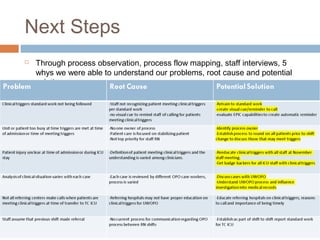
Next Steps
 Through process observation, process flow mapping, staff interviews, 5
whys we were able to understand our problems, root cause and potential
solution
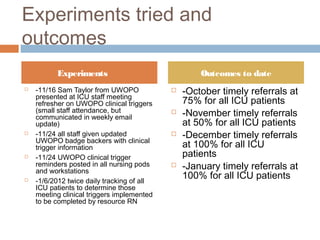
Experiments tried and
outcomes
 -11/16 Sam Taylor from UWOPO
presented at ICU staff meeting
refresher on UWOPO clinical triggers
(small staff attendance, but
communicated in weekly email
update)
 -11/24 all staff given updated
UWOPO badge backers with clinical
trigger information
 -11/24 UWOPO clinical trigger
reminders posted in all nursing pods
and workstations
 -1/6/2012 twice daily tracking of all
ICU patients to determine those
meeting clinical triggers implemented
to be completed by resource RN
 -October timely referrals at
75% for all ICU patients
 -November timely referrals
at 50% for all ICU patients
 -December timely referrals
at 100% for all ICU
patients
 -January timely referrals at
100% for all ICU patients
Experiments Outcomes to date
Why do we keep doing this
work?
 Organ donation is a key driver for our
business line
 This work has engaged staff in process
improvement
 Our unrelenting drive for perfection uncovered
more opportunities than we first considered
 By using a consistent format and process, you
are able to prove you have a problem and
maintain focus on solving that problem
 PDSA work is a significant component of the
ThedaCare Improvement System, and
integrated into our culture of continuous
Why do we keep doing this
work?
 Organ donation is a key driver for our
business line
 This work has engaged staff in process
improvement
 Our unrelenting drive for perfection uncovered
more opportunities than we first considered
 By using a consistent format and process, you
are able to prove you have a problem and
maintain focus on solving that problem
 PDSA work is a significant component of the
ThedaCare Improvement System, and
integrated into our culture of continuous

Timely referrals to Uwopo-pdsa thinking

  • 1.
    TIMELY REFERRALS TO UWOPO-PDSATHINKING Theda Clark Medical Center Intensive Care Unit
  • 2.
    Why did westart a PDSA?  During our monthly ICU leadership meetings we evaluate our UWOPO dashboard  Starting in June 2011, we began to separate ICU and ER data for Theda Clark Medical Center, to understand our opportunities  When the numbers were separated we saw an opportunity for the ICU  Over the next few months we began to collect our background/current state data and documented this in our standard PDSA format  By using the PDSA format we are able to maintain focus on the real problems, focus on working one solution at a time, study our experiments and act if we are not seeing the anticipated outcomes
  • 3.
    What did ourcurrent state show?  Problem Statement: Within the TC ICU, when ICU patients meet UWOPO clinical triggers staff are calling statline within one hour 62% of the time from January-Sept 2011, potentially missing donation opportunities, delaying UWOPO analysis for appropriate candidates and increased family dissatisfaction with donation process.  Average call time 20.6 hours. Only 4 out of 16 late calls met triggers at time of admission to the ICU.  Ideal State: The TC ICU staff will be timely on 100% of all calls to UWOPO within one hour of ICU patients meeting UWOPO clinical triggers.    Organizational Tie: By increasing timeliness of calls made to UPOPO we will impact customer satisfaction with our patient’s families and UWOPO by increasing the quality of time and increasing the turnaround time to a decision.
  • 4.
    Next Steps  Throughprocess observation, process flow mapping, staff interviews, 5 whys we were able to understand our problems, root cause and potential solution
  • 5.
    Experiments tried and outcomes -11/16 Sam Taylor from UWOPO presented at ICU staff meeting refresher on UWOPO clinical triggers (small staff attendance, but communicated in weekly email update)  -11/24 all staff given updated UWOPO badge backers with clinical trigger information  -11/24 UWOPO clinical trigger reminders posted in all nursing pods and workstations  -1/6/2012 twice daily tracking of all ICU patients to determine those meeting clinical triggers implemented to be completed by resource RN  -October timely referrals at 75% for all ICU patients  -November timely referrals at 50% for all ICU patients  -December timely referrals at 100% for all ICU patients  -January timely referrals at 100% for all ICU patients Experiments Outcomes to date
  • 6.
    Why do wekeep doing this work?  Organ donation is a key driver for our business line  This work has engaged staff in process improvement  Our unrelenting drive for perfection uncovered more opportunities than we first considered  By using a consistent format and process, you are able to prove you have a problem and maintain focus on solving that problem  PDSA work is a significant component of the ThedaCare Improvement System, and integrated into our culture of continuous
  • 7.
    Why do wekeep doing this work?  Organ donation is a key driver for our business line  This work has engaged staff in process improvement  Our unrelenting drive for perfection uncovered more opportunities than we first considered  By using a consistent format and process, you are able to prove you have a problem and maintain focus on solving that problem  PDSA work is a significant component of the ThedaCare Improvement System, and integrated into our culture of continuous