Timeline of the
Evolution of Media
STEM 1202 - Group 4
Alintatao, Beatrice
Certeza, Diana Rose
Lozano, Darianne
Novero, Ashley Marie
Baradillo, King
Huang, Zhengie Huane
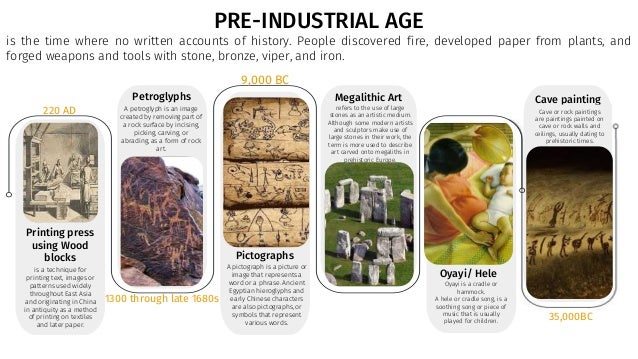
PRE-INDUSTRIAL AGE
is the time where no written accounts of history. People discovered fire, developed paper from plants, and
forged weapons and tools with stone, bronze, viper, and iron.
Printing press
using Wood
blocks
Oyayi/ Hele
35,000BC
1300 through late 1680s
220 AD
Cave painting
Megalithic Art
9,000 BC
Pictographs
is a technique for
printing text, images or
patterns used widely
throughout East Asia
and originating in China
in antiquity as a method
of printing on textiles
and later paper.
Petroglyphs
A petroglyph is an image
created by removing part of
a rock surface by incising,
picking, carving, or
abrading, as a form of rock
art.
A pictograph is a picture or
image that represents a
word or a phrase. Ancient
Egyptian hieroglyphs and
early Chinese characters
are also pictographs, or
symbols that represent
various words.
Cave or rock paintings
are paintings painted on
cave or rock walls and
ceilings, usually dating to
prehistoric times.
refers to the use of large
stones as an artistic medium.
Although some modern artists
and sculptors make use of
large stones in their work, the
term is more used to describe
art carved onto megaliths in
prehistoric Europe.
Oyayi is a cradle or
hammock.
A hele or cradle song, is a
soothing song or piece of
music that is usually
played for children.
PRE-INDUSTRIAL AGE
Clay tablets in
Mesopotamia
Papyrus in
Egypt
Codex in the
Mayan region
Acta Diurna in
Rome
Dibao in China
2400 BC
2500 BC
2nd Century
5th century
130 B.C.
In the Ancient Near East,
clay tablets (Akkadian
ṭuppu(m) 𒁾) were used
as a writing medium,
especially for writing in
cuneiform, throughout
the Bronze Age and well
into the Iron Age.
The papyrus plant was long
cultivated in the Nile delta
region in Egypt and was
collected for its stalk or stem,
whose central pith was cut
into thin strips, pressed
together, and dried to form a
smooth thin writing surface.
Papyrus (Cyperus papyrus).
Dibao (ti-pao), sometimes
called headmen or
constables, were local
officials in Qing and early
Republican China, typically
selected from among the
prominent landowners.
Working in communities of
around 100 households, they
were charged with overseeing
boundaries and land
disputes.
Maya codices (singular codex) are
folding books written by the pre-
Columbian Maya civilization in
Maya hieroglyphic script on
Mesoamerican bark paper. They
developed their huun-paper
around the 5th century, which is
roughly the same time that the
codex became predominant over
the scroll in the Roman world.
The Acta Diurna, the First
Daily Gazette, is Presented on
Message Boards in Public
Places. beginning about 130
BCE. They were also called
simply Acta or Diurna or
sometimes Acta Popidi or
Acta Publica. These are
thought to be the first daily
gazettes
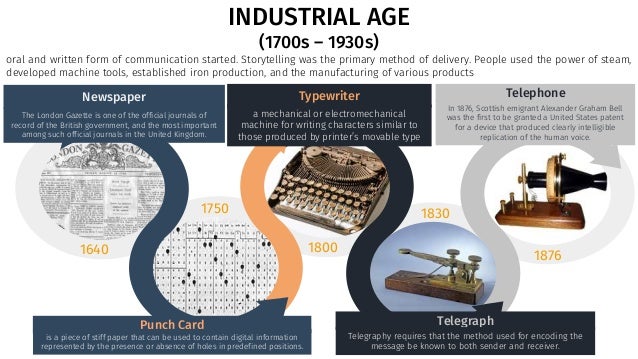
INDUSTRIAL AGE
(1700s – 1930s)
oral and written form of communication started. Storytelling was the primary method of delivery. People used the power of steam,
developed machine tools, established iron production, and the manufacturing of various products
1640 1800
1830
1876
a mechanical or electromechanical
machine for writing characters similar to
those produced by printer’s movable type
Typewriter Telephone
Newspaper
Punch Card Telegraph
1750
The London Gazette is one of the official journals of
record of the British government, and the most important
among such official journals in the United Kingdom.
is a piece of stiff paper that can be used to contain digital information
represented by the presence or absence of holes in predefined positions.
Telegraphy requires that the method used for encoding the
message be known to both sender and receiver.
In 1876, Scottish emigrant Alexander Graham Bell
was the first to be granted a United States patent
for a device that produced clearly intelligible
replication of the human voice.
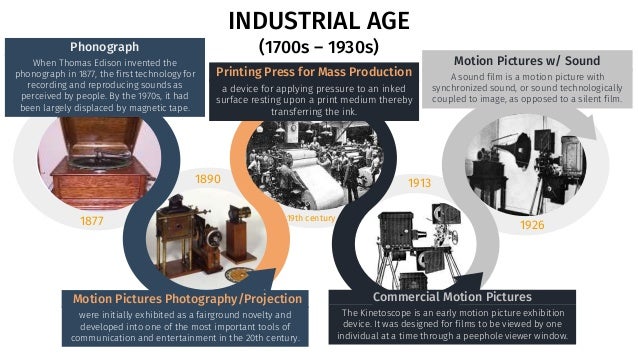
Printing Press for Mass Production
Phonograph
19th century
1926
1913
1890
1877
INDUSTRIAL AGE
(1700s – 1930s)
a device for applying pressure to an inked
surface resting upon a print medium thereby
transferring the ink.
When Thomas Edison invented the
phonograph in 1877, the first technology for
recording and reproducing sounds as
perceived by people. By the 1970s, it had
been largely displaced by magnetic tape.
Motion Pictures Photography/Projection
were initially exhibited as a fairground novelty and
developed into one of the most important tools of
communication and entertainment in the 20th century.
The Kinetoscope is an early motion picture exhibition
device. It was designed for films to be viewed by one
individual at a time through a peephole viewer window.
Commercial Motion Pictures
Motion Pictures w/ Sound
A sound film is a motion picture with
synchronized sound, or sound technologically
coupled to image, as opposed to a silent film.
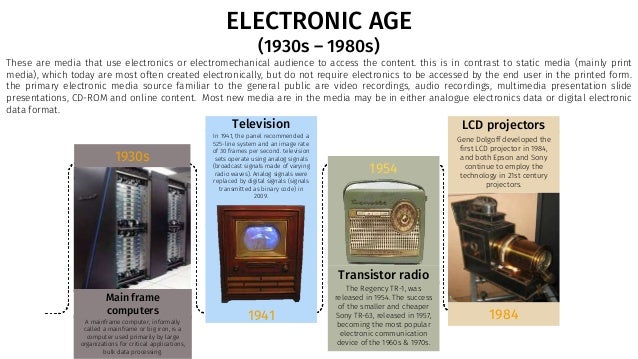
In 1941, the panel recommended a
525-line system and an image rate
of 30 frames per second. television
sets operate using analog signals
(broadcast signals made of varying
radio waves). Analog signals were
replaced by digital signals (signals
transmitted as binary code) in
2009.
ELECTRONIC AGE
(1930s – 1980s)
These are media that use electronics or electromechanical audience to access the content. this is in contrast to static media (mainly print
media), which today are most often created electronically, but do not require electronics to be accessed by the end user in the printed form.
the primary electronic media source familiar to the general public are video recordings, audio recordings, multimedia presentation slide
presentations, CD-ROM and online content. Most new media are in the media may be in either analogue electronics data or digital electronic
data format.
Transistor radio
Television
1954
1941
1930s
LCD projectors
1984
Gene Dolgoff developed the
first LCD projector in 1984,
and both Epson and Sony
continue to employ the
technology in 21st century
projectors.
The Regency TR-1, was
released in 1954. The success
of the smaller and cheaper
Sony TR-63, released in 1957,
becoming the most popular
electronic communication
device of the 1960s & 1970s.
A mainframe computer, informally
called a mainframe or big iron, is a
computer used primarily by large
organizations for critical applications,
bulk data processing.
Main frame
computers
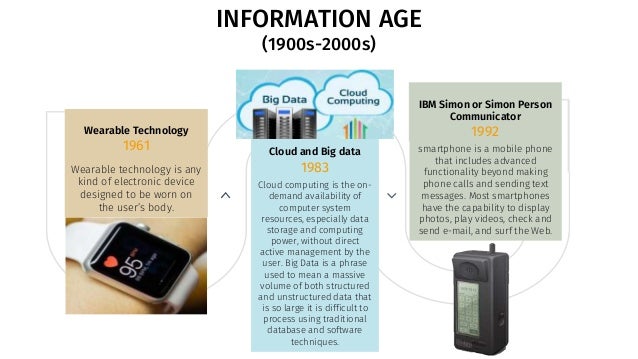
INFORMATION AGE
(1900s-2000s)
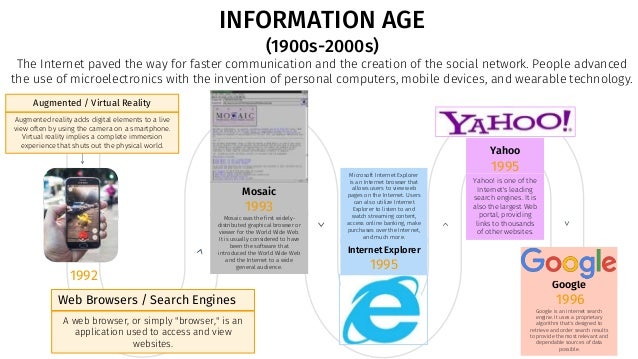
The Internet paved the way for faster communication and the creation of the social network. People advanced
the use of microelectronics with the invention of personal computers, mobile devices, and wearable technology.
Google
1996
Yahoo
1995
Mosaic
1993
Internet Explorer
1995
Web Browsers / Search Engines
1992
Augmented / Virtual Reality
A web browser, or simply "browser," is an
application used to access and view
websites.
Mosaic was the first widely-
distributed graphical browser or
viewer for the World Wide Web.
It is usually considered to have
been the software that
introduced the World Wide Web
and the Internet to a wide
general audience.
Microsoft Internet Explorer
is an Internet browser that
allows users to view web
pages on the Internet. Users
can also utilize Internet
Explorer to listen to and
watch streaming content,
access online banking, make
purchases over the Internet,
and much more.
Yahoo! is one of the
Internet's leading
search engines. It is
also the largest Web
portal, providing
links to thousands
of other websites.
Google is an internet search
engine. It uses a proprietary
algorithm that's designed to
retrieve and order search results
to provide the most relevant and
dependable sources of data
possible.
Augmented reality adds digital elements to a live
view often by using the camera on a smartphone.
Virtual reality implies a complete immersion
experience that shuts out the physical world.
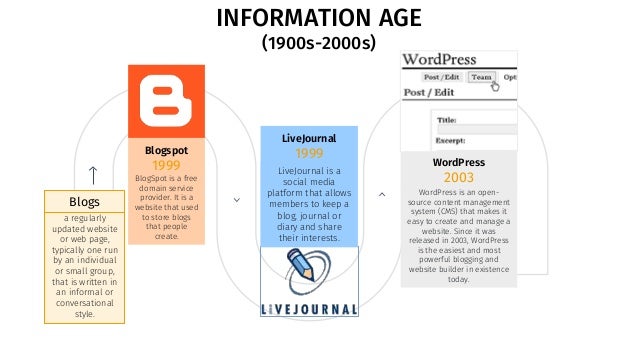
WordPress
2003
LiveJournal
1999
INFORMATION AGE
(1900s-2000s)
Blogspot
1999
BlogSpot is a free
domain service
provider. It is a
website that used
to store blogs
that people
create.
WordPress is an open-
source content management
system (CMS) that makes it
easy to create and manage a
website. Since it was
released in 2003, WordPress
is the easiest and most
powerful blogging and
website builder in existence
today.
a regularly
updated website
or web page,
typically one run
by an individual
or small group,
that is written in
an informal or
conversational
style.
Blogs
LiveJournal is a
social media
platform that allows
members to keep a
blog, journal or
diary and share
their interests.
2003
2004
Tumblr
2007
Twitter
2006
2002
Social Networks
1996
INFORMATION AGE
(1900s-2000s)
Twitter is a
free social
networking
microblogging
service that
allows
registered
members to
broadcast
short posts
called tweets.
Tumblr is a blogging and
social media tool that allows
users to publish a
"tumblelog", or short blog
posts.
a dedicated website or other
application which enables users to
communicate with each other by
posting information, comments,
messages, images, etc.
Friendster was a social gaming site based in Kuala
Lumpur, Malaysia. It was originally a social
networking service website. Before Friendster was
redesigned, the service allowed users to contact
other members, maintain those contacts, and share
online content and media with those contacts.
Multiply was a social networking service with
an emphasis on allowing users to share media
– such as photos, videos and blog entries –
with their "real-world" network.
Facebook is defined as an online social
networking website where people can create
profiles, share information such as photos and
quotes about themselves, and respond or link
to the information posted by others.
a social media site
to which a user
makes short,
frequent posts.
Microblogs
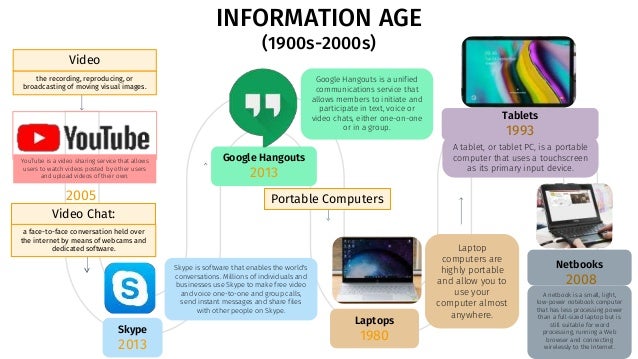
Google Hangouts
2013
Netbooks
2008
Video Chat:
Portable Computers
Laptops
1980
2005
Video
INFORMATION AGE
(1900s-2000s)
the recording, reproducing, or
broadcasting of moving visual images.
YouTube is a video sharing service that allows
users to watch videos posted by other users
and upload videos of their own.
a face-to-face conversation held over
the internet by means of webcams and
dedicated software.
Skype is software that enables the world's
conversations. Millions of individuals and
businesses use Skype to make free video
and voice one-to-one and group calls,
send instant messages and share files
with other people on Skype.
Google Hangouts is a unified
communications service that
allows members to initiate and
participate in text, voice or
video chats, either one-on-one
or in a group.
Laptop
computers are
highly portable
and allow you to
use your
computer almost
anywhere.
A netbook is a small, light,
low-power notebook computer
that has less processing power
than a full-sized laptop but is
still suitable for word
processing, running a Web
browser and connecting
wirelessly to the Internet.
A tablet, or tablet PC, is a portable
computer that uses a touchscreen
as its primary input device.
Skype
2013
Tablets
1993
INFORMATION AGE
(1900s-2000s)
Wearable Technology
1961 Cloud and Big data
1983
Wearable technology is any
kind of electronic device
designed to be worn on
the user’s body.
Cloud computing is the on-
demand availability of
computer system
resources, especially data
storage and computing
power, without direct
active management by the
user. Big Data is a phrase
used to mean a massive
volume of both structured
and unstructured data that
is so large it is difficult to
process using traditional
database and software
techniques.
smartphone is a mobile phone
that includes advanced
functionality beyond making
phone calls and sending text
messages. Most smartphones
have the capability to display
photos, play videos, check and
send e-mail, and surf the Web.
IBM Simon or Simon Person
Communicator
1992
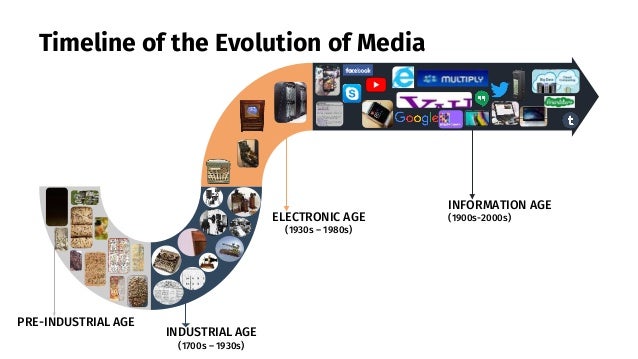
Timeline of the Evolution of Media
ELECTRONIC AGE
(1930s – 1980s)
PRE-INDUSTRIAL AGE
INFORMATION AGE
(1900s-2000s)
INDUSTRIAL AGE
(1700s – 1930s)
http://www.moah.org/brains/industrial.html#:~:text=Media%20included%20stone%2C%20shell%2C%20clay,%2C%20papyrus%2C%20cloth%2C%20paper
https://www.google.com/search?q=printing+press+using+wood+blocks&oq=printing+pr&aqs=chrome.2.69i57j0i433j0l3.2940j0j7&client=ms-android-oppo-rev1&sourceid=chrome-mobile&ie=UTF-8
https://www.google.com/search?q=petroglyphs+images&oq=petroglyphs+images&aqs=chrome..69i57j0i22i30l4.4189j1j7&client=ms-android-oppo-rev1&sourceid=chrome-mobile&ie=UTF-8
https://www.google.com/search?q=pictograph+images+history&tbm=isch&ved=2ahUKEwiatNHe7MvtAhUHXJQKHfLaAvwQ2-
cCegQIABAC&oq=pictograph+images+history&gs_lcp=ChJtb2JpbGUtZ3dzLXdpei1pbWcQAzIECCEQCjoECCMQJzoCCAA6BggAEAcQHjoECAAQHjoGCAAQBRAeOgYIABAIEB46BQgAEM0CU
Mc2WOBhYNdiaABwAHgAgAHMAYgB9wiSAQUwLjcuMZgBAKABAcABAQ&sclient=mobile-gws-wiz-img&ei=moDWX5r_GYe40QTytYvgDw&bih=672&biw=360&client=ms-android-oppo-
rev1&prmd=inv#isa=y
https://www.google.com/search?q=megalithic+art&client=ms-android-oppo-
rev1&prmd=insv&sxsrf=ALeKk00yrgmsWEF0PxTAFsdSUnNLgQwjrg:1607893196141&source=lnms&tbm=isch&sa=X&ved=2ahUKEwj-
p6v27MvtAhWNKqYKHUINAk8Q_AUoAXoECBUQAQ&biw=360&bih=672&dpr=2
https://www.google.com/search?q=oyayi/hele+images&client=ms-android-oppo-
rev1&prmd=ivn&sxsrf=ALeKk00zPUNvyJphQaKJ_KXlMC4U036DlA:1607893250781&source=lnms&tbm=isch&sa=X&ved=2ahUKEwiJm7KQ7cvtAhVOFqYKHR-
zClgQ_AUoAXoECA0QAQ&biw=360&bih=672#imgrc=MRjxcSV3ixpvBM&imgdii=sVeH7ZbhgC8hdM
https://www.google.com/search?q=papyrus+in+egypt&client=ms-android-oppo-
rev1&prmd=ivsn&sxsrf=ALeKk00EjLJECKff4qwRVRjjf3tUuExNdw:1607893393051&source=lnms&tbm=isch&sa=X&ved=2ahUKEwjB3J3U7cvtAhWEGqYKHTMpBo0Q_AUoAXoECA4QAQ&biw=36
0&bih=672&dpr=2
https://www.google.com/search?q=dibao+in+china+(2nd+century)&client=ms-android-oppo-
rev1&prmd=inv&sxsrf=ALeKk01z5N0W8eCU9rv8lONuGitfFJp6MQ:1607893428004&source=lnms&tbm=isch&sa=X&ved=2ahUKEwing_Pk7cvtAhXMIqYKHRFyDVIQ_AUoAXoECAMQAQ&cshid=1
607893433102&biw=360&bih=672
https://www.google.com/search?q=codex+in+the+mayan+region+5th+century&client=ms-android-oppo-
rev1&prmd=insv&sxsrf=ALeKk02OUEV2GjlZzgbUr6tKwMvdaCSwYw:1607893461609&source=lnms&tbm=isch&sa=X&ved=2ahUKEwiimPb07cvtAhXUIqYKHULnA90Q_AUoAXoECAsQAQ&cshid
=1607893465269&biw=360&bih=672&dpr=2
https://www.google.com/search?q=acta+diurna+in+rome+130+bc&client=ms-android-oppo-
rev1&prmd=imnv&sxsrf=ALeKk01VVc3xO3QPdch_XhIrc5Vy36RWlg:1607893497606&source=lnms&tbm=isch&sa=X&ved=2ahUKEwjmnouG7svtAhVExIsBHTBxAGoQ_AUoAXoECAsQAQ&cshid
=1607893501922&biw=360&bih=672#imgrc=8XNUbT8f145MjM
https://www.google.com/search?q=blogspot+logo&hl=en-GB&prmd=inv&sxsrf=ALeKk01Tg6yUpWqzmj3-
tNV8q1vc05fUJw:1608288956660&source=lnms&tbm=isch&sa=X&ved=2ahUKEwj7qNSfr9ftAhXC-GEKHZmzAFcQ_AUoAXoECA0QAQ&biw=320&bih=576&dpr=2.25#imgrc=mV2S0iElw4LoKM
https://www.google.com/search?q=six+degrees+logo&hl=en-GB&prmd=ivn&sxsrf=ALeKk00Y2Z_VcYC3u2CQFMlk5-
01M1SkLQ:1608288897042&source=lnms&tbm=isch&sa=X&ved=2ahUKEwid152Dr9ftAhXkdt4KHQ0dDHwQ_AUoAXoECAwQAQ&biw=320&bih=576&dpr=2.25#imgrc=QoFtd-vk4sIn0M
https://www.google.com/search?q=tim+berners+lee&bih=576&biw=320&hl=en-
GB&prmd=inbv&sxsrf=ALeKk02C1VeNNWcyTyHt2E6tJN6jx3AnRw:1608288872515&source=lnms&tbm=isch&sa=X&ved=2ahUKEwjlz8T3rtftAhXRP3AKHTc8CFoQ_AUoAXo
ECBQQAQ#imgrc=HZ0oy5NT1oJxhM
https://www.google.com/search?q=Cloud+and+big+data&tbm=isch&ved=2ahUKEwiXkPDPrtftAhWVwIsBHefuBU8Q2-
cCegQIABAC&oq=Cloud+and+big+data&gs_lcp=ChJtb2JpbGUtZ3dzLXdpei1pbWcQAzIECCMQJzICCAAyAggAMgIIADIGCAAQCBAeOgcIIxDqAhAnOgQIABBDOgcIABCxAxBDOgUIABCxAzoICA
AQsQMQgwFQkq8BWJnMAWD6zQFoAnAAeACAAfQCiAGLG5IBCDAuMTIuMy4zmAEAoAEBsAEFwAEB&sclient=mobile-gws-wiz-img&ei=FYrcX9exFJWBr7wP592X-
AQ&bih=576&biw=320&prmd=inv&hl=en-GB#imgrc=xHGCWScci2frUM
REFERENCES/SOURCES:
https://l.messenger.com/l.php?u=https%3A%2F%2Fwww.google.com%2Fsearch%3Fq%3Dtim%2520berners%2520lee%26bih%3D576%26biw%3D320%26hl%3Den-
GB%26prmd%3Dinbv%26sxsrf%3DALeKk02C1VeNNWcyTyHt2E6tJN6jx3AnRw%253A1608288872515%26source%3Dlnms%26tbm%3Disch%26sa%3DX%26ved%3D2a
hUKEwjlz8T3rtftAhXRP3AKHTc8CFoQ_AUoAXoECBQQAQ%23imgrc%3DHZ0oy5NT1oJxhM&h=AT20sJXTn0O7Ud7D1xO5bA66cmosrUo4ZATTD7V6O2YRu_OYeWaGy
0YVnP6I6xO6LQMS4GPBb4zBxsfcJw7tUHFvBtK9Y-QtOfWeCImCo8hpR_q40_jgl-JR5uv-M46uTe9dboX-zmfPjBZLsh_JaQ
REFERENCES/SOURCES:

Timeline-of-the-Evolution-of-Media.pptx