Time Management for
Engineering Managers
Get Stuff Done and Not Drown
Vidal Graupera, May 2019 @ Lead Developer Meetup
@vgraupera
Topics
● Introduction
● Concepts
● Interruptions
● Emails
● Calendar
● Planning
● Meetings
● To-dos
● Tips and More Tips
● Resources and Wrap up
Introduction
● A bit about me… Always been interested in this… my mission
● Everybody wants a piece of you, right? Never enough time….
● Can be overwhelming especially for new managers!
● Time management is a constant challenge for all EMs. Top concern of
managers I interviewed on managersclub.com
● “What’s your work day like and how do you manage your time, emails, etc.?”
Goals
● How to not drown! And how to scale your efforts and be effective without
brute force putting in more time as team and scope grows.
● Share what I’ve learned and also picked up from interviewing over 70 EMs
● A collection of techniques and strategies that may help you
● Suggest some tweaks to your human management software
● Some of these items may also apply to ICs!
Concepts
● Everyone has the same amount of time
● You will not get everything done!
● Manager’s schedule vs maker's schedule is very different, see article by Paul
Graham
● You have to be really conscious of how you manage other people’s time.
● Analogy. Since we are in tech there are things we can learn from computers to
avoid thrashing and bricking ourselves. Try to not touch things more than once
if possible, e.g. avoid memory swaps.
● Parkinson's Law “Work expands so as to fill the time available for its
completion.” -> Time Boxing.
The Fallacy of Multitasking
● Very tempting. It’s a myth that this works.
● Human beings are single threaded
● Subject much research, e.g. American Psychological Association
https://www.apa.org/research/action/multitask
● Your effective IQ goes down by 10% on these tasks!
● Errors go up
● Don't do fast task switching for anything really important, save for routine stuff,
filling out forms, or don’t do it
● IMO better for focus on 1 thing at a time. Apply 80/20
Interruptions
● Learn to love internal interruptions: they’re often your job
● Interruptions from your team, your boss, your peers are almost always
important. You are an unblocker.
● Shutting out the world was what made you successful as a coder
● Inviting interruptions is what makes you successful as a manager
● Very different from makers schedule
● Be strict with external interruptions from 3rd parties, vendors, recruiters, etc.
Emails
● Quickly scan for fires. Priority one: Can I unblock anyone or another team?
● Work toward acting on an email when you read it – delegate it, reply to it, trash
it, etc.
● 80/20 rule. Can I answer it quickly now even imperfectly - 1 sentence and not
have to come back later to avoid swapping? Don’t leave anyone waiting.
● Turn off all alerts. If you can, only review a few times a day at fixed intervals.
Block time for communications. Keep this time sacred.
● Inbox Zero & Slack Zero with as SLA
● Avoid “texting” via email. Limit back and forth. Inefficient. Kill off long email
chains. Call a meeting.
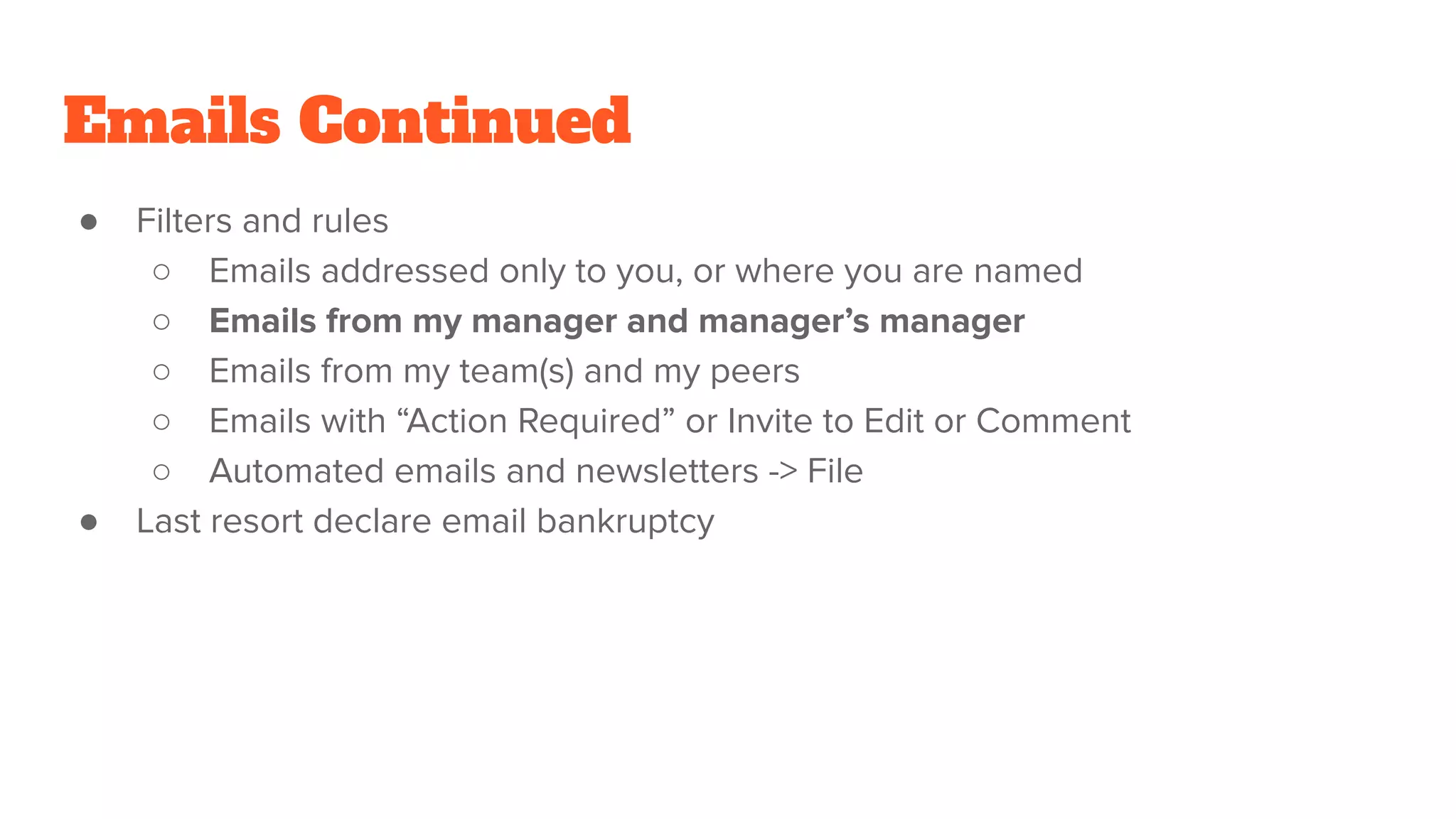
Emails Continued
● Filters and rules
○ Emails addressed only to you, or where you are named
○ Emails from my manager and manager’s manager
○ Emails from my team(s) and my peers
○ Emails with “Action Required” or Invite to Edit or Comment
○ Automated emails and newsletters -> File
● Last resort declare email bankruptcy
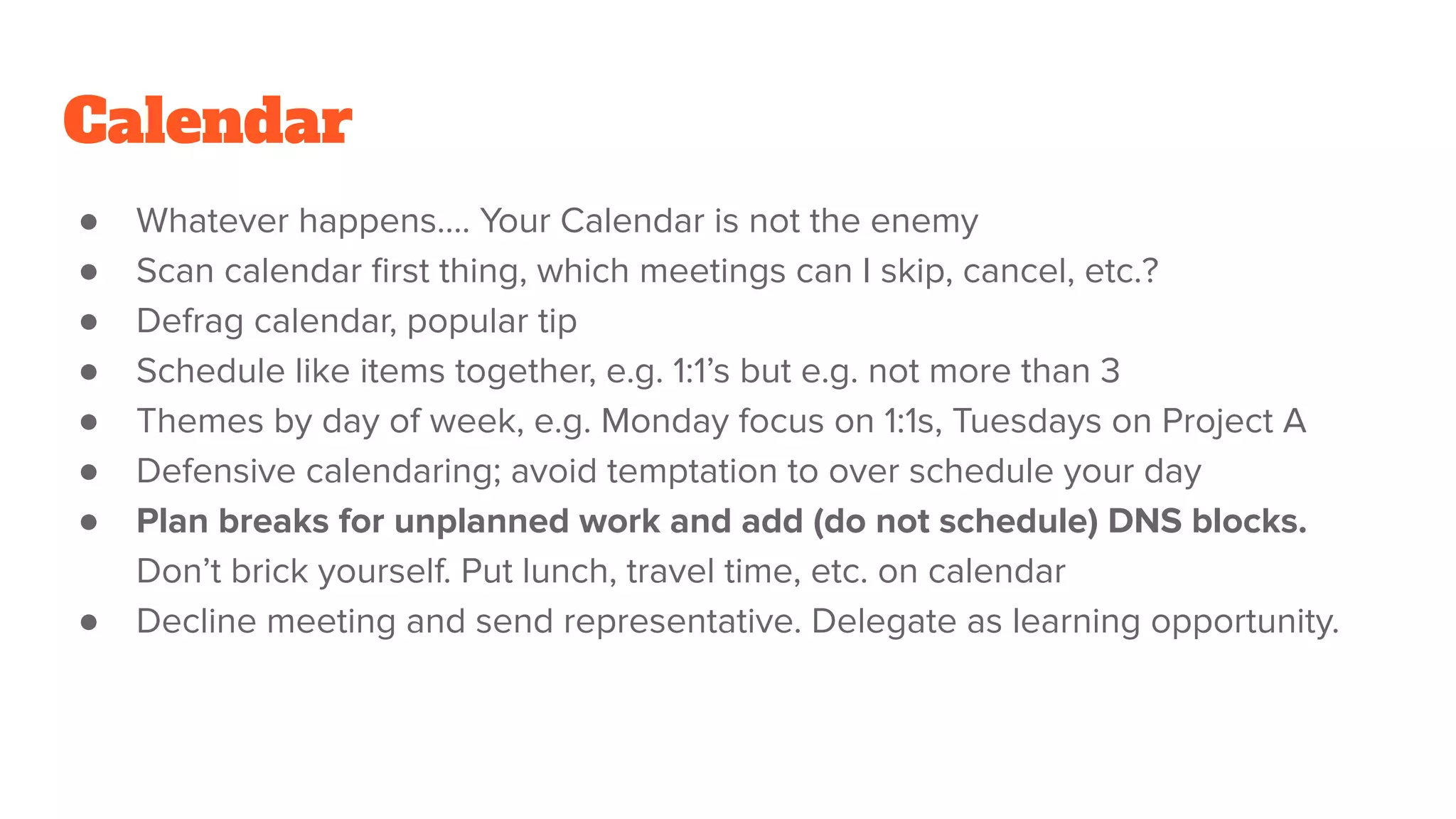
Calendar
● Whatever happens…. Your Calendar is not the enemy
● Scan calendar first thing, which meetings can I skip, cancel, etc.?
● Defrag calendar, popular tip
● Schedule like items together, e.g. 1:1’s but e.g. not more than 3
● Themes by day of week, e.g. Monday focus on 1:1s, Tuesdays on Project A
● Defensive calendaring; avoid temptation to over schedule your day
● Plan breaks for unplanned work and add (do not schedule) DNS blocks.
Don’t brick yourself. Put lunch, travel time, etc. on calendar
● Decline meeting and send representative. Delegate as learning opportunity.
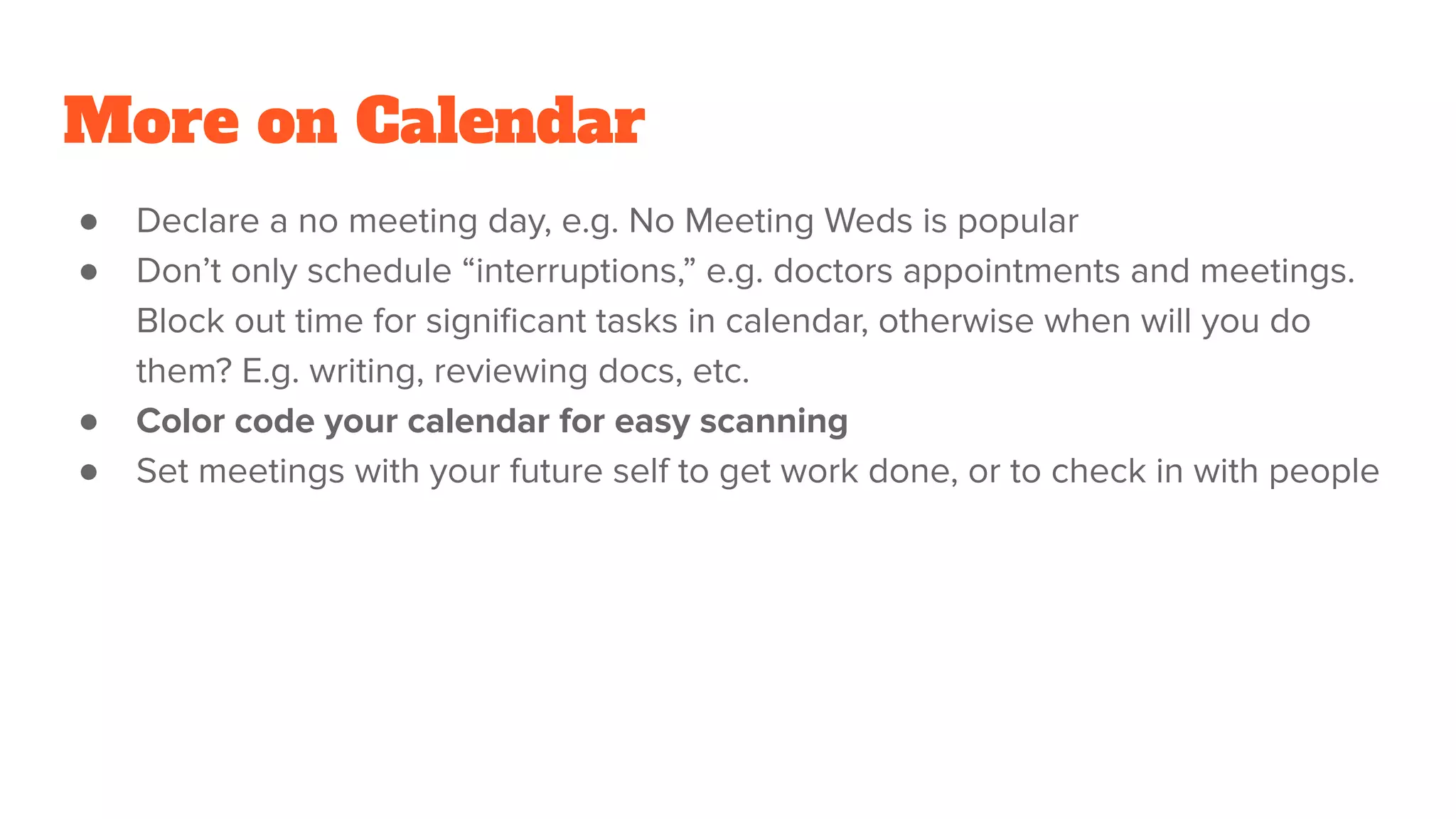
More on Calendar
● Declare a no meeting day, e.g. No Meeting Weds is popular
● Don’t only schedule “interruptions,” e.g. doctors appointments and meetings.
Block out time for significant tasks in calendar, otherwise when will you do
them? E.g. writing, reviewing docs, etc.
● Color code your calendar for easy scanning
● Set meetings with your future self to get work done, or to check in with people
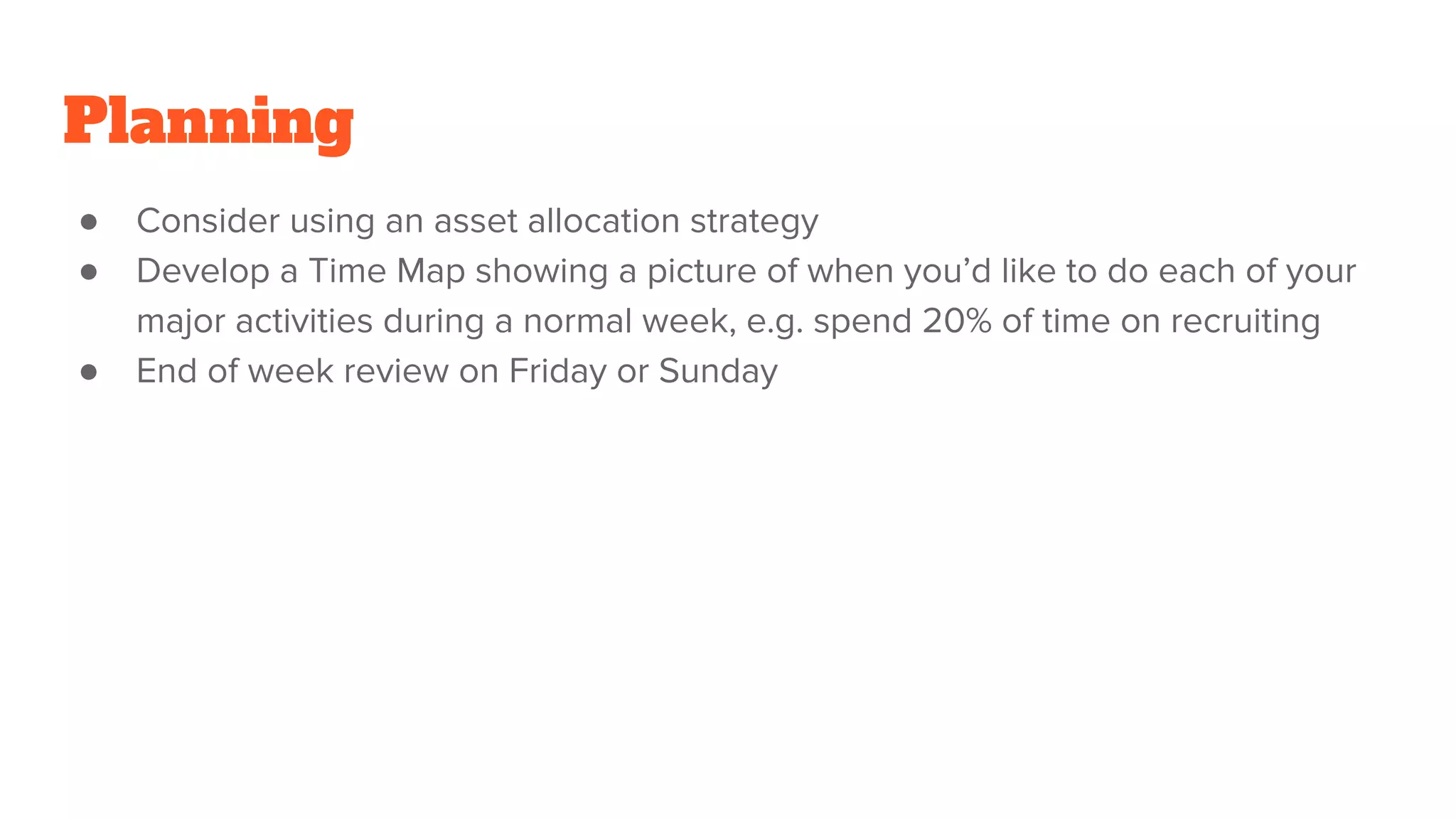
Planning
● Consider using an asset allocation strategy
● Develop a Time Map showing a picture of when you’d like to do each of your
major activities during a normal week, e.g. spend 20% of time on recruiting
● End of week review on Friday or Sunday
Meetings
● Meetings are often the main work up to 80% of time
● Learn to love meetings! Get good at them to improve efficiency & reduce
need for more meetings!
● Running effective meetings is super important (book recommendation)
● Action items, agendas, meeting notes, etc. “If there are no notes and AI, then
meeting never happened.”
● End early and return time to people! Super appreciated.
● Keep short (Parkinson's Law)
● Laptops down. Take note of how many people are not paying attention.
● Regularly send surveys after meetings to improve them. Rate 1-10.
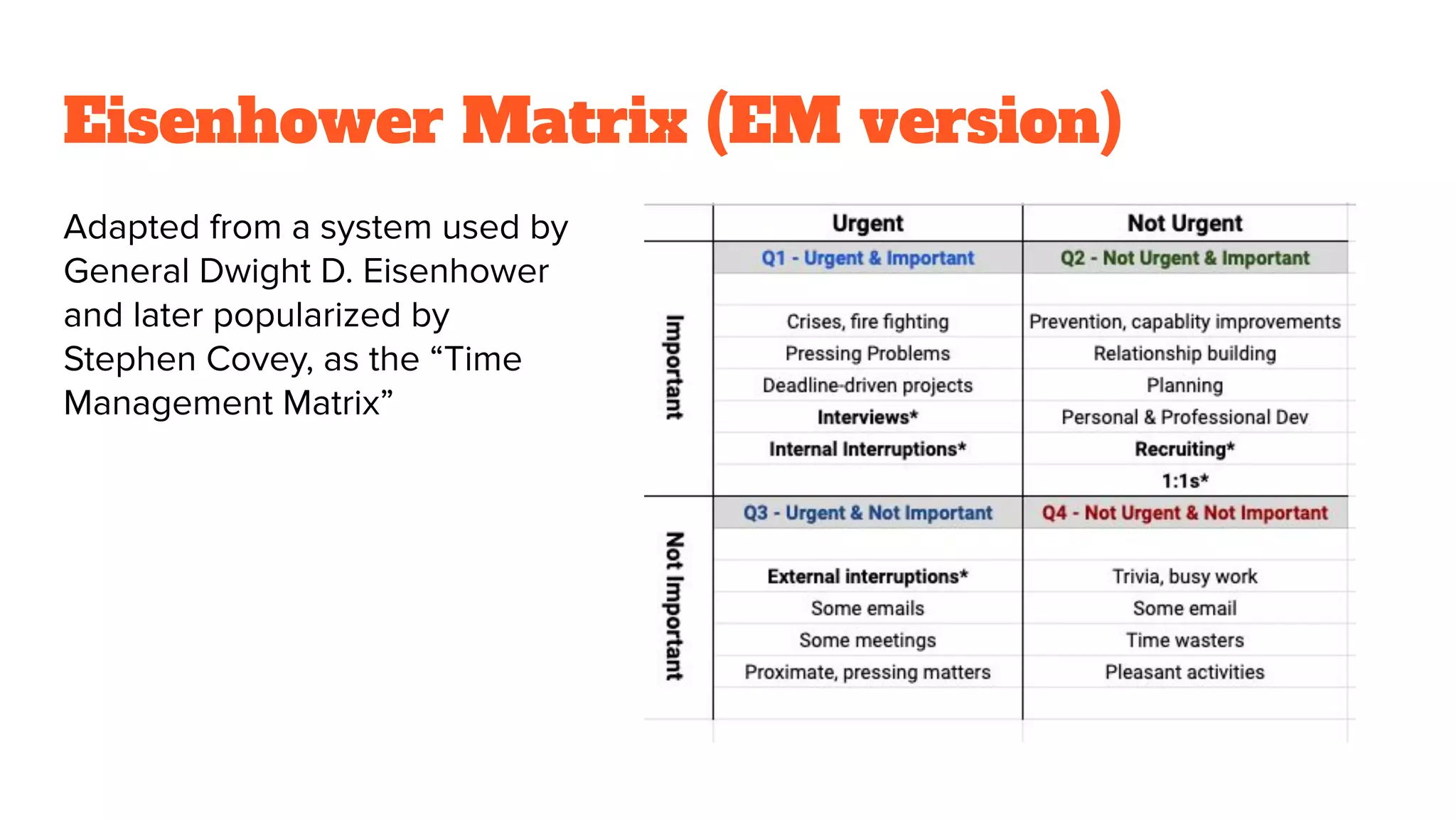
Eisenhower Matrix (EM version)
Adapted from a system used by
General Dwight D. Eisenhower
and later popularized by
Stephen Covey, as the “Time
Management Matrix”
To-dos
● Create a daily “TO DO” list of the things I want to accomplish TODAY usually
1-3 items. Very popular technique.
● To-Do lists and apps are very popular
● Beware: todo lists can quickly grow long and become overwhelming. They do
not have a sense of time so instead put items on calendar
● Create checklists, daily and weekly so things don’t slip through the cracks
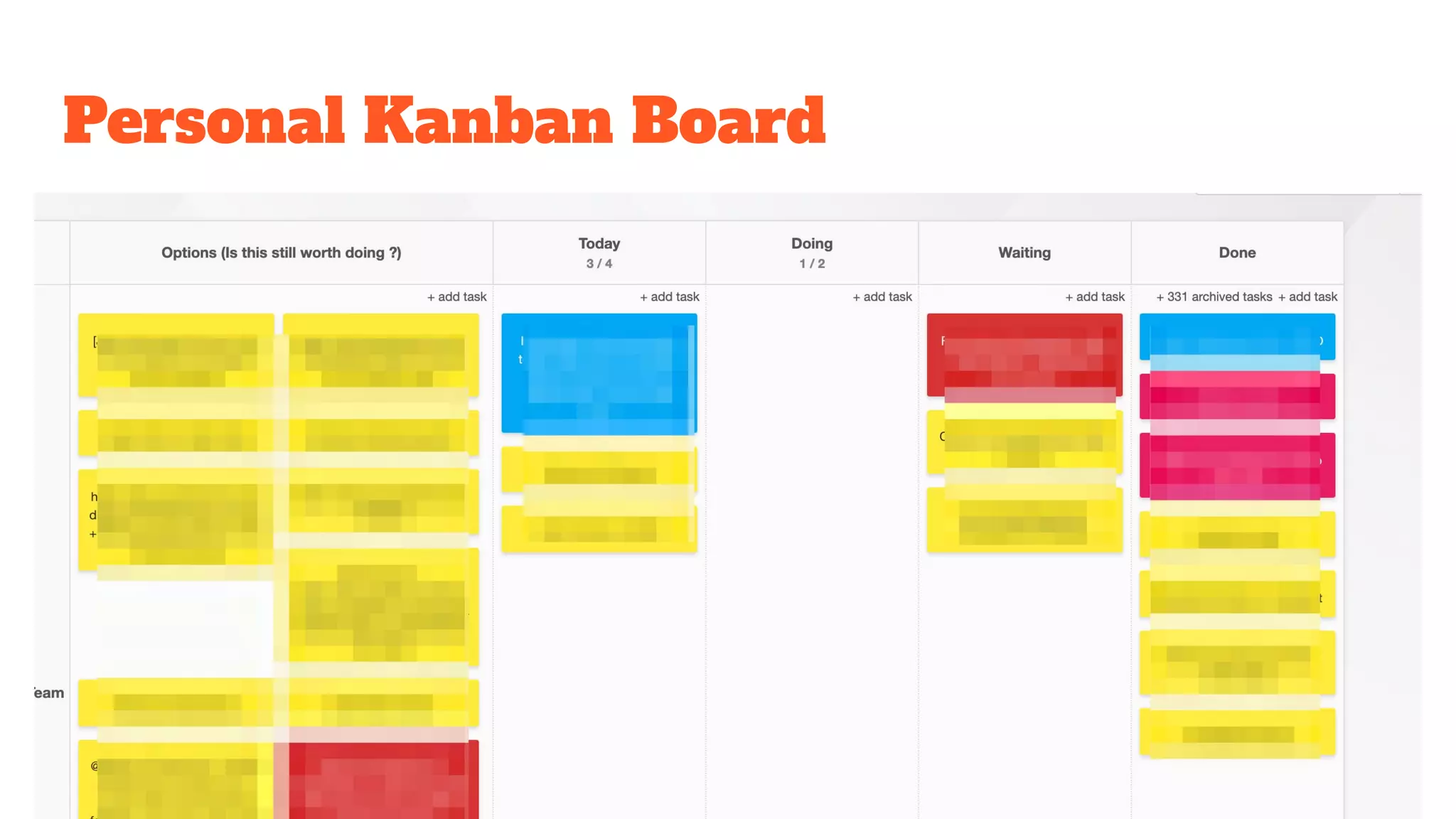
● Pro-tip consider a Personal Kanban Board! Benefits limit WIP, visualize in
progress, blocked, waiting, etc.
Personal Kanban Board
Tips & Ideas
● Get in early before everyone else and things get busy or plan it out night
before. Most common manager technique.
● “Work late night” e.g., stay late on Mondays to get week off to strong start and
build momentum
● Think what is the most important thing I can do, or that no one else can do or is
able to do
● Make time to check in with staff to get ahead of problems.
● Always leave at least 30 min a day unscheduled
● Exercise and meditation to keep energy
More Tips
● Become a faster typer
● Get an autocomplete app like TextExpander
● Hide if you must, leave your desk and book a conference room to work with
focus, e.g. writing perf reviews
● You are most productive 2-4 hours after waking up. Don’t squander that time
with e.g admin stuff, routine staff meeting, etc. Use it for deep, creative work
work. Avoid getting sucked into email and calendar first thing.
● Capture system. Get things out of your head it’s stress inducing. (GTD). I carry a
paper notebook and Evernote.
● If you can do it in less than 2 minutes, just do it. (Getting Things Done = GTD)
Books on “Time Management”
● Getting Things Done by David Allen
● When: The Scientific Secrets of Perfect Timing
● The Checklist Manifesto
● Personal Kanban
● The 7 Habits of Highly Effective People
● The Surprising Science of Meetings
Wrap up
Thanks for your time! I hope you found this useful.
Contact Info
Twitter: @vgraupera
vgraupera@gmail.com
Deck: https://managersclub.com/talks

Time mangement or getting things done for engineering managers

  • 1.
    Time Management for EngineeringManagers Get Stuff Done and Not Drown Vidal Graupera, May 2019 @ Lead Developer Meetup @vgraupera
  • 2.
    Topics ● Introduction ● Concepts ●Interruptions ● Emails ● Calendar ● Planning ● Meetings ● To-dos ● Tips and More Tips ● Resources and Wrap up
  • 3.
    Introduction ● A bitabout me… Always been interested in this… my mission ● Everybody wants a piece of you, right? Never enough time…. ● Can be overwhelming especially for new managers! ● Time management is a constant challenge for all EMs. Top concern of managers I interviewed on managersclub.com ● “What’s your work day like and how do you manage your time, emails, etc.?”
  • 4.
    Goals ● How tonot drown! And how to scale your efforts and be effective without brute force putting in more time as team and scope grows. ● Share what I’ve learned and also picked up from interviewing over 70 EMs ● A collection of techniques and strategies that may help you ● Suggest some tweaks to your human management software ● Some of these items may also apply to ICs!
  • 5.
    Concepts ● Everyone hasthe same amount of time ● You will not get everything done! ● Manager’s schedule vs maker's schedule is very different, see article by Paul Graham ● You have to be really conscious of how you manage other people’s time. ● Analogy. Since we are in tech there are things we can learn from computers to avoid thrashing and bricking ourselves. Try to not touch things more than once if possible, e.g. avoid memory swaps. ● Parkinson's Law “Work expands so as to fill the time available for its completion.” -> Time Boxing.
  • 6.
    The Fallacy ofMultitasking ● Very tempting. It’s a myth that this works. ● Human beings are single threaded ● Subject much research, e.g. American Psychological Association https://www.apa.org/research/action/multitask ● Your effective IQ goes down by 10% on these tasks! ● Errors go up ● Don't do fast task switching for anything really important, save for routine stuff, filling out forms, or don’t do it ● IMO better for focus on 1 thing at a time. Apply 80/20
  • 7.
    Interruptions ● Learn tolove internal interruptions: they’re often your job ● Interruptions from your team, your boss, your peers are almost always important. You are an unblocker. ● Shutting out the world was what made you successful as a coder ● Inviting interruptions is what makes you successful as a manager ● Very different from makers schedule ● Be strict with external interruptions from 3rd parties, vendors, recruiters, etc.
  • 8.
    Emails ● Quickly scanfor fires. Priority one: Can I unblock anyone or another team? ● Work toward acting on an email when you read it – delegate it, reply to it, trash it, etc. ● 80/20 rule. Can I answer it quickly now even imperfectly - 1 sentence and not have to come back later to avoid swapping? Don’t leave anyone waiting. ● Turn off all alerts. If you can, only review a few times a day at fixed intervals. Block time for communications. Keep this time sacred. ● Inbox Zero & Slack Zero with as SLA ● Avoid “texting” via email. Limit back and forth. Inefficient. Kill off long email chains. Call a meeting.
  • 9.
    Emails Continued ● Filtersand rules ○ Emails addressed only to you, or where you are named ○ Emails from my manager and manager’s manager ○ Emails from my team(s) and my peers ○ Emails with “Action Required” or Invite to Edit or Comment ○ Automated emails and newsletters -> File ● Last resort declare email bankruptcy
  • 10.
    Calendar ● Whatever happens….Your Calendar is not the enemy ● Scan calendar first thing, which meetings can I skip, cancel, etc.? ● Defrag calendar, popular tip ● Schedule like items together, e.g. 1:1’s but e.g. not more than 3 ● Themes by day of week, e.g. Monday focus on 1:1s, Tuesdays on Project A ● Defensive calendaring; avoid temptation to over schedule your day ● Plan breaks for unplanned work and add (do not schedule) DNS blocks. Don’t brick yourself. Put lunch, travel time, etc. on calendar ● Decline meeting and send representative. Delegate as learning opportunity.
  • 11.
    More on Calendar ●Declare a no meeting day, e.g. No Meeting Weds is popular ● Don’t only schedule “interruptions,” e.g. doctors appointments and meetings. Block out time for significant tasks in calendar, otherwise when will you do them? E.g. writing, reviewing docs, etc. ● Color code your calendar for easy scanning ● Set meetings with your future self to get work done, or to check in with people
  • 12.
    Planning ● Consider usingan asset allocation strategy ● Develop a Time Map showing a picture of when you’d like to do each of your major activities during a normal week, e.g. spend 20% of time on recruiting ● End of week review on Friday or Sunday
  • 13.
    Meetings ● Meetings areoften the main work up to 80% of time ● Learn to love meetings! Get good at them to improve efficiency & reduce need for more meetings! ● Running effective meetings is super important (book recommendation) ● Action items, agendas, meeting notes, etc. “If there are no notes and AI, then meeting never happened.” ● End early and return time to people! Super appreciated. ● Keep short (Parkinson's Law) ● Laptops down. Take note of how many people are not paying attention. ● Regularly send surveys after meetings to improve them. Rate 1-10.
  • 14.
    Eisenhower Matrix (EMversion) Adapted from a system used by General Dwight D. Eisenhower and later popularized by Stephen Covey, as the “Time Management Matrix”
  • 15.
    To-dos ● Create adaily “TO DO” list of the things I want to accomplish TODAY usually 1-3 items. Very popular technique. ● To-Do lists and apps are very popular ● Beware: todo lists can quickly grow long and become overwhelming. They do not have a sense of time so instead put items on calendar ● Create checklists, daily and weekly so things don’t slip through the cracks ● Pro-tip consider a Personal Kanban Board! Benefits limit WIP, visualize in progress, blocked, waiting, etc.
  • 16.
  • 17.
    Tips & Ideas ●Get in early before everyone else and things get busy or plan it out night before. Most common manager technique. ● “Work late night” e.g., stay late on Mondays to get week off to strong start and build momentum ● Think what is the most important thing I can do, or that no one else can do or is able to do ● Make time to check in with staff to get ahead of problems. ● Always leave at least 30 min a day unscheduled ● Exercise and meditation to keep energy
  • 18.
    More Tips ● Becomea faster typer ● Get an autocomplete app like TextExpander ● Hide if you must, leave your desk and book a conference room to work with focus, e.g. writing perf reviews ● You are most productive 2-4 hours after waking up. Don’t squander that time with e.g admin stuff, routine staff meeting, etc. Use it for deep, creative work work. Avoid getting sucked into email and calendar first thing. ● Capture system. Get things out of your head it’s stress inducing. (GTD). I carry a paper notebook and Evernote. ● If you can do it in less than 2 minutes, just do it. (Getting Things Done = GTD)
  • 19.
    Books on “TimeManagement” ● Getting Things Done by David Allen ● When: The Scientific Secrets of Perfect Timing ● The Checklist Manifesto ● Personal Kanban ● The 7 Habits of Highly Effective People ● The Surprising Science of Meetings
  • 20.
    Wrap up Thanks foryour time! I hope you found this useful. Contact Info Twitter: @vgraupera vgraupera@gmail.com Deck: https://managersclub.com/talks