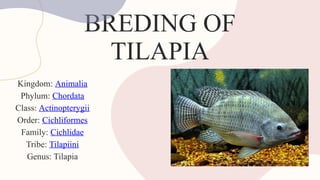
BREDING OF
TILAPIA
Kingdom: Animalia
Phylum: Chordata
Class: Actinopterygii
Order: Cichliformes
Family: Cichlidae
Tribe: Tilapiini
Genus: Tilapia
Introduction
• Tilapias are a group of African freshwater fish that exhibit parental care.
• They are widely cultured in tropical and sub-tropical countries.
• Tilapias breed naturally in ponds, tanks, lakes, estuaries, reservoirs, etc.
and spawn year-round.
• An important foodfish and commands high price in the international
market.
Distribution and importance of tilapia
• Tilapias belong to the family Cichlidae and Order Perciformes.
• Also known as `Aquatic chicken’ due to its fast-growing nature,
delicacy, ability to convert natural food into flesh very efficiently and
absence of intramuscular bones’, its demand is increasing
tremendously.
• Can be cultured in freshwater, brackish-water and salt water.
• Grows to 500 - 600 g in 6-8 months
Identifying characters
• Body elongate, fairly deep and compressed.
• Upper profile more convex than lower.
• Mouth large. Longest soft dorsal ray extending to above proximal part of caudal

fin in females and immature males.
• Caudal fin truncate, often with rounded corners.
• Females and non-breeding males watery–grey to yellowish, with 3 or 4 dark
blotches often apparent along flanks.
• Body of males during breeding season deep black; lower part of head chalky or
pale-grayishwhite; upper lip bluish.
• Dorsal fin black with a red margin ; pectoral fin translucent red; caudal fin with a
Food and feeding
• Herbivorous, feeding on algae, detritus, etc.
• Based on parental care, tilapias are grouped into
1.Maternal mouth-brooder, eg.Oreochromis mossambicus, O.
niloticus, etc.,
2.Paternal (or biparental) mouth-brooders, eg. Sarotherodon galileus,
S. macrocephalus.
3. Substrate spawners, eg. Tilapia zilli.
Brood-stock development
• Brood fish is maintained in cement cisterns with a protein-rich
commercial diet.
• Tilapia mature in 3-4 months in a tropical country like India.
• They produce 500-1,000 eggs (brood) per female.
• Males grow much faster than female sand exhibit territorial
behavior.
Selection of broodfish and breeding technique
• Artificial breeding is undertaken to produce fry on a large scale, reduce mortality and
produce monosex seed.
• They are asynchronous multiple spawners, spawning naturally in stagnant waters.
• Mature male and female are released in a cement cistern (1 m3 ) at a ratio of 1 : 3-4
• The male builds a nest (‘lek’) on the bottom and invite a female for mating.
• After spawning, the female collects fertilized eggs in her mouth and leaves the nest.
• The male invites another female for a similar act. Like-wise, one male can mate with

several females within a short period.
• Mature broodstock is identified based on their secondary sexual characters, as detailed
below:
Hatching of eggs
• The developing eggs are allowed to hatch either in the mouth
of the female or robbed (removed) and kept for hatching in
jars with running water.
• The stocking density of eggs is 5,000 eggs /L water.
• The eggs hatch in 3 days at 26 – 28oC.
Hatching and
rearing
Fry rearing
• The yolk-sac fry is reared in perforated rectangular trays of 40 x 25 x
10 cm, made of aluminium or plastic, with running water.
• Yolk-sac is completely absorbed in 8 – 10 days. After about 20 days,
the fry are transferred to prepared nursery pond for on-growing to
fingerling stage.
• The fry are fed with crumbles (40% protein).

Tilapia ppt.pptx...........................

  • 1.
    BREDING OF TILAPIA Kingdom: Animalia Phylum:Chordata Class: Actinopterygii Order: Cichliformes Family: Cichlidae Tribe: Tilapiini Genus: Tilapia
  • 2.
    Introduction • Tilapias area group of African freshwater fish that exhibit parental care. • They are widely cultured in tropical and sub-tropical countries. • Tilapias breed naturally in ponds, tanks, lakes, estuaries, reservoirs, etc. and spawn year-round. • An important foodfish and commands high price in the international market.
  • 3.
    Distribution and importanceof tilapia • Tilapias belong to the family Cichlidae and Order Perciformes. • Also known as `Aquatic chicken’ due to its fast-growing nature, delicacy, ability to convert natural food into flesh very efficiently and absence of intramuscular bones’, its demand is increasing tremendously. • Can be cultured in freshwater, brackish-water and salt water. • Grows to 500 - 600 g in 6-8 months
  • 4.
    Identifying characters • Bodyelongate, fairly deep and compressed. • Upper profile more convex than lower. • Mouth large. Longest soft dorsal ray extending to above proximal part of caudal  fin in females and immature males. • Caudal fin truncate, often with rounded corners. • Females and non-breeding males watery–grey to yellowish, with 3 or 4 dark blotches often apparent along flanks. • Body of males during breeding season deep black; lower part of head chalky or pale-grayishwhite; upper lip bluish. • Dorsal fin black with a red margin ; pectoral fin translucent red; caudal fin with a
  • 5.
    Food and feeding •Herbivorous, feeding on algae, detritus, etc. • Based on parental care, tilapias are grouped into 1.Maternal mouth-brooder, eg.Oreochromis mossambicus, O. niloticus, etc., 2.Paternal (or biparental) mouth-brooders, eg. Sarotherodon galileus, S. macrocephalus. 3. Substrate spawners, eg. Tilapia zilli.
  • 6.
    Brood-stock development • Broodfish is maintained in cement cisterns with a protein-rich commercial diet. • Tilapia mature in 3-4 months in a tropical country like India. • They produce 500-1,000 eggs (brood) per female. • Males grow much faster than female sand exhibit territorial behavior.
  • 7.
    Selection of broodfishand breeding technique • Artificial breeding is undertaken to produce fry on a large scale, reduce mortality and produce monosex seed. • They are asynchronous multiple spawners, spawning naturally in stagnant waters. • Mature male and female are released in a cement cistern (1 m3 ) at a ratio of 1 : 3-4 • The male builds a nest (‘lek’) on the bottom and invite a female for mating. • After spawning, the female collects fertilized eggs in her mouth and leaves the nest. • The male invites another female for a similar act. Like-wise, one male can mate with  several females within a short period. • Mature broodstock is identified based on their secondary sexual characters, as detailed below:
  • 9.
    Hatching of eggs •The developing eggs are allowed to hatch either in the mouth of the female or robbed (removed) and kept for hatching in jars with running water. • The stocking density of eggs is 5,000 eggs /L water. • The eggs hatch in 3 days at 26 – 28oC. Hatching and rearing
  • 10.
    Fry rearing • Theyolk-sac fry is reared in perforated rectangular trays of 40 x 25 x 10 cm, made of aluminium or plastic, with running water. • Yolk-sac is completely absorbed in 8 – 10 days. After about 20 days, the fry are transferred to prepared nursery pond for on-growing to fingerling stage. • The fry are fed with crumbles (40% protein).