Thyroid hormones in pregnancy
Dr Suman Bijlani, MD, DGO,
FCPS
Impact of thyroid on the female
reproductive system
Relevant in menstruation, ovulation, fertility and
pregnancy
Thyroid and pregnancy
• Management of thyroid diseases during
pregnancy requires special considerations
because pregnancy induces major changes in
thyroid function, and maternal thyroid disease
can have adverse effects on the pregnancy
and the fetus.
• Thyroid dysfunction affects 2–3% of pregnant
women.
TBG during normal pregnancy (mean
± 2 SD) in 2-week intervals
Acta Endocrinol1982;100:504–11. © Society of the European Journal of Endocrinology
Feto-maternal unit and thyroid
THYROID ADAPTATION DURING
NORMAL PREGNANCY
Thyroid hormone levels in pregnancy
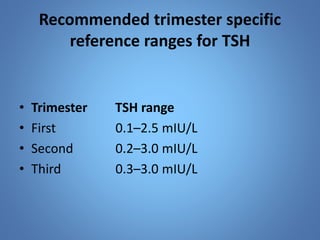
Recommended trimester specific
reference ranges for TSH
• Trimester TSH range
• First 0.1–2.5 mIU/L
• Second 0.2–3.0 mIU/L
• Third 0.3–3.0 mIU/L
Algorithm for the evaluation of
hypothyroidism during pregnancy
Definitions
• Stagnaro-Green A, ert al. American Thyroid Association Taskforce on Thyroid Disease During
Pregnancy and Postpartum.Guidelines of the American Thyroid Association for the diagnosis
and management of thyroid disease during pregnancy and postpartum. Thyroid. 2011
Oct;21(10):1081-125.PMID
SCH is defined as a serum TSH
between 2.5 & 10 mIU/L with a
normal FT4 concentration.
Women with a TSH concentration
above the trimester-specific
reference interval with a decreased
FT4, and all women with a TSH
concentration above 10.0 mIU/L
irrespective of the level of FT4 are
also considered to have OH.
Etiology of hypothyroidism in
pregnancy
Iodine deficiency - Combined
maternal and fetal hypothyroidism
• Iodine deficiency is, by a large margin, the most
common preventable cause of mental retardation
in the world. Without adequate maternal iodine
intake, both the fetus and mother are
hypothyroid, and if supplemental iodine is not
provided, the child may well develop cretinism,
with mental retardation, deaf-mutism and
spasticity.
• The WHO recommends 250 μg/day of iodine in
pregnancy and lactation to meet the
increased demands.
Iodine deficiency in India
In India, the entire population is prone to IDD due
to deficiency of iodine in the soil of the
subcontinent and consequently the food derived
from it. To combat the risk of IDD, salt is fortified
with iodine. However, an estimated 350 million
people do not consume adequately iodized salt. Of
the 325 districts surveyed in India so far, 263 are
IDD-endemic. The current household level iodized
salt coverage in India is 91 per cent with 71 per cent
households consuming adequately iodized salt.
Iodine deficiency disorders (IDD) control in India Chandrakant S. Pandav et al Centre for Community
Medicine, All India Institute of Medical Sciences, New Delhi, Department of Social & Behavioral
Sciences, School of Public Health, Harvard University, Boston, Massachusetts, USA & **Department
of Indian Coalition for Control of Iodine Deficiency Disorders, New Delhi, India October 5, 2011
Overt untreated hypothyroidism
• Fetal loss
• Gestational hypertension
• Placental abruption
• Neurodevelopmental delay
• Poor perinatal outcome
Subclinical hypothyroidism adverse
outcomes
• At present, the majority of high-quality evidence
suggests that SCH is associated with increased
risk of adverse pregnancy outcomes (miscarriage,
late fetal loss)
• The detrimental effect of SCH on fetal
neurocognitive development is less clear. An
association between maternal SCH and adverse
fetal neurocognitive development is biologically
plausible , though not clearly demonstrated.
SCH and neurocognitive development
• Data from a large, case–control study (Haddow et al) demonstrated a 7-
point reduction in IQ among children born to untreated hypothyroid
women when compared with euthyroid controls(in addition to delays in
motor, language, and attention at 7–9 years of age). Similar retrospective
data were previously published by Man and colleagues.
• Preliminary data from the Controlled Antenatal Thyroid Screening trials,
presented at the International Thyroid Congress in 2010, have questioned
these findings. Primary outcomes of the study were the mean IQ of
children at 3.5 years and the percentage of children with an IQ < 85 at 3.5
years among children whose mothers were treated for SCH and/or
isolated hypothyroxinemia as compared to children whose mothers were
not treated. They found that there was no difference in mean IQ.
However, the percentage of children with IQs < 85 was higher in the
untreated group vs. the treated group (15.6% vs. 9.2%, p = 0.009).
• Between 50% and 85% of hypothyroid women being
treated with exogenous LT4 need to increase dosing
during pregnancy.
• Thyroxine should be increased by two additional doses
per week (or 30%) on suspicion or confirmation of
pregnancy in women already taking thyroxine.
• All treated hypothyroid women (currently receiving LT4)
optimize thyroid status preconception. Maternal serum
TSH concentration of <2.5 mIU/L is a reasonable goal
for all such women.
• In pregnant patients with treated
hypothyroidism, maternal serum TSH should be
monitored approximately every 4 weeks during
the first half of pregnancy because further
LT4 dose adjustments are often required.
• Therefore, following delivery, maternal LT4 dosing
should be reduced to prepregnancy levels, and a
serum TSH assessed 6 weeks thereafter.
• There are no data to suggest that women with
adequately treated SCH or OH have an
increased risk of any obstetrical complication.
Consequently, there is no indication for any
additional testing or surveillance in
pregnancies of women with either SCH or OH
who are being monitored and being treated
appropriately.
Controversy
• Universal versus targeted screening
• How to and whether to treat SCH
• How to manage the thyroid antibody positive
euthyroid woman
• OH should be treated in pregnancy. The goal of
LT4 treatment is to normalize maternal serum TSH
values within the trimester-specific pregnancy
reference range.
• Thyroid auto-antibodies were detected in ∼50%
of pregnant women with SCH and in more than
80% with OH.
• There is insufficient evidence to recommend for
or against screening all women for thyroid
antibodies in the first trimester of pregnancy.
Management of hypothyroidism in
pregnancy
Monitoring Hypothyroidism
in Pregnancy
• Ideally women with hypothyroidism should be seen pre-pregnancy to ensure that
they are euthyroid. They should also be encouraged to present as soon as they
become pregnant in order that their thyroxine dose may be increased and TSH and
FT4 are monitored regularly. For patients with established hypothyroidism the
ideal monitoring regimen is thus:-
• Before conception (if possible)
• Test FT4 and TSH at diagnosis of pregnancy or at antenatal booking
• Test 2 weeks after the dose of T4 has been increased
• At least once in each trimester
• 2-6 weeks postpartum
• If TFTs are unstable refer to Consultant Endocrinologist as early as possible as
growth scans may be required
• Reduce T4 treatment to pre-pregnancy dose at 2-6 weeks post-partum and
recheck TSH/Free T4 6-8 weeks later
Should SCH be treated in pregnancy?
• SCH has been associated with adverse
maternal and fetal outcomes. However, due to
the lack of randomized controlled trials there
is insufficient evidence to recommend for or
against universal LT4 treatment in TAb−ve
pregnant women with SCH (Level I-USPSTF)
Should SCH be treated in pregnancy?
• Benefit of thyroxine treatment has been
demonstrated for thyroid peroxidase antibody
(TPOab) positive women with SCH, but there is
little prospective data on intervention in TPOab
negative women. Until prospective data are
available to guide management, some clinicians
may choose to consider low dose thyroxine
replacement, which is safe in pregnancy, aiming
for TSH values within the trimester specific
reference ranges in all women with SCH.
Should SCH be treated in pregnancy?
• Women who are positive for TPOAb and have
SCH should be treated with LT4. Level B-
USPSTF
If pregnant women with SCH are not initially treated,
how should they be monitored through gestation?
• Women with SCH in pregnancy who are not
initially treated should be monitored for
progression to OH with a serum TSH and
FT4 approximately every 4 weeks until 16–20
weeks gestation and at least once between 26
and 32 weeks gestation. This approach has not
been prospectively studied. Level I-USPSTF
Should isolated hypothyroxinemia be
treated in pregnancy?
To date, no randomized, interventional trial of
LT4 therapy has been performed in pregnant
women with isolated hypothyroxinemia (this will
change with the publication of the Controlled
Antenatal Thyroid Study). Thus, because only
limited data exist suggesting harm from isolated
hypothyroxinemia and no interventional data
have been published, the committee does not
recommend therapy for such women at present.
Isolated hypothyroxinemia
Isolated hypothyroxinemia is defined as a
normal maternal TSH concentration in
conjunction with FT4 concentrations in the lower
5th or 10th percentile of the reference range.
Isolated hypothyroxinemia
• It is debated whether isolated hypothyroxinemia causes any
adverse effects on the developing fetus.
• Pop and colleagues reported a decrease in psychomotor test scores
among offspring born to women with FT4 indices in the lowest 10th
percentile.
• Li et al. observed a similar reduction in the IQ of the offspring
whose mothers experienced either hypothyroidism or isolated
hypothyroxinemia during the first trimester.
• Henrichs and colleagues recently published data from the
Generation R study, conducted in the Netherlands. This prospective,
nonrandomized investigation evaluated communication
development in children born to women with isolated
hypothyroxinemia. A 1.5- to 2-fold increased risk of adverse findings
(at 3 years of age) was associated with maternal FT4 in the lower
5th and 10th percentiles.
Hyperthyroidism in pregnancy
Etiology of hyperthyroidism in
pregnancy
Low TSH in pregnancy
Hyperthyroidism (Graves' disease)
Stimulation of the TSH receptor by hCG (first
trimester of pregnancy, hyperemesis gravidarum,
molar pregnancy/choriocarcinoma)
Exogenous thyroid hormone
Thyroiditis
Autonomous thyroid nodule
Dopamine, glucocorticoids
Secondary hypothyroidism
Serum TSH and hCG as a function of
gestational age
J Endocrinol Metab 1990;71:276–87. © The Endocrine Society.
Significance of an “Undetectable” TSH in
Pregnancy
• Some “normal” pregnancies are associated with a
mild transient “physiological” hyperthyroidism
during the first trimester. This is caused by very
high levels of hCG, that have a mild stimulatory
effect on the thyroid. In approximately 3% of
pregnancies the TSH will be suppressed to
<0.01mU/L and FT4/FT3 may be slightly elevated.
It is essential to exclude Graves’ disease in such
pregnancies and as such TSH-receptor antibodies
should be (TRAbs) measured and an endocrine
opinion sought.
Gestational thyrotoxicosis
• The appropriate management of women with
gestational hyperthyroidism and hyperemesis
gravidarum includes supportive therapy,
management of dehydration, and
hospitalization if needed.
• ATDs are not recommended for the
management of gestational hyperthyroidism.
Hyperthyroidism in pregnancy
• In the presence of a suppressed serum TSH in
the first trimester (TSH <0.1 mIU/L), a history
and physical examination are indicated.
FT4 measurements should be obtained in all
patients. Measurement of TT3 and TRAb may
be helpful in establishing a diagnosis of
hyperthyroidism.
Algorithm for management of
hyperthyroidism during pregnancy
NL, within the reference interval; ↓,
Hyperthyroid pre-pregnancy
• The optimal time to conceive is once a
euthyroid state is reached.
• Prepregnancy counseling is imperative, and
use of contraception until the disease is
controlled is strongly recommended.
• Prior to conception, a hyperthyroid patient
may be offered ablative therapy (131I or
surgery) or medical (anti-thyroid drugs)
therapy.
Ablative therapy
• If TrAB titres are high and the prospective
mother is planning a pregnancy in the next 2
years, surgery is better than 131I as the latter
causes increase in antibody titres which may
remain for several months.
• After surgery, pregnancy should be postponed
for 6 months to allow time for adjustment of
LT4 dose for optimal control.
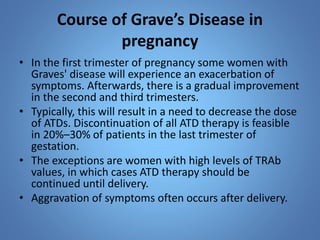
Course of Grave’s Disease in
pregnancy
• In the first trimester of pregnancy some women with
Graves' disease will experience an exacerbation of
symptoms. Afterwards, there is a gradual improvement
in the second and third trimesters.
• Typically, this will result in a need to decrease the dose
of ATDs. Discontinuation of all ATD therapy is feasible
in 20%–30% of patients in the last trimester of
gestation.
• The exceptions are women with high levels of TRAb
values, in which cases ATD therapy should be
continued until delivery.
• Aggravation of symptoms often occurs after delivery.
Goals of management
• Maintaining euthyroid status with minimal
effective dose of antithyroid drugs
• Prediction and prevention of neonatal hypo-
and hyperthyroidism
• Prevention of postpartum flare of
thyrotoxicosis
• Optimising fetal outcome in uncontrolled
cases
Anti-thyroid drugs
• PTU drug of choice in first trimester
• Switch to MMI after first trimester
• Free T4 and TSH should be measured
approximately every 2–4 weeks at
initiation of therapy and every 4–6 weeks
after achieving the target value.
Hyperthyroidism in pregnancy
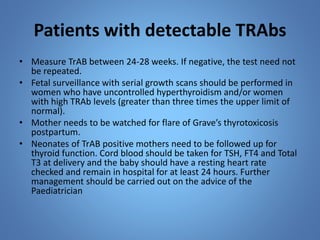
Patients with detectable TRAbs
• Measure TrAB between 24-28 weeks. If negative, the test need not
be repeated.
• Fetal surveillance with serial growth scans should be performed in
women who have uncontrolled hyperthyroidism and/or women
with high TRAb levels (greater than three times the upper limit of
normal).
• Mother needs to be watched for flare of Grave’s thyrotoxicosis
postpartum.
• Neonates of TrAB positive mothers need to be followed up for
thyroid function. Cord blood should be taken for TSH, FT4 and Total
T3 at delivery and the baby should have a resting heart rate
checked and remain in hospital for at least 24 hours. Further
management should be carried out on the advice of the
Paediatrician
Postpartum management
• Moderate doses of antithyroid medications
(ie. carbimazole 25–30 mg/day or PTU less
than 300 mg/day) appear to be safe for the
breastfed infant.
• Monitoring of thyroid function in
breastfeeding infants of mothers taking
antithyroid medications (particularly those
taking high doses) should be considered.
Postnatal management
Many women will not require to return to their
CBZ/PTU post-natal but all should be seen in the
Endocrine Clinic 8-12 weeks post partum or
sooner if they have symptoms.
Postpartum thyroiditis
Management
• ATDs are not recommended for the treatment of
the thyrotoxic phase of PPT.
• Following the resolution of the thyrotoxic phase
of PPT, TSH should be tested every 2 months (or if
symptoms are present) until 1 year postpartum
to screen for the hypothyroid phase.
• Women with a prior history of PPT should have
an annual TSH test performed to evaluate for
permanent hypothyroidism.
• Women who are symptomatic with hypothyroidism in
PPT should either have their TSH level retested in 4–8
weeks or be started on LT4 (if symptoms are severe, if
conception is being attempted, or if the patient desires
therapy). Women who are asymptomatic with
hypothyroidism in PPT should have their TSH level
retested in 4–8 weeks.
• If LT4 is initiated for PPT, future discontinuation of
therapy should be attempted. Tapering of treatment
can be begun 6–12 months after the initiation of
treatment. Tapering of LT4 should be avoided when a
woman is actively attempting pregnancy, is
breastfeeding, or is pregnant.
Controversy
• How to manage the thyroid antibody positive
euthyroid woman
The thyroid antibody positive
euthyroid woman
1 in 10 women of childbearing age with normal
thyroid function have underlying thyroid
autoimmunity, which may indicate reduced
functional reserve, but antenatal antibody
screening is not routine. Screening for TPOab
and TSH is advisable in women with recurrent
miscarriage.
The thyroid antibody positive
euthyroid woman
• A two–threefold increased risk of spontaneous miscarriage
• The risk of preterm birth is approximately doubled
• A risk factor for perinatal death
• However, prospective intervention data are limited and the
decision to treat with thyroxine or monitor for overt or
subclinical hypothyroidism is controversial.
• In these cases, monitoring of thyroid function every 4
weeks during the first half of pregnancy and once between
26 and 32 weeks gestation has been suggested. In the case
of recurrent miscarriage, it is acceptable to treat with low
dose thyroxine with judicious monitoring of thyroid
function as there is potential benefit from this safe
treatment.
Controversy
• Universal versus targeted screening
Screening recommendation for thyroid disease in pregnancy
High risk attributes for thyroid
dysfunction
• A history of thyroid dysfunction or surgery
• Family history of thyroid disease
• Goitre
• Antithyroid antibodies present
• Symptoms or signs of hypothyroidism
• Women with type 1 diabetes
• History of miscarriage or preterm delivery
• Autoimmune disorder
• Infertility
• Prior head or neck irradiation
• Morbid obesity
• Age 30 years or older
• Treatment with amiodarone/ lithium
• Recent exposure to iodinated contrast
Take home messages
• Serum TSH is a more accurate indication of
thyroid status in pregnancy than any
alternative method.
• Pregnancy specific reference ranges should be
used to guide diagnosis and monitoring of
thyroid conditions in pregnancy.
Take home messages
• The World Health Organization recommends a daily
intake of iodine 250 µg during pregnancy and lactation.
• Hypothyroid states should be treated with thyroxine
aiming for a TSH <2.5 prior to conception and in the
first trimester and TSH <3.0 for the second and third
trimesters.
• Gestational thyrotoxicosis needs to be differentiated
from Graves disease and rarely requires thionamide
treatment.
• It is important to maintain a high index of suspicion for
postpartum thyroiditis, especially in those with known
thyroid antibodies or autoimmune conditions.
A new study finds that not only low but also
high maternal thyroid hormone levels during
early pregnancy may significantly lower the
infant's IQ later in childhood. The study results
suggest that the common practice of treating
pregnant women who have mild thyroid
hormone deficiency may pose unexpected risks
to the developing baby's brain.
High-normal thyroid hormone level in pregnancy may
affect fetal brain development
March 6, 2015:The Endocrine Society

Thyroid hormone in reproduction

  • 1.
    Thyroid hormones inpregnancy Dr Suman Bijlani, MD, DGO, FCPS
  • 4.
    Impact of thyroidon the female reproductive system Relevant in menstruation, ovulation, fertility and pregnancy
  • 5.
    Thyroid and pregnancy •Management of thyroid diseases during pregnancy requires special considerations because pregnancy induces major changes in thyroid function, and maternal thyroid disease can have adverse effects on the pregnancy and the fetus. • Thyroid dysfunction affects 2–3% of pregnant women.
  • 6.
    TBG during normalpregnancy (mean ± 2 SD) in 2-week intervals Acta Endocrinol1982;100:504–11. © Society of the European Journal of Endocrinology
  • 7.
  • 9.
  • 10.
  • 11.
    Recommended trimester specific referenceranges for TSH • Trimester TSH range • First 0.1–2.5 mIU/L • Second 0.2–3.0 mIU/L • Third 0.3–3.0 mIU/L
  • 12.
    Algorithm for theevaluation of hypothyroidism during pregnancy
  • 13.
    Definitions • Stagnaro-Green A,ert al. American Thyroid Association Taskforce on Thyroid Disease During Pregnancy and Postpartum.Guidelines of the American Thyroid Association for the diagnosis and management of thyroid disease during pregnancy and postpartum. Thyroid. 2011 Oct;21(10):1081-125.PMID SCH is defined as a serum TSH between 2.5 & 10 mIU/L with a normal FT4 concentration. Women with a TSH concentration above the trimester-specific reference interval with a decreased FT4, and all women with a TSH concentration above 10.0 mIU/L irrespective of the level of FT4 are also considered to have OH.
  • 14.
  • 15.
    Iodine deficiency -Combined maternal and fetal hypothyroidism • Iodine deficiency is, by a large margin, the most common preventable cause of mental retardation in the world. Without adequate maternal iodine intake, both the fetus and mother are hypothyroid, and if supplemental iodine is not provided, the child may well develop cretinism, with mental retardation, deaf-mutism and spasticity. • The WHO recommends 250 μg/day of iodine in pregnancy and lactation to meet the increased demands.
  • 16.
    Iodine deficiency inIndia In India, the entire population is prone to IDD due to deficiency of iodine in the soil of the subcontinent and consequently the food derived from it. To combat the risk of IDD, salt is fortified with iodine. However, an estimated 350 million people do not consume adequately iodized salt. Of the 325 districts surveyed in India so far, 263 are IDD-endemic. The current household level iodized salt coverage in India is 91 per cent with 71 per cent households consuming adequately iodized salt. Iodine deficiency disorders (IDD) control in India Chandrakant S. Pandav et al Centre for Community Medicine, All India Institute of Medical Sciences, New Delhi, Department of Social & Behavioral Sciences, School of Public Health, Harvard University, Boston, Massachusetts, USA & **Department of Indian Coalition for Control of Iodine Deficiency Disorders, New Delhi, India October 5, 2011
  • 18.
    Overt untreated hypothyroidism •Fetal loss • Gestational hypertension • Placental abruption • Neurodevelopmental delay • Poor perinatal outcome
  • 19.
    Subclinical hypothyroidism adverse outcomes •At present, the majority of high-quality evidence suggests that SCH is associated with increased risk of adverse pregnancy outcomes (miscarriage, late fetal loss) • The detrimental effect of SCH on fetal neurocognitive development is less clear. An association between maternal SCH and adverse fetal neurocognitive development is biologically plausible , though not clearly demonstrated.
  • 20.
    SCH and neurocognitivedevelopment • Data from a large, case–control study (Haddow et al) demonstrated a 7- point reduction in IQ among children born to untreated hypothyroid women when compared with euthyroid controls(in addition to delays in motor, language, and attention at 7–9 years of age). Similar retrospective data were previously published by Man and colleagues. • Preliminary data from the Controlled Antenatal Thyroid Screening trials, presented at the International Thyroid Congress in 2010, have questioned these findings. Primary outcomes of the study were the mean IQ of children at 3.5 years and the percentage of children with an IQ < 85 at 3.5 years among children whose mothers were treated for SCH and/or isolated hypothyroxinemia as compared to children whose mothers were not treated. They found that there was no difference in mean IQ. However, the percentage of children with IQs < 85 was higher in the untreated group vs. the treated group (15.6% vs. 9.2%, p = 0.009).
  • 21.
    • Between 50%and 85% of hypothyroid women being treated with exogenous LT4 need to increase dosing during pregnancy. • Thyroxine should be increased by two additional doses per week (or 30%) on suspicion or confirmation of pregnancy in women already taking thyroxine. • All treated hypothyroid women (currently receiving LT4) optimize thyroid status preconception. Maternal serum TSH concentration of <2.5 mIU/L is a reasonable goal for all such women.
  • 22.
    • In pregnantpatients with treated hypothyroidism, maternal serum TSH should be monitored approximately every 4 weeks during the first half of pregnancy because further LT4 dose adjustments are often required. • Therefore, following delivery, maternal LT4 dosing should be reduced to prepregnancy levels, and a serum TSH assessed 6 weeks thereafter.
  • 23.
    • There areno data to suggest that women with adequately treated SCH or OH have an increased risk of any obstetrical complication. Consequently, there is no indication for any additional testing or surveillance in pregnancies of women with either SCH or OH who are being monitored and being treated appropriately.
  • 24.
    Controversy • Universal versustargeted screening • How to and whether to treat SCH • How to manage the thyroid antibody positive euthyroid woman
  • 25.
    • OH shouldbe treated in pregnancy. The goal of LT4 treatment is to normalize maternal serum TSH values within the trimester-specific pregnancy reference range. • Thyroid auto-antibodies were detected in ∼50% of pregnant women with SCH and in more than 80% with OH. • There is insufficient evidence to recommend for or against screening all women for thyroid antibodies in the first trimester of pregnancy.
  • 26.
  • 27.
    Monitoring Hypothyroidism in Pregnancy •Ideally women with hypothyroidism should be seen pre-pregnancy to ensure that they are euthyroid. They should also be encouraged to present as soon as they become pregnant in order that their thyroxine dose may be increased and TSH and FT4 are monitored regularly. For patients with established hypothyroidism the ideal monitoring regimen is thus:- • Before conception (if possible) • Test FT4 and TSH at diagnosis of pregnancy or at antenatal booking • Test 2 weeks after the dose of T4 has been increased • At least once in each trimester • 2-6 weeks postpartum • If TFTs are unstable refer to Consultant Endocrinologist as early as possible as growth scans may be required • Reduce T4 treatment to pre-pregnancy dose at 2-6 weeks post-partum and recheck TSH/Free T4 6-8 weeks later
  • 28.
    Should SCH betreated in pregnancy? • SCH has been associated with adverse maternal and fetal outcomes. However, due to the lack of randomized controlled trials there is insufficient evidence to recommend for or against universal LT4 treatment in TAb−ve pregnant women with SCH (Level I-USPSTF)
  • 29.
    Should SCH betreated in pregnancy? • Benefit of thyroxine treatment has been demonstrated for thyroid peroxidase antibody (TPOab) positive women with SCH, but there is little prospective data on intervention in TPOab negative women. Until prospective data are available to guide management, some clinicians may choose to consider low dose thyroxine replacement, which is safe in pregnancy, aiming for TSH values within the trimester specific reference ranges in all women with SCH.
  • 30.
    Should SCH betreated in pregnancy? • Women who are positive for TPOAb and have SCH should be treated with LT4. Level B- USPSTF
  • 31.
    If pregnant womenwith SCH are not initially treated, how should they be monitored through gestation? • Women with SCH in pregnancy who are not initially treated should be monitored for progression to OH with a serum TSH and FT4 approximately every 4 weeks until 16–20 weeks gestation and at least once between 26 and 32 weeks gestation. This approach has not been prospectively studied. Level I-USPSTF
  • 32.
    Should isolated hypothyroxinemiabe treated in pregnancy? To date, no randomized, interventional trial of LT4 therapy has been performed in pregnant women with isolated hypothyroxinemia (this will change with the publication of the Controlled Antenatal Thyroid Study). Thus, because only limited data exist suggesting harm from isolated hypothyroxinemia and no interventional data have been published, the committee does not recommend therapy for such women at present.
  • 33.
    Isolated hypothyroxinemia Isolated hypothyroxinemiais defined as a normal maternal TSH concentration in conjunction with FT4 concentrations in the lower 5th or 10th percentile of the reference range.
  • 34.
    Isolated hypothyroxinemia • Itis debated whether isolated hypothyroxinemia causes any adverse effects on the developing fetus. • Pop and colleagues reported a decrease in psychomotor test scores among offspring born to women with FT4 indices in the lowest 10th percentile. • Li et al. observed a similar reduction in the IQ of the offspring whose mothers experienced either hypothyroidism or isolated hypothyroxinemia during the first trimester. • Henrichs and colleagues recently published data from the Generation R study, conducted in the Netherlands. This prospective, nonrandomized investigation evaluated communication development in children born to women with isolated hypothyroxinemia. A 1.5- to 2-fold increased risk of adverse findings (at 3 years of age) was associated with maternal FT4 in the lower 5th and 10th percentiles.
  • 35.
  • 36.
  • 37.
    Low TSH inpregnancy Hyperthyroidism (Graves' disease) Stimulation of the TSH receptor by hCG (first trimester of pregnancy, hyperemesis gravidarum, molar pregnancy/choriocarcinoma) Exogenous thyroid hormone Thyroiditis Autonomous thyroid nodule Dopamine, glucocorticoids Secondary hypothyroidism
  • 38.
    Serum TSH andhCG as a function of gestational age J Endocrinol Metab 1990;71:276–87. © The Endocrine Society.
  • 39.
    Significance of an“Undetectable” TSH in Pregnancy • Some “normal” pregnancies are associated with a mild transient “physiological” hyperthyroidism during the first trimester. This is caused by very high levels of hCG, that have a mild stimulatory effect on the thyroid. In approximately 3% of pregnancies the TSH will be suppressed to <0.01mU/L and FT4/FT3 may be slightly elevated. It is essential to exclude Graves’ disease in such pregnancies and as such TSH-receptor antibodies should be (TRAbs) measured and an endocrine opinion sought.
  • 40.
    Gestational thyrotoxicosis • Theappropriate management of women with gestational hyperthyroidism and hyperemesis gravidarum includes supportive therapy, management of dehydration, and hospitalization if needed. • ATDs are not recommended for the management of gestational hyperthyroidism.
  • 41.
    Hyperthyroidism in pregnancy •In the presence of a suppressed serum TSH in the first trimester (TSH <0.1 mIU/L), a history and physical examination are indicated. FT4 measurements should be obtained in all patients. Measurement of TT3 and TRAb may be helpful in establishing a diagnosis of hyperthyroidism.
  • 42.
    Algorithm for managementof hyperthyroidism during pregnancy NL, within the reference interval; ↓,
  • 43.
    Hyperthyroid pre-pregnancy • Theoptimal time to conceive is once a euthyroid state is reached. • Prepregnancy counseling is imperative, and use of contraception until the disease is controlled is strongly recommended. • Prior to conception, a hyperthyroid patient may be offered ablative therapy (131I or surgery) or medical (anti-thyroid drugs) therapy.
  • 44.
    Ablative therapy • IfTrAB titres are high and the prospective mother is planning a pregnancy in the next 2 years, surgery is better than 131I as the latter causes increase in antibody titres which may remain for several months. • After surgery, pregnancy should be postponed for 6 months to allow time for adjustment of LT4 dose for optimal control.
  • 45.
    Course of Grave’sDisease in pregnancy • In the first trimester of pregnancy some women with Graves' disease will experience an exacerbation of symptoms. Afterwards, there is a gradual improvement in the second and third trimesters. • Typically, this will result in a need to decrease the dose of ATDs. Discontinuation of all ATD therapy is feasible in 20%–30% of patients in the last trimester of gestation. • The exceptions are women with high levels of TRAb values, in which cases ATD therapy should be continued until delivery. • Aggravation of symptoms often occurs after delivery.
  • 46.
    Goals of management •Maintaining euthyroid status with minimal effective dose of antithyroid drugs • Prediction and prevention of neonatal hypo- and hyperthyroidism • Prevention of postpartum flare of thyrotoxicosis • Optimising fetal outcome in uncontrolled cases
  • 47.
    Anti-thyroid drugs • PTUdrug of choice in first trimester • Switch to MMI after first trimester • Free T4 and TSH should be measured approximately every 2–4 weeks at initiation of therapy and every 4–6 weeks after achieving the target value.
  • 48.
  • 49.
    Patients with detectableTRAbs • Measure TrAB between 24-28 weeks. If negative, the test need not be repeated. • Fetal surveillance with serial growth scans should be performed in women who have uncontrolled hyperthyroidism and/or women with high TRAb levels (greater than three times the upper limit of normal). • Mother needs to be watched for flare of Grave’s thyrotoxicosis postpartum. • Neonates of TrAB positive mothers need to be followed up for thyroid function. Cord blood should be taken for TSH, FT4 and Total T3 at delivery and the baby should have a resting heart rate checked and remain in hospital for at least 24 hours. Further management should be carried out on the advice of the Paediatrician
  • 50.
    Postpartum management • Moderatedoses of antithyroid medications (ie. carbimazole 25–30 mg/day or PTU less than 300 mg/day) appear to be safe for the breastfed infant. • Monitoring of thyroid function in breastfeeding infants of mothers taking antithyroid medications (particularly those taking high doses) should be considered.
  • 51.
    Postnatal management Many womenwill not require to return to their CBZ/PTU post-natal but all should be seen in the Endocrine Clinic 8-12 weeks post partum or sooner if they have symptoms.
  • 52.
  • 53.
  • 54.
  • 55.
    Management • ATDs arenot recommended for the treatment of the thyrotoxic phase of PPT. • Following the resolution of the thyrotoxic phase of PPT, TSH should be tested every 2 months (or if symptoms are present) until 1 year postpartum to screen for the hypothyroid phase. • Women with a prior history of PPT should have an annual TSH test performed to evaluate for permanent hypothyroidism.
  • 56.
    • Women whoare symptomatic with hypothyroidism in PPT should either have their TSH level retested in 4–8 weeks or be started on LT4 (if symptoms are severe, if conception is being attempted, or if the patient desires therapy). Women who are asymptomatic with hypothyroidism in PPT should have their TSH level retested in 4–8 weeks. • If LT4 is initiated for PPT, future discontinuation of therapy should be attempted. Tapering of treatment can be begun 6–12 months after the initiation of treatment. Tapering of LT4 should be avoided when a woman is actively attempting pregnancy, is breastfeeding, or is pregnant.
  • 57.
    Controversy • How tomanage the thyroid antibody positive euthyroid woman
  • 58.
    The thyroid antibodypositive euthyroid woman 1 in 10 women of childbearing age with normal thyroid function have underlying thyroid autoimmunity, which may indicate reduced functional reserve, but antenatal antibody screening is not routine. Screening for TPOab and TSH is advisable in women with recurrent miscarriage.
  • 59.
    The thyroid antibodypositive euthyroid woman • A two–threefold increased risk of spontaneous miscarriage • The risk of preterm birth is approximately doubled • A risk factor for perinatal death • However, prospective intervention data are limited and the decision to treat with thyroxine or monitor for overt or subclinical hypothyroidism is controversial. • In these cases, monitoring of thyroid function every 4 weeks during the first half of pregnancy and once between 26 and 32 weeks gestation has been suggested. In the case of recurrent miscarriage, it is acceptable to treat with low dose thyroxine with judicious monitoring of thyroid function as there is potential benefit from this safe treatment.
  • 60.
  • 61.
    Screening recommendation forthyroid disease in pregnancy
  • 62.
    High risk attributesfor thyroid dysfunction • A history of thyroid dysfunction or surgery • Family history of thyroid disease • Goitre • Antithyroid antibodies present • Symptoms or signs of hypothyroidism • Women with type 1 diabetes • History of miscarriage or preterm delivery • Autoimmune disorder • Infertility • Prior head or neck irradiation • Morbid obesity • Age 30 years or older • Treatment with amiodarone/ lithium • Recent exposure to iodinated contrast
  • 63.
    Take home messages •Serum TSH is a more accurate indication of thyroid status in pregnancy than any alternative method. • Pregnancy specific reference ranges should be used to guide diagnosis and monitoring of thyroid conditions in pregnancy.
  • 64.
    Take home messages •The World Health Organization recommends a daily intake of iodine 250 µg during pregnancy and lactation. • Hypothyroid states should be treated with thyroxine aiming for a TSH <2.5 prior to conception and in the first trimester and TSH <3.0 for the second and third trimesters. • Gestational thyrotoxicosis needs to be differentiated from Graves disease and rarely requires thionamide treatment. • It is important to maintain a high index of suspicion for postpartum thyroiditis, especially in those with known thyroid antibodies or autoimmune conditions.
  • 65.
    A new studyfinds that not only low but also high maternal thyroid hormone levels during early pregnancy may significantly lower the infant's IQ later in childhood. The study results suggest that the common practice of treating pregnant women who have mild thyroid hormone deficiency may pose unexpected risks to the developing baby's brain. High-normal thyroid hormone level in pregnancy may affect fetal brain development March 6, 2015:The Endocrine Society

Editor's Notes

  • #10 The fetus is dependent on transplacental transfer of maternal thyroxine (T4). Deiodination of maternal T4 by the fetus results in local fetal production of liothyronine (T3), which is particularly important for neurological development. Maternal T3 does not cross the placenta and appears to have little, if any, role in development. Pregnancy is therefore a state of increased thyroid hormone demand necessitating an increase in thyroid hormone synthesis by as much as 50%.
  • #45 Human chorionic gonadotropin (hCG) and thyroid stimulating hormone (TSH) are glycoprotein hormones and share a common alpha subunit; their beta subunits also have significant homology. As a result, hCG has thyrotropic activity and as levels increase in pregnancy, there is an appropriate reciprocal decline in TSH.