• FIRST LANGUAGE: First language is the
language a persons learns first. It is his home
language or mother tongue.
• SECOND LANGUAGE: Second language is the
language a person learns after the first
language. It may have some official status in
the country. May be use it for communicative
purposes besides mother tongue.
Foreign language
• It is used for non native English speakers.
• Learning English in a country which English is
not commonly spoken.
• In another word, foreign language is a
language that is learned in an area where that
language is not generally not spoken.
ENGLISH AS A FOREIGN
LANGUAGE
• Before the independence english is considered as a
foreign language.
• English occupies a unique position in indian educational
system. Even after independence, it continues to be a
major language having a prestigious position in our
society.
• In woods dispatch, it is asserted that English should be
the medium of all higher branches and the vernacular
in lower.
• In the post-independence period, the
foreign status of English in India thus
appears to have remained for a shorter
period initially, and it gradually seems to
have acquired the status of a second
language.
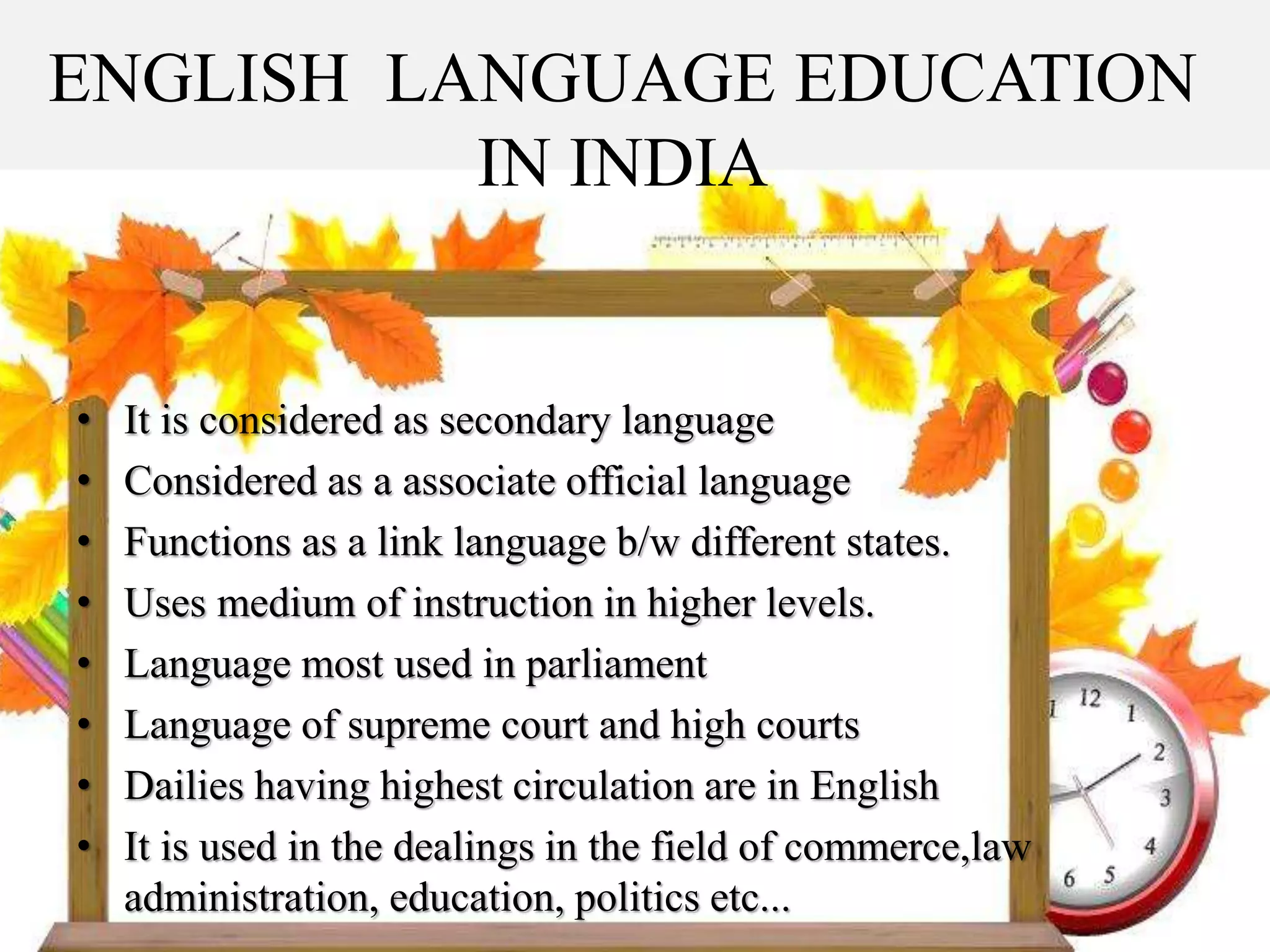
ENGLISH LANGUAGE EDUCATION
IN INDIA
• It is considered as secondary language
• Considered as a associate official language
• Functions as a link language b/w different states.
• Uses medium of instruction in higher levels.
• Language most used in parliament
• Language of supreme court and high courts
• Dailies having highest circulation are in English
• It is used in the dealings in the field of commerce,law
administration, education, politics etc...
• In university education commission
report DR.S. Radhakrishnan, says
English should be studied in schools
and universities so as to keep ourselves
in touch with the stream of ever
growing knowledge.
• Indian education commission (1964-66)
headed by Kothari proposed three
language formula for secondary level
education.
• We Indianized the English
• In India teaching of English starting different levels in different states.
• Most of the states follow their own syllabus
• But even after getting English language classes for several years in
schools most of the students cannot use English accurately in speech
and writing. They fail to reach the expected level of performance in
English language .
• Their English language competency remains unsatisfactory.
• ELT faces several challenges in our country.
• The present situation of teaching english in the country itself is poor
and shaky.
CRITICAL EVALUATION OF
TEACHING AND LEARNING
ENGLISH IN KERALA ?
• ELT & Learning is not moving on smooth tracks
in our country.
• Creation of English atmosphere which is
lacking in school is one of the pertinent
problems in terms English acquisition
• The distinctive element that makes only
Kerala education products struggle in
communication part.
Socio-cultural and economic background
• students are either from lower-middle class or
disadvantaged classes
• hence access to any level of literature or media in
English is un-expectable.
• The style of their life never demand much of
English and if does the children are sent to
privates schools and so the parents never
expect anything from government schools
• culture of English newspaper reading or English
channels or movies cannot find.
Lack of pre-school education:
• Children come to 1st standard are fresher's
having no any traditional literacy, pre-KGs or
any pre-school education.
• If the children are familiarised with alphabets
and small words before and applicability of
newly revised curriculum would be easy and
realise fuller improvement in children
acquisition.
Absenteeism
• Absenteeism becomes more than a problem while
following new method in classroom
• by missing a class he/she loses entire concepts and
alphabets.
• Teachers are unable to redo all stuffs only for one or
two students.
Lack of Parent support:
• Home work places critical in reinforcing what
is taught in school and its practice lead to
fuller understanding of things
• The more parents aware and take care of
children’s learning the better they perform in
classroom.
• best performers out of all were either taught
at home or sent for tuitions.
Lack of English ambience
• Children’s immediate circle/society and family
are their closer points whereby they grasp
primary tools of language or else.
• But here, children get to hear English only
from schools
Teachers’ proficiency:
• In service training doesn’t give enough
space for language training especially for
English.
CONTENT
OVERLOAD
• Content overload adversely affect a complete
activity-based classroom practices
• content overload and badly demand for
portion completion put teachers in trouble
and end up in covering most possible portion
and missing out big segment of activities.
Over-strength and lack of individual
focus
• over strength affect in dangerous way in
activity-based plus constructivistic classrooms.
Lack of infrastructures
• No policies considered primary classes as they
did on higher classes unto very recently.
• It affects to do activities and games in
classrooms.
Lack of ICT classrooms
• From mere’ chalk’ and ‘talk’ method would
elicit interest in them towards English and
primary schools are in dire need of ‘Smart
classrooms’.
• the teachers are not in stage for demanding
ICT while even the
infrastructural condition
is least noticed and
pathetic.
• The condition of Kerala in terms of English
literacy was not different from other states
• NIEPA survey in 1994 posited Kerala in 18th
rank amongst all states in terms of language
English literacy and mathematics.
Measures to overcome challenges
• Limit the size of class.
• Reduce work load of teachers
• Organize refresher programs
• Quality teacher education system
• Suitable methods of teaching.
• Arrange good library facility
• Maximize exposure of English
• Improve curriculum
• Allot adequate number of periods
• Reform evaluation system
• Supply textbooks in time.
• Make learning aids available in schools.
• Facilitate effective supervision
• Government must have a clear cut policy.
english language learning and aquisition in india

english language learning and aquisition in india

  • 3.
    • FIRST LANGUAGE:First language is the language a persons learns first. It is his home language or mother tongue. • SECOND LANGUAGE: Second language is the language a person learns after the first language. It may have some official status in the country. May be use it for communicative purposes besides mother tongue.
  • 4.
    Foreign language • Itis used for non native English speakers. • Learning English in a country which English is not commonly spoken. • In another word, foreign language is a language that is learned in an area where that language is not generally not spoken.
  • 5.
    ENGLISH AS AFOREIGN LANGUAGE • Before the independence english is considered as a foreign language. • English occupies a unique position in indian educational system. Even after independence, it continues to be a major language having a prestigious position in our society. • In woods dispatch, it is asserted that English should be the medium of all higher branches and the vernacular in lower.
  • 6.
    • In thepost-independence period, the foreign status of English in India thus appears to have remained for a shorter period initially, and it gradually seems to have acquired the status of a second language.
  • 8.
    ENGLISH LANGUAGE EDUCATION ININDIA • It is considered as secondary language • Considered as a associate official language • Functions as a link language b/w different states. • Uses medium of instruction in higher levels. • Language most used in parliament • Language of supreme court and high courts • Dailies having highest circulation are in English • It is used in the dealings in the field of commerce,law administration, education, politics etc...
  • 9.
    • In universityeducation commission report DR.S. Radhakrishnan, says English should be studied in schools and universities so as to keep ourselves in touch with the stream of ever growing knowledge. • Indian education commission (1964-66) headed by Kothari proposed three language formula for secondary level education. • We Indianized the English
  • 10.
    • In Indiateaching of English starting different levels in different states. • Most of the states follow their own syllabus • But even after getting English language classes for several years in schools most of the students cannot use English accurately in speech and writing. They fail to reach the expected level of performance in English language . • Their English language competency remains unsatisfactory. • ELT faces several challenges in our country. • The present situation of teaching english in the country itself is poor and shaky.
  • 11.
    CRITICAL EVALUATION OF TEACHINGAND LEARNING ENGLISH IN KERALA ?
  • 12.
    • ELT &Learning is not moving on smooth tracks in our country. • Creation of English atmosphere which is lacking in school is one of the pertinent problems in terms English acquisition • The distinctive element that makes only Kerala education products struggle in communication part.
  • 13.
    Socio-cultural and economicbackground • students are either from lower-middle class or disadvantaged classes • hence access to any level of literature or media in English is un-expectable. • The style of their life never demand much of English and if does the children are sent to privates schools and so the parents never expect anything from government schools • culture of English newspaper reading or English channels or movies cannot find.
  • 14.
    Lack of pre-schooleducation: • Children come to 1st standard are fresher's having no any traditional literacy, pre-KGs or any pre-school education. • If the children are familiarised with alphabets and small words before and applicability of newly revised curriculum would be easy and realise fuller improvement in children acquisition.
  • 15.
    Absenteeism • Absenteeism becomesmore than a problem while following new method in classroom • by missing a class he/she loses entire concepts and alphabets. • Teachers are unable to redo all stuffs only for one or two students.
  • 16.
    Lack of Parentsupport: • Home work places critical in reinforcing what is taught in school and its practice lead to fuller understanding of things • The more parents aware and take care of children’s learning the better they perform in classroom. • best performers out of all were either taught at home or sent for tuitions.
  • 17.
    Lack of Englishambience • Children’s immediate circle/society and family are their closer points whereby they grasp primary tools of language or else. • But here, children get to hear English only from schools
  • 18.
    Teachers’ proficiency: • Inservice training doesn’t give enough space for language training especially for English.
  • 19.
    CONTENT OVERLOAD • Content overloadadversely affect a complete activity-based classroom practices • content overload and badly demand for portion completion put teachers in trouble and end up in covering most possible portion and missing out big segment of activities.
  • 20.
    Over-strength and lackof individual focus • over strength affect in dangerous way in activity-based plus constructivistic classrooms.
  • 21.
    Lack of infrastructures •No policies considered primary classes as they did on higher classes unto very recently. • It affects to do activities and games in classrooms.
  • 22.
    Lack of ICTclassrooms • From mere’ chalk’ and ‘talk’ method would elicit interest in them towards English and primary schools are in dire need of ‘Smart classrooms’. • the teachers are not in stage for demanding ICT while even the infrastructural condition is least noticed and pathetic.
  • 23.
    • The conditionof Kerala in terms of English literacy was not different from other states • NIEPA survey in 1994 posited Kerala in 18th rank amongst all states in terms of language English literacy and mathematics.
  • 24.
    Measures to overcomechallenges • Limit the size of class. • Reduce work load of teachers • Organize refresher programs • Quality teacher education system • Suitable methods of teaching. • Arrange good library facility • Maximize exposure of English • Improve curriculum • Allot adequate number of periods • Reform evaluation system • Supply textbooks in time. • Make learning aids available in schools. • Facilitate effective supervision • Government must have a clear cut policy.

Editor's Notes