Thirteen Colonies
    Chynna Ratliff
New England Colonies


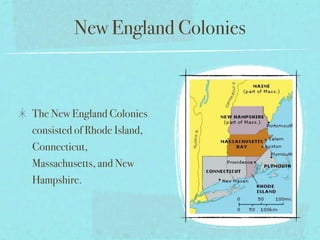
The New England Colonies
consisted of Rhode Island,
Connecticut,
Massachusetts, and New
Hampshire.
New England Colonies


The New England Colonies were either fishing communities or
subsistence farming. They basically did everything for
themselves like making own clothes and farming their own food.
New England Colonies

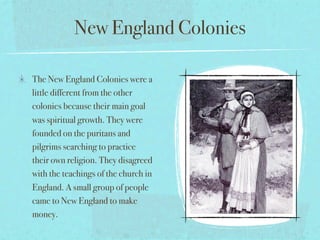
The New England Colonies were a
little different from the other
colonies because their main goal
was spiritual growth. They were
founded on the puritans and
pilgrims searching to practice
their own religion. They disagreed
with the teachings of the church in
England. A small group of people
came to New England to make
money.
New England Colonies


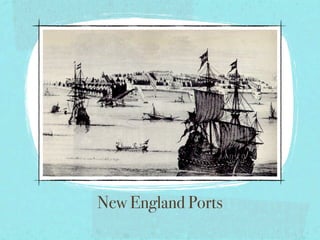
Shipbuilding was very popular because of many, large ports
available in New England. They were near bodies of water to
only make shipbuilding more popular.
New England Ports
Middle Colonies
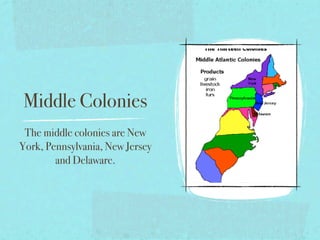
 The middle colonies are New
York, Pennsylvania, New Jersey
        and Delaware.
Middle Colonies


The people who came to the Middle colonies were looking to
practice their own religion as well. But they were also concerned
with making money. Many of them didn’t bring their families
from England so they were the ideal workers for hard labor.
Middle Colonies
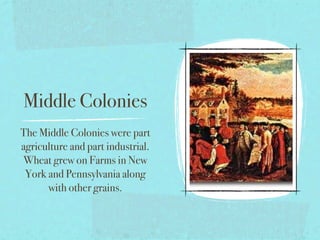
The Middle Colonies were part
agriculture and part industrial.
Wheat grew on Farms in New
 York and Pennsylvania along
      with other grains.
Middle Colonies


Along with being part agriculture the Middle Colonies were part
industrial. They were many factories in Maryland and
Pennsylvania. Trade with England and other colonies was
flourishing. Factories produced iron, textiles and paper.
Middle Colonies


Along with the agricultural and industrial aspects of the Middle
Colonies, there was three large rivers that ran through these
colonies. The Susquehanna, the Delaware and the Hudson
assisted the fur trading industry.
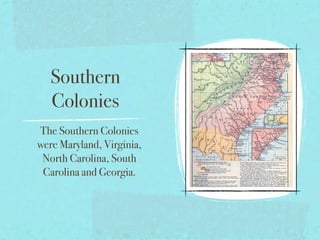
Southern
   Colonies
The Southern Colonies
were Maryland, Virginia,
 North Carolina, South
 Carolina and Georgia.
The Southern Colonies


The Southern Colonies were mainly to make money. Many of
them brought their families to work together on plantations. So
therefor; there was many thriving plantations that made a
sufficient amount of money.
The Southern Colonies


Like I mentioned before the Southern Colonies had a lot of
plantations. This made for acres of farmland. They were mainly
agricultural colonies.
The Southern Colonies


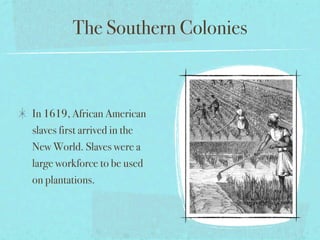
In 1619, African American
slaves first arrived in the
New World. Slaves were a
large workforce to be used
on plantations.
The Southern Colonies
Triangular Trade

The Triangular Trade routes got its name from the triangular
shape it made to retrieve fish, lumbar, and other goods from
New England to the West Indies. The West Indies rum, guns,
gunpowder to West Africa. Here, they traded for salves. The
effects of the trade routes were detrimental. Africans had no
protection because all the males were taken. Violence became
common because of the introduction of guns. Sadly, racism was
very common now.
The Great Awakening


The Great Awaking was a time of spiritual growth which brought
an identity to the colonies. The biggest effect of the Great
Awakening was the rebellion against authority.
Enlightenment


The enlightenment influenced the people to overthrow
governments and establish a real democracy.
Work Cited

"American History." : Explain Why There Were No Major Witchcraft Scares in the Chesapeake Colonies and No Uprising like Bacon's
Rebellion in New England. Consider the Possible Social, Economic, and Religious Causes of Both Phenomena. N.p., n.d. Web. 24
Sept. 2012. <http://blogamericanhistory.blogspot.com/2011/04/explain-why-there-were-no-major.html>.

"Lesson 1: Who Were the Pilgrims." Lesson 1: Who Were the Pilgrims. N.p., n.d. Web. 24 Sept. 2012. <http://castle.eiu.edu/~wow/
classes/fa09/Plimoth/Lesson1.html>.

"The Dutch Left Their Influences." University Of Gronigen, n.d. Web. 27 Sept. 2012. <http://www.let.rug.nl/usa/outlines/
history-1963/the-colonial-period/the-dutch-left-their-influences.php>.

"The Middle Colonies." The Middle Colonies. N.p., n.d. Web. 27 Sept. 2012. <http://www.mce.k12tn.net/colonial_america/
middle_colonies.htm>.

"4. The Middle Colonies." The Middle Colonies [ushistory.org]. Independence Hall Association in Pennsylvania, n.d. Web. 27 Sept.
2012. <http://www.ushistory.org/us/4.asp>.

Thirteen colonies

  • 1.
    Thirteen Colonies Chynna Ratliff
  • 2.
    New England Colonies TheNew England Colonies consisted of Rhode Island, Connecticut, Massachusetts, and New Hampshire.
  • 3.
    New England Colonies TheNew England Colonies were either fishing communities or subsistence farming. They basically did everything for themselves like making own clothes and farming their own food.
  • 4.
    New England Colonies TheNew England Colonies were a little different from the other colonies because their main goal was spiritual growth. They were founded on the puritans and pilgrims searching to practice their own religion. They disagreed with the teachings of the church in England. A small group of people came to New England to make money.
  • 5.
    New England Colonies Shipbuildingwas very popular because of many, large ports available in New England. They were near bodies of water to only make shipbuilding more popular.
  • 6.
  • 7.
    Middle Colonies Themiddle colonies are New York, Pennsylvania, New Jersey and Delaware.
  • 8.
    Middle Colonies The peoplewho came to the Middle colonies were looking to practice their own religion as well. But they were also concerned with making money. Many of them didn’t bring their families from England so they were the ideal workers for hard labor.
  • 9.
    Middle Colonies The MiddleColonies were part agriculture and part industrial. Wheat grew on Farms in New York and Pennsylvania along with other grains.
  • 10.
    Middle Colonies Along withbeing part agriculture the Middle Colonies were part industrial. They were many factories in Maryland and Pennsylvania. Trade with England and other colonies was flourishing. Factories produced iron, textiles and paper.
  • 11.
    Middle Colonies Along withthe agricultural and industrial aspects of the Middle Colonies, there was three large rivers that ran through these colonies. The Susquehanna, the Delaware and the Hudson assisted the fur trading industry.
  • 12.
    Southern Colonies The Southern Colonies were Maryland, Virginia, North Carolina, South Carolina and Georgia.
  • 13.
    The Southern Colonies TheSouthern Colonies were mainly to make money. Many of them brought their families to work together on plantations. So therefor; there was many thriving plantations that made a sufficient amount of money.
  • 14.
    The Southern Colonies LikeI mentioned before the Southern Colonies had a lot of plantations. This made for acres of farmland. They were mainly agricultural colonies.
  • 15.
    The Southern Colonies In1619, African American slaves first arrived in the New World. Slaves were a large workforce to be used on plantations.
  • 16.
  • 17.
    Triangular Trade The TriangularTrade routes got its name from the triangular shape it made to retrieve fish, lumbar, and other goods from New England to the West Indies. The West Indies rum, guns, gunpowder to West Africa. Here, they traded for salves. The effects of the trade routes were detrimental. Africans had no protection because all the males were taken. Violence became common because of the introduction of guns. Sadly, racism was very common now.
  • 18.
    The Great Awakening TheGreat Awaking was a time of spiritual growth which brought an identity to the colonies. The biggest effect of the Great Awakening was the rebellion against authority.
  • 19.
    Enlightenment The enlightenment influencedthe people to overthrow governments and establish a real democracy.
  • 20.
    Work Cited "American History.": Explain Why There Were No Major Witchcraft Scares in the Chesapeake Colonies and No Uprising like Bacon's Rebellion in New England. Consider the Possible Social, Economic, and Religious Causes of Both Phenomena. N.p., n.d. Web. 24 Sept. 2012. <http://blogamericanhistory.blogspot.com/2011/04/explain-why-there-were-no-major.html>. "Lesson 1: Who Were the Pilgrims." Lesson 1: Who Were the Pilgrims. N.p., n.d. Web. 24 Sept. 2012. <http://castle.eiu.edu/~wow/ classes/fa09/Plimoth/Lesson1.html>. "The Dutch Left Their Influences." University Of Gronigen, n.d. Web. 27 Sept. 2012. <http://www.let.rug.nl/usa/outlines/ history-1963/the-colonial-period/the-dutch-left-their-influences.php>. "The Middle Colonies." The Middle Colonies. N.p., n.d. Web. 27 Sept. 2012. <http://www.mce.k12tn.net/colonial_america/ middle_colonies.htm>. "4. The Middle Colonies." The Middle Colonies [ushistory.org]. Independence Hall Association in Pennsylvania, n.d. Web. 27 Sept. 2012. <http://www.ushistory.org/us/4.asp>.