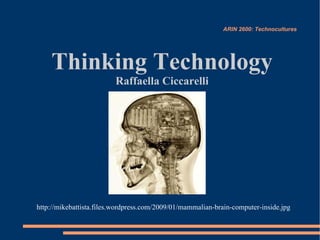
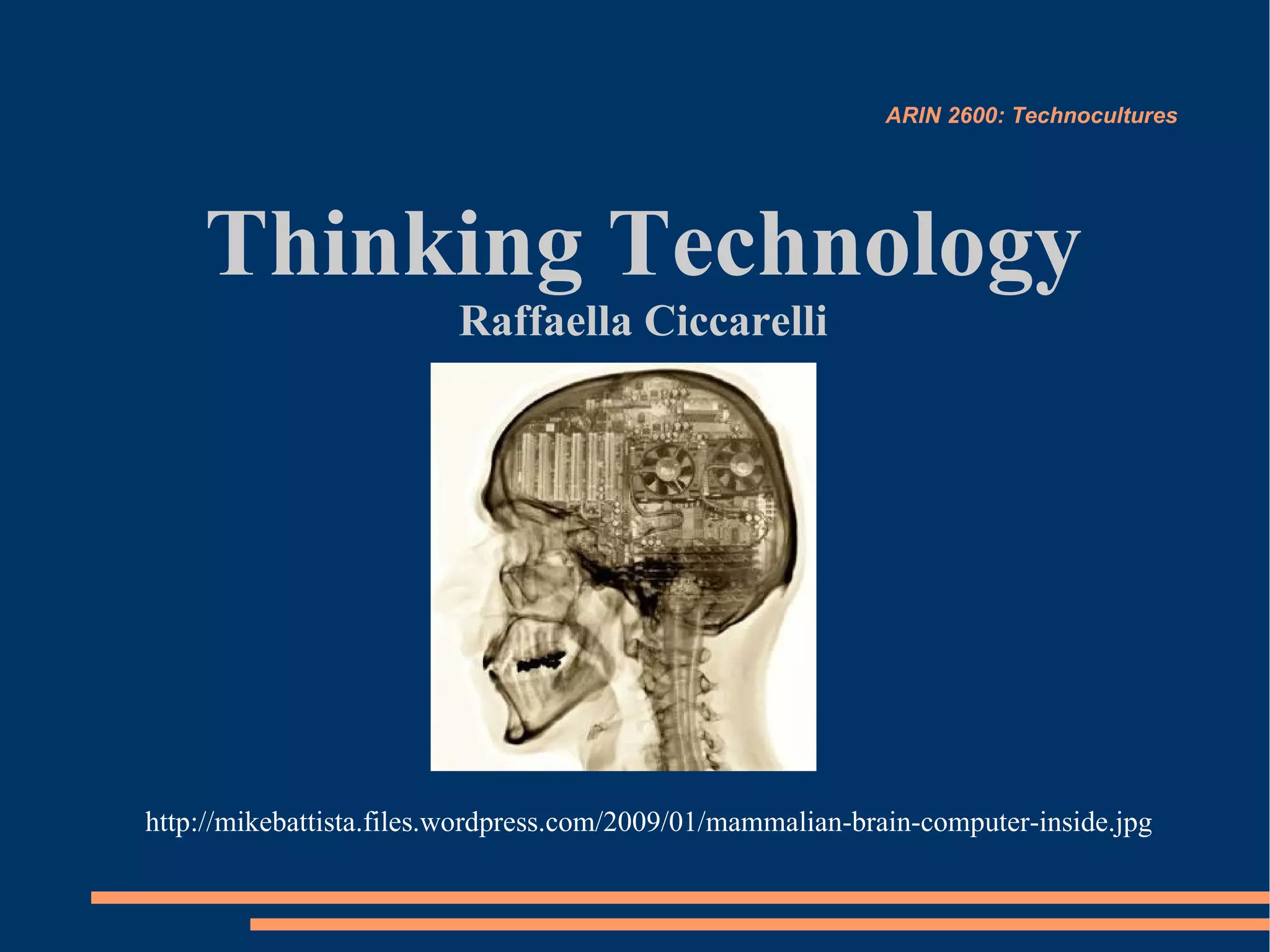
ARIN 2600: Technocultures Thinking Technology Raffaella Ciccarelli http://mikebattista.files.wordpress.com/2009/01/mammalian-brain-computer-inside.jpg
Human Memory as Computerised  Processing  Disscussions on human memory favour machine metaphores  Terms such as “hardwired” and “programmed” are often used Computer based technologies have therefore become models of human memory and consciousness.  But do computers and other digital technologies really mirror the the processes undertaken by human memory? If technology IS a reconstuction of human thought then to what extent will it change human thought processes? Lets take a closer look...
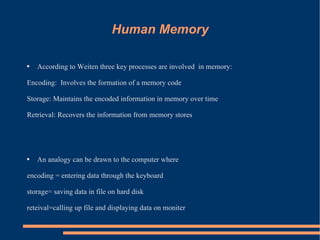
Human Memory According to Weiten three key processes are involved  in memory:  Encoding:  Involves the formation of a memory code Storage: Maintains the encoded information in memory over time Retrieval: Recovers the information from memory stores An analogy can be drawn to the computer where  encoding = entering data through the keyboard storage= saving data in file on hard disk  reteival=calling up file and displaying data on moniter
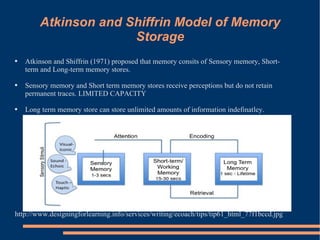
Atkinson and Shiffrin Model of Memory Storage Atkinson and Shiffrin (1971) proposed that memory consits of Sensory memory, Short-term and Long-term memory stores.  Sensory memory and Short term memory stores receive perceptions but do not retain permanent traces. LIMITED CAPACITY Long term memory store can store unlimited amounts of information indefinatley.  http://www.designingforlearning.info/services/writing/ecoach/tips/tip61_html_77f1bccd.jpg
Human Memory cnt... Freud's conception of memory is quite simliar.  It involes two seperate interelated systems: Pcpt.-C system; which receives perceptions but retains no permeant trace of them & Mnemic systems: which store the permeant traces Pcpt.-C system similar to sensory and short term memory stores Mnemic system similar to long term memory store Both theories of memory involve a system that retains no permeant traces and a system that does Memory  ∴ requires an unlimited receptive capacity and a retention of permeant traces.
Technological Memory “ Lift the entire covering sheet...the writing vanishes and...does not reappear again... what was written is retained upon the wax slab itself and is legible in suitable lights” (Freud, 230) Mystic Writing Pad = unlimited receptive capacity and a retention of permeant traces Roles of sensory, short term and long term memory are attributed for.  Doesn't allow for changes to stored data Weiten noted this was an imperfection to his computer analogy  More recent technologies  DO  allow for this though E.G. Creation of a word document: Encoding= Entering data through a keyboard Storage= Saving data in file on hard disk Retrieval=Calling up file and displaying data on moniter Individuals are given the potential to edit their work and then re-save it allowing for changes to the computers memory system
Technological Memory cnt... Another example is the writing and storage of SMS.  Encoding= Entering data through the keypad Storage= Saving data in inbox Retrieval=Calling up file and displaying data on moniter Individuals are given the potential to edit messages through the draft feature allowing for changes in the mobiles memory Mobile provides users with unlimited receptive capacity, storage mechanism and  an editing feature Emails work in a similar manner These three functions mean that tecnolgical memory does model itself entirely upon human memory
Technology affects thought If technologies of information processing are modelled upon the human condition it will affect human thought Post industry machines have moved from tools used by humans to “intelligent” machines Machines more capable and efficent at information production, have displaced the human subject  Society now dependent upon computerized systems Dependence leads to changes in thought Changes to thought occur in two fields:  1) How we think and produce information  2) Human sense of self
Technology and Society  http://www.youtube.com/watch?v=Mmz5qYbKsvM
Automation of Human Thought Word processor leads to the fragmentation of written and spoken language;  Undermines spelling and planning skills.  Micheal Heim: Thoughts take on attributes of writing technology used “the word processor is computerizing our language...formulate thoughts directly on screen” (cited in Murphie and Potts 2003, p 157) MSN and SMS: technical slang such as LOL or BRB have infiltrated modern speech.  It is easier to say three letters instead of three words LOL replaces laughter. Human thought computerized to the extent where human emotions are robotic  Productivity and effiency of technology leads to a decreased in human thought and significance of emotions.
Heidegger and the changing sense of self Split opinions: is technological saturation good or bad?  Heidegger: “It is here that thinking comes in. We lose, in technicity, the reflective person preserving a careful relation to thought which had been begun by the Greeks...Humans are now themselves 'enframed' within technicity's treatment of the world as standing-reserve. So is human thought. This has dreadful consequences, not the least of which for Heidegger is that 'in truth...precisely nowhere does man today any longer encounter himself, i.e his essence'” ( Murphie and Potts 2003, p 166) Where is our essence gone?
Heidegger and the changing sense of self cnt... Gergen's “Pastiche Personalities”: Individuality as a patchwork construction of other personae garnered from media specific technologies such as film, magazines and television.  David Harvey: Media decreases attention spans and sense of a lived past.  Turkle thought differently.  Virtual communities allow for the reconstruction of self.  “ Acknowledges the constructed nature of reality, self and the other...This reconstruction is our cultural work in progress.”  ( Murphie and Potts 2003, p 162) Most theorists think that it is destructive even if it may promote more flexible ideas of self
Technicity: a faulty instrument?  Heidegger particulaly negative.  He belived that technicity is extremely dangerous to both thought and culture Leads to humans thinking of themselves as superior. We can overcome the world and time. Thus we can ovecome Being. Belief in dominance removes humans conceptions of themselves from the wider ecosystem, and previous conceptions of humanity. Leads to environmental problems.
Discussion Questions Do you agree with Heidegger, Gergen and Harveys point that technology leads to a destruction in the sense of self or do you agree with Turkle in that virtual realities construct valuable representations of the self and society?  Do you think that technicity generates  faulty thinking causing us to overlook consequences​?
References Freud, S. “ A Note Upon the Mystic Writing-Pad”, in  The Complete Psychological Works of Sigmund Freud,  Vol.19, Hogarth Press, London,   1971, pp 226-232.  Heidegger, M. “The question concerning technology”, in  The question concerning technology and other essays,  Harper and Row, New York, 1977, pp 3-35.  Murphie, A and Potts, J. “Technology, thought and consciousness”, in  Culture and Technology,  Palgrave Macmillan, New York, 2003, pp 142-168.  Weiten, W.  Psychology: Themes and Variations 7 th  Edition,  Thomson Wadsworth, U.S.A, 2007, pp 259-273.

Thinking Technology

  • 1.
    ARIN 2600: TechnoculturesThinking Technology Raffaella Ciccarelli http://mikebattista.files.wordpress.com/2009/01/mammalian-brain-computer-inside.jpg
  • 2.
    Human Memory asComputerised Processing Disscussions on human memory favour machine metaphores Terms such as “hardwired” and “programmed” are often used Computer based technologies have therefore become models of human memory and consciousness. But do computers and other digital technologies really mirror the the processes undertaken by human memory? If technology IS a reconstuction of human thought then to what extent will it change human thought processes? Lets take a closer look...
  • 3.
    Human Memory Accordingto Weiten three key processes are involved in memory: Encoding: Involves the formation of a memory code Storage: Maintains the encoded information in memory over time Retrieval: Recovers the information from memory stores An analogy can be drawn to the computer where encoding = entering data through the keyboard storage= saving data in file on hard disk reteival=calling up file and displaying data on moniter
  • 4.
    Atkinson and ShiffrinModel of Memory Storage Atkinson and Shiffrin (1971) proposed that memory consits of Sensory memory, Short-term and Long-term memory stores. Sensory memory and Short term memory stores receive perceptions but do not retain permanent traces. LIMITED CAPACITY Long term memory store can store unlimited amounts of information indefinatley. http://www.designingforlearning.info/services/writing/ecoach/tips/tip61_html_77f1bccd.jpg
  • 5.
    Human Memory cnt...Freud's conception of memory is quite simliar. It involes two seperate interelated systems: Pcpt.-C system; which receives perceptions but retains no permeant trace of them & Mnemic systems: which store the permeant traces Pcpt.-C system similar to sensory and short term memory stores Mnemic system similar to long term memory store Both theories of memory involve a system that retains no permeant traces and a system that does Memory ∴ requires an unlimited receptive capacity and a retention of permeant traces.
  • 6.
    Technological Memory “Lift the entire covering sheet...the writing vanishes and...does not reappear again... what was written is retained upon the wax slab itself and is legible in suitable lights” (Freud, 230) Mystic Writing Pad = unlimited receptive capacity and a retention of permeant traces Roles of sensory, short term and long term memory are attributed for. Doesn't allow for changes to stored data Weiten noted this was an imperfection to his computer analogy More recent technologies DO allow for this though E.G. Creation of a word document: Encoding= Entering data through a keyboard Storage= Saving data in file on hard disk Retrieval=Calling up file and displaying data on moniter Individuals are given the potential to edit their work and then re-save it allowing for changes to the computers memory system
  • 7.
    Technological Memory cnt...Another example is the writing and storage of SMS. Encoding= Entering data through the keypad Storage= Saving data in inbox Retrieval=Calling up file and displaying data on moniter Individuals are given the potential to edit messages through the draft feature allowing for changes in the mobiles memory Mobile provides users with unlimited receptive capacity, storage mechanism and an editing feature Emails work in a similar manner These three functions mean that tecnolgical memory does model itself entirely upon human memory
  • 8.
    Technology affects thoughtIf technologies of information processing are modelled upon the human condition it will affect human thought Post industry machines have moved from tools used by humans to “intelligent” machines Machines more capable and efficent at information production, have displaced the human subject Society now dependent upon computerized systems Dependence leads to changes in thought Changes to thought occur in two fields: 1) How we think and produce information 2) Human sense of self
  • 9.
    Technology and Society http://www.youtube.com/watch?v=Mmz5qYbKsvM
  • 10.
    Automation of HumanThought Word processor leads to the fragmentation of written and spoken language; Undermines spelling and planning skills. Micheal Heim: Thoughts take on attributes of writing technology used “the word processor is computerizing our language...formulate thoughts directly on screen” (cited in Murphie and Potts 2003, p 157) MSN and SMS: technical slang such as LOL or BRB have infiltrated modern speech. It is easier to say three letters instead of three words LOL replaces laughter. Human thought computerized to the extent where human emotions are robotic Productivity and effiency of technology leads to a decreased in human thought and significance of emotions.
  • 11.
    Heidegger and thechanging sense of self Split opinions: is technological saturation good or bad? Heidegger: “It is here that thinking comes in. We lose, in technicity, the reflective person preserving a careful relation to thought which had been begun by the Greeks...Humans are now themselves 'enframed' within technicity's treatment of the world as standing-reserve. So is human thought. This has dreadful consequences, not the least of which for Heidegger is that 'in truth...precisely nowhere does man today any longer encounter himself, i.e his essence'” ( Murphie and Potts 2003, p 166) Where is our essence gone?
  • 12.
    Heidegger and thechanging sense of self cnt... Gergen's “Pastiche Personalities”: Individuality as a patchwork construction of other personae garnered from media specific technologies such as film, magazines and television. David Harvey: Media decreases attention spans and sense of a lived past. Turkle thought differently. Virtual communities allow for the reconstruction of self. “ Acknowledges the constructed nature of reality, self and the other...This reconstruction is our cultural work in progress.” ( Murphie and Potts 2003, p 162) Most theorists think that it is destructive even if it may promote more flexible ideas of self
  • 13.
    Technicity: a faultyinstrument? Heidegger particulaly negative. He belived that technicity is extremely dangerous to both thought and culture Leads to humans thinking of themselves as superior. We can overcome the world and time. Thus we can ovecome Being. Belief in dominance removes humans conceptions of themselves from the wider ecosystem, and previous conceptions of humanity. Leads to environmental problems.
  • 14.
    Discussion Questions Doyou agree with Heidegger, Gergen and Harveys point that technology leads to a destruction in the sense of self or do you agree with Turkle in that virtual realities construct valuable representations of the self and society? Do you think that technicity generates faulty thinking causing us to overlook consequences​?
  • 15.
    References Freud, S.“ A Note Upon the Mystic Writing-Pad”, in The Complete Psychological Works of Sigmund Freud, Vol.19, Hogarth Press, London, 1971, pp 226-232. Heidegger, M. “The question concerning technology”, in The question concerning technology and other essays, Harper and Row, New York, 1977, pp 3-35. Murphie, A and Potts, J. “Technology, thought and consciousness”, in Culture and Technology, Palgrave Macmillan, New York, 2003, pp 142-168. Weiten, W. Psychology: Themes and Variations 7 th Edition, Thomson Wadsworth, U.S.A, 2007, pp 259-273.