
Thinking Statistically
What Counts and What Doesn’t?
Thinking statistically (c) 2017 Stephen Senn 1
Acknowledgements
This work is partly supported by the European Union’s 7th Framework Programme
for research, technological development and demonstration under grant
agreement no. 602552. “IDEAL”
My thanks to CASI for further support and Gabrielle Kelly and the oganisers for the
invitation
2(c) Stephen Senn 2017
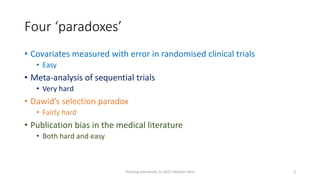
Four ‘paradoxes’
• Covariates measured with error in randomised clinical trials
• Easy
• Meta-analysis of sequential trials
• Very hard
• Dawid’s selection paradox
• Fairly hard
• Publication bias in the medical literature
• Both hard and easy
Thinking statistically (c) 2017 Stephen Senn 3
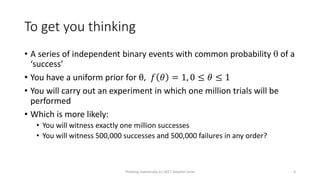
To get you thinking
• A series of independent binary events with common probability  of a
‘success’
• You have a uniform prior for θ, 𝑓 𝜃 = 1, 0 ≤ 𝜃 ≤ 1
• You will carry out an experiment in which one million trials will be
performed
• Which is more likely:
• You will witness exactly one million successes
• You will witness 500,000 successes and 500,000 failures in any order?
Thinking statistically (c) 2017 Stephen Senn 4
Covariate errors
Base logic
Thinking statistically (c) 2017 Stephen Senn 5
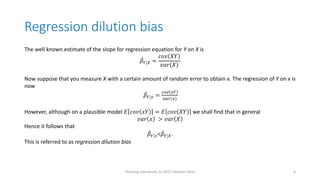
Regression dilution bias
The well known estimate of the slope for regression equation for Y on X is
𝛽 𝑌¦𝑋 =
𝑐𝑜𝑣 𝑋𝑌
𝑣𝑎𝑟 𝑋
Now suppose that you measure X with a certain amount of random error to obtain x. The regression of Y on x is
now
𝛽 𝑌¦𝑥 =
𝑐𝑜𝑣 𝑥𝑌
𝑣𝑎𝑟 𝑥
However, although on a plausible model 𝐸 𝑐𝑜𝑣 𝑥𝑌 = 𝐸 𝑐𝑜𝑣 𝑋𝑌 we shall find that in general
𝑣𝑎𝑟 𝑥 > 𝑣𝑎𝑟 𝑋
Hence it follows that
𝛽 𝑌¦𝑥< 𝛽 𝑌¦𝑋.
This is referred to as regression dilution bias
Thinking statistically (c) 2017 Stephen Senn 6
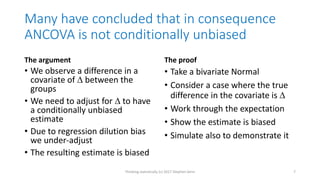
Many have concluded that in consequence
ANCOVA is not conditionally unbiased
The argument
• We observe a difference in a
covariate of  between the
groups
• We need to adjust for  to have
a conditionally unbiased
estimate
• Due to regression dilution bias
we under-adjust
• The resulting estimate is biased
The proof
• Take a bivariate Normal
• Consider a case where the true
difference in the covariate is 
• Work through the expectation
• Show the estimate is biased
• Simulate also to demonstrate it
Thinking statistically (c) 2017 Stephen Senn 7
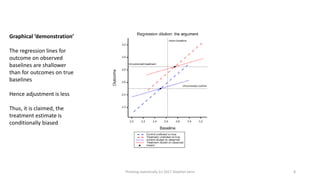
Graphical ‘demonstration’
The regression lines for
outcome on observed
baselines are shallower
than for outcomes on true
baselines
Hence adjustment is less
Thus, it is claimed, the
treatment estimate is
conditionally biased
Thinking statistically (c) 2017 Stephen Senn 8
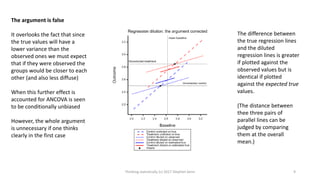
The argument is false
It overlooks the fact that since
the true values will have a
lower variance than the
observed ones we must expect
that if they were observed the
groups would be closer to each
other (and also less diffuse)
When this further effect is
accounted for ANCOVA is seen
to be conditionally unbiased
However, the whole argument
is unnecessary if one thinks
clearly in the first case
The difference between
the true regression lines
and the diluted
regression lines is greater
if plotted against the
observed values but is
identical if plotted
against the expected true
values.
(The distance between
thee three pairs of
parallel lines can be
judged by comparing
them at the overall
mean.)
Thinking statistically (c) 2017 Stephen Senn 9
Thinking clearly
• If you have two covariates measured without error you adjust to the extent that they are
predictive
• If one predicts more than another you adjust more
• It’s the degree to which something is predictive that governs the adjustment
• If you don’t measure a covariate you can’t condition on it
• But ANCOVA is still unbiased because you have an RCT
• So you can’t do better than condition on what you observe
• Trivially, the observed covariate is what you have observed
• You adjust for what you have observed to the extent that what you have observed is predictive
• You haven’t observed the true covariate
• Its regression is irrelevant
• Because it is unobserved
• ANCOVA is conditionally unbiased conditioning on the observed covariate and that is all
that matters
Thinking statistically (c) 2017 Stephen Senn 10
Sequential meta-analysis
Weight to go
Thinking statistically (c) 2017 Stephen Senn 11
The problem
• It is well known that any good frequentist should pay a penalty for
monitoring a clinical trial with the intention to stop for efficacy
• All drug regulators agencies will require this
• Suppose that a number of such trials have been run
• It is proposed to perform a meta-analysis
• A formal summary of the results
• Is an adjustment needed for stopping?
Thinking statistically (c) 2017 Stephen Senn 12
Thinking statistically (c) 2017 Stephen Senn 13
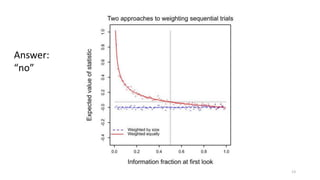
Answer:
“no”
Thinking statistically (c) 2017 Stephen Senn 14
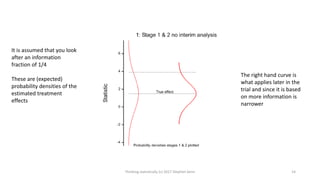
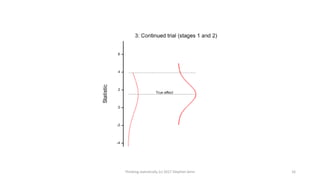
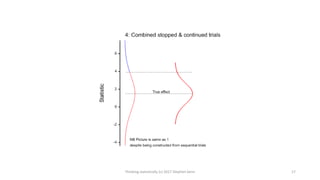
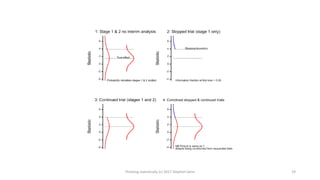
It is assumed that you look
after an information
fraction of 1/4
These are (expected)
probability densities of the
estimated treatment
effects
The right hand curve is
what applies later in the
trial and since it is based
on more information is
narrower
Thinking statistically (c) 2017 Stephen Senn 15
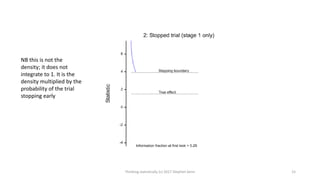
NB this is not the
density; it does not
integrate to 1. It is the
density multiplied by the
probability of the trial
stopping early
Thinking statistically (c) 2017 Stephen Senn 16
Thinking statistically (c) 2017 Stephen Senn 17
Conclusion
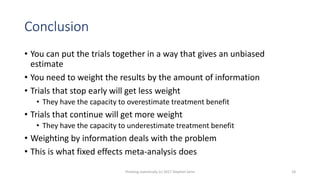
• You can put the trials together in a way that gives an unbiased
estimate
• You need to weight the results by the amount of information
• Trials that stop early will get less weight
• They have the capacity to overestimate treatment benefit
• Trials that continue will get more weight
• They have the capacity to underestimate treatment benefit
• Weighting by information deals with the problem
• This is what fixed effects meta-analysis does
Thinking statistically (c) 2017 Stephen Senn 18
Thinking statistically (c) 2017 Stephen Senn 19
Dawid’s selection paradox
Choices, choices
Thinking statistically (c) 2017 Stephen Senn 20
The paradox
Philip Dawid, in a paper of 1994, drew attention to a clash between a frequentist
intuition that the interpretation of a data set ought to be different if the data were
specifically chosen for some feature
Example the best of a number of treatments being studied
However, this does not (usually) matter for the Bayesian
“Since Bayesian posterior distributions are already fully conditioned on the data, the
posterior distribution of any quantity is the same, whether it was chosen in advance
or selected in the light of the data.”
Thinking statistically (c) 2017 Stephen Senn 21
A Selection Paradox of Dawid’s
• Suppose that we estimate treatment means from a
number of treatments in clinical research
• We use a standard conjugate prior
• Since Bayesian analysis is full conditioned on the data,
then for any treatment the posterior mean will not
depend on why we have chosen the treatment
• At random
• Because it gave the largest response
See DAWID, A. P. (1994), in Multivariate Analysis and its Applications, eds. T. W. Anderson, K.
a.-t. a. Fang, & I. Olkin
Thinking statistically (c) 2017 Stephen Senn 22
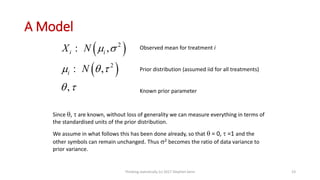
A Model
 
 
2
2
,
,
,
i i
i
X N
N
 
  
 
:
:
Observed mean for treatment i
Prior distribution (assumed iid for all treatments)
Known prior parameter
Since ,  are known, without loss of generality we can measure everything in terms of
the standardised units of the prior distribution.
We assume in what follows this has been done already, so that  = 0,  =1 and the
other symbols can remain unchanged. Thus 2 becomes the ratio of data variance to
prior variance.
Thinking statistically (c) 2017 Stephen Senn 23
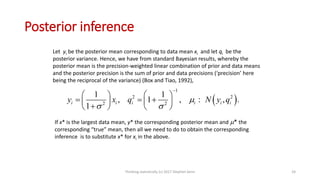
Posterior inference
Let yi be the posterior mean corresponding to data mean xi and let qi be the
posterior variance. Hence, we have from standard Bayesian results, whereby the
posterior mean is the precision-weighted linear combination of prior and data means
and the posterior precision is the sum of prior and data precisions (‘precision’ here
being the reciprocal of the variance) (Box and Tiao, 1992),
 
1
2 2
2 2
1 1
, 1 , , .
1
i i i i i iy x q N y q
 

   
     
   
:
If x* is the largest data mean, y* the corresponding posterior mean and * the
corresponding “true” mean, then all we need to do to obtain the corresponding
inference is to substitute x* for xi in the above.
Thinking statistically (c) 2017 Stephen Senn 24
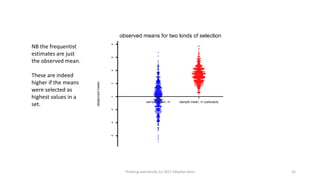
NB the frequentist
estimates are just
the observed mean.
These are indeed
higher if the means
were selected as
highest values in a
set.
Thinking statistically (c) 2017 Stephen Senn 25
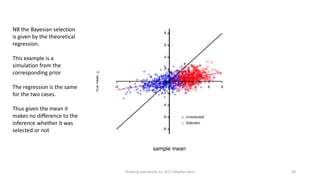
NB the Bayesian selection
is given by the theoretical
regression.
This example is a
simulation from the
corresponding prior
The regression is the same
for the two cases.
Thus given the mean it
makes no difference to the
inference whether it was
selected or not
Thinking statistically (c) 2017 Stephen Senn 26
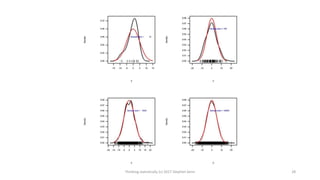
A Heuristic Explanation
• A Normal prior distribution for the true means could be expressed in
two ways
• Parametrically using two parameters
• Non-parametrically using an empirical distribution
• The more means are represented in the empirical distribution the
closer it comes to the parametric representation
• Hence, having a parametric prior is equivalent to having observed an
infinity of true means
• You are 100% certain about the mean of your prior
Thinking statistically (c) 2017 Stephen Senn 27
Thinking statistically (c) 2017 Stephen Senn 28
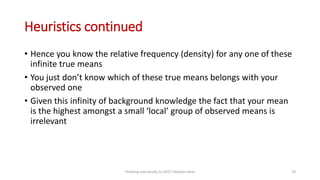
Heuristics continued
• Hence you know the relative frequency (density) for any one of these
infinite true means
• You just don’t know which of these true means belongs with your
observed one
• Given this infinity of background knowledge the fact that your mean
is the highest amongst a small ‘local’ group of observed means is
irrelevant
Thinking statistically (c) 2017 Stephen Senn 29
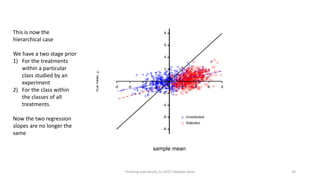
This is now the
hierarchical case
We have a two stage prior
1) For the treatments
within a particular
class studied by an
experiment
2) For the class within
the classes of all
treatments
Now the two regression
slopes are no longer the
same
Thinking statistically (c) 2017 Stephen Senn 30
Positive publication bias
Missing inaction
Thinking statistically (c) 2017 Stephen Senn 31
The problem of missing clinical trials
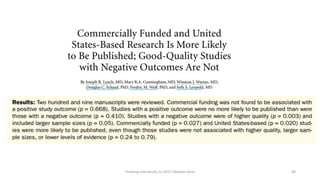
• It seems that positive results are more likely to be published in the
literature
• Observational studies in which submissions have been classified as
positive or negative seem to show no editorial bias
• Editors are guiltless
• Authors are to blame
• A few small experimental studies show the opposite
• These have been dismissed as unreliable
Thinking statistically (c) 2017 Stephen Senn 32
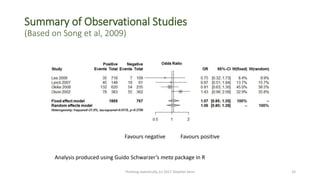
Summary of Observational Studies
(Based on Song et al, 2009)
Favours negative Favours positive
Analysis produced using Guido Schwarzer’s meta package in R
Thinking statistically (c) 2017 Stephen Senn 33
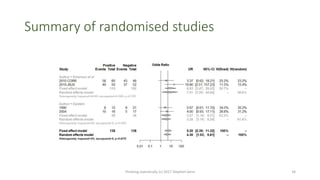
Summary of randomised studies
Thinking statistically (c) 2017 Stephen Senn 34
Thinking statistically (c) 2017 Stephen Senn 35
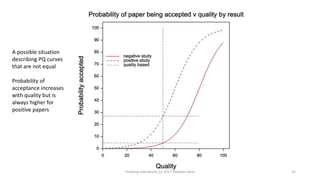
A possible situation
describing PQ curves
that are not equal
Probability of
acceptance increases
with quality but is
always higher for
positive papers
Thinking statistically (c) 2017 Stephen Senn 36
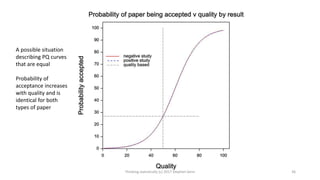
A possible situation
describing PQ curves
that are equal
Probability of
acceptance increases
with quality and is
identical for both
types of paper
Minding your Ps and Qs
• However
• We do not get to see the whole curves
• Not every paper is submitted to every journal
• So the question is what do we see?
• So let’s consider two alternatives for curves that differ
• That is to say for the situation where there is a bias in favour of positive
papers
Thinking statistically (c) 2017 Stephen Senn 37
Thinking statistically (c) 2017 Stephen Senn 38
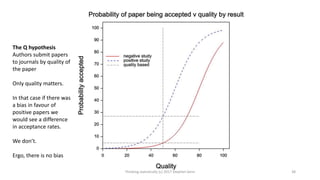
The Q hypothesis
Authors submit papers
to journals by quality of
the paper
Only quality matters.
In that case if there was
a bias in favour of
positive papers we
would see a difference
in acceptance rates.
We don’t.
Ergo, there is no bias
Thinking statistically (c) 2017 Stephen Senn 39
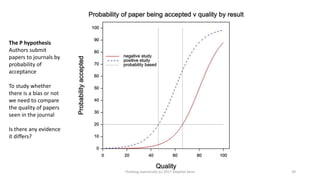
The P hypothesis
Authors submit
papers to journals by
probability of
acceptance
To study whether
there is a bias or not
we need to compare
the quality of papers
seen in the journal
Is there any evidence
it differs?
Thinking statistically (c) 2017 Stephen Senn 40
Conclusions
Relax. The lecture is nearly over
Thinking statistically (c) 2017 Stephen Senn 41
Statistics is more than just mathematics
• Basic philosophy is important
• Reaching for mathematics too quickly can harm understanding
• Mathematical models are not the be all and end all
• It is important to see what the essence of a problem is
• Graphics can help explain things to yourself and others
• Always ask
• What will be known and what will be unknown?
• How do I get to see what I see?
• And teach students this also!
• Understanding is necessary on more than one level
• Heuristics are valuable
Thinking statistically (c) 2017 Stephen Senn 42
That binary event
• Which is more likely:
• You will witness exactly one million successes
• You will witness 500,000 successes and 500,000 failures in any order?
• You can work with the predictive distribution of a beta-binomial if you like
• Integration and algebra
• Or you can see the answer
• Given the prior after one million events the relative frequency will be the
true value
• But your prior says every true value is equally likely
• Therefore the two events are equally likely
Thinking statistically (c) 2017 Stephen Senn 43
Final thought
Thinking statistically (c) 2017 Stephen Senn 44
Mathematics is full of lemmas but statistics is
full of dilemmas
Some references
Thinking statistically (c) 2017 Stephen Senn 45
Senn, S. J. (1987). Correcting for regression in assessing the response to treatment in a selected population [letter].
Statistics in Medicine, 6(6), 727-728
Senn, S. J. (1998). Mathematics: governess or handmaiden? Journal of the Royal Statistical Society Series D-The
Statistician, 47(2), 251-259
Senn, S. J. (1994). Methods for assessing difference between groups in change when initial measurement is subject
to intra-individual variation [letter; comment] [see comments]. Statistics in Medicine, 13(21), 2280-2285
Senn, S. (2008). A note concerning a selection "Paradox" of Dawid's. American Statistician, 62(3), 206-210
Senn, S. (2014). A note regarding meta-analysis of sequential trials with stopping for efficacy. Pharmaceutical
statistics, 13(6), 371-375
Senn, S. (2012). Misunderstanding publication bias: editors are not blameless after all. F1000Research, 1
Senn, S. (2013). Authors are also reviewers: problems in assigning cause for missing negative studies.
F1000Research. Retrieved from http://f1000research.com/articles/2-17/v1
stephen.senn@lih.lu

Thinking statistically v3

  • 1.
    Thinking Statistically What Countsand What Doesn’t? Thinking statistically (c) 2017 Stephen Senn 1
  • 2.
    Acknowledgements This work ispartly supported by the European Union’s 7th Framework Programme for research, technological development and demonstration under grant agreement no. 602552. “IDEAL” My thanks to CASI for further support and Gabrielle Kelly and the oganisers for the invitation 2(c) Stephen Senn 2017
  • 3.
    Four ‘paradoxes’ • Covariatesmeasured with error in randomised clinical trials • Easy • Meta-analysis of sequential trials • Very hard • Dawid’s selection paradox • Fairly hard • Publication bias in the medical literature • Both hard and easy Thinking statistically (c) 2017 Stephen Senn 3
  • 4.
    To get youthinking • A series of independent binary events with common probability  of a ‘success’ • You have a uniform prior for θ, 𝑓 𝜃 = 1, 0 ≤ 𝜃 ≤ 1 • You will carry out an experiment in which one million trials will be performed • Which is more likely: • You will witness exactly one million successes • You will witness 500,000 successes and 500,000 failures in any order? Thinking statistically (c) 2017 Stephen Senn 4
  • 5.
    Covariate errors Base logic Thinkingstatistically (c) 2017 Stephen Senn 5
  • 6.
    Regression dilution bias Thewell known estimate of the slope for regression equation for Y on X is 𝛽 𝑌¦𝑋 = 𝑐𝑜𝑣 𝑋𝑌 𝑣𝑎𝑟 𝑋 Now suppose that you measure X with a certain amount of random error to obtain x. The regression of Y on x is now 𝛽 𝑌¦𝑥 = 𝑐𝑜𝑣 𝑥𝑌 𝑣𝑎𝑟 𝑥 However, although on a plausible model 𝐸 𝑐𝑜𝑣 𝑥𝑌 = 𝐸 𝑐𝑜𝑣 𝑋𝑌 we shall find that in general 𝑣𝑎𝑟 𝑥 > 𝑣𝑎𝑟 𝑋 Hence it follows that 𝛽 𝑌¦𝑥< 𝛽 𝑌¦𝑋. This is referred to as regression dilution bias Thinking statistically (c) 2017 Stephen Senn 6
  • 7.
    Many have concludedthat in consequence ANCOVA is not conditionally unbiased The argument • We observe a difference in a covariate of  between the groups • We need to adjust for  to have a conditionally unbiased estimate • Due to regression dilution bias we under-adjust • The resulting estimate is biased The proof • Take a bivariate Normal • Consider a case where the true difference in the covariate is  • Work through the expectation • Show the estimate is biased • Simulate also to demonstrate it Thinking statistically (c) 2017 Stephen Senn 7
  • 8.
    Graphical ‘demonstration’ The regressionlines for outcome on observed baselines are shallower than for outcomes on true baselines Hence adjustment is less Thus, it is claimed, the treatment estimate is conditionally biased Thinking statistically (c) 2017 Stephen Senn 8
  • 9.
    The argument isfalse It overlooks the fact that since the true values will have a lower variance than the observed ones we must expect that if they were observed the groups would be closer to each other (and also less diffuse) When this further effect is accounted for ANCOVA is seen to be conditionally unbiased However, the whole argument is unnecessary if one thinks clearly in the first case The difference between the true regression lines and the diluted regression lines is greater if plotted against the observed values but is identical if plotted against the expected true values. (The distance between thee three pairs of parallel lines can be judged by comparing them at the overall mean.) Thinking statistically (c) 2017 Stephen Senn 9
  • 10.
    Thinking clearly • Ifyou have two covariates measured without error you adjust to the extent that they are predictive • If one predicts more than another you adjust more • It’s the degree to which something is predictive that governs the adjustment • If you don’t measure a covariate you can’t condition on it • But ANCOVA is still unbiased because you have an RCT • So you can’t do better than condition on what you observe • Trivially, the observed covariate is what you have observed • You adjust for what you have observed to the extent that what you have observed is predictive • You haven’t observed the true covariate • Its regression is irrelevant • Because it is unobserved • ANCOVA is conditionally unbiased conditioning on the observed covariate and that is all that matters Thinking statistically (c) 2017 Stephen Senn 10
  • 11.
    Sequential meta-analysis Weight togo Thinking statistically (c) 2017 Stephen Senn 11
  • 12.
    The problem • Itis well known that any good frequentist should pay a penalty for monitoring a clinical trial with the intention to stop for efficacy • All drug regulators agencies will require this • Suppose that a number of such trials have been run • It is proposed to perform a meta-analysis • A formal summary of the results • Is an adjustment needed for stopping? Thinking statistically (c) 2017 Stephen Senn 12
  • 13.
    Thinking statistically (c)2017 Stephen Senn 13 Answer: “no”
  • 14.
    Thinking statistically (c)2017 Stephen Senn 14 It is assumed that you look after an information fraction of 1/4 These are (expected) probability densities of the estimated treatment effects The right hand curve is what applies later in the trial and since it is based on more information is narrower
  • 15.
    Thinking statistically (c)2017 Stephen Senn 15 NB this is not the density; it does not integrate to 1. It is the density multiplied by the probability of the trial stopping early
  • 16.
    Thinking statistically (c)2017 Stephen Senn 16
  • 17.
    Thinking statistically (c)2017 Stephen Senn 17
  • 18.
    Conclusion • You canput the trials together in a way that gives an unbiased estimate • You need to weight the results by the amount of information • Trials that stop early will get less weight • They have the capacity to overestimate treatment benefit • Trials that continue will get more weight • They have the capacity to underestimate treatment benefit • Weighting by information deals with the problem • This is what fixed effects meta-analysis does Thinking statistically (c) 2017 Stephen Senn 18
  • 19.
    Thinking statistically (c)2017 Stephen Senn 19
  • 20.
    Dawid’s selection paradox Choices,choices Thinking statistically (c) 2017 Stephen Senn 20
  • 21.
    The paradox Philip Dawid,in a paper of 1994, drew attention to a clash between a frequentist intuition that the interpretation of a data set ought to be different if the data were specifically chosen for some feature Example the best of a number of treatments being studied However, this does not (usually) matter for the Bayesian “Since Bayesian posterior distributions are already fully conditioned on the data, the posterior distribution of any quantity is the same, whether it was chosen in advance or selected in the light of the data.” Thinking statistically (c) 2017 Stephen Senn 21
  • 22.
    A Selection Paradoxof Dawid’s • Suppose that we estimate treatment means from a number of treatments in clinical research • We use a standard conjugate prior • Since Bayesian analysis is full conditioned on the data, then for any treatment the posterior mean will not depend on why we have chosen the treatment • At random • Because it gave the largest response See DAWID, A. P. (1994), in Multivariate Analysis and its Applications, eds. T. W. Anderson, K. a.-t. a. Fang, & I. Olkin Thinking statistically (c) 2017 Stephen Senn 22
  • 23.
    A Model    2 2 , , , i i i X N N        : : Observed mean for treatment i Prior distribution (assumed iid for all treatments) Known prior parameter Since ,  are known, without loss of generality we can measure everything in terms of the standardised units of the prior distribution. We assume in what follows this has been done already, so that  = 0,  =1 and the other symbols can remain unchanged. Thus 2 becomes the ratio of data variance to prior variance. Thinking statistically (c) 2017 Stephen Senn 23
  • 24.
    Posterior inference Let yibe the posterior mean corresponding to data mean xi and let qi be the posterior variance. Hence, we have from standard Bayesian results, whereby the posterior mean is the precision-weighted linear combination of prior and data means and the posterior precision is the sum of prior and data precisions (‘precision’ here being the reciprocal of the variance) (Box and Tiao, 1992),   1 2 2 2 2 1 1 , 1 , , . 1 i i i i i iy x q N y q                  : If x* is the largest data mean, y* the corresponding posterior mean and * the corresponding “true” mean, then all we need to do to obtain the corresponding inference is to substitute x* for xi in the above. Thinking statistically (c) 2017 Stephen Senn 24
  • 25.
    NB the frequentist estimatesare just the observed mean. These are indeed higher if the means were selected as highest values in a set. Thinking statistically (c) 2017 Stephen Senn 25
  • 26.
    NB the Bayesianselection is given by the theoretical regression. This example is a simulation from the corresponding prior The regression is the same for the two cases. Thus given the mean it makes no difference to the inference whether it was selected or not Thinking statistically (c) 2017 Stephen Senn 26
  • 27.
    A Heuristic Explanation •A Normal prior distribution for the true means could be expressed in two ways • Parametrically using two parameters • Non-parametrically using an empirical distribution • The more means are represented in the empirical distribution the closer it comes to the parametric representation • Hence, having a parametric prior is equivalent to having observed an infinity of true means • You are 100% certain about the mean of your prior Thinking statistically (c) 2017 Stephen Senn 27
  • 28.
    Thinking statistically (c)2017 Stephen Senn 28
  • 29.
    Heuristics continued • Henceyou know the relative frequency (density) for any one of these infinite true means • You just don’t know which of these true means belongs with your observed one • Given this infinity of background knowledge the fact that your mean is the highest amongst a small ‘local’ group of observed means is irrelevant Thinking statistically (c) 2017 Stephen Senn 29
  • 30.
    This is nowthe hierarchical case We have a two stage prior 1) For the treatments within a particular class studied by an experiment 2) For the class within the classes of all treatments Now the two regression slopes are no longer the same Thinking statistically (c) 2017 Stephen Senn 30
  • 31.
    Positive publication bias Missinginaction Thinking statistically (c) 2017 Stephen Senn 31
  • 32.
    The problem ofmissing clinical trials • It seems that positive results are more likely to be published in the literature • Observational studies in which submissions have been classified as positive or negative seem to show no editorial bias • Editors are guiltless • Authors are to blame • A few small experimental studies show the opposite • These have been dismissed as unreliable Thinking statistically (c) 2017 Stephen Senn 32
  • 33.
    Summary of ObservationalStudies (Based on Song et al, 2009) Favours negative Favours positive Analysis produced using Guido Schwarzer’s meta package in R Thinking statistically (c) 2017 Stephen Senn 33
  • 34.
    Summary of randomisedstudies Thinking statistically (c) 2017 Stephen Senn 34
  • 35.
    Thinking statistically (c)2017 Stephen Senn 35 A possible situation describing PQ curves that are not equal Probability of acceptance increases with quality but is always higher for positive papers
  • 36.
    Thinking statistically (c)2017 Stephen Senn 36 A possible situation describing PQ curves that are equal Probability of acceptance increases with quality and is identical for both types of paper
  • 37.
    Minding your Psand Qs • However • We do not get to see the whole curves • Not every paper is submitted to every journal • So the question is what do we see? • So let’s consider two alternatives for curves that differ • That is to say for the situation where there is a bias in favour of positive papers Thinking statistically (c) 2017 Stephen Senn 37
  • 38.
    Thinking statistically (c)2017 Stephen Senn 38 The Q hypothesis Authors submit papers to journals by quality of the paper Only quality matters. In that case if there was a bias in favour of positive papers we would see a difference in acceptance rates. We don’t. Ergo, there is no bias
  • 39.
    Thinking statistically (c)2017 Stephen Senn 39 The P hypothesis Authors submit papers to journals by probability of acceptance To study whether there is a bias or not we need to compare the quality of papers seen in the journal Is there any evidence it differs?
  • 40.
    Thinking statistically (c)2017 Stephen Senn 40
  • 41.
    Conclusions Relax. The lectureis nearly over Thinking statistically (c) 2017 Stephen Senn 41
  • 42.
    Statistics is morethan just mathematics • Basic philosophy is important • Reaching for mathematics too quickly can harm understanding • Mathematical models are not the be all and end all • It is important to see what the essence of a problem is • Graphics can help explain things to yourself and others • Always ask • What will be known and what will be unknown? • How do I get to see what I see? • And teach students this also! • Understanding is necessary on more than one level • Heuristics are valuable Thinking statistically (c) 2017 Stephen Senn 42
  • 43.
    That binary event •Which is more likely: • You will witness exactly one million successes • You will witness 500,000 successes and 500,000 failures in any order? • You can work with the predictive distribution of a beta-binomial if you like • Integration and algebra • Or you can see the answer • Given the prior after one million events the relative frequency will be the true value • But your prior says every true value is equally likely • Therefore the two events are equally likely Thinking statistically (c) 2017 Stephen Senn 43
  • 44.
    Final thought Thinking statistically(c) 2017 Stephen Senn 44 Mathematics is full of lemmas but statistics is full of dilemmas
  • 45.
    Some references Thinking statistically(c) 2017 Stephen Senn 45 Senn, S. J. (1987). Correcting for regression in assessing the response to treatment in a selected population [letter]. Statistics in Medicine, 6(6), 727-728 Senn, S. J. (1998). Mathematics: governess or handmaiden? Journal of the Royal Statistical Society Series D-The Statistician, 47(2), 251-259 Senn, S. J. (1994). Methods for assessing difference between groups in change when initial measurement is subject to intra-individual variation [letter; comment] [see comments]. Statistics in Medicine, 13(21), 2280-2285 Senn, S. (2008). A note concerning a selection "Paradox" of Dawid's. American Statistician, 62(3), 206-210 Senn, S. (2014). A note regarding meta-analysis of sequential trials with stopping for efficacy. Pharmaceutical statistics, 13(6), 371-375 Senn, S. (2012). Misunderstanding publication bias: editors are not blameless after all. F1000Research, 1 Senn, S. (2013). Authors are also reviewers: problems in assigning cause for missing negative studies. F1000Research. Retrieved from http://f1000research.com/articles/2-17/v1 stephen.senn@lih.lu