Volume 4 | Issue 6
April-2018
RNI No.: HARENG/2014/61357
www.thinkgrainthinkfeed.co.in
www.benisonmedia.com
Price: 75/- Postal No. PKL-212/2018-2020
To access soft copy, please visit
Published by
BENISON Media
SCO 17, 2nd Floor, Mugal Canal Market
Karnal - 132001 (Haryana)
Tel: +91 184 4047817
info@thinkgrainthinkfeed.co.in
Publisher & Editor
Prachi Arora
prachi.a@thinkgrainthinkfeed.co.in
Monthly Magazine for Feed Technology
EDITORIAL COMMITTEE
Marketing & Designing
Ashwani Verma
info@thinkgrainthinkfeed.co.in
Subscription Head
Ramesh Kumar Singh
info@thinkgrainthinkfeed.co.in
Dr. Dinesh T. Bhosale
Former Chairman, CLFMA of India
Mr. Amit Sachdev
Indian Representative, US Grain Council
Dr. P.E. Vijay Anand
US Soybean Export Council
Dr. Suhas Amrutkar
Subject Matter Specialist, Animal Nutrition,
MAFSU, Parbhani
Dr. SN Mohanty
Former Principal Scientist, CIFA
Dr. Meeta Punjabi Mehta
Agricultural Economist
Dr. Swamy Haladi
Feed Additive Expert
Dr. R Gnana Sekar
Lead Consultant, GS Dairy Farm Consulting
Dr. Suraj Amrutkar
Assistant Professor, Dept. of ILFC,
SKUAST-J, Jammu
www.thinkgrainthinkfeed.co.in
www.benisonmedia.com
Managing Editor
Dr. T.K. Walli
Former Head,
Dairy Cattle Nutrition, NDRI
EDITORIAL
Chinese Feed Industry's “Trade War” with US
on soybean import
China has been importing some 60 % of all
soybean traded globally, buying 50% of its needs
from Brail and US. It has been importing a third of
its soybean from US in the past. But last year, the
country imported 51 million tonnes of soybean
from Brazil and 33 million tonnes from US. China's total import, of which
it processed into cooking oil and animal feed ingredients, amounted for
over US$12 billion last year. Brazil first overtook US as a top supplier of
Soybean in 2012, which offered attractive prices for its beans which
contains higher protein content than the US variety. China has declared
that it can absorb the shock of 25 % additional tariff by diversifying its
resources, raising its domestic output and changing the feed
formulations. It has also decided that the feed industry can also import
more soyabean from Brazil, Russia, India, Argentina, if tariff is slapped
by US. May be that is a good news for soyabean exporters in India.
Soyabean can also be fed as a leguminous forage to ruminants
Soybean is also valuable legume forage, ideally suited for summer
cropping. Forage soybean is tolerant to drought and thrives when other
forage legumes like alfalfa are not available. Forage soybean can be
sown alone or in combination with other forage species such as
sorghum. It grows quickly and can provide 5 to 10 t DM/ha within 3-4
months. Intercropping forage soybean with maize resulted in the same
yield as maize alone but containing 30-43% more protein. In a mixed
stand of forage soybean and tall fescue, DM yield was threefold and
protein increased by 10%. In the USA, soyabean was also recommended
for annual pastures to combine forage soybeans with maize, sorghum
or Sudan grass. Soybean plants may be grazed from the flowering stage
to near maturity. In the USA, soybean was not considered as a
satisfactory pasture for cattle due to the damage caused by trampling
to the growing plant, but pasturing sheep on soybean has been
practiced throughout the Corn Belt. However, in India it is better to use
the crop as oil seed and the meal forms an ideal protein source for
poultry and aqua feeds.
India's shrimp production is getting a big flip
Oceanaa Biotek Industries Limited (Obil), which is dealing with shrimp
production, has signed an MoU with Thailand's aqua feed producer
Inteqc, to jointly set up a shrimp feed plant in Tamil Nadu, India. Obil
aims to focus on integration from hatchery to retail with complete
traceability. The company guarantees that shrimp fries from its
hatcheries are 100% antibiotic free since it uses only probiotics to
enhance immunity. The company also has a state-of-the-art laboratory
to perform microbiology and chemistry tests. As more of scientifically
produced shrimp feed is available in the country, Indian aqua industry
can develop further, for which there is already a vast potential for
development.
TK Walli
Think Grain Think Feed - Volume 4 | Issue 6 | April 2018
Circulation & Subscription Head
Rahul Bhardwaj
info@thinkgrainthinkfeed.co.in
Printed by: Jaiswal Printing Press | Published by: On behalf of: BENISON Media | Printed at: Chaura Bazar, Karnal-132001,
Haryana | Published at: SCO-17, 2nd Floor, Mugal Canal Market, Karnal-132001, Haryana | Editor: Prachi Arora
Prachi Arora |
Monthly Magazine for Feed & Feed Technology
Vollume 1 | Issue 10 | August 2015
Think Grain Think Feed is a monthly magazine published by BENISON Media at its office in Karnal. Editorial
policy is independent. Views expressed by authors are not necessarily those held by the editors. The
data/information provided in the magazine is sourced through various sources and the publisher considers its
sources reliable and verifies as much data as possible. However, the publisher accepts no liability for the
material herein and consequently readers using this information do so at their own risk.
Although persons and companies mentioned herein are believed to be reputable, neither BENISON Media, nor
any of its employees or contributors accept any responsibility whatsoever for such persons’ and companies’
activities. All legal matters are subjected to Karnal Jurisdiction.
Contents
Think Grain Think Feed - Volume 4 | Issue 6 | April 2018
Front Cover: WKMS
SUBSCRIPTION INFORMATION:
Simple Post Courier Overseas
One Year : INR 1200 INR 1800 USD 300
Three Year : INR 3300 INR 4800 USD 900
Five Year : INR 5200 INR 6500 USD 1500
Disclaimer :
info@thinkgrainthinkfeed.co.in. BENISON Media or Think Grain Think Feed is not liable for any claim prior to written information.
The published material and images are sourced from various websites and newspapers, and used for information purpose only, if you have any issue, please inform us at
RESEARCH & DEVELOPMENT
05
EVENT CALENDAR - 30
ARTICLE
14
MARKET PROJECTION
INTERVIEW
SURVEY
EVENT COVERAGE
Scientists discovered a new method
to trace protein sources of Salmon
18
Feed Management in Layers
Research on innovative and disruptive
livestock technologies: Need of the hour
10
Oilseed market outlook05 Thai Millennials prefermeat
raised using phytogenic feed
additives-Survey report
20
AquaVision 2018 all set to
discuss the blue revolution in June 2018
28
UPCOMING EVENTS
19-21 April
2018
16-18 May
2018
Preventive Measures to
Control Silage Spoilage
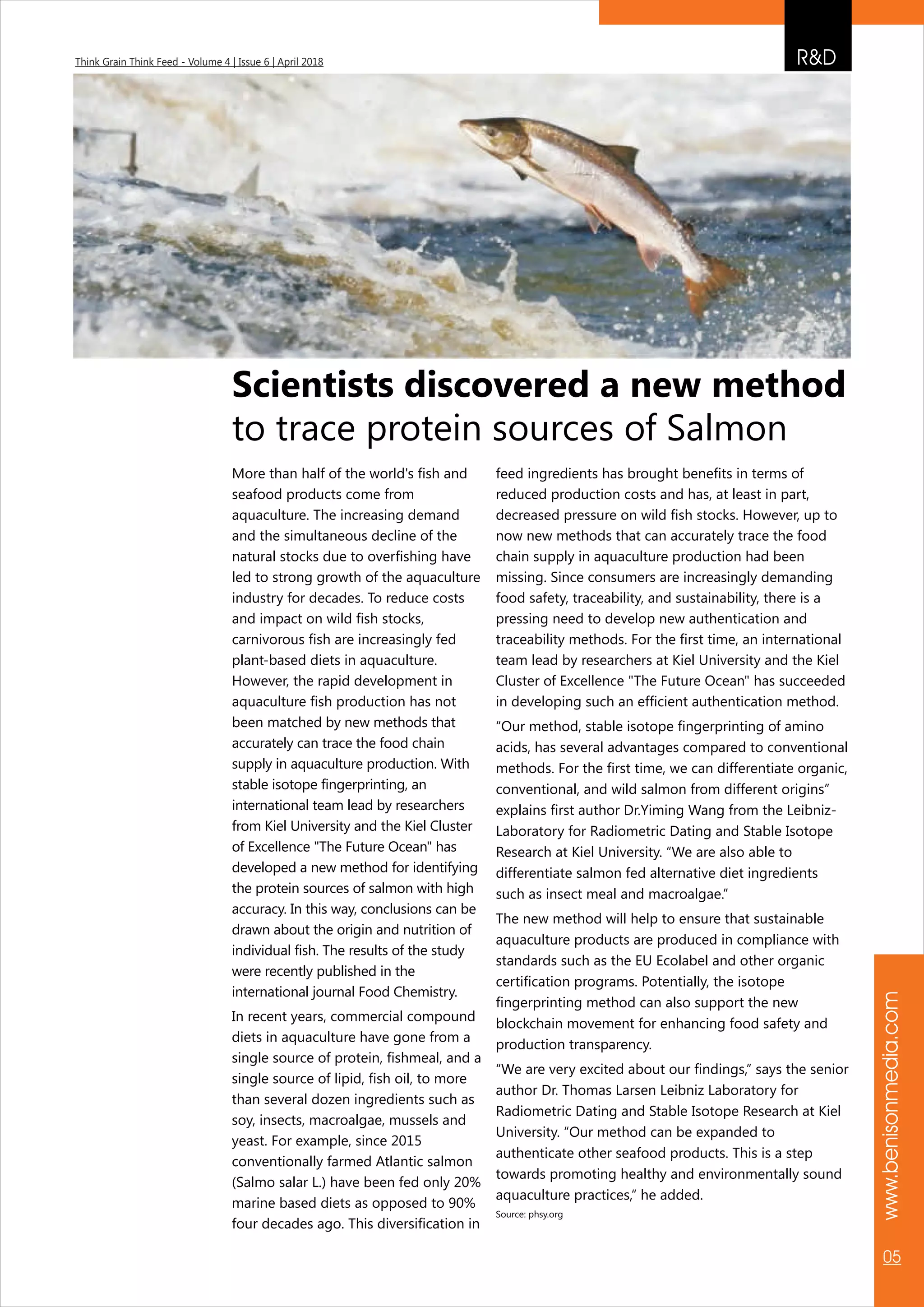
More than half of the world's fish and
seafood products come from
aquaculture. The increasing demand
and the simultaneous decline of the
natural stocks due to overfishing have
led to strong growth of the aquaculture
industry for decades. To reduce costs
and impact on wild fish stocks,
carnivorous fish are increasingly fed
plant-based diets in aquaculture.
However, the rapid development in
aquaculture fish production has not
been matched by new methods that
accurately can trace the food chain
supply in aquaculture production. With
stable isotope fingerprinting, an
international team lead by researchers
from Kiel University and the Kiel Cluster
of Excellence "The Future Ocean" has
developed a new method for identifying
the protein sources of salmon with high
accuracy. In this way, conclusions can be
drawn about the origin and nutrition of
individual fish. The results of the study
were recently published in the
international journal Food Chemistry.
In recent years, commercial compound
diets in aquaculture have gone from a
single source of protein, fishmeal, and a
single source of lipid, fish oil, to more
than several dozen ingredients such as
soy, insects, macroalgae, mussels and
yeast. For example, since 2015
conventionally farmed Atlantic salmon
(Salmo salar L.) have been fed only 20%
marine based diets as opposed to 90%
four decades ago. This diversification in
feed ingredients has brought benefits in terms of
reduced production costs and has, at least in part,
decreased pressure on wild fish stocks. However, up to
now new methods that can accurately trace the food
chain supply in aquaculture production had been
missing. Since consumers are increasingly demanding
food safety, traceability, and sustainability, there is a
pressing need to develop new authentication and
traceability methods. For the first time, an international
team lead by researchers at Kiel University and the Kiel
Cluster of Excellence "The Future Ocean" has succeeded
in developing such an efficient authentication method.
“Our method, stable isotope fingerprinting of amino
acids, has several advantages compared to conventional
methods. For the first time, we can differentiate organic,
conventional, and wild salmon from different origins”
explains first author Dr.Yiming Wang from the Leibniz-
Laboratory for Radiometric Dating and Stable Isotope
Research at Kiel University. “We are also able to
differentiate salmon fed alternative diet ingredients
such as insect meal and macroalgae.”
The new method will help to ensure that sustainable
aquaculture products are produced in compliance with
standards such as the EU Ecolabel and other organic
certification programs. Potentially, the isotope
fingerprinting method can also support the new
blockchain movement for enhancing food safety and
production transparency.
“We are very excited about our findings,” says the senior
author Dr. Thomas Larsen Leibniz Laboratory for
Radiometric Dating and Stable Isotope Research at Kiel
University. “Our method can be expanded to
authenticate other seafood products. This is a step
towards promoting healthy and environmentally sound
aquaculture practices,“ he added.
Source: phsy.org
Scientists discovered a new method
to trace protein sources of Salmon
R&DThink Grain Think Feed - Volume 4 | Issue 6 | April 2018
www.benisonmedia.com
05
INDUSTRY NEWS
www.thinkgrainthinkfeed.co.in
06
Think Grain Think Feed - Volume 4 | Issue 6 | April 2018
Liu Yonghao of New Hope Group, one
of China's largest animal feed
producers, says a trade war can be
damaging for both countries and hopes
that the dispute can be resolved
through negotiations
China's animal feed industry can absorb
the shock of a 25 per cent additional
tariff by diversifying its sources, raising
domestic output and changing the
feed's formula, according to the chief of
one of the country's largest animal feed
producers.
Liu Yonghao, chairman and founder of
New Hope Group, said his company
and the wider Chinese animal feed
industry can import more soybeans
from Brazil, Russia, India and Argentina
if the tariff is slapped on US soybeans,
which will render its import
uneconomical.
“A trade war is bad for both China and
the US,” he said in an interview on the
sidelines of the Boao Forum recently.
“China imports a third of its soybeans
from the US and we want to maintain
friendly relations with our US farmer
friends, we hope negotiations will result
in a win-win resolution.”
Recently Beijing unveiled plans to slap
an extra 25 per cent tariff on a range of
goods it imports from the US, including
soybeans, cars and aircraft, as the
world's two largest economies edge
ever closer towards an all-out trade war.
Chinese animal feed industry can
absorb impact of US soybean tariff
China imported some 60 per cent of all soybeans traded
globally, buying just over half its needs or some 51
million tonnes from Brazil last year and 33 million
tonnes from the US.
China's total import of the bean, which is processed into
cooking oil and animal feed ingredients, amounted to
over US$12 billion last year.
Brazil first overtook the US as the top supplier to China
in 2012, according to Reuters, as the South American
nation – whose domestic market is limited – offered
attractive prices for its beans that contains higher
protein content than the US variety.
The 35-year-old company produces some 20 million
tonnes of animal feed, processes 1.3 billion chickens and
eight million pigs a year, according to its website.
Having built or invested in 40 livestock and aquatic
animal feed production facilities across 20 nations, the
privately-owned company recorded 61.5 billion yuan
(US$9.7 billion) of sales in 2015, generated by over
60,000 employees.
Its overseas units span four nations in South Asia, seven
in Southeast Asia, and Russia, Poland, Turkey, Egypt and
South Africa.
In 2015, New Hope bought a 20 per cent stake in
Chicago-based Lasing Trade Group, one of the largest
animal feed merchandisers in the US, which also trades
other grains-derived and energy commodities.
Asked if rising protectionism and scrutiny of Chinese
acquisition of US assets would discourage New Hope
from pursuing acquisitions in the US, Liu said he
believes the agricultural sector is not among the most
sensitive sectors that will attract a lot of scrutiny on US
national security concerns.
Source: SCMP
ImageSource:WKMS
www.thinkgrainthinkfeed.co.in
08
MARKET PROJECTION Think Grain Think Feed - Volume 4 | Issue 6 | April 2018
Oilseed market outlook
Soybeans recovery in exports
Soybeans are trying to hang on to
double digit gains, following a USDA
projection of 2017 crop endingstocks
that fell by 5 million bushels, surprising
the trade.
Soybeans rallied before the report, after
USDA announced new purchases,
including 10.25 million bushels of old
crop to Argentina and 9.3 million
bushels of new crop to China and
unknown destinations. The market
made new highs after the April supply
and demand report was released, but
quickly ran into profit taking before
firming again.
USDA said stronger crush would offset
a decrease in feed and residual usage,
causing the small reduction in soybean
carryout. The agency also cut its
forecast of Argentine production by
257 million bushels, more than
expected, while adding nearly 75
million to the crop in Brazil. Overall
world carryout for the 2017 marketing
year fell 132 million bushels, again, a
bigger reduction than the trade was
looking for.
Corn traded both sides of unchanged
after USDA raised carryout by 55
million bushels to2.182 billion, due to
weaker feed and industrial usage
suggested by the March 29 stocks
report. That was close to trade
estimates. The agency cut its forecast of
production in both Brazil and Argentina
by a total of 217 million bushels, helping tighten world
carryout slightly. Acreage fell in both countries with
Argentine yields slashed by drought.
The agency put U.S. wheat carryout at 1.064 billion
bushels, up 30 million due to lower feed and residual
usage. World ending stocks went up 86 million bushels,
more than the trade expected. Wheat prices were under
modest pressure before the report but tried to frim after
initial selling dried up.
Markets generally were buoyed by calming trade
tensions that gave a boost to stock markets around the
world today. Commodities also rallied, with crude oil
moving back above $65.
While the trade issue won't disappear completely, it may
not dominate prices unless headline news turns sour.
Corn Report from India
Indian corn harvest for Rabi will be late, another 2
weeks before the new corn is large quantities could be
seen in the market. In the interim, the price has gone
up, in Gulabbagh by over 9% in last one month. Against
last week, prices are down slightly and are at
Rs.13000/MT. Prices in Erode, (South) have also gone up
by over 4% in last one month and currently close to
Rs.13900/MT. Against 1st week of April, prices are up by
2.5%
DDGS
Higher demand of DDGS in the domestic as well as
foreign markets has led to higher prices, which are
indicated at $245/MT FOB US Gulf, up 10% in one
month. Prices of DGGS to Vietnam are indicated at
$251/MT, China $251/MT, Chittagong $283/MT and
Myanmar $279/MT. Other co-product price, CGM prices
have been more or less stable at $620/MT (FOB US gulf)
for the last couple of weeks.
Source: USDA, Informa &Techproindia
www.benisonmedia.com
09
Think Grain Think Feed - Volume 4 | Issue 6 | April 2018
2017/18 OUTLOOK CHANGES
Country Commodity Attribute Previous Current Change
Soybean Meal Exports 30,800 29.500 -1,300
Soybean Oil Exports 5,120 4,750 -370
Soybean Oilseed Exports 6,800 4,200 -2,600
Bangladesh Soybean Oil Imports 880 780 -100
Soybean Oilseed Exports 70,500 73,100 2,600
Soybean Meal Exports 15,250 15,450 200
China Soybean Oil Exports 100 200 100
Egypt Palm Oil Imports 1,300 1,200 -100
Soybean Meal Imports 19,200 18,900 -300
Rapeseed Oilseed Exports 250 150 -100
Sunflower seed Imports 3,700 3,800 100
Meal
Soybean Meal Exports 1,700 1,600 -100
Soybean Oil Imports 3,545 3,345 -200
Peanut Oilseed Exports 950 850 -100
Palm Kernel Meal Exports 4,650 4,550 -100
Coconut Oil Exports 620 500 -120
Iran Soybean Meal Imports 1,550 1,370 -180
SouthKorea Soybean Meal Imports 2,000 1,850 -150
Malaysia Palm Kernel Meal Exports 2,500 2,400 -100
Mexico Soybean Oilseed Imports 4,250 4,400 150
NewZealand Palm Kernel Meal Imports 2,100 2,300 200
Pakistan Soybean Meal Imports 350 150 -200
Philippines Coconut Oil Exports 850 1,000 150
Russia Soybean Oilseed Imports 400 600 200
Exports 2,000 2,200 200
Senegal Peanut Oilseed Exports 420 130 -290
Thailand Palm Oil Exports 150 250 100
Tunisia Soybean Meal Imports 140 40 -100
Turkey Sunflowerseed Oil Imports 700 600 -100
Sunflowerseed Imports 450 550 100
Oilseed
Soybean Meal Exports 450 350 -100
Soybean Oilseed Exports 2,400 2,500 100
Uruguay Soybean Oilseed Exports 2,100 1,600 -500
Venezuela Soybean Meal Imports 565 425 -140
The slow pace of crush to
datecoupled with significant crop
lossesleads to lower exports
Reason
Lower Argentina exports
Higher production and
strongerexport demand
Argentina
Brazil
Stronger pace of trade in the first
halfof the marketing year
Weaker trade pace in Oct-Dec as
wellas stronger demand for
“golden” oilssuch as soybean and
sunflower-seedoil
Trade pace
Lower production and reduced
competitiveness
India
Lower global supplies
Weak Oct-Jan trade pace
Trade pace
Indonesia Lower production and crush
estimate
Lower global supplies
Lower global supplies and
earlyseason trade pace
Trade pace
Stronger pace of trade
Growing feed demand
Trade pace
Higher production and
crushestimates
Trade pace
Stronger pace of trade to China
Trade pace
Greater exportable supplies
Lower demand for product
importswith greater emphasis on
domesticcrush
Trade pace
Trade pace
Lower crop
Smaller global supplies and
slowerpace of trade
Note : All figures are in thousand metric tons.
European Union
Ukraine
www.thinkgrainthinkfeed.co.in
10
Think Grain Think Feed - Volume 4 | Issue 6 | April 2018
What according to you are the key trends in feed industry globally and in India?
There are major current challenges for the livestock industry on a global level
including India? What is the role of CLFMA of India in overcoming these
challenges?
Globally meat consumption is growing and hence feed industry is also growing in
tandem. However, Asian (particularly South East Asia) countries are growing much
faster than the rest of the world. In India, for example, poultry meat consumption is
growing at 7 to 8% per annum and dairy products consumption is also growing.
Similarly, with increase in incomes and consumer awareness, protein share in diets is
expected to increase. India has recently emerged as one of the most significant
exporter of shrimp. All these indicate encouraging trend for the feed industry.
Recently, there is lot of negative publicity being created by some groups with vested
interests and questionable credentials with regard to livestock and meat industry. We
must understand that India is still the home to millions of malnourished population
especially having proteindeficiency. It is quite imperative that animal protein must be
made available to them at affordable prices. This kind of propaganda against industry,
without any scientific data to justify the claims, shall only cost the country big in terms
INTERVIEW
Research on innovative
and disruptive livestock
technologies:
Need of the hour
B Soundararajan -A renowned
and humble personality of Indian
Poultry Industry - is the Chairman
and Managing Director of Suguna
Holdings Private Limited. The man
who foresaw the great potential
of growth in poultry integration
as early as in the 90’s, brought the
concept of Contract Farming in
India. Presently he is the
Chairman of CLFMA of India, the
apex association representing the
dynamic Indian livestock industry.
In a telephonic conversation with
Think Grain Think Feed, he shares
his views about present trends
and challenges of the Indian
livestock sector, impact of
developments in global trade and
more. Below are the excerpts of
the interview:
B Soundararajan
Suguna Holdings Pvt. Ltd.
www.benisonmedia.com
11
Think Grain Think Feed - Volume 4 | Issue 6 | April 2018
of food and nutritional security, if it is not
addressed appropriately. Lack of
understanding among consumers about
how food is produced leads to unjustified
negative public perception on tools and
technologies that are useful in food
production.
Another challenge is that the import of
GM feed ingredients, which is prohibited,
while ironically, the country has agreed to
import US chicken which is fed on GM
ingredients, or shrimp feed import made
using GM ingredients. Approx. 90% of
world production of feed ingredient is
genetically modified and a premium is to
be paid for organic or non-GM. Lower per
hectare production of corn and soya in
India also remains a major challenge.
CLFMA's primary mandate is
development of the livestock sector in
India. So, CLFMA actively works with
diverse stakeholdersto drive home the
point that this is a shared responsibility of
all stakeholders connected to the food
value chain including the industry,
government, policy makers, scientists,
media and general public. As an organization, CLFMA also
actively supports the government vision of doubling the
farmer's income which can be achieved by increasing
productivity of corn, soya and other key crops. This would
ultimately bring sustainable income for farmers and better
protein availability for consumers (human as well as
livestock).
We mustappreciate thatnowadays the consumer is not only
concerned about food prices and quality but also much
interested to look into how it is produced, especially
inrelation toenvironmental issues, resource use and welfare.
As India is one of the efficient producers of animal protein,
our production systems are already much improved in the
last few decades. In future, we must be more focused
towards things such as water use, judicious use of other
inputs including medicines and additives, cutting down
waste both on and off the farms, improving the share of
processing etc. There is always a scope and need for
continuous improvement.
It is generally accepted that India should increase its R&D
spend across the board in agriculture and livestock industry.
However, it should not be isolated and confined to only
public and/or private sectors. The future is about
collaboration between these two sectors and the
Government is also keen to promote PPPs (Public Private
Partnerships) to ultimately benefit the industry and the
country. Indian poultry industry is already one of the most
efficient producers in the world. Still the country should
invest on breeding else we will remain dependant forever
on few international companies. However, the industry is
experimenting but it is not sufficient. Innovative and
disruptiveresearch in technologies arethe needs of the hour.
In my personal opinion, it is a welcome move since
consumers are quite concerned about food safety and
quality. The organized players are already conforming to the
standards and relevant laws. FSSAI's regulation will make
the unorganized and unscrupulous players to conform or
quit. It might also bring the shift in consumer preference
from live chicken to processed chicken. However, I would
like to emphasize that effective implementation of the
regulation is very critical.
How do you define sustainability in the context of
livestock production? How is India doing when it comes
to sustainability and what would be your suggestions to
improve it further
As per recent report by TOI1, India spends less than 1%
of GDP on R&D. What is your opinion on this issue and
how could the industry respond to this low percentage
spent on R&D?
With strict FSSAI regulation in place, what could be its
impact on Indian livestock industry?
There is a lot that has been recently said about
antibiotic usage in India, highlighting livestock industry
as the main culprit. There is a need to bring right
www.thinkgrainthinkfeed.co.in
12
Think Grain Think Feed - Volume 4 | Issue 6 | April 2018INTERVIEW
information to the end-consumer. Any
thoughts you would like to share on
this issue?
As I mentioned earlier, scaremongering
without scientific data and making
untruthful claims had become more
popular tactics of people who have vested
interests. However, the industry is already
doing its part to promote awareness on
judicious and responsible use of inputs
including antibiotics. Everyone including
media and journalists has a great
responsibility to ensure consumers are not
misled. At CLFMA, we are always
advocating for judicious and responsible
usage of all inputs. Hence, without
scientific evidence, any unnecessary
regulation or blanket bans will only be
harmful. On the face of it, these sorts of
campaigns lead to confusion and anti-
industry perception among public.
Everyone concerned with the food and
nutritional security of the country must
counter this with facts and science-backed
information.
Recent reports suggest a global trade war is on cards
that would impact the commodity market. What are
your views on its impact on Indian feed industry?
You are speaking next month in Feed Additives
conference, please share more details on the topic-Feed
Additives and Feed Markets in India.
Indian feed industry largely depends on domestic supplies
except in odd years when our production falls short.
However, we cannot be complacent and remain immune to
the global dynamics. If the so-called trade war is happening,
we must be watchful about prices since our prices are
aligned with the global prices in both the key commodities
– maize and soybean. During such times, government has a
major role to play in protecting the domestic industry by
focusing on farmers' income and industry's
competitiveness.
I would be discussing about the key developments in
livestock industry in India, major consumer trends, as well as
socio-economic, policy, and regulatory environments. I will
also be focusing on the growth potential of India's dairy,
poultry and aqua sectors.I see a lot of opportunity in global
feed sector. While on feed additives front,we are largely
dependent on imports, this needs to be changed. To
conclude, I feel that the evolving government regulations
and socioeconomic factors would further support the
overall livestock industry's growth in India.
Tel :+74952871354
www.thinkgrainthinkfeed.co.in
14
Think Grain Think Feed - Volume 4 | Issue 6 | April 2018
INTRODUCTION
Nutrition plays a major role in the
performance of layer birds. Feed
management is the most important
practice to achieve egg production at
the right time, maximum peak
production, long standing peak
production, standard egg size, good
cull bird weight and reduced feed cost
per egg. Body weight should be taken
every week from 1st week to 18th week
of age, the birds with less body weight
should be separated and special care
must be taken to those birds to get
uniformity in flock. The birds fed with
standard feed prepared as per nutrient
specifications will attain recommended
body weight. The nutritional
requirements of birds will vary
depending on the breed, age and
climatic conditions. So, feed
formulation should be prepared as per
the nutritional requirement of birds. In
summer, the feed intake is less and the
feed formulation will be revised as per
the feed consumption.
NUTRIENTS CLASIFICATION
Carbohydrates, proteins, fats, vitamins, minerals and
water are main nutrients in poultry layers that are
discussed as follows.
CARBOHYDRATES
Cereal grains such as maize, bajra, broken rice, rice
polish, jowar, ragi, de-oiled rice bran (DORB) and wheat
bran, etc., are some of the carbohydrate sources used in
layer diet. Most of the carbohydrates of cereal grains
occur as starch, which is readily digested by poultry.
Other carbohydrates occur in varying concentrations in
cereal grains and protein supplements. These
carbohydrates include polysaccharides such as cellulose,
hemicellulose, pentosans and oligosaccharides such as
stachyose and raffinose, all of which are poorly digested
by poultry. Thus, these dietary carbohydrates often
contribute little to meet the energy requirement of
poultry and some adversely affect the digestive
processes of poultry when present in sufficient dietary
concentrations.
PROTEINS
The vegetable protein sources are soya bean meal, sun
flower cake, rapeseed meal, cotton seed cake, ground
ARTICLE
Feed Management in Layers
Dr. S R Prabakar, Kemin Industries South Asia
www.benisonmedia.com
15
Think Grain Think Feed - Volume 4 | Issue 6 | April 2018
absorbed through intestinal villi.
VITAMINS
Vitamins are present in the feed raw materials such as
corn and soy, but these are insufficient for the birds.
Therefore, vitamins are supplemented as vitamin
premixes in feed. Vitamins have been divided into two
groups based on their solubility in fat solvent or in
water. Thus, fat-soluble vitamins include vitamin A, D, E
and K. While, vitamin B complex and vitamin C are
classified as water soluble vitamins. Fat-soluble vitamins
are found in feedstuffs in association with lipids. The fat-
soluble vitamins are absorbed along with dietary fats,
apparently by mechanisms like those involved in fat
absorption. Water soluble vitamins are not associated
with fats. Commonly used vitamins in layers are fat-
soluble vitamins such as Vitamin A, D3, E and K. Water
soluble vitamins are Vitamin B1, B2, niacin, pantothenic
acid, pyridoxine (B6), biotin, folic acid, Vitamin B12,
choline, Vitamin C, carnitine and inositol. Classical
added choline levels used for layer diet are usually
around 250ppm, but for an efficient action on liver, 500
to 1000 ppm of added choline is recommended. Vitamin
B12, folic acid and vitamin E improve the liver condition.
DEFICIENCY OF VITAMINS:
The deficiency of vitamins and its affects were described
by Simon as follows:
! Vitamin-A deficiency: Vitamin A deficiency in chicks
leads to poor growth, feathering and in advanced
cases ataxia (inability to stand), xerophthalmia (dry
eye) and chronic purulent conjunctivitis. Deficiency
of vitamin A in layers causes deterioration in
internal egg quality and a high prevalence of blood
spots.
! Vitamin-D3 deficiency: Vitamin D3 deficiency will
lead to rickets in immature flocks, swelling of joints,
depressed growth and poor feathering. In mature
laying birds, deficiency of Vitamin D3 results in
osteomalacia characterized by decreased skeletal
density, production drop and reduced egg shell
quality.
! Vitamin-E deficiency: Vitamin E deficiency in chicks
leads to encephalomalacia, transudative diathesis
and muscular dystrophy.
! Vitamin-K deficiency: Vitamin K deficiency leads to
subcutaneous hemorrhages that are noted on the
head and beneath the wings.
! Vitamin-B1 (Thiamine) deficiency: Vitamin B1
deficiency in 10 to 20 days old chicks comprises
incoordination and an abnormal retraction of head
(star gazing).
! Vitamin-B2 (Riboflavin) deficiency: Vitamin B2
deficiency leads to curled toe paralysis, low growth
rate, poor feathering and low egg production.
nut cake, guar meal, til cake, and
distillers dried grains with solubles
(DDGS), etc. Animal protein sources are
fish meal, meat and bone meal, blood
meal and feather meal etc. Proteins are
polymers that are composed of alpha
amino acids, which are linked together
by peptide bonds. Proteins are broken
down and hydrolyzed in the digestive
system into amino acids. Then, after
absorption, the amino acids will be
assembled and metabolized to form
proteins that are used in the building of
different body tissues. They also serve
vital metabolic roles as blood plasma
proteins, enzymes, hormones and
antibodies, each of which has a specific
role in the body. The concepts of
digestible amino acids, ideal amino acid
ratios, use of synthetic amino acids and
feed consumption-based formulations
must be considered to get excellent
result in layer flocks and saving in feed
cost.
FAT
“Fat” or “oil” is another source of
energy. Besides supplying energy, the
addition of fat to animal diet improves
the absorption of fat-soluble vitamins,
decreases pulverulence, increases diet
palatability and the efficiency of
utilization of the consumed energy.
Furthermore, it reduces the rate of food
passage through gastrointestinal tract,
which allows a better absorption of all
nutrients present in the diet. The
digestion of fat produces less body
heat (fat has a relatively low heat
increment), which is useful during
periods of heat stress. Vegetable oils
such as soya oil, rice bran oil and
animal fat such as tallow are used as
the energy sources.
The presence of food in the duodenum
stimulates the secretion of
cholecystokinin, which induces the
contraction of gall bladder and
secretion of the pancreatic juice,
making the chime. Colipase binds to
the oil-water interface and produces
the emulsion. Afterwards, triglycerides
undergo hydrolysis under the action of
the pancreatic lipase and micelles are
formed by monoglycerides, diglycerides
and free fatty acids. Micelles are
ARTICLE
www.thinkgrainthinkfeed.co.in
16
Think Grain Think Feed - Volume 4 | Issue 6 | April 2018
! Biotin deficiency: Affected flock
demonstrates poor growth,
loss occurs in the air sacs and lungs through rapid
respiration. There is no precise quantity requirement for
water because there are several factors that affect the
amount of water a bird needs: age, body condition, diet,
temperature, water quality and humidity.
CONCLUSIONS
While preparing the feed formulation, proper raw
materials, cost and availability of raw materials must be
considered. Feed formulation should be based on the
age of the birds, nutritional requirement of the breed
and feed intake of the birds. The nutrients in the feed
raw materials should be utilized efficiently through
proper digestion and absorption of nutrients by using
emulsifier and enzymes.
SURVEY
www.thinkgrainthinkfeed.co.in
18
Think Grain Think Feed - Volume 4 | Issue 6 | April 2018
A recent survey commissioned by
Delacon revealed Thai consumers are
ready to buy meat products raised with
phytogenic feed additives. They look
closely at product labels, gravitate
toproducts “raised without antibiotics
ever,” and are interested to know that
phytogenics are used. It appears that
knowing phytogenics “leave no harmful
residue” would be influential to the
majority.
Results of a consumer survey
commissioned by Delacon show two-thirds (62 percent)
of Thai millennial foodies look very closely atmeat
product labels and almost all Thai millennials are
concerned enough to look closely at thelabel. “The survey
shows that millennials in Thailand are interestedin
knowing how their food is produced. The story of
phytogenics, or plant-derived ingredients fed to chickens
and pigs, would be very attractive for them to consider in
their purchasing decision for meat products,” says Preecha
Sapkitjakarn, Delacon Country Sales Manager in Thailand.
Phytogenics closely fit the mindset of Thai millennials
on food: safe, sustainable, without antibiotics
Thai Millennials prefermeat
raised using phytogenic feed
additives-Survey report
www.benisonmedia.com
19
Think Grain Think Feed - Volume 4 | Issue 6 | April 2018
Phytogenic feed additives are
standardized mixtures of herbs, spices,
other plants, and their extracts with
proven efficacy. To consumers, one could
more visually talk about natural
ingredients such as cinnamon, thyme, or
cayenne pepper. Phytogenics are used
for their impact on animal wellness, gut
health, and greenhouse gas emissions.
The survey found their attributes fit into
the belief and purchasing behavior ofthe
majority of Thai millennials. Millennial
foodies look forproducts that are “raised
without antibiotics ever,” “raised in ways
that reduce environmental impact,” and
“certified organic” when choosing a
specific brand of meat.
The survey also looked at product
labeling concepts to see which
phytogenic claims would be most
important to Thai millennials.
Overwhelmingly, the strongest claim for
a brand of chicken or pork meat was “fed
a diet that includes phytogenic
ingredients which leave no harmful
residue.”
“Delacon phytogenic feed additives are
extensively tested to ensure safety in the
feed-to-food chain. A product stamp
showing meat raised with phytogenics
could provide meaningful information
that supports consumer purchasing
confidence,” shares Gina Medina,
Delacon Sales Group Leader Asia.
Nine out of 10 Thai millennial foodies in
favor of phytogenics:
Nine out of 10 Thai millennial foodies
would
! “choose meat and poultry fed
completely natural ingredients, such
as phytogenics”: 91 percent foodies,
78 percent overall.
! “feel great about food choices”
knowing phytogenics support
animal's digestive health and
wellness, as well as reduce
environmental impact: 92 percent
foodies, 87 percent overall.
! “want to know and choose meat
and poultry raised with
phytogenics”: 93 percent foodies,
82 percent overall. It is important to
them that food choices reflect their
value for the environment, animal
welfare and natural ingredients.
Moreover, the survey found that phytogenics on the label
would make a positive impact on 82 percent of Thai
millennial foodies and 71 percent of Thai millennials
overall. “We look forward to sharing these insights with
our partners in Asia Pacific to reinforce the important role
of phytogenicsin their animal production operations and
demonstrate an opportunity to tell a positive message
to consumers,” says GinaMedina.
Growing phytogenics market in Asia Pacific
In Asia Pacific, Delacon recognizes strong growth in the
sales of its phytogenic feed additives, more than 40
percent. Local producers have turned to natural
phytogenics to support animal wellness and productivity
as legislation banning antibiotic growth promoters in
animal production in Thailand, and recently in Vietnam
and Indonesia (2018) has taken effect.
Also, consumers' demand for protein is projected for
continued growth across the region. They are notably
interested in safe, sustainable food.
The survey was conducted online within Thailand by
Millennium Research on behalf of the Delacon in
February 2018 among 505 millennial adults ages 24-34.
Millennial foodies are defined as those who say that
they care very much about the quality and source of
their food.
Source: Delacon
ARTICLE Think Grain Think Feed - Volume 4 | Issue 6 | April 2018
In developing countriesincluding
India,livestock sector is one of the fastest
growing segment of the agricultural
economy. The supply of the green forage
throughout the year is an economic
priority to the farmers, in orderto maintain
the production from the ruminant stock.
But forage production is mostlyseasonal
in many parts of the world, with surplus
availability in harvesting season and
shortage of fodder during dry season.
Silage making is an option to preserve the
green fodder to make the greens available
throughout the year.Ensiling is based on
natural lactic acid fermentation under
anaerobic conditions. The most important
foddercrops for ensiling are corn,
sorghum, barleyand various othergrasses.
Beside these crops various moist “by-
products” of the food industry, such as
apple pomace, beet pulp and brewer's
mash can alsobe used for silage
preparation. Ensiling process has many
steps which should be timed and
controlled carefully to ensure successful
ensiling.
Ensiling process and role of different
bacterial groups during ensiling:
The ensiling process completes in the
following steps: harvesting the crop (30-
Preventive Measures to
Control Silage Spoilage
35%DM), chopping, loading into a silo, compacting and
sealing to exclude air, storing and feed out phase
(unloading for animal feeding). Biochemical and
microbiological incidents can ariseduring the different
stages of ensiling which may affect the silage quality. At first
step of ensilingisthe enzymatic activity of intact plant cells
whenresidual respiration occurs. The intact cellsuse glucose
and fructose as carbohydrate source and consume oxygen
entrapped in the silage.Early consumption of carbohydrates
is detrimental for the subsequent anaerobic lactic acid
fermentation. In initial phase of ensiling epiphytic aerobic
flora such as Enterobacteria, yeasts and molds develop until
oxygen has been entirely consumed or acidification is
sufficient to stop their metabolism. At ensiling, the
facultative anaerobic bacteria carry out a heterolactic
fermentation which slightly decreases the pH of the silage.
As the conditions become anaerobic in silagepit,
fermentation phase starts.This phase continue for several
days or weeks, during which different groups of facultative
aerobic or anaerobic microorganisms naturally found in
plants compete for available nutrients. With gradual
acidification,acid tolerant bacterial development start;
convert water soluble carbohydrates into lacticacid. In well-
processed silage, LAB dominate the fermentation, rapidly
producing the low pH conditions that help to preserve the
silage. In case of accidental soil incorporation in ensiled
material, a long aerobic phase or slow acidification, the
microbial communities in the silage will be dominated by
Clostridia, yeasts, molds and accidentally incorporated
pathogenic microorganisms such as Listeria sp.
Bharti Sharma, Dipak Dey, Nitin Tyagi, NDRI, Karnal
www.benisonmedia.com
21
Think Grain Think Feed - Volume 4 | Issue 6 | April 2018
milk taste.
Moulds are eukaryotic micro-organisms and develop in
part of silage where oxygen is present. Many mould species
produce the large filamentous structures and coloured
spores in silage..Penicillium (70%), Fusarium (47%) and
Aspergillus (34%) are the most frequent mycotoxin-
producing fungi isolated from corn silage. There
metabolites remain in the silage even after the fungus has
disappeared. More than 20 mycotoxins can be produced
by Fusarium sp., mainly dioxynivalenol(DON), zearalenone
(ZEN) and fumonisin (FB).
Chronic exposure to mycotoxins produce non-specific
symptoms such as immune system impairment, increased
infections and metabolic and hormonal imbalances.
Ruminants are better protected than other animals against
many mycotoxins but fumonisin B1 is only poorly
metabolized in the rumen.In high producing dairy animals
fed on silage-based diets with high levels of concentrates;
the consequent acidificationof the rumen environment may
increase the animal's sensitivity to mycotoxins.
Butyric acid bacteria (BAB): Soil accidentally included with
the plant material during silo filling is the source of Butyric
acid bacterial contamination of silage. Endospore-forming
bacteria of the genera Clostridium, especially C.
tyrobutyricum and C. butyricum and Bacillus are main BAB
found in silage.At a relatively low ph,BABconvert lactic acid
into butyric acid, hydrogen and carbon dioxide. A typical
“clostridial silage” is characterized by a high butyric acid
content of more than 5 g/kg DM, a high pH (over pH 5 in
low DM silages), and a high ammonia and amine content.
Excess butyric acid from feeding butyric silages results in
higher levels of plasma Ketones. Daily doses of over 50 –
100g of butyric acid can cause ketosis.Feeding butyric silage
has long term negative effects on production, fertility and
health, thus economy of the farm business.
Bacterial spores can survive the passage through the
gastrointestinal tract in dairy cows. Bacillus cereusis an
important spoilage microorganism in pasteurized milk and
milk products and can lead to food poisoning.The
occurrence of Clostridium in milk can lead to off-flavors and
excessive gas formation in semi-hard or hard ripened
cheeses.
Listeria: The presence of L. monocytogenes in silage, feces
or both increases the risk of its presence in milk and hence
of its transmission to humans. pH of silage over 4.5
increases the risk of presence of Listeria sp. In ruminants it
could cause encephalitis, absorption or septicemia, even
death.
E. coli (STEC):E. coli and higher prevalence of E. coli O157 or
E. coli O157:H7 has been found in herds fed corn silage.At
ensiling, insufficient anaerobiosis could delay the
establishment of lactic acid fermentation, slowing the pH
decrease andincreasing the survival of pathogenic E. coli,
which is a food born pathogen.
As long as the pH is sufficiently low and
anaerobiosis is maintained, storage phase
lasts and few changes occur. Numbers of
LAB and other viable microorganisms
decline over time, except for some
specialized species such as L. buchneri
with continues to be active at low
population densities. Some acid-tolerant
microorganisms can survive this storage
period in an almost inactive state (e.g.
acid-tolerant yeasts) or as spores (e.g.
butyric acid bacteria). Homofermentative
lactobacilli such as L. plantarum and
Lactobacillus curvatus tend to
predominate in well preserved silage until
the final stage of fermentation, when they
are invariably replaced by
heterofermentative species such as L.
brevis and L. buchneri.
The fourth phase is the unloading or
feedout phase. On opening of silos air
penetrates into the silage depending on
the density and porosity of the plant
material and the rate of silage removal.
This causes the growth of undesirable
aerobic microorganisms initially present in
the silage, such as yeasts and molds and
an increase in pH.
Undesirable microorganisms and their
metabolites
Several undesirable microorganisms can
grow during ensiling process which can
affect silage quality and thus affect animal
performance or both animal and human
health. These microorganisms are known
as spoilage microorganisms; responsible
for silage degradation mainly induce
economic losses.
Yeasts and molds: Yeasts are considered
to be the most important groupamong
the undesirable microorganisms of silage
because they are involved in aerobic
spoilage either during the aerobic phase
at the beginning of ensiling or during the
unloading phase. The organic acid
metabolism pathways (succinic, citric and
lactic acids) of yeasts restarts on exposure
of silage to air; inducing a pH increase
and allowing the growth of less acid-
tolerant microorganisms. Yeasts present in
silage convert WSC into CO2 and
alcohols; impair silage quality and lead to
a decrease in feed intake. The alcohol
production also has negative effect on
Think Grain Think Feed - Volume 4 | Issue 6 | April 2018
www.thinkgrainthinkfeed.co.in
22
ARTICLE
Image Source: AgWebBiogenic amines (BA): Putrescine,
cadaverine and tyramine are main
bacteriocins.
Prevention of pathogen introduction during harvesting
and ensiling of crop:Entry of soil in the silage is the source
of butyric acid bacterial/ pathogen contamination. Crops
should be harvested 4 weeks after manure application
takingcare to prevent contamination by soil.
Conclusions
Preservation of surplus fodder as silagemakes it possible
to have the green fodder availability throughout the year.
Lactic acid fermentation is important for good silage
production, but some undesirable bacteria can make
entry during ensiling, which candegrade the quality of
silage and cause economic lossesto the farmer. Safety
control measures and additives may behelpful used in
producing quality silage.
INDUSTRY NEWS
www.benisonmedia.com
23
Think Grain Think Feed - Volume 4 | Issue 6 | April 2018
Feed raw material tax waiver
makes feed costs cheaper in East Africa
Governments in East Africa recently have
made animal feed costs cheaper by
removing a tax on the raw materials used
in their production, although livestock
farmers in the region are grappling with
frequent droughts that impact the supply
of commodities such as corn, sunflower
and soybeans.
Since 2015, the governments of Kenya,
Tanzania, Uganda and Rwanda gradually
have removed taxation on both feed and
raw materials used in their production to
increase access to meat, milk and eggs
and also boost the feed production
industry in East Africa.
In addition, the removal of taxes on raw
material for the manufacture of animal
feeds has encouraged private investment
in the East African feed industry.
Kenya introduced the VAT on raw
materials for manufacture of animal feeds
in 2013, leading to an increase in the price
of feed in the country. A survey by
Egerton University's Tegemeo Institute in
October 2013 stated that the increase in
the price of feed triggered by the VAT
policy led to a 50% drop in sales of
manufacturers relying on imported raw
materials and 20% for companies that
procured their inputs locally, according to
the survey.
The Kenya Association of Manufacturers
(KAM), a leading representative
organization for industry that brings
together industrialists and provides a
platform for the country's manufacturing
sector, said the removal of VAT will
“strengthen the government's
commitment of transforming the
agricultural sector by encouraging local
manufacturers to produce high quality
feeds at low cost, thereby making the
business profitable.”
Some feed manufacturers in Kenya say
removal of VAT on inputs for feed
production has helped stabilize the
country's feed industry despite a few raw
materials still remaining on the taxation
list.
Nicholas Hutchinson, managing director of Unga Group,
the biggest feed manufacturer in Kenya, said removal of
VAT on certain raw materials used in feed production “has
greatly assisted in stabilizing feed prices despite inflationary
pressure.”
“Nevertheless, farmers will not enjoy the full benefit of VAT
exemption until soybean meal, a significant input, is also
exempted,” he said.
Kenya's soybean deficit
Kenya, which has an estimated 307 registered companies
involved in large-scale feed processing, faces a serious
deficit in soybeans with the country's Ministry of Agriculture
estimating the annual demand to be between 50,000 and
70,000 tonnes against domestic production of 10,000
tonnes. The deficit is overcome by imports from the United
States, Brazil, China, Tanzania, Uganda, India and other
African countries where soybean meal production is still
low.
Kilimo Trust, an independent organization working on
agricultural development across East Africa, estimates
Kenya's imports of feed raw materials at 5.5%, mainly
oilseed cake and cereal bran.
The plan targets an increase in red meat, chicken meat, pig
meat, milk and egg production by 50%, 66%, 69%, 77% and
40%, respectively, by 2022 if the country can secure “all-
year-round quality feed supplies.”
“These increases, as well as the expected use of the cross-
breed cattle population to nearly 3 million, will require
enhanced forage and feed production and feeding services,
including improved pasture productivity practices and
raining of farmers on livestock feeding and forage use,” the
plan said.
In addition, the plan said the supply of animal feed,
including concentrate feed and roughage in Tanzania, “is
erratic both in terms of quality and quantity. Much of the
feed in Tanzania is mineral deficient, in part due to the lack
of quality control and standards, and enforcement
mechanisms in addition to the price of available seed being
high.”
The removal of VAT on the sale of feed early last year, which
came after successful lobbying efforts by the U.S. Grains
Council (USGC) in partnership with Tanzania Animal Feed
Manufacturers and Poultry Association of Tanzania, is one
way the East Africa country hopes to increase access to
quality animal feed.
Demand for feed in East Africa is expected to increase 60%
by 2022 from the 6 million tonnes in 2014, according to
Kilimo Trust.
Source: UK Agro Consult Ltd.
Image Source: AgWeb
INDUSTRY NEWS Think Grain Think Feed - Volume 4 | Issue 6 | April 2018
www.thinkgrainthinkfeed.co.in
24
A journey over land and sea may not
keep animal diseases away.
Researchers from South Dakota State
University, Pipestone Veterinary
Services in Minnesota and Kansas State
University found that seven of the 11
animal viruses tested can potentially
survive the transglobal journey from
Asia or Europe to the United States in
at least two commonly imported feed
ingredients. The scientists examined
virus survivability in 11 imported feed
ingredients and products by replicating
the environmental conditions in
shipping containers.
“The findings of this study show that
feed biosecurity should be a major
priority for pork producers and
ultimately, the livestock industry,” said
assistant professor Diego Diel, who led
the SDSU team. Scott Dee, director of
research at Pipestone Veterinary
Services, said, “For the first time, we
have data to support that certain feed
ingredients are risk factors for moving
viruses between farms and around the
world.”
Diel and his team at the South Dakota
Animal Disease Research and
Diagnostic Laboratory assessed the
ability of 10 viruses to survive the 37-
day journey from Beijing, China, to Des
Moines, Iowa.
Kansas State University, which has a
Level 3 biosecurity laboratory,
evaluated the ability of African swine
fever virus to survive the 30-day trip
from Warsaw, Poland, to Des Moines.
The Iowa destination was chosen
because ingredients are mixed at a feed
mill in Des Moines and then distributed
Virus risk with imported
feed ingredients
to swine farms in the Midwest.
In previous work, Dee and ADRDL researchers
discovered that porcine epidemic diarrhea virus (PEDV)
can survive the simulated trip from Beijing to Des
Moines in five feed ingredients—vitamin D, lysine,
choline and organic and conventional soybean meal.
The researchers are now looking for cost-effective ways
to mitigate this risk through continuing support from
Swine Health Information Center.
Identifying high-risk ingredients
Dee worked with a colleague at the Lincoln Memorial
University College of Veterinary Sciences to expand the
list of ingredients beyond those in the PEDV study. The
researchers added soy cake and dried distillers grain
solids (DDGS), moist and dry dog food and moist cat
food. The use of feline calici virus and canine distemper
as surrogate viruses further supported inclusion of these
ingredients, he explained.
More than 47,000 tons of imported feed ingredients
arrived in San Francisco from China in 2016, according
to the International Trade Commission Harmonized
Tariff Schedule.
Six viruses survived in conventional soybean meal, while
only two did so in organic soybean meal. Though the
researchers don't know what accounts for this
difference, Diel said preliminary analysis showed the
organic soybean meal had a higher fat content and
lower protein content.
Conventional soybean meal is treated with hexane,
while the organic soybean meal was not, Dee explained.
Because of the processing method used, the organic
meal tested had a high fat content and lower protein
level. “Those ingredients with higher protein levels
seemed to be more conducive to virus survival,” he said.
Four viruses survived in soy oil cake, which is imported
from China in the largest quantities of any of the
ingredients evaluated. Only two viruses survived in
DDGS, which ranks second among imported
ingredients.
Four viruses survived in sausage casings. The amount of
this processed product returning to the United States
has quadrupled from 2012 to 2016.
“We all need to consider the implications of this
research and then to understand if this potential
transport could lead to transmission to animals and
what we need to do next,” Sundberg said. “We must
work together with government agencies and the feed
industry to protect U.S. meat protein agriculture.”
Source: sdstate.edu
www.benisonmedia.com
25
Think Grain Think Feed - Volume 4 | Issue 6 | April 2018
An unconventional mélange of algae,
eucalyptus and bioenergy with carbon
capture and storage appears to be a
quirky ecological recipe. But, scientists
from Cornell University, Duke University,
and the University of Hawaii at Hilo have
an idea that could use that recipe to help
power and provide food protein to large
regions of the world - and simultaneously
remove carbon dioxide from Earth's
atmosphere.
"Algae may be the key to unlocking an
important negative-emissions technology
to combat climate change," said Charles
Greene, Cornell professor of Earth and
Atmospheric Sciences and a co-author of
new research published in Earth's Future,
by the American Geophysical Union.
"Combining two technologies - bio-
energy with carbon capture and storage,
and microalgae production - may seem
like an odd couple, but it could provide
enough scientific synergy to help solve
world hunger and at the same time
Algae-forestry, bioenergy mix couldhelp to
solve world hunger and reduce greenhouse
reduce the level of greenhouse gases that are changing our
climate system," Greene said.
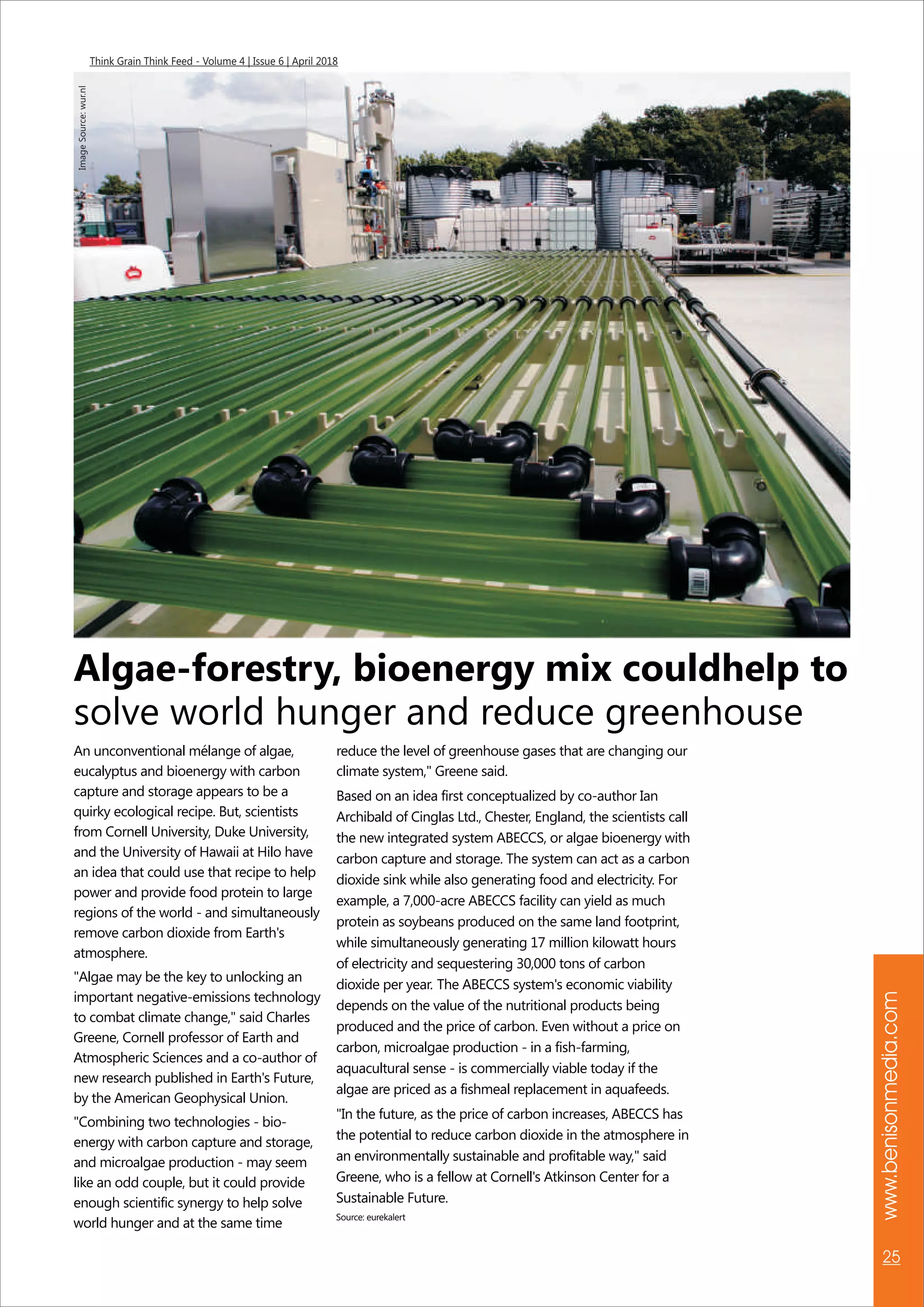
Based on an idea first conceptualized by co-author Ian
Archibald of Cinglas Ltd., Chester, England, the scientists call
the new integrated system ABECCS, or algae bioenergy with
carbon capture and storage. The system can act as a carbon
dioxide sink while also generating food and electricity. For
example, a 7,000-acre ABECCS facility can yield as much
protein as soybeans produced on the same land footprint,
while simultaneously generating 17 million kilowatt hours
of electricity and sequestering 30,000 tons of carbon
dioxide per year. The ABECCS system's economic viability
depends on the value of the nutritional products being
produced and the price of carbon. Even without a price on
carbon, microalgae production - in a fish-farming,
aquacultural sense - is commercially viable today if the
algae are priced as a fishmeal replacement in aquafeeds.
"In the future, as the price of carbon increases, ABECCS has
the potential to reduce carbon dioxide in the atmosphere in
an environmentally sustainable and profitable way," said
Greene, who is a fellow at Cornell's Atkinson Center for a
Sustainable Future.
Source: eurekalert
ImageSource:wur.nl
www.thinkgrainthinkfeed.co.in
26
INDUSTRY NEWS Think Grain Think Feed - Volume 4 | Issue 6 | April 2018
Image Source: Institute of Aquaculture
Cargill recently opened an 80,000
metric tonne warehouse for grains and
oilseed at the Saigon International
Terminals Vietnam (SITV) port in Phu
My town, the southern province of Ba
Ria-Vung Tau.
Equipped with world-class equipment,
the 10 million USD facility is expected
to meet the growing demand for grains
primarily from the food and animal
feed sectors.
The company said the warehouse
meets safety, security and quality
requirements and enables customers to
receive agricultural products faster,
more efficiently and more cost
effectively.
This is Cargill's such facility in the
southern region. It has another 50,000-
tonne facility at Cai Lan Port in the
northern province of Quang Ninh.
Alan Willits, head of Cargill's grain and
oilseed business in Asia Pacific, said
Vietnam is a key market for the company and the new
storage facility strengthens its ability to supply high-
quality feed grains and animal feed products to
customers.
According to him, the investment is part of Cargill's
strategy to expand business to meet the growing
demand for feed grains and animal feed, driven by
increased meat consumption amongst Vietnamese
consumers.
In the past three years the volume of grains and oilseed
handled by the company in Vietnam has grown four-
fold from 400,000 metric tonnes to 1.75 million tonnes.
By 2020 Cargill expects this to increase to more than 3
million tonnes, making it one of the largest importers,
marketers and distributors of grains in Vietnam, he said.
Cargill came to Vietnam in 1995.Alongside the
investment in the storage facility, it will also become the
first company in Vietnam to offer customers a digital
platform that will provide real-time information
including the warehouse stock position, shipment
status, product orders and contract status updates. The
digital solution will be launched in June 2018.
Cargill expansion in Vietnam to
cater feed grain and animal
feed market
ImageSource:FeedNavigator
EVENT COVERAGE
www.thinkgrainthinkfeed.co.in
28
Think Grain Think Feed - Volume 4 | Issue 6 | April 2018
The theme for AquaVision 2018 is
'Meeting tomorrow today' and the two-
day programme will focus on two main
topics: “The blue revolution” and
“Beyond tomorrow”. According to FAO
(Food and Agriculture Organization of
the United Nations), global food
production needs to increase by 70%
by 2050. The growth within aquaculture
can contribute a significant portion of
that future food supply. The conference
will explore ways in which aquaculture
can contribute to feeding the growing
world population in a sustainable way.
AquaVision is a world-class aquaculture
business conference that attracts a
diverse range of stakeholders to
Stavanger every two years and will do
so again from 11-13 June 2018. The
conference, organised by Skretting and
its parent company Nutreco since 1996,
has established itself as an important
meeting place for some 400
participants from around 40 countries.
Former Secretary-General of the United
Nations, Ban Ki-moon, will be the
keynote speaker at AquaVision 2018 in
Stavanger, Norway. Mr Ban will directly
address the food security challenges of
the coming decades.
This year, Ban Ki-moon will contribute with his
knowledge and experience on global food security for a
growing population. Mr Ban was the eighth Secretary-
General of the United Nations, serving two consecutive
terms, from 1 January 2007 to 31 December 2016. As
Secretary-General, he focused on mobilising world
leaders around a set of new global challenges, from
climate change and economic upheaval to pandemics
and increasing pressures involving food, energy and
water.
The ocean covers more than 70 percent of the surface
of our planet and the vast ocean depth represents the
world's last frontier. Some 90 percent of the ocean has
not yet been explored and offer countless opportunities
if managed sustainably. At AquaVisision in June, Nina
Jensen's speech is titled “From understanding to
solutions: A global rescue operation for the ocean”.
Nina Jensen is the CEO of X Four-10, the company
currently building REV - the world's largest research and
expedition vessel. REV's generalised goal is to enhance
our understanding of, and search for more sustainable
and environmentally sustainable solutions for, the
world's oceans.
The event will feature exceptional speakers who will
provide their insights and expertise to the delegates.
Complete program can be accessed at
www.aquavision.org
AquaVision 2018 all set to
discuss the blue revolution
in June 2018
Think Grain Think Feed - Volume 4 | Issue 6 | April 2018CALENDAR OF EVENTS
www.thinkgrainthinkfeed.co.in
30
2018
To list any industry event related to Grain & Feed industry please write us at
info@thinkgrainthinkfeed.co.in
APRIL
Livestock Asia
Date: 19-21 April 2018
Venue: Kuala Lumpur Convention Centre, Malaysia
Email: rita.lau@ubm.com
Web: www.livestockasia.com
JUNE
Poultry Information Exchange and Australasian
Milling Conference 2018
Date: 03-05 June 2018
Venue: Gold Coast Convention and Exhibition Centre,
Queensland, Australia
Email: info@pixamc.com.au
Web: www.pixamc.com.au
AquaVision
Date: 11-13 June 2018
Venue: Stavanger, Norway
Email: info@aquavision.org
Web: www.aquavision.org
MAY
Animal Nutrition Conference of Canada (ANCC)
Date: 1-3 May 2018
Venue: Edmonton, AB, Canada
Email: info@anacan.org
Web: www.animalnutritionconference.ca
Feed Additives Asia
Date: 16-18 May 2018
Venue: Millennium Hilton, Bangkok
Email: annabel.ly@agribriefing.com
Web: www.feedadditives-global.com
JULY
Indo Livestock 2018 Expo & Forum
Date: 04-06 July 2018
Venue: Jakarta Convention Centre, Jakarta-Indonesia
Email: info@indolivestock.com
Web: www.indolivestock.com
SEPTEMBER
SPACE
Date: 11-14 Sep 2018
Venue: Parc-Expo of Rennes, France
Email: am.quemener@space.fr
Web: http://uk.space.fr/
VIV Europe
Date: 20-22 June 2018
Venue: Jaarbeurs Utreach, the Netherlands
Email: karlienke.smitt@vnuexhibitions.com
Web: www.viveurope.nl
Dairy, Livestock and Poultry Technology
Exhibition Africa
Date: 20-22 June 2018
Venue: Kenyatta International Convention Center,
Nairobi, Kenya
Email: africa@dlpexpo.com
Web: www.dlpexpo.com
Novus
Think Grain Think Feed April 2018

Think Grain Think Feed April 2018

  • 1.
    Volume 4 |Issue 6 April-2018 RNI No.: HARENG/2014/61357 www.thinkgrainthinkfeed.co.in www.benisonmedia.com Price: 75/- Postal No. PKL-212/2018-2020 To access soft copy, please visit
  • 3.
    Published by BENISON Media SCO17, 2nd Floor, Mugal Canal Market Karnal - 132001 (Haryana) Tel: +91 184 4047817 info@thinkgrainthinkfeed.co.in Publisher & Editor Prachi Arora prachi.a@thinkgrainthinkfeed.co.in Monthly Magazine for Feed Technology EDITORIAL COMMITTEE Marketing & Designing Ashwani Verma info@thinkgrainthinkfeed.co.in Subscription Head Ramesh Kumar Singh info@thinkgrainthinkfeed.co.in Dr. Dinesh T. Bhosale Former Chairman, CLFMA of India Mr. Amit Sachdev Indian Representative, US Grain Council Dr. P.E. Vijay Anand US Soybean Export Council Dr. Suhas Amrutkar Subject Matter Specialist, Animal Nutrition, MAFSU, Parbhani Dr. SN Mohanty Former Principal Scientist, CIFA Dr. Meeta Punjabi Mehta Agricultural Economist Dr. Swamy Haladi Feed Additive Expert Dr. R Gnana Sekar Lead Consultant, GS Dairy Farm Consulting Dr. Suraj Amrutkar Assistant Professor, Dept. of ILFC, SKUAST-J, Jammu www.thinkgrainthinkfeed.co.in www.benisonmedia.com Managing Editor Dr. T.K. Walli Former Head, Dairy Cattle Nutrition, NDRI EDITORIAL Chinese Feed Industry's “Trade War” with US on soybean import China has been importing some 60 % of all soybean traded globally, buying 50% of its needs from Brail and US. It has been importing a third of its soybean from US in the past. But last year, the country imported 51 million tonnes of soybean from Brazil and 33 million tonnes from US. China's total import, of which it processed into cooking oil and animal feed ingredients, amounted for over US$12 billion last year. Brazil first overtook US as a top supplier of Soybean in 2012, which offered attractive prices for its beans which contains higher protein content than the US variety. China has declared that it can absorb the shock of 25 % additional tariff by diversifying its resources, raising its domestic output and changing the feed formulations. It has also decided that the feed industry can also import more soyabean from Brazil, Russia, India, Argentina, if tariff is slapped by US. May be that is a good news for soyabean exporters in India. Soyabean can also be fed as a leguminous forage to ruminants Soybean is also valuable legume forage, ideally suited for summer cropping. Forage soybean is tolerant to drought and thrives when other forage legumes like alfalfa are not available. Forage soybean can be sown alone or in combination with other forage species such as sorghum. It grows quickly and can provide 5 to 10 t DM/ha within 3-4 months. Intercropping forage soybean with maize resulted in the same yield as maize alone but containing 30-43% more protein. In a mixed stand of forage soybean and tall fescue, DM yield was threefold and protein increased by 10%. In the USA, soyabean was also recommended for annual pastures to combine forage soybeans with maize, sorghum or Sudan grass. Soybean plants may be grazed from the flowering stage to near maturity. In the USA, soybean was not considered as a satisfactory pasture for cattle due to the damage caused by trampling to the growing plant, but pasturing sheep on soybean has been practiced throughout the Corn Belt. However, in India it is better to use the crop as oil seed and the meal forms an ideal protein source for poultry and aqua feeds. India's shrimp production is getting a big flip Oceanaa Biotek Industries Limited (Obil), which is dealing with shrimp production, has signed an MoU with Thailand's aqua feed producer Inteqc, to jointly set up a shrimp feed plant in Tamil Nadu, India. Obil aims to focus on integration from hatchery to retail with complete traceability. The company guarantees that shrimp fries from its hatcheries are 100% antibiotic free since it uses only probiotics to enhance immunity. The company also has a state-of-the-art laboratory to perform microbiology and chemistry tests. As more of scientifically produced shrimp feed is available in the country, Indian aqua industry can develop further, for which there is already a vast potential for development. TK Walli Think Grain Think Feed - Volume 4 | Issue 6 | April 2018 Circulation & Subscription Head Rahul Bhardwaj info@thinkgrainthinkfeed.co.in
  • 4.
    Printed by: JaiswalPrinting Press | Published by: On behalf of: BENISON Media | Printed at: Chaura Bazar, Karnal-132001, Haryana | Published at: SCO-17, 2nd Floor, Mugal Canal Market, Karnal-132001, Haryana | Editor: Prachi Arora Prachi Arora | Monthly Magazine for Feed & Feed Technology Vollume 1 | Issue 10 | August 2015 Think Grain Think Feed is a monthly magazine published by BENISON Media at its office in Karnal. Editorial policy is independent. Views expressed by authors are not necessarily those held by the editors. The data/information provided in the magazine is sourced through various sources and the publisher considers its sources reliable and verifies as much data as possible. However, the publisher accepts no liability for the material herein and consequently readers using this information do so at their own risk. Although persons and companies mentioned herein are believed to be reputable, neither BENISON Media, nor any of its employees or contributors accept any responsibility whatsoever for such persons’ and companies’ activities. All legal matters are subjected to Karnal Jurisdiction. Contents Think Grain Think Feed - Volume 4 | Issue 6 | April 2018 Front Cover: WKMS SUBSCRIPTION INFORMATION: Simple Post Courier Overseas One Year : INR 1200 INR 1800 USD 300 Three Year : INR 3300 INR 4800 USD 900 Five Year : INR 5200 INR 6500 USD 1500 Disclaimer : info@thinkgrainthinkfeed.co.in. BENISON Media or Think Grain Think Feed is not liable for any claim prior to written information. The published material and images are sourced from various websites and newspapers, and used for information purpose only, if you have any issue, please inform us at RESEARCH & DEVELOPMENT 05 EVENT CALENDAR - 30 ARTICLE 14 MARKET PROJECTION INTERVIEW SURVEY EVENT COVERAGE Scientists discovered a new method to trace protein sources of Salmon 18 Feed Management in Layers Research on innovative and disruptive livestock technologies: Need of the hour 10 Oilseed market outlook05 Thai Millennials prefermeat raised using phytogenic feed additives-Survey report 20 AquaVision 2018 all set to discuss the blue revolution in June 2018 28 UPCOMING EVENTS 19-21 April 2018 16-18 May 2018 Preventive Measures to Control Silage Spoilage
  • 5.
    More than halfof the world's fish and seafood products come from aquaculture. The increasing demand and the simultaneous decline of the natural stocks due to overfishing have led to strong growth of the aquaculture industry for decades. To reduce costs and impact on wild fish stocks, carnivorous fish are increasingly fed plant-based diets in aquaculture. However, the rapid development in aquaculture fish production has not been matched by new methods that accurately can trace the food chain supply in aquaculture production. With stable isotope fingerprinting, an international team lead by researchers from Kiel University and the Kiel Cluster of Excellence "The Future Ocean" has developed a new method for identifying the protein sources of salmon with high accuracy. In this way, conclusions can be drawn about the origin and nutrition of individual fish. The results of the study were recently published in the international journal Food Chemistry. In recent years, commercial compound diets in aquaculture have gone from a single source of protein, fishmeal, and a single source of lipid, fish oil, to more than several dozen ingredients such as soy, insects, macroalgae, mussels and yeast. For example, since 2015 conventionally farmed Atlantic salmon (Salmo salar L.) have been fed only 20% marine based diets as opposed to 90% four decades ago. This diversification in feed ingredients has brought benefits in terms of reduced production costs and has, at least in part, decreased pressure on wild fish stocks. However, up to now new methods that can accurately trace the food chain supply in aquaculture production had been missing. Since consumers are increasingly demanding food safety, traceability, and sustainability, there is a pressing need to develop new authentication and traceability methods. For the first time, an international team lead by researchers at Kiel University and the Kiel Cluster of Excellence "The Future Ocean" has succeeded in developing such an efficient authentication method. “Our method, stable isotope fingerprinting of amino acids, has several advantages compared to conventional methods. For the first time, we can differentiate organic, conventional, and wild salmon from different origins” explains first author Dr.Yiming Wang from the Leibniz- Laboratory for Radiometric Dating and Stable Isotope Research at Kiel University. “We are also able to differentiate salmon fed alternative diet ingredients such as insect meal and macroalgae.” The new method will help to ensure that sustainable aquaculture products are produced in compliance with standards such as the EU Ecolabel and other organic certification programs. Potentially, the isotope fingerprinting method can also support the new blockchain movement for enhancing food safety and production transparency. “We are very excited about our findings,” says the senior author Dr. Thomas Larsen Leibniz Laboratory for Radiometric Dating and Stable Isotope Research at Kiel University. “Our method can be expanded to authenticate other seafood products. This is a step towards promoting healthy and environmentally sound aquaculture practices,“ he added. Source: phsy.org Scientists discovered a new method to trace protein sources of Salmon R&DThink Grain Think Feed - Volume 4 | Issue 6 | April 2018 www.benisonmedia.com 05
  • 6.
    INDUSTRY NEWS www.thinkgrainthinkfeed.co.in 06 Think GrainThink Feed - Volume 4 | Issue 6 | April 2018 Liu Yonghao of New Hope Group, one of China's largest animal feed producers, says a trade war can be damaging for both countries and hopes that the dispute can be resolved through negotiations China's animal feed industry can absorb the shock of a 25 per cent additional tariff by diversifying its sources, raising domestic output and changing the feed's formula, according to the chief of one of the country's largest animal feed producers. Liu Yonghao, chairman and founder of New Hope Group, said his company and the wider Chinese animal feed industry can import more soybeans from Brazil, Russia, India and Argentina if the tariff is slapped on US soybeans, which will render its import uneconomical. “A trade war is bad for both China and the US,” he said in an interview on the sidelines of the Boao Forum recently. “China imports a third of its soybeans from the US and we want to maintain friendly relations with our US farmer friends, we hope negotiations will result in a win-win resolution.” Recently Beijing unveiled plans to slap an extra 25 per cent tariff on a range of goods it imports from the US, including soybeans, cars and aircraft, as the world's two largest economies edge ever closer towards an all-out trade war. Chinese animal feed industry can absorb impact of US soybean tariff China imported some 60 per cent of all soybeans traded globally, buying just over half its needs or some 51 million tonnes from Brazil last year and 33 million tonnes from the US. China's total import of the bean, which is processed into cooking oil and animal feed ingredients, amounted to over US$12 billion last year. Brazil first overtook the US as the top supplier to China in 2012, according to Reuters, as the South American nation – whose domestic market is limited – offered attractive prices for its beans that contains higher protein content than the US variety. The 35-year-old company produces some 20 million tonnes of animal feed, processes 1.3 billion chickens and eight million pigs a year, according to its website. Having built or invested in 40 livestock and aquatic animal feed production facilities across 20 nations, the privately-owned company recorded 61.5 billion yuan (US$9.7 billion) of sales in 2015, generated by over 60,000 employees. Its overseas units span four nations in South Asia, seven in Southeast Asia, and Russia, Poland, Turkey, Egypt and South Africa. In 2015, New Hope bought a 20 per cent stake in Chicago-based Lasing Trade Group, one of the largest animal feed merchandisers in the US, which also trades other grains-derived and energy commodities. Asked if rising protectionism and scrutiny of Chinese acquisition of US assets would discourage New Hope from pursuing acquisitions in the US, Liu said he believes the agricultural sector is not among the most sensitive sectors that will attract a lot of scrutiny on US national security concerns. Source: SCMP ImageSource:WKMS
  • 8.
    www.thinkgrainthinkfeed.co.in 08 MARKET PROJECTION ThinkGrain Think Feed - Volume 4 | Issue 6 | April 2018 Oilseed market outlook Soybeans recovery in exports Soybeans are trying to hang on to double digit gains, following a USDA projection of 2017 crop endingstocks that fell by 5 million bushels, surprising the trade. Soybeans rallied before the report, after USDA announced new purchases, including 10.25 million bushels of old crop to Argentina and 9.3 million bushels of new crop to China and unknown destinations. The market made new highs after the April supply and demand report was released, but quickly ran into profit taking before firming again. USDA said stronger crush would offset a decrease in feed and residual usage, causing the small reduction in soybean carryout. The agency also cut its forecast of Argentine production by 257 million bushels, more than expected, while adding nearly 75 million to the crop in Brazil. Overall world carryout for the 2017 marketing year fell 132 million bushels, again, a bigger reduction than the trade was looking for. Corn traded both sides of unchanged after USDA raised carryout by 55 million bushels to2.182 billion, due to weaker feed and industrial usage suggested by the March 29 stocks report. That was close to trade estimates. The agency cut its forecast of production in both Brazil and Argentina by a total of 217 million bushels, helping tighten world carryout slightly. Acreage fell in both countries with Argentine yields slashed by drought. The agency put U.S. wheat carryout at 1.064 billion bushels, up 30 million due to lower feed and residual usage. World ending stocks went up 86 million bushels, more than the trade expected. Wheat prices were under modest pressure before the report but tried to frim after initial selling dried up. Markets generally were buoyed by calming trade tensions that gave a boost to stock markets around the world today. Commodities also rallied, with crude oil moving back above $65. While the trade issue won't disappear completely, it may not dominate prices unless headline news turns sour. Corn Report from India Indian corn harvest for Rabi will be late, another 2 weeks before the new corn is large quantities could be seen in the market. In the interim, the price has gone up, in Gulabbagh by over 9% in last one month. Against last week, prices are down slightly and are at Rs.13000/MT. Prices in Erode, (South) have also gone up by over 4% in last one month and currently close to Rs.13900/MT. Against 1st week of April, prices are up by 2.5% DDGS Higher demand of DDGS in the domestic as well as foreign markets has led to higher prices, which are indicated at $245/MT FOB US Gulf, up 10% in one month. Prices of DGGS to Vietnam are indicated at $251/MT, China $251/MT, Chittagong $283/MT and Myanmar $279/MT. Other co-product price, CGM prices have been more or less stable at $620/MT (FOB US gulf) for the last couple of weeks. Source: USDA, Informa &Techproindia
  • 9.
    www.benisonmedia.com 09 Think Grain ThinkFeed - Volume 4 | Issue 6 | April 2018 2017/18 OUTLOOK CHANGES Country Commodity Attribute Previous Current Change Soybean Meal Exports 30,800 29.500 -1,300 Soybean Oil Exports 5,120 4,750 -370 Soybean Oilseed Exports 6,800 4,200 -2,600 Bangladesh Soybean Oil Imports 880 780 -100 Soybean Oilseed Exports 70,500 73,100 2,600 Soybean Meal Exports 15,250 15,450 200 China Soybean Oil Exports 100 200 100 Egypt Palm Oil Imports 1,300 1,200 -100 Soybean Meal Imports 19,200 18,900 -300 Rapeseed Oilseed Exports 250 150 -100 Sunflower seed Imports 3,700 3,800 100 Meal Soybean Meal Exports 1,700 1,600 -100 Soybean Oil Imports 3,545 3,345 -200 Peanut Oilseed Exports 950 850 -100 Palm Kernel Meal Exports 4,650 4,550 -100 Coconut Oil Exports 620 500 -120 Iran Soybean Meal Imports 1,550 1,370 -180 SouthKorea Soybean Meal Imports 2,000 1,850 -150 Malaysia Palm Kernel Meal Exports 2,500 2,400 -100 Mexico Soybean Oilseed Imports 4,250 4,400 150 NewZealand Palm Kernel Meal Imports 2,100 2,300 200 Pakistan Soybean Meal Imports 350 150 -200 Philippines Coconut Oil Exports 850 1,000 150 Russia Soybean Oilseed Imports 400 600 200 Exports 2,000 2,200 200 Senegal Peanut Oilseed Exports 420 130 -290 Thailand Palm Oil Exports 150 250 100 Tunisia Soybean Meal Imports 140 40 -100 Turkey Sunflowerseed Oil Imports 700 600 -100 Sunflowerseed Imports 450 550 100 Oilseed Soybean Meal Exports 450 350 -100 Soybean Oilseed Exports 2,400 2,500 100 Uruguay Soybean Oilseed Exports 2,100 1,600 -500 Venezuela Soybean Meal Imports 565 425 -140 The slow pace of crush to datecoupled with significant crop lossesleads to lower exports Reason Lower Argentina exports Higher production and strongerexport demand Argentina Brazil Stronger pace of trade in the first halfof the marketing year Weaker trade pace in Oct-Dec as wellas stronger demand for “golden” oilssuch as soybean and sunflower-seedoil Trade pace Lower production and reduced competitiveness India Lower global supplies Weak Oct-Jan trade pace Trade pace Indonesia Lower production and crush estimate Lower global supplies Lower global supplies and earlyseason trade pace Trade pace Stronger pace of trade Growing feed demand Trade pace Higher production and crushestimates Trade pace Stronger pace of trade to China Trade pace Greater exportable supplies Lower demand for product importswith greater emphasis on domesticcrush Trade pace Trade pace Lower crop Smaller global supplies and slowerpace of trade Note : All figures are in thousand metric tons. European Union Ukraine
  • 10.
    www.thinkgrainthinkfeed.co.in 10 Think Grain ThinkFeed - Volume 4 | Issue 6 | April 2018 What according to you are the key trends in feed industry globally and in India? There are major current challenges for the livestock industry on a global level including India? What is the role of CLFMA of India in overcoming these challenges? Globally meat consumption is growing and hence feed industry is also growing in tandem. However, Asian (particularly South East Asia) countries are growing much faster than the rest of the world. In India, for example, poultry meat consumption is growing at 7 to 8% per annum and dairy products consumption is also growing. Similarly, with increase in incomes and consumer awareness, protein share in diets is expected to increase. India has recently emerged as one of the most significant exporter of shrimp. All these indicate encouraging trend for the feed industry. Recently, there is lot of negative publicity being created by some groups with vested interests and questionable credentials with regard to livestock and meat industry. We must understand that India is still the home to millions of malnourished population especially having proteindeficiency. It is quite imperative that animal protein must be made available to them at affordable prices. This kind of propaganda against industry, without any scientific data to justify the claims, shall only cost the country big in terms INTERVIEW Research on innovative and disruptive livestock technologies: Need of the hour B Soundararajan -A renowned and humble personality of Indian Poultry Industry - is the Chairman and Managing Director of Suguna Holdings Private Limited. The man who foresaw the great potential of growth in poultry integration as early as in the 90’s, brought the concept of Contract Farming in India. Presently he is the Chairman of CLFMA of India, the apex association representing the dynamic Indian livestock industry. In a telephonic conversation with Think Grain Think Feed, he shares his views about present trends and challenges of the Indian livestock sector, impact of developments in global trade and more. Below are the excerpts of the interview: B Soundararajan Suguna Holdings Pvt. Ltd.
  • 11.
    www.benisonmedia.com 11 Think Grain ThinkFeed - Volume 4 | Issue 6 | April 2018 of food and nutritional security, if it is not addressed appropriately. Lack of understanding among consumers about how food is produced leads to unjustified negative public perception on tools and technologies that are useful in food production. Another challenge is that the import of GM feed ingredients, which is prohibited, while ironically, the country has agreed to import US chicken which is fed on GM ingredients, or shrimp feed import made using GM ingredients. Approx. 90% of world production of feed ingredient is genetically modified and a premium is to be paid for organic or non-GM. Lower per hectare production of corn and soya in India also remains a major challenge. CLFMA's primary mandate is development of the livestock sector in India. So, CLFMA actively works with diverse stakeholdersto drive home the point that this is a shared responsibility of all stakeholders connected to the food value chain including the industry, government, policy makers, scientists, media and general public. As an organization, CLFMA also actively supports the government vision of doubling the farmer's income which can be achieved by increasing productivity of corn, soya and other key crops. This would ultimately bring sustainable income for farmers and better protein availability for consumers (human as well as livestock). We mustappreciate thatnowadays the consumer is not only concerned about food prices and quality but also much interested to look into how it is produced, especially inrelation toenvironmental issues, resource use and welfare. As India is one of the efficient producers of animal protein, our production systems are already much improved in the last few decades. In future, we must be more focused towards things such as water use, judicious use of other inputs including medicines and additives, cutting down waste both on and off the farms, improving the share of processing etc. There is always a scope and need for continuous improvement. It is generally accepted that India should increase its R&D spend across the board in agriculture and livestock industry. However, it should not be isolated and confined to only public and/or private sectors. The future is about collaboration between these two sectors and the Government is also keen to promote PPPs (Public Private Partnerships) to ultimately benefit the industry and the country. Indian poultry industry is already one of the most efficient producers in the world. Still the country should invest on breeding else we will remain dependant forever on few international companies. However, the industry is experimenting but it is not sufficient. Innovative and disruptiveresearch in technologies arethe needs of the hour. In my personal opinion, it is a welcome move since consumers are quite concerned about food safety and quality. The organized players are already conforming to the standards and relevant laws. FSSAI's regulation will make the unorganized and unscrupulous players to conform or quit. It might also bring the shift in consumer preference from live chicken to processed chicken. However, I would like to emphasize that effective implementation of the regulation is very critical. How do you define sustainability in the context of livestock production? How is India doing when it comes to sustainability and what would be your suggestions to improve it further As per recent report by TOI1, India spends less than 1% of GDP on R&D. What is your opinion on this issue and how could the industry respond to this low percentage spent on R&D? With strict FSSAI regulation in place, what could be its impact on Indian livestock industry? There is a lot that has been recently said about antibiotic usage in India, highlighting livestock industry as the main culprit. There is a need to bring right
  • 12.
    www.thinkgrainthinkfeed.co.in 12 Think Grain ThinkFeed - Volume 4 | Issue 6 | April 2018INTERVIEW information to the end-consumer. Any thoughts you would like to share on this issue? As I mentioned earlier, scaremongering without scientific data and making untruthful claims had become more popular tactics of people who have vested interests. However, the industry is already doing its part to promote awareness on judicious and responsible use of inputs including antibiotics. Everyone including media and journalists has a great responsibility to ensure consumers are not misled. At CLFMA, we are always advocating for judicious and responsible usage of all inputs. Hence, without scientific evidence, any unnecessary regulation or blanket bans will only be harmful. On the face of it, these sorts of campaigns lead to confusion and anti- industry perception among public. Everyone concerned with the food and nutritional security of the country must counter this with facts and science-backed information. Recent reports suggest a global trade war is on cards that would impact the commodity market. What are your views on its impact on Indian feed industry? You are speaking next month in Feed Additives conference, please share more details on the topic-Feed Additives and Feed Markets in India. Indian feed industry largely depends on domestic supplies except in odd years when our production falls short. However, we cannot be complacent and remain immune to the global dynamics. If the so-called trade war is happening, we must be watchful about prices since our prices are aligned with the global prices in both the key commodities – maize and soybean. During such times, government has a major role to play in protecting the domestic industry by focusing on farmers' income and industry's competitiveness. I would be discussing about the key developments in livestock industry in India, major consumer trends, as well as socio-economic, policy, and regulatory environments. I will also be focusing on the growth potential of India's dairy, poultry and aqua sectors.I see a lot of opportunity in global feed sector. While on feed additives front,we are largely dependent on imports, this needs to be changed. To conclude, I feel that the evolving government regulations and socioeconomic factors would further support the overall livestock industry's growth in India.
  • 13.
  • 14.
    www.thinkgrainthinkfeed.co.in 14 Think Grain ThinkFeed - Volume 4 | Issue 6 | April 2018 INTRODUCTION Nutrition plays a major role in the performance of layer birds. Feed management is the most important practice to achieve egg production at the right time, maximum peak production, long standing peak production, standard egg size, good cull bird weight and reduced feed cost per egg. Body weight should be taken every week from 1st week to 18th week of age, the birds with less body weight should be separated and special care must be taken to those birds to get uniformity in flock. The birds fed with standard feed prepared as per nutrient specifications will attain recommended body weight. The nutritional requirements of birds will vary depending on the breed, age and climatic conditions. So, feed formulation should be prepared as per the nutritional requirement of birds. In summer, the feed intake is less and the feed formulation will be revised as per the feed consumption. NUTRIENTS CLASIFICATION Carbohydrates, proteins, fats, vitamins, minerals and water are main nutrients in poultry layers that are discussed as follows. CARBOHYDRATES Cereal grains such as maize, bajra, broken rice, rice polish, jowar, ragi, de-oiled rice bran (DORB) and wheat bran, etc., are some of the carbohydrate sources used in layer diet. Most of the carbohydrates of cereal grains occur as starch, which is readily digested by poultry. Other carbohydrates occur in varying concentrations in cereal grains and protein supplements. These carbohydrates include polysaccharides such as cellulose, hemicellulose, pentosans and oligosaccharides such as stachyose and raffinose, all of which are poorly digested by poultry. Thus, these dietary carbohydrates often contribute little to meet the energy requirement of poultry and some adversely affect the digestive processes of poultry when present in sufficient dietary concentrations. PROTEINS The vegetable protein sources are soya bean meal, sun flower cake, rapeseed meal, cotton seed cake, ground ARTICLE Feed Management in Layers Dr. S R Prabakar, Kemin Industries South Asia
  • 15.
    www.benisonmedia.com 15 Think Grain ThinkFeed - Volume 4 | Issue 6 | April 2018 absorbed through intestinal villi. VITAMINS Vitamins are present in the feed raw materials such as corn and soy, but these are insufficient for the birds. Therefore, vitamins are supplemented as vitamin premixes in feed. Vitamins have been divided into two groups based on their solubility in fat solvent or in water. Thus, fat-soluble vitamins include vitamin A, D, E and K. While, vitamin B complex and vitamin C are classified as water soluble vitamins. Fat-soluble vitamins are found in feedstuffs in association with lipids. The fat- soluble vitamins are absorbed along with dietary fats, apparently by mechanisms like those involved in fat absorption. Water soluble vitamins are not associated with fats. Commonly used vitamins in layers are fat- soluble vitamins such as Vitamin A, D3, E and K. Water soluble vitamins are Vitamin B1, B2, niacin, pantothenic acid, pyridoxine (B6), biotin, folic acid, Vitamin B12, choline, Vitamin C, carnitine and inositol. Classical added choline levels used for layer diet are usually around 250ppm, but for an efficient action on liver, 500 to 1000 ppm of added choline is recommended. Vitamin B12, folic acid and vitamin E improve the liver condition. DEFICIENCY OF VITAMINS: The deficiency of vitamins and its affects were described by Simon as follows: ! Vitamin-A deficiency: Vitamin A deficiency in chicks leads to poor growth, feathering and in advanced cases ataxia (inability to stand), xerophthalmia (dry eye) and chronic purulent conjunctivitis. Deficiency of vitamin A in layers causes deterioration in internal egg quality and a high prevalence of blood spots. ! Vitamin-D3 deficiency: Vitamin D3 deficiency will lead to rickets in immature flocks, swelling of joints, depressed growth and poor feathering. In mature laying birds, deficiency of Vitamin D3 results in osteomalacia characterized by decreased skeletal density, production drop and reduced egg shell quality. ! Vitamin-E deficiency: Vitamin E deficiency in chicks leads to encephalomalacia, transudative diathesis and muscular dystrophy. ! Vitamin-K deficiency: Vitamin K deficiency leads to subcutaneous hemorrhages that are noted on the head and beneath the wings. ! Vitamin-B1 (Thiamine) deficiency: Vitamin B1 deficiency in 10 to 20 days old chicks comprises incoordination and an abnormal retraction of head (star gazing). ! Vitamin-B2 (Riboflavin) deficiency: Vitamin B2 deficiency leads to curled toe paralysis, low growth rate, poor feathering and low egg production. nut cake, guar meal, til cake, and distillers dried grains with solubles (DDGS), etc. Animal protein sources are fish meal, meat and bone meal, blood meal and feather meal etc. Proteins are polymers that are composed of alpha amino acids, which are linked together by peptide bonds. Proteins are broken down and hydrolyzed in the digestive system into amino acids. Then, after absorption, the amino acids will be assembled and metabolized to form proteins that are used in the building of different body tissues. They also serve vital metabolic roles as blood plasma proteins, enzymes, hormones and antibodies, each of which has a specific role in the body. The concepts of digestible amino acids, ideal amino acid ratios, use of synthetic amino acids and feed consumption-based formulations must be considered to get excellent result in layer flocks and saving in feed cost. FAT “Fat” or “oil” is another source of energy. Besides supplying energy, the addition of fat to animal diet improves the absorption of fat-soluble vitamins, decreases pulverulence, increases diet palatability and the efficiency of utilization of the consumed energy. Furthermore, it reduces the rate of food passage through gastrointestinal tract, which allows a better absorption of all nutrients present in the diet. The digestion of fat produces less body heat (fat has a relatively low heat increment), which is useful during periods of heat stress. Vegetable oils such as soya oil, rice bran oil and animal fat such as tallow are used as the energy sources. The presence of food in the duodenum stimulates the secretion of cholecystokinin, which induces the contraction of gall bladder and secretion of the pancreatic juice, making the chime. Colipase binds to the oil-water interface and produces the emulsion. Afterwards, triglycerides undergo hydrolysis under the action of the pancreatic lipase and micelles are formed by monoglycerides, diglycerides and free fatty acids. Micelles are
  • 16.
    ARTICLE www.thinkgrainthinkfeed.co.in 16 Think Grain ThinkFeed - Volume 4 | Issue 6 | April 2018 ! Biotin deficiency: Affected flock demonstrates poor growth, loss occurs in the air sacs and lungs through rapid respiration. There is no precise quantity requirement for water because there are several factors that affect the amount of water a bird needs: age, body condition, diet, temperature, water quality and humidity. CONCLUSIONS While preparing the feed formulation, proper raw materials, cost and availability of raw materials must be considered. Feed formulation should be based on the age of the birds, nutritional requirement of the breed and feed intake of the birds. The nutrients in the feed raw materials should be utilized efficiently through proper digestion and absorption of nutrients by using emulsifier and enzymes.
  • 18.
    SURVEY www.thinkgrainthinkfeed.co.in 18 Think Grain ThinkFeed - Volume 4 | Issue 6 | April 2018 A recent survey commissioned by Delacon revealed Thai consumers are ready to buy meat products raised with phytogenic feed additives. They look closely at product labels, gravitate toproducts “raised without antibiotics ever,” and are interested to know that phytogenics are used. It appears that knowing phytogenics “leave no harmful residue” would be influential to the majority. Results of a consumer survey commissioned by Delacon show two-thirds (62 percent) of Thai millennial foodies look very closely atmeat product labels and almost all Thai millennials are concerned enough to look closely at thelabel. “The survey shows that millennials in Thailand are interestedin knowing how their food is produced. The story of phytogenics, or plant-derived ingredients fed to chickens and pigs, would be very attractive for them to consider in their purchasing decision for meat products,” says Preecha Sapkitjakarn, Delacon Country Sales Manager in Thailand. Phytogenics closely fit the mindset of Thai millennials on food: safe, sustainable, without antibiotics Thai Millennials prefermeat raised using phytogenic feed additives-Survey report
  • 19.
    www.benisonmedia.com 19 Think Grain ThinkFeed - Volume 4 | Issue 6 | April 2018 Phytogenic feed additives are standardized mixtures of herbs, spices, other plants, and their extracts with proven efficacy. To consumers, one could more visually talk about natural ingredients such as cinnamon, thyme, or cayenne pepper. Phytogenics are used for their impact on animal wellness, gut health, and greenhouse gas emissions. The survey found their attributes fit into the belief and purchasing behavior ofthe majority of Thai millennials. Millennial foodies look forproducts that are “raised without antibiotics ever,” “raised in ways that reduce environmental impact,” and “certified organic” when choosing a specific brand of meat. The survey also looked at product labeling concepts to see which phytogenic claims would be most important to Thai millennials. Overwhelmingly, the strongest claim for a brand of chicken or pork meat was “fed a diet that includes phytogenic ingredients which leave no harmful residue.” “Delacon phytogenic feed additives are extensively tested to ensure safety in the feed-to-food chain. A product stamp showing meat raised with phytogenics could provide meaningful information that supports consumer purchasing confidence,” shares Gina Medina, Delacon Sales Group Leader Asia. Nine out of 10 Thai millennial foodies in favor of phytogenics: Nine out of 10 Thai millennial foodies would ! “choose meat and poultry fed completely natural ingredients, such as phytogenics”: 91 percent foodies, 78 percent overall. ! “feel great about food choices” knowing phytogenics support animal's digestive health and wellness, as well as reduce environmental impact: 92 percent foodies, 87 percent overall. ! “want to know and choose meat and poultry raised with phytogenics”: 93 percent foodies, 82 percent overall. It is important to them that food choices reflect their value for the environment, animal welfare and natural ingredients. Moreover, the survey found that phytogenics on the label would make a positive impact on 82 percent of Thai millennial foodies and 71 percent of Thai millennials overall. “We look forward to sharing these insights with our partners in Asia Pacific to reinforce the important role of phytogenicsin their animal production operations and demonstrate an opportunity to tell a positive message to consumers,” says GinaMedina. Growing phytogenics market in Asia Pacific In Asia Pacific, Delacon recognizes strong growth in the sales of its phytogenic feed additives, more than 40 percent. Local producers have turned to natural phytogenics to support animal wellness and productivity as legislation banning antibiotic growth promoters in animal production in Thailand, and recently in Vietnam and Indonesia (2018) has taken effect. Also, consumers' demand for protein is projected for continued growth across the region. They are notably interested in safe, sustainable food. The survey was conducted online within Thailand by Millennium Research on behalf of the Delacon in February 2018 among 505 millennial adults ages 24-34. Millennial foodies are defined as those who say that they care very much about the quality and source of their food. Source: Delacon
  • 20.
    ARTICLE Think GrainThink Feed - Volume 4 | Issue 6 | April 2018 In developing countriesincluding India,livestock sector is one of the fastest growing segment of the agricultural economy. The supply of the green forage throughout the year is an economic priority to the farmers, in orderto maintain the production from the ruminant stock. But forage production is mostlyseasonal in many parts of the world, with surplus availability in harvesting season and shortage of fodder during dry season. Silage making is an option to preserve the green fodder to make the greens available throughout the year.Ensiling is based on natural lactic acid fermentation under anaerobic conditions. The most important foddercrops for ensiling are corn, sorghum, barleyand various othergrasses. Beside these crops various moist “by- products” of the food industry, such as apple pomace, beet pulp and brewer's mash can alsobe used for silage preparation. Ensiling process has many steps which should be timed and controlled carefully to ensure successful ensiling. Ensiling process and role of different bacterial groups during ensiling: The ensiling process completes in the following steps: harvesting the crop (30- Preventive Measures to Control Silage Spoilage 35%DM), chopping, loading into a silo, compacting and sealing to exclude air, storing and feed out phase (unloading for animal feeding). Biochemical and microbiological incidents can ariseduring the different stages of ensiling which may affect the silage quality. At first step of ensilingisthe enzymatic activity of intact plant cells whenresidual respiration occurs. The intact cellsuse glucose and fructose as carbohydrate source and consume oxygen entrapped in the silage.Early consumption of carbohydrates is detrimental for the subsequent anaerobic lactic acid fermentation. In initial phase of ensiling epiphytic aerobic flora such as Enterobacteria, yeasts and molds develop until oxygen has been entirely consumed or acidification is sufficient to stop their metabolism. At ensiling, the facultative anaerobic bacteria carry out a heterolactic fermentation which slightly decreases the pH of the silage. As the conditions become anaerobic in silagepit, fermentation phase starts.This phase continue for several days or weeks, during which different groups of facultative aerobic or anaerobic microorganisms naturally found in plants compete for available nutrients. With gradual acidification,acid tolerant bacterial development start; convert water soluble carbohydrates into lacticacid. In well- processed silage, LAB dominate the fermentation, rapidly producing the low pH conditions that help to preserve the silage. In case of accidental soil incorporation in ensiled material, a long aerobic phase or slow acidification, the microbial communities in the silage will be dominated by Clostridia, yeasts, molds and accidentally incorporated pathogenic microorganisms such as Listeria sp. Bharti Sharma, Dipak Dey, Nitin Tyagi, NDRI, Karnal
  • 21.
    www.benisonmedia.com 21 Think Grain ThinkFeed - Volume 4 | Issue 6 | April 2018 milk taste. Moulds are eukaryotic micro-organisms and develop in part of silage where oxygen is present. Many mould species produce the large filamentous structures and coloured spores in silage..Penicillium (70%), Fusarium (47%) and Aspergillus (34%) are the most frequent mycotoxin- producing fungi isolated from corn silage. There metabolites remain in the silage even after the fungus has disappeared. More than 20 mycotoxins can be produced by Fusarium sp., mainly dioxynivalenol(DON), zearalenone (ZEN) and fumonisin (FB). Chronic exposure to mycotoxins produce non-specific symptoms such as immune system impairment, increased infections and metabolic and hormonal imbalances. Ruminants are better protected than other animals against many mycotoxins but fumonisin B1 is only poorly metabolized in the rumen.In high producing dairy animals fed on silage-based diets with high levels of concentrates; the consequent acidificationof the rumen environment may increase the animal's sensitivity to mycotoxins. Butyric acid bacteria (BAB): Soil accidentally included with the plant material during silo filling is the source of Butyric acid bacterial contamination of silage. Endospore-forming bacteria of the genera Clostridium, especially C. tyrobutyricum and C. butyricum and Bacillus are main BAB found in silage.At a relatively low ph,BABconvert lactic acid into butyric acid, hydrogen and carbon dioxide. A typical “clostridial silage” is characterized by a high butyric acid content of more than 5 g/kg DM, a high pH (over pH 5 in low DM silages), and a high ammonia and amine content. Excess butyric acid from feeding butyric silages results in higher levels of plasma Ketones. Daily doses of over 50 – 100g of butyric acid can cause ketosis.Feeding butyric silage has long term negative effects on production, fertility and health, thus economy of the farm business. Bacterial spores can survive the passage through the gastrointestinal tract in dairy cows. Bacillus cereusis an important spoilage microorganism in pasteurized milk and milk products and can lead to food poisoning.The occurrence of Clostridium in milk can lead to off-flavors and excessive gas formation in semi-hard or hard ripened cheeses. Listeria: The presence of L. monocytogenes in silage, feces or both increases the risk of its presence in milk and hence of its transmission to humans. pH of silage over 4.5 increases the risk of presence of Listeria sp. In ruminants it could cause encephalitis, absorption or septicemia, even death. E. coli (STEC):E. coli and higher prevalence of E. coli O157 or E. coli O157:H7 has been found in herds fed corn silage.At ensiling, insufficient anaerobiosis could delay the establishment of lactic acid fermentation, slowing the pH decrease andincreasing the survival of pathogenic E. coli, which is a food born pathogen. As long as the pH is sufficiently low and anaerobiosis is maintained, storage phase lasts and few changes occur. Numbers of LAB and other viable microorganisms decline over time, except for some specialized species such as L. buchneri with continues to be active at low population densities. Some acid-tolerant microorganisms can survive this storage period in an almost inactive state (e.g. acid-tolerant yeasts) or as spores (e.g. butyric acid bacteria). Homofermentative lactobacilli such as L. plantarum and Lactobacillus curvatus tend to predominate in well preserved silage until the final stage of fermentation, when they are invariably replaced by heterofermentative species such as L. brevis and L. buchneri. The fourth phase is the unloading or feedout phase. On opening of silos air penetrates into the silage depending on the density and porosity of the plant material and the rate of silage removal. This causes the growth of undesirable aerobic microorganisms initially present in the silage, such as yeasts and molds and an increase in pH. Undesirable microorganisms and their metabolites Several undesirable microorganisms can grow during ensiling process which can affect silage quality and thus affect animal performance or both animal and human health. These microorganisms are known as spoilage microorganisms; responsible for silage degradation mainly induce economic losses. Yeasts and molds: Yeasts are considered to be the most important groupamong the undesirable microorganisms of silage because they are involved in aerobic spoilage either during the aerobic phase at the beginning of ensiling or during the unloading phase. The organic acid metabolism pathways (succinic, citric and lactic acids) of yeasts restarts on exposure of silage to air; inducing a pH increase and allowing the growth of less acid- tolerant microorganisms. Yeasts present in silage convert WSC into CO2 and alcohols; impair silage quality and lead to a decrease in feed intake. The alcohol production also has negative effect on
  • 22.
    Think Grain ThinkFeed - Volume 4 | Issue 6 | April 2018 www.thinkgrainthinkfeed.co.in 22 ARTICLE Image Source: AgWebBiogenic amines (BA): Putrescine, cadaverine and tyramine are main bacteriocins. Prevention of pathogen introduction during harvesting and ensiling of crop:Entry of soil in the silage is the source of butyric acid bacterial/ pathogen contamination. Crops should be harvested 4 weeks after manure application takingcare to prevent contamination by soil. Conclusions Preservation of surplus fodder as silagemakes it possible to have the green fodder availability throughout the year. Lactic acid fermentation is important for good silage production, but some undesirable bacteria can make entry during ensiling, which candegrade the quality of silage and cause economic lossesto the farmer. Safety control measures and additives may behelpful used in producing quality silage.
  • 23.
    INDUSTRY NEWS www.benisonmedia.com 23 Think GrainThink Feed - Volume 4 | Issue 6 | April 2018 Feed raw material tax waiver makes feed costs cheaper in East Africa Governments in East Africa recently have made animal feed costs cheaper by removing a tax on the raw materials used in their production, although livestock farmers in the region are grappling with frequent droughts that impact the supply of commodities such as corn, sunflower and soybeans. Since 2015, the governments of Kenya, Tanzania, Uganda and Rwanda gradually have removed taxation on both feed and raw materials used in their production to increase access to meat, milk and eggs and also boost the feed production industry in East Africa. In addition, the removal of taxes on raw material for the manufacture of animal feeds has encouraged private investment in the East African feed industry. Kenya introduced the VAT on raw materials for manufacture of animal feeds in 2013, leading to an increase in the price of feed in the country. A survey by Egerton University's Tegemeo Institute in October 2013 stated that the increase in the price of feed triggered by the VAT policy led to a 50% drop in sales of manufacturers relying on imported raw materials and 20% for companies that procured their inputs locally, according to the survey. The Kenya Association of Manufacturers (KAM), a leading representative organization for industry that brings together industrialists and provides a platform for the country's manufacturing sector, said the removal of VAT will “strengthen the government's commitment of transforming the agricultural sector by encouraging local manufacturers to produce high quality feeds at low cost, thereby making the business profitable.” Some feed manufacturers in Kenya say removal of VAT on inputs for feed production has helped stabilize the country's feed industry despite a few raw materials still remaining on the taxation list. Nicholas Hutchinson, managing director of Unga Group, the biggest feed manufacturer in Kenya, said removal of VAT on certain raw materials used in feed production “has greatly assisted in stabilizing feed prices despite inflationary pressure.” “Nevertheless, farmers will not enjoy the full benefit of VAT exemption until soybean meal, a significant input, is also exempted,” he said. Kenya's soybean deficit Kenya, which has an estimated 307 registered companies involved in large-scale feed processing, faces a serious deficit in soybeans with the country's Ministry of Agriculture estimating the annual demand to be between 50,000 and 70,000 tonnes against domestic production of 10,000 tonnes. The deficit is overcome by imports from the United States, Brazil, China, Tanzania, Uganda, India and other African countries where soybean meal production is still low. Kilimo Trust, an independent organization working on agricultural development across East Africa, estimates Kenya's imports of feed raw materials at 5.5%, mainly oilseed cake and cereal bran. The plan targets an increase in red meat, chicken meat, pig meat, milk and egg production by 50%, 66%, 69%, 77% and 40%, respectively, by 2022 if the country can secure “all- year-round quality feed supplies.” “These increases, as well as the expected use of the cross- breed cattle population to nearly 3 million, will require enhanced forage and feed production and feeding services, including improved pasture productivity practices and raining of farmers on livestock feeding and forage use,” the plan said. In addition, the plan said the supply of animal feed, including concentrate feed and roughage in Tanzania, “is erratic both in terms of quality and quantity. Much of the feed in Tanzania is mineral deficient, in part due to the lack of quality control and standards, and enforcement mechanisms in addition to the price of available seed being high.” The removal of VAT on the sale of feed early last year, which came after successful lobbying efforts by the U.S. Grains Council (USGC) in partnership with Tanzania Animal Feed Manufacturers and Poultry Association of Tanzania, is one way the East Africa country hopes to increase access to quality animal feed. Demand for feed in East Africa is expected to increase 60% by 2022 from the 6 million tonnes in 2014, according to Kilimo Trust. Source: UK Agro Consult Ltd. Image Source: AgWeb
  • 24.
    INDUSTRY NEWS ThinkGrain Think Feed - Volume 4 | Issue 6 | April 2018 www.thinkgrainthinkfeed.co.in 24 A journey over land and sea may not keep animal diseases away. Researchers from South Dakota State University, Pipestone Veterinary Services in Minnesota and Kansas State University found that seven of the 11 animal viruses tested can potentially survive the transglobal journey from Asia or Europe to the United States in at least two commonly imported feed ingredients. The scientists examined virus survivability in 11 imported feed ingredients and products by replicating the environmental conditions in shipping containers. “The findings of this study show that feed biosecurity should be a major priority for pork producers and ultimately, the livestock industry,” said assistant professor Diego Diel, who led the SDSU team. Scott Dee, director of research at Pipestone Veterinary Services, said, “For the first time, we have data to support that certain feed ingredients are risk factors for moving viruses between farms and around the world.” Diel and his team at the South Dakota Animal Disease Research and Diagnostic Laboratory assessed the ability of 10 viruses to survive the 37- day journey from Beijing, China, to Des Moines, Iowa. Kansas State University, which has a Level 3 biosecurity laboratory, evaluated the ability of African swine fever virus to survive the 30-day trip from Warsaw, Poland, to Des Moines. The Iowa destination was chosen because ingredients are mixed at a feed mill in Des Moines and then distributed Virus risk with imported feed ingredients to swine farms in the Midwest. In previous work, Dee and ADRDL researchers discovered that porcine epidemic diarrhea virus (PEDV) can survive the simulated trip from Beijing to Des Moines in five feed ingredients—vitamin D, lysine, choline and organic and conventional soybean meal. The researchers are now looking for cost-effective ways to mitigate this risk through continuing support from Swine Health Information Center. Identifying high-risk ingredients Dee worked with a colleague at the Lincoln Memorial University College of Veterinary Sciences to expand the list of ingredients beyond those in the PEDV study. The researchers added soy cake and dried distillers grain solids (DDGS), moist and dry dog food and moist cat food. The use of feline calici virus and canine distemper as surrogate viruses further supported inclusion of these ingredients, he explained. More than 47,000 tons of imported feed ingredients arrived in San Francisco from China in 2016, according to the International Trade Commission Harmonized Tariff Schedule. Six viruses survived in conventional soybean meal, while only two did so in organic soybean meal. Though the researchers don't know what accounts for this difference, Diel said preliminary analysis showed the organic soybean meal had a higher fat content and lower protein content. Conventional soybean meal is treated with hexane, while the organic soybean meal was not, Dee explained. Because of the processing method used, the organic meal tested had a high fat content and lower protein level. “Those ingredients with higher protein levels seemed to be more conducive to virus survival,” he said. Four viruses survived in soy oil cake, which is imported from China in the largest quantities of any of the ingredients evaluated. Only two viruses survived in DDGS, which ranks second among imported ingredients. Four viruses survived in sausage casings. The amount of this processed product returning to the United States has quadrupled from 2012 to 2016. “We all need to consider the implications of this research and then to understand if this potential transport could lead to transmission to animals and what we need to do next,” Sundberg said. “We must work together with government agencies and the feed industry to protect U.S. meat protein agriculture.” Source: sdstate.edu
  • 25.
    www.benisonmedia.com 25 Think Grain ThinkFeed - Volume 4 | Issue 6 | April 2018 An unconventional mélange of algae, eucalyptus and bioenergy with carbon capture and storage appears to be a quirky ecological recipe. But, scientists from Cornell University, Duke University, and the University of Hawaii at Hilo have an idea that could use that recipe to help power and provide food protein to large regions of the world - and simultaneously remove carbon dioxide from Earth's atmosphere. "Algae may be the key to unlocking an important negative-emissions technology to combat climate change," said Charles Greene, Cornell professor of Earth and Atmospheric Sciences and a co-author of new research published in Earth's Future, by the American Geophysical Union. "Combining two technologies - bio- energy with carbon capture and storage, and microalgae production - may seem like an odd couple, but it could provide enough scientific synergy to help solve world hunger and at the same time Algae-forestry, bioenergy mix couldhelp to solve world hunger and reduce greenhouse reduce the level of greenhouse gases that are changing our climate system," Greene said. Based on an idea first conceptualized by co-author Ian Archibald of Cinglas Ltd., Chester, England, the scientists call the new integrated system ABECCS, or algae bioenergy with carbon capture and storage. The system can act as a carbon dioxide sink while also generating food and electricity. For example, a 7,000-acre ABECCS facility can yield as much protein as soybeans produced on the same land footprint, while simultaneously generating 17 million kilowatt hours of electricity and sequestering 30,000 tons of carbon dioxide per year. The ABECCS system's economic viability depends on the value of the nutritional products being produced and the price of carbon. Even without a price on carbon, microalgae production - in a fish-farming, aquacultural sense - is commercially viable today if the algae are priced as a fishmeal replacement in aquafeeds. "In the future, as the price of carbon increases, ABECCS has the potential to reduce carbon dioxide in the atmosphere in an environmentally sustainable and profitable way," said Greene, who is a fellow at Cornell's Atkinson Center for a Sustainable Future. Source: eurekalert ImageSource:wur.nl
  • 26.
    www.thinkgrainthinkfeed.co.in 26 INDUSTRY NEWS ThinkGrain Think Feed - Volume 4 | Issue 6 | April 2018 Image Source: Institute of Aquaculture Cargill recently opened an 80,000 metric tonne warehouse for grains and oilseed at the Saigon International Terminals Vietnam (SITV) port in Phu My town, the southern province of Ba Ria-Vung Tau. Equipped with world-class equipment, the 10 million USD facility is expected to meet the growing demand for grains primarily from the food and animal feed sectors. The company said the warehouse meets safety, security and quality requirements and enables customers to receive agricultural products faster, more efficiently and more cost effectively. This is Cargill's such facility in the southern region. It has another 50,000- tonne facility at Cai Lan Port in the northern province of Quang Ninh. Alan Willits, head of Cargill's grain and oilseed business in Asia Pacific, said Vietnam is a key market for the company and the new storage facility strengthens its ability to supply high- quality feed grains and animal feed products to customers. According to him, the investment is part of Cargill's strategy to expand business to meet the growing demand for feed grains and animal feed, driven by increased meat consumption amongst Vietnamese consumers. In the past three years the volume of grains and oilseed handled by the company in Vietnam has grown four- fold from 400,000 metric tonnes to 1.75 million tonnes. By 2020 Cargill expects this to increase to more than 3 million tonnes, making it one of the largest importers, marketers and distributors of grains in Vietnam, he said. Cargill came to Vietnam in 1995.Alongside the investment in the storage facility, it will also become the first company in Vietnam to offer customers a digital platform that will provide real-time information including the warehouse stock position, shipment status, product orders and contract status updates. The digital solution will be launched in June 2018. Cargill expansion in Vietnam to cater feed grain and animal feed market ImageSource:FeedNavigator
  • 28.
    EVENT COVERAGE www.thinkgrainthinkfeed.co.in 28 Think GrainThink Feed - Volume 4 | Issue 6 | April 2018 The theme for AquaVision 2018 is 'Meeting tomorrow today' and the two- day programme will focus on two main topics: “The blue revolution” and “Beyond tomorrow”. According to FAO (Food and Agriculture Organization of the United Nations), global food production needs to increase by 70% by 2050. The growth within aquaculture can contribute a significant portion of that future food supply. The conference will explore ways in which aquaculture can contribute to feeding the growing world population in a sustainable way. AquaVision is a world-class aquaculture business conference that attracts a diverse range of stakeholders to Stavanger every two years and will do so again from 11-13 June 2018. The conference, organised by Skretting and its parent company Nutreco since 1996, has established itself as an important meeting place for some 400 participants from around 40 countries. Former Secretary-General of the United Nations, Ban Ki-moon, will be the keynote speaker at AquaVision 2018 in Stavanger, Norway. Mr Ban will directly address the food security challenges of the coming decades. This year, Ban Ki-moon will contribute with his knowledge and experience on global food security for a growing population. Mr Ban was the eighth Secretary- General of the United Nations, serving two consecutive terms, from 1 January 2007 to 31 December 2016. As Secretary-General, he focused on mobilising world leaders around a set of new global challenges, from climate change and economic upheaval to pandemics and increasing pressures involving food, energy and water. The ocean covers more than 70 percent of the surface of our planet and the vast ocean depth represents the world's last frontier. Some 90 percent of the ocean has not yet been explored and offer countless opportunities if managed sustainably. At AquaVisision in June, Nina Jensen's speech is titled “From understanding to solutions: A global rescue operation for the ocean”. Nina Jensen is the CEO of X Four-10, the company currently building REV - the world's largest research and expedition vessel. REV's generalised goal is to enhance our understanding of, and search for more sustainable and environmentally sustainable solutions for, the world's oceans. The event will feature exceptional speakers who will provide their insights and expertise to the delegates. Complete program can be accessed at www.aquavision.org AquaVision 2018 all set to discuss the blue revolution in June 2018
  • 30.
    Think Grain ThinkFeed - Volume 4 | Issue 6 | April 2018CALENDAR OF EVENTS www.thinkgrainthinkfeed.co.in 30 2018 To list any industry event related to Grain & Feed industry please write us at info@thinkgrainthinkfeed.co.in APRIL Livestock Asia Date: 19-21 April 2018 Venue: Kuala Lumpur Convention Centre, Malaysia Email: rita.lau@ubm.com Web: www.livestockasia.com JUNE Poultry Information Exchange and Australasian Milling Conference 2018 Date: 03-05 June 2018 Venue: Gold Coast Convention and Exhibition Centre, Queensland, Australia Email: info@pixamc.com.au Web: www.pixamc.com.au AquaVision Date: 11-13 June 2018 Venue: Stavanger, Norway Email: info@aquavision.org Web: www.aquavision.org MAY Animal Nutrition Conference of Canada (ANCC) Date: 1-3 May 2018 Venue: Edmonton, AB, Canada Email: info@anacan.org Web: www.animalnutritionconference.ca Feed Additives Asia Date: 16-18 May 2018 Venue: Millennium Hilton, Bangkok Email: annabel.ly@agribriefing.com Web: www.feedadditives-global.com JULY Indo Livestock 2018 Expo & Forum Date: 04-06 July 2018 Venue: Jakarta Convention Centre, Jakarta-Indonesia Email: info@indolivestock.com Web: www.indolivestock.com SEPTEMBER SPACE Date: 11-14 Sep 2018 Venue: Parc-Expo of Rennes, France Email: am.quemener@space.fr Web: http://uk.space.fr/ VIV Europe Date: 20-22 June 2018 Venue: Jaarbeurs Utreach, the Netherlands Email: karlienke.smitt@vnuexhibitions.com Web: www.viveurope.nl Dairy, Livestock and Poultry Technology Exhibition Africa Date: 20-22 June 2018 Venue: Kenyatta International Convention Center, Nairobi, Kenya Email: africa@dlpexpo.com Web: www.dlpexpo.com
  • 31.