The Writing – Reading
Connection
Writing Instruction Strategies that Enhance Reading
Comprehension
Project created in partnership with the Rhode Island Department of Education
Literacy Ambassadors 2020
During this presentation, participants will:
• Use the Simple View of Writing as an organizing framework for
writing instruction
• Discover The Writing Revolution (TWR) resource for teaching
writing
• Watch a TWR video explaining because, but, so sentence expansion
as one example out of many presented in TWR.
• Practice because, but, so sentence expansion.
• Develop an understanding of why explicit instruction in sentence
structure is an important part of developing literacy skills
Why is writing hard to teach?
• Take a few minutes to write down 2-3 things that
make teaching writing challenging in your
classroom?
• Turn and share with a table partner/ or type into
chat feature.
What do we mean by "Written Expression"?
Written expression instruction includes:
• the mechanics and conventions of writing,
• composition (handwriting, spelling, punctuation, syntax),
• semantics,
• as well as the phases of the writing process (composition,
revision, and editing).
(International Dyslexia Association)
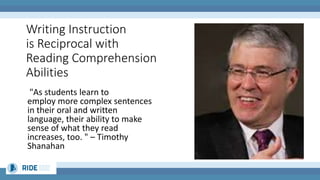
Writing Instruction
is Reciprocal with
Reading Comprehension
Abilities
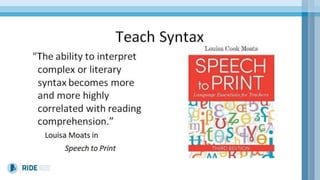
"As students learn to
employ more complex sentences
in their oral and written
language, their ability to make
sense of what they read
increases, too. " – Timothy
Shanahan
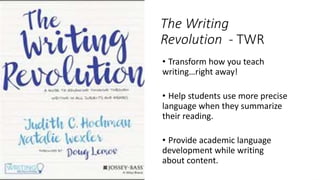
The Writing
Revolution - TWR
• Transform how you teach
writing…right away!
• Help students use more precise
language when they summarize
their reading.
• Provide academic language
development while writing
about content.
Six Principles of Writing Instruction outlined
in The Writing Revolution:
• Students need explicit instruction in writing, beginning in the early
elementary grades.
• Sentences are the building blocks of all writing.
• When embedded in the content of the curriculum, writing instruction is a
powerful teaching tool.
• The content of the curriculum drives the rigor of the writing activities.
• Grammar is best taught in the context of student writing.
• The two most important phases of the writing process are planning and
revising.
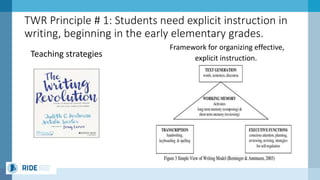
TWR Principle # 1: Students need explicit instruction in
writing, beginning in the early elementary grades.
Framework for organizing effective,
explicit instruction.
Teaching strategies
TWR Principle # 2: Sentences are the building
blocks of all writing.
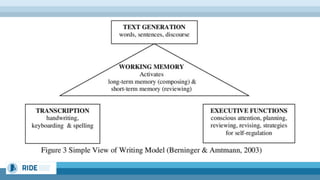
•Text Generation is part of Simple View of Writing
(SVW)
•Good writing often involves more complex sentence
structures and a more varied and precise vocabulary
than spoken language.
•A writer who can’t compose a decent
sentence most likely will not produce a
decent essay—or even a decent paragraph.
TWR Principle # 3: When embedded in the content of
the curriculum, writing is a powerful teaching tool.
• To maximize the benefits of writing instruction,
students should start practicing their writing skills on
topics embedded in content as soon as possible.
(Hochman).
• Teachers can use writing as a check for
comprehension.
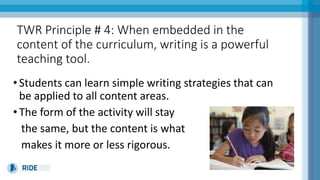
TWR Principle # 4: When embedded in the
content of the curriculum, writing is a powerful
teaching tool.
•Students can learn simple writing strategies that can
be applied to all content areas.
•The form of the activity will stay
the same, but the content is what
makes it more or less rigorous.
TWR Principle # 5: Grammar is best taught in
the context of student writing
• Teachers should refer to CCSS Language Standards in addition
to the CCSS Writing Standards when planning instruction.
• As students begin to use more complex
terms and sentence constructions in
their written language, they begin to
incorporate those features into their
spoken language as well.
• Multilingual Learners
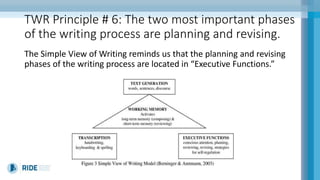
TWR Principle # 6: The two most important phases
of the writing process are planning and revising.
The Simple View of Writing reminds us that the planning and revising
phases of the writing process are located in “Executive Functions.”
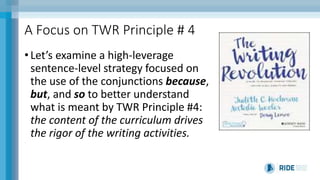
A Focus on TWR Principle # 4
• Let’s examine a high-leverage
sentence-level strategy focused on
the use of the conjunctions because,
but, and so to better understand
what is meant by TWR Principle #4:
the content of the curriculum drives
the rigor of the writing activities.
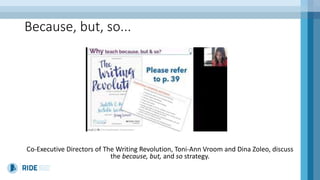
Because, but, so...
Co-Executive Directors of The Writing Revolution, Toni-Ann Vroom and Dina Zoleo, discuss
the because, but, and so strategy.
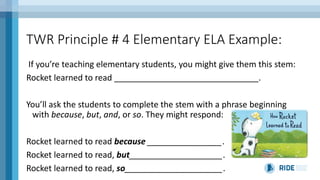
TWR Principle # 4 Elementary ELA Example:
If you’re teaching elementary students, you might give them this stem:
Rocket learned to read _______________________________.
You’ll ask the students to complete the stem with a phrase beginning
with because, but, and, or so. They might respond:
Rocket learned to read because ________________.
Rocket learned to read, but____________________.
Rocket learned to read, so_____________________.
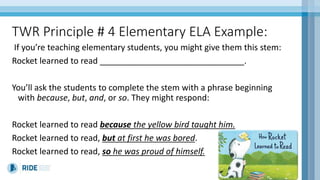
TWR Principle # 4 Elementary ELA Example:
If you’re teaching elementary students, you might give them this stem:
Rocket learned to read _______________________________.
You’ll ask the students to complete the stem with a phrase beginning
with because, but, and, or so. They might respond:
Rocket learned to read because the yellow bird taught him.
Rocket learned to read, but at first he was bored.
Rocket learned to read, so he was proud of himself.
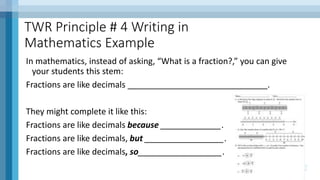
TWR Principle # 4 Writing in
Mathematics Example
In mathematics, instead of asking, “What is a fraction?,” you can give
your students this stem:
Fractions are like decimals ______________________________.
They might complete it like this:
Fractions are like decimals because _____________.
Fractions are like decimals, but _________________.
Fractions are like decimals, so__________________.
TWR Principle # 4 Writing in Mathematics
Example
In mathematics, instead of asking, “What is a fraction?,” you can give
your students this stem:
Fractions are like decimals ______________________________.
They might complete it like this:
Fractions are like decimals because they are all parts of wholes.
Fractions are like decimals, but they are written differently.
Fractions are like decimals, so they can be used interchangeably.
Why is explicit instruction of
sentence structure an important
part of developing literacy skills?
Analyzing Student Writing
Analyze student writing samples and
spelling tests to refine instructional
targets (e.g., development of
phonological awareness, knowledge of
spelling rules, awareness of inflectional
morphemes). International Dyslexia Association
Knowledge and Practice Standards.
Student writing also yields information
on syntax, composition, organization,
comprehension, and handwriting.
Error Analysis
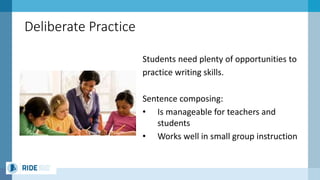
Deliberate Practice
Students need plenty of opportunities to
practice writing skills.
Sentence composing:
• Is manageable for teachers and
students
• Works well in small group instruction
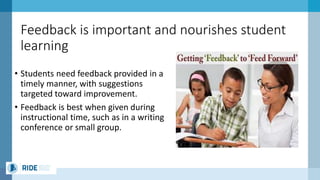
Feedback is important and nourishes student
learning
• Students need feedback provided in a
timely manner, with suggestions
targeted toward improvement.
• Feedback is best when given during
instructional time, such as in a writing
conference or small group.
Resources and Activities for
GOING FURTHER
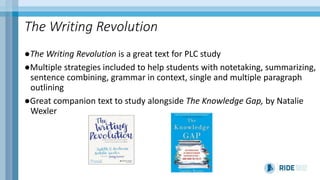
The Writing Revolution
●The Writing Revolution is a great text for PLC study
●Multiple strategies included to help students with notetaking, summarizing,
sentence combining, grammar in context, single and multiple paragraph
outlining
●Great companion text to study alongside The Knowledge Gap, by Natalie
Wexler
The Writing Revolution Writing Principles #2
and #5 in Action:
Sentence
Expansion
• https://vimeo.com/208687154
Sentence
Combining
• https://vimeo.com/207849027
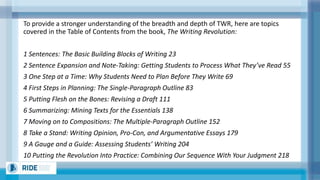
To provide a stronger understanding of the breadth and depth of TWR, here are topics
covered in the Table of Contents from the book, The Writing Revolution:
1 Sentences: The Basic Building Blocks of Writing 23
2 Sentence Expansion and Note-Taking: Getting Students to Process What They’ve Read 55
3 One Step at a Time: Why Students Need to Plan Before They Write 69
4 First Steps in Planning: The Single-Paragraph Outline 83
5 Putting Flesh on the Bones: Revising a Draft 111
6 Summarizing: Mining Texts for the Essentials 138
7 Moving on to Compositions: The Multiple-Paragraph Outline 152
8 Take a Stand: Writing Opinion, Pro-Con, and Argumentative Essays 179
9 A Gauge and a Guide: Assessing Students’ Writing 204
10 Putting the Revolution Into Practice: Combining Our Sequence With Your Judgment 218
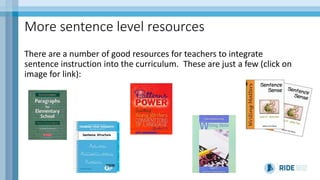
More sentence level resources
There are a number of good resources for teachers to integrate
sentence instruction into the curriculum. These are just a few (click on
image for link):
Wrap Up
3-2-1 Strategy Exit Slip
3 things you learned from today’s presentation
2 ideas you will try in your classroom
1 question you still have

TheWriting-ReadingConnection.pptx

  • 1.
    The Writing –Reading Connection Writing Instruction Strategies that Enhance Reading Comprehension Project created in partnership with the Rhode Island Department of Education Literacy Ambassadors 2020
  • 2.
    During this presentation,participants will: • Use the Simple View of Writing as an organizing framework for writing instruction • Discover The Writing Revolution (TWR) resource for teaching writing • Watch a TWR video explaining because, but, so sentence expansion as one example out of many presented in TWR. • Practice because, but, so sentence expansion. • Develop an understanding of why explicit instruction in sentence structure is an important part of developing literacy skills
  • 3.
    Why is writinghard to teach? • Take a few minutes to write down 2-3 things that make teaching writing challenging in your classroom? • Turn and share with a table partner/ or type into chat feature.
  • 4.
    What do wemean by "Written Expression"? Written expression instruction includes: • the mechanics and conventions of writing, • composition (handwriting, spelling, punctuation, syntax), • semantics, • as well as the phases of the writing process (composition, revision, and editing). (International Dyslexia Association)
  • 6.
    Writing Instruction is Reciprocalwith Reading Comprehension Abilities "As students learn to employ more complex sentences in their oral and written language, their ability to make sense of what they read increases, too. " – Timothy Shanahan
  • 7.
    The Writing Revolution -TWR • Transform how you teach writing…right away! • Help students use more precise language when they summarize their reading. • Provide academic language development while writing about content.
  • 8.
    Six Principles ofWriting Instruction outlined in The Writing Revolution: • Students need explicit instruction in writing, beginning in the early elementary grades. • Sentences are the building blocks of all writing. • When embedded in the content of the curriculum, writing instruction is a powerful teaching tool. • The content of the curriculum drives the rigor of the writing activities. • Grammar is best taught in the context of student writing. • The two most important phases of the writing process are planning and revising.
  • 9.
    TWR Principle #1: Students need explicit instruction in writing, beginning in the early elementary grades. Framework for organizing effective, explicit instruction. Teaching strategies
  • 10.
    TWR Principle #2: Sentences are the building blocks of all writing. •Text Generation is part of Simple View of Writing (SVW) •Good writing often involves more complex sentence structures and a more varied and precise vocabulary than spoken language. •A writer who can’t compose a decent sentence most likely will not produce a decent essay—or even a decent paragraph.
  • 11.
    TWR Principle #3: When embedded in the content of the curriculum, writing is a powerful teaching tool. • To maximize the benefits of writing instruction, students should start practicing their writing skills on topics embedded in content as soon as possible. (Hochman). • Teachers can use writing as a check for comprehension.
  • 12.
    TWR Principle #4: When embedded in the content of the curriculum, writing is a powerful teaching tool. •Students can learn simple writing strategies that can be applied to all content areas. •The form of the activity will stay the same, but the content is what makes it more or less rigorous.
  • 13.
    TWR Principle #5: Grammar is best taught in the context of student writing • Teachers should refer to CCSS Language Standards in addition to the CCSS Writing Standards when planning instruction. • As students begin to use more complex terms and sentence constructions in their written language, they begin to incorporate those features into their spoken language as well. • Multilingual Learners
  • 14.
    TWR Principle #6: The two most important phases of the writing process are planning and revising. The Simple View of Writing reminds us that the planning and revising phases of the writing process are located in “Executive Functions.”
  • 15.
    A Focus onTWR Principle # 4 • Let’s examine a high-leverage sentence-level strategy focused on the use of the conjunctions because, but, and so to better understand what is meant by TWR Principle #4: the content of the curriculum drives the rigor of the writing activities.
  • 16.
    Because, but, so... Co-ExecutiveDirectors of The Writing Revolution, Toni-Ann Vroom and Dina Zoleo, discuss the because, but, and so strategy.
  • 17.
    TWR Principle #4 Elementary ELA Example: If you’re teaching elementary students, you might give them this stem: Rocket learned to read _______________________________. You’ll ask the students to complete the stem with a phrase beginning with because, but, and, or so. They might respond: Rocket learned to read because ________________. Rocket learned to read, but____________________. Rocket learned to read, so_____________________.
  • 18.
    TWR Principle #4 Elementary ELA Example: If you’re teaching elementary students, you might give them this stem: Rocket learned to read _______________________________. You’ll ask the students to complete the stem with a phrase beginning with because, but, and, or so. They might respond: Rocket learned to read because the yellow bird taught him. Rocket learned to read, but at first he was bored. Rocket learned to read, so he was proud of himself.
  • 19.
    TWR Principle #4 Writing in Mathematics Example In mathematics, instead of asking, “What is a fraction?,” you can give your students this stem: Fractions are like decimals ______________________________. They might complete it like this: Fractions are like decimals because _____________. Fractions are like decimals, but _________________. Fractions are like decimals, so__________________.
  • 20.
    TWR Principle #4 Writing in Mathematics Example In mathematics, instead of asking, “What is a fraction?,” you can give your students this stem: Fractions are like decimals ______________________________. They might complete it like this: Fractions are like decimals because they are all parts of wholes. Fractions are like decimals, but they are written differently. Fractions are like decimals, so they can be used interchangeably.
  • 21.
    Why is explicitinstruction of sentence structure an important part of developing literacy skills?
  • 23.
    Analyzing Student Writing Analyzestudent writing samples and spelling tests to refine instructional targets (e.g., development of phonological awareness, knowledge of spelling rules, awareness of inflectional morphemes). International Dyslexia Association Knowledge and Practice Standards. Student writing also yields information on syntax, composition, organization, comprehension, and handwriting. Error Analysis
  • 24.
    Deliberate Practice Students needplenty of opportunities to practice writing skills. Sentence composing: • Is manageable for teachers and students • Works well in small group instruction
  • 25.
    Feedback is importantand nourishes student learning • Students need feedback provided in a timely manner, with suggestions targeted toward improvement. • Feedback is best when given during instructional time, such as in a writing conference or small group.
  • 26.
    Resources and Activitiesfor GOING FURTHER
  • 27.
    The Writing Revolution ●TheWriting Revolution is a great text for PLC study ●Multiple strategies included to help students with notetaking, summarizing, sentence combining, grammar in context, single and multiple paragraph outlining ●Great companion text to study alongside The Knowledge Gap, by Natalie Wexler
  • 28.
    The Writing RevolutionWriting Principles #2 and #5 in Action: Sentence Expansion • https://vimeo.com/208687154 Sentence Combining • https://vimeo.com/207849027
  • 29.
    To provide astronger understanding of the breadth and depth of TWR, here are topics covered in the Table of Contents from the book, The Writing Revolution: 1 Sentences: The Basic Building Blocks of Writing 23 2 Sentence Expansion and Note-Taking: Getting Students to Process What They’ve Read 55 3 One Step at a Time: Why Students Need to Plan Before They Write 69 4 First Steps in Planning: The Single-Paragraph Outline 83 5 Putting Flesh on the Bones: Revising a Draft 111 6 Summarizing: Mining Texts for the Essentials 138 7 Moving on to Compositions: The Multiple-Paragraph Outline 152 8 Take a Stand: Writing Opinion, Pro-Con, and Argumentative Essays 179 9 A Gauge and a Guide: Assessing Students’ Writing 204 10 Putting the Revolution Into Practice: Combining Our Sequence With Your Judgment 218
  • 30.
    More sentence levelresources There are a number of good resources for teachers to integrate sentence instruction into the curriculum. These are just a few (click on image for link):
  • 31.
    Wrap Up 3-2-1 StrategyExit Slip 3 things you learned from today’s presentation 2 ideas you will try in your classroom 1 question you still have