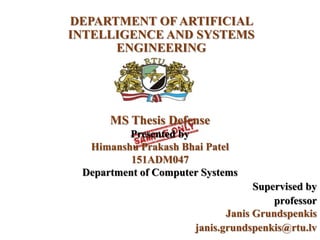
DEPARTMENT OF ARTIFICIAL
INTELLIGENCE AND SYSTEMS
ENGINEERING
MS Thesis Defense
Presented by
Himanshu Prakash Bhai Patel
151ADM047
Department of Computer Systems
Supervised by
professor
Janis Grundspenkis
janis.grundspenkis@rtu.lv
CONTENTS
TITLE / TEAM
PROBLEM / SIGNIFICANCE
PRIOR RESEARCH
RESEARCH QUESTION, SCOPE, AND LIMITATIONS
RESEARCH OBJECTIVES / APPROACH
FINDINGS / RESULTS
CONCLUSIONS
AREAS FOR FUTURE RESEARCH
QUESTIONS
TITLE
“EVOLUTION OF METHODOLOGIES FOR
EFFICIENT MULTI-AGENT SYSTEM PROJECTS”
TEAM
Author : Himanshu Prakash Bhai Patel
Supervisor: Janis Grundspenkis
PROBLEM / SIGNIFICANCE
MAS methodologies have been evolving and need to be presented in a precise
way.
Many methodologies and tools with unclear data
Data not present in a single document for quick reference
Books are lengthy to read and comprehend
Unclear ideas about adopting MAS methodologies and tools
Many authors have complex details and not so easy to read
Difficulties for project teams to use the theories, experiment and spend time
before selecting the right methodology and tools
Need for precise, concise and easy to understand data
There are not many thesis that give a brief overview of the major methodologies
with case study and comparison
MAS market is picking up and needs authors to contribute
PRIOR RESEARCH
Several authors have written great books and Journals
Few of them have extended the methodologies and given modern shape
Few books I read about authors are Wood, Wooldridge, Russell, Chess, Lin,
Rumbaugh and Fausto
What I find that these are all great and big authors and have large data set
I also read about MAS projects from authors that have case studies and practical
project work using JADE, Prolog and Java languages
What I am into is putting that in lucid, simple way so that it becomes easier to read
and pick the methodologies
RESEARCH QUESTION, SCOPE, AND LIMITATIONS
My research question is to address the pain points during selection the
methodologies and to know how about the evolution of these
methodologies that have refined over time to address the pain points.
My scope is limited by the material in books , library and internet
material related to MAS
My research is limited and scoped to the available time, material and
research tools as prescribed by the Department
RESEARCH OBJECTIVES / APPROACH
The main objective of this thesis is to provide an introduction to agent
architecture, multi-agents and multi agent system types and methodologies,
research on their strengths, limitations and showcase how they compare
with each other through a systematic use of industry standard framework
and research methodology
In addition the objective is to bring forth the origins, evolution and present
them using analysis, facts and figures, pictorial, metric based
representations
RESEARCH OBJECTIVES / DESIGN / METHODOLOGY / APPROACH
My research method has been guided by my professor and as per Lativa
University framework. It includes the following points
1. Literature review - Study of earlier work done in this area of AI and MAS
2. Reference the library books at university – Visit to the University library
and reference relevant books from research scholars and professionals
3. Online research using Internet and AI community groups – Conduct
search using suitable keywords related to Agent, MAS, visit professor’s
websites and publications
4. Personal interaction with scholars who have earlier worked on similar
thesis – Interact with the scholars in this area
RESEARCH OBJECTIVES / DESIGN / METHODOLOGY / APPROACH
Research Methodology is by way of systematic analysis of the existing MAS
methodologies and adding my value by way of finding their strength /
weakness and presenting them using quantitative and qualitative methods.
My work will reference many existing methodologies and I will add my piece
of recommendation and findings in my findings sections
My work will also highlight the origins of the methodologies and how they
have evolved over time and how these solve the pain points
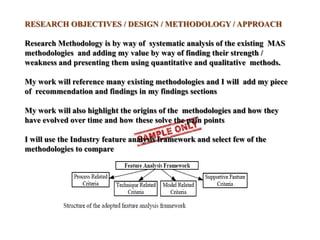
I will use the Industry feature analysis framework and select few of the
methodologies to compare
FINDINGS / RESULTS
Below is a sample of the analysis
Evaluation
criteria Prometheus
Tropos O-MaSE GAIA INGENIA
S
MAS-
CommonKA
DS
BDI-ASP
Process Related Criteria
Development
Lifecycle
Iterative
across all
phases
Iterative
across all
phases
Iterative
across all
phases
Iterative
across all
phases
Iterative
across all
phases
Risk-driven &
component-
based
Not
Specific
Coverage of
the lifecycle
Analysis &
Design
Conceptu
al,
Analysis
Design &
Code
Analysis&
Design
Analysis&
Design
Analysis&
Design
Conceptual,
Analysis&
Design
Analysis
& Design
Development
perspective
Bottom Up Top
Down
Top Down Top Down Hybrid Hybrid Hybrid
Application
domain
Any Any Any Any Any Any Any
Size of MAS Not
specified
Any size < 10 agents < 100 agents Not
Specific,
Any Size
Not Specific Not
Specific
Agent nature BDI Agents BDI–like
Agents
Heterogeneo
us
Heterogeneo
us
Agents
with goals
and states
Heterogeneous BDI
agents
CONCLUSIONS
My thesis has put forth clear and easy to read details of the methodologies
It has captured the essence of the MAS for IT teams to easily pick up
methodology as per needs
It has presented the evolutions of the MAS methodologies and hence compared
them using a standard framework
The thesis avoids complicated details and presents an easy to refer and use data
AREAS FOR FUTURE RESEARCH
There is ample scope to refer more details and data and have more methodologies
that can be compared
This short thesis has given an opportunity for future researchers and scholars to
make deep dive into several other areas and also data present in this thesis
QUESTIONS ???

Thesis defense sample

  • 1.
    DEPARTMENT OF ARTIFICIAL INTELLIGENCEAND SYSTEMS ENGINEERING MS Thesis Defense Presented by Himanshu Prakash Bhai Patel 151ADM047 Department of Computer Systems Supervised by professor Janis Grundspenkis janis.grundspenkis@rtu.lv
  • 2.
    CONTENTS TITLE / TEAM PROBLEM/ SIGNIFICANCE PRIOR RESEARCH RESEARCH QUESTION, SCOPE, AND LIMITATIONS RESEARCH OBJECTIVES / APPROACH FINDINGS / RESULTS CONCLUSIONS AREAS FOR FUTURE RESEARCH QUESTIONS
  • 3.
    TITLE “EVOLUTION OF METHODOLOGIESFOR EFFICIENT MULTI-AGENT SYSTEM PROJECTS” TEAM Author : Himanshu Prakash Bhai Patel Supervisor: Janis Grundspenkis
  • 4.
    PROBLEM / SIGNIFICANCE MASmethodologies have been evolving and need to be presented in a precise way. Many methodologies and tools with unclear data Data not present in a single document for quick reference Books are lengthy to read and comprehend Unclear ideas about adopting MAS methodologies and tools Many authors have complex details and not so easy to read Difficulties for project teams to use the theories, experiment and spend time before selecting the right methodology and tools Need for precise, concise and easy to understand data There are not many thesis that give a brief overview of the major methodologies with case study and comparison MAS market is picking up and needs authors to contribute
  • 5.
    PRIOR RESEARCH Several authorshave written great books and Journals Few of them have extended the methodologies and given modern shape Few books I read about authors are Wood, Wooldridge, Russell, Chess, Lin, Rumbaugh and Fausto What I find that these are all great and big authors and have large data set I also read about MAS projects from authors that have case studies and practical project work using JADE, Prolog and Java languages What I am into is putting that in lucid, simple way so that it becomes easier to read and pick the methodologies
  • 6.
    RESEARCH QUESTION, SCOPE,AND LIMITATIONS My research question is to address the pain points during selection the methodologies and to know how about the evolution of these methodologies that have refined over time to address the pain points. My scope is limited by the material in books , library and internet material related to MAS My research is limited and scoped to the available time, material and research tools as prescribed by the Department
  • 7.
    RESEARCH OBJECTIVES /APPROACH The main objective of this thesis is to provide an introduction to agent architecture, multi-agents and multi agent system types and methodologies, research on their strengths, limitations and showcase how they compare with each other through a systematic use of industry standard framework and research methodology In addition the objective is to bring forth the origins, evolution and present them using analysis, facts and figures, pictorial, metric based representations
  • 8.
    RESEARCH OBJECTIVES /DESIGN / METHODOLOGY / APPROACH My research method has been guided by my professor and as per Lativa University framework. It includes the following points 1. Literature review - Study of earlier work done in this area of AI and MAS 2. Reference the library books at university – Visit to the University library and reference relevant books from research scholars and professionals 3. Online research using Internet and AI community groups – Conduct search using suitable keywords related to Agent, MAS, visit professor’s websites and publications 4. Personal interaction with scholars who have earlier worked on similar thesis – Interact with the scholars in this area
  • 9.
    RESEARCH OBJECTIVES /DESIGN / METHODOLOGY / APPROACH Research Methodology is by way of systematic analysis of the existing MAS methodologies and adding my value by way of finding their strength / weakness and presenting them using quantitative and qualitative methods. My work will reference many existing methodologies and I will add my piece of recommendation and findings in my findings sections My work will also highlight the origins of the methodologies and how they have evolved over time and how these solve the pain points I will use the Industry feature analysis framework and select few of the methodologies to compare
  • 10.
    FINDINGS / RESULTS Belowis a sample of the analysis Evaluation criteria Prometheus Tropos O-MaSE GAIA INGENIA S MAS- CommonKA DS BDI-ASP Process Related Criteria Development Lifecycle Iterative across all phases Iterative across all phases Iterative across all phases Iterative across all phases Iterative across all phases Risk-driven & component- based Not Specific Coverage of the lifecycle Analysis & Design Conceptu al, Analysis Design & Code Analysis& Design Analysis& Design Analysis& Design Conceptual, Analysis& Design Analysis & Design Development perspective Bottom Up Top Down Top Down Top Down Hybrid Hybrid Hybrid Application domain Any Any Any Any Any Any Any Size of MAS Not specified Any size < 10 agents < 100 agents Not Specific, Any Size Not Specific Not Specific Agent nature BDI Agents BDI–like Agents Heterogeneo us Heterogeneo us Agents with goals and states Heterogeneous BDI agents
  • 11.
    CONCLUSIONS My thesis hasput forth clear and easy to read details of the methodologies It has captured the essence of the MAS for IT teams to easily pick up methodology as per needs It has presented the evolutions of the MAS methodologies and hence compared them using a standard framework The thesis avoids complicated details and presents an easy to refer and use data
  • 12.
    AREAS FOR FUTURERESEARCH There is ample scope to refer more details and data and have more methodologies that can be compared This short thesis has given an opportunity for future researchers and scholars to make deep dive into several other areas and also data present in this thesis
  • 13.