Roisin Murphy (1465677)
Submitted in partial fulfillment of the requirements of the Bachelor
of Arts degree (Psychology Specialization) at DBS School of Arts,
Dublin.
Supervisor: Dr Barbara Caska
Head of Department: Dr S Eccles
April 2013
Department of Psychology
DBS School of Arts
2
Contents
Acknowledgements 3
Abstract 4
Introduction 5
Methodology 12
Results 16
Discussion 22
Reference Section 32
Appendix 49
3
Acknowledgements
Firstly, I would like to take this opportunity to thank my supervisor Dr. Barbara Caska for all her
help with this study. Likewise, I would also like to thank Dr. Patricia Frazer and Dr Garry
Prentice for their advice and support with this study.
I would also like to thank all of the people who kindly gave their time and consent to participate
in this study.
I also owe many thanks to my parents for their patience and support over the past three years.
4
Abstract
This study aimed to investigate the relationship between personality traits – as assessed using the
Big Five Inventory – and length of friendship. Also, the affect Extraversion and Neuroticism has
on assumed similarity was also looked into. A sample of eighty-six college students (n = 86)
participated in this study. Data was analysed using pearson correlations and partial correlations.
Results showed that although friends had significantly similar personalities, this was not
significantly affected by the length of their friendship. Furthermore, although Extraversion and
Neuroticism show some weak correlations with assumed similarity, the relationships found failed
to achieve a significant score. Results and limitations are discussed with reference to previous
studies in the area of personality psychology.
5
Introduction
“Establishing and maintaining social relationships with others are some of the most
important tasks an individual faces” (Baumeister and Leary, 1995)
The study of personality similarity can offer a great deal of information about the reasons
behind individuals forming relationships and how they maintain these social investments.
Similarity can be defined as the relation between self-reports of individuals. The relation
between the self-report of an individual and his or her observer report on another individual is
known as assumed similarity.
Similarity between members of social dyads has been widely examined with regards to
various physical and psychological traits. Studies using samples of friends, dating couples and
spouses have found similarities such as height, age, education, religiosity and even behavioural
similarities including drinking, exercise habits and drug use. Correlations of these similarities
have been found to score .30 and higher. (Watson et al, 2004).
Likewise, Lee and Bond (1960) researched similarity but instead used a sample of
roommates from two Hong Kong universities. Their study showed that friendships grew between
roommates who shared similar values and personality traits. However, even true similarity was
unnecessary for the growth of friendship as strong friendships were formed even when there was
only a perceived similarity between the roommates. This suggests that perception plays an
important role in our social interactions.
6
However, studies concerning the similarity of personality traits tend to report weaker
relations between the two than those investigating characteristics such as those previously
mentioned. This has been shown in studies such as Rushton and Bons (2005), McCrae (1996)
and Watson, Hubbard and Wiese (2000). Similarly, Watson et al (2000) found that similarity
correlations of the Big Five personality traits all fell below .30 except that of Openness to
Experience which scored a moderately strong .36 in the dating sample. McCrae (1996) found
correlations of .33 and .29 for Openness to Experience. However, among the Big Five traits these
scores were the highest found.
A study by Kurtz and Sherker (2003) also reported similar findings in a sample of female
college students. Assessments were given to students (assessment used was the Neo Five Factor
Inventory; Costa and McCrae, 1992) on week 2 and week 15. All scores on the NEO-FFI had
high self-other correlations. Conscientiousness had significantly higher correlations than
Extraversion in both assessments. However, as with finding by previous studies, all traits scored
below .30 for assumed similarity and therefore were not found to be a strong correlation.
On the other hand, other studies have failed to find a significant correlation for any of the
Big Five personality characteristics (Watson et al, 2004; Botwin, Buss and Shackelford, 1992).
There have been studies in this area using different personality measures than the Big
Five factors. Waller (1999) found that spouses scored a moderately strong similarity correlation
of .41 for Conventionality – a trait that is very alike the Big Five characteristic of Openness to
Experience.
In 2000, Ready et al conducted a study of assumed similarity using the 15 personality
scales. The highest correlation report was that of Eccentric Perceptions and Propriety – a trait
related to Openness to Experience.
7
Bourdage and Ogunfousra (2009) studied similarity and assumed similarity using the
HEXACO Personality Inventory (HEXACO-PI; Lee and Ashton, 2006). In this study, college
students were instructed to complete the questionnaire about themselves and also their friend. It
was found that Honesty-humility (a trait with some overlap with the Big Five trait of
Agreeableness) and Openness to Experience were indicated to have moderately strong
correlations of assumed similarity.
All of these findings mentioned provide ample support that relationships are not formed
randomly but that there is a tendency to form relations with others based on characteristic
similarities whether they are real or assumed.
“The influence of personality and social relations is bi-directional, that is, not only does
personality influence social relations, but social relations also influence personality
development.” (Corrs and Matthews, 2009, p. 516)
This is the main theory behind the hypothesis of the present study. It is hypothesized that
college friends will have significantly similar personalities, and furthermore, friends who have
known each other longer will have more personality similarities than those who have known
each other for a shorter period of time.
Asendorpf and Wilpers (1998) found that over long periods of time – several months or
years – personality and the environment are prone to change. From this we can deduce that both
8
the individual’s personality and the social relations they participate in are influential in these
changes.
This idea is supported by Robins, Caspi and Moffitt (2002) in which they reported that
both antecedent personality traits predicted social relations and likewise social relations also
predicted personality changes over time.
Sheese (2005; as cited by Corrs and Matthews, 2009) added to the research in this area
and reported that, in a study of college students personality and social relations during a 14 week
interval, it was found that there were personality changes over time.
Contrary to this, Asendorpf and Wilpers (1998) found in an 18 month longitudinal study
personality affected relationship but did not find a significant relationship for vice versa.
Izard (1960) found that friends who have known each other over a long period of time
have significantly more similar personality profiles than those paired at random.
As seen by the aforementioned studies, similarity among friends when length of
relationship is taken into account has left conflicting results. This study wishes to add more
recent data to this area of literature. Furthermore, this is not a longitudinal study looking for
personality changes over a small length of time.
In this study, the personality similarity of students who have known each other for a
shorter length of time will be compared to the personality similarity among those whom have
been friends for longer lengths of time. In this way, the study is not limited to looking at
differences within a short window of time which may not be long enough to witness any
significant changes in personalities.
9
Several studies have found assumed similarity to be an important factor in social relations
(Newcomb, 1961; Fiedler, 1958; Rosenfeld and Jackson, 1959). Izard (1960) reported that
friends had significant positive correlations on some individual personality traits.
However, what personality traits show a tendency to be assumed similar in friendship
dyads and why do they have this tendency? Schimel (2000) found that individuals tend to not
like those who present with one’s own negative traits. In other words, a person tends not to like
another when they see their own negative traits in that other. This suggests that similarity is a
positive and helpful factor in social relations only when the similarity involves positive
characteristics.
In this study, one positive and one negative personality trait will be considered with
regard to assumed similarity among college friends. It is hypothesized that Extraversion will be
positively correlated with assumed similarity between friends, whereas Neuroticism will be
negatively correlated with assumed similarity.
These negative and positive traits were selected on the basis of numerous studies of the
effect of different personality characteristics on social relations. For example, Anderson et al
(2001) associated Extraversion to social status. Neuroticism on the other hand has been linked to
marriage dissatisfaction (Donnellan, Conger and Bryan, 2004). Extraversion has been shown to
be negatively linked to the number of conflicts in friendship (Berry, Willingham and Thayer,
2000), associated with social competence in children (Asendorpf and Von Aken, 2003), and peer
acceptance (Lubbers et al, 2006). Extraverts are more likely to have smoother interpersonal
relations (Ashton, Lee and Paunonen, 2002), whereas Neuroticism has been linked with social
10
difficulties (Asendorpf and Von Aken, 2003). Neuroticism has also been associated with a
negative view of others (Erez and Judge, 2001) which can easily be seen by others as a sign of
dislike.
Suls, Martin and David (1998) noted that neurotics may have poorer social relations and
higher level of victimization because of hypersensitivity to negative events. Bollmur, Harris and
Mitich (2006) give an example of the route victimization could occur through. As neurotic
individuals have a tendency to experience negative emotions, during conflicts this can present
itself in a more angry constitution. Furthermore, neurotic individuals are usually unforgiving and
are more likely to put the blame on others which gives rise to a higher likelihood of victimization
by their peers.
Should assumed similarity be associated with specific traits only, it would be an
important topic to be studied. It would give the implication that these specific traits possessed a
special property that causes an individual to project that specific trait onto others over other
characteristics.
Previous studies have used self-reports and observer-reports to study personality
(Biesanz, West and Millevoi, 2007; Vazire, 2010). However, most of this research focuses on
self-other agreement and accuracy such as Funder and West (1993). This research has been
useful in supporting trait theories of personality but has mostly ignored the similarity between
the participants – the relation between self-reports of one participant and the self-report of
11
another participant. This would corroborate general findings that social relationships are not
randomly formed but instead are made somewhat based on similarity of certain traits.
This study will investigate similarity in relation to the length of friendships among
college students. Assumed similarity will also be studied with regard to Extraversion and
Neuroticism. Two copies of a personality questionnaire will be given to participants to complete
based on themselves (self-report) and then based on their friend (observer-report). Correlations
will be used to identify any significant results for the hypothesis.
12
Methodology
Participants
The sample used in this study was a convenience sample consisting of Dublin Business School
students. Participants took part in pairs with a friend. Each participant was required to complete self-
reports of their personality along with an observer report of their friends personality.
Participants were recruited in three ways; firstly they were informed about the present study by their
lecturers and a room was booked for them to attend if they wished to take part.
Once participants entered the room, they were given the Big Five Inventory (Donahue & Kentle,
1991) to complete based on their self-report of their own personality and their perception of their
friend’s personality. Questionnaires included a cover page, demographic page and two copies of the BFI.
Each questionnaire was labelled in order to keep the correct questionnaires paired (ie. The first pair of
participants received questionnaires labelled 1A and 1B).
Students were also approached in the Common Room and asked if they would consider filling
out a short questionnaire for the study. It was explained to them that it would only take ten minutes to
complete, responses were kept completely anonymous and there was no obligation to take part should
they wish not to participate.
Lastly, students were enlisted at the beginning of their lecture – with the lecturer’s permission –
to fill out the questionnaire if they wished to do so. The lecturer’s permission was ascertained through
email correspondence and a time was chosen that was of convenience to the lecturer. The students
were given a brief overview of the aim of this study and once again were informed of the length of time
13
needed to complete the questionnaire, their anonymity, right to refuse to take part and were instructed
on how to fill out the questionnaires.
Participation was completely voluntary and there was no monetary gain or course credit given
for participation.
Overall 86 students (42 dyads) participated in this study; females represented 58% of this
sample. Ages ranged from 18 to 53 years, with a median age of 21 (m = 21.44, SD = 4.3). Length of
friendship was reported between 5 – 156 months (5 months up to 13 years), and a median of 30 months
(m = 30.77, SD = 38.9) was recorded.
Design
This study is a quantitative study with a correlational design. The predictor variables involved
are the length of friendship, extraversion and neuroticism scale scores. Criterion variables used in this
study are personality similarity and assumed similarity. Participants were not assigned to pairs but were
free to choose a partner to pair with themselves.
Materials
This study used self-administered, paper-and-pencil questionnaires. A small demographic sheet
was constructed to obtain information about age, gender and length of friendship.
14
The Big Five Inventory (Donahue & Kentle, 1991) was used to assess the personality of
participants. This questionnaire measures the following personality traits; Extraversion (8 statements:
eg. “is talkative”), Agreeableness (9 statements: eg. “is generally trusting”), Openness (10 statements:
eg. “is curious about many different things”), Conscientiousness (9 statements: eg. “is a reliable
worker”) and Neuroticism (8 statements: eg. “can be moody”).
Alpha reliabilities were reported for subscales as E = .88; A = .79; C = .82; N = .84; O = .81
(John and Srivastava, 1999).
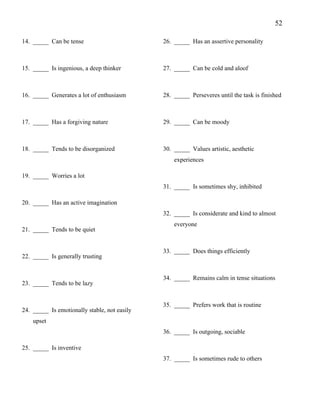
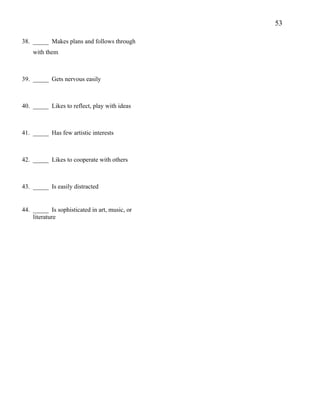
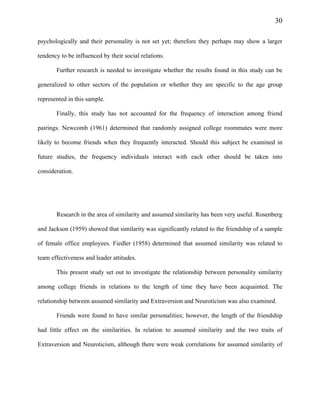
There are 44 questions in the Big Five Inventory. Participants completed two copies of the Big
Five Inventory; the first copy based on their personality and the second copy was in relation to their
friend’s personality.
Responses were recorded according to a likert scale ranging from 1 (disagree strongly) to 5
(agree strongly).
Procedure
A cover note was supplied regarding information of the study. It included information regarding
the anonymity of the data collected, and that although participation is completely voluntary, once data
is collected it is indistinguishable from other participant’s data and therefore cannot be removed.
The cover note also stated that questionnaires would be securely stored and data collected from
these questionnaires would be stored on a password protected computer. Participants were also
warned that by completing the questionnaire they were giving their consent to participate in this study.
15
Finally an email address was also given should any participant have questions or wish to be
informed of the results of the study.
Participants were also given a verbal account of the general aim of the study – ie. that this study is to
investigate personality among college friends. Furthermore, it was emphasized that students were
under no obligation to participate in this study.
They were then instructed to take the questionnaire in pairs of friends. It was then explained
that the first questionnaire was to be answered based on your own personality and the second
questionnaire was to be answered based on you perception of your friends personality. Participants
were reminded that these questionnaires were to be answered based on their opinion and therefore
they were not to consult with each other when filling out the questionnaires.
It was advised that the questionnaire should only take between 10 – 15 minutes to complete.
Once all the questionnaires were returned participants were thanked for their involvement and
asked if they had any questions. Finally they were reminded that should they wish to, they can contact
the provided email address.
16
Results.
Descriptive Statistics.
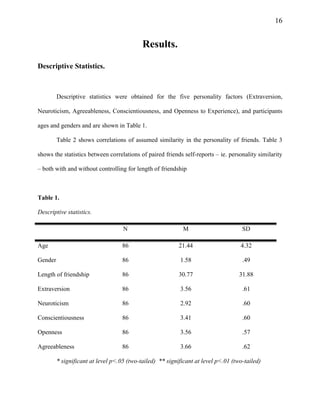
Descriptive statistics were obtained for the five personality factors (Extraversion,
Neuroticism, Agreeableness, Conscientiousness, and Openness to Experience), and participants
ages and genders and are shown in Table 1.
Table 2 shows correlations of assumed similarity in the personality of friends. Table 3
shows the statistics between correlations of paired friends self-reports – ie. personality similarity
– both with and without controlling for length of friendship
Table 1.
Descriptive statistics.
N M SD
Age 86 21.44 4.32
Gender 86 1.58 .49
Length of friendship 86 30.77 31.88
Extraversion 86 3.56 .61
Neuroticism 86 2.92 .60
Conscientiousness 86 3.41 .60
Openness 86 3.56 .57
Agreeableness 86 3.66 .62
* significant at level p<.05 (two-tailed) ** significant at level p<.01 (two-tailed)
17
Inferential Statistics
To determine whether personality characteristics were related to assumed similarity,
correlations were calculated between the self-report scores of participants and their observer-
reports of their friend’s personality. Histograms were obtained to ensure that data fell into the
range of normal distribution. This was to investigate whether outliers would cause testing to be
unreliable. All data fell within normal parameters.
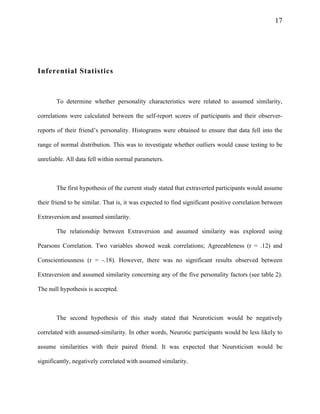
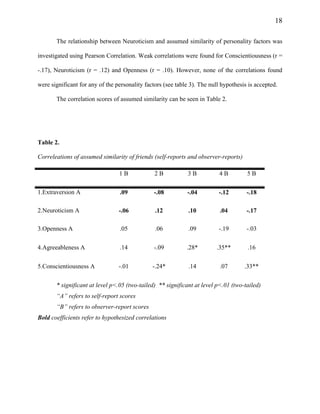
The first hypothesis of the current study stated that extraverted participants would assume
their friend to be similar. That is, it was expected to find significant positive correlation between
Extraversion and assumed similarity.
The relationship between Extraversion and assumed similarity was explored using
Pearsons Correlation. Two variables showed weak correlations; Agreeableness (r = .12) and
Conscientiousness (r = -.18). However, there was no significant results observed between
Extraversion and assumed similarity concerning any of the five personality factors (see table 2).
The null hypothesis is accepted.
The second hypothesis of this study stated that Neuroticism would be negatively
correlated with assumed-similarity. In other words, Neurotic participants would be less likely to
assume similarities with their paired friend. It was expected that Neuroticism would be
significantly, negatively correlated with assumed similarity.
18
The relationship between Neuroticism and assumed similarity of personality factors was
investigated using Pearson Correlation. Weak correlations were found for Conscientiousness (r =
-.17), Neuroticism (r = .12) and Openness (r = .10). However, none of the correlations found
were significant for any of the personality factors (see table 3). The null hypothesis is accepted.
The correlation scores of assumed similarity can be seen in Table 2.
Table 2.
Correleations of assumed similarity of friends (self-reports and observer-reports)
1 B 2 B 3 B 4 B 5 B
1.Extraversion A .09 -.08 -.04 -.12 -.18
2.Neuroticism A -.06 .12 .10 .04 -.17
3.Openness A .05 .06 .09 -.19 -.03
4.Agreeableness A .14 -.09 .28* .35** .16
5.Conscientiousness A -.01 -.24* .14 .07 .33**
* significant at level p<.05 (two-tailed) ** significant at level p<.01 (two-tailed)
“A” refers to self-report scores
“B” refers to observer-report scores
Bold coefficients refer to hypothesized correlations
19
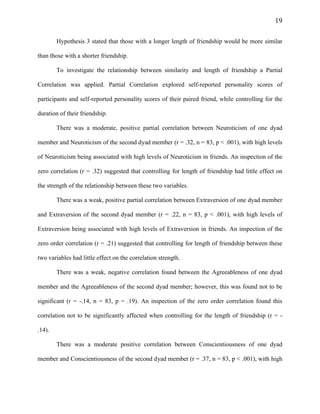
Hypothesis 3 stated that those with a longer length of friendship would be more similar
than those with a shorter friendship.
To investigate the relationship between similarity and length of friendship a Partial
Correlation was applied. Partial Correlation explored self-reported personality scores of
participants and self-reported personality scores of their paired friend, while controlling for the
duration of their friendship.
There was a moderate, positive partial correlation between Neuroticism of one dyad
member and Neuroticism of the second dyad member (r = .32, n = 83, p < .001), with high levels
of Neuroticism being associated with high levels of Neuroticism in friends. An inspection of the
zero correlation (r = .32) suggested that controlling for length of friendship had little effect on
the strength of the relationship between these two variables.
There was a weak, positive partial correlation between Extraversion of one dyad member
and Extraversion of the second dyad member (r = .22, n = 83, p < .001), with high levels of
Extraversion being associated with high levels of Extraversion in friends. An inspection of the
zero order correlation (r = .21) suggested that controlling for length of friendship between these
two variables had little effect on the correlation strength.
There was a weak, negative correlation found between the Agreeableness of one dyad
member and the Agreeableness of the second dyad member; however, this was found not to be
significant (r = -.14, n = 83, p = .19). An inspection of the zero order correlation found this
correlation not to be significantly affected when controlling for the length of friendship (r = -
.14).
There was a moderate positive correlation between Conscientiousness of one dyad
member and Conscientiousness of the second dyad member (r = .37, n = 83, p < .001), with high
20
levels of Conscientiousness of one friend being associated with high levels of Conscientiousness
in their friend. An inspection of the zero order correlation found this correlation not to be
significantly affected when controlling for the length of friendship (r = .36).
There was a moderate positive correlation found between Openness of one dyad member
and Openness of the second dyad member (r = .31, n = 83, p < .001), with high levels of
Openness in one friend being associated with high levels of Openness in their friend. An
inspection of the zero order correlation (r = -31) suggested that controlling for length of
friendship had little effect on the strength of the relationship between these two variables.
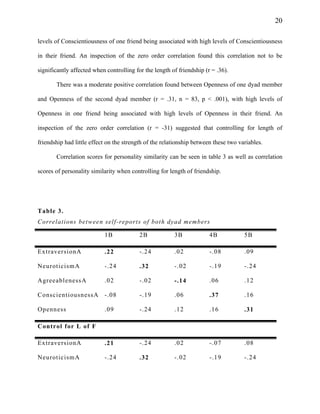
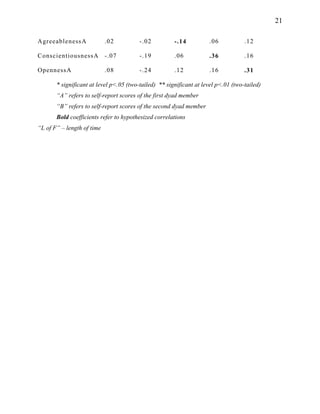
Correlation scores for personality similarity can be seen in table 3 as well as correlation
scores of personality similarity when controlling for length of friendship.
Table 3.
Correlations between self-reports of both dyad members
1B 2B 3B 4B 5B
ExtraversionA .22 -.24 .02 -.08 .09
NeuroticismA -.24 .32 -.02 -.19 -.24
AgreeablenessA .02 -.02 -.14 .06 .12
ConscientiousnessA -.08 -.19 .06 .37 .16
Openness .09 -.24 .12 .16 .31
Control for L of F
ExtraversionA .21 -.24 .02 -.07 .08
NeuroticismA -.24 .32 -.02 -.19 -.24
21
AgreeablenessA .02 -.02 -.14 .06 .12
ConscientiousnessA -.07 -.19 .06 .36 .16
OpennessA .08 -.24 .12 .16 .31
* significant at level p<.05 (two-tailed) ** significant at level p<.01 (two-tailed)
“A” refers to self-report scores of the first dyad member
“B” refers to self-report scores of the second dyad member
Bold coefficients refer to hypothesized correlations
“L of F” – length of time
22
Discussion
According to Kluckhohn and Murray (1950, p.190), “every man is in certain respects (a)
like all other men, (b) like some other men, and (c) like no other man.”
The aim of this study was to investigate the relationship between length of friendship and
similarity among college friends. Furthermore, this study examined the concept that extraverted
individuals are more likely to view friends as similar to themselves; whereas neurotic individuals
are unlikely to view others as similar to themselves.
“To date, personality research has focused primarily on how personality influences
relationship experiences. An equally important issue involves whether relationship experiences
can cause change in personality” (Corr and Matthews, p.511).
This study set out to investigate this particular area in personality research. It was
predicted that the longer an individual’s relationship with their friend was, the more similar the
personalities of the friends would be. Positive correlations were found for similarity for all five
personality factors except Agreeableness.
This finding of this similarity could be linked to implicit egotism; that is, we like what we
associate with ourselves. Part of the attraction to others with similarities to oneself is that it
makes an individual feel good about themselves. Research has shown that individuals view those
similar to themselves as more likeable and attractive (Moreland and Zajonc, 1982). Condon and
Crano (1988) believed this effect to be partly due to the belief that others similar to an individual
will like that individual. Furthermore, Miller and Marks (1982) found that males and females
projected their views onto another same sex peer to a greater extent when they believed that they
23
would be discussing theses views with that peer. As such, it was theorised that this projection
takes place as perceiving more similarity between self and other ensures friendly and pleasant
social interaction.
However, controlling for the length of friendship was shown to have very little effect on
the correlation scores of any of the Big Five personality traits. Therefore, it can be concluded that
although friends show similarity in certain personality traits, the length of time they have known
each other for does not increase similarity in any significant manner.
These findings support those reported by Asendorpf and Wilpers (1998) based on their 18
month longitudinal study of college-age participants. However, Sheese (2005; as cited by Corrs
and Matthews, 2009) reported that over a 14 week interval, participants showed changes in
personality. Izard’s (1960) findings also differ from those found in this study. Izard found that
friends who have known each other over a long time have significantly more similar personality
than those paired at random.
Ready et al (2000) determined that traits which show strong assumed similarity showed
lower self-observer agreement, especially when similarity was controlled for. This finding
suggests that projecting one’s traits onto another may be a phenomenon that occurs when
individuals do not have sufficient information to accurately assess the personality of the other
(Watson et al, 2000). This concept may account for the results found in the present study.
Personality traits have been recorded as showing much weaker similarity among well
acquainted individuals than for characteristics such as age, height, education, smoking, drinking,
etc (Rushton and Bons, 2005; Watson, Hubbard, and Wiese, 2000).
The similarity correlations in this study seem to support certain findings recorded by
previous studies. Watson et al (2000) reported all similarity correlation of the Big Five Factors as
24
below .30, except for Openness in the dating sample, which scored a moderately strong
correlation ( r = .36). McCrae (1996) reported similar results to this. Correlations of .33 and .29
were found for Openness; however, these were the highest scores obtained in the study.
Studies using different personality measure have also shown similar results as those using
the Big Five factors. Waller (1999) found a correlation of .41 for Conventionality; which is a
trait similar to Openness.
On the other hand, Botwin, Buss and Shackelford (1992) and Watson et al (2004) found
no significant correlations for Openness in spouses or dating couples. With regard to the present
study, although Openness was moderately correlated for similarity in accordance with Watson et
al (2000), moderately strong correlations for similarity were also present for Neuroticism and
Conscientiousness which goes against the studies mentioned above.
Although there seems to be a bi-directional influence between social relations and
personality, Asendorpf and Van Aken (2003) found that core personality traits, such as
Extraversion or Agreeableness, are less likely to be affected by social relations than surface
characteristics like loneliness. This finding may account for the lack of significant similarity
found in the present study.
Assumed similarity has been identified as an important factor in social relations
(Newcomb, 1951; Rosenfeld and Jackson, 1959).
This study aimed to ascertain whether assumed similarity would be affected by
Extraversion and Neuroticism. More specifically, it was predicted that the more extraverted an
25
individual is the higher assumed similarity would be. Neurotic individuals were believed to be
negatively related to assumed similarity.
Weak correlations were found for Extraversion and assumed similarity for Agreeableness
and Conscientiousness; however these were not statistically significant.
Weak correlations were also found for Neuroticism and assumed similarity for
Neuroticism, Openness and Conscientiousness. These too were not statistically significant.
These results seem to contradict previous studies on assumed similarity. Significant
positive correlations for personality traits were found by Izard (1960).
More recently, Lee, Bourdage and Ogunfowora (2009) studied a sample of college
students using the HEXACO Personality Inventory (Lee and Ashton, 2004;2006). Their study
found moderately strong correlations for assumed similarity for Honest – humility (a trait with
some similar components as Agreeableness) and Openness to Experience. Similarly, Ready et al
(2000) recorded Eccentric Perception and Propriety as having the highest correlation for assumed
similarity (a trait similar to Openness).
However, Kurtz and Sherker (2003) reported differently in their study of female college
students. Participants were given personality assessments on week 2 and week 15. All
personality factors scored high self-other correlations. Conscientiousness scored significantly
higher than Extraversion in both week 2 and week 15 assessment scores. However, the result
here differs from Lee, Bourdage and Ogunfowora (2009). All trait scores reported by Kurtz and
Sherker were below .30 for assumed similarity and therefore were not found to be strong
correlations.
26
The discrepancy between the results of this study and previous studies may be due to a
few reasons. Firstly, Beer and Watson (2008) found that assumed similarity was greater in first
impressions than in well acquainted others. Furthermore, Watson et al (2000) found greater
assumed similarity for traits with low visibility than those with high visibility. Lee et al (2009)
reported that individuals perceive friends with greater assumed similarity when scoring for traits
central to the personality.
A large variable unaccounted for in this study as well as many other is the cultural
context. Personality traits hold different values in social relations depending on the culture.
“Surprisingly, few studies have examined whether the link between personality and social
relations is influenced by the broader cultural context” (Corr and Matthews, p.512).
Cultural context colours how individuals perceive and interpret the world around them
and as such, has a strong influence on personality and social relations. Chen, French and
Schneider (2006) noted that personality traits may be considered differently according to the
culture. As different cultures may place more importance or value onto certain personality traits,
this most likely will affect the contribution different traits make to social relations as well as
influencing the display of different traits.
Helson, Jones and Kwan (2002) found that when the cultural context involves high rates
of individualism, the personality characteristic of responsibility is present at low rates. In
individualistic cultures, where independence and social interaction is important and celebrated,
traits such as shyness-inhibition are seen as problematic or undesirable. On the other hand, some
cultures view shyness-inhibition as a welcome personality trait. Chen, Wang and DeSouza
27
(2006) reported that collectivistic cultures concerned with interdependence and interpersonal
harmony value shyness-inhibition and the behaviours associated with it.
For example, shyness and behaviours associated with the trait are viewed as socially
negative behaviours in America. Shy children there are more likely to remain isolated or ignored
by their peer groups while shy American men are less likely to initiate relationships (Caspi, Elder
and Bemm, 1988; Ker, Lambert and Bem, 1996).
This situation is almost reversed in collectivistic cultures such as China. Shy children in
China are perceived as more socially mature (Chen, Rubin and Li, 1995) and are more likely to
be associated with higher social status among their peer (Chen, Li, Li, Li and Lui, 2002). Unlike
America, in China extraverted children are viewed as having more aggression and being less
respectful by teachers according to Chen, Rubin and Li (1995).
Graziano (1994) found that cultural differences are also present for Agreeableness; while
Jensen-Campbell, Borja and Knack (2007) reported that Conscientiousness is also affected by
the broader cultural context.
The use of self-report questionnaires also can cause bias in studies such as this. People
can often answer questions based on what they want their personality to be rather than what they
are truly like. Participants may also answer questions according to what they believe you want
them to answer like.
Furthermore, social desirability may also play a role in distorting results. That is, when
answering a questionnaire, participants may feel the need to present themselves in a better or
more favourable way rather than answering honestly and giving an accurate picture of
themselves and their personality.
28
Questionnaire results can also be affected by something as simple as the mood of the
participant. Answers can differ depending on whether or not the participant is in a good mood or
bad mood. In a good mood, a participant may be more inclined to properly judge their
personality and honestly document this; whereas, in a bad mood, a participant may care very
little about the questions and answer question quickly without much thought or insight given to
their personality.
Moving away from the limitations of questionnaires; the simple fact that this study uses
self-reports can cause bias to distort the results.
Many studies have documented the accuracy of individuals in perceptions of themselves;
while others have noted observers as being just as accurate as the person themselves in
describing what their personality is like (Vazire and Mehl, 2008; Kolar, Funder and Colvin,
1996). However, studies such as Anderson et al (1998) found that individuals judge themselves
based more on their thoughts and feelings than on their behaviours. This effect is reversed when
perceiving others; that is, individuals base their perception of others largely on the others’
behaviour.
Roberts et al (2007) reported that self-reports of personality predict behaviour to a large
extent. McAdams (1995) concluded that self perceptions play a vital role in personality.
In contradiction to these previous studies, many have found problems with self-
perceptions. Empirical studies such as Bargh and Williams (2008) found individuals had limited
insight for mental states. Epley and Dunning (2006) found behaviour to be poorly predicted by
the self while preferences (Eastwick and Finkel, 2008) and motives (Schultheiss, Jones, Davis
and Kley, 2008) were also determined to be poorly perceived by the self.
29
However, this problem can be combated by obtaining observer reports from family and
friends for better reliability. Fiedler, Oltmanns and Turkheimer (2004) noted a “compelling
empirical case can be made for the validity of informant reports”.
Although this study did use observer reports, it did not use them to assess the accuracy of
the self-reports provided; instead observer reports were used to evaluate similarity and assumed
similarity. However, further studies would benefit greatly by including informant reports to
obtain more reliable personality scores of participants. This benefit has been shown in previous
studies. Studies such as Ozer and Benet-Martinez (2006) and Roberts et al (2007) have
“established that inventory reports based on self-perceptions and peer perceptions of Big Five
traits or valid predictors of behaviour and meaningful life outcomes” (Srivastava, Guglielmo and
Beer, 2010).
Although many see the use of both self and observer reports as a valid action against bias
in measuring personality, some prefer other-reports instead of self-reports (Hofstee, 1994)
whereas those such as Vazire (2006) believe that self and other reports should be used as part of
a multi-method design.
This study also has limitations in generality. The sample consisted solely on a college
student population. This limits the study’s findings with respect to age and education; and
furthermore, as the sample was taken from a private, fee-paying college, socioeconomic status
among the sample would not be representative of the general population.
McCrae and Costa (1990) determined after an empirical study, that beyond the age of 30
years, personality remains mostly stable. With this in mind, much of the personality similarity
found in this study may be partly influenced by the fact that students in college are still growing
30
psychologically and their personality is not set yet; therefore they perhaps may show a larger
tendency to be influenced by their social relations.
Further research is needed to investigate whether the results found in this study can be
generalized to other sectors of the population or whether they are specific to the age group
represented in this sample.
Finally, this study has not accounted for the frequency of interaction among friend
pairings. Newcomb (1961) determined that randomly assigned college roommates were more
likely to become friends when they frequently interacted. Should this subject be examined in
future studies, the frequency individuals interact with each other should be taken into
consideration.
Research in the area of similarity and assumed similarity has been very useful. Rosenberg
and Jackson (1959) showed that similarity was significantly related to the friendship of a sample
of female office employees. Fiedler (1958) determined that assumed similarity was related to
team effectiveness and leader attitudes.
This present study set out to investigate the relationship between personality similarity
among college friends in relations to the length of time they have been acquainted. The
relationship between assumed similarity and Extraversion and Neuroticism was also examined.
Friends were found to have similar personalities; however, the length of the friendship
had little effect on the similarities. In relation to assumed similarity and the two traits of
Extraversion and Neuroticism, although there were weak correlations for assumed similarity of
31
certain traits, there was no significant relationship between Extraversion and assumed similarity
nor was there any significant findings found for Neuroticism and assumed similarity.
These findings may have been influenced by cultural differences; certain traits hold
different social values depending on the broader cultural context. Further research should also
consider the effect of interaction frequency on social relations. Reliability could also be
strengthened by the use of both self and informant reports as a means of countering biases.
Most importantly, research should be employed in this area using different samples. The
majority of personality similarities have been investigated using college or college-age samples
(Srivastava, Guglielmo and Beer, 2010; Izard, 1960; Lee, Bourdage and Ogunfowora, 2009;
Cuperman and Ickes, 2009).
This means that the results cannot be generalized to the larger population as personality
changes and grows over time (Asendorpf and Wilpers, 1998; Robins, Caspi and Moffitt, 2002).
Despite the limitations discussed, this study replicates certain results from previous studies
(Asendorpf and Wilpers, 1998; Izard, 1960). It also adds to the contradictory results found on the
subject of similarity and assumed similarity.
32
Referencing Section
Andersen, S. M., Glassman, N. S., & Gold, D. A. (1998). Mental Representations of the Self,
Significant Others, and Nonsignificant Others: Structure and Processing of Private and Public
Aspects. Journal of Personality and Social Psychology, 75, 845-861.
Anderson, C., John, O. P., Keltner, D., & Kring, A. M. (2001). Who attains social status? Effects
of personality and physical attractiveness in social groups. Journal of Personality and Social
Psychology, 81, 116-32. doi:10.1037//0022-3514.81.1.116
Asendorpf, J. B., & Van Akens, M. A. (2003). Personality-relationship transaction in
adolescence: core versus surface personality characteristics. Journal of Personality, 71, 1531-44.
Asendorpf, J. B., & Wilpers, S. (1998). Personality effects on social relationships. Journal of
Personality and Social Relationships, 74, 1531-44.
Ashton, M. C., Lee, K., & Paunonen, S. V. (2002). What is the central feature of extraversion?:
Social attention versus reward sensitivity. Journal of Personality and Social Psychology, 83, 245-
51. doi:10.1037//0022-3514.83.1.245
33
Baumeister, R. F., & Leary, M. R. (1995). The need to belong: desire for interpersonal
attachment as a fundamental human motivation. Psychological Bulletin, 117, 497-529.
Beer, A., & Watson, D. (2008). Personality Judgment at Zero Acquaintance: Agreement,
Assumed Similarity, and Implicit Simplicity. Journal of Personality Assessment, 90, 250-260.
doi:10.1080/00223890701884970
Berry, D. S., Willingham, J. K., & Thayer, C. A. (2000). Affect and Personality as Predictors of
Conflict and Closeness in Young Adults' Friendships. Journal of Research in Personality, 34, 84-
107. doi:10.1006/jrpe.1999.2271
Biesanz, J. C., West, S. G., & Millevoi, A. (2007). What do you learn about someone over time?
The relationship between length of acquaintance and consensus and self-other agreement in
judgements of personality. Journal of Personality and Social Psychology, 92(1), 119-135.
doi:10.1037/0022-3514.92.1.119
Bollmer, J. M., Harris, M. J., & Milich, R. (2006). Reactions to bullying and peer victimization:
narratives, physiological arousal, and personality. Journal of Research in Personality, 40, 107-36.
34
Bornstein, R. F. (1989). Exposure and affect: Overview and metaanalysis of research, 1968-
1987. Psychological Bulletin, 106, 265-289. doi: 10.1177/0146167201277011
Boseovski, J. J. (2010). Evidence for "rose-colored glasses": an examination of the positivity
bias in young children's personality judgements. Child Development Perspectives, 4(3), 212-218.
Botwin, M. D., Buss, D. M., & Shackelford, T. K. (1997). personality and mate preferences: five
factors in mate selection and marital satisfaction. Journal of Personality, 35, 107-36.
Caspi, A., Elder, G. H., & Bem, D. J. (1988). Moving away from the world: Life-course patterns
of shy children. Developmental Psychology, 24, 824-31. doi:10.1037//0012-1649.24.6.824
Caspi, A. & Herbener, E. S. (1990). Continuity and change: Assortative marriage and the
consistency of personality in adulthood. Journal of Personality and Social Psychology, 58,
250-258.
Chen, X., French, D. C., & Schneider, B. H. (2006). Peer relationships in cultural context. New
York: Cambridge University Press.
35
Chen, X., Li, D., Li, Z., Li, B., & Liu, M. (2002). Sociable and prosocial dimensions of social
competence in Chinese children: common and unique contributions to social, academic, and
psychological adjustment. Developmental Psychology, 36, 302-14.
Chen, X., Rubin, K., & Li, B. (1995). Social and school adjustment of shy and aggressive
children in China. Developmental and Psychopathology, 7, 337-49.
Chen, X., Wang, L. And DeSouza, A. (2006) Temperment, socioemotional functioning, and peer
relationships in Chinese and North American Children, in X. Chen, D.C. French and B.H.
Schneider (eds.), Peer relations in cultural context, pp. 123-47. New York: Cambridge.
Condon, J, & Crano, W, 1988 Inferred evaluation and the relation between attitude similarity
and interpersonal attraction. Journal of Personality and Social Psychology. 54, 789-
797
Corr, P. J., & Matthews, G. (2009). The Cambridge handbook of personality psychology.
Cambridge, U.K: Cambridge University Press.
36
Costa, P.T., Jr. And McCrae, R. R. (1994) Set like plaster: evidence for the stability of adult
personality, in T. F. Healtherton and J. L. Weinberger (eds.), Can personality change? pp. 21-40.
Washington, DC: American Psychological Association.
Cuperman, R., & Ickes, W. (2009). Big five predictors of behavior and perceptions in initial
dyadic interactions: personality similarity helps extraverts and introverts, but hurts
"disagreeables". Journal of Personality and Social Psychology, 97(4), 667-684.
doi:10.1037/a0015741
Donnellan, M. B., Conger, R. D., & Bryant, C. M. (2004). The Big Five and enduring marriages.
Journal of Research in Personality, 38, 481-504.
Eastwick, P. W., & Finkel, E. J. (2008). Sex Differences in Mate Preferences Revisited: Do
People Know What They Initially Desire in a Romantic Partner?. Journal of Personality and
Social Psychology, 94, 245-264. doi:10.1037/0022-3514.94.2.245
Epley, N., & Dunning, D. (2006). The Mixed Blessings of Self-Knowledge in Behavioral
Prediction: Enhanced Discrimination but Exacerbated Bias. Personality and Social Psychology
Bulletin, 32, 641-655. doi:10.1177/0146167205284007
37
Erez, A., & Judge, T. A. (2001). Relationship of Core Self-Evaluations to Goal Setting,
Motivation, and Performance. Journal of Applied Psychology, 86, 1270-79. doi:10.1037/0021-
9010.86.6.1270
Fiedler, F. E. (1958). Leader attitudes and group effectiveness. Urbana, Univer: Illinois Press.
Funder, D. C., & Ozer, D. J. (1997). Pieces of the personality puzzle: Readings in theory and
research. New York: W.W. Norton.
Funder, D. C., & West, S. G. (1993). Viewpoints on personality: Consensus, self-other
agreement and accuracy in judgements of personality. Journal of Personality, 6(4).
Graziano, W.G. (1994) The development of Agreeableness as a dimension of personality, in C.F.
Halverson, Jr. And G. A. Kohnstomm (eds.) The developing structure of temperament and
personality from infancy to adulthood, pp. 339-54. Hillsdale, NJ: Erlbaum.
Harmon-Jones, E., Allen, J.J.B. (2001). The role of affect in the mere exposure effect: evidence
from psychophysiological and individual differences approaches. Personality and Social
Psychology Bulletin, 27, 889–898. doi: 10.1177/0146167201277011
38
Helson, R., Kwan, V. S., John, O. P., & Jones, C. (2002). The growing evidence for personality
change in adulthood: Findings from research with personality inventories. Journal of Research in
Personality, 36, 287-306. doi:10.1016/S0092-6566(02)00010-7
Hofstee, W. K. (1994). Who should own the definition of personality?. European Journal of
Personality, 8, 149-162.
Human, L. J., & Biesanz, J. C. (2011). Through the looking glass clearly: accuracy and assumed
similarity in well-adjusted individuals' first impressions. Journal of Personality and Social
Psychology, 100(2), 349-364.
Ickes, W., Hutchison, J. And Mashek, D. (2004) Closeness as intersubjectivity: social absorption
and social individuation, in D. Mashek and A. Aron (eds.), The Handbook of closeness and
intimacy, pp. 357-73. Mahwah, NJ: Erlbaum.
Izard, C. E. (1960). Personality similarity and friendship. Journal of Abnormal and Social
Psychology, 61(1), 47-51.
39
Jensen-Campbell, L. A., Adams, R., Perry, D. G., Workman, K. A., Furdella, J. Q., & Egan, S.
K. (2002). Agreeableness, Extraversion, and Peer Relations in Early Adolescence: Winning
Friends and Deflecting Aggression. Journal of Research in Personality, 36, 224-51.
doi:10.1006/jrpe.2002.2348
Jensen-Campbell, L. A., & Graziano, W. G. (2001). Agreeableness as a Moderator of
Interpersonal Conflict. Journal of Personality, 69, 323-62. doi:10.1111/1467-6494.00148
Jensen-Campbell, L. A., Gleason, K. A., & Adams, R. (2003). Interpersonal Conflict,
Agreeableness, and Personality Development. Journal of Personality, 71, 1059-85.
doi:10.1111/1467-6494.7106007
John, O. P., Donahue, E. M., & Kentle, R. L. (1991). The Big Five Inventory--Versions 4a and
54. Berkely, CA: University of California, Berkeley, Institute of Personality and Social
Research.
John, O. P., Naumann, L. P., & Soto, C. J. (2008). Paradigm shift to the integrative Big Five trait
taxonomy: History, measurement, and conceptual issues. In O. P. John, R. W. Robins, &
L. A. Pervin (Eds.), Handbook of personality: Theory and research (pp. 114-158). New
York, NY: Guilford Press.
40
John, O.P. and Srivastava, S. (1999) The Big Five Trait Taxonomy: History, measurement, and
theoretical perspectives. In L.A.Pervin & O.P.John (Eds.), Handbook of Personality:
Theory and Research (2nd ed., pp. 102-138), New York: Guilford Press.
Kerr, M., Lambert, W. W., & Bem, D. J. (1996). Life course sequelae of childhood shyness in
Sweden: Comparison with the United States. Developmental Psychology, 32, 1100-5.
doi:10.1037//0012-1649.32.6.1100
Kluckhohn, C., & Murray, H. A. (1950). Personality in nature, society and culture. New York:
Knopf.
Kolar, D. W., Funder, D. C., & Colvin, C. R. (1996). Comparing the Accuracy of Personality
Judgments by the Self and Knowledgeable Others. Journal of Personality, 64, 311-337.
doi:10.1111/j.1467-6494.1996.tb00513.x
Kurtz, J. E., & Sherker, J. L. (2003). Relationship Quality, Trait Similarity, and Self-Other
Agreement on Personality Ratings in College Roommates. Journal of Personality, 71, 21-48.
41
Kurtz, J. E., & Sherker, J. L. (2003). Relationship quality, trait similarity, and self-other
agreement on personality ratings in college roommates. Journal of Personality, 71(1).
Lee, K., & Ashton, M. (2004). Psychometric Properties of the HEXACO Personality Inventory.
Multivariate Behavioral Research, 39, 329-358. doi:10.1207/s15327906mbr3902_8
Lee, K., & Ashton, M. C. (2006). Further Assessment of the HEXACO Personality Inventory:
Two New Facet Scales and an Observer Report Form. Psychological Assessment, 18, 182-191.
doi:10.1037/1040-3590.18.2.182
Lee, R. Y.P. and Bond, M. H. (1998), Personality and Roommate Friendship in Chinese Culture.
Asian Journal of Social Psychology, 1: 179–190.
doi: 10.1111/1467-839X.00012
Lee, K., Bourdage, J. S., & Ogunfowora, B. (2009). Similarity and assumed similarity in
personality reports of well-acquainted persons. Journal of Personality and Social Psychology,
96(2), 460-472. doi:10.1037/a0014059
42
Liew, J., Eisenberg, N., & Reiser, M. (2004). Preschoolers’ effortful control and negative
emotionality, immediate reactions to disappointment, and quality of social functioning. Journal
of Experimental Child Psychology, 89, 298-319. doi:10.1016/j.jecp.2004.06.004
Lubbers, M. J., Werf, M. P., Kuyper, H., & Offringa, G. J. (2006). Predicting Peer Acceptance in
Dutch YouthA Multilevel Analysis. Journal of Early Adolescence, 26, 4-35.
doi:10.1177/0272431605282747
Marks, G., Miller, N., & Maruyama, G. (1981). Effect of targets' physical attractiveness on
assumptions of similarity. Journal of Personality and Social Psychology, 41, 198-206.
doi:10.1037/0022-3514.41.1.198
McAdams, D. P. (1995). What Do We Know When We Know a Person?. Journal of Personality,
63, 365-395. doi:10.1111/j.1467-6494.1995.tb00500.x
McCrae, R. R. (1996). Social consequences of experiential openness. Psychological Bulletin,
120, 323-337. doi:10.1037//0033-2909.120.3.323
43
McCrae, R. R., and Costa, P. T., Jr. (1997) A five-factor theory of personality. In L. A. Pervin
and O. P. John (eds). Handbook of personality: Theory and research. pp. 139-153. New York:
Guilford Press
Miller, N., & Marks, G. (1982). Assumed similarity between self and other: effect of expectation
of future interaction with that other. Social Psychology Quarterly, 45(2), 100-105.
Moreland, R., & Zajonc, R. (1982). “Exposure effects in person perception: Familiarity,
similarity, and attraction.” Journal of Experimental Social Psychology 18 (5): 395-415.
Newcomb, T. M. (1953). An approach to the study of communicative acts. Psychological
Review, 60, 393-404. doi:10.1037/h0063098
Newcomb, T. M. (1956). The prediction of interpersonal attraction. American Psychologist, 11,
575-586.
Newcomb, T. M. (1961). The acquaintance process. New York: Holt, Rinehart, & Winston.
44
Oltmanns, T. F., Fiedler, E. R., & Turkheimer, E. (2004). Traits Associated with Personality
Disorders and Adjustment to Military Life: Predictive Validity of Self and Peer Reports. Military
Medicine, 169, 207-211.
Ozer, D. J., & Benet-Martínez, V. (2006). Personality and the Prediction of Consequential
Outcomes. Annual Review of Psychology, 57, 401-21.
doi:10.1146/annurev.psych.57.102904.190127
Ready, R. E., Clark, L. A., Watson, D., & Westerhouse, K. (2000). Self and Peer-Reported
Personality: Agreement, Trait Ratability, and the “SelfBased Heuristic”. Journal of Research in
Personality, 34, 208-224. doi:10.1006/jrpe.1999.2280
Roberts, B. W., Helson, R., & Klohnen, E. C. (2002). Personality Development and Growth in
Women Across 30 Years: Three Perspectives. Journal of Personality, 70, 79-102.
doi:10.1111/1467-6494.00179
Roberts, B. W., Kuncel, N., Shiner, R. N., Caspi, A., & Goldberg, L. R. (2007). The power of
personality: The comparative validity of personality traits, socio-economic status, and cognitive
ability for predicting important life outcomes. Perspectives in Psychological Science, 2, 313-345.
45
Robins, R. W., Caspi, A., & Moffitt, T. E. (2000). It's not just who you're with, it's who you are:
personality and relationship experiences across multiple relationships. Journal of Personality and
Social Psychology, 70, 925-64.
Robins, R. W., Caspi, A., & Moffitt, T. E. (2000). Two personalities, one relationship: Both
partners' personality traits shape the quality of their relationship. Journal of Personality and
Social Psychology, 79, 251-9. doi:10.1037//0022-3514.79.2.251
Rosenfeld, H., & Jackson, J. (1959). Effect of similarity of personalities on interpersonal
attraction. American Psychologist, 14, 366-367.
Rushton, J. P., & Bons, T. A. (2005). Mate Choice and Friendship in Twins: Evidence for
Genetic Similarity. Psychological Science, 16, 555-559. doi:10.1111/j.0956-7976.2005.01574.x
Schimel, J., Greenberg, J., Pysczynski, T., O’Mahen, H., Arndt, J. (2000). Running from the
Shadow: Psychological Distancing from Others to Deny Characteristics People Fear in
Themselves. Journal of Personality & Social Psychology, 78, 446-462. doi: 10.1037/0022-
3514.78.3.446
46
Schultheiss, O. C., Jones, N. M., Davis, A. Q., & Kley, C. (2008). The role of implicit motivation
in hot and cold goal pursuit: Effects on goal progress, goal rumination, and emotional well-
being. Journal of Research in Personality, 42, 971-987.
Srivastava, S., Guglielmo, S., & Beer, J. S. (2010). Perceiving others' personalities: examining
the dimensionality, assumed similarity to the self, and stability of perceiver effects. Journal of
Personality and Social Psychology, 98(3), 520-534. doi:10.1037/a0017057
Suls, J., Martin, R., & David, J. P. (1998). Person-Environment Fit and its Limits:
Agreeableness, Neuroticism, and Emotional Reactivity to Interpersonal Conflict. Personality and
Social Psychology Bulletin, 24, 88-98. doi:10.1177/0146167298241007
Vaughan, G. M., & Hogg, M. A. (2010). Essentials of social psychology. Frenchs Forest, N.S.W:
Pearson Australia.
Vazire, S., & Mehl, M. R. (2008). Knowing Me, Knowing You: The Accuracy and Unique
Predictive Validity of Self-Ratings and Other-Ratings of Daily Behavior. Journal of Personality
and Social Psychology, 95, 1202-1216. doi:10.1037/a0013314
47
Vazire, S. (2006). Informant reports: A cheap, fast, and easy method for personality assessment.
Journal of Research in Personality, 40, 472-481. doi:10.1016/j.jrp.2005.03.003
Vazire, S. (2010). Who knows what about a person? The self-other knowledge asymmetry
(SOKA) model. Journal of Personality and Social Psychology, 98(2), 281-300.
doi:10.1037/a0017908
Waller, N.G. (1999). Evaluating the structure of personality. In C. R. Cloninger (ed.) Personality
and psychopathology. pp. 155-197. Washington, DC: American Psychiatric Association.
Watson, D., Klohnen, E. C., Casillas, A., Simms, E. N., Haig, J., & Berry, D. S. (2004). Match
Makers and Deal Breakers: Analyses of Assortative Mating in Newlywed Couples. Journal of
Personality, 72, 1029-1068. doi:10.1111/j.0022-3506.2004.00289.x
Watson, D., Hubbard, B., & Wiese, D. (2000). Self-other agreement in personality and
affectivity: The role of acquaintanceship, trait visibility, and assumed similarity. Journal of
Personality and Social Psychology, 78, 546-58. doi:10.1037//0022-3514.78.3.546
48
White, J. K., Hendrick, S. S., & Hendrick, C. (2004). Big five personality variables and
relationship constructs. Personality and Individual Differences, 37, 1510-30.
doi:10.1016/j.paid.2004.02.019
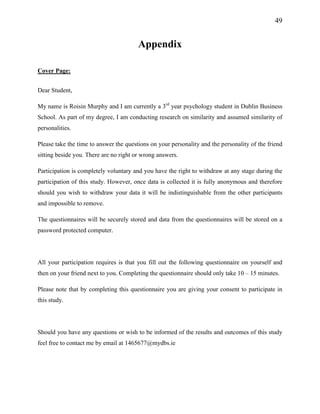
49
Appendix
Cover Page:
Dear Student,
My name is Roisin Murphy and I am currently a 3rd
year psychology student in Dublin Business
School. As part of my degree, I am conducting research on similarity and assumed similarity of
personalities.
Please take the time to answer the questions on your personality and the personality of the friend
sitting beside you. There are no right or wrong answers.
Participation is completely voluntary and you have the right to withdraw at any stage during the
participation of this study. However, once data is collected it is fully anonymous and therefore
should you wish to withdraw your data it will be indistinguishable from the other participants
and impossible to remove.
The questionnaires will be securely stored and data from the questionnaires will be stored on a
password protected computer.
All your participation requires is that you fill out the following questionnaire on yourself and
then on your friend next to you. Completing the questionnaire should only take 10 – 15 minutes.
Please note that by completing this questionnaire you are giving your consent to participate in
this study.
Should you have any questions or wish to be informed of the results and outcomes of this study
feel free to contact me by email at 1465677@mydbs.ie
50
Demographic Sheet:
Demographic Information - Self.
Age: .
Gender: .
Length of Friendship with the other: . (in months)
Demographic Information - Other
Age: .
Gender: .
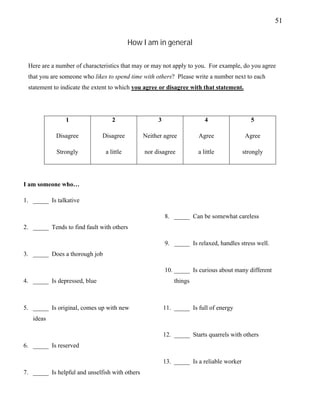
51
How I am in general
Here are a number of characteristics that may or may not apply to you. For example, do you agree
that you are someone who likes to spend time with others? Please write a number next to each
statement to indicate the extent to which you agree or disagree with that statement.
1
Disagree
Strongly
2
Disagree
a little
3
Neither agree
nor disagree
4
Agree
a little
5
Agree
strongly
I am someone who…
1. _____ Is talkative
2. _____ Tends to find fault with others
3. _____ Does a thorough job
4. _____ Is depressed, blue
5. _____ Is original, comes up with new
ideas
6. _____ Is reserved
7. _____ Is helpful and unselfish with others
8. _____ Can be somewhat careless
9. _____ Is relaxed, handles stress well.
10. _____ Is curious about many different
things
11. _____ Is full of energy
12. _____ Starts quarrels with others
13. _____ Is a reliable worker
52
14. _____ Can be tense
15. _____ Is ingenious, a deep thinker
16. _____ Generates a lot of enthusiasm
17. _____ Has a forgiving nature
18. _____ Tends to be disorganized
19. _____ Worries a lot
20. _____ Has an active imagination
21. _____ Tends to be quiet
22. _____ Is generally trusting
23. _____ Tends to be lazy
24. _____ Is emotionally stable, not easily
upset
25. _____ Is inventive
26. _____ Has an assertive personality
27. _____ Can be cold and aloof
28. _____ Perseveres until the task is finished
29. _____ Can be moody
30. _____ Values artistic, aesthetic
experiences
31. _____ Is sometimes shy, inhibited
32. _____ Is considerate and kind to almost
everyone
33. _____ Does things efficiently
34. _____ Remains calm in tense situations
35. _____ Prefers work that is routine
36. _____ Is outgoing, sociable
37. _____ Is sometimes rude to others
53
38. _____ Makes plans and follows through
with them
39. _____ Gets nervous easily
40. _____ Likes to reflect, play with ideas
41. _____ Has few artistic interests
42. _____ Likes to cooperate with others
43. _____ Is easily distracted
44. _____ Is sophisticated in art, music, or
literature
54

Thesis Complete.adobe.

  • 1.
    Roisin Murphy (1465677) Submittedin partial fulfillment of the requirements of the Bachelor of Arts degree (Psychology Specialization) at DBS School of Arts, Dublin. Supervisor: Dr Barbara Caska Head of Department: Dr S Eccles April 2013 Department of Psychology DBS School of Arts
  • 2.
    2 Contents Acknowledgements 3 Abstract 4 Introduction5 Methodology 12 Results 16 Discussion 22 Reference Section 32 Appendix 49
  • 3.
    3 Acknowledgements Firstly, I wouldlike to take this opportunity to thank my supervisor Dr. Barbara Caska for all her help with this study. Likewise, I would also like to thank Dr. Patricia Frazer and Dr Garry Prentice for their advice and support with this study. I would also like to thank all of the people who kindly gave their time and consent to participate in this study. I also owe many thanks to my parents for their patience and support over the past three years.
  • 4.
    4 Abstract This study aimedto investigate the relationship between personality traits – as assessed using the Big Five Inventory – and length of friendship. Also, the affect Extraversion and Neuroticism has on assumed similarity was also looked into. A sample of eighty-six college students (n = 86) participated in this study. Data was analysed using pearson correlations and partial correlations. Results showed that although friends had significantly similar personalities, this was not significantly affected by the length of their friendship. Furthermore, although Extraversion and Neuroticism show some weak correlations with assumed similarity, the relationships found failed to achieve a significant score. Results and limitations are discussed with reference to previous studies in the area of personality psychology.
  • 5.
    5 Introduction “Establishing and maintainingsocial relationships with others are some of the most important tasks an individual faces” (Baumeister and Leary, 1995) The study of personality similarity can offer a great deal of information about the reasons behind individuals forming relationships and how they maintain these social investments. Similarity can be defined as the relation between self-reports of individuals. The relation between the self-report of an individual and his or her observer report on another individual is known as assumed similarity. Similarity between members of social dyads has been widely examined with regards to various physical and psychological traits. Studies using samples of friends, dating couples and spouses have found similarities such as height, age, education, religiosity and even behavioural similarities including drinking, exercise habits and drug use. Correlations of these similarities have been found to score .30 and higher. (Watson et al, 2004). Likewise, Lee and Bond (1960) researched similarity but instead used a sample of roommates from two Hong Kong universities. Their study showed that friendships grew between roommates who shared similar values and personality traits. However, even true similarity was unnecessary for the growth of friendship as strong friendships were formed even when there was only a perceived similarity between the roommates. This suggests that perception plays an important role in our social interactions.
  • 6.
    6 However, studies concerningthe similarity of personality traits tend to report weaker relations between the two than those investigating characteristics such as those previously mentioned. This has been shown in studies such as Rushton and Bons (2005), McCrae (1996) and Watson, Hubbard and Wiese (2000). Similarly, Watson et al (2000) found that similarity correlations of the Big Five personality traits all fell below .30 except that of Openness to Experience which scored a moderately strong .36 in the dating sample. McCrae (1996) found correlations of .33 and .29 for Openness to Experience. However, among the Big Five traits these scores were the highest found. A study by Kurtz and Sherker (2003) also reported similar findings in a sample of female college students. Assessments were given to students (assessment used was the Neo Five Factor Inventory; Costa and McCrae, 1992) on week 2 and week 15. All scores on the NEO-FFI had high self-other correlations. Conscientiousness had significantly higher correlations than Extraversion in both assessments. However, as with finding by previous studies, all traits scored below .30 for assumed similarity and therefore were not found to be a strong correlation. On the other hand, other studies have failed to find a significant correlation for any of the Big Five personality characteristics (Watson et al, 2004; Botwin, Buss and Shackelford, 1992). There have been studies in this area using different personality measures than the Big Five factors. Waller (1999) found that spouses scored a moderately strong similarity correlation of .41 for Conventionality – a trait that is very alike the Big Five characteristic of Openness to Experience. In 2000, Ready et al conducted a study of assumed similarity using the 15 personality scales. The highest correlation report was that of Eccentric Perceptions and Propriety – a trait related to Openness to Experience.
  • 7.
    7 Bourdage and Ogunfousra(2009) studied similarity and assumed similarity using the HEXACO Personality Inventory (HEXACO-PI; Lee and Ashton, 2006). In this study, college students were instructed to complete the questionnaire about themselves and also their friend. It was found that Honesty-humility (a trait with some overlap with the Big Five trait of Agreeableness) and Openness to Experience were indicated to have moderately strong correlations of assumed similarity. All of these findings mentioned provide ample support that relationships are not formed randomly but that there is a tendency to form relations with others based on characteristic similarities whether they are real or assumed. “The influence of personality and social relations is bi-directional, that is, not only does personality influence social relations, but social relations also influence personality development.” (Corrs and Matthews, 2009, p. 516) This is the main theory behind the hypothesis of the present study. It is hypothesized that college friends will have significantly similar personalities, and furthermore, friends who have known each other longer will have more personality similarities than those who have known each other for a shorter period of time. Asendorpf and Wilpers (1998) found that over long periods of time – several months or years – personality and the environment are prone to change. From this we can deduce that both
  • 8.
    8 the individual’s personalityand the social relations they participate in are influential in these changes. This idea is supported by Robins, Caspi and Moffitt (2002) in which they reported that both antecedent personality traits predicted social relations and likewise social relations also predicted personality changes over time. Sheese (2005; as cited by Corrs and Matthews, 2009) added to the research in this area and reported that, in a study of college students personality and social relations during a 14 week interval, it was found that there were personality changes over time. Contrary to this, Asendorpf and Wilpers (1998) found in an 18 month longitudinal study personality affected relationship but did not find a significant relationship for vice versa. Izard (1960) found that friends who have known each other over a long period of time have significantly more similar personality profiles than those paired at random. As seen by the aforementioned studies, similarity among friends when length of relationship is taken into account has left conflicting results. This study wishes to add more recent data to this area of literature. Furthermore, this is not a longitudinal study looking for personality changes over a small length of time. In this study, the personality similarity of students who have known each other for a shorter length of time will be compared to the personality similarity among those whom have been friends for longer lengths of time. In this way, the study is not limited to looking at differences within a short window of time which may not be long enough to witness any significant changes in personalities.
  • 9.
    9 Several studies havefound assumed similarity to be an important factor in social relations (Newcomb, 1961; Fiedler, 1958; Rosenfeld and Jackson, 1959). Izard (1960) reported that friends had significant positive correlations on some individual personality traits. However, what personality traits show a tendency to be assumed similar in friendship dyads and why do they have this tendency? Schimel (2000) found that individuals tend to not like those who present with one’s own negative traits. In other words, a person tends not to like another when they see their own negative traits in that other. This suggests that similarity is a positive and helpful factor in social relations only when the similarity involves positive characteristics. In this study, one positive and one negative personality trait will be considered with regard to assumed similarity among college friends. It is hypothesized that Extraversion will be positively correlated with assumed similarity between friends, whereas Neuroticism will be negatively correlated with assumed similarity. These negative and positive traits were selected on the basis of numerous studies of the effect of different personality characteristics on social relations. For example, Anderson et al (2001) associated Extraversion to social status. Neuroticism on the other hand has been linked to marriage dissatisfaction (Donnellan, Conger and Bryan, 2004). Extraversion has been shown to be negatively linked to the number of conflicts in friendship (Berry, Willingham and Thayer, 2000), associated with social competence in children (Asendorpf and Von Aken, 2003), and peer acceptance (Lubbers et al, 2006). Extraverts are more likely to have smoother interpersonal relations (Ashton, Lee and Paunonen, 2002), whereas Neuroticism has been linked with social
  • 10.
    10 difficulties (Asendorpf andVon Aken, 2003). Neuroticism has also been associated with a negative view of others (Erez and Judge, 2001) which can easily be seen by others as a sign of dislike. Suls, Martin and David (1998) noted that neurotics may have poorer social relations and higher level of victimization because of hypersensitivity to negative events. Bollmur, Harris and Mitich (2006) give an example of the route victimization could occur through. As neurotic individuals have a tendency to experience negative emotions, during conflicts this can present itself in a more angry constitution. Furthermore, neurotic individuals are usually unforgiving and are more likely to put the blame on others which gives rise to a higher likelihood of victimization by their peers. Should assumed similarity be associated with specific traits only, it would be an important topic to be studied. It would give the implication that these specific traits possessed a special property that causes an individual to project that specific trait onto others over other characteristics. Previous studies have used self-reports and observer-reports to study personality (Biesanz, West and Millevoi, 2007; Vazire, 2010). However, most of this research focuses on self-other agreement and accuracy such as Funder and West (1993). This research has been useful in supporting trait theories of personality but has mostly ignored the similarity between the participants – the relation between self-reports of one participant and the self-report of
  • 11.
    11 another participant. Thiswould corroborate general findings that social relationships are not randomly formed but instead are made somewhat based on similarity of certain traits. This study will investigate similarity in relation to the length of friendships among college students. Assumed similarity will also be studied with regard to Extraversion and Neuroticism. Two copies of a personality questionnaire will be given to participants to complete based on themselves (self-report) and then based on their friend (observer-report). Correlations will be used to identify any significant results for the hypothesis.
  • 12.
    12 Methodology Participants The sample usedin this study was a convenience sample consisting of Dublin Business School students. Participants took part in pairs with a friend. Each participant was required to complete self- reports of their personality along with an observer report of their friends personality. Participants were recruited in three ways; firstly they were informed about the present study by their lecturers and a room was booked for them to attend if they wished to take part. Once participants entered the room, they were given the Big Five Inventory (Donahue & Kentle, 1991) to complete based on their self-report of their own personality and their perception of their friend’s personality. Questionnaires included a cover page, demographic page and two copies of the BFI. Each questionnaire was labelled in order to keep the correct questionnaires paired (ie. The first pair of participants received questionnaires labelled 1A and 1B). Students were also approached in the Common Room and asked if they would consider filling out a short questionnaire for the study. It was explained to them that it would only take ten minutes to complete, responses were kept completely anonymous and there was no obligation to take part should they wish not to participate. Lastly, students were enlisted at the beginning of their lecture – with the lecturer’s permission – to fill out the questionnaire if they wished to do so. The lecturer’s permission was ascertained through email correspondence and a time was chosen that was of convenience to the lecturer. The students were given a brief overview of the aim of this study and once again were informed of the length of time
  • 13.
    13 needed to completethe questionnaire, their anonymity, right to refuse to take part and were instructed on how to fill out the questionnaires. Participation was completely voluntary and there was no monetary gain or course credit given for participation. Overall 86 students (42 dyads) participated in this study; females represented 58% of this sample. Ages ranged from 18 to 53 years, with a median age of 21 (m = 21.44, SD = 4.3). Length of friendship was reported between 5 – 156 months (5 months up to 13 years), and a median of 30 months (m = 30.77, SD = 38.9) was recorded. Design This study is a quantitative study with a correlational design. The predictor variables involved are the length of friendship, extraversion and neuroticism scale scores. Criterion variables used in this study are personality similarity and assumed similarity. Participants were not assigned to pairs but were free to choose a partner to pair with themselves. Materials This study used self-administered, paper-and-pencil questionnaires. A small demographic sheet was constructed to obtain information about age, gender and length of friendship.
  • 14.
    14 The Big FiveInventory (Donahue & Kentle, 1991) was used to assess the personality of participants. This questionnaire measures the following personality traits; Extraversion (8 statements: eg. “is talkative”), Agreeableness (9 statements: eg. “is generally trusting”), Openness (10 statements: eg. “is curious about many different things”), Conscientiousness (9 statements: eg. “is a reliable worker”) and Neuroticism (8 statements: eg. “can be moody”). Alpha reliabilities were reported for subscales as E = .88; A = .79; C = .82; N = .84; O = .81 (John and Srivastava, 1999). There are 44 questions in the Big Five Inventory. Participants completed two copies of the Big Five Inventory; the first copy based on their personality and the second copy was in relation to their friend’s personality. Responses were recorded according to a likert scale ranging from 1 (disagree strongly) to 5 (agree strongly). Procedure A cover note was supplied regarding information of the study. It included information regarding the anonymity of the data collected, and that although participation is completely voluntary, once data is collected it is indistinguishable from other participant’s data and therefore cannot be removed. The cover note also stated that questionnaires would be securely stored and data collected from these questionnaires would be stored on a password protected computer. Participants were also warned that by completing the questionnaire they were giving their consent to participate in this study.
  • 15.
    15 Finally an emailaddress was also given should any participant have questions or wish to be informed of the results of the study. Participants were also given a verbal account of the general aim of the study – ie. that this study is to investigate personality among college friends. Furthermore, it was emphasized that students were under no obligation to participate in this study. They were then instructed to take the questionnaire in pairs of friends. It was then explained that the first questionnaire was to be answered based on your own personality and the second questionnaire was to be answered based on you perception of your friends personality. Participants were reminded that these questionnaires were to be answered based on their opinion and therefore they were not to consult with each other when filling out the questionnaires. It was advised that the questionnaire should only take between 10 – 15 minutes to complete. Once all the questionnaires were returned participants were thanked for their involvement and asked if they had any questions. Finally they were reminded that should they wish to, they can contact the provided email address.
  • 16.
    16 Results. Descriptive Statistics. Descriptive statisticswere obtained for the five personality factors (Extraversion, Neuroticism, Agreeableness, Conscientiousness, and Openness to Experience), and participants ages and genders and are shown in Table 1. Table 2 shows correlations of assumed similarity in the personality of friends. Table 3 shows the statistics between correlations of paired friends self-reports – ie. personality similarity – both with and without controlling for length of friendship Table 1. Descriptive statistics. N M SD Age 86 21.44 4.32 Gender 86 1.58 .49 Length of friendship 86 30.77 31.88 Extraversion 86 3.56 .61 Neuroticism 86 2.92 .60 Conscientiousness 86 3.41 .60 Openness 86 3.56 .57 Agreeableness 86 3.66 .62 * significant at level p<.05 (two-tailed) ** significant at level p<.01 (two-tailed)
  • 17.
    17 Inferential Statistics To determinewhether personality characteristics were related to assumed similarity, correlations were calculated between the self-report scores of participants and their observer- reports of their friend’s personality. Histograms were obtained to ensure that data fell into the range of normal distribution. This was to investigate whether outliers would cause testing to be unreliable. All data fell within normal parameters. The first hypothesis of the current study stated that extraverted participants would assume their friend to be similar. That is, it was expected to find significant positive correlation between Extraversion and assumed similarity. The relationship between Extraversion and assumed similarity was explored using Pearsons Correlation. Two variables showed weak correlations; Agreeableness (r = .12) and Conscientiousness (r = -.18). However, there was no significant results observed between Extraversion and assumed similarity concerning any of the five personality factors (see table 2). The null hypothesis is accepted. The second hypothesis of this study stated that Neuroticism would be negatively correlated with assumed-similarity. In other words, Neurotic participants would be less likely to assume similarities with their paired friend. It was expected that Neuroticism would be significantly, negatively correlated with assumed similarity.
  • 18.
    18 The relationship betweenNeuroticism and assumed similarity of personality factors was investigated using Pearson Correlation. Weak correlations were found for Conscientiousness (r = -.17), Neuroticism (r = .12) and Openness (r = .10). However, none of the correlations found were significant for any of the personality factors (see table 3). The null hypothesis is accepted. The correlation scores of assumed similarity can be seen in Table 2. Table 2. Correleations of assumed similarity of friends (self-reports and observer-reports) 1 B 2 B 3 B 4 B 5 B 1.Extraversion A .09 -.08 -.04 -.12 -.18 2.Neuroticism A -.06 .12 .10 .04 -.17 3.Openness A .05 .06 .09 -.19 -.03 4.Agreeableness A .14 -.09 .28* .35** .16 5.Conscientiousness A -.01 -.24* .14 .07 .33** * significant at level p<.05 (two-tailed) ** significant at level p<.01 (two-tailed) “A” refers to self-report scores “B” refers to observer-report scores Bold coefficients refer to hypothesized correlations
  • 19.
    19 Hypothesis 3 statedthat those with a longer length of friendship would be more similar than those with a shorter friendship. To investigate the relationship between similarity and length of friendship a Partial Correlation was applied. Partial Correlation explored self-reported personality scores of participants and self-reported personality scores of their paired friend, while controlling for the duration of their friendship. There was a moderate, positive partial correlation between Neuroticism of one dyad member and Neuroticism of the second dyad member (r = .32, n = 83, p < .001), with high levels of Neuroticism being associated with high levels of Neuroticism in friends. An inspection of the zero correlation (r = .32) suggested that controlling for length of friendship had little effect on the strength of the relationship between these two variables. There was a weak, positive partial correlation between Extraversion of one dyad member and Extraversion of the second dyad member (r = .22, n = 83, p < .001), with high levels of Extraversion being associated with high levels of Extraversion in friends. An inspection of the zero order correlation (r = .21) suggested that controlling for length of friendship between these two variables had little effect on the correlation strength. There was a weak, negative correlation found between the Agreeableness of one dyad member and the Agreeableness of the second dyad member; however, this was found not to be significant (r = -.14, n = 83, p = .19). An inspection of the zero order correlation found this correlation not to be significantly affected when controlling for the length of friendship (r = - .14). There was a moderate positive correlation between Conscientiousness of one dyad member and Conscientiousness of the second dyad member (r = .37, n = 83, p < .001), with high
  • 20.
    20 levels of Conscientiousnessof one friend being associated with high levels of Conscientiousness in their friend. An inspection of the zero order correlation found this correlation not to be significantly affected when controlling for the length of friendship (r = .36). There was a moderate positive correlation found between Openness of one dyad member and Openness of the second dyad member (r = .31, n = 83, p < .001), with high levels of Openness in one friend being associated with high levels of Openness in their friend. An inspection of the zero order correlation (r = -31) suggested that controlling for length of friendship had little effect on the strength of the relationship between these two variables. Correlation scores for personality similarity can be seen in table 3 as well as correlation scores of personality similarity when controlling for length of friendship. Table 3. Correlations between self-reports of both dyad members 1B 2B 3B 4B 5B ExtraversionA .22 -.24 .02 -.08 .09 NeuroticismA -.24 .32 -.02 -.19 -.24 AgreeablenessA .02 -.02 -.14 .06 .12 ConscientiousnessA -.08 -.19 .06 .37 .16 Openness .09 -.24 .12 .16 .31 Control for L of F ExtraversionA .21 -.24 .02 -.07 .08 NeuroticismA -.24 .32 -.02 -.19 -.24
  • 21.
    21 AgreeablenessA .02 -.02-.14 .06 .12 ConscientiousnessA -.07 -.19 .06 .36 .16 OpennessA .08 -.24 .12 .16 .31 * significant at level p<.05 (two-tailed) ** significant at level p<.01 (two-tailed) “A” refers to self-report scores of the first dyad member “B” refers to self-report scores of the second dyad member Bold coefficients refer to hypothesized correlations “L of F” – length of time
  • 22.
    22 Discussion According to Kluckhohnand Murray (1950, p.190), “every man is in certain respects (a) like all other men, (b) like some other men, and (c) like no other man.” The aim of this study was to investigate the relationship between length of friendship and similarity among college friends. Furthermore, this study examined the concept that extraverted individuals are more likely to view friends as similar to themselves; whereas neurotic individuals are unlikely to view others as similar to themselves. “To date, personality research has focused primarily on how personality influences relationship experiences. An equally important issue involves whether relationship experiences can cause change in personality” (Corr and Matthews, p.511). This study set out to investigate this particular area in personality research. It was predicted that the longer an individual’s relationship with their friend was, the more similar the personalities of the friends would be. Positive correlations were found for similarity for all five personality factors except Agreeableness. This finding of this similarity could be linked to implicit egotism; that is, we like what we associate with ourselves. Part of the attraction to others with similarities to oneself is that it makes an individual feel good about themselves. Research has shown that individuals view those similar to themselves as more likeable and attractive (Moreland and Zajonc, 1982). Condon and Crano (1988) believed this effect to be partly due to the belief that others similar to an individual will like that individual. Furthermore, Miller and Marks (1982) found that males and females projected their views onto another same sex peer to a greater extent when they believed that they
  • 23.
    23 would be discussingtheses views with that peer. As such, it was theorised that this projection takes place as perceiving more similarity between self and other ensures friendly and pleasant social interaction. However, controlling for the length of friendship was shown to have very little effect on the correlation scores of any of the Big Five personality traits. Therefore, it can be concluded that although friends show similarity in certain personality traits, the length of time they have known each other for does not increase similarity in any significant manner. These findings support those reported by Asendorpf and Wilpers (1998) based on their 18 month longitudinal study of college-age participants. However, Sheese (2005; as cited by Corrs and Matthews, 2009) reported that over a 14 week interval, participants showed changes in personality. Izard’s (1960) findings also differ from those found in this study. Izard found that friends who have known each other over a long time have significantly more similar personality than those paired at random. Ready et al (2000) determined that traits which show strong assumed similarity showed lower self-observer agreement, especially when similarity was controlled for. This finding suggests that projecting one’s traits onto another may be a phenomenon that occurs when individuals do not have sufficient information to accurately assess the personality of the other (Watson et al, 2000). This concept may account for the results found in the present study. Personality traits have been recorded as showing much weaker similarity among well acquainted individuals than for characteristics such as age, height, education, smoking, drinking, etc (Rushton and Bons, 2005; Watson, Hubbard, and Wiese, 2000). The similarity correlations in this study seem to support certain findings recorded by previous studies. Watson et al (2000) reported all similarity correlation of the Big Five Factors as
  • 24.
    24 below .30, exceptfor Openness in the dating sample, which scored a moderately strong correlation ( r = .36). McCrae (1996) reported similar results to this. Correlations of .33 and .29 were found for Openness; however, these were the highest scores obtained in the study. Studies using different personality measure have also shown similar results as those using the Big Five factors. Waller (1999) found a correlation of .41 for Conventionality; which is a trait similar to Openness. On the other hand, Botwin, Buss and Shackelford (1992) and Watson et al (2004) found no significant correlations for Openness in spouses or dating couples. With regard to the present study, although Openness was moderately correlated for similarity in accordance with Watson et al (2000), moderately strong correlations for similarity were also present for Neuroticism and Conscientiousness which goes against the studies mentioned above. Although there seems to be a bi-directional influence between social relations and personality, Asendorpf and Van Aken (2003) found that core personality traits, such as Extraversion or Agreeableness, are less likely to be affected by social relations than surface characteristics like loneliness. This finding may account for the lack of significant similarity found in the present study. Assumed similarity has been identified as an important factor in social relations (Newcomb, 1951; Rosenfeld and Jackson, 1959). This study aimed to ascertain whether assumed similarity would be affected by Extraversion and Neuroticism. More specifically, it was predicted that the more extraverted an
  • 25.
    25 individual is thehigher assumed similarity would be. Neurotic individuals were believed to be negatively related to assumed similarity. Weak correlations were found for Extraversion and assumed similarity for Agreeableness and Conscientiousness; however these were not statistically significant. Weak correlations were also found for Neuroticism and assumed similarity for Neuroticism, Openness and Conscientiousness. These too were not statistically significant. These results seem to contradict previous studies on assumed similarity. Significant positive correlations for personality traits were found by Izard (1960). More recently, Lee, Bourdage and Ogunfowora (2009) studied a sample of college students using the HEXACO Personality Inventory (Lee and Ashton, 2004;2006). Their study found moderately strong correlations for assumed similarity for Honest – humility (a trait with some similar components as Agreeableness) and Openness to Experience. Similarly, Ready et al (2000) recorded Eccentric Perception and Propriety as having the highest correlation for assumed similarity (a trait similar to Openness). However, Kurtz and Sherker (2003) reported differently in their study of female college students. Participants were given personality assessments on week 2 and week 15. All personality factors scored high self-other correlations. Conscientiousness scored significantly higher than Extraversion in both week 2 and week 15 assessment scores. However, the result here differs from Lee, Bourdage and Ogunfowora (2009). All trait scores reported by Kurtz and Sherker were below .30 for assumed similarity and therefore were not found to be strong correlations.
  • 26.
    26 The discrepancy betweenthe results of this study and previous studies may be due to a few reasons. Firstly, Beer and Watson (2008) found that assumed similarity was greater in first impressions than in well acquainted others. Furthermore, Watson et al (2000) found greater assumed similarity for traits with low visibility than those with high visibility. Lee et al (2009) reported that individuals perceive friends with greater assumed similarity when scoring for traits central to the personality. A large variable unaccounted for in this study as well as many other is the cultural context. Personality traits hold different values in social relations depending on the culture. “Surprisingly, few studies have examined whether the link between personality and social relations is influenced by the broader cultural context” (Corr and Matthews, p.512). Cultural context colours how individuals perceive and interpret the world around them and as such, has a strong influence on personality and social relations. Chen, French and Schneider (2006) noted that personality traits may be considered differently according to the culture. As different cultures may place more importance or value onto certain personality traits, this most likely will affect the contribution different traits make to social relations as well as influencing the display of different traits. Helson, Jones and Kwan (2002) found that when the cultural context involves high rates of individualism, the personality characteristic of responsibility is present at low rates. In individualistic cultures, where independence and social interaction is important and celebrated, traits such as shyness-inhibition are seen as problematic or undesirable. On the other hand, some cultures view shyness-inhibition as a welcome personality trait. Chen, Wang and DeSouza
  • 27.
    27 (2006) reported thatcollectivistic cultures concerned with interdependence and interpersonal harmony value shyness-inhibition and the behaviours associated with it. For example, shyness and behaviours associated with the trait are viewed as socially negative behaviours in America. Shy children there are more likely to remain isolated or ignored by their peer groups while shy American men are less likely to initiate relationships (Caspi, Elder and Bemm, 1988; Ker, Lambert and Bem, 1996). This situation is almost reversed in collectivistic cultures such as China. Shy children in China are perceived as more socially mature (Chen, Rubin and Li, 1995) and are more likely to be associated with higher social status among their peer (Chen, Li, Li, Li and Lui, 2002). Unlike America, in China extraverted children are viewed as having more aggression and being less respectful by teachers according to Chen, Rubin and Li (1995). Graziano (1994) found that cultural differences are also present for Agreeableness; while Jensen-Campbell, Borja and Knack (2007) reported that Conscientiousness is also affected by the broader cultural context. The use of self-report questionnaires also can cause bias in studies such as this. People can often answer questions based on what they want their personality to be rather than what they are truly like. Participants may also answer questions according to what they believe you want them to answer like. Furthermore, social desirability may also play a role in distorting results. That is, when answering a questionnaire, participants may feel the need to present themselves in a better or more favourable way rather than answering honestly and giving an accurate picture of themselves and their personality.
  • 28.
    28 Questionnaire results canalso be affected by something as simple as the mood of the participant. Answers can differ depending on whether or not the participant is in a good mood or bad mood. In a good mood, a participant may be more inclined to properly judge their personality and honestly document this; whereas, in a bad mood, a participant may care very little about the questions and answer question quickly without much thought or insight given to their personality. Moving away from the limitations of questionnaires; the simple fact that this study uses self-reports can cause bias to distort the results. Many studies have documented the accuracy of individuals in perceptions of themselves; while others have noted observers as being just as accurate as the person themselves in describing what their personality is like (Vazire and Mehl, 2008; Kolar, Funder and Colvin, 1996). However, studies such as Anderson et al (1998) found that individuals judge themselves based more on their thoughts and feelings than on their behaviours. This effect is reversed when perceiving others; that is, individuals base their perception of others largely on the others’ behaviour. Roberts et al (2007) reported that self-reports of personality predict behaviour to a large extent. McAdams (1995) concluded that self perceptions play a vital role in personality. In contradiction to these previous studies, many have found problems with self- perceptions. Empirical studies such as Bargh and Williams (2008) found individuals had limited insight for mental states. Epley and Dunning (2006) found behaviour to be poorly predicted by the self while preferences (Eastwick and Finkel, 2008) and motives (Schultheiss, Jones, Davis and Kley, 2008) were also determined to be poorly perceived by the self.
  • 29.
    29 However, this problemcan be combated by obtaining observer reports from family and friends for better reliability. Fiedler, Oltmanns and Turkheimer (2004) noted a “compelling empirical case can be made for the validity of informant reports”. Although this study did use observer reports, it did not use them to assess the accuracy of the self-reports provided; instead observer reports were used to evaluate similarity and assumed similarity. However, further studies would benefit greatly by including informant reports to obtain more reliable personality scores of participants. This benefit has been shown in previous studies. Studies such as Ozer and Benet-Martinez (2006) and Roberts et al (2007) have “established that inventory reports based on self-perceptions and peer perceptions of Big Five traits or valid predictors of behaviour and meaningful life outcomes” (Srivastava, Guglielmo and Beer, 2010). Although many see the use of both self and observer reports as a valid action against bias in measuring personality, some prefer other-reports instead of self-reports (Hofstee, 1994) whereas those such as Vazire (2006) believe that self and other reports should be used as part of a multi-method design. This study also has limitations in generality. The sample consisted solely on a college student population. This limits the study’s findings with respect to age and education; and furthermore, as the sample was taken from a private, fee-paying college, socioeconomic status among the sample would not be representative of the general population. McCrae and Costa (1990) determined after an empirical study, that beyond the age of 30 years, personality remains mostly stable. With this in mind, much of the personality similarity found in this study may be partly influenced by the fact that students in college are still growing
  • 30.
    30 psychologically and theirpersonality is not set yet; therefore they perhaps may show a larger tendency to be influenced by their social relations. Further research is needed to investigate whether the results found in this study can be generalized to other sectors of the population or whether they are specific to the age group represented in this sample. Finally, this study has not accounted for the frequency of interaction among friend pairings. Newcomb (1961) determined that randomly assigned college roommates were more likely to become friends when they frequently interacted. Should this subject be examined in future studies, the frequency individuals interact with each other should be taken into consideration. Research in the area of similarity and assumed similarity has been very useful. Rosenberg and Jackson (1959) showed that similarity was significantly related to the friendship of a sample of female office employees. Fiedler (1958) determined that assumed similarity was related to team effectiveness and leader attitudes. This present study set out to investigate the relationship between personality similarity among college friends in relations to the length of time they have been acquainted. The relationship between assumed similarity and Extraversion and Neuroticism was also examined. Friends were found to have similar personalities; however, the length of the friendship had little effect on the similarities. In relation to assumed similarity and the two traits of Extraversion and Neuroticism, although there were weak correlations for assumed similarity of
  • 31.
    31 certain traits, therewas no significant relationship between Extraversion and assumed similarity nor was there any significant findings found for Neuroticism and assumed similarity. These findings may have been influenced by cultural differences; certain traits hold different social values depending on the broader cultural context. Further research should also consider the effect of interaction frequency on social relations. Reliability could also be strengthened by the use of both self and informant reports as a means of countering biases. Most importantly, research should be employed in this area using different samples. The majority of personality similarities have been investigated using college or college-age samples (Srivastava, Guglielmo and Beer, 2010; Izard, 1960; Lee, Bourdage and Ogunfowora, 2009; Cuperman and Ickes, 2009). This means that the results cannot be generalized to the larger population as personality changes and grows over time (Asendorpf and Wilpers, 1998; Robins, Caspi and Moffitt, 2002). Despite the limitations discussed, this study replicates certain results from previous studies (Asendorpf and Wilpers, 1998; Izard, 1960). It also adds to the contradictory results found on the subject of similarity and assumed similarity.
  • 32.
    32 Referencing Section Andersen, S.M., Glassman, N. S., & Gold, D. A. (1998). Mental Representations of the Self, Significant Others, and Nonsignificant Others: Structure and Processing of Private and Public Aspects. Journal of Personality and Social Psychology, 75, 845-861. Anderson, C., John, O. P., Keltner, D., & Kring, A. M. (2001). Who attains social status? Effects of personality and physical attractiveness in social groups. Journal of Personality and Social Psychology, 81, 116-32. doi:10.1037//0022-3514.81.1.116 Asendorpf, J. B., & Van Akens, M. A. (2003). Personality-relationship transaction in adolescence: core versus surface personality characteristics. Journal of Personality, 71, 1531-44. Asendorpf, J. B., & Wilpers, S. (1998). Personality effects on social relationships. Journal of Personality and Social Relationships, 74, 1531-44. Ashton, M. C., Lee, K., & Paunonen, S. V. (2002). What is the central feature of extraversion?: Social attention versus reward sensitivity. Journal of Personality and Social Psychology, 83, 245- 51. doi:10.1037//0022-3514.83.1.245
  • 33.
    33 Baumeister, R. F.,& Leary, M. R. (1995). The need to belong: desire for interpersonal attachment as a fundamental human motivation. Psychological Bulletin, 117, 497-529. Beer, A., & Watson, D. (2008). Personality Judgment at Zero Acquaintance: Agreement, Assumed Similarity, and Implicit Simplicity. Journal of Personality Assessment, 90, 250-260. doi:10.1080/00223890701884970 Berry, D. S., Willingham, J. K., & Thayer, C. A. (2000). Affect and Personality as Predictors of Conflict and Closeness in Young Adults' Friendships. Journal of Research in Personality, 34, 84- 107. doi:10.1006/jrpe.1999.2271 Biesanz, J. C., West, S. G., & Millevoi, A. (2007). What do you learn about someone over time? The relationship between length of acquaintance and consensus and self-other agreement in judgements of personality. Journal of Personality and Social Psychology, 92(1), 119-135. doi:10.1037/0022-3514.92.1.119 Bollmer, J. M., Harris, M. J., & Milich, R. (2006). Reactions to bullying and peer victimization: narratives, physiological arousal, and personality. Journal of Research in Personality, 40, 107-36.
  • 34.
    34 Bornstein, R. F.(1989). Exposure and affect: Overview and metaanalysis of research, 1968- 1987. Psychological Bulletin, 106, 265-289. doi: 10.1177/0146167201277011 Boseovski, J. J. (2010). Evidence for "rose-colored glasses": an examination of the positivity bias in young children's personality judgements. Child Development Perspectives, 4(3), 212-218. Botwin, M. D., Buss, D. M., & Shackelford, T. K. (1997). personality and mate preferences: five factors in mate selection and marital satisfaction. Journal of Personality, 35, 107-36. Caspi, A., Elder, G. H., & Bem, D. J. (1988). Moving away from the world: Life-course patterns of shy children. Developmental Psychology, 24, 824-31. doi:10.1037//0012-1649.24.6.824 Caspi, A. & Herbener, E. S. (1990). Continuity and change: Assortative marriage and the consistency of personality in adulthood. Journal of Personality and Social Psychology, 58, 250-258. Chen, X., French, D. C., & Schneider, B. H. (2006). Peer relationships in cultural context. New York: Cambridge University Press.
  • 35.
    35 Chen, X., Li,D., Li, Z., Li, B., & Liu, M. (2002). Sociable and prosocial dimensions of social competence in Chinese children: common and unique contributions to social, academic, and psychological adjustment. Developmental Psychology, 36, 302-14. Chen, X., Rubin, K., & Li, B. (1995). Social and school adjustment of shy and aggressive children in China. Developmental and Psychopathology, 7, 337-49. Chen, X., Wang, L. And DeSouza, A. (2006) Temperment, socioemotional functioning, and peer relationships in Chinese and North American Children, in X. Chen, D.C. French and B.H. Schneider (eds.), Peer relations in cultural context, pp. 123-47. New York: Cambridge. Condon, J, & Crano, W, 1988 Inferred evaluation and the relation between attitude similarity and interpersonal attraction. Journal of Personality and Social Psychology. 54, 789- 797 Corr, P. J., & Matthews, G. (2009). The Cambridge handbook of personality psychology. Cambridge, U.K: Cambridge University Press.
  • 36.
    36 Costa, P.T., Jr.And McCrae, R. R. (1994) Set like plaster: evidence for the stability of adult personality, in T. F. Healtherton and J. L. Weinberger (eds.), Can personality change? pp. 21-40. Washington, DC: American Psychological Association. Cuperman, R., & Ickes, W. (2009). Big five predictors of behavior and perceptions in initial dyadic interactions: personality similarity helps extraverts and introverts, but hurts "disagreeables". Journal of Personality and Social Psychology, 97(4), 667-684. doi:10.1037/a0015741 Donnellan, M. B., Conger, R. D., & Bryant, C. M. (2004). The Big Five and enduring marriages. Journal of Research in Personality, 38, 481-504. Eastwick, P. W., & Finkel, E. J. (2008). Sex Differences in Mate Preferences Revisited: Do People Know What They Initially Desire in a Romantic Partner?. Journal of Personality and Social Psychology, 94, 245-264. doi:10.1037/0022-3514.94.2.245 Epley, N., & Dunning, D. (2006). The Mixed Blessings of Self-Knowledge in Behavioral Prediction: Enhanced Discrimination but Exacerbated Bias. Personality and Social Psychology Bulletin, 32, 641-655. doi:10.1177/0146167205284007
  • 37.
    37 Erez, A., &Judge, T. A. (2001). Relationship of Core Self-Evaluations to Goal Setting, Motivation, and Performance. Journal of Applied Psychology, 86, 1270-79. doi:10.1037/0021- 9010.86.6.1270 Fiedler, F. E. (1958). Leader attitudes and group effectiveness. Urbana, Univer: Illinois Press. Funder, D. C., & Ozer, D. J. (1997). Pieces of the personality puzzle: Readings in theory and research. New York: W.W. Norton. Funder, D. C., & West, S. G. (1993). Viewpoints on personality: Consensus, self-other agreement and accuracy in judgements of personality. Journal of Personality, 6(4). Graziano, W.G. (1994) The development of Agreeableness as a dimension of personality, in C.F. Halverson, Jr. And G. A. Kohnstomm (eds.) The developing structure of temperament and personality from infancy to adulthood, pp. 339-54. Hillsdale, NJ: Erlbaum. Harmon-Jones, E., Allen, J.J.B. (2001). The role of affect in the mere exposure effect: evidence from psychophysiological and individual differences approaches. Personality and Social Psychology Bulletin, 27, 889–898. doi: 10.1177/0146167201277011
  • 38.
    38 Helson, R., Kwan,V. S., John, O. P., & Jones, C. (2002). The growing evidence for personality change in adulthood: Findings from research with personality inventories. Journal of Research in Personality, 36, 287-306. doi:10.1016/S0092-6566(02)00010-7 Hofstee, W. K. (1994). Who should own the definition of personality?. European Journal of Personality, 8, 149-162. Human, L. J., & Biesanz, J. C. (2011). Through the looking glass clearly: accuracy and assumed similarity in well-adjusted individuals' first impressions. Journal of Personality and Social Psychology, 100(2), 349-364. Ickes, W., Hutchison, J. And Mashek, D. (2004) Closeness as intersubjectivity: social absorption and social individuation, in D. Mashek and A. Aron (eds.), The Handbook of closeness and intimacy, pp. 357-73. Mahwah, NJ: Erlbaum. Izard, C. E. (1960). Personality similarity and friendship. Journal of Abnormal and Social Psychology, 61(1), 47-51.
  • 39.
    39 Jensen-Campbell, L. A.,Adams, R., Perry, D. G., Workman, K. A., Furdella, J. Q., & Egan, S. K. (2002). Agreeableness, Extraversion, and Peer Relations in Early Adolescence: Winning Friends and Deflecting Aggression. Journal of Research in Personality, 36, 224-51. doi:10.1006/jrpe.2002.2348 Jensen-Campbell, L. A., & Graziano, W. G. (2001). Agreeableness as a Moderator of Interpersonal Conflict. Journal of Personality, 69, 323-62. doi:10.1111/1467-6494.00148 Jensen-Campbell, L. A., Gleason, K. A., & Adams, R. (2003). Interpersonal Conflict, Agreeableness, and Personality Development. Journal of Personality, 71, 1059-85. doi:10.1111/1467-6494.7106007 John, O. P., Donahue, E. M., & Kentle, R. L. (1991). The Big Five Inventory--Versions 4a and 54. Berkely, CA: University of California, Berkeley, Institute of Personality and Social Research. John, O. P., Naumann, L. P., & Soto, C. J. (2008). Paradigm shift to the integrative Big Five trait taxonomy: History, measurement, and conceptual issues. In O. P. John, R. W. Robins, & L. A. Pervin (Eds.), Handbook of personality: Theory and research (pp. 114-158). New York, NY: Guilford Press.
  • 40.
    40 John, O.P. andSrivastava, S. (1999) The Big Five Trait Taxonomy: History, measurement, and theoretical perspectives. In L.A.Pervin & O.P.John (Eds.), Handbook of Personality: Theory and Research (2nd ed., pp. 102-138), New York: Guilford Press. Kerr, M., Lambert, W. W., & Bem, D. J. (1996). Life course sequelae of childhood shyness in Sweden: Comparison with the United States. Developmental Psychology, 32, 1100-5. doi:10.1037//0012-1649.32.6.1100 Kluckhohn, C., & Murray, H. A. (1950). Personality in nature, society and culture. New York: Knopf. Kolar, D. W., Funder, D. C., & Colvin, C. R. (1996). Comparing the Accuracy of Personality Judgments by the Self and Knowledgeable Others. Journal of Personality, 64, 311-337. doi:10.1111/j.1467-6494.1996.tb00513.x Kurtz, J. E., & Sherker, J. L. (2003). Relationship Quality, Trait Similarity, and Self-Other Agreement on Personality Ratings in College Roommates. Journal of Personality, 71, 21-48.
  • 41.
    41 Kurtz, J. E.,& Sherker, J. L. (2003). Relationship quality, trait similarity, and self-other agreement on personality ratings in college roommates. Journal of Personality, 71(1). Lee, K., & Ashton, M. (2004). Psychometric Properties of the HEXACO Personality Inventory. Multivariate Behavioral Research, 39, 329-358. doi:10.1207/s15327906mbr3902_8 Lee, K., & Ashton, M. C. (2006). Further Assessment of the HEXACO Personality Inventory: Two New Facet Scales and an Observer Report Form. Psychological Assessment, 18, 182-191. doi:10.1037/1040-3590.18.2.182 Lee, R. Y.P. and Bond, M. H. (1998), Personality and Roommate Friendship in Chinese Culture. Asian Journal of Social Psychology, 1: 179–190. doi: 10.1111/1467-839X.00012 Lee, K., Bourdage, J. S., & Ogunfowora, B. (2009). Similarity and assumed similarity in personality reports of well-acquainted persons. Journal of Personality and Social Psychology, 96(2), 460-472. doi:10.1037/a0014059
  • 42.
    42 Liew, J., Eisenberg,N., & Reiser, M. (2004). Preschoolers’ effortful control and negative emotionality, immediate reactions to disappointment, and quality of social functioning. Journal of Experimental Child Psychology, 89, 298-319. doi:10.1016/j.jecp.2004.06.004 Lubbers, M. J., Werf, M. P., Kuyper, H., & Offringa, G. J. (2006). Predicting Peer Acceptance in Dutch YouthA Multilevel Analysis. Journal of Early Adolescence, 26, 4-35. doi:10.1177/0272431605282747 Marks, G., Miller, N., & Maruyama, G. (1981). Effect of targets' physical attractiveness on assumptions of similarity. Journal of Personality and Social Psychology, 41, 198-206. doi:10.1037/0022-3514.41.1.198 McAdams, D. P. (1995). What Do We Know When We Know a Person?. Journal of Personality, 63, 365-395. doi:10.1111/j.1467-6494.1995.tb00500.x McCrae, R. R. (1996). Social consequences of experiential openness. Psychological Bulletin, 120, 323-337. doi:10.1037//0033-2909.120.3.323
  • 43.
    43 McCrae, R. R.,and Costa, P. T., Jr. (1997) A five-factor theory of personality. In L. A. Pervin and O. P. John (eds). Handbook of personality: Theory and research. pp. 139-153. New York: Guilford Press Miller, N., & Marks, G. (1982). Assumed similarity between self and other: effect of expectation of future interaction with that other. Social Psychology Quarterly, 45(2), 100-105. Moreland, R., & Zajonc, R. (1982). “Exposure effects in person perception: Familiarity, similarity, and attraction.” Journal of Experimental Social Psychology 18 (5): 395-415. Newcomb, T. M. (1953). An approach to the study of communicative acts. Psychological Review, 60, 393-404. doi:10.1037/h0063098 Newcomb, T. M. (1956). The prediction of interpersonal attraction. American Psychologist, 11, 575-586. Newcomb, T. M. (1961). The acquaintance process. New York: Holt, Rinehart, & Winston.
  • 44.
    44 Oltmanns, T. F.,Fiedler, E. R., & Turkheimer, E. (2004). Traits Associated with Personality Disorders and Adjustment to Military Life: Predictive Validity of Self and Peer Reports. Military Medicine, 169, 207-211. Ozer, D. J., & Benet-Martínez, V. (2006). Personality and the Prediction of Consequential Outcomes. Annual Review of Psychology, 57, 401-21. doi:10.1146/annurev.psych.57.102904.190127 Ready, R. E., Clark, L. A., Watson, D., & Westerhouse, K. (2000). Self and Peer-Reported Personality: Agreement, Trait Ratability, and the “SelfBased Heuristic”. Journal of Research in Personality, 34, 208-224. doi:10.1006/jrpe.1999.2280 Roberts, B. W., Helson, R., & Klohnen, E. C. (2002). Personality Development and Growth in Women Across 30 Years: Three Perspectives. Journal of Personality, 70, 79-102. doi:10.1111/1467-6494.00179 Roberts, B. W., Kuncel, N., Shiner, R. N., Caspi, A., & Goldberg, L. R. (2007). The power of personality: The comparative validity of personality traits, socio-economic status, and cognitive ability for predicting important life outcomes. Perspectives in Psychological Science, 2, 313-345.
  • 45.
    45 Robins, R. W.,Caspi, A., & Moffitt, T. E. (2000). It's not just who you're with, it's who you are: personality and relationship experiences across multiple relationships. Journal of Personality and Social Psychology, 70, 925-64. Robins, R. W., Caspi, A., & Moffitt, T. E. (2000). Two personalities, one relationship: Both partners' personality traits shape the quality of their relationship. Journal of Personality and Social Psychology, 79, 251-9. doi:10.1037//0022-3514.79.2.251 Rosenfeld, H., & Jackson, J. (1959). Effect of similarity of personalities on interpersonal attraction. American Psychologist, 14, 366-367. Rushton, J. P., & Bons, T. A. (2005). Mate Choice and Friendship in Twins: Evidence for Genetic Similarity. Psychological Science, 16, 555-559. doi:10.1111/j.0956-7976.2005.01574.x Schimel, J., Greenberg, J., Pysczynski, T., O’Mahen, H., Arndt, J. (2000). Running from the Shadow: Psychological Distancing from Others to Deny Characteristics People Fear in Themselves. Journal of Personality & Social Psychology, 78, 446-462. doi: 10.1037/0022- 3514.78.3.446
  • 46.
    46 Schultheiss, O. C.,Jones, N. M., Davis, A. Q., & Kley, C. (2008). The role of implicit motivation in hot and cold goal pursuit: Effects on goal progress, goal rumination, and emotional well- being. Journal of Research in Personality, 42, 971-987. Srivastava, S., Guglielmo, S., & Beer, J. S. (2010). Perceiving others' personalities: examining the dimensionality, assumed similarity to the self, and stability of perceiver effects. Journal of Personality and Social Psychology, 98(3), 520-534. doi:10.1037/a0017057 Suls, J., Martin, R., & David, J. P. (1998). Person-Environment Fit and its Limits: Agreeableness, Neuroticism, and Emotional Reactivity to Interpersonal Conflict. Personality and Social Psychology Bulletin, 24, 88-98. doi:10.1177/0146167298241007 Vaughan, G. M., & Hogg, M. A. (2010). Essentials of social psychology. Frenchs Forest, N.S.W: Pearson Australia. Vazire, S., & Mehl, M. R. (2008). Knowing Me, Knowing You: The Accuracy and Unique Predictive Validity of Self-Ratings and Other-Ratings of Daily Behavior. Journal of Personality and Social Psychology, 95, 1202-1216. doi:10.1037/a0013314
  • 47.
    47 Vazire, S. (2006).Informant reports: A cheap, fast, and easy method for personality assessment. Journal of Research in Personality, 40, 472-481. doi:10.1016/j.jrp.2005.03.003 Vazire, S. (2010). Who knows what about a person? The self-other knowledge asymmetry (SOKA) model. Journal of Personality and Social Psychology, 98(2), 281-300. doi:10.1037/a0017908 Waller, N.G. (1999). Evaluating the structure of personality. In C. R. Cloninger (ed.) Personality and psychopathology. pp. 155-197. Washington, DC: American Psychiatric Association. Watson, D., Klohnen, E. C., Casillas, A., Simms, E. N., Haig, J., & Berry, D. S. (2004). Match Makers and Deal Breakers: Analyses of Assortative Mating in Newlywed Couples. Journal of Personality, 72, 1029-1068. doi:10.1111/j.0022-3506.2004.00289.x Watson, D., Hubbard, B., & Wiese, D. (2000). Self-other agreement in personality and affectivity: The role of acquaintanceship, trait visibility, and assumed similarity. Journal of Personality and Social Psychology, 78, 546-58. doi:10.1037//0022-3514.78.3.546
  • 48.
    48 White, J. K.,Hendrick, S. S., & Hendrick, C. (2004). Big five personality variables and relationship constructs. Personality and Individual Differences, 37, 1510-30. doi:10.1016/j.paid.2004.02.019
  • 49.
    49 Appendix Cover Page: Dear Student, Myname is Roisin Murphy and I am currently a 3rd year psychology student in Dublin Business School. As part of my degree, I am conducting research on similarity and assumed similarity of personalities. Please take the time to answer the questions on your personality and the personality of the friend sitting beside you. There are no right or wrong answers. Participation is completely voluntary and you have the right to withdraw at any stage during the participation of this study. However, once data is collected it is fully anonymous and therefore should you wish to withdraw your data it will be indistinguishable from the other participants and impossible to remove. The questionnaires will be securely stored and data from the questionnaires will be stored on a password protected computer. All your participation requires is that you fill out the following questionnaire on yourself and then on your friend next to you. Completing the questionnaire should only take 10 – 15 minutes. Please note that by completing this questionnaire you are giving your consent to participate in this study. Should you have any questions or wish to be informed of the results and outcomes of this study feel free to contact me by email at 1465677@mydbs.ie
  • 50.
    50 Demographic Sheet: Demographic Information- Self. Age: . Gender: . Length of Friendship with the other: . (in months) Demographic Information - Other Age: . Gender: .
  • 51.
    51 How I amin general Here are a number of characteristics that may or may not apply to you. For example, do you agree that you are someone who likes to spend time with others? Please write a number next to each statement to indicate the extent to which you agree or disagree with that statement. 1 Disagree Strongly 2 Disagree a little 3 Neither agree nor disagree 4 Agree a little 5 Agree strongly I am someone who… 1. _____ Is talkative 2. _____ Tends to find fault with others 3. _____ Does a thorough job 4. _____ Is depressed, blue 5. _____ Is original, comes up with new ideas 6. _____ Is reserved 7. _____ Is helpful and unselfish with others 8. _____ Can be somewhat careless 9. _____ Is relaxed, handles stress well. 10. _____ Is curious about many different things 11. _____ Is full of energy 12. _____ Starts quarrels with others 13. _____ Is a reliable worker
  • 52.
    52 14. _____ Canbe tense 15. _____ Is ingenious, a deep thinker 16. _____ Generates a lot of enthusiasm 17. _____ Has a forgiving nature 18. _____ Tends to be disorganized 19. _____ Worries a lot 20. _____ Has an active imagination 21. _____ Tends to be quiet 22. _____ Is generally trusting 23. _____ Tends to be lazy 24. _____ Is emotionally stable, not easily upset 25. _____ Is inventive 26. _____ Has an assertive personality 27. _____ Can be cold and aloof 28. _____ Perseveres until the task is finished 29. _____ Can be moody 30. _____ Values artistic, aesthetic experiences 31. _____ Is sometimes shy, inhibited 32. _____ Is considerate and kind to almost everyone 33. _____ Does things efficiently 34. _____ Remains calm in tense situations 35. _____ Prefers work that is routine 36. _____ Is outgoing, sociable 37. _____ Is sometimes rude to others
  • 53.
    53 38. _____ Makesplans and follows through with them 39. _____ Gets nervous easily 40. _____ Likes to reflect, play with ideas 41. _____ Has few artistic interests 42. _____ Likes to cooperate with others 43. _____ Is easily distracted 44. _____ Is sophisticated in art, music, or literature
  • 54.