How Heat Transfer and
Energy Transformation
be Used to Do Work
HEAT
Heat flows from a hotter object to
a cooler object when the two
objects are placed in contact. It is a
normal process.
Thermal energy transferred
between two systems at different
temperatures that come in
contact.
HEAT PUMP
a device that allows heat to
transfer from a cold reservoir to
a warmer one
heat flows from lower temperature
to higher temperature, it needs
mechanical energy to happen
SPONTANEOUS
- on its own, natural
- Heat flows normally from higher
temperature to lower temperature
NON-SPONTANEOUS
- does not take place on its own
- Happens when heat flows from lower
temperature to higher temperature.
Work is required for the heat
to flow from a lower to a higher
temperature.
The First Law of Thermodynamics
It states that heat energy cannot be
created or destroyed. It can, however, be
transferred from one location to another
and converted to and from other forms of
energy.
The Second Law of Thermodynamics
It states that heat will never of itself flow
from a cold temperature to a hot
temperature object.
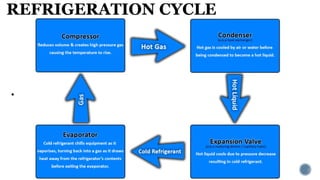
REFRIGERATION CYCLE
.
REFRIGERATION CYCLE
.
Four main processes:
• Compression
• Condensation
• Expansion
• Evaporation
REFRIGERATION CYCLE
.
The refrigeration cycle starts and ends
with the compressor. The refrigerant
flows into the compressor where it is
compressed and pressurized. At this
point, the refrigerant is a hot gas.
REFRIGERATION CYCLE
.
The refrigerant is then pushed to the
condenser which turns the vapour into
liquid and absorbs some of the heat.
The refrigerant then proceeds to the
expansion valve where it expands,
losing pressure and heat.
REFRIGERATION CYCLE
.
The refrigerant coming out of the
expansion valve is cold and slow due to
the loss of pressure. It enters the
evaporator in a liquid state where the
exchange of heat takes place thus cooling
the load inside the refrigerator.
REFRIGERATION CYCLE
.
As the gas cools down the load, it
absorbs the heat which turns it into a
gas. The gas is then pushed back into
the compressor where it can start
the cycle again.
.
• Spoilage of food
• Melting of ice
• Waterfall
• Breakage of egg
• Rice cooking
• Drying of leaves
Spontaneous Process (SP) or Non-
Spontaneous Process (NSP)

work, heat pump and energy transformation

  • 1.
    How Heat Transferand Energy Transformation be Used to Do Work
  • 2.
    HEAT Heat flows froma hotter object to a cooler object when the two objects are placed in contact. It is a normal process. Thermal energy transferred between two systems at different temperatures that come in contact.
  • 3.
    HEAT PUMP a devicethat allows heat to transfer from a cold reservoir to a warmer one heat flows from lower temperature to higher temperature, it needs mechanical energy to happen
  • 4.
    SPONTANEOUS - on itsown, natural - Heat flows normally from higher temperature to lower temperature NON-SPONTANEOUS - does not take place on its own - Happens when heat flows from lower temperature to higher temperature.
  • 5.
    Work is requiredfor the heat to flow from a lower to a higher temperature.
  • 6.
    The First Lawof Thermodynamics It states that heat energy cannot be created or destroyed. It can, however, be transferred from one location to another and converted to and from other forms of energy.
  • 7.
    The Second Lawof Thermodynamics It states that heat will never of itself flow from a cold temperature to a hot temperature object.
  • 8.
  • 9.
    REFRIGERATION CYCLE . Four mainprocesses: • Compression • Condensation • Expansion • Evaporation
  • 10.
    REFRIGERATION CYCLE . The refrigerationcycle starts and ends with the compressor. The refrigerant flows into the compressor where it is compressed and pressurized. At this point, the refrigerant is a hot gas.
  • 11.
    REFRIGERATION CYCLE . The refrigerantis then pushed to the condenser which turns the vapour into liquid and absorbs some of the heat. The refrigerant then proceeds to the expansion valve where it expands, losing pressure and heat.
  • 12.
    REFRIGERATION CYCLE . The refrigerantcoming out of the expansion valve is cold and slow due to the loss of pressure. It enters the evaporator in a liquid state where the exchange of heat takes place thus cooling the load inside the refrigerator.
  • 13.
    REFRIGERATION CYCLE . As thegas cools down the load, it absorbs the heat which turns it into a gas. The gas is then pushed back into the compressor where it can start the cycle again.
  • 14.
    . • Spoilage offood • Melting of ice • Waterfall • Breakage of egg • Rice cooking • Drying of leaves Spontaneous Process (SP) or Non- Spontaneous Process (NSP)