SECTION 2
INSULATION MATERIALS AND PROPERTIES
MP-0
SECTION 2: INSULATION MATERIALS AND PROPERTIES
2.1	
 ย  DEFINITION	
 ย OF	
 ย INSULATION	
 ย  1	
 ย 
2.2	
 ย  GENERIC	
 ย TYPES	
 ย AND	
 ย FORMS	
 ย OF	
 ย INSULATION	
 ย  1	
 ย 
2.3	
 ย  PROPERTIES	
 ย OF	
 ย INSULATION	
 ย  2	
 ย 
2.4	
 ย  MAJOR	
 ย INSULATION	
 ย MATERIALS	
 ย  4	
 ย 
2.5	
 ย 	
 ย  PROTECTIVE	
 ย COVERINGS	
 ย AND	
 ย FINISHES	
 ย  5	
 ย 
2.6	
 ย 	
 ย  PROPERTIES	
 ย OF	
 ย PROTECTIVE	
 ย COVERINGS	
 ย  6	
 ย 
2.7	
 ย 	
 ย  ACCESSORIES	
 ย  7	
 ย 
2.8	
 ย 	
 ย  SUMMARY	
 ย -ยญโ€	
 ย INSULATION	
 ย MATERIALS	
 ย AND	
 ย APPLICATION	
 ย WITHIN	
 ย THE	
 ย GENERAL	
 ย TEMPERATURE	
 ย 
RANGES	
 ย  8	
 ย 
2.9	
 ย  INSULATION	
 ย AND	
 ย JACKET	
 ย MATERIAL	
 ย TABLES	
 ย  10	
 ย 
SECTION 2
INSULATION MATERIALS AND PROPERTIES
MP-1
SECTION 2
INSULATION MATERIALS AND PROPERTIES
2.1 DEFINITION OF INSULATION
Insulations are defined as those materials or combinations of materials which retard the flow of heat energy by
performing one or more of the following functions:
1. Conserve energy by reducing heat loss or gain.
2. Control surface temperatures for personnel protection and comfort.
3. Facilitate temperature control of process.
4. Prevent vapour flow and water condensation on cold surfaces.
5. Increase operating efficiency of heating/ventilating/cooling, plumbing, steam, process and power systems
found in commercial and industrial installations.
6. Prevent or reduce damage to equipment from exposure to fire or corrosive atmospheres.
7. Assist mechanical systems in meeting criteria in food and cosmetic plants.
8. Reduce emissions of pollutants to the atmosphere.
The temperature range within which the term "thermal insulation" will apply, is from -75ยฐC to 815ยฐC. All
applications below -75ยฐC are termed "cryogenic", and those above 815ยฐC are termed "refractory".
Thermal insulation is further divided into three general application temperature ranges as follows:
A. LOW TEMPERATURE THERMAL INSULATION
1. From15ยฐC through 1ยฐC - i.e. Cold or chilled water.
2. 0ยฐC through -40ยฐC - i.e. Refrigeration or glycol.
3. -41ยฐC through -75ยฐC - i.e. Refrigeration or brine.
4. -76ยฐC through -273ยฐC (absolute zero) - i.e. Cryogenic. (Not addressed in this manual).
B. INTERMEDIATE TEMPERATURE THERMAL INSULATION
1. 16ยฐC through 100ยฐC - i.e. Hot water and steam condensate.
2. 101ยฐC through 315ยฐC - i.e. Steam, high temperature hot water.
C. HIGH TEMPERATURE THERMAL INSULATION
1. 316ยฐC through 815ยฐC - i.e. Turbines, breechings, stacks, exhausts, incinerators, boilers.
2.2 GENERIC TYPES AND FORMS OF INSULATION
SECTION 2
INSULATION MATERIALS AND PROPERTIES
MP-2
Insulations will be discussed in this manual according to their generic types and forms. The type indicates
composition (i.e. glass, plastic) and internal structure (i.e. cellular, fibrous). The form implies overall shape or
application (i.e. board, blanket, pipe covering).
2.2.1 TYPES
1. Fibrous Insulation - composed of small diameter fibers which finely divide the air space. The fibers may be
perpendicular or parallel to the surface being insulated, and they may or may not be bonded together. Silica,
rock wool, slag wool and alumina silica fibers are used. The most widely used insulations of this type are
glass fiber and mineral wool. Glass fiber and mineral wool products usually have their fibers bonded together
with organic binders that supply the limited structural integrity of the products.
2. Cellular Insulation - composed of small individual cells separated from each other. The cellular material may
be glass or foamed plastic such as polystyrene (closed cell), polyisocyanurate and elastomeric.
3. Granular Insulation - composed of small nodules which may contain voids or hollow spaces. It is not
considered a true cellular material since gas can be transferred between the individual spaces. This type may
be produced as a loose or pourable material, or combined with a binder and fibers or undergo a chemical
reaction to make a rigid insulation. Examples of these insulations are calcium silicate, expanded vermiculite,
perlite, cellulose, diatomaceous earth and expanded polystyrene.
2.2.2 FORMS
Insulations are produced in a variety of forms suitable for specific functions and applications. The combined form
and type of insulation determine its proper method of installation. The forms most widely used are:
1. Rigid boards, blocks, sheets, and pre-formed shapes such as pipe insulation, curved segments, lagging etc.
Cellular, granular, and fibrous insulations are produced in these forms.
2. Flexible sheets and pre-formed shapes. Cellular and fibrous insulations are produced in these forms.
3. Flexible blankets. Fibrous insulations are produced in flexible blankets.
4. Cements (insulating and finishing). Produced from fibrous and granular insulations and cement, they may be
of the hydraulic setting or air drying type.
5. Foams. Poured or froth foam used to fill irregular areas and voids. Spray used for flat surfaces.
2.3 PROPERTIES OF INSULATION
Not all properties are significant for all materials or applications. Therefore, many are not included in manufacturers'
published literature or in the Table of Properties which follows this section. In some applications, however, omitted
properties may assume extreme importance (i.e. when insulations must be compatible with chemically corrosive
atmospheres.)
If the property is significant for an application and the measure of that property cannot be found in manufacturers'
literature, effort should be made to obtain the information directly from the manufacturer, testing laboratory or
insulation contractors association.
The following properties are referenced only according to their significance in meeting design criteria of specific
applications. More detailed definitions of the properties themselves can be found in the Glossary.
SECTION 2
INSULATION MATERIALS AND PROPERTIES
MP-3
2.3.1 THERMAL PROPERTIES OF INSULATION
Thermal properties are the primary consideration in choosing insulations. Refer to the following Glossary for
definitions.
a. Temperature limits: Upper and lower temperatures within which the material must retain all its properties.
b. Thermal conductance "C": The time rate of steady state heat flow through a unit area of a material or
construction induced by a unit temperature difference between the body surfaces.
c. Thermal conductivity "K": The time rate of steady state heat flow through a unit area of a homogeneous
material induced by a unit temperature gradient in a direction perpendicular to that unit area.
d. Emissivity "E": The emissivity of a material (usually written ฮต or e) is the relative ability of its surface to emit
energy by radiation. It is the ratio of energy radiated by a particular material to energy radiated by a black
body at the same temperature.
e. Thermal resistance "R": Resistance of a material to the flow of heat.
f. Thermal transmittance "U": The overall conductance of heat flow through an "assembly".
2.3.2 MECHANICAL AND CHEMICAL PROPERTIES OF INSULATION
Properties other than thermal must be considered when choosing materials for specific applications. Among them
are:
a. Alkalinity (pH) or acidity: Significant when moisture is present. Also insulation must not contribute to
corrosion of the system. See Section 3.
b. Appearance: Important in exposed areas and for coding purposes.
c. Breaking load: In some installations the insulation material must "bridge" over a discontinuity in its support.
This factor is however most significant as a measure of resistance to abuse during handling.
d. Capillarity: Must be considered when material may be in contact with liquids.
e. Chemical reaction: Potential fire hazards exist in areas where flammable chemicals are present. Corrosion
resistance must also be considered.
f. Chemical resistance: Significant when the atmosphere is salt or chemical laden and when pipe content
leaks.
g. Coefficient of expansion and contraction: Enters into the design and spacing of expansion/contraction
joints and/or use of multiple layer insulation applications.
h. Combustibility: One of the measures of a material's contribution to a fire hazard.
i. Compressive strength: Important if the insulation must support a load or withstand mechanical abuse
without crushing. If, however, cushioning or filling in space is needed as in expansion/contraction joints, low
compressive strength materials are specified.
j. Density: A material's density may affect other properties of that material, such as compressive strength. The
weight of the insulated system must be known in order to design the proper support.
k. Dimensional stability: Significant when the material is exposed to temperature; expansion or shrinkage of
the insulation may occur resulting in stress cracking , voids, sagging or slump.
SECTION 2
INSULATION MATERIALS AND PROPERTIES
MP-4
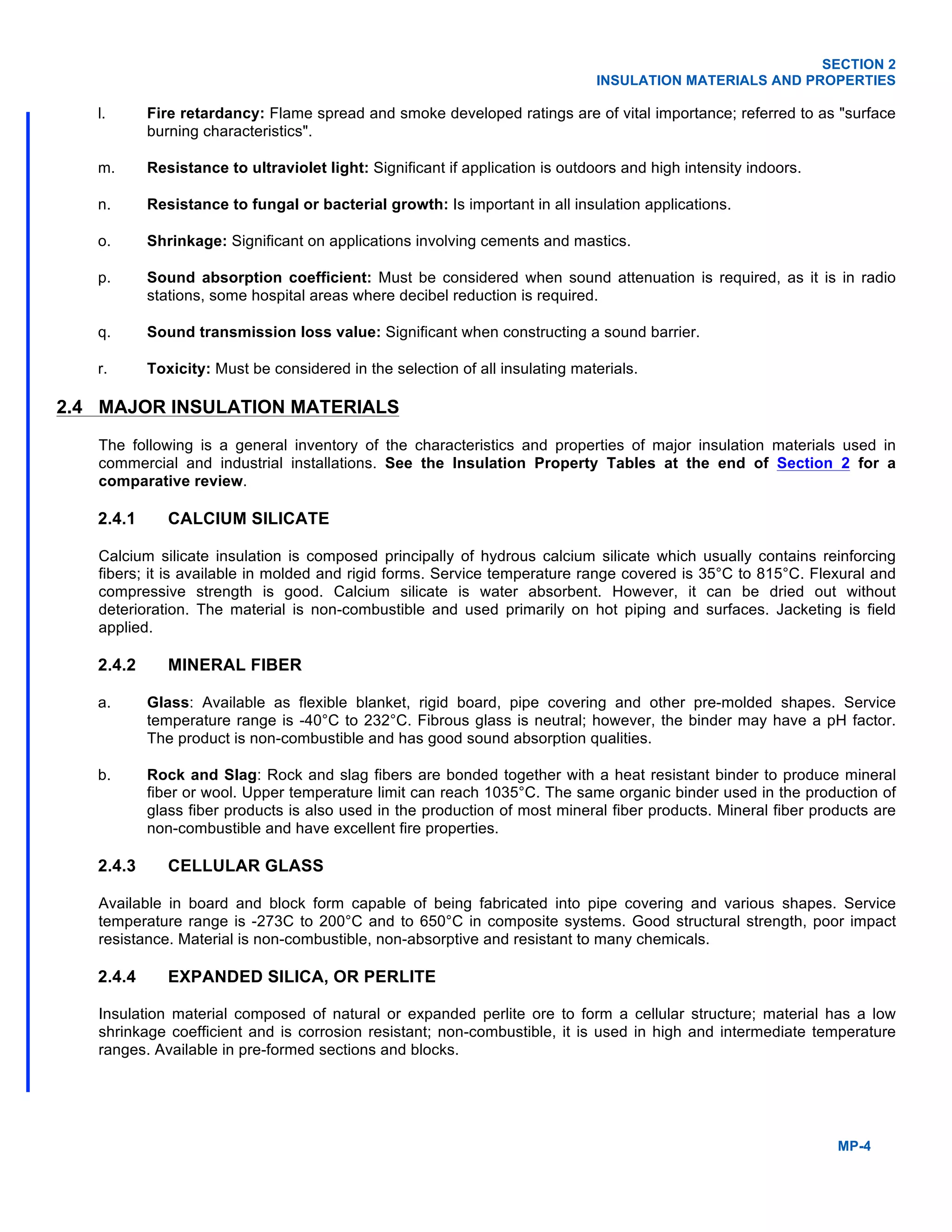
l. Fire retardancy: Flame spread and smoke developed ratings are of vital importance; referred to as "surface
burning characteristics".
m. Resistance to ultraviolet light: Significant if application is outdoors and high intensity indoors.
n. Resistance to fungal or bacterial growth: Is important in all insulation applications.
o. Shrinkage: Significant on applications involving cements and mastics.
p. Sound absorption coefficient: Must be considered when sound attenuation is required, as it is in radio
stations, some hospital areas where decibel reduction is required.
q. Sound transmission loss value: Significant when constructing a sound barrier.
r. Toxicity: Must be considered in the selection of all insulating materials.
2.4 MAJOR INSULATION MATERIALS
The following is a general inventory of the characteristics and properties of major insulation materials used in
commercial and industrial installations. See the Insulation Property Tables at the end of Section 2 for a
comparative review.
2.4.1 CALCIUM SILICATE
Calcium silicate insulation is composed principally of hydrous calcium silicate which usually contains reinforcing
fibers; it is available in molded and rigid forms. Service temperature range covered is 35ยฐC to 815ยฐC. Flexural and
compressive strength is good. Calcium silicate is water absorbent. However, it can be dried out without
deterioration. The material is non-combustible and used primarily on hot piping and surfaces. Jacketing is field
applied.
2.4.2 MINERAL FIBER
a. Glass: Available as flexible blanket, rigid board, pipe covering and other pre-molded shapes. Service
temperature range is -40ยฐC to 232ยฐC. Fibrous glass is neutral; however, the binder may have a pH factor.
The product is non-combustible and has good sound absorption qualities.
b. Rock and Slag: Rock and slag fibers are bonded together with a heat resistant binder to produce mineral
fiber or wool. Upper temperature limit can reach 1035ยฐC. The same organic binder used in the production of
glass fiber products is also used in the production of most mineral fiber products. Mineral fiber products are
non-combustible and have excellent fire properties.
2.4.3 CELLULAR GLASS
Available in board and block form capable of being fabricated into pipe covering and various shapes. Service
temperature range is -273C to 200ยฐC and to 650ยฐC in composite systems. Good structural strength, poor impact
resistance. Material is non-combustible, non-absorptive and resistant to many chemicals.
2.4.4 EXPANDED SILICA, OR PERLITE
Insulation material composed of natural or expanded perlite ore to form a cellular structure; material has a low
shrinkage coefficient and is corrosion resistant; non-combustible, it is used in high and intermediate temperature
ranges. Available in pre-formed sections and blocks.
SECTION 2
INSULATION MATERIALS AND PROPERTIES
MP-5
2.4.5 ELASTOMERIC FOAM
Foamed resins combined with elastomers to produce a flexible cellular material. Available in pre-formed sections or
sheets, Elastomeric insulation offer water and moisture resistance. Upper temperature limit is 105
o
C . Product is
resilient. Fire resistance should be taken in consideration.
2.4.6 FOAMED PLASTIC
Insulations produced from foaming plastic resins create predominately closed cellular rigid materials. "K" values
decline after initial use as the gas trapped within the cellular structure is eventually replaced by air. Check
manufacturers' data. Foamed plastics are light weight with excellent cutting characteristics. The chemical content
varies with each manufacturer. Available in pre-formed shapes and boards, foamed plastics are generally used in
the lower intermediate and the entire low temperature ranges. Consideration should be made for fire retardancy of
the material.
2.4.7 REFRACTORY FIBER
Refractory Fiber insulations are mineral or ceramic fibers, including alumina and silica, bonded with extremely high
temperature inorganic binders, or a mechanical interlocking of fibers eliminates the need for any binder. The
material is manufactured in blanket or rigid form. Thermal shock resistance is high. Temperature limits reach
1750ยฐC. The material is non-combustible.
The use and design of refractory range materials is an engineering art in its own right and is not treated
fully in this manual, although some refractory products can be installed using application methods
illustrated here.
2.4.8 INSULATING CEMENT
Insulating and finishing cements are a mixture of various insulating fibers and binders with water and cement, to
form a soft plastic mass for application on irregular surfaces. Insulation values are moderate. Cements may be
applied to high temperature surfaces. Finishing cements or one-coat cements are used in the lower intermediate
range and as a finish to other insulation applications. Check each manufacturer for shrinkage and adhesion
properties.
2.5 PROTECTIVE COVERINGS AND FINISHES
The efficiency and service of insulation is directly dependent upon its protection from moisture entry and mechanical
and chemical damage. Choices of jacketing and finish materials are based upon the mechanical, chemical, thermal
and moisture conditions of the installation, as well as cost and appearance requirements.
Protective coverings are divided into six functional types.
2.5.1 WEATHER RETARDERS
The basic function of the weather-barrier is to prevent the entry of water, ice, snow or atmospheric residue into the
insulation. Sunlight and ozone can also damage certain insulations. Applications may be either jacketing of metal or
plastic, or a coating of weather-barrier mastic. Jacketing must be over-lapped sufficiently to shed water. Avoid the
use of plastic jacketing materials with low resistance to ultraviolet rays unless protective measures are taken.
2.5.2 VAPOUR RETARDERS
Vapour retarders are designed to retard (slow down) the passage of moisture vapour from one side of its surface to
the other. Joints and overlaps must be sealed with a vapour tight adhesive or sealer free of pin holes or cracks.
Vapour retarders take three forms:
a. Rigid jacketing - plastic fabricated jackets to the exact dimensions required and sealed vapour retarding.
SECTION 2
INSULATION MATERIALS AND PROPERTIES
MP-6
b. Membrane jacketing - laminated foils, treated or coated products and plastic films which are field or factory
applied to the insulation material. (Additional sealing beyond the factory seal may be necessary depending
on temperature/humidity conditions of the installation.)
c. Mastic applications - solvent types which provide a seamless coating but require time to dry.
2.5.3 MECHANICAL ABUSE COVERINGS
Rigid jacketing provides the strongest protection against mechanical abuse from personnel, equipment, machinery,
etc. The compressive strength of the insulation material should also be considered when designing for mechanical
protection.
2.5.4 CORROSION AND FIRE RESISTANT COVERINGS
a. Corrosion protection - can be applied to the insulation by the use of various jacket materials. The corrosive
atmosphere must be determined and a compatible material selected. Mastics may be used in atmospheres
that are damaging to jacket materials. (see Section 3).
b. Fire resistance - can be applied to insulation systems by the use of jacketing and/or mastics. Fire resistant
materials are determined by flame spread, smoke developed and combustibility. The total systems should be
considered when designing for fire resistance. (see Section 3).
2.5.5 APPEARANCE COVERINGS AND FINISHES
Various coatings, finishing cements, fitting covers and jackets are chosen primarily for their appearance value in
exposed areas.
2.5.6 HYGIENIC COVERINGS
Coatings and jackets must present a smooth surface which resists fungal or bacterial growth in all areas. High
temperature steam or high pressure water wash down conditions require jackets with high mechanical strength and
temperature ranges. (see Section 3).
2.6 PROPERTIES OF PROTECTIVE COVERINGS
The properties of jacketing and mastic materials that must be considered to meet the aforementioned functions are:
2.6.1 Chemical Compatibility
The chemical make-up of coverings must be compatible with the insulation material over which they are applied, as
well as resistant to elements in the environment such as industrial chemicals, salt, air and ultraviolet or infrared
light.
2.6.2 Resistance to Internal and External Movement
This property is significant if the covering must absorb or compensate for thermal expansion and contraction of the
insulation it covers (i.e. shrinkage of high temperature insulation ) or if the system vibration must be considered.
2.6.3 Temperature Range of the Finish or Covering
The temperature range must be compatible with the surface temperature of the insulation surface.
2.6.4 Vapour Permeability
Permeability should be considered for below ambient or dual temperature systems. The covering should
significantly reduce the passage of moisture through the insulation.
SECTION 2
INSULATION MATERIALS AND PROPERTIES
MP-7
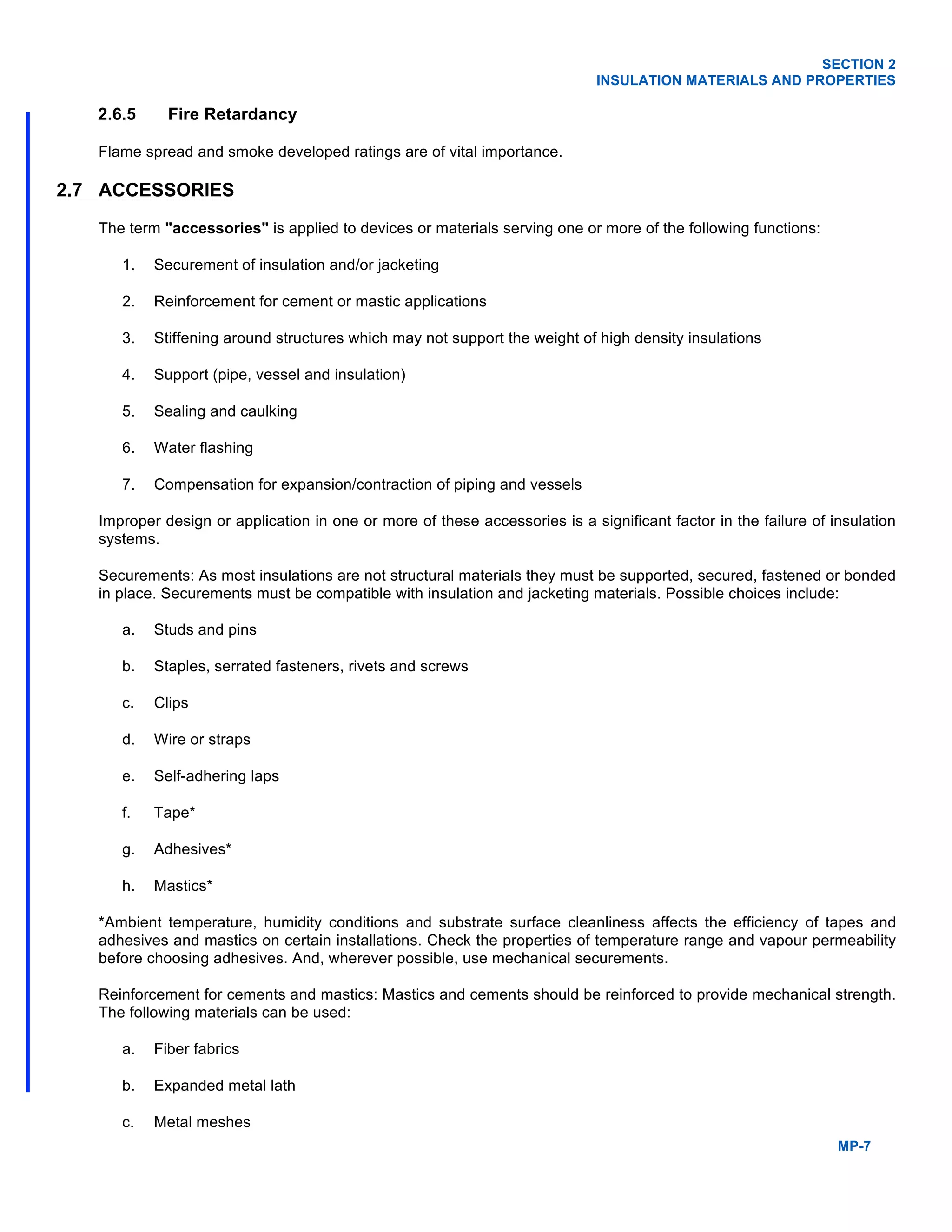
2.6.5 Fire Retardancy
Flame spread and smoke developed ratings are of vital importance.
2.7 ACCESSORIES
The term "accessories" is applied to devices or materials serving one or more of the following functions:
1. Securement of insulation and/or jacketing
2. Reinforcement for cement or mastic applications
3. Stiffening around structures which may not support the weight of high density insulations
4. Support (pipe, vessel and insulation)
5. Sealing and caulking
6. Water flashing
7. Compensation for expansion/contraction of piping and vessels
Improper design or application in one or more of these accessories is a significant factor in the failure of insulation
systems.
Securements: As most insulations are not structural materials they must be supported, secured, fastened or bonded
in place. Securements must be compatible with insulation and jacketing materials. Possible choices include:
a. Studs and pins
b. Staples, serrated fasteners, rivets and screws
c. Clips
d. Wire or straps
e. Self-adhering laps
f. Tape*
g. Adhesives*
h. Mastics*
*Ambient temperature, humidity conditions and substrate surface cleanliness affects the efficiency of tapes and
adhesives and mastics on certain installations. Check the properties of temperature range and vapour permeability
before choosing adhesives. And, wherever possible, use mechanical securements.
Reinforcement for cements and mastics: Mastics and cements should be reinforced to provide mechanical strength.
The following materials can be used:
a. Fiber fabrics
b. Expanded metal lath
c. Metal meshes
SECTION 2
INSULATION MATERIALS AND PROPERTIES
MP-8
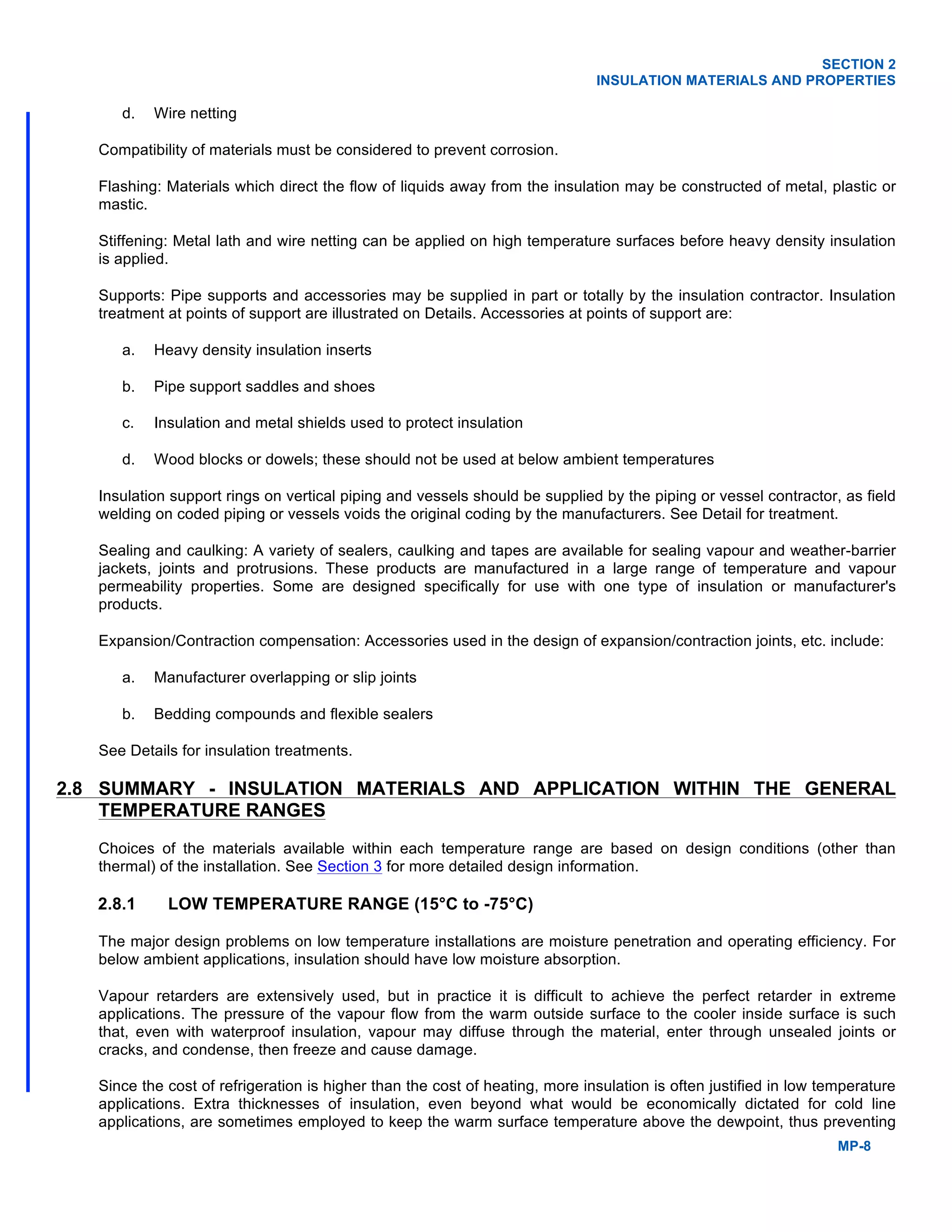
d. Wire netting
Compatibility of materials must be considered to prevent corrosion.
Flashing: Materials which direct the flow of liquids away from the insulation may be constructed of metal, plastic or
mastic.
Stiffening: Metal lath and wire netting can be applied on high temperature surfaces before heavy density insulation
is applied.
Supports: Pipe supports and accessories may be supplied in part or totally by the insulation contractor. Insulation
treatment at points of support are illustrated on Details. Accessories at points of support are:
a. Heavy density insulation inserts
b. Pipe support saddles and shoes
c. Insulation and metal shields used to protect insulation
d. Wood blocks or dowels; these should not be used at below ambient temperatures
Insulation support rings on vertical piping and vessels should be supplied by the piping or vessel contractor, as field
welding on coded piping or vessels voids the original coding by the manufacturers. See Detail for treatment.
Sealing and caulking: A variety of sealers, caulking and tapes are available for sealing vapour and weather-barrier
jackets, joints and protrusions. These products are manufactured in a large range of temperature and vapour
permeability properties. Some are designed specifically for use with one type of insulation or manufacturer's
products.
Expansion/Contraction compensation: Accessories used in the design of expansion/contraction joints, etc. include:
a. Manufacturer overlapping or slip joints
b. Bedding compounds and flexible sealers
See Details for insulation treatments.
2.8 SUMMARY - INSULATION MATERIALS AND APPLICATION WITHIN THE GENERAL
TEMPERATURE RANGES
Choices of the materials available within each temperature range are based on design conditions (other than
thermal) of the installation. See Section 3 for more detailed design information.
2.8.1 LOW TEMPERATURE RANGE (15ยฐC to -75ยฐC)
The major design problems on low temperature installations are moisture penetration and operating efficiency. For
below ambient applications, insulation should have low moisture absorption.
Vapour retarders are extensively used, but in practice it is difficult to achieve the perfect retarder in extreme
applications. The pressure of the vapour flow from the warm outside surface to the cooler inside surface is such
that, even with waterproof insulation, vapour may diffuse through the material, enter through unsealed joints or
cracks, and condense, then freeze and cause damage.
Since the cost of refrigeration is higher than the cost of heating, more insulation is often justified in low temperature
applications. Extra thicknesses of insulation, even beyond what would be economically dictated for cold line
applications, are sometimes employed to keep the warm surface temperature above the dewpoint, thus preventing
SECTION 2
INSULATION MATERIALS AND PROPERTIES
MP-9
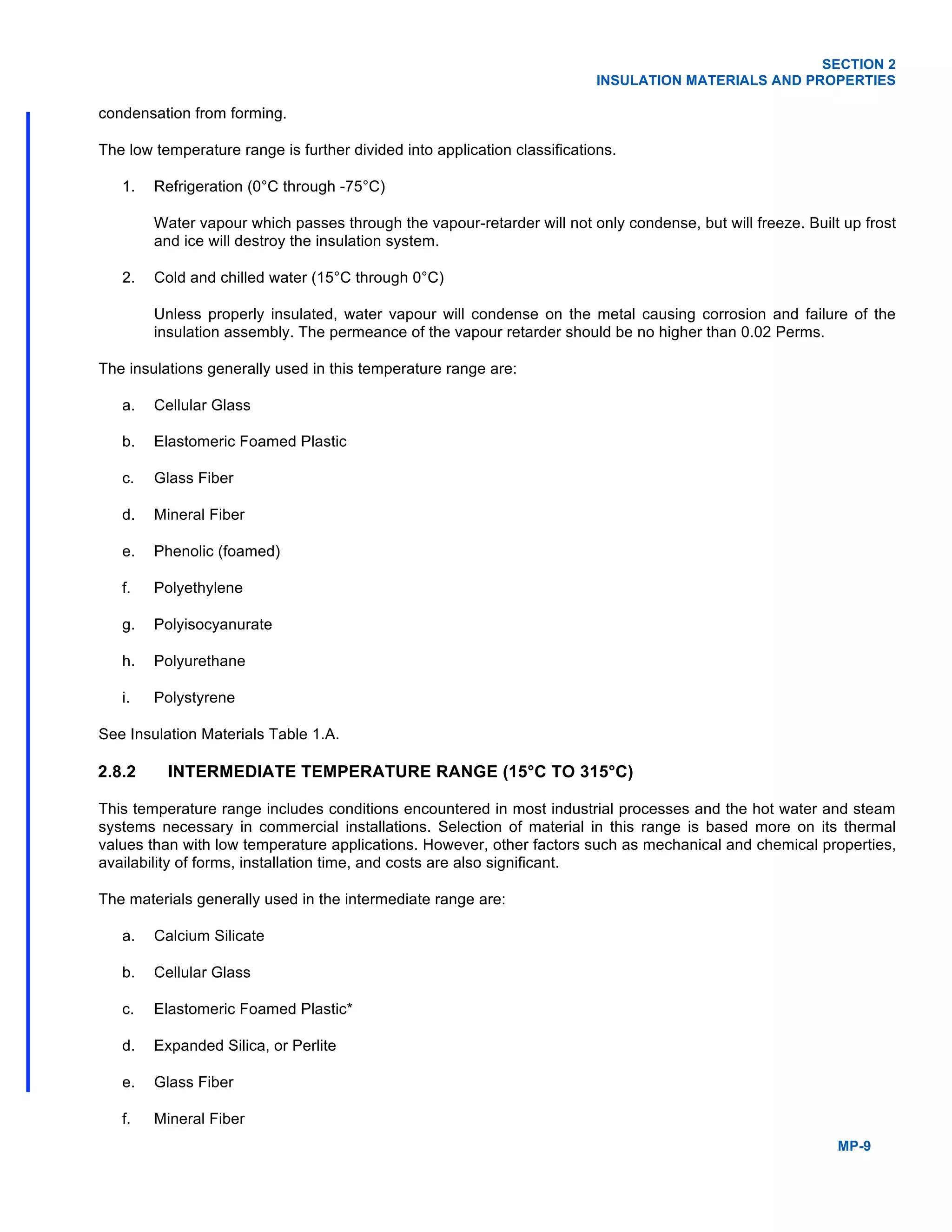
condensation from forming.
The low temperature range is further divided into application classifications.
1. Refrigeration (0ยฐC through -75ยฐC)
Water vapour which passes through the vapour-retarder will not only condense, but will freeze. Built up frost
and ice will destroy the insulation system.
2. Cold and chilled water (15ยฐC through 0ยฐC)
Unless properly insulated, water vapour will condense on the metal causing corrosion and failure of the
insulation assembly. The permeance of the vapour retarder should be no higher than 0.02 Perms.
The insulations generally used in this temperature range are:
a. Cellular Glass
b. Elastomeric Foamed Plastic
c. Glass Fiber
d. Mineral Fiber
e. Phenolic (foamed)
f. Polyethylene
g. Polyisocyanurate
h. Polyurethane
i. Polystyrene
See Insulation Materials Table 1.A.
2.8.2 INTERMEDIATE TEMPERATURE RANGE (15ยฐC TO 315ยฐC)
This temperature range includes conditions encountered in most industrial processes and the hot water and steam
systems necessary in commercial installations. Selection of material in this range is based more on its thermal
values than with low temperature applications. However, other factors such as mechanical and chemical properties,
availability of forms, installation time, and costs are also significant.
The materials generally used in the intermediate range are:
a. Calcium Silicate
b. Cellular Glass
c. Elastomeric Foamed Plastic*
d. Expanded Silica, or Perlite
e. Glass Fiber
f. Mineral Fiber
SECTION 2
INSULATION MATERIALS AND PROPERTIES
MP-10
g. Phenolic*
h. Polystyrene*
i. Polyurethane*
See Insulation Materials Table 1.B.
*The maximum temperature (315ยฐC) exceeds these materials recommended maximum temperature.
2.8.3 HIGH TEMPERATURE RANGE (315ยฐC TO 815ยฐC)
As the refractory range of insulation is approached, fewer materials and application methods are available. High
temperature materials are often a combination of other materials or similar materials manufactured using special
binders. Jacketing is generally field applied. Industrial power and process piping and equipment, boilers,
breechings, exhausts and incinerators fall within this application range. The materials generally used are:
a. Calcium Silicate
b. Cellular Glass*
c. Cements
d. Ceramic Fibers
e. Glass Fibers*
f. Mineral Fiber*
g. Perlite*
See Insulation Materials Table 1.C.
*The maximum temperature (815ยฐC) exceeds these materials recommended service maximum temperature.
2.9 INSULATION AND JACKET MATERIAL TABLES
These tables represent a summation of available data and information. References to test data, form, temperature
range, "K" factors at certain mean temperatures, and general notes are for classification purposes only. Actual
descriptions, performances, etc will vary from one manufacturer to another. Specific information on material
properties should be obtained from the manufacturers' current data prior to being included in specifications. Fire
hazard ratings in particular must be determined to meet local codes.
SECTION 2
INSULATION MATERIALS AND PROPERTIES
MP-0
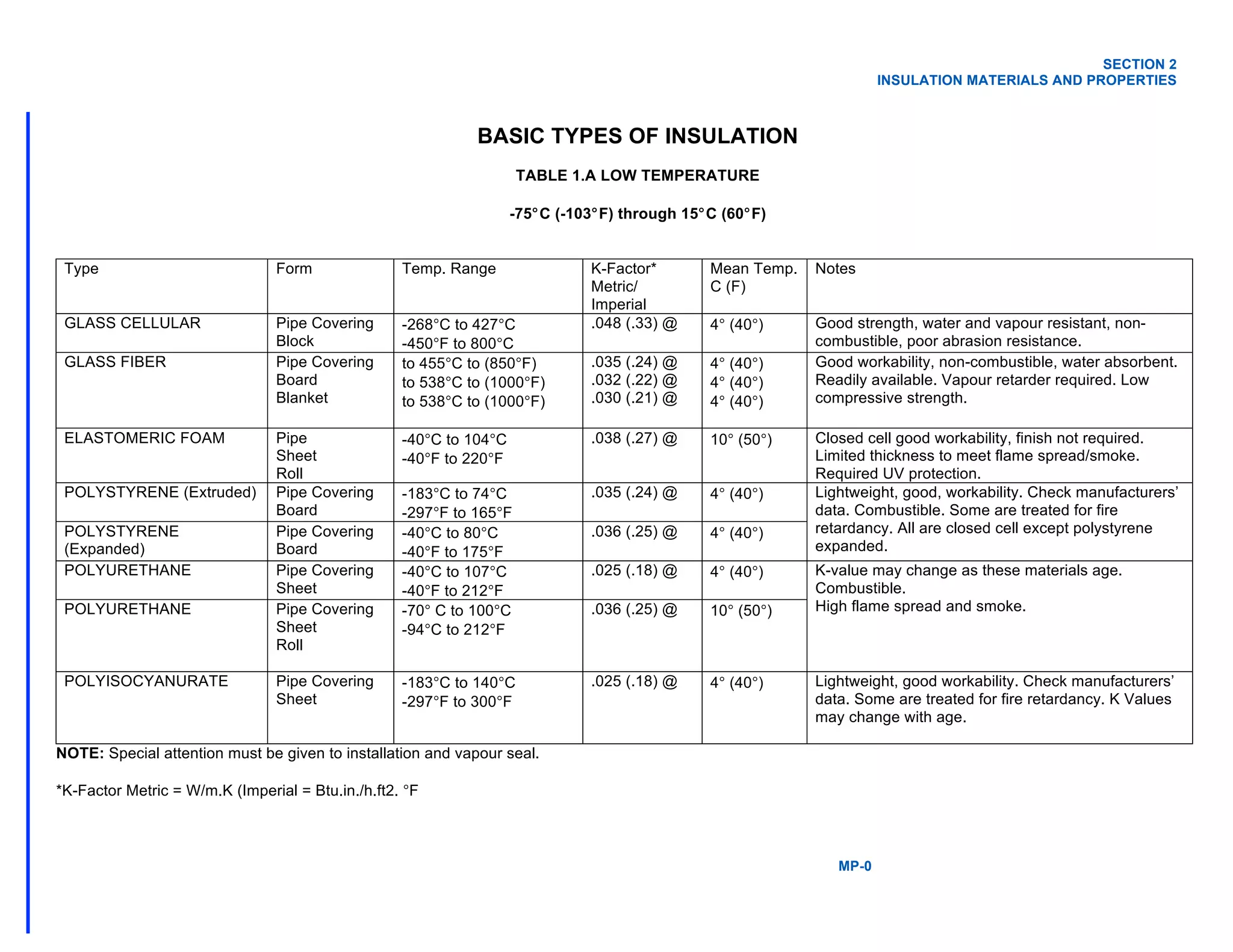
BASIC TYPES OF INSULATION
TABLE 1.A LOW TEMPERATURE
-75ยฐC (-103ยฐF) through 15ยฐC (60ยฐF)
Type Form Temp. Range K-Factor*
Metric/
Imperial
Mean Temp.
C (F)
Notes
GLASS CELLULAR Pipe Covering
Block
-268ยฐC to 427ยฐC
-450ยฐF to 800ยฐC
.048 (.33) @ 4ยฐ (40ยฐ) Good strength, water and vapour resistant, non-
combustible, poor abrasion resistance.
GLASS FIBER Pipe Covering
Board
Blanket
to 455ยฐC to (850ยฐF)
to 538ยฐC to (1000ยฐF)
.035 (.24) @
.032 (.22) @
.030 (.21) @
4ยฐ (40ยฐ)
4ยฐ (40ยฐ)
4ยฐ (40ยฐ)
Good workability, non-combustible, water absorbent.
Readily available. Vapour retarder required. Low
compressive strength.
ELASTOMERIC FOAM Pipe
Sheet
Roll
-40ยฐC to 104ยฐC
-40ยฐF to 220ยฐF
.038 (.27) @ 10ยฐ (50ยฐ) Closed cell good workability, finish not required.
Limited thickness to meet flame spread/smoke.
Required UV protection.
POLYSTYRENE (Extruded) Pipe Covering
Board
-183ยฐC to 74ยฐC
-297ยฐF to 165ยฐF
.035 (.24) @ 4ยฐ (40ยฐ) Lightweight, good, workability. Check manufacturersโ€™
data. Combustible. Some are treated for fire
retardancy. All are closed cell except polystyrene
expanded.
POLYSTYRENE
(Expanded)
Pipe Covering
Board
-40ยฐC to 80ยฐC
-40ยฐF to 175ยฐF
.036 (.25) @ 4ยฐ (40ยฐ)
POLYURETHANE Pipe Covering
Sheet
-40ยฐC to 107ยฐC
-40ยฐF to 212ยฐF
.025 (.18) @ 4ยฐ (40ยฐ) K-value may change as these materials age.
Combustible.
High flame spread and smoke.POLYURETHANE Pipe Covering
Sheet
Roll
-70ยฐ C to 100ยฐC
-94ยฐC to 212ยฐF
.036 (.25) @ 10ยฐ (50ยฐ)
POLYISOCYANURATE Pipe Covering
Sheet
-183ยฐC to 140ยฐC
-297ยฐF to 300ยฐF
.025 (.18) @ 4ยฐ (40ยฐ) Lightweight, good workability. Check manufacturersโ€™
data. Some are treated for fire retardancy. K Values
may change with age.
NOTE: Special attention must be given to installation and vapour seal.
*K-Factor Metric = W/m.K (Imperial = Btu.in./h.ft2. ยฐF
SECTION 2
INSULATION MATERIALS AND PROPERTIES
MP-1
TABLE 1.B INTERMEDIATE TEMPERATURES
15ยฐC (60ยฐF) through 315ยฐC (600ยฐF)
Type Form Temp. Range K-Factor*
Metric/ Imperial
Mean Temp.
C (F)
Notes
CALCIUM SILICATE Pipe Covering
Block
Segments
Type I to 649ยฐC (1200ยฐF) .065 (.45) @ 93ยฐ (200ยฐ)
High compression strength, good workability, water
absorbent, non-combustible. High flexural strength.
Resistant to abrasion. See manufacturersโ€™ data for
shrinkage factors.
GLASS CELLULAR Pipe Covering
Block
Segments
to 427ยฐC (800ยฐF) .050 (.35) @
.063 (.44) @
24ยฐ (75ยฐ)
93ยฐ (200ยฐ)
Good strength, water and vapour resistant, non-
combustible, poor abrasion resistance. Subject to thermal
shock. For applications over 204ยฐC (400ยฐF) see
manufacturersโ€™ specifications.
GLASS FIBER Pipe Covering
Board
to 455ยฐC (850ยฐF)
to 538ยฐC (1000ยฐF)
.037 (.26) @
.033 (.23) @
24ยฐ (75ยฐ)
24ยฐ (75ยฐ)
Good workability, non-combustible, water absorbent. Low
compression resistance.
GLASS FIBER Blanket to 538ยฐC (1000ยฐF) .033 (.23) @ 24ยฐ (75ยฐ) General purpose material, many facings available.
MINERAL FIBER Pipe Covering
Block
Board
Blanket
to 649ยฐC (1200ยฐF)
to 1035ยฐC (1895ยฐF)
to 649ยฐC (1200ยฐF)
to 649ยฐC (1200ยฐF)
.037 (.26) @
.037 (.26) @
.037 (.26) @
.048 (.33) @
24ยฐ (75ยฐ)
24ยฐ (75ยฐ)
24ยฐ (75ยฐ)
24ยฐ (75ยฐ)
Good workability, non-combustible.
Water absorbent.
Low compression resistance.
PERLITE (Expanded) Pipe Covering
Board
to 649ยฐC (1200ยฐF) .076 (.53) @ 93ยฐ (200ยฐ) Good workability, non-combustible. Poor abrasion
resistance. Special packaging required to protect
materials. Corrosion inhibitor.
ELASTOMERIC FOAM Pipe Covering-I
Sheet-II
Roll
-40ยฐC to 105ยฐC
-40ยฐF to 220ยฐF
.043 (.30) @ 24ยฐ (75ยฐ) Closed cell, finish not required, good workability. May
require UV protection. Flame spread/smoke limited)
POLYSTYRENE (Extruded) Pipe Covering
Board
-183ยฐC to 74ยฐC
-297ยฐF to 165ยฐF
.037 (.26) @ 24ยฐ (75ยฐ) Lightweight, excellent workability, combustible although
some are treated for fire retardancy (check
manufacturersโ€™ data sheet for properties) High flame
spread/smoke. Check manufacturersโ€™ data sheets for
values. K value may change as these materials age.
POLYSTYRENE (Expanded) Pipe Covering
Board
-40ยฐC to 80ยฐC
-40ยฐF to 175ยฐF
.039 (.27) @ 24ยฐ (75ยฐ)
POLYURETHANE Pipe Covering -40ยฐC to 105ยฐC
-40ยฐF to 225ยฐF
.027 (.19) @ 24ยฐ (75ยฐ)
POLYETHYLENE Pipe Covering -70ยฐC to 100ยฐC
-94ยฐF to 212ยฐF
.037
(.26) @
24ยฐ
(75ยฐ)
POLYISOCYANURATE Pipe Covering
Board
-183ยฐC to 149ยฐC
-297ยฐF to 300ยฐF
.027 (.19) @ 24ยฐ (75ยฐ) Lightweight, good workability.
Check manufacturersโ€™ data sheets.
Some are treated for fire retardancy. K values may
change with age
CEMENTS โ€“ See Table 1.C
*K-Factor Metric = W/m.K (Imperial = Btu.in./h.ft2. ยฐF)
SECTION 2
INSULATION MATERIALS AND PROPERTIES
MP-0
TABLE 1.C HIGH TEMPERATURE
315ยฐC (600ยฐF) through 815ยฐC (1500ยฐF)
Type Form Temp. Range K-Factor*
Metric/ Imperial
Mean Temp.
C (F)
Notes
CALCIUM SILICATE Pipe
Covering
Block
Segments
Type I
Type II
to 649ยฐC (1200ยฐF)
to 871ยฐC (1600ยฐF)
.087 (.60) @
.101 (.70) @
260ยฐ (500ยฐ)
260ยฐ (500ยฐ)
High compressive strength, good cutting
characteristics, water absorbent, non-
combustible. High flexural strength. Resistant
to abrasion. See manufacturersโ€™ data for
shrinkage factors.
CLASS CELLULAR HIGH TEMP Pipe
Covering
Block
Segments
to 427ยฐC (800ยฐF) .103 (.72) @ 260ยฐ (500ยฐ)
Good strength, water and vapour resistant,
non-combustible, poor abrasion resistance.
Subject to thermal shock. For application over
204ยฐC (400ยฐF), see manufacturersโ€™
specifications.
GLASS FIBER Pipe
Covering
Board
Blanket
to 455ยฐC (850ยฐF)
to 538ยฐC (1000ยฐF)
to 538ยฐC (1000ยฐF)
.083 (.58) @
.086 (.60) @
.086 (.60) @
260ยฐ (500ยฐ)
260ยฐ (500ยฐ)
260ยฐ (500ยฐ)
Good workability, water absorbent, non-
combustible. Check manufacturersโ€™ data for
specific properties. Low compression
resistance.
MINERAL FIBER Pipe
Covering
Block
Board
Blanket
to 649ยฐC (1200ยฐF)
to 1035ยฐC (1895ยฐF)
to 649ยฐC (1200ยฐF)
to 649ยฐC (1200ยฐF)
.072 (.50) @
.092 (.64) @
.101 (.70) @
.101 (.70) @
260ยฐ (500ยฐ)
260ยฐ (500ยฐ)
260ยฐ (500ยฐ)
260ยฐ (500ยฐ)
Good workability, non-combustible. Low
compressive resistance. Water absorbent.
PERLITE (Expanded) Pipe
Covering
Block
to 649ยฐC (1200ยฐF) .106 (.74) @ 260ยฐ (500ยฐ)
Good workability, non-combustible,
friable. Check manufacturersโ€™ data for
specific properties. Poor abrasion
resistance. Special packaging required
to protect material. Corrosion inhibitor.
CERAMIC FIBER
(Refractory Fiber)
Blanket
Board
to 1260ยฐC (2300ยฐF)
.086 (.60) @
.080 (.56) @
260ยฐ (500ยฐ)
260ยฐ (500ยฐ)
Temperature range varies with
manufacturer, style and type.
CEMENTS
Hydraulic Setting Cement
High Temperature Mineral Wool
Finishing Cement
(Mineral Fiber or Vermiculite)
Type I
Type II
Type III
38-649ยฐC (100-1200ยฐF)
38-870ยฐC (100-1600ยฐF)
38-980ยฐC (100-1800ยฐF)
.180 (1.05) @
.160 (1.12) @
.150 (1.26) @
250ยฐ (482ยฐ)
250ยฐ (482ยฐ)
250ยฐ (482ยฐ)
One coat application โ€“ insulating and finishing.
Slow drying, rough texture โ€“ Pointing and
insulating and filling. Used over basic
insulation โ€“ Smooth finish usually 1/8โ€ or ยผโ€
think application.
SECTION 2
INSULATION MATERIALS AND PROPERTIES
MP-0
PROTECTIVE COVERINGS AND FINISHES
PLEASE NOTE: The following items are classified for use as weather barriers and/or vapour retarders. They also serve other purposes listed for protective
coverings (i.e. mechanical abuse, corrosion, appearance, and hygienic), but each must be considered on its own merits for these aspects.
TABLE 2.A WEATHER BARRIERS*
Type Composition Fasteners Notes
JACKETS: 1. Films laminated to felts or foil Contact adhesives and/or tape Corrosion resistant, bacteria and mildew
resistant
2. Stainless steel (various alloys โ€“
available with factory-applied
moisture retarder)
Bands, screws or rivets Excellent mechanical strength, corrosion,
mildew and bacteria resistant. Excellent
fire resistance.
3. Galvanized steel (coated and with
factory-applied moisture retarder)
Bands, screws or rivets Good mechanical strength and fire
resistance.
4. Aluminum alloys (preferably with
factory-applied moisture retarder)
Bands, screw or rivets Good mechanical strength, good
workability, poor fire resistance.
5. Polyvinyl Chloride (PVC) Mechanical fasteners, adhesive, or
matching tape
May require protection from ultra-violet
radiation. Resists chemicals and bacteria.
Washable surface for food processing
applications.
6. High Impact Plastics (ABS) ABS welding adhesive or mechanical
fasteners
7. Plastic film (PVDC) Adhesive or tape Corrosion. Bacteria, mildew and chemical
resistance. May require protection from
ultra-violet radiation. Workable surface for
food processing applications.
MASTICS: 1. Asphalt emulsion Apply with reinforcing mesh Water base, a breather mastic
2. Asphalt cut-back Apply with reinforcing mesh Solvent base, also a vapour barrier
3. Resin emulsion Apply with reinforcing mesh Tough, resilient film
4. Polyvinyl acetate Apply with reinforcing mesh Tough, resilient film
5. Acrylic Apply with reinforcing mesh Tough, resilient film
*Covering shall not be termed a weather barrier unless its joint and overlaps are adequate to prevent the entry of rainwater (See Section 2.5)
SECTION 2
INSULATION MATERIALS AND PROPERTIES
MP-1
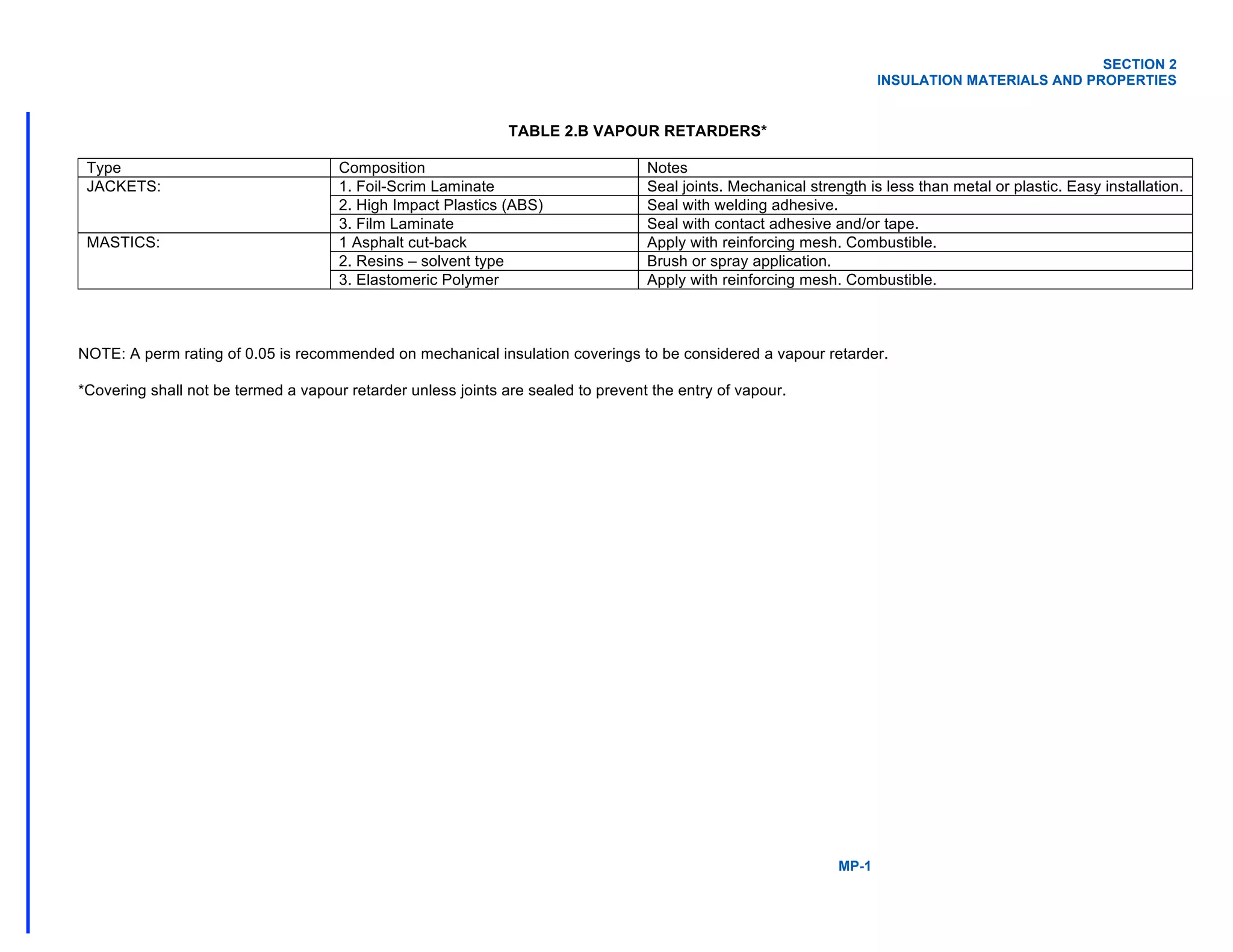
TABLE 2.B VAPOUR RETARDERS*
Type Composition Notes
JACKETS: 1. Foil-Scrim Laminate Seal joints. Mechanical strength is less than metal or plastic. Easy installation.
2. High Impact Plastics (ABS) Seal with welding adhesive.
3. Film Laminate Seal with contact adhesive and/or tape.
MASTICS: 1 Asphalt cut-back Apply with reinforcing mesh. Combustible.
2. Resins โ€“ solvent type Brush or spray application.
3. Elastomeric Polymer Apply with reinforcing mesh. Combustible.
NOTE: A perm rating of 0.05 is recommended on mechanical insulation coverings to be considered a vapour retarder.
*Covering shall not be termed a vapour retarder unless joints are sealed to prevent the entry of vapour.

Thermal insulation materials

  • 1.
    SECTION 2 INSULATION MATERIALSAND PROPERTIES MP-0 SECTION 2: INSULATION MATERIALS AND PROPERTIES 2.1 ย  DEFINITION ย OF ย INSULATION ย  1 ย  2.2 ย  GENERIC ย TYPES ย AND ย FORMS ย OF ย INSULATION ย  1 ย  2.3 ย  PROPERTIES ย OF ย INSULATION ย  2 ย  2.4 ย  MAJOR ย INSULATION ย MATERIALS ย  4 ย  2.5 ย  ย  PROTECTIVE ย COVERINGS ย AND ย FINISHES ย  5 ย  2.6 ย  ย  PROPERTIES ย OF ย PROTECTIVE ย COVERINGS ย  6 ย  2.7 ย  ย  ACCESSORIES ย  7 ย  2.8 ย  ย  SUMMARY ย -ยญโ€ ย INSULATION ย MATERIALS ย AND ย APPLICATION ย WITHIN ย THE ย GENERAL ย TEMPERATURE ย  RANGES ย  8 ย  2.9 ย  INSULATION ย AND ย JACKET ย MATERIAL ย TABLES ย  10 ย 
  • 2.
    SECTION 2 INSULATION MATERIALSAND PROPERTIES MP-1 SECTION 2 INSULATION MATERIALS AND PROPERTIES 2.1 DEFINITION OF INSULATION Insulations are defined as those materials or combinations of materials which retard the flow of heat energy by performing one or more of the following functions: 1. Conserve energy by reducing heat loss or gain. 2. Control surface temperatures for personnel protection and comfort. 3. Facilitate temperature control of process. 4. Prevent vapour flow and water condensation on cold surfaces. 5. Increase operating efficiency of heating/ventilating/cooling, plumbing, steam, process and power systems found in commercial and industrial installations. 6. Prevent or reduce damage to equipment from exposure to fire or corrosive atmospheres. 7. Assist mechanical systems in meeting criteria in food and cosmetic plants. 8. Reduce emissions of pollutants to the atmosphere. The temperature range within which the term "thermal insulation" will apply, is from -75ยฐC to 815ยฐC. All applications below -75ยฐC are termed "cryogenic", and those above 815ยฐC are termed "refractory". Thermal insulation is further divided into three general application temperature ranges as follows: A. LOW TEMPERATURE THERMAL INSULATION 1. From15ยฐC through 1ยฐC - i.e. Cold or chilled water. 2. 0ยฐC through -40ยฐC - i.e. Refrigeration or glycol. 3. -41ยฐC through -75ยฐC - i.e. Refrigeration or brine. 4. -76ยฐC through -273ยฐC (absolute zero) - i.e. Cryogenic. (Not addressed in this manual). B. INTERMEDIATE TEMPERATURE THERMAL INSULATION 1. 16ยฐC through 100ยฐC - i.e. Hot water and steam condensate. 2. 101ยฐC through 315ยฐC - i.e. Steam, high temperature hot water. C. HIGH TEMPERATURE THERMAL INSULATION 1. 316ยฐC through 815ยฐC - i.e. Turbines, breechings, stacks, exhausts, incinerators, boilers. 2.2 GENERIC TYPES AND FORMS OF INSULATION
  • 3.
    SECTION 2 INSULATION MATERIALSAND PROPERTIES MP-2 Insulations will be discussed in this manual according to their generic types and forms. The type indicates composition (i.e. glass, plastic) and internal structure (i.e. cellular, fibrous). The form implies overall shape or application (i.e. board, blanket, pipe covering). 2.2.1 TYPES 1. Fibrous Insulation - composed of small diameter fibers which finely divide the air space. The fibers may be perpendicular or parallel to the surface being insulated, and they may or may not be bonded together. Silica, rock wool, slag wool and alumina silica fibers are used. The most widely used insulations of this type are glass fiber and mineral wool. Glass fiber and mineral wool products usually have their fibers bonded together with organic binders that supply the limited structural integrity of the products. 2. Cellular Insulation - composed of small individual cells separated from each other. The cellular material may be glass or foamed plastic such as polystyrene (closed cell), polyisocyanurate and elastomeric. 3. Granular Insulation - composed of small nodules which may contain voids or hollow spaces. It is not considered a true cellular material since gas can be transferred between the individual spaces. This type may be produced as a loose or pourable material, or combined with a binder and fibers or undergo a chemical reaction to make a rigid insulation. Examples of these insulations are calcium silicate, expanded vermiculite, perlite, cellulose, diatomaceous earth and expanded polystyrene. 2.2.2 FORMS Insulations are produced in a variety of forms suitable for specific functions and applications. The combined form and type of insulation determine its proper method of installation. The forms most widely used are: 1. Rigid boards, blocks, sheets, and pre-formed shapes such as pipe insulation, curved segments, lagging etc. Cellular, granular, and fibrous insulations are produced in these forms. 2. Flexible sheets and pre-formed shapes. Cellular and fibrous insulations are produced in these forms. 3. Flexible blankets. Fibrous insulations are produced in flexible blankets. 4. Cements (insulating and finishing). Produced from fibrous and granular insulations and cement, they may be of the hydraulic setting or air drying type. 5. Foams. Poured or froth foam used to fill irregular areas and voids. Spray used for flat surfaces. 2.3 PROPERTIES OF INSULATION Not all properties are significant for all materials or applications. Therefore, many are not included in manufacturers' published literature or in the Table of Properties which follows this section. In some applications, however, omitted properties may assume extreme importance (i.e. when insulations must be compatible with chemically corrosive atmospheres.) If the property is significant for an application and the measure of that property cannot be found in manufacturers' literature, effort should be made to obtain the information directly from the manufacturer, testing laboratory or insulation contractors association. The following properties are referenced only according to their significance in meeting design criteria of specific applications. More detailed definitions of the properties themselves can be found in the Glossary.
  • 4.
    SECTION 2 INSULATION MATERIALSAND PROPERTIES MP-3 2.3.1 THERMAL PROPERTIES OF INSULATION Thermal properties are the primary consideration in choosing insulations. Refer to the following Glossary for definitions. a. Temperature limits: Upper and lower temperatures within which the material must retain all its properties. b. Thermal conductance "C": The time rate of steady state heat flow through a unit area of a material or construction induced by a unit temperature difference between the body surfaces. c. Thermal conductivity "K": The time rate of steady state heat flow through a unit area of a homogeneous material induced by a unit temperature gradient in a direction perpendicular to that unit area. d. Emissivity "E": The emissivity of a material (usually written ฮต or e) is the relative ability of its surface to emit energy by radiation. It is the ratio of energy radiated by a particular material to energy radiated by a black body at the same temperature. e. Thermal resistance "R": Resistance of a material to the flow of heat. f. Thermal transmittance "U": The overall conductance of heat flow through an "assembly". 2.3.2 MECHANICAL AND CHEMICAL PROPERTIES OF INSULATION Properties other than thermal must be considered when choosing materials for specific applications. Among them are: a. Alkalinity (pH) or acidity: Significant when moisture is present. Also insulation must not contribute to corrosion of the system. See Section 3. b. Appearance: Important in exposed areas and for coding purposes. c. Breaking load: In some installations the insulation material must "bridge" over a discontinuity in its support. This factor is however most significant as a measure of resistance to abuse during handling. d. Capillarity: Must be considered when material may be in contact with liquids. e. Chemical reaction: Potential fire hazards exist in areas where flammable chemicals are present. Corrosion resistance must also be considered. f. Chemical resistance: Significant when the atmosphere is salt or chemical laden and when pipe content leaks. g. Coefficient of expansion and contraction: Enters into the design and spacing of expansion/contraction joints and/or use of multiple layer insulation applications. h. Combustibility: One of the measures of a material's contribution to a fire hazard. i. Compressive strength: Important if the insulation must support a load or withstand mechanical abuse without crushing. If, however, cushioning or filling in space is needed as in expansion/contraction joints, low compressive strength materials are specified. j. Density: A material's density may affect other properties of that material, such as compressive strength. The weight of the insulated system must be known in order to design the proper support. k. Dimensional stability: Significant when the material is exposed to temperature; expansion or shrinkage of the insulation may occur resulting in stress cracking , voids, sagging or slump.
  • 5.
    SECTION 2 INSULATION MATERIALSAND PROPERTIES MP-4 l. Fire retardancy: Flame spread and smoke developed ratings are of vital importance; referred to as "surface burning characteristics". m. Resistance to ultraviolet light: Significant if application is outdoors and high intensity indoors. n. Resistance to fungal or bacterial growth: Is important in all insulation applications. o. Shrinkage: Significant on applications involving cements and mastics. p. Sound absorption coefficient: Must be considered when sound attenuation is required, as it is in radio stations, some hospital areas where decibel reduction is required. q. Sound transmission loss value: Significant when constructing a sound barrier. r. Toxicity: Must be considered in the selection of all insulating materials. 2.4 MAJOR INSULATION MATERIALS The following is a general inventory of the characteristics and properties of major insulation materials used in commercial and industrial installations. See the Insulation Property Tables at the end of Section 2 for a comparative review. 2.4.1 CALCIUM SILICATE Calcium silicate insulation is composed principally of hydrous calcium silicate which usually contains reinforcing fibers; it is available in molded and rigid forms. Service temperature range covered is 35ยฐC to 815ยฐC. Flexural and compressive strength is good. Calcium silicate is water absorbent. However, it can be dried out without deterioration. The material is non-combustible and used primarily on hot piping and surfaces. Jacketing is field applied. 2.4.2 MINERAL FIBER a. Glass: Available as flexible blanket, rigid board, pipe covering and other pre-molded shapes. Service temperature range is -40ยฐC to 232ยฐC. Fibrous glass is neutral; however, the binder may have a pH factor. The product is non-combustible and has good sound absorption qualities. b. Rock and Slag: Rock and slag fibers are bonded together with a heat resistant binder to produce mineral fiber or wool. Upper temperature limit can reach 1035ยฐC. The same organic binder used in the production of glass fiber products is also used in the production of most mineral fiber products. Mineral fiber products are non-combustible and have excellent fire properties. 2.4.3 CELLULAR GLASS Available in board and block form capable of being fabricated into pipe covering and various shapes. Service temperature range is -273C to 200ยฐC and to 650ยฐC in composite systems. Good structural strength, poor impact resistance. Material is non-combustible, non-absorptive and resistant to many chemicals. 2.4.4 EXPANDED SILICA, OR PERLITE Insulation material composed of natural or expanded perlite ore to form a cellular structure; material has a low shrinkage coefficient and is corrosion resistant; non-combustible, it is used in high and intermediate temperature ranges. Available in pre-formed sections and blocks.
  • 6.
    SECTION 2 INSULATION MATERIALSAND PROPERTIES MP-5 2.4.5 ELASTOMERIC FOAM Foamed resins combined with elastomers to produce a flexible cellular material. Available in pre-formed sections or sheets, Elastomeric insulation offer water and moisture resistance. Upper temperature limit is 105 o C . Product is resilient. Fire resistance should be taken in consideration. 2.4.6 FOAMED PLASTIC Insulations produced from foaming plastic resins create predominately closed cellular rigid materials. "K" values decline after initial use as the gas trapped within the cellular structure is eventually replaced by air. Check manufacturers' data. Foamed plastics are light weight with excellent cutting characteristics. The chemical content varies with each manufacturer. Available in pre-formed shapes and boards, foamed plastics are generally used in the lower intermediate and the entire low temperature ranges. Consideration should be made for fire retardancy of the material. 2.4.7 REFRACTORY FIBER Refractory Fiber insulations are mineral or ceramic fibers, including alumina and silica, bonded with extremely high temperature inorganic binders, or a mechanical interlocking of fibers eliminates the need for any binder. The material is manufactured in blanket or rigid form. Thermal shock resistance is high. Temperature limits reach 1750ยฐC. The material is non-combustible. The use and design of refractory range materials is an engineering art in its own right and is not treated fully in this manual, although some refractory products can be installed using application methods illustrated here. 2.4.8 INSULATING CEMENT Insulating and finishing cements are a mixture of various insulating fibers and binders with water and cement, to form a soft plastic mass for application on irregular surfaces. Insulation values are moderate. Cements may be applied to high temperature surfaces. Finishing cements or one-coat cements are used in the lower intermediate range and as a finish to other insulation applications. Check each manufacturer for shrinkage and adhesion properties. 2.5 PROTECTIVE COVERINGS AND FINISHES The efficiency and service of insulation is directly dependent upon its protection from moisture entry and mechanical and chemical damage. Choices of jacketing and finish materials are based upon the mechanical, chemical, thermal and moisture conditions of the installation, as well as cost and appearance requirements. Protective coverings are divided into six functional types. 2.5.1 WEATHER RETARDERS The basic function of the weather-barrier is to prevent the entry of water, ice, snow or atmospheric residue into the insulation. Sunlight and ozone can also damage certain insulations. Applications may be either jacketing of metal or plastic, or a coating of weather-barrier mastic. Jacketing must be over-lapped sufficiently to shed water. Avoid the use of plastic jacketing materials with low resistance to ultraviolet rays unless protective measures are taken. 2.5.2 VAPOUR RETARDERS Vapour retarders are designed to retard (slow down) the passage of moisture vapour from one side of its surface to the other. Joints and overlaps must be sealed with a vapour tight adhesive or sealer free of pin holes or cracks. Vapour retarders take three forms: a. Rigid jacketing - plastic fabricated jackets to the exact dimensions required and sealed vapour retarding.
  • 7.
    SECTION 2 INSULATION MATERIALSAND PROPERTIES MP-6 b. Membrane jacketing - laminated foils, treated or coated products and plastic films which are field or factory applied to the insulation material. (Additional sealing beyond the factory seal may be necessary depending on temperature/humidity conditions of the installation.) c. Mastic applications - solvent types which provide a seamless coating but require time to dry. 2.5.3 MECHANICAL ABUSE COVERINGS Rigid jacketing provides the strongest protection against mechanical abuse from personnel, equipment, machinery, etc. The compressive strength of the insulation material should also be considered when designing for mechanical protection. 2.5.4 CORROSION AND FIRE RESISTANT COVERINGS a. Corrosion protection - can be applied to the insulation by the use of various jacket materials. The corrosive atmosphere must be determined and a compatible material selected. Mastics may be used in atmospheres that are damaging to jacket materials. (see Section 3). b. Fire resistance - can be applied to insulation systems by the use of jacketing and/or mastics. Fire resistant materials are determined by flame spread, smoke developed and combustibility. The total systems should be considered when designing for fire resistance. (see Section 3). 2.5.5 APPEARANCE COVERINGS AND FINISHES Various coatings, finishing cements, fitting covers and jackets are chosen primarily for their appearance value in exposed areas. 2.5.6 HYGIENIC COVERINGS Coatings and jackets must present a smooth surface which resists fungal or bacterial growth in all areas. High temperature steam or high pressure water wash down conditions require jackets with high mechanical strength and temperature ranges. (see Section 3). 2.6 PROPERTIES OF PROTECTIVE COVERINGS The properties of jacketing and mastic materials that must be considered to meet the aforementioned functions are: 2.6.1 Chemical Compatibility The chemical make-up of coverings must be compatible with the insulation material over which they are applied, as well as resistant to elements in the environment such as industrial chemicals, salt, air and ultraviolet or infrared light. 2.6.2 Resistance to Internal and External Movement This property is significant if the covering must absorb or compensate for thermal expansion and contraction of the insulation it covers (i.e. shrinkage of high temperature insulation ) or if the system vibration must be considered. 2.6.3 Temperature Range of the Finish or Covering The temperature range must be compatible with the surface temperature of the insulation surface. 2.6.4 Vapour Permeability Permeability should be considered for below ambient or dual temperature systems. The covering should significantly reduce the passage of moisture through the insulation.
  • 8.
    SECTION 2 INSULATION MATERIALSAND PROPERTIES MP-7 2.6.5 Fire Retardancy Flame spread and smoke developed ratings are of vital importance. 2.7 ACCESSORIES The term "accessories" is applied to devices or materials serving one or more of the following functions: 1. Securement of insulation and/or jacketing 2. Reinforcement for cement or mastic applications 3. Stiffening around structures which may not support the weight of high density insulations 4. Support (pipe, vessel and insulation) 5. Sealing and caulking 6. Water flashing 7. Compensation for expansion/contraction of piping and vessels Improper design or application in one or more of these accessories is a significant factor in the failure of insulation systems. Securements: As most insulations are not structural materials they must be supported, secured, fastened or bonded in place. Securements must be compatible with insulation and jacketing materials. Possible choices include: a. Studs and pins b. Staples, serrated fasteners, rivets and screws c. Clips d. Wire or straps e. Self-adhering laps f. Tape* g. Adhesives* h. Mastics* *Ambient temperature, humidity conditions and substrate surface cleanliness affects the efficiency of tapes and adhesives and mastics on certain installations. Check the properties of temperature range and vapour permeability before choosing adhesives. And, wherever possible, use mechanical securements. Reinforcement for cements and mastics: Mastics and cements should be reinforced to provide mechanical strength. The following materials can be used: a. Fiber fabrics b. Expanded metal lath c. Metal meshes
  • 9.
    SECTION 2 INSULATION MATERIALSAND PROPERTIES MP-8 d. Wire netting Compatibility of materials must be considered to prevent corrosion. Flashing: Materials which direct the flow of liquids away from the insulation may be constructed of metal, plastic or mastic. Stiffening: Metal lath and wire netting can be applied on high temperature surfaces before heavy density insulation is applied. Supports: Pipe supports and accessories may be supplied in part or totally by the insulation contractor. Insulation treatment at points of support are illustrated on Details. Accessories at points of support are: a. Heavy density insulation inserts b. Pipe support saddles and shoes c. Insulation and metal shields used to protect insulation d. Wood blocks or dowels; these should not be used at below ambient temperatures Insulation support rings on vertical piping and vessels should be supplied by the piping or vessel contractor, as field welding on coded piping or vessels voids the original coding by the manufacturers. See Detail for treatment. Sealing and caulking: A variety of sealers, caulking and tapes are available for sealing vapour and weather-barrier jackets, joints and protrusions. These products are manufactured in a large range of temperature and vapour permeability properties. Some are designed specifically for use with one type of insulation or manufacturer's products. Expansion/Contraction compensation: Accessories used in the design of expansion/contraction joints, etc. include: a. Manufacturer overlapping or slip joints b. Bedding compounds and flexible sealers See Details for insulation treatments. 2.8 SUMMARY - INSULATION MATERIALS AND APPLICATION WITHIN THE GENERAL TEMPERATURE RANGES Choices of the materials available within each temperature range are based on design conditions (other than thermal) of the installation. See Section 3 for more detailed design information. 2.8.1 LOW TEMPERATURE RANGE (15ยฐC to -75ยฐC) The major design problems on low temperature installations are moisture penetration and operating efficiency. For below ambient applications, insulation should have low moisture absorption. Vapour retarders are extensively used, but in practice it is difficult to achieve the perfect retarder in extreme applications. The pressure of the vapour flow from the warm outside surface to the cooler inside surface is such that, even with waterproof insulation, vapour may diffuse through the material, enter through unsealed joints or cracks, and condense, then freeze and cause damage. Since the cost of refrigeration is higher than the cost of heating, more insulation is often justified in low temperature applications. Extra thicknesses of insulation, even beyond what would be economically dictated for cold line applications, are sometimes employed to keep the warm surface temperature above the dewpoint, thus preventing
  • 10.
    SECTION 2 INSULATION MATERIALSAND PROPERTIES MP-9 condensation from forming. The low temperature range is further divided into application classifications. 1. Refrigeration (0ยฐC through -75ยฐC) Water vapour which passes through the vapour-retarder will not only condense, but will freeze. Built up frost and ice will destroy the insulation system. 2. Cold and chilled water (15ยฐC through 0ยฐC) Unless properly insulated, water vapour will condense on the metal causing corrosion and failure of the insulation assembly. The permeance of the vapour retarder should be no higher than 0.02 Perms. The insulations generally used in this temperature range are: a. Cellular Glass b. Elastomeric Foamed Plastic c. Glass Fiber d. Mineral Fiber e. Phenolic (foamed) f. Polyethylene g. Polyisocyanurate h. Polyurethane i. Polystyrene See Insulation Materials Table 1.A. 2.8.2 INTERMEDIATE TEMPERATURE RANGE (15ยฐC TO 315ยฐC) This temperature range includes conditions encountered in most industrial processes and the hot water and steam systems necessary in commercial installations. Selection of material in this range is based more on its thermal values than with low temperature applications. However, other factors such as mechanical and chemical properties, availability of forms, installation time, and costs are also significant. The materials generally used in the intermediate range are: a. Calcium Silicate b. Cellular Glass c. Elastomeric Foamed Plastic* d. Expanded Silica, or Perlite e. Glass Fiber f. Mineral Fiber
  • 11.
    SECTION 2 INSULATION MATERIALSAND PROPERTIES MP-10 g. Phenolic* h. Polystyrene* i. Polyurethane* See Insulation Materials Table 1.B. *The maximum temperature (315ยฐC) exceeds these materials recommended maximum temperature. 2.8.3 HIGH TEMPERATURE RANGE (315ยฐC TO 815ยฐC) As the refractory range of insulation is approached, fewer materials and application methods are available. High temperature materials are often a combination of other materials or similar materials manufactured using special binders. Jacketing is generally field applied. Industrial power and process piping and equipment, boilers, breechings, exhausts and incinerators fall within this application range. The materials generally used are: a. Calcium Silicate b. Cellular Glass* c. Cements d. Ceramic Fibers e. Glass Fibers* f. Mineral Fiber* g. Perlite* See Insulation Materials Table 1.C. *The maximum temperature (815ยฐC) exceeds these materials recommended service maximum temperature. 2.9 INSULATION AND JACKET MATERIAL TABLES These tables represent a summation of available data and information. References to test data, form, temperature range, "K" factors at certain mean temperatures, and general notes are for classification purposes only. Actual descriptions, performances, etc will vary from one manufacturer to another. Specific information on material properties should be obtained from the manufacturers' current data prior to being included in specifications. Fire hazard ratings in particular must be determined to meet local codes.
  • 12.
    SECTION 2 INSULATION MATERIALSAND PROPERTIES MP-0 BASIC TYPES OF INSULATION TABLE 1.A LOW TEMPERATURE -75ยฐC (-103ยฐF) through 15ยฐC (60ยฐF) Type Form Temp. Range K-Factor* Metric/ Imperial Mean Temp. C (F) Notes GLASS CELLULAR Pipe Covering Block -268ยฐC to 427ยฐC -450ยฐF to 800ยฐC .048 (.33) @ 4ยฐ (40ยฐ) Good strength, water and vapour resistant, non- combustible, poor abrasion resistance. GLASS FIBER Pipe Covering Board Blanket to 455ยฐC to (850ยฐF) to 538ยฐC to (1000ยฐF) to 538ยฐC to (1000ยฐF) .035 (.24) @ .032 (.22) @ .030 (.21) @ 4ยฐ (40ยฐ) 4ยฐ (40ยฐ) 4ยฐ (40ยฐ) Good workability, non-combustible, water absorbent. Readily available. Vapour retarder required. Low compressive strength. ELASTOMERIC FOAM Pipe Sheet Roll -40ยฐC to 104ยฐC -40ยฐF to 220ยฐF .038 (.27) @ 10ยฐ (50ยฐ) Closed cell good workability, finish not required. Limited thickness to meet flame spread/smoke. Required UV protection. POLYSTYRENE (Extruded) Pipe Covering Board -183ยฐC to 74ยฐC -297ยฐF to 165ยฐF .035 (.24) @ 4ยฐ (40ยฐ) Lightweight, good, workability. Check manufacturersโ€™ data. Combustible. Some are treated for fire retardancy. All are closed cell except polystyrene expanded. POLYSTYRENE (Expanded) Pipe Covering Board -40ยฐC to 80ยฐC -40ยฐF to 175ยฐF .036 (.25) @ 4ยฐ (40ยฐ) POLYURETHANE Pipe Covering Sheet -40ยฐC to 107ยฐC -40ยฐF to 212ยฐF .025 (.18) @ 4ยฐ (40ยฐ) K-value may change as these materials age. Combustible. High flame spread and smoke.POLYURETHANE Pipe Covering Sheet Roll -70ยฐ C to 100ยฐC -94ยฐC to 212ยฐF .036 (.25) @ 10ยฐ (50ยฐ) POLYISOCYANURATE Pipe Covering Sheet -183ยฐC to 140ยฐC -297ยฐF to 300ยฐF .025 (.18) @ 4ยฐ (40ยฐ) Lightweight, good workability. Check manufacturersโ€™ data. Some are treated for fire retardancy. K Values may change with age. NOTE: Special attention must be given to installation and vapour seal. *K-Factor Metric = W/m.K (Imperial = Btu.in./h.ft2. ยฐF
  • 13.
    SECTION 2 INSULATION MATERIALSAND PROPERTIES MP-1 TABLE 1.B INTERMEDIATE TEMPERATURES 15ยฐC (60ยฐF) through 315ยฐC (600ยฐF) Type Form Temp. Range K-Factor* Metric/ Imperial Mean Temp. C (F) Notes CALCIUM SILICATE Pipe Covering Block Segments Type I to 649ยฐC (1200ยฐF) .065 (.45) @ 93ยฐ (200ยฐ) High compression strength, good workability, water absorbent, non-combustible. High flexural strength. Resistant to abrasion. See manufacturersโ€™ data for shrinkage factors. GLASS CELLULAR Pipe Covering Block Segments to 427ยฐC (800ยฐF) .050 (.35) @ .063 (.44) @ 24ยฐ (75ยฐ) 93ยฐ (200ยฐ) Good strength, water and vapour resistant, non- combustible, poor abrasion resistance. Subject to thermal shock. For applications over 204ยฐC (400ยฐF) see manufacturersโ€™ specifications. GLASS FIBER Pipe Covering Board to 455ยฐC (850ยฐF) to 538ยฐC (1000ยฐF) .037 (.26) @ .033 (.23) @ 24ยฐ (75ยฐ) 24ยฐ (75ยฐ) Good workability, non-combustible, water absorbent. Low compression resistance. GLASS FIBER Blanket to 538ยฐC (1000ยฐF) .033 (.23) @ 24ยฐ (75ยฐ) General purpose material, many facings available. MINERAL FIBER Pipe Covering Block Board Blanket to 649ยฐC (1200ยฐF) to 1035ยฐC (1895ยฐF) to 649ยฐC (1200ยฐF) to 649ยฐC (1200ยฐF) .037 (.26) @ .037 (.26) @ .037 (.26) @ .048 (.33) @ 24ยฐ (75ยฐ) 24ยฐ (75ยฐ) 24ยฐ (75ยฐ) 24ยฐ (75ยฐ) Good workability, non-combustible. Water absorbent. Low compression resistance. PERLITE (Expanded) Pipe Covering Board to 649ยฐC (1200ยฐF) .076 (.53) @ 93ยฐ (200ยฐ) Good workability, non-combustible. Poor abrasion resistance. Special packaging required to protect materials. Corrosion inhibitor. ELASTOMERIC FOAM Pipe Covering-I Sheet-II Roll -40ยฐC to 105ยฐC -40ยฐF to 220ยฐF .043 (.30) @ 24ยฐ (75ยฐ) Closed cell, finish not required, good workability. May require UV protection. Flame spread/smoke limited) POLYSTYRENE (Extruded) Pipe Covering Board -183ยฐC to 74ยฐC -297ยฐF to 165ยฐF .037 (.26) @ 24ยฐ (75ยฐ) Lightweight, excellent workability, combustible although some are treated for fire retardancy (check manufacturersโ€™ data sheet for properties) High flame spread/smoke. Check manufacturersโ€™ data sheets for values. K value may change as these materials age. POLYSTYRENE (Expanded) Pipe Covering Board -40ยฐC to 80ยฐC -40ยฐF to 175ยฐF .039 (.27) @ 24ยฐ (75ยฐ) POLYURETHANE Pipe Covering -40ยฐC to 105ยฐC -40ยฐF to 225ยฐF .027 (.19) @ 24ยฐ (75ยฐ) POLYETHYLENE Pipe Covering -70ยฐC to 100ยฐC -94ยฐF to 212ยฐF .037 (.26) @ 24ยฐ (75ยฐ) POLYISOCYANURATE Pipe Covering Board -183ยฐC to 149ยฐC -297ยฐF to 300ยฐF .027 (.19) @ 24ยฐ (75ยฐ) Lightweight, good workability. Check manufacturersโ€™ data sheets. Some are treated for fire retardancy. K values may change with age CEMENTS โ€“ See Table 1.C *K-Factor Metric = W/m.K (Imperial = Btu.in./h.ft2. ยฐF)
  • 14.
    SECTION 2 INSULATION MATERIALSAND PROPERTIES MP-0 TABLE 1.C HIGH TEMPERATURE 315ยฐC (600ยฐF) through 815ยฐC (1500ยฐF) Type Form Temp. Range K-Factor* Metric/ Imperial Mean Temp. C (F) Notes CALCIUM SILICATE Pipe Covering Block Segments Type I Type II to 649ยฐC (1200ยฐF) to 871ยฐC (1600ยฐF) .087 (.60) @ .101 (.70) @ 260ยฐ (500ยฐ) 260ยฐ (500ยฐ) High compressive strength, good cutting characteristics, water absorbent, non- combustible. High flexural strength. Resistant to abrasion. See manufacturersโ€™ data for shrinkage factors. CLASS CELLULAR HIGH TEMP Pipe Covering Block Segments to 427ยฐC (800ยฐF) .103 (.72) @ 260ยฐ (500ยฐ) Good strength, water and vapour resistant, non-combustible, poor abrasion resistance. Subject to thermal shock. For application over 204ยฐC (400ยฐF), see manufacturersโ€™ specifications. GLASS FIBER Pipe Covering Board Blanket to 455ยฐC (850ยฐF) to 538ยฐC (1000ยฐF) to 538ยฐC (1000ยฐF) .083 (.58) @ .086 (.60) @ .086 (.60) @ 260ยฐ (500ยฐ) 260ยฐ (500ยฐ) 260ยฐ (500ยฐ) Good workability, water absorbent, non- combustible. Check manufacturersโ€™ data for specific properties. Low compression resistance. MINERAL FIBER Pipe Covering Block Board Blanket to 649ยฐC (1200ยฐF) to 1035ยฐC (1895ยฐF) to 649ยฐC (1200ยฐF) to 649ยฐC (1200ยฐF) .072 (.50) @ .092 (.64) @ .101 (.70) @ .101 (.70) @ 260ยฐ (500ยฐ) 260ยฐ (500ยฐ) 260ยฐ (500ยฐ) 260ยฐ (500ยฐ) Good workability, non-combustible. Low compressive resistance. Water absorbent. PERLITE (Expanded) Pipe Covering Block to 649ยฐC (1200ยฐF) .106 (.74) @ 260ยฐ (500ยฐ) Good workability, non-combustible, friable. Check manufacturersโ€™ data for specific properties. Poor abrasion resistance. Special packaging required to protect material. Corrosion inhibitor. CERAMIC FIBER (Refractory Fiber) Blanket Board to 1260ยฐC (2300ยฐF) to 1260ยฐC (2300ยฐF) .086 (.60) @ .080 (.56) @ 260ยฐ (500ยฐ) 260ยฐ (500ยฐ) Temperature range varies with manufacturer, style and type. CEMENTS Hydraulic Setting Cement High Temperature Mineral Wool Finishing Cement (Mineral Fiber or Vermiculite) Type I Type II Type III 38-649ยฐC (100-1200ยฐF) 38-870ยฐC (100-1600ยฐF) 38-980ยฐC (100-1800ยฐF) .180 (1.05) @ .160 (1.12) @ .150 (1.26) @ 250ยฐ (482ยฐ) 250ยฐ (482ยฐ) 250ยฐ (482ยฐ) One coat application โ€“ insulating and finishing. Slow drying, rough texture โ€“ Pointing and insulating and filling. Used over basic insulation โ€“ Smooth finish usually 1/8โ€ or ยผโ€ think application.
  • 15.
    SECTION 2 INSULATION MATERIALSAND PROPERTIES MP-0 PROTECTIVE COVERINGS AND FINISHES PLEASE NOTE: The following items are classified for use as weather barriers and/or vapour retarders. They also serve other purposes listed for protective coverings (i.e. mechanical abuse, corrosion, appearance, and hygienic), but each must be considered on its own merits for these aspects. TABLE 2.A WEATHER BARRIERS* Type Composition Fasteners Notes JACKETS: 1. Films laminated to felts or foil Contact adhesives and/or tape Corrosion resistant, bacteria and mildew resistant 2. Stainless steel (various alloys โ€“ available with factory-applied moisture retarder) Bands, screws or rivets Excellent mechanical strength, corrosion, mildew and bacteria resistant. Excellent fire resistance. 3. Galvanized steel (coated and with factory-applied moisture retarder) Bands, screws or rivets Good mechanical strength and fire resistance. 4. Aluminum alloys (preferably with factory-applied moisture retarder) Bands, screw or rivets Good mechanical strength, good workability, poor fire resistance. 5. Polyvinyl Chloride (PVC) Mechanical fasteners, adhesive, or matching tape May require protection from ultra-violet radiation. Resists chemicals and bacteria. Washable surface for food processing applications. 6. High Impact Plastics (ABS) ABS welding adhesive or mechanical fasteners 7. Plastic film (PVDC) Adhesive or tape Corrosion. Bacteria, mildew and chemical resistance. May require protection from ultra-violet radiation. Workable surface for food processing applications. MASTICS: 1. Asphalt emulsion Apply with reinforcing mesh Water base, a breather mastic 2. Asphalt cut-back Apply with reinforcing mesh Solvent base, also a vapour barrier 3. Resin emulsion Apply with reinforcing mesh Tough, resilient film 4. Polyvinyl acetate Apply with reinforcing mesh Tough, resilient film 5. Acrylic Apply with reinforcing mesh Tough, resilient film *Covering shall not be termed a weather barrier unless its joint and overlaps are adequate to prevent the entry of rainwater (See Section 2.5)
  • 16.
    SECTION 2 INSULATION MATERIALSAND PROPERTIES MP-1 TABLE 2.B VAPOUR RETARDERS* Type Composition Notes JACKETS: 1. Foil-Scrim Laminate Seal joints. Mechanical strength is less than metal or plastic. Easy installation. 2. High Impact Plastics (ABS) Seal with welding adhesive. 3. Film Laminate Seal with contact adhesive and/or tape. MASTICS: 1 Asphalt cut-back Apply with reinforcing mesh. Combustible. 2. Resins โ€“ solvent type Brush or spray application. 3. Elastomeric Polymer Apply with reinforcing mesh. Combustible. NOTE: A perm rating of 0.05 is recommended on mechanical insulation coverings to be considered a vapour retarder. *Covering shall not be termed a vapour retarder unless joints are sealed to prevent the entry of vapour.